EP1363465A2 - Triggerless call type blocking system and method in a telecommunications network - Google Patents
Triggerless call type blocking system and method in a telecommunications network Download PDFInfo
- Publication number
- EP1363465A2 EP1363465A2 EP03009888A EP03009888A EP1363465A2 EP 1363465 A2 EP1363465 A2 EP 1363465A2 EP 03009888 A EP03009888 A EP 03009888A EP 03009888 A EP03009888 A EP 03009888A EP 1363465 A2 EP1363465 A2 EP 1363465A2
- Authority
- EP
- European Patent Office
- Prior art keywords
- tctb
- message
- call
- service
- database
- Prior art date
- Legal status (The legal status is an assumption and is not a legal conclusion. Google has not performed a legal analysis and makes no representation as to the accuracy of the status listed.)
- Withdrawn
Links
- 238000000034 method Methods 0.000 title claims abstract description 27
- 230000000903 blocking effect Effects 0.000 title claims abstract description 16
- 230000011664 signaling Effects 0.000 claims abstract description 27
- 238000012546 transfer Methods 0.000 claims description 7
- 238000001914 filtration Methods 0.000 description 14
- 238000004458 analytical method Methods 0.000 description 8
- 238000012545 processing Methods 0.000 description 3
- 230000009471 action Effects 0.000 description 2
- 230000000694 effects Effects 0.000 description 2
- 230000000644 propagated effect Effects 0.000 description 2
- 238000010200 validation analysis Methods 0.000 description 2
- HTRJZMPLPYYXIN-UHFFFAOYSA-N 2-acetamido-3-[[4-[(2-acetamido-2-carboxyethyl)sulfanylcarbothioylamino]phenyl]carbamothioylsulfanyl]propanoic acid Chemical compound CC(=O)NC(C(O)=O)CSC(=S)NC1=CC=C(NC(=S)SCC(NC(C)=O)C(O)=O)C=C1 HTRJZMPLPYYXIN-UHFFFAOYSA-N 0.000 description 1
- 238000013459 approach Methods 0.000 description 1
- 238000004891 communication Methods 0.000 description 1
- 238000010276 construction Methods 0.000 description 1
- 238000005516 engineering process Methods 0.000 description 1
- 230000003993 interaction Effects 0.000 description 1
- 238000012423 maintenance Methods 0.000 description 1
- 238000012986 modification Methods 0.000 description 1
- 230000004048 modification Effects 0.000 description 1
- 230000008569 process Effects 0.000 description 1
- 230000004044 response Effects 0.000 description 1
- 238000010845 search algorithm Methods 0.000 description 1
- 238000012795 verification Methods 0.000 description 1
Images


Classifications
-
- H—ELECTRICITY
- H04—ELECTRIC COMMUNICATION TECHNIQUE
- H04Q—SELECTING
- H04Q3/00—Selecting arrangements
- H04Q3/0016—Arrangements providing connection between exchanges
- H04Q3/0029—Provisions for intelligent networking
Definitions
- the present invention generally relates to telecommunications networks. More particularly, and not by way of any limitation, the present invention is directed to a triggerless call blocking system and method in a telecommunications network.
- the present invention advantageously provides a Triggerless Call Type Blocking (TCTB) service in a telecommunications network that overcomes these and other shortcomings and disadvantages.
- TCTB Triggerless Call Type Blocking
- STP Signal Transfer Point
- a database provided with the STP is queried based on subscriber number information in the incoming message and the Call Type.
- Service logic at STP is operable to provide call treatment, including call termination, based on the results obtained from querying the database.
- the present invention is directed to a TCTB method operable to be effectuated in a telecommunications network.
- An incoming signaling message received at an STP on a selected linkset is intercepted based on whether the selected linkset has been provisioned for the TCTB service.
- the incoming signaling message is generated pursuant to a call originated by a calling party towards a called party.
- a database associated with the STP is queried based on a subscriber parameter contained in the incoming signaling message.
- the subscriber parameter may comprise the calling party's directory number.
- the subscriber parameter may comprise the called party's directory number.
- a particular call treatment is effectuated by the STP. For instance, the call may be terminated, re-routed to a call center, or forwarded to an announcement system.
- the present invention is directed to a TCTB system operable to be effectuated in a telecommunications network.
- a structure is provided for intercepting an incoming signaling message received at an STP node on a selected linkset, depending on whether the selected linkset has been provisioned for the TCTB service. If so, another structure is activatable for querying a database associated with the STP based on a subscriber parameter contained in the incoming signaling message.
- a particular call treatment e.g., call termination, may be effectuated by the STP.
- the various structures set forth above may comprise software, firmware, hardware, or any combination thereof, that is executable by one or more processors associated with the STP node.
- the present invention is directed to a Flexible Routing application system associated with an STP node for effectuating a TCTB service in a telecommunications network.
- a message filter is provided for intercepting and examining incoming Message Transfer Part (MTP) messages on selected linksets associated with the STP node. Based upon examination, a message distributer is operable to distribute a particular MTP message to a TCTB service handler upon determining that the particular MTP message is received on a linkset enabled for the TCTB service.
- a database is operable to be queried by the TCTB service handler based on a subscriber number parameter associated with the particular MTP message and its Call Type.
- Service logic provided with the TCTB service handler effectuates call treatment with respect to the particular MTP message based on a result obtained from the database responsive to a querying operation, e.g., call termination, re-routing, et cetera.
- FR Flexible Routing
- TCTB Triggerless Call Type Blocking
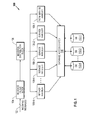
- the FR application architecture embodiment 100 is operable to provide for targeted routing of messages within the signaling network, preferably by means of a series of message filtration algorithms, specific routing logic blocks associated with various service handlers, and one or more databases that contain route-specific data on a subscriber-by-subscriber basis, for effectuating the TCTB service.
- a message filter block 104 is provided as part of the FR application architecture embodiment 100 for effectuating appropriate filtration with respect to incoming signaling messages (e.g., the Message Transfer Part or MTP messages of the Signaling System No. 7 Standard) on selected linksets 102 coupled to the STP node.
- incoming signaling messages e.g., the Message Transfer Part or MTP messages of the Signaling System No. 7 Standard
- the network operator has the capability to provision and enable the incoming linksets on which the message filtering may be performed.
- MTP message filtering The purpose of MTP message filtering is to examine the message header contents in order to determine if the message needs to be processed by an appropriate service handler. In an exemplary embodiment, the following items are examined for this determination: (i) incoming linkset and (ii) MTP Service Information Octet (SIO).
- a message distributor block 106 is provided for distributing the MTP messages to one of a plurality of service handlers 108-1 through 108-N based on the message header examination, each of which includes service logic operable to query a local database via a database access system 110.
- DB 112-1 through DB 112-K are exemplified with respect to the FR application architecture embodiment 100 shown in FIG. 1.
- each service handler is comprised of service-specific routing logic that is responsible for effectuating appropriate call treatment with respect to a particular incoming signaling message based on one or more results obtained from a database query operation.
- the TCTB service is preferably effectuated within the FR application architecture embodiment 100 by means of one of the service handlers, e.g., Call Type Blocking service handler 108-1, with respect to incoming signaling messages received on linksets that have been provisioned and enabled for the service.
- these signaling messages may be generated pursuant to voice or data calls originated by calling parties served by a local exchange switch, e.g., a Class 5 switch, coupled to the STP node, such signaling messages may also emanate from networks that are foreign to the network portion to which the serving STP node belongs.
- a local exchange switch e.g., a Class 5 switch
- the TCTB service is effectuated on the basis of Call Type, which can be any communications service performed for a subscriber, e.g., local calling, long distance calling, carrier selection, automatic collect calling, international dialing, 800 and 900 services, et cetera.
- a controlled service is a service of particular Call Type for which the TCTB service logic is invoked in order to determine appropriate call treatment based on database query.
- each controlled service may be identified by a Service Key of a predetermined number of digits that corresponds to a specific Call Type.
- the network operator has the capability to enable on which incoming linksets the message filtering is to be performed for the TCTB service.
- the MTP SIO is set to a particular SS7-compliant User Part, namely, the Integrated Services Digital Network (ISDN) User Part or ISUP.
- ISDN Integrated Services Digital Network
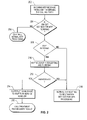
- the message filtration block 104 further examines the incoming messages in order to effectuate ISUP message filtering before the TCTB service handler is invoked for determining appropriate treatment.
- the TCTB service handler is operable to query a database associated with the STP based on one or more subscriber parameters contained in the message and its Call Type.
- the subscriber parameters may comprise the E.164 directory numbers associated with the calling party (CgPN), called party (CdPN), or both.
- the service database may include several database portions, e.g., a database portion containing Single or Ranged E.164 numbers and restrictions associated therewith on accessing predefined controlled services, et cetera.
- the service logic of the TCTB service handler determines appropriate call treatment, e.g., call termination, re-routing and the like (block 216).
- the intercepted message is not an IAM message
- the received message undergoes normal MTP routing based on its Destination Point Code (DPC) without further processing (block 218).
- DPC Destination Point Code
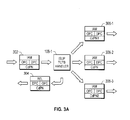
- FIG. 3A depicts an exemplary embodiment of a scheme for treating an incoming signaling message 302 on a TCTB-enabled linkset in accordance with the teachings of the present invention.
- the signaling message 302 comprises the ISUP IAM message, an Origination Point Code (OPC), a Destination Point Code (DPC) and Called Party Number (CdPN).
- Service logic associated with the ISUP TCTB handler 108-1 is operable to query the TCTB database using CdPN. In one implementation, if CdPN belongs to a restricted number or range of numbers, the service logic is able to issue an ISUP Release (REL) message 304 towards the serving switch that originated the signaling message 302 so that the call may be terminated.
- REL ISUP Release
- the restriction profile associated with CdPN may be such that when a call is placed to that number, it may be re-routed to one or more different destinations by modifying the downstream IAM messages. Accordingly, in general, where an incoming call is modified to be treated differently, the resulting effect may be deemed as "call blocking.” On the other hand, where it is determined that no restrictions are applicable, the IAM message is simply forwarded to the called party's switch.
- reference numerals 306-1 through 306-3 refer to these exemplary scenarios.
- FIG. 3B depicted therein is a flow chart of the various operations involved in an ISUP TCTB service handling methodology of the present invention.
- a TCTB database is queried using CgPN and/or CdPN information associated with the incoming messages generated pursuant to a controlled service (block 352).
- CgPN and/or CdPN information associated with the incoming messages generated pursuant to a controlled service
- one or more response actions may be executed by the ISUP TCTB service handler functionality as part of its call treatment logic.
- the call may be continued to its intended destination (block 356A), it may be re-routed to another destination (block 356B), or it may be blocked, i.e., terminated (block 356C).
- the ISUP TCTB service handler may be designed to execute a number of procedures and query various databases that may be common to other service handlers of the FR application architecture, thereby eliminating redundancy.
- the following databases may be provisioned within the FR service application architecture: Calling Line Identity Verification (CLIV) database, International Mobile Station Identity (IMSI) database, E.164 Single Number Database, E.164 Range database, Call Type Blocking (CTB) Subscriber Number database, CTB General Controlled Number database, and CTB List database, each database being deployed and provisioned to meet the specific data requirements of an individual service handler, including the ISUP TCTB service handler, or a group of handlers, within the FR service application architecture.
- CLIV Calling Line Identity Verification
- IMSI International Mobile Station Identity
- E.164 Single Number Database E.164 Range database
- CTB Call Type Blocking
- CTB CTB General Controlled Number database
- CTB List database each database being deployed and provisioned to meet the specific data requirements of an individual service handler, including the ISUP TCTB service handler, or a group of handlers, within the FR service application architecture.
- the CTB Subscriber Number database may be provisioned to store both single and ranges of directory numbers in accordance with the E.164 numbering plan.
- the purpose of this data is to restrict single and ranges of E.164 numbers (i.e., blocks of subscriber numbers, which can be called party numbers or calling party numbers) for specific Call Types (as may be defined by Service Keys). Essentially, those Call Types that are restricted for a subscriber number are provided with a Release Cause value associated with the Service Key.
- the CTB List database may also be provisioned to store both single and ranges of numbers that are associated with lists of restricted numbers. Th purpose of this data is to restrict access to single and ranges of numbers associated with a list ID. Two different types of lists may be provided for each controlled subscriber: system lists or custom lists.
- Calls to these list numbers may be treated as defined by Release Cause values associated with the Custom List ID or System List ID in the CTB Subscriber Number database. Additional details regarding the TCTB database implementation and provisioning are provided in the following commonly owned co-pending patent application(s): (i) "Triggerless Call Treatment Service Implementation in a Telecommunications Network," Application No. , filed (Attorney Docket Number: 1285-0127US), in the name(s) of: Vicente Melillo de Souza Lopes, Maureen Rose O'Toole and Ramesh K. Bhardwaj, cross-referenced hereinabove and incorporated by reference herein.
- FIG. 4 depicts a flow chart of the various operations of an embodiment of an E.164 database query method for use in conjunction with a directory number search by an exemplary ISUP TCTB service handler.
- a search may be performed for obtaining routing information with respect to the directory number.
- Upon launching the search algorithm (block 402), a determination is made if a Single Number database is present (decision block 404). If so, the search flow then determines if the directory number's information is found in the Single Number database (decision block 408). A "FOUND" indication is provided if a positive result is obtained from the Single Number database query (block 410).
- the digits that are used to search the database are usually a subset of the E.164 numbering plan. In general, these digits are only the National Significant portion of the complete, received digits. However, the complete digit stream may contain many non-National components such as an E.164 Country Code, an Inter-Network Routing Number or INRN, or an internal network identifier. It may therefore be necessary to perform a digit analysis on a received sequence of digits in order to derive the final digit subset that is used to search the E.164 database(s).
- an address analysis may have to be performed as part of the digit analysis to examine the type of address that was received in an incoming signaling message.
- This information may be contained in a signaling parameter (e.g., Nature of Address parameter) that communicates the information necessary to interpret the composition of address digits.
- FIG. 5 depicts a flow chart of the various operations of an embodiment of an exemplary address analysis procedure for use in conjunction with an E.164 database query by the TCTB service handler.
- the address analysis is designed to indicate whether or not the address contains a Country Code, which is important to recognize since this Code is not used as part the E.164 database search criteria.
- the Nature of Address parametric value of an intercepted signaling message is examined (block 504).
- the recognition of a Country Code contained within the received digit sequence is necessary only when the associated Nature of Address parameter for the digit sequence indicates that it is an International Number. If the Nature of Address parameter is set to "Explicit International”, then an indication to that effect is provided (block 506). With the National numbers, there is no Country Code that is contained within the received address. If the Nature of Address parameter or its equivalent is set to "Explicit National", an indication that the received address is a national address may be provided (block 508). On the other hand, if the Nature of Address parameter (or its equivalent) is not one of the supported values, then it is the responsibility of the individual service handlers to determine the action taken upon receipt of messages having such unsupported addresses (block 510).
- FIG. 6 depicted therein is an exemplary embodiment of a telecommunications network portion 600 for effectuating a TCTB system and method in accordance with the teachings of the present invention.
- a calling party as exemplified by the telephony equipment 602
- a local switch 604 serving the calling party 602 generates an ISUP IAM message 606 to an STP node 608 as part of the requisite signaling during call setup.
- the STP node 608 is provided with the TCTB capability by means of service handler 108-1, whose database(s) 610 and service logic are provisioned by an administration (ADMIN) node 612 coupled thereto.
- ADMIN administration
- ADMIN node 612 and STP 608 may be coupled together via a separate network for carrying operations, administration and maintenance control traffic, and further that ADMIN node 612 may be provided with appropriate man-machine interfaces for provisioning the STP's linksets, databases, and service handlers. If the incoming IAM message 606 is received on a linkset enabled and provisioned for the TCTB service, depending on results obtained from database query by the service logic, a downstream IAM message 614 may be propagated to another switch 616.
- the downstream IAM message 614 may include the original or modified destination address, responsive to which the downstream switch 616 can route the call to the called party destination 618, route the call to a calling center 620, or route the call to a suitable announcement system 622. Also, if the TCTB service logic determines that the call needs to be terminated or blocked, a REL message 624 may be propagated back to the originating switch 604, which will disconnect the call.
- the present invention advantageously provides a scheme for effectuating a Triggerless Call Blocking service based on Call Types that imposes minimal impact on the existing service infrastructure.
- advanced network controls that can be provisioned within the TCTB service architecture, several benefits can be realized such as, e.g., selective network access, real-time call validation, selective call blocking (for instance, blocking calls from subscribers in debt), filtering of calls to illegal destinations, et cetera.
Landscapes
- Engineering & Computer Science (AREA)
- Computer Networks & Wireless Communication (AREA)
- Telephonic Communication Services (AREA)
- Mobile Radio Communication Systems (AREA)
Abstract
A Triggerless Call Type Blocking (TCTB) system and method in a telecommunications network. Upon intercepting an incoming signaling message received at an STP on a selected linkset, a database provided with the STP is queried based on subscriber number information in the incoming message. Service logic at STP is operable to provide call treatment, including termination, based on the results obtained from the database. <IMAGE>
Description
The present invention generally relates to
telecommunications networks. More particularly, and not by
way of any limitation, the present invention is directed to
a triggerless call blocking system and method in a
telecommunications network.
Today, network operators have to contend with a
variety of scenarios that pose significant challenges:
rapid technological evolution, access to network by
fraudulent users, diverse switching service providers,
smuggling of international dialing services, lack of Signal
Switching Point (SSP) functionality at most local switches,
steady shrinkage of paying subscriber base, and ever-increasing
competition, just to name a few. To address the
concerns that arise from such challenges, network operators
need a multitude of advanced network controls such as, for
example, selective network access, real-time call
validation, selective call blocking, filtering of illegal
destinations, control of out-of-network customers, and the
like. Current solutions in this regard, however, require
costly upgrades in infrastructure in addition to having to
deal with different technologies and vendors. Furthermore,
service provisioning models in use today utilize a trigger-based
approach to access advanced call processing
capabilities which necessitates interaction with additional
network elements possibly operated by third-parties.
Accordingly, the present invention advantageously
provides a Triggerless Call Type Blocking (TCTB) service in
a telecommunications network that overcomes these and other
shortcomings and disadvantages. Upon intercepting an
incoming signaling message received at a Signal Transfer
Point (STP) on a selected linkset, a database provided with
the STP is queried based on subscriber number information
in the incoming message and the Call Type. Service logic at
STP is operable to provide call treatment, including call
termination, based on the results obtained from querying
the database.
In one aspect, the present invention is directed
to a TCTB method operable to be effectuated in a
telecommunications network. An incoming signaling message
received at an STP on a selected linkset is intercepted
based on whether the selected linkset has been provisioned
for the TCTB service. In general, the incoming signaling
message is generated pursuant to a call originated by a
calling party towards a called party. Thereafter, a
database associated with the STP is queried based on a
subscriber parameter contained in the incoming signaling
message. In one exemplary embodiment, the subscriber
parameter may comprise the calling party's directory
number. In another embodiment, the subscriber parameter may
comprise the called party's directory number. Depending on
the results obtained from the database responsive to the
foregoing querying operation, a particular call treatment
is effectuated by the STP. For instance, the call may be
terminated, re-routed to a call center, or forwarded to an
announcement system.
In another aspect, the present invention is
directed to a TCTB system operable to be effectuated in a
telecommunications network. A structure is provided for
intercepting an incoming signaling message received at an
STP node on a selected linkset, depending on whether the
selected linkset has been provisioned for the TCTB service.
If so, another structure is activatable for querying a
database associated with the STP based on a subscriber
parameter contained in the incoming signaling message.
Depending on the results obtained from the database
responsive to the foregoing querying operation, a
particular call treatment, e.g., call termination, may be
effectuated by the STP. In one embodiment, the various
structures set forth above may comprise software, firmware,
hardware, or any combination thereof, that is executable by
one or more processors associated with the STP node.
In yet another aspect, the present invention is
directed to a Flexible Routing application system
associated with an STP node for effectuating a TCTB service
in a telecommunications network. A message filter is
provided for intercepting and examining incoming Message
Transfer Part (MTP) messages on selected linksets
associated with the STP node. Based upon examination, a
message distributer is operable to distribute a particular
MTP message to a TCTB service handler upon determining that
the particular MTP message is received on a linkset enabled
for the TCTB service. A database is operable to be queried
by the TCTB service handler based on a subscriber number
parameter associated with the particular MTP message and
its Call Type. Service logic provided with the TCTB service
handler effectuates call treatment with respect to the
particular MTP message based on a result obtained from the
database responsive to a querying operation, e.g., call
termination, re-routing, et cetera.
A more complete understanding of the present
invention may be had by reference to the following Detailed
Description when taken in conjunction with the accompanying
drawings wherein:
In the drawings, like or similar elements are
designated with identical reference numerals throughout the
several views thereof, and the various elements depicted
are not necessarily drawn to scale. Referring now in
particular to FIG. 1, depicted therein is an embodiment of
a Flexible Routing (FR) application architecture 100 for
effectuating a Triggerless Call Type Blocking (TCTB)
service system and method in accordance with the teachings
of the present invention. For purposes of the present
patent application, the exemplary FR application
architecture embodiment 100 is integrated as part of a
Signal Transfer Point (STP) node disposed on a signaling
network portion of a telecommunications network (not
shown). As will be seen below, the FR application
architecture embodiment 100 is operable to provide for
targeted routing of messages within the signaling network,
preferably by means of a series of message filtration
algorithms, specific routing logic blocks associated with
various service handlers, and one or more databases that
contain route-specific data on a subscriber-by-subscriber
basis, for effectuating the TCTB service.
A message filter block 104 is provided as part of
the FR application architecture embodiment 100 for
effectuating appropriate filtration with respect to
incoming signaling messages (e.g., the Message Transfer
Part or MTP messages of the Signaling System No. 7
Standard) on selected linksets 102 coupled to the STP node.
Preferably, the network operator has the capability to
provision and enable the incoming linksets on which the
message filtering may be performed.
The purpose of MTP message filtering is to
examine the message header contents in order to determine
if the message needs to be processed by an appropriate
service handler. In an exemplary embodiment, the following
items are examined for this determination: (i) incoming
linkset and (ii) MTP Service Information Octet (SIO). A
message distributor block 106 is provided for distributing
the MTP messages to one of a plurality of service handlers
108-1 through 108-N based on the message header
examination, each of which includes service logic operable
to query a local database via a database access system 110.
By way of illustration, a plurality of databases, DB 112-1
through DB 112-K, are exemplified with respect to the FR
application architecture embodiment 100 shown in FIG. 1.
Further, each service handler is comprised of service-specific
routing logic that is responsible for effectuating
appropriate call treatment with respect to a particular
incoming signaling message based on one or more results
obtained from a database query operation.
As pointed out hereinabove, the TCTB service is
preferably effectuated within the FR application
architecture embodiment 100 by means of one of the service
handlers, e.g., Call Type Blocking service handler 108-1,
with respect to incoming signaling messages received on
linksets that have been provisioned and enabled for the
service. Whereas these signaling messages may be generated
pursuant to voice or data calls originated by calling
parties served by a local exchange switch, e.g., a Class 5
switch, coupled to the STP node, such signaling messages
may also emanate from networks that are foreign to the
network portion to which the serving STP node belongs. In
either case, whether the TCTB service logic at the STP node
is invoked depends on the linkset enablement and
provisioning by the network operator.
In accordance with the teachings of the present
invention, the TCTB service is effectuated on the basis of
Call Type, which can be any communications service
performed for a subscriber, e.g., local calling, long
distance calling, carrier selection, automatic collect
calling, international dialing, 800 and 900 services, et
cetera. A controlled service is a service of particular
Call Type for which the TCTB service logic is invoked in
order to determine appropriate call treatment based on
database query. In one implementation, each controlled
service may be identified by a Service Key of a
predetermined number of digits that corresponds to a
specific Call Type.
As alluded to before, the network operator has
the capability to enable on which incoming linksets the
message filtering is to be performed for the TCTB service.
On these linksets, the MTP SIO is set to a particular SS7-compliant
User Part, namely, the Integrated Services
Digital Network (ISDN) User Part or ISUP. Where so enabled,
the message filtration block 104 further examines the
incoming messages in order to effectuate ISUP message
filtering before the TCTB service handler is invoked for
determining appropriate treatment. These operations are set
forth in additional detail in the flow chart shown in FIG.
2, where an embodiment of the TCTB methodology of the
present invention is exemplified.
Upon receiving an incoming MTP message from a
switch serving a calling party (block 202), a determination
is made whether the linkset on which the message is
received is defined for MTP message filtering (decision
block 204). If the linkset is not defined for MTP message
filtering, the received MTP message undergoes normal MTP
processing in accordance with standard MTP routing
procedures (block 206). On the other hand, if the linkset
is enabled for MTP filtering, a further examination is made
(decision block 208) so as to determine if the MTP's SIO is
set to "ISUP", which enables ISUP message intercepting and
filtering (block 210). Otherwise, normal MTP routing
process will take place (block 218).
As part of the ISUP message filtration process, a
determination is made as to the received ISUP message type
(decision block 212). If the intercepted ISUP message is an
Initial Address Message (IAM), the message is distributed
to the TCTB service handler via a message distributor
(block 214). As set forth above, the TCTB service handler
is operable to query a database associated with the STP
based on one or more subscriber parameters contained in the
message and its Call Type. By way of exemplary
implementation, the subscriber parameters may comprise the
E.164 directory numbers associated with the calling party
(CgPN), called party (CdPN), or both. Further, the service
database may include several database portions, e.g., a
database portion containing Single or Ranged E.164 numbers
and restrictions associated therewith on accessing
predefined controlled services, et cetera. Based on a
result obtained from querying the database, the service
logic of the TCTB service handler determines appropriate
call treatment, e.g., call termination, re-routing and the
like (block 216).
On the other hand, if the intercepted message is
not an IAM message, the received message undergoes normal
MTP routing based on its Destination Point Code (DPC)
without further processing (block 218).
FIG. 3A depicts an exemplary embodiment of a
scheme for treating an incoming signaling message 302 on a
TCTB-enabled linkset in accordance with the teachings of
the present invention. The signaling message 302 comprises
the ISUP IAM message, an Origination Point Code (OPC), a
Destination Point Code (DPC) and Called Party Number
(CdPN). Service logic associated with the ISUP TCTB handler
108-1 is operable to query the TCTB database using CdPN. In
one implementation, if CdPN belongs to a restricted number
or range of numbers, the service logic is able to issue an
ISUP Release (REL) message 304 towards the serving switch
that originated the signaling message 302 so that the call
may be terminated. In another implementation, the
restriction profile associated with CdPN may be such that
when a call is placed to that number, it may be re-routed
to one or more different destinations by modifying the
downstream IAM messages. Accordingly, in general, where an
incoming call is modified to be treated differently, the
resulting effect may be deemed as "call blocking." On the
other hand, where it is determined that no restrictions are
applicable, the IAM message is simply forwarded to the
called party's switch. In FIG. 3A, reference numerals 306-1
through 306-3 refer to these exemplary scenarios.
Referring now to FIG. 3B, depicted therein is a
flow chart of the various operations involved in an ISUP
TCTB service handling methodology of the present invention.
Upon intercepting ISUP IAM messages on selected linksets
(block 350), a TCTB database is queried using CgPN and/or
CdPN information associated with the incoming messages
generated pursuant to a controlled service (block 352).
Upon obtaining a result from the local TCTB database (block
354), one or more response actions may be executed by the
ISUP TCTB service handler functionality as part of its call
treatment logic. As pointed out before, the call may be
continued to its intended destination (block 356A), it may
be re-routed to another destination (block 356B), or it may
be blocked, i.e., terminated (block 356C).
As part of the FR service application
architecture of an STP provided in accordance with the
teachings of the present invention, the ISUP TCTB service
handler may be designed to execute a number of procedures
and query various databases that may be common to other
service handlers of the FR application architecture,
thereby eliminating redundancy. For example, the following
databases may be provisioned within the FR service
application architecture: Calling Line Identity
Verification (CLIV) database, International Mobile Station
Identity (IMSI) database, E.164 Single Number Database,
E.164 Range database, Call Type Blocking (CTB) Subscriber
Number database, CTB General Controlled Number database,
and CTB List database, each database being deployed and
provisioned to meet the specific data requirements of an
individual service handler, including the ISUP TCTB service
handler, or a group of handlers, within the FR service
application architecture.
The CTB Subscriber Number database may be
provisioned to store both single and ranges of directory
numbers in accordance with the E.164 numbering plan. The
purpose of this data is to restrict single and ranges of
E.164 numbers (i.e., blocks of subscriber numbers, which
can be called party numbers or calling party numbers) for
specific Call Types (as may be defined by Service Keys).
Essentially, those Call Types that are restricted for a
subscriber number are provided with a Release Cause value
associated with the Service Key. The CTB List database may
also be provisioned to store both single and ranges of
numbers that are associated with lists of restricted
numbers. Th purpose of this data is to restrict access to
single and ranges of numbers associated with a list ID. Two
different types of lists may be provided for each
controlled subscriber: system lists or custom lists. Calls
to these list numbers may be treated as defined by Release
Cause values associated with the Custom List ID or System
List ID in the CTB Subscriber Number database. Additional
details regarding the TCTB database implementation and
provisioning are provided in the following commonly owned
co-pending patent application(s): (i) "Triggerless Call
Treatment Service Implementation in a Telecommunications
Network," Application No. , filed
(Attorney Docket Number: 1285-0127US), in the name(s) of:
Vicente Melillo de Souza Lopes, Maureen Rose O'Toole and
Ramesh K. Bhardwaj, cross-referenced hereinabove and
incorporated by reference herein.
FIG. 4 depicts a flow chart of the various
operations of an embodiment of an E.164 database query
method for use in conjunction with a directory number
search by an exemplary ISUP TCTB service handler. As those
skilled in the art will appreciate, such a search may be
performed for obtaining routing information with respect to
the directory number. Upon launching the search algorithm
(block 402), a determination is made if a Single Number
database is present (decision block 404). If so, the search
flow then determines if the directory number's information
is found in the Single Number database (decision block
408). A "FOUND" indication is provided if a positive result
is obtained from the Single Number database query (block
410).
If the directory number's information is not
found in the Single Number database or if there was no
Single Number database in the first place, a determination
is made if an E.164 Range database is present (decision
block 406). If the determination yields that no database is
available, a "NOT FOUND" indication is provided (block
412). Otherwise, the search flow will continue so that a
further determination is made whether the directory
number's routing information is located in the E.164 Range
database (decision block 414). A "NOT FOUND" indication may
be provided upon obtaining a negative result (block 416). A
matching determination is made to verify whether there is a
complete match in the requested directory number so as to
avoid ambiguity (decision block 420). If the match is
complete, a "FOUND" indication is provided (block 422).
Otherwise, an indication of unresolved directory number may
be provided (block 420).
For each service handler, including the ISUP TCTB
service handler, that is required to search the E.164
database(s), the digits that are used to search the
database are usually a subset of the E.164 numbering plan.
In general, these digits are only the National Significant
portion of the complete, received digits. However, the
complete digit stream may contain many non-National
components such as an E.164 Country Code, an Inter-Network
Routing Number or INRN, or an internal network identifier.
It may therefore be necessary to perform a digit analysis
on a received sequence of digits in order to derive the
final digit subset that is used to search the E.164
database(s). In addition, an address analysis may have to
be performed as part of the digit analysis to examine the
type of address that was received in an incoming signaling
message. This information may be contained in a signaling
parameter (e.g., Nature of Address parameter) that
communicates the information necessary to interpret the
composition of address digits.
FIG. 5 depicts a flow chart of the various
operations of an embodiment of an exemplary address
analysis procedure for use in conjunction with an E.164
database query by the TCTB service handler. At its root,
the address analysis is designed to indicate whether or not
the address contains a Country Code, which is important to
recognize since this Code is not used as part the E.164
database search criteria.
Upon launching the address analysis procedure
(block 502), the Nature of Address parametric value of an
intercepted signaling message is examined (block 504). The
recognition of a Country Code contained within the received
digit sequence is necessary only when the associated Nature
of Address parameter for the digit sequence indicates that
it is an International Number. If the Nature of Address
parameter is set to "Explicit International", then an
indication to that effect is provided (block 506). With the
National numbers, there is no Country Code that is
contained within the received address. If the Nature of
Address parameter or its equivalent is set to "Explicit
National", an indication that the received address is a
national address may be provided (block 508). On the other
hand, if the Nature of Address parameter (or its
equivalent) is not one of the supported values, then it is
the responsibility of the individual service handlers to
determine the action taken upon receipt of messages having
such unsupported addresses (block 510).
Where the Nature of Address parameter is neither
explicitly international, explicitly national, nor
unsupported, a further analysis may be needed to determine
the nature of any implied address. A determination is first
made to verify if the leading digits are set to "00"
(decision block 512). If so, the leading "00" digits are
removed (block 514) and an indication of an international
address is provided (block 518). If there are no leading
double zeros, then yet another determination is made to
verify if the leading digit is set to "0" (decision block
516). If so, the leading "0" is removed (block 522) and an
indication of a national address is provided (block 520),
which is also the result when it is determined that the
leading digit is not set to "0".
Referring now to FIG. 6, depicted therein is an
exemplary embodiment of a telecommunications network
portion 600 for effectuating a TCTB system and method in
accordance with the teachings of the present invention.
When a calling party, as exemplified by the telephony
equipment 602, attempts to originate a controlled service
call to a called party, a local switch 604 serving the
calling party 602 generates an ISUP IAM message 606 to an
STP node 608 as part of the requisite signaling during call
setup. The STP node 608 is provided with the TCTB
capability by means of service handler 108-1, whose
database(s) 610 and service logic are provisioned by an
administration (ADMIN) node 612 coupled thereto. Those
skilled in the art will recognize that ADMIN node 612 and
STP 608 may be coupled together via a separate network for
carrying operations, administration and maintenance control
traffic, and further that ADMIN node 612 may be provided
with appropriate man-machine interfaces for provisioning
the STP's linksets, databases, and service handlers. If the
incoming IAM message 606 is received on a linkset enabled
and provisioned for the TCTB service, depending on results
obtained from database query by the service logic, a
downstream IAM message 614 may be propagated to another
switch 616. The downstream IAM message 614 may include the
original or modified destination address, responsive to
which the downstream switch 616 can route the call to the
called party destination 618, route the call to a calling
center 620, or route the call to a suitable announcement
system 622. Also, if the TCTB service logic determines that
the call needs to be terminated or blocked, a REL message
624 may be propagated back to the originating switch 604,
which will disconnect the call.
Based upon the foregoing Detailed Description, it
should be readily apparent that the present invention
advantageously provides a scheme for effectuating a
Triggerless Call Blocking service based on Call Types that
imposes minimal impact on the existing service
infrastructure. With the advanced network controls that can
be provisioned within the TCTB service architecture,
several benefits can be realized such as, e.g., selective
network access, real-time call validation, selective call
blocking (for instance, blocking calls from subscribers in
debt), filtering of calls to illegal destinations, et
cetera.
It is believed that the operation and
construction of the present invention will be apparent from
the foregoing Detailed Description. While one or more of
the exemplary embodiments of the invention shown and
described have been characterized as being preferred, it
should be readily understood that various changes and
modifications could be made therein without departing from
the scope of the present invention as set forth in the
following claims.
Claims (10)
- A flexible routing application system associated with a Signal Transfer Point (STP) (608) for effectuating a Triggerless Call Type Blocking (TCTB) service in a telecommunications network, comprising:a message filter (104) operating to intercept incoming Message Transfer Part (MTP) messages (102), said message filter (104) for examining message headers associated with said MTP messages (102) in order to determine if a particular message requires a service handler;a message distributor (106) operating to distribute a particular MTP message to a TCTB service handler (108-1) upon determining that said particular MTP message is received on a linkset enabled for said TCTB service;a database (112-1 through 112-K) operable to be queried by said TCTB service handler (108-1) based on a subscriber number parameter associated with said particular MTP message; andservice logic provided with said TCTB service handler (108-1) for effectuating call treatment with respect to said particular MTP message based on a result obtained from said database (112-1 through 112-K) responsive to a querying operation.
- The flexible routing application system associated with an STP (608) for effectuating a TCTB service in a telecommunications network as set forth in claim 1, wherein said service logic is operable to effectuate one of call re-routing, call termination, and call continuation based on a result obtained from said database (112-1 through 112-K).
- A Triggerless Call Type Blocking (TCTB) method in a telecommunications network, comprising:intercepting an incoming signaling message (606) received at a Signal Transfer Point (STP) (608) on a selected linkset, wherein said incoming signaling message (606) is generated pursuant to a call originated by a calling party (602) towards a called party;querying a database (610) associated with said STP (608) based on a parameter contained in said incoming signaling message (606); andtreating said call by said STP (608) depending on a result obtained from said database (610) responsive to said querying operation.
- The TCTB method in a telecommunications network as set forth in claim 3, wherein said database (610) is integrated with said STP (608).
- The TCTB method in a telecommunications network as set forth in claim 3 or claim 4, wherein said parameter contained in said incoming signaling message (606) comprises a directory number associated with said calling party.
- The TCTB method in a telecommunications network as set forth in claim 3 or claim 4, wherein said parameter contained in said incoming signaling message (606) comprises a directory number associated with said called party.
- The TCTB method in a telecommunications network as set forth in claim 3, claim 4, claim 5 or claim 6, wherein said call is continued to said called party.
- The TCTB method in a telecommunications network as set forth in claim 3, claim 4, claim 5 or claim 6, wherein said call is re-routed to another destination.
- The TCTB method in a telecommunications network as set forth in claim 3, claim 4, claim 5 or claim 6, wherein said call is terminated.
- The TCTB method in a telecommunications network as set forth in claim 3, claim 4, claim 5, claim 6, claim 7, claim 8 or claim 9, wherein said call is originated in a network portion other than a network portion native to said STP (608).
Applications Claiming Priority (2)
| Application Number | Priority Date | Filing Date | Title |
|---|---|---|---|
| US37803802P | 2002-05-15 | 2002-05-15 | |
| US378038P | 2002-05-15 |
Publications (1)
| Publication Number | Publication Date |
|---|---|
| EP1363465A2 true EP1363465A2 (en) | 2003-11-19 |
Family
ID=29270788
Family Applications (2)
| Application Number | Title | Priority Date | Filing Date |
|---|---|---|---|
| EP03009887A Withdrawn EP1363464A2 (en) | 2002-05-15 | 2003-05-15 | Triggerless call treatment service implementation in a telecommunications network |
| EP03009888A Withdrawn EP1363465A2 (en) | 2002-05-15 | 2003-05-15 | Triggerless call type blocking system and method in a telecommunications network |
Family Applications Before (1)
| Application Number | Title | Priority Date | Filing Date |
|---|---|---|---|
| EP03009887A Withdrawn EP1363464A2 (en) | 2002-05-15 | 2003-05-15 | Triggerless call treatment service implementation in a telecommunications network |
Country Status (2)
| Country | Link |
|---|---|
| US (2) | US20030215081A1 (en) |
| EP (2) | EP1363464A2 (en) |
Cited By (1)
| Publication number | Priority date | Publication date | Assignee | Title |
|---|---|---|---|---|
| US4565637A (en) * | 1982-12-22 | 1986-01-21 | Steetley Refractories Limited | Method of, and apparatus for, filtering a slurry |
Families Citing this family (2)
| Publication number | Priority date | Publication date | Assignee | Title |
|---|---|---|---|---|
| US20100208878A1 (en) * | 2007-08-31 | 2010-08-19 | Panasonic Corporation | Communication apparatus and registration method |
| US8509222B2 (en) * | 2010-02-12 | 2013-08-13 | Ibasis, Inc. | Common routing |
Family Cites Families (5)
| Publication number | Priority date | Publication date | Assignee | Title |
|---|---|---|---|---|
| US5586177A (en) * | 1995-09-06 | 1996-12-17 | Bell Atlantic Network Services, Inc. | Intelligent signal transfer point (ISTP) |
| US6639981B1 (en) * | 1999-04-05 | 2003-10-28 | Tekelec | Methods and systems for routing signaling messages associated with ported subscribers in a communications network |
| US6574327B2 (en) * | 2000-03-02 | 2003-06-03 | Alcatel Usa Sourcing, L.P. | Apparatus and method of processing local number portability calls in a signal transfer point of a telecommunications network |
| US6647113B2 (en) * | 2000-05-05 | 2003-11-11 | Tekelec | Methods and systems for providing universal triggerless number portability |
| US6466792B1 (en) * | 2000-10-23 | 2002-10-15 | Alcatel | System and method for effectuating selective triggerless local number portability in a telecommunications network |
-
2003
- 2003-05-12 US US10/435,793 patent/US20030215081A1/en not_active Abandoned
- 2003-05-12 US US10/436,345 patent/US20030215082A1/en not_active Abandoned
- 2003-05-15 EP EP03009887A patent/EP1363464A2/en not_active Withdrawn
- 2003-05-15 EP EP03009888A patent/EP1363465A2/en not_active Withdrawn
Cited By (1)
| Publication number | Priority date | Publication date | Assignee | Title |
|---|---|---|---|---|
| US4565637A (en) * | 1982-12-22 | 1986-01-21 | Steetley Refractories Limited | Method of, and apparatus for, filtering a slurry |
Also Published As
| Publication number | Publication date |
|---|---|
| US20030215081A1 (en) | 2003-11-20 |
| US20030215082A1 (en) | 2003-11-20 |
| EP1363464A2 (en) | 2003-11-19 |
Similar Documents
| Publication | Publication Date | Title |
|---|---|---|
| US6856598B1 (en) | Communications system | |
| US5694463A (en) | System for service control point routing | |
| AU749173B2 (en) | Intercepting call communications within an intelligent network | |
| US5793857A (en) | Method of using dynamic database to improve telephone number portability | |
| US5473677A (en) | Telecommunications network architecture and system | |
| US5572579A (en) | System and method for providing portable telephone number service | |
| EP1013107B1 (en) | Local number portability | |
| AU709864B2 (en) | Enhanced efficient telephone number portability | |
| GB2315953A (en) | Number portability | |
| US7616623B1 (en) | Technique for providing intelligent features for calls in a communications network independent of network architecture | |
| EP1013106B1 (en) | Local number portability intelligent signaling transfer point | |
| JP3796126B2 (en) | Intelligent network telecommunications system that strategically creates and employs service-dependent pseudo-call line identifier (CLI) to eliminate double charging errors | |
| EP1363465A2 (en) | Triggerless call type blocking system and method in a telecommunications network | |
| US6081590A (en) | Call treatment in portable number networks | |
| US6683946B2 (en) | Local exchange carrier escape list for local number portability | |
| US5757903A (en) | Flexible direct and shared termination call processing | |
| US6529483B1 (en) | Communication system, method and processing means for switching calls via a transmission network disposed between two local networks | |
| JP2001506823A (en) | Call control method | |
| US6968051B1 (en) | Programmable feature queues | |
| JP2002510170A (en) | Caller confirmation | |
| MXPA99010852A (en) | Interexchange carrier escape list for local number portability |
Legal Events
| Date | Code | Title | Description |
|---|---|---|---|
| PUAI | Public reference made under article 153(3) epc to a published international application that has entered the european phase |
Free format text: ORIGINAL CODE: 0009012 |
|
| AK | Designated contracting states |
Kind code of ref document: A2 Designated state(s): AT BE BG CH CY CZ DE DK EE ES FI FR GB GR HU IE IT LI LU MC NL PT RO SE SI SK TR |
|
| AX | Request for extension of the european patent |
Extension state: AL LT LV MK |
|
| STAA | Information on the status of an ep patent application or granted ep patent |
Free format text: STATUS: THE APPLICATION HAS BEEN WITHDRAWN |
|
| 18W | Application withdrawn |
Effective date: 20050319 |