EP1363456A2 - Video-on-demand service system and method of dynamic image distribution - Google Patents
Video-on-demand service system and method of dynamic image distribution Download PDFInfo
- Publication number
- EP1363456A2 EP1363456A2 EP03009749A EP03009749A EP1363456A2 EP 1363456 A2 EP1363456 A2 EP 1363456A2 EP 03009749 A EP03009749 A EP 03009749A EP 03009749 A EP03009749 A EP 03009749A EP 1363456 A2 EP1363456 A2 EP 1363456A2
- Authority
- EP
- European Patent Office
- Prior art keywords
- dynamic image
- wireless lan
- video
- request
- portable information
- Prior art date
- Legal status (The legal status is an assumption and is not a legal conclusion. Google has not performed a legal analysis and makes no representation as to the accuracy of the status listed.)
- Withdrawn
Links
Images



Classifications
-
- H—ELECTRICITY
- H04—ELECTRIC COMMUNICATION TECHNIQUE
- H04N—PICTORIAL COMMUNICATION, e.g. TELEVISION
- H04N7/00—Television systems
- H04N7/16—Analogue secrecy systems; Analogue subscription systems
- H04N7/173—Analogue secrecy systems; Analogue subscription systems with two-way working, e.g. subscriber sending a programme selection signal
- H04N7/17309—Transmission or handling of upstream communications
- H04N7/17318—Direct or substantially direct transmission and handling of requests
-
- H—ELECTRICITY
- H04—ELECTRIC COMMUNICATION TECHNIQUE
- H04N—PICTORIAL COMMUNICATION, e.g. TELEVISION
- H04N21/00—Selective content distribution, e.g. interactive television or video on demand [VOD]
- H04N21/20—Servers specifically adapted for the distribution of content, e.g. VOD servers; Operations thereof
- H04N21/21—Server components or server architectures
- H04N21/222—Secondary servers, e.g. proxy server, cable television Head-end
- H04N21/2223—Secondary servers, e.g. proxy server, cable television Head-end being a public access point, e.g. for downloading to or uploading from clients
-
- H—ELECTRICITY
- H04—ELECTRIC COMMUNICATION TECHNIQUE
- H04N—PICTORIAL COMMUNICATION, e.g. TELEVISION
- H04N21/00—Selective content distribution, e.g. interactive television or video on demand [VOD]
- H04N21/20—Servers specifically adapted for the distribution of content, e.g. VOD servers; Operations thereof
- H04N21/23—Processing of content or additional data; Elementary server operations; Server middleware
- H04N21/238—Interfacing the downstream path of the transmission network, e.g. adapting the transmission rate of a video stream to network bandwidth; Processing of multiplex streams
- H04N21/2381—Adapting the multiplex stream to a specific network, e.g. an Internet Protocol [IP] network
-
- H—ELECTRICITY
- H04—ELECTRIC COMMUNICATION TECHNIQUE
- H04N—PICTORIAL COMMUNICATION, e.g. TELEVISION
- H04N21/00—Selective content distribution, e.g. interactive television or video on demand [VOD]
- H04N21/20—Servers specifically adapted for the distribution of content, e.g. VOD servers; Operations thereof
- H04N21/25—Management operations performed by the server for facilitating the content distribution or administrating data related to end-users or client devices, e.g. end-user or client device authentication, learning user preferences for recommending movies
- H04N21/254—Management at additional data server, e.g. shopping server, rights management server
- H04N21/2543—Billing, e.g. for subscription services
-
- H—ELECTRICITY
- H04—ELECTRIC COMMUNICATION TECHNIQUE
- H04N—PICTORIAL COMMUNICATION, e.g. TELEVISION
- H04N21/00—Selective content distribution, e.g. interactive television or video on demand [VOD]
- H04N21/40—Client devices specifically adapted for the reception of or interaction with content, e.g. set-top-box [STB]; Operations thereof
- H04N21/41—Structure of client; Structure of client peripherals
- H04N21/4104—Peripherals receiving signals from specially adapted client devices
- H04N21/4126—The peripheral being portable, e.g. PDAs or mobile phones
-
- H—ELECTRICITY
- H04—ELECTRIC COMMUNICATION TECHNIQUE
- H04N—PICTORIAL COMMUNICATION, e.g. TELEVISION
- H04N21/00—Selective content distribution, e.g. interactive television or video on demand [VOD]
- H04N21/40—Client devices specifically adapted for the reception of or interaction with content, e.g. set-top-box [STB]; Operations thereof
- H04N21/43—Processing of content or additional data, e.g. demultiplexing additional data from a digital video stream; Elementary client operations, e.g. monitoring of home network or synchronising decoder's clock; Client middleware
- H04N21/436—Interfacing a local distribution network, e.g. communicating with another STB or one or more peripheral devices inside the home
- H04N21/4363—Adapting the video stream to a specific local network, e.g. a Bluetooth® network
- H04N21/43637—Adapting the video stream to a specific local network, e.g. a Bluetooth® network involving a wireless protocol, e.g. Bluetooth®, RF or wireless LAN [IEEE 802.11]
-
- H—ELECTRICITY
- H04—ELECTRIC COMMUNICATION TECHNIQUE
- H04N—PICTORIAL COMMUNICATION, e.g. TELEVISION
- H04N21/00—Selective content distribution, e.g. interactive television or video on demand [VOD]
- H04N21/40—Client devices specifically adapted for the reception of or interaction with content, e.g. set-top-box [STB]; Operations thereof
- H04N21/47—End-user applications
- H04N21/472—End-user interface for requesting content, additional data or services; End-user interface for interacting with content, e.g. for content reservation or setting reminders, for requesting event notification, for manipulating displayed content
- H04N21/47202—End-user interface for requesting content, additional data or services; End-user interface for interacting with content, e.g. for content reservation or setting reminders, for requesting event notification, for manipulating displayed content for requesting content on demand, e.g. video on demand
-
- H—ELECTRICITY
- H04—ELECTRIC COMMUNICATION TECHNIQUE
- H04N—PICTORIAL COMMUNICATION, e.g. TELEVISION
- H04N21/00—Selective content distribution, e.g. interactive television or video on demand [VOD]
- H04N21/60—Network structure or processes for video distribution between server and client or between remote clients; Control signalling between clients, server and network components; Transmission of management data between server and client, e.g. sending from server to client commands for recording incoming content stream; Communication details between server and client
- H04N21/65—Transmission of management data between client and server
- H04N21/658—Transmission by the client directed to the server
- H04N21/6581—Reference data, e.g. a movie identifier for ordering a movie or a product identifier in a home shopping application
Definitions
- the present invention relates to a video-on-demand service system and a method of dynamic image distribution and, in particular, to a dynamic image distribution of a television program, a movie program and the like.
- Portable display equipment such as portable televisions and DVD (Digital Versatile Disc) players and the like are known, to permit watching a television program while away from home.
- terminals have been developed for sending and receiving not only still images, but also dynamic images attached to an electronic mail, such terminals being representative of "third generation” or "3G" cellular networks, that is, terminals capable of receiving the content provided by a dynamic image.
- the above-described conventional image-receiving terminals and the like require an antenna having a sufficient size and directionality to receive a television radio wave in a good condition so as to secure a good picture quality.
- such terminals are bulky and unable to maintain a stable directionality while in motion, e.g., on a train.
- reception quality such conventional devices are often unable to permit viewing television or video while traveling, e.g., while being onboard a train and the like.
- An object of the present invention is to overcome or alleviate the above-described problems, at least in part, and to provide a video-on-demand system in which a dynamic image content of a television program, a movie program and the like can be downloaded inside a station house or receiving area in a short period of time and the dynamic image content can be reproduced and watched locally, e.g., while being aboard the train; as well as to provide a corresponding method of dynamic image distribution.
- system according to the invention preferably comprises:
- the present invention has advantages in that, in the place where the wireless LAN is built to distribute a dynamic image, the dynamic image corresponding to a request is distributed to the portable information terminal through a wireless LAN in response to the request from the portable information terminal, so that the content of the television program, the movie program and the like can be downloaded in a short period of time in the station house or receiving area, and the dynamic image content can be reproduced and watched, e.g., even while being aboard a train.
- FIG. 1 A Video-on-Demand Service System embodying the present invention will be described with reference to Fig. 1 through Fig. 5.
- a service provider is associated with a railroad company, and in the railroad facility 4 of the railroad company, each station house or each major station house 1-1 to 1-4 and a data center 5 of the service provider are connected by optical fibers 100 to 103.
- the optical fibers 101 to 103 connecting each of the station houses 1-1 to 1-4 are previously laid down by the railroad company, the same may be used.
- Communication equipment 2-1 to 2-4 is provided in each of the station house facilities 1-1 to 1-4 which are the object of the service.
- the communication equipment 2-1 to 2-4 exchange dynamic image content and control signals with a data center 5 through the optical fibers 100 to 103, and control base station devices (antennas) 3-1 to 3-4 and wireless LANs (Local Area Network) (not shown) inside each of the station house facilities 1-1 to 1-4, and distribute (download) the dynamic image content to the terminal (not shown) of the user.
- the service provider provides a server (not shown) to store broadcast programs and/or movie programs and a communication equipment (not shown) for providing communication between each station at the data center 5.
- the dynamic image content such as the broadcast program, the movie program and the like are supplied under a contract between the service provider and the broadcaster or movie distributor.
- the data center 5 is supplied with program data from the broadcaster terminal 6 and image data from the movie distributor terminal 7 respectively, these data are stored in the server.
- a transmission line may be used, or a recording medium may be used.
- each of the station house facilities 1-1 to 1-4 is generically designated as a station house facility 1
- the communication equipment 2-1 to 2-4 are generically designated as communication equipment 2.
- the construction of each of the station house facilities 1-1 to 1-4 and the communication equipment 2-1 to 2-4 is the same as the construction of the station house facility 1 and the communication equipment 2, respectively.
- the communication equipment 2 is provided in the station house facility 1, and is connected to the data center 5 by the optical fiber 100, and at the same time is connected also between the station house facility 1 and the next station by the optical fiber to relay the information with the data center 5. Furthermore, the communication equipment 2 is connected to the base station devices (antennas) 31 - 35 of a wireless LAN 200 through the wireless LAN 200.
- a high speed type regulated by the specification of the IEEE802.11a or a similar type having a data transmission speed of approximately 50 Mbps or a high speed type having not less than that speed is preferably used.
- the base stations 31 to 34 are provided on the platform 11, and perform the sending and receiving of signals via PDA (Personal Digital Assistant) .
- a base station 35 in this embodiment is provided in a concourse inside the station house facility 1, it should not be limited to a platform 11 or a concourse 12, but may be provided in a meeting spot, an outlet and the like inside the station house facility 1.
- four base station devices 31 to 34 are provided on the platform 11, needless to say, any desired number of devices may be provided by taking into consideration the access traffic of the user.
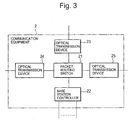
- the communication equipment 2 is constituted by a packet routing switch 21, a base station controller 22, and optical transmission devices 23 to 25.
- the packet routing switch 21 transmits packet data (dynamic image data) input from the optical transmission devices 23 to 25 to the base station controller 22 by switching, and the base station controller 22 delivers the packet data subjected to the switching by the packet routing switch 21 to a PDA 8 through the base station devices 31 to 35 which are connected.
- the communication equipment 2-1 to 2-4 shown in Fig. 1 have approximately the same construction as that of the communication equipment 2, and have the same operation accordingly.
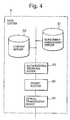
- the data center 5 is constituted by a subscriber management server 51, a content server 52, an authorization receiving device 53, a packet router 54, and an optical transmission device 55.
- the subscriber management server 51 controls the information (such as a password for authorization, accounting information on the content provided and the like) of the subscriber (the user who makes a contract for the supply of dynamic image content).
- the content server 52 is a server which stores a broadcasting program and image content.
- the authorization receiving device 53 determines whether or not a request from the user received through the optical transmission device 55 and the packet router 54 is a request from a user who made a contract previously based on the information of the subscriber management server 51, and if it is determined to be a request from a contracting user, reads out the requested content from the content server 52 and delivers it to the packet router 54.
- the packet router 54 delivers the content delivered from the authorization receiving device 53 through the optical transmission device 55 to the base station device in which the request originating user is located.
- the PDA 8 When the user operates the PDA 8 by hand, that is, a wireless terminal equipped with a display device (which may also be a portable type computer) and requests the distribution of the desired dynamic image content, that request signal is received by the nearest base station device 32 and is transmitted to the communication equipment 2 through the wireless LAN 200 (a1 of Fig. 5).
- the communication equipment 2 converts the request signal from the PDA terminal 8 into an adequate form containing the request information and the identification information of the user or the PDA terminal 8 (a2 of Fig. 5) so as to be transmitted to the data center 5 through the optical fiber 100 (a3 of Fig. 5).
- the request signal is deciphered (a4 of Fig. 5), and the requested dynamic image content is downloaded from the server (a5 of Fig. 5), and is downloaded to the PDA terminal 8 of the user through a path of an opposite direction, that is, the optical fiber 100, the communication equipment 2, the wireless LAN 200 and the base station device 32 (a6 of Fig. 5).
- the download speed is at a high speed such as the maximum 54 Mbps and, therefore, in the case where the definition of a reproduced image is 1 Mbps on an average, it is possible to download even a one hour program in only about one minute, which is fast enough to complete the download while the user waits for the next train to come.
- the user can play back the dynamic image downloaded into the PDA terminal 8 by operating the PDA terminal 8.
- the service provider charges a charge to the user under the terms of the contract previously entered into between the service provider and the user according to the distributed content, the data amount of the dynamic image, the time zone and the like. This charging is performed based on the subscriber information accumulated in the subscriber management server 51.
- the service provider pays a use fee based on the contract between itself and the broadcaster or the movie distributor with whom a purchase or resale contract of the dynamic image content has been made.
- the desired content is of a relatively short duration, it may be possible to download it at a station along the way while the train makes a stop.
- the user downloads the dynamic image content of the television program such as news, drama and the like or a movie and the like to the PDA terminal 8 on hand, and can enjoy reproducing the dynamic image content while being aboard the train by operating the PDA terminal 8.
- various patterns of a service commencement are contemplated such as the service commencement right after a first run at general cinema theaters, the service commencement after a fixed period of time subsequent to the first run at the general cinema theaters, the service commencement after the preview, the service commencement simultaneous with the sign on of the broadcasting at a cable television provider and the like, the service commencement simultaneous with a lifting of the ban on lending at rental video shops and the like, all of which depend on the contract made between the service provider and the movie distributor of the movie concerned.
- the communication equipment 2, 2-1 to 2-4 and the base station devices 3-1 to 3-4, 31 to 35 are provided in the station house facilities, the above-described equipment could also be provided in hall facilities, shopping malls, amusement parks or terminals of long-distance buses and the like, so that the present invention can be applied in a wide variety of settings.
- the above-described explanation describes an on-demand distribution service for dynamic images (e.g., television program, movie program), the on-demand distribution of the dynamic image other than the above-described, for example, a live image and the like at a tourist information center, a theater and the like is also possible, but not limited to this. Furthermore, a copying protection may be set on these dynamic images so as to be able to deal with an unauthorized use and the like.
- dynamic images e.g., television program, movie program
- the on-demand distribution of the dynamic image other than the above-described for example, a live image and the like at a tourist information center, a theater and the like is also possible, but not limited to this.
- a copying protection may be set on these dynamic images so as to be able to deal with an unauthorized use and the like.
- the data center 5 makes an accounting, in addition to the accounting by the subscriber management server 51, there is contemplated, for example, such a method that, when a long-distance travel by a railroad or a bus is made and its fare is collected, the charge for the dynamic image content is collected together with the fare, and in accordance therewith, a code or a password is given to the user at the time when the dynamic image content is downloaded.
- the present invention has advantages in that, in the place where the wireless LAN is built to distribute a dynamic image, the dynamic image corresponding to a request is distributed to the portable information terminal through a wireless LAN in response to the request from the portable information terminal, so that the content of the television program, the movie program and the like can be downloaded in a short period of time in a station house or other receiving area, and the dynamic image content can be reproduced and watched even while the user subsequently departs from the receiving area, e.g., while being aboard a train.
Landscapes
- Engineering & Computer Science (AREA)
- Multimedia (AREA)
- Signal Processing (AREA)
- Computer Networks & Wireless Communication (AREA)
- Databases & Information Systems (AREA)
- Human Computer Interaction (AREA)
- Mobile Radio Communication Systems (AREA)
- Two-Way Televisions, Distribution Of Moving Picture Or The Like (AREA)
- Small-Scale Networks (AREA)
Abstract
Description
Claims (13)
- A video-on-demand service system, comprising:a wireless LAN (Local Area Network); anda unit for distributing a dynamic image corresponding to a request to a portable information terminal through said wireless LAN in response to said request from the portable information terminal.
- The video-on-demand service system as claimed in Claim 1, wherein:said wireless LAN is provided in a facility in which at least one user is present.
- The video-on-demand service system as claimed in Claim 1 or 2, wherein:said wireless LAN is provided in a station house facility of a railroad.
- The video-on-demand service system as claimed in Claim 1, 2 or 3, wherein:said portable information terminal is a PDA (Personal Digital Assistant) terminal or a personal computer.
- The video-on-demand service system as claimed in Claim 1, 2, 3 or 4, wherein:said wireless LAN comprises a transmission line having at least about the same transmission speed as that of an IEEE802.11a, and which downloads said dynamic image to said portable information terminal.
- The video-on-demand service system as claimed in Claim 1, 2, 3, 4 or 5, wherein:said dynamic image comprises at least one of a television program and a movie program.
- A video-on-demand service system, in particular according to any one of claims 1 to 6, comprising:a wireless LAN (Local Area Network) for distributing a dynamic image;a plurality of distribution facilities in which said wireless LAN is provided for distributing a dynamic image corresponding to a request to a portable information terminal through said wireless LAN in response to said request from said portable information terminal;a data center in which said dynamic image is provided to said distribution facility;a first optical transmission line interconnecting said plurality of distribution facilities; anda second optical transmission line interconnecting at least one of said plurality of distribution facilities and said data center.
- A method of dynamic image distribution, comprising:receiving through a wireless LAN (Local Area Network) a request from a portable information terminal in an area in which said LAN is provided,; anddistributing a dynamic image corresponding to said request to the portable information terminal through said wireless LAN in response to said request.
- The method of dynamic image distribution as claimed in Claim 7 , further comprising:providing said wireless LAN in a facility in which at least one user is present.
- The method of dynamic image distribution as claimed in Claim 8 or 9, further comprising:providing said wireless LAN in a station house facility of a railroad.
- The method of dynamic image distribution as claimed in Claim 8, 9 or 10, wherein:the portable information terminal is a PDA (Personal Digital Assistant) or a personal computer.
- The method of dynamic image distribution as claimed in Claim 8, 9, 10 or 11, wherein:said wireless LAN comprises a transmission line having at least about the same transmission speed as that of an IEEE802.11a; andsaid dynamic image is downloaded via said wireless LAN to said portable information terminal.
- The method as claimed in any one of Claims 8 to 12, wherein:said dynamic image is at least one of a television program and a movie program.
Applications Claiming Priority (2)
| Application Number | Priority Date | Filing Date | Title |
|---|---|---|---|
| JP2002139377 | 2002-05-15 | ||
| JP2002139377A JP2003333576A (en) | 2002-05-15 | 2002-05-15 | Video-on-demand service system and moving picture distribution service method |
Publications (2)
| Publication Number | Publication Date |
|---|---|
| EP1363456A2 true EP1363456A2 (en) | 2003-11-19 |
| EP1363456A3 EP1363456A3 (en) | 2007-06-20 |
Family
ID=29267784
Family Applications (1)
| Application Number | Title | Priority Date | Filing Date |
|---|---|---|---|
| EP03009749A Withdrawn EP1363456A3 (en) | 2002-05-15 | 2003-05-05 | Video-on-demand service system and method of dynamic image distribution |
Country Status (4)
| Country | Link |
|---|---|
| US (1) | US20030217366A1 (en) |
| EP (1) | EP1363456A3 (en) |
| JP (1) | JP2003333576A (en) |
| CA (1) | CA2427116A1 (en) |
Cited By (1)
| Publication number | Priority date | Publication date | Assignee | Title |
|---|---|---|---|---|
| GB2408159A (en) * | 2003-11-17 | 2005-05-18 | Avermedia Tech Inc | Wireless audio / video transmission system |
Families Citing this family (21)
| Publication number | Priority date | Publication date | Assignee | Title |
|---|---|---|---|---|
| JP4020091B2 (en) * | 2004-03-10 | 2007-12-12 | 日本電気株式会社 | Data transmission / reception system, data transmission / reception method, and data transmission / reception program |
| JP2006060284A (en) * | 2004-08-17 | 2006-03-02 | Matsushita Electric Ind Co Ltd | Information distribution system, portable terminal device, and information providing device |
| KR100714683B1 (en) * | 2004-12-24 | 2007-05-04 | 삼성전자주식회사 | Method and system for sharing and trading digital content globally |
| JP2006333332A (en) * | 2005-05-30 | 2006-12-07 | Adc Technology Kk | Image information supply system |
| US7438215B2 (en) * | 2005-09-19 | 2008-10-21 | Silverbrook Research Pty Ltd | Printing location-based information using a mobile device |
| US7637424B2 (en) * | 2005-09-19 | 2009-12-29 | Silverbrook Research Pty Ltd | Printing audio information using a mobile device |
| US7558597B2 (en) * | 2005-09-19 | 2009-07-07 | Silverbrook Research Pty Ltd. | Retrieving a ringtone via a coded surface |
| US7403797B2 (en) * | 2005-09-19 | 2008-07-22 | Silverbrook Research Pty Ltd | Obtaining a physical product via a coded surface |
| US7407092B2 (en) * | 2005-09-19 | 2008-08-05 | Silverbrook Research Pty Ltd | Printing gaming information using a mobile device |
| US8072629B2 (en) * | 2005-09-19 | 2011-12-06 | Silverbrook Research Pty Ltd | Print subscribed content on a mobile device |
| US20070064130A1 (en) * | 2005-09-19 | 2007-03-22 | Silverbrook Research Pty Ltd | Link object to form field on surface |
| US7506802B2 (en) * | 2005-09-19 | 2009-03-24 | Silverbrook Research Pty Ltd | Method of performing an action in relation to a software object |
| US7756526B2 (en) | 2005-09-19 | 2010-07-13 | Silverbrook Research Pty Ltd | Retrieving a web page via a coded surface |
| US7621442B2 (en) | 2005-09-19 | 2009-11-24 | Silverbrook Research Pty Ltd | Printing a subscription using a mobile device |
| US7428986B2 (en) * | 2005-09-19 | 2008-09-30 | Silverbrook Research Pty Ltd | Printing a health report using a mobile device |
| US20070261069A1 (en) * | 2006-05-05 | 2007-11-08 | Petrisor Gregory C | Search, selection and charge methods for on the go video content distribution system |
| US20070261095A1 (en) * | 2006-05-05 | 2007-11-08 | Petrisor Gregory C | On the go video content distribution system |
| JP4972382B2 (en) * | 2006-11-09 | 2012-07-11 | 株式会社エヌケービー | Video transmission system |
| WO2009042914A2 (en) * | 2007-09-26 | 2009-04-02 | Blastmsgs Inc. | Blast video messages systems and methods |
| US8589993B2 (en) * | 2008-08-29 | 2013-11-19 | At&T Intellectual Property I, L.P. | Distributing on-demand multimedia content |
| CN113825028B (en) * | 2021-09-30 | 2022-06-24 | 北京邮电大学 | A Real-time Seeking Dominance Broadcast Method Based on Node Chains Distributed Nearly Around Cellular Network Nodes |
Family Cites Families (11)
| Publication number | Priority date | Publication date | Assignee | Title |
|---|---|---|---|---|
| JPH11127427A (en) * | 1997-10-21 | 1999-05-11 | Matsushita Electric Ind Co Ltd | Mobile terminal VOD system |
| JP2001218273A (en) * | 2000-02-04 | 2001-08-10 | Livesee Corporation:Kk | Video audio distribution system |
| JP2001245281A (en) * | 2000-02-29 | 2001-09-07 | Fujitsu Ltd | Network system |
| JP2001346199A (en) * | 2000-06-05 | 2001-12-14 | Sony Corp | Large video equipment |
| AU2001268562A1 (en) * | 2000-06-23 | 2002-01-08 | Terayon Communications Systems, Inc. | A process for supplying video from a headend |
| JP4136334B2 (en) * | 2000-07-27 | 2008-08-20 | 日本ビクター株式会社 | Information collection system |
| ES2312475T3 (en) * | 2000-10-11 | 2009-03-01 | United Video Properties, Inc. | SYSTEMS AND METHODS TO PROVIDE DATA STORAGE IN SERVERS OF A MEDIA DELIVERY SYSTEM UNDER DEMAND. |
| US20020178330A1 (en) * | 2001-04-19 | 2002-11-28 | Schlowsky-Fischer Mark Harold | Systems and methods for applying a quality metric to caching and streaming of multimedia files over a network |
| US6996393B2 (en) * | 2001-08-31 | 2006-02-07 | Nokia Corporation | Mobile content delivery system |
| JP2003274214A (en) * | 2002-03-15 | 2003-09-26 | Sanyo Electric Co Ltd | Broadcast audience system |
| JP2003281028A (en) * | 2002-03-20 | 2003-10-03 | Fuji Photo Film Co Ltd | Portable terminal provided with camera, and network print system |
-
2002
- 2002-05-15 JP JP2002139377A patent/JP2003333576A/en active Pending
-
2003
- 2003-04-30 US US10/425,671 patent/US20030217366A1/en not_active Abandoned
- 2003-04-30 CA CA002427116A patent/CA2427116A1/en not_active Abandoned
- 2003-05-05 EP EP03009749A patent/EP1363456A3/en not_active Withdrawn
Cited By (2)
| Publication number | Priority date | Publication date | Assignee | Title |
|---|---|---|---|---|
| GB2408159A (en) * | 2003-11-17 | 2005-05-18 | Avermedia Tech Inc | Wireless audio / video transmission system |
| GB2408159B (en) * | 2003-11-17 | 2005-10-12 | Avermedia Tech Inc | Wireless audio-video transmission apparatus, system and method |
Also Published As
| Publication number | Publication date |
|---|---|
| CA2427116A1 (en) | 2003-11-15 |
| US20030217366A1 (en) | 2003-11-20 |
| EP1363456A3 (en) | 2007-06-20 |
| JP2003333576A (en) | 2003-11-21 |
Similar Documents
| Publication | Publication Date | Title |
|---|---|---|
| EP1363456A2 (en) | Video-on-demand service system and method of dynamic image distribution | |
| JP3827518B2 (en) | Home network system | |
| US5822324A (en) | Simulcasting digital video programs for broadcast and interactive services | |
| US5729549A (en) | Simulcasting digital video programs for broadcast and interactive services | |
| JP4014281B2 (en) | Program reservation system in CATV | |
| US6401243B1 (en) | Two-way information transmission system, two-way information transmission method, and subscriber terminal | |
| US5572442A (en) | System for distributing subscription and on-demand audio programming | |
| JP4277094B2 (en) | Bidirectional multiple access communication system and central station and user station for use in the system | |
| US5557541A (en) | Apparatus for distributing subscription and on-demand audio programming | |
| US20100323682A1 (en) | Communication method and, terminal apparatus and base station apparatus using the method | |
| JP2009219143A (en) | Multimedia terminal and method for realizing multimedia reception | |
| WO1996028904A1 (en) | Simulcasting digital video programs for broadcast and interactive services | |
| KR20030040097A (en) | A transmission system for transmitting video streams relating to an event to spectators physically present at said event | |
| CA2432690A1 (en) | Buried data stream in a wireless home network | |
| JPH09307564A (en) | Two-way communication system | |
| JP2002504271A (en) | Remote link adapter for TV broadcast data transmission system | |
| EP0595354B1 (en) | System for authorizing and billing the use of data transmitted by radio | |
| US20050198662A1 (en) | Content distribution system | |
| EP1379048B1 (en) | System for and method of providing mobile live video multimedia services | |
| WO2003069906A1 (en) | Cable television system and method for providing cable television service using the system | |
| JP2002132595A (en) | Home gateway, security and content receiving method realized on home gateway, computer readable storage medium storing security and content receiving program for realizing on home gateway | |
| JP2002290357A (en) | System and method for distributing re-broadcast signal in digital broadcasting and distribution management system | |
| US20060053473A1 (en) | System and method of image distribution | |
| KR20020009737A (en) | Satellite Internet Multi-point Digital Video Distribution System | |
| JP5008114B2 (en) | Content distribution system and receiving server of the system |
Legal Events
| Date | Code | Title | Description |
|---|---|---|---|
| PUAI | Public reference made under article 153(3) epc to a published international application that has entered the european phase |
Free format text: ORIGINAL CODE: 0009012 |
|
| AK | Designated contracting states |
Kind code of ref document: A2 Designated state(s): AT BE BG CH CY CZ DE DK EE ES FI FR GB GR HU IE IT LI LU MC NL PT RO SE SI SK TR |
|
| AX | Request for extension of the european patent |
Extension state: AL LT LV MK |
|
| RAP1 | Party data changed (applicant data changed or rights of an application transferred) |
Owner name: NEC INFRONTIA CORPORATION |
|
| PUAL | Search report despatched |
Free format text: ORIGINAL CODE: 0009013 |
|
| AK | Designated contracting states |
Kind code of ref document: A3 Designated state(s): AT BE BG CH CY CZ DE DK EE ES FI FR GB GR HU IE IT LI LU MC NL PT RO SE SI SK TR |
|
| AX | Request for extension of the european patent |
Extension state: AL LT LV MK |
|
| 17P | Request for examination filed |
Effective date: 20070529 |
|
| 17Q | First examination report despatched |
Effective date: 20070726 |
|
| AKX | Designation fees paid |
Designated state(s): DE FR GB |
|
| STAA | Information on the status of an ep patent application or granted ep patent |
Free format text: STATUS: THE APPLICATION IS DEEMED TO BE WITHDRAWN |
|
| 18D | Application deemed to be withdrawn |
Effective date: 20071206 |