EP1363427A1 - Data transmission control method for GPRS - Google Patents
Data transmission control method for GPRS Download PDFInfo
- Publication number
- EP1363427A1 EP1363427A1 EP20030009776 EP03009776A EP1363427A1 EP 1363427 A1 EP1363427 A1 EP 1363427A1 EP 20030009776 EP20030009776 EP 20030009776 EP 03009776 A EP03009776 A EP 03009776A EP 1363427 A1 EP1363427 A1 EP 1363427A1
- Authority
- EP
- European Patent Office
- Prior art keywords
- stall state
- alarm signal
- state alarm
- rlc data
- transmitted
- Prior art date
- Legal status (The legal status is an assumption and is not a legal conclusion. Google has not performed a legal analysis and makes no representation as to the accuracy of the status listed.)
- Granted
Links
- 238000000034 method Methods 0.000 title claims abstract description 46
- 230000005540 biological transmission Effects 0.000 title claims abstract description 28
- 239000002699 waste material Substances 0.000 abstract description 5
- 238000013459 approach Methods 0.000 abstract 1
- 101000741965 Homo sapiens Inactive tyrosine-protein kinase PRAG1 Proteins 0.000 description 34
- 102100038659 Inactive tyrosine-protein kinase PRAG1 Human genes 0.000 description 34
- 238000012546 transfer Methods 0.000 description 2
- 238000004891 communication Methods 0.000 description 1
- 238000010295 mobile communication Methods 0.000 description 1
- 238000012986 modification Methods 0.000 description 1
- 230000004048 modification Effects 0.000 description 1
- 238000012545 processing Methods 0.000 description 1
- 230000002035 prolonged effect Effects 0.000 description 1
Images


Classifications
-
- H—ELECTRICITY
- H04—ELECTRIC COMMUNICATION TECHNIQUE
- H04W—WIRELESS COMMUNICATION NETWORKS
- H04W24/00—Supervisory, monitoring or testing arrangements
-
- H—ELECTRICITY
- H04—ELECTRIC COMMUNICATION TECHNIQUE
- H04L—TRANSMISSION OF DIGITAL INFORMATION, e.g. TELEGRAPHIC COMMUNICATION
- H04L1/00—Arrangements for detecting or preventing errors in the information received
- H04L1/12—Arrangements for detecting or preventing errors in the information received by using return channel
- H04L1/16—Arrangements for detecting or preventing errors in the information received by using return channel in which the return channel carries supervisory signals, e.g. repetition request signals
- H04L1/18—Automatic repetition systems, e.g. Van Duuren systems
-
- H—ELECTRICITY
- H04—ELECTRIC COMMUNICATION TECHNIQUE
- H04L—TRANSMISSION OF DIGITAL INFORMATION, e.g. TELEGRAPHIC COMMUNICATION
- H04L1/00—Arrangements for detecting or preventing errors in the information received
- H04L1/12—Arrangements for detecting or preventing errors in the information received by using return channel
- H04L1/16—Arrangements for detecting or preventing errors in the information received by using return channel in which the return channel carries supervisory signals, e.g. repetition request signals
- H04L1/18—Automatic repetition systems, e.g. Van Duuren systems
- H04L1/1867—Arrangements specially adapted for the transmitter end
- H04L1/187—Details of sliding window management
-
- H—ELECTRICITY
- H04—ELECTRIC COMMUNICATION TECHNIQUE
- H04L—TRANSMISSION OF DIGITAL INFORMATION, e.g. TELEGRAPHIC COMMUNICATION
- H04L1/00—Arrangements for detecting or preventing errors in the information received
- H04L1/12—Arrangements for detecting or preventing errors in the information received by using return channel
- H04L1/16—Arrangements for detecting or preventing errors in the information received by using return channel in which the return channel carries supervisory signals, e.g. repetition request signals
-
- H—ELECTRICITY
- H04—ELECTRIC COMMUNICATION TECHNIQUE
- H04W—WIRELESS COMMUNICATION NETWORKS
- H04W84/00—Network topologies
- H04W84/02—Hierarchically pre-organised networks, e.g. paging networks, cellular networks, WLAN [Wireless Local Area Network] or WLL [Wireless Local Loop]
- H04W84/04—Large scale networks; Deep hierarchical networks
Definitions
- the present invention relates to a General Packet Radio System (GPRS) and, more particularly, to a data transmission method in the GPRS.
- GPRS General Packet Radio System
- a GPRS is an overlay network system implemented on a global system for mobile communications (GSM) network, a circuit switching-based two-generation radio communication network standard, for a packet data transmission.
- GSM global system for mobile communications
- the GPRS is logically implemented by adding two network nodes as core network (CN) factors of the GSM, that is, a serving GPRS Support Node (SGSN) and a gateway GPRS Support Node (GGSN), and a packet control unit (PCU) for processing a packet traffic should be installed in a base station controller (BSC), as well as a software upgrading.
- CN core network
- SGSN serving GPRS Support Node
- GGSN gateway GPRS Support Node
- BSC base station controller
- voice or data traffic transmitted from a GPRS terminal is transmitted to a BTS through an air interface and then transmitted from the BTS to the BSC in the same manner.
- the traffic is divided into the voice traffic which is transmitted to a mobile switching center (MSC) as a standard GSM traffic and the data traffic which is transmitted to the SGSN through the PCU.
- MSC mobile switching center
- the GPRS uses a physical channel called a temporary block flow (TBF) for a data transmission between the terminal and a network.
- TBF temporary block flow
- the TBF is set when there is an LLC PDU transmission request by an upper layer of the terminal in a packet idle mode.
- the terminal is switched to a packet transfer mode.
- the LLC PDU transmission service is provided in an RLC acknowledged mode and an RLC unacknowledged mode, and when the LLC PDU transmission in uplink and downlink directions is terminated, the corresponding TBF is released. As the TBF is released in the packet transfer mode, the terminal returns to the packet idle mode.
- Figure 1 is a drawing illustrating a protocol layer adopted in the GPRS system.
- a data link layer consists of a logical ink control (LLC), a radio link control (RLC) and a medium access control (MAC) sublayer, provides a service on an upper layer protocol and receives a service from a physical layer.
- LLC logical ink control
- RLC radio link control
- MAC medium access control
- the LLC sublayer provides a logical channel ensuring a reliability between two peer entities, while the RLC sublayer positioned below the LLC sublayer segments a to-be-transmitted LLC protocol data unit (PDU) to RLC/MAC block and reassembles received RLC/MAC block.
- PDU protocol data unit
- the MAC sublayer positioned below the RLC sublayer allows a plurality of mobile terminals to share a physical channel.
- the RLC/MAC block is classified into an RLC data block and an RLC/MAC control block in the acknowledged mode.
- the RLC/MAC control block has a priority over the RLC data block.
- the RLC/MAC block consists of an MAC header and an RLC data block which includes an RLC header, an RLC data unit and spare bits.
- Figure 2 is a drawing illustrating a format of an uplink RNC data block containing an MAC header adopted for the GPRS system in accordance with a conventional art.
- the MAC header consists of a payload type field indicative of a type of data carried in the RLC/MAC block, a countdown value field indicative of a countdown value (CV) that the terminal transmits in order for a network to calculate the current number of RLC data blocks remaining for the uplink TBF, a stall indicator (SI) bit indicative of whether an RLC transmission window of the terminal can advance, and a retry (R) bit indicative of whether the terminal has transmitted a CHANNEL REQUEST message or a PACKET CHANNEL REQUEST message more than once during the latest channel access.
- SI stall indicator
- R retry
- An uplink RLC data block includes a spare bit set to '0', an PFI indicator (PI) indicative of whether there is a packet flow identifier (PFI), an optional item, a TLLI indicator (TI) bit indicative of whether there is a temporary flow identity (TFI) field for checking a TBF where the RLC data block belongs or whether there is a TLLI field, an optional item, a BSN field indicative of a block sequence number (BSN), a length indicator (LI) for determining a boundary of LLC PDUs of the RLC data block, a more (M) bit indicative of whether there is a following LLC PDU in the RLC data block, and an extension (E) bit indicative of whether there is an optional octet in the RLC PDU.
- PFI indicator indicative of whether there is a packet flow identifier
- TI TLLI indicator
- TFI temporary flow identity
- the terminal transmits the RLC/MAC block through each allocated uplink data block, and the network sends a PACKET UPLINK ACK/NAK message to the terminal as necessary.
- the terminal judges that the transmit window is in a stall state. Then, the terminal sets stall indicators (SI) of every transmitted uplink RLC block to '1' so as to inform the network of the stall state until the transmit window gets out of the stall state.
- SI stall indicators
- the terminal informs the network of the stall state using the following data blocks after the transmit window is in stall state
- the terminal keeps re-transmitting the RLC data blocks which have not been acknowledged from the network until it receives a PACKET UPLINK ACK/NACK message from the network and gets out of the stall, and if the stall state is prolonged, radio resource is much wasted.
- an object of the present invention is to provide a data transmission control method that is capable of minimizing waste of a common resource according to an RLC data block re-transmission by estimating a possibility that a transmit window of a terminal is in stall and informing a network accordingly in advance before its occurrence.
- a data transmission method of a GPRS including: estimating a possibility that a transmit window is stalled; transmitting a stall state alarm signal to a network if it is estimated that the transmit window will enter the stall state; and controlling a data transmission according to whether or not an ACK signal for the stall state alarm signal is received from the network.
- the transmit window's entering into stall occurs when a send state variable V(S) is equal to the sum of an acknowledge state variable V(A) and a transmission window size (WS) modulo SNS (sequence number space).
- a first stall state alarm signal is transmitted, it is judged whether an ACK for the first stall state alarm signal has been received, and if the ACK for the first stall state alarm signal is received by a predetermined time point, the network is informed of reception of the ACK for the first stall state alarm signal, and the transmit window is updated according to the received ACK signal.
- a second stall state alarm signal is transmitted, it is judged whether an ACK for the second stall state alarm signal has been received before the transmit window is stalled, and if the ACK for the second stall state alarm signal has been received, the network is informed of the reception of the ACK for the second stall state alarm signal, and the transmit window is updated accordingly to the received ACK signal.
- the network is informed that the transmit window is stalled and a re-transmission procedure is performed.
- the first stall state alarm signal is transmitted when there remain RLC/MAC blocks to be transmitted which are as many as double the assigned uplink time slots until the transmit window is stalled, while the second stall state alarm signal is transmitted when there remain RLC/MAC blocks to be transmitted which are as many as assigned uplink time slots until the transmit window is stalled without receiving an ACK for the first stall state alarm signal.
- the stall state alarm signal of the transmit window is determined depending on setting of an RLC Transmit Stall Alarm (RTSA) field of the RLC data block.
- RTSA RLC Transmit Stall Alarm
- An RTSA field of the RLC data block corresponding to the first stall state alarm signal is set to '01', while an RTSA field of the RLC data block corresponding to the second stall state alarm signal is set to '10'.
- An RTSA field of the first RLC data block transmitted after receiving an ACK for the first and second stall state alarm signal is set to '11', and an RTSA field of the following RLC data block is set to '00'.
- a data transmission method in accordance with the present invention will now be described by taking an example of channel allocation in a multislot class 12 terminal supporting a multi-time slot.
- a GPRS radio frame consists of 8 time slots. Each uplink and downlink allocation available number of the class 12 terminal is 4, and the sum of maximum uplink and downlink is 5. An uplink frame starts later by 3 time slots than a downlink frame in consideration of a propagation delay.
- Figure 3 is a drawing illustrating a frame structure of uplink and downlink channels allocated to the multislot class 12 terminal.
- the terminal transmits the RCL data block to the network through the uplink time slots TS0, TS1, TS2 and TS3, and after the RLC data block is transmitted as much as the transmit window (WS), the terminal receives a packet uplink ACK/NACK message through the downlink time slot TSO.
- the terminal sets an Sl bit of the uplink RLC data block as '1' and informs the network that the RLC transmit window of the terminal is in the stall state. If the transmit window is not in the stall state, the SI bit is set to '0'.
- the terminal judges that the transmit window is in the stall state.
- V(S) a sequence number of the RLC data block to be transmitted next, has a value of SNS-1 at '0'.
- V(S) starts from '0' and is increased by 1 together with BSN (block sequence number) whenever the RLC data block is transmitted.
- the acknowledge state variable V(A) provides an index with respect to an acknowledge state array V(B) modulo SNS, which is updated by a value of a received block bitmap (RBB) of the packet uplink ACK/NACK message received from the network.
- the acknowledge state array V(B) is an array of SNS factors informing the acknowledge state of the transmit window size (WS), while the RBB is a binary value array of the WS factors.
- the terminal transmits the oldest RLC data block having a factor with a PENDING_ACK value in the V(B) (that is, a value of a factor corresponding to a pertinent RLC data block in the V(B) set when each RLC data block is transmitted), and then subsequently transmits the second-oldest RLC data block.
- a PENDING_ACK value in the V(B) that is, a value of a factor corresponding to a pertinent RLC data block in the V(B) set when each RLC data block is transmitted
- the terminal repeats transmission from the oldest RLC data block in the same manner.
- the transmit window is held in the stall state so that re-transmission of the oldest RLC data block having the corresponding factor with the PENDING_ACK value in V(B) is repeated to waste the common resource.
- the present invention is directed to minimizing waste of the common resource according to re-transmission by allowing the terminal to predict the stall state and inform the network in advance before the transmit window is stalled.
- Figure 4 is a drawing illustrating a format of an uplink RLC data block containing an MCA header adopted for a data transmission method in accordance with a preferred embodiment of the present invention.
- the uplink RLC data block in accordance with the present invention uses the spare bits in the conventional art to RLC transmit stall alarm (RTSA) bits.
- RTSA RLC transmit stall alarm
- the terminal predicts that, informs the network accordingly by using the RTSA bits of the uplink RLC data block, and requests a packet uplink ACK/NACK message.
- the terminal's packet uplink ACK/NACK message request is attempted before the transmit window is stalled.
- the terminal transmits the RLC/MAC block with RTSA bits set to '01' to the network when there remain RLC/MAC blocks as many as double the allocated uplink timeslots until the transmit window is stalled.
- the terminal transmits the RLC/MAC block with RTSA bits set to '11' to the network to inform that the packet uplink ACK/NACK message has been received.
- the terminal transmits the RLC/MAC block with RTSA bits set to '10' to the network when there remain RLC/MAC blocks as many as allocated uplink timeslots until the transmit window is stalled.
- the terminal transmits the RLC/MAC block with RTSA bits set to '11' to the network to inform of its reception of the packet uplink ACK/NACK. If, however, no packet uplink ACK/NACK message is received for the second RTSA bits from the network, the transmit window is stalled.
- Table 1 defines each value of RTSA bits. RTSA bits 00 None valid 01 Request Packet uplink ACK/NACK (1st) 10 Request Packet uplink ACK/NACK (2nd) 11 Received Packet uplink ACK/NACK
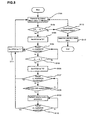
- Figure 5 is a flow chart of a data transmission control method in a GPRS in accordance with the present invention.
- the terminal sets RTSA bits of the transmitted RLC data block to '01', requests a packet UL ACK/NACK from the network (first packet UL ACK/NACK request) (step S103), and waits for a packet UL ACK/NACK message from the network in response (step S104).
- the terminal When the terminal receives the packet UL ACK/NACK from the network in response to the first packet UL ACK/NACK request, the terminal sets RTSA bits to '11' and informs the network of the reception of the packet UL ACK/NACK, and then, sets RTSA bits to '00' for the following RLC data block.
- the terminal sets RTSA bits to '11' and informs the network of the reception of the packet UL ACK/NACK, and then, sets RTSA bits to '00' for the following RLC data block (step S111).
- the terminal judges whether the transmit window has reached a stall state (step S108), and if so, the terminal performs the re-transmission procedure.
- the terminal monitors reception of the packet UL ACK/NACK.
- the terminal sets RTSA bits to '11' and informs the network of the reception of the packet UL ACK/NACK, and then, sets RTSA bits to '00' for the following RLC data block (step S111).
- the terminal judges whether a count down procedure has started. If the count down procedure has not started yet, the terminal keeps transmission of the RLC/MAC within the transmit window, and then when the count down procedure starts, the terminal transmits the final RLC data block (step S113) and releases the uplink TBF.
- the data transmission method in accordance with the present invention has the following advantages.
- the possibility that the transmit window is stalled is informed to the network twice before its occurrence, so that the number of occurrence of the transmit window's stall state can be reduced, and accordingly, waste of the network resource due to re-transmission performed in the stall state can be minimized.
Landscapes
- Engineering & Computer Science (AREA)
- Computer Networks & Wireless Communication (AREA)
- Signal Processing (AREA)
- Mobile Radio Communication Systems (AREA)
- Communication Control (AREA)
- Data Exchanges In Wide-Area Networks (AREA)
- Reduction Or Emphasis Of Bandwidth Of Signals (AREA)
- Detection And Prevention Of Errors In Transmission (AREA)
Abstract
Description
- The present invention relates to a General Packet Radio System (GPRS) and, more particularly, to a data transmission method in the GPRS.
- A GPRS is an overlay network system implemented on a global system for mobile communications (GSM) network, a circuit switching-based two-generation radio communication network standard, for a packet data transmission.
- Accordingly, in order to transmit packet-based data on the GSM network, fresh network factor, interface and protocol are required to process a packet traffic.
- The GPRS is logically implemented by adding two network nodes as core network (CN) factors of the GSM, that is, a serving GPRS Support Node (SGSN) and a gateway GPRS Support Node (GGSN), and a packet control unit (PCU) for processing a packet traffic should be installed in a base station controller (BSC), as well as a software upgrading.
- In the GPRS system constructed as described above, voice or data traffic transmitted from a GPRS terminal is transmitted to a BTS through an air interface and then transmitted from the BTS to the BSC in the same manner. However, at the output side of the BSC, the traffic is divided into the voice traffic which is transmitted to a mobile switching center (MSC) as a standard GSM traffic and the data traffic which is transmitted to the SGSN through the PCU.
- The GPRS uses a physical channel called a temporary block flow (TBF) for a data transmission between the terminal and a network. The TBF is set when there is an LLC PDU transmission request by an upper layer of the terminal in a packet idle mode. When the TBF is set, the terminal is switched to a packet transfer mode.
- The LLC PDU transmission service is provided in an RLC acknowledged mode and an RLC unacknowledged mode, and when the LLC PDU transmission in uplink and downlink directions is terminated, the corresponding TBF is released. As the TBF is released in the packet transfer mode, the terminal returns to the packet idle mode.
- Figure 1 is a drawing illustrating a protocol layer adopted in the GPRS system.
- As shown in Figure 1, a data link layer consists of a logical ink control (LLC), a radio link control (RLC) and a medium access control (MAC) sublayer, provides a service on an upper layer protocol and receives a service from a physical layer.
- The LLC sublayer provides a logical channel ensuring a reliability between two peer entities, while the RLC sublayer positioned below the LLC sublayer segments a to-be-transmitted LLC protocol data unit (PDU) to RLC/MAC block and reassembles received RLC/MAC block. The MAC sublayer positioned below the RLC sublayer allows a plurality of mobile terminals to share a physical channel.
- The RLC/MAC block is classified into an RLC data block and an RLC/MAC control block in the acknowledged mode. The RLC/MAC control block has a priority over the RLC data block.
- The RLC/MAC block consists of an MAC header and an RLC data block which includes an RLC header, an RLC data unit and spare bits.
- Figure 2 is a drawing illustrating a format of an uplink RNC data block containing an MAC header adopted for the GPRS system in accordance with a conventional art.
- As shown in Figure 2, the MAC header consists of a payload type field indicative of a type of data carried in the RLC/MAC block, a countdown value field indicative of a countdown value (CV) that the terminal transmits in order for a network to calculate the current number of RLC data blocks remaining for the uplink TBF, a stall indicator (SI) bit indicative of whether an RLC transmission window of the terminal can advance, and a retry (R) bit indicative of whether the terminal has transmitted a CHANNEL REQUEST message or a PACKET CHANNEL REQUEST message more than once during the latest channel access.
- An uplink RLC data block includes a spare bit set to '0', an PFI indicator (PI) indicative of whether there is a packet flow identifier (PFI), an optional item, a TLLI indicator (TI) bit indicative of whether there is a temporary flow identity (TFI) field for checking a TBF where the RLC data block belongs or whether there is a TLLI field, an optional item, a BSN field indicative of a block sequence number (BSN), a length indicator (LI) for determining a boundary of LLC PDUs of the RLC data block, a more (M) bit indicative of whether there is a following LLC PDU in the RLC data block, and an extension (E) bit indicative of whether there is an optional octet in the RLC PDU.
- In the uplink TBF operation process, the terminal transmits the RLC/MAC block through each allocated uplink data block, and the network sends a PACKET UPLINK ACK/NAK message to the terminal as necessary.
- If a transmission status variable V(S) is equal to the sum of an acknowledge state variable V(A) and a transmit window size (WS) modulo SNS (that is, V(S) = V(A) + WS modulo SNS), the terminal judges that the transmit window is in a stall state. Then, the terminal sets stall indicators (SI) of every transmitted uplink RLC block to '1' so as to inform the network of the stall state until the transmit window gets out of the stall state.
- However, in the case that the terminal informs the network of the stall state using the following data blocks after the transmit window is in stall state, the terminal keeps re-transmitting the RLC data blocks which have not been acknowledged from the network until it receives a PACKET UPLINK ACK/NACK message from the network and gets out of the stall, and if the stall state is prolonged, radio resource is much wasted.
- The above references are incorporated by reference herein where appropriate for appropriate teachings of additional or alternative details, features and/or technical background.
- Therefore, an object of the present invention is to provide a data transmission control method that is capable of minimizing waste of a common resource according to an RLC data block re-transmission by estimating a possibility that a transmit window of a terminal is in stall and informing a network accordingly in advance before its occurrence.
- To achieve at least the above objects in whole or in parts, there is provided a data transmission method of a GPRS including: estimating a possibility that a transmit window is stalled; transmitting a stall state alarm signal to a network if it is estimated that the transmit window will enter the stall state; and controlling a data transmission according to whether or not an ACK signal for the stall state alarm signal is received from the network.
- The transmit window's entering into stall occurs when a send state variable V(S) is equal to the sum of an acknowledge state variable V(A) and a transmission window size (WS) modulo SNS (sequence number space).
- In the step of transmitting the stall state alarm signal, a first stall state alarm signal is transmitted, it is judged whether an ACK for the first stall state alarm signal has been received, and if the ACK for the first stall state alarm signal is received by a predetermined time point, the network is informed of reception of the ACK for the first stall state alarm signal, and the transmit window is updated according to the received ACK signal.
- If the ACK for the first stall state alarm signal is not received by the predetermined time point, a second stall state alarm signal is transmitted, it is judged whether an ACK for the second stall state alarm signal has been received before the transmit window is stalled, and if the ACK for the second stall state alarm signal has been received, the network is informed of the reception of the ACK for the second stall state alarm signal, and the transmit window is updated accordingly to the received ACK signal.
- If, however, no ACK is received for the second stall state alarm signal, the network is informed that the transmit window is stalled and a re-transmission procedure is performed.
- The first stall state alarm signal is transmitted when there remain RLC/MAC blocks to be transmitted which are as many as double the assigned uplink time slots until the transmit window is stalled, while the second stall state alarm signal is transmitted when there remain RLC/MAC blocks to be transmitted which are as many as assigned uplink time slots until the transmit window is stalled without receiving an ACK for the first stall state alarm signal.
- The stall state alarm signal of the transmit window is determined depending on setting of an RLC Transmit Stall Alarm (RTSA) field of the RLC data block. An RTSA field of the RLC data block corresponding to the first stall state alarm signal is set to '01', while an RTSA field of the RLC data block corresponding to the second stall state alarm signal is set to '10'.
- An RTSA field of the first RLC data block transmitted after receiving an ACK for the first and second stall state alarm signal is set to '11', and an RTSA field of the following RLC data block is set to '00'.
- Additional advantages, objects, and features of the invention will be set forth in part in the description which follows and in part will become apparent to those having ordinary skill in the art upon examination of the following or may be learned from practice of the invention. The objects and advantages of the invention may be realized and attained as particularly pointed out in the appended claims.
- The invention will be described in detail with reference to the following drawings in which like reference numerals refer to like elements wherein:
- Figure 1 is a drawing illustrating a protocol layer adopted for a GPRS system;
- Figure 2 is a drawing illustrating a format of an uplink RLC data block containing an MAC header;
- Figure 3 is a drawing illustrating a frame structure of uplink and downlink channels allocated to a multislot class 12 terminal;
- Figure 4 is a drawing illustrating a format of an uplink RLC data block containing an MCA header adopted for a data transmission method in accordance with a preferred embodiment of the present invention; and
- Figure 5 is a flow chart of a data transmission control method in a GPRS in accordance with the present invention.
-
- A data transmission method in accordance with the present invention will now be described by taking an example of channel allocation in a multislot class 12 terminal supporting a multi-time slot.
- A GPRS radio frame consists of 8 time slots. Each uplink and downlink allocation available number of the class 12 terminal is 4, and the sum of maximum uplink and downlink is 5. An uplink frame starts later by 3 time slots than a downlink frame in consideration of a propagation delay.
- Figure 3 is a drawing illustrating a frame structure of uplink and downlink channels allocated to the multislot class 12 terminal.
- As shown in Figure 3, allocated four uplink time slots TS0, TS1, TS2, and TS3 (block period) and one downlink time slot TS0 per frame, the terminal transmits the RCL data block to the network through the uplink time slots TS0, TS1, TS2 and TS3, and after the RLC data block is transmitted as much as the transmit window (WS), the terminal receives a packet uplink ACK/NACK message through the downlink time slot TSO.
- In this process, if the transmit window (WS) is checked to be in a stall state, the terminal sets an Sl bit of the uplink RLC data block as '1' and informs the network that the RLC transmit window of the terminal is in the stall state. If the transmit window is not in the stall state, the SI bit is set to '0'.
- When the send state variable V(S) of the terminal is equal to the sum of an acknowledge state variable V(A), which indicates a BSN value of the oldest RLC data block negatively received from the network, and the WS modulo SNS (sequence number space) 128 (that is, if V(S) = V(A) + WS modulo SNS), the terminal judges that the transmit window is in the stall state.
- V(S), a sequence number of the RLC data block to be transmitted next, has a value of SNS-1 at '0'. When TBF starts, V(S) starts from '0' and is increased by 1 together with BSN (block sequence number) whenever the RLC data block is transmitted.
- The acknowledge state variable V(A) provides an index with respect to an acknowledge state array V(B) modulo SNS, which is updated by a value of a received block bitmap (RBB) of the packet uplink ACK/NACK message received from the network. The acknowledge state array V(B) is an array of SNS factors informing the acknowledge state of the transmit window size (WS), while the RBB is a binary value array of the WS factors.
- If the transmit window is judged to be in the stall state, the terminal transmits the oldest RLC data block having a factor with a PENDING_ACK value in the V(B) (that is, a value of a factor corresponding to a pertinent RLC data block in the V(B) set when each RLC data block is transmitted), and then subsequently transmits the second-oldest RLC data block.
- After every RLC data block having a corresponding factor with the PENDING_ACK value in V(B) is transmitted, the terminal repeats transmission from the oldest RLC data block in the same manner. The procedure of transmitting the oldest RLC data block having the corresponding factor with the PENDING_ACK value in V(B) continues until V(S) = V(A) + WS modulo SNS is released.
- Accordingly, if the packet uplink ACK/NACK value received from the network is negative or if no packet uplink ACK/NACK message is received, the transmit window is held in the stall state so that re-transmission of the oldest RLC data block having the corresponding factor with the PENDING_ACK value in V(B) is repeated to waste the common resource.
- Therefore, the present invention is directed to minimizing waste of the common resource according to re-transmission by allowing the terminal to predict the stall state and inform the network in advance before the transmit window is stalled.
- Figure 4 is a drawing illustrating a format of an uplink RLC data block containing an MCA header adopted for a data transmission method in accordance with a preferred embodiment of the present invention.
- As shown in Figure 4, the uplink RLC data block in accordance with the present invention uses the spare bits in the conventional art to RLC transmit stall alarm (RTSA) bits.
- In the data transmission method of the present invention, before the transmit window is stalled, the terminal predicts that, informs the network accordingly by using the RTSA bits of the uplink RLC data block, and requests a packet uplink ACK/NACK message.
- The terminal's packet uplink ACK/NACK message request is attempted before the transmit window is stalled.
- In detail, the terminal transmits the RLC/MAC block with RTSA bits set to '01' to the network when there remain RLC/MAC blocks as many as double the allocated uplink timeslots until the transmit window is stalled. When the packet uplink ACK/NACK message is received from the network in response to the first RTSA bits, the terminal transmits the RLC/MAC block with RTSA bits set to '11' to the network to inform that the packet uplink ACK/NACK message has been received.
- Meanwhile, if no packet uplink ACK/NACK message is received for the first RTSA bits from the network, the terminal transmits the RLC/MAC block with RTSA bits set to '10' to the network when there remain RLC/MAC blocks as many as allocated uplink timeslots until the transmit window is stalled.
- If the packet uplink ACK/NACK message is received from the network in response to the second RTSA bits, the terminal transmits the RLC/MAC block with RTSA bits set to '11' to the network to inform of its reception of the packet uplink ACK/NACK. If, however, no packet uplink ACK/NACK message is received for the second RTSA bits from the network, the transmit window is stalled.
- Table 1 defines each value of RTSA bits.
RTSA bits 00 None valid 01 Request Packet uplink ACK/NACK (1st) 10 Request Packet uplink ACK/NACK (2nd) 11 Received Packet uplink ACK/NACK - Figure 5 is a flow chart of a data transmission control method in a GPRS in accordance with the present invention.
- With reference to Figure 5, when an uplink TBF is set in an RLC acknowledged mode, the terminal transmits the RLC/MAC block within the transmit window through each allocated uplink data block (step S101). While transmitting the RLC/MAC block, the terminal monitors Ns , the number of RLC/MAC blocks corresponding to the number of allocated ULTSs, and judges whether it satisfies the condition of 2Ns = Nt (step S102).
- If the condition 2Ns = Nt is satisfied, the terminal sets RTSA bits of the transmitted RLC data block to '01', requests a packet UL ACK/NACK from the network (first packet UL ACK/NACK request) (step S103), and waits for a packet UL ACK/NACK message from the network in response (step S104).
- When the terminal receives the packet UL ACK/NACK from the network in response to the first packet UL ACK/NACK request, the terminal sets RTSA bits to '11' and informs the network of the reception of the packet UL ACK/NACK, and then, sets RTSA bits to '00' for the following RLC data block.
- Meanwhile, if no packet UL ACK/NACK is received from the network for the first packet UL ACK/NACK request, the terminal judges whether the condition Ns = Nt (step S105) is satisfied. If this condition is satisfied, the terminal sets RTSA bits of the RLC data block to '10' and requests a packet UL ACK/NACK from the network (second packet UL ACK/NACK request) (step S106) and waits for the packet UL ACK/NACK message from the network in response (step S107).
- When the packet UL ACK/NACK message is received from the network in response to the second packet UL ACK/NACK request, the terminal sets RTSA bits to '11' and informs the network of the reception of the packet UL ACK/NACK, and then, sets RTSA bits to '00' for the following RLC data block (step S111).
- If, however, no packet UL ACK/NAKC is received from the network for the second packet UL ACK/NACK request, the terminal judges whether the transmit window has reached a stall state (step S108), and if so, the terminal performs the re-transmission procedure.
- During the re-transmission procedure, the terminal monitors reception of the packet UL ACK/NACK. When the terminal receives the packet UL ACK/NACK message, it sets RTSA bits to '11' and informs the network of the reception of the packet UL ACK/NACK, and then, sets RTSA bits to '00' for the following RLC data block (step S111).
- Meanwhile, in the step S102, if the condition 2Ns = Nt is not satisfied, the terminal judges whether a count down procedure has started. If the count down procedure has not started yet, the terminal keeps transmission of the RLC/MAC within the transmit window, and then when the count down procedure starts, the terminal transmits the final RLC data block (step S113) and releases the uplink TBF.
- As so far described, the data transmission method in accordance with the present invention has the following advantages.
- That is, the possibility that the transmit window is stalled is informed to the network twice before its occurrence, so that the number of occurrence of the transmit window's stall state can be reduced, and accordingly, waste of the network resource due to re-transmission performed in the stall state can be minimized.
- The foregoing embodiments and advantages are merely exemplary and are not to be construed as limiting the present invention. The present teaching can be readily applied to other types of apparatuses. The description of the present invention is intended to be illustrative, and not to limit the scope of the claims. Many alternatives, modifications, and variations will be apparent to those skilled in the art. In the claims, means-plus-function clauses are intended to cover the structure described herein as performing the recited function and not only structural equivalents but also equivalent structures.
Claims (23)
- A data transmission method comprising:estimating a stall state entrance of a transmit window;transmitting a stall state alarm signal when the stall state entrance is estimated; andcontrolling a data transmission according to a feedback signal in response to the stall state alarm signal.
- The method of claim 1, wherein the stall state entrance occurs when a send state variable V(S) become equal to a sum of acknowledge state variable V(A) and window size (WS) modulo sequence number space (SNS).
- The method of claim 1, wherein the transmitting includes:transmitting a first stall state alarm signal; andtransmitting a second stall state alarm signal.
- The method of claim 3, wherein the first stall state alarm signal is transmitted when a number (Nt ) of RLC data blocks to be transmitted is two times of a number (Ns ) of the RLC data blocks corresponding to a number of time slots allocated until the transmit window is stalled (Nt = 2Ns ).
- The method of claim 3, wherein the second stall state alarm signal is transmitted when the number of RLC Data Block to be transmitted is equal to the number of the RLC data blocks corresponding to the number of time slot allocated until the transmit window is stalled (Nt = Ns ).
- The method of claim 3, wherein the first stall state alarm signal is transmitted when a number (Nt ) of RLC data blocks to be transmitted is two times of a number (Ns ) of the RLC data blocks corresponding to a number of time slots allocated until the transmit window is stalled (Nt = 2Ns ) and the second stall state alarm signal is transmitted when the number of the RLC data blocks to be transmitted is equal to the number of the RLC data blocks corresponding to the number of time slot allocated until the transmit window is stalled (Nt = Ns ).
- The method of claim 6, wherein the stall state alarm signal is transmitted through a RLC Transmit Stall Alarm (RTSA) field of the RLC data block.
- The method of claim 7, wherein the RTSA field of the RLC data block is set to "01" for the first stall state alarm signal.
- The method of claim 7, wherein an RTSA field of the RLC data block is set to "10" for the second stall state alarm signal.
- The method of claim 7, wherein an RTSA field of the RLC data block is set to "01" for the first stall state alarm signal and "10" for the second stall state alarm signal.
- The method of claim 10, wherein an RTSA field of a first RLC data block transmitted after receiving an ACK for the first and second stall state alarm signal is set to '11', and an RTSA field of the RLC data block following the first RLC Data Block is set to '00'.
- The method of claim 7, wherein transmitting the first stall state alarm signal includes:determining whether or not an acknowledgement signal is received in response to the first stall state alarm signal before a predetermined time;informing the network of reception of the acknowledgement signal for the first stall state alarm signal upon reception of the acknowledgement; andupdating the transmit window according to the acknowledgement signal.
- The method of claim 7, wherein transmitting the second stall state alarm signal includes:determining whether or not an acknowledgement signal is received in response to the second stall state alarm signal before the transmit window is stalled;informing the network of reception of the acknowledgement signal for the second stall state alarm signal upon reception of the second stall state alarm signal; andupdating the transmit window according to the acknowledgement signal.
- The method of claim 13, wherein if no acknowledgement signal is received in response to the second stall state alarm signal, the transmit window entered in a stall state.
- The method of claim 1, wherein the transmitting the transmitting includes:transmitting a first stall state alarm signal to a network;determining whether or not an acknowledgement is received in response to the first stall state alarm signal;informing the network of reception of the acknowledgement for the first stall state alarm signal upon reception of the acknowledgement and updating the transmit window according to the acknowledgement;transmitting a second stall state alarm signal if the acknowledgement is not received in response to the first stall state alarm signal until a predetermined time point;determining whether or not an acknowledgement is received in response to the second stall state alarm signal before the transmit window is stalled;informing the network of reception of the acknowledgement upon reception of the acknowledgement in response to the second stall state alarm signal, and updating the transmit window according to the received acknowledgement;informing the network that the transmit window is stalled if the acknowledgement in response to the second stall state alarm signal is not received; andperforming a re-transmission procedure.
- The method of claim 15, wherein a transmission time point of the first stall state alarm signal is when a number (Nt ) of RLC data blocks to be transmitted is two times of a number (Ns ) of the RLC data blocks corresponding to a number of time slots allocated until the transmit window is stalled (Nt = 2Ns ).
- The method of claim 15, wherein the transmission time point of the second stall state alarm signal is when the number of RLC Data Block to be transmitted is equal to the number of the RLC data blocks corresponding to the number of time slot allocated until the transmit window is stalled (Nt = Ns ).
- The method of claim 15, wherein the first stall state alarm signal is transmitted when a number (Nt ) of RLC data blocks to be transmitted is two times of a number (Ns ) of the RLC data blocks corresponding to a number of time slots allocated until the transmit window is stalled (Nt = 2Ns ) and the second stall state alarm signal is transmitted when the number of the RLC data blocks to be transmitted is equal to the number of the RLC data blocks corresponding to the number of time slot allocated until the transmit window is stalled (Nt = Ns ).
- The method of claim 18, wherein the stall state alarm signal is transmitted through a RLC Transmit Stall Alarm (RTSA) field of the RLC data block.
- The method of claim 19, wherein the RTSA field of the RLC data block is set to "01" for the first stall state alarm signal.
- The method of claim 19, wherein an RTSA field of the RLC data block is set to "10" for the second stall state alarm signal.
- The method of claim 19, wherein an RTSA field of the RLC data block is set to "01" for the first stall state alarm signal and "10" for the second stall state alarm signal.
- The method of claim 22, wherein an RTSA field of a first RLC data block transmitted after receiving an ACK for the first and second stall state alarm signal is set to '11', and an RTSA field of the RLC data block following the first RLC Data Block is set to '00'.
Applications Claiming Priority (2)
| Application Number | Priority Date | Filing Date | Title |
|---|---|---|---|
| KR2002026822 | 2002-05-15 | ||
| KR10-2002-0026822A KR100442368B1 (en) | 2002-05-15 | 2002-05-15 | Rlc/mac data transmit method for gprs |
Publications (2)
| Publication Number | Publication Date |
|---|---|
| EP1363427A1 true EP1363427A1 (en) | 2003-11-19 |
| EP1363427B1 EP1363427B1 (en) | 2005-07-27 |
Family
ID=29267946
Family Applications (1)
| Application Number | Title | Priority Date | Filing Date |
|---|---|---|---|
| EP20030009776 Expired - Lifetime EP1363427B1 (en) | 2002-05-15 | 2003-05-08 | Data transmission control method for GPRS |
Country Status (9)
| Country | Link |
|---|---|
| US (1) | US7443795B2 (en) |
| EP (1) | EP1363427B1 (en) |
| JP (1) | JP3746491B2 (en) |
| KR (1) | KR100442368B1 (en) |
| CN (1) | CN1223221C (en) |
| AT (1) | ATE300825T1 (en) |
| DE (1) | DE60301085T2 (en) |
| ES (1) | ES2244860T3 (en) |
| PT (1) | PT1363427E (en) |
Cited By (4)
| Publication number | Priority date | Publication date | Assignee | Title |
|---|---|---|---|---|
| GB2417390A (en) * | 2004-08-18 | 2006-02-22 | Wecomm Ltd | Adjusting packet transmission rate in response to retransmit information |
| GB2437349A (en) * | 2006-04-18 | 2007-10-24 | Motorola Inc | Optimised packet data transmission protocol in a communication system employing a transmission window |
| US8671147B2 (en) | 2007-06-09 | 2014-03-11 | Open Text S.A. | Supplying applications to mobile devices |
| CN107995653A (en) * | 2016-10-26 | 2018-05-04 | 普天信息技术有限公司 | A Resource Management Approach |
Families Citing this family (37)
| Publication number | Priority date | Publication date | Assignee | Title |
|---|---|---|---|---|
| US7933260B2 (en) | 2004-06-29 | 2011-04-26 | Damaka, Inc. | System and method for routing and communicating in a heterogeneous network environment |
| US7570636B2 (en) | 2004-06-29 | 2009-08-04 | Damaka, Inc. | System and method for traversing a NAT device for peer-to-peer hybrid communications |
| US8050272B2 (en) | 2004-06-29 | 2011-11-01 | Damaka, Inc. | System and method for concurrent sessions in a peer-to-peer hybrid communications network |
| US8009586B2 (en) | 2004-06-29 | 2011-08-30 | Damaka, Inc. | System and method for data transfer in a peer-to peer hybrid communication network |
| US8437307B2 (en) | 2007-09-03 | 2013-05-07 | Damaka, Inc. | Device and method for maintaining a communication session during a network transition |
| US7903690B2 (en) * | 2005-04-28 | 2011-03-08 | Hewlett-Packard Development Company, L.P. | Method and system of sending an audio stream and a data stream |
| KR100702783B1 (en) * | 2005-06-10 | 2007-04-03 | 주식회사 케이티 | Subscriber terminal processing system and processing method having the same MAC address |
| KR100837704B1 (en) * | 2006-09-29 | 2008-06-13 | 한국전자통신연구원 | Data Transmission Method in Evolved MMTS Network System |
| US8006122B2 (en) * | 2007-01-10 | 2011-08-23 | International Business Machines Corporation | Methods, systems, and computer products for detection of and policy directed resolution of signaling sympathy sickness in a multisystem cluster |
| US8862164B2 (en) | 2007-09-28 | 2014-10-14 | Damaka, Inc. | System and method for transitioning a communication session between networks that are not commonly controlled |
| US8380859B2 (en) | 2007-11-28 | 2013-02-19 | Damaka, Inc. | System and method for endpoint handoff in a hybrid peer-to-peer networking environment |
| WO2010121357A1 (en) * | 2009-04-21 | 2010-10-28 | Research In Motion Limited | Methods and apparatus to use window alignment information to process acknowledgment information associated with transmitted data blocks |
| RU2495531C2 (en) * | 2009-05-12 | 2013-10-10 | Хуавэй Текнолоджиз Ко., Лтд. | Methods, systems and apparatus for obtaining interpretation and acknowledgement of data reception status |
| US8725895B2 (en) * | 2010-02-15 | 2014-05-13 | Damaka, Inc. | NAT traversal by concurrently probing multiple candidates |
| US8892646B2 (en) | 2010-08-25 | 2014-11-18 | Damaka, Inc. | System and method for shared session appearance in a hybrid peer-to-peer environment |
| US8874785B2 (en) | 2010-02-15 | 2014-10-28 | Damaka, Inc. | System and method for signaling and data tunneling in a peer-to-peer environment |
| US8689307B2 (en) | 2010-03-19 | 2014-04-01 | Damaka, Inc. | System and method for providing a virtual peer-to-peer environment |
| US9043488B2 (en) | 2010-03-29 | 2015-05-26 | Damaka, Inc. | System and method for session sweeping between devices |
| US9191416B2 (en) | 2010-04-16 | 2015-11-17 | Damaka, Inc. | System and method for providing enterprise voice call continuity |
| US8352563B2 (en) | 2010-04-29 | 2013-01-08 | Damaka, Inc. | System and method for peer-to-peer media routing using a third party instant messaging system for signaling |
| US8446900B2 (en) | 2010-06-18 | 2013-05-21 | Damaka, Inc. | System and method for transferring a call between endpoints in a hybrid peer-to-peer network |
| US8611540B2 (en) | 2010-06-23 | 2013-12-17 | Damaka, Inc. | System and method for secure messaging in a hybrid peer-to-peer network |
| US8468010B2 (en) | 2010-09-24 | 2013-06-18 | Damaka, Inc. | System and method for language translation in a hybrid peer-to-peer environment |
| US8743781B2 (en) | 2010-10-11 | 2014-06-03 | Damaka, Inc. | System and method for a reverse invitation in a hybrid peer-to-peer environment |
| US8407314B2 (en) | 2011-04-04 | 2013-03-26 | Damaka, Inc. | System and method for sharing unsupported document types between communication devices |
| US8694587B2 (en) | 2011-05-17 | 2014-04-08 | Damaka, Inc. | System and method for transferring a call bridge between communication devices |
| US8478890B2 (en) | 2011-07-15 | 2013-07-02 | Damaka, Inc. | System and method for reliable virtual bi-directional data stream communications with single socket point-to-multipoint capability |
| WO2014077764A1 (en) * | 2012-11-13 | 2014-05-22 | Telefonaktiebolaget L M Ericsson (Publ) | Extension of radio link control transmit window |
| CN103902405B (en) * | 2012-12-28 | 2017-02-08 | 杭州宏杉科技有限公司 | Quasi-continuity data copying method and device |
| US9027032B2 (en) | 2013-07-16 | 2015-05-05 | Damaka, Inc. | System and method for providing additional functionality to existing software in an integrated manner |
| US9357016B2 (en) | 2013-10-18 | 2016-05-31 | Damaka, Inc. | System and method for virtual parallel resource management |
| WO2016022574A1 (en) | 2014-08-05 | 2016-02-11 | Damaka, Inc. | System and method for providing unified communications and collaboration (ucc) connectivity between incompatible systems |
| US10091025B2 (en) | 2016-03-31 | 2018-10-02 | Damaka, Inc. | System and method for enabling use of a single user identifier across incompatible networks for UCC functionality |
| US10492099B2 (en) * | 2016-05-11 | 2019-11-26 | Futurewei Technologies, Inc. | System and method for maintaining synchronization in connectionless transmissions |
| CN106060464A (en) * | 2016-06-16 | 2016-10-26 | 深圳辉锐天眼科技有限公司 | Video alarm |
| CN109905327B (en) * | 2017-12-11 | 2021-05-07 | 网宿科技股份有限公司 | Wireless network data transmission method, sending end and receiving end |
| CN111294859B (en) * | 2019-05-24 | 2021-09-07 | 展讯通信(上海)有限公司 | Data packet transmission method and device, storage medium and terminal |
Family Cites Families (7)
| Publication number | Priority date | Publication date | Assignee | Title |
|---|---|---|---|---|
| JP3442220B2 (en) * | 1996-05-15 | 2003-09-02 | シスメックス株式会社 | Optical system for visualizing objects in light scattering media |
| CA2285167C (en) * | 1998-10-12 | 2004-12-07 | Jinoo Joung | Flow control method in packet switched network |
| GB2348580B (en) * | 1999-03-30 | 2001-03-14 | 3Com Corp | System and method for congestion control in packet-based communication networks |
| DE60236138D1 (en) * | 2002-01-03 | 2010-06-10 | Innovative Sonic Ltd | Window based blockage avoidance for a high speed wireless communication system |
| KR100747464B1 (en) * | 2002-01-05 | 2007-08-09 | 엘지전자 주식회사 | Deadlock avoidance method using timer for high speed downlink packet connection (HSDPA) system |
| KR100842651B1 (en) * | 2002-02-05 | 2008-06-30 | 삼성전자주식회사 | Data block transmission and reception method for wireless link control in general packet radio service system |
| US7409474B2 (en) * | 2002-06-27 | 2008-08-05 | Broadcom Corporation | Method and system for rate adaptation |
-
2002
- 2002-05-15 KR KR10-2002-0026822A patent/KR100442368B1/en not_active Expired - Fee Related
-
2003
- 2003-05-08 EP EP20030009776 patent/EP1363427B1/en not_active Expired - Lifetime
- 2003-05-08 ES ES03009776T patent/ES2244860T3/en not_active Expired - Lifetime
- 2003-05-08 DE DE2003601085 patent/DE60301085T2/en not_active Expired - Lifetime
- 2003-05-08 AT AT03009776T patent/ATE300825T1/en active
- 2003-05-08 PT PT03009776T patent/PT1363427E/en unknown
- 2003-05-09 JP JP2003132405A patent/JP3746491B2/en not_active Expired - Fee Related
- 2003-05-15 CN CNB031360416A patent/CN1223221C/en not_active Expired - Fee Related
- 2003-05-15 US US10/438,032 patent/US7443795B2/en not_active Expired - Fee Related
Non-Patent Citations (2)
| Title |
|---|
| "DIGITAL CELLULAR TELECOMMUNICATIONS SYSTEM (PHASE 2+);GENERAL PACKET RADIO SERVICE (GPRS); MOBILE STATION (MS) - BASE STATION SYSTEM (BSS) INTERFACE; RADIO LINKE CONTROL/MEDIUM ACCESS CONTROL (RLC/MAC) PROTOCOL (GSM 04.60 VERSION 8.14.1 RELEASE 1999) ETSI TS 101 349 V8.14.1 (2002-04)", EUROPEAN TELECOMMUNICATION STANDARD, April 2002 (2002-04-01), pages 85 - 124, XP002253781 * |
| AJIB W ET AL: "Acknowledgment operations in the RLC layer of GPRS", MOBILE MULTIMEDIA COMMUNICATIONS, 1999. (MOMUC '99). 1999 IEEE INTERNATIONAL WORKSHOP ON SAN DIEGO, CA, USA 15-17 NOV. 1999, PISCATAWAY, NJ, USA,IEEE, US, 15 November 1999 (1999-11-15), pages 311 - 317, XP010370732, ISBN: 0-7803-5904-6 * |
Cited By (11)
| Publication number | Priority date | Publication date | Assignee | Title |
|---|---|---|---|---|
| GB2417390A (en) * | 2004-08-18 | 2006-02-22 | Wecomm Ltd | Adjusting packet transmission rate in response to retransmit information |
| GB2417390B (en) * | 2004-08-18 | 2007-11-14 | Wecomm Ltd | Data packet transmission |
| US7483402B2 (en) | 2004-08-18 | 2009-01-27 | Wecomm Limited | Data packet transmission |
| GB2437349A (en) * | 2006-04-18 | 2007-10-24 | Motorola Inc | Optimised packet data transmission protocol in a communication system employing a transmission window |
| GB2437349B (en) * | 2006-04-18 | 2008-03-12 | Motorola Inc | Optimised packet data transmission protocol in a communication system employing a transmission window |
| US8671147B2 (en) | 2007-06-09 | 2014-03-11 | Open Text S.A. | Supplying applications to mobile devices |
| US10250432B2 (en) | 2007-06-09 | 2019-04-02 | Open Text Sa Ulc | Supplying applications to mobile devices |
| US10749730B2 (en) | 2007-06-09 | 2020-08-18 | Open Text Sa Ulc | Supplying applications to mobile devices |
| US11252008B2 (en) | 2007-06-09 | 2022-02-15 | Open Text Sa Ulc | Supplying applications to mobile devices |
| CN107995653A (en) * | 2016-10-26 | 2018-05-04 | 普天信息技术有限公司 | A Resource Management Approach |
| CN107995653B (en) * | 2016-10-26 | 2021-03-23 | 普天信息技术有限公司 | Resource management method |
Also Published As
| Publication number | Publication date |
|---|---|
| CN1223221C (en) | 2005-10-12 |
| JP2003333120A (en) | 2003-11-21 |
| CN1461153A (en) | 2003-12-10 |
| ATE300825T1 (en) | 2005-08-15 |
| JP3746491B2 (en) | 2006-02-15 |
| ES2244860T3 (en) | 2005-12-16 |
| DE60301085D1 (en) | 2005-09-01 |
| DE60301085T2 (en) | 2006-03-30 |
| US7443795B2 (en) | 2008-10-28 |
| US20030217318A1 (en) | 2003-11-20 |
| PT1363427E (en) | 2005-09-30 |
| KR20030088804A (en) | 2003-11-20 |
| KR100442368B1 (en) | 2004-07-30 |
| EP1363427B1 (en) | 2005-07-27 |
Similar Documents
| Publication | Publication Date | Title |
|---|---|---|
| EP1363427A1 (en) | Data transmission control method for GPRS | |
| EP1878292B1 (en) | Communicating control information in mobile communication system | |
| JP5064378B2 (en) | Data block transmission control apparatus and method | |
| EP2166691B1 (en) | Methods and apparatuses for improving buffer status triggering mechanism in wireless communictions system | |
| EP1142228B1 (en) | Report transmission in a telecommunications system | |
| EP1878155B1 (en) | Method of transmitting control information in wireless communication system and transmission window updating method using the same | |
| EP2134132B1 (en) | Method and apparatus for handling scheduling information report | |
| EP2048904A1 (en) | Method of effectively transmitting radio resource allocation request in mobile communication system | |
| EP1710963B1 (en) | Method and apparatus for reporting a buffer status using node B-estimated buffer status information in a mobile communication system | |
| EP2224763B1 (en) | A resource release method, a communication equipment and a network system | |
| US20020080758A1 (en) | Method of reporting radio access capacity information from a mobile station to a mobile radio network in packet mode | |
| US20090168704A1 (en) | Method of transmitting control information for scheduling | |
| EP3506540A1 (en) | Data transmission method, network device and terminal device | |
| JP2009534917A (en) | Method, communication entity, and system for transmitting positive acknowledgment and negative acknowledgment in a wireless communication system | |
| CN101631008B (en) | Method and device for informing load state | |
| US8954084B2 (en) | Method and system for reducing MAC-is reset ambiguity for common E-DCH transmissions | |
| CN101069369B (en) | Improved high speed uplink packet access scheme | |
| KR20060082733A (en) | Method and apparatus for efficiently reporting buffer status with event triggered in mobile communication system | |
| EP2451205A1 (en) | Communication method, communication system and control apparatus |
Legal Events
| Date | Code | Title | Description |
|---|---|---|---|
| PUAI | Public reference made under article 153(3) epc to a published international application that has entered the european phase |
Free format text: ORIGINAL CODE: 0009012 |
|
| 17P | Request for examination filed |
Effective date: 20030508 |
|
| AK | Designated contracting states |
Kind code of ref document: A1 Designated state(s): AT BE BG CH CY CZ DE DK EE ES FI FR GB GR HU IE IT LI LU MC NL PT RO SE SI SK TR |
|
| AX | Request for extension of the european patent |
Extension state: AL LT LV MK |
|
| AKX | Designation fees paid |
Designated state(s): AT BE BG CH CY CZ DE DK EE ES FI FR GB GR HU IE IT LI LU MC NL PT RO SE SI SK TR |
|
| 17Q | First examination report despatched |
Effective date: 20040729 |
|
| GRAP | Despatch of communication of intention to grant a patent |
Free format text: ORIGINAL CODE: EPIDOSNIGR1 |
|
| GRAS | Grant fee paid |
Free format text: ORIGINAL CODE: EPIDOSNIGR3 |
|
| GRAA | (expected) grant |
Free format text: ORIGINAL CODE: 0009210 |
|
| RAP1 | Party data changed (applicant data changed or rights of an application transferred) |
Owner name: LG ELECTRONICS INC. |
|
| AK | Designated contracting states |
Kind code of ref document: B1 Designated state(s): AT BE BG CH CY CZ DE DK EE ES FI FR GB GR HU IE IT LI LU MC NL PT RO SE SI SK TR |
|
| PG25 | Lapsed in a contracting state [announced via postgrant information from national office to epo] |
Ref country code: BE Free format text: LAPSE BECAUSE OF FAILURE TO SUBMIT A TRANSLATION OF THE DESCRIPTION OR TO PAY THE FEE WITHIN THE PRESCRIBED TIME-LIMIT Effective date: 20050727 Ref country code: EE Free format text: LAPSE BECAUSE OF FAILURE TO SUBMIT A TRANSLATION OF THE DESCRIPTION OR TO PAY THE FEE WITHIN THE PRESCRIBED TIME-LIMIT Effective date: 20050727 Ref country code: CH Free format text: LAPSE BECAUSE OF FAILURE TO SUBMIT A TRANSLATION OF THE DESCRIPTION OR TO PAY THE FEE WITHIN THE PRESCRIBED TIME-LIMIT Effective date: 20050727 Ref country code: RO Free format text: LAPSE BECAUSE OF FAILURE TO SUBMIT A TRANSLATION OF THE DESCRIPTION OR TO PAY THE FEE WITHIN THE PRESCRIBED TIME-LIMIT Effective date: 20050727 Ref country code: SI Free format text: LAPSE BECAUSE OF FAILURE TO SUBMIT A TRANSLATION OF THE DESCRIPTION OR TO PAY THE FEE WITHIN THE PRESCRIBED TIME-LIMIT Effective date: 20050727 Ref country code: LI Free format text: LAPSE BECAUSE OF FAILURE TO SUBMIT A TRANSLATION OF THE DESCRIPTION OR TO PAY THE FEE WITHIN THE PRESCRIBED TIME-LIMIT Effective date: 20050727 Ref country code: SK Free format text: LAPSE BECAUSE OF FAILURE TO SUBMIT A TRANSLATION OF THE DESCRIPTION OR TO PAY THE FEE WITHIN THE PRESCRIBED TIME-LIMIT Effective date: 20050727 |
|
| REG | Reference to a national code |
Ref country code: GB Ref legal event code: FG4D |
|
| REG | Reference to a national code |
Ref country code: CH Ref legal event code: EP |
|
| REG | Reference to a national code |
Ref country code: IE Ref legal event code: FG4D |
|
| REG | Reference to a national code |
Ref country code: SE Ref legal event code: TRGR |
|
| REF | Corresponds to: |
Ref document number: 60301085 Country of ref document: DE Date of ref document: 20050901 Kind code of ref document: P |
|
| REG | Reference to a national code |
Ref country code: PT Ref legal event code: SC4A Effective date: 20050810 |
|
| PG25 | Lapsed in a contracting state [announced via postgrant information from national office to epo] |
Ref country code: BG Free format text: LAPSE BECAUSE OF FAILURE TO SUBMIT A TRANSLATION OF THE DESCRIPTION OR TO PAY THE FEE WITHIN THE PRESCRIBED TIME-LIMIT Effective date: 20051027 Ref country code: DK Free format text: LAPSE BECAUSE OF FAILURE TO SUBMIT A TRANSLATION OF THE DESCRIPTION OR TO PAY THE FEE WITHIN THE PRESCRIBED TIME-LIMIT Effective date: 20051027 |
|
| REG | Reference to a national code |
Ref country code: GR Ref legal event code: EP Ref document number: 20050403206 Country of ref document: GR |
|
| REG | Reference to a national code |
Ref country code: ES Ref legal event code: FG2A Ref document number: 2244860 Country of ref document: ES Kind code of ref document: T3 |
|
| PG25 | Lapsed in a contracting state [announced via postgrant information from national office to epo] |
Ref country code: HU Free format text: LAPSE BECAUSE OF FAILURE TO SUBMIT A TRANSLATION OF THE DESCRIPTION OR TO PAY THE FEE WITHIN THE PRESCRIBED TIME-LIMIT Effective date: 20060128 |
|
| REG | Reference to a national code |
Ref country code: CH Ref legal event code: PL |
|
| ET | Fr: translation filed | ||
| PG25 | Lapsed in a contracting state [announced via postgrant information from national office to epo] |
Ref country code: IE Free format text: LAPSE BECAUSE OF NON-PAYMENT OF DUE FEES Effective date: 20060508 |
|
| PG25 | Lapsed in a contracting state [announced via postgrant information from national office to epo] |
Ref country code: MC Free format text: LAPSE BECAUSE OF NON-PAYMENT OF DUE FEES Effective date: 20060531 |
|
| PLBE | No opposition filed within time limit |
Free format text: ORIGINAL CODE: 0009261 |
|
| STAA | Information on the status of an ep patent application or granted ep patent |
Free format text: STATUS: NO OPPOSITION FILED WITHIN TIME LIMIT |
|
| 26N | No opposition filed |
Effective date: 20060428 |
|
| REG | Reference to a national code |
Ref country code: IE Ref legal event code: MM4A |
|
| PG25 | Lapsed in a contracting state [announced via postgrant information from national office to epo] |
Ref country code: LU Free format text: LAPSE BECAUSE OF NON-PAYMENT OF DUE FEES Effective date: 20060508 |
|
| PG25 | Lapsed in a contracting state [announced via postgrant information from national office to epo] |
Ref country code: CY Free format text: LAPSE BECAUSE OF FAILURE TO SUBMIT A TRANSLATION OF THE DESCRIPTION OR TO PAY THE FEE WITHIN THE PRESCRIBED TIME-LIMIT Effective date: 20050727 |
|
| REG | Reference to a national code |
Ref country code: DE Ref legal event code: R079 Ref document number: 60301085 Country of ref document: DE Free format text: PREVIOUS MAIN CLASS: H04L0012560000 Ipc: H04L0012700000 Ref country code: DE Ref legal event code: R082 Ref document number: 60301085 Country of ref document: DE Representative=s name: GRUENECKER, KINKELDEY, STOCKMAIR & SCHWANHAEUS, DE |
|
| REG | Reference to a national code |
Ref country code: DE Ref legal event code: R079 Ref document number: 60301085 Country of ref document: DE Free format text: PREVIOUS MAIN CLASS: H04L0012560000 Ipc: H04L0012700000 Effective date: 20141120 Ref country code: DE Ref legal event code: R082 Ref document number: 60301085 Country of ref document: DE Representative=s name: GRUENECKER, KINKELDEY, STOCKMAIR & SCHWANHAEUS, DE Effective date: 20141120 Ref country code: DE Ref legal event code: R081 Ref document number: 60301085 Country of ref document: DE Owner name: OPTIS CELLULAR TECHNOLOGY, LLC (N. D. GES. D. , US Free format text: FORMER OWNER: LG ELECTRONICS INC., SEOUL, KR Effective date: 20141120 Ref country code: DE Ref legal event code: R082 Ref document number: 60301085 Country of ref document: DE Representative=s name: GRUENECKER PATENT- UND RECHTSANWAELTE PARTG MB, DE Effective date: 20141120 |
|
| REG | Reference to a national code |
Ref country code: FR Ref legal event code: PLFP Year of fee payment: 13 |
|
| REG | Reference to a national code |
Ref country code: GB Ref legal event code: 732E Free format text: REGISTERED BETWEEN 20150521 AND 20150527 |
|
| REG | Reference to a national code |
Ref country code: NL Ref legal event code: SD Effective date: 20150618 |
|
| REG | Reference to a national code |
Ref country code: ES Ref legal event code: PC2A Effective date: 20150828 |
|
| REG | Reference to a national code |
Ref country code: FR Ref legal event code: CA Effective date: 20151216 Ref country code: FR Ref legal event code: TP Owner name: OPTIS CELLULAR TECHNOLOGY, LLC, US Effective date: 20151216 |
|
| REG | Reference to a national code |
Ref country code: FR Ref legal event code: PLFP Year of fee payment: 14 |
|
| PGFP | Annual fee paid to national office [announced via postgrant information from national office to epo] |
Ref country code: DE Payment date: 20160421 Year of fee payment: 14 Ref country code: GB Payment date: 20160426 Year of fee payment: 14 Ref country code: CZ Payment date: 20160425 Year of fee payment: 14 Ref country code: ES Payment date: 20160506 Year of fee payment: 14 Ref country code: GR Payment date: 20160422 Year of fee payment: 14 Ref country code: FI Payment date: 20160422 Year of fee payment: 14 |
|
| PGFP | Annual fee paid to national office [announced via postgrant information from national office to epo] |
Ref country code: FR Payment date: 20160422 Year of fee payment: 14 Ref country code: AT Payment date: 20160422 Year of fee payment: 14 Ref country code: IT Payment date: 20160427 Year of fee payment: 14 |
|
| PGFP | Annual fee paid to national office [announced via postgrant information from national office to epo] |
Ref country code: NL Payment date: 20170421 Year of fee payment: 15 |
|
| PGFP | Annual fee paid to national office [announced via postgrant information from national office to epo] |
Ref country code: PT Payment date: 20170502 Year of fee payment: 15 Ref country code: SE Payment date: 20170425 Year of fee payment: 15 |
|
| PGFP | Annual fee paid to national office [announced via postgrant information from national office to epo] |
Ref country code: TR Payment date: 20170425 Year of fee payment: 15 |
|
| REG | Reference to a national code |
Ref country code: AT Ref legal event code: PC Ref document number: 300825 Country of ref document: AT Kind code of ref document: T Owner name: OPTIS CELLULAR TECHNOLOGY, LLC, US Effective date: 20170920 |
|
| REG | Reference to a national code |
Ref country code: DE Ref legal event code: R119 Ref document number: 60301085 Country of ref document: DE |
|
| REG | Reference to a national code |
Ref country code: AT Ref legal event code: MM01 Ref document number: 300825 Country of ref document: AT Kind code of ref document: T Effective date: 20170508 |
|
| GBPC | Gb: european patent ceased through non-payment of renewal fee |
Effective date: 20170508 |
|
| PG25 | Lapsed in a contracting state [announced via postgrant information from national office to epo] |
Ref country code: CZ Free format text: LAPSE BECAUSE OF NON-PAYMENT OF DUE FEES Effective date: 20170508 Ref country code: FI Free format text: LAPSE BECAUSE OF NON-PAYMENT OF DUE FEES Effective date: 20170508 Ref country code: AT Free format text: LAPSE BECAUSE OF NON-PAYMENT OF DUE FEES Effective date: 20170508 |
|
| PG25 | Lapsed in a contracting state [announced via postgrant information from national office to epo] |
Ref country code: GR Free format text: LAPSE BECAUSE OF NON-PAYMENT OF DUE FEES Effective date: 20171206 |
|
| REG | Reference to a national code |
Ref country code: FR Ref legal event code: ST Effective date: 20180131 |
|
| PG25 | Lapsed in a contracting state [announced via postgrant information from national office to epo] |
Ref country code: GB Free format text: LAPSE BECAUSE OF NON-PAYMENT OF DUE FEES Effective date: 20170508 Ref country code: DE Free format text: LAPSE BECAUSE OF NON-PAYMENT OF DUE FEES Effective date: 20171201 |
|
| PG25 | Lapsed in a contracting state [announced via postgrant information from national office to epo] |
Ref country code: FR Free format text: LAPSE BECAUSE OF NON-PAYMENT OF DUE FEES Effective date: 20170531 Ref country code: IT Free format text: LAPSE BECAUSE OF NON-PAYMENT OF DUE FEES Effective date: 20170508 |
|
| REG | Reference to a national code |
Ref country code: ES Ref legal event code: FD2A Effective date: 20180627 |
|
| PG25 | Lapsed in a contracting state [announced via postgrant information from national office to epo] |
Ref country code: ES Free format text: LAPSE BECAUSE OF NON-PAYMENT OF DUE FEES Effective date: 20170509 |
|
| REG | Reference to a national code |
Ref country code: SE Ref legal event code: EUG Ref country code: NL Ref legal event code: MM Effective date: 20180601 |
|
| PG25 | Lapsed in a contracting state [announced via postgrant information from national office to epo] |
Ref country code: PT Free format text: LAPSE BECAUSE OF NON-PAYMENT OF DUE FEES Effective date: 20181108 Ref country code: SE Free format text: LAPSE BECAUSE OF NON-PAYMENT OF DUE FEES Effective date: 20180509 |
|
| PG25 | Lapsed in a contracting state [announced via postgrant information from national office to epo] |
Ref country code: NL Free format text: LAPSE BECAUSE OF NON-PAYMENT OF DUE FEES Effective date: 20180601 |
|
| PG25 | Lapsed in a contracting state [announced via postgrant information from national office to epo] |
Ref country code: TR Free format text: LAPSE BECAUSE OF NON-PAYMENT OF DUE FEES Effective date: 20180508 |