EP1363346A2 - Gel electrolyte, process for producing the same, and use thereof - Google Patents
Gel electrolyte, process for producing the same, and use thereof Download PDFInfo
- Publication number
- EP1363346A2 EP1363346A2 EP03006720A EP03006720A EP1363346A2 EP 1363346 A2 EP1363346 A2 EP 1363346A2 EP 03006720 A EP03006720 A EP 03006720A EP 03006720 A EP03006720 A EP 03006720A EP 1363346 A2 EP1363346 A2 EP 1363346A2
- Authority
- EP
- European Patent Office
- Prior art keywords
- electrolyte
- gel
- group
- gel electrolyte
- bifunctional
- Prior art date
- Legal status (The legal status is an assumption and is not a legal conclusion. Google has not performed a legal analysis and makes no representation as to the accuracy of the status listed.)
- Granted
Links
Images

Classifications
-
- H—ELECTRICITY
- H01—ELECTRIC ELEMENTS
- H01G—CAPACITORS; CAPACITORS, RECTIFIERS, DETECTORS, SWITCHING DEVICES, LIGHT-SENSITIVE OR TEMPERATURE-SENSITIVE DEVICES OF THE ELECTROLYTIC TYPE
- H01G11/00—Hybrid capacitors, i.e. capacitors having different positive and negative electrodes; Electric double-layer [EDL] capacitors; Processes for the manufacture thereof or of parts thereof
- H01G11/54—Electrolytes
- H01G11/56—Solid electrolytes, e.g. gels; Additives therein
-
- H—ELECTRICITY
- H01—ELECTRIC ELEMENTS
- H01G—CAPACITORS; CAPACITORS, RECTIFIERS, DETECTORS, SWITCHING DEVICES, LIGHT-SENSITIVE OR TEMPERATURE-SENSITIVE DEVICES OF THE ELECTROLYTIC TYPE
- H01G9/00—Electrolytic capacitors, rectifiers, detectors, switching devices, light-sensitive or temperature-sensitive devices; Processes of their manufacture
- H01G9/004—Details
- H01G9/022—Electrolytes; Absorbents
- H01G9/025—Solid electrolytes
- H01G9/028—Organic semiconducting electrolytes, e.g. TCNQ
-
- H—ELECTRICITY
- H01—ELECTRIC ELEMENTS
- H01M—PROCESSES OR MEANS, e.g. BATTERIES, FOR THE DIRECT CONVERSION OF CHEMICAL ENERGY INTO ELECTRICAL ENERGY
- H01M10/00—Secondary cells; Manufacture thereof
- H01M10/05—Accumulators with non-aqueous electrolyte
- H01M10/052—Li-accumulators
-
- H—ELECTRICITY
- H01—ELECTRIC ELEMENTS
- H01M—PROCESSES OR MEANS, e.g. BATTERIES, FOR THE DIRECT CONVERSION OF CHEMICAL ENERGY INTO ELECTRICAL ENERGY
- H01M10/00—Secondary cells; Manufacture thereof
- H01M10/05—Accumulators with non-aqueous electrolyte
- H01M10/056—Accumulators with non-aqueous electrolyte characterised by the materials used as electrolytes, e.g. mixed inorganic/organic electrolytes
- H01M10/0564—Accumulators with non-aqueous electrolyte characterised by the materials used as electrolytes, e.g. mixed inorganic/organic electrolytes the electrolyte being constituted of organic materials only
- H01M10/0565—Polymeric materials, e.g. gel-type or solid-type
-
- H—ELECTRICITY
- H01—ELECTRIC ELEMENTS
- H01M—PROCESSES OR MEANS, e.g. BATTERIES, FOR THE DIRECT CONVERSION OF CHEMICAL ENERGY INTO ELECTRICAL ENERGY
- H01M10/00—Secondary cells; Manufacture thereof
- H01M10/05—Accumulators with non-aqueous electrolyte
- H01M10/058—Construction or manufacture
-
- H—ELECTRICITY
- H01—ELECTRIC ELEMENTS
- H01M—PROCESSES OR MEANS, e.g. BATTERIES, FOR THE DIRECT CONVERSION OF CHEMICAL ENERGY INTO ELECTRICAL ENERGY
- H01M6/00—Primary cells; Manufacture thereof
- H01M6/14—Cells with non-aqueous electrolyte
- H01M6/18—Cells with non-aqueous electrolyte with solid electrolyte
- H01M6/181—Cells with non-aqueous electrolyte with solid electrolyte with polymeric electrolytes
-
- H—ELECTRICITY
- H01—ELECTRIC ELEMENTS
- H01M—PROCESSES OR MEANS, e.g. BATTERIES, FOR THE DIRECT CONVERSION OF CHEMICAL ENERGY INTO ELECTRICAL ENERGY
- H01M2300/00—Electrolytes
- H01M2300/0085—Immobilising or gelification of electrolyte
-
- Y—GENERAL TAGGING OF NEW TECHNOLOGICAL DEVELOPMENTS; GENERAL TAGGING OF CROSS-SECTIONAL TECHNOLOGIES SPANNING OVER SEVERAL SECTIONS OF THE IPC; TECHNICAL SUBJECTS COVERED BY FORMER USPC CROSS-REFERENCE ART COLLECTIONS [XRACs] AND DIGESTS
- Y02—TECHNOLOGIES OR APPLICATIONS FOR MITIGATION OR ADAPTATION AGAINST CLIMATE CHANGE
- Y02E—REDUCTION OF GREENHOUSE GAS [GHG] EMISSIONS, RELATED TO ENERGY GENERATION, TRANSMISSION OR DISTRIBUTION
- Y02E60/00—Enabling technologies; Technologies with a potential or indirect contribution to GHG emissions mitigation
- Y02E60/10—Energy storage using batteries
-
- Y—GENERAL TAGGING OF NEW TECHNOLOGICAL DEVELOPMENTS; GENERAL TAGGING OF CROSS-SECTIONAL TECHNOLOGIES SPANNING OVER SEVERAL SECTIONS OF THE IPC; TECHNICAL SUBJECTS COVERED BY FORMER USPC CROSS-REFERENCE ART COLLECTIONS [XRACs] AND DIGESTS
- Y02—TECHNOLOGIES OR APPLICATIONS FOR MITIGATION OR ADAPTATION AGAINST CLIMATE CHANGE
- Y02E—REDUCTION OF GREENHOUSE GAS [GHG] EMISSIONS, RELATED TO ENERGY GENERATION, TRANSMISSION OR DISTRIBUTION
- Y02E60/00—Enabling technologies; Technologies with a potential or indirect contribution to GHG emissions mitigation
- Y02E60/13—Energy storage using capacitors
Definitions
- the present invention relates to a gel electrolyte, and particularly, to a gel electrolyte that can be suitably used in, for example, batteries or capacitors.
- a solid electrolyte as referred to herein means a substance that is in a solid state and has a high ionic conductivity.
- polymer solid electrolytes in which a polymer substance is used as a solid are watched as an electrolyte for next-generation lithium secondary batteries, and their researches are worldwide promoted.
- such polymer solid electrolytes are free from a fear of liquid leakage and have a large degree of freedom of the shape such that they can be processed into a thin film.
- the conventional polymer solid electrolytes involve a problem such that the conductivity is extremely low as compared with liquid electrolytes, i.e., electrolytic solutions.
- non-aqueous polymer solid electrolytes comprising a composite of a chain polymer (such as polyethylene glycol and polypropylene glycol) or a comb-like polymer (such as polyphosphazene) and an electrolyte salt.
- a chain polymer such as polyethylene glycol and polypropylene glycol
- comb-like polymer such as polyphosphazene
- Such gel-like electrolytes comprise an electrolyte salt dissolved in a gel formed from a polymer material and a non-aqueous organic solvent and can be, for example, obtained by holding an electrolytic solution in a polymer matrix.
- gel electrolytes are conventional gel electrolytes comprising an electrolytic solution carried in pores of a porous fluorocarbon polymer made of polyvinylidene fluoride or a vinylidene fluoride/hexafluoroporpylene copolymer as disclosed in, for example, JP-T-8-509100 and JP-T-9-500485 (the term "JP-T" as used herein means a published Japanese translation of a PCT patent application).
- JP-A-8-298126 proposes gel electrolytes comprising polyethylene oxide or a polyether polymer analogous thereto as a polymer matrix and also proposes gel electrolytes comprising a polyether polymer (such as polyethylene oxide and polypropylene oxide) as a polymer matrix and ⁇ -butyrolactone as an organic solvent. Further, JP-A-11-176452 proposes gel electrolytes using a tetrafunctional terminal acryloyl-modified alkylene oxide polymer.
- polyether-based polymers give gel electrolytes that have a high compatibility with electrolytic solutions, are homogeneous and have a high conductivity.
- the polymers cause decomposition, resulting in a problem in durability.
- the invention has been made to overcome the above-described problems of the conventional gel electrolytes.
- an object of the invention is to provide a uniform gel electrolyte having high durability and its use, and particularly, to provide batteries or capacitors using such a gel electrolyte.
- a gel electrolyte comprising a gel composition comprising an electrolyte salt, a solvent for the electrolyte salt, and a polymer matrix, wherein the polymer matrix comprises a crosslinked polymer prepared by polymerizing a bifunctional (meth)acrylate represented by the following formula (I): wherein R represents a divalent organic group, and R 1 represents a hydrogen atom or a methyl group.
- a process for producing a gel electrolyte which comprises heating or irradiating with actinic radiations a solution containing an electrolyte salt, a solvent for the electrolyte salt, and a bifunctional (meth)acrylate represented by the following formula (I): wherein R represents a divalent organic group, and R 1 represents a hydrogen atom or a methyl group, to polymerize the bifunctional (meth)acrylate, thereby forming a crosslinked polymer and forming a gel in which the electrolyte salt and the solvent are held in a matrix comprising the crosslinked polymer.
- the Figure is a cross-sectional view of a coin-type secondary battery using a gel electrolyte according to the invention.
- the polymer matrix comprises a crosslinked polymer prepared by polymerizing the bifunctional (meth)acrylate represented by the above-described formula (I).
- (meth)acrylate means an acrylate or a methacrylate
- (meth)acryloyl means an acryloyl or a methacryloyl
- the bifunctional (meth)acrylate can be obtained by reacting a diamine represented by the following formula (IV): H 2 N-R-NH 2 wherein R represents a divalent organic group, with 2-(meth)acryloyloxyethyl isocyanate in a reaction solvent. Accordingly, in the bifunctional (meth)acrylate, the divalent organic group represented by R is a residue of the diamine used as the starting material for the production (that is, a group in which two amino groups of the diamine have been eliminated).
- divalent organic group or diamine residue is not particularly limited, preferred examples include:
- the alkylene group (a) is preferably a linear or branched alkylene group having 2 to 40 carbon atoms, such as an ethylene group, a propylene group, a hexamethylene group, and a dodecamethylene group.
- the alkyl group represented by R 2 preferably has 1 to 10 carbon atoms; and the alkylene group represented by R 3 and R 4 preferably has 1 to 10 carbon atoms.
- a preferred example of the divalent group represented by the formula (II) is one in which R 1 represents a methyl group, and R 2 and R 3 each represents a trimethylene group.
- Examples of the xylylene group include an o-xylylene group, an m-xylylene group and a p-xylylene group, and an m-xylylene group is particularly preferred.
- Examples of the divalent group represented by the formula (III) include:
- a diamine residue derived from 1,3-bis(aminomethyl)cyclohexane is preferable.
- the gel electrolyte according to the invention can be obtained by, for example, dissolving the bifunctional (meth)acrylate in an electrolytic solution comprising an electrolyte salt and a solvent for the electrolyte salt preferably together with a polymerization initiator, and heating the resulting solution, thereby polymerizing (heat polymerizing) the bifunctional (meth)acrylate and forming a crosslinked polymer as the polymer matrix.
- the bifunctional (meth)acrylate is used as a gelling agent.
- the polymerization initiator for polymerizing the bifunctional (meth)acrylate is not particularly limited, but examples thereof include benzoyl peroxide and 2,2'-azobisisobutyronitrile.
- the polymerization method of the bifunctional (meth)acrylate is not limited to the heat polymerization, but the bifunctional (meth)acrylate may be photo-polymerized upon irradiation with actinic radiations such as ultraviolet ray and electron beams.
- a proportion of the crosslinked polymer prepared by polymerizing the bifunctional (meth)acrylate is appropriately determined depending on the electrolyte salt and solvent used such that they form the gel electrolyte comprising the crosslinked polymer as the matrix.
- the proportion of the crosslinked polymer is usually in the range of from 0.1 to 50% by weight of the gel electrolyte.
- the proportion of the crosslinked polymer is preferably in the range of from 0.1 to 25% by weight, and more preferably from 0.1 to 10% by weight, of the gel electrolyte.
- a proportion of the electrolyte salt in the gel electrolyte according to the invention is appropriately determined depending on not only the electrolyte salt itself but also the solvent used.
- the proportion of the electrolyte salt is usually in the range of from 1 to 50% by weight in the obtained gel electrolyte.
- the electrolyte salt that can be used in the invention is salts comprising hydrogen, an alkali metal (such as lithium, sodium, and potassium), an alkaline earth metal (such as calcium and strontium), or a tertiary or quaternary ammonium salt as a cationic component and an inorganic acid (such as hydrochloric acid, nitric acid, phosphoric acid, sulfuric acid, fluoroboric acid, hydrofluoric acid, hexafluorophosphoric acid, and perchloric acid) or an organic acid (such as organic carboxylic acids, organic sulfonic acids, and fluorine-substituted organic sulfonic acids) as an anionic component.
- electrolyte salts comprising an alkali metal ion as a cationic component are preferably used.
- electrolyte salts comprising such an alkali metal ion as a cationic component
- alkali metal perchlorates such as lithium perchlorate, sodium perchlorate, and potassium perchlorate
- alkali metal tetrafluoroborates such as lithium tetrafluoroborate, sodium tetrafluoroborate, and potassium tetrafluoroborate
- alkali metal hexafluorophosphates such as lithium hexafluorophosphate and potassium hexafluorophosphate
- alkali metal trifluoroacetates such as lithium trifluoroacetate
- alkali metal trifluoromethanesulfonates such as lithium trifluoromethanesulfonate.
- any solvent can be used as the solvent for the electrolyte salt in the invention so far as it can dissolve the electrolyte salt therein.
- non-aqueous solvents include cyclic esters such as ethylene carbonate, propylene carbonate, butylene carbonate, and ⁇ -butyrolactone; cyclic or chain ethers such as tetrahydrofuran and dimethoxyethane; and chain esters such as dimethyl carbonate, diethyl carbonate, and ethylmethyl carbonate. These solvents may be used alone or as mixtures of two or more thereof.
- the gel electrolyte according to the invention in order to prevent a short circuit between electrodes, the gel electrolyte can be used as a film-like gel electrolyte by appropriately carrying the same on a sheet-like substrate.
- a porous film it is preferred to use a porous film as the sheet-like substrate not so as to obstruct the movement of ions between the electrodes.
- the solution containing the electrolyte salt, the solvent for the electrolyte salt, and the bifunctional (meth)methacrylate represented by the formula (I) is heated or irradiated with actinic radiations to polymerize the bifunctional (meth)acrylate, thereby forming the crosslinked polymer and forming the gel in which the electrolyte salt and solvent are held in the matrix comprising the crosslinked polymer.
- the film-like gel electrolyte can be suitably used for the production of batteries or capacitors.
- electrodes and a substrate porous film are laminated or wound to form an electrochemical element, which is then installed in a battery can also functioning as an electrode can of the battery.
- the solution containing the electrolyte salt, the solvent for the electrolyte salt and the bifunctional (meth)acrylate, and preferably the polymerization initiator is poured into the battery can, and the substrate porous film is impregnated with the solution.
- the bifunctional (meth)acrylate is polymerized upon heating, thereby forming the crosslinked polymer and forming a homogeneous gel electrolyte comprising the crosslinked polymer as the polymer matrix.
- a battery containing the film-like gel electrolyte.
- the bifunctional (meth)acrylate is previously carried on the substrate porous film, and the resulting porous film and electrodes are laminated or wound to form an electrochemical element, which is then installed in a battery can also functioning as an electrode can of the battery.
- an electrolytic solution comprising the electrolyte salt and the solvent for the electrolyte salt, and preferably the polymerization initiator is poured into the battery can, and the. substrate porous film is impregnated with the electrolytic solution to dissolve the bifunctional (meth)acrylate carried on the substrate porous film in the electrolytic solution.
- the bifunctional (meth)acrylate is polymerized upon heating, thereby forming the crosslinked polymer and forming a uniform gel electrolyte comprising the crosslinked polymer as the polymer matrix.
- a battery containing the film-like gel electrolyte There can be thus obtained a battery containing the film-like gel electrolyte.
- the bifunctional (meth)acrylate and the polymerization initiator are previously carried on the substrate porous film, and the resulting porous film and electrodes are laminated or wound to form an electrochemical element, which is then installed in a battery can also functioning as an electrode can of the battery.
- an electrolytic solution comprising the electrolyte salt and the solvent for the electrolyte salt is poured into the battery can, and the substrate porous film is impregnated with the electrolytic solution to dissolve the bifunctional (meth)acrylate and the polymerization initiator carried on the substrate porous film in the electrolytic solution.
- the bifunctional (meth)acrylate is polymerized upon heating, thereby forming the crosslinked polymer and forming a homogeneous gel electrolyte comprising the crosslinked polymer as the polymer matrix.
- a battery containing the film-like gel electrolyte.
- the bifunctional (meth)acrylate and the polymerization initiator are previously dissolved in an electrolytic solution comprising the electrolyte salt and the solvent for the electrolyte salt to prepare a solution.
- an electrolytic solution comprising the electrolyte salt and the solvent for the electrolyte salt
- the resulting substrate porous film and electrodes are installed in a battery can, and a laminate comprising, for example, negative electrode/substrate porous film/positive electrode is formed within the battery can, to prepare an intermediate of a battery.
- the intermediate is heated to polymerize the bifunctional (meth)acrylate contained in the substrate porous film, thereby forming the crosslinked polymer and forming a uniform gel electrolyte comprising the crosslinked polymer as the polymer matrix.
- a battery containing the film-like gel electrolyte It will be easily understood that capacitors can be obtained similarly by the above-described methods.
- the Figure is a cross-sectional view of a coin-type lithium secondary battery using the gel electrolyte.
- a positive electrode can 1 also functioning as a positive electrode terminal is made of, for example, a nickel-plated stainless steel sheet and is combined with a negative electrode can 3 also functioning as a negative electrode terminal, which is insulated from the positive electrode can 1 via an insulator 2, to configure a battery can (vessel).
- the negative electrode can 3 is also made of, for example, a nickel-plated stainless steel sheet.
- a positive electrode 4 is arranged while contacting with the positive electrode can 1 via a positive electrode collector 5.
- the positive electrode 4 can be obtained by mixing a positive electrode active material (such as a lithium-manganese composite oxide) and a conductive material (such as graphite) with a binder resin (such as polyethylene, polypropylene, and polytetrafluoroethylene) and pressure molding the mixture.
- a negative electrode 6 is arranged while contacting with the negative electrode can 3 via a negative electrode collector 7.
- the negative electrode 6 is made of a lithium sheet.
- a film-like gel electrolyte 8 according to the invention is arranged between the positive electrode 4 and the negative electrode 6 to configure a battery. According to the thus configured battery, an electric energy can be taken out while functioning the positive electrode can 1 and the negative electrode can 3 as terminals.
- lithium hexafluorophosphate (LiPF 6 ) as an electrolyte salt was dissolved in an ethylene carbonate/ethylmethyl carbonate mixed solvent (volume ratio: 1/2) such that the concentration of the electrolyte salt became 1.2 moles/l, to prepare an electrolytic solution.
- 3.0 g of the bifunctional methacrylate as prepared in Referential Example 1 was added to 97.0 g of this electrolytic solution, and the resulting mixture was stirred for dissolution at room temperature. 0.06 g of benzoyl peroxide was further added to the mixture, which was then stirred for dissolution at room temperature. There was thus prepared a solution A.
- the solution A was charged in a glass bottle, and the glass bottle was sealed and then placed in a thermostatic chamber at 80°C for 1 hour to polymerize the bifunctional methacrylate, thereby forming a crosslinked polymer. There was thus obtained a self-supporting gel electrolyte.
- This gel electrolyte was allowed to stand in a sealed state within the thermostatic chamber at 80°C for 5 days. As a result, no separation of any liquid material was observed, and the resulting electrolyte maintained the gel state.
- the intermediate was placed in a thermostatic chamber at 80°C for 1 hour to polymerize the bifunctional methacrylate, thereby forming a crosslinked polymer and forming a gel electrolyte. There was thus prepared a coin-type lithium-ion secondary battery.
- This battery was subjected to charge and discharge five times at a rate of 0.2 CmA. Thereafter, the battery was charged at a rate of 0.2 CmA and then discharged at a rate of 2.0 CmA.
- the charge load characteristic of the electrolyte was evaluated in a discharge capacity ratio of 2.0 CmA/0.2 CmA. As a result, it was found to be 91%.
- a solution B was prepared in the same manner as in the preparation of the solution A of Example 1, except that the bifunctional methacrylate as prepared in Reference Example 2 was used in place of the bifunctional methacrylate as prepared in Reference Example 1.
- Example 2 Using the solution B, a coin-type battery was prepared in the same manner as in Example 1. The discharge load characteristic of the electrolyte was evaluated under the same conditions as in Example 1. As a result, it was found to be 90%.
- a solution C was prepared in the same manner as in the preparation of the solution A of Example 1, except that the bifunctional methacrylate as prepared in Reference Example 3 was used in place of the bifunctional methacrylate as prepared in Reference Example 1.
- Example 1 Using the solution C, a coin-type battery was prepared in the same manner as in Example 1. The discharge load characteristic of the electrolyte was evaluated under the same conditions as in Example 1. As a result, it was found to be 89%.
- a solution D was prepared in the same manner as in the preparation of the solution A of Example 1, except that the bifunctional methacrylate as prepared in Reference Example 4 was used in place of the bifunctional methacrylate as prepared in Reference Example 1.
- Example 1 Using the solution D, a coin-type battery was prepared in the same manner as in Example 1. The discharge load characteristic of the electrolyte was evaluated under the same conditions as in Example 1. As a result, it was found to be 92%.
- a solution E was prepared in the same manner as in the preparation of the solution A of Example 1, except that the bifunctional methacrylate as prepared in Reference Example 5 was used in place of the bifunctional methacrylate as prepared in Reference Example 1.
- Example 2 Using the solution E, a coin-type battery was prepared in the same manner as in Example 1. The discharge load characteristic of the electrolyte was evaluated under the same conditions as in Example 1. As a result, it was found to be 88%.
- a solution F was prepared in the same manner as in the preparation of the solution A of Example 1, except that the bifunctional methacrylate as prepared in Reference Example 6 was used in place of the bifunctional methacrylate as prepared in Reference Example 1.
- a solution G was prepared in the same manner as in the preparation of the solution A of Example 1, except that the bifunctional methacrylate as prepared in Reference Example 7 was used in place of the bifunctional methacrylate as prepared in Reference Example 1.
- Example 2 Using the solution G, a coin-type battery was prepared in the same manner as in Example 1. The discharge load characteristic of the electrolyte was evaluated under the same conditions as in Example 1. As a result, it was found to be 90%.
- lithium hexafluorophosphate (LiPF 6 ) as an electrolyte salt was dissolved in an ethylene carbonate/ethylmethyl carbonate mixed solvent (volume ratio: 1/2) such that the concentration of the electrolyte salt became 1.2 moles/l, to prepare an electrolytic solution.
- 3.0 g of polyethylene glycol dimethacrylate (NK ESTER 9G, manufactured by Shin-Nakamura Chemical Co., Ltd.) was added to 97.0 g of this electrolytic solution, and the resulting mixture was stirred for dissolution at room temperature. 0.06 g of 2,2'-azobisisobutyronitrile was further added to the mixture. There was thus prepared a solution P.
- the solution P was charged in a glass bottle, and the glass bottle was sealed and then placed in a thermostatic chamber at 80°C for 1 hour to polymerize the polyethylene glycol dimethacrylate, thereby forming a polymer.
- the resulting electrolyte was a flowable liquid. This liquid electrolyte was allowed to stand in a sealed state within the thermostatic chamber at 80°C for 5 days. As a result, it was discolored blackish brown, and a reduction of viscosity of the solution was observed.
- Example 2 Using the solution P, a coin-type battery was prepared in the same manner as in Example 1.
- the discharge load characteristic of the electrolyte was evaluated in a discharge capacity ratio of 2.0 CmA/0.2 CmA in the same manner as in Example 1. As a result, it was found to be 80%.
- LiPF 6 as an electrolyte salt was dissolved in an ethylene carbonate/ethylmethyl carbonate mixed solvent (volume ratio: 1/2) such that the concentration of the electrolyte salt became 1.2 moles/l, to prepare an electrolytic solution.
- 20.0 g of polyethylene glycol dimethacrylate (NK ESTER 9G, manufactured by Shin-Nakamura Chemical Co., Ltd.) was added to 80.0 g of this electrolytic solution, and the resulting mixture was stirred for dissolution at room temperature.
- 0.4 g of 2,2'-azobisisobutyronitrile was further added to the mixture. There was thus prepared a solution Q.
- the solution Q was charged in a glass bottle, and the glass bottle was sealed and then placed in a thermostatic chamber at 80°C for 1 hour to obtain a self-supporting gel electrolyte.
- This gel electrolyte was allowed to stand in a sealed state within the thermostatic chamber at 80°C for 5 days. As a result, it was discolored blackish brown and changed to a flowable liquid.
- Example 1 Using the solution Q, a coin-type battery was prepared in the same manner as in Example 1. The discharge load characteristic of the electrolyte was evaluated under the same conditions as in Example 1. As a result, it was found to be 40%.
- VdF vinylidene fluoride
- HFP hexafluoropropylene copolymer resin
- KYNAR 2801 manufactured by Elf Atochem SA
- dibutyl phthalate was added to 200 g of acetone, and the resulting mixture was mixed in a ball mill to prepare a homogeneous solution R.
- the solution R was cast in a uniform thickness on a tetrafluoroethylene resin sheet by a doctor blade, and the acetone was evaporated at 60°C to form a film having a thickness of 40 ⁇ m.
- This film was dipped in diethyl ether, and the dibutyl phthalate was extracted to obtain a 40 ⁇ m-thick porous film made of a VdF/HFP copolymer resin.
- LiPF 6 as an electrolyte salt was dissolved in an ethylene carbonate/ethylmethyl carbonate mixed solvent (volume ratio: 1/2) such that the concentration of the electrolyte salt became 1.2 moles/l, to prepare an electrolytic solution.
- the porous film was dipped in this electrolytic solution for one hour, thereby holding the electrolytic solution on the porous film. There was thus prepared a gel electrolyte. Determining from an increase in weight before and after dipping the porous film in the electrolytic solution, a weight ratio of the copolymer resin to the electrolytic solution of the gel electrolyte was found to be 30/70.
- this gel electrolyte was charged in a glass bottle, and the glass bottle was sealed and allowed to stand in a sealed state within the thermostatic chamber at 80°C for 5 days. As a result, separation of the electrolytic solution was observed.
- Example 2 Using the foregoing gel electrolyte, a coin-type battery was prepared in the same manner as in Example 1. The discharge load characteristic of the electrolyte was evaluated in a discharge capacity ratio of 2.0 CmA/0.2 CmA in the same manner as in Example 1. As a result, it was found to be 73%.
- the gel electrolyte according to the invention comprises as a matrix a crosslinked polymer prepared by polymerizing a bifunctional (meth)acrylate represented by the foregoing general formula as a gelling agent and has superior electrolytic characteristics. Moreover, according to the invention, the use of a small quantity of the foregoing gelling agent enables one to obtain a homogeneous gel electrolyte having superior durability.
Landscapes
- Chemical & Material Sciences (AREA)
- Chemical Kinetics & Catalysis (AREA)
- Electrochemistry (AREA)
- Engineering & Computer Science (AREA)
- General Chemical & Material Sciences (AREA)
- Manufacturing & Machinery (AREA)
- Power Engineering (AREA)
- Physics & Mathematics (AREA)
- Microelectronics & Electronic Packaging (AREA)
- Condensed Matter Physics & Semiconductors (AREA)
- Dispersion Chemistry (AREA)
- General Physics & Mathematics (AREA)
- Inorganic Chemistry (AREA)
- Secondary Cells (AREA)
- Electric Double-Layer Capacitors Or The Like (AREA)
- Conductive Materials (AREA)
Abstract

Description


to polymerize the bifunctional (meth)acrylate, thereby forming a crosslinked polymer and forming a gel in which the electrolyte salt and the solvent are held in a matrix comprising the crosslinked polymer.
with 2-(meth)acryloyloxyethyl isocyanate in a reaction solvent. Accordingly, in the bifunctional (meth)acrylate, the divalent organic group represented by R is a residue of the diamine used as the starting material for the production (that is, a group in which two amino groups of the diamine have been eliminated).



Molecular weight by mass analysis (ESI method): (M + H)+ = 371
Proton NMR spectrum (400 MHz, solvent: deutero acetic acid, δ (ppm)):
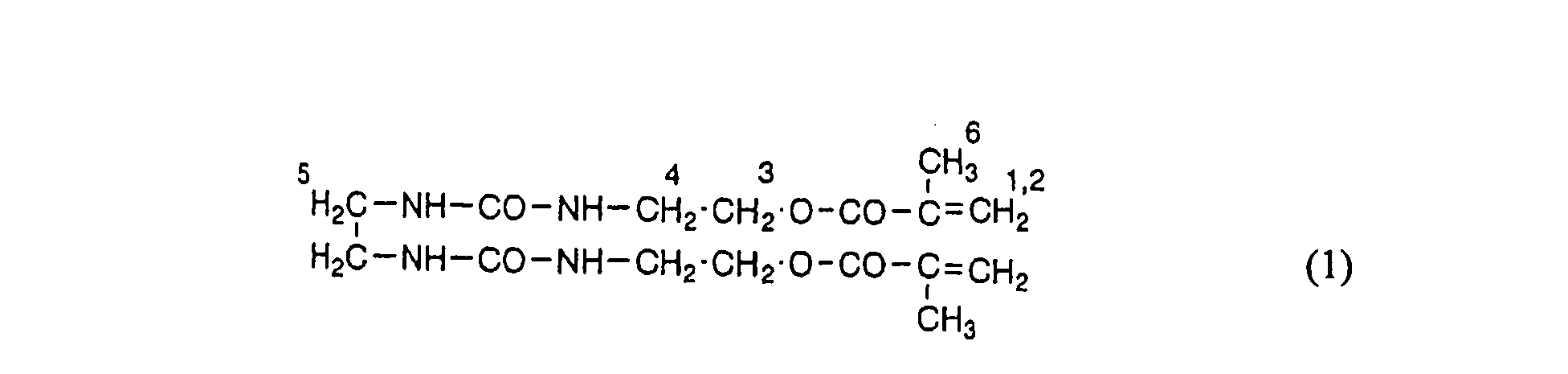
| Assignment | δ (ppm) | Signal | Number of |
| 1 | 6.00 | | 2 |
| 2 | 5.48 | | 2 |
| 3 | 4.08 | t | 4 |
| 4 | 3.34 | t | 4 |
| 5 | 3.15 | s | 4 |
| 6 | 1.79 | m | 6 |

| Assignment | δ (ppm) | Signal | Number of |
| 1 | 169.4 | | 2 |
| 2 | 162.0 | | 2 |
| 3 | 138.0 | | 2 |
| 4 | 127.4 | | 2 |
| 5 | 65.6 | | 2 |
| 6 | 41.9 | | 2 |
| 7 | 40.6 | | 2 |
| 8 | 19.1 | | 2 |
Molecular weight by mass analysis (ESI method): (M + H)+ = 427
Proton NMR spectrum (400 MHz, solvent: deutero acetic acid, δ (ppm)):

| Assignment | δ (ppm) | Signal | Number of |
| 1 | 6.00 | | 2 |
| 2 | 5.49 | | 2 |
| 3 | 4.09 | t | 4 |
| 4 | 3.36 | t | 4 |
| 5 | 3.00 | t | 4 |
| 6 | 1.79 | | 6 |
| 7 | 1.36 | m | 4 |
| 8 | 1.19 | m | 4 |

| Assignment | δ (ppm) | Signal | Number of |
| 1 | 169.6 | | 2 |
| 2 | 161.8 | | 2 |
| 3 | 138.0 | | 2 |
| 4 | 127.4 | | 2 |
| 5 | 65.7 | | 2 |
| 6 | 41.9 | | 2 |
| 7 | 40.9 | | 2 |
| 8 | 31.2 | | 2 |
| 9 | 27.9 | | 2 |
| 10 | 19.0 | | 2 |
Molecular weight by mass analysis (ESI method): (M + H)+ = 456
Proton NMR spectrum (400 MHz, solvent: deutero acetic acid, δ (ppm)):

| Assignment | δ (ppm) | Signal | Number of |
| 1 | 6.00 | | 2 |
| 2 | 5.49 | | 2 |
| 3 | 4.09 | t | 4 |
| 4 | 3.34 | t | 4 |
| 5 | 3.16 | t | 4 |
| 6 | 3.02 | m | 4 |
| 7 | 2.74 | | 3 |
| 8 | 1.85 | m | 4 |
| 9 | 1.81 | | 6 |
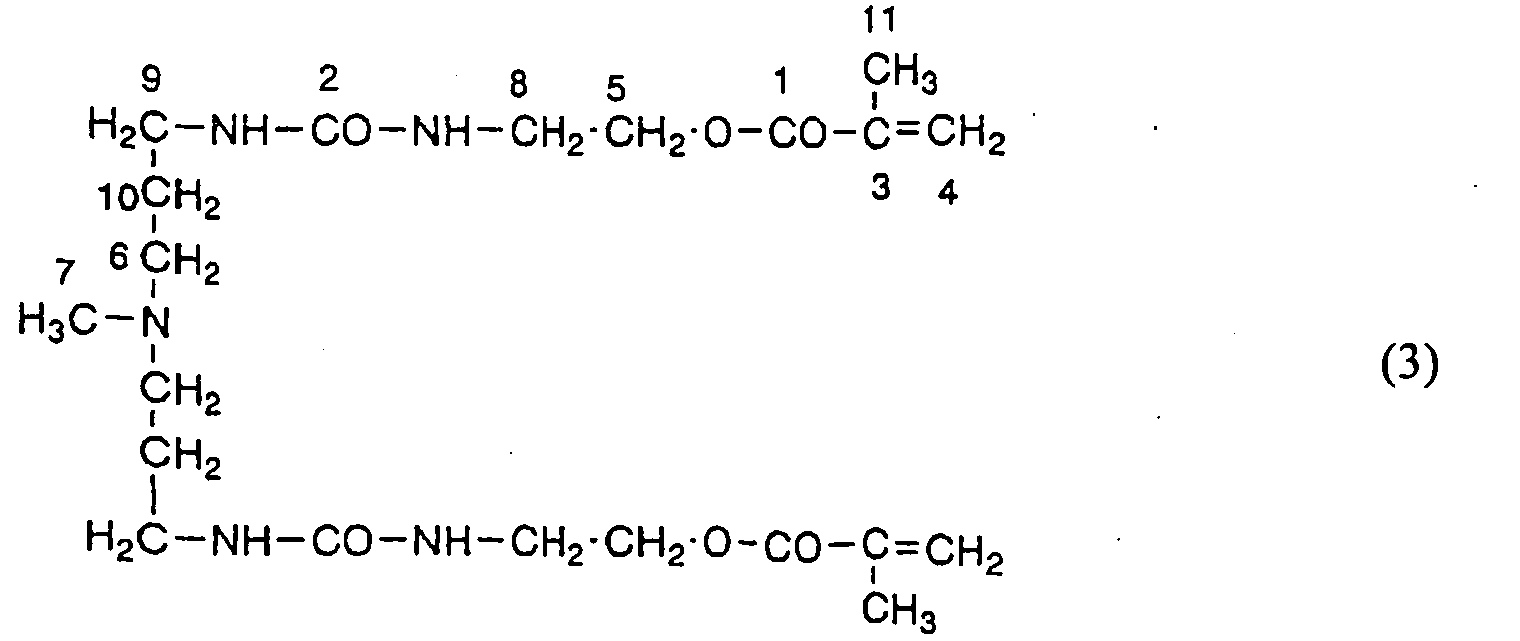
| Assignment | δ (ppm) | Signal | Number of |
| 1 | 169.3 | | 2 |
| 2 | 161.9 | | 2 |
| 3 | 137.9 | | 2 |
| 4 | 127.3 | | 2 |
| 5 | 65.4 | | 2 |
| 6 | 55.2 | | 2 |
| 7 | 40.9 | | 1 |
| 8 | 40.8 | | 2 |
| 9 | 38.2 | | 2 |
| 10 | 26.4 | | 2 |
| 11 | 19.0 | | 2 |
Molecular weight by mass analysis (ESI method): (M + H)+ = 447
Proton NMR spectrum (400 MHz, solvent: deutero acetic acid, δ (ppm)):
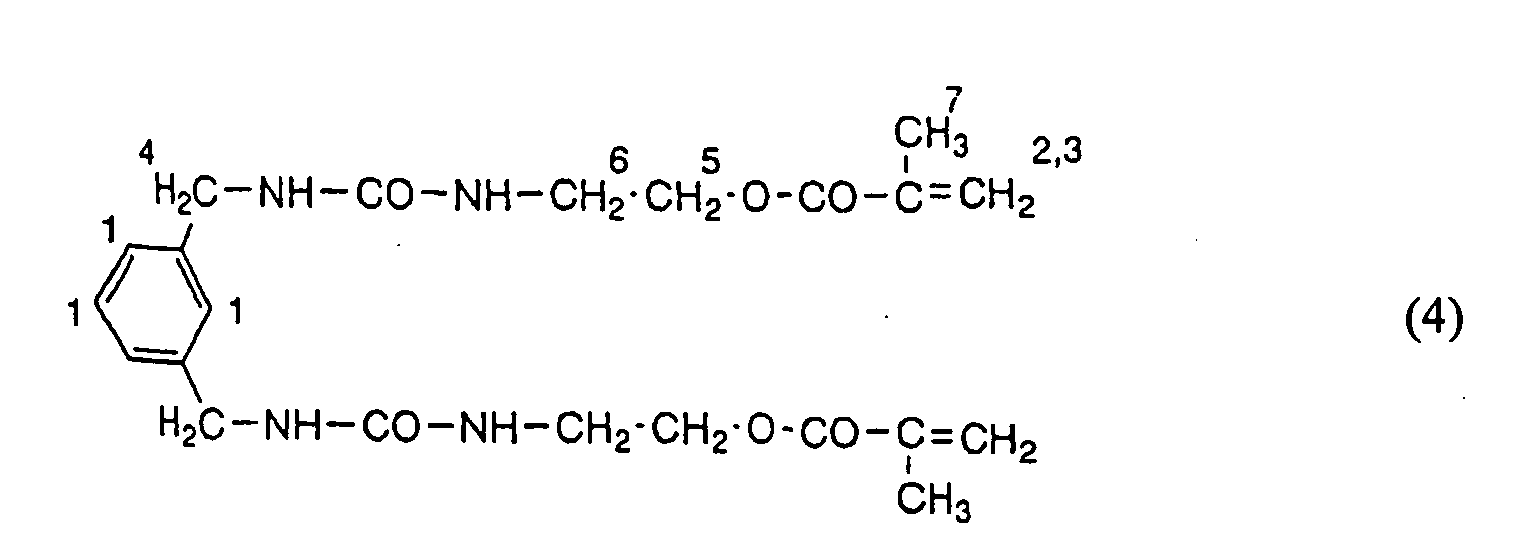
| Assignment | δ (ppm) | Signal | Number of |
| 1 | 7.14 to 7.03 | m | 4 |
| 2 | 5.97 | | 2 |
| 3 | 5.47 | | 2 |
| 4 | 4.22 | s | 4 |
| 5 | 4.09 | t | 4 |
| 6 | 3.38 | t | 4 |
| 7 | 1.77 | s | 6 |
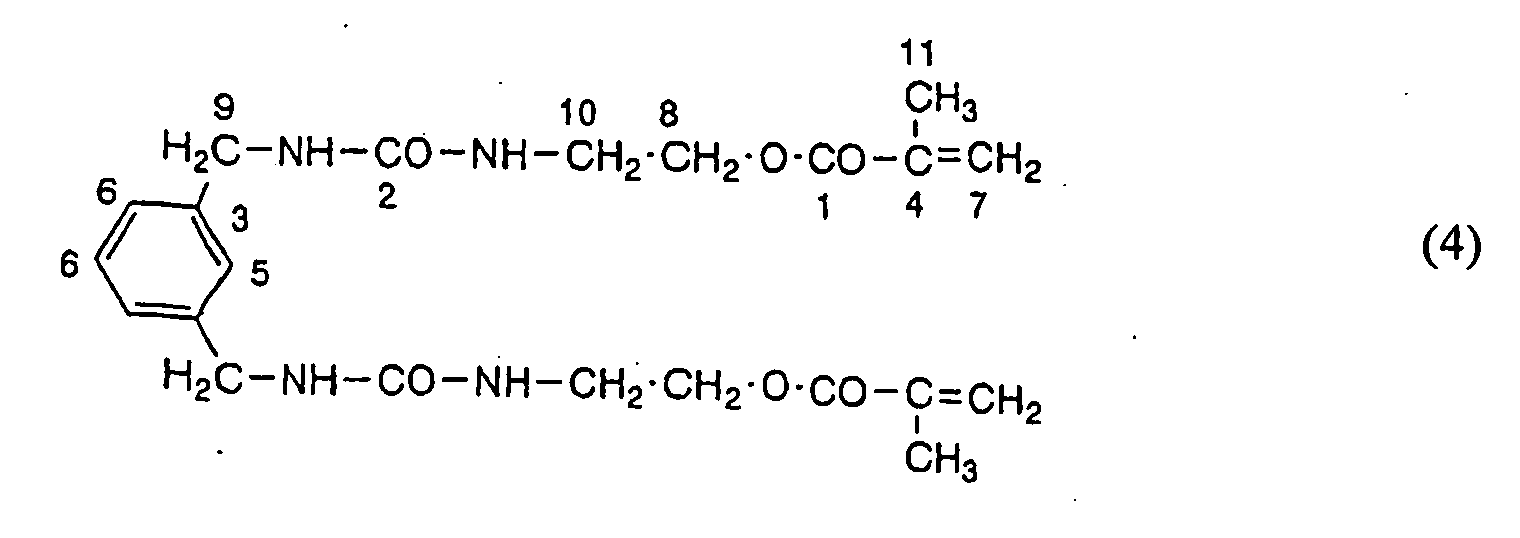
| Assignment | δ (ppm) | Signal | Number of |
| 1 | 169.6 | | 2 |
| 2 | 161.7 | | 2 |
| 3 | 141.2 | | 2 |
| 4 | 138.0 | | 2 |
| 5 | 130.4 | | 1 |
| 6 | 127.8 | | 3 |
| 7 | 127.5 | | 2 |
| 8 | 65.8 | | 2 |
| 9 | 45.5 | | 2 |
| 10 | 40.9 | | 2 |
| 11 | 19.1 | | 2 |
Molecular weight by mass analysis (ESI method): (M + H)+ = 453
Proton NMR spectrum (400 MHz, solvent: deutero acetic acid, δ (ppm)):

| Assignment | δ (ppm) | Signal | Number of |
| 1 | 6.00 | | 2 |
| 2 | 5.49 | | 2 |
| 3 | 4.09 | t | 4 |
| 4 | 3.35 | t | 4 |
| 5 | 2.87 | m | 4 |
| 6 | 1.79 | | 6 |
| 7 | 1.61 | m | 4 |
| 8 | 1.32 | | 2 |
| 9 | 1.12 | | 1 |
| 10 | 0.69 | | 2 |
| 11 | 0.43 | m | 1 |
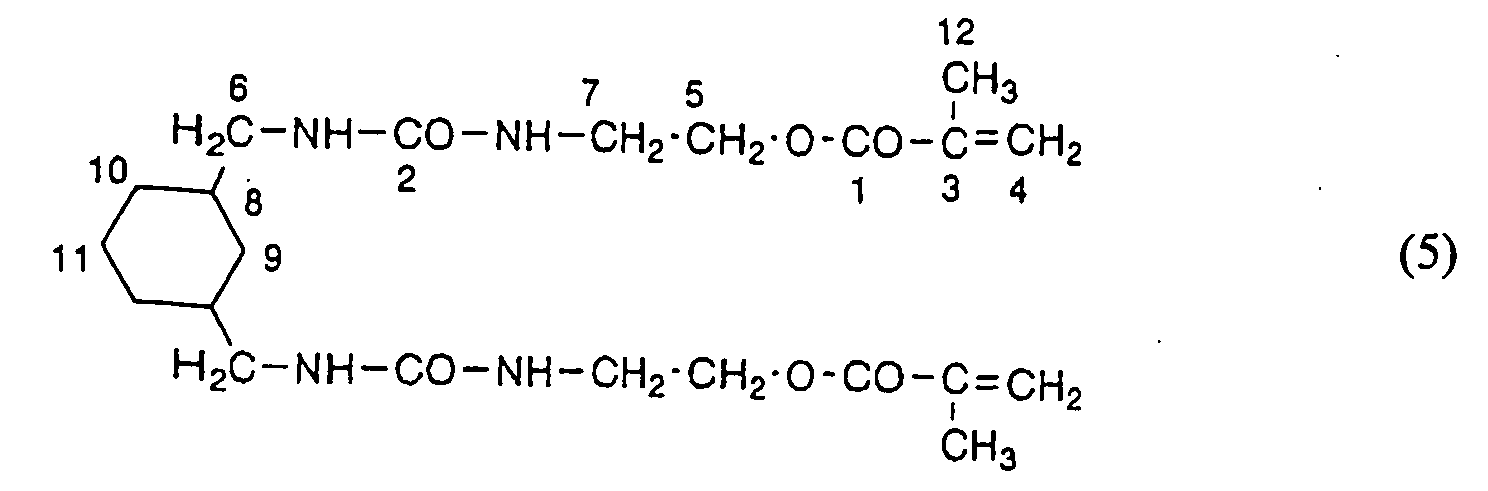
| Assignment | δ (ppm) | Signal | Number of |
| 1 | 169.5 | | 2 |
| 2 | 161.9 | | 2 |
| 3 | 137.9 | | 2 |
| 4 | 127.5 | | 2 |
| 5 | 65.7 | | 2 |
| 6 | 48.2 | | 2 |
| 7 | 40.8 | | 2 |
| 8 | 39.6 | | 2 |
| 9 | 36.3 | | 1 |
| 10 | 32.0 | | 2 |
| 11 | 26.9 | | 1 |
| 12 | 19.1 | | 2 |
Molecular weight by mass analysis (ESI method): (M + H)+ = 511
Proton NMR spectrum (400 MHz, solvent: deutero dimethyl sulfoxide, δ (ppm)):

| Assignment | δ (ppm) | Signal | Number of |
| 1 | 6.05 | | 2 |
| 2 | 5.80 | m | 4 |
| 3 | 5.65 | | 2 |
| 4 | 4.07 | m | 4 |
| 5 | 3.28 | q | 4 |
| 6 | 2.97 | q | 4 |
| 7 | 1.90 | | 6 |
| 8 | 1.36 | m | 4 |
| 9 | 1.25 | m | 16 |

| Assignment | δ (ppm) | Signal | Number of |
| 1 | 166.5 | | 2 |
| 2 | 158.3 | | 2 |
| 3 | 136.0 | | 2 |
| 4 | 125.3 | | 2 |
| 5 | 64.1 | | 2 |
| 6 | 39.2 | | 2 |
| 7 | 38.4 | | 2 |
| 8 | 29.9 | | 2 |
| 9 | 28.9 to 28.7 | | 6 |
| 10 | 26.3 | | 2 |
| 11 | 17.8 | | 2 |
Molecular weight by mass analysis (ESI method): (M + H)+ = 385
Proton NMR spectrum (400 MHz, solvent: deutero dimethyl sulfoxide, δ (ppm)):
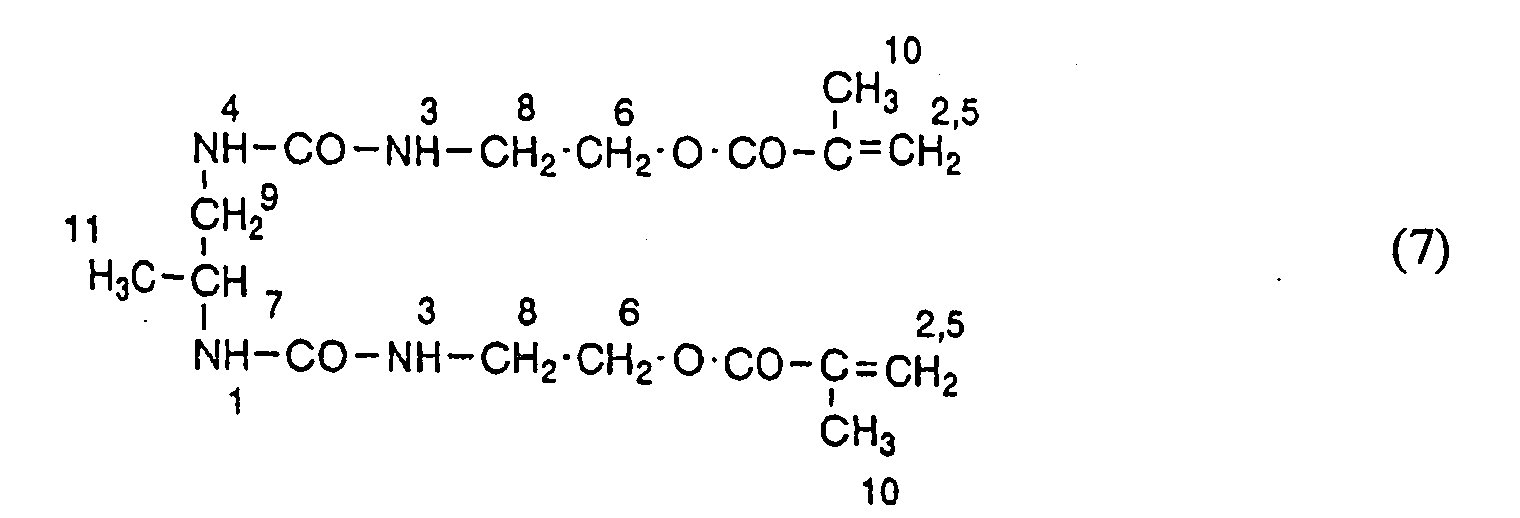
| Assignment | δ (ppm) | Signal | Number of |
| 1 | 6.12 | | 1 |
| 2 | 6.05 | | 2 |
| 3 | 6.00 | | 2 |
| 4 | 5.85 | | 1 |
| 5 | 5.67 | | 2 |
| 6 | 4.05 | t | 4 |
| 7 | 3.55 | | 1 |
| 8 | 3.30 to 3.22 | m | 4 |
| 9 | 2.96 | | 2 |
| 10 | 1.88 | | 6 |
| 11 | 0.96 | d | 3 |
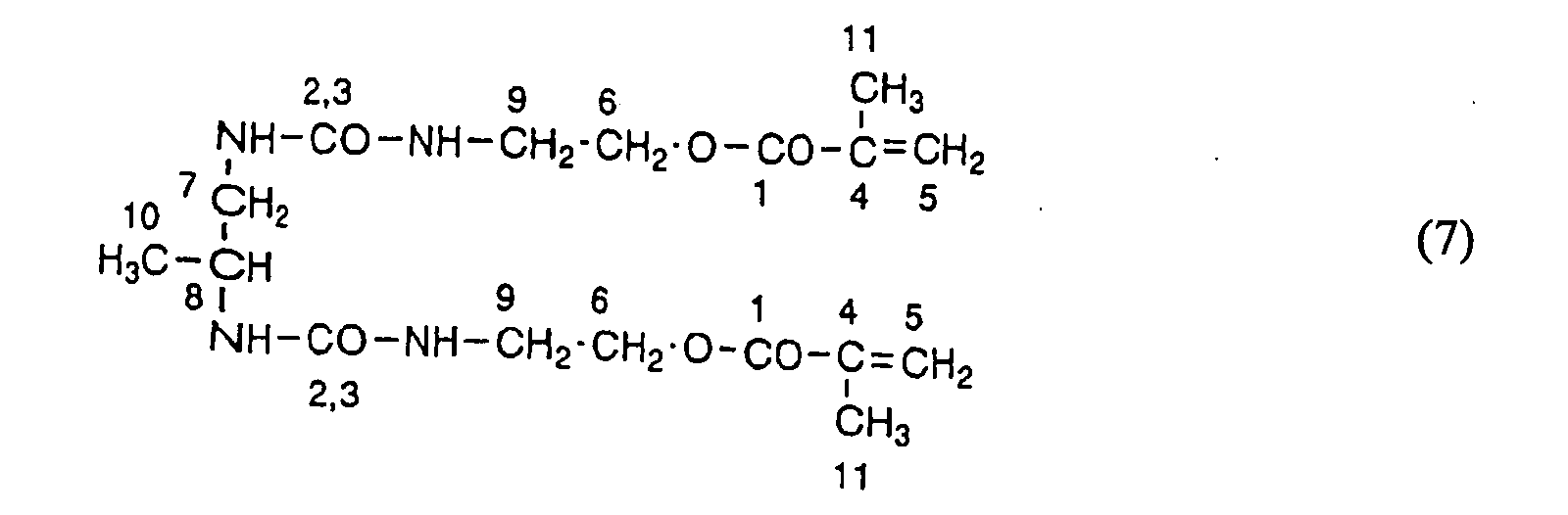
| Assignment | δ (ppm) | Signal | Number of |
| 1 | 166.5 | | 2 |
| 2 | 158.1 | | 1 |
| 3 | 157.6 | | 1 |
| 4 | 135.8 | | 2 |
| 5 | 125.8 | | 2 |
| 6 | 64.1 | | 2 |
| 7 | 45.9 | | 1 |
| 8 | 45.1 | | 1 |
| 9 | 38.2 | | 2 |
| 10 | 18.9 | | 1 |
| 11 | 18.0 | | 2 |
Claims (8)
- A gel electrolyte comprising a gel composition comprising an electrolyte salt, a solvent for the electrolyte salt, and a polymer matrix, wherein the polymer matrix comprises a crosslinked polymer prepared by polymerizing a bifunctional (meth)acrylate represented by the following formula (I):wherein R represents a divalent organic group, and R1 represents a hydrogen atom or a methyl group.

- The gel electrolyte as claimed in claim 1, wherein the organic group is a divalent group selected from:(a) an alkylene group,(b) a divalent group represented by the following general formula (II):wherein R2 represents an alkyl group, and R3 and R4 each independently represents an alkylene group,
 (c) a xylylene group, and(d) a divalent group represented by the following general formula (III):
- A film-like gel electrolyte comprising the gel electrolyte as claimed in claim 1 carried on a substrate porous film.
- A non-aqueous electrolytic battery comprising the gel electrolyte as claimed in claim 1 as an electrolyte.
- A non-aqueous electrolytic capacitor comprising the gel electrolyte as claimed in claim 1 as an electrolyte.
- A process for producing a gel electrolyte, which comprises heating or irradiating with actinic radiations a solution containing an electrolyte salt, a solvent for the electrolyte salt, and a bifunctional (meth)acrylate represented by the following formula (I):wherein R represents a divalent organic group, and R1 represents a hydrogen atom or a methyl group,

to polymerize the bifunctional (meth)acrylate, thereby forming a crosslinked polymer and forming a gel in which the electrolyte salt and the solvent are held in a matrix comprising the crosslinked polymer. - A process of producing a film-like gel electrolyte, which comprises heating or irradiating with actinic radiations a solution containing an electrolyte salt, a solvent for the electrolyte salt, and a bifunctional (meth)acrylate represented by the following formula (I): (I)
wherein R represents a divalent organic group, and R1 represents a hydrogen atom or a methyl group,
in a substrate porous film, to polymerize the bifunctional (meth)acrylate, thereby forming a crosslinked polymer and forming a gel in which the electrolyte salt and the solvent are held in a matrix comprising the crosslinked polymer. - The process for producing a gel electrolyte as claimed in claim 6 or 7, wherein the organic group is a divalent group selected from:(a) an alkylene group,(b) a divalent group represented by the following general formula (II):wherein R2 represents an alkyl group, and R3 and R4 each independently represents an alkylene group,
 (c) a xylylene group, and(d) a divalent group represented by the following general formula (III):
Applications Claiming Priority (2)
| Application Number | Priority Date | Filing Date | Title |
|---|---|---|---|
| JP2002086440 | 2002-03-26 | ||
| JP2002086440A JP4132912B2 (en) | 2002-03-26 | 2002-03-26 | Gel electrolyte, its production method and its use |
Publications (3)
| Publication Number | Publication Date |
|---|---|
| EP1363346A2 true EP1363346A2 (en) | 2003-11-19 |
| EP1363346A3 EP1363346A3 (en) | 2005-05-11 |
| EP1363346B1 EP1363346B1 (en) | 2011-11-09 |
Family
ID=28449306
Family Applications (1)
| Application Number | Title | Priority Date | Filing Date |
|---|---|---|---|
| EP03006720A Expired - Lifetime EP1363346B1 (en) | 2002-03-26 | 2003-03-24 | Gel electrolyte, process for producing the same, and use thereof |
Country Status (5)
| Country | Link |
|---|---|
| US (2) | US7097940B2 (en) |
| EP (1) | EP1363346B1 (en) |
| JP (1) | JP4132912B2 (en) |
| KR (1) | KR20030077453A (en) |
| CN (1) | CN1446848A (en) |
Cited By (2)
| Publication number | Priority date | Publication date | Assignee | Title |
|---|---|---|---|---|
| US10707527B2 (en) | 2015-02-17 | 2020-07-07 | Jenax Inc. | Gel polymer electrolyte, electrochemical device, and methods thereof |
| EP3699202A4 (en) * | 2017-10-18 | 2020-09-23 | FUJIFILM Corporation | HARDENABLE COMPOSITION, FILM, HARDENED PRODUCT AND MEDICAL ELEMENT |
Families Citing this family (14)
| Publication number | Priority date | Publication date | Assignee | Title |
|---|---|---|---|---|
| CN100511786C (en) * | 2004-09-09 | 2009-07-08 | 三洋化成工业株式会社 | Thickener for alkaline battery and alkaline battery |
| CN101516319B (en) * | 2006-09-13 | 2015-11-25 | 3M创新有限公司 | Comprise the dental composition of organic gelator, product and method |
| KR100914340B1 (en) * | 2008-04-25 | 2009-08-28 | 한국에너지기술연구원 | Manufacturing method of vinyl sulfonic acid crosslinked polymer electrolyte composite membrane for high hydrogen ion conductive fuel cell and fuel cell using same |
| TW201302793A (en) | 2010-09-03 | 2013-01-16 | Glaxo Group Ltd | Novel antigen binding protein |
| US8928966B1 (en) | 2012-08-08 | 2015-01-06 | Gentex Corporation | Electrochromic polyelectrolyte gel medium having improved creep resistance and associated electrochromic device |
| WO2017153310A1 (en) | 2016-03-08 | 2017-09-14 | Solvay Specialty Polymers Italy S.P.A. | Curable liquid formulation and use thereof |
| CN107253922B (en) * | 2017-06-22 | 2019-03-12 | 西南石油大学 | A kind of preparation method of supercritical carbon dioxide thickener |
| KR102217108B1 (en) | 2017-11-30 | 2021-02-18 | 주식회사 엘지화학 | Composition for gel polymer electrolyte, gel polymer electrolyte and lithium secondary battery comprising the same |
| US11302960B2 (en) * | 2018-11-07 | 2022-04-12 | Factorial Inc. | Polymer solid electrolytes, methods of making, and electrochemical cells comprising the same |
| US11450884B2 (en) * | 2019-07-16 | 2022-09-20 | Factorial Inc. | Electrolyte, anode-free rechargeable battery, method of forming anode-free rechargeable battery, battery, and method of forming battery |
| CN114944508A (en) * | 2021-02-17 | 2022-08-26 | 通用汽车环球科技运作有限责任公司 | Non-combustible solvated ionic liquid electrolytes with diluents |
| WO2023168258A2 (en) | 2022-03-04 | 2023-09-07 | Factorial Inc. | Electrochemical cell having electrolyte with polymer localized on electrode surface |
| EP4666334A2 (en) | 2023-02-16 | 2025-12-24 | Anthro Energy, Inc. | Gel electrolyte composition for a battery and a method of implementation |
| WO2025091014A1 (en) | 2023-10-27 | 2025-05-01 | Anthro Energy, Inc. | System and method for improved battery structural properties |
Family Cites Families (6)
| Publication number | Priority date | Publication date | Assignee | Title |
|---|---|---|---|---|
| US5418091A (en) | 1993-03-05 | 1995-05-23 | Bell Communications Research, Inc. | Polymeric electrolytic cell separator membrane |
| US5460904A (en) | 1993-08-23 | 1995-10-24 | Bell Communications Research, Inc. | Electrolyte activatable lithium-ion rechargeable battery cell |
| JPH08298126A (en) | 1995-04-28 | 1996-11-12 | Yuasa Corp | Gel electrolyte |
| JP4005192B2 (en) | 1997-12-09 | 2007-11-07 | 第一工業製薬株式会社 | Solid battery |
| JP3907141B2 (en) | 1998-07-07 | 2007-04-18 | 日東電工株式会社 | Gel-like composition and use thereof |
| JP2001229730A (en) | 2000-02-21 | 2001-08-24 | Showa Denko Kk | Electrolyte material and its use |
-
2002
- 2002-03-26 JP JP2002086440A patent/JP4132912B2/en not_active Expired - Fee Related
-
2003
- 2003-03-07 US US10/383,071 patent/US7097940B2/en not_active Expired - Lifetime
- 2003-03-24 EP EP03006720A patent/EP1363346B1/en not_active Expired - Lifetime
- 2003-03-25 KR KR10-2003-0018609A patent/KR20030077453A/en not_active Ceased
- 2003-03-26 CN CN03107688A patent/CN1446848A/en active Pending
-
2006
- 2006-06-05 US US11/446,258 patent/US7517615B2/en not_active Expired - Fee Related
Cited By (3)
| Publication number | Priority date | Publication date | Assignee | Title |
|---|---|---|---|---|
| US10707527B2 (en) | 2015-02-17 | 2020-07-07 | Jenax Inc. | Gel polymer electrolyte, electrochemical device, and methods thereof |
| EP3699202A4 (en) * | 2017-10-18 | 2020-09-23 | FUJIFILM Corporation | HARDENABLE COMPOSITION, FILM, HARDENED PRODUCT AND MEDICAL ELEMENT |
| US11130831B2 (en) | 2017-10-18 | 2021-09-28 | Fujifilm Corporation | Curable composition, film, cured product, and medical member |
Also Published As
| Publication number | Publication date |
|---|---|
| CN1446848A (en) | 2003-10-08 |
| JP4132912B2 (en) | 2008-08-13 |
| EP1363346B1 (en) | 2011-11-09 |
| US7097940B2 (en) | 2006-08-29 |
| JP2003282141A (en) | 2003-10-03 |
| US20060222956A1 (en) | 2006-10-05 |
| US20030207179A1 (en) | 2003-11-06 |
| KR20030077453A (en) | 2003-10-01 |
| EP1363346A3 (en) | 2005-05-11 |
| US7517615B2 (en) | 2009-04-14 |
Similar Documents
| Publication | Publication Date | Title |
|---|---|---|
| US6025437A (en) | Block-graft copolymer, self-crosslinked polymer solid electrolyte and composite solid electrolyte manufactured through use of the block-graft copolymer, and solid cell employing the composite solid electrolyte | |
| US7097940B2 (en) | Gel electrolyte, process for producing the same, and use thereof | |
| KR100660483B1 (en) | Ionic Conductive Electrolyte and Battery Using the Same | |
| JP4370079B2 (en) | Lithium polymer battery | |
| EP0921529B1 (en) | Hybrid electrolyte, method for producing the same, and method for producing electrochemical device comprising the same | |
| JP2003017128A (en) | Gel polymer electrolyte and lithium battery using the same | |
| US6677084B1 (en) | Solid crosslinked-polymer electrolyte and use thereof | |
| KR100531724B1 (en) | Solvent-free polymer electrolytes with porous membranes filled with oligomeric viscous materials and secondary batteries employing the same | |
| JP2022050261A (en) | Electrolyte additive for lithium metal battery, gel polymer electrolyte, and method for producing the same | |
| KR101807693B1 (en) | Gel polymer electrolyte and Lithium battery comprising gel polymer electrolyte and method for preparing gel polymer electrolyte | |
| JPH08273671A (en) | Electrode plate for non-aqueous electrolyte secondary battery | |
| JP2003331838A (en) | Lithium secondary battery | |
| JP2002270236A (en) | Polymer gel electrolyte and cell | |
| JP4156481B2 (en) | Gel electrolyte, its production method and its use | |
| JP3136610B2 (en) | Battery and manufacturing method thereof | |
| JP4156495B2 (en) | Gel electrolyte, its production method and its use | |
| JP3942232B2 (en) | Gel-like solid electrolyte and battery | |
| KR102488679B1 (en) | Aqueous binder for a lithium-ion secondary battery, anode comprising the same, lithium-ion secondary battery comprising the anode, and method for polymerizing copolymer comprised in the binder | |
| JPH1197026A (en) | Electrode for li cell | |
| KR100457093B1 (en) | Fabrication of a polymer electrolyte for lithium/sulfur battery and room temperature lithium/sulfur battery containing the same with one flat voltage | |
| JP4156420B2 (en) | Gel electrolyte, its production method and its use | |
| JPH11149823A (en) | Polymerizable compound, polymer solid electrolyte using polymerizable compound and application thereof | |
| KR100408514B1 (en) | Polymer solid electrolyte and lithium secondary battery employing the same | |
| JP2004214041A (en) | Gel electrolyte and non-aqueous electrolyte battery using the same | |
| KR100708213B1 (en) | Gel electrolyte and gel electrolyte battery prepared using the same |
Legal Events
| Date | Code | Title | Description |
|---|---|---|---|
| PUAI | Public reference made under article 153(3) epc to a published international application that has entered the european phase |
Free format text: ORIGINAL CODE: 0009012 |
|
| AK | Designated contracting states |
Kind code of ref document: A2 Designated state(s): AT BE BG CH CY CZ DE DK EE ES FI FR GB GR HU IE IT LI LU MC NL PT SE SI SK TR |
|
| AX | Request for extension of the european patent |
Extension state: AL LT LV MK RO |
|
| PUAL | Search report despatched |
Free format text: ORIGINAL CODE: 0009013 |
|
| AK | Designated contracting states |
Kind code of ref document: A3 Designated state(s): AT BE BG CH CY CZ DE DK EE ES FI FR GB GR HU IE IT LI LU MC NL PT SE SI SK TR |
|
| AX | Request for extension of the european patent |
Extension state: AL LT LV MK RO |
|
| 17P | Request for examination filed |
Effective date: 20050809 |
|
| AKX | Designation fees paid |
Designated state(s): BE DE FI FR |
|
| R17C | First examination report despatched (corrected) |
Effective date: 20070123 |
|
| REG | Reference to a national code |
Ref country code: DE Ref legal event code: R079 Ref document number: 60339033 Country of ref document: DE Free format text: PREVIOUS MAIN CLASS: H01M0010400000 Ipc: H01M0010056500 |
|
| REG | Reference to a national code |
Ref country code: DE Ref legal event code: R079 Ref document number: 60339033 Country of ref document: DE Free format text: PREVIOUS MAIN CLASS: H01M0010056500 Ipc: H01G0009028000 |
|
| RIC1 | Information provided on ipc code assigned before grant |
Ipc: H01M 6/18 20060101ALI20110421BHEP Ipc: H01M 10/0565 20100101AFI20110421BHEP |
|
| GRAP | Despatch of communication of intention to grant a patent |
Free format text: ORIGINAL CODE: EPIDOSNIGR1 |
|
| RIC1 | Information provided on ipc code assigned before grant |
Ipc: C08F 222/22 20060101ALI20110516BHEP Ipc: C08F 220/36 20060101ALI20110516BHEP Ipc: H01G 9/038 20060101ALI20110516BHEP Ipc: H01G 9/028 20060101AFI20110516BHEP |
|
| RIN1 | Information on inventor provided before grant (corrected) |
Inventor name: MURATA, SHUUHEI,C/O NITTO DENKO CORPORATION Inventor name: KII, KEISUKE,C/O NITTO DENKO CORPORATION Inventor name: UETANI, YOSHIHIRO,C/O NITTO DENKO CORPORATION |
|
| GRAS | Grant fee paid |
Free format text: ORIGINAL CODE: EPIDOSNIGR3 |
|
| GRAA | (expected) grant |
Free format text: ORIGINAL CODE: 0009210 |
|
| AK | Designated contracting states |
Kind code of ref document: B1 Designated state(s): BE DE FI FR |
|
| REG | Reference to a national code |
Ref country code: DE Ref legal event code: R096 Ref document number: 60339033 Country of ref document: DE Effective date: 20111229 |
|
| PG25 | Lapsed in a contracting state [announced via postgrant information from national office to epo] |
Ref country code: BE Free format text: LAPSE BECAUSE OF FAILURE TO SUBMIT A TRANSLATION OF THE DESCRIPTION OR TO PAY THE FEE WITHIN THE PRESCRIBED TIME-LIMIT Effective date: 20111109 |
|
| PLBE | No opposition filed within time limit |
Free format text: ORIGINAL CODE: 0009261 |
|
| STAA | Information on the status of an ep patent application or granted ep patent |
Free format text: STATUS: NO OPPOSITION FILED WITHIN TIME LIMIT |
|
| 26N | No opposition filed |
Effective date: 20120810 |
|
| REG | Reference to a national code |
Ref country code: DE Ref legal event code: R097 Ref document number: 60339033 Country of ref document: DE Effective date: 20120810 |
|
| PG25 | Lapsed in a contracting state [announced via postgrant information from national office to epo] |
Ref country code: FI Free format text: LAPSE BECAUSE OF FAILURE TO SUBMIT A TRANSLATION OF THE DESCRIPTION OR TO PAY THE FEE WITHIN THE PRESCRIBED TIME-LIMIT Effective date: 20111109 |
|
| REG | Reference to a national code |
Ref country code: FR Ref legal event code: PLFP Year of fee payment: 14 |
|
| REG | Reference to a national code |
Ref country code: FR Ref legal event code: PLFP Year of fee payment: 15 |
|
| REG | Reference to a national code |
Ref country code: FR Ref legal event code: PLFP Year of fee payment: 16 |
|
| PGFP | Annual fee paid to national office [announced via postgrant information from national office to epo] |
Ref country code: DE Payment date: 20190312 Year of fee payment: 17 |
|
| PGFP | Annual fee paid to national office [announced via postgrant information from national office to epo] |
Ref country code: FR Payment date: 20190213 Year of fee payment: 17 |
|
| REG | Reference to a national code |
Ref country code: DE Ref legal event code: R119 Ref document number: 60339033 Country of ref document: DE |
|
| PG25 | Lapsed in a contracting state [announced via postgrant information from national office to epo] |
Ref country code: FR Free format text: LAPSE BECAUSE OF NON-PAYMENT OF DUE FEES Effective date: 20200331 Ref country code: DE Free format text: LAPSE BECAUSE OF NON-PAYMENT OF DUE FEES Effective date: 20201001 |