EP1362837A1 - Process for producing low polymer of alpha-olefin - Google Patents
Process for producing low polymer of alpha-olefin Download PDFInfo
- Publication number
- EP1362837A1 EP1362837A1 EP02711407A EP02711407A EP1362837A1 EP 1362837 A1 EP1362837 A1 EP 1362837A1 EP 02711407 A EP02711407 A EP 02711407A EP 02711407 A EP02711407 A EP 02711407A EP 1362837 A1 EP1362837 A1 EP 1362837A1
- Authority
- EP
- European Patent Office
- Prior art keywords
- reaction
- olefin
- stage
- olefin oligomer
- hour
- Prior art date
- Legal status (The legal status is an assumption and is not a legal conclusion. Google has not performed a legal analysis and makes no representation as to the accuracy of the status listed.)
- Granted
Links
Images
Classifications
-
- C—CHEMISTRY; METALLURGY
- C07—ORGANIC CHEMISTRY
- C07C—ACYCLIC OR CARBOCYCLIC COMPOUNDS
- C07C2/00—Preparation of hydrocarbons from hydrocarbons containing a smaller number of carbon atoms
- C07C2/02—Preparation of hydrocarbons from hydrocarbons containing a smaller number of carbon atoms by addition between unsaturated hydrocarbons
- C07C2/04—Preparation of hydrocarbons from hydrocarbons containing a smaller number of carbon atoms by addition between unsaturated hydrocarbons by oligomerisation of well-defined unsaturated hydrocarbons without ring formation
- C07C2/06—Preparation of hydrocarbons from hydrocarbons containing a smaller number of carbon atoms by addition between unsaturated hydrocarbons by oligomerisation of well-defined unsaturated hydrocarbons without ring formation of alkenes, i.e. acyclic hydrocarbons having only one carbon-to-carbon double bond
- C07C2/08—Catalytic processes
- C07C2/26—Catalytic processes with hydrides or organic compounds
- C07C2/30—Catalytic processes with hydrides or organic compounds containing metal-to-carbon bond; Metal hydrides
-
- C—CHEMISTRY; METALLURGY
- C07—ORGANIC CHEMISTRY
- C07C—ACYCLIC OR CARBOCYCLIC COMPOUNDS
- C07C2527/00—Catalysts comprising the elements or compounds of halogens, sulfur, selenium, tellurium, phosphorus or nitrogen; Catalysts comprising carbon compounds
- C07C2527/06—Halogens; Compounds thereof
- C07C2527/135—Compounds comprising a halogen and titanum, zirconium, hafnium, germanium, tin or lead
-
- C—CHEMISTRY; METALLURGY
- C07—ORGANIC CHEMISTRY
- C07C—ACYCLIC OR CARBOCYCLIC COMPOUNDS
- C07C2531/00—Catalysts comprising hydrides, coordination complexes or organic compounds
- C07C2531/02—Catalysts comprising hydrides, coordination complexes or organic compounds containing organic compounds or metal hydrides
- C07C2531/12—Catalysts comprising hydrides, coordination complexes or organic compounds containing organic compounds or metal hydrides containing organo-metallic compounds or metal hydrides
- C07C2531/14—Catalysts comprising hydrides, coordination complexes or organic compounds containing organic compounds or metal hydrides containing organo-metallic compounds or metal hydrides of aluminium or boron
Definitions
- the present invention relates to a process for producing an ⁇ - olefin oligomer. More particularly, the present invention is concerned with a process for producing an ⁇ -olefin oligomer which is capable of producing a high quality ⁇ -olefin oligomer having enhanced purity, in the case of producing an ⁇ -olefin oligomer which has a double bond and 4 to 24 carbon atoms and which is useful as a starting material for high molecular polymers, plasticizers, surfactants and the like by the use of a Ziegler based catalyst.
- An ⁇ -olefin oligomer which has a double bond and 4 to 24 carbon atoms is a useful substance which is widely used as a starting monomer material for olefin polymers, as a comonomer for a variety of high molecular polymers, as a starting material for plasticizers, surfactants, etc.
- the ⁇ -olefin oligomer is produced usually by oligomerizing ethylene as the starting raw material by the use of a Ziegler based catalyst.
- the production process comprises a step of origomerization reaction, a step of recovering unreacted ethylene, a step of deactivating and deashing the catalyst and a step of fractionating the solvent used therein and the ⁇ -olefin oligomer (see, for example, Japanese Patent Application Laid-Open (kokai) No.3-220135).
- the origomerization reaction is put into practice usually by one step composed of one reactor.
- the ⁇ -olefin oligomer that is produced by the above-mentioned step involves a problem in that it often contains such impurities as paraffin, internal olefin and branched olefin, which bring about marked deterioration in the quality of a polyethylene resin and the like as the final product.
- intensive extensive research and investigation were accumulated by the present inventors.
- the object of the present invention can be achieved by carrying out oligomerization reaction through multi-stage reaction, supplying each of a plurality of the stages with an ⁇ -olefin as a starting material component, and controlling the reaction.
- the present invention has been accomplished on the basis of the foregoing findings and information.
- the present invention provides a process for producing an ⁇ -olefin oligomer which comprises subjecting an ⁇ olefin to oligomerization reaction in an organic solvent in the presence of a Ziegler based catalyst, wherein the foregoing oligomerization reaction is carried out through multi-stage reaction, and the ⁇ -olefin is supplied to each of the reaction stages.
- an ⁇ -olefin oligomer is obtained by oligomerizing an ⁇ -olefin in the presence of a Ziegler based catalyst, which consists of the combination of (A) a transition metal compound, (B) an organoaluminum and (C) a tertiary component to be used as desired.
- a Ziegler based catalyst which consists of the combination of (A) a transition metal compound, (B) an organoaluminum and (C) a tertiary component to be used as desired.
- transition metal compound (A) the compound represented by the general formula: M XxYyOz wherein M is a zirconium atom or a titanium atom, X is a halogen atom (chlorine atom, bromine atom or iodine atom), Y is RO-, R 2 N-, -OCOR, -OSO 3 R, R-, -Cp (cyclopentadienyl), wherein R is a straight chain or branched chain alkyl group having 1 to 20 carbon atoms, or ⁇ diketonato represented by the general formula: wherein R 1 ,R 2 and R 3 are each independently a hydrogen atom, an alkyl group having 1 to 20 carbon atoms or an alkyl group which is substituted with a halogen atom and which has 1 to 20 carbon atoms with the proviso that one of R 1 , R 2 and R 3 is an alkyl group which is substituted with a halogen atom and which has
- the above-mentioned compound is specifically exemplified by ZrCl 4 , ZrBr 4 , ZrI 4 , ZrBrCl 3 , ZrBr 2 Cl 2 , TiCl 4 , TiBr 4 , TiI 4 , TiBrCl 3 , TiBr 2 Cl 2 , Z r (OC 2 H 5 ) 4 , Zr(OC 2 H 5 ) 2 Cl 2 , Zr(O-n-C 3 H 7 ) 4 , Zr(O-n-C 3 H 7 ) 2 Cl 2 , Zr(O-iso-C 3 H 7 ) 4 , Zr(O-iso-C 3 H 7 ) 2 Cl 2 , Zr(O-n-C 4 H 9 ) 4 , Zr(O-n-C 4 H 9 ) 2 Cl 2 , Zr(O-iso-C 4 H 9 ) 4 , Zr(O-iso-C 4 H 9 ) 2 Cl 2 ,
- Examples of the compound represented by the general formula (III) include Al(CH 3 ) 3 , Al(C 2 H 5 ) 3 , Al(C 3 H 7 ) 3 , Al(iso-C 3 H 7 ) 3 , Al(C 4 H 9 ) 3 , Al(iso-C 4 H 9 ) 3 , Al(C 5 H 11 ) 3 , Al(C 6 H 13 ) 3 , Al(C 8 H 17 ) 3 , Al(C 2 H 5 ) 2 Cl, Al(C 2 H 5 ) 2 Br, Al(C 2 H 5 ) 2 I, Al(C 2 H 5 )Cl 2 , Al(C 2 H 5 )Br 2 , Al(C 2 H 5 )I 2 , AlC 2 H 5 (OC 2 H 5 ) 2 , AlC 2 H 5 (OC 3 H 7 ) 2 , AlC 2 H 5 (OC 4 H 9 ) 2 , Al(OC 2 H 5 ) 2 Cl, Al(OC 3 H 7 ) 2 Cl,
- Examples of the compound represented by the general formula (IV) include Al 2 (CH 3 ) 3 Cl 3 , Al 2 (CH 3 ) 3 Br 3 , Al 2 (C 2 H 5 ) 3 Cl 3 , Al 2 (C 2 H 5 ) 3 Br 3 ,Al 2 (C 2 H 5 ) 3 I 3 , Al 2 (C 2 H 5 ) 2 BrCl 2 , Al 2 (C 3 H 7 ) 3 Cl 3 , Al 2 (iso-C 3 H 7 ) 3 Cl 3 , Al 2 (C 4 H 9 ) 3 Cl 3 , Al 2 (iso-C 4 H 9 ) 3 Cl 3 , Al 2 (C 5 H 1 1 ) 3 Cl 3 , Al 2 (C 8 H 17 ) 3 Cl 3 , Al 2 (C 2 H 5 ) 2 (CH 3 )Cl 3 , Al 2 (OC 2 H 5 ) 3 Cl 3 , Al 2 (OC 3 H 7 ) 3 Cl 3 , Al 2 (OC 4 H 9 ) 3 Cl 3 , Al 2 (OCOC
- tertiary component (C) which is used as desired, there is usable at least one compound selected from sulfur compounds, phosphorus compounds and nitrogen compounds.
- the tertiary component contributes to enhancing the purity of ⁇ -olefin oligomer as the objective product.
- the sulfur compound needs only to be an organosulfur compound without specific limitation, and is preferably exemplified by dimethyl sulfide, diethyl sulfide, dipropyl sulfide, dihexyl sulfide, dicyclohexyl sulfide, thioethers such as diphenyl thioether: dialkyl disulfide compounds such as dimethyl disulfide, diethyl disulfide, dipropyl disulfide, dibutyl disulfide, dihexyl disulfide, dicyclohexyl disulfide and ethylmethyl disulfide: thiophenes such as thiophene, 2-methyl- thiophene, 3-methylthiophene, 2,3-dimethylthiophene, 2-ethyl- thiophene and benzothiophene and heterocyclic sulfur compounds such as tetrahydrothiophene and thio
- the phosphorus compound needs only to be an organophosphorus compound without specific limitation, and is preferably exemplified by phosphines such as triphenylphosphine, triethylphosphine, tributylphosphine, tripropylphosphine, trioctylphosphine and tricyclohexylphosphine.
- phosphines such as triphenylphosphine, triethylphosphine, tributylphosphine, tripropylphosphine, trioctylphosphine and tricyclohexylphosphine.
- the nitrogen compound needs only to be an organonitrogen compound without specific limitation, and is preferably exemplified by organoamines such as methylamine, ethylamine, propylamine, butylamine, pentylamine, hexylamine, cyclohexylamine, octylamine , decylamine, aniline, benzylamine, naphthylamine, dimethylamine, diethylamine, dibutylamine, diphenylamine, methylphenylamine, trimethylamine, triethylamine, tributylamine, triphenylamine, pyridine and picoline.
- organoamines such as methylamine, ethylamine, propylamine, butylamine, pentylamine, hexylamine, cyclohexylamine, octylamine , decylamine, aniline, benzylamine, naphthylamine, dimethylamine,
- the sulfur compounds, phosphorus compounds and nitrogen compounds each as mentioned above are particularly preferably usable one or two or more compounds selected from dimethyl disulfide, thiophenes, thiourea, triphenylphosphine, tributyl phosphine, trioctylphosphine and aniline.
- the oligomerization reaction of ⁇ -olefin according to the present invention is put into practice usually in an organic solvent.
- organic solvent include naphthene base paraffin such as cyclohexane and decalin, aromatic hydrocarbons such as benzene, toluene, xylene, chlorobenzene, ethylbenzene, dichlorobenzene and chlorotoluene, halogenide thereof, aliphatic hydrocarbons such as pentane, hexane, heptane, octane, nonane and decane, haloalkanes such as dichloroethane and dichlorobutane, and the like solvents.
- the amount of the component (A) is usually 0.01 to 5 mmol, preferably 0.03 to 1 mmol
- the amount of the component (B) is usually 0.05 to 15 mmol, preferably 0.06 to 3 mmol
- the amount of the component (C) is usually 0.05 to 20 mmol, preferably 0.1 to 10 mmol in the case of using the above-mentioned sulfur compound, preferably 0.05 to 5 mmol in the case of using the aforesaid nitrogen or phosphorus compound, on the basis of 250 ml of the organic solvent.
- the oligomerization reaction of an ⁇ -olefin in the present invention is carried out through multi-stage reaction steps.
- the above-mentioned multi-stage reaction steps are preferably constituted of at least two stage reactors arranged in series, and are particularly preferably constituted of two or three stage reaction steps.
- the oligomerization reaction constituted of the aforesaid multi-stage reaction steps according to the present invention, it is indispensable to supply each of the reaction steps with an ⁇ -olefin as a starting material component, and it is preferable with respect to the working effect of the present invention to regulate the reacting weight in each of the reaction steps so as to equalize the reacting weight therein as much as possible. In addition, it is also preferable to regulate the retention time or catalyst supply amount in each of the reaction steps so as to attain such reacting weight in each of the reaction steps. Supply of the above-stated catalyst and organic solvent to the second and subsequent steps is not always necessary, but can be conducted at need.
- a first stage reactor is continuously charged at first with a reaction solvent, catalyst and ⁇ -olefin, while enabling the reaction temperature to be set on a temperature at which the catalyst exhibits effective activity, and pressure control to be conducted by regulating the ⁇ -olefin supply amount.
- Reaction liquid thus obtained is taken out therefrom, and is introduced in a second stage reactor, while separately supplying the ⁇ -olefin to the second stage reactor.
- supply of the above-stated catalyst and organic solvent to the second stage reactor is not always necessary, but can be conducted properly and optionally at need.
- the ratio of the oligomerizing reacting weight in the first stage reactor to that in the second stage reactor is preferably in the range of 30 : 70 to 70: 30.
- the foregoing ratio is more preferably in the range of 40 : 60 to 60 : 40, particularly preferably 50 : 50, approximately.
- the ratio of [(the oligomerizing reacting weight in each of the stages) / (the oligomerizing reacting weight in whole)] ⁇ 100 is preferably within the range of 20 to 40%, and the ratio thereof in each of the steps is particularly preferably 33.3 : 33.3 : 33.3, approximately.
- the oligomerization reaction in each of the reaction steps of the above-mentioned multi-stage reaction steps can be carried out usually at a temperature in the range of 100 to 150°C under pressure of 30 to 90 kg / cm 2 ⁇ G (2.94 to 8.82 MPa).
- the reaction time in each of the reaction steps which varies depending upon the temperature and pressure and accordingly can not be unequivocally determined, is usually 5 to 40 minutes per each of the steps, making a total of 10 to 60 minutes, approximately.
- the ⁇ -olefin to be used as a starting material is an ⁇ -olefin having 2 to 4 carbon atoms, preferably ethylene
- the ⁇ -olefin oligomer to be obtained is an ⁇ -olefin oligomer having the number of carbon atoms of 4 or more, particularly 4 to 18. Specific examples thereof include 1-butene, 1-hexene, 1-octene, 1-decene, 1-dodecene, 1-tetradecene, 1-hexadecene and 1-octadecene.
- the ⁇ -olefin oligomer is formed as a mixture thereof.
- the liquid reaction product obtained by the oligomerization reaction of an ⁇ -olefin is subjected to subsequent recovery of unreacted ⁇ -olefin, deactivation of the catalyst and deashing treatment.
- the temperature thereof is not specifically limited provided that it is 90°C or higher, but is in the range of usually 90 to 150°C, preferably 100 to 130°C.
- the temperature thereof, when being unreasonably high, is unfavorable, since it often brings about deterioration of product purity.
- the amount of by-produced polymer which varies depending upon the reaction conditions, is not unequivocal, but is usually 300 to 500 ppm.
- the by-produced polymer is dissolved in the liquid reaction product when the temperature thereof is kept at 90°C or higher, thereby enabling to proceed with stable running irrespective of the type of the organic solvent to be used for the oligomerization reaction.
- the catalyst is subjected to deactivation treatment by introducing a deactivating agent at a pressure of the treatment system of 4 kg / cm 2 ⁇ G(0.39 MPa), approximately.
- a deactivating agent examples include basic nitrogen compounds, water, alcohols, carboxylic acids and phenols.
- the basic nitrogen compounds among them are exemplified by ammonia and amines such as methylamine, ethylamine, propylamine, butylamine, pentylamine, hexylamine, cyclohexylamine, octylamine, decylamine, aniline, benzylamine, naphthylamine, dimethylamine, diethylamine, dibutylamine, diphenylamine, methylphenylamine, trimethylamine, triethylamine, tributylamine, triphenylamine, pyridine and picoline.
- ammonia and amines such as methylamine, ethylamine, propylamine, butylamine, pentylamine, hexylamine, cyclohexylamine, octylamine, decylamine, aniline, benzylamine, naphthylamine, dimethylamine, diethylamine, dibutyl
- the above-mentioned deactivation treatment is followed by deashing treatment and further recovery of the organic solvent and unreacted ⁇ -olefin by distillation.
- the recovered organic solvent and unreacted ⁇ -olefin are each recycled at need through the oligomerization reaction system.
- the objective ⁇ -olefin oligomers in the present invention are obtained as desirable mixed products of various ⁇ -olefin oligomers by means of distillation.
- the mixed products can be obtained in large amounts as ⁇ -olefin oligomers each having desirable number of carbon atoms by properly and optionally selecting the reaction conditions.
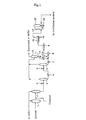
- FIG. 1 is an example of schematic process flow diagram which shows the production process for carrying out the present invention by using reactors composed of two stage reaction steps.
- a first reactor 1 is charged with a reaction catalyst, a reaction solvent and an ⁇ -olefin as a starting material to proceed with oligomerization reaction.
- the liquid reaction product which is produced therein and composed of the reaction catalyst, the reaction solvent, unreacted ⁇ -olefin and ⁇ -olefin oligomers is introduced to a second reactor 1', which is further supplied with the ⁇ -olefin as the starting material to proceed with oligomerization reaction.
- the liquid reaction product which is produced in the second reactor 1' and composed of the reaction catalyst, the reaction solvent, unreacted ⁇ -olefin and ⁇ -olefin oligomers is supplied to a first stage flash tank 3 via a control valve 2, and further to a second stage flash tank 6 via a control valve 5.
- the liquid product after the first stage flashing, prior to supply to the second stage flash tank, is heated in a heat exchanger 4 to be kept at a prescribed temperature or higher.
- the unreacted ⁇ -olefin which is dissolved in the liquid reaction product is recovered. Thereafter the liquid reaction product is sent to a deactivator 8, where the catalyst is deactivated with a deactivating agent 13.
- ⁇ -olefin oligomer accompanying the recovered ⁇ -olefin is recovered in a pot 10, and is sent to the deactivator 8, and then to a deasher 9, and after cleaning with cleaning water 14, to a separating tank 15.
- the ⁇ -olefin oligomer is separated into oil phase and water phase, and the water phase is discarded to the outside of the reaction e system as waste water 16.
- the oil phase is sent to a dissolving tank 19 equipped with a heat exchanger 17 and a pump 18, is again heated to completely dissolve the polymer in the oil phase, and thereafter is sent to the distillation system, where the solvent and the ⁇ -olefin are fractionated.
- Oligomerization reaction was continuously carried out by arranging in series, two sets of complete mixing tank type reactors (internal volume of 500 cc each), taking out reaction liquid from the first stage reactor, and supplying the second stage reactor with the reaction liquid.
- the above-prepared liquid catalyst was mixed with cyclohexane which had been dried in an atmosphere of argon so that the concentration of the zirconium tetrachloride was adjusted to 0.08 mmol /1 mmol of cyclohexane. Further, thiophene was added to the mixture in an amount of three times molar ratio to the zirconium tetrachloride to prepare a catalytic solution. Subsequently a definite amount (700 cc/hour) of the catalytic solution was fed in the first stage reactor.
- the oligomerization reaction was carried out by taking out reaction liquid from the first stage reactor, while regulating the liquid level to a constant value in the first stage reactor, and supplying the second stage reactor with the reaction liquid under the reactional conditions including a reaction temperature of 120°C, reaction pressure of 65 kg /cm 2 ⁇ G ( 6.4 MPa ), stirring at a revolutional speed of 500 rpm, and continuous supply of highly pure ethylene gas so as to maintain the reaction pressure at 65 kg / cm 2 ⁇ G in each of the reactors.
- the liquid level was equivalent to 200 cc in the first stage reactor and 250 cc in the second stage reactor.
- the reaction time (retention time) based on the solvent was about 17 minutes in the first stage reactor and about 21 minutes in the second stage reactor.
- the reaction conditions and the results are collectively given in Table 1.
- the deactivation treatment of catalyst was carried out by continuously supplying the deactivating tank with the liquid reaction product which had been obtained in the above-mentioned oligomerization reaction.
- a deactivating agent consisting of 10% by weight of aqueous ammonia was supplied at 28 g / hour.
- the deactivating tank was operated at 100°C at 4 kg / cm 2 ⁇ G (0.39 MPa) under stirring at a revolutional speed of 700 rpm.
- the liquid product after the deactivation treatment was filtered to filter off wax component by using filter paper.
- the resultant filtrate was washed twice with deionized water in an amount two times that of the filtrate, and then was dried with potassium carbonate anhydride.
- the colorless transparent liquid reaction product thus obtained was analyzed by gas chromatography to determine the distribution and purity of the ⁇ -olefin oligomer as the objective product.
- the product distribution was found by calculation through Schultz ⁇ Flory distribution from the result of gas chromatography for C-10 and more based on the operational loss. The results are given in Table 1.
- a sample of the reaction liquid was collected from the first stage reactor, and was analyzed by gas chromatography in the same manner as above to determine the amount of the ⁇ -olefin oligomer thus formed.
- the reaction ratio in each of the reactors is calculated by [(reacting weight in each reactor / (total reacting weight in the all the reactors)) ⁇ 100 (molar percent).
- C 18 purity is the production ratio of 1-octadecene as the objective product to the total production amount of C 18 components.
- Example 1 The procedure in Example 1 was repeated to carry out the oligomerization reaction except that the liquid level in the first stage reactor and also the liquid level in the second stage reactor were altered to the levels as given in Table 1.
- the reaction conditions and performance results are given in Table 1.
- Example 3 The procedure in Example 3 was repeated to carry out the oligomerization reaction except that the feed lines of the catalyst and solvent leading to the first stage reactor were branched, and the catalyst and solvent in part were directly supplied to the second stage reactor through the branched lines.
- the reaction conditions and performance results are given in Table 1.
- a third stage reactor same as the first and second stage reactors was installed on the downstream side of the second stage reactor constituting three-stage reaction steps.
- the oligomerization reaction was put into practice under the reactional conditions as given in Table 1, wherein the reactional conditions in the third stage reactor were set to a reaction temperature of 120°C, reaction pressure of 65 kg / cm 2 ⁇ G ( 6.4 MPa ), stirring at a revolutional speed of 500 rpm, and continuous supply of highly pure ethylene gas so as to maintain the reaction pressure at 65 kg / cm 2 ⁇ G, which were same as in the first and second stage reactors.
- the reaction conditions and performance results are given in Table 1.
- Example 1 The procedure in Example 1 was repeated to carry out the oligomerization reaction except that use was made of a first stage reactor having an internal volume of 1000 cc, the liquid level therein was set on 500 cc, and a second stage reactor was not used.
- the reaction conditions and performance results are given in Table 1.
- the present invention relates to a process capable of producing a highly pure and high quality ⁇ -olefin oligomer in the case of producing by the use of a Ziegler based catalyst, an ⁇ -olefin oligomer which has unsaturated double bond and 4 to 24 carbon atoms, and which is useful as a starting material for high molecular polymers, plasticizers, surfactants and the like.
Landscapes
- Chemical & Material Sciences (AREA)
- Organic Chemistry (AREA)
- Chemical Kinetics & Catalysis (AREA)
- Organic Low-Molecular-Weight Compounds And Preparation Thereof (AREA)
- Low-Molecular Organic Synthesis Reactions Using Catalysts (AREA)
- Transition And Organic Metals Composition Catalysts For Addition Polymerization (AREA)
- Addition Polymer Or Copolymer, Post-Treatments, Or Chemical Modifications (AREA)
- Polymerisation Methods In General (AREA)
Abstract
Description

| Example No. | ||||
| 1 | 2 | 3 | ||
| 〈〈Supply Amount of Catalyst and Solvent〉〉 | ||||
| <First Stage Reactor> | ||||
| ZrCl4 | (mmol/hour) | 0.08 | 0.08 | 0.08 |
| Ethylaluminum sesquichloride | (mmol/hour) | 0.436 | 0.436 | 0.436 |
| Triethylaluminum | (mmol/hour) | 0.124 | 0.124 | 0.124 |
| Cyclohexane | (cc/hour) | 700 | 700 | 700 |
| <Second Stage Reactor> | ||||
| ZrCl4 | (mmol/hour) | 0 | 0 | 0 |
| Ethylaluminum sesquichloride | (mmol/hour) | 0 | 0 | 0 |
| Triethylaluminum | (mmol/hour) | 0 | 0 | 0 |
| Cyclohexane | (cc/hour) | 0 | 0 | 0 |
| <Third Stage Reactor> | ||||
| ZrCl4 | (mmol/hour) | ― | ― | ― |
| Ethylaluminum sesquichloride | (mmol/hour) | ― | ― | ― |
| Triethylaluminum | (mmol/hour) | ― | ― | ― |
| Cyclohexane | (cc/hour) | ― | ― | ― |
| <Reaction temperature> | (°C) | 120 | 120 | 120 |
| <Reaction pressure> | (kg / cm2 · G) | 65 | 65 | 65 |
| Example No. | Comp.ExNo.1 | |||
| 4 | 5 | |||
| 〈〈Supply Amount of Catalyst and Solvent〉〉 | ||||
| <First Stage Reactor> | ||||
| ZrCl4 | (mmol/hour) | 0.07 | 0.08 | 0.08 |
| Ethylaluminum sesquichloride | (mmol/hour) | 0.374 | 0.436 | 0.436 |
| Triethylaluminum | (mmol/hour) | 0.11 | 0.124 | 0.124 |
| Cyclohexane | (cc/hour) | 600 | 700 | 700 |
| <Second Stage Reactor> | ||||
| ZrCl4 | (mmol/hour) | 0.01 | 0 | ― |
| Ethylaluminum sesquichloride | (mmol/hour) | 0.062 | 0 | ― |
| Triethylaluminum | (mmol/hour) | 0.018 | 0 | ― |
| Cyclohexane | (cc/hour) | 100 | 0 | ― |
| <Third Stage Reactor> | ||||
| ZrCl4 | (mmol/hour) | ― | 0 | ― |
| Ethylaluminum sesquichloride | (mmol/hour) | ― | 0 | ― |
| Triethylaluminum | (mmol/hour) | ― | 0 | ― |
| Cyclohexane | (cc/hour) | ― | 0 | ― |
| <Reaction temperature> | (°C) | 120 | 120 | 120 |
| <Reaction pressure> | (kg / cm2 · G) | 65 | 65 | 65 |
| (Remarks) Comp. ExNo.1: Comparative Example 1 |
| Example No. | |||||
| 1 | 2 | 3 | |||
| <First Stage Reactor> | |||||
| Reactor level | (cc) | 200 | 230 | 250 | |
| Reaction time | (minute) | 17 | 20 | 21 | |
| Reacting weight | (g/hour) | 119 | 138 | 151 | |
| Reaction ratio (Proportion) | (molar% ) | 52 | 60 | 67 | |
| <Second Stage Reactor> | |||||
| Reactor level | (cc) | 250 | 230 | 200 | |
| Reaction time | (minute) | 21 | 20 | 17 | |
| Reacting weight | (g/hour) | 110 | 92 | 74 | |
| Reaction ratio (Proportion) | (molar%) | 48 | 40 | 33 | |
| <Third Stage Reactor> | |||||
| Reactor level | (cc) | ― | ― | ― | |
| Reaction time | (minute) | ― | ― | ― | |
| Reacting weight | (g/hour) | ― | ― | ― | |
| Reaction ratio (Proportion) | (molar% ) | ― | ― | ― | |
| Catalytic activity (kg/g •ZrCl4) | 12.8 | 12.9 | 12.6 | ||
| α -Olefin oligomer thus formed | C 4 | (% by weight) | 15.0 | 14.7 | 14.8 |
| C 6 | (% by weight) | 15.4 | 15.2 | 15.2 | |
| C 8 | (% by weight) | 14.1 | 14.0 | 14.0 | |
| C 10 to 16 | (% by weight) | 36.3 | 36.4 | 36.4 | |
| C 18 | (% by weight) | 4.8 | 4.9 | 4.9 | |
| C 20 and more | (% by weight) | 14.4 | 14.8 | 14.7 | |
| C 18 purity | (% by weight) | 96.0 | 95.8 | 95.4 |
| Example No. | Comp.ExNo.1 | ||||
| 4 | 5 | ||||
| <First Stage Reactor> | |||||
| Reactor level | (cc) | 250 | 100 | 500 | |
| Reaction time | (minute) | 25 | 9 | 43 | |
| Reacting weight | (g/hour) | 121 | 88 | 225 | |
| Reaction ratio (Proportion) | (molar% ) | 55 | 38 | 100 | |
| <Second Stage Reactor> | |||||
| Reactor level | (cc) | 200 | 150 | ― | |
| Reaction time | (minute) | 17 | 13 | ― | |
| Reacting weight | (g/hour) | 99 | 81 | ― | |
| Reaction ratio (Proportion) | (molar% ) | 45 | 35 | ― | |
| <Third Stage Reactor> | |||||
| Reactor level | (cc) | ― | 200 | ― | |
| Reaction time | (minute) | ― | 17 | ― | |
| Reacting weight | (g/hour) | ― | 63 | ― | |
| Reaction ratio (Proportion) | (molar% ) | ― | 27 | ― | |
| Catalytic activity (kg/g · ZrCl4) | 12.3 | 13.0 | 12.6 | ||
| α -Olefin oligomer thus formed | C 4 | (% by weight) | 15.2 | 14.6 | 14.9 |
| C 6 | (% by weight) | 15.6 | 15.1 | 15.4 | |
| C 8 | (% by weight) | 14.2 | 13.9 | 14.1 | |
| C 10 to 16 | (% by weight) | 36.3 | 36.4 | 36.3 | |
| C 18 | (% by weight) | 4.8 | 4.9 | 4.9 | |
| C 20 and more | (% by weight) | 13.9 | 15.1 | 14.4 | |
| C 18 purity | (% by weight) | 95.9 | 96.3 | 94.5 | |
| {Remarks} Comp. ExNo.1: Comparative Example 1 |
Claims (6)
- A process for producing an α -olefin oligomer which comprises subjecting an α -olefin to oligomerization reaction in an organic solvent in the presence of a Ziegler based catalyst, wherein said oligomerization reaction is carried out through multi-stage reaction steps, and the α -olefin is supplied to each of the reaction steps.
- The process for producing an α -olefin oligomer according to Claim 1, wherein multi-stage reaction steps are two-stage reaction steps.
- The process for producing an α -olefin oligomer according to Claim 2, wherein the reactional ratio of the oligomerizing reacting weight in the first reaction step to the oligomerizing reacting weight in the second reaction step is in the range of 30: 70 to 70 : 30.
- The process for producing an α -olefin oligomer according to Claim 1, wherein the multi-stage reaction steps are carried out by using multi-stage reactors.
- The process for producing an α -olefin oligomer according to Claim 4, wherein the multi-stage reactors consist of two-stage reactors arranged in series.
- The process for producing an α -olefin oligomer according to Claim 1, wherein said α -olefin as the starting material is ethylene.
Applications Claiming Priority (3)
| Application Number | Priority Date | Filing Date | Title |
|---|---|---|---|
| JP2001048435A JP4870269B2 (en) | 2001-02-23 | 2001-02-23 | Method for producing α-olefin low polymer |
| JP2001048435 | 2001-02-23 | ||
| PCT/JP2002/001074 WO2002068365A1 (en) | 2001-02-23 | 2002-02-08 | PROCESS FOR PRODUCING LOW POLYMER OF α-OLEFIN |
Publications (3)
| Publication Number | Publication Date |
|---|---|
| EP1362837A1 true EP1362837A1 (en) | 2003-11-19 |
| EP1362837A4 EP1362837A4 (en) | 2006-08-23 |
| EP1362837B1 EP1362837B1 (en) | 2014-07-30 |
Family
ID=18909706
Family Applications (1)
| Application Number | Title | Priority Date | Filing Date |
|---|---|---|---|
| EP02711407.3A Expired - Lifetime EP1362837B1 (en) | 2001-02-23 | 2002-02-08 | Process for producing low polymer of alpha-olefin |
Country Status (8)
| Country | Link |
|---|---|
| US (1) | US20030153798A1 (en) |
| EP (1) | EP1362837B1 (en) |
| JP (1) | JP4870269B2 (en) |
| KR (1) | KR100849299B1 (en) |
| CN (1) | CN1229311C (en) |
| ES (1) | ES2509865T3 (en) |
| TW (1) | TWI252221B (en) |
| WO (1) | WO2002068365A1 (en) |
Cited By (1)
| Publication number | Priority date | Publication date | Assignee | Title |
|---|---|---|---|---|
| WO2014139861A1 (en) | 2013-03-11 | 2014-09-18 | Universität Bayreuth | Complexes for the catalytic oligomerization of olefins |
Families Citing this family (13)
| Publication number | Priority date | Publication date | Assignee | Title |
|---|---|---|---|---|
| ATE426281T1 (en) * | 2003-11-12 | 2009-04-15 | Alcatel Lucent | PATH PROTECTION FOR SDH/SONET NETWORKS |
| JP2007514026A (en) * | 2003-12-11 | 2007-05-31 | バセル ポリオレフィン イタリア エス.アール.エル. | Liquid phase method for the polymerization of olefins. |
| ES2352741T3 (en) * | 2005-08-31 | 2011-02-22 | Saudi Basic Industries Corporation | PROCESS FOR THE PREPARATION OF LINEAR ALFA-OLEFINS AND CATALYST USED IN THE SAME. |
| EP1886985B1 (en) * | 2006-07-31 | 2009-09-02 | Saudi Basic Industries Corporation | Process for oligomerization of ethylene and/or alpha-olefins |
| WO2008081638A1 (en) * | 2006-12-28 | 2008-07-10 | Mitsubishi Chemical Corporation | PROCESS FOR PRODUCTION OF α-OLEFIN LOW POLYMERS |
| DE102010006589A1 (en) * | 2010-02-02 | 2011-08-04 | Linde Aktiengesellschaft, 80331 | Process for the preparation of linear α-olefins |
| FR2959751B1 (en) * | 2010-05-06 | 2012-06-08 | Inst Francais Du Petrole | PROCESS FOR THE PRODUCTION OF FUEL BASE FROM AN ETHYLENE CHARGE USING AT LEAST ONE OLIGOMERIZATION STEP IN THE PRESENCE OF A HOMOGENEOUS CATALYTIC SYSTEM |
| US10519077B2 (en) | 2015-09-18 | 2019-12-31 | Chevron Phillips Chemical Company Lp | Ethylene oligomerization/trimerization/tetramerization reactor |
| US10513473B2 (en) | 2015-09-18 | 2019-12-24 | Chevron Phillips Chemical Company Lp | Ethylene oligomerization/trimerization/tetramerization reactor |
| FR3083235B1 (en) * | 2018-06-29 | 2021-12-03 | Ifp Energies Now | CASCADE OLIGOMERIZATION PROCESS OF AGITATED LIQUID GAS REACTORS WITH STAGE INJECTION OF ETHYLENE |
| US11667590B2 (en) | 2021-05-26 | 2023-06-06 | Chevron Phillips Chemical Company, Lp | Ethylene oligomerization processes |
| US20240239727A1 (en) * | 2021-06-03 | 2024-07-18 | Idemitsu Kosan Co.,Ltd. | Method for producing alpha-olefin |
| US12516003B2 (en) * | 2022-03-29 | 2026-01-06 | Uop Llc | Process for converting olefins to distillate fuels |
Family Cites Families (11)
| Publication number | Priority date | Publication date | Assignee | Title |
|---|---|---|---|---|
| US3108145A (en) * | 1960-11-29 | 1963-10-22 | Sun Oil Co | Preparation of olefin polymers |
| US3576902A (en) * | 1968-12-20 | 1971-04-27 | Exxon Research Engineering Co | Process for preparation of wax range linear alpha olefins |
| US4377720A (en) * | 1981-12-14 | 1983-03-22 | Exxon Research And Engineering Co. | Preparation of linear olefin products |
| US4740645A (en) * | 1984-09-14 | 1988-04-26 | Mobil Oil Corporation | Multistage conversion of lower olefins with interreactor quenching |
| JPS62430A (en) * | 1985-06-26 | 1987-01-06 | Idemitsu Petrochem Co Ltd | Production of linear alpha-olefin |
| JPH0678373B2 (en) * | 1986-04-17 | 1994-10-05 | 出光石油化学株式会社 | Method for producing α-olefin |
| EP0241596B1 (en) * | 1986-04-17 | 1990-10-31 | Idemitsu Petrochemical Co. Ltd. | A process for preparing linear alpha-olefins |
| US4886933A (en) * | 1988-02-15 | 1989-12-12 | Idemitsu Petrochemical Co., Ltd. | Production of linear alpha-olefins |
| JPH062430A (en) * | 1992-06-17 | 1994-01-11 | Hory Corp | Device for retaining curved form |
| JPH0859519A (en) * | 1994-08-23 | 1996-03-05 | Tosoh Corp | Method for producing chain α-olefin |
| US5650548A (en) * | 1995-06-16 | 1997-07-22 | Amoco Corporation | Olefin oligomerization process |
-
2001
- 2001-02-23 JP JP2001048435A patent/JP4870269B2/en not_active Expired - Lifetime
-
2002
- 2002-02-08 EP EP02711407.3A patent/EP1362837B1/en not_active Expired - Lifetime
- 2002-02-08 US US10/257,537 patent/US20030153798A1/en not_active Abandoned
- 2002-02-08 KR KR1020027014168A patent/KR100849299B1/en not_active Expired - Fee Related
- 2002-02-08 ES ES02711407.3T patent/ES2509865T3/en not_active Expired - Lifetime
- 2002-02-08 WO PCT/JP2002/001074 patent/WO2002068365A1/en not_active Ceased
- 2002-02-08 CN CNB028003993A patent/CN1229311C/en not_active Expired - Lifetime
- 2002-02-20 TW TW091102948A patent/TWI252221B/en active
Cited By (1)
| Publication number | Priority date | Publication date | Assignee | Title |
|---|---|---|---|---|
| WO2014139861A1 (en) | 2013-03-11 | 2014-09-18 | Universität Bayreuth | Complexes for the catalytic oligomerization of olefins |
Also Published As
| Publication number | Publication date |
|---|---|
| JP4870269B2 (en) | 2012-02-08 |
| KR100849299B1 (en) | 2008-07-29 |
| WO2002068365A1 (en) | 2002-09-06 |
| CN1229311C (en) | 2005-11-30 |
| US20030153798A1 (en) | 2003-08-14 |
| CN1457330A (en) | 2003-11-19 |
| ES2509865T3 (en) | 2014-10-20 |
| EP1362837A4 (en) | 2006-08-23 |
| TWI252221B (en) | 2006-04-01 |
| JP2002255863A (en) | 2002-09-11 |
| KR20020091232A (en) | 2002-12-05 |
| EP1362837B1 (en) | 2014-07-30 |
Similar Documents
| Publication | Publication Date | Title |
|---|---|---|
| US6576721B2 (en) | Process for producing low polymer of ethylene | |
| US4783573A (en) | Process for preparing linear α-olefins | |
| EP1362837B1 (en) | Process for producing low polymer of alpha-olefin | |
| CN106103389B (en) | Ethylene Oligomerization Using Mixed Ligands | |
| US10421064B2 (en) | Catalyst composition and process for oligomerization of ethylene to produce 1-hexene and/or 1-octene | |
| CN106061607A (en) | Continuous ethylene oligomerization with in-situ catalyst preparation | |
| US10975001B2 (en) | Method for producing alpha-olefin oligomer | |
| EP1464655A1 (en) | PROCESS FOR PRODUCING LOW POLYMER OF a-OLEFIN | |
| JPH08198780A (en) | Oligomerization of ethylene to linear α-olefins | |
| KR920005669B1 (en) | A process for preparing linear alpha-olefins | |
| US3981941A (en) | Process of making linear alpha-olefins by ethylene oligomerization | |
| JP2002256007A (en) | METHOD FOR PRODUCING alpha-OLEFIN OLIGOMER | |
| JP4916049B2 (en) | Method for producing ethylene low polymer | |
| JPS58201729A (en) | Preparation of straight chain alpha-olefin | |
| JP2622797B2 (en) | Method for producing linear α-olefin | |
| AU624652B2 (en) | A process for preparing linear alpha-olefins | |
| JPH0853374A (en) | Production of linear alpha-olefin | |
| US20240239727A1 (en) | Method for producing alpha-olefin | |
| JP7754928B2 (en) | Method for producing α-olefins | |
| JPH06104627B2 (en) | Method for producing linear α-olefin | |
| JPH0446929B2 (en) | ||
| JP2000264919A (en) | Production of alpha-olefin | |
| JPH0797344A (en) | Production of alpha-olefin | |
| JPH07247226A (en) | Method for producing α-olefin |
Legal Events
| Date | Code | Title | Description |
|---|---|---|---|
| PUAI | Public reference made under article 153(3) epc to a published international application that has entered the european phase |
Free format text: ORIGINAL CODE: 0009012 |
|
| 17P | Request for examination filed |
Effective date: 20020930 |
|
| AK | Designated contracting states |
Kind code of ref document: A1 Designated state(s): AT BE CH CY DE DK ES FI FR GB GR IE IT LI LU MC NL PT SE TR |
|
| RAP1 | Party data changed (applicant data changed or rights of an application transferred) |
Owner name: IDEMITSU KOSAN CO., LTD. |
|
| A4 | Supplementary search report drawn up and despatched |
Effective date: 20060725 |
|
| 17Q | First examination report despatched |
Effective date: 20080514 |
|
| GRAP | Despatch of communication of intention to grant a patent |
Free format text: ORIGINAL CODE: EPIDOSNIGR1 |
|
| INTG | Intention to grant announced |
Effective date: 20131122 |
|
| GRAS | Grant fee paid |
Free format text: ORIGINAL CODE: EPIDOSNIGR3 |
|
| GRAP | Despatch of communication of intention to grant a patent |
Free format text: ORIGINAL CODE: EPIDOSNIGR1 |
|
| GRAS | Grant fee paid |
Free format text: ORIGINAL CODE: EPIDOSNIGR3 |
|
| GRAA | (expected) grant |
Free format text: ORIGINAL CODE: 0009210 |
|
| INTG | Intention to grant announced |
Effective date: 20140604 |
|
| AK | Designated contracting states |
Kind code of ref document: B1 Designated state(s): AT BE CH CY DE DK ES FI FR GB GR IE IT LI LU MC NL PT SE TR |
|
| REG | Reference to a national code |
Ref country code: GB Ref legal event code: FG4D |
|
| REG | Reference to a national code |
Ref country code: CH Ref legal event code: EP |
|
| REG | Reference to a national code |
Ref country code: AT Ref legal event code: REF Ref document number: 679882 Country of ref document: AT Kind code of ref document: T Effective date: 20140815 |
|
| REG | Reference to a national code |
Ref country code: IE Ref legal event code: FG4D |
|
| REG | Reference to a national code |
Ref country code: DE Ref legal event code: R096 Ref document number: 60246492 Country of ref document: DE Effective date: 20140911 |
|
| REG | Reference to a national code |
Ref country code: ES Ref legal event code: FG2A Ref document number: 2509865 Country of ref document: ES Kind code of ref document: T3 Effective date: 20141020 |
|
| REG | Reference to a national code |
Ref country code: NL Ref legal event code: T3 |
|
| REG | Reference to a national code |
Ref country code: AT Ref legal event code: MK05 Ref document number: 679882 Country of ref document: AT Kind code of ref document: T Effective date: 20140730 |
|
| PG25 | Lapsed in a contracting state [announced via postgrant information from national office to epo] |
Ref country code: PT Free format text: LAPSE BECAUSE OF FAILURE TO SUBMIT A TRANSLATION OF THE DESCRIPTION OR TO PAY THE FEE WITHIN THE PRESCRIBED TIME-LIMIT Effective date: 20141202 Ref country code: GR Free format text: LAPSE BECAUSE OF FAILURE TO SUBMIT A TRANSLATION OF THE DESCRIPTION OR TO PAY THE FEE WITHIN THE PRESCRIBED TIME-LIMIT Effective date: 20141031 Ref country code: FI Free format text: LAPSE BECAUSE OF FAILURE TO SUBMIT A TRANSLATION OF THE DESCRIPTION OR TO PAY THE FEE WITHIN THE PRESCRIBED TIME-LIMIT Effective date: 20140730 Ref country code: SE Free format text: LAPSE BECAUSE OF FAILURE TO SUBMIT A TRANSLATION OF THE DESCRIPTION OR TO PAY THE FEE WITHIN THE PRESCRIBED TIME-LIMIT Effective date: 20140730 |
|
| PG25 | Lapsed in a contracting state [announced via postgrant information from national office to epo] |
Ref country code: AT Free format text: LAPSE BECAUSE OF FAILURE TO SUBMIT A TRANSLATION OF THE DESCRIPTION OR TO PAY THE FEE WITHIN THE PRESCRIBED TIME-LIMIT Effective date: 20140730 Ref country code: CY Free format text: LAPSE BECAUSE OF FAILURE TO SUBMIT A TRANSLATION OF THE DESCRIPTION OR TO PAY THE FEE WITHIN THE PRESCRIBED TIME-LIMIT Effective date: 20140730 |
|
| PG25 | Lapsed in a contracting state [announced via postgrant information from national office to epo] |
Ref country code: DK Free format text: LAPSE BECAUSE OF FAILURE TO SUBMIT A TRANSLATION OF THE DESCRIPTION OR TO PAY THE FEE WITHIN THE PRESCRIBED TIME-LIMIT Effective date: 20140730 Ref country code: IT Free format text: LAPSE BECAUSE OF FAILURE TO SUBMIT A TRANSLATION OF THE DESCRIPTION OR TO PAY THE FEE WITHIN THE PRESCRIBED TIME-LIMIT Effective date: 20140730 |
|
| REG | Reference to a national code |
Ref country code: DE Ref legal event code: R097 Ref document number: 60246492 Country of ref document: DE |
|
| PLBE | No opposition filed within time limit |
Free format text: ORIGINAL CODE: 0009261 |
|
| STAA | Information on the status of an ep patent application or granted ep patent |
Free format text: STATUS: NO OPPOSITION FILED WITHIN TIME LIMIT |
|
| 26N | No opposition filed |
Effective date: 20150504 |
|
| PG25 | Lapsed in a contracting state [announced via postgrant information from national office to epo] |
Ref country code: LU Free format text: LAPSE BECAUSE OF FAILURE TO SUBMIT A TRANSLATION OF THE DESCRIPTION OR TO PAY THE FEE WITHIN THE PRESCRIBED TIME-LIMIT Effective date: 20150208 |
|
| REG | Reference to a national code |
Ref country code: CH Ref legal event code: PL |
|
| PG25 | Lapsed in a contracting state [announced via postgrant information from national office to epo] |
Ref country code: CH Free format text: LAPSE BECAUSE OF NON-PAYMENT OF DUE FEES Effective date: 20150228 Ref country code: MC Free format text: LAPSE BECAUSE OF FAILURE TO SUBMIT A TRANSLATION OF THE DESCRIPTION OR TO PAY THE FEE WITHIN THE PRESCRIBED TIME-LIMIT Effective date: 20140730 Ref country code: LI Free format text: LAPSE BECAUSE OF NON-PAYMENT OF DUE FEES Effective date: 20150228 |
|
| REG | Reference to a national code |
Ref country code: IE Ref legal event code: MM4A |
|
| REG | Reference to a national code |
Ref country code: FR Ref legal event code: ST Effective date: 20151030 |
|
| PG25 | Lapsed in a contracting state [announced via postgrant information from national office to epo] |
Ref country code: IE Free format text: LAPSE BECAUSE OF NON-PAYMENT OF DUE FEES Effective date: 20150208 |
|
| PG25 | Lapsed in a contracting state [announced via postgrant information from national office to epo] |
Ref country code: FR Free format text: LAPSE BECAUSE OF NON-PAYMENT OF DUE FEES Effective date: 20150302 |
|
| PGFP | Annual fee paid to national office [announced via postgrant information from national office to epo] |
Ref country code: NL Payment date: 20160111 Year of fee payment: 15 |
|
| PGFP | Annual fee paid to national office [announced via postgrant information from national office to epo] |
Ref country code: ES Payment date: 20160113 Year of fee payment: 15 Ref country code: DE Payment date: 20160202 Year of fee payment: 15 |
|
| PGFP | Annual fee paid to national office [announced via postgrant information from national office to epo] |
Ref country code: BE Payment date: 20151223 Year of fee payment: 15 Ref country code: GB Payment date: 20160203 Year of fee payment: 15 |
|
| PG25 | Lapsed in a contracting state [announced via postgrant information from national office to epo] |
Ref country code: BE Free format text: LAPSE BECAUSE OF NON-PAYMENT OF DUE FEES Effective date: 20170228 |
|
| PG25 | Lapsed in a contracting state [announced via postgrant information from national office to epo] |
Ref country code: TR Free format text: LAPSE BECAUSE OF FAILURE TO SUBMIT A TRANSLATION OF THE DESCRIPTION OR TO PAY THE FEE WITHIN THE PRESCRIBED TIME-LIMIT Effective date: 20140730 |
|
| REG | Reference to a national code |
Ref country code: DE Ref legal event code: R119 Ref document number: 60246492 Country of ref document: DE |
|
| REG | Reference to a national code |
Ref country code: NL Ref legal event code: MM Effective date: 20170301 |
|
| GBPC | Gb: european patent ceased through non-payment of renewal fee |
Effective date: 20170208 |
|
| PG25 | Lapsed in a contracting state [announced via postgrant information from national office to epo] |
Ref country code: NL Free format text: LAPSE BECAUSE OF NON-PAYMENT OF DUE FEES Effective date: 20170301 |
|
| PG25 | Lapsed in a contracting state [announced via postgrant information from national office to epo] |
Ref country code: DE Free format text: LAPSE BECAUSE OF NON-PAYMENT OF DUE FEES Effective date: 20170901 |
|
| REG | Reference to a national code |
Ref country code: BE Ref legal event code: FP Effective date: 20140826 Ref country code: BE Ref legal event code: MM Effective date: 20170228 |
|
| PG25 | Lapsed in a contracting state [announced via postgrant information from national office to epo] |
Ref country code: GB Free format text: LAPSE BECAUSE OF NON-PAYMENT OF DUE FEES Effective date: 20170208 |
|
| REG | Reference to a national code |
Ref country code: ES Ref legal event code: FD2A Effective date: 20180704 |
|
| PG25 | Lapsed in a contracting state [announced via postgrant information from national office to epo] |
Ref country code: ES Free format text: LAPSE BECAUSE OF NON-PAYMENT OF DUE FEES Effective date: 20170209 |