EP1362786A2 - Radiator für einen Satelliten - Google Patents
Radiator für einen Satelliten Download PDFInfo
- Publication number
- EP1362786A2 EP1362786A2 EP03010527A EP03010527A EP1362786A2 EP 1362786 A2 EP1362786 A2 EP 1362786A2 EP 03010527 A EP03010527 A EP 03010527A EP 03010527 A EP03010527 A EP 03010527A EP 1362786 A2 EP1362786 A2 EP 1362786A2
- Authority
- EP
- European Patent Office
- Prior art keywords
- radiator
- wavelength
- layer
- radiation
- selective element
- Prior art date
- Legal status (The legal status is an assumption and is not a legal conclusion. Google has not performed a legal analysis and makes no representation as to the accuracy of the status listed.)
- Withdrawn
Links
- 230000005855 radiation Effects 0.000 claims abstract description 49
- QSHDDOUJBYECFT-UHFFFAOYSA-N mercury Chemical compound [Hg] QSHDDOUJBYECFT-UHFFFAOYSA-N 0.000 claims description 31
- 229910052753 mercury Inorganic materials 0.000 claims description 29
- 239000000463 material Substances 0.000 claims description 20
- 238000010521 absorption reaction Methods 0.000 claims description 18
- 229910052709 silver Inorganic materials 0.000 claims description 8
- 239000004332 silver Substances 0.000 claims description 8
- 239000000853 adhesive Substances 0.000 claims description 7
- 230000001070 adhesive effect Effects 0.000 claims description 7
- PXHVJJICTQNCMI-UHFFFAOYSA-N Nickel Chemical compound [Ni] PXHVJJICTQNCMI-UHFFFAOYSA-N 0.000 claims description 6
- 229910018072 Al 2 O 3 Inorganic materials 0.000 claims description 4
- KRHYYFGTRYWZRS-UHFFFAOYSA-M Fluoride anion Chemical compound [F-] KRHYYFGTRYWZRS-UHFFFAOYSA-M 0.000 claims description 4
- 229910052782 aluminium Inorganic materials 0.000 claims description 4
- XAGFODPZIPBFFR-UHFFFAOYSA-N aluminium Chemical compound [Al] XAGFODPZIPBFFR-UHFFFAOYSA-N 0.000 claims description 4
- 238000000926 separation method Methods 0.000 claims description 4
- 229910004261 CaF 2 Inorganic materials 0.000 claims description 3
- 230000007797 corrosion Effects 0.000 claims description 3
- 238000005260 corrosion Methods 0.000 claims description 3
- 229910001026 inconel Inorganic materials 0.000 claims description 3
- AMGQUBHHOARCQH-UHFFFAOYSA-N indium;oxotin Chemical compound [In].[Sn]=O AMGQUBHHOARCQH-UHFFFAOYSA-N 0.000 claims description 3
- 229910052759 nickel Inorganic materials 0.000 claims description 3
- XOLBLPGZBRYERU-UHFFFAOYSA-N tin dioxide Chemical compound O=[Sn]=O XOLBLPGZBRYERU-UHFFFAOYSA-N 0.000 claims description 3
- 229910001887 tin oxide Inorganic materials 0.000 claims description 3
- 229910020156 CeF Inorganic materials 0.000 claims description 2
- 229910017768 LaF 3 Inorganic materials 0.000 claims description 2
- ASNHGEVAWNWCRQ-UHFFFAOYSA-N 4-(hydroxymethyl)oxolane-2,3,4-triol Chemical compound OCC1(O)COC(O)C1O ASNHGEVAWNWCRQ-UHFFFAOYSA-N 0.000 claims 1
- 230000003287 optical effect Effects 0.000 description 21
- WUKWITHWXAAZEY-UHFFFAOYSA-L calcium difluoride Chemical compound [F-].[F-].[Ca+2] WUKWITHWXAAZEY-UHFFFAOYSA-L 0.000 description 9
- 229910001634 calcium fluoride Inorganic materials 0.000 description 9
- BQCADISMDOOEFD-UHFFFAOYSA-N Silver Chemical compound [Ag] BQCADISMDOOEFD-UHFFFAOYSA-N 0.000 description 7
- 230000003595 spectral effect Effects 0.000 description 5
- 206010041662 Splinter Diseases 0.000 description 3
- 238000004364 calculation method Methods 0.000 description 3
- 238000004519 manufacturing process Methods 0.000 description 3
- 238000004088 simulation Methods 0.000 description 3
- 238000007740 vapor deposition Methods 0.000 description 3
- 241000726409 Satellites Species 0.000 description 2
- 239000002313 adhesive film Substances 0.000 description 2
- 239000011248 coating agent Substances 0.000 description 2
- 238000000576 coating method Methods 0.000 description 2
- 238000001228 spectrum Methods 0.000 description 2
- 230000005457 Black-body radiation Effects 0.000 description 1
- -1 OSRs Substances 0.000 description 1
- 239000003522 acrylic cement Substances 0.000 description 1
- 239000003086 colorant Substances 0.000 description 1
- 230000007547 defect Effects 0.000 description 1
- 238000009826 distribution Methods 0.000 description 1
- 230000007613 environmental effect Effects 0.000 description 1
- 239000011521 glass Substances 0.000 description 1
- 238000010438 heat treatment Methods 0.000 description 1
- 239000013464 silicone adhesive Substances 0.000 description 1
- 238000004544 sputter deposition Methods 0.000 description 1
- 230000007704 transition Effects 0.000 description 1
- 238000007738 vacuum evaporation Methods 0.000 description 1
- 239000002918 waste heat Substances 0.000 description 1
Images


Classifications
-
- B—PERFORMING OPERATIONS; TRANSPORTING
- B64—AIRCRAFT; AVIATION; COSMONAUTICS
- B64G—COSMONAUTICS; VEHICLES OR EQUIPMENT THEREFOR
- B64G1/00—Cosmonautic vehicles
- B64G1/22—Parts of, or equipment specially adapted for fitting in or to, cosmonautic vehicles
- B64G1/46—Arrangements or adaptations of devices for control of environment or living conditions
- B64G1/50—Arrangements or adaptations of devices for control of environment or living conditions for temperature control
- B64G1/503—Radiator panels
Definitions
- the invention relates to a radiator for a satellite.
- Radiators are used in space travel to radiate waste heat from space vehicles to a cold environment in order to regulate the internal temperature. Adapted surface properties ensure that the internal loads can be emitted to the environment as well as possible as IR radiation.
- the external loads mainly solar radiation and albedound IR radiation from the orbiting planet
- Surfaces with a high infrared hemispherical emissivity ( ⁇ h ) and small solar absorption levels ( ⁇ s ) are used as standard for satellites in earth orbit. This does not minimize the absorbed earth radiation.
- the invention has for its object to a radiator for a satellite develop that even with about 10 times higher solar radiation and 20 times higher planetary radiation (compared to near-Earth orbits), e.g. on orbit around Mercury, moderate temperatures (-40 ° C to + 60 ° C) guaranteed inside the satellite.
- a fluoride for example CaF 2 , LaF 3 , CeF 3 or also Al 2 O 3 , is particularly suitable as the material for the wavelength-selective element, a reflection layer, for example made of silver or aluminum, being applied to the back.
- the materials mentioned are preferably present in the wavelength-selective material in the form of thin, in particular monocrystalline, platelets with a thickness of, for example, 0.1 to 10 mm.
- the area of these platelets can be between a few mm 2 and a few cm 2 , although there is no upper or lower limit.
- the use of thin platelets is particularly advantageous since they can compensate for different thermal expansions of the radiator material and of the wavelength-selective material, since distances can be provided between the individual platelets that can act as expansion joints. These distances can preferably be chosen in the same order of magnitude as the thickness of the platelets. This would not be the case if a continuous layer of wavelength selective material was used.
- the use of individual platelets is easier to repair, since in the case of local defects, ideally only a single platelet has to be replaced and not an entire, continuous layer has to be completely renewed.
- the application of the platelets can also take place at different times from the manufacture of the radiator body, as a result of which the manufacturing process can be made more flexible.
- the platelets can preferably be applied with the aid of an adhesive, for example a flexible adhesive, which can thus additionally contribute to the compensation of the different thermal expansion coefficients of the radiator material and the wavelength-selective material.
- the adhesive can also be electrically conductive.
- the wavelength-selective element according to the invention has a separation wavelength - depending on the material used - below which the incident radiation is essentially reflected and above which the incident radiation is essentially absorbed.
- a separation wavelength - depending on the material used - below which the incident radiation is essentially reflected and above which the incident radiation is essentially absorbed.
- the presence of this cut-off wavelength leads to the above-mentioned properties of the material with regard to the desired emissivity and the desired degrees of absorption.
- the radiator according to the invention is based on an application Exemplified on board a satellite in an orbit around Mercury.
- the basic principle of the radiator according to the invention is based on the selective one Radiation properties of the wavelength selective arranged on the radiator surface Elements (this is also referred to below as an optical splitter) for IR radiation coming from Mercury on the one hand and IR intrinsic radiation the satellite on the other.
- the absorption of those coming from Mercury IR radiation is minimized without the actual function of the radiator, the radiation of heat from inside the satellite.
- the wavelength-selective element has a low degree of solar absorption so that the amount of solar radiation absorbed remains low.
- the principle of operation of the optical splitter according to the invention is not based on the Mercury is limited, but can also be used on other planetary missions with high Planetary radiation (and high temperature). To adapt to the respective radiation states only the separation wavelength of the optical Elements are changed. This can be achieved by selecting suitable materials become.
- Fig. 1 shows a sketch to illustrate the geometric relationships of the satellite orbit around Mercury.
- An elliptical orbit around Mercury is assumed, the track height in the Perigee is 400 km and in the Apogee 1500 km.
- the web is perpendicular to the paper plane.
- One side of orbiting Mercury Satellite SAT is constantly nadir-oriented.
- Direct sunlight on the radiator level is avoided by the satellite is rotated in a suitable manner as soon as it has reached the position of the orbit which the sun vector runs parallel to the radiator plane (see Fig. 2). How one 2, such a rotation of the satellite takes place exactly twice during one orbit of Mercury around the sun.
- the satellite's orbital plane 2 is perpendicular to the paper plane.
- the orientation of the orbital plane of the Satellite is fixed in space over the entire orbit of Mercury around the sun.
- the normal vector of the radiator is perpendicular to all points of the orbit Nadir direction.
- the satellite orbit shown corresponds to the orbit of the orbiter Bepi Colombo Mercury Mission, on which the radiator described here is used should come.
- One side of the satellite is never illuminated by the sun and can act as a radiator R (see Fig. 1,3) can be used, due to the small visibility factor a fairly weak albedo radiation, but a very high IR radiation from the Mercury falls.
- Mercury has surface temperatures between on its day side 600 K in apogee and 700 K in perigee. It is on the night side at approx. 100 K. The temperature on the day side remains in the viewing angle of the radiator (38 ° to 59 °) between subsolar point and horizon almost constant.
- the temperature of Mercury changes significantly with the distance of Mercury from the sun during one orbit (Mercury year). Since Mercury Days only rotates once around its own axis, the temperature distribution is on Day and night side almost constant. Mercury orbits around the sun 88 earth days.
- Optical splitter OS and Radiators R advantageously form an integral unit.
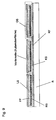
- the wavelength-selective material of an optical splitter is present as a monocrystalline, polished calcium fluoride plate FP.
- Calcium fluoride has properties similar to glass, i.e. very temperature and radiation resistant, and can be attached like optical solar reflectors (OSRs).
- the platelets FP have a typical thickness of approx. 1 mm and a size of approx. 20 x 20 mm 2 .
- the back is coated with a reflective layer RS made of aluminum or silver by vacuum evaporation or sputtering.
- a further layer KS for example made of nickel or Inconel® or the like, which is applied on the back of the plates FP and on their edges, serves as corrosion protection for this reflection layer RS.
- the plates FP are glued on with a flexible adhesive, which can also be designed as an electrically conductive adhesive, in order to compensate for the different thermal expansions of the radiator material (generally aluminum or a sandwich structure) and calcium fluoride.
- the platelets are glued to the outer surface of the radiator R using a silicone adhesive (adhesive film KF in FIG. 9).
- Alternatively, thin acrylic adhesive films can be used.
- the outer surface and edges of the platelets FP can be coated with a weakly electrically conductive layer LS, for example made of tin oxide or indium tin oxide (ITO), in order to avoid strong electrostatic charges. Clearances of, for example, approximately 0.1 mm to 0.5 mm are preferably left free between the platelets in order to achieve sufficient flexibility to compensate for different thermal expansion.
- the use of platelets also enables the radiator coating to be more easily adapted to more complex radiator structures, for example placing platelets around inserts, brackets or specific mounting points for further components such as antennas or the like.
- the optical splitter is an inverted OSR with changed selective thermo-optical properties.
- the calcium fluoride as Optical splinters containing wavelength-selective material are distinguished a separation wavelength at approx. 9 ⁇ m. 4 and 5 show those from simulation calculations derived spectral absorption and reflectance of 1mm thick calcium fluoride with silver coating on the back.
- One recognizes one Wavelength of approx. 9 ⁇ m has a sharp transition at which the degree of absorption of jumps about 0 to approximately 1.
- the degree of reflection jumps from approx. 1 a value close to 0.
- Mercury radiation has its maximum radiation at a wavelength of approx. 4 to 5 ⁇ m, while the IR intrinsic radiation of radiator R has its maximum radiation at temperatures between 0 and 40 ° C at around 10 ⁇ m. 8 shows the spectral radiance of a black body for the temperatures of the radiator (310K), Mercury (700K) and sun (5777K). This difference in the radiation maxima is used by the optical splitter OS: the incoming mercury radiation penetrates the calcium fluoride layer of the optical splitter OS and is largely reflected back into space by the silver layer serving as the reflection layer RS, i.e. only weakly absorbed ( ⁇ IR (700 K ) ⁇ 0.4).
- the radiator's natural radiation is emitted from the surface of the optical splitter into the environment with a high semi-spatial emissivity ( ⁇ h > 0.8).
- Fig. 7 are summarized those on the system satellite, radiator, optical Splinters of existing heat flows and radiation paths are shown.
Landscapes
- Engineering & Computer Science (AREA)
- Toxicology (AREA)
- Biodiversity & Conservation Biology (AREA)
- Environmental & Geological Engineering (AREA)
- Environmental Sciences (AREA)
- General Health & Medical Sciences (AREA)
- Health & Medical Sciences (AREA)
- Life Sciences & Earth Sciences (AREA)
- Remote Sensing (AREA)
- Aviation & Aerospace Engineering (AREA)
- Optical Filters (AREA)
- Crystals, And After-Treatments Of Crystals (AREA)
- Optical Elements Other Than Lenses (AREA)
- Lenses (AREA)
Abstract
Description
- einen hohen hemisphärischen Emissionsgrad (εh bevorzugt > 0,8) zur Abstrahlung der Verlustwärme des Satelliten;
- einen geringen Absorptionsgrad (αIR bevorzugt < 0,4) für IR-Strahlung eines schwarzen Strahlers bei Temperaturen zwischen 500 und 700 K zur Minimierung der absorbierten Wärmestrahlung des Planeten, in dessen Orbit sich der Satellit befindet und
- einen geringen solaren Absorptionsgrad (αs bevorzugt <0,2) zur Minimierung der absorbierten Wärmestrahlung der Sonne.
- Fig. 1:
- eine Skizze zur Darlegung der geometrischen Verhältnisse im Perigäum und Apogäum des Satellitenorbits um den Merkur;
- Fig. 2:
- eine Skizze zur Darlegung der geometrischen Verhältnisse von Satellitenorbit und Merkurbahn um die Sonne;
- Fig. 3:
- eine Skizze zu den einfallenden Wärmelasten auf Satellit und Radiator;
- Fig. 4a,b:
- die aus Simulationsrechnungen abgeleiteten spektralen Absorptions- und Reflexionsgrade eines 1mm dicken Calciumfluoridplättchens mit rückseitiger Silberbedampfung in einem Frequenzbereich, der insbesondere den IR-Bereich betrifft;
- Fig. 5a,b:
- die die aus Simulationsrechnungen abgeleiteten spektralen Absorptions-, und Reflexionsgrade eines 1 mm dicken Calciumfluoridplättchens mit rückseitiger Silberbedampfung in logarithmischer Darstellung;
- Fig. 6:
- den Absorptionsgrad eines 1mm dicken Calciumfluorid-Plättchens mit rückseitiger Silberbedampfung als Funktion der Temperatur der einfallenden Strahlung eines schwarzen Körpers;
- Fig. 7:
- eine erfindungsgemäße Ausführung aus einem Radiator mit darauf aufgebrachtem optischem Splitter in schematischer Darstellung, wobei auch die vorhandenen Wärmeströme und Strahlungswege eingezeichnet sind;
- Fig. 8:
- die spektrale Strahldichte eines schwarzen Strahlers bei 310 K (Radiator), 700 K (Merkur) und 5777 K (Sonne) in Abhängigkeit von der Wellenlänge.
- Fig. 9:
- die detailierte Darstellung einer erfindungsgemäßen Ausführung aus einem Radiator mit darauf angebrachtem optischem Splitter.
| Temperatur/K der einfallenden/emittierten Strahlung eines schwarzen Strahlers | Absorptions-grad α(T) | Bemerkung |
| 310 | 0,84 | Radiator-lR-Eigenstrahlung |
| wobei gilt: α(T) = ε(T) | ||
| 700 | 0,37 | einfallende Merkur-IR- |
| Strahlung | ||
| 5777 | 0,10 | einfallende Sonnenstrahlung |
- FP
- Plättchen aus wellenlängenselektivem Material
- KF
- Klebefilm
- KS
- Korrosionsschutzschicht (z.B. Nickel oder Inconel)
- LS
- schwach elektrisch leitende Schicht (z.B. Zinnoxid oder Indium-Zinn-Oxid)
- OS
- optischer Splitter
- RS
- Reflexionsschicht
- ha
- Bahnhöhe im Apogäum
- hp
- Bahnhöhe im Perigäum
- IR
- Infrarot
- OSR
- Optical Solar Reflectors
- SSM
- Second Surface Mirror
- rm
- Radius des Merkur
- UV
- Ultraviolett
- α
- Absorptionsgrad (Materialeigenschaft)
- α IR(700 K)
- IR-Absorptionsgrad des optischen Splitters bezogen auf das Strahlungsspektrum des Merkur (700 K)
- α s(5777 K)
- solarer Absorptionsgrad des optischen Splitters bezogen auf das Strahlungsspektrum der Sonne (5777 K)
- ε h
- hemisphärischer IR-Emissionsgrad (Materialeigenschaft)
- ϕM(t)
- Winkel zwischen Nadir-Richtung und Horizont des Merkur vom Satelliten aus gesehen
- ϕMa
- ϕM (Apogäum)
- ϕMp
- ϕM(Perigäum)
Claims (10)
- Radiator (R) für einen Satelliten (SAT), dadurch gekennzeichnet, dass auf der Radiatoroberfläche ein wellenlängenselektives Element (OS) aufgebracht ist, das folgende Eigenschaften besitzt:einen hohen hemisphärischen Emissionsgrad;einen geringen Absorptionsgrad für IR-Strahlung eines schwarzen Strahlers mit einer Temperatur zwischen 500 K und 700 K;einen geringen solaren Absorptionsgrad.
- Radiator nach Anspruch 1, dadurch gekennzeichnet, dass das wellenlängenselektive Element (OS) eine Trennwellenlänge aufweist, unterhalb derer die einfallende Strahlung im Wesentlichen reflektiert wird, und oberhalb derer Strahlung im Wesentlichen absorbiert wird.
- Radiator nach Anspruch 1 oder 2, dadurch gekennzeichnet, dass das wellenlängenselektive Element (OS) eine Schicht aus wellenlängenselektivem Material in Form dünner Plättchen aufweist.
- Radiator nach einem der Ansprüche 1 bis 3, dadurch gekennzeichnet, dass das wellenlängenselektive Element (OS) eine Schicht aus einem Fluorid, z.B. CaF2, LaF3, CeF3 oder aus Al2O3 umfasst, welche auf ihrer Rückseite mit einer Reflexionsschicht, z.B. aus Aluminium oder Silber, versehen ist.
- Radiator nach Anspruch 4, dadurch gekennzeichnet, dass die Fluoridschicht oder die Al2O3-Schicht in Form dünner Plättchen (FP) mit einer Dicke von 0,1 bis 10 mm, bevorzugt 1 mm vorliegt.
- Radiator nach einem der vorangehenden Ansprüche, dadurch gekennzeichnet, dass die Außenoberfläche und/oder die Ränder der Fluoridschicht oder der Al2O3-Schicht zur Vermeidung starker elektrostatischer Aufladungen mit einer schwach elektrisch leitenden Schicht (LS), z.B. aus Zinnoxid, Indium-Zinnoxid, beschichtet ist.
- Radiator nach einem der vorangehenden Ansprüche, dadurch gekennzeichnet, dass zum Schutz der Reflexionsschicht (RS) eine Korrosionsschutzschicht (KS) aus z.B. Nickel oder Inconel® auf der Rückseite der Reflexionsschicht (RS) und entlang ihrer Ränder vorhanden ist.
- Radiator nach einem der vorangehenden Ansprüche, dadurch gekennzeichnet, dass das wellenlängenselektive Element (OS) und der Radiator (R) eine integrale Einheit bilden.
- Radiator nach einem der vorangehenden Ansprüche, dadurch gekennzeichnet, dass das wellenlängenselektive Element (OS) mittels eines elektrisch leitenden Klebers (KF) mit dem Radiator (R) verbunden ist.
- Verwendung eines Radiators (R) nach einem der vorangehenden Ansprüche an Bord eines Satelliten (SAT) in einem Orbit um einen sonnennahen Planeten, z.B. dem Merkur.
Applications Claiming Priority (2)
| Application Number | Priority Date | Filing Date | Title |
|---|---|---|---|
| DE2002122180 DE10222180A1 (de) | 2002-05-18 | 2002-05-18 | Radiator für einen Satelliten |
| DE10222180 | 2002-05-18 |
Publications (2)
| Publication Number | Publication Date |
|---|---|
| EP1362786A2 true EP1362786A2 (de) | 2003-11-19 |
| EP1362786A3 EP1362786A3 (de) | 2004-01-14 |
Family
ID=29265357
Family Applications (1)
| Application Number | Title | Priority Date | Filing Date |
|---|---|---|---|
| EP03010527A Withdrawn EP1362786A3 (de) | 2002-05-18 | 2003-05-10 | Radiator für einen Satelliten |
Country Status (3)
| Country | Link |
|---|---|
| EP (1) | EP1362786A3 (de) |
| JP (1) | JP2004001739A (de) |
| DE (1) | DE10222180A1 (de) |
Cited By (1)
| Publication number | Priority date | Publication date | Assignee | Title |
|---|---|---|---|---|
| CN103231811A (zh) * | 2013-03-28 | 2013-08-07 | 上海卫星工程研究所 | 直接利用太阳光的航天器热控系统 |
Family Cites Families (5)
| Publication number | Priority date | Publication date | Assignee | Title |
|---|---|---|---|---|
| DE3306880A1 (de) * | 1983-02-26 | 1984-08-30 | Licentia Patent-Verwaltungs-Gmbh, 6000 Frankfurt | Verfahren zum herstellen einer selektiv waermestrahlenden oberflaeche |
| US4586350A (en) * | 1984-09-14 | 1986-05-06 | The United States Of America As Represented By The United States Department Of Energy | Selective radiative cooling with MgO and/or LiF layers |
| US5400986A (en) * | 1993-02-08 | 1995-03-28 | Martin Marietta Corporation | Optical solar reflector and mounting method |
| DE4409470C2 (de) * | 1994-03-19 | 1998-09-17 | Dornier Gmbh | Zwischen einem Infrarotstrahlung absorbierenden und einem Infrarotstrahlung reflektierenden Zustand hin- und herschaltbares elektrochromes Element |
| JP3221412B2 (ja) * | 1997-11-25 | 2001-10-22 | 日本電気株式会社 | 熱制御方法及びその装置 |
-
2002
- 2002-05-18 DE DE2002122180 patent/DE10222180A1/de not_active Withdrawn
-
2003
- 2003-05-10 EP EP03010527A patent/EP1362786A3/de not_active Withdrawn
- 2003-05-15 JP JP2003137913A patent/JP2004001739A/ja active Pending
Non-Patent Citations (1)
| Title |
|---|
| None |
Cited By (2)
| Publication number | Priority date | Publication date | Assignee | Title |
|---|---|---|---|---|
| CN103231811A (zh) * | 2013-03-28 | 2013-08-07 | 上海卫星工程研究所 | 直接利用太阳光的航天器热控系统 |
| CN103231811B (zh) * | 2013-03-28 | 2015-05-06 | 上海卫星工程研究所 | 直接利用太阳光的航天器热控系统 |
Also Published As
| Publication number | Publication date |
|---|---|
| EP1362786A3 (de) | 2004-01-14 |
| DE10222180A1 (de) | 2003-12-04 |
| JP2004001739A (ja) | 2004-01-08 |
Similar Documents
| Publication | Publication Date | Title |
|---|---|---|
| DE69113584T2 (de) | Sonnenschutzmembran für Antenne. | |
| EP0821798B1 (de) | Retroreflektor | |
| Harris et al. | Phase relations of high albedo asteroids: The unusual opposition brightening of 44 Nysa and 64 Angelina | |
| EP1828818B1 (de) | Thermisch stabiler multilayer-spiegel für den euv-spektralbereich | |
| DE4227070A1 (de) | Thermische steueranordnungen fuer ein geosynchrones raumfahrzeug | |
| DE60027359T2 (de) | Absorber-Reflektor für Solarheizung | |
| US3671286A (en) | Surface with low absorptivity to emissivity ratio | |
| Harvey et al. | On the far-infrared excess of Vega | |
| EP0098404B1 (de) | Befestigungselement an Spiegeln für Solar-Reflektoren | |
| Visentine | Atomic oxygen effects measurements for shuttle missions STS-8 and 41-G | |
| DE3490105T1 (de) | Verbesserungen an Belägen, die geeignet sind, hohen thermischen Belastungen zu widerstehen, und insbesondere an Belägen für Satelliten und Raumschiffe, sowie Verfahren zur Herstellung dieser Beläge | |
| DE69003028T2 (de) | Lageregelungssystem für einen Satelliten mit einer supraleitenden Magnetspule. | |
| DE10222180A1 (de) | Radiator für einen Satelliten | |
| EP0137930A2 (de) | Schutzüberzug oder Fenster | |
| DE2710483A1 (de) | Verfahren zum niederschlagen einer schicht | |
| DE112019002340T5 (de) | Aussenwandmaterial und verfahren zu dessen herstellung | |
| DE3330305A1 (de) | Fenster | |
| Underwood et al. | Layered synthetic microstructures: properties and applications in x-ray astronomy | |
| DE1456199A1 (de) | Satellit | |
| Hass et al. | Evaporated Ag coated with double layers of Al2O3 and silicon oxide to produce surface films with low solar absorptivity and high thermal emissivity | |
| EP2576219B1 (de) | Verfahren zum herstellen eines flächigen materialschichtverbundes | |
| DE9201949U1 (de) | Strahlungsenergieabsorber | |
| DE19615529A1 (de) | Retroreflektor | |
| Keski-Kuha et al. | Layered synthetic microstructures for solar EUV telescopes | |
| DE1622498C (de) | Filteranordnung mit einem Durchlaßband von Ultraviolett bis etwa Infrarot |
Legal Events
| Date | Code | Title | Description |
|---|---|---|---|
| PUAI | Public reference made under article 153(3) epc to a published international application that has entered the european phase |
Free format text: ORIGINAL CODE: 0009012 |
|
| AK | Designated contracting states |
Kind code of ref document: A2 Designated state(s): AT BE BG CH CY CZ DE DK EE ES FI FR GB GR HU IE IT LI LU MC NL PT RO SE SI SK TR |
|
| AX | Request for extension of the european patent |
Extension state: AL LT LV MK |
|
| PUAL | Search report despatched |
Free format text: ORIGINAL CODE: 0009013 |
|
| AK | Designated contracting states |
Kind code of ref document: A3 Designated state(s): AT BE BG CH CY CZ DE DK EE ES FI FR GB GR HU IE IT LI LU MC NL PT RO SE SI SK TR |
|
| AX | Request for extension of the european patent |
Extension state: AL LT LV MK |
|
| RAP1 | Party data changed (applicant data changed or rights of an application transferred) |
Owner name: EADS ASTRIUM GMBH |
|
| 17P | Request for examination filed |
Effective date: 20040617 |
|
| AKX | Designation fees paid |
Designated state(s): AT BE BG CH CY CZ DE DK EE ES FI FR GB GR HU IE IT LI LU MC NL PT RO SE SI SK TR |
|
| 17Q | First examination report despatched |
Effective date: 20041207 |
|
| GRAP | Despatch of communication of intention to grant a patent |
Free format text: ORIGINAL CODE: EPIDOSNIGR1 |
|
| STAA | Information on the status of an ep patent application or granted ep patent |
Free format text: STATUS: THE APPLICATION IS DEEMED TO BE WITHDRAWN |
|
| 18D | Application deemed to be withdrawn |
Effective date: 20060420 |