EP1362073B1 - Process to enhance polyurethane foam performance - Google Patents
Process to enhance polyurethane foam performance Download PDFInfo
- Publication number
- EP1362073B1 EP1362073B1 EP02704299A EP02704299A EP1362073B1 EP 1362073 B1 EP1362073 B1 EP 1362073B1 EP 02704299 A EP02704299 A EP 02704299A EP 02704299 A EP02704299 A EP 02704299A EP 1362073 B1 EP1362073 B1 EP 1362073B1
- Authority
- EP
- European Patent Office
- Prior art keywords
- acid
- bis
- tertiary amine
- foam
- group
- Prior art date
- Legal status (The legal status is an assumption and is not a legal conclusion. Google has not performed a legal analysis and makes no representation as to the accuracy of the status listed.)
- Expired - Lifetime
Links
- 238000000034 method Methods 0.000 title claims abstract description 49
- 230000008569 process Effects 0.000 title claims abstract description 46
- 229920005830 Polyurethane Foam Polymers 0.000 title claims abstract description 36
- 239000011496 polyurethane foam Substances 0.000 title claims abstract description 36
- 239000003054 catalyst Substances 0.000 claims abstract description 84
- 239000000203 mixture Substances 0.000 claims abstract description 51
- 238000006243 chemical reaction Methods 0.000 claims abstract description 46
- -1 tertiary amine compound Chemical class 0.000 claims abstract description 39
- 229920001228 polyisocyanate Polymers 0.000 claims abstract description 23
- 239000005056 polyisocyanate Substances 0.000 claims abstract description 23
- 150000003977 halocarboxylic acids Chemical class 0.000 claims abstract description 18
- NIXYMFJMHHIQAC-UHFFFAOYSA-N 1,1-bis(dimethylamino)propan-2-ol Chemical compound CC(O)C(N(C)C)N(C)C NIXYMFJMHHIQAC-UHFFFAOYSA-N 0.000 claims abstract description 10
- NWDRKFORNVPWLY-UHFFFAOYSA-N 1-[bis[3-(dimethylamino)propyl]amino]propan-2-ol Chemical compound CN(C)CCCN(CC(O)C)CCCN(C)C NWDRKFORNVPWLY-UHFFFAOYSA-N 0.000 claims abstract description 10
- NCUPDIHWMQEDPR-UHFFFAOYSA-N 2-[2-[2-(dimethylamino)ethoxy]ethyl-methylamino]ethanol Chemical compound CN(C)CCOCCN(C)CCO NCUPDIHWMQEDPR-UHFFFAOYSA-N 0.000 claims abstract description 10
- BVKZGUZCCUSVTD-UHFFFAOYSA-N carbonic acid Chemical class OC(O)=O BVKZGUZCCUSVTD-UHFFFAOYSA-N 0.000 claims abstract description 10
- BXYVQNNEFZOBOZ-UHFFFAOYSA-N n-[3-(dimethylamino)propyl]-n',n'-dimethylpropane-1,3-diamine Chemical compound CN(C)CCCNCCCN(C)C BXYVQNNEFZOBOZ-UHFFFAOYSA-N 0.000 claims abstract description 10
- 150000001734 carboxylic acid salts Chemical class 0.000 claims abstract description 7
- 150000003512 tertiary amines Chemical class 0.000 claims description 33
- 239000004604 Blowing Agent Substances 0.000 claims description 31
- 238000004519 manufacturing process Methods 0.000 claims description 25
- XLYOFNOQVPJJNP-UHFFFAOYSA-N water Substances O XLYOFNOQVPJJNP-UHFFFAOYSA-N 0.000 claims description 18
- 125000002887 hydroxy group Chemical group [H]O* 0.000 claims description 13
- 239000007795 chemical reaction product Substances 0.000 claims description 12
- 150000001875 compounds Chemical class 0.000 claims description 12
- 150000002430 hydrocarbons Chemical class 0.000 claims description 12
- 239000004094 surface-active agent Substances 0.000 claims description 12
- 239000002253 acid Substances 0.000 claims description 11
- 239000000654 additive Substances 0.000 claims description 9
- KRKNYBCHXYNGOX-UHFFFAOYSA-N citric acid Chemical compound OC(=O)CC(O)(C(O)=O)CC(O)=O KRKNYBCHXYNGOX-UHFFFAOYSA-N 0.000 claims description 9
- 239000004971 Cross linker Substances 0.000 claims description 7
- 229930195733 hydrocarbon Natural products 0.000 claims description 7
- RGHNJXZEOKUKBD-SQOUGZDYSA-N D-gluconic acid Chemical compound OC[C@@H](O)[C@@H](O)[C@H](O)[C@@H](O)C(O)=O RGHNJXZEOKUKBD-SQOUGZDYSA-N 0.000 claims description 6
- JOYRKODLDBILNP-UHFFFAOYSA-N Ethyl urethane Chemical compound CCOC(N)=O JOYRKODLDBILNP-UHFFFAOYSA-N 0.000 claims description 6
- AEMRFAOFKBGASW-UHFFFAOYSA-N Glycolic acid Chemical compound OCC(O)=O AEMRFAOFKBGASW-UHFFFAOYSA-N 0.000 claims description 6
- 125000004432 carbon atom Chemical group C* 0.000 claims description 6
- JVTAAEKCZFNVCJ-UHFFFAOYSA-N lactic acid Chemical compound CC(O)C(O)=O JVTAAEKCZFNVCJ-UHFFFAOYSA-N 0.000 claims description 6
- FJKROLUGYXJWQN-UHFFFAOYSA-N papa-hydroxy-benzoic acid Natural products OC(=O)C1=CC=C(O)C=C1 FJKROLUGYXJWQN-UHFFFAOYSA-N 0.000 claims description 6
- YGSDEFSMJLZEOE-UHFFFAOYSA-N salicylic acid Chemical compound OC(=O)C1=CC=CC=C1O YGSDEFSMJLZEOE-UHFFFAOYSA-N 0.000 claims description 6
- 150000001732 carboxylic acid derivatives Chemical class 0.000 claims description 5
- 239000007789 gas Substances 0.000 claims description 5
- 229910052799 carbon Inorganic materials 0.000 claims description 4
- SIEILFNCEFEENQ-UHFFFAOYSA-N dibromoacetic acid Chemical compound OC(=O)C(Br)Br SIEILFNCEFEENQ-UHFFFAOYSA-N 0.000 claims description 4
- 238000011065 in-situ storage Methods 0.000 claims description 4
- GAWAYYRQGQZKCR-REOHCLBHSA-N (S)-2-chloropropanoic acid Chemical compound C[C@H](Cl)C(O)=O GAWAYYRQGQZKCR-REOHCLBHSA-N 0.000 claims description 3
- BJEPYKJPYRNKOW-REOHCLBHSA-N (S)-malic acid Chemical compound OC(=O)[C@@H](O)CC(O)=O BJEPYKJPYRNKOW-REOHCLBHSA-N 0.000 claims description 3
- ZQHJVIHCDHJVII-OWOJBTEDSA-N (e)-2-chlorobut-2-enedioic acid Chemical compound OC(=O)\C=C(\Cl)C(O)=O ZQHJVIHCDHJVII-OWOJBTEDSA-N 0.000 claims description 3
- QVHNPERSEFABEH-UHFFFAOYSA-N 2,2-dibromopropanoic acid Chemical compound CC(Br)(Br)C(O)=O QVHNPERSEFABEH-UHFFFAOYSA-N 0.000 claims description 3
- MENJBAPSEVYSIK-UHFFFAOYSA-N 2,2-dichloro-2-phenylacetic acid Chemical compound OC(=O)C(Cl)(Cl)C1=CC=CC=C1 MENJBAPSEVYSIK-UHFFFAOYSA-N 0.000 claims description 3
- BRRSNXCXLSVPFC-UHFFFAOYSA-N 2,3,4-Trihydroxybenzoic acid Chemical compound OC(=O)C1=CC=C(O)C(O)=C1O BRRSNXCXLSVPFC-UHFFFAOYSA-N 0.000 claims description 3
- YNVNFMCYBIBHLH-UHFFFAOYSA-N 2,3-dibromobenzoic acid Chemical compound OC(=O)C1=CC=CC(Br)=C1Br YNVNFMCYBIBHLH-UHFFFAOYSA-N 0.000 claims description 3
- FJWGRXKOBIVTFA-UHFFFAOYSA-N 2,3-dibromobutanedioic acid Chemical compound OC(=O)C(Br)C(Br)C(O)=O FJWGRXKOBIVTFA-UHFFFAOYSA-N 0.000 claims description 3
- QAOJBHRZQQDFHA-UHFFFAOYSA-N 2,3-dichlorobenzoic acid Chemical compound OC(=O)C1=CC=CC(Cl)=C1Cl QAOJBHRZQQDFHA-UHFFFAOYSA-N 0.000 claims description 3
- JLZVIWSFUPLSOR-UHFFFAOYSA-N 2,3-difluorobenzoic acid Chemical compound OC(=O)C1=CC=CC(F)=C1F JLZVIWSFUPLSOR-UHFFFAOYSA-N 0.000 claims description 3
- WXTMDXOMEHJXQO-UHFFFAOYSA-N 2,5-dihydroxybenzoic acid Chemical compound OC(=O)C1=CC(O)=CC=C1O WXTMDXOMEHJXQO-UHFFFAOYSA-N 0.000 claims description 3
- XXSPGBOGLXKMDU-UHFFFAOYSA-N 2-bromo-2-methylpropanoic acid Chemical compound CC(C)(Br)C(O)=O XXSPGBOGLXKMDU-UHFFFAOYSA-N 0.000 claims description 3
- XRXMNWGCKISMOH-UHFFFAOYSA-N 2-bromobenzoic acid Chemical compound OC(=O)C1=CC=CC=C1Br XRXMNWGCKISMOH-UHFFFAOYSA-N 0.000 claims description 3
- YAQLSKVCTLCIIE-UHFFFAOYSA-N 2-bromobutyric acid Chemical compound CCC(Br)C(O)=O YAQLSKVCTLCIIE-UHFFFAOYSA-N 0.000 claims description 3
- DPRAYRYQQAXQPE-UHFFFAOYSA-N 2-bromohexadecanoic acid Chemical compound CCCCCCCCCCCCCCC(Br)C(O)=O DPRAYRYQQAXQPE-UHFFFAOYSA-N 0.000 claims description 3
- VBZOUUJVGADJBK-UHFFFAOYSA-N 2-bromopropanedioic acid Chemical compound OC(=O)C(Br)C(O)=O VBZOUUJVGADJBK-UHFFFAOYSA-N 0.000 claims description 3
- MONMFXREYOKQTI-UHFFFAOYSA-N 2-bromopropanoic acid Chemical compound CC(Br)C(O)=O MONMFXREYOKQTI-UHFFFAOYSA-N 0.000 claims description 3
- IKCLCGXPQILATA-UHFFFAOYSA-N 2-chlorobenzoic acid Chemical compound OC(=O)C1=CC=CC=C1Cl IKCLCGXPQILATA-UHFFFAOYSA-N 0.000 claims description 3
- NSTREUWFTAOOKS-UHFFFAOYSA-N 2-fluorobenzoic acid Chemical compound OC(=O)C1=CC=CC=C1F NSTREUWFTAOOKS-UHFFFAOYSA-N 0.000 claims description 3
- NVWSLNRSPZAQOK-UHFFFAOYSA-N 3,4-dibromo-2-hydroxybenzoic acid Chemical compound OC(=O)C1=CC=C(Br)C(Br)=C1O NVWSLNRSPZAQOK-UHFFFAOYSA-N 0.000 claims description 3
- YUDBKSANIWMLCU-UHFFFAOYSA-N 3,4-dichlorophthalic acid Chemical compound OC(=O)C1=CC=C(Cl)C(Cl)=C1C(O)=O YUDBKSANIWMLCU-UHFFFAOYSA-N 0.000 claims description 3
- OSLCJYYQMKPZHU-UHFFFAOYSA-N 3-chlorolactic acid Chemical compound ClCC(O)C(O)=O OSLCJYYQMKPZHU-UHFFFAOYSA-N 0.000 claims description 3
- DBXBTMSZEOQQDU-UHFFFAOYSA-N 3-hydroxyisobutyric acid Chemical compound OCC(C)C(O)=O DBXBTMSZEOQQDU-UHFFFAOYSA-N 0.000 claims description 3
- SJZRECIVHVDYJC-UHFFFAOYSA-N 4-hydroxybutyric acid Chemical compound OCCCC(O)=O SJZRECIVHVDYJC-UHFFFAOYSA-N 0.000 claims description 3
- WKBOTKDWSSQWDR-UHFFFAOYSA-N Bromine atom Chemical group [Br] WKBOTKDWSSQWDR-UHFFFAOYSA-N 0.000 claims description 3
- RGHNJXZEOKUKBD-UHFFFAOYSA-N D-gluconic acid Natural products OCC(O)C(O)C(O)C(O)C(O)=O RGHNJXZEOKUKBD-UHFFFAOYSA-N 0.000 claims description 3
- NDUPDOJHUQKPAG-UHFFFAOYSA-N Dalapon Chemical compound CC(Cl)(Cl)C(O)=O NDUPDOJHUQKPAG-UHFFFAOYSA-N 0.000 claims description 3
- FEWJPZIEWOKRBE-JCYAYHJZSA-N Dextrotartaric acid Chemical compound OC(=O)[C@H](O)[C@@H](O)C(O)=O FEWJPZIEWOKRBE-JCYAYHJZSA-N 0.000 claims description 3
- PXGOKWXKJXAPGV-UHFFFAOYSA-N Fluorine Chemical group FF PXGOKWXKJXAPGV-UHFFFAOYSA-N 0.000 claims description 3
- FEWJPZIEWOKRBE-UHFFFAOYSA-N Tartaric acid Natural products [H+].[H+].[O-]C(=O)C(O)C(O)C([O-])=O FEWJPZIEWOKRBE-UHFFFAOYSA-N 0.000 claims description 3
- 230000000996 additive effect Effects 0.000 claims description 3
- BJEPYKJPYRNKOW-UHFFFAOYSA-N alpha-hydroxysuccinic acid Natural products OC(=O)C(O)CC(O)=O BJEPYKJPYRNKOW-UHFFFAOYSA-N 0.000 claims description 3
- UKXSKSHDVLQNKG-UHFFFAOYSA-N benzilic acid Chemical compound C=1C=CC=CC=1C(O)(C(=O)O)C1=CC=CC=C1 UKXSKSHDVLQNKG-UHFFFAOYSA-N 0.000 claims description 3
- 229940087675 benzilic acid Drugs 0.000 claims description 3
- GDTBXPJZTBHREO-UHFFFAOYSA-N bromine Chemical group BrBr GDTBXPJZTBHREO-UHFFFAOYSA-N 0.000 claims description 3
- 229910052794 bromium Inorganic materials 0.000 claims description 3
- 239000000460 chlorine Substances 0.000 claims description 3
- 229910052801 chlorine Inorganic materials 0.000 claims description 3
- 125000001309 chloro group Chemical group Cl* 0.000 claims description 3
- JXTHNDFMNIQAHM-UHFFFAOYSA-N dichloroacetic acid Chemical compound OC(=O)C(Cl)Cl JXTHNDFMNIQAHM-UHFFFAOYSA-N 0.000 claims description 3
- 239000011737 fluorine Chemical group 0.000 claims description 3
- 229910052731 fluorine Inorganic materials 0.000 claims description 3
- 239000000174 gluconic acid Substances 0.000 claims description 3
- 235000012208 gluconic acid Nutrition 0.000 claims description 3
- 150000008282 halocarbons Chemical class 0.000 claims description 3
- 239000004310 lactic acid Substances 0.000 claims description 3
- 235000014655 lactic acid Nutrition 0.000 claims description 3
- 239000001630 malic acid Substances 0.000 claims description 3
- 235000011090 malic acid Nutrition 0.000 claims description 3
- 229960004889 salicylic acid Drugs 0.000 claims description 3
- 125000001424 substituent group Chemical group 0.000 claims description 3
- 239000011975 tartaric acid Substances 0.000 claims description 3
- 235000002906 tartaric acid Nutrition 0.000 claims description 3
- PTBDIHRZYDMNKB-UHFFFAOYSA-N 2,2-Bis(hydroxymethyl)propionic acid Chemical compound OCC(C)(CO)C(O)=O PTBDIHRZYDMNKB-UHFFFAOYSA-N 0.000 claims description 2
- GTGTXZRPJHDASG-UHFFFAOYSA-N 2-bromooctanoic acid Chemical compound CCCCCCC(Br)C(O)=O GTGTXZRPJHDASG-UHFFFAOYSA-N 0.000 claims description 2
- 150000007942 carboxylates Chemical class 0.000 claims description 2
- FOCAUTSVDIKZOP-UHFFFAOYSA-N chloroacetic acid Chemical compound OC(=O)CCl FOCAUTSVDIKZOP-UHFFFAOYSA-N 0.000 claims description 2
- 229960005215 dichloroacetic acid Drugs 0.000 claims description 2
- WBJINCZRORDGAQ-UHFFFAOYSA-N ethyl formate Chemical compound CCOC=O WBJINCZRORDGAQ-UHFFFAOYSA-N 0.000 claims description 2
- 125000001183 hydrocarbyl group Chemical group 0.000 claims 2
- IUGYQRQAERSCNH-UHFFFAOYSA-N pivalic acid Chemical compound CC(C)(C)C(O)=O IUGYQRQAERSCNH-UHFFFAOYSA-N 0.000 claims 1
- 239000006260 foam Substances 0.000 description 105
- 229920005862 polyol Polymers 0.000 description 44
- 150000003077 polyols Chemical class 0.000 description 43
- 229920002635 polyurethane Polymers 0.000 description 23
- 239000004814 polyurethane Substances 0.000 description 23
- UPMLOUAZCHDJJD-UHFFFAOYSA-N 4,4'-Diphenylmethane Diisocyanate Chemical compound C1=CC(N=C=O)=CC=C1CC1=CC=C(N=C=O)C=C1 UPMLOUAZCHDJJD-UHFFFAOYSA-N 0.000 description 21
- 150000001412 amines Chemical class 0.000 description 21
- 238000009472 formulation Methods 0.000 description 20
- 239000013518 molded foam Substances 0.000 description 20
- CURLTUGMZLYLDI-UHFFFAOYSA-N Carbon dioxide Chemical compound O=C=O CURLTUGMZLYLDI-UHFFFAOYSA-N 0.000 description 16
- 239000012948 isocyanate Substances 0.000 description 14
- 230000003111 delayed effect Effects 0.000 description 13
- 150000002513 isocyanates Chemical class 0.000 description 13
- 125000002947 alkylene group Chemical group 0.000 description 10
- 229920001296 polysiloxane Polymers 0.000 description 10
- 230000009471 action Effects 0.000 description 9
- 229910002092 carbon dioxide Inorganic materials 0.000 description 9
- 229920000642 polymer Polymers 0.000 description 9
- 229920005989 resin Polymers 0.000 description 9
- 239000011347 resin Substances 0.000 description 9
- 150000003839 salts Chemical class 0.000 description 9
- 239000004721 Polyphenylene oxide Substances 0.000 description 8
- 210000004027 cell Anatomy 0.000 description 8
- 238000005187 foaming Methods 0.000 description 8
- 230000006872 improvement Effects 0.000 description 8
- 230000000977 initiatory effect Effects 0.000 description 8
- 229920000570 polyether Polymers 0.000 description 8
- 239000000376 reactant Substances 0.000 description 8
- IAYPIBMASNFSPL-UHFFFAOYSA-N Ethylene oxide Chemical compound C1CO1 IAYPIBMASNFSPL-UHFFFAOYSA-N 0.000 description 7
- GOOHAUXETOMSMM-UHFFFAOYSA-N Propylene oxide Chemical compound CC1CO1 GOOHAUXETOMSMM-UHFFFAOYSA-N 0.000 description 7
- 239000001569 carbon dioxide Substances 0.000 description 7
- 150000001261 hydroxy acids Chemical class 0.000 description 7
- 238000002156 mixing Methods 0.000 description 7
- 125000002524 organometallic group Chemical group 0.000 description 7
- 238000002360 preparation method Methods 0.000 description 7
- 239000011541 reaction mixture Substances 0.000 description 7
- 230000014509 gene expression Effects 0.000 description 6
- 229910052751 metal Inorganic materials 0.000 description 6
- 239000002184 metal Substances 0.000 description 6
- 150000002894 organic compounds Chemical class 0.000 description 6
- 229920000768 polyamine Polymers 0.000 description 6
- 230000009257 reactivity Effects 0.000 description 6
- PEDCQBHIVMGVHV-UHFFFAOYSA-N Glycerine Chemical compound OCC(O)CO PEDCQBHIVMGVHV-UHFFFAOYSA-N 0.000 description 5
- 230000015572 biosynthetic process Effects 0.000 description 5
- 238000007906 compression Methods 0.000 description 5
- 230000006835 compression Effects 0.000 description 5
- ZBCBWPMODOFKDW-UHFFFAOYSA-N diethanolamine Chemical compound OCCNCCO ZBCBWPMODOFKDW-UHFFFAOYSA-N 0.000 description 5
- 239000007858 starting material Substances 0.000 description 5
- QGZKDVFQNNGYKY-UHFFFAOYSA-N Ammonia Chemical compound N QGZKDVFQNNGYKY-UHFFFAOYSA-N 0.000 description 4
- YMWUJEATGCHHMB-UHFFFAOYSA-N Dichloromethane Chemical compound ClCCl YMWUJEATGCHHMB-UHFFFAOYSA-N 0.000 description 4
- OAKJQQAXSVQMHS-UHFFFAOYSA-N Hydrazine Chemical compound NN OAKJQQAXSVQMHS-UHFFFAOYSA-N 0.000 description 4
- 229920001730 Moisture cure polyurethane Polymers 0.000 description 4
- 230000008901 benefit Effects 0.000 description 4
- 238000009835 boiling Methods 0.000 description 4
- 230000000694 effects Effects 0.000 description 4
- 238000005259 measurement Methods 0.000 description 4
- 239000004215 Carbon black (E152) Substances 0.000 description 3
- MUBZPKHOEPUJKR-UHFFFAOYSA-N Oxalic acid Chemical compound OC(=O)C(O)=O MUBZPKHOEPUJKR-UHFFFAOYSA-N 0.000 description 3
- XSTXAVWGXDQKEL-UHFFFAOYSA-N Trichloroethylene Chemical compound ClC=C(Cl)Cl XSTXAVWGXDQKEL-UHFFFAOYSA-N 0.000 description 3
- UKLDJPRMSDWDSL-UHFFFAOYSA-L [dibutyl(dodecanoyloxy)stannyl] dodecanoate Chemical compound CCCCCCCCCCCC(=O)O[Sn](CCCC)(CCCC)OC(=O)CCCCCCCCCCC UKLDJPRMSDWDSL-UHFFFAOYSA-L 0.000 description 3
- 230000032683 aging Effects 0.000 description 3
- 150000001298 alcohols Chemical class 0.000 description 3
- 150000001338 aliphatic hydrocarbons Chemical group 0.000 description 3
- 230000003197 catalytic effect Effects 0.000 description 3
- 150000004985 diamines Chemical class 0.000 description 3
- 239000012975 dibutyltin dilaurate Substances 0.000 description 3
- 125000005442 diisocyanate group Chemical group 0.000 description 3
- IUNMPGNGSSIWFP-UHFFFAOYSA-N dimethylaminopropylamine Chemical compound CN(C)CCCN IUNMPGNGSSIWFP-UHFFFAOYSA-N 0.000 description 3
- 238000005516 engineering process Methods 0.000 description 3
- 229910052736 halogen Inorganic materials 0.000 description 3
- 150000002367 halogens Chemical class 0.000 description 3
- 239000004615 ingredient Substances 0.000 description 3
- 238000006467 substitution reaction Methods 0.000 description 3
- 238000012360 testing method Methods 0.000 description 3
- 239000012974 tin catalyst Substances 0.000 description 3
- CYRMSUTZVYGINF-UHFFFAOYSA-N trichlorofluoromethane Chemical compound FC(Cl)(Cl)Cl CYRMSUTZVYGINF-UHFFFAOYSA-N 0.000 description 3
- 239000012855 volatile organic compound Substances 0.000 description 3
- RGSFGYAAUTVSQA-UHFFFAOYSA-N Cyclopentane Chemical compound C1CCCC1 RGSFGYAAUTVSQA-UHFFFAOYSA-N 0.000 description 2
- LYCAIKOWRPUZTN-UHFFFAOYSA-N Ethylene glycol Chemical compound OCCO LYCAIKOWRPUZTN-UHFFFAOYSA-N 0.000 description 2
- PIICEJLVQHRZGT-UHFFFAOYSA-N Ethylenediamine Chemical compound NCCN PIICEJLVQHRZGT-UHFFFAOYSA-N 0.000 description 2
- OFBQJSOFQDEBGM-UHFFFAOYSA-N Pentane Chemical compound CCCCC OFBQJSOFQDEBGM-UHFFFAOYSA-N 0.000 description 2
- GLUUGHFHXGJENI-UHFFFAOYSA-N Piperazine Chemical compound C1CNCCN1 GLUUGHFHXGJENI-UHFFFAOYSA-N 0.000 description 2
- 229920002396 Polyurea Polymers 0.000 description 2
- 150000007513 acids Chemical class 0.000 description 2
- 230000002411 adverse Effects 0.000 description 2
- 229910021529 ammonia Inorganic materials 0.000 description 2
- 125000002029 aromatic hydrocarbon group Chemical group 0.000 description 2
- 229920001400 block copolymer Polymers 0.000 description 2
- 238000007664 blowing Methods 0.000 description 2
- 125000003178 carboxy group Chemical group [H]OC(*)=O 0.000 description 2
- 150000001735 carboxylic acids Chemical class 0.000 description 2
- 238000004132 cross linking Methods 0.000 description 2
- 239000006185 dispersion Substances 0.000 description 2
- 238000011156 evaluation Methods 0.000 description 2
- 210000000497 foam cell Anatomy 0.000 description 2
- 235000011187 glycerol Nutrition 0.000 description 2
- NAQMVNRVTILPCV-UHFFFAOYSA-N hexane-1,6-diamine Chemical compound NCCCCCCN NAQMVNRVTILPCV-UHFFFAOYSA-N 0.000 description 2
- 125000004435 hydrogen atom Chemical group [H]* 0.000 description 2
- IQPQWNKOIGAROB-UHFFFAOYSA-N isocyanate group Chemical group [N-]=C=O IQPQWNKOIGAROB-UHFFFAOYSA-N 0.000 description 2
- 239000007788 liquid Substances 0.000 description 2
- 239000000463 material Substances 0.000 description 2
- 229920005906 polyester polyol Polymers 0.000 description 2
- SCVFZCLFOSHCOH-UHFFFAOYSA-M potassium acetate Chemical compound [K+].CC([O-])=O SCVFZCLFOSHCOH-UHFFFAOYSA-M 0.000 description 2
- 239000000047 product Substances 0.000 description 2
- 230000001737 promoting effect Effects 0.000 description 2
- 230000000630 rising effect Effects 0.000 description 2
- 230000006641 stabilisation Effects 0.000 description 2
- 238000011105 stabilization Methods 0.000 description 2
- 239000000126 substance Substances 0.000 description 2
- 238000010998 test method Methods 0.000 description 2
- 239000002937 thermal insulation foam Substances 0.000 description 2
- RUELTTOHQODFPA-UHFFFAOYSA-N toluene 2,6-diisocyanate Chemical compound CC1=C(N=C=O)C=CC=C1N=C=O RUELTTOHQODFPA-UHFFFAOYSA-N 0.000 description 2
- IMNIMPAHZVJRPE-UHFFFAOYSA-N triethylenediamine Chemical compound C1CN2CCN1CC2 IMNIMPAHZVJRPE-UHFFFAOYSA-N 0.000 description 2
- WZCQRUWWHSTZEM-UHFFFAOYSA-N 1,3-phenylenediamine Chemical compound NC1=CC=CC(N)=C1 WZCQRUWWHSTZEM-UHFFFAOYSA-N 0.000 description 1
- VOZKAJLKRJDJLL-UHFFFAOYSA-N 2,4-diaminotoluene Chemical compound CC1=CC=C(N)C=C1N VOZKAJLKRJDJLL-UHFFFAOYSA-N 0.000 description 1
- NSMWYRLQHIXVAP-UHFFFAOYSA-N 2,5-dimethylpiperazine Chemical compound CC1CNC(C)CN1 NSMWYRLQHIXVAP-UHFFFAOYSA-N 0.000 description 1
- GXVUZYLYWKWJIM-UHFFFAOYSA-N 2-(2-aminoethoxy)ethanamine Chemical class NCCOCCN GXVUZYLYWKWJIM-UHFFFAOYSA-N 0.000 description 1
- YSAANLSYLSUVHB-UHFFFAOYSA-N 2-[2-(dimethylamino)ethoxy]ethanol Chemical compound CN(C)CCOCCO YSAANLSYLSUVHB-UHFFFAOYSA-N 0.000 description 1
- BYACHAOCSIPLCM-UHFFFAOYSA-N 2-[2-[bis(2-hydroxyethyl)amino]ethyl-(2-hydroxyethyl)amino]ethanol Chemical compound OCCN(CCO)CCN(CCO)CCO BYACHAOCSIPLCM-UHFFFAOYSA-N 0.000 description 1
- NYHNVHGFPZAZGA-UHFFFAOYSA-N 2-hydroxyhexanoic acid Chemical compound CCCCC(O)C(O)=O NYHNVHGFPZAZGA-UHFFFAOYSA-N 0.000 description 1
- 229940105325 3-dimethylaminopropylamine Drugs 0.000 description 1
- HLBLWEWZXPIGSM-UHFFFAOYSA-N 4-Aminophenyl ether Chemical compound C1=CC(N)=CC=C1OC1=CC=C(N)C=C1 HLBLWEWZXPIGSM-UHFFFAOYSA-N 0.000 description 1
- RREANTFLPGEWEN-MBLPBCRHSA-N 7-[4-[[(3z)-3-[4-amino-5-[(3,4,5-trimethoxyphenyl)methyl]pyrimidin-2-yl]imino-5-fluoro-2-oxoindol-1-yl]methyl]piperazin-1-yl]-1-cyclopropyl-6-fluoro-4-oxoquinoline-3-carboxylic acid Chemical compound COC1=C(OC)C(OC)=CC(CC=2C(=NC(\N=C/3C4=CC(F)=CC=C4N(CN4CCN(CC4)C=4C(=CC=5C(=O)C(C(O)=O)=CN(C=5C=4)C4CC4)F)C\3=O)=NC=2)N)=C1 RREANTFLPGEWEN-MBLPBCRHSA-N 0.000 description 1
- UFHFLCQGNIYNRP-UHFFFAOYSA-N Hydrogen Chemical compound [H][H] UFHFLCQGNIYNRP-UHFFFAOYSA-N 0.000 description 1
- UEEJHVSXFDXPFK-UHFFFAOYSA-N N-dimethylaminoethanol Chemical class CN(C)CCO UEEJHVSXFDXPFK-UHFFFAOYSA-N 0.000 description 1
- CTQNGGLPUBDAKN-UHFFFAOYSA-N O-Xylene Chemical compound CC1=CC=CC=C1C CTQNGGLPUBDAKN-UHFFFAOYSA-N 0.000 description 1
- OAICVXFJPJFONN-UHFFFAOYSA-N Phosphorus Chemical compound [P] OAICVXFJPJFONN-UHFFFAOYSA-N 0.000 description 1
- CZMRCDWAGMRECN-UGDNZRGBSA-N Sucrose Chemical compound O[C@H]1[C@H](O)[C@@H](CO)O[C@@]1(CO)O[C@@H]1[C@H](O)[C@@H](O)[C@H](O)[C@@H](CO)O1 CZMRCDWAGMRECN-UGDNZRGBSA-N 0.000 description 1
- 229930006000 Sucrose Natural products 0.000 description 1
- GSEJCLTVZPLZKY-UHFFFAOYSA-N Triethanolamine Chemical compound OCCN(CCO)CCO GSEJCLTVZPLZKY-UHFFFAOYSA-N 0.000 description 1
- ZJCCRDAZUWHFQH-UHFFFAOYSA-N Trimethylolpropane Chemical compound CCC(CO)(CO)CO ZJCCRDAZUWHFQH-UHFFFAOYSA-N 0.000 description 1
- 230000004913 activation Effects 0.000 description 1
- 230000001154 acute effect Effects 0.000 description 1
- 125000002723 alicyclic group Chemical group 0.000 description 1
- 125000001931 aliphatic group Chemical group 0.000 description 1
- 229910052783 alkali metal Inorganic materials 0.000 description 1
- 150000001340 alkali metals Chemical class 0.000 description 1
- 229910052784 alkaline earth metal Inorganic materials 0.000 description 1
- 229910052782 aluminium Inorganic materials 0.000 description 1
- XAGFODPZIPBFFR-UHFFFAOYSA-N aluminium Chemical compound [Al] XAGFODPZIPBFFR-UHFFFAOYSA-N 0.000 description 1
- 125000003277 amino group Chemical group 0.000 description 1
- 239000003125 aqueous solvent Substances 0.000 description 1
- 125000003118 aryl group Chemical group 0.000 description 1
- 125000000732 arylene group Chemical group 0.000 description 1
- 239000012752 auxiliary agent Substances 0.000 description 1
- 239000002585 base Substances 0.000 description 1
- 238000007630 basic procedure Methods 0.000 description 1
- 230000000903 blocking effect Effects 0.000 description 1
- 150000001720 carbohydrates Chemical class 0.000 description 1
- 150000001721 carbon Chemical group 0.000 description 1
- 238000006555 catalytic reaction Methods 0.000 description 1
- 239000003795 chemical substances by application Substances 0.000 description 1
- KYKAJFCTULSVSH-UHFFFAOYSA-N chloro(fluoro)methane Chemical compound F[C]Cl KYKAJFCTULSVSH-UHFFFAOYSA-N 0.000 description 1
- 229940106681 chloroacetic acid Drugs 0.000 description 1
- 230000000052 comparative effect Effects 0.000 description 1
- 239000000470 constituent Substances 0.000 description 1
- 238000010924 continuous production Methods 0.000 description 1
- 229920001577 copolymer Polymers 0.000 description 1
- 238000005520 cutting process Methods 0.000 description 1
- 125000004122 cyclic group Chemical group 0.000 description 1
- 125000004977 cycloheptylene group Chemical group 0.000 description 1
- 125000004979 cyclopentylene group Chemical group 0.000 description 1
- 230000007547 defect Effects 0.000 description 1
- 230000001419 dependent effect Effects 0.000 description 1
- 230000008021 deposition Effects 0.000 description 1
- 230000006866 deterioration Effects 0.000 description 1
- AYOHIQLKSOJJQH-UHFFFAOYSA-N dibutyltin Chemical compound CCCC[Sn]CCCC AYOHIQLKSOJJQH-UHFFFAOYSA-N 0.000 description 1
- 150000001991 dicarboxylic acids Chemical class 0.000 description 1
- 239000004205 dimethyl polysiloxane Substances 0.000 description 1
- 150000002009 diols Chemical class 0.000 description 1
- 238000011067 equilibration Methods 0.000 description 1
- 238000001704 evaporation Methods 0.000 description 1
- 230000001747 exhibiting effect Effects 0.000 description 1
- 238000001125 extrusion Methods 0.000 description 1
- 238000010097 foam moulding Methods 0.000 description 1
- 125000000524 functional group Chemical group 0.000 description 1
- 150000002334 glycols Chemical class 0.000 description 1
- 125000005843 halogen group Chemical group 0.000 description 1
- DMEGYFMYUHOHGS-UHFFFAOYSA-N heptamethylene Natural products C1CCCCCC1 DMEGYFMYUHOHGS-UHFFFAOYSA-N 0.000 description 1
- 239000004619 high density foam Substances 0.000 description 1
- 229910052739 hydrogen Inorganic materials 0.000 description 1
- 239000001257 hydrogen Substances 0.000 description 1
- WGCNASOHLSPBMP-UHFFFAOYSA-N hydroxyacetaldehyde Natural products OCC=O WGCNASOHLSPBMP-UHFFFAOYSA-N 0.000 description 1
- 230000008676 import Effects 0.000 description 1
- 238000010952 in-situ formation Methods 0.000 description 1
- 238000007373 indentation Methods 0.000 description 1
- 239000011261 inert gas Substances 0.000 description 1
- 239000003999 initiator Substances 0.000 description 1
- 238000009413 insulation Methods 0.000 description 1
- 150000002596 lactones Chemical class 0.000 description 1
- 238000000465 moulding Methods 0.000 description 1
- 238000006386 neutralization reaction Methods 0.000 description 1
- 239000003921 oil Substances 0.000 description 1
- 150000007524 organic acids Chemical class 0.000 description 1
- 239000011368 organic material Substances 0.000 description 1
- 239000003960 organic solvent Substances 0.000 description 1
- 150000002902 organometallic compounds Chemical class 0.000 description 1
- 235000006408 oxalic acid Nutrition 0.000 description 1
- YWAKXRMUMFPDSH-UHFFFAOYSA-N pentene Chemical group CCCC=C YWAKXRMUMFPDSH-UHFFFAOYSA-N 0.000 description 1
- 229910052698 phosphorus Inorganic materials 0.000 description 1
- 239000011574 phosphorus Substances 0.000 description 1
- 230000000704 physical effect Effects 0.000 description 1
- 229920000435 poly(dimethylsiloxane) Polymers 0.000 description 1
- 229920000582 polyisocyanurate Polymers 0.000 description 1
- 239000011495 polyisocyanurate Substances 0.000 description 1
- 229920003226 polyurethane urea Polymers 0.000 description 1
- ZUFQCVZBBNZMKD-UHFFFAOYSA-M potassium 2-ethylhexanoate Chemical compound [K+].CCCCC(CC)C([O-])=O ZUFQCVZBBNZMKD-UHFFFAOYSA-M 0.000 description 1
- 235000011056 potassium acetate Nutrition 0.000 description 1
- 238000012545 processing Methods 0.000 description 1
- 239000012048 reactive intermediate Substances 0.000 description 1
- 230000009467 reduction Effects 0.000 description 1
- 238000005057 refrigeration Methods 0.000 description 1
- 229920006395 saturated elastomer Polymers 0.000 description 1
- 229930195734 saturated hydrocarbon Natural products 0.000 description 1
- 150000003384 small molecules Chemical class 0.000 description 1
- 239000007787 solid Substances 0.000 description 1
- 239000002904 solvent Substances 0.000 description 1
- 239000005720 sucrose Substances 0.000 description 1
- 150000005846 sugar alcohols Chemical class 0.000 description 1
- 239000011885 synergistic combination Substances 0.000 description 1
- KSBAEPSJVUENNK-UHFFFAOYSA-L tin(ii) 2-ethylhexanoate Chemical compound [Sn+2].CCCCC(CC)C([O-])=O.CCCCC(CC)C([O-])=O KSBAEPSJVUENNK-UHFFFAOYSA-L 0.000 description 1
- DVKJHBMWWAPEIU-UHFFFAOYSA-N toluene 2,4-diisocyanate Chemical compound CC1=CC=C(N=C=O)C=C1N=C=O DVKJHBMWWAPEIU-UHFFFAOYSA-N 0.000 description 1
- 229940029284 trichlorofluoromethane Drugs 0.000 description 1
- 229930195735 unsaturated hydrocarbon Natural products 0.000 description 1
- 239000008096 xylene Substances 0.000 description 1
Classifications
-
- C—CHEMISTRY; METALLURGY
- C08—ORGANIC MACROMOLECULAR COMPOUNDS; THEIR PREPARATION OR CHEMICAL WORKING-UP; COMPOSITIONS BASED THEREON
- C08G—MACROMOLECULAR COMPOUNDS OBTAINED OTHERWISE THAN BY REACTIONS ONLY INVOLVING UNSATURATED CARBON-TO-CARBON BONDS
- C08G18/00—Polymeric products of isocyanates or isothiocyanates
- C08G18/06—Polymeric products of isocyanates or isothiocyanates with compounds having active hydrogen
- C08G18/08—Processes
- C08G18/16—Catalysts
- C08G18/18—Catalysts containing secondary or tertiary amines or salts thereof
- C08G18/1825—Catalysts containing secondary or tertiary amines or salts thereof having hydroxy or primary amino groups
-
- C—CHEMISTRY; METALLURGY
- C08—ORGANIC MACROMOLECULAR COMPOUNDS; THEIR PREPARATION OR CHEMICAL WORKING-UP; COMPOSITIONS BASED THEREON
- C08G—MACROMOLECULAR COMPOUNDS OBTAINED OTHERWISE THAN BY REACTIONS ONLY INVOLVING UNSATURATED CARBON-TO-CARBON BONDS
- C08G18/00—Polymeric products of isocyanates or isothiocyanates
- C08G18/06—Polymeric products of isocyanates or isothiocyanates with compounds having active hydrogen
- C08G18/08—Processes
- C08G18/16—Catalysts
- C08G18/18—Catalysts containing secondary or tertiary amines or salts thereof
-
- C—CHEMISTRY; METALLURGY
- C08—ORGANIC MACROMOLECULAR COMPOUNDS; THEIR PREPARATION OR CHEMICAL WORKING-UP; COMPOSITIONS BASED THEREON
- C08G—MACROMOLECULAR COMPOUNDS OBTAINED OTHERWISE THAN BY REACTIONS ONLY INVOLVING UNSATURATED CARBON-TO-CARBON BONDS
- C08G18/00—Polymeric products of isocyanates or isothiocyanates
- C08G18/06—Polymeric products of isocyanates or isothiocyanates with compounds having active hydrogen
- C08G18/08—Processes
- C08G18/089—Reaction retarding agents
-
- C—CHEMISTRY; METALLURGY
- C08—ORGANIC MACROMOLECULAR COMPOUNDS; THEIR PREPARATION OR CHEMICAL WORKING-UP; COMPOSITIONS BASED THEREON
- C08G—MACROMOLECULAR COMPOUNDS OBTAINED OTHERWISE THAN BY REACTIONS ONLY INVOLVING UNSATURATED CARBON-TO-CARBON BONDS
- C08G18/00—Polymeric products of isocyanates or isothiocyanates
- C08G18/06—Polymeric products of isocyanates or isothiocyanates with compounds having active hydrogen
- C08G18/28—Polymeric products of isocyanates or isothiocyanates with compounds having active hydrogen characterised by the compounds used containing active hydrogen
- C08G18/40—High-molecular-weight compounds
- C08G18/4009—Two or more macromolecular compounds not provided for in one single group of groups C08G18/42 - C08G18/64
- C08G18/4072—Mixtures of compounds of group C08G18/63 with other macromolecular compounds
-
- C—CHEMISTRY; METALLURGY
- C08—ORGANIC MACROMOLECULAR COMPOUNDS; THEIR PREPARATION OR CHEMICAL WORKING-UP; COMPOSITIONS BASED THEREON
- C08G—MACROMOLECULAR COMPOUNDS OBTAINED OTHERWISE THAN BY REACTIONS ONLY INVOLVING UNSATURATED CARBON-TO-CARBON BONDS
- C08G18/00—Polymeric products of isocyanates or isothiocyanates
- C08G18/06—Polymeric products of isocyanates or isothiocyanates with compounds having active hydrogen
- C08G18/70—Polymeric products of isocyanates or isothiocyanates with compounds having active hydrogen characterised by the isocyanates or isothiocyanates used
- C08G18/72—Polyisocyanates or polyisothiocyanates
- C08G18/74—Polyisocyanates or polyisothiocyanates cyclic
- C08G18/76—Polyisocyanates or polyisothiocyanates cyclic aromatic
- C08G18/7657—Polyisocyanates or polyisothiocyanates cyclic aromatic containing two or more aromatic rings
- C08G18/7664—Polyisocyanates or polyisothiocyanates cyclic aromatic containing two or more aromatic rings containing alkylene polyphenyl groups
-
- C—CHEMISTRY; METALLURGY
- C08—ORGANIC MACROMOLECULAR COMPOUNDS; THEIR PREPARATION OR CHEMICAL WORKING-UP; COMPOSITIONS BASED THEREON
- C08G—MACROMOLECULAR COMPOUNDS OBTAINED OTHERWISE THAN BY REACTIONS ONLY INVOLVING UNSATURATED CARBON-TO-CARBON BONDS
- C08G2110/00—Foam properties
- C08G2110/0008—Foam properties flexible
-
- C—CHEMISTRY; METALLURGY
- C08—ORGANIC MACROMOLECULAR COMPOUNDS; THEIR PREPARATION OR CHEMICAL WORKING-UP; COMPOSITIONS BASED THEREON
- C08G—MACROMOLECULAR COMPOUNDS OBTAINED OTHERWISE THAN BY REACTIONS ONLY INVOLVING UNSATURATED CARBON-TO-CARBON BONDS
- C08G2110/00—Foam properties
- C08G2110/0041—Foam properties having specified density
- C08G2110/005—< 50kg/m3
-
- C—CHEMISTRY; METALLURGY
- C08—ORGANIC MACROMOLECULAR COMPOUNDS; THEIR PREPARATION OR CHEMICAL WORKING-UP; COMPOSITIONS BASED THEREON
- C08G—MACROMOLECULAR COMPOUNDS OBTAINED OTHERWISE THAN BY REACTIONS ONLY INVOLVING UNSATURATED CARBON-TO-CARBON BONDS
- C08G2110/00—Foam properties
- C08G2110/0083—Foam properties prepared using water as the sole blowing agent
Definitions
- This invention relates to tertiary amine carboxylic acid salt catalysts for producing polyurethane foam.
- the invention is especially adapted for making polyurethane foam using the one-shot foaming process, the quasi-prepolymer process or the pre-polymer process.
- the invention specifically relates to polyurethane catalysis with catalysts composed of (1) specific reactive tertiary amine(s) and (2) salts formed by the reaction between the specific reactive tertiary amine(s) and hydroxy- and/or halo-carboxylic acids.
- specific reactive tertiary amine(s) and expressions of like import as utilized herein refers to the identified amine compounds useful in the practice of the invention herein, i.e., bis(dimethylaminopropyl)amino-2-propanol, bis(dimethylaminopropyl)amine, dimethylaminopropyldipropanolamine, bis(dimethylamino)-2-propanol, N,N,N'-trimethyl-N'-hydroxyethyl-bis(aminoethyl)ether and mixtures thereof.
- Polyurethane foams are produced by reacting a di-or polyisocyanate with isocyanate-reactive compounds containing two or more reactive sites, generally in the presence of blowing agent(s), catalysts, silicone-based surfactants and other auxiliary agents.
- the isocyanate-reactive compounds are typically polyols, primary and secondary polyamines, and water. Two major reactions among the reactants, gelling and blowing, are promoted by the catalysts during the preparation of polyurethane foam. These reactions must proceed simultaneously and at a competitively balanced rate during the process in order to yield polyurethane foam with desired physical characteristics.
- Reaction between the isocyanate and the polyol or polyamine leads to the formation of a polymer of high molecular weight. This reaction is predominant in foams blown exclusively with low boiling point organic compounds. The progress of this reaction increases the viscosity of the mixture and generally contributes to crosslink formation with polyfunctional polyols.
- the second major reaction occurs between isocyanate and water. This reaction adds to urethane polymer growth, and is important for producing carbon dioxide gas which promotes foaming. As a result, this reaction often is referred to as the blow reaction.
- the blow reaction is essential for avoiding or reducing the use of auxiliary blowing agents.
- the gel and blow reactions must proceed simultaneously and at optimum balanced rates. For example, if the carbon dioxide evolution is too rapid in comparison with the gel reaction, the foam tends to collapse. Alternatively, if the gel extension reaction is too rapid in comparison with the blow reaction generating carbon dioxide, foam rise will be restricted, resulting in a high-density foam. Also, poorly balanced crosslinking reactions will adversely impact foam stability. In practice, the balancing of these two reactions is controlled by the nature of the promoters and catalysts, generally amine and/or organometallic compounds, used in the process.
- Flexible and rigid foam formulations usually include, e.g., a polyol, a polyisocyanate, water, optional blowing agent (low boiling organic compound or inert gas, e.g., CO 2 ), a silicone type surfactant, and catalysts.
- blowing agent low boiling organic compound or inert gas, e.g., CO 2
- silicone type surfactant e.g., a silicone type surfactant
- catalysts e.g., a low boiling organic compound or inert gas, e.g., CO 2
- Flexible foams are generally open-celled materials, while rigid foams usually have a high proportion of closed cells.
- organo-tin compounds and tertiary amines (mono and poly).
- Organometallic tin catalysts predominantly favor the gelling reaction, while amine catalysts exhibit a more varied range of blow/gel balance.
- Using tin catalysts in flexible foam formulations also increases the quantity of closed cells contributing to foam tightness.
- Tertiary amines also are effective as catalysts for the chain extension reaction and can be used in combination with the organo-tin catalysts.
- the "one-shot” process has been used wherein triethylenediamine is employed for promoting the water-isocyanate reaction and the cross-linking reaction, while an organo-tin compound is used in synergistic combination to promote the chain extension reaction.
- the process for making molded foams typically involves the mixing of the starting materials with polyurethane foam production machinery and pouring the reacting mixture, as it exits the mix-head, into a mold.
- the principal uses of flexible molded polyurethane foams are; e.g., automotive seats, automotive headrests and armrests and furniture cushions.
- Some of the uses of semi-flexible molded foams include, e.g., automotive instrument panels, energy managing foam, and sound absorbing foam.
- VOCs Volatile Organic Compounds
- One of the main components of VOCs evaporating from flexible molded foams is the amine catalyst.
- catalysts having a very low vapor pressure should be used.
- the catalysts have reactive hydroxyl or amine groups they can be linked to the polymer network. If so, insignificant amine vapor will be detected in the fogging tests.
- reactive amine is not without difficulties. Reactive amines are known to degrade some fatigue properties such as humid aging compression set.
- Modem molded flexible and semi-flexible polyurethane foam production processes have enjoyed significant growth. Processes such as those used in Just-in-Time (JIT) supply plants have increased the demand for rapid demold systems, i.e., systems in which the molding time is as short as possible. Gains in productivity and/or reduced part cost result from reduced cycle times. Rapid cure High Resilience (HR) molded flexible foam formulations typically achieve demold times of three to five minutes. This is accomplished by using one or more of the following: a higher mold temperature, more reactive intermediates (polyols and/or isocyanate), or increased quantity and/or activity of the catalysts.
- HR Rapid cure High Resilience
- High reactivity molded polyurethane systems give rise to a number of problems however.
- the fast initiation times require that the reacting chemicals be poured into a mold quickly.
- a rapid build-up of the viscosity of the rising foam causes a deterioration of its flow properties and can result in defects in the molded parts.
- rapidly rising foam can reach the parting line of the mold cavity before the cover has had time to close resulting in collapsed areas in the foam.
- catalysts with a long initiation time i.e., delayed action catalysts, can potentially be used to improve the initial system flow and allow sufficient time to close the mold.
- delayed action catalysts is intended to refer to catalysts that display the desirable property of having a slow start followed by increased activity. That is, a delayed action catalyst will exhibit a low activity at first followed by increased activity at a later time. Catalysts exhibiting high catalytic activity following activation are especially useful. However, increasing the level of reactive catalysts in order to achieve good curing generally results in worsening the fatigue properties of the produced parts.
- foam tightness Another difficulty experienced in the production of molded foams, which is usually worse in the case of rapid cure foam formulations, is foam tightness.
- a high proportion of closed cells causes foam tightness at the time the molded foam part is removed from the mold. If left to cool in that state, the foam part will generally shrink irreversibly.
- a high proportion of open cells are required if the foam is to have the desired high resiliency. Consequently, foam cells have to be opened physically either by crushing the molded part or inserting it into a vacuum chamber.
- Many strategies have been proposed, both chemical and mechanical, to minimize the quantity of closed cells at demold.
- Flexible polyurethane foams are commercially prepared as slabstock foam or in molds. Some slabstock foam is produced by pouring the mixed reactants in large boxes (discontinuous process), while other foam is prepared in a continuous manner by deposition of the reacting mixture on a paper-lined conveyor. The foam rises and cures as the conveyor advances and the foam is cut into large blocks as it exits the foam machine. Some of the uses of flexible slabstock polyurethane foams include furniture cushions, bedding, and carpet underlay.
- the initiation of the reaction must be delayed to allow uniform laydown of the reacting mixture and escape of excess air entrapped during reactant mixing. Otherwise, foam splitting caused by the tardy release of such entrapped air may occur.
- catalysts with long initiation time or delayed action catalysts can be used to achieve the required reactivity profile.
- the problem also can be acute with slabstock foam produced by the continuous process on a machine with a short conveyor. In this case, the formulation has to be highly catalyzed in order to be sufficiently cured when the foam reaches the cutting saw. Thus, not only is delayed action necessary for a uniform laydown, but once activated, rapid catalytic action is critical.
- rigid polyurethane foams are, e.g., pour-in-place insulation foams for refrigeration applications, transportation applications, and metal doors, as well as boardstock and sprayed insulation.
- delayed action catalysts can also fmd use for the same reasons needed in flexible foam molding, i.e., to delay the initial system reactivity while offering the short cure times required for fast production cycles.
- U.S. Pat. No. 2,932,621 discloses the use of dimethylethanolamine salts of dicarboxylic acids (such as oxalic acid) as a catalyst in the preparation of polyurethane foam.
- U.S. Pat. No. 4,007,140 discloses the use of tertiary amines prepared by reacting 3-dimethylaminopropylamine with an organic acid or an acylating agent derived therefrom as catalysts for the manufacture of polyurethanes.
- European Pat. No. 0,140,480 discloses the use of monocarboxylic acid salts of bis(aminoethyl)ether derivatives as catalysts for the preparation of polyurethane foams.
- salts of a tertiary amine and a carboxylic acid with hydroxyl functionality could advantageously be used as a delayed action catalyst for promoting reactions involved in the production of polyurethanes, including one-shot polyurethanes, and particularly flexible polyurethane foams.
- This technology is described in U.S. Pat. No. 5,489,618.
- the use of such amine salts results in the manufacture of polyurethane foams which are either open, more easily opened, or both.
- the present invention provides a method for the manufacture of polyurethane foam using the one-shot foaming, the quasi-prepolymer and the pre-polymer processes.
- the foam is produced by reacting an organic polyisocyanate with a polyfunctional isocyanate-reactive compound in the presence of a blowing agent(s) and optional additives known to those skilled in the art, and a catalytically effective amount of a catalyst system comprising (a) a specific reactive tertiary amine compound selected from the group consisting of bis(dimethylaminopropyl)amino-2-propanol, bis(dimethylaminopropyl)amine, dimethylaminopropyldipropanolamine, bis(dimethylamino)-2-propanol, N,N,N'-trimethyl-N'-hydroxyethyl-bis(aminoethyl)ether and mixtures thereof; and (b) at least one carboxylic acid salt of the specific reactive
- a polyurethane foam having repeating units derived from the reaction of an organic polyisocyanate and a polyfunctional isocyanate-reactive compound in the presence of a blowing agent and optionally, at least one additive, and a catalyst system comprising: (a) a specific reactive tertiary amine compound selected from the group consisting of bis(dimethylaminopropyl)amino-2-propanol, bis(dimethylaminopropyl)amine, dimethylaminopropyldipropanolamine, bis(dimethylamino)-2-propanol, N,N,N'-trimethyl-N'-hydroxyethyl-bis(aminoethyl)ether and mixtures thereof; and (b) at least one carboxylic acid salt of the specific reactive tertiary amine compound selected from the group consisting of hydroxy-carboxylic acid salts and halo-carboxylic acid salts.
- polyfunctional isocyanate-reactive organic compound refers to an organic compound possessing at least two functional groups that are reactive with polyisocyanates.
- Polyfunctional compounds preferred for use in the invention include polyols and primary and secondary polyamines.
- the use of the subject catalyst system, i.e., the specific reactive tertiary amine(s) and the derived specific reactive tertiary amine salt compositions as polyurethane catalysts unexpectedly results in the production of flexible polyurethane foams having improved durability characteristics, particularly humid aging compression set (HACS), relative to those obtained with the same reactive tertiary amine(s) alone.
- HACS humid aging compression set
- improved durability characteristics refers to a value of a measurement of a property or properties related to durability, e.g., HACS, being at least equal to if not better than the requirements set forth by the end user.
- tertiary amine carboxylic acid salts do not significantly affect the HACS.
- the significant improvement of HACS is achieved only in conjunction with specific reactive tertiary amines and mixtures thereof.
- the significant improvement in durability properties of various foam formulations e.g., different technologies (TDI and MDI) and different foam densities, is achieved mainly with hydroxy- and/or halo-carboxylic acids.
- Such improvement is dependent on the specific reactive tertiary amine or reactive tertiary amine mixtures, the blocking percentage, and the type of hydroxy- and/or halo-carboxylic acids.
- Polyurethane reaction kinetics are controlled, e.g., by the use of such catalysts, extending the time elapsed from the mixing of the reactants to the initiation of the foam forming reaction and improving the processing characteristics.
- Another advantage of the delayed catalytic action of the subject catalyst system(s) is improved flow of the reacting mixture and the production of more open or more easily to open foam. This quality is demonstrated by reduced force to crush (FTC). The production of more open or more easily to open foam results in foam showing less shrinkage.
- FTC force to crush
- a further advantage of the catalyst system is the production of high resilient molded foam with improved hardness particularly when using TDI.
- This invention broadly relates to a process for making flexible and semi-flexible polyurethane foams and for making rigid polyurethane foams.
- polyurethane refers to the reaction product of a polyisocyanate with isocyanate-reactive compounds containing two or more reactive sites, e.g., polyols, primary and secondary polyamines, water. These reaction products are generally known to those skilled in the art as polyurethanes and polyurethane(ureas).
- the invention is especially suitable for making flexible, semi-flexible, and rigid foams using the one shot foaming, the quasi-pre-polymer and the pre-polymer processes.
- the polyurethane reaction kinetics are controlled in part by including in the foaming mixture a catalyst comprising (a) a tertiary amine compound selected from the group consisting of bis(dimethylaminopropyl)amino-2-propanol, bis(dimethylaminopropyl)amine, dimethylaminopropyldipropanolamine, bis(dimethylamino)-2-propanol, N,N,N'-trimethyl-N'-hydroxyethyl-bis(aminoethyl)ether, and mixtures thereof; and (b) the reaction product of the above-mentioned tertiary amine compound(s) and hydroxy- and/or halo-carboxylic acids, i.e., carboxylic acids having a hydroxyl functionality or a halo functionality or both functionalities.
- a catalyst comprising (a) a tertiary amine compound selected from the group consisting of bis(dimethyla
- the polyurethane manufacturing process of the present invention typically involves the reaction of, e.g., a polyol, generally a polyol having a hydroxyl number from about 15 to about 700, an organic polyisocyanate, a blowing agent and optional additives known to those skilled in the art and one or more catalysts, at least one of which is the subject specific reactive tertiary amine(s) and the reaction product of the subject specific reactive tertiary amine(s) and hydroxy- and/or halo-carboxylic acids (i.e., the subject specific reactive tertiary amine(s) and its salt).
- flexible and semi-flexible foam formulations also generally include, e.g., water, organic low boiling auxiliary blowing agent or an optional non-reacting gas, silicone surfactants, optional catalysts, and optional crosslinker(s).
- Rigid foam formulations often contain both a low boiling organic material and water for blowing.
- in situ refers to the formation of the delayed catalyst system in the resin, i.e. the addition of the hydroxy- and/or the halo-carboxylic acid(s) to the resin premix consisting of all the formulation components prior to the addition of the isocyanate.
- the order of the addition of the additives to form a resin useful herein is not critical. That is, the specific tertiary amine(s) may be mixed with the hydroxy- and/or halo-carboxylic acid(s) in any order. Therefore, the resin premix is prepared by combining organic polyol and/or polyamine, blowing agent(s), optional additives, specific tertiary amine(s) and hydroxy- and/or halo-carboxylic acid in any order of addition.
- the preferred order of addition for any specific application will be determined through routine experimentation.
- the "one shot foam process" for making polyurethane foam is a one-step process in which all of the ingredients necessary (or desired) for producing the foamed polyurethane product including the polyisocyanate, the organic polyol, water, catalysts, surfactant(s), optional blowing agents and the like are simply blended together, poured onto a moving conveyor or into a mold of a suitable configuration and cured.
- the one shot process is to be contrasted with the prepolymer process wherein a liquid prepolymer (an adduct of a polyisocyanate and a polyol normally having terminal isocyanate groups) is first prepared in the absence of any foam-generating constituents and then the prepolymer is reacted with water in the presence of catalyst in a second step to form the solid urethane polymer.
- a liquid prepolymer an adduct of a polyisocyanate and a polyol normally having terminal isocyanate groups
- Carboxylic acids useful for preparing the reactive tertiary amine salt catalysts according to the subject invention have the general formula: (X) n -R-(COOH) m
- R is at least a divalent hydrocarbon moiety, typically at least a divalent linear or branched aliphatic hydrocarbon moiety and/or at least a divalent alicyclic or aromatic hydrocarbon moiety
- X is independently chlorine, bromine, fluorine or hydroxyl
- n is an integer having a value of at least 1 and allows for mono and poly substitution of a halogen and/or a hydroxyl on the hydrocarbon moiety
- m is an integer having a value of at least 1 and allows for mono and polycarboxyl substitution on the hydrocarbon moiety, with the proviso that no single carbon atom has more than two X substituents.
- m and n will independently have a value of 1, 2, 3, or 4.
- the "at least a divalent hydrocarbon moiety” can be a saturated or unsaturated hydrocarbon moiety of 1 to 20 carbon atoms, including a linear aliphatic hydrocarbon moiety, a branched aliphatic hydrocarbon moiety, an alicyclic hydrocarbon moiety or an aromatic hydrocarbon moiety.
- R can, for example, be a linear, or branched alkylene group of one to 20 carbon atoms, a cyclic alkylene group of 4 to 10 carbon atoms, or an arylene, an alkarylene, or an aralkylene group of 6 to 20 carbon atoms. Alkylenes of 2-10 carbons and 6-carbon arylenes are generally preferred.
- suitable hydrocarbon moieties are methylene, ethylene, 1,1-propylene, 1,3-propylene, 1,2-propylene, 1,4-butylene, butylene, 1,1-amylene, 1,1-decylene, 2-ethyl-1,1-pentylene, 2-ethylhexylene, o -, m - , p - phenylene, ethyl -p- phenylene 2,5-naphthylene, p , p '-biphenylene, cyclopentylene, cycloheptylene, xylene, 1,4-dimethylenephenylene and the like.
- hydrocarbon moieties While the above-noted radicals have two available substitution sites, at least one for a carboxyl group and one for a hydroxyl or a halogen, it is contemplated that additional hydrogens on the hydrocarbon could be replaced with further halogen and/or hydroxyl and/or carboxyl groups.
- hydroxy- and halo-acids are illustrative of compounds suitable for practicing the present invention: salicylic acid, benzilic acid, hydroxybenzoic acid, dihydroxybenzoic acid, trihydroxybenzoic acid, gluconic acid, citric acid, glycolic acid, dimethylolpropionic acid, malic acid, lactic acid, tartaric acid, 2-hydroxymethylpropionic acid, hydroxybutyric acid, chloropropionic acid, bromopropionic acid, dichloropropionic acid, dibromopropionic acid, chloroacetic acid, dichloroacetic acid, bromoacetic acid, dibromoacetic acid, bromobutyric acid, bromoisobutyric acid, dichlorophenylacetic acid, bromomalonic acid, dibromosuccinic acid, 3-chloro-2-hydroxypropionic acid, dichlorophthalic acid, chloromaleic acid, fluorobenzoic acid, chlorobenzoic acid, bromobenzo
- reaction products of the specific reactive tertiary amine compound(s) and the hydroxy- and/or halo- acids can be prepared simply by any order of mixing of the amine compound(s) and the acid in a suitable organic solvent (e.g., glycol and alkoxyglycol) or an aqueous solvent, especially water.
- a suitable organic solvent e.g., glycol and alkoxyglycol
- the hydroxy- and/or halo-acid may also be added "in situ" to the resin premix consisting of all the formulation components, including specific reactive tertiary amine compound(s), except the polyisocyanate. Neutralization of the specific reactive tertiary amine compound(s) in the resin premix by the hydroxy- and/or the halo- acid is a fast process.
- the subject catalyst of the present invention may be used as a sole catalyst or in combination with one or more subject specific reactive tertiary amine catalysts in the polyurethane production process. It can also be used in combination with one or more other catalysts useful for producing polyurethane foams, for example, tertiary amines, organometallic catalysts, e.g., organotin catalysts, metal salt catalysts, e.g., alkali metal or alkaline earth metal carboxylate catalysts, other delayed action catalysts, or other known polyurethane catalysts.
- organometallic catalysts e.g., organotin catalysts
- metal salt catalysts e.g., alkali metal or alkaline earth metal carboxylate catalysts, other delayed action catalysts, or other known polyurethane catalysts.
- the quantity of hydroxy- and/or halo-carboxylic acids reacted with the specific reactive amine compound(s) can be adjusted to improve HACS and to achieve the desired reactivity, such as the initiation delay and reactivity profile, during polyurethane formation.
- Catalyst compositions contain both free specific reactive amine and bound amine in the form of the specific reactive amine and hydroxy- and/or halo-carboxylic acid reaction product, i.e., carboxylic acid salt. Acid exchange equilibrium is expected to occur if there is more than one amine present. Therefore, the amount of free amine and bound amine of these catalyst systems will vary depending upon the equilibrium of the system. Based on acid-base equivalents, the amount of the amine acid reaction product generally will be between about 2% to about 80% of the total amine equivalents in the formulation. A preferred quantity of amine present as the reaction product (specific reactive amine salt) in a resin formulation typically will be between about 2% and about 50% of the total specific reactive tertiary amine content on an equivalents basis and preferably between about 5% and about 40%.
- the initiation of the foaming reaction is delayed. Time to full cure, however, is not adversely affected. Furthermore, surprising results are obtained, especially when using the disclosed delayed action amine catalysts for making flexible foams using the one-shot foaming process.
- the unexpected advantage that is realized upon using the subject catalyst system is the production of flexible foam with improved HACS.
- Catalysts that can be used for the production of polyurethanes in addition to the disclosed catalysts of the present invention include catalysts well known in the urethane art, e.g., tertiary amines of both the non-reactive and reactive types, organotin, or carboxylate urethane catalysts.
- Organometallic catalysts or metal salt catalysts also can, and often are, used in polyurethane foam formulations.
- the generally preferred metal salt and organometallic catalysts are stannous octoate and dibutyltin dilaurate respectively.
- the normally preferred organometallic catalysts are dibutyltin dilaurate and dibutyltin dialkylmercaptide.
- the most often preferred metal salt and organometallic catalysts are potassium acetate, potassium octoate and dibutyltin dilaurate, respectively.
- Metal salt or organometallic catalysts normally are used in small amounts in polyurethane formulations, typically from about 0.001 phpp to about 0.5 phpp.
- Polyols which are useful in the process of the invention for making a polyurethane, particularly via the one-shot foaming procedure are any of the types presently employed in the art for the preparation of flexible slabstock foams, flexible molded foams, semi-flexible foams, and rigid foams.
- Such polyols are typically liquids at ambient temperatures and pressures and include polyether polyols and polyester polyols having hydroxyl numbers in the range of from about 15 to about 700. The hydroxyl numbers are preferably between about 20 to about 60 for flexible foams, between about 100 to about 300 for semi-flexible foams and between about 250 to about 700 for rigid foams.
- the preferred functionality i.e., the average number of hydroxyl groups per molecule of polyol, of the polyols is about 2 to about 4 and most preferably about 2.3 to about 3.5.
- the preferred functionality is about 2 to about 8 and most preferably about 3 to about 5.
- diamines such as, e.g., piperazine, 2,5-dimethylpiperazine, bis(4-aminophenyl)ether, 1,3-phenylenediamine and hexamethylenediamine are preferred.
- Polyfunctional organic compounds which can be used in the process of the present invention, alone or in admixture as copolymers, can be any of the following non-limiting classes:
- alkylene oxide adducts of polyhydroxyalkanes are the ethylene oxide and propylene oxide adducts of aliphatic triols such as glycerol, trimethylol propane, etc.
- the preferred class of alkylene oxide adducts are the ethylene oxide and propylene oxide adducts of ammonia, toluene diamine, sucrose, and phenol-formaldehyde-amine resins (Mannich bases).
- Grafted or polymer polyols are used extensively in the production of flexible foams and are, along with standard polyols, one of the preferred class of polyols useful in the process of this invention.
- Polymer polyols are polyols that contain a stable dispersion of a polymer, for example in the polyols a) to e) above and more preferably the polyols of type a).
- Other polymer polyols useful in the process of this invention are polyurea polyols and polyoxamate polyols.
- the polyisocyanates that are useful in the polyurethane foam formation process of this invention are organic compounds that contain at least two isocyanate groups and generally will be any of the known aromatic or aliphatic polyisocyanates.
- Suitable organic polyisocyanates include, for example, the hydrocarbon diisocyanates, (e.g. the alkylenediisocyanates and the arylene diisocyanates), such as methylene diphenyl diisocyanate (MDI) and 2,4- and 2,6-toluene diisocyanate (TDI), as well as known triisocyanates and polymethylene poly(phenylene isocyanates) also known as polymeric or crude MDI.
- MDI methylene diphenyl diisocyanate
- TDI 2,4- and 2,6-toluene diisocyanate
- polymethylene poly(phenylene isocyanates) also known as polymeric or crude MDI.
- the preferred isocyanates generally are, e.g., mixtures of 2,4-tolulene diisocyanate and 2,6-tolulene diisocyanate (TDI) in proportions by weight of about 80% and about 20% respectively and also about 65% and about 35% respectively; mixtures of TDI and polymeric MDI, preferably in the proportion by weight of about 80% TDI and about 20% of crude polymeric MDI to about 50% TDI and about 50% crude polymeric MDI; and all polyisocyanates of the MDI type.
- the preferred isocyanates are, e.g., polyisocyanates of the MDI type and preferably crude polymeric MDI.
- the amount of polyisocyanate included in the foam formulations used relative to the amount of other materials in the formulations is described in terms of "Isocyanate Index".
- Isocyanate Index means the actual amount of polyisocyanate used divided by the theoretically required stoichiometric amount of polyisocyanate required to react with all the active hydrogen in the reaction mixture multiplied by one hundred (100) [see Oertel, Polyurethane Handbook , Hanser Publishers, New York, NY. (1985)].
- the Isocyanate Indices in the reaction mixtures used in the process of this invention generally are between 60 and 140.
- the Isocyanate Index is: for flexible TDI foams, typically between 85 and 120; for molded TDI foams, normally between 90 and 105; for molded MDI foams, most often between 70 and 90; and for rigid MDI foams, generally between 90 and 130.
- Some examples of polyisocyanurate rigid foams are produced at indices as high as 250-400.
- water In the production of flexible slabstock foams, water generally can be used in concentrations of, e.g., between 2 to 6.5 parts per hundred parts of polyol (phpp), and more often between 3.5 to 5.5 phpp.
- Water levels for TDI molded foams normally range, e.g., from 3 to 4.5 phpp.
- MDI molded foam the water level, for example, is more normally between 2.5 and 5 phpp.
- Rigid foam water levels for example, range from 0.5 to 5 parts, and more often from 0.5 to 1 phpp.
- blowing agents such as blowing agents based on volatile hydrocarbons or halogenated hydrocarbons and other non-reacting gases can also be used in the production of polyurethane foams in accordance with the present invention.
- a significant proportion of the rigid insulation foam produced is blown with volatile hydrocarbons or halogenated hydrocarbons and the preferred blowing agents are the hydrochlorofluorocarbons (HCFC) and the volatile hydrocarbons pentane and cyclopentane.
- HCFC hydrochlorofluorocarbons
- the volatile hydrocarbons pentane and cyclopentane In the production of flexible slabstock foams, water is the main blowing agent; however, other blowing agents can be used as auxiliary blowing agents.
- the preferred auxiliary blowing agents are carbon dioxide and dichloromethane (methylene chloride).
- Other blowing agents may also be used such as, e.g., the chlorofluorocarbon (CFC) trichloromonofluoromethane (CFC
- Flexible molded foams typically do not use an inert, auxiliary blowing agent, and in any event incorporate less auxiliary blowing agents than slabstock foams.
- carbon dioxide in some molded technology.
- MDI molded foams in Asia and in some developing countries use methylene chloride, CFC-11 and other blowing agents.
- the quantity of blowing agent varies according to the desired foam density and foam hardness as recognized by those skilled in the art.
- the amount of hydrocarbon-type blowing agent varies from, e.g., a trace amount up to about 50 parts per hundred parts of polyol (phpp) and CO 2 varies from, e.g., about 1 to about 10%.
- Crosslinkers also may be used in the production of polyurethane foams.
- Crosslinkers are typically small molecules; usually less than 350 molecular weight, which contain active hydrogens for reaction with the isocyanate.
- the functionality of a crosslinker is greater than 3 and preferably between 3 and 5.
- the amount of crosslinker used can vary between about 0.1 phpp and about 20 phpp and the amount used is adjusted to achieve the required foam stabilization or foam hardness.
- Examples of crosslinkers include glycerine, diethanolamine, triethanolamine and tetrahydroxyethylethylenediamine.
- Silicone surfactants that may be used in the process of this invention include, e.g., "hydrolysable” polysiloxane-polyoxyalkylene block copolymers, “non-hydrolysable” polysiloxane-polyoxyalkylene block copolymers, cyanoalkylpolysiloxanes, alkylpolysiloxanes, and polydimethylsiloxane oils.
- the type of silicone surfactant used and the amount required depends on the type of foam produced as recognized by those skilled in the art. Silicone surfactants can be used as such or dissolved in solvents such as glycols.
- the reaction mixture usually contains from about 0.1 to about 6 phpp of silicone surfactant, and more often from about 0.7 to about 2.5 phpp.
- the reaction mixture usually contains about 0.1 to about 5 phpp of silicone surfactant, and more often about 0.5 to about 2.5 phpp.
- the reaction mixture usually contains about 0.1 to about 5 phpp of silicone surfactant, and more often from about 0.5 to about 3.5 phpp. The amount used is adjusted to achieve the required foam cell structure and foam stabilization.
- Flexible slabstock foams are usually produced by mixing the reactants generally at an ambient temperature of between about 20°C and about 40°C.
- the conveyor on which the foam rises and cures is essentially at ambient temperature, which temperature can vary significantly depending on the geographical area where the foam is made and the time of year.
- Flexible molded foams usually are produced by mixing the reactants at temperatures between about 20°C and about 30°C, and more often between about 20°C and about 25°C. The mixed starting materials are fed into a mold typically by pouring.
- the mold preferably is heated to a temperature between about 20°C and about 70°C, and more often between about 40°C and about 65°C.
- Sprayed rigid foam starting materials are mixed and sprayed at ambient temperature. Molded rigid foam starting materials are mixed at a temperature in the range of about 20°C to about 35°C.
- the preferred process used for the production of flexible slabstock foams, molded foams, and rigid foams in accordance with the present invention is the "one-shot" process where the starting materials are mixed and reacted in one step.
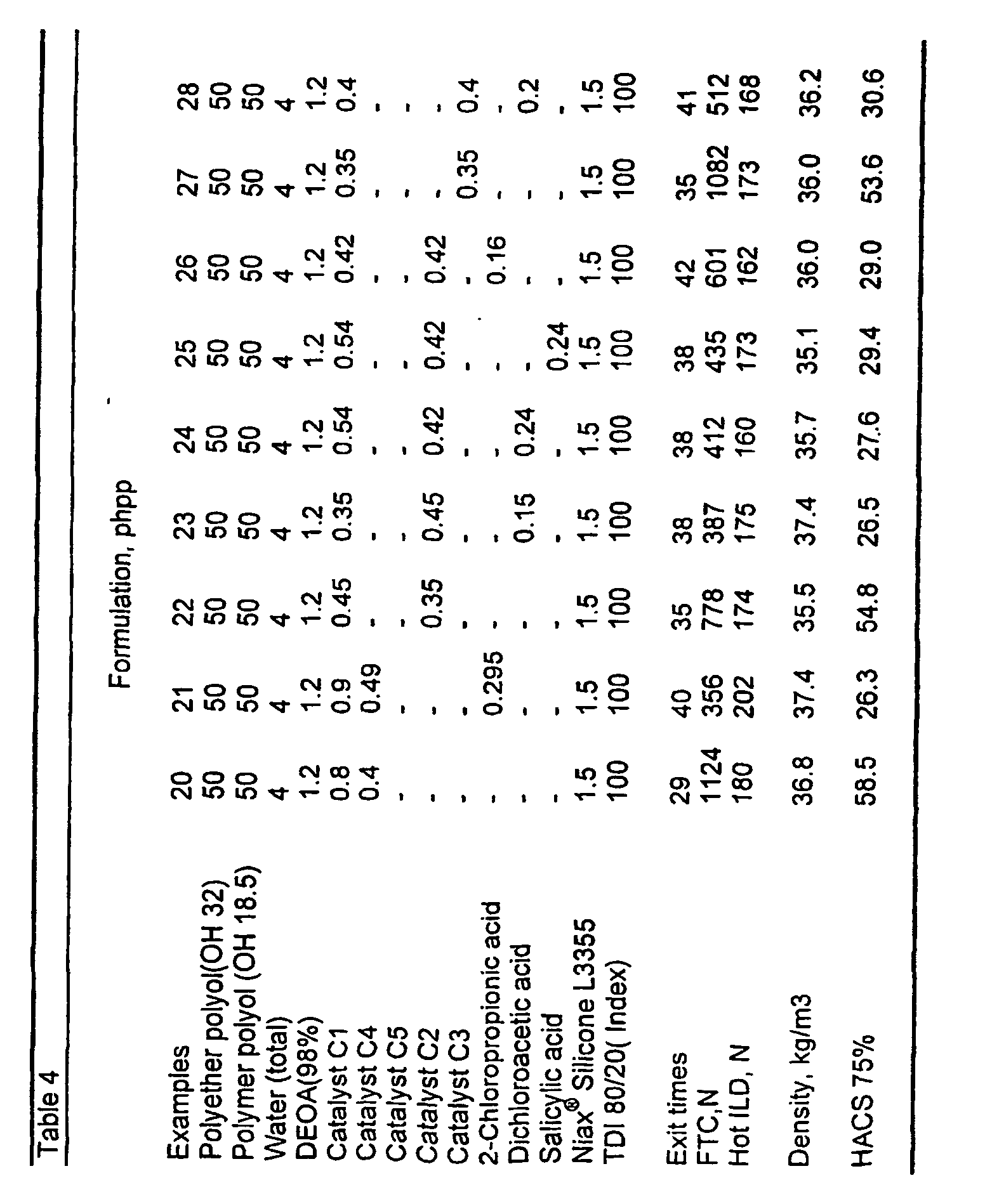
- Table 2 shows significant improvement of HACS, of MDI molded foams, was obtained due to the addition of hydroxy- and/or halo-carboxylic acids reaction product of subject tertiary amine in MDI molded foams.
Landscapes
- Chemical & Material Sciences (AREA)
- Health & Medical Sciences (AREA)
- Chemical Kinetics & Catalysis (AREA)
- Medicinal Chemistry (AREA)
- Polymers & Plastics (AREA)
- Organic Chemistry (AREA)
- Polyurethanes Or Polyureas (AREA)
- Manufacture Of Porous Articles, And Recovery And Treatment Of Waste Products (AREA)
Abstract
Description
| Physical Characteristic | Test Method |
| Density | ASTM D 3574 Test a |
| Exit Time | Exit time is the time elapsed, in seconds, from the addition of the isocyanate to the reaction mixture to the first appearance of foam extrusion from the four vents of the mold. |
| Force-to-Crush | Force-to-crush (FTC) is the peak force required to deflect a foam pad with the standard 323 cm2 (50 sq. in.) indentor, 1 minute after demold, to 50% of its original thickness. It is measured with a load-testing machine using the same setup as that used for measuring foam hardness. A load tester crosshead speed of 50.8 cm/minute is used. The FTC value is a |
| good relative measure of the degree of foam openness, i.e., the lower the value, the more open the foam | |
| Hot ILD | The indentation load deflection (ILD) is measured on the same pad used for the FTC measurement three minutes after demold. Following the FTC measurement, the foam pad is completely crushed by a mechanical crusher before the measurement of ILD at 50% compression is taken. |
| HACS | Compression Set (75% compression at 70°C for 22h, ISO/DIS 1856) after Humid aging (5 h at 120°C 100% RH) ISO 2440 |
| Term or Abbreviation | Meaning |
| Polyol OH 28 | Reactive triol with 28 OH No. |
| Polyol OH 32 | Highly reactive triol with 32 OH No. |
| Polyol OH 18.5 | Highly reactive grafted triol with 18.5 OH No. |
| TDI 80/20 | A mixture of 80 wt. % of 2,4-tolylene diisocyanate and 20 wt. % 2,6-tolylene diisocyanate |
| MDI | Methylene diphenyl diisocyanate and blends thereof |
| DEOA | Diethanolamine |
| C1 | Dimethylaminopropyldipropanolamine |
| C2 | Bis(dimethylaminopropyl)amine |
| C3 | Bis(dimethylaminopropyl)amino-2-propanol |
| C4 | Bis(dimethylamino)-2-propanol |
| C5 | N,N,N'-trimethyl-N'-hydroxyethyl-bis(aminoethyl)ether |
| C6 | N,N-dimethylaminoethyl-N'-methylaminoethanol |
| C7 | Dimethylaminoethoxyethanol |
| C8 | Dimethylaminopropylamine |
| g | grams |
| mg | milligrams |
| s | seconds |
| min | minute |
| kg | kilograms |
| cm | centimeter |
| % | percent by weight |
| phpp | parts per hundred parts by weight of polyol |
| C | degree Celsius |
| N | Newton |
| ILD | Indention Load Deflection |
| FTC | Force-to-crush (crushing force) |
dimethylaminoethoayethanol,
dimethylaminopropylamine.


Claims (17)
- A process for the manufacture of polyurethane foam which comprises reacting an organic polyisocyanate with a polyfunctional isocyanate-reactive compound in the presence of a blowing agent(s) and optional additives known to those skilled in the art, and a catalytically effective amount of a catalyst system comprising:(a) a specific reactive tertiary amine compound selected from the group consisting of bis(dimethylaminopropyl)amino-2-propanol, bis(dimethylaminopropyl)amine, dimethylaminopropyldipropanolamine, bis(dimethylamino)-2-propanol, N,N,N'-trimethyl-N'-hydroxyethyl-bis(aminoethyl)ether and mixtures thereof; and(b) at least one carboxylic acid salt of the specific reactive tertiary amine compound selected from the group consisting of hydroxy-carboxylic acid salts and halo-carboxylic acid salts.
- The process of claim 1 wherein the specific reactive tertiary amine is bis(dimethylaminopropyl)amino-2-propanol.
- The process of claim 1 wherein the specific reactive tertiary amine is bis(dimethylaminopropyl)amine.
- The process of claim 1 wherein the specific reactive tertiary amine is dimethylaminopropyldipropanolamine.
- The process of claim 1 wherein the specific reactive tertiary amine is bis(dimethylamino)-2-propanol.
- The process of claim 1 wherein the specific reactive tertiary amine is N,N,N'-trimethyl-N'-hydroxyethyl-bis(aminoethyl)ether.
- The process of claim 1 wherein the step of reacting an organic polyisocyanate with a polyfunctional isocyanate-reactive compound in the presence of a catalytically effective amount of a catalyst system comprises a catalyst system wherein the carboxylic acid salt is the reaction product of the specific reactive tertiary amine and a carboxylic acid having the following formula:
- The process of claim 7 wherein the step of reacting an organic polyisocyanate with a polyfunctional isocyanate-reactive compound in the presence of a catalytically effective amount of a catalyst system comprises a catalyst system wherein the carboxylic acid is selected from the group consisting of salicylic acid, benzilic acid, hydroxybenzoic acid, dihydroxybenzoic acid, trihydroxybenzoic acid, gluconic acid, citric acid, glycolic acid, dimethylolpropionic acid, malic acid, lactic acid, tartaric acid, 2-hydroxymethylpropionic acid, hydroxybutyric acid, chloropropionic acid, bromopropionic acid, dichloropropionic acid, dibromopropionic acid, chloracetic acid, dichloracetic acid, bromoacetic acid, dibromoacetic acid, bromobutyric acid, bromoisobutyric acid, dichlorphenylacetic acid, bromomalonic acid, dibromosuccinic acid, 3-chloro-2-hydroxypropionic acid, dichlorophthalic acid, chloromaleic acid, fluorobenzoic acid, chlorobenzoic acid, bromobenzoic acid, difluorobenzoic acid, dichlorobenzoic acid, dibromobenzoic acid, dibromosalicylic acid, 2-bromocaprylic acid, 2-bromohexadecanoic acid, 2,2-dichloro-1-methyl propionic acid and mixtures thereof.
- The process of claim 1 wherein the blowing agent is selected from the group consisting of reactive blowing agents, physical blowing agents and mixtures thereof.
- The process of claim 9 wherein the reactive blowing agent is water.
- The process of claim 9 wherein the physical blowing agent is selected from the group consisting of volatile hydrocarbons, halogenated hydrocarbons, hydrofluorocarbons, chlorofluorocarbons, non-reacting gases and mixtures thereof.
- The process of claim 1 wherein the optional additive is selected from the group consisting of catalysts, cross-linkers, surfactants and mixtures thereof.
- The process of claim 12 wherein the optional catalyst is selected from the group consisting of tertiary amines, organotin compounds, carboxylate urethane catalysts and mixtures thereof.
- The process of claim 1 wherein the catalyst system is prepared in situ.
- A polyurethane foam having repeating units derived from the reaction of an organic polyisocyanate and a polyfunctional isocyanate-reactive compound in the presence of a blowing agent and optionally, at least one additive, and a catalyst system comprising:(a) a specific reactive tertiary amine compound selected from the group consisting of bis(dimethylaminopropyl)amino-2-propanol, bis(dimethylaminopropyl)amine, dimethylaminopropyldipropanolamine, bis(dimethylamino)-2-propanol, N,N,N'-trimethyl-N'-hydroxyethyl-bis(aminoethyl)ether and mixtures thereof; and(b) at least one carboxylic acid salt of the specific reactive tertiary amine compound selected from the group consisting of hydroxy-carboxylic acid salts and halo-carboxylic acid salts.
- The polyurethane foam of claim 15 wherein the catalyst system comprises the equilibrium reaction product of (a) a specific reactive tertiary amine compound selected from the group consisting of bis(dimethylaminopropyl)amino-2-propanol, bis(dimethylaminopropyl)amine, dimethylaminopropyldipropanolamine, bis(dimethylamino)-2-propanol, N,N,N'-trimethyl-N'-hydroxyethyl-bis(aminoethyl)ether and mixtures thereof; and(b) at least one carboxylic acid having the following formula:
- The polyurethane foam of claim 16 wherein the carboxylic acid is selected from the group consisting of salicylic acid, benzilic acid, hydroxybenzoic acid, dihydroxybenzoic acid, trihydroxybenzoic acid, gluconic acid, citric acid, glycolic acid, dimethylpropionic acid, malic acid, lactic acid, tartaric acid, 2-hydroxymethylpropionic acid, hydroxybutyric acid, chloropropionic acid, bromopropionic acid, dichloropropionic acid, dibromopropionic acid, bromobutyric acid, bromoisobutyric acid, dichlorophenylacetic acid, bromomalonic acid, dibromosuccinic acid, 3-chloro-2-hydroxypropionic acid, dichlorophthalic acid, chloromaleic acid, fluorobenzoic acid, chlorobenzoic acid, bromobenzoic acid, difluorobenzoic acid, dichlorobenzoic acid, dibromobenzoic acid, dibromosalicylic acid, 2-bromocapryic acid, 2-bromohexadecanoic acid, 2,2-dichloro-1-methyl propionic acid and mixtures thereof.
Applications Claiming Priority (3)
| Application Number | Priority Date | Filing Date | Title |
|---|---|---|---|
| US09/784,546 US6387972B1 (en) | 2001-02-15 | 2001-02-15 | Process to enhance polyurethane foam performance |
| US784546 | 2001-02-15 | ||
| PCT/US2002/002738 WO2002066531A2 (en) | 2001-02-15 | 2002-02-01 | Process to enhance polyurethane foam performance |
Publications (2)
| Publication Number | Publication Date |
|---|---|
| EP1362073A2 EP1362073A2 (en) | 2003-11-19 |
| EP1362073B1 true EP1362073B1 (en) | 2005-12-14 |
Family
ID=25132767
Family Applications (1)
| Application Number | Title | Priority Date | Filing Date |
|---|---|---|---|
| EP02704299A Expired - Lifetime EP1362073B1 (en) | 2001-02-15 | 2002-02-01 | Process to enhance polyurethane foam performance |
Country Status (15)
| Country | Link |
|---|---|
| US (1) | US6387972B1 (en) |
| EP (1) | EP1362073B1 (en) |
| JP (1) | JP4066069B2 (en) |
| KR (1) | KR100865197B1 (en) |
| AT (1) | ATE312857T1 (en) |
| AU (1) | AU2002237991A1 (en) |
| BR (1) | BR0207082B1 (en) |
| CA (1) | CA2434309C (en) |
| CZ (1) | CZ297851B6 (en) |
| DE (1) | DE60207991T2 (en) |
| ES (1) | ES2255605T3 (en) |
| MX (1) | MXPA03007223A (en) |
| WO (1) | WO2002066531A2 (en) |
| YU (1) | YU64003A (en) |
| ZA (1) | ZA200304948B (en) |
Families Citing this family (33)
| Publication number | Priority date | Publication date | Assignee | Title |
|---|---|---|---|---|
| EP1167411B1 (en) * | 2000-06-20 | 2003-09-17 | Goldschmidt AG | Use of reactive amines for the preparation of polyurethane foams |
| US6458860B1 (en) * | 2001-06-01 | 2002-10-01 | Huntsman Petrochemical Corporation | Advances in urethane foam catalysis |
| US6818675B2 (en) * | 2002-08-06 | 2004-11-16 | General Electric Company | Process for preparing polyurethane foam |
| US6831110B2 (en) | 2003-04-01 | 2004-12-14 | Bayer Polymers Llc | Rigid, dimensionally stable polyurethane foams and a process for the production of such foams in which the foam pressure is reduced |
| CN100351281C (en) * | 2003-05-01 | 2007-11-28 | 胡茨曼石油化学公司 | Process of making press molded materials using heat activated tertiary amine urethane catalysts |
| KR20070004070A (en) * | 2004-04-30 | 2007-01-05 | 다우 글로벌 테크놀로지스 인크. | Cocatalyst Reaction of Autocatalyst Polyol for Low Density Polyurethane Foam with Improved Aging Characteristics |
| LT1773902T (en) * | 2004-08-04 | 2018-04-10 | Foam Supplies, Inc. | Reactivity drift and catalyst degradation in polyurethane foam |
| US8501828B2 (en) * | 2004-08-11 | 2013-08-06 | Huntsman Petrochemical Llc | Cure rebond binder |
| US20080269367A1 (en) * | 2005-10-18 | 2008-10-30 | Neill Paul L | Prepolymer containing a Liquid Hardness Agent For Open Cell Foams |
| US8143321B2 (en) * | 2006-07-13 | 2012-03-27 | Air Products And Chemicals, Inc. | N,N,N,′-trimethyl-bis-(aminoethyl) ether and its derivatives as catalysts for polyurethanes |
| US20080076843A1 (en) * | 2006-09-21 | 2008-03-27 | General Electric Company | Polyurethane foam composition possessing modified silicone surfactants |
| MX337959B (en) | 2007-01-19 | 2016-03-29 | Huntsman Petrochemical Llc | Tertiary amines blocked with polymer acids. |
| US8063113B2 (en) * | 2008-04-23 | 2011-11-22 | Momentive Performance Materials Inc. | Polyurethane foam-forming compositions containing polysilsesquioxane cell opening agents |
| US7872055B2 (en) * | 2008-12-11 | 2011-01-18 | Air Products and Chenicals, Inc. | Catalyst composition for water blown, low density, rigid polyurethane foam |
| CN101456943B (en) * | 2009-01-12 | 2010-10-06 | 陈跃进 | Non-granule plastic rubber material |
| DE102009037009A1 (en) * | 2009-08-11 | 2011-02-17 | Bayer Materialscience Ag | Prepolymers with good storage stability |
| WO2012006548A1 (en) | 2010-07-09 | 2012-01-12 | Air Products And Chemicals, Inc. | Additives for improving polyurethane foam performance |
| US9968919B2 (en) | 2011-06-29 | 2018-05-15 | Evonik Degussa Gmbh | Reducing emissions in polyurethane foam |
| US9447223B2 (en) | 2011-07-07 | 2016-09-20 | Air Products And Chemicals, Inc. | Additives for improving natural oil based polyurethane foam performance |
| US9145466B2 (en) | 2011-07-07 | 2015-09-29 | Air Products And Chemicals, Inc. | Process for producing flexible polyurethane foam using natural oil polyols |
| US10106638B2 (en) * | 2011-07-29 | 2018-10-23 | Evonik Degussa Gmbh | Reduced emissions low density spray polyurethane foam |
| TW201418304A (en) * | 2012-06-29 | 2014-05-16 | Tosoh Corp | Catalyst composition for producing polyurethane resin, and method for producing polyurethane resin using said catalyst composition |
| DE102012212077A1 (en) * | 2012-07-11 | 2014-01-16 | Evonik Industries Ag | Process for the production of low-emission flexible polyurethane foams |
| CN103668957B (en) * | 2012-09-17 | 2016-05-18 | 湖北中科博策新材料研究院 | A kind of crosslinking and curing agent that improves fabric three-proof finishing agent water-wash resistance |
| US10023681B2 (en) | 2012-10-24 | 2018-07-17 | Evonik Degussa Gmbh | Delay action catalyst for improving the stability of polyurethane systems having halogen containing blowing agents |
| US9951174B2 (en) | 2015-05-20 | 2018-04-24 | Covestro Llc | Polyol compositions, a process for the production of these polyol compositions, and their use in the production of open celled polyurethane foams having high airflow |
| US10933609B2 (en) * | 2016-03-31 | 2021-03-02 | The Regents Of The University Of California | Composite foam |
| JP6367887B2 (en) * | 2016-10-21 | 2018-08-01 | スリーエム イノベイティブ プロパティズ カンパニー | Abrasive article and method for producing the same |
| CN108892769B (en) * | 2018-06-19 | 2021-07-06 | 石家庄合汇化工有限公司 | A kind of acid-sealing retardation catalyst for preparing polyurethane |
| CN115210283B (en) | 2020-03-03 | 2025-07-29 | 迈图高新材料公司 | For forming polyamino groups catalyst for formic acid esters |
| CN115243789B (en) | 2020-03-03 | 2025-07-22 | 迈图高新材料公司 | For polyurethanes catalyst composition of (2) |
| US11572433B2 (en) | 2021-03-12 | 2023-02-07 | Covestro Llc | In-situ formed polyols, a process for their preparation, foams prepared from these in-situ formed polyols and a process for their preparation |
| US11718705B2 (en) | 2021-07-28 | 2023-08-08 | Covestro Llc | In-situ formed polyether polyols, a process for their preparation, and a process for the preparation of polyurethane foams |
Family Cites Families (29)
| Publication number | Priority date | Publication date | Assignee | Title |
|---|---|---|---|---|
| CA651638A (en) | 1962-11-06 | J. Gorman John | Delayed-action urethane foam catalyst | |
| US2932621A (en) | 1956-02-07 | 1960-04-12 | Pittsburgh Plate Glass Co | Preparation of polyurethane foam utilizing a salt of dimethylethanol amine and a dicarboxylic acid as a catalyst |
| NL103386C (en) | 1958-03-12 | |||
| US3728291A (en) | 1971-06-21 | 1973-04-17 | Air Prod & Chem | Catalyst composition for polyurethane foam |
| US4007140A (en) | 1972-11-01 | 1977-02-08 | Imperial Chemical Industries Limited | Tertiary amines as catalysts in polyurethane manufacture |
| LU68552A1 (en) | 1973-10-03 | 1975-06-16 | ||
| US4049591A (en) | 1976-10-18 | 1977-09-20 | Texaco Development Corporation | Foams and elastomers prepared in the presence of high tertiary amine content polyurethane catalysts |
| US4175097A (en) | 1976-12-01 | 1979-11-20 | Texaco Development Corp. | Bis(dimethylaminopropyl)-amine derivatives as polyurethane catalysts |
| US4232152A (en) | 1976-12-01 | 1980-11-04 | Air Products And Chemicals, Inc. | Amine salts of tertiary amino acids |
| US4165412A (en) | 1977-01-12 | 1979-08-21 | Air Products And Chemicals, Inc. | Delayed action catalysts for polyurethanes |
| US4366084A (en) | 1981-05-26 | 1982-12-28 | Abbott Laboratories | Catalyst for making polyurethanes |
| US4450246A (en) | 1982-10-26 | 1984-05-22 | W. R. Grace & Co. | Novel polyurethane catalysts in polyurethane foam process |
| US4464488A (en) | 1983-08-11 | 1984-08-07 | Texaco Inc. | Polyurethanes using monocarboxylic acid salts of bis(aminoethyl)ether derivatives as catalysts |
| US4621106A (en) | 1985-02-05 | 1986-11-04 | Wm. T. Burnett & Co., Inc. | Polyester polyurethane foams having antistatic properties |
| US4701474A (en) | 1986-04-09 | 1987-10-20 | Union Carbide Corporation | Reduced reactivity polyols as foam controllers in producing polyurethanes foams |
| CA1288546C (en) | 1986-11-14 | 1991-09-03 | Ragui Ghali | Foam, composition and method of production |
| GB8701993D0 (en) | 1987-01-29 | 1987-03-04 | Bp Chem Int Ltd | Polyurethane foams |
| US4910230A (en) | 1987-12-25 | 1990-03-20 | Tosoh Corporation | Preparation of fine-cell rigid polyurethane foam using amine catalyst |
| JP3044261B2 (en) * | 1990-04-11 | 2000-05-22 | 東ソー株式会社 | Method for producing flexible polyurethane foam with excellent air permeability |
| US5168009A (en) | 1990-09-27 | 1992-12-01 | Air Products And Chemicals, Inc. | Tertiary amine catalyst composition for polyurethane foam in contact with polyvinyl chloride |
| GB9215488D0 (en) | 1992-07-21 | 1992-09-02 | Polyol Int Bv | Isocyanate modified amines as catalysts useful for the preparation of polyurethane materials |
| US5478494A (en) | 1993-09-22 | 1995-12-26 | Basf Corporation | Polyol composition having good flow and formic acid blown rigid polyurethane foams made thereby having good dimensional stability |
| US5591781A (en) | 1993-10-27 | 1997-01-07 | Tosoh Corporation | Process for producing polyurethane foam with high curing rate |
| US5489618A (en) | 1993-11-29 | 1996-02-06 | Osi Specialties, Inc. | Process for preparing polyurethane foam |
| CN1134473C (en) * | 1996-11-04 | 2004-01-14 | 亨茨曼Ici化学品有限公司 | Rigid polyurethane foams |
| JP3826470B2 (en) * | 1997-02-03 | 2006-09-27 | 東ソー株式会社 | Manufacturing method of rigid spray foam |
| US6660781B1 (en) | 1999-01-05 | 2003-12-09 | Witco Corporation | Process for preparing polyurethane foam |
| US6395796B1 (en) | 1999-01-05 | 2002-05-28 | Crompton Corporation | Process for preparing polyurethane foam |
| DE19902505A1 (en) * | 1999-01-22 | 2000-07-27 | Basf Ag | Low-fogging catalysts for the production of polyurethanes |
-
2001
- 2001-02-15 US US09/784,546 patent/US6387972B1/en not_active Expired - Lifetime
-
2002
- 2002-02-01 AT AT02704299T patent/ATE312857T1/en not_active IP Right Cessation
- 2002-02-01 YU YU64003A patent/YU64003A/en unknown
- 2002-02-01 KR KR1020037010574A patent/KR100865197B1/en not_active Expired - Lifetime
- 2002-02-01 MX MXPA03007223A patent/MXPA03007223A/en active IP Right Grant
- 2002-02-01 CZ CZ20032062A patent/CZ297851B6/en not_active IP Right Cessation
- 2002-02-01 CA CA002434309A patent/CA2434309C/en not_active Expired - Lifetime
- 2002-02-01 JP JP2002566244A patent/JP4066069B2/en not_active Expired - Lifetime
- 2002-02-01 WO PCT/US2002/002738 patent/WO2002066531A2/en not_active Ceased
- 2002-02-01 AU AU2002237991A patent/AU2002237991A1/en not_active Abandoned
- 2002-02-01 BR BRPI0207082-0A patent/BR0207082B1/en not_active IP Right Cessation
- 2002-02-01 EP EP02704299A patent/EP1362073B1/en not_active Expired - Lifetime
- 2002-02-01 ES ES02704299T patent/ES2255605T3/en not_active Expired - Lifetime
- 2002-02-01 DE DE60207991T patent/DE60207991T2/en not_active Expired - Lifetime
-
2003
- 2003-06-25 ZA ZA200304948A patent/ZA200304948B/en unknown
Also Published As
| Publication number | Publication date |
|---|---|
| CA2434309C (en) | 2009-09-08 |
| EP1362073A2 (en) | 2003-11-19 |
| ES2255605T3 (en) | 2006-07-01 |
| CA2434309A1 (en) | 2002-08-29 |
| JP4066069B2 (en) | 2008-03-26 |
| JP2004529995A (en) | 2004-09-30 |
| BR0207082B1 (en) | 2011-10-04 |
| AU2002237991A1 (en) | 2002-09-04 |
| YU64003A (en) | 2006-03-03 |
| US6387972B1 (en) | 2002-05-14 |
| DE60207991D1 (en) | 2006-01-19 |
| ATE312857T1 (en) | 2005-12-15 |
| KR100865197B1 (en) | 2008-10-23 |
| WO2002066531A3 (en) | 2002-11-14 |
| WO2002066531A2 (en) | 2002-08-29 |
| KR20040014456A (en) | 2004-02-14 |
| MXPA03007223A (en) | 2003-12-04 |
| BR0207082A (en) | 2004-06-22 |
| ZA200304948B (en) | 2004-08-25 |
| DE60207991T2 (en) | 2006-06-14 |
| CZ20032062A3 (en) | 2003-12-17 |
| CZ297851B6 (en) | 2007-04-18 |
Similar Documents
| Publication | Publication Date | Title |
|---|---|---|
| EP1362073B1 (en) | Process to enhance polyurethane foam performance | |
| EP1534766B2 (en) | Process for preparing polyurethane foam | |
| EP1018526B1 (en) | Process for preparing polyurethane foam | |
| US6395796B1 (en) | Process for preparing polyurethane foam | |
| EP0656383B2 (en) | Improved process for preparing polyurethane foam | |
| EP1332167B1 (en) | Process to improve polyurethane foam performance |
Legal Events
| Date | Code | Title | Description |
|---|---|---|---|
| PUAI | Public reference made under article 153(3) epc to a published international application that has entered the european phase |
Free format text: ORIGINAL CODE: 0009012 |
|
| 17P | Request for examination filed |
Effective date: 20030718 |
|
| AK | Designated contracting states |
Kind code of ref document: A2 Designated state(s): AT BE CH CY DE DK ES FI FR GB GR IE IT LI LU MC NL PT SE TR |
|
| AX | Request for extension of the european patent |
Extension state: AL LT LV MK RO SI |
|
| GRAP | Despatch of communication of intention to grant a patent |
Free format text: ORIGINAL CODE: EPIDOSNIGR1 |
|
| GRAC | Information related to communication of intention to grant a patent modified |
Free format text: ORIGINAL CODE: EPIDOSCIGR1 |
|
| GRAS | Grant fee paid |
Free format text: ORIGINAL CODE: EPIDOSNIGR3 |
|
| GRAA | (expected) grant |
Free format text: ORIGINAL CODE: 0009210 |
|
| RAP1 | Party data changed (applicant data changed or rights of an application transferred) |
Owner name: GENERAL ELECTRIC COMPANY |
|
| AK | Designated contracting states |
Kind code of ref document: B1 Designated state(s): AT BE CH CY DE DK ES FI FR GB GR IE IT LI LU MC NL PT SE TR |
|
| PG25 | Lapsed in a contracting state [announced via postgrant information from national office to epo] |
Ref country code: FI Free format text: LAPSE BECAUSE OF FAILURE TO SUBMIT A TRANSLATION OF THE DESCRIPTION OR TO PAY THE FEE WITHIN THE PRESCRIBED TIME-LIMIT Effective date: 20051214 Ref country code: CH Free format text: LAPSE BECAUSE OF FAILURE TO SUBMIT A TRANSLATION OF THE DESCRIPTION OR TO PAY THE FEE WITHIN THE PRESCRIBED TIME-LIMIT Effective date: 20051214 Ref country code: AT Free format text: LAPSE BECAUSE OF FAILURE TO SUBMIT A TRANSLATION OF THE DESCRIPTION OR TO PAY THE FEE WITHIN THE PRESCRIBED TIME-LIMIT Effective date: 20051214 Ref country code: LI Free format text: LAPSE BECAUSE OF FAILURE TO SUBMIT A TRANSLATION OF THE DESCRIPTION OR TO PAY THE FEE WITHIN THE PRESCRIBED TIME-LIMIT Effective date: 20051214 |
|
| REG | Reference to a national code |
Ref country code: GB Ref legal event code: FG4D |
|
| REG | Reference to a national code |
Ref country code: CH Ref legal event code: EP |
|
| REG | Reference to a national code |
Ref country code: SE Ref legal event code: TRGR |
|
| REG | Reference to a national code |
Ref country code: IE Ref legal event code: FG4D |
|
| REF | Corresponds to: |
Ref document number: 60207991 Country of ref document: DE Date of ref document: 20060119 Kind code of ref document: P |
|
| PG25 | Lapsed in a contracting state [announced via postgrant information from national office to epo] |
Ref country code: IE Free format text: LAPSE BECAUSE OF NON-PAYMENT OF DUE FEES Effective date: 20060201 |
|
| REG | Reference to a national code |
Ref country code: GR Ref legal event code: EP Ref document number: 20050403597 Country of ref document: GR |
|
| PG25 | Lapsed in a contracting state [announced via postgrant information from national office to epo] |
Ref country code: MC Free format text: LAPSE BECAUSE OF NON-PAYMENT OF DUE FEES Effective date: 20060228 Ref country code: LU Free format text: LAPSE BECAUSE OF NON-PAYMENT OF DUE FEES Effective date: 20060228 |
|
| PG25 | Lapsed in a contracting state [announced via postgrant information from national office to epo] |
Ref country code: DK Free format text: LAPSE BECAUSE OF FAILURE TO SUBMIT A TRANSLATION OF THE DESCRIPTION OR TO PAY THE FEE WITHIN THE PRESCRIBED TIME-LIMIT Effective date: 20060314 |
|
| PG25 | Lapsed in a contracting state [announced via postgrant information from national office to epo] |
Ref country code: PT Free format text: LAPSE BECAUSE OF FAILURE TO SUBMIT A TRANSLATION OF THE DESCRIPTION OR TO PAY THE FEE WITHIN THE PRESCRIBED TIME-LIMIT Effective date: 20060515 |
|
| REG | Reference to a national code |
Ref country code: CH Ref legal event code: PL |
|
| REG | Reference to a national code |
Ref country code: ES Ref legal event code: FG2A Ref document number: 2255605 Country of ref document: ES Kind code of ref document: T3 |
|
| ET | Fr: translation filed | ||
| PLBE | No opposition filed within time limit |
Free format text: ORIGINAL CODE: 0009261 |
|
| STAA | Information on the status of an ep patent application or granted ep patent |
Free format text: STATUS: NO OPPOSITION FILED WITHIN TIME LIMIT |
|
| REG | Reference to a national code |
Ref country code: IE Ref legal event code: MM4A |
|
| 26N | No opposition filed |
Effective date: 20060915 |
|
| PG25 | Lapsed in a contracting state [announced via postgrant information from national office to epo] |
Ref country code: TR Free format text: LAPSE BECAUSE OF FAILURE TO SUBMIT A TRANSLATION OF THE DESCRIPTION OR TO PAY THE FEE WITHIN THE PRESCRIBED TIME-LIMIT Effective date: 20051214 |
|
| PG25 | Lapsed in a contracting state [announced via postgrant information from national office to epo] |
Ref country code: CY Free format text: LAPSE BECAUSE OF FAILURE TO SUBMIT A TRANSLATION OF THE DESCRIPTION OR TO PAY THE FEE WITHIN THE PRESCRIBED TIME-LIMIT Effective date: 20051214 |
|
| PGFP | Annual fee paid to national office [announced via postgrant information from national office to epo] |
Ref country code: NL Payment date: 20090224 Year of fee payment: 8 |
|
| PGFP | Annual fee paid to national office [announced via postgrant information from national office to epo] |
Ref country code: GR Payment date: 20090227 Year of fee payment: 8 |
|
| REG | Reference to a national code |
Ref country code: NL Ref legal event code: V1 Effective date: 20100901 |
|
| PG25 | Lapsed in a contracting state [announced via postgrant information from national office to epo] |
Ref country code: NL Free format text: LAPSE BECAUSE OF NON-PAYMENT OF DUE FEES Effective date: 20100901 |
|
| PGFP | Annual fee paid to national office [announced via postgrant information from national office to epo] |
Ref country code: SE Payment date: 20130227 Year of fee payment: 12 |
|
| PGFP | Annual fee paid to national office [announced via postgrant information from national office to epo] |
Ref country code: BE Payment date: 20130227 Year of fee payment: 12 |
|
| BERE | Be: lapsed |
Owner name: *GENERAL ELECTRIC CY Effective date: 20140228 |
|
| REG | Reference to a national code |
Ref country code: SE Ref legal event code: EUG |
|
| PG25 | Lapsed in a contracting state [announced via postgrant information from national office to epo] |
Ref country code: SE Free format text: LAPSE BECAUSE OF NON-PAYMENT OF DUE FEES Effective date: 20140202 |
|
| PG25 | Lapsed in a contracting state [announced via postgrant information from national office to epo] |
Ref country code: BE Free format text: LAPSE BECAUSE OF NON-PAYMENT OF DUE FEES Effective date: 20140228 |
|
| REG | Reference to a national code |
Ref country code: FR Ref legal event code: PLFP Year of fee payment: 15 |
|
| REG | Reference to a national code |
Ref country code: FR Ref legal event code: PLFP Year of fee payment: 16 |
|
| REG | Reference to a national code |
Ref country code: FR Ref legal event code: PLFP Year of fee payment: 17 |
|
| PGFP | Annual fee paid to national office [announced via postgrant information from national office to epo] |
Ref country code: FR Payment date: 20210223 Year of fee payment: 20 Ref country code: IT Payment date: 20210219 Year of fee payment: 20 |
|
| PGFP | Annual fee paid to national office [announced via postgrant information from national office to epo] |
Ref country code: ES Payment date: 20210301 Year of fee payment: 20 Ref country code: GB Payment date: 20210225 Year of fee payment: 20 Ref country code: DE Payment date: 20210225 Year of fee payment: 20 |
|
| REG | Reference to a national code |
Ref country code: DE Ref legal event code: R071 Ref document number: 60207991 Country of ref document: DE |
|
| REG | Reference to a national code |
Ref country code: GB Ref legal event code: PE20 Expiry date: 20220131 |
|
| PG25 | Lapsed in a contracting state [announced via postgrant information from national office to epo] |
Ref country code: GB Free format text: LAPSE BECAUSE OF EXPIRATION OF PROTECTION Effective date: 20220131 |
|
| REG | Reference to a national code |
Ref country code: ES Ref legal event code: FD2A Effective date: 20220526 |
|
| PG25 | Lapsed in a contracting state [announced via postgrant information from national office to epo] |
Ref country code: ES Free format text: LAPSE BECAUSE OF EXPIRATION OF PROTECTION Effective date: 20220202 |