EP1361748A2 - Improved processing of images - Google Patents
Improved processing of images Download PDFInfo
- Publication number
- EP1361748A2 EP1361748A2 EP03252682A EP03252682A EP1361748A2 EP 1361748 A2 EP1361748 A2 EP 1361748A2 EP 03252682 A EP03252682 A EP 03252682A EP 03252682 A EP03252682 A EP 03252682A EP 1361748 A2 EP1361748 A2 EP 1361748A2
- Authority
- EP
- European Patent Office
- Prior art keywords
- image
- images
- sequence
- magnification
- zoom
- Prior art date
- Legal status (The legal status is an assumption and is not a legal conclusion. Google has not performed a legal analysis and makes no representation as to the accuracy of the status listed.)
- Withdrawn
Links
Images


Classifications
-
- H—ELECTRICITY
- H04—ELECTRIC COMMUNICATION TECHNIQUE
- H04N—PICTORIAL COMMUNICATION, e.g. TELEVISION
- H04N5/00—Details of television systems
- H04N5/222—Studio circuitry; Studio devices; Studio equipment
- H04N5/262—Studio circuits, e.g. for mixing, switching-over, change of character of image, other special effects ; Cameras specially adapted for the electronic generation of special effects
- H04N5/2628—Alteration of picture size, shape, position or orientation, e.g. zooming, rotation, rolling, perspective, translation
Definitions
- the present invention relates to improvements in and relating to methods and apparatus suitable for the processing of zoomed sequences of images.
- the zoom can be an optical zoom, a digital zoom, or a zoom comprising both optical and digital zooms.
- Various cameras include such zooms, including video cameras and camcorders (both analogue and digital), surveillance cameras, and digital and analogue "stills" cameras that are arranged to capture sequences of still images and/or video sequences.
- a zoom feature allows a camera to change from a long shot to a close-up shot (or vice versa).
- An optical zoom also termed mechanical zoom
- An optical zoom normally utilises a zoom lens in which the focal length is continuously variable whilst maintaining a fixed focal plane, so as to provide variable magnification of the subject.
- electronic zooms have been developed, which act to enlarge (or diminish) a predetermined area of a picture by using electronic processing. This processing can be performed during the capture of the picture, or subsequently by the camera or even by utilising post capture image processing software.
- electronic zooms also referred to as digital zooms
- processing techniques to improve the image quality of the enlarged image e.g. by interpolating adjacent pixels.
- Chart 10 illustrates the level of the zoom of the camera as a function of time, with the frame sequence 20 illustrating the corresponding sequence of frames (A, B, C).
- the camera is not zoomed in, and remains at a constant low magnification level producing frames A of a wide-angle view. Subsequently, the camera is progressively zoomed in producing frames B, until it reaches an adequate level of detail after which the zoom remains constant so as to provide frames C at a constant magnified level of detail.
- the resulting edited video and audio track 30 cuts directly from the wide-angle viewed frames A to the magnified viewed frames C, so as to omit the zooming action. It will thus be appreciated that the frames B containing the zooming action will be lost, along with any associated audio track. Losing such information is undesirable.
- EP 0853855 Video Camera with Improved Zoom Capability
- attempts to address this problem by providing a zoom camera which uses a combination of electronic (i.e. digital) zoom and optical zoom so as to obtain a rapid change in magnification, and hence minimise the period of time for which the zoom sequence exists. Whilst minimising the duration of the zoom sequence, the zoom sequence still exists.
- the present invention provides a method of processing a zoomed sequence of images comprising a first image at a first magnification, a later image at a second magnification, and at least one intermediate image at a magnification between said first and second magnifications, the method comprises: applying an electronic zoom to each of said intermediate images so as to magnify at least an area of each of the intermediate images to the same magnification level as the higher of the first and second magnifications.
- the method further comprises; producing an output image sequence comprising said first image, the electronically zoomed images and said later image.
- the method further comprises: determining a subject of the image sequence that appears in said first image, said intermediate image and said later image; and wherein said electronically zoomed images are arranged to comprise at least a portion of said subject.
- the method further comprises applying a soft cut image-image transition between at least one of said zoomed intermediate images and at least one of the final image and the first image.
- the present invention provides a computer program arranged to perform the above method.
- the program is arranged to automatically determine if a subject of the image sequence appears in said first image, said intermediate image and said later image.
- the present invention provides a machine readable medium comprising the program.
- the present invention provides an apparatus arranged to process a zoomed sequence of images comprising a first image at a first magnification, a later image at a second magnification, and at least one intermediate image at a magnification between said first and second magnifications, the apparatus comprising: processing means arranged to apply an electronic zoom to each of said intermediate images so as to magnify at least an area of each of the intermediate images to the same magnification level as the higher of the first and second magnifications.
- the present invention provides a camera comprising an apparatus as above.
- the camera further comprises a user interface arranged for a user to select whether said apparatus operates automatically.
- the present invention provides editing device arranged to edit previously captured images, the device comprising an apparatus as claimed in claim.
- chart 120 illustrates a change in zoom level as a camera is progressively zoomed in from a first, relatively low level of magnification to a second, higher level of magnification.
- the sequence 100 illustrates the corresponding images as a function of time, from the image at a low level (e.g. no) magnification 110 up to the image at the high level of magnification 118, with intermediate zooming in images 112, 114, 116.
- the subject of the image sequence is a simple pendulum with the camera progressively zooming in upon this subject.
- Image sequence 200 illustrates the corresponding sequence of images (110, 210, 214, 216, 118) that have been processed according to an embodiment of the present invention, with chart 220 illustrating the effective zoom as a function of time for this image sequence 200.
- Each of the images within this sequence 200 are the same size i.e. they have the same area and the same aspect ratio.
- the start image 110 and the final image 118 remain unchanged.
- varying degrees of electronic zoom have been applied to portions of the original intermediate images (112, 114, 116) to result in new, processed intermediate images (212, 214, 216) which have the same effective magnification as the final image 118.
- the portions of the original image to which the electronic zoom have been applied contain the subject, and are illustrated by a dotted line in images 112 and 114.
- Such a technique allows a cut in a video sequence from a first level of magnification to a second level magnification without any loss in the images from the sequence or any associated audio signal.
- the resulting image sequence is substantially improved as the annoying zooming sequence has been eliminated and substituted by a cut, without losing any audio signal e.g. commentary or background noise and subject action.
- Figure 3 shows a flow chart illustrating the steps that can be carried out to edit a sequence of images as illustrated in figure 2.
- the sequence of images is analysed to determine whether there has been a zoom action (510). If no zoom action has been performed, then no processing of this type is carried out (512).
- the subject of the image sequence is identified (in the example shown in figure 2, the subject was the pendulum).
- the subject of the zoom action can be determined by looking at the objects within the image which has the highest level of magnification. The motion of the subject is then tracked across each of the zoom sequence frames z 1 - z N , where N is a integer (514).
- the transformations T i are determined for each frame z i required to alter the magnification of a portion of each of the zoom frames z 1 -z N-1 to be of the same level of magnification (and size) as frame z N whilst consistently retaining the subject within each frame (step 520).
- each of the intermediate frames (z 1 -z N-1 ) are replaced by corresponding frames which have undergone the transformations T i .
- step 516 a check is made that the subject is within each frame (step 516), and procedure halted if such is not the case (step 518), it will be appreciated that the procedure could still proceed even if the subject is not within each frame. Whilst less desirable, this would still have the effect of removing the zoom sequence from the image sequence. In such a modified sequence, the subject might have the effect of gradually panning in and out of the shot.
- intermediate frames could be computer generated so as to contain the subject, based upon the frames on which the subject is always within shot.
- the present invention could be implemented within a post capture editing suite e.g. on a computer arranged to edit a sequence of images after the images have been captured by a camera. Equally, the invention could be implemented within a camera.
- the invention method could be performed automatically or on the instructions of a user. For instance, the camera could be arranged to automatically implement the removal of a zooming feature unless other wise instructed by a user.
- Removal of the zooming sequence could be conducted completely automatically, or with some user intervention e.g. by the user identifying a zoom sequence or the subject of a zoom sequence.
- the above embodiment describes an example of the resulting image-image transition, after the invention has been applied, being a hard cut i.e. an instantaneous transition straight from an image at the first magnification to an image at the second, final magnification.
- a hard cut i.e. an instantaneous transition straight from an image at the first magnification to an image at the second, final magnification.
- the zoom sequence could be swapped for any image-image transition.
- a soft cut could be utilised, an image-image transition that takes a short period of time to change between the images produced by the use of an embodiment of the present invention.
- Examples of such other soft cut image-image transitions that could be utilised include fading (one image gradually fades into another), random dissolve, matched dissolve, blinds, wiping, and curtain.
- an initial input sequence might involve gradually zooming in on a view of a car as the car approaches from a distance, continuing the zoom to the face of the driver of the car.
- a user might select to gradually zoom in until the car fills the whole frame, and then to use the present invention to cut directly to the face of the driver.
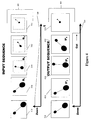
- Figure 4 illustrates an alternative embodiment of the invention applied to a zooming out image sequence 300.
- Chart 320 illustrates how the zoom level (i.e. magnification) initially starts from a relatively high value, corresponding to image frame 310, and is then successfully decreased as a function of time so as to zoom out from the subject (frames 312, 314, 316), to result in a low level of zoom, and a corresponding lower magnification/wider field of view image from 318.
- zoom level i.e. magnification
- Image sequence 400 illustrates the output framed sequence 400 that can be derived from the input sequence 300 by applying an embodiment of the present invention.
- the first frame 310 and the final frame 318 remain from the input sequence.
- the intermediate frames 312, 314, 316 (corresponding to the frames during the zooming action) have been replaced by respective transformed frames 412, 414 and 416.
- Each of the transformed frames corresponds to a portion of a respective input frame that has been electronically magnified to the same magnification (i.e. zoom) level as the input frame 310.
- the zoom level in the processed image sequence remains constant until the final frame, at which it drops to the lower level of magnification.
Landscapes
- Engineering & Computer Science (AREA)
- Multimedia (AREA)
- Signal Processing (AREA)
- Studio Devices (AREA)
- Television Signal Processing For Recording (AREA)
- Studio Circuits (AREA)
- Editing Of Facsimile Originals (AREA)
- Image Processing (AREA)
Abstract
Description
Claims (11)
- A method of processing a zoomed sequence of images comprising a first image at a first magnification, a later image at a second magnification, and at least one intermediate image at a magnification between said first and second magnifications, the method comprises:applying an electronic zoom to each of said intermediate images so as to magnify at least an area of each of the intermediate images to the same magnification level as the higher of the first and second magnifications.
- A method as claimed in claim 1, further comprising:producing an output image sequence comprising said first image, the electronically zoomed images and said later image.
- A method as claimed in claim 1 or claim 2, further comprising:wherein said electronically zoomed images are arranged to comprise at least a portion of said subject.determining a subject of the image sequence that appears in said first image, said intermediate image and said later image; and
- A method as claimed in any one of the above claims, further comprising:applying a soft cut image-image transition between at least one of said zoomed intermediate images and at least one of the final image and the first image.
- A computer program arranged to perform the method as claimed in any one of the above claims.
- A program as claimed in claim 5, arranged to automatically determine if a subject of the image sequence appears in said first image, said intermediate image and said later image.
- A machine readable medium comprising a computer program as claimed in claim 5 or claim 6.
- An apparatus arranged to process a zoomed sequence of images comprising a first image at a first magnification, a later image at a second magnification, and at least one intermediate image at a magnification between said first and second magnifications, the apparatus comprising:processing means arranged to apply an electronic zoom to each of said intermediate images so as to magnify at least an area of each of the intermediate images to the same magnification level as the higher of the first and second magnifications.
- A camera comprising an apparatus as claimed in claim 8.
- A camera as claimed in claim 9, further comprising a user interface arranged for a user to select whether said apparatus operates automatically.
- An editing device arranged to edit previously captured images, the device comprising an apparatus as claimed in claim.
Applications Claiming Priority (2)
| Application Number | Priority Date | Filing Date | Title |
|---|---|---|---|
| GB0209953 | 2002-04-30 | ||
| GB0209953A GB2388265B (en) | 2002-04-30 | 2002-04-30 | Improvements in and relating to processing of images |
Publications (2)
| Publication Number | Publication Date |
|---|---|
| EP1361748A2 true EP1361748A2 (en) | 2003-11-12 |
| EP1361748A3 EP1361748A3 (en) | 2006-06-07 |
Family
ID=9935860
Family Applications (1)
| Application Number | Title | Priority Date | Filing Date |
|---|---|---|---|
| EP03252682A Withdrawn EP1361748A3 (en) | 2002-04-30 | 2003-04-28 | Improved processing of images |
Country Status (4)
| Country | Link |
|---|---|
| US (1) | US7231100B2 (en) |
| EP (1) | EP1361748A3 (en) |
| JP (1) | JP4309171B2 (en) |
| GB (1) | GB2388265B (en) |
Cited By (1)
| Publication number | Priority date | Publication date | Assignee | Title |
|---|---|---|---|---|
| GB2424535A (en) * | 2003-04-30 | 2006-09-27 | Hewlett Packard Co | Editing an image and associating sound with it |
Families Citing this family (59)
| Publication number | Priority date | Publication date | Assignee | Title |
|---|---|---|---|---|
| US7904815B2 (en) * | 2003-06-30 | 2011-03-08 | Microsoft Corporation | Content-based dynamic photo-to-video methods and apparatuses |
| JP4255345B2 (en) * | 2003-09-12 | 2009-04-15 | 株式会社ルネサステクノロジ | Imaging device |
| JP4433981B2 (en) * | 2004-10-29 | 2010-03-17 | ソニー株式会社 | Imaging method and imaging apparatus |
| US20080193100A1 (en) * | 2007-02-12 | 2008-08-14 | Geoffrey King Baum | Methods and apparatus for processing edits to online video |
| USD579947S1 (en) * | 2007-07-24 | 2008-11-04 | Samsung Electronics Co., Ltd. | Image display for a mobile phone |
| US10269388B2 (en) | 2007-08-21 | 2019-04-23 | Adobe Inc. | Clip-specific asset configuration |
| US8639086B2 (en) * | 2009-01-06 | 2014-01-28 | Adobe Systems Incorporated | Rendering of video based on overlaying of bitmapped images |
| JP5414357B2 (en) | 2009-05-20 | 2014-02-12 | キヤノン株式会社 | Imaging device and playback device |
| CN113259565B (en) | 2012-11-28 | 2023-05-19 | 核心光电有限公司 | Multi-Aperture Imaging System |
| US9185291B1 (en) | 2013-06-13 | 2015-11-10 | Corephotonics Ltd. | Dual aperture zoom digital camera |
| CN108535839B (en) | 2013-07-04 | 2022-02-08 | 核心光电有限公司 | Small-sized telephoto lens set |
| CN108989649B (en) | 2013-08-01 | 2021-03-19 | 核心光电有限公司 | Slim multi-aperture imaging system with autofocus and method of use |
| US9215377B2 (en) * | 2013-12-04 | 2015-12-15 | Nokia Technologies Oy | Digital zoom with sensor mode change |
| US9392188B2 (en) | 2014-08-10 | 2016-07-12 | Corephotonics Ltd. | Zoom dual-aperture camera with folded lens |
| CN112327463B (en) | 2015-01-03 | 2022-10-14 | 核心光电有限公司 | Miniature telephoto lens module and camera using the same |
| KR101914894B1 (en) | 2015-04-02 | 2018-11-02 | 코어포토닉스 리미티드 | Dual voice coil motor structure of dual optical module camera |
| KR102088603B1 (en) | 2015-04-16 | 2020-03-13 | 코어포토닉스 리미티드 | Auto focus and optical imagestabilization in a compact folded camera |
| WO2016189455A1 (en) | 2015-05-28 | 2016-12-01 | Corephotonics Ltd. | Bi-directional stiffness for optical image stabilization and auto-focus in a dual-aperture digital camera |
| EP4425424A3 (en) | 2015-08-13 | 2024-11-20 | Corephotonics Ltd. | Dual aperture zoom camera with video support and switching / non-switching dynamic control |
| EP3474070B1 (en) | 2015-09-06 | 2020-06-24 | Corephotonics Ltd. | Auto focus and optical image stabilization with roll compensation in a compact folded camera |
| KR102770499B1 (en) | 2015-12-29 | 2025-02-19 | 코어포토닉스 리미티드 | Dual-aperture zoom digital camera with automatic adjustable tele field of view |
| US10488631B2 (en) | 2016-05-30 | 2019-11-26 | Corephotonics Ltd. | Rotational ball-guided voice coil motor |
| KR20240036133A (en) | 2016-06-19 | 2024-03-19 | 코어포토닉스 리미티드 | Frame synchronization in a dual-aperture camera system |
| WO2018007951A1 (en) | 2016-07-07 | 2018-01-11 | Corephotonics Ltd. | Dual-camera system with improved video smooth transition by image blending |
| KR102903119B1 (en) | 2016-07-07 | 2025-12-22 | 코어포토닉스 리미티드 | Linear ball guided voice coil motor for folded optic |
| WO2018122650A1 (en) | 2016-12-28 | 2018-07-05 | Corephotonics Ltd. | Folded camera structure with an extended light-folding-element scanning range |
| US10884321B2 (en) | 2017-01-12 | 2021-01-05 | Corephotonics Ltd. | Compact folded camera |
| KR102354134B1 (en) | 2017-02-23 | 2022-01-21 | 코어포토닉스 리미티드 | Folded camera lens designs |
| CN114137791A (en) | 2017-03-15 | 2022-03-04 | 核心光电有限公司 | Camera device and mobile device with panoramic scanning range |
| WO2019048904A1 (en) | 2017-09-06 | 2019-03-14 | Corephotonics Ltd. | Combined stereoscopic and phase detection depth mapping in a dual aperture camera |
| US10951834B2 (en) | 2017-10-03 | 2021-03-16 | Corephotonics Ltd. | Synthetically enlarged camera aperture |
| KR102456315B1 (en) | 2017-11-23 | 2022-10-18 | 코어포토닉스 리미티드 | Compact folded camera structure |
| EP3848749A1 (en) | 2018-02-05 | 2021-07-14 | Corephotonics Ltd. | Reduced height penalty for folded camera |
| US11640047B2 (en) | 2018-02-12 | 2023-05-02 | Corephotonics Ltd. | Folded camera with optical image stabilization |
| US10694168B2 (en) | 2018-04-22 | 2020-06-23 | Corephotonics Ltd. | System and method for mitigating or preventing eye damage from structured light IR/NIR projector systems |
| KR102795759B1 (en) | 2018-04-23 | 2025-04-11 | 코어포토닉스 리미티드 | An optical-path folding-element with an extended two degree of freedom rotation range |
| KR102912051B1 (en) | 2018-07-04 | 2026-01-13 | 코어포토닉스 리미티드 | Cameras with scanning optical path folding elements for automotive or surveillance applications |
| JP7028983B2 (en) | 2018-08-04 | 2022-03-02 | コアフォトニクス リミテッド | Switchable continuous display information system on the camera |
| US11635596B2 (en) | 2018-08-22 | 2023-04-25 | Corephotonics Ltd. | Two-state zoom folded camera |
| WO2020144528A1 (en) | 2019-01-07 | 2020-07-16 | Corephotonics Ltd. | Rotation mechanism with sliding joint |
| KR102268094B1 (en) | 2019-03-09 | 2021-06-22 | 코어포토닉스 리미티드 | System and method for dynamic stereoscopic calibration |
| KR102365748B1 (en) | 2019-07-31 | 2022-02-23 | 코어포토닉스 리미티드 | System and method for creating background blur in camera panning or motion |
| US11659135B2 (en) | 2019-10-30 | 2023-05-23 | Corephotonics Ltd. | Slow or fast motion video using depth information |
| EP4045959B1 (en) | 2019-12-03 | 2025-02-05 | Corephotonics Ltd. | Actuators for providing an extended two-degree of freedom rotation range |
| US11770618B2 (en) | 2019-12-09 | 2023-09-26 | Corephotonics Ltd. | Systems and methods for obtaining a smart panoramic image |
| US11949976B2 (en) | 2019-12-09 | 2024-04-02 | Corephotonics Ltd. | Systems and methods for obtaining a smart panoramic image |
| KR102811003B1 (en) | 2020-02-22 | 2025-05-20 | 코어포토닉스 리미티드 | Split screen function for macro shooting |
| EP4097773A4 (en) | 2020-04-26 | 2023-11-01 | Corephotonics Ltd. | TEMPERATURE CONTROL FOR HALL BAR SENSOR CORRECTION |
| CN117372248A (en) | 2020-05-17 | 2024-01-09 | 核心光电有限公司 | Image stitching of full field of view reference images |
| KR20250156831A (en) | 2020-05-30 | 2025-11-03 | 코어포토닉스 리미티드 | Systems and methods for obtaining a super macro image |
| US11637977B2 (en) | 2020-07-15 | 2023-04-25 | Corephotonics Ltd. | Image sensors and sensing methods to obtain time-of-flight and phase detection information |
| CN119355935A (en) | 2020-07-15 | 2025-01-24 | 核心光电有限公司 | Method for correcting viewpoint aberrations in a scan folded camera and a multi-camera comprising such a scan folded camera |
| CN114270145B (en) | 2020-07-31 | 2024-05-17 | 核心光电有限公司 | Hall sensor-magnet geometry for long-travel linear position sensing |
| KR102598070B1 (en) | 2020-08-12 | 2023-11-02 | 코어포토닉스 리미티드 | Optical image stabilization in a scanning folded camera |
| KR102696960B1 (en) | 2020-12-26 | 2024-08-19 | 코어포토닉스 리미티드 | Video support in a multi-aperture mobile camera with a scanning zoom camera |
| TWI888016B (en) | 2021-03-11 | 2025-06-21 | 以色列商核心光電有限公司 | Systems for pop-out camera |
| EP4726455A2 (en) | 2021-06-08 | 2026-04-15 | Corephotonics Ltd. | Systems and cameras for tilting a focal plane of a super-macro image |
| KR102940165B1 (en) | 2021-07-21 | 2026-03-16 | 코어포토닉스 리미티드 | Pop-out mobile cameras and actuators |
| EP4500266A1 (en) | 2022-03-24 | 2025-02-05 | Corephotonics Ltd. | Slim compact lens optical image stabilization |
Family Cites Families (10)
| Publication number | Priority date | Publication date | Assignee | Title |
|---|---|---|---|---|
| JPS6468074A (en) * | 1987-09-08 | 1989-03-14 | Canon Kk | Multi-screen display device for camera capable of electronic zooming |
| US5657402A (en) * | 1991-11-01 | 1997-08-12 | Massachusetts Institute Of Technology | Method of creating a high resolution still image using a plurality of images and apparatus for practice of the method |
| US5867217A (en) * | 1992-01-08 | 1999-02-02 | Canon Kabushiki Kaisha | Photographing apparatus and lens position control device |
| JPH05284404A (en) * | 1992-03-31 | 1993-10-29 | Hitachi Ltd | Video camera |
| JP3387135B2 (en) * | 1993-01-21 | 2003-03-17 | ソニー株式会社 | Video camera |
| JP3550692B2 (en) * | 1993-06-03 | 2004-08-04 | 松下電器産業株式会社 | Tracking electronic zoom device |
| US5684532A (en) | 1995-10-06 | 1997-11-04 | Sensormatic Electronics Corporation | Video camera with improved zoom capability |
| JP4643773B2 (en) * | 1996-12-17 | 2011-03-02 | テセラ・テクノロジーズ・ハンガリー・ケイエフティー | Electronic zoom image input method |
| JP3695119B2 (en) * | 1998-03-05 | 2005-09-14 | 株式会社日立製作所 | Image synthesizing apparatus and recording medium storing program for realizing image synthesizing method |
| US20020094026A1 (en) * | 2001-01-12 | 2002-07-18 | Edelson Steven D. | Video super-frame display system |
-
2002
- 2002-04-30 GB GB0209953A patent/GB2388265B/en not_active Expired - Fee Related
-
2003
- 2003-04-28 EP EP03252682A patent/EP1361748A3/en not_active Withdrawn
- 2003-04-30 US US10/426,035 patent/US7231100B2/en not_active Expired - Lifetime
- 2003-04-30 JP JP2003124677A patent/JP4309171B2/en not_active Expired - Fee Related
Cited By (1)
| Publication number | Priority date | Publication date | Assignee | Title |
|---|---|---|---|---|
| GB2424535A (en) * | 2003-04-30 | 2006-09-27 | Hewlett Packard Co | Editing an image and associating sound with it |
Also Published As
| Publication number | Publication date |
|---|---|
| JP2004007630A (en) | 2004-01-08 |
| EP1361748A3 (en) | 2006-06-07 |
| GB2388265B (en) | 2005-10-12 |
| JP4309171B2 (en) | 2009-08-05 |
| GB2388265A (en) | 2003-11-05 |
| US20040027367A1 (en) | 2004-02-12 |
| GB0209953D0 (en) | 2002-06-05 |
| US7231100B2 (en) | 2007-06-12 |
Similar Documents
| Publication | Publication Date | Title |
|---|---|---|
| EP1361748A2 (en) | Improved processing of images | |
| EP2048878B1 (en) | Imaging device, imaging method, and program | |
| US6750903B1 (en) | Super high resolution camera | |
| JP4483501B2 (en) | Image processing apparatus, program, and method for performing preprocessing for reproducing still image as moving picture | |
| US7092016B2 (en) | Method and system for motion image digital processing | |
| JP5313127B2 (en) | Video composition method, video composition system | |
| KR101134668B1 (en) | Image generation method, device, its program and recording medium with program recorded therein | |
| US20070025727A1 (en) | Fast switching camera aperture | |
| CN102696219A (en) | Imaging device, imaging method, program, and integrated circuit | |
| CN112532808A (en) | Image processing method and device and electronic equipment | |
| EP2851900B1 (en) | Media content real time analysis and semi-automated summarization for capturing a fleeting event. | |
| US20080025628A1 (en) | Enhancement of Blurred Image Portions | |
| KR20060135667A (en) | Image format conversion | |
| US7408591B2 (en) | System and method for defocus difference matting | |
| CN113613030A (en) | A kind of live broadcast control method, system and computer readable storage medium | |
| JP2003304492A (en) | Image processing device | |
| JP5387701B2 (en) | Image processing device | |
| JP2005117399A (en) | Image processor | |
| US8665349B2 (en) | Method of simulating short depth of field and digital camera using the same | |
| JP5566196B2 (en) | Image processing apparatus and control method thereof | |
| KR20100065318A (en) | Method and device for creating a modified video from an input video | |
| JP2004266669A (en) | Monitoring camera and image pickup method | |
| CN114125291B (en) | Image imaging method and device based on multi-focal-length camera and electronic equipment | |
| JP4508112B2 (en) | Still image extraction system | |
| Yamada et al. | High-quality stereo panorama generation using a three-camera system |
Legal Events
| Date | Code | Title | Description |
|---|---|---|---|
| PUAI | Public reference made under article 153(3) epc to a published international application that has entered the european phase |
Free format text: ORIGINAL CODE: 0009012 |
|
| AK | Designated contracting states |
Kind code of ref document: A2 Designated state(s): AT BE BG CH CY CZ DE DK EE ES FI FR GB GR HU IE IT LI LU MC NL PT RO SE SI SK TR |
|
| AX | Request for extension of the european patent |
Extension state: AL LT LV MK |
|
| PUAL | Search report despatched |
Free format text: ORIGINAL CODE: 0009013 |
|
| AK | Designated contracting states |
Kind code of ref document: A3 Designated state(s): AT BE BG CH CY CZ DE DK EE ES FI FR GB GR HU IE IT LI LU MC NL PT RO SE SI SK TR |
|
| AX | Request for extension of the european patent |
Extension state: AL LT LV MK |
|
| 17P | Request for examination filed |
Effective date: 20061019 |
|
| 17Q | First examination report despatched |
Effective date: 20061220 |
|
| AKX | Designation fees paid |
Designated state(s): DE FR GB |
|
| GRAP | Despatch of communication of intention to grant a patent |
Free format text: ORIGINAL CODE: EPIDOSNIGR1 |
|
| INTG | Intention to grant announced |
Effective date: 20130530 |
|
| STAA | Information on the status of an ep patent application or granted ep patent |
Free format text: STATUS: THE APPLICATION IS DEEMED TO BE WITHDRAWN |
|
| 18D | Application deemed to be withdrawn |
Effective date: 20131010 |