EP1361477B1 - Process for chemically sensitizing a green-sensitive silver halide photographic emulsion and photographic material containing said emulsion - Google Patents
Process for chemically sensitizing a green-sensitive silver halide photographic emulsion and photographic material containing said emulsion Download PDFInfo
- Publication number
- EP1361477B1 EP1361477B1 EP03009124A EP03009124A EP1361477B1 EP 1361477 B1 EP1361477 B1 EP 1361477B1 EP 03009124 A EP03009124 A EP 03009124A EP 03009124 A EP03009124 A EP 03009124A EP 1361477 B1 EP1361477 B1 EP 1361477B1
- Authority
- EP
- European Patent Office
- Prior art keywords
- silver halide
- emulsion
- benzo
- bis
- thiazole
- Prior art date
- Legal status (The legal status is an assumption and is not a legal conclusion. Google has not performed a legal analysis and makes no representation as to the accuracy of the status listed.)
- Expired - Lifetime
Links
- -1 silver halide Chemical class 0.000 title claims description 110
- 229910052709 silver Inorganic materials 0.000 title claims description 102
- 239000004332 silver Substances 0.000 title claims description 102
- 239000000839 emulsion Substances 0.000 title claims description 98
- 238000000034 method Methods 0.000 title claims description 53
- 230000008569 process Effects 0.000 title claims description 26
- 230000001235 sensitizing effect Effects 0.000 title claims description 26
- 239000000463 material Substances 0.000 title claims description 19
- 150000003839 salts Chemical group 0.000 claims description 34
- 125000000217 alkyl group Chemical group 0.000 claims description 21
- 125000004432 carbon atom Chemical group C* 0.000 claims description 19
- NINIDFKCEFEMDL-UHFFFAOYSA-N Sulfur Chemical compound [S] NINIDFKCEFEMDL-UHFFFAOYSA-N 0.000 claims description 17
- 150000001875 compounds Chemical class 0.000 claims description 16
- 229910052717 sulfur Inorganic materials 0.000 claims description 13
- 239000011593 sulfur Substances 0.000 claims description 13
- 239000000126 substance Substances 0.000 claims description 11
- 150000001450 anions Chemical class 0.000 claims description 10
- 206010070834 Sensitisation Diseases 0.000 claims description 8
- 230000008313 sensitization Effects 0.000 claims description 8
- 239000002253 acid Substances 0.000 claims description 5
- 125000006193 alkinyl group Chemical group 0.000 claims description 5
- IFVYHJRLWCUVBB-UHFFFAOYSA-N allyl thiocyanate Chemical compound C=CCSC#N IFVYHJRLWCUVBB-UHFFFAOYSA-N 0.000 claims description 4
- HTKFORQRBXIQHD-UHFFFAOYSA-N allylthiourea Chemical compound NC(=S)NCC=C HTKFORQRBXIQHD-UHFFFAOYSA-N 0.000 claims description 4
- 125000004429 atom Chemical group 0.000 claims description 4
- 125000004435 hydrogen atom Chemical group [H]* 0.000 claims description 4
- GWIKYPMLNBTJHR-UHFFFAOYSA-M thiosulfonate group Chemical group S(=S)(=O)[O-] GWIKYPMLNBTJHR-UHFFFAOYSA-M 0.000 claims description 4
- UMGDCJDMYOKAJW-UHFFFAOYSA-N thiourea Chemical compound NC(N)=S UMGDCJDMYOKAJW-UHFFFAOYSA-N 0.000 claims description 4
- 229960003067 cystine Drugs 0.000 claims description 3
- XSQUKJJJFZCRTK-UHFFFAOYSA-N Urea Natural products NC(N)=O XSQUKJJJFZCRTK-UHFFFAOYSA-N 0.000 claims description 2
- 125000003342 alkenyl group Chemical group 0.000 claims description 2
- 229960001748 allylthiourea Drugs 0.000 claims description 2
- AKHNMLFCWUSKQB-UHFFFAOYSA-L sodium thiosulfate Chemical compound [Na+].[Na+].[O-]S([O-])(=O)=S AKHNMLFCWUSKQB-UHFFFAOYSA-L 0.000 claims description 2
- 235000019345 sodium thiosulphate Nutrition 0.000 claims description 2
- LEVWYRKDKASIDU-IMJSIDKUSA-N L-cystine Chemical compound [O-]C(=O)[C@@H]([NH3+])CSSC[C@H]([NH3+])C([O-])=O LEVWYRKDKASIDU-IMJSIDKUSA-N 0.000 claims 1
- SGPGESCZOCHFCL-UHFFFAOYSA-N Tilisolol hydrochloride Chemical compound [Cl-].C1=CC=C2C(=O)N(C)C=C(OCC(O)C[NH2+]C(C)(C)C)C2=C1 SGPGESCZOCHFCL-UHFFFAOYSA-N 0.000 claims 1
- 239000010410 layer Substances 0.000 description 36
- 239000000243 solution Substances 0.000 description 20
- 239000000975 dye Substances 0.000 description 18
- 239000011248 coating agent Substances 0.000 description 16
- 238000000576 coating method Methods 0.000 description 16
- 239000000203 mixture Substances 0.000 description 12
- BQCADISMDOOEFD-UHFFFAOYSA-N Silver Chemical compound [Ag] BQCADISMDOOEFD-UHFFFAOYSA-N 0.000 description 11
- 108010010803 Gelatin Proteins 0.000 description 10
- 239000003795 chemical substances by application Substances 0.000 description 10
- 239000008273 gelatin Substances 0.000 description 10
- 229920000159 gelatin Polymers 0.000 description 10
- 235000019322 gelatine Nutrition 0.000 description 10
- 235000011852 gelatine desserts Nutrition 0.000 description 10
- OKKJLVBELUTLKV-UHFFFAOYSA-N Methanol Chemical compound OC OKKJLVBELUTLKV-UHFFFAOYSA-N 0.000 description 9
- 238000011160 research Methods 0.000 description 9
- 238000004519 manufacturing process Methods 0.000 description 8
- ZUNKMNLKJXRCDM-UHFFFAOYSA-N silver bromoiodide Chemical compound [Ag].IBr ZUNKMNLKJXRCDM-UHFFFAOYSA-N 0.000 description 8
- XLYOFNOQVPJJNP-UHFFFAOYSA-N water Substances O XLYOFNOQVPJJNP-UHFFFAOYSA-N 0.000 description 8
- JKFYKCYQEWQPTM-UHFFFAOYSA-N 2-azaniumyl-2-(4-fluorophenyl)acetate Chemical compound OC(=O)C(N)C1=CC=C(F)C=C1 JKFYKCYQEWQPTM-UHFFFAOYSA-N 0.000 description 6
- 229910021612 Silver iodide Inorganic materials 0.000 description 6
- 125000002496 methyl group Chemical group [H]C([H])([H])* 0.000 description 6
- 238000001556 precipitation Methods 0.000 description 6
- 229940045105 silver iodide Drugs 0.000 description 6
- 230000003595 spectral effect Effects 0.000 description 6
- QGZKDVFQNNGYKY-UHFFFAOYSA-N Ammonia Chemical compound N QGZKDVFQNNGYKY-UHFFFAOYSA-N 0.000 description 5
- XEEYBQQBJWHFJM-UHFFFAOYSA-N Iron Chemical compound [Fe] XEEYBQQBJWHFJM-UHFFFAOYSA-N 0.000 description 5
- 239000011230 binding agent Substances 0.000 description 5
- 238000004061 bleaching Methods 0.000 description 5
- 238000006243 chemical reaction Methods 0.000 description 5
- 238000011161 development Methods 0.000 description 5
- 125000001495 ethyl group Chemical group [H]C([H])([H])C([H])([H])* 0.000 description 5
- 125000001997 phenyl group Chemical group [H]C1=C([H])C([H])=C(*)C([H])=C1[H] 0.000 description 5
- ADZWSOLPGZMUMY-UHFFFAOYSA-M silver bromide Chemical compound [Ag]Br ADZWSOLPGZMUMY-UHFFFAOYSA-M 0.000 description 5
- QGKMIGUHVLGJBR-UHFFFAOYSA-M (4z)-1-(3-methylbutyl)-4-[[1-(3-methylbutyl)quinolin-1-ium-4-yl]methylidene]quinoline;iodide Chemical compound [I-].C12=CC=CC=C2N(CCC(C)C)C=CC1=CC1=CC=[N+](CCC(C)C)C2=CC=CC=C12 QGKMIGUHVLGJBR-UHFFFAOYSA-M 0.000 description 4
- DGAQECJNVWCQMB-PUAWFVPOSA-M Ilexoside XXIX Chemical compound C[C@@H]1CC[C@@]2(CC[C@@]3(C(=CC[C@H]4[C@]3(CC[C@@H]5[C@@]4(CC[C@@H](C5(C)C)OS(=O)(=O)[O-])C)C)[C@@H]2[C@]1(C)O)C)C(=O)O[C@H]6[C@@H]([C@H]([C@@H]([C@H](O6)CO)O)O)O.[Na+] DGAQECJNVWCQMB-PUAWFVPOSA-M 0.000 description 4
- ZLMJMSJWJFRBEC-UHFFFAOYSA-N Potassium Chemical compound [K] ZLMJMSJWJFRBEC-UHFFFAOYSA-N 0.000 description 4
- 239000002585 base Substances 0.000 description 4
- 238000005859 coupling reaction Methods 0.000 description 4
- 150000004820 halides Chemical class 0.000 description 4
- 229910052757 nitrogen Inorganic materials 0.000 description 4
- 125000004433 nitrogen atom Chemical group N* 0.000 description 4
- 229910052700 potassium Inorganic materials 0.000 description 4
- 239000011591 potassium Substances 0.000 description 4
- 238000002360 preparation method Methods 0.000 description 4
- 230000035945 sensitivity Effects 0.000 description 4
- SQGYOTSLMSWVJD-UHFFFAOYSA-N silver(1+) nitrate Chemical compound [Ag+].[O-]N(=O)=O SQGYOTSLMSWVJD-UHFFFAOYSA-N 0.000 description 4
- 229910052708 sodium Inorganic materials 0.000 description 4
- 239000011734 sodium Substances 0.000 description 4
- 125000001424 substituent group Chemical group 0.000 description 4
- QGZKDVFQNNGYKY-UHFFFAOYSA-O Ammonium Chemical compound [NH4+] QGZKDVFQNNGYKY-UHFFFAOYSA-O 0.000 description 3
- 125000000484 butyl group Chemical group [H]C([*])([H])C([H])([H])C([H])([H])C([H])([H])[H] 0.000 description 3
- 230000008878 coupling Effects 0.000 description 3
- 238000010168 coupling process Methods 0.000 description 3
- 239000013078 crystal Substances 0.000 description 3
- 239000006185 dispersion Substances 0.000 description 3
- PCHJSUWPFVWCPO-UHFFFAOYSA-N gold Chemical compound [Au] PCHJSUWPFVWCPO-UHFFFAOYSA-N 0.000 description 3
- 229910052737 gold Inorganic materials 0.000 description 3
- 239000010931 gold Substances 0.000 description 3
- 229910052736 halogen Inorganic materials 0.000 description 3
- RAXXELZNTBOGNW-UHFFFAOYSA-N imidazole Natural products C1=CNC=N1 RAXXELZNTBOGNW-UHFFFAOYSA-N 0.000 description 3
- 239000002609 medium Substances 0.000 description 3
- 125000001436 propyl group Chemical group [H]C([*])([H])C([H])([H])C([H])([H])[H] 0.000 description 3
- 238000003860 storage Methods 0.000 description 3
- CBCKQZAAMUWICA-UHFFFAOYSA-N 1,4-phenylenediamine Chemical class NC1=CC=C(N)C=C1 CBCKQZAAMUWICA-UHFFFAOYSA-N 0.000 description 2
- 239000004215 Carbon black (E152) Substances 0.000 description 2
- LEVWYRKDKASIDU-QWWZWVQMSA-N D-cystine Chemical compound OC(=O)[C@H](N)CSSC[C@@H](N)C(O)=O LEVWYRKDKASIDU-QWWZWVQMSA-N 0.000 description 2
- KCXVZYZYPLLWCC-UHFFFAOYSA-N EDTA Chemical compound OC(=O)CN(CC(O)=O)CCN(CC(O)=O)CC(O)=O KCXVZYZYPLLWCC-UHFFFAOYSA-N 0.000 description 2
- LFQSCWFLJHTTHZ-UHFFFAOYSA-N Ethanol Chemical compound CCO LFQSCWFLJHTTHZ-UHFFFAOYSA-N 0.000 description 2
- SIKJAQJRHWYJAI-UHFFFAOYSA-N Indole Chemical compound C1=CC=C2NC=CC2=C1 SIKJAQJRHWYJAI-UHFFFAOYSA-N 0.000 description 2
- SMWDFEZZVXVKRB-UHFFFAOYSA-N Quinoline Chemical compound N1=CC=CC2=CC=CC=C21 SMWDFEZZVXVKRB-UHFFFAOYSA-N 0.000 description 2
- BUGBHKTXTAQXES-UHFFFAOYSA-N Selenium Chemical compound [Se] BUGBHKTXTAQXES-UHFFFAOYSA-N 0.000 description 2
- FAPWRFPIFSIZLT-UHFFFAOYSA-M Sodium chloride Chemical compound [Na+].[Cl-] FAPWRFPIFSIZLT-UHFFFAOYSA-M 0.000 description 2
- FZWLAAWBMGSTSO-UHFFFAOYSA-N Thiazole Chemical group C1=CSC=N1 FZWLAAWBMGSTSO-UHFFFAOYSA-N 0.000 description 2
- YRKCREAYFQTBPV-UHFFFAOYSA-N acetylacetone Chemical compound CC(=O)CC(C)=O YRKCREAYFQTBPV-UHFFFAOYSA-N 0.000 description 2
- 229910052783 alkali metal Inorganic materials 0.000 description 2
- 229910021529 ammonia Inorganic materials 0.000 description 2
- IOJUPLGTWVMSFF-UHFFFAOYSA-N benzothiazole Chemical compound C1=CC=C2SC=NC2=C1 IOJUPLGTWVMSFF-UHFFFAOYSA-N 0.000 description 2
- 230000015572 biosynthetic process Effects 0.000 description 2
- 239000007844 bleaching agent Substances 0.000 description 2
- 239000011203 carbon fibre reinforced carbon Substances 0.000 description 2
- 229920002678 cellulose Polymers 0.000 description 2
- 238000007796 conventional method Methods 0.000 description 2
- 239000002270 dispersing agent Substances 0.000 description 2
- 150000002367 halogens Chemical class 0.000 description 2
- 125000000623 heterocyclic group Chemical group 0.000 description 2
- 229930195733 hydrocarbon Natural products 0.000 description 2
- 229910052742 iron Inorganic materials 0.000 description 2
- 125000000959 isobutyl group Chemical group [H]C([H])([H])C([H])(C([H])([H])[H])C([H])([H])* 0.000 description 2
- 125000001449 isopropyl group Chemical group [H]C([H])([H])C([H])(*)C([H])([H])[H] 0.000 description 2
- AWJUIBRHMBBTKR-UHFFFAOYSA-N isoquinoline Chemical compound C1=NC=CC2=CC=CC=C21 AWJUIBRHMBBTKR-UHFFFAOYSA-N 0.000 description 2
- 239000004816 latex Substances 0.000 description 2
- 229920000126 latex Polymers 0.000 description 2
- 125000001434 methanylylidene group Chemical group [H]C#[*] 0.000 description 2
- 125000000740 n-pentyl group Chemical group [H]C([H])([H])C([H])([H])C([H])([H])C([H])([H])C([H])([H])* 0.000 description 2
- 230000006911 nucleation Effects 0.000 description 2
- 238000010899 nucleation Methods 0.000 description 2
- 230000003287 optical effect Effects 0.000 description 2
- 239000003960 organic solvent Substances 0.000 description 2
- 239000007800 oxidant agent Substances 0.000 description 2
- 230000003647 oxidation Effects 0.000 description 2
- 238000007254 oxidation reaction Methods 0.000 description 2
- 125000001147 pentyl group Chemical group C(CCCC)* 0.000 description 2
- 238000012545 processing Methods 0.000 description 2
- JEXVQSWXXUJEMA-UHFFFAOYSA-N pyrazol-3-one Chemical class O=C1C=CN=N1 JEXVQSWXXUJEMA-UHFFFAOYSA-N 0.000 description 2
- KIWUVOGUEXMXSV-UHFFFAOYSA-N rhodanine Chemical compound O=C1CSC(=S)N1 KIWUVOGUEXMXSV-UHFFFAOYSA-N 0.000 description 2
- 230000005070 ripening Effects 0.000 description 2
- 239000012266 salt solution Substances 0.000 description 2
- 229910052711 selenium Inorganic materials 0.000 description 2
- 239000011669 selenium Substances 0.000 description 2
- 229910001961 silver nitrate Inorganic materials 0.000 description 2
- 159000000000 sodium salts Chemical class 0.000 description 2
- 239000002904 solvent Substances 0.000 description 2
- 125000004079 stearyl group Chemical group [H]C([*])([H])C([H])([H])C([H])([H])C([H])([H])C([H])([H])C([H])([H])C([H])([H])C([H])([H])C([H])([H])C([H])([H])C([H])([H])C([H])([H])C([H])([H])C([H])([H])C([H])([H])C([H])([H])C([H])([H])C([H])([H])[H] 0.000 description 2
- 125000005420 sulfonamido group Chemical group S(=O)(=O)(N*)* 0.000 description 2
- 239000004094 surface-active agent Substances 0.000 description 2
- ILJSQTXMGCGYMG-UHFFFAOYSA-N triacetic acid Chemical compound CC(=O)CC(=O)CC(O)=O ILJSQTXMGCGYMG-UHFFFAOYSA-N 0.000 description 2
- 238000001429 visible spectrum Methods 0.000 description 2
- 238000005406 washing Methods 0.000 description 2
- AIGNCQCMONAWOL-UHFFFAOYSA-N 1,3-benzoselenazole Chemical compound C1=CC=C2[se]C=NC2=C1 AIGNCQCMONAWOL-UHFFFAOYSA-N 0.000 description 1
- PCPGEIOVOGMVLW-UHFFFAOYSA-N 1,3-benzothiazole;iodoethane Chemical compound CCI.C1=CC=C2SC=NC2=C1 PCPGEIOVOGMVLW-UHFFFAOYSA-N 0.000 description 1
- BCMCBBGGLRIHSE-UHFFFAOYSA-N 1,3-benzoxazole Chemical compound C1=CC=C2OC=NC2=C1 BCMCBBGGLRIHSE-UHFFFAOYSA-N 0.000 description 1
- XJDDLMJULQGRLU-UHFFFAOYSA-N 1,3-dioxane-4,6-dione Chemical compound O=C1CC(=O)OCO1 XJDDLMJULQGRLU-UHFFFAOYSA-N 0.000 description 1
- UHKAJLSKXBADFT-UHFFFAOYSA-N 1,3-indandione Chemical compound C1=CC=C2C(=O)CC(=O)C2=C1 UHKAJLSKXBADFT-UHFFFAOYSA-N 0.000 description 1
- ODIRBFFBCSTPTO-UHFFFAOYSA-N 1,3-selenazole Chemical compound C1=C[se]C=N1 ODIRBFFBCSTPTO-UHFFFAOYSA-N 0.000 description 1
- PYWQACMPJZLKOQ-UHFFFAOYSA-N 1,3-tellurazole Chemical compound [Te]1C=CN=C1 PYWQACMPJZLKOQ-UHFFFAOYSA-N 0.000 description 1
- ZRHUHDUEXWHZMA-UHFFFAOYSA-N 1,4-dihydropyrazol-5-one Chemical compound O=C1CC=NN1 ZRHUHDUEXWHZMA-UHFFFAOYSA-N 0.000 description 1
- ZIGUAZMWILHVOU-UHFFFAOYSA-N 1-n,4-n-diethyl-4-n-methoxy-2-methylbenzene-1,4-diamine Chemical compound CCNC1=CC=C(N(CC)OC)C=C1C ZIGUAZMWILHVOU-UHFFFAOYSA-N 0.000 description 1
- HYZJCKYKOHLVJF-UHFFFAOYSA-N 1H-benzimidazole Chemical compound C1=CC=C2NC=NC2=C1 HYZJCKYKOHLVJF-UHFFFAOYSA-N 0.000 description 1
- HIYWOHBEPVGIQN-UHFFFAOYSA-N 1h-benzo[g]indole Chemical compound C1=CC=CC2=C(NC=C3)C3=CC=C21 HIYWOHBEPVGIQN-UHFFFAOYSA-N 0.000 description 1
- PVKCAQKXTLCSBC-UHFFFAOYSA-N 1h-isoquinolin-4-one Chemical compound C1=CC=C2C(=O)C=NCC2=C1 PVKCAQKXTLCSBC-UHFFFAOYSA-N 0.000 description 1
- 125000003903 2-propenyl group Chemical group [H]C([*])([H])C([H])=C([H])[H] 0.000 description 1
- 125000001494 2-propynyl group Chemical group [H]C#CC([H])([H])* 0.000 description 1
- UGWULZWUXSCWPX-UHFFFAOYSA-N 2-sulfanylideneimidazolidin-4-one Chemical compound O=C1CNC(=S)N1 UGWULZWUXSCWPX-UHFFFAOYSA-N 0.000 description 1
- RVBUGGBMJDPOST-UHFFFAOYSA-N 2-thiobarbituric acid Chemical compound O=C1CC(=O)NC(=S)N1 RVBUGGBMJDPOST-UHFFFAOYSA-N 0.000 description 1
- XRZDIHADHZSFBB-UHFFFAOYSA-N 3-oxo-n,3-diphenylpropanamide Chemical compound C=1C=CC=CC=1NC(=O)CC(=O)C1=CC=CC=C1 XRZDIHADHZSFBB-UHFFFAOYSA-N 0.000 description 1
- MEYXQRPXVJWXBZ-UHFFFAOYSA-M 3-prop-2-enyl-1,3-benzothiazol-3-ium;bromide Chemical compound [Br-].C1=CC=C2[N+](CC=C)=CSC2=C1 MEYXQRPXVJWXBZ-UHFFFAOYSA-M 0.000 description 1
- FXJVNINSOKCNJP-UHFFFAOYSA-M 4-methylbenzenesulfinate Chemical compound CC1=CC=C(S([O-])=O)C=C1 FXJVNINSOKCNJP-UHFFFAOYSA-M 0.000 description 1
- XBTWVJKPQPQTDW-UHFFFAOYSA-N 4-n,4-n-diethyl-2-methylbenzene-1,4-diamine Chemical compound CCN(CC)C1=CC=C(N)C(C)=C1 XBTWVJKPQPQTDW-UHFFFAOYSA-N 0.000 description 1
- QNGVNLMMEQUVQK-UHFFFAOYSA-N 4-n,4-n-diethylbenzene-1,4-diamine Chemical compound CCN(CC)C1=CC=C(N)C=C1 QNGVNLMMEQUVQK-UHFFFAOYSA-N 0.000 description 1
- QBWUTXXJFOIVME-UHFFFAOYSA-N 4h-1,2-oxazol-5-one Chemical compound O=C1CC=NO1 QBWUTXXJFOIVME-UHFFFAOYSA-N 0.000 description 1
- INVVMIXYILXINW-UHFFFAOYSA-N 5-methyl-1h-[1,2,4]triazolo[1,5-a]pyrimidin-7-one Chemical compound CC1=CC(=O)N2NC=NC2=N1 INVVMIXYILXINW-UHFFFAOYSA-N 0.000 description 1
- 229920001817 Agar Polymers 0.000 description 1
- 102000009027 Albumins Human genes 0.000 description 1
- 108010088751 Albumins Proteins 0.000 description 1
- LSNNMFCWUKXFEE-UHFFFAOYSA-M Bisulfite Chemical compound OS([O-])=O LSNNMFCWUKXFEE-UHFFFAOYSA-M 0.000 description 1
- CPELXLSAUQHCOX-UHFFFAOYSA-M Bromide Chemical compound [Br-] CPELXLSAUQHCOX-UHFFFAOYSA-M 0.000 description 1
- 229920002134 Carboxymethyl cellulose Polymers 0.000 description 1
- 229920002284 Cellulose triacetate Polymers 0.000 description 1
- VEXZGXHMUGYJMC-UHFFFAOYSA-M Chloride anion Chemical compound [Cl-] VEXZGXHMUGYJMC-UHFFFAOYSA-M 0.000 description 1
- KIWBPDUYBMNFTB-UHFFFAOYSA-N Ethyl hydrogen sulfate Chemical compound CCOS(O)(=O)=O KIWBPDUYBMNFTB-UHFFFAOYSA-N 0.000 description 1
- 241000206672 Gelidium Species 0.000 description 1
- 229920000084 Gum arabic Polymers 0.000 description 1
- 239000004354 Hydroxyethyl cellulose Substances 0.000 description 1
- 229920000663 Hydroxyethyl cellulose Polymers 0.000 description 1
- BZORFPDSXLZWJF-UHFFFAOYSA-N N,N-dimethyl-1,4-phenylenediamine Chemical compound CN(C)C1=CC=C(N)C=C1 BZORFPDSXLZWJF-UHFFFAOYSA-N 0.000 description 1
- ZCQWOFVYLHDMMC-UHFFFAOYSA-N Oxazole Chemical compound C1=COC=N1 ZCQWOFVYLHDMMC-UHFFFAOYSA-N 0.000 description 1
- ISWSIDIOOBJBQZ-UHFFFAOYSA-N Phenol Chemical compound OC1=CC=CC=C1 ISWSIDIOOBJBQZ-UHFFFAOYSA-N 0.000 description 1
- 239000004372 Polyvinyl alcohol Substances 0.000 description 1
- CZPWVGJYEJSRLH-UHFFFAOYSA-N Pyrimidine Chemical compound C1=CN=CN=C1 CZPWVGJYEJSRLH-UHFFFAOYSA-N 0.000 description 1
- KJTLSVCANCCWHF-UHFFFAOYSA-N Ruthenium Chemical compound [Ru] KJTLSVCANCCWHF-UHFFFAOYSA-N 0.000 description 1
- 241000978776 Senegalia senegal Species 0.000 description 1
- 229910021607 Silver chloride Inorganic materials 0.000 description 1
- 208000029152 Small face Diseases 0.000 description 1
- ZMZDMBWJUHKJPS-UHFFFAOYSA-M Thiocyanate anion Chemical compound [S-]C#N ZMZDMBWJUHKJPS-UHFFFAOYSA-M 0.000 description 1
- YXFVVABEGXRONW-UHFFFAOYSA-N Toluene Chemical compound CC1=CC=CC=C1 YXFVVABEGXRONW-UHFFFAOYSA-N 0.000 description 1
- NNLVGZFZQQXQNW-ADJNRHBOSA-N [(2r,3r,4s,5r,6s)-4,5-diacetyloxy-3-[(2s,3r,4s,5r,6r)-3,4,5-triacetyloxy-6-(acetyloxymethyl)oxan-2-yl]oxy-6-[(2r,3r,4s,5r,6s)-4,5,6-triacetyloxy-2-(acetyloxymethyl)oxan-3-yl]oxyoxan-2-yl]methyl acetate Chemical compound O([C@@H]1O[C@@H]([C@H]([C@H](OC(C)=O)[C@H]1OC(C)=O)O[C@H]1[C@@H]([C@@H](OC(C)=O)[C@H](OC(C)=O)[C@@H](COC(C)=O)O1)OC(C)=O)COC(=O)C)[C@@H]1[C@@H](COC(C)=O)O[C@@H](OC(C)=O)[C@H](OC(C)=O)[C@H]1OC(C)=O NNLVGZFZQQXQNW-ADJNRHBOSA-N 0.000 description 1
- LWVVNNZRDBXOQL-AATRIKPKSA-O [(e)-3-(dimethylamino)prop-2-enyl]-dimethylazanium Chemical compound CN(C)\C=C\C[NH+](C)C LWVVNNZRDBXOQL-AATRIKPKSA-O 0.000 description 1
- JWLNXHODHNBWPR-UHFFFAOYSA-N [1,3]thiazolo[5,4-f][1,3]benzothiazole Chemical group C1=C2SC=NC2=CC2=C1N=CS2 JWLNXHODHNBWPR-UHFFFAOYSA-N 0.000 description 1
- MPLZNPZPPXERDA-UHFFFAOYSA-N [4-(diethylamino)-2-methylphenyl]azanium;chloride Chemical compound [Cl-].CC[NH+](CC)C1=CC=C(N)C(C)=C1 MPLZNPZPPXERDA-UHFFFAOYSA-N 0.000 description 1
- HOLVRJRSWZOAJU-UHFFFAOYSA-N [Ag].ICl Chemical compound [Ag].ICl HOLVRJRSWZOAJU-UHFFFAOYSA-N 0.000 description 1
- XEIPQVVAVOUIOP-UHFFFAOYSA-N [Au]=S Chemical compound [Au]=S XEIPQVVAVOUIOP-UHFFFAOYSA-N 0.000 description 1
- 239000006096 absorbing agent Substances 0.000 description 1
- 239000000205 acacia gum Substances 0.000 description 1
- 235000010489 acacia gum Nutrition 0.000 description 1
- 230000002378 acidificating effect Effects 0.000 description 1
- 239000000654 additive Substances 0.000 description 1
- 235000010419 agar Nutrition 0.000 description 1
- 150000001340 alkali metals Chemical class 0.000 description 1
- KJCVRFUGPWSIIH-UHFFFAOYSA-N alpha-naphthol Natural products C1=CC=C2C(O)=CC=CC2=C1 KJCVRFUGPWSIIH-UHFFFAOYSA-N 0.000 description 1
- 239000012736 aqueous medium Substances 0.000 description 1
- 125000003118 aryl group Chemical group 0.000 description 1
- HNYOPLTXPVRDBG-UHFFFAOYSA-N barbituric acid Chemical compound O=C1CC(=O)NC(=O)N1 HNYOPLTXPVRDBG-UHFFFAOYSA-N 0.000 description 1
- 238000010923 batch production Methods 0.000 description 1
- 230000008901 benefit Effects 0.000 description 1
- 125000005605 benzo group Chemical group 0.000 description 1
- AMTXUWGBSGZXCJ-UHFFFAOYSA-N benzo[e][1,3]benzoselenazole Chemical compound C1=CC=C2C(N=C[se]3)=C3C=CC2=C1 AMTXUWGBSGZXCJ-UHFFFAOYSA-N 0.000 description 1
- KXNQKOAQSGJCQU-UHFFFAOYSA-N benzo[e][1,3]benzothiazole Chemical compound C1=CC=C2C(N=CS3)=C3C=CC2=C1 KXNQKOAQSGJCQU-UHFFFAOYSA-N 0.000 description 1
- WMUIZUWOEIQJEH-UHFFFAOYSA-N benzo[e][1,3]benzoxazole Chemical compound C1=CC=C2C(N=CO3)=C3C=CC2=C1 WMUIZUWOEIQJEH-UHFFFAOYSA-N 0.000 description 1
- 238000009835 boiling Methods 0.000 description 1
- 125000000480 butynyl group Chemical group [*]C#CC([H])([H])C([H])([H])[H] 0.000 description 1
- 125000003917 carbamoyl group Chemical group [H]N([H])C(*)=O 0.000 description 1
- 125000001951 carbamoylamino group Chemical group C(N)(=O)N* 0.000 description 1
- 125000003178 carboxy group Chemical group [H]OC(*)=O 0.000 description 1
- 239000001768 carboxy methyl cellulose Substances 0.000 description 1
- 235000010948 carboxy methyl cellulose Nutrition 0.000 description 1
- 239000008112 carboxymethyl-cellulose Substances 0.000 description 1
- 239000001913 cellulose Substances 0.000 description 1
- 230000008859 change Effects 0.000 description 1
- BQLSCAPEANVCOG-UHFFFAOYSA-N chromene-2,4-dione Chemical compound C1=CC=C2OC(=O)CC(=O)C2=C1 BQLSCAPEANVCOG-UHFFFAOYSA-N 0.000 description 1
- 239000008199 coating composition Substances 0.000 description 1
- 230000000295 complement effect Effects 0.000 description 1
- 239000011258 core-shell material Substances 0.000 description 1
- HJSLFCCWAKVHIW-UHFFFAOYSA-N cyclohexane-1,3-dione Chemical compound O=C1CCCC(=O)C1 HJSLFCCWAKVHIW-UHFFFAOYSA-N 0.000 description 1
- 125000000113 cyclohexyl group Chemical group [H]C1([H])C([H])([H])C([H])([H])C([H])(*)C([H])([H])C1([H])[H] 0.000 description 1
- 230000007547 defect Effects 0.000 description 1
- 150000004985 diamines Chemical class 0.000 description 1
- 238000009792 diffusion process Methods 0.000 description 1
- 230000000694 effects Effects 0.000 description 1
- 150000002148 esters Chemical class 0.000 description 1
- 235000019441 ethanol Nutrition 0.000 description 1
- FDWREHZXQUYJFJ-UHFFFAOYSA-M gold monochloride Chemical compound [Cl-].[Au+] FDWREHZXQUYJFJ-UHFFFAOYSA-M 0.000 description 1
- 229940076153 heptahydrate zinc sulfate Drugs 0.000 description 1
- WJRBRSLFGCUECM-UHFFFAOYSA-N hydantoin Chemical compound O=C1CNC(=O)N1 WJRBRSLFGCUECM-UHFFFAOYSA-N 0.000 description 1
- 229940091173 hydantoin Drugs 0.000 description 1
- XMBWDFGMSWQBCA-UHFFFAOYSA-N hydrogen iodide Chemical compound I XMBWDFGMSWQBCA-UHFFFAOYSA-N 0.000 description 1
- ZMZDMBWJUHKJPS-UHFFFAOYSA-N hydrogen thiocyanate Natural products SC#N ZMZDMBWJUHKJPS-UHFFFAOYSA-N 0.000 description 1
- 229920001477 hydrophilic polymer Polymers 0.000 description 1
- 230000002209 hydrophobic effect Effects 0.000 description 1
- DOUHZFSGSXMPIE-UHFFFAOYSA-N hydroxidooxidosulfur(.) Chemical class [O]SO DOUHZFSGSXMPIE-UHFFFAOYSA-N 0.000 description 1
- 125000002887 hydroxy group Chemical group [H]O* 0.000 description 1
- SSBBQNOCGGHKJQ-UHFFFAOYSA-N hydroxy-(4-methylphenyl)-oxo-sulfanylidene-$l^{6}-sulfane Chemical compound CC1=CC=C(S(S)(=O)=O)C=C1 SSBBQNOCGGHKJQ-UHFFFAOYSA-N 0.000 description 1
- 235000019447 hydroxyethyl cellulose Nutrition 0.000 description 1
- LOCAIGRSOJUCTB-UHFFFAOYSA-N indazol-3-one Chemical class C1=CC=C2C(=O)N=NC2=C1 LOCAIGRSOJUCTB-UHFFFAOYSA-N 0.000 description 1
- PZOUSPYUWWUPPK-UHFFFAOYSA-N indole Natural products CC1=CC=CC2=C1C=CN2 PZOUSPYUWWUPPK-UHFFFAOYSA-N 0.000 description 1
- RKJUIXBNRJVNHR-UHFFFAOYSA-N indolenine Natural products C1=CC=C2CC=NC2=C1 RKJUIXBNRJVNHR-UHFFFAOYSA-N 0.000 description 1
- 238000002329 infrared spectrum Methods 0.000 description 1
- 239000003112 inhibitor Substances 0.000 description 1
- 230000002401 inhibitory effect Effects 0.000 description 1
- 150000004694 iodide salts Chemical class 0.000 description 1
- 229910052741 iridium Inorganic materials 0.000 description 1
- GKOZUEZYRPOHIO-UHFFFAOYSA-N iridium atom Chemical compound [Ir] GKOZUEZYRPOHIO-UHFFFAOYSA-N 0.000 description 1
- 230000001788 irregular Effects 0.000 description 1
- CUONGYYJJVDODC-UHFFFAOYSA-N malononitrile Chemical compound N#CCC#N CUONGYYJJVDODC-UHFFFAOYSA-N 0.000 description 1
- DZVCFNFOPIZQKX-LTHRDKTGSA-M merocyanine Chemical compound [Na+].O=C1N(CCCC)C(=O)N(CCCC)C(=O)C1=C\C=C\C=C/1N(CCCS([O-])(=O)=O)C2=CC=CC=C2O\1 DZVCFNFOPIZQKX-LTHRDKTGSA-M 0.000 description 1
- JZMJDSHXVKJFKW-UHFFFAOYSA-M methyl sulfate(1-) Chemical compound COS([O-])(=O)=O JZMJDSHXVKJFKW-UHFFFAOYSA-M 0.000 description 1
- 238000002156 mixing Methods 0.000 description 1
- 150000004682 monohydrates Chemical class 0.000 description 1
- 125000005487 naphthalate group Chemical group 0.000 description 1
- 238000006386 neutralization reaction Methods 0.000 description 1
- 230000003472 neutralizing effect Effects 0.000 description 1
- ZMUADARPXLFDHP-UHFFFAOYSA-N nitrocarbamic acid Chemical compound OC(=O)N[N+]([O-])=O ZMUADARPXLFDHP-UHFFFAOYSA-N 0.000 description 1
- ODUCDPQEXGNKDN-UHFFFAOYSA-N nitroxyl Chemical compound O=N ODUCDPQEXGNKDN-UHFFFAOYSA-N 0.000 description 1
- 229910000510 noble metal Inorganic materials 0.000 description 1
- 125000002347 octyl group Chemical group [H]C([*])([H])C([H])([H])C([H])([H])C([H])([H])C([H])([H])C([H])([H])C([H])([H])C([H])([H])[H] 0.000 description 1
- 150000007524 organic acids Chemical class 0.000 description 1
- 150000004989 p-phenylenediamines Chemical class 0.000 description 1
- 239000002245 particle Substances 0.000 description 1
- VLTRZXGMWDSKGL-UHFFFAOYSA-M perchlorate Inorganic materials [O-]Cl(=O)(=O)=O VLTRZXGMWDSKGL-UHFFFAOYSA-M 0.000 description 1
- VLTRZXGMWDSKGL-UHFFFAOYSA-N perchloric acid Chemical compound OCl(=O)(=O)=O VLTRZXGMWDSKGL-UHFFFAOYSA-N 0.000 description 1
- 150000002989 phenols Chemical class 0.000 description 1
- 229920000233 poly(alkylene oxides) Polymers 0.000 description 1
- 229920003207 poly(ethylene-2,6-naphthalate) Polymers 0.000 description 1
- 229920002401 polyacrylamide Polymers 0.000 description 1
- 229920000768 polyamine Polymers 0.000 description 1
- 229920006267 polyester film Polymers 0.000 description 1
- 239000011112 polyethylene naphthalate Substances 0.000 description 1
- 229920000139 polyethylene terephthalate Polymers 0.000 description 1
- 239000005020 polyethylene terephthalate Substances 0.000 description 1
- 229920002451 polyvinyl alcohol Polymers 0.000 description 1
- 229920000036 polyvinylpyrrolidone Polymers 0.000 description 1
- 239000001267 polyvinylpyrrolidone Substances 0.000 description 1
- 235000013855 polyvinylpyrrolidone Nutrition 0.000 description 1
- XAEFZNCEHLXOMS-UHFFFAOYSA-M potassium benzoate Chemical compound [K+].[O-]C(=O)C1=CC=CC=C1 XAEFZNCEHLXOMS-UHFFFAOYSA-M 0.000 description 1
- ZNNZYHKDIALBAK-UHFFFAOYSA-M potassium thiocyanate Chemical compound [K+].[S-]C#N ZNNZYHKDIALBAK-UHFFFAOYSA-M 0.000 description 1
- 229940116357 potassium thiocyanate Drugs 0.000 description 1
- RUDNWZFWWJFUSF-UHFFFAOYSA-M potassium;(4-methylphenyl)-oxido-oxo-sulfanylidene-$l^{6}-sulfane Chemical compound [K+].CC1=CC=C(S([O-])(=O)=S)C=C1 RUDNWZFWWJFUSF-UHFFFAOYSA-M 0.000 description 1
- 230000001376 precipitating effect Effects 0.000 description 1
- 239000011241 protective layer Substances 0.000 description 1
- DNTVKOMHCDKATN-UHFFFAOYSA-N pyrazolidine-3,5-dione Chemical compound O=C1CC(=O)NN1 DNTVKOMHCDKATN-UHFFFAOYSA-N 0.000 description 1
- 230000005855 radiation Effects 0.000 description 1
- 229910052703 rhodium Inorganic materials 0.000 description 1
- 239000010948 rhodium Substances 0.000 description 1
- MHOVAHRLVXNVSD-UHFFFAOYSA-N rhodium atom Chemical compound [Rh] MHOVAHRLVXNVSD-UHFFFAOYSA-N 0.000 description 1
- 229910052707 ruthenium Inorganic materials 0.000 description 1
- 150000003378 silver Chemical class 0.000 description 1
- HKZLPVFGJNLROG-UHFFFAOYSA-M silver monochloride Chemical compound [Cl-].[Ag+] HKZLPVFGJNLROG-UHFFFAOYSA-M 0.000 description 1
- 239000011780 sodium chloride Substances 0.000 description 1
- HRILWXJIWQHJMT-UHFFFAOYSA-M sodium;(4-methylphenyl)-oxido-oxo-sulfanylidene-$l^{6}-sulfane Chemical compound [Na+].CC1=CC=C(S([O-])(=O)=S)C=C1 HRILWXJIWQHJMT-UHFFFAOYSA-M 0.000 description 1
- KFZUDNZQQCWGKF-UHFFFAOYSA-M sodium;4-methylbenzenesulfinate Chemical compound [Na+].CC1=CC=C(S([O-])=O)C=C1 KFZUDNZQQCWGKF-UHFFFAOYSA-M 0.000 description 1
- GGCZERPQGJTIQP-UHFFFAOYSA-N sodium;9,10-dioxoanthracene-2-sulfonic acid Chemical compound [Na+].C1=CC=C2C(=O)C3=CC(S(=O)(=O)O)=CC=C3C(=O)C2=C1 GGCZERPQGJTIQP-UHFFFAOYSA-N 0.000 description 1
- 238000001228 spectrum Methods 0.000 description 1
- 239000003381 stabilizer Substances 0.000 description 1
- 230000000087 stabilizing effect Effects 0.000 description 1
- 238000003756 stirring Methods 0.000 description 1
- 125000005504 styryl group Chemical group 0.000 description 1
- 238000006467 substitution reaction Methods 0.000 description 1
- 230000002195 synergetic effect Effects 0.000 description 1
- 239000000979 synthetic dye Substances 0.000 description 1
- 229920003002 synthetic resin Polymers 0.000 description 1
- 239000000057 synthetic resin Substances 0.000 description 1
- 150000003568 thioethers Chemical class 0.000 description 1
- DHCDFWKWKRSZHF-UHFFFAOYSA-L thiosulfate(2-) Chemical compound [O-]S([S-])(=O)=O DHCDFWKWKRSZHF-UHFFFAOYSA-L 0.000 description 1
- 150000003585 thioureas Chemical class 0.000 description 1
- 238000000108 ultra-filtration Methods 0.000 description 1
- 239000006097 ultraviolet radiation absorber Substances 0.000 description 1
- 125000000391 vinyl group Chemical group [H]C([*])=C([H])[H] 0.000 description 1
- RZLVQBNCHSJZPX-UHFFFAOYSA-L zinc sulfate heptahydrate Chemical compound O.O.O.O.O.O.O.[Zn+2].[O-]S([O-])(=O)=O RZLVQBNCHSJZPX-UHFFFAOYSA-L 0.000 description 1
Classifications
-
- G—PHYSICS
- G03—PHOTOGRAPHY; CINEMATOGRAPHY; ANALOGOUS TECHNIQUES USING WAVES OTHER THAN OPTICAL WAVES; ELECTROGRAPHY; HOLOGRAPHY
- G03C—PHOTOSENSITIVE MATERIALS FOR PHOTOGRAPHIC PURPOSES; PHOTOGRAPHIC PROCESSES, e.g. CINE, X-RAY, COLOUR, STEREO-PHOTOGRAPHIC PROCESSES; AUXILIARY PROCESSES IN PHOTOGRAPHY
- G03C1/00—Photosensitive materials
- G03C1/005—Silver halide emulsions; Preparation thereof; Physical treatment thereof; Incorporation of additives therein
- G03C1/06—Silver halide emulsions; Preparation thereof; Physical treatment thereof; Incorporation of additives therein with non-macromolecular additives
- G03C1/08—Sensitivity-increasing substances
- G03C1/28—Sensitivity-increasing substances together with supersensitising substances
-
- G—PHYSICS
- G03—PHOTOGRAPHY; CINEMATOGRAPHY; ANALOGOUS TECHNIQUES USING WAVES OTHER THAN OPTICAL WAVES; ELECTROGRAPHY; HOLOGRAPHY
- G03C—PHOTOSENSITIVE MATERIALS FOR PHOTOGRAPHIC PURPOSES; PHOTOGRAPHIC PROCESSES, e.g. CINE, X-RAY, COLOUR, STEREO-PHOTOGRAPHIC PROCESSES; AUXILIARY PROCESSES IN PHOTOGRAPHY
- G03C7/00—Multicolour photographic processes or agents therefor; Regeneration of such processing agents; Photosensitive materials for multicolour processes
- G03C7/30—Colour processes using colour-coupling substances; Materials therefor; Preparing or processing such materials
- G03C7/392—Additives
- G03C7/39208—Organic compounds
- G03C7/3924—Heterocyclic
- G03C7/39276—Heterocyclic the nucleus containing nitrogen and sulfur
-
- G—PHYSICS
- G03—PHOTOGRAPHY; CINEMATOGRAPHY; ANALOGOUS TECHNIQUES USING WAVES OTHER THAN OPTICAL WAVES; ELECTROGRAPHY; HOLOGRAPHY
- G03C—PHOTOSENSITIVE MATERIALS FOR PHOTOGRAPHIC PURPOSES; PHOTOGRAPHIC PROCESSES, e.g. CINE, X-RAY, COLOUR, STEREO-PHOTOGRAPHIC PROCESSES; AUXILIARY PROCESSES IN PHOTOGRAPHY
- G03C1/00—Photosensitive materials
- G03C1/005—Silver halide emulsions; Preparation thereof; Physical treatment thereof; Incorporation of additives therein
- G03C1/06—Silver halide emulsions; Preparation thereof; Physical treatment thereof; Incorporation of additives therein with non-macromolecular additives
- G03C1/08—Sensitivity-increasing substances
- G03C1/09—Noble metals or mercury; Salts or compounds thereof; Sulfur, selenium or tellurium, or compounds thereof, e.g. for chemical sensitising
-
- G—PHYSICS
- G03—PHOTOGRAPHY; CINEMATOGRAPHY; ANALOGOUS TECHNIQUES USING WAVES OTHER THAN OPTICAL WAVES; ELECTROGRAPHY; HOLOGRAPHY
- G03C—PHOTOSENSITIVE MATERIALS FOR PHOTOGRAPHIC PURPOSES; PHOTOGRAPHIC PROCESSES, e.g. CINE, X-RAY, COLOUR, STEREO-PHOTOGRAPHIC PROCESSES; AUXILIARY PROCESSES IN PHOTOGRAPHY
- G03C1/00—Photosensitive materials
- G03C1/005—Silver halide emulsions; Preparation thereof; Physical treatment thereof; Incorporation of additives therein
- G03C1/06—Silver halide emulsions; Preparation thereof; Physical treatment thereof; Incorporation of additives therein with non-macromolecular additives
- G03C1/08—Sensitivity-increasing substances
- G03C1/09—Noble metals or mercury; Salts or compounds thereof; Sulfur, selenium or tellurium, or compounds thereof, e.g. for chemical sensitising
- G03C2001/096—Sulphur sensitiser
Definitions
- the present invention refers to a process for chemically sensitizing a silver halide photographic emulsion, to a green-sensitive silver halide emulsion and to a photographic material containing said emulsion.
- the manufacturing process of photographic materials includes the steps related to the preparation of silver halide emulsions which comprises, among the others, emulsion making, chemical and/or optical emulsion sensitization and emulsion coating.
- Processes for chemically sensitize silver halide emulsions are well known in the art and they include, for example, the use of sulfur, selenium or gold sensitizers.
- P-toluenethiosulfonate is a well-known sulfuring agent, as described, for example, in US Patent Nos. 6,017,684 and 5,573,901.
- a sulfur sensitization is usually carried out by adding a sulfur sensitizer to an emulsion and stirring it for a predetermined time at an elevated temperature, preferably 40°C or higher.
- Known sulfur sensitizers used for the sulfur sensitization are for example, thiosulfate, thioureas, allylisothiacyanate, cystine, p-toluenethiosulfonate, and rhodanine.
- European Patent application No. 576,910 discloses tabular silver bromide grains having a thickness lower than 0.4 mm and an aspect ratio lower than 8:1 prepared in the presence of a deionized gelatin.
- the obtained emulsion was optically sensitized to green light with a cyanine dye and chemically sensitized with sodium p-toluenethiosulfonate, sodium p-toluene-sulfinate and benzothiazoleiodoethylate.
- auxiliary coating solutions such as, for example, coating solutions containing dye-forming couplers, sensitizing dyes, ultraviolet absorbers and the like.
- coating waiting time a variable period of time (herein defined as “coating waiting time” and ranging from some minutes to several hours) can pass from the moment in which the emulsion is ready to be coated onto the photographic support and the effective time in which the emulsion will be coated.
- a problem which can arise during said coating waiting time is the change in photographic properties which occurs to silver halide emulsion, due to chemical reactions of agents contained in the coating solutions activated by a synergic action of relative high temperature (about 40-45°C) and long coating waiting time.
- Benzo-bis-thiazolium compounds are known in the art.
- US Patent No. 4,849,327 discloses a photographic material comprising a silver halide emulsion associated with a benzo-bis-thiazolium quaternary salt antifogging agent to inhibit fog formation
- US Patent No. 5,024,928 discloses a color reversal photographic material comprising, in a blue-sensitive silver halide emulsion layer, the combination of a specific monomethine cyanine spectral sensitizing dye and a specific benzo-bis-thiazolium quaternary salt to improve yellow color reproducibility.
- the present invention provides a process for chemically sensitizing a silver halide photographic emulsion including the addition to said emulsion, during the chemical sensitization, of a benzo-bis-thiazole quaternary salt represented by the general formula (I): wherein R is an alkyl, or an alkinyl group having from 1 to 5 carbon atoms, A represents the atoms necessary to complete a benzo-bis-thiazole nucleus and X - is an anion.
- a benzo-bis-thiazole quaternary salt represented by the general formula (I): wherein R is an alkyl, or an alkinyl group having from 1 to 5 carbon atoms, A represents the atoms necessary to complete a benzo-bis-thiazole nucleus and X - is an anion.
- Another aspect of the present invention relates to a chemically sensitized green-sensitive silver halide emulsion comprising a benzo-bis-thiazole quaternary salt as above and to a photographic material containing in at least one light-sensitive layer said chemically sensitized green-sensitive silver halide photographic emulsion.
- the chemically sensitized green-sensitive silver halide emulsion of the present invention has the advantage that it maintains the good sensitometric characteristics even after being maintained for a long coating waiting time.
- the manufacturing process of silver halide elements usually comprises an emulsion-making step, a chemical and optical sensitization step, and a coating step.
- the silver halide emulsion-making step generally comprises a nucleation step, in which silver halide grain seeds are formed, followed by one or more growing steps, in which the grain seeds achieve their final dimension, and a washing step, in which all soluble salts are removed from the final emulsion.
- a ripening step is usually performed between the nucleation and growing step and/or between the growing and the washing steps.
- Suitable silver halides include silver chloride, silver bromide, silver iodide, silver chloroiodide, silver bromoiodide, silver chlorobromoiodide and the like.
- silver bromide and silver bromoiodide are preferred silver halide compositions with silver bromoiodide compositions containing from 0 to 10 mol % silver iodide, preferably, from 0.2 to 5 mol % silver iodide, and more preferably, from 0.5 to 1.5 mol % silver iodide.
- the halogen composition of individual grains may be homogeneous or heterogeneous.
- the silver halide grains of the emulsion used in the present invention may be grains having a regular crystal structure such as cube, octahedron, and tetra-decahedron, or the spherical or irregular crystal structure, or those having crystal defects such as twin plane, or those having a tabular form, or the combination thereof.
- cubic grains is intended to include substantially cubic grains, that is grains which are regular cubic grains bounded by crystallographic faces (100), or which may have rounded edges and/or vertices or small faces (111), or may even be nearly spherical when prepared in the presence of soluble iodides or strong ripening agents, such as ammonia. Particularly good results are obtained with silver halide grains having average grain sizes in the range from 0.2 to 3 ⁇ m, more preferably from 0.4 to 1.5 ⁇ m. Preparation of silver halide emulsions comprising cubic silver iodobromide grains is described, for example, in Research Disclosure, Vol. 184, Item 18431, Vol. 176, Item 17644 and Vol. 308, Item 308119.
- the tabular silver halide grains contained in the emulsion used in this invention have an average diameter:thickness ratio (often referred to in the art as aspect ratio) of at least 2:1, preferably 2:1 to 20:1, more preferably 3:1 to 14:1, and most preferably 3:1 to 8:1.
- Average diameters of the tabular silver halide grains suitable for use in this invention range from 0.3 ⁇ m to 5 ⁇ m, preferably 0.5 ⁇ m to 3 ⁇ m, more preferably 0.8 ⁇ m to 1.5 ⁇ m.
- the tabular silver halide grains suitable for use in this invention have a thickness of less than 0.4 ⁇ m, preferably less than 0.3 ⁇ m and more preferably less than 0.2 ⁇ m.
- the tabular grain characteristics described above can be readily ascertained by procedures well known to those skilled in the art.
- the term “diameter” is defined as the diameter of a circle having an area equal to the projected area of the grain.
- the term “thickness” means the distance between two substantially parallel main planes constituting the tabular silver halide grains. From the measure of diameter and thickness of each grain the diameter:thickness ratio of each grain can be calculated, and the diameter:thickness ratios of all tabular grains can be averaged to obtain their average diameter:thickness ratio.
- the average diameter:thickness ratio is the average of individual tabular grain diameter:thickness ratios. In practice, it is simpler to obtain an average diameter and an average thickness of the tabular grains and to calculate the average diameter:thickness ratio as the ratio of these two averages. Whatever the used method may be, the average diameter:thickness ratios obtained do not greatly differ.
- the silver halide emulsion layer containing tabular silver halide grains at least 15%, preferably at least 25%, and, more preferably, at least 50% of the silver halide grains are tabular grains having an average diameter:thickness ratio of not less than 2:1.
- Each of the above proportions, "15%”, “25%” and “50%” means the proportion of the total projected area of the tabular grains having a diameter:thickness ratio of at least 2:1 and a thickness lower than 0.4 ⁇ m, as compared to the projected area of all of the silver halide grains in the layer.
- Silver bromoiodide grains having an inner core and a plurality of shells can be used in the present invention.
- the inner core generally consists essentially of silver bromide or silver bromoiodide, while the plurality of shells generally consists essentially of silver bromide or silver bromoiodide having different silver halide compositions.
- the silver iodide content of the inner core is preferably in the range of from 0 to 20 mol% relative to the total silver halide content of the inner core phase, more preferably from 0 to 10 mol%, and most preferably from 0 to 5 mol%.
- the silver iodide content of each shell is in the range of from 0 to 40 mol%, preferably from 0 to 20 mol% relative to the total silver halide content of the shell.
- the plurality of shells generally comprises at least two shells having different silver halide composition and the number of shells surrounding the inner core preferably ranges from two to four, as described, for example, in US Patent No. 6,258,522.
- the silver content of the core and the plurality of shells relative to the total silver content of the grain can have different values depending on the number of shells representing the plurality of shells.
- photosensitive silver halide emulsions can be formed by precipitating silver halide grains in an aqueous dispersing medium comprising a binder, gelatin preferably being used as a binder.
- the silver halide grains may be precipitated by a variety of conventional techniques.
- the silver halide emulsion can be prepared using a single-jet method, a double-jet method, or a combination of these methods or can be matured using, for instance, an ammonia method, a neutralization method, an acid method, or can be performed an accelerated or constant flow rate precipitation, interrupted precipitation, ultrafiltration during precipitation, etc.
- References can be found in Trivelli and Smith, The Photographic Journal, Vol. LXXIX, May 1939, pp. 330-338, T.H. James, The Theory of The Photographic Process, 4th Edition, Chapter 3, US Patent Nos. 2,222,264, 3,650,757, 3,917,485, 3,790,387, 3,716,276, 3,979,213, Research Disclosure, Dec. 1989, Item 308119, and Research Disclosure, Sept. 1976, Item 14987.
- One common technique is a batch process commonly referred to as the double-jet precipitation process by which a silver salt solution in water and a halide salt solution in water are concurrently added into a reaction vessel containing the dispersing medium.
- the shape and size of the formed silver halide grains can be controlled by the kind and concentration of the solvent existing in the gelatin solution and by the addition speed.
- Double-jet precipitation processes are described, for example, in GB 1,027,146, GB 1,302,405, US 3,801,326, US 4,046,376, US 3,790,386, US 3,897,935, US 4,147,551, and US 4,171,224.
- the single jet method in which a silver nitrate solution is added in a halide and gelatin solution has been long used for manufacturing photographic emulsion.
- the formed silver halide grains are a mixture of different kinds of shapes and sizes.
- hydrophilic dispersing agents for the silver halides can be employed.
- hydrophilic dispersing agent any hydrophilic polymer conventionally used in photography can be advantageously employed including gelatin, a gelatin derivative such as acylated gelatin, graft gelatin, etc., albumin, gum arabic, agar agar, a cellulose derivative, such as hydroxyethylcellulose, carboxymethylcellulose, etc., a synthetic resin, such as polyvinyl alcohol, polyvinylpyrrolidone, polyacrylamide, etc.
- Other hydrophilic materials useful known in the art are described, for example, in Research Disclosure, Vol. 308, Item 308119, Section IX.
- R is a low alkyl group having 1 to 5 carbon atoms, such as a methyl group, an ethyl group, a propyl group, an iso-propyl group, a butyl group, an isobutyl group, a tertiary-butyl group, a normal pentyl group or a tertiary amyl group; or R is a low alkenyl group having 1 to 5 carbon atoms, that is a linear or branched hydrocarbon radical containing at least one carbon--carbon double bond, such as, for example, vinyl groups and allyl group, or R is a low alkinyl group having 1 to 5 carbon atoms, that is a linear or branched hydrocarbon radical containing at least one carbon-carbon triple bond, such as
- the benzo-bis-thiazole quaternary salt used in the present invention is represented by the following general formula (II): wherein R 1 , R 2 , R 3 , R 4 and R 5 is hydrogen atom or a low alkyl group having 1 to 5 carbon atoms and X - is an anion.
- the benzo-bis-thiazole quaternary salt used in the present invention is represented by the following general formula (III): wherein R 5 is hydrogen atom or a low alkyl group having 1 to 5 carbon atoms, R 6 is a low alkyl group having 1 to 3 carbon atoms, and X - is an anion.
- the non-quaternized thiazole group may be fused to the benzene ring by linking the nitrogen atom and the sulphur atom to the positions 3, 4, 5, or 6 of the benzene ring.
- the nitrogen atom may be linked to the 3-position and the sulphur atom to the 4-position of the benzene ring or viceversa (thus obtaining a benzo(1,2-d:4,3-d')-bisthiazole quaternary salt and a benzo-(1,2-d:3,4-d')-bisthiazole quaternary salt, respectively), or the nitrogen atom may be linked to the 4-position and the sulphur atom to the 5-position of the benzene ring or viceversa (thus obtaining a benzo-(1,2-d:5,4-d')-bisthiazole quaternary salt and a benzo-(1,2-d:4,5-d')- bisthiazole quaternary salt, respectively) or the nitrogen atom may be linked to the 5-position and the sulphur atom to the 6-position of the benzene ring or viceversa (thus obtaining a benzo-(1,2-d:6,5-d')-bisthiazole
- Low alkyl groups represented by R 1 , R 2 , R 3 , R 4 and R 5 have from 1 to 5 carbon atoms; suitable low alkyl groups are a methyl group, an ethyl group, a propyl group, an iso-propyl group, a butyl group, an isobutyl group, a tertiary-butyl group, a normal pentyl group or a tertiary amyl group.
- R 5 is a methyl group
- the total number of carbon atoms of the low alkyl groups represented by R 1 , R 2 , R 3 and R 4 when more than one group is present, is such as not to negatively affect the properties of the benzo-bis-thiazole quaternary salts according to this invention.
- the low alkyl groups represented by R 1 , R 2 , R 3 and R 4 may have up to a maximum of 20 carbon atoms.
- said total number of carbon atoms of R 1 , R 2 , R 3 and R 4 is less than 15, more preferably less than 10.
- Low alkyl groups represented by R 6 have from 1 to 3 carbon atoms; suitable low alkyl groups are, for example, a methyl group, an ethyl group and a propyl group.
- alkyl group includes not only such alkyl moiety as methyl, ethyl, butyl, octyl, stearyl, etc., but also moieties bearing substituent groups such as halogen cyano, hydroxyl, nitro, amino, carboxylate, etc.
- alkyl moiety includes only methyl, ethyl, stearyl, cyclohexyl, etc.
- X - of formulas (I) to (III) above represents an acid anion (e.g. chloride, bromide, iodide, thiocyanate, methylsulfate, ethylsulfate, perchlorate, p-toluenesulfonate ions or other well-known photographically inert or harmless anions).
- an acid anion e.g. chloride, bromide, iodide, thiocyanate, methylsulfate, ethylsulfate, perchlorate, p-toluenesulfonate ions or other well-known photographically inert or harmless anions.
- Typical examples of the benzo-bis-thiazole quaternary salts according to the present invention include the following:
- benzo-bis-thiazole quaternary salts used in the present invention can be prepared according to methods known in the art, such as described, for example, in US Patent No. 4,849,327.
- the most useful amount of the benzo-bis-thiazole quaternary salts used in the present invention varies correspondingly with various factors, such as the silver halide composition, the nature of the other components of the emulsion, the use of the photographic element, and the like. However, useful amounts are generally in the range from 0.01 to 10 millimoles per mole of silver and preferably from 0.1 to 5 millimoles per mole of silver.
- the process for chemically sensitizing a silver halide photographic emulsion of the present invention further includes the addition to said emulsion of a sulfur chemical sensitizer in such an amount as will effectively increase the sensitivity of the emulsion.
- the amount which depends on various conditions such as the pH value, the temperature and the size of the silver halide grains, is preferably in the range from 1x10 -7 to 1x10 -1 grams per mole of silver, more preferably, from 1x10 -4 to 1x10 -2 grams per mole of silver.
- the silver halide emulsions may be chemically sensitized with a sulfur sensitizer, such as thiosulfonate salts (for example, p-toluene thiosulfonate potassium salt), sodium thiosulfate, allylthiocyanate, allylthiourea, thiosulfinic acid and its sodium salt, sulfonic acid and its sodium salt, allylthiocarbamide, thiourea, cystine, etc.
- thiosulfonate salts for example, p-toluene thiosulfonate potassium salt
- sodium thiosulfate for example, p-toluene thiosulfonate potassium salt
- sodium thiosulfate for example, p-toluene thiosulfonate potassium salt
- sodium thiosulfate for example, p-toluene thiosulfonate potassium
- the sulfur sensitizer can be added before, during or after the addition of the benzo-bis-thiazole quaternary salt of previous formula (I).
- the sulfur sensitizer is added after the addition of said benzo-bis-thiazole quaternary salt.
- chemical sensitizers can be used, such as, for example, an active or inert selenium sensitizer; a reducing sensitizer such as stannous salt, a polyamine, etc.; a noble metal sensitizer, such as gold sensitizer, more specifically potassium aurithiocyanate, potassium chloroaurate, etc.; or a sensitizer of a water soluble salt such as for instance of ruthenium, rhodium, iridium and the like, more specifically, ammonium chloropalladate, potassium chloroplatinate and sodium chloropalladite, etc.; each being employed either alone or in a suitable combination, as described, for example, in Research Disclosure 17643, Section III, 1978 and in Research Disclosure 308119, Section III, 1989.
- an active or inert selenium sensitizer such as stannous salt, a polyamine, etc.
- a noble metal sensitizer such as gold sensitizer, more specifically potassium aurithiocyanate, potassium chloroaurate,
- Stabilizers such as tetraazaindenes (for example, 4-hydroxy-6-methyl-1,3,3a,7- tetraazaindene), and those described in Research Disclosure Item 308119, Section VI, can be added to the emulsion used in the present invention.
- Thiosulfonate and sulfinate compounds can be prepared with methods known in the art as described, for example, in Journal of Organic Chemistry, vol. 53, p. 386 (1988) and Chemical Abstracts , vol. 59, 9777e.
- the more preferred compounds, sodium or potassium p-toluene thiosulfonate and p-toluene sulfinate, are available on the market of chemical compounds.
- the silver halide emulsion used in the present invention can be spectrally sensitized with dyes from a variety of classes, including the polymethyne dye class, which includes the cyanines, merocyanines, complex cyanines and merocyanines, oxonols, hemioxonols, styryls, merostyryls, and streptocyanine.
- the polymethyne dye class which includes the cyanines, merocyanines, complex cyanines and merocyanines, oxonols, hemioxonols, styryls, merostyryls, and streptocyanine.
- the cyanine spectral sensitizing dyes include, joined by a methine linkage, two basic heterocyclic nuclei, such as those derived from quinoline, pyrimidine, isoquinoline, indole, benzindole, oxazole, thiazole, selenazole, imidazole, benzoxazole, benzothiazole, benzoselenazole, benzoimidazole, naphthoxazole, naphthothiazole, naphthoselenazole, tellurazole, oxatellurazole.
- two basic heterocyclic nuclei such as those derived from quinoline, pyrimidine, isoquinoline, indole, benzindole, oxazole, thiazole, selenazole, imidazole, benzoxazole, benzothiazole, benzoselenazole, benzoimidazole, naphthoxazole, naph
- the merocyanine spectral sensitizing dyes include, joined by a methine linkage, a basic heterocyclic nucleus of the cyanine-dye type and an acidic nucleus, which can be derived from barbituric acid, 2-thiobarbituric acid, rhodanine, hydantoin, 2-thiohydantoin, 2-pirazolin-5-one, 2-isoxazolin-5-one, indan-1,3-dione, cyclohexane-1,3-dione, 1,3-dioxane-4,6-dione, pyrazolin-3,5-dione, pentane-2,4-dione, alkylsulfonylacetonitrile, malononitrile, isoquinolin-4-one, chromane-2,4-dione, and the like.
- One or more spectral sensitizing dyes may be used. Dyes with sensitizing maxima at wavelengths throughout the visible and infrared spectrum and with a great variety of spectral sensitivity curve shapes are known. The choice and relative proportion of dyes depends on the region of the spectrum to which sensitivity is desired and on the shape of the spectral sensitivity desired.
- sensitizing dyes can be found in Venkataraman, The chemistry of Synthetic Dyes , Academic Press, New York, 1971, Chapter V, James, The Theory of the Photographic Process , 4th Ed., Macmillan, !977, Chapter 8, F.M.Hamer, Cyanine Dyes and Related Compounds , John Wiley and Sons, 1964.
- the silver halide emulsion used in the present invention can be used for the manufacture of light-sensitive silver halide photographic elements, in particular color negative photographic elements, color reversal photographic elements, and the like.
- Silver halide multilayer color photographic elements usually comprise, coated on a support, a red sensitized silver halide emulsion layer associated with cyan dye-forming color couplers, a green sensitized silver halide emulsion layer associated with magenta dye-forming color couplers and a blue sensitized silver halide emulsion layer associated with yellow dye-forming color couplers.
- Each layer can be comprised of a single emulsion layer or of multiple emulsion sub-layers sensitive to a given region of visible spectrum.
- multilayer materials contain multiple blue, green or red sub-layers, there can be in any case relatively faster and relatively slower sub-layers.
- These elements additionally comprise other non-light sensitive layers, such as intermediate layers, filter layers, antihalation layers and protective layers, thus forming a multilayer structure.
- These color photographic elements after imagewise exposure to actinic radiation, are processed in a chromogenic developer to yield a visible color image.
- the layer units can be coated in any conventional order, but in a preferred layer arrangement the red-sensitive layers are coated nearest the support and are overcoated by the green-sensitive layers, a yellow filter layer and the blue-sensitive layers.
- Suitable color couplers are preferably selected from the couplers having diffusion preventing groups, such as groups having a hydrophobic organic residue of 8 to 32 carbon atoms, introduced into the coupler molecule in a non-splitting-off position. Such a residue is called a "ballast group".
- the ballast group is bonded to the coupler nucleus directly or through an imino, ether, carbon-amido, sulfonamido, ureido, ester, imido, carbamoyl, sulfamoyl bond, etc. Examples of suitable ballasting groups are described in US patent 3,892,572.
- Said non-diffusible couplers are introduced into the light-sensitive silver halide emulsion layers or into non-light-sensitive layers adjacent thereto. On exposure and color development, said couplers give a color which is complementary to the light color to which the silver halide emulsion layers are sensitive.
- At least one non-diffusible cyan-image forming color coupler is associated with red-sensitive silver halide emulsion layers
- at least one non-diffusible magenta image-forming color coupler is associated with green-sensitive silver halide emulsion layers
- at least one non-diffusible yellow image forming color coupler is associated with blue-sensitive silver halide emulsion layers.
- Said color couplers may be 4-equivalent and/or 2-equivalent couplers, the latter requiring a smaller amount of silver halide for color production.
- 2-equivalent couplers derive from 4-equivalent couplers since, in the coupling position, they contain a substituent which is released during coupling reaction.
- 2-Equivalent couplers which may be used in silver halide color photographic elements include both those substantially colorless and those which are colored ("masked couplers").
- the 2-equivalent couplers also include white couplers which do not form any dye on reaction with the color developer oxidation products.
- the 2-equivalent color couplers include also DIR couplers which are capable of releasing a diffusing development inhibiting compound on reaction with the color developer oxidation products.
- cyan-forming couplers are conventional phenol compounds and a-naphthol compounds.
- Examples of cyan couplers can be selected from those described in US patents 2,369,929; 2,474,293; 3,591,383; 2,895,826; 3,458,315; 3,311,476; 3,419,390; 3,476,563 and 3,253,924; and in British patent 1,201,110.
- magenta-forming couplers are conventional pyrazolone type compounds, indazolone type compounds, cyanoacetyl compounds, pyrazoletriazole type compounds, etc, and particularly preferred couplers are pyrazolone type compounds.
- Magenta-forming couplers are described for example in US patents 2,600,788, 2,983,608, 3,062,653, 3,127,269, 3,311,476, 3,419,391, 3,519,429, 3,558,319, 3,582,322, 3,615,506, 3,834,908 and 3,891,445,in DE patent 1,810,464, in DE patent applications 2,408,665, 2,417,945, 2,418,959 and 2,424,467 and in JP patent applications 20,826/76, 58,922/77, 129,538/74, 74,027/74, 159,336/75, 42,121/77, 74,028/74, 60,233/75, 26,541/76 and 55,122/78.
- the most useful yellow-forming couplers are conventional open-chain ketomethylene type couplers. Particular examples of such couplers are benzoyl-acetanilide type and pivaloyl acetanilide type compounds. Yellow-forming couplers that can be used are specifically described in US patents 2,875,057, 3,235,924, 3,265,506, 3,278,658, 3,369,859, 3,408,194, 3,415,652 3,528,322, 3,551,151, 3,682,322, 3,725,072 and 3,891,445, in DE patents 2,219,917, 2,261,361 and 2,414,006, in GB patent 1,425,020, in JP patent 10,783/76 and in JP patent applications 26,133/72, 73,147/73, 102,636/76, 6,341/75, 123,342/75, 130,442/75, 1,827/76, 87,650/75, 82,424/77 and 115,219/77.
- Colored couplers can be used which include those described for example in US patents 3,476,560, 2,521,908 and 3,034,892, in JP patent publications 2,016/69, 22,335/63, 11,304/67 and 32,461/69, in JP patent applications 26,034/76 and 42,121/77 and in DE patent application 2,418,959.
- the light-sensitive silver halide color photographic element may contain high molecular weight color couplers as described for example in US Pat. No. 4,080,211, in EP Pat. Appl. No. 27,284 and in DE Pat. Appl. Nos. 1,297,417, 2,407,569, 3,148,125, 3,217,200, 3,320,079, 3,324,932, 3,331,743, and 3,340,376.
- Colored cyan couplers can be selected from those described in US patents 3,934,802; 3,386,301 and 2,434,272, colored magenta couplers can be selected from the colored magenta couplers described in US patents 2,434,272; 3,476,564 and 3,476,560 and in British patent 1,464,361.
- Colorless couplers can be selected from those described in British patents 861,138; 914,145 and 1,109,963 and in US patent 3,580,722.
- couplers providing diffusible colored dyes can be used together with the above mentioned couplers for improving graininess and specific examples of these couplers are magenta couplers described in US Pat. No. 4,366,237 and GB Pat. No. 2,125,570 and yellow, magenta and cyan couplers described in EP Pat. No. 96,873, and in DE Pat. Appl. No. 3,324,533.
- 2-equivalent couplers are those couplers which carry in the coupling position a group which is released in the color development reaction to give a certain photographic activity, e.g. as development inhibitor or accelerator or bleaching accelerator, either directly or after removal of one or further groups from the group originally released.
- 2-equivalent couplers include the known DIR couplers as well as DAR, FAR and BAR couplers. Typical examples of said couplers are described in DE Pat. Appl. Nos. 2,703,145, 2,855,697, 3,105,026, 3,319,428, 1,800,420, 2,015,867, 2,414,006, 2,842,063, 3,427,235, 3,209,110, and 1,547,640, in GB Pat. Nos. 953,454 and 1,591,641, and in EP Pat. Appl. Nos. 89,843, 117,511, 118,087, 193,389, and 301,477.
- non-color forming DIR coupling compounds which can be used in silver halide color elements include those described in US patents 3,938,996; 3,632,345; 3,639,417; 3,297,445 and 3,928,041; in German patent applications S.N. 2,405,442; 2,523,705; 2,460,202; 2,529,350 and 2,448,063; in Japanese patent applications S.N. 143,538/75 and 147,716/75 and in British patents 1,423,588 and 1,542,705.
- the couplers can be incorporated into the silver halide emulsion layer by the dispersion technique, which consists of dissolving the coupler in a water-immiscible high-boiling organic solvent and then dispersing such a solution in a hydrophilic colloidal binder under the form of very small droplets.
- the preferred colloidal binder is gelatin, even if some other kinds of binders can be used.
- Another type of introduction of the couplers into the silver halide emulsion layer consists of the so-called "loaded-latex technique".
- a detailed description of such technique can be found in BE patents 853,512 and 869,816, in US patents 4,214,047 and 4,199,363 and in EP patent 14,921. It consists of mixing a solution of the couplers in a water-miscible organic solvent with a polymeric latex consisting of water as a continuous phase and of polymeric particles having a mean diameter ranging from 0.02 to 0.2 micrometers as a dispersed phase.
- couplers having a water-soluble group such as a carboxyl group, a hydroxy group, a sulfonic group or a sulfonamido group, can be added to the photographic layer for example by dissolving them in an alkaline water solution.
- the layers of the photographic elements can be coated on various support bases, such as cellulose ester (e.g., cellulose triacetate), paper, polyester films (e.g., polyethylene terephthalate or naphthalate), and the like, as described in Research Disclosure 308119, XVII, 1989.
- cellulose ester e.g., cellulose triacetate
- polyester films e.g., polyethylene terephthalate or naphthalate
- the photographic elements including the silver halide emulsion used in this invention, may be processed to form a visible image upon association of the silver halides with an alkaline aqueous medium in the presence of a developing agent contained in the medium or in the material, as known in the art.
- the aromatic primary amine color developing agent used in the photographic color developing composition can be any of known compounds of the class of p-phenylendiamine derivatives, widely employed in various color photographic process. Particularly useful color developing agents are the p-phenylendiamine derivatives, especially the N,N-dialkyl-p-phenylene diamine derivatives wherein the alkyl groups or the aromatic nucleus can be substituted or not substituted.
- Examples of p-phenilene diamine developers include the salts of: N,N-diethyl-p-phenylendiamine, 2-amino-5-diethylamino-toluene, 4-amino-N-ethyl-N-(a-methanesulphonamidoethyl)-m-toluidine, 4-amino-3-methyl-N-ethyl-N-(a-hydroxy-ethyl)-aniline, 4-amino-3-(a-methylsulfonamidoethyl)-N,N-diethylaniline, 4-amino-N,N-diethyl-3-(N'-methyl-a-methylsulfonamido)-aniline, N-ethyl-N-methoxy -ethyl-3-methyl-p-phenylenediamine and the like, as described, for instance, in US patents No. 2,552,241; 2,556,271; 3,65
- Examples of commonly used developing agents of the p-phenylene diamine salt type are: 2-amino-5-diethylaminotoluene hydrochloride (generally known as CD2 and used in the developing solutions for color positive photographic material), 4-amino-N-ethyl-N-(a-methanesulfonamidoethyl)-m-toluidine sesquisulfate monohydrate (generally known as CD3 and used in the developing solution for photographic papers and color reversal materials) and 4-amino-3-methyl-N-ethyl-N-(b-hydroxy-ethyl)-aniline sulfate (generally known as CD4 and used in the developing solutions for color negative photographic materials).
- CD2 2-amino-5-diethylaminotoluene hydrochloride
- CD3 4-amino-N-ethyl-N-(a-methanesulfonamidoethyl)-m-toluidine
- Said color developing agents are generally used in a quantity from 0.001 to 0.1 moles per liter, preferably from 0045 to 0.04 moles per liter of photographic color developing compositions.
- the processing comprises at least a color developing bath and, optionally, a prehardening bath, a neutralizing bath, a first (black and white) developing bath, etc.
- a color developing bath and, optionally, a prehardening bath, a neutralizing bath, a first (black and white) developing bath, etc.
- the image-wise developed metallic silver and the remaining silver salts generally must be removed from the photographic element. This is performed in separate bleaching and fixing baths or in a single bath, called blix, which bleaches and fixes the image in a single step.
- the bleaching bath is a water solution having a pH equal to 5.60 and containing an oxidizing agent, normally a complex salt on an alkali metal or of ammonium and of trivalent iron with an organic acid, e. g. EDTA.Fe.NH4, wherein EDTA is the ethylenediaminotetracetic acid.
- this bath is continuously aired to oxidize the divalent iron which forms while bleaching the silver image and regenerated, as known in the art, to maintain the bleach effectiveness. The bad working of these operations may cause the drawback of the loss of cyan density of the dyes.
- the blix bath contains known fixing agents, such as for example ammonium or alkali metal thiosulfates.
- Both bleaching and fixing baths can contain other additives, e. g. polyalkyleneoxide derivatives, as described in GB patent 933,008 in order to increase the effectiveness of the bath, or thioethers known as bleach accelerators.
- Sample 1 (control).
- a core-shell silver bromoiodide emulsion having a grain size of 1.5 mm was prepared according to the procedure described in US Patent No. 6,258,522.
- the silver halide emulsion concentration was first adjusted to 10.5 % by weight, the pH was corrected to 5.5 and the pAg to 8.4 at a temperature of 40°C.
- the emulsion was chemically and spectrally sensitized with a conventional sulfur-gold sensitization process while keeping the temperature at 53°C.
- the following solution concentrations are all expressed in parts per weight in water, unless different solvents are clearly specified.
- the emulsion was added with 9 cc of heptahydrate zinc sulfate at 0.3 %, 56 cc of green sensitizing dye S-1 at 0.15 % in water and ethyl alcohol, 146 cc of green sensitizing dye S-2 at 0.3 %, 3.3 cc of sodium chloride at 21.5 %, 16.4 cc of benzothiazolium ethyl iodide at 0.2%, a blend of 16.7 cc of sodium para-toluensulfinate at 18.96 %, and of 30 cc of sodium para-toluenethiosulfonate at 0.38 % in methyl alcohol, a blend of 16 cc of potassium thiocyanate at 0.3 % and of 17.2 cc of gold chloride at 0.008 % in gold.
- the digest was performed during 150 minutes at 53°C and the emulsion successively stabilized with 24.8 cc of triazoindolizine at 9.58 % and 40 cc of potassium hexachloropalladate at 0.035 % first to be chilled.
- Sample 2 (comparison). The same method for chemically sensitising the Sample 1 emulsion has been used, but the benzothiazolium ethyl iodide compound has been replaced by the same amount of N-allylbenzothiazolium bromide.
- Sample 3 (invention). The same method for chemically sensitising the Sample 1 emulsion has been used, but the benzothiazolium ethyl iodide compound has been replaced by 9.4 cc at 0.5 % weight per volume in methyl alcohol of Compound (1) used in the present invention.
- a magenta monochrome film having a triacetate support base was obtained from each Samples 1 to 3 by using magenta coupler M-1 and conventional coating formulation.
- the silver coverage of the magenta layer was 2.65 g Ag/m 2 .
- Samples of each film were exposed to a white light source having a color temperature of 5,500 Kelvin. All the exposed samples have been developed after coating in a standard type C41 process as described in British Journal of Photography, July 12, 1974, pp. 597-598.
- the speeds of the green-sensitive layers, obtained at a density of 0.2 and of 1.0 above minimum density, as well as Dmin and Dmax are reported in the following table 1.
- the thermal stability (TS) of samples 1 to 3 have been also reported in table 1 by measuring the same sensitometric values (indicated, in this case, by Dmin TS, Dmax TS, Speed 0.1 TS and Speed 1.0 TS) after that the sample emulsions have been maintained at 45°C for a coating waiting time of 24 hours.
- Table 1 Dmin Dmin Dmax Dmax Speed Speed Speed Speed TS TS 0.2 0.2 TS 1.0 1.0 TS Sample 1 (Control) 0.10 0.13 1.80 1.94 2.46 2.32 1.76 1.69 Sample 2 (Comparison) 0.09 0.12 1.61 1.71 2.52 2.41 1.79 1.70 Sample 3 (Invention) 0.10 0.11 1.85 2.08 2.46 2.43 1.81 1.84
- the data of Table 1 clearly show the superior overall characteristics of the silver halide emulsion (Sample 3) chemically sensitized by the method of the present invention.
- Sample 3 the typical sensitometric values, such as Dmin, Dmax and Speeds associated to Sample 3 are good, but they also show a good thermal stability upon storage, as clearly shown by the data related to Dmin TS, Dmax TS and Speeds TS.
- the data of comparison Samples 1 and 2 obtained by emulsions chemically sensitized by a process not belonging to the present invention, show a decrease in the sensitometric values related to thermal stabilty.
- Sample 4 (comparison). The same method for chemically sensitising the Sample 1 emulsion has been used.
- Sample 5 (invention). The same method for chemically sensitising the Sample 1 emulsion has been used, but the benzothiazolium ethyl iodide compound has been replaced by 9.4 cc at 0.5 % weight per volume in methyl alcohol of Compound (8) used in the present invention.
- a magenta monochrome film having a triacetate support base was obtained from each Samples 4 and 5 as described in Example 1; samples of each film were exposed, developed and evaluated as in Example 1.
- Table 2 reports the same sensitometric data of Table 1 related to Samples 4 and 5.
- Table 2 Dmin Dmin TS Dmax Dmax Speed Speed Speed Speed TS 0.2 0.2 TS 1.0 1.0 TS Sample 4 (Control) 0.13 0.17 1.65 1.77 2.62 2.53 1.94 1.89
- Sample 5 (Invention) 0.11 0.13 1.71 1.98 2.53 2.52 1.90 1.92
Landscapes
- Physics & Mathematics (AREA)
- Spectroscopy & Molecular Physics (AREA)
- Chemical & Material Sciences (AREA)
- General Physics & Mathematics (AREA)
- Chemical Kinetics & Catalysis (AREA)
- Engineering & Computer Science (AREA)
- Materials Engineering (AREA)
- Silver Salt Photography Or Processing Solution Therefor (AREA)
Description
- The present invention refers to a process for chemically sensitizing a silver halide photographic emulsion, to a green-sensitive silver halide emulsion and to a photographic material containing said emulsion.
- The manufacturing process of photographic materials includes the steps related to the preparation of silver halide emulsions which comprises, among the others, emulsion making, chemical and/or optical emulsion sensitization and emulsion coating.
- Processes for chemically sensitize silver halide emulsions are well known in the art and they include, for example, the use of sulfur, selenium or gold sensitizers. P-toluenethiosulfonate is a well-known sulfuring agent, as described, for example, in US Patent Nos. 6,017,684 and 5,573,901. A sulfur sensitization is usually carried out by adding a sulfur sensitizer to an emulsion and stirring it for a predetermined time at an elevated temperature, preferably 40°C or higher. Known sulfur sensitizers used for the sulfur sensitization are for example, thiosulfate, thioureas, allylisothiacyanate, cystine, p-toluenethiosulfonate, and rhodanine. European Patent application No. 576,910 discloses tabular silver bromide grains having a thickness lower than 0.4 mm and an aspect ratio lower than 8:1 prepared in the presence of a deionized gelatin. The obtained emulsion was optically sensitized to green light with a cyanine dye and chemically sensitized with sodium p-toluenethiosulfonate, sodium p-toluene-sulfinate and benzothiazoleiodoethylate.
- During the manufacturing process of photographic material, when the silver halide emulsion preparation is completed, the emulsion must be coated onto a support base of a photographic material together with auxiliary coating solutions, such as, for example, coating solutions containing dye-forming couplers, sensitizing dyes, ultraviolet absorbers and the like. However, in many cases, a variable period of time (herein defined as "coating waiting time" and ranging from some minutes to several hours) can pass from the moment in which the emulsion is ready to be coated onto the photographic support and the effective time in which the emulsion will be coated. This is mainly due to manufacturing problems, arising from the fact that not always the emulsions and all the coating solutions are ready to be coated at the same time or from other technical industrial problems during manufacturing process. A problem which can arise during said coating waiting time is the change in photographic properties which occurs to silver halide emulsion, due to chemical reactions of agents contained in the coating solutions activated by a synergic action of relative high temperature (about 40-45°C) and long coating waiting time.
- Benzo-bis-thiazolium compounds are known in the art. In fact, for example, US Patent No. 4,849,327 discloses a photographic material comprising a silver halide emulsion associated with a benzo-bis-thiazolium quaternary salt antifogging agent to inhibit fog formation and US Patent No. 5,024,928 discloses a color reversal photographic material comprising, in a blue-sensitive silver halide emulsion layer, the combination of a specific monomethine cyanine spectral sensitizing dye and a specific benzo-bis-thiazolium quaternary salt to improve yellow color reproducibility.
- Despite the attempts to provide photographic emulsions which maintain photographic speed and control fog growth upon storage, after that the emulsion has been coated onto a photographic support, the art has not yet provided a method which is able to maintain said photographic characteristics during the coating waiting time, that is after the photosensitive emulsion has been chemically sensitized and before it has been coated onto a photographic support, together with the auxiliary coating solutions.
- A similar problem has been solved in US Patent No. 6,143,484, wherein a method for stabilizing a photographic coating melt by the addition of certain surfactants to a Lippmann emulsion before adding said emulsion to a photographic dispersion of an ultraviolet absorber compound is disclosed. The surfactant greatly inhibits an undesired growth in the photographic dispersion subject to large droplet formation, allowing the emulsion to show good sensitometric properties.
- The present invention provides a process for chemically sensitizing a silver halide photographic emulsion including the addition to said emulsion, during the chemical sensitization, of a benzo-bis-thiazole quaternary salt represented by the general formula (I):

- Another aspect of the present invention relates to a chemically sensitized green-sensitive silver halide emulsion comprising a benzo-bis-thiazole quaternary salt as above and to a photographic material containing in at least one light-sensitive layer said chemically sensitized green-sensitive silver halide photographic emulsion.
- The chemically sensitized green-sensitive silver halide emulsion of the present invention has the advantage that it maintains the good sensitometric characteristics even after being maintained for a long coating waiting time.
- The manufacturing process of silver halide elements usually comprises an emulsion-making step, a chemical and optical sensitization step, and a coating step.
- The silver halide emulsion-making step generally comprises a nucleation step, in which silver halide grain seeds are formed, followed by one or more growing steps, in which the grain seeds achieve their final dimension, and a washing step, in which all soluble salts are removed from the final emulsion. A ripening step is usually performed between the nucleation and growing step and/or between the growing and the washing steps.
- In the preparation of silver halide emulsions, commonly used halogen compositions of the silver halide grains can be used. Suitable silver halides include silver chloride, silver bromide, silver iodide, silver chloroiodide, silver bromoiodide, silver chlorobromoiodide and the like. However, silver bromide and silver bromoiodide are preferred silver halide compositions with silver bromoiodide compositions containing from 0 to 10 mol % silver iodide, preferably, from 0.2 to 5 mol % silver iodide, and more preferably, from 0.5 to 1.5 mol % silver iodide. The halogen composition of individual grains may be homogeneous or heterogeneous.
- The silver halide grains of the emulsion used in the present invention may be grains having a regular crystal structure such as cube, octahedron, and tetra-decahedron, or the spherical or irregular crystal structure, or those having crystal defects such as twin plane, or those having a tabular form, or the combination thereof.
- The term "cubic grains" according to the present invention is intended to include substantially cubic grains, that is grains which are regular cubic grains bounded by crystallographic faces (100), or which may have rounded edges and/or vertices or small faces (111), or may even be nearly spherical when prepared in the presence of soluble iodides or strong ripening agents, such as ammonia. Particularly good results are obtained with silver halide grains having average grain sizes in the range from 0.2 to 3 µm, more preferably from 0.4 to 1.5 µm. Preparation of silver halide emulsions comprising cubic silver iodobromide grains is described, for example, in Research Disclosure, Vol. 184, Item 18431, Vol. 176, Item 17644 and Vol. 308, Item 308119.
- Other silver halide emulsions according to this invention are those which employ one or more light-sensitive tabular grain emulsions. The tabular silver halide grains contained in the emulsion used in this invention have an average diameter:thickness ratio (often referred to in the art as aspect ratio) of at least 2:1, preferably 2:1 to 20:1, more preferably 3:1 to 14:1, and most preferably 3:1 to 8:1. Average diameters of the tabular silver halide grains suitable for use in this invention range from 0.3 µm to 5 µm, preferably 0.5 µm to 3 µm, more preferably 0.8 µm to 1.5 µm. The tabular silver halide grains suitable for use in this invention have a thickness of less than 0.4 µm, preferably less than 0.3 µm and more preferably less than 0.2 µm.
- The tabular grain characteristics described above can be readily ascertained by procedures well known to those skilled in the art. The term "diameter" is defined as the diameter of a circle having an area equal to the projected area of the grain. The term "thickness" means the distance between two substantially parallel main planes constituting the tabular silver halide grains. From the measure of diameter and thickness of each grain the diameter:thickness ratio of each grain can be calculated, and the diameter:thickness ratios of all tabular grains can be averaged to obtain their average diameter:thickness ratio. By this definition the average diameter:thickness ratio is the average of individual tabular grain diameter:thickness ratios. In practice, it is simpler to obtain an average diameter and an average thickness of the tabular grains and to calculate the average diameter:thickness ratio as the ratio of these two averages. Whatever the used method may be, the average diameter:thickness ratios obtained do not greatly differ.
- In the silver halide emulsion layer containing tabular silver halide grains, at least 15%, preferably at least 25%, and, more preferably, at least 50% of the silver halide grains are tabular grains having an average diameter:thickness ratio of not less than 2:1. Each of the above proportions, "15%", "25%" and "50%" means the proportion of the total projected area of the tabular grains having a diameter:thickness ratio of at least 2:1 and a thickness lower than 0.4 µm, as compared to the projected area of all of the silver halide grains in the layer.
- Silver bromoiodide grains having an inner core and a plurality of shells can be used in the present invention. The inner core generally consists essentially of silver bromide or silver bromoiodide, while the plurality of shells generally consists essentially of silver bromide or silver bromoiodide having different silver halide compositions. The silver iodide content of the inner core is preferably in the range of from 0 to 20 mol% relative to the total silver halide content of the inner core phase, more preferably from 0 to 10 mol%, and most preferably from 0 to 5 mol%. The silver iodide content of each shell is in the range of from 0 to 40 mol%, preferably from 0 to 20 mol% relative to the total silver halide content of the shell. The plurality of shells generally comprises at least two shells having different silver halide composition and the number of shells surrounding the inner core preferably ranges from two to four, as described, for example, in US Patent No. 6,258,522. The silver content of the core and the plurality of shells relative to the total silver content of the grain can have different values depending on the number of shells representing the plurality of shells.
- It is known that photosensitive silver halide emulsions can be formed by precipitating silver halide grains in an aqueous dispersing medium comprising a binder, gelatin preferably being used as a binder.
- The silver halide grains may be precipitated by a variety of conventional techniques. The silver halide emulsion can be prepared using a single-jet method, a double-jet method, or a combination of these methods or can be matured using, for instance, an ammonia method, a neutralization method, an acid method, or can be performed an accelerated or constant flow rate precipitation, interrupted precipitation, ultrafiltration during precipitation, etc. References can be found in Trivelli and Smith, The Photographic Journal, Vol. LXXIX, May 1939, pp. 330-338, T.H. James, The Theory of The Photographic Process, 4th Edition, Chapter 3, US Patent Nos. 2,222,264, 3,650,757, 3,917,485, 3,790,387, 3,716,276, 3,979,213, Research Disclosure, Dec. 1989, Item 308119, and Research Disclosure, Sept. 1976, Item 14987.
- One common technique is a batch process commonly referred to as the double-jet precipitation process by which a silver salt solution in water and a halide salt solution in water are concurrently added into a reaction vessel containing the dispersing medium.
- In the double jet method, in which alkaline halide solution and silver nitrate solution are concurrently added in the gelatin solution, the shape and size of the formed silver halide grains can be controlled by the kind and concentration of the solvent existing in the gelatin solution and by the addition speed. Double-jet precipitation processes are described, for example, in GB 1,027,146, GB 1,302,405, US 3,801,326, US 4,046,376, US 3,790,386, US 3,897,935, US 4,147,551, and US 4,171,224.
- The single jet method in which a silver nitrate solution is added in a halide and gelatin solution has been long used for manufacturing photographic emulsion. In this method, because the varying concentration of halides in the solution determines which silver halide grains are formed, the formed silver halide grains are a mixture of different kinds of shapes and sizes.
- In order to avoid soluble salts in the emulsion layers of a photographic material from crystallizing out after coating and other photographic or mechanical disadvantages (stickiness, brittleness, etc.), the soluble salts formed during precipitation have to be removed.
- In preparing the silver halide emulsions used in the present invention, a wide variety of hydrophilic dispersing agents for the silver halides can be employed. As hydrophilic dispersing agent, any hydrophilic polymer conventionally used in photography can be advantageously employed including gelatin, a gelatin derivative such as acylated gelatin, graft gelatin, etc., albumin, gum arabic, agar agar, a cellulose derivative, such as hydroxyethylcellulose, carboxymethylcellulose, etc., a synthetic resin, such as polyvinyl alcohol, polyvinylpyrrolidone, polyacrylamide, etc. Other hydrophilic materials useful known in the art are described, for example, in Research Disclosure, Vol. 308, Item 308119, Section IX.
- In the process of the present invention, the chemical sensitization of the above described silver halide emulsion is performed by adding a benzo-bis-thiazole quaternary salt of previous formula I. In said formula, R is a low alkyl group having 1 to 5 carbon atoms, such as a methyl group, an ethyl group, a propyl group, an iso-propyl group, a butyl group, an isobutyl group, a tertiary-butyl group, a normal pentyl group or a tertiary amyl group; or R is a low alkenyl group having 1 to 5 carbon atoms, that is a linear or branched hydrocarbon radical containing at least one carbon--carbon double bond, such as, for example, vinyl groups and allyl group, or R is a low alkinyl group having 1 to 5 carbon atoms, that is a linear or branched hydrocarbon radical containing at least one carbon-carbon triple bond, such as, for example, a propargyl group and a butynyl group.
- In one preferred embodiment, the benzo-bis-thiazole quaternary salt used in the present invention is represented by the following general formula (II):

- In another preferred embodiment, the benzo-bis-thiazole quaternary salt used in the present invention is represented by the following general formula (III):

- In the previous formulas (I) to (III), the non-quaternized thiazole group may be fused to the benzene ring by linking the nitrogen atom and the sulphur atom to the positions 3, 4, 5, or 6 of the benzene ring. By this way, the nitrogen atom may be linked to the 3-position and the sulphur atom to the 4-position of the benzene ring or viceversa (thus obtaining a benzo(1,2-d:4,3-d')-bisthiazole quaternary salt and a benzo-(1,2-d:3,4-d')-bisthiazole quaternary salt, respectively), or the nitrogen atom may be linked to the 4-position and the sulphur atom to the 5-position of the benzene ring or viceversa (thus obtaining a benzo-(1,2-d:5,4-d')-bisthiazole quaternary salt and a benzo-(1,2-d:4,5-d')- bisthiazole quaternary salt, respectively) or the nitrogen atom may be linked to the 5-position and the sulphur atom to the 6-position of the benzene ring or viceversa (thus obtaining a benzo-(1,2-d:6,5-d')-bisthiazole quaternary salt and a benzo-(1,2-d:5,6-d')-bisthiazole quaternary salt, respectively).
- Low alkyl groups represented by R1, R2, R3 , R4 and R5 have from 1 to 5 carbon atoms; suitable low alkyl groups are a methyl group, an ethyl group, a propyl group, an iso-propyl group, a butyl group, an isobutyl group, a tertiary-butyl group, a normal pentyl group or a tertiary amyl group. Preferably, R5 is a methyl group The total number of carbon atoms of the low alkyl groups represented by R1, R2, R3 and R4, when more than one group is present, is such as not to negatively affect the properties of the benzo-bis-thiazole quaternary salts according to this invention. The low alkyl groups represented by R1, R2, R3 and R4 may have up to a maximum of 20 carbon atoms. Preferably, said total number of carbon atoms of R1, R2, R3 and R4 is less than 15, more preferably less than 10. Low alkyl groups represented by R6 have from 1 to 3 carbon atoms; suitable low alkyl groups are, for example, a methyl group, an ethyl group and a propyl group.
- When the term "group", is used in this invention to describe a chemical compound or substituent, the described chemical material includes the basic group, ring or residue and that group, ring or residue with conventional substitution. Where the term "moiety" is used to describe a chemical compound or substituent, only the unsubstituted chemical material is intended to be included. For example, "alkyl group" includes not only such alkyl moiety as methyl, ethyl, butyl, octyl, stearyl, etc., but also moieties bearing substituent groups such as halogen cyano, hydroxyl, nitro, amino, carboxylate, etc. On the other hand, "alkyl moiety" includes only methyl, ethyl, stearyl, cyclohexyl, etc.
- X- of formulas (I) to (III) above represents an acid anion (e.g. chloride, bromide, iodide, thiocyanate, methylsulfate, ethylsulfate, perchlorate, p-toluenesulfonate ions or other well-known photographically inert or harmless anions).
- Typical examples of the benzo-bis-thiazole quaternary salts according to the present invention include the following:


- The benzo-bis-thiazole quaternary salts used in the present invention can be prepared according to methods known in the art, such as described, for example, in US Patent No. 4,849,327.
- The most useful amount of the benzo-bis-thiazole quaternary salts used in the present invention varies correspondingly with various factors, such as the silver halide composition, the nature of the other components of the emulsion, the use of the photographic element, and the like. However, useful amounts are generally in the range from 0.01 to 10 millimoles per mole of silver and preferably from 0.1 to 5 millimoles per mole of silver.
- Preferably, the process for chemically sensitizing a silver halide photographic emulsion of the present invention further includes the addition to said emulsion of a sulfur chemical sensitizer in such an amount as will effectively increase the sensitivity of the emulsion. The amount, which depends on various conditions such as the pH value, the temperature and the size of the silver halide grains, is preferably in the range from 1x10⁻⁷ to 1x10⁻¹ grams per mole of silver, more preferably, from 1x10⁻⁴ to 1x10⁻² grams per mole of silver. In particular, the silver halide emulsions may be chemically sensitized with a sulfur sensitizer, such as thiosulfonate salts (for example, p-toluene thiosulfonate potassium salt), sodium thiosulfate, allylthiocyanate, allylthiourea, thiosulfinic acid and its sodium salt, sulfonic acid and its sodium salt, allylthiocarbamide, thiourea, cystine, etc..
- In the process for chemically sensitizing a silver halide photographic emulsion of the present invention, the sulfur sensitizer can be added before, during or after the addition of the benzo-bis-thiazole quaternary salt of previous formula (I). Preferably, the sulfur sensitizer is added after the addition of said benzo-bis-thiazole quaternary salt.
- Additional useful examples of chemical sensitizers can be used, such as, for example, an active or inert selenium sensitizer; a reducing sensitizer such as stannous salt, a polyamine, etc.; a noble metal sensitizer, such as gold sensitizer, more specifically potassium aurithiocyanate, potassium chloroaurate, etc.; or a sensitizer of a water soluble salt such as for instance of ruthenium, rhodium, iridium and the like, more specifically, ammonium chloropalladate, potassium chloroplatinate and sodium chloropalladite, etc.; each being employed either alone or in a suitable combination, as described, for example, in Research Disclosure 17643, Section III, 1978 and in Research Disclosure 308119, Section III, 1989.
- Stabilizers such as tetraazaindenes (for example, 4-hydroxy-6-methyl-1,3,3a,7- tetraazaindene), and those described in Research Disclosure Item 308119, Section VI, can be added to the emulsion used in the present invention. Thiosulfonate and sulfinate compounds can be prepared with methods known in the art as described, for example, in Journal of Organic Chemistry, vol. 53, p. 386 (1988) and Chemical Abstracts , vol. 59, 9777e. The more preferred compounds, sodium or potassium p-toluene thiosulfonate and p-toluene sulfinate, are available on the market of chemical compounds.
- The silver halide emulsion used in the present invention can be spectrally sensitized with dyes from a variety of classes, including the polymethyne dye class, which includes the cyanines, merocyanines, complex cyanines and merocyanines, oxonols, hemioxonols, styryls, merostyryls, and streptocyanine.
- The cyanine spectral sensitizing dyes include, joined by a methine linkage, two basic heterocyclic nuclei, such as those derived from quinoline, pyrimidine, isoquinoline, indole, benzindole, oxazole, thiazole, selenazole, imidazole, benzoxazole, benzothiazole, benzoselenazole, benzoimidazole, naphthoxazole, naphthothiazole, naphthoselenazole, tellurazole, oxatellurazole.
- The merocyanine spectral sensitizing dyes include, joined by a methine linkage, a basic heterocyclic nucleus of the cyanine-dye type and an acidic nucleus, which can be derived from barbituric acid, 2-thiobarbituric acid, rhodanine, hydantoin, 2-thiohydantoin, 2-pirazolin-5-one, 2-isoxazolin-5-one, indan-1,3-dione, cyclohexane-1,3-dione, 1,3-dioxane-4,6-dione, pyrazolin-3,5-dione, pentane-2,4-dione, alkylsulfonylacetonitrile, malononitrile, isoquinolin-4-one, chromane-2,4-dione, and the like.
- One or more spectral sensitizing dyes may be used. Dyes with sensitizing maxima at wavelengths throughout the visible and infrared spectrum and with a great variety of spectral sensitivity curve shapes are known. The choice and relative proportion of dyes depends on the region of the spectrum to which sensitivity is desired and on the shape of the spectral sensitivity desired.
- Examples of sensitizing dyes can be found in Venkataraman, The chemistry of Synthetic Dyes, Academic Press, New York, 1971, Chapter V, James, The Theory of the Photographic Process, 4th Ed., Macmillan, !977, Chapter 8, F.M.Hamer, Cyanine Dyes and Related Compounds, John Wiley and Sons, 1964.
- The silver halide emulsion used in the present invention can be used for the manufacture of light-sensitive silver halide photographic elements, in particular color negative photographic elements, color reversal photographic elements, and the like.
- Silver halide multilayer color photographic elements usually comprise, coated on a support, a red sensitized silver halide emulsion layer associated with cyan dye-forming color couplers, a green sensitized silver halide emulsion layer associated with magenta dye-forming color couplers and a blue sensitized silver halide emulsion layer associated with yellow dye-forming color couplers. Each layer can be comprised of a single emulsion layer or of multiple emulsion sub-layers sensitive to a given region of visible spectrum. When multilayer materials contain multiple blue, green or red sub-layers, there can be in any case relatively faster and relatively slower sub-layers. These elements additionally comprise other non-light sensitive layers, such as intermediate layers, filter layers, antihalation layers and protective layers, thus forming a multilayer structure. These color photographic elements, after imagewise exposure to actinic radiation, are processed in a chromogenic developer to yield a visible color image. The layer units can be coated in any conventional order, but in a preferred layer arrangement the red-sensitive layers are coated nearest the support and are overcoated by the green-sensitive layers, a yellow filter layer and the blue-sensitive layers.
- Suitable color couplers are preferably selected from the couplers having diffusion preventing groups, such as groups having a hydrophobic organic residue of 8 to 32 carbon atoms, introduced into the coupler molecule in a non-splitting-off position. Such a residue is called a "ballast group". The ballast group is bonded to the coupler nucleus directly or through an imino, ether, carbon-amido, sulfonamido, ureido, ester, imido, carbamoyl, sulfamoyl bond, etc. Examples of suitable ballasting groups are described in US patent 3,892,572.
- Said non-diffusible couplers are introduced into the light-sensitive silver halide emulsion layers or into non-light-sensitive layers adjacent thereto. On exposure and color development, said couplers give a color which is complementary to the light color to which the silver halide emulsion layers are sensitive. Consequently, at least one non-diffusible cyan-image forming color coupler, generally a phenol or an alpha-naphthol compound, is associated with red-sensitive silver halide emulsion layers, at least one non-diffusible magenta image-forming color coupler, generally a 5-pyrazolone or a pyrazolotriazole compound, is associated with green-sensitive silver halide emulsion layers and at least one non-diffusible yellow image forming color coupler, generally a acylacetanilide compound, is associated with blue-sensitive silver halide emulsion layers.
- Said color couplers may be 4-equivalent and/or 2-equivalent couplers, the latter requiring a smaller amount of silver halide for color production. As is well known, 2-equivalent couplers derive from 4-equivalent couplers since, in the coupling position, they contain a substituent which is released during coupling reaction. 2-Equivalent couplers which may be used in silver halide color photographic elements include both those substantially colorless and those which are colored ("masked couplers"). The 2-equivalent couplers also include white couplers which do not form any dye on reaction with the color developer oxidation products. The 2-equivalent color couplers include also DIR couplers which are capable of releasing a diffusing development inhibiting compound on reaction with the color developer oxidation products.
- The most useful cyan-forming couplers are conventional phenol compounds and a-naphthol compounds. Examples of cyan couplers can be selected from those described in US patents 2,369,929; 2,474,293; 3,591,383; 2,895,826; 3,458,315; 3,311,476; 3,419,390; 3,476,563 and 3,253,924; and in British patent 1,201,110.
- The most useful magenta-forming couplers are conventional pyrazolone type compounds, indazolone type compounds, cyanoacetyl compounds, pyrazoletriazole type compounds, etc, and particularly preferred couplers are pyrazolone type compounds. Magenta-forming couplers are described for example in US patents 2,600,788, 2,983,608, 3,062,653, 3,127,269, 3,311,476, 3,419,391, 3,519,429, 3,558,319, 3,582,322, 3,615,506, 3,834,908 and 3,891,445,in DE patent 1,810,464, in DE patent applications 2,408,665, 2,417,945, 2,418,959 and 2,424,467 and in JP patent applications 20,826/76, 58,922/77, 129,538/74, 74,027/74, 159,336/75, 42,121/77, 74,028/74, 60,233/75, 26,541/76 and 55,122/78.
- The most useful yellow-forming couplers are conventional open-chain ketomethylene type couplers. Particular examples of such couplers are benzoyl-acetanilide type and pivaloyl acetanilide type compounds. Yellow-forming couplers that can be used are specifically described in US patents 2,875,057, 3,235,924, 3,265,506, 3,278,658, 3,369,859, 3,408,194, 3,415,652 3,528,322, 3,551,151, 3,682,322, 3,725,072 and 3,891,445, in DE patents 2,219,917, 2,261,361 and 2,414,006, in GB patent 1,425,020, in JP patent 10,783/76 and in JP patent applications 26,133/72, 73,147/73, 102,636/76, 6,341/75, 123,342/75, 130,442/75, 1,827/76, 87,650/75, 82,424/77 and 115,219/77.
- Colored couplers can be used which include those described for example in US patents 3,476,560, 2,521,908 and 3,034,892, in JP patent publications 2,016/69, 22,335/63, 11,304/67 and 32,461/69, in JP patent applications 26,034/76 and 42,121/77 and in DE patent application 2,418,959. The light-sensitive silver halide color photographic element may contain high molecular weight color couplers as described for example in US Pat. No. 4,080,211, in EP Pat. Appl. No. 27,284 and in DE Pat. Appl. Nos. 1,297,417, 2,407,569, 3,148,125, 3,217,200, 3,320,079, 3,324,932, 3,331,743, and 3,340,376.
- Colored cyan couplers can be selected from those described in US patents 3,934,802; 3,386,301 and 2,434,272, colored magenta couplers can be selected from the colored magenta couplers described in US patents 2,434,272; 3,476,564 and 3,476,560 and in British patent 1,464,361. Colorless couplers can be selected from those described in British patents 861,138; 914,145 and 1,109,963 and in US patent 3,580,722.
- Also, couplers providing diffusible colored dyes can be used together with the above mentioned couplers for improving graininess and specific examples of these couplers are magenta couplers described in US Pat. No. 4,366,237 and GB Pat. No. 2,125,570 and yellow, magenta and cyan couplers described in EP Pat. No. 96,873, and in DE Pat. Appl. No. 3,324,533.
- Also, among the 2-equivalent couplers are those couplers which carry in the coupling position a group which is released in the color development reaction to give a certain photographic activity, e.g. as development inhibitor or accelerator or bleaching accelerator, either directly or after removal of one or further groups from the group originally released. Examples of such 2-equivalent couplers include the known DIR couplers as well as DAR, FAR and BAR couplers. Typical examples of said couplers are described in DE Pat. Appl. Nos. 2,703,145, 2,855,697, 3,105,026, 3,319,428, 1,800,420, 2,015,867, 2,414,006, 2,842,063, 3,427,235, 3,209,110, and 1,547,640, in GB Pat. Nos. 953,454 and 1,591,641, and in EP Pat. Appl. Nos. 89,843, 117,511, 118,087, 193,389, and 301,477.
- Examples of non-color forming DIR coupling compounds which can be used in silver halide color elements include those described in US patents 3,938,996; 3,632,345; 3,639,417; 3,297,445 and 3,928,041; in German patent applications S.N. 2,405,442; 2,523,705; 2,460,202; 2,529,350 and 2,448,063; in Japanese patent applications S.N. 143,538/75 and 147,716/75 and in British patents 1,423,588 and 1,542,705.
- In order to introduce the couplers into the silver halide emulsion layer, some conventional methods known to the skilled in the art can be employed. According to US patents 2,322,027, 2,801,170, 2,801,171 and 2,991,177, the couplers can be incorporated into the silver halide emulsion layer by the dispersion technique, which consists of dissolving the coupler in a water-immiscible high-boiling organic solvent and then dispersing such a solution in a hydrophilic colloidal binder under the form of very small droplets. The preferred colloidal binder is gelatin, even if some other kinds of binders can be used.
- Another type of introduction of the couplers into the silver halide emulsion layer consists of the so-called "loaded-latex technique". A detailed description of such technique can be found in BE patents 853,512 and 869,816, in US patents 4,214,047 and 4,199,363 and in EP patent 14,921. It consists of mixing a solution of the couplers in a water-miscible organic solvent with a polymeric latex consisting of water as a continuous phase and of polymeric particles having a mean diameter ranging from 0.02 to 0.2 micrometers as a dispersed phase.
- Another useful method is further the Fisher process. According to such a process, couplers having a water-soluble group, such as a carboxyl group, a hydroxy group, a sulfonic group or a sulfonamido group, can be added to the photographic layer for example by dissolving them in an alkaline water solution.
- The layers of the photographic elements can be coated on various support bases, such as cellulose ester (e.g., cellulose triacetate), paper, polyester films (e.g., polyethylene terephthalate or naphthalate), and the like, as described in Research Disclosure 308119, XVII, 1989.
- The photographic elements, including the silver halide emulsion used in this invention, may be processed to form a visible image upon association of the silver halides with an alkaline aqueous medium in the presence of a developing agent contained in the medium or in the material, as known in the art. The aromatic primary amine color developing agent used in the photographic color developing composition can be any of known compounds of the class of p-phenylendiamine derivatives, widely employed in various color photographic process. Particularly useful color developing agents are the p-phenylendiamine derivatives, especially the N,N-dialkyl-p-phenylene diamine derivatives wherein the alkyl groups or the aromatic nucleus can be substituted or not substituted.
- Examples of p-phenilene diamine developers include the salts of: N,N-diethyl-p-phenylendiamine, 2-amino-5-diethylamino-toluene, 4-amino-N-ethyl-N-(a-methanesulphonamidoethyl)-m-toluidine, 4-amino-3-methyl-N-ethyl-N-(a-hydroxy-ethyl)-aniline, 4-amino-3-(a-methylsulfonamidoethyl)-N,N-diethylaniline, 4-amino-N,N-diethyl-3-(N'-methyl-a-methylsulfonamido)-aniline, N-ethyl-N-methoxy -ethyl-3-methyl-p-phenylenediamine and the like, as described, for instance, in US patents No. 2,552,241; 2,556,271; 3,656,950 and 3,658,525.
- Examples of commonly used developing agents of the p-phenylene diamine salt type are: 2-amino-5-diethylaminotoluene hydrochloride (generally known as CD2 and used in the developing solutions for color positive photographic material), 4-amino-N-ethyl-N-(a-methanesulfonamidoethyl)-m-toluidine sesquisulfate monohydrate (generally known as CD3 and used in the developing solution for photographic papers and color reversal materials) and 4-amino-3-methyl-N-ethyl-N-(b-hydroxy-ethyl)-aniline sulfate (generally known as CD4 and used in the developing solutions for color negative photographic materials).
- Said color developing agents are generally used in a quantity from 0.001 to 0.1 moles per liter, preferably from 0045 to 0.04 moles per liter of photographic color developing compositions.
- In the case of color photographic materials, the processing comprises at least a color developing bath and, optionally, a prehardening bath, a neutralizing bath, a first (black and white) developing bath, etc. These baths are well known in the art and are described for instance in Research Disclosure 17643, 1978.
- After color development, the image-wise developed metallic silver and the remaining silver salts generally must be removed from the photographic element. This is performed in separate bleaching and fixing baths or in a single bath, called blix, which bleaches and fixes the image in a single step. The bleaching bath is a water solution having a pH equal to 5.60 and containing an oxidizing agent, normally a complex salt on an alkali metal or of ammonium and of trivalent iron with an organic acid, e. g. EDTA.Fe.NH4, wherein EDTA is the ethylenediaminotetracetic acid. While processing, this bath is continuously aired to oxidize the divalent iron which forms while bleaching the silver image and regenerated, as known in the art, to maintain the bleach effectiveness. The bad working of these operations may cause the drawback of the loss of cyan density of the dyes.
- Further to the above mentioned oxidizing agents, the blix bath contains known fixing agents, such as for example ammonium or alkali metal thiosulfates. Both bleaching and fixing baths can contain other additives, e. g. polyalkyleneoxide derivatives, as described in GB patent 933,008 in order to increase the effectiveness of the bath, or thioethers known as bleach accelerators.
- The present invention will be illustrated with reference to the following examples, but it should be understood that these examples do not limit the present invention.
- Sample 1 (control). A core-shell silver bromoiodide emulsion having a grain size of 1.5 mm was prepared according to the procedure described in US Patent No. 6,258,522.
- Prior to starting the chemical digest, the silver halide emulsion concentration was first adjusted to 10.5 % by weight, the pH was corrected to 5.5 and the pAg to 8.4 at a temperature of 40°C. The emulsion was chemically and spectrally sensitized with a conventional sulfur-gold sensitization process while keeping the temperature at 53°C. The following solution concentrations are all expressed in parts per weight in water, unless different solvents are clearly specified. Per each mole of silver, the emulsion was added with 9 cc of heptahydrate zinc sulfate at 0.3 %, 56 cc of green sensitizing dye S-1 at 0.15 % in water and ethyl alcohol, 146 cc of green sensitizing dye S-2 at 0.3 %, 3.3 cc of sodium chloride at 21.5 %, 16.4 cc of benzothiazolium ethyl iodide at 0.2%, a blend of 16.7 cc of sodium para-toluensulfinate at 18.96 %, and of 30 cc of sodium para-toluenethiosulfonate at 0.38 % in methyl alcohol, a blend of 16 cc of potassium thiocyanate at 0.3 % and of 17.2 cc of gold chloride at 0.008 % in gold. The digest was performed during 150 minutes at 53°C and the emulsion successively stabilized with 24.8 cc of triazoindolizine at 9.58 % and 40 cc of potassium hexachloropalladate at 0.035 % first to be chilled.
- Sample 2 (comparison). The same method for chemically sensitising the Sample 1 emulsion has been used, but the benzothiazolium ethyl iodide compound has been replaced by the same amount of N-allylbenzothiazolium bromide.
- Sample 3 (invention). The same method for chemically sensitising the Sample 1 emulsion has been used, but the benzothiazolium ethyl iodide compound has been replaced by 9.4 cc at 0.5 % weight per volume in methyl alcohol of Compound (1) used in the present invention.
- A magenta monochrome film having a triacetate support base was obtained from each Samples 1 to 3 by using magenta coupler M-1 and conventional coating formulation. The silver coverage of the magenta layer was 2.65 g Ag/m2. Samples of each film were exposed to a white light source having a color temperature of 5,500 Kelvin. All the exposed samples have been developed after coating in a standard type C41 process as described in British Journal of Photography, July 12, 1974, pp. 597-598. The speeds of the green-sensitive layers, obtained at a density of 0.2 and of 1.0 above minimum density, as well as Dmin and Dmax are reported in the following table 1. The thermal stability (TS) of samples 1 to 3 have been also reported in table 1 by measuring the same sensitometric values (indicated, in this case, by Dmin TS, Dmax TS, Speed 0.1 TS and Speed 1.0 TS) after that the sample emulsions have been maintained at 45°C for a coating waiting time of 24 hours.
Table 1 Dmin Dmin Dmax Dmax Speed Speed Speed Speed TS TS 0.2 0.2 TS 1.0 1.0 TS Sample 1
(Control)0.10 0.13 1.80 1.94 2.46 2.32 1.76 1.69 Sample 2
(Comparison)0.09 0.12 1.61 1.71 2.52 2.41 1.79 1.70 Sample 3
(Invention)0.10 0.11 1.85 2.08 2.46 2.43 1.81 1.84 - The data of Table 1 clearly show the superior overall characteristics of the silver halide emulsion (Sample 3) chemically sensitized by the method of the present invention. In fact, not only all the typical sensitometric values, such as Dmin, Dmax and Speeds associated to Sample 3 are good, but they also show a good thermal stability upon storage, as clearly shown by the data related to Dmin TS, Dmax TS and Speeds TS. On the contrary, the data of comparison Samples 1 and 2, obtained by emulsions chemically sensitized by a process not belonging to the present invention, show a decrease in the sensitometric values related to thermal stabilty.
- Sample 4 (comparison). The same method for chemically sensitising the Sample 1 emulsion has been used.
- Sample 5 (invention). The same method for chemically sensitising the Sample 1 emulsion has been used, but the benzothiazolium ethyl iodide compound has been replaced by 9.4 cc at 0.5 % weight per volume in methyl alcohol of Compound (8) used in the present invention.
- A magenta monochrome film having a triacetate support base was obtained from each Samples 4 and 5 as described in Example 1; samples of each film were exposed, developed and evaluated as in Example 1. Table 2 reports the same sensitometric data of Table 1 related to Samples 4 and 5.
Table 2 Dmin Dmin TS Dmax Dmax Speed Speed Speed Speed TS 0.2 0.2 TS 1.0 1.0 TS Sample 4
(Control)0.13 0.17 1.65 1.77 2.62 2.53 1.94 1.89 Sample 5
(Invention)0.11 0.13 1.71 1.98 2.53 2.52 1.90 1.92 - Also the data of Table 2 clearly show the superior good thermal stability upon storage characteristics of the silver halide emulsion (Sample 5) chemically sensitized by the method of the present invention compared with Sample 4, obtained by emulsions chemically sensitized by a process not belonging to the present invention.
- Formulas of compounds used in the present invention will be presented below.


Claims (10)
- Process for chemically sensitizing a silver halide photographic emulsion including the addition to said emulsion, during the chemical sensitization, of a benzo-bis-thiazole quaternary salt represented by the general formula (I):

- Process for chemically sensitizing a silver halide photographic emulsion according to claim 1, wherein the benzo-bis-thiazole quaternary salt is represented by the general formula (II):

- Process for chemically sensitizing a silver halide photographic emulsion according to claim 1, wherein the benzo-bis-thiazole quaternary salt is represented by the general formula (III):

- Process for chemically sensitizing a silver halide photographic emulsion according to claim 1, wherein the benzo-bis-thiazole quaternary salt is one of the following compounds:


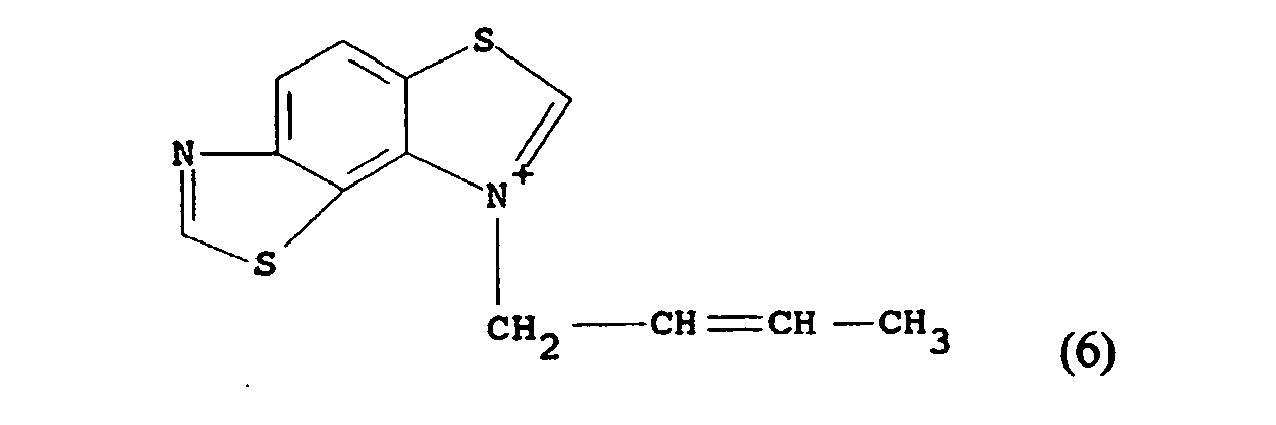
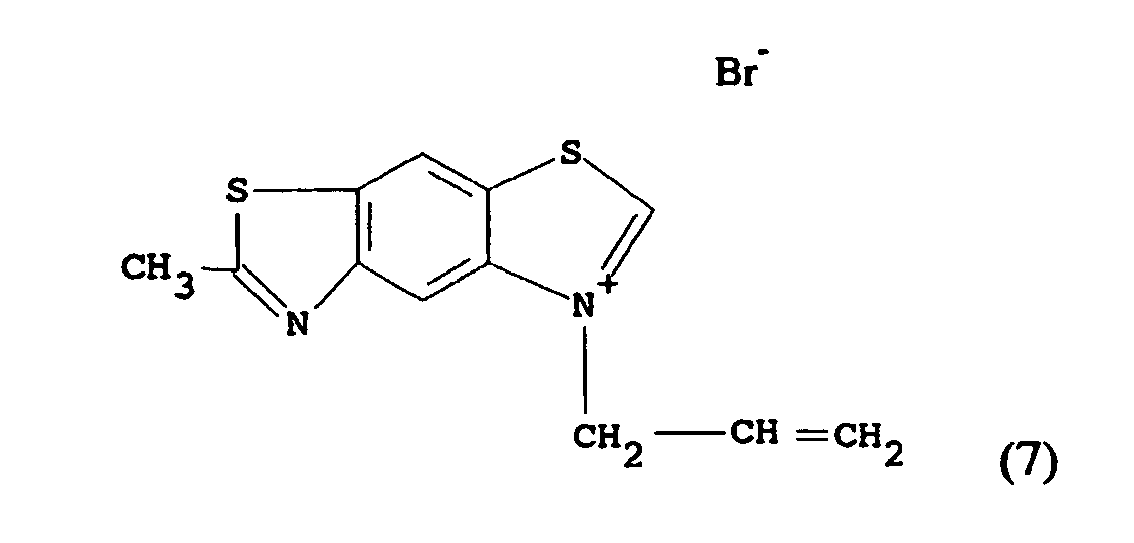


- Process for chemically sensitizing a silver halide photographic emulsion according to daim 1 further including the addition of a sulfur sensitizer to said emulsion.
- Process for chemically sensitizing a silver halide photographic emulsion according to claim 5, wherein said sulfur sensitizer is a thiosulfonate salts, sodium thiosulfate, allylthiocyanate, allylthiourea, thiosulfinic acid, sulfonic add, allylthiocarbamide, thiourea or cystine.
- Process for chemically sensitizing a silver halide photographic emulsion according to claim 5, wherein said sulfur sensitizer is para-toluenethiosulfonate salts.
- Process for chemically sensitizing a silver halide photographic emulsion according to claim 5, wherein said sulfur sensitizer is added after the addition of the benzo-bis-thiazole quaternary salt.
- Chemically sensitized silver halide light green-sensitive emulsion containing a benzo-bis-thiazole quaternary salt represented by the general formula (I):

- Silver halide light-sensitive material comprising a support base carrying at least one silver halide blue-sensitive emulsion layer associated with a yellow dye-forming coupler, at least one silver halide green-sensitive emulsion layer associated with a magenta dye-forming coupler and at least one silver halide red-sensitive silver halide emulsion layer associated with a cyan dye-forming coupler, wherein at least one silver halide green-sensitive emulsion layer contains a chemically sensitized silver halide green-sensitive emulsion comprising a benzo-bis-thiazole quaternary salt represented by the general formula (I):

Applications Claiming Priority (2)
| Application Number | Priority Date | Filing Date | Title |
|---|---|---|---|
| IT2002SV000019A ITSV20020019A1 (en) | 2002-05-06 | 2002-05-06 | PROCESS TO CHEMICALLY SENSITIZE A PHOTOGRAPHIC EMULSION TO SILVER HALIDES EMULSION TO SILVER HALIDES SENSITIVE TO |
| ITSV20020019 | 2002-05-06 |
Publications (2)
| Publication Number | Publication Date |
|---|---|
| EP1361477A1 EP1361477A1 (en) | 2003-11-12 |
| EP1361477B1 true EP1361477B1 (en) | 2007-01-17 |
Family
ID=29227566
Family Applications (1)
| Application Number | Title | Priority Date | Filing Date |
|---|---|---|---|
| EP03009124A Expired - Lifetime EP1361477B1 (en) | 2002-05-06 | 2003-04-22 | Process for chemically sensitizing a green-sensitive silver halide photographic emulsion and photographic material containing said emulsion |
Country Status (3)
| Country | Link |
|---|---|
| EP (1) | EP1361477B1 (en) |
| DE (1) | DE60311178D1 (en) |
| IT (1) | ITSV20020019A1 (en) |
Families Citing this family (1)
| Publication number | Priority date | Publication date | Assignee | Title |
|---|---|---|---|---|
| US8477143B2 (en) | 2008-03-04 | 2013-07-02 | Apple Inc. | Buffers for display acceleration |
Family Cites Families (2)
| Publication number | Priority date | Publication date | Assignee | Title |
|---|---|---|---|---|
| IT1215535B (en) * | 1987-06-02 | 1990-02-14 | Minnesota Mining & Mfg | QUATERNARY SALTS OF BENZO-BIS-THIAZOL AND THEIR USE AS ANTI-VEIL AGENTS IN PHOTOSENSITIVE TO SILVER HALIDE. |
| IT1230035B (en) * | 1988-07-19 | 1991-09-24 | Minnesota Mining & Mfg | INVERTIBLE COLOR PHOTOGRAPHIC MATERIAL IN MULTIPLE LAYERS WITH SILVER HALIDES, WITH IMPROVED COLOR REPRODUCIBILITY. |
-
2002
- 2002-05-06 IT IT2002SV000019A patent/ITSV20020019A1/en unknown
-
2003
- 2003-04-22 DE DE60311178T patent/DE60311178D1/en not_active Expired - Lifetime
- 2003-04-22 EP EP03009124A patent/EP1361477B1/en not_active Expired - Lifetime
Also Published As
| Publication number | Publication date |
|---|---|
| ITSV20020019A1 (en) | 2003-11-06 |
| DE60311178D1 (en) | 2007-03-08 |
| EP1361477A1 (en) | 2003-11-12 |
Similar Documents
| Publication | Publication Date | Title |
|---|---|---|
| JPH0372974B2 (en) | ||
| EP0297804B1 (en) | Silver halide photographic light-sensitive material | |
| JPS60170853A (en) | Color photosensitive material | |
| JPH01131555A (en) | Negative type silver halide color photographic sensitive material | |
| EP1055964B1 (en) | Silver bromoiodide core-shell grain emulsion | |
| JP2729485B2 (en) | Silver halide photographic emulsion | |
| US5821042A (en) | Silver halide color photographic element having improved bleachability | |
| JPH0830861B2 (en) | Silver halide photographic emulsion and multilayer photographic light-sensitive material using the same | |
| EP0735417B1 (en) | Silver halide photographic elements containing 2-equivalent 5-pyrazolone magenta couplers | |
| JPH0364054B2 (en) | ||
| JP2929511B2 (en) | Silver halide color photographic materials | |
| JPH0562322B2 (en) | ||
| US6242168B1 (en) | Silver halide color photographic light-sensitive elements having improved image quality | |
| EP1361477A1 (en) | Process for chemically sensitizing a green-sensitive silver halide photographic emulsion and photographic material containing said emulsion | |
| EP0725312B1 (en) | Silver halide color photographic elements | |
| EP0725313B1 (en) | Silver halide color photographic elements | |
| EP0747761A1 (en) | Silver halide photographic elements having improved sensitivity | |
| JP2631111B2 (en) | Silver halide photographic emulsion and multilayer photographic material using the same | |
| US6511796B2 (en) | Color photographic element | |
| EP0678773B1 (en) | Silver bromoiodide core-shell grain emulsion | |
| JP2916700B2 (en) | Silver halide photographic material | |
| JP3549982B2 (en) | Silver halide color photographic light-sensitive element with improved granularity | |
| EP0878735B1 (en) | Silver halide color photographic element having improved bleachability | |
| JP2681171B2 (en) | Silver halide photographic material | |
| JP2651614B2 (en) | Silver halide photographic material |
Legal Events
| Date | Code | Title | Description |
|---|---|---|---|
| PUAI | Public reference made under article 153(3) epc to a published international application that has entered the european phase |
Free format text: ORIGINAL CODE: 0009012 |
|
| AK | Designated contracting states |
Kind code of ref document: A1 Designated state(s): AT BE BG CH CY CZ DE DK EE ES FI FR GB GR HU IE IT LI LU MC NL PT RO SE SI SK TR |
|
| AX | Request for extension of the european patent |
Extension state: AL LT LV MK |
|
| 17P | Request for examination filed |
Effective date: 20040511 |
|
| AKX | Designation fees paid |
Designated state(s): DE FR GB IT |
|
| RAP1 | Party data changed (applicant data changed or rights of an application transferred) |
Owner name: FERRANIA TECHNOLOGIES S.P.A. |
|
| GRAP | Despatch of communication of intention to grant a patent |
Free format text: ORIGINAL CODE: EPIDOSNIGR1 |
|
| GRAS | Grant fee paid |
Free format text: ORIGINAL CODE: EPIDOSNIGR3 |
|
| GRAA | (expected) grant |
Free format text: ORIGINAL CODE: 0009210 |
|
| AK | Designated contracting states |
Kind code of ref document: B1 Designated state(s): DE FR GB IT |
|
| REG | Reference to a national code |
Ref country code: GB Ref legal event code: FG4D |
|
| REF | Corresponds to: |
Ref document number: 60311178 Country of ref document: DE Date of ref document: 20070308 Kind code of ref document: P |
|
| PLBE | No opposition filed within time limit |
Free format text: ORIGINAL CODE: 0009261 |
|
| STAA | Information on the status of an ep patent application or granted ep patent |
Free format text: STATUS: NO OPPOSITION FILED WITHIN TIME LIMIT |
|
| 26N | No opposition filed |
Effective date: 20071018 |
|
| PG25 | Lapsed in a contracting state [announced via postgrant information from national office to epo] |
Ref country code: DE Free format text: LAPSE BECAUSE OF FAILURE TO SUBMIT A TRANSLATION OF THE DESCRIPTION OR TO PAY THE FEE WITHIN THE PRESCRIBED TIME-LIMIT Effective date: 20070418 |
|
| PG25 | Lapsed in a contracting state [announced via postgrant information from national office to epo] |
Ref country code: IT Free format text: LAPSE BECAUSE OF NON-PAYMENT OF DUE FEES Effective date: 20070422 Ref country code: FR Free format text: LAPSE BECAUSE OF FAILURE TO SUBMIT A TRANSLATION OF THE DESCRIPTION OR TO PAY THE FEE WITHIN THE PRESCRIBED TIME-LIMIT Effective date: 20070907 |
|
| PGFP | Annual fee paid to national office [announced via postgrant information from national office to epo] |
Ref country code: GB Payment date: 20080317 Year of fee payment: 6 |
|
| PG25 | Lapsed in a contracting state [announced via postgrant information from national office to epo] |
Ref country code: FR Free format text: LAPSE BECAUSE OF FAILURE TO SUBMIT A TRANSLATION OF THE DESCRIPTION OR TO PAY THE FEE WITHIN THE PRESCRIBED TIME-LIMIT Effective date: 20070117 |
|
| GBPC | Gb: european patent ceased through non-payment of renewal fee |
Effective date: 20090422 |
|
| PG25 | Lapsed in a contracting state [announced via postgrant information from national office to epo] |
Ref country code: GB Free format text: LAPSE BECAUSE OF NON-PAYMENT OF DUE FEES Effective date: 20090422 |