EP1360953A1 - Mixture for the production of a high-expansion stone die - Google Patents
Mixture for the production of a high-expansion stone die Download PDFInfo
- Publication number
- EP1360953A1 EP1360953A1 EP02010127A EP02010127A EP1360953A1 EP 1360953 A1 EP1360953 A1 EP 1360953A1 EP 02010127 A EP02010127 A EP 02010127A EP 02010127 A EP02010127 A EP 02010127A EP 1360953 A1 EP1360953 A1 EP 1360953A1
- Authority
- EP
- European Patent Office
- Prior art keywords
- mixture
- parts
- weight
- die
- sulfonates
- Prior art date
- Legal status (The legal status is an assumption and is not a legal conclusion. Google has not performed a legal analysis and makes no representation as to the accuracy of the status listed.)
- Granted
Links
Classifications
-
- C—CHEMISTRY; METALLURGY
- C04—CEMENTS; CONCRETE; ARTIFICIAL STONE; CERAMICS; REFRACTORIES
- C04B—LIME, MAGNESIA; SLAG; CEMENTS; COMPOSITIONS THEREOF, e.g. MORTARS, CONCRETE OR LIKE BUILDING MATERIALS; ARTIFICIAL STONE; CERAMICS; REFRACTORIES; TREATMENT OF NATURAL STONE
- C04B28/00—Compositions of mortars, concrete or artificial stone, containing inorganic binders or the reaction product of an inorganic and an organic binder, e.g. polycarboxylate cements
- C04B28/14—Compositions of mortars, concrete or artificial stone, containing inorganic binders or the reaction product of an inorganic and an organic binder, e.g. polycarboxylate cements containing calcium sulfate cements
- C04B28/145—Calcium sulfate hemi-hydrate with a specific crystal form
- C04B28/146—Calcium sulfate hemi-hydrate with a specific crystal form alpha-hemihydrate
-
- A—HUMAN NECESSITIES
- A61—MEDICAL OR VETERINARY SCIENCE; HYGIENE
- A61K—PREPARATIONS FOR MEDICAL, DENTAL OR TOILETRY PURPOSES
- A61K6/00—Preparations for dentistry
- A61K6/80—Preparations for artificial teeth, for filling teeth or for capping teeth
- A61K6/849—Preparations for artificial teeth, for filling teeth or for capping teeth comprising inorganic cements
- A61K6/858—Calcium sulfates, e.g, gypsum
-
- A—HUMAN NECESSITIES
- A61—MEDICAL OR VETERINARY SCIENCE; HYGIENE
- A61K—PREPARATIONS FOR MEDICAL, DENTAL OR TOILETRY PURPOSES
- A61K6/00—Preparations for dentistry
- A61K6/80—Preparations for artificial teeth, for filling teeth or for capping teeth
- A61K6/849—Preparations for artificial teeth, for filling teeth or for capping teeth comprising inorganic cements
- A61K6/871—Quartz; SiO2
-
- A—HUMAN NECESSITIES
- A61—MEDICAL OR VETERINARY SCIENCE; HYGIENE
- A61K—PREPARATIONS FOR MEDICAL, DENTAL OR TOILETRY PURPOSES
- A61K6/00—Preparations for dentistry
- A61K6/90—Compositions for taking dental impressions
-
- C—CHEMISTRY; METALLURGY
- C04—CEMENTS; CONCRETE; ARTIFICIAL STONE; CERAMICS; REFRACTORIES
- C04B—LIME, MAGNESIA; SLAG; CEMENTS; COMPOSITIONS THEREOF, e.g. MORTARS, CONCRETE OR LIKE BUILDING MATERIALS; ARTIFICIAL STONE; CERAMICS; REFRACTORIES; TREATMENT OF NATURAL STONE
- C04B2111/00—Mortars, concrete or artificial stone or mixtures to prepare them, characterised by specific function, property or use
- C04B2111/00474—Uses not provided for elsewhere in C04B2111/00
- C04B2111/00836—Uses not provided for elsewhere in C04B2111/00 for medical or dental applications
-
- C—CHEMISTRY; METALLURGY
- C04—CEMENTS; CONCRETE; ARTIFICIAL STONE; CERAMICS; REFRACTORIES
- C04B—LIME, MAGNESIA; SLAG; CEMENTS; COMPOSITIONS THEREOF, e.g. MORTARS, CONCRETE OR LIKE BUILDING MATERIALS; ARTIFICIAL STONE; CERAMICS; REFRACTORIES; TREATMENT OF NATURAL STONE
- C04B2111/00—Mortars, concrete or artificial stone or mixtures to prepare them, characterised by specific function, property or use
- C04B2111/00474—Uses not provided for elsewhere in C04B2111/00
- C04B2111/00939—Uses not provided for elsewhere in C04B2111/00 for the fabrication of moulds or cores
Definitions
- the present invention relates to a mixture for the production of a die.
- Such plasters have a setting expansion of at most 0,3%.
- the die, produced with this kind of plaster is covered with a ceramic suspension to build a ceramic cap (also called green body before the sintering process) and then the covered die is dried at temperatures of about 900°C.
- die and cap are separated and the ceramic cap is heated (sintered) to about 1400 to 1500°C.
- the ceramic material of the cap shrinks to an extent of from about 4% up to 12%. Accordingly, the cap is too small and does not fit on the patient's tooth so that the ceramic cap has to be adapted to the tooth by removing ceramic material. Repeatedly, the fit of the cap on the tooth is tested and excess material removed until a good fit has been achieved. This procedure is time-consuming, expensive and inconvenient for the patient.
- a die which consists of such material can be used for the production of a ceramic cap which needs no further modification and fits exactly onto a patient's tooth.
- This object has been achieved according to the present invention by providing a mixture, comprising: a) 100 parts by weight ⁇ CaSO 4 x 1 ⁇ 2 H 2 O, b) 1-20 parts by weight CaSO 4 x 2 H 2 O, c) 0.005-0.80 parts by weight of at least one additive and d) up to 2 parts by weight of one or more surfactants.
- This mixture can further comprise : e) 15-65, preferably 23-45 parts by weight of a liquid such as water or a colloidal silica suspension.
- the mixtures according to the present invention can be used to prepare a die which has a setting expansion of about 4 to about 14%.
- a die which has a setting expansion of about 4 to about 14%.
- the die When such a die is covered with a ceramic material and heated to, e.g., about 900 °C, the die and accordingly the ceramic material expand to a corresponding degree.
- the ceramic cap is then removed from the die and fired at a temperature of, e.g. 1400 °C to 1500 °C the ceramic material shrinks to its original size so that the cap fits exactly to the patients tooth.
- components a), b), c) and optionally d) and/or e) will usually be provided in separate containers as a kit of parts so that the dentist or the dental laboratory can combine them in any appropriate ratio. It is also possible to provide a mixture of components a)-c) and optionally d) with a defined expansion ratio. This mixture can be mixed with water in a recommended ratio. Alternatively component e) can be provided in a predetermined amount, again resulting in a specific expansion of the die when all components are mixed.
- a die can be produced by mixing components a) to c) and e) and optionally one or more of components d), preferably while stirring the mixture.
- the material is then poured into a mold which is an exact negative of the patient's tooth to be treated. Care should be taken at this stage to avoid voids in the die; if voids are formed at a surface of the die, protrusions will be formed on the cap which will have to be removed during further work-up. If voids are formed within the die, the die will not be homogenous thereby preventing a linear expansion of the die. This also results in a cap which must be worked-up with considerable difficulty. Methods to prevent formations of voids in a die are known in the art and should accordingly be applied in the present case.
- the die When the die has hardened to a degree that it can be handled without being damaged, it is covered with a ceramic cap e.g. by dipping the die into ceramic material, drying the ceramic material and repeating these steps until the required strength and size of the ceramic cap has been achieved.
- the materials are then heated to a temperature of e.g. about 900°C. During this heating step, the die expands to the required degree, thereby co-expanding the ceramic cap.
- the cap is then removed from the die and heated to a temperature of about 1400 to about 1500°C. During this sintering step, the cap shrinks depending upon the ceramic material used, e.g. by about 13%, thereby regaining the required size.
- a further advantage of the present invention is that the properties, especially the expansion of the die can be varied to a large extent: If the ceramic material used for the production of a cap has a specific shrinkage, the mixture according to the present invention can be adapted so that the die expands to exactly meet this shrinkage.
- All solid materials used in the present invention are preferably employed as powders or fine grains. They can e.g. have an average particle size of about 3 ⁇ m to about 70 ⁇ m.
- ⁇ CaSO 4 x 1/2 H 2 O An important factor is the quality and type of the ⁇ CaSO 4 x 1/2 H 2 O to be used. Basically any ⁇ gypsum hemi-hydrate or any mixture thereof can be used. Examples are synthetic gypsum T, natural gypsum K and natural gypsum PL, all of which are commercially available. If synthetic gypsum T is used, the expansion of the resulting die is larger than when natural gypsum K or natural gypsum PL are used, please compare with Table 1.
- a further important factor is the quality and type of the dihydrate to be used. Basically any dihydrate and any commercially available dihydrate can be used.
- the amount of the dihydrate to be added to the mixture has a large influence on the properties of the resulting die. As can be taken from table 2 an increase from 2 parts by weight to 10 parts by weight increases the expansion from 3-4% to 11-12%.
- the dihydrate can be used in amounts of about 1-20 parts by weight, while 2-15 parts by weight are preferred. As mentioned above, the amount will be determined depending on the requested properties of the die.
- the mixture according to the present invention can comprise one, two or more additives.
- additives are hardening accelerators, hardening retarders, and settng expansion inhibitors.
- Such components are described in e.g. Skinner's Science of Dental Materials, Ralph W. Phillips, 1982, 8 th edition.
- carboxylates citrate, succinate,..etc
- water soluble high polymers can be used in the present invention.
- tri sodium citrate is used.
- the hardening accelerator(s) inorganic acid salts sodium chloride, potassium sulfate,...etc
- potassium sulfate is used as the hardening accelerator(s) inorganic acid salts.
- potassium salts and sodium salts etc. can be used in the present invention.
- potassium tartrate is used.
- the physical properties such as setting time, setting expansion and compressive strength of the die can be varied, please refer to table 2.
- the amount of these additives can vary from 0.005 to 0.8 parts by weight, whereas a range of 0.01 to 0.4 parts by weight is preferred.
- One or a mixture of two or more additives can be used.
- a water reducing agent and/or dispersing agent can be used as a surfactant.
- Such agents are, for example,
- An especially preferred surfactant is a mixture of melamin sulfonates and formaldehyd polycondensation products.
- surfactant One function of the surfactant is to reduce the amount of liquid required for mixing and to increase the setting expansion.
- Commercially available surfactants are e.g. Pozzolith NR. 70, NR. 81 MP, NR. NL-1440 or NR. NL-4000.
- the surfactants can be used in amounts of up to 2 parts by weight, while amounts of 0.2 to 1 parts by weight are preferred. It is, however, possible to omit the surfactants altogether. Moreover, one or a mixture of two or more surfactants can be used.
- the liquid(s) which can be used also can have an important influence on the properties and especially the setting expansion of the die.
- a colloidal silica suspension is used.
- Commercially available examples are e.g. Levasil (Bayer) 100/45%, 200/40%, LUDOX (Dupont) H540, W30, W50.
- the colloidal silica suspension is usually diluted to a concentration of about 20 to 50 weight-% using distilled or tap water. Alternatively, distilled or tap water can be used as the liquid.
- Preferred amounts of the liquid to be added to the mixture of components a)-c) and optionally component(s) d) are 23 to 45 g liquid per 100 g of the mixture.
- the properties and especially the expansion of the die can be adapted.
- the shrinkage of a desired ceramic material can be determined and then a specific die can be selected based on the teaching of the present invention which has the appropriate shrinkage.
- the present invention furthermore discloses a kit of parts especially for dental purposes, containing at least components a), b) and c) preferably each in separate containers. Additionally it can contain component(s) d), also in (a) separate container(s).
- the components can be provided in pre-determined quantities and qualities so that a die material with specific properties such as expansion etc. can be prepared in a dental laboratory by the dentist or technician.
- compositions of the present invention are described in the following tables.
Landscapes
- Health & Medical Sciences (AREA)
- Chemical & Material Sciences (AREA)
- Oral & Maxillofacial Surgery (AREA)
- Public Health (AREA)
- Veterinary Medicine (AREA)
- General Health & Medical Sciences (AREA)
- Animal Behavior & Ethology (AREA)
- Life Sciences & Earth Sciences (AREA)
- Epidemiology (AREA)
- Inorganic Chemistry (AREA)
- Ceramic Engineering (AREA)
- Plastic & Reconstructive Surgery (AREA)
- Engineering & Computer Science (AREA)
- Materials Engineering (AREA)
- Chemical Kinetics & Catalysis (AREA)
- Crystallography & Structural Chemistry (AREA)
- Structural Engineering (AREA)
- Organic Chemistry (AREA)
- Dental Preparations (AREA)
- Dental Prosthetics (AREA)
- Curing Cements, Concrete, And Artificial Stone (AREA)
- Press-Shaping Or Shaping Using Conveyers (AREA)
- Compositions Of Oxide Ceramics (AREA)
Abstract
Description
- The present invention relates to a mixture for the production of a die.
- In recent times dental implants, bridges and crowns were prepared using gold since gold has superior properties and can be processed quite easily. Today, people require ceramic materials for aesthetic reasons. However, processing of ceramic material is quite complex and requires a lot of time and work so that new improved techniques are needed to process ceramic materials more effectively.
- When producing ceramic implants, crowns or bridges, a model (master model) of the tooth to be covered with the ceramic material is prepared. Then the master model is duplicated with a die material like gypsum or plaster as disclosed in the book "Gips ... und was man darüber wissen sollte" (Martin Kuske & Ralf Suckert - teamwork media - 2000) especially chapter 1, page 18 ff. Known dental plasters are divided according to the norm DIN/EN 26873 IS 6873 into five types:
Type Setting Expansion % Compression strength in Mpa min max I 0 to 0.15 4 4 II 0 to 0.30 9 - III 0 to 0.20 20 - IV 0 to 0.15 35 - V 0.16 to 0.30 35 - - Such plasters have a setting expansion of at most 0,3%. The die, produced with this kind of plaster, is covered with a ceramic suspension to build a ceramic cap (also called green body before the sintering process) and then the covered die is dried at temperatures of about 900°C. In a second step, die and cap are separated and the ceramic cap is heated (sintered) to about 1400 to 1500°C. At such temperatures the ceramic material of the cap shrinks to an extent of from about 4% up to 12%. Accordingly, the cap is too small and does not fit on the patient's tooth so that the ceramic cap has to be adapted to the tooth by removing ceramic material. Repeatedly, the fit of the cap on the tooth is tested and excess material removed until a good fit has been achieved. This procedure is time-consuming, expensive and inconvenient for the patient.
- In order to overcome this disadvantage it has been proposed to provide a die material which expands during setting. If such material is used, the die material and accordingly the ceramic material covering the die would have a too big/loose fit in a pre-sintered stage so that a good fit of the final sintered ceramic cap to the tooth would be achieved. However, no such material is available: As mentioned above, currently available plaster has a setting expansion of up to 0.3 % which is far from satisfactory.
- It was accordingly an object of the present invention to provide a material which overcomes this disadvantage of the prior art.
- It was especially an object of the present invention to provide a die material which expands to an extent that the shrinkage of a ceramic cap can be neutralized. Thus, a die which consists of such material can be used for the production of a ceramic cap which needs no further modification and fits exactly onto a patient's tooth.
- This object has been achieved according to the present invention by providing a mixture, comprising:
a) 100 parts by weight α CaSO4 x ½ H2O, b) 1-20 parts by weight CaSO4 x 2 H2O, c) 0.005-0.80 parts by weight of at least one additive and d) up to 2 parts by weight of one or more surfactants. - This mixture can further comprise :
e) 15-65, preferably 23-45 parts by weight of a liquid such as water or a colloidal silica suspension. - The mixtures according to the present invention can be used to prepare a die which has a setting expansion of about 4 to about 14%. When such a die is covered with a ceramic material and heated to, e.g., about 900 °C, the die and accordingly the ceramic material expand to a corresponding degree. When the ceramic cap is then removed from the die and fired at a temperature of, e.g. 1400 °C to 1500 °C the ceramic material shrinks to its original size so that the cap fits exactly to the patients tooth.
- Some or all components a), b), c) and optionally d) and/or e) will usually be provided in separate containers as a kit of parts so that the dentist or the dental laboratory can combine them in any appropriate ratio. It is also possible to provide a mixture of components a)-c) and optionally d) with a defined expansion ratio. This mixture can be mixed with water in a recommended ratio. Alternatively component e) can be provided in a predetermined amount, again resulting in a specific expansion of the die when all components are mixed.
- According to one embodiment of the present invention, a die can be produced by mixing components a) to c) and e) and optionally one or more of components d), preferably while stirring the mixture. According to this embodiment, the material is then poured into a mold which is an exact negative of the patient's tooth to be treated. Care should be taken at this stage to avoid voids in the die; if voids are formed at a surface of the die, protrusions will be formed on the cap which will have to be removed during further work-up. If voids are formed within the die, the die will not be homogenous thereby preventing a linear expansion of the die. This also results in a cap which must be worked-up with considerable difficulty. Methods to prevent formations of voids in a die are known in the art and should accordingly be applied in the present case.
- When the die has hardened to a degree that it can be handled without being damaged, it is covered with a ceramic cap e.g. by dipping the die into ceramic material, drying the ceramic material and repeating these steps until the required strength and size of the ceramic cap has been achieved. The materials are then heated to a temperature of e.g. about 900°C. During this heating step, the die expands to the required degree, thereby co-expanding the ceramic cap. The cap is then removed from the die and heated to a temperature of about 1400 to about 1500°C. During this sintering step, the cap shrinks depending upon the ceramic material used, e.g. by about 13%, thereby regaining the required size.
- A further advantage of the present invention is that the properties, especially the expansion of the die can be varied to a large extent: If the ceramic material used for the production of a cap has a specific shrinkage, the mixture according to the present invention can be adapted so that the die expands to exactly meet this shrinkage.
- There are a number of factors which influence the properties such as setting and thermal expansion and compressive strength of the die. All solid materials used in the present invention are preferably employed as powders or fine grains. They can e.g. have an average particle size of about 3 µm to about 70 µm.
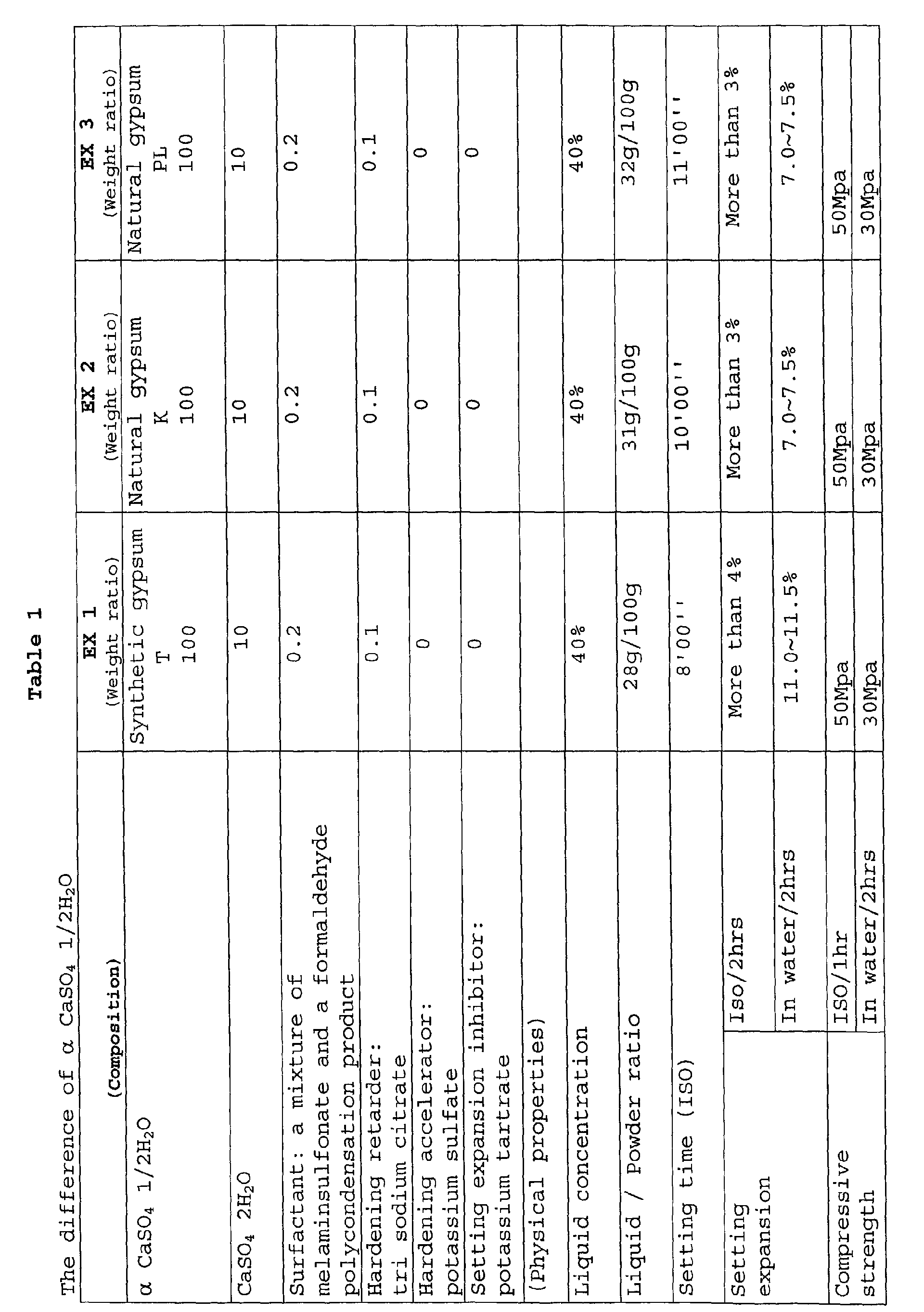
- An important factor is the quality and type of the α CaSO4 x 1/2 H2O to be used. Basically any α gypsum hemi-hydrate or any mixture thereof can be used. Examples are synthetic gypsum T, natural gypsum K and natural gypsum PL, all of which are commercially available. If synthetic gypsum T is used, the expansion of the resulting die is larger than when natural gypsum K or natural gypsum PL are used, please compare with Table 1.
- A further important factor is the quality and type of the dihydrate to be used. Basically any dihydrate and any commercially available dihydrate can be used.
- Moreover, the amount of the dihydrate to be added to the mixture has a large influence on the properties of the resulting die. As can be taken from table 2 an increase from 2 parts by weight to 10 parts by weight increases the expansion from 3-4% to 11-12%. The dihydrate can be used in amounts of about 1-20 parts by weight, while 2-15 parts by weight are preferred. As mentioned above, the amount will be determined depending on the requested properties of the die.
- The mixture according to the present invention can comprise one, two or more additives. Examples of such additives are hardening accelerators, hardening retarders, and settng expansion inhibitors. Such components are described in e.g. Skinner's Science of Dental Materials, Ralph W. Phillips, 1982, 8th edition.
- For example, as the hardening retarder(s), carboxylates (citrate, succinate,..etc) and water soluble high polymers (cane sugar, hexameta phosphate,..etc) can be used in the present invention. Preferably tri sodium citrate is used.
- For example, as the hardening accelerator(s) inorganic acid salts (sodium chloride, potassium sulfate,...etc) may be used in the present invention. Preferably potassium sulfate is used.
- For example, as the setting expansion inhibitor potassium salts and sodium salts etc. (potassium chloride, potassium tartrate, potassium sodium, sodium tartrate,..etc) can be used in the present invention. Preferably potassium tartrate is used.
- Depending on the amount and combination of the additives, the physical properties such as setting time, setting expansion and compressive strength of the die can be varied, please refer to table 2. The amount of these additives can vary from 0.005 to 0.8 parts by weight, whereas a range of 0.01 to 0.4 parts by weight is preferred. One or a mixture of two or more additives can be used.
- Especially a water reducing agent and/or dispersing agent can be used as a surfactant. Such agents are, for example,
- anionic surfactants like alkylbenzene sulfonate,
alkylnaphthalene sulfonate,
a mixture of naphtalene sulfonates and formaldehyde polycondensation products,
a mixture of melamin sulfonates and formaldehyde polycondensation products, dialkyl sulfosuccinates, alkylsulfonates,
alpha-olefin sulfonates, sodium N-acyl methyl taurate, - nonionic surfactants like polyethylene alkylether,
polyoxyethylene sec-alcohol ether,
polyethylene polyoxypropylene alkylether,
polyglyceryl fatty acid ester. - An especially preferred surfactant is a mixture of melamin sulfonates and formaldehyd polycondensation products.
- One function of the surfactant is to reduce the amount of liquid required for mixing and to increase the setting expansion. Commercially available surfactants are e.g. Pozzolith NR. 70, NR. 81 MP, NR. NL-1440 or NR. NL-4000.
- The surfactants can be used in amounts of up to 2 parts by weight, while amounts of 0.2 to 1 parts by weight are preferred. It is, however, possible to omit the surfactants altogether. Moreover, one or a mixture of two or more surfactants can be used.
- The liquid(s) which can be used also can have an important influence on the properties and especially the setting expansion of the die. Preferably, a colloidal silica suspension is used. Commercially available examples are e.g. Levasil (Bayer) 100/45%, 200/40%, LUDOX (Dupont) H540, W30, W50.
The colloidal silica suspension is usually diluted to a concentration of about 20 to 50 weight-% using distilled or tap water. Alternatively, distilled or tap water can be used as the liquid. Preferred amounts of the liquid to be added to the mixture of components a)-c) and optionally component(s) d) are 23 to 45 g liquid per 100 g of the mixture. - Thus, by varying the quality and/or the quantity of the above components, the properties and especially the expansion of the die can be adapted. For example, the shrinkage of a desired ceramic material can be determined and then a specific die can be selected based on the teaching of the present invention which has the appropriate shrinkage.
- The present invention furthermore discloses a kit of parts especially for dental purposes, containing at least components a), b) and c) preferably each in separate containers. Additionally it can contain component(s) d), also in (a) separate container(s).
- The components can be provided in pre-determined quantities and qualities so that a die material with specific properties such as expansion etc. can be prepared in a dental laboratory by the dentist or technician.
- Examples of compositions of the present invention are described in the following tables.
- Powder (components a), b), c) and optionally d)) / Liquid ratio:
- about 100g / 23g-45g
- Hand mix powder into liquid for 15 seconds.
- Blend to a homogenous mixture.
- Pour into mold, especially a duplicate impression.
- Bench setting for 10 minutes. After 10 minutes remove from impression and put into water for total setting time (EX 2hours) to get available setting expansion.
-


Claims (9)
- Mixture, comprising:
a) 100 parts by weight alpha CaSO4 x ½ H2O, b) 1-20 parts by weight CaSO4 x 2 H2O, c) 0.005-0.8 parts by weight of at least one additive, and d) up to 2 parts by weight of one or two different surfactants. - Mixture according to claim 1, further comprising:
e) 15-65 parts by weight of a liquid, such as water or a colloidal silica suspension. - Mixture according to any one of the preceding claims, characterized by
b) 2-15 parts by weight CaSO4 x 2 H2O. - Mixture according to any one of the preceding claims, characterized in that the at least one additive c) is a hardening accelerator, a hardening retarder or a setting expansion inhibitor.
- Mixture according to any one of the preceding claims, characterized in that the hardening accelerator c) is selected from inorganic acid salts like sodium chloride and potassium sulfate,
and the hardening retarder c) is selected from carboxylates like citrates, succinates, acetates and phosphates, and borates like borax, water soluble high polymers like cane sugar, hexameta phosphate, etylenediamine tetra acetate, starch, gum arabic, carboxymethyl cellulose and sugar alcohol,
and the setting expansion inhibitor c) is selected from potassium chloride, potassium tartrate, potassium sodium, and sodium tartrate. - Mixture according to any one of the preceding claims, characterized in that the surfactants d) are selected from anionic surfactants like alkylbenzene sulfonates, alkylnaphthalene sulfonates, a mixture of naphthalene sulfonates and formaldehyde polycondensation products, a mixture of melamin sulfonates and formaldehyde polycondensation products, dialkylsulfosuccinates, alkylsulfoacetates, alpha-olefin sulfonates, sodium N-acyl methyl taurates, and nonionic surfactants like polyethylene alkylethers, polyoxyethylene sec-alcoholethers, polyethylene polyoxypropylene alkylethers, and polyglyceryl fatty acid esters.
- Mixture according to any one of claims 2 to 6, characterized in that colloidal silica suspension has a concentration of 20-50 wt.-%.
- Kit of parts, containing components a), b) and c) and optionally components d) and/or e) according to any one of the preceding claims in separate containers.
- Die, obtainable by using a mixture or a kit of parts according to any one of the preceding claims.
Priority Applications (5)
| Application Number | Priority Date | Filing Date | Title |
|---|---|---|---|
| DE60207528T DE60207528T2 (en) | 2002-05-10 | 2002-05-10 | Mixture for the production of high-expansion compression molds made of stone |
| EP02010127A EP1360953B1 (en) | 2002-05-10 | 2002-05-10 | Mixture for the production of a high-expansion stone die |
| AT02010127T ATE310488T1 (en) | 2002-05-10 | 2002-05-10 | MIXTURE FOR PRODUCING HIGH EXPANSION PRESSING MOLDS FROM STONE |
| US10/419,664 US6881258B2 (en) | 2002-05-10 | 2003-04-21 | Mixture for the production of a high-expansion stone die |
| JP2003131578A JP4225474B2 (en) | 2002-05-10 | 2003-05-09 | Mixtures for the production of high expansion stone dies |
Applications Claiming Priority (1)
| Application Number | Priority Date | Filing Date | Title |
|---|---|---|---|
| EP02010127A EP1360953B1 (en) | 2002-05-10 | 2002-05-10 | Mixture for the production of a high-expansion stone die |
Publications (2)
| Publication Number | Publication Date |
|---|---|
| EP1360953A1 true EP1360953A1 (en) | 2003-11-12 |
| EP1360953B1 EP1360953B1 (en) | 2005-11-23 |
Family
ID=29225613
Family Applications (1)
| Application Number | Title | Priority Date | Filing Date |
|---|---|---|---|
| EP02010127A Expired - Lifetime EP1360953B1 (en) | 2002-05-10 | 2002-05-10 | Mixture for the production of a high-expansion stone die |
Country Status (5)
| Country | Link |
|---|---|
| US (1) | US6881258B2 (en) |
| EP (1) | EP1360953B1 (en) |
| JP (1) | JP4225474B2 (en) |
| AT (1) | ATE310488T1 (en) |
| DE (1) | DE60207528T2 (en) |
Cited By (1)
| Publication number | Priority date | Publication date | Assignee | Title |
|---|---|---|---|---|
| CN103864364A (en) * | 2014-02-10 | 2014-06-18 | 安徽众凯架业有限责任公司 | Viscose/diatomite composite thermal insulation mortar and preparation method thereof |
Families Citing this family (5)
| Publication number | Priority date | Publication date | Assignee | Title |
|---|---|---|---|---|
| US7940785B2 (en) * | 2007-01-08 | 2011-05-10 | International Business Machines Corporation | Ethernet adapter packet management |
| JP2011213608A (en) * | 2010-03-31 | 2011-10-27 | Gc Corp | Dental hydraulic temporary sealing material composition |
| US9169160B2 (en) | 2012-08-27 | 2015-10-27 | Yoshino Gypsum Co., Ltd. | Process for manufacturing high-expansion gypsum plaster composition and high-expansion gypsum plaster composition obtained by said process |
| CA3026648A1 (en) * | 2016-06-07 | 2017-12-14 | United States Gypsum Company | Pourable compositions |
| US10780109B1 (en) | 2018-12-21 | 2020-09-22 | Laura Torrado | Method for treating a tooth using selenite |
Citations (9)
| Publication number | Priority date | Publication date | Assignee | Title |
|---|---|---|---|---|
| US2639478A (en) * | 1949-12-16 | 1953-05-26 | United States Gypsum Co | Process of preparing patterns |
| DE2740018A1 (en) * | 1977-09-06 | 1979-03-08 | Giulini Chemie | Foamed gypsum mouldings mfr. using a foaming agent - and min. amt. of water to avoid excessive drying costs |
| US4526619A (en) * | 1982-08-13 | 1985-07-02 | G-C Dental Industrial Corp. | Gypsum composition for denture investment |
| US4604142A (en) * | 1984-07-06 | 1986-08-05 | G-C Dental Industrial Corp. | Investments for dental casting |
| US4647311A (en) * | 1984-08-15 | 1987-03-03 | G-C Dental Industrial Corporation | Gypsum composition for denture investment |
| US4909847A (en) * | 1986-03-12 | 1990-03-20 | G-C Dental Industrial Corp. | Dental investment compositions in low-dusting powdery form |
| US4911759A (en) * | 1986-03-12 | 1990-03-27 | G-C Dental Industiral Corporation | Dental gypsum compositions in low-dusting powdery form |
| DE19548655A1 (en) * | 1995-12-15 | 1997-06-19 | Dentona Dental Produktions Und | Gypsum-based modelling material especially for dentistry |
| EP1186577A2 (en) * | 2000-09-06 | 2002-03-13 | Air Products Polymers, L.P. | Flexible setting type joint compound |
-
2002
- 2002-05-10 EP EP02010127A patent/EP1360953B1/en not_active Expired - Lifetime
- 2002-05-10 AT AT02010127T patent/ATE310488T1/en not_active IP Right Cessation
- 2002-05-10 DE DE60207528T patent/DE60207528T2/en not_active Expired - Lifetime
-
2003
- 2003-04-21 US US10/419,664 patent/US6881258B2/en not_active Expired - Fee Related
- 2003-05-09 JP JP2003131578A patent/JP4225474B2/en not_active Expired - Fee Related
Patent Citations (9)
| Publication number | Priority date | Publication date | Assignee | Title |
|---|---|---|---|---|
| US2639478A (en) * | 1949-12-16 | 1953-05-26 | United States Gypsum Co | Process of preparing patterns |
| DE2740018A1 (en) * | 1977-09-06 | 1979-03-08 | Giulini Chemie | Foamed gypsum mouldings mfr. using a foaming agent - and min. amt. of water to avoid excessive drying costs |
| US4526619A (en) * | 1982-08-13 | 1985-07-02 | G-C Dental Industrial Corp. | Gypsum composition for denture investment |
| US4604142A (en) * | 1984-07-06 | 1986-08-05 | G-C Dental Industrial Corp. | Investments for dental casting |
| US4647311A (en) * | 1984-08-15 | 1987-03-03 | G-C Dental Industrial Corporation | Gypsum composition for denture investment |
| US4909847A (en) * | 1986-03-12 | 1990-03-20 | G-C Dental Industrial Corp. | Dental investment compositions in low-dusting powdery form |
| US4911759A (en) * | 1986-03-12 | 1990-03-27 | G-C Dental Industiral Corporation | Dental gypsum compositions in low-dusting powdery form |
| DE19548655A1 (en) * | 1995-12-15 | 1997-06-19 | Dentona Dental Produktions Und | Gypsum-based modelling material especially for dentistry |
| EP1186577A2 (en) * | 2000-09-06 | 2002-03-13 | Air Products Polymers, L.P. | Flexible setting type joint compound |
Cited By (1)
| Publication number | Priority date | Publication date | Assignee | Title |
|---|---|---|---|---|
| CN103864364A (en) * | 2014-02-10 | 2014-06-18 | 安徽众凯架业有限责任公司 | Viscose/diatomite composite thermal insulation mortar and preparation method thereof |
Also Published As
| Publication number | Publication date |
|---|---|
| JP2003339743A (en) | 2003-12-02 |
| EP1360953B1 (en) | 2005-11-23 |
| ATE310488T1 (en) | 2005-12-15 |
| DE60207528D1 (en) | 2005-12-29 |
| DE60207528T2 (en) | 2006-08-03 |
| US6881258B2 (en) | 2005-04-19 |
| US20040031421A1 (en) | 2004-02-19 |
| JP4225474B2 (en) | 2009-02-18 |
Similar Documents
| Publication | Publication Date | Title |
|---|---|---|
| US4911759A (en) | Dental gypsum compositions in low-dusting powdery form | |
| US5746822A (en) | Ready-mixed setting type joint compound | |
| AU2001247019B2 (en) | Method for producing a chemically bound ceramic product, and product | |
| US4909847A (en) | Dental investment compositions in low-dusting powdery form | |
| AU2001247019A1 (en) | Method for producing a chemically bound ceramic product, and product | |
| EP2783675B1 (en) | Dental gypsum powder | |
| EP1360953B1 (en) | Mixture for the production of a high-expansion stone die | |
| JP2023182617A (en) | Gypsum-based casting investment material composition | |
| DE2408639A1 (en) | MODIFIED PLASTER COMPOSITION | |
| AU4967897A (en) | Cement composition, concrete using the same and method of manufacturing concrete product | |
| CA2147904C (en) | High strength, abrasion resistant veneer plaster | |
| JPH04234802A (en) | Dental investment compound with improved fluidity and powder form | |
| JPH10226558A (en) | Dental gypsum composition | |
| JP2009040659A (en) | Gypsum mold for casting crystal glass and composition for producing gypsum mold | |
| JP2008195574A (en) | Method of manufacturing cement composition | |
| JP7833804B2 (en) | Method for manufacturing a hydraulic molded body | |
| JP4587448B2 (en) | Additive for rapid hardening accelerator and rapid hardening admixture, rapid hardening composition and quick hardening self-leveling composition containing the same | |
| Kang et al. | Influence of bentonite addition on the handling and physical properties of tricalcium silicate cement | |
| JP6749304B2 (en) | Dental gypsum powder | |
| JP6835909B2 (en) | Dental plaster powder | |
| WO2023229996A1 (en) | Pottery plaster formula with increased porosity | |
| JP2013070891A (en) | Dental gypsum powder | |
| US20230382793A1 (en) | Plaster formula with increased porosity | |
| JP2024052640A (en) | Dental hardenable composition | |
| JPH04356405A (en) | Investment for dental precision casting |
Legal Events
| Date | Code | Title | Description |
|---|---|---|---|
| PUAI | Public reference made under article 153(3) epc to a published international application that has entered the european phase |
Free format text: ORIGINAL CODE: 0009012 |
|
| 17P | Request for examination filed |
Effective date: 20021227 |
|
| AK | Designated contracting states |
Kind code of ref document: A1 Designated state(s): AT BE CH CY DE DK ES FI FR GB GR IE IT LI LU MC NL PT SE TR |
|
| AX | Request for extension of the european patent |
Extension state: AL LT LV MK RO SI |
|
| AKX | Designation fees paid |
Designated state(s): AT BE CH CY DE DK ES FI FR GB GR IE IT LI LU MC NL PT SE TR |
|
| GRAP | Despatch of communication of intention to grant a patent |
Free format text: ORIGINAL CODE: EPIDOSNIGR1 |
|
| GRAS | Grant fee paid |
Free format text: ORIGINAL CODE: EPIDOSNIGR3 |
|
| GRAA | (expected) grant |
Free format text: ORIGINAL CODE: 0009210 |
|
| RAP1 | Party data changed (applicant data changed or rights of an application transferred) |
Owner name: GC CORPORATION |
|
| AK | Designated contracting states |
Kind code of ref document: B1 Designated state(s): AT BE CH CY DE DK ES FI FR GB GR IE IT LI LU MC NL PT SE TR |
|
| PG25 | Lapsed in a contracting state [announced via postgrant information from national office to epo] |
Ref country code: FI Free format text: LAPSE BECAUSE OF FAILURE TO SUBMIT A TRANSLATION OF THE DESCRIPTION OR TO PAY THE FEE WITHIN THE PRESCRIBED TIME-LIMIT Effective date: 20051123 Ref country code: LI Free format text: LAPSE BECAUSE OF FAILURE TO SUBMIT A TRANSLATION OF THE DESCRIPTION OR TO PAY THE FEE WITHIN THE PRESCRIBED TIME-LIMIT Effective date: 20051123 Ref country code: CH Free format text: LAPSE BECAUSE OF FAILURE TO SUBMIT A TRANSLATION OF THE DESCRIPTION OR TO PAY THE FEE WITHIN THE PRESCRIBED TIME-LIMIT Effective date: 20051123 Ref country code: BE Free format text: LAPSE BECAUSE OF FAILURE TO SUBMIT A TRANSLATION OF THE DESCRIPTION OR TO PAY THE FEE WITHIN THE PRESCRIBED TIME-LIMIT Effective date: 20051123 Ref country code: NL Free format text: LAPSE BECAUSE OF FAILURE TO SUBMIT A TRANSLATION OF THE DESCRIPTION OR TO PAY THE FEE WITHIN THE PRESCRIBED TIME-LIMIT Effective date: 20051123 Ref country code: AT Free format text: LAPSE BECAUSE OF FAILURE TO SUBMIT A TRANSLATION OF THE DESCRIPTION OR TO PAY THE FEE WITHIN THE PRESCRIBED TIME-LIMIT Effective date: 20051123 |
|
| REG | Reference to a national code |
Ref country code: GB Ref legal event code: FG4D |
|
| REG | Reference to a national code |
Ref country code: CH Ref legal event code: EP |
|
| REF | Corresponds to: |
Ref document number: 60207528 Country of ref document: DE Date of ref document: 20051229 Kind code of ref document: P |
|
| REG | Reference to a national code |
Ref country code: IE Ref legal event code: FG4D |
|
| PG25 | Lapsed in a contracting state [announced via postgrant information from national office to epo] |
Ref country code: DK Free format text: LAPSE BECAUSE OF FAILURE TO SUBMIT A TRANSLATION OF THE DESCRIPTION OR TO PAY THE FEE WITHIN THE PRESCRIBED TIME-LIMIT Effective date: 20060223 Ref country code: GR Free format text: LAPSE BECAUSE OF FAILURE TO SUBMIT A TRANSLATION OF THE DESCRIPTION OR TO PAY THE FEE WITHIN THE PRESCRIBED TIME-LIMIT Effective date: 20060223 Ref country code: SE Free format text: LAPSE BECAUSE OF FAILURE TO SUBMIT A TRANSLATION OF THE DESCRIPTION OR TO PAY THE FEE WITHIN THE PRESCRIBED TIME-LIMIT Effective date: 20060223 |
|
| PG25 | Lapsed in a contracting state [announced via postgrant information from national office to epo] |
Ref country code: ES Free format text: LAPSE BECAUSE OF FAILURE TO SUBMIT A TRANSLATION OF THE DESCRIPTION OR TO PAY THE FEE WITHIN THE PRESCRIBED TIME-LIMIT Effective date: 20060306 |
|
| PG25 | Lapsed in a contracting state [announced via postgrant information from national office to epo] |
Ref country code: PT Free format text: LAPSE BECAUSE OF FAILURE TO SUBMIT A TRANSLATION OF THE DESCRIPTION OR TO PAY THE FEE WITHIN THE PRESCRIBED TIME-LIMIT Effective date: 20060424 |
|
| NLV1 | Nl: lapsed or annulled due to failure to fulfill the requirements of art. 29p and 29m of the patents act | ||
| PG25 | Lapsed in a contracting state [announced via postgrant information from national office to epo] |
Ref country code: IE Free format text: LAPSE BECAUSE OF NON-PAYMENT OF DUE FEES Effective date: 20060510 |
|
| PG25 | Lapsed in a contracting state [announced via postgrant information from national office to epo] |
Ref country code: MC Free format text: LAPSE BECAUSE OF NON-PAYMENT OF DUE FEES Effective date: 20060531 |
|
| REG | Reference to a national code |
Ref country code: CH Ref legal event code: PL |
|
| ET | Fr: translation filed | ||
| PLBE | No opposition filed within time limit |
Free format text: ORIGINAL CODE: 0009261 |
|
| STAA | Information on the status of an ep patent application or granted ep patent |
Free format text: STATUS: NO OPPOSITION FILED WITHIN TIME LIMIT |
|
| 26N | No opposition filed |
Effective date: 20060824 |
|
| REG | Reference to a national code |
Ref country code: IE Ref legal event code: MM4A |
|
| PG25 | Lapsed in a contracting state [announced via postgrant information from national office to epo] |
Ref country code: LU Free format text: LAPSE BECAUSE OF NON-PAYMENT OF DUE FEES Effective date: 20060510 Ref country code: TR Free format text: LAPSE BECAUSE OF FAILURE TO SUBMIT A TRANSLATION OF THE DESCRIPTION OR TO PAY THE FEE WITHIN THE PRESCRIBED TIME-LIMIT Effective date: 20051123 |
|
| PG25 | Lapsed in a contracting state [announced via postgrant information from national office to epo] |
Ref country code: CY Free format text: LAPSE BECAUSE OF FAILURE TO SUBMIT A TRANSLATION OF THE DESCRIPTION OR TO PAY THE FEE WITHIN THE PRESCRIBED TIME-LIMIT Effective date: 20051123 |
|
| PGFP | Annual fee paid to national office [announced via postgrant information from national office to epo] |
Ref country code: FR Payment date: 20110603 Year of fee payment: 10 |
|
| PGFP | Annual fee paid to national office [announced via postgrant information from national office to epo] |
Ref country code: GB Payment date: 20110523 Year of fee payment: 10 |
|
| PGFP | Annual fee paid to national office [announced via postgrant information from national office to epo] |
Ref country code: IT Payment date: 20110527 Year of fee payment: 10 |
|
| PGFP | Annual fee paid to national office [announced via postgrant information from national office to epo] |
Ref country code: DE Payment date: 20110525 Year of fee payment: 10 |
|
| GBPC | Gb: european patent ceased through non-payment of renewal fee |
Effective date: 20120510 |
|
| PG25 | Lapsed in a contracting state [announced via postgrant information from national office to epo] |
Ref country code: IT Free format text: LAPSE BECAUSE OF NON-PAYMENT OF DUE FEES Effective date: 20120510 |
|
| REG | Reference to a national code |
Ref country code: FR Ref legal event code: ST Effective date: 20130131 |
|
| REG | Reference to a national code |
Ref country code: DE Ref legal event code: R119 Ref document number: 60207528 Country of ref document: DE Effective date: 20121201 |
|
| PG25 | Lapsed in a contracting state [announced via postgrant information from national office to epo] |
Ref country code: FR Free format text: LAPSE BECAUSE OF NON-PAYMENT OF DUE FEES Effective date: 20120531 Ref country code: GB Free format text: LAPSE BECAUSE OF NON-PAYMENT OF DUE FEES Effective date: 20120510 |
|
| PG25 | Lapsed in a contracting state [announced via postgrant information from national office to epo] |
Ref country code: DE Free format text: LAPSE BECAUSE OF NON-PAYMENT OF DUE FEES Effective date: 20121201 |