EP1359905B1 - Use of mglur5 antagonists for the treatment of pruritic conditions - Google Patents
Use of mglur5 antagonists for the treatment of pruritic conditions Download PDFInfo
- Publication number
- EP1359905B1 EP1359905B1 EP02711840A EP02711840A EP1359905B1 EP 1359905 B1 EP1359905 B1 EP 1359905B1 EP 02711840 A EP02711840 A EP 02711840A EP 02711840 A EP02711840 A EP 02711840A EP 1359905 B1 EP1359905 B1 EP 1359905B1
- Authority
- EP
- European Patent Office
- Prior art keywords
- alkyl
- hydrogen
- alkoxy
- hydroxy
- carboxy
- Prior art date
- Legal status (The legal status is an assumption and is not a legal conclusion. Google has not performed a legal analysis and makes no representation as to the accuracy of the status listed.)
- Expired - Lifetime
Links
- 239000005557 antagonist Substances 0.000 title claims abstract description 35
- 230000001823 pruritic effect Effects 0.000 title abstract description 16
- 108010065028 Metabotropic Glutamate 5 Receptor Proteins 0.000 claims abstract description 35
- 102000012777 Metabotropic Glutamate 5 Receptor Human genes 0.000 claims abstract 5
- 125000004178 (C1-C4) alkyl group Chemical group 0.000 claims description 42
- 229910052739 hydrogen Inorganic materials 0.000 claims description 34
- 239000001257 hydrogen Substances 0.000 claims description 34
- 125000000229 (C1-C4)alkoxy group Chemical group 0.000 claims description 20
- -1 cyano, ethynyl Chemical group 0.000 claims description 20
- 150000001875 compounds Chemical class 0.000 claims description 18
- UFHFLCQGNIYNRP-UHFFFAOYSA-N Hydrogen Chemical compound [H][H] UFHFLCQGNIYNRP-UHFFFAOYSA-N 0.000 claims description 15
- 150000002431 hydrogen Chemical group 0.000 claims description 15
- 125000004356 hydroxy functional group Chemical group O* 0.000 claims description 14
- 125000004093 cyano group Chemical group *C#N 0.000 claims description 12
- 125000004453 alkoxycarbonyl group Chemical group 0.000 claims description 10
- 125000001997 phenyl group Chemical group [H]C1=C([H])C([H])=C(*)C([H])=C1[H] 0.000 claims description 8
- 150000003839 salts Chemical class 0.000 claims description 8
- 239000008194 pharmaceutical composition Substances 0.000 claims description 7
- 125000003282 alkyl amino group Chemical group 0.000 claims description 6
- 125000005115 alkyl carbamoyl group Chemical group 0.000 claims description 6
- 125000001475 halogen functional group Chemical group 0.000 claims description 6
- 229910052736 halogen Inorganic materials 0.000 claims description 5
- 150000002367 halogens Chemical class 0.000 claims description 5
- 125000004423 acyloxy group Chemical group 0.000 claims description 4
- 125000003236 benzoyl group Chemical group [H]C1=C([H])C([H])=C(C([H])=C1[H])C(*)=O 0.000 claims description 4
- 125000003917 carbamoyl group Chemical group [H]N([H])C(*)=O 0.000 claims description 4
- 125000001589 carboacyl group Chemical group 0.000 claims description 4
- 125000004435 hydrogen atom Chemical group [H]* 0.000 claims description 4
- 238000004519 manufacturing process Methods 0.000 claims description 4
- 125000001544 thienyl group Chemical group 0.000 claims description 4
- KYJSGWVPWUBKGL-UHFFFAOYSA-N 2-methyl-6-(2-pyridin-3-ylethynyl)pyridine Chemical group CC1=CC=CC(C#CC=2C=NC=CC=2)=N1 KYJSGWVPWUBKGL-UHFFFAOYSA-N 0.000 claims description 3
- PXGOKWXKJXAPGV-UHFFFAOYSA-N Fluorine Chemical group FF PXGOKWXKJXAPGV-UHFFFAOYSA-N 0.000 claims description 2
- SYKNUAWMBRIEKB-UHFFFAOYSA-N [Cl].[Br] Chemical group [Cl].[Br] SYKNUAWMBRIEKB-UHFFFAOYSA-N 0.000 claims description 2
- 125000000217 alkyl group Chemical group 0.000 claims description 2
- 125000000304 alkynyl group Chemical group 0.000 claims description 2
- 125000001584 benzyloxycarbonyl group Chemical group C(=O)(OCC1=CC=CC=C1)* 0.000 claims description 2
- 125000003178 carboxy group Chemical group [H]OC(*)=O 0.000 claims description 2
- 239000011737 fluorine Chemical group 0.000 claims description 2
- 229910052731 fluorine Inorganic materials 0.000 claims description 2
- 125000006518 morpholino carbonyl group Chemical group [H]C1([H])OC([H])([H])C([H])([H])N(C(*)=O)C1([H])[H] 0.000 claims description 2
- 125000000449 nitro group Chemical group [O-][N+](*)=O 0.000 claims description 2
- UYWQUFXKFGHYNT-UHFFFAOYSA-N phenylmethyl ester of formic acid Natural products O=COCC1=CC=CC=C1 UYWQUFXKFGHYNT-UHFFFAOYSA-N 0.000 claims description 2
- 125000004076 pyridyl group Chemical group 0.000 claims description 2
- KGFYHTZWPPHNLQ-AWEZNQCLSA-N rivaroxaban Chemical compound S1C(Cl)=CC=C1C(=O)NC[C@@H]1OC(=O)N(C=2C=CC(=CC=2)N2C(COCC2)=O)C1 KGFYHTZWPPHNLQ-AWEZNQCLSA-N 0.000 claims description 2
- 125000000876 trifluoromethoxy group Chemical group FC(F)(F)O* 0.000 claims description 2
- 125000002023 trifluoromethyl group Chemical group FC(F)(F)* 0.000 claims description 2
- LMBFAGIMSUYTBN-MPZNNTNKSA-N teixobactin Chemical group C([C@H](C(=O)N[C@@H]([C@@H](C)CC)C(=O)N[C@@H](CO)C(=O)N[C@H](CCC(N)=O)C(=O)N[C@H]([C@@H](C)CC)C(=O)N[C@@H]([C@@H](C)CC)C(=O)N[C@@H](CO)C(=O)N[C@H]1C(N[C@@H](C)C(=O)N[C@@H](C[C@@H]2NC(=N)NC2)C(=O)N[C@H](C(=O)O[C@H]1C)[C@@H](C)CC)=O)NC)C1=CC=CC=C1 LMBFAGIMSUYTBN-MPZNNTNKSA-N 0.000 claims 1
- 102100038357 Metabotropic glutamate receptor 5 Human genes 0.000 description 30
- 102000016193 Metabotropic glutamate receptors Human genes 0.000 description 8
- 108010010914 Metabotropic glutamate receptors Proteins 0.000 description 8
- 238000000034 method Methods 0.000 description 7
- 241001465754 Metazoa Species 0.000 description 6
- 239000003795 chemical substances by application Substances 0.000 description 6
- 230000004064 dysfunction Effects 0.000 description 6
- 208000003251 Pruritus Diseases 0.000 description 5
- 230000000694 effects Effects 0.000 description 5
- 239000007924 injection Substances 0.000 description 5
- 238000002347 injection Methods 0.000 description 5
- 238000002360 preparation method Methods 0.000 description 5
- 238000006748 scratching Methods 0.000 description 5
- 230000002393 scratching effect Effects 0.000 description 5
- 239000000243 solution Substances 0.000 description 5
- 230000001225 therapeutic effect Effects 0.000 description 5
- 0 *c1c(*)c(*)nc(*)c1* Chemical compound *c1c(*)c(*)nc(*)c1* 0.000 description 4
- 241000699670 Mus sp. Species 0.000 description 4
- 239000003085 diluting agent Substances 0.000 description 4
- 239000003937 drug carrier Substances 0.000 description 4
- 239000000203 mixture Substances 0.000 description 4
- 102000005962 receptors Human genes 0.000 description 4
- 108020003175 receptors Proteins 0.000 description 4
- 208000024891 symptom Diseases 0.000 description 4
- 239000003826 tablet Substances 0.000 description 4
- XLYOFNOQVPJJNP-UHFFFAOYSA-N water Substances O XLYOFNOQVPJJNP-UHFFFAOYSA-N 0.000 description 4
- LFQSCWFLJHTTHZ-UHFFFAOYSA-N Ethanol Chemical compound CCO LFQSCWFLJHTTHZ-UHFFFAOYSA-N 0.000 description 3
- GUBGYTABKSRVRQ-QKKXKWKRSA-N Lactose Natural products OC[C@H]1O[C@@H](O[C@H]2[C@H](O)[C@@H](O)C(O)O[C@@H]2CO)[C@H](O)[C@@H](O)[C@H]1O GUBGYTABKSRVRQ-QKKXKWKRSA-N 0.000 description 3
- DNIAPMSPPWPWGF-UHFFFAOYSA-N Propylene glycol Chemical compound CC(O)CO DNIAPMSPPWPWGF-UHFFFAOYSA-N 0.000 description 3
- 241000700159 Rattus Species 0.000 description 3
- FAPWRFPIFSIZLT-UHFFFAOYSA-M Sodium chloride Chemical compound [Na+].[Cl-] FAPWRFPIFSIZLT-UHFFFAOYSA-M 0.000 description 3
- 239000007864 aqueous solution Substances 0.000 description 3
- 239000002775 capsule Substances 0.000 description 3
- 238000002474 experimental method Methods 0.000 description 3
- 239000011780 sodium chloride Substances 0.000 description 3
- 238000007920 subcutaneous administration Methods 0.000 description 3
- NEWKHUASLBMWRE-UHFFFAOYSA-N 2-methyl-6-(phenylethynyl)pyridine Chemical compound CC1=CC=CC(C#CC=2C=CC=CC=2)=N1 NEWKHUASLBMWRE-UHFFFAOYSA-N 0.000 description 2
- VTYYLEPIZMXCLO-UHFFFAOYSA-L Calcium carbonate Chemical compound [Ca+2].[O-]C([O-])=O VTYYLEPIZMXCLO-UHFFFAOYSA-L 0.000 description 2
- 108091006146 Channels Proteins 0.000 description 2
- 206010048768 Dermatosis Diseases 0.000 description 2
- 208000035874 Excoriation Diseases 0.000 description 2
- PEDCQBHIVMGVHV-UHFFFAOYSA-N Glycerine Chemical compound OCC(O)CO PEDCQBHIVMGVHV-UHFFFAOYSA-N 0.000 description 2
- 102100036834 Metabotropic glutamate receptor 1 Human genes 0.000 description 2
- 206010037868 Rash maculo-papular Diseases 0.000 description 2
- 229920002472 Starch Polymers 0.000 description 2
- 239000013543 active substance Substances 0.000 description 2
- 230000001139 anti-pruritic effect Effects 0.000 description 2
- 239000003908 antipruritic agent Substances 0.000 description 2
- 230000006399 behavior Effects 0.000 description 2
- 239000011230 binding agent Substances 0.000 description 2
- 230000007423 decrease Effects 0.000 description 2
- 239000000945 filler Substances 0.000 description 2
- 229920000159 gelatin Polymers 0.000 description 2
- 235000019322 gelatine Nutrition 0.000 description 2
- 238000007918 intramuscular administration Methods 0.000 description 2
- 238000001990 intravenous administration Methods 0.000 description 2
- 230000003902 lesion Effects 0.000 description 2
- 239000007788 liquid Substances 0.000 description 2
- 208000012965 maculopapular rash Diseases 0.000 description 2
- HQKMJHAJHXVSDF-UHFFFAOYSA-L magnesium stearate Chemical compound [Mg+2].CCCCCCCCCCCCCCCCCC([O-])=O.CCCCCCCCCCCCCCCCCC([O-])=O HQKMJHAJHXVSDF-UHFFFAOYSA-L 0.000 description 2
- 108010014719 metabotropic glutamate receptor type 1 Proteins 0.000 description 2
- 239000000546 pharmaceutical excipient Substances 0.000 description 2
- 208000017520 skin disease Diseases 0.000 description 2
- 239000007787 solid Substances 0.000 description 2
- 235000019698 starch Nutrition 0.000 description 2
- 239000008107 starch Substances 0.000 description 2
- 239000007929 subcutaneous injection Substances 0.000 description 2
- 238000012360 testing method Methods 0.000 description 2
- 239000003981 vehicle Substances 0.000 description 2
- GQSLKBHGURRQLG-UHFFFAOYSA-N 2-[2-(3-fluorophenyl)ethynyl]-6-methylpyridine Chemical compound CC1=CC=CC(C#CC=2C=C(F)C=CC=2)=N1 GQSLKBHGURRQLG-UHFFFAOYSA-N 0.000 description 1
- GUBGYTABKSRVRQ-XLOQQCSPSA-N Alpha-Lactose Chemical compound O[C@@H]1[C@@H](O)[C@@H](O)[C@@H](CO)O[C@H]1O[C@@H]1[C@@H](CO)O[C@H](O)[C@H](O)[C@H]1O GUBGYTABKSRVRQ-XLOQQCSPSA-N 0.000 description 1
- 208000019901 Anxiety disease Diseases 0.000 description 1
- 108091005462 Cation channels Proteins 0.000 description 1
- 108091006027 G proteins Proteins 0.000 description 1
- 102000030782 GTP binding Human genes 0.000 description 1
- 108091000058 GTP-Binding Proteins 0.000 description 1
- 108010010803 Gelatin Proteins 0.000 description 1
- 239000001828 Gelatine Substances 0.000 description 1
- WQZGKKKJIJFFOK-GASJEMHNSA-N Glucose Natural products OC[C@H]1OC(O)[C@H](O)[C@@H](O)[C@@H]1O WQZGKKKJIJFFOK-GASJEMHNSA-N 0.000 description 1
- 239000004705 High-molecular-weight polyethylene Substances 0.000 description 1
- 101001032845 Homo sapiens Metabotropic glutamate receptor 5 Proteins 0.000 description 1
- 108090000862 Ion Channels Proteins 0.000 description 1
- 102000004310 Ion Channels Human genes 0.000 description 1
- 102000006541 Ionotropic Glutamate Receptors Human genes 0.000 description 1
- 108010008812 Ionotropic Glutamate Receptors Proteins 0.000 description 1
- WHUUTDBJXJRKMK-VKHMYHEASA-N L-glutamic acid Chemical compound OC(=O)[C@@H](N)CCC(O)=O WHUUTDBJXJRKMK-VKHMYHEASA-N 0.000 description 1
- 240000007472 Leucaena leucocephala Species 0.000 description 1
- 235000010643 Leucaena leucocephala Nutrition 0.000 description 1
- FYYHWMGAXLPEAU-UHFFFAOYSA-N Magnesium Chemical compound [Mg] FYYHWMGAXLPEAU-UHFFFAOYSA-N 0.000 description 1
- 208000008167 Magnesium Deficiency Diseases 0.000 description 1
- 241000124008 Mammalia Species 0.000 description 1
- 240000003183 Manihot esculenta Species 0.000 description 1
- 235000016735 Manihot esculenta subsp esculenta Nutrition 0.000 description 1
- 102100036837 Metabotropic glutamate receptor 2 Human genes 0.000 description 1
- 102100038352 Metabotropic glutamate receptor 3 Human genes 0.000 description 1
- 241000699666 Mus <mouse, genus> Species 0.000 description 1
- 102000004868 N-Methyl-D-Aspartate Receptors Human genes 0.000 description 1
- 108090001041 N-Methyl-D-Aspartate Receptors Proteins 0.000 description 1
- 208000012902 Nervous system disease Diseases 0.000 description 1
- 208000025966 Neurological disease Diseases 0.000 description 1
- 235000019483 Peanut oil Nutrition 0.000 description 1
- 229920005439 Perspex® Polymers 0.000 description 1
- 102000004257 Potassium Channel Human genes 0.000 description 1
- 208000036741 Pruritus generalised Diseases 0.000 description 1
- 101001032838 Rattus norvegicus Metabotropic glutamate receptor 5 Proteins 0.000 description 1
- 244000000231 Sesamum indicum Species 0.000 description 1
- DBMJMQXJHONAFJ-UHFFFAOYSA-M Sodium laurylsulphate Chemical compound [Na+].CCCCCCCCCCCCOS([O-])(=O)=O DBMJMQXJHONAFJ-UHFFFAOYSA-M 0.000 description 1
- 244000061456 Solanum tuberosum Species 0.000 description 1
- 235000002595 Solanum tuberosum Nutrition 0.000 description 1
- 238000003477 Sonogashira cross-coupling reaction Methods 0.000 description 1
- 229930006000 Sucrose Natural products 0.000 description 1
- CZMRCDWAGMRECN-UGDNZRGBSA-N Sucrose Chemical compound O[C@H]1[C@H](O)[C@@H](CO)O[C@@]1(CO)O[C@@H]1[C@H](O)[C@@H](O)[C@H](O)[C@@H](CO)O1 CZMRCDWAGMRECN-UGDNZRGBSA-N 0.000 description 1
- 102000014384 Type C Phospholipases Human genes 0.000 description 1
- 108010079194 Type C Phospholipases Proteins 0.000 description 1
- 206010052428 Wound Diseases 0.000 description 1
- 208000027418 Wounds and injury Diseases 0.000 description 1
- 241000269370 Xenopus <genus> Species 0.000 description 1
- 210000001015 abdomen Anatomy 0.000 description 1
- 239000002253 acid Substances 0.000 description 1
- 230000003213 activating effect Effects 0.000 description 1
- 102000030621 adenylate cyclase Human genes 0.000 description 1
- 108060000200 adenylate cyclase Proteins 0.000 description 1
- 239000000556 agonist Substances 0.000 description 1
- 239000000783 alginic acid Substances 0.000 description 1
- 235000010443 alginic acid Nutrition 0.000 description 1
- 229920000615 alginic acid Polymers 0.000 description 1
- 229960001126 alginic acid Drugs 0.000 description 1
- 150000004781 alginic acids Chemical class 0.000 description 1
- 150000001413 amino acids Chemical group 0.000 description 1
- 230000003042 antagnostic effect Effects 0.000 description 1
- 230000036506 anxiety Effects 0.000 description 1
- 239000012736 aqueous medium Substances 0.000 description 1
- 239000007900 aqueous suspension Substances 0.000 description 1
- WQZGKKKJIJFFOK-VFUOTHLCSA-N beta-D-glucose Chemical compound OC[C@H]1O[C@@H](O)[C@H](O)[C@@H](O)[C@@H]1O WQZGKKKJIJFFOK-VFUOTHLCSA-N 0.000 description 1
- 230000015572 biosynthetic process Effects 0.000 description 1
- 210000000746 body region Anatomy 0.000 description 1
- 230000037396 body weight Effects 0.000 description 1
- 229910000019 calcium carbonate Inorganic materials 0.000 description 1
- 239000001506 calcium phosphate Substances 0.000 description 1
- 229910000389 calcium phosphate Inorganic materials 0.000 description 1
- 235000011010 calcium phosphates Nutrition 0.000 description 1
- 210000004027 cell Anatomy 0.000 description 1
- 210000003169 central nervous system Anatomy 0.000 description 1
- 210000001638 cerebellum Anatomy 0.000 description 1
- LOCPVWIREQIGNQ-UHFFFAOYSA-N chembl88553 Chemical compound CC1=CC=C(O)C(N=NC=2C=CC=CC=2)=N1 LOCPVWIREQIGNQ-UHFFFAOYSA-N 0.000 description 1
- 230000007012 clinical effect Effects 0.000 description 1
- 229920002055 compound 48/80 Polymers 0.000 description 1
- 238000009833 condensation Methods 0.000 description 1
- 230000005494 condensation Effects 0.000 description 1
- 230000008878 coupling Effects 0.000 description 1
- 238000010168 coupling process Methods 0.000 description 1
- 238000005859 coupling reaction Methods 0.000 description 1
- 239000006071 cream Substances 0.000 description 1
- 239000007933 dermal patch Substances 0.000 description 1
- 238000011161 development Methods 0.000 description 1
- 235000005911 diet Nutrition 0.000 description 1
- 230000037213 diet Effects 0.000 description 1
- LOKCTEFSRHRXRJ-UHFFFAOYSA-I dipotassium trisodium dihydrogen phosphate hydrogen phosphate dichloride Chemical compound P(=O)(O)(O)[O-].[K+].P(=O)(O)([O-])[O-].[Na+].[Na+].[Cl-].[K+].[Cl-].[Na+] LOKCTEFSRHRXRJ-UHFFFAOYSA-I 0.000 description 1
- 239000007884 disintegrant Substances 0.000 description 1
- 239000002552 dosage form Substances 0.000 description 1
- 239000003814 drug Substances 0.000 description 1
- 229940079593 drug Drugs 0.000 description 1
- 239000000975 dye Substances 0.000 description 1
- 239000003995 emulsifying agent Substances 0.000 description 1
- 230000001804 emulsifying effect Effects 0.000 description 1
- 238000005516 engineering process Methods 0.000 description 1
- 230000002964 excitative effect Effects 0.000 description 1
- 239000000796 flavoring agent Substances 0.000 description 1
- 235000013355 food flavoring agent Nutrition 0.000 description 1
- 235000003599 food sweetener Nutrition 0.000 description 1
- 238000009472 formulation Methods 0.000 description 1
- 239000012458 free base Substances 0.000 description 1
- 125000000524 functional group Chemical group 0.000 description 1
- 230000002496 gastric effect Effects 0.000 description 1
- 239000000499 gel Substances 0.000 description 1
- 239000008273 gelatin Substances 0.000 description 1
- 235000011852 gelatine desserts Nutrition 0.000 description 1
- 239000008103 glucose Substances 0.000 description 1
- 229930195712 glutamate Natural products 0.000 description 1
- 235000011187 glycerol Nutrition 0.000 description 1
- 230000021061 grooming behavior Effects 0.000 description 1
- 230000007062 hydrolysis Effects 0.000 description 1
- 238000006460 hydrolysis reaction Methods 0.000 description 1
- 125000002887 hydroxy group Chemical group [H]O* 0.000 description 1
- 230000008595 infiltration Effects 0.000 description 1
- 238000001764 infiltration Methods 0.000 description 1
- 230000002757 inflammatory effect Effects 0.000 description 1
- 239000004615 ingredient Substances 0.000 description 1
- 230000005764 inhibitory process Effects 0.000 description 1
- 230000003834 intracellular effect Effects 0.000 description 1
- 239000007927 intramuscular injection Substances 0.000 description 1
- 238000007912 intraperitoneal administration Methods 0.000 description 1
- 239000007928 intraperitoneal injection Substances 0.000 description 1
- 239000008101 lactose Substances 0.000 description 1
- 239000007937 lozenge Substances 0.000 description 1
- 239000000314 lubricant Substances 0.000 description 1
- 239000008176 lyophilized powder Substances 0.000 description 1
- 239000011777 magnesium Substances 0.000 description 1
- 229910052749 magnesium Inorganic materials 0.000 description 1
- 235000004764 magnesium deficiency Nutrition 0.000 description 1
- 235000019359 magnesium stearate Nutrition 0.000 description 1
- 210000004962 mammalian cell Anatomy 0.000 description 1
- 239000000463 material Substances 0.000 description 1
- 230000007246 mechanism Effects 0.000 description 1
- 108010038421 metabotropic glutamate receptor 2 Proteins 0.000 description 1
- 108010038445 metabotropic glutamate receptor 3 Proteins 0.000 description 1
- 229910052751 metal Inorganic materials 0.000 description 1
- 239000002184 metal Substances 0.000 description 1
- 230000000926 neurological effect Effects 0.000 description 1
- 231100000252 nontoxic Toxicity 0.000 description 1
- 230000003000 nontoxic effect Effects 0.000 description 1
- 239000002674 ointment Substances 0.000 description 1
- 210000000287 oocyte Anatomy 0.000 description 1
- 239000003960 organic solvent Substances 0.000 description 1
- 239000005022 packaging material Substances 0.000 description 1
- 238000007911 parenteral administration Methods 0.000 description 1
- 230000037361 pathway Effects 0.000 description 1
- 239000000312 peanut oil Substances 0.000 description 1
- 239000000825 pharmaceutical preparation Substances 0.000 description 1
- 230000003285 pharmacodynamic effect Effects 0.000 description 1
- 239000002953 phosphate buffered saline Substances 0.000 description 1
- 150000003906 phosphoinositides Chemical class 0.000 description 1
- 229920001223 polyethylene glycol Polymers 0.000 description 1
- 239000004926 polymethyl methacrylate Substances 0.000 description 1
- 229920001451 polypropylene glycol Polymers 0.000 description 1
- 108020001213 potassium channel Proteins 0.000 description 1
- 230000003389 potentiating effect Effects 0.000 description 1
- 230000000069 prophylactic effect Effects 0.000 description 1
- 208000020016 psychiatric disease Diseases 0.000 description 1
- 238000012552 review Methods 0.000 description 1
- 239000008159 sesame oil Substances 0.000 description 1
- 235000011803 sesame oil Nutrition 0.000 description 1
- SISOFUCTXZKSOQ-ZHACJKMWSA-N sib-1893 Chemical compound CC1=CC=CC(\C=C\C=2C=CC=CC=2)=N1 SISOFUCTXZKSOQ-ZHACJKMWSA-N 0.000 description 1
- 150000004760 silicates Chemical class 0.000 description 1
- 206010040882 skin lesion Diseases 0.000 description 1
- 231100000444 skin lesion Toxicity 0.000 description 1
- 239000001509 sodium citrate Substances 0.000 description 1
- NLJMYIDDQXHKNR-UHFFFAOYSA-K sodium citrate Chemical compound O.O.[Na+].[Na+].[Na+].[O-]C(=O)CC(O)(CC([O-])=O)C([O-])=O NLJMYIDDQXHKNR-UHFFFAOYSA-K 0.000 description 1
- 235000019333 sodium laurylsulphate Nutrition 0.000 description 1
- 239000008247 solid mixture Substances 0.000 description 1
- 238000010561 standard procedure Methods 0.000 description 1
- 239000007858 starting material Substances 0.000 description 1
- 230000000638 stimulation Effects 0.000 description 1
- 238000010254 subcutaneous injection Methods 0.000 description 1
- 239000005720 sucrose Substances 0.000 description 1
- 239000000375 suspending agent Substances 0.000 description 1
- 239000003765 sweetening agent Substances 0.000 description 1
- 239000006188 syrup Substances 0.000 description 1
- 235000020357 syrup Nutrition 0.000 description 1
- 239000000454 talc Substances 0.000 description 1
- 229910052623 talc Inorganic materials 0.000 description 1
- 235000012222 talc Nutrition 0.000 description 1
- 238000002560 therapeutic procedure Methods 0.000 description 1
- 230000026683 transduction Effects 0.000 description 1
- 238000010361 transduction Methods 0.000 description 1
- 230000001052 transient effect Effects 0.000 description 1
- QORWJWZARLRLPR-UHFFFAOYSA-H tricalcium bis(phosphate) Chemical compound [Ca+2].[Ca+2].[Ca+2].[O-]P([O-])([O-])=O.[O-]P([O-])([O-])=O QORWJWZARLRLPR-UHFFFAOYSA-H 0.000 description 1
- WTVXIBRMWGUIMI-UHFFFAOYSA-N trifluoro($l^{1}-oxidanylsulfonyl)methane Chemical group [O]S(=O)(=O)C(F)(F)F WTVXIBRMWGUIMI-UHFFFAOYSA-N 0.000 description 1
Classifications
-
- A—HUMAN NECESSITIES
- A61—MEDICAL OR VETERINARY SCIENCE; HYGIENE
- A61K—PREPARATIONS FOR MEDICAL, DENTAL OR TOILETRY PURPOSES
- A61K31/00—Medicinal preparations containing organic active ingredients
- A61K31/33—Heterocyclic compounds
- A61K31/395—Heterocyclic compounds having nitrogen as a ring hetero atom, e.g. guanethidine or rifamycins
- A61K31/435—Heterocyclic compounds having nitrogen as a ring hetero atom, e.g. guanethidine or rifamycins having six-membered rings with one nitrogen as the only ring hetero atom
- A61K31/44—Non condensed pyridines; Hydrogenated derivatives thereof
- A61K31/4427—Non condensed pyridines; Hydrogenated derivatives thereof containing further heterocyclic ring systems
- A61K31/444—Non condensed pyridines; Hydrogenated derivatives thereof containing further heterocyclic ring systems containing a six-membered ring with nitrogen as a ring heteroatom, e.g. amrinone
-
- A—HUMAN NECESSITIES
- A61—MEDICAL OR VETERINARY SCIENCE; HYGIENE
- A61K—PREPARATIONS FOR MEDICAL, DENTAL OR TOILETRY PURPOSES
- A61K31/00—Medicinal preparations containing organic active ingredients
-
- A—HUMAN NECESSITIES
- A61—MEDICAL OR VETERINARY SCIENCE; HYGIENE
- A61K—PREPARATIONS FOR MEDICAL, DENTAL OR TOILETRY PURPOSES
- A61K31/00—Medicinal preparations containing organic active ingredients
- A61K31/33—Heterocyclic compounds
- A61K31/395—Heterocyclic compounds having nitrogen as a ring hetero atom, e.g. guanethidine or rifamycins
- A61K31/435—Heterocyclic compounds having nitrogen as a ring hetero atom, e.g. guanethidine or rifamycins having six-membered rings with one nitrogen as the only ring hetero atom
- A61K31/44—Non condensed pyridines; Hydrogenated derivatives thereof
-
- A—HUMAN NECESSITIES
- A61—MEDICAL OR VETERINARY SCIENCE; HYGIENE
- A61K—PREPARATIONS FOR MEDICAL, DENTAL OR TOILETRY PURPOSES
- A61K31/00—Medicinal preparations containing organic active ingredients
- A61K31/33—Heterocyclic compounds
- A61K31/395—Heterocyclic compounds having nitrogen as a ring hetero atom, e.g. guanethidine or rifamycins
- A61K31/495—Heterocyclic compounds having nitrogen as a ring hetero atom, e.g. guanethidine or rifamycins having six-membered rings with two or more nitrogen atoms as the only ring heteroatoms, e.g. piperazine or tetrazines
-
- A—HUMAN NECESSITIES
- A61—MEDICAL OR VETERINARY SCIENCE; HYGIENE
- A61P—SPECIFIC THERAPEUTIC ACTIVITY OF CHEMICAL COMPOUNDS OR MEDICINAL PREPARATIONS
- A61P17/00—Drugs for dermatological disorders
- A61P17/04—Antipruritics
-
- A—HUMAN NECESSITIES
- A61—MEDICAL OR VETERINARY SCIENCE; HYGIENE
- A61P—SPECIFIC THERAPEUTIC ACTIVITY OF CHEMICAL COMPOUNDS OR MEDICINAL PREPARATIONS
- A61P43/00—Drugs for specific purposes, not provided for in groups A61P1/00-A61P41/00
Definitions
- the present invention relates to a new pharmaceutical use of compounds having antagonistic activity at metabotropic glutamate receptors (mGluRs).
- mGluRs metabotropic glutamate receptors
- Glutamate is the principal excitatory transmitter in the central nervous system acting through ionotropic glutamate receptors. It also plays a major role in activating modulatory pathways through the mGluRs.
- mGluR1 and mGluR5 Based on their amino acid sequence homology, agonist pharmacology and coupling to transduction mechanisms, the 8 presently known mGluR sub-types are classified into three groups. Group I receptors (mGluR1 and mGluR5) have been shown to be coupled to stimulation of phospholipase C resulting in phosphoinositide hydrolysis and elevation of intracellular Ca ++ levels, and, in some expression systems, to couple to modulation of ion channels, such as K + channels, Ca ++ channels, non-selective cation channels or NMDA receptors.
- ion channels such as K + channels, Ca ++ channels, non-selective cation channels or NMDA receptors.
- Group II receptors mGluR2 and mGluR3
- Group III receptors mGluRs 4, 6, 7 and 8
- mGluRs 2 and mGluR3 and mGluRs 4, 6, 7 and 8 are negatively coupled to adenylylcyclase and have been shown to couple to inhibition of cAMP formation when heterologously expressed in mammalian cells, and to G-protein-activated inward rectifying potassium channels in Xenopus oocytes and in unipolar brush cells in the cerebellum.
- mGluRs have been implicated as potentially important therapeutic targets for a number of neurological and psychiatric disorders largely based on studies with compounds not discriminating between mGluR subtypes (for review see Knopfel et al., J. Med. Chem. 38 , 1417-26, 1995; Conn and Pin, Annu. Rev. Pharmacol. Toxicol. 37 , 205-37, 1997).
- group I mGluR the elucidation of the role of the individual receptor subtypes has been significantly hampered by the lack of potent, systemically active, subtype-selective compounds.
- mGluR5 antagonists particularly selective mGluR5 antagonists, provide highly effective treatment of pruritic conditions.
- Selective mGluR5 antagonists typically exhibit about 100 fold greater activity at an mGluR5 receptor than at an mGluR1 receptor, preferably about 200 fold greater activity and most preferably about 400 fold greater activity.
- Selective mGluR5 antagonists include 2-arylalkenyl-, 2-heteroarylalkenyl-, 2-arylalkynyl-, 2-heteroaryl-alkynyl-, 2-arylazo- and 2-heteroarylazo- pyridines, more particularly 6-methyl-2-(phenylazo)-3-pyridinol, (E)-2-methyl-6-styryl-pyridine and compounds of formula I wherein
- Selective mGluR5 antagonists further include compounds of formula II wherein
- the compounds of formula II can be prepared by reacting a compound of formula III Y 1 -A III with a compound of formula IV wherein R and A are as described above and one of Y 1 and Y 2 is a reactive esterified hydroxy group, e.g. trifluoro-methylsulfonyloxy, or halogen and the other is a group -C ⁇ C-Y 3 , Y 3 being hydrogen or a metallic group, whereby any functional group may be temporarily protected, and recovering the resulting group in free base or acid addition salt form.
- R and A are as described above and one of Y 1 and Y 2 is a reactive esterified hydroxy group, e.g. trifluoro-methylsulfonyloxy, or halogen and the other is a group -C ⁇ C-Y 3 , Y 3 being hydrogen or a metallic group, whereby any functional group may be temporarily protected, and recovering the resulting group in free base or acid addition salt form.
- Y 3 is hydrogen
- the condensation is preferably performed according to the Heck or Sonogashira coupling method.
- Y 3 is a metallic group
- tributylstannyl is suitably used.
- the starting materials of formulae III and IV are generally known.
- mGluR5 antagonists as antipruritics is evidenced for example in a model of magnesium deficiency-induced dermatosis in rat.
- This dermatosis is characterised by a transient erythematous maculopapular rash associated with a severe generalised pruritus. The animals scratch and bite themselves causing excoriations and wounds on the head and trunk (Neckermann G., Bavandi A., Meingassner J.G., Br. J. Dermatol; 2000; 142: 669-679).
- male hairless rats obtained from Iffa Credo (Lyon, France) at an age of 3 weeks are maintained with a diet low in magnesium (C10350, Altromin, Germany) and demineralised water. After onset of symptoms, the test compound is applied orally to 5 rats per group on 5 consecutive days. Control animals are treated similarly with the vehicle alone. Efficacy is assessed by clinical examination and semiquantitative assessment of skin lesions. The intensity and extend of the erythematous maculopapular rash is scored with 0 (not present) to 4 (most severe changes, involvement of the whole trunk).
- the intensity of pruritus is evaluated by the scoring of excoriations at the head, shoulders, lateral abdomen/flanks and caudal dorsal trunk with 0 (not present), 1 (few lesions) or 3 (numerous lesions) resulting in a combined maximal score of 12 per animal.
- the animals are examined daily for 7 days after onset of treatment.
- mGluR5 antagonists are found to inhibit signs of pruritus at daily doses of about 1 to about 100mg/kg/day.
- 2-[2-(pyridin-3-yl)ethynyl]-6-methyl-pyridine for example, oral treatment at 6 mg/fcg/day inhibits signs of pruritus whereas inflammatory skin reddening and infiltration is not inhibited.
- mGluR5 antagonists as antipruritics is evidenced in a model of itch induced in mice by injection of the pruritic agent Compound 48/80 (Sigma, Catalog No. C 2313).
- the said pruritic agent when applied to the mouse skin induces scratching behaviour at the site of injection [Kuraishi et al., European Journal of Pharmacology 275: 229-233 (1995)].
- mice 25-30 g.
- Individual mice receive the test compound p.o. (a vehicle alone for control animals) 30min. prior to subcutaneous injections of the above mentioned pruritic agent into the dorsal neck region and are then placed into a clear Perspex box.
- a maximum of 3 mice are closely and continuously observed by an experimenter for 30 minutes following injection.
- 'Scratching episodes' are defined as scratching focused at the site of injection using the hind paws, and differentiated from grooming behaviour that also involves licking and is systematically directed over all body regions. The duration of the itch behaviour is recorded by using a keyboard linked to three stop-clocks.
- mGluR5 antagonists are found to decrease the number and duration of scratching episodes induced by the pruritic agent at doses of about 1 to 100mg/kg.
- 2-methyl-6-phenylethynyl-pyridine for example, significantly decreases the duration of scratching episodes induced by 30 ⁇ g/10 ⁇ l s.c. of the pruritic agent following oral administration of 3-30mg/kg and 10-100mg/kg respectively.
- the present invention provides:
- the appropriate dosage will of course vary depending upon, for example, the compound employed, the host, the mode of administration and the nature and severity of the condition being treated. However, in general, satisfactory results in animals are indicated to be obtained at a daily dosage of from about 0.1 to about 100 mg/kg body weight. In larger mammals, for example humans, an indicated daily dosage is in the range from about 5 to about 1000 mg of a compound for use according to the invention conveniently administered, for example, in divided doses up to five times a day.
- the mGluR5 antagonist may be delivered orally for example in the form of tablets or capsules, or parenterally, e.g. by intravenous, intraperitoneal, intramuscular, subcutaneous, intranasal or intradermal injection, as well as by epicutaneous application (e.g. In a cream, ointment, gel or solution) or by transdermal application (e.g. with a lipid-soluble carrier in a skin patch placed on skin), or by gastrointestinal delivery (e.g., with a capsule or tablet).
- epicutaneous application e.g. In a cream, ointment, gel or solution
- transdermal application e.g. with a lipid-soluble carrier in a skin patch placed on skin
- gastrointestinal delivery e.g., with a capsule or tablet.
- the preferred therapeutic compositions for inocula and dosage will vary with the clinical indication.
- the inocula is typically prepared from a dried mGluR5 antagonist preparation (e.g., a lyophilized powder) by suspending the preparation in a physiologically acceptable diluent such as water, saline, or phosphate-buffered saline.
- a physiologically acceptable diluent such as water, saline, or phosphate-buffered saline.
- compositions incorporating as active agent a mGluR5 antagonist are administered alone or in combination with pharmaceutically acceptable carriers, in either single or multiple doses.
- suitable pharmaceutical carriers include inert solid diluents or fillers, sterile aqueous solutions, and various nontoxic organic solvents.
- the pharmaceutical compositions formed by combining the mGluR5 antagonist with the pharmaceutically acceptable carrier are then readily administered in a variety of dosage forms such as tablets, lozenges, syrups, injectable solutions, and the like.
- These pharmaceutical carriers can, if desired, contain additional ingredients such as flavorings, binders, excipients, and the like.
- tablets containing various excipients such as sodium citrate, calcium carbonate and calcium phosphate are employed along with various disintegrants such as starch, and preferably potato or tapioca starch, alginic acid, and certain complex silicates, together with binding agents such as polyvinylpyrolidone, sucrose, gelatin and acacia.
- disintegrants such as starch, and preferably potato or tapioca starch, alginic acid, and certain complex silicates
- binding agents such as polyvinylpyrolidone, sucrose, gelatin and acacia.
- lubricating agents such as magnesium stearate, sodium lauryl sulfate and talc are often useful for tablefing purposes.
- Solid compositions of a similar type may also be employed as fillers in salt and hard filled gelatine capsules. Preferred materials for this purpose include lactose or milk sugar and high molecular weight polyethylene glycols.
- the active mGluR5 antagonist is combined with various sweetening or flavoring agents, colored matter of dyes, and if desired, emulsifying or suspending agents, together with diluents such as water, ethanol, propylene glycol, glycerin and combinations thereof.
- diluents such as water, ethanol, propylene glycol, glycerin and combinations thereof.
- solutions of the mGluR5 antagonist in sesame or peanut oil or in aqueous polypropylene glycol are employed, as well as sterile aqueous saline solutions of corresponding water soluble pharmaceutically acceptable metal salts.
- Such an aqueous solution should be suitably buffered if necessary and the liquid diluent first rendered isotonic with sufficient saline or glucose.
- aqueous solutions are especially suitable for intravenous, intramuscular, subcutaneous and intraperitoneal injection.
- the sterile aqueous media employed are all readily obtainable by standard techniques well known to those skilled in the art. Additionally, it is possible to administer the aforesaid compounds topically (e.g. through a placed catheter) using an appropriate solution suitable for the purpose at hand.
- the method of treating pruritic conditions in accordance with the invention is intended to mean a method of delivering to a subject in need thereof a pharmaceutical preparation of mGluR5 antagonist with the aim of treating or preventing one or more symptoms of a dysfunction having a pruritic condition component.
- the subject method includes delivering the preparation to a patient i) before the dysfunction has been diagnosed, e.g., prophylactic protocols delivered with the aim of preventing development of the dysfunction, as well as, ii) after the dysfunction has been diagnosed, e.g., therapeutic protocols.
- the mGluR5 antagonist is introduced in the structure of any medicinal form or composition. It is used as a solitary agent of medication or in combination with other medicinal preparations. Since the pharmacokinetics and pharmacodynamics of the mGluR5 antagonist will vary in different patients, the most preferred method for achieving a therapeutic concentration in a tissue is to gradually escalate the dosage and monitor the clinical effects. The initial dose, for such an escalating dosage regimen of therapy, will depend upon the route of administration.
- Transdermal and epicutaneous administrations are preferred routes of administration.
- the mGluR5 antagonist may be administered in any conventional liquid or solid transdermal pharmaceutical composition, e.g. as described in Remington's Pharmaceutical Sciences 16th Edition Mack; Sucker, Fuchs and Spieser, Pharmazeutician Technologie 1st Edition, Springer and in GB 2098865 A or DOS 3212053.
Landscapes
- Health & Medical Sciences (AREA)
- General Health & Medical Sciences (AREA)
- Life Sciences & Earth Sciences (AREA)
- Chemical & Material Sciences (AREA)
- Public Health (AREA)
- Medicinal Chemistry (AREA)
- Animal Behavior & Ethology (AREA)
- Veterinary Medicine (AREA)
- Pharmacology & Pharmacy (AREA)
- Epidemiology (AREA)
- Engineering & Computer Science (AREA)
- Chemical Kinetics & Catalysis (AREA)
- Nuclear Medicine, Radiotherapy & Molecular Imaging (AREA)
- Bioinformatics & Cheminformatics (AREA)
- Organic Chemistry (AREA)
- General Chemical & Material Sciences (AREA)
- Dermatology (AREA)
- Pharmaceuticals Containing Other Organic And Inorganic Compounds (AREA)
- Medicines That Contain Protein Lipid Enzymes And Other Medicines (AREA)
- Peptides Or Proteins (AREA)
- Steroid Compounds (AREA)
- Saccharide Compounds (AREA)
- Organic Low-Molecular-Weight Compounds And Preparation Thereof (AREA)
- Pyridine Compounds (AREA)
- Preparation Of Compounds By Using Micro-Organisms (AREA)
Abstract
Description
- The present invention relates to a new pharmaceutical use of compounds having antagonistic activity at metabotropic glutamate receptors (mGluRs).
- Glutamate is the principal excitatory transmitter in the central nervous system acting through ionotropic glutamate receptors. It also plays a major role in activating modulatory pathways through the mGluRs.
- Based on their amino acid sequence homology, agonist pharmacology and coupling to transduction mechanisms, the 8 presently known mGluR sub-types are classified into three groups. Group I receptors (mGluR1 and mGluR5) have been shown to be coupled to stimulation of phospholipase C resulting in phosphoinositide hydrolysis and elevation of intracellular Ca++ levels, and, in some expression systems, to couple to modulation of ion channels, such as K+ channels, Ca++ channels, non-selective cation channels or NMDA receptors. Group II receptors (mGluR2 and mGluR3) and Group III receptors (mGluRs 4, 6, 7 and 8) are negatively coupled to adenylylcyclase and have been shown to couple to inhibition of cAMP formation when heterologously expressed in mammalian cells, and to G-protein-activated inward rectifying potassium channels in Xenopus oocytes and in unipolar brush cells in the cerebellum.
- Said mGluRs have been implicated as potentially important therapeutic targets for a number of neurological and psychiatric disorders largely based on studies with compounds not discriminating between mGluR subtypes (for review see Knopfel et al., J. Med. Chem. 38, 1417-26, 1995; Conn and Pin, Annu. Rev. Pharmacol. Toxicol. 37, 205-37, 1997). Particularly, for group I mGluR, the elucidation of the role of the individual receptor subtypes has been significantly hampered by the lack of potent, systemically active, subtype-selective compounds.
- According to the present invention it has unexpectedly been found that mGluR5 antagonists, particularly selective mGluR5 antagonists, provide highly effective treatment of pruritic conditions.
- These findings are based on experiments performed with compounds which display a high degree of selectivity and affinity as antagonists of the human and rat mGluR5 (selective mGluR5 antagonists). Selective mGluR5 antagonists, as used herein, typically exhibit about 100 fold greater activity at an mGluR5 receptor than at an mGluR1 receptor, preferably about 200 fold greater activity and most preferably about 400 fold greater activity.
- Selective mGluR5 antagonists include 2-arylalkenyl-, 2-heteroarylalkenyl-, 2-arylalkynyl-, 2-heteroaryl-alkynyl-, 2-arylazo- and 2-heteroarylazo- pyridines, more particularly 6-methyl-2-(phenylazo)-3-pyridinol, (E)-2-methyl-6-styryl-pyridine and compounds of formula I

- R1
- is hydrogen, (C1-4) alkyl, (C1-4)alkoxy, cyano, ethynyl or di(C1-4)alkylamino,
- R2
- is hydrogen, hydroxy, carboxy, (C1-4) alkoxycarbonyl, di(C1-4)alkylaminomethyl, 4-(4-fluoro-benzoyl)-piperidin-1-yl-carboxy, 4-t.-butyloxycarbonyl-piperazin-1-yl-carboxy, 4-(4-azido-2-hydroxybenzoyl)-piperazin-1-yl-carboxy or 4-(4-azido-2-hydroxy-3-iodo-benzoyl)-piperazin-1-yl-carboxy,
- R3
- is hydrogen, (C1-4) alkyl, carboxy, (C1-4)alkoxycarbonyl, (C1-4)alkylcarbamoyl, hydroxy(C1-4)alkyl, di(C1-4)alkylaminomethyl, morpholinocarbonyl or 4-(4-fluoro-benzoyl)-piperidin-1-yl-carboxy,
- R4
- is hydrogen, hydroxy, carboxy, (C2-5)alkanoyloxy, (C1-4)alkoxycarbonyl, amino (C1-4)alkoxy, di(C1-4)alkylamino(C1-4)alkoxy, di(C1-4)alkylamino(C1-4)alkyl or hydroxy(C1-4)alkyl, and
- R5
- is a group of formula

Ra and Rb independently are hydrogen, halogen, nitro, cyano, (C1-4)alkyl, (C1-4)alkoxy, trifluoromethyl, trifluoromethoxy or (C2-5)alkynyl, and
Rc is hydrogen, fluorine, chlorine bromine, hydroxy (C1-4)alkyl, (C2-5)alkanoyloxy, (C1-4)alkoxy or cyano, and
Rd is hydrogen, halogen or (C1-4)alkyl, - More particularly the findings are based on experiments performed with compounds including 2-[2-(pyridin-3-yl)ethynyl]-6-methyl-pyridine, 2-methyl-6-(phenylethynyl)-pyridine and 2-(3-fluoro-phenylethynyl)-6-methyl pyridine.
- The compounds of formula I, their preparation and their use as selective mGluR5 antagonists are disclosed e.g. in WO 99/02 497.
- Selective mGluR5 antagonists further include compounds of formula II

- R
- is hydrogen or (C1-4)alkyl and
- A
- is a group of formula
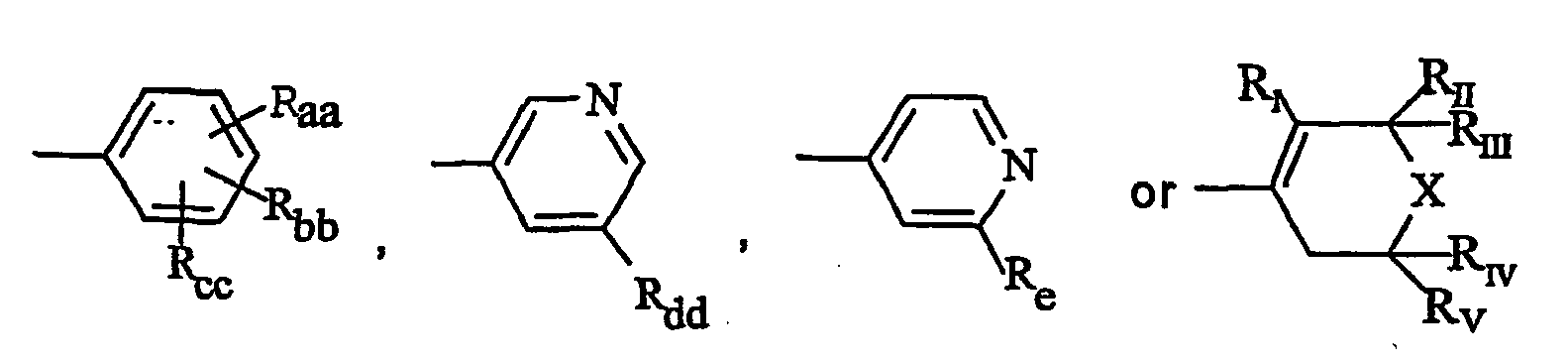
Raa, Rbb and Rcc, independently, are hydrogen, (C1-4)alkyl, (C1-4) alkoxy, hydroxy, hydroxy(C1-4)alkyl, cyano or halo,
Rdd is cyano or halo,
Re is hydroxy, (C1-4)alkyl or (C1-4)alkoxy,
RI is hydrogen or (C1-4)alkyl,
RII and RIII each are hydrogen or form together a group oxo, =CH-CN, =N- OH, =N-O-(C1-4)alkyl, =CH-PO3[(C1-4)alkyl]2 or =CH-CO-Rf wherein Rf is (C1-4)alkoxy or -NRgRh, Rg and Rh independently being hydrogen, (C1-4)alkyl or phenyl,
RIV and RV independently are hydrogen, (C1-4)alkyl or phenyl, and
X is (CH2)n, n being 0, 1 or 2,
CHRI, RI being hydroxy, (C1-4)alkyl, (C1-4)alkoxy, hydroxy(C1-4)alkyl, (C1-4)alkoxy(C1-4)alkyl, (C1-4)alkoxycarbonyl, carbamoyl, (C1-4)alkylcarbamoyl, phenyl, pyridyl, thienyl or (Rj, Rk)N-(C1-4)alkyl, Rj being hydrogen, or (C1-4)alkyl, (C1-4)alkanoyl or benzoyl and Rk being hydrogen or (C1-4)alkyl, or, if RII and RIII each are hydrogen, X can also be
NRI, RI being (C1-4)alkoxy-carbonyl, benzyloxycarbonyl, benzoyl, thienyl, (C1-4)alkanoyl, carbamoyl, mono- or
di(C1-4)alkylcarbamoyl or phenylcarbamoyl, any phenyl ring in RI being optionally mono- or. disubstituted by halo, cyano, (C1-4)alkyl or (C1-4)alkoxy, - The compounds of formula II can be prepared by reacting a compound of formula III
Y1-A III
with a compound of formula IV
- When Y3 is hydrogen, the condensation is preferably performed according to the Heck or Sonogashira coupling method. When Y3 is a metallic group, tributylstannyl is suitably used. The starting materials of formulae III and IV are generally known.
- Activity of mGluR5 antagonists as antipruritics according to the invention is evidenced for example in a model of magnesium deficiency-induced dermatosis in rat. This dermatosis is characterised by a transient erythematous maculopapular rash associated with a severe generalised pruritus. The animals scratch and bite themselves causing excoriations and wounds on the head and trunk (Neckermann G., Bavandi A., Meingassner J.G., Br. J. Dermatol; 2000; 142: 669-679). According to this model, male hairless rats (Ico:OFA hr/hr) obtained from Iffa Credo (Lyon, France) at an age of 3 weeks are maintained with a diet low in magnesium (C10350, Altromin, Lage, Germany) and demineralised water. After onset of symptoms, the test compound is applied orally to 5 rats per group on 5 consecutive days. Control animals are treated similarly with the vehicle alone. Efficacy is assessed by clinical examination and semiquantitative assessment of skin lesions. The intensity and extend of the erythematous maculopapular rash is scored with 0 (not present) to 4 (most severe changes, involvement of the whole trunk). The intensity of pruritus is evaluated by the scoring of excoriations at the head, shoulders, lateral abdomen/flanks and caudal dorsal trunk with 0 (not present), 1 (few lesions) or 3 (numerous lesions) resulting in a combined maximal score of 12 per animal. The animals are examined daily for 7 days after onset of treatment.
- In this model, mGluR5 antagonists are found to inhibit signs of pruritus at daily doses of about 1 to about 100mg/kg/day. With 2-[2-(pyridin-3-yl)ethynyl]-6-methyl-pyridine, for example, oral treatment at 6 mg/fcg/day inhibits signs of pruritus whereas inflammatory skin reddening and infiltration is not inhibited.
- Furthermore, the activity of mGluR5 antagonists as antipruritics is evidenced in a model of itch induced in mice by injection of the pruritic agent Compound 48/80 (Sigma, Catalog No. C 2313). The said pruritic agent when applied to the mouse skin induces scratching behaviour at the site of injection [Kuraishi et al., European Journal of Pharmacology 275: 229-233 (1995)].
- Experiments are carried out on adult female and male C57BU6 mice (25-30 g). Individual mice receive the test compound p.o. (a vehicle alone for control animals) 30min. prior to subcutaneous injections of the above mentioned pruritic agent into the dorsal neck region and are then placed into a clear Perspex box. A maximum of 3 mice are closely and continuously observed by an experimenter for 30 minutes following injection. 'Scratching episodes' are defined as scratching focused at the site of injection using the hind paws, and differentiated from grooming behaviour that also involves licking and is systematically directed over all body regions. The duration of the itch behaviour is recorded by using a keyboard linked to three stop-clocks.
- In this model, mGluR5 antagonists are found to decrease the number and duration of scratching episodes induced by the pruritic agent at doses of about 1 to 100mg/kg. 2-methyl-6-phenylethynyl-pyridine, for example, significantly decreases the duration of scratching episodes induced by 30µg/10µl s.c. of the pruritic agent following oral administration of 3-30mg/kg and 10-100mg/kg respectively.
- These results indicate that mGluR5 antagonists are useful in the treatment of pruritic conditions.
- In accordance with the above, the present invention provides:
- a) the use of a mGluR5 antagonist for the treatment of pruritic conditions;
- b) the use of a mGluR5 antagonist in the manufacture of a pharmaceutical composition for the treatment of pruritic conditions;
- c) a pharmaceutical composition incorporating as active agent a mGluR5 antagonist for use in the treatment of pruritic conditions;
- d) a method of treating pruritic conditions in a subject in need of such treatment, comprising administration to such subject of a therapeutically effective amount of a mGluR5 antagonist.
- For the new uses according to the invention, the appropriate dosage will of course vary depending upon, for example, the compound employed, the host, the mode of administration and the nature and severity of the condition being treated. However, in general, satisfactory results in animals are indicated to be obtained at a daily dosage of from about 0.1 to about 100 mg/kg body weight. In larger mammals, for example humans, an indicated daily dosage is in the range from about 5 to about 1000 mg of a compound for use according to the invention conveniently administered, for example, in divided doses up to five times a day.
- The mGluR5 antagonist may be delivered orally for example in the form of tablets or capsules, or parenterally, e.g. by intravenous, intraperitoneal, intramuscular, subcutaneous, intranasal or intradermal injection, as well as by epicutaneous application (e.g. In a cream, ointment, gel or solution) or by transdermal application (e.g. with a lipid-soluble carrier in a skin patch placed on skin), or by gastrointestinal delivery (e.g., with a capsule or tablet). The preferred therapeutic compositions for inocula and dosage will vary with the clinical indication. The inocula is typically prepared from a dried mGluR5 antagonist preparation (e.g., a lyophilized powder) by suspending the preparation in a physiologically acceptable diluent such as water, saline, or phosphate-buffered saline.
- Pharmaceutical compositions incorporating as active agent a mGluR5 antagonist are administered alone or in combination with pharmaceutically acceptable carriers, in either single or multiple doses. Suitable pharmaceutical carriers include inert solid diluents or fillers, sterile aqueous solutions, and various nontoxic organic solvents. The pharmaceutical compositions formed by combining the mGluR5 antagonist with the pharmaceutically acceptable carrier are then readily administered in a variety of dosage forms such as tablets, lozenges, syrups, injectable solutions, and the like. These pharmaceutical carriers can, if desired, contain additional ingredients such as flavorings, binders, excipients, and the like. Thus, for purposes of oral administration, tablets containing various excipients such as sodium citrate, calcium carbonate and calcium phosphate are employed along with various disintegrants such as starch, and preferably potato or tapioca starch, alginic acid, and certain complex silicates, together with binding agents such as polyvinylpyrolidone, sucrose, gelatin and acacia. Additionally, lubricating agents such as magnesium stearate, sodium lauryl sulfate and talc are often useful for tablefing purposes. Solid compositions of a similar type may also be employed as fillers in salt and hard filled gelatine capsules. Preferred materials for this purpose include lactose or milk sugar and high molecular weight polyethylene glycols. When aqueous suspensions of elixiers are desired for oral administration, the active mGluR5 antagonist is combined with various sweetening or flavoring agents, colored matter of dyes, and if desired, emulsifying or suspending agents, together with diluents such as water, ethanol, propylene glycol, glycerin and combinations thereof. For parenteral administration, solutions of the mGluR5 antagonist in sesame or peanut oil or in aqueous polypropylene glycol are employed, as well as sterile aqueous saline solutions of corresponding water soluble pharmaceutically acceptable metal salts. Such an aqueous solution should be suitably buffered if necessary and the liquid diluent first rendered isotonic with sufficient saline or glucose. These particular aqueous solutions are especially suitable for intravenous, intramuscular, subcutaneous and intraperitoneal injection. The sterile aqueous media employed are all readily obtainable by standard techniques well known to those skilled in the art. Additionally, it is possible to administer the aforesaid compounds topically (e.g. through a placed catheter) using an appropriate solution suitable for the purpose at hand.
- Further embodiments of the invention provide articles of manufacture containing package inserts with instructions for therapeutic use, packaging material and a formulation of one or more of the mGluR5 antagonist containing pharmaceutical compositions. The instructions for use will commonly identify administering the mGluR5 antagonist to ameliorate one or more symptoms of a dysfunction having a pain and/or anxiety component. The article of manufacture Will also commonly contain a label indicating the compound, or composition, and its use for ameliorating one or more symptoms associated with the subject dysfunction.
- The method of treating pruritic conditions in accordance with the invention is intended to mean a method of delivering to a subject in need thereof a pharmaceutical preparation of mGluR5 antagonist with the aim of treating or preventing one or more symptoms of a dysfunction having a pruritic condition component. The subject method includes delivering the preparation to a patient i) before the dysfunction has been diagnosed, e.g., prophylactic protocols delivered with the aim of preventing development of the dysfunction, as well as, ii) after the dysfunction has been diagnosed, e.g., therapeutic protocols.
- In accordance with said method for treating pruritic conditions the mGluR5 antagonist is introduced in the structure of any medicinal form or composition. It is used as a solitary agent of medication or in combination with other medicinal preparations. Since the pharmacokinetics and pharmacodynamics of the mGluR5 antagonist will vary in different patients, the most preferred method for achieving a therapeutic concentration in a tissue is to gradually escalate the dosage and monitor the clinical effects. The initial dose, for such an escalating dosage regimen of therapy, will depend upon the route of administration.
- Transdermal and epicutaneous administrations are preferred routes of administration. For transdermal administration, the mGluR5 antagonist may be administered in any conventional liquid or solid transdermal pharmaceutical composition, e.g. as described in Remington's Pharmaceutical Sciences 16th Edition Mack; Sucker, Fuchs and Spieser, Pharmazeutische Technologie 1st Edition, Springer and in GB 2098865 A or DOS 3212053.
Claims (4)
- The use of a mGluR5 antagonist in the manufacture of a pharmaceutical composition for the treatment of prutritic conditions.
- The use according to claim 1, wherein the mGluR5 antagonist is a compound of formula I
 R1 is hydrogen, (C1-4) alkyl, (C1-4)alkoxy, cyano, ethynyl or di(C1-4)alkylamino,R2 is hydrogen, hydroxy, carboxy, (C1-4) alkoxycarbonyl, di(C1-4)alkylaminomethyl, 4-(4-fluoro-benzoyl)-piperidin-1-yl-carboxy, 4-t.-butyloxycarbonyl-piperazin-1-yl-carboxy, 4-(4-azido-2-hydroxybenzoyl)-piperazin-1-yl-carboxy or 4-(4-azido-2-hydroxy-3-iodo-benzoyl)-piperazin-1-yl-carboxy,R3 is hydrogen, (C1-4) alkyl, carboxy, (C1-4)alkoxycarbonyl, (C1-4)alkylcarbamoyl, hydroxy(C1-4)alkyl, di(C1-4)alkylaminomethyl, morpholinocarbonyl or 4-(4-fluorobenzoyl)-piperidin-1-yl-carboxy,R4 is hydrogen, hydroxy, carboxy, (C2-5)alkanoyloxy, (C1-4)alkoxycarbonyl, amino (C1-4)alkoxy, di(C1-4)alkylamino(C1-4)alkoxy, di(C1-4)alkylamino(C1-4)alkyl or hydroxy(C1-4)alkyl, andR5 is a group of formulain free form or in form of a pharmaceutically acceptable salt.
 Ra and Rb independently are hydrogen, halogen, nitro, cyano, (C1-4)alkyl, (C1-4)alkoxy, trifluoromethyl, trifluoromethoxy or (C2-5)alkynyl, andRc is hydrogen, fluorine, chlorine bromine, hydroxy (C1-4)alkyl, (C2-5)alkanoyloxy, (C1-4)alkoxy or cyano, andRd is hydrogen, halogen or (C1-4)alkyl,
 - The use according to claim 1, wherein the mGluR5 antagonist is a compound of formula II
 R is hydrogen or (C1-4)alkyl andA is a group of formulain free form or in form of a pharmaceutically acceptable salt.
 Raa, Rbb and Rcc, independently, are hydrogen, (C1-4)alkyl, (C1-4) alkoxy, hydroxy, hydroxy(C1-4)alkyl, cyano or halo,Rdd is cyano or halo,Re is hydroxy, (C1-4)alkyl or (C1-4)alkoxy,RI is hydrogen or (C1-4)alkyl,RII and RIII each are hydrogen or form together a group oxo, =CH-CN, =N- OH, =N-O-(C1-4)alkyl, =CH-PO3[(C1-4)alkyl]2 or =CH-CO-Rf wherein Rf is (C1-4)alkoxy or -NRgRh, Rg and Rh independently being hydrogen, (C1-4)alkyl or phenyl,RIV and RV independently are hydrogen, (C1-4)alkyl or phenyl, andX is (CH2)n, n being 0, 1 or 2,CHRi, Ri being hydroxy, (C1-4)alkyl, (C1-4)alkoxy, hydroxy(C1-4)alkyl, (C1-4)alkoxy(C1-4)alkyl, (C1-4)alkoxycarbonyl, carbamoyl, (C1-4)alkylcarbamoyl, phenyl, pyridyl, thienyl or (Rj, Rk)N-(C1-4)alkyl, Rj being hydrogen, or (C1-4)alkyl, (C1-4)alkanoyl or benzoyl and Rk being hydrogen or (C1-4)alkyl, or, if RII and RIII each are hydrogen, X can also beNRI, RI being (C1-4)alkoxy-carbonyl, benzyloxycarbonyl, benzoyl, thienyl, (C1-4)alkanoyl, carbamoyl, mono- or di(C1-4)alkylcarbamoyl or phenylcarbamoyl, any phenyl ring in RI being optionally mono- or. disubstituted by halo, cyano, (C1-4)alkyl or (C1-4)alkoxy,
 - The use according to claim 1, wherein the mGluR5 antagonist is 2-[2-(pyridine-3-yl)ethynyl]-6-methyl-pyridine, in free form or in form of a pharmaceutically acceptable salt.
Applications Claiming Priority (3)
| Application Number | Priority Date | Filing Date | Title |
|---|---|---|---|
| GB0103045 | 2001-02-07 | ||
| GBGB0103045.1A GB0103045D0 (en) | 2001-02-07 | 2001-02-07 | Organic Compounds |
| PCT/EP2002/001250 WO2002062323A2 (en) | 2001-02-07 | 2002-02-06 | Use of mglur5 antagonists for the treatment of pruritic conditions |
Publications (2)
| Publication Number | Publication Date |
|---|---|
| EP1359905A2 EP1359905A2 (en) | 2003-11-12 |
| EP1359905B1 true EP1359905B1 (en) | 2006-07-26 |
Family
ID=9908300
Family Applications (1)
| Application Number | Title | Priority Date | Filing Date |
|---|---|---|---|
| EP02711840A Expired - Lifetime EP1359905B1 (en) | 2001-02-07 | 2002-02-06 | Use of mglur5 antagonists for the treatment of pruritic conditions |
Country Status (13)
| Country | Link |
|---|---|
| US (2) | US20040106582A1 (en) |
| EP (1) | EP1359905B1 (en) |
| JP (2) | JP2004517947A (en) |
| CN (1) | CN1253151C (en) |
| AT (1) | ATE333869T1 (en) |
| AU (1) | AU2002231777A1 (en) |
| BR (1) | BR0206917A (en) |
| CA (1) | CA2433409C (en) |
| DE (1) | DE60213365T2 (en) |
| ES (1) | ES2271229T3 (en) |
| GB (1) | GB0103045D0 (en) |
| PT (1) | PT1359905E (en) |
| WO (1) | WO2002062323A2 (en) |
Families Citing this family (9)
| Publication number | Priority date | Publication date | Assignee | Title |
|---|---|---|---|---|
| GB0128996D0 (en) | 2001-12-04 | 2002-01-23 | Novartis Ag | Organic compounds |
| GB0322612D0 (en) * | 2003-09-26 | 2003-10-29 | Novartis Ag | Organic compounds |
| JP2007509935A (en) * | 2003-10-31 | 2007-04-19 | アストラゼネカ アクチボラグ | Alkins II |
| EP1677788A1 (en) * | 2003-10-31 | 2006-07-12 | AstraZeneca AB | Alkynes iii |
| CA2549967A1 (en) * | 2003-10-31 | 2005-05-19 | Astrazeneca Ab | Alkynes i |
| GB0503646D0 (en) * | 2005-02-22 | 2005-03-30 | Novartis Ag | Organic compounds |
| GB0508319D0 (en) | 2005-04-25 | 2005-06-01 | Novartis Ag | Organic compounds |
| WO2014034898A1 (en) | 2012-08-30 | 2014-03-06 | 日本新薬株式会社 | Pyridine derivative and medicine |
| HRP20200638T1 (en) | 2015-06-03 | 2020-07-10 | F. Hoffmann - La Roche Ag | ETHYNYL DERIVATIVES |
Family Cites Families (6)
| Publication number | Priority date | Publication date | Assignee | Title |
|---|---|---|---|---|
| US5013744B1 (en) * | 1989-12-29 | 1994-09-20 | Allegran Inc | Acetylenes disubstituted with a pyridinyl group and a substituted phenyl group having retinoid like activity |
| FR2719044B1 (en) * | 1994-04-26 | 1996-05-31 | Cird Galderma | New acetylenated bi-aromatic compounds with adamantyl group, pharmaceutical and cosmetic compositions containing them and uses. |
| US5498795A (en) * | 1994-12-29 | 1996-03-12 | Allergan, Inc. | Acetylenes disubstituted with hydroxyaryl and aryl or heteroaryl groups having retinoid-like biological activity |
| US5534641A (en) * | 1994-12-29 | 1996-07-09 | Allergan | Acetylenes disubstituted with 2-tetrahydropyranoxyaryl and aryl or heteroaryl groups having retinoid-like biological activity |
| TW544448B (en) * | 1997-07-11 | 2003-08-01 | Novartis Ag | Pyridine derivatives |
| US6774138B2 (en) * | 1999-08-31 | 2004-08-10 | Merck & Co., Inc. | Thiazolyl(pyridyl)ethyne compounds |
-
2001
- 2001-02-07 GB GBGB0103045.1A patent/GB0103045D0/en not_active Ceased
-
2002
- 2002-02-06 US US10/466,183 patent/US20040106582A1/en not_active Abandoned
- 2002-02-06 ES ES02711840T patent/ES2271229T3/en not_active Expired - Lifetime
- 2002-02-06 AU AU2002231777A patent/AU2002231777A1/en not_active Abandoned
- 2002-02-06 PT PT02711840T patent/PT1359905E/en unknown
- 2002-02-06 DE DE60213365T patent/DE60213365T2/en not_active Expired - Lifetime
- 2002-02-06 CA CA2433409A patent/CA2433409C/en not_active Expired - Fee Related
- 2002-02-06 BR BR0206917-2A patent/BR0206917A/en not_active Application Discontinuation
- 2002-02-06 AT AT02711840T patent/ATE333869T1/en active
- 2002-02-06 WO PCT/EP2002/001250 patent/WO2002062323A2/en not_active Ceased
- 2002-02-06 JP JP2002562330A patent/JP2004517947A/en not_active Withdrawn
- 2002-02-06 CN CNB028046307A patent/CN1253151C/en not_active Expired - Fee Related
- 2002-02-06 EP EP02711840A patent/EP1359905B1/en not_active Expired - Lifetime
-
2007
- 2007-06-26 US US11/823,310 patent/US20070265279A1/en not_active Abandoned
-
2012
- 2012-04-03 JP JP2012084772A patent/JP2012131829A/en active Pending
Also Published As
| Publication number | Publication date |
|---|---|
| PT1359905E (en) | 2006-11-30 |
| JP2004517947A (en) | 2004-06-17 |
| CA2433409A1 (en) | 2002-08-15 |
| JP2012131829A (en) | 2012-07-12 |
| CN1535143A (en) | 2004-10-06 |
| WO2002062323A3 (en) | 2003-03-20 |
| DE60213365D1 (en) | 2006-09-07 |
| US20040106582A1 (en) | 2004-06-03 |
| CA2433409C (en) | 2010-04-20 |
| CN1253151C (en) | 2006-04-26 |
| ES2271229T3 (en) | 2007-04-16 |
| AU2002231777A1 (en) | 2002-08-19 |
| WO2002062323A2 (en) | 2002-08-15 |
| ATE333869T1 (en) | 2006-08-15 |
| US20070265279A1 (en) | 2007-11-15 |
| GB0103045D0 (en) | 2001-03-21 |
| EP1359905A2 (en) | 2003-11-12 |
| DE60213365T2 (en) | 2007-08-09 |
| BR0206917A (en) | 2004-02-03 |
Similar Documents
| Publication | Publication Date | Title |
|---|---|---|
| US20070265279A1 (en) | Use of mGluR5 antagonists for the treatment of pruritic conditions | |
| KR101653071B1 (en) | Dosing Regimen for a Selective S1P1 Receptor Agonist | |
| AU765644B2 (en) | mGluR5 antagonists for the treatment of pain and anxiety | |
| TW200524611A (en) | Methods of preventing and reducing the severity of stress-associated conditions | |
| KR102372194B1 (en) | Treatment of multiple sclerosis using LSD1 inhibitors | |
| CN100391455C (en) | Pharmaceutical use of isatin and oxindole derivatives | |
| JP3832229B2 (en) | Phenylethenesulfonamide derivative-containing medicine | |
| US20010056084A1 (en) | MGluR5 antagonists for the treatment of pain and anxiety | |
| JP2006508933A (en) | 5-HT1B / 1D receptor agonists for the treatment of headaches resulting from administration of endothelin receptor antagonists | |
| WO2004039404A1 (en) | Therapeutic agent for spinal canal stenosis | |
| US20100087398A1 (en) | Dihydropyridine derivative for treating cancer or a pre-cancerous condition and other conditions | |
| EP0968715B1 (en) | Loratadine for use as an antiarrhymthmic | |
| US20060173028A1 (en) | Therapeutic and/or preventive agent for chronic skin disease | |
| WO1997027175A1 (en) | SUBSTITUTED ETHYL α,α - DIARYLMETHYL ETHER DERIVATIVES | |
| JP2003504396A (en) | New uses of macrolide compounds | |
| JPH0827029A (en) | New medicine use of 5ht1 agonist | |
| HK1032911A (en) | Combination effective for the treatment of impotence |
Legal Events
| Date | Code | Title | Description |
|---|---|---|---|
| PUAI | Public reference made under article 153(3) epc to a published international application that has entered the european phase |
Free format text: ORIGINAL CODE: 0009012 |
|
| AK | Designated contracting states |
Kind code of ref document: A2 Designated state(s): AT BE CH CY DE DK ES FI FR GB GR IE IT LI LU MC NL PT SE TR |
|
| AX | Request for extension of the european patent |
Extension state: AL LT LV MK RO SI |
|
| 17P | Request for examination filed |
Effective date: 20030922 |
|
| GRAP | Despatch of communication of intention to grant a patent |
Free format text: ORIGINAL CODE: EPIDOSNIGR1 |
|
| GRAS | Grant fee paid |
Free format text: ORIGINAL CODE: EPIDOSNIGR3 |
|
| GRAA | (expected) grant |
Free format text: ORIGINAL CODE: 0009210 |
|
| AK | Designated contracting states |
Kind code of ref document: B1 Designated state(s): AT BE CH CY DE DK ES FI FR GB GR IE IT LI LU MC NL PT SE TR |
|
| PG25 | Lapsed in a contracting state [announced via postgrant information from national office to epo] |
Ref country code: IT Free format text: LAPSE BECAUSE OF FAILURE TO SUBMIT A TRANSLATION OF THE DESCRIPTION OR TO PAY THE FEE WITHIN THE PRESCRIBED TIME-LIMIT;WARNING: LAPSES OF ITALIAN PATENTS WITH EFFECTIVE DATE BEFORE 2007 MAY HAVE OCCURRED AT ANY TIME BEFORE 2007. THE CORRECT EFFECTIVE DATE MAY BE DIFFERENT FROM THE ONE RECORDED. Effective date: 20060726 Ref country code: FI Free format text: LAPSE BECAUSE OF FAILURE TO SUBMIT A TRANSLATION OF THE DESCRIPTION OR TO PAY THE FEE WITHIN THE PRESCRIBED TIME-LIMIT Effective date: 20060726 |
|
| REG | Reference to a national code |
Ref country code: GB Ref legal event code: FG4D |
|
| REG | Reference to a national code |
Ref country code: CH Ref legal event code: EP |
|
| REG | Reference to a national code |
Ref country code: IE Ref legal event code: FG4D |
|
| REF | Corresponds to: |
Ref document number: 60213365 Country of ref document: DE Date of ref document: 20060907 Kind code of ref document: P |
|
| PG25 | Lapsed in a contracting state [announced via postgrant information from national office to epo] |
Ref country code: SE Free format text: LAPSE BECAUSE OF FAILURE TO SUBMIT A TRANSLATION OF THE DESCRIPTION OR TO PAY THE FEE WITHIN THE PRESCRIBED TIME-LIMIT Effective date: 20061026 Ref country code: DK Free format text: LAPSE BECAUSE OF FAILURE TO SUBMIT A TRANSLATION OF THE DESCRIPTION OR TO PAY THE FEE WITHIN THE PRESCRIBED TIME-LIMIT Effective date: 20061026 |
|
| REG | Reference to a national code |
Ref country code: GR Ref legal event code: EP Ref document number: 20060403457 Country of ref document: GR |
|
| REG | Reference to a national code |
Ref country code: PT Ref legal event code: SC4A Free format text: AVAILABILITY OF NATIONAL TRANSLATION Effective date: 20060926 |
|
| ET | Fr: translation filed | ||
| PG25 | Lapsed in a contracting state [announced via postgrant information from national office to epo] |
Ref country code: MC Free format text: LAPSE BECAUSE OF NON-PAYMENT OF DUE FEES Effective date: 20070228 |
|
| REG | Reference to a national code |
Ref country code: ES Ref legal event code: FG2A Ref document number: 2271229 Country of ref document: ES Kind code of ref document: T3 |
|
| PLBE | No opposition filed within time limit |
Free format text: ORIGINAL CODE: 0009261 |
|
| STAA | Information on the status of an ep patent application or granted ep patent |
Free format text: STATUS: NO OPPOSITION FILED WITHIN TIME LIMIT |
|
| 26N | No opposition filed |
Effective date: 20070427 |
|
| PG25 | Lapsed in a contracting state [announced via postgrant information from national office to epo] |
Ref country code: IE Free format text: LAPSE BECAUSE OF NON-PAYMENT OF DUE FEES Effective date: 20070206 |
|
| PG25 | Lapsed in a contracting state [announced via postgrant information from national office to epo] |
Ref country code: CY Free format text: LAPSE BECAUSE OF FAILURE TO SUBMIT A TRANSLATION OF THE DESCRIPTION OR TO PAY THE FEE WITHIN THE PRESCRIBED TIME-LIMIT Effective date: 20060726 Ref country code: LU Free format text: LAPSE BECAUSE OF NON-PAYMENT OF DUE FEES Effective date: 20070206 |
|
| PGFP | Annual fee paid to national office [announced via postgrant information from national office to epo] |
Ref country code: TR Payment date: 20110112 Year of fee payment: 10 Ref country code: NL Payment date: 20110216 Year of fee payment: 10 Ref country code: PT Payment date: 20110126 Year of fee payment: 10 Ref country code: CH Payment date: 20110214 Year of fee payment: 10 Ref country code: AT Payment date: 20110126 Year of fee payment: 10 |
|
| PGFP | Annual fee paid to national office [announced via postgrant information from national office to epo] |
Ref country code: GR Payment date: 20110113 Year of fee payment: 10 |
|
| PGFP | Annual fee paid to national office [announced via postgrant information from national office to epo] |
Ref country code: BE Payment date: 20110722 Year of fee payment: 10 |
|
| REG | Reference to a national code |
Ref country code: PT Ref legal event code: MM4A Free format text: LAPSE DUE TO NON-PAYMENT OF FEES Effective date: 20120806 |
|
| BERE | Be: lapsed |
Owner name: *NOVARTIS A.G. Effective date: 20120228 |
|
| REG | Reference to a national code |
Ref country code: NL Ref legal event code: V1 Effective date: 20120901 |
|
| REG | Reference to a national code |
Ref country code: CH Ref legal event code: PL |
|
| REG | Reference to a national code |
Ref country code: GR Ref legal event code: ML Ref document number: 20060403457 Country of ref document: GR Effective date: 20120905 |
|
| PG25 | Lapsed in a contracting state [announced via postgrant information from national office to epo] |
Ref country code: CH Free format text: LAPSE BECAUSE OF NON-PAYMENT OF DUE FEES Effective date: 20120229 Ref country code: LI Free format text: LAPSE BECAUSE OF NON-PAYMENT OF DUE FEES Effective date: 20120229 |
|
| PG25 | Lapsed in a contracting state [announced via postgrant information from national office to epo] |
Ref country code: PT Free format text: LAPSE BECAUSE OF NON-PAYMENT OF DUE FEES Effective date: 20120806 Ref country code: GR Free format text: LAPSE BECAUSE OF NON-PAYMENT OF DUE FEES Effective date: 20120905 |
|
| REG | Reference to a national code |
Ref country code: AT Ref legal event code: MM01 Ref document number: 333869 Country of ref document: AT Kind code of ref document: T Effective date: 20120206 |
|
| PG25 | Lapsed in a contracting state [announced via postgrant information from national office to epo] |
Ref country code: BE Free format text: LAPSE BECAUSE OF NON-PAYMENT OF DUE FEES Effective date: 20120228 |
|
| PG25 | Lapsed in a contracting state [announced via postgrant information from national office to epo] |
Ref country code: NL Free format text: LAPSE BECAUSE OF NON-PAYMENT OF DUE FEES Effective date: 20120901 Ref country code: AT Free format text: LAPSE BECAUSE OF NON-PAYMENT OF DUE FEES Effective date: 20120206 |
|
| PG25 | Lapsed in a contracting state [announced via postgrant information from national office to epo] |
Ref country code: TR Free format text: LAPSE BECAUSE OF NON-PAYMENT OF DUE FEES Effective date: 20120206 |
|
| PGFP | Annual fee paid to national office [announced via postgrant information from national office to epo] |
Ref country code: DE Payment date: 20140129 Year of fee payment: 13 |
|
| PGFP | Annual fee paid to national office [announced via postgrant information from national office to epo] |
Ref country code: FR Payment date: 20140211 Year of fee payment: 13 Ref country code: IT Payment date: 20140217 Year of fee payment: 13 Ref country code: ES Payment date: 20140113 Year of fee payment: 13 |
|
| PGFP | Annual fee paid to national office [announced via postgrant information from national office to epo] |
Ref country code: GB Payment date: 20140206 Year of fee payment: 13 |
|
| REG | Reference to a national code |
Ref country code: DE Ref legal event code: R119 Ref document number: 60213365 Country of ref document: DE |
|
| GBPC | Gb: european patent ceased through non-payment of renewal fee |
Effective date: 20150206 |
|
| REG | Reference to a national code |
Ref country code: FR Ref legal event code: ST Effective date: 20151030 |
|
| PG25 | Lapsed in a contracting state [announced via postgrant information from national office to epo] |
Ref country code: IT Free format text: LAPSE BECAUSE OF NON-PAYMENT OF DUE FEES Effective date: 20150206 |
|
| PG25 | Lapsed in a contracting state [announced via postgrant information from national office to epo] |
Ref country code: DE Free format text: LAPSE BECAUSE OF NON-PAYMENT OF DUE FEES Effective date: 20150901 Ref country code: GB Free format text: LAPSE BECAUSE OF NON-PAYMENT OF DUE FEES Effective date: 20150206 |
|
| PG25 | Lapsed in a contracting state [announced via postgrant information from national office to epo] |
Ref country code: FR Free format text: LAPSE BECAUSE OF NON-PAYMENT OF DUE FEES Effective date: 20150302 |
|
| REG | Reference to a national code |
Ref country code: ES Ref legal event code: FD2A Effective date: 20160329 |
|
| PG25 | Lapsed in a contracting state [announced via postgrant information from national office to epo] |
Ref country code: ES Free format text: LAPSE BECAUSE OF NON-PAYMENT OF DUE FEES Effective date: 20150207 |