EP1359716A1 - Procédé d'adaptation du protocole de routage OSPF au réseau radio - Google Patents
Procédé d'adaptation du protocole de routage OSPF au réseau radio Download PDFInfo
- Publication number
- EP1359716A1 EP1359716A1 EP03101058A EP03101058A EP1359716A1 EP 1359716 A1 EP1359716 A1 EP 1359716A1 EP 03101058 A EP03101058 A EP 03101058A EP 03101058 A EP03101058 A EP 03101058A EP 1359716 A1 EP1359716 A1 EP 1359716A1
- Authority
- EP
- European Patent Office
- Prior art keywords
- router
- network
- database
- routers
- message
- Prior art date
- Legal status (The legal status is an assumption and is not a legal conclusion. Google has not performed a legal analysis and makes no representation as to the accuracy of the status listed.)
- Granted
Links
Images

Classifications
-
- H—ELECTRICITY
- H04—ELECTRIC COMMUNICATION TECHNIQUE
- H04L—TRANSMISSION OF DIGITAL INFORMATION, e.g. TELEGRAPHIC COMMUNICATION
- H04L45/00—Routing or path finding of packets in data switching networks
- H04L45/26—Route discovery packet
-
- H—ELECTRICITY
- H04—ELECTRIC COMMUNICATION TECHNIQUE
- H04W—WIRELESS COMMUNICATION NETWORKS
- H04W40/00—Communication routing or communication path finding
- H04W40/24—Connectivity information management, e.g. connectivity discovery or connectivity update
- H04W40/246—Connectivity information discovery
-
- H—ELECTRICITY
- H04—ELECTRIC COMMUNICATION TECHNIQUE
- H04W—WIRELESS COMMUNICATION NETWORKS
- H04W40/00—Communication routing or communication path finding
- H04W40/24—Connectivity information management, e.g. connectivity discovery or connectivity update
- H04W40/248—Connectivity information update
-
- H—ELECTRICITY
- H04—ELECTRIC COMMUNICATION TECHNIQUE
- H04W—WIRELESS COMMUNICATION NETWORKS
- H04W40/00—Communication routing or communication path finding
- H04W40/24—Connectivity information management, e.g. connectivity discovery or connectivity update
- H04W40/26—Connectivity information management, e.g. connectivity discovery or connectivity update for hybrid routing by combining proactive and reactive routing
-
- H—ELECTRICITY
- H04—ELECTRIC COMMUNICATION TECHNIQUE
- H04W—WIRELESS COMMUNICATION NETWORKS
- H04W40/00—Communication routing or communication path finding
- H04W40/24—Connectivity information management, e.g. connectivity discovery or connectivity update
- H04W40/32—Connectivity information management, e.g. connectivity discovery or connectivity update for defining a routing cluster membership
-
- H—ELECTRICITY
- H04—ELECTRIC COMMUNICATION TECHNIQUE
- H04W—WIRELESS COMMUNICATION NETWORKS
- H04W92/00—Interfaces specially adapted for wireless communication networks
- H04W92/16—Interfaces between hierarchically similar devices
- H04W92/24—Interfaces between hierarchically similar devices between backbone network devices
Definitions
- the invention relates in particular to a method for adapting the routing protocol OSPF (Open Shortest path First) to the specifics of low speed or VHF (Very High Frequency) radio networks.
- OSPF Open Shortest path First
- VHF Very High Frequency
- CBLS Constraint Base Link State
- IP Internet Protocol
- the subject of the invention relates in particular to a protocol for routing called CBLS, compatible with the OSPF protocol and capable of operate in a VHF network. For example, it uses multicast mode to send routing information across a network.
- the radio network is for example of broadcast network type, NBMA or even point-to-multipoint network.
- the database describes the topology of the SA Autonomous System like a directed graph, with routers and networks at the top, and point to point links in arc.
- Each entry in the LSA describes the neighborhood of a router. This neighborhood depends, for example, on the type of network to which the router interface and the number of routers is connected connected to this interface.
- Each network in the graph is associated with an IP address and a mask.
- a router designated (RD) is elected to take charge of the exchange of information routing for the network.
- the database used in the method according to the invention is identical or substantially identical to that of the OSPF protocol. This gives especially as an advantage of offering compatibility between the two protocols.
- the information external routing are discussed.
- the process that implements the procedure for calculating the shortest path tree consults the information external to the protocol in order to be able to take them into account. These information comes, for example, from an external routing protocol or still are statically configured. They are classified according to the type of the metric used: if the metric is that of the CBLS protocol, then these information is of type 1, otherwise it is of type 2.
- the routes associated with a type 1 metric are always preferred to routes associated with a type 2 metric.
- the CBLS protocol according to the invention makes it possible to define different areas inside a SA.
- the different zones are for example configured as a star. he there is a central area, called the backbone area, to which all other areas are connected.
- This Backbone area contains, for example, all inter-zone routers. Its main mission is to ensure the inter-zone routing and propagate information relating to a zone to the other areas of the SA. When an inter-zone router receives information from another zone, it diffuses it inside the zones to which it is connected.
- Every route is associated with a mask which authorizes the aggregation of several groups addresses for a single route.
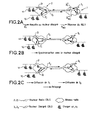
- FIGS 2A, 2B and 2C schematize an example of exchanges information between two radio networks.
- a radio network 1 comprises for example two routers 2i, 2j to which several users ui, uj are connected, as well as a designated router RD, 3 1 .
- the figure indicates a second radio 2 also comprising a designated router 3 2 , two routers 2i, 2j connected to users.
- the CBLS protocol implemented in the process according to the invention comprises, for example, the steps described below.
- a router In a first step, at startup, a router initializes the structures necessary for the implementation of the protocol. These structures are, for example, those which make it possible to store the database of states of links, information from other routing protocol, tables routing, static configuration information. The router is waiting then the implementation of its interfaces to its different neighbors. Generally, each physical link of the router is associated with a or several interfaces, according to rules known to those skilled in the art.
- a router 2i, 2j uses, for example, the Hello protocol to know its different neighbors.
- a network router so send Hello messages to all its neighbors who are directly reachable in an IP hop and receives, in return, Hello messages from these neighbors. If the router is connected to a radio network and an Ethernet network, its neighbors are all routers reachable directly through the network radio and through the Ethernet network.
- the router detects its neighbors, for example dynamic, by sending Hello messages, to the All Ospf / multicast address Routers. On other networks, manual configuration is by example used to allow this discovery.
- the Hello protocol also allows the election of the designated router, RD or 3i.
- a router network tries to establish adjacency relationships with its new neighbors.
- the databases of routers and part of its neighbors, in the occurrence its neighbors which are adjacent to it, are then synchronized between pairs of adjacent routers. Adjacent relationships are especially used in the protocol dissemination process to reduce the flow of information across the network. For a broadcast network, this is the designated router which determines the different adjacency relationships.
- a router periodically sends messages, for example Hello to keep connected with your neighbors. It also transmits, periodically, the state of its database to other routers in the area through LSA. These messages are also broadcast when changing the status of the router's database.
- LSAs are, for example, broadcast to through the CBLS area to which the router belongs, thanks to an algorithm that ensures that all routers in the area have the same database. Once the database is updated, the routers calculate the shortest path tree and then fill their routing table.
- inter-zone router In the case of an inter-zone router, this summarizes the topology zones to which it is connected with the exception of the Backbone zone. This summary is then transmitted to the Backbone which broadcasts it to the other routers inter zone of the SA. Each inter-zone router therefore receives messages from all other SA inter-area routers.
- An inter-zone router has so the information on the complete topology of the Backbone and a summary the topology of other areas. From this topology information, the router calculates the paths relative to all inter-zone destinations. These information allows each internal router to route packets to destination of other areas.
- the protocol implemented in the method according to the invention uses for example four types of message. These messages are sent directly to IP for example. It is also possible to use the IP fragmentation. All CBLS messages share, for example, a header common 20 bytes.
- Hello messages are sent periodically, for example, on all output interfaces of the router.
- Link-state routing protocol requires synchronization databases of all routers. Unlike the protocol OSPF where point-to-point synchronization occurs, most exchange of routing information for the protocol according to the invention CBLS is done using multicast mode.
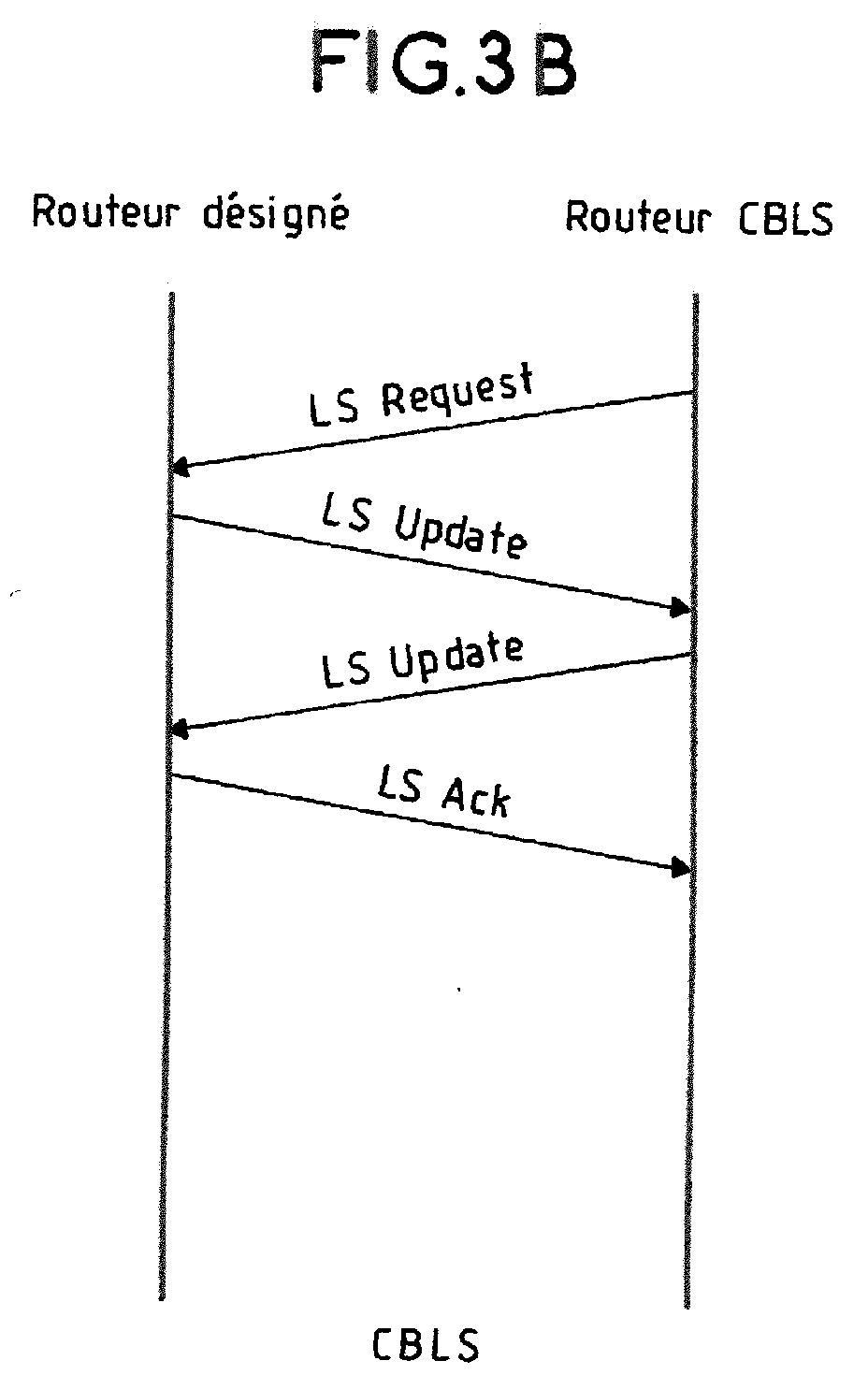
- each router After discovering the neighbors and electing the designated router, each router (except the designated router) sends an LS Request message, in unicast mode, to the designated router. This message is intended to initialize the exchange of databases by forcing the designated router to send the contents of its database. If no response from the designated router did not arrive after waiting for a Retransmission Interval, then a new LS Request message is sent to the designated router.
- the router designated Upon receipt of the first LS Request message, the router designated waits for a Request Interval during which it ignores all other LS Request messages. When this period expires, the designated router distributes the content of its database to all routers on the network sending an LS Update message to the AllOspfRouter address.
- Each router upon receipt of the message from the designated router (corresponding to the content of its database), compare the information contained in the message with the information contained in its database and sends an LS Update message in multicast. The designated router acknowledges this message. To ensure synchronization of network routers, each router sends an LS Update message in multicast to the AllOspfRouter address containing the information existing in the database and not present in the message. Then, the router includes in its database the information contained in the message. The LS Update message thus sent is for example explicitly acknowledged by the designated router using an LS Ack message. If the acknowledgment has not reached the router after a delay of Interval retransmission then the message is retransmitted.
- the designated router When the designated router receives an LS Update, it sends the LS Ack message to the message sender. This message is used acknowledgment.
- the designated router being at the center of the synchronization, it acknowledges LS Update messages to have the basis of data as up to date as possible.
- FIGS. 3A and 3B respectively summarize the mechanism of synchronization of databases in the case of the OSPF protocol and for the CBLS protocol according to the invention.
- the protocol according to the invention contributes to reducing the number of accesses on the radio channel which constitutes a performance.
- the use of multicast for all LS messages Update makes it possible to limit the presence of redundant information on the network.
- synchronization being a mechanism using only multi-point, a lot of information is sent several times over the network, which reduces the efficiency of the protocol.
- Each router maintains for each interface the list of different LSAs to send to different neighbors.
- Each router can be the origin of one or more LSAs.
- Each router creates for example an LSA Router to describe each of its interfaces, for example the physical characteristics of the interface statically configured as well as the different protocol variables applied to this interface.
- a designated router creates a Network LSA to each network for which it is a designated router.
- An inter-zone router creates a Summary SA for each zone to which it belongs.
- An inter SA router creates an AS-External LSA for each SA.
- the flooding mechanism is for example achieved by sending Link State Update packets step by step, from router to router.
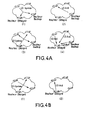
- Each package can contain one or more LSAs. He presents as advantage, decentralize the sending of packets and transmit directly information to all routers on the network without going through the router designated.
- the operation of this mechanism is shown in Figure 4B, FIG. 4A representing the protocol usually used in the case of OSPF. Note the central role of the router designated in Figure 4A and decentralization in Figure 4B.
- the flooding process takes place as soon as the router receives a Link State Update packet step by step.
- the router is browsing the various LSAs contained in the message and installs the new ones and the most recent in its database. Depending on the type of LSA added or modified in the database, the router recalculates its routing table (full calculation from the table if Router or Network LSA, calculation of inter-zone or inter-routes SA if Summary or AS-External LSA).
- Each modification of the database is, for example, transmitted on the different output interfaces of the router to synchronize the database of all network routers.
- Each router maintains a list of different LSAs that it should send to each interface.
- the LSA must be transmitted on the link.
- a Link State Update containing the LSA is sent on the interface.
- LSA age must be incremented by the value of the estimated transmission time for the link.
- the designated router acknowledges all LS Update messages with a message LS Ack. If the acknowledgment is not received after a delay Retransmission Interval, then the message is for example retransmitted.
- Acknowledgment of all messages by the designated router allows it to have a permanent database consistent. Consistency means that all routers in an area have the same link state database in order to calculate the same routes. Each LSA is acknowledged separately by the router designated. Acknowledgments are contained in Link State packets Acknowledgment. Such a package may also contain several acquittals. This consistency of the designated router's database ensures optimal functioning of the synchronization.
- a sequence number in all LS Update messages is used for example to allow routers to detect the fact that a message has not reached them (unacknowledged message). This sequence number, specific to each router, is incremented each time LS Update message is sent over the network (except for message retransmissions). Each router can then compare the contents of its table with that of the designated router. A router which has a sequence number lower than the number present in the message, sends an LS Request message to the designated router containing the list of lost messages. The designated router, upon receipt of the LS Request message, will broadcast on the network, the messages requested by the request, after a Request Interval delay. Constants take the following values, for example: VHF network LAN network Hello Interval 50 seconds 10 seconds Router Dead Interval 200 seconds 40 seconds Interval Retransmission 100 seconds 5 seconds Sequence Interval 200 seconds 40 seconds Request Interval 10 seconds 2 seconds
Landscapes
- Engineering & Computer Science (AREA)
- Computer Networks & Wireless Communication (AREA)
- Signal Processing (AREA)
- Data Exchanges In Wide-Area Networks (AREA)
- Mobile Radio Communication Systems (AREA)
- Small-Scale Networks (AREA)
Abstract

Description

- Au niveau de chaque réseau, par exemple, chacun des routeurs 2i, 2j, envoie une requête désignée par la flèche Rr au routeur désigné RD ou 31, 32. Celui-ci centralise les requêtes avant de répondre en envoyant le contenu de sa base de données à tous les routeurs, flèche RRD, figure 2A,
- après la réception du message du routeur désigné 31, 32 : chaque routeur du réseau 2i, 2j multicast (envoie dans toutes les directions) le contenu de la base de données afin de synchroniser l'ensemble de ces voisins, figure 2B,
- un routeur (2i, 2j) d'un réseau radio ayant reçu le contenu de la base de données, envoie un message Hello afin de rechercher ses différents voisins. Ce message Hello est par exemple diffusé périodiquement.
- après la synchronisation locale, chaque routeur désigné 31, 32 d'un réseau radio 1, respectivement 2 diffuse les informations locales relatives à son réseau, aux autres réseaux, figure 2C. Ces informations sont relayées à travers la totalité du réseau. Les échanges s'effectuent entre les routeurs par exemple. Le réseau dépend de la configuration mis en oeuvre avec les frontières suivantes :
- Si aucune zone n'est mise en place, le réseau comprend tout le SA.
- Si des zones sont définies, la diffusion diffère selon le type de LSA.
| Type | Nom | Fonction |
| 1 | Hello | Découverte des voisins et maintenance de la connectivité |
| 2 | Link State Request | Demande de chargement de la base de données |
| 3 | Link State Update | Mise à jour de la base de données |
| 4 | Link State Ack | Acquittement d'une mise à jour |
Un message Hello contient par exemple :
Les constantes prennent par exemple les valeurs suivantes :
| Réseau VHF | Réseau LAN | |
| Hello Interval | 50 secondes | 10 secondes |
| Router Dead Interval | 200 secondes | 40 secondes |
| Retransmission Interval | 100 secondes | 5 secondes |
| Sequence Interval | 200 secondes | 40 secondes |
| Request Interval | 10 secondes | 2 secondes |
Claims (7)
- Procédé de routage de messages entre plusieurs réseaux radio, un réseau radio (1) comportant au moins un ou plusieurs routeurs (2i, 2j) et un routeur désigné (RD, 31, 32), chaque routeur comportant une base de données caractérisé en ce qu'il comporte au moins les étapes suivantes :Au niveau de la majorité de réseaux radio, chaque routeur (2i, 2j) transmet une requête Rr au routeur désigné (RD, 31, 32) du réseau radio,

- Procédé selon la revendication 1 caractérisé en ce que après l'étape de synchronisation de l'ensemble des voisins, le routeur désigné diffuse les informations locales aux réseaux extérieurs au sien.
- Procédé selon la revendication 1 caractérisé en ce que le message Hello est diffusé périodiquement.
- Procédé selon la revendication 1 caractérisé en ce que après la découverte de ses voisins, un routeur envoie un message LS request en unicast à destination du routeur désigné, le message étant répété en cas d'absence de réponse après un délai Retransmission Interval donné.
- Procédé selon la revendication 4 caractérisé en ce que le routeur désigné ayant diffusé le contenu de sa base de données à tous les routeurs du réseau en envoyant un message LS Update, chaque routeur à la réception du message LS Update compare les informations contenues dans le message au contenu de sa base de données et envoie un message LS Update en multicast, et le routeur désigné acquitte ce message.
- Procédé selon l'une des revendications 1 à 5 caractérisé en ce qu'il comporte l'acquittement de tous les messages par le routeur désigné et la retransmission des messages non acquittés et/ou à la présence d'un numéro de séquence dans tous les messages LS Update.
- Procédé selon l'une des revendications 1 à 6 caractérisé en ce que le réseau radio est de type réseau à diffusion, NBMA ou encore réseau point à multipoint.
Applications Claiming Priority (2)
| Application Number | Priority Date | Filing Date | Title |
|---|---|---|---|
| FR0205448 | 2002-04-30 | ||
| FR0205448A FR2839228B1 (fr) | 2002-04-30 | 2002-04-30 | Procede d'adaptation du protocole de routage ospf au reseau radio |
Publications (2)
| Publication Number | Publication Date |
|---|---|
| EP1359716A1 true EP1359716A1 (fr) | 2003-11-05 |
| EP1359716B1 EP1359716B1 (fr) | 2010-01-13 |
Family
ID=28800082
Family Applications (1)
| Application Number | Title | Priority Date | Filing Date |
|---|---|---|---|
| EP03101058A Expired - Lifetime EP1359716B1 (fr) | 2002-04-30 | 2003-04-17 | Procédé d'adaptation du protocole de routage OSPF au réseau radio |
Country Status (6)
| Country | Link |
|---|---|
| US (1) | US20040017801A1 (fr) |
| EP (1) | EP1359716B1 (fr) |
| AT (1) | ATE455417T1 (fr) |
| DE (1) | DE60330929D1 (fr) |
| ES (1) | ES2338776T3 (fr) |
| FR (1) | FR2839228B1 (fr) |
Cited By (2)
| Publication number | Priority date | Publication date | Assignee | Title |
|---|---|---|---|---|
| EP2648375A4 (fr) * | 2011-06-30 | 2013-12-04 | Huawei Tech Co Ltd | Procédé et dispositif d'établissement de routeur voisin |
| CN106130904A (zh) * | 2016-08-26 | 2016-11-16 | 杭州华三通信技术有限公司 | 一种lsp链路状态协议数据单元的同步方法及装置 |
Families Citing this family (4)
| Publication number | Priority date | Publication date | Assignee | Title |
|---|---|---|---|---|
| US7515551B2 (en) * | 2005-01-18 | 2009-04-07 | Cisco Technology, Inc. | Techniques for reducing adjacencies in a link-state network routing protocol |
| US7656856B2 (en) * | 2005-04-28 | 2010-02-02 | Cisco Technology, Inc. | Method and system for transmitting LSP fragments |
| US9071546B2 (en) * | 2011-05-20 | 2015-06-30 | Cisco Technology, Inc. | Protocol independent multicast designated router redundancy |
| CN114760946B (zh) * | 2019-11-01 | 2025-04-15 | 巴德外周血管股份有限公司 | 用于将各胸膜层的一部分密封在一起的系统 |
Citations (1)
| Publication number | Priority date | Publication date | Assignee | Title |
|---|---|---|---|---|
| WO2001037483A2 (fr) * | 1999-11-12 | 2001-05-25 | Itt Manufacturing Enterprises, Inc. | Procede et appareil de transmission de messages d'etat de liaison de noeud dans un reseau associes a un trafic a surdebit reduit de protocole de communication |
Family Cites Families (4)
| Publication number | Priority date | Publication date | Assignee | Title |
|---|---|---|---|---|
| US5987376A (en) * | 1997-07-16 | 1999-11-16 | Microsoft Corporation | System and method for the distribution and synchronization of data and state information between clients in a distributed processing system |
| US6418139B1 (en) * | 1998-11-25 | 2002-07-09 | Nortel Networks Limited | Mechanism to guarantee quality of service to real-time traffic on IP networks |
| US6977937B1 (en) * | 2000-04-10 | 2005-12-20 | Bbnt Solutions Llc | Radio network routing apparatus |
| FR2819359B1 (fr) * | 2001-01-11 | 2003-04-11 | Cit Alcatel | Systeme de routage assurant la continuite de service, des machines a etats associees aux systemes de routage voisins |
-
2002
- 2002-04-30 FR FR0205448A patent/FR2839228B1/fr not_active Expired - Fee Related
-
2003
- 2003-04-17 EP EP03101058A patent/EP1359716B1/fr not_active Expired - Lifetime
- 2003-04-17 AT AT03101058T patent/ATE455417T1/de not_active IP Right Cessation
- 2003-04-17 DE DE60330929T patent/DE60330929D1/de not_active Expired - Lifetime
- 2003-04-17 ES ES03101058T patent/ES2338776T3/es not_active Expired - Lifetime
- 2003-04-24 US US10/421,941 patent/US20040017801A1/en not_active Abandoned
Patent Citations (1)
| Publication number | Priority date | Publication date | Assignee | Title |
|---|---|---|---|---|
| WO2001037483A2 (fr) * | 1999-11-12 | 2001-05-25 | Itt Manufacturing Enterprises, Inc. | Procede et appareil de transmission de messages d'etat de liaison de noeud dans un reseau associes a un trafic a surdebit reduit de protocole de communication |
Non-Patent Citations (1)
| Title |
|---|
| MOY J: "OSPF Version 2 (Std. 54)", RFC 2328, April 1998 (1998-04-01), XP002175571, Retrieved from the Internet <URL:http://www.faqs.org/rfcs/std/std54.html> [retrieved on 20010822] * |
Cited By (3)
| Publication number | Priority date | Publication date | Assignee | Title |
|---|---|---|---|---|
| EP2648375A4 (fr) * | 2011-06-30 | 2013-12-04 | Huawei Tech Co Ltd | Procédé et dispositif d'établissement de routeur voisin |
| US9154401B2 (en) | 2011-06-30 | 2015-10-06 | Huawei Technologies Co., Ltd. | Method and device for establishing router neighbor |
| CN106130904A (zh) * | 2016-08-26 | 2016-11-16 | 杭州华三通信技术有限公司 | 一种lsp链路状态协议数据单元的同步方法及装置 |
Also Published As
| Publication number | Publication date |
|---|---|
| ES2338776T3 (es) | 2010-05-12 |
| ATE455417T1 (de) | 2010-01-15 |
| DE60330929D1 (de) | 2010-03-04 |
| FR2839228A1 (fr) | 2003-10-31 |
| US20040017801A1 (en) | 2004-01-29 |
| FR2839228B1 (fr) | 2004-11-05 |
| EP1359716B1 (fr) | 2010-01-13 |
Similar Documents
| Publication | Publication Date | Title |
|---|---|---|
| Francis | Yoid: Extending the internet multicast architecture | |
| Moy | RFC2328: OSPF Version 2 | |
| Moy | OSPF version 2 | |
| US10476793B2 (en) | Multicast flow overlay using registration over a reliable transport | |
| US7065059B1 (en) | Technique for restoring adjacencies in OSPF in a non-stop forwarding intermediate node of a computer network | |
| Topolcic | Experimental internet stream protocol: Version 2 (ST-II) | |
| JP4745387B2 (ja) | メッシュ・ネットワークにおけるマルチキャストのルーティング・プロトコル | |
| CN100407688C (zh) | 内部bgp下载器 | |
| US7027453B2 (en) | Spanning tree alternate routing bridge protocol | |
| US8498299B2 (en) | Flooding-based routing protocol having average-rate and burst-rate control | |
| US6717950B2 (en) | Method and apparatus for priority-based load balancing for use in an extended local area network | |
| US8351438B2 (en) | Flooding-based routing protocol having database pruning and rate-controlled state refresh | |
| US7466661B1 (en) | Method and apparatus for establishing adjacency for a restarting router during convergence | |
| CN100456754C (zh) | 路由消息分组的系统和方法 | |
| US6950427B1 (en) | Technique for resynchronizing LSDB in OSPF after a software reload in a non-stop forwarding intermediate node of a computer network | |
| EP1557013B1 (fr) | Transport fiable vers de multiples parties par protocole rpf | |
| CN101682552B (zh) | 具有串连节点的网络中的故障通知 | |
| US20100329270A1 (en) | Dynamic discovery mechanisms via inter-domain routing protocol | |
| CN112422307B (zh) | Evpn和vpls共存双活的方法、设备及系统 | |
| FR2954644A1 (fr) | Protocole de routage fiabilise | |
| FR2930100A1 (fr) | Procede d'etablissement d'un chemin de communication dans un reseau etendu de communication, tetes de tunnel,produit programme d'ordinateur et moyen de stockage correspondants | |
| Francis | Yallcast: Extending the internet multicast architecture | |
| US8018953B1 (en) | Adaptive, deterministic ant routing approach for updating network routing information | |
| US20130073741A1 (en) | Ospf nsr with delayed neighbor synchronization | |
| EP1359716B1 (fr) | Procédé d'adaptation du protocole de routage OSPF au réseau radio |
Legal Events
| Date | Code | Title | Description |
|---|---|---|---|
| PUAI | Public reference made under article 153(3) epc to a published international application that has entered the european phase |
Free format text: ORIGINAL CODE: 0009012 |
|
| AK | Designated contracting states |
Kind code of ref document: A1 Designated state(s): AT BE BG CH CY CZ DE DK EE ES FI FR GB GR HU IE IT LI LU MC NL PT RO SE SI SK TR |
|
| AX | Request for extension of the european patent |
Extension state: AL LT LV MK |
|
| 17P | Request for examination filed |
Effective date: 20040506 |
|
| AKX | Designation fees paid |
Designated state(s): AT BE BG CH CY CZ DE DK EE ES FI FR GB GR HU IE IT LI LU MC NL PT RO SE SI SK TR |
|
| 17Q | First examination report despatched |
Effective date: 20070202 |
|
| GRAP | Despatch of communication of intention to grant a patent |
Free format text: ORIGINAL CODE: EPIDOSNIGR1 |
|
| RIN1 | Information on inventor provided before grant (corrected) |
Inventor name: JACQUEMIN, DAVID Inventor name: SCHMITT, FRANCK |
|
| GRAS | Grant fee paid |
Free format text: ORIGINAL CODE: EPIDOSNIGR3 |
|
| GRAA | (expected) grant |
Free format text: ORIGINAL CODE: 0009210 |
|
| AK | Designated contracting states |
Kind code of ref document: B1 Designated state(s): AT BE BG CH CY CZ DE DK EE ES FI FR GB GR HU IE IT LI LU MC NL PT RO SE SI SK TR |
|
| REG | Reference to a national code |
Ref country code: GB Ref legal event code: FG4D Free format text: NOT ENGLISH |
|
| REG | Reference to a national code |
Ref country code: CH Ref legal event code: EP |
|
| REG | Reference to a national code |
Ref country code: IE Ref legal event code: FG4D |
|
| REF | Corresponds to: |
Ref document number: 60330929 Country of ref document: DE Date of ref document: 20100304 Kind code of ref document: P |
|
| REG | Reference to a national code |
Ref country code: NL Ref legal event code: VDEP Effective date: 20100113 |
|
| REG | Reference to a national code |
Ref country code: ES Ref legal event code: FG2A Ref document number: 2338776 Country of ref document: ES Kind code of ref document: T3 |
|
| PG25 | Lapsed in a contracting state [announced via postgrant information from national office to epo] |
Ref country code: AT Free format text: LAPSE BECAUSE OF FAILURE TO SUBMIT A TRANSLATION OF THE DESCRIPTION OR TO PAY THE FEE WITHIN THE PRESCRIBED TIME-LIMIT Effective date: 20100113 |
|
| PG25 | Lapsed in a contracting state [announced via postgrant information from national office to epo] |
Ref country code: PT Free format text: LAPSE BECAUSE OF FAILURE TO SUBMIT A TRANSLATION OF THE DESCRIPTION OR TO PAY THE FEE WITHIN THE PRESCRIBED TIME-LIMIT Effective date: 20100513 Ref country code: NL Free format text: LAPSE BECAUSE OF FAILURE TO SUBMIT A TRANSLATION OF THE DESCRIPTION OR TO PAY THE FEE WITHIN THE PRESCRIBED TIME-LIMIT Effective date: 20100113 |
|
| REG | Reference to a national code |
Ref country code: IE Ref legal event code: FD4D |
|
| PG25 | Lapsed in a contracting state [announced via postgrant information from national office to epo] |
Ref country code: SI Free format text: LAPSE BECAUSE OF FAILURE TO SUBMIT A TRANSLATION OF THE DESCRIPTION OR TO PAY THE FEE WITHIN THE PRESCRIBED TIME-LIMIT Effective date: 20100113 |
|
| PG25 | Lapsed in a contracting state [announced via postgrant information from national office to epo] |
Ref country code: GR Free format text: LAPSE BECAUSE OF FAILURE TO SUBMIT A TRANSLATION OF THE DESCRIPTION OR TO PAY THE FEE WITHIN THE PRESCRIBED TIME-LIMIT Effective date: 20100414 Ref country code: RO Free format text: LAPSE BECAUSE OF FAILURE TO SUBMIT A TRANSLATION OF THE DESCRIPTION OR TO PAY THE FEE WITHIN THE PRESCRIBED TIME-LIMIT Effective date: 20100113 Ref country code: CY Free format text: LAPSE BECAUSE OF FAILURE TO SUBMIT A TRANSLATION OF THE DESCRIPTION OR TO PAY THE FEE WITHIN THE PRESCRIBED TIME-LIMIT Effective date: 20100113 Ref country code: EE Free format text: LAPSE BECAUSE OF FAILURE TO SUBMIT A TRANSLATION OF THE DESCRIPTION OR TO PAY THE FEE WITHIN THE PRESCRIBED TIME-LIMIT Effective date: 20100113 Ref country code: IE Free format text: LAPSE BECAUSE OF FAILURE TO SUBMIT A TRANSLATION OF THE DESCRIPTION OR TO PAY THE FEE WITHIN THE PRESCRIBED TIME-LIMIT Effective date: 20100113 |
|
| BERE | Be: lapsed |
Owner name: THALES Effective date: 20100430 |
|
| PLBE | No opposition filed within time limit |
Free format text: ORIGINAL CODE: 0009261 |
|
| STAA | Information on the status of an ep patent application or granted ep patent |
Free format text: STATUS: NO OPPOSITION FILED WITHIN TIME LIMIT |
|
| PG25 | Lapsed in a contracting state [announced via postgrant information from national office to epo] |
Ref country code: BG Free format text: LAPSE BECAUSE OF FAILURE TO SUBMIT A TRANSLATION OF THE DESCRIPTION OR TO PAY THE FEE WITHIN THE PRESCRIBED TIME-LIMIT Effective date: 20100413 Ref country code: CZ Free format text: LAPSE BECAUSE OF FAILURE TO SUBMIT A TRANSLATION OF THE DESCRIPTION OR TO PAY THE FEE WITHIN THE PRESCRIBED TIME-LIMIT Effective date: 20100113 Ref country code: MC Free format text: LAPSE BECAUSE OF NON-PAYMENT OF DUE FEES Effective date: 20100430 Ref country code: SK Free format text: LAPSE BECAUSE OF FAILURE TO SUBMIT A TRANSLATION OF THE DESCRIPTION OR TO PAY THE FEE WITHIN THE PRESCRIBED TIME-LIMIT Effective date: 20100113 |
|
| REG | Reference to a national code |
Ref country code: CH Ref legal event code: PL |
|
| 26N | No opposition filed |
Effective date: 20101014 |
|
| PG25 | Lapsed in a contracting state [announced via postgrant information from national office to epo] |
Ref country code: DK Free format text: LAPSE BECAUSE OF FAILURE TO SUBMIT A TRANSLATION OF THE DESCRIPTION OR TO PAY THE FEE WITHIN THE PRESCRIBED TIME-LIMIT Effective date: 20100113 |
|
| PG25 | Lapsed in a contracting state [announced via postgrant information from national office to epo] |
Ref country code: CH Free format text: LAPSE BECAUSE OF NON-PAYMENT OF DUE FEES Effective date: 20100430 Ref country code: LI Free format text: LAPSE BECAUSE OF NON-PAYMENT OF DUE FEES Effective date: 20100430 |
|
| PG25 | Lapsed in a contracting state [announced via postgrant information from national office to epo] |
Ref country code: BE Free format text: LAPSE BECAUSE OF NON-PAYMENT OF DUE FEES Effective date: 20100430 |
|
| PG25 | Lapsed in a contracting state [announced via postgrant information from national office to epo] |
Ref country code: LU Free format text: LAPSE BECAUSE OF NON-PAYMENT OF DUE FEES Effective date: 20100417 Ref country code: HU Free format text: LAPSE BECAUSE OF FAILURE TO SUBMIT A TRANSLATION OF THE DESCRIPTION OR TO PAY THE FEE WITHIN THE PRESCRIBED TIME-LIMIT Effective date: 20100714 |
|
| PGFP | Annual fee paid to national office [announced via postgrant information from national office to epo] |
Ref country code: ES Payment date: 20150327 Year of fee payment: 13 |
|
| PGFP | Annual fee paid to national office [announced via postgrant information from national office to epo] |
Ref country code: GB Payment date: 20150415 Year of fee payment: 13 Ref country code: FI Payment date: 20150409 Year of fee payment: 13 Ref country code: DE Payment date: 20150414 Year of fee payment: 13 Ref country code: TR Payment date: 20150413 Year of fee payment: 13 Ref country code: SE Payment date: 20150413 Year of fee payment: 13 |
|
| PGFP | Annual fee paid to national office [announced via postgrant information from national office to epo] |
Ref country code: IT Payment date: 20150415 Year of fee payment: 13 |
|
| REG | Reference to a national code |
Ref country code: FR Ref legal event code: PLFP Year of fee payment: 14 |
|
| REG | Reference to a national code |
Ref country code: DE Ref legal event code: R119 Ref document number: 60330929 Country of ref document: DE |
|
| REG | Reference to a national code |
Ref country code: SE Ref legal event code: EUG |
|
| GBPC | Gb: european patent ceased through non-payment of renewal fee |
Effective date: 20160417 |
|
| PG25 | Lapsed in a contracting state [announced via postgrant information from national office to epo] |
Ref country code: GB Free format text: LAPSE BECAUSE OF NON-PAYMENT OF DUE FEES Effective date: 20160417 Ref country code: FI Free format text: LAPSE BECAUSE OF NON-PAYMENT OF DUE FEES Effective date: 20160417 Ref country code: DE Free format text: LAPSE BECAUSE OF NON-PAYMENT OF DUE FEES Effective date: 20161101 |
|
| PG25 | Lapsed in a contracting state [announced via postgrant information from national office to epo] |
Ref country code: SE Free format text: LAPSE BECAUSE OF NON-PAYMENT OF DUE FEES Effective date: 20160418 Ref country code: IT Free format text: LAPSE BECAUSE OF NON-PAYMENT OF DUE FEES Effective date: 20160417 |
|
| REG | Reference to a national code |
Ref country code: FR Ref legal event code: PLFP Year of fee payment: 15 |
|
| REG | Reference to a national code |
Ref country code: FR Ref legal event code: PLFP Year of fee payment: 16 |
|
| PG25 | Lapsed in a contracting state [announced via postgrant information from national office to epo] |
Ref country code: ES Free format text: LAPSE BECAUSE OF NON-PAYMENT OF DUE FEES Effective date: 20160418 |
|
| REG | Reference to a national code |
Ref country code: ES Ref legal event code: FD2A Effective date: 20181204 |
|
| PGFP | Annual fee paid to national office [announced via postgrant information from national office to epo] |
Ref country code: FR Payment date: 20220321 Year of fee payment: 20 |
|
| PG25 | Lapsed in a contracting state [announced via postgrant information from national office to epo] |
Ref country code: TR Free format text: LAPSE BECAUSE OF NON-PAYMENT OF DUE FEES Effective date: 20160417 |