EP1359481A1 - Agent learning apparatus, method, and program - Google Patents
Agent learning apparatus, method, and program Download PDFInfo
- Publication number
- EP1359481A1 EP1359481A1 EP02710486A EP02710486A EP1359481A1 EP 1359481 A1 EP1359481 A1 EP 1359481A1 EP 02710486 A EP02710486 A EP 02710486A EP 02710486 A EP02710486 A EP 02710486A EP 1359481 A1 EP1359481 A1 EP 1359481A1
- Authority
- EP
- European Patent Office
- Prior art keywords
- behavior
- sensory inputs
- outputs
- learning
- column
- Prior art date
- Legal status (The legal status is an assumption and is not a legal conclusion. Google has not performed a legal analysis and makes no representation as to the accuracy of the status listed.)
- Withdrawn
Links
- 238000000034 method Methods 0.000 title claims description 27
- 230000006399 behavior Effects 0.000 claims abstract description 212
- 230000007246 mechanism Effects 0.000 claims abstract description 32
- 230000010332 selective attention Effects 0.000 claims abstract description 25
- 238000011156 evaluation Methods 0.000 claims abstract description 18
- 230000001953 sensory effect Effects 0.000 claims description 117
- 238000009826 distribution Methods 0.000 claims description 33
- 238000013528 artificial neural network Methods 0.000 claims description 16
- 238000006243 chemical reaction Methods 0.000 claims description 7
- 230000007613 environmental effect Effects 0.000 claims description 7
- 230000004044 response Effects 0.000 abstract description 4
- 239000006185 dispersion Substances 0.000 abstract 1
- 230000003935 attention Effects 0.000 description 57
- 230000006870 function Effects 0.000 description 21
- 230000008569 process Effects 0.000 description 18
- 238000010586 diagram Methods 0.000 description 9
- 238000013507 mapping Methods 0.000 description 9
- 230000002787 reinforcement Effects 0.000 description 8
- 238000002474 experimental method Methods 0.000 description 5
- 238000012545 processing Methods 0.000 description 5
- 230000000087 stabilizing effect Effects 0.000 description 5
- 230000000007 visual effect Effects 0.000 description 3
- 238000004138 cluster model Methods 0.000 description 2
- 230000001149 cognitive effect Effects 0.000 description 2
- 230000009466 transformation Effects 0.000 description 2
- 238000007476 Maximum Likelihood Methods 0.000 description 1
- 230000003044 adaptive effect Effects 0.000 description 1
- 230000002860 competitive effect Effects 0.000 description 1
- 238000007796 conventional method Methods 0.000 description 1
- 230000003247 decreasing effect Effects 0.000 description 1
- 230000001419 dependent effect Effects 0.000 description 1
- 238000001914 filtration Methods 0.000 description 1
- 238000012886 linear function Methods 0.000 description 1
- 239000000203 mixture Substances 0.000 description 1
- 230000001537 neural effect Effects 0.000 description 1
- 238000011160 research Methods 0.000 description 1
- 230000000946 synaptic effect Effects 0.000 description 1
- 238000012360 testing method Methods 0.000 description 1
Images




Classifications
-
- G—PHYSICS
- G05—CONTROLLING; REGULATING
- G05B—CONTROL OR REGULATING SYSTEMS IN GENERAL; FUNCTIONAL ELEMENTS OF SUCH SYSTEMS; MONITORING OR TESTING ARRANGEMENTS FOR SUCH SYSTEMS OR ELEMENTS
- G05B13/00—Adaptive control systems, i.e. systems automatically adjusting themselves to have a performance which is optimum according to some preassigned criterion
- G05B13/02—Adaptive control systems, i.e. systems automatically adjusting themselves to have a performance which is optimum according to some preassigned criterion electric
- G05B13/0265—Adaptive control systems, i.e. systems automatically adjusting themselves to have a performance which is optimum according to some preassigned criterion electric the criterion being a learning criterion
-
- G—PHYSICS
- G05—CONTROLLING; REGULATING
- G05B—CONTROL OR REGULATING SYSTEMS IN GENERAL; FUNCTIONAL ELEMENTS OF SUCH SYSTEMS; MONITORING OR TESTING ARRANGEMENTS FOR SUCH SYSTEMS OR ELEMENTS
- G05B13/00—Adaptive control systems, i.e. systems automatically adjusting themselves to have a performance which is optimum according to some preassigned criterion
- G05B13/02—Adaptive control systems, i.e. systems automatically adjusting themselves to have a performance which is optimum according to some preassigned criterion electric
- G05B13/0265—Adaptive control systems, i.e. systems automatically adjusting themselves to have a performance which is optimum according to some preassigned criterion electric the criterion being a learning criterion
- G05B13/027—Adaptive control systems, i.e. systems automatically adjusting themselves to have a performance which is optimum according to some preassigned criterion electric the criterion being a learning criterion using neural networks only
Definitions
- the invention relates to an agent learning apparatus, method and program. More specifically, the invention relates to an agent learning apparatus, method and program for implementing the rapid and highly adaptive control for non-linear or non-stationary targets or physical system control such as industrial robots, automobiles, and airplanes with high-order cognitive control mechanism.
- Examples of the conventional learning scheme include a supervised learning scheme for minimizing an error between model control path by the time-series representation given by an operator and predicted path (Gomi. H. and Kawato. M., Neural Network Control for a Closed-Loop System Using Feedback-Error-Learning, Neural Networks, Vol. 6, pp.933-946, 1933).
- Another example is a reinforcement learning scheme, in which optimal path is acquired by iterating try and error process in given environment for control system without model control path (Doya. K., Reinforcement Learning In Continuous Time and Space, Neural Computation, 2000).
- a selective attention mechanism is devised for creating non-observable information (attention classes) by learning and for associating sensory inputs with the attention classes.
- optimal control path for minimizing the variance of the behavior outputs may be acquired rapidly.
- An agent learning apparatus comprises a sensor for capturing external environmental information for conversion to sensory inputs, and a behavior controller for supplying behavior outputs to a controlled object based on results of learning performed on said sensory inputs.
- the apparatus further comprises a behavior status evaluator for evaluating behavior of the controlled object caused by said behavior outputs.
- the apparatus further comprises a selective attention mechanism for storing said behavior outputs in one of a plurality of columns in association with corresponding sensory inputs based on the evaluation, computing probabilistic models based on the behavior outputs stored in said columns, and outputting behavior outputs in association with newly given sensory inputs in the column as said results of learning.
- the column has largest confidence calculated by applying said newly given sensory inputs to said probabilistic models.
- the agent learning apparatus may be applied to initiate controlling an object without advance learning.
- the instability of controlled object is large before computing the probabilistic models and the object may be damaged or so by unexpected motion of the object. Therefore, range of behavior outputs given to the object by the behavior controller is preferably limited forcefully for a predetermined period.
- a column containing the behavior outputs having largest evaluation by the behavior status evaluator may be always selected and a behavior output in association with newly given sensory inputs in that column may be outputted.
- the computing probabilistic model comprises representing behavior outputs stored in columns as normal distribution by using Expectation Maximization algorithm, using said normal distribution to compute a priori probability that a behavior output is contained in each column, and using said a priori probability to compute said probabilistic model by supervised learning with neural network.
- the probabilistic model is probabilistic relationship between any sensory input and each column.
- the probabilistic model may be conditional probabilistic density function p(I i (t)
- the confidence may be calculated by applying the a priori probability and the probabilistic model to Bayes' rule.
- the confidence is the probability that a sensory input belongs to each attention class (column).
- controlling the object may be initiated without advance learning.
- data sets of relationship between sensory inputs and behavior outputs are prepared and probabilistic models are computed in advance by performing advance learning with the data sets. After computing the probabilistic models, confidence is calculated using the probabilistic model for newly given sensory inputs. In this case, probabilistic models same with those computed in advance learning stage are continued to be used. Therefore, the object may be stabilized more rapidly.
- sensory inputs are converted into behavior outputs by a behavior output generator based on the data sets and supplied to the object.
- Fig. 1 is a graph of the time-series data on outputs of control motor for the helicopter acquired every 30 milliseconds when the helicopter was operated to maintain stability.
- Fig. 2 is a histogram of that data.
- control outputs for stabilizing the helicopter hereinafter referred to as "behavior output" may be represented in a normal distribution curve.
- the number of selectable behavior outputs may be unlimited.
- the range of selectable behavior outputs based on the captured sensory inputs come to be limited, and resultantly the controlled object will be stabilized.
- stable control with lowest width or rate of fluctuation is realized.
- the agent learning apparatus according to the invention is characterized in that both statistical learning schemes based on such preliminary experiment and conventional supervised learning scheme are employed synthetically. Now, preferable embodiments of the invention will be described with reference to Figs. 1 to 12.
- the agent learning apparatus 100 performs learning with prepared data sets, for example. Such process is referred to as "advance learning stage" herein.
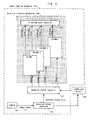
- Fig. 3 shows a functional block diagram of an agent learning apparatus 100 according to one embodiment of the invention in advance learning stage.
- the agent learning apparatus 100 is illustrated in the area enclosed with dotted lines in Fig. 3, including one or more sensors 301, a behavior output generator 302, a behavior status evaluator 303 and a selective attention mechanism 304.
- the selective attention mechanism 304 includes a plurality of columns 1, 2, 3,...,m created according to rewards produced by the behavior status evaluator 303.
- the selective attention mechanism 304 also includes an attention class selector 306.
- the behavior output generator 302 To the sensory inputs captured by the sensor 301, the behavior output generator 302 generates behavior outputs based on the data sets and supplies them to a controlled object 308.
- the behavior status evaluator 303 evaluates the behavior result of the controlled object 308 to generate rewards for behavior outputs one by one.
- the selective attention mechanism 304 distributes the behavior outputs to one of columns according to each reward to create probabilistic models described later. Creating probabilistic models -in advance enables high-accurate control.
- the agent learning apparatus 100 After the advance learning stage is completed, the agent learning apparatus 100 performs a process which is referred to as "behavior control stage" herein.
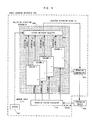
- Fig. 4 shows a functional block diagram of an agent learning apparatus 100 according to one embodiment of the invention in behavior control stage.
- behavior control stage new sensory inputs captured by sensor 301 are provided directly to the attention class selector 306.
- the attention class selector 306 performs some process to the sensory inputs using the probabilistic model computed in advance.
- a behavior controller 307 determines behavior outputs for stabilizing the controlled object 308 and supplies them to the controlled object 308.
- An example of the controlled object 308 is a helicopter as noted above.
- advance learning stage is not necessary. Operation of the agent learning apparatus in such case without advance learning will be described later.
- All or part of the behavior output generator 302, the behavior status evaluator 303, the selective attention mechanism 304 and the behavior controller 307 may be implemented by, for example, executing on a general purpose computer a program configured to realize functionality of them.
- the behavior output generator 302 generates behavior outputs Q i (t) corresponding to the supplied sensory inputs I i (t) and supplies them to a behavior status evaluator 303 and a controlled object 308.
- the transformation between the sensory inputs I i (t) and the behavior outputs Q i (t) is represented by the following mapping f. ⁇ :I i (t) ⁇ Q i (t)
- the mapping ⁇ is, for example, a non-linear approximation transformation using well-known Fourier series or the like.
- the mapping ⁇ corresponds to preparing random data sets which includes the mapping between sensory inputs I i (t) and behavior outputs Q i (t).
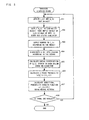
- the behavior output generator 302 generates behavior outputs Q i (t) one by one corresponding to each sensory input I i (t) based on these data sets (step S401 in Fig. 5).
- Generated behavior outputs Q i (t) are supplied to the behavior status evaluator 303 and the controlled object 308.
- the controlled object 308 will work in response to the supplied behavior outputs Q i (t).
- the result of this work is supplied to the behavior status evaluator 303 (step S402 in Fig. 5).
- the behavior status evaluator 303 then evaluates the result of this work (for example, behavior of the controlled object gets stable or not) with predetermined evaluation function and generates reward for every behavior outputs Q i (t) (step S403 in Fig. 5). Such process in the behavior status evaluator 303 is considered as reinforcement learning.
- the evaluation function herein is a function that yields reward “1” if the controlled object gets stable by the supplied behavior output Q i (t) or yields reward “2" otherwise.
- Type of rewards may be selected in consideration of behavior characteristics of the controlled object 308 or the required control accuracy.
- Evaluation function is used to minimize the variance ⁇ of the behavior outputs Q i (t). In other words, by using the evaluation function, sensory inputs I i (t) unnecessary for stable control may be removed and necessary sensory inputs I i (t) are reinforced. Finally, reinforcement learning satisfying ⁇ (Q 1 ) ⁇ ⁇ (Q 2 ) is attained.
- Q 1 is a group of the behavior outputs Q i (t) which are given reward "1"
- Q 2 is a group of the behavior outputs Q i (t) which are given reward "2".
- the selective attention mechanism 304 On receiving rewards from the behavior status evaluator 303, the selective attention mechanism 304 creates a plurality of columns 1, 2, 3,...,m in response to the type of the rewards. Then the selective attention mechanism 304 distributes the behavior outputs Q i (t) to each column (step S404 in Fig. 5). In each column, behavior outputs Q i (t) are stored by rewards, being associated with the sensory inputs I i (t) which cause that behavior outputs. More specifically, when the behavior status evaluator 303 generates either reward "1" or reward "2" for example, the selective attention mechanism 304 creates column 1 and column 2.
- the selective attention mechanism 304 performs expectation maximization (EM) algorithm and supervised learning with neural network, both will be described later, to calculate conditional probabilistic distribution (that is, probabilistic model) p(I i (t)
- the attention class ⁇ l is used to select noticeable sensory inputs I i (t) from among massive sensory inputs I i (t). More specifically, attention class ⁇ l is a parameter used for modeling the behavior outputs Q i (t) stored in each column using the probabilistic density function of the normal distribution of behavior outputs Q i (t). Attention classes ⁇ l are created as many as the number of the columns storing these behavior outputs Q i (t). Calculating the attention class ⁇ l corresponding to the behavior outputs Q i (t) stored in each column is represented by the following mapping h. h : Q i (t) ⁇ l (t)
- steps S405-S408 in Fig. 5 will be next described in detail. It should be noted that each process in steps S405-S408 is performed on every column.
- the EM algorithm is an iterative algorithm for estimating parameter ⁇ which takes maximum likelihood when observed data is viewed as incomplete data.
- the parameter ⁇ may be represented as ⁇ ( ⁇ l , ⁇ l ) with mean ⁇ l and covariance ⁇ l .
- EM algorithm is initiated with appropriate initial values of ⁇ ( ⁇ l , ⁇ l ). Then the parameter ⁇ ( ⁇ 1 , ⁇ 1 ) is updated one after another by iterating Expectation (E) step and Maximization (M) step alternately.
- ⁇ (k) ) is calculated by following equation.
- ⁇ (k) ) is calculated by following equation and are set to a new estimated value ⁇ (k+1) .
- ⁇ (k+1) arg max ⁇ ⁇ ( ⁇ , ⁇ (k) )
- behavior outputs Q i (t) stored in each column may be represented by normal distribution (step S405 in Fig. 5). Calculating ⁇ l and ⁇ l for the behavior outputs Q i (t) corresponds to calculating a posteriori probability for attention class ⁇ l .
- Figs. 6 and 7 show examples of normal distribution of behavior outputs Q i (t) included in column 1 (stable) or column 2 (unstable) respectively.
- the normal distribution of column1 has shaper end of graph than that of column 2 and thus the variance of behavior outputs Q i (t) is smaller ( ⁇ (Q 1 ) ⁇ (Q 2 )).
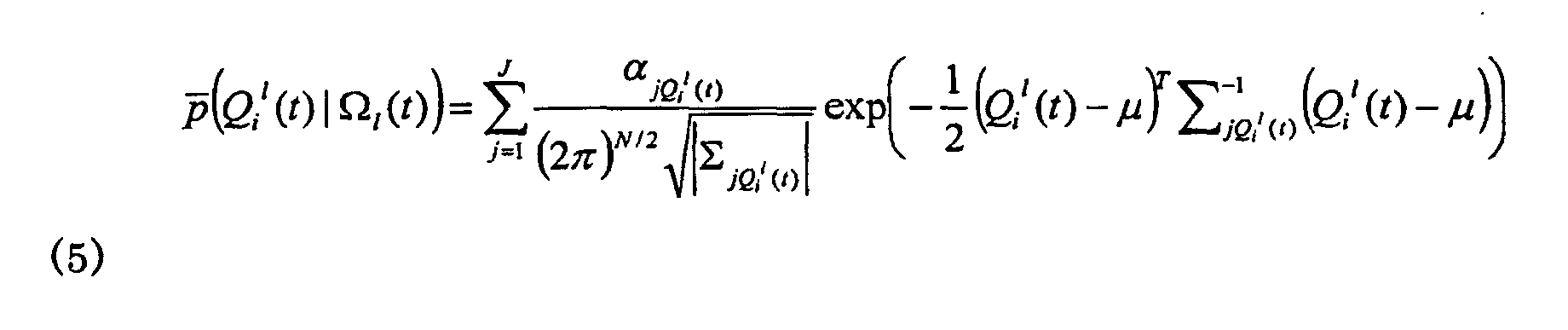
- a priori probability p (Q i l (t) ⁇ 1 (t)) of attention class ⁇ l is calculated by following equation with the calculated parameters ⁇ l and ⁇ l (step S406 in Fig. 5).
- N is dimension of the behavior outputs Q i (t).
- ⁇ l ) is calculated with the attention class ⁇ l , which has been calculated as a posteriori probability, as supervising signal (step S407 in Fig. 5).
- Fig. 8 shows the exemplary structure of hierarchical neural network used for the supervised learning with neural network.
- This hierarchical neural network is composed of three layers of nodes.
- the input layer 501 corresponds to sensory inputs I i (t), middle layer 502 to behavior outputs Q i (t), and output layer 503 to attention classes ⁇ l , respectively.
- the middle layer 502 behavior output nodes Q i (t) exist as many as nodes in the input layer 501.
- Nodes in the middle layer 502 correspond to nodes in the input layer one by one.
- Nodes in the output layer 503 are created as many as the number of the attention classes ⁇ 1 .
- ⁇ shown in Fig. 8 denotes synaptic weight matrices of the hierarchical neural network. Since a probability that a behavior outputs Q i (t) belong to its each attention classes ⁇ l is computed by EM algorithm, and behavior outputs Q i (t) are stored in the column in a one-to-one correspondence with sensory inputs I i (t), probabilistic relationship (that is, ⁇ in Fig. 8) between sensory inputs I i (t) and attention classes ⁇ l are determined by repeating the supervised learning with attention class ⁇ l as a teacher signal. This probabilistic relationship is conditional probabilistic density function p ( I i (t)
- ⁇ l ) which is probabilistic relationship between sensory inputs I i (t) and attention class ⁇ l , may be computed.
- the probability may be determined of which attention class ⁇ l a new sensory input I i (t) belongs to without calculating the mapping h ⁇ ⁇ at each time for that sensory input.
- steps S401 to S407 are performed on every pair of sensory input I i (t) and behavior output Q i (t) in given data sets (step S408 in Fig. 5).
- ⁇ l ) continues to be updated in response to given behavior outputs Q i (t).
- the agent learning apparatus 100 After the advance learning stage using the data sets is completed, the agent learning apparatus 100 starts to control the controlled object 308 based on the established learning result. Now it will be described below how the agent learning apparatus 100 operates on behavior control stage referring to Figs. 4 and 9.
- ⁇ l ), both has been calculated in advance learning stage, are used.
- New sensory inputs I i (t) captured at sensor 301 are provided to the attention class selector 306 in the selective attention mechanism 304 (step S410 in Fig. 9).
- the confidence p( ⁇ l (t)) is the probability that a sensory input I i (t) belongs to each attention class ⁇ l (t).
- Calculating the probability that a sensory input I i (t) belongs to each attention class ⁇ l (t) with Bayes' rule means that one attention class may be identified selectively by increasing the confidence p( ⁇ l (t)) with learning of Bayes' rule (weight).
- the attention class ⁇ l or hidden control parameter, may be directly identified based on observable sensory input I i (t).
- the attention class selector 306 determines that the attention class ⁇ l with highest confidence p( ⁇ l (t)) is an attention class corresponding to the new sensory input I i (t). The determined attention class ⁇ l is informed to the behavior controller 307 (step S412 in Fig. 9).
- the behavior controller 307 calculates a behavior output Q i (t) corresponding to a captured sensory input I i (t) based on the behavior outputs Q i (t) stored in the column 1 (step S413 in Fig. 9), then provides it to the controlled object 308 (step S414).
- these behavior outputs Q i (t) may be calculated on the probabilistic distribution calculated by EM algorithm and not behavior outputs Q i (t) itself which was given as data sets in advance learning stage.
- the behavior controller 307 selects not column 2 but column 1 having smaller variance, and calculates a behavior output Q i (t) corresponding to a captured sensory input I i (t) based on the behavior outputs Q i (t) stored in column 1, then provides it to the controlled object 308 (S414). If no corresponding behavior output is stored, last behavior output is supplied. If no behavior output Q i (t) associated with the sensory input I i (t) is stored in the column, previous behavior output Q i (t) is selected and provided to the controlled object 308. By repeating such process, relation between variance of columns ⁇ (Q 1 ) ⁇ (Q 2 ) is accomplished (that is, variance of behavior outputs in column 1 gets smaller rapidly and the stability of controlled object 308 is attained).
- the behavior controller 307 may select column 2, calculate behavior outputs Q i (t) corresponding to captured sensory inputs I i (t) from among behavior outputs Q i (t) stored in column 2 having smaller variance, and supply them to the controlled object 308.
- the controlled object 308 exhibits behavior according to the provided behavior output Q i (t). The result of this behavior is provided to the behavior status evaluator 303 again. Then, when new sensory input I i (t) is captured by sensor 301, attention class is selected using conditional probability density function p(I i (t)
- ⁇ l ) is calculated in the advance learning stage
- the attention class ⁇ l may be directly selected corresponding to new sensory input I i (t) using statistical learning in behavior control stage without computing mapping f and h.
- mapping ⁇ and h are calculated for all sensory inputs I i (t)
- its computing amount far exceeds the processing capacity of the typical computer.
- appropriate filtering for sensory inputs I i (t) with the attention classes ⁇ l may improve the efficiency of the learning.
- selecting attention class ⁇ l with highest confidence p( ⁇ l (t)) corresponds to selecting column which includes behavior output Q i (t) with highest reward for a sensory input I i (t).
- the agent learning apparatus 100 is characterized in that supervised learning scheme and statistical learning scheme are synthetically applied.
- the agent learning apparatus 100 can select the attention class with the selective attention mechanism 304 and learn the important sensory inputs I i (t) selectively, resulting to reduce the processing time and to eliminate the need of the supervising information given by an operator. Furthermore, if the motion of the controlled object 308 has non-linear characteristics, it takes much time for learning with only the reinforcement learning scheme because complicated non-linear function approximation is required. On the other hand, since the agent learning apparatus 100 of the invention learns the sensory inputs according to their importance with the selective attention mechanism 304, the processing speed is improved.
- the agent learning apparatus 100 is also characterized in that feed back control is performed in advance learning stage and feed forward control is performed in behavior control stage.
- FIG. 10 shows a schematic view of a control system for a radio-controlled helicopter 601 applying an agent learning apparatus 100 of the invention.
- a vision sensor 602 mounted on a helicopter 601 is a vision sensor 602, which captures visual information every 30-90 milliseconds and sends them to a computer 603 as sensory inputs I i (t).
- the computer 603 is programmed to implement the agent learning apparatus 100 shown in Fig. 3 or Fig. 4 and generates behavior outputs Q i (t) for the sensory inputs I i (t) according to the invention.
- the behavior outputs Q i (t) are sent to a motor control unit 605 mounted on the helicopter 601 via a radio transmitter 604, rotating a rotor on the helicopter.
- the number of the attention classes ⁇ 1 is set at two. Total 360 data sets for advance learning were used for processing in selective attention mechanism 304. After the advance learning was over, it was confirmed whether the system could select correct attention class ⁇ l when another 150 test data (new sensory inputs I i (t)) were provided to the system.
- the selective attention mechanism 304 distributes the behavior outputs Q i (t) to column 1 or column 2 according to their rewards. This process is represented by the following evaluation function.
- Q i 1 ⁇ Q i (Positive) else Q i 2 ⁇ Q i (Negative) where Q 1 or Q 2 representes a group of behavior outputs Q i (t) distributed to column 1 or column2 respectively.
- the positive reward corresponds to column 1 and the negative reward correspond to column 2.
- Q i denotes the behavior output Q i (t) to keep the helicopter stable.
- Q i is a mean value of a probabilistic distribution p(Q i ) and set to "82" in this example.
- ⁇ is a threshold that represents a tolerance of stability and set to "1.0" in this example.
- the evaluation function shown above acts as reinforcement learning satisfying the relation between the variances of column ⁇ (Q 1 ) ⁇ (Q 2 ).
- Figs. 11A to 11C show the relationship between the sensory inputs I i (t) and the attention class ⁇ l , which was acquired from the experiment using the system in Fig. 10. It should be noted that the actual attention class could be calculated by the data sets.
- Fig. 11A is a diagram of the correct attention class ⁇ l corresponding to sensory inputs I i (t).
- Fig. 11B is a diagram of the experiment result when the iteration number is small (early stage) in the EM algorithm.
- Fig. 11C is a diagram of the experiment result when the iteration number is sufficient (late stage). Solid lines in each figure represent that the attention class ⁇ l selected at its time point is shifted from one to another.
- the agent learning apparatus 100 can learn the predictive relationship between the sensory inputs I i (t) and the two attention classes ⁇ l .
- the result suggests that the discriminative power of the prediction between sensory inputs I i (t) and two attention classes is "weak" when the probabilistic distribution for statistical column is in early stage of EM algorithm.
- the discriminative power of the prediction may be affected by the number of the normal distribution (Gaussian function) used in the EM algorithm. Although single Gaussian function is used in the aforementioned embodiments, mixture of Gaussian functions may be used in the EM algorithm to improve the discriminative power of the prediction.
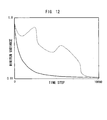
- Fig. 12 shows a graph of the minimum variance value of the behavior outputs Q i (t) over time when the helicopter 601 in the example is controlled.
- a dashed line represents the result when the helicopter 601 is controlled by the conventional feedback control, while a solid line represents the result when the helicopter 601 is controlled by the agent learning apparatus 100 according to the invention.
- the conventional methods have no learning process by the selective attention mechanism 304. Therefore, since it is learned through try and error process which visual information (that is, sensory inputs I i (t)) are needed for stabilizing the helicopter 601 among sensory inputs I i (t) captured by the helicopter 601, it takes much time until the variance becomes small, in other words, the helicopter 601 gets stabilized.
- the agent learning apparatus 100 acquires the sensory inputs I i (t) needed for stabilizing the helicopter 601 not through try and error process but by the learning according to the importance of the sensory inputs I i (t) using the selective attention mechanism 304. Therefore, minimization of the variance of the behavior outputs Q i (t) may be attained very rapidly.
- vision sensor 602 is used in this example, sensory inputs I i (t) is not limited to vision information but other input such as auditory information or tactile information may be also used.
- example has been described for two columns and two rewards, but three or more columns and rewards may be used. Only one column will not accelerate the convergence of the learning because, if there is only one column, it will take much time until the normal distribution curve of behavior outputs Q i (t) contained in the column is sharpened and the variance gets small.
- One feature of the invention is that the normal distribution curve of behavior outputs Q i (t) is sharpened rapidly by generating a plurality of columns. The more columns are used, the more complicated and various behavior outputs may be obtained.
- a priori learning using data sets is performed. Such a priori learning is for stabilizing the controlled object 308 more rapidly.
- control for controlled object 308 for example, a helicopter 601 may be started by applying the agent learning apparatus 100 without a priori learning.
- the behavior controller 307 supplies behavior outputs Q i (t) to the controlled object 308 in a random fashion irrespective of sensory inputs I i (t) captured by the sensor because no probabilistic model described above is created during short period after control is started.
- the behavior status evaluator 303 supplies rewards to behavior results of the controlled object 308.
- the selective attention mechanism distributes behavior outputs Q i (t) to columns in association with sensory inputs I i (t) according to the reward.
- relationship between sensory inputs I i (t) and behavior outputs Q i (t) is stored in columns according to rewards and normal distributions for behavior outputs stored in columns may be computed with EM algorithm, a priori probability p (Q i l (t)
- the behavior controller 307 computes behavior output Q i (t) corresponding to newly-captured sensory input I i (t) based on column where confidence p( ⁇ l (t)) is maximum or where behavior outputs having best reward are stored and supply them to controlled object.
- the behavior status evaluator supplies rewards to behavior results of the controlled object 308 and the computed behavior outputs Q i (t) are stored in one of columns.
- ⁇ l ) may be updated. Then, these updated probabilities are applied to Bayes' rule and new behavior output Q i (t) is output.
- ⁇ l ) are updated one after another.
- the instability of controlled object is large when at the beginning of starting the control and the controlled object may be damaged or so by unexpected motion of the object. Therefore, range of behavior output Q i (t) given to the controlled object 308 by the behavior controller 307 is preferably limited forcefully until the predetermined number of the relationship between sensory inputs and behavior outputs are gained (alternatively, until predetermined period is lapsed).
- step S405 well-known competitive learning or learning with self-organized network may be employed instead of EM algorithm in step S405.
- Well-known belief network or graphical model may be employed instead of Bayes' rule in step S411.
- variance of behavior outputs Q i (t) may be minimized rapidly to stabilize a controlled object by computing the behavior output based on a column which is estimated as stable.
Landscapes
- Engineering & Computer Science (AREA)
- Artificial Intelligence (AREA)
- Evolutionary Computation (AREA)
- Health & Medical Sciences (AREA)
- Computer Vision & Pattern Recognition (AREA)
- Medical Informatics (AREA)
- Software Systems (AREA)
- Physics & Mathematics (AREA)
- General Physics & Mathematics (AREA)
- Automation & Control Theory (AREA)
- Feedback Control In General (AREA)
- Complex Calculations (AREA)
Abstract
Description
Expectation (E) step and Maximization (M) step alternately.



Claims (15)
- An agent learning apparatus (100) for performing optimal control for a controlled object, comprising:a sensor (301) for capturing external environmental information for conversion to sensory inputs;a behavior controller (302,307) for supplying behavior outputs to said controlled object based on results of learning performed on said sensory inputs;a behavior status evaluator (303) for evaluating behavior of the controlled object caused by said behavior outputs; anda selective attention mechanism (304) for storing said behavior outputs in one of a plurality of columns in association with corresponding sensory inputs based on the evaluation, computing probabilistic models based on the behavior outputs stored in said columns, and outputting, as said results of learning, behavior outputs in association with newly given sensory inputs in the column, said column having largest confidence calculated by applying said newly given sensory inputs to said probabilistic models.
- An agent learning apparatus (100) for performing optimal control for a controlled object, comprising:a sensor (301) for capturing external environmental information for conversion to sensory inputs;a behavior controller (302,307) for supplying behavior outputs to said controlled object based on results of learning performed on said sensory inputs;a behavior status evaluator (303) for evaluating behavior of the controlled object caused by said behavior outputs; anda selective attention mechanism (304) for storing said behavior outputs in one of a plurality of columns in association with corresponding sensory inputs based on the evaluation, computing probabilistic models based on the behavior outputs stored in said columns, and outputting, as said results of learning, behavior outputs in association with newly given sensory inputs in the column, said column containing the behavior outputs having largest evaluation.
- The agent learning apparatus (100) of claim 1 or 2, said computing probabilistic model comprising:representing behavior outputs stored in columns as normal distribution by using Expectation Maximization algorithm;using said normal distribution to compute a priori probability that a behavior output is contained in each column; andusing said a priori probability to compute said probabilistic model by supervised learning with neural network, said probabilistic model being probabilistic relationship between any sensory input and each column.
- The agent learning apparatus (100) of claim 3, said confidence being calculated by applying said a priori probability and said probabilistic model to Bayes' rule.
- The agent learning apparatus (100) of claim 4, wherein said probabilistic model is computed in advance using data sets of relationship between sensory inputs and behavior outputs, wherein after computing said probabilistic model, said confidence is calculated using the probabilistic model for newly given sensory inputs.
- An agent learning method for performing optimal control for a controlled object, comprising:capturing external environmental information for conversion to sensory inputs;supplying behavior outputs to said controlled object based on results of learning performed on said sensory inputs;evaluating behavior of the controlled object caused by said behavior outputs;storing said behavior outputs in one of a plurality of columns in association with corresponding sensory inputs based on the evaluation;computing probabilistic models based on the behavior outputs stored in said columns; andoutputting, as said results of learning, behavior outputs in association with newly given sensory inputs in the column, said column having largest confidence calculated by applying said newly given sensory inputs to said probabilistic models.
- An agent learning method for performing optimal control for a controlled object, comprising:capturing external environmental information for conversion to sensory inputs;supplying behavior outputs to said controlled object based on results of learning performed on said sensory inputs;evaluating behavior of the controlled object caused by said behavior outputs;storing said behavior outputs in one of a plurality of columns in association with corresponding sensory inputs based on the evaluation;computing probabilistic models based on the behavior outputs stored in said columns; andoutputting, as said results of learning, behavior outputs in association with newly given sensory inputs in the column, said column containing the behavior outputs having largest evaluation.
- The agent learning method of claim 6 or 7, said computing probabilistic model comprising:representing behavior outputs stored in columns as normal distribution by using Expectation Maximization algorithm;using said normal distribution to compute a priori probability that a behavior output is contained in each column; andusing said a priori probability to compute said probabilistic model by supervised learning with neural network, said probabilistic model being probabilistic relationship between any sensory input and each column.
- The agent learning method of claim 8, said confidence being calculated by applying said a priori probability and said probabilistic model to Bayes' rule.
- The agent learning method of claim 9, wherein said probabilistic model is computed in advance using data sets of relationship between sensory inputs and behavior outputs, wherein after computing said probabilistic model, said confidence is calculated using the probabilistic model for newly given sensory inputs.
- An agent learning program for performing optimal control for a controlled object, comprising:capturing external environmental information for conversion to sensory inputs;supplying behavior outputs to said controlled object based on results of learning performed on said sensory inputs;evaluating behavior of the controlled object caused by said behavior outputs;storing said behavior outputs in one of a plurality of columns in association with corresponding sensory inputs based on the evaluation;computing probabilistic models based on the behavior outputs stored in said columns; andoutputting, as said results of learning, behavior outputs in association with newly given sensory inputs in the column, said column having largest confidence calculated by applying said newly given sensory inputs to said probabilistic models.
- An agent learning program for performing optimal control for a controlled object, comprising:capturing external environmental information for conversion to sensory inputs;supplying behavior outputs to said controlled object based on results of learning performed on said sensory inputs;evaluating behavior of the controlled object caused by said behavior outputs;storing said behavior outputs in one of a plurality of columns in association with corresponding sensory inputs based on the evaluation;computing probabilistic models based on the behavior outputs stored in said columns; andoutputting, as said results of learning, behavior outputs in association with newly given sensory inputs in the column, said column containing the behavior outputs having largest evaluation.
- The agent learning program of claim 11 or 12, said computing probabilistic model comprising:representing behavior outputs stored in columns as normal distribution by using Expectation Maximization algorithm;using said normal distribution to compute a priori probability that a behavior output is contained in each column; andusing said a priori probability to compute said probabilistic model by supervised learning with neural network, said probabilistic model being probabilistic relationship between any sensory input and each column.
- The agent learning program of claim 13, said confidence being calculated by applying said a priori probability and said probabilistic model to Bayes' rule.
- The agent learning program of claim 14, wherein said probabilistic model is computed in advance using data sets of relationship between sensory inputs and behavior outputs, wherein after computing said probabilistic model, said confidence is calculated using the probabilistic model for newly given sensory inputs.
Applications Claiming Priority (5)
| Application Number | Priority Date | Filing Date | Title |
|---|---|---|---|
| JP2001028759 | 2001-02-05 | ||
| JP2001028759 | 2001-02-05 | ||
| JP2001028758 | 2001-02-05 | ||
| JP2001028758 | 2001-02-05 | ||
| PCT/JP2002/000878 WO2002063402A1 (en) | 2001-02-05 | 2002-02-04 | Agent learning apparatus, method, and program |
Publications (2)
| Publication Number | Publication Date |
|---|---|
| EP1359481A1 true EP1359481A1 (en) | 2003-11-05 |
| EP1359481A4 EP1359481A4 (en) | 2006-04-12 |
Family
ID=26608946
Family Applications (1)
| Application Number | Title | Priority Date | Filing Date |
|---|---|---|---|
| EP02710486A Withdrawn EP1359481A4 (en) | 2001-02-05 | 2002-02-04 | Agent learning apparatus, method, and program |
Country Status (4)
| Country | Link |
|---|---|
| US (1) | US20060155660A1 (en) |
| EP (1) | EP1359481A4 (en) |
| JP (1) | JP4028384B2 (en) |
| WO (1) | WO2002063402A1 (en) |
Cited By (1)
| Publication number | Priority date | Publication date | Assignee | Title |
|---|---|---|---|---|
| US10152037B2 (en) | 2013-07-09 | 2018-12-11 | Ford Global Technologies, Llc | System and method for feedback error learning in non-linear systems |
Families Citing this family (21)
| Publication number | Priority date | Publication date | Assignee | Title |
|---|---|---|---|---|
| US7152051B1 (en) * | 2002-09-30 | 2006-12-19 | Michael Lamport Commons | Intelligent control with hierarchical stacked neural networks |
| US20060184462A1 (en) | 2004-12-10 | 2006-08-17 | Hawkins Jeffrey C | Methods, architecture, and apparatus for implementing machine intelligence and hierarchical memory systems |
| US20070192267A1 (en) * | 2006-02-10 | 2007-08-16 | Numenta, Inc. | Architecture of a hierarchical temporal memory based system |
| US8732098B2 (en) | 2006-02-10 | 2014-05-20 | Numenta, Inc. | Hierarchical temporal memory (HTM) system deployed as web service |
| FI20070159A0 (en) * | 2007-02-23 | 2007-02-23 | Teknillinen Korkeakoulu | Procedure for integration of information, choice and learning of representation |
| JP5398414B2 (en) * | 2008-09-18 | 2014-01-29 | 本田技研工業株式会社 | Learning system and learning method |
| US9015093B1 (en) | 2010-10-26 | 2015-04-21 | Michael Lamport Commons | Intelligent control with hierarchical stacked neural networks |
| US8775341B1 (en) | 2010-10-26 | 2014-07-08 | Michael Lamport Commons | Intelligent control with hierarchical stacked neural networks |
| JP6457369B2 (en) * | 2015-09-30 | 2019-01-23 | ファナック株式会社 | Machine learning device and motor control device having function of automatically adjusting parameters |
| US10839302B2 (en) | 2015-11-24 | 2020-11-17 | The Research Foundation For The State University Of New York | Approximate value iteration with complex returns by bounding |
| JP6203808B2 (en) * | 2015-11-27 | 2017-09-27 | ファナック株式会社 | Machine learning device, motor control system and machine learning method for learning fan motor cleaning interval |
| JP6453805B2 (en) | 2016-04-25 | 2019-01-16 | ファナック株式会社 | Production system for setting judgment values for variables related to product abnormalities |
| US10416619B2 (en) * | 2016-07-25 | 2019-09-17 | General Electric Company | System modeling, control and optimization |
| CA2982930A1 (en) | 2017-10-18 | 2019-04-18 | Kari Saarenvirta | System and method for selecting promotional products for retail |
| GB2567900A (en) | 2017-10-31 | 2019-05-01 | Babylon Partners Ltd | A computer implemented determination method and system |
| US10621533B2 (en) | 2018-01-16 | 2020-04-14 | Daisy Intelligence Corporation | System and method for operating an enterprise on an autonomous basis |
| US11281208B2 (en) * | 2018-03-02 | 2022-03-22 | Carnegie Mellon University | Efficient teleoperation of mobile robots via online adaptation |
| US20220156786A1 (en) * | 2018-07-02 | 2022-05-19 | Bluecore, Inc. | Systems, Methods and Media for Automatic Prioritizer |
| US11887138B2 (en) | 2020-03-03 | 2024-01-30 | Daisy Intelligence Corporation | System and method for retail price optimization |
| US12416925B2 (en) * | 2020-04-30 | 2025-09-16 | Rakuten Group, Inc. | Learning device, information processing device, and learned control model |
| US11783338B2 (en) | 2021-01-22 | 2023-10-10 | Daisy Intelligence Corporation | Systems and methods for outlier detection of transactions |
Family Cites Families (7)
| Publication number | Priority date | Publication date | Assignee | Title |
|---|---|---|---|---|
| JPH03260704A (en) * | 1990-03-09 | 1991-11-20 | Kobe Steel Ltd | Action deciding device |
| JP2982174B2 (en) * | 1989-05-22 | 1999-11-22 | 日本鋼管株式会社 | Blast furnace operation support method |
| JPH02308301A (en) * | 1989-05-24 | 1990-12-21 | Hitachi Ltd | Plant operation support equipment |
| JP3151857B2 (en) * | 1991-06-06 | 2001-04-03 | オムロン株式会社 | Inference device with learning function |
| JP3129342B2 (en) * | 1992-01-27 | 2001-01-29 | オムロン株式会社 | Knowledge learning device |
| JPH05265511A (en) * | 1992-03-19 | 1993-10-15 | Hitachi Ltd | Control system |
| JP3086206B2 (en) * | 1998-07-17 | 2000-09-11 | 科学技術振興事業団 | Agent learning device |
-
2002
- 2002-02-04 EP EP02710486A patent/EP1359481A4/en not_active Withdrawn
- 2002-02-04 JP JP2002563083A patent/JP4028384B2/en not_active Expired - Fee Related
- 2002-02-04 WO PCT/JP2002/000878 patent/WO2002063402A1/en not_active Ceased
- 2002-02-04 US US10/468,316 patent/US20060155660A1/en not_active Abandoned
Non-Patent Citations (5)
| Title |
|---|
| BILLARD A ET AL: "Grounding communication in autonomous robots: An experimental study" ROBOTICS AND AUTONOMOUS SYSTEMS, ELSEVIER SCIENCE PUBLISHERS, AMSTERDAM, NL, vol. 24, no. 1-2, August 1998 (1998-08), pages 71-79, XP004140681 ISSN: 0921-8890 * |
| BUXTON H: "Advanced visual surveillance using Bayesian networks" IEE, 10 March 1997 (1997-03-10), pages 9-1, XP006509182 London, Savoy Place * |
| CHANG R-I ET AL: "UNSUPERVISED QUERY-BASED LEARNING OF NEURAL NETWORKS USING SELECTIVE-ATTENTION AND SELF-REGULATION" IEEE TRANSACTIONS ON NEURAL NETWORKS, IEEE SERVICE CENTER, PISCATAWAY, NJ, US, vol. 8, no. 2, March 1997 (1997-03), pages 205-217, XP000656744 ISSN: 1045-9227 * |
| JOULAIN C ET AL: "Learning to build visual categories from perception-action associations" INTELLIGENT ROBOTS AND SYSTEMS, 1997. IROS '97., PROCEEDINGS OF THE 1997 IEEE/RSJ INTERNATIONAL CONFERENCE ON GRENOBLE, FRANCE 7-11 SEPT. 1997, NEW YORK, NY, USA,IEEE, US, vol. 2, 7 September 1997 (1997-09-07), pages 857-864, XP010264745 ISBN: 0-7803-4119-8 * |
| See also references of WO02063402A1 * |
Cited By (1)
| Publication number | Priority date | Publication date | Assignee | Title |
|---|---|---|---|---|
| US10152037B2 (en) | 2013-07-09 | 2018-12-11 | Ford Global Technologies, Llc | System and method for feedback error learning in non-linear systems |
Also Published As
| Publication number | Publication date |
|---|---|
| US20060155660A1 (en) | 2006-07-13 |
| EP1359481A4 (en) | 2006-04-12 |
| JP4028384B2 (en) | 2007-12-26 |
| JPWO2002063402A1 (en) | 2004-06-10 |
| WO2002063402A1 (en) | 2002-08-15 |
Similar Documents
| Publication | Publication Date | Title |
|---|---|---|
| EP1359481A1 (en) | Agent learning apparatus, method, and program | |
| CN115668072B (en) | Nonlinear optimization methods for stochastic predictive control | |
| Zhang et al. | Near-optimal rapid MPC using neural networks: A primal-dual policy learning framework | |
| US11605026B2 (en) | Methods and systems for support policy learning | |
| Chen et al. | Approximating explicit model predictive control using constrained neural networks | |
| Wei et al. | Safe control with neural network dynamic models | |
| Rubies-Royo et al. | A classification-based approach for approximate reachability | |
| Fröhlich et al. | Contextual tuning of model predictive control for autonomous racing | |
| Sledge et al. | Balancing exploration and exploitation in reinforcement learning using a value of information criterion | |
| Arif et al. | Incorporation of experience in iterative learning controllers using locally weighted learning | |
| US20230120256A1 (en) | Training an artificial neural network, artificial neural network, use, computer program, storage medium and device | |
| Wang et al. | Interaction-aware model predictive control for autonomous driving | |
| CN114020013A (en) | Unmanned aerial vehicle formation collision avoidance method based on deep reinforcement learning | |
| KR20230119023A (en) | Attention neural networks with short-term memory | |
| CN113419424B (en) | Modeling reinforcement learning robot control method and system for reducing overestimation | |
| Abbeel et al. | Learning first-order Markov models for control | |
| Cheng et al. | Human motion prediction using adaptable neural networks | |
| Eysenbach et al. | A connection between one-step RL and critic regularization in reinforcement learning | |
| Carreras et al. | Semi-online neural-Q/spl I. bar/leaming for real-time robot learning | |
| Toner et al. | Probabilistically safe mobile manipulation in an unmodeled environment with automated feedback tuning | |
| JP2004118658A (en) | Method and apparatus for controlling physical system and computer program for controlling physical system | |
| CN114770523A (en) | Robot control method based on offline environment interaction | |
| CN114371626B (en) | Discrete control fence function improvement optimization method, optimization system, terminal and medium | |
| Medina et al. | Uncertainty-dependent optimal control for robot control considering high-order cost statistics | |
| CN114488786A (en) | A3C and event trigger-based networked servo system control method |
Legal Events
| Date | Code | Title | Description |
|---|---|---|---|
| PUAI | Public reference made under article 153(3) epc to a published international application that has entered the european phase |
Free format text: ORIGINAL CODE: 0009012 |
|
| 17P | Request for examination filed |
Effective date: 20030805 |
|
| AK | Designated contracting states |
Kind code of ref document: A1 Designated state(s): AT BE CH CY DE DK ES FI FR GB GR IE IT LI LU MC NL PT SE TR |
|
| AX | Request for extension of the european patent |
Extension state: AL LT LV MK RO SI |
|
| A4 | Supplementary search report drawn up and despatched |
Effective date: 20060224 |
|
| RIC1 | Information provided on ipc code assigned before grant |
Ipc: G06F 15/18 20060101ALI20060220BHEP Ipc: G06N 3/00 20060101ALI20060220BHEP Ipc: G06N 1/00 20060101ALI20060220BHEP Ipc: G05B 13/02 20060101AFI20020816BHEP |
|
| 17Q | First examination report despatched |
Effective date: 20070216 |
|
| STAA | Information on the status of an ep patent application or granted ep patent |
Free format text: STATUS: THE APPLICATION IS DEEMED TO BE WITHDRAWN |
|
| 18D | Application deemed to be withdrawn |
Effective date: 20070627 |