EP1359209A2 - Compounds containing amide and carboxyl groups as asphaltene dispersants in crude oil - Google Patents
Compounds containing amide and carboxyl groups as asphaltene dispersants in crude oil Download PDFInfo
- Publication number
- EP1359209A2 EP1359209A2 EP03252269A EP03252269A EP1359209A2 EP 1359209 A2 EP1359209 A2 EP 1359209A2 EP 03252269 A EP03252269 A EP 03252269A EP 03252269 A EP03252269 A EP 03252269A EP 1359209 A2 EP1359209 A2 EP 1359209A2
- Authority
- EP
- European Patent Office
- Prior art keywords
- alkyl
- compound
- group
- difunctional
- hydrogen
- Prior art date
- Legal status (The legal status is an assumption and is not a legal conclusion. Google has not performed a legal analysis and makes no representation as to the accuracy of the status listed.)
- Withdrawn
Links
- 0 NC(*C(O)=O)=O Chemical compound NC(*C(O)=O)=O 0.000 description 3
Classifications
-
- C—CHEMISTRY; METALLURGY
- C10—PETROLEUM, GAS OR COKE INDUSTRIES; TECHNICAL GASES CONTAINING CARBON MONOXIDE; FUELS; LUBRICANTS; PEAT
- C10L—FUELS NOT OTHERWISE PROVIDED FOR; NATURAL GAS; SYNTHETIC NATURAL GAS OBTAINED BY PROCESSES NOT COVERED BY SUBCLASSES C10G OR C10K; LIQUIFIED PETROLEUM GAS; USE OF ADDITIVES TO FUELS OR FIRES; FIRE-LIGHTERS
- C10L1/00—Liquid carbonaceous fuels
- C10L1/10—Liquid carbonaceous fuels containing additives
- C10L1/14—Organic compounds
- C10L1/22—Organic compounds containing nitrogen
- C10L1/222—Organic compounds containing nitrogen containing at least one carbon-to-nitrogen single bond
- C10L1/224—Amides; Imides carboxylic acid amides, imides
-
- C—CHEMISTRY; METALLURGY
- C10—PETROLEUM, GAS OR COKE INDUSTRIES; TECHNICAL GASES CONTAINING CARBON MONOXIDE; FUELS; LUBRICANTS; PEAT
- C10L—FUELS NOT OTHERWISE PROVIDED FOR; NATURAL GAS; SYNTHETIC NATURAL GAS OBTAINED BY PROCESSES NOT COVERED BY SUBCLASSES C10G OR C10K; LIQUIFIED PETROLEUM GAS; USE OF ADDITIVES TO FUELS OR FIRES; FIRE-LIGHTERS
- C10L1/00—Liquid carbonaceous fuels
- C10L1/10—Liquid carbonaceous fuels containing additives
- C10L1/14—Organic compounds
- C10L1/16—Hydrocarbons
- C10L1/1616—Hydrocarbons fractions, e.g. lubricants, solvents, naphta, bitumen, tars, terpentine
Definitions
- This invention relates generally to compounds containing amide and carboxyl groups.
- the compounds are useful in processing of crude oil.
- the problem addressed by this invention is to find a composition suitable for improving processing of petroleum products.
- the present invention is directed to a composition
- a composition comprising: (a) 0.001% to 20% of at least one compound having: (i) at least one carboxyl group; (ii) at least one amide group; and (iii) at least fifteen carbon atoms; and (b) crude oil; provided that the compound is not represented by formula (I) wherein R 1 and R 2 independently are hydrogen or C 1 -C 22 alkyl and n is one or two.
- This invention is directed further to a method for dispersing asphaltenes in a petroleum product.
- the method comprises adding to the petroleum product 0.001% to 20% of at least one compound having: (i) at least one carboxyl group; (ii) at least one amide group; and (iii) at least fifteen carbon atoms; and (b) crude oil; provided that the compound is not represented by formula (I) wherein R 1 and R 2 independently are hydrogen or C 1 -C 22 alkyl and n is one or two.
- alkyl is a hydrocarbyl group having from one to seventy carbon atoms in a linear, branched or cyclic arrangement.
- a "difunctional alkyl” group is an alkyl group having two points of attachment on the same or different carbon atoms, e.g., -CH 2 -, -CH 2 CH 2 -, -CH(CH 2 CH 2 CH 3 )-, and -CH 2 CH(CH 2 CH 2 CH 3 )-.
- Alkyl groups optionally have one or more double or triple bonds.
- alkyl groups are substituted by one or more halo substituents.
- a "heteroalkyl” group is an alkyl group in which at least one carbon has been replaced by O, NR, or S, wherein R is hydrogen, alkyl, heteroalkyl, aryl or aralkyl.
- An "aryl” group is a substituent derived from an aromatic hydrocarbon compound. An aryl group has a total of from six to twenty ring atoms, and has one or more rings which are separate or fused.
- a “difunctional aryl” group is an aryl group having two points of attachment, e.g., o-phenylene.
- An “aralkyl” group is an “alkyl” group substituted by an “aryl” group.
- a “heterocyclic” group is a substituent derived from a heterocyclic compound having from five to twenty ring atoms, at least one of which is nitrogen, oxygen or sulfur. Preferably, heterocyclic groups do not contain sulfur. Substitution on aryl or heterocyclic groups of one or more of halo, cyano, alkyl, heteroalkyl, alkoxy or hydroxy is permitted, with substitution by one or more halo groups being possible on alkyl, heteroalkyl or alkoxy groups.
- An “aromatic heterocyclic” group is a heterocyclic group derived from an aromatic heterocyclic compound.
- heterocyclic groups in compounds used in this invention are aromatic heterocyclic groups.
- At least one compound having: (i) at least one carboxyl group; (ii) at least one amide group; and (iii) at least fifteen carbon atoms; is added to a petroleum product, with the total amount of said compound(s) being from 0.001% to 20%, preferably from 0.001% to 10%, more preferably from 0.01% to 10%, more preferably from 0.01% to 1%, and most preferably from 0.02% to 0.2%.
- a compound used in this invention is not in the form of a salt having an anion and a cation, i.e., a salt that is not a zwitterion; more preferably the compound is a neutral compound.
- a carboxyl or amide functional group is not part of a heterocyclic ring.
- a compound used in this invention is aliphatic.
- a compound used in this invention is acyclic.
- compounds of formula (I) for which n is from three to five also are excluded from the compounds of this invention.
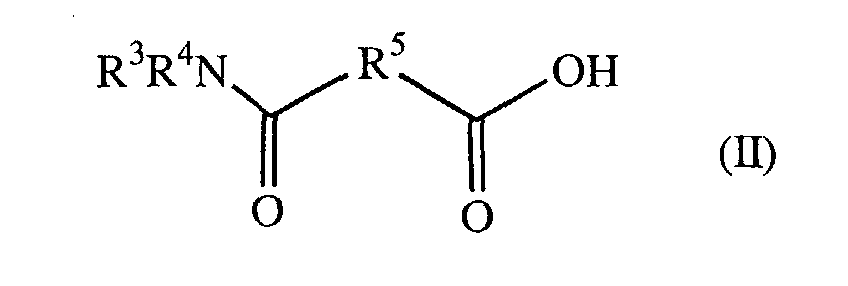
- a compound used in the composition or method of this invention preferably is represented by formula (II), wherein R 5 is C 1 -C 70 difunctional alkyl or C 6 -C 14 difunctional aryl, and R 3 and R 4 independently are hydrogen or organic functional groups.
- R 3 and R 4 independently are hydrogen, alkyl, heteroalkyl, heterocyclic, aryl or aralkyl.
- at least one of R 3 , R 4 and R 5 has at least 12 carbon atoms, and most preferably at least 15 carbon atoms.
- an "organic functional group” is a functional group which does not contain metal atoms, and which has from one to seventy carbon atoms, hydrogen atoms, and optionally, contains heteroatoms, including but not limited to: nitrogen, oxygen, sulfur, phosphorus and halogen atoms.
- An organic functional group optionally contains double and/or triple bonds; rings, which are linked or fused; and if it is wholly or partly acyclic, the acyclic part can be linear or branched.
- an organic functional group is an alkyl, heteroalkyl, aryl, aralkyl, heterocyclic or heterocyclic-alkyl group.
- At least one of the organic functional groups is a C 2 -C 22 alkyl or heteroalkyl group, more preferably a C 8 -C 22 alkyl or heteroalkyl group, more preferably a C 10 -C 22 alkyl or heteroalkyl group, and most preferably, a C 16 -C 22 alkyl group.
- alkyl and heteroalkyl groups are unsubstituted.
- a compound used in this invention optionally contains other carboxyl or amide functional groups on one or more of the organic functional groups, preferably for a total of one to three carboxyl and/or amide functional groups. Preferably, only one carboxyl group and one amide group are present.
- R 5 is C 1 -C 3 difunctional alkyl.
- R 5 is C 11 -C 19 difunctional alkyl in which the points of attachment are on the same carbon of the alkyl group, e.g., wherein R 6 is C 10 -C 18 alkyl.
- R 6 is C 16 -C 18 alkyl.
- R 5 is C 50 -C 70 difunctional alkyl, preferably in which the points of attachment are on adjacent carbon atoms of the difunctional alkyl group, most preferably on adjacent carbon atoms at one end of the difunctional alkyl, i.e., -CH 2 CH(C 50-70 )-.
- Compounds of this type are derived, for example, from reaction of an amine with polyisobutylene succinic anhydride, which has a polyisobutylene group having from 50 to 70 carbon atoms as a substituent on a succinic anhydride ring carbon.
- R 3 is hydrogen and R 4 is C 10 -C 22 alkyl, preferably C 16 -C 22 alkyl.
- R 4 is derived from an unsubstituted C 16 -C 22 alkyl amine, R 4 NH 2 , preferably one which is an oil-soluble amine.
- the alkyl amine is a tertiary alkyl primary amine., i.e., a primary amine in which the alkyl group is attached to the amino group through a tertiary carbon. Examples of commercially available tertiary alkyl primary amines are the PrimeneTM amines available from Rohm and Haas Company, Philadelphia, PA.
- the compound of formula (II) is selected from the group consisting of and wherein R 7 is C 50 -C 70 alkyl and R 8 is C 2 -C 22 difunctional alkyl or heteroalkyl, preferably C 2 -C 8 difunctional alkyl or heteroalkyl.
- R 7 is C 50 -C 70 alkyl
- R 8 is C 2 -C 22 difunctional alkyl or heteroalkyl, preferably C 2 -C 8 difunctional alkyl or heteroalkyl.
- Reaction of an alkyl amine, R 4 NH 2 with succinic, maleic or phthalic anhydride produces a compound of formula (III), (IV) or (V), respectively.
- Tertiary alkyl primary amines are preferred amines for this reaction.
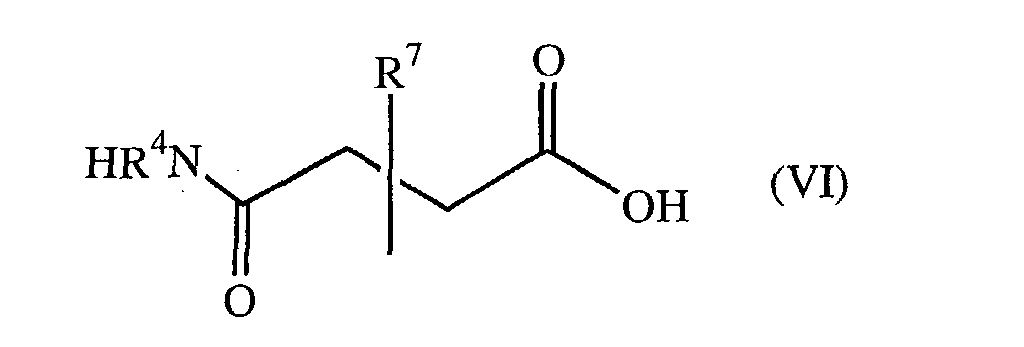
- R 4 Reaction of an alkyl amine, R 4 NH 2 with polyisobutylene succinic anhydride (PIBSA) produces a compound of formula (VI), and reaction of a diamine H 2 NR 8 NH 2 with PIBSA produces a compound of formula (VII).
- R 8 is C 4 -C 8 difunctional heteroalkyl, and preferably is derived from a diamine selected from among diethylenetriamine, triethylenetetramine and tetraethylenepentamine.
- the composition of the present invention typically also increases demulsibility, reduces viscosity, reduces sediment formation, reduces surface fouling and reduces corrosion.
- the composition of the present invention can be injected directly into an injection well, or preferably diluted with solvent prior to injection.
- Suitable solvents include but are not limited to: petroleum distillates such as kerosene and gas oil; linear and branched aliphatic solvents such as pentane, hexane, mixtures of nonanes and 2-ethylhexanes; cycloaliphatic mixtures commonly known as naphtha; aromatic solvents such as toluene, xylenes and commercial aromatic solvent mixtures; esters; ethers; alcohols such as ethanol, isopropanol, octanol and dodecanol; ketones such as acetone, cyclohexanone and acetophenone; and other polar solvents.
- petroleum distillates such as kerosene and gas oil
- linear and branched aliphatic solvents such as pentane, hexane, mixtures of nonanes and 2-ethylhexanes
- cycloaliphatic mixtures commonly known as naphtha
- aromatic solvents such as toluen
- Preferred dilutions are 0.01 to 50 wt% of the compound in the solvent, more preferred dilutions being 0.01 to 20 wt%, more preferred dilutions being 0.1 to 10%, and most preferred dilutions being 1 to 10 wt %.
- Asphaltene Dispersancy-test tube method This test requires a previously made dispersion of asphaltene in xylenes (Aromatic 150 solvent) or asphaltenic heavy crude diluted in xylenes (Aromatic 150 solvent) at a known concentration.
- a solution of an additive formulation (0.1 mL, the active ingredient was typically at 5-10 wt%, making the treat rate 500-1000 ppm) was taken in to a 15.0 mL graduated glass centrifuge tube, and hexanes added such that the total volume in the tube became 10.0 mL.
- asphaltenic stock solution 0.1 mL
- the test tube was then capped, shaken vigorously for about a minute or 40-60 times by hand and allowed to stand.
- the volume of any precipitated asphaltenes settled at the bottom of the tube was recorded at 10, 30, 60, 90 and 1440 (24 h) min intervals.
- the volume of asphaltenes precipitated in the first 0.5-1 h was 0.4-0.5 mL (4-5%); in fact, it was important to initially adjust the concentration of the asphaltene stock in such a way that under these conditions of dilution with paraffinic solvents, a 4-5 vol% of asphaltenic precipitation occurred.
- the treat rate is the concentration of the compound in the crude oil.
- AROMATIC 150 SOLVENT is a solvent mixture with a boiling range of 184-204°C which contains xylene isomers, and which is available from Exxon Mobil Chemical Co., Houston TX.
Landscapes
- Chemical & Material Sciences (AREA)
- Oil, Petroleum & Natural Gas (AREA)
- Engineering & Computer Science (AREA)
- Chemical Kinetics & Catalysis (AREA)
- General Chemical & Material Sciences (AREA)
- Organic Chemistry (AREA)
- Lubricants (AREA)
- Emulsifying, Dispersing, Foam-Producing Or Wetting Agents (AREA)
- Production Of Liquid Hydrocarbon Mixture For Refining Petroleum (AREA)
Abstract

Description





| compound | rating | |
| (III) | R4 = C-16-22 (derived from Primene™ JM-T amine) | |
| formulated at 20% in AROMATIC 150 SOLVENT; treat rate: 2000 ppm | 2 | |
| (IV) | R4 = C-16-22 (derived from Primene™ JM-T amine) | |
| formulated at 20% in AROMATIC 150 SOLVENT; treat rate: 2000 ppm | 2 |
Claims (10)
- A composition comprising:provided that said at least one compound is not represented by formula (I)(a) 0.001% to 20% of at least one compound having: (i) at least one carboxyl group; (ii) at least one amide group; and (iii) at least fifteen carbon atoms; and(b) crude oil;wherein R1 and R2 independently are hydrogen or C1-C22 alkyl and n is one or two.

- The composition of claim 1 in which said at least one compound is represented by formula (II),wherein R5 is C1-C70 difunctional alkyl, and R3 and R4 independently are hydrogen or organic functional groups.

- The composition of claim 2 in which R3 is hydrogen, R4 is C16-C22 alkyl and R5 is -CH2-, -CH2CH2-, -CH2CH2CH2-, -CH=CH- or o-phenylene.
- The composition of claim 2 in which R3 and R4 are alkyl and R5 is C11-C19 difunctional alkyl with points of attachment on one carbon atom of the difunctional alkyl.
- The composition of claim 2 in which R5 is C50-C70 difunctional alkyl.
- A method for dispersing asphaltenes in a petroleum product; said method comprising adding to the petroleum product 0.001% to 20% of at least one compound having: (i) at least one carboxyl group; (ii) at least one amide group; and (iii) at least fifteen carbon atoms; andprovided that said at least one compound is not represented by formula (I)(b) crude oil;wherein R1 and R2 independently are hydrogen or C1-C22 alkyl and n is one or two.

- The method of claim 6 in which said at least one compound is represented by formula (II),wherein R5 is C1-C70 difunctional alkyl, and R3 and R4 independently are hydrogen or organic functional groups.

- The method of claim 7 in which R3 is hydrogen, R4 is C16-C22 alkyl and R5 is -CH2-, -CH2CH2-, -CH2CH2CH2-, -CH=CH- or o-phenylene.
- The method of claim 7 in which R3 and R4 are alkyl and R5 is C11-C19 difunctional alkyl with points of attachment on one carbon atom of the difunctional alkyl.
- The method of claim 7 in which R5 is C50-C70 difunctional alkyl.
Applications Claiming Priority (2)
| Application Number | Priority Date | Filing Date | Title |
|---|---|---|---|
| US37487402P | 2002-04-23 | 2002-04-23 | |
| US374874P | 2002-04-23 |
Publications (2)
| Publication Number | Publication Date |
|---|---|
| EP1359209A2 true EP1359209A2 (en) | 2003-11-05 |
| EP1359209A3 EP1359209A3 (en) | 2004-11-03 |
Family
ID=28454889
Family Applications (1)
| Application Number | Title | Priority Date | Filing Date |
|---|---|---|---|
| EP03252269A Withdrawn EP1359209A3 (en) | 2002-04-23 | 2003-04-10 | Compounds containing amide and carboxyl groups as asphaltene dispersants in crude oil |
Country Status (4)
| Country | Link |
|---|---|
| EP (1) | EP1359209A3 (en) |
| CA (1) | CA2424904A1 (en) |
| MX (1) | MXPA03003367A (en) |
| NO (1) | NO20031603L (en) |
Cited By (3)
| Publication number | Priority date | Publication date | Assignee | Title |
|---|---|---|---|---|
| EP1357171A3 (en) * | 2002-04-23 | 2004-03-17 | Rohm And Haas Company | Carbonyl, thiocarbonyl or imine containing compounds as asphaltene dispersants in crude oil |
| US7097759B2 (en) | 2003-05-23 | 2006-08-29 | Rohm And Haas Company | Carbonyl, thiocarbonyl or imine containing compounds as asphaltene dispersants in crude oil |
| EP3760696A1 (en) * | 2018-12-20 | 2021-01-06 | Infineum International Limited | Oil anti-foulant and/or asphaltene agglomeration process |
Family Cites Families (7)
| Publication number | Priority date | Publication date | Assignee | Title |
|---|---|---|---|---|
| US3095286A (en) * | 1958-05-07 | 1963-06-25 | Socony Mobil Oil Co Inc | Stabilized distillate fuel oil |
| US3224957A (en) * | 1962-01-12 | 1965-12-21 | Nalco Chemical Co | Process of reducing deposition of deposits on heat exchange surfaces in petroleum refinery operations |
| GB1117643A (en) * | 1964-11-18 | 1968-06-19 | Rohm & Haas | Imides and related compounds |
| FR2576032B1 (en) * | 1985-01-17 | 1987-02-06 | Elf France | HOMOGENEOUS AND STABLE COMPOSITION OF ASPHALTENIC LIQUID HYDROCARBONS AND AT LEAST ONE ADDITIVE USABLE IN PARTICULAR AS FUEL INDUSTRIAL |
| DE69025404T2 (en) * | 1989-08-08 | 1996-07-04 | Stepan Co | CYCLIC AMIDOCARBOXY SURFACE ACTIVE CONNECTIONS, PRODUCTION AND THEIR USE |
| GB9200694D0 (en) * | 1992-01-14 | 1992-03-11 | Exxon Chemical Patents Inc | Additives and fuel compositions |
| EP0662504A1 (en) * | 1994-01-10 | 1995-07-12 | Nalco Chemical Company | Corrosion inhibition and iron sulfide dispersing in refineries using the reaction product of a hydrocarbyl succinic anhydride and an amine |
-
2003
- 2003-04-09 NO NO20031603A patent/NO20031603L/en unknown
- 2003-04-09 CA CA 2424904 patent/CA2424904A1/en not_active Abandoned
- 2003-04-10 EP EP03252269A patent/EP1359209A3/en not_active Withdrawn
- 2003-04-15 MX MXPA03003367 patent/MXPA03003367A/en unknown
Cited By (3)
| Publication number | Priority date | Publication date | Assignee | Title |
|---|---|---|---|---|
| EP1357171A3 (en) * | 2002-04-23 | 2004-03-17 | Rohm And Haas Company | Carbonyl, thiocarbonyl or imine containing compounds as asphaltene dispersants in crude oil |
| US7097759B2 (en) | 2003-05-23 | 2006-08-29 | Rohm And Haas Company | Carbonyl, thiocarbonyl or imine containing compounds as asphaltene dispersants in crude oil |
| EP3760696A1 (en) * | 2018-12-20 | 2021-01-06 | Infineum International Limited | Oil anti-foulant and/or asphaltene agglomeration process |
Also Published As
| Publication number | Publication date |
|---|---|
| EP1359209A3 (en) | 2004-11-03 |
| NO20031603D0 (en) | 2003-04-09 |
| NO20031603L (en) | 2003-10-24 |
| MXPA03003367A (en) | 2005-08-16 |
| CA2424904A1 (en) | 2003-10-23 |
Similar Documents
| Publication | Publication Date | Title |
|---|---|---|
| US7122112B2 (en) | Compounds containing amide and carboxyl groups as asphaltene dispersants in crude oil | |
| EP1807480B1 (en) | Asphaltene inhibition | |
| EP1666570B1 (en) | Formulations useful as asphaltene dispersants in petroleum products | |
| US5503643A (en) | Substituted fullerenes as flow improvers | |
| JPH08507315A (en) | Petroleum middle distillate composition containing a paraffin sedimentation rate limiting agent | |
| US20070051033A1 (en) | Pour point reduction and paraffin deposition reduction by use of imidazolines | |
| US20070124990A1 (en) | Asphaltene dispersants for petroleum products | |
| US3095286A (en) | Stabilized distillate fuel oil | |
| US20100051508A1 (en) | Asphaltense-stabilising molecules having a tetrapyrrolic ring | |
| US7097759B2 (en) | Carbonyl, thiocarbonyl or imine containing compounds as asphaltene dispersants in crude oil | |
| US20040232042A1 (en) | Amine-acid reaction products as asphaltene dispersants in crude oil | |
| EP1357172B1 (en) | Oil-soluble imine-acid reaction products as asphaltene dispersants in crude oil | |
| EP1359208A2 (en) | Amine-acid reaction products as asphaltene dispersants in crude oil | |
| DE69623492T2 (en) | METHOD FOR REDUCING THE WAX EXPOSURE TEMPERATURE OF RAW OIL CONTAINING WAX | |
| US20040232043A1 (en) | Amine-unsaturated acid adducts as asphaltene dispersants in crude oil | |
| US20040232044A1 (en) | Oil-soluble imine-acid reaction products as asphaltene dispersants in crude oil | |
| EP1359206A1 (en) | Amine-unsaturated acid adducts as asphaltene dispersants in crude oil | |
| EP3562915B1 (en) | Amine based hydrogen sulfide scavenging additive compositions of copper salts, and medium comprising the same | |
| EP1357171A2 (en) | Carbonyl, thiocarbonyl or imine containing compounds as asphaltene dispersants in crude oil | |
| CA2424904A1 (en) | Compounds containing amide and carboxyl groups as asphaltene dispersants in crude oil | |
| US20070074449A1 (en) | Additive concentrate | |
| EP1721955B1 (en) | Fuel compositions | |
| US5455358A (en) | Fuel compositions containing alkyl-substituted cyclic urea-substituted amines | |
| CN114292205A (en) | Marine fuel oil stability additive and preparation method thereof |
Legal Events
| Date | Code | Title | Description |
|---|---|---|---|
| PUAI | Public reference made under article 153(3) epc to a published international application that has entered the european phase |
Free format text: ORIGINAL CODE: 0009012 |
|
| 17P | Request for examination filed |
Effective date: 20030426 |
|
| AK | Designated contracting states |
Kind code of ref document: A2 Designated state(s): AT BE BG CH CY CZ DE DK EE ES FI FR GB GR HU IE IT LI LU MC NL PT RO SE SI SK TR |
|
| AX | Request for extension of the european patent |
Extension state: AL LT LV MK |
|
| PUAL | Search report despatched |
Free format text: ORIGINAL CODE: 0009013 |
|
| AK | Designated contracting states |
Kind code of ref document: A3 Designated state(s): AT BE BG CH CY CZ DE DK EE ES FI FR GB GR HU IE IT LI LU MC NL PT RO SE SI SK TR |
|
| AX | Request for extension of the european patent |
Extension state: AL LT LV MK |
|
| AKX | Designation fees paid |
Designated state(s): DE FR GB |
|
| GRAP | Despatch of communication of intention to grant a patent |
Free format text: ORIGINAL CODE: EPIDOSNIGR1 |
|
| STAA | Information on the status of an ep patent application or granted ep patent |
Free format text: STATUS: THE APPLICATION IS DEEMED TO BE WITHDRAWN |
|
| 18D | Application deemed to be withdrawn |
Effective date: 20090709 |