EP1358886A1 - Excretion accelerator for accumulative chlorine compound - Google Patents
Excretion accelerator for accumulative chlorine compound Download PDFInfo
- Publication number
- EP1358886A1 EP1358886A1 EP01998170A EP01998170A EP1358886A1 EP 1358886 A1 EP1358886 A1 EP 1358886A1 EP 01998170 A EP01998170 A EP 01998170A EP 01998170 A EP01998170 A EP 01998170A EP 1358886 A1 EP1358886 A1 EP 1358886A1
- Authority
- EP
- European Patent Office
- Prior art keywords
- containing compound
- agent
- chlorine
- anion exchange
- accumulative
- Prior art date
- Legal status (The legal status is an assumption and is not a legal conclusion. Google has not performed a legal analysis and makes no representation as to the accuracy of the status listed.)
- Granted
Links
Classifications
-
- A—HUMAN NECESSITIES
- A61—MEDICAL OR VETERINARY SCIENCE; HYGIENE
- A61K—PREPARATIONS FOR MEDICAL, DENTAL OR TOILETRY PURPOSES
- A61K31/00—Medicinal preparations containing organic active ingredients
- A61K31/74—Synthetic polymeric materials
- A61K31/785—Polymers containing nitrogen
- A61K31/787—Polymers containing nitrogen containing heterocyclic rings having nitrogen as a ring hetero atom
-
- A—HUMAN NECESSITIES
- A61—MEDICAL OR VETERINARY SCIENCE; HYGIENE
- A61K—PREPARATIONS FOR MEDICAL, DENTAL OR TOILETRY PURPOSES
- A61K31/00—Medicinal preparations containing organic active ingredients
- A61K31/74—Synthetic polymeric materials
- A61K31/785—Polymers containing nitrogen
-
- A—HUMAN NECESSITIES
- A61—MEDICAL OR VETERINARY SCIENCE; HYGIENE
- A61P—SPECIFIC THERAPEUTIC ACTIVITY OF CHEMICAL COMPOUNDS OR MEDICINAL PREPARATIONS
- A61P1/00—Drugs for disorders of the alimentary tract or the digestive system
-
- A—HUMAN NECESSITIES
- A61—MEDICAL OR VETERINARY SCIENCE; HYGIENE
- A61P—SPECIFIC THERAPEUTIC ACTIVITY OF CHEMICAL COMPOUNDS OR MEDICINAL PREPARATIONS
- A61P39/00—General protective or antinoxious agents
- A61P39/02—Antidotes
Definitions
- the present invention relates to an agent for promoting excretion of accumulative chlorine-containing compounds, which comprises a pharmaceutically acceptable anion exchange resin.
- Chlorine compounds which readily remain in vivo specifically, an accumulative chlorine-containing compound including dioxins as typical examples, have carcinogenesis and likely cause liver disorder and the like, and the compounds are transferred from a gravida to a fetus. Accordingly, effects of the compounds on a human body have been focused, and recently considered as severe problems. It is considered that approximately 90% of uptake of the accumulative chlorine-containing compounds taken into a human body comes from food, and accumulative chlorine-containing compounds after the uptake are accumulated in fatty tissues. Therefore, it is desired to provide an agent for promoting excretion of accumulative chlorine-containing compounds, which can excrete accumulative chlorine-containing compounds after being uptaken in vivo as efficiently as possible.
- an objective of the present invention is to provide an agent for promoting excretion of accumulative chlorine-containing compounds, which comprises as an active ingredient a pharmaceutically acceptable anion exchange resin.
- a pharmaceutically acceptable anion exchange resin alone as an active ingredient including colestimide (2-methylimidazol-epichlorohydrin copolymer) known as a cholesterol lowering agent, has an action of promoting excretion of accumulative chlorine-containing compounds as represented by dioxins.
- the gist of the present invention relates to an agent for promoting excretion of an accumulative chlorine-containing compound, which comprises as an active ingredient a pharmaceutically acceptable anion exchange resin.
- the above agent for promoting excretion of an accumulative chlorine-containing compound characterized in that the pharmaceutically acceptable anion exchange resin has an action of adsorbing an accumulative chlorine-containing compound labeled with a radioactive compound in Solution 2 defined in the Japanese Pharmacopoeia; the above agent for promoting excretion of an accumulative chlorine-containing compound, characterized in that the pharmaceutically acceptable anion exchange resin is selected from colestimide, cholestyramine resin, colestipol, colesevelam hydrochloride, and sevelamer hydrochloride; the above agent for promoting excretion of an accumulative chlorine-containing compound, characterized in that the pharmaceutically acceptable anion exchange resin is selected from colestimide, colestipol, colesevelam hydrochloride, and sevelamer hydrochloride; the above agent for promoting excretion of an accumulative chlorine-containing compound, characterized in that the pharmaceutically acceptable anion exchange resin is synthesized by poly
- gists of the present invention relates to a pharmaceutical composition for promoting excretion of an accumulative chlorine-containing compound, which comprises as an active ingredient a pharmaceutically acceptable anion exchange resin; a medicament for therapeutic treatment of a disease selected from toxicosis by chlorine compounds and "yusho", which comprises as an active ingredient a pharmaceutically acceptable anion exchange resin; and a method for promoting excretion of an accumulative chlorine-containing compound by using a pharmaceutically acceptable anion exchange resin as an active ingredient .
- a pharmaceutically acceptable anion exchange resin is an anion exchange resin that can be administered as a medicament, and is not particularly limited so long as the resin has an action of promoting the excretion of an accumulative chlorine-containing compound including dioxins as typical examples.
- the anion exchange resin preferably has an action of adsorbing an accumulative chlorine-containing compound labeled with a radioactive atom in Solution 2 in the Japanese Pharmacopoeia.
- a most preferred example of such class of anion exchange resin is colestimide (2-methylimidazol-epichlorohydrin copolymer).
- Colestimide has an irregularly assembled and complicated stereostructure, and is represented by the fundamental structure of the following formula (III) that is partially represented by the following formula (IV).
- the resin is obtained by polymerization reaction of an epichlorohydrin derivative with an amine including an imidazole derivative as a typical example, specifically, by the manufacturing method described in JP Patent Publication (Kokai) No. 60-209523.
- Examples of other preferable anion exchange resins include the above cholestyramine resin, and colestipol (N-(2-aminoethyl)-N'-[2-[(2-amino -ethyl)-amino]ethyl]-1, 2-ethanediamine polymer synthesized by addition of (chloromethyl)oxirane), which are sold by SIGMA.
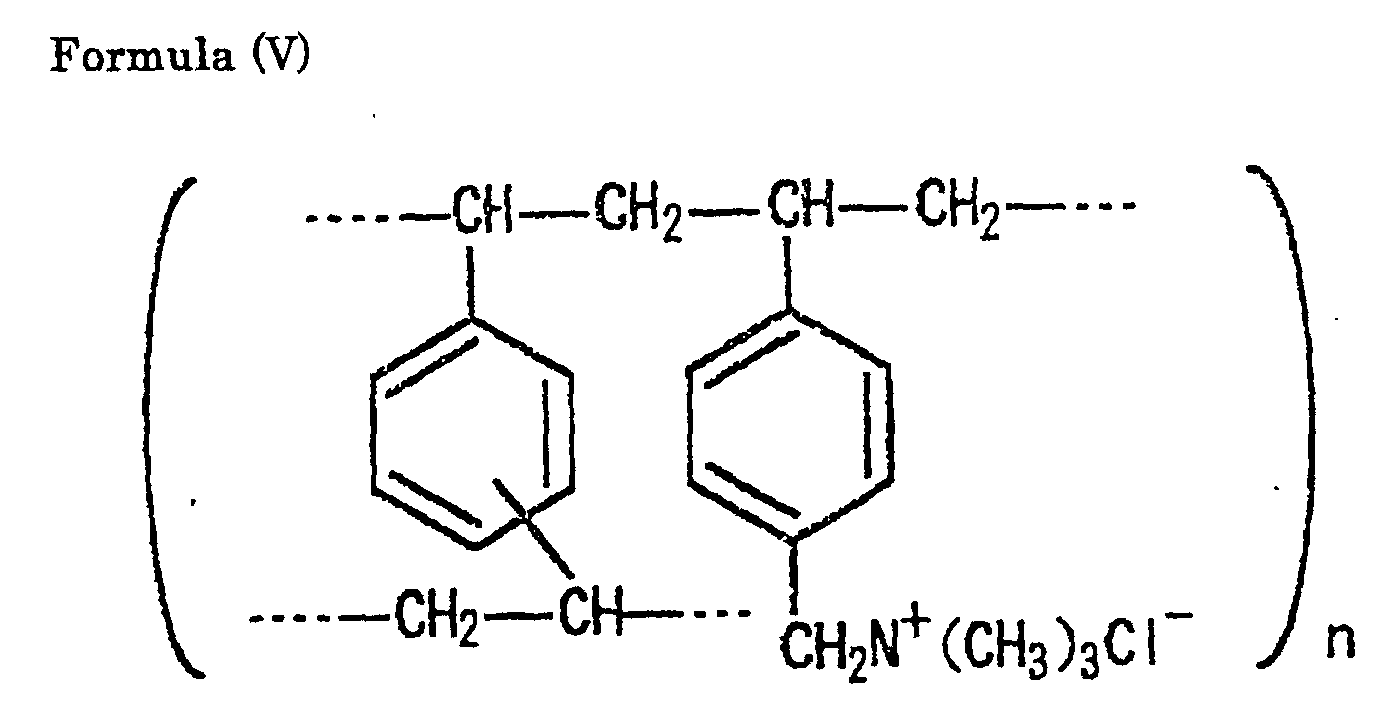
- the cholestyramine resin is a strongly basic anion exchange resin including styrene-divinylbenzene copolymer which contains quarternary ammonium groups, and its fundamental structure is represented by the following formula (V).
- the resin can be produced by the method of U.S. Patent No. 5607669, or any method similar thereto.
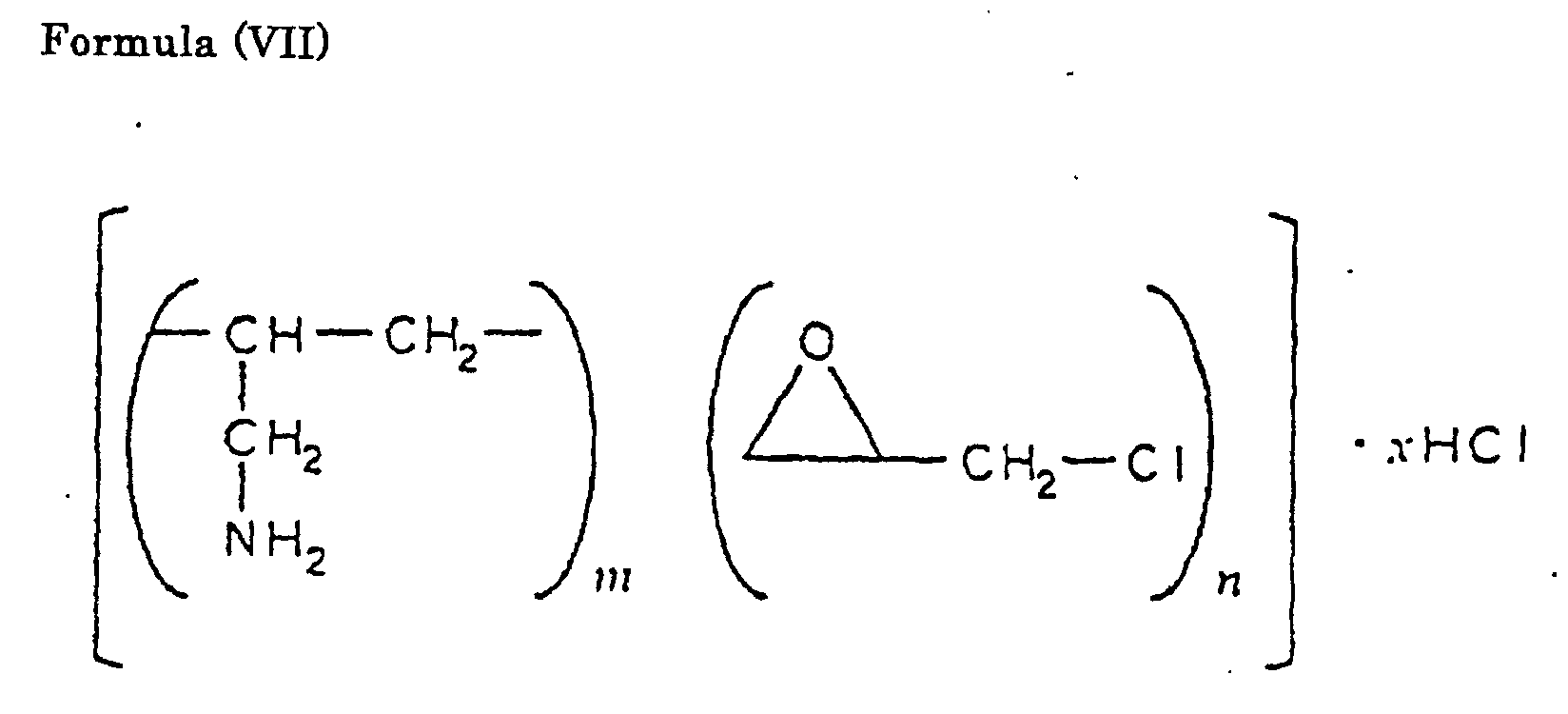
- sevelamer hydrochloride The fundamental structure of sevelamer hydrochloride is represented by the following formula (VII), and sevelamer hydrochloride can be produced by the method of U.S. Patent No. 5496545, or any method similar thereto.
- the above compound an active ingredient, per se, can be used as the agent for promoting excretion of accumulative chlorine-containing compounds of the present invention. It is preferred that a pharmaceutical composition containing the above active ingredient is manufactured by using an widely-used additive for pharmaceutical preparation, and then use the same.
- Examples of the pharmaceutical composition include tablets, capsules, subtle granules, pills, troches, and liquids, and these are orally administered.
- the pharmaceutical composition for oral administration can be manufactured by a conventional method widely used, such as mixing, filling or compressing. Further, by applying repeated formulation procedures, the active ingredient may be distributed in a pharmaceutical composition containing a large amount of excipient.
- tablets or capsules used for oral administration are preferably provided as unit dosage forms, and they may contain ordinarily used carriers for pharmaceutical preparation, such as a binder, excipient, diluent, compressing agent, lubricant, disintegrator, coloring agent, flavoring agent, and moistening agent.
- a tablet may be manufactured as a coated tablet according to a well known method in the art by using a coating agent, for example.
- Examples of a preferable excipient include cellulose, mannitol, and lactose.
- Starch, polyvinylpyrrolidone, starch derivative including sodium starch glycolate or the like as a disintegrator, and sodium lauryl sulfate or the like as a lubricant can be used as additives for the pharmaceutical preparation.
- Orally-available pharmaceutical compositions in the form of a liquid are provided as, for example, a pharmaceutical composition, such as an aqueous or oil suspension, a solution, an emulsion, a syrup, or an elixir; or a dry pharmaceutical composition which can be re-dissolved in water or an appropriate medium before use.
- a precipitation preventing agent such as sorbitol, syrup, methyl cellulose, gelatin, hydroxyethylcellulose, carboxymethylcellulose, aluminum stearate gel, or hydrogenated edible fat
- an emulsifier such as lecithin, sorbitan monooleate, or gum arabicum
- oily esters such as almond oil, refined coconut oil, or glycerin esters
- non-aqueous medium such as propylene glycol, or ethyl alcohol (edible oils may be included)
- a preservative such as methylester, ethyl ester, or propyl ester of p-hydroxybenzoic acid, or sorbic acid
- an optionally ordinarily used flavoring agent or coloring agent such as, for example, a precipitation preventing agent, such as sorbitol, syrup, methyl cellulose, gelatin, hydroxyethylcellulose, carboxymethylcellulose, aluminum stearate gel, or hydrogenated edible fat
- composition for oral administration such as in the forms of tablets, capsules, or subtilized granules generally contain 5 to 95% by weight, preferably 25 to 90% by weight of the active ingredient.
- the colestimide has been sold by Mitsubishi Pharma Corporation as a trade name of "Cholebine", and Cholebine may be used, per se, for the present invention.
- the accumulative chlorine-containing compound according to the present invention is not specifically limited, so long as the compound is a chlorinated compound that readily remains in vivo, and its excretion is promoted by the above-defined anion exchange resin.
- Typical examples include a class of dioxins.
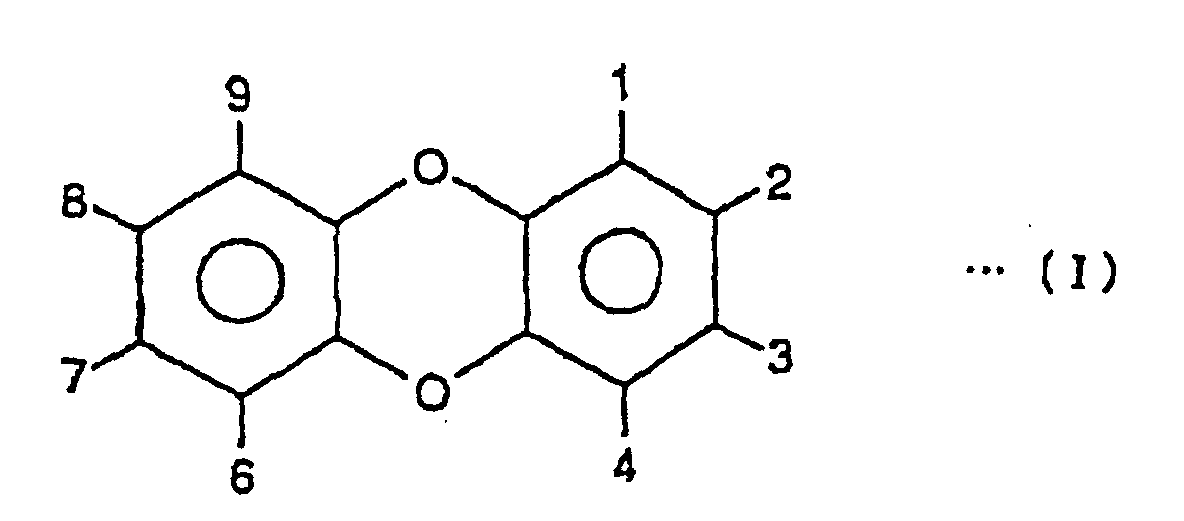
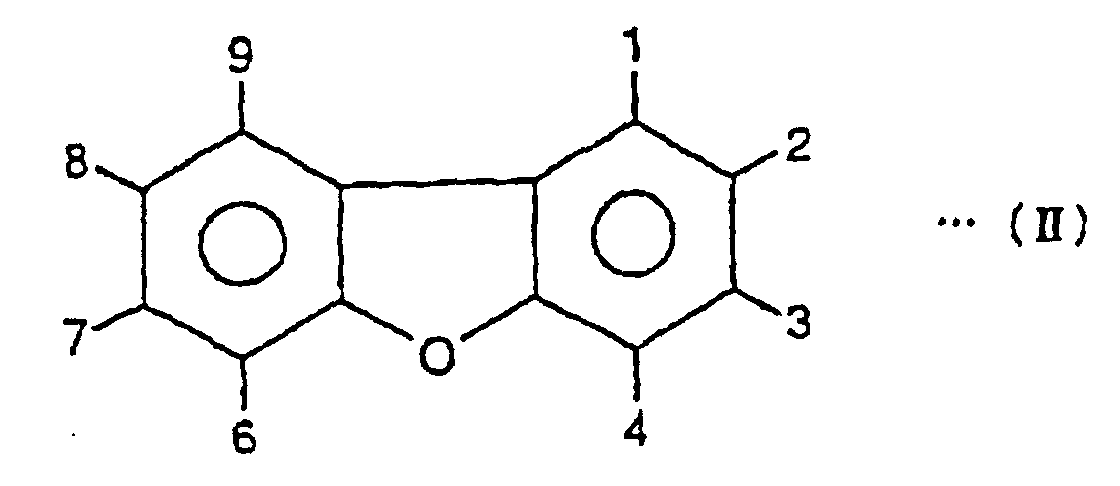
- the dioxins has a chemical structure as represented by the above formula (I) or (II) wherein 1 to 8 chlorine atoms are substituted at positions 1 to 9.
- preferred are those represented by the above general formula (I) or (II) wherein chlorine atoms are substituted at positions 2, 3, 7 and 8.
- the compound is tetrachlorodibenzodioxin.
- the agent for promoting excretion of an accumulative chlorine-containing compound of the present invention is particularly effective for treatment of toxicosis caused by chlorinated compounds and "yusho (oil poisoning sympton)".
- Dose of the agent for promoting excretion of an accumulative chlorine-containing compound of the present invention may appropriately be determined depending on the age, health conditions, and body weight of a patient, and the severity of a disease, the type of and frequency of therapy or treatment being simultaneously applied, the nature of desired effects and the like.
- a daily dose for an adult may be 1 to 60 g as a weight of the active ingredient, and the agent may be administered once or several times a day.
- the present invention will be specifically explained by referring to the examples. However, the present invention is not limited to these examples.
- the colestimide used below was produced by the preparation method described in Japanese Patent Unexamined Publication (Kokai) No. 60-209523.
- 14 C-TCDD 14 C-labeled tetrachlorodibenzodioxin
- the tubes were each stoppered tightly, agitated with a vortex mixer, and then incubated at 37°C for 10 minutes. Centrifugation was performed (3,000 rpm/min for 5 minutes), and then the supernatant (0.5 mL each) was collected in a counting vial to obtain a sample for radioactivity measurement.
- Radioactivity measurement 5 mL of a scintillation cocktail (Clear-sol, nacalai tesque) was added to each sample and the resulting mixtures were prepared for radioactivity measurement, and then measurements were carried out by using a liquid scintillation counter (TRI-CARB 2300TR, PACKARD) in which quenching correction was performed by the tSIE method (transformed Special Index of External standard). The measurement was performed once per vial for 5 minutes. A net count value was obtained by subtracting background data, which were obtained by measuring only the scintillation cocktail once for 10 minutes, from the measured value.
- Binding rate (%) (radioactivity in the filtrate when the test substance was added) / (radioactivity in the control filtrate) ⁇ 100
- colestimide adsorbs TCDD in a dose-depending manner, which is an accumulative chlorine-containing compound,.
- a novel agent for promoting excretion of an accumulative chlorine-containing compound is successfully provided, which is capable of efficiently excreting accumulative chlorine-containing compounds uptaken in vivo.
Landscapes
- Health & Medical Sciences (AREA)
- Animal Behavior & Ethology (AREA)
- Chemical & Material Sciences (AREA)
- Life Sciences & Earth Sciences (AREA)
- General Health & Medical Sciences (AREA)
- Medicinal Chemistry (AREA)
- Public Health (AREA)
- Veterinary Medicine (AREA)
- Pharmacology & Pharmacy (AREA)
- Epidemiology (AREA)
- Organic Chemistry (AREA)
- Nuclear Medicine, Radiotherapy & Molecular Imaging (AREA)
- General Chemical & Material Sciences (AREA)
- Chemical Kinetics & Catalysis (AREA)
- Toxicology (AREA)
- Engineering & Computer Science (AREA)
- Bioinformatics & Cheminformatics (AREA)
- Pharmaceuticals Containing Other Organic And Inorganic Compounds (AREA)
- Organic Low-Molecular-Weight Compounds And Preparation Thereof (AREA)
- Pyridine Compounds (AREA)
- Glass Compositions (AREA)
Abstract
Description



| Binding rates of 14C-TCDD to colestimide | ||||
| Test Compound | Amount added | Radioactivity in supernatant | Binding rate of TCDD (%) | |
| Experimental value | Average | |||
| 3399.1 | ||||
| - | 3509.8 | 3467.2 | - | |
| 3492.6 | ||||
| 3 | 1828.7 | |||
| 1948.9 | 1830.9 | 47.2 | ||
| 1715.1 | ||||
| 10 | 1177.0 | |||
| Colestimide | 1146.5 | 1194.2 | 65.6 | |
| 1259.0 | ||||
| 30 | 334.1 | |||
| 233.1 | 291.0 | 91.6 | ||
| 305.8 |
Claims (13)
- An agent for promoting excretion of an accumulative chlorine-containing compound, which comprises a pharmaceutically acceptable anion exchange resin.
- The agent for promoting excretion of an accumulative chlorine-containing compound according to claim 1, wherein the pharmaceutically acceptable anion exchange resin has an action of adsorbing an accumulative chlorine-containing compound labeled with a radioactive compound in Solution 2 of the Japanese Pharmacopoeia.
- The agent for promoting excretion of an accumulative chlorine-containing compound according to claim 1 or 2, wherein the pharmaceutically acceptable anion exchange resin is selected from colestimide, cholestyramine resin, colestipol, colesevelam hydrochloride, and sevelamer hydrochloride.
- The agent for promoting excretion of an accumulative chlorine-containing compound according to any one of claims 1 to 3, wherein the pharmaceutically acceptable anion exchange resin is selected from colestimide, colestipol, colesevelam hydrochloride, and sevelamer hydrochloride.
- The agent for promoting excretion of an accumulative chlorine-containing compound according to claim 1 or 2, wherein the pharmaceutically acceptable anion exchange resin is synthesized by polymerization reaction of an epichlorohydrin derivative with an amine.
- The agent for promoting excretion of an accumulative chlorine-containing compound according to any one of claims 1 to 5, wherein the pharmaceutically acceptable anion exchange resin is colestimide.
- The agent for promoting excretion of an accumulative chlorine-containing compound according to any one of claims 1 to 6, wherein the accumulative chlorine-containing compound is a dioxin.
- The agent for promoting excretion of an accumulative chlorine-containing compound according to claim 7, wherein the dioxin has a chemical structure as represented by the following general formula (I) or (II) wherein 1 to 8 chlorine atoms are substituted at any of positions 1 to 9;


- The agent for promoting excretion of an accumulative chlorine-containing compound according to claim 8, wherein the dioxin has a chemical structure as represented by the general formula (I) or (II) of claim 8 wherein chlorine atoms are substituted at positions 2, 3, 7, and 8.
- The agent for promoting excretion of an accumulative chlorine-containing compound according to any one of claims 7 to 9, wherein the dioxin is tetrachlorodibenzodioxin.
- A pharmaceutical composition for promoting excretion of an accumulative chlorine-containing compound, which comprises a pharmaceutically acceptable anion exchange resin as an active ingredient.
- A medicament for therapeutic treatment of a disease selected from toxicosis caused by a chlorinated compound and yusho, which comprises a pharmaceutically acceptable anion exchange resin as an active ingredient.
- A method for promoting excretion of an accumulative chlorine-containing compound by using a pharmaceutically acceptable anion exchange resin.
Applications Claiming Priority (3)
| Application Number | Priority Date | Filing Date | Title |
|---|---|---|---|
| JP2000361834 | 2000-11-28 | ||
| JP2000361834 | 2000-11-28 | ||
| PCT/JP2001/010310 WO2002043744A1 (en) | 2000-11-28 | 2001-11-27 | Excretion accelerator for accumulative chlorine compound |
Publications (3)
| Publication Number | Publication Date |
|---|---|
| EP1358886A1 true EP1358886A1 (en) | 2003-11-05 |
| EP1358886A4 EP1358886A4 (en) | 2005-08-17 |
| EP1358886B1 EP1358886B1 (en) | 2010-07-07 |
Family
ID=18833210
Family Applications (1)
| Application Number | Title | Priority Date | Filing Date |
|---|---|---|---|
| EP01998170A Expired - Lifetime EP1358886B1 (en) | 2000-11-28 | 2001-11-27 | Excretion accelerator for accumulative chlorine compound |
Country Status (11)
| Country | Link |
|---|---|
| US (1) | US8173114B2 (en) |
| EP (1) | EP1358886B1 (en) |
| JP (1) | JP4270540B2 (en) |
| KR (1) | KR100782245B1 (en) |
| CN (1) | CN1273144C (en) |
| AT (1) | ATE473007T1 (en) |
| AU (1) | AU2002224109A1 (en) |
| CA (1) | CA2430123C (en) |
| DE (1) | DE60142527D1 (en) |
| ES (1) | ES2349093T3 (en) |
| WO (1) | WO2002043744A1 (en) |
Families Citing this family (2)
| Publication number | Priority date | Publication date | Assignee | Title |
|---|---|---|---|---|
| KR100924478B1 (en) * | 2001-07-30 | 2009-11-03 | 미쓰비시 타나베 파마 코퍼레이션 | Postprandial Hyperglycemic Enhancers |
| DE102004007358B4 (en) * | 2004-02-16 | 2017-10-12 | Chiron As | Congeners, chlorinated, brominated and / or iodinated fluorinated aromatic compounds containing two benzene rings in their basic structure, process for their preparation and their use |
Family Cites Families (10)
| Publication number | Priority date | Publication date | Assignee | Title |
|---|---|---|---|---|
| JPS60209523A (en) | 1984-04-03 | 1985-10-22 | Mitsubishi Petrochem Co Ltd | Antilipemic agent |
| US5840339A (en) * | 1991-07-30 | 1998-11-24 | Kunin; Robert | Blood cholesterol reducing pharmaceutical composition |
| US5607669A (en) * | 1994-06-10 | 1997-03-04 | Geltex Pharmaceuticals, Inc. | Amine polymer sequestrant and method of cholesterol depletion |
| US5496545A (en) * | 1993-08-11 | 1996-03-05 | Geltex Pharmaceuticals, Inc. | Phosphate-binding polymers for oral administration |
| US5414068A (en) | 1994-01-24 | 1995-05-09 | Rohm And Haas Company | Crosslinked anion exchange particles and method for producing the particles |
| TW474813B (en) | 1994-06-10 | 2002-02-01 | Geltex Pharma Inc | Alkylated composition for removing bile salts from a patient |
| US5521214A (en) * | 1995-01-25 | 1996-05-28 | Eli Lilly And Company | Methods of inhibiting environmental estrogens |
| EP0793960B1 (en) * | 1996-03-05 | 2001-08-01 | Mitsubishi Chemical Corporation | Use of anion exchange resins for the manufacture of a medicament for the treatment of hyperphosphatemia |
| PT1140190E (en) * | 1998-12-23 | 2003-02-28 | Searle Llc | COMBINATIONS OF ILEAL TRANSPORTATION INHIBITORS OF BILIARY ACIDS AND BILIARY ACID SEQUESTRANTS AGENTS USED FOR CARDIOVASCULAR PROBLEMS |
| US6733780B1 (en) * | 1999-10-19 | 2004-05-11 | Genzyme Corporation | Direct compression polymer tablet core |
-
2001
- 2001-11-27 CN CNB018196209A patent/CN1273144C/en not_active Expired - Fee Related
- 2001-11-27 DE DE60142527T patent/DE60142527D1/en not_active Expired - Lifetime
- 2001-11-27 JP JP2002545714A patent/JP4270540B2/en not_active Expired - Fee Related
- 2001-11-27 CA CA2430123A patent/CA2430123C/en not_active Expired - Fee Related
- 2001-11-27 AU AU2002224109A patent/AU2002224109A1/en not_active Abandoned
- 2001-11-27 US US10/432,871 patent/US8173114B2/en not_active Expired - Fee Related
- 2001-11-27 ES ES01998170T patent/ES2349093T3/en not_active Expired - Lifetime
- 2001-11-27 AT AT01998170T patent/ATE473007T1/en not_active IP Right Cessation
- 2001-11-27 KR KR1020037006244A patent/KR100782245B1/en not_active Expired - Fee Related
- 2001-11-27 WO PCT/JP2001/010310 patent/WO2002043744A1/en not_active Ceased
- 2001-11-27 EP EP01998170A patent/EP1358886B1/en not_active Expired - Lifetime
Also Published As
| Publication number | Publication date |
|---|---|
| KR100782245B1 (en) | 2007-12-05 |
| ATE473007T1 (en) | 2010-07-15 |
| JP4270540B2 (en) | 2009-06-03 |
| CN1514730A (en) | 2004-07-21 |
| CA2430123C (en) | 2010-08-24 |
| US20040047834A1 (en) | 2004-03-11 |
| JPWO2002043744A1 (en) | 2004-04-02 |
| ES2349093T3 (en) | 2010-12-27 |
| CA2430123A1 (en) | 2002-06-06 |
| WO2002043744A1 (en) | 2002-06-06 |
| CN1273144C (en) | 2006-09-06 |
| EP1358886A4 (en) | 2005-08-17 |
| DE60142527D1 (en) | 2010-08-19 |
| US8173114B2 (en) | 2012-05-08 |
| AU2002224109A1 (en) | 2002-06-11 |
| EP1358886B1 (en) | 2010-07-07 |
| KR20030070025A (en) | 2003-08-27 |
Similar Documents
| Publication | Publication Date | Title |
|---|---|---|
| CA2586023C (en) | Aliphatic amine polymer salts for tableting | |
| US5374422A (en) | Ingestible [hydrophobic] polymeric amines useful for lowering blood cholesterol | |
| DE60224052T2 (en) | AMINPOLYMERS FOR THE TREATMENT OF GILD AND FOR THE REDUCTION OF THE HARNIC ACID CONTENT | |
| DK1923064T3 (en) | Use of amine polymer for lowering serum glucose | |
| US20020187120A1 (en) | Method for treating gout and reducing serum uric acid | |
| WO2006050314A2 (en) | Once a day formulation for phosphate binders | |
| ZA200308063B (en) | Method of lowering serum glucose. | |
| EP1413309A1 (en) | Drugs for ameliorating postcibal hyperglycemia | |
| US8173114B2 (en) | Excretion accelerator for accumulative chlorine compound | |
| EP2050456A1 (en) | Tablet | |
| AU2012200480B2 (en) | "Aliphatic amine polymer salts for tableting" | |
| EP1923064B1 (en) | Use of amine polymer for lowering serum glucose | |
| HK1237258A1 (en) | Aliphatic amine polymer salts for tableting |
Legal Events
| Date | Code | Title | Description |
|---|---|---|---|
| PUAI | Public reference made under article 153(3) epc to a published international application that has entered the european phase |
Free format text: ORIGINAL CODE: 0009012 |
|
| 17P | Request for examination filed |
Effective date: 20030618 |
|
| AK | Designated contracting states |
Kind code of ref document: A1 Designated state(s): AT BE CH CY DE DK ES FI FR GB GR IE IT LI LU MC NL PT SE TR |
|
| AX | Request for extension of the european patent |
Extension state: AL LT LV MK RO SI |
|
| A4 | Supplementary search report drawn up and despatched |
Effective date: 20050701 |
|
| RAP1 | Party data changed (applicant data changed or rights of an application transferred) |
Owner name: MITSUBISHI TANABE PHARMA CORPORATION |
|
| GRAP | Despatch of communication of intention to grant a patent |
Free format text: ORIGINAL CODE: EPIDOSNIGR1 |
|
| GRAS | Grant fee paid |
Free format text: ORIGINAL CODE: EPIDOSNIGR3 |
|
| GRAA | (expected) grant |
Free format text: ORIGINAL CODE: 0009210 |
|
| RAP1 | Party data changed (applicant data changed or rights of an application transferred) |
Owner name: MITSUBISHI TANABE PHARMA CORPORATION |
|
| AK | Designated contracting states |
Kind code of ref document: B1 Designated state(s): AT BE CH CY DE DK ES FI FR GB GR IE IT LI LU MC NL PT SE TR |
|
| REG | Reference to a national code |
Ref country code: GB Ref legal event code: FG4D |
|
| REG | Reference to a national code |
Ref country code: CH Ref legal event code: EP |
|
| REG | Reference to a national code |
Ref country code: IE Ref legal event code: FG4D |
|
| REF | Corresponds to: |
Ref document number: 60142527 Country of ref document: DE Date of ref document: 20100819 Kind code of ref document: P |
|
| REG | Reference to a national code |
Ref country code: NL Ref legal event code: T3 |
|
| REG | Reference to a national code |
Ref country code: SE Ref legal event code: TRGR |
|
| REG | Reference to a national code |
Ref country code: ES Ref legal event code: FG2A Effective date: 20101214 |
|
| PG25 | Lapsed in a contracting state [announced via postgrant information from national office to epo] |
Ref country code: AT Free format text: LAPSE BECAUSE OF FAILURE TO SUBMIT A TRANSLATION OF THE DESCRIPTION OR TO PAY THE FEE WITHIN THE PRESCRIBED TIME-LIMIT Effective date: 20100707 Ref country code: FI Free format text: LAPSE BECAUSE OF FAILURE TO SUBMIT A TRANSLATION OF THE DESCRIPTION OR TO PAY THE FEE WITHIN THE PRESCRIBED TIME-LIMIT Effective date: 20100707 |
|
| PG25 | Lapsed in a contracting state [announced via postgrant information from national office to epo] |
Ref country code: CY Free format text: LAPSE BECAUSE OF FAILURE TO SUBMIT A TRANSLATION OF THE DESCRIPTION OR TO PAY THE FEE WITHIN THE PRESCRIBED TIME-LIMIT Effective date: 20100707 Ref country code: PT Free format text: LAPSE BECAUSE OF FAILURE TO SUBMIT A TRANSLATION OF THE DESCRIPTION OR TO PAY THE FEE WITHIN THE PRESCRIBED TIME-LIMIT Effective date: 20101108 |
|
| PG25 | Lapsed in a contracting state [announced via postgrant information from national office to epo] |
Ref country code: GR Free format text: LAPSE BECAUSE OF FAILURE TO SUBMIT A TRANSLATION OF THE DESCRIPTION OR TO PAY THE FEE WITHIN THE PRESCRIBED TIME-LIMIT Effective date: 20101008 |
|
| PG25 | Lapsed in a contracting state [announced via postgrant information from national office to epo] |
Ref country code: DK Free format text: LAPSE BECAUSE OF FAILURE TO SUBMIT A TRANSLATION OF THE DESCRIPTION OR TO PAY THE FEE WITHIN THE PRESCRIBED TIME-LIMIT Effective date: 20100707 |
|
| PLBE | No opposition filed within time limit |
Free format text: ORIGINAL CODE: 0009261 |
|
| STAA | Information on the status of an ep patent application or granted ep patent |
Free format text: STATUS: NO OPPOSITION FILED WITHIN TIME LIMIT |
|
| 26N | No opposition filed |
Effective date: 20110408 |
|
| PG25 | Lapsed in a contracting state [announced via postgrant information from national office to epo] |
Ref country code: MC Free format text: LAPSE BECAUSE OF NON-PAYMENT OF DUE FEES Effective date: 20101130 |
|
| REG | Reference to a national code |
Ref country code: CH Ref legal event code: PL |
|
| REG | Reference to a national code |
Ref country code: DE Ref legal event code: R097 Ref document number: 60142527 Country of ref document: DE Effective date: 20110408 |
|
| PG25 | Lapsed in a contracting state [announced via postgrant information from national office to epo] |
Ref country code: LI Free format text: LAPSE BECAUSE OF NON-PAYMENT OF DUE FEES Effective date: 20101130 Ref country code: CH Free format text: LAPSE BECAUSE OF NON-PAYMENT OF DUE FEES Effective date: 20101130 |
|
| PG25 | Lapsed in a contracting state [announced via postgrant information from national office to epo] |
Ref country code: IE Free format text: LAPSE BECAUSE OF NON-PAYMENT OF DUE FEES Effective date: 20101127 |
|
| PG25 | Lapsed in a contracting state [announced via postgrant information from national office to epo] |
Ref country code: LU Free format text: LAPSE BECAUSE OF NON-PAYMENT OF DUE FEES Effective date: 20101127 |
|
| PG25 | Lapsed in a contracting state [announced via postgrant information from national office to epo] |
Ref country code: TR Free format text: LAPSE BECAUSE OF FAILURE TO SUBMIT A TRANSLATION OF THE DESCRIPTION OR TO PAY THE FEE WITHIN THE PRESCRIBED TIME-LIMIT Effective date: 20100707 |
|
| PGFP | Annual fee paid to national office [announced via postgrant information from national office to epo] |
Ref country code: ES Payment date: 20141013 Year of fee payment: 14 Ref country code: DE Payment date: 20141118 Year of fee payment: 14 Ref country code: FR Payment date: 20141110 Year of fee payment: 14 Ref country code: GB Payment date: 20141126 Year of fee payment: 14 Ref country code: SE Payment date: 20141111 Year of fee payment: 14 |
|
| PGFP | Annual fee paid to national office [announced via postgrant information from national office to epo] |
Ref country code: NL Payment date: 20141010 Year of fee payment: 14 |
|
| PGFP | Annual fee paid to national office [announced via postgrant information from national office to epo] |
Ref country code: IT Payment date: 20141110 Year of fee payment: 14 |
|
| PGFP | Annual fee paid to national office [announced via postgrant information from national office to epo] |
Ref country code: BE Payment date: 20141111 Year of fee payment: 14 |
|
| REG | Reference to a national code |
Ref country code: DE Ref legal event code: R119 Ref document number: 60142527 Country of ref document: DE |
|
| GBPC | Gb: european patent ceased through non-payment of renewal fee |
Effective date: 20151127 |
|
| PG25 | Lapsed in a contracting state [announced via postgrant information from national office to epo] |
Ref country code: IT Free format text: LAPSE BECAUSE OF NON-PAYMENT OF DUE FEES Effective date: 20151127 |
|
| REG | Reference to a national code |
Ref country code: NL Ref legal event code: MM Effective date: 20151201 |
|
| REG | Reference to a national code |
Ref country code: FR Ref legal event code: ST Effective date: 20160729 |
|
| PG25 | Lapsed in a contracting state [announced via postgrant information from national office to epo] |
Ref country code: SE Free format text: LAPSE BECAUSE OF NON-PAYMENT OF DUE FEES Effective date: 20151128 |
|
| PG25 | Lapsed in a contracting state [announced via postgrant information from national office to epo] |
Ref country code: NL Free format text: LAPSE BECAUSE OF NON-PAYMENT OF DUE FEES Effective date: 20151201 |
|
| PG25 | Lapsed in a contracting state [announced via postgrant information from national office to epo] |
Ref country code: GB Free format text: LAPSE BECAUSE OF NON-PAYMENT OF DUE FEES Effective date: 20151127 Ref country code: DE Free format text: LAPSE BECAUSE OF NON-PAYMENT OF DUE FEES Effective date: 20160601 |
|
| PG25 | Lapsed in a contracting state [announced via postgrant information from national office to epo] |
Ref country code: FR Free format text: LAPSE BECAUSE OF NON-PAYMENT OF DUE FEES Effective date: 20151130 |
|
| REG | Reference to a national code |
Ref country code: ES Ref legal event code: FD2A Effective date: 20161227 |
|
| PG25 | Lapsed in a contracting state [announced via postgrant information from national office to epo] |
Ref country code: ES Free format text: LAPSE BECAUSE OF NON-PAYMENT OF DUE FEES Effective date: 20151128 |
|
| PG25 | Lapsed in a contracting state [announced via postgrant information from national office to epo] |
Ref country code: BE Free format text: LAPSE BECAUSE OF NON-PAYMENT OF DUE FEES Effective date: 20151130 |