EP1357539A1 - Procédé d'assemblage et de contrôle d'un panneau acoustique à double resonateur avec âme en nid d'abeille - Google Patents
Procédé d'assemblage et de contrôle d'un panneau acoustique à double resonateur avec âme en nid d'abeille Download PDFInfo
- Publication number
- EP1357539A1 EP1357539A1 EP03290979A EP03290979A EP1357539A1 EP 1357539 A1 EP1357539 A1 EP 1357539A1 EP 03290979 A EP03290979 A EP 03290979A EP 03290979 A EP03290979 A EP 03290979A EP 1357539 A1 EP1357539 A1 EP 1357539A1
- Authority
- EP
- European Patent Office
- Prior art keywords
- septum
- pixels
- assembly
- camera
- honeycomb
- Prior art date
- Legal status (The legal status is an assumption and is not a legal conclusion. Google has not performed a legal analysis and makes no representation as to the accuracy of the status listed.)
- Granted
Links
- 238000000034 method Methods 0.000 title claims description 33
- 238000004519 manufacturing process Methods 0.000 title description 2
- 241000264877 Hippospongia communis Species 0.000 claims description 61
- 238000004026 adhesive bonding Methods 0.000 claims description 9
- 239000003292 glue Substances 0.000 claims description 8
- 230000002950 deficient Effects 0.000 claims description 6
- 238000007689 inspection Methods 0.000 claims description 2
- 241000257303 Hymenoptera Species 0.000 claims 1
- 241000256815 Apocrita Species 0.000 description 17
- 238000005192 partition Methods 0.000 description 10
- 239000004744 fabric Substances 0.000 description 8
- 238000005259 measurement Methods 0.000 description 8
- 238000005553 drilling Methods 0.000 description 5
- 239000011347 resin Substances 0.000 description 5
- 229920005989 resin Polymers 0.000 description 5
- 239000000853 adhesive Substances 0.000 description 4
- 230000001070 adhesive effect Effects 0.000 description 4
- 239000011159 matrix material Substances 0.000 description 4
- 239000002131 composite material Substances 0.000 description 3
- OKTJSMMVPCPJKN-UHFFFAOYSA-N Carbon Chemical compound [C] OKTJSMMVPCPJKN-UHFFFAOYSA-N 0.000 description 2
- 229920000271 Kevlar® Polymers 0.000 description 2
- XAGFODPZIPBFFR-UHFFFAOYSA-N aluminium Chemical compound [Al] XAGFODPZIPBFFR-UHFFFAOYSA-N 0.000 description 2
- 229910052782 aluminium Inorganic materials 0.000 description 2
- 229910052799 carbon Inorganic materials 0.000 description 2
- 230000007547 defect Effects 0.000 description 2
- 238000002474 experimental method Methods 0.000 description 2
- 239000003365 glass fiber Substances 0.000 description 2
- 239000004761 kevlar Substances 0.000 description 2
- 239000000203 mixture Substances 0.000 description 2
- 238000006116 polymerization reaction Methods 0.000 description 2
- 230000003014 reinforcing effect Effects 0.000 description 2
- 238000005070 sampling Methods 0.000 description 2
- XLYOFNOQVPJJNP-UHFFFAOYSA-N water Substances O XLYOFNOQVPJJNP-UHFFFAOYSA-N 0.000 description 2
- 238000010521 absorption reaction Methods 0.000 description 1
- 238000004458 analytical method Methods 0.000 description 1
- 230000000694 effects Effects 0.000 description 1
- 239000011888 foil Substances 0.000 description 1
- 230000005484 gravity Effects 0.000 description 1
- 238000010191 image analysis Methods 0.000 description 1
- 229920000642 polymer Polymers 0.000 description 1
- 230000000379 polymerizing effect Effects 0.000 description 1
- 230000002787 reinforcement Effects 0.000 description 1
- 239000007787 solid Substances 0.000 description 1
Images


Classifications
-
- G—PHYSICS
- G10—MUSICAL INSTRUMENTS; ACOUSTICS
- G10K—SOUND-PRODUCING DEVICES; METHODS OR DEVICES FOR PROTECTING AGAINST, OR FOR DAMPING, NOISE OR OTHER ACOUSTIC WAVES IN GENERAL; ACOUSTICS NOT OTHERWISE PROVIDED FOR
- G10K11/00—Methods or devices for transmitting, conducting or directing sound in general; Methods or devices for protecting against, or for damping, noise or other acoustic waves in general
- G10K11/16—Methods or devices for protecting against, or for damping, noise or other acoustic waves in general
- G10K11/172—Methods or devices for protecting against, or for damping, noise or other acoustic waves in general using resonance effects
-
- Y—GENERAL TAGGING OF NEW TECHNOLOGICAL DEVELOPMENTS; GENERAL TAGGING OF CROSS-SECTIONAL TECHNOLOGIES SPANNING OVER SEVERAL SECTIONS OF THE IPC; TECHNICAL SUBJECTS COVERED BY FORMER USPC CROSS-REFERENCE ART COLLECTIONS [XRACs] AND DIGESTS
- Y10—TECHNICAL SUBJECTS COVERED BY FORMER USPC
- Y10T—TECHNICAL SUBJECTS COVERED BY FORMER US CLASSIFICATION
- Y10T156/00—Adhesive bonding and miscellaneous chemical manufacture
- Y10T156/10—Methods of surface bonding and/or assembly therefor
- Y10T156/1002—Methods of surface bonding and/or assembly therefor with permanent bending or reshaping or surface deformation of self sustaining lamina
- Y10T156/1003—Methods of surface bonding and/or assembly therefor with permanent bending or reshaping or surface deformation of self sustaining lamina by separating laminae between spaced secured areas [e.g., honeycomb expanding]
Definitions
- the invention relates to acoustic panels with double resonator with nest core bee and more particularly to a method of assembly and control of such panels.
- Acoustic panels with double resonator with honeycomb core are sandwich structures well known for absorbing noise, especially on aircraft powerplants. These panels usually comprise the following successive layers in the thickness direction: a first skin called “acoustic” and multi-perforated, that is to say comprising a plurality of holes, a first layer of honeycomb called “primary”, a septum also multiperforated, a second layer of honeycomb called “secondary” and a second skin called “full” because having no holes.
- the honeycombs are formed by a plurality of generally hexagonal cells, these cells being separated by thin partitions themselves comprising drainage notches to evacuate by gravity the water which would have penetrated into the acoustic panel during its operation.
- the holes of the acoustic skin and of the septum are regularly distributed and are each characterized by their perforation rate, that is to say by the ratio between the surface of the holes and the total surface of the layer considered.
- the acoustic skin and the full skin are usually made of an organic matrix composite material consisting of a variable number of layers of reinforcing fabric superimposed and embedded in a polymerized resin.
- the honeycomb layers are usually made of aluminum foil.
- the acoustic properties of the panel that is to say its rate of absorption of noise as a function of the frequency and the sound level of the noise, depend on the dimensioning of the components of the panel and in particular on the rates of perforation of the full skin and of the septum.
- the acoustic skin is usually drilled in the drill because the size of the holes allows this without difficulty.
- the septum can be drilled with a drill, but drilling with a laser beam is preferred because of the small size of the holes and their large number.
- the acoustic panel is then assembled by placing the various layers previously glued on a mold to the required shape and by subjecting the assembly to a thermal cycle in an autoclave aimed at clamping the layers against one another and polymerizing the glues. Note that the full skin can be made and glued in a single operation on the panel.
- the critical phase of the assembly process is the bonding of the septum to the two layers of honeycomb.
- a fraction of the holes in the septum is normally closed with adhesive and this is taken into account to define the rate of perforation of the bare septum, that is to say before it is assembled. This fraction easily reaches 50%. Too small or too large a fraction appreciably changes the acoustic properties of the panel and makes it unfit for the intended use. This fraction is minimal when the cells of each of the honeycomb layers are in phase, that is to say facing each other well, because the adhesives used to assemble each of the honeycombs to the septum substantially close the same septum holes.
- the septum holes are usually very small, about 0.3mm in diameter with about 50 holes per square centimeter. Such a septum is pierced before assembly with drill but preferably by laser beam. The number and smallness of the holes make delicate piercing. Thus, and although the drilling process is fairly well controlled, defects may appear.
- a measurement carried out with the aforementioned raylometer is marred by very important errors caused by side leaks through the drainage notches in the bulkheads and also by the inevitable misalignment of the two layers of honeycomb.
- Kund tube allowing directly measure an acoustic impedance.
- the measures performed with a Kundt tube on the panel described above are also marred by very important errors coming from the alveoli of the honeycomb straddling the edge of the Kundt tube when it is applied against the panel.
- a first problem to solve is to propose an assembly and control process acoustic panels to guarantee acoustic characteristics provided.
- a second problem to solve is to detect possible defects as soon as possible likely to alter the characteristics of the panel, in order to be able to interrupt the assembly process and therefore not to carry out operations unnecessary assembly.
- a third problem is to propose a reliable assembly and control method and cheap.
- the invention makes it possible to control the proper execution of the critical phase of the assembly process, namely the assembly of the septum with the two honeycombs.
- the implementation work of the invention makes it possible to guarantee obtaining acoustic panels as closely as possible performances for which they were designed, which provides a solution to the first problem.
- the invention makes it possible to control as soon as possible the correct execution of the critical phase of the assembly process since this control can be performed immediately after this critical phase, which solves the second problem.
- the inspection shows that the septum is defective, the assembly operations unnecessary skins can therefore be avoided.
- This inexpensive control operation makes it possible not to engage the assembly of acoustic panels from defective septa.
- FIG. 1 illustrates an acoustic panel on which the invention is applicable.
- Figure 2 illustrates a bare septum.
- Figure 3 illustrates an assembled septum
- Figure 4 illustrates the control of a bare septum.
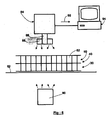
- Figure 5 illustrates the control of an assembled septum.
- the acoustic panel 10 is a structure laminate formed by the assembly of different layers in the thickness direction, either successively: an acoustic skin 20, a so-called “primary” honeycomb 30, a septum 40, a so-called “secondary” honeycomb 50 and finally a full skin 60.
- the acoustic skin 20 is usually made of an organic matrix composite material consisting of five to fifteen layers of reinforcing fabric, not shown, these fabrics being embedded in a polymer hardened resin, these fabrics usually made of glass fibers, carbon or Kevlar. Acoustic skin 20 is pierced of holes 22 according to a regular mesh, their diameter being of the order of 1mm to 3mm, the perforation rate, i.e. the ratio between the total area of the holes 22 and the area of the acoustic skin 20 being of the order of 15 to 25%.
- the primary honeycomb 30 consists of adjacent cells 32 oriented in the thickness direction of the honeycomb 30, these cells 32 being separated by thin partitions 34, these partitions 34 having drainage notches 36 adjacent at the septum 40, these drainage notches 36 allowing the flow and evacuation of the water which could have penetrated into the panel 10 through the holes 22 of the acoustic skin 20.
- the cells 32 are most often hexagonal with a diameter inscribed, or width, usually between 3mm and 10mm, or 1/8 th to 3/8 th of an inch.
- the partitions 34 may be made of aluminum strip.
- Septum 40 is usually made of an organic matrix composite material from one to five plies of reinforcement fabric, not shown, these fabrics being embedded in a resin cured by polymerization, these fabrics usually being made of glass fibers, carbon or Kevlar.
- the septum 40 is also pierced with holes 42 according to a regular mesh.
- Secondary honeycomb 50 is similar to primary honeycomb 30. However, its thickness or width of its cells may be different. We will reference 52, 54 and 56 respectively its cells, its partitions and its drainage notches which are adjacent to the full skin 60.
- the full skin 60 is similar to the acoustic skin 20, the full skin 60 not being however not perforated, the number and composition of the fabric pleats as well as the composition of the resin can be different.
- the holes 42 of the septum are arranged along straight lines 75 or straight lines that are slightly curved, the distance between two successive lines being noted e, the pitch between two holes 42 on each line 75 being noted p.
- the holes are drilled by laser, the septum being placed on a table having the same shape as it, the drilling device being placed at the end of a robot arm and traversing the septum following the drilling lines 75.
- FIG. 3 the septum 40 is seen through the alveoli of one of the honeycombs 30, 50, for example through the alveoli of the nest secondary honeycomb 50.
- the primary honeycomb 30 is therefore not visible and its partitions 34 are shown in dotted lines.
- the glue 70 is against the partitions 54 and extends a little over the septum up to a bonding limit 77, this bonding limit 77 therefore forming an approximately circular closed line.
- Holes 42 of septum 40 appear inside the bonding limit 77, certain holes 42a being clogged with glue holding the primary honeycomb 30 on the septum 40, these holes closed 42a being in the vicinity of the partitions 34 of the primary honeycomb 30.
- 42b the cleared holes.
- the assembly of the panel is advantageously, but not necessarily, preceded by a control of the perforation rate of the septum 40.
- This control can be exhaustive but it will preferably be carried out by sampling to reduce the cost.
- each hole 42 covers at least 30 pixels on the image. In a preferred embodiment, this resolution is chosen so that each hole 42 covers from 75 to 100 pixels on the image, the accuracy of the measurement being consequently improved by reducing the influence of the pixels straddling the edges. Holes.
- the pixels 100 corresponding to the holes 42 are those whose light level is lower than a preset threshold level.
- the pixels 100 corresponding to the holes 42 are those whose light level is higher than a preset threshold level. This level threshold is established by experiments to give the most accurate measurement, i.e. for statistically half the pixels straddling the edge of the hole have a lower level at this threshold and so that the other half has a level higher than this threshold.
- the operator rejects the defective septums 40, that is to say the perforation rate is out of tolerance and may make changes to the adjustment of the machine having pierced the septum 40.
- the two nest layers are then assembled bee 30, 50, and possibly one of the two skins 20, 60, according to the methods well known, the subset thus obtained being referenced 12.
- the surface of at least a honeycomb 30, 50 remains uncovered and makes it possible to see the septum 40 at the bottom of the alveoli.
- each hole 42 covers at least 30 pixels on image 92. In a preferred embodiment, this resolution is chosen so that each hole 4 2 covers from 80 to 100 pixels on the image, the accuracy of the measurement being consequently improved by reducing the influence of the pixels straddling the edges of the holes.
- the pixels corresponding to the holes 42 are those whose light level is lower than a preset threshold level, it happens that the glue 70 appears on the image with a light level also lower than this. threshold.
- the computer 94 delimits inside each cell the surface 76 of the septum 40 not covered by the adhesive 70, the computer 94 then looking for the pixels corresponding to the cleared holes 42b only inside the surfaces 76 thus delimited.
- This delimitation implements a well-known image analysis function making it possible to define a closed line 77 approximately circular and of size greater than a given minimum, this closed line 77 then being a border between a first zone whose light level is lower than a predefined threshold and a second zone whose light level is greater than this same threshold, this closed line 77 corresponding to the limit of the propagation of the adhesive 70 on the septum 40.
- the pixels 100 corresponding to the holes 42 are those whose light level is lower than a preset threshold level.
- the pixels 100 corresponding to the holes 42 are those whose light level is higher than a preset threshold level. This level threshold is established by experiments to give the most accurate measurement, i.e. for statistically half the pixels straddling the edge of the hole have a lower level at this threshold and so that the other half has a level higher than this threshold.
- the camera resolution and image magnification ratio 92 are also chosen so that each hole 42 covers at least 30 pixels on the image. In a mode preferred for implementation, this resolution is chosen so that each hole 42 covers from 75 to 100 pixels on the image, the accuracy of the measurement being consequently improved by reducing the influence of pixels straddling the edges of the holes.
- the report the magnification of the camera 84 should not however be too high so that this camera 84 has sufficient field for each image 92 to completely cover the minus one cell. In practice, this enlargement ratio is of the order of 3 to 6.
- the perforation rate of the assembled septum must be equal to one average value at plus or minus 12%. In the event that the perforation rate after assembly goes beyond these limits, the assembled septum 40 is therefore defective, the assembly process of the panel 10 is interrupted.
- the full skin 60 is produced and glued to the secondary honeycomb 50.
- This arrangement has the advantage of impose on the full skin 60 only one thermal cycle simultaneously ensuring the polymerization of the matrix resin and glue.
Landscapes
- Physics & Mathematics (AREA)
- Engineering & Computer Science (AREA)
- Acoustics & Sound (AREA)
- Multimedia (AREA)
- Soundproofing, Sound Blocking, And Sound Damping (AREA)
- Investigating Or Analyzing Materials By The Use Of Ultrasonic Waves (AREA)
- Diaphragms For Electromechanical Transducers (AREA)
- Laminated Bodies (AREA)
- Examining Or Testing Airtightness (AREA)
Abstract
Description
Les propriétés acoustiques du panneau, c'est à dire son taux d'absorption du bruit en fonction de la fréquence et du niveau sonore du bruit, dépendent du dimensionnement des composants du panneau et en particulier des taux de perforation de la peau pleine et du septum.
Le panneau acoustique est ensuite assemblé en disposant les différentes couches préalablement encollées sur un moule à la forme requise et en faisant subir à l'ensemble un cycle thermique en autoclave visant à serrer les couches les unes contre les autres et à polymériser les colles. A noter que la peau pleine peut être réalisée et collée en une seule opération sur le panneau.
Cette fraction dépend également de la quantité de colle utilisée, mais le collage proprement dit est quant à lui bien maítrisable.
Un tel panneau est remarquable en ce que :
- on assemble dans un premier temps par collage les deux nids d'abeilles avec le septum pour constituer un sous-ensemble, cet assemblage ayant malheureusement pour effet d'obstruer inévitablement une fraction des trous du septum ;
- postérieurement à l'assemblage des deux nids d'abeilles avec le septum et préalablement à l'assemblage de l'une au moins des deux peaux, l'un au moins des nids d'abeilles étant ainsi découvert, on contrôle du taux de perforation du septum en scannant le sous-ensemble avec une caméra numérique comportant un éclairage associé, la caméra étant disposée du coté d'un nid d'abeille découvert, la caméra prenant ainsi des prises de vue du septum au fond des alvéoles du nid d'abeille découvert, cet éclairage éclairant la zone du septum observée par la caméra, les images successives ainsi obtenues étant transmises à un ordinateur, l'ordinateur analysant les images et établissant le taux de perforation T du septum en appliquant la formule T = N1 / N dans laquelle N1 est le nombre de pixels correspondants aux trous dégagés et N le nombre de pixels de l'image.
Les trous sont percés au laser, le septum étant disposé sur une table ayant la même forme que lui, l'appareil de perçage étant disposé au bout d'un bras robot et parcourant le septum en suivant les lignes de perçage 75.
Est effectuée par ailleurs l'acquisition des différentes couches 20, 30, 40, 50 et 60, cette acquisition comprenant le perçage des trous 22 de la peau acoustique 20 ainsi que des trous 42 du septum 40 et préencollage des couches. Dans une forme particulière de mise en oeuvre sans incidence sur la présente invention, la peau pleine 60 peut être réalisée et collée sur le nid d'abeille secondaire en une seule opération et donc avec un seul cycle thermique.
Scanner le septum 40 nu avec une caméra 84 numérique comportant un objectif 86 un éclairage 88,96 associé, cet éclairage 88,96 éclairant évidemment la zone du septum observée par la caméra 84, le septum 40 étant en pratique disposé sur un support 82, les images successives 92 ainsi obtenues étant transmises à un ordinateur 94, l'ordinateur établissant le taux de perforation T en appliquant la formule T = N1 / N dans laquelle N1 est le nombre de pixels 100 correspondants aux trous 42 et N le nombre de pixels de l'image 92. La résolution de la caméra et le rapport d'agrandissement de l'image 92 sont choisis pour que chaque trou 42 recouvre au moins 30 pixels sur l'image. Dans un mode préféré de réalisation, cette résolution est choisie pour que chaque trou 42 recouvre de 75 à 100 pixels sur l'image, la précision de la mesure étant par conséquent améliorée par la réduction de l'influence des pixels à cheval sur les bords des trous.
L'assemblage comporte des opérations préliminaires de préencollage des différentes couches 20, 30, 40, 50 et 60 à assembler, ce préencollage étant effectué de préférence, mais non obligatoirement, de la façon suivante :
- la peau acoustique 20 est préencollée sur son coté qui sera au contact du nid d'abeille primaire 30 ;
- le nid d'abeille primaire 30 est préencollé aux extrémités des cloisons 34 qui seront au contact du septum 40 ;
- le septum 40 ne subit pas de pré encollage qui en obturerait les trous 42 car ceux-ci sont trop petits ;
- le nid d'abeille secondaire 50 est également préencollé aux extrémités des cloisons 54 qui seront au contact du septum 40 ;
- la peau pleine 60 est préencollée du coté qui sera au contact du nid d'abeille secondaire 50.
Scanner le sous-ensemble 12 avec une caméra 84 numérique comportant un objectif 86 un éclairage 88,96 associé, la caméra 84 prenant ainsi des prises de vue du septum 40 au fond des alvéoles du nid d'abeille 30, 50 entre le septum 40 et l'objectif 86, cet éclairage 88,96 éclairant évidemment la zone du septum observée par la caméra 84 au fond des alvéoles du nid d'abeille 30, 50, le sous-ensemble 12 étant en pratique disposé sur un support 82, les images successives 92 ainsi obtenues étant transmises à un ordinateur 94, l'ordinateur établissant le taux de perforation T en appliquant la formule T = N1 / N dans laquelle N1 est le nombre de pixels non représentés correspondants aux trous dégagés 42b et N le nombre de pixels de l'image 92. La résolution de la caméra et le rapport d'agrandissement sont choisis pour que chaque trou 42 recouvre au moins 30 pixels sur l'image 92. Dans un mode préféré de réalisation, cette résolution est choisie pour que chaque trou 42 recouvre de 80 à 100 pixels sur l'image, la précision de la mesure étant par conséquent améliorée par la réduction de l'influence des pixels à cheval sur les bords des trous.
Dans le cas où on utilise un éclairage épiscopique 88, les pixels correspondant aux trous 42 sont ceux dont le niveau lumineux est inférieur à un niveau seuil préétabli, il arrive que la colle 70 apparaisse sur l'image avec un niveau lumineux également inférieur à ce seuil. Dans ce cas, l'ordinateur 94 délimite à l'intérieur de chaque alvéole la surface 76 du septum 40 non recouverte par la colle 70, l'ordinateur 94 recherchant ensuite les pixels correspondant aux trous dégagés 42b uniquement à l'intérieur des surface 76 ainsi délimitées. Cette délimitation met en oeuvre une fonction d'analyse d'image bien connue permettant de définir une ligne fermée 77 approximativement circulaire et de taille supérieure à un minimum donné, cette ligne fermée 77 étant alors une frontière entre une première zone dont le niveau lumineux est inférieur à un seuil prédéfini et une seconde zone dont le niveau lumineux est supérieur à ce même seuil, cette ligne fermée 77 correspondant à la limite de la propagation de la colle 70 sur le septum 40.
Le mode de contrôle diascopique permet une reconnaissance d'images plus simple car les trous dégagés 42b apparaissent très lumineux et avec un excellent contraste sur un font sombre. Il est par contre plus difficile à mettre en oeuvre avec les grands panneaux car l'éclairage diascopique 90 situé derrière le panneau par rapport à la caméra 84 doit suivre les mouvements de cette caméra 84.
- au contrôle d'un premier septum assemblé avec les deux nids d'abeilles qui lui sont adjacents, l'éclairage étant épiscopique ou diascopique,
- au contrôle du second septum après son assemblage pour constituer un sous-ensemble comportant les deux septums et les trois nids d'abeilles, le contrôle étant alors effectué avec un éclairage épiscopique,
- au contrôle des deux septums après leur assemblage avec les trois nids d'abeilles, le contrôle étant effectué avec un éclairage épiscopique, l'assemblage pouvant être effectué en un seul cycle thermique en autoclave, avec les trois nids d'abeilles.
Claims (12)
- Procédé d'assemblage et de contrôle d'un panneau acoustique en nid d'abeille à double résonateur, le panneau (10) étant constitué d'une pluralité de couches (20, 30, 40, 50 et 60) à assembler dans le sens de l'épaisseur du panneau (10), soit : une peau acoustique (20), un nid d'abeille primaire (30), un septum (40) percé d'une pluralité de trous (42), un nid d'abeille secondaire (50) et une peau pleine (60), le procédé comportant des opérations préliminaires d'encollage des différentes couches (20, 30, 40, 50 et 60) à assembler, caractérisé en ce que :on assemble dans un premier temps par collage les deux nids d'abeilles (30,50) avec le septum 40, le sous-ensemble ainsi obtenu étant référencé (12), les trous (42) du septum (40) encore dégagés étant référencés (42b) ;postérieurement à l'assemblage des deux nids d'abeilles (30, 50) avec le septum (40) et préalablement à l'assemblage de l'une au moins des deux peaux (20, 60), l'un au moins dès nids d'abeilles (30, 50) étant ainsi découvert, on contrôle du taux de perforation du septum (42) en scannant le sous-ensemble (12) avec une caméra (84) numérique comportant un éclairage (88, 96) associé, la caméra (84) étant disposée du coté d'un nid d'abeille (30, 50) découvert, la caméra (84) prenant ainsi des prises de vue du septum (40) au fond des alvéoles du nid d'abeille (30, 50) découvert, cet éclairage (88, 96) éclairant la zone du septum (40) observée par la caméra (84), les images successives (92) ainsi obtenues étant transmises à un ordinateur (94), l'ordinateur (94) analysant les images (92) et établissant le taux de perforation T du septum (40) en appliquant la formule T = N1 / N dans laquelle N1 est le nombre de pixels (100) correspondants aux trous dégagés (42b) et N le nombre de pixels de l'image (92).
- procédé selon la revendication 1 caractérisé en ce que le contrôle du septum (40) est effectué préalablement à l'assemblage des deux peaux (20, 60) et en ce que l'éclairage (88, 96) est un éclairage diascopique (96).
- Procédé selon la revendication 1 caractérisé en ce que l'éclairage (88, 96) est un éclairage épiscopique (88).
- Procédé selon la revendication 3 caractérisé en ce que sur les images (92), l'ordinateur (94) délimite, à l'intérieur de chaque alvéole, la surface (76) du septum (40) non recouverte par la colle (70), cet ordinateur (94) recherchant les pixels (100) correspondants aux trous dégagés (42b) uniquement à l'intérieur de ces surfaces (76).
- Procédé selon l'une quelconque des revendication 1 à 4 caractérisé en ce que la résolution de la caméra (84) et le rapport d'agrandissement des images (92) est approprié pour que chaque trou (42à) du septum (40) recouvre au moins 30 pixels (100).
- Procédé selon l'une quelconque des revendications 1 à 5 caractérisé en ce que la résolution de la caméra (84) et le rapport d'agrandissement des images (92) est approprié pour que chaque trou (42à) du septum (40) recouvre au moins 75 pixels (100).
- Procédé selon l'une quelconque des revendications 1 à 6 caractérisé en ce qu'il est interrompu quand le contrôle du septum (40) assemblé montre qu'il est défectueux.
- Procédé selon l'une quelconque des revendications 1 à 7 caractérisé en ce que la peau pleine (60) est réalisée et collée sur le nid d'abeille secondaire (50) en une seule opération.
- Procédé selon l'une quelconque des revendications 1 à 8 caractérisé en ce que préalablement à l'assemblage du septum (40) avec l'un au moins des nids d'abeilles (30, 50), on effectue un contrôle du taux de perforation T du septum (40) nu en scannant le septum (40) avec une caméra (84) numérique comportant un éclairage (88,96) associé, cet éclairage (88,96) éclairant la zone du septum (40) observée par la caméra (84), les images successives (92) ainsi obtenues étant transmises à un ordinateur (94), l'ordinateur établissant le taux de perforation T en appliquant la formule T = N1 / N dans laquelle N1 est le nombre de pixels (100) correspondants aux trous 42 et N le nombre de pixels de l'image (92).
- Procédé selon la revendication 9 caractérisé en ce que l'assemblage du panneau (10) est interrompu quand le contrôle du septum (40) nu montre que ce septum (40) est défectueux.
- Procédé selon la revendication 9 ou 10 caractérisé en ce que la résolution de la caméra (84) et le rapport d'agrandissement des images (92) est approprié pour que chaque trou (42a) du septum (40) recouvre au moins 30 pixels (100).
- Procédé selon l'une quelconque des revendications 9 à 11 caractérisé en ce que la résolution de la caméra (84) et le rapport d'agrandissement des images (92) est approprié pour que chaque trou (42à) du septum (40) recouvre au moins 75 pixels (100).
Applications Claiming Priority (2)
| Application Number | Priority Date | Filing Date | Title |
|---|---|---|---|
| FR0205000 | 2002-04-22 | ||
| FR0205000A FR2838859B1 (fr) | 2002-04-22 | 2002-04-22 | Procede d'assemblage et de controle d'un panneau acoustique a double resonateur avec ame en nid d'abeille |
Publications (2)
| Publication Number | Publication Date |
|---|---|
| EP1357539A1 true EP1357539A1 (fr) | 2003-10-29 |
| EP1357539B1 EP1357539B1 (fr) | 2009-01-07 |
Family
ID=28686242
Family Applications (1)
| Application Number | Title | Priority Date | Filing Date |
|---|---|---|---|
| EP03290979A Expired - Lifetime EP1357539B1 (fr) | 2002-04-22 | 2003-04-22 | Procédé d'assemblage et de contrôle d'un panneau acoustique à double resonateur avec âme en nid d'abeille |
Country Status (9)
| Country | Link |
|---|---|
| US (1) | US7074287B2 (fr) |
| EP (1) | EP1357539B1 (fr) |
| AT (1) | ATE420430T1 (fr) |
| AU (1) | AU2003262396B2 (fr) |
| CA (1) | CA2481727A1 (fr) |
| DE (1) | DE60325667D1 (fr) |
| ES (1) | ES2318096T3 (fr) |
| FR (1) | FR2838859B1 (fr) |
| WO (1) | WO2003090202A2 (fr) |
Cited By (3)
| Publication number | Priority date | Publication date | Assignee | Title |
|---|---|---|---|---|
| CN104205208A (zh) * | 2012-02-29 | 2014-12-10 | 赫克塞尔公司 | 弯曲式声学蜂窝结构的拼接 |
| FR3023202A1 (fr) * | 2014-07-02 | 2016-01-08 | Aircelle Sa | Outillage de controle de panneaux acoustique en materiaux composites presentant des percages |
| FR3077137A1 (fr) * | 2018-01-23 | 2019-07-26 | Safran Nacelles | Dispositif et procede pour le controle de la permeabilite acoustique de peaux de panneaux acoustiques pour ensemble propulsif d’aeronef |
Families Citing this family (15)
| Publication number | Priority date | Publication date | Assignee | Title |
|---|---|---|---|---|
| US8052831B2 (en) * | 2005-02-02 | 2011-11-08 | The Boeing Company | Low temperature, vacuum cure fabrication process for large, honeycomb core stiffened composite structures |
| US7430912B2 (en) * | 2005-12-28 | 2008-10-07 | International Automotive Components Group North America, Inc. | Random incident absorber approximation |
| GB2459844B (en) * | 2008-05-06 | 2011-01-19 | Rolls Royce Plc | Fan section |
| US7998389B2 (en) * | 2009-07-17 | 2011-08-16 | Spirit Aerosystems, Inc. | Method for septumizing injection molded thermoplastic core |
| US8047329B1 (en) | 2010-08-13 | 2011-11-01 | Rohr, Inc. | System and method for noise suppression |
| US8800714B2 (en) * | 2012-06-26 | 2014-08-12 | Hexcel Corporation | Structure with active acoustic openings |
| US9127452B1 (en) * | 2014-04-11 | 2015-09-08 | Rohr, Inc. | Porous septum cap |
| US9693166B2 (en) | 2014-06-24 | 2017-06-27 | The Boeing Company | Automated production of acoustic structures |
| US9752595B2 (en) | 2015-11-03 | 2017-09-05 | Rohr, Inc. | Nacelle core with insert |
| EP3506253B1 (fr) * | 2016-08-23 | 2022-09-28 | FUJIFILM Corporation | Structure d'insonorisation et structure d'ouverture |
| US10702928B2 (en) * | 2017-02-13 | 2020-07-07 | Spirit Aerosystems, Inc. | Method and apparatus for acoustic perforation of core sandwich panels |
| FR3069210B1 (fr) * | 2017-07-24 | 2020-12-11 | Faurecia Automotive Ind | Piece d'insonorisation de vehicule automobile et procede de fabrication associe |
| US11151971B2 (en) * | 2017-12-14 | 2021-10-19 | Spirit Aerosystems, Inc. | Acoustic panel employing chopped fibers in septum layer and method for making same |
| US11123948B2 (en) * | 2018-11-13 | 2021-09-21 | Epic Aircraft, LLC | Method for forming a composite structure |
| FR3103953B1 (fr) * | 2019-11-29 | 2021-11-12 | Safran Aircraft Engines | Pastille résonante et cellule de traitement acoustique dotée d’une telle pastille |
Citations (4)
| Publication number | Priority date | Publication date | Assignee | Title |
|---|---|---|---|---|
| EP0509166A1 (fr) * | 1989-10-26 | 1992-10-21 | Rohr Industries, Inc. | Structure en nid d'abeilles pour l'atténuation du bruit |
| US5175401A (en) * | 1991-03-18 | 1992-12-29 | Grumman Aerospace Corporation | Segmented resistance acoustic attenuating liner |
| GB2324262A (en) * | 1997-04-11 | 1998-10-21 | Bpb Plc | A punch for perforating a cementitious tile |
| US6203656B1 (en) * | 1998-08-03 | 2001-03-20 | General Electric Company | Acoustic liner manufacture |
Family Cites Families (2)
| Publication number | Priority date | Publication date | Assignee | Title |
|---|---|---|---|---|
| US4421811A (en) * | 1979-12-21 | 1983-12-20 | Rohr Industries, Inc. | Method of manufacturing double layer attenuation panel with two layers of linear type material |
| US4541879A (en) * | 1982-07-15 | 1985-09-17 | Rohr Industries, Inc. | Method of manufacture of noise suppression panel |
-
2002
- 2002-04-22 FR FR0205000A patent/FR2838859B1/fr not_active Expired - Fee Related
-
2003
- 2003-04-22 US US10/510,206 patent/US7074287B2/en not_active Expired - Fee Related
- 2003-04-22 AT AT03290979T patent/ATE420430T1/de not_active IP Right Cessation
- 2003-04-22 WO PCT/FR2003/001266 patent/WO2003090202A2/fr not_active Ceased
- 2003-04-22 ES ES03290979T patent/ES2318096T3/es not_active Expired - Lifetime
- 2003-04-22 DE DE60325667T patent/DE60325667D1/de not_active Expired - Fee Related
- 2003-04-22 EP EP03290979A patent/EP1357539B1/fr not_active Expired - Lifetime
- 2003-04-22 AU AU2003262396A patent/AU2003262396B2/en not_active Ceased
- 2003-04-22 CA CA002481727A patent/CA2481727A1/fr not_active Abandoned
Patent Citations (4)
| Publication number | Priority date | Publication date | Assignee | Title |
|---|---|---|---|---|
| EP0509166A1 (fr) * | 1989-10-26 | 1992-10-21 | Rohr Industries, Inc. | Structure en nid d'abeilles pour l'atténuation du bruit |
| US5175401A (en) * | 1991-03-18 | 1992-12-29 | Grumman Aerospace Corporation | Segmented resistance acoustic attenuating liner |
| GB2324262A (en) * | 1997-04-11 | 1998-10-21 | Bpb Plc | A punch for perforating a cementitious tile |
| US6203656B1 (en) * | 1998-08-03 | 2001-03-20 | General Electric Company | Acoustic liner manufacture |
Cited By (3)
| Publication number | Priority date | Publication date | Assignee | Title |
|---|---|---|---|---|
| CN104205208A (zh) * | 2012-02-29 | 2014-12-10 | 赫克塞尔公司 | 弯曲式声学蜂窝结构的拼接 |
| FR3023202A1 (fr) * | 2014-07-02 | 2016-01-08 | Aircelle Sa | Outillage de controle de panneaux acoustique en materiaux composites presentant des percages |
| FR3077137A1 (fr) * | 2018-01-23 | 2019-07-26 | Safran Nacelles | Dispositif et procede pour le controle de la permeabilite acoustique de peaux de panneaux acoustiques pour ensemble propulsif d’aeronef |
Also Published As
| Publication number | Publication date |
|---|---|
| FR2838859A1 (fr) | 2003-10-24 |
| FR2838859B1 (fr) | 2004-07-16 |
| ATE420430T1 (de) | 2009-01-15 |
| AU2003262396A1 (en) | 2003-11-03 |
| US7074287B2 (en) | 2006-07-11 |
| AU2003262396B2 (en) | 2008-06-26 |
| WO2003090202A2 (fr) | 2003-10-30 |
| ES2318096T3 (es) | 2009-05-01 |
| WO2003090202A3 (fr) | 2004-04-01 |
| DE60325667D1 (de) | 2009-02-26 |
| CA2481727A1 (fr) | 2003-10-30 |
| EP1357539B1 (fr) | 2009-01-07 |
| US20050178489A1 (en) | 2005-08-18 |
Similar Documents
| Publication | Publication Date | Title |
|---|---|---|
| EP1357539B1 (fr) | Procédé d'assemblage et de contrôle d'un panneau acoustique à double resonateur avec âme en nid d'abeille | |
| EP2464505B1 (fr) | Procédé de réparation d'une paroi constituée de plusieurs couches | |
| EP0763420B2 (fr) | Vitrage feuilleté d'isolation acoustique | |
| EP2075105B1 (fr) | Procédé et dispositif de séparation d'une structure | |
| EP2504832B1 (fr) | Panneau acoustique pour nacelle d'aeronef et procédé de fabrication correspondant | |
| FR2934056A1 (fr) | Procede de transfert d'une portion de film fonctionnel | |
| EP1157372B1 (fr) | Procede de fabrication d'un panneau d'attenuation acoustique a couche resistive a propriete structurale et panneau ainsi obtenu | |
| FR2638240A1 (fr) | Platine pour l'analyse rapide et indexee sous microscope de filtres et d'autres supports porteurs d'echantillons multiples et procede d'analyse de ces echantillons utilisant cette platine | |
| EP1986239B9 (fr) | Procédé pour la réalisation d'une matrice de détection de rayonnements électromagnétiques et notamment de rayonnements infrarouges. | |
| EP0005792A1 (fr) | Procédé de raccordement de fibres optiques disposées en nappe dans un câble, et dispositif de mise en oeuvre du procédé | |
| FR2712985A1 (fr) | Tête de mesure colorimétrique, et procédé pour déterminer la couleur interne d'un matériau non opaque. | |
| FR2702309A1 (fr) | Procédé de fabrication d'une sonde acoustique multiéléments, notamment d'une sonde d'échographie. | |
| FR2839075A1 (fr) | Film adhesif perfore et son procede de fabrication | |
| WO1999064907A1 (fr) | Assemblage de connexion de fibres optiques avec des composants optiques ou optoelectroniques | |
| WO2018121982A1 (fr) | Dispositif de detection de gaz ou de particules et procede de fabrication d'un tel dispositif | |
| FR2903196A1 (fr) | Element optique a cellules fermees au moyen d'une couche de materiau adhesif | |
| EP1654773B1 (fr) | Panneau electroluminescent dote d'elements d'extraction de lumiere | |
| EP2895319B1 (fr) | Dispositif d'infusion d'une piece composite et procede associe | |
| EP4114652B1 (fr) | Procédé de fabrication d'une structure à âmes alvéolaires pour nacelle de turboréacteur | |
| CA3216305A1 (fr) | Dispositif d'isolation acoustique d'un vitrage automobile | |
| EP3541626B1 (fr) | Procédé et système de contrôle d'usinage pli à pli de matériau multicouche | |
| FR2963114A1 (fr) | Dispositif optique, boitier a l'echelle d'une tranche pour un tel dispositif optique et procede correspondant. | |
| EP3489665B1 (fr) | Système de surveillance de la dégradation et de l'encrassement d'un miroir | |
| EP4440840B1 (fr) | Installation et procédé de désassemblage d'un module photovoltaïque | |
| EP0575268A1 (fr) | Matériau de construction à base de bois lamelle-colle |
Legal Events
| Date | Code | Title | Description |
|---|---|---|---|
| PUAI | Public reference made under article 153(3) epc to a published international application that has entered the european phase |
Free format text: ORIGINAL CODE: 0009012 |
|
| 17P | Request for examination filed |
Effective date: 20030520 |
|
| AK | Designated contracting states |
Kind code of ref document: A1 Designated state(s): AT BE BG CH CY CZ DE DK EE ES FI FR GB GR HU IE IT LI LU MC NL PT RO SE SI SK TR |
|
| AX | Request for extension of the european patent |
Extension state: AL LT LV MK |
|
| RAP1 | Party data changed (applicant data changed or rights of an application transferred) |
Owner name: HUREL HISPANO LE-HAVRE |
|
| RAP1 | Party data changed (applicant data changed or rights of an application transferred) |
Owner name: HUREL-HISPANO |
|
| AKX | Designation fees paid |
Designated state(s): AT BE BG CH CY CZ DE DK EE ES FI FR GB GR HU IE IT LI LU MC NL PT RO SE SI SK TR |
|
| RAP1 | Party data changed (applicant data changed or rights of an application transferred) |
Owner name: AIRCELLE |
|
| GRAP | Despatch of communication of intention to grant a patent |
Free format text: ORIGINAL CODE: EPIDOSNIGR1 |
|
| RTI1 | Title (correction) |
Free format text: METHOD OF MANUFACTURE AND ASSEMBLY OF AN ACOUSTIC PANEL COMPRISING A DOUBLE-RESONATOR WITH A HONEYCOMB CORE |
|
| GRAS | Grant fee paid |
Free format text: ORIGINAL CODE: EPIDOSNIGR3 |
|
| GRAA | (expected) grant |
Free format text: ORIGINAL CODE: 0009210 |
|
| AK | Designated contracting states |
Kind code of ref document: B1 Designated state(s): AT BE BG CH CY CZ DE DK EE ES FI FR GB GR HU IE IT LI LU MC NL PT RO SE SI SK TR |
|
| REG | Reference to a national code |
Ref country code: GB Ref legal event code: FG4D Free format text: NOT ENGLISH |
|
| REG | Reference to a national code |
Ref country code: CH Ref legal event code: EP |
|
| REG | Reference to a national code |
Ref country code: IE Ref legal event code: FG4D Free format text: LANGUAGE OF EP DOCUMENT: FRENCH |
|
| REF | Corresponds to: |
Ref document number: 60325667 Country of ref document: DE Date of ref document: 20090226 Kind code of ref document: P |
|
| REG | Reference to a national code |
Ref country code: ES Ref legal event code: FG2A Ref document number: 2318096 Country of ref document: ES Kind code of ref document: T3 |
|
| PG25 | Lapsed in a contracting state [announced via postgrant information from national office to epo] |
Ref country code: NL Free format text: LAPSE BECAUSE OF FAILURE TO SUBMIT A TRANSLATION OF THE DESCRIPTION OR TO PAY THE FEE WITHIN THE PRESCRIBED TIME-LIMIT Effective date: 20090107 Ref country code: SI Free format text: LAPSE BECAUSE OF FAILURE TO SUBMIT A TRANSLATION OF THE DESCRIPTION OR TO PAY THE FEE WITHIN THE PRESCRIBED TIME-LIMIT Effective date: 20090107 |
|
| NLV1 | Nl: lapsed or annulled due to failure to fulfill the requirements of art. 29p and 29m of the patents act | ||
| PG25 | Lapsed in a contracting state [announced via postgrant information from national office to epo] |
Ref country code: FI Free format text: LAPSE BECAUSE OF FAILURE TO SUBMIT A TRANSLATION OF THE DESCRIPTION OR TO PAY THE FEE WITHIN THE PRESCRIBED TIME-LIMIT Effective date: 20090107 |
|
| PGFP | Annual fee paid to national office [announced via postgrant information from national office to epo] |
Ref country code: ES Payment date: 20090422 Year of fee payment: 7 |
|
| REG | Reference to a national code |
Ref country code: IE Ref legal event code: FD4D |
|
| PG25 | Lapsed in a contracting state [announced via postgrant information from national office to epo] |
Ref country code: SE Free format text: LAPSE BECAUSE OF FAILURE TO SUBMIT A TRANSLATION OF THE DESCRIPTION OR TO PAY THE FEE WITHIN THE PRESCRIBED TIME-LIMIT Effective date: 20090407 Ref country code: PT Free format text: LAPSE BECAUSE OF FAILURE TO SUBMIT A TRANSLATION OF THE DESCRIPTION OR TO PAY THE FEE WITHIN THE PRESCRIBED TIME-LIMIT Effective date: 20090608 Ref country code: AT Free format text: LAPSE BECAUSE OF FAILURE TO SUBMIT A TRANSLATION OF THE DESCRIPTION OR TO PAY THE FEE WITHIN THE PRESCRIBED TIME-LIMIT Effective date: 20090107 |
|
| PGFP | Annual fee paid to national office [announced via postgrant information from national office to epo] |
Ref country code: DE Payment date: 20090414 Year of fee payment: 7 Ref country code: IT Payment date: 20090423 Year of fee payment: 7 |
|
| PG25 | Lapsed in a contracting state [announced via postgrant information from national office to epo] |
Ref country code: EE Free format text: LAPSE BECAUSE OF FAILURE TO SUBMIT A TRANSLATION OF THE DESCRIPTION OR TO PAY THE FEE WITHIN THE PRESCRIBED TIME-LIMIT Effective date: 20090107 Ref country code: DK Free format text: LAPSE BECAUSE OF FAILURE TO SUBMIT A TRANSLATION OF THE DESCRIPTION OR TO PAY THE FEE WITHIN THE PRESCRIBED TIME-LIMIT Effective date: 20090107 Ref country code: IE Free format text: LAPSE BECAUSE OF FAILURE TO SUBMIT A TRANSLATION OF THE DESCRIPTION OR TO PAY THE FEE WITHIN THE PRESCRIBED TIME-LIMIT Effective date: 20090107 Ref country code: CZ Free format text: LAPSE BECAUSE OF FAILURE TO SUBMIT A TRANSLATION OF THE DESCRIPTION OR TO PAY THE FEE WITHIN THE PRESCRIBED TIME-LIMIT Effective date: 20090107 |
|
| PGFP | Annual fee paid to national office [announced via postgrant information from national office to epo] |
Ref country code: FR Payment date: 20090317 Year of fee payment: 7 |
|
| BERE | Be: lapsed |
Owner name: AIRCELLE Effective date: 20090430 |
|
| PLBE | No opposition filed within time limit |
Free format text: ORIGINAL CODE: 0009261 |
|
| STAA | Information on the status of an ep patent application or granted ep patent |
Free format text: STATUS: NO OPPOSITION FILED WITHIN TIME LIMIT |
|
| PG25 | Lapsed in a contracting state [announced via postgrant information from national office to epo] |
Ref country code: SK Free format text: LAPSE BECAUSE OF FAILURE TO SUBMIT A TRANSLATION OF THE DESCRIPTION OR TO PAY THE FEE WITHIN THE PRESCRIBED TIME-LIMIT Effective date: 20090107 Ref country code: RO Free format text: LAPSE BECAUSE OF FAILURE TO SUBMIT A TRANSLATION OF THE DESCRIPTION OR TO PAY THE FEE WITHIN THE PRESCRIBED TIME-LIMIT Effective date: 20090107 |
|
| PGFP | Annual fee paid to national office [announced via postgrant information from national office to epo] |
Ref country code: GB Payment date: 20090407 Year of fee payment: 7 |
|
| REG | Reference to a national code |
Ref country code: CH Ref legal event code: PL |
|
| 26N | No opposition filed |
Effective date: 20091008 |
|
| PG25 | Lapsed in a contracting state [announced via postgrant information from national office to epo] |
Ref country code: BG Free format text: LAPSE BECAUSE OF FAILURE TO SUBMIT A TRANSLATION OF THE DESCRIPTION OR TO PAY THE FEE WITHIN THE PRESCRIBED TIME-LIMIT Effective date: 20090407 Ref country code: LI Free format text: LAPSE BECAUSE OF NON-PAYMENT OF DUE FEES Effective date: 20090430 Ref country code: CH Free format text: LAPSE BECAUSE OF NON-PAYMENT OF DUE FEES Effective date: 20090430 |
|
| PG25 | Lapsed in a contracting state [announced via postgrant information from national office to epo] |
Ref country code: MC Free format text: LAPSE BECAUSE OF NON-PAYMENT OF DUE FEES Effective date: 20090430 |
|
| PG25 | Lapsed in a contracting state [announced via postgrant information from national office to epo] |
Ref country code: BE Free format text: LAPSE BECAUSE OF NON-PAYMENT OF DUE FEES Effective date: 20090430 |
|
| PG25 | Lapsed in a contracting state [announced via postgrant information from national office to epo] |
Ref country code: GR Free format text: LAPSE BECAUSE OF FAILURE TO SUBMIT A TRANSLATION OF THE DESCRIPTION OR TO PAY THE FEE WITHIN THE PRESCRIBED TIME-LIMIT Effective date: 20090408 |
|
| GBPC | Gb: european patent ceased through non-payment of renewal fee |
Effective date: 20100422 |
|
| REG | Reference to a national code |
Ref country code: FR Ref legal event code: ST Effective date: 20101230 |
|
| PG25 | Lapsed in a contracting state [announced via postgrant information from national office to epo] |
Ref country code: DE Free format text: LAPSE BECAUSE OF NON-PAYMENT OF DUE FEES Effective date: 20101103 |
|
| PG25 | Lapsed in a contracting state [announced via postgrant information from national office to epo] |
Ref country code: GB Free format text: LAPSE BECAUSE OF NON-PAYMENT OF DUE FEES Effective date: 20100422 Ref country code: IT Free format text: LAPSE BECAUSE OF NON-PAYMENT OF DUE FEES Effective date: 20100422 |
|
| PG25 | Lapsed in a contracting state [announced via postgrant information from national office to epo] |
Ref country code: LU Free format text: LAPSE BECAUSE OF NON-PAYMENT OF DUE FEES Effective date: 20090422 |
|
| PG25 | Lapsed in a contracting state [announced via postgrant information from national office to epo] |
Ref country code: HU Free format text: LAPSE BECAUSE OF FAILURE TO SUBMIT A TRANSLATION OF THE DESCRIPTION OR TO PAY THE FEE WITHIN THE PRESCRIBED TIME-LIMIT Effective date: 20090708 |
|
| REG | Reference to a national code |
Ref country code: ES Ref legal event code: FD2A Effective date: 20110712 |
|
| PG25 | Lapsed in a contracting state [announced via postgrant information from national office to epo] |
Ref country code: ES Free format text: LAPSE BECAUSE OF NON-PAYMENT OF DUE FEES Effective date: 20110630 |
|
| PG25 | Lapsed in a contracting state [announced via postgrant information from national office to epo] |
Ref country code: TR Free format text: LAPSE BECAUSE OF FAILURE TO SUBMIT A TRANSLATION OF THE DESCRIPTION OR TO PAY THE FEE WITHIN THE PRESCRIBED TIME-LIMIT Effective date: 20090107 |
|
| PG25 | Lapsed in a contracting state [announced via postgrant information from national office to epo] |
Ref country code: CY Free format text: LAPSE BECAUSE OF FAILURE TO SUBMIT A TRANSLATION OF THE DESCRIPTION OR TO PAY THE FEE WITHIN THE PRESCRIBED TIME-LIMIT Effective date: 20090107 Ref country code: ES Free format text: LAPSE BECAUSE OF NON-PAYMENT OF DUE FEES Effective date: 20100423 |
|
| PG25 | Lapsed in a contracting state [announced via postgrant information from national office to epo] |
Ref country code: FR Free format text: LAPSE BECAUSE OF NON-PAYMENT OF DUE FEES Effective date: 20100430 |