EP1357522B1 - Paper quality discriminating machine - Google Patents
Paper quality discriminating machine Download PDFInfo
- Publication number
- EP1357522B1 EP1357522B1 EP20030009068 EP03009068A EP1357522B1 EP 1357522 B1 EP1357522 B1 EP 1357522B1 EP 20030009068 EP20030009068 EP 20030009068 EP 03009068 A EP03009068 A EP 03009068A EP 1357522 B1 EP1357522 B1 EP 1357522B1
- Authority
- EP
- European Patent Office
- Prior art keywords
- light
- paper
- intensity
- irradiation
- absorbance
- Prior art date
- Legal status (The legal status is an assumption and is not a legal conclusion. Google has not performed a legal analysis and makes no representation as to the accuracy of the status listed.)
- Revoked
Links
Images




Classifications
-
- G—PHYSICS
- G07—CHECKING-DEVICES
- G07D—HANDLING OF COINS OR VALUABLE PAPERS, e.g. TESTING, SORTING BY DENOMINATIONS, COUNTING, DISPENSING, CHANGING OR DEPOSITING
- G07D7/00—Testing specially adapted to determine the identity or genuineness of valuable papers or for segregating those which are unacceptable, e.g. banknotes that are alien to a currency
- G07D7/06—Testing specially adapted to determine the identity or genuineness of valuable papers or for segregating those which are unacceptable, e.g. banknotes that are alien to a currency using wave or particle radiation
- G07D7/12—Visible light, infrared or ultraviolet radiation
- G07D7/1205—Testing spectral properties
Definitions
- the present invention relates to a machine and a method for identifying paper quality, to be more precise, paper material.
- One method to discriminate genuine from counterfeit about sheets is performed by judging as to whether or not the material of sheets are proper.
- a technique of identifying the paper material based on optical scanning of lattice shading patterns of the paper, which is caused by fibrous structure of the paper (e.g. JP8-180189A discloses those techniques).
- Another technique in the art is to identify the paper material according to the difference of the time required for transmitting sheets, which is caused by the difference of the frictional force corresponding to each paper material (e.g. JP11-139620A discloses those techniques).
- Other prior art arrangements are disclosed by WO-A-9 950 796 (basis for the preamble of claim 1).
- the object of the present invention is thus to provide a machine and a method for identifying the paper material in a reliable manner.
- the technique of the present invention directs to irradiate plural kinds of irradiated light to paper to be identified, each kind of the irradiated light included in a different waveband.
- This technique identifies the paper material, based on an evaluation value calculated according to a prescribed arithmetic expression including the series of absorbance of the paper corresponding to each kind of the irradiated light Since the absorbance of paper varies depending on the paper material, the absorbance, in contrast to the shading patterns of the paper, enables the identification of the paper material free from the influence of differences in manufacturing process.
- the plural kinds of the irradiated light in different wavebands may reduce the influence on the absorbance, caused by environmental factors, such as humidity, and deterioration of sheets, thereby resulting in stable identification of the paper material.
- the absorbance may be detected by means of a transmission method that is measured by the transmitted light through the paper or a reflection method that is measured by the reflected light from the paper.
- the wavebands of the irradiated light may be arbitrary set according to the purpose of identifying the paper material, that is, what kind of paper material is to be identified. The present invention is thus applicable to discriminate genuine from counterfeit about banknotes and other prescribed sheets.
- the wavebands may be selected so that the absorbance of genuine paper material significantly differs from that of any other paper materials since it is only required to judge as to whether or not the identified paper is genuine material.
- the irradiated light preferably includes short-wavelength light within the ultraviolet light range and long-wavelength light within the visible light or the infrared light range. It is because the short-wavelength light tends to make the absorbance of each paper material typically distinctive, and the long-wavelength light tends to make the absorbance less sensitive to the environmental factors, such as humidity, and deterioration of paper. The combination of both types of the light thus improves the stabilization as well as the accuracy for identifying the paper material.
- the center wavelength of the short-wavelength light is in the range of 370 ⁇ 10 nm
- the long-wavelength light is in the range of 420 to 1000 nm.
- the prescribed arithmetic expression includes at least one out of two parameters, DA or Ar, which are respectively calculated from the following arithmetic expressions.
- A1 and A2 respectively represents the series of absorbance responsive to the irradiated light in two different wavebands
- Ca is an arbitrary positive number.
- the present invention may be attained by a paper material identifying machine for identifying the paper material based on the above-mentioned policy, or a method for identifying the paper material. Further, it is also applicable to be constructed as a paper identifying machine and a method for identifying genuine from counterfeit about banknotes, based on a result from the identification about the paper material.
- Fig. 1 is a schematic of the structure of a paper material identifying machine
- Fig. 2 is a flow chart of a processing of paper material identification
- Fig. 3 is an explanatory diagram showing the relationship between evaluation values and paper material with 660 nm-long-wavelength-light;
- Fig. 4 is an explanatory diagram showing the relationship between evaluation values and paper material with 880 nm-long-wavelength-light;
- Fig. 5 is an explanatory diagram showing the relationship between evaluation values and paper material with 420 nm-long-wavelength-light;
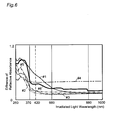
- Fig. 6 shows a graph of the relationship between the wavelength of irradiated light and absorbance
- Fig. 7 is an explanatory diagram showing the effect on evaluation values in the case of varying moisture content
- Fig. 8 is an explanatory diagram showing the effect on evaluation values in the case of varying sign of yellowing.
- Fig. 9 is an explanatory diagram showing experimental result as a comparative example.
- Fig. 1 is a schematic of the structure of a paper material identifying machine.
- the paper material identifying machine comprises an optical 1 unit 20 and a controller 10.
- the optical unit 20 includes a light source 23 in order to irradiate irradiated light that is used for identifying material of sheets, such as banknotes.
- the identification is performed using two different kinds of irradiated light.
- the spectrum of the first kind of the irradiated light, the center wavelength of which is 370 nm distributes within the range of 370 ⁇ 10 nm (Hereinafter referred to as "short-wavelength light").
- the spectrum the second kind of the irradiated light the center wavelength of which is within the range of 420 to 1000 nm, distributes within the range of ⁇ 20 nm from the center wavelength(Hereinafter referred to as "long-wavelength light”).
- the wavelength of the light may be selected experimentally or analytically so as to obtain the value most suitable for the paper material of the sheet to be identified.
- two different kinds of the irradiated light are obtained by switching over a filter 24 through which the light irradiated from the single light source 23 passes. It is also applicable to install two light sources for irradiating restrictive light in different wavebands.
- the light source 23 is activated by an irradiation drive circuit 22.
- the irradiation drive circuit 22 is configured to impress the voltage according to a control signal from the controller 10.
- the irradiation drive circuit 22 may vary impedance based on the control signal, thereby enabling the adjustment of the amount of emission from the light source 23.
- the optical unit 20 includes a light receiver 25, for detecting the intensity of the reflected light, and a reflected light detecting circuit 26. It is possible to apply a photo transistor, a photo diode, a magnetic spectrophotometer or the like to the light receiver 25. It is possible to apply, for example, A/D converter, which converts an analog signal such as the voltage being output from the light receiver 25 to a digital signal, to the reflected light detecting circuit 26.
- the controller 10 is constructed as a microcomputer including CPU, RAM, ROM or the like, and is configured to identify the paper material by handling a variety of signals transmitted from the optical unit 20 as shown in respective functional blocks. Functions of respective functional blocks are discussed in the subsequent section.
- Fig. 2 is a flow chart showing a processing of paper material identification that is performed by the controller 10 in response to the insertion of the sheet 28.
- the controller 10 controls the irradiation drive circuit 22 in order to irradiate the short-wavelength light (Step S10).
- the controller 10 simultaneously controls the filter 24 in order to irradiate the short-wavelength light and the long-wavelength light in a sequential order.
- These functions are actualized by an irradiation controller 15.
- the irradiated light is reflected on the sheet 28, and then incidents into the light receiver 25.
- the controller 10 obtains the intensity of the reflected light for the short-wavelength light by the function of a reflected light detecting module 14.
- absorbance of the short-wavelength light A1 is calculated from the following formula, based on intensity of the irradiated light L10 and the intensity of the reflected light L1 (Step S12).
- a ⁇ 1 log L ⁇ 1 / L ⁇ 10 ;
- the controller 10 controls the irradiation drive circuit 22 in order to irradiate the long-wavelength light (step S14), and calculates absorbance of the long-wavelength light A2 from the following formula, based on intensity of the irradiated light L20 and the intensity of the reflected light L2 (Step S16).
- a ⁇ 2 log L ⁇ 2 / L ⁇ 20 ;
- the controller 10 obtains an evaluation value for identifying the paper material, based on the above absorbance; A1 and A2 (Step S18).
- the difference between two absorbance is used as an evaluation value, as follows.
- Evaluation value Da A ⁇ 1 - A ⁇ 2
- An evaluation value calculating module 13 functions to calculate the evaluation value based on the above arithmetic expression.
- the short-wavelength light and the long-wavelength light are irradiated in this order, however it is applicable to irradiate them in a reverse order.
- both the short-wavelength light and the long-wavelength light may be irradiated simultaneously if each absorbance corresponding to the light is distinguishable.
- the controller 10 pre-stores an evaluation value table 12 that represents the relationship between the evaluation value and the paper material. An example of the evaluation value table 12 will be discussed later.
- the controller 10 identifies the paper material by comparing the evaluation value obtained on step 18 with the value stored in the evaluation value table 12 (Step S20). A paper material identification module 11 achieves this function. The controller 10 thus outputs the result of the identification (Step S22) and then terminates this processing.
- Fig. 3 is an explanatory diagram showing the relationship between the evaluation value and the paper material with 660nm-long-wavelength light.
- the figure shows the experimental result of the irradiation with 370 nm-short-wavelength-light and 660 nm-long-wavelength-light to six kinds of the paper material of sheets at a humidity of 40%.
- DA represents the difference between both absorbance.
- the light was emitted with a 150 mm-integrated-sphere.
- the light intensity was detected with a magnetic spectrophotometer.
- Each sheet number represents the paper material as follows; N0.1 .
- Kraft Paper N0.2 Color Copy Paper N0.3 : OCR Paper N0.4 : Bathroom Tissue N0.5 : Ordinary Copy Paper N0.6 Banknote
- the paper material may be identified by storing the evaluation values into the evaluation value table 12 in advance.
- the purpose of the identification is to judge as to whether or not the sheet 28 is genuine banknote, it is applicable to simply store value corresponding to the banknote into the evaluation value table 12, thereby enabling easy judgment as to genuine from counterfeit, based on whether or not the evaluation value of the sheet 28 matches the stored value.
- Fig. 4 is an explanatory diagram showing the relationship between the evaluation values and the paper material with 880 nm-long-wavelength-light.
- the definitions of the short-wavelength light, the paper material to be identified, the condition of humidity and the evaluation values are the same as those of Fig. 3 .
- Fig. 4 has also shown that the absorbance apparently has been varied depending on the paper material with 880 nm-light. It should be noted, however, that the difference between "No.3: OCR Paper” and "NO.5: Ordinary Copy Paper” is relatively small in this example, therefore, it is preferred not to apply this testing in the necessity that both types are to be identified.
- Fig. 5 is an explanatory diagram showing the relationship between evaluation values and the paper material with 420 nm-long-wavelength-light. Fig. 5 has also shown that the absorbance apparently has been varied depending on the paper material with 420 nm-light. The difference between "NO.5: Ordinary Copy Paper” and "No.6: Banknote" is relatively small in this example, however, they are distinguishable each other.
- Fig. 6 shows a graph of the relationship between the wavelength of the irradiated light and the absorbance.
- Fig. 6 has shown the variation in the absorbance for the irradiated light within the range between 250 and 1000 nm about six kinds of papers to be identified in Figs.3 and 4 .
- the irradiated light of 370 nm, 420 nm, 660 nm and 880 nm used in Figs.3 and 4 are shown here as well.
- the absorbance in the range of 370 nm steeply varies as the wavelength varies.
- the absorbance of some papers are constant, and others are varying.
- the absorbance is nearly constant. Therefore, it is possible to obtain the patterns similar to one out of examples in Figs. 3 through 5 or interpolating them, thereby enabling the identification of the paper material.
- Fig. 7 is an explanatory diagram showing the influence on the evaluation values in the case of varying humidity.
- the experimental result at a humidity of 90% is shown, contrasting to being shown the result at a humidity of 40% in Fig.3 .
- Fig. 8 is an explanatory diagram showing the influence on the evaluation values in the case of varying the sign of yellowing.
- the experimental result at a yellowing of 30% is shown, contrasting to being shown the result for new sheets, at no yellowing, in Fig.3 .
- the evaluation values of this embodiment enable the identification of the paper material free from the influence due to the variation in the humidity and the sign of yellowing.
- Fig. 9 is an explanatory diagram showing experimental result as a comparative example.
- the example shows that the identification of the paper material is performed simply employing the absorbance for the short-wavelength light whose center wavelength is 370 nm.
- Solid-box-marks indicate the results under the same conditions as those of Fig. 3 : new papers, at a humidity of 40 %. Under those conditions, it turns to be possible to identify the paper material by employing the short-wavelength light only.
- Circle-marks indicate the results under the same conditions as those of Fig. 7 : new papers, at a humidity of 95 %.
- Triangle-marks indicate the results under the same conditions as those of Fig. 8 : at a yellowing of 30 %, a humidity of 40 %.
- the variation of the conditions such as the humidity and the sign of yellowing, significantly influence on the absorbance, thereby declining stable identification about the paper material.
- all of three data within the area A are 0.2, which are impossible to be distinguished. Therefore, the identification employing the short-wavelength light only can't be stable and accurate enough.
- the paper material identifying machine discussed in this embodiment using the long-wavelength light as well as the short-wavelength light it is possible to reduce influences that are caused by manufacturing process, environmental factors such as humidity, and deterioration of sheets, thereby resulting in stable identification of the paper material.
- a reflection method is exemplified in the above embodiment, it is applicable to employ a transmission method that detects absorbance based on transmitted light through a sheet.
- a weighting factor may be multiplied at least one out of the two absorbance, A1 and A2, to calculate the evaluation value, as follows.
- evaluation values DAm and Ar may be multiplied to the above evaluation values DAm and Ar.
- the evaluation values may be defined by the arithmetic expression including one of DAm or Ar, or both of them.
- short-wavelength light whose center wavelength is 370 nm and long wavelength light whose center wavelength is in the range of 420 to 1000 are employed. It is also applicable to employ more than two kinds of the irradiated light.
- the wavelength of the irradiated light is settable in various manners corresponding to the paper material to be identified. In general, when the center wavelength is around 370 nm, which is included in the ultraviolet range, the absorbance peculiar to binder that adheres fabric composing a sheet arises, thereby tending to easily detect the difference in the absorbance depending on the paper material.
- the absorbance for the light in the range of 420 to 1000 tends to be less influenced by the variation of the paper material, such as sign of yellowing, caused by deterioration and worn-out of sheets.
- the absorbance for the light under the range of 1000 nm tends to be less sensitive by humidity. It is preferable to select the irradiated light in view of those tendencies, for example, by combining the ultraviolet light with the visible light or the infrared light. Further, it is preferable to include the light whose center wavelength is 370 nm or the light whose center wavelength is in the range of 420 to 1000 nm.
- the paper material identifying machine for identifying banknotes is exemplified, however, it is not restrictive to the banknotes but may be applicable for various kinds of sheets, for example, a lot ticket such as lottery, a ballot ticket of bike race, horse race or boat race, an admission ticket, a utility ticket of highway, telephone or various facilities, various securities, credit obligation, stock certificate and book coupon.
- the paper material identifying machine in the present invention may be employed not only for the purpose of any identification processing about sheets genuine or counterfeit, but also for analysis in the paper material of the sheet to be identified.
- the paper material identifying machine in accordance with the present invention prevents effects caused by manufacturing process, environmental factors such as moisture content and depleted sheets, thereby resulting in stable identification about the paper material.
Landscapes
- Physics & Mathematics (AREA)
- Health & Medical Sciences (AREA)
- General Health & Medical Sciences (AREA)
- Toxicology (AREA)
- Spectroscopy & Molecular Physics (AREA)
- General Physics & Mathematics (AREA)
- Inspection Of Paper Currency And Valuable Securities (AREA)
- Investigating Or Analysing Materials By Optical Means (AREA)
- Paper (AREA)
Description
- The present invention relates to a machine and a method for identifying paper quality, to be more precise, paper material.
- One method to discriminate genuine from counterfeit about sheets, such as banknotes, for example, is performed by judging as to whether or not the material of sheets are proper. As to well known in the art, there is a technique of identifying the paper material, based on optical scanning of lattice shading patterns of the paper, which is caused by fibrous structure of the paper (e.g.
JP8-180189A JP11-139620A WO-A-9 950 796 - Those skilled in the art, however, fail to attain stable identification of paper material sufficiently. In some cases of the first technique, the variation of shading patterns, which are caused by differences in manufacturing process, resulted in misjudgments about the paper material. On the other hand, in some cases of the latter technique, the variation of frictional force, which is caused by variable humidity and deterioration of sheets, resulted in misjudgments about the paper material.
- The object of the present invention is thus to provide a machine and a method for identifying the paper material in a reliable manner.
To attain at least part of the above and the other related objects in the present invention, the technique of the present invention directs to irradiate plural kinds of irradiated light to paper to be identified, each kind of the irradiated light included in a different waveband.
This technique identifies the paper material, based on an evaluation value calculated according to a prescribed arithmetic expression including the series of absorbance of the paper corresponding to each kind of the irradiated light Since the absorbance of paper varies depending on the paper material, the absorbance, in contrast to the shading patterns of the paper, enables the identification of the paper material free from the influence of differences in manufacturing process. In addition, the plural kinds of the irradiated light in different wavebands may reduce the influence on the absorbance, caused by environmental factors, such as humidity, and deterioration of sheets, thereby resulting in stable identification of the paper material. - Here, the absorbance means the ratio between the intensity of the irradiated light L0 and that of the light L transmitted through the paper or reflected from the paper, and is defined as e.g. "Absorbance = log (L/L0)". It is also possible to be defined as "Absorbance = L/L0". The absorbance may be detected by means of a transmission method that is measured by the transmitted light through the paper or a reflection method that is measured by the reflected light from the paper.
The wavebands of the irradiated light may be arbitrary set according to the purpose of identifying the paper material, that is, what kind of paper material is to be identified. The present invention is thus applicable to discriminate genuine from counterfeit about banknotes and other prescribed sheets. In those cases, the wavebands may be selected so that the absorbance of genuine paper material significantly differs from that of any other paper materials since it is only required to judge as to whether or not the identified paper is genuine material.
The irradiated light preferably includes short-wavelength light within the ultraviolet light range and long-wavelength light within the visible light or the infrared light range. It is because the short-wavelength light tends to make the absorbance of each paper material typically distinctive, and the long-wavelength light tends to make the absorbance less sensitive to the environmental factors, such as humidity, and deterioration of paper. The combination of both types of the light thus improves the stabilization as well as the accuracy for identifying the paper material. In particular, it is preferable that the center wavelength of the short-wavelength light is in the range of 370±10 nm, and the long-wavelength light is in the range of 420 to 1000 nm. - In the present invention, the prescribed arithmetic expression includes at least one out of two parameters, DA or Ar, which are respectively calculated from the following arithmetic expressions.

and
- Here, A1 and A2 respectively represents the series of absorbance responsive to the irradiated light in two different wavebands, and Ca is an arbitrary positive number. Those evaluation values corresponding to the paper material are stored in advance, so that the paper material may be judged by comparing the stored values with the evaluation values being calculated from the absorbance corresponding to the paper to be identified.
- A variety of the structures may be adopted for the present invention. For example, the present invention may be attained by a paper material identifying machine for identifying the paper material based on the above-mentioned policy, or a method for identifying the paper material. Further, it is also applicable to be constructed as a paper identifying machine and a method for identifying genuine from counterfeit about banknotes, based on a result from the identification about the paper material.
-
Fig. 1 is a schematic of the structure of a paper material identifying machine; -
Fig. 2 is a flow chart of a processing of paper material identification; -
Fig. 3 is an explanatory diagram showing the relationship between evaluation values and paper material with 660 nm-long-wavelength-light; -
Fig. 4 is an explanatory diagram showing the relationship between evaluation values and paper material with 880 nm-long-wavelength-light; -
Fig. 5 is an explanatory diagram showing the relationship between evaluation values and paper material with 420 nm-long-wavelength-light; -
Fig. 6 shows a graph of the relationship between the wavelength of irradiated light and absorbance; -
Fig. 7 is an explanatory diagram showing the effect on evaluation values in the case of varying moisture content; -
Fig. 8 is an explanatory diagram showing the effect on evaluation values in the case of varying sign of yellowing; and -
Fig. 9 is an explanatory diagram showing experimental result as a comparative example. - Some modes of performing the present invention are discussed below as preferred embodiments.
-
Fig. 1 is a schematic of the structure of a paper material identifying machine. The paper material identifying machine comprises an optical 1unit 20 and acontroller 10. - The
optical unit 20 includes alight source 23 in order to irradiate irradiated light that is used for identifying material of sheets, such as banknotes. In this embodiment, the identification is performed using two different kinds of irradiated light. The spectrum of the first kind of the irradiated light, the center wavelength of which is 370 nm, distributes within the range of 370±10 nm (Hereinafter referred to as "short-wavelength light"). The spectrum the second kind of the irradiated light, the center wavelength of which is within the range of 420 to 1000 nm, distributes within the range of ±20 nm from the center wavelength(Hereinafter referred to as "long-wavelength light"). In either types, the wavelength of the light may be selected experimentally or analytically so as to obtain the value most suitable for the paper material of the sheet to be identified. - In this embodiment, two different kinds of the irradiated light are obtained by switching over a
filter 24 through which the light irradiated from thesingle light source 23 passes. It is also applicable to install two light sources for irradiating restrictive light in different wavebands. - It is possible to apply various devices to the light source 23: an integrated sphere, a light emitted diode, an ultraviolet lump, an infrared light emitted diode or the like. The
light source 23 is activated by anirradiation drive circuit 22. Theirradiation drive circuit 22 is configured to impress the voltage according to a control signal from thecontroller 10. Theirradiation drive circuit 22 may vary impedance based on the control signal, thereby enabling the adjustment of the amount of emission from thelight source 23. - When a
sheet 28 is located on aconveyance path 21, the irradiated light is reflected on the surface of thesheet 28. Theoptical unit 20 includes alight receiver 25, for detecting the intensity of the reflected light, and a reflectedlight detecting circuit 26. It is possible to apply a photo transistor, a photo diode, a magnetic spectrophotometer or the like to thelight receiver 25. It is possible to apply, for example, A/D converter, which converts an analog signal such as the voltage being output from thelight receiver 25 to a digital signal, to the reflectedlight detecting circuit 26. - The
controller 10 is constructed as a microcomputer including CPU, RAM, ROM or the like, and is configured to identify the paper material by handling a variety of signals transmitted from theoptical unit 20 as shown in respective functional blocks. Functions of respective functional blocks are discussed in the subsequent section. -
Fig. 2 is a flow chart showing a processing of paper material identification that is performed by thecontroller 10 in response to the insertion of thesheet 28. - First, the
controller 10 controls theirradiation drive circuit 22 in order to irradiate the short-wavelength light (Step S10). In the course of this processing, thecontroller 10 simultaneously controls thefilter 24 in order to irradiate the short-wavelength light and the long-wavelength light in a sequential order. These functions are actualized by anirradiation controller 15. The irradiated light is reflected on thesheet 28, and then incidents into thelight receiver 25. Thecontroller 10 obtains the intensity of the reflected light for the short-wavelength light by the function of a reflectedlight detecting module 14. In addition, absorbance of the short-wavelength light A1 is calculated from the following formula, based on intensity of the irradiated light L10 and the intensity of the reflected light L1 (Step S12).
- Similarly, the
controller 10 controls theirradiation drive circuit 22 in order to irradiate the long-wavelength light (step S14), and calculates absorbance of the long-wavelength light A2 from the following formula, based on intensity of the irradiated light L20 and the intensity of the reflected light L2 (Step S16).
- In this embodiment, the absorbance is defined as the inferior logarithm of the ratio between the irradiated light and the reflected light, however, the absorbance may be defined as the ratio between the irradiated light and the reflected light, that is, "A1=L1/L10" and "A2=L2/L20".
- Subsequently, the
controller 10 obtains an evaluation value for identifying the paper material, based on the above absorbance; A1 and A2 (Step S18). In this embodiment, the difference between two absorbance is used as an evaluation value, as follows.
- An evaluation
value calculating module 13 functions to calculate the evaluation value based on the above arithmetic expression. - In this embodiment, the short-wavelength light and the long-wavelength light are irradiated in this order, however it is applicable to irradiate them in a reverse order. In addition, both the short-wavelength light and the long-wavelength light may be irradiated simultaneously if each absorbance corresponding to the light is distinguishable.
- The
controller 10 pre-stores an evaluation value table 12 that represents the relationship between the evaluation value and the paper material. An example of the evaluation value table 12 will be discussed later. Thecontroller 10 identifies the paper material by comparing the evaluation value obtained onstep 18 with the value stored in the evaluation value table 12 (Step S20). A papermaterial identification module 11 achieves this function. Thecontroller 10 thus outputs the result of the identification (Step S22) and then terminates this processing. -
Fig. 3 is an explanatory diagram showing the relationship between the evaluation value and the paper material with 660nm-long-wavelength light. The figure shows the experimental result of the irradiation with 370 nm-short-wavelength-light and 660 nm-long-wavelength-light to six kinds of the paper material of sheets at a humidity of 40%. DA represents the difference between both absorbance. The light was emitted with a 150 mm-integrated-sphere. The light intensity was detected with a magnetic spectrophotometer. Each sheet number represents the paper material as follows;
N0.1 . Kraft Paper
N0.2 : Color Copy Paper
N0.3 : OCR Paper
N0.4 : Bathroom Tissue
N0.5 : Ordinary Copy Paper
N0.6 Banknote - The result of this experimental test in
Fig. 3 has shown that the evaluation values have been varied depending on the paper material. Thus, the paper material may be identified by storing the evaluation values into the evaluation value table 12 in advance. When the purpose of the identification is to judge as to whether or not thesheet 28 is genuine banknote, it is applicable to simply store value corresponding to the banknote into the evaluation value table 12, thereby enabling easy judgment as to genuine from counterfeit, based on whether or not the evaluation value of thesheet 28 matches the stored value. -
Fig. 4 is an explanatory diagram showing the relationship between the evaluation values and the paper material with 880 nm-long-wavelength-light. The definitions of the short-wavelength light, the paper material to be identified, the condition of humidity and the evaluation values are the same as those ofFig. 3 .Fig. 4 has also shown that the absorbance apparently has been varied depending on the paper material with 880 nm-light. It should be noted, however, that the difference between "No.3: OCR Paper" and "NO.5: Ordinary Copy Paper" is relatively small in this example, therefore, it is preferred not to apply this testing in the necessity that both types are to be identified. -
Fig. 5 is an explanatory diagram showing the relationship between evaluation values and the paper material with 420 nm-long-wavelength-light.Fig. 5 has also shown that the absorbance apparently has been varied depending on the paper material with 420 nm-light. The difference between "NO.5: Ordinary Copy Paper" and "No.6: Banknote" is relatively small in this example, however, they are distinguishable each other. -
Fig. 6 shows a graph of the relationship between the wavelength of the irradiated light and the absorbance.Fig. 6 has shown the variation in the absorbance for the irradiated light within the range between 250 and 1000 nm about six kinds of papers to be identified inFigs.3 and4 . The irradiated light of 370 nm, 420 nm, 660 nm and 880 nm used inFigs.3 and4 are shown here as well. As shown inFig. 6 , the absorbance in the range of 370 nm steeply varies as the wavelength varies. In the range of 420 nm to 660 nm, the absorbance of some papers are constant, and others are varying. In the range over 660 nm, the absorbance is nearly constant. Therefore, it is possible to obtain the patterns similar to one out of examples inFigs. 3 through 5 or interpolating them, thereby enabling the identification of the paper material. -
Fig. 7 is an explanatory diagram showing the influence on the evaluation values in the case of varying humidity. The experimental result at a humidity of 90% is shown, contrasting to being shown the result at a humidity of 40% inFig.3 .Fig. 8 is an explanatory diagram showing the influence on the evaluation values in the case of varying the sign of yellowing. The experimental result at a yellowing of 30% is shown, contrasting to being shown the result for new sheets, at no yellowing, inFig.3 . According toFigs. 7 and8 , the evaluation values of this embodiment enable the identification of the paper material free from the influence due to the variation in the humidity and the sign of yellowing. -
Fig. 9 is an explanatory diagram showing experimental result as a comparative example. The example shows that the identification of the paper material is performed simply employing the absorbance for the short-wavelength light whose center wavelength is 370 nm. Solid-box-marks indicate the results under the same conditions as those ofFig. 3 : new papers, at a humidity of 40 %. Under those conditions, it turns to be possible to identify the paper material by employing the short-wavelength light only. Circle-marks indicate the results under the same conditions as those ofFig. 7 : new papers, at a humidity of 95 %. Triangle-marks indicate the results under the same conditions as those ofFig. 8 : at a yellowing of 30 %, a humidity of 40 %. As shown in the figure, the variation of the conditions, such as the humidity and the sign of yellowing, significantly influence on the absorbance, thereby declining stable identification about the paper material. For example, all of three data within the area A are 0.2, which are impossible to be distinguished. Therefore, the identification employing the short-wavelength light only can't be stable and accurate enough. - The paper material identifying machine discussed in this embodiment using the long-wavelength light as well as the short-wavelength light, it is possible to reduce influences that are caused by manufacturing process, environmental factors such as humidity, and deterioration of sheets, thereby resulting in stable identification of the paper material.
- Although a reflection method is exemplified in the above embodiment, it is applicable to employ a transmission method that detects absorbance based on transmitted light through a sheet.
- A variety of methods may be defined for calculating evaluation values. For example, a weighting factor may be multiplied at least one out of the two absorbance, A1 and A2, to calculate the evaluation value, as follows.
Evaluation Value DAm=A1-Ca·A2;
Ca= arbitrary positive number; - The evaluation value may be also defined as an extinction quotient as follows.
Evaluation Value Ar=A1/A2; - Certainly, further coefficient may be multiplied to the above evaluation values DAm and Ar. The evaluation values may be defined by the arithmetic expression including one of DAm or Ar, or both of them.
- In the embodiment, short-wavelength light whose center wavelength is 370 nm and long wavelength light whose center wavelength is in the range of 420 to 1000 are employed. It is also applicable to employ more than two kinds of the irradiated light. The wavelength of the irradiated light is settable in various manners corresponding to the paper material to be identified. In general, when the center wavelength is around 370 nm, which is included in the ultraviolet range, the absorbance peculiar to binder that adheres fabric composing a sheet arises, thereby tending to easily detect the difference in the absorbance depending on the paper material. The absorbance for the light in the range of 420 to 1000, which is included in the visible light or the infrared light range, tends to be less influenced by the variation of the paper material, such as sign of yellowing, caused by deterioration and worn-out of sheets. The absorbance for the light under the range of 1000 nm tends to be less sensitive by humidity. It is preferable to select the irradiated light in view of those tendencies, for example, by combining the ultraviolet light with the visible light or the infrared light. Further, it is preferable to include the light whose center wavelength is 370 nm or the light whose center wavelength is in the range of 420 to 1000 nm.
- In the embodiment, the paper material identifying machine for identifying banknotes is exemplified, however, it is not restrictive to the banknotes but may be applicable for various kinds of sheets, for example, a lot ticket such as lottery, a ballot ticket of bike race, horse race or boat race, an admission ticket, a utility ticket of highway, telephone or various facilities, various securities, credit obligation, stock certificate and book coupon. In addition, the paper material identifying machine in the present invention may be employed not only for the purpose of any identification processing about sheets genuine or counterfeit, but also for analysis in the paper material of the sheet to be identified.
- The above embodiments are to be considered in all aspects as illustrative and not restrictive. For example, a processing of the paper material identification discussed above may be attained by the hardware construction as well as the software configuration.
- The paper material identifying machine in accordance with the present invention prevents effects caused by manufacturing process, environmental factors such as moisture content and depleted sheets, thereby resulting in stable identification about the paper material.
Claims (10)
- A paper material identifying machine comprising:an irradiation module (15) for irradiating plural kinds of irradiation light of different wavebands to a paper to be identified;a detecting module (14) for detecting a plurality of absorbances of the paper corresponding to the plural kinds of the irradiation light; andan identification module (11) for identifying the paper based on an evaluation value,characterized in that
each absorbance corresponds to the ratio of the light intensity transmitted or reflected by the paper and the intensity of the irradiation light, and
the evaluation value is adapted to identify the material of the paper and is calculated in accordance with a prescribed arithmetic expression including the plurality of absorbance. - The machine of claim 1, wherein
the irradiation module (15) comprises:a first irradiating sub-module for irradiating first irradiation light to the paper, the first irradiation light being included in a first waveband; anda second irradiating sub-module for irradiating second irradiation light to the paper, the second irradiation light being included in a second waveband different from the first wavebandthe detecting module (14) comprises:a first detecting sub-module for detecting a luminous intensity of first reflected light or first transmitted light, wherein the first reflected light is reflected from the paper by irradiating the first irradiation light to the paper, and the first transmitted light is transmitted through the paper by irradiating the first irradiation light to the paper;a second detecting sub-module for detecting a luminous intensity of second reflected light or second transmitted light, wherein the second reflected light is reflected from the paper by irradiating the second irradiation light to the paper, and the second transmitted light is transmitted through the paper by irradiating the second irradiation light to the paper; anda measuring module (13) for measuring a first absorbance and a second absorbance, the first absorbance being defined using a ratio between the intensity of the first irradiation light and that of the light detected by the first detecting sub-module, the second absorbance being defined using a ratio between the intensity of the second irradiation light and that of the light detected by the second detecting sub-module, andthe identification module (11) is adapted to identify the paper material by comparing the evaluation value, defined by the first absorbance and the second absorbance, with prescribed standard values. - The machine of claim 2, wherein
the first irradiation light includes short-wavelength light within the ultraviolet light range, and
the second irradiation light includes long-wavelength light within the visible light or the infrared light range. - The machine of claim 2 or 3, wherein the evaluation value is defined by the formula Ar = A1 / A2, wherein


L10 represents the intensity of the first irradiation light,
L20 represents the intensity of the second irradiation light,
L1 represents the intensity of the first reflected light or the first transmitted light, and
L2 represents the intensity of the second reflected light or the second transmitted light. - The machine of claim 2 or 3, wherein the evaluation value is defined by the formula DA = A1 - Ca · A2, wherein


L10 represents the intensity of the first irradiation light,
L20 represents the intensity of the second irradiation light,
L1 represents the intensity of the first reflected light or the first transmitted light,
L2 represents the intensity of the second reflected light or the second transmitted light, and
Ca is an arbitrary parameter. - A method for identifying paper material comprising the steps of:irradiating (S10, S14) plural kinds of irradiation light to the paper to be identified, each kind of the irradiation light being included in a different waveband;detecting (S12, S16) a plurality of absorbances of the paper corresponding to the plural kinds of the irradiation light, wherein each absorbance corresponds to the ratio of the light intensity transmitted or reflected by the paper and the intensity of the irradiation light; andidentifying (S20) the paper material, based on an evaluation value calculated according to a prescribed arithmetic expression including the plurality of absorbances.
- The machine of claim 1 or the method 6, wherein the irradiation light includes short-wavelength light within the ultraviolet light range and long-wavelength light within the visible light or the infrared light range.
- The machine or method of any of claims 1, 6 and 7, wherein the prescribed arithmetic expression includes at least one of two parameters, DA and Ar, defined by the following arithmetic expressions;

and
wherein A1 and A2 respectively represent the plurality of absorbances responsive to the irradiation lights in two different wavebands, and Ca is an arbitrary positive number. - The machine or method of claim 3 or 7, wherein the center wavelength of the short-wavelength light is in the range of 370±10 nm.
- The machine or method of any of claims 3, 7 and 9, wherein the center wavelength of the long-wavelength light is in the range of 420 to 1000 nm.
Applications Claiming Priority (2)
| Application Number | Priority Date | Filing Date | Title |
|---|---|---|---|
| JP2002119439 | 2002-04-22 | ||
| JP2002119439A JP4210466B2 (en) | 2002-04-22 | 2002-04-22 | Discriminator |
Publications (3)
| Publication Number | Publication Date |
|---|---|
| EP1357522A2 EP1357522A2 (en) | 2003-10-29 |
| EP1357522A3 EP1357522A3 (en) | 2004-07-21 |
| EP1357522B1 true EP1357522B1 (en) | 2008-03-05 |
Family
ID=28786747
Family Applications (1)
| Application Number | Title | Priority Date | Filing Date |
|---|---|---|---|
| EP20030009068 Revoked EP1357522B1 (en) | 2002-04-22 | 2003-04-17 | Paper quality discriminating machine |
Country Status (5)
| Country | Link |
|---|---|
| US (1) | US7167247B2 (en) |
| EP (1) | EP1357522B1 (en) |
| JP (1) | JP4210466B2 (en) |
| CN (3) | CN102592346A (en) |
| DE (1) | DE60319456T2 (en) |
Families Citing this family (20)
| Publication number | Priority date | Publication date | Assignee | Title |
|---|---|---|---|---|
| RU2305323C2 (en) † | 2002-12-27 | 2007-08-27 | Джэпэн Кэш Машин Ко., Лтд. | Optical perception device for detecting optical signs of securities |
| JP4366104B2 (en) | 2003-04-17 | 2009-11-18 | 日立オムロンターミナルソリューションズ株式会社 | Paper sheet discrimination device |
| CN1898704B (en) * | 2004-02-12 | 2010-04-21 | 日本电产科宝株式会社 | Check device |
| CA2559102C (en) * | 2004-03-09 | 2013-01-15 | Council Of Scientific And Industrial Research | Improved fake currency detector using visual and reflective spectral response |
| DE102005031957B4 (en) * | 2005-07-08 | 2007-03-22 | Koenig & Bauer Ag | Apparatus for inspecting a substrate with non-uniform reflective surfaces |
| JP4979977B2 (en) * | 2006-04-26 | 2012-07-18 | 三菱電機株式会社 | Surface state determination device, surface state determination method, and surface state determination program |
| US8125625B2 (en) * | 2009-07-12 | 2012-02-28 | Hewlett-Packard Development Company, L.P. | Hard copy re-emission color measurement system |
| US8749767B2 (en) | 2009-09-02 | 2014-06-10 | De La Rue North America Inc. | Systems and methods for detecting tape on a document |
| JP5673621B2 (en) * | 2012-07-18 | 2015-02-18 | オムロン株式会社 | Defect inspection method and defect inspection apparatus |
| JP6221738B2 (en) | 2013-01-07 | 2017-11-01 | セイコーエプソン株式会社 | Recording medium discrimination device and recording medium discrimination method |
| CN103324946B (en) | 2013-07-11 | 2016-08-17 | 广州广电运通金融电子股份有限公司 | A kind of method and system of paper money recognition classification |
| JP6806134B2 (en) | 2016-02-24 | 2021-01-06 | セイコーエプソン株式会社 | Sheet collection device, sheet collection system, sheet collection method |
| DE102016005923A1 (en) * | 2016-05-13 | 2017-11-16 | Giesecke+Devrient Currency Technology Gmbh | Device and method for checking the authenticity of a security element |
| EA039217B1 (en) * | 2016-06-30 | 2021-12-20 | Сикпа Холдинг Са | System and method for forming an image of an object and generating a measure of authenticity of an object |
| WO2018029884A1 (en) * | 2016-08-10 | 2018-02-15 | シャープ株式会社 | Image formation device and determination method |
| CN107633591A (en) * | 2017-08-31 | 2018-01-26 | 维沃移动通信有限公司 | The authenticity verification method and mobile terminal of a kind of bank note |
| CN110853217B (en) * | 2018-07-24 | 2022-05-13 | 深圳怡化电脑股份有限公司 | Method, device and equipment for determining false discriminating wavelength and storage medium |
| CN110779877B (en) * | 2019-11-08 | 2020-08-14 | 青岛市黄岛区中心医院 | Medical literature state timing detection platform |
| JP7694146B2 (en) * | 2021-05-24 | 2025-06-18 | コニカミノルタ株式会社 | Recording medium discrimination device, image forming apparatus, and recording medium discrimination method |
| US11906919B2 (en) * | 2021-05-24 | 2024-02-20 | Konica Minolta, Inc. | Recording medium determination device, image formation device, and recording medium determination method |
Family Cites Families (23)
| Publication number | Priority date | Publication date | Assignee | Title |
|---|---|---|---|---|
| US3910701A (en) * | 1973-07-30 | 1975-10-07 | George R Henderson | Method and apparatus for measuring light reflectance absorption and or transmission |
| US4618257A (en) * | 1984-01-06 | 1986-10-21 | Standard Change-Makers, Inc. | Color-sensitive currency verifier |
| US4750140A (en) * | 1984-11-30 | 1988-06-07 | Kawasaki Steel Corporation | Method of and apparatus for determining glossiness of surface of a body |
| JPS61233889A (en) | 1985-04-09 | 1986-10-18 | 株式会社東芝 | Paper money discriminator |
| JPH087145B2 (en) | 1986-08-04 | 1996-01-29 | 日本製紙株式会社 | Method for measuring the adhesive concentration on the surface of the coating layer |
| JPS63187138A (en) | 1987-01-30 | 1988-08-02 | Fuji Photo Film Co Ltd | Color document classifying apparatus |
| JPH0812709B2 (en) * | 1988-05-31 | 1996-02-07 | ローレルバンクマシン株式会社 | Bill validator |
| US5960103A (en) * | 1990-02-05 | 1999-09-28 | Cummins-Allison Corp. | Method and apparatus for authenticating and discriminating currency |
| JPH07260680A (en) | 1994-03-23 | 1995-10-13 | Yokogawa Electric Corp | Infrared sensor |
| JPH08180189A (en) | 1994-12-26 | 1996-07-12 | Toyo Commun Equip Co Ltd | Method and apparatus for determining authenticity of paper sheet |
| US5757001A (en) * | 1996-05-01 | 1998-05-26 | The Regents Of The University Of Calif. | Detection of counterfeit currency |
| US6325505B1 (en) * | 1997-06-30 | 2001-12-04 | Hewlett-Packard Company | Media type detection system for inkjet printing |
| JPH11139620A (en) | 1997-11-10 | 1999-05-25 | Omron Corp | Paper quality judgment device |
| GB9806914D0 (en) | 1998-03-31 | 1998-05-27 | Rue De Int Ltd | Methods and apparatus for monitoring articles |
| US6297508B1 (en) | 1998-08-10 | 2001-10-02 | Cryovac Inc. | Method of determining authenticity of a packaged product |
| JP2000307819A (en) * | 1999-04-26 | 2000-11-02 | Glory Ltd | Image reading apparatus using multi-wavelength light source and control method thereof |
| JP3839207B2 (en) * | 2000-01-14 | 2006-11-01 | グローリー工業株式会社 | Paper sheet identification device |
| US6473165B1 (en) * | 2000-01-21 | 2002-10-29 | Flex Products, Inc. | Automated verification systems and methods for use with optical interference devices |
| JP2002245511A (en) * | 2001-02-15 | 2002-08-30 | Hitachi Ltd | Paper quality identification method |
| JP4112266B2 (en) | 2001-04-25 | 2008-07-02 | 株式会社ワールド・テクノ | Banknote authenticity identification device |
| US6914684B1 (en) * | 2001-07-05 | 2005-07-05 | Lexmark International, Inc. | Method and apparatus for detecting media type |
| US6839128B2 (en) * | 2002-03-08 | 2005-01-04 | Canadian Bank Note Company, Ltd. | Optoelectronic document reader for reading UV / IR visible indicia |
| US6838687B2 (en) * | 2002-04-11 | 2005-01-04 | Hewlett-Packard Development Company, L.P. | Identification of recording media |
-
2002
- 2002-04-22 JP JP2002119439A patent/JP4210466B2/en not_active Expired - Fee Related
-
2003
- 2003-04-17 DE DE2003619456 patent/DE60319456T2/en not_active Expired - Lifetime
- 2003-04-17 CN CN201110340479XA patent/CN102592346A/en active Pending
- 2003-04-17 EP EP20030009068 patent/EP1357522B1/en not_active Revoked
- 2003-04-17 CN CN03122911A patent/CN1453571A/en active Pending
- 2003-04-17 CN CN200910160507A patent/CN101694731A/en active Pending
- 2003-04-17 US US10/417,266 patent/US7167247B2/en not_active Expired - Fee Related
Also Published As
| Publication number | Publication date |
|---|---|
| DE60319456D1 (en) | 2008-04-17 |
| US7167247B2 (en) | 2007-01-23 |
| JP4210466B2 (en) | 2009-01-21 |
| US20030197866A1 (en) | 2003-10-23 |
| CN102592346A (en) | 2012-07-18 |
| DE60319456T2 (en) | 2009-03-12 |
| CN1453571A (en) | 2003-11-05 |
| JP2003315260A (en) | 2003-11-06 |
| CN101694731A (en) | 2010-04-14 |
| EP1357522A3 (en) | 2004-07-21 |
| EP1357522A2 (en) | 2003-10-29 |
Similar Documents
| Publication | Publication Date | Title |
|---|---|---|
| US7167247B2 (en) | Paper quality discriminating machine | |
| RU2183861C2 (en) | Procedure identifying authenticity of document, apparatus and system for its realization | |
| US6438262B1 (en) | Security document validation | |
| KR101297702B1 (en) | Improved fake currency detector using integrated transmission and reflective spectral response | |
| DE69527806T2 (en) | Method and apparatus for checking US banknotes | |
| KR101333278B1 (en) | Improved fake currency detector using visual and reflective spectral response | |
| EP1066602B1 (en) | Methods and apparatus for monitoring articles | |
| US8400509B2 (en) | Authentication apparatus for value documents | |
| GB2355522A (en) | Improvements in verifying printed security substrates | |
| JPH05502126A (en) | Optical testing of authenticity of banknotes and similar paper securities | |
| JPH09507326A (en) | Detection of counterfeit items such as counterfeit bills | |
| CN1225730A (en) | Cash detector | |
| US6937322B2 (en) | Methods and devices for testing the color fastness of imprinted objects | |
| JP2001126107A (en) | Method and apparatus for identifying paper sheets | |
| EP1868166A2 (en) | Method and apparatus for validating banknotes | |
| JPH08241450A (en) | Paper sheet identification device | |
| JP3653556B2 (en) | Banknote recognition device | |
| US12387546B2 (en) | Method and device for testing a substrate with a luminescent substance | |
| JPH08263717A (en) | Bill validator | |
| JPS63148391A (en) | Paper money discriminator | |
| JP2005234907A (en) | Paper sheet identification device and paper sheet identification method | |
| JPH02193288A (en) | Banknote data correction method |
Legal Events
| Date | Code | Title | Description |
|---|---|---|---|
| PUAI | Public reference made under article 153(3) epc to a published international application that has entered the european phase |
Free format text: ORIGINAL CODE: 0009012 |
|
| AK | Designated contracting states |
Kind code of ref document: A2 Designated state(s): AT BE BG CH CY CZ DE DK EE ES FI FR GB GR HU IE IT LI LU MC NL PT RO SE SI SK TR |
|
| AX | Request for extension of the european patent |
Extension state: AL LT LV MK |
|
| PUAL | Search report despatched |
Free format text: ORIGINAL CODE: 0009013 |
|
| AK | Designated contracting states |
Kind code of ref document: A3 Designated state(s): AT BE BG CH CY CZ DE DK EE ES FI FR GB GR HU IE IT LI LU MC NL PT RO SE SI SK TR |
|
| AX | Request for extension of the european patent |
Extension state: AL LT LV MK |
|
| 17P | Request for examination filed |
Effective date: 20050118 |
|
| AKX | Designation fees paid |
Designated state(s): DE FR GB |
|
| RAP1 | Party data changed (applicant data changed or rights of an application transferred) |
Owner name: HITACHI-OMRON TERMINAL SOLUTIONS, CORP. |
|
| GRAP | Despatch of communication of intention to grant a patent |
Free format text: ORIGINAL CODE: EPIDOSNIGR1 |
|
| GRAS | Grant fee paid |
Free format text: ORIGINAL CODE: EPIDOSNIGR3 |
|
| GRAA | (expected) grant |
Free format text: ORIGINAL CODE: 0009210 |
|
| AK | Designated contracting states |
Kind code of ref document: B1 Designated state(s): DE FR GB |
|
| REG | Reference to a national code |
Ref country code: GB Ref legal event code: FG4D |
|
| REF | Corresponds to: |
Ref document number: 60319456 Country of ref document: DE Date of ref document: 20080417 Kind code of ref document: P |
|
| ET | Fr: translation filed | ||
| PLBI | Opposition filed |
Free format text: ORIGINAL CODE: 0009260 |
|
| PLAX | Notice of opposition and request to file observation + time limit sent |
Free format text: ORIGINAL CODE: EPIDOSNOBS2 |
|
| 26 | Opposition filed |
Opponent name: GIESECKE & DEVRIENT GMBH Effective date: 20081205 |
|
| PLAF | Information modified related to communication of a notice of opposition and request to file observations + time limit |
Free format text: ORIGINAL CODE: EPIDOSCOBS2 |
|
| PLBB | Reply of patent proprietor to notice(s) of opposition received |
Free format text: ORIGINAL CODE: EPIDOSNOBS3 |
|
| APBM | Appeal reference recorded |
Free format text: ORIGINAL CODE: EPIDOSNREFNO |
|
| APBP | Date of receipt of notice of appeal recorded |
Free format text: ORIGINAL CODE: EPIDOSNNOA2O |
|
| APAH | Appeal reference modified |
Free format text: ORIGINAL CODE: EPIDOSCREFNO |
|
| APBQ | Date of receipt of statement of grounds of appeal recorded |
Free format text: ORIGINAL CODE: EPIDOSNNOA3O |
|
| REG | Reference to a national code |
Ref country code: FR Ref legal event code: PLFP Year of fee payment: 14 |
|
| PGFP | Annual fee paid to national office [announced via postgrant information from national office to epo] |
Ref country code: FR Payment date: 20160309 Year of fee payment: 14 |
|
| PGFP | Annual fee paid to national office [announced via postgrant information from national office to epo] |
Ref country code: GB Payment date: 20160413 Year of fee payment: 14 Ref country code: DE Payment date: 20160412 Year of fee payment: 14 |
|
| PLAB | Opposition data, opponent's data or that of the opponent's representative modified |
Free format text: ORIGINAL CODE: 0009299OPPO |
|
| REG | Reference to a national code |
Ref country code: DE Ref legal event code: R064 Ref document number: 60319456 Country of ref document: DE Ref country code: DE Ref legal event code: R103 Ref document number: 60319456 Country of ref document: DE |
|
| APBU | Appeal procedure closed |
Free format text: ORIGINAL CODE: EPIDOSNNOA9O |
|
| R26 | Opposition filed (corrected) |
Opponent name: GIESECKE+DEVRIENT CURRENCY TECHNOLOGY GMBH Effective date: 20081205 |
|
| REG | Reference to a national code |
Ref country code: DE Ref legal event code: R119 Ref document number: 60319456 Country of ref document: DE |
|
| GBPC | Gb: european patent ceased through non-payment of renewal fee |
Effective date: 20170417 |
|
| RDAF | Communication despatched that patent is revoked |
Free format text: ORIGINAL CODE: EPIDOSNREV1 |
|
| STAA | Information on the status of an ep patent application or granted ep patent |
Free format text: STATUS: PATENT REVOKED |
|
| RDAG | Patent revoked |
Free format text: ORIGINAL CODE: 0009271 |
|
| REG | Reference to a national code |
Ref country code: FR Ref legal event code: ST Effective date: 20171229 |
|
| PG25 | Lapsed in a contracting state [announced via postgrant information from national office to epo] |
Ref country code: FR Free format text: LAPSE BECAUSE OF NON-PAYMENT OF DUE FEES Effective date: 20170502 |
|
| 27W | Patent revoked |
Effective date: 20171019 |
|
| PG25 | Lapsed in a contracting state [announced via postgrant information from national office to epo] |
Ref country code: GB Free format text: LAPSE BECAUSE OF NON-PAYMENT OF DUE FEES Effective date: 20170417 |