EP1357193A1 - Preparation of pyrazines - Google Patents
Preparation of pyrazines Download PDFInfo
- Publication number
- EP1357193A1 EP1357193A1 EP02076573A EP02076573A EP1357193A1 EP 1357193 A1 EP1357193 A1 EP 1357193A1 EP 02076573 A EP02076573 A EP 02076573A EP 02076573 A EP02076573 A EP 02076573A EP 1357193 A1 EP1357193 A1 EP 1357193A1
- Authority
- EP
- European Patent Office
- Prior art keywords
- residue
- hydroxyketone
- derivatives
- hydroxy
- pyruvate
- Prior art date
- Legal status (The legal status is an assumption and is not a legal conclusion. Google has not performed a legal analysis and makes no representation as to the accuracy of the status listed.)
- Withdrawn
Links
- 150000003216 pyrazines Chemical class 0.000 title claims abstract description 24
- 238000002360 preparation method Methods 0.000 title claims description 4
- BVKZGUZCCUSVTD-UHFFFAOYSA-N carbonic acid Chemical class OC(O)=O BVKZGUZCCUSVTD-UHFFFAOYSA-N 0.000 claims abstract description 33
- 238000000034 method Methods 0.000 claims abstract description 14
- 239000000796 flavoring agent Substances 0.000 claims abstract description 12
- 235000019634 flavors Nutrition 0.000 claims abstract description 11
- OQJVXNHMUWQQEW-UHFFFAOYSA-N 1,2,3,4-tetrahydropyrazine Chemical class C1CNC=CN1 OQJVXNHMUWQQEW-UHFFFAOYSA-N 0.000 claims abstract description 9
- 235000013305 food Nutrition 0.000 claims abstract description 9
- AOHJOMMDDJHIJH-UHFFFAOYSA-N propylenediamine Chemical compound CC(N)CN AOHJOMMDDJHIJH-UHFFFAOYSA-N 0.000 claims abstract description 9
- QYMGRIFMUQCAJW-UHFFFAOYSA-N 1,2-dihydropyrazine Chemical class C1NC=CN=C1 QYMGRIFMUQCAJW-UHFFFAOYSA-N 0.000 claims abstract description 3
- LCTONWCANYUPML-UHFFFAOYSA-M Pyruvate Chemical compound CC(=O)C([O-])=O LCTONWCANYUPML-UHFFFAOYSA-M 0.000 claims description 21
- 240000004808 Saccharomyces cerevisiae Species 0.000 claims description 20
- 235000014680 Saccharomyces cerevisiae Nutrition 0.000 claims description 20
- 238000006243 chemical reaction Methods 0.000 claims description 14
- 244000005700 microbiome Species 0.000 claims description 13
- -1 pyrazine derivatives compounds Chemical class 0.000 claims description 13
- TYEYBOSBBBHJIV-UHFFFAOYSA-N 2-oxobutanoic acid Chemical compound CCC(=O)C(O)=O TYEYBOSBBBHJIV-UHFFFAOYSA-N 0.000 claims description 12
- 125000001495 ethyl group Chemical group [H]C([H])([H])C([H])([H])* 0.000 claims description 10
- 125000002496 methyl group Chemical group [H]C([H])([H])* 0.000 claims description 10
- 125000003342 alkenyl group Chemical group 0.000 claims description 4
- 125000003187 heptyl group Chemical group [H]C([*])([H])C([H])([H])C([H])([H])C([H])([H])C([H])([H])C([H])([H])C([H])([H])[H] 0.000 claims description 4
- 235000013361 beverage Nutrition 0.000 claims description 3
- 241000193830 Bacillus <bacterium> Species 0.000 claims description 2
- 241000222120 Candida <Saccharomycetales> Species 0.000 claims description 2
- 241000186660 Lactobacillus Species 0.000 claims description 2
- 241000235648 Pichia Species 0.000 claims description 2
- 108010011939 Pyruvate Decarboxylase Proteins 0.000 claims description 2
- 241000235070 Saccharomyces Species 0.000 claims description 2
- 241000235346 Schizosaccharomyces Species 0.000 claims description 2
- 241000235017 Zygosaccharomyces Species 0.000 claims description 2
- 241000588901 Zymomonas Species 0.000 claims description 2
- 230000000694 effects Effects 0.000 claims description 2
- 125000004051 hexyl group Chemical group [H]C([H])([H])C([H])([H])C([H])([H])C([H])([H])C([H])([H])C([H])([H])* 0.000 claims description 2
- 229940039696 lactobacillus Drugs 0.000 claims description 2
- GGHDAUPFEBTORZ-UHFFFAOYSA-N propane-1,1-diamine Chemical compound CCC(N)N GGHDAUPFEBTORZ-UHFFFAOYSA-N 0.000 claims description 2
- 125000002485 formyl group Chemical class [H]C(*)=O 0.000 claims 1
- 235000019219 chocolate Nutrition 0.000 abstract description 2
- 235000009508 confectionery Nutrition 0.000 abstract description 2
- 235000016213 coffee Nutrition 0.000 abstract 1
- 235000013353 coffee beverage Nutrition 0.000 abstract 1
- 230000001747 exhibiting effect Effects 0.000 abstract 1
- 150000001299 aldehydes Chemical class 0.000 description 25
- RTZKZFJDLAIYFH-UHFFFAOYSA-N Diethyl ether Chemical compound CCOCC RTZKZFJDLAIYFH-UHFFFAOYSA-N 0.000 description 17
- 239000002609 medium Substances 0.000 description 15
- HGINCPLSRVDWNT-UHFFFAOYSA-N Acrolein Chemical compound C=CC=O HGINCPLSRVDWNT-UHFFFAOYSA-N 0.000 description 12
- 230000036983 biotransformation Effects 0.000 description 12
- ZFTHRGXKSJKKCF-UHFFFAOYSA-N 3-hydroxypent-4-en-2-one Chemical compound CC(=O)C(O)C=C ZFTHRGXKSJKKCF-UHFFFAOYSA-N 0.000 description 9
- 238000004817 gas chromatography Methods 0.000 description 9
- 239000000047 product Substances 0.000 description 8
- 210000004027 cell Anatomy 0.000 description 7
- 238000004519 manufacturing process Methods 0.000 description 7
- CSNNHWWHGAXBCP-UHFFFAOYSA-L Magnesium sulfate Chemical compound [Mg+2].[O-][S+2]([O-])([O-])[O-] CSNNHWWHGAXBCP-UHFFFAOYSA-L 0.000 description 6
- OKKJLVBELUTLKV-UHFFFAOYSA-N Methanol Chemical compound OC OKKJLVBELUTLKV-UHFFFAOYSA-N 0.000 description 6
- 239000000203 mixture Substances 0.000 description 6
- 239000000758 substrate Substances 0.000 description 6
- 150000001875 compounds Chemical class 0.000 description 5
- 229960004132 diethyl ether Drugs 0.000 description 5
- 238000011534 incubation Methods 0.000 description 5
- 229960002363 thiamine pyrophosphate Drugs 0.000 description 5
- 235000008170 thiamine pyrophosphate Nutrition 0.000 description 5
- 239000011678 thiamine pyrophosphate Substances 0.000 description 5
- YXVCLPJQTZXJLH-UHFFFAOYSA-N thiamine(1+) diphosphate chloride Chemical compound [Cl-].CC1=C(CCOP(O)(=O)OP(O)(O)=O)SC=[N+]1CC1=CN=C(C)N=C1N YXVCLPJQTZXJLH-UHFFFAOYSA-N 0.000 description 5
- NFMJLRWCAGAETO-UHFFFAOYSA-N 4-hydroxypent-1-en-3-one Chemical compound CC(O)C(=O)C=C NFMJLRWCAGAETO-UHFFFAOYSA-N 0.000 description 4
- LFQSCWFLJHTTHZ-UHFFFAOYSA-N Ethanol Chemical compound CCO LFQSCWFLJHTTHZ-UHFFFAOYSA-N 0.000 description 4
- KYQCOXFCLRTKLS-UHFFFAOYSA-N Pyrazine Chemical compound C1=CN=CC=N1 KYQCOXFCLRTKLS-UHFFFAOYSA-N 0.000 description 4
- 239000002253 acid Substances 0.000 description 4
- 230000015572 biosynthetic process Effects 0.000 description 4
- 239000000243 solution Substances 0.000 description 4
- 239000000872 buffer Substances 0.000 description 3
- 239000007789 gas Substances 0.000 description 3
- 238000002290 gas chromatography-mass spectrometry Methods 0.000 description 3
- 229910052943 magnesium sulfate Inorganic materials 0.000 description 3
- 239000012429 reaction media Substances 0.000 description 3
- 229920006395 saturated elastomer Polymers 0.000 description 3
- 238000003786 synthesis reaction Methods 0.000 description 3
- WGZOVGGCHYCMNG-UHFFFAOYSA-N 2,5-dimethyl-6-pentyl-2,3-dihydropyrazine Chemical compound CCCCCC1=NC(C)CN=C1C WGZOVGGCHYCMNG-UHFFFAOYSA-N 0.000 description 2
- SGOSUXXYOOOVJA-UHFFFAOYSA-N 2,6-dimethyl-5-propyl-2,3-dihydropyrazine Chemical compound CCCC1=NCC(C)N=C1C SGOSUXXYOOOVJA-UHFFFAOYSA-N 0.000 description 2
- JZBCTZLGKSYRSF-UHFFFAOYSA-N 2-Ethyl-3,5-dimethylpyrazine Chemical compound CCC1=NC=C(C)N=C1C JZBCTZLGKSYRSF-UHFFFAOYSA-N 0.000 description 2
- ZWBUSAWJHMPOEJ-UHFFFAOYSA-N 2-Hydroxyhexan-3-one Chemical compound CCCC(=O)C(C)O ZWBUSAWJHMPOEJ-UHFFFAOYSA-N 0.000 description 2
- QMXCHEVUAIPIRM-UHFFFAOYSA-N 2-hydroxy-pentan-3-one Chemical compound CCC(=O)C(C)O QMXCHEVUAIPIRM-UHFFFAOYSA-N 0.000 description 2
- JHECZRZZPVHFGJ-UHFFFAOYSA-N 3,5-dimethyl-2-pentylpyrazine Chemical compound CCCCCC1=NC=C(C)N=C1C JHECZRZZPVHFGJ-UHFFFAOYSA-N 0.000 description 2
- HDKKRASBPHFULQ-UHFFFAOYSA-N 3-Hydroxy-2-pentanone Chemical compound CCC(O)C(C)=O HDKKRASBPHFULQ-UHFFFAOYSA-N 0.000 description 2
- QWEHQNZGVUHHME-UHFFFAOYSA-N 3-Hydroxyoctan-2-one Chemical compound CCCCCC(O)C(C)=O QWEHQNZGVUHHME-UHFFFAOYSA-N 0.000 description 2
- LTRVKBLOHFHYCL-UHFFFAOYSA-N 5,6-diethyl-2-methyl-2,3-dihydropyrazine Chemical compound CCC1=NCC(C)N=C1CC LTRVKBLOHFHYCL-UHFFFAOYSA-N 0.000 description 2
- VEYJFTCARMKJNN-UHFFFAOYSA-N 5-ethyl-2,6-dimethyl-2,3-dihydropyrazine Chemical compound CCC1=NCC(C)N=C1C VEYJFTCARMKJNN-UHFFFAOYSA-N 0.000 description 2
- MFZNNWHKFWADHO-UHFFFAOYSA-N 6-ethyl-2,5-dimethyl-1,2,3,6-tetrahydropyrazine Chemical compound CCC1NC(C)CN=C1C MFZNNWHKFWADHO-UHFFFAOYSA-N 0.000 description 2
- CGSGWEMRCJYHEC-UHFFFAOYSA-N 6-hexyl-2,5-dimethyl-2,3-dihydropyrazine Chemical compound CCCCCCC1=NC(C)CN=C1C CGSGWEMRCJYHEC-UHFFFAOYSA-N 0.000 description 2
- ROWKJAVDOGWPAT-UHFFFAOYSA-N Acetoin Chemical compound CC(O)C(C)=O ROWKJAVDOGWPAT-UHFFFAOYSA-N 0.000 description 2
- QGZKDVFQNNGYKY-UHFFFAOYSA-N Ammonia Chemical compound N QGZKDVFQNNGYKY-UHFFFAOYSA-N 0.000 description 2
- IJGRMHOSHXDMSA-UHFFFAOYSA-N Atomic nitrogen Chemical compound N#N IJGRMHOSHXDMSA-UHFFFAOYSA-N 0.000 description 2
- 241000894006 Bacteria Species 0.000 description 2
- 241000233866 Fungi Species 0.000 description 2
- TWRXJAOTZQYOKJ-UHFFFAOYSA-L Magnesium chloride Chemical compound [Mg+2].[Cl-].[Cl-] TWRXJAOTZQYOKJ-UHFFFAOYSA-L 0.000 description 2
- 239000007832 Na2SO4 Substances 0.000 description 2
- PXHVJJICTQNCMI-UHFFFAOYSA-N Nickel Chemical compound [Ni] PXHVJJICTQNCMI-UHFFFAOYSA-N 0.000 description 2
- OFBQJSOFQDEBGM-UHFFFAOYSA-N Pentane Chemical compound CCCCC OFBQJSOFQDEBGM-UHFFFAOYSA-N 0.000 description 2
- PCNDJXKNXGMECE-UHFFFAOYSA-N Phenazine Natural products C1=CC=CC2=NC3=CC=CC=C3N=C21 PCNDJXKNXGMECE-UHFFFAOYSA-N 0.000 description 2
- PMZURENOXWZQFD-UHFFFAOYSA-L Sodium Sulfate Chemical compound [Na+].[Na+].[O-]S([O-])(=O)=O PMZURENOXWZQFD-UHFFFAOYSA-L 0.000 description 2
- 150000003863 ammonium salts Chemical class 0.000 description 2
- 238000004458 analytical method Methods 0.000 description 2
- 239000012736 aqueous medium Substances 0.000 description 2
- 239000008346 aqueous phase Substances 0.000 description 2
- 239000003054 catalyst Substances 0.000 description 2
- 238000005119 centrifugation Methods 0.000 description 2
- 230000001419 dependent effect Effects 0.000 description 2
- SWXVUIWOUIDPGS-UHFFFAOYSA-N diacetone alcohol Chemical compound CC(=O)CC(C)(C)O SWXVUIWOUIDPGS-UHFFFAOYSA-N 0.000 description 2
- 239000000284 extract Substances 0.000 description 2
- 238000000605 extraction Methods 0.000 description 2
- 238000004128 high performance liquid chromatography Methods 0.000 description 2
- 235000019341 magnesium sulphate Nutrition 0.000 description 2
- 239000000376 reactant Substances 0.000 description 2
- 238000000926 separation method Methods 0.000 description 2
- 239000001509 sodium citrate Substances 0.000 description 2
- NLJMYIDDQXHKNR-UHFFFAOYSA-K sodium citrate Chemical compound O.O.[Na+].[Na+].[Na+].[O-]C(=O)CC(O)(CC([O-])=O)C([O-])=O NLJMYIDDQXHKNR-UHFFFAOYSA-K 0.000 description 2
- 229910052938 sodium sulfate Inorganic materials 0.000 description 2
- 239000002904 solvent Substances 0.000 description 2
- 239000006228 supernatant Substances 0.000 description 2
- 239000000725 suspension Substances 0.000 description 2
- 239000003039 volatile agent Substances 0.000 description 2
- SSMOBBQOCVOXGK-CSKARUKUSA-N (e)-3-hydroxydec-3-en-2-one Chemical compound CCCCCC\C=C(\O)C(C)=O SSMOBBQOCVOXGK-CSKARUKUSA-N 0.000 description 1
- PSINWXIDJYEXLO-UHFFFAOYSA-N 2,3-Diethyl-5-methylpyrazine Chemical compound CCC1=NC=C(C)N=C1CC PSINWXIDJYEXLO-UHFFFAOYSA-N 0.000 description 1
- YVYGFQPWNRTJNS-UHFFFAOYSA-N 2,5,6-trimethyl-2,3-dihydropyrazine Chemical compound CC1CN=C(C)C(C)=N1 YVYGFQPWNRTJNS-UHFFFAOYSA-N 0.000 description 1
- VJNUCPVMBFFSSP-UHFFFAOYSA-N 2,5-dimethyl-3-pentylpyrazine Chemical compound CCCCCC1=NC(C)=CN=C1C VJNUCPVMBFFSSP-UHFFFAOYSA-N 0.000 description 1
- OOGRABCVQSVUNR-UHFFFAOYSA-N 2,5-dimethyl-6-propyl-1,2,3,6-tetrahydropyrazine Chemical compound CCCC1NC(C)CN=C1C OOGRABCVQSVUNR-UHFFFAOYSA-N 0.000 description 1
- WDQKPFOXMDAVIN-UHFFFAOYSA-N 2-Hydroxydecan-3-one Chemical compound CCCCCCCC(=O)C(C)O WDQKPFOXMDAVIN-UHFFFAOYSA-N 0.000 description 1
- BNHJODMDMOKFFL-UHFFFAOYSA-N 2-Hydroxyoctan-3-one Chemical compound CCCCCC(=O)C(C)O BNHJODMDMOKFFL-UHFFFAOYSA-N 0.000 description 1
- QQZOPKMRPOGIEB-UHFFFAOYSA-N 2-Oxohexane Chemical compound CCCCC(C)=O QQZOPKMRPOGIEB-UHFFFAOYSA-N 0.000 description 1
- XZCOGBINGKZZHI-UHFFFAOYSA-N 2-ethyl-3,5-dimethyl-1,2-dihydropyrazine Chemical compound CCC1NC=C(C)N=C1C XZCOGBINGKZZHI-UHFFFAOYSA-N 0.000 description 1
- 239000001363 2-ethyl-3,5-dimethylpyrazine Substances 0.000 description 1
- VDZUUSBUGUAPBX-UHFFFAOYSA-N 2-heptyl-3,5-dimethylpyrazine Chemical compound CCCCCCCC1=NC=C(C)N=C1C VDZUUSBUGUAPBX-UHFFFAOYSA-N 0.000 description 1
- 239000001581 2-hydroxy-5-methylhexan-3-one Substances 0.000 description 1
- KTKQJWVLAMSBTM-UHFFFAOYSA-N 2-hydroxy-heptan-3-one Chemical compound CCCCC(=O)C(C)O KTKQJWVLAMSBTM-UHFFFAOYSA-N 0.000 description 1
- GHAYRYHCWULLDR-UHFFFAOYSA-N 2-hydroxynonan-3-one Chemical compound CCCCCCC(=O)C(C)O GHAYRYHCWULLDR-UHFFFAOYSA-N 0.000 description 1
- GHCZTIFQWKKGSB-UHFFFAOYSA-N 2-hydroxypropane-1,2,3-tricarboxylic acid;phosphoric acid Chemical compound OP(O)(O)=O.OC(=O)CC(O)(C(O)=O)CC(O)=O GHCZTIFQWKKGSB-UHFFFAOYSA-N 0.000 description 1
- QUCNADLLYRLLCU-UHFFFAOYSA-N 3,5,6-trimethyl-1,2,3,6-tetrahydropyrazine Chemical compound CC1CNC(C)C(C)=N1 QUCNADLLYRLLCU-UHFFFAOYSA-N 0.000 description 1
- JRCRSSJTQWABTG-UHFFFAOYSA-N 3,5-dimethyl-6-propyl-1,2,3,6-tetrahydropyrazine Chemical compound CCCC1NCC(C)N=C1C JRCRSSJTQWABTG-UHFFFAOYSA-N 0.000 description 1
- WQMUDPTXGSGWFD-UHFFFAOYSA-N 3-Hydroxydecan-2-one Chemical compound CCCCCCCC(O)C(C)=O WQMUDPTXGSGWFD-UHFFFAOYSA-N 0.000 description 1
- CGEJGVJCYONJRA-UHFFFAOYSA-N 3-Hydroxyheptan-2-one Chemical compound CCCCC(O)C(C)=O CGEJGVJCYONJRA-UHFFFAOYSA-N 0.000 description 1
- KFYQYBOXJRFQKT-UHFFFAOYSA-N 3-heptyl-2,5-dimethylpyrazine Chemical compound CCCCCCCC1=NC(C)=CN=C1C KFYQYBOXJRFQKT-UHFFFAOYSA-N 0.000 description 1
- LZDPYURTPRCDJG-UHFFFAOYSA-N 3-hydroxy-5-methylhexan-2-one Chemical compound CC(C)CC(O)C(C)=O LZDPYURTPRCDJG-UHFFFAOYSA-N 0.000 description 1
- UHSBCAJZDUQTHH-UHFFFAOYSA-N 3-hydroxyhexan-2-one Chemical compound CCCC(O)C(C)=O UHSBCAJZDUQTHH-UHFFFAOYSA-N 0.000 description 1
- UUTYZPOOFRWUJV-UHFFFAOYSA-N 3-hydroxynonan-2-one Chemical compound CCCCCCC(O)C(C)=O UUTYZPOOFRWUJV-UHFFFAOYSA-N 0.000 description 1
- ZWFSKVZACXTELI-UHFFFAOYSA-N 4-hydroxyhex-1-en-3-one Chemical compound CCC(O)C(=O)C=C ZWFSKVZACXTELI-UHFFFAOYSA-N 0.000 description 1
- BFAZWULGRMBHPB-UHFFFAOYSA-N 4-hydroxyhex-5-en-3-one Chemical compound CCC(=O)C(O)C=C BFAZWULGRMBHPB-UHFFFAOYSA-N 0.000 description 1
- SKCYVGUCBRYGTE-UHFFFAOYSA-N 4-hydroxyhexan-3-one Chemical compound CCC(O)C(=O)CC SKCYVGUCBRYGTE-UHFFFAOYSA-N 0.000 description 1
- IQHCMELKALRGBH-UHFFFAOYSA-N 5,6-diethyl-3-methyl-1,2,3,6-tetrahydropyrazine Chemical compound CCC1NCC(C)N=C1CC IQHCMELKALRGBH-UHFFFAOYSA-N 0.000 description 1
- ZZFYDPRIENXKJB-UHFFFAOYSA-N 5-heptyl-2,6-dimethyl-2,3-dihydropyrazine Chemical compound CCCCCCCC1=NCC(C)N=C1C ZZFYDPRIENXKJB-UHFFFAOYSA-N 0.000 description 1
- QLBAZJOHRSXXKD-UHFFFAOYSA-N 6-ethyl-2,5-dimethyl-2,3-dihydropyrazine Chemical compound CCC1=NC(C)CN=C1C QLBAZJOHRSXXKD-UHFFFAOYSA-N 0.000 description 1
- VLFBCIPUHLLJEH-UHFFFAOYSA-N 6-heptyl-2,5-dimethyl-2,3-dihydropyrazine Chemical compound CCCCCCCC1=NC(C)CN=C1C VLFBCIPUHLLJEH-UHFFFAOYSA-N 0.000 description 1
- VGGSQFUCUMXWEO-UHFFFAOYSA-N Ethene Chemical group C=C VGGSQFUCUMXWEO-UHFFFAOYSA-N 0.000 description 1
- 244000286779 Hansenula anomala Species 0.000 description 1
- WKSXRWSOSLGSTN-UHFFFAOYSA-N Methoxypyrazine Chemical class COC1=CN=CC=N1 WKSXRWSOSLGSTN-UHFFFAOYSA-N 0.000 description 1
- 244000061176 Nicotiana tabacum Species 0.000 description 1
- 235000002637 Nicotiana tabacum Nutrition 0.000 description 1
- KVMYNFHOVJTIPS-UHFFFAOYSA-N OC(C(C)=O)=CCC Chemical compound OC(C(C)=O)=CCC KVMYNFHOVJTIPS-UHFFFAOYSA-N 0.000 description 1
- FFHPTQUIKQQWJA-UHFFFAOYSA-N OC(C(C)=O)=CCCCC Chemical compound OC(C(C)=O)=CCCCC FFHPTQUIKQQWJA-UHFFFAOYSA-N 0.000 description 1
- DWEWGEXQQYIGGE-UHFFFAOYSA-N OC(C(C)=O)=CCCCCC Chemical compound OC(C(C)=O)=CCCCCC DWEWGEXQQYIGGE-UHFFFAOYSA-N 0.000 description 1
- 239000007983 Tris buffer Substances 0.000 description 1
- 230000002378 acidificating effect Effects 0.000 description 1
- 239000000654 additive Substances 0.000 description 1
- 229910021529 ammonia Inorganic materials 0.000 description 1
- 125000003118 aryl group Chemical group 0.000 description 1
- 239000011324 bead Substances 0.000 description 1
- 239000012159 carrier gas Substances 0.000 description 1
- 238000012512 characterization method Methods 0.000 description 1
- 239000003153 chemical reaction reagent Substances 0.000 description 1
- 229910017052 cobalt Inorganic materials 0.000 description 1
- 239000010941 cobalt Substances 0.000 description 1
- GUTLYIVDDKVIGB-UHFFFAOYSA-N cobalt atom Chemical compound [Co] GUTLYIVDDKVIGB-UHFFFAOYSA-N 0.000 description 1
- 239000008373 coffee flavor Substances 0.000 description 1
- 238000010411 cooking Methods 0.000 description 1
- 239000006071 cream Substances 0.000 description 1
- 238000006114 decarboxylation reaction Methods 0.000 description 1
- 238000006356 dehydrogenation reaction Methods 0.000 description 1
- 150000004985 diamines Chemical class 0.000 description 1
- 125000002897 diene group Chemical group 0.000 description 1
- 239000000975 dye Substances 0.000 description 1
- 239000003480 eluent Substances 0.000 description 1
- 238000010828 elution Methods 0.000 description 1
- 238000005538 encapsulation Methods 0.000 description 1
- 239000012259 ether extract Substances 0.000 description 1
- 125000002534 ethynyl group Chemical group [H]C#C* 0.000 description 1
- 230000002349 favourable effect Effects 0.000 description 1
- 235000013355 food flavoring agent Nutrition 0.000 description 1
- 235000019264 food flavour enhancer Nutrition 0.000 description 1
- 239000012634 fragment Substances 0.000 description 1
- GAEKPEKOJKCEMS-UHFFFAOYSA-N gamma-valerolactone Chemical compound CC1CCC(=O)O1 GAEKPEKOJKCEMS-UHFFFAOYSA-N 0.000 description 1
- LNEPOXFFQSENCJ-UHFFFAOYSA-N haloperidol Chemical compound C1CC(O)(C=2C=CC(Cl)=CC=2)CCN1CCCC(=O)C1=CC=C(F)C=C1 LNEPOXFFQSENCJ-UHFFFAOYSA-N 0.000 description 1
- 239000001307 helium Substances 0.000 description 1
- 229910052734 helium Inorganic materials 0.000 description 1
- SWQJXJOGLNCZEY-UHFFFAOYSA-N helium atom Chemical compound [He] SWQJXJOGLNCZEY-UHFFFAOYSA-N 0.000 description 1
- 125000000623 heterocyclic group Chemical group 0.000 description 1
- 238000005984 hydrogenation reaction Methods 0.000 description 1
- 238000000338 in vitro Methods 0.000 description 1
- 230000002401 inhibitory effect Effects 0.000 description 1
- 229910001629 magnesium chloride Inorganic materials 0.000 description 1
- 239000000463 material Substances 0.000 description 1
- 239000012528 membrane Substances 0.000 description 1
- 230000007935 neutral effect Effects 0.000 description 1
- 229910052759 nickel Inorganic materials 0.000 description 1
- 229910052757 nitrogen Inorganic materials 0.000 description 1
- QJGQUHMNIGDVPM-UHFFFAOYSA-N nitrogen group Chemical group [N] QJGQUHMNIGDVPM-UHFFFAOYSA-N 0.000 description 1
- DIZBESKOLJEDAW-UHFFFAOYSA-N pent-4-ene-2,3-dione Chemical compound CC(=O)C(=O)C=C DIZBESKOLJEDAW-UHFFFAOYSA-N 0.000 description 1
- 239000012071 phase Substances 0.000 description 1
- 239000000843 powder Substances 0.000 description 1
- 230000000750 progressive effect Effects 0.000 description 1
- 238000000746 purification Methods 0.000 description 1
- 238000010992 reflux Methods 0.000 description 1
- 230000000284 resting effect Effects 0.000 description 1
- 239000007787 solid Substances 0.000 description 1
- 238000001228 spectrum Methods 0.000 description 1
- 239000000126 substance Substances 0.000 description 1
- 238000000825 ultraviolet detection Methods 0.000 description 1
- XLYOFNOQVPJJNP-UHFFFAOYSA-N water Substances O XLYOFNOQVPJJNP-UHFFFAOYSA-N 0.000 description 1
- 210000005253 yeast cell Anatomy 0.000 description 1
Classifications
-
- C—CHEMISTRY; METALLURGY
- C07—ORGANIC CHEMISTRY
- C07D—HETEROCYCLIC COMPOUNDS
- C07D241/00—Heterocyclic compounds containing 1,4-diazine or hydrogenated 1,4-diazine rings
- C07D241/02—Heterocyclic compounds containing 1,4-diazine or hydrogenated 1,4-diazine rings not condensed with other rings
- C07D241/06—Heterocyclic compounds containing 1,4-diazine or hydrogenated 1,4-diazine rings not condensed with other rings having one or two double bonds between ring members or between ring members and non-ring members
-
- A—HUMAN NECESSITIES
- A23—FOODS OR FOODSTUFFS; TREATMENT THEREOF, NOT COVERED BY OTHER CLASSES
- A23L—FOODS, FOODSTUFFS OR NON-ALCOHOLIC BEVERAGES, NOT OTHERWISE PROVIDED FOR; PREPARATION OR TREATMENT THEREOF
- A23L27/00—Spices; Flavouring agents or condiments; Artificial sweetening agents; Table salts; Dietetic salt substitutes; Preparation or treatment thereof
- A23L27/20—Synthetic spices, flavouring agents or condiments
- A23L27/205—Heterocyclic compounds
- A23L27/2054—Heterocyclic compounds having nitrogen as the only hetero atom
-
- C—CHEMISTRY; METALLURGY
- C12—BIOCHEMISTRY; BEER; SPIRITS; WINE; VINEGAR; MICROBIOLOGY; ENZYMOLOGY; MUTATION OR GENETIC ENGINEERING
- C12P—FERMENTATION OR ENZYME-USING PROCESSES TO SYNTHESISE A DESIRED CHEMICAL COMPOUND OR COMPOSITION OR TO SEPARATE OPTICAL ISOMERS FROM A RACEMIC MIXTURE
- C12P17/00—Preparation of heterocyclic carbon compounds with only O, N, S, Se or Te as ring hetero atoms
- C12P17/10—Nitrogen as only ring hetero atom
- C12P17/12—Nitrogen as only ring hetero atom containing a six-membered hetero ring
Definitions
- the present invention relates to the preparation of pyrazines compounds and derivatives thereof as well as compositions containing the same.
- Pyrazines are heterocyclic, nitrogen containing compounds which contribute significantly to the flavour of many foods.
- Pyrazine compositions and derivatives thereof are known to have utility in varieties of applications is various industries as broad-ranging as the pharmaceutical, tobacco, dyestuff and of course food industries.
- Pyrazines derivatives have been known to impart a regular coffee flavor generally described as green by experts as evidenced in the British patent 1 156 475.
- US 3622346 discloses the unique nutty, roasted flavors of the methoxypyrazines having potential applications as additives to a variety of baked or toasted foodstuffs.
- a row of patents involving the use of pyrazines as flavour enhancers in foods indicate their potential as flavouring agents.
- Such patents include the addition of pyrazines for popcorn-like, nut-like, coffee-like, pineapple-like and chocolate-like flavours (US 3402051, US 3619210, US 3803331 and GB 1248380).
- a plurality of reactants compounds, compositions, reactionsnewests and conditions have been proposed and suggested in the art for the manufacture of pyrazines and derivatives.
- US 3067199 describes the reaction of alkanolamine with nickel or cobalt hydrogenation/dehydrogenation catalysts at elevated temperature under subatmospheric pressure.
- alkyl pyrazines have been found in fermented products and it is also believe that they are formed during baking, roasting, cooking of various foodstuffs and have consequently great importance as flavor components of such foodstuffs. In particular, it is believed that these compounds impart roast flavor and aromatic characteristic to foodstuffs. Thus efforts are being made to attempt to prepare such compositions in a food acceptable manner.
- the present invention provides a process for the preparation of pyrazine derivatives compounds comprising the steps of :
- R1 may also be a C1 to C7 alkyl residue, and in this case, the reaction of the hydroxyketone with propanediamine is performed after a step involving the concentration of the saturated hydroxyketone.
- ambient conditions refers to ambient temperature and pression conditions, namelly a temperature ranging between about 15°C and 25°C, and a pression of about the atmospheric pressure, about 950 to 1050 hPa, for example.
- the micro-organism used for the bioconversion of aldehyde into hydroxyketone may be resting cells, disrupted or intact ones.
- the micro-organism used for the bioconversion may be in the form of an extract, a powder or a cream solution.
- the micro-organism is a fresh solution of grown micro-organism, or of up 4 to 8 days, kept in the refrigerator.
- the micro-organism is selected from the group comprising bacteria, yeasts, moulds and fungus.
- the preferred bacteria are selected from the group comprising Zymomonas, Lactobacillus and Bacillus.
- the preferred moulds and fungus are selected from the group comprising Neurosporae and Aspergillae.
- the preferred yeasts are selected from the group comprising Saccharomyces, Debaromyces, Candida, Pichia, Schizosaccharomyces and Zygosaccharomyces. More preferably, the yeast is baker's yeast, Saccharomyces cerevisiae. R1 is preferably an ethylen group and the aldehyde is therefore acrolein that will lead upon bioconversion with pyruvate in the presence of baker's yeast cells to 3-hydroxy-4-pentene-2-one. The bioconverion may also lead to the isomer 2-hydroxy-4-penten-3-one, depending upon reactants relative aboundance. This bioconversion is achieved according to the following route :
- the concentrations of the starting products in the medium may be in the range of 0.5 mM to 500 mM for aldehade and in the range of from 0.5 to 1000 mM for pyruvate and oxobutyric acid.
- the respective quantities of the starting products aldehyde, pyruvate and oxobutyric acid they can be such that the molar ratio aldehyde:pyruvate and aldehyde:oxobutyric acid may vary from 1:2000 to 500:1.
- Optimal ratio aldehyde:pyruvate and aldehyde:oxobutyric acid will depend on the relative aboundance of the desired isomer.
- pyruvate and oxobutyric acid may be used in combination ; this giving a mixture of different hydroxyketones.
- 3-hydroxy-4-pentene-2-one is however preferentially formed.
- the aldehyde may be added in the medium completly or may be advantageously added in the bioconversion medium by mean of fed-batch mode. Such progressive addition of aldehyde may allow to reduce the inhibitory effect of such compound on the formation of hydroxyketones.
- the micro-organism solution is used as from 1 to 30% w/v of micro-organism cells in the reaction medium.
- the bioconversion may be carried out under aerobic or anaerobic conditions during from 15 minutes to 48 hours, preferably from 1 to 5 hours and at a pH of from 4 to 8, preferably from 5 to 7, more preferably about 6.
- the cells of the micro-organism may be immobilized on a solid support such as bead or membrane by appropriate means such as encapsulation for example.
- the temperature of the bioconversion may range from 4 to 45°C, preferably from 20 to 35°C.
- the reaction medium may be water or buffer such as citrate phosphate or Tris buffers of concentration between 50 to 200 mM, for example.
- the reaction medium may also comprise ethanol or methanol in a concentration of up to 5% w/v which may serve as increasing the bioconversion yield.
- TPP Thiamine pyro phosphate
- Mg ++ may be added in the medium as MgCl 2 or MgSO 4 in order to obtain a concentration of free Mg ++ in the range of from 0.1 mM to 20 mM.
- TPP may be added in them medium in the range of from 0.1 mM to 10 mM.
- pyrazine derivatives refered to in the present application may be selected in the group comprising the following pyrazines derivatives compounds :
- the odour threshold as well as flavour profile are respectivelly much lower and more equilibrated as compared to the existing ones.
- the odour threshold of 2-ethyl-3,5-dimethyl-dihydropyrazine is at least 1000 time less than the odour threshold of 2,3,5-dimethyl-5,5-dihydropyrazine.
- the reaction of the obtained hydroxyketone with 1,2-diaminopropane (DAP) in order to produce pyrazine derivatives may be achieved in a medium such as the bioconversion medium used for the generation of hydroxyketone. Therefore, 1,2 diaminopropane may be added to the bioconversion medium containing hydroxyketone in a ratio of 1:1 to 1:2 hydroxyketone:1,2 diaminopropane.
- DAP may aldo be added to and reacted with purified hydroxyketone in an aqueous based medium but also in an other non aqueous medium like ether, ethanol or methanol for example. In such case the hydroxyketone are extracted from the bioconversion medium and dissolved in the aqueous or non-aqueous medium and eventually the DAP is added and the reaction performed at room temperature as previously exposed.
- the reaction of hydroxyketone with DAP may be done at room temperature, such as from 18 to 25°C for example, but it may be performed at higher temperatures in order to accelerate the reaction. Indeed it is the first time that generation of pyrazines compounds is obtained by a combination of biotransformation and chemical reaction at such low temperatures.
- the reaction may be carried out at such temperature during a time sufficient to generate the pyrazines derivatives, for instance during from about 1 hour to about 20 hours depending on the temperature used.
- the aqueous phase containing the pyrazine derivatives may be extracted with diethyl ether for example for characterization by means of gas chromatography. The extraction procedure may be repeated twice or three times.
- New roasted or earthy aroma properties are for example interesting for beverage industry as well as chocolate and confectionery one. Accordingly it is also an object of the present invention to use of the pyrazines derivatives according to the present invention in food products, especially beverages for purpose of taste and flavour improvement.
- Biotransformation studies were carried out with commercially-available dried baker's yeast in shaking flasks. To a solution of Baker's Yeast in 0.1 M sodium citrate buffer (2 mM thiamine pyrophosphate, 20 mM magnesium sulfate, pH 6.0), 2-oxocarboxylic acid and aldehyde in different concentrations were simultaneously added. A kinetic study was performed by collecting samples, centrifugating them and further analytical treatment of the supernatant.
- GC-MS analyses were performed on a Finnigan MAT-8430 mass spectrometer combined with an HP 5890 gas chromatograph using the same GC conditions as described above.
- the MS-EI spectra were generated at 70 eV and MS-CI at 150 eV with ammonia as reagent gas.
- aqueous supernatant 400ml was extracted continuously with 800 mL of distilled diethyl ether overnight. The extract was dried over anhydrous Na 2 SO 4 and concentrated using a Vigreux column at 40 °C.
- 3-Hydroxy-4-penten-2-one was purified by High Performance Liquid Chromatography (HPLC) using a Hewlett Packard series 1050 device, equipped with a diode array detector. Separation of compounds was achieved by using a normal phase column (Nucleosil 100-7-OH, 4x250 mm, Macherey Nagel). Elution was carried out using pentane/diethylether at a flow rate of 1.0 ml/min. The concentration of diethylether in the eluent was gradually increased from 0 % to 30 % during the first 30 minutes. UV-detection was done at 210 nm and 3-hydroxy-4-penten-2-one was repetitively collected between 21 and 23 min.
- HPLC High Performance Liquid Chromatography
- 3-HPO was formed during the first four hours of incubation and higher substrate concentration were favourable for formation of 3-HPO in a range from 10 mM to 50 mM. Best product concentrations (150 mg/l) were obtained using a 20% suspension of Baker's Yeast, substrate concentrations of 50 mM and incubation for 3 hours. 3-HPO was purified by HPLC.
Landscapes
- Chemical & Material Sciences (AREA)
- Organic Chemistry (AREA)
- Life Sciences & Earth Sciences (AREA)
- Engineering & Computer Science (AREA)
- Zoology (AREA)
- Wood Science & Technology (AREA)
- Health & Medical Sciences (AREA)
- General Chemical & Material Sciences (AREA)
- Biotechnology (AREA)
- Chemical Kinetics & Catalysis (AREA)
- Polymers & Plastics (AREA)
- Microbiology (AREA)
- Food Science & Technology (AREA)
- Nutrition Science (AREA)
- Biochemistry (AREA)
- Bioinformatics & Cheminformatics (AREA)
- General Engineering & Computer Science (AREA)
- General Health & Medical Sciences (AREA)
- Genetics & Genomics (AREA)
- Preparation Of Compounds By Using Micro-Organisms (AREA)
Abstract
Description
- The present invention relates to the preparation of pyrazines compounds and derivatives thereof as well as compositions containing the same.
- Pyrazines are heterocyclic, nitrogen containing compounds which contribute significantly to the flavour of many foods.
Pyrazine compositions and derivatives thereof are known to have utility in varieties of applications is various industries as broad-ranging as the pharmaceutical, tobacco, dyestuff and of course food industries.
Pyrazines derivatives have been known to impart a regular coffee flavor generally described as green by experts as evidenced in the British patent 1 156 475.
US 3622346 discloses the unique nutty, roasted flavors of the methoxypyrazines having potential applications as additives to a variety of baked or toasted foodstuffs.
A row of patents involving the use of pyrazines as flavour enhancers in foods indicate their potential as flavouring agents. Such patents include the addition of pyrazines for popcorn-like, nut-like, coffee-like, pineapple-like and chocolate-like flavours (US 3402051, US 3619210, US 3803331 and GB 1248380).
A plurality of reactants compounds, compositions, reactions mecanisms and conditions have been proposed and suggested in the art for the manufacture of pyrazines and derivatives.
US 3067199 describes the reaction of alkanolamine with nickel or cobalt hydrogenation/dehydrogenation catalysts at elevated temperature under subatmospheric pressure. - In US 3676442, acetylene compounds are reacted with an ammoniacal derivative under acid conditions at elevated pressure.
Japanese Kokai application 52-97983 discloses a process where hydroxyketone compound and an ammonium salt of an acid are heated with a heat-stable solvent under neutral or acidic conditions.
As indicated by Rizzi (J. Agric. Food Chem. Vol. 36 N°2, 1988, pp 349-352) who proceed to study the nature of pyrazine formation from hydroxyketone compounds and ammonium salts by reaction under reflux conditions, although alkyl pyrazines have been widely investigated as trace components in foods, their exact origin remains unclear. Particularly, Rizzi noted that alkyl pyrazines have been found in fermented products and it is also believe that they are formed during baking, roasting, cooking of various foodstuffs and have consequently great importance as flavor components of such foodstuffs. In particular, it is believed that these compounds impart roast flavor and aromatic characteristic to foodstuffs. Thus efforts are being made to attempt to prepare such compositions in a food acceptable manner. - As noted from all the above mentionned prior art, the procedures to manufacture and isolate pyrazines compounds are generally complex, cumbersome, involve catalysts, solvents, high temperature and/or high pressure conditions, heavy equipement for performing the reaction ...
- It thus appears a need for a simple, cheap, direct and food-grade process for the generation of pyrazines compounds.
- Accordingly, the present invention provides a process for the preparation of pyrazine derivatives compounds comprising the steps of :
- performing the bioconversion of an aldehyde of the
general formula :
- and reacting at ambient conditions the obtained hydroxyketone formed with 1,2-diaminopropane, in order to obtain pyrazine derivative compounds,
- R1 may also be a C1 to C7 alkyl residue, and in this case, the reaction of the hydroxyketone with propanediamine is performed after a step involving the concentration of the saturated hydroxyketone.
- The expression "ambient conditions" refers to ambient temperature and pression conditions, namelly a temperature ranging between about 15°C and 25°C, and a pression of about the atmospheric pressure, about 950 to 1050 hPa, for exemple.
- It is also an object of the present invention to provide new tetrahydropyrazine derivatives of the formula :where A and B are identical or different and selected in the group consisting of CH3 and H, C is a C1 to C6 alkyl residue and D is a methyl or an ethyl residue, being unserstood that if C is an ethyl residue D is also an ethyl residue.
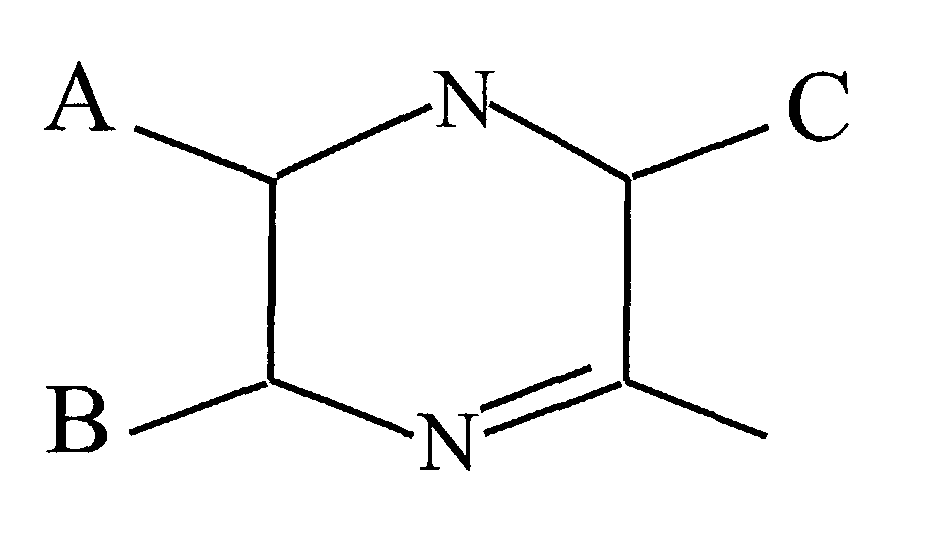
- It is still an object of the present invention to provide new dihydropyrazine derivatives of the formula :where A and B are identical or different and selected in the group consisting of CH3 and H, C' is a C2 to C7 alkyl residue.

- The micro-organism used for the bioconversion of aldehyde into hydroxyketone may be resting cells, disrupted or intact ones. The micro-organism used for the bioconversion may be in the form of an extract, a powder or a cream solution. Preferably, the micro-organism is a fresh solution of grown micro-organism, or of up 4 to 8 days, kept in the refrigerator.
In one preferred embodiment, the micro-organism is selected from the group comprising bacteria, yeasts, moulds and fungus. The preferred bacteria are selected from the group comprising Zymomonas, Lactobacillus and Bacillus. The preferred moulds and fungus are selected from the group comprising Neurosporae and Aspergillae. The preferred yeasts are selected from the group comprising Saccharomyces, Debaromyces, Candida, Pichia, Schizosaccharomyces and Zygosaccharomyces. More preferably, the yeast is baker's yeast, Saccharomyces cerevisiae.
R1 is preferably an ethylen group and the aldehyde is therefore acrolein that will lead upon bioconversion with pyruvate in the presence of baker's yeast cells to 3-hydroxy-4-pentene-2-one. The bioconverion may also lead to the isomer 2-hydroxy-4-penten-3-one, depending upon reactants relative aboundance. This bioconversion is achieved according to the following route :
- The concentrations of the starting products in the medium, e.g. aldehyde, pyruvate and oxobutyric acid may be in the range of 0.5 mM to 500 mM for aldehade and in the range of from 0.5 to 1000 mM for pyruvate and oxobutyric acid.
- Regarding the respective quantities of the starting products aldehyde, pyruvate and oxobutyric acid, they can be such that the molar ratio aldehyde:pyruvate and aldehyde:oxobutyric acid may vary from 1:2000 to 500:1. Optimal ratio aldehyde:pyruvate and aldehyde:oxobutyric acid will depend on the relative aboundance of the desired isomer.
Of course, pyruvate and oxobutyric acid may be used in combination ; this giving a mixture of different hydroxyketones.
In the case of the use of acrolein, the more pyruvate is present in the medium, compared to acrolein, the more 3-hydroxy-4-pentene-2-one is produced and alternatively the less pyruvate is present in the medium compared to acrolein, the more 2-hydroxy-4-pentene-3-one is produced. One has to keep in mind that 3-hydroxy-4-pentene-2-one is however preferentially formed.
The aldehyde may be added in the medium completly or may be advantageously added in the bioconversion medium by mean of fed-batch mode. Such progressive addition of aldehyde may allow to reduce the inhibitory effect of such compound on the formation of hydroxyketones.
Generally the micro-organism solution is used as from 1 to 30% w/v of micro-organism cells in the reaction medium. - The bioconversion may be carried out under aerobic or anaerobic conditions during from 15 minutes to 48 hours, preferably from 1 to 5 hours and at a pH of from 4 to 8, preferably from 5 to 7, more preferably about 6.
The cells of the micro-organism may be immobilized on a solid support such as bead or membrane by appropriate means such as encapsulation for example.
The temperature of the bioconversion may range from 4 to 45°C, preferably from 20 to 35°C. - The reaction medium may be water or buffer such as citrate phosphate or Tris buffers of concentration between 50 to 200 mM, for example. The reaction medium may also comprise ethanol or methanol in a concentration of up to 5% w/v which may serve as increasing the bioconversion yield.
- Some co-factors of the decarboxylation like Thiamine pyro phosphate (TPP) and Mg++ are generally present in the cells of the micro-organism and therefore in the bioconversion medium. Such compounds may also be added in the medium in order to enhance the bioconversion yield. Mg++ may be added in the medium as MgCl2 or MgSO4 in order to obtain a concentration of free Mg++ in the range of from 0.1 mM to 20 mM. TPP may be added in them medium in the range of from 0.1 mM to 10 mM.
- The pyrazine derivatives refered to in the present application may be selected in the group comprising the following pyrazines derivatives compounds :
- 2,3,5-trimethyl-5,6-dihydropyrazine
- 2-ethyl-3,6-dimethyl-5,6-dihydropyrazine
- 2-ethyl-3,5-dimethyl-5,6-dihydropyrazine
- 2,3-diethyl-5-methyl-5,6-dihydropyrazine
- 2-propyl-3,6-dlmethyl-5,6-dihydropyrazine
- 2-propyl-3,5-dimethyl-5,6-dihydropyrazine
- 2-pentyl-3,6-dimethyl-5,6-dihydropyrazine
- 2-pentyl-3,6-dimethyl-5,6-dihydropyrazine
- 2-hexyl-3,6-dimethyl-5,6-dihydropyrazine
- 2-hexyl-3,6-dimethyl-5,6-dihydropyrazine
- 2-heptyl-3,6-dimethyl-5,6-dihydropyrazine
- 2-heptyl-3,5-dimethyl-5,6-dihydropyrazine
- 2,3,5-trimethyl-1,2,5,6-tetrahydropyrazine
- 2-ethyl-3,6-dimethyl-1,2,5,6-tetrahydropyrazine
- 2-ethyl-3,6-dimethyl-1,2,5,6-tetrahydropyrazine
- 2-propyl-3,6-dimethyl-1,2,5,6-tetrahydropyrazine
- 2,3-diethyl-5-methyl-1,2,5,6-tetrahydropyrazine
- 2-propyl-3,5-dimethyl-1,2,5,6-tetrahydropyrazine
- 2-ethyi-3,6-dimethylpyrazine
- 2-ethyl-3,5-dimethylpyrazine
- 2,3-diethyl-5-methylpyrazine
- 2-pentyl-3,6-dimethylpyrazine
- 2-pentyl-3,5-dimethylpyrazine
- 2-heptyl-3,6-dimethylpyrazine
- 2-heptyl-3,5-dimethylpyrazine
-
- Indeed, it is the very first time that tetrahydropyrazine compounds are found to be flavour active. Regarding the dihydropyrazine compound according to the present invention, the odour threshold as well as flavour profile are respectivelly much lower and more equilibrated as compared to the existing ones. For instance, the odour threshold of 2-ethyl-3,5-dimethyl-dihydropyrazine is at least 1000 time less than the odour threshold of 2,3,5-dimethyl-5,5-dihydropyrazine.
- The reaction of the obtained hydroxyketone with 1,2-diaminopropane (DAP) in order to produce pyrazine derivatives may be achieved in a medium such as the bioconversion medium used for the generation of hydroxyketone. Therefore, 1,2 diaminopropane may be added to the bioconversion medium containing hydroxyketone in a ratio of 1:1 to 1:2 hydroxyketone:1,2 diaminopropane. However, DAP may aldo be added to and reacted with purified hydroxyketone in an aqueous based medium but also in an other non aqueous medium like ether, ethanol or methanol for exemple. In such case the hydroxyketone are extracted from the bioconversion medium and dissolved in the aqueous or non-aqueous medium and eventually the DAP is added and the reaction performed at room temperature as previously exposed.
- It is thus an other aspect of the present invention to provide a process for the generation of pyrazine derivatives consisting in :
- reacting at least one hydroxyketone according to the
formula :
- The reaction of hydroxyketone with DAP may be done at room temperature, such as from 18 to 25°C for exemple, but it may be performed at higher temperatures in order to accelerate the reaction. Indeed it is the first time that generation of pyrazines compounds is obtained by a combination of biotransformation and chemical reaction at such low temperatures. The reaction may be carried out at such temperature during a time sufficient to generate the pyrazines derivatives, for instance during from about 1 hour to about 20 hours depending on the temperature used. The aqueous phase containing the pyrazine derivatives may be extracted with diethyl ether for example for characterization by means of gas chromatography. The extraction procedure may be repeated twice or three times.
- All in the whole, various pyrazines, most dihydropyrazines and all tetrahydropyrazines produced according to the present application are novel. Some of the novel pyrazine derivatives were shown to possess pleasant roasted or earthy aroma properties and low odour thresholds. Especially the tetrahydropyrazine derivatives are interesting candidates because nothing has been described in literature in terms of flavour properties.
- New roasted or earthy aroma properties are for example interesting for beverage industry as well as chocolate and confectionery one. Accordingly it is also an object of the present invention to use of the pyrazines derivatives according to the present invention in food products, especially beverages for purpose of taste and flavour improvement.
- Dried baker's yeast for bioconversion was purchased by Hefe Schweiz. All chemicals were from Sigma Aldrich Chemical Co.
- Biotransformation studies were carried out with commercially-available dried baker's yeast in shaking flasks. To a solution of Baker's Yeast in 0.1 M sodium citrate buffer (2 mM thiamine pyrophosphate, 20 mM magnesium sulfate, pH 6.0), 2-oxocarboxylic acid and aldehyde in different concentrations were simultaneously added. A kinetic study was performed by collecting samples, centrifugating them and further analytical treatment of the supernatant.
- Biotransformation studies were carried out with commercially-available dried baker's yeast in shaking flasks at room temperature. 25 mM 2-oxocarboxylic acid and 25 mM aldehyde were subjected to biotransformation using a 4 % suspension of Baker's Yeast in 0.1 M sodium citrate buffer (2 mM thiamine pyrophosphate, 20 mM magnesium sulfate, pH=6.0), and 60 minutes later 10 times excess of 1,2-diaminopropane (1,2-DAP) was added. After a total incubation of 150 minutes, analysis of volatiles was performed by gas chromatography.
- After centrifugation of collected samples, 4-hydroxy-4-methyl-2-pentanone was added as internal standard. The aqueous phase was extracted twice with one volume of distilled diethyl ether. The ether extract was dried over anhydrous Na2SO4 and concentrated using a Vigreux column at 40 °C. Quantitation was performed by comparing the surfaces of peaks between the concerned products and the internal standard in the GC chromatogram. Due to structural similarity of products and internal standard the FID response factors of both are suggested to be equal.
- Gas Chromatography (GC) and Gas Chromatography / Olfactometry (GC-O)
- GC-analyses were performed on a Agilent 6890 Series GC equipped with a Splitless injector, a flame ionization detector (FID) and sniffing port. Separation of volatiles was either achieved on a DB-Wax capillary column or a DB-1 capillary column (30 m x 0.25 mm, film thickness 0.25 mm, J & W Scientific) using helium as carrier gas (1.5 mL min-1) and nitrogen (45 kPa) as make up-gas for the FID. The following temperature programs were applied:
- With DB-Wax:
5 min isothermal at 40 °C, then raised to 220 °C at 5 °C/min and kept 5 min isothermal at 220 °C. - With DB-1:
5 min isothermal at 40 °C, then raised to 240 °C at 4 °C/min and kept 15 min isothermal at 240 °C. -
- GC-MS analyses were performed on a Finnigan MAT-8430 mass spectrometer combined with an HP 5890 gas chromatograph using the same GC conditions as described above. The MS-EI spectra were generated at 70 eV and MS-CI at 150 eV with ammonia as reagent gas.
- After removal of cells by centrifugation, the aqueous supernatant (400ml) was extracted continuously with 800 mL of distilled diethyl ether overnight. The extract was dried over anhydrous Na2SO4 and concentrated using a Vigreux column at 40 °C.
- 3-Hydroxy-4-penten-2-one was purified by High Performance Liquid Chromatography (HPLC) using a Hewlett Packard series 1050 device, equipped with a diode array detector. Separation of compounds was achieved by using a normal phase column (Nucleosil 100-7-OH, 4x250 mm, Macherey Nagel). Elution was carried out using pentane/diethylether at a flow rate of 1.0 ml/min. The concentration of diethylether in the eluent was gradually increased from 0 % to 30 % during the first 30 minutes. UV-detection was done at 210 nm and 3-hydroxy-4-penten-2-one was repetitively collected between 21 and 23 min.
- With whole cells 3-HPO was formed during the first four hours of incubation and higher substrate concentration were favourable for formation of 3-HPO in a range from 10 mM to 50 mM. Best product concentrations (150 mg/l) were obtained using a 20% suspension of Baker's Yeast, substrate concentrations of 50 mM and incubation for 3 hours. 3-HPO was purified by HPLC.
- Biotransformation led also to the production of 2-hydroxy-4-penten-3-one (2-HPO), the isomer of 3-HPO. The quantitative ratio between 3-HPO and 2-HPO was dependent on the relative amounts of aldehyde and pyruvate. When equimolar concentrations of pyruvate and aldehyde were used, 3-HPO was produced in excess. When using pyruvate in excess, even more 3-HPO was produced relatively to 2-HPO than in case of equimolarity whereas the opposite relationship was observed with higher aldehyde concentrations. However, amounts of 2-HPO have never exceeded those of 3-HPO. It was found that the hydroxyketones were even produced when only the aldehyde was subjected to biotransformation without addition of pyruvate to the medium. This is due to the fact that endogeneous pyruvate is always present in the cell. Under this condition approximately same amounts of 3-HPO and 2-HPO were produced.
- Furthermore, 4-pentene-2,3-dione and γ-pentalactone were identified as product of biotransformation.
- In analogy, pyruvate and other linear aldehydes were subjected to biotransformation using S. cerevisiae. In a special case acrolein and 2-oxo butyric acid were taken as substrates. After one hour of incubation at 25 mM initial substrate concentrations numerous hydroxyketones were identified. The product yields after one hour of incubation were strongly dependent on the choice of aldehyde, 2-hexanal being the best candidate with yields above 50 % in terms of the 3-hydroxy isomer, for example. In general it was observed that branched aldehydes were converted worse than linear ones, unsaturated aldehydes worse than saturated ones and short aldehydes worse than long ones.
In conclusion a pool of hydroxyketones was synthesized by biotransformation of aldehydes using Baker's yeast.No. Hydroxyketones Rl Rl Ref MS Ref 1 3-hydroxy-2-butanone 1263 - - 2 3-hydroxy-2-pentanone 1344 1346 Neuser (1999) 3 2-hydroxy-3-pentanone 1361 1346 Neuser (1999) 4 2-hydroxy-3-hexanone 1423 1434 Neuser (1999) 5 3-hydroxy-2-hexanone 1430 1440 Neuser (1999) 6 2-hydroxy-3-heptanone 1551 1539 Neuser (1999) 7 3-hydroxy-2-heptanone 1560 1547 Neuser (1999) 8 2-hydroxy-3-octanone 1647 1645 Neuser (1999) 9 3-hydroxy-2-octanone 1655 1655 Neuser (1999) 10 2-hydroxy-3-nonanone 1757 1752 Neuser (1999) 11 3-hydroxy-2-nonanone 1768 1765 Neuser (1999) 12 2-hydroxy-3-decanone 1874 1859 Neuser (1999) 13 3-hydroxy-2-decanone 1889 1867 Neuser (1999) 14 3-hydroxy-5-methyl-2-hexanone 1479 1472 Neuser (1999) 15 2-hydroxy-4-penten-3-one 1372 - - 16 3-hydroxy-4-penten-2-one 1381 - - 17 3-hydroxy-4E-hexen-2-one 1481 1504 Neuser (1999) 18 2-hydroxy-4E-hexen-3-one 1511 1511 Neuser (1999) 19 3-hydroxy-4E-octen-2-one 1683 1687 Neuser (1999) 20 2-hydroxy-4E-octen-3-one 1698 1710 Neuser (1999) 21 3-hydroxy-4E-nonen-2-one 1776 - - 22 2-hydroxy-4E-nonen-3-one 1796 - - 23 3-hydroxy-4E-decen-2-one 1946 - - 24 2-hydroxy-4E-decen-3-one 1959 - - 25 4-hydroxy-3-hexanone 1389 - - 26 3-hydroxy-5-hexen-4-one 1430 - - 27 4-hydroxy-5-hexen-3-one 1453 - - - Syntheses with Baker's yeast were performed with other α,β-unsaturated aldehydes, pyruvate and 1,2-DAP. In a particular essay acrolein and 2-oxobutyric acid were used as substrates. RI and GC-MS data strongly suggest that in all reactions alkyldihydropyrazines and not alkenyltetrahydropyrazines were found. Putatively identified 2-propyl-, 2-pentyl-, 2-hexyl- and 2-heptyldimethyl,-5,6-dihydropyrazine derivatives contain a prominent mass fragment of 124 while 2-ethyldimethyl-5,6-dihydropyrazines do not. As reference, a mixture of 2-propyldimethyl-5,6-dihydropyrazine isomers as well as 2,3-diethyl-5-methyl-5,6-dihydropyrazine were chemically synthesized.
- In order to produce tetrahydropyrazines, syntheses with Baker's yeast were performed with saturated aldehydes, pyruvate and 1,2-DAP like those performed before. However, no pyrazine derivatives were obtained although the saturated hydroxyketones were sometimes produced in higher concentrations than the α,β-unsaturated ones before. This result can be explained by the fact that only unsaturated hydroxyketones tautomerize into the highly reactive diene structure while saturated ones do not. In consequence, when reactions between saturated hydroxyketones and diamines were carried out in vitro with higher substrate concentrations tetrahydropyrazines could indeed be synthesized.
R2 is a methyl residue when pyruvate is used or an ethyl residue when oxobutyric acid is used.
R2 is a methyl or an ethyl residue.
Claims (8)
- Process for the preparation of pyrazine derivatives compounds comprising the steps of :where R1 is a C1 to C7 alkenyl residue andperforming the bioconversion of an aldehyde of the general formula :and reacting at ambient conditions the obtained hydroxyketone formed with 1,2-diaminopropane, in order to obtain pyrazine derivatives compounds,
R2 is a methyl residue when pyruvate is used or an ethyl residue when oxobutyric acid is used. - Process according to claim 1, characterized in that R1 is a C1 to C7 alkyl residue, and in this case, the reaction of the hydroxyketone with propanediamine is performed after a step involving the concentration of the saturated hydroxyketone.
- Tetrahydropyrazine derivatives of the formula :where A and B are identical or different and selected in the group consisting of CH3 and H, C is a C1 to C6 alkyl residue and D is a methyl or an ethyl residue, being unserstood that if C is an ethyl residue D is also an ethyl residue.

- Dihydropyrazine derivatives of the formula :where A and B are identical or different and selected in the group consisting of CH3 and H, C' is a C2 to C7 alkyl residue.

- Process according to claim 1, characterized in that the microorganism is selected from the group comprising Zymomonas, Lactobacillus, Bacillus, Neurosporae, Aspergillae, Saccharomyces, Debaromyces, Candida, Pichia, Schizosaccharomyces and Zygosaccharomyces.
- Process according to claim 1, characterized in that the microorganism is baker's yeast, Saccharomyces cerevisiae.
- Process for the generation of pyrazine derivatives consisting in :where R1 is a C1 to C7 alkenyl residue andreacting at least one hydroxyketone according to the formula :
R2 is a methyl or an ethyl residue. - Use of pyrazines derivatives according to claims 1 to 7 in food products, especially beverages for purpose of taste and flavour improvement.
Priority Applications (1)
| Application Number | Priority Date | Filing Date | Title |
|---|---|---|---|
| EP02076573A EP1357193A1 (en) | 2002-04-22 | 2002-04-22 | Preparation of pyrazines |
Applications Claiming Priority (1)
| Application Number | Priority Date | Filing Date | Title |
|---|---|---|---|
| EP02076573A EP1357193A1 (en) | 2002-04-22 | 2002-04-22 | Preparation of pyrazines |
Publications (1)
| Publication Number | Publication Date |
|---|---|
| EP1357193A1 true EP1357193A1 (en) | 2003-10-29 |
Family
ID=28685957
Family Applications (1)
| Application Number | Title | Priority Date | Filing Date |
|---|---|---|---|
| EP02076573A Withdrawn EP1357193A1 (en) | 2002-04-22 | 2002-04-22 | Preparation of pyrazines |
Country Status (1)
| Country | Link |
|---|---|
| EP (1) | EP1357193A1 (en) |
Citations (1)
| Publication number | Priority date | Publication date | Assignee | Title |
|---|---|---|---|---|
| US4097478A (en) * | 1976-09-20 | 1978-06-27 | Tokai Denka Kogyo Kabushiki Kaisha | Process for preparing pyrazines |
-
2002
- 2002-04-22 EP EP02076573A patent/EP1357193A1/en not_active Withdrawn
Patent Citations (1)
| Publication number | Priority date | Publication date | Assignee | Title |
|---|---|---|---|---|
| US4097478A (en) * | 1976-09-20 | 1978-06-27 | Tokai Denka Kogyo Kabushiki Kaisha | Process for preparing pyrazines |
Non-Patent Citations (10)
| Title |
|---|
| BARLUENGA J ET AL: "One-pot synthesis of quinoxalines and 2,3-dihydropyrazines via oxidative aminomercuriation of propargyl alcohols", SYNTHESIS, vol. 3, 1985, pages 313 - 314, XP002226443 * |
| FLAMENT I ET AL: "I. SYNTHESE DE METHYL-2-PYRAZINES ALCOYLEES EN 3, PAR CONDENSATION DE L'ETHYLENEDIAMINE AVEC LES DIOXO-2,3-ALCANES", HELVETICA CHIMICA ACTA, VERLAG HELVETICA CHIMICA ACTA. BASEL, CH, vol. 50, 1967, pages 1754 - 1758, XP001107153, ISSN: 0018-019X * |
| GUO Z ET AL: "Asymmetric acyloin condensation catalysed by phenylpyruvate decarboxylase. Part 2: Substrate specificity and purification of the enzyme", TETRAHEDRON: ASYMMETRY, ELSEVIER SCIENCE PUBLISHERS, AMSTERDAM, NL, vol. 12, no. 4, 19 March 2001 (2001-03-19), pages 571 - 577, XP004234155, ISSN: 0957-4166 * |
| MASUDA H ET AL: "PREPARATION OF 5 SUBSTITUTED 2 3 DI METHYL PYRAZINES FROM THE REACTION OF 2 3 DI METHYL-5 6 DI HYDRO PYRAZINE AND ALDEHYDES OR KETONES", JOURNAL OF AGRICULTURAL AND FOOD CHEMISTRY, vol. 28, no. 2, 1980, pages 244 - 246, XP002213540, ISSN: 0021-8561 * |
| NEUSER FRAUKE ET AL: "Formation of aliphatic and aromatic alpha-hydroxy ketones by Zygosaccharomyces bisporus.", ZEITSCHRIFT FUER NATURFORSCHUNG SECTION C JOURNAL OF BIOSCIENCES, vol. 55, no. 7-8, July 2000 (2000-07-01), pages 560 - 568, XP001104571, ISSN: 0939-5075 * |
| NEUSER FRAUKE ET AL: "Generation of odorous acyloins by yeast pyruvate decarboxylases and their occurrence in Sherry and soy sauce.", JOURNAL OF AGRICULTURAL AND FOOD CHEMISTRY, vol. 48, no. 12, December 2000 (2000-12-01), pages 6191 - 6195, XP002213480, ISSN: 0021-8561 * |
| PRIPIS-NICOLAU LAURA ET AL: "Formation of flavor components by the reaction of amino acid and carbonyl compounds in mild conditions.", JOURNAL OF AGRICULTURAL AND FOOD CHEMISTRY, vol. 48, no. 9, September 2000 (2000-09-01), pages 3761 - 3766, XP002213541, ISSN: 0021-8561 * |
| RIZZI G P: "FORMATION OF PYRAZINES FROM ACYLOIN PRECURSORS UNDER MILD CONDITIONS", JOURNAL OF AGRICULTURAL AND FOOD CHEMISTRY, vol. 36, no. 2, 1988, pages 349 - 352, XP002213542, ISSN: 0021-8561 * |
| YAMAGUCHI T ET AL: "New Compounds Derived from Dihydropyrazines Having DNA Strand-Breakage Activity", TETRAHEDRON, ELSEVIER SCIENCE PUBLISHERS, AMSTERDAM, NL, vol. 55, no. 3, 15 January 1999 (1999-01-15), pages 675 - 686, XP004151192, ISSN: 0040-4020 * |
| YAMAGUCHI TADATOSHI ET AL: "Dihydropyrazine derivatives as a new type of DNA strand breaking agent.", BIOLOGICAL & PHARMACEUTICAL BULLETIN, vol. 19, no. 10, 1996, pages 1261 - 1265, XP002226442, ISSN: 0918-6158 * |
Similar Documents
| Publication | Publication Date | Title |
|---|---|---|
| Belitz et al. | Aroma compounds | |
| Schieberle | Quantitation of important roast-smelling odorants in popcorn by stable isotope dilution assays and model studies on flavor formation during popping | |
| Maga et al. | Pyrazines in foods | |
| Walradt et al. | Volatile components of roasted peanuts | |
| Owens et al. | Formation of volatile compounds during Bacillus subtilis fermentation of soya beans | |
| Wong et al. | Effect of nitrogen source on pyrazine formation | |
| Ames et al. | Volatile components of a yeast extract composition | |
| Song et al. | Monitoring of yeast communities and volatile flavor changes during traditional Korean soy sauce fermentation | |
| Sakaguchi et al. | Formation of heterocyclic compounds from the reaction of cysteamine and D-glucose, acetaldehyde, or glyoxal | |
| Bock et al. | Biotransformation of linalool by Botrytis cinerea | |
| JP2002520405A (en) | Dicarboalkoxy dioxolane | |
| Blank et al. | Determination of 4-hydroxy-2, 5-dimethyl-3 (2 H)-furanone and 2 (or 5)-ethyl-4-hydroxy-5 (or 2)-methyl-3 (2 H)-furanone in pentose sugar-based Maillard model systems by isotope dilution assays | |
| Chen et al. | Analysis of aroma components from sugarcane to non-centrifugal cane sugar using GC-O-MS | |
| Belitz et al. | Aroma substances | |
| Maga et al. | Pyrazines in the foods | |
| CA1340826C (en) | Process for preparing natural benzaldehyde and acetaldehyde, natural benzaldehyde and acetaldehyde compositions, products produced thereby and organoleptic utilities therefor | |
| Xue et al. | A comprehensive review of quantified flavour components in Chinese baijiu. | |
| Deng et al. | Promoted formation of pyrazines by targeted precursor addition to improve aroma of thermally processed methionine-glucose Amadori compound | |
| US5747302A (en) | Preparation of thiols with food-acceptable micro-organisms | |
| Buttery | Unusual volatile carbonyl components of potato chips | |
| US6384243B1 (en) | Method for producing natural diol-1,3 derivatives and corresponding natural 1,3-dioxane derivatives | |
| Guichard et al. | Enantiomeric ratios of pantolactone, solerone, 4-carboethoxy-4-hydroxy-butyrolactone and of sotolon, a flavour impact compound of flor-sherry and botrytized wines | |
| Gao et al. | Effects of different cooking times on the sensory evaluation and flavor characteristics of soy sauce | |
| US5948453A (en) | Food flavorant preparation via bioconversion of elemental sulphur | |
| CA2105937C (en) | Pyrazine preparation |
Legal Events
| Date | Code | Title | Description |
|---|---|---|---|
| PUAI | Public reference made under article 153(3) epc to a published international application that has entered the european phase |
Free format text: ORIGINAL CODE: 0009012 |
|
| AK | Designated contracting states |
Kind code of ref document: A1 Designated state(s): AT BE CH CY DE DK ES FI FR GB GR IE IT LI LU MC NL PT SE TR |
|
| AX | Request for extension of the european patent |
Extension state: AL LT LV MK RO SI |
|
| 17P | Request for examination filed |
Effective date: 20040429 |
|
| AKX | Designation fees paid |
Designated state(s): AT BE CH CY DE DK ES FI FR GB GR IE IT LI LU MC NL PT SE TR |
|
| 17Q | First examination report despatched |
Effective date: 20040824 |
|
| STAA | Information on the status of an ep patent application or granted ep patent |
Free format text: STATUS: THE APPLICATION HAS BEEN WITHDRAWN |
|
| 18W | Application withdrawn |
Effective date: 20050620 |