Technical Field
-
The present invention relates to processes for
producing UDP-N-acetylgalactosamine and an N-acetylgalactosamine-containing
carbohydrate. Some N-acetylgalactosamine-containing
carbohydrates are expressed
specifically in cancer cells, etc. and thus are useful as
anticancer vaccines, etc. for anticancer treatment.
Further, as N-acetylgalactosamine-containing carbohydrates
are present abundantly in the brain, they are expected to
be applicable to the improvement of brain function. UDP-N-acetylgalactosamine
is useful as a substrate for the
synthesis of N-acetylgalactosamine-containing
carbohydrates.
Background Art
-
With regard to the production of UDP-N-acetylgalactosamine
(hereinafter abbreviated as UDP-GalNAc),
there are known processes for production
utilizing a cell-free extract or a partially-purified
enzyme derived from Bacillus subtilis [U.S. Patent No.
4,569,909; J. Biol. Chem., 234. 2801 (1959); Agr. Biol.
Chem., 37, 1741 (1973); Appl. Environ. Microbiol., 41, 392
(1981); Microbiol. Immunol., 30, 1085 (1986); Agr. Biol.
Chem., 49, 603 (1985)]. However, the productivity of UDP-GalNAc
by the above methods is low, and UDP-N-acetylglucosamine
4-epimerase (EC 5.1.3.7, hereinafter
abbreviated as UDP-GlcNAc 4-epimerase) derived from
Bacillus subtilis or a gene encoding UDP-GlcNAc 4-epimerase
has not been specified yet.
-
As regards UDP-GlcNAc 4-epimerase derived from a
microorganism, there is a report that WbpP protein derived
from Pseudomonas aeruginosa has UDP-GlcNAc 4-epimerase
activity [J. Biol. Chem. , 275, 19060 (2000)], but no
report on the production of UDP-GalNAc using the protein
or DNA encoding the protein.
-
On the other hand, as for UDP-glucose 4-epimerase
(EC 5.1.3.2), it is known that the enzymes derived from
hamster and human also use UDP-GlcNAc as a substrate [Cell,
44, 749 (1986)], but there is no report that UDP-glucose
4-epimerase derived from Escherichia coli [Nucleic Acid
Res., 14, 7705 (1986)] has UDP-GlcNAc 4-epimerase activity.
Further, the above-mentioned WbpP protein derived from
Pseudomonas aeruginosa has no homology to the known UDP-glucose
4-epimerases.
-
There are known proteins derived from Bacillus
subtilis, Bacillus halodurans, Bacillus stearothermophilus,
Haemophilus influenzae, Brucella abortus, Arabidopsis
thaliana, Neisseria meningitidis, Neisseria gonorrhoeae,
Erwinia amylovora, Yersinia enterocolitica, Campylobacter
jejuni, Helicobacter pylori, Vibrio cholerae, Moraxella
catarrhalis, Pisum sativurn, Salmonella, typhi, Salmonella
typhimurium, Cyamopsis tetragonoloba, Pseudomonas
aeruginosa, Lactococcus lactis, Aquifex aeolicus,
Synechocystis sp. , Azospirium brasilense, Sinorhizobium
meliloti, Rhizobium leguminosarum, Methanobacterium
thermoautotrophicum, Corynebacterium glutamicum,
Rhodococcus erythropolis, Rhodococcus equi, Streptomyces
coelicolor, Streptomyces lividans, Deinococcus radiodurans,
Bradyrhizobium japonicum, Thermotoga maritima, Klebsiella
pneumoniae, Methanococcus jannaschii, Halobacterium sp.
NRC-1, Pyrococcus horikoshii, Pyrococcus abyssi, Listeria
monocytogenes, Clostridium perfringens, Deinococcus
radiodurans. Archaeoglobus fulgidus, Staphylococcus
carnosus and Streptococcus thermophilus which are regarded
as UDP-glucose 4-epimerase (galE) because of their high
homology to the amino acid sequence of a known UDP-glucose
4-epimerase. Also known are proteins derived from
microorganisms such as Bacillus megaterium, Haemophilus
ducreyi, Corynebacterium diphtheriae, Streptococcus
pneumoniae and Streptococcus agalactiae which have high
homology to the amino acid sequence of a known UDP-glucose
4-epimerase, but whose function has not been clarified yet.
However, it is not known that these proteins have UDP-GlcNAc
4-epimerase activity and are useful for the
production of UDP-GalNAc.
Disclosure of the Invention
-
An object of the present invention is to provide
processes for producing UDP-N-acetylgalactosamine and an
N-acetylgalactosamine-containing carbohydrate.
-
The present inventors discovered that a protein
which is regarded as UDP-glucose 4-epimerase (galE)
because of its high homology to the amino acid sequence of
a known UDP-glucose 4-epimerase or a protein which has
high homology to the amino acid sequence of a known UDP-glucose
4-epimerase but whose function has not been
clarified yet has UDP-N-acetylglucosamine 4-epimerase
activity and that this enzyme is useful for the efficient
production of UDP-N-acetylgalactosamine and an N-acetylgalactosamine-containing
carbohydrate. The present
invention has been completed based on the discovery.
-
The present invention relates to the following (1)
to (35).
- (1) A process for producing UDP-N-acetylgalactosamine
(hereinafter abbreviated as UDP-GalNAc), which
comprises:
- allowing an enzyme source and UDP-N-acetylglucosamine
(hereinafter abbreviated as UDP-GlcNAc) to be present
in an aqueous medium, said enzyme source being a
culture of a transformant which produces a protein
having UDP-N-acetylglucosamine 4-epimerase
(hereinafter abbreviated as UDP-GlcNAc 4-epimerase)
activity or a treated matter of the culture;
- allowing UDP-GalNAc to form and accumulate in the
aqueous medium; and
- recovering UDP-GalNAc from the aqueous medium.
- (2) A process for producing an N-acetylgalactosamine
(hereinafter abbreviated as GalNAc)-containing
carbohydrate, which comprises:
- allowing an enzyme source, an acceptor carbohydrate,
GalNAc transferase and UDP-GlcNAc to be present in an
aqueous medium, said enzyme source being a culture of
a transformant which produces a protein having UDP-GlcNAc
4-epimerase activity or a treated matter of
the culture;
- allowing the GalNAc-containing carbohydrate to form
and accumulate in the aqueous medium; and
- recovering the GalNAc-containing carbohydrate from
the aqueous medium.
- (3) A process for producing UDP-GalNAc, which comprises:
- allowing enzyme sources, a precursor of uridine-5'-triphosphate
(hereinafter abbreviated as UTP) and a
sugar to be present in an aqueous medium, said enzyme
sources being a culture of a microorganism having the
ability to form UDP-GlcNAc from the precursor of UTP
and the sugar or a treated matter of the culture, and
- a culture of a transformant which produces a protein
having UDP-GlcNAc 4-epimerase activity or a treated
matter of the culture;
- allowing UDP-GalNAc to form and accumulate in the
aqueous medium; and
- recovering UDP-GalNAc from the aqueous medium.
- (4) A process for producing a GalNAc-containing
carbohydrate, which comprises:
- allowing enzyme sources, a precursor of UTP, a sugar
and an acceptor carbohydrate to be present in an
aqueous medium, said enzyme sources being a culture
of a microorganism having the ability to form UDP-GlcNAc
from the precursor of UTP and the sugar or a
treated matter of the culture, GalNAc transferase,
and a culture of a transformant which produces a
protein having UDP-GlcNAc 4-epimerase activity or a
treated matter of the culture;
- allowing the GalNAc-containing carbohydrate to form
and accumulate in the aqueous medium; and
- recovering the GalNAc-containing carbohydrate from
the aqueous medium.
- (5) The process according to any of (1) to (4), wherein
the treated matter of the culture is concentrated
culture, dried culture, cells obtained by
centrifuging the culture, a product obtained by
subjecting the cells to drying, freeze-drying,
treatment with a surfactant, ultrasonication,
mechanical friction, treatment with a solvent,
enzymatic treatment, protein fractionation or
immobilization, or an enzyme preparation obtained by
extracting the cells.
- (6) The process according to (2) or (4), wherein the
acceptor carbohydrate is a complex carbohydrate
comprising an oligosaccharide having sialic acid,
galactose, GalNAc, N-acetylglucosamine, fucose,
glucuronic acid or iduronic acid at the nonreducing
end.
- (7) The process according to (6), wherein the
oligosaccharide having sialic acid, galactose, GalNAc,
N-acetylglucosamine, fucose, glucuronic acid or
iduronic acid at the nonreducing end is lactose, N-acetyllactosamine,
globotriose, sialyllactose, sialyl
N-acetyllactosamine, Lewis X, Lewis a, sialyl Lewis X,
sialyl Lewis a, chondroitin sulfate, dermatan sulfate,
H type 1 (Fuc α1-2Gal β1-3GlcNAc) or H type 2 (Fuc α1-2Gal
β1-4GlcNAc).
- (8) The process according to (2) or (4), wherein the
acceptor carbohydrate is lactose, N-acetyllactosamine,
globotriose, sialyllactose, sialyl N-acetyllactosamine,
Lewis X, Lewis a, sialyl Lewis X,
sialyl Lewis a, chondroitin sulfate, dermatan sulfate,
H type 1 (Fuc α 1-2Gal β 1-3GlcNAc) or H type 2 (Fuc α 1-2Gal
β1-4GlcNAc) .
- (9) The process according to (3) or (4), wherein the
precursor is orotic acid, orotidine, uracil, uridine
or uridine-5'-monophosphate.
- (10) The process according to (3) or (4), wherein the
sugar is glucosamine or N-acetylglucosamine.
- (11) The process according to (3) or (4), wherein the
microorganism having the ability to form UDP-GlcNAc
from the precursor of UTP and the sugar is one or
more microorganisms selected from the group
consisting of microorganisms belonging to the genera
Escherichia, Corynebacterium and Saccharomyces.
- (12) The process according to (11), wherein the
microorganism belonging to the genus Escherichia is
Escherichia coli.
- (13) The process according to (11), wherein the
microorganism belonging to the genus Corynebacterium
is Corynebacterium ammoniagenes.
- (14) The process according to (11), wherein the
microorganism belonging to the genus Saccharomyces is
Saccharomyces cerevisiae.
- (15) The process according to any of (1) to (4), wherein
the transformant is a transformant obtained by
introducing a recombinant DNA into a microorganism.
- (16) The process according to (15), wherein the
microorganism is selected from the group consisting
of microorganisms belonging to the genera Escherichia,
Corynebacterium and Saccharomyces.
- (17) The process according to (16), wherein the
microorganism belonging to the genus Escherichia is
Escherichia coli.
- (18) The process according to (16), wherein the
microorganism belonging to the genus Corynebacterium
is Corynebacterium glutamicum.
- (19) The process according to (16), wherein the
microorganism belonging to the genus Saccharomyces is
Saccharomyces cerevisiae.
- (20) The process according to any of (1) to (4), wherein
the protein having UDP-GlcNAc 4-epimerase activity is
a protein having UDP-GlcNAc 4-epimerase activity
which is derived from a microorganism belonging to
the genus Bacillus or Neisseria.
- (21) The process according to (20), wherein the
microorganism belonging to the genus Bacillus is
selected from the group consisting of Bacillus
subtilis, Bacillus megaterium and Bacillus
stearothermophilus.
- (22) The process according to (20), wherein the
microorganism belonging to the genus Neisseria is
Neisseria gonorrhoeae or Neisseria meningitidis.
- (23) The process according to any of (1) to (4) and (20)
to (22), wherein the protein having UDP-GlcNAc 4-epimerase
activity is a protein having the amino acid
sequence shown in SEQ ID NO: 1 or 2.
- (24) The process according to any of (1) to (4) and (20)
to (22), wherein the protein having UDP-GlcNAc 4-epimerase
activity is a protein consisting of an
amino acid sequence wherein one or more amino acid
residues are deleted, substituted, inserted or added
in the amino acid sequence shown in SEQ ID NO: 1 or 2
and having UDP-GlcNAc 4-epimerase activity.
- (25) The process according to any of (1) to (4) and (20)
to (22), wherein the protein having UDP-GlcNAc 4-epimerase
activity is a protein consisting of an
amino acid sequence having 50% or more homology to
the amino acid sequence shown in SEQ ID NO: 1 or 2.
- (26) The process according to (15), wherein the
recombinant DNA comprises DNA encoding a protein
having UDP-GlcNAc 4-epimerase activity.
- (27) The process according to (15), wherein the
recombinant DNA comprises DNA encoding UDP-glucose 4-epimerase
(hereinafter abbreviated as galE protein)
having UDP-GlcNAc 4-epimerase activity.
- (28) The process according to (27), wherein the galE
protein is derived from a microorganism belonging to
the genus Bacillus or Neisseria.
- (29) The process according to (28), wherein the
microorganism belonging to the genus Bacillus is
selected from the group consisting of Bacillus
subtilis, Bacillus megaterium and Bacillus
stearothermophilus.
- (30) The process according to (28), wherein the
microorganism belonging to the genus Neisseria is
Neisseria gonorrhoeae or Neisseria meningitidis.
- (31) The process according to (15), wherein the
recombinant DNA comprises DNA encoding a protein
having the amino acid sequence shown in SEQ ID NO: 1
or 2.
- (32) The process according to (15), wherein the
recombinant DNA comprises DNA encoding a protein
consisting of an amino acid sequence wherein one or
more amino acid residues are deleted, substituted,
inserted or added in the amino acid sequence shown in
SEQ ID NO: 1 or 2 and having UDP-GlcNAc 4-epimerase
activity.
- (33) The process according to (15), wherein the
recombinant DNA comprises DNA encoding a protein
consisting of an amino acid sequence which has 50% or
more homology to the amino acid sequence shown in SEQ
ID NO: 1 or 2 and having UDP-GlcNAc 4-epimerase
activity.
- (34) The process according to (15), wherein the
recombinant DNA comprises DNA having the nucleotide
sequence shown in SEQ ID NO: 3 or 4.
- (35) The process according to (15), wherein the
recombinant DNA comprises DNA which hybridizes with
DNA consisting of the nucleotide sequence shown in
SEQ ID NO: 3 or 4 under stringent conditions and
which encodes a protein having UDP-GlcNAc 4-epimerase
activity.
-
-
Any proteins having UDP-GlcNAc 4-epimerase activity
can be used in the process of the present invention.
Suitable examples are the following (1) to (6).
- (1) A galE protein having UDP-GlcNAc 4-epimerase activity
- (2) A protein which is supposed to have the function of
galE protein because of its high homology to the amino
acid sequence of galE protein and which has UDP-GlcNAc
4-epimerase activity
- (3) A protein having an amino acid sequence which has 50%
or more homology to the amino acid sequence of galE
protein and having UDP-GlcNAc 4-epimerase activity
- (4) A protein having the amino acid sequence shown in SEQ
ID NO: 1 or 2
- (5) A protein consisting of an amino acid sequence wherein
one or more amino acid residues are deleted,
substituted, inserted or added in the amino acid
sequence shown in SEQ ID NO: 1 or 2 and having UDP-GlcNAc
4-epimerase activity
- (6) A protein consisting of an amino acid sequence which
has 50% or more homology to the amino acid sequence
shown in SEQ ID NO: 1 or 2 and having UDP-GlcNAc 4-epimerase
activity
-
-
Examples of the galE protein having UDP-GlcNAc 4-epimerase
activity are those derived from Bacillus
subtilis (GenBank accession No. X99339) and Neisseria
gonorrhoeae (GenGank accession No. Z215508).
-
Examples of the proteins regarded as galE protein
because of their high homology to the amino acid sequence
of a known galE protein are those derived from Bacillus
halodurans (GenBank accession No. AP001510), Haemophilus
influenzae (GenBank accession No. X57315), Brucella
abortus (GenBank accession No. U78089), Arabidopsis
thaliana (GenBank accession No. AL078468), Neisseria
meningitidis (GenBank accession No. AF083467), Erwinia
amylovora (GenBank accession No. X76172), Yersinia
enterocolitica (GenBank accession No. Z47767),
Campylobacter jejuni (GenBank accession No. CJ11168X4),
Helicobacter pylori (GenBank accession No. AF016844),
Vibrio cholerae (GenBank accession No. AE004405, Moraxella
catarrhalis (GenBank accession No. AF248584), Pisum
sativum (GenBank accession No. U31544), Salmonella typhi
(GenBank accession No. X83927), Salmonella typhimurium
(GenBank accession No. M33681), Cyamopsis tetragonoloba
(GenBank accession No. AJ005081), Pseudomonas aeruginosa
(GenBank accession No. AE004568), Lactococcus lactis
(GenBank accession No. AJ011653), Aquifex aeolicus
(GenBank accession No. AE000721), Synechocystis sp.
(GenBank accession No. D90910), Azospirium brasilense
(GenBank accession No. U09349), Sinorhizobium meliloti
(GenBank accession No. X58126), Rhizobiurn leguminosarum
(GenBank accession No. X96507), Methanobacterium
thermoautotrophicum (GenBank accession No. AE000844),
Corynebacterium glutamicum (GenBank accession No. Z49823),
Rhodococcus erythropolis (GenBank accession No. AF221951),
Rhodococcus equi (GenBank accession No. AF277002),
Streptomyces coelicolor (GenBank accession No. AL359989),
Streptomyces lividans (GenBank accession No. M18953),
Deinococcus radiodurans (GenBank accession No. AE002053),
Bradyrhizobium japonicum (GenBank accession No. AF253311),
Thermotoga maritima (GenBank accession No. AE001727),
Klebsiella pneumoniae (GenBank accession No. M94964),
Methanococcus jannaschii (GenBank accession No. U67477),
Halobacterium sp. NRC-1 (GenBank accession No. AE004975),
Pyrococcus horikoshii (GenBank accession No. AP000007),
Pyrococcus abyssi (GenBank accession No. AJ248284),
Listeria monocytogenes (GenBank accession No. AF0099622),
Clostridium perfringens (GenBank accession No. X86505),
Deinococcus radiodurans (GenBank accession No. AE001927),
Archaeoglobus fulgidus (GenBank accession No. AE001079),
Staphylococcus carnosus (GenBank accession No. AF109295)
and Streptococcus thermophilus (GenBank accession No.
M38175).
-
Examples of the proteins having an amino acid
sequence which has 50% or more homology to the amino acid
sequence of galE protein and having UDP-GlcNAc 4-epimerase
activity are that derived from Corynebacterium diphtheriae
(GenBank accession No. M80338) and those derived from
microorganisms such as Bacillus megaterium, Bacillus
stearothermophilus, Haemophilus ducreyi, Streptococcus
pneumoniae and Streptococcus agalactiae.
-
Examples of the proteins having an amino acid
sequence which has 50% or more homology to the amino acid
sequence of galE protein are those consisting of an amino
acid sequence which has at least 50% or more, preferably
60% or more, more preferably 80% or more, further
preferably 95% or more homology to the amino acid sequence
of galE protein.
-
The homology among amino acid sequences and
nucleotide sequences can be determined using algorithm
BLAST by Karlin and Altschul [Pro. Natl. Acad. Sci. USA,
90, 5873 (1993)] and FASTA [Methods Enzymol., 183, 63
(1990)]. On the basis of the algorithm BLAST, programs
such as BLASTN and BLASTX have been developed [J. Mol.
Biol., 215, 403 (1990)]. When a nucleotide sequence is
analyzed by BLASTN on the basis of BLAST, the parameters,
for instance, are as follows: score=100 and wordlength=12.
When an amino acid sequence is analyzed by BLASTX on the
basis of BLAST, the parameters, for instance, are as
follows: score=50 and wordlength=3. When BLAST and Gapped
BLAST programs are used, default parameters of each
program are used. The specific techniques for these
analyses are known (http://www.ncbi.nlm.nih.gov.).
-
More specific examples of the proteins having UDP-GlcNAc
4-epimerase activity useful in the process of the
present invention are proteins having UDP-GlcNAc 4-epimerase
activity derived from microorganisms belonging
to the genus Bacillus such as Bacillus subtilis, Bacillus
megaterium and Bacillus stearothermophilus, and those
belonging to the genus Neisseria such as Neisseria
gonorrhoeae and Neisseria meningitidis.
-
The protein consisting of an amino acid sequence
wherein one or more amino acid residues are deleted,
substituted or added and having UDP-GlcNAc 4-epimerase
activity can be obtained, for example, by introducing a
mutation into DNA encoding a protein having the amino acid
sequence shown in SEQ ID NO: 1 or 2 by site-directed
mutagenesis described in Molecular Cloning, A Laboratory
Manual, Second Edition (1989) (hereinafter abbreviated as
Molecular Cloning, Second Edition); Current Protocols in
Molecular Biology, John Wiley & Sons (1987-1997)
(hereinafter abbreviated as Current Protocols in Molecular
Biology); Nucleic Acids Res., 10, 6487 (1982); Proc. Natl.
Acad. Sci. USA, 79, 6409 (1982); Gene, 34, 315 (1985);
Nucleic Acids Res., 13, 4431 (1985); Proc. Natl. Acad. Sci.
USA, 82, 488 (1985), etc.
-
The number of amino acid residues which are deleted,
substituted, inserted or added is not specifically limited,
but is within the range where deletion, substitution,
insertion or addition is possible by known methods such as
the above site-directed mutagenesis. The suitable number
is 1 to dozens, preferably 1 to 20, more preferably 1 to
10, further preferably 1 to 5.
-
The expression "one or more amino acid residues are
deleted, substituted, inserted or added in the amino acid
sequence of a polypeptide having UDP-GlcNAc 4-epimerase
activity" means that the amino acid sequence contains
deletion, substitution, insertion or addition of a single
or plural amino acid residues at a single or plural
arbitrary positions therein. Deletion, substitution,
insertion and addition may be simultaneously contained in
one sequence, and amino acid residues to be substituted,
inserted or added may be either natural or not. Examples
of the natural amino acid residues are L-alanine, L-asparagine,
L-aspartic acid, L-glutamine, L-glutamic acid,
glycine, L-histidine, L-isoleucine, L-leucine, L-lysine,
L-methionine, L-phenylalanine, L-proline, L-serine, L-threonine,
L-tryptophan, L-tyrosine, L-valine and L-cysteine.
-
The following are examples of the amino acid
residues capable of mutual substitution. The amino acid
residues in the same group can be mutually substituted.
- Group A: leucine, isoleucine, norleucine, valine,
norvaline, alanine, 2-aminobutanoic acid,
methionine, O-methylserine, t-butylglycine, t-butylalanine,
cyclohexylalanine
- Group B: aspartic acid, glutamic acid, isoaspartic acid,
isoglutamic acid, 2-aminoadipic acid, 2-aminosuberic
acid
- Group C: asparagine, glutamine
- Group D: lysine, arginine, ornithine, 2,4-diaminobutanoic
acid, 2,3-diaminopropionic acid
- Group E: proline, 3-hydroxyproline, 4-hydroxyproline
- Group F: serine, threonine, homoserine
- Group G: phenylalanine, tyrosine
-
-
In order that the protein to be used in the process
of the present invention may have UDP-GlcNAc 4-epimerase
activity, it is desirable that the homology of its amino
acid sequence to the amino acid sequence shown in SEQ ID
NO: 1 or 2 is at least 50% or more, preferably 60% or more,
more preferably 80% or more, further preferably 95% or
more, when calculated using BLAST, FASTA, etc. under the
above conditions.
-
Examples of the DNAs encoding the proteins having
UDP-GlcNAc 4-epimerase activity useful in the process of
the present invention are those encoding the above
proteins (1) to (6).
-
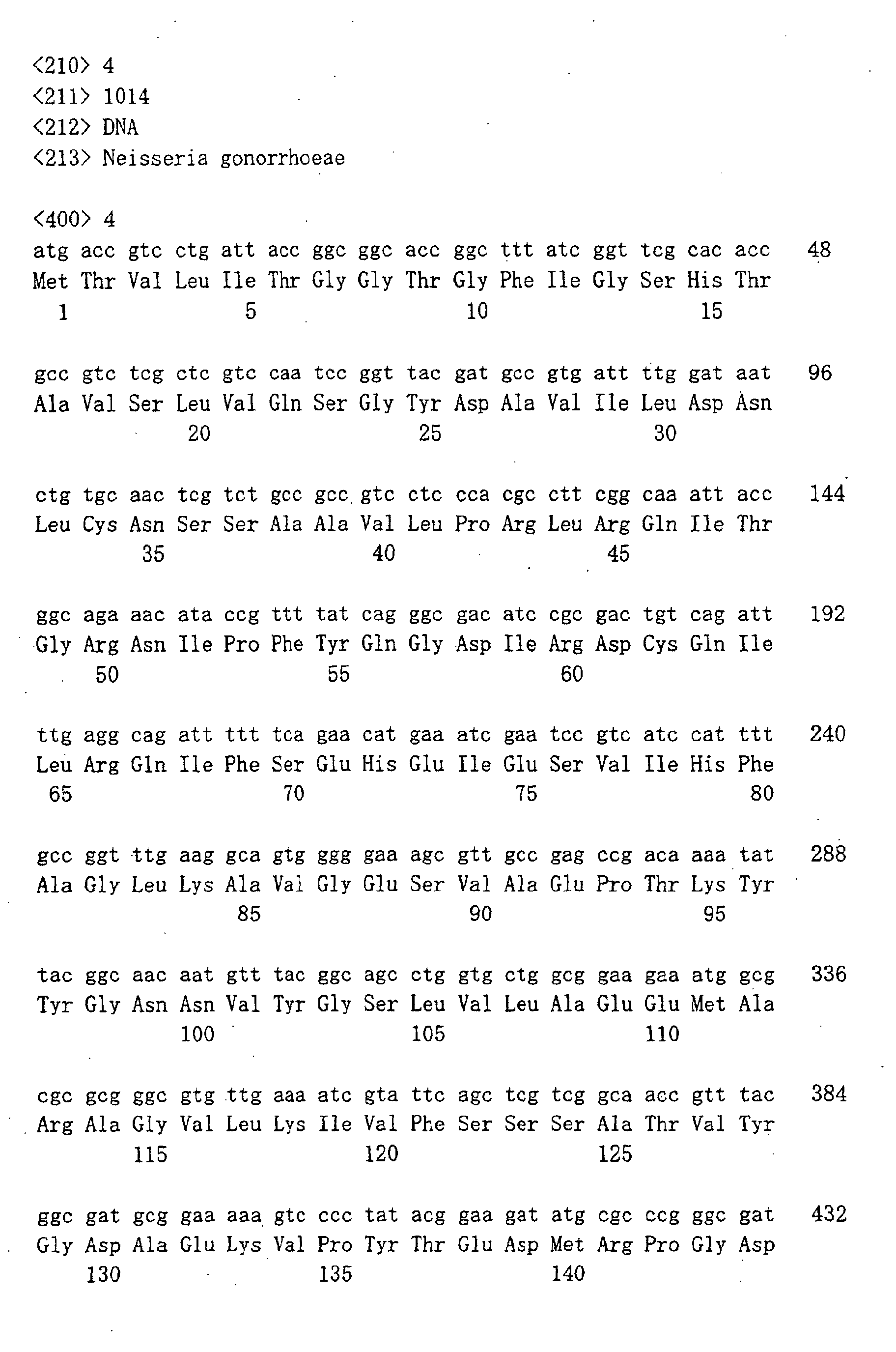
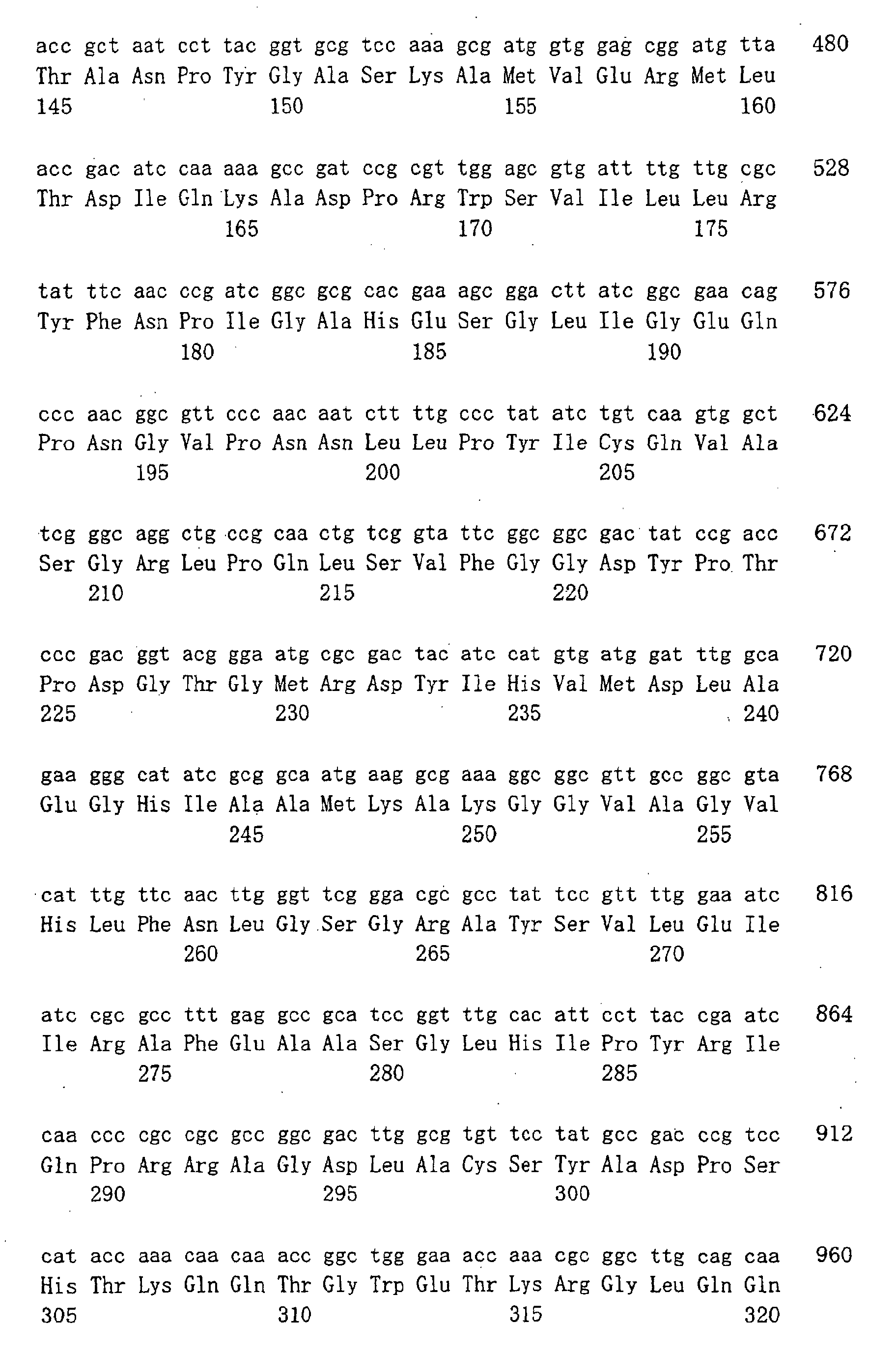
Specific examples include DNA having the nucleotide
sequence shown in SEQ ID NO: 3 or 4, and DNA which
hybridizes with this DNA under stringent conditions and
which encodes a protein having UDP-GlcNAc 4-epimerase
activity.
-
The above DNA capable of hybridization under
stringent conditions refers to DNA which is obtained by
colony hybridization, plaque hybridization, Southern blot
hybridization, or the like using a part or the whole of
DNA encoding the protein according to any of the above (1)
to (6) as a probe. A specific example of such DNA is DNA
which can be identified by performing hybridization at
65°C in the presence of 0.7 to 1.0 mol/l sodium chloride
using a filter with colony- or plaque-derived DNA
immobilized thereon, and then washing the filter at 65°C
with a 0.1 to 2-fold conc. SSC solution (1-fold conc. SSC
solution: 150 mmol/l sodium chloride and 15 mmol/l sodium
citrate). Hybridization can be carried out according to
the methods described in Molecular Cloning, Second
Edition; Current Protocols in Molecular Biology; DNA
Cloning 1: Core Techniques, A Practical Approach, Second
Edition, Oxford University (1995), etc. Specifically, the
hybridizable DNA includes DNA having at least 60% or more
homology, preferably 80% or more homology, further
preferably 95% or more homology to the nucleotide sequence
shown in SEQ ID NO: 3 or 4 as calculated by use of BLAST
or FASTA under the above conditions.
-
The transformant which produces a protein having
UDP-GlcNAc 4-epimerase activity used in the process of the
present invention can be obtained, for example, by
preparing a recombinant DNA by ligating the DNA encoding
the protein prepared by the above-described method to a
vector DNA according to the method described in Molecular
Cloning, Second Edition, and then transforming a host cell
using the recombinant DNA according to the method
described in Molecular Cloning, Second Edition.
-
Preparation of the transformant which expresses a
protein having UDP-GlcNAc 4-epimerase activity used in the
process of the present invention is described below.
(1) Preparation of DNA Encoding a Protein Having UDP-GlcNAc
4-Epimerase Activity
-
The DNA encoding a protein having UDP-GlcNAc 4-epimerase
activity can be prepared from DNA derived from
any organism having the enzyme activity. Examples of the
suitable DNAs are those derived from microorganisms,
preferably those belonging to the genus Bacillus or
Neisseria, more preferably Bacillus subtilis MI112 (ATCC
33712) and Neisseria gonorrhoeae (ATCC 33084).
-
Microorganisms belonging to the genera Bacillus and
Neisseria can be cultured by a known method. After the
culturing, the chromosomal DNA of the microorganism is
isolated and purified by a known method (for example,
Current Protocols in Molecular Biology).
-
A fragment comprising the DNA encoding a protein
having UDP-GlcNAc 4-epimerase activity can be obtained by
PCR [PCR Protocols, Hamana Press (1993)] using a set of
primers prepared on the basis of the nucleotide sequence
of a known DNA encoding a protein supposed to have UDP-glucose
4-epimerase (EC 5.1.3.2) activity and, as a
template, the chromosomal DNA. Examples of the suitable
nucleotide sequences are that derived from Bacillus
subtilis shown in SEQ ID NO: 1 and that derived from
Neisseria gonorrhoeae shown in SEQ ID NO: 2.
-
The desired DNA can also be obtained by
hybridization using a synthetic DNA designed based on a
known nucleotide sequence as a probe.
-
It is also possible to artificially synthesize the
DNA encoding a protein having UDP-GlcNAc 4-epimerase
activity by PCR using a synthetic DNA according to a
conventional method [PCR Protocols, Hamana Press (1993)].
(2) Cloning of DNA Encoding a Protein Having UDP-GlcNAc 4-Epimerase
Activity and Confirmation of the Nucleotide
Sequence
-
The DNA to be used in the process of the present
invention prepared in the above (1), as such or after
cleavage with appropriate restriction enzymes, is ligated
to a vector by a conventional method.
-
As the vector to which the DNA is ligated, any phage
vectors, plasmid vectors, etc. that are capable of
autonomous replication in Escherichia coli K12 can be
employed. Examples of suitable vectors are ZAP Express
[STRATAGENE; Strategies, 5, 58 (1992)], pBluescript II
SK(+) [STRATAGENE; Nucleic Acids Res., 17. 9494 (1989)],
λzap II (STRATAGENE), λgt10, λgt11 [DNA Cloning, A
Practical Approach, 1, 49 (1985)], λTriplEx (Clontech) ,
λExCell (Amersham Pharmacia Biotech) and pUC18 [Gene, 33,
103 (1985)].
-
As the Escherichia coli used as host cells for a
recombinant DNA obtained by ligating the DNA used in the
process of the present invention obtained in (1) to the
vector, any microorganism belonging to Escherichia coli
can be employed. Examples of suitable microorganisms are
Escherichia coli XL1-Blue MRF' [STRATAGENE; Strategies, 5,
81 (1992)], Escherichia coli C600 [Genetics, 39, 440
(1954)], Escherichia coli Y1088 [Science, 222, 778 (1983)],
Escherichia coli Y1090 [Science, 222, 778 (1983)],
Escherichia coli NM522 [J. Mol. Biol., 166. 1 (1983)],
Escherichia coli K802 [J. Mol. Biol., 16, 118 (1966)] and
Escherichia coli JM105 [Gene, 38, 275 (1985)].
-
Introduction of the recombinant DNA can be carried
out by any of the methods for introducing DNA into the
above host cells, for example, the method using calcium
ion [Proc. Natl. Acad. Sci. USA, 69, 2110 (1972)], the
protoplast method (Japanese Published Unexamined Patent
Application No. 248394/88) and electroporation [Nucleic
Acids Res., 16, 6127 (1988)].
-
The nucleotide sequence of the DNA of the present
invention contained in the recombinant DNA can be
determined after extracting the recombinant DNA from the
transformant obtained in the above manner. Determination
of the nucleotide sequence can be carried out by a
conventional sequencing method such as the dideoxy method
[Proc. Natl. Acad. Sci. USA, 74, 5463 (1977)] or by using
a nucleotide sequencer such as 373A DNA Sequencer (Perkin-Elmer
Corp.).
-
Examples of the transformants carrying the
recombinant DNA obtained in the above manner are
Escherichia coli NM522/pGT73 carrying a plasmid DNA having
the nucleotide sequence shown in SEQ ID NO: 3 and
Escherichia coli NM522/pGT24 carrying a plasmid DNA having
the nucleotide sequence shown in SEQ ID NO: 4.
(3) Preparation of a Transformant Which Produces a Protein
Having UDP-GlcNAc 4-Epimerase Activity
-
Preparation of the transformant which produces a
protein having UDP-GlcNAc 4-epimerase activity can be
carried out, for example, in the following manner by use
of the methods described in Molecular Cloning, Second
Edition and Current Protocols in Molecular Biology.
-
That is, on the basis of the DNA obtained above, a
DNA fragment of an appropriate length comprising a region
encoding the protein is prepared according to need, and
the DNA fragment is inserted downstream of a promoter in
an appropriate expression vector to prepare a recombinant
DNA. Then, the recombinant DNA is introduced into a host
cell suited for the expression vector to prepare a
transformant.
-
As the host cell, any bacterial cells, yeast cells,
etc. that are capable of expressing the desired gene can
be used.
-
The expression vectors that can be employed are
those capable of autonomous replication or integration
into the chromosomal DNA in the above host cells and
comprising a promoter at a position appropriate for the
transcription of the DNA encoding the protein of the
present invention.
-
When a procaryote such as a bacterium is used as the
host cell, it is preferred that the recombinant DNA
comprising the DNA encoding a protein having UDP-GlcNAc 4-epimerase
activity is a vector which is capable of
autonomous replication in the procaryote and which
comprises a promoter, a ribosome binding sequence, the DNA
of the present invention and a transcription termination
sequence. The vector may further comprise a gene
regulating the promoter.
-
Examples of suitable expression vectors are pHelix1
(Roche Diagnostics), pKK233-2 (Amersham Pharmacia Biotech),
pSE280 (Invitrogen), pGEMEX-1 (Promega), pQE-8 (QIAGEN),
pKYP10 (Japanese Published Unexamined Patent Application
No. 110600/83), pKYP200 [Agric. Biol. Chem., 48, 669
(1984)], pLSA1 [Agric. Biol. Chem., 53, 277 (1989)], pGEL1
[Proc. Natl. Acad. Sci. USA, 82. 4306 (1985)], pBluescript
II SK(-) (STRATAGENE), pTrs30 [prepared from Escherichia
coli JM109/pTrS30 (FERM BP-5407)], pTrs32 [prepared from
Escherichia coli JM109/pTrS32 (FERM BP-5408)], pPAC31
(WO98/12343), pGHA2 [prepared from Escherichia coli IGHA2
(FERM B-400); Japanese Published Unexamined Patent
Application No. 221091/85], pGKA2 [prepared from
Escherichia coli IGKA2 (FERM BP-6798); Japanese Published
Unexamined Patent Application No. 221091/85], pTerm2
(US4686191, US4939094 and US5160735), pSupex, pUB110, pTP5,
pC194, pEG400 [J. Bacteriol., 172. 2392 (1990)], pGEX
(Amersham Pharmacia Biotech) and pET system (Novagen).
-
As the promoter, any promoters capable of
functioning in host cells can be used. For example,
promoters derived from Escherichia, coli or phage, such as
trp promoter (Ptrp), lac promoter, PL promoter, PR promoter
and T7 promoter can be used. Artificially designed and
modified promoters such as a promoter in which two Ptrps
are combined in tandem (Ptrp x 2), tac promoter, lacT7
promoter and letI promoter, etc. can also be used.
-
It is preferred to use a plasmid in which the
distance between the Shine-Dalgarno sequence (ribosome
binding sequence) and the initiation codon is adjusted to
an appropriate length (e.g., 6 to 18 bases).
-
In the recombinant DNA of the present invention, the
transcription termination sequence is not essential for
the expression of the DNA of the present invention, but it
is preferred to place the transcription termination
sequence immediately downstream of the structural gene.
-
Examples of suitable host cells are microorganisms
belonging to the genera Escherichia, Serratia, Bacillus,
Brevibacterium, Corynebacterium, Microbacterium and
Pseudomonas. Specific examples are Escherichia coli XL1-Blue,
Escherichia coli XL2-Blue, Escherichia coli DH1,
Escherichia coli MC1000, Escherichia coli KY3276,
Escherichia coli W1485, Escherichia coli JM109,
Escherichia coli HB101, Escherichia coli No. 49,
Escherichia coli W3110, Escherichia coli NY49, Escherichia
coli GI698, Escherichia coli TB1, Serratia ficaria,
Serratia fonticola, Serratia liquefaciens, Serratia
marcescens, Bacillus subtilis, Bacillus megaterium,
Bacillus amyloliquefaciens, Corynebacterium ammoniagenes,
Brevibacterium immariophilum ATCC 14068, Brevibacterium
saccharolyticurn ATCC 14066, Brevibacterium flavum ATCC
14067, Brevibacterium lactofermentum ATCC 13869,
corynebacterium glutamicum ATCC 13032, Corynebacterium
glutamicum ATCC 13869, Corynebacterium acetoacidophilum
ATCC 13870, Microbacterium ammoniaphilum ATCC 15354,
Pseudomonas putida and Pseudomonas sp. D-0110.
-
Introduction of the recombinant DNA can be carried
out by any of the methods for introducing DNA into the
above host cells, for example, the method using calcium
ion [Proc. Natl. Acad. Sci. USA, 69, 2110 (1972)], the
protoplast method (Japanese Published Unexamined Patent
Application No. 248394/88) and the methods described in
Gene, 17, 107 (1982) and Mol. Gen. Genet., 168, 111 (1979).
-
When yeast is used as the host cell, YEP13 (ATCC
37115), YEp24 (ATCC 37051), YCpS (ATCC 37419), pHS19,
pHS15, etc. can be used as the expression vector.
-
As the promoter, any promoters capable of
functioning in yeast can be used. Suitable promoters
include the promoter of a glycolytic gene such as hexose
kinase, PHO5 promoter, PGK promoter, GAP promoter, ADH
promoter, gal 1 promoter, gal 10 promoter, heat shock
polypeptide promoter, MFα1 promoter and CUP 1 promoter.
-
Examples of suitable host cells are microorganisms
belonging to the genera Saccharomyces, Schizosaccharomyces,
Kluyveromyces, Trichosporon, Schwanniomyces, Pichia and
Candida, specifically, Saccharomyces cerevisiae,
Schizosaccharomyces pombe, Kluyveromyces lactis,
Trichosporon pullulans, Schwanniomyces alluvius and
Candida utilis.
-
Introduction of the recombinant DNA can be carried
out by any of the methods for introducing DNA into yeast,
for example, electroporation [Methods Enzymol., 194, 182
(1990)], the spheroplast method [Proc. Natl. Acad. Sci.
USA, 75, 1929 (1978)], the lithium acetate method [J.
Bacteriol., 153, 163 (1983)] and the method described in
Proc. Natl. Acad. Sci. USA, 75, 1929 (1978).
-
Culturing of the above-prepared transformant used
for the preparation of UDP-GalNAc and a GalNAc-containing
carbohydrate can be carried out by conventional methods
for culturing the host.
-
When the transformant used in the process of the
present invention is prepared by using a procaryote such
as Escherichia coli or a eucaryote such as yeast as the
host, any of natural media and synthetic media can be used
as a medium for culturing the transformant insofar as it
is a medium suitable for efficient culturing of the
transformant which contains carbon sources, nitrogen
sources, inorganic salts, etc. which can be assimilated by
the transformant.
-
As the carbon sources, any carbon sources that can
be assimilated by the transformant can be used. Examples
of suitable carbon sources include carbohydrates such as
glucose, fructose, sucrose, molasses containing them,
starch and starch hydrolyzate; organic acids such as
acetic acid and propionic acid; and alcohols such as
ethanol and propanol.
-
As the nitrogen sources, ammonia, ammonium salts of
organic or inorganic acids such as ammonium chloride,
ammonium sulfate, ammonium acetate and ammonium phosphate,
and other nitrogen-containing compounds can be used as
well as peptone, meat extract, yeast extract, corn steep
liquor, casein hydrolyzate, soybean cake, soybean cake
hydrolyzate, and various fermented microbial cells and
digested products thereof.
-
Examples of the inorganic salts include potassium
dihydrogenphosphate, dipotassium hydrogenphosphate,
magnesium phosphate, magnesium sulfate, sodium chloride,
ferrous sulfate, manganese sulfate, copper sulfate and
calcium carbonate.
-
Culturing is carried out under aerobic conditions,
for example, by shaking culture or submerged spinner
culture under aeration, at 15 to 40°C usually for 16 hours
to 7 days. The pH is preferably maintained at 3.0 to 9.0
during the culturing. The pH adjustment is carried out by
using an organic or inorganic acid, an alkali solution,
urea, calcium carbonate, ammonia, etc.
-
If necessary, antibiotics such as ampicillin,
tetracycline and chloramphenicol may be added to the
medium during the culturing.
-
When a microorganism transformed with a recombinant
DNA comprising an inducible promoter is cultured, an
inducer may be added to the medium, if necessary. For
example, in the case of a microorganism transformed with a
recombinant DNA comprising lac promoter, isopropyl- β -D-thiogalactopyranoside
or the like may be added to the
medium; and in the case of a microorganism transformed
with a recombinant DNA comprising trp promoter,
indoleacrylic acid or the like may be added.
-
The thus obtained culture of the transformant and
various treated matters of the culture can be used as an
enzyme source for the production of UDP-GalNAc or a
GalNAc-containing carbohydrate in an aqueous medium.
-
The treated matters of the culture include
concentrated culture, dried culture, cells obtained by
centrifuging the culture, products obtained by treating
the cells by various means such as drying, freeze-drying,
treatment with a surfactant, ultrasonication, mechanical
friction, treatment with a solvent, enzymatic treatment,
protein fractionation and immobilization, an enzyme
preparation obtained by extracting the cells, etc.
-
In the formation of UDP-GalNAc or a GalNAc-containing
carbohydrate, the enzyme source is used at a
concentration of 0.1 mU/l to 10,000 U/l, preferably 1 mU/l
to 1,000 U/l, one unit (U) being defined as the activity
which forms 1 µ mol of UDP-GalNAc or a GalNAc-containing
carbohydrate at 37°C in one minute.
-
Aqueous media useful in the formation of UDP-GalNAc
or a GalNAc-containing carbohydrate include water, buffers
such as phosphate buffer, carbonate buffer, acetate buffer,
borate buffer, citrate buffer and Tris buffer, alcohols
such as methanol and ethanol, esters such as ethyl acetate,
ketones such as acetone, amides such as acetamide, etc.
The culture of the microorganism used as the enzyme source
can be used also as the aqueous medium.
-
If necessary, a surfactant or an organic solvent may
be added in the formation of UDP-GalNAc or a GalNAc-containing
carbohydrate. Any surfactant that promotes the
formation of a GalNAc-containing carbohydrate can be used.
Suitable surfactants include nonionic surfactants such as
polyoxyethylene octadecylamine (e.g., Nymeen S-215, NOF
Corporation), cationic surfactants such as
cetyltrimethylammonium bromide and
alkyldimethylbenzylammonium chloride (e.g., Cation F2-40E,
NOF Corporation), anionic surfactants such as lauroyl
sarcosinate, and tertiary amines such as
alkyldimethylamine (e.g., Tertiary Amine FB, NOF
Corporation), which may be used alone or in combination.
-
The surfactant is usually used at a concentration of
0.1 to 50 g/l. As the organic solvent, xylene, toluene,
aliphatic alcohols, acetone, ethyl acetate, etc. may be
used usually at a concentration of 0.1 to 50 ml/l.
-
UDP-GlcNAc useful in the formation of UDP-GalNAc and
a GalNAc-containing carbohydrate includes commercially
available ones, reaction solutions formed utilizing the
activity of a microorganism or the like, and those
purified from the reaction solutions. Examples of
suitable microorganisms are those belonging to the genera
Escherichia, Corynebacterium and Saccharomyces,
specifically, Escherichia coli, Corynebacterium
ammoniagenes and Saccharomyces cerevisiae. These
microorganisms may be used alone or in combination. The
sugar nucleotide substrate is used at a concentration of
0.1 to 500 mmol/l.
-
UDP-GalNAc can be produced by allowing the above
enzyme source, a culture of a microorganism having the
ability to form UDP-GlcNAc from a precursor of UTP and a
sugar or a treated matter of the culture as an additional
enzyme source, the precursor of UTP and the sugar to be
present in an aqueous medium, allowing UDP-GalNAc to form
and accumulate in the aqueous medium, and recovering UDP-GalNAc
from the aqueous medium.
-
Examples of the precursor of UTP used in the present
process include orotic acid, orotidine, uridine, uracil
and uridine-5'-monophosphate. The precursor may be a
purified product, a salt of the precursor, or a culture
containing the precursor produced by a microorganism or a
partially-purified product obtained from the culture
insofar as contaminants therein do not inhibit the
reaction. The precursor is used at a concentration of 0.1
mmol/l to 1.0 mol/l, preferably 0.01 to 0.5 mol/l.
-
Examples of the sugar used in the present process
include glucosamine and N-acetylglucosamine. The sugar
may be a purified product or any product containing the
sugar insofar as contaminants therein do not inhibit the
reaction. The sugar can be added at a time at the start
of the reaction, or in portions or continuously during the
reaction and is used at a concentration of 0.1 mmol/l to
2.0 mol/l.
-
A GalNAc-containing carbohydrate can be produced by
allowing the above enzyme source, a culture of a
microorganism having the ability to form UDP-GlcNAc from a
precursor of UTP and a sugar or a treated matter of the
culture and GalNAc transferase as additional enzyme
sources, the precursor of UTP, the sugar and an acceptor
carbohydrate to be present in an aqueous medium, allowing
the GalNAc-containing carbohydrate to form and accumulate
in the aqueous medium, and recovering the GalNAc-containing
carbohydrate from the aqueous medium.
-
The acceptor carbohydrate used in the formation of a
GalNAc-containing carbohydrate may be any acceptor
carbohydrate that works as a substrate for GalNAc
transferase. An example of a suitable acceptor
carbohydrate is an acceptor carbohydrate which contains an
oligosaccharide having sialic acid, galactose, GalNAc, N-acetylglucosamine,
fucose, glucuronic acid or iduronic
acid at the nonreducing end. Examples of the
oligosaccharides having sialic acid, galactose, GalNAc, N-acetylglucosamine,
fucose, glucuronic acid or iduronic
acid at the nonreducing end are lactose, N-acetyllactosamine,
globotriose, sialyllactose, sialyl N-acetyllactosamine,
Lewis X, Lewis a, sialyl Lewis X,
sialyl Lewis a, chondroitin sulfate, dermatan sulfate, H
type 1 (Fuc α1-2Gal β1-3GlcNAc) and H type 2 (Fuc α 1-2Gal β
1-4GlcNAc). Preferred acceptor carbohydrates are lactose,
N-acetyllactosamine, globotriose, sialyllactose, sialyl N-acetyllactosamine,
Lewis X, Lewis a, sialyl Lewis X,
sialyl Lewis a, chondroitin sulfate, dermatan sulfate, H
type 1 (Fuc α 1-2Gal β 1-3GlcNAc) and H type 2 (Fuc α1-2Gal β
1-4GlcNAc).
-
The acceptor carbohydrate is used at a concentration
of 0.1 to 500 mmol/l.
-
If necessary, an inorganic salt such as MnCl2, β-mercaptoethanol,
and the like may be added in the above
reaction for forming UDP-GalNAc and a GalNAc-containing
carbohydrate.
-
The reaction for the formation of UDP-GalNAc and a
GalNAc-containing carbohydrate is carried out in an
aqueous medium at pH 5 to 10, preferably pH 6 to 8, at 20
to 50°C for 1 to 96 hours.
-
Determination of UDP-GalNAc and the GalNAc-containing
carbohydrate formed in the aqueous medium can
be carried out according to known methods [Microbiol.
Immunol., 30, 1085 (1986); Kagaku to Kogyo (Chemistry and
Chemical Industry), 43, 953 (1990)].
-
Recovery of UDP-GalNAc and the GalNAc-containing
carbohydrate formed in the reaction mixture can be carried
out by ordinary methods using active carbon, ion-exchange
resins, etc. For example, UDP-GalNAc can be recovered by
the method described in Agr. Biol. Chem., 37, 1741 (1973),
and the GalNAc-containing carbohydrate by the method
described in J. Org. Chem., 47, 5416 (1982).
Brief Description of the Drawings
-
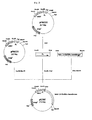
- Fig. 1 shows the steps for constructing plasmid
pGT73 expressing a gene encoding a protein having UDP-GlcNAc
4-epimerase activity derived from Bacillus subtilis.
- Fig. 2 shows the steps for constructing plasmid
pGT24 expressing a gene encoding a protein having UDP-GlcNAc
4-epimerase activity derived from Neisseria
gonorrhoeae.
- Fig. 3 shows the steps for constructing plasmid
pGT87 expressing the β1,4-N-acetylgalactosaminyltransferase
gene derived from
Campylobacter jejuni
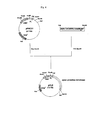
- Fig. 4 shows the steps for constructing plasmid pCJ2
expressing the α1,4-N-acetylgalactosaminyltransferase
gene derived from Campylobacter jejuni.
-
-
The symbols in Figs. 1 to 4 refer to the following.
PL: PL promoter
cI857: cI857 repressor gene
Ampr: ampicillin resistance gene
galE (B. subtilis): gene encoding a protein having UDP-GlcNAc
4-epimerase activity derived from Bacillus
subtilis
galE (N. gonorrhoeae): gene encoding a protein having UDP-GlcNAc
4-epimerase activity derived from Neisseria
gonorrhoeae
beta 1,4-GalNAc transferase: β1,4-N-acetylgalactosaminyltransferase
gene derived from
Campylobacter jejuni
alpha 1,4-GalNAc transferase: α1, 4-N-acetylgalactosaminyltransferase
gene derived from
Campylobacter jejuni
Best Modes for Carrying Out the Invention
-
Examples of the present invention are shown below.
These examples are not to be construed as limiting the
scope of the invention.
Example 1
Construction of a Transformant Which Produces UDP-glucose
4-Epimerase Derived from Bacillus subtilis
-
Bacillus subtilis MI112 (ATCC 33712) was inoculated
into 20 ml of LB medium (10 g/l Bacto-tryptone, 10 g/l
yeast extract and 5 g/l sodium chloride) in a 300-ml flask
and cultured at 37°C for 16 hours. After the culturing,
the chromosomal DNA of the microorganism was prepared
according to the method described in Current Protocols in
Molecular Biology.
-
On the basis of the nucleotide sequence of the galE
gene supposed to encode a protein having UDP-glucose 4-epimerase
activity derived from Bacillus subtilis
[Microbiology, 142, 3113 (1996)], DNAs having the
nucleotide sequences shown in SEQ ID NOS: 5 and 6 were
synthesized using a DNA synthesizer (Model 8905,
PerSeptive Biosystems). PCR was carried out in the
following manner using the synthesized DNAs as a set of
primers and the chromosomal DNA of Bacillus subtilis MI112
as a template. That is, PCR was carried out by 30 cycles,
one cycle consisting of reaction at 94°C for one minute,
reaction at 37°C for 2 minutes and reaction at 72°C for 3
minutes, using 40 µl of a reaction mixture comprising 0.1
µg of the chromosomal DNA, 0.5 µ mol/l each of the primers,
2.5 units of Pfu DNA polymerase (STRATAGENE), 4 µl of
buffer for Pfu DNA polymerase (10 x) (STRATAGENE) and 200
µmol/l each of deoxyNTPs, whereby a ca. 1.0 kb PCR
product was obtained.
-
One-tenth of the resulting reaction mixture was
subjected to agarose gel electrophoresis to confirm that
the desired fragment was amplified. Then, the remaining
reaction mixture was mixed with an equal amount of
phenol/chloroform saturated with TE.
-
The resulting mixture was centrifuged and the
obtained upper layer was mixed with a two-fold volume of
cold ethanol and allowed to stand at -80°C for 30 minutes.
The resulting mixture was centrifuged to obtain a DNA
precipitate.
-
The DNA precipitate was dissolved in 20 µl of TE
[10 mmol/l Tris-HCl, 1 mmol/l EDTA (pH 8.0)] and 5 µl of
the solution was subjected to reaction to cleave the DNA
with restriction enzymes ClaI and BamHI. DNA fragments
were separated by agarose gel electrophoresis and a 1.0 kb
DNA fragment containing the UDP-glucose 4-epimerase gene
was recovered using Gene Clean II Kit (Funakoshi).
-
pPAC31 (0.2 µg) was cleaved with restriction
enzymes ClaI and BamHI. DNA fragments were separated by
agarose gel electrophoresis and a 5.5 kb DNA fragment was
recovered in the same manner.
-
The 1.0 kb fragment and 5.5 kb DNA fragment obtained
above were subjected to ligation reaction using a ligation
kit (Takara Shuzo Co., Ltd.) at 16°C for 16 hours.
-
Escherichia coli NM522 was transformed using the
ligation mixture according to the known method described
above, spread on LB agar medium containing 50 µg/ml
ampicillin, and cultured overnight at 30°C.
-
A plasmid was extracted from a colony of the
transformant that grew on the medium according to the
known method described above, whereby expression plasmid
pGT73 was obtained. The structure of the obtained plasmid
was confirmed by digestion with restriction enzymes (Fig.
1) .
Example 2
Construction of a Transformant Which Produces UDP-glucose
4-Epimerase Derived from Neisseria gonorrhoeae
-
Neisseria gonorrhoeae (ATCC 33084) was cultured
according to a known method (USP 5,545,553). After the
culturing, the chromosomal DNA of the microorganism was
prepared by the method described in Current Protocols in
Molecular Biology.
-
On the basis of the nucleotide sequence of the galE
gene supposed to encode a protein having UDP-glucose 4-epimerase
activity derived from Neisseria gonorrhoeae [Mol.
Microbiol., 8., 891 (1993)], DNAs having the nucleotide
sequences shown in SEQ ID NOS: 7 and 8 were synthesized
using a DNA synthesizer (Model 8905, PerSeptive
Biosystems). PCR was carried out using the synthesized
DNAs as a set of primers and the chromosomal DNA of
Neisseria gonorrhoeae (ATCC 33084) as a template under the
same conditions as described above, whereby a ca. 1.0 kb
PCR product was obtained.
-
One-tenth of the resulting reaction mixture was
subjected to agarose gel electrophoresis to confirm that
the desired fragment was amplified. Then, the remaining
reaction mixture was mixed with an equal amount of
phenol/chloroform saturated with TE.
-
The resulting mixture was centrifuged and the
obtained upper layer was mixed with a two-fold volume of
cold ethanol and allowed to stand at -80°C for 30 minutes.
The resulting mixture was centrifuged to obtain a DNA
precipitate.
-
The DNA precipitate was dissolved in 20 µl of TE
and 5 µl of the solution was subjected to reaction to
cleave the DNA with restriction enzymes ClaI and BamHI.
DNA fragments were separated by agarose gel
electrophoresis and a 1.0 kb DNA fragment containing the
UDP-glucose 4-epimerase gene was recovered using Gene
Clean II Kit.
-
pPAC31 (0.2 µg) was cleaved with restriction
enzymes ClaI and BamHI. DNA fragments were separated by
agarose gel electrophoresis and a 5.5 kb DNA fragment was
recovered in the same manner.
-
The 1.0 kb fragment and 5.5 kb fragment obtained
above were subjected to ligation reaction using a ligation
kit at 16°C for 16 hours.
-
Escherichia coli NM522 was transformed using the
ligation mixture according to the known method described
above, spread on LB agar medium containing 50 µg/ml
ampicillin, and cultured overnight at 30°C.
-
A plasmid was extracted from a colony of the
transformant that grew on the medium according to the
known method described above, whereby expression plasmid
pGT24 was obtained. The structure of the obtained plasmid
was confirmed by digestion with restriction enzymes (Fig.
2).
Example 3
Construction of a Transformant Which Produces β 1,4-N-Acetylgalactosaminyltransferase
Derived from Campylobacter
jejuni
-
Campylobacter jejuni (ATCC 43446) was cultured
according to a known method [Microbiology, 144, 2049
(1998)]. After the culturing, the chromosomal DNA of the
microorganism was prepared by the method described in
Current Protocols in Molecular Biology.
-
On the basis of the nucleotide sequence of the gene
encoding β 1,4-N-acetylgalactosaminyltransferase derived
from Campylobacter jejuni (ATCC 43446) [J. Biol. Chem.,
275, 3896 (2000)], DNAs having the nucleotide sequences
shown in SEQ ID NOS: 9 and 10 were synthesized using a DNA
synthesizer (Model 8905, PerSeptive Biosystems). PCR was
carried out using the synthesized DNAs as a set of primers
and the chromosomal DNA of Campylobacter jejuni (ATCC
43446) as a template under the same conditions as
described above, whereby a ca. 1.0 kb DNA fragment was
obtained.
-
One-tenth of the resulting reaction mixture was
subjected to agarose gel electrophoresis to confirm that
the desired fragment was amplified. Then, the remaining
reaction mixture was mixed with an equal amount of
phenol/chloroform saturated with TE.
-
The resulting mixture was centrifuged and the
obtained upper layer was mixed with a two-fold volume of
cold ethanol and allowed to stand at -80°C for 30 minutes.
The resulting mixture was centrifuged to obtain a DNA
precipitate.
-
The DNA precipitate was dissolved in 20 µl of TE
and 5 µl of the solution was subjected to reaction to
cleave the DNA with restriction enzymes XhoI and BamHI.
DNA fragments were separated by agarose gel
electrophoresis and a 1.0 kb DNA fragment containing the
β 1,4-N-acetylgalactosaminyltransferase gene was recovered
using Gene Clean II Kit (Funakoshi).
-
Separately, PCR was carried out under the same
conditions as described above using DNAs having the
nucleotide sequences shown in SEQ ID NOS: 11 and 12 as a
set of primers and pPAC31 as a template.
-
One-tenth of the resulting reaction mixture was
subjected to agarose gel electrophoresis to confirm that
the desired fragment was amplified. Then, the remaining
reaction mixture was mixed with an equal amount of
phenol/chloroform saturated with TE.
-
The resulting mixture was centrifuged and the
obtained upper layer was mixed with a two-fold volume of
cold ethanol and allowed to stand at -80°C for 30 minutes.
The resulting mixture was centrifuged to obtain a DNA
precipitate.
-
The DNA precipitate was dissolved in 20 µl of TE
and 5 µl of the solution was subjected to reaction to
cleave the DNA with restriction enzymes XhoI and EcoRI.
DNA fragments were separated by agarose gel
electrophoresis and a 0.3 kb DNA fragment containing PL
promoter was recovered using Gene Clean II Kit.
-
pPAC31 (0.2 µg) was cleaved with restriction
enzymes EcoRI and BamHI. DNA fragments were separated by
agarose gel electrophoresis and a 5.2 kb DNA fragment was
recovered in the same manner.
-
The 1.0 kb fragment, 0.3 kb fragment and 5.2 kb
fragment obtained above were subjected to ligation
reaction using a ligation kit at 16°C for 16 hours.
-
Escherichia coli NM522 was transformed using the
ligation mixture according to the known method described
above, spread on LB agar medium containing 50 µg/ml
ampicillin, and cultured overnight at 30°C.
-
A plasmid was extracted from a colony of the
transformant that grew on the medium according to the
known method described above, whereby expression plasmid
pGT87 was obtained. The structure of the obtained plasmid
was confirmed by digestion with restriction enzymes (Fig.
3).
Example 4
Construction of a Transformant Which Produces α1,4-N-Acetylgalactosaminyltransferase
Derived from Campylobacter
jejuni
-
On the basis of the nucleotide sequence of the gene
encoding α1,4-N-acetylgalactosaminyltransferase derived
from Campylobacter jejuni (ATCC 43446) [Microbiology, 144,
2049 (1998)], DNAs having the nucleotide sequences shown
in SEQ ID NOS: 13 and 14 were synthesized using a DNA
synthesizer (Model 8905, PerSeptive Biosystems). PCR was
carried out using the synthesized DNAs as a set of primers
and the chromosomal DNA of Campylobacter jejuni (ATCC
43446) as a template under the same conditions as in
Example 3, whereby a ca. 1.0 kb PCR product was obtained.
-
One-tenth of the resulting reaction mixture was
subjected to agarose gel electrophoresis to confirm that
the desired fragment was amplified. Then, the remaining
reaction mixture was mixed with an equal amount of
phenol/chloroform saturated with TE.
-
The resulting mixture was centrifuged and the
obtained upper layer was mixed with a two-fold volume of
cold ethanol and allowed to stand at -80°C for 30 minutes.
The resulting mixture was centrifuged to obtain a DNA
precipitate.
-
The DNA precipitate was dissolved in 20 µl of TE
and 5 µl of the solution was subjected to reaction to
cleave the DNA with restriction enzymes ClaI and BamHI.
DNA fragments were separated by agarose gel
electrophoresis and a 1.0 kb DNA fragment containing the
α1,4-N-acetylgalactosaminyltransferase gene was recovered
using Gene Clean II Kit.
-
pPAC31 (0.2 µg) was cleaved with restriction
enzymes ClaI and BamHI. DNA fragments were separated by
agarose gel electrophoresis and a 5.5 kb DNA fragment was
recovered in the same manner.
-
The 1.0 kb fragment and 5.5 kb fragment obtained
above were subjected to ligation reaction using a ligation
kit at 16°C for 16 hours.
-
Escherichia coli NM522 was transformed using the
ligation mixture according to the known method described
above, spread on LB agar medium containing 50 µg/ml
ampicillin, and cultured overnight at 30°C.
-
A plasmid was extracted from a colony of the
transformant that grew on the medium according to the
known method described above, whereby expression plasmid
pCJ2 was obtained. The structure of the obtained plasmid
was confirmed by digestion with restriction enzymes (Fig.
4).
Example 5
Production of UDP-GalNAc (1)
-
Escherichia coli NM522/pGT73 obtained in Example 1
and Escherichia coli NM522/pNT25 (WO98/12343) producing
galactokinase and galactose-1-phosphate
uridylyltransferase were respectively inoculated into 125
ml of LB medium containing 50 µg/ml ampicillin in a 1-1
Erlenmeyer flask equipped with baffles, and cultured at
220 rpm at 28°C for 17 hours. Each of the resulting
cultures (125 ml) was inoculated into 2.5 1 of TB medium
[10 g/l glucose, 12 g/l Bacto-tryptone (Difco), 24 g/l
yeast extract (Difco), 2.3 g/l KH2PO4 and 12.5 g/l K2HPO4
(pH unadjusted)] containing 50 µg/ml ampicillin in a 5-1
fermenter, and cultured at 600 rpm with aeration (2.5
1/min.) at 30°C for 4 hours, followed by further culturing
at 40°C for 3 hours. During the culturing, the culture
was maintained at pH 7.0 with 28% aqueous ammonia, and
glucose was added thereto according to need. The
resulting culture was centrifuged to obtain wet cells.
Being capable of storage at -20°C as may be required, the
wet cells could be used after thawing.
-
Corynebacterium ammoniagenes ATCC 21170 was
inoculated into 25 ml of a liquid medium comprising 50 g/l
glucose, 10 g/l polypeptone (Nihon Pharmaceutical Co.,
Ltd.), 10 g/l yeast extract (Oriental Yeast Co., Ltd.), 5
g/l urea, 5 g/l (NH4)2SO4, 1 g/l KH2PO4, 3 g/l K2HPO4, 1 g/l
MgSO4·7H2O, 0.1 g/l CaCl2·2H2O, 10 mg/l FeSO4·7H2O, 10 mg/l
ZnSO4·7H2O, 20 mg/l MnSO4·4-6H2O, 20 mg/l L-cysteine, 10
mg/l calcium D-pantothenate, 5 mg/l vitamin B1, 5 mg/l
nicotinic acid and 30 mg/l biotin (adjusted to pH 7.2 with
10 mol/l NaOH) in a 300-ml Erlenmeyer flask equipped with
baffles, and cultured at 220 rpm at 28°C for 24 hours.
-
The resulting culture (20 ml) was inoculated into
250 ml of a liquid medium having the same composition as
above in a 2-1 Erlenmeyer flask equipped with baffles, and
cultured at 220 rpm at 28°C for 24 hours. The obtained
culture was used as a seed culture.
-
The seed culture (250 ml) was inoculated into 2.25 1
of a liquid medium comprising 150 g/l glucose, 5 g/l meat
extract (Kyokuto Pharmaceutical Ind. Co., Ltd.), 10 g/l
KH2PO4, 10 g/l K2HPO4, 10 g/l MgSO4·7H2O, 0.1 g/l CaCl2·2H2O,
20 mg/l FeSO4·7H2O, 10 mg/l ZnSO4·7H2O, 20 mg/l MnSO4·4-SH2O
(separately sterilized), 15 mg/l β-alanine
(separately sterilized), 20 mg/l L-cysteine, 100 mg/l
biotin, 2 g/l urea and 5 mg/l vitamin B1 (separately
sterilized) (adjusted to pH 7.2 with 10 mol/l NaOH) in a
5-1 fermenter, and cultured at 600 rpm with aeration (2.5
1/mm.) at 32°C for 24 hours. During the culturing, the
culture was maintained at pH 6.8 with 28% aqueous ammonia.
-
The resulting culture was centrifuged to obtain wet
cells. Being capable of storage at -20°C as may be
required, the wet cells could be used after thawing.
-
A reaction mixture (30 ml) comprising 50 g/l wet
cells of Escherichia coli NM522/pNT25, 50 g/l wet cells of
Escherichia coli NM522/pGT73, 150 g/l wet cells of
Corynebacterium ammoniagenes ATCC 21170, 100 g/l fructose,
50 g/l N-acetylglucosamine, 10 g/l orotic acid, 25 g/l
KH2PO4, 5 g/l MgSO4·7H2O, 5 g/l phytic acid, 4 g/l Nymeen
S-215 and 10 ml/l xylene was put in a 200-ml beaker, and
reaction was carried out at 32°C for 27 hours with
stirring at 900 rpm with a magnetic stirrer. During the
reaction, the reaction mixture was maintained at pH 7.2
with 4 mol/l NaOH, and fructose, N-acetylglucosamine and
KH2PO4 were added thereto according to need.
-
After the completion of the reaction, the reaction
product was analyzed by HPLC, whereby it was confirmed
that 9.6 g/l UDP-GalNAc was formed and accumulated in the
reaction mixture.
Example 6
Production of UDP-GalNAc (2)
-
Escherichia coli NM522/pGT24 obtained in Example 2
and Escherichia coli NM522/pNT25 (WO98/12343) were
respectively cultured in the same manner as in Example 5
to obtain wet cells. Being capable of storage at -20°C as
may be required, the wet cells could be used after thawing.
-
Corynebacterium ammoniagenes ATCC 21170 was cultured
in the same manner as in Example 5 to obtain wet cells.
Being capable of storage at -20°C as may be required, the
wet cells could be used after thawing.
-
A reaction mixture (30 ml) comprising 50 g/l wet
cells of Bscherichia coli NM522/pNT25, 50 g/l wet cells of
Escherichia coli NM522/pGT24, 150 g/l wet cells of
Corynebacterium ammoniagenes ATCC 21170, 100 g/l fructose,
50 g/l N-acetylglucosamine, 10 g/l orotic acid, 25 g/l
KH2PO4, 5 g/l MgSO4·7H2O, 5 g/l phytic acid, 4 g/l Nymeen
S-215 and 10 ml/l xylene was put in a 200-ml beaker, and
reaction was carried out at 32°C for 27 hours with
stirring at 900 rpm with a magnetic stirrer. During the
reaction, the reaction mixture was maintained at pH 7.2
with 4 mol/l NaOH, and fructose, N-acetylglucosamine and
KH2PO4 were added thereto according to need.
-
After the completion of the reaction, the reaction
product was analyzed by HPLC, whereby it was confirmed
that 5.5 g/l UDP-GalNAc was formed and accumulated in the
reaction mixture.
Example 7
Production of GM2 Sugar Chain [GalNAc β 1,4 (NeuAc α 2, 3) Gal β
1,4Glc]
-
Escherichia coli NM522/pGT73 obtained in Example 1,
Escherichia coli NM522/pNT25 (WO98/12343 and Escherichia
coli NM522/pGT87 obtained in Example 4 were respectively
cultured in the same manner as in Example 5 to obtain wet
cells. Being capable of storage at -20°C as may be
required, the wet cells could be used after thawing.
-
Corynebacterium ammoniagenes ATCC 21170 was cultured
in the same manner as in Example 5 to obtain wet cells.
Being capable of storage at -20°C as may be required, the
wet cells could be used after thawing.
-
A reaction mixture (30 ml) comprising 50 g/l wet
cells of Escherichia coli NM522/pNT25, 50 g/l wet cells of
Escherichia coli NM522/pGT73, 100 g/l wet cells of
Escherichia coli NM522/pGT87, 150 g/l wet cells of
Corynebacterium ammoniagenes ATCC 21170, 100 g/l fructose,
50 g/l N-acetylglucosamine, 50 g/l UDP-N-acetylglucosamine,
33 g/l 3'-sialyllactose, 25 g/l KH2PO4, 5 g/l MgSO4·7H2O, 5
g/l phytic acid, 4 g/l Nymeen S-215 and 10 ml/l xylene was
put in a 200-ml beaker, and reaction was carried out at
32°C for 27 hours with stirring at 900 rpm with a magnetic
stirrer. During the reaction, the reaction mixture was
maintained at pH 7.2 with 4 mol/l NaOH, and fructose, N-acetylglucosamine,
3'-sialyllactose and KH2PO4 were added
thereto according to need.
-
After the completion of the reaction, the reaction
product was analyzed by HPLC, whereby it was confirmed
that 7.7 g/l GM2 sugar chain was formed and accumulated in
the reaction mixture.
Example 8
Production of NOS- α (GalNAc α 1,4 Gal β1,4GlcNAc β1,3Gal β
1,4Glc)
-
Escherichia coil NM522/pGT24 obtained in Example 2,
Bscherichia coli NM522/pNT25 (WO98/12343) and Escherichia
coli NM522/pCJ2 obtained in Example 5 were respectively
cultured in the same manner as in Example 5 to obtain wet
cells. Being capable of storage at -20°C as may be
required, the wet cells could be used after thawing.
-
Corynebacterium ammoniagenes ATCC 21170 was cultured
in the same manner as in Example 5 to obtain wet cells.
Being capable of storage at -20°C as may be required, the
wet cells could be used after thawing.
-
A reaction mixture (30 ml) comprising 50 g/l wet
cells of Escherichia coli NM522/pNT25, 25 g/l wet cells of
Escherichia coli NM522/pGT24, 50 g/l wet cells of
Escherichia coli NM522/pCJ2, 150 g/l wet cells of
Corynebacterium ammoniagenes ATCC 21170, 100 g/l fructose,
100 g/l N-acetylglucosamine, 200 g/l lacto-N-neotetraose,
5 g/l orotic acid, 25 g/l KH2PO4, 5 g/l MgSO4·7H2O, 5 g/l
phytic acid, 4 g/l Nymeen S-215 and 10 ml/l xylene was put
in a 200-ml beaker, and reaction was carried out at 32°C
for 35 hours with stirring at 900 rpm with a magnetic
stirrer. During the reaction, the reaction mixture was
maintained at pH 7.2 with 4 mol/l NaOH, and fructose and
KH2PO4 were added thereto according to need.
-
After the completion of the reaction, the reaction
product was analyzed by HPLC, whereby it was confirmed
that 2.4 g/l NOS-α was formed and accumulated in the
reaction mixture.
industrial Applicability
-
According to the present invention, UDP-GalNAc and
an N-acetylgalactosamine-containing carbohydrate can be
efficiently produced.
[Sequence Listing Free Text]
-
- SEQ ID NO: 5 - Description of artificial sequence:
synthetic DNA
- SEQ ID NO: 6 - Description of artificial sequence:
synthetic DNA
- SEQ ID NO: 7 - Description of artificial sequence:
synthetic DNA
- SEQ ID NO: 8 - Description of artificial sequence:
synthetic DNA
- SEQ ID NO: 9 - Description of artificial sequence:
synthetic DNA
- SEQ ID NO: 10 - Description of artificial sequence:
synthetic DNA
- SEQ ID NO: 11 - Description of artificial sequence:
synthetic DNA
- SEQ ID NO: 12 - Description of artificial sequence:
synthetic DNA
- SEQ ID NO: 13 - Description of artificial sequence:
synthetic DNA
- SEQ ID NO: 14 - Description of artificial sequence:
synthetic DNA
-