The present invention concerns an apparatus for making edible articles by immersing
plungers into chocolate-like mass deposited directly onto a conveyor web.
Generally, chocolate-like masses are suspensions of non-fat particles such as
sugar, milk powders and cocoa solids mixed up with a liquid fat constituent. Often
the fat phase comprises genuine cocoa butter of until around 30%, but may comprise
substitutes as well. Such substitutes can be in the form of other types of fat-containing
oils. Chocolate types where the cocoa butter has been replaced wholly or
partly by other fats are often named commercially as compound chocolate, in which
the cocoa butter has been replaced by palm-kernel oil. Mass made of 100% fat in
the form of cocoa butter or the like as compound is also possible.
However, for the chocolate-like mass according to the present invention it is decisive,
that whether the fat phase constitutes of genuine cocoa butter or substitutes
therefore, that the fat phase is capable of crystallizing into stable crystal types, such
as the β-crystals developing in genuine cocoa butter when the mass solidifies.
The chocolate-like mass is brought to a tempered, liquid state and then deposited
directly onto a conveyor web. Optionally, the conveyor web may then be shaken for
obtaining a more even distribution of the chocolate mass.
By the tempering process the mass is brought to around 40-50°C, where after it is
being cooled to around 25-34°C so that crystallisation is initiated. Then the mass is
reheated around 0,5-2,0°C for re-melting most of the in-stable crystals in the mass,
however preserving a content of stable β-crystals which melts at a higher temperature
than the in-stable crystals. The stable crystals are preserved in the mass ready
for depositing in an amount of typically 0,01% - 5%, preferably in an amount of 0,1%
- 2%. The stable crystals could preferably be of the βV or βIV type.
After the edible articles made are solidified, they could be filled with a centre mass
of a creamy or liquid food material, which differs from that of the article material. The
centre mass could be an alcohol containing mass, a sugar containing mass or a
creamy fondant mass, simply any of the centre masses known to the chocolate industry.
Finally, a chocolate covering layer may be deposited for closing the centre
mass off thereby creating a kind of "praline-like" article. If the edible article made by
the invention is flat or plate-shaped such as a tablet, a centre in the form of a bisquit
could be arranged as well.
WO 98/30111 (Mars) discloses embossing of details on top of enrobed products. A
bar-shaped centre is arranged on a supporting surface and enrobed with chocolate
mass before embossing. The disclosure is silent about depositing chocolate directly
on a conveyor web before embossing as the disclosure exclusively deals with enrobed
products. The disclosure teaches low temperatures of the embossing surfaces
typically being below 0°C and that ice builds up on the embossing surfaces.
The ice melts in contact with the chocolate working as a lubricant, which secures
separation from the covering layer when the embossing device is retracted therefrom.
The disclosure is silent about how to keep the articles staying on the supporting
surface when the embossing plungers are retracted. Due to the surfaces of the
articles in contact with the embossing plungers being greater than the bottom surfaces
in contact with the support, the articles will inevitably follow the embossing
plungers when retracted and leave the support.
Though the pressing surfaces of the plungers have released from any sticking with
the chocolate the chosen geometry of the surfaces may still create surface suction
or friction when the plungers are retracted which overcomes the gravitational forces
on the articles.
However, for several reasons and especially for obtaining a "hard" and strong bottom
of the article it is preferable to keep the temperature of the conveyor web below
the solidification temperature of the chocolate mass. When doing so, the secure
retaining of the articles on the conveyor web is ensured when the holding device of
the apparatus according to the invention carries a closure plate, which is movable in
relation to the plungers, surrounds the periphery of each plunger and is adapted to
overlap at least part of the rim of the pressed articles.
Then the complete geometry of the articles are determined by the pressing surfaces
of the plungers, by the forming surfaces of the closure plate and by the planar conveyor
web surface.
The holding and cooling device carrying plungers with pressing surfaces is arranged
above the conveyor web and is movable up- and down in relation thereto. The closure
plate, which is movable in relation to the plungers, surrounds the periphery of
each plunger and is adapted to rest on the conveyor web during pressing of the
mass, and that forming surfaces of the closure plate are adapted to overlap at least
part of the rim of the pressed articles.
The temperature of the forming surfaces of the closure plate is kept below the solidification
temperature of the tempered chocolate mass.
As the closure plate will retain the articles on to the web when the plungers are retracted,
the articles will be left on the web.
Plungers having dry pressing surfaces onto which no lubricant is applied are immersed
into contact with deformable, non-solidified tempered chocolate deposited
directly in small lumps on a conveyor web and thereby being pressed into the shape
of an article. The temperature of the pressing surfaces is kept below the solidification
temperature of the chocolate mass during the pressing, whereafter the plungers
are retracted from the edible articles as the closure plate holds the articles on to the
web. Thereafter the closure plate is retracted as well.
So the plungers are retracted from the chocolate without deforming the contacted
surfaces of the article when the outer part or surface "skin" of the chocolate layer
has solidified and thereby contracted slightly. The pressing surfaces are high gloss
surfaces.
Hereby is obtained, that a predetermined geometry of a chocolate article can be
obtained directly on a conveyor web from a deposited lump of chocolate without the
use of any separate moulds or mould plates or any bar-shaped centre or the like
and so that the articles stay on the web when the plungers are retracted.
When being deformed by the pressing surfaces of the plungers the ready made surfaces
of the chocolate articles are simply an identical print of the geometry of the
plunger pressing surfaces. Deleterious effects to the chocolate caused by remains
of lubricant, whether it be water, gelatine or any other possible receipt is completely
avoided. Furthermore is contamination of the plungers and the edible chocolate articles
with lubricant remains avoided. Remains having a water content is certainly
suspected to give rise to bacteria growth such as in the dangerous salmonella form.
The chocolate rapidly solidifies under crystallisation from its surface in contact with
the pressing surfaces of the plunger and inwardly through the chocolate layer. By
being forced into contact with the colder pressing surfaces of the plunger, the tempered
chocolate instantly solidifies and contracts slightly at its part in contact with
the pressing surfaces whereby it releases. Decisive is here, that the tempered chocolate
contains stable crystals, which makes the chocolate mass contract just slightly
when it solidifies in contact with a continuously cooled surface. A solidified outer
"skin" is created on the chocolate in contact with the pressing surfaces when the
chocolate solidifies and contracts slightly, and this is sufficient for the chocolate to
release from the plunger surface where after the plunger can be retracted. The
pressing surfaces are high gloss surfaces so that diminishing friction is created with
the chocolate mass when it contracts slightly during contraction. The remaining or
inner part of the chocolate layer then doesn't need to be solidified when the plunger
is retracted from its contact with the chocolate. The solidified "skin" of the chocolate
layer secures a geometrical stable geometry of the article though heat remains inside
the chocolate mass when the plunger is retracted from contact.
Thereby it has though become possible to make chocolate articles directly on a conveyor
web by use of plungers and without applying any lubricant, yet still moulding
the articles with the complete geometry without any surplus chocolate to be recirculated.
The production line then becomes very simple as it is free from any
moulds or mould plates. Any de-moulding, removal or knocking out of articles from
moulds becomes superfluous as the articles by the inventive technique simply stays
on the conveyor web in the position they were pressed being transported on to possible
further modification, such as the depositing of centre mass in pressed cavities
of the article or the like.
When the plungers have been retracted the surfaces of the chocolate articles are
completely dry and free from any remains of lubricant. Whether the articles made
are to be eaten with visible surfaces made by the plungers or are to be filled with
centre mass and closed of, remains of lubricant is no matter of pure appearance.
Lubricant remains and especially when having the slightest water content dissolves
the chocolate surface and gives rise to "fat-bloom" in the chocolate, bad taste and is
the perfect basis for bacteria growth, which makes people sick. There is plenty of
accidents in chocolate making history by which contamination of a centre mass in a
closed chocolate article has been the coarse of swelling, so that the filled article
more or less "exploded". Several accidents with salmonella contamination of chocolate
is known as well.
When keeping the air surrounding at least the pressing surfaces dry in every position
of the plungers, no moisture is created on the pressing surfaces and pick up or
build up of chocolate particles on the pressing surfaces with time is avoided as well
as contamination of the chocolate with dew.
However, especially when maintaining cold surface temperatures of the pressing
surfaces, i.e. such as below +5°C, a secure precaution for avoiding creation of dew
at the pressing and forming surfaces is to keep the dew point temperature of the air
surrounding the surfaces below the temperature of the surfaces in question.
When the temperature of the pressing surfaces are kept below 0°C in contact with
the chocolate mass during pressing, an especially strong article wall against leaking
out of a subsequently deposited filling is secured. The tempered mass is caught
mostly in its "nuclei" form of the desirable crystals directly at the non-lubricated
pressing surfaces as the crystals are not given any really time to solidify by growth
due to the chill being forced by the non-lubricated and cold pressing surfaces of the
plungers into the chocolate. Thereby, the surface layer or "skin" of the tempered
chocolate shell instantly contracts slightly and becomes hard when it releases the
surface of the plunger. An increase around 25-35% in shell strength of the inner
surface has been observed. Such an increase in strength is of great importance
when the article is subsequently filled with a centre mass which off course must not
leak out of the chocolate article before it being eaten.
When the plungers are retracted before the articles have solidified completely, the
chill forced from the inside does not reach all the way through the layer before the
plungers are retracted. Though the bottoms of the articles in contact with the conveyor
web have solidified slightly in the outer "skin" simultaneously with the forced
solidification from the pressing surfaces of the articles in contact with the plungers,
heat still remains in the inside of the articles when the plungers are retracted. The
inner of the chocolate articles are more or less "leather-like" when the plungers are
retracted.
However, care should be taken so that the chill is limited and so that it is secured,
that the rapid cooling from the pressing surfaces doesn't reach all the way through
the articles whatever the thickness thereof may be. If it does it may create cracks in
the chocolate, especially at "sharp" corners, etc. or at parts where the thickness varies.
The combination of the temperature of the pressing surfaces and the immersion
time thereof in contact with the chocolate determines the actual amount of chill
taken up by the chocolate mass. Obviously, the immersion time has to be reduced
when the article thickness is smaller when keeping the temperature of the pressing
surfaces essentially constant.
The thickness of the chocolate edible articles manufactured is typically between 1
and 5 mm. It has been observed, that for reaching the above effect of remaining
heat inside the article walls, the immersion time should be less than 1 second for a 1
mm thick wall, less than 2 seconds for a 2 mm thick wall and less than 3 seconds
for a 3 mm thick wall, less than 4 seconds for a 4 mm thick wall and less than 5 seconds
for a 5 mm thick wall when the temperature of the pressing surfaces was constantly
kept around -20°C. When the temperature of the pressing surfaces was kept
around -5°C the immersion periods should approximately be less than 1,5 seconds,
3 seconds, 4 seconds, 6 seconds and 8 seconds for the 1mm, 2mm, 3mm, 4mm
and 5mm wall thickness. However these guidelines are approximately and not exact
for all geometries. However, it was observed, that especially flat articles could be
chilled through without any deterioration or cracks appearing when the geometry of
the articles were simple such as for a flat-shaped, planar article.
The condition of the tempered chocolate mass is chosen so that when deposited in
small lumps on the conveyor web it doesn't "run" over the conveyor surface due to
being to "liquid" or high viscous. On the other hand the deposited chocolate shall
also be deformable, meaning that it must not have solidified to such an extent that it
becomes impossible to deform it without cracks and incomplete filling of the enclosure
and incomplete contact with the pressing and forming surfaces.
After being deposited the lumps are positioned under the plungers and the holding
device carrying the plungers and the closure plate is lowered. The closure plate
comes to contact with the conveyor web and each lump is surrounded by forming
surfaces and thereby securely bordered by these on the conveyor web. By the further
lowering of the holding device the plungers come to contact with the mass so
the pressing surfaces forces the mass to complete distribution over the pressing
surfaces, the forming surfaces and the enclosed parts of the conveyor web surfaces.
During the initial retraction of the holding device which may only be part of a millimetre
or a few millimetre, the plungers are lifted free from the chocolate article, however
the closure plate remains in contact with the conveyor web surface so that the
part of the forming surfaces overlapping the articles secures that the articles are
kept on the conveyor web.
The closure plate may be influenced by a force from above, which secures that the
plate is fully in contact with the conveyor web, especially during the initial part of the
retraction of the holding device when the plungers are lifted. The force against the
holding plate may be activated by pneumatic or hydraulic means or simply by compressible
spring means.
When the holding device comprises cooling channels through which cooling liquid is
circulated, the plungers and the closure plate is influenced by the cooling of the circulating
liquid. By controlling the temperature of the liquid the temperatures of the
pressing surfaces and the forming surfaces can be controlled to below the solidification
temperature of the tempered chocolate mass in question.
When the plungers are independently suspended to the holding device so that they
are adapted to move independently of each other, a complete filling out of the pressing
enclosures and thereby contact of the mass with any pressing and forming surfaces
are ensured whatever the deviations in the volume of the deposited, individual
lumps of chocolate mass may be. Deviations in the volume of the individual deposited
lumps of tempered chocolate is always present, and due to the individual suspension
of the plungers, each plunger will simply be pressed more or less down into
the chocolate mass in accordance with actual volume thereof so that complete filing
of the enclosures are secured. The individual articles then varies slightly in height,
however here we are talking about dimensions such as fractions of a millimetre,
which is hardly visible by the eye. The top of the plungers are influenced by compressible
spring means, which forces the plungers down against the chocolate mass
and secures that when the holding device are lowered to a certain position, then are
all plungers pressed down to complete contact with the mass and complete filling of
the enclosures being pressed, whatever the deviations between the deposited volumes
of the chocolate lumps on the conveyor web may be.
The invention is explained further below by reference to preferred embodiments as
well as the drawing, in which
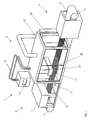
The apparatus 1 disclosed in figure 1 working according to the invention may be
arranged as an independent production unit or as part of a major production plant.
Especially may the conveyor web 2 run through non-disclosed sub-treatment sections
such as for depositing a filling mass into a pressed cavity of the article or for
depositing a covering layer onto part of the articles. Advantageously the conveyor
may also run through further non-disclosed sections where the completed articles
are picked, wrapped or arranged directly into appropriate sales boxes.
The conveyor belt or web 2 runs through the complete apparatus by a known
"closed" or "endless" conveyor principle and is reversed by running around driving
rolls 3 at the ends of the apparatus. The conveyor 2 could have a supporting belt of
known type of metal or plastic which supports the web material, however in its preferred
simple form the conveyor comprises only the web material, which is supported
and driven by the rollers 3. The web 2 is then typically a fibre-reinforced material
having an upper plastic layer of a glossy or smooth character giving easy release
for the bottom surfaces of the pressed articles. The rollers 3 are typically
spring-loaded in direction away from each other, so that a surface tension and accompanying
straightness of the web 2 is secured.
The apparatus 1 shown in figure 1 comprises a chocolate depositing section 4, an
article pressing section 5 and a cooling section 6. The continuously moving conveyer
2 extends through all of the sections 4-6 and is free of any mould plates. For
sake of clarity is not disclosed any sub-treatment sections such as for filing the articles
with centre mass, which are optional as explained above.
The filling section 4 comprises a schematically disclosed housing 7 comprising a
depositor of known type. The depositor has a number of nozzles each of which are
adapted to simultaneously deposit tempered chocolate in predetermined volumes as
lumps 8 onto the conveyor web 2. During the depositing, the depositor may follow
the conveyor web with the same speed as that of the conveyor whereafter the depositor
idles back to a starting position. The other option is, that the conveyor web is
stopped during depositing whereafter the web is started again.
The same type of chocolate may be deposited through all of the nozzles and onto
the conveyor web 2 simultaneously, however, different types of chocolate may also
be deposited optionally through different nozzles, so that for example milk chocolate
is deposited onto some spots of the web, dark chocolate is deposited into other
spots and yet a further chocolate type such as having a yet different taste or colour
onto other spots all at the part of the conveyor web below the depositor.
Any mixture or intermixing of the different chocolate types with each other is thereby
avoided by the subsequent pressing of the chocolate layers with the pressing plungers.
After the pressing the edible articles are ready for further treatment or for packaging
advantageously arranged in the same order as on the web, and any scraping
off of chocolate residues from the web surface is superfluous.
The newly deposited chocolate lumps 8 are then carried on by the conveyor 2 and
leaves the depositing station 4 and preferably passes over a shaking table 9, which
distributes the deposited chocolate lumps 8 more evenly on the web 2 before entering
the shell pressing section 5.
The conveyor web 2 then enters the article pressing housing 10, within which the
deposited, tempered chocolate lumps 8 are pressed into edible articles. The temperature
of the conveyor web 2 is preferably kept around 10-20°C during the subsequent
pressing of the edible articles.
The chocolate mass has to undergo a tempering process before it can be deposited.
During the tempering process the chocolate mass is heated to around 40-50°C,
whereafter it is being cooled down to around 25-34°C, so that crystallisation is initiated.
Then the mass is reheated around 0,5-2,0°C for re-melting most of and preferably
all the in-stable crystals in the mass, however preserving a content of stable
β-crystals, which melts at a higher temperature than the in-stable crystals. The stable
crystals are preserved in the mass ready for depositing in an amount of typically
0,01% - 5%, preferably in an amount of 0,1% - 2%.
The tempering process is today well-known and it is known how to regulate the temperatures
of the different steps exactly in accordance with the actual chocolate mass
being tempered, so that the end result is a mass constituting an amount of stable
crystal, typically around 0,1% - 2% and being essentially free from in-stable crystals.
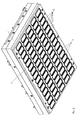
In figure 2 is schematically disclosed a holding and cooling device 11, in which are
arranged plungers 12 in a pattern corresponding to that of the chocolate lumps 8
deposited on the web 2. As disclosed in figure 1, cooling liquid is circulated via
hoses 13 by means of a cooling liquid controlling device 14 through the holding and
cooling device 11. The temperature of the cooling liquid is kept constant and thereby
the temperature of the pressing surfaces 15 of the plungers 12 as well. The temperature
of the pressing surfaces 15 of the plungers 12 are kept below the solidification
point of the tempered chocolate during the pressing thereof. The temperature of
the cooling liquid is typically around 1-5°C colder than the desired temperature kept
of the pressing surfaces 15. However, a temperature difference lower than 1°C between
the temperature of the cooling liquid flowing through cooling channels 16 of
the holding plate 11, depicted in figure 5 and the temperature kept at the pressing
surfaces 15 is possible to obtain. The flow of the cooling liquid through the cooling
channels 16 is simply increased until the temperature difference is as small as desired,
for example below 1°C.
The temperature of the pressing surfaces 15 may be measured by a handheld infrared
or laser thermometer or by means of any other known device. Temperature
measuring sensors may also be incorporated into the plungers 12 close to or having
their ends in line with the pressing surfaces 15. The sensors may then be wired to a
computer or the like which controls the cooling liquid temperature and flow for obtaining
the required temperature of the pressing surfaces 15.
The holding device 11 carries a closure plate 17, which is movable in relation to the
plungers 12 and surrounds the periphery of each plunger 12. The closure plate 17
has forming surfaces 18 surrounding each plunger 12, i.e. figure 5. The temperature
of the forming surface 18 is kept below the solidification temperature of the chocolate
mass and is controlled as explained above in relation to the pressing surfaces
by regulating the temperature of the holding device 11.
Essential is, that both the pressing surfaces 15 and the forming surfaces 18 are free
of any lubricant.
The solidification temperature of the particular chocolate mass being used may be
obtained from the chocolate supplier or by a premature test where the tempered
chocolate is deposited on a surface having a known temperature. However, a surface
temperature below 20°C is to the safe side below the solidification temperature
of the today's most used chocolate types.
The pressing surfaces of the plungers and the forming surfaces of the closure plate
have obtained high gloss. Hereby means, that a "shiny" or "mirror"-like surface appearance
is obtained. When the plungers are made of steel such a high gloss "mirror"-like
surface is easy to imagine. Typically, the plungers are made of metal such
as steel, copper or aluminium, however the material is not limited to metal as long
as the high gloss surfaces can be obtained.
Below the conveyor web 2 and the holding device 11 is arranged a supporting table
19 as disclosed in figures 1, 3 and 4. The supporting table has an inner closure 20,
which by a hose 21 is connected to a schematically disclosed source 22 adapted to
create a vacuum in the closure 20. The top surface 23 comprises a plurality of holes
24 into the closure 20. When the apparatus 1 is in function the vacuum is created in
the supporting table 19 and the conveyor web 2 is thereby sucked on to the top surface
23. During pressing of the articles the web 2 is then kept planar and stable as
disclosed in figures 5-8.
The chocolate lumps 8 are deposited in a pattern on the web 2, which corresponds
with the arrangement of the individual plungers 12 on the holding device 11, preferable
so, that when a pattern of chocolate lumps 8 on the web is below the holding
device 11, each lump 8 of the pattern is exactly below a centre line or the centre of a
corresponding plunger 12 before the pressing operation starts.
Important to notice is however, that the accuracy of which the individual plungers is
positioned above the individual lumps 8 may be much, much coarser than when the
plungers are positioned above moulds of a mould plate in a traditional article making
system. In a traditional system the positioning off-set of the plunger centre line is
restricted to within fractions of a millimetre, however in the mould-less system of the
present invention the accepted off-set may be as great as several millimetres as the
only requirement is, that the lump is caught fully in the closure cavity when the closure
plate rests on the web.
When the conveyor web 2 has entered a new set of newly deposited chocolate
lumps 8 to be pressed into the pressing section 5 the holding device 11 is started to
move down against the web when each plunger 12 is in line with an underlying lump
8 on the web 2, as depicted in figure 5. The pressing operation is describes by referral
to the pressing of one article for sake of simplicity, however the pressing is carried
out in the same manner and simultaneously for all the articles made.
The conveyor web 2 may still be moving forward during the pressing operation, in
which case the holding device 11 is adapted to move forward with the same speed
as that of the conveyor 2 during the immersion of the plungers 12 onto the chocolate
lumps 8 on the web 2. When the holding device 11 has retracted from pressing it
traverses or idles back to the starting position, so that it again may follow the conveyor
2 when the next pressing operation is to take place. The other possibility is,
that the conveyor 2 is stopped before each pressing operation exactly below a horizontally
fixed holding device 11 so that the above explained positioning is achieved.
Compressible springs 25 are arranged between the closure plate 17 and the holding
device 11 as schematically disclosed in figures 5-8. When the holding device
has been lowered so that the closure plate 17 rests on the conveyor web 2 the
springs 25 are compressed as depicted in figures 6 and 7 so that the closure plate
17 rests on the web 2 with a downwardly directed pressure force which secures, that
essentially no chocolate is squeezed out between the closure plate 17 and the web
2.
The individual plungers 12 may all be fixed in the holding device 11, so that they are
not movable in relation thereto. However, when the individual plungers 12 are independently
suspended to the holding device 11 as disclosed at figures 2, 5-8 they are
able to move to different heights independent of each other during the pressing operation.
Compressible springs 26 are arranged to interact between the plungers 12
and the holding device 11. As disclosed the springs 16 may be biased between the
holding device 11 and a bolt 27 connected with the top of the plunger 12.
Compensation for deviations in the deposited amount of chocolate from lump 8 to
lump 8 is obtained by the independently suspension of the plungers 12. Each
plunger 12 simply acts against a counter pressure, so that when the particular
plunger is immersed into the particular deposited amount of chocolate with the required
depth to fill out the enclosure, the plunger simply levels to a position where
the enclosure is filled totally with chocolate whatever the actual volume and thickness
of the shell may then be.
The up and down movement of the holding device 11 is controlled by means of
known simple mechanical means of columns and travelling tool holders or sledges
schematically disclosed by 28 in figure 1.
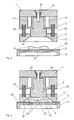
Figure 5-8 schematically discloses the pressing operation. In figure 5 the pressing
surface 15 is close to contact with the mass 8 and the closure plate 17 is close to
engagement with the conveyor web 2. In figure 6 the closure plate 17 has now come
to rest on the upper surface 29 of the web 2 whereby the pressing enclosure 30 is
completely closed off and defined. The plunger 12 will soon start to immerse into the
tempered chocolate mass lump 8.
Essential is, that no lubricant is applied to the pressing surfaces 15 of the plungers
12 before they are immersed into contact with the tempered chocolate mass and
that no lubricant is applied to the forming surfaces 18 of the closure plate 17. Before
the pressing operation is started, the pressing surfaces 15 of the plungers 12, and
the forming surfaces 18 are thoroughly cleaned off, for example by use of towels
with spirit, so that one is fully sure, that any possible remains of film of fat, dew,
grease or the like, which could maybe act as a lubricant, is for sure removed.
In figure 7 the holding device 10 has been moved down to its lowermost position in
which the tempered, flowable chocolate mass has now completely filled the closed
off cavity and is fully pressed into shape as an article 31 by the contact with the
pressing surfaces 15, the forming surfaces 18 and the upper surfaces 29 of the web
2.
The tempered chocolate mass then rapidly solidifies under crystallisation at the contact
with the completely dry pressing surfaces 15 and forming surfaces 18 free of
any lubricant and being kept at temperatures below that of the solidification temperature
of the particular chocolate mass. The chocolate solidifies and contracts
slightly in the extension of its thin surface layer or "skin" in contact with the pressing
surfaces 15 and forming surfaces 18, whereby it instantly releases from adhesion
therewith.
Decisive is here, that the tempered chocolate contains stable crystals, which makes
the chocolate mass contract just slightly when it solidifies in contact with non-lubricated,
continuously cooled surfaces. A solidified "skin" is created on the tempered
chocolate in contact with the pressing surfaces 15 and forming surfaces 18
when the chocolate solidifies and contracts slightly, and this is sufficient for the tempered
chocolate to release from the non-lubricated surfaces. The remaining part of
the chocolate articles 31 then doesn't need to be solidified yet when the plungers
are retracted from its contact with the chocolate. The solidified "skin" of the chocolate
layer secures a geometrical stable article 31 though heat remains inside the
article when the plungers and closure plate are retracted from contact.
The contraction is caused by the solidification of the mass into stable crystals and
could be as small as 0,1%-0,5% in volume for a typical milk chocolate and up until
around 2% for a typical dark chocolate which is known to set harder than a milk
chocolate. However, such slight contraction in volume is sufficient to secure, that the
solidified chocolate in contact with the non-lubricated surfaces "springs off" the surfaces
with no further adhesion thereto. As the pressing and forming surfaces are
free of any lubricant or moisture there is no risk that a "suction" or "gluing" effect
between the surfaces and the solidifying chocolate are created. Any contamination
of the chocolate with remains of lubricant or moisture is avoided as well.
The solidification temperature of the particular tempered chocolate mass varies and
is dependent of the chocolate type and recipe, is however typically between 20°C
and 30°C for the majority of today's used chocolate types. When keeping the temperatures
of the pressing and forming surfaces at 20°C the contact period between
the chocolate and the surfaces is around 10 seconds before chocolate "skin" in contact
with the pressing surfaces has solidified and the plungers are retracted.
A clear relation between pressing period and temperature of the pressing and forming
surfaces is present. The lower the temperature, the shorter the pressing period
obtained. When keeping a temperature of +10°C of the pressing surface the pressing
period was shortened to around 5 seconds, and when lowering the pressing surface
temperature to between -5°C and +5°C the pressing period was shortened to
between 1 and 3 seconds. When the pressing temperature was kept as low as between
-25°C and -5°C the pressing period could be as low as 0,5 - 2 seconds. The
observations was performed with a wall thickness between 1 and 5 mm. Different
chocolate types were used, such as traditional milk chocolate, dark chocolate and a
white chocolate type.
During the actual pressing as disclosed in figure 7 the tempered mass is pressed
out to complete filling of all cavities of the enclosure 30 creating the article 31. Optionally,
the top surface 34 of the plunger 12 may be pressurised during the pressing
operation whereby the plunger 12 sets off slightly in relation to the holding device 11
so that the spring 26 is compressed. When the pressing of the articles 31 are complete,
the air pressure is released at the top of the plungers 12, which due to the
action of the springs 26 returns the small distance into the holding device 11. The
closure plate 17 still rests onto the web 2 and as the forming surfaces 18 of the closure
plate 17 at least partly overlaps the rim 35 of the pressed article 31 the closure
plate keeps the article 31 against the web 2. Thereby it is secured, that the articles
31 stays on to the conveyor web 2 when the plungers 12 are retracted therefrom as
disclosed in figure 8. By the further lifting of the holding device 11, the springs 25
secures that the closure plate is pressed down against the web until the plungers 12
are securely free of the articles 31 whatever the geometry thereof may be.
By the further lifting of the holding device 11 than disclosed in figure 8, the forming
surfaces 18 is retracted from the articles 31 as the closure plate 17 leaves the web
2.
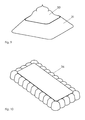
An article 31 made by the pressing operation of figures 5-8 is disclosed in figure 9.
After being pressed the article was filled with a cream 33.
Several tests were made making flat-shaped, or table shaped articles like the article
36 disclosed in figure 10 and the article 37 disclosed in figure 11. The chocolate
article 37 disclosed in figure 12 is much similar to the article 31 disclosed in figure 9,
however, a centre cavity of the article 38 has been filled with a sugar containing,
high gloss and colour full covering 39.
By one test cooling liquid having a temperature between of around -28°C is circulating
through the cooling channels 16 of the holding device 11 with a continuous and
forceful flow and the temperature of the plunger pressing surfaces 15 was kept at
-25°C. The temperature of the conveyor web 2 was kept between 10°C and 15°C.
Edible articles having thickness between 1,5 mm and 10 mm were made and the
immersion period of the plungers when in contact with the chocolate mass was by
different trials kept between 0,5 and 10 seconds.
The same tests were made now with a cooling liquid temperature of -20°C and a
pressing surface temperature of -18°C, with a cooling liquid temperature of -10°C
and a pressing surface temperature of -9°C, and with a cooling liquid temperature of
-5°C and a pressing surface temperature of -4°C.
It was observed, that by all these tests the tempered mass is caught mostly in its
"nuclei" form of the stable crystals due to the chill being forced by the non-lubricated
pressing surfaces into the chocolate. However, the chill didn't reach all the way
through the article wall which were more or less "leather-like" as heat still remained
inside the articles when the holding device were retracted.
When the remaining chocolate mass of the article solidifies, the remaining heat will
be transported out through the hard surface layer of the article now being free from
the cooling plunger withdrawn. The article still remains on the conveyor web 2 made
by plastic material working as an insulator. During the passage of the solidified
outer, hard surface layer the remaining heat will convert or re-melt possible undesirable
instable crystals, so that only desirable stable crystals remains when the article
is fully solidified.
During subsequent shelving no "fat-bloom" was then created at the outside of the
edible articles due to the content of desirable stable crystals.
A general increase around 25-35% in shell strength was observed when keeping the
pressing surface temperature below 0°C in comparison edible articles of the same
chocolate made by a traditional article making where no plunger is immersed. Such
an increase in strength is of great importance when the article is subsequently filled
with a centre mass which of course must not leak out of the chocolate article before
it being eaten.
During continuous production an air drying device 32 keeps the environment in the
housing 10 dry, so that the non-lubricated pressing and forming surfaces are kept
free from any development of moisture.
The skilled person controls the unit 32 so that the air is sufficiently dried regardless
of the composition of the air and the surface temperatures of the cooled pressing
and forming surfaces - so that no moisture is created in any position of the holding
device 11. Thereby the air is dried to such an extent, that the dew point temperature
of the air surrounding the pressing and the forming surfaces are kept below the actual
temperatures of the surfaces.
It has become possible to produce chocolate articles having exactly moulded surfaces
all over without using any moulds and mould plates. The same high gloss and
nice geometry is secures all over the article, which may comprise desirable and exact
geometries and relief's such as a company logo or a product brand which is
printed into the chocolate.