EP1355894B1 - Amidinophenylalanine derivatives as thrombin inhibitors - Google Patents
Amidinophenylalanine derivatives as thrombin inhibitors Download PDFInfo
- Publication number
- EP1355894B1 EP1355894B1 EP01272199A EP01272199A EP1355894B1 EP 1355894 B1 EP1355894 B1 EP 1355894B1 EP 01272199 A EP01272199 A EP 01272199A EP 01272199 A EP01272199 A EP 01272199A EP 1355894 B1 EP1355894 B1 EP 1355894B1
- Authority
- EP
- European Patent Office
- Prior art keywords
- formula
- methyl
- compound
- hydrazino
- pip
- Prior art date
- Legal status (The legal status is an assumption and is not a legal conclusion. Google has not performed a legal analysis and makes no representation as to the accuracy of the status listed.)
- Expired - Lifetime
Links
- 229940122388 Thrombin inhibitor Drugs 0.000 title abstract description 9
- 239000003868 thrombin inhibitor Substances 0.000 title abstract description 9
- MVTHUEOHHHQQKY-QMMMGPOBSA-N (2s)-2-(diaminomethylideneamino)-3-phenylpropanoic acid Chemical class NC(N)=N[C@H](C(O)=O)CC1=CC=CC=C1 MVTHUEOHHHQQKY-QMMMGPOBSA-N 0.000 title description 2
- 150000001875 compounds Chemical class 0.000 claims abstract description 51
- 239000008194 pharmaceutical composition Substances 0.000 claims abstract description 8
- 150000003839 salts Chemical class 0.000 claims abstract description 3
- 238000004519 manufacturing process Methods 0.000 claims abstract 4
- 108090000190 Thrombin Proteins 0.000 claims description 25
- 229960004072 thrombin Drugs 0.000 claims description 25
- 125000000217 alkyl group Chemical group 0.000 claims description 16
- 210000004369 blood Anatomy 0.000 claims description 11
- 239000008280 blood Substances 0.000 claims description 11
- 230000015572 biosynthetic process Effects 0.000 claims description 10
- UCPYLLCMEDAXFR-UHFFFAOYSA-N triphosgene Chemical compound ClC(Cl)(Cl)OC(=O)OC(Cl)(Cl)Cl UCPYLLCMEDAXFR-UHFFFAOYSA-N 0.000 claims description 9
- -1 R11 = H Chemical group 0.000 claims description 8
- 150000001412 amines Chemical class 0.000 claims description 8
- 125000000753 cycloalkyl group Chemical group 0.000 claims description 8
- 102000009123 Fibrin Human genes 0.000 claims description 7
- 108010073385 Fibrin Proteins 0.000 claims description 7
- BWGVNKXGVNDBDI-UHFFFAOYSA-N Fibrin monomer Chemical compound CNC(=O)CNC(=O)CN BWGVNKXGVNDBDI-UHFFFAOYSA-N 0.000 claims description 7
- 229950003499 fibrin Drugs 0.000 claims description 7
- QTBSBXVTEAMEQO-UHFFFAOYSA-N Acetic acid Chemical compound CC(O)=O QTBSBXVTEAMEQO-UHFFFAOYSA-N 0.000 claims description 6
- 125000002915 carbonyl group Chemical group [*:2]C([*:1])=O 0.000 claims description 6
- 238000002560 therapeutic procedure Methods 0.000 claims description 4
- HGZJJKZPPMFIBU-UHFFFAOYSA-N 3-formylbenzonitrile Chemical compound O=CC1=CC=CC(C#N)=C1 HGZJJKZPPMFIBU-UHFFFAOYSA-N 0.000 claims description 3
- 239000003814 drug Substances 0.000 claims description 3
- 230000002401 inhibitory effect Effects 0.000 claims description 3
- 229910004373 HOAc Inorganic materials 0.000 claims description 2
- KYJGWEQIDCBJRT-UHFFFAOYSA-N [3-[[(4-methylpiperidine-1-carbonyl)-(naphthalen-2-ylsulfonylamino)amino]methyl]benzenecarboximidoyl]azanium;chloride Chemical compound [Cl-].C1CC(C)CCN1C(=O)N(NS(=O)(=O)C=1C=C2C=CC=CC2=CC=1)CC1=CC=CC(C([NH3+])=N)=C1 KYJGWEQIDCBJRT-UHFFFAOYSA-N 0.000 claims description 2
- GNPODGNSVRUMNJ-UHFFFAOYSA-N [3-[[[(6-methoxynaphthalen-2-yl)sulfonylamino]-(4-methylpiperidine-1-carbonyl)amino]methyl]benzenecarboximidoyl]azanium;chloride Chemical compound [Cl-].C1=CC2=CC(OC)=CC=C2C=C1S(=O)(=O)NN(C(=O)N1CCC(C)CC1)CC1=CC=CC(C([NH3+])=N)=C1 GNPODGNSVRUMNJ-UHFFFAOYSA-N 0.000 claims description 2
- LWMGBUNUFGDPRY-UHFFFAOYSA-N [3-[[azepane-1-carbonyl-[(6-methoxynaphthalen-2-yl)sulfonylamino]amino]methyl]benzenecarboximidoyl]azanium;chloride Chemical compound [Cl-].C1=CC2=CC(OC)=CC=C2C=C1S(=O)(=O)NN(C(=O)N1CCCCCC1)CC1=CC=CC(C([NH3+])=N)=C1 LWMGBUNUFGDPRY-UHFFFAOYSA-N 0.000 claims description 2
- 125000002777 acetyl group Chemical group [H]C([H])([H])C(*)=O 0.000 claims description 2
- 125000003118 aryl group Chemical group 0.000 claims description 2
- PXXJHWLDUBFPOL-UHFFFAOYSA-N benzamidine Chemical compound NC(=N)C1=CC=CC=C1 PXXJHWLDUBFPOL-UHFFFAOYSA-N 0.000 claims description 2
- 125000001797 benzyl group Chemical group [H]C1=C([H])C([H])=C(C([H])=C1[H])C([H])([H])* 0.000 claims description 2
- 238000009903 catalytic hydrogenation reaction Methods 0.000 claims description 2
- 125000001160 methoxycarbonyl group Chemical group [H]C([H])([H])OC(*)=O 0.000 claims description 2
- 125000004170 methylsulfonyl group Chemical group [H]C([H])([H])S(*)(=O)=O 0.000 claims description 2
- FJIYDNIQKFTEOQ-UHFFFAOYSA-N n'-hydroxy-3-[[(2-methylpiperidine-1-carbonyl)-(naphthalen-2-ylsulfonylamino)amino]methyl]benzenecarboximidamide Chemical compound CC1CCCCN1C(=O)N(NS(=O)(=O)C=1C=C2C=CC=CC2=CC=1)CC1=CC=CC(C(N)=NO)=C1 FJIYDNIQKFTEOQ-UHFFFAOYSA-N 0.000 claims description 2
- GCPPMBSGYIARDA-UHFFFAOYSA-N n'-hydroxy-3-[[(4-methylpiperidine-1-carbonyl)-(naphthalen-2-ylsulfonylamino)amino]methyl]benzenecarboximidamide Chemical compound C1CC(C)CCN1C(=O)N(NS(=O)(=O)C=1C=C2C=CC=CC2=CC=1)CC1=CC=CC(C(N)=NO)=C1 GCPPMBSGYIARDA-UHFFFAOYSA-N 0.000 claims description 2
- UWBAFPIFAILSMN-UHFFFAOYSA-N n'-hydroxy-3-[[[(6-methoxynaphthalen-2-yl)sulfonylamino]-(2-methylpiperidine-1-carbonyl)amino]methyl]benzenecarboximidamide Chemical compound C1=CC2=CC(OC)=CC=C2C=C1S(=O)(=O)NN(C(=O)N1C(CCCC1)C)CC1=CC=CC(C(N)=NO)=C1 UWBAFPIFAILSMN-UHFFFAOYSA-N 0.000 claims description 2
- 238000005580 one pot reaction Methods 0.000 claims description 2
- 230000009467 reduction Effects 0.000 claims description 2
- 239000000126 substance Substances 0.000 claims description 2
- YBBRCQOCSYXUOC-UHFFFAOYSA-N sulfuryl dichloride Chemical compound ClS(Cl)(=O)=O YBBRCQOCSYXUOC-UHFFFAOYSA-N 0.000 claims description 2
- DBGRZURIIFFWFO-UHFFFAOYSA-N tert-butyl hydrazinecarbonyl carbonate Chemical compound CC(C)(C)OC(=O)OC(=O)NN DBGRZURIIFFWFO-UHFFFAOYSA-N 0.000 claims description 2
- 125000005931 tert-butyloxycarbonyl group Chemical group [H]C([H])([H])C(OC(*)=O)(C([H])([H])[H])C([H])([H])[H] 0.000 claims description 2
- 241000124008 Mammalia Species 0.000 claims 3
- SMHWNUDFXCJGHR-UHFFFAOYSA-N [3-[[[(6-methoxynaphthalen-2-yl)sulfonylamino]-(2-methylpiperidine-1-carbonyl)amino]methyl]benzenecarboximidoyl]azanium;chloride Chemical compound [Cl-].C1=CC2=CC(OC)=CC=C2C=C1S(=O)(=O)NN(C(=O)N1C(CCCC1)C)CC1=CC=CC(C([NH3+])=N)=C1 SMHWNUDFXCJGHR-UHFFFAOYSA-N 0.000 claims 1
- 125000000472 sulfonyl group Chemical group *S(*)(=O)=O 0.000 claims 1
- 238000000034 method Methods 0.000 description 39
- HEDRZPFGACZZDS-MICDWDOJSA-N Trichloro(2H)methane Chemical compound [2H]C(Cl)(Cl)Cl HEDRZPFGACZZDS-MICDWDOJSA-N 0.000 description 26
- LFQSCWFLJHTTHZ-UHFFFAOYSA-N Ethanol Chemical compound CCO LFQSCWFLJHTTHZ-UHFFFAOYSA-N 0.000 description 23
- 238000005160 1H NMR spectroscopy Methods 0.000 description 21
- IAZDPXIOMUYVGZ-UHFFFAOYSA-N Dimethylsulphoxide Chemical compound CS(C)=O IAZDPXIOMUYVGZ-UHFFFAOYSA-N 0.000 description 21
- 239000000047 product Substances 0.000 description 21
- IAZDPXIOMUYVGZ-WFGJKAKNSA-N Dimethyl sulfoxide Chemical compound [2H]C([2H])([2H])S(=O)C([2H])([2H])[2H] IAZDPXIOMUYVGZ-WFGJKAKNSA-N 0.000 description 20
- 238000004992 fast atom bombardment mass spectroscopy Methods 0.000 description 19
- 239000003112 inhibitor Substances 0.000 description 18
- 125000002496 methyl group Chemical group [H]C([H])([H])* 0.000 description 16
- XLYOFNOQVPJJNP-UHFFFAOYSA-N water Chemical compound O XLYOFNOQVPJJNP-UHFFFAOYSA-N 0.000 description 15
- YMWUJEATGCHHMB-UHFFFAOYSA-N Dichloromethane Chemical compound ClCCl YMWUJEATGCHHMB-UHFFFAOYSA-N 0.000 description 12
- RTZKZFJDLAIYFH-UHFFFAOYSA-N Diethyl ether Chemical compound CCOCC RTZKZFJDLAIYFH-UHFFFAOYSA-N 0.000 description 12
- 208000007536 Thrombosis Diseases 0.000 description 12
- 239000003153 chemical reaction reagent Substances 0.000 description 9
- 239000012153 distilled water Substances 0.000 description 9
- 239000000203 mixture Substances 0.000 description 9
- 239000000243 solution Substances 0.000 description 9
- 238000012360 testing method Methods 0.000 description 9
- FAPWRFPIFSIZLT-UHFFFAOYSA-M Sodium chloride Chemical compound [Na+].[Cl-] FAPWRFPIFSIZLT-UHFFFAOYSA-M 0.000 description 8
- 238000006243 chemical reaction Methods 0.000 description 8
- 230000035602 clotting Effects 0.000 description 8
- 239000012224 working solution Substances 0.000 description 8
- 108090000631 Trypsin Proteins 0.000 description 7
- 102000004142 Trypsin Human genes 0.000 description 7
- 210000001367 artery Anatomy 0.000 description 7
- 238000000921 elemental analysis Methods 0.000 description 7
- 125000000956 methoxy group Chemical group [H]C([H])([H])O* 0.000 description 7
- 239000011550 stock solution Substances 0.000 description 7
- 239000012588 trypsin Substances 0.000 description 7
- XEKOWRVHYACXOJ-UHFFFAOYSA-N Ethyl acetate Chemical compound CCOC(C)=O XEKOWRVHYACXOJ-UHFFFAOYSA-N 0.000 description 6
- OKKJLVBELUTLKV-UHFFFAOYSA-N Methanol Chemical compound OC OKKJLVBELUTLKV-UHFFFAOYSA-N 0.000 description 6
- KRKNYBCHXYNGOX-UHFFFAOYSA-N citric acid Chemical compound OC(=O)CC(O)(C(O)=O)CC(O)=O KRKNYBCHXYNGOX-UHFFFAOYSA-N 0.000 description 6
- 230000015271 coagulation Effects 0.000 description 6
- 238000005345 coagulation Methods 0.000 description 6
- 239000002244 precipitate Substances 0.000 description 6
- 230000008569 process Effects 0.000 description 6
- 239000000758 substrate Substances 0.000 description 6
- 0 CN1C(*)CC(*)CC1 Chemical compound CN1C(*)CC(*)CC1 0.000 description 5
- 108010000499 Thromboplastin Proteins 0.000 description 5
- 102000002262 Thromboplastin Human genes 0.000 description 5
- ROLZYTOAMYXLMF-UHFFFAOYSA-N amino(benzyl)carbamic acid Chemical class OC(=O)N(N)CC1=CC=CC=C1 ROLZYTOAMYXLMF-UHFFFAOYSA-N 0.000 description 5
- 238000002844 melting Methods 0.000 description 5
- 230000008018 melting Effects 0.000 description 5
- 239000000523 sample Substances 0.000 description 5
- 239000011780 sodium chloride Substances 0.000 description 5
- SNTBQRVSDCIKPL-UHFFFAOYSA-N tert-butyl n-[(3-cyanophenyl)methylamino]carbamate Chemical compound CC(C)(C)OC(=O)NNCC1=CC=CC(C#N)=C1 SNTBQRVSDCIKPL-UHFFFAOYSA-N 0.000 description 5
- PGOHTUIFYSHAQG-LJSDBVFPSA-N (2S)-6-amino-2-[[(2S)-5-amino-2-[[(2S)-2-[[(2S)-2-[[(2S)-2-[[(2S)-4-amino-2-[[(2S)-2-[[(2S)-2-[[(2S)-2-[[(2S)-2-[[(2S)-5-amino-2-[[(2S)-5-amino-2-[[(2S)-2-[[(2S)-2-[[(2S)-2-[[(2S,3R)-2-[[(2S)-5-amino-2-[[(2S)-2-[[(2S)-2-[[(2S,3R)-2-[[(2S)-2-[[(2S)-2-[[(2S)-2-[[(2S)-2-[[(2S)-5-amino-2-[[(2S)-1-[(2S,3R)-2-[[(2S)-2-[[(2S)-2-[[(2R)-2-[[(2S)-2-[[(2S)-2-[[2-[[(2S)-2-[[(2S)-2-[[(2S)-2-[[(2S)-1-[(2S)-2-[[(2S)-2-[[(2S)-2-[[(2S)-2-amino-4-methylsulfanylbutanoyl]amino]-3-(1H-indol-3-yl)propanoyl]amino]-5-carbamimidamidopentanoyl]amino]propanoyl]pyrrolidine-2-carbonyl]amino]-3-methylbutanoyl]amino]-4-methylpentanoyl]amino]-4-methylpentanoyl]amino]acetyl]amino]-3-hydroxypropanoyl]amino]-4-methylpentanoyl]amino]-3-sulfanylpropanoyl]amino]-4-methylsulfanylbutanoyl]amino]-5-carbamimidamidopentanoyl]amino]-3-hydroxybutanoyl]pyrrolidine-2-carbonyl]amino]-5-oxopentanoyl]amino]-3-hydroxypropanoyl]amino]-3-hydroxypropanoyl]amino]-3-(1H-imidazol-5-yl)propanoyl]amino]-4-methylpentanoyl]amino]-3-hydroxybutanoyl]amino]-3-(1H-indol-3-yl)propanoyl]amino]-5-carbamimidamidopentanoyl]amino]-5-oxopentanoyl]amino]-3-hydroxybutanoyl]amino]-3-hydroxypropanoyl]amino]-3-carboxypropanoyl]amino]-3-hydroxypropanoyl]amino]-5-oxopentanoyl]amino]-5-oxopentanoyl]amino]-3-phenylpropanoyl]amino]-5-carbamimidamidopentanoyl]amino]-3-methylbutanoyl]amino]-4-methylpentanoyl]amino]-4-oxobutanoyl]amino]-5-carbamimidamidopentanoyl]amino]-3-(1H-indol-3-yl)propanoyl]amino]-4-carboxybutanoyl]amino]-5-oxopentanoyl]amino]hexanoic acid Chemical compound CSCC[C@H](N)C(=O)N[C@@H](Cc1c[nH]c2ccccc12)C(=O)N[C@@H](CCCNC(N)=N)C(=O)N[C@@H](C)C(=O)N1CCC[C@H]1C(=O)N[C@@H](C(C)C)C(=O)N[C@@H](CC(C)C)C(=O)N[C@@H](CC(C)C)C(=O)NCC(=O)N[C@@H](CO)C(=O)N[C@@H](CC(C)C)C(=O)N[C@@H](CS)C(=O)N[C@@H](CCSC)C(=O)N[C@@H](CCCNC(N)=N)C(=O)N[C@@H]([C@@H](C)O)C(=O)N1CCC[C@H]1C(=O)N[C@@H](CCC(N)=O)C(=O)N[C@@H](CO)C(=O)N[C@@H](CO)C(=O)N[C@@H](Cc1cnc[nH]1)C(=O)N[C@@H](CC(C)C)C(=O)N[C@@H]([C@@H](C)O)C(=O)N[C@@H](Cc1c[nH]c2ccccc12)C(=O)N[C@@H](CCCNC(N)=N)C(=O)N[C@@H](CCC(N)=O)C(=O)N[C@@H]([C@@H](C)O)C(=O)N[C@@H](CO)C(=O)N[C@@H](CC(O)=O)C(=O)N[C@@H](CO)C(=O)N[C@@H](CCC(N)=O)C(=O)N[C@@H](CCC(N)=O)C(=O)N[C@@H](Cc1ccccc1)C(=O)N[C@@H](CCCNC(N)=N)C(=O)N[C@@H](C(C)C)C(=O)N[C@@H](CC(C)C)C(=O)N[C@@H](CC(N)=O)C(=O)N[C@@H](CCCNC(N)=N)C(=O)N[C@@H](Cc1c[nH]c2ccccc12)C(=O)N[C@@H](CCC(O)=O)C(=O)N[C@@H](CCC(N)=O)C(=O)N[C@@H](CCCCN)C(O)=O PGOHTUIFYSHAQG-LJSDBVFPSA-N 0.000 description 4
- 206010053567 Coagulopathies Diseases 0.000 description 4
- 102000004190 Enzymes Human genes 0.000 description 4
- 108090000790 Enzymes Proteins 0.000 description 4
- OAKJQQAXSVQMHS-UHFFFAOYSA-N Hydrazine Chemical compound NN OAKJQQAXSVQMHS-UHFFFAOYSA-N 0.000 description 4
- JGFZNNIVVJXRND-UHFFFAOYSA-N N,N-Diisopropylethylamine (DIPEA) Chemical compound CCN(C(C)C)C(C)C JGFZNNIVVJXRND-UHFFFAOYSA-N 0.000 description 4
- 108010022999 Serine Proteases Proteins 0.000 description 4
- 102000012479 Serine Proteases Human genes 0.000 description 4
- 238000002835 absorbance Methods 0.000 description 4
- 238000003556 assay Methods 0.000 description 4
- 239000000872 buffer Substances 0.000 description 4
- 229960004132 diethyl ether Drugs 0.000 description 4
- 229940088598 enzyme Drugs 0.000 description 4
- GSQKKUPKCYOWJG-UHFFFAOYSA-N n-[(3-cyanophenyl)methyl]-n'-naphthalen-2-ylsulfonylazepane-1-carbohydrazide Chemical compound C1CCCCCN1C(=O)N(NS(=O)(=O)C=1C=C2C=CC=CC2=CC=1)CC1=CC=CC(C#N)=C1 GSQKKUPKCYOWJG-UHFFFAOYSA-N 0.000 description 4
- 230000002035 prolonged effect Effects 0.000 description 4
- 230000002829 reductive effect Effects 0.000 description 4
- JKMHFZQWWAIEOD-UHFFFAOYSA-N 2-[4-(2-hydroxyethyl)piperazin-1-yl]ethanesulfonic acid Chemical compound OCC[NH+]1CCN(CCS([O-])(=O)=O)CC1 JKMHFZQWWAIEOD-UHFFFAOYSA-N 0.000 description 3
- USFZMSVCRYTOJT-UHFFFAOYSA-N Ammonium acetate Chemical compound N.CC(O)=O USFZMSVCRYTOJT-UHFFFAOYSA-N 0.000 description 3
- 239000005695 Ammonium acetate Substances 0.000 description 3
- 108010039209 Blood Coagulation Factors Proteins 0.000 description 3
- 102000015081 Blood Coagulation Factors Human genes 0.000 description 3
- 208000032843 Hemorrhage Diseases 0.000 description 3
- AVXURJPOCDRRFD-UHFFFAOYSA-N Hydroxylamine Chemical compound ON AVXURJPOCDRRFD-UHFFFAOYSA-N 0.000 description 3
- 241000700159 Rattus Species 0.000 description 3
- HEMHJVSKTPXQMS-UHFFFAOYSA-M Sodium hydroxide Chemical compound [OH-].[Na+] HEMHJVSKTPXQMS-UHFFFAOYSA-M 0.000 description 3
- ZMANZCXQSJIPKH-UHFFFAOYSA-N Triethylamine Chemical compound CCN(CC)CC ZMANZCXQSJIPKH-UHFFFAOYSA-N 0.000 description 3
- WFPROCSOSFKOTI-UHFFFAOYSA-N [(3-cyanophenyl)methyl-(2-methylpiperidine-1-carbonyl)amino]azanium;chloride Chemical compound [Cl-].CC1CCCCN1C(=O)N([NH3+])CC1=CC=CC(C#N)=C1 WFPROCSOSFKOTI-UHFFFAOYSA-N 0.000 description 3
- JPXKXXFUKIDNRV-UHFFFAOYSA-N [(3-cyanophenyl)methyl-(4-methylpiperidine-1-carbonyl)amino]azanium;chloride Chemical compound [Cl-].C1CC(C)CCN1C(=O)N([NH3+])CC1=CC=CC(C#N)=C1 JPXKXXFUKIDNRV-UHFFFAOYSA-N 0.000 description 3
- 229940043376 ammonium acetate Drugs 0.000 description 3
- 235000019257 ammonium acetate Nutrition 0.000 description 3
- 239000003146 anticoagulant agent Substances 0.000 description 3
- 230000000740 bleeding effect Effects 0.000 description 3
- 239000003114 blood coagulation factor Substances 0.000 description 3
- 230000000694 effects Effects 0.000 description 3
- 239000000706 filtrate Substances 0.000 description 3
- 210000003709 heart valve Anatomy 0.000 description 3
- VLKZOEOYAKHREP-UHFFFAOYSA-N n-Hexane Chemical compound CCCCCC VLKZOEOYAKHREP-UHFFFAOYSA-N 0.000 description 3
- JLLXEKNQVUXEEY-UHFFFAOYSA-N n-[(3-cyanophenyl)methyl]-n'-(6-methoxynaphthalen-2-yl)sulfonyl-4-methylpiperidine-1-carbohydrazide Chemical compound C1=CC2=CC(OC)=CC=C2C=C1S(=O)(=O)NN(C(=O)N1CCC(C)CC1)CC1=CC=CC(C#N)=C1 JLLXEKNQVUXEEY-UHFFFAOYSA-N 0.000 description 3
- OGGJHBZODWMAHS-UHFFFAOYSA-N n-[(3-cyanophenyl)methyl]-n'-(6-methoxynaphthalen-2-yl)sulfonylazepane-1-carbohydrazide Chemical compound C1=CC2=CC(OC)=CC=C2C=C1S(=O)(=O)NN(C(=O)N1CCCCCC1)CC1=CC=CC(C#N)=C1 OGGJHBZODWMAHS-UHFFFAOYSA-N 0.000 description 3
- OPECTNGATDYLSS-UHFFFAOYSA-N naphthalene-2-sulfonyl chloride Chemical compound C1=CC=CC2=CC(S(=O)(=O)Cl)=CC=C21 OPECTNGATDYLSS-UHFFFAOYSA-N 0.000 description 3
- 239000003921 oil Substances 0.000 description 3
- 230000002093 peripheral effect Effects 0.000 description 3
- 238000002360 preparation method Methods 0.000 description 3
- 239000011541 reaction mixture Substances 0.000 description 3
- 239000001509 sodium citrate Substances 0.000 description 3
- NLJMYIDDQXHKNR-UHFFFAOYSA-K sodium citrate Chemical compound O.O.[Na+].[Na+].[Na+].[O-]C(=O)CC(O)(CC([O-])=O)C([O-])=O NLJMYIDDQXHKNR-UHFFFAOYSA-K 0.000 description 3
- 239000002904 solvent Substances 0.000 description 3
- XTWMNZWNCLOXPC-UHFFFAOYSA-N tert-butyl n-[azepane-1-carbonyl-[(3-cyanophenyl)methyl]amino]carbamate Chemical compound C1CCCCCN1C(=O)N(NC(=O)OC(C)(C)C)CC1=CC=CC(C#N)=C1 XTWMNZWNCLOXPC-UHFFFAOYSA-N 0.000 description 3
- 230000002792 vascular Effects 0.000 description 3
- 210000003462 vein Anatomy 0.000 description 3
- 108091003079 Bovine Serum Albumin Proteins 0.000 description 2
- UXVMQQNJUSDDNG-UHFFFAOYSA-L Calcium chloride Chemical compound [Cl-].[Cl-].[Ca+2] UXVMQQNJUSDDNG-UHFFFAOYSA-L 0.000 description 2
- HEDRZPFGACZZDS-UHFFFAOYSA-N Chloroform Chemical compound ClC(Cl)Cl HEDRZPFGACZZDS-UHFFFAOYSA-N 0.000 description 2
- 208000005189 Embolism Diseases 0.000 description 2
- CSNNHWWHGAXBCP-UHFFFAOYSA-L Magnesium sulfate Chemical compound [Mg+2].[O-][S+2]([O-])([O-])[O-] CSNNHWWHGAXBCP-UHFFFAOYSA-L 0.000 description 2
- 238000005481 NMR spectroscopy Methods 0.000 description 2
- 108010094028 Prothrombin Proteins 0.000 description 2
- 102100027378 Prothrombin Human genes 0.000 description 2
- 206010038563 Reocclusion Diseases 0.000 description 2
- VYPSYNLAJGMNEJ-UHFFFAOYSA-N Silicium dioxide Chemical compound O=[Si]=O VYPSYNLAJGMNEJ-UHFFFAOYSA-N 0.000 description 2
- PXIPVTKHYLBLMZ-UHFFFAOYSA-N Sodium azide Chemical compound [Na+].[N-]=[N+]=[N-] PXIPVTKHYLBLMZ-UHFFFAOYSA-N 0.000 description 2
- UIIMBOGNXHQVGW-UHFFFAOYSA-M Sodium bicarbonate Chemical compound [Na+].OC([O-])=O UIIMBOGNXHQVGW-UHFFFAOYSA-M 0.000 description 2
- 206010047249 Venous thrombosis Diseases 0.000 description 2
- 208000027418 Wounds and injury Diseases 0.000 description 2
- 229960000583 acetic acid Drugs 0.000 description 2
- 230000004913 activation Effects 0.000 description 2
- 239000004480 active ingredient Substances 0.000 description 2
- 238000002399 angioplasty Methods 0.000 description 2
- 239000005557 antagonist Substances 0.000 description 2
- 230000002429 anti-coagulating effect Effects 0.000 description 2
- 239000012300 argon atmosphere Substances 0.000 description 2
- ZSIQJIWKELUFRJ-UHFFFAOYSA-N azepane Chemical compound C1CCCNCC1 ZSIQJIWKELUFRJ-UHFFFAOYSA-N 0.000 description 2
- 230000023555 blood coagulation Effects 0.000 description 2
- 208000015294 blood coagulation disease Diseases 0.000 description 2
- 229940098773 bovine serum albumin Drugs 0.000 description 2
- 239000012267 brine Substances 0.000 description 2
- 230000003197 catalytic effect Effects 0.000 description 2
- 230000008859 change Effects 0.000 description 2
- 239000003593 chromogenic compound Substances 0.000 description 2
- 230000009852 coagulant defect Effects 0.000 description 2
- 239000013078 crystal Substances 0.000 description 2
- 230000006378 damage Effects 0.000 description 2
- 230000007812 deficiency Effects 0.000 description 2
- 230000006735 deficit Effects 0.000 description 2
- 208000037265 diseases, disorders, signs and symptoms Diseases 0.000 description 2
- 238000010494 dissociation reaction Methods 0.000 description 2
- 230000005593 dissociations Effects 0.000 description 2
- 239000012362 glacial acetic acid Substances 0.000 description 2
- 238000000338 in vitro Methods 0.000 description 2
- 238000001727 in vivo Methods 0.000 description 2
- 230000006698 induction Effects 0.000 description 2
- 230000005764 inhibitory process Effects 0.000 description 2
- 208000014674 injury Diseases 0.000 description 2
- 208000010125 myocardial infarction Diseases 0.000 description 2
- LBFXQPSXDNFJJF-UHFFFAOYSA-N n-[(3-cyanophenyl)methyl]-2-methyl-n'-naphthalen-2-ylsulfonylpiperidine-1-carbohydrazide Chemical compound CC1CCCCN1C(=O)N(NS(=O)(=O)C=1C=C2C=CC=CC2=CC=1)CC1=CC=CC(C#N)=C1 LBFXQPSXDNFJJF-UHFFFAOYSA-N 0.000 description 2
- QCTKXQNWSKFRKP-UHFFFAOYSA-N n-[(3-cyanophenyl)methyl]-n'-(6-methoxynaphthalen-2-yl)sulfonyl-2-methylpiperidine-1-carbohydrazide Chemical compound C1=CC2=CC(OC)=CC=C2C=C1S(=O)(=O)NN(C(=O)N1C(CCCC1)C)CC1=CC=CC(C#N)=C1 QCTKXQNWSKFRKP-UHFFFAOYSA-N 0.000 description 2
- 239000012074 organic phase Substances 0.000 description 2
- 230000036961 partial effect Effects 0.000 description 2
- 230000037361 pathway Effects 0.000 description 2
- 150000003904 phospholipids Chemical class 0.000 description 2
- 230000035935 pregnancy Effects 0.000 description 2
- 230000002265 prevention Effects 0.000 description 2
- 229940039716 prothrombin Drugs 0.000 description 2
- 238000010992 reflux Methods 0.000 description 2
- 208000037803 restenosis Diseases 0.000 description 2
- 230000002441 reversible effect Effects 0.000 description 2
- 238000012216 screening Methods 0.000 description 2
- HPALAKNZSZLMCH-UHFFFAOYSA-M sodium;chloride;hydrate Chemical compound O.[Na+].[Cl-] HPALAKNZSZLMCH-UHFFFAOYSA-M 0.000 description 2
- 239000007787 solid Substances 0.000 description 2
- 238000003756 stirring Methods 0.000 description 2
- WVBHRHGTNOIQDF-UHFFFAOYSA-N tert-butyl n-[(3-cyanophenyl)methyl-(2-methylpiperidine-1-carbonyl)amino]carbamate Chemical compound CC1CCCCN1C(=O)N(NC(=O)OC(C)(C)C)CC1=CC=CC(C#N)=C1 WVBHRHGTNOIQDF-UHFFFAOYSA-N 0.000 description 2
- JQMZEYGVACWVCL-UHFFFAOYSA-N tert-butyl n-[(3-cyanophenyl)methylideneamino]carbamate Chemical compound CC(C)(C)OC(=O)NN=CC1=CC=CC(C#N)=C1 JQMZEYGVACWVCL-UHFFFAOYSA-N 0.000 description 2
- 229960003766 thrombin (human) Drugs 0.000 description 2
- 230000002885 thrombogenetic effect Effects 0.000 description 2
- YDMBNDUHUNWWRP-VJBWXMMDSA-N (2s)-1-[(2r)-2-amino-3-phenylpropanoyl]-n-[(2s)-5-(diaminomethylideneamino)-1-(4-nitroanilino)-1-oxopentan-2-yl]piperidine-2-carboxamide Chemical compound C([C@@H](N)C(=O)N1[C@@H](CCCC1)C(=O)N[C@@H](CCCN=C(N)N)C(=O)NC=1C=CC(=CC=1)[N+]([O-])=O)C1=CC=CC=C1 YDMBNDUHUNWWRP-VJBWXMMDSA-N 0.000 description 1
- WVNVBGHCMUXODA-LURJTMIESA-N (2s)-2-[amino(pyridin-2-yl)amino]propanoic acid Chemical class OC(=O)[C@H](C)N(N)C1=CC=CC=N1 WVNVBGHCMUXODA-LURJTMIESA-N 0.000 description 1
- NNWUEBIEOFQMSS-UHFFFAOYSA-N 2-Methylpiperidine Chemical compound CC1CCCCN1 NNWUEBIEOFQMSS-UHFFFAOYSA-N 0.000 description 1
- GJDCYHGXHQTSHH-UHFFFAOYSA-N 3-[[azepane-1-carbonyl-(naphthalen-2-ylsulfonylamino)amino]methyl]-n'-hydroxybenzenecarboximidamide Chemical compound ON=C(N)C1=CC=CC(CN(NS(=O)(=O)C=2C=C3C=CC=CC3=CC=2)C(=O)N2CCCCCC2)=C1 GJDCYHGXHQTSHH-UHFFFAOYSA-N 0.000 description 1
- UZDLVNRFMPETNI-UHFFFAOYSA-N 3-[[azepane-1-carbonyl-[(6-methoxynaphthalen-2-yl)sulfonylamino]amino]methyl]-n'-hydroxybenzenecarboximidamide Chemical compound C1=CC2=CC(OC)=CC=C2C=C1S(=O)(=O)NN(C(=O)N1CCCCCC1)CC1=CC=CC(C(N)=NO)=C1 UZDLVNRFMPETNI-UHFFFAOYSA-N 0.000 description 1
- UZOFELREXGAFOI-UHFFFAOYSA-N 4-methylpiperidine Chemical compound CC1CCNCC1 UZOFELREXGAFOI-UHFFFAOYSA-N 0.000 description 1
- QYCDJXYAIDWYFK-UHFFFAOYSA-N 6-methoxynaphthalene-2-sulfonyl chloride Chemical compound C1=C(S(Cl)(=O)=O)C=CC2=CC(OC)=CC=C21 QYCDJXYAIDWYFK-UHFFFAOYSA-N 0.000 description 1
- QUXLCYFNVNNRBE-UHFFFAOYSA-N 6-methylpyridin-2-amine Chemical group CC1=CC=CC(N)=N1 QUXLCYFNVNNRBE-UHFFFAOYSA-N 0.000 description 1
- 208000004476 Acute Coronary Syndrome Diseases 0.000 description 1
- 206010002383 Angina Pectoris Diseases 0.000 description 1
- 206010003178 Arterial thrombosis Diseases 0.000 description 1
- BSYNRYMUTXBXSQ-UHFFFAOYSA-N Aspirin Chemical compound CC(=O)OC1=CC=CC=C1C(O)=O BSYNRYMUTXBXSQ-UHFFFAOYSA-N 0.000 description 1
- 241000283690 Bos taurus Species 0.000 description 1
- YNAVUWVOSKDBBP-UHFFFAOYSA-N C1NCCOC1 Chemical compound C1NCCOC1 YNAVUWVOSKDBBP-UHFFFAOYSA-N 0.000 description 1
- LMWKQCLXXQJUJC-UHFFFAOYSA-N CC(CCCC1)N1C(N(Cc1cc(C(N)N(C)O)ccc1)NS(c1cc2ccccc2cc1)(=O)=O)=O Chemical compound CC(CCCC1)N1C(N(Cc1cc(C(N)N(C)O)ccc1)NS(c1cc2ccccc2cc1)(=O)=O)=O LMWKQCLXXQJUJC-UHFFFAOYSA-N 0.000 description 1
- RGHPCLZJAFCTIK-UHFFFAOYSA-N CC1NCCC1 Chemical compound CC1NCCC1 RGHPCLZJAFCTIK-UHFFFAOYSA-N 0.000 description 1
- OYPRJOBELJOOCE-UHFFFAOYSA-N Calcium Chemical compound [Ca] OYPRJOBELJOOCE-UHFFFAOYSA-N 0.000 description 1
- BHPQYMZQTOCNFJ-UHFFFAOYSA-N Calcium cation Chemical compound [Ca+2] BHPQYMZQTOCNFJ-UHFFFAOYSA-N 0.000 description 1
- ZAFNJMIOTHYJRJ-UHFFFAOYSA-N Diisopropyl ether Chemical compound CC(C)OC(C)C ZAFNJMIOTHYJRJ-UHFFFAOYSA-N 0.000 description 1
- 206010014522 Embolism venous Diseases 0.000 description 1
- 108010049003 Fibrinogen Proteins 0.000 description 1
- 102000008946 Fibrinogen Human genes 0.000 description 1
- 239000007995 HEPES buffer Substances 0.000 description 1
- 206010062506 Heparin-induced thrombocytopenia Diseases 0.000 description 1
- 101000635804 Homo sapiens Tissue factor Proteins 0.000 description 1
- UFHFLCQGNIYNRP-UHFFFAOYSA-N Hydrogen Chemical compound [H][H] UFHFLCQGNIYNRP-UHFFFAOYSA-N 0.000 description 1
- 208000032382 Ischaemic stroke Diseases 0.000 description 1
- 241001465754 Metazoa Species 0.000 description 1
- XYDRCGKVUHHEHA-UHFFFAOYSA-N N#Cc1cccc(CN(C(N2CCCCCC2)=O)NS(c2cc(cccc3)c3cc2)(O)=O)c1 Chemical compound N#Cc1cccc(CN(C(N2CCCCCC2)=O)NS(c2cc(cccc3)c3cc2)(O)=O)c1 XYDRCGKVUHHEHA-UHFFFAOYSA-N 0.000 description 1
- 239000007832 Na2SO4 Substances 0.000 description 1
- 206010028980 Neoplasm Diseases 0.000 description 1
- KDLHZDBZIXYQEI-UHFFFAOYSA-N Palladium on carbon Substances [Pd] KDLHZDBZIXYQEI-UHFFFAOYSA-N 0.000 description 1
- QGMRQYFBGABWDR-UHFFFAOYSA-M Pentobarbital sodium Chemical compound [Na+].CCCC(C)C1(CC)C(=O)NC(=O)[N-]C1=O QGMRQYFBGABWDR-UHFFFAOYSA-M 0.000 description 1
- 102000035195 Peptidases Human genes 0.000 description 1
- 108091005804 Peptidases Proteins 0.000 description 1
- NTUPOKHATNSWCY-JYJNAYRXSA-N Phe-Pro-Arg Chemical compound C([C@H](N)C(=O)N1[C@@H](CCC1)C(=O)N[C@@H](CCCN=C(N)N)C(O)=O)C1=CC=CC=C1 NTUPOKHATNSWCY-JYJNAYRXSA-N 0.000 description 1
- 208000033012 Postpartum state Diseases 0.000 description 1
- 208000010378 Pulmonary Embolism Diseases 0.000 description 1
- 108010039286 S 2238 Proteins 0.000 description 1
- MTCFGRXMJLQNBG-UHFFFAOYSA-N Serine Natural products OCC(N)C(O)=O MTCFGRXMJLQNBG-UHFFFAOYSA-N 0.000 description 1
- PMZURENOXWZQFD-UHFFFAOYSA-L Sodium Sulfate Chemical compound [Na+].[Na+].[O-]S([O-])(=O)=O PMZURENOXWZQFD-UHFFFAOYSA-L 0.000 description 1
- 101000712605 Theromyzon tessulatum Theromin Proteins 0.000 description 1
- 208000001435 Thromboembolism Diseases 0.000 description 1
- 208000007814 Unstable Angina Diseases 0.000 description 1
- GGGQRRPHCSDUEI-UHFFFAOYSA-N [3-[[azepane-1-carbonyl-(naphthalen-2-ylsulfonylamino)amino]methyl]benzenecarboximidoyl]azanium;chloride Chemical compound [Cl-].[NH3+]C(=N)C1=CC=CC(CN(NS(=O)(=O)C=2C=C3C=CC=CC3=CC=2)C(=O)N2CCCCCC2)=C1 GGGQRRPHCSDUEI-UHFFFAOYSA-N 0.000 description 1
- FUHTUNPITJNEPF-UHFFFAOYSA-N [azepane-1-carbonyl-[(3-cyanophenyl)methyl]amino]azanium;chloride Chemical compound [Cl-].C1CCCCCN1C(=O)N([NH3+])CC1=CC=CC(C#N)=C1 FUHTUNPITJNEPF-UHFFFAOYSA-N 0.000 description 1
- 210000001015 abdomen Anatomy 0.000 description 1
- 210000000683 abdominal cavity Anatomy 0.000 description 1
- 229960001138 acetylsalicylic acid Drugs 0.000 description 1
- 239000002253 acid Substances 0.000 description 1
- 239000012190 activator Substances 0.000 description 1
- 239000013543 active substance Substances 0.000 description 1
- 239000000654 additive Substances 0.000 description 1
- 230000002785 anti-thrombosis Effects 0.000 description 1
- 229940127090 anticoagulant agent Drugs 0.000 description 1
- KXNPVXPOPUZYGB-XYVMCAHJSA-N argatroban Chemical compound OC(=O)[C@H]1C[C@H](C)CCN1C(=O)[C@H](CCCN=C(N)N)NS(=O)(=O)C1=CC=CC2=C1NC[C@H](C)C2 KXNPVXPOPUZYGB-XYVMCAHJSA-N 0.000 description 1
- 229960003856 argatroban Drugs 0.000 description 1
- 206010003119 arrhythmia Diseases 0.000 description 1
- 230000003143 atherosclerotic effect Effects 0.000 description 1
- 201000005008 bacterial sepsis Diseases 0.000 description 1
- 239000012472 biological sample Substances 0.000 description 1
- 239000003130 blood coagulation factor inhibitor Substances 0.000 description 1
- 210000004204 blood vessel Anatomy 0.000 description 1
- 210000004556 brain Anatomy 0.000 description 1
- 239000011575 calcium Substances 0.000 description 1
- 229910052791 calcium Inorganic materials 0.000 description 1
- 239000001110 calcium chloride Substances 0.000 description 1
- 229910001628 calcium chloride Inorganic materials 0.000 description 1
- 229910001424 calcium ion Inorganic materials 0.000 description 1
- 201000011510 cancer Diseases 0.000 description 1
- 230000000747 cardiac effect Effects 0.000 description 1
- 230000001269 cardiogenic effect Effects 0.000 description 1
- 239000003054 catalyst Substances 0.000 description 1
- 238000007820 coagulation assay Methods 0.000 description 1
- 238000004440 column chromatography Methods 0.000 description 1
- 238000013270 controlled release Methods 0.000 description 1
- 238000007887 coronary angioplasty Methods 0.000 description 1
- 230000007547 defect Effects 0.000 description 1
- 238000013461 design Methods 0.000 description 1
- 238000011161 development Methods 0.000 description 1
- 201000010099 disease Diseases 0.000 description 1
- 208000035475 disorder Diseases 0.000 description 1
- 238000002224 dissection Methods 0.000 description 1
- 208000009190 disseminated intravascular coagulation Diseases 0.000 description 1
- 229940079593 drug Drugs 0.000 description 1
- 239000003480 eluent Substances 0.000 description 1
- 230000002255 enzymatic effect Effects 0.000 description 1
- 238000001952 enzyme assay Methods 0.000 description 1
- 239000002532 enzyme inhibitor Substances 0.000 description 1
- 229940125532 enzyme inhibitor Drugs 0.000 description 1
- 230000006624 extrinsic pathway Effects 0.000 description 1
- 230000000173 fibrin polymerisation Effects 0.000 description 1
- 229940012952 fibrinogen Drugs 0.000 description 1
- 230000020764 fibrinolysis Effects 0.000 description 1
- 238000001914 filtration Methods 0.000 description 1
- 238000009472 formulation Methods 0.000 description 1
- 239000012458 free base Substances 0.000 description 1
- 239000007789 gas Substances 0.000 description 1
- 230000002068 genetic effect Effects 0.000 description 1
- 238000001631 haemodialysis Methods 0.000 description 1
- 210000002216 heart Anatomy 0.000 description 1
- 208000019622 heart disease Diseases 0.000 description 1
- 230000000322 hemodialysis Effects 0.000 description 1
- 230000002008 hemorrhagic effect Effects 0.000 description 1
- 230000023597 hemostasis Effects 0.000 description 1
- 125000000717 hydrazino group Chemical group [H]N([*])N([H])[H] 0.000 description 1
- 239000001257 hydrogen Substances 0.000 description 1
- 229910052739 hydrogen Inorganic materials 0.000 description 1
- 230000007062 hydrolysis Effects 0.000 description 1
- 238000006460 hydrolysis reaction Methods 0.000 description 1
- 125000002887 hydroxy group Chemical group [H]O* 0.000 description 1
- 238000000099 in vitro assay Methods 0.000 description 1
- 238000011534 incubation Methods 0.000 description 1
- 238000002347 injection Methods 0.000 description 1
- 239000007924 injection Substances 0.000 description 1
- 229910052500 inorganic mineral Inorganic materials 0.000 description 1
- 230000002427 irreversible effect Effects 0.000 description 1
- 230000000302 ischemic effect Effects 0.000 description 1
- 238000012417 linear regression Methods 0.000 description 1
- 239000007791 liquid phase Substances 0.000 description 1
- 210000004185 liver Anatomy 0.000 description 1
- 208000019423 liver disease Diseases 0.000 description 1
- 231100000053 low toxicity Toxicity 0.000 description 1
- 210000004072 lung Anatomy 0.000 description 1
- 229910052943 magnesium sulfate Inorganic materials 0.000 description 1
- 230000036210 malignancy Effects 0.000 description 1
- 230000003211 malignant effect Effects 0.000 description 1
- 229940126601 medicinal product Drugs 0.000 description 1
- 239000011707 mineral Substances 0.000 description 1
- 238000012986 modification Methods 0.000 description 1
- 230000004048 modification Effects 0.000 description 1
- 238000012544 monitoring process Methods 0.000 description 1
- 208000031225 myocardial ischemia Diseases 0.000 description 1
- 210000004165 myocardium Anatomy 0.000 description 1
- UMHCOLAWOWTRTA-UHFFFAOYSA-N n-[(3-cyanophenyl)methyl]-4-methyl-n'-naphthalen-2-ylsulfonylpiperidine-1-carbohydrazide Chemical compound C1CC(C)CCN1C(=O)N(NS(=O)(=O)C=1C=C2C=CC=CC2=CC=1)CC1=CC=CC(C#N)=C1 UMHCOLAWOWTRTA-UHFFFAOYSA-N 0.000 description 1
- OWIUPIRUAQMTTK-UHFFFAOYSA-M n-aminocarbamate Chemical compound NNC([O-])=O OWIUPIRUAQMTTK-UHFFFAOYSA-M 0.000 description 1
- 230000014508 negative regulation of coagulation Effects 0.000 description 1
- 239000002245 particle Substances 0.000 description 1
- 210000003899 penis Anatomy 0.000 description 1
- 208000030613 peripheral artery disease Diseases 0.000 description 1
- 235000019833 protease Nutrition 0.000 description 1
- 102000004169 proteins and genes Human genes 0.000 description 1
- 108090000623 proteins and genes Proteins 0.000 description 1
- 239000000377 silicon dioxide Substances 0.000 description 1
- 235000012239 silicon dioxide Nutrition 0.000 description 1
- 229910000030 sodium bicarbonate Inorganic materials 0.000 description 1
- 229910052938 sodium sulfate Inorganic materials 0.000 description 1
- 238000002798 spectrophotometry method Methods 0.000 description 1
- 238000013222 sprague-dawley male rat Methods 0.000 description 1
- 238000010561 standard procedure Methods 0.000 description 1
- 239000007858 starting material Substances 0.000 description 1
- 238000001356 surgical procedure Methods 0.000 description 1
- 239000000725 suspension Substances 0.000 description 1
- 238000013268 sustained release Methods 0.000 description 1
- 239000012730 sustained-release form Substances 0.000 description 1
- 238000003786 synthesis reaction Methods 0.000 description 1
- 125000000999 tert-butyl group Chemical group [H]C([H])([H])C(*)(C([H])([H])[H])C([H])([H])[H] 0.000 description 1
- FQPRZLUDWYBZAV-UHFFFAOYSA-N tert-butyl n-[(3-cyanophenyl)methyl-(4-methylpiperidine-1-carbonyl)amino]carbamate Chemical compound C1CC(C)CCN1C(=O)N(NC(=O)OC(C)(C)C)CC1=CC=CC(C#N)=C1 FQPRZLUDWYBZAV-UHFFFAOYSA-N 0.000 description 1
- DKACXUFSLUYRFU-UHFFFAOYSA-N tert-butyl n-aminocarbamate Chemical compound CC(C)(C)OC(=O)NN DKACXUFSLUYRFU-UHFFFAOYSA-N 0.000 description 1
- NQRYJNQNLNOLGT-UHFFFAOYSA-N tetrahydropyridine hydrochloride Natural products C1CCNCC1 NQRYJNQNLNOLGT-UHFFFAOYSA-N 0.000 description 1
- 230000001225 therapeutic effect Effects 0.000 description 1
- 230000002537 thrombolytic effect Effects 0.000 description 1
- 201000005665 thrombophilia Diseases 0.000 description 1
- 210000001519 tissue Anatomy 0.000 description 1
- 231100000331 toxic Toxicity 0.000 description 1
- 230000002588 toxic effect Effects 0.000 description 1
- 230000001960 triggered effect Effects 0.000 description 1
- 235000013311 vegetables Nutrition 0.000 description 1
- 210000001631 vena cava inferior Anatomy 0.000 description 1
- 208000004043 venous thromboembolism Diseases 0.000 description 1
Classifications
-
- C—CHEMISTRY; METALLURGY
- C07—ORGANIC CHEMISTRY
- C07D—HETEROCYCLIC COMPOUNDS
- C07D295/00—Heterocyclic compounds containing polymethylene-imine rings with at least five ring members, 3-azabicyclo [3.2.2] nonane, piperazine, morpholine or thiomorpholine rings, having only hydrogen atoms directly attached to the ring carbon atoms
- C07D295/16—Heterocyclic compounds containing polymethylene-imine rings with at least five ring members, 3-azabicyclo [3.2.2] nonane, piperazine, morpholine or thiomorpholine rings, having only hydrogen atoms directly attached to the ring carbon atoms acylated on ring nitrogen atoms
- C07D295/20—Heterocyclic compounds containing polymethylene-imine rings with at least five ring members, 3-azabicyclo [3.2.2] nonane, piperazine, morpholine or thiomorpholine rings, having only hydrogen atoms directly attached to the ring carbon atoms acylated on ring nitrogen atoms by radicals derived from carbonic acid, or sulfur or nitrogen analogues thereof
- C07D295/215—Radicals derived from nitrogen analogues of carbonic acid
-
- A—HUMAN NECESSITIES
- A61—MEDICAL OR VETERINARY SCIENCE; HYGIENE
- A61P—SPECIFIC THERAPEUTIC ACTIVITY OF CHEMICAL COMPOUNDS OR MEDICINAL PREPARATIONS
- A61P43/00—Drugs for specific purposes, not provided for in groups A61P1/00-A61P41/00
-
- A—HUMAN NECESSITIES
- A61—MEDICAL OR VETERINARY SCIENCE; HYGIENE
- A61P—SPECIFIC THERAPEUTIC ACTIVITY OF CHEMICAL COMPOUNDS OR MEDICINAL PREPARATIONS
- A61P7/00—Drugs for disorders of the blood or the extracellular fluid
- A61P7/02—Antithrombotic agents; Anticoagulants; Platelet aggregation inhibitors
-
- C—CHEMISTRY; METALLURGY
- C07—ORGANIC CHEMISTRY
- C07C—ACYCLIC OR CARBOCYCLIC COMPOUNDS
- C07C311/00—Amides of sulfonic acids, i.e. compounds having singly-bound oxygen atoms of sulfo groups replaced by nitrogen atoms, not being part of nitro or nitroso groups
- C07C311/48—Amides of sulfonic acids, i.e. compounds having singly-bound oxygen atoms of sulfo groups replaced by nitrogen atoms, not being part of nitro or nitroso groups having nitrogen atoms of sulfonamide groups further bound to another hetero atom
- C07C311/49—Amides of sulfonic acids, i.e. compounds having singly-bound oxygen atoms of sulfo groups replaced by nitrogen atoms, not being part of nitro or nitroso groups having nitrogen atoms of sulfonamide groups further bound to another hetero atom to nitrogen atoms
Definitions
- the invention belongs to the field of pharmaceutical industry and relates to novel azaphenylalanine derivatives, procedures for their preparation and pharmaceutical compositions containing them.
- Novel azaphenylalanine derivatives have the enzymatic activity (serine proteases) and anticoagulant effect.
- Thrombin as a serine protease is one of key enzymes in the processes of blood coagulation and in the development of thrombosis (Edit, J. F.; Allison, P.; Noble, S.; Ashton, J.; Golino, P.; McNard, J.; Buja, L. M.; Willerson, J. T., J. Clin. Invest. 1989, 84 , 18.).
- thrombin inhibitors should have selective efficacy and can be used in oral administration.
- There are reversible and irreversible thrombin antagonists (Kimball, S. D., Curr. Pharm. Design 1995, 1 , 441, Das, J.; Kimball, S. D., Bioorg. Med. Chem. 1995, 3 , 999, Kimball, S. D., Blood Coagulation and Fibrinolysis 1995, 6 , 511, Breznik, M.; Peèar, S., Farm. Vestn. 1997, 48 , 545, Sanderson, P. E. J.; Naylor-Olsen, A. M.; Current Med. Chem. 1998, 5, 289, Rewinkel, J. B.
- the majority of reversible thrombin antagonists derive from peptidomimetically modified structure D-Phe-Pro-Arg.
- the aim of the modification is to provide chemical stability, selectivity and effectiveness.
- the active substance used in Japan and the USA is argatroban (Kikumoto, R.; Tamao, Y.; Tezuka., T.; Tonomura, S.; Hara, H., Ninomiya, K.; Hijikata, A.; Okamoto, S., Biochemistry 1984, 23 , 85).
- Amidinophenylalanine derivatives and aminopyridylalanine derivatives have selective antithrombotic activity (Danilewicz, J., et al. WO 95/13274 (1995)).
- SI 20025 describes thrombin inhibitors which are the derivatives of azaphenylalanine.
- the object of the present invention is to overcome the problems encountered in the prior art.
- R 6 H, alkyl (C 1 -C 3 ), CF 3 , COOR 9 ,
- R 7 alkyl (C 1 -C 3 ), cycloalkyl (C 3 -C 6 ),
- R 8 alkyl (C 1 -C 3 ), cycloalkyl (C 3 -C 6 ),
- R 9 H, alkyl (C 1 -C 3 ),
- R 10 H, alkyl (C 1 -C 3 ), benzyl
- R 11 H, SO 2 Me, CO 2 Me;
- Ki thrombin ( ⁇ M) of the compound a is 0.032
- Ki thrombin ( ⁇ M) of the compound b is 0.005.
- the invention also particularly relates to a process for the preparation of azaphenylalanine derivatives and analogs of the general formula (I).
- the protecting BOC group in the compound (XI) is removed with HCl (g) in HOAc at room temperature to obtain the compound (XII), wherein R 2 has the same meanings as in the formula (I) which reacts with aromatic sulfonylchloride up to the compound (XIII), wherein R 2 and R 3 have the same meanings as in the formula (I).
- the compound (XIII) is converted to the compound of the formula (I) in a usual manner. This can be achieved e.g. by converting compound (XIII) by addition of a hydroxylamine and an anhydrous alcohol such as e.g.-ethanol or a mineral acid such as e.g. HCl(g) and e.g. ammonium acetate, thus obtaining compound (I).
- anhydrous alcohol such as e.g.-ethanol
- a mineral acid such as e.g. HCl(g) and e.g. ammonium acetate
- R 4 denotes OH group
- R 4 denotes hydrogen
- the starting compounds are prepared, unless otherwise directed, according to the procedures described in the literature; e.g., the compound of the formula IV as described by A. Rheinssler, et. al., J. Med. Chem. 1996, 39 , 3203-3215.
- the invention further relates to the use of compounds of the formula I as therapeutically active compounds.
- the novel compounds are preferably thrombin inhibitors. They inhibit thrombin and formation of fibrin. They are useful in the treatment or prevention of a variety of thrombosis forms: (i) venous thromboembolism due to formation of a thrombus within a vein ( venous thrombosis ) associated with acquired (prolonged bedrest, surgery, injury, malignancy, pregnancy and postpartum states or inherited (deficiency of natural coagulation inhibitors) risk factors, obstruction or occlusion of a lung artery by a detached thrombus ( pulmonary embolism ), (ii) cardiogenic thromboembolism due to formation of a thombus in the heart associated with cardiac arrythmia, heart valve defect, prosthetic heart valves or heart disease, embolism of peripheral arteries caused by a detached thrombus, most commonly in the brain ( ischemic stroke ), (ii
- the compounds of the present invention may be also used as an adjunct therapy in conjunction with thrombolytic therapy in recent myocardial infarction, in combination with aspirin in patients with unstable angina pectoris designed to undergo percutaneous transluminal angioplasty and in the treatment of patients with thrombosis and with heparin-induced thrombocytopenia.
- the compounds of the present invention may further be used for the prevention of coagulation of blood which is in contact with nonbiological surfaces (vascular prosthesis, vascular stents, prosthetic heart valves, extracorporeal circulation systems, hemodialysis) and in vitro to prevent coagulation in biological samples for testing or storage.
- nonbiological surfaces vascular prosthesis, vascular stents, prosthetic heart valves, extracorporeal circulation systems, hemodialysis
- the present invention also relates particularly to pharmaceutical compositions comprising the compounds of the formula I. They can be formulated as injectable or oral formulations.
- the active drug component may be combined with suitable standard additives with respect to the intended form of administration.
- the pharmaceutical compositions may be prepared according to the standard procedures. The preparation may be formulated in such a manner as to permit controlled and sustained release of the active ingredient. Dosage, frequency and mode of administration depend on a variety of factors, they also depend on individual active ingredient and its pharmacokinetic parameters and on the patient's therapeutic needs.
- thrombin time thrombin time
- aPTT activated partial thromboplastin time
- PT prothrombin time
- TT Thrombin time
- thrombin converts fibrinogen into fibrin and the clot is formed. The time for clot formation was measured. Thrombin time is prolonged due to disorders in fibrin polymerisation or due to the presence of thrombin inhibitors.
- Inhibitors (10 ⁇ L working solution, concentrations from 2.5 ⁇ M to 100 ⁇ M) and pooled plasma (90 ⁇ L) were incubated at 37°C for 5 minutes and then thrombin (200 ⁇ L) was added. Clot formation was measured in a coagulometer in duplicate.
- Inhibitor (10 ⁇ L working solution, concentrations from 5 ⁇ M to 100 ⁇ M) and pooled plasma (90 ⁇ L) were incubated at 37°C for 5 minutes. Pathromtin (100 ⁇ L) was added and the sample was incubated for another 2 minutes at 37°C. The addition of calcium chloride (100 ⁇ L) triggered the coagulation process and clot formation was detected with a coagulometer in duplicate.
- PT is a rapid, sensitive screening test for coagulation disorders of the extrinsic pathway. It is well suited for the induction and monitoring of oral anticoagulant therapy, for diagnosing genetic or acquired deficiencies in coagulation factors and checking the synthesis performance of the liver in hepatic diseases. PT is prolonged due to extrinsic coagulation factors deficit or due to the presence of inhibitors.
- Inhibitor (10 ⁇ L working solution, concentrations from 5 ⁇ M to 100 ⁇ M) and pooled plasma (90 ⁇ L) were incubated at 37°C for 5 minutes and then Thromborel S (200 ⁇ L) was added. Clot formation was measured with a coagulometer in duplicate.
- the enzyme inhibitory effect of the compounds can be identified by determination of inhibition constant Ki. It denotes the degree of dissociation of the enzyme-inhibitor complex. Low dissociation constant means high potency of inhibitor. Ki can be determined during reaction of the enzyme with a specific chromogenic substrate which under hydrolysis by the enzyme develops color. Reaction in time is recorded by spectrophotometry and Ki is calculated from kinetic parameters (Vmax, Km, reaction rate).
- the reaction was started with 50 ⁇ L of S-2238 (20 ⁇ M or 40 ⁇ M f.c.) and the absorbance of each sample at 405 nm (at 25°C) was measured in triplicate every 10 seconds for a period of 15 minutes using a microtiter plate reader (Tecan Sunrise).
- Thrombin activity was determined from the change in absorbance in the linear part of the velocity graph. Ki was calculated according to Cheng and Prussof (Biochem Pharmacol, 1973) where Ki is IC 50 /(1+S/Km). The Km for the substrate was determined under the test conditions with at least 6 substrate concentrations varying around Km and calculated with the non-linear regression programme Curve expert.
- Ki Trypsin activity was determined from the change in absorbance in the linear part of velocity graph. Ki was calculated according to Cheng and Prussof (Biochem Pharmacol, 1973) where Ki is IC 50 /(1+S/Km). The Km for the substrate was determined under test conditions with at least 6 substrate concentrations varying around Km and calculated with the non-linear regression program Curve expert.
- selectivity of inhibitors with respect to thrombin was determined.
- Selectivity of an inhibitor is expressed as a ratio of Ki for trypsin to Ki for thrombin.
- thrombogenic challenge 0.045 ng/kg of tissue factor
- stasis compounds were tested for their abillity to affect thrombus formation in a venous thrombosis model in the rat.
- Thrombus formation by a combination of stasis and hypercoagulability was induced as described by Vogel et al. (Thromb. Res., 1989, 54, 399-410).
- Male sprague-Dawley rats 250-300 g were anaesthetized with sodium pentobarbitone (30 mg/kg, i.p.).
- the abdomen of the animals was surgically opened and after careful dissection, the vena cava was exposed and dissected free from surrounding tissue. Saline, or the various compounds were administered i.v. 5 min before thrombosis induction.
- Two loose sutures were prepared 0.7 cm apart on the inferior vena cava and all collateral veins were ligated.
- the hemorrhagic risk associated to a treatment with selected compounds were determined using an experimental model of bleeding: transection of the tail of rats.
- Bleeding time was determined by transection of the tail, 2 mm from the tip, of phenobarbital-anaestetised rats (30 mg/kg i.p.). The compounds were injected i.v. at the indicated doses 5 min before tail transection. Blood was carefully blotted every 15 s on a filter paper. Haemostasis was considered to be achieved when no more blood stain was observed over 1 min.
- Triphosgene (2.296 g) was dissolved in 15 ml of anhydrous dichloromethane and cooled to -5°C. While stirring under argon atmosphere, a solution of N -1-( tert -butoxycarbonyl)-N-2-[(3-cyanophenyl)methyl]hydrazine (3.833 g) and N,N -diisopropylethylamine (4.040 ml) in 25 ml of dichloromethane was added dropwise.
- reaction mixture was stirred for another 5 minutes, and a mixture of 4-methyl piperidine (1.836 ml) and N,N -diisopropylethylamine (4.040 ml) in 25 ml dichloromethane was then added at once and stirred at room temperature for another 20 minutes.
- the solvent was evaporated in vacuo and the residue was dissolved in 50 ml of ethyl acetate, washed with 25 ml of 5% citric acid, with 25 ml of 5% solution of NaHCO 3 and with 25 ml of brine.
- the organic phase was dried over MgSO 4 , filtered and the filtrate evaporated under reduced pressure.
- N '-(3-cyanobenzyl)- N '-[(4-methyl-1-pyperidinyl)carbonyl]-2-naphthalene sulfonohydrazide (0.200 g) was suspended in 10 ml of ethanol, cooled in an ice bath and HCl was bubbled into the suspension for 30 minutes. The mixture was stirred at room temperature for 4 hours and then the solvent was evaporatedunder reduced pressure. The solid residue was washed with isopropyl ether and filtered by suction. The resulting precipitate was dissolved in 10 ml ethanol and ammonium acetate (0.092 g) was added.
- the product was prepared from N '-(3-cyanobenzyl)-6-methoxy- N '-[(4-methyl-1-piperidinyl)carbonyl]-2-naphthalenesulfonohydrazide using the procedure described in EXAMPLE 4. Yield: 36 %. MP: 154-156 °C. IR (KBr): 3473, 3365, 2950, 1646 cm -1 .
Landscapes
- Chemical & Material Sciences (AREA)
- Organic Chemistry (AREA)
- Health & Medical Sciences (AREA)
- Life Sciences & Earth Sciences (AREA)
- General Health & Medical Sciences (AREA)
- Veterinary Medicine (AREA)
- Chemical Kinetics & Catalysis (AREA)
- General Chemical & Material Sciences (AREA)
- Medicinal Chemistry (AREA)
- Nuclear Medicine, Radiotherapy & Molecular Imaging (AREA)
- Bioinformatics & Cheminformatics (AREA)
- Pharmacology & Pharmacy (AREA)
- Engineering & Computer Science (AREA)
- Animal Behavior & Ethology (AREA)
- Public Health (AREA)
- Hematology (AREA)
- Diabetes (AREA)
- Pharmaceuticals Containing Other Organic And Inorganic Compounds (AREA)
- Hydrogenated Pyridines (AREA)
- Medicines That Contain Protein Lipid Enzymes And Other Medicines (AREA)
- Other In-Based Heterocyclic Compounds (AREA)
- Saccharide Compounds (AREA)
- Investigating Or Analysing Biological Materials (AREA)
- Medicines Containing Material From Animals Or Micro-Organisms (AREA)
Abstract
Description
- The invention belongs to the field of pharmaceutical industry and relates to novel azaphenylalanine derivatives, procedures for their preparation and pharmaceutical compositions containing them. Novel azaphenylalanine derivatives have the enzymatic activity (serine proteases) and anticoagulant effect.
- There exists a constant need for new medicinal products with anticoagulant activity that may be administered either orally or parenterally and that are highly selective and of low toxicity. Recently, low molecular weight thrombin inhibitors appear to be of growing importance in this area.
- Thrombin as a serine protease is one of key enzymes in the processes of blood coagulation and in the development of thrombosis (Edit, J. F.; Allison, P.; Noble, S.; Ashton, J.; Golino, P.; McNard, J.; Buja, L. M.; Willerson, J. T., J. Clin. Invest. 1989, 84, 18.).
- The crystalline structure of serine proteases of thrombin and serine is known (Bode, W.; Turk, D.; Karshikov, A. J., Protein Sci. 1992, 1, 426).
- Currently used anticoagulant agents are toxic and of limited effectiveness.
- Low molecular weight thrombin inhibitors should have selective efficacy and can be used in oral administration. There are reversible and irreversible thrombin antagonists (Kimball, S. D., Curr. Pharm. Design 1995, 1, 441, Das, J.; Kimball, S. D., Bioorg. Med. Chem. 1995, 3, 999, Kimball, S. D., Blood Coagulation and Fibrinolysis 1995, 6, 511, Breznik, M.; Peèar, S., Farm. Vestn. 1997, 48, 545, Sanderson, P. E. J.; Naylor-Olsen, A. M.; Current Med. Chem. 1998, 5, 289, Rewinkel, J. B. M.; Adang, A. E. P., Curr. Pharm. Design 1999,5,1043,Wiley, M. R.; Fisher, M. J.; Exp. Opin. Ther. Patents 1997, 7, 1265, Menear, K.; Current Med. Chem. 1998, 5, 457.
- The majority of reversible thrombin antagonists derive from peptidomimetically modified structure D-Phe-Pro-Arg. The aim of the modification is to provide chemical stability, selectivity and effectiveness.
- The active substance used in Japan and the USA is argatroban (Kikumoto, R.; Tamao, Y.; Tezuka., T.; Tonomura, S.; Hara, H., Ninomiya, K.; Hijikata, A.; Okamoto, S., Biochemistry 1984, 23, 85).
- Amidinophenylalanine derivatives and aminopyridylalanine derivatives have selective antithrombotic activity (Danilewicz, J., et al. WO 95/13274 (1995)).
- By replacing amidino-pyperidine P1 group with a weakly basic 2-amino-6-metylpyridine structure, a selective and effective thrombin inhibitor that can be used in oral administration has been obtained (Sanderson, P. E. J.; et al., Bioorg. Med. Chem. 1998, 8, 817).
- SI 20025 describes thrombin inhibitors which are the derivatives of azaphenylalanine.
- Accordingly, the object of the present invention is to overcome the problems encountered in the prior art.
- The above problems are solved e.g. by a compound as defined in claim 1 and a process as defined in claim 6 as well as pharmaceutical compositions as defined in claim 8.
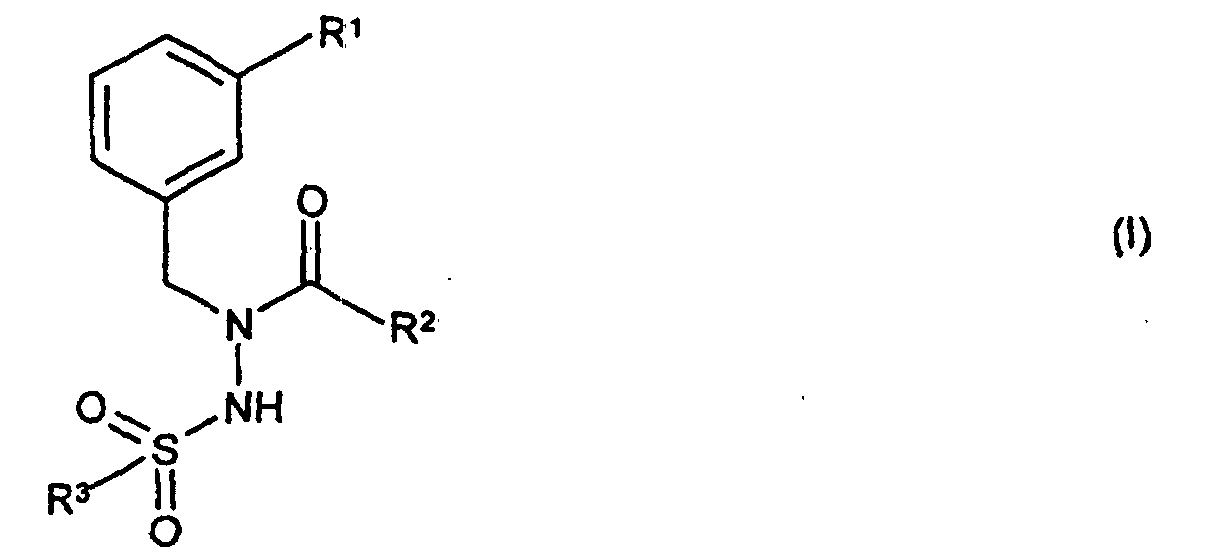
- The invention relates particularly to novel azaphenylalanine derivatives and analogs thereof of the general formula (I)wherein
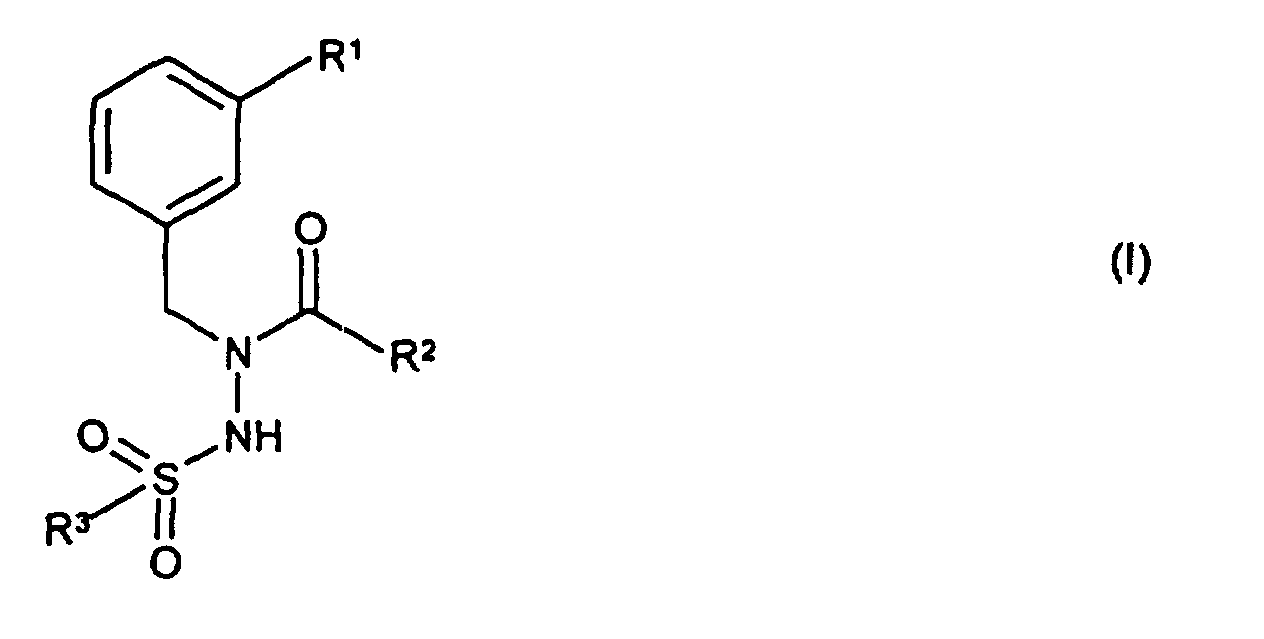
R1 represents a residue of the formulawherein R4 = H, alkyl (C1-C3), OH, O-alkyl (C1-C3), NH2;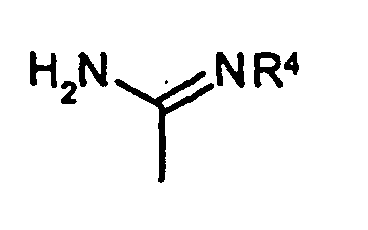
R2 represents a residue of the formula wherein R5 = H, alkyl (C1-C3), CF3, COOR9,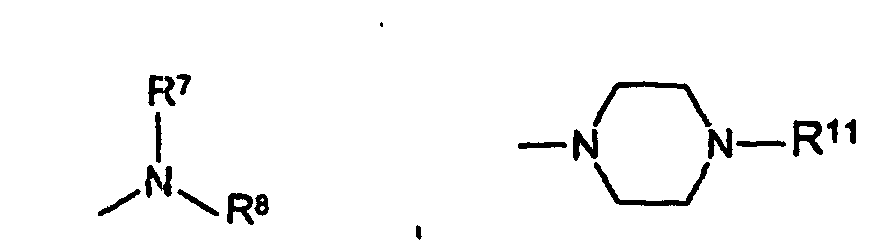
R6 = H, alkyl (C1-C3), CF3, COOR9,
R7 = alkyl (C1-C3), cycloalkyl (C3-C6),
R8 = alkyl (C1-C3), cycloalkyl (C3-C6),
R9= H, alkyl (C1-C3),
R10 = H, alkyl (C1-C3), benzyl
R11 = H, SO2Me, CO2Me;
R3 represents a residue of the formula wherein R12 = H, alkyl (C1-C3), acetyl
and pharmaceutically acceptable salts thereof. - In comparison to the compounds, described in SI 20025, the compounds of the present invention are of greater activity. Ki thrombin (µM) of the compound a, according to the patent SI 20025, is 0.032, Ki thrombin (µM) of the compound b, according to the present invention, is 0.005.

- The invention also particularly relates to a process for the preparation of azaphenylalanine derivatives and analogs of the general formula (I).
- They may be suitably prepared as follows:
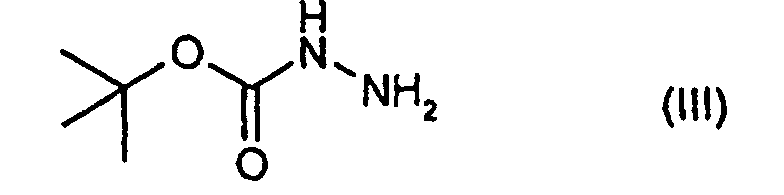
- a) 3-cyanobenzaldehyde of formula (II)
is converted with BOC-carbazate of the formula (III)
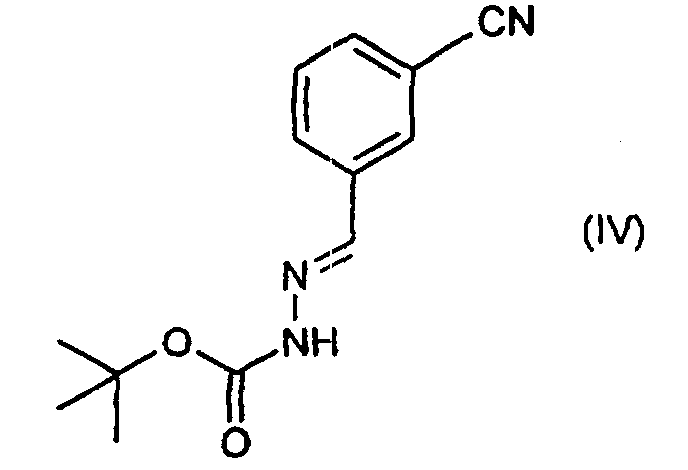
 to the compound of the formula (IV),
 which is subjected to reduction by catalytic hydrogenation or with NaCNBH3 and is converted to the compound (V),
 which reacts with triphosgene and amine of the formula (VI),
 wherein R5 and R6 have the same meanings as in the formula (I),
 -
- The protecting BOC group in the compound (XI) is removed with HCl (g) in HOAc at room temperature to obtain the compound (XII),wherein R2 has the same meanings as in the formula (I)

which reacts with aromatic sulfonylchloride up to the compound (XIII),wherein R2 and R3 have the same meanings as in the formula (I).
- The compound (XIII) is converted to the compound of the formula (I)in a usual manner. This can be achieved e.g. by converting compound (XIII) by addition of a hydroxylamine and an anhydrous alcohol such as e.g.-ethanol or a mineral acid such as e.g. HCl(g) and e.g. ammonium acetate, thus obtaining compound (I).
- When the compound (XIII) reacts with hydroxylamine in anhydrous ethanol, R4 denotes OH group, after the reaction of the compound (XIII) with HCl (g) and ammonium acetate R4 denotes hydrogen.
- The starting compounds are prepared, unless otherwise directed, according to the procedures described in the literature; e.g., the compound of the formula IV as described by A. Fässler, et. al., J. Med. Chem. 1996, 39, 3203-3215.
- The invention further relates to the use of compounds of the formula I as therapeutically active compounds. The novel compounds are preferably thrombin inhibitors. They inhibit thrombin and formation of fibrin. They are useful in the treatment or prevention of a variety of thrombosis forms: (i) venous thromboembolism due to formation of a thrombus within a vein (venous thrombosis) associated with acquired (prolonged bedrest, surgery, injury, malignancy, pregnancy and postpartum states or inherited (deficiency of natural coagulation inhibitors) risk factors, obstruction or occlusion of a lung artery by a detached thrombus (pulmonary embolism), (ii) cardiogenic thromboembolism due to formation of a thombus in the heart associated with cardiac arrythmia, heart valve defect, prosthetic heart valves or heart disease, embolism of peripheral arteries caused by a detached thrombus, most commonly in the brain (ischemic stroke), (iii) arterial thrombosis due to underlying atherosclerotic processes in the arteries which obstructs or occludes an artery and causes myocardial ischemia (angina pectoris, acute coronary syndrome) or heart muscle death cell (myocardial infarction), obstructs or occludes a peripheral artery (ischemic peripheral artery disease) and obstructs or occludes the artery after the procedure on the blood vessel (reocclusion or restenosis after transluminal coronary angioplasty, reocclusion or restenosis after percutaneous transluminal angioplasty of peripheral arteries) and (iv) in the number of states (e.g., in complications in pregnancy, in metastazing malignant diseases, after extensive injuries, in bacterial sepsis) when thrombogenic activation causes widespread formation of thrombi within the vascular system (disseminated intravascular coagulation).
- The compounds of the present invention may be also used as an adjunct therapy in conjunction with thrombolytic therapy in recent myocardial infarction, in combination with aspirin in patients with unstable angina pectoris designed to undergo percutaneous transluminal angioplasty and in the treatment of patients with thrombosis and with heparin-induced thrombocytopenia.
- The compounds of the present invention may further be used for the prevention of coagulation of blood which is in contact with nonbiological surfaces (vascular prosthesis, vascular stents, prosthetic heart valves, extracorporeal circulation systems, hemodialysis) and in vitro to prevent coagulation in biological samples for testing or storage.
- The present invention also relates particularly to pharmaceutical compositions comprising the compounds of the formula I. They can be formulated as injectable or oral formulations. The active drug component may be combined with suitable standard additives with respect to the intended form of administration. The pharmaceutical compositions may be prepared according to the standard procedures. The preparation may be formulated in such a manner as to permit controlled and sustained release of the active ingredient. Dosage, frequency and mode of administration depend on a variety of factors, they also depend on individual active ingredient and its pharmacokinetic parameters and on the patient's therapeutic needs.
- The Anticoagulant effect of thrombin inhibitors was measured by thrombin time (TT), activated partial thromboplastin time (aPTT), and prothrombin time (PT) assays. Inhibitors were added to normal pooled human plasma over a range of concentrations and clotting was recorded in an automated coagulometer (Fibrintimer, Dade/Behring). The concentration of inhibitor that doubled the clotting time was determined for each assay.
- In a plasma sample thrombin converts fibrinogen into fibrin and the clot is formed. The time for clot formation was measured. Thrombin time is prolonged due to disorders in fibrin polymerisation or due to the presence of thrombin inhibitors.
-
- Thrombin (Test Thrombin Reagent, 1.5 IU/mL, Dade/Behring): lyophilized bovine thrombin was dissolved in 5 mL of HEPES (25 mmol/L, pH 7.4). The reagent was warmed to 37°C prior to the assay.
- Normal pooled plasma: venous blood from 11 apparently healthy volunteers was collected (1 part 0.11 mol/L sodium citrate solution with 9 parts of blood) and centrifuged immediately at 2000 x g for 30 minutes at 4°C. Plasma was removed, pooled and stored in aliquots at -70°C until use.
- Inhibitors: were dissolved in DMSO (10 mM stock solution) and diluted with distilled water to working solutions (the highest concentration 100 µM).
-
- Inhibitors (10 µL working solution, concentrations from 2.5 µM to 100 µM) and pooled plasma (90 µL) were incubated at 37°C for 5 minutes and then thrombin (200 µL) was added. Clot formation was measured in a coagulometer in duplicate.
- Incubation of plasma with the optimal quantity of phospholipids and a surface activator leads to activation of factors of the intrinsic coagulation pathway. The addition of calcium ions triggers the coagulation process. The time of fibrin clot formation wass measured. aPTT was used as a screening test for coagulation disorders of the intrinsic coagulation pathway. It is prolonged due to intrinsic coagulation factors deficit or due to the presence of inhibitors.
-
- Pathromtin SL (Dade/Behring): silicon dioxide particles, vegetable phospholipids, sodium chloride (2.4 g/L), Hopes (14.3 g/L, pH 7.6), sodium azide (<1 g/L). The reagent was used at room temperature (15-25°C).
- Calcium chloride solution: 0.025 mol/L, warmed to 37°C.
- Normal pooled plasma: venous blood from 11 apparently healthy volunteers was collected (1 part 0.11 mol/L sodium citrate solution with 9 parts of blood) and centrifuged immediately at 2000 x g for 30 minutes at 4°C. Plasma was removed, pooled and stored in aliquots at -70°C until use.
- Inhibitors: were dissolved in DMSO (10 mM stock solution) and diluted with distilled water to working solutions (the highest concentration 100 µM).
-
- Inhibitor (10 µL working solution, concentrations from 5 µM to 100 µM) and pooled plasma (90 µL) were incubated at 37°C for 5 minutes. Pathromtin (100 µL) was added and the sample was incubated for another 2 minutes at 37°C. The addition of calcium chloride (100 µL) triggered the coagulation process and clot formation was detected with a coagulometer in duplicate.
- An optimal amount of thromboplastin and calcium are added to plasma sample and the time of fibrin clot formation wass measured. PT is a rapid, sensitive screening test for coagulation disorders of the extrinsic pathway. It is well suited for the induction and monitoring of oral anticoagulant therapy, for diagnosing genetic or acquired deficiencies in coagulation factors and checking the synthesis performance of the liver in hepatic diseases. PT is prolonged due to extrinsic coagulation factors deficit or due to the presence of inhibitors.
-
- Thromboplastin (Thromborel S, Dade/Behring): was dissolved in 4 mL of distilled water. Reagent was at 37°C prior to use at least 30 minutes.
- Normal pooled plasma: venous blood from 11 apparently healthy volunteers was collected (1 part 0.11 mol/L sodium citrate solution with 9 parts of blood) and centrifuged immediately at 2000 x g for 30 minutes at 4°C. Plasma was removed, pooled and stored in aliquots at -70°C until use.
- Inhibitors: were dissolved in DMSO (10 mM stock solution) and diluted with distilled water to working solutions (the highest concentration 100 µM).
-
- Inhibitor (10 µL working solution, concentrations from 5 µM to 100 µM) and pooled plasma (90 µL) were incubated at 37°C for 5 minutes and then Thromborel S (200 µL) was added. Clot formation was measured with a coagulometer in duplicate.
- The enzyme inhibitory effect of the compounds can be identified by determination of inhibition constant Ki. It denotes the degree of dissociation of the enzyme-inhibitor complex. Low dissociation constant means high potency of inhibitor. Ki can be determined during reaction of the enzyme with a specific chromogenic substrate which under hydrolysis by the enzyme develops color. Reaction in time is recorded by spectrophotometry and Ki is calculated from kinetic parameters (Vmax, Km, reaction rate).
- The ability of a compound to act as an inhibitor of human thrombin catalytic activity was assessed by determination of Ki.
-
- Buffer: HBSA, pH 7.5 (10 mM Hepes, 150 mM NaCl, 0.1% w/v bovine serum albumin)
- Substrate (S-2238: H-D-Phe-Pip-Arg-pNA HCl, 25 mg; Chromogenix): dissolved in distilled water to 1mM concentration. (Km is 2.6 µM)
- Human thrombin (308 NIH; Sigma): dissolved in saline to give a stock solution of 20 NIH/mL.
- Inhibitors: were dissolved in DMSO (10 mM stock solution) and diluted with distilled water to working solutions (the highest final concentration of DMSO was 3%).
-
- A mixture of 50 µL of buffer, 50 µL of inhibitor in water (final concentrations from 10 to 100 µM) and 50 µl of thrombin (0.5 NIH U/mL f.c.) was incubated for 15 minutes at room temperature. The reaction was started with 50 µL of S-2238 (20 µM or 40 µM f.c.) and the absorbance of each sample at 405 nm (at 25°C) was measured in triplicate every 10 seconds for a period of 15 minutes using a microtiter plate reader (Tecan Sunrise).
- Thrombin activity was determined from the change in absorbance in the linear part of the velocity graph. Ki was calculated according to Cheng and Prussof (Biochem Pharmacol, 1973) where Ki is IC50/(1+S/Km). The Km for the substrate was determined under the test conditions with at least 6 substrate concentrations varying around Km and calculated with the non-linear regression programme Curve expert.
- The ability of a compound to act as an inhibitor of trypsin catalytic activity was assessed by determination of Ki.
-
- Buffer: HBSA, pH 7.5 (10 mM Hepes, 150 mM NaCl, 0.1% w/v bovine serum albumin)
- Substrate (S-2222: N-benzoyl-Ile-Glu-Gly-Arg-pNA HCl, 25 mg; Chromogenix): dissolved in distilled water to 2mM concentration. (Km is 21 µM)
- Trypsin (6000 E/mg prot.; Sigma): dissolved in distilled water to give a stock solution of 300 E/mL.
- Inhibitors: were dissolved in DMSO (10 mM stock solution) and diluted with distilled water to working solution (the highest final concentration of DMSO was 10%).
-
- 50 µL of buffer, 50 µL of test compound in water (final concentrations from 50 to 300 µM) and 50 µL of trypsin (3 mE/mL f.c.) were incubated for 15 minutes at room temperature The reaction was started with 50 µL of S-2222 (50 µM or 100 µM f.c.) and the absorbance of each sample at 405 nm (at 25°C) was measured in triplicates every 10 seconds for a period of 15 minutes using a microtiter plate reader (Tecan Sunrise).
- Trypsin activity was determined from the change in absorbance in the linear part of velocity graph. Ki was calculated according to Cheng and Prussof (Biochem Pharmacol, 1973) where Ki is IC50/(1+S/Km). The Km for the substrate was determined under test conditions with at least 6 substrate concentrations varying around Km and calculated with the non-linear regression program Curve expert.
- By the use of other serine protease like trypsin with the appropriate chromogenic substrate, selectivity of inhibitors with respect to thrombin was determined. Selectivity of an inhibitor is expressed as a ratio of Ki for trypsin to Ki for thrombin.
- Using a combination of thrombogenic challenge (0.045 ng/kg of tissue factor) and stasis, compounds were tested for their abillity to affect thrombus formation in a venous thrombosis model in the rat.
- Thrombus formation by a combination of stasis and hypercoagulability was induced as described by Vogel et al. (Thromb. Res., 1989, 54, 399-410). Male sprague-Dawley rats (250-300 g) were anaesthetized with sodium pentobarbitone (30 mg/kg, i.p.). The abdomen of the animals was surgically opened and after careful dissection, the vena cava was exposed and dissected free from surrounding tissue. Saline, or the various compounds were administered i.v. 5 min before thrombosis induction. Two loose sutures were prepared 0.7 cm apart on the inferior vena cava and all collateral veins were ligated. Human tissue factor (0.045 ng/kg, i.v.) was injected into the dorsal vein of the penis. Ten seconds after the end of the injection, stasis were established by tightening the two, firstly the proximal and then the distal. The abdominal cavity was provisionally closed and stasis was maintained for 20 minutes. The cavity was then reopened, the ligated segment was opened longitudinally and the thrombus formed was removed, rinsed, blotted on filter paper, dried overnight at 60°C and weighed. Under these experimental conditions, control thrombus weight was 5.5 ± 0.1 mg (n=15).
- The hemorrhagic risk associated to a treatment with selected compounds were determined using an experimental model of bleeding: transection of the tail of rats.
- Bleeding time was determined by transection of the tail, 2 mm from the tip, of phenobarbital-anaestetised rats (30 mg/kg i.p.). The compounds were injected i.v. at the indicated doses 5 min before tail transection. Blood was carefully blotted every 15 s on a filter paper. Haemostasis was considered to be achieved when no more blood stain was observed over 1 min.
- The invention is further described by means of the following examples, but not in any limitative case:
-

- Triphosgene (2.296 g) was dissolved in 15 ml of anhydrous dichloromethane and cooled to -5°C. While stirring under argon atmosphere, a solution of N-1-(tert-butoxycarbonyl)-N-2-[(3-cyanophenyl)methyl]hydrazine (3.833 g) and N,N-diisopropylethylamine (4.040 ml) in 25 ml of dichloromethane was added dropwise. After addition, the reaction mixture was stirred for another 5 minutes, and a mixture of 4-methyl piperidine (1.836 ml) and N,N-diisopropylethylamine (4.040 ml) in 25 ml dichloromethane was then added at once and stirred at room temperature for another 20 minutes. The solvent was evaporated in vacuo and the residue was dissolved in 50 ml of ethyl acetate, washed with 25 ml of 5% citric acid, with 25 ml of 5% solution of NaHCO3 and with 25 ml of brine. The organic phase was dried over MgSO4, filtered and the filtrate evaporated under reduced pressure.
- The resulting mixture was suspended in 20 ml of diethylether and 5 ml of hexane was added. The precipitate was filtered by suction.
Yield: 1.756 g (30.4 %)
Melting range: 147-150°C
IR (KBr, cm-1): 3275.0, 2922.7, 2229.3, 1722.3, 1632.3, 1497.3, 1445.5, 1367.6, 1252.9, 1157.0, 979.2, 805.1, 736.2, 573.7
NMR (DMSO-d6)):δ (ppm): 0.86 (d, J = 6,4 Hz, 3H, CH3), 0.90-1.05 (m, 2H, Pip-H3,5), 1.35 (s, 9H, Boc), 1.45-1.60 (m, 4H, Pip-H3',5'), 2.60-2.75 (m, 2H, Pip-H2,6), 3.70-3.85(m, 2H, Pip-H2',6'), 4.52 (br s, 2H, CH2), 7.58-7.66 (m, 1H, Bn-H5), 7.79-7.85 (m, 1H, Bn-H6), 7.93-8.05 (m, 2H, Bn-H2,4), 11.05 (s, 1H, NH).
Molecular weight of C20 H27 N4 O3: calculated: 372; found: 373 (MH +) -
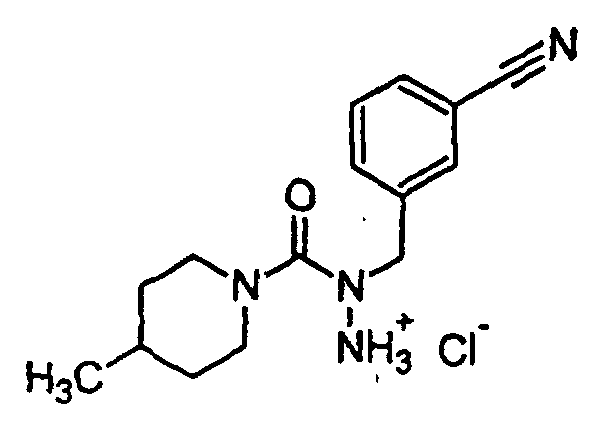
- terc-butyl 2-(3-cyanobenzyl)-2-[(4-methyl-1-pyperidinyl)carbonyl]hydrazine carboxylate (1.173 mg) was dissolved in 30 ml of glacial acetic acid and HCl gas was bubbled through the solution for 20 minutes. The progress of the reaction was monitored by TLC. Glacial acetic acid was evaporated on a rotavapor, and diethylether was poured over the oily product. The liquid phase was removed, the resulting precipitate is dried at 50°C and desiccated over NaOH for 24 hours.
Yield: 0. 875 g (%) of the mixture
Melting range: 170-173°C
IR (KBr, cm-1): 3417.8, 2934.6, 2664.1, 2227.3, 1711.6, 1641.3, 1433.7, 1402.3, 1249.6, 1132.0, 1017.8
NMR (DMSO-d6):δ (ppm): 0.92 ( d, J = 6,4 Hz, 3H, CH3), 0.99-1.16 (m, 2H, Pip=H3,5), 1.52-1.71 (m, 4H, Pip-H3',5'), 2.90-3.05 (m, 2H, Pip-H2,6), 3.80-3.95(m, 2H, Pip-H2',6'), 4.62 (s, 2H, CH2), 7.59-7.69 (m, 1H, Bn-H4,5), 7.79-7.88 (m, 1H, Bn-H2,6).
Molecular weight of C14H19ClN4O: calculated: 294.78; found: 295(MH +) -

- 2-(3-cyanobenzyl)-2-[(4-methyl-1-pyperidinyl)carbonyl]hydrazine (0.870 g) was dissolved in 50 ml of dichloromethane, cooled to -5°C and while stirring, 1.190 ml of triethylamine and 0.640 g of naphthalen-2-sulfonylchloride were added. The reaction mixture was stirred at -5°C for 30 minutes and then at room temperature for another 24 hours. The solvent was evaporated under reduced pressure and 100 ml of ethyl acetate was added to the residue. In the separatory funnel it was washed twice with 50 ml of water, with 50 ml of 10% of citric acid and with 50 ml of brine. The organic phase was dried over Na2SO4, filtered and the filtrate was evaporated in vacuo. The resulting product was suspended in diethylether and the precipitate was filtered by suction. The precipitate was then recrystalized from ethanol and the crystals were filtered by suction.
Yield: 0.464 g (35.6%)
Melting range: 92-95°C
IR (KBr, cm-1): 3191.7, 2931.6, 2221.0, 1680.5, 1433.5, 1-333.1, 1168.8, 857.9, 749.4, 692.2
1H NMR (DMSO-d6)):δ (ppm): 0.10-0.35 (m, 2H, Pip-H3,3',5,5'), 0.47 (d, 3H, J = 6.0 Hz, CH3), 1.22-1.32 (m, 3H, Pip-H3,3',4,4',5,5'), 2.30-2.45 (m, 1H, Pip-H2,2'), 2.65-2.80 (m, 1H, Pip-H6,6'), 3.45-3.65 (m, 2H, Pip-H2,2', 6,6'), 4,38 (br d, 2H, CH2), 7.47-7.55 (m, 2H, Bn-H5,6), 7.58-7.63 (m, 1H, Bn-H2), 7.63-7.80 (m, 4H, Bn-H4 in Nf-H3,6,7), 8.02-8.18 (m, 3H, Nf-H4,5,8), 8.43 (s, 1H, Nf-H1), 9.60 (s, 1H, NH). Two sets of signals Molecular weight of C25H26N4O3S: calculated: 462.6; found: 463 (MH+) -

- N'-(3-cyanobenzyl)-N'-[(4-methyl-1-pyperidinyl)carbonyl]-2-naphthalene sulfonohydrazide (0.223 g) was suspended in 20 ml of anhydous ethanol under argon atmosphere and 0.032 g of hydroxylamine was added. The reaction mixture was heated at reflux temperature for 24 hours and evaporated under reduced pressure. the reacting product was purified by column chromatography (eluent: chloroform/methanol = 9/1 to yield white crystals.
Yield: 0.215 g (38%)
Melting range: 169-173°C
IR (KBr, cm-1): 3365.8, 3194.6, 2943.8, 2864.7, 1652.6, 1447.5, 1332.2, 1169.3, 1076.1, 756.2, 700.3, 553.2
1H-NMR (DMSO-d6):δ (ppm): 0.01-0.36 (m, 2H, Pip-H3,5), 0.44 (d, 3H, J = 6.4 Hz, CH3), 1.15-1.27 (m, 3H, Pip-H3,4,5), 2.27-2.42 (m, 1H, Pip-H2), 2.56-2.75 (m, 1H, Pip-H6), 3.45-3.63 (m, 2H, Pip-H2,6), 4.35 (br d, 2H, CH2), 7.14 (d, 1H, J = 7.9, Bn-H4), 7.25-7.40 (m, 1H, Bn-H5), 7.48-7.59 (m, 2H, Bn-H2,6), 7.63-7.81 (m, 3H, Nf-H3,6,7), 8.02-8.19 (m, 3H, Nf-H4,5,8), 8.46 (s, 1H, Nf-H1), 9.40 (s, 1H, NH), 9.78 (s, 1H, OH).
Molecular weight of C25H30N5O4S: calculated: 495.6; found: 496 (MH+) -
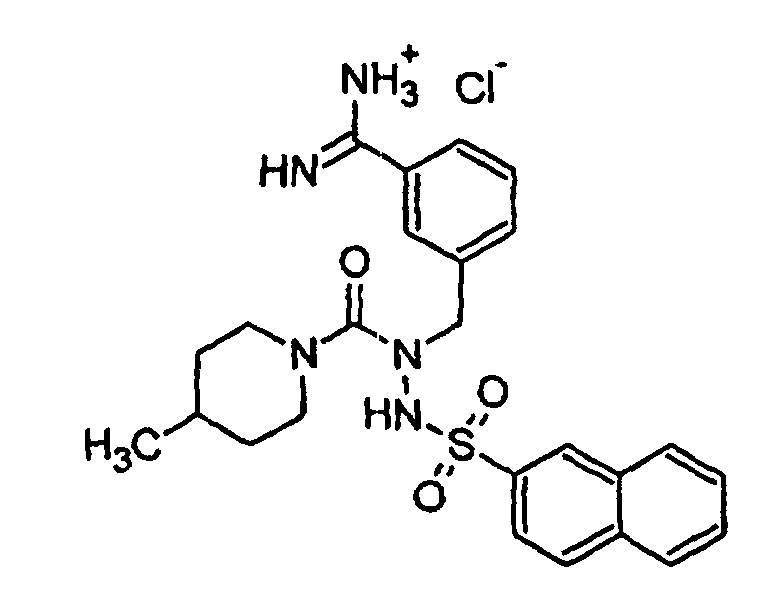
- N'-(3-cyanobenzyl)-N'-[(4-methyl-1-pyperidinyl)carbonyl]-2-naphthalene sulfonohydrazide (0.200 g) was suspended in 10 ml of ethanol, cooled in an ice bath and HCl was bubbled into the suspension for 30 minutes. The mixture was stirred at room temperature for 4 hours and then the solvent was evaporatedunder reduced pressure. The solid residue was washed with isopropyl ether and filtered by suction. The resulting precipitate was dissolved in 10 ml ethanol and ammonium acetate (0.092 g) was added. The resulting mixture was stirred at room temperature for 20 hours and then HCl was passed through the solution for 30 minutes. After 24 hours the white precipitate was formed which was filtered by suction.
Yield: 50.4 mg (52%)
Melting range: 148-152°C
IR (KBr, cm-1): 3396.1, 3101.7, 2945.8, 1669.1, 1435.8, 1335.9, 1165.9, 1072.4, 749.4,668.4
1H-NMR (DMSO-d6):δ (ppm): 0.01-0.40 (m, 2H, Pip-H3,5), 0.47 (d, 3H, J = 6.4 Hz, CH3), 1.15-1.29 (m, 3H, Pip-H3,4,5), 2.27-2.42 (m, 1H, Pip-H2), 2.56-2.75 (m, 1H, Pip-H6), 3.45-3.60 (m, 2H, Pip-H2,6), 4.41 (br d, 2H, CH2), 7.14 (d, 1H, J = 7.9, Bn-H4), 7.25-7.40 (m, 1H, Bn-H5), 7.48-7.59 (m, 2H, Bn-H2,6), 7.63-7.81 (m, 3H, Nf-H3,6,7), 8.02-8.19 (m, 3H, Nf-H4,5,8), 8.46 (s, 1H, Nf-H1), 9.40 (s, 1H, NH).
Molecular weight of C24H27N5O3S (free base): calculated: 465.57; found: 466 (MH +) -
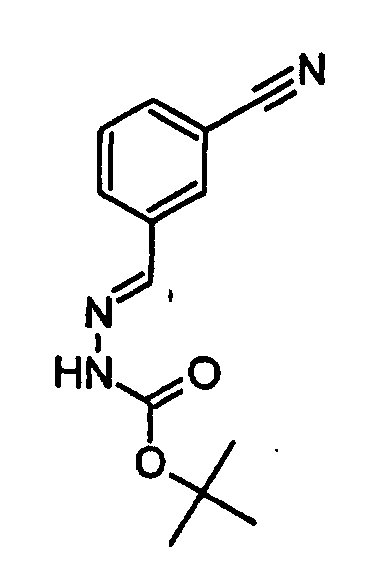
- 3-Cyanobenzaldehyde (40.0 mmol) suspended in EtOH (100 mL) was added to a stirred solution of tert-butylcarbazate (40.0 mmol) in EtOH. The mixture was heated at reflux temperature and after 4 h the EtOH was partially evaporated in vacuo. Water (100 mL) was added and the precipitated product was collected by filtration and washed with diethylether to give tert-butyl 2-(3-cyanobenzylidene)-1-hydrazinecarboxylate as a white solid.
Yield: 77%.
MP: 115-158 °C.
IR (KBr): 3297, 2977, 2232, 1703, 1530, 1477, 1376, 1248, 1160, 1061, 941, 865 cm-1.
MS (FAB): MH+ = 246.
1H NMR (300 MHz CDCl3): 1.55 (s, 9H, Boc-H), 7.55 (m, 2H, Bn-H), 7.93 (m, 3H, Bn-H in CH), 8.24 (s, 1H, NH).
Elemental analysis: calculated for C13H15N3O2: C, 63.66; H, 6.16; N, 17.13, found C, 63.38; H, 6.18; N, 17.09. -
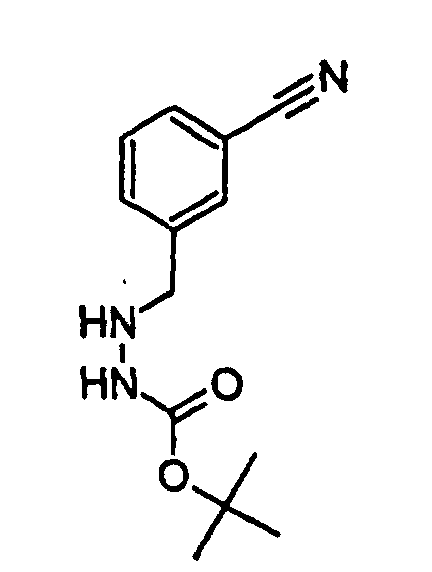
- tert-Butyl 2-(3-cyanobenzylidene)-1-hydrazinecarboxylate (60.0 mmol) was dissolved in MeOH (250 mL) and 10% Pd/C (10 w/w %) was added. The mixture was hydrogenated for 6 h. The catalyst was filtered off and the filtrate was evaporated in vacuo to yield oily tert-butyl 2-(3-cyanobenzyl)-1-hydrazinecarboxylate which crystallized overnight.
Yield: 95 %.
MP: 75-80 °C.
IR (KBr): 3368, 2980, 2226, 1679, 1482, 1366, 1286, 1166, 793 cm-1
MS (FAB): MH+ = 248.
1H NMR (300 MHz CDCl3): 1.47 (s,9H, Boc-H), 4.04 (br s, 2H, CH2), 4.28 (br s, 1H, NH), 6.09 (br s, 1H, NH), 7.12-7.41 (m, 4H, Bn-H).
Elemental analysis: calculated for C13H17N3O2 · ¼ H2O: C, 62.01; H, 7.00; N, 16.69; found C, 61.90; H, 7.22; N, 16.69. -
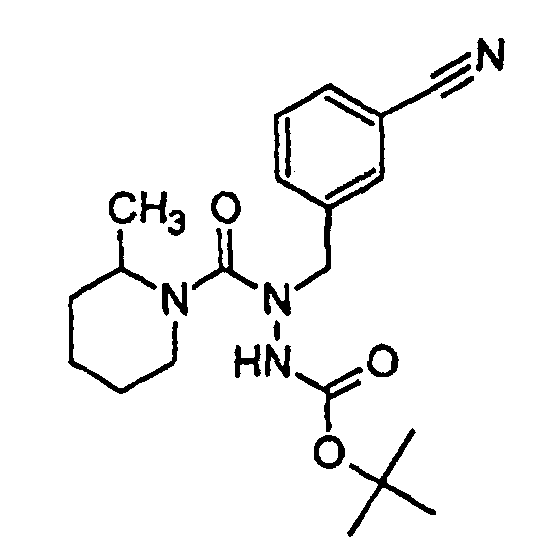
- The product was prepared from tert-butyl 2-(3-cyanobenzyl)-1-hydrazinecarboxylate and 2-methylpiperidine using the procedure described in EXAMPLE 1.
Yield: 42 %.
MP: oil
IR (KBr): 3271, 2941, 2230, 1725, 1644, 1428 cm-1.
MS (FAB): MH+ = 373.
1H NMR (300 MHz, CDCl3): 1.22 (d, J = 6,8 Hz, 3H, CH3), 1.45 (s, 9H, Boc), 1.45-1.79 (m, 5H, Pip-H), 2.97-3.10 (m, 1H, Pip-H); 3.44-3.54 (m, 1H, Pip-H), 3.63-3.76 (m, 1H, Pip-H), 4.18-4.32 (m, 1H, Pip-H), 4.48 (s, 2H, CH2), 6.30 (s, 1H, NH), 7.46 (t, J = 7.9 Hz, 1H, Bn-H), 7.56-7.67 (m, 3H, Bn-H). -

- The product was prepared from tert-butyl 2-(3-cyanobenzyl)-2-[(2-methyl-1-piperidinyl)carbonyl]-1-hydrazinecarboxylate using the procedure described in EXAMPLE 2.
Yield: 91 %.
MP: 135-137 °C.
IR (KBr): 3429, 2949, 2229, 2708, 2230, 1694, 1526, 1420 cm-1.
MS (FAB): MH+ = 273.
1H NMR (300 MHz, CDCl3): 1.23 (d, J = 6,8 Hz, 3H, CH3), 1.40-1.51 (m, 1H, Pip-H) 1.52-1.79 (m, 5H, Pip-H), 2.98-3.10 (m 1H, Pip-H), 3.60-3.79 (m, 1H, Pip-H), 4.25-4.38 8 (m, 1H, Pip-H), 4.64 (s, 2H, CH2), 7.53 (t, J = 7.9 Hz, 1H, Bn-H), 7.61-7.76 (m, 3H, Bn-H), 9.60 (br s, 2H, NH2). -

- The product was prepared from tert-butyl 2-(3-cyanobenzyl)-1-hydrazinecarboxylate and azepane using the procedure described in EXAMPLE 1.
Yield: 63 %.
MP: oil.
IR (KBr): 3287, 2925, 2223, 1726, 1634 cm-1.
MS (FAB): MH+ = 373.
1H NMR (300 MHz, CDCl3): 1.45 (s, 9H, Boc), 1.53-1.62 (m, 4H, Pip-H4,5), 1.69-1.80 (m, 4H, Pip-H3,6), 3.39-3.46 (m, 4H, Pip-H2,7), 4.50 (s, 2H, CH2), 6.25 (br s, 1H, NH), 7.45 (t, J = 7.9 Hz, 1H, Bn-H), 7.56-7.69 (m, 3H, Bn-H). -

- The product was prepared from tert-butyl 2-(1-azepanylcarbonyl)-2-(3-cyanobenzyl)-1-hydrazinecarboxylate using the procedure described in EXAMPLE 2.
Yield: 66 %.
MP: oil.
IR (KBr): 2926, 2702, 2230 1703,1521 cm-1.
MS (FAB): MH+ = 273.
1H NMR (300 MHz, CDCl3): 1.53-1.64 (m, 4H, Pip-H4,5), 1.65-1.81 (m, 4H, Pip-H3,6), 3.38-3.46 (m, 4H, Pip-H2,7), 4.70 (s, 2H, CH2), 7.48- 7.64 (m, 2H, Bn-H), 7.69-7.80 (m, 2H, Bn-H), 9.60 (br s, 2H, NH2). -

- The product was prepared from 2-(3-cyanobenzyl)-2-[(2-methyl-1-piperidinyl)carbonyl]hydrazinium chloride and naphthalene-2-sulfonyl chloride using the procedure described in EXAMPLE 3.
Yield: 14 %.
MP: 116-119 °C.
IR (KBr): 3231, 2943, 2227. 1653 cm-1.
MS (FAB): MH+ = 273.
1H NMR (300 MHz CDCl3): 0.35-0.55 (m, 2H, Pip-H), 0.75-0.90 (m, 2H, Pip-H), 1.03-1.45 (m, 6H, Pip-H in CH3), 2.54-2.70 in 2.75-2.95 (m, 1H, Pip-H) 3.50-3.75 in 3.75-4.00 (m, 1H, Pip-H), 4.31 (br d, 2H, CH2), 7.35-7.70 (m, 7H, Bn-H in Nph-H), 7.75-7.85(m, 1H, Nph-H), 7.86-8.00 (m, 3H, Nph-H), 8.42 (s, 1H, Nph-H), (two sets of signals).
Elemental analysis: calculated for C25H26N4O3S: C, 64.91; H, 5.67; N, 12.11; found: C, 65.07; H, 5.58; N, 11.93. -

- The product was prepared from N'-(3-cyanobenzyl)-N'-[(2-methyl-1-piperidinyl)carbonyl]-2-naphthalenesulfonohydrazide using the procedure described in EXAMPLE 4.
Yield: 48 %.
MP: 101-103 °C.
IR (KBr): = 3370, 2932, 1651 cm-1.
MS (FAB): MH+ = 496. -

- The product was prepared from 2-(3-cyanobenzyl)-2-[(2-methyl-1-piperidinyl)carbonyl]hydrazinium chloride and 6-methoxy-2-naphthalenesulfonyl chloride using the procedure described in EXAMPLE 3.
Yield: 26 %.
MP: 169-173 °C.
IR (KBr): 3172, 2934, 2229, 1671, 1623 cm-1.
MS (FAB): MH+ = 493273.
1H NMR (300 MHz, CDCl3): 0.47-0.60 (m, 2H, Pip-H), 0.79-0.92 (m, 2H, Pip-H), 1.12-1.50 (m, 6H, Pip-H in CH3), 2.50-2.75 in 2.80-3.15 (m, 1H, Pip-H), 3.55-3.76 in 3.80-3.95 (m, 1H, Pip-H), 3.95 8s, 3H, OCH3); 2.55-2.74 (m, 1H, Pip-H), 3.45-3.65 (m, 2H, Pip-H), 3.84 (s, 3H, CH3), 4.32 (br d, 2H, CH2), 7.28-7.33 (m, 1H, Nph-H), 7.44-7.60 (m, 5H, Bn-H and Nph-H), 7.75-7.88 (m, 3H, Nph-H), 8.34 (d, 1H, J= 1.88 Hz, Nph-H). -
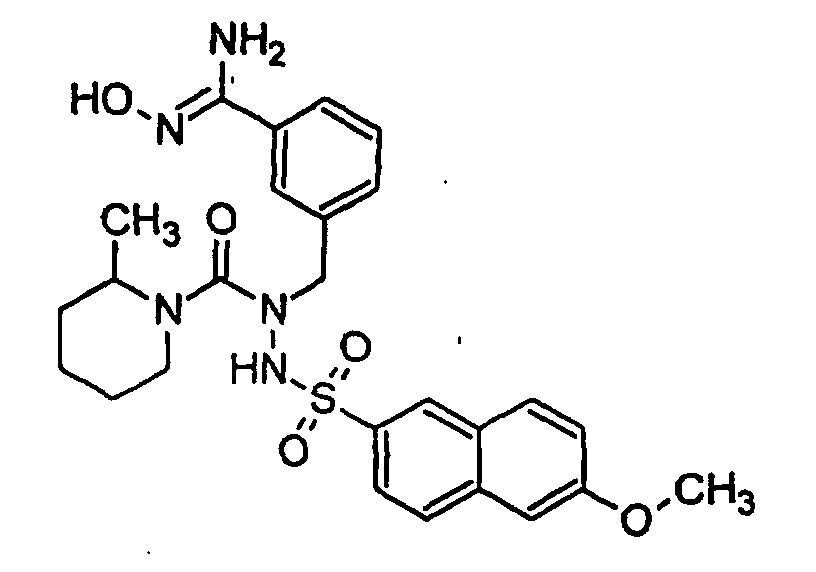
- The product was prepared from N'-(3-Cyanobenzyl)-6-methoxy-N'-[(2-methyl-1-piperidinyl)carbonyl]-2-naphthalenesulfonohydrazide using the procedure described in EXAMPLE 4.
Yield: 45 %.
MP: 172-175 °C.
IR (KBr): 3368, 2937, 1647, 1160 cm-1.
MS (FAB): MH+ = 526.
1H NMR (300 MHz, CDCl3): 0.35-0.50 (m, 2H, Pip-H), 0.79-1.00 (m, 2H, Pip-H), 1.12-1.50 (m, 6H, Pip-H in CH3), 2.40-2.75 in 2.80-3.00 (m, 1H, Pip-H), 3.55-3.76 in 3.80-3.95 (m, 1H, Pip-H), 3.95 (s, 3H, OCH3); 4.35 (br d, 2H, CH2), 5.04 (s, 2H, NH2), 7.15-7.65 (m, 6H, Nph-H in Bn-H), 7.74-7.87 (m, 3H, Nph-H), 8.34 (s, 1H, Nph-H).
Elemental analysis: calculated for C26H31N5O5S · EtOH : C, 58.83; H, 6.52; N, 12.25; found: C, 59.41; H, 5.96; N, 12.09. -

- The product was prepared from 2-(3-cyanobenzyl)-2-[(4-methyl-1-piperidinyl)carbonyl]hydrazinium chloride using the procedure described in EXAMPLE 3.
Yield: 50 %.
MP: 169-173 °C.
IR (KBr): 3168, 2932, 2232, 1671 cm-1.
MS (FAB): MH+ = 493.
1H NMR (300MHz, DMSO-d6): 0.15-0.40 (m, 2H, Pip-H), 0.53 (d, 3H, J = 6.0 Hz, CH3), 1.25-1.39 (m, 3H, Pip-H), 2.25-2.38 (m, 1H, Pip-H), 2.55-2.74 (m, 1H, Pip-H), 3.45-3.65 (m, 2H, Pip-H), 3.84 (s, 3H, CH3), 4.32 (br d, 2H, CH2), 7.28-7.33 (m, 1H, Nph-H), 7.44-7.54 (m, 3H, Bn-H and Nph-H), 7.60 (d, 1H, J = 1.88 Hz, Bn-H), 7.60- 7.76 (m, 2H, Bn-H and Nph-H), 7.94 (d, 1H, J= 8.66 Hz, Nph-H), 8.05 (d, 1H, J= 8.66 Hz, Nph-H), 8.34 (d, 1H, J= 1.88 Hz, Nph-H1), 9.46 (s, 1H, NH). -

- The product was prepared from N'-(3-cyanobenzyl)-6-methoxy-N'-[(4-methyl-1-piperidinyl)carbonyl]-2-naphthalenesulfonohydrazide using the procedure described in EXAMPLE 4.
Yield: 36 %.
MP: 154-156 °C.
IR (KBr): 3473, 3365, 2950, 1646 cm-1.
MS (FAB): MH+ = 526
1H NMR (300 MHz, CDCl3): 0.30 (br d, 3H, Pip-H), 0.58 (d, 3H, J= 6.0 Hz, CH3), 1.26 (br d, 3H, Pip-H), 2.45, (br s, 1H, Pip-H), 2.63 (br d, 1H, Pip-H), 3.74 (br d, 2H, Pip-H), 3.97 (s, 3H, OCH3), 4.34 (br d, 2H, CH2), 4.94 (s, 2H, NH2) 7.17-7.35 (m, 4H, Nph-H and Bn-H), 7.49-7.55 (m, 2H, Bn-H), 7.77-7.89 (m, 4H, Bn-H and Nph-H), 8.35 (m, 1H, Bn-H), 8.65 (br s, 1H, NH), 9.02 (s, 1H, OH). -
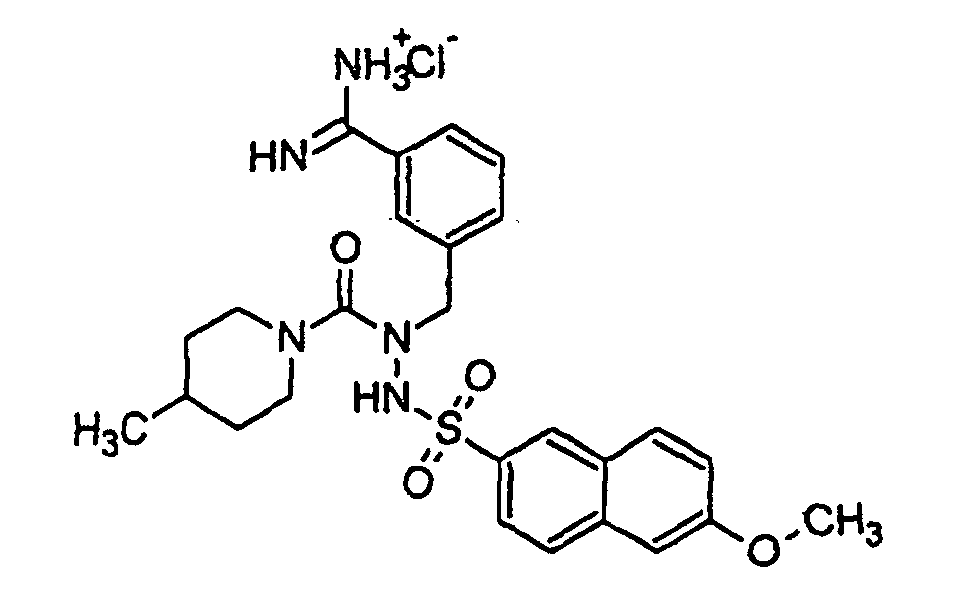
- The product was prepared from N'-(3-cyanobenzyl)-6-methoxy-N'-[(4-methyl-1-piperidinyl)carbonyl]-2-naphthalenesulfonohydrazide using the procedure described in EXAMPLE 5.
Yield: 26 %.
MP: 151-154 °C.
IR (KBr): 3054, 1677, 1624 cm-1.
MS (FAB): MH+ = 510.
1H NMR (300 MHz, CDCl3): 0.28 (br d, 3H, Pip-H), 0.54 (d, 3H, J= 6.0 Hz, CH3), 1.27 (br d, 3H, Pip-H), 2.45 (br s, 1H, Pip-H), 2.64 (br s, 1H, Pip-H), 3.66 (br s, 2H, Pip-H), 3.95 (s, 3H, OCH3), 4.32 (m, 2H, CH2), 7.16-7.28 (m, 2H, Nph-H), 7.36-7.40 (m, 2H, Bn-H2,6), 7.73-7.87 (m, 4H, Bn-H5 and Nph-H), 7.95 (m, 1H, Bn-H4), 8.78 (br s, 2H, NH2), 8.16 (br s, 2H, NH2). -

- The product was prepared from N'-(1-azepanylcarbonyl)-N'-(3-cyanobenzyl)-2-naphthalenesulfonohydrazide and naphthalene-2-sulfonyl chloride using the procedure described in EXAMPLE 3.
Yield: 43 %.
MP: 128-130 °C.
IR (KBr): 3190, 2942, 2223, 1674 cm-1.
MS (FAB): MH+ = 463.
1H NMR (300 MHz, DMSO-d6): 0.63-1.40 (m, 8H, Pip-H3,4,5,6), 2.90-3.20 (m, 4H, Pip-H2,7), 4.35 (br d, 2H, CH2), 7.45-5.55 (m, 2H, Nph-H in Bn-H), 7.50-7-75 (m, 5H, Nph-H in Bn-H), 8.02- 8.15 (m, 3H, Nph-H), 8.45 (s, 1H, Nph-H),9.56 (s, 1H, NH).
Elemental analysis: calculated for za C25 H26 N4 O3 S: C, 64.91; H, 5.67; N, 12.11; found: C, 64.65; H, 5.78; N, 12.10. -

- The product was prepared from N'-(1-azepanylcarbonyl)-N'-(3-cyanobenzyl)-2-naphthalenesulfonohydrazide using the procedure described in EXAMPLE 4.
Yield: 79%.
MP: 152-155 °C.
IR (KBr): 3365, 2924, 1646 cm-1.
MS (FAB): MH+ = 496.
1H NMR (300 MHz, DMSO-d6): 0.65-1.40 (m, 8H, Pip-H3,4,5,6), 2.90-3.20 (m, 4H, Pip-H2,7), 4.34 (br d, 2H, CH2), 5.87 (br s, 2H, NH2), 7.45-5.55 (m, 2H, Nph-H in Bn-H), 7.50-7-75 (m, 5H, Nph-H in Bn-H), 8.02- 8.15 (m, 3H, Nph-H), 8.45 (s, 1H, Nph-H),9.35 (br d, 1H, NH), 9.67 (br s, 1H, OH). -
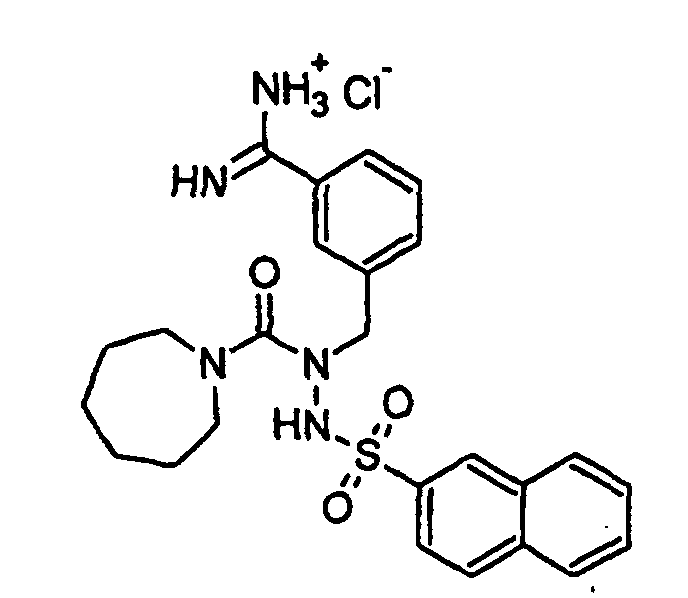
- The product was prepared from N'-(1-azepanylcarbonyl)-N'-(3-cyanobenzyl)-2-naphthalenesulfonohydrazide using the procedure described in EXAMPLE 5.
Yield: 36 %.
MP: 151-154 °C.
IR (KBr): 3374, 3054, 2926, 1654, 1420, 1160 cm-1.
MS (FAB): MH+ = 480.
1H NMR (300 DMSO-d6): 0.60-1.45 (m, 8H, Pip-H3,4,5,6), 2.90-3.20 (m, 4H, Pip-H2,7), 4.40 (br d, 2H, CH2), 7.44 (d, J = 8,3 Hz, 2H, Bn-H2,6), 7.62-7.80 (m, 5H, Bn-H3,5 in Nph-H), 8.02-8.18 (m, 3H, Nph-H), 8.45 (s, 1H, Nph-H), 9.09 (s, 2H, NH2), 9.35 (s, 1H, NH) -
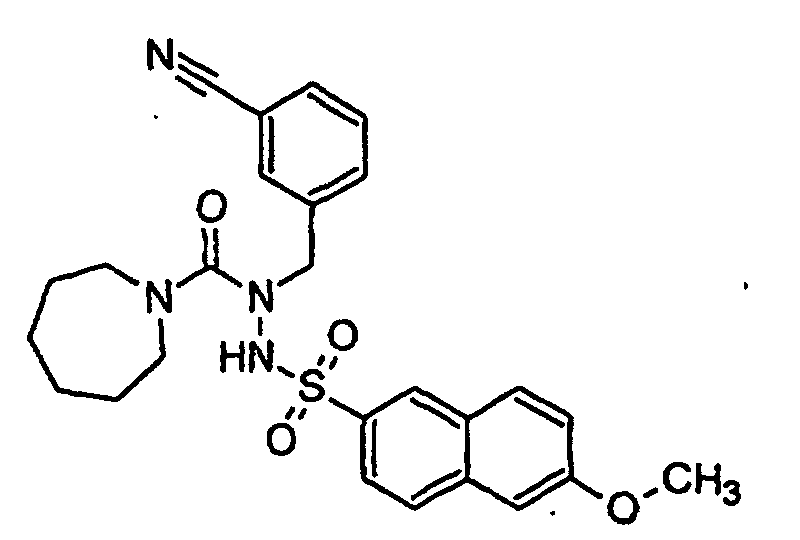
- The product was prepared from 2-(3-cyanobenzyl)-2-[(4-methyl-1-piperidinyl)carbonyl]hydrazinium chloride using the procedure described in EXAMPLE 3.
Yield: 15 %.
MP: 128-130 °C.
IR (KBr): 3169, 2939, 2229, 1670 cm-1.
MS (FAB): MH+ = 493.
1H NMR (300 MHz, DMSO-d6): 0.65-1.50 (m, 8H, Pip-H3,4,5,6), 2.85-3.20 (m, 4H, Pip-H2,7), 3.91 (s, 3H, OCH3) 4.35 (br d, 2H, CH2), 7.28-7.32 (m, 1H, Bn-H), 7.42-7.52 (m, 3H, Bn-H in Nph-H), 7.60 (br s, 1H, Nph-H), 7.66-7.71 (m, 2H, Nph-H), 7.92 (d, 1H, J = 8.7, Nph-H), 8.04 (d, 1H, J = 8.7, Nph-H), 8.33 (d, 1H, J = 1.5, Nph-H), 9.44 (s, 1H, NH).
Elemental analysis: calculated for C26 H28 N4 O4 S: C, 63.14; H, 6.11; N, 11.33; found: C, 63.26; H, 5.87; N, 11.06. -
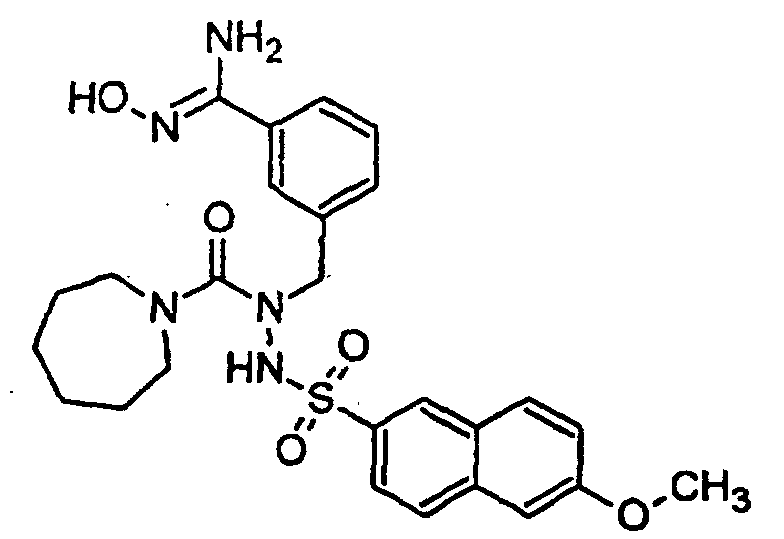
- The product was prepared from N'-(1-azepanylcarbonyl)-N'-(3-cyanobenzyl)-6-methoxy-2-naphthalenesulfonohydrazide using the procedure described in EXAMPLE 4.
Yield: 24 %.
MP: 173-175 °C.
IR (KBr): 3459, 3368, 2932, 1648, cm-1.
MS (FAB): MH+ = 526.
1H NMR (300 MHz, CDCl3): 0.65-1.50 (m, 8H, Pip-H3,4,5,6), 2.85-3.20 (m, 4H, Pip-H2,7), 3.97 (s, 3H, OCH3) 4.35 (s, 2H, CH2), 4.95, (s, 1H, NH) 7.28-7.32 (m, 1H, Bn-H), 7.42-7.52 (m, 3H, Bn-H in Nph-H), 7.60 (br s, 1H, Nph-H), 7.66-7.71 (m, 2H, Nph-H), 7.92 (d, 1H, J = 8,7 Hz, Nph-H), 8.04 (d, 1H, J = 8.7 Hz, Nph-H), 8.33 (d, 1H, J = 1.5 Hz, Nph-H), 8.90 (br s, 1H, NH), 8.35 (s, 1H, OH).
Elemental analysis: calculated for C26 H31 N5 O5 S: C, 59.18; H, 6.30; N, 13.27; found: C, 59.68; H, 6.16; N, 12.88. -

- The product was prepared from N'-(1-azepanylcarbonyl)-N'-(3-cyanobenzyl)-6-methoxy-2-naphthalenesulfonohydrazide using the procedure described in EXAMPLE 5.
Yield: 21 %.
MP: 151-154 °C
IR (KBr): 3057, 2929, 1677, 1623, 1474, 1157 cm-1.
MS (FAB): MH+ = 510.
1H NMR (300 MHz CDCl3): 0.65-1.40 (m, 8H, Pip-H3,4,5,6), 2.95-3.20 (m, 4H, Pip-H2,7), 3.97 (s, 3H, OCH3) 4.35 (br s, 2H, CH2), 7.44 (d, J = 8,3 Hz, 2H, Bn-H2,6), 7.62-7.80 (m, 5H, Bn-H3,5 in Nph-H), 8.02-8.18 (m, 3H, Nph-H), 8.45 (s, 1H, Nph-H), 9.03 (s, 2H, NH2), 9.35 (s, 2H, NH2). -


-
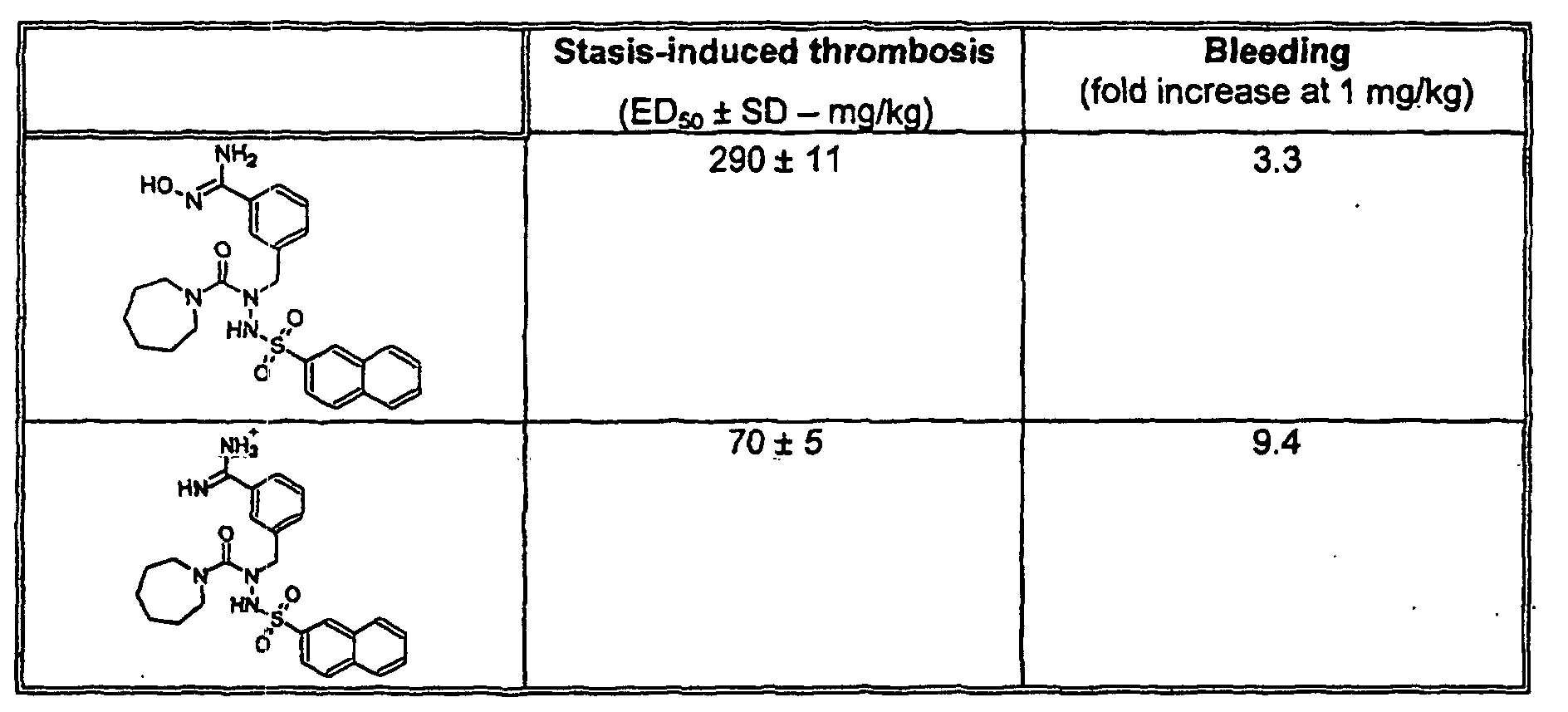
or with triphosgene and amine of the formula (VII or VIII),

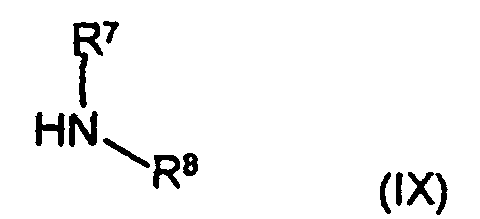
or with triphosgene and amine of the formula (X),
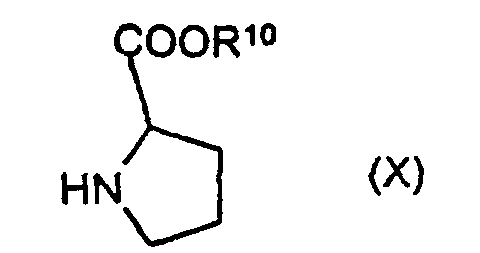
in "one pot" reaction to the compound (XI)

Claims (11)
- The compounds of the general formula Iwherein
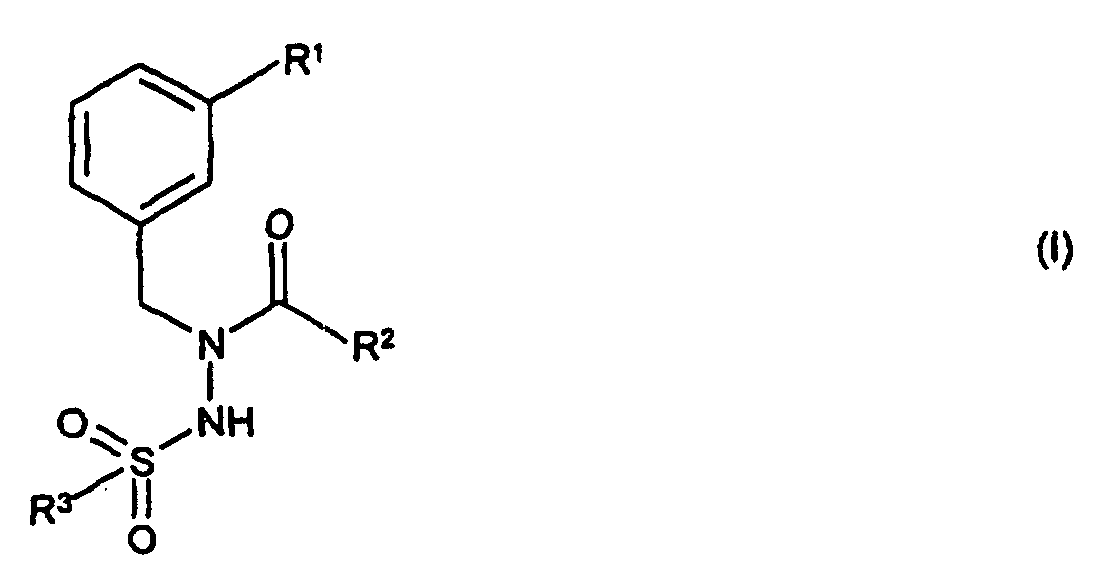
R1 represents a residue of the formulawherein R4 = H, alkyl (C1-C3), OH, O-alkyl (C1-C3), NH2;
R2 represents a residue of the formula wherein R5 = H, alkyl (C1-C3), CF3, COOR9,
R6 = H, alkyl (C1-C3), CF3, COOR9,
R7 = alkyl (C1-C3), cycloalkyl (C3-C6),
R8 = alkyl (C1-C3), cycloalkyl (C3-C6),
R9 = H, alkyl (C1-C3),
R10 = H, alkyl (C1-C3), benzyl,
R11 = H, SO2Me, CO2Me
R3 represents a residue of the formula wherein R12 = H, alkyl (C1-C3), acetyl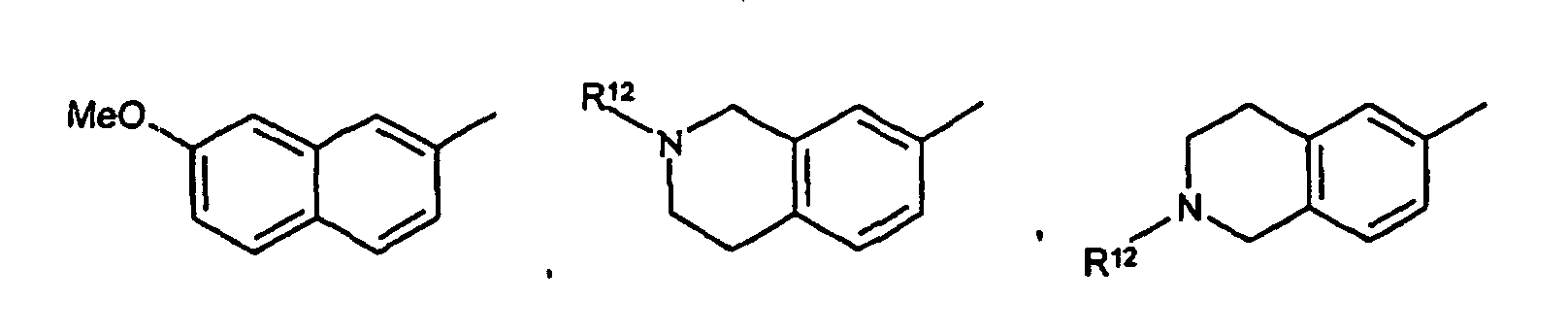
and pharmaceutically acceptable salts thereof. - A compound as claimed in claim 1, of formula I wherein R2 represents a group selected from:
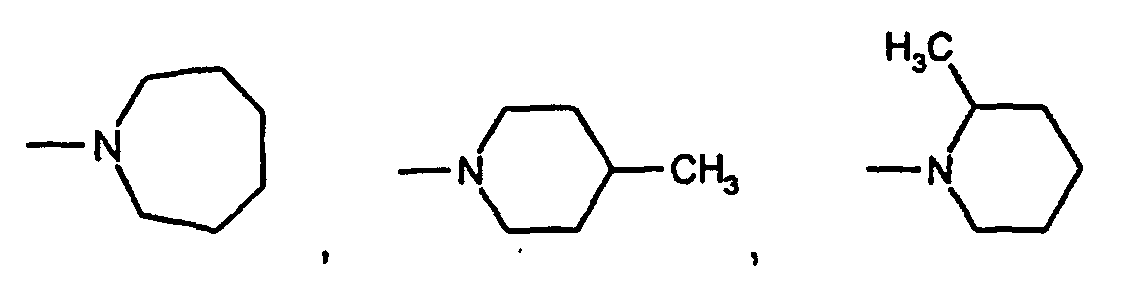
- A compound as claimed in preceding claim wherein R3 represents a group selected from:
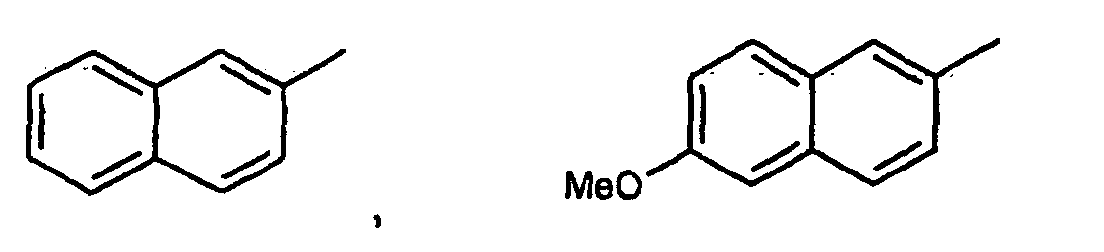
- A compound as claimed in claim 1 wherein said compound is selected from the group consisting of:N'-hydroxy-3-{[1-[(2-methyl-1-piperidinyl)carbonyl]-2-(2-naphthylsulfonyl)hydrazino]methyl}benzenecarboximidamideN'-Hydroxy-3-({2-[(6-methoxy-2-naphthyl)sulfonyl]-1-[(2-methyl-1-piperidinyl)carbonyl]hydrazino}methyl)benzenecarboximidamideImino[3-({2-[(6-methoxy-2-naphthyl)sulfonyl]-1-[(2-methyl-1-piperidinyl)carbonyl] hydrazino}methyl)phenyl]methanaminium chlorideN'-Hydroxy-3-{[1-[(4-methyl-1-piperidinyl)carbonyl]-2-(2-naphthylsulfonyl)hydrazino]methyl}benzenecarboximidamideImino(3-{[1-[(4-methyl-1-piperidinyl)carbonyl]-2-(2-naphthylsulfonyl)hydrazino]methyl}phenyl)methanaminium chlorideN'-Hydroxy-3-({2-[(6-methoxy-2-naphthyl)sulfonyl]-1-[(4-methyl-1-piperidinyl)carbonyl]hydrazimo}methyl)benzenecarboximidamideImino[3-({2-[(6-methoxy-2-naphthyl)sulfonyl]-1-[(4-methyl-1-piperidinyl)carbonyl]hydrazino}methyl)phenyl]methanaminium chloride3-{[1-(1-Azepanylcarbonyl)-2-(2-naphthylsulfonyl)hydrazino]methyl}-N'-hydroxybenzenecarboximidamide(3-{[1-(1-Azepanylcarbonyl)-2-(2-naphthylsulfonyl)hydrazino]methyl}phenyl)(imino)methanaminium chloride3-({1-(1-Azepanylcarbonyl)-2-[(6-methoxy-2-naphthyl)sulfonyl]hydrazino}methyl)-N'-hydroxybenzenecarboximidamide[3-({1-(1-Azepanylcarbonyl)-2-[(6-methoxy-2-naphthyl)sulfonyl]hydrazino}methyl)phenyl](imino)methanaminium chloride.
- Compounds of the formula I according to claim 1 for use in therapy.
- A process for preparing compounds of the formula I according to claim 1, characterized in that 3-cyanobenzaldehyde of the formula (II)is converted with BOC-carbazate of the formula (III)
 to the compound of the formula (IV),
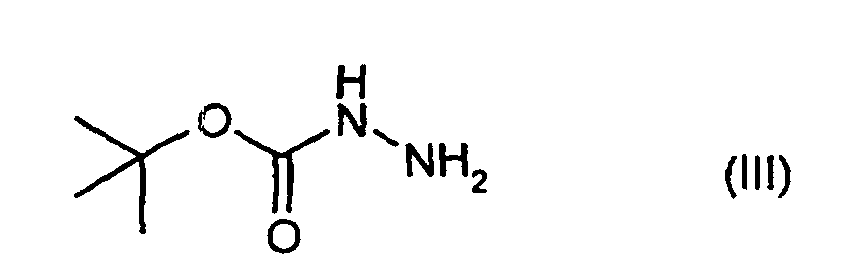 which is subjected to reduction by catalytic hydrogenation or with NaCNBH3 is converted to the compound (V),
 which reacts with triphosgene and amine of the formula (VI),
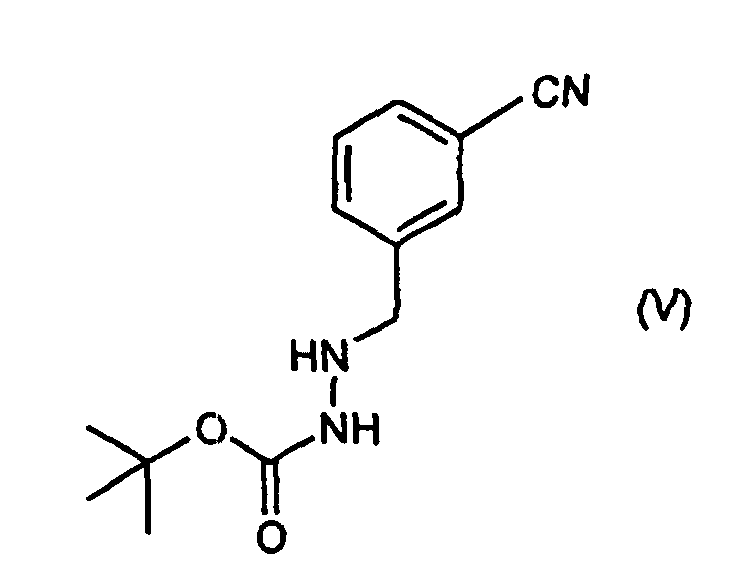 wherein R5 and R6 have the same meanings as in the formula (I),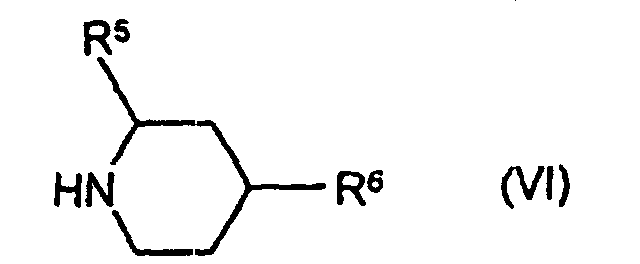
or with triphosgene and amine of the formula (VII or VIII),or with triphosgene and amine of the formula (IX), wherein R7 and R8 have the same meanings as in the formula (I),
or with triphosgene and amine of the formula (X),wherein R10 has the same meaning as in the formula (I),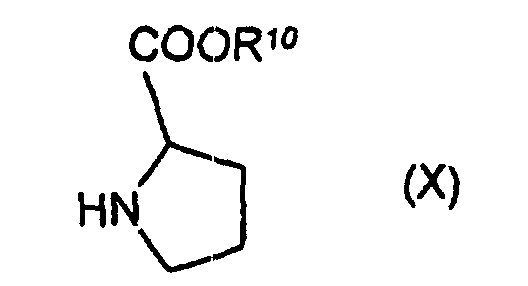
in "one pot" up to the compound (XI),wherein R2 has the same meaning as in formula (I);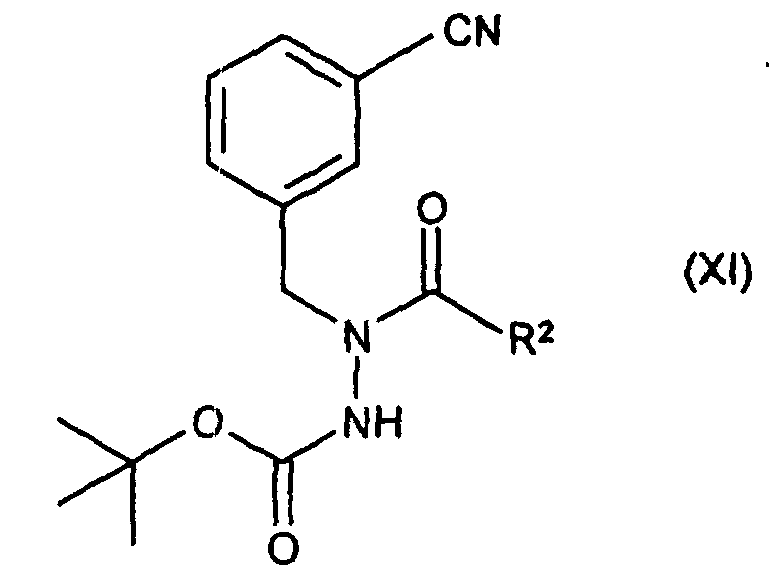
in which the protecting BOC group is removed with HCl (g) in HOAc at room temperature to obtain the compound (XII),wherein R2 has the same meaning as in the formula (I),
which reacts with aromatic sulfonylchloride up to the compound (XIII)wherein R2 and R3 have the same meanings as in the formula (I);
which are then converted to the compound of the formula (I).
- The use of compounds of the formula I of claim 1, in the manufacture of medicaments which inhibit thrombin and the formation of fibrin.
- The use according to claim 7, in the manufacture of medicaments which inhibit thrombin and the formation of fibrin in the blood of man and other mammals.
- Pharmaceutical compositions comprising a therapeutically effective amount of the compound of the formula I of claim 1 and pharmaceutically acceptable auxiliary substances.
- Pharmaceutical compositions according to claim 8, for inhibiting thrombin in man and other mammals.
- Pharmaceutical compositions according to claim 8, for inhibiting thrombin and the formation of fibrin in the blood of man and other mammals.
Applications Claiming Priority (3)
| Application Number | Priority Date | Filing Date | Title |
|---|---|---|---|
| SI200000326A SI20743A (en) | 2000-12-22 | 2000-12-22 | New thrombine inhibitors |
| SI200000326 | 2000-12-22 | ||
| PCT/IB2001/002600 WO2002051824A1 (en) | 2000-12-22 | 2001-12-20 | Amidinophenylalanine derivatives as thrombin inhibitors |
Publications (2)
| Publication Number | Publication Date |
|---|---|
| EP1355894A1 EP1355894A1 (en) | 2003-10-29 |
| EP1355894B1 true EP1355894B1 (en) | 2005-03-16 |
Family
ID=20432799
Family Applications (1)
| Application Number | Title | Priority Date | Filing Date |
|---|---|---|---|
| EP01272199A Expired - Lifetime EP1355894B1 (en) | 2000-12-22 | 2001-12-20 | Amidinophenylalanine derivatives as thrombin inhibitors |
Country Status (10)
| Country | Link |
|---|---|
| US (2) | US7285547B2 (en) |
| EP (1) | EP1355894B1 (en) |
| JP (1) | JP4390453B2 (en) |
| AT (1) | ATE291016T1 (en) |
| DE (1) | DE60109498T2 (en) |
| DK (1) | DK1355894T3 (en) |
| ES (1) | ES2240345T3 (en) |
| PT (1) | PT1355894E (en) |
| SI (1) | SI20743A (en) |
| WO (1) | WO2002051824A1 (en) |
Families Citing this family (2)
| Publication number | Priority date | Publication date | Assignee | Title |
|---|---|---|---|---|
| GB0507577D0 (en) | 2005-04-14 | 2005-05-18 | Novartis Ag | Organic compounds |
| GB0523539D0 (en) * | 2005-11-18 | 2005-12-28 | Lek Tovarna Farmacevtskih | New use of organic compounds |
Family Cites Families (1)
| Publication number | Priority date | Publication date | Assignee | Title |
|---|---|---|---|---|
| GB9322976D0 (en) * | 1993-11-08 | 1994-01-05 | Pfizer Ltd | Therapeutic agents |
-
2000
- 2000-12-22 SI SI200000326A patent/SI20743A/en not_active IP Right Cessation
-
2001
- 2001-12-20 JP JP2002552919A patent/JP4390453B2/en not_active Expired - Fee Related
- 2001-12-20 WO PCT/IB2001/002600 patent/WO2002051824A1/en not_active Ceased
- 2001-12-20 EP EP01272199A patent/EP1355894B1/en not_active Expired - Lifetime
- 2001-12-20 DK DK01272199T patent/DK1355894T3/en active
- 2001-12-20 US US10/433,358 patent/US7285547B2/en not_active Expired - Fee Related
- 2001-12-20 ES ES01272199T patent/ES2240345T3/en not_active Expired - Lifetime
- 2001-12-20 DE DE60109498T patent/DE60109498T2/en not_active Expired - Lifetime
- 2001-12-20 PT PT01272199T patent/PT1355894E/en unknown
- 2001-12-20 AT AT01272199T patent/ATE291016T1/en active
-
2007
- 2007-09-12 US US11/854,532 patent/US20080004256A1/en not_active Abandoned
Also Published As
| Publication number | Publication date |
|---|---|
| US20040048851A1 (en) | 2004-03-11 |
| US20080004256A1 (en) | 2008-01-03 |
| DK1355894T3 (en) | 2005-07-11 |
| JP2004516317A (en) | 2004-06-03 |
| DE60109498D1 (en) | 2005-04-21 |
| US7285547B2 (en) | 2007-10-23 |
| EP1355894A1 (en) | 2003-10-29 |
| PT1355894E (en) | 2005-08-31 |
| ES2240345T3 (en) | 2005-10-16 |
| DE60109498T2 (en) | 2006-04-13 |
| WO2002051824A1 (en) | 2002-07-04 |
| SI20743A (en) | 2002-06-30 |
| JP4390453B2 (en) | 2009-12-24 |
| ATE291016T1 (en) | 2005-04-15 |
Similar Documents
| Publication | Publication Date | Title |
|---|---|---|
| US6469026B2 (en) | Isoquinolone inhibitors of factor Xa | |
| US6638980B1 (en) | Inhibitors of factor Xa | |
| US6545055B1 (en) | Inhibitors of factor Xa | |
| US20040067938A1 (en) | Quaternary amines and related inhibitors of factor xa | |
| US20020065303A1 (en) | Bivalent phenylene inhibitors of factor Xa | |
| US20030114448A1 (en) | Inhibitors of factor Xa | |
| US20020019395A1 (en) | Indalone and benzimidazolone inhibitors of factor Xa | |
| US20020072530A1 (en) | Indole and benzimidazole inhibitors of factor Xa | |
| US6548517B2 (en) | Oxindole inhibitors of factor Xa | |
| US6686368B1 (en) | Inhibitors of factor Xa | |
| EP0883405B1 (en) | Amidino protease inhibitors | |
| WO2000071516A2 (en) | INHIBITORS OF FACTOR Xa | |
| US6777413B2 (en) | 2-[1H]-quinolone and 2-[1H]-quinoxalone inhibitors of factor Xa | |
| US20040082786A1 (en) | Piperazine based inhibitors of factor xa | |
| US20080004256A1 (en) | Amidinophenylalanine Derivatives as Thrombin Inhibitors | |
| US20020019394A1 (en) | Bicyclic sulfonyl amino inhibitors of factor Xa | |
| DE10392134T5 (en) | Azaphenylalaninderivate | |
| JP2004516317A5 (en) | ||
| US6218382B1 (en) | Selective factor Xa inhibitors | |
| US20030186972A1 (en) | Isoquinolone inhibitors of factor Xa |
Legal Events
| Date | Code | Title | Description |
|---|---|---|---|
| PUAI | Public reference made under article 153(3) epc to a published international application that has entered the european phase |
Free format text: ORIGINAL CODE: 0009012 |
|
| 17P | Request for examination filed |
Effective date: 20030710 |
|
| AK | Designated contracting states |
Kind code of ref document: A1 Designated state(s): AT BE CH CY DE DK ES FI FR GB GR IE IT LI LU MC NL PT SE TR |
|
| AX | Request for extension of the european patent |
Extension state: AL LT LV MK RO SI |
|
| 17Q | First examination report despatched |
Effective date: 20040323 |
|
| GRAP | Despatch of communication of intention to grant a patent |
Free format text: ORIGINAL CODE: EPIDOSNIGR1 |
|
| GRAS | Grant fee paid |
Free format text: ORIGINAL CODE: EPIDOSNIGR3 |
|
| GRAA | (expected) grant |
Free format text: ORIGINAL CODE: 0009210 |
|
| AK | Designated contracting states |
Kind code of ref document: B1 Designated state(s): AT BE CH CY DE DK ES FI FR GB GR IE IT LI LU MC NL PT SE TR |
|
| REG | Reference to a national code |
Ref country code: GB Ref legal event code: FG4D |
|
| REG | Reference to a national code |
Ref country code: CH Ref legal event code: EP |
|
| REG | Reference to a national code |
Ref country code: IE Ref legal event code: FG4D |
|
| REF | Corresponds to: |
Ref document number: 60109498 Country of ref document: DE Date of ref document: 20050421 Kind code of ref document: P |
|
| REG | Reference to a national code |
Ref country code: SE Ref legal event code: TRGR |
|
| REG | Reference to a national code |
Ref country code: DK Ref legal event code: T3 |
|
| REG | Reference to a national code |
Ref country code: GR Ref legal event code: EP Ref document number: 20050401882 Country of ref document: GR |
|
| REG | Reference to a national code |
Ref country code: CH Ref legal event code: NV Representative=s name: NOVARTIS AG |
|
| REG | Reference to a national code |
Ref country code: PT Ref legal event code: SC4A Effective date: 20050614 |
|
| REG | Reference to a national code |
Ref country code: ES Ref legal event code: FG2A Ref document number: 2240345 Country of ref document: ES Kind code of ref document: T3 |
|
| PG25 | Lapsed in a contracting state [announced via postgrant information from national office to epo] |
Ref country code: MC Free format text: LAPSE BECAUSE OF NON-PAYMENT OF DUE FEES Effective date: 20051231 |
|
| PLBE | No opposition filed within time limit |
Free format text: ORIGINAL CODE: 0009261 |
|
| STAA | Information on the status of an ep patent application or granted ep patent |
Free format text: STATUS: NO OPPOSITION FILED WITHIN TIME LIMIT |
|
| 26N | No opposition filed |
Effective date: 20051219 |
|
| ET | Fr: translation filed | ||
| PGFP | Annual fee paid to national office [announced via postgrant information from national office to epo] |
Ref country code: CY Payment date: 20091125 Year of fee payment: 9 |
|
| PGFP | Annual fee paid to national office [announced via postgrant information from national office to epo] |
Ref country code: DK Payment date: 20101210 Year of fee payment: 10 Ref country code: FR Payment date: 20101224 Year of fee payment: 10 Ref country code: AT Payment date: 20101129 Year of fee payment: 10 Ref country code: IE Payment date: 20101214 Year of fee payment: 10 |
|
| PGFP | Annual fee paid to national office [announced via postgrant information from national office to epo] |
Ref country code: PT Payment date: 20101209 Year of fee payment: 10 Ref country code: LU Payment date: 20110118 Year of fee payment: 10 Ref country code: FI Payment date: 20101214 Year of fee payment: 10 Ref country code: CH Payment date: 20101215 Year of fee payment: 10 |
|
| PGFP | Annual fee paid to national office [announced via postgrant information from national office to epo] |
Ref country code: GB Payment date: 20101215 Year of fee payment: 10 Ref country code: GR Payment date: 20101115 Year of fee payment: 10 Ref country code: SE Payment date: 20101213 Year of fee payment: 10 Ref country code: TR Payment date: 20101129 Year of fee payment: 10 Ref country code: NL Payment date: 20101210 Year of fee payment: 10 |
|
| PGFP | Annual fee paid to national office [announced via postgrant information from national office to epo] |
Ref country code: DE Payment date: 20101215 Year of fee payment: 10 |
|
| PGFP | Annual fee paid to national office [announced via postgrant information from national office to epo] |
Ref country code: ES Payment date: 20110120 Year of fee payment: 10 Ref country code: BE Payment date: 20110222 Year of fee payment: 10 |
|
| PG25 | Lapsed in a contracting state [announced via postgrant information from national office to epo] |
Ref country code: CY Free format text: LAPSE BECAUSE OF NON-PAYMENT OF DUE FEES Effective date: 20101220 |
|
| REG | Reference to a national code |
Ref country code: PT Ref legal event code: MM4A Free format text: LAPSE DUE TO NON-PAYMENT OF FEES Effective date: 20120620 |
|
| BERE | Be: lapsed |
Owner name: *UNIVERZA V LJUBLJANI FAKULTETA ZA FARMACIJO Effective date: 20111231 Owner name: *LEK PHARMACEUTICAL AND CHEMICAL CO. D.D. Effective date: 20111231 |
|
| REG | Reference to a national code |
Ref country code: NL Ref legal event code: V1 Effective date: 20120701 |
|
| REG | Reference to a national code |
Ref country code: DK Ref legal event code: EBP |
|
| REG | Reference to a national code |
Ref country code: SE Ref legal event code: EUG Ref country code: CH Ref legal event code: PL |
|
| GBPC | Gb: european patent ceased through non-payment of renewal fee |
Effective date: 20111220 |
|
| PG25 | Lapsed in a contracting state [announced via postgrant information from national office to epo] |
Ref country code: PT Free format text: LAPSE BECAUSE OF NON-PAYMENT OF DUE FEES Effective date: 20120620 Ref country code: FI Free format text: LAPSE BECAUSE OF NON-PAYMENT OF DUE FEES Effective date: 20111220 |
|
| REG | Reference to a national code |
Ref country code: GR Ref legal event code: ML Ref document number: 20050401882 Country of ref document: GR Effective date: 20120704 |
|
| REG | Reference to a national code |
Ref country code: FR Ref legal event code: ST Effective date: 20120831 |
|
| REG | Reference to a national code |
Ref country code: IE Ref legal event code: MM4A |
|
| REG | Reference to a national code |
Ref country code: DE Ref legal event code: R119 Ref document number: 60109498 Country of ref document: DE Effective date: 20120703 |
|
| PG25 | Lapsed in a contracting state [announced via postgrant information from national office to epo] |
Ref country code: DE Free format text: LAPSE BECAUSE OF NON-PAYMENT OF DUE FEES Effective date: 20120703 Ref country code: SE Free format text: LAPSE BECAUSE OF NON-PAYMENT OF DUE FEES Effective date: 20111221 Ref country code: BE Free format text: LAPSE BECAUSE OF NON-PAYMENT OF DUE FEES Effective date: 20111231 Ref country code: IE Free format text: LAPSE BECAUSE OF NON-PAYMENT OF DUE FEES Effective date: 20111220 Ref country code: LI Free format text: LAPSE BECAUSE OF NON-PAYMENT OF DUE FEES Effective date: 20111231 Ref country code: GB Free format text: LAPSE BECAUSE OF NON-PAYMENT OF DUE FEES Effective date: 20111220 Ref country code: CH Free format text: LAPSE BECAUSE OF NON-PAYMENT OF DUE FEES Effective date: 20111231 |
|
| PG25 | Lapsed in a contracting state [announced via postgrant information from national office to epo] |
Ref country code: IT Free format text: LAPSE BECAUSE OF NON-PAYMENT OF DUE FEES Effective date: 20111220 Ref country code: GR Free format text: LAPSE BECAUSE OF NON-PAYMENT OF DUE FEES Effective date: 20120704 |
|
| REG | Reference to a national code |
Ref country code: AT Ref legal event code: MM01 Ref document number: 291016 Country of ref document: AT Kind code of ref document: T Effective date: 20111220 |
|
| PG25 | Lapsed in a contracting state [announced via postgrant information from national office to epo] |
Ref country code: NL Free format text: LAPSE BECAUSE OF NON-PAYMENT OF DUE FEES Effective date: 20120701 Ref country code: DK Free format text: LAPSE BECAUSE OF NON-PAYMENT OF DUE FEES Effective date: 20120102 Ref country code: AT Free format text: LAPSE BECAUSE OF NON-PAYMENT OF DUE FEES Effective date: 20111220 |
|
| PGRI | Patent reinstated in contracting state [announced from national office to epo] |
Ref country code: IT Effective date: 20130101 |
|
| PGFP | Annual fee paid to national office [announced via postgrant information from national office to epo] |
Ref country code: IT Payment date: 20121220 Year of fee payment: 11 |
|
| PG25 | Lapsed in a contracting state [announced via postgrant information from national office to epo] |
Ref country code: FR Free format text: LAPSE BECAUSE OF NON-PAYMENT OF DUE FEES Effective date: 20120102 |
|
| PG25 | Lapsed in a contracting state [announced via postgrant information from national office to epo] |
Ref country code: LU Free format text: LAPSE BECAUSE OF NON-PAYMENT OF DUE FEES Effective date: 20111220 |
|
| REG | Reference to a national code |
Ref country code: ES Ref legal event code: FD2A Effective date: 20130704 |
|
| PG25 | Lapsed in a contracting state [announced via postgrant information from national office to epo] |
Ref country code: ES Free format text: LAPSE BECAUSE OF NON-PAYMENT OF DUE FEES Effective date: 20111221 |
|
| PG25 | Lapsed in a contracting state [announced via postgrant information from national office to epo] |
Ref country code: TR Free format text: LAPSE BECAUSE OF NON-PAYMENT OF DUE FEES Effective date: 20111220 |
|
| PGRI | Patent reinstated in contracting state [announced from national office to epo] |
Ref country code: IT Effective date: 20130101 |