EP1355646B1 - Muscarinic receptor agonists - Google Patents
Muscarinic receptor agonists Download PDFInfo
- Publication number
- EP1355646B1 EP1355646B1 EP01995477A EP01995477A EP1355646B1 EP 1355646 B1 EP1355646 B1 EP 1355646B1 EP 01995477 A EP01995477 A EP 01995477A EP 01995477 A EP01995477 A EP 01995477A EP 1355646 B1 EP1355646 B1 EP 1355646B1
- Authority
- EP
- European Patent Office
- Prior art keywords
- thiadiazol
- compounds
- compound according
- methyl
- formula
- Prior art date
- Legal status (The legal status is an assumption and is not a legal conclusion. Google has not performed a legal analysis and makes no representation as to the accuracy of the status listed.)
- Expired - Lifetime
Links
- 102000014415 Muscarinic acetylcholine receptor Human genes 0.000 title claims abstract description 27
- 108050003473 Muscarinic acetylcholine receptor Proteins 0.000 title claims abstract description 27
- 239000000018 receptor agonist Substances 0.000 title 1
- 229940044601 receptor agonist Drugs 0.000 title 1
- 150000001875 compounds Chemical class 0.000 claims abstract description 61
- 230000000694 effects Effects 0.000 claims abstract description 15
- 239000000556 agonist Substances 0.000 claims abstract description 11
- 230000001713 cholinergic effect Effects 0.000 claims abstract description 11
- 125000000816 ethylene group Chemical group [H]C([H])([*:1])C([H])([H])[*:2] 0.000 claims abstract description 9
- 150000003839 salts Chemical class 0.000 claims abstract description 9
- 230000004936 stimulating effect Effects 0.000 claims abstract description 8
- 230000000926 neurological effect Effects 0.000 claims abstract description 7
- 239000002253 acid Substances 0.000 claims abstract description 6
- 150000004677 hydrates Chemical class 0.000 claims abstract description 6
- 239000012453 solvate Substances 0.000 claims abstract description 6
- 239000003446 ligand Substances 0.000 claims description 13
- UWHCKJMYHZGTIT-UHFFFAOYSA-N tetraethylene glycol Chemical compound OCCOCCOCCOCCO UWHCKJMYHZGTIT-UHFFFAOYSA-N 0.000 claims description 10
- 239000008194 pharmaceutical composition Substances 0.000 claims description 6
- -1 4-methoxy-1,2,5-thiadiazol-3-yl Chemical group 0.000 claims description 3
- 239000003814 drug Substances 0.000 claims description 3
- 239000003937 drug carrier Substances 0.000 claims description 3
- CQGQFKBWLUBQQX-UHFFFAOYSA-N 12-[[4-(1-methyl-3,6-dihydro-2h-pyridin-5-yl)-1,2,5-thiadiazol-3-yl]oxy]dodecyl acetate;hydrochloride Chemical compound Cl.C1N(C)CCC=C1C1=NSN=C1OCCCCCCCCCCCCOC(C)=O CQGQFKBWLUBQQX-UHFFFAOYSA-N 0.000 claims description 2
- GGZLIFYHRXVSEP-UHFFFAOYSA-N acetic acid;3-(1-methyl-3,6-dihydro-2h-pyridin-5-yl)-4-[[4-(1-methyl-3,6-dihydro-2h-pyridin-5-yl)-1,2,5-thiadiazol-3-yl]oxy]-1,2,5-thiadiazole;hydrochloride Chemical compound Cl.CC(O)=O.C1N(C)CCC=C1C1=NSN=C1OC1=NSN=C1C1=CCCN(C)C1 GGZLIFYHRXVSEP-UHFFFAOYSA-N 0.000 claims description 2
- 230000001747 exhibiting effect Effects 0.000 claims description 2
- 239000000203 mixture Substances 0.000 claims description 2
- LBAQSKZHMLAFHH-UHFFFAOYSA-N ethoxyethane;hydron;chloride Chemical compound Cl.CCOCC LBAQSKZHMLAFHH-UHFFFAOYSA-N 0.000 claims 2
- VUTKBVZTSXWIQM-UHFFFAOYSA-N 12-[[4-(1-methyl-3,6-dihydro-2h-pyridin-5-yl)-1,2,5-thiadiazol-3-yl]oxy]dodecan-1-ol;hydrochloride Chemical compound Cl.C1N(C)CCC=C1C1=NSN=C1OCCCCCCCCCCCCO VUTKBVZTSXWIQM-UHFFFAOYSA-N 0.000 claims 1
- 238000004519 manufacturing process Methods 0.000 claims 1
- 125000001495 ethyl group Chemical group [H]C([H])([H])C([H])([H])* 0.000 abstract 1
- 102000005962 receptors Human genes 0.000 description 13
- 108020003175 receptors Proteins 0.000 description 13
- CSCPPACGZOOCGX-UHFFFAOYSA-N Acetone Chemical compound CC(C)=O CSCPPACGZOOCGX-UHFFFAOYSA-N 0.000 description 6
- OIPILFWXSMYKGL-UHFFFAOYSA-N acetylcholine Chemical compound CC(=O)OCC[N+](C)(C)C OIPILFWXSMYKGL-UHFFFAOYSA-N 0.000 description 6
- 239000000843 powder Substances 0.000 description 6
- 229960004373 acetylcholine Drugs 0.000 description 5
- RTZKZFJDLAIYFH-UHFFFAOYSA-N diethyl ether Substances CCOCC RTZKZFJDLAIYFH-UHFFFAOYSA-N 0.000 description 5
- 230000004060 metabolic process Effects 0.000 description 5
- JOLJIIDDOBNFHW-UHFFFAOYSA-N xanomeline Chemical compound CCCCCCOC1=NSN=C1C1=CCCN(C)C1 JOLJIIDDOBNFHW-UHFFFAOYSA-N 0.000 description 5
- HEDRZPFGACZZDS-UHFFFAOYSA-N Chloroform Chemical compound ClC(Cl)Cl HEDRZPFGACZZDS-UHFFFAOYSA-N 0.000 description 4
- OKKJLVBELUTLKV-UHFFFAOYSA-N Methanol Chemical compound OC OKKJLVBELUTLKV-UHFFFAOYSA-N 0.000 description 4
- 125000003545 alkoxy group Chemical group 0.000 description 4
- 210000003169 central nervous system Anatomy 0.000 description 4
- 208000037265 diseases, disorders, signs and symptoms Diseases 0.000 description 4
- 208000035475 disorder Diseases 0.000 description 4
- 238000000034 method Methods 0.000 description 4
- 229950006755 xanomeline Drugs 0.000 description 4
- CMPNWGQBNRHIQZ-UHFFFAOYSA-N 3-chloro-4-pyridin-3-yl-1,2,5-thiadiazole Chemical compound ClC1=NSN=C1C1=CC=CN=C1 CMPNWGQBNRHIQZ-UHFFFAOYSA-N 0.000 description 3
- WFDIJRYMOXRFFG-UHFFFAOYSA-N Acetic anhydride Chemical compound CC(=O)OC(C)=O WFDIJRYMOXRFFG-UHFFFAOYSA-N 0.000 description 3
- YMWUJEATGCHHMB-UHFFFAOYSA-N Dichloromethane Chemical compound ClCCl YMWUJEATGCHHMB-UHFFFAOYSA-N 0.000 description 3
- LYCAIKOWRPUZTN-UHFFFAOYSA-N Ethylene glycol Chemical compound OCCO LYCAIKOWRPUZTN-UHFFFAOYSA-N 0.000 description 3
- 125000000217 alkyl group Chemical group 0.000 description 3
- 210000004027 cell Anatomy 0.000 description 3
- 150000003906 phosphoinositides Chemical class 0.000 description 3
- 229910000104 sodium hydride Inorganic materials 0.000 description 3
- KUHPMFQXLXWEPG-UHFFFAOYSA-N 3-(3,4-dihydro-2h-pyridin-1-yl)-1,2,5-thiadiazole Chemical group C1CCC=CN1C1=NSN=C1 KUHPMFQXLXWEPG-UHFFFAOYSA-N 0.000 description 2
- SNLDYFHPRJMKLQ-UHFFFAOYSA-N 3-chloro-4-methoxy-1,2,5-thiadiazole Chemical compound COC1=NSN=C1Cl SNLDYFHPRJMKLQ-UHFFFAOYSA-N 0.000 description 2
- 102000009660 Cholinergic Receptors Human genes 0.000 description 2
- 108010009685 Cholinergic Receptors Proteins 0.000 description 2
- VEXZGXHMUGYJMC-UHFFFAOYSA-N Hydrochloric acid Chemical compound Cl VEXZGXHMUGYJMC-UHFFFAOYSA-N 0.000 description 2
- 125000000218 acetic acid group Chemical group C(C)(=O)* 0.000 description 2
- 230000009471 action Effects 0.000 description 2
- 238000003556 assay Methods 0.000 description 2
- 210000004556 brain Anatomy 0.000 description 2
- 238000006243 chemical reaction Methods 0.000 description 2
- 229940125904 compound 1 Drugs 0.000 description 2
- 229940125782 compound 2 Drugs 0.000 description 2
- 229940126214 compound 3 Drugs 0.000 description 2
- GHLKSLMMWAKNBM-UHFFFAOYSA-N dodecane-1,12-diol Chemical compound OCCCCCCCCCCCCO GHLKSLMMWAKNBM-UHFFFAOYSA-N 0.000 description 2
- 150000002148 esters Chemical class 0.000 description 2
- 150000002170 ethers Chemical class 0.000 description 2
- 125000005842 heteroatom Chemical group 0.000 description 2
- IXCSERBJSXMMFS-UHFFFAOYSA-N hydrogen chloride Substances Cl.Cl IXCSERBJSXMMFS-UHFFFAOYSA-N 0.000 description 2
- 229910000041 hydrogen chloride Inorganic materials 0.000 description 2
- INQOMBQAUSQDDS-UHFFFAOYSA-N iodomethane Chemical compound IC INQOMBQAUSQDDS-UHFFFAOYSA-N 0.000 description 2
- 239000000472 muscarinic agonist Substances 0.000 description 2
- 230000035515 penetration Effects 0.000 description 2
- 238000002360 preparation method Methods 0.000 description 2
- 238000010992 reflux Methods 0.000 description 2
- 229910000033 sodium borohydride Inorganic materials 0.000 description 2
- 239000012279 sodium borohydride Substances 0.000 description 2
- 239000000243 solution Substances 0.000 description 2
- GEVRYXCBWWVSAK-UHFFFAOYSA-N 1,2,3,4-tetrahydropyrimidine;thiadiazole Chemical class C1=CSN=N1.C1NCC=CN1 GEVRYXCBWWVSAK-UHFFFAOYSA-N 0.000 description 1
- BBVIDBNAYOIXOE-UHFFFAOYSA-N 1,2,4-oxadiazole Chemical group C=1N=CON=1 BBVIDBNAYOIXOE-UHFFFAOYSA-N 0.000 description 1
- 150000005071 1,2,4-oxadiazoles Chemical class 0.000 description 1
- 150000004868 1,2,5-thiadiazoles Chemical class 0.000 description 1
- VBXZSFNZVNDOPB-UHFFFAOYSA-N 1,4,5,6-tetrahydropyrimidine Chemical compound C1CNC=NC1 VBXZSFNZVNDOPB-UHFFFAOYSA-N 0.000 description 1
- DFKRYMIXMGKJBW-UHFFFAOYSA-N 1-azabicyclo[2.2.2]octane;thiadiazole Chemical class C1=CSN=N1.C1CC2CCN1CC2 DFKRYMIXMGKJBW-UHFFFAOYSA-N 0.000 description 1
- YNZQOVYRCBAMEU-UHFFFAOYSA-N 3,4-dichloro-1,2,5-thiadiazole Chemical compound ClC1=NSN=C1Cl YNZQOVYRCBAMEU-UHFFFAOYSA-N 0.000 description 1
- KPOCXUHWXCPBCD-UHFFFAOYSA-N 3-(1-methyl-3,6-dihydro-2h-pyridin-5-yl)-4-[12-[[4-(1-methyl-3,6-dihydro-2h-pyridin-5-yl)-1,2,5-thiadiazol-3-yl]oxy]dodecoxy]-1,2,5-thiadiazole Chemical compound C1N(C)CCC=C1C1=NSN=C1OCCCCCCCCCCCCOC1=NSN=C1C1=CCCN(C)C1 KPOCXUHWXCPBCD-UHFFFAOYSA-N 0.000 description 1
- IQWATUCLWGQSLW-UHFFFAOYSA-N 3-(1-methyl-3,6-dihydro-2h-pyridin-5-yl)-4-[[4-(1-methyl-3,6-dihydro-2h-pyridin-5-yl)-1,2,5-thiadiazol-3-yl]oxy]-1,2,5-thiadiazole Chemical class C1N(C)CCC=C1C1=NSN=C1OC1=NSN=C1C1=CCCN(C)C1 IQWATUCLWGQSLW-UHFFFAOYSA-N 0.000 description 1
- TYZBAZSWMKASFK-UHFFFAOYSA-N 3-(1-methyl-3,6-dihydro-2h-pyridin-5-yl)-4-[[4-(1-methyl-3,6-dihydro-2h-pyridin-5-yl)-1,2,5-thiadiazol-3-yl]oxy]-1,2,5-thiadiazole;hydrochloride Chemical compound Cl.C1N(C)CCC=C1C1=NSN=C1OC1=NSN=C1C1=CCCN(C)C1 TYZBAZSWMKASFK-UHFFFAOYSA-N 0.000 description 1
- DWIMZJRVHMOWHH-UHFFFAOYSA-N 3-pyridin-3-yl-4-[(4-pyridin-3-yl-1,2,5-thiadiazol-3-yl)oxy]-1,2,5-thiadiazole Chemical compound N=1SN=C(C=2C=NC=CC=2)C=1OC1=NSN=C1C1=CC=CN=C1 DWIMZJRVHMOWHH-UHFFFAOYSA-N 0.000 description 1
- 208000024827 Alzheimer disease Diseases 0.000 description 1
- 0 C*C1=N*(C)=CC1C Chemical compound C*C1=N*(C)=CC1C 0.000 description 1
- 102000017927 CHRM1 Human genes 0.000 description 1
- 102000017926 CHRM2 Human genes 0.000 description 1
- OUTBJTJXEMFENV-UHFFFAOYSA-N Cc1n[s]nc1OC Chemical compound Cc1n[s]nc1OC OUTBJTJXEMFENV-UHFFFAOYSA-N 0.000 description 1
- 101150073075 Chrm1 gene Proteins 0.000 description 1
- 101150012960 Chrm2 gene Proteins 0.000 description 1
- DLSCBJUUMIOTQA-UHFFFAOYSA-N Cl.COC1=NSN=C1OC1=NSN=C1C1=CCCN(C)C1 Chemical compound Cl.COC1=NSN=C1OC1=NSN=C1C1=CCCN(C)C1 DLSCBJUUMIOTQA-UHFFFAOYSA-N 0.000 description 1
- 102000019315 Nicotinic acetylcholine receptors Human genes 0.000 description 1
- 108050006807 Nicotinic acetylcholine receptors Proteins 0.000 description 1
- KEAYESYHFKHZAL-UHFFFAOYSA-N Sodium Chemical compound [Na] KEAYESYHFKHZAL-UHFFFAOYSA-N 0.000 description 1
- WQDUMFSSJAZKTM-UHFFFAOYSA-N Sodium methoxide Chemical compound [Na+].[O-]C WQDUMFSSJAZKTM-UHFFFAOYSA-N 0.000 description 1
- 239000004480 active ingredient Substances 0.000 description 1
- 239000000654 additive Substances 0.000 description 1
- 102000030621 adenylate cyclase Human genes 0.000 description 1
- 108060000200 adenylate cyclase Proteins 0.000 description 1
- 150000001298 alcohols Chemical class 0.000 description 1
- 230000015572 biosynthetic process Effects 0.000 description 1
- 239000002775 capsule Substances 0.000 description 1
- AIXAANGOTKPUOY-UHFFFAOYSA-N carbachol Chemical group [Cl-].C[N+](C)(C)CCOC(N)=O AIXAANGOTKPUOY-UHFFFAOYSA-N 0.000 description 1
- 229960004484 carbachol Drugs 0.000 description 1
- 230000022900 cardiac muscle contraction Effects 0.000 description 1
- 239000000969 carrier Substances 0.000 description 1
- 230000003197 catalytic effect Effects 0.000 description 1
- 210000000170 cell membrane Anatomy 0.000 description 1
- 238000002425 crystallisation Methods 0.000 description 1
- 230000008025 crystallization Effects 0.000 description 1
- 230000007423 decrease Effects 0.000 description 1
- 230000003247 decreasing effect Effects 0.000 description 1
- 230000006735 deficit Effects 0.000 description 1
- 239000003085 diluting agent Substances 0.000 description 1
- 150000002009 diols Chemical class 0.000 description 1
- 230000003291 dopaminomimetic effect Effects 0.000 description 1
- 231100000673 dose–response relationship Toxicity 0.000 description 1
- 229940079593 drug Drugs 0.000 description 1
- 229940093476 ethylene glycol Drugs 0.000 description 1
- 210000003499 exocrine gland Anatomy 0.000 description 1
- 239000007789 gas Substances 0.000 description 1
- 230000027119 gastric acid secretion Effects 0.000 description 1
- 239000008187 granular material Substances 0.000 description 1
- 210000001320 hippocampus Anatomy 0.000 description 1
- 150000003840 hydrochlorides Chemical class 0.000 description 1
- 229910052739 hydrogen Inorganic materials 0.000 description 1
- 239000001257 hydrogen Substances 0.000 description 1
- 230000005764 inhibitory process Effects 0.000 description 1
- 125000005647 linker group Chemical group 0.000 description 1
- 239000007788 liquid Substances 0.000 description 1
- 239000007937 lozenge Substances 0.000 description 1
- 239000000463 material Substances 0.000 description 1
- 230000001404 mediated effect Effects 0.000 description 1
- 230000006386 memory function Effects 0.000 description 1
- 230000003278 mimic effect Effects 0.000 description 1
- 230000004048 modification Effects 0.000 description 1
- 238000012986 modification Methods 0.000 description 1
- 230000003551 muscarinic effect Effects 0.000 description 1
- 210000000653 nervous system Anatomy 0.000 description 1
- 239000002858 neurotransmitter agent Substances 0.000 description 1
- RBYVPFWMZLIVOR-UHFFFAOYSA-N oxadiazole;1,2,3,4-tetrahydropyrimidine Chemical class C1=CON=N1.C1NCC=CN1 RBYVPFWMZLIVOR-UHFFFAOYSA-N 0.000 description 1
- 239000003182 parenteral nutrition solution Substances 0.000 description 1
- 230000001575 pathological effect Effects 0.000 description 1
- 230000037361 pathway Effects 0.000 description 1
- 230000008447 perception Effects 0.000 description 1
- 210000001428 peripheral nervous system Anatomy 0.000 description 1
- 239000000546 pharmaceutical excipient Substances 0.000 description 1
- 230000006461 physiological response Effects 0.000 description 1
- 150000003053 piperidines Chemical class 0.000 description 1
- 230000003389 potentiating effect Effects 0.000 description 1
- 230000008569 process Effects 0.000 description 1
- 210000004129 prosencephalon Anatomy 0.000 description 1
- 102000004169 proteins and genes Human genes 0.000 description 1
- 108090000623 proteins and genes Proteins 0.000 description 1
- QJZUKDFHGGYHMC-UHFFFAOYSA-N pyridine-3-carbaldehyde Chemical compound O=CC1=CC=CN=C1 QJZUKDFHGGYHMC-UHFFFAOYSA-N 0.000 description 1
- 125000001453 quaternary ammonium group Chemical group 0.000 description 1
- 238000005956 quaternization reaction Methods 0.000 description 1
- SBYHFKPVCBCYGV-UHFFFAOYSA-N quinuclidine Chemical compound C1CC2CCN1CC2 SBYHFKPVCBCYGV-UHFFFAOYSA-N 0.000 description 1
- 230000004044 response Effects 0.000 description 1
- 230000028327 secretion Effects 0.000 description 1
- 230000016160 smooth muscle contraction Effects 0.000 description 1
- 239000012312 sodium hydride Substances 0.000 description 1
- 125000006850 spacer group Chemical group 0.000 description 1
- 239000000021 stimulant Substances 0.000 description 1
- 230000000638 stimulation Effects 0.000 description 1
- 210000002784 stomach Anatomy 0.000 description 1
- 238000005556 structure-activity relationship Methods 0.000 description 1
- 239000000126 substance Substances 0.000 description 1
- 239000000829 suppository Substances 0.000 description 1
- 239000000725 suspension Substances 0.000 description 1
- 238000003786 synthesis reaction Methods 0.000 description 1
- 239000003826 tablet Substances 0.000 description 1
- 150000003512 tertiary amines Chemical class 0.000 description 1
- 125000004853 tetrahydropyridinyl group Chemical group N1(CCCC=C1)* 0.000 description 1
- 125000005942 tetrahydropyridyl group Chemical group 0.000 description 1
- 210000001519 tissue Anatomy 0.000 description 1
- 231100000331 toxic Toxicity 0.000 description 1
- 230000002588 toxic effect Effects 0.000 description 1
- XLYOFNOQVPJJNP-UHFFFAOYSA-N water Substances O XLYOFNOQVPJJNP-UHFFFAOYSA-N 0.000 description 1
- 239000011592 zinc chloride Substances 0.000 description 1
- JIAARYAFYJHUJI-UHFFFAOYSA-L zinc dichloride Chemical compound [Cl-].[Cl-].[Zn+2] JIAARYAFYJHUJI-UHFFFAOYSA-L 0.000 description 1
Classifications
-
- C—CHEMISTRY; METALLURGY
- C07—ORGANIC CHEMISTRY
- C07D—HETEROCYCLIC COMPOUNDS
- C07D417/00—Heterocyclic compounds containing two or more hetero rings, at least one ring having nitrogen and sulfur atoms as the only ring hetero atoms, not provided for by group C07D415/00
- C07D417/02—Heterocyclic compounds containing two or more hetero rings, at least one ring having nitrogen and sulfur atoms as the only ring hetero atoms, not provided for by group C07D415/00 containing two hetero rings
- C07D417/04—Heterocyclic compounds containing two or more hetero rings, at least one ring having nitrogen and sulfur atoms as the only ring hetero atoms, not provided for by group C07D415/00 containing two hetero rings directly linked by a ring-member-to-ring-member bond
-
- A—HUMAN NECESSITIES
- A61—MEDICAL OR VETERINARY SCIENCE; HYGIENE
- A61P—SPECIFIC THERAPEUTIC ACTIVITY OF CHEMICAL COMPOUNDS OR MEDICINAL PREPARATIONS
- A61P25/00—Drugs for disorders of the nervous system
-
- A—HUMAN NECESSITIES
- A61—MEDICAL OR VETERINARY SCIENCE; HYGIENE
- A61P—SPECIFIC THERAPEUTIC ACTIVITY OF CHEMICAL COMPOUNDS OR MEDICINAL PREPARATIONS
- A61P25/00—Drugs for disorders of the nervous system
- A61P25/04—Centrally acting analgesics, e.g. opioids
-
- A—HUMAN NECESSITIES
- A61—MEDICAL OR VETERINARY SCIENCE; HYGIENE
- A61P—SPECIFIC THERAPEUTIC ACTIVITY OF CHEMICAL COMPOUNDS OR MEDICINAL PREPARATIONS
- A61P43/00—Drugs for specific purposes, not provided for in groups A61P1/00-A61P41/00
-
- C—CHEMISTRY; METALLURGY
- C07—ORGANIC CHEMISTRY
- C07D—HETEROCYCLIC COMPOUNDS
- C07D417/00—Heterocyclic compounds containing two or more hetero rings, at least one ring having nitrogen and sulfur atoms as the only ring hetero atoms, not provided for by group C07D415/00
- C07D417/14—Heterocyclic compounds containing two or more hetero rings, at least one ring having nitrogen and sulfur atoms as the only ring hetero atoms, not provided for by group C07D415/00 containing three or more hetero rings
Definitions
- This invention relates to muscarinic receptor ligands with agonist activity. More particularly, this invention relates to compounds based on the tetrahydropyridyl moiety that have unusually high affinity for muscarinic receptors, and exhibit agonist activity useful in the treatment of neurological and other disorders, in which stimulating cholinergic activity is desirable.
- Cholinergic receptors are proteins embedded in the cell membrane that respond to the chemical acetylcholine. Cholinergic receptors are subdivided into the nicotinic and muscarinic receptor families, and muscarinic receptors represent a family of five subtypes.
- Muscarinic receptors mediate a variety of physiological responses to the neurotransmitter acetylcholine in the central and peripheral nervous systems.
- M 1 muscarinic receptors play a role in learning and memory function in the brain and regulate gastric acid secretion in the stomach.
- M 2 receptors regulate acetylcholine release in the central nervous system and control cardiac muscle contraction.
- Acetylcholine stimulates smooth muscle contraction In a variety of tissues and promotes secretion from exocrine glands. These effects are mediated by M 3 receptors. Though less well characterized pharmacologically, M 4 receptors appear to play a role in the perception of pain, and M 5 receptors may regulate dopaminergic activity in the brain.
- US 6,096,767 describes compounds having affinity for muscarinic receptors and their use in the treatment of disorders in which stimulating cholinergic activity is desireable.
- a compound of the Formula III wherein X is a linkage independently selected from (CH 2 ) 12 or CH 2 CH 2 OCH 2 CH 2 OCH 2 CH 2 OCH 2 CH 2 - and wherein R 3 is independently selected from H, COCH 3 or and acid addition salts, solvates and hydrates thereof.
- a muscarinic receptor ligand exhibiting agonist activity useful in the treatment of neurological and other disorders, in which stimulating cholinergic activity is desirable, the muscarinic receptor ligand comprising a compound of Formula (III): wherein X is a linkage independently selected from (CH 2 ) 12 or (CH 2 CH 2 ) 4 O 3 ; and wherein R 3 is independently selected from H, COCH 3 or and acid addition salts, solvates and hydrates thereof.
- composition comprising compounds of Formula (III) and a pharmaceutically acceptable carrier.
- the invention relates to bis-alkyloxy-1,2,5-thiadiazole derivatives of 1,2,5,6-tetrahydropyridine that bind to and activate muscarinic receptors.
- the compounds incorporate two functional muscarinic agonists into the same molecule with an alkyloxy linkage, such as those compounds of Formula (I) (which do not form part of the present invention): wherein R Is a linkage independently selected from (CH 2 ) 12 or (CH 2 CH 2 ) 4 O 3 , and acid addition salts, solvates and hydrates thereof.
- PI metabolism represents the percentage stimulation above basal levels at 100 ⁇ M expressed relative to the carbachol response (100%). Full dose-response curves were obtained for a few compounds. The data represents the mean ( ⁇ s.e.m) from two to five assays for each compound.
- R is a linkage independently selected from (CH 2 ) 2 , (CH 2 ) 3 , (CH 2 ) 4 , (CH 2 ) 5 , (CH 2 ) 6 , (CH 2 ) 7 , (CH 2 ) 8 , (CH 2 ) 9 , (CH 2 ) 10 , (CH 2 ) 12 and (CH 2 CH 2 ) 4 O 3 .
- Table 2 Compound/Linkage PI metabolism EC 50 ( ⁇ M) S max Xanomeline n.d.
- the compounds of Formula III are based on the Formula I bivalent xanomeline derivatives described in the Example 1.
- the Formula I compounds exhibited high affinity and receptor activity, but their utility was limited by poor oral bioavailability and low CNS penetration, which is believed to be due to the large size and presence of two tertiary amines, which are both positively charged at physiological pH.
- the compounds of Formula III incorporate hydrogen bonding elements as ester isosteres (i.e., alcohols, esters, 1,2,5-thiadiazoles) at the end of an alkyl or alkyloxy linking group as shown below.
- the compounds lack a second tetrahydropyridine moiety.
- Examples of the compounds of Formula III are shown in Table 3.
- the compounds of Formula III bind to M 1 muscarinic receptors and activate phosphoinositide metabolism in A9 L cells.
- the compounds of Formula III exhibit increased bioavailability and improved CNS penetration, as compared to the compounds of Formula I.
- the compounds of Formula (III) are preferably isolated in substantially pure form.
- the binding profiles of the compounds of Formula (III) indicate their utility as pharmaceuticals useful for the treatment of various conditions in which the use of a muscarinic receptor ligand is indicated. More particularly, the compounds of Formula (III) have been found to mimic acetylcholine function via an action at muscarinic receptors and are therefore of potential use in the treatment of pain, Alzheimer's disease and other disorders involving cholinergic deficits. Furthermore, it has been found that the inclusion of heteroatoms in the alkyl chain improves the water solubility of the compounds. In addition, agonist activity is enhanced relative to the straight chain derivatives.
- the present invention also provides pharmaceutical compositions, which comprise compounds of Formula (IIII) or pharmaceutically acceptable salts thereof, and pharmaceutically acceptable carriers.
- the pharmaceutical composition may be in the form of patches, tablets, capsules, powders, granules, lozenges, suppositories, reconstitutable powders or liquid preparations such as oral or sterile parenteral solutions or suspensions.
- the pharmaceutical composition includes compounds of Formula (IIII) of a pharmaceutically acceptable level of purity excluding normal pharmaceutical additives such as diluents and carriers, and including no material considered toxic at normal dosage levels.
- a pharmaceutically acceptable level of purity will generally be at least 90% excluding normal pharmaceutically acceptable additives, preferably 95%, more preferably 97% and still more preferably 99%.
- the above bis-ligand methodology can include, but not be limited to, other known and potential muscarinic ligands such as tetrahydropyrimidine-oxadiazoles, tetrahydropyrimidine-thiadiazoles, quinuclidine-thiadiazoles, and the like.
- Example 2 (compound CDD-0301-A not being illustrative of the present invention)
- 3-(3-chloro-1,2,5-thiadiazol-4-yl)pyridine (compound 1) was synthesized from 3-pyridinecarboxlaldehyde following published procedures as provided in Sauerberg et al., Journal of Medicinal Chemistry, 1992, Vol. 35, page 2274 .
- Tetra(ethylene glycol) mono ethyl ether was prepared from the reaction of tetra(ethylene glycol) with NaH and BrCH 2 CH 3 in THF.
- 3-Chloro-4-methoxy-1,2,5-thiadiazole was synthesized by reacting 3, 4-dichloro-1,2,5-thiadiazole with NaOCH 3 .
- 3-(3-Chloro-1,2,5-thiadiazol-4-yl)pyridine was combined with compound 2 (1, 12-dodecanediol, tetra(ethylene glycol), or tetra(ethylene glycol) mono ethyl ether) in the presence of NaH in refluxing THF to give mono-[3-(pyrid-3-yl)-1,2,5-thiadiazol-4-y-l] ethers (compounds 3) in 40-60% yield.
- CDD-0297-A Formula IIIa 12-[3-(1-Methyl-1,2,5,6-tetrahydropyrid-3-yl)-1,2,5-thiadiazol-4-yloxy]-1-dodecanolhydrochloride, white powder, m.p.
- CDD-0299-A Formula IIIb 12-[3-(1-Methyl-1,2,5,6-tetrahydropyrid-3-yl)-1,2,5-thiadiazol-4-yloxy]-1-dodecyl acetate hydrochloride, hygroscopic pale yellow powder, m.p.
- CDD-0300-A Formula IIIc Tetra(ethylene glycol) mono[3-(1-methyl-1,2,5,6-tetrahydropyrid-3-yl)-1,2,5-thiadiazol-4-yl] ether hydrochloride, yellow oil;
- CDD-0303-A Formula IIIe Tatra(ethylene glycol) [3-(1-methyl-1,2,5,6-tetrahydropyrid-3-yl)-1,2,5-thiadiazol-4-yl] ether acetate hydrochloride, hygroscopic white-yellow powder, m.p.
- CDD-0304-A Formula IIIf Tetra(ethyleneglycol) (4-methoxy-1,2,5-thiadiazol-3-yl) [3-(1-methyl-1,2,5,6-tetrahydropyrid-3-yl)-1,2,5-thiadiazol-4-yl] ether hydrochloride, hygroscopic white-yellow powder, m.p. 35-37°C.
Landscapes
- Chemical & Material Sciences (AREA)
- Organic Chemistry (AREA)
- Health & Medical Sciences (AREA)
- Life Sciences & Earth Sciences (AREA)
- General Health & Medical Sciences (AREA)
- General Chemical & Material Sciences (AREA)
- Medicinal Chemistry (AREA)
- Nuclear Medicine, Radiotherapy & Molecular Imaging (AREA)
- Bioinformatics & Cheminformatics (AREA)
- Pharmacology & Pharmacy (AREA)
- Engineering & Computer Science (AREA)
- Animal Behavior & Ethology (AREA)
- Chemical Kinetics & Catalysis (AREA)
- Public Health (AREA)
- Veterinary Medicine (AREA)
- Biomedical Technology (AREA)
- Neurology (AREA)
- Neurosurgery (AREA)
- Pain & Pain Management (AREA)
- Pharmaceuticals Containing Other Organic And Inorganic Compounds (AREA)
- Plural Heterocyclic Compounds (AREA)
- Medicines That Contain Protein Lipid Enzymes And Other Medicines (AREA)
Abstract
Description
- This invention relates to muscarinic receptor ligands with agonist activity. More particularly, this invention relates to compounds based on the tetrahydropyridyl moiety that have unusually high affinity for muscarinic receptors, and exhibit agonist activity useful in the treatment of neurological and other disorders, in which stimulating cholinergic activity is desirable.
- Recent advances have been made in the understanding of the cholinergic nervous system and the receptors therein. Cholinergic receptors are proteins embedded in the cell membrane that respond to the chemical acetylcholine. Cholinergic receptors are subdivided into the nicotinic and muscarinic receptor families, and muscarinic receptors represent a family of five subtypes.
- Muscarinic receptors mediate a variety of physiological responses to the neurotransmitter acetylcholine in the central and peripheral nervous systems. M1 muscarinic receptors play a role in learning and memory function in the brain and regulate gastric acid secretion in the stomach. M2 receptors regulate acetylcholine release in the central nervous system and control cardiac muscle contraction. Acetylcholine stimulates smooth muscle contraction In a variety of tissues and promotes secretion from exocrine glands. These effects are mediated by M3 receptors. Though less well characterized pharmacologically, M4 receptors appear to play a role in the perception of pain, and M5 receptors may regulate dopaminergic activity in the brain.
- It has been suggested that compounds capable of mimicking the action of acetylcholine at these receptors would be useful In treating pathological conditions involving imbalances in these cholinergic pathways. Despite the wealth of knowledge about muscarinic receptor subtypes, relatively few selective ligands are available to characterize muscarinic receptor subtypes. Consequently, the tendency for ligands to bind indiscriminately to muscarinic receptor subtypes has made difficult the development of drugs that are muscarinic receptor subtype selective.
-
US 5,712,297 describes therapeutically active piperidine compounds useful as stimulants of the forebrain and hippocampus. -
US 6,096,767 describes compounds having affinity for muscarinic receptors and their use in the treatment of disorders in which stimulating cholinergic activity is desireable. - In view of the foregoing, it would be desirable to provide such compounds, particularly so side effects are minimized during treatment of the conditions noted above. It is an object of the present invention to provide compounds having muscarinic receptor affinity and activity. It is another object of the present invention to provide compounds having improved muscarinic receptor selectivity profiles. It is another object of the present invention to provide pharmaceutical composition comprising compounds of the present invention, as active ingredients.
- In a first aspect of the present invention, there is provided a compound of the Formula III:


- In another aspect, there is provided a muscarinic receptor ligand exhibiting agonist activity useful in the treatment of neurological and other disorders, in which stimulating cholinergic activity is desirable, the muscarinic receptor ligand comprising a compound of Formula (III):


- According to another aspect of the present invention there is provided a pharmaceutical composition comprising compounds of Formula (III) and a pharmaceutically acceptable carrier.
- The invention relates to bis-alkyloxy-1,2,5-thiadiazole derivatives of 1,2,5,6-tetrahydropyridine that bind to and activate muscarinic receptors. The compounds incorporate two functional muscarinic agonists into the same molecule with an alkyloxy linkage, such as those compounds of Formula (I) (which do not form part of the present invention):

- The compounds of Formula (I), 2, 2'-bis-{[3-(1-methyl-1,2,5,6-tetrahydropyrid-3-yl)-1,2,5-thiadiazol-4-yloxy]ethyloxy}-diethyl ether and 1, 12-bis-[3-(1-methyl-1,2,5,6-tetrahydropyrid-3-yl)-1,2,5-thiadiazol-4-yloxy]-dodecane, exhibit very high affinity for muscarinic receptors as compared to the parent compound xanomeline. In addition, the compounds appearto interact with multiple M2 receptors expressed in A9 L cells. It is believed that compounds of Formula (I) may act as agonists at muscarinic receptors coupled to the inhibition of adenylyl cyclase activity.
Table 1 Ligand/Linkage M1 Receptors K1 (nM) % High affinity M2 Receptors Kh (pM) K1 (nM) Xanomeline 82 ± 6.7 26 ± 8.5 23 ± 16 32 ± 12 (CH2)6 0.61 ± 0.18 18 ± 4.5 0.0086 ± 0.0069 0.28 ± 0.020 (CH2)8 0.19 ± 0.040 40 ± 11 58 ± 56 0.38 ± 0.15 (CH2)10 0.23 ± 0.10 26 ± 3.1 3.1 ± 2.4 0.23 ± 0.040 (CH2CH2)4O3 0.12 ± 0.057 --- --- --- - It was heretofore believed that as the length of the alkoxy chain increases agonist activity decreases. As reported in the Journal of Medicinal Chemistry, 1993, Vol. 36, No. 7, pages 843-844, increasing the length of the 3-alkyl chain on the 1,2,4-oxadiazole ring of 1,4,5,6-tetrahydropyrimidine dramatically decreased activity in the phosphoinositide metabolism assay. Again these data are consistent with similar observations in 1,2,4-oxadiazole derivatives of 1,2,5,6-tetrahydro-1-methylpyridine and quinuclidine where increasing the length of the 3-alkyl substituent led to compounds with higher affinity yet lower agonist activity. As shown in Tables 1 and 2, it has been surprisingly found that compounds of Formula 1 (which are not part of the present invention) with increasing alkoxy chains displayed M1 agonist efficacy comparable to xanomeline, yet with higher potency and higher affinity for M1 receptors.
- The receptor binding properties and agonist activity of bis-thiadiazole derivatives, (Formula (I)), at M1 muscarinic receptors expressed in A9 L cells is provided below in Table 2. PI metabolism represents the percentage stimulation above basal levels at 100 µM expressed relative to the carbachol response (100%). Full dose-response curves were obtained for a few compounds. The data represents the mean (± s.e.m) from two to five assays for each compound.

Table 2 Compound/Linkage PI metabolism EC50 (µM) Smax Xanomeline n.d. 5.7 ± 2.3 180 ± 24% (CH2)2 50 ± 14% --- --- (CH2)3 21 ± 2.6% --- --- (CH2)4 21 ± 1.9 --- --- (CH2)5 -1.0 ± 1.8% --- --- (CH2)6 18 ± 0.06% --- --- (CH2)7 -3.0 ± 3.4% --- --- (CH2)8 8.2 ± 1.4% --- --- (CH2)9 27 ± 6.2% 0.72 ± 0.37 140 ± 34% (CH2)10 76 ± 11 % --- --- (CH2)12 84 ± 9.9% 0.34 ± 0.19 190 ± 61% (CH2CH2)4O3 --- 0.0085 ± 0.0012 250 ± 36% - The compounds of Formula III are based on the Formula I bivalent xanomeline derivatives described in the Example 1. The Formula I compounds exhibited high affinity and receptor activity, but their utility was limited by poor oral bioavailability and low CNS penetration, which is believed to be due to the large size and presence of two tertiary amines, which are both positively charged at physiological pH.
- The compounds of Formula III incorporate hydrogen bonding elements as ester isosteres (i.e., alcohols, esters, 1,2,5-thiadiazoles) at the end of an alkyl or alkyloxy linking group as shown below. The compounds lack a second tetrahydropyridine moiety. Examples of the compounds of Formula III are shown in Table 3. The compounds of Formula III bind to M1 muscarinic receptors and activate phosphoinositide metabolism in A9 L cells. The compounds of Formula III exhibit increased bioavailability and improved CNS penetration, as compared to the compounds of Formula I.

Table 3 Muscarinic Agonists Compound Structure Muscarinic receptor binding K1 value Phosphoinositide metabolism Smax
EC50CDD-0297-A 
16 ± 3.1 nM 250 ± 28 %
2.6 ± 0.18 µMCDD-0299-A 
16 ± 13 nM 280 ± 17 %
3.4 ± 1.6 µMCDD-0300-A 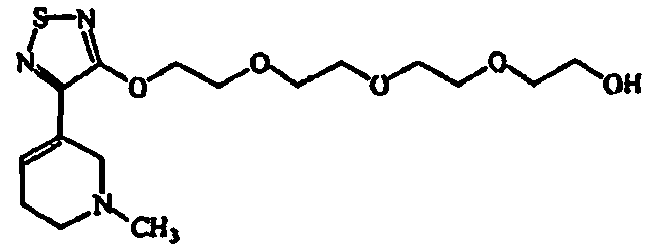
150 ± 42 nM 240 ± 64 %
0.71 ± 0.17 µMCDD-0303-A 
280 ± 130 nM n.d. CDD-0304-A 
38 ± 23 nM 600 ± 56 %
0.064 ± 0.016 µM - The compounds of Formula (III) are preferably isolated in substantially pure form.
- The binding profiles of the compounds of Formula (III) indicate their utility as pharmaceuticals useful for the treatment of various conditions in which the use of a muscarinic receptor ligand is indicated. More particularly, the compounds of Formula (III) have been found to mimic acetylcholine function via an action at muscarinic receptors and are therefore of potential use in the treatment of pain, Alzheimer's disease and other disorders involving cholinergic deficits. Furthermore, it has been found that the inclusion of heteroatoms in the alkyl chain improves the water solubility of the compounds. In addition, agonist activity is enhanced relative to the straight chain derivatives.
- The present invention also provides pharmaceutical compositions, which comprise compounds of Formula (IIII) or pharmaceutically acceptable salts thereof, and pharmaceutically acceptable carriers. The pharmaceutical composition may be in the form of patches, tablets, capsules, powders, granules, lozenges, suppositories, reconstitutable powders or liquid preparations such as oral or sterile parenteral solutions or suspensions. The pharmaceutical composition includes compounds of Formula (IIII) of a pharmaceutically acceptable level of purity excluding normal pharmaceutical additives such as diluents and carriers, and including no material considered toxic at normal dosage levels. A pharmaceutically acceptable level of purity will generally be at least 90% excluding normal pharmaceutically acceptable additives, preferably 95%, more preferably 97% and still more preferably 99%.
- Sauerbeg et al., Journal Medicinal Chemistry, 1992, Vol. 35, page 2274, reported the synthesis and SAR of potent ligands of M1 receptors based on the 1,2,5-thiadiazolyl-tetrahydropyridine moieties. In accordance with the present invention, is was found that if two 1,2,5-thiadiazolyl-tetrahydropyridine moieties are tethered by spacers of varied length and rigidity, in a single structure, the binding affinity of the resultant bis ligands is enhanced. By varying the length of the alkyl chain and also replacing some of the carbons with heteroatoms such as N, O or S, structure activity relationships is established. The two moieties in the same molecule may either bind in the pockets of two proximal receptors or in two pockets of the same receptor molecule.
- The compounds of Formulae (I) and (III) can be prepared as described below.
- The following is a detailed example of a preferred process to prepare compounds of Formulae (I) and (III). It will be understood that the following examples are not intended to limit the scope of the invention.
- 3-(3-chloro-1,2,5-thiadiazol-4-yl-pyridine (compound 1) was synthesized from 3-pyridinecarboxaldehyde following, except with slight modification, from the published procedure as provided in Sauerberg et al, Journal Medicinal Chemistry, 1992, Vol. 35, Page 2274. 3-(3-Chloro-1,2,5-thiadiazol-4-yl) pyridine was reacted with a diol (compound 2, wherein n=6, 7, 8, 9, 10 or 12) in the presence of sodium hydride in refluxing THF to yield bis[3-(pyridine-3-yl)- 1,2,5-thiadiazol-4-yl]alkyl-diethers (compound 3, wherein n=6, 7, 8, 9, 19 or 12) in 75-90% yield. These diethers were treated with excess methyl iodide in acetone or chloroform to give bis-quaternary ammonium iodides (compound 4, wherein n=6, 7, 8, 9, 10 or 12) in 96-100% yield. The quaternary salts were then treated with 5 equivalents of sodium borohydride in a mixture of methanol and chloroform to yield the compounds 5, wherein n=6, 7, 8, 9, 10 or 12 in 50-60% yield. Dry hydrogen chloride gas was then bubbled through the methanolic solution of compounds 5 at 0°C to give compounds 6, wherein n=6, 7, 8, 9, 10 or 12 in 95-100% yield.


- In view of the detailed description provided herein, it will be appreciated by one skilled in the art that the above bis-ligand methodology can include, but not be limited to, other known and potential muscarinic ligands such as tetrahydropyrimidine-oxadiazoles, tetrahydropyrimidine-thiadiazoles, quinuclidine-thiadiazoles, and the like.

CDD-0299-A: X = (CH2)12, R1 = R2 = H, R3 = COCH3
CDD-0300-A: X = (CH2CH2OCH2CH2OCH2CH2OCH2CH2), R1 = R2 = R3 = H
CDD-0303-A: X = (CH2CH2OCH2CH2OCH2CH2OCH2CH2), R1 = R2 = H, R3 = COCH3
CDD-0304-A: X = (CH2CH2OCH2CH2OCH2CH2OCH2CH2), R1 = H,
- Preparation of mono-[3-(1-methyl-1,2,5,6-tetrahydropyrid-3-yl)-1,2,5-thiadiazol-4-yl] ether derivatives.
- 3-(3-chloro-1,2,5-thiadiazol-4-yl)pyridine (compound 1) was synthesized from 3-pyridinecarboxlaldehyde following published procedures as provided in Sauerberg et al., Journal of Medicinal Chemistry, 1992, Vol. 35, page 2274. Tetra(ethylene glycol) mono ethyl ether was prepared from the reaction of tetra(ethylene glycol) with NaH and BrCH2CH3 in THF. 3-Chloro-4-methoxy-1,2,5-thiadiazole was synthesized by reacting 3, 4-dichloro-1,2,5-thiadiazole with NaOCH3.
- 3-(3-Chloro-1,2,5-thiadiazol-4-yl)pyridine was combined with compound 2 (1, 12-dodecanediol, tetra(ethylene glycol), or tetra(ethylene glycol) mono ethyl ether) in the presence of NaH in refluxing THF to give mono-[3-(pyrid-3-yl)-1,2,5-thiadiazol-4-y-l] ethers (compounds 3) in 40-60% yield.
- (For CDD-0304-A, prior to quaternization, the resulting tetra(ethylene glycol) mono-[3-(pyrid-3-yl)-1,2,5-thiadiazol-4-yl] ether was reacted further with 3-chloro-4-methoxy-1,2,5-thiadiazole to give compound 3 where R1 changed to 4-methoxy-1,2,5-thiadiazol-3-yl).
- The ethers were treated with excess CH3I in acetone to yield the quaternary ammonium iodides (compounds 4) in 85-90% yield.
- The quaternary salts then were treated with 4 equivalents of NaBH4 in CH3OH to yield the free bases (compounds 5) in 30-50% yield.
- (For CDD-0299-A and CDD-0303-A, the free bases were converted into the corresponding acetyl esters (compounds 6) by reacting with excess acetic anhydride in the presence of catalytic anhydrous ZnCl2 before conversion into hydrochlorides).
- Ethereal HCl then was added into the methylene chloride solution of compounds 5 or 6, after crystallization from acetone/ether, and the final compounds 7 were obtained in 60-80% yield.
CDD-0297-A:
Formula IIIa12-[3-(1-Methyl-1,2,5,6-tetrahydropyrid-3-yl)-1,2,5-thiadiazol-4-yloxy]-1-dodecanolhydrochloride, white powder, m.p. 97-98 °C; CDD-0299-A:
Formula IIIb12-[3-(1-Methyl-1,2,5,6-tetrahydropyrid-3-yl)-1,2,5-thiadiazol-4-yloxy]-1-dodecyl acetate hydrochloride, hygroscopic pale yellow powder, m.p. 85-86°C; CDD-0300-A:
Formula IIIcTetra(ethylene glycol) mono[3-(1-methyl-1,2,5,6-tetrahydropyrid-3-yl)-1,2,5-thiadiazol-4-yl] ether hydrochloride, yellow oil; CDD-0303-A:
Formula IIIeTatra(ethylene glycol) [3-(1-methyl-1,2,5,6-tetrahydropyrid-3-yl)-1,2,5-thiadiazol-4-yl] ether acetate hydrochloride, hygroscopic white-yellow powder, m.p. 55-55.5°C; CDD-0304-A:
Formula IIIfTetra(ethyleneglycol) (4-methoxy-1,2,5-thiadiazol-3-yl) [3-(1-methyl-1,2,5,6-tetrahydropyrid-3-yl)-1,2,5-thiadiazol-4-yl] ether hydrochloride, hygroscopic white-yellow powder, m.p. 35-37°C. - Having described presently preferred embodiments of the invention, it is to be understood that it may be otherwise embodied within the scope of the appended claims.
Claims (11)
- A compound of Formula (III):


- A muscarinic receptor ligand exhibiting agonist activity useful in the treatment of neurological and other disorders, in which stimulating cholinergic activity is desirable, the muscarinic receptor ligand comprising a compound of Formula (III):


- A compound according to claim 1 or 2, which is 12-[3-(1-methyl-1, 2, 5, 6-tetrahydropyrid-3-yl)-1,2,5-thiadiazol-4-yloxy]-1-dodecanol hydrochloride.
- A compound according to claim 1 or 2, which is 12-[3-(1-methyl-1,2,5,6-tetrahydropyrid-3-yl)-1,2,5-thiadiazol-4-yloxy]-1-dodecyl acetate hydrochloride.
- A compound according to claim 1 or 2, which is tetra(ethylene glycol)mono[3-(1-methyl-1,2,5,6-tetrahydropyrid-3-yl)-1,2,5-thiadiazol-4-yl] ether hydrochloride.
- A compound according to claim 1 or 2, which is tetra(ethylene glycol) [3-(1-methyl-1,2,5,6-tetrahydropyrid-3-yl)-1,2,5-thiadiazol-4-yl] ether acetate hydrochloride.
- A compound according to claim 1 or 2, which is tetra(ethylene glycol) (4-methoxy-1,2,5-thiadiazol-3-yl) [3-(1-methyl-1,2,5,6-tetrahydroprid-3-yl)-1,2,5-thiadiazol-4-yl] ether hydrochloride.
- A pharmaceutical composition comprising a therapeutically effective amount of a compound according to any one of claims 1 to 7, and a pharmaceutically acceptable carrier.
- A compound according to any one of claims 1 to 7, for use in the treatment of neurological and other disorders in which stimulating cholinergic activity is desirable.
- A composition according to claim 8, for use in the treatment of neurological and other disorders in which stimulating cholinergic activity is desirable.
- The use of a compound according to any one of claims 1 to 7, in the manufacture of a medicament for the treatment of neurological and other disorders in which stimulating cholinergic activity is desirable.
Applications Claiming Priority (3)
| Application Number | Priority Date | Filing Date | Title |
|---|---|---|---|
| US772143 | 2001-01-29 | ||
| US09/772,143 US6376675B2 (en) | 1999-01-22 | 2001-01-29 | Muscarinic receptor agonists |
| PCT/US2001/047474 WO2002060444A1 (en) | 2001-01-29 | 2001-12-10 | Muscarinic receptor agonists |
Publications (3)
| Publication Number | Publication Date |
|---|---|
| EP1355646A1 EP1355646A1 (en) | 2003-10-29 |
| EP1355646A4 EP1355646A4 (en) | 2004-06-16 |
| EP1355646B1 true EP1355646B1 (en) | 2009-05-13 |
Family
ID=25094053
Family Applications (1)
| Application Number | Title | Priority Date | Filing Date |
|---|---|---|---|
| EP01995477A Expired - Lifetime EP1355646B1 (en) | 2001-01-29 | 2001-12-10 | Muscarinic receptor agonists |
Country Status (9)
| Country | Link |
|---|---|
| US (2) | US6376675B2 (en) |
| EP (1) | EP1355646B1 (en) |
| JP (2) | JP2004520382A (en) |
| AT (1) | ATE431143T1 (en) |
| CA (1) | CA2434839A1 (en) |
| DE (1) | DE60138732D1 (en) |
| DK (1) | DK1355646T3 (en) |
| ES (1) | ES2327104T3 (en) |
| WO (1) | WO2002060444A1 (en) |
Cited By (2)
| Publication number | Priority date | Publication date | Assignee | Title |
|---|---|---|---|---|
| US9549928B2 (en) | 2011-04-29 | 2017-01-24 | The University Of Toledo | Muscarinic agonists as enhancers of cognitive flexibility |
| US10835532B2 (en) | 2008-05-15 | 2020-11-17 | The University Of Toledo | Muscarinic agonists as cognitive enhancers |
Families Citing this family (38)
| Publication number | Priority date | Publication date | Assignee | Title |
|---|---|---|---|---|
| US8914114B2 (en) | 2000-05-23 | 2014-12-16 | The Feinstein Institute For Medical Research | Inhibition of inflammatory cytokine production by cholinergic agonists and vagus nerve stimulation |
| EP1734941A2 (en) | 2004-03-25 | 2006-12-27 | The Feinstein Institute for Medical Research | Neural tourniquet |
| US10912712B2 (en) | 2004-03-25 | 2021-02-09 | The Feinstein Institutes For Medical Research | Treatment of bleeding by non-invasive stimulation |
| WO2006073484A2 (en) | 2004-12-27 | 2006-07-13 | North Shore-Long Island Jewish Research Institute | Treating inflammatory disorders by electrical vagus nerve stimulation |
| US11207518B2 (en) | 2004-12-27 | 2021-12-28 | The Feinstein Institutes For Medical Research | Treating inflammatory disorders by stimulation of the cholinergic anti-inflammatory pathway |
| CN101374836A (en) * | 2005-12-27 | 2009-02-25 | 托莱多大学 | Muscarinic agonists and methods of use thereof |
| WO2008118326A1 (en) * | 2007-03-23 | 2008-10-02 | University Of Toledo | Muscarinic agonists and methods of use thereof |
| US8391970B2 (en) | 2007-08-27 | 2013-03-05 | The Feinstein Institute For Medical Research | Devices and methods for inhibiting granulocyte activation by neural stimulation |
| WO2009146030A1 (en) | 2008-03-31 | 2009-12-03 | The Feinstein Institute For Medical Research | Methods and systems for reducing inflammation by neuromodulation of t-cell activity |
| US9662490B2 (en) | 2008-03-31 | 2017-05-30 | The Feinstein Institute For Medical Research | Methods and systems for reducing inflammation by neuromodulation and administration of an anti-inflammatory drug |
| WO2009152392A2 (en) * | 2008-06-11 | 2009-12-17 | University Of Toledo | Muscarinic agonists for neurological disorders and methods of making the same |
| CN102215909B (en) | 2008-11-18 | 2014-09-10 | 赛博恩特医疗器械公司 | Devices and methods for optimizing electrode placement for anti-inflamatory stimulation |
| US9211410B2 (en) | 2009-05-01 | 2015-12-15 | Setpoint Medical Corporation | Extremely low duty-cycle activation of the cholinergic anti-inflammatory pathway to treat chronic inflammation |
| US8788034B2 (en) | 2011-05-09 | 2014-07-22 | Setpoint Medical Corporation | Single-pulse activation of the cholinergic anti-inflammatory pathway to treat chronic inflammation |
| US8996116B2 (en) | 2009-10-30 | 2015-03-31 | Setpoint Medical Corporation | Modulation of the cholinergic anti-inflammatory pathway to treat pain or addiction |
| EP2440284B1 (en) | 2009-06-09 | 2018-09-12 | Setpoint Medical Corporation | Nerve cuff with pocket for leadless stimulator |
| US9833621B2 (en) | 2011-09-23 | 2017-12-05 | Setpoint Medical Corporation | Modulation of sirtuins by vagus nerve stimulation |
| US11051744B2 (en) | 2009-11-17 | 2021-07-06 | Setpoint Medical Corporation | Closed-loop vagus nerve stimulation |
| EP2515996B1 (en) | 2009-12-23 | 2019-09-18 | Setpoint Medical Corporation | Neural stimulation devices and systems for treatment of chronic inflammation |
| US12172017B2 (en) | 2011-05-09 | 2024-12-24 | Setpoint Medical Corporation | Vagus nerve stimulation to treat neurodegenerative disorders |
| US9572983B2 (en) | 2012-03-26 | 2017-02-21 | Setpoint Medical Corporation | Devices and methods for modulation of bone erosion |
| US11311725B2 (en) | 2014-10-24 | 2022-04-26 | Setpoint Medical Corporation | Systems and methods for stimulating and/or monitoring loci in the brain to treat inflammation and to enhance vagus nerve stimulation |
| US11406833B2 (en) | 2015-02-03 | 2022-08-09 | Setpoint Medical Corporation | Apparatus and method for reminding, prompting, or alerting a patient with an implanted stimulator |
| US10596367B2 (en) | 2016-01-13 | 2020-03-24 | Setpoint Medical Corporation | Systems and methods for establishing a nerve block |
| EP3405255B1 (en) | 2016-01-20 | 2025-12-31 | Setpoint Medical Corporation | IMPLANTABLE MICROSIMULATORS AND INDUCTIVE CHARGING SYSTEMS |
| US11471681B2 (en) | 2016-01-20 | 2022-10-18 | Setpoint Medical Corporation | Batteryless implantable microstimulators |
| CN108882885A (en) | 2016-01-20 | 2018-11-23 | 赛博恩特医疗器械公司 | Control of vagus nerve stimulation |
| US10583304B2 (en) | 2016-01-25 | 2020-03-10 | Setpoint Medical Corporation | Implantable neurostimulator having power control and thermal regulation and methods of use |
| EP3668402B1 (en) | 2017-08-14 | 2024-07-31 | Setpoint Medical Corporation | Vagus nerve stimulation pre-screening test |
| US11660443B2 (en) | 2018-04-20 | 2023-05-30 | The Feinstein Institutes For Medical Research | Methods and apparatuses for reducing bleeding via electrical trigeminal nerve stimulation |
| US11260229B2 (en) | 2018-09-25 | 2022-03-01 | The Feinstein Institutes For Medical Research | Methods and apparatuses for reducing bleeding via coordinated trigeminal and vagal nerve stimulation |
| US12343535B2 (en) | 2019-04-12 | 2025-07-01 | Setpoint Medical Corporation | Vagus nerve stimulation to treat neurodegenerative disorders |
| EP4090424A4 (en) | 2020-01-13 | 2024-02-21 | The Feinstein Institutes for Medical Research | Treating bleeding and bleeding disorders via high intensity focused ultrasound stimulation of the spleen |
| US11938324B2 (en) | 2020-05-21 | 2024-03-26 | The Feinstein Institutes For Medical Research | Systems and methods for vagus nerve stimulation |
| WO2022245878A1 (en) | 2021-05-17 | 2022-11-24 | Setpoint Medical Corporation | Neurostimulation parameter authentication and expiration system for neurostimulation |
| EP4466064A4 (en) | 2022-01-20 | 2026-01-14 | Setpoint Medical Corp | TREATMENT OF INFLAMMATORY DISEASES |
| CN121605195A (en) * | 2023-08-03 | 2026-03-03 | 纽罗克里生物科学有限公司 | Synthesis method |
| WO2025174424A1 (en) * | 2024-02-16 | 2025-08-21 | Terran Biosciences Inc. | Analogs of xanomeline, analogs of trospium, and methods of use thereof |
Family Cites Families (6)
| Publication number | Priority date | Publication date | Assignee | Title |
|---|---|---|---|---|
| US5043345A (en) * | 1989-02-22 | 1991-08-27 | Novo Nordisk A/S | Piperidine compounds and their preparation and use |
| DK198390D0 (en) * | 1990-08-21 | 1990-08-21 | Novo Nordisk As | HETEROCYCLIC COMPOUNDS, THEIR PREPARATION AND USE |
| US5376668A (en) * | 1990-08-21 | 1994-12-27 | Novo Nordisk A/S | Heterocyclic compounds |
| WO1993014089A1 (en) | 1992-01-13 | 1993-07-22 | Novo Nordisk A/S | Heterocyclic compounds and their preparation and use |
| US5718912A (en) | 1996-10-28 | 1998-02-17 | Merck & Co., Inc. | Muscarine agonists |
| US6096767A (en) | 1999-01-22 | 2000-08-01 | The University Of Toledo | Muscarinic receptor agonists |
-
2001
- 2001-01-29 US US09/772,143 patent/US6376675B2/en not_active Expired - Fee Related
- 2001-12-10 WO PCT/US2001/047474 patent/WO2002060444A1/en not_active Ceased
- 2001-12-10 AT AT01995477T patent/ATE431143T1/en not_active IP Right Cessation
- 2001-12-10 EP EP01995477A patent/EP1355646B1/en not_active Expired - Lifetime
- 2001-12-10 CA CA002434839A patent/CA2434839A1/en not_active Abandoned
- 2001-12-10 ES ES01995477T patent/ES2327104T3/en not_active Expired - Lifetime
- 2001-12-10 DE DE60138732T patent/DE60138732D1/en not_active Expired - Lifetime
- 2001-12-10 DK DK01995477T patent/DK1355646T3/en active
- 2001-12-10 JP JP2002560636A patent/JP2004520382A/en not_active Ceased
- 2001-12-20 US US10/034,229 patent/US6602891B2/en not_active Expired - Fee Related
-
2010
- 2010-03-02 JP JP2010045346A patent/JP2010159274A/en not_active Withdrawn
Cited By (2)
| Publication number | Priority date | Publication date | Assignee | Title |
|---|---|---|---|---|
| US10835532B2 (en) | 2008-05-15 | 2020-11-17 | The University Of Toledo | Muscarinic agonists as cognitive enhancers |
| US9549928B2 (en) | 2011-04-29 | 2017-01-24 | The University Of Toledo | Muscarinic agonists as enhancers of cognitive flexibility |
Also Published As
| Publication number | Publication date |
|---|---|
| JP2010159274A (en) | 2010-07-22 |
| US20030032658A1 (en) | 2003-02-13 |
| US20010036953A1 (en) | 2001-11-01 |
| EP1355646A4 (en) | 2004-06-16 |
| WO2002060444A1 (en) | 2002-08-08 |
| ES2327104T3 (en) | 2009-10-26 |
| US6376675B2 (en) | 2002-04-23 |
| DE60138732D1 (en) | 2009-06-25 |
| JP2004520382A (en) | 2004-07-08 |
| US6602891B2 (en) | 2003-08-05 |
| EP1355646A1 (en) | 2003-10-29 |
| CA2434839A1 (en) | 2002-08-08 |
| DK1355646T3 (en) | 2009-08-17 |
| ATE431143T1 (en) | 2009-05-15 |
Similar Documents
| Publication | Publication Date | Title |
|---|---|---|
| US6602891B2 (en) | Muscarinic receptor agonists | |
| US9593102B2 (en) | Piperidine compounds, pharmaceutical composition comprising the same and its use | |
| AU2001275326A1 (en) | Treatment of gastroesophageal reflux disease using piperidine derivatives | |
| US20090221642A1 (en) | Muscarinic receptor agonists, compositions, methods of treatment thereof, and processes for preparation thereof-176 | |
| DE69718498T2 (en) | SUBSTITUTED BENZOYLTHIAZOLE DERIVATIVES AND MEDICINAL PRODUCTS CONTAINING THEM | |
| US6369081B1 (en) | Muscarinic receptor agonists | |
| EP0596891B1 (en) | Aminoalkyl-substituted 2-amino-5-mercaptothiadiazoles, their preparation and their use | |
| US6211204B1 (en) | Muscarinic receptor agonists | |
| EP0589908B1 (en) | Aminoalkyl-substituted thiazolin-2-ones, their preparation and their use | |
| EP0589903B1 (en) | Aminoalkyl-substituted 5-mercaptothiazoles, their preparation and their use | |
| EP0675109A1 (en) | N-substituted indole derivative | |
| JPH10203987A (en) | (R) -1-Ethyl-4-methylhexahydro-1H-1,4-diazepine derivative as active ingredient for suppressing morphine-like drug-induced emesis | |
| RO108683B1 (en) | Butynilamine derivates and preparation process therefor | |
| EP0457331B1 (en) | Piperidine derivatives and antiulcer composition containing the same | |
| JP2920727B2 (en) | New 1,4- (diphenylalkyl) homopiperazine derivatives | |
| KR20080041733A (en) | Thiomorpholine compound and preparation method thereof | |
| WO2011075470A1 (en) | Quaternary piperidine compounds and uses thereof | |
| WO1992022541A1 (en) | Aminoalkyl-substituted 2-amino-1,3,4-thiadiazoles, their preparation and their use | |
| HK1225375B (en) | Piperidine compounds, pharmaceutical composition comprising the same and its use | |
| HK1225375A1 (en) | Piperidine compounds, pharmaceutical composition comprising the same and its use | |
| HK1200446B (en) | Piperidine compounds, pharmaceutical composition comprising the same and its use | |
| HK1162176B (en) | Piperidine compounds, pharmaceutical composition comprising the same and its use | |
| JP2005220027A (en) | 2,2-diphenyl-1-ethanone derivative and pharmaceutical containing the same | |
| WO2009152392A2 (en) | Muscarinic agonists for neurological disorders and methods of making the same | |
| WO1996031479A1 (en) | Novel heterocyclic compounds |
Legal Events
| Date | Code | Title | Description |
|---|---|---|---|
| PUAI | Public reference made under article 153(3) epc to a published international application that has entered the european phase |
Free format text: ORIGINAL CODE: 0009012 |
|
| 17P | Request for examination filed |
Effective date: 20030729 |
|
| AK | Designated contracting states |
Kind code of ref document: A1 Designated state(s): AT BE CH CY DE DK ES FI FR GB GR IE IT LI LU MC NL PT SE TR |
|
| AX | Request for extension of the european patent |
Extension state: AL LT LV MK RO SI |
|
| RIN1 | Information on inventor provided before grant (corrected) |
Inventor name: MESSER, WILLIAM, S. Inventor name: CAO, YANG |
|
| A4 | Supplementary search report drawn up and despatched |
Effective date: 20040506 |
|
| 17Q | First examination report despatched |
Effective date: 20060620 |
|
| 17Q | First examination report despatched |
Effective date: 20060620 |
|
| GRAP | Despatch of communication of intention to grant a patent |
Free format text: ORIGINAL CODE: EPIDOSNIGR1 |
|
| GRAS | Grant fee paid |
Free format text: ORIGINAL CODE: EPIDOSNIGR3 |
|
| GRAA | (expected) grant |
Free format text: ORIGINAL CODE: 0009210 |
|
| AK | Designated contracting states |
Kind code of ref document: B1 Designated state(s): AT BE CH CY DE DK ES FI FR GB GR IE IT LI LU MC NL PT SE TR |
|
| REG | Reference to a national code |
Ref country code: GB Ref legal event code: FG4D |
|
| REG | Reference to a national code |
Ref country code: CH Ref legal event code: EP |
|
| REG | Reference to a national code |
Ref country code: IE Ref legal event code: FG4D |
|
| REF | Corresponds to: |
Ref document number: 60138732 Country of ref document: DE Date of ref document: 20090625 Kind code of ref document: P |
|
| REG | Reference to a national code |
Ref country code: CH Ref legal event code: NV Representative=s name: ISLER & PEDRAZZINI AG |
|
| REG | Reference to a national code |
Ref country code: DK Ref legal event code: T3 |
|
| REG | Reference to a national code |
Ref country code: SE Ref legal event code: TRGR |
|
| REG | Reference to a national code |
Ref country code: ES Ref legal event code: FG2A Ref document number: 2327104 Country of ref document: ES Kind code of ref document: T3 |
|
| PG25 | Lapsed in a contracting state [announced via postgrant information from national office to epo] |
Ref country code: AT Free format text: LAPSE BECAUSE OF FAILURE TO SUBMIT A TRANSLATION OF THE DESCRIPTION OR TO PAY THE FEE WITHIN THE PRESCRIBED TIME-LIMIT Effective date: 20090513 Ref country code: PT Free format text: LAPSE BECAUSE OF FAILURE TO SUBMIT A TRANSLATION OF THE DESCRIPTION OR TO PAY THE FEE WITHIN THE PRESCRIBED TIME-LIMIT Effective date: 20090913 |
|
| PGFP | Annual fee paid to national office [announced via postgrant information from national office to epo] |
Ref country code: CH Payment date: 20091228 Year of fee payment: 9 Ref country code: DK Payment date: 20091229 Year of fee payment: 9 Ref country code: ES Payment date: 20091228 Year of fee payment: 9 Ref country code: FI Payment date: 20091231 Year of fee payment: 9 Ref country code: TR Payment date: 20091123 Year of fee payment: 9 |
|
| PGFP | Annual fee paid to national office [announced via postgrant information from national office to epo] |
Ref country code: NL Payment date: 20091224 Year of fee payment: 9 |
|
| PLBE | No opposition filed within time limit |
Free format text: ORIGINAL CODE: 0009261 |
|
| STAA | Information on the status of an ep patent application or granted ep patent |
Free format text: STATUS: NO OPPOSITION FILED WITHIN TIME LIMIT |
|
| 26N | No opposition filed |
Effective date: 20100216 |
|
| PGFP | Annual fee paid to national office [announced via postgrant information from national office to epo] |
Ref country code: FR Payment date: 20100106 Year of fee payment: 9 Ref country code: GB Payment date: 20091229 Year of fee payment: 9 Ref country code: IT Payment date: 20091228 Year of fee payment: 9 |
|
| PGFP | Annual fee paid to national office [announced via postgrant information from national office to epo] |
Ref country code: BE Payment date: 20100212 Year of fee payment: 9 Ref country code: DE Payment date: 20091230 Year of fee payment: 9 |
|
| PG25 | Lapsed in a contracting state [announced via postgrant information from national office to epo] |
Ref country code: MC Free format text: LAPSE BECAUSE OF NON-PAYMENT OF DUE FEES Effective date: 20100701 |
|
| REG | Reference to a national code |
Ref country code: IE Ref legal event code: MM4A |
|
| PG25 | Lapsed in a contracting state [announced via postgrant information from national office to epo] |
Ref country code: IE Free format text: LAPSE BECAUSE OF NON-PAYMENT OF DUE FEES Effective date: 20091210 Ref country code: GR Free format text: LAPSE BECAUSE OF FAILURE TO SUBMIT A TRANSLATION OF THE DESCRIPTION OR TO PAY THE FEE WITHIN THE PRESCRIBED TIME-LIMIT Effective date: 20090814 |
|
| PG25 | Lapsed in a contracting state [announced via postgrant information from national office to epo] |
Ref country code: LU Free format text: LAPSE BECAUSE OF NON-PAYMENT OF DUE FEES Effective date: 20091210 |
|
| PGFP | Annual fee paid to national office [announced via postgrant information from national office to epo] |
Ref country code: SE Payment date: 20091230 Year of fee payment: 9 |
|
| BERE | Be: lapsed |
Owner name: UNIVERSITY OF TOLEDO Effective date: 20101231 |
|
| REG | Reference to a national code |
Ref country code: NL Ref legal event code: V1 Effective date: 20110701 |
|
| REG | Reference to a national code |
Ref country code: CH Ref legal event code: PL |
|
| REG | Reference to a national code |
Ref country code: DK Ref legal event code: EBP |
|
| GBPC | Gb: european patent ceased through non-payment of renewal fee |
Effective date: 20101210 |
|
| PG25 | Lapsed in a contracting state [announced via postgrant information from national office to epo] |
Ref country code: FI Free format text: LAPSE BECAUSE OF NON-PAYMENT OF DUE FEES Effective date: 20101210 |
|
| REG | Reference to a national code |
Ref country code: FR Ref legal event code: ST Effective date: 20110831 |
|
| REG | Reference to a national code |
Ref country code: SE Ref legal event code: EUG |
|
| PG25 | Lapsed in a contracting state [announced via postgrant information from national office to epo] |
Ref country code: BE Free format text: LAPSE BECAUSE OF NON-PAYMENT OF DUE FEES Effective date: 20101231 Ref country code: CY Free format text: LAPSE BECAUSE OF FAILURE TO SUBMIT A TRANSLATION OF THE DESCRIPTION OR TO PAY THE FEE WITHIN THE PRESCRIBED TIME-LIMIT Effective date: 20090513 Ref country code: SE Free format text: LAPSE BECAUSE OF NON-PAYMENT OF DUE FEES Effective date: 20101211 |
|
| PG25 | Lapsed in a contracting state [announced via postgrant information from national office to epo] |
Ref country code: CH Free format text: LAPSE BECAUSE OF NON-PAYMENT OF DUE FEES Effective date: 20101231 Ref country code: LI Free format text: LAPSE BECAUSE OF NON-PAYMENT OF DUE FEES Effective date: 20101231 Ref country code: FR Free format text: LAPSE BECAUSE OF NON-PAYMENT OF DUE FEES Effective date: 20110103 |
|
| REG | Reference to a national code |
Ref country code: DE Ref legal event code: R119 Ref document number: 60138732 Country of ref document: DE Effective date: 20110701 |
|
| PG25 | Lapsed in a contracting state [announced via postgrant information from national office to epo] |
Ref country code: DE Free format text: LAPSE BECAUSE OF NON-PAYMENT OF DUE FEES Effective date: 20110701 Ref country code: GB Free format text: LAPSE BECAUSE OF NON-PAYMENT OF DUE FEES Effective date: 20101210 |
|
| PG25 | Lapsed in a contracting state [announced via postgrant information from national office to epo] |
Ref country code: IT Free format text: LAPSE BECAUSE OF NON-PAYMENT OF DUE FEES Effective date: 20101210 Ref country code: NL Free format text: LAPSE BECAUSE OF NON-PAYMENT OF DUE FEES Effective date: 20110701 |
|
| REG | Reference to a national code |
Ref country code: ES Ref legal event code: FD2A Effective date: 20120411 |
|
| PG25 | Lapsed in a contracting state [announced via postgrant information from national office to epo] |
Ref country code: ES Free format text: LAPSE BECAUSE OF NON-PAYMENT OF DUE FEES Effective date: 20101211 |
|
| PG25 | Lapsed in a contracting state [announced via postgrant information from national office to epo] |
Ref country code: TR Free format text: LAPSE BECAUSE OF NON-PAYMENT OF DUE FEES Effective date: 20101210 |