EP1355445A2 - Method and apparatus for encrypting/decrypting data - Google Patents
Method and apparatus for encrypting/decrypting data Download PDFInfo
- Publication number
- EP1355445A2 EP1355445A2 EP03251967A EP03251967A EP1355445A2 EP 1355445 A2 EP1355445 A2 EP 1355445A2 EP 03251967 A EP03251967 A EP 03251967A EP 03251967 A EP03251967 A EP 03251967A EP 1355445 A2 EP1355445 A2 EP 1355445A2
- Authority
- EP
- European Patent Office
- Prior art keywords
- data
- decryption key
- time value
- encryption
- key
- Prior art date
- Legal status (The legal status is an assumption and is not a legal conclusion. Google has not performed a legal analysis and makes no representation as to the accuracy of the status listed.)
- Granted
Links
Images

Classifications
-
- H—ELECTRICITY
- H04—ELECTRIC COMMUNICATION TECHNIQUE
- H04L—TRANSMISSION OF DIGITAL INFORMATION, e.g. TELEGRAPHIC COMMUNICATION
- H04L9/00—Cryptographic mechanisms or cryptographic arrangements for secret or secure communications; Network security protocols
- H04L9/30—Public key, i.e. encryption algorithm being computationally infeasible to invert or user's encryption keys not requiring secrecy
- H04L9/3066—Public key, i.e. encryption algorithm being computationally infeasible to invert or user's encryption keys not requiring secrecy involving algebraic varieties, e.g. elliptic or hyper-elliptic curves
- H04L9/3073—Public key, i.e. encryption algorithm being computationally infeasible to invert or user's encryption keys not requiring secrecy involving algebraic varieties, e.g. elliptic or hyper-elliptic curves involving pairings, e.g. identity based encryption [IBE], bilinear mappings or bilinear pairings, e.g. Weil or Tate pairing
Definitions
- the present invention relates to a method and apparatus for encrypting/decrypting data.
- a more recent cryptographic schema is Identifier-Based Encryption (IBE).
- IBE Identifier-Based Encryption
- a data provider encrypts payload data using an encryption key string and public data provided by a trusted authority; the data provider then provides the encrypted payload data to a recipient who decrypts it using a decryption key provided by the trust authority together with the latter's public data.
- the trusted authority's public data is derived by the authority using private data using a one-way function.
- IBE schema is that any kind of string (including a name, a role, etc.) can be used as an encryption key string, and that the generation of the decryption key is effected by the trust authority using the encryption key string and its private data, enabling the generation of the decryption key to be postponed until needed for decryption.
- any kind of string including a name, a role, etc.
- IBE algorithms are known, including the "Quadratic Residuosity” (QR) method described in the paper: “An Identity Based Encryption Scheme based on Quadratic Residues”. C. Cocks Communications-Electronics Security Group (CESG), UK. http://www.cesg.gov.uk/technology/idpkc/media/ciren.pdf - 2001.
- Other IBE algorithms are known such as the use of Weil or Tate pairings - see, for example: D. Boneh, M. Franklin - Identity-based Encryption from the Weil Pairing. Crypto 2001 - 2001.
- a security method comprising:
- This provides the advantage of ensuring that a decryption key required to decrypt encrypted data is only generated when access to confidential information is authorised.
- a computer system comprising a first computing entity arranged to encrypt, for output, first data according to an encryption process involving both an encryption key and second, public, data provided by a trusted party; a second computing entity associated with the trusted party and arranged to determine, for output, a decryption key using both third data and fourth, private, data from which said second data has been derived; and a third computing entity arranged to receive both the encrypted first data and the decryption key, and to decrypt the received encrypted first data using the received decryption key; characterised in that the first computing entity is arranged to use a time value as said encryption key, and in that the second computing entity is arranged to determine said decryption key at intervals using as said third data, at each determination, a new current time value derived independently of said encryption key, the decryption key being so determined by the second computing entity that, for a said current time value equalling the time value used by the first computing entity for its encryption key, the
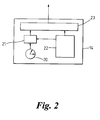
- apparatus for generating a decryption key comprising a memory for holding private data, a clock, and a processor for generating, at intervals, a decryption key using both said private data and a current time value from the clock, each decryption key generated being apt to decrypt data encrypted using both public data derived using said private data and a time value corresponding to the current time value used in generating the decryption key.
- the present invention addresses the issue of controlling access to data, where the owner/originator of the relevant data wishes to restrict access to the data until a specific time (which could include year, month, day as well as hours and minutes).
- a specific time which could include year, month, day as well as hours and minutes.
- This is achieved by using a encryption key to encrypt the data where the encryption key is derived using data that equates to the specific time the owner/originator of the data wishes to allow access to the data, and where the corresponding decryption key is only generated at that specific time (i.e. at the time owner/originator wishes to allow access to the data).
- Figure 1 illustrates a computer system 10 according to an embodiment of the present invention.
- Computer system 10 includes a first computer entity 11, a second computer entity 12, a third computer entity 13 and a fourth computer entity 14.
- the three computer entities 11, 12, 13 are coupled via a network 15, for example the Internet, while the fourth computer entity 14 is coupled directly to the third computer entity 13, via a secure link.
- a document generation software application 16 for example Acrobat writer, that includes a software plug-in 161 for allowing encryption of documents generated by the application using an identity based encryption IBE mechanism, as described below.
- a document reader software application 17 for example Acrobat reader, that includes a software plug-in 171 for allowing decryption of documents generated by the document generation software application 16 of the first computer entity 11 using an identity based encryption IBE mechanism, as described below.
- the third computer entity 13 acts as a distribution service 131 for the fourth computer entity 14, where the fourth computer entity 14 acts as a trust authority 141 that makes available, via the distribution service 131 of the third computer entity 13, trust authority encryption data 142 and decryption key data 143, as described below.
- the distribution service 131 can make available the trust authorities encryption data 142 and decryption key data 143 in a variety of ways, for example via a web site.
- the fourth computer entity 14 As the fourth computer entity 14 is acting as a trust authority 141 the fourth computer entity 14 would ideally operate in a secure environment, for example within a secure building, or secure room and/or be constructed as a tamper-resistant box.
- the trust authority's encryption data 142 comprises:
- time can be a time-of-day value and/or a calendar date or any other measure of time.
- a user of the first computer entity 11 creates a document using the document generation software application 16.
- a specified time for example until a specific hour of a given day, month and year
- the user inputs into the document generation software application 16 this specific time, this could be achieved, for example, by the application 16 being arranged to prompt the user with a request as to when the information should be made available to the recipient.
- the software plug-in encrypts, using the IBE mechanism, the document using the time information, or typically a digital representation of the time information, as the encryption key.
- #(encryptionkeystring) may be non-square
- the software plug-in 161 then computes the value: s - ⁇ ( t - -#( encryptionkeystring )/ t - ) mod N for each bit m.
- the document generation application 16 obtains the trust authorities encryption data 142 by any suitable means, for example the encryption data could be pre-loaded within the software plug-in 161 or could be downloaded from the distribution service 131, via the network 15.
- the time information format used to generate the encryption key will typically be determined by the trust authority 141 that provides the associated decryption key and, typically, will be standardised, for example Greenwich Mean Time GMT or Universal Time Co-ordinates UTC.
- the encrypted data (that is, the values s + and s - for each bit m of the user's data) is made available to the intended recipient via the second computer entity 17, by any suitable means, for example via e-mail or by being placed in a electronic public area.
- the identity of the trust authority 141 and encryption key i.e. the designated time period from when the intended recipient can access the document) can also be provided to the recipient if the intended recipient does not already have access to this information.
- the document reader software application plug-in 171 needs to obtain, from the distribution service 131, a decryption key that corresponds to the encryption key, as described below, where the decryption key is only generated at the appropriate time (i.e. at substantially the same time as the time represented by the data set used to generate the encryption key).
- Any suitable time intervals for the generation of associated decryption keys can be used, therefore depending on the circumstance this could be, for example, seconds, minutes or day. Accordingly, the clock time ideally would include years, months, days, hours and minutes.
- the first computer entity 11 will have chosen the time value used for its encryption key to be a value corresponding to a time for which the computer entity will generate a decryption key.
- the trust authority 141 is arranged to provide a decryption key on the hour every hour
- the processor 21 calculates a decryption key using an " encryptionkeystring " that corresponds to the current hour time.
- the resultant decryption key will be apt to decrypt data that has been encrypted using the same " encryptionkeystring " value.
- the decryption key corresponding to the encryption key used by the first computer entity is not generated until the specific time selected by the first computer entity for when access to the encrypted data is authorised.
- the processor 21 calculates a decryption key that is associated with the encryption key.
- the associated decryption key B is determined by the trust authority 141 as follows : B 2 ⁇ #( encryptionkeystring ) mod N ("positive" solution)
- N is a product of two prime numbers p
- q it would be extremely difficult for any one to calculate the decryption key B with only knowledge of the encryption key string and N.
- the trust authority 141 has knowledge of p and q (i.e. two prime numbers) it is relatively straightforward for the trust authority 141 to calculate B.
- the fourth computer entity 14 On calculation of the decryption key the fourth computer entity 14 provides the decryption key to the distribution service 131 (together, preferably, with an indication of whether this is the "positive” or “negative” solution for B), thereby making the decryption key available to the recipient of the encrypted data and allowing the recipient to decrypt the encrypted data.
- the distribution service 131 can make the decryption key available by any suitable means, for example, via a web site or distributed in conjunction with transmitted time information over a national or global time distribution system.
- the distribution service 131 is arranged to make available (i.e. publish) the encryption key for use by the recipient, where the recipient may, for example, correspond to a group of people within a company or globally to everyone.
- the distribution service 131 could include load-balancing machines (not shown) to spread the web site access load.
- the distribution service 131 could also maintain a database of previously available decryption keys, thereby allowing a recipient of encrypted data to obtain an appropriate decryption key for some time after the represented time used to generate the encryption key.
- the recipient may choose to cache the decryption key to decrypt the document at a later date.
- the above embodiment uses the QR IBE encryption/decryption mechanism, however, other forms of IBE could be used such as those based on Weil or Tate pairings.
- the fourth computer entity 14 could be configured to allow an authorised individual to reconfigure the fourth computer entity 14 to allow the generation of previously created decryption keys, for example if the distribution service database was destroyed.
- the source of time used by the trust authority need not be a clock of the computer entity 14 but could be time signals received from another source though in this case, appropriate measures are preferably applied to ensure that the time signals are secure.
Landscapes
- Engineering & Computer Science (AREA)
- Theoretical Computer Science (AREA)
- Mathematical Physics (AREA)
- General Physics & Mathematics (AREA)
- Mathematical Analysis (AREA)
- Mathematical Optimization (AREA)
- Physics & Mathematics (AREA)
- Pure & Applied Mathematics (AREA)
- Algebra (AREA)
- Computing Systems (AREA)
- Computer Security & Cryptography (AREA)
- Computer Networks & Wireless Communication (AREA)
- Signal Processing (AREA)
- Storage Device Security (AREA)
- Facsimile Transmission Control (AREA)
Abstract
Description
- a hash function # which when applied to a string returns a value in the range 0 to N-1, and
- a value N that is a product of two random prime numbers p and q, where
the values of p and q are only known to the
trust authority 17; the values of p and q should ideally be in the range of 2511 and 2512 and should both satisfy the equation: p,q ≡ 3 mod 4 (however, p and q must not have the same value).
Claims (21)
- A security method, comprising:characterised in that the encryption key used by the data discloser (11) comprises a time value, and in that the decryption key is determined by the trusted party (141) at intervals with said further data comprising, at each determination, a new current time value derived independently of said encryption key, the decryption key being so determined that, for a said current time value equalling the time value used by the data discloser for its encryption key, the decryption key is apt to decrypt the discloser's encrypted data.first operations, effected by a discloser (11) of data, comprising encrypting the data and providing the encrypted data to a recipient (12), the encryption process using both an encryption key and public data (142) provided by a trusted party (141) and derived thereby using private data (143); andsecond operations, effected by the trusted party (141), comprising using both said private data and further data, in order to determine a decryption key which is then output;
- A computer system according to claim 1, wherein said current time value is derived from a real-time clock (20) associated with the trusted party.
- A method according to claim 1 or 2, wherein the decryption key is determined at regular time intervals.
- A method according to any one of the preceding claims, wherein said current time value corresponds to a date.
- A method according to any one of the preceding claims, wherein the time value used as the encryption key is chosen from amongst time values known to be ones that will be used as current time values in determining the decryption key.
- A method according to any one of the preceding claims, wherein the cryptographic processes effected in respect of the said encryption and decryption keys are identifier-based cryptographic processes utilising quadratic residuosity.
- A method according to any one of claims 1 to 5, wherein the cryptographic processes effected in respect of the said encryption and decryption keys are identifier-based cryptographic processes utilising Weil or Tate pairings.
- A computer system comprising a first computing entity (11) arranged to encrypt, for output, first data according to an encryption process involving both an encryption key and second, public, data (142) provided by a trusted party (141); a second computing entity (14) associated with the trusted party (141) and arranged to determine, for output, a decryption key using both third data and fourth, private, data from which said second data has been derived; and a third computing entity (12) arranged to receive both the encrypted first data and the decryption key, and to decrypt the received encrypted first data using the received decryption key; characterised in that the first computing entity (14) is arranged to use a time value as said encryption key, and in that the second computing entity is arranged to determine said decryption key at intervals using as said third data, at each determination, a new current time value derived independently of said encryption key (11), the decryption key being so determined by the second computing entity (14) that, for a said current time value equalling the time value used by the first computing entity (11) for its encryption key, the decryption key is apt to decrypt the encrypted first data.
- A computer system according to claim 8, wherein the second computing entity (14) is tamper resistant.
- A computer system according to claim 8 or claim 9, wherein the second computing entity (14) includes a real-time clock (20) from which said current time values are generated.
- A computer system according to any one of claims 8 to 10, wherein said current time value corresponds to a date.
- A computer system according to any one of claims 8 to 11, further comprising a distribution sub-system for distributing the decryption key.
- A computer system according to any one of claims 8 to 12, wherein the second computing entity (14) is arranged to determine the decryption key at regular time intervals.
- A computer system according to any one of claims 8 to 13, wherein the first computing entity (11) is arranged to select as said second data, a time value that it knows is one for which the second computing entity will use as a said current time value for determining the decryption key.
- A computer system according to any one of claims 8 to 14, wherein the cryptographic processes effected by the first, second and third computing entities (11,12,14) in respect of the said encryption and decryption keys are identifier-based cryptographic processes utilising quadratic residuosity.
- A computer system according to any one of claims 8 to 14, wherein the cryptographic processes effected by the first, second and third computing entities (11,12,14) in respect of the said encryption and decryption keys are identifier-based cryptographic processes utilising Weil or Tate pairings.
- Apparatus for generating a decryption key, comprising a memory (22) for holding private data (143), a clock (20), and a processor (21) for generating, at intervals, a decryption key using both said private data and a current time value from the clock (20), each decryption key generated being apt to decrypt data encrypted using both public data derived using said private data and a time value corresponding to the current time value used in generating the decryption key.
- Apparatus according to claim 17, further comprising tamper resistant means to inhibit tampering with the apparatus.
- Apparatus according to claim 17 or claim 18, wherein said current time value corresponds to a date.
- Apparatus according to any one of claims 17 to 19, wherein the decryption key is generated by an identifier-based cryptographic process utilising quadratic residuosity.
- Apparatus according to any one of claims 17 to 19, wherein the decryption key is generated by an identifier-based cryptographic processes utilising Weil or Tate pairings.
Applications Claiming Priority (2)
| Application Number | Priority Date | Filing Date | Title |
|---|---|---|---|
| GB0208858 | 2002-04-18 | ||
| GBGB0208858.1A GB0208858D0 (en) | 2002-04-18 | 2002-04-18 | Method and apparatus for encrypting/decrypting data |
Publications (3)
| Publication Number | Publication Date |
|---|---|
| EP1355445A2 true EP1355445A2 (en) | 2003-10-22 |
| EP1355445A3 EP1355445A3 (en) | 2004-03-10 |
| EP1355445B1 EP1355445B1 (en) | 2007-10-17 |
Family
ID=9935054
Family Applications (1)
| Application Number | Title | Priority Date | Filing Date |
|---|---|---|---|
| EP03251967A Expired - Lifetime EP1355445B1 (en) | 2002-04-18 | 2003-03-28 | Method and apparatus for encrypting/decrypting data |
Country Status (4)
| Country | Link |
|---|---|
| US (1) | US7321660B2 (en) |
| EP (1) | EP1355445B1 (en) |
| DE (1) | DE60316861T2 (en) |
| GB (1) | GB0208858D0 (en) |
Cited By (1)
| Publication number | Priority date | Publication date | Assignee | Title |
|---|---|---|---|---|
| GB2413863A (en) * | 2004-05-08 | 2005-11-09 | Ibm | Method and system for distribution of information |
Families Citing this family (32)
| Publication number | Priority date | Publication date | Assignee | Title |
|---|---|---|---|---|
| GB0215590D0 (en) * | 2002-07-05 | 2002-08-14 | Hewlett Packard Co | Method and apparatus for generating a cryptographic key |
| GB0312736D0 (en) * | 2003-06-04 | 2003-07-09 | Ibm | Method and system for controlling the disclosure time of information |
| US7017181B2 (en) * | 2003-06-25 | 2006-03-21 | Voltage Security, Inc. | Identity-based-encryption messaging system with public parameter host servers |
| US7580521B1 (en) * | 2003-06-25 | 2009-08-25 | Voltage Security, Inc. | Identity-based-encryption system with hidden public key attributes |
| US7685414B1 (en) * | 2004-08-27 | 2010-03-23 | Voltage Security, Inc. | Subscription management service for secure messaging system |
| CA2526791C (en) * | 2005-11-14 | 2012-01-10 | Bce Inc. | Method and system for providing personalized service mobility |
| WO2008048713A2 (en) * | 2006-05-05 | 2008-04-24 | President And Fellows Of Harvard College | Practical secrecy-preserving, verifiably correct and trustworthy auctions |
| US7917442B2 (en) * | 2006-09-21 | 2011-03-29 | Sony Corporation | System and method for relaxing media access restrictions over time |
| US8526621B2 (en) * | 2006-12-01 | 2013-09-03 | President And Fellows Of Harvard College | Method and apparatus for time-lapse cryptography |
| US20090327141A1 (en) * | 2007-04-18 | 2009-12-31 | Rabin Michael O | Highly efficient secrecy-preserving proofs of correctness of computation |
| US7933408B2 (en) * | 2007-06-15 | 2011-04-26 | Microsoft Corporation | Asynchronous download |
| US20090055364A1 (en) * | 2007-08-21 | 2009-02-26 | Microsoft Corporation | Declarative views for mapping |
| US8150886B2 (en) * | 2007-08-29 | 2012-04-03 | Microsoft Corporation | Multiple database entity model generation using entity models |
| US20090177591A1 (en) * | 2007-10-30 | 2009-07-09 | Christopher Thorpe | Zero-knowledge proofs in large trades |
| US8161154B2 (en) * | 2007-12-04 | 2012-04-17 | Hewlett-Packard Development Company, L.P. | Establishing a thin client terminal services session |
| US9947002B2 (en) | 2008-02-15 | 2018-04-17 | First Data Corporation | Secure authorization of contactless transaction |
| US20090228715A1 (en) * | 2008-03-05 | 2009-09-10 | Research In Motion Limited | Media security system and method |
| US8171560B2 (en) * | 2008-04-07 | 2012-05-01 | Microsoft Corporation | Secure content pre-distribution to designated systems |
| US9460435B2 (en) * | 2008-04-23 | 2016-10-04 | City University Of Hong Kong | Advancing a committed transaction time |
| GB0811897D0 (en) * | 2008-06-30 | 2008-07-30 | Steed Darren | Intelligent file encapsulation |
| US9077526B2 (en) | 2008-09-30 | 2015-07-07 | Apple Inc. | Method and system for ensuring sequential playback of digital media |
| KR20100042457A (en) * | 2008-10-16 | 2010-04-26 | 삼성전자주식회사 | Method and apparatus for data encryption, and method and apparatus for data decryption |
| JP2010193343A (en) * | 2009-02-20 | 2010-09-02 | Kddi Corp | Content distribution system and method, and program |
| US20120311317A1 (en) * | 2011-06-02 | 2012-12-06 | David Elrod | Access-controlled customer data offloading to blind public utility-managed device |
| US8732481B2 (en) * | 2012-01-30 | 2014-05-20 | Hewlett-Packard Development Company, L.P. | Object with identity based encryption |
| EP2962422B1 (en) * | 2013-02-27 | 2020-09-23 | Ciphertooth, Inc. | Method and apparatus for secure data transmissions |
| US10182041B2 (en) | 2013-02-27 | 2019-01-15 | CipherTooth, Inc. | Method and apparatus for secure data transmissions |
| US9559840B2 (en) | 2013-10-18 | 2017-01-31 | Globalfoundries Inc. | Low-bandwidth time-embargoed content disclosure |
| DE102014212038A1 (en) * | 2014-06-24 | 2015-12-24 | Qsc Ag | Network system with end-to-end encryption |
| US10133862B1 (en) | 2017-05-09 | 2018-11-20 | International Business Machines Corporation | Timer and content security |
| CN109218017A (en) * | 2018-07-26 | 2019-01-15 | 饶四强 | It is a kind of to use two dimensional code and using network time as the message leaving method of key |
| CN109274494B (en) * | 2018-11-27 | 2022-06-21 | 新华三技术有限公司 | Method and device for maintaining secret key |
Family Cites Families (14)
| Publication number | Priority date | Publication date | Assignee | Title |
|---|---|---|---|---|
| FI93280C (en) | 1993-04-05 | 1995-03-10 | Icl Personal Systems Oy | Arrangements for storing data in a computer device |
| US5337357A (en) | 1993-06-17 | 1994-08-09 | Software Security, Inc. | Method of software distribution protection |
| JP3647907B2 (en) | 1994-09-09 | 2005-05-18 | 富士通株式会社 | Encryption software decompression system |
| US5768389A (en) * | 1995-06-21 | 1998-06-16 | Nippon Telegraph And Telephone Corporation | Method and system for generation and management of secret key of public key cryptosystem |
| EP0784256A1 (en) | 1995-12-22 | 1997-07-16 | Intel Corporation | Method and apparatus for public-key cryptography using a secure semiconductor device |
| JP3657396B2 (en) | 1997-07-07 | 2005-06-08 | 株式会社日立製作所 | Key management system, key management apparatus, information encryption apparatus, information decryption apparatus, and storage medium storing program |
| US6603857B1 (en) * | 1997-07-14 | 2003-08-05 | Entrust Technologies Limited | Method and apparatus for controlling release of time sensitive information |
| JP3542895B2 (en) | 1997-08-22 | 2004-07-14 | インターナショナル・ビジネス・マシーンズ・コーポレーション | Time-constrained cryptosystem |
| US6370629B1 (en) | 1998-10-29 | 2002-04-09 | Datum, Inc. | Controlling access to stored information based on geographical location and date and time |
| US6813358B1 (en) * | 1998-11-17 | 2004-11-02 | Telcordia Technologies, Inc. | Method and system for timed-release cryptosystems |
| JP2000293587A (en) | 1999-04-09 | 2000-10-20 | Sony Corp | Information processing apparatus and method, management apparatus and method, and provided medium |
| EP1259865A2 (en) | 1999-12-16 | 2002-11-27 | Microsoft Corporation | Method of pre-releasing encrypted digital data |
| US7113594B2 (en) * | 2001-08-13 | 2006-09-26 | The Board Of Trustees Of The Leland Stanford University | Systems and methods for identity-based encryption and related cryptographic techniques |
| US20030099360A1 (en) * | 2001-11-28 | 2003-05-29 | Khoi Hoang | Time-based encryption key |
-
2002
- 2002-04-18 GB GBGB0208858.1A patent/GB0208858D0/en active Pending
-
2003
- 2003-03-03 US US10/379,455 patent/US7321660B2/en not_active Expired - Fee Related
- 2003-03-28 DE DE60316861T patent/DE60316861T2/en not_active Expired - Lifetime
- 2003-03-28 EP EP03251967A patent/EP1355445B1/en not_active Expired - Lifetime
Cited By (2)
| Publication number | Priority date | Publication date | Assignee | Title |
|---|---|---|---|---|
| GB2413863A (en) * | 2004-05-08 | 2005-11-09 | Ibm | Method and system for distribution of information |
| CN100345410C (en) * | 2004-05-08 | 2007-10-24 | 国际商业机器公司 | Method and system for distribution of information |
Also Published As
| Publication number | Publication date |
|---|---|
| US20030198348A1 (en) | 2003-10-23 |
| US7321660B2 (en) | 2008-01-22 |
| GB0208858D0 (en) | 2002-05-29 |
| EP1355445A3 (en) | 2004-03-10 |
| DE60316861T2 (en) | 2008-07-24 |
| DE60316861D1 (en) | 2007-11-29 |
| EP1355445B1 (en) | 2007-10-17 |
Similar Documents
| Publication | Publication Date | Title |
|---|---|---|
| US7321660B2 (en) | Method and apparatus for encrypting/decrypting data using timed-release keys | |
| US6247127B1 (en) | Method and apparatus for providing off-line secure communications | |
| Bhatia et al. | Towards a secure incremental proxy re‐encryption for e‐healthcare data sharing in mobile cloud computing | |
| US7246379B2 (en) | Method and system for validating software code | |
| Ateniese et al. | Improved proxy re-encryption schemes with applications to secure distributed storage | |
| EP0541727B1 (en) | Method for secure time-stamping of digital documents | |
| US6081899A (en) | Time stamp authority hierarchy protocol and associated validating system | |
| US7650498B2 (en) | Secure data provision method and apparatus and data recovery method and system | |
| EP1471680B1 (en) | Identifier-Based Encryption method and apparatus | |
| Scott et al. | A location based encryption technique and some of its applications | |
| US20040165728A1 (en) | Limiting service provision to group members | |
| JP2009044763A (en) | Identity-based encryption system | |
| US20080098227A1 (en) | Method of enabling secure transfer of a package of information | |
| US20010014156A1 (en) | Common key generating method, common key generator, cryptographic communication method and cryptographic communication system | |
| US20040230540A1 (en) | Method and system for regulating access to a service | |
| US7124190B1 (en) | Method for verifying chronological integrity of an electronic time stamp | |
| US20020071562A1 (en) | Method and system for encrypting shared documents for transit and storage | |
| GB2401013A (en) | Cryptographic Method and Apparatus | |
| EP1430639B1 (en) | Time stamping device and method | |
| JP2005217808A (en) | Information processing unit, and method for sealing electronic document | |
| Han et al. | Privacy-Preserving Confidential Reporting System With Designated Reporters | |
| Smith et al. | Cryptographic information recovery using key recovery | |
| Hughes | Key Management | |
| Deepika | Data access control for multiauthority storage system | |
| EP1605626B1 (en) | Cryptographic method and apparatus |
Legal Events
| Date | Code | Title | Description |
|---|---|---|---|
| PUAI | Public reference made under article 153(3) epc to a published international application that has entered the european phase |
Free format text: ORIGINAL CODE: 0009012 |
|
| AK | Designated contracting states |
Kind code of ref document: A2 Designated state(s): AT BE BG CH CY CZ DE DK EE ES FI FR GB GR HU IE IT LI LU MC NL PT RO SE SI SK TR |
|
| AX | Request for extension of the european patent |
Extension state: AL LT LV MK |
|
| PUAL | Search report despatched |
Free format text: ORIGINAL CODE: 0009013 |
|
| AK | Designated contracting states |
Kind code of ref document: A3 Designated state(s): AT BE BG CH CY CZ DE DK EE ES FI FR GB GR HU IE IT LI LU MC NL PT RO SE SI SK TR |
|
| AX | Request for extension of the european patent |
Extension state: AL LT LV MK |
|
| 17P | Request for examination filed |
Effective date: 20040415 |
|
| 17Q | First examination report despatched |
Effective date: 20040921 |
|
| AKX | Designation fees paid |
Designated state(s): DE FR GB |
|
| GRAP | Despatch of communication of intention to grant a patent |
Free format text: ORIGINAL CODE: EPIDOSNIGR1 |
|
| GRAS | Grant fee paid |
Free format text: ORIGINAL CODE: EPIDOSNIGR3 |
|
| GRAA | (expected) grant |
Free format text: ORIGINAL CODE: 0009210 |
|
| AK | Designated contracting states |
Kind code of ref document: B1 Designated state(s): DE FR GB |
|
| REG | Reference to a national code |
Ref country code: GB Ref legal event code: FG4D |
|
| REF | Corresponds to: |
Ref document number: 60316861 Country of ref document: DE Date of ref document: 20071129 Kind code of ref document: P |
|
| ET | Fr: translation filed | ||
| PLBE | No opposition filed within time limit |
Free format text: ORIGINAL CODE: 0009261 |
|
| STAA | Information on the status of an ep patent application or granted ep patent |
Free format text: STATUS: NO OPPOSITION FILED WITHIN TIME LIMIT |
|
| 26N | No opposition filed |
Effective date: 20080718 |
|
| REG | Reference to a national code |
Ref country code: FR Ref legal event code: PLFP Year of fee payment: 14 |
|
| REG | Reference to a national code |
Ref country code: DE Ref legal event code: R082 Ref document number: 60316861 Country of ref document: DE Representative=s name: SCHOPPE, ZIMMERMANN, STOECKELER, ZINKLER, SCHE, DE Ref country code: DE Ref legal event code: R081 Ref document number: 60316861 Country of ref document: DE Owner name: HEWLETT PACKARD ENTERPRISE DEVELOPMENT LP, HOU, US Free format text: FORMER OWNER: HEWLETT-PACKARD DEVELOPMENT COMPANY, L.P., HOUSTON, TEX., US |
|
| REG | Reference to a national code |
Ref country code: GB Ref legal event code: 732E Free format text: REGISTERED BETWEEN 20160616 AND 20160622 |
|
| REG | Reference to a national code |
Ref country code: FR Ref legal event code: TP Owner name: HEWLETT PACKARD ENTREPRISE DEVELOPMENT LP, US Effective date: 20160819 |
|
| REG | Reference to a national code |
Ref country code: FR Ref legal event code: PLFP Year of fee payment: 15 |
|
| REG | Reference to a national code |
Ref country code: FR Ref legal event code: PLFP Year of fee payment: 16 |
|
| PGFP | Annual fee paid to national office [announced via postgrant information from national office to epo] |
Ref country code: FR Payment date: 20180220 Year of fee payment: 16 |
|
| PG25 | Lapsed in a contracting state [announced via postgrant information from national office to epo] |
Ref country code: FR Free format text: LAPSE BECAUSE OF NON-PAYMENT OF DUE FEES Effective date: 20190331 |
|
| PGFP | Annual fee paid to national office [announced via postgrant information from national office to epo] |
Ref country code: DE Payment date: 20210217 Year of fee payment: 19 Ref country code: GB Payment date: 20210219 Year of fee payment: 19 |
|
| REG | Reference to a national code |
Ref country code: DE Ref legal event code: R119 Ref document number: 60316861 Country of ref document: DE |
|
| GBPC | Gb: european patent ceased through non-payment of renewal fee |
Effective date: 20220328 |
|
| PG25 | Lapsed in a contracting state [announced via postgrant information from national office to epo] |
Ref country code: GB Free format text: LAPSE BECAUSE OF NON-PAYMENT OF DUE FEES Effective date: 20220328 Ref country code: DE Free format text: LAPSE BECAUSE OF NON-PAYMENT OF DUE FEES Effective date: 20221001 |