EP1355401A2 - Switching circuit for charge and discharge of mulitple battery systems - Google Patents
Switching circuit for charge and discharge of mulitple battery systems Download PDFInfo
- Publication number
- EP1355401A2 EP1355401A2 EP03101027A EP03101027A EP1355401A2 EP 1355401 A2 EP1355401 A2 EP 1355401A2 EP 03101027 A EP03101027 A EP 03101027A EP 03101027 A EP03101027 A EP 03101027A EP 1355401 A2 EP1355401 A2 EP 1355401A2
- Authority
- EP
- European Patent Office
- Prior art keywords
- battery
- load
- switching
- charger
- coupled
- Prior art date
- Legal status (The legal status is an assumption and is not a legal conclusion. Google has not performed a legal analysis and makes no representation as to the accuracy of the status listed.)
- Withdrawn
Links
Images


Classifications
-
- H—ELECTRICITY
- H02—GENERATION; CONVERSION OR DISTRIBUTION OF ELECTRIC POWER
- H02J—ELECTRIC POWER NETWORKS; CIRCUIT ARRANGEMENTS OR SYSTEMS FOR SUPPLYING OR DISTRIBUTING ELECTRIC POWER; SYSTEMS FOR STORING ELECTRIC ENERGY
- H02J7/00—Circuit arrangements for charging or discharging batteries or for supplying loads from batteries
- H02J7/50—Circuit arrangements for charging or discharging batteries or for supplying loads from batteries acting upon multiple batteries simultaneously or sequentially
Definitions
- the present invention relates to electrical circuits and more particularly to switching networks for multiple battery systems.
- Portable electronic devices typically include a rechargeable battery that is charged by a recharging unit plugged into an AC power source, such as that found in conventional 115 VAC lines.
- Certain rechargeable batteries can be recharged by coupling the rechargeable battery to a DC voltage source (e.g ., car adapter, plane adapter, airplane adapter, USB power bus).
- the recharging unit powers the portable device, while simultaneously charging the rechargeable battery.
- the portable device switches over to battery power upon removal of the portable device from the charging unit or the power source.
- Some portable electronic devices are provided with two or more batteries, so that the portable electronic device can be used for longer periods of time than is possible with a single battery.
- a switching network is required to allow selective charging and discharging of each battery pack, while maintaining isolation between battery packs, a battery charger and a load.
- each battery can be in a different state of charge and, as a result, have different output voltages.
- This characteristic makes the use of single switches not practical, as the parasitic back-gate diode, associated with discrete power Metal-Oxide-Semiconductor Field-Effect Transistors (MOSFETs) when in an off mode, will cause the system to go in a diode-OR configuration. In general this is unacceptable, as most systems require each battery to be isolated from the others during charging and discharging.
- MOSFETs Metal-Oxide-Semiconductor Field-Effect Transistors
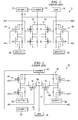
- FIG. 1 illustrates an example of a switching network having an eight MOSFET configuration
- FIG. 2 illustrates a switching network having a six MOSFET configuration.
- FIG. 1 illustrates a multiple battery system 10 with a switching network having an eight MOSFET configuration in accordance with a conventional system.
- the multiple battery system 10 includes a first switching cell 20 having a first p-type MOSFET Q1 coupled to a second p-type MOSFET Q2 in a back-to-back configuration to isolate a first battery 28 from a load 18.
- the drains of the first p-type MOSFET Q1 and the second p-type MOSFET Q2 are coupled to one another, such that the back-gate diodes or parasitic diodes of the first p-type MOSFET Q1 and the second p-type MOSFET Q2 have conduction paths in opposite directions.
- the body diodes formed between the substrate and source have opposite conduction paths of the first p-type MOSFET Q1 and the second p-type MOSFET Q2 since the body diodes are in series with the back gate diode and have a conduction direction opposite to the back gate diode.
- the first switching cell 20 is turned on and off by a single control line /BL1.
- a second switching cell 22 includes a third p-type MOSFET Q3 coupled to a fourth p-type MOSFET Q4 to isolate the first battery 28 from a charger 16.
- the second switching cell 22 is configured the same as the first switching cell 20 in a back-to back configuration.
- the second switching cell 22 is turned on and off by a single control line /B1C.
- a third switching cell 24 includes a fifth p-type MOSFET Q5 coupled to a sixth p-type MOSFET Q6 to isolate a second battery 30 from the charger 16.
- the third switching cell 24 is configured the same as the first and second switching cells 20 and 22, respectively, in a back-to back configuration.
- the third switching cell 24 is turned on and off by a single control line /B2C.
- a fourth switching cell 26 includes a seventh p-type MOSFET Q7 coupled to an eighth p-type MOSFET Q8 to isolate the second battery 30 from the load 18.
- the fourth switching cell 26 is configured the same as the first, the second and the third switching cells 20, 22 and 24, respectively, in a back-to back configuration.
- the fourth switching cell 26 is turned on and off by a single control line /B2L.
- a DC supply 12 is coupled to the load 18 through a diode D1.
- the DC supply 12 is also coupled to the charger 16.
- the charger 16 can provide charge to either the first battery 28 or the second battery 30 by selecting the second or third switching cells 22 and 24, respectively.
- the first battery 28 or the second battery 30 can provide power to the load 18 by selecting the first or the fourth switching cells 20 and 26, respectively.
- FIG. 2 illustrates a multiple battery system 40 and switching network having a six MOSFET configuration in accordance with a conventional system.
- the multiple battery system 40 includes a first switching cell 44 having a first p-type MOSFET Q9 coupled to a second p-type MOSFET Q10, a second switching cell 46 having a third p-type MOSFET Q11 coupled to a fourth p-type MOSFET Q12, and a third switching cell 48 having a fifth MOSFET Q13 coupled to a sixth p-type MOSFET Q14.
- a load 56 is coupled to a node 58 connecting the sources of the third and fourth p-type MOSFETS Q11 and Q12, respectively.
- a DC supply 54 is also coupled to the node 58 through a diode D2.
- a first battery 50 is coupled to the drain of the second p-type MOSFET Q12, and a second battery 52 is connected to the drain of the sixth p-type MOSFET Q14.
- Each MOSFET is controlled by a single control line (Q9-/B1C, Q10-/B1S, Q11-/B1L, Q12-/B2L, Q13-/B2C, Q14-/B2S).
- the DC supply 54 powers the load 56 and the charger 42.
- the charger 42 can provide charge to either the first battery 50 or the second battery 52 by selecting the first switching cell 44 or the third switching cell 48.
- Charging of the first battery 50 is accomplished by selecting the first MOSFET Q9 and the second MOSFET Q10 via the control lines /B1C and /B1S, while charging of the second battery 52 is accomplished by selecting the fifth MOSFET Q13 and the sixth MOSFET Q14 via the control lines /B2C and /B2S.
- the first battery 50 can provide power to the load 56 by selecting the second p-type MOSFET Q10 of the first switching cell 44 via control line /B1S and the third p-type MOSFET Q11 of the second switching cell 46 via control line /B1L.
- the second battery 52 can provide power to the load 56 by selecting the sixth p-type MOSFET Q14 of the third switching cell 48 via control line /B2S and the fourth p-type MOSFET Q12 of the second switching cell 46 via control line /B2L.
- the present invention relates to multiple battery systems and switching networks for portable electronic devices.
- the system and methods utilize a single switching cell per battery and a load switch coupled to a battery power bus to achieve proper connectivity and isolation between batteries, a load and a charger.
- the single switching cells are configured as a back-to-back MOSFET switch devices.
- the charger is also coupled to the battery power bus and can be enabled when AC power to the portable electronic device is available.
- the present invention facilitates selective connection of battery packs in a multiple battery system to a load or a charger, while still maintaining isolation between battery packs, the load and the charger.
- the back-to-back MOSFET switch device are connected together at one end to create a battery power bus that is connected to the charger output, and that can be connected to the load by a load switch when the charger is disabled.
- the back-to-back MOSFET switch devices can be used to select between charging of batteries and employment of batteries in powering the load.
- the charger In charge mode, the charger is enabled and the DC switch is turned on, connecting the DC supply to the load, with the load switch turned off, effectively isolating the battery power bus from the load.
- the selected battery is connected to the battery power bus and the charger output by turning on one of the battery switches.
- discharge mode the charger is disabled, the battery power bus is connected to the load by turning on the load switch, and the selected battery is connected to the battery power bus by turning on one of the battery switches.
- the present invention facilitates selective connection of battery packs in a multiple battery system to a load or a charger, while still maintaining isolation between battery packs, the load and the charger.
- the present invention utilizes a single cell or back-to-back battery switch configuration for each battery pack in the multiple battery system.
- the battery switch outputs are connected together, creating a "battery power bus" that is connected to the charger output and that can be connected to the load by a load switch when the charger is disabled.
- the charger is enabled by a control signal and has a high impedance path between a DC supply and the battery power bus in off mode.
- Logic control signals select which battery is connected to the battery power bus.
- the proposed topology utilizes two MOSFETs in a back-to-back configuration to control connection of each battery to the battery power bus.
- the charger output is connected to the power bus and enabled only when a battery is being charged.
- the power bus connection to the load is implemented by a single MOSFET switch (load switch) and the DC supply connection to the load is implemented by a single MOSFET switch (DC switch) or diode.
- load switch MOSFET switch
- DC switch MOSFET switch
- the present invention is illustrated with respect to multiple battery systems. However, the present invention is applicable to a variety of other rechargeable power sources that employ switching networks to isolate the power sources from one another, a load and a charger.
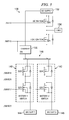
- FIG. 3 illustrates a portable electronic device 60 having a multiple battery system using a switching network configuration in accordance with an aspect of the present invention.
- the portable electronic device 60 includes a first switching cell 78 having a back-to-back MOSFET configuration.
- the first switching cell 78 couples and isolates a first battery 82 from a battery power bus 76.
- the first switching cell 78 is turned on and off by a single control line SBAT1.
- a second switching cell 80 includes a back-to-back MOSFET configuration to isolate a second battery from the power bus 76.
- the second switching cell 80 is turned on and off by a single control line SBAT2.
- the back-to-back MOSFET configuration of the first switching cell 78 and the second switching cell 80 can be two n-type MOSFET devices coupled in a back-to-back configuration, two p-type MOSFET devices coupled in a back-to-back configuration or a combination of n-type and p-type MOSFET devices as long as the back-gate diodes of each device have opposite conduction directions.
- a load switch 70 isolates the battery bus 76 from a load 68.
- a charger 74 is also coupled to the battery bus 76.
- the charger 74 includes an enable control that disables and enables the charger 74.
- a single control line (BATLD) has a first state that enables the charger 74 and opens the load switch 70, and a second state that disables the charger 74 and closes the load switch 70.
- a DC supply 64 is coupled to the load 68 through a DC switch 66 (e.g ., diode, MOSFET). The DC supply 64 is also coupled to the charger 74 to provide power to the charger 74.
- An AC/DC adapter 62 receives AC power from an AC power source, such as that found in conventional 115 VAC lines and provides unregulated DC power to the DC supply 64.
- the DC supply 64 converts the unregulated DC power to regulated DC power.
- the DC supply 64 can be a synchronous buck converter or some other switching power supply.
- a control system 72 controls the switching of the power sources (e.g ., DC Supply, battery 1, battery 2) to the load 68, the charging of the batteries 82 and 84 and the isolation of the devices from one another. If AC power is available, the control system 72 closes the DC switch 66 and opens the load switch 70, so that power from the DC supply 64 is provided to the load 68 and the charger 74, and the battery bus 76 is isolated from the load 68. The opening of the load switch 70 also enables the charger 74 since the control line BATLD is connected to both devices. The charge from the charger 74 is then available at the battery power bus 76.
- the control system 72 provides charge from the charger 74 to the first battery 82 by selecting the first switching cell 78 using control line SBAT1, or the second battery 84 by selecting the second switching cell 80 using the control line SBAT2.
- control system 72 opens the DC switch 66 and closes the load switch 70, so that power from the battery bus 76 is provided to the load 68, and the DC supply 64 is isolated from the load 68.
- the closing of the load switch 70 also disables the charger 74 since the control line BATLD is connected to both devices.
- the control system 72 can provide power to the power bus 76 and the load 68 from the first battery 82 by selecting the first switching cell 78 using control line SBAT1, or provide power from the second battery 84 by selecting the second switching cell 80 using the control line SBAT2.
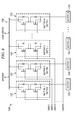
- FIG. 4 illustrates a multiple battery system 100 having a five MOSFET switching network configuration in accordance with an aspect of the present invention.
- the multiple battery system 100 includes a first switching cell 108 having a first p-type MOSFET Q15 coupled to a second p-type MOSFET Q16.
- the first switching cell 108 couples and isolates a first battery 112 from a power bus 138.
- the drains of the first p-type MOSFET Q15 and the second p-type MOSFET Q16 are coupled to one another, such that the back-gate diodes or parasitic diodes of the first p-type MOSFET Q15 and the second p-type MOSFET Q16 have conduction paths in opposite directions.
- the body diodes formed between the substrate and source have opposite conduction paths of the first p-type MOSFET Q15 and the second p-type MOSFET Q16 since the body diodes are in series with the back-gate diode and have a conduction direction opposite to the back-gate diode.
- the first switching cell 108 is turned on and off by a single control line /SBAT1.
- a second switching cell 110 includes a third p-type MOSFET Q17 coupled to a fourth p-type MOSFET Q18 to isolate a second battery 114 from the power bus 138.
- the second switching cell 110 is configured the same as the first switching cell 108 in a back-to-back configuration.
- the second switching cell 110 is turned on and off by a single control line /SBAT2.
- a single p-type MOSFET device Q19 isolates the battery bus 138 from a load 104.
- a charger 106 is also coupled to the battery bus 138.
- the charger 106 includes an enable control that disables and enables the charger 106.
- a single battery load control line (/BATLD) has a first state that enables the charger 106 and opens the load switch Q19, and a second state that disables the charger 106 and closes the load switch Q19.
- a DC supply 102 is coupled to the load 104 through a diode D3.
- the DC supply 102 is also coupled to the charger 106 to provide power to the charger 106. When power from the DC supply 102 is available, the DC supply 102 powers the load 104 and the charger 106.
- the battery load control line (/BATLD) is set to a state that enables the charger 106 and opens the load switch Q19.
- the charger 106 can provide charge to the first battery 112 by selecting the first switching cell 108 using the control line /SBAT1, or the second battery 114 by selecting the second switching cell 110 using the control line /SBAT2.
- the first battery 112 can provide power to the load 104 by selecting the first switching cell 108 and setting the battery load control line (/BATLD) to a state that disables the charger 106 and closes the load switch Q19.
- the second battery 114 can provide power to the load 104 by selecting the second switching cell 110, and setting the battery load control line (/BATLD) to a state that disables the charger 106 and closes the load switch Q19.
- /BATLD battery load control line
- the internal logic enables the battery power bus connection to load only when the DC supply voltage is below the battery power bus voltage. This is required to prevent battery over-charging, as the diode topology of FIG. 4 does not effectively isolate the DC supply from the load in all states. Therefore, an additional controllable switch can be provided between the DC supply and the load to isolate the DC supply from the load and selected battery by turning the controllable switch off. It is to be appreciated that although the MOSFETS Q15-Q19 are illustrated as p-type devices, any combination of p-type and n-type devices can be employed in accordance with the present invention. Additionally, any combination of active levels for control logic can be employed.
- FIG. 5 illustrates a multiple battery system 130 with individual control lines for MOSFET devices in a switching network in accordance with an aspect of the present invention.
- the multiple battery system 130 includes a first switching cell 140 having a first p-type MOSFET Q22 coupled to a second p-type MOSFET Q23.
- the first switching cell 140 couples and isolates a first battery 144 from a power bus 148.
- the drains of the first p-type MOSFET Q22 and the second p-type MOSFET Q23 are coupled to one another similar to the switching cells illustrated in FIG. 4.
- the first p-type MOSFET Q22 is turned on and off by a dedicated control line /SBAT1A
- the second p-type MOSFET Q23 is turned on and off by a dedicated control line /SBAT1B.
- a second switching cell 142 includes a third p-type MOSFET Q24 coupled to a fourth p-type MOSFET Q25 to isolate a second battery 146 from the power bus 148.
- the second switching cell 142 is configured the same as the first switching cell 140 in a back-to back configuration.
- the third p-type MOSFET Q24 is turned on and off by a dedicated control line /SBAT2A
- the fourth p-type MOSFET Q25 is turned on and off by a dedicated control line /SBAT2B.
- a p-type MOSFET device Q21 isolates the battery bus 148 from a load 134.
- a charger 136 is also coupled to the battery bus 148.
- the charger 136 includes an enable control that disables and enables the charger 136.
- a single control line (/BATLD) has a first state that enables the charger 136 and opens the load switch Q21, and a second state that disables the charger 136 and closes the load switch Q21 coupling the load 134 to the battery bus 148. It is to be appreciated that separate control lines can be provided for controlling the load switch Q21 and the charger enable.
- a DC supply 132 is coupleable to the load 134 through a n-type MOSFET device Q20 (DC switch) .
- the DC switch Q20 replaces the diode D3 illustrated in FIG. 4, so that providing power to the load 134 from the DC supply 132 is controllable.
- the DC switch Q20 is controlled by a control line (/DCLD).
- the DC switch Q20 couples the DC supply 132 to the load 134 to provide power to the load 134.
- Power is also provided to the charger 136 from the DC power supply 132.
- the battery load control line (/BATLD) is set to a state that enables the charger 136 and opens the load switch Q21.
- the charger 136 can provide charge to the first battery 144 by selecting the first switching cell 140 using control line /SBAT1A and /SBAT1B, or the second battery 146 by selecting the second switching cell 142 using the control line /SBAT2A and /SBAT2B.
- the first battery 144 can provide power to the load 134 by selecting the first switching cell 140 via control lines /SBAT1A and /SBAT1B, and setting the battery load control line (/BATLD) to a state that disables the charger 136 and closes the load switch Q21.
- the second battery 146 can provide power to the load 134 by selecting the second switching cell 142 via control lines /SBAT2A and /SBAT2B, and setting the battery load control line (/BATLD) to a state that disables the charger 136 and closes the load switch Q21.
- TABLE 2 illustrates a truth table for the logic of the switching network illustrated in FIG. 5.
- FIGS. 4-5 employ p-type MOSFETs selected to minimize the battery to load path on resistance and simplify control logic design.
- this switching network can be implemented with n-type only devices or another placement for n-type/p-type devices in a mixed n-type/p-type MOSFET configuration, as long as the back-gate diodes used in the battery switches are in a back-to-back configuration with a high impedance in off mode and the back-gate diodes for the DC and load switch have the same polarity as illustrated in FIGS. 4-5.
- FIG. 6 illustrates a portion of a multiple battery system 150 having a plurality of batteries and a plurality of back-to-back MOSFET devices in accordance with the present invention.
- the multiple battery system 150 includes a plurality of batteries 154 from BATT1 to BATTN that can be coupled and decoupled from a battery power bus 156 using a plurality of back-to-back MOSFET battery switches 152 from BATT SWITCH 1 to BATT SWITCH N.
- a single back-to-back MOSFET battery switch and a single control line are provided for each additional battery added to the multiple battery system 150.
- Each of the back-to-back MOSFET battery switches 152 are coupled to the battery power bus 156 and its respective battery, such that all of the switches 152 are coupled in parallel.
- the battery power bus 156 is also connected to a charger and a load switch as illustrated in FIGS. 3-5.
- FIGS. 7-8 methodologies in accordance with various aspects of the present invention will be better appreciated with reference to FIGS. 7-8. While, for purposes of simplicity of explanation, the methodologies of FIGS. 7-8 is shown and described as executing serially, it is to be understood and appreciated that the present invention is not limited by the illustrated order, as some aspects could, in accordance with the present invention, occur in different orders and/or concurrently with other aspects from that shown and described herein. Moreover, not all illustrated features may be required to implement a methodology in accordance with an aspect the present invention.
- FIG. 7 illustrates one particular methodology for providing a multiple battery system and switching network in accordance with an aspect of the present invention.
- a single MOSFET switching cell is provided for each battery in the multiple battery system and coupled to the respective battery on one end and a battery bus on the other end, such that the switching cells are coupled in parallel.
- the single MOSFET switching cell can be comprised of two n-type MOSFET devices coupled in a back-to-back configuration or two p-type MOSFET devices coupled in a back-to-back configuration.
- the methodology then proceeds to 210.
- a load switch is coupled between a load and the battery bus.
- the load switch can be a p-type or n-type MOSFET.
- a charger that includes an enable control line is coupled to the battery bus.
- a DC supply is then coupled to the load through a DC supply switch at 230.
- the DC supply is also coupled to the charger to provide the charger with power.
- the DC supply switch can be a diode or a controllable n-type or p-type MOSFET switch.
- the methodology then proceeds to 240.
- various control lines are provided to the various switches and the charger enable.
- FIG. 8 illustrates one particular methodology for operating a multiple battery system and switching network such as those described in FIGS. 3-6 in accordance with an aspect of the present invention.
- the load switch is opened and the DC supply switch is closed providing power to the load from the DC supply.
- the first switching cell is closed and the second switching cell is opened, so that the first battery can be charged.
- the charger is enabled so that charge is available at the battery power bus so that the first battery connected to the battery power bus will be charged. The first battery is charged until the first battery reaches a predetermined charge level.
- Various methodologies can be employed to determine when the first battery reaches the predetermined charge level.
- the first switching cell is opened and the second switching cell is closed, so that the second battery can be charged.
- the second battery is charged until the second battery reaches a predetermined charge level.
- the second switching cell is then opened so that charging of the first and second battery terminate.
- Various methodologies can be employed to determine when the second battery reaches the predetermined charge level. Additionally, various methodologies can be employed to determine when and in what order to charge the first and second batteries and any other number of batteries forming part of the multiple battery system.
- the methodology advances to 340 to determine if AC power is removed resulting in the removal of DC power. If AC power is not removed (NO), the methodology repeats 340. If AC power is removed (YES), the methodology proceeds to 350.
- the DC supply switch is opened and the load switch is closed to provide power to the load from the battery bus and to disable the charger.
- the first switching cell is closed to provide power to the load through the battery bus by the first battery, until the first battery falls below a predetermined charge level.
- Various methodologies can be employed to determine if the first battery falls below a predetermined charge level.
- the first switching cell is opened and the second switching cell is closed to provide power to the load through the battery bus by the second battery, until the second battery falls below a predetermined charge level.
Landscapes
- Engineering & Computer Science (AREA)
- Power Engineering (AREA)
- Charge And Discharge Circuits For Batteries Or The Like (AREA)
Abstract
Description
| DC | /BATLD | /SBAT1 | /SBAT2 | STATE |
| ON | HI | LO | HI | DC SUPPLY TO LOAD, CHARGER ON, BATT1 CHARGING |
| ON | HI | HI | LO | DC SUPPLY TO LOAD, CHARGER ON, BATT2 CHARGING |
| OFF | LO | HI | LO | BATT2 TO LOAD, BATT1 OPEN, CHARGER OFF |
| OFF | LO | LO | HI | BATT1 TO LOAD, BATT2 OPEN, CHARGER OFF |
| /DCLD | /BATLD | /SBATlA /SBAT1B | /SBAT2A /SBAT2B | STATE |
| LO | HI | LO | HI | DC SUPPLY TO LOAD, CHARGER ON, BATT1 CHARGING |
| LO | HI | HI | LO | DC SUPPLY TO LOAD, CHARGER ON, BATT2 CHARGING |
| HI | LO | HI | LO | BATT2 TO LOAD, BATT1 OPEN, CHARGER OFF |
| HI | LO | LO | HI | BATT1 TO LOAD, BATT2 OPEN, CHARGER OFF |
Claims (7)
- A portable electronic device comprising:a first switching cell coupled to a first battery on a first end and a battery power bus on a second end, the first switching cell being comprised of two back-to-back MOSFET devices;a second switching cell coupled to a second battery on a first end and the battery power bus on a second end, the second switching cell being comprised of two back-to-back MOSFET devices;a load switch coupled to the battery bus on a first end and a load on a second end;a charger coupled to the battery bus; anda DC supply connected to the load through a DC switch.
- The portable electronic device of claim 1, wherein the DC supply is coupled to an AC/DC adapter that receives AC voltage and provides unregulated DC voltage to the DC supply, the DC supply provides regulated DC voltage to the load and the charger upon detection of AC power.
- The portable electronic device of claim 1 or 2, further comprising N number of batteries and M number of switching cells comprised of two back-to-back MOSFET devices, the switching cells coupled to a respective battery on a first end and the battery power bus on a second end, N and M being integers greater than 2 having equal values, such that a single switching cell corresponds to a single battery.
- A switching network for a multiple battery system comprising:a first back-to-back MOSFET device connectable to a first rechargeable power source on a first end and a power bus on a second end;a second back-to-back MOSFET device connectable to a second rechargeable power source on a first end and the power bus on a second end;a load switch coupled to the power bus on a first end and a load on a second end;a charger coupled to the power bus; anda DC supply connected to the load through a DC switch.
- The switching network of claim 4, wherein the DC switch is one of a diode, a p-type MOSFET device and an N-type MOSFET device.
- The switching network of claim 4 or 5, further comprising a first control line that controls the switching of the first back-to-back MOSFET device, a second control line that controls the switching of the second back-to-back MOSFET device and a third control line that controls the switching of the load switch.
- The switching network of claim 4, further comprising a first control line that controls the switching of a first MOSFET device and a second control line that controls the switching of a second MOSFET device of the first back-to-back MOSFET device, a third control line that controls the switching of a third MOSFET device and a fourth control line that controls the switching of a fourth MOSFET device of the second back-to-back MOSFET device, and a fifth control line that controls the switching of the load switch.
Applications Claiming Priority (2)
| Application Number | Priority Date | Filing Date | Title |
|---|---|---|---|
| US123776 | 2002-04-16 | ||
| US10/123,776 US6957048B2 (en) | 2002-04-16 | 2002-04-16 | Switching circuit for charge and discharge of multiple battery systems |
Publications (2)
| Publication Number | Publication Date |
|---|---|
| EP1355401A2 true EP1355401A2 (en) | 2003-10-22 |
| EP1355401A3 EP1355401A3 (en) | 2004-08-18 |
Family
ID=28674673
Family Applications (1)
| Application Number | Title | Priority Date | Filing Date |
|---|---|---|---|
| EP03101027A Withdrawn EP1355401A3 (en) | 2002-04-16 | 2003-04-15 | Switching circuit for charge and discharge of mulitple battery systems |
Country Status (3)
| Country | Link |
|---|---|
| US (1) | US6957048B2 (en) |
| EP (1) | EP1355401A3 (en) |
| JP (1) | JP2003319570A (en) |
Cited By (4)
| Publication number | Priority date | Publication date | Assignee | Title |
|---|---|---|---|---|
| US7388349B2 (en) | 2003-08-11 | 2008-06-17 | Reserve Power Cell, Llc | Multiple battery switching method and apparatus |
| US8013611B2 (en) | 2006-07-14 | 2011-09-06 | Reserve Power Cell, Llc | Vehicle battery product and battery monitoring system |
| EP3648277A1 (en) * | 2018-10-31 | 2020-05-06 | Aptiv Technologies Limited | Electronic circuit for redundant supply of an electric load |
| US20230231208A1 (en) * | 2017-11-02 | 2023-07-20 | Qualcomm Incorporated | Pulse current parallel charger |
Families Citing this family (43)
| Publication number | Priority date | Publication date | Assignee | Title |
|---|---|---|---|---|
| JP3906169B2 (en) * | 2003-03-05 | 2007-04-18 | 三洋電機株式会社 | Mobile phone and control program for broadcast reception function of mobile phone |
| US7567057B2 (en) * | 2003-08-11 | 2009-07-28 | Reserve Power Cell, Llc | Multiple battery management system, auxiliary battery attachment system, and network controlled multiple battery system |
| KR100574555B1 (en) * | 2003-09-02 | 2006-04-27 | 엘지전자 주식회사 | Power supply device of mobile communication terminal |
| US7009350B1 (en) * | 2004-02-13 | 2006-03-07 | Great Systems, Inc. | Energy collection and storage system |
| JP2005245170A (en) * | 2004-02-27 | 2005-09-08 | Casio Comput Co Ltd | Charging system |
| US7560829B2 (en) * | 2004-12-31 | 2009-07-14 | Intel Corporation | Power system using multiple battery pack types |
| US7598700B2 (en) * | 2005-03-30 | 2009-10-06 | Reserve Power Cell, Llc | Tamper resistant battery and battery warranty and performance tracking system |
| KR100713850B1 (en) * | 2005-09-28 | 2007-05-07 | 삼성전자주식회사 | Battery pack, portable electronic apparatus, and control method thereof |
| US20070123315A1 (en) * | 2005-11-28 | 2007-05-31 | Williams Willie J Jr | Method and system for charging a mobile phone with conventional DC batteries |
| TWI340515B (en) * | 2006-12-01 | 2011-04-11 | O2Micro Int Ltd | Battery pack, electronic system with cell monitoring and the method for battery pack monitoring thereof |
| CN101227098B (en) * | 2007-01-19 | 2012-01-18 | 鸿富锦精密工业(深圳)有限公司 | Charging apparatus and method |
| US7804275B2 (en) * | 2007-08-02 | 2010-09-28 | Richard Dellacona | Battery power supply |
| JP2009089454A (en) * | 2007-09-27 | 2009-04-23 | Toshiba Corp | Power circuit |
| US7800510B2 (en) * | 2007-11-30 | 2010-09-21 | O2Micro, Inc. | Battery systems with embedded cell monitors |
| JP5179851B2 (en) * | 2007-11-30 | 2013-04-10 | オーツー マイクロ, インコーポレーテッド | Battery pack with embedded cell monitor, electronic system, and method for monitoring a battery pack |
| DE102007062955B4 (en) * | 2007-12-21 | 2011-06-01 | Catem Develec Gmbh & Co. Kg | Circuit for voltage stabilization of a vehicle electrical system |
| ATE539897T1 (en) * | 2008-06-19 | 2012-01-15 | Zih Corp | PORTABLE PRINTER |
| US7893560B2 (en) * | 2008-09-12 | 2011-02-22 | Nellcor Puritan Bennett Llc | Low power isolation design for a multiple sourced power bus |
| US9231438B2 (en) * | 2008-10-01 | 2016-01-05 | Aspen Avionics, Inc. | Airborne power system disconnect system and method |
| US9059603B2 (en) * | 2008-12-11 | 2015-06-16 | Sunline Jamaica Limited | Solar powered electrical energy generating device |
| JP2011259572A (en) * | 2010-06-08 | 2011-12-22 | Honda Motor Co Ltd | Battery charger and charging system |
| US8941264B2 (en) * | 2011-06-20 | 2015-01-27 | Bae Systems Information And Electronic Systems Integration Inc. | Apparatus for bi-directional power switching in low voltage vehicle power distribution systems |
| CN103650284A (en) * | 2011-09-02 | 2014-03-19 | 三星Sdi株式会社 | Data transmitting method, data transmitting apparatus, and energy storage system including the same |
| US9871404B2 (en) * | 2011-12-12 | 2018-01-16 | Cree, Inc. | Emergency lighting devices with LED strings |
| US10117295B2 (en) | 2013-01-24 | 2018-10-30 | Cree, Inc. | LED lighting apparatus for use with AC-output lighting ballasts |
| TWI459184B (en) * | 2011-12-21 | 2014-11-01 | 群光電子股份有限公司 | Electronic device with battery device power protection and system reset circuit and operation method thereof |
| JP2012186989A (en) * | 2012-01-09 | 2012-09-27 | Masayuki Kawada | Charge/discharge stabilization automatic round-robin style system for storage battery |
| CN103683523B (en) * | 2012-09-07 | 2018-04-13 | 捷通国际有限公司 | System and method for double-direction radio power transmission |
| US20160193935A1 (en) * | 2012-12-24 | 2016-07-07 | H&D Electric, LLC | Advances in Electric Car Technology |
| KR20150108825A (en) * | 2013-01-21 | 2015-09-30 | 가부시키가이샤 한도오따이 에네루기 켄큐쇼 | Secondary battery, secondary battery module, method for charging the secondary battery and the secondary battery module, method for discharging the secondary battery and the secondary battery module, method for operating the secondary battery and the secondary battery module, power storage system, and method for operating the power storage system |
| KR101856573B1 (en) * | 2013-12-06 | 2018-05-11 | (주)알파솔루션즈 | Portable device |
| US10031567B2 (en) | 2015-06-09 | 2018-07-24 | Microsoft Technology Licensing, Llc | Offline battery management in a device |
| US10230895B2 (en) * | 2015-10-29 | 2019-03-12 | Netgear, Inc. | System and method for management of battery power |
| US10097014B2 (en) | 2016-06-03 | 2018-10-09 | Nidec Motor Corporation | Battery charger monitor with charge balancing between batteries in a battery supply |
| DE102017104958B4 (en) * | 2017-03-09 | 2024-03-14 | Dr. Ing. H.C. F. Porsche Aktiengesellschaft | Battery storage system |
| WO2018183864A1 (en) * | 2017-03-31 | 2018-10-04 | The Noco Company | Portable or hand held vehicle battery jump starting apparatus with battery cell equalization circuit |
| WO2019111872A1 (en) | 2017-12-04 | 2019-06-13 | 株式会社Gsユアサ | Charging control device, electricity storage device, and charging method |
| US11710973B2 (en) | 2018-05-14 | 2023-07-25 | Marathonnorco Aerospace, Inc. | Fast charger and fast charger process |
| WO2020055423A1 (en) * | 2018-09-14 | 2020-03-19 | General Electric Company | Methods and systems for energy storage dispatch |
| US11016140B1 (en) | 2018-10-31 | 2021-05-25 | Wisk Aero Llc | Battery diode fault monitoring |
| KR20210054172A (en) * | 2019-11-05 | 2021-05-13 | 삼성전자주식회사 | Method for controlling power path and electronic device supporting the same |
| US12142953B2 (en) * | 2022-02-08 | 2024-11-12 | Apple Inc. | Battery charging protection and health management system |
| GB2640122A (en) * | 2024-03-28 | 2025-10-15 | Curbar Lothian Ltd | Passthrough battery management system |
Family Cites Families (8)
| Publication number | Priority date | Publication date | Assignee | Title |
|---|---|---|---|---|
| US4754160A (en) | 1984-08-23 | 1988-06-28 | Intersil, Inc. | Power supply switching circuit |
| EP0660520B1 (en) | 1993-11-30 | 2004-05-26 | Siliconix Incorporated | Multiple source power supply and method of selecting a power source from among multiple sources of power |
| US5598041A (en) | 1995-11-16 | 1997-01-28 | Lockheed Martin Corporation | Efficient fault tolerant switching circuit for redundant d. c. power supplies |
| US5764032A (en) | 1997-03-06 | 1998-06-09 | Maxim Integrated Products, Inc. | Multiple battery switchover circuits |
| US5982145A (en) | 1997-04-08 | 1999-11-09 | Sony Chemicals Corporation | Battery pack unit, control method therefor, electronic equipment driven by power supplied from the same battery pack unit, and recording medium on which program for controlling the same battery pack unit is recorded |
| US5818200A (en) | 1997-05-06 | 1998-10-06 | Dell U.S.A., L.P. | Dual smart battery detection system and method for portable computers |
| US5955867A (en) | 1997-07-29 | 1999-09-21 | Dell Usa L.P. | Dual battery pack charging in a computer system |
| US6583603B1 (en) * | 2002-02-08 | 2003-06-24 | Peco Ii, Inc. | Back-up battery management apparatus and method for charging and testing battery cells in a string of battery cells |
-
2002
- 2002-04-16 US US10/123,776 patent/US6957048B2/en not_active Expired - Lifetime
-
2003
- 2003-04-15 JP JP2003109764A patent/JP2003319570A/en active Pending
- 2003-04-15 EP EP03101027A patent/EP1355401A3/en not_active Withdrawn
Cited By (11)
| Publication number | Priority date | Publication date | Assignee | Title |
|---|---|---|---|---|
| US7388349B2 (en) | 2003-08-11 | 2008-06-17 | Reserve Power Cell, Llc | Multiple battery switching method and apparatus |
| US7427865B2 (en) | 2003-08-11 | 2008-09-23 | Reserve Power Cell, Llc | Method for detecting a discharge condition fault in an electrical system of a vehicle or piece of machinery |
| US7675261B2 (en) | 2003-08-11 | 2010-03-09 | Reserve Power Cell, Llc | Auxiliary battery attachment apparatus for use in a multiple battery system that reliably supplies electrical energy to an electrical system |
| US7679314B2 (en) | 2003-08-11 | 2010-03-16 | Reserve Power Cell, Llc | Multiple battery system for reliably supplying electrical energy to an electrical system |
| US7834583B2 (en) | 2003-08-11 | 2010-11-16 | Reserve Power Cell, Llc | Remotely controlled multiple battery system |
| US7839117B2 (en) | 2003-08-11 | 2010-11-23 | Reserve Power Cell, Llc | System and method of detecting a battery fault |
| US8120364B2 (en) | 2003-08-11 | 2012-02-21 | Reserve Power Cell, Llc | Stand alone battery monitoring system with alert |
| US8013611B2 (en) | 2006-07-14 | 2011-09-06 | Reserve Power Cell, Llc | Vehicle battery product and battery monitoring system |
| US20230231208A1 (en) * | 2017-11-02 | 2023-07-20 | Qualcomm Incorporated | Pulse current parallel charger |
| EP3648277A1 (en) * | 2018-10-31 | 2020-05-06 | Aptiv Technologies Limited | Electronic circuit for redundant supply of an electric load |
| US11114889B2 (en) | 2018-10-31 | 2021-09-07 | Aptiv Technologies Limited | Electronic circuit for redundant supply of an electric load |
Also Published As
| Publication number | Publication date |
|---|---|
| EP1355401A3 (en) | 2004-08-18 |
| JP2003319570A (en) | 2003-11-07 |
| US6957048B2 (en) | 2005-10-18 |
| US20040192407A1 (en) | 2004-09-30 |
Similar Documents
| Publication | Publication Date | Title |
|---|---|---|
| EP1355401A2 (en) | Switching circuit for charge and discharge of mulitple battery systems | |
| US5764032A (en) | Multiple battery switchover circuits | |
| US11791721B2 (en) | Multi-mode DC-to-DC power converter | |
| CN104584374B (en) | System and method for equalizing voltage | |
| CN102403757B (en) | Charge-discharge control circuit and cell apparatus | |
| JP2004336994A (en) | Battery pack and battery charge / discharge circuit incorporating the battery pack | |
| US20010005125A1 (en) | Battery pack, power source apparatus, and charging and discharging method | |
| US11848581B2 (en) | Source bootstrap power conversion for the safe and efficient interconnection of homogeneous or heterogeneous energy storage modules | |
| US12451717B2 (en) | Adaptive multi-mode charging | |
| JP2001352683A (en) | Charge / discharge type power supply | |
| EP4131710A1 (en) | Hybrid battery system | |
| CN216904381U (en) | Multi-interface charging module and electronic equipment | |
| US12142953B2 (en) | Battery charging protection and health management system | |
| GB2293059A (en) | Equalization of charge on series connected cells or batteries | |
| KR102821612B1 (en) | Cell balancing apparatus, battery apparatus including the same, and cell balancing method | |
| KR20100119467A (en) | System and method for managing battery | |
| WO2009085915A2 (en) | Method and apparatus for bi-contact battery-charger system | |
| CN216774326U (en) | Charge-discharge control circuit and battery protection device | |
| US11631907B2 (en) | System and method for charging of a battery | |
| EP3955411A1 (en) | Pre-charge circuit and battery system having same | |
| JP2003079058A (en) | Battery pack | |
| KR20190086093A (en) | Appartus for connecting power | |
| JPH0766772A (en) | Portable radios and power supplies | |
| CN120728775A (en) | Battery charging and discharging system, battery and method | |
| CN121689336A (en) | Electronic devices and power supply methods |
Legal Events
| Date | Code | Title | Description |
|---|---|---|---|
| PUAI | Public reference made under article 153(3) epc to a published international application that has entered the european phase |
Free format text: ORIGINAL CODE: 0009012 |
|
| AK | Designated contracting states |
Kind code of ref document: A2 Designated state(s): AT BE BG CH CY CZ DE DK EE ES FI FR GB GR HU IE IT LI LU MC NL PT RO SE SI SK TR |
|
| AX | Request for extension of the european patent |
Extension state: AL LT LV MK |
|
| PUAL | Search report despatched |
Free format text: ORIGINAL CODE: 0009013 |
|
| AK | Designated contracting states |
Kind code of ref document: A3 Designated state(s): AT BE BG CH CY CZ DE DK EE ES FI FR GB GR HU IE IT LI LU MC NL PT RO SE SI SK TR |
|
| AX | Request for extension of the european patent |
Extension state: AL LT LV MK |
|
| 17P | Request for examination filed |
Effective date: 20050218 |
|
| 17Q | First examination report despatched |
Effective date: 20050324 |
|
| AKX | Designation fees paid |
Designated state(s): DE FR GB |
|
| RBV | Designated contracting states (corrected) |
Designated state(s): DE FR GB |
|
| STAA | Information on the status of an ep patent application or granted ep patent |
Free format text: STATUS: THE APPLICATION IS DEEMED TO BE WITHDRAWN |
|
| 18D | Application deemed to be withdrawn |
Effective date: 20061107 |