EP1355345A1 - Integral starting aid for high intensity discharge lamps - Google Patents
Integral starting aid for high intensity discharge lamps Download PDFInfo
- Publication number
- EP1355345A1 EP1355345A1 EP03008277A EP03008277A EP1355345A1 EP 1355345 A1 EP1355345 A1 EP 1355345A1 EP 03008277 A EP03008277 A EP 03008277A EP 03008277 A EP03008277 A EP 03008277A EP 1355345 A1 EP1355345 A1 EP 1355345A1
- Authority
- EP
- European Patent Office
- Prior art keywords
- starting aid
- arc tube
- stripe
- metal nitride
- nitride
- Prior art date
- Legal status (The legal status is an assumption and is not a legal conclusion. Google has not performed a legal analysis and makes no representation as to the accuracy of the status listed.)
- Withdrawn
Links
- 150000004767 nitrides Chemical class 0.000 claims abstract description 18
- 239000000919 ceramic Substances 0.000 claims abstract description 14
- NRTOMJZYCJJWKI-UHFFFAOYSA-N Titanium nitride Chemical compound [Ti]#N NRTOMJZYCJJWKI-UHFFFAOYSA-N 0.000 claims abstract description 12
- ZVWKZXLXHLZXLS-UHFFFAOYSA-N zirconium nitride Chemical compound [Zr]#N ZVWKZXLXHLZXLS-UHFFFAOYSA-N 0.000 claims abstract description 6
- 229910010293 ceramic material Inorganic materials 0.000 claims abstract description 4
- 239000003870 refractory metal Substances 0.000 claims abstract description 4
- PNEYBMLMFCGWSK-UHFFFAOYSA-N aluminium oxide Inorganic materials [O-2].[O-2].[O-2].[Al+3].[Al+3] PNEYBMLMFCGWSK-UHFFFAOYSA-N 0.000 claims description 13
- 229910052751 metal Inorganic materials 0.000 claims description 13
- 239000002184 metal Substances 0.000 claims description 13
- 229910052782 aluminium Inorganic materials 0.000 claims description 2
- XAGFODPZIPBFFR-UHFFFAOYSA-N aluminium Chemical compound [Al] XAGFODPZIPBFFR-UHFFFAOYSA-N 0.000 claims description 2
- TWNQGVIAIRXVLR-UHFFFAOYSA-N oxo(oxoalumanyloxy)alumane Chemical compound O=[Al]O[Al]=O TWNQGVIAIRXVLR-UHFFFAOYSA-N 0.000 claims description 2
- WFKWXMTUELFFGS-UHFFFAOYSA-N tungsten Chemical compound [W] WFKWXMTUELFFGS-UHFFFAOYSA-N 0.000 description 13
- 229910052721 tungsten Inorganic materials 0.000 description 9
- 239000010937 tungsten Substances 0.000 description 9
- 239000000463 material Substances 0.000 description 7
- 239000000443 aerosol Substances 0.000 description 6
- 238000004519 manufacturing process Methods 0.000 description 4
- 238000007740 vapor deposition Methods 0.000 description 4
- 230000008018 melting Effects 0.000 description 3
- 238000002844 melting Methods 0.000 description 3
- 238000000034 method Methods 0.000 description 3
- 239000007921 spray Substances 0.000 description 3
- 238000005382 thermal cycling Methods 0.000 description 3
- CSCPPACGZOOCGX-UHFFFAOYSA-N Acetone Chemical compound CC(C)=O CSCPPACGZOOCGX-UHFFFAOYSA-N 0.000 description 2
- DGAQECJNVWCQMB-PUAWFVPOSA-M Ilexoside XXIX Chemical compound C[C@@H]1CC[C@@]2(CC[C@@]3(C(=CC[C@H]4[C@]3(CC[C@@H]5[C@@]4(CC[C@@H](C5(C)C)OS(=O)(=O)[O-])C)C)[C@@H]2[C@]1(C)O)C)C(=O)O[C@H]6[C@@H]([C@H]([C@@H]([C@H](O6)CO)O)O)O.[Na+] DGAQECJNVWCQMB-PUAWFVPOSA-M 0.000 description 2
- 239000011195 cermet Substances 0.000 description 2
- 238000005229 chemical vapour deposition Methods 0.000 description 2
- 229910052593 corundum Inorganic materials 0.000 description 2
- 229910052708 sodium Inorganic materials 0.000 description 2
- 239000011734 sodium Substances 0.000 description 2
- 238000005507 spraying Methods 0.000 description 2
- 229910001845 yogo sapphire Inorganic materials 0.000 description 2
- LFQSCWFLJHTTHZ-UHFFFAOYSA-N Ethanol Chemical compound CCO LFQSCWFLJHTTHZ-UHFFFAOYSA-N 0.000 description 1
- ATJFFYVFTNAWJD-UHFFFAOYSA-N Tin Chemical compound [Sn] ATJFFYVFTNAWJD-UHFFFAOYSA-N 0.000 description 1
- 239000011230 binding agent Substances 0.000 description 1
- 238000000576 coating method Methods 0.000 description 1
- 238000000354 decomposition reaction Methods 0.000 description 1
- PCHJSUWPFVWCPO-UHFFFAOYSA-N gold Chemical compound [Au] PCHJSUWPFVWCPO-UHFFFAOYSA-N 0.000 description 1
- 239000010931 gold Substances 0.000 description 1
- 229910052737 gold Inorganic materials 0.000 description 1
- 230000000873 masking effect Effects 0.000 description 1
- 238000012986 modification Methods 0.000 description 1
- 230000004048 modification Effects 0.000 description 1
- 230000000704 physical effect Effects 0.000 description 1
- 239000000843 powder Substances 0.000 description 1
- 238000009877 rendering Methods 0.000 description 1
- 238000005245 sintering Methods 0.000 description 1
- 238000004544 sputter deposition Methods 0.000 description 1
- 239000000758 substrate Substances 0.000 description 1
- 238000002834 transmittance Methods 0.000 description 1
Images
Classifications
-
- H—ELECTRICITY
- H01—ELECTRIC ELEMENTS
- H01J—ELECTRIC DISCHARGE TUBES OR DISCHARGE LAMPS
- H01J61/00—Gas-discharge or vapour-discharge lamps
- H01J61/02—Details
- H01J61/12—Selection of substances for gas fillings; Specified operating pressure or temperature
- H01J61/18—Selection of substances for gas fillings; Specified operating pressure or temperature having a metallic vapour as the principal constituent
- H01J61/22—Selection of substances for gas fillings; Specified operating pressure or temperature having a metallic vapour as the principal constituent vapour of an alkali metal
-
- H—ELECTRICITY
- H01—ELECTRIC ELEMENTS
- H01J—ELECTRIC DISCHARGE TUBES OR DISCHARGE LAMPS
- H01J61/00—Gas-discharge or vapour-discharge lamps
- H01J61/02—Details
- H01J61/54—Igniting arrangements, e.g. promoting ionisation for starting
- H01J61/547—Igniting arrangements, e.g. promoting ionisation for starting using an auxiliary electrode outside the vessel
Definitions
- starting aids for high intensity discharge lamps and in particular high pressure sodium (HPS) lamps, have traditionally consisted of a tungsten wire wrapped around, or positioned alongside, the ceramic arc tube.
- the tungsten wire is welded to a frame member or an electrode feedthrough during the manufacturing process to provide electrical contact with the lamp's power supply.
- This basic type of starting aid has been manufactured for many years and generally performs reliably over the life of the lamp.
- pure tungsten wire is relatively expensive and labor and time are required to form the welds.
- integral starting aid which consists of a printed stripe directly sintered to the ceramic arc tube.
- the stripe is made of either pure tungsten or a tungsten/alumina cermet.
- PCA polycrystalline alumina
- any mismatch in the thermal expansion coefficients of the ceramic arc tube and starting aid materials becomes important.
- the high temperature of the operating arc tube coupled with the on-off thermal cycling which occurs throughout the operating life of the lamp can cause the thin stripe to break and lose electrical continuity thereby rendering it inoperable.
- the geometry of the starting aid is also limited by thermal expansion mismatches. If the starting aid is applied too thickly, the induced stress from the thermal expansion mismatch can cause the arc tube to crack. Therefore, it would be desirable for the material comprising the starting aid to have a thermal expansion coefficient which closely matches that of the arc tube material.
- an integral starting aid comprised of a conductive, refractory metal nitride stripe applied directly to the surface of a ceramic arc tube.
- the metal nitride stripe may be applied by a number of conventional means including aerosol spraying, ink pen, ink-jet, or vapor deposition.
- the integral starting aid is comprised of a thin stripe containing titanium nitride or zirconium nitride. The starting aid is sintered with the ceramic arc tube to bond it to the arc tube surface.
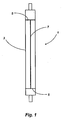
- Fig. 1 is an illustration of a ceramic arc tube having an integral starting aid on the exterior surface of the arc tube.
- Refractory metal nitrides such as titanium nitride and zirconium nitride are advantageous for integral starting aids because they are conductive, have high melting points, and their thermal expansion coefficients closely match that of the conventional polycrystalline alumina (PCA) arc tubes at the tube's operating temperature of about 1 400K.
- PCA polycrystalline alumina
- TiN titanium nitride
- ZrN zirconium nitride
- Table 1 with tungsten (W) and alumina (Al 2 O 3 ).
- W tungsten
- Al 2 O 3 alumina
- the metal nitrides have melting points above that of alumina and possess low electrical resistivity.
- the nitrides possess thermal expansion coefficients which closely match that of alumina at 1400K. For this reason, it is expected that starting aids comprised of metal nitrides should outlast pure tungsten and W-AI 2 O 3 starting aids when subjected to lamp operating conditions and thermal cycling.
- Material Linear Expansion Coefficient at 1400K ( ⁇ 10 -6 /K) Electrical Resistivity at ⁇ 25°C ( ⁇ ) Melting Point (°C) Color Al 2 O 3 10.1 1 ⁇ 10 22 2015 White TiN 10.5 21.7 2930 Gold ZrN 9.1 13.6 2980 Gold W 5.4 5.7 3410 Black
- the metal nitride starting aid of this invention may be combined in a powdered form with a organic vehicle and applied as an aerosol spray or as an ink using a pen, brush, ink-jet, or similar printing means.
- Vapor deposition techniques such as vacuum sputtering and chemical vapor deposition (CVD) are also expected to be useful for applying the metal nitride starting aid.
- CVD chemical vapor deposition
- such means may prove impractical because of the high cost of vapor deposition equipment and the difficulties associated with applying vapor deposition to large-scale manufacturing.
- a prefired PCA arc tube is formed using standard ceramic fabrication techniques, e.g., isopressing or extruding of doped powders into a tubular shape and prefiring the tube in air to remove the binder material.
- a stripe containing the metal nitride is then applied directly to the porous tube via aerosol spray coating.
- the aerosol spray consists of the metal nitride and a carrier, e.g., TiN powder in an alcohol/acetone-based carrier.
- a titanium nitride-containing aerosol spray is commercially available as Traycoat TN Aerosol (ZYP Coatings, Inc., Oak Ridge, Tennessee).
- the stripe dimensions and shape are controlled by masking the arc tube surface tube except in the area for the desired stripe.
- the metal nitride may be blended with a ceramic material, preferably aluminum oxide or aluminum oxynitride, to improve the translucency of the starting aid.
- the prefired, striped arc tube is then sintered to full density, e.g., at 1880 ° C for 1 hour in a flowing N 2 -8%H 2 atmosphere during which the metal nitride simultaneously sinters onto the PCA arc tube.
- the properties of a TiN starting aid are compared with conventional tungsten and tungsten-alumina starting aids in Table 2. The TiN sinters well without decomposition and provides an electrically conductive stripe.
- Figure 1 is an illustration of the integral starting aid applied to a ceramic arc tube for a high pressure sodium lamp.
- the arc tube 1 has a tubular body 3 comprised of polycrystalline alumina.
- the integral starting aid is comprised of longitudinal stripe 7 and transverse stripes 5.
- the longitudinal stripe extends substantially along the length of the arc tube body and is connected at either end to a transverse stripe 5 which extends circumferentially around the tubular body 3.
- the starting aid is applied to the exterior surface of tubular body 3 by a conventional ink dispensing means.
Landscapes
- Vessels And Coating Films For Discharge Lamps (AREA)
- Discharge Lamps And Accessories Thereof (AREA)
Abstract
A integral starting aid for high intensity discharge lamps is provided wherein the
starting aid comprises a conductive, refractory metal nitride stripe which is directly
applied to the surface of the ceramic arc tube. Preferably, the starting aid comprises
titanium nitride or zirconium nitride and may be mixed a ceramic material to improve
translucency.
Description
- Conventional starting aids for high intensity discharge lamps, and in particular high pressure sodium (HPS) lamps, have traditionally consisted of a tungsten wire wrapped around, or positioned alongside, the ceramic arc tube. The tungsten wire is welded to a frame member or an electrode feedthrough during the manufacturing process to provide electrical contact with the lamp's power supply. This basic type of starting aid has been manufactured for many years and generally performs reliably over the life of the lamp. However, pure tungsten wire is relatively expensive and labor and time are required to form the welds.
- More recently, lamp manufacturers have used an integral starting aid which consists of a printed stripe directly sintered to the ceramic arc tube. The stripe is made of either pure tungsten or a tungsten/alumina cermet. For example, U.S. Patent No. 5,541,480, which is incorporated herein by reference, describes a polycrystalline alumina (PCA) arc tube having an integral tungsten ignition aid which is applied as a tungsten-containing paste prior to sintering the arc tube to translucency. These integral starting aids reduce the costs of manufacturing but may not perform as reliably as tungsten wire starting aids. In particular, because the starting aid is applied as a thin stripe directly to the surface, any mismatch in the thermal expansion coefficients of the ceramic arc tube and starting aid materials becomes important. The high temperature of the operating arc tube coupled with the on-off thermal cycling which occurs throughout the operating life of the lamp can cause the thin stripe to break and lose electrical continuity thereby rendering it inoperable. In addition, the geometry of the starting aid is also limited by thermal expansion mismatches. If the starting aid is applied too thickly, the induced stress from the thermal expansion mismatch can cause the arc tube to crack. Therefore, it would be desirable for the material comprising the starting aid to have a thermal expansion coefficient which closely matches that of the arc tube material.
- It is an object of the invention to obviate the disadvantages of the prior art.
- It is another object of the invention to provide an integral starting aid for high intensity discharge lamps wherein the thermal expansion coefficient of the starting aid material is closely matched to that of the ceramic arc tube.
- It is still another object of the invention to provide an integral starting aid which is capable of withstanding the high temperatures and thermal cycling of the operating arc tubes of high intensity discharge lamps.
- In accordance with one object of the invention, there is provided an integral starting aid comprised of a conductive, refractory metal nitride stripe applied directly to the surface of a ceramic arc tube. The metal nitride stripe may be applied by a number of conventional means including aerosol spraying, ink pen, ink-jet, or vapor deposition. In one aspect, the integral starting aid is comprised of a thin stripe containing titanium nitride or zirconium nitride. The starting aid is sintered with the ceramic arc tube to bond it to the arc tube surface.
- Fig. 1 is an illustration of a ceramic arc tube having an integral starting aid on the exterior surface of the arc tube.
- Refractory metal nitrides such as titanium nitride and zirconium nitride are advantageous for integral starting aids because they are conductive, have high melting points, and their thermal expansion coefficients closely match that of the conventional polycrystalline alumina (PCA) arc tubes at the tube's operating temperature of about 1 400K. The physical properties of titanium nitride (TiN) and zirconium nitride (ZrN) are compared in Table 1 with tungsten (W) and alumina (Al 2O3). Like tungsten, the metal nitrides, have melting points above that of alumina and possess low electrical resistivity. However, unlike tungsten, the nitrides possess thermal expansion coefficients which closely match that of alumina at 1400K. For this reason, it is expected that starting aids comprised of metal nitrides should outlast pure tungsten and W-AI2O3 starting aids when subjected to lamp operating conditions and thermal cycling.
Material Linear Expansion Coefficient at 1400K (×10 -6 /K) Electrical Resistivity at ∼25°C (µΩ) Melting Point (°C) Color Al2O3 10.1 1×10²² 2015 White TiN 10.5 21.7 2930 Gold ZrN 9.1 13.6 2980 Gold W 5.4 5.7 3410 Black - The metal nitride starting aid of this invention may be combined in a powdered form with a organic vehicle and applied as an aerosol spray or as an ink using a pen, brush, ink-jet, or similar printing means. Vapor deposition techniques such as vacuum sputtering and chemical vapor deposition (CVD) are also expected to be useful for applying the metal nitride starting aid. However, such means may prove impractical because of the high cost of vapor deposition equipment and the difficulties associated with applying vapor deposition to large-scale manufacturing.
- In a preferred method, a prefired PCA arc tube is formed using standard ceramic fabrication techniques, e.g., isopressing or extruding of doped powders into a tubular shape and prefiring the tube in air to remove the binder material. A stripe containing the metal nitride is then applied directly to the porous tube via aerosol spray coating. The aerosol spray consists of the metal nitride and a carrier, e.g., TiN powder in an alcohol/acetone-based carrier. A titanium nitride-containing aerosol spray is commercially available as Traycoat TN Aerosol (ZYP Coatings, Inc., Oak Ridge, Tennessee). The stripe dimensions and shape are controlled by masking the arc tube surface tube except in the area for the desired stripe. The metal nitride may be blended with a ceramic material, preferably aluminum oxide or aluminum oxynitride, to improve the translucency of the starting aid. The prefired, striped arc tube is then sintered to full density, e.g., at 1880 ° C for 1 hour in a flowing N2 -8%H2 atmosphere during which the metal nitride simultaneously sinters onto the PCA arc tube. The properties of a TiN starting aid are compared with conventional tungsten and tungsten-alumina starting aids in Table 2. The TiN sinters well without decomposition and provides an electrically conductive stripe. The sintered TiN starting aid adhered well to the PCA with no coloration of the PCA substrate, and yielded an arc tube having acceptable in-line and total transmittance.
Material In-Line Trans.
(%)Total Trans.
(%)Resistance of Stripe @
25 °C (Ω)Length
(mm)Width
(µm)Thickness
(µm)PCA/TiN stripe 5.7 90.3 9.3 20 1000 10 PCA/W stripe 4.6 94.6 1.6 75 278 27 PCA/W-25%Al2O3 cermet stripe 5.6 94.9 21.0 76 210 25 PCA/no stripe 6.0 95.0 NA NA NA NA - Figure 1 is an illustration of the integral starting aid applied to a ceramic arc tube for a high pressure sodium lamp. The arc tube 1 has a tubular body 3 comprised of polycrystalline alumina. The integral starting aid is comprised of
longitudinal stripe 7 andtransverse stripes 5. The longitudinal stripe extends substantially along the length of the arc tube body and is connected at either end to atransverse stripe 5 which extends circumferentially around the tubular body 3. The starting aid is applied to the exterior surface of tubular body 3 by a conventional ink dispensing means. - While there has been shown and described what are at the present considered the preferred embodiments of the invention, it will be obvious to those skilled in the art that various changes and modifications may be made therein without departing from the scope of the invention as defined by the appended claims.
Claims (7)
- An integral starting aid for a high intensity discharge lamp having a ceramic arc tube, the starting aid comprising a conductive, refractory metal nitride stripe applied to a surface of the arc tube.
- The starting aid of claim 1 wherein the metal nitride is titanium nitride or zirconium nitride.
- The starting aid of claim 2 wherein the ceramic arc tube comprises polycrystalline alumina.
- The starting aid of claim 1 wherein the ceramic arc tube comprises polycrystalline alumina and the metal nitride is titanium nitride.
- The starting aid of claim 1 wherein the metal nitride is mixed with a ceramic material.
- The starting aid of claim 5 wherein the ceramic material is aluminum oxide or aluminum oxynitride.
- The starting aid of claim 1 wherein the ceramic arc tube has a tubular body and the metal nitride stripe comprises a longitudinal stripe extending along the length of the tubular body and connected at each end to a traverse stripe extending circumferentially around the tubular body.
Applications Claiming Priority (2)
| Application Number | Priority Date | Filing Date | Title |
|---|---|---|---|
| US10/063,367 US6661171B2 (en) | 2002-04-16 | 2002-04-16 | Integral starting aid for high intensity discharge lamps |
| US63367 | 2002-04-16 |
Publications (1)
| Publication Number | Publication Date |
|---|---|
| EP1355345A1 true EP1355345A1 (en) | 2003-10-22 |
Family
ID=28673459
Family Applications (1)
| Application Number | Title | Priority Date | Filing Date |
|---|---|---|---|
| EP03008277A Withdrawn EP1355345A1 (en) | 2002-04-16 | 2003-04-09 | Integral starting aid for high intensity discharge lamps |
Country Status (6)
| Country | Link |
|---|---|
| US (1) | US6661171B2 (en) |
| EP (1) | EP1355345A1 (en) |
| JP (1) | JP2003317664A (en) |
| KR (1) | KR20030082433A (en) |
| CN (1) | CN1452211A (en) |
| CA (1) | CA2418183C (en) |
Cited By (8)
| Publication number | Priority date | Publication date | Assignee | Title |
|---|---|---|---|---|
| DE102004035931A1 (en) * | 2004-07-23 | 2006-02-09 | Flowil International Lighting (Holding) B.V. | Ignition aid for a high-pressure gas discharge lamp like a high-pressure sodium vapor discharge lamp has a wire antenna coiled round a burner tube |
| DE202005021546U1 (en) | 2005-07-20 | 2008-08-07 | Flowil International Lighting (Holding) B.V. | Ignition aid for a high pressure discharge lamp |
| US7884549B2 (en) | 2006-07-07 | 2011-02-08 | Koninklijke Philips Electronics N.V. | Gas-discharge lamp |
| US8456087B2 (en) | 2008-07-10 | 2013-06-04 | Koninklijke Philips Electronics N.V. | High-pressure sodium vapor discharge lamp with hybrid antenna |
| US8659225B2 (en) | 2011-10-18 | 2014-02-25 | General Electric Company | High intensity discharge lamp with crown and foil ignition aid |
| US8729800B2 (en) | 2009-09-10 | 2014-05-20 | Koninklijke Philips N.V. | High intensity discharge lamp with external antenna |
| US8766518B2 (en) | 2011-07-08 | 2014-07-01 | General Electric Company | High intensity discharge lamp with ignition aid |
| US9666425B2 (en) | 2005-01-03 | 2017-05-30 | Koninklijke Philips N.V. | Gas discharge lamp |
Families Citing this family (8)
| Publication number | Priority date | Publication date | Assignee | Title |
|---|---|---|---|---|
| KR20060073626A (en) * | 2003-09-17 | 2006-06-28 | 코닌클리즈케 필립스 일렉트로닉스 엔.브이. | High brightness discharge lamp |
| US7038383B2 (en) * | 2004-09-27 | 2006-05-02 | Osram Sylvania Inc. | Ignition aid for high intensity discharge lamp |
| US7187131B2 (en) * | 2004-12-14 | 2007-03-06 | Osram Sylvania Inc. | Discharge lamp with internal starting electrode |
| DE102006033871A1 (en) * | 2006-07-21 | 2008-01-24 | Patent-Treuhand-Gesellschaft für elektrische Glühlampen mbH | Discharge lamp with Zündhilfselement |
| US20090098389A1 (en) * | 2007-10-12 | 2009-04-16 | General Electric Company. | Highly emissive material, structure made from highly emissive material, and method of making the same |
| US8508964B2 (en) * | 2010-12-03 | 2013-08-13 | Solarbridge Technologies, Inc. | Variable duty cycle switching with imposed delay |
| US9030099B2 (en) * | 2013-05-09 | 2015-05-12 | Osram Sylvania Inc. | High pressure discharge lamp with multiple arc tubes |
| US10074532B1 (en) * | 2017-03-07 | 2018-09-11 | Eye Lighting International Of North America, Inc. | Semi-active antenna starting aid for HID arc tubes |
Citations (3)
| Publication number | Priority date | Publication date | Assignee | Title |
|---|---|---|---|---|
| JPH034439A (en) * | 1989-05-31 | 1991-01-10 | Iwasaki Electric Co Ltd | Metal halide lamp |
| US5541480A (en) * | 1992-10-08 | 1996-07-30 | U.S. Philips Corporation | High-pressure discharge lamp with metal layer on outer surface |
| WO2002037533A2 (en) * | 2000-10-31 | 2002-05-10 | General Electric Company | Novel materials and methods for application of conducting members on arc tubes |
-
2002
- 2002-04-16 US US10/063,367 patent/US6661171B2/en not_active Expired - Lifetime
-
2003
- 2003-01-31 CA CA2418183A patent/CA2418183C/en not_active Expired - Fee Related
- 2003-04-09 EP EP03008277A patent/EP1355345A1/en not_active Withdrawn
- 2003-04-15 JP JP2003110201A patent/JP2003317664A/en active Pending
- 2003-04-15 KR KR10-2003-0023688A patent/KR20030082433A/en not_active Withdrawn
- 2003-04-16 CN CN03123198A patent/CN1452211A/en active Pending
Patent Citations (3)
| Publication number | Priority date | Publication date | Assignee | Title |
|---|---|---|---|---|
| JPH034439A (en) * | 1989-05-31 | 1991-01-10 | Iwasaki Electric Co Ltd | Metal halide lamp |
| US5541480A (en) * | 1992-10-08 | 1996-07-30 | U.S. Philips Corporation | High-pressure discharge lamp with metal layer on outer surface |
| WO2002037533A2 (en) * | 2000-10-31 | 2002-05-10 | General Electric Company | Novel materials and methods for application of conducting members on arc tubes |
Non-Patent Citations (2)
| Title |
|---|
| PATENT ABSTRACTS OF JAPAN vol. 015, no. 114 (E - 1047) 19 March 1991 (1991-03-19) * |
| WPI/DERWENT Abstract * |
Cited By (10)
| Publication number | Priority date | Publication date | Assignee | Title |
|---|---|---|---|---|
| DE102004035931A1 (en) * | 2004-07-23 | 2006-02-09 | Flowil International Lighting (Holding) B.V. | Ignition aid for a high-pressure gas discharge lamp like a high-pressure sodium vapor discharge lamp has a wire antenna coiled round a burner tube |
| EP1626435A2 (en) | 2004-07-23 | 2006-02-15 | Flowil International Lighting (Holding) B.V. | Starting aid for high pressure discharge lamp |
| DE102004035931B4 (en) * | 2004-07-23 | 2006-06-14 | Flowil International Lighting (Holding) B.V. | Ignition aid for a high-pressure gas discharge lamp like a high-pressure sodium vapor discharge lamp has a wire antenna coiled round a burner tube |
| US9666425B2 (en) | 2005-01-03 | 2017-05-30 | Koninklijke Philips N.V. | Gas discharge lamp |
| DE202005021546U1 (en) | 2005-07-20 | 2008-08-07 | Flowil International Lighting (Holding) B.V. | Ignition aid for a high pressure discharge lamp |
| US7884549B2 (en) | 2006-07-07 | 2011-02-08 | Koninklijke Philips Electronics N.V. | Gas-discharge lamp |
| US8456087B2 (en) | 2008-07-10 | 2013-06-04 | Koninklijke Philips Electronics N.V. | High-pressure sodium vapor discharge lamp with hybrid antenna |
| US8729800B2 (en) | 2009-09-10 | 2014-05-20 | Koninklijke Philips N.V. | High intensity discharge lamp with external antenna |
| US8766518B2 (en) | 2011-07-08 | 2014-07-01 | General Electric Company | High intensity discharge lamp with ignition aid |
| US8659225B2 (en) | 2011-10-18 | 2014-02-25 | General Electric Company | High intensity discharge lamp with crown and foil ignition aid |
Also Published As
| Publication number | Publication date |
|---|---|
| JP2003317664A (en) | 2003-11-07 |
| US20030193292A1 (en) | 2003-10-16 |
| CN1452211A (en) | 2003-10-29 |
| KR20030082433A (en) | 2003-10-22 |
| CA2418183A1 (en) | 2003-10-16 |
| US6661171B2 (en) | 2003-12-09 |
| CA2418183C (en) | 2011-01-11 |
Similar Documents
| Publication | Publication Date | Title |
|---|---|---|
| US6661171B2 (en) | Integral starting aid for high intensity discharge lamps | |
| CN1048353C (en) | High-pressure discharge lamp | |
| US7375046B2 (en) | Yttria sintered body, ceramic member using yttria sintered body, and manufacturing method of yttria sintered body | |
| US20060191879A1 (en) | Plasma processing member | |
| EP2301063B1 (en) | High-pressure sodium vapor discharge lamp with hybrid antenna | |
| CZ160098A3 (en) | Ceramic jacketing device, lamp with such device and process for producing such device | |
| US6456005B1 (en) | Materials and methods for application of conducting members on arc tubes | |
| JP2002231187A (en) | High pressure discharge lamp | |
| EP0650184A1 (en) | Structure of sealing part of arc tube and method of manufacturing the same | |
| EP0389228A1 (en) | High temperature operating element | |
| EP0807957B1 (en) | High pressure discharge lamps and processes for production of the same | |
| US6538377B1 (en) | Means for applying conducting members to arc tubes | |
| EP1845754B1 (en) | Heating element | |
| EP0602927B1 (en) | Coated arc tube for sodium vapor lamp | |
| US7170228B2 (en) | Ceramic arc tube having an integral susceptor | |
| EP0777261A1 (en) | Low-pressure discharge lamp | |
| US8581493B2 (en) | Ceramic electrode for a high-pressure discharge lamp | |
| JP2005056881A (en) | Susceptor for semiconductor manufacturing apparatus and semiconductor manufacturing apparatus equipped with the same | |
| EP1150334B1 (en) | Electrode for discharge tube and discharge tube using it | |
| US20050082983A1 (en) | High-pressure discharge lamp | |
| US20080036377A1 (en) | Light Bulb Comprising An Illumination Body That Contains Carbide | |
| US20100060164A1 (en) | Method for bonding ceramic to metal and ceramic arc tube with ceramic to metal bond | |
| EP0926700B1 (en) | Electrode for a high pressure discharge lamp | |
| JPH06333665A (en) | Insulator for spark plug | |
| JPWO1996021940A1 (en) | High-pressure discharge lamp and its manufacturing method |
Legal Events
| Date | Code | Title | Description |
|---|---|---|---|
| PUAI | Public reference made under article 153(3) epc to a published international application that has entered the european phase |
Free format text: ORIGINAL CODE: 0009012 |
|
| AK | Designated contracting states |
Kind code of ref document: A1 Designated state(s): AT BE BG CH CY CZ DE DK EE ES FI FR GB GR HU IE IT LI LU MC NL PT RO SE SI SK TR |
|
| AX | Request for extension of the european patent |
Extension state: AL LT LV MK |
|
| AKX | Designation fees paid | ||
| REG | Reference to a national code |
Ref country code: DE Ref legal event code: 8566 |
|
| STAA | Information on the status of an ep patent application or granted ep patent |
Free format text: STATUS: THE APPLICATION IS DEEMED TO BE WITHDRAWN |
|
| 18D | Application deemed to be withdrawn |
Effective date: 20040423 |