EP1354880A1 - Halogen compounds having thrombopoietin receptor agonism - Google Patents
Halogen compounds having thrombopoietin receptor agonism Download PDFInfo
- Publication number
- EP1354880A1 EP1354880A1 EP02710353A EP02710353A EP1354880A1 EP 1354880 A1 EP1354880 A1 EP 1354880A1 EP 02710353 A EP02710353 A EP 02710353A EP 02710353 A EP02710353 A EP 02710353A EP 1354880 A1 EP1354880 A1 EP 1354880A1
- Authority
- EP
- European Patent Office
- Prior art keywords
- optionally substituted
- substituent
- hydrogen atom
- alkyl
- atom
- Prior art date
- Legal status (The legal status is an assumption and is not a legal conclusion. Google has not performed a legal analysis and makes no representation as to the accuracy of the status listed.)
- Withdrawn
Links
- 0 CC*N(CC*1C#*C)S1(=O)=O Chemical compound CC*N(CC*1C#*C)S1(=O)=O 0.000 description 5
Classifications
-
- A—HUMAN NECESSITIES
- A61—MEDICAL OR VETERINARY SCIENCE; HYGIENE
- A61K—PREPARATIONS FOR MEDICAL, DENTAL OR TOILETRY PURPOSES
- A61K31/00—Medicinal preparations containing organic active ingredients
- A61K31/33—Heterocyclic compounds
- A61K31/395—Heterocyclic compounds having nitrogen as a ring hetero atom, e.g. guanethidine or rifamycins
- A61K31/41—Heterocyclic compounds having nitrogen as a ring hetero atom, e.g. guanethidine or rifamycins having five-membered rings with two or more ring hetero atoms, at least one of which being nitrogen, e.g. tetrazole
- A61K31/425—Thiazoles
- A61K31/426—1,3-Thiazoles
-
- C—CHEMISTRY; METALLURGY
- C07—ORGANIC CHEMISTRY
- C07D—HETEROCYCLIC COMPOUNDS
- C07D417/00—Heterocyclic compounds containing two or more hetero rings, at least one ring having nitrogen and sulfur atoms as the only ring hetero atoms, not provided for by group C07D415/00
- C07D417/14—Heterocyclic compounds containing two or more hetero rings, at least one ring having nitrogen and sulfur atoms as the only ring hetero atoms, not provided for by group C07D415/00 containing three or more hetero rings
-
- A—HUMAN NECESSITIES
- A61—MEDICAL OR VETERINARY SCIENCE; HYGIENE
- A61P—SPECIFIC THERAPEUTIC ACTIVITY OF CHEMICAL COMPOUNDS OR MEDICINAL PREPARATIONS
- A61P43/00—Drugs for specific purposes, not provided for in groups A61P1/00-A61P41/00
-
- A—HUMAN NECESSITIES
- A61—MEDICAL OR VETERINARY SCIENCE; HYGIENE
- A61P—SPECIFIC THERAPEUTIC ACTIVITY OF CHEMICAL COMPOUNDS OR MEDICINAL PREPARATIONS
- A61P7/00—Drugs for disorders of the blood or the extracellular fluid
-
- A—HUMAN NECESSITIES
- A61—MEDICAL OR VETERINARY SCIENCE; HYGIENE
- A61P—SPECIFIC THERAPEUTIC ACTIVITY OF CHEMICAL COMPOUNDS OR MEDICINAL PREPARATIONS
- A61P7/00—Drugs for disorders of the blood or the extracellular fluid
- A61P7/02—Antithrombotic agents; Anticoagulants; Platelet aggregation inhibitors
-
- A—HUMAN NECESSITIES
- A61—MEDICAL OR VETERINARY SCIENCE; HYGIENE
- A61P—SPECIFIC THERAPEUTIC ACTIVITY OF CHEMICAL COMPOUNDS OR MEDICINAL PREPARATIONS
- A61P7/00—Drugs for disorders of the blood or the extracellular fluid
- A61P7/04—Antihaemorrhagics; Procoagulants; Haemostatic agents; Antifibrinolytic agents
-
- C—CHEMISTRY; METALLURGY
- C07—ORGANIC CHEMISTRY
- C07D—HETEROCYCLIC COMPOUNDS
- C07D277/00—Heterocyclic compounds containing 1,3-thiazole or hydrogenated 1,3-thiazole rings
- C07D277/02—Heterocyclic compounds containing 1,3-thiazole or hydrogenated 1,3-thiazole rings not condensed with other rings
- C07D277/20—Heterocyclic compounds containing 1,3-thiazole or hydrogenated 1,3-thiazole rings not condensed with other rings having two or three double bonds between ring members or between ring members and non-ring members
- C07D277/32—Heterocyclic compounds containing 1,3-thiazole or hydrogenated 1,3-thiazole rings not condensed with other rings having two or three double bonds between ring members or between ring members and non-ring members with hetero atoms or with carbon atoms having three bonds to hetero atoms with at the most one bond to halogen, e.g. ester or nitrile radicals, directly attached to ring carbon atoms
- C07D277/38—Nitrogen atoms
- C07D277/44—Acylated amino or imino radicals
- C07D277/46—Acylated amino or imino radicals by carboxylic acids, or sulfur or nitrogen analogues thereof
Definitions
- the present invention relates to a pharmaceutical composition exhibiting thrombopoietin receptor agonism.
- Thrombopoietin polypeptide cytokine composed of 332 amino acids, activates the production of platelets by stimulating the differentiation and proliferation of megakaryocytes through the receptor and is expected as a medicine for hemopathy accompanied with the unusual number of platelets, for example, thrombocytopenia.
- DNA sequences encoding the thrombopoietin receptor have been described in Proc. Natl. Acad. Sci., 89, 5640-5644 (1992).
- Low molecular peptides having an affinity for the thrombopoietin receptor is also known (JP98/72492A and WO96/40750), but these peptide derivatives are not generally practical for oral administration.
- 1,4-Benzodiazepine derivatives as a low molecule compound having an affinity to the thrombopoietin receptor is described in JP99/1477A and JP99/152276A.
- the object of the present invention is to prepare pharmaceutical compositions exhibiting thrombopoietin receptor agonism and provide orally administrable platelet production modifiers.
- the present invention relates to:
- halogen means fluoro, chloro, bromo, and iodo. Preferable are fluoro, chloro and bromo.
- alkyl employed alone or in combination with other terms means a straight or branched chain monovalent hydrocarbon group having 1 to 15 carbon atom(s).
- alkyl include methyl, ethyl, n-propyl, isopropyl, n-butyl, isobutyl, sec-butyl, tert-butyl, n-pentyl, isopentyl, neo-pentyl, n-hexyl, isohexyl, n-heptyl, n-octyl, n-nonanyl, n-decanyl, n-undecanyl, n-dodecanyl, n-tridecanyl, n-tetradecanyl, n-pentadecanyl, and the like.
- C1 to C10 alkyl is preferred.
- C1 to C6 alkyl is more preferred.
- lower alkyl employed alone or in combination with other terms means a straight or branched chain monovalent hydrocarbon group having 1 to 8 carbon atom(s).
- Examples of lower alkyl include methyl, ethyl, n-propyl, isopropyl, n-butyl, isobutyl, sec-butyl, tert-butyl, n-pentyl, isopentyl, neo-pentyl, n-hexyl, isohexyl, n-heptyl, n-octyl, and the like.
- C1 to C6 alkyl is preferred.
- C1 to C3 alkyl is more preferred.
- cycloalkyl employed alone or in combination with other terms means a cycloalkyl having 3 to 8 carbon atoms.
- examples of cycloalkyl include cyclopropyl, cyclobutyl, cyclopentyl, cyclohexyl, cycloheptyl, cyclooctyl.
- C3 to C6 cycloalkyl is preferred.
- lower alkenyl in the present specification means a straight or branched chain monovalent hydrocarbon group having 2 to 8 carbon atoms and one or more double bond.
- Examples of lower alkenyl include vinyl, allyl, 1-propenyl, 2-propenyl, a variety of butenyl isomers and the like.
- C2 to C6 alkenyl is preferred.
- C2 to C4 alkenyl is more preferred.
- lower alkynyl used in the present specification means a straight or branched chain monovalent hydrocarbon group having 2 to 8 carbon atoms and one or more triple bond.
- Examples of lower alkynyl include ethynyl, 1-propynyl, 2-propynyl, 1-butynyl, 2-butynyl, 3-butynyl, 1-pentynyl, 2-pentynyl, a variety of pentynyl isomers and the like.
- C2 to C6 alkynyl is preferred.
- C2 to C4 alkynyl is more preferred.
- aryl employed alone or in combination with other terms means monocyclic or condensed cyclic aromatic hydrocarbon.
- aryl include phenyl, 1-naphtyl, 2-naphtyl, anthryl, and the like.
- aralkyl herein used means the above mentioned “lower alkyl” substituted with one or more of the above mentioned “aryl” at any possible position.
- examples of the aralkyl are benzyl, phenethyl (e.g., 2-phenethyl and the like), phenylpropyl (e.g., 3-phenylpropyl and the like), naphthylmethyl (e.g., 1-naphthylmethyl, 2-naphthylmethyl, and the like), anthrylmethyl (e.g., 9-anthrylmethyl), and the like.
- Benzyl and phenylethyl are preferred.
- non-aromatic heterocyclic group employed alone or in combination with other terms means a 5- to 7-membered non-aromatic ring which contains one or more heteroatoms selected from the group consisting of oxygen, sulfur, and nitrogen atoms in the ring and the 5- to 7-membered non-aromatic ring group may be condensed with two or more rings.
- non-aromatic heterocyclic group examples include pyrrolidinyl (e.g., 1-pyrrolidinyl, 2-pyrrolidinyl), pyrrolinyl (e.g., 3-pyrrolinyl), imidazolidinyl (e.g., 2-imidazolidinyl), imidazolinyl (e.g., imidazolinyl), pyrazolidinyl (e.g., 1-pyrazolidinyl, 2-pyrazolidinyl), pyrazolinyl (e.g., pyrazolinyl), piperidinyl (e.g., piperidino, 2-piperidinyl), piperazinyl (e.g., 1-piperazinyl), indolynyl (e.g., 1-indolynyl), isoindolinyl (e.g., isoindolinyl), morpholinyl (e.g., morpholino, 3-
- morpholino morpholino, piperazino, pyrrolidino, teterahydrofuranyl, tetrahydropyranyl, and the like as "non-aromatic heterocyclic group" for R 10 , R 11 , and R 12 .
- non-aromatic heterocyclic group for substituent group A.
- non-aromatic heterocyclic group for substituent group B.
- heteroaryl employed alone or in combination with other terms means a 5- to 6-membered aromatic heterocyclic group which contains one or more heteroatoms selected from the group consisting of oxygen, sulfur, and nitrogen atoms in the ring and may be fused with above mentioned “cycloalkyl", above mentioned “aryl”, above mentioned “non-aromatic heterocyclic group”, and other heteroaryl at any possible position.
- the heteroaryl, monocyclic or fused ring may be bonded at any possible position.
- heteroaryl examples include pyrrolyl (e.g., 1-pyrrolyl, 2-pyrrolyl, 3-pyrrolyl), furyl (e.g., 2-furyl, 3-furyl), thienyl (e.g., 2-thienyl 3-thienyl), imidazolyl (e.g., 2- imidazolyl, 4- imidazolyl), pyrazolyl (e.g., 1-pyrazolyl, 3-pyrazolyl), isothiazolyl (e.g., 3-isothiazolyl), isoxazolyl (e.g., 3-isoxazolyl), oxazolyl (e.g., 2-oxazolyl), thiazolyl (e.g., 2-thiazolyl), pyridyl (e.g., 2-pyridyl, 3-pyridyl, 4-pyridyl), pyrazinyl (e.g., 2-pyrazinyl), pyrimid
- pyridyl pyridyl, thienyl, furyl, pyrimidinyl, imidazolyl, thiazolyl, oxazolyl, triazolyl, and the like as "heteroaryl" for R 10 , R 11 and R 12 .
- pyridyl pyrazolyl
- pyrimidinyl imidazolyl
- oxazolyl thiazolyl
- furyl thienyl
- thienyl furyl
- pyridyl pyrazolyl, imidazolyl, and the like as "heteroaryl” for substituent B group.
- heteroarylalkyl herein used means the above mentioned “lower alkyl” substituted with one or more the above mentioned “heteroaryl” at any possible position.
- heteroarylalkyl examples include thienylmethyl (e.g., 2- thienylmethyl), thienylethyl (e.g., 2-(thiophen-2-yl)ethyl), furylmethyl (e.g., 2- furylmethyl), furylethyl (e.g., 2-(furan-2-yl)ethyl), pyrrolylmethyl (e.g., 2-pyrrolylmethyl), pyrrolylethyl (e.g., 2-(pyrrol-2-yl)ethyl), imidazolylmethyl (e.g., 2-imidazolylmethyl, 4-imidazolylmethyl), imidazolylethyl (e.g., 2-(imidazol-2-yl)ethyl), pyrazoly
- arylene herein used means a divalent group of the above mentioned "aryl”.
- examples of the arylene include phenylene, naphthylene, and the like, in more detail, 1,2-phenylene, 1,3-phenylene, 1,4-phenylene, and the like. 1,4-Phenylene is preferred.
- heteroarylene herein used means a divalent group of the above mentioned “heteroaryl”.
- Example of the heteroarylene include thiofendiyl, furandiyl, pyridinediyl, and the like. In more detail, include 2,5-thiofendiyl, 2,5-furandiyl, 2,5-pyridinediyl and the like.
- non-aromatic heterocyclicdiyl herein used means a divalent group of the above mentioned “non-aromatic heterocyclic group”.
- Example of the non-aromatic heterocyclicdiyl include pyrrolidinediyl, piperidinediyl, pyrazinediyl, and the like.
- cycloalkylene herein used means a divalent group of the above mentioned “cycloalkyl”.
- Example of the cycloalkylene include cyclopentylene cyclohexylene, and the like.
- alkyloxy herein used are methyloxy, ethyloxy, n-propyloxy, isopropyloxy, n-butyloxy, isobutyloxy, sec-butyloxy, tert-butyloxy, n-pentyloxy, n-hexyloxy, n-heptyloxy, n-octyloxy, n-nonanyloxy, n-decanyloxy, and the like.
- Methyloxy, ethyloxy, n-propyloxy, isopropyloxy and n-butyloxy are preferred.
- lower alkyloxy herein used are methyloxy, ethyloxy, n-propyloxy, isopropyloxy, n-butyloxy, isobutyloxy, sec-butyloxy, tert-butyloxy, and the like. Methyloxy, ethyloxy, n-propyloxy, isopropyloxy and n-butyloxy are preferred.
- lower alkylthio herein used are methylthio, ethylthio, and the like.
- lower alkyloxycarbonyl herein used are methyloxycarbonyl, ethyloxycarbonyl, n-propyloxycarbonyl, isopropyloxycarbonyl, n-butyloxycarbonyl, t-butyloxycarbonyl, n-pentyloxycarbonyl and the like.
- aryloxycarbonyl herein used are phenyloxycarbonyl, 1-naphthyloxycarbonyl, 2-naphthyloxycarbonyl, and the like.
- acyl employed alone or in combination with other terms means alkylcarbonyl in which alkyl group is the above mentioned “lower alkyl” and arylcarbonyl in which aryl group is the above mentioned “aryl”.
- examples of the acyl are acetyl, propyonyl, benzoyl, and the like.
- “Lower alkyl” and “aryl” may be substituted respectively with substituents mentioned below.
- halo(lower)alkyl employed alone or in combination with other terms means the above mentioned “lower alkyl” which is substituted with the above mentioned “halogen” at 1 to 8 positions, preferably, at 1 to 5 .
- examples of the halo(lower)alkyl include trifluoromethyl, trichloromethyl, difluoroethyl, trifluoroethyl, dichloroethyl, trichloroethyl, and the like. Preferable is trifluoromethyl.
- halo(lower)alkyloxy herein used are trifluoromethyloxy, trichloromethyloxy, difluoroethyloxy, trifluoroethyloxy, dichloroethyloxy, trichloroethyloxy, and the like. Preferable is trifluoromethyloxy.
- acyloxy herein used are acetyloxy, propionyloxy, benzoyloxy and the like.
- lower alkylsilyl examples are triethylsilyl, t-butyldimethylsilyl, and the like.
- optionally substituted amino employed alone or in combination with other terms includes amino substituted with one or two of the above mentioned “lower alkyl”, “aryl”, “aralkyl”, “heteroaryl”, “heteroarylalkyl” or “acyl”.
- the optionally substituted amino include amino, methylamino, dimethylamino, ethylmethylamino, diethylamino, benzylamino, acetylamino, benzoylamino and the like.
- Preferable are amino, methylamino, dimethylamino, ethylmethylamino, diethylamino and acetylamino.
- aminocarbonyl examples include aminocarbonyl, methylaminocarbonyl, dimethylaminocarbonyl, ethylmethylaminocarbonyl, diethylaminocarbonyl and the like. Preferable are aminocarbonyl, methylaminocarbonyl, and dimethylaminocarbonyl.
- ureide substituted with one or more of the above mentioned “lower alkyl”, “aryl”, “aralkyl”, “heteroaryl”, “heteroarylalkyl” or "acyl”.
- halogen atom halo(lower)alkyl, and the like as substituents of "optionally substituted lower alkyl" for R C and R D .
- cycloalkyl Preferable are cycloalkyl, lower alkenyl, lower alkylidene (e.g., ethylidene, propylidene, and the like), and the like as substituents of "optionally substituted lower alkyl" for R 8 .
- substituents of "optionally substituted lower alkenyl” and “optionally substituted lower alknyl” include cycloalkyl, lower alkenyl, lower alkylidene (e.g., ethylidene, propylidene, and the like), hydroxy, lower alkyloxy, mercapto, lower alkylthio, halogen, nitro, cyano, carboxy, lower alkyloxycarbonyl, halo(lower)alkyl, halo(lower)alkyloxy, optionally substituted amino, optionally substituted aminocarbonyl, acyl, acyloxy, optionally substituted non-aromatic heterocyclic group, aryloxy (e.g., phenyloxy), aralkyloxy (e.g., benzyloxy), lower alkylsulfonyl, guanidino, azo group, optionally substituted ureide, and the like. These substituents are able to locate at
- ( ⁇ ) ⁇ - ⁇ means that the number of ⁇ present is ⁇ to ⁇ .
- (CR C R D ) 0-2, (CH 2 ) 0-2, and (CH 2 ) 1-5 mean that CR C R D is present 0 to 2, CH 2 is present 0 to 2, CH 2 is present 1 to 5, respectively.
- the term "platelet production modifier” includes a medicine for hemopathy accompanied with the unusual number of platelet.
- the hemopathy is thrombocytopenia (after bone marrow transplantation, after chemotherapy, anaplastic anemia, bone marrow dysplasia syndrome, acquired thrombopenia of intractable sudden thrombocy topenic purpura and the like, congenital thrombopenia of thrombopoietin deficiency and the like) and the like.
- this medicine can be used as a treating agent for decreace platelet number caused by administrating an antitumor agent, or as a preventing agent for the platelet number decreace caused by administrating an antitumor agent.
- modifying platelet production includes 1) increasing the number of platelet decreased by administrating an antitumor agent and the like, 2) maintaining the number of platelet which may be decreased by administrating an antitumor agent and the like, and 3) reducing the ratio of the platelet number decrease caused by administrating an antitumor agent and the like.
- the pharmaceuticl composition exhibiting thrombopoietin receptor agonism includes a thrombopoietin receptor agonistic agent.
- Compounds (I) of the invention can be synthesized by the following methods A to C and the similar process. Furthermore, they can be synthesized in a manner similar to the methods described in WO97/05135 and WO98/39737.
- a 1 and X 1 are as defined above;
- Z 3 is optionally substituted arylene, optionally substituted heteroarylene, optionally substituted non-aromatic heterocyclicdiyl, or optionally substituted cycloalkylene;
- R 15 is lower alkyl.
- the compounds (IV) can be obtained by the following methods 1) to 3), 1) the carboxy group of the compounds substituted with lower alkyloxycarbonyl and carboxy is converted to mixed acid anhydride with ethyl chlorocarbonate or the like, 2) the obtained compounds are converted to the compounds substituted with alkyloxycarbonyl and hydroxy by usual reduction reaction (e.g., reduction reaction with sodium borohydride), 3) the obtained compounds are converted to the compounds (IV) substituted with alkyloxycarbonyl and aldehyde by usual oxidation reaction (e.g., Swern oxidation, Dess-Martin oxidation, or the like).
- oxidation reaction e.g., Swern oxidation, Dess-Martin oxidation, or the like.
- This step is a process for preparing benzylidene derivatives by reacting aldehyde derivatives (IV) and 2,4-thiazolidinedione or the like.
- the desired compounds can be obtained by reacting the compounds (IV) in a solvent such as benzene, toluene with 2,4-thiazolidinedione or the like under heating and reflux in the presence of acetic acid and piperidine as catalyst (Knoevenagel reaction).
- the produced double bond can be reduced by usual reduction reaction (e.g., catalytic reduction) at appropriate stage.
- reduction reaction e.g., catalytic reduction
- a substituent interfering with the reaction it can be protected by the method described in Protective Groups in Organic Synthesis, Theodora W Green (Johan Wiley & Sons) or the like, and deprotected at appropriate stage.
- This step is a process for converting alkyloxy derivatives to carboxylic acid derivatives by hydrolysis. It can be conducted on usual hydrolysis reaction.
- carboxylic derivatives (compound (VI)) can be obtained by reacting the compounds (V) in acetic acid with hydrochloric acid or the like.
- This step is a process for preparing amide derivative (I-A) from carboxylic acid derivatives (VI) and amine derivatives (VII) by the method such as active esterification, acid chloride, and mixed acid anhydride. This step is reacted in a solvent such as tetrahydrofuran, dioxane, dichloromethane, toluene, and benzene.
- a solvent such as tetrahydrofuran, dioxane, dichloromethane, toluene, and benzene.
- the active esterification can be carried out by using 1-hydroxybenzotriazole, hydroxysuccinimide, dimethylaminopyridine, and the like and a condensation reagent such as dicyclohexylcarbodiimide and 1-ethyl-3-(3-dimethylaminopropyl)carbodiimide hydrochloride salt.
- the acid halide method can be carried out by converting free carboxylic acid to acid chloride with thionyl chloride or oxalyl chloride.
- the mixed acid anhydride method can be carried out by converting carboxylic acid to mixed acid anhydride with ethylchloroformate, isobutylchloroformate or the like. Triethylamine, pyridine or the like are used as base in these reaction if necessary.
- Compounds (VII) can be commercially available or obtained by the following methods. 1) in the case that X 1 is optionally substituted aryl, optionally substituted heteroaryl or the like, and said substituent is aryl and heteroaryl, compounds (VII) having a continuously connected two rings can be obtained by Suzuki reaction or the like. 2) in the case that X 1 is optionally substituted thiazole, compounds (VII') can be obtained by the following method. wherein R E and R F are hydrogen atom, optionally substituted lower alkyl, carboxy, lower alkyloxycarbonyl, optionally substituted aminocarbonyl, optionally substituted phenyl, or the like; Hal is halogen atom.
- This step is a process of halogenation. It can be prepared by usual halogenation. For example, it can be brominated by reacting with bromine in a mixed solvent of methanol-chloroform.
- This step is a process for constructing thiazole ring.
- the desired thiazole derivatives (VII') can be obtained by reacting with thiourea in a solvent such as methanol.
- Boc is t-butyloxycarbonyl.
- This step is a process for converting carboxy to amino protected with Boc.
- the desired compounds can be obtained by reacting the compounds (VI) having carboxy in a solvent such as dimethylformamide, toluene, diethyl ether, dioxane, with t-butanol and diphenylphosphorylazide, in the presence of a base such as triethylamine .
- This step is a process for removing Boc. It can be conducted by the method described in Protective Groups in Organic Synthesis, Theodora W Green (Johan Wiley & Sons) or the like.
- the desired deprotected derivatives (XI) can be obtained by treating the compounds (X) with trifluoroacetic acid.
- This step is a process for converting the carboxylic acid halide (XIII) of the compounds (VI) described in Method A to the desired compounds (I-C) by treating with ammonium isothiocyanate, followed by reacting with the above mentioned compounds (VII).
- N-alkyl derivatives can be prepared by usual alkylation.
- the compound in the case of compound of the general formula (I), (II), or (III) wherein a broken line represents the presence of a bond, the compound includes a cis isomer and a trans isomer.
- a cis isomer and a trans isomer for example, in the case that A 1 ring is thiazolidinedione, the following cis isomer and trans isomer may exist. wherein X 1 , Y 1 and Z 1 are as defined above.
- solvate includes, for example, solvates with organic solvents, hydrates, and the like.
- the term "compound of the present invention” herein used includes a pharmaceutically acceptable salt or hydrate thereof.
- the salt is exemplified by a salt with alkali metals (e.g., lithium, sodium, potassium, and the like), alkaline earth metals (e.g., magnesium, calcium, and the like), ammonium, organic bases, amino acids, mineral acids (e.g., hydrochloric acid, hydrobromic acid, phosphoric acid, sulfuric acid, and the like), or organic acids (e.g., acetic acid, citric acid, maleic acid, fumaric acid, benzenesulfonic acid, p-toluenesulfonic acid, and the like).
- These salts can be formed by the usual method.
- These hydrates can coordinate with any water molecules.
- Prodrug is a derivative of the compound having a group which can be decomposed chemically or metabolically, and such prodrug is a compound according to the present invention which becOMes pharmaceutically active by means of solvolysis or by placing the compound in vivo under a physiological condition.
- the method of both selection and manufacture of appropriate prodrug derivatives is described in, for example. Design of Prodrugs, Elsevier, Amsterdam, 1985).
- prodrugs such as an ester derivative which is prepared by reacting a basal acid compound with a suitable alcohol, or an amide derivative which is prepared by reacting a basal acid compound with a suitable amine are exemplified when the compounds according to present invention have a carboxylic group.
- esters as prodrugs are methyl, ethyl, n-propyl, isopropyl, n-butyl, isobutyl, tert-butyl, morpholinoethyl, and N,N-diethylglycolamido, and the like.
- prodrugs such as an acyloxy derivative which is prepared by reacting a basal hydroxy compound with a suitable acyl halide or a suitable acid anhydride, or an amide derivative which is prepared by reacting a basal acid compound with a suitable amine are exemplified when the compounds according to present invention have a hydroxy group..
- acyloxy derivatives as prodrugs -OCOC 2 H 5 , -OCO(t-Bu), -OCOC 15 H 31, -OCO(m-COONa-Ph),-COCH 2 CH 2 COONa, -OCOCH(NH 2 )CH 3 , -OCOCH 2 N(CH 3 ) 2 , and the like.
- prodrugs such as an amide derivative which is prepared by reacting a basal amino compound with a suitable acid halide or a suitable acid anhydride are exemplified when the compounds according to present invention have an amino group.
- Particularly preferred amide as prodrugs are -NHCO(CH 2 ) 20 CH 3 , -NHCOCH(NH 2 )CH 3 , and the like.
- the compound of the present invention is not restricted to any particular isomers but includes all possible isomers and racemic modifications.
- the present invention compounds show excellent thrombopoietin receptor agonism as described in examples mentioned later, and may be used as a pharmaceutical composition (platelet production modifier) for hemopathy accompanied with the unusual number of platelet. And the present compounds may be used as a peripheral blood stem cell-releasing accelerating agent, a differetiation-inducing agent against megakaryocytoid leukemia cell, a thrombocytosis agent for blood platelet donor, and the like.
- the compound of the present invention When the compound of the present invention is administered to a person for the treatment of the above diseases, it can be administered orally as powder, granules, tablets, capsules, pilulae, and liquid medicines, or parenterally as injections, suppositories, percutaneous formulations, insufflation, or the like.
- An effective dose of the compound is formulated by being mixed with appropriate medicinal admixtures such as excipient, binder, penetrant, disintegrators, lubricant, and the like ifnecessary.
- Parenteral injections are prepared by sterilizing the compound together with an appropriate carrier.
- the dosage varies with the conditions of the patients, administration route, their age, and body weight.
- the dosage can generally be between 0. 1 to 100 mg/kg/day, and preferably 1 to 20 mg/kg/day for adult.
- R a is hydrogen atom, fluoro, or methyl
- R b is hydrogen atom, fluoro, or chloro
- R c is hydrogen atom, fluoro, chloro, methyl, ethyl, n-propyl, cyclopropyl, isopropyl, n-butyl, isobutyl, sec-butyl, n-pentyl, cyclopentyl, n-hexyl, cyclohexyl, hydroxy, methyloxy, ethyloxy, n-propyloxy, phenyloxy, benzyloxy, phenylethyloxy, trifluoromethyl, trifluoromethyloxy, phenyl, 4-fluorophenyl, 4-trifluoromethylphenyl, 4-dimethylaminopheny
- TPO Thrombopoietin
- Human TPO and mouse TPO were purchased from R&D Systems.
- the TPO dependent BaF/hTPOR cell line which was established by introducing human TPO receptor into BaF-B03 cells according to Collins et al (J. Cell. Physiol., 137:293-298 (1988)) was used to test the thrombopoietic activity of the present compound.
- the DNA sequences and encoded peptide sequences for human TPO receptor have been described by Vigon et al (Proc. Natl. Acad. Sci. USA, 89:5640-5644 (1992)).
- TPO dose not have any ability to support proliferation of interlukin-3 dependent parental cell line BaF-B03.
- BAF/hTPOR cells were maintained in RPMI medium and 10% WEHI-3 conditioned medium.
- Granules are prepared using the following ingredients. Ingredients The compound represented by the formula (I) 10 mg Lactose 700 mg Corn starch 274 mg HPC-L 16 mg 1000 mg
- the compound represented by the formula (I) and lactose are made pass through a 60 mesh sieve.
- Corn starch is made pass through a 120 mesh sieve. They are mixed by a twin shell blender.
- An aqueous solution of HPC-L (low mucosity hydroxypropylcellulose) is added to the mixture and the resulting mixture is kneaded, granulated (by the extrusion with pore size 0.5 to 1 mm mesh), and dried.
- the dried granules thus obtained are sieved by a swing sieve (12/60 mesh) to yield the granules.
- Powders for filling capsules are prepared using the following ingredients. Ingredients The compound represented by the formula (I) 10 mg Lactose 79 mg Corn starch 10 mg Magnesium stearate 1 mg 100 mg
- the compound represented by the formula (I) and lactose are made pass through a 60 mesh sieve.
- Corn starch is made pass through a 120 mesh sieve.
- These ingredients and magnesium stearate are mixed by a twin shell blender. 100 mg of the 10-fold trituration is filled into a No. 5 hard gelatin capsule.
- Granules for filling capsules are prepared using the following ingredients. Ingredients The compound represented by the formula (I) 15 mg Lactose 90 mg Corn starch 42 mg HPC-L 3 mg 150 mg
- the compound represented by the formula (I) and lactose are made pass through a 60 mesh sieve.
- Corn starch is made pass through a 120 mesh sieve.
- an aqueous solution of HP C-L is added to the mixture and the resulting mixture is kneaded, granulated, and dried. After the dried granules are lubricated, 150 mg of that are filled into a No. 4 hard gelatin capsule.
- Tablets are prepared using the following ingredients. Ingredients The compound represented by the formula (I) 10 mg Lactose 90 mg Microcrystal cellulose 30 mg CMC-Na 15 mg Magnesium stearate 5 mg 150 mg
- the compound represented by the formula (I), lactose, microcrystal cellulose, and CMC-Na (carboxymethylcellulose sodium salt) are made pass through a 60 mesh sieve and then mixed.
- the resulting mixture is mixed with magnesium stearate to obtain the mixed powder for the tablet formulation.
- the mixed powder is compressed to yield tablets of 150 mg.
- the compounds of the present invention have thrombopoietin receptor agonism and are useful as the treating or preventing agent for hemopathy accompanied with unusual count of platelet, for example, thrombocytopenia and the like.
Landscapes
- Chemical & Material Sciences (AREA)
- Organic Chemistry (AREA)
- Health & Medical Sciences (AREA)
- Animal Behavior & Ethology (AREA)
- Veterinary Medicine (AREA)
- Public Health (AREA)
- General Health & Medical Sciences (AREA)
- Pharmacology & Pharmacy (AREA)
- Life Sciences & Earth Sciences (AREA)
- Medicinal Chemistry (AREA)
- Chemical Kinetics & Catalysis (AREA)
- Bioinformatics & Cheminformatics (AREA)
- General Chemical & Material Sciences (AREA)
- Nuclear Medicine, Radiotherapy & Molecular Imaging (AREA)
- Engineering & Computer Science (AREA)
- Hematology (AREA)
- Diabetes (AREA)
- Epidemiology (AREA)
- Pharmaceuticals Containing Other Organic And Inorganic Compounds (AREA)
- Organic Low-Molecular-Weight Compounds And Preparation Thereof (AREA)
- Thiazole And Isothizaole Compounds (AREA)
Abstract
Compounds of the general formula (III), prodrugs thereof, pharmaceutically
acceptable salts of both, or solvates of them and exhibiting thrombopoietin receptor
agonism:
 wherein R9 is hydrogen atom, optionally substituted lower alkyl, or the like; R10, R11 and
R12 are each independently optionally substituted alkyl, halogen atom, or the like; R14 is
each independently lower alkyl, halogen atom, or the like; n is an integer of 0 to 2; A3 is
a group represented by the formula:
wherein R9 is hydrogen atom, optionally substituted lower alkyl, or the like; R10, R11 and
R12 are each independently optionally substituted alkyl, halogen atom, or the like; R14 is
each independently lower alkyl, halogen atom, or the like; n is an integer of 0 to 2; A3 is
a group represented by the formula:
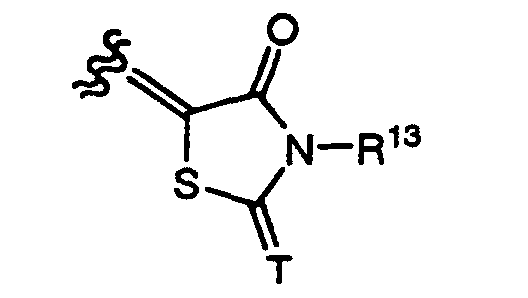 wherein R13 is hydrogen atom or lower alkyl; T is oxygen atom or sulfur atom.
Description
- The present invention relates to a pharmaceutical composition exhibiting thrombopoietin receptor agonism.
- Thrombopoietin, polypeptide cytokine composed of 332 amino acids, activates the production of platelets by stimulating the differentiation and proliferation of megakaryocytes through the receptor and is expected as a medicine for hemopathy accompanied with the unusual number of platelets, for example, thrombocytopenia. DNA sequences encoding the thrombopoietin receptor have been described in Proc. Natl. Acad. Sci., 89, 5640-5644 (1992). Low molecular peptides having an affinity for the thrombopoietin receptor is also known (JP98/72492A and WO96/40750), but these peptide derivatives are not generally practical for oral administration.
- 1,4-Benzodiazepine derivatives as a low molecule compound having an affinity to the thrombopoietin receptor is described in JP99/1477A and JP99/152276A.
- The compound having a similar structure of the present invention compound are described in EP 389699 A1, WO97/32863, J. Med. Chem. 25, 1992, 1853-1864, JP92/99770, and the like, but the affinity for thrombopoietin receptor is not described therein.
- The object of the present invention is to prepare pharmaceutical compositions exhibiting thrombopoietin receptor agonism and provide orally administrable platelet production modifiers.
- In the above situation, the inventors of the present invention have found that the following compounds exhibit strong thrombopoietin receptor agonism to achieve the present invention.
- The present invention relates to:
- 1) A pharmaceutical composition exhibiting thrombopoietin receptor agonism
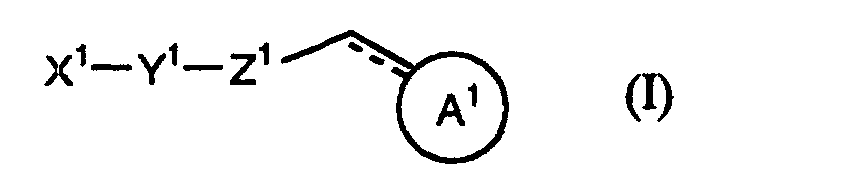
which contains as an active ingredient a compound of the general formula (I):
wherein X1 is a group represented by the formula:
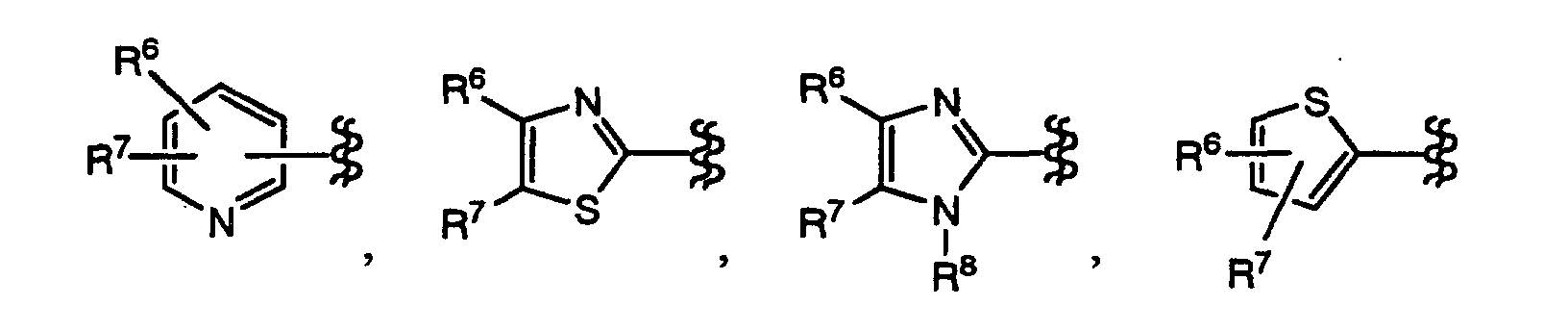 or
or wherein E is -CH2-, -(CH2)2-, -(CH2)3-, -O-CH2-, or -S-CH2-; one of R6 and R7 is a group represented by the formula:
 wherein R10, R11, and R12 are each independently hydrogen atom, alkyl optionally substituted with one or more substituent(s) selected from substituent group A, cycloalkyl, alkyloxy optionally substituted with one or more substituent(s) selected from substituent group A, alkylthio, halogen atom, phenyl optionally substituted with one or more substituent(s) selected from substituent group B, heteroaryl optionally substituted with one or more substituent(s) selected from substituent group B, or non-aromatic heterocyclic group optionally substituted with one or more substituent(s) selected from substituent group B,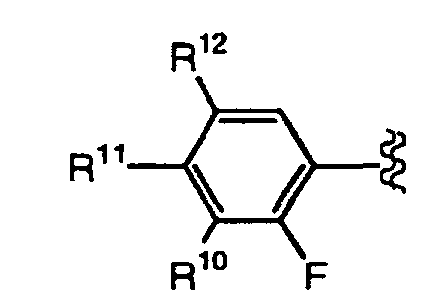
substituent group A consists of cycloalkyl, hydroxy, optionally substituted alkyloxy, halogen atom, carboxy, lower alkyloxycarbonyl, aryloxycarbonyl, optionally substituted amino, optionally substituted aminocarbonyl, phenyl optionally substituted with one or more substituent(s) selected from substituent group B, non-aromatic heterocyclic group, and heteroaryl,
substituent group B consists of hydroxy, alkyl, halogen atom, halo(lower)alkyl, carboxy, lower alkyloxycarbonyl, alkyloxy, optionally substituted amino, non-aromatic heterocyclic group, and heteroaryl;
the other of R6 and R7 is hydrogen atom, optionally substituted lower alkyl, carboxy, lower alkyloxycarbonyl, halogen atom, optionally substituted aminocarbonyl, optionally substituted heteroaryl, or optionally substituted aryl; R8 is hydrogen atom or lower alkyl;
Y1 is -NRACO-(CRCRD)0-2-, -NRACO-(CH2)0-2-V-, -NRACO-CRC=CRD-, -V-(CH2)1- 5-NRACO-(CH2)0-2-, -V-(CH2)1-5-CONRA-(CH2)0-2, -CONRA-(CH2)0-2-,-(CH2)0-2-NRA-SO2-(CH2)0-2-, -(CH2)0-2-SO2-NRA-(CH2)0-2-, -NRA-(CH2)0-2-, -NRA-CO-NRA-, -NRA-CS-NRA-,-N=C(-SRA)-NRA-, -NRACSNRACO-, -N=C(-SRA)-NRACO-, -NRA-(CH2)1-2-NRA-CO-,-NRACONRANRBCO-, or -N=C(-NRARA)-NRA-CO- wherein RA is each independently hydrogen atom or lower alkyl; RB is hydrogen atom or phenyl; RC and RD are each independently hydrogen atom, halogen atom, optionally substituted lower alkyl, optionally substituted lower alkyloxy, optionally substituted lower alkylthio, optionally substituted lower alkenyl, optionally substituted lower alkynyl, optionally substituted aryl, optionally substituted heteroaryl, optionally substituted cycloalkyl, optionally substituted aralkyl, optionally substituted heteroarylalkyl, optionally substituted non-aromatic heterocyclic group, or optionally substituted amino; V is oxygen atom or sulfur atom;
Z1 is optionally substituted arylene, optionally substituted heteroarylene, optionally substituted non-aromatic heterocyclicdiyl, or optionally substituted cycloalkylene;
A1 ring is a ring represented by the formula:wherein R1 and R2 are hydrogen atom or taken together to be oxygen atom or sulfur atom; R3 and R4 are hydrogen atom or taken together to be oxygen atom or sulfur atom; R5 is hydrogen atom or lower alkyl; Q and W are each independently -O-, -S-, -N(RF)-wherein RF is hydrogen atom or lower alkyl, or -CH2-; m is 1,2, or 3; a broken line (---) represents the presence or absence of a bond;
a broken line (---) represents the presence or absence of a bond;
provided that R10, R11, and R12 are not hydrogen atom at the same time; when R10 and R11 are hydrogen, R12 is not fluoro; when R10 is hydrogen, R11 and R12 are not fluoro;
its prodrug, or their pharmaceutically acceptable salt, or solvate thereof. More details, the present invention relates to the followings 2) to 21). - 2) A pharmaceutical composition exhibiting thrombopoietin receptor agonism of 1), wherein Y1 is -NHCO-, -CONH-, -NHCH2-, -NHCO-CH=CH-, or -NHSO2-.
- 3) A pharmaceutical composition exhibiting thrombopoietin receptor agonism of 1) or 2), wherein Z1 is halogen atom or 1,4-phenylene optionally substituted with lower alkyl.
- 4) A pharmaceutical composition exhibiting thrombopoietin receptor agonism
which contains a compound of any one of 1) to 3), wherein A1 ring is a group represented
by the formula:
wherein R13 is hydrogen atom or lower alkyl; M is -S-, -O-, -N(RE)- wherein RE is hydrogen atom or lower alkyl; or -CH2-; T is oxygen atom or sulfur atom; a broken line (---) represents the presence or absence of a bond.
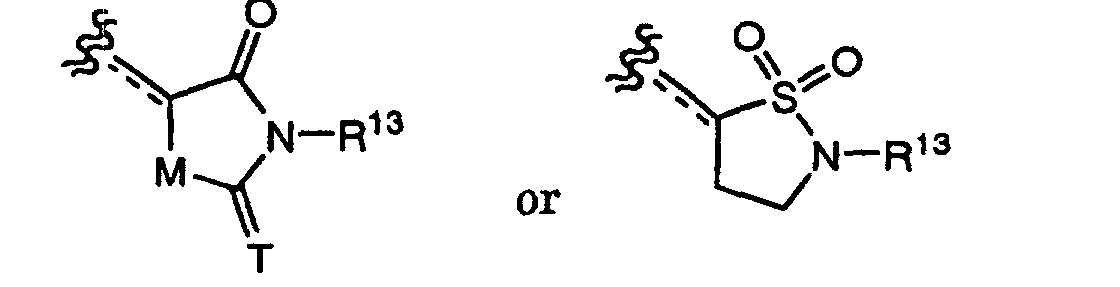
- 5) A pharmaceutical composition exhibiting thrombopoietin receptor agonism of any one of 1) to 4), wherein a broken line (---) represents the presence of a bond.
- 6) A pharmaceutical composition exhibiting thrombopoietin receptor agonism of any one of 1) to 5), which is a platelet production modifier.
- 7) Use of a compound of any one of 1) to 5), for preparation of a medicine for modifying platelet production.
- 8) A method for modifying platelet production of a mammal, including a human, which comprises administration to said mammal of a compound of any one of 1) to 5) in a therapeutically effective amount.
- 9) A compound represented by the general formula (II):
wherein R9 is hydrogen atom, optionally substituted lower alkyl; carboxy, lower alkyloxycarbonyl, halogen atom, or optionally substituted aminocarbonyl;
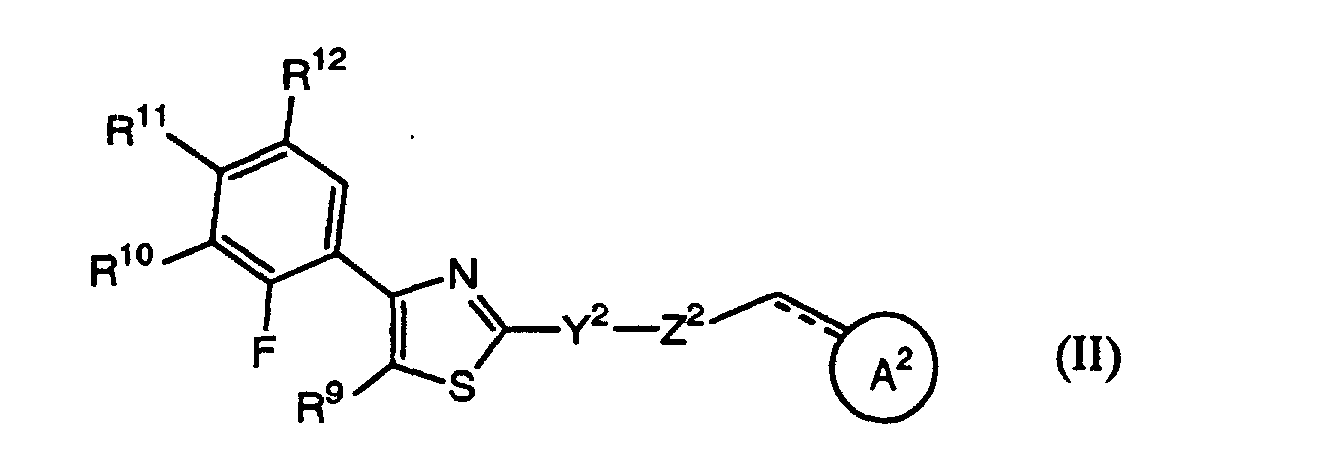
R10, R11, and R12 are each independently hydrogen atom, alkyl optionally substituted with one or more substituent(s) selected from substituent group A, cycloalkyl, alkyloxy optionally substituted with one or more substituent(s) selected from substituent group A, alkylthio, halogen atom, phenyl optionally substituted with one or more substituent(s) selected from substituent group B, heteroaryl optionally substituted with one or more substituent(s) selected from substituent group B, or non-aromatic heterocyclic group optionally substituted with one or more substituent(s) selected from substituent group B,
substituent group A consists of cycloalkyl, hydroxy, optionally substituted alkyloxy, halogen atom, carboxy, lower alkyloxycarbonyl, aryloxycarbonyl, optionally substituted amino, optionally substituted aminocarbonyl, phenyl optionally substituted with one or more substituent(s) selected from substituent group B, non-aromatic heterocyclic group, and heteroaryl,
substituent group B consists of hydroxy, alkyl, halogen atom, halo(lower)alkyl, carboxy, lower alkyloxycarbonyl, alkyloxy, optionally substituted amino, non-aromatic heterocyclic group, and heteroaryl;
Y2 is -NRACO-(CRCRD)0-2-, -NRACO-(CH2)0-2-V-, -NRACO-CRC=CRD-, -V-(CH2)1-5-NRACO-(CH2)0.2-, -V-(CH2)1-5-CONRA-(CH2)0-2-, -CONRA-(CH2)0-2-, -(CH2)0-2-NRA-SO2-(CH2)0-2-, -(CH2)0-2-SO2-NRA-(CH2)0-2-, -NRA-(CH2)0-2-, -NRA-CO-NRA-, -NRA-CS-NRA-,-N=C(-SRA)-NRA-, -NRACSNRACO-, -N=C(-SRA)-NRACO-, -NRA-(CH2)1-2-NRA-CO-,-NRACONRANRBCO-, or -N=C(-NRARA)-NRA-CO- wherein RA is each independently hydrogen atom or lower alkyl; RB is hydrogen atom or phenyl; RC and RD are each independently hydrogen atom, halogen atom, optionally substituted lower alkyl, optionally substituted lower alkyloxy, optionally substituted lower alkylthio, optionally substituted lower alkenyl, optionally substituted lower alkynyl, optionally substituted aryl, optionally substituted heteroaryl, optionally substituted cycloalkyl, optionally substituted aralkyl, optionally substituted heteroarylalkyl, optionally substituted non-aromatic heterocyclic group, or optionally substituted amino; V is oxygen atom or sulfur atom;
Z2 is optionally substituted phenylene, optionally substituted 2,5-pyridinediyl, optionally substituted 2,5-thiophenediyl, or optionally substituted 2,5-furandiyl;
A2 ring is a ring represented by the formula:wherein R1 and R2 are hydrogen atom or taken together to be oxygen atom or sulfur atom; R3 and R4 are hydrogen atom or taken together to be oxygen atom or sulfur atom; R5 is hydrogen atom or lower alkyl; Q and W are each independently -O-, -S-, -N(RF)-wherein RF is hydrogen atom or lower alkyl, or -CH2-; m is 1,2, or 3; a broken line (---) represents the presence or absence of a bond;
a broken line (---) represents the presence or absence of a bond;
provided that R10, R11, and R12 are not hydrogen atom at the same time; when R10 and R" are hydrogen, R12 is not fluoro; when R10 is hydrogen, R11 and R12 are not fluoro;
its prodrug, or their pharmaceutically acceptable salt, or solvate thereof. - 10) A compound of 9), wherein Y2 is -NHCO-, -CONH-, -NHCH2-, -NHCO-CH=CH-,
or -NHSO2-;
its prodrug, or their pharmaceutically acceptable salt, or solvate thereof. - 11) A compound of 9), wherein Y2 is -NHCO-;
its prodrug, or their pharmaceutically acceptable salt, or solvate thereof. - 12) A compound of any one of 9) to 11), wherein Z2 is halogen atom or 1,4-phenylene
optionally substituted with lower alkyl;
its prodrug, or their pharmaceutically acceptable salt, or solvate thereof. - 13) A compound of any one of 9) to 12), wherein A2 ring is a group represented by
the formula:
wherein R13 is hydrogen atom or lower alkyl; M is -S-, -O-, -N(RE)- wherein RE is hydrogen atom or lower alkyl; or -CH2-; T is oxygen atom or sulfur atom; a broken line (---) represents the presence or absence of a bond; its prodrug, or their pharmaceutically acceptable salt, or solvate thereof.
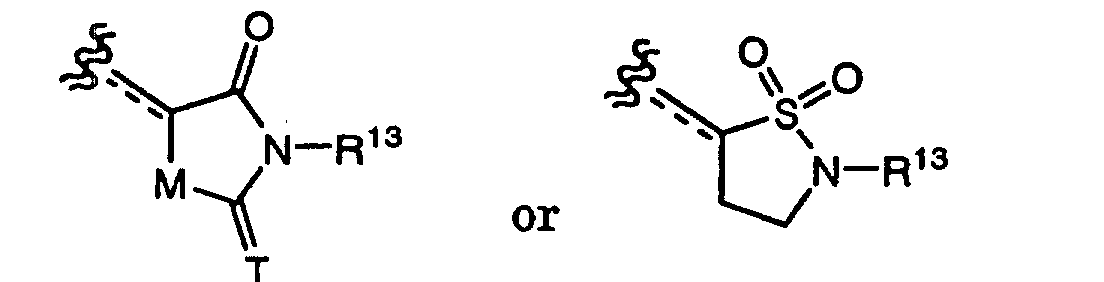
- 14) A compound of any one of 9) to 13), wherein a broken line (---) represents the
presence of a bond;
its prodrug, or their pharmaceutically acceptable salt, or solvate thereof. - 15) A compound of the general formula (III):
wherein R9 is hydrogen atom, optionally substituted lower alkyl; carboxy, lower alkyloxycarbonyl, halogen atom, or optionally substituted aminocarbonyl;
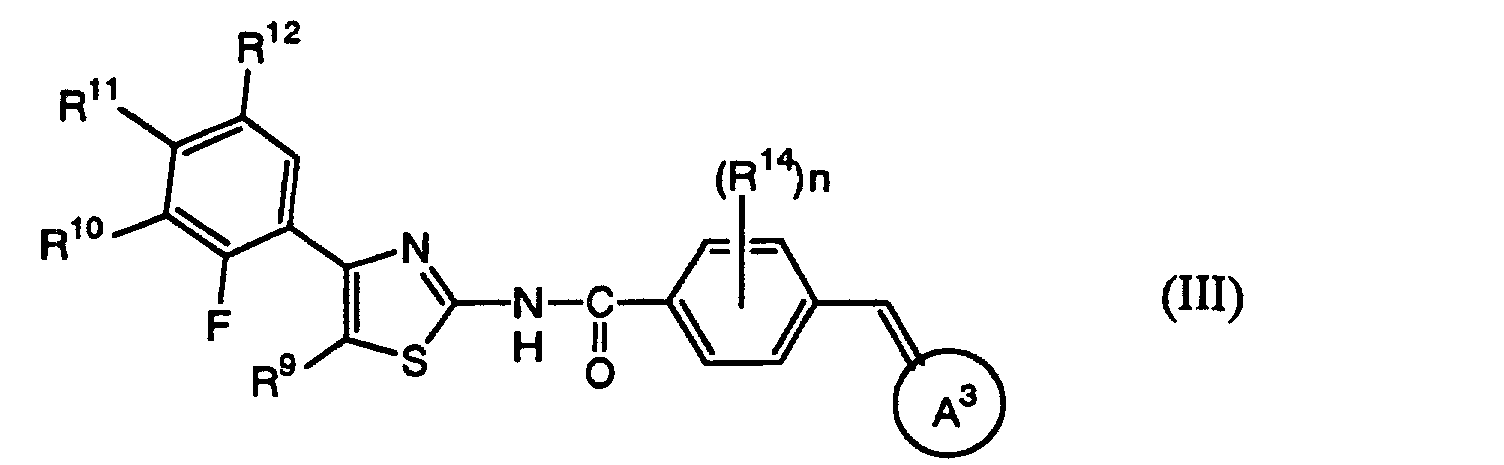
R10 is alkyl optionally substituted with one or more substituent(s) selected from substituent group A, cycloalkyl, alkyloxy optionally substituted with one or more substituent(s) selected from substituent group A, alkylthio, halogen atom, phenyl optionally substituted with one or more substituent(s) selected from substituent group B, heteroaryl optionally substituted with one or more substituent(s) selected from substituent group B, or non-aromatic heterocyclic group optionally substituted with one or more substituent(s) selected from substituent group B,
R11 and R12 are each independently hydrogen atom, alkyl optionally substituted with one or more substituent(s) selected from substituent group A, cycloalkyl, alkyloxy optionally substituted with one or more substituent(s) selected from substituent group A, alkylthio, halogen atom, phenyl optionally substituted with one or more substituent(s) selected from substituent group B, heteroaryl optionally substituted with one or more substituent(s) selected from substituent group B, or non-aromatic heterocyclic group optionally substituted with one or more substituent(s) selected from substituent group B,
substituent group A consists of cycloalkyl, hydroxy, optionally substituted alkyloxy, halogen atom, carboxy, lower alkyloxycarbonyl, aryloxycarbonyl, optionally substituted amino, optionally substituted aminocarbonyl, phenyl optionally substituted with one or more substituent(s) selected from substituent group B, non-aromatic heterocyclic group, and heteroaryl,
substituent group B consists of hydroxy, alkyl, halogen atom, halo(lower)alkyl, carboxy, lower alkyloxycarbonyl, alkyloxy, optionally substituted amino, non-aromatic heterocyclic group, and heteroaryl;
R14 is each independently lower alkyl, halogen atom, halo(lower)alkyl, lower alkyloxy, halo(lower)alkyloxy, or hydroxy;
n is an integer of 0 to 2;
A3 ring is a group represented by the formula:wherein R13 is hydrogen atom or lower alkyl; T is oxygen atom or sulfur atom; its prodrug, or their pharmaceutically acceptable salt, or solvate thereof.
- 16) A compound of 15), wherein R10 is alkyl optionally substituted with one or
more substituent(s) selected from substituent group A, alkyloxy, halo(lower)alkyloxy, or
phenyl optionally substituted with one or more substituent(s) selected from substituent
group B; R11 is hydrogen atom, halo(lower)alkyl, or halo(lower)alkyloxy; R12 is hydrogen
atom or fluoro;
substituent group A consists of cycloalkyl, hydroxy, optionally substituted alkyloxy, halogen atom, carboxy, lower alkyloxycarbonyl, aryloxycarbonyl, optionally substituted amino, optionally substituted aminocarbonyl, phenyl optionally substituted with one or more substituent(s) selected from substituent group B, non-aromatic heterocyclic group, and heteroaryl,
substituent group B consists of hydroxy, alkyl, halogen atom, halo(lower)alkyl, carboxy, lower alkyloxycarbonyl, alkyloxy, optionally substituted amino, non-aromatic heterocyclic group, and heteroaryl; its prodrug, or their pharmaceutically acceptable salt, or solvate thereof. - 17) A pharmaceutical composition containing as an active ingredient a compound of any one of 9) to 16).
- 18) A pharmaceutical composition exhibiting thrombopoietin receptor agonism, which contains as an active ingredient a compound of any one of 9) to 16).
- 19) A platelet production modifier containing as an active ingredient a compound of any one of 9) to 16).
- 20) Use of a compound of any one of 9) to 16), for preparation of a medicine for modifying platelet production.
- 21) A method for modifying platelet production of a mammal, including a human, which comprises administration to said mammal of a compound of any one of 9) to 16) in a pharmaceutically effective amount..
-
- In the present specification, the term "halogen" means fluoro, chloro, bromo, and iodo. Preferable are fluoro, chloro and bromo.
- In the present specification, the term "alkyl" employed alone or in combination with other terms means a straight or branched chain monovalent hydrocarbon group having 1 to 15 carbon atom(s). Examples of alkyl include methyl, ethyl, n-propyl, isopropyl, n-butyl, isobutyl, sec-butyl, tert-butyl, n-pentyl, isopentyl, neo-pentyl, n-hexyl, isohexyl, n-heptyl, n-octyl, n-nonanyl, n-decanyl, n-undecanyl, n-dodecanyl, n-tridecanyl, n-tetradecanyl, n-pentadecanyl, and the like. C1 to C10 alkyl is preferred. C1 to C6 alkyl is more preferred.
- In the present specification, the term "lower alkyl" employed alone or in combination with other terms means a straight or branched chain monovalent hydrocarbon group having 1 to 8 carbon atom(s). Examples of lower alkyl include methyl, ethyl, n-propyl, isopropyl, n-butyl, isobutyl, sec-butyl, tert-butyl, n-pentyl, isopentyl, neo-pentyl, n-hexyl, isohexyl, n-heptyl, n-octyl, and the like. C1 to C6 alkyl is preferred. C1 to C3 alkyl is more preferred.
- In the present specification, the term "cycloalkyl" employed alone or in combination with other terms means a cycloalkyl having 3 to 8 carbon atoms. Examples of cycloalkyl include cyclopropyl, cyclobutyl, cyclopentyl, cyclohexyl, cycloheptyl, cyclooctyl. C3 to C6 cycloalkyl is preferred.
- The term "lower alkenyl" in the present specification means a straight or branched chain monovalent hydrocarbon group having 2 to 8 carbon atoms and one or more double bond. Examples of lower alkenyl include vinyl, allyl, 1-propenyl, 2-propenyl, a variety of butenyl isomers and the like. C2 to C6 alkenyl is preferred. C2 to C4 alkenyl is more preferred.
- The term "lower alkynyl" used in the present specification means a straight or branched chain monovalent hydrocarbon group having 2 to 8 carbon atoms and one or more triple bond. Examples of lower alkynyl include ethynyl, 1-propynyl, 2-propynyl, 1-butynyl, 2-butynyl, 3-butynyl, 1-pentynyl, 2-pentynyl, a variety of pentynyl isomers and the like. C2 to C6 alkynyl is preferred. C2 to C4 alkynyl is more preferred.
- In the present specification, the term "aryl" employed alone or in combination with other terms means monocyclic or condensed cyclic aromatic hydrocarbon. Examples of aryl include phenyl, 1-naphtyl, 2-naphtyl, anthryl, and the like.
- The term "aralkyl" herein used means the above mentioned "lower alkyl" substituted with one or more of the above mentioned "aryl" at any possible position. Examples of the aralkyl are benzyl, phenethyl (e.g., 2-phenethyl and the like), phenylpropyl (e.g., 3-phenylpropyl and the like), naphthylmethyl (e.g., 1-naphthylmethyl, 2-naphthylmethyl, and the like), anthrylmethyl (e.g., 9-anthrylmethyl), and the like. Benzyl and phenylethyl are preferred.
- In the present specification, the term "non-aromatic heterocyclic group" employed alone or in combination with other terms means a 5- to 7-membered non-aromatic ring which contains one or more heteroatoms selected from the group consisting of oxygen, sulfur, and nitrogen atoms in the ring and the 5- to 7-membered non-aromatic ring group may be condensed with two or more rings. Examples of the non-aromatic heterocyclic group are pyrrolidinyl (e.g., 1-pyrrolidinyl, 2-pyrrolidinyl), pyrrolinyl (e.g., 3-pyrrolinyl), imidazolidinyl (e.g., 2-imidazolidinyl), imidazolinyl (e.g., imidazolinyl), pyrazolidinyl (e.g., 1-pyrazolidinyl, 2-pyrazolidinyl), pyrazolinyl (e.g., pyrazolinyl), piperidinyl (e.g., piperidino, 2-piperidinyl), piperazinyl (e.g., 1-piperazinyl), indolynyl (e.g., 1-indolynyl), isoindolinyl (e.g., isoindolinyl), morpholinyl (e.g., morpholino, 3-morpholinyl), tetrahydrofuranyl, tetrahydropyranyl, and the like.
- Preferable are morpholino, piperazino, pyrrolidino, teterahydrofuranyl, tetrahydropyranyl, and the like as "non-aromatic heterocyclic group" for R10, R11, and R12.
- Preferable are morpholino, piperazino, piperidino, teterahydrofuranyl, tetrahydropyranyl, and the like as "non-aromatic heterocyclic group" for substituent group A.
- Preferable are morpholino, piperazino, piperidino, pyrrolidino, teterahydrofuranyl, tetrahydropyranyl, and the like as "non-aromatic heterocyclic group" for substituent group B.
- In the present specification, the term "heteroaryl" employed alone or in combination with other terms means a 5- to 6-membered aromatic heterocyclic group which contains one or more heteroatoms selected from the group consisting of oxygen, sulfur, and nitrogen atoms in the ring and may be fused with above mentioned "cycloalkyl", above mentioned "aryl", above mentioned "non-aromatic heterocyclic group", and other heteroaryl at any possible position. The heteroaryl, monocyclic or fused ring, may be bonded at any possible position. Examples of the heteroaryl are pyrrolyl (e.g., 1-pyrrolyl, 2-pyrrolyl, 3-pyrrolyl), furyl (e.g., 2-furyl, 3-furyl), thienyl (e.g., 2-thienyl 3-thienyl), imidazolyl (e.g., 2- imidazolyl, 4- imidazolyl), pyrazolyl (e.g., 1-pyrazolyl, 3-pyrazolyl), isothiazolyl (e.g., 3-isothiazolyl), isoxazolyl (e.g., 3-isoxazolyl), oxazolyl (e.g., 2-oxazolyl), thiazolyl (e.g., 2-thiazolyl), pyridyl (e.g., 2-pyridyl, 3-pyridyl, 4-pyridyl), pyrazinyl (e.g., 2-pyrazinyl), pyrimidinyl (e.g., 2-pyrimidinyl, 4-pyrimidinyl), pyridazinyl (e.g., 3-pyridazinyl), tetrazolyl(e.g., 1H-tetrazolyl), oxadiazolyl (e.g., 1,3,4-oxadiazolyl), thiadiazolyl (e.g., 1,3,4- thiadiazolyl), indolizinyl (e.g., 2-indolizinyl, 6-indolizinyl), isoindolyl (2-isoindolyl), indolyl (e.g., 1-indolyl, 2-indolyl, 3-indolyl), indazolyl (e.g., 3-indazolyl), puriyl (e.g., 8-puriyl), quinolizinyl ( e.g., 2-quinolizinyl), isoquinolyl (e.g., 3-isoquinolyl), quinolyl (e.g., 3-quinolyl, 5-quinolyl), phthalazinyl (e.g., 1-phthalazinyl), naphthyridinyl (e.g., 2-naphthyridinyl), quinolanyl (2-quinolanyl), quinazolinyl (e.g., 2-quinazolinyl), cinnolinyl (e.g., 3-cinnolinyl), pteridinyl (e.g., 2-pteridinyl), carbazolyl (e.g., 2-carbazolyl, 4-carbazolyl), phenanthridinyl (e.g., 2-phenanthridinyl, 3-phenanthridinyl), acridinyl (e.g., 1-acridinyl, 2-acridinyl), dibenzofuranyl (e.g., 1-dibenzofuranyl, 2-dibenzofuranyl), benzimidazolyl (e.g., 2-benzimidazolyl), benzisoxazolyl (e.g., 3-benzisoxazolyl), benzoxazolyl (e.g., 2-benzoxazolyl), benzoxadiazolyl (e.g., 4- benzoxadiazolyl), benzisothiazolyl (e.g., 3-benzisothiazolyl), benzothiazolyl (e.g., 2-benzothiazolyl), benzofuryl (e.g., 3-benzofuryl), benzothienyl (e.g., 2-benzothienyl), and the like.
- Preferable are pyridyl, thienyl, furyl, pyrimidinyl, imidazolyl, thiazolyl, oxazolyl, triazolyl, and the like as "heteroaryl" for R10, R11 and R12.
- Preferable are pyridyl, pyrazolyl, pyrimidinyl, imidazolyl, oxazolyl, thiazolyl, furyl, thienyl, and the like as "heteroaryl" for substituent A group.
- Preferable are pyridyl, pyrazolyl, imidazolyl, and the like as "heteroaryl" for substituent B group.
- The term "heteroarylalkyl" herein used means the above mentioned "lower alkyl" substituted with one or more the above mentioned "heteroaryl" at any possible position. Examples of the heteroarylalkyl are thienylmethyl (e.g., 2- thienylmethyl), thienylethyl (e.g., 2-(thiophen-2-yl)ethyl), furylmethyl (e.g., 2- furylmethyl), furylethyl (e.g., 2-(furan-2-yl)ethyl), pyrrolylmethyl (e.g., 2-pyrrolylmethyl), pyrrolylethyl (e.g., 2-(pyrrol-2-yl)ethyl), imidazolylmethyl (e.g., 2-imidazolylmethyl, 4-imidazolylmethyl), imidazolylethyl (e.g., 2-(imidazol-2-yl)ethyl), pyrazolylmethyl (e.g., 3- pyrazolylmethyl), pyrazolylethyl (e.g., 2-(pyrazol-3-yl)ethyl), thiazolylmethyl (e.g., 2-thiazolylmethyl), thiazolylethyl (e.g., 2-(thiazol-2-yl)ethyl), isothiazolylmethyl (e.g., 3-thiazolylmethyl), isoxazolylmethyl (e.g., 3-isoxazolylmethyl), oxazolylmethyl (e.g., 2-oxazolylmethyl), oxazolylethyl (e.g., 2-(oxazol-2-yl)ethyl), pyridylmethyl (e.g., 2-pyridylmethyl , 3-pyridylmethyl, 4-pyridylmethyl), pyridylethyl (e.g., 2-pyridylethyl) and the like.
- The term "arylene" herein used means a divalent group of the above mentioned "aryl". Examples of the arylene include phenylene, naphthylene, and the like, in more detail, 1,2-phenylene, 1,3-phenylene, 1,4-phenylene, and the like. 1,4-Phenylene is preferred.
- The term "heteroarylene" herein used means a divalent group of the above mentioned "heteroaryl". Example of the heteroarylene include thiofendiyl, furandiyl, pyridinediyl, and the like. In more detail, include 2,5-thiofendiyl, 2,5-furandiyl, 2,5-pyridinediyl and the like.
- The term "non-aromatic heterocyclicdiyl" herein used means a divalent group of the above mentioned "non-aromatic heterocyclic group". Example of the non-aromatic heterocyclicdiyl include pyrrolidinediyl, piperidinediyl, pyrazinediyl, and the like.
- The term "cycloalkylene" herein used means a divalent group of the above mentioned "cycloalkyl". Example of the cycloalkylene include cyclopentylene cyclohexylene, and the like.
- The term "alkyloxy" herein used are methyloxy, ethyloxy, n-propyloxy, isopropyloxy, n-butyloxy, isobutyloxy, sec-butyloxy, tert-butyloxy, n-pentyloxy, n-hexyloxy, n-heptyloxy, n-octyloxy, n-nonanyloxy, n-decanyloxy, and the like. Methyloxy, ethyloxy, n-propyloxy, isopropyloxy and n-butyloxy are preferred.
- The term "lower alkyloxy" herein used are methyloxy, ethyloxy, n-propyloxy, isopropyloxy, n-butyloxy, isobutyloxy, sec-butyloxy, tert-butyloxy, and the like. Methyloxy, ethyloxy, n-propyloxy, isopropyloxy and n-butyloxy are preferred.
- The term "lower alkylthio" herein used are methylthio, ethylthio, and the like.
- The term "lower alkyloxycarbonyl" herein used are methyloxycarbonyl, ethyloxycarbonyl, n-propyloxycarbonyl, isopropyloxycarbonyl, n-butyloxycarbonyl, t-butyloxycarbonyl, n-pentyloxycarbonyl and the like.
- The term "aryloxycarbonyl" herein used are phenyloxycarbonyl, 1-naphthyloxycarbonyl, 2-naphthyloxycarbonyl, and the like.
- In the present specification, the term "acyl" employed alone or in combination with other terms means alkylcarbonyl in which alkyl group is the above mentioned "lower alkyl" and arylcarbonyl in which aryl group is the above mentioned "aryl". Examples of the acyl are acetyl, propyonyl, benzoyl, and the like. "Lower alkyl" and "aryl" may be substituted respectively with substituents mentioned below.
- In the present specification, the term "halo(lower)alkyl" employed alone or in combination with other terms means the above mentioned "lower alkyl" which is substituted with the above mentioned "halogen" at 1 to 8 positions, preferably, at 1 to 5 . Examples of the halo(lower)alkyl include trifluoromethyl, trichloromethyl, difluoroethyl, trifluoroethyl, dichloroethyl, trichloroethyl, and the like. Preferable is trifluoromethyl.
- The term "halo(lower)alkyloxy" herein used are trifluoromethyloxy, trichloromethyloxy, difluoroethyloxy, trifluoroethyloxy, dichloroethyloxy, trichloroethyloxy, and the like. Preferable is trifluoromethyloxy.
- Examples of the term "acyloxy" herein used are acetyloxy, propionyloxy, benzoyloxy and the like.
- Examples of the term "lower alkylsilyl" herein used are triethylsilyl, t-butyldimethylsilyl, and the like.
- In the present specification, the term "optionally substituted amino" employed alone or in combination with other terms includes amino substituted with one or two of the above mentioned "lower alkyl", "aryl", "aralkyl", "heteroaryl", "heteroarylalkyl" or "acyl". Examples of the optionally substituted amino include amino, methylamino, dimethylamino, ethylmethylamino, diethylamino, benzylamino, acetylamino, benzoylamino and the like. Preferable are amino, methylamino, dimethylamino, ethylmethylamino, diethylamino and acetylamino.
- Examples of the term "optionally substituted aminocarbonyl" herein used are aminocarbonyl, methylaminocarbonyl, dimethylaminocarbonyl, ethylmethylaminocarbonyl, diethylaminocarbonyl and the like. Preferable are aminocarbonyl, methylaminocarbonyl, and dimethylaminocarbonyl.
- In the present specification, the term "optionally substituted ureide" includes ureide substituted with one or more of the above mentioned "lower alkyl", "aryl", "aralkyl", "heteroaryl", "heteroarylalkyl" or "acyl".
- The substituents of "optionally substituted lower alkyl" include cycloalkyl, lower alkenyl, lower alkyliden (e.g., ethylidene, propylidene), hydroxy, lower alkyloxy, mercapto, lower alkylthio, halogen, nitro, cyano, carboxy, lower alkyloxycarbonyl, halo(lower)alkyl, halo(lower)alkyloxy, optionally substituted amino, optionally substituted aminocarbonyl, acyl, acyloxy, optionally substituted non-aromatic heterocyclic group, aryloxy (e.g., phenyloxy), aralkyloxy (e.g., benzyloxy), lower alkylsulfonyl, guanidino, azo group, optionally substituted ureide, =N-O- (acyl) and the like. These substituents are able to locate at one or more of any possible positions.
- Preferable are halogen atom, halo(lower)alkyl, and the like as substituents of "optionally substituted lower alkyl" for RC and RD.
- Preferable are lower alkyloxycarbonyl and halogen atom as substituents of "optionally substituted lower alkyl" for R6, R7, and R9.
- Preferable are cycloalkyl, lower alkenyl, lower alkylidene (e.g., ethylidene, propylidene, and the like), and the like as substituents of "optionally substituted lower alkyl" for R8.
- The substituents of "optionally substituted lower alkyloxy" and "optionally substituted lower alkylthio" include cycloalkyl, lower alkenyl, lower alkylidene (e.g., ethylidene, propylidene, and the like), hydroxy, lower alkyloxy, mercapto, lower alkylthio, halogen, nitro, cyano, carboxy, lower alkyloxycarbonyl, halo(lower)alkyl, halo(lower)alkyloxy, optionally substituted amino, optionally substituted aminocarbonyl, acyl, acyloxy, optionally substituted non-aromatic heterocyclic group, aryloxy (e.g., phenyloxy), aralkyloxy (e.g., benzyloxy), lower alkylsulfonyl, guanidino, azo group, optionally substituted ureide, =N-O- (acyl) and the like. These substituents are able to locate at one or more of any possible positions.
- The substituents of "optionally substituted lower alkenyl" and "optionally substituted lower alknyl" include cycloalkyl, lower alkenyl, lower alkylidene (e.g., ethylidene, propylidene, and the like), hydroxy, lower alkyloxy, mercapto, lower alkylthio, halogen, nitro, cyano, carboxy, lower alkyloxycarbonyl, halo(lower)alkyl, halo(lower)alkyloxy, optionally substituted amino, optionally substituted aminocarbonyl, acyl, acyloxy, optionally substituted non-aromatic heterocyclic group, aryloxy (e.g., phenyloxy), aralkyloxy (e.g., benzyloxy), lower alkylsulfonyl, guanidino, azo group, optionally substituted ureide, and the like. These substituents are able to locate at one or more of any possible positions.
- The substituents of "optionally substituted arylene", "optionally substituted heteroarylene", "optionally substituted 2,5-pyridinediyl", "optionally substituted 2,5-thiophenediyl", "optionally substituted 2,5-furandiyl", "optionally substituted non-armatic heterocyclicdiyl", "optionally substituted cycloalkylene", "optionally substituted aryl", "optionally substituted phenyl", "optionally substituted heteroaryl", "optionally substituted non-aromatic heterocyclic group", "optionally substituted cycloalkyl", "optionally substituted aralkyl", and "optionally substituted heteroarylalkyl" herein used are optionally substituted alkyl, cycloalkyl, lower alkenyl, lower alkynyl, hydroxy, alkyloxy,aralkyloxy, mercapto, lower alkylthio, halogen, nitro, cyano, carboxy, lower alkyloxycarbonyl, halo(lower)alkyl, halo(lower)alkyloxy, optionally substituted amino, optionally substituted aminocarbonyl, acyl, acyloxy, optionally substituted aryl (which is substituted by halogen atom, carboxy, alkyl, or alkyloxy, and the like), optionally substituted heteroaryl (which is substituted by halogen atom, carboxy, alkyl, or alkyloxy, and the like), optionally substituted non-aromatic heterocyclic group, optionally substituted aralkyl, lower alkylsulfonyl, guanidino, azo group, -N=N-(optionally substituted phenyl) or optionally substituted ureide and the like. These substituents are able to locate at one or more of any possible positions.
- In the present specification, the term "(α)β-γ" means that the number of α present is β to γ. For examples, (CRCRD)0-2, (CH2)0-2, and (CH2)1-5 mean that CRCRD is present 0 to 2, CH2 is present 0 to 2, CH2 is present 1 to 5, respectively.
- In the present specification, the term "platelet production modifier" includes a medicine for hemopathy accompanied with the unusual number of platelet. For example the hemopathy is thrombocytopenia (after bone marrow transplantation, after chemotherapy, anaplastic anemia, bone marrow dysplasia syndrome, acquired thrombopenia of intractable sudden thrombocy topenic purpura and the like, congenital thrombopenia of thrombopoietin deficiency and the like) and the like. For example this medicine can be used as a treating agent for decreace platelet number caused by administrating an antitumor agent, or as a preventing agent for the platelet number decreace caused by administrating an antitumor agent.
- In the present specification, the term "modifying platelet production" includes 1) increasing the number of platelet decreased by administrating an antitumor agent and the like, 2) maintaining the number of platelet which may be decreased by administrating an antitumor agent and the like, and 3) reducing the ratio of the platelet number decrease caused by administrating an antitumor agent and the like.
- The pharmaceuticl composition exhibiting thrombopoietin receptor agonism includes a thrombopoietin receptor agonistic agent.
- Compounds (I) of the invention can be synthesized by the following methods A to C and the similar process. Furthermore, they can be synthesized in a manner similar to the methods described in WO97/05135 and WO98/39737.
- wherein A1 and X1 are as defined above; Z3 is optionally substituted arylene, optionally substituted heteroarylene, optionally substituted non-aromatic heterocyclicdiyl, or optionally substituted cycloalkylene; R15 is lower alkyl.

- Commercial available compounds (IV) substituted with lower alkyloxycarbonyl and aldehyde are used as a starting material.
- Further, the compounds (IV) can be obtained by the following methods 1) to 3), 1) the carboxy group of the compounds substituted with lower alkyloxycarbonyl and carboxy is converted to mixed acid anhydride with ethyl chlorocarbonate or the like, 2) the obtained compounds are converted to the compounds substituted with alkyloxycarbonyl and hydroxy by usual reduction reaction (e.g., reduction reaction with sodium borohydride), 3) the obtained compounds are converted to the compounds (IV) substituted with alkyloxycarbonyl and aldehyde by usual oxidation reaction (e.g., Swern oxidation, Dess-Martin oxidation, or the like).
- This step is a process for preparing benzylidene derivatives by reacting aldehyde derivatives (IV) and 2,4-thiazolidinedione or the like. The desired compounds can be obtained by reacting the compounds (IV) in a solvent such as benzene, toluene with 2,4-thiazolidinedione or the like under heating and reflux in the presence of acetic acid and piperidine as catalyst (Knoevenagel reaction).
- The produced double bond can be reduced by usual reduction reaction (e.g., catalytic reduction) at appropriate stage. When a substituent interfering with the reaction is present, it can be protected by the method described in Protective Groups in Organic Synthesis, Theodora W Green (Johan Wiley & Sons) or the like, and deprotected at appropriate stage.
- This step is a process for converting alkyloxy derivatives to carboxylic acid derivatives by hydrolysis. It can be conducted on usual hydrolysis reaction. For example, carboxylic derivatives (compound (VI)) can be obtained by reacting the compounds (V) in acetic acid with hydrochloric acid or the like.
- This step is a process for preparing amide derivative (I-A) from carboxylic acid derivatives (VI) and amine derivatives (VII) by the method such as active esterification, acid chloride, and mixed acid anhydride. This step is reacted in a solvent such as tetrahydrofuran, dioxane, dichloromethane, toluene, and benzene. The active esterification can be carried out by using 1-hydroxybenzotriazole, hydroxysuccinimide, dimethylaminopyridine, and the like and a condensation reagent such as dicyclohexylcarbodiimide and 1-ethyl-3-(3-dimethylaminopropyl)carbodiimide hydrochloride salt. The acid halide method can be carried out by converting free carboxylic acid to acid chloride with thionyl chloride or oxalyl chloride. The mixed acid anhydride method can be carried out by converting carboxylic acid to mixed acid anhydride with ethylchloroformate, isobutylchloroformate or the like. Triethylamine, pyridine or the like are used as base in these reaction if necessary.
- Compounds (VII) can be commercially available or obtained by the following methods. 1) in the case that X1 is optionally substituted aryl, optionally substituted heteroaryl or the like, and said substituent is aryl and heteroaryl, compounds (VII) having a continuously connected two rings can be obtained by Suzuki reaction or the like. 2) in the case that X1 is optionally substituted thiazole, compounds (VII') can be obtained by the following method.wherein RE and RF are hydrogen atom, optionally substituted lower alkyl, carboxy, lower alkyloxycarbonyl, optionally substituted aminocarbonyl, optionally substituted phenyl, or the like; Hal is halogen atom.

- This step is a process of halogenation. It can be prepared by usual halogenation. For example, it can be brominated by reacting with bromine in a mixed solvent of methanol-chloroform.
- This step is a process for constructing thiazole ring. For example, the desired thiazole derivatives (VII') can be obtained by reacting with thiourea in a solvent such as methanol.
-
 wherein A1, X1, and Z3 are as defined above; Boc is t-butyloxycarbonyl.
- This step is a process for converting carboxy to amino protected with Boc. For example, the desired compounds can be obtained by reacting the compounds (VI) having carboxy in a solvent such as dimethylformamide, toluene, diethyl ether, dioxane, with t-butanol and diphenylphosphorylazide, in the presence of a base such as triethylamine .
- This step is a process for removing Boc. It can be conducted by the method described in Protective Groups in Organic Synthesis, Theodora W Green (Johan Wiley & Sons) or the like. For example, the desired deprotected derivatives (XI) can be obtained by treating the compounds (X) with trifluoroacetic acid.
- It can be conducted in a manner similar to Step 3 of Method A.
- wherein A1, X1, Z3, and Hal are as defined above.

- This step is a process for converting the carboxylic acid halide (XIII) of the compounds (VI) described in Method A to the desired compounds (I-C) by treating with ammonium isothiocyanate, followed by reacting with the above mentioned compounds (VII).
- The compounds of the general formula (I) wherein Y1 is not -CONH-, -NHCO-, and -NHC(=S)NHC(=O)- can be synthesized in a manner similar to Method A to C described above.
- N-alkyl derivatives can be prepared by usual alkylation.
- In the synthesis of a compound (I) wherein Y1 is -N(-alkyl)-CO-; X1 is optionally substituted thiazole, represented by the formula;wherein A1 and Z1 are as defined above; Alk is lower alkyl, depending the alkylation condition, the following compound may be obtained.
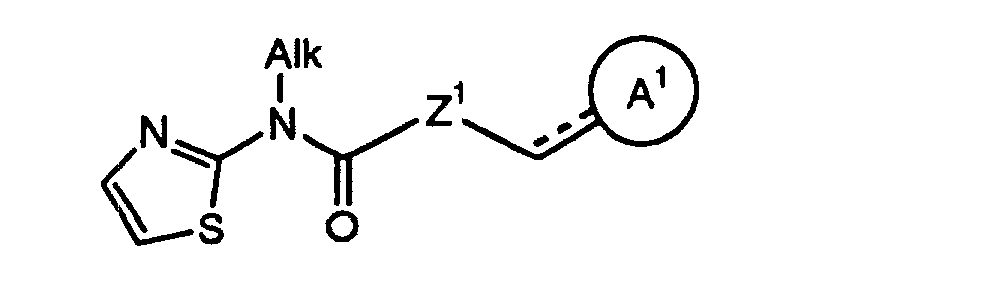 wherein A1, Z1 and Alk are as defined above.
- In the case of compound of the general formula (I), (II), or (III) wherein a broken line represents the presence of a bond, the compound includes a cis isomer and a trans isomer. For example, in the case that A1 ring is thiazolidinedione, the following cis isomer and trans isomer may exist.wherein X1, Y1 and Z1 are as defined above.
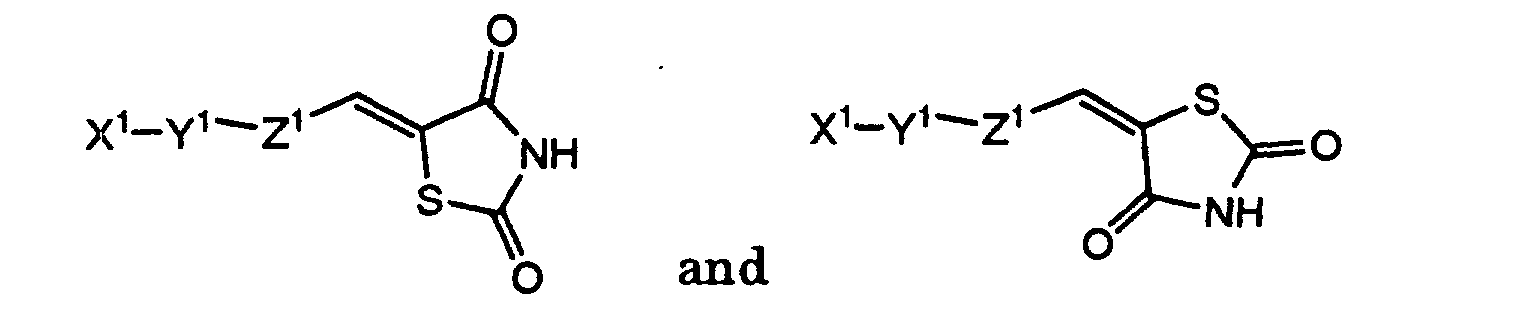
- The term "solvate" includes, for example, solvates with organic solvents, hydrates, and the like.
- The term "compound of the present invention" herein used includes a pharmaceutically acceptable salt or hydrate thereof. The salt is exemplified by a salt with alkali metals (e.g., lithium, sodium, potassium, and the like), alkaline earth metals (e.g., magnesium, calcium, and the like), ammonium, organic bases, amino acids, mineral acids (e.g., hydrochloric acid, hydrobromic acid, phosphoric acid, sulfuric acid, and the like), or organic acids (e.g., acetic acid, citric acid, maleic acid, fumaric acid, benzenesulfonic acid, p-toluenesulfonic acid, and the like). These salts can be formed by the usual method. These hydrates can coordinate with any water molecules.
- Prodrug is a derivative of the compound having a group which can be decomposed chemically or metabolically, and such prodrug is a compound according to the present invention which becOMes pharmaceutically active by means of solvolysis or by placing the compound in vivo under a physiological condition. The method of both selection and manufacture of appropriate prodrug derivatives is described in, for example. Design of Prodrugs, Elsevier, Amsterdam, 1985). For instance, prodrugs such as an ester derivative which is prepared by reacting a basal acid compound with a suitable alcohol, or an amide derivative which is prepared by reacting a basal acid compound with a suitable amine are exemplified when the compounds according to present invention have a carboxylic group. Particularly preferred esters as prodrugs are methyl, ethyl, n-propyl, isopropyl, n-butyl, isobutyl, tert-butyl, morpholinoethyl, and N,N-diethylglycolamido, and the like. For instance, prodrugs such as an acyloxy derivative which is prepared by reacting a basal hydroxy compound with a suitable acyl halide or a suitable acid anhydride, or an amide derivative which is prepared by reacting a basal acid compound with a suitable amine are exemplified when the compounds according to present invention have a hydroxy group.. Particularly preferred acyloxy derivatives as prodrugs -OCOC2H5, -OCO(t-Bu), -OCOC15H31, -OCO(m-COONa-Ph),-COCH2CH2COONa, -OCOCH(NH2)CH3, -OCOCH2N(CH3)2, and the like. For instance, prodrugs such as an amide derivative which is prepared by reacting a basal amino compound with a suitable acid halide or a suitable acid anhydride are exemplified when the compounds according to present invention have an amino group. Particularly preferred amide as prodrugs are -NHCO(CH2)20CH3, -NHCOCH(NH2)CH3, and the like.
- The compound of the present invention is not restricted to any particular isomers but includes all possible isomers and racemic modifications.
- The present invention compounds show excellent thrombopoietin receptor agonism as described in examples mentioned later, and may be used as a pharmaceutical composition (platelet production modifier) for hemopathy accompanied with the unusual number of platelet. And the present compounds may be used as a peripheral blood stem cell-releasing accelerating agent, a differetiation-inducing agent against megakaryocytoid leukemia cell, a thrombocytosis agent for blood platelet donor, and the like.
- When the compound of the present invention is administered to a person for the treatment of the above diseases, it can be administered orally as powder, granules, tablets, capsules, pilulae, and liquid medicines, or parenterally as injections, suppositories, percutaneous formulations, insufflation, or the like. An effective dose of the compound is formulated by being mixed with appropriate medicinal admixtures such as excipient, binder, penetrant, disintegrators, lubricant, and the like ifnecessary. Parenteral injections are prepared by sterilizing the compound together with an appropriate carrier.
- The dosage varies with the conditions of the patients, administration route, their age, and body weight. In the case of oral administration, the dosage can generally be between 0. 1 to 100 mg/kg/day, and preferably 1 to 20 mg/kg/day for adult.
- The following examples are provided to further illustrate the present invention and are not to be construed as limiting the scope thereof.
- Abbreviations described below are used in the following examples.
- Me : methyl
- Et : ethyl
- n-Pr : n-propyl
- i-Pr : isopropyl
- c-Pr: cyclopropyl
- n-Bu: n-butyl
- i-Bu : isobutyl
- sec-Bu : sec-butyl
- t-Bu : tert-butyl
- i-Bu : isobutyl
- n-Pen : n-pentyl
- c-Pen : cyclopentyl
- n-Hex: n-hexyl
- c-Hex : cyclohexyl
- i-Hex: isohexyl
- Ph : phenyl
- Bn : benzyl
- Bz : benzoyl
- Py : pyridyl
- Th thienyl
- Ac : acetyl
- Z: benzyloxycarbonyl
- DMF : N,N-dimethylformamide
- THF : tetrahydrofuran
-
-
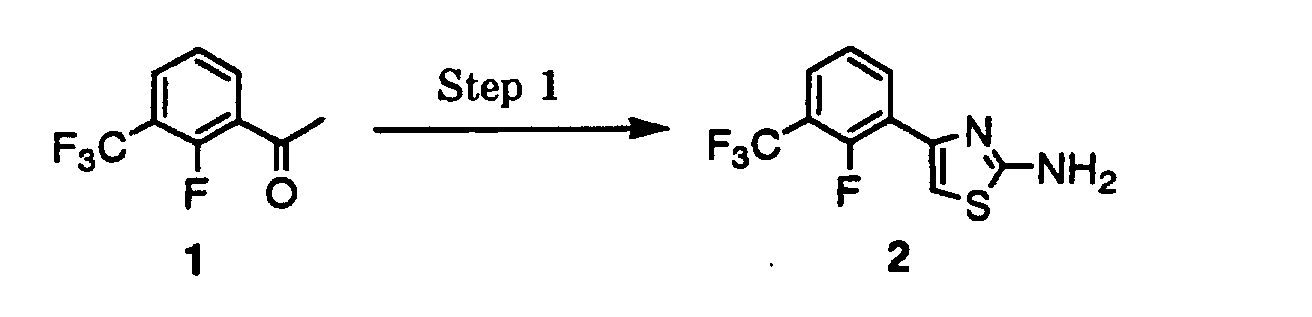


- To a solution of 2'-fluoro-3'-trifluoroacetophenone (1) (20.9 g) in 10% methanol-chloroform was added bromine (5.26 mL), and the reaction mixture was stirred at room temperature until a color of bromine was disappeared. The solvent was evaporated under reduced pressure and the residue was dissolved in ethanol again. To the reaction mixture was added thiourea (7.71 g) and the mixture was heated under reflux for 2 h. To the reaction mixture was added a mixture of ethyl acetate-saturated aqueous sodium bicarbonate solution, and the organic layer was dried over anhydrous magnesium sulfate, and evaporated. The residue was purified by column chromatography to give a compound (2) (19.8 g).
1H NMR (CDCl3, δ ppm): 8.22 - 8.28 (m, 1H), 7.48 - 7.54 (m, 1H), 7.24 - 7.30 (m, 1H), 7.10 (d, 1H, J = 2.4 Hz), 5.14 (bs, 2H). - To a solution of methyl terephthalaldehydate (25 g) and rhodanine (23.3 g) in toluene were added 1 mol/L piperizine-toluene solution (6.2 mL) and 1 mol/L acetic acid-toluene solution (6.2 mL), and then the reaction mixture was heated under reflux overnight. After cooling, the resulting crystal was filtered to a compound (4) (34.6 g) as a brown oil.
1H NMR(DMSO-d6, δ ppm) 13.18 (bs, 1H), 8.07 (d, 2H, J = 8.7 Hz), 7.73 (d, 2H, J = 8.7 Hz), 7.68 (s, 1H), 3.88 (s, 1H). - A suspension of compound (4) (34.6 g) in dioxane (160 mL), acetic acid (250 mL), and 6 mol/L hydrochloric acid (88 mL) was refluxed at 120 °C for 5 h. To the reaction mixture was added water (350 mL), after cooling, the crystal was filtered to give a compound (5) (30.0 g).
1H NMR (DMSO-d6, δ ppm): 13.95 (bs, 1H), 13.24 (bs, 1H), 8.06 (d, 2H, J = 8.4 Hz), 7.72 (d, 2H, J = 8.4 Hz), 7.69 (s, 1H). - A mixture of compound (5) (3 g) in dioxane (20 mL) and thionyl chloride (10 mL) was heated to dissolve at 100 °C. The solvent was evaporated to give a carboxylic acid chloride. The obtained carboxylic acid chloride was used at next reaction without purification. The carboxylic acid chloride (286 mg) and the compound (2) (368 mg) synthesized in Step 1 were dissolved in dioxane (50 mL), and pyridine (162 µL) was added to the reaction mixture and the reaction mixture was heated at 100 °C for 2 h. After cooling, the solvent was evaporated, and to the residue were added methanol (6 mL) and water (2 mL). The resulting crystal was filtered and recrystallized from DMF to give a compound (A-1) (220 mg).
1H NMR (DMSO-d6, δ ppm): 13.90 (bs, 1H), 13.02 (bs, 1H), 8.37 - 8.42 (m, 1H), 8.25 (d, 2H, J = 8.2 Hz), 7.75 - 7.81 (m, 4H), 7.71 (s, 1H), 7.53 - 7.58 (m, 1H). - Compounds (A-2) to (A-51) were synthesized in a manner similar to Example 1. Their physical data were shown in Tables 1 to 6.


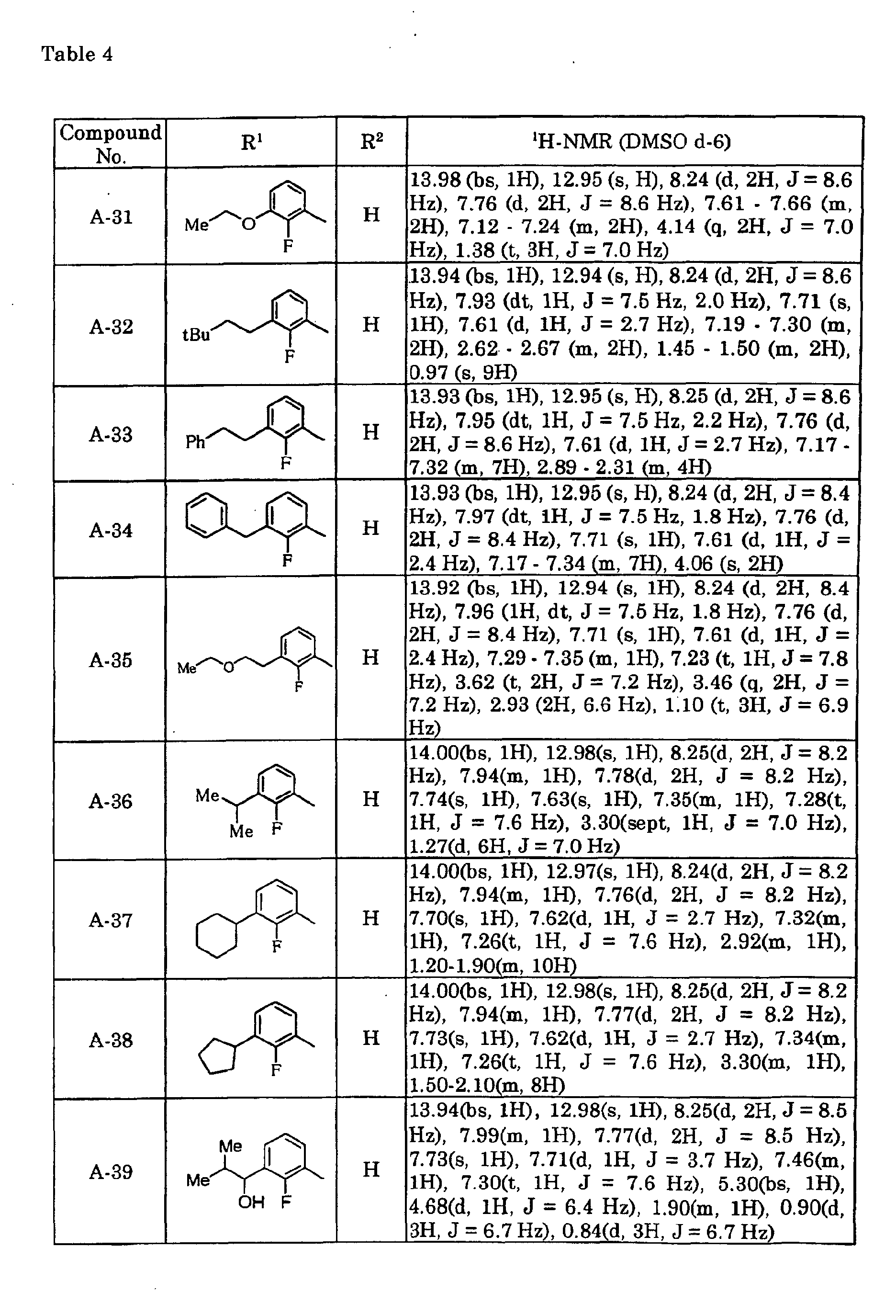

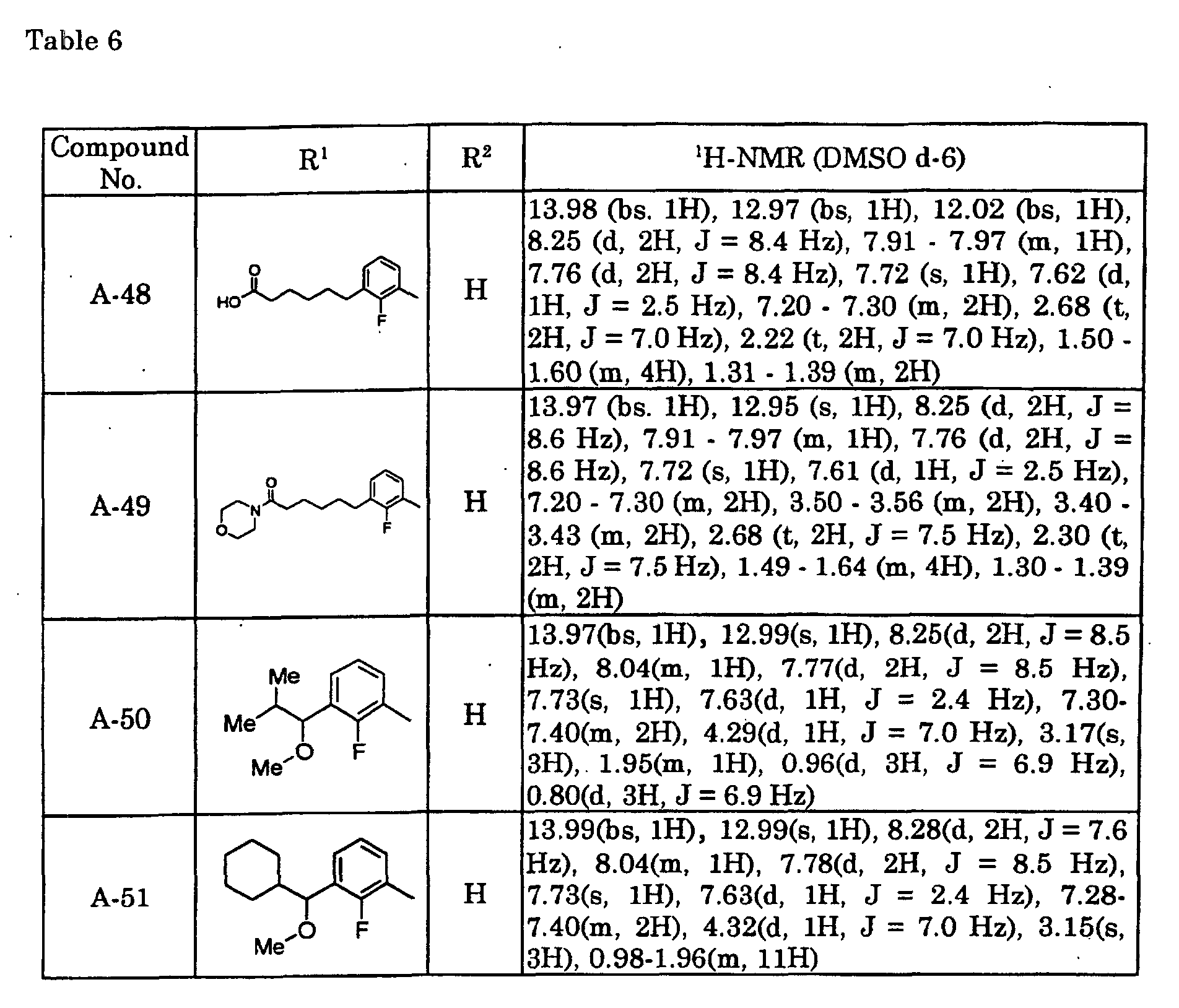
- All compounds of the general formula (XIV) and (XV), having substituent of the following combination, can be synthesized in a manner similar to the method described above.wherein Ra is hydrogen atom, fluoro, or methyl; Rb is hydrogen atom, fluoro, or chloro; Rc is hydrogen atom, fluoro, chloro, methyl, ethyl, n-propyl, cyclopropyl, isopropyl, n-butyl, isobutyl, sec-butyl, n-pentyl, cyclopentyl, n-hexyl, cyclohexyl, hydroxy, methyloxy, ethyloxy, n-propyloxy, phenyloxy, benzyloxy, phenylethyloxy, trifluoromethyl, trifluoromethyloxy, phenyl, 4-fluorophenyl, 4-trifluoromethylphenyl, 4-dimethylaminophenyl, 4-hydroxyphenyl, 3,4-difluorophenyl, 4-carboxyphenyl, benzyl, 4-fluorobenzyl, 2-pyridyl, 3-pyridyl, 4-pyridyl, 2-thienyl, 3-thienyl, pyrazol-2-yl, pyrazol-3-yl, pyrimidin-2-yl, pyrimidin-4-yl, pyrimidin-5-yl, 3-carboxypropyl, 4-carboxybutyl, 4-dimethylaminocarbonylbutyl, 5-dimethylaminocarbonylpentyl, methyloxymethyl, ethyloxymethyl, ethyloxyethyl, methyloxyethyloxyethyl, methyloxyethyl, hydroxymethyl, hydroxyethyl, hydroxypropyl, hydroxybutyl, hydroxypentyl, dimethylamino, piperidin-4-ylmethyl, or cyclohexylmethyl; Rc is hydrogen atom, fluoro, chloro, bromo, methyl, or trifluoromethyl;

(Ra, Rb, Rc) = (B-1, H, H, H), (B-2, H, H, Cl), (B-3, H, H, F), (B-4, H, H, CF3), (B-5, H, H, Br), (B-6, H, H, Me), (B-7, H, F, H), (B-8, H, F, Cl), (B-9, H, F, F), (B-10, H, F, CF3), (B-11, H, F, Br), (B-12, H, F, Me), (B-13, H, Cl, H), (B-14, H, Cl, Cl), (B-15, H, Cl, F), (B-16, H, Cl, CF3), (B-17, H, Cl, Br), (B-18, H, Cl, Me), (B-19, H, Me, H), (B-20, H, Me, Cl), (B-21, H, Me, F), (B-22, H, Me, CF3), (B-23, H, Me, Br), (B-24, H, Me, Me), (B-25, H, Et, H), (B-26, H, Et, Cl), (B-27, H, Et, F), (B-28, H, Et, CF3), (B-29, H, Et, Br), (B-30, H, Et, Me), (B-31, H, n-Pr, H), (B-32, H, n-Pr, Cl), (B-33, H, n-Pr, F), (B-34, H, n-Pr, CF3), (B-35, H, n-Pr, Br), (B-36, H, n-Pr, Me), (B-37, H, c-Pr, H), (B-38, H, c-Pr, Cl), (B-39, H, c-Pr, F), (B-40, H, c-Pr, CF3), (B-41, H, c-Pr, Br), (B-42, H, c-Pr, Me), (B-43, H, i-Pr, H), (B-44, H, i-Pr, Cl), (B-45, H, i-Pr, F), (B-46, H, i-Pr, CF3), (B-47, H, i-Pr, Br), (B-48, H, i-Pr, Me), (B-49, H, n-Bu, H), (B-50, H, n-Bu, Cl), (B-51, H, n-Bu, F), (B-52, H, n-Bu, CF3), (B-53, H, n-Bu, Br), (B-54, H, n-Bu, Me), (B-55, H, i-Bu, H), (B.56, H, i-Bu, Cl), (B-57, H, i-Bu, F), (B-58, H, i-Bu, CF3), (B-59, H, i-Bu, Br), (B-60, H, i-Bu, Me), (B-61, H, sec-Bu, H), (B-62, H, sec-Bu, Cl), (B-63, H, sec-Bu, F), (B-64, H, sec-Bu, CF3), (B-65, H, sec-Bu, Br), (B-66, H, sec-Bu, Me), (B-67, H, n-Pen, H), (B-68, H, n-Pen, Cl), (B-69, H, n-Pen, F), (B-70, H, n.Pen, CF3), (B-71, H, n-Pen, Br), (B-72, H, n-Pen, Me), (B-73, H, c-Pen, H), (B-74, H, c-Pen, Cl), (B-75, H, c-Pen, F), (B-76, H, c-Pen, CF3), (B-77, H, c-Pen, Br), (B-78, H, c-Pen, Me), (B-79, H, n-Hex, H), (B-80, H, n-Hex, Cl), (B-81, H, n-Hex, F), (B-82, H, n-Hex, CF3), (B-83, H, n-Hex, Br), (B-84, H, n-Hex, Me), (B-85, H, c-Hex, H), (B-86, H, c-Hex, Cl), (B-87, H, c-Hex, F), (B-88, H, c-Hex, CF3), (B-89, H, c-Hex, Br), (B-90, H, c-Hex, Me), (B-91, H, OH, H), (B-92, H, OH, Cl), (B-93, H, OH, F), (B-94, H, OH, CF3), (B-95, H, OH, Br), (B.96. H, OH, Me), (B-97, H, MeO, H), (B-98, H, MeO, Cl), (B-99, H, MeO, F), (B-100, H, MeO, CF3), (B-101, H, MeO, Br), (B-102, H, MeO, Me), (B-103, H, EtO, H), (B-104, H, EtO, Cl), (B-105, H, EtO, F), (B-106, H, EtO, CF3), (B-107, H, EtO, Br), (B-108, H, EtO, Me), (B-109, H, n-PrO, H), (B-110, H, n-PrO, Cl), (B-111, H, n-PrO, F), (B-112, H, n-PrO, CF3), (B-113, H, n-PrO, Br), (B-114, H, n-PrO, Me), (B-115, H, PhO, H), (B-116, H, PhO, Cl), (B-117, H, PhO, F), (B-118, H, PhO, CF3), (B-119, H, PhO, Br), (B-120, H, PhO, Me), (B-121, H, BnO, H), (B-122, H, BnO, Cl), (B-123, H, BnO, F), (B-124, H, BnO, CF3), (B-125, H, BnO, Br), (B-126, H, BnO, Me), (B-127, H, PhCH2CH2O, H), (B-128, H, PhCH2CH2O, Cl), (B.129, H, PhCH2CH2O, F), (B-130, H, PhCH2CH2O, CF3), (B-131, H, PhCH2CH2O, Br), (B-132, H, PhCH2CH2O, Me), (B-133, H, CF3, H), (B-134, H, CF3, Cl), (B-135, H, CF3, F), (B-136, H, CF3, CF3), (B-137, H, CF3, Br), (B-138, H, CF3, Me), (B-139, H, CF3O, H), (B-140, H, CF3O, Cl), (B-141, H, CF3O, F), (B-142, H, CF3O, CF3), (B-143, H, CF3O, Br), (B-144, H, CF3O, Me), (B-145, H, Ph, H), (B-146, H, Ph, Cl), (B-147, H, Ph, F), (B-148, H, Ph, CF3, (B-149, H, Ph, Br), (B-150, H, Ph, Me), (B-151, H, 4-F-Ph, H), (B-152, H, 4-F-Ph, Cl), (B-153, H, 4-F-Ph, F), (B-154, H, 4-F-Ph, CF3), (B-155, H, 4-F-Ph, Br), (B-156, H, 4-F-Ph, Me), (B-157, H, 4-CF3-Ph, H), (B-158, H, 4-CF3-Ph, Cl), (B-159, H, 4-CF3-Ph, F), (B-160, H, 4-CF3-Ph, CF3), (B-161, H, 4-CF3-Ph, Br), (B-162, H, 4-CF3-Ph, Me), (B-163, H, 4-(Me)2N-Ph, H), (B-164, H, 4-(Me)2N-Ph, Cl), (B-165, H, 4-(Me)2N-Ph, F), (B-166, H, 4-(Me)2N-Ph, CF3), (B-167, H, 4-(Me)2N-Ph, Br), (B-168, H, 4-(Me)2N-Ph, Me), (B-169, H, 4-OH-Ph, H), (B-170, H, 4-OH-Ph, Cl), (B-171, H, 4-OH-Ph, F), (B-172, H, 4-OH-Ph, CF3), (B-173, H, 4-OH-Ph, Br), (B-174, H, 4-OH-Ph, Me), (B-175, H, 3,4-di-F-Ph, H), (B-176, H, 3,4-di-F-Ph, Cl), (B-177, H, 3,4-di-F-Ph, F), (B-178, H, 3,4-di-F-Ph, CF3), (B-179, H, 3,4-di-F-Ph, Br), (B-180, H, 3,4-di-F-Ph, Me), (B-181, H, 4-COOH-Ph, H), (B-182, H, 4-COOH-Ph, Cl), (B-183, H, 4-COOH-Ph, F), (B-184, H, 4-COOH-Ph, CF3), (B-185, H, 4-COOH-Ph, Br), (B-186, H, 4-COOH-Ph, Me), (B-187, H, Bn, H), (B-188, H, Bn, Cl), (B-189, H, Bn, F), (B-190, H, Bn, CF3), (B-191, H, Bn, Br), (8-192, H, Bn, Me), (B-193, H, 4-F-Bn, H), (B-194, H, 4-F-Bn, Cl), (B-195, H, 4-F-Bn, F), (B-196, H, 4-F-Bn, CF3), (B-197, H, 4-F-Bn, Br), (B-198, H, 4-F-Bn, Me), (B-199, H, 2-Py, H), (B-200, H, 2-Py, Cl), (B-201, H, 2-Py, F), (B-202, H, 2-Py, CF3), (B-203, H, 2-Py, Br), (B-204, H, 2-Py, Me), (B-205, H, 3-Py, H), (B-206, H, 3-Py, Cl), (B-207, H, 3-Py, F), (B-208, H, 3-Py, CF3), (B-209, H, 3-Py, Br), (B-210, H, 3-Py, Me), (B-211, H, 4-Py, H), (B-212, H, 4-Py, Cl), (B-213, H, 4-Py, F), (B-214, H, 4-Py, CF3), (B-215, H, 4-Py, Br), (B-216, H, 4-Py, Me), (B-217, H, 2-Th, H), (B-218, H, 2-Th, Cl), (B-219, H, 2-Th, F), (B-220, H, 2-Th, CF3), (B-221, H, 2-Th, Br), (B-222, H, 2-Th, Me), (B-223, H, 3-Th, H), (B-224, H, 3-Th, Cl), (B-225, H, 3-Th, F), (B-226, H, 3-Th, CF3), (B-227, H, 3-Th, Br), (B-228, H, 3-Th, Me), (B-229, H, Pyrazol-2-yl, H), (B-230, H, Pyrazol-2-yl, Cl), (B-231, H, Pyrazol-2-yl, F), (B-232, H, Pyrazol-2-yl, CF3), (B-233, H, Pyrazol-2-yl, Br), (B-234, H, Pyrazol-2-yl, Me), (B-235, H, Pyrazol-3-yl, H), (B-236, H, Pyrazol-3-yl, Cl), (B-237, H, Pyrazol-3-yl, F), (B-238, H, Pyrazol-3-yl, CF3), (B-239, H, Pyrazol-3-yl, Br), (B-240, H, Pyrazol-3-yl, Me), (B-241, H, pyrimidin-2-yl, H), (B-242, H, pyrimidin-2-yl, Cl), (B-243, H, pyrimidin-2-yl, F), (B-244, H, pyrimidin-2-yl, CF3), (B-245, H, pyrimidin-2-yl, Br), (B-246, H, pyrimidin-2-yl, Me), (B-247, H, pyrimidin-4-yl, H), (B-248, H, pyrimidin-4-yl, Cl), (B-249, H, pyrimidin-4-yl, F), (B-250, H, pyrimidin-4-yl, CF3), (B-251, H, pyrimidin-4-yl, Br), (B-252, H, pyrimidin-4-yl, Me), (B-253, H, pyrimidin-5-yl, H), (B-254, H, pyrimidin-5-yl, Cl), (B-255, H, pyrimidin-5-yl, F), (B-256, H, pyrimidin-5-yl, CF3), (B-257, H, pyrimidin-5-yl, Br), (B-258, H, pyrimidin-5-yl, Me), (B-259, H, HOOCCH2CH2CH2, H), (B-260, H, HOOCCH2CH2CH2, Cl), (B-261, H, HOOCCH2CH2CH2, F), (B-262, H, HOOCCH2CH2CH2, CF3), (B-263, H, HOOCCH2CH2CH2, Br), (B-264, H, HOOCCH2CH2CH2, Me), (B-265, H, HOOCCH2CH2CH2CH2, H), (B-266, H, HOOCCH2CHCH2CH2, Cl), (B-267, H, HOOCCH2CH2CH2CH2, F), (B-268, H, HOOCCH2CH2CH2CH2, CF3), (B-269, H, HOOCCH2CH2CH2CH2, Br), (B-270; H, HOOCCH2CH2CH2CH2, Me), (B-271, H, (Me)2NCOCH2CH2CH2CH2, H), (B-272, H, (Me)2NCOCH2CH2CH2CH2, Cl), (B-273, H, (Me)2NCOCH2CH2CH2CH2, F), (B-274, H, (Me)2NCOCH2CH2CH2CH2, CF3), (B-275, H, (Me)2NCOCH2CH2CH2CH2, Br), (B-276, H, (Me)2NCOCH2CH2CH2CH2, Me), (B-277, H, (Me)2NCOCH2CH2CH2CH2CH2, H), (B-278, H, (Me)2NCOCH2CH2CH2CH2CH2, Cl), (B-279, H, (Me)2NCOCH2CH2CH2CH2CH2, F), (B-280, H, (Me)2NCOCH2CH2CH2CH2CH2, CF3), (B.281, H, (Me)2NCOCH2CH2CH2CH2CH2, Br), (B-282, H, (Me)2NCOCH2CH2CH2CH2CH2, Me), (B-283, H, MeOCH2, H), (B-284, H, MeOCH2, Cl), (B-285, H, MeOCH2, F), (B-286, H, MeOCH2, CF3), (B-287, H, MeOCH2, Br), (B-288, H, MeOCH2, Me), (B-289, H, EtOCH2, H), (B-290, H, EtOCH2, Cl), (B-291, H, EtOCH2, F), (B-292, H, EtOCH2, CF3), (B-293, H, EtOCH2, Br), (B-294, H, EtOCH2, Me), (B-295, H, EtOCH2CH2, H), (B.296, H, EtOCH2CH2, Cl), (B-297, H, EtOCH2CH2, F), (B-298, H, EtOCH2CH2, CF3), (B-299, H, EtOCH2CH2, Br), (B-300, H, EtOCH2CH2, Me), (B-301, H, MeOCH2CH2OCH2CH2, H), (B-302, H, MeOCH2CH2OCH2CH2, Cl), (B-303, H, MeOCH2CH2OCH2CH2, F), (B-304, H, MeOCH2CH2OCH2CH2, CF3), (B-305, H, MeOCH2CH2OCH2CH2, Br), (B-306, H, MeOCH2CH2OCH2CH2, Me), (B-307, H, MeOCH2CH2, H), (B-308, H, MeOCH2CH2, Cl), (B-309, H, MeOCH2CH2, F), (B-310, H, MeOCH2CH2, CF3), (B-311, H, MeOCH2CH2, Br), (B-312, H, MeOCH2CH2, Me), (B-313, H, HOCH2, H), (B-314, H, HOCH2, Cl), (B-315, H, HOCH2, F), (B-316, H, HOCH2, CF3), (B-317, H, HOCH2, Br), (B-318, H, HOCH2, Me), (B-319, H, HOCH2CH2, H), (B-320, H, HOCH2CH2, Cl), (B-321, H, HOCH2CH2, F), (B-322, H, HOCH2CH2, CF3), (B-323, H, HOCH2CH2, Br), (B-324, H, HOCH2CH2, Me), (B-325, H, HOCH2CH2CH2, H), (B-326, H, HOCH2CH2CH2, Cl), (B-327, H, HOCH2CH2CH2, F), (B-328, H, HOCH2CH2CH2, CF3), (B-329, H, HOCH2CH2CH2, Br), (B-330, H, HOCH2CH2CH2, Me), (B-331, H, HOCH2CH2CH2CH2, H), (B-332, H, HOCH2CH2CH2CH2, Cl), (B-333, H, HOCH2CH2CH2CH2, F), (B-334, H, HOCH2CH2CH2CH2, CF3), (B-335, H, HOCH2CH2CH2CH2, Br), (B-336, H, HOCH2CH2CH2CH2, Me), (B-337, H, HOCH2CH2CH2CH2CH2, H), (B-338, H, HOCH2CH2CH2CH2CH2, Cl), (B-339, H, HOCH2CH2CH2CH2CH2, F), (B-340, H, HOCH2CH2CH2CH2CH2, CF3), (B-341, H, HOCH2CH2CH2CH2CH2, Br), (B-342, H, HOCH2CH2CH2CH2CH2, Me), (B-343, H, HOCH2CH2OCH2CH2, H), (B-344, H, HOCH2CH2OCH2CH2, Cl), (B-345, H. HOCH2CH2OCH2CH2, F), (B-346, H, HOCH2CH2OCH2CH2, CF3), (B-347, H, HOCH2CH2OCH2CH2, Br), (B-348, H, HOCH2CH2OCH2CH2, Me), (B-349, H, (Me)2N, H), (B-350, H, (Me)2N, Cl), (B-351, H, (Me)2N, F), (B-352, H, (Me)2N, CF3), (B-353, H, (Me)2N, Br), (B-354, H, (Me)2N, Me), (B-355, H, piperidin-4-yl-methyl, H), (B-356, H, piperidin-4-yl-methyl, Cl), (B-357, H, piperidin-4-yl-methyl, F), (B-358, H, piperidin-4-yl-methyl, CF3), (B-359, H, piperidin-4-yl-methyl, Br), (B-360, H, piperidin-4-yl-methyl, Me), (B-361, H, cyclohexylmethyl, H), (B-362, H, cyclohexylmethyl, Cl), (B-363, H, cyclohexylmethyl, F), (B-364, H, cyclohexylmethyl, CF3), (B-365, H, cyclohexylmethyl, Br), (B-366, H, cyclohexylmethyl, Me), (B-367, F, H, H), (B-368, F, H, Cl), (B-369, F, H, F), (B-370, F, H, CF3), (B-371, F, H, Br), (B-372, F, H, Me), (B-373, F, F, H), (B-374, F, F, Cl), (B-375, F, F, F), (B-376, F, F, CF3), (B-377, F, F, Br), (B-378, F, F, Me), (B-379, F, Cl, H), (B-380, F, Cl, Cl), (B-381, F, Cl, F), (B-382, F, Cl, CF3), (B-383, F, Cl, Br), (B-384, F, Cl, Me), (B-385, F, Me, H), (B-386, F, Me, Cl), (B-387, F, Me, F), (B-388, F, Me, CF3), (B-389, F, Me, Br), (B-390, F, Me, Me), (B-391, F, Et, H), (B-392, F, Et, Cl), (B-393, F, Et, F), (B-394, F, Et, CF3), (B-395, F, Et, Br), (B-396, F, Et, Me), (B-397, F, n-Pr, H), (B-398, F, n-Pr, Cl), (B-399, F, n-Pr, F), (B-400, F, n-Pr, CF3), (B-401, F, n-Pr, Br), (B-402, F, n-Pr, Me), (B-403, F, c-Pr, H), (B-404, F, c-Pr, Cl), (B-405, F, c-Pr, F), (B-406, F, c-Pr, CF3), (B-407, F, c-Pr, Br), (B-408, F, c-Pr, Me), (B-409, F, i-Pr, H), (B-410, F, i-Pr, Cl), (B-411, F, i-Pr, F), (B-412, F, i-Pr, CF3), (B-413, F, i-Pr, Br), (B-414, F, i-Pr, Me), (B-415, F, n-Bu, H), (B-416, F, n-Bu, Cl), (B-417, F, n-Bu, F), (B-418, F, n-Bu, CF3), (B-419, F, n-Bu, Br), (B-420, F, n-Bu, Me), (B-421, F, i-Bu, H), (B-422, F, i-Bu, Cl), (B-423, F, i-Bu, F), (B-424, F, i-Bu, CF3), (B-425, F, i-Bu, Br), (B-426, F, i-Bu, Me), (B-427, F, sec-Bu, H), (B-428, F, sec-Bu, Cl), (B-429, F, sec-Bu, F), (B-430, F, sec-Bu, CF3), (B-431, F, sec-Bu, Br), (B-432, F, sec-Bu, Me), (B-433, F, n-Pen, H), (B-434, F, n-Pen, Cl), (B-435, F, n-Pen, F), (B-436, F, n-Pen, CF3), (B-437, F, n-Pen, Br), (B-438, F, n-Pen, Me), (B-439, F, c-Pen, H), (B-440, F, c-Pen, Cl), (B-441, F, c-Pen, F), (B-442, F, c-Pen, CF3), (B-443, F, c-Pen, Br), (B-444, F, c-Pen, Me), (B-445, F, n-Hex, H), (B-446, F, n-Hex, Cl), (B-447, F, n-Hex, F), (B-448, F, n-Hex, CF3), (B-449, F, n-Hex, Br), (B-450, F, n-Hex, Me), (B-451, F, c-Hex, H), (B-452, F, c-Hex, Cl), (B-453, F, c-Hex, F), (B-454, F, c-Hex, CF3), (B-455, F, c-Hex, Br), (B-456, F, c-Hex, Me), (B-457, F, OH, H), (B-458, F, OH, Cl), (B-459, F, OH, F), (B-460, F, OH, CF3), (B-461, F, OH, Br), (B-462, F, OH, Me), (B-463, F, MeO, H), (B-464, F, MeO, Cl), (B-465, F, MeO, F), (B-466, F, MeO, CF3), (B-467, F, MeO, Br), (B-468, F, MeO, Me), (B-469, F, EtO, H), (B-470, F, EtO, Cl), (B-471, F, EtO, F), (B-472, F, EtO, CF3), (B-473, F, EtO, Br), (B-474, F, EtO, Me), (B-475, F, n-PrO, H), (B-476, F, n-PrO, Cl), (B-477, F, n-PrO, F), (B-478, F, n-PrO, CF3), (B-479, F, n-PrO, Br), (B-480, F, n-PrO, Me), (B-481, F, PhO, H), (B-482, F, PhO, Cl), (B-483, F, PhO, F), (B-484, F, PhO, CF3), (B-485, F, PhO, Br), (B-486, F, PhO, Me), (8-487, F, BnO, H), (B-488, F, BnO, Cl), (B-489, F, BnO, F), (B-490, F, BnO, CF3), (B-491, F, BnO, Br), (B-492, F, BnO, Me), (B-493, F, PhCH2CH2O, H), (B-494, F, PhCH2CH2O, Cl), (B-495, F, PhCH2CH2O, F), (B-496, F, PhCH2CH2O, CF3), (B-497, F, PhCH2CH2O, Br), (B-498, F, PhCH2CH2O, Me), (B-499, F, CF3, H), (B-500, F, CF3, Cl), (B-501, F, CF3, F), (B-502, F, CF3, CF3), (B-503, F, CF3, Br), (B-504, F, CF3, Me), (B-505, F, CF3O, H), (B-506, F, CF3O, Cl), (B-507, F, CF3O, F), (B-508, F, CF3O, CF3), (B-509, F, CF3O, Br), (B-510, F, CF3O, Me), (B-511, F, Ph, H), (B-512, F, Ph, Cl), (B-513, F, Ph, F), (B-514, F, Ph, CF3), (B-515, F, Ph, Br), (B-516, F, Ph, Me), (B-517, F, 4-F-Ph, H), (B-518, F, 4-F-Ph, Cl), (B-519, F, 4-F-Ph, F), (B-520, F, 4-F-Ph, CF3), (B-521, F, 4-F-Ph, Br), (B-522, F, 4-F-Ph, Me), (B-523, F, 4-CF3-Ph, H), (B-524, F, 4-CF3-Ph, Cl), (B-525, F, 4-CF3-Ph, F), (B-526, F, 4-CF3-Ph, CF3), (B-527, F, 4-CF3-Ph, Br), (B-528, F, 4-CF3-Ph, Me), (B-529, F, 4-(Me)2N-Ph, H), (B-530, F, 4-(Me)2N-Ph, Cl), (B-531, F, 4-(Me)2N-Ph, F), (B-532, F, 4-(Me)2N-Ph, CF3), (B-533, F, 4-(Me)2N-Ph, Br), (B-534, F, 4-(Me)2N-Ph, Me), (B-535, F, 4-OH-Ph, H), (B-536, F, 4-OH-Ph, Cl), (B-537, F, 4-OH-Ph, F), (B-538, F, 4-OH-Ph, CF3), (B-539, F, 4-OH-Ph, Br), (B-540, F, 4-OH-Ph, Me), (B-541, F, 3,4-di-F-Ph, H), (B-542, F, 3,4-di-F-Ph, Cl), (B-543, F, 3,4-di-F-Ph, F), (B-544, F, 3,4-di-F-Ph, CF3), (B-545, F, 3,4-di-F-Ph, Br), (B-546, F, 3,4-di-F-Ph, Me), (B-547, F, 4-COOH-Ph, H), (B-548, F, 4-COOH-Ph, Cl), (B-549, F, 4-COOH-Ph, F), (B-550, F, 4-COOH-Ph, CF3), (B-551, F, 4-COOH-Ph, Br), (B-552, F, 4-COOH-Ph, Me), (B-553, F, Bn, H), (B-554, F, Bn, Cl), (B-555, F, Bn, F), (B-556, F, Bn, CF3), (B-557, F, Bn, Br), (B-558, F, Bn, Me), (B-559, F, 4-F-Bn, H), (B-560, F, 4-F-Bn, Cl), (B-561, F, 4-F-Bn, F), (B-562, F, 4-F-Bn, CF3), (B-563, F, 4-F-Bn, Br), (B-564, F, 4-F-Bn, Me), (B-565, F, 2-Py, H), (B.566, F, 2-Py, Cl), (B-567, F, 2-Py, F), (B-568, F, 2-Py, CF3), (B-569, F, 2-Py, Br), (B-570, F, 2-Py, Me), (B-571, F, 3-Py, H), (B-572, F, 3-Py, Cl), (B-573, F, 3-Py, F), (B-574, F, 3-Py, CF3), (B-575, F, 3-Py, Br), (B-576, F, 3-Py, Me), (B-577, F, 4-Py, H), (B-578, F, 4-Py, Cl), (B-579, F, 4-Py, F), (B-580, F, 4-Py, CF3), (B-581, F, 4-Py, Br), (B-582, F, 4-Py, Me), (B-583, F, 2-Th, H), (B-584, F, 2-Th, Cl), (B-585, F, 2-Th, F), (B-586, F, 2-Th, CF3), (B-587, F, 2-Th, Br), (B-588, F, 2-Th, Me), (B-589, F, 3-Th, H), (B-590, F, 3-Th, Cl), (B-591, F, 3-Th, F), (8-592, F, 3-Th, CF3), (B-593, F, 3-Th, Br), (B-594, F, 3-Th, Me), (B-595, F, Pyrazol-2-yl, H), (B-596, F, Pyrazol-2-yl, Cl), (B-597, F, Pyrazol-2-yl, F), (B-598, F, Pyrazol-2-yl, CF3), (B-599, F, Pyrazol-2-yl, Br), (B-600, F, Pyrazol-2-yl, Me), (B-601, F, Pyrazol-3-yl, H), (B-602, F, Pyrazol-3-yl, Cl), (B-603, F, Pyrazol-3-yl, F), (B-604, F, Pyrazol-3-yl, CF3), (B-605, F, Pyrazol-3-yl, Br), (B-606, F, Pyrazol-3-yl, Me), (B-607, F, pyrimidin-2-yl, H), (B-608, F, pyrimidin-2-yl, Cl), (B-609, F, pyrimidin-2-yl, F), (B-610, F, pyrimidin-2-yl, CF3), (B-611, F, pyrimidin-2-yl, Br), (B-612, F, pyrimidin-2-yl, Me), (B-613, F, pyrimidin-4-yl, H), (B-614, F, pyrimidin-4-yl, Cl), (B-615, F, pyrimidin-4-yl, F), (B-616, F, pyrimidin-4-yl, CF3), (B-617, F, pyrimidin-4-yl, Br), (B-618, F, pyrimidin-4-yl, Me), (B-619, F, pyrimidin-5-yl, H), (B-620, F, pyrimidin-5-yl, Cl), (B-621, F, pyrimidin-5-yl, F), (B-622, F, pyrimidin-5-yl, CF3), (B-623, F, pyrimidin-5-yl, Br), (B-624, F, pyrimidin-5-yl, Me), (B-625, F, HOOCCH2CH2CH2, H), (B-626, F, HOOCCH2CH2CH2, Cl), (B-627, F, HOOCCH2CH2CH2, F), (B-628, F, HOOCCH2CH2CH2, CF3), (B-629, F, HOOCCH2CH2CH2, Br), (B-630, F, HOOCCH2CH2CH2, Me), (B-631, F, HOOCCH2CH2CH2CH2, H), (B-632, F, HOOCCH2CH2CH2CH2, Cl), (B-633, F, HOOCCH2CH2CH2CH2, F), (B-634, F, HOOCCH2CH2CH2CH2, CF3), (B-635, F, HOOCCH2CH2CH2CH2, Br), (B-636, F, HOOCCH2CH2CH2CH2, Me), (B-637, F, (Me)2NCOCH2CH2CH2CH2, H), (B-638, F, (Me)2NCOCH2CH2CH2CH2, Cl), (B-639, F, (Me)2NCOCH2CH2CH2CH2, F), (B-640, F, (Me)2NCOCH2CH2CH2CH2, CF3), (B-641, F, (Me)2NCOCH2CH2CH2CH2, Br), (B-642, F, (Me)2NCOCH2CH2CH2CH2, Me), (B-643, F, (Me)2NCOCH2CH2CH2CH2CH2, H), (B-644, F, (Me)2NCOCH2CH2CH2CH2CH2, Cl), (B-645, F, (Me)2NCOCH2,CH2CH2CH2CH2, F), (B-646, F, (Me)2NCOCH2CH2CH2CH2CH2, CF3), (B-647, F, (Me)2NCOCH2CH2CH2CH2CH2, Br), (B-648, F, (Me)2NCOCH2CH2CH2CH2CH2, Me), (B-649, F, MeOCH2, H), (B-650, F, MeOCH2, Cl), (B-651, F, MeOCH2, F), (B-652, F, MeOCH2, CF3), (B-653, F, MeOCH2, Br), (B-654, F, MeOCH2, Me), (B-655, F, EtOCH2, H), (B-656, F, EtOCH2, Cl), (B-657, F, EtOCH2, F), (B-658, F, EtOCH2, CF3), (B-659, F, EtOCH2, Br), (B-660, F, EtOCH2, Me), (B-661, F, EtOCH2CH2, H), (B-662, F, EtOCH2CH2, Cl), (B-663, F, EtOCH2CH2, F), (B-664, F, EtOCH2CH2, CF3), (B-665, F, EtOCH2CH2, Br), (B-666, F, EtOCH2CH2, Me), (B-667, F, MeOCH2CH2OCH2CH2, H), (B-668, F, MeOCH2CH2OCH2CH2, Cl), (B-669, F, MeOCH2CH2OCH2CH2, F), (B-670, F, MeOCH2CH2OCH2CH2, CF3), (B-671, F, MeOCH2CH2OCH2CH2, Br), (B-672, F, MeOCH2CH2OCH2CH2, Me), (B-673, F, MeOCH2CH2, H), (B-674, F, MeOCH2CH2, Cl), (B-675, F, MeOCH2CH2, F), (B-676, F, MeOCH2CH2, CF3), (B-677, F, MeOCH2CH2, Br), (B-678, F, MeOCH2CH2, Me), (B-679, F, HOCH2, H), (B-680, F, HOCH2, Cl), (B-681, F, HOCH2, F), (B-682, F, HOCH2, CF3), (B-683, F, HOCH2, Br), (B-684, F, HOCH2, Me), (B-685, F, HOCH2CH2, H), (B-686, F, HOCH2CH2, Cl), (B-687, F, HOCH2CH2, F), (B-688, F, HOCH2CH2, CF3), (B-689, F, HOCH2CH2, Br), (B-690, F, HOCH2CH2, Me), (B-691, F, HOCH2CH2CH2, H), (B-692, F, HOCH2CH2CH2, Cl), (B-693, F, HOCH2CH2CH2, F), (B-694, F, HOCH2CH2CH2, CF3), (B-695, F, HOCH2CH2CH2, Br), (B-696, F, HOCH2CH2CH2, Me), (B-697, F, HOCH2CH2CH2CH2, H), (B-698, F, HOCH2CH2CH2CH2, Cl), (B-699, F, HOCH2CH2CH2CH2, F), (B-700, F, HOCH2CH2CH2CH2, CF3), (B-701, F, HOCH2CH2CH2CH2, Br), (B-702, F, HOCH2CH2CH2CH2, Me), (B-703, F, HOCH2CH2CH2CH2CH2, H), (B-704, F, HOCH2CH2CH2CH2CH2, Cl), (B-705, F, HOCH2CH2CH2CH2CH2, F), (B-706, F, HOCH2CH2CH2CH2CH2, CF3), (B-707, F, HOCH2CH2CH2CH2, Br), (B-708, F, HOCH2CH2CH2CH2CH2, Me), (B-709, F, HOCH2CH2OCH2CH2, H), (B-710, F, HOCH2CH2OCH2CH2, Cl), (B-711, F, HOCH2CH2OCH2CH2, F), (B-712, F, HOCH2CH2OCH2CH2, CF3), (B-713, F, HOCH2CH2OCH2CH2, Br), (B-714, F, HOCH2CH2OCH2CH2, Me), (B-715, F, (Me)2N, H), (B-716, F, (Me)2N, Cl), (B-717, F, (Me)2N, F), (B-718, F, (Me)2N, CF3), (B-719, F, (Me)2N, Br), (B-720, F, (Me)2N, Me), (B-721, F, piperidin-4-yl-methyl, H), (B-722, F, piperidin-4-yl-methyl, Cl), (B-723, F, piperidin-4-yl-methyl, F), (B-724, F, piperidin-4-yl-methyl, CF3), (B-725, F, piperidin-4-yl-methyl, Br), (B-726, F, piperidin-4-yl-methyl, Me), (B-727, F, cyclohexylmethyl, H), (B-728, F, cyclohexylmethyl, Cl), (B-729, F, cyclohexylmethyl, F), (B-730, F, cyclohexylmethyl, CF3), (B-731, F, cyclohexylmethyl, Br), (B-732, F, cyclohexylmethyl, Me), (B-733, Me, H, H), (B-734, Me, H, Cl), (B-735, Me, H, F), (B-736, Me, H, CF3), (B-737, Me, H, Br), (B-738, Me, H, Me), (B-739, Me, F, H), (B-740, Me, F, Cl), (B-741, Me, F, F), (B-742, Me, F, CF3), (B-743, Me, F, Br), (B-744, Me, F, Me), (B-745, Me, Cl, H), (B-746, Me, Cl, Cl), (B-747, Me, Cl, F), (B-748, Me, Cl, CF3), (B-749, Me, Cl, Br), (B-750, Me, Cl, Me), (B-751, Me, Me, H), (B-752, Me, Me, Cl), (B-753, Me, Me, F), (B-754, Me, Me, CF3), (B-755, Me, Me, Br), (B-756, Me, Me, Me), (B-757, Me, Et, H), (B-758, Me, Et, Cl), (B-759, Me, Et, F), (B-760, Me, Et, CF3), (B-761, Me, Et, Br), (B-762, Me, Et, Me), (B-763, Me, n-Pr, H), (B-764, Me, n-Pr, Cl), (B-765, Me, n-Pr, F), (B-766, Me, n-Pr, CF3), (B-767, Me, n-Pr, Br), (B-768, Me, n-Pr, Me), (B-769, Me, c-Pr, H), (B-770, Me, c-Pr, Cl), (B-771, Me, c-Pr, F), (B-772, Me, c-Pr, CF3), (B-773, Me, c-Pr, Br), (B-774, Me, c-Pr, Me), (B-775, Me, i-Pr, H), (B-776, Me, i-Pr, Cl), (B-777, Me, i-Pr, F), (B-778, Me, i-Pr, CF3), (B-779, Me, i-Pr, Br), (B-780, Me, i-Pr, Me), (B-781, Me, n-Bu, H), (B-782, Me, n-Bu, Cl), (B-783, Me, n-Bu, F), (B-784, Me, n-Bu, CF3), (B-785, Me, n-Bu, Br), (B-786, Me, n-Bu, Me), (B-787, Me, i-Bu, H), (B-788, Me, i-Bu, Cl), (B-789, Me, i-Bu, F), (B-790, Me, i-Bu, CF3), (B-791, Me, i-Bu, Br), (B-792, Me, i-Bu, Me), (B-793, Me, sec-Bu, H), (B-794, Me, sec-Bu, Cl), (B-795, Me, sec-Bu, F), (B-796, Me, sec-Bu, CF3), (B-797, Me, sec-Bu, Br), (B-798, Me, sec-Bu, Me), (B-799, Me, n-Pen, H), (B-800, Me, n-Pen, Cl), (B-801, Me, n-Pen, F), (B-802, Me, n-Pen, CF3), (B-803, Me, n-Pen, Br), (B-804, Me, n-Pen, Me), (B-805, Me, c-Pen, H), (B-806, Me, c-Pen, Cl), (B-807, Me, c-Pen, F), (B-808, Me, c-Pen, CF3), (B-809, Me, c-Pen, Br), (B-810, Me, c-Pen, Me), (B-811, Me, n-Hex, H), (B-812, Me, n-Hex, Cl), (B-813, Me, n-Hex, F), (B-814, Me, n-Hex, CF3), (B-815, Me, n-Hex, Br), (B-816, Me, n-Hex, Me), (B-817, Me, c-Hex, H), (B-818, Me, c-Hex, Cl), (B-819, Me, c-Hex, F), (B-820, Me, c-Hex, CF3), (B-821, Me, c-Hex, Br), (B-822, Me, c-Hex, Me), (B-823, Me, OH, H), (B-824, Me, OH, Cl), (B-825, Me, OH, F), (B-826, Me, OH, CF3), (B-827, Me, OH, Br), (B-828, Me, OH, Me), (B-829, Me, MeO, H), (B-830, Me, MeO, Cl), (B-831, Me, MeO, F), (B-832, Me, MeO, CF3), (B-833, Me, MeO, Br), (B-834, Me, MeO, Me), (B-835, Me, EtO, H), (B-836, Me, EtO, Cl), (B-837, Me, EtO, F), (B-838, Me, EtO, CF3), (B-839, Me, EtO, Br), (B-840, Me, EtO, Me), (B-841, Me, n-PrO, H), (B-842, Me, n-PrO, Cl), (B-843, Me, n-PrO, F), (B-844, Me, n-PrO, CF3), (B-845. Me, n-PrO, Br), (B-846, Me, n-PrO, Me), (B-847, Me, PhO, H), (B-848, Me, PhO, Cl), (B-849, Me, PhO, F), (B-850, Me, PhO, CF3), (B-851, Me, PhO, Br), (B-852, Me, PhO, Me), (B-853, Me, BnO, H), (B-854, Me, BnO, Cl), (B-855, Me, BnO, F), (B-856, Me, BnO, CF3), (B-857, Me, BnO, Br), (B-858, Me, BnO, Me), (B-859, Me, PhCH2CH2O, H), (B-860, Me, PhCH2CH2O, Cl), (B-861, Me, PhCH2CH2O, F), (B-862, Me, PhCH2CH2O, CF3), (B-863, Me, PhCH2CH2O, Br), (B-864, Me, PhCH2CH2O, Me), (B-865, Me, CF3, H), (B-866, Me, CF3, Cl), (B-867, Me, CF3, F), (B-868, Me, CF3, CF3), (B-869, Me, CF3, Br), (B-870, Me, CF3, Me), (B-871, Me, CF3O, H), (B-872, Me, CF3O, Cl), (B-873, Me, CF3O, F), (B-874, Me, CF3O, CF3), (B-875, Me, CF3O, Br), (B-876, Me, CF3O, Me), (B-877, Me, Ph, H), (B-878, Me, Ph, Cl), (B-879, Me, Ph, F), (B-880, Me, Ph, CF3), (B-881, Me, Ph, Br), (B-882, Me, Ph, Me), (B-883, Me, 4-F-Ph, H), (B-884, Me, 4-F-Ph, Cl), (B-885, Me, 4-F-Ph, F), (B-886, Me, 4-F-Ph, CF3), (B-887, Me, 4-F-Ph, Br), (B-888, Me, 4-F-Ph, Me), (B-889, Me, 4-CF3-Ph, H), (B-890, Me, 4-CF3-Ph, Cl), (B-891, Me, 4-CF3-Ph, F), (B-892, Me, 4-CF3-Ph, CF3), (B-893, Me, 4-CF3-Ph, Br), (B-894, Me, 4-CF3-Ph, Me), (B-895, Me, 4-(Me)2N-Ph, H), (B-896, Me, 4-(Me)2N-Ph, Cl), (B-897, Me, 4-(Me)2N-Ph, F), (B-898, Me, 4-(Me)2N-Ph, CF3), (B-899, Me, 4-(Me)2N-Ph, Br), (B-900, Me, 4-(Me)2N-Ph, Me), (B-901, Me, 4-OH-Ph, H), (B-902, Me, 4-OH-Ph, Cl), (B-903, Me, 4-OH-Ph, F), (B-904, Me, 4-OH-Ph, CF3), (B-905, Me, 4-OH-Ph, Br), (B-906, Me, 4-OH-Ph, Me), (B-907, Me, 3,4-di-F-Ph, H), (B-908, Me, 3,4-di-F-Ph, Cl), (B-909, Me, 3,4-di-F-Ph, F), (B-910, Me, 3,4-di-F-Ph, CF3), (B-911, Me, 3,4-di-F-Ph, Br), (B-912, Me, 3,4-di-F-Ph, Me), (B-913, Me, 4-COOH-Ph, H), (B-914, Me, 4-COOH-Ph, Cl), (B-915, Me, 4-COOH-Ph, F), (B-916, Me, 4-COOH-Ph, CF3), (B-917, Me, 4-COOH-Ph, Br), (B-918, Me, 4-COOH-Ph, Me), (B-919, Me, Bn, H), (B-920, Me, Bn, Cl), (B-921, Me, Bn, F), (B-922, Me, Bn, CF3), (B-923, Me, Bn, Br), (B-924, Me, Bn, Me), (B-925, Me, 4-F-Bn, H), (B-926, Me, 4-F-Bn, Cl), (B-927, Me, 4-F-Bn, F), (B-928, Me, 4-F-Bn, CF3), (B-929, Me, 4-F·Bn, Br), (B-930, Me, 4-F-Bn, Me), (B-931, Me, 2-Py, H), (B-932, Me, 2-Py, Cl), (B-933, Me, 2-Py, F), (B-934, Me, 2-Py, CF3), (B-935, Me, 2-Py, Br), (B-936, Me, 2-Py, Me), (B-937, Me, 3-Py, H), (B-938, Me, 3-Py, Cl), (B-939, Me, 3-Py, F), (B-940, Me, 3-Py, CF3), (B-941, Me, 3-Py, Br), (B-942, Me, 3-Py, Me), (B-943, Me, 4-Py, H), (B-944, Me, 4-Py, Cl), (B-945, Me, 4-Py, F), (B-946, Me, 4-Py, CF3), (B-947, Me, 4-Py, Br), (B-948, Me, 4-Py, Me), (B-949, Me, 2-Th, H), (B-950, Me, 2-Th, Cl), (B-951, Me, 2-Th, F), (B-952, Me, 2-Th, CF3), (B-953, Me, 2-Th, Br), (B-954, Me, 2-Th, Me), (B-955, Me, 3-Th, H), (B-956, Me, 3-Th, Cl), (B-957, Me, 3-Th, F), (B-958, Me, 3-Th, CF3), (B-959, Me, 3-Th, Br), (B-960, Me, 3-Th, Me), (B-961, Me, Pyrazol-2-yl, H), (B-962, Me, Pyrazol-2-yl, Cl), (B-963, Me, Pyrazol-2-yl, F), (B-964, Me, Pyrazol-2-yl, CF3), (B-965, Me, Pyrazol-2-yl, Br), (B-966, Me, Pyrazol-2-yl, Me), (B-967, Me, Pyrazol-3-yl, H), (B-968, Me, Pyrazol-3-yl, Cl), (B-969, Me, Pyrazol-3-yl, F), (B-970, Me, Pyrazol-3-yl, CF3), (B-971, Me, Pyrazol-3-yl, Br), (B-972, Me, Pyrazol-3-yl, Me), (B-973, Me, pyrimidin-2-yl, H), (B-974, Me, pyrimidin-2-yl, Cl), (B-975, Me, pyrimidin-2-yl, F), (B-976, Me, pyrimidin-2-yl, CF3), (B-977, Me, pyrimidin-2-yl, Br), (B-978, Me, pyrimidin-2-yl, Me), (B-979, Me, pyrimidin-4-yl, H), (B-980, Me, pyrimidin-4-yl, Cl), (B-981, Me, pyrimidin-4-yl, F), (B-982, Me, pyrimidin-4-yl, CF3), (B-983, Me, pyrimidin-4-yl, Br), (B-984, Me, pyrimidin-4-yl, Me), (B-985, Me, pyrimidin-5-yl, H), (B-986, Me, pyrimidin-5-yl, Cl), (B-987, Me, pyrimidin-5-yl, F), (B-988, Me, pyrimidin-5-yl, CF3), (B-989, Me, pyrimidin-5-yl, Br), (B-990, Me, pyrimidin-5-yl, Me), (B-991, Me, HOOCCH2CH2CH2, H), (B-992, Me, HOOCCH2CH2CH2, Cl), (B-993, Me, HOOCCH2CH2CH2, F), (B-994, Me, HOOCCH2CH2CH2, CF3), (B-995, Me, HOOCCH2CH2CH2, Br), (B-996, Me, HOOCCH2CH2CH2, Me), (B-997, Me, HOOCCH2CH2CH2CH2, H), (B-998, Me, HOOCCH2CH2CH2CH2, Cl), (B-999, Me, HOOCCH2CH2CH2CH2, F), (B-1000, Me, HOOCCH2CH2CH2CH2, CF3), (B-1001, Me, HOOCCH2CH2CH2CH2, Br), (B-1002, Me, HOOCCH2CH2CH2CH2, Me), (B-1003, Me, (Me)2NCOCH2CH2CH2CH2, H), (B-1004, Me, (Me)2NCOCH2CH2CH2CH2, Cl), (B-1005, Me, (Me)2NCOCH2CH2CH2CH2, F), (B-1006, Me, (Me)2NCOCH2CH2CH2CH2, CF3), (B-1007, Me, (Me)2NCOCH2CH2CH2CH2, Br), (B-1008, Me, (Me)2NCOCH2CH2CH2CH2, Me), (B-1009, Me, (Me)2NCOCH2CH2CH2CH2CH2, H), (B-1010, Me, (Me)2NCOCH2CH2CH2CH2CH2, Cl), (B-1011, Me, (Me)2NCOCH2CH2CH2CH2CH2, F), (B-1012, Me, (Me)2NCOCH2CH2CH2CH2CH2, CF3), (B-1013, Me, (Me)2NCOCH2CH2CH2CH2CH2, Br), (B-1014, Me, (Me)2NCOCH2CH2CH2CH2CH2, Me), (B-1015, Me, MeOCH2, H), (B-1016, Me, MeOCH2, Cl), (B-1017, Me, MeOCH2, F), (B-1018, Me, MeOCH2, CF3), (B-1019, Me, MeOCH2, Br), (B-1020, Me, MeOCH2, Me), (B-1021, Me, EtOCH2, H), (B-1022, Me, EtOCH2, Cl), (B-1023, Me, EtOCH2, F), (B-1024, Me, EtOCH2, CF3), (B-1025, Me, EtOCH2, Br), (B-1026, Me, EtOCH2, Me), (B-1027, Me, EtOCH2CH2, H), (B-1028, Me, EtOCH2CH2, Cl), (B-1029, Me, EtOCH2CH2, F), (B-1030, Me, EtOCH2CH2, CF3), (B-1031, Me, EtOCH2CH2, Br), (B-1032, Me, EtOCH2CH2, Me), (B-1033, Me, MeOCH2CH2OCH2CH2, H), (B-1034, Me, MeOCH2CH2OCH2CH2, Cl), (B-1035, Me, MeOCH2CH2OCH2CH2, F), (B-1036, Me, MeOCH2CH2OCH2CH2, CF3), (B-1037, Me, MeOCH2CH2OCH2CH2, Br), (B-1038, Me, MeOCH2CH2OCH2CH2, Me), (B-1039, Me, MeOCH2CH2, H), (B-1040, Me, MeOCH2CH2, Cl), (B-1041, Me, MeOCH2CH2, F), (B-1042, Me, MeOCH2CH2, CF3), (B-1043, Me, MeOCH2CH2, Br), (B-1044, Me, MeOCH2CH2, Me), (B-1045, Me, HOCH2, H), (B-1046, Me, HOCH2, Cl), (B-1047, Me, HOCH2, F), (B-1048, Me, HOCH2, CF3), (B-1049, Me, HOCH2, Br), (B-1050, Me, HOCH2, Me), (B-1051, Me, HOCH2CH2, H), (B-1052, Me, HOCH2CH2, Cl), (B-1053, Me, HOCH2CH2, F), (B-1054, Me, HOCH2CH2, CF3), (B-1055, Me, HOCH2CH2, Br), (B-1056, Me, HOCH2CH2, Me), (B-1057, Me, HOCH2CH2CH2, H), (B-1058, Me, HOCH2CH2CH2, Cl), (B-1059, Me, HOCH2CH2CH2, F), (B-1060, Me, HOCH2CH2CH2, CF3), (B-1061, Me, HOCH2CH2CH2; Br), (B-1062, Me, HOCH2CH2CH2, Me), (B-1063, Me, HOCH2CH2CH2CH2, H), (B-1064, Me, HOCH2CH2CH2CH2, Cl), (B-1065, Me, HOCH2CH2CH2CH2, F), (B-1066, Me, HOCH2CH2CH2CH2, CF3), (B-1067, Me, HOCH2CH2CH2CH2, Br), (B-1068, Me, HOCH2CH2CH2CH2, Me), (B-1069, Me, HOCH2CH2CH2CH2CH2, H), (B-1070, Me, HOCH2CH2CH2CH2CH2, Cl), (B-1071, Me, HOCH2CH2CH2CH2CH2, F), (B-1072, Me, HOCH2CH2CH2CH2CH2, CF3), (B-1073, Me, HOCH2CH2CH2CH2CH2, Br), (B-1074, Me, HOCH2CH2CH2CH2CH2, Me), (B-1075, Me, HOCH2CH2OCH2CH2, H), (B-1076, Me, HOCH2CH2OCH2CH2, Cl), (B-1077, Me, HOCH2CH2OCH2CH2, F), (B-1078, Me, HOCH2CH2OCH2CH2, CF3), (B-1079, Me, HOCH2CH2OCH2CH2, Br), (B-1080, Me, HOCH2CH2OCH2CH2, Me), (B-1081, Me, (Me)2N, H), (B-1082, Me, (Me)2N, Cl), (B-1083, Me, (Me)2N, F), (B-1084, Me, (Me)2N, CF3), (B-1085, Me, (Me)2N, Br), (B-1086, Me, (Me)2N, Me), (B-1087, Me, piperidin-4-yl-methyl, H), (B-1088, Me, piperidin-4-yl-methyl, Cl), (B-1089, Me, piperidin-4-yl-methyl, F), (B-1090, Me, piperidin-4-yl-methyl, CF3), (B-1091, Me, piperidin-4-yl-methyl, Br), (B-1092, Me, piperidin-4-yl-methyl, Me), (B-1093, Me, cyclohexylmethyl, H), (B-1094, Me, cyclohexylmethyl, Cl), (B-1095, Me, cyclohexylmethyl, F), (B-1096, Me, cyclohexylmethyl, CF3), (B-1097, Me, cyclohexylmethyl, Br), (B-1098, Me, cyclohexylmethyl, Me) - Human TPO and mouse TPO were purchased from R&D Systems.
- The TPO dependent BaF/hTPOR cell line which was established by introducing human TPO receptor into BaF-B03 cells according to Collins et al (J. Cell. Physiol., 137:293-298 (1988)) was used to test the thrombopoietic activity of the present compound. The DNA sequences and encoded peptide sequences for human TPO receptor have been described by Vigon et al (Proc. Natl. Acad. Sci. USA, 89:5640-5644 (1992)). TPO dose not have any ability to support proliferation of interlukin-3 dependent parental cell line BaF-B03. BAF/hTPOR cells were maintained in RPMI medium and 10% WEHI-3 conditioned medium. These cells were washed once with PBS and resuspended in RPMI medium without WHEHI-3 conditioned medium and seeded into each well of 96-well microtiter plates at a density of 5 X10⁴ cells per well in the presence of the present compound or TPO. After incubation at 37°C for 20 hours in the 5% CO2 incubator, WST-1 reagent (Takara Biomedicals, Japan) was added to each wells and the cells were further incubated for 4 hours. The absorbance at 450 nm was measured. Table 7 exemplifies the ED50 for tested compounds of the present invention, wherein the ED50 is the half concentration of the concentration showing the maximum thrombopoietic activity.

- Granules are prepared using the following ingredients.
Ingredients The compound represented by the formula (I) 10 mg Lactose 700 mg Corn starch 274 mg HPC-L 16 mg 1000 mg - The compound represented by the formula (I) and lactose are made pass through a 60 mesh sieve. Corn starch is made pass through a 120 mesh sieve. They are mixed by a twin shell blender. An aqueous solution of HPC-L (low mucosity hydroxypropylcellulose) is added to the mixture and the resulting mixture is kneaded, granulated (by the extrusion with pore size 0.5 to 1 mm mesh), and dried. The dried granules thus obtained are sieved by a swing sieve (12/60 mesh) to yield the granules.
- Powders for filling capsules are prepared using the following ingredients.
Ingredients The compound represented by the formula (I) 10 mg Lactose 79 mg Corn starch 10 mg Magnesium stearate 1 mg 100 mg - The compound represented by the formula (I) and lactose are made pass through a 60 mesh sieve. Corn starch is made pass through a 120 mesh sieve. These ingredients and magnesium stearate are mixed by a twin shell blender. 100 mg of the 10-fold trituration is filled into a No. 5 hard gelatin capsule.
- Granules for filling capsules are prepared using the following ingredients.
Ingredients The compound represented by the formula (I) 15 mg Lactose 90 mg Corn starch 42 mg HPC-L 3 mg 150 mg - The compound represented by the formula (I) and lactose are made pass through a 60 mesh sieve. Corn starch is made pass through a 120 mesh sieve. After mixing them, an aqueous solution of HP C-L is added to the mixture and the resulting mixture is kneaded, granulated, and dried. After the dried granules are lubricated, 150 mg of that are filled into a No. 4 hard gelatin capsule.
- Tablets are prepared using the following ingredients.
Ingredients The compound represented by the formula (I) 10 mg Lactose 90 mg Microcrystal cellulose 30 mg CMC-Na 15 mg Magnesium stearate 5 mg 150 mg - The compound represented by the formula (I), lactose, microcrystal cellulose, and CMC-Na (carboxymethylcellulose sodium salt) are made pass through a 60 mesh sieve and then mixed. The resulting mixture is mixed with magnesium stearate to obtain the mixed powder for the tablet formulation. The mixed powder is compressed to yield tablets of 150 mg.
- The compounds of the present invention have thrombopoietin receptor agonism and are useful as the treating or preventing agent for hemopathy accompanied with unusual count of platelet, for example, thrombocytopenia and the like.
Claims (20)
- A pharmaceutical composition exhibiting thrombopoietin receptor agonism which contains as an active ingredient a compound of the general formula (I):wherein X1 is a group represented by the formula:
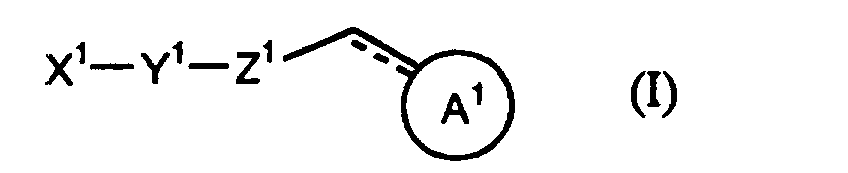

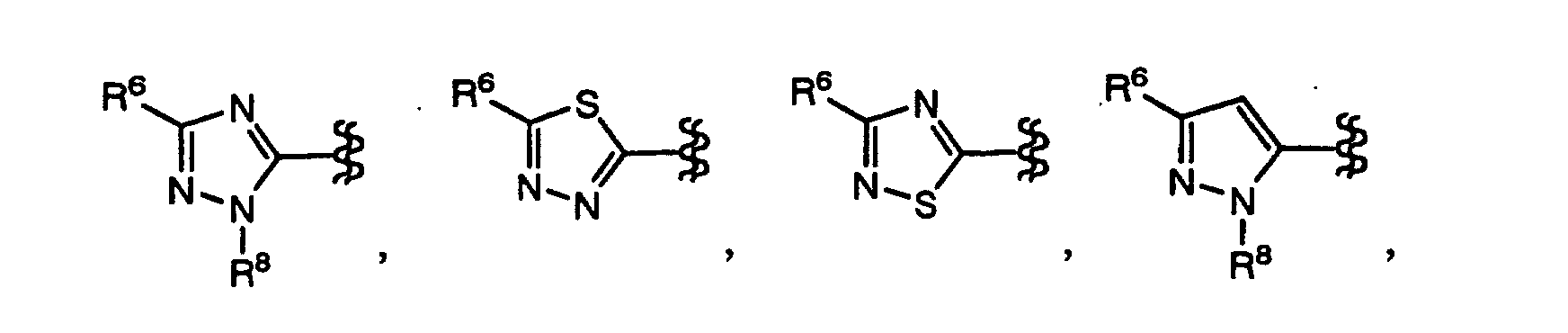 wherein E is -CH2-, -(CH2)2-, -(CH2)3-, -O-CH2-, or -S-CH2-; one of R6 and R7 is a group represented by the formula:
 wherein R10, R11, and R12 are each independently hydrogen atom, alkyl optionally substituted with one or more substituent(s) selected from substituent group A, cycloalkyl, alkyloxy optionally substituted with one or more substituent(s) selected from substituent group A, alkylthio, halogen atom, phenyl optionally substituted with one or more substituent(s) selected from substituent group B, heteroaryl optionally substituted with one or more substituent(s) selected from substituent group B, or non-aromatic heterocyclic group optionally substituted with one or more substituent(s) selected from substituent group B, substituent group A consists of cycloalkyl, hydroxy, optionally substituted alkyloxy, halogen atom, carboxy, lower alkyloxycarbonyl, aryloxycarbonyl, optionally substituted amino, optionally substituted aminocarbonyl, phenyl optionally substituted with one or more substituent(s) selected from substituent group B, non-aromatic heterocyclic group, and heteroaryl,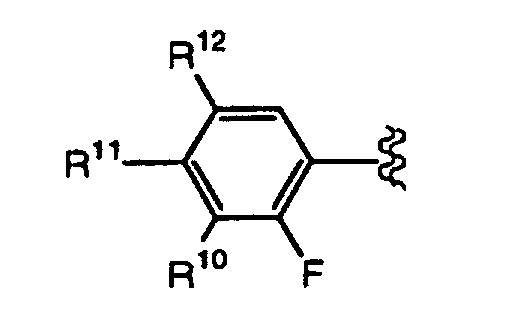
substituent group B consists of hydroxy, alkyl, halogen atom, halo(lower)alkyl, carboxy, lower alkyloxycarbonyl, alkyloxy, optionally substituted amino, non-aromatic heterocyclic group, and heteroaryl;
the other of R6 and R7 is hydrogen atom, optionally substituted lower alkyl, carboxy, lower alkyloxycarbonyl, halogen atom, optionally substituted aminocarbonyl, optionally substituted heteroaryl, or optionally substituted aryl; R8 is hydrogen atom or lower alkyl;
Y1 is NRACO-(CRCRD)0-2-, -NRACO-(CH2)0-2-V-, -NRACO-CRC=CRD-, -V- (CH2)1-5-NRACO-(CH2)0-2-, -V-(CH2)1-5- CONRA-(CH2)0-2-, -CONRA-(CH2)0-2-, -(CH2)0-2-NRA-SO2-(CH2)0.2-, -(CH2)0.2-SO2-NRA-(CH2)0.2-, -NRA-(CH2)0.2-, -NRA-CO-NRA-, -NRA-CS-NRA-,-N=C(-SRA)-NRA-, -NRACSNRACO-, -N=C(-SRA)-NRACO-, -NRA-(CH2)1-2-NRA-CO-,-NRACONRANRBCO-, or -N=C(-NRARA)-NRA-CO- wherein RA is each independently hydrogen atom or lower alkyl; RB is hydrogen atom or phenyl; RC and RD are each independently hydrogen atom, halogen atom, optionally substituted lower alkyl, optionally substituted lower alkyloxy, optionally substituted lower alkylthio, optionally substituted lower alkenyl, optionally substituted lower alkynyl, optionally substituted aryl, optionally substituted heteroaryl, optionally substituted cycloalkyl, optionally substituted aralkyl, optionally substituted heteroarylalkyl, optionally substituted non-aromatic heterocyclic group, or optionally substituted amino; V is oxygen atom or sulfur atom;
Z1 is optionally substituted arylene, optionally substituted heteroarylene, optionally substituted non-aromatic heterocyclicdiyl, or optionally substituted cycloalkylene;
A1 ring is a ring represented by the formula:wherein R1 and R2 are hydrogen atom or taken together to be oxygen atom or sulfur atom; R3 and R4 are hydrogen atom or taken together to be oxygen atom or sulfur atom; R5 is hydrogen atom or lower alkyl; Q and W are each independently -O-, -S-, -N(RF)-wherein RF is hydrogen atom or lower alkyl, or -CH2-; m is 1,2, or 3; a broken line (---) represents the presence or absence of a bond;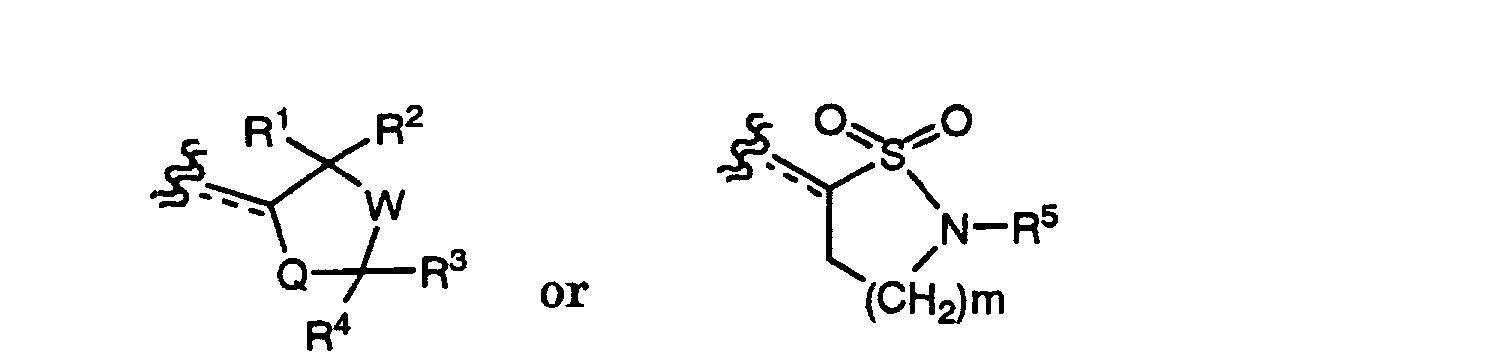
a broken line (---) represents the presence or absence of a bond;
provided that R10, R11, and R12 are not hydrogen atom at the same time; when R10 and R11 are hydrogen, R12 is not fluoro; when R10 is hydrogen, R11 and R12 are not fluoro;
its prodrug, or their pharmaceutically acceptable salt, or solvate thereof. - A pharmaceutical composition exhibiting thrombopoietin receptor agonism of claim 1, wherein Y1 is -NHCO-, -CONH-, -NHCH2-, -NHCO-CH=CH-, or -NHSO2-.
- A pharmaceutical composition exhibiting thrombopoietin receptor agonism of claim 1 or 2, wherein Z1 is halogen atom or 1,4-phenylene optionally substituted with lower alkyl.
- A pharmaceutical composition exhibiting thrombopoietin receptor agonism of any one of claims 1 to 3, wherein A1 ring is a group represented by the formula:wherein R13 is hydrogen atom or lower alkyl; M is -S-, -O-, -N(RE)- wherein RE is hydrogen atom or lower alkyl; or -CH2-; T is oxygen atom or sulfur atom; a broken line (---) represents the presence or absence of a bond.

- A pharmaceutical composition exhibiting thrombopoietin receptor agonism of any one of claims 1 to 4, wherein a broken line (---) represents the presence of a bond.
- A pharmaceutical composition exhibiting thrombopoietin receptor agonism of any one of claims 1 to 5, which is a platelet production modifier.
- Use of a compound of any one of claims 1 to 5, for preparation of a medicine for modifying platelet production.
- A method for modifying platelet production of a mammal, including a human, which comprises administration to said mammal of a compound of any one of claims 1 to 5 in a therapeutically effective amount.
- A compound represented by the general formula (II):wherein R9 is hydrogen atom, optionally substituted lower alkyl; carboxy, lower alkyloxycarbonyl, halogen atom, or optionally substituted aminocarbonyl;

R10, R11, and R12 are each independently hydrogen atom, alkyl optionally substituted with one or more substituent(s) selected from substituent group A, cycloalkyl, alkyloxy optionally substituted with one or more substituent(s) selected from substituent group A, alkylthio, halogen atom, phenyl optionally substituted with one or more substituent(s) selected from substituent group B, heteroaryl optionally substituted with one or more substituent(s) selected from substituent group B, or non-aromatic heterocyclic group optionally substituted with one or more substituent(s) selected from substituent group B,
substituent group A consists of cycloalkyl, hydroxy, optionally substituted alkyloxy, halogen atom, carboxy, lower alkyloxycarbonyl, aryloxycarbonyl, optionally substituted amino, optionally substituted aminocarbonyl, phenyl optionally substituted.with one or more substituent(s) selected from substituent group B, non-aromatic heterocyclic group, and heteroaryl,
substituent group B consists of hydroxy, alkyl, halogen atom, halo(lower)alkyl, carboxy, lower alkyloxycarbonyl, alkyloxy, optionally substituted amino, non-aromatic heterocyclic group, and heteroaryl;
Y2 is -NRACO-(CRCRD)0-2-, -NRA-CO-(CH2)0-2-V-, -NRACO-CRC=CRD-, -V-(CH2)1-5-NRACO-(CH2)0-2-, -V-(CH2)1-5-CONRA-(CH2)0-2-, -CONRA-(CH2)0-2-,-(CH2)0-2-NRA-SO2-(CH2)0-2-, -(CH2)0-2-SO2-NRA -(CH2)0-2-, -NRA-(CH2)0-2-, -NRA-CO-NRA-, -NRA-CS-NRA-,-N=C(-SRA)-NRA-, -NRACSNRACO-, -N=C(-SRA)-NRACO-, -NRA-(CH2)1-2-NRA-CO-,-NRACONRANRBCO-, or -N=C(-NRARA)-NRA-CO- wherein RA is each independently hydrogen atom or lower alkyl; RB is hydrogen atom or phenyl; RC and RD are each independently hydrogen atom, halogen atom, optionally substituted lower alkyl, optionally substituted lower alkyloxy, optionally substituted lower alkylthio, optionally substituted lower alkenyl, optionally substituted lower alkynyl, optionally substituted aryl, optionally substituted heteroaryl, optionally substituted cycloalkyl, optionally substituted aralkyl, optionally substituted heteroarylalkyl, optionally substituted non-aromatic heterocyclic group, or optionally substituted amino; V is oxygen atom or sulfur atom;
Z2 is optionally substituted phenylene, optionally substituted 2,5-pyridinediyl, optionally substituted 2,5-thiophenediyl, or optionally substituted 2,5-furandiyl;
A2 ring is a ring represented by the formula:wherein R1 and R2 are hydrogen atom or taken together to be oxygen atom or sulfur atom; R3 and R4 are hydrogen atom or taken together to be oxygen atom or sulfur atom; R5 is hydrogen atom or lower alkyl; Q and W are each independently -O-, -S-, -N(RF)-wherein RF is hydrogen atom or lower alkyl, or -CH2-; m is 1,2, or 3; a broken line (---) represents the presence or absence of a bond;
a broken line (---) represents the presence or absence of a bond;
provided that R10, R11, and R12 are not hydrogen atom at the same time; when R10 and R11 are hydrogen, R12 is not fluoro; when R10 is hydrogen, R11 and R12 are not fluoro;
its prodrug, or their pharmaceutically acceptable salt, or solvate thereof. - A compound of claim 9, wherein Y2 is -NHCO-, -CONH-, -NHCH2-, -NHCO-CH=CH-, or -NHSO2-;
its prodrug, or their pharmaceutically acceptable salt, or solvate thereof. - A compound of claim 9, wherein Y2 is -NHCO-;
its prodrug, or their pharmaceutically acceptable salt, or solvate thereof. - A compound of any one of claims 9 to 11, wherein Z2 is halogen atom or 1,4-phenylene optionally substituted with lower alkyl;
its prodrug, or their pharmaceutically acceptable salt, or solvate thereof. - A compound of any one of claims 9 to 12, wherein A2 ring is a group represented by the formula:wherein R13 is hydrogen atom or lower alkyl; M is -S-, -O-, -N(RE)- wherein RE is hydrogen atom or lower alkyl; or -CH2-; T is oxygen atom or sulfur atom; a broken line (---) represents the presence or absence of a bond;
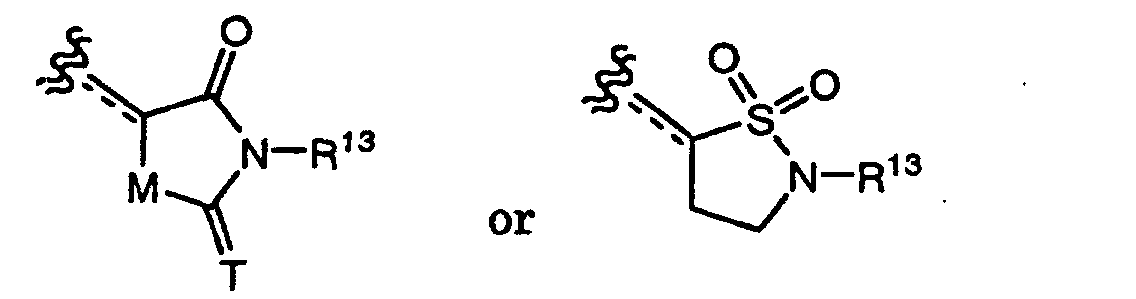
its prodrug, or their pharmaceutically acceptable salt, or solvate thereof. - A compound of any one of claims 9 to 13, wherein a broken line (---) represents the presence of a bond;
its prodrug, or their pharmaceutically acceptable salt, or solvate thereof. - A compound of the general formula (III):wherein R9 is hydrogen atom, optionally substituted lower alkyl; carboxy, lower alkyloxycarbonyl, halogen atom, or optionally substituted aminocarbonyl;
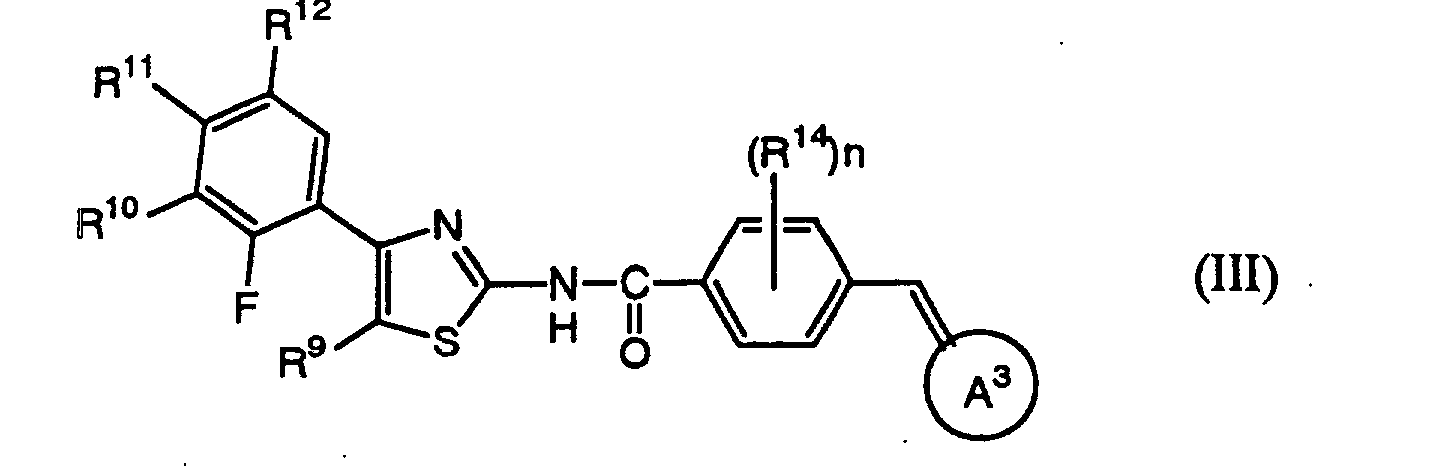
R10 is alkyl optionally substituted with one or more substituent(s) selected from substituent group A, cycloalkyl, alkyloxy optionally substituted with one or more substituent(s) selected from substituent group A, alkylthio, halogen atom, phenyl optionally substituted with one or more substituent(s) selected from substituent group B, heteroaryl optionally substituted with one or more substituent(s) selected from substituent group B, or non-aromatic heterocyclic group optionally substituted with one or more substituent(s) selected from substituent group B,
R11 and R12 are each independently hydrogen atom, alkyl optionally substituted with one or more substituent(s) selected from substituent group A, cycloalkyl, alkyloxy optionally substituted with one or more substituent(s) selected from substituent group A, alkylthio, halogen atom, phenyl optionally substituted with one or more substituent(s) selected from substituent group B, heteroaryl optionally substituted with one or more substituent(s) selected from substituent group B, or non-aromatic heterocyclic group optionally substituted with one or more substituent(s) selected from substituent group B,
substituent group A consists of cycloalkyl, hydroxy, optionally substituted alkyloxy, halogen atom, carboxy, lower alkyloxycarbonyl, aryloxycarbonyl, optionally substituted amino, optionally substituted aminocarbonyl, phenyl optionally substituted with one or more substituent(s) selected from substituent group B, non-aromatic heterocyclic group, and heteroaryl, substituent group B consists of hydroxy, alkyl, halogen atom, halo(lower)alkyl, carl lower alkyloxycarbonyl, alkyloxy, optionally substituted amino, non-aron heterocyclic group, and heteroaryl;
R14 is each independently lower alkyl, halogen atom, halo(lower)alkyl, lower alkyloxy, halo(lower)alkyloxy, or hydroxy;
n is an integer of 0 to 2;
A2 ring is a group represented by the formula:wherein R13 is hydrogen atom or lower alkyl; T is oxygen atom or sulfur atom; its prodrug, or their pharmaceutically acceptable salt, or solvate thereof.
- A compound of claim 15, wherein R10 is alkyl optionally substituted with one or more substituent(s) selected from substituent group A, alkyloxy, halo(lower)alkyloxy, or phenyl optionally substituted with one or more substituent(s) selected from substituent group B; R11 is hydrogen atom, halo(lower)alkyl, or halo(lower)alkyloxy; R12 is hydrogen atom or fluoro;
substituent group A consists of cycloalkyl, hydroxy, optionally substituted alkyloxy, halogen atom, carboxy, lower alkyloxycarbonyl, aryloxycarbonyl, optionally substituted amino, optionally substituted aminocarbonyl, phenyl optionally substituted with one or more substituent(s) selected from substituent group B, non-aromatic heterocyclic group, and heteroaryl,
substituent group B consists of hydroxy, alkyl, halogen atom, halo(lower)alkyl, carboxy, lower alkyloxycarbonyl, alkyloxy, optionally substituted amino, non-aromatic heterocyclic group, and heteroaryl;
its prodrug, or their pharmaceutically acceptable salt, or solvate thereof. - A pharmaceutical composition containing as an active ingredient a compound of any one of claims 9 to 16.
- A pharmaceutical composition exhibiting thrombopoietin receptor agonism, which contains as an active ingredient a compound of any one of claims 9 to 16.
- A platelet production modifier containing as an active ingredient a compound of any one of claims 9 to 16.
- Use of a compound of any one of claims 9 to 16, for preparation of a medicine for modifying platelet production.
Applications Claiming Priority (5)
| Application Number | Priority Date | Filing Date | Title |
|---|---|---|---|
| JP2001017785 | 2001-01-26 | ||
| JP2001017785 | 2001-01-26 | ||
| JP2001223413 | 2001-07-24 | ||
| JP2001223413 | 2001-07-24 | ||
| PCT/JP2002/000547 WO2002059100A1 (en) | 2001-01-26 | 2002-01-25 | Halogen compounds having thrombopoietin receptor agonism |
Publications (2)
| Publication Number | Publication Date |
|---|---|
| EP1354880A1 true EP1354880A1 (en) | 2003-10-22 |
| EP1354880A4 EP1354880A4 (en) | 2004-08-25 |
Family
ID=26608322
Family Applications (1)
| Application Number | Title | Priority Date | Filing Date |
|---|---|---|---|
| EP02710353A Withdrawn EP1354880A4 (en) | 2001-01-26 | 2002-01-25 | Halogen compounds having thrombopoietin receptor agonism |
Country Status (9)
| Country | Link |
|---|---|
| US (1) | US20040063764A1 (en) |
| EP (1) | EP1354880A4 (en) |
| JP (1) | JP4145655B2 (en) |
| KR (1) | KR20040025891A (en) |
| CN (1) | CN1516696A (en) |
| BR (1) | BR0206670A (en) |
| CA (1) | CA2435143A1 (en) |
| MX (1) | MXPA03006510A (en) |
| WO (1) | WO2002059100A1 (en) |
Cited By (5)
| Publication number | Priority date | Publication date | Assignee | Title |
|---|---|---|---|---|
| WO2005039572A1 (en) * | 2003-10-27 | 2005-05-06 | H. Lundbeck A/S | N-thiazol-2-yl-benzamide derivatives |
| WO2006033005A3 (en) * | 2004-09-23 | 2007-01-25 | Pfizer Prod Inc | Thrombopoietin receptor agonists |
| US7674912B2 (en) | 2005-04-25 | 2010-03-09 | H. Lundbeck A/S | Pro-drugs of N-thiazol-2-yl-benzamide derivatives |
| US7910613B2 (en) | 2004-09-22 | 2011-03-22 | H. Lundbeck A/S | 2-acylaminothiazole derivatives |
| US8530668B2 (en) | 2007-07-31 | 2013-09-10 | Shionogi & Co., Ltd. | Pharmaceutical composition containing optically active compound having thrombopoietin receptor agonist activity, and intermediate therefor |
Families Citing this family (34)
| Publication number | Priority date | Publication date | Assignee | Title |
|---|---|---|---|---|
| TWI284639B (en) * | 2000-01-24 | 2007-08-01 | Shionogi & Co | A compound having thrombopoietin receptor agonistic effect |
| CY2010012I2 (en) | 2000-05-25 | 2020-05-29 | Novartis Ag | THROMBOPOIETIN MIMETICS |
| US20110212054A1 (en) * | 2000-05-25 | 2011-09-01 | Glaxosmithkline Llc. | Thrombopoietin mimetics |
| JP2004527541A (en) | 2001-03-01 | 2004-09-09 | スミスクライン・ビーチャム・コーポレイション | Thrombopoietin mimic |
| AR040083A1 (en) * | 2002-05-22 | 2005-03-16 | Smithkline Beecham Corp | BIS- (MONOETHANOLAMINE) ACID COMPOUND 3 '- [(2Z) - [1- (3,4-DIMETHYLPHENYL) -1,5-DIHIDRO-3-METHYL-5-OXO-4H-PIRAZOL-4-ILIDEN] HYDRAZINE ] -2'-HYDROXI- [1,1'-BIFENIL] -3-CARBOXILICO, PROCEDURE TO PREPARE IT, PHARMACEUTICAL COMPOSITION THAT INCLUDES IT, PROCEDURE TO PREPARE SUCH FARMAC COMPOSITION |
| EP1552828A4 (en) | 2002-08-14 | 2007-01-24 | Nissan Chemical Ind Ltd | Thrombopoetin receptor activator and process for producing the same |
| TWI324593B (en) | 2002-10-09 | 2010-05-11 | Nissan Chemical Ind Ltd | Pyrazolone compounds and thrombopoietin receptor activator |
| EP2387998A1 (en) | 2003-04-29 | 2011-11-23 | Glaxosmithkline LLC | Methods for treating degenerative diseases/injuries |
| US7601746B2 (en) * | 2003-08-12 | 2009-10-13 | Shionogi & Co., Ltd. | Compounds exhibiting thrombopoietin receptor agonism |
| TW200526638A (en) * | 2003-10-22 | 2005-08-16 | Smithkline Beecham Corp | 2-(3,4-dimethylphenyl)-4-{[2-hydroxy-3'-(1H-tetrazol-5-yl)biphenyl-3-yl]-hydrazono}-5-methyl-2,4-dihydropyrazol-3-one choline |
| AU2005312585B2 (en) | 2004-12-08 | 2012-01-12 | Nissan Chemical Industries, Ltd. | 3-ethylidenehydrazino substituted heterocyclic compounds as thrombopoietin receptor activators |
| JP4973192B2 (en) | 2004-12-14 | 2012-07-11 | 日産化学工業株式会社 | Amide compound and thrombopoietin receptor activator |
| JP5071375B2 (en) * | 2005-07-15 | 2012-11-14 | 日産化学工業株式会社 | Thiophene compound and thrombopoietin receptor activator |
| KR101290484B1 (en) * | 2005-07-20 | 2013-07-26 | 닛산 가가쿠 고교 가부시키 가이샤 | Pyrazole compounds and thrombopoietin receptor activators |
| JP2007045946A (en) * | 2005-08-10 | 2007-02-22 | Shipro Kasei Kaisha Ltd | Organic pigment using thiazolidine derivative |
| WO2007044982A2 (en) * | 2005-10-13 | 2007-04-19 | Smithkline Beecham Corporation | Methods for the preservation of platelet efficacy during storage |
| JP5205967B2 (en) | 2005-11-07 | 2013-06-05 | 日産化学工業株式会社 | Hydrazide compounds and thrombopoietin receptor activators |
| US7879318B2 (en) | 2006-01-23 | 2011-02-01 | Mcw Research Foundation, Inc. | Method of reducing the effects of ischemia by administration of a thrombopoietin receptor ligand |
| JP2007275058A (en) * | 2006-03-16 | 2007-10-25 | Shionogi & Co Ltd | Asymmetric reduction by yeast |
| US8093251B2 (en) | 2006-06-07 | 2012-01-10 | Nissan Chemical Industries, Ltd. | Nitrogen-containing heterocyclic compounds and thrombopoietin receptor activators |
| UY30915A1 (en) | 2007-02-16 | 2008-09-02 | Smithkline Beecham Corp | CANCER TREATMENT METHOD |
| US20110129550A1 (en) | 2007-02-16 | 2011-06-02 | Connie Erickson-Miller | Cancer treatment method |
| ECSP077628A (en) | 2007-05-03 | 2008-12-30 | Smithkline Beechman Corp | NEW PHARMACEUTICAL COMPOSITION |
| CN101888841B (en) | 2007-10-09 | 2012-09-26 | 宾夕法尼亚大学理事会 | Thrombopoietin receptor agonist (TpoRA) kills acute human myeloid leukemia cells |
| US8476249B2 (en) | 2009-05-07 | 2013-07-02 | Glaxosmithkline Llc | Method of treating thrombocytopenia |
| US8680150B2 (en) * | 2009-05-28 | 2014-03-25 | Ligand Pharmaceuticals, Inc. | Small molecule hematopoietic growth factor mimetic compounds that activate hematopoietic growth factor receptors |
| SG176088A1 (en) | 2009-05-29 | 2011-12-29 | Glaxosmithkline Llc | Methods of administration of thrombopoietin agonist compounds |
| AR081626A1 (en) | 2010-04-23 | 2012-10-10 | Cytokinetics Inc | AMINO-PYRIDAZINIC COMPOUNDS, PHARMACEUTICAL COMPOSITIONS THAT CONTAIN THEM AND USE OF THE SAME TO TREAT CARDIAC AND SKELETIC MUSCULAR DISORDERS |
| AR081331A1 (en) | 2010-04-23 | 2012-08-08 | Cytokinetics Inc | AMINO- PYRIMIDINES COMPOSITIONS OF THE SAME AND METHODS FOR THE USE OF THE SAME |
| EP2560488B1 (en) | 2010-04-23 | 2015-10-28 | Cytokinetics, Inc. | Certain amino-pyridines and amino-triazines, compositions thereof, and methods for their use |
| US8759380B2 (en) | 2011-04-22 | 2014-06-24 | Cytokinetics, Inc. | Certain heterocycles, compositions thereof, and methods for their use |
| JP6632127B2 (en) * | 2013-12-20 | 2020-01-15 | 塩野義製薬株式会社 | Method for producing optically active compound having thrombopoietin receptor agonistic activity and intermediate thereof |
| JP6658535B2 (en) | 2014-10-31 | 2020-03-04 | 日産化学株式会社 | Ligand-bound fiber and cell culture substrate using the fiber |
| CN112552258B (en) * | 2020-12-22 | 2023-02-28 | 许昌学院 | Thiazole amidoisomagnolanine derivatives, preparation method and application thereof |
Family Cites Families (10)
| Publication number | Priority date | Publication date | Assignee | Title |
|---|---|---|---|---|
| WO1989008652A1 (en) * | 1988-03-08 | 1989-09-21 | Pfizer Inc. | Thiazolidinedione derivatives as hypoglycemic agents |
| JP3024781B2 (en) * | 1990-08-20 | 2000-03-21 | 日清製粉株式会社 | Rhodanin derivative |
| BR9609744A (en) * | 1995-07-31 | 1999-03-02 | Shionogi & Co | Pyrrolidine derivatives having a2 phospholipase inhibitory activity |
| AU2231397A (en) * | 1996-03-08 | 1997-09-22 | Torii Pharmaceutical Co., Ltd. | Thiazolidine-2,4-dione derivatives |
| TW577875B (en) * | 1997-01-31 | 2004-03-01 | Shionogi & Co | Pyrrolidine derivatives with inhibitory activity for phospholipase A2 |
| JPH10287634A (en) * | 1997-04-11 | 1998-10-27 | Otsuka Pharmaceut Co Ltd | Benzene derivatives |
| JPH11152276A (en) * | 1997-11-20 | 1999-06-08 | Hokuriku Seiyaku Co Ltd | Benzodiazepine derivatives |
| GC0000177A (en) * | 1998-12-17 | 2006-03-29 | Smithkline Beecham | Thrombopoietin mimetics |
| CA2380206A1 (en) * | 1999-07-26 | 2001-02-01 | Shionogi & Co., Ltd. | Pharmaceutical compositions exhibiting thrombopoietin receptor agonism |
| TWI284639B (en) * | 2000-01-24 | 2007-08-01 | Shionogi & Co | A compound having thrombopoietin receptor agonistic effect |
-
2002
- 2002-01-25 MX MXPA03006510A patent/MXPA03006510A/en not_active Application Discontinuation
- 2002-01-25 CA CA002435143A patent/CA2435143A1/en not_active Abandoned
- 2002-01-25 BR BR0206670-0A patent/BR0206670A/en not_active IP Right Cessation
- 2002-01-25 EP EP02710353A patent/EP1354880A4/en not_active Withdrawn
- 2002-01-25 CN CNA028069900A patent/CN1516696A/en active Pending
- 2002-01-25 WO PCT/JP2002/000547 patent/WO2002059100A1/en not_active Ceased
- 2002-01-25 US US10/470,256 patent/US20040063764A1/en not_active Abandoned
- 2002-01-25 JP JP2002559402A patent/JP4145655B2/en not_active Expired - Fee Related
- 2002-01-25 KR KR10-2003-7009887A patent/KR20040025891A/en not_active Ceased
Non-Patent Citations (2)
| Title |
|---|
| No further relevant documents disclosed * |
| See also references of WO02059100A1 * |
Cited By (8)
| Publication number | Priority date | Publication date | Assignee | Title |
|---|---|---|---|---|
| WO2005039572A1 (en) * | 2003-10-27 | 2005-05-06 | H. Lundbeck A/S | N-thiazol-2-yl-benzamide derivatives |
| EP1803455A1 (en) * | 2003-10-27 | 2007-07-04 | H.Lundbeck A/S | N-thiazol-2-yl-benzamide derivatives |
| EA010790B1 (en) * | 2003-10-27 | 2008-10-30 | Х. Лундбекк А/С | N-thiazol-2-yl-benzamide derivatives |
| US7910613B2 (en) | 2004-09-22 | 2011-03-22 | H. Lundbeck A/S | 2-acylaminothiazole derivatives |
| WO2006033005A3 (en) * | 2004-09-23 | 2007-01-25 | Pfizer Prod Inc | Thrombopoietin receptor agonists |
| US7674912B2 (en) | 2005-04-25 | 2010-03-09 | H. Lundbeck A/S | Pro-drugs of N-thiazol-2-yl-benzamide derivatives |
| US8530668B2 (en) | 2007-07-31 | 2013-09-10 | Shionogi & Co., Ltd. | Pharmaceutical composition containing optically active compound having thrombopoietin receptor agonist activity, and intermediate therefor |
| US8889722B2 (en) | 2007-07-31 | 2014-11-18 | Shionogi & Co., Ltd. | Pharmaceutical composition containing optically active compound having thrombopoietin receptor agonist activity, and intermediate therefor |
Also Published As
| Publication number | Publication date |
|---|---|
| JPWO2002059100A1 (en) | 2004-05-27 |
| CN1516696A (en) | 2004-07-28 |
| MXPA03006510A (en) | 2003-10-15 |
| US20040063764A1 (en) | 2004-04-01 |
| WO2002059100A1 (en) | 2002-08-01 |
| BR0206670A (en) | 2004-02-25 |
| JP4145655B2 (en) | 2008-09-03 |
| EP1354880A4 (en) | 2004-08-25 |
| KR20040025891A (en) | 2004-03-26 |
| CA2435143A1 (en) | 2002-08-01 |
Similar Documents
| Publication | Publication Date | Title |
|---|---|---|
| JP4145655B2 (en) | Halogen compounds having thrombopoietin receptor agonist activity | |
| JP3929244B2 (en) | Aromatic heterocyclic derivatives having HIV integrase inhibitory activity | |
| US7662826B2 (en) | Pyrazolo [1,5-a] pyrimidine derivative and nad (p) h oxidase inhibitor containing the same | |
| JP6612874B2 (en) | Geminal-substituted quinuclidineamide compounds as agonists of α7-nicotinic acetylcholine receptors | |
| CA2397018C (en) | Compounds exhibiting thrombopoietin receptor agonism | |
| US11633393B2 (en) | Tubulin binding compounds and therapeutic use thereof | |
| JPWO2000039086A1 (en) | Aromatic heterocyclic derivatives having HIV integrase inhibitory activity | |
| JP2006522125A (en) | Thiazoles useful as protein kinase inhibitors | |
| EA032323B1 (en) | Substituted n-(tetrazol-5-yl)- and n-(triazol-5-yl)arylcarboxamide compounds and their use as herbicides | |
| EA027847B1 (en) | Substituted n-(tetrazol-5-yl)- and n-(triazol-5-yl)arylcarboxamide compounds and their use as herbicides | |
| EA035862B1 (en) | Benzamide compounds and their use as herbicides | |
| US20240294519A1 (en) | PYRROLO[2,3-b]PYRIDINE PGDH INHIBITORS AND METHODS OF MAKING AND USING | |
| CN101522640A (en) | Pyrimidine compounds against pathogenic fungi and cancer | |
| CN107531688A (en) | For the preparation of L-alanyl-L-alanine 2-{4-[2-({[2(4-chlorophenyl)-1,3-thiazol-4-yl]methyl}sulfanyl )-3,5-dicyano-6-(pyrrolidin-1-yl)pyridin-4-yl]phenoxy}ethyl ester monohydrochloride | |
| US20100093738A1 (en) | Fungicidal Compounds and Fungicidal Compositions | |
| TW202413344A (en) | Methods and compounds for modulating inherited genetic diseases | |
| US20090069180A1 (en) | 2-substituted pyrimidine derivatives | |
| US20120289706A1 (en) | Method for Producing Triazolinthione Derivatives and Intermediates Thereof | |
| CN100358896C (en) | Heterobicyclic compounds useful as fungicides | |
| JPH0741485A (en) | Cephem derivative and antimicrobial agent containing the same | |
| CN101522677A (en) | Fungicidal N-heteroaryl fused pyridine derivatives and fungicidal compositions | |
| US20080300135A1 (en) | 5-Alkyl-7-Amino-6-Heteroaryl-1,2,4-Triazolo[1,5-A]Pyrimidine Compounds and Their Use for Controlling Harmful Fungi | |
| CN101223173A (en) | 5-Alkyl-7-amino-6-heteroaryl-1,2,4-triazolo[1,5-a]pyrimidine compounds and their use in controlling harmful fungi | |
| EP2970229B1 (en) | Oxindole derivatives carrying an oxetane substituent and use thereof for treating vasopressine-related diseases | |
| HK40017812A (en) | Tubulin binding compounds and therapeutic use thereof |
Legal Events
| Date | Code | Title | Description |
|---|---|---|---|
| PUAI | Public reference made under article 153(3) epc to a published international application that has entered the european phase |
Free format text: ORIGINAL CODE: 0009012 |
|
| 17P | Request for examination filed |
Effective date: 20030721 |
|
| AK | Designated contracting states |
Kind code of ref document: A1 Designated state(s): AT BE CH CY DE DK ES FI FR GB GR IE IT LI LU MC NL PT SE TR |
|
| AX | Request for extension of the european patent |
Extension state: AL LT LV MK RO SI |
|
| A4 | Supplementary search report drawn up and despatched |
Effective date: 20040714 |
|
| STAA | Information on the status of an ep patent application or granted ep patent |
Free format text: STATUS: THE APPLICATION IS DEEMED TO BE WITHDRAWN |
|
| 18D | Application deemed to be withdrawn |
Effective date: 20060223 |