EP1354447B1 - Method and system for a distributed multicast caching technique - Google Patents
Method and system for a distributed multicast caching technique Download PDFInfo
- Publication number
- EP1354447B1 EP1354447B1 EP02715626A EP02715626A EP1354447B1 EP 1354447 B1 EP1354447 B1 EP 1354447B1 EP 02715626 A EP02715626 A EP 02715626A EP 02715626 A EP02715626 A EP 02715626A EP 1354447 B1 EP1354447 B1 EP 1354447B1
- Authority
- EP
- European Patent Office
- Prior art keywords
- cache
- group
- directory
- group directory
- subsidiary
- Prior art date
- Legal status (The legal status is an assumption and is not a legal conclusion. Google has not performed a legal analysis and makes no representation as to the accuracy of the status listed.)
- Expired - Lifetime
Links
Images


Classifications
-
- H—ELECTRICITY
- H04—ELECTRIC COMMUNICATION TECHNIQUE
- H04L—TRANSMISSION OF DIGITAL INFORMATION, e.g. TELEGRAPHIC COMMUNICATION
- H04L12/00—Data switching networks
- H04L12/02—Details
- H04L12/16—Arrangements for providing special services to substations
- H04L12/18—Arrangements for providing special services to substations for broadcast or conference, e.g. multicast
-
- H—ELECTRICITY
- H04—ELECTRIC COMMUNICATION TECHNIQUE
- H04L—TRANSMISSION OF DIGITAL INFORMATION, e.g. TELEGRAPHIC COMMUNICATION
- H04L12/00—Data switching networks
- H04L12/02—Details
- H04L12/16—Arrangements for providing special services to substations
- H04L12/18—Arrangements for providing special services to substations for broadcast or conference, e.g. multicast
- H04L12/185—Arrangements for providing special services to substations for broadcast or conference, e.g. multicast with management of multicast group membership
-
- H—ELECTRICITY
- H04—ELECTRIC COMMUNICATION TECHNIQUE
- H04L—TRANSMISSION OF DIGITAL INFORMATION, e.g. TELEGRAPHIC COMMUNICATION
- H04L67/00—Network arrangements or protocols for supporting network services or applications
- H04L67/2866—Architectures; Arrangements
- H04L67/2885—Hierarchically arranged intermediate devices, e.g. for hierarchical caching
-
- H—ELECTRICITY
- H04—ELECTRIC COMMUNICATION TECHNIQUE
- H04L—TRANSMISSION OF DIGITAL INFORMATION, e.g. TELEGRAPHIC COMMUNICATION
- H04L67/00—Network arrangements or protocols for supporting network services or applications
- H04L67/50—Network services
- H04L67/56—Provisioning of proxy services
- H04L67/568—Storing data temporarily at an intermediate stage, e.g. caching
-
- H—ELECTRICITY
- H04—ELECTRIC COMMUNICATION TECHNIQUE
- H04L—TRANSMISSION OF DIGITAL INFORMATION, e.g. TELEGRAPHIC COMMUNICATION
- H04L69/00—Network arrangements, protocols or services independent of the application payload and not provided for in the other groups of this subclass
- H04L69/30—Definitions, standards or architectural aspects of layered protocol stacks
- H04L69/32—Architecture of open systems interconnection [OSI] 7-layer type protocol stacks, e.g. the interfaces between the data link level and the physical level
- H04L69/322—Intralayer communication protocols among peer entities or protocol data unit [PDU] definitions
- H04L69/329—Intralayer communication protocols among peer entities or protocol data unit [PDU] definitions in the application layer [OSI layer 7]
-
- H—ELECTRICITY
- H04—ELECTRIC COMMUNICATION TECHNIQUE
- H04L—TRANSMISSION OF DIGITAL INFORMATION, e.g. TELEGRAPHIC COMMUNICATION
- H04L12/00—Data switching networks
- H04L12/02—Details
- H04L12/16—Arrangements for providing special services to substations
- H04L12/18—Arrangements for providing special services to substations for broadcast or conference, e.g. multicast
- H04L12/1859—Arrangements for providing special services to substations for broadcast or conference, e.g. multicast adapted to provide push services, e.g. data channels
Definitions
- This invention relates to multicast transmission of information across a data network. More particularly this invention relates to an improved caching technique for use in multicasting over a data network.
- U.S. Patent No. 6,065,058 proposes a push-based filtering broadcast method in a two-way client-server hierarchy, in which objects can be staged at the servers in different levels of hierarchy.
- a filtering process can factor in not only which lower level nodes will receive the push, but also the content level each node will receive.
- an uplink mechanism is required to connect receivers with some level of the cache in order to supply missing data.
- U.S. Patent No. 6,507,586 a technique of IP multicasting over existing broadband networks without using a return link is disclosed.
- This technique allows the issues of multicast group membership and error detection and recovery to be handled locally within an end-user terminal, without need for returning data to a host.
- a single data transmitter sends a group of data items to a subset of possible receivers over a one-way channel.
- Each data item is divided into blocks which are encapsulated to form datagrams, each including a block sequence number, a data item identifier, and a timestamp indicating the age of the data item.
- a group directory is regularly sent by the transmitter to each of the possible receivers.
- the group directory contains information for all groups of data items, enabling each receiver to select the group of data item it wishes to receive. Reliability is provided by periodic retransmission of missing data.
- a caching arrangement for the content of multicast transmission across a data network utilizes a first cache, which receives content from one or more content providers.
- the first cache constructs a group directory.
- the first cache forms the root of a multilevel hierarchical tree.
- the first cache transmits the group directory to a plurality of subsidiary caches.
- the subsidiary caches may reorganize the group directory, and relay it to a lower level of subsidiary caches. The process is recursive, until a multicast group of end-user clients is reached. Requests for content by the end-user clients are received by the lowest level cache, and should the content not be available, the request is forwarded toward the root of the tree until it is found.
- the content is then returned to the requestors.
- Various levels of caches retain the group directory and content according to configuration options, which can be adaptive to changing conditions such as demand, loading, and the like.
- the behavior of the caches may optionally be modified by the policies of the content providers.
- the invention provides a method of transmitting data over a communications network which includes receiving content from a content provider, and responsive to the content establishing a first group directory in a cache.
- the method includes transmitting the first group directory from the cache on a data channel to a subsidiary cache, establishing a second group directory in the subsidiary cache, in which the second group directory is derived from the first group directory, characterised by periodically transmitting the second group directory from the subsidiary cache to a multicast group of receivers, wherein the content provider receives no communications from the multicast group of receivers.
- the first group directory is transmitted using the REMADE protocol.
- the first group directory is transmitted periodically.
- the first group directory is transmitted in response to a request from a receiver.
- the first group directory is transmitted according to a policy of the content provider.
- the second group directory is transmitted in response to a request from a receiver.
- the second group directory is transmitted using a REMADE protocol.
- the second group directory is transmitted according to a policy of the content provider.
- the content provider is a plurality of content providers.
- the subsidiary cache is a plurality of subsidiary caches.
- the cache and the subsidiary caches are linked together as a hierarchical tree, the cache forming a root of the hierarchical tree.
- Still another aspect of the invention includes receiving a transmission request from a member of the group of receivers, wherein the transmission request is responsive to the second group directory, and responsive to the transmission request, transmitting a data item from the subsidiary cache to the receiver.
- the first group directory includes a root directory hierarchically linked to a plurality of subdirectories.
- the subdirectories carry a list of data items.
- a subtree of the first group directory is defined by one of the subdirectories and at least one linked subdirectory thereunder.
- the second group directory includes a root directory hierarchically linked to a plurality of subdirectories.
- the subdirectories carry a list of data items.
- a subtree of the second group directory is defined by one of the subdirectories and at least one linked subdirectory thereunder.
- the invention provides a computer program, comprising a computer program, comprising computer program instructions, which when executed on a computer, causes the computer to transmit transmitting data over a communications network by performing, the steps of: in a first server receiving content from a content provider; responsive to said content establishing a first group directory in a cache of said first server; transmitting said first group directory from said cache on a data channel to a second server having a subsidiary cache; establishing a second group directory in said subsidiary cache (26), said second group directory being derived from said first group directory; characterised by periodically transmitting said second group directory from said subsidiary cache to a multicast group of receivers (28) and wherein the content provider receives no communications from the multicast group of receivers.
- the invention also provides a system as claimed in claim 12.
- the cache and the subsidiary caches are linked together as a hierarchical tree, the cache forming a root of the hierarchical tree.
- Software programming code which embodies the present invention, is typically stored in permanent storage of some type, such as a computer readable medium.
- such software programming code may be stored on the client or a server.
- the software programming code may be embodied on any of a variety of known media for use with a data processing system, such as a diskette, or hard drive, or CD-ROM.
- the code may be distributed on such media, or may be distributed to users from the memory or storage of one computer system over a network of some type to other computer systems for use by users of such other systems.
- the techniques and methods for embodying software program code on physical media and/or distributing software code via networks are well known and will not be further discussed herein.
- the source of the files is a content provider 12, which is provided with transmitting capability, but may lack receiving capability.
- the content provider 12 is a parent with respect to a downstream cache 14.
- Content is multicast via a data or communications network 16, which may be the Internet, to a plurality of end-user clients 18.
- the cache 14 may receive content from a plurality of content providers. For example both the content provider 12 and the content provider 20 may submit a catalog to the cache 14, which then combines information from the two catalogs to formulate its own catalog or group directory for subsequent multicast.
- the cache 14 employs the REMADE protocol to multicast the content.
- the REMADE protocol is disclosed in the above noted U.S. Patent No. 6,507,586.
- the REMADE protocol is a technique of IP multicasting over existing broadband networks without using a return link. This technique allows the issues of multicast group membership and error detection and recovery to be handled locally within an end-user terminal, without need for returning data to a host.
- a single data transmitter sends a group of data items to a subset of possible receivers. Each data item is divided into blocks, which are encapsulated to form datagrams, each including a block sequence number, a data item identifier, and a timestamp indicating the age of the data item.
- a catalog comprising a group directory is regularly sent by the transmitter to each of the possible receivers.
- the group directory contains information for all groups of data items, enabling each receiver to select the group of data item it wishes to receive. Reliability may be provided by periodic retransmission of missing data.
- improvements in the REMADE protocol which were disclosed in our copending Application No. 09/564,387, filed May 3, 2000, may be used in the practice of the present invention.
- the directory system 30 is preferably a hierarchical arrangement, and comprises a root directory 32, with links to subdirectories 34.
- the root directory 32, and any of the subdirectories 34 may have links to general data items 36, or to patches 38.
- the arrangement is recursive, with subdirectories 34 having links to more deeply nested subdirectories, such as subdirectory 40.
- the cache 14 operates according to a service policy that is appropriate for a particular application.
- Files may be retained or erased, in whole or in part, following a multicast, depending on various factors, which may include file size, the characteristics of the provider or the recipient, average demand for the content, currently available free space, and many other relevant parameters.
- a second embodiment of the invention employs a multilevel hierarchy 22 of cache servers.
- a plurality of content providers 12, 20 provide content to a high level cache 24,
- the content providers 12, 20 have transmitting capability, but may lack receiving capability.
- the content providers 12, 20 optionally act as policy control servers, specifying the recipients to whom the content may be delivered, and the manner of delivery.
- the cache 24 executes an internal policy.
- the interaction of the cache 24 and other levels of the multilevel hierarchy 22 is preferably determined by internal configuration options, rather than by the content providers 12, 20.
- the cache 24 Upon request, or in accordance with its policy control, the cache 24 delivers catalog and content in accordance with the REMADE protocol over the data or communications network, which may be the Internet, to a subsidiary cache 26.
- the subsidiary caches 26 have both receiving and transmitting capabilities, and depending upon the attributes of their respective clients, may independently reorganize the catalog that was received from the cache 24.
- each of the subsidiary caches 26 has end-user clients 28, also referred to as multicast group of receivers 28.
- the multilevel hierarchy 22 is represented for clarity in Fig. 3 as a two-level tree, comprising the cache 24 and the subsidiary caches 26, there can be any number of levels in the tree-structured hierarchy, as appropriate for a particular application. In such case, the subsidiary caches 26 communicate with a lower level of caches, rather than directly with the end-user clients 28.
- the end-user clients 28 have both transmitting and receiving capability.
- the subsidiary caches 26 have organized their data inventory into a tree-structured catalog according to the REMADE protocol, as disclosed more fully in the above noted US Patent No. 6,507,586 they transmit it to all the end-user clients 28, or to a predefined multicast group of the end-user clients 28.
- the end-user clients 28 receive a relevant part of the catalog, or may receive the whole catalog. They choose a document, and begin receiving it according to the REMADE protocol.
- various members end-user clients 28 may choose different documents, in which case all the documents are transmitted according to the governing policy. Clients not currently members of the multicast group may in some circumstances elect to join it.
- the subsidiary caches 26 can independently decide to elect a periodic mode of transmission of the catalog or the content, or to transmit either or both of them on demand.
- the cache 24 can elect a mode of transmission of its catalog to the subsidiary caches 26.
- a particular one of the subsidiary caches 26 lack a file, or portion of a file, requested by a receiver, such as one or more of the end-user clients 28, it obtains the missing parts from the cache 24. These parts are immediately resent to the receiver, which considerably reduces latency from the point of view of the receiver.
- a downstream push mode of operation if a particular content is designated according to the service policy as content in high demand, then the cache 14 may, even in the absence of a request from any of the end-user clients 18, multicast the content. In this mode, the content is flagged, requiring any downstream caches to begin receiving the content immediately, without waiting for transmission requests from clients.
- the caches in each level may push the content down to other levels.
- the behavior of the caches at all levels is controlled by configuration parameters, optionally modified by the policies of higher level caches, or of the content providers 12, 20.
Landscapes
- Engineering & Computer Science (AREA)
- Computer Networks & Wireless Communication (AREA)
- Signal Processing (AREA)
- Computer Security & Cryptography (AREA)
- Information Transfer Between Computers (AREA)
- Data Exchanges In Wide-Area Networks (AREA)
- Two-Way Televisions, Distribution Of Moving Picture Or The Like (AREA)
- Information Retrieval, Db Structures And Fs Structures Therefor (AREA)
Abstract
Description
- This invention relates to multicast transmission of information across a data network. More particularly this invention relates to an improved caching technique for use in multicasting over a data network.
- The push model for distributing data over the Internet and other client server networks has become more widespread in recent years. In modern versions of this model a server "multicasts" data to an interested subset of clients on the network, known as a "multicast group". Whoever is interested becomes a listener by joining the group.
By their nature, push applications are closer to the broadcasting paradigm of radio and television than to the interactive paradigm of the World Wide Web. As such, broadband networks, such as cable TV or satellite, can be used as a very efficient medium for the transmission of "pushed data". Unfortunately, currently these networks are one-way only. That is to say, data such as a television program is sent from a broadcasting facility (the head-end) to several receivers (end-users) without any feedback. As such, these networks are inappropriate for popular interactive push applications since the latter require a return channel. Although attempts to upgrade the current public network infrastructure are underway in several places around the world, it will take some years until reliable two-way broadband networks are commonplace and therefore, a mechanism for multicasting over one-way broadband networks is desirable. Caching systems have been developed to improve the efficiency of data transmission across the internet. Current internet caching systems, however, are based on the unicast TCP/IP transport protocol. Various technical issues have impeded the development of caching systems adapted to multicast transmission. Using the unicast transport protocol, a document is required to be delivered separately to each requesting client of the cache. For example, when two clients request the same documents simultaneously, or within a short interval, the cache transmitter is required to read the document twice, and send it twice. Consequently the resources of both the cache transmitter and the internet are used inefficiently. - U.S. Patent No. 6,065,058 proposes a push-based filtering broadcast method in a two-way client-server hierarchy, in which objects can be staged at the servers in different levels of hierarchy. A filtering process can factor in not only which lower level nodes will receive the push, but also the content level each node will receive. However, an uplink mechanism is required to connect receivers with some level of the cache in order to supply missing data.
- The document, Reliable Multicast Transport Protocol, Shioshita, Teruji et al., Draft Document for the 37th IETF, Feb. 7, 1997, proposes a transport control mechanism to enable reliable multicast data transfer to a large number of receivers on a TCP/IP network from a server in parallel. This protocol promotes short delivery time, as the data is transferred only once, and conserves bandwidth because only one copy of the data is sent to the server. It has the advantage of requiring only a single session regardless of the number of receivers. However, despite some optimizations, there remains a requirement for receiver confirmation by ACK/NAK responses and the retransmission of data to selected receivers based on the information associated with the NAK response are disadvantages, as large numbers of receivers issuing ACK/NAK responses can still cause network congestion.
- Another known multicast transport protocol is proposed in Starburst Multicast File Transfer Protocol (MFTP) Specification. Miller, K. et al., Internet Draft, April 1998. This protocol operates in the Application Layer.
- In U.S. Patent No. 6,507,586, a technique of IP multicasting over existing broadband networks without using a return link is disclosed. This technique allows the issues of multicast group membership and error detection and recovery to be handled locally within an end-user terminal, without need for returning data to a host. According to the technique a single data transmitter sends a group of data items to a subset of possible receivers over a one-way channel. Each data item is divided into blocks which are encapsulated to form datagrams, each including a block sequence number, a data item identifier, and a timestamp indicating the age of the data item. A group directory is regularly sent by the transmitter to each of the possible receivers. The group directory contains information for all groups of data items, enabling each receiver to select the group of data item it wishes to receive. Reliability is provided by periodic retransmission of missing data. Despite these advantages, significant problems remain.
- It is a primary advantage of some aspects of the present invention that there is improved caching of content that is multicast across a data network.
- A caching arrangement for the content of multicast transmission across a data network utilizes a first cache, which receives content from one or more content providers. Using the REMADE protocol, the first cache constructs a group directory. The first cache forms the root of a multilevel hierarchical tree. In accordance with configuration parameters, the first cache transmits the group directory to a plurality of subsidiary caches. The subsidiary caches may reorganize the group directory, and relay it to a lower level of subsidiary caches. The process is recursive, until a multicast group of end-user clients is reached. Requests for content by the end-user clients are received by the lowest level cache, and should the content not be available, the request is forwarded toward the root of the tree until it is found. The content is then returned to the requestors. Various levels of caches retain the group directory and content according to configuration options, which can be adaptive to changing conditions such as demand, loading, and the like. The behavior of the caches may optionally be modified by the policies of the content providers.
- It is an advantage of some aspects of the invention that content need only be transmitted once to multiple receivers.
- The invention provides a method of transmitting data over a communications network which includes receiving content from a content provider, and responsive to the content establishing a first group directory in a cache. The method includes transmitting the first group directory from the cache on a data channel to a subsidiary cache, establishing a second group directory in the subsidiary cache, in which the second group directory is derived from the first group directory, characterised by periodically transmitting the second group directory from the subsidiary cache to a multicast group of receivers, wherein the content provider receives no communications from the multicast group of receivers.
- According to an aspect of the invention, the first group directory is transmitted using the REMADE protocol.
- According to still another aspect of the invention, the first group directory is transmitted periodically.
- According to an additional aspect of the invention, the first group directory is transmitted in response to a request from a receiver.
- According to another aspect of the invention, the first group directory is transmitted according to a policy of the content provider.
- According to still another aspect of the invention, the second group directory is transmitted in response to a request from a receiver.
- According to an aspect of the invention, the second group directory is transmitted using a REMADE protocol.
- According to yet another aspect of the invention, the second group directory is transmitted according to a policy of the content provider.
- According to a further aspect of the invention, the content provider is a plurality of content providers.
- According to another aspect of the invention, the subsidiary cache is a plurality of subsidiary caches.
- According to a further aspect of the invention, the cache and the subsidiary caches are linked together as a hierarchical tree, the cache forming a root of the hierarchical tree.
- Still another aspect of the invention includes receiving a transmission request from a member of the group of receivers, wherein the transmission request is responsive to the second group directory, and responsive to the transmission request, transmitting a data item from the subsidiary cache to the receiver.
- According to still another aspect of the invention, the first group directory includes a root directory hierarchically linked to a plurality of subdirectories. The subdirectories carry a list of data items. A subtree of the first group directory is defined by one of the subdirectories and at least one linked subdirectory thereunder.
- According to yet another aspect of the invention, the second group directory includes a root directory hierarchically linked to a plurality of subdirectories. The subdirectories carry a list of data items. A subtree of the second group directory is defined by one of the subdirectories and at least one linked subdirectory thereunder.
- The invention provides a computer program, comprising a computer program, comprising computer program instructions, which when executed on a computer, causes the computer to transmit transmitting data over a communications network by performing, the steps of: in a first server receiving content from a content provider; responsive to said content establishing a first group directory in a cache of said first server; transmitting said first group directory from said cache on a data channel to a second server having a subsidiary cache; establishing a second group directory in said subsidiary cache (26), said second group directory being derived from said first group directory; characterised by periodically transmitting said second group directory from said subsidiary cache to a multicast group of receivers (28) and wherein the content provider receives no communications from the multicast group of receivers.
- The invention also provides a system as claimed in
claim 12. - According to an aspect of the invention, the cache and the subsidiary caches are linked together as a hierarchical tree, the cache forming a root of the hierarchical tree.
- For a better understanding of these and other objects of the present invention, reference is made to the detailed description of the invention, by way of example, which is to be read in conjunction with the following drawings, wherein:
- Fig. 1 is a schematic diagram of a multicasting cache arrangement;
- Fig. 2 is a block diagram of a group directory; and
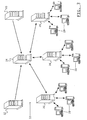
- Fig. 3 is a schematic diagram of a multicasting cache arrangement in accordance with the invention that employs a hierarchical tree structure.
- In the following description, numerous specific details are set forth in order to provide a thorough understanding of the present invention. It will be apparent however, to one skilled in the art that the present invention may be practiced without these specific details. In other instances well known circuits, control logic, and the details of computer program instructions for conventional algorithms and processes have not been shown in detail in order not to unnecessarily obscure the present invention.
- Software programming code, which embodies the present invention, is typically stored in permanent storage of some type, such as a computer readable medium. In a client/server environment, such software programming code may be stored on the client or a server. The software programming code may be embodied on any of a variety of known media for use with a data processing system, such as a diskette, or hard drive, or CD-ROM. The code may be distributed on such media, or may be distributed to users from the memory or storage of one computer system over a network of some type to other computer systems for use by users of such other systems. The techniques and methods for embodying software program code on physical media and/or distributing software code via networks are well known and will not be further discussed herein.
- Turning now to the drawings, and to Fig. 1 thereof, there is shown the high level architecture of a first embodiment of a
multicasting system 10 which can be employed using the techniques of the present invention. The source of the files is acontent provider 12, which is provided with transmitting capability, but may lack receiving capability. Thecontent provider 12 is a parent with respect to adownstream cache 14. Content is multicast via a data or communications network 16, which may be the Internet, to a plurality of end-user clients 18. - It is possible for the
cache 14 to receive content from a plurality of content providers. For example both thecontent provider 12 and thecontent provider 20 may submit a catalog to thecache 14, which then combines information from the two catalogs to formulate its own catalog or group directory for subsequent multicast. - The
cache 14 employs the REMADE protocol to multicast the content. The REMADE protocol is disclosed in the above noted U.S. Patent No. 6,507,586. The REMADE protocol is a technique of IP multicasting over existing broadband networks without using a return link. This technique allows the issues of multicast group membership and error detection and recovery to be handled locally within an end-user terminal, without need for returning data to a host. According to the technique, a single data transmitter sends a group of data items to a subset of possible receivers. Each data item is divided into blocks, which are encapsulated to form datagrams, each including a block sequence number, a data item identifier, and a timestamp indicating the age of the data item. A catalog comprising a group directory is regularly sent by the transmitter to each of the possible receivers. The group directory contains information for all groups of data items, enabling each receiver to select the group of data item it wishes to receive. Reliability may be provided by periodic retransmission of missing data. - In some embodiments, improvements in the REMADE protocol which were disclosed in our copending Application No. 09/564,387, filed May 3, 2000, may be used in the practice of the present invention.
- Referring now to Fig. 2, a representative group directory,
directory system 30, is shown. Thedirectory system 30 is preferably a hierarchical arrangement, and comprises a root directory 32, with links to subdirectories 34. The root directory 32, and any of thesubdirectories 34 may have links togeneral data items 36, or topatches 38. The arrangement is recursive, withsubdirectories 34 having links to more deeply nested subdirectories, such assubdirectory 40. - Referring again to Fig. 1, functionally the
cache 14 operates according to a service policy that is appropriate for a particular application. Files may be retained or erased, in whole or in part, following a multicast, depending on various factors, which may include file size, the characteristics of the provider or the recipient, average demand for the content, currently available free space, and many other relevant parameters. - As shown in Fig. 3, a second embodiment of the invention employs a
multilevel hierarchy 22 of cache servers. As in the first embodiment, a plurality ofcontent providers high level cache 24, Thecontent providers content providers content providers cache 24 executes an internal policy. In any case the interaction of thecache 24 and other levels of themultilevel hierarchy 22 is preferably determined by internal configuration options, rather than by thecontent providers - Upon request, or in accordance with its policy control, the
cache 24 delivers catalog and content in accordance with the REMADE protocol over the data or communications network, which may be the Internet, to asubsidiary cache 26. Thesubsidiary caches 26 have both receiving and transmitting capabilities, and depending upon the attributes of their respective clients, may independently reorganize the catalog that was received from thecache 24. In Fig. 3, each of thesubsidiary caches 26 has end-user clients 28, also referred to as multicast group ofreceivers 28. It should be noted that while themultilevel hierarchy 22 is represented for clarity in Fig. 3 as a two-level tree, comprising thecache 24 and thesubsidiary caches 26, there can be any number of levels in the tree-structured hierarchy, as appropriate for a particular application. In such case, thesubsidiary caches 26 communicate with a lower level of caches, rather than directly with the end-user clients 28. - Typically, the end-
user clients 28 have both transmitting and receiving capability. When thesubsidiary caches 26 have organized their data inventory into a tree-structured catalog according to the REMADE protocol, as disclosed more fully in the above noted US Patent No. 6,507,586 they transmit it to all the end-user clients 28, or to a predefined multicast group of the end-user clients 28. The end-user clients 28 receive a relevant part of the catalog, or may receive the whole catalog. They choose a document, and begin receiving it according to the REMADE protocol. Of course, various members end-user clients 28 may choose different documents, in which case all the documents are transmitted according to the governing policy. Clients not currently members of the multicast group may in some circumstances elect to join it. Based on considerations such as the average number of requests for particular content specified in the catalog, thesubsidiary caches 26 can independently decide to elect a periodic mode of transmission of the catalog or the content, or to transmit either or both of them on demand. In like manner, thecache 24 can elect a mode of transmission of its catalog to thesubsidiary caches 26.
In themultilevel hierarchy 22, should a particular one of thesubsidiary caches 26 lack a file, or portion of a file, requested by a receiver, such as one or more of the end-user clients 28, it obtains the missing parts from thecache 24. These parts are immediately resent to the receiver, which considerably reduces latency from the point of view of the receiver.
In a downstream push mode of operation, if a particular content is designated according to the service policy as content in high demand, then thecache 14 may, even in the absence of a request from any of the end-user clients 18, multicast the content. In this mode, the content is flagged, requiring any downstream caches to begin receiving the content immediately, without waiting for transmission requests from clients. In the case of a multilevel cache hierarchy, the caches in each level may push the content down to other levels. As in the other modes of operation, the behavior of the caches at all levels is controlled by configuration parameters, optionally modified by the policies of higher level caches, or of thecontent providers
While this invention has been explained with reference to the structure disclosed herein, it is not confined to the details set forth and this application is intended to cover any modifications and changes as may come within the scope of the following claims:
Claims (12)
- A method of transmitting data over a communications network (16), comprising the steps of:receiving content from a content provider (12, 20); responsive to said content establishing a first group directory in a cache (24);transmitting said first group directory from said cache on a data channel to a subsidiary cache (26);establishing a second group directory in said subsidiary cache (26), said second group directory being derived from said first group directory;characterised by periodically transmitting said second group directory from said subsidiary cache (26) to a multicast group of receivers (28) and wherein the content provider (12,20) receives no communications from the multicast group of receivers (28).
- The method according to claim 1, wherein said step of transmitting said first group directory or said second group directory is performed using a REMADE protocol, wherein the first and second group directories comprise data items that are divided into blocks that include a block sequence number, a data item identifier, and a timestamp indicating the age of a respective data item.
- The method according to any of the preceding claims, wherein said step of transmitting said first group directory is performed by periodic transmission.
- The method according to any of the preceding claims, wherein said step of transmitting said first group directory is performed in response to a request from one of the group of receivers (28).
- The method according to any of the preceding claims, wherein said step of transmitting said first group directory or said second group directory is performed according to a policy of said content provider (12, 20).
- The method according to any of the preceding claims, wherein said subsidiary cache (26) comprises a plurality of subsidiary caches (26).
- The method according to claim 6, wherein said cache (24) and said subsidiary caches (26) are linked together as a hierarchical tree, said cache forming a root of said hierarchical tree.
- The method according to claim 6, further comprising the steps of:receiving a transmission request from a member of said group of receivers (28), wherein said transmission request is responsive to said second group directory; andresponsive to said transmission request, transmitting a data item from said subsidiary cache (26) to said member of said group of receivers (28).
- The method according to any of the preceding claims, wherein said first group directory or said second group directory comprises a root directory hierarchically linked to a plurality of subdirectories, said subdirectories carrying a list of data items, a subtree of said first group directory being defined by one of said subdirectories and at least one linked subdirectory thereunder.
- A computer program, comprising computer program instructions, which when executed on a computer, causes the computer to transmit transmitting data over a communications network by performing, the steps of:in a first server receiving content from a content provider (12,20);responsive to said content establishing a first group directory in a cache (24) of said first server;transmitting said first group directory from said cache (24) on a data channel to a second server having a subsidiary cache (26);establishing a second group directory in said subsidiary cache (26), said second group directory being derived from said first group directory;characterised by periodically transmitting said second group directory from said subsidiary cache to a multicast group of receivers (28) and wherein the content provider (12,20) receives no communications from the multicast group of receivers (28).
- The computer program according to claim 10, wherein said step of transmitting said first group directory is performed using a REMADE protocol,wherein the first and second group directories comprise data items that are divided into blocks that include a block sequence number, a data item identifier, and a timestamp indicating the age of a respective data item.
- A system for transmitting data over a communications network (16), comprising:a first server, having a cache (24) therein, receiving content from a content provider (12, 20), wherein responsive to said content a first group directory is established in said cache (24) by said first server,a second server, having a subsidiary cache (26) therein, said first group directory being transmitted by said first server from said cache (24) on a data channel to said subsidiary cache (26), wherein responsive to said first group directory, a second group directory is established in said subsidiary cache (26) by said second server, said second group directory being derived from said first group directory, characterised in that said second group directory is periodically transmitted by said second server from said subsidiary cache (26) to a multicast group of receivers (28) and wherein the content provider (12,20) receives no communications from the multicast group of receivers (28).
Applications Claiming Priority (3)
| Application Number | Priority Date | Filing Date | Title |
|---|---|---|---|
| US770558 | 2001-01-26 | ||
| US09/770,558 US7240105B2 (en) | 2001-01-26 | 2001-01-26 | Distributed multicast caching technique |
| PCT/IB2002/000208 WO2002060127A2 (en) | 2001-01-26 | 2002-01-24 | Distributed multicast caching technique |
Publications (2)
| Publication Number | Publication Date |
|---|---|
| EP1354447A2 EP1354447A2 (en) | 2003-10-22 |
| EP1354447B1 true EP1354447B1 (en) | 2006-09-20 |
Family
ID=25088966
Family Applications (1)
| Application Number | Title | Priority Date | Filing Date |
|---|---|---|---|
| EP02715626A Expired - Lifetime EP1354447B1 (en) | 2001-01-26 | 2002-01-24 | Method and system for a distributed multicast caching technique |
Country Status (8)
| Country | Link |
|---|---|
| US (1) | US7240105B2 (en) |
| EP (1) | EP1354447B1 (en) |
| JP (1) | JP4183170B2 (en) |
| KR (1) | KR100505834B1 (en) |
| CN (1) | CN100428679C (en) |
| DE (1) | DE60214823T2 (en) |
| TW (1) | TW563313B (en) |
| WO (1) | WO2002060127A2 (en) |
Families Citing this family (141)
| Publication number | Priority date | Publication date | Assignee | Title |
|---|---|---|---|---|
| US7035911B2 (en) | 2001-01-12 | 2006-04-25 | Epicrealm, Licensing Llc | Method and system for community data caching |
| US7188145B2 (en) * | 2001-01-12 | 2007-03-06 | Epicrealm Licensing Llc | Method and system for dynamic distributed data caching |
| US7769823B2 (en) | 2001-09-28 | 2010-08-03 | F5 Networks, Inc. | Method and system for distributing requests for content |
| US20040203803A1 (en) * | 2001-11-06 | 2004-10-14 | Taylor Scott P. | Delivery policy tool |
| US7418702B2 (en) * | 2002-08-06 | 2008-08-26 | Sheng (Ted) Tai Tsao | Concurrent web based multi-task support for control management system |
| US7986687B2 (en) * | 2002-09-27 | 2011-07-26 | Nokia Corporation | Multicast data transfer |
| CN100356725C (en) * | 2002-12-26 | 2007-12-19 | 华为技术有限公司 | Managing method for network facilities |
| US7124249B1 (en) * | 2003-06-26 | 2006-10-17 | Emc Corporation | Method and apparatus for implementing a software cache |
| EP1723763A1 (en) * | 2004-03-12 | 2006-11-22 | THOMSON Licensing | Cache server network and method of scheduling the distribution of content files |
| US9083538B2 (en) * | 2004-04-21 | 2015-07-14 | Qualcomm Incorporated | Methods and apparatus for creation and transport of multimedia content flows to a distribution network |
| US7693171B2 (en) * | 2006-01-03 | 2010-04-06 | Time Warner Cable Inc. | Methods and apparatus for efficient IP multicasting in a content-based network |
| US7761503B2 (en) * | 2006-01-06 | 2010-07-20 | Microsoft Corporation | Peer distribution point feature for system management server |
| US7849211B2 (en) * | 2006-05-12 | 2010-12-07 | Broadcom Corporation | Method and system for reliable multicast datagrams and barriers |
| US20080111977A1 (en) * | 2006-11-14 | 2008-05-15 | Asml Holding N.V. | Compensation techniques for fluid and magnetic bearings |
| US8051145B2 (en) | 2007-03-30 | 2011-11-01 | Hong Kong Applied Science and Technology Research Institute Company Limited | Method of simultaneously providing data to two or more devices on the same network |
| US11095583B2 (en) | 2007-06-28 | 2021-08-17 | Voxer Ip Llc | Real-time messaging method and apparatus |
| US8533611B2 (en) * | 2009-08-10 | 2013-09-10 | Voxer Ip Llc | Browser enabled communication device for conducting conversations in either a real-time mode, a time-shifted mode, and with the ability to seamlessly shift the conversation between the two modes |
| US20110019662A1 (en) | 2007-06-28 | 2011-01-27 | Rebelvox Llc | Method for downloading and using a communication application through a web browser |
| US9178916B2 (en) | 2007-06-28 | 2015-11-03 | Voxer Ip Llc | Real-time messaging method and apparatus |
| US8688789B2 (en) | 2009-01-30 | 2014-04-01 | Voxer Ip Llc | Progressive messaging apparatus and method capable of supporting near real-time communication |
| US20100198922A1 (en) * | 2009-01-30 | 2010-08-05 | Rebelvox Llc | Methods for using the addressing, protocols and the infrastructure of email to support near real-time communication |
| US8645477B2 (en) * | 2009-01-30 | 2014-02-04 | Voxer Ip Llc | Progressive messaging apparatus and method capable of supporting near real-time communication |
| US8180029B2 (en) | 2007-06-28 | 2012-05-15 | Voxer Ip Llc | Telecommunication and multimedia management method and apparatus |
| US8825772B2 (en) | 2007-06-28 | 2014-09-02 | Voxer Ip Llc | System and method for operating a server for real-time communication of time-based media |
| US8028090B2 (en) | 2008-11-17 | 2011-09-27 | Amazon Technologies, Inc. | Request routing utilizing client location information |
| US7991910B2 (en) | 2008-11-17 | 2011-08-02 | Amazon Technologies, Inc. | Updating routing information based on client location |
| US8311058B2 (en) | 2008-05-10 | 2012-11-13 | Vantrix Corporation | Modular transcoding pipeline |
| US8677241B2 (en) * | 2007-09-10 | 2014-03-18 | Vantrix Corporation | Method and system for multimedia messaging service (MMS) to video adaptation |
| US8220051B2 (en) * | 2007-09-28 | 2012-07-10 | Vantrix Corporation | Generation and delivery of multimedia content-adaptation notifications |
| US20090277226A1 (en) * | 2007-10-16 | 2009-11-12 | Santangelo Salvatore R | Modular melter |
| US8380874B2 (en) | 2007-10-19 | 2013-02-19 | Voxer Ip Llc | Telecommunication and multimedia management method and apparatus |
| US8099512B2 (en) * | 2007-10-19 | 2012-01-17 | Voxer Ip Llc | Method and system for real-time synchronization across a distributed services communication network |
| US8250181B2 (en) * | 2007-10-19 | 2012-08-21 | Voxer Ip Llc | Method and apparatus for near real-time synchronization of voice communications |
| US8001261B2 (en) * | 2007-10-19 | 2011-08-16 | Voxer Ip Llc | Telecommunication and multimedia management method and apparatus |
| US20090103529A1 (en) * | 2007-10-19 | 2009-04-23 | Rebelvox, Llc | Telecommunication and multimedia management method and apparatus |
| US8855276B2 (en) * | 2007-10-19 | 2014-10-07 | Voxer Ip Llc | Telecommunication and multimedia management method and apparatus |
| US7751361B2 (en) * | 2007-10-19 | 2010-07-06 | Rebelvox Llc | Graceful degradation for voice communication services over wired and wireless networks |
| US8391312B2 (en) | 2007-10-19 | 2013-03-05 | Voxer Ip Llc | Telecommunication and multimedia management method and apparatus |
| US8145780B2 (en) | 2007-10-19 | 2012-03-27 | Voxer Ip Llc | Telecommunication and multimedia management method and apparatus |
| US8111713B2 (en) * | 2007-10-19 | 2012-02-07 | Voxer Ip Llc | Telecommunication and multimedia management method and apparatus |
| US7751362B2 (en) | 2007-10-19 | 2010-07-06 | Rebelvox Llc | Graceful degradation for voice communication services over wired and wireless networks |
| US8699383B2 (en) | 2007-10-19 | 2014-04-15 | Voxer Ip Llc | Method and apparatus for real-time synchronization of voice communications |
| US8559319B2 (en) * | 2007-10-19 | 2013-10-15 | Voxer Ip Llc | Method and system for real-time synchronization across a distributed services communication network |
| US8699678B2 (en) | 2007-10-19 | 2014-04-15 | Voxer Ip Llc | Telecommunication and multimedia management method and apparatus |
| US8682336B2 (en) | 2007-10-19 | 2014-03-25 | Voxer Ip Llc | Telecommunication and multimedia management method and apparatus |
| US8321581B2 (en) | 2007-10-19 | 2012-11-27 | Voxer Ip Llc | Telecommunication and multimedia management method and apparatus |
| US8782274B2 (en) | 2007-10-19 | 2014-07-15 | Voxer Ip Llc | Method and system for progressively transmitting a voice message from sender to recipients across a distributed services communication network |
| US8706907B2 (en) | 2007-10-19 | 2014-04-22 | Voxer Ip Llc | Telecommunication and multimedia management method and apparatus |
| US8090867B2 (en) | 2007-10-19 | 2012-01-03 | Voxer Ip Llc | Telecommunication and multimedia management method and apparatus |
| US8171167B2 (en) | 2007-11-13 | 2012-05-01 | Vantrix Corporation | Intelligent caching of media files |
| US8321582B2 (en) | 2008-02-08 | 2012-11-27 | Voxer Ip Llc | Communication application for conducting conversations including multiple media types in either a real-time mode or a time-shifted mode |
| US9054912B2 (en) | 2008-02-08 | 2015-06-09 | Voxer Ip Llc | Communication application for conducting conversations including multiple media types in either a real-time mode or a time-shifted mode |
| US8542804B2 (en) | 2008-02-08 | 2013-09-24 | Voxer Ip Llc | Voice and text mail application for communication devices |
| CN101252589B (en) * | 2008-03-25 | 2011-01-05 | 中国科学院计算技术研究所 | Data caching device, network storage system and caching method using the device |
| US7970820B1 (en) | 2008-03-31 | 2011-06-28 | Amazon Technologies, Inc. | Locality based content distribution |
| US8606996B2 (en) | 2008-03-31 | 2013-12-10 | Amazon Technologies, Inc. | Cache optimization |
| US8156243B2 (en) | 2008-03-31 | 2012-04-10 | Amazon Technologies, Inc. | Request routing |
| US8447831B1 (en) | 2008-03-31 | 2013-05-21 | Amazon Technologies, Inc. | Incentive driven content delivery |
| US8601090B1 (en) | 2008-03-31 | 2013-12-03 | Amazon Technologies, Inc. | Network resource identification |
| US8533293B1 (en) | 2008-03-31 | 2013-09-10 | Amazon Technologies, Inc. | Client side cache management |
| US8321568B2 (en) * | 2008-03-31 | 2012-11-27 | Amazon Technologies, Inc. | Content management |
| US7962597B2 (en) | 2008-03-31 | 2011-06-14 | Amazon Technologies, Inc. | Request routing based on class |
| US8401583B2 (en) | 2008-04-11 | 2013-03-19 | Voxer Ip Llc | Time-shifting for push to talk voice communication systems |
| US7925782B2 (en) | 2008-06-30 | 2011-04-12 | Amazon Technologies, Inc. | Request routing using network computing components |
| US9407681B1 (en) | 2010-09-28 | 2016-08-02 | Amazon Technologies, Inc. | Latency measurement in resource requests |
| US8165055B2 (en) * | 2008-06-30 | 2012-04-24 | University-Industry Cooperation Foundation Of Korea Aerospace University | Apparatus and method for transmitting and receiving time stamp to provide multicast service in communication system |
| US9912740B2 (en) | 2008-06-30 | 2018-03-06 | Amazon Technologies, Inc. | Latency measurement in resource requests |
| US8325662B2 (en) * | 2008-09-17 | 2012-12-04 | Voxer Ip Llc | Apparatus and method for enabling communication when network connectivity is reduced or lost during a conversation and for resuming the conversation when connectivity improves |
| US8065417B1 (en) | 2008-11-17 | 2011-11-22 | Amazon Technologies, Inc. | Service provider registration by a content broker |
| US8073940B1 (en) | 2008-11-17 | 2011-12-06 | Amazon Technologies, Inc. | Managing content delivery network service providers |
| US8732309B1 (en) | 2008-11-17 | 2014-05-20 | Amazon Technologies, Inc. | Request routing utilizing cost information |
| US8521880B1 (en) | 2008-11-17 | 2013-08-27 | Amazon Technologies, Inc. | Managing content delivery network service providers |
| US8060616B1 (en) | 2008-11-17 | 2011-11-15 | Amazon Technologies, Inc. | Managing CDN registration by a storage provider |
| US8122098B1 (en) | 2008-11-17 | 2012-02-21 | Amazon Technologies, Inc. | Managing content delivery network service providers by a content broker |
| US8447287B2 (en) * | 2008-12-05 | 2013-05-21 | Voxer Ip Llc | System and method for reducing RF radiation exposure for a user of a mobile communication device by saving transmission containing non time-sensitive media until the user of the mobile communication device is a safe distance away from the user |
| US8185650B2 (en) * | 2009-01-13 | 2012-05-22 | Hong Kong Applied Science And Technology Research Institute Co., Ltd. | Systems, methods, and computer program products for transmitting and/or receiving media streams |
| US8849927B2 (en) | 2009-01-30 | 2014-09-30 | Voxer Ip Llc | Method for implementing real-time voice messaging on a server node |
| US8521851B1 (en) | 2009-03-27 | 2013-08-27 | Amazon Technologies, Inc. | DNS query processing using resource identifiers specifying an application broker |
| US8412823B1 (en) | 2009-03-27 | 2013-04-02 | Amazon Technologies, Inc. | Managing tracking information entries in resource cache components |
| US8756341B1 (en) | 2009-03-27 | 2014-06-17 | Amazon Technologies, Inc. | Request routing utilizing popularity information |
| US8688837B1 (en) | 2009-03-27 | 2014-04-01 | Amazon Technologies, Inc. | Dynamically translating resource identifiers for request routing using popularity information |
| US8782236B1 (en) | 2009-06-16 | 2014-07-15 | Amazon Technologies, Inc. | Managing resources using resource expiration data |
| US8397073B1 (en) | 2009-09-04 | 2013-03-12 | Amazon Technologies, Inc. | Managing secure content in a content delivery network |
| US8433771B1 (en) | 2009-10-02 | 2013-04-30 | Amazon Technologies, Inc. | Distribution network with forward resource propagation |
| CA2778215C (en) * | 2009-12-01 | 2017-07-04 | Vantrix Corporation | System and methods for efficient media delivery using cache |
| US9495338B1 (en) | 2010-01-28 | 2016-11-15 | Amazon Technologies, Inc. | Content distribution network |
| US9712484B1 (en) | 2010-09-28 | 2017-07-18 | Amazon Technologies, Inc. | Managing request routing information utilizing client identifiers |
| US8468247B1 (en) | 2010-09-28 | 2013-06-18 | Amazon Technologies, Inc. | Point of presence management in request routing |
| US10958501B1 (en) | 2010-09-28 | 2021-03-23 | Amazon Technologies, Inc. | Request routing information based on client IP groupings |
| US8577992B1 (en) | 2010-09-28 | 2013-11-05 | Amazon Technologies, Inc. | Request routing management based on network components |
| US8819283B2 (en) | 2010-09-28 | 2014-08-26 | Amazon Technologies, Inc. | Request routing in a networked environment |
| US10097398B1 (en) | 2010-09-28 | 2018-10-09 | Amazon Technologies, Inc. | Point of presence management in request routing |
| US9003035B1 (en) | 2010-09-28 | 2015-04-07 | Amazon Technologies, Inc. | Point of presence management in request routing |
| US8452874B2 (en) | 2010-11-22 | 2013-05-28 | Amazon Technologies, Inc. | Request routing processing |
| US9792649B1 (en) | 2010-11-24 | 2017-10-17 | Nyse Arca Llc | Methods and apparatus for performing risk checking |
| US8832211B1 (en) | 2010-11-24 | 2014-09-09 | Nyse Arca Llc | Messaging methods and apparatus for use with an exchange system and/or client devices |
| US10467042B1 (en) | 2011-04-27 | 2019-11-05 | Amazon Technologies, Inc. | Optimized deployment based upon customer locality |
| US8904009B1 (en) | 2012-02-10 | 2014-12-02 | Amazon Technologies, Inc. | Dynamic content delivery |
| US10021179B1 (en) | 2012-02-21 | 2018-07-10 | Amazon Technologies, Inc. | Local resource delivery network |
| US10623408B1 (en) | 2012-04-02 | 2020-04-14 | Amazon Technologies, Inc. | Context sensitive object management |
| US9154551B1 (en) | 2012-06-11 | 2015-10-06 | Amazon Technologies, Inc. | Processing DNS queries to identify pre-processing information |
| US9112922B2 (en) | 2012-08-28 | 2015-08-18 | Vantrix Corporation | Method and system for self-tuning cache management |
| US9525659B1 (en) | 2012-09-04 | 2016-12-20 | Amazon Technologies, Inc. | Request routing utilizing point of presence load information |
| KR101959970B1 (en) * | 2012-09-05 | 2019-07-04 | 에스케이텔레콤 주식회사 | Contents delivery service method using contents sharing, and cache apparatus therefor |
| US9323577B2 (en) | 2012-09-20 | 2016-04-26 | Amazon Technologies, Inc. | Automated profiling of resource usage |
| US10205698B1 (en) | 2012-12-19 | 2019-02-12 | Amazon Technologies, Inc. | Source-dependent address resolution |
| US9294391B1 (en) | 2013-06-04 | 2016-03-22 | Amazon Technologies, Inc. | Managing network computing components utilizing request routing |
| US10091096B1 (en) | 2014-12-18 | 2018-10-02 | Amazon Technologies, Inc. | Routing mode and point-of-presence selection service |
| US10033627B1 (en) | 2014-12-18 | 2018-07-24 | Amazon Technologies, Inc. | Routing mode and point-of-presence selection service |
| US10097448B1 (en) | 2014-12-18 | 2018-10-09 | Amazon Technologies, Inc. | Routing mode and point-of-presence selection service |
| US10225326B1 (en) | 2015-03-23 | 2019-03-05 | Amazon Technologies, Inc. | Point of presence based data uploading |
| US9887932B1 (en) | 2015-03-30 | 2018-02-06 | Amazon Technologies, Inc. | Traffic surge management for points of presence |
| US9819567B1 (en) | 2015-03-30 | 2017-11-14 | Amazon Technologies, Inc. | Traffic surge management for points of presence |
| US9887931B1 (en) | 2015-03-30 | 2018-02-06 | Amazon Technologies, Inc. | Traffic surge management for points of presence |
| US9832141B1 (en) | 2015-05-13 | 2017-11-28 | Amazon Technologies, Inc. | Routing based request correlation |
| US10616179B1 (en) | 2015-06-25 | 2020-04-07 | Amazon Technologies, Inc. | Selective routing of domain name system (DNS) requests |
| US10097566B1 (en) | 2015-07-31 | 2018-10-09 | Amazon Technologies, Inc. | Identifying targets of network attacks |
| US9794281B1 (en) | 2015-09-24 | 2017-10-17 | Amazon Technologies, Inc. | Identifying sources of network attacks |
| US9774619B1 (en) | 2015-09-24 | 2017-09-26 | Amazon Technologies, Inc. | Mitigating network attacks |
| US9742795B1 (en) | 2015-09-24 | 2017-08-22 | Amazon Technologies, Inc. | Mitigating network attacks |
| US10270878B1 (en) | 2015-11-10 | 2019-04-23 | Amazon Technologies, Inc. | Routing for origin-facing points of presence |
| CN105516263B (en) * | 2015-11-28 | 2019-02-01 | 华为技术有限公司 | Data distribution method, device, computing node and storage system in storage system |
| US10049051B1 (en) | 2015-12-11 | 2018-08-14 | Amazon Technologies, Inc. | Reserved cache space in content delivery networks |
| US10257307B1 (en) | 2015-12-11 | 2019-04-09 | Amazon Technologies, Inc. | Reserved cache space in content delivery networks |
| US10348639B2 (en) | 2015-12-18 | 2019-07-09 | Amazon Technologies, Inc. | Use of virtual endpoints to improve data transmission rates |
| US10075551B1 (en) | 2016-06-06 | 2018-09-11 | Amazon Technologies, Inc. | Request management for hierarchical cache |
| US10110694B1 (en) | 2016-06-29 | 2018-10-23 | Amazon Technologies, Inc. | Adaptive transfer rate for retrieving content from a server |
| US9992086B1 (en) | 2016-08-23 | 2018-06-05 | Amazon Technologies, Inc. | External health checking of virtual private cloud network environments |
| US10033691B1 (en) | 2016-08-24 | 2018-07-24 | Amazon Technologies, Inc. | Adaptive resolution of domain name requests in virtual private cloud network environments |
| US10616250B2 (en) | 2016-10-05 | 2020-04-07 | Amazon Technologies, Inc. | Network addresses with encoded DNS-level information |
| US10831549B1 (en) | 2016-12-27 | 2020-11-10 | Amazon Technologies, Inc. | Multi-region request-driven code execution system |
| US10372499B1 (en) | 2016-12-27 | 2019-08-06 | Amazon Technologies, Inc. | Efficient region selection system for executing request-driven code |
| US10938884B1 (en) | 2017-01-30 | 2021-03-02 | Amazon Technologies, Inc. | Origin server cloaking using virtual private cloud network environments |
| US10503613B1 (en) | 2017-04-21 | 2019-12-10 | Amazon Technologies, Inc. | Efficient serving of resources during server unavailability |
| US11075987B1 (en) | 2017-06-12 | 2021-07-27 | Amazon Technologies, Inc. | Load estimating content delivery network |
| US10447648B2 (en) | 2017-06-19 | 2019-10-15 | Amazon Technologies, Inc. | Assignment of a POP to a DNS resolver based on volume of communications over a link between client devices and the POP |
| US10742593B1 (en) | 2017-09-25 | 2020-08-11 | Amazon Technologies, Inc. | Hybrid content request routing system |
| US10592578B1 (en) | 2018-03-07 | 2020-03-17 | Amazon Technologies, Inc. | Predictive content push-enabled content delivery network |
| US10862852B1 (en) | 2018-11-16 | 2020-12-08 | Amazon Technologies, Inc. | Resolution of domain name requests in heterogeneous network environments |
| US11025747B1 (en) | 2018-12-12 | 2021-06-01 | Amazon Technologies, Inc. | Content request pattern-based routing system |
| CN114040262B (en) * | 2021-11-04 | 2022-08-05 | 西安数道航空技术有限公司 | Network switch |
Citations (1)
| Publication number | Priority date | Publication date | Assignee | Title |
|---|---|---|---|---|
| EP0779716A2 (en) * | 1995-12-13 | 1997-06-18 | Lucent Technologies Inc. | A system and method for a scalable and reliable transmission of electronic software distribution |
Family Cites Families (15)
| Publication number | Priority date | Publication date | Assignee | Title |
|---|---|---|---|---|
| JPH07239808A (en) * | 1994-03-01 | 1995-09-12 | Mitsubishi Electric Corp | Distributed data management method |
| US5553083B1 (en) | 1995-01-19 | 2000-05-16 | Starburst Comm Corp | Method for quickly and reliably transmitting frames of data over communications links |
| JPH10222411A (en) | 1997-02-05 | 1998-08-21 | Nippon Telegr & Teleph Corp <Ntt> | Proxy cache server control method and proxy cache server |
| SE9700622D0 (en) * | 1997-02-21 | 1997-02-21 | Ericsson Telefon Ab L M | Device and method for data networks |
| JP3650864B2 (en) | 1997-02-28 | 2005-05-25 | コニカミノルタホールディングス株式会社 | Processing method of silver halide photographic light-sensitive material |
| JP3652834B2 (en) | 1997-04-30 | 2005-05-25 | 富士通株式会社 | Client-driven network computing system and method |
| US6065058A (en) | 1997-05-09 | 2000-05-16 | International Business Machines Corp. | Dynamic push filtering based on information exchanged among nodes in a proxy hierarchy |
| US6243760B1 (en) | 1997-06-24 | 2001-06-05 | Vistar Telecommunications Inc. | Information dissemination system with central and distributed caches |
| US6507586B1 (en) * | 1997-09-18 | 2003-01-14 | International Business Machines Corporation | Multicast data transmission over a one-way broadband channel |
| DE69942536D1 (en) * | 1998-05-13 | 2010-08-12 | Panasonic Corp | Device and method for data transmission |
| US6801499B1 (en) * | 1999-08-10 | 2004-10-05 | Texas Instruments Incorporated | Diversity schemes for packet communications |
| US6684331B1 (en) * | 1999-12-22 | 2004-01-27 | Cisco Technology, Inc. | Method and apparatus for distributing and updating group controllers over a wide area network using a tree structure |
| US6718361B1 (en) * | 2000-04-07 | 2004-04-06 | Network Appliance Inc. | Method and apparatus for reliable and scalable distribution of data files in distributed networks |
| US6987728B2 (en) * | 2001-01-23 | 2006-01-17 | Sharp Laboratories Of America, Inc. | Bandwidth allocation system |
| US6807578B2 (en) * | 2001-03-14 | 2004-10-19 | International Business Machines Corporation | Nack suppression for multicast protocols in mostly one-way networks |
-
2001
- 2001-01-26 US US09/770,558 patent/US7240105B2/en not_active Expired - Fee Related
-
2002
- 2002-01-18 TW TW091100827A patent/TW563313B/en not_active IP Right Cessation
- 2002-01-24 JP JP2002560341A patent/JP4183170B2/en not_active Expired - Fee Related
- 2002-01-24 EP EP02715626A patent/EP1354447B1/en not_active Expired - Lifetime
- 2002-01-24 DE DE60214823T patent/DE60214823T2/en not_active Expired - Lifetime
- 2002-01-24 CN CNB028041097A patent/CN100428679C/en not_active Expired - Fee Related
- 2002-01-24 KR KR10-2003-7009630A patent/KR100505834B1/en not_active Expired - Fee Related
- 2002-01-24 WO PCT/IB2002/000208 patent/WO2002060127A2/en not_active Ceased
Patent Citations (1)
| Publication number | Priority date | Publication date | Assignee | Title |
|---|---|---|---|---|
| EP0779716A2 (en) * | 1995-12-13 | 1997-06-18 | Lucent Technologies Inc. | A system and method for a scalable and reliable transmission of electronic software distribution |
Also Published As
| Publication number | Publication date |
|---|---|
| DE60214823D1 (en) | 2006-11-02 |
| KR100505834B1 (en) | 2005-08-03 |
| US7240105B2 (en) | 2007-07-03 |
| EP1354447A2 (en) | 2003-10-22 |
| TW563313B (en) | 2003-11-21 |
| CN100428679C (en) | 2008-10-22 |
| KR20040008123A (en) | 2004-01-28 |
| US20020103972A1 (en) | 2002-08-01 |
| JP2004524613A (en) | 2004-08-12 |
| DE60214823T2 (en) | 2007-06-21 |
| JP4183170B2 (en) | 2008-11-19 |
| WO2002060127A2 (en) | 2002-08-01 |
| CN1488213A (en) | 2004-04-07 |
| WO2002060127A3 (en) | 2003-02-20 |
Similar Documents
| Publication | Publication Date | Title |
|---|---|---|
| US7240105B2 (en) | Distributed multicast caching technique | |
| US6807578B2 (en) | Nack suppression for multicast protocols in mostly one-way networks | |
| US8140927B2 (en) | Method and system for reliable multicast data transmission | |
| US8358641B2 (en) | Method for improving peer to peer network communication | |
| US7797375B2 (en) | System and method for responding to resource requests in distributed computer networks | |
| US5940391A (en) | Method and apparatus for reconfigurable and adaptive stream multicast | |
| US20050015404A1 (en) | System and method having improved efficiency for distributing a file among a plurality of recipients | |
| US20050259682A1 (en) | Broadcast system | |
| US20020165948A1 (en) | Scalable resource discovery and reconfiguration for distributed computer networks | |
| WO2001058131A2 (en) | Broadcast system | |
| US7523217B2 (en) | System and method having improved efficiency and reliability for distributing a file among a plurality of recipients | |
| WO2004036827A1 (en) | Multicast data transfer | |
| CN1672399A (en) | Modules and methods for inter-user communication | |
| KR20000033213A (en) | Method for transfering multimedia contents using meta data | |
| US7200598B2 (en) | System and method for efficiently replicating a file among a plurality of recipients having improved scalability | |
| AU2002225281A1 (en) | Distributed multicast caching technique | |
| CA2595438C (en) | Method for improving peer to peer network communication | |
| US8626944B2 (en) | System and method for efficient replication of files | |
| KR100733987B1 (en) | Multi-forwarder based file transfer using session join time difference | |
| Vyzovitis | An active protocol architecture for collaborative media distribution | |
| Almeroth et al. | Delivering popular web pages using cyclic multicast | |
| Li | Content Caching and Multicast | |
| Wang et al. | BuddyWeb: A P2P-Based Collaborative Web |
Legal Events
| Date | Code | Title | Description |
|---|---|---|---|
| PUAI | Public reference made under article 153(3) epc to a published international application that has entered the european phase |
Free format text: ORIGINAL CODE: 0009012 |
|
| 17P | Request for examination filed |
Effective date: 20030626 |
|
| AK | Designated contracting states |
Kind code of ref document: A2 Designated state(s): AT BE CH CY DE DK ES FI FR GB GR IE IT LI LU MC NL PT SE TR |
|
| AX | Request for extension of the european patent |
Extension state: AL LT LV MK RO SI |
|
| 17Q | First examination report despatched |
Effective date: 20040902 |
|
| GRAP | Despatch of communication of intention to grant a patent |
Free format text: ORIGINAL CODE: EPIDOSNIGR1 |
|
| RTI1 | Title (correction) |
Free format text: METHOD AND SYSTEM FOR A DISTRIBUTED MULTICAST CACHING TECHNIQUE |
|
| GRAS | Grant fee paid |
Free format text: ORIGINAL CODE: EPIDOSNIGR3 |
|
| GRAA | (expected) grant |
Free format text: ORIGINAL CODE: 0009210 |
|
| AK | Designated contracting states |
Kind code of ref document: B1 Designated state(s): DE FR GB |
|
| REG | Reference to a national code |
Ref country code: GB Ref legal event code: FG4D |
|
| REF | Corresponds to: |
Ref document number: 60214823 Country of ref document: DE Date of ref document: 20061102 Kind code of ref document: P |
|
| RAP2 | Party data changed (patent owner data changed or rights of a patent transferred) |
Owner name: INTERNATIONAL BUSINESS MACHINES CORPORATION |
|
| ET | Fr: translation filed | ||
| PLBE | No opposition filed within time limit |
Free format text: ORIGINAL CODE: 0009261 |
|
| STAA | Information on the status of an ep patent application or granted ep patent |
Free format text: STATUS: NO OPPOSITION FILED WITHIN TIME LIMIT |
|
| 26N | No opposition filed |
Effective date: 20070621 |
|
| REG | Reference to a national code |
Ref country code: GB Ref legal event code: 746 Effective date: 20081219 |
|
| PGFP | Annual fee paid to national office [announced via postgrant information from national office to epo] |
Ref country code: FR Payment date: 20120130 Year of fee payment: 11 |
|
| REG | Reference to a national code |
Ref country code: FR Ref legal event code: ST Effective date: 20130930 |
|
| PG25 | Lapsed in a contracting state [announced via postgrant information from national office to epo] |
Ref country code: FR Free format text: LAPSE BECAUSE OF NON-PAYMENT OF DUE FEES Effective date: 20130131 |
|
| PGFP | Annual fee paid to national office [announced via postgrant information from national office to epo] |
Ref country code: DE Payment date: 20191218 Year of fee payment: 19 |
|
| PGFP | Annual fee paid to national office [announced via postgrant information from national office to epo] |
Ref country code: GB Payment date: 20210127 Year of fee payment: 20 |
|
| REG | Reference to a national code |
Ref country code: DE Ref legal event code: R119 Ref document number: 60214823 Country of ref document: DE |
|
| PG25 | Lapsed in a contracting state [announced via postgrant information from national office to epo] |
Ref country code: DE Free format text: LAPSE BECAUSE OF NON-PAYMENT OF DUE FEES Effective date: 20210803 |
|
| REG | Reference to a national code |
Ref country code: GB Ref legal event code: PE20 Expiry date: 20220123 |
|
| PG25 | Lapsed in a contracting state [announced via postgrant information from national office to epo] |
Ref country code: GB Free format text: LAPSE BECAUSE OF EXPIRATION OF PROTECTION Effective date: 20220123 |