EP1353303A1 - A method of assigning an account to a new identification device - Google Patents
A method of assigning an account to a new identification device Download PDFInfo
- Publication number
- EP1353303A1 EP1353303A1 EP02078895A EP02078895A EP1353303A1 EP 1353303 A1 EP1353303 A1 EP 1353303A1 EP 02078895 A EP02078895 A EP 02078895A EP 02078895 A EP02078895 A EP 02078895A EP 1353303 A1 EP1353303 A1 EP 1353303A1
- Authority
- EP
- European Patent Office
- Prior art keywords
- identification device
- account
- sim
- old
- new
- Prior art date
- Legal status (The legal status is an assumption and is not a legal conclusion. Google has not performed a legal analysis and makes no representation as to the accuracy of the status listed.)
- Withdrawn
Links
- 238000000034 method Methods 0.000 title claims description 5
- 238000004891 communication Methods 0.000 claims abstract description 12
- 238000013215 result calculation Methods 0.000 claims abstract description 3
- 238000012546 transfer Methods 0.000 claims abstract description 3
- 230000001413 cellular effect Effects 0.000 description 16
- 238000013515 script Methods 0.000 description 5
- 238000004422 calculation algorithm Methods 0.000 description 2
- 230000003993 interaction Effects 0.000 description 2
- 230000004044 response Effects 0.000 description 2
- 230000009471 action Effects 0.000 description 1
- 230000008901 benefit Effects 0.000 description 1
- 238000004364 calculation method Methods 0.000 description 1
- 238000013461 design Methods 0.000 description 1
- 230000008569 process Effects 0.000 description 1
- 238000013519 translation Methods 0.000 description 1
Classifications
-
- H—ELECTRICITY
- H04—ELECTRIC COMMUNICATION TECHNIQUE
- H04W—WIRELESS COMMUNICATION NETWORKS
- H04W88/00—Devices specially adapted for wireless communication networks, e.g. terminals, base stations or access point devices
- H04W88/02—Terminal devices
Definitions
- a method of assigning an account to a new identification device is a method of assigning an account to a new identification device.
- the invention relates to assigning an account to a new identification device, the account having previously been assigned to an old identification device that comprises an identification data and a key.
- the invention may be applied, for example, in the field of cellular phone networks.
- a GSM cellular phone network recognizes, as it were, a particular subscriber by means of a subscriber identity module (SIM).
- SIM subscriber identity module
- the SIM thus constitutes an identification device that comprises identification data (IMSI) and a key (Kc).
- the old identification device calculates a result on the basis of an input data and the key.
- the result calculated by the old identification device and the identification number of the old identification device are made available to a communication device.
- the new identification device is coupled to the communication device.
- a transfer step a communication is established between the communication device to which the new identification device is coupled, and an account center, which causes the account center to assign the account to the new identification device.
- the invention allows flexibility.
- the new identification device need not be assigned in advance to a particular account.
- the new identification device can be distributed and sold "anonymously". A subscriber who buys such a new identification device can personalize the device and then assign the new identification device to his account in accordance with the invention.
- the new SIM contains a random number.
- the reader reads this random number from the new SIM.
- the reader applies the random number to the old SIM with an instruction known as "RUN GSM algorithm".
- the old SIM calculates a result (SRES).
- the reader reads the SRES and writes the SRES into the new SIM.
- the reader reads the IMSI from the old SIM and writes the IMSI into the new SIM.
- the reader can copy certain personal data from the old SIM to the new SIM. For example, the reader can copy a personal phone book contained in the old SIM to the new SIM.
- the subscriber inserts the new SIM, which comprises the IMSI and the SRES of the old SIM, into his cellular phone.
- the subscriber switches on his cellular phone, which causes the new SIM to send its IMSI to the cellular network operator he is subscribed to.
- the cellular network operator recognizes the IMSI as one belonging to a SIM destined to replace a previous SIM.
- the cellular network operator reads the IMSI of the old SIM and the SRES originating from the old SIM. This allows the cellular network operator to make a secure link between the old SIM and the new SIM.
- the cellular network operator can then assign the account that belonged to the old SIM to the new SIM. In addition, he may decouple the account from the old SIM.
- the old SIM is coupled to a personal computer (PC), which can communicate with the cellular network operator via, for example, the Internet.
- PC personal computer
- the cellular phone operator applies a random number to the old SIM with the RUN GSM algorithm.
- the old SIM calculates an SRES.
- the PC reads the SRES and the IMSI of the old SIM and stores these two data.
- the new SIM is coupled to the PC.
- the new SIM sends its IMSI to the cellular network operator.
- the cellular network operator recognizes the IMSI as one belonging to a SIM destined to replace a previous SIM.
- the cellular network operator reads from the PC the IMSI of the old SIM and the SRES originating from the old SIM. This allows the cellular network operator to make a secure link between the old SIM and the new SIM.
- the cellular network operator can then assign the account that belonged to the old SIM to the new SIM. In addition, he may decouple the account from the old SIM.
- the scripting application of the SIM copy device is made of three types of entity:
- a command or function as defined here below is not always a single smart card APDU. It might be a combination of APDUs, and may include user interactions (displaying a message, waiting for a PIN entrance ).
- a compulsorily successful command failure induces the immediate termination of the script, displaying the error message.
Landscapes
- Engineering & Computer Science (AREA)
- Computer Networks & Wireless Communication (AREA)
- Signal Processing (AREA)
- Telephone Function (AREA)
Abstract
An account is assigned to a new identification device. The account has previously been
assigned to an old identification device that comprises an identification data and a key.
The account is assigned in the following manner. In a result-calculation step, the old
identification device calculates a result on the basis of an input data and the key. In a
linking step, the result calculated by the old identification device and the identification
data of the old identification device are made available to a communication device.
Furthermore, the new identification device is coupled to the communication device. In a
transfer step, a communication is established between the communication device to
which the new identification device is coupled, and an account center. This causes the
account center to assign the account to the new identification device.
Description
- A method of assigning an account to a new identification device.
- The invention relates to assigning an account to a new identification device, the account having previously been assigned to an old identification device that comprises an identification data and a key. The invention may be applied, for example, in the field of cellular phone networks. A GSM cellular phone network recognizes, as it were, a particular subscriber by means of a subscriber identity module (SIM). The SIM thus constitutes an identification device that comprises identification data (IMSI) and a key (Kc).
- In a result-calculation step, the old identification device calculates a result on the basis of an input data and the key.
- In a linking step, the result calculated by the old identification device and the identification number of the old identification device are made available to a communication device. In addition, the new identification device is coupled to the communication device.
- In a transfer step, a communication is established between the communication device to which the new identification device is coupled, and an account center, which causes the account center to assign the account to the new identification device.
- The invention allows flexibility. The new identification device need not be assigned in advance to a particular account. The new identification device can be distributed and sold "anonymously". A subscriber who buys such a new identification device can personalize the device and then assign the new identification device to his account in accordance with the invention.
- There are numerous possible implementations of the invention. For example, it is possible to insert an old SIM and a new SIM in a reader. The new SIM contains a random number. The reader reads this random number from the new SIM. The reader applies the random number to the old SIM with an instruction known as "RUN GSM algorithm". In response, the old SIM calculates a result (SRES). The reader reads the SRES and writes the SRES into the new SIM. In addition, the reader reads the IMSI from the old SIM and writes the IMSI into the new SIM. Furthermore, the reader can copy certain personal data from the old SIM to the new SIM. For example, the reader can copy a personal phone book contained in the old SIM to the new SIM. The subscriber inserts the new SIM, which comprises the IMSI and the SRES of the old SIM, into his cellular phone. The subscriber switches on his cellular phone, which causes the new SIM to send its IMSI to the cellular network operator he is subscribed to.
- The cellular network operator recognizes the IMSI as one belonging to a SIM destined to replace a previous SIM. The cellular network operator reads the IMSI of the old SIM and the SRES originating from the old SIM. This allows the cellular network operator to make a secure link between the old SIM and the new SIM. The cellular network operator can then assign the account that belonged to the old SIM to the new SIM. In addition, he may decouple the account from the old SIM.
- In an alternative embodiment, the old SIM is coupled to a personal computer (PC), which can communicate with the cellular network operator via, for example, the Internet. The cellular phone operator applies a random number to the old SIM with the RUN GSM algorithm. The old SIM calculates an SRES. The PC reads the SRES and the IMSI of the old SIM and stores these two data. Subsequently, the new SIM is coupled to the PC. The new SIM sends its IMSI to the cellular network operator. The cellular network operator recognizes the IMSI as one belonging to a SIM destined to replace a previous SIM. The cellular network operator reads from the PC the IMSI of the old SIM and the SRES originating from the old SIM. This allows the cellular network operator to make a secure link between the old SIM and the new SIM. The cellular network operator can then assign the account that belonged to the old SIM to the new SIM. In addition, he may decouple the account from the old SIM.
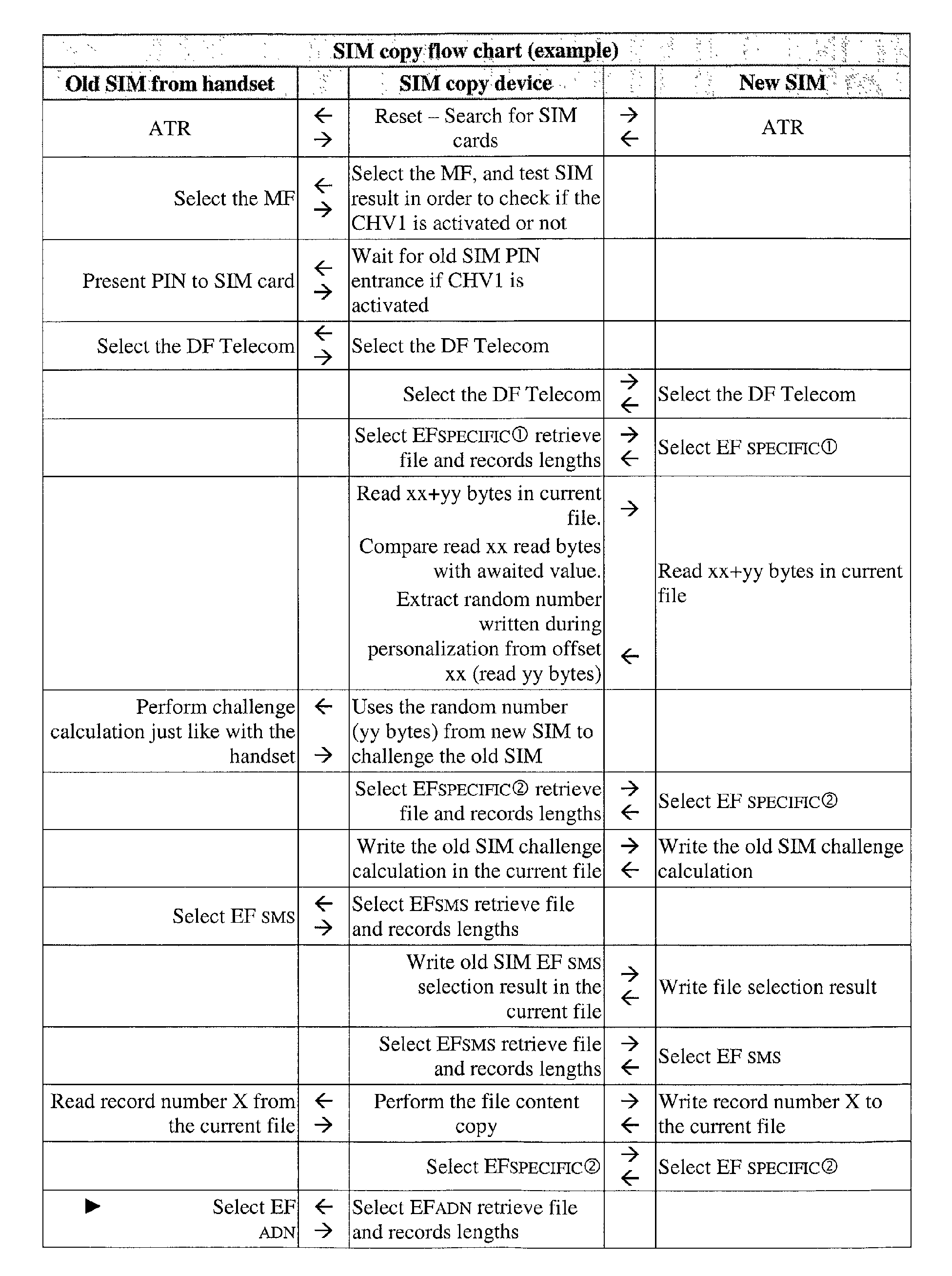
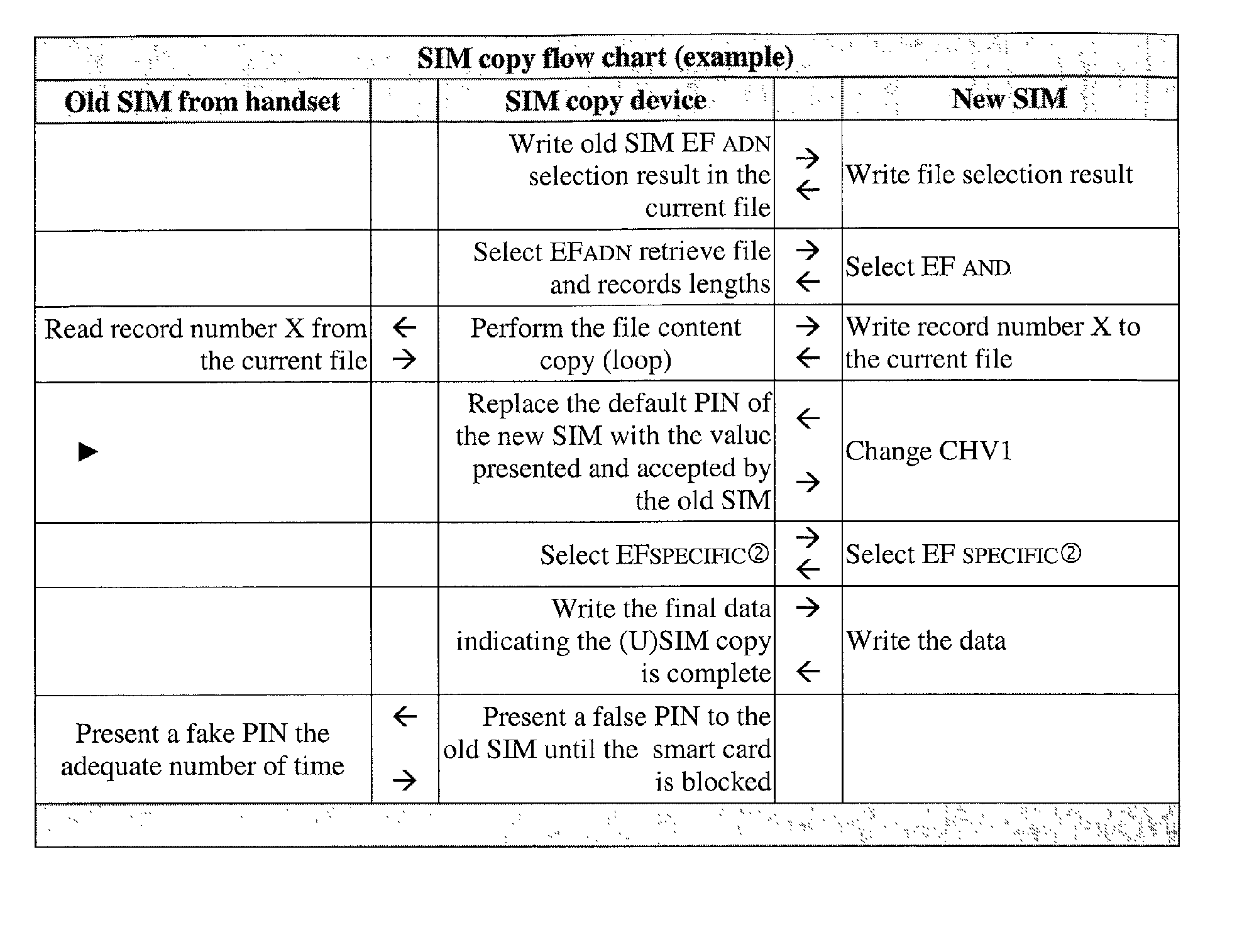
- This chapter describes the APDU required to pilot the SIM copy function in the electronic device.
- The manner these commands are coded (byte code) in the new SIM is not the purpose of this document.
- The scripting application of the SIM copy device is made of three types of entity:
- 1. The commands related to the smart cards.
- 2. The commands related to the interaction with the user.
- 3. The messages.
-
- These 3 categories might be combined to have command displaying a message, waiting for an action from the customer, and sending an APDU to a smart card.
- The coding of all these elements is fully depending on the device manufacturer choices (i.e. the byte code).
- A command or function as defined here below is not always a single smart card APDU. It might be a combination of APDUs, and may include user interactions (displaying a message, waiting for a PIN entrance ...).
- This document describes the device characteristics for the SIM copy function. Of course, the commands might vary for another application.
- Messages are defined outside of the commands. Some message might be display under certain circumstances, when an error appends for instance. These messages will be described later on.
- The manner a message is coded is not the purpose of this document, and is under the responsibility of the device manufacturer. This principle is applicable to many different circumstances.
- For example, it might be interesting to customize messages format depending on the design of the LCD screen. Instead of translating a UNICODE message on the flow to the value to write in the registers of the LCD screen, it is more interesting to pre calculate the correct registers value, then the translation is no more required.
- Some commands might be mandatory, some other might not.
- The distinction is done by adding a parameter to all commands, indicating whether it is mandatory or not.
- A failure forces the script to jump to next milestone. Milestones are populated over the scripts in order to identify the important steps. Having found the next milestones, the device continues the script execution by executing the next command. If no more milestones are found, treatment applied on compulsorily successful commands is engaged.
- A compulsorily successful command failure induces the immediate termination of the script, displaying the error message.
-
- SW1-SW2 = 90-00 → Continue normally
- SW1-SW2 = 9F-xx → Retrieve xx bytes using the GET RESPONSE command.
- Any other value → Command failure: process to treatment as described here above.
- The commands described here are to be used in scripts. Thus, is required to have some internal variables to store intermediate results. These variables are:
- A → 20 bytes long binary buffer
- B → 20 bytes long binary buffer
- GRR → GetResponse command result
- There is no need to be able to perform arithmetic calculations to complete the SIM copy function. By the way, more sophisticated application might require such new commands to be included. There are to be described when needs will occur, but not in this document.
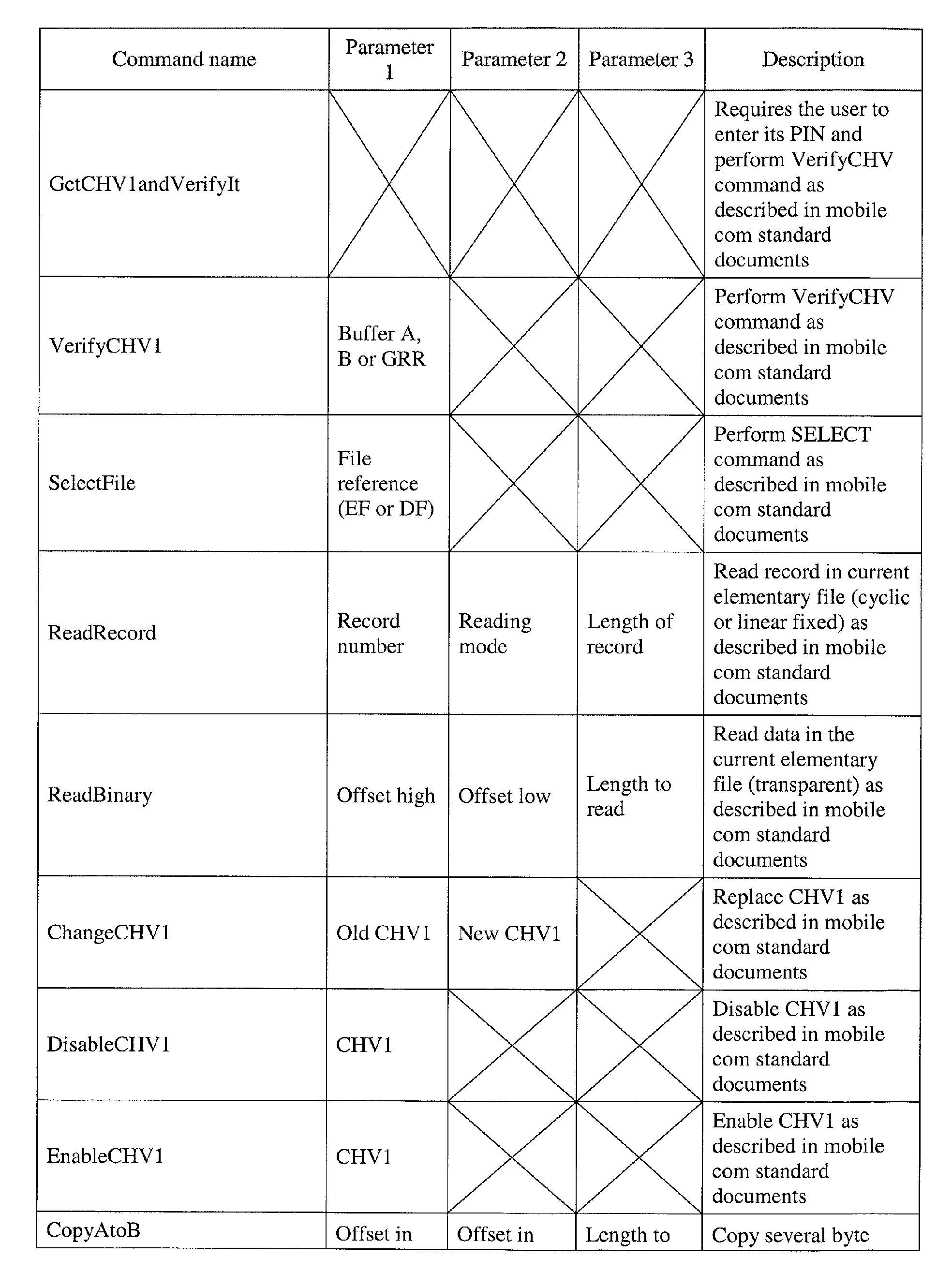
- The following table briefly describes the commands and their parameters. By the way, most of them require indicating also the following:
- The smart card slot where to apply the command.
- A Boolean value indicating if the command must compulsorily be successful or not.

Claims (1)
- A method of assigning an account to a new identification device, the account having previously been assigned to an old identification device that comprises an identification data and a key, the method comprising:a result-calculation step in which the old identification device calculates a result on the basis of an input data and the key;a linking step in which the result calculated by the old identification device and the identification data of the old identification device are made available to a communication device, and in which the new identification device is coupled to the communication device; anda transfer step in which a communication is established between the communication device to which the new identification device is coupled, and an account center, which causes the account center to assign the account to the new identification device.
Priority Applications (1)
| Application Number | Priority Date | Filing Date | Title |
|---|---|---|---|
| EP02078895A EP1353303A1 (en) | 2002-04-10 | 2002-08-22 | A method of assigning an account to a new identification device |
Applications Claiming Priority (3)
| Application Number | Priority Date | Filing Date | Title |
|---|---|---|---|
| EP02076419 | 2002-04-10 | ||
| EP02076419 | 2002-04-10 | ||
| EP02078895A EP1353303A1 (en) | 2002-04-10 | 2002-08-22 | A method of assigning an account to a new identification device |
Publications (1)
| Publication Number | Publication Date |
|---|---|
| EP1353303A1 true EP1353303A1 (en) | 2003-10-15 |
Family
ID=28455916
Family Applications (1)
| Application Number | Title | Priority Date | Filing Date |
|---|---|---|---|
| EP02078895A Withdrawn EP1353303A1 (en) | 2002-04-10 | 2002-08-22 | A method of assigning an account to a new identification device |
Country Status (1)
| Country | Link |
|---|---|
| EP (1) | EP1353303A1 (en) |
Citations (3)
| Publication number | Priority date | Publication date | Assignee | Title |
|---|---|---|---|---|
| WO1993007697A1 (en) * | 1991-09-30 | 1993-04-15 | Comvik Gsm Ab | Method for personalisation of an active card |
| EP0829831A1 (en) * | 1996-09-13 | 1998-03-18 | Schlumberger Industries S.A. | Card authentication method |
| FR2771528A1 (en) * | 1997-11-25 | 1999-05-28 | Gemplus Card Int | Management of data in a smart card |
-
2002
- 2002-08-22 EP EP02078895A patent/EP1353303A1/en not_active Withdrawn
Patent Citations (3)
| Publication number | Priority date | Publication date | Assignee | Title |
|---|---|---|---|---|
| WO1993007697A1 (en) * | 1991-09-30 | 1993-04-15 | Comvik Gsm Ab | Method for personalisation of an active card |
| EP0829831A1 (en) * | 1996-09-13 | 1998-03-18 | Schlumberger Industries S.A. | Card authentication method |
| FR2771528A1 (en) * | 1997-11-25 | 1999-05-28 | Gemplus Card Int | Management of data in a smart card |
Similar Documents
| Publication | Publication Date | Title |
|---|---|---|
| US8762350B2 (en) | Methods and systems for providing data objects on a token | |
| US7272830B2 (en) | Ordering program data for loading on a device | |
| JP5323187B2 (en) | Application access method in a secure mobile environment | |
| US20100323681A1 (en) | Sharing or reselling nfc applications among mobile communication devices | |
| US8473417B2 (en) | Signing program data payload sequence in program loading | |
| US7484095B2 (en) | System for communicating program data between a first device and a second device | |
| HUH3896A (en) | Home service system with smart terminal emulator | |
| MXPA04005525A (en) | Smartcard system. | |
| CN111932245B (en) | Data processing methods, devices, equipment and media | |
| US10915893B2 (en) | Method for processing transaction data, device and corresponding program | |
| EP2620897A1 (en) | Method, device and system for displaying radio frequency identification application information | |
| KR100374526B1 (en) | Simplified use of smart cards | |
| EP1584017A2 (en) | Run time code integrity checks | |
| EP2793201A1 (en) | Safety information transfer system, device and method based on extended parameter set | |
| Husemann | Standards in the smart card world | |
| US7281244B2 (en) | Using a digital fingerprint to commit loaded data in a device | |
| US7606931B2 (en) | Method with which a first application can access components of a second application over a logical interface | |
| US7315942B1 (en) | Network element and method for controlling access to low level computer system services | |
| CN100538750C (en) | Personalized data processing method and device for portable communication device such as smart card | |
| US20060080655A1 (en) | System and method for post-issuance code update employing embedded native code | |
| US7222331B2 (en) | Linking of virtual methods | |
| CN112600803B (en) | Web end data signature method and device and computer equipment | |
| EP1353289A1 (en) | System comprising a smart card and a reader | |
| US9959544B2 (en) | Updating an application on a smart card and displaying an advertisement | |
| WO2003085587A1 (en) | A system comprising a smart card and a reader |
Legal Events
| Date | Code | Title | Description |
|---|---|---|---|
| PUAI | Public reference made under article 153(3) epc to a published international application that has entered the european phase |
Free format text: ORIGINAL CODE: 0009012 |
|
| AK | Designated contracting states |
Kind code of ref document: A1 Designated state(s): AT BE BG CH CY CZ DE DK EE ES FI FR GB GR IE IT LI LU MC NL PT SE SK TR |
|
| AX | Request for extension of the european patent |
Extension state: AL LT LV MK RO SI |
|
| AKX | Designation fees paid | ||
| REG | Reference to a national code |
Ref country code: DE Ref legal event code: 8566 |
|
| RAP1 | Party data changed (applicant data changed or rights of an application transferred) |
Owner name: AXALTO S.A. |
|
| STAA | Information on the status of an ep patent application or granted ep patent |
Free format text: STATUS: THE APPLICATION IS DEEMED TO BE WITHDRAWN |
|
| 18D | Application deemed to be withdrawn |
Effective date: 20040416 |