EP1352904A1 - (meth)acrylate esters, starting alcohols for the preparation thereof, processes for preparing both, polymers of the esters, chemically amplifiable resist compositions, and method for forming patterns - Google Patents
(meth)acrylate esters, starting alcohols for the preparation thereof, processes for preparing both, polymers of the esters, chemically amplifiable resist compositions, and method for forming patterns Download PDFInfo
- Publication number
- EP1352904A1 EP1352904A1 EP01999568A EP01999568A EP1352904A1 EP 1352904 A1 EP1352904 A1 EP 1352904A1 EP 01999568 A EP01999568 A EP 01999568A EP 01999568 A EP01999568 A EP 01999568A EP 1352904 A1 EP1352904 A1 EP 1352904A1
- Authority
- EP
- European Patent Office
- Prior art keywords
- group
- represented
- meth
- formula
- methyl
- Prior art date
- Legal status (The legal status is an assumption and is not a legal conclusion. Google has not performed a legal analysis and makes no representation as to the accuracy of the status listed.)
- Granted
Links
- 239000000203 mixture Substances 0.000 title claims abstract description 138
- 229920000642 polymer Polymers 0.000 title claims abstract description 102
- 238000000034 method Methods 0.000 title claims description 76
- 150000002148 esters Chemical class 0.000 title description 9
- 230000008569 process Effects 0.000 title description 6
- 150000001252 acrylic acid derivatives Chemical class 0.000 title description 3
- 150000001298 alcohols Chemical class 0.000 title description 3
- 238000002360 preparation method Methods 0.000 title description 3
- 125000004435 hydrogen atom Chemical group [H]* 0.000 claims abstract description 91
- LFQSCWFLJHTTHZ-UHFFFAOYSA-N Ethanol Chemical compound CCO LFQSCWFLJHTTHZ-UHFFFAOYSA-N 0.000 claims abstract description 81
- 239000000178 monomer Substances 0.000 claims abstract description 77
- NIXOWILDQLNWCW-UHFFFAOYSA-M Acrylate Chemical compound [O-]C(=O)C=C NIXOWILDQLNWCW-UHFFFAOYSA-M 0.000 claims abstract description 73
- 125000002496 methyl group Chemical group [H]C([H])([H])* 0.000 claims abstract description 52
- 150000002596 lactones Chemical class 0.000 claims abstract description 32
- 125000001495 ethyl group Chemical group [H]C([H])([H])C([H])([H])* 0.000 claims abstract description 24
- FPYJFEHAWHCUMM-UHFFFAOYSA-N maleic anhydride Chemical compound O=C1OC(=O)C=C1 FPYJFEHAWHCUMM-UHFFFAOYSA-N 0.000 claims abstract description 22
- 238000005698 Diels-Alder reaction Methods 0.000 claims abstract description 17
- LLVWLCAZSOLOTF-UHFFFAOYSA-N 1-methyl-4-[1,4,4-tris(4-methylphenyl)buta-1,3-dienyl]benzene Chemical compound C1=CC(C)=CC=C1C(C=1C=CC(C)=CC=1)=CC=C(C=1C=CC(C)=CC=1)C1=CC=C(C)C=C1 LLVWLCAZSOLOTF-UHFFFAOYSA-N 0.000 claims abstract description 15
- 230000000379 polymerizing effect Effects 0.000 claims abstract description 8
- 230000000887 hydrating effect Effects 0.000 claims abstract description 6
- 150000001875 compounds Chemical class 0.000 claims description 140
- 239000002904 solvent Substances 0.000 claims description 63
- ZMXDDKWLCZADIW-UHFFFAOYSA-N N,N-Dimethylformamide Chemical compound CN(C)C=O ZMXDDKWLCZADIW-UHFFFAOYSA-N 0.000 claims description 40
- 125000000753 cycloalkyl group Chemical group 0.000 claims description 32
- 239000002253 acid Substances 0.000 claims description 27
- 239000000284 extract Substances 0.000 claims description 20
- 238000000605 extraction Methods 0.000 claims description 20
- 150000001732 carboxylic acid derivatives Chemical class 0.000 claims description 19
- 125000000524 functional group Chemical group 0.000 claims description 18
- 239000000758 substrate Substances 0.000 claims description 18
- VEXZGXHMUGYJMC-UHFFFAOYSA-N Hydrochloric acid Chemical compound Cl VEXZGXHMUGYJMC-UHFFFAOYSA-N 0.000 claims description 14
- 239000003638 chemical reducing agent Substances 0.000 claims description 14
- 230000007062 hydrolysis Effects 0.000 claims description 13
- 238000006460 hydrolysis reaction Methods 0.000 claims description 13
- 125000002887 hydroxy group Chemical group [H]O* 0.000 claims description 13
- 230000009467 reduction Effects 0.000 claims description 12
- QAOWNCQODCNURD-UHFFFAOYSA-N Sulfuric acid Chemical compound OS(O)(=O)=O QAOWNCQODCNURD-UHFFFAOYSA-N 0.000 claims description 10
- 125000001424 substituent group Chemical group 0.000 claims description 9
- IZSHZLKNFQAAKX-UHFFFAOYSA-N 5-cyclopenta-2,4-dien-1-ylcyclopenta-1,3-diene Chemical group C1=CC=CC1C1C=CC=C1 IZSHZLKNFQAAKX-UHFFFAOYSA-N 0.000 claims description 8
- 125000005073 adamantyl group Chemical group C12(CC3CC(CC(C1)C3)C2)* 0.000 claims description 8
- 150000007942 carboxylates Chemical class 0.000 claims description 8
- 125000000113 cyclohexyl group Chemical group [H]C1([H])C([H])([H])C([H])([H])C([H])(*)C([H])([H])C1([H])[H] 0.000 claims description 8
- 150000004678 hydrides Chemical class 0.000 claims description 8
- DTGKSKDOIYIVQL-WEDXCCLWSA-N (+)-borneol Chemical group C1C[C@@]2(C)[C@@H](O)C[C@@H]1C2(C)C DTGKSKDOIYIVQL-WEDXCCLWSA-N 0.000 claims description 7
- 150000002576 ketones Chemical class 0.000 claims description 7
- FXHOOIRPVKKKFG-UHFFFAOYSA-N N,N-Dimethylacetamide Chemical compound CN(C)C(C)=O FXHOOIRPVKKKFG-UHFFFAOYSA-N 0.000 claims description 6
- 230000002378 acidificating effect Effects 0.000 claims description 6
- 238000007259 addition reaction Methods 0.000 claims description 6
- 239000011248 coating agent Substances 0.000 claims description 6
- 238000000576 coating method Methods 0.000 claims description 6
- 239000001257 hydrogen Substances 0.000 claims description 6
- 229910052739 hydrogen Inorganic materials 0.000 claims description 6
- 239000003456 ion exchange resin Substances 0.000 claims description 5
- 229920003303 ion-exchange polymer Polymers 0.000 claims description 5
- SECXISVLQFMRJM-UHFFFAOYSA-N N-Methylpyrrolidone Chemical compound CN1CCCC1=O SECXISVLQFMRJM-UHFFFAOYSA-N 0.000 claims description 4
- 238000006386 neutralization reaction Methods 0.000 claims description 4
- NWUYHJFMYQTDRP-UHFFFAOYSA-N 1,2-bis(ethenyl)benzene;1-ethenyl-2-ethylbenzene;styrene Chemical compound C=CC1=CC=CC=C1.CCC1=CC=CC=C1C=C.C=CC1=CC=CC=C1C=C NWUYHJFMYQTDRP-UHFFFAOYSA-N 0.000 claims description 3
- 230000003472 neutralizing effect Effects 0.000 claims description 3
- 239000011347 resin Substances 0.000 abstract description 29
- 229920005989 resin Polymers 0.000 abstract description 29
- 238000001312 dry etching Methods 0.000 abstract description 23
- 239000003960 organic solvent Substances 0.000 abstract description 21
- 239000000243 solution Substances 0.000 description 92
- 238000006243 chemical reaction Methods 0.000 description 88
- OKKJLVBELUTLKV-UHFFFAOYSA-N Methanol Chemical compound OC OKKJLVBELUTLKV-UHFFFAOYSA-N 0.000 description 60
- -1 agglutinant Substances 0.000 description 58
- 229920001577 copolymer Polymers 0.000 description 48
- XLYOFNOQVPJJNP-UHFFFAOYSA-N water Substances O XLYOFNOQVPJJNP-UHFFFAOYSA-N 0.000 description 42
- ZMANZCXQSJIPKH-UHFFFAOYSA-N Triethylamine Chemical compound CCN(CC)CC ZMANZCXQSJIPKH-UHFFFAOYSA-N 0.000 description 36
- WYURNTSHIVDZCO-UHFFFAOYSA-N Tetrahydrofuran Chemical compound C1CCOC1 WYURNTSHIVDZCO-UHFFFAOYSA-N 0.000 description 35
- 238000004519 manufacturing process Methods 0.000 description 34
- 238000003756 stirring Methods 0.000 description 31
- XEKOWRVHYACXOJ-UHFFFAOYSA-N Ethyl acetate Chemical compound CCOC(C)=O XEKOWRVHYACXOJ-UHFFFAOYSA-N 0.000 description 24
- BDAGIHXWWSANSR-UHFFFAOYSA-N methanoic acid Natural products OC=O BDAGIHXWWSANSR-UHFFFAOYSA-N 0.000 description 22
- 239000002244 precipitate Substances 0.000 description 22
- NTIZESTWPVYFNL-UHFFFAOYSA-N Methyl isobutyl ketone Chemical compound CC(C)CC(C)=O NTIZESTWPVYFNL-UHFFFAOYSA-N 0.000 description 21
- YXFVVABEGXRONW-UHFFFAOYSA-N Toluene Chemical compound CC1=CC=CC=C1 YXFVVABEGXRONW-UHFFFAOYSA-N 0.000 description 21
- VLKZOEOYAKHREP-UHFFFAOYSA-N n-Hexane Chemical compound CCCCCC VLKZOEOYAKHREP-UHFFFAOYSA-N 0.000 description 21
- YLQBMQCUIZJEEH-UHFFFAOYSA-N Furan Chemical compound C=1C=COC=1 YLQBMQCUIZJEEH-UHFFFAOYSA-N 0.000 description 20
- 238000006116 polymerization reaction Methods 0.000 description 20
- 239000000047 product Substances 0.000 description 20
- IUVCFHHAEHNCFT-INIZCTEOSA-N 2-[(1s)-1-[4-amino-3-(3-fluoro-4-propan-2-yloxyphenyl)pyrazolo[3,4-d]pyrimidin-1-yl]ethyl]-6-fluoro-3-(3-fluorophenyl)chromen-4-one Chemical compound C1=C(F)C(OC(C)C)=CC=C1C(C1=C(N)N=CN=C11)=NN1[C@@H](C)C1=C(C=2C=C(F)C=CC=2)C(=O)C2=CC(F)=CC=C2O1 IUVCFHHAEHNCFT-INIZCTEOSA-N 0.000 description 19
- YEJRWHAVMIAJKC-UHFFFAOYSA-N 4-Butyrolactone Chemical compound O=C1CCCO1 YEJRWHAVMIAJKC-UHFFFAOYSA-N 0.000 description 18
- LZCLXQDLBQLTDK-UHFFFAOYSA-N ethyl 2-hydroxypropanoate Chemical compound CCOC(=O)C(C)O LZCLXQDLBQLTDK-UHFFFAOYSA-N 0.000 description 18
- 238000007334 copolymerization reaction Methods 0.000 description 17
- 238000005227 gel permeation chromatography Methods 0.000 description 17
- 238000005160 1H NMR spectroscopy Methods 0.000 description 16
- 238000004458 analytical method Methods 0.000 description 16
- YMWUJEATGCHHMB-UHFFFAOYSA-N Dichloromethane Chemical compound ClCCl YMWUJEATGCHHMB-UHFFFAOYSA-N 0.000 description 15
- MOOAHMCRPCTRLV-UHFFFAOYSA-N boron sodium Chemical compound [B].[Na] MOOAHMCRPCTRLV-UHFFFAOYSA-N 0.000 description 15
- 238000005530 etching Methods 0.000 description 15
- 230000010354 integration Effects 0.000 description 15
- 238000001459 lithography Methods 0.000 description 15
- 230000015572 biosynthetic process Effects 0.000 description 14
- VHRYZQNGTZXDNX-UHFFFAOYSA-N methacryloyl chloride Chemical compound CC(=C)C(Cl)=O VHRYZQNGTZXDNX-UHFFFAOYSA-N 0.000 description 14
- IJGRMHOSHXDMSA-UHFFFAOYSA-N nitrogen Substances N#N IJGRMHOSHXDMSA-UHFFFAOYSA-N 0.000 description 14
- 238000010898 silica gel chromatography Methods 0.000 description 14
- CERQOIWHTDAKMF-UHFFFAOYSA-N Methacrylic acid Chemical compound CC(=C)C(O)=O CERQOIWHTDAKMF-UHFFFAOYSA-N 0.000 description 13
- UIIMBOGNXHQVGW-UHFFFAOYSA-M Sodium bicarbonate Chemical compound [Na+].OC([O-])=O UIIMBOGNXHQVGW-UHFFFAOYSA-M 0.000 description 13
- 230000000052 comparative effect Effects 0.000 description 13
- 239000007787 solid Substances 0.000 description 13
- 238000003786 synthesis reaction Methods 0.000 description 13
- KNDQHSIWLOJIGP-UHFFFAOYSA-N 826-62-0 Chemical compound C1C2C3C(=O)OC(=O)C3C1C=C2 KNDQHSIWLOJIGP-UHFFFAOYSA-N 0.000 description 12
- WEVYAHXRMPXWCK-UHFFFAOYSA-N Acetonitrile Chemical compound CC#N WEVYAHXRMPXWCK-UHFFFAOYSA-N 0.000 description 12
- 239000007788 liquid Substances 0.000 description 12
- 238000006722 reduction reaction Methods 0.000 description 12
- 238000001228 spectrum Methods 0.000 description 12
- OSWFIVFLDKOXQC-UHFFFAOYSA-N 4-(3-methoxyphenyl)aniline Chemical compound COC1=CC=CC(C=2C=CC(N)=CC=2)=C1 OSWFIVFLDKOXQC-UHFFFAOYSA-N 0.000 description 11
- FAPWRFPIFSIZLT-UHFFFAOYSA-M Sodium chloride Chemical compound [Na+].[Cl-] FAPWRFPIFSIZLT-UHFFFAOYSA-M 0.000 description 11
- 239000012141 concentrate Substances 0.000 description 11
- 238000004132 cross linking Methods 0.000 description 11
- 235000019253 formic acid Nutrition 0.000 description 11
- 239000002994 raw material Substances 0.000 description 11
- OZAIFHULBGXAKX-UHFFFAOYSA-N 2-(2-cyanopropan-2-yldiazenyl)-2-methylpropanenitrile Chemical compound N#CC(C)(C)N=NC(C)(C)C#N OZAIFHULBGXAKX-UHFFFAOYSA-N 0.000 description 10
- CSNNHWWHGAXBCP-UHFFFAOYSA-L Magnesium sulfate Chemical compound [Mg+2].[O-][S+2]([O-])([O-])[O-] CSNNHWWHGAXBCP-UHFFFAOYSA-L 0.000 description 10
- 239000003377 acid catalyst Substances 0.000 description 10
- 239000004615 ingredient Substances 0.000 description 10
- 230000035945 sensitivity Effects 0.000 description 10
- 239000000126 substance Substances 0.000 description 10
- XJLDYKIEURAVBW-UHFFFAOYSA-N Aethyl-heptyl-keton Natural products CCCCCCCC(=O)CC XJLDYKIEURAVBW-UHFFFAOYSA-N 0.000 description 9
- WOBHKFSMXKNTIM-UHFFFAOYSA-N Hydroxyethyl methacrylate Chemical compound CC(=C)C(=O)OCCO WOBHKFSMXKNTIM-UHFFFAOYSA-N 0.000 description 9
- 125000003178 carboxy group Chemical group [H]OC(*)=O 0.000 description 9
- 239000003054 catalyst Substances 0.000 description 9
- 238000005516 engineering process Methods 0.000 description 9
- 229940116333 ethyl lactate Drugs 0.000 description 9
- 239000010410 layer Substances 0.000 description 9
- ARJOQCYCJMAIFR-UHFFFAOYSA-N prop-2-enoyl prop-2-enoate Chemical compound C=CC(=O)OC(=O)C=C ARJOQCYCJMAIFR-UHFFFAOYSA-N 0.000 description 9
- 102100026735 Coagulation factor VIII Human genes 0.000 description 8
- 101000911390 Homo sapiens Coagulation factor VIII Proteins 0.000 description 8
- 150000008065 acid anhydrides Chemical class 0.000 description 8
- 239000010408 film Substances 0.000 description 8
- 239000011521 glass Substances 0.000 description 8
- 229910052757 nitrogen Inorganic materials 0.000 description 8
- 238000002834 transmittance Methods 0.000 description 8
- RTZKZFJDLAIYFH-UHFFFAOYSA-N Diethyl ether Chemical compound CCOCC RTZKZFJDLAIYFH-UHFFFAOYSA-N 0.000 description 7
- 238000005904 alkaline hydrolysis reaction Methods 0.000 description 7
- 229920001400 block copolymer Polymers 0.000 description 7
- 238000004821 distillation Methods 0.000 description 7
- 238000005886 esterification reaction Methods 0.000 description 7
- 238000004817 gas chromatography Methods 0.000 description 7
- 239000003112 inhibitor Substances 0.000 description 7
- 239000002798 polar solvent Substances 0.000 description 7
- 229920005604 random copolymer Polymers 0.000 description 7
- 239000010409 thin film Substances 0.000 description 7
- JPGAWMJMPXECEB-UHFFFAOYSA-N (3-oxo-4-oxatricyclo[5.2.1.02,6]decan-8-yl) formate Chemical compound C12COC(=O)C2C2CC(OC=O)C1C2 JPGAWMJMPXECEB-UHFFFAOYSA-N 0.000 description 6
- TUNWNPKDXUGKMG-UHFFFAOYSA-N (5-oxo-4-oxatricyclo[5.2.1.02,6]decan-8-yl) formate Chemical compound C1OC(=O)C2C1C1CC(OC=O)C2C1 TUNWNPKDXUGKMG-UHFFFAOYSA-N 0.000 description 6
- QQZOPKMRPOGIEB-UHFFFAOYSA-N 2-Oxohexane Chemical compound CCCCC(C)=O QQZOPKMRPOGIEB-UHFFFAOYSA-N 0.000 description 6
- ARUVPLPLDAWQHA-UHFFFAOYSA-N 4-oxatricyclo[5.2.1.02,6]decen-3-one Chemical compound C1CC2=C3C(=O)OCC3C1C2 ARUVPLPLDAWQHA-UHFFFAOYSA-N 0.000 description 6
- VVQNEPGJFQJSBK-UHFFFAOYSA-N Methyl methacrylate Chemical compound COC(=O)C(C)=C VVQNEPGJFQJSBK-UHFFFAOYSA-N 0.000 description 6
- HEMHJVSKTPXQMS-UHFFFAOYSA-M Sodium hydroxide Chemical compound [OH-].[Na+] HEMHJVSKTPXQMS-UHFFFAOYSA-M 0.000 description 6
- 229920006243 acrylic copolymer Polymers 0.000 description 6
- ORILYTVJVMAKLC-UHFFFAOYSA-N adamantane Chemical compound C1C(C2)CC3CC1CC2C3 ORILYTVJVMAKLC-UHFFFAOYSA-N 0.000 description 6
- 238000001460 carbon-13 nuclear magnetic resonance spectrum Methods 0.000 description 6
- 238000001035 drying Methods 0.000 description 6
- NWVVVBRKAWDGAB-UHFFFAOYSA-N p-methoxyphenol Chemical compound COC1=CC=C(O)C=C1 NWVVVBRKAWDGAB-UHFFFAOYSA-N 0.000 description 6
- XNLICIUVMPYHGG-UHFFFAOYSA-N pentan-2-one Chemical compound CCCC(C)=O XNLICIUVMPYHGG-UHFFFAOYSA-N 0.000 description 6
- 238000000425 proton nuclear magnetic resonance spectrum Methods 0.000 description 6
- NAWXUBYGYWOOIX-SFHVURJKSA-N (2s)-2-[[4-[2-(2,4-diaminoquinazolin-6-yl)ethyl]benzoyl]amino]-4-methylidenepentanedioic acid Chemical compound C1=CC2=NC(N)=NC(N)=C2C=C1CCC1=CC=C(C(=O)N[C@@H](CC(=C)C(O)=O)C(O)=O)C=C1 NAWXUBYGYWOOIX-SFHVURJKSA-N 0.000 description 5
- BDAGIHXWWSANSR-UHFFFAOYSA-M Formate Chemical compound [O-]C=O BDAGIHXWWSANSR-UHFFFAOYSA-M 0.000 description 5
- DNIAPMSPPWPWGF-UHFFFAOYSA-N Propylene glycol Chemical compound CC(O)CO DNIAPMSPPWPWGF-UHFFFAOYSA-N 0.000 description 5
- JUJWROOIHBZHMG-UHFFFAOYSA-N Pyridine Chemical compound C1=CC=NC=C1 JUJWROOIHBZHMG-UHFFFAOYSA-N 0.000 description 5
- 238000011161 development Methods 0.000 description 5
- 230000018109 developmental process Effects 0.000 description 5
- 229910052943 magnesium sulfate Inorganic materials 0.000 description 5
- 235000019341 magnesium sulphate Nutrition 0.000 description 5
- 239000003921 oil Substances 0.000 description 5
- 239000012044 organic layer Substances 0.000 description 5
- 239000003505 polymerization initiator Substances 0.000 description 5
- 238000010992 reflux Methods 0.000 description 5
- 239000011780 sodium chloride Substances 0.000 description 5
- 238000005809 transesterification reaction Methods 0.000 description 5
- RYHBNJHYFVUHQT-UHFFFAOYSA-N 1,4-Dioxane Chemical compound C1COCCO1 RYHBNJHYFVUHQT-UHFFFAOYSA-N 0.000 description 4
- HEDRZPFGACZZDS-UHFFFAOYSA-N Chloroform Chemical compound ClC(Cl)Cl HEDRZPFGACZZDS-UHFFFAOYSA-N 0.000 description 4
- LCGLNKUTAGEVQW-UHFFFAOYSA-N Dimethyl ether Chemical compound COC LCGLNKUTAGEVQW-UHFFFAOYSA-N 0.000 description 4
- RRHGJUQNOFWUDK-UHFFFAOYSA-N Isoprene Chemical compound CC(=C)C=C RRHGJUQNOFWUDK-UHFFFAOYSA-N 0.000 description 4
- BZLVMXJERCGZMT-UHFFFAOYSA-N Methyl tert-butyl ether Chemical compound COC(C)(C)C BZLVMXJERCGZMT-UHFFFAOYSA-N 0.000 description 4
- KWYUFKZDYYNOTN-UHFFFAOYSA-M Potassium hydroxide Chemical compound [OH-].[K+] KWYUFKZDYYNOTN-UHFFFAOYSA-M 0.000 description 4
- XUIMIQQOPSSXEZ-UHFFFAOYSA-N Silicon Chemical compound [Si] XUIMIQQOPSSXEZ-UHFFFAOYSA-N 0.000 description 4
- CDBYLPFSWZWCQE-UHFFFAOYSA-L Sodium Carbonate Chemical compound [Na+].[Na+].[O-]C([O-])=O CDBYLPFSWZWCQE-UHFFFAOYSA-L 0.000 description 4
- PMZURENOXWZQFD-UHFFFAOYSA-L Sodium Sulfate Chemical compound [Na+].[Na+].[O-]S([O-])(=O)=O PMZURENOXWZQFD-UHFFFAOYSA-L 0.000 description 4
- 230000009471 action Effects 0.000 description 4
- 239000000853 adhesive Substances 0.000 description 4
- 230000001070 adhesive effect Effects 0.000 description 4
- 238000013019 agitation Methods 0.000 description 4
- 125000000217 alkyl group Chemical group 0.000 description 4
- NNBZCPXTIHJBJL-UHFFFAOYSA-N decalin Chemical compound C1CCCC2CCCCC21 NNBZCPXTIHJBJL-UHFFFAOYSA-N 0.000 description 4
- 230000000694 effects Effects 0.000 description 4
- 238000000609 electron-beam lithography Methods 0.000 description 4
- 125000001033 ether group Chemical class 0.000 description 4
- LYCAIKOWRPUZTN-UHFFFAOYSA-N ethylene glycol Natural products OCCO LYCAIKOWRPUZTN-UHFFFAOYSA-N 0.000 description 4
- 238000010438 heat treatment Methods 0.000 description 4
- 239000000463 material Substances 0.000 description 4
- PSHKMPUSSFXUIA-UHFFFAOYSA-N n,n-dimethylpyridin-2-amine Chemical compound CN(C)C1=CC=CC=N1 PSHKMPUSSFXUIA-UHFFFAOYSA-N 0.000 description 4
- 239000012299 nitrogen atmosphere Substances 0.000 description 4
- QJGQUHMNIGDVPM-UHFFFAOYSA-N nitrogen group Chemical group [N] QJGQUHMNIGDVPM-UHFFFAOYSA-N 0.000 description 4
- KJIFKLIQANRMOU-UHFFFAOYSA-N oxidanium;4-methylbenzenesulfonate Chemical compound O.CC1=CC=C(S(O)(=O)=O)C=C1 KJIFKLIQANRMOU-UHFFFAOYSA-N 0.000 description 4
- NPSSWQJHYLDCNV-UHFFFAOYSA-N prop-2-enoic acid;hydrochloride Chemical compound Cl.OC(=O)C=C NPSSWQJHYLDCNV-UHFFFAOYSA-N 0.000 description 4
- 238000000746 purification Methods 0.000 description 4
- 229910052710 silicon Inorganic materials 0.000 description 4
- 239000010703 silicon Substances 0.000 description 4
- 229910052938 sodium sulfate Inorganic materials 0.000 description 4
- 235000011152 sodium sulphate Nutrition 0.000 description 4
- 230000002194 synthesizing effect Effects 0.000 description 4
- ITMCEJHCFYSIIV-UHFFFAOYSA-N triflic acid Chemical compound OS(=O)(=O)C(F)(F)F ITMCEJHCFYSIIV-UHFFFAOYSA-N 0.000 description 4
- FDYDISGSYGFRJM-UHFFFAOYSA-N (2-methyl-2-adamantyl) 2-methylprop-2-enoate Chemical compound C1C(C2)CC3CC1C(OC(=O)C(=C)C)(C)C2C3 FDYDISGSYGFRJM-UHFFFAOYSA-N 0.000 description 3
- DGQCUJSJGOUDOP-UHFFFAOYSA-N (5-methyl-1-oxo-3,4,4a,6,7,7a-hexahydrocyclopenta[c]pyran-5-yl) 2-methylprop-2-enoate Chemical compound C1COC(=O)C2C1C(OC(=O)C(=C)C)(C)CC2 DGQCUJSJGOUDOP-UHFFFAOYSA-N 0.000 description 3
- NZYCRSLJPTXDRT-UHFFFAOYSA-N (6-methyl-1-oxo-3,4,4a,5,7,7a-hexahydrocyclopenta[c]pyran-6-yl) 2-methylprop-2-enoate Chemical compound C1COC(=O)C2CC(OC(=O)C(=C)C)(C)CC21 NZYCRSLJPTXDRT-UHFFFAOYSA-N 0.000 description 3
- JWEWPPCQHQRJCT-UHFFFAOYSA-N (8-methyl-5-oxo-4-oxatricyclo[5.2.1.02,6]decan-8-yl) 2-methylprop-2-enoate Chemical compound C1OC(=O)C2C1C1CC(OC(=O)C(=C)C)(C)C2C1 JWEWPPCQHQRJCT-UHFFFAOYSA-N 0.000 description 3
- OISVCGZHLKNMSJ-UHFFFAOYSA-N 2,6-dimethylpyridine Chemical compound CC1=CC=CC(C)=N1 OISVCGZHLKNMSJ-UHFFFAOYSA-N 0.000 description 3
- LLKCTMZKABYXPK-UHFFFAOYSA-N 5-methyl-4-oxatricyclo[5.2.1.02,6]dec-1-en-3-one Chemical compound C1CC2C3C(C)OC(=O)C3=C1C2 LLKCTMZKABYXPK-UHFFFAOYSA-N 0.000 description 3
- QTBSBXVTEAMEQO-UHFFFAOYSA-N Acetic acid Chemical compound CC(O)=O QTBSBXVTEAMEQO-UHFFFAOYSA-N 0.000 description 3
- CSCPPACGZOOCGX-UHFFFAOYSA-N Acetone Chemical compound CC(C)=O CSCPPACGZOOCGX-UHFFFAOYSA-N 0.000 description 3
- UHOVQNZJYSORNB-UHFFFAOYSA-N Benzene Chemical compound C1=CC=CC=C1 UHOVQNZJYSORNB-UHFFFAOYSA-N 0.000 description 3
- KFZMGEQAYNKOFK-UHFFFAOYSA-N Isopropanol Chemical compound CC(C)O KFZMGEQAYNKOFK-UHFFFAOYSA-N 0.000 description 3
- CTQNGGLPUBDAKN-UHFFFAOYSA-N O-Xylene Chemical compound CC1=CC=CC=C1C CTQNGGLPUBDAKN-UHFFFAOYSA-N 0.000 description 3
- 125000003647 acryloyl group Chemical group O=C([*])C([H])=C([H])[H] 0.000 description 3
- 150000004945 aromatic hydrocarbons Chemical class 0.000 description 3
- 230000005587 bubbling Effects 0.000 description 3
- 239000011203 carbon fibre reinforced carbon Substances 0.000 description 3
- 239000003795 chemical substances by application Substances 0.000 description 3
- LQRUPWUPINJLMU-UHFFFAOYSA-N dioctyl(oxo)tin Chemical compound CCCCCCCC[Sn](=O)CCCCCCCC LQRUPWUPINJLMU-UHFFFAOYSA-N 0.000 description 3
- 238000010894 electron beam technology Methods 0.000 description 3
- 150000002170 ethers Chemical class 0.000 description 3
- 229940052303 ethers for general anesthesia Drugs 0.000 description 3
- 238000010528 free radical solution polymerization reaction Methods 0.000 description 3
- 230000020169 heat generation Effects 0.000 description 3
- KNRCVAANTQNTPT-UHFFFAOYSA-N methyl-5-norbornene-2,3-dicarboxylic anhydride Chemical compound O=C1OC(=O)C2C1C1(C)C=CC2C1 KNRCVAANTQNTPT-UHFFFAOYSA-N 0.000 description 3
- 238000002156 mixing Methods 0.000 description 3
- TYJJADVDDVDEDZ-UHFFFAOYSA-M potassium hydrogencarbonate Chemical compound [K+].OC([O-])=O TYJJADVDDVDEDZ-UHFFFAOYSA-M 0.000 description 3
- LLHKCFNBLRBOGN-UHFFFAOYSA-N propylene glycol methyl ether acetate Chemical compound COCC(C)OC(C)=O LLHKCFNBLRBOGN-UHFFFAOYSA-N 0.000 description 3
- 125000006239 protecting group Chemical group 0.000 description 3
- 230000005855 radiation Effects 0.000 description 3
- 238000011084 recovery Methods 0.000 description 3
- 230000007261 regionalization Effects 0.000 description 3
- 229910000030 sodium bicarbonate Inorganic materials 0.000 description 3
- 235000017557 sodium bicarbonate Nutrition 0.000 description 3
- 239000004094 surface-active agent Substances 0.000 description 3
- 238000005292 vacuum distillation Methods 0.000 description 3
- 238000005406 washing Methods 0.000 description 3
- 239000008096 xylene Substances 0.000 description 3
- FFIUYPHLNHLJOQ-UHFFFAOYSA-N (1-oxo-4,4a,5,6,7,7a-hexahydro-3h-cyclopenta[c]pyran-5-yl) 2-methylprop-2-enoate Chemical compound C1COC(=O)C2C1C(OC(=O)C(=C)C)CC2 FFIUYPHLNHLJOQ-UHFFFAOYSA-N 0.000 description 2
- VFUWPOLGBMXQLG-UHFFFAOYSA-N (1-oxo-4,4a,5,6,7,7a-hexahydro-3h-cyclopenta[c]pyran-6-yl) 2-methylprop-2-enoate Chemical compound C1COC(=O)C2CC(OC(=O)C(=C)C)CC21 VFUWPOLGBMXQLG-UHFFFAOYSA-N 0.000 description 2
- CVOFUHUIXVFPCH-UHFFFAOYSA-N (3-oxo-4,10-dioxatricyclo[5.2.1.02,6]decan-8-yl) 2-methylprop-2-enoate Chemical compound C12COC(=O)C2C2CC(OC(=O)C(=C)C)C1O2 CVOFUHUIXVFPCH-UHFFFAOYSA-N 0.000 description 2
- CUONHNINZJRNLP-UHFFFAOYSA-N (3-oxo-4-oxatricyclo[5.2.1.02,6]decan-8-yl) 2-methylprop-2-enoate Chemical compound C12COC(=O)C2C2CC(OC(=O)C(=C)C)C1C2 CUONHNINZJRNLP-UHFFFAOYSA-N 0.000 description 2
- CUWLHXQSQBKAPU-UHFFFAOYSA-N (3-oxo-4-oxatricyclo[5.2.1.02,6]decan-8-yl) prop-2-enoate Chemical compound C12COC(=O)C2C2CC(OC(=O)C=C)C1C2 CUWLHXQSQBKAPU-UHFFFAOYSA-N 0.000 description 2
- KCNDXSQVSNDKPJ-UHFFFAOYSA-N (3-oxo-4-oxatricyclo[5.2.2.02,6]undecan-8-yl) 2-methylprop-2-enoate Chemical compound CC(=C)C(=O)OC1CC2C3C(=O)OCC3C1CC2 KCNDXSQVSNDKPJ-UHFFFAOYSA-N 0.000 description 2
- NHIPKYRUODSXFT-UHFFFAOYSA-N (5,6-dimethyl-1-oxo-3,4,4a,5,7,7a-hexahydrocyclopenta[c]pyran-6-yl) 2-methylprop-2-enoate Chemical compound C1COC(=O)C2CC(OC(=O)C(C)=C)(C)C(C)C21 NHIPKYRUODSXFT-UHFFFAOYSA-N 0.000 description 2
- RDVVJBOIXRAPCV-UHFFFAOYSA-N (5,6-dimethyl-1-oxo-3,4,4a,5,7,7a-hexahydrocyclopenta[c]pyran-6-yl) prop-2-enoate Chemical compound C1COC(=O)C2CC(OC(=O)C=C)(C)C(C)C21 RDVVJBOIXRAPCV-UHFFFAOYSA-N 0.000 description 2
- XTVLLBVUSPDLNI-UHFFFAOYSA-N (5,6-dimethyl-1-oxo-3,4,4a,6,7,7a-hexahydrocyclopenta[c]pyran-5-yl) 2-methylprop-2-enoate Chemical compound CC(=C)C(=O)OC1(C)C(C)CC2C1CCOC2=O XTVLLBVUSPDLNI-UHFFFAOYSA-N 0.000 description 2
- DPPBXUPINVBRIM-UHFFFAOYSA-N (5,6-dimethyl-1-oxo-3,4,4a,6,7,7a-hexahydrocyclopenta[c]pyran-5-yl) prop-2-enoate Chemical compound C=CC(=O)OC1(C)C(C)CC2C1CCOC2=O DPPBXUPINVBRIM-UHFFFAOYSA-N 0.000 description 2
- GLJMWIYXNJXMQN-UHFFFAOYSA-N (5-methyl-1-oxo-3,4,4a,6,7,7a-hexahydrocyclopenta[c]pyran-5-yl) prop-2-enoate Chemical compound C1COC(=O)C2C1C(C)(OC(=O)C=C)CC2 GLJMWIYXNJXMQN-UHFFFAOYSA-N 0.000 description 2
- MPIWGHBYAGYSQG-UHFFFAOYSA-N (5-oxo-4,10-dioxatricyclo[5.2.1.02,6]decan-8-yl) 2-methylprop-2-enoate Chemical compound C1OC(=O)C2C1C1CC(OC(=O)C(=C)C)C2O1 MPIWGHBYAGYSQG-UHFFFAOYSA-N 0.000 description 2
- HUBQXXVDMPTEHH-UHFFFAOYSA-N (5-oxo-4-oxatricyclo[5.2.1.02,6]decan-8-yl) 2-methylprop-2-enoate Chemical compound C1OC(=O)C2C1C1CC(OC(=O)C(=C)C)C2C1 HUBQXXVDMPTEHH-UHFFFAOYSA-N 0.000 description 2
- WAGNUIYTQCAEAE-UHFFFAOYSA-N (5-oxo-4-oxatricyclo[5.2.1.02,6]decan-8-yl) prop-2-enoate Chemical compound C1OC(=O)C2C1C1CC(OC(=O)C=C)C2C1 WAGNUIYTQCAEAE-UHFFFAOYSA-N 0.000 description 2
- WOJXPUAMEPVSNS-UHFFFAOYSA-N (5-oxo-4-oxatricyclo[5.2.2.02,6]undecan-8-yl) 2-methylprop-2-enoate Chemical compound CC(=C)C(=O)OC1CC2C(COC3=O)C3C1CC2 WOJXPUAMEPVSNS-UHFFFAOYSA-N 0.000 description 2
- ZROFAXCQYPKWCY-UHFFFAOYSA-N (5-oxooxolan-3-yl) 2-methylprop-2-enoate Chemical compound CC(=C)C(=O)OC1COC(=O)C1 ZROFAXCQYPKWCY-UHFFFAOYSA-N 0.000 description 2
- KXXHNVZQEQPEMI-UHFFFAOYSA-N (6-methyl-1-oxo-3,4,4a,5,7,7a-hexahydrocyclopenta[c]pyran-6-yl) prop-2-enoate Chemical compound C1COC(=O)C2CC(C)(OC(=O)C=C)CC21 KXXHNVZQEQPEMI-UHFFFAOYSA-N 0.000 description 2
- CQUMARYHBCQCCZ-UHFFFAOYSA-N (8-ethyl-3-oxo-4-oxatricyclo[5.2.1.02,6]decan-8-yl) 2-methylprop-2-enoate Chemical compound C12COC(=O)C2C2CC(OC(=O)C(C)=C)(CC)C1C2 CQUMARYHBCQCCZ-UHFFFAOYSA-N 0.000 description 2
- XOTXLKRQKIGJBK-UHFFFAOYSA-N (8-ethyl-3-oxo-4-oxatricyclo[5.2.1.02,6]decan-8-yl) prop-2-enoate Chemical compound C12COC(=O)C2C2CC(OC(=O)C=C)(CC)C1C2 XOTXLKRQKIGJBK-UHFFFAOYSA-N 0.000 description 2
- FSTPSIJAGPPREP-UHFFFAOYSA-N (8-ethyl-5-oxo-4-oxatricyclo[5.2.1.02,6]decan-8-yl) 2-methylprop-2-enoate Chemical compound C1OC(=O)C2C1C1CC(OC(=O)C(C)=C)(CC)C2C1 FSTPSIJAGPPREP-UHFFFAOYSA-N 0.000 description 2
- XSBNNMMEYPHZCB-UHFFFAOYSA-N (8-ethyl-5-oxo-4-oxatricyclo[5.2.1.02,6]decan-8-yl) prop-2-enoate Chemical compound C1OC(=O)C2C1C1CC(OC(=O)C=C)(CC)C2C1 XSBNNMMEYPHZCB-UHFFFAOYSA-N 0.000 description 2
- ZKLZJDAJMIYTJQ-UHFFFAOYSA-N (8-methyl-3-oxo-4-oxatricyclo[5.2.1.02,6]decan-8-yl) 2-methylprop-2-enoate Chemical compound C12COC(=O)C2C2CC(OC(=O)C(=C)C)(C)C1C2 ZKLZJDAJMIYTJQ-UHFFFAOYSA-N 0.000 description 2
- YUDJTSGOJVSSHW-UHFFFAOYSA-N (8-methyl-3-oxo-4-oxatricyclo[5.2.1.02,6]decan-8-yl) prop-2-enoate Chemical compound C12COC(=O)C2C2CC(OC(=O)C=C)(C)C1C2 YUDJTSGOJVSSHW-UHFFFAOYSA-N 0.000 description 2
- BYXHFDNXKOSOKK-UHFFFAOYSA-N (8-methyl-5-oxo-4-oxatricyclo[5.2.1.02,6]decan-8-yl) prop-2-enoate Chemical compound C1OC(=O)C2C1C1CC(OC(=O)C=C)(C)C2C1 BYXHFDNXKOSOKK-UHFFFAOYSA-N 0.000 description 2
- 0 *C(*)(C1CO2)C(*)(*)C(*)(*)C(*)(*)C1C2=O Chemical compound *C(*)(C1CO2)C(*)(*)C(*)(*)C(*)(*)C1C2=O 0.000 description 2
- KBPLFHHGFOOTCA-UHFFFAOYSA-N 1-Octanol Chemical compound CCCCCCCCO KBPLFHHGFOOTCA-UHFFFAOYSA-N 0.000 description 2
- SDJHPPZKZZWAKF-UHFFFAOYSA-N 2,3-dimethylbuta-1,3-diene Chemical compound CC(=C)C(C)=C SDJHPPZKZZWAKF-UHFFFAOYSA-N 0.000 description 2
- ZWEHNKRNPOVVGH-UHFFFAOYSA-N 2-Butanone Chemical compound CCC(C)=O ZWEHNKRNPOVVGH-UHFFFAOYSA-N 0.000 description 2
- VQKFNUFAXTZWDK-UHFFFAOYSA-N 2-Methylfuran Chemical compound CC1=CC=CO1 VQKFNUFAXTZWDK-UHFFFAOYSA-N 0.000 description 2
- 125000000954 2-hydroxyethyl group Chemical group [H]C([*])([H])C([H])([H])O[H] 0.000 description 2
- BSKHPKMHTQYZBB-UHFFFAOYSA-N 2-methylpyridine Chemical compound CC1=CC=CC=N1 BSKHPKMHTQYZBB-UHFFFAOYSA-N 0.000 description 2
- VHYFNPMBLIVWCW-UHFFFAOYSA-N 4-Dimethylaminopyridine Chemical compound CN(C)C1=CC=NC=C1 VHYFNPMBLIVWCW-UHFFFAOYSA-N 0.000 description 2
- YYSDNLZCJQMZCZ-UHFFFAOYSA-N 5,5-dimethyl-3-methylenedihydrofuran-2-one Chemical compound CC1(C)CC(=C)C(=O)O1 YYSDNLZCJQMZCZ-UHFFFAOYSA-N 0.000 description 2
- NTSLROIKFLNUIJ-UHFFFAOYSA-N 5-Ethyl-2-methylpyridine Chemical compound CCC1=CC=C(C)N=C1 NTSLROIKFLNUIJ-UHFFFAOYSA-N 0.000 description 2
- LVFWDKHHYJXPFX-UHFFFAOYSA-N 8-hydroxy-4-oxatricyclo[5.2.1.02,6]decan-3-one Chemical compound C12COC(=O)C2C2CC(O)C1C2 LVFWDKHHYJXPFX-UHFFFAOYSA-N 0.000 description 2
- UTYFKAKOVMDCIH-UHFFFAOYSA-N 9-hydroxy-1-methyl-4-oxatricyclo[5.2.1.02,6]decan-3-one Chemical compound C12COC(=O)C2C2(C)C(O)CC1C2 UTYFKAKOVMDCIH-UHFFFAOYSA-N 0.000 description 2
- NLXLAEXVIDQMFP-UHFFFAOYSA-N Ammonia chloride Chemical class [NH4+].[Cl-] NLXLAEXVIDQMFP-UHFFFAOYSA-N 0.000 description 2
- KAKZBPTYRLMSJV-UHFFFAOYSA-N Butadiene Chemical compound C=CC=C KAKZBPTYRLMSJV-UHFFFAOYSA-N 0.000 description 2
- RGSFGYAAUTVSQA-UHFFFAOYSA-N Cyclopentane Chemical compound C1CCCC1 RGSFGYAAUTVSQA-UHFFFAOYSA-N 0.000 description 2
- RWSOTUBLDIXVET-UHFFFAOYSA-N Dihydrogen sulfide Chemical class S RWSOTUBLDIXVET-UHFFFAOYSA-N 0.000 description 2
- ZAFNJMIOTHYJRJ-UHFFFAOYSA-N Diisopropyl ether Chemical compound CC(C)OC(C)C ZAFNJMIOTHYJRJ-UHFFFAOYSA-N 0.000 description 2
- XTHFKEDIFFGKHM-UHFFFAOYSA-N Dimethoxyethane Chemical compound COCCOC XTHFKEDIFFGKHM-UHFFFAOYSA-N 0.000 description 2
- IAZDPXIOMUYVGZ-UHFFFAOYSA-N Dimethylsulphoxide Chemical compound CS(C)=O IAZDPXIOMUYVGZ-UHFFFAOYSA-N 0.000 description 2
- ZHNUHDYFZUAESO-UHFFFAOYSA-N Formamide Chemical compound NC=O ZHNUHDYFZUAESO-UHFFFAOYSA-N 0.000 description 2
- ZRALSGWEFCBTJO-UHFFFAOYSA-N Guanidine Chemical compound NC(N)=N ZRALSGWEFCBTJO-UHFFFAOYSA-N 0.000 description 2
- OAKJQQAXSVQMHS-UHFFFAOYSA-N Hydrazine Chemical compound NN OAKJQQAXSVQMHS-UHFFFAOYSA-N 0.000 description 2
- QIGBRXMKCJKVMJ-UHFFFAOYSA-N Hydroquinone Chemical compound OC1=CC=C(O)C=C1 QIGBRXMKCJKVMJ-UHFFFAOYSA-N 0.000 description 2
- UIHCLUNTQKBZGK-UHFFFAOYSA-N Methyl isobutyl ketone Natural products CCC(C)C(C)=O UIHCLUNTQKBZGK-UHFFFAOYSA-N 0.000 description 2
- IMNFDUFMRHMDMM-UHFFFAOYSA-N N-Heptane Chemical compound CCCCCCC IMNFDUFMRHMDMM-UHFFFAOYSA-N 0.000 description 2
- NBIIXXVUZAFLBC-UHFFFAOYSA-N Phosphoric acid Chemical compound OP(O)(O)=O NBIIXXVUZAFLBC-UHFFFAOYSA-N 0.000 description 2
- GLUUGHFHXGJENI-UHFFFAOYSA-N Piperazine Chemical compound C1CNCCN1 GLUUGHFHXGJENI-UHFFFAOYSA-N 0.000 description 2
- RTAQQCXQSZGOHL-UHFFFAOYSA-N Titanium Chemical compound [Ti] RTAQQCXQSZGOHL-UHFFFAOYSA-N 0.000 description 2
- DTQVDTLACAAQTR-UHFFFAOYSA-N Trifluoroacetic acid Chemical compound OC(=O)C(F)(F)F DTQVDTLACAAQTR-UHFFFAOYSA-N 0.000 description 2
- CZCSLHYZEQSUNV-UHFFFAOYSA-N [Na].OB(O)O Chemical compound [Na].OB(O)O CZCSLHYZEQSUNV-UHFFFAOYSA-N 0.000 description 2
- 150000007513 acids Chemical class 0.000 description 2
- 239000000654 additive Substances 0.000 description 2
- 239000012670 alkaline solution Substances 0.000 description 2
- MTHSVFCYNBDYFN-UHFFFAOYSA-N anhydrous diethylene glycol Natural products OCCOCCO MTHSVFCYNBDYFN-UHFFFAOYSA-N 0.000 description 2
- GPRLTFBKWDERLU-UHFFFAOYSA-N bicyclo[2.2.2]octane Chemical compound C1CC2CCC1CC2 GPRLTFBKWDERLU-UHFFFAOYSA-N 0.000 description 2
- PPTSBERGOGHCHC-UHFFFAOYSA-N boron lithium Chemical compound [Li].[B] PPTSBERGOGHCHC-UHFFFAOYSA-N 0.000 description 2
- 239000012267 brine Substances 0.000 description 2
- WQAQPCDUOCURKW-UHFFFAOYSA-N butanethiol Chemical compound CCCCS WQAQPCDUOCURKW-UHFFFAOYSA-N 0.000 description 2
- 150000001925 cycloalkenes Chemical class 0.000 description 2
- MGNZXYYWBUKAII-UHFFFAOYSA-N cyclohexa-1,3-diene Chemical compound C1CC=CC=C1 MGNZXYYWBUKAII-UHFFFAOYSA-N 0.000 description 2
- JHIVVAPYMSGYDF-UHFFFAOYSA-N cyclohexanone Chemical compound O=C1CCCCC1 JHIVVAPYMSGYDF-UHFFFAOYSA-N 0.000 description 2
- ZSWFCLXCOIISFI-UHFFFAOYSA-N cyclopentadiene Chemical compound C1C=CC=C1 ZSWFCLXCOIISFI-UHFFFAOYSA-N 0.000 description 2
- BGTOWKSIORTVQH-UHFFFAOYSA-N cyclopentanone Chemical compound O=C1CCCC1 BGTOWKSIORTVQH-UHFFFAOYSA-N 0.000 description 2
- 238000000151 deposition Methods 0.000 description 2
- 229910001873 dinitrogen Inorganic materials 0.000 description 2
- 239000000839 emulsion Substances 0.000 description 2
- 230000032050 esterification Effects 0.000 description 2
- 229940093476 ethylene glycol Drugs 0.000 description 2
- XLLIQLLCWZCATF-UHFFFAOYSA-N ethylene glycol monomethyl ether acetate Natural products COCCOC(C)=O XLLIQLLCWZCATF-UHFFFAOYSA-N 0.000 description 2
- 238000005187 foaming Methods 0.000 description 2
- 230000036571 hydration Effects 0.000 description 2
- 238000006703 hydration reaction Methods 0.000 description 2
- 230000003301 hydrolyzing effect Effects 0.000 description 2
- 239000005457 ice water Substances 0.000 description 2
- 238000002955 isolation Methods 0.000 description 2
- 238000007273 lactonization reaction Methods 0.000 description 2
- 239000007791 liquid phase Substances 0.000 description 2
- 239000012280 lithium aluminium hydride Substances 0.000 description 2
- 238000005259 measurement Methods 0.000 description 2
- SYSQUGFVNFXIIT-UHFFFAOYSA-N n-[4-(1,3-benzoxazol-2-yl)phenyl]-4-nitrobenzenesulfonamide Chemical class C1=CC([N+](=O)[O-])=CC=C1S(=O)(=O)NC1=CC=C(C=2OC3=CC=CC=C3N=2)C=C1 SYSQUGFVNFXIIT-UHFFFAOYSA-N 0.000 description 2
- 230000007935 neutral effect Effects 0.000 description 2
- UMRZSTCPUPJPOJ-KNVOCYPGSA-N norbornane Chemical compound C1C[C@H]2CC[C@@H]1C2 UMRZSTCPUPJPOJ-KNVOCYPGSA-N 0.000 description 2
- VLTRZXGMWDSKGL-UHFFFAOYSA-N perchloric acid Chemical compound OCl(=O)(=O)=O VLTRZXGMWDSKGL-UHFFFAOYSA-N 0.000 description 2
- 238000000206 photolithography Methods 0.000 description 2
- 229920000058 polyacrylate Polymers 0.000 description 2
- BWHMMNNQKKPAPP-UHFFFAOYSA-L potassium carbonate Chemical compound [K+].[K+].[O-]C([O-])=O BWHMMNNQKKPAPP-UHFFFAOYSA-L 0.000 description 2
- 229960004063 propylene glycol Drugs 0.000 description 2
- 235000013772 propylene glycol Nutrition 0.000 description 2
- UMJSCPRVCHMLSP-UHFFFAOYSA-N pyridine Natural products COC1=CC=CN=C1 UMJSCPRVCHMLSP-UHFFFAOYSA-N 0.000 description 2
- 238000001226 reprecipitation Methods 0.000 description 2
- 229910000029 sodium carbonate Inorganic materials 0.000 description 2
- 235000017550 sodium carbonate Nutrition 0.000 description 2
- 235000011121 sodium hydroxide Nutrition 0.000 description 2
- HPALAKNZSZLMCH-UHFFFAOYSA-M sodium;chloride;hydrate Chemical compound O.[Na+].[Cl-] HPALAKNZSZLMCH-UHFFFAOYSA-M 0.000 description 2
- SJMYWORNLPSJQO-UHFFFAOYSA-N tert-butyl 2-methylprop-2-enoate Chemical compound CC(=C)C(=O)OC(C)(C)C SJMYWORNLPSJQO-UHFFFAOYSA-N 0.000 description 2
- WGTYBPLFGIVFAS-UHFFFAOYSA-M tetramethylammonium hydroxide Chemical compound [OH-].C[N+](C)(C)C WGTYBPLFGIVFAS-UHFFFAOYSA-M 0.000 description 2
- 239000012974 tin catalyst Substances 0.000 description 2
- 229910052719 titanium Inorganic materials 0.000 description 2
- 239000010936 titanium Substances 0.000 description 2
- JOXIMZWYDAKGHI-UHFFFAOYSA-N toluene-4-sulfonic acid Chemical compound CC1=CC=C(S(O)(=O)=O)C=C1 JOXIMZWYDAKGHI-UHFFFAOYSA-N 0.000 description 2
- 238000012546 transfer Methods 0.000 description 2
- FAYMLNNRGCYLSR-UHFFFAOYSA-M triphenylsulfonium triflate Chemical compound [O-]S(=O)(=O)C(F)(F)F.C1=CC=CC=C1[S+](C=1C=CC=CC=1)C1=CC=CC=C1 FAYMLNNRGCYLSR-UHFFFAOYSA-M 0.000 description 2
- UBRVCMHYALPIBJ-UHFFFAOYSA-N (1-ethyl-3-oxo-4-oxatricyclo[5.2.1.02,6]decan-8-yl) 2-methylprop-2-enoate Chemical compound C12COC(=O)C2C2(CC)CC1C(OC(=O)C(C)=C)C2 UBRVCMHYALPIBJ-UHFFFAOYSA-N 0.000 description 1
- ZUILAPMZVHLKKA-UHFFFAOYSA-N (1-ethyl-3-oxo-4-oxatricyclo[5.2.1.02,6]decan-8-yl) prop-2-enoate Chemical compound C12COC(=O)C2C2(CC)CC1C(OC(=O)C=C)C2 ZUILAPMZVHLKKA-UHFFFAOYSA-N 0.000 description 1
- ZGZXNQQEHJKNEQ-UHFFFAOYSA-N (1-ethyl-5-oxo-4-oxatricyclo[5.2.1.02,6]decan-8-yl) 2-methylprop-2-enoate Chemical compound C1OC(=O)C2C1C1(CC)CC2C(OC(=O)C(C)=C)C1 ZGZXNQQEHJKNEQ-UHFFFAOYSA-N 0.000 description 1
- JJSMBPXWANRTFB-UHFFFAOYSA-N (1-ethyl-5-oxo-4-oxatricyclo[5.2.1.02,6]decan-8-yl) prop-2-enoate Chemical compound C1OC(=O)C2C1C1(CC)CC2C(OC(=O)C=C)C1 JJSMBPXWANRTFB-UHFFFAOYSA-N 0.000 description 1
- JLDOSQGDXCZVIT-UHFFFAOYSA-N (1-methyl-3-oxo-4,10-dioxatricyclo[5.2.1.02,6]decan-8-yl) 2-methylprop-2-enoate Chemical compound C12COC(=O)C2C2(C)CC(OC(=O)C(=C)C)C1O2 JLDOSQGDXCZVIT-UHFFFAOYSA-N 0.000 description 1
- DAIQJIHOLQXFFM-UHFFFAOYSA-N (1-methyl-3-oxo-4-oxatricyclo[5.2.1.02,6]decan-8-yl) 2-methylprop-2-enoate Chemical compound C12COC(=O)C2C2(C)CC(OC(=O)C(=C)C)C1C2 DAIQJIHOLQXFFM-UHFFFAOYSA-N 0.000 description 1
- XVFBZFRNGJZBQA-UHFFFAOYSA-N (1-methyl-3-oxo-4-oxatricyclo[5.2.1.02,6]decan-8-yl) prop-2-enoate Chemical compound C12COC(=O)C2C2(C)CC1C(OC(=O)C=C)C2 XVFBZFRNGJZBQA-UHFFFAOYSA-N 0.000 description 1
- MFPYJTKWZBPAKH-UHFFFAOYSA-N (1-methyl-5-oxo-4,10-dioxatricyclo[5.2.1.02,6]decan-8-yl) 2-methylprop-2-enoate Chemical compound C1OC(=O)C2C1C1(C)CC(OC(=O)C(=C)C)C2O1 MFPYJTKWZBPAKH-UHFFFAOYSA-N 0.000 description 1
- FQKAQPGMVCQUJC-UHFFFAOYSA-N (1-methyl-5-oxo-4,10-dioxatricyclo[5.2.1.02,6]decan-8-yl) prop-2-enoate Chemical compound C1OC(=O)C2C1C1(C)OC2C(OC(=O)C=C)C1 FQKAQPGMVCQUJC-UHFFFAOYSA-N 0.000 description 1
- NBHPLFLFYFPJTP-UHFFFAOYSA-N (1-methyl-5-oxo-4-oxatricyclo[5.2.1.02,6]decan-8-yl) prop-2-enoate Chemical compound C1OC(=O)C2C1C1(C)CC2C(OC(=O)C=C)C1 NBHPLFLFYFPJTP-UHFFFAOYSA-N 0.000 description 1
- BFMWCJXENKPIND-UHFFFAOYSA-N (1-oxo-4,4a,5,6,7,7a-hexahydro-3h-cyclopenta[c]pyran-5-yl) prop-2-enoate Chemical compound C1COC(=O)C2C1C(OC(=O)C=C)CC2 BFMWCJXENKPIND-UHFFFAOYSA-N 0.000 description 1
- JCZSKDFHBBEMDP-UHFFFAOYSA-N (1-oxo-4,4a,5,6,7,7a-hexahydro-3h-cyclopenta[c]pyran-6-yl) prop-2-enoate Chemical compound C1COC(=O)C2CC(OC(=O)C=C)CC21 JCZSKDFHBBEMDP-UHFFFAOYSA-N 0.000 description 1
- RIRPYFBLLBNOQW-UHFFFAOYSA-N (10-ethyl-3-oxo-4-oxatricyclo[5.2.1.02,6]decan-8-yl) 2-methylprop-2-enoate Chemical compound C12COC(=O)C2C2C(CC)C1C(OC(=O)C(C)=C)C2 RIRPYFBLLBNOQW-UHFFFAOYSA-N 0.000 description 1
- QLWLLXOFGOINRF-UHFFFAOYSA-N (10-ethyl-3-oxo-4-oxatricyclo[5.2.1.02,6]decan-8-yl) prop-2-enoate Chemical compound C12COC(=O)C2C2C(CC)C1C(OC(=O)C=C)C2 QLWLLXOFGOINRF-UHFFFAOYSA-N 0.000 description 1
- VCXIMYHNWPMAGU-UHFFFAOYSA-N (10-ethyl-5-oxo-4-oxatricyclo[5.2.1.02,6]decan-8-yl) 2-methylprop-2-enoate Chemical compound C1OC(=O)C2C1C1C(CC)C2C(OC(=O)C(C)=C)C1 VCXIMYHNWPMAGU-UHFFFAOYSA-N 0.000 description 1
- ZSFUVRRLGUFJRQ-UHFFFAOYSA-N (10-ethyl-5-oxo-4-oxatricyclo[5.2.1.02,6]decan-8-yl) prop-2-enoate Chemical compound C1OC(=O)C2C1C1C(CC)C2C(OC(=O)C=C)C1 ZSFUVRRLGUFJRQ-UHFFFAOYSA-N 0.000 description 1
- AJBYBCWCMLEYNV-UHFFFAOYSA-N (10-methyl-3-oxo-4-oxatricyclo[5.2.1.02,6]decan-8-yl) 2-methylprop-2-enoate Chemical compound C12COC(=O)C2C2C(C)C1C(OC(=O)C(C)=C)C2 AJBYBCWCMLEYNV-UHFFFAOYSA-N 0.000 description 1
- NRWMJVHNXOPAHE-UHFFFAOYSA-N (10-methyl-3-oxo-4-oxatricyclo[5.2.1.02,6]decan-8-yl) prop-2-enoate Chemical compound C12COC(=O)C2C2C(C)C1C(OC(=O)C=C)C2 NRWMJVHNXOPAHE-UHFFFAOYSA-N 0.000 description 1
- CWDCCRZPNBRRJE-UHFFFAOYSA-N (10-methyl-5-oxo-4-oxatricyclo[5.2.1.02,6]decan-8-yl) 2-methylprop-2-enoate Chemical compound C1OC(=O)C2C1C1C(C)C2C(OC(=O)C(C)=C)C1 CWDCCRZPNBRRJE-UHFFFAOYSA-N 0.000 description 1
- DCTVCFJTKSQXED-UHFFFAOYSA-N (2-ethyl-2-adamantyl) 2-methylprop-2-enoate Chemical compound C1C(C2)CC3CC1C(CC)(OC(=O)C(C)=C)C2C3 DCTVCFJTKSQXED-UHFFFAOYSA-N 0.000 description 1
- NLNVUFXLNHSIQH-UHFFFAOYSA-N (2-ethyl-2-adamantyl) prop-2-enoate Chemical compound C1C(C2)CC3CC1C(CC)(OC(=O)C=C)C2C3 NLNVUFXLNHSIQH-UHFFFAOYSA-N 0.000 description 1
- YRPLSAWATHBYFB-UHFFFAOYSA-N (2-methyl-2-adamantyl) prop-2-enoate Chemical compound C1C(C2)CC3CC1C(C)(OC(=O)C=C)C2C3 YRPLSAWATHBYFB-UHFFFAOYSA-N 0.000 description 1
- QSUJHKWXLIQKEY-UHFFFAOYSA-N (2-oxooxolan-3-yl) 2-methylprop-2-enoate Chemical compound CC(=C)C(=O)OC1CCOC1=O QSUJHKWXLIQKEY-UHFFFAOYSA-N 0.000 description 1
- OOIBFPKQHULHSQ-UHFFFAOYSA-N (3-hydroxy-1-adamantyl) 2-methylprop-2-enoate Chemical compound C1C(C2)CC3CC2(O)CC1(OC(=O)C(=C)C)C3 OOIBFPKQHULHSQ-UHFFFAOYSA-N 0.000 description 1
- FSSLCYAPDYGDLO-UHFFFAOYSA-N (3-oxo-4,10-dioxatricyclo[5.2.1.02,6]decan-8-yl) prop-2-enoate Chemical compound C12COC(=O)C2C2CC(OC(=O)C=C)C1O2 FSSLCYAPDYGDLO-UHFFFAOYSA-N 0.000 description 1
- YSZIVYNLNLVVNZ-UHFFFAOYSA-N (3-oxo-4-oxatricyclo[5.2.2.02,6]undecan-8-yl) prop-2-enoate Chemical compound C=CC(=O)OC1CC2C3C(=O)OCC3C1CC2 YSZIVYNLNLVVNZ-UHFFFAOYSA-N 0.000 description 1
- QQYNRBAAQFZCLF-FBXFSONDSA-N (3ar,4s,7r,7as)-rel-3a,4,7,7a-tetrahydro-4,7-epoxyisobenzofuran-1,3-dione Chemical compound O1[C@@H]2[C@@H]3C(=O)OC(=O)[C@@H]3[C@H]1C=C2 QQYNRBAAQFZCLF-FBXFSONDSA-N 0.000 description 1
- KMOUUZVZFBCRAM-OLQVQODUSA-N (3as,7ar)-3a,4,7,7a-tetrahydro-2-benzofuran-1,3-dione Chemical compound C1C=CC[C@@H]2C(=O)OC(=O)[C@@H]21 KMOUUZVZFBCRAM-OLQVQODUSA-N 0.000 description 1
- OOZXGSNRQPOCQZ-UHFFFAOYSA-N (4a-methyl-1-oxo-3,4,5,6,7,7a-hexahydrocyclopenta[c]pyran-5-yl) 2-methylprop-2-enoate Chemical compound O=C1OCCC2(C)C(OC(=O)C(=C)C)CCC21 OOZXGSNRQPOCQZ-UHFFFAOYSA-N 0.000 description 1
- BRCZBSBZQNJGEV-UHFFFAOYSA-N (4a-methyl-1-oxo-3,4,5,6,7,7a-hexahydrocyclopenta[c]pyran-5-yl) prop-2-enoate Chemical compound C1COC(=O)C2CCC(OC(=O)C=C)C21C BRCZBSBZQNJGEV-UHFFFAOYSA-N 0.000 description 1
- MEZDIMJFBZXDAX-UHFFFAOYSA-N (4a-methyl-1-oxo-3,4,5,6,7,7a-hexahydrocyclopenta[c]pyran-6-yl) prop-2-enoate Chemical compound O=C1OCCC2(C)C1CC(OC(=O)C=C)C2 MEZDIMJFBZXDAX-UHFFFAOYSA-N 0.000 description 1
- VHXBVMKWNCYOTO-UHFFFAOYSA-N (5-methyl-1-oxo-4,4a,5,6,7,7a-hexahydro-3h-cyclopenta[c]pyran-6-yl) prop-2-enoate Chemical compound C1COC(=O)C2C1C(C)C(OC(=O)C=C)C2 VHXBVMKWNCYOTO-UHFFFAOYSA-N 0.000 description 1
- XOORWNOWLATDTJ-UHFFFAOYSA-N (5-oxo-4,10-dioxatricyclo[5.2.1.02,6]decan-8-yl) prop-2-enoate Chemical compound C1OC(=O)C2C1C1CC(OC(=O)C=C)C2O1 XOORWNOWLATDTJ-UHFFFAOYSA-N 0.000 description 1
- ZEIJQSQLGIGDTR-UHFFFAOYSA-N (5-oxo-4-oxatricyclo[5.2.2.02,6]undecan-8-yl) prop-2-enoate Chemical compound C=CC(=O)OC1CC2C(COC3=O)C3C1CC2 ZEIJQSQLGIGDTR-UHFFFAOYSA-N 0.000 description 1
- RNUACKKQAPPBBX-UHFFFAOYSA-N (6-methyl-1-oxo-4,4a,5,6,7,7a-hexahydro-3h-cyclopenta[c]pyran-5-yl) 2-methylprop-2-enoate Chemical compound CC(=C)C(=O)OC1C(C)CC2C1CCOC2=O RNUACKKQAPPBBX-UHFFFAOYSA-N 0.000 description 1
- IGAMHKKZBGAHCN-UHFFFAOYSA-N (6-methyl-1-oxo-4,4a,5,6,7,7a-hexahydro-3h-cyclopenta[c]pyran-5-yl) prop-2-enoate Chemical compound C=CC(=O)OC1C(C)CC2C1CCOC2=O IGAMHKKZBGAHCN-UHFFFAOYSA-N 0.000 description 1
- PTCXBASFPCTLMK-UHFFFAOYSA-N (7-ethyl-3-oxo-4-oxatricyclo[5.2.1.02,6]decan-8-yl) 2-methylprop-2-enoate Chemical compound C1OC(=O)C2C1C1(CC)C(OC(=O)C(C)=C)CC2C1 PTCXBASFPCTLMK-UHFFFAOYSA-N 0.000 description 1
- ZVEJSPJJUGHKER-UHFFFAOYSA-N (7-ethyl-3-oxo-4-oxatricyclo[5.2.1.02,6]decan-8-yl) prop-2-enoate Chemical compound C1OC(=O)C2C1C1(CC)C(OC(=O)C=C)CC2C1 ZVEJSPJJUGHKER-UHFFFAOYSA-N 0.000 description 1
- XCKDOUZUNGXTBX-UHFFFAOYSA-N (7-ethyl-5-oxo-4-oxatricyclo[5.2.1.02,6]decan-8-yl) 2-methylprop-2-enoate Chemical compound C12COC(=O)C2C2(CC)C(OC(=O)C(C)=C)CC1C2 XCKDOUZUNGXTBX-UHFFFAOYSA-N 0.000 description 1
- PJNXIMKZKZRWMT-UHFFFAOYSA-N (7-ethyl-5-oxo-4-oxatricyclo[5.2.1.02,6]decan-8-yl) prop-2-enoate Chemical compound C12COC(=O)C2C2(CC)C(OC(=O)C=C)CC1C2 PJNXIMKZKZRWMT-UHFFFAOYSA-N 0.000 description 1
- MRMHGIZOPTXIME-UHFFFAOYSA-N (7-methyl-1-oxo-4,4a,5,6,7,7a-hexahydro-3h-cyclopenta[c]pyran-5-yl) 2-methylprop-2-enoate Chemical compound C1COC(=O)C2C(C)CC(OC(=O)C(C)=C)C21 MRMHGIZOPTXIME-UHFFFAOYSA-N 0.000 description 1
- AFGAYTVBSIRKKO-UHFFFAOYSA-N (7-methyl-1-oxo-4,4a,5,6,7,7a-hexahydro-3h-cyclopenta[c]pyran-5-yl) prop-2-enoate Chemical compound C1COC(=O)C2C(C)CC(OC(=O)C=C)C21 AFGAYTVBSIRKKO-UHFFFAOYSA-N 0.000 description 1
- RDYMAGBMCOFRGS-UHFFFAOYSA-N (7-methyl-1-oxo-4,4a,5,6,7,7a-hexahydro-3h-cyclopenta[c]pyran-6-yl) 2-methylprop-2-enoate Chemical compound C1COC(=O)C2C(C)C(OC(=O)C(C)=C)CC21 RDYMAGBMCOFRGS-UHFFFAOYSA-N 0.000 description 1
- XFOUPZWMYRWLAD-UHFFFAOYSA-N (7-methyl-1-oxo-4,4a,5,6,7,7a-hexahydro-3h-cyclopenta[c]pyran-6-yl) prop-2-enoate Chemical compound C1COC(=O)C2C(C)C(OC(=O)C=C)CC21 XFOUPZWMYRWLAD-UHFFFAOYSA-N 0.000 description 1
- NRXDXMGUVVFIIA-UHFFFAOYSA-N (7-methyl-3-oxo-4,10-dioxatricyclo[5.2.1.02,6]decan-8-yl) 2-methylprop-2-enoate Chemical compound C12COC(=O)C2C2CC(OC(=O)C(=C)C)C1(C)O2 NRXDXMGUVVFIIA-UHFFFAOYSA-N 0.000 description 1
- UNKLUCPCXQOWRE-UHFFFAOYSA-N (7-methyl-3-oxo-4,10-dioxatricyclo[5.2.1.02,6]decan-8-yl) prop-2-enoate Chemical compound C1OC(=O)C2C1C1(C)C(OC(=O)C=C)CC2O1 UNKLUCPCXQOWRE-UHFFFAOYSA-N 0.000 description 1
- AHRRBNSJWJVIGP-UHFFFAOYSA-N (7-methyl-3-oxo-4-oxatricyclo[5.2.1.02,6]decan-8-yl) 2-methylprop-2-enoate Chemical compound C12COC(=O)C2C2CC(OC(=O)C(=C)C)C1(C)C2 AHRRBNSJWJVIGP-UHFFFAOYSA-N 0.000 description 1
- OXBZRLUKQLVOTH-UHFFFAOYSA-N (7-methyl-3-oxo-4-oxatricyclo[5.2.1.02,6]decan-8-yl) prop-2-enoate Chemical compound C1OC(=O)C2C1C1(C)C(OC(=O)C=C)CC2C1 OXBZRLUKQLVOTH-UHFFFAOYSA-N 0.000 description 1
- BNIQUAGZOORUJX-UHFFFAOYSA-N (7-methyl-5-oxo-4,10-dioxatricyclo[5.2.1.02,6]decan-8-yl) 2-methylprop-2-enoate Chemical compound C1OC(=O)C2C1C1CC(OC(=O)C(=C)C)C2(C)O1 BNIQUAGZOORUJX-UHFFFAOYSA-N 0.000 description 1
- MSOCTSFZHBBAKQ-UHFFFAOYSA-N (7-methyl-5-oxo-4,10-dioxatricyclo[5.2.1.02,6]decan-8-yl) prop-2-enoate Chemical compound C12COC(=O)C2C2(C)C(OC(=O)C=C)CC1O2 MSOCTSFZHBBAKQ-UHFFFAOYSA-N 0.000 description 1
- YQFLLLKEKRNPDL-UHFFFAOYSA-N (7-methyl-5-oxo-4-oxatricyclo[5.2.1.02,6]decan-8-yl) 2-methylprop-2-enoate Chemical compound C1OC(=O)C2C1C1CC(OC(=O)C(=C)C)C2(C)C1 YQFLLLKEKRNPDL-UHFFFAOYSA-N 0.000 description 1
- AXXFWLLCDSDDSE-UHFFFAOYSA-N (7-methyl-5-oxo-4-oxatricyclo[5.2.1.02,6]decan-8-yl) prop-2-enoate Chemical compound C12COC(=O)C2C2(C)C(OC(=O)C=C)CC1C2 AXXFWLLCDSDDSE-UHFFFAOYSA-N 0.000 description 1
- NWHKNEXGSSFQAW-UHFFFAOYSA-N (9-ethyl-3-oxo-4-oxatricyclo[5.2.1.02,6]decan-8-yl) 2-methylprop-2-enoate Chemical compound C12COC(=O)C2C2C(CC)C(OC(=O)C(C)=C)C1C2 NWHKNEXGSSFQAW-UHFFFAOYSA-N 0.000 description 1
- BFQLJGKNJASBDJ-UHFFFAOYSA-N (9-ethyl-3-oxo-4-oxatricyclo[5.2.1.02,6]decan-8-yl) prop-2-enoate Chemical compound C12COC(=O)C2C2C(CC)C(OC(=O)C=C)C1C2 BFQLJGKNJASBDJ-UHFFFAOYSA-N 0.000 description 1
- OKQXMUPVMFJTFM-UHFFFAOYSA-N (9-ethyl-5-oxo-4-oxatricyclo[5.2.1.02,6]decan-8-yl) 2-methylprop-2-enoate Chemical compound C1OC(=O)C2C1C1C(CC)C(OC(=O)C(C)=C)C2C1 OKQXMUPVMFJTFM-UHFFFAOYSA-N 0.000 description 1
- YJYDIJGHASNIOC-UHFFFAOYSA-N (9-ethyl-5-oxo-4-oxatricyclo[5.2.1.02,6]decan-8-yl) prop-2-enoate Chemical compound C1OC(=O)C2C1C1C(CC)C(OC(=O)C=C)C2C1 YJYDIJGHASNIOC-UHFFFAOYSA-N 0.000 description 1
- VUMPSABUQODOPO-UHFFFAOYSA-N (9-methyl-3-oxo-4-oxatricyclo[5.2.1.02,6]decan-8-yl) 2-methylprop-2-enoate Chemical compound C12COC(=O)C2C2C(C)C(OC(=O)C(C)=C)C1C2 VUMPSABUQODOPO-UHFFFAOYSA-N 0.000 description 1
- UCHQWJHQEKNKEI-UHFFFAOYSA-N (9-methyl-3-oxo-4-oxatricyclo[5.2.1.02,6]decan-8-yl) prop-2-enoate Chemical compound C12COC(=O)C2C2C(C)C(OC(=O)C=C)C1C2 UCHQWJHQEKNKEI-UHFFFAOYSA-N 0.000 description 1
- OVDUYFUDHNZJRQ-UHFFFAOYSA-N (9-methyl-5-oxo-4-oxatricyclo[5.2.1.02,6]decan-8-yl) 2-methylprop-2-enoate Chemical compound C1OC(=O)C2C1C1C(C)C(OC(=O)C(C)=C)C2C1 OVDUYFUDHNZJRQ-UHFFFAOYSA-N 0.000 description 1
- ZCDARWHAKYMOSN-UHFFFAOYSA-N (9-methyl-5-oxo-4-oxatricyclo[5.2.1.02,6]decan-8-yl) prop-2-enoate Chemical compound C1OC(=O)C2C1C1C(C)C(OC(=O)C=C)C2C1 ZCDARWHAKYMOSN-UHFFFAOYSA-N 0.000 description 1
- PMJHHCWVYXUKFD-SNAWJCMRSA-N (E)-1,3-pentadiene Chemical group C\C=C\C=C PMJHHCWVYXUKFD-SNAWJCMRSA-N 0.000 description 1
- RRQYJINTUHWNHW-UHFFFAOYSA-N 1-ethoxy-2-(2-ethoxyethoxy)ethane Chemical compound CCOCCOCCOCC RRQYJINTUHWNHW-UHFFFAOYSA-N 0.000 description 1
- JOLQKTGDSGKSKJ-UHFFFAOYSA-N 1-ethoxypropan-2-ol Chemical compound CCOCC(C)O JOLQKTGDSGKSKJ-UHFFFAOYSA-N 0.000 description 1
- LIPRQQHINVWJCH-UHFFFAOYSA-N 1-ethoxypropan-2-yl acetate Chemical compound CCOCC(C)OC(C)=O LIPRQQHINVWJCH-UHFFFAOYSA-N 0.000 description 1
- UGMAZBOVNVWXHQ-UHFFFAOYSA-N 1-ethyl-8-hydroxy-4-oxatricyclo[5.2.1.02,6]decan-3-one Chemical compound C12COC(=O)C2C2(CC)CC1C(O)C2 UGMAZBOVNVWXHQ-UHFFFAOYSA-N 0.000 description 1
- ANNQOFTYONFNSA-UHFFFAOYSA-N 1-ethyl-9-hydroxy-4-oxatricyclo[5.2.1.02,6]decan-3-one Chemical compound C12COC(=O)C2C2(CC)C(O)CC1C2 ANNQOFTYONFNSA-UHFFFAOYSA-N 0.000 description 1
- IQSUNBLELDRPEY-UHFFFAOYSA-N 1-ethylcyclopenta-1,3-diene Chemical compound CCC1=CC=CC1 IQSUNBLELDRPEY-UHFFFAOYSA-N 0.000 description 1
- ARXJGSRGQADJSQ-UHFFFAOYSA-N 1-methoxypropan-2-ol Chemical compound COCC(C)O ARXJGSRGQADJSQ-UHFFFAOYSA-N 0.000 description 1
- PWNBRRGFUVBTQG-UHFFFAOYSA-N 1-n,4-n-di(propan-2-yl)benzene-1,4-diamine Chemical compound CC(C)NC1=CC=C(NC(C)C)C=C1 PWNBRRGFUVBTQG-UHFFFAOYSA-N 0.000 description 1
- VETPHHXZEJAYOB-UHFFFAOYSA-N 1-n,4-n-dinaphthalen-2-ylbenzene-1,4-diamine Chemical compound C1=CC=CC2=CC(NC=3C=CC(NC=4C=C5C=CC=CC5=CC=4)=CC=3)=CC=C21 VETPHHXZEJAYOB-UHFFFAOYSA-N 0.000 description 1
- VOBIWKQLUQGKTE-UHFFFAOYSA-N 10-ethyl-8-hydroxy-4-oxatricyclo[5.2.1.02,6]decan-3-one Chemical compound C12COC(=O)C2C2C(CC)C1C(O)C2 VOBIWKQLUQGKTE-UHFFFAOYSA-N 0.000 description 1
- HPJOAIGUUZZSSJ-UHFFFAOYSA-N 10-ethyl-9-hydroxy-4-oxatricyclo[5.2.1.02,6]decan-3-one Chemical compound C1OC(=O)C2C1C1C(CC)C2C(O)C1 HPJOAIGUUZZSSJ-UHFFFAOYSA-N 0.000 description 1
- VILCJCGEZXAXTO-UHFFFAOYSA-N 2,2,2-tetramine Chemical compound NCCNCCNCCN VILCJCGEZXAXTO-UHFFFAOYSA-N 0.000 description 1
- WLZMKZGLQVILBX-UHFFFAOYSA-N 2-(1-adamantyl)propan-2-yl 2-methylprop-2-enoate Chemical compound C1C(C2)CC3CC2CC1(C(C)(C)OC(=O)C(=C)C)C3 WLZMKZGLQVILBX-UHFFFAOYSA-N 0.000 description 1
- LRNVAYLPTLYWSI-UHFFFAOYSA-N 2-(1-adamantyl)propan-2-yl prop-2-enoate Chemical compound C1C(C2)CC3CC2CC1(C(C)(OC(=O)C=C)C)C3 LRNVAYLPTLYWSI-UHFFFAOYSA-N 0.000 description 1
- XNWFRZJHXBZDAG-UHFFFAOYSA-N 2-METHOXYETHANOL Chemical compound COCCO XNWFRZJHXBZDAG-UHFFFAOYSA-N 0.000 description 1
- WYGWHHGCAGTUCH-UHFFFAOYSA-N 2-[(2-cyano-4-methylpentan-2-yl)diazenyl]-2,4-dimethylpentanenitrile Chemical compound CC(C)CC(C)(C#N)N=NC(C)(C#N)CC(C)C WYGWHHGCAGTUCH-UHFFFAOYSA-N 0.000 description 1
- ZNQVEEAIQZEUHB-UHFFFAOYSA-N 2-ethoxyethanol Chemical compound CCOCCO ZNQVEEAIQZEUHB-UHFFFAOYSA-N 0.000 description 1
- SVONRAPFKPVNKG-UHFFFAOYSA-N 2-ethoxyethyl acetate Chemical compound CCOCCOC(C)=O SVONRAPFKPVNKG-UHFFFAOYSA-N 0.000 description 1
- 125000004200 2-methoxyethyl group Chemical group [H]C([H])([H])OC([H])([H])C([H])([H])* 0.000 description 1
- YGDKIQZYHCUZIC-UHFFFAOYSA-N 3-methylideneoxan-2-one Chemical compound C=C1CCCOC1=O YGDKIQZYHCUZIC-UHFFFAOYSA-N 0.000 description 1
- VKOUCEYRNVWDRF-UHFFFAOYSA-N 3-methylideneoxepan-2-one Chemical compound C=C1CCCCOC1=O VKOUCEYRNVWDRF-UHFFFAOYSA-N 0.000 description 1
- KZUGRVFCVJZFSU-UHFFFAOYSA-N 3-methylideneoxetan-2-one Chemical compound C=C1COC1=O KZUGRVFCVJZFSU-UHFFFAOYSA-N 0.000 description 1
- JRDITCVCSIUWFA-UHFFFAOYSA-N 3-methylideneoxocan-2-one Chemical compound C=C1CCCCCOC1=O JRDITCVCSIUWFA-UHFFFAOYSA-N 0.000 description 1
- UZFMOKQJFYMBGY-UHFFFAOYSA-N 4-hydroxy-TEMPO Chemical group CC1(C)CC(O)CC(C)(C)N1[O] UZFMOKQJFYMBGY-UHFFFAOYSA-N 0.000 description 1
- SXIFAEWFOJETOA-UHFFFAOYSA-N 4-hydroxy-butyl Chemical group [CH2]CCCO SXIFAEWFOJETOA-UHFFFAOYSA-N 0.000 description 1
- FUGYGGDSWSUORM-UHFFFAOYSA-N 4-hydroxystyrene Chemical compound OC1=CC=C(C=C)C=C1 FUGYGGDSWSUORM-UHFFFAOYSA-N 0.000 description 1
- ZZMVLMVFYMGSMY-UHFFFAOYSA-N 4-n-(4-methylpentan-2-yl)-1-n-phenylbenzene-1,4-diamine Chemical compound C1=CC(NC(C)CC(C)C)=CC=C1NC1=CC=CC=C1 ZZMVLMVFYMGSMY-UHFFFAOYSA-N 0.000 description 1
- GCXBYQNPOFCGFL-UHFFFAOYSA-N 4-oxatricyclo[5.2.1.0(2,6)]decan-8-ol Chemical compound C12COCC2C2CC(O)C1C2 GCXBYQNPOFCGFL-UHFFFAOYSA-N 0.000 description 1
- FXWWAVREXBDOSP-UHFFFAOYSA-N 5-ethyl-3-methylideneoxolan-2-one Chemical compound CCC1CC(=C)C(=O)O1 FXWWAVREXBDOSP-UHFFFAOYSA-N 0.000 description 1
- DPSXQZWRNCGQJQ-UHFFFAOYSA-N 5-hydroxy-4,4a,5,6,7,7a-hexahydro-3h-cyclopenta[c]pyran-1-one Chemical compound C1COC(=O)C2C1C(O)CC2 DPSXQZWRNCGQJQ-UHFFFAOYSA-N 0.000 description 1
- UBHMIZOBKNAJTD-UHFFFAOYSA-N 5-hydroxy-4a-methyl-3,4,5,6,7,7a-hexahydrocyclopenta[c]pyran-1-one Chemical compound C1COC(=O)C2CCC(O)C21C UBHMIZOBKNAJTD-UHFFFAOYSA-N 0.000 description 1
- ZVAVICGVQYSSQF-UHFFFAOYSA-N 5-hydroxy-5,6-dimethyl-3,4,4a,6,7,7a-hexahydrocyclopenta[c]pyran-1-one Chemical compound CC1(O)C(C)CC2C1CCOC2=O ZVAVICGVQYSSQF-UHFFFAOYSA-N 0.000 description 1
- IVQSOHIUCHXKIC-UHFFFAOYSA-N 5-hydroxy-5-methyl-3,4,4a,6,7,7a-hexahydrocyclopenta[c]pyran-1-one Chemical compound C1COC(=O)C2C1C(C)(O)CC2 IVQSOHIUCHXKIC-UHFFFAOYSA-N 0.000 description 1
- PDIKEVGACJBNOQ-UHFFFAOYSA-N 5-hydroxy-6-methyl-4,4a,5,6,7,7a-hexahydro-3h-cyclopenta[c]pyran-1-one Chemical compound OC1C(C)CC2C1CCOC2=O PDIKEVGACJBNOQ-UHFFFAOYSA-N 0.000 description 1
- RZUGJDUHYXOYJH-UHFFFAOYSA-N 5-hydroxy-7-methyl-4,4a,5,6,7,7a-hexahydro-3h-cyclopenta[c]pyran-1-one Chemical compound C1COC(=O)C2C(C)CC(O)C21 RZUGJDUHYXOYJH-UHFFFAOYSA-N 0.000 description 1
- KYLUHLJIAMFYKW-UHFFFAOYSA-N 5-methyl-3-methylideneoxolan-2-one Chemical compound CC1CC(=C)C(=O)O1 KYLUHLJIAMFYKW-UHFFFAOYSA-N 0.000 description 1
- JOAOMHWDNUUMMS-UHFFFAOYSA-N 5-methyl-4,4a,7,7a-tetrahydro-3h-cyclopenta[c]pyran-1-one Chemical compound C1COC(=O)C2C1C(C)=CC2 JOAOMHWDNUUMMS-UHFFFAOYSA-N 0.000 description 1
- OZJPLYNZGCXSJM-UHFFFAOYSA-N 5-valerolactone Chemical group O=C1CCCCO1 OZJPLYNZGCXSJM-UHFFFAOYSA-N 0.000 description 1
- MEOWHJYHTHFKPO-UHFFFAOYSA-N 6-hydroxy-4,4a,5,6,7,7a-hexahydro-3h-cyclopenta[c]pyran-1-one Chemical compound C1COC(=O)C2CC(O)CC21 MEOWHJYHTHFKPO-UHFFFAOYSA-N 0.000 description 1
- KGAVBVJQBOSRPD-UHFFFAOYSA-N 6-hydroxy-4a-methyl-3,4,5,6,7,7a-hexahydrocyclopenta[c]pyran-1-one Chemical compound O=C1OCCC2(C)C1CC(O)C2 KGAVBVJQBOSRPD-UHFFFAOYSA-N 0.000 description 1
- SZBXBEAXTWLARC-UHFFFAOYSA-N 6-hydroxy-5,6-dimethyl-3,4,4a,5,7,7a-hexahydrocyclopenta[c]pyran-1-one Chemical compound C1COC(=O)C2CC(O)(C)C(C)C21 SZBXBEAXTWLARC-UHFFFAOYSA-N 0.000 description 1
- YUSLJVQWMLDEEG-UHFFFAOYSA-N 6-hydroxy-5-methyl-4,4a,5,6,7,7a-hexahydro-3h-cyclopenta[c]pyran-1-one Chemical compound C1COC(=O)C2C1C(C)C(O)C2 YUSLJVQWMLDEEG-UHFFFAOYSA-N 0.000 description 1
- GAGKHZRDFPZDDW-UHFFFAOYSA-N 6-hydroxy-6-methyl-3,4,4a,5,7,7a-hexahydrocyclopenta[c]pyran-1-one Chemical compound C1COC(=O)C2CC(C)(O)CC21 GAGKHZRDFPZDDW-UHFFFAOYSA-N 0.000 description 1
- WJMOFJJTTHNUOH-UHFFFAOYSA-N 6-hydroxy-7-methyl-4,4a,5,6,7,7a-hexahydro-3h-cyclopenta[c]pyran-1-one Chemical compound C1COC(=O)C2C(C)C(O)CC21 WJMOFJJTTHNUOH-UHFFFAOYSA-N 0.000 description 1
- DQHYUEFNBHJDRD-UHFFFAOYSA-N 6-methyl-4,4a,7,7a-tetrahydro-3h-cyclopenta[c]pyran-1-one Chemical compound C1COC(=O)C2CC(C)=CC21 DQHYUEFNBHJDRD-UHFFFAOYSA-N 0.000 description 1
- QAMFYJSDBKTXFJ-UHFFFAOYSA-N 7-ethyl-8-hydroxy-4-oxatricyclo[5.2.1.02,6]decan-3-one Chemical compound C1OC(=O)C2C1C1(CC)C(O)CC2C1 QAMFYJSDBKTXFJ-UHFFFAOYSA-N 0.000 description 1
- CHWDGXDOPNXFFM-UHFFFAOYSA-N 7-ethyl-9-hydroxy-4-oxatricyclo[5.2.1.02,6]decan-3-one Chemical compound C1OC(=O)C2C1C1(CC)CC2C(O)C1 CHWDGXDOPNXFFM-UHFFFAOYSA-N 0.000 description 1
- ZCYVEMRRCGMTRW-UHFFFAOYSA-N 7553-56-2 Chemical compound [I] ZCYVEMRRCGMTRW-UHFFFAOYSA-N 0.000 description 1
- CJSHILQFYPJYAJ-UHFFFAOYSA-N 8-ethyl-9-hydroxy-4-oxatricyclo[5.2.1.02,6]decan-3-one Chemical compound C12COC(=O)C2C2C(O)C(CC)C1C2 CJSHILQFYPJYAJ-UHFFFAOYSA-N 0.000 description 1
- MZZPONWTXFVEMW-UHFFFAOYSA-N 8-hydroxy-1-methyl-4-oxatricyclo[5.2.1.02,6]decan-3-one Chemical compound C12COC(=O)C2C2(C)CC1C(O)C2 MZZPONWTXFVEMW-UHFFFAOYSA-N 0.000 description 1
- MCMNOSGQGAIOKI-UHFFFAOYSA-N 8-hydroxy-10-methyl-4-oxatricyclo[5.2.1.02,6]decan-3-one Chemical compound C12COC(=O)C2C2C(C)C1C(O)C2 MCMNOSGQGAIOKI-UHFFFAOYSA-N 0.000 description 1
- XHTBDIPWKHVHBJ-UHFFFAOYSA-N 8-hydroxy-4,10-dioxatricyclo[5.2.1.02,6]decan-3-one Chemical compound C12COC(=O)C2C2CC(O)C1O2 XHTBDIPWKHVHBJ-UHFFFAOYSA-N 0.000 description 1
- OYZRGZXYLLRHDN-UHFFFAOYSA-N 8-hydroxy-4-oxatricyclo[5.2.2.02,6]undecan-3-one Chemical compound OC1CC2C3C(=O)OCC3C1CC2 OYZRGZXYLLRHDN-UHFFFAOYSA-N 0.000 description 1
- BBXWPPGBZIOEBW-UHFFFAOYSA-N 8-hydroxy-7-methyl-4,10-dioxatricyclo[5.2.1.02,6]decan-3-one Chemical compound C1OC(=O)C2C1C1(C)C(O)CC2O1 BBXWPPGBZIOEBW-UHFFFAOYSA-N 0.000 description 1
- RKCRIUSGSDBAMV-UHFFFAOYSA-N 8-hydroxy-7-methyl-4-oxatricyclo[5.2.1.02,6]decan-3-one Chemical compound C1OC(=O)C2C1C1(C)C(O)CC2C1 RKCRIUSGSDBAMV-UHFFFAOYSA-N 0.000 description 1
- PBDDGPBGCAAZTP-UHFFFAOYSA-N 8-hydroxy-8-methyl-4-oxatricyclo[5.2.1.02,6]decan-3-one Chemical compound C12COC(=O)C2C2CC(C)(O)C1C2 PBDDGPBGCAAZTP-UHFFFAOYSA-N 0.000 description 1
- SPVAHGYWNPXLKO-UHFFFAOYSA-N 8-hydroxy-9-methyl-4-oxatricyclo[5.2.1.02,6]decan-3-one Chemical compound C1OC(=O)C2C1C1C(O)C(C)C2C1 SPVAHGYWNPXLKO-UHFFFAOYSA-N 0.000 description 1
- HQUCLOUZCVRMPU-UHFFFAOYSA-N 9-ethyl-8-hydroxy-4-oxatricyclo[5.2.1.02,6]decan-3-one Chemical compound C1OC(=O)C2C1C1C(O)C(CC)C2C1 HQUCLOUZCVRMPU-UHFFFAOYSA-N 0.000 description 1
- BRVGWTNOMPUMKE-UHFFFAOYSA-N 9-ethyl-9-hydroxy-4-oxatricyclo[5.2.1.02,6]decan-3-one Chemical compound C1OC(=O)C2C1C1CC(CC)(O)C2C1 BRVGWTNOMPUMKE-UHFFFAOYSA-N 0.000 description 1
- OTVSLKSDVQTUEX-UHFFFAOYSA-N 9-hydroxy-1-methyl-4,10-dioxatricyclo[5.2.1.02,6]decan-3-one Chemical compound C12COC(=O)C2C2(C)C(O)CC1O2 OTVSLKSDVQTUEX-UHFFFAOYSA-N 0.000 description 1
- AOXQLADAADRURK-UHFFFAOYSA-N 9-hydroxy-10-methyl-4-oxatricyclo[5.2.1.02,6]decan-3-one Chemical compound C1OC(=O)C2C1C1C(C)C2C(O)C1 AOXQLADAADRURK-UHFFFAOYSA-N 0.000 description 1
- LHKSGESWSQQRAM-UHFFFAOYSA-N 9-hydroxy-4,10-dioxatricyclo[5.2.1.02,6]decan-3-one Chemical compound C1OC(=O)C2C1C1CC(O)C2O1 LHKSGESWSQQRAM-UHFFFAOYSA-N 0.000 description 1
- UJNZRUUINNZCNQ-UHFFFAOYSA-N 9-hydroxy-4-oxatricyclo[5.2.1.02,6]decan-3-one Chemical compound C1OC(=O)C2C1C1CC(O)C2C1 UJNZRUUINNZCNQ-UHFFFAOYSA-N 0.000 description 1
- FCCUTEPUNQIEIP-UHFFFAOYSA-N 9-hydroxy-4-oxatricyclo[5.2.2.02,6]undecan-3-one Chemical compound OC1CC2C(COC3=O)C3C1CC2 FCCUTEPUNQIEIP-UHFFFAOYSA-N 0.000 description 1
- FADXTVLNTOOZJT-UHFFFAOYSA-N 9-hydroxy-7-methyl-4,10-dioxatricyclo[5.2.1.02,6]decan-3-one Chemical compound C1OC(=O)C2C1C1(C)OC2C(O)C1 FADXTVLNTOOZJT-UHFFFAOYSA-N 0.000 description 1
- WUNOVEGZCLYKFB-UHFFFAOYSA-N 9-hydroxy-7-methyl-4-oxatricyclo[5.2.1.02,6]decan-3-one Chemical compound C1OC(=O)C2C1C1(C)CC2C(O)C1 WUNOVEGZCLYKFB-UHFFFAOYSA-N 0.000 description 1
- FZDOTOCURVUEDA-UHFFFAOYSA-N 9-hydroxy-8-methyl-4-oxatricyclo[5.2.1.02,6]decan-3-one Chemical compound C12COC(=O)C2C2C(O)C(C)C1C2 FZDOTOCURVUEDA-UHFFFAOYSA-N 0.000 description 1
- PESJWEJNLHWGPI-UHFFFAOYSA-N 9-hydroxy-9-methyl-4-oxatricyclo[5.2.1.02,6]decan-3-one Chemical compound C1OC(=O)C2C1C1CC(C)(O)C2C1 PESJWEJNLHWGPI-UHFFFAOYSA-N 0.000 description 1
- JLGWTGKOSOABRI-UHFFFAOYSA-N B.[Zn] Chemical compound B.[Zn] JLGWTGKOSOABRI-UHFFFAOYSA-N 0.000 description 1
- 239000004342 Benzoyl peroxide Substances 0.000 description 1
- OMPJBNCRMGITSC-UHFFFAOYSA-N Benzoylperoxide Chemical compound C=1C=CC=CC=1C(=O)OOC(=O)C1=CC=CC=C1 OMPJBNCRMGITSC-UHFFFAOYSA-N 0.000 description 1
- ZOXJGFHDIHLPTG-UHFFFAOYSA-N Boron Chemical compound [B] ZOXJGFHDIHLPTG-UHFFFAOYSA-N 0.000 description 1
- SBGKBDNQMKTAIB-UHFFFAOYSA-N C(C1=CC=CC=C1)S(=O)(=O)[O-].OC1=C(C=CC=C1)[S+](C)CC1=CC=CC=C1 Chemical compound C(C1=CC=CC=C1)S(=O)(=O)[O-].OC1=C(C=CC=C1)[S+](C)CC1=CC=CC=C1 SBGKBDNQMKTAIB-UHFFFAOYSA-N 0.000 description 1
- OKTJSMMVPCPJKN-UHFFFAOYSA-N Carbon Chemical compound [C] OKTJSMMVPCPJKN-UHFFFAOYSA-N 0.000 description 1
- 239000004215 Carbon black (E152) Substances 0.000 description 1
- XDTMQSROBMDMFD-UHFFFAOYSA-N Cyclohexane Chemical compound C1CCCCC1 XDTMQSROBMDMFD-UHFFFAOYSA-N 0.000 description 1
- KMTRUDSVKNLOMY-UHFFFAOYSA-N Ethylene carbonate Chemical compound O=C1OCCO1 KMTRUDSVKNLOMY-UHFFFAOYSA-N 0.000 description 1
- 238000005684 Liebig rearrangement reaction Methods 0.000 description 1
- CERQOIWHTDAKMF-UHFFFAOYSA-M Methacrylate Chemical compound CC(=C)C([O-])=O CERQOIWHTDAKMF-UHFFFAOYSA-M 0.000 description 1
- CHJJGSNFBQVOTG-UHFFFAOYSA-N N-methyl-guanidine Natural products CNC(N)=N CHJJGSNFBQVOTG-UHFFFAOYSA-N 0.000 description 1
- GRYLNZFGIOXLOG-UHFFFAOYSA-N Nitric acid Chemical compound O[N+]([O-])=O GRYLNZFGIOXLOG-UHFFFAOYSA-N 0.000 description 1
- DCTLJGWMHPGCOS-UHFFFAOYSA-N Osajin Chemical compound C1=2C=CC(C)(C)OC=2C(CC=C(C)C)=C(O)C(C2=O)=C1OC=C2C1=CC=C(O)C=C1 DCTLJGWMHPGCOS-UHFFFAOYSA-N 0.000 description 1
- 239000002202 Polyethylene glycol Substances 0.000 description 1
- 239000004809 Teflon Substances 0.000 description 1
- 229920006362 Teflon® Polymers 0.000 description 1
- HEDRZPFGACZZDS-MICDWDOJSA-N Trichloro(2H)methane Chemical compound [2H]C(Cl)(Cl)Cl HEDRZPFGACZZDS-MICDWDOJSA-N 0.000 description 1
- GSEJCLTVZPLZKY-UHFFFAOYSA-N Triethanolamine Chemical compound OCCN(CCO)CCO GSEJCLTVZPLZKY-UHFFFAOYSA-N 0.000 description 1
- IAXXETNIOYFMLW-COPLHBTASA-N [(1s,3s,4s)-4,7,7-trimethyl-3-bicyclo[2.2.1]heptanyl] 2-methylprop-2-enoate Chemical compound C1C[C@]2(C)[C@@H](OC(=O)C(=C)C)C[C@H]1C2(C)C IAXXETNIOYFMLW-COPLHBTASA-N 0.000 description 1
- 150000001242 acetic acid derivatives Chemical class 0.000 description 1
- CSCPPACGZOOCGX-WFGJKAKNSA-N acetone d6 Chemical compound [2H]C([2H])([2H])C(=O)C([2H])([2H])[2H] CSCPPACGZOOCGX-WFGJKAKNSA-N 0.000 description 1
- 125000002777 acetyl group Chemical group [H]C([H])([H])C(*)=O 0.000 description 1
- 239000005456 alcohol based solvent Substances 0.000 description 1
- 125000003158 alcohol group Chemical group 0.000 description 1
- GSLDEZOOOSBFGP-UHFFFAOYSA-N alpha-methylene gamma-butyrolactone Chemical compound C=C1CCOC1=O GSLDEZOOOSBFGP-UHFFFAOYSA-N 0.000 description 1
- 229920005603 alternating copolymer Polymers 0.000 description 1
- 229910000147 aluminium phosphate Inorganic materials 0.000 description 1
- 150000001408 amides Chemical class 0.000 description 1
- 239000002518 antifoaming agent Substances 0.000 description 1
- 239000000010 aprotic solvent Substances 0.000 description 1
- 239000007864 aqueous solution Substances 0.000 description 1
- 235000019400 benzoyl peroxide Nutrition 0.000 description 1
- SIPUZPBQZHNSDW-UHFFFAOYSA-N bis(2-methylpropyl)aluminum Chemical compound CC(C)C[Al]CC(C)C SIPUZPBQZHNSDW-UHFFFAOYSA-N 0.000 description 1
- 238000009835 boiling Methods 0.000 description 1
- 229910052796 boron Inorganic materials 0.000 description 1
- 229910010277 boron hydride Inorganic materials 0.000 description 1
- XLKNMWIXNFVJRR-UHFFFAOYSA-N boron potassium Chemical compound [B].[K] XLKNMWIXNFVJRR-UHFFFAOYSA-N 0.000 description 1
- MCQRPQCQMGVWIQ-UHFFFAOYSA-N boron;methylsulfanylmethane Chemical compound [B].CSC MCQRPQCQMGVWIQ-UHFFFAOYSA-N 0.000 description 1
- VIHAEDVKXSOUAT-UHFFFAOYSA-N but-2-en-4-olide Chemical compound O=C1OCC=C1 VIHAEDVKXSOUAT-UHFFFAOYSA-N 0.000 description 1
- FPCJKVGGYOAWIZ-UHFFFAOYSA-N butan-1-ol;titanium Chemical compound [Ti].CCCCO.CCCCO.CCCCO.CCCCO FPCJKVGGYOAWIZ-UHFFFAOYSA-N 0.000 description 1
- 239000006227 byproduct Substances 0.000 description 1
- 229910052799 carbon Inorganic materials 0.000 description 1
- 125000004432 carbon atom Chemical group C* 0.000 description 1
- BVKZGUZCCUSVTD-UHFFFAOYSA-N carbonic acid Chemical compound OC(O)=O BVKZGUZCCUSVTD-UHFFFAOYSA-N 0.000 description 1
- 230000015556 catabolic process Effects 0.000 description 1
- 230000003197 catalytic effect Effects 0.000 description 1
- 239000012986 chain transfer agent Substances 0.000 description 1
- 230000008859 change Effects 0.000 description 1
- KXZJHVJKXJLBKO-UHFFFAOYSA-N chembl1408157 Chemical compound N=1C2=CC=CC=C2C(C(=O)O)=CC=1C1=CC=C(O)C=C1 KXZJHVJKXJLBKO-UHFFFAOYSA-N 0.000 description 1
- HGCIXCUEYOPUTN-UHFFFAOYSA-N cis-cyclohexene Natural products C1CCC=CC1 HGCIXCUEYOPUTN-UHFFFAOYSA-N 0.000 description 1
- 238000009833 condensation Methods 0.000 description 1
- 230000005494 condensation Effects 0.000 description 1
- 150000003997 cyclic ketones Chemical class 0.000 description 1
- HPXRVTGHNJAIIH-UHFFFAOYSA-N cyclohexanol Chemical compound OC1CCCCC1 HPXRVTGHNJAIIH-UHFFFAOYSA-N 0.000 description 1
- 230000007423 decrease Effects 0.000 description 1
- 230000003247 decreasing effect Effects 0.000 description 1
- 238000006731 degradation reaction Methods 0.000 description 1
- 230000008021 deposition Effects 0.000 description 1
- 239000012954 diazonium Substances 0.000 description 1
- 150000001989 diazonium salts Chemical class 0.000 description 1
- JGFBRKRYDCGYKD-UHFFFAOYSA-N dibutyl(oxo)tin Chemical compound CCCC[Sn](=O)CCCC JGFBRKRYDCGYKD-UHFFFAOYSA-N 0.000 description 1
- MJEKRVFLXCYWPZ-IBGZPJMESA-N diethyl (2s)-2-[[4-[(2,4-diaminoquinazolin-6-yl)methylamino]benzoyl]amino]butanedioate Chemical compound C1=CC(C(=O)N[C@@H](CC(=O)OCC)C(=O)OCC)=CC=C1NCC1=CC=C(N=C(N)N=C2N)C2=C1 MJEKRVFLXCYWPZ-IBGZPJMESA-N 0.000 description 1
- 229960004132 diethyl ether Drugs 0.000 description 1
- 229940019778 diethylene glycol diethyl ether Drugs 0.000 description 1
- SBZXBUIDTXKZTM-UHFFFAOYSA-N diglyme Chemical compound COCCOCCOC SBZXBUIDTXKZTM-UHFFFAOYSA-N 0.000 description 1
- SWSQBOPZIKWTGO-UHFFFAOYSA-N dimethylaminoamidine Natural products CN(C)C(N)=N SWSQBOPZIKWTGO-UHFFFAOYSA-N 0.000 description 1
- 150000002009 diols Chemical class 0.000 description 1
- UUMAFLKWOXKEID-UHFFFAOYSA-N diphenyliodanium;dodecyl benzenesulfonate Chemical compound C=1C=CC=CC=1[I+]C1=CC=CC=C1.CCCCCCCCCCCCOS(=O)(=O)C1=CC=CC=C1 UUMAFLKWOXKEID-UHFFFAOYSA-N 0.000 description 1
- OVAZMTZNAIEREQ-UHFFFAOYSA-M diphenyliodanium;pyrene-1-sulfonate Chemical compound C=1C=CC=CC=1[I+]C1=CC=CC=C1.C1=C2C(S(=O)(=O)[O-])=CC=C(C=C3)C2=C2C3=CC=CC2=C1 OVAZMTZNAIEREQ-UHFFFAOYSA-M 0.000 description 1
- SBQIJPBUMNWUKN-UHFFFAOYSA-M diphenyliodanium;trifluoromethanesulfonate Chemical compound [O-]S(=O)(=O)C(F)(F)F.C=1C=CC=CC=1[I+]C1=CC=CC=C1 SBQIJPBUMNWUKN-UHFFFAOYSA-M 0.000 description 1
- 238000004090 dissolution Methods 0.000 description 1
- 230000008030 elimination Effects 0.000 description 1
- 238000003379 elimination reaction Methods 0.000 description 1
- WOJWXGGCIZZKFQ-UHFFFAOYSA-N endo-4-oxatricyclo[5.2.1.0(2,6)]dec-8-en-3-one Chemical compound C1C2C3C(=O)OCC3C1C=C2 WOJWXGGCIZZKFQ-UHFFFAOYSA-N 0.000 description 1
- 230000007613 environmental effect Effects 0.000 description 1
- 239000003759 ester based solvent Substances 0.000 description 1
- 239000004210 ether based solvent Substances 0.000 description 1
- VCNSRRFUKAQODN-UHFFFAOYSA-N ethyl 2-hydroxypropanoate;1-methoxypropan-2-yl acetate Chemical compound CCOC(=O)C(C)O.COCC(C)OC(C)=O VCNSRRFUKAQODN-UHFFFAOYSA-N 0.000 description 1
- 238000011156 evaluation Methods 0.000 description 1
- 239000007789 gas Substances 0.000 description 1
- 230000005484 gravity Effects 0.000 description 1
- 150000008282 halocarbons Chemical class 0.000 description 1
- DMEGYFMYUHOHGS-UHFFFAOYSA-N heptamethylene Natural products C1CCCCCC1 DMEGYFMYUHOHGS-UHFFFAOYSA-N 0.000 description 1
- 239000011964 heteropoly acid Substances 0.000 description 1
- 229920001519 homopolymer Polymers 0.000 description 1
- 238000006197 hydroboration reaction Methods 0.000 description 1
- 229930195733 hydrocarbon Natural products 0.000 description 1
- 150000002430 hydrocarbons Chemical class 0.000 description 1
- XMBWDFGMSWQBCA-UHFFFAOYSA-N hydrogen iodide Chemical class I XMBWDFGMSWQBCA-UHFFFAOYSA-N 0.000 description 1
- 125000001165 hydrophobic group Chemical group 0.000 description 1
- 125000004356 hydroxy functional group Chemical group O* 0.000 description 1
- 230000006872 improvement Effects 0.000 description 1
- 230000002401 inhibitory effect Effects 0.000 description 1
- 230000000977 initiatory effect Effects 0.000 description 1
- 229910052500 inorganic mineral Inorganic materials 0.000 description 1
- 239000011630 iodine Substances 0.000 description 1
- 229910052740 iodine Inorganic materials 0.000 description 1
- 229940119545 isobornyl methacrylate Drugs 0.000 description 1
- 239000005453 ketone based solvent Substances 0.000 description 1
- 239000004973 liquid crystal related substance Substances 0.000 description 1
- DCUFMVPCXCSVNP-UHFFFAOYSA-N methacrylic anhydride Chemical compound CC(=C)C(=O)OC(=O)C(C)=C DCUFMVPCXCSVNP-UHFFFAOYSA-N 0.000 description 1
- ZEIWWVGGEOHESL-UHFFFAOYSA-N methanol;titanium Chemical compound [Ti].OC.OC.OC.OC ZEIWWVGGEOHESL-UHFFFAOYSA-N 0.000 description 1
- 229940043265 methyl isobutyl ketone Drugs 0.000 description 1
- NFWSQSCIDYBUOU-UHFFFAOYSA-N methylcyclopentadiene Chemical compound CC1=CC=CC1 NFWSQSCIDYBUOU-UHFFFAOYSA-N 0.000 description 1
- 235000010755 mineral Nutrition 0.000 description 1
- 239000011707 mineral Substances 0.000 description 1
- LABYRQOOPPZWDG-UHFFFAOYSA-M naphthalene-1-sulfonate;triphenylsulfanium Chemical compound C1=CC=C2C(S(=O)(=O)[O-])=CC=CC2=C1.C1=CC=CC=C1[S+](C=1C=CC=CC=1)C1=CC=CC=C1 LABYRQOOPPZWDG-UHFFFAOYSA-M 0.000 description 1
- 229910017604 nitric acid Inorganic materials 0.000 description 1
- 150000002825 nitriles Chemical class 0.000 description 1
- 239000002736 nonionic surfactant Substances 0.000 description 1
- 229920003986 novolac Polymers 0.000 description 1
- KZCOBXFFBQJQHH-UHFFFAOYSA-N octane-1-thiol Chemical compound CCCCCCCCS KZCOBXFFBQJQHH-UHFFFAOYSA-N 0.000 description 1
- JRZJOMJEPLMPRA-UHFFFAOYSA-N olefin Natural products CCCCCCCC=C JRZJOMJEPLMPRA-UHFFFAOYSA-N 0.000 description 1
- 150000001451 organic peroxides Chemical class 0.000 description 1
- QHGUPRQTQITEPO-UHFFFAOYSA-N oxan-2-yl 2-methylprop-2-enoate Chemical compound CC(=C)C(=O)OC1CCCCO1 QHGUPRQTQITEPO-UHFFFAOYSA-N 0.000 description 1
- 238000006400 oxidative hydrolysis reaction Methods 0.000 description 1
- 230000020477 pH reduction Effects 0.000 description 1
- SERHXTVXHNVDKA-UHFFFAOYSA-N pantolactone Chemical compound CC1(C)COC(=O)C1O SERHXTVXHNVDKA-UHFFFAOYSA-N 0.000 description 1
- 229940115458 pantolactone Drugs 0.000 description 1
- SIEVQTNTRMBCHO-UHFFFAOYSA-N pantolactone Natural products CC1(C)OC(=O)CC1O SIEVQTNTRMBCHO-UHFFFAOYSA-N 0.000 description 1
- 239000012071 phase Substances 0.000 description 1
- 150000002989 phenols Chemical class 0.000 description 1
- 150000004714 phosphonium salts Chemical class 0.000 description 1
- PMJHHCWVYXUKFD-UHFFFAOYSA-N piperylene Natural products CC=CC=C PMJHHCWVYXUKFD-UHFFFAOYSA-N 0.000 description 1
- 229920001223 polyethylene glycol Polymers 0.000 description 1
- 229920000259 polyoxyethylene lauryl ether Polymers 0.000 description 1
- 239000011736 potassium bicarbonate Substances 0.000 description 1
- 235000015497 potassium bicarbonate Nutrition 0.000 description 1
- 229910000028 potassium bicarbonate Inorganic materials 0.000 description 1
- 229910000027 potassium carbonate Inorganic materials 0.000 description 1
- 235000011181 potassium carbonates Nutrition 0.000 description 1
- NNFCIKHAZHQZJG-UHFFFAOYSA-N potassium cyanide Chemical compound [K+].N#[C-] NNFCIKHAZHQZJG-UHFFFAOYSA-N 0.000 description 1
- 235000011118 potassium hydroxide Nutrition 0.000 description 1
- 230000002265 prevention Effects 0.000 description 1
- 230000002250 progressing effect Effects 0.000 description 1
- RLJWTAURUFQFJP-UHFFFAOYSA-N propan-2-ol;titanium Chemical compound [Ti].CC(C)O.CC(C)O.CC(C)O.CC(C)O RLJWTAURUFQFJP-UHFFFAOYSA-N 0.000 description 1
- 230000035484 reaction time Effects 0.000 description 1
- 230000009257 reactivity Effects 0.000 description 1
- 150000003839 salts Chemical class 0.000 description 1
- 239000012047 saturated solution Substances 0.000 description 1
- 239000004065 semiconductor Substances 0.000 description 1
- 238000000926 separation method Methods 0.000 description 1
- 238000007086 side reaction Methods 0.000 description 1
- 238000001577 simple distillation Methods 0.000 description 1
- 150000003384 small molecules Chemical class 0.000 description 1
- 238000004528 spin coating Methods 0.000 description 1
- 239000003381 stabilizer Substances 0.000 description 1
- 230000003746 surface roughness Effects 0.000 description 1
- 239000000725 suspension Substances 0.000 description 1
- 229920003002 synthetic resin Polymers 0.000 description 1
- 125000000999 tert-butyl group Chemical group [H]C([H])([H])C(*)(C([H])([H])[H])C([H])([H])[H] 0.000 description 1
- 150000003509 tertiary alcohols Chemical class 0.000 description 1
- 125000001412 tetrahydropyranyl group Chemical group 0.000 description 1
- 239000012953 triphenylsulfonium Substances 0.000 description 1
- 238000000870 ultraviolet spectroscopy Methods 0.000 description 1
- 239000002699 waste material Substances 0.000 description 1
- PAPBSGBWRJIAAV-UHFFFAOYSA-N ε-Caprolactone Chemical group O=C1CCCCCO1 PAPBSGBWRJIAAV-UHFFFAOYSA-N 0.000 description 1
Images







Classifications
-
- G—PHYSICS
- G03—PHOTOGRAPHY; CINEMATOGRAPHY; ANALOGOUS TECHNIQUES USING WAVES OTHER THAN OPTICAL WAVES; ELECTROGRAPHY; HOLOGRAPHY
- G03F—PHOTOMECHANICAL PRODUCTION OF TEXTURED OR PATTERNED SURFACES, e.g. FOR PRINTING, FOR PROCESSING OF SEMICONDUCTOR DEVICES; MATERIALS THEREFOR; ORIGINALS THEREFOR; APPARATUS SPECIALLY ADAPTED THEREFOR
- G03F7/00—Photomechanical, e.g. photolithographic, production of textured or patterned surfaces, e.g. printing surfaces; Materials therefor, e.g. comprising photoresists; Apparatus specially adapted therefor
- G03F7/004—Photosensitive materials
- G03F7/039—Macromolecular compounds which are photodegradable, e.g. positive electron resists
- G03F7/0392—Macromolecular compounds which are photodegradable, e.g. positive electron resists the macromolecular compound being present in a chemically amplified positive photoresist composition
- G03F7/0397—Macromolecular compounds which are photodegradable, e.g. positive electron resists the macromolecular compound being present in a chemically amplified positive photoresist composition the macromolecular compound having an alicyclic moiety in a side chain
-
- C—CHEMISTRY; METALLURGY
- C07—ORGANIC CHEMISTRY
- C07D—HETEROCYCLIC COMPOUNDS
- C07D307/00—Heterocyclic compounds containing five-membered rings having one oxygen atom as the only ring hetero atom
- C07D307/77—Heterocyclic compounds containing five-membered rings having one oxygen atom as the only ring hetero atom ortho- or peri-condensed with carbocyclic rings or ring systems
- C07D307/87—Benzo [c] furans; Hydrogenated benzo [c] furans
- C07D307/88—Benzo [c] furans; Hydrogenated benzo [c] furans with one oxygen atom directly attached in position 1 or 3
-
- C—CHEMISTRY; METALLURGY
- C07—ORGANIC CHEMISTRY
- C07D—HETEROCYCLIC COMPOUNDS
- C07D307/00—Heterocyclic compounds containing five-membered rings having one oxygen atom as the only ring hetero atom
- C07D307/77—Heterocyclic compounds containing five-membered rings having one oxygen atom as the only ring hetero atom ortho- or peri-condensed with carbocyclic rings or ring systems
- C07D307/93—Heterocyclic compounds containing five-membered rings having one oxygen atom as the only ring hetero atom ortho- or peri-condensed with carbocyclic rings or ring systems condensed with a ring other than six-membered
-
- C—CHEMISTRY; METALLURGY
- C08—ORGANIC MACROMOLECULAR COMPOUNDS; THEIR PREPARATION OR CHEMICAL WORKING-UP; COMPOSITIONS BASED THEREON
- C08F—MACROMOLECULAR COMPOUNDS OBTAINED BY REACTIONS ONLY INVOLVING CARBON-TO-CARBON UNSATURATED BONDS
- C08F220/00—Copolymers of compounds having one or more unsaturated aliphatic radicals, each having only one carbon-to-carbon double bond, and only one being terminated by only one carboxyl radical or a salt, anhydride ester, amide, imide or nitrile thereof
- C08F220/02—Monocarboxylic acids having less than ten carbon atoms; Derivatives thereof
- C08F220/10—Esters
- C08F220/12—Esters of monohydric alcohols or phenols
- C08F220/16—Esters of monohydric alcohols or phenols of phenols or of alcohols containing two or more carbon atoms
- C08F220/18—Esters of monohydric alcohols or phenols of phenols or of alcohols containing two or more carbon atoms with acrylic or methacrylic acids
Definitions
- the present invention relates to (meth)acrylate, which is useful as a raw material monomer for component resins of a coating material, adhesive, agglutinant, resin for ink, resist or the like; a raw material alcohol for the (meth)acrylate; and a method of producing the (meth)acrylate and the alcohol.
- the present invention relates to a polymer produced by polymerizing the (meth)acrylate, which is useful for resist or the like.
- it relates to a polymer for resist, which is preferably used in microfabrication using an excimer laser or electron beam.
- the present invention relates to a chemically amplified resist composition comprising the polymer, and a method of the formation of a pattern.
- a condensed cycloaliphatic compound, decahydronaphthalene, and cross-linking cycloaliphatic compounds, norbornane, tricyclodecane, tetracyclododecane, bicyclo[2.2.2]octane and adamantane, are excellent in low specific gravity, hydrophobicity, transparency, heat resistance, and environmental stability.
- (meth)acrylate which has the above condensed cycloaliphatic compound or cross-linking cycloaliphatic compound in its intramolecular structure, also has the aforementioned excellent properties.
- a method of synthesizing such (meth)acrylate is described, for example, in Japanese Patent Publication No. 5-27643, Japanese Patent Publication No. 7-13038, Japanese Patent Laid-Open No. 63-8355, and Jpn. J. Appl. Phys., 35 , 528 (1996).
- a cyclic ester, ⁇ -butyrolactone is transparent, highly polar and soluble in water, as well as being a good solvent for various types of organic low molecular weight compounds and polymers. Additionally, as opposed to ⁇ -propione ring, ⁇ -valerolactone ring and ⁇ -caprolactone ring, ⁇ -butyrolactone ring itself has almost no polymerizing ability, and therefore it is extremely chemically stable and is also excellent in heat stability. For these reasons, it is expected that (meth)acrylate having a ⁇ -butyrolactone ring in its molecule is also excellent in transparency, high polarity, solubility and stability. A method of synthesizing such (meth)acrylate is described, for example, in Japanese Patent Laid-open No. 10-212283 and Japanese Patent Laid-Open No. 11-269160.
- a (meth)acrylate polymer used for component resins of a coating material, adhesive, agglutinant, resin for ink, resist or the like is required to have hydrophobicity, heat resistance, moderate polarity, and solubility in various organic solvents, as well as transparency and stability.
- (meth)acrylate which has both a condensed ring structure or a cross-linking ring structure such as decahydronaphthalene, norbornane, tricyclodecane, tetracyclododecane, bicyclo[2.2.2]octane and adamantane, and a ⁇ -butyrolactone structure in a molecule, has high polarity and solubility in various solvents deriving from the ⁇ -butyrolactone structure, as well as hydrophobicity and heat resistance deriving from the condensed ring structure or the cross-linking ring structure.
- a condensed ring structure or a cross-linking ring structure such as decahydronaphthalene, norbornane, tricyclodecane, tetracyclododecane, bicyclo[2.2.2]octane and adamantane, and a ⁇ -butyrolactone structure in a molecule
- Japanese Patent Laid-Open No. 2000-26446 proposes a copolymer obtained by copolymerizing 5-(meth)acryloyloxy-6-hydroxybicyclo[2.2.1]heptane-2-carboxylic-6-lactone.
- 5-(meth)acryloyloxy-6-hydroxybicyclo[2.2.1]heptane-2-carboxylic-6-lactone is a solid at an ordinary temperature and it is not always sufficiently soluble in organic solvents, so that it is not easy to produce the (co)polymer by solution polymerization.
- an exposure radiation source having a shorter wavelength has generally been used.
- the exposure radiation source has been changed from the conventional ultraviolet ray, such as a g-line (wavelength: 438 nm) and i-line (wavelength: 365 nm), to far ultraviolet ray.
- a KrF excimer laser (wavelength: 248 nm) lithography technology has been introduced in the market, and an ArF excimer laser (wavelength: 193 nm) lithography technology, which is directed towards the conversion of an exposure radiation source into the source with a further shorter wavelength, is being introduced.
- an F 2 excimer laser (wavelength: 157 nm) lithography technology is studied as the next generation technology.
- an electron beam lithography technology which somewhat differs from the above technologies, is also intensively studied.
- a resin used for the resist is also forced to change its structure in the conversion of the light source into the one with a shorter wavelength.
- polyhydroxystyrene having high transparency to the light with a wavelength of 248 nm, a hydroxy group thereof protected with an acid-dissociating solubility-inhibiting group or the like is used.
- the above resin cannot always be used because its transparency is insufficient to the light with a wavelength of 193 nm.
- an acryl resin or cycloolefin resin that is transparent to a light with a wavelength of 193 nm becomes the focus of attention.
- an acryl resin is disclosed in publications such as Japanese Patent Laid-Open No. 4-39665, Japanese Patent Laid-Open No. 10-207069 and Japanese Patent Laid-open No. 9-090637, and such a cycloolefin resin is disclosed in publications such as Japanese Patent Laid-Open No. 10-153864 and Japanese Patent Laid-Open No. 10-207070.
- these resins are still insufficient in their performance, and further higher dry etching resistance is required.
- Japanese Patent Laid-Open No. 2000-26446 discloses a method of copolymerizing 5-(meth)acryl oyl oxy-6-hydroxybicyclo[2.2.1] heptane-2-carboxylic-6-lactone or the like as a monomer unit.
- copolymer offers excellent performance as a resist resin.
- 5-(meth)acryloyloxy-6-hydroxybicyclo[2.2.1]heptane-2-carboxylic-6-lactone is a solid at an ordinary temperature and is inferior in solubility in organic solvents. Accordingly, it is extremely difficult to eliminate unreacted monomers remaining in a polymerization solution in the process of reprecipitating a resist resin synthesized by solution polymerization, and sometimes it may affect resist some kinds of performance such as transmittance.
- a resist resin obtained by copolymerizing 5-(meth)acryloyloxy-6-hydroxybicyclo[2.2.1]heptane-2-carboxylic-6-lactone is also inferior in solubility in organic solvents, and therefore conditions for obtaining a resist resin by solution polymerization are strictly limited.
- the present invention relates to a (meth)acrylate represented by the following formula (1): wherein each of R 1 , R 2 , R 3 and R 4 represents a hydrogen atom, a methyl group or an ethyl group; either one of x 1 or x 2 represents a (meth)acryloyloxy group and the other represents a hydrogen atom; both A 1 and A 2 represent hydrogen atoms, or A 1 and A 2 form -O-, -CH 2 - or -CH 2 CH 2 -.
- the present invention relates to an alcohol represented by the following formula (2): wherein each of R 1 , R 2 , R 3 and R 4 represents a hydrogen atom, a methyl group or an ethyl group ; either one of Y 1 or Y 2 represents a hydroxy group and the other represents a hydrogen atom ; both A 1 and A 2 represent hydrogen atoms, or A 1 and A 2 form -O-, -CH 2 - or -CH 2 CH 2 -.
- the present invention relates to a method of producing the alcohol represented by the above formula (2), comprising the steps of:
- the present invention relates to a method of producing a (meth)acrylate represented by the above formula (1) by (meth)acrylation of the alcohol represented by the above formula (2).
- the present invention relates to a method of producing the (meth)acrylate represented by the above formula (1), comprising the steps of:
- the present invention relates to a polymer produced by (co)polymerizing a monomer composition comprising the monomer represented by the above formula (1).
- the units (A), (B) or (C) is not necessarily of the same type, but they may be of two or more types as long as they can be represented by the above general formula. Moreover, in the above formula (5-1), each unit can be in any sequence. Accordingly, the polymer represented by the above formula (5-1) may be either a random copolymer or a block copolymer.
- the units (A) or (B) is not necessarily of the same type, but they may be of two or more types as long as they can be represented by the above general formula. Moreover, in the above formula (5-2), each unit can be in any sequence. Accordingly, the polymer represented by the above formula (5-2) may be either a random copolymer or a block copolymer.
- the units (A), (B) or (E) is not necessarily of the same type, but they may be of two or more types as long as they can be represented by the above general formula. Moreover, in the above formula (5-3), each unit can be in any sequence. Accordingly, the polymer represented by the above formula (5-3) may be either a random copolymer or a block copolymer.
- the present invention relates to a chemically amplified resist composition
- a chemically amplified resist composition comprising the above-described polymer and a photoacid generator.
- the present invention relates to a method of forming a pattern, comprising the steps of:
- (meth)acrylate is used herein to mean both “acrylate” and “methacrylate”.
- (co)polymerization is used herein to mean either homopolymerization or copolymerization, as it is commonly used.
- (meth)acryloyl is used herein to mean both "acryloyl” and “methacryloyl”.
- a group binding to the main chain which is a (meth)acryloyloxy group with open-chained unsaturated bonds binds to a carbon to which R 1 or R 2 binds.
- the (meth)acrylate of the present invention is a (meth)acrylate represented by the following formula (1) (hereinafter referred to also as an ester of formula (1)).
- the (meth)acrylate of the present invention may be a mixture of two or more types of (meth)acrylates represented by the following formula (1): wherein each of R 1 , R 2 , R 3 and R 4 represents a hydrogen atom or a methyl group; either one of X 1 or X 2 represents a (meth)acryloyloxy group and the other represents a hydrogen atom; both A 1 and A 2 represent hydrogen atoms, or A 1 and A 2 form -O-, -CH 2 - or -CH 2 CH 2 -.
- the (meth)acrylate of the present invention is a novel compound, which has a condensed ring structure or a cross-linking ring structure, and a ⁇ -butyrolactone structure in a single molecule, and it has heat resistance, moderate polarity, and excellent solubility in organic solvents. Accordingly, the (meth)acrylate of the present invention is extremely useful as a raw material monomer for a (meth)acrylate polymer used for component resins of a coating material, adhesive, agglutinant, resin for ink, resist, or the like.
- the (meth)acrylate of the present invention is obtained by (meth)acrylation of an alcohol of the present invention represented by the following formula (2) (hereinafter referred to also as an alcohol of formula (2)): wherein each of R 1 , R 2 , R 3 and R 4 represents a hydrogen atom, a methyl group or an ethyl group; either one of Y 1 or Y 2 represents a hydroxy group and the other represents a hydrogen atom; both A 1 and A 2 represent hydrogen atoms, or A 1 and A 2 form -O-, -CH 2 - or -CH 2 CH 2 -.
- formula (2) hereinafter referred to also as an alcohol of formula (2)
- Each of R 1 , R 2 , R 3 , R 4 , A 1 , A 2 , and Y 1 or Y 2 that is a hydrogen atom in the formula (2) corresponds to each of R 1 , R 2 , R 3 , R 4 , A 1 , A 2 , and X 1 or X 2 that is a hydrogen atom in the formula (1).
- a (meth)acryloyloxy group is obtained by (meth)acrylation of a hydroxy group of Y 1 or Y 2 in the formula (2), so as to obtain the (meth)acrylate represented by the above formula (1).
- the alcohol of the present invention represented by the above formula (2) is obtained by producing a lactone represented by the above formula (4) by reducing an addition product represented by the above formula (3) obtained by the Diels-Alder reaction between 1,3-diene and maleic anhydride, and then hydrating the obtained lactone.
- the alcohol represented by the above formula (2) can be produced in an extremely short process from an addition product obtained by the Diels-Aider reaction between 1,3-diene and maleic anhydride that are easily obtained. Moreover, the (meth)acrylate represented by the above formula (1) can easily be produced from the thus obtained alcohol represented by the above formula (2).
- synthesis, 42 (1974) describes a method of synthesizing ⁇ -crotonolactone, which comprises reducing a cyclic acid anhydride obtained by the Diels-Alder reaction between furan and maleic anhydride with sodium boron hydride in an ethanol solvent, so as to obtain the corresponding lactone.
- a method of isolating lactone the above-described document, J. org. Chem., 35, 3574 (1970) describes a method which comprises neutralizing the reaction solution obtained by reduction with a hydrochloric acid solution, and then extracting with ether followed by condensation.
- aprotic polar solvents such as DMF
- an addition product from the Diels-Alder reaction between 1,3-diene and maleic anhydride, and common reducing agents such as sodium boron hydride are highly soluble therein, and the reaction quickly progresses even using a small amount of reducing agents.
- a lactone obtained by the reduction is highly soluble in aprotic polar solvents. Therefore, if the lactone is isolated by a method of neutralizing the reaction solution, extracting with ether and condensing it, aprotic polar solvents are very likely to coexist until the end, and the lactone can hardly be isolated in some cases.
- To eliminate aprotic solvents in some cases, much time and efforts are required to wash them with a large amount of solvents and water many times, and further, isolation yield significantly decreases.
- an aprotic polar solvent is used when an addition product from the Diels-Alder reaction is reduced, and the obtained lactone is extracted with an extraction solvent, preferably a ketone solvent, and then the extract is directly used in the following reaction without isolation of the lactone.
- the polymer of the present invention is obtained by (co)polymerizing a monomer composition comprising the monomer represented by the above formula (1). It comprises a monomeric unit wherein unsaturated bond of the monomer represented by the above formula (1) is open-chained (transfer of electrons).
- the monomer represented by the above formula (1) may be a single type or a mixture of two or more types.
- the monomer represented by the above formula (1) has a condensed ring structure or a cross-linking ring structure and a ⁇ -butyrolactone structure in a single molecule. Accordingly, the polymer of the present invention has excellent transparency to far ultraviolet light, high dry etching resistance deriving from the condensed ring structure or the cross-linking ring structure, and excellent solubility in organic solvents deriving from an exposed ⁇ -butyrolactone structure.
- the polymer of the present invention is particularly preferable as a resist resin used in far ultraviolet excimer laser lithography, electron beam lithography, and other lithographies.
- each of R 1 , R 2 , R 3 and R 4 independently represents a hydrogen atom, a methyl group or an ethyl group, and it is preferably a hydrogen atom or a methyl group.
- the number of methyl and ethyl groups may be any of 0 to 4, and it is preferably 0 to 2. when it is used as a raw material monomer for a chemically amplified resist composition, the number of methyl and ethyl groups is particularly preferably 0 or 1.
- Either one of X 1 or X 2 represents a (meth)acryloyloxy group, and the other represents a hydrogen atom.
- any of x 1 or x 2 may represent a (meth)acryloyloxy group.
- Both A 1 and A 2 represent hydrogen atoms, or A 1 and A 2 form -O-, -CH 2 - or -CH 2 CH 2 -. Among them, so as to obtain excellent heat resistance, it is preferable that A 1 and A 2 form -O-, -CH 2 - or -CH 2 CH 2 -, and it is particularly preferable that A 1 and A 2 form -CH 2 -.
- ester of the formula (1) are as follows:
- each of R 1 , R 2 , R 3 and R 4 represents a hydrogen atom, a methyl group or an ethyl group, and either one of Y 1 or Y 2 represents a hydroxy group and the other represents a hydrogen atom.
- Both A 1 and A 2 represent hydrogen atoms, or A 1 and A 2 form -O-,-CH 2 - or -CH 2 CH 2 -.
- each of R 1 , R 2 , R 3 , R 4 , A 1 , A 2 , and Y 1 or Y 2 that is a hydrogen atom in the formula (2) corresponds to each of R 1 , R 2 , R 3 , R 4 , A 1 , A 2 , and X 1 or X 2 that is a hydrogen atom in the formula (1).
- a (meth)acryloyloxy group of X 1 or X 2 in the formula (1) is obtained by (meth)acrylation of a hydroxy group of Y 1 or Y 2 in the formula (2).
- R 1 , R 2 , R 3 , R 4 , A 1 and A 2 in the formula (2) are the same as R 1 , R 2 , R 3 , R 4 , A 1 and A 2 in the formula (1), and their preferred examples are also the same.
- the alcohol of the formula (2) can be produced by reducing an addition product from the Diels-Alder reaction between 1,3-diene such as (methyl-)5-norbornene-2,3-dicarboxylic anhydride and maleic anhydride, and then hydrating the obtained product.
- 1,3-diene such as (methyl-)5-norbornene-2,3-dicarboxylic anhydride and maleic anhydride
- an addition product represented by the following formula (3) (hereinafter referred to as the compound of formula (3)) obtained by the Diels-Alder reaction between 1,3-diene and maleic anhydride is selectively reduced to obtain an olefin lactone represented by the following formula (4) (hereinafter referred to as the compound of formula (4)).
- each of R 1 , R 2 , R 3 and R 4 represents a hydrogen atom, a methyl group or an ethyl group ; and both A 1 and A 2 represent hydrogen atoms, or A 1 and A 2 form -O-, -CH 2 -or -CH 2 CH 2 -.
- each of R 1 , R 2 , R 3 and R 4 represents a hydrogen atom, a methyl group or an ethyl group; and both A 1 and A 2 represent hydrogen atoms, or A 1 and A 2 form -O-, -CH 2 -or -CH 2 CH 2 - R 1 , R 2 , R 3 , R 4 , A 1 and A 2 in formulas (3) and (4) correspond to R 1 , R 2 , R 3 , R 4 , A 1 and A 2 in formulas (1) and (2), respectively.
- the compound of formula (3) can be synthesized by the Diels-Alder reaction between 1,3-diene and maleic anhydride.
- 1,3-diene include 1,3-butadiene, isoprene, piperylene, 2,3-dimethyl-1,3-butadiene, cyclopentadiene, methylcyclopentadiene, ethylcyclopentadiene, 1,3-cyclohexadiene, furan and 2-methylfuran.
- 1,3-Diene used herein may be determined, as appropriate, depending on a product of interest.
- the Diels-Alder reaction between 1,3-diene and maleic anhydride is generally carried out in a pressure-resistant hermetically sealed container such as an autoclave, using an aromatic hydrocarbon solvent such as benzene, toluene and xylene, while raising temperature.
- maleic anhydride has an extremely high activity as dienophile, as described in J. org. chem., 84 , 297 (1962), J. Am. Chem. soc., 102 , 7816 (1980), and J. Am. Chem.
- reaction can also be carried out in an open system at 0°C to room temperature.
- a polar solvent such as water, methanol, dimethoxyethane, ethyl acetate, acetonitrile, formamide and N,N-dimethylformamide
- a commercially available product may be used as an addition product from the Diels-Alder reaction between 1,3-diene and maleic anhydride.
- a method of selectively reducing the compound of formula (3) (acid anhydride) that is an addition product from the Diels-Alder reaction between 1,3-diene and maleic anhydride to the compound of formula (4) in the presence of a carbon-carbon double bond is not particularly limited.
- the reaction may be carried out using a metallic hydride or a metal-hydrogen complex compound as a reducing agent.
- Examples of such a metallic hydride or a metal-hydrogen complex compound include borane dimethyl sulfide, diisobutyl aluminum hydride, sodium boron hydride, lithium boron hydride, potassium boron hydride, zinc boron hydride, tri-s-butyl lithium boron hydride, tri-s-butyl potassium boron hydride, triethyl lithium boron hydride, lithium aluminum hydride, tri-t-butoxy lithium aluminum hydride, and bis(methoxyethoxy) sodium aluminum hydride.
- the metallic hydride or the metal-hydrogen complex compound as a reducing agent may be used singly or in combination of two or more types. Among them, the use of sodium boron hydride is particularly preferable because it can easily be obtained and handled, and the reaction conditions are moderate.
- the amount of the metallic hydride or the metal-hydrogen complex compound as a reducing agent should be controlled, so as to prevent the situation in which the reaction excessively progresses and even diol is reduced.
- the amount used is preferably 0.5 mol or more based on 1 mol of the compound of formula (3), and it is preferably 1.5 mol or less based on 1 mol of the compound (3).
- the reaction temperature of reduction with sodium boron hydride is preferably -20°C or higher, particularly preferably 0°C or higher to obtain a sufficient reaction rate, and it is also preferably 60°C or lower, particularly preferably 40°c or lower to sufficiently control the heat generated as a result of the reaction. In the case of using other reducing agents, in general, the reaction temperature is also preferably within the above range.
- Examples of a solvent for a reduction reaction using a metallic hydride and/or a metal-hydrogen complex compound include alcohol solvents such as methanol and ethanol, ether solvents such as diethyl ether, tetrahydrofuran, dimethoxyethane, diglime and triglime, ester solvents such as ethyl acetate and ⁇ -butyrolactone, nitrile solvents such as acetonitrile, amide solvents such as N,N-dimethylformamide (DMF), N,N-dimethylacetamide and N-methylpyrrolidone, hydrocarbon solvents such as toluene and hexane, and dimethyl sulfoxide.
- alcohol solvents such as methanol and ethanol
- ether solvents such as diethyl ether, tetrahydrofuran, dimethoxyethane, diglime and triglime
- ester solvents such as ethyl acetate and
- solvents may be used singly or as a mixture of two or more types.
- diglime, N,N-dimethylformamide (DMF), N,N-dimethylacetamide and N-methylpyrrolidone are preferable, because these have a high reaction rate, and reducing agents such as sodium boron hydride and the compound of formula (3) are highly soluble therein.
- diglime, N,N-dimethylacetamide and N-methylpyrrolidone are particularly preferable because these are excellent also in safety.
- the acid anhydride structure is converted into the boron complex of hydroxycarboxylic acid.
- water is added to the reaction solution, if necessary, and then acid is added thereto for neutralization, and preferably, acid is further added thereto for acidification and lactonization to obtain the compound of formula (4).
- Examples of acid used to neutralize and then acidify the reaction solution include common mineral acids such as hydrochloric acid, sulfuric acid, nitric acid and phosphoric acid, and acidic ion exchange resins. These acids may be used singly or in combination of two or more types. If taking into consideration the following process of eliminating acid, of these, hydrochloric acid or acidic ion exchange resins are preferably used, and if taking into consideration handling in mass synthesis, sulfuric acid is preferably used.
- the Diels-Alder reaction using maleic anhydride as dienophile can be carried out in an open system at 0°c to room temperature. Accordingly, a suitable polar solvent is selected, the Diels-Alder reaction is carried out using the solvent, and the reaction solution is reduced by adding a reducing agent such as sodium boron hydride followed by lactonization under neutral or acidic conditions, so that the compound of formula (4) can be obtained. In this case, it is not necessary to isolate and purify the obtained compound of formula (3), and therefore the operations of the Diels-Alder reaction and the reduction reaction can extremely simply be carried out successively.
- a suitable polar solvent is selected, the Diels-Alder reaction is carried out using the solvent, and the reaction solution is reduced by adding a reducing agent such as sodium boron hydride followed by lactonization under neutral or acidic conditions, so that the compound of formula (4) can be obtained.
- a reducing agent such as sodium boron hydride followed by lacton
- the thus obtained compound of formula (4) can directly be used in the following reaction without subjecting to purification.
- purification may be carried out using silica gel column chromatography or precision distillation.
- an extraction solvent used in extraction of the compound of formula (4) examples include ethers such as dimethyl ether, methyl-tert-butyl ether and diisopropyl ether, ketones such as methyl-n-propyl ketone, methyl-n-butyl ketone and methyl-isobutyl ketone (hereinafter referred to as MIBK), aromatic hydrocarbons such as toluene and xylene, esters such as ethyl acetate. These solvents may be used singly or as a mixture of two or more types. when emphasis is placed on recovery rate and separativity of two liquid phases, ketones, in particular, MIBK is preferably used.
- the amount of an extraction solvent used is not particularly limited. It is preferably 0.05 or more times to the amount of an extraction feed by weight, and it is also preferably 20 or less times to the amount of an extraction feed by weight.
- Extraction may be carried out only once, or it may also be carried out twice or more.
- the extracted layer may be washed with water.
- the extract can directly be subjected to the following lower carboxylic acid addition reaction without isolating the compound of formula (4) therefrom, but it may also be possible to eliminate solvents by distillation so as to concentrate the extract.
- the concentration of the compound of formula (4) in the extract that is concentrated if necessary and subjected to the lower carboxylic acid addition reaction is preferably 1% or more by weight, and particularly preferably 25% or more by weight to the total mass.
- the concentration of the compound of formula (4) in the extract is preferably 95% or less by weight, and particularly preferably 70% or less by weight to the total mass.
- the compound of formula (4) is hydrated to obtain the alcohol of formula (2).
- the extract of the compound of formula (4) as produced above can directly be used.
- a method of hydrating the carbon-carbon double bond of the compound of formula (4) in the presence of a lactone is not particularly limited.
- Examples of such a method include (i) a method of carrying out oxidative hydrolysis after hydroboration, (ii) a method of hydrolyzing an ester which is obtained by adding lower carboxylic acid to the compound of formula (4) in the presence of an acid catalyst, and (iii) a method of carrying out alkaline hydrolysis on a lactone, converting the obtained product into an iodolactone, and eliminating iodine by reduction for relactonization, as described in Tetrahedron, 47 , 5513 (1991), and Liebigs Ann. Chem., 691 (1993).
- the method of using lower carboxylic acid is preferable.
- Lower carboxylic acid added to the carbon-carbon double bond of the compound of formula (4) is not particularly limited, and examples of such lower carboxylic acid include formic acid, acetic acid, and trifluoroacetic acid. Of these, in terms of availability, yield and economical efficiency, formic acid is preferably used. In general, the amount of lower carboxylic acid used is preferably 2 or more times to the compound of formula (4).
- an acid catalyst used in the lower carboxylic acid addition reaction examples include perchloric acid, p-toluenesulfonic acid, trifluromethanesulfonic acid, acidic ion exchange resin, and heteropoly acid. These acid catalysts may be used singly or in combination of two or more types. In terms of yield and economical efficiency, of these, trifluoromethanesulfonic acid is preferably used. In general, the amount of an acid catalyst used is preferably 0.1 or more times to the compound of formula (4).
- reaction temperature of the lower carboxylic acid addition reaction is preferably 80°C or higher.
- the compound of formula (4), lower carboxylic acid and an acid catalyst may be reacted all together. However, if emphasis is placed on reaction yield, it is preferable to mix lower carboxylic acid and an acid catalyst in advance, and then drop the compound of formula (4) thereto.
- the amount of water added is not particularly limited, but it is preferably 0.5 or more times to the mass of the reaction solution by weight, and it is also preferably 5 or less times thereto by weight.
- a sodium chloride solution or the like may also be used.
- alkaline hydrolysis is also preferable.
- a base used in alkaline hydrolysis of lower carboxylate include sodium hydroxide, potassium hydroxide, sodium carbonate, potassium carbonate, sodium hydrogen carbonate, potassium bicarbonate, sodium cyanide, potassium cyanide, hydrazine, and guanidine. These bases may be used singly or in combination of two or more types.
- the base is added to the substrate in a controlled amount within a range from 1 to 1.2 equivalent weight.
- Examples of a solvent used in alkaline hydrolysis include water, and a mixture of water with alcohols such as methanol and ethanol, or with ethers such as tetrahydrofuran.
- the reaction temperature of hydrolysis may be selected, as appropriate, depending on compounds.
- the thus obtained alcohol of formula (2) can be used in the following reaction without subjecting to purification, but it may also be purified by silica gel column chromatography or precision distillation. Moreover, it may also be possible that the alcohol of formula (2) is extracted with an extraction solvent, and after distilling the solvent off, silicagel column chromatography or vacuum distillation is carried out thereon, if necessary.
- an extraction solvent used in extraction of the alcohol of formula (2) examples include aromatic hydrocarbons such as toluene and xylene, ethers such as dimethyl ether, methyl tert-butyl ether and diisopropyl ether, ketones such as methyl n-propyl ketone, methyl n-butyl ketone and MIBK, and esters such as ethyl acetate.
- aromatic hydrocarbons such as toluene and xylene
- ethers such as dimethyl ether, methyl tert-butyl ether and diisopropyl ether
- ketones such as methyl n-propyl ketone, methyl n-butyl ketone and MIBK
- esters such as ethyl acetate.
- solvents may be used singly or as a mixture of two or more types.
- ketones, particularly MIBK is preferably used, since it has high recovery rate and good separativity of two liquid phases
- the amount of an extraction solvent used is not particularly limited. It is preferably 0.05 or more times to the amount of extraction feed by weight, and it is also preferably 20 or less times to the amount of extraction feed by weight.
- Extraction may be carried out only once, or it may also be carried out twice or more.
- the extracted layer may be washed with water, or alkalescent aqueous solutions such as a sodium hydrogen carbonate solution and sodium carbonate solution in water.
- Possible vacuum distillation methods may include either a common simple distillation, or a distillation using a forced agitation or centrifugal thin film evaporator. To prevent degradation by thermal history, a thin film evaporator is preferably used.
- the ester of formula (1) can be obtained by (meth)acrylation of the alcohol of formula (2).
- An example of a method of (meth)acrylation includes a method of reacting (meth)acrylic halide, (meth)acrylic anhydride, (meth)acrylic acid or (meth)acrylate with the alcohol of formula (2) for esterification.
- a base is used.
- a base used herein is not particularly limited as long as it neutralizes acid generated. Examples of such a base include triethylamine, pyridine, 2-methylpyridine, 2-methyl-5-ethylpyridine, 2,6-dimethylpyridine, triethylenetetramine, triethanolamine, piperazine and sodium hydrogen carbonate. These bases may be used singly or in combination of two or more types.
- the molar ratio of (meth)acrylic halide is preferably 1.2 mol or more based on 1 mol alcohol and is preferably 2 mol or less based on 1 mol alcohol
- the molar ratio of base is preferably 1.3 mol or more based on 1 mol alcohol and is preferably 2.4 mol or less based on 1 mol alcohol.
- the molar ratio of (meth)acrylic anhydride is preferably 0.9 mol or more based on 1 mol alcohol and is preferably 1.5 mol or less based on 1 mol alcohol
- the molar ratio of base is preferably 0.5 mol or more based on 1 mol alcohol and is preferably 1.6 mol or less based on 1 mol alcohol.
- 4-dimethylaminopyridine or the like may be added to the reaction system because it can complete the reaction in a shorter reaction time.
- the reaction temperature is preferably -80°C or higher, particularly preferably -20°C or higher to sufficiently increase a reaction rate, and it is also preferably 100°C or lower, particularly preferably 80°C or lower to sufficiently inhibit side reaction.
- (meth)acrylation is carried out using (meth)acrylic halide, since it has high reaction activity, it is preferable to carry out the reaction at 20°C or lower, and particularly preferably at -20°C to 20°C.
- (meth)acrylation is carried out using (meth)acrylic anhydride, since it has low reaction activity, it is preferable to carry out the reaction at 40°C or higher, and particularly preferably at 40°C to 80°C.
- ketone solvents such as 2-butanone and 4-methyl-2-pentanone
- halogenated hydrocarbon solvents such as methylene chloride and chloroform
- These polymerization inhibitors may be used singly or in combination of two or more types. The used amount is not particularly limited, and it is determined as appropriate.
- an acid catalyst is generally used.
- an acid catalyst used herein include sulfuric acid, p-toluenesulfonic acid monohydrate, and acidic ion exchange resin. These acid catalysts may be used singly or in combination of two or more types.
- the molar ratio of (meth)acrylic acid is preferably 1.02 mol or more, particularly preferably 1.05 mol or more based on 1 mol alcohol, and is preferably 2.5 mol or less, particularly preferably 2 mol or less based on 1 mol alcohol.
- the molar ratio of acid catalyst is preferably 0.001 mol or more, particularly preferably 0.01 mol or more based on 1 mol alcohol, and is preferably 0.2 mol or less, particularly preferably 0.1 mol or less based on 1 mol alcohol.
- reaction is carried out while eliminating water using an apparatus such as a decanter, and tetrahydrofuran, hexane, toluene or the like is used as an azeotropic solvent.
- an apparatus such as a decanter, and tetrahydrofuran, hexane, toluene or the like is used as an azeotropic solvent.
- the reaction temperature is generally 0°C or higher, preferably 40°C or higher, and more preferably 60°C or higher, and further, generally 170°C or lower, preferably 150°C or lower, and more preferably 130°C or lower.
- a polymerization inhibitor so as to prevent polymerization due to high temperature, it is preferable to use a polymerization inhibitor and it is preferable to carry out air bubbling.
- a polymerization inhibitor used herein are the same as in the case of (meth)acrylation with (meth)acrylic anhydride.
- a catalyst for transesterification is used. Any common catalyst used for transesterification may be used herein. Examples of such a catalyst include titanium catalysts such as tetramethoxytitanium, tetra-n-butoxytitanium and tetraisopropoxytitanium, and tin catalysts such as dibutyl tin oxide and dioctyl tin oxide. These catalysts may be used singly or in combination of two or more types.
- the molar ratio of (meth)acrylate is preferably 1.5 mol or more based on 1 mol alcohol and is preferably 20 mol or less based on 1 mol alcohol, and the molar ratio of the catalyst is preferably 0.0001 mol or more based on 1 mol alcohol and is preferably 0.05 mol or less based on 1 mol alcohol.
- the molar ratio of (meth)acrylate is preferably 1.5 mol or more based on 1 mol alcohol and is preferably 20 mol or less based on 1 mol alcohol, and the molar ratio of the catalyst is preferably 0.0005 mol or more based on 1 mol alcohol and is preferably 0.1 mol or less based on 1 mol alcohol.
- the reaction temperature is preferably-30°C or higher and preferably 150°C or lower. It is particularly preferably between 60°C and 150°C, since alcohol generated as a by-product is eliminated, and also a sufficient reaction rate is obtained at a temperature within the above range.
- a polymerization inhibitor so as to prevent polymerization due to high temperature, it is preferable to use a polymerization inhibitor and it is preferable to carry out air bubbling.
- a polymerization inhibitor used herein are the same as in the case of (meth)acrylation with (meth)acrylic anhydride.
- (meth)acrylation of the alcohol of formula (2) if taking into consideration reactivity and yield, a method of using (meth)acrylic halide or (meth)acrylic anhydride is preferable. If taking into consideration simplicity of apparatuses and pretreatment, a method of using (meth)acrylic acid is preferable. If taking into consideration recovery performance and waste treatment, a method of transesterifying with (meth)acrylate is preferable.
- the (meth)acrylate of the present invention is obtained by adding, if necessary, methanol or the like after (meth)acrylation, washing with water or the like, and distilling off solvents followed by purification by silica gel column chromatography or precision distillation.
- the polymer of the present invention is obtained by (co)polymerizing a monomer composition comprising the monomer represented by the above formula (1). It is preferably used for a resist composition, and in particular, for a chemically amplified resist composition. A case where the polymer of the present invention is a resin for a chemically amplified resist composition will be explained below.
- the resin for chemically amplified resist composition is required to have a property to become soluble in an alkaline solution by acid and to have dry etching resistance.
- the homopolymer of the monomer represented by the above formula (1), or the copolymer of two or more types of the monomer represented by the above formula (1) has a property to become soluble in an alkaline solution by acid, high dry etching resistance, and further, excellent solubility in organic solvents.
- a structure having a functional group that is easily eliminated by the action of acid, or a structure having high dry etching resistance such as a cyclic hydrocarbon group may also be introduced into such a polymer.
- a structure in which a hydroxy or carboxy group is protected by an acetyl, t-butyl, tetrahydropyranyl, methyladamantyl, ethyladamantyl or other groups is an example of the structure having a functional group that is easily eliminated by the action of acid.
- the monomer represented by the above formula (1) may be copolymerized with a monomer having such a structure.
- a monomer having such a structure for example, the one that is known as a raw material monomer for the resin for chemically amplified resist composition is available.
- a raw material monomer used for the polymer of the present invention is appropriately selected depending on light source used in lithography.
- a polymer obtained by copolymerizing the monomer represented by the above formula (1) with p-hydroxystyrene or a derivative thereof is preferably used.
- the proportion of units derived from the monomer represented by the above formula (1) is preferably 1% or more in the polymer and is preferably 25% or less in the polymer.
- a polymer obtained by copolymerizing the monomer represented by the above formula (1) with a monomer having a cyclic hydrocarbon group is preferably used. Copolymerization of a monomer having a cyclic hydrocarbon group realize high light transmittance and high etching resistance.
- the following copolymers are particularly preferably used: an acrylic copolymer obtained by copolymerizing the monomer represented by the above formula (1), a monomer having a cyclic hydrocarbon group, and a monomer having a hydrophilic functional group; an acrylic copolymer obtained by copolymerizing the monomer represented by the above formula (1), a monomer having a cyclic hydrocarbon group, and maleic anhydride; and an acrylic copolymer obtained by copolymerizing the monomer represented by the above formula (1), a monomer having a cyclic hydrocarbon group, and a monomer having a lactone structure such as a ⁇ -butyrolactone structure.
- an acrylic copolymer obtained by copolymerizing a monomer having a cyclic hydrocarbon group and a monomer having a hydrophilic functional group an acrylic copolymer obtained by copolymerizing a monomer having a cyclic hydrocarbon group and maleic anhydride, and an acrylic copolymer obtained by copolymerizing a monomer having a cyclic hydrocarbon group and a monomer having a lactone structure are preferable as a resin for ArF excimer laser lithography.
- Introduction of the monomer unit represented by the above formula (1) into these polymers enables to improve dry etching resistance, thereby providing an excellent resist pattern with only a little roughness on a surface thereof after dry etching.
- a monomer unit having a cyclic hydrocarbon group imparts high dry etching resistance to a polymer comprising the same.
- a monomer unit comprising a protecting group that is eliminated by acid (a cyclic hydrocarbon group may also be a protecting group by itself) also imparts high sensitivity in photolithography using an ArF excimer laser with a wavelength of 193 nm to the polymer comprising the same.
- the monomer unit having a cyclic hydrocarbon group may be of one type, or of two or more types, if necessary.
- Preferred examples of a monomer unit having a cyclic hydrocarbon group include cyclohexyl (meth)acrylate, isobornyl (meth)acrylate, adamantyl (meth)acrylate, tricyclodecanyl (meth)acrylate, dicyclopentadienyl (meth)acrylate, and their derivatives having substituent(s) such as an alkyl group, hydroxy group and carboxy group on the cyclic hydrocarbon groups of these monomers.
- Such a monomer unit examples include 1-isobornyl (meth)acrylate, 2-(meth)acryloyloxy-2-methyladamantane, 2-(meth)acryloyloxy-2-ethyladamantane, 1-(1-(meth)acryloyloxy-1-methylethyl)adamantane, cyclohexyl (meth)acrylate, adamantyl (meth)acrylate, tricyclodecanyl (meth)acrylate, and dicyclopentadienyl (meth)acrylate.
- a monomer unit having a hydrophilic functional group imparts adhesion to a substrate to a polymer comprising the unit.
- a monomer unit comprising a protecting group that is eliminated by acid also imparts high sensitivity in photolithography using an ArF excimer laser with a wavelength of 193 nm to the polymer comprising the unit.
- a hydrophilic functional group include a terminal carboxy group, a terminal hydroxy group, an alkyl-substituted ether group (preferably, an alkyl-substituted ether group wherein the alkyl has 4 carbon atoms or less), a ⁇ -valerolactonyl group, and a ⁇ -butyrolactonyl group.
- hydrophilic functional groups are generally included in hydrophobic groups. However, since even such type of hydrophilic functional groups has hydrophilia that is sufficient in the present invention, they are herein defined as hydrophilic functional groups.
- the monomer units having a hydrophilic functional group may be one type, or two or more types, if necessary.
- Preferred examples of a monomer unit having a hydrophilic functional group include (meth)acrylic acid, (meth)acrylate having a terminal hydroxy group, (meth)acrylate having an alkyl-substituted ether group, (meth)acrylate having a ⁇ -valerolactonyl group, (meth)acrylate having a ⁇ -butyrolactonyl group, and their derivatives having substituent(s) such as an alkyl group, hydroxy group and carboxy group on the hydrophilic functional groups of these monomers other than (meth)acrylic acid.
- Such a monomer unit include (meth)acrylic acid, 2-hydroxyethyl (meth)acrylate, 2-hydroxypropyl (meth)acrylate, 4-hydroxybutyl (meth)acrylate, 1-(meth)acryloyloxy-3-hydroxyadamantane, 2-methoxyethyl (meth)acrylate, 2-ethoxyethyl (meth)acrylate, ⁇ -(meth)acryloyloxy- ⁇ -methyl- ⁇ -valerolactone, ⁇ -(meth)acryloyloxy- ⁇ -butyrolactone, ⁇ -(meth)acryloyloxy- ⁇ -methyl- ⁇ -butyrolactone, ⁇ -(meth)acryloyloxy- ⁇ -butyrolactone, 2-(1-(meth)acryloyloxy)ethyl-4-butanolide, and pantolactone (meth)acrylate.
- a maleic anhydride monomer unit imparts high dry etching resistance and adhesion to a substrate to a polymer comprising the unit.
- a monomer unit having a lactone structure imparts high dry etching resistance and adhesion to a substrate to a polymer comprising the unit.
- the monomer unit having a lactone structure may be of one type, or of two or more types, if necessary.
- Preferred examples of a monomer unit having a lactone structure include ⁇ -methylenelactone having 4 to 8 ring forming members, and their derivatives having substituent(s) such as an alkyl group, hydroxy group, or carboxy group on carbons of the lactone ring.
- Such a monomer unit examples include 2-methylene-3-propanolide, 2-methylene-4-butanolide, 2-methylene-4-methyl-4-butanolide, 2-methylene-4-ethyl-4-butanolide, 2-methylene-4,4-dimethyl-4-butanolide, 2-methylene-5-pentanolide, 2-methylene-6-hexanolide, and 2-methylene-7-heptanolide.
- the unit (B) represents a monomer unit having a cyclic hydrocarbon group
- the unit (C) represents a monomer unit having a hydrophilic functional group.
- R 8 in the unit (C) is a hydrogen atom, it has a carboxy group (-COOH), and so it has hydrophilia.
- R 6 is preferably one or more types selected from a group consisting of a cyclohexyl group, an isobornyl group, an adamantyl group, a tricyclodecanyl group, a dicyclopentadienyl group, and these cyclic hydrocarbon groups having a substituent. It is particularly preferably 2-methyladamantyl group.
- R 8 is preferably one or more types selected from a group consisting of a terminal hydroxy group, a group having an alkyl-substituted ether group, a ⁇ -valerolactonyl group, a ⁇ -butyrolactonyl group and a hydrogen atom. It is particularly preferably a ⁇ -butyrolactonyl group.
- x 2 , y 2 and z 2 represent the ratios of the units (copolymer composition).
- x 2 +y 2 +z 2 1
- x 2 , y 2 and z 2 are any given numbers satisfying 0 ⁇ x 2 ⁇ 1, 0 ⁇ y 2 ⁇ 1, and 0 ⁇ z 2 ⁇ 1.
- This copolymer composition makes it possible to improve dry etching resistance and adhesion to a substrate, while maintaining sufficient solubility in organic solvents.
- the units (A), (B) or (C) is not necessarily of the same type, but they may be of two or more types as long as they can be represented by the above general formula.
- each unit can be in any sequence.
- the polymer represented by the above formula (5-1) may be either a random copolymer or a block copolymer.
- the unit (B) represents a monomer unit having a cyclic hydrocarbon group
- the unit (D) is a maleic anhydride monomer unit.
- R 6 is preferably one or more types selected from a group consisting of a cyclohexyl group, an isobornyl group, an adamantyl group, a tricyclodecanyl group, a dicyclopentadienyl group, and these cyclic hydrocarbon groups having a substituent. It is particularly preferably 2-methyladamantyl group.
- x 3 , y 3 and z 3 represent the ratios of the units (copolymer composition).
- x 3 +y 3 +z 3 1
- x 3 , y 3 and z 3 are any given numbers satisfying 0 ⁇ x 3 ⁇ 1, 0 ⁇ y 3 ⁇ 1, and 0 ⁇ z 3 ⁇ 1.
- This copolymer composition makes it possible to improve dry etching resistance and adhesion to a substrate, while maintaining sufficient solubility in organic solvents.
- the units (A) or (B) is not necessarily of the same type, but they may be of two or more types as long as they can be represented by the above general formula.
- each unit can be in any sequence.
- the polymer represented by the above formula (5-2) may be either a random copolymer or a block copolymer.
- the unit (B) represents a monomer unit having a cyclic hydrocarbon group
- the unit (E) represents a monomer unit having a lactone structure.
- R 6 is preferably one or more types selected from a group consisting of a cyclohexyl group, an isobornyl group, an adamantyl group, a tricyclodecanyl group, a dicyclopentadienyl group, and these cyclic hydrocarbon groups having a substituent. It is particularly preferably 2-methyladamantyl group.
- Each of R 10 and R 11 is preferably a hydrogen atom or a methyl group, and particularly preferably a methyl group.
- n is preferably 0, 1 or 2.
- x 4 , y 4 and z 4 represent the ratios of the units (copolymer composition).
- x 4 +y 4 +z 4 1
- x 4 , y 4 and z 4 are any given numbers satisfying 0 ⁇ x 4 ⁇ 1, 0 ⁇ y 4 ⁇ 1, and 0 ⁇ z 4 ⁇ 1.
- This copolymer composition makes it possible to improve dry etching resistance and adhesion to a substrate, while maintaining sufficient solubility in organic solvents.
- the units (A), (B) or (E) is not necessarily of the same type, but they may be of two or more types as long as they can be represented by the above general formula.
- each unit can be in any sequence.
- the polymer represented by the above formula (5-3) may be either a random copolymer or a block copolymer.
- the weight-average molecular weight of the polymer of the present invention such as the polymer represented by the above formula (5-1), (5-2) or (5-3) is not particularly limited, but it is preferably 1,000 or greater and it is preferably 100,000 or smaller.
- the polymer of the present invention such as the polymer represented by the above formula (5-1), (5-2) or (5-3) is a copolymer, it may be a random copolymer, alternating copolymer, or block copolymer.
- the polymer (resin for chemically amplified resist composition) of the present invention can be produced by known polymerization methods.
- the polymer is preferably produced by a method called drop polymerization, in which a monomer solution obtained by previously dissolving a monomer and a polymerization initiator in an organic solvent is dropped in an organic solvent that is maintained at a certain temperature.
- An organic solvent used in the drop polymerization is not particularly limited. Solvents that can dissolve both a monomer and the obtained copolymer are preferable. Examples of such a solvent include 1,4-dioxane, isopropyl alcohol, acetone, tetrahydrofuran and ethyl lactate. The amount of an organic solvent used is not particularly limited, and it may be determined as appropriate.
- a polymerization initiator used in the drop polymerization is not particularly limited.
- examples of a polymerization initiator include azo compounds such as azobisisobutyronitrile and 2,2'-azobis(2,4-dimethylvaleronitrile), and organic peroxides such as benzoyl peroxide.
- mercaptans such as n-butyl mercaptan and n-octyl mercaptan may be used as chain transfer agents.
- the amounts of the polymerization initiator and the chain transfer agent used are not particularly limited, and they may be determined as appropriate.
- Polymerization temperature is not particularly limited in the drop polymerization method, but in general, it is preferably within a range of 50°c to 150°C.
- Dropping time is not particularly limited, but in general, it is preferably 6 hours or longer. Moreover, it is preferable to maintain the temperature for 1 to 3 hours after termination of the dropping, so as to complete polymerization.
- a polymer solution produced by the drop polymerization method is diluted with a good solvent such as tetrahydrofuran and 1,4-dioxane to a suitable solution viscosity, if necessary. Then, the polymer solution is dropped into a large amount of poor solvent such as heptane, methanol and water so as to deposit polymers. Thereafter, the obtained deposition is filtered and fully dried, so as to obtain the polymer of the present invention.
- a good solvent such as tetrahydrofuran and 1,4-dioxane
- suitable solution viscosity if necessary.
- the polymer solution is dropped into a large amount of poor solvent such as heptane, methanol and water so as to deposit polymers. Thereafter, the obtained deposition is filtered and fully dried, so as to obtain the polymer of the present invention.
- the step of depositing polymers by dropping a polymer solution into a large amount of poor solvent is called reprecipitation, and it is extremely effective to eliminate unreacted monomers, polymerization initiators and others that remain in the polymer solution. If these unreacted monomers and others remain in the polymer solution, they are likely to affect resist performances. Accordingly, it is preferable to eliminate them, if possible. This reprecipitation process may be omitted in some cases.
- the chemically amplified resist composition of the present invention is obtained by dissolving the above-described polymer of the present invention and a photoacid generator in a solvent.
- the polymer of the present invention may be used singly or in combination of two or more types.
- the content of the polymer of the present invention is preferably 70% or more by weight in total. Moreover, in a chemically amplified resist composition (excluding a solvent), the content of the polymer of the present invention is preferably 99.8% or less by weight in total.
- a photoacid generator used for the chemically amplified resist composition of the present invention can appropriately be selected from among acid generators that can be used for a chemically amplified resist composition.
- the photoacid generator can be used singly or in combination of two or more types.
- Examples of such a photoacid generator include an onium salt compound, a sulfone imide compound, a sulfone compound, a sulfonate compound, a quinone diazide compound, and a diazo methane compound, of these, onium salt compounds such as a sulfonium salt, iodonium salt, phosphonium salt, diazonium salt and pyridinium salt are preferably used.
- a photoacid generator examples include triphenylsulfonium triflate, triphenylsulfonium hexafluoro antimonate, triphenylsulfonium naphthalene sulfonate, (hydroxy phenyl) benzyl methyl sulfonium toluene sulfonate, diphenyl iodonium triflate, diphenyl iodonium pyrene sulfonate, diphenyl iodonium dodecyl benzene sulfonate, and diphenyl iodonium hexafluoro antimonate.
- the amount of a photoacid generator used is appropriately determined depending on the type of a photoacid generator used or other conditions, but the amount is generally 0.1 part or more by weight, and preferably 0.5 parts or more by weight, based on 100 parts by weight of a polymer for resist (the polymer of the present invention).
- the amount of a photoacid generator used is generally 20 parts or less by weight, and preferably 10 parts or less by weight, based on 100 parts by weight of a polymer for resist (the polymer of the present invention).
- a solvent used for the chemically amplified resist composition of the present invention is appropriately selected depending on purposes.
- the selection of the solvent may be subject to some constraints other than solubility of a resin, such as the ones regarding the homogeneity and appearance of a coating film, and safety.
- solvents usually used in the present invention include linear ketones such as 2-pentanone and 2-hexanone; cyclic ketones such as cyclopentanone and cyclohexanone; propyleneglycol monoalkyl acetates such as propyleneglycol monomethylether acetate and propyleneglycol monoethylether acetate; ethyleneglycol monoalkylether acetates such as ethyleneglycol monomethylether acetate and ethyleneglycol monoethylether acetate; propyleneglycol monoalkylethers such as propyleneglycol monomethylether and propyleneglycol monoethylether; ethyleneglycol monoalkylethers such as ethyleneglycol monomethylether and ethyleneglycol monoethylether; diethyleneglycol alkylethers such as diethyleneglycol dimethylether and diethyleneglycol diethylether; esters such as ethyl acetate and a
- the amount of a solvent used depends on the thickness of a resist film to be formed. In general, the amount is 100 parts or more by weight based on 100 parts by weight of a polymer for resist (the polymer of the present invention). Moreover, in general, the amount is 10000 parts or less by weight based on 100 parts by weight of a polymer for resist (the polymer of the present invention).
- the chemically amplified resist composition of the present invention can further comprise various additives such as a surfactant, quencher, sensitizer, antihalation agent, stabilizer and antifoaming agent, if necessary.
- additives such as a surfactant, quencher, sensitizer, antihalation agent, stabilizer and antifoaming agent, if necessary.
- the amount of these additives is not particularly limited, but it may be determined as appropriate.
- a surfactant examples include nonionic surfactants such as polyoxyethylene lauryl ether and polyethyleneglycol dilaurate, as well as surfactants known as the following trade names such as Polyflow No. 75 (produced by Kyoeisha chemical Co., Ltd.), Megafax F173 (produced by Dainippon Ink and chemicals Incorporated), surflon SC-105 (producing by Asahi Glass Co., Ltd.), and L-70001 (produced by Shin-Etsu Chemical Co., Ltd.)
- nonionic surfactants such as polyoxyethylene lauryl ether and polyethyleneglycol dilaurate
- surfactants known as the following trade names such as Polyflow No. 75 (produced by Kyoeisha chemical Co., Ltd.), Megafax F173 (produced by Dainippon Ink and chemicals Incorporated), surflon SC-105 (producing by Asahi Glass Co., Ltd.), and L-70001 (produced by Shin-Etsu Chemical Co., Ltd.)
- the chemically amplified resist composition of the present invention is coated by spin-coating or the like on the surface of a substrate such as a silicon wafer, on which a pattern is to be formed. Then, the substrate, on which the chemically amplified resist composition is coated, is dried by baking treatment (pre-bake), so that a resist film is formed on the substrate.
- pre-bake baking treatment
- the light used in the exposure preferably has a wavelength of 220 nm or shorter, and particularly preferably, it is an ArF excimer laser.
- baking treatment PEB
- the substrate is immersed in an alkaline developing solution to eliminate the exposed portion by dissolving it therein (development). Any known alkaline developing solution can be used herein.
- the substrate is rinsed with pure water or the like, as appropriate. Thus, a resist pattern is formed on the substrate.
- a substrate on which a resist pattern is formed is appropriately subjected to baking treatment (post exposure bake) so that the resist is reinforced. Portions having no resists are selectively etched. After the etching, the resist is generally eliminated using a release agent.
- the measurement of properties of the produced copolymer was carried out by the following methods.
- the weight-average molecular weight of the copolymer was determined by gel permeation chromatography (hereinafter referred to as GPC) relative to standard poly (methyl)methacrylate. chloroform or tetrahydrofuran was used as a solvent.
- the average copolymer composition of copolymers was determined by 1 H-NMR measurement. Chloroform-d1 or acetone-d6 was used as a solvent.
- the mixture was purified by silica gel column chromatography to obtain 38.1 g (0.19 mol, yield: 55%) of a mixture of 8-formyloxy-4-oxatricyclo[5.2.1.0 2,6 ]decane-3-one and 9-formyloxy -4-oxatricyclo[5.2.1.0 2,6 ]decane-3-one that was a transparent liquid.
- the mixture was dried with magnesium sulfate, and the solvent was distilled off, so as to obtain a crude compound of formula (8).
- the compound was then purified by silica gel column chromatography so as to obtain 18.4 g (0.078 mol, yield: 78%) of the compound of formula (8) that was a transparent liquid. It should be noted that the compound of formula (8) may become a mixture of isomers depending on whether the methacryloyloxy group is an endo-orientation or exo-orientation.
- the compound of formula (9) was then purified by silica gel column chromatography so as to obtain 9.3 g (0.042 mol, yield: 84%) of the compound of formula (9). It should be noted that the compound of formula (9) may become a mixture of isomers depending on whether the acryloyloxy group is an endo-orientation or exo-orientation.
- the obtained solution was placed in the dropping funnel, and it was then dropped in the system over 2 hours. After completion of the dropping, while eliminating water generated as a result of the reaction as well as tetrahydrofuran by azeotropic elimination, esterification was carried out at a reaction temperature of 75 °C for 8 hours. After completion of the reaction, the reaction solution was cooled to room temperature, and a 10% sodium hydroxide solution was added thereto to neutralize the catalyst. After washing the reaction solution with a 20% potassium carbonate solution, a saturated ammonium chloride solution and a saturated saline solution, it was dried with magnesium sulfate, and the solvent was distilled off, so as to obtain a crude compound of formula (8). The compound was then purified by silica gel column chromatography, so as to obtain 11.1 g (0.047 mol, yield: 47%) of the compound of formula (8) that was a transparent liquid.
- the reaction solution was cooled to room temperature, and methyl methacrylate was removed, so as to obtain a crude compound of formula (8).
- the compound was then purified by silica gel column chromatography, so as to obtain 13.2 g (0.056 mol, yield: 56%) of the compound of formula (8) that was a transparent liquid.
- the mixture was transferred to the above dropping funnel, and it was dropped, while paying attention so that the internal temperature of the flask was controlled within a range of 5°C to 30°C.
- stirring was further continued for 2 hours in an ice bath.
- 1.5 L of water was added thereto, while paying attention so that the internal temperature of the flask was controlled within a range of 5°C to 30°c, and then concentrated sulfuric acid was added thereto until the pH became 0.5.
- the obtained mixture was extracted twice with MIBK. This time, the water layer was well separated from the organic layer. Thereafter, the combined organic layers were washed with water, and they were then concentrated with an evaporator.
- the obtained concentrate was analyzed by gas chromatography using a capillary column HP-5 (Hewlett-Packard). As a result, 133.2 g (0.887 mol) of 4-oxatricyclo[5.2.1.0 2,6 ]decen-3-one was obtained at a yield of 90%. Moreover, in the concentrate, MIBK represented 42% to the total mass.
- the concentrate was analyzed by gas chromatography, and as a result, 114.4 g (0.697 mol) of methyl-4-oxatricyclo[5.2.1.0 2,6 ]decen-3-one was obtained at a yield of 86%, and in the concentrate, MIBK represented 56% to the total mass.
- reaction solution was cooled to room temperature, and methyl methacrylate was removed, so as to obtain a crude compound of formula (8).
- the compound was then purified by silica gel column chromatography, so as to obtain 13.2 g (0.056 mol, yield: 56%) of the compound of formula (8).
- each of R 5 and R 7 represents a methyl group
- each of R 1 to R 4 represents a hydrogen atom
- R 6 represents a 2-methyl-2-adamantyl group
- a 1 , A 2 -CH 2 -
- 30.0 parts of ethyl lactate was placed in a separable flask equipped with a nitrogen introduction port, an agitator, a condenser and a thermometer in a nitrogen atmosphere, and while stirring, the temperature of a hot water bath was raised to 80°C.
- a monomer solution obtained by mixing 13.33 parts of OTDMA, 13.22 parts of 2-methacryloyloxy-2-methyladamantane (hereinafter referred to as MAdMA), 30.0 parts of ethyl lactate, and 0.21 parts of azobisisobutyronitrile was dropped in the flask at a certain rate over 6 hours, and then the temperature of 80°C was kept for 2 hours.
- the obtained reaction solution was dropped in 800 parts of methanol, so as to obtain a white precipitate.
- the obtained precipitate was filtered and dried under a reduced pressure at 60°C for approximately 10 hours.
- the precipitate was dissolved in 45 parts of tetrahydrofuran, and while stirring, the obtained solution was dropped in 800 parts of methanol.
- the obtained precipitate was filtered and dried under a reduced pressure at 60°C for approximately 40 hours.
- Mw weight-average molecular weight
- Mw/Mn dispersity
- each of R 1 to R 5 and R 7 represents a hydrogen atom
- R 6 represents a 2-methyl-2-adamantyl group
- a 1 , A 2 -CH 2 -
- each of R 5 and R 7 represents a methyl group
- each of R 1 to R 4 represents a hydrogen atom
- R 6 represents a 2-ethyl-2-adamantyl group
- a 1 , A 2 -CH 2 -
- each of R 5 and R 7 represents a methyl group
- each of R 1 to R 4 represents a hydrogen atom
- R 6 represents a 2-(1-adamantyl)propyl group
- a 1 , A 2 -CH 2 -
- Example B1 Synthesis was carried out in the same manner as in Example B1 with the exception that 14.83 parts of 1-(1-methacryloyloxy-1-methylethyl)adamantane (hereinafter referred to as IAdMA) was used instead of 13.22 parts of MAdMA in Example B1, so as to obtain a copolymer.
- IAdMA 1-(1-methacryloyloxy-1-methylethyl)adamantane
- each of R 5 , R 7 and R 9 represents a methyl group
- each of R 1 to R 4 represents a hydrogen atom
- R 6 represents a 2-methyl-2-adamantyl group
- R 8 represents a 2-hydroxyethyl group
- a 1 , A 2 -CH 2 -
- X 2 0.4
- Y 2 0.5
- Z 2 0.1
- ethyl lactate 30.0 parts was placed in a separable flask equipped with a nitrogen introduction port, an agitator, a condenser and a thermometer in a nitrogen atmosphere, and while stirring, the temperature of a hot water bath was raised to 80°C.
- HEMA 2-hydroxyethyl methacrylate
- the obtained reaction solution was dropped in 800 parts of methanol, so as to obtain a white precipitate.
- the obtained precipitate was filtered and dried under a reduced pressure at 60°C for approximately 10 hours.
- the precipitate was dissolved in 45 parts of tetrahydrofuran, and while stirring, the obtained solution was dropped in 800 parts of methanol.
- the obtained precipitate was filtered and dried under a reduced pressure at 60°C for approximately 40 hours.
- each of R 5 , R 7 and R 9 represents a methyl group
- each of R 1 to R 4 represents a hydrogen atom
- R 6 represents a 2-methyl-2-adamantyl group
- R 8 represents a 3-hydroxy-1-adamantyl group
- a 1 , A 2 -CH 2 -
- X 2 0.4
- Y 2 0.5
- Z 2 0.1
- each of R 5 , R 7 and R 9 represents a methyl group
- each of R 1 to R 4 represents a hydrogen atom
- R 6 represents a 2-methyl-2-adamantyl group
- R 8 represents a 3-(4-butanolide) group
- each of R 5 , R 7 and R 9 represents a methyl group
- each of R 1 to R 4 represents a hydrogen atom
- R 6 represents a 2-methyl-2-adamantyl group
- R 8 represents a 2-(4-butanolide) group
- each of R 5 , R 7 and R 9 represents a methyl group
- each of R 1 to R 4 and R 8 represents a hydrogen atom
- R 6 represents a 2-methyl-2-adamantyl group
- a 1 , A 2 -CH 2 -
- X 2 0.4
- Y 2 0.5
- Z 2 0.1
- each of R 1 to R 5 and R 7 represents a hydrogen atom
- each of R 10 and R 11 represents a methyl group
- R 6 represents a 2-methyl-2-adamantyl group
- a 1 , A 2 -CH 2 -
- X 4 0.4
- Y 4 0.5
- Z 4 0.1
- Synthesis was carried out in the same manner as in Example B5 with the exception that 10.03 parts of OTDA, 12.43 parts of MAdA, and 1.42 parts of 2-methylene-4,4-dimethyl-4-butanolide (hereinafter referred to as MDMBL) were used instead of 10.67 parts of OTDMA, 13.22 parts of MAdMA, and 1.47 parts of HEMA in Example B5, respectively, so as to obtain a copolymer.
- MDMBL 2-methylene-4,4-dimethyl-4-butanolide
- each of R 1 to R 5 and R 7 represents a hydrogen atom
- each of R 10 and R 11 represents a methyl group
- R 6 represents a 2-ethyl-2-adamantyl group
- a 1 , A 2 - CH 2 -
- X 4 0.4
- Y 4 0.5
- Z 4 0.1
- each of R 1 to R 5 and R 7 represents a hydrogen atom
- each of R 10 and R 11 represents a methyl group
- R 6 represents a (2-(1-adamantyl)propyl group
- a 1 , A 2 -CH 2 -
- X 4 0.4
- Y 4 0.5
- Z 4 0.1
- the white polymer precipitate was not dissolved by the addition of 45 parts of tetrahydrofuran to the reaction solution, 1800 parts of tetrahydrofuran was further added thereto, and the precipitate was thereby dissolved.
- the obtained solution was dropped in 4000 parts of methanol, while stirring, so that a white precipitate was obtained.
- the obtained precipitate was filtered and dried under a reduced pressure at 60°C for approximately 10 hours.
- the dried precipitate was dissolved in 2000 parts of tetrahydrofuran, and while stirring, the obtained solution was dropped in 5000 parts of methanol.
- the obtained precipitate was filtered and dried under a reduced pressure at 60°C for approximately 40 hours.
- the obtained precipitate was filtered and dried under a reduced pressure at 60°c for approximately 10 hours.
- the precipitate was dissolved in 45 parts of tetrahydrofuran, and while stirring, the obtained solution was dropped in 800 parts of methanol.
- the obtained precipitate was filtered and dried under a reduced pressure at 60°C for approximately 40 hours.
- the thin film was exposed using an ArF excimer laser exposure machine (wavelength: 193 nm), and then, using a hot plate, baking was carried out at 120°C for 60 seconds. Thereafter, development was carried out at room temperature using a 2.38 % by weight tetramethylammonium hydroxide solution followed by washing with pure water and drying, so as to form a resist pattern.
- Resolution was defined as the minimal dimension ( ⁇ m) of a resist pattern, which was resolved when exposure was carried out at the above-described light exposure.
- the resist film formed on a silicon wafer was subjected to etching, and the etching rate of each resist was measured by the reduction of the thickness of individual films (normalized by setting the etching rate of a novolac resin as 1). Etching was carried out employing an etching machine produced by Tokyo Electron Ltd., using C 4 F 8 /Ar/O 2 mixed gas, under etching conditions at 2,000 w, at 50 mTorr, for 50 seconds.
- the surface of a resist was observed with an electron microscope after etching, and a resist having no unevenness on the surface was evaluated with a mark of " ⁇ " and a resist having unevenness and roughness on the surface was evaluated with a mark of " ⁇ ".
- Example B1 4.8 0.18 1.03 ⁇ 63
- Example B2 5.0 0.18 1.05 ⁇ 61
- Example B3 4.6 0.17 1.03 ⁇ 64
- Example B4 4.5 0.17 1.04 ⁇ 62
- Example B5 4.2 0.17 1.11 ⁇ 65
- Example B6 4.8 0.17 1.04 ⁇ 62
- Example B7 4.0 0.17 1.09 ⁇ 68
- Example B8 4.6 0.18 1.10 ⁇ 66
- Example B10 5.0 0.18 1.13 ⁇ 65
- Example B11 5.0 0.17 1.05 ⁇ 63
- Example B12 4.8 0.17 1.04 ⁇ 63
- Example B13 4.7 0.17 1.04 ⁇ 62 Compar
- the chemically amplified resist compositions comprising the polymers of the present invention had excellent solubility in commonly used resist solvents, sufficient sensitivity and resolution, and excellent dry etching resistance and transmittance.
- the polymer of Comparative Example B1 had poor solubility in organic solvents, and the chemically amplified resist composition comprising the polymer of Comparative Example B1 had poor transmittance.
- the chemically amplified resist composition comprising the polymer of Comparative Example B2 had poor sensitivity and etching resistance.
- the present invention provides a (meth)acrylate having a condensed ring structure or a cross-linking ring structure comprising a ⁇ -butyrolactone structure in its molecule, which is excellent in heat resistance, moderate polarity, and solubility in organic solvents; a raw material alcohol for the (meth)acrylate; and a method of producing these compounds which is easy to perform, has high yield, and is excellent in productivity.
- the polymer of the present invention obtained by (co)polymerizing the (meth)acrylate is excellent in transparency, dry etching resistance, and solubility in organic solvents, and so it is preferable as a resin for a chemically amplified resist composition.
- the chemically amplified resist composition of the present invention comprising this polymer has high transparency, and it has only a little roughness on a resist surface thereof after etching, having good dry etching resistance. Moreover, the chemically amplified resist composition has high sensitivity and resolution.
- the chemically amplified resist composition comprising the polymer of the present invention is preferably used in far ultraviolet excimer laser lithography and electron beam lithography, and particularly in lithography using an ArF excimer laser.
Landscapes
- Chemical & Material Sciences (AREA)
- Organic Chemistry (AREA)
- Physics & Mathematics (AREA)
- Spectroscopy & Molecular Physics (AREA)
- Health & Medical Sciences (AREA)
- Chemical Kinetics & Catalysis (AREA)
- Medicinal Chemistry (AREA)
- Polymers & Plastics (AREA)
- General Physics & Mathematics (AREA)
- Addition Polymer Or Copolymer, Post-Treatments, Or Chemical Modifications (AREA)
- Materials For Photolithography (AREA)
- Organic Low-Molecular-Weight Compounds And Preparation Thereof (AREA)
Abstract
Description

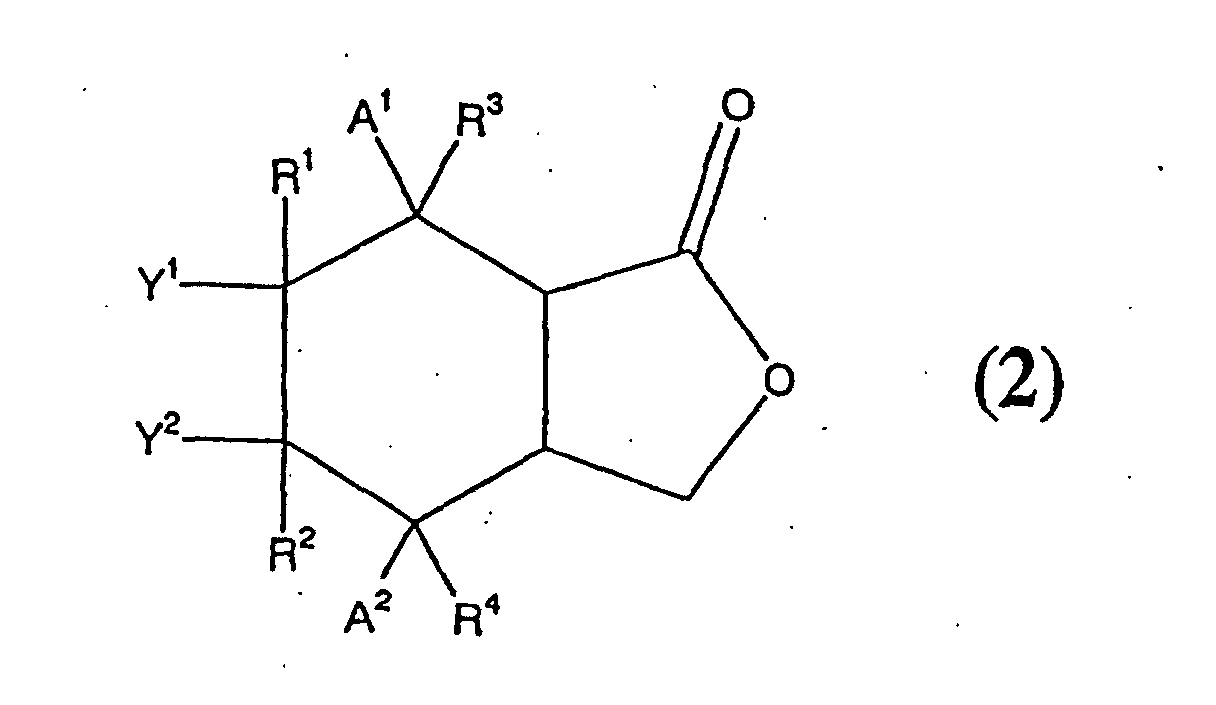

by reducing an addition product represented by the following formula (3):

obtained by the Diels-Alder reaction between 1,3-diene and maleic anhydride; and

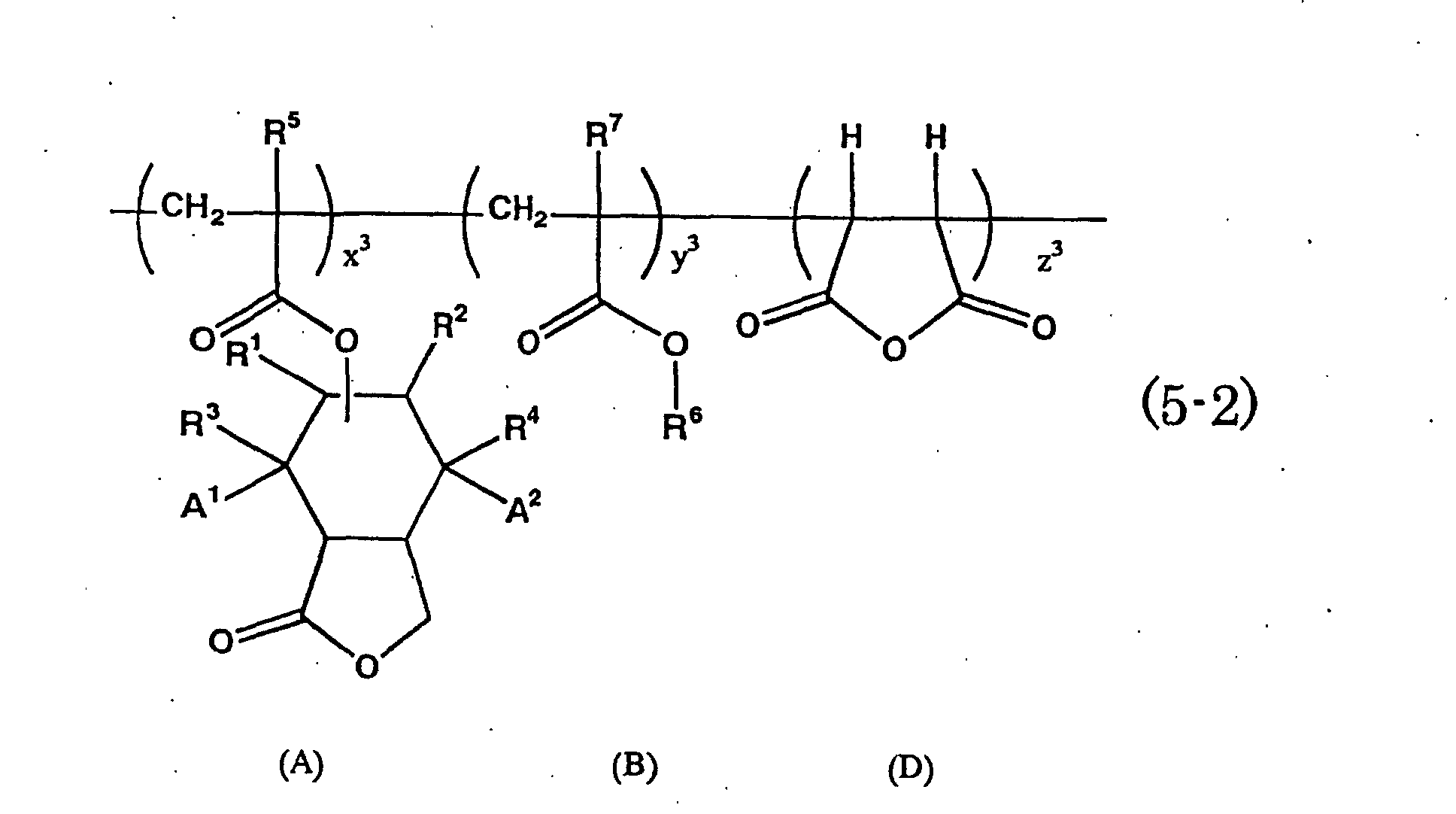

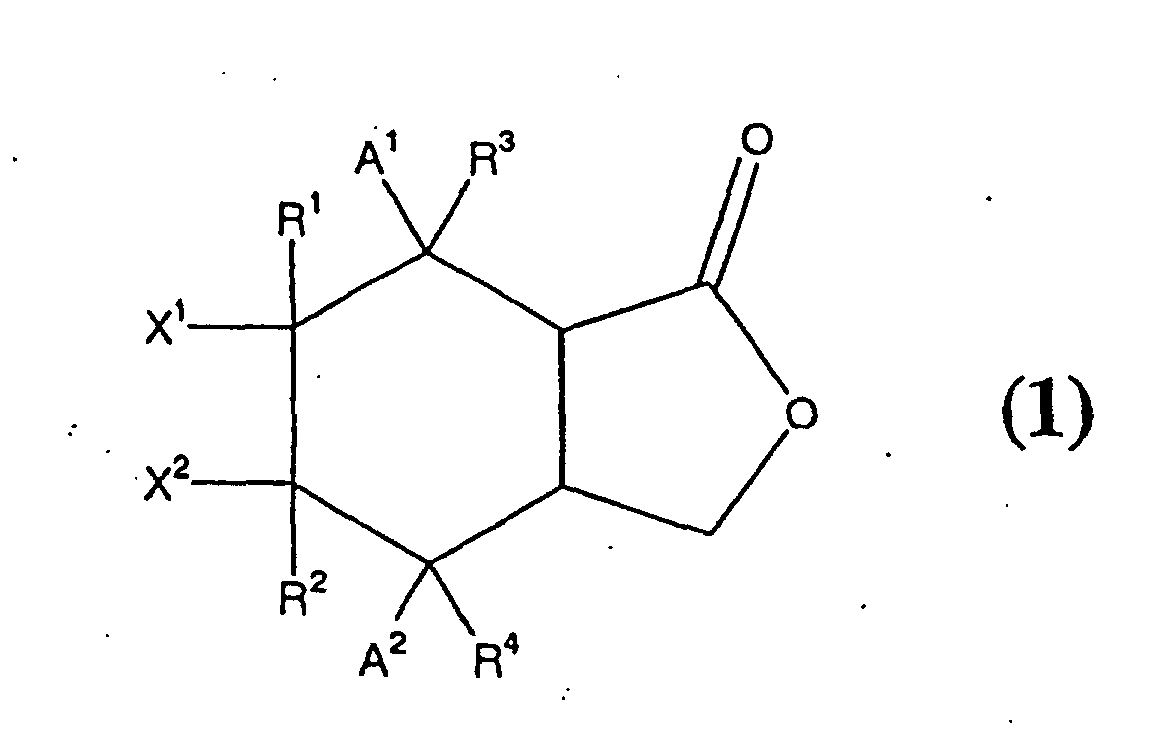

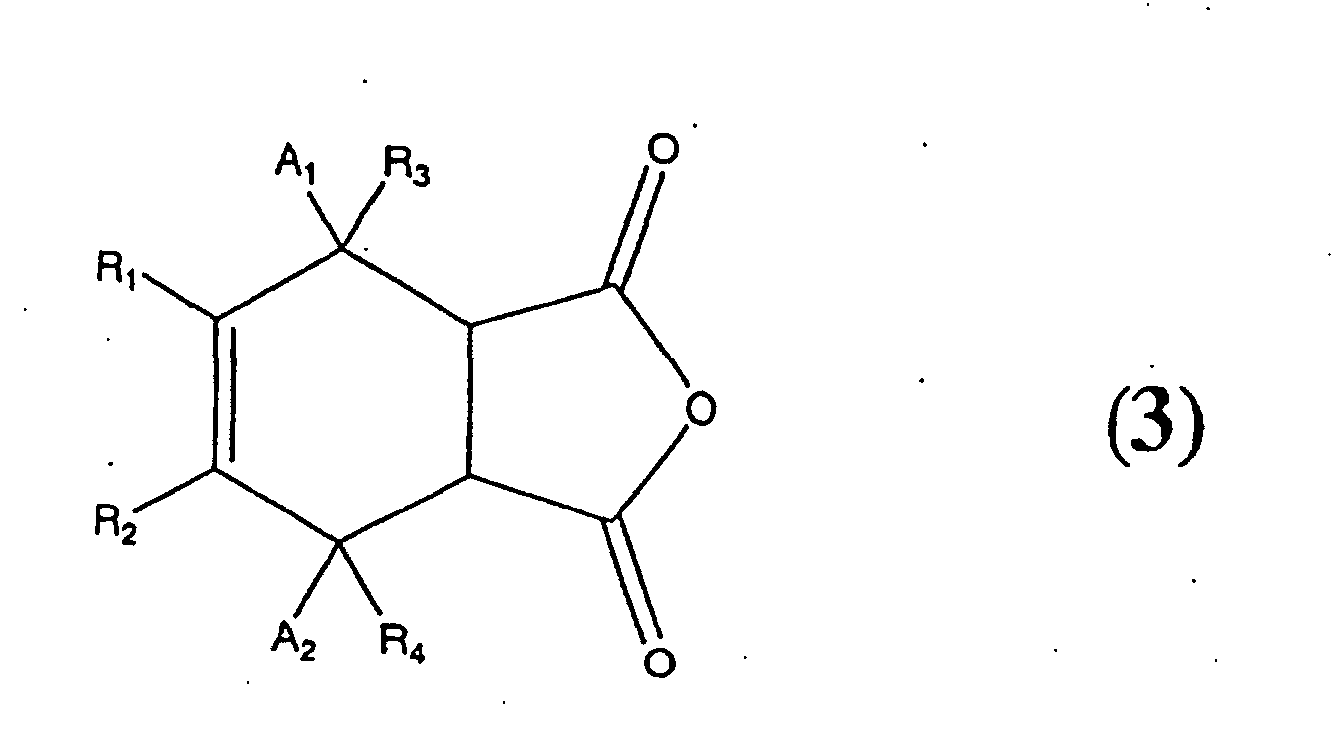
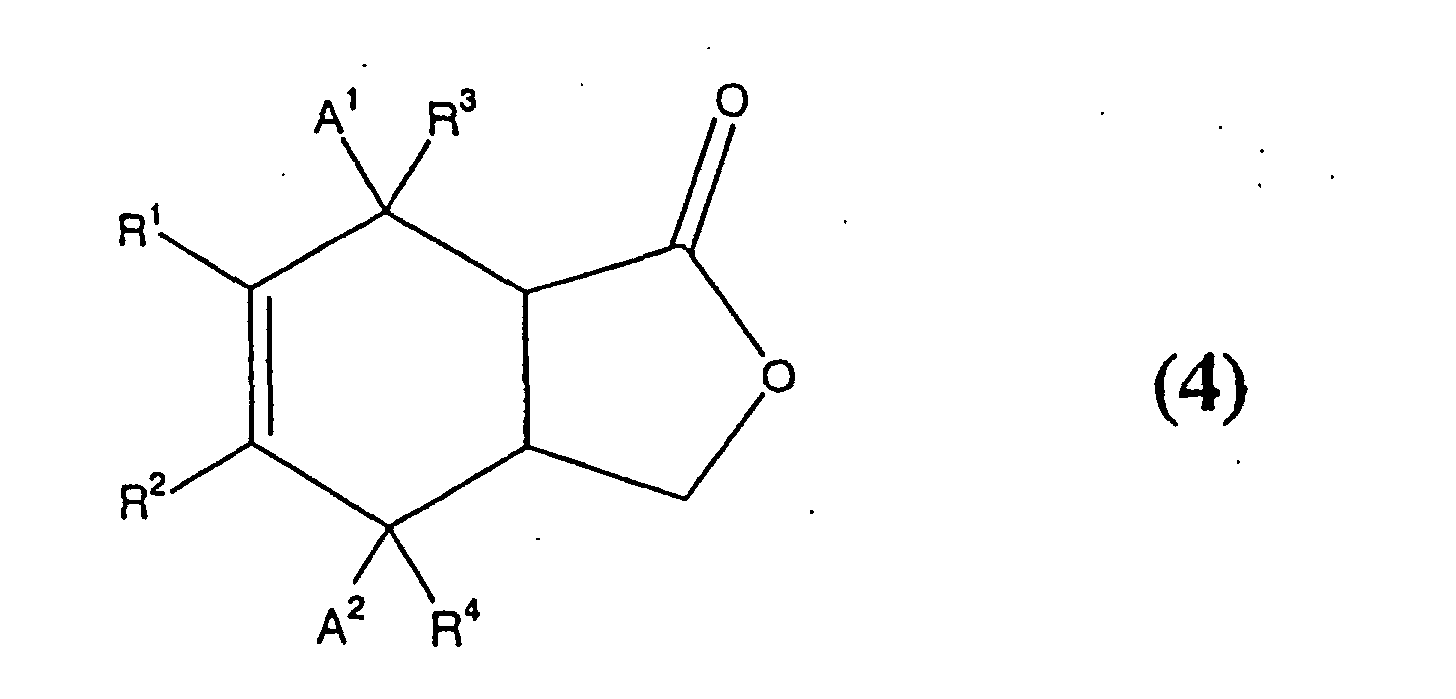
R1, R2, R3, R4, A1 and A2 in formulas (3) and (4) correspond to R1, R2, R3, R4, A1 and A2 in formulas (1) and (2), respectively.

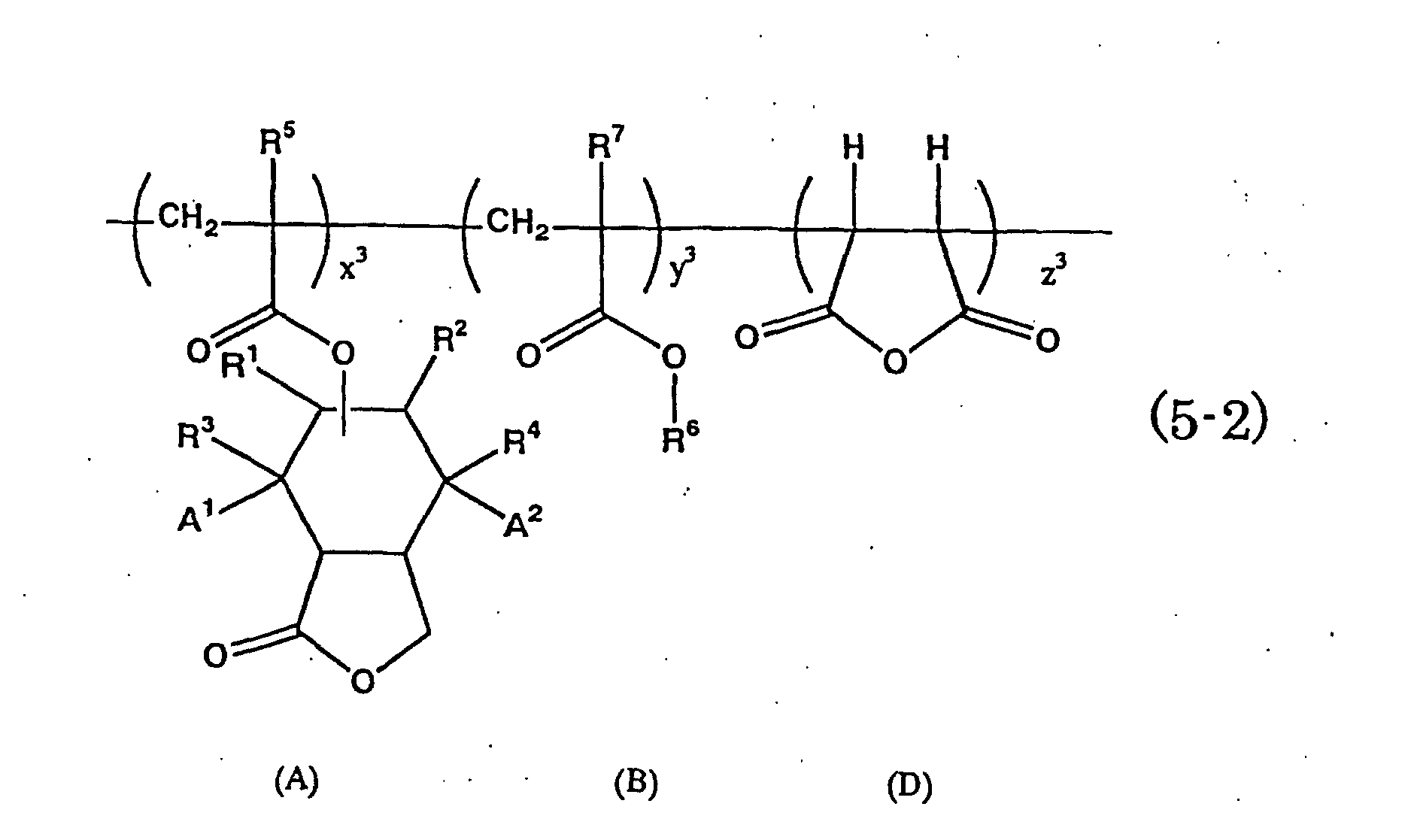

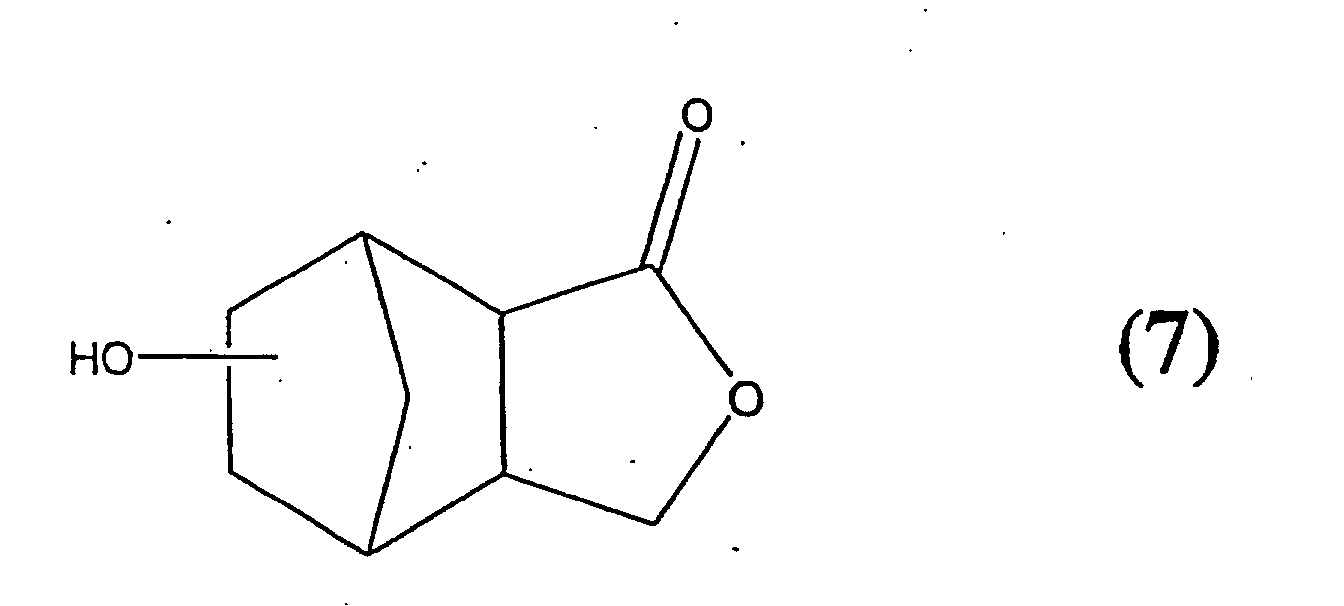
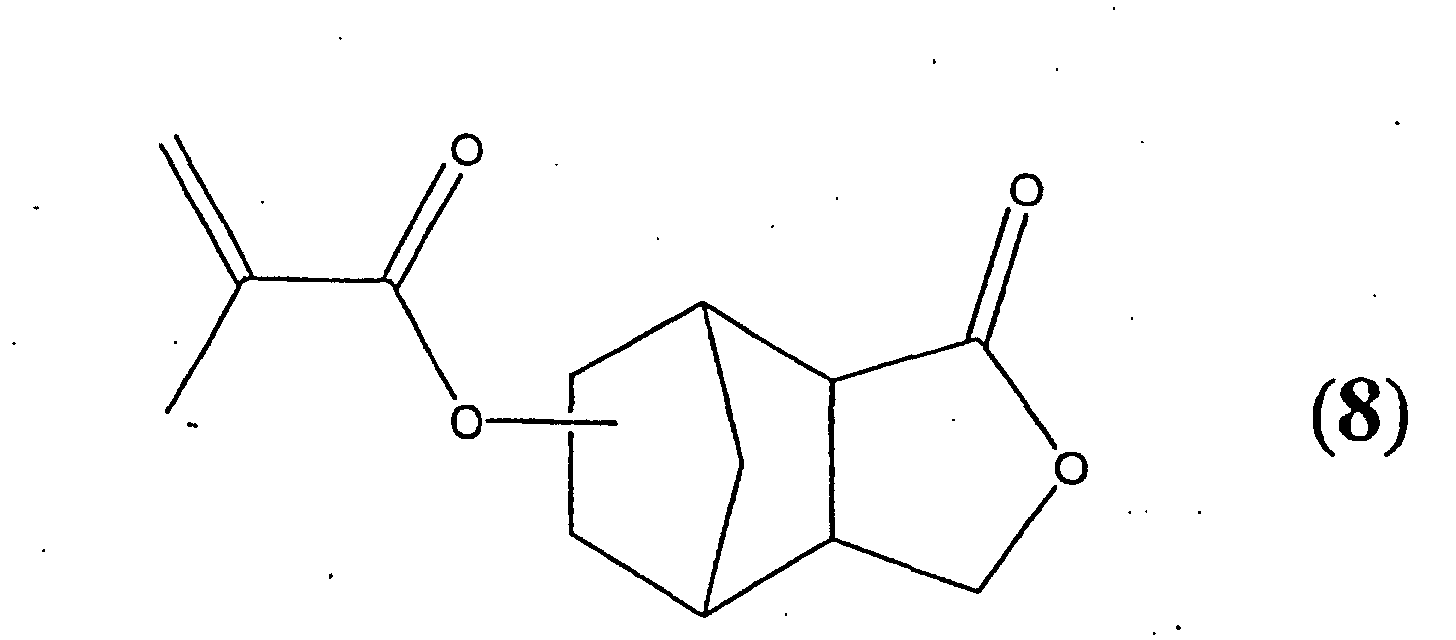
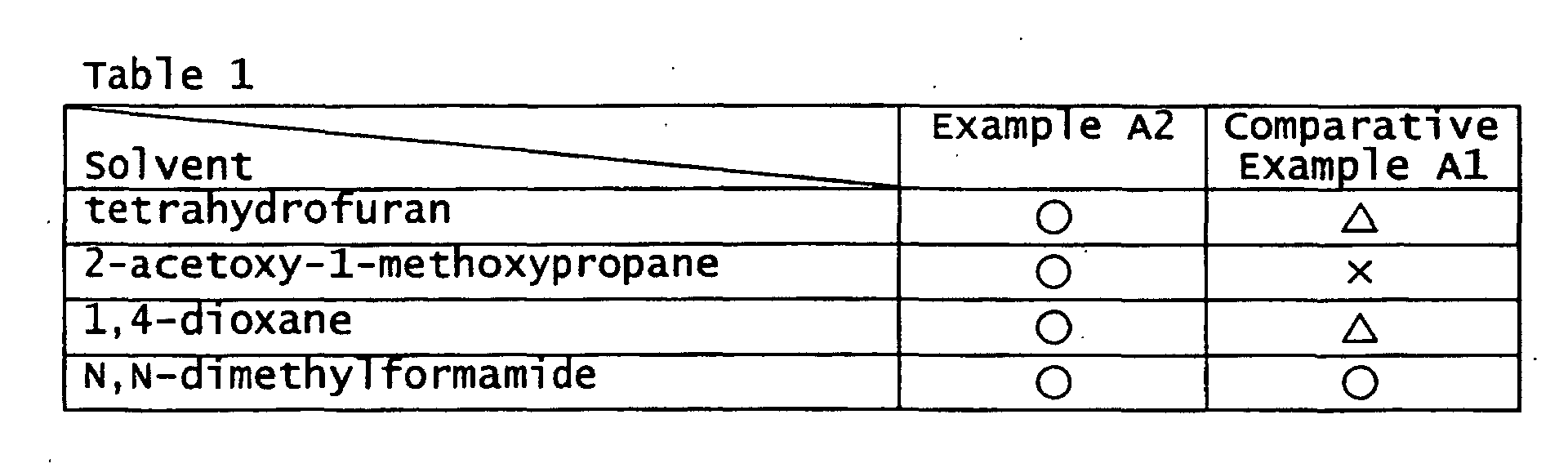


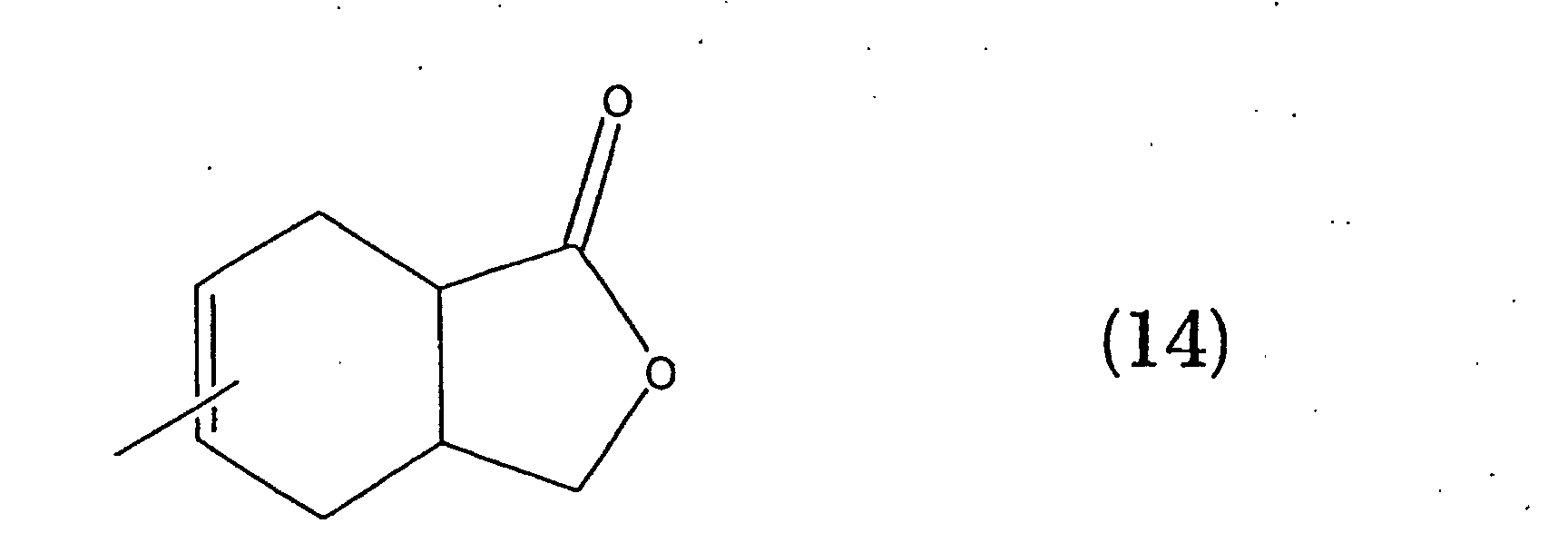

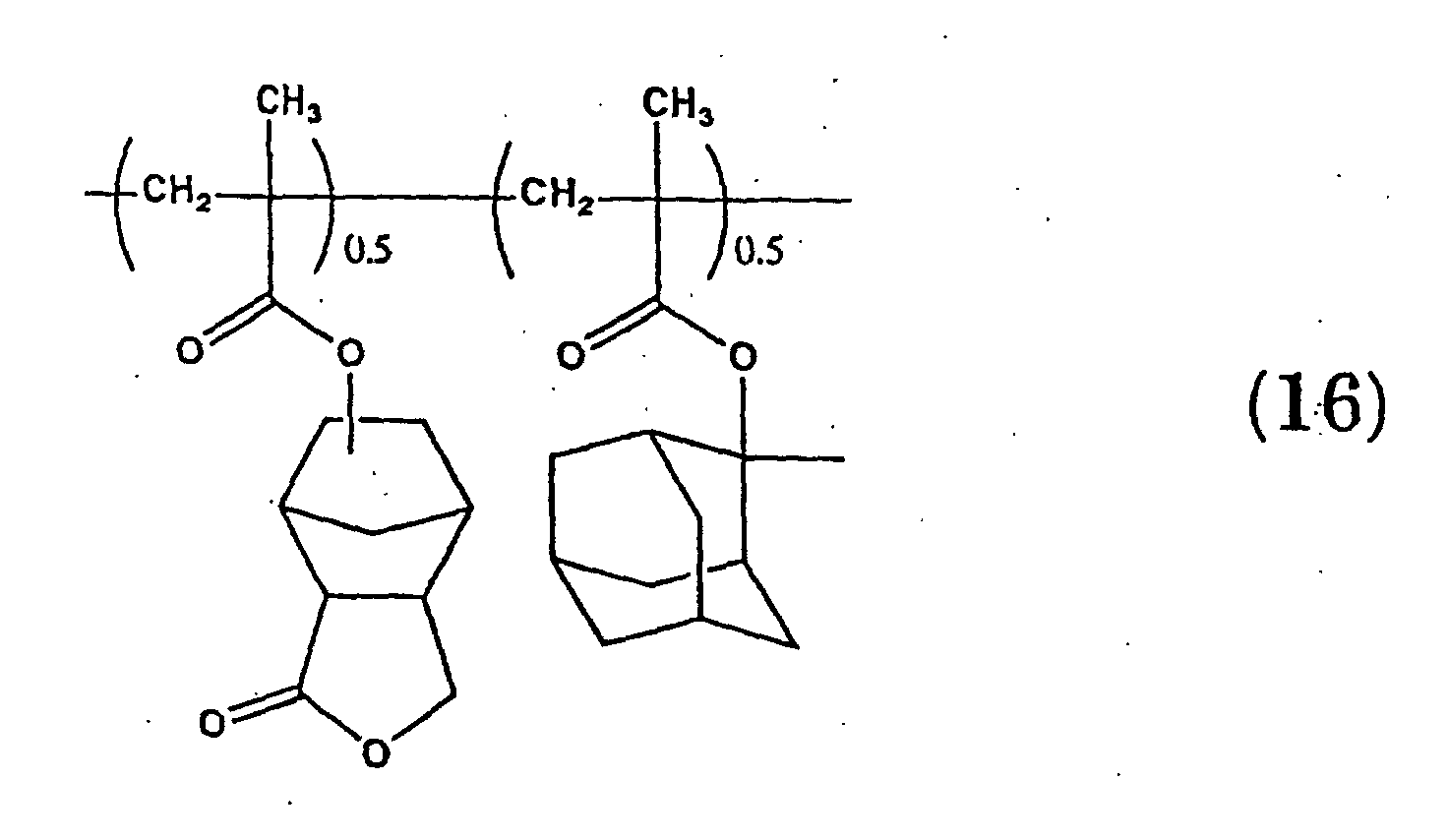


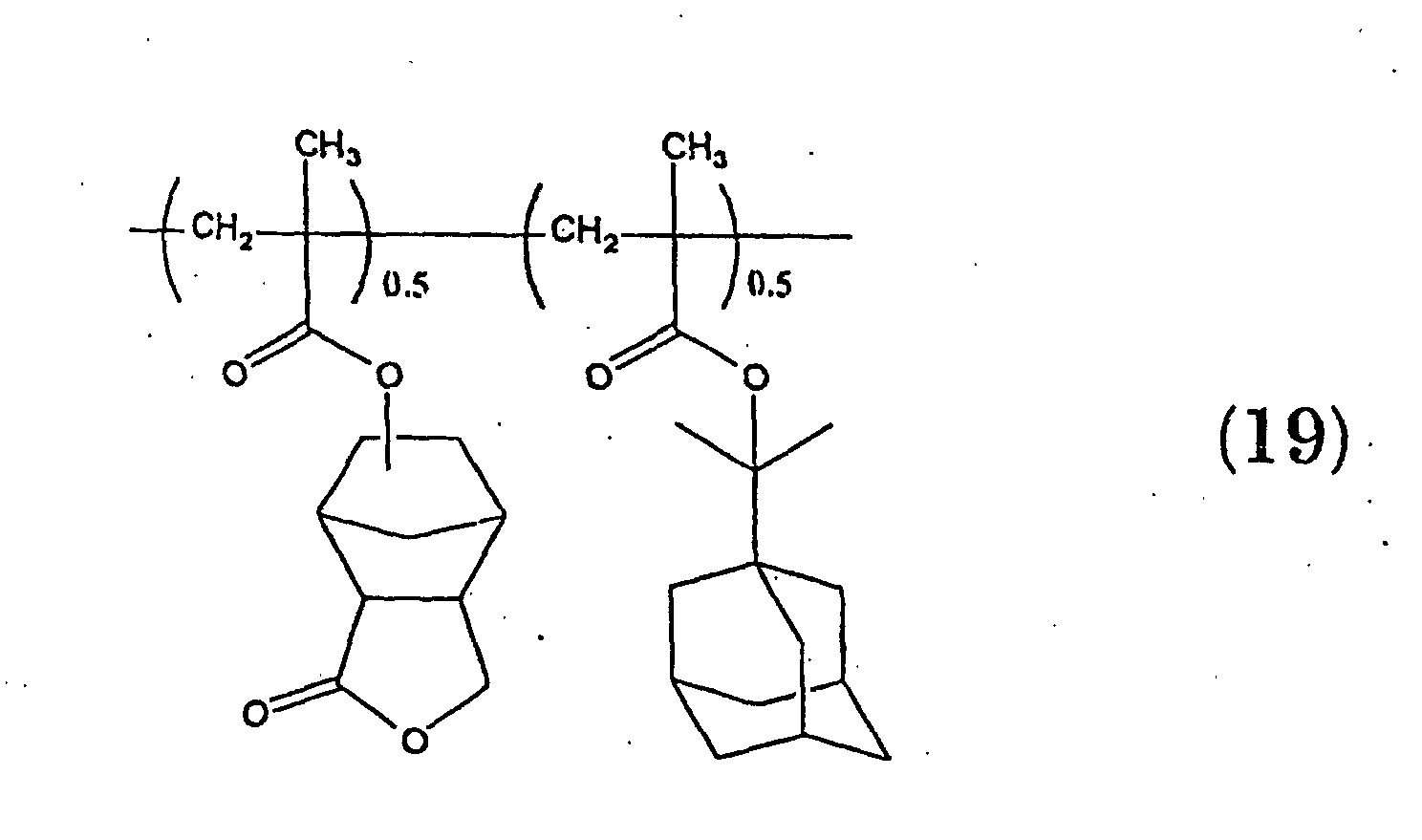


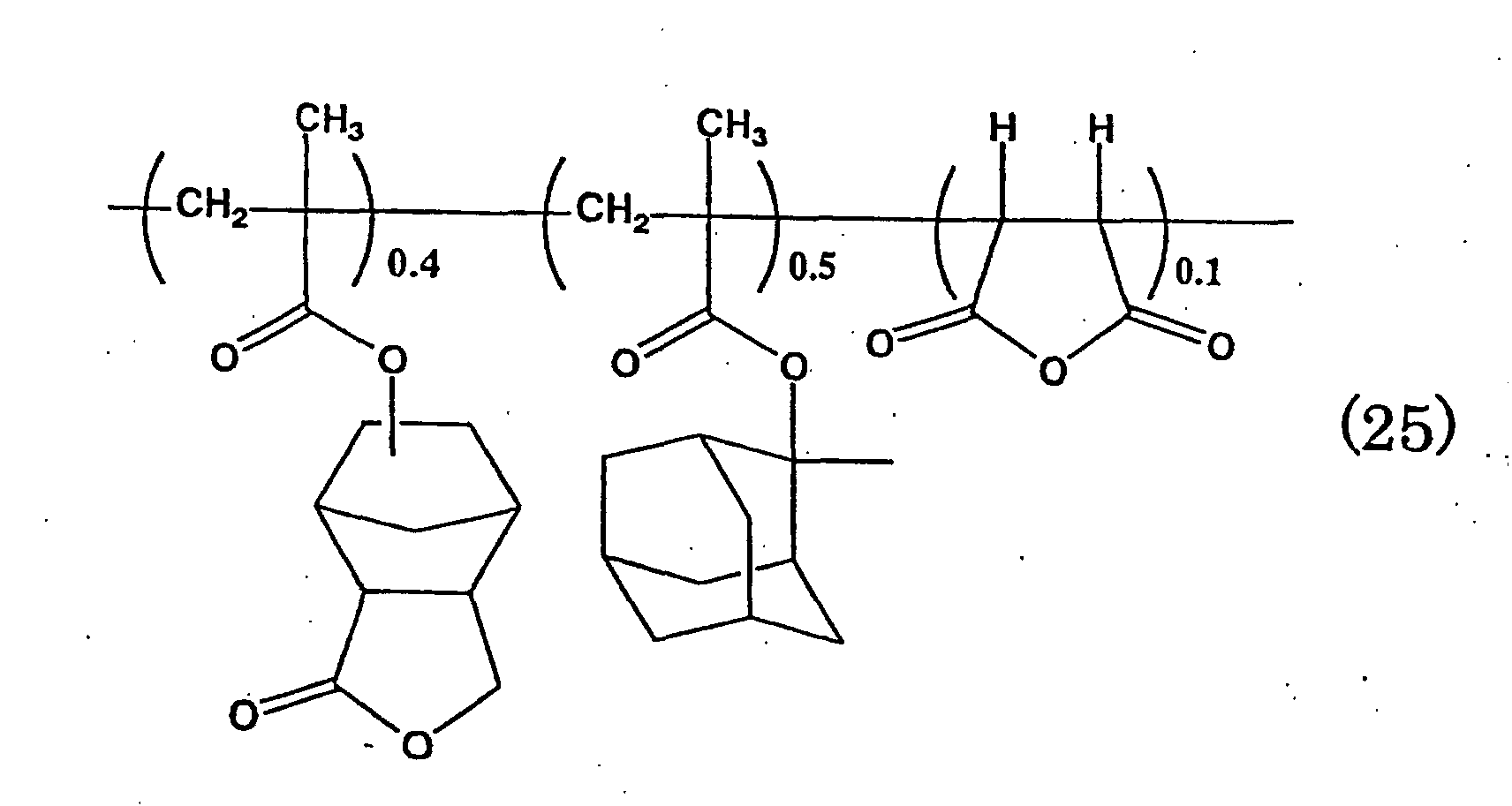

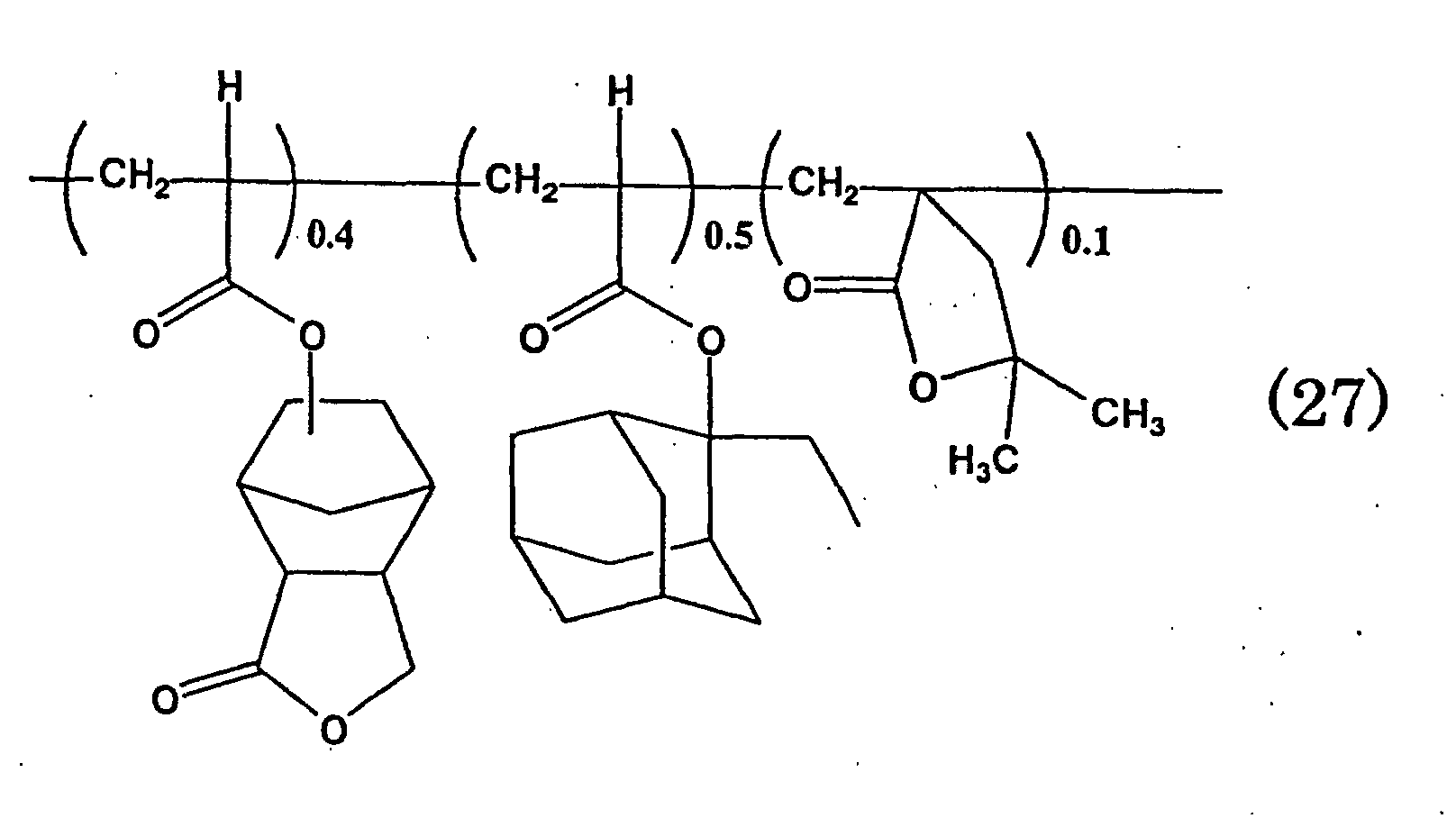

| Ethyl lactate | Propyleneglycol monomethyl ether acetate | |
| Example B1 | ○ | ○ |
| Example B2 | ○ | ○ |
| Example B3 | ○ | ○ |
| Example B4 | ○ | ○ |
| Example B5 | ○ | ○ |
| Example B6 | ○ | ○ |
| Example B7 | ○ | ○ |
| Example B8 | ○ | ○ |
| Example B9 | ○ | ○ |
| Example B10 | ○ | ○ |
| Example B11 | ○ | ○ |
| Example B12 | ○ | ○ |
| Example B13 | ○ | ○ |
| Comparative Example B1 | × | × |
| Comparative Example B2 | ○ | ○ |
| Symbols in the table mean as follows: O: a homogenous transparent solution was obtained, | ||
| x: a precipitate was deposited. |
| sensitivity (mJ/cm2) | Resolution (µm) | Etching rate | surface roughness after etching | Transmittance (%/µm) | |
| Example B1 | 4.8 | 0.18 | 1.03 | ○ | 63 |
| Example B2 | 5.0 | 0.18 | 1.05 | ○ | 61 |
| Example B3 | 4.6 | 0.17 | 1.03 | ○ | 64 |
| Example B4 | 4.5 | 0.17 | 1.04 | ○ | 62 |
| Example B5 | 4.2 | 0.17 | 1.11 | ○ | 65 |
| Example B6 | 4.8 | 0.17 | 1.04 | ○ | 62 |
| Example B7 | 4.0 | 0.17 | 1.09 | ○ | 68 |
| Example B8 | 4.6 | 0.18 | 1.10 | ○ | 66 |
| Example B9 | 4.7 | 0.18 | 1.15 | ○ | 64 |
| Example B10 | 5.0 | 0.18 | 1.13 | ○ | 65 |
| Example B11 | 5.0 | 0.17 | 1.05 | ○ | 63 |
| Example B12 | 4.8 | 0.17 | 1.04 | ○ | 63 |
| Example B13 | 4.7 | 0.17 | 1.04 | ○ | 62 |
| Comparative Example B1 | 5.0 | 0.19 | 1.05 | ○ | 57 |
| Comparative Example B2 | 3.6 | 0.16 | 1.26 | × | 70 |
Claims (26)
- A (meth)acrylate represented by the following formula (1):wherein each of R1, R2, R3 and R4 represents a hydrogen atom, a methyl group or an ethyl group; either one of X1 or X2 represents a (meth)acryloyloxy group and the other represents a hydrogen atom; both A1 and A2 represent hydrogen atoms, or A1 and A2 form -O-, -CH2- or -CH2CH2-.

- An alcohol represented by the following formula (2):wherein each of R1, R2, R3 and R4 represents a hydrogen atom, a methyl group or an ethyl group; either one of Y1 or Y2 represents a hydroxy group and the other represents a hydrogen atom; both A1 and A2 represent hydrogen atoms, or A1 and A2 form -O-, -CH2- or -CH2CH2-.

- A method of producing the alcohol represented by the above formula (2), comprising the steps of:producing a lactone represented by the following formula (4):wherein each of R1, R2, R3 and R4 represents a hydrogen atom or a methyl group; both A1 and A2 represent hydrogen atoms, or A1 and A2 form -O-, -CH2- or -CH2CH2- ; by reducing an addition product represented by the following formula (3):
 wherein each of R1, R2, R3 and R4 represents a hydrogen atom, a methyl group or an ethyl group ; both A1 and A2 represent hydrogen atoms, or A1 and A2 form -O-, -CH2- or -CH2CH2- ;
obtained by the Diels-Alder reaction between 1,3-diene and maleic anhydride; andhydrating the lactone represented by the formula (4). - The method of producing the alcohol according to claim 3, wherein a reducing agent used in the reduction of the addition product represented by the above formula (3) is a metallic hydride and/or a metal-hydrogen complex compound.
- The method of producing the alcohol according to claim 3 or 4, wherein a solvent used in the reduction of the addition product represented by the above formula (3) is at least one selected from a group consisting of diglime, N,N-dimethylformamide, N,N-dimethylacetamide and N-methylpyrrolidone.
- The method of producing the alcohol according to any one of claims 3 to 5, wherein the lactone represented by the following formula (4) is produced by reducing the addition product represented by the above formula (3) and then neutralizing.
- The method of producing the alcohol according to claim 6, wherein neutralization is carried out using hydrochloric acid, an acidic ion exchange resin, or sulfuric acid.
- The method of producing the alcohol according to any one of claims 3 to 7, wherein a lower carboxylate is produced by adding a lower carboxylic acid to the lactone represented by the above formula (4), and then the lower carboxylate is hydrated by hydrolysis.
- The method of producing the alcohol according to claim 8, wherein the produced lactone represented by the above formula (4) is extracted with an extraction solvent before adding the lower carboxylic acid, and the lower carboxylic acid is then added to the lactone without isolating the lactone represented by the above formula (4) from the obtained extract.
- The method of producing the alcohol according to claim 9, wherein the extraction solvent is a ketone solvent.
- The method of producing the alcohol according to claim 9 or 10, wherein the concentration of the lactone represented by the above formula (4) is 1 to 95% by weight in the extract subjected to the lower carboxylic acid addition reaction.
- A method of producing a (meth)acrylate represented by the above formula (1) by (meth)acrylation of the alcohol represented by the above formula (2).
- A method of producing the (meth)acrylate represented by the above formula (1), comprising the steps of:producing the alcohol represented by the above formula (2) by the method according to any one of claims 3 to 11; and(meth)acrylating the produced alcohol.
- A polymer produced by (co)polymerizing a monomer composition comprising the monomer represented by the above formula (1).
- The polymer according to claim 14, wherein, in the above formula (1), any one of R1, R2, R3 and R4 represents a methyl group and the others represent hydrogen atoms.
- The polymer according to claim 14, which is represented by the following formula (5-1):wherein each of R1, R2, R3 and R4 represents a hydrogen atom, a methyl group or an ethyl group; each of R5, R7 and R9 represents a hydrogen atom or a methyl group ; R6 represents a cyclic hydrocarbon group having a group that is eliminated by acid; R8 represents a group having a hydrophilic functional group or a hydrogen atom; both A1 and A2 represent hydrogen atoms, or A1 and A2 form -O-, -CH2- or -CH2CH2- ; and x2, y2 and z2 represent the ratios of a unit (A), a unit (B) and a unit (C), respectively, wherein when x2+y2+z2=1, x2, y2 and z2 are any given numbers satisfying 0<x2≤1, 0≤y2<1, and 0≤z2<1.
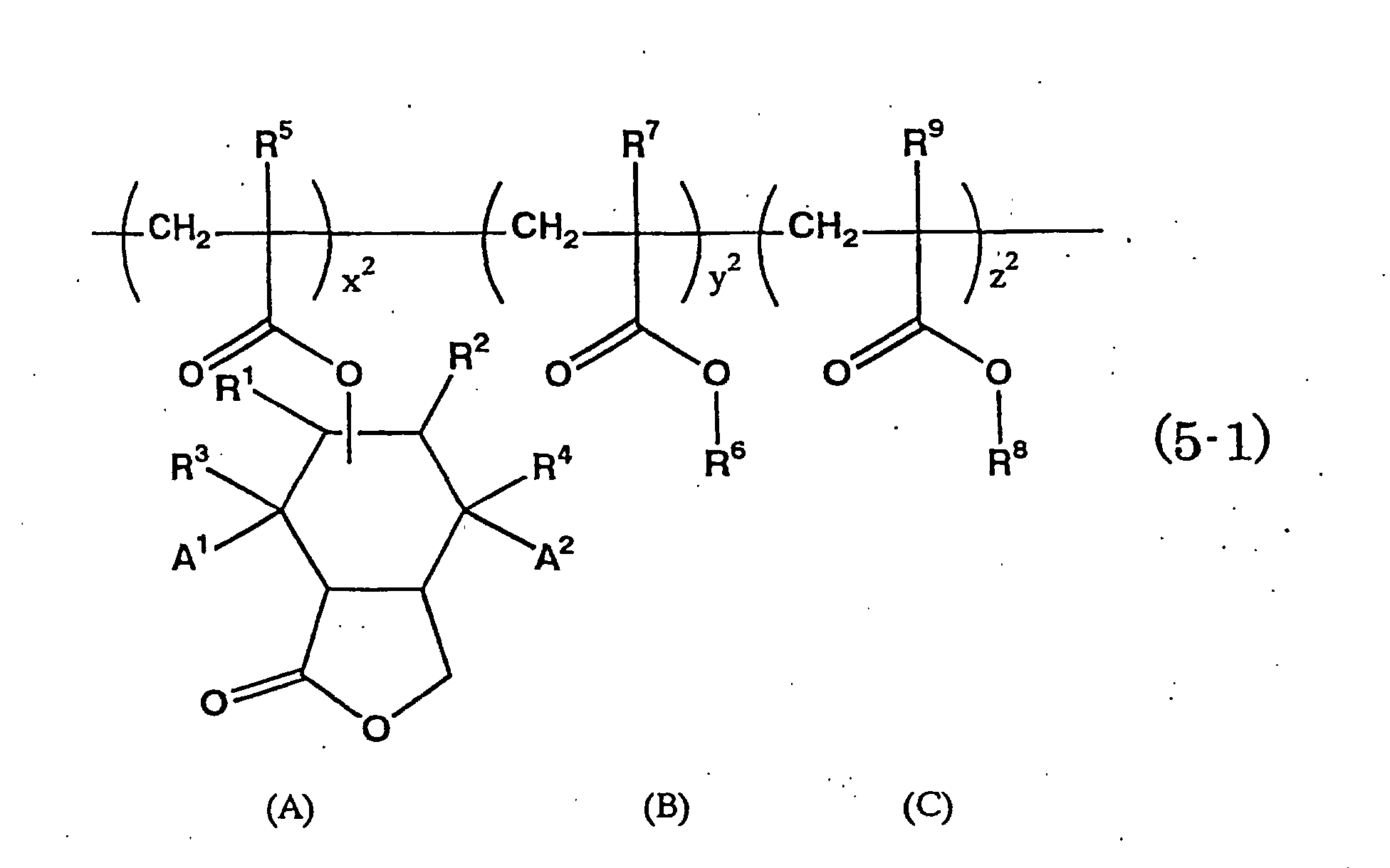
- The polymer according to claim 16, wherein, in the above formula (5-1), R6 is one or more types selected from the group consisting of a cyclohexyl group, an isobornyl group, an adamantyl group, a tricyclodecanyl group, a dicyclopentadienyl group, and these cyclic hydrocarbon groups having a substituent.
- The polymer according to claim 14, which is represented by the following formula (5-2):wherein each of R1, R2, R3 and R4 represents a hydrogen atom, a methyl group or an ethyl group; each of R5 and R7 represents a hydrogen atom or a methyl group; R6 represents a cyclic hydrocarbon group having a group that is eliminated by acid; both A1 and A2 represent hydrogen atoms, or A1 and A2 form -O-, -CH2- or -CH2CH2- ; and x3, y3 and z3 represent the ratios of a unit (A), a unit (B) and a unit (D), respectively, wherein when x3+y3+z3=1, x3, y3 and z3 are any given numbers satisfying 0<x3≤1, 0≤y3<1, and 0≤z3<1.
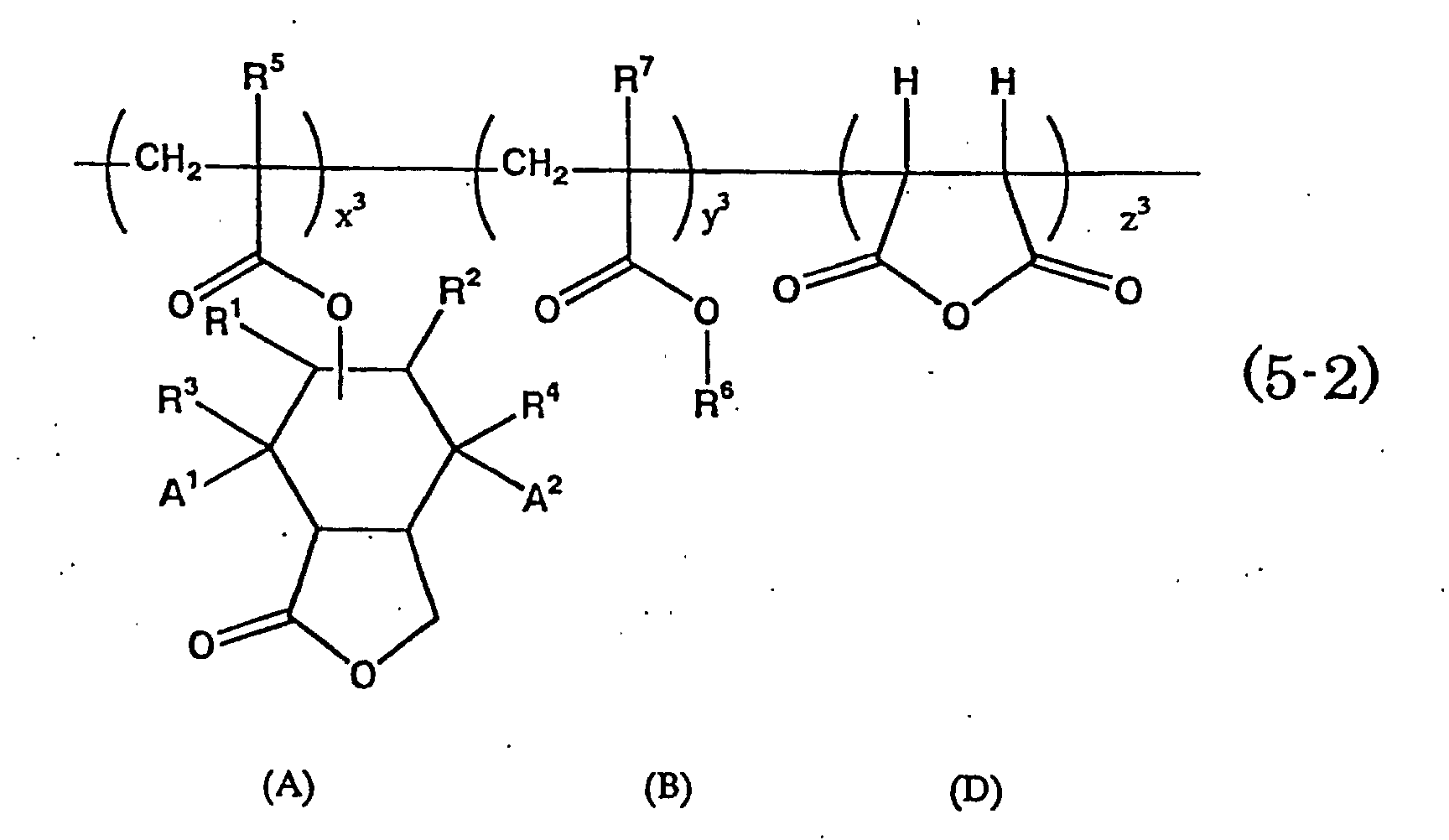
- The polymer according to claim 18, wherein, in the above formula (5-2), R6 is one or more types selected from the group consisting of a cyclohexyl group, an isobornyl group, an adamantyl group, a tricyclodecanyl group, a dicyclopentadienyl group, and these cyclic hydrocarbon groups having a substituent.
- The polymer according to claim 14, which is represented by the following formula (5-3):wherein each of R1, R2, R3, R4, R10 and R11 represents a hydrogen atom, a methyl group or an ethyl group; each of R5 and R7 represents a hydrogen atom or a methyl group ; R6 represents a cyclic hydrocarbon group having a group that is eliminated by acid; both A1 and A2 represent hydrogen atoms, or A1 and A2 form -O-, -CH2- or -CH2CH2- ; n represents an integer of 0 to 4 ; and x4, y4 and z4 represent the ratios of a unit (A), a unit (B) and a unit (E), respectively, wherein when x4+y4+z4=1, x4, y4 and z4 are any given numbers satisfying 0<x4≤1, 0≤y4<1, and 0≤z4<1.
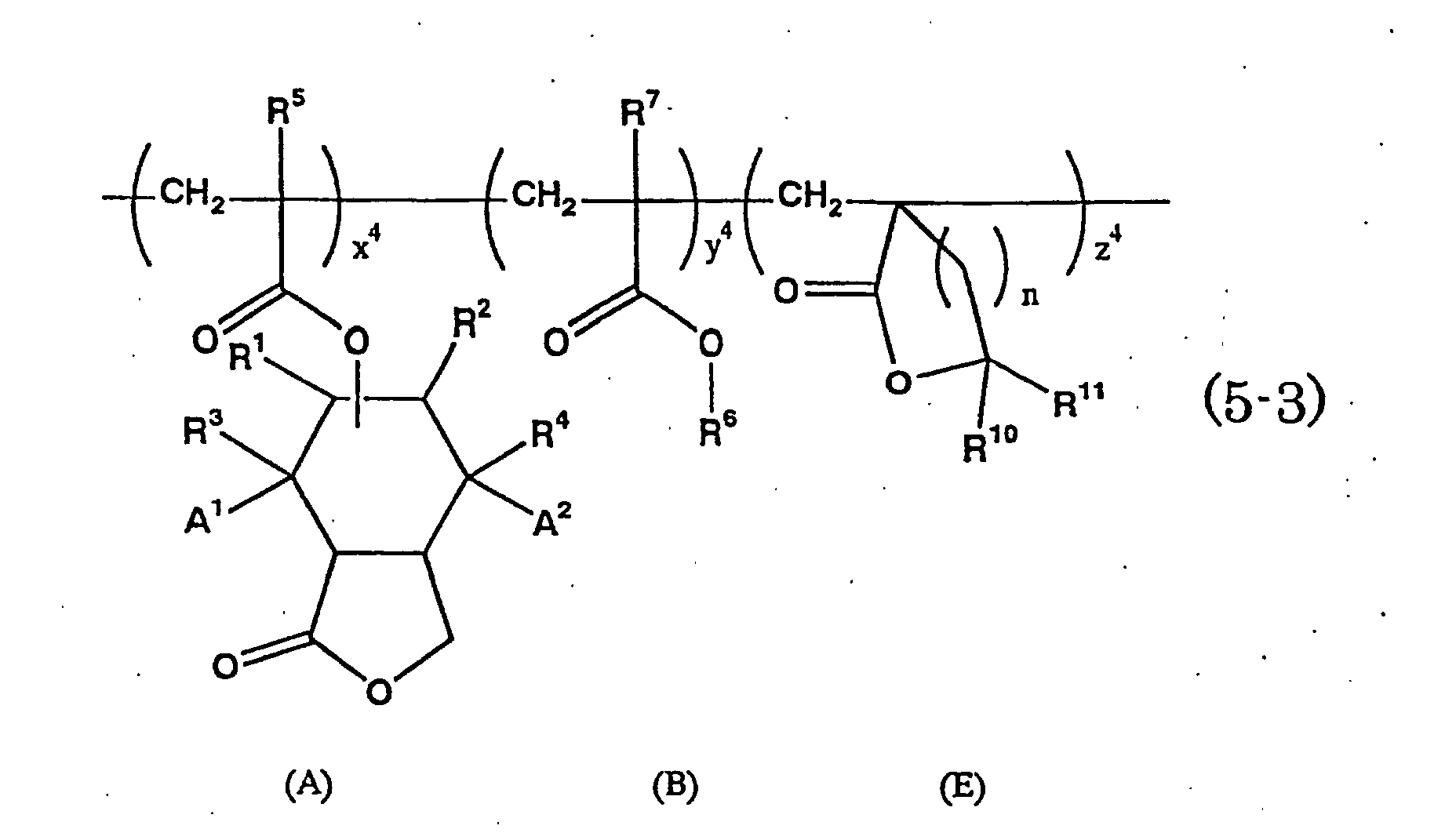
- The polymer according to claim 20, wherein, in the above formula (5-3), R6 is one or more types selected from the group consisting of a cyclohexyl group, an isobornyl group, an adamantyl group, a tricyclodecanyl group, a dicyclopentadienyl group, and these cyclic hydrocarbon groups having a substituent.
- The polymer according to any one of claims 14 to 21, which has a weight-average molecular weight of 1,000 to 100,000.
- A chemically amplified resist composition comprising the polymer according to any one of claims 14 to 22 and a photoacid generator.
- The chemically amplified resist composition according to claim 23, wherein the content of said photoacid generator is 0.1 to 20 parts by weight based on 100 parts by weight of said polymer.
- A method of forming a pattern, comprising the steps of:coating the chemically amplified resist composition according to claim 23 or 24 onto a substrate to be processed;exposing the substrate to a light with a wavelength of 250 nm or shorter; anddeveloping.
- The method of forming a pattern according to claim 25, wherein the light with a wavelength of 250 nm or shorter used in exposure is an ArF excimer laser.
Applications Claiming Priority (9)
| Application Number | Priority Date | Filing Date | Title |
|---|---|---|---|
| JP2000371712 | 2000-12-06 | ||
| JP2000371712 | 2000-12-06 | ||
| JP2001001728 | 2001-01-09 | ||
| JP2001001728 | 2001-01-09 | ||
| JP2001366958A JP4116282B2 (en) | 2000-12-06 | 2001-11-30 | Alcohol, method for producing the same, and method for producing (meth) acrylic acid ester using the alcohol |
| JP2001366958 | 2001-11-30 | ||
| JP2001368904 | 2001-12-03 | ||
| JP2001368904A JP4065684B2 (en) | 2001-01-09 | 2001-12-03 | Polymer, chemically amplified resist composition, and pattern forming method |
| PCT/JP2001/010628 WO2002046179A1 (en) | 2000-12-06 | 2001-12-05 | (meth)acrylate esters, starting alcohols for the preparation thereof, processes for preparing both, polymers of the esters, chemically amplifiable resist compositions, and method for forming patterns |
Publications (3)
| Publication Number | Publication Date |
|---|---|
| EP1352904A1 true EP1352904A1 (en) | 2003-10-15 |
| EP1352904A4 EP1352904A4 (en) | 2005-08-17 |
| EP1352904B1 EP1352904B1 (en) | 2008-10-08 |
Family
ID=27481848
Family Applications (1)
| Application Number | Title | Priority Date | Filing Date |
|---|---|---|---|
| EP01999568A Expired - Lifetime EP1352904B1 (en) | 2000-12-06 | 2001-12-05 | (meth)acrylate esters, starting alcohols for the preparation thereof, processes for preparing both, polymers of the esters, chemically amplifiable resist compositions, and method for forming patterns |
Country Status (6)
| Country | Link |
|---|---|
| US (2) | US7041838B2 (en) |
| EP (1) | EP1352904B1 (en) |
| KR (1) | KR100531535B1 (en) |
| DE (1) | DE60136100D1 (en) |
| TW (1) | TW583182B (en) |
| WO (1) | WO2002046179A1 (en) |
Cited By (8)
| Publication number | Priority date | Publication date | Assignee | Title |
|---|---|---|---|---|
| WO2004050728A3 (en) * | 2002-12-02 | 2004-09-30 | Tokyo Ohka Kogyo Co Ltd | Method of producing (meth) acrylic acid derivative polymer for resist |
| US6992197B2 (en) * | 2003-06-12 | 2006-01-31 | Takasago International Corporation | Lactone compound |
| US7045582B2 (en) * | 2003-12-11 | 2006-05-16 | Maruzen Petrochemical Co. Ltd. | Preparation process of copolymer for semiconductor lithography and a copolymer for semiconductor lithography available by this process |
| EP1701214A1 (en) * | 2005-03-11 | 2006-09-13 | Fuji Photo Film Co., Ltd. | Positive photosensitive composition and pattern-forming method using the same |
| EP1354897A4 (en) * | 2000-12-13 | 2007-11-28 | Daicel Chem | POLYMER FOR PHOTORESISTANT VARNISH AND RESIN COMPOSITIONS USING THE SAME |
| EP1612602A3 (en) * | 2004-06-28 | 2008-02-27 | FUJIFILM Corporation | Photosensitive composition and method for forming pattern using the same |
| EP1876190A4 (en) * | 2004-12-27 | 2009-03-18 | Tokyo Ohka Kogyo Co Ltd | ACRYLIC COPOLYMER |
| JP2015214634A (en) * | 2014-05-09 | 2015-12-03 | 信越化学工業株式会社 | Monomer, polymer compound, resist material, and patterning process |
Families Citing this family (8)
| Publication number | Priority date | Publication date | Assignee | Title |
|---|---|---|---|---|
| EP1649322A4 (en) | 2003-07-17 | 2007-09-19 | Honeywell Int Inc | PLANARIZATION FILMS FOR ADVANCED MICROELECTRONIC DEVICES AND APPLICATIONS AND METHODS FOR PRODUCING SAID FILMS |
| JP4191103B2 (en) * | 2004-07-02 | 2008-12-03 | 東京応化工業株式会社 | Positive resist composition and resist pattern forming method |
| US8476401B2 (en) * | 2004-09-10 | 2013-07-02 | Mitsubishi Rayon Co., Ltd. | Resist polymer, process for production thereof, resist composition, and process for production of substrated with patterns thereon |
| JP2008162946A (en) * | 2006-12-28 | 2008-07-17 | Mitsubishi Rayon Co Ltd | Method for producing (meth) acrylic acid ester |
| US20110039210A1 (en) * | 2009-05-20 | 2011-02-17 | Rohm And Haas Electronic Materials Llc | Novel resins and photoresist compositions comprising same |
| CN102603586A (en) | 2010-11-15 | 2012-07-25 | 罗门哈斯电子材料有限公司 | Base reactive photoacid generators and photoresists comprising same |
| CN105061454B (en) * | 2011-06-14 | 2019-09-27 | 三菱化学株式会社 | Manufacturing method of alcohol compound, manufacturing method of (meth)acrylate |
| JP6428596B2 (en) | 2015-12-25 | 2018-11-28 | 信越化学工業株式会社 | Resist composition, pattern forming method, polymer compound, and monomer |
Family Cites Families (12)
| Publication number | Priority date | Publication date | Assignee | Title |
|---|---|---|---|---|
| US4187236A (en) | 1977-11-04 | 1980-02-05 | E. R. Squibb & Sons, Inc. | 7-Oxabicycloheptane compounds |
| US4143054A (en) | 1977-11-04 | 1979-03-06 | E. R. Squibb & Sons, Inc. | 7-oxabicycloheptane- and 7-oxabicycloheptene compounds |
| JPS56130273A (en) | 1980-03-19 | 1981-10-13 | Nippon Steel Corp | Manufacture of precoated steel plate |
| KR100382960B1 (en) * | 1998-07-03 | 2003-05-09 | 닛뽕덴끼 가부시끼가이샤 | (meth)acrylate derivatives bearing lactone structure, polymers, photoresist compositions and process of forming patterns with the same |
| JP4131062B2 (en) * | 1998-09-25 | 2008-08-13 | 信越化学工業株式会社 | Novel lactone-containing compound, polymer compound, resist material, and pattern forming method |
| JP4358940B2 (en) * | 1999-08-26 | 2009-11-04 | 丸善石油化学株式会社 | Polymerizable compound and polymer having cyclohexanelactone structure |
| JP4135848B2 (en) | 2000-02-28 | 2008-08-20 | 東京応化工業株式会社 | Positive resist composition |
| JP5132850B2 (en) | 2000-04-20 | 2013-01-30 | 三菱レイヨン株式会社 | (Co) polymer for resist and resist composition |
| JP4441104B2 (en) | 2000-11-27 | 2010-03-31 | 東京応化工業株式会社 | Positive resist composition |
| JP3991191B2 (en) * | 2001-06-14 | 2007-10-17 | 信越化学工業株式会社 | Novel (meth) acrylate compound having lactone structure, polymer, photoresist material, and pattern forming method |
| US6639035B1 (en) * | 2002-05-28 | 2003-10-28 | Everlight Usa, Inc. | Polymer for chemical amplified photoresist compositions |
| US6720430B2 (en) * | 2002-05-28 | 2004-04-13 | Everlight Usa, Inc. | Monomer for chemical amplified photoresist compositions |
-
2001
- 2001-12-05 EP EP01999568A patent/EP1352904B1/en not_active Expired - Lifetime
- 2001-12-05 DE DE60136100T patent/DE60136100D1/en not_active Expired - Lifetime
- 2001-12-05 WO PCT/JP2001/010628 patent/WO2002046179A1/en not_active Ceased
- 2001-12-05 KR KR10-2003-7007625A patent/KR100531535B1/en not_active Expired - Lifetime
- 2001-12-05 US US10/433,570 patent/US7041838B2/en not_active Expired - Lifetime
- 2001-12-06 TW TW090130267A patent/TW583182B/en not_active IP Right Cessation
-
2004
- 2004-10-28 US US10/974,876 patent/US7339014B2/en not_active Expired - Lifetime
Cited By (10)
| Publication number | Priority date | Publication date | Assignee | Title |
|---|---|---|---|---|
| EP1354897A4 (en) * | 2000-12-13 | 2007-11-28 | Daicel Chem | POLYMER FOR PHOTORESISTANT VARNISH AND RESIN COMPOSITIONS USING THE SAME |
| WO2004050728A3 (en) * | 2002-12-02 | 2004-09-30 | Tokyo Ohka Kogyo Co Ltd | Method of producing (meth) acrylic acid derivative polymer for resist |
| US6992197B2 (en) * | 2003-06-12 | 2006-01-31 | Takasago International Corporation | Lactone compound |
| US7045582B2 (en) * | 2003-12-11 | 2006-05-16 | Maruzen Petrochemical Co. Ltd. | Preparation process of copolymer for semiconductor lithography and a copolymer for semiconductor lithography available by this process |
| EP1612602A3 (en) * | 2004-06-28 | 2008-02-27 | FUJIFILM Corporation | Photosensitive composition and method for forming pattern using the same |
| US7371505B2 (en) | 2004-06-28 | 2008-05-13 | Fujifilm Corporation | Photosensitive composition and method for forming pattern using the same |
| EP1876190A4 (en) * | 2004-12-27 | 2009-03-18 | Tokyo Ohka Kogyo Co Ltd | ACRYLIC COPOLYMER |
| EP1701214A1 (en) * | 2005-03-11 | 2006-09-13 | Fuji Photo Film Co., Ltd. | Positive photosensitive composition and pattern-forming method using the same |
| US7960087B2 (en) | 2005-03-11 | 2011-06-14 | Fujifilm Corporation | Positive photosensitive composition and pattern-forming method using the same |
| JP2015214634A (en) * | 2014-05-09 | 2015-12-03 | 信越化学工業株式会社 | Monomer, polymer compound, resist material, and patterning process |
Also Published As
| Publication number | Publication date |
|---|---|
| DE60136100D1 (en) | 2008-11-20 |
| WO2002046179A1 (en) | 2002-06-13 |
| KR20030057578A (en) | 2003-07-04 |
| US20050113538A1 (en) | 2005-05-26 |
| US7041838B2 (en) | 2006-05-09 |
| KR100531535B1 (en) | 2005-11-28 |
| EP1352904A4 (en) | 2005-08-17 |
| TW583182B (en) | 2004-04-11 |
| EP1352904B1 (en) | 2008-10-08 |
| WO2002046179A8 (en) | 2002-08-08 |
| US7339014B2 (en) | 2008-03-04 |
| US20040063882A1 (en) | 2004-04-01 |
Similar Documents
| Publication | Publication Date | Title |
|---|---|---|
| US8092979B2 (en) | Resist polymer and resist composition | |
| EP1352904B1 (en) | (meth)acrylate esters, starting alcohols for the preparation thereof, processes for preparing both, polymers of the esters, chemically amplifiable resist compositions, and method for forming patterns | |
| JP6031076B2 (en) | Novel compound, resist composition and pattern forming method | |
| KR100292406B1 (en) | Photosensitive polymer and dissolution inhibitor for chemically amplified photoresist and chemically amplified photoresist composition having thereof | |
| KR20040058226A (en) | 5-methylene-1,3-dioxolan-4-one derivatives, process for their production, polymers of the derivatives, resist compositions, and pattern formation process | |
| CN101952239A (en) | Compound containing alicyclic structure, (meth)acrylic acid ester and preparation method thereof | |
| KR100408400B1 (en) | Photosensitive monomer, photosensitive polymer and chemically amplified resist composition comprising lactone group having acid-labile protecting group | |
| JP3642316B2 (en) | Chemically amplified resist monomer, chemically amplified resist polymer, chemically amplified resist composition, pattern formation method | |
| JP4065684B2 (en) | Polymer, chemically amplified resist composition, and pattern forming method | |
| CN107400140B (en) | (meth) acrylate compound and polymer thereof | |
| JP2012072107A (en) | Salt for acid generator, and resist composition | |
| JP4071021B2 (en) | (Meth) acrylate compound having lactone structure, polymer thereof, resist material, and pattern forming method | |
| US6316159B1 (en) | Chemical amplified photoresist composition | |
| JP4323250B2 (en) | Polymer, polymer production method, resist composition, and pattern formation method | |
| US6271412B1 (en) | Photosensitive monomer | |
| JP3997382B2 (en) | Novel ester compound having alicyclic structure and process for producing the same | |
| JP2004059844A (en) | Fluorine-containing polymer compound | |
| JP4236423B2 (en) | Polymer, resist composition, and pattern forming method | |
| US6441115B1 (en) | Photosensitive polymer | |
| JP4270959B2 (en) | Polymer, resist composition, and pattern forming method | |
| KR20030079907A (en) | Resins for resists and chemically amplifiable resist compositions | |
| JP3805564B2 (en) | Novel (meth) acrylate esters, novel norbornene derivatives, and novel polymers derived therefrom | |
| JP2006016490A (en) | Copolymer and process for producing the same | |
| KR101000596B1 (en) | 5-methylene-1,3-dioxolan-4-one derivatives, process for their production, polymers of the derivatives, resist compositions, and pattern formation process | |
| JP6705286B2 (en) | Method for producing polymerizable monomer, method for producing polymer for lithography and method for producing resist composition |
Legal Events
| Date | Code | Title | Description |
|---|---|---|---|
| PUAI | Public reference made under article 153(3) epc to a published international application that has entered the european phase |
Free format text: ORIGINAL CODE: 0009012 |
|
| 17P | Request for examination filed |
Effective date: 20030703 |
|
| AK | Designated contracting states |
Kind code of ref document: A1 Designated state(s): AT BE CH CY DE DK ES FI FR GB GR IE IT LI LU MC NL PT SE TR |
|
| RBV | Designated contracting states (corrected) |
Designated state(s): AT BE CH DE FR GB LI |
|
| A4 | Supplementary search report drawn up and despatched |
Effective date: 20050706 |
|
| RIC1 | Information provided on ipc code assigned before grant |
Ipc: 7C 08F 220/28 B Ipc: 7G 03F 7/039 B Ipc: 7C 07D 493/18 B Ipc: 7C 07D 307/93 A Ipc: 7C 07D 307/33 B Ipc: 7C 07D 307/88 B Ipc: 7C 07D 307/04 B Ipc: 7C 07D 307/77 B |
|
| RBV | Designated contracting states (corrected) |
Designated state(s): DE FR GB |
|
| 17Q | First examination report despatched |
Effective date: 20061207 |
|
| 17Q | First examination report despatched |
Effective date: 20061207 |
|
| GRAP | Despatch of communication of intention to grant a patent |
Free format text: ORIGINAL CODE: EPIDOSNIGR1 |
|
| GRAS | Grant fee paid |
Free format text: ORIGINAL CODE: EPIDOSNIGR3 |
|
| RIN1 | Information on inventor provided before grant (corrected) |
Inventor name: KUWANO, HIDEAKI,C/O MITSUBISHI RAYON CO., LTD Inventor name: FUJIWARA, TADAYUKI,C/O MITSUBISHI RAYON CO., LTD Inventor name: KAMON, YOSHIHIRO,C/O CORPORATE RESEARCH LAB. Inventor name: KOIZUMI, ATSUSHI,C/O OTAKE PLANTS Inventor name: MOMOSE, HIKARU,C/O MITSUBISHI RAYON CO., LTD |
|
| GRAA | (expected) grant |
Free format text: ORIGINAL CODE: 0009210 |
|
| AK | Designated contracting states |
Kind code of ref document: B1 Designated state(s): DE FR GB |
|
| REG | Reference to a national code |
Ref country code: GB Ref legal event code: FG4D |
|
| REF | Corresponds to: |
Ref document number: 60136100 Country of ref document: DE Date of ref document: 20081120 Kind code of ref document: P |
|
| PLBE | No opposition filed within time limit |
Free format text: ORIGINAL CODE: 0009261 |
|
| STAA | Information on the status of an ep patent application or granted ep patent |
Free format text: STATUS: NO OPPOSITION FILED WITHIN TIME LIMIT |
|
| 26N | No opposition filed |
Effective date: 20090709 |
|
| REG | Reference to a national code |
Ref country code: FR Ref legal event code: PLFP Year of fee payment: 15 |
|
| REG | Reference to a national code |
Ref country code: FR Ref legal event code: PLFP Year of fee payment: 16 |
|
| PGFP | Annual fee paid to national office [announced via postgrant information from national office to epo] |
Ref country code: FR Payment date: 20161111 Year of fee payment: 16 Ref country code: GB Payment date: 20161130 Year of fee payment: 16 |
|
| REG | Reference to a national code |
Ref country code: DE Ref legal event code: R082 Ref document number: 60136100 Country of ref document: DE Representative=s name: HOFFMANN - EITLE PATENT- UND RECHTSANWAELTE PA, DE Ref country code: DE Ref legal event code: R081 Ref document number: 60136100 Country of ref document: DE Owner name: MITSUBISHI CHEMICAL CORPORATION, JP Free format text: FORMER OWNER: MITSUBISHI RAYON CO., LTD., TOKIO/TOKYO, JP |
|
| GBPC | Gb: european patent ceased through non-payment of renewal fee |
Effective date: 20171205 |
|
| REG | Reference to a national code |
Ref country code: FR Ref legal event code: ST Effective date: 20180831 |
|
| PG25 | Lapsed in a contracting state [announced via postgrant information from national office to epo] |
Ref country code: FR Free format text: LAPSE BECAUSE OF NON-PAYMENT OF DUE FEES Effective date: 20180102 |
|
| PG25 | Lapsed in a contracting state [announced via postgrant information from national office to epo] |
Ref country code: GB Free format text: LAPSE BECAUSE OF NON-PAYMENT OF DUE FEES Effective date: 20171205 |
|
| PGFP | Annual fee paid to national office [announced via postgrant information from national office to epo] |
Ref country code: DE Payment date: 20201124 Year of fee payment: 20 |
|
| REG | Reference to a national code |
Ref country code: DE Ref legal event code: R071 Ref document number: 60136100 Country of ref document: DE |