EP1352615A1 - Dispositif de traitement par émission de flashs lumineux - Google Patents
Dispositif de traitement par émission de flashs lumineux Download PDFInfo
- Publication number
- EP1352615A1 EP1352615A1 EP03290870A EP03290870A EP1352615A1 EP 1352615 A1 EP1352615 A1 EP 1352615A1 EP 03290870 A EP03290870 A EP 03290870A EP 03290870 A EP03290870 A EP 03290870A EP 1352615 A1 EP1352615 A1 EP 1352615A1
- Authority
- EP
- European Patent Office
- Prior art keywords
- lamp
- flash
- treatment
- generator
- treated
- Prior art date
- Legal status (The legal status is an assumption and is not a legal conclusion. Google has not performed a legal analysis and makes no representation as to the accuracy of the status listed.)
- Granted
Links
Images


Classifications
-
- A—HUMAN NECESSITIES
- A61—MEDICAL OR VETERINARY SCIENCE; HYGIENE
- A61B—DIAGNOSIS; SURGERY; IDENTIFICATION
- A61B18/00—Surgical instruments, devices or methods for transferring non-mechanical forms of energy to or from the body
- A61B18/18—Surgical instruments, devices or methods for transferring non-mechanical forms of energy to or from the body by applying electromagnetic radiation, e.g. microwaves
- A61B18/20—Surgical instruments, devices or methods for transferring non-mechanical forms of energy to or from the body by applying electromagnetic radiation, e.g. microwaves using laser
- A61B18/203—Surgical instruments, devices or methods for transferring non-mechanical forms of energy to or from the body by applying electromagnetic radiation, e.g. microwaves using laser applying laser energy to the outside of the body
-
- A—HUMAN NECESSITIES
- A61—MEDICAL OR VETERINARY SCIENCE; HYGIENE
- A61B—DIAGNOSIS; SURGERY; IDENTIFICATION
- A61B18/00—Surgical instruments, devices or methods for transferring non-mechanical forms of energy to or from the body
- A61B2018/00315—Surgical instruments, devices or methods for transferring non-mechanical forms of energy to or from the body for treatment of particular body parts
- A61B2018/00452—Skin
-
- A—HUMAN NECESSITIES
- A61—MEDICAL OR VETERINARY SCIENCE; HYGIENE
- A61B—DIAGNOSIS; SURGERY; IDENTIFICATION
- A61B18/00—Surgical instruments, devices or methods for transferring non-mechanical forms of energy to or from the body
- A61B2018/00315—Surgical instruments, devices or methods for transferring non-mechanical forms of energy to or from the body for treatment of particular body parts
- A61B2018/00452—Skin
- A61B2018/00458—Deeper parts of the skin, e.g. treatment of vascular disorders or port wine stains
-
- A—HUMAN NECESSITIES
- A61—MEDICAL OR VETERINARY SCIENCE; HYGIENE
- A61B—DIAGNOSIS; SURGERY; IDENTIFICATION
- A61B18/00—Surgical instruments, devices or methods for transferring non-mechanical forms of energy to or from the body
- A61B2018/00315—Surgical instruments, devices or methods for transferring non-mechanical forms of energy to or from the body for treatment of particular body parts
- A61B2018/00452—Skin
- A61B2018/00476—Hair follicles
-
- A—HUMAN NECESSITIES
- A61—MEDICAL OR VETERINARY SCIENCE; HYGIENE
- A61B—DIAGNOSIS; SURGERY; IDENTIFICATION
- A61B18/00—Surgical instruments, devices or methods for transferring non-mechanical forms of energy to or from the body
- A61B2018/00988—Means for storing information, e.g. calibration constants, or for preventing excessive use, e.g. usage, service life counter
-
- A—HUMAN NECESSITIES
- A61—MEDICAL OR VETERINARY SCIENCE; HYGIENE
- A61B—DIAGNOSIS; SURGERY; IDENTIFICATION
- A61B18/00—Surgical instruments, devices or methods for transferring non-mechanical forms of energy to or from the body
- A61B18/18—Surgical instruments, devices or methods for transferring non-mechanical forms of energy to or from the body by applying electromagnetic radiation, e.g. microwaves
- A61B2018/1807—Surgical instruments, devices or methods for transferring non-mechanical forms of energy to or from the body by applying electromagnetic radiation, e.g. microwaves using light other than laser radiation
-
- A—HUMAN NECESSITIES
- A61—MEDICAL OR VETERINARY SCIENCE; HYGIENE
- A61B—DIAGNOSIS; SURGERY; IDENTIFICATION
- A61B90/00—Instruments, implements or accessories specially adapted for surgery or diagnosis and not covered by any of the groups A61B1/00 - A61B50/00, e.g. for luxation treatment or for protecting wound edges
- A61B90/06—Measuring instruments not otherwise provided for
- A61B2090/064—Measuring instruments not otherwise provided for for measuring force, pressure or mechanical tension
- A61B2090/065—Measuring instruments not otherwise provided for for measuring force, pressure or mechanical tension for measuring contact or contact pressure
-
- A—HUMAN NECESSITIES
- A61—MEDICAL OR VETERINARY SCIENCE; HYGIENE
- A61B—DIAGNOSIS; SURGERY; IDENTIFICATION
- A61B90/00—Instruments, implements or accessories specially adapted for surgery or diagnosis and not covered by any of the groups A61B1/00 - A61B50/00, e.g. for luxation treatment or for protecting wound edges
- A61B90/04—Protection of tissue around surgical sites against effects of non-mechanical surgery, e.g. laser surgery
Definitions
- the present invention relates to treatment devices by emission of luminous flashes, in particular for hair removal or therapeutic applications.
- European patent application EP 0 885 629 describes a device for treatment comprising a flash lamp and a generator to which the flash lamp is connected.
- This generator includes a capacitor charged at a voltage between 100 and 1000 volts and whose capacity is between 10 and 100 mF as well as a switch electronics consisting of a single IGBT transistor.
- Such a device does not offer complete satisfaction, because in the event of failure of the electronic switch, all the electrical energy stored in the capacitor is can be transformed into light, which can cause burning of the area treated.
- the stored energy represents for example between two and four times that which is necessary for the emission of a flash, so that the accidental fluence in the event of failure of the electronic switch can reach 100 J / cm 2 approximately while beyond 30 J / cm 2 lesions may appear.
- US Pat. No. 5,720,772 describes a processing device comprising a generator comprising three capacitors with respective capacities 1 mF, 10 mF and 100 mF, each associated with a switch and a choke.
- the switches can be controlled separately or sequentially.
- An energy density of 30 to 100 J / cm 2 can be obtained on the skin. In case of failure of the switch associated with the 100 mF capacitor, an excessive energy density is likely to be delivered.
- the electric generator comprises several electronic switches each associated with a respective capacitor, each electronic switch which can be controlled from a non-passing state to a passing state allowing electrical energy accumulated in the associated capacitor to be discharged into the lamp, the capacity of each capacitor being sufficiently low so that in the event of failure of the corresponding electronic switch and discharge in the lamp of all the electrical energy accumulated in the capacitor, the light flash thus generated has an energy density low enough not to risk of undesirable damage to the treated area.
- capacitor it is necessary to understand within the meaning of the present invention a single capacitive component or a set of connected capacitive components electrically in parallel and / or in series so as to be equivalent to a component single capacitive having the desired capacity.
- an electronic switch it is necessary to understand within the meaning of the present invention one or more switching components assembled in series and / or parallel.
- an electronic switch according to the invention can be constituted by a single transistor, for example of the IGBT type, or by several transistors assembled in parallel and / or in series so as to present the desired switching power.
- the capacitance of each capacitor is sufficiently low so that the fluence of the light flash caused by the discharge in the lamp of all the energy accumulated in this capacitor is less than or equal to approximately 30 J / cm 2 .
- the generator can have between three and six capacitors associated with respective electronic switches, and each capacitor may have a capacity less than or equal to 15 mF, for example close to 10 mF.
- the treatment device advantageously comprises a device for control, in particular for controlling electronic switches.
- These can be controlled simultaneously or not by switching from the non-passing state to the passing state. They can be ordered simultaneously or not from state to non-state when the desired amount of energy has been discharged in the lamp.
- switches When the electronic switches are switched not simultaneously from non-passing state, they can be switched sequentially, with overlapping of switching intervals or not. For example, switches can be switched sequentially from the non-passing state to the passing state and then to the state not passing so as to successively discharge the electrical energy contained in each of the capacitors, the electrical energy of only one capacitor at a time being discharged into the lamp. This can result in a succession of more bright flashes. or less close in time.
- the controller can be configured to switch each electronic switch when a predetermined energy has been discharged into the lamp.
- the control device can be programmable so as to allow a user to program the energy of the light flash, this programming being able to for example by pressing keys each corresponding to a type which eliminates the need to enter numeric values.
- the control device can receive information relating to the operation of each electronic switch, including information representative of the current flowing through each electronic switch. This information can be used to control interruption of capacitor discharge associated when the desired energy has been discharged into the lamp. It can be used also to allow the control device to detect an anomaly of operation.
- the processing device comprises a insulation fault detection device, which provides additional security.
- This insulation fault detection device can be configured to detect a potential variation across two resistors connected in series, having a midpoint connected to earth and terminals connected to the two polarities of the capacitors. Such an insulation fault detection device can be configured to detect a leakage current less than 100 ⁇ A, or even less than 50 ⁇ A.
- the device for detecting Insulation failure can detect contamination of the liquid. It may also make it possible to detect the use of an unsuitable, non-insulating liquid electric. For example, if instead of filling the cooling system with water demineralized, running water is used, the fault detection device insulation will detect a leakage current through the liquid and the operation of the processing device will be prevented.
- an electrically insulating coolant for example water demineralized
- the processing device can be devoid of electrical supply in flash lamp simmer mode. This can avoid permanent feeding of the handpiece with relatively high tension and reduce radiation electromagnetic radiation of the device as well as the risks linked to the presence of high voltage.
- At least one saturable coil can be connected electrically in series with the lamp.
- This saturable coil is configured for allow the establishment at the start of the discharge of the capacitors, in a first time, of a "pseudo-simmer" current in the lamp.
- a "pseudo-simmer" current allows extend the life of the flash lamp as plasma can settle well in the center of the tube before its expansion.
- the coil also reduces switching losses in the electronic switches.
- control device is configured to receive information from at least one sensor capable of delivering information representative of contact or proximity of the handpiece with the area to be treated and preferably also representative of the pressure with which a handpiece containing the lamp is applied to the area to be treated.
- the handpiece may have a light exit window to the area to be treated and the sensor can be arranged to detect the pressure exerted by that window against the skin.
- the control device can be configured not to allow transmission a flash as long as the pressure exerted by the handpiece on the area to be treated is less than or equal to a predetermined limit. This avoids the emission accidental flash of light when the handpiece is not applied against the area to be treated.
- the processing device can also be configured to not not allow the emission of a luminous flash as long as the application pressure of the handpiece on the area to be treated is not between lower limits and higher (which can be infinite) predetermined, for a given nature of treatment.
- the energy discharged into the lamp may not be the same as in the case of hair removal, the flash light being different example in spectrum and energy and the pressure exerted by the handpiece on the treated area should be lower so as not to flush out hemoglobin; the device control may authorize the emission of a light flash only when the pressure of the handpiece on the skin is within a predetermined interval.
- the processing device comprises at least one detector capable of detecting an opening of a removable generator cover providing access to electronic circuits, and the processing device is configured to memorize the opening of the hood and prevent that in the absence of an intervention predetermined, carried out by an authorized person, the processing device can work again. This prevents unauthorized intervention on the circuits processing device, which may affect security in particular.
- the processing device may include a reader of a support for credit, such as a smart card reader, and the processing device can be configured to decrement a user account with each use, for example at each flash emission. This can allow for example to bill a medical center or aesthetic depending on the actual use of the treatment device.
- a reader of a support for credit such as a smart card reader
- the invention also relates to the generator defined above, considered isolation.
- Another object of the invention is a device for treatment by emission of light flashes, in particular for hair removal or therapeutic applications, comprising at least a flash lamp and a generator to which the flash lamp is connected, this device being characterized in that it comprises a control device configured to receive at least one piece of information from a suitable sensor to deliver information representative of a contact or the proximity of a part to hand containing the lamp with the area to be treated and preferably also representative the pressure with which the handpiece is applied against the area to be treated.
- Such a device makes it possible to avoid the departure of light flashes accidentally elsewhere than on the area to be treated and also allows not to authorize the emission of light flashes only under certain conditions of pressure of the room to hand on the treated area, which is useful when treatments of different kinds, for example example of hair removal or vascular, can be programmed.
- Another object of the invention is a device for treatment by emission of light flashes, in particular for hair removal, comprising at least minus a flash lamp and a generator to which the flash lamp is connected, this device being characterized in that the lamp is connected to the generator via at least a saturable coil.
- Such a device makes it possible to increase the life of the lamp, as explained above and avoid using a simmer mode power supply lamp.
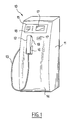
- FIG. 1 shows a processing device 10 comprising a generator 11 and a handpiece 12 connected to the generator 11 by a hose 13.
- the generator 11 may include, as in the example illustrated, a face front 14 with a control panel 15.
- the front face 14 can be provided with a support 16 making it possible to hang the handpiece 12 in the absence of use and a slot 17 allowing the introduction a smart card.
- the control panel 15 may include a display device 17 as well a keyboard 18 allowing to enter information concerning for example the nature of treatment.
- the handpiece 12 includes a flash lamp 60 shown schematically in Figure 4, capable of emitting incoherent light towards the area to treat.
- the flash lamp is for example constituted by a xenon tube of 5 or 6 mm of diameter.
- the flash lamp can be cooled, as in the example shown, by a coolant which is circulated by a pump arranged at the interior of the generator 11 and circulating through the ducts of the hose 13.
- the handpiece has an exit window 19 through which light from the lamp is emitted towards the skin.
- the generator 11 includes a medium voltage power supply 20 (a few hundred volts), shown schematically in Figure 2 and which is by example produced in accordance with the teachings of the European patent application EP 0 772 286 in the name of the plaintiff.
- the generator 11 has an output stage comprising a plurality of capacitors 21 each associated respectively with a electronic switch 22.
- Each capacitor 21 can be constituted for example, as in the example illustrated, by a single electrochemical capacitive component having 10 mF of capacity.
- Each electronic switch 22 can be constituted for example by a IGBT power transistor.
- the negative terminals of the capacitors 21 are electrically connected to the supply 20 negative terminal while the positive terminals are connected, by via respective diodes 23 at the positive terminal of supply 20.
- the generator 11 includes a control device 30 configured in particular to control the electronic switches 22.
- This control device 30 receives information representative of the current which runs through the conductors 24 which connect the cathodes of the diodes 23 to the switches 22 corresponding electronics.
- Diodes 28 can be arranged in series with the conductors 24 to allow sequential switching of the switches 22.
- the measurement of the current in each of the conductors 24 can be carried out by example by measuring the voltage across a resistor (not shown) traversed by the discharge current of the capacitor or by any other means, for example a Inductive sensor.
- the generator 11 also includes a fault detection device insulation 31 capable of detecting a variation in the voltage across each of two resistors 25 and 26 electrically connected in series between the supply terminals 20 and whose midpoint 27 is connected to earth.
- the output stage is floating and in the absence of leakage current the voltages across resistors 25 and 26, which have a very high value, for example an identical value of the order of a few M ⁇ , are substantially equal.
- Leakage currents below 50 ⁇ A can thus be detected.
- the insulation fault detection device 31 also makes it possible to advantageously, to detect contamination of the liquid used to cool the lamp in handpiece 12 or the use of a liquid other than the recommended liquid, namely demineralized water in this case.
- circuit breaker differential 40 shown schematically in Figure 3, can be used.
- This circuit breaker differential 40 may include a magnetic ring on which the conductors of polarity + and - coming from the output stage of figure 2.
- a winding 41 on the ring makes it possible to detect an imbalance of the currents I L + and I L - corresponding to each of the polarities.
- the generator 11 is configured so as to prevent operation in case of imbalance.
- a saturable coil 50 is connected electrically in series with the flash lamp 60, as illustrated in FIG. 4.
- Such a saturable coil can include a magnetizable ferrite.
- the voltage V G at the terminals of the output stage can go from 0 at around 300 volts.
- the current I L evolves, between the instants t 0 and t 'relatively slowly, as long as the ferrite is not saturated. Once the latter is saturated, the current changes more quickly, between the instants t 'and t "to reach its maximum value.
- the saturable coil allows, with the ferrite being saturated, to obtain a maximum current rise time of approximately 1A / ⁇ s between the instants t 'and t ", which makes it possible to reduce the switching losses in the electronic switches 22.
- the magnetizing current which flows through the lamp 60 between the instants t and t ' allows to create a "pseudo-simmer" in the tube, which prolongs its lifespan by allowing the plasma to settle well in the center of the tube before its expansion.
- the ratio between the slopes of the current rises between the instants t 0 and t 'on the one hand and t' and t "on the other hand can be of the order of twenty.
- the generator 11 can advantageously be configured to receive a information from at least one sensor 70 shown in isolation in FIG. 6, capable of delivering information (for example digital or analog, in particular a value of resistance, voltage, current, a binary word) representative of the pressure exerted by handpiece 12 on the treated area.
- information for example digital or analog, in particular a value of resistance, voltage, current, a binary word
- the control device 30 can be configured so as to prevent the emission of a light flash as long as a predetermined pressure is not exerted by the exit window 19 on the skin.
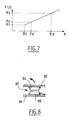
- the energy domain E between e 1 and e 2 may correspond to the energy recommended for carrying out a vascular treatment and the energies greater than e 3 may correspond to the energies required for hair removal.
- the control device 30 can authorize the emission of a flash.
- the control device 30 prevents the emission of a flash.
- the control device 30 can prevent the emission of a flash as long as the pressure exerted P is less than the p value 3 .
- the control device 30 can also be configured, if necessary, to adjust the energy E of the light flash as a function of the pressure P exerted on the moment when the shot is fired, by calculating as a function of the pressure P the energy E most appropriate correspondent, for example by respecting a predetermined law which is for example a straight line as illustrated.
- the application pressure of the outlet window on the skin by the treatment device 10 allows the operator to have to exercise on the patient's skin, enough pressure to drive the hemoglobin out of the area treated during hair removal and, in the case of vascular treatment, to prevent the operator to exert too much pressure which would result in driving out hemoglobin in the area to be treated and thereby reduce the effectiveness of the flash.
- the processing device 10 advantageously comprises a detector 80, shown schematically in Figure 8, fixed on an inner wall 81 of the generator 11 and sensitive to the opening of a cover 82 allowing access to its circuits e.
- this detector 80 comprises on the one hand a fixed part 83 constituted for example by an ILS type contact and on the other hand a magnet 84 fixed on the cover 82 so as to allow the fixed part 83 to detect the removal of the cover 82.
- the fixed part 83 is connected to the control device 30 and the latter is configured so as to memorize the opening of the cover 82 and to prevent, in the absence a predetermined intervention carried out by an authorized person, the treatment to function again.
- the control device 30 can be configured to decrement a card to chip inserted in the reader 17, in order for example to decrease a count of units of credit stored in the chip.
- the generator 11 is then configured so that when the account no longer contains credit units, the emission of a light flash is prevented.
- the processing device 10 can be used in the following manner.
- the operator inserts a loaded smart card into the reader 17 and programs using the keyboard 18 the nature of the desired treatment, for example a treatment delaying hair regrowth, permanent hair removal, anti-wrinkle or vascular treatment .
- the operator can directly enter the desired energy density value, but the control device 30 can be configured to control the electronic switches 22 so as to stop the discharge of the capacitors 21 when the energy delivered by the lamp 60 reaches a predetermined value, which can be fixed for example at 20 J / cm 2 for safety.
- the handpiece 12 has a trigger (not shown) which allows the operator to trigger the emission of at least one light flash.
- the generator 11 prevents the emission of a flash even when the trigger is actuated, in the absence of sufficient pressure exerted by the handpiece 12 on the skin or when the pressure exerted does not correspond not at the required pressure, given the nature of the treatment.
- the pressure sensor can thus be removed or replaced by any other type of sensor, including a contact or distance sensor, which can reduce the risk of lightning flashing in a direction other than the area to be treated.
Landscapes
- Physics & Mathematics (AREA)
- Health & Medical Sciences (AREA)
- Surgery (AREA)
- Optics & Photonics (AREA)
- Life Sciences & Earth Sciences (AREA)
- Molecular Biology (AREA)
- General Health & Medical Sciences (AREA)
- Nuclear Medicine, Radiotherapy & Molecular Imaging (AREA)
- Engineering & Computer Science (AREA)
- Biomedical Technology (AREA)
- Heart & Thoracic Surgery (AREA)
- Medical Informatics (AREA)
- Electromagnetism (AREA)
- Animal Behavior & Ethology (AREA)
- Otolaryngology (AREA)
- Public Health (AREA)
- Veterinary Medicine (AREA)
- Radiation-Therapy Devices (AREA)
- Finger-Pressure Massage (AREA)
- Stroboscope Apparatuses (AREA)
- Cleaning In General (AREA)
- Physical Or Chemical Processes And Apparatus (AREA)
- Polarising Elements (AREA)
- Treatments Of Macromolecular Shaped Articles (AREA)
- Heating, Cooling, Or Curing Plastics Or The Like In General (AREA)
Abstract
Description
- la figure 1 représente de manière schématique, en perspective, un dispositif de traitement,
- la figure 2 représente de manière schématique et simplifiée un étage de sortie pouvant être utilisé,
- 1a figure 3 illustre l'utilisation d'un disjoncteur différentiel,
- la figure 4 illustre l'utilisation d'une bobine saturable, reliée électriquement en série avec la lampe flash,
- la figure 5 représente de manière schématique l'évolution du courant IL de la lampe et de la tension VG de l'étage de sortie en fonction du temps,
- la figure 6 représente isolément et schématiquement un capteur de pression,
- la figure 7 illustre la possibilité de conditionner l'émission d'un flash lumineux à des conditions de pression particulières de la pièce à main sur la zone traitée, et
- la figure 8 représente un exemple de détecteur d'ouverture.
Claims (18)
- Dispositif de traitement (10) par émission de flashs lumineux, comportant une lampe flash (60) et un générateur (11) auquel la lampe est reliée, le générateur (11) comportant plusieurs interrupteurs électroniques (22) associés chacun à un condensateur (21) respectif, chaque interrupteur électronique (22) pouvant être commandé d'un état non passant à un état passant permettant à de l'énergie électrique accumulée dans le condensateur associé d'être déchargée dans la lampe, caractérisé par le fait que la capacité de chaque condensateur (21) est suffisamment faible pour qu'en cas de défaillance de l'interrupteur électronique correspondant et la décharge dans la lampe (60) de la totalité de l'énergie électrique accumulée dans le condensateur (21), le flash lumineux ainsi généré ait une densité d'énergie suffisamment faible pour ne pas occasionner de risque de lésion indésirable de la zone traitée.
- Dispositif de traitement selon la revendication précédente, caractérisé par le fait qu'il comporte un dispositif de contrôle (30) pour commander les interrupteurs électroniques (22).
- Dispositif de traitement selon la revendication 2, caractérisé par le fait que les interrupteurs électroniques (22) sont commandés simultanément en commutation de l'état non passant à l'état passant.
- Dispositif de traitement selon l'une des revendications 2 et 3, caractérisé par le fait que le dispositif de contrôle (30) est configuré pour commuter de l'état passant à l'état non passant les interrupteurs électroniques lorsqu'une énergie prédéterminée a été déchargée dans la lampe.
- Dispositif de traitement selon l'une quelconque des revendications 2 à 4, caractérisé par le fait que le dispositif de contrôle est programmable de manière à permettre à un utilisateur de programmer l'énergie du flash lumineux, cette programmation pouvant s'effectuer en appuyant sur des touches (18) correspondant chacune à une nature de traitement.
- Dispositif de traitement selon l'une quelconque des revendications précédentes, caractérisé par le fait qu'il comporte un dispositif de détection de défaut d'isolation (31).
- Dispositif de traitement selon la revendication précédente, caractérisé par le fait que le dispositif de détection de défaut d'isolation (31) est configuré pour détecter une variation de potentiel aux bornes de deux résistances (25, 26) reliées en série, ayant un point milieu relié à la terre et des bornes reliées aux deux polarités d'une alimentation (20) des condensateurs.
- Dispositif de traitement selon l'une des revendications 6 et 7, caractérisé par le fait que le dispositif de détection de défaut d'isolation (31) est configuré pour détecter un courant de fuite inférieur à 100 µA, de préférence inférieur à 50 µA.
- Dispositif de traitement selon l'une quelconque des revendications précédentes, caractérisé par le fait qu'un liquide de refroidissement isolant électrique, notamment de l'eau déminéralisée, est utilisé pour refroidir la lampe, ce liquide venant en contact électrique entre la terre et l'une des deux polarités des condensateurs.
- Dispositif de traitement selon l'une quelconque des revendications précédentes, caractérisé par le fait qu'il est dépourvu d'alimentation électrique en mode simmer de la lampe flash (60).
- Dispositif de traitement selon l'une quelconque des revendications précédentes, caractérisé par le fait qu'au moins une bobine saturable (50) est reliée électriquement en série avec la lampe (60).
- Dispositif de traitement selon l'une quelconque des revendications précédentes, caractérisé par le fait que le dispositif de contrôle est configuré pour recevoir une information d'au moins un capteur (70) apte à délivrer une information représentative d'un contact ou d'une proximité de la pièce à main avec la zone à traiter et de préférence représentative également de la pression avec laquelle une pièce à main (12) contenant la lampe est appliquée sur la zone à traiter.
- Dispositif de traitement selon l'une quelconque des revendications précédentes, caractérisé par le fait qu'il est configuré pour ne pas permettre l'émission d'un flash tant que la pression exercée par la pièce à main (12) sur la zone à traiter est inférieure ou égale à une limite prédéterminée.
- Dispositif de traitement selon l'une quelconque des revendications précédentes, caractérisé par le fait qu'il est configuré pour ne pas permettre l'émission d'un flash lumineux tant que la pression d'application de la pièce à main (12) sur la zone à traiter n'est pas comprise entre des limites inférieure et supérieure prédéterminées, pour une nature de traitement donnée.
- Dispositif de traitement selon l'une quelconque des revendications précédentes, caractérisé par le fait qu'il comporte au moins un détecteur apte à détecter une ouverture d'un capot amovible (82) du générateur (11) et par le fait que le dispositif de traitement est configuré pour mémoriser l'ouverture du capot et empêcher qu'en l'absence d'une intervention prédéterminée, effectuée par une personne autorisée, le dispositif de traitement puisse fonctionner à nouveau.
- Dispositif de traitement selon l'une quelconque des revendications précédentes, caractérisé par le fait qu'il comporte un lecteur (17) d'un support d'unités de crédit, par exemple un lecteur de carte à puce.
- Dispositif de traitement (10) par émission de flashs lumineux, notamment pour l'épilation ou des applications thérapeutiques, comportant au moins une lampe flash (60) et un générateur (11) auquel est reliée la lampe flash, caractérisé par le fait qu'il comporte un dispositif de contrôle (30) configuré pour recevoir au moins une information d'un capteur (70) apte à délivrer une information représentative du contact ou de la proximité d'une pièce à main (12) contenant la lampe (60) avec la zone à traiter et de préférence représentative également de la pression avec laquelle la pièce à main est appliquée contre la zone à traiter.
- Dispositif de traitement (10) par émission de flashs lumineux, notamment pour l'épilation ou des applications thérapeutiques, comportant au moins une lampe flash (60) et un générateur (11) auquel est reliée la lampe flash, caractérisé par le fait que la lampe (60) est reliée au générateur par l'intermédiaire d'au moins une bobine saturable (50).
Priority Applications (1)
| Application Number | Priority Date | Filing Date | Title |
|---|---|---|---|
| EP05019414A EP1602340B1 (fr) | 2002-04-08 | 2003-04-08 | Dispositif de traitement par émission de flashs lumineux |
Applications Claiming Priority (2)
| Application Number | Priority Date | Filing Date | Title |
|---|---|---|---|
| FR0204313A FR2838042B1 (fr) | 2002-04-08 | 2002-04-08 | Dispositif de traitement par emission de flashs lumineux |
| FR0204313 | 2002-04-08 |
Related Child Applications (1)
| Application Number | Title | Priority Date | Filing Date |
|---|---|---|---|
| EP05019414A Division EP1602340B1 (fr) | 2002-04-08 | 2003-04-08 | Dispositif de traitement par émission de flashs lumineux |
Publications (2)
| Publication Number | Publication Date |
|---|---|
| EP1352615A1 true EP1352615A1 (fr) | 2003-10-15 |
| EP1352615B1 EP1352615B1 (fr) | 2005-11-02 |
Family
ID=28052172
Family Applications (2)
| Application Number | Title | Priority Date | Filing Date |
|---|---|---|---|
| EP05019414A Expired - Lifetime EP1602340B1 (fr) | 2002-04-08 | 2003-04-08 | Dispositif de traitement par émission de flashs lumineux |
| EP03290870A Expired - Lifetime EP1352615B1 (fr) | 2002-04-08 | 2003-04-08 | Dispositif de traitement par émission de flashs lumineux |
Family Applications Before (1)
| Application Number | Title | Priority Date | Filing Date |
|---|---|---|---|
| EP05019414A Expired - Lifetime EP1602340B1 (fr) | 2002-04-08 | 2003-04-08 | Dispositif de traitement par émission de flashs lumineux |
Country Status (5)
| Country | Link |
|---|---|
| EP (2) | EP1602340B1 (fr) |
| AT (2) | ATE308281T1 (fr) |
| DE (1) | DE60302096T2 (fr) |
| ES (2) | ES2367899T3 (fr) |
| FR (1) | FR2838042B1 (fr) |
Cited By (1)
| Publication number | Priority date | Publication date | Assignee | Title |
|---|---|---|---|---|
| EP2481369A1 (fr) * | 2011-02-01 | 2012-08-01 | Biosense Webster (Israel), Ltd. | Prévention des risques pour la sûreté dus à un courant de fuite |
Families Citing this family (5)
| Publication number | Priority date | Publication date | Assignee | Title |
|---|---|---|---|---|
| FR2862204B1 (fr) * | 2003-11-13 | 2006-02-10 | Yves Vincent Brottier | Appareil d'epilation par decharges electriques dans une lampe flash regulee en courant |
| FR2864440B1 (fr) | 2003-12-26 | 2006-03-17 | Eurofeedback Sa | Piece a main comportant au moins un tube flash |
| FR2860704B1 (fr) * | 2004-12-15 | 2009-02-13 | Eurofeedback Sa | Dispositif de traitement par emission de flashs lumineux. |
| FR2889440A1 (fr) | 2005-08-05 | 2007-02-09 | Eurofeedback Sa | Appareil de traitement par emission de flashs lumineux, notamment d'epilation |
| FR2892012B1 (fr) | 2005-10-17 | 2008-07-18 | Eurofeedback Sa | Procede d'epilation |
Citations (8)
| Publication number | Priority date | Publication date | Assignee | Title |
|---|---|---|---|---|
| DE875679C (de) * | 1942-11-21 | 1953-05-04 | Siemens Ag | Beruehrungsschutzschaltung fuer elektrische Geraete |
| US4745613A (en) * | 1987-01-09 | 1988-05-17 | General Electric Co. | Laser flash lamp triggering circuit |
| DE3800291A1 (de) * | 1988-01-08 | 1989-07-20 | Lauerer Friedrich | Elektrische sicherheitsschaltung |
| US5287380A (en) * | 1993-02-19 | 1994-02-15 | Candela Laser Corporation | Method and apparatus for generating long output pulses from flashlamp-excited lasers |
| US5720772A (en) * | 1992-10-20 | 1998-02-24 | Esc Medical Systems Ltd. | Method and apparatus for therapeutic electromagnetic treatment |
| US5735844A (en) * | 1995-02-01 | 1998-04-07 | The General Hospital Corporation | Hair removal using optical pulses |
| US6273883B1 (en) * | 1996-04-09 | 2001-08-14 | Cynosure, Inc. | Alexandrite laser system for treatment of dermatological specimens |
| WO2001087408A2 (fr) * | 2000-05-19 | 2001-11-22 | Ib Soft Ltd. | Procede et appareil pour l'application de rayonnement electromagnetique sur des tissus humains |
Family Cites Families (3)
| Publication number | Priority date | Publication date | Assignee | Title |
|---|---|---|---|---|
| US6251113B1 (en) * | 1996-08-29 | 2001-06-26 | Bausch & Lomb Surgical, Inc. | Ophthalmic microsurgical system employing surgical module employing flash EEPROM and reprogrammable modules |
| EP0885629A3 (fr) | 1997-06-16 | 1999-07-21 | Danish Dermatologic Development A/S | Dispositif de génération d'impulsions lumineuses et de phototraitement cosmétique et thérapeutique |
| US6214035B1 (en) * | 1999-03-23 | 2001-04-10 | Jackson Streeter | Method for improving cardiac microcirculation |
-
2002
- 2002-04-08 FR FR0204313A patent/FR2838042B1/fr not_active Expired - Lifetime
-
2003
- 2003-04-08 EP EP05019414A patent/EP1602340B1/fr not_active Expired - Lifetime
- 2003-04-08 AT AT03290870T patent/ATE308281T1/de not_active IP Right Cessation
- 2003-04-08 EP EP03290870A patent/EP1352615B1/fr not_active Expired - Lifetime
- 2003-04-08 AT AT05019414T patent/ATE512635T1/de not_active IP Right Cessation
- 2003-04-08 ES ES05019414T patent/ES2367899T3/es not_active Expired - Lifetime
- 2003-04-08 ES ES03290870T patent/ES2252628T3/es not_active Expired - Lifetime
- 2003-04-08 DE DE60302096T patent/DE60302096T2/de not_active Expired - Lifetime
Patent Citations (8)
| Publication number | Priority date | Publication date | Assignee | Title |
|---|---|---|---|---|
| DE875679C (de) * | 1942-11-21 | 1953-05-04 | Siemens Ag | Beruehrungsschutzschaltung fuer elektrische Geraete |
| US4745613A (en) * | 1987-01-09 | 1988-05-17 | General Electric Co. | Laser flash lamp triggering circuit |
| DE3800291A1 (de) * | 1988-01-08 | 1989-07-20 | Lauerer Friedrich | Elektrische sicherheitsschaltung |
| US5720772A (en) * | 1992-10-20 | 1998-02-24 | Esc Medical Systems Ltd. | Method and apparatus for therapeutic electromagnetic treatment |
| US5287380A (en) * | 1993-02-19 | 1994-02-15 | Candela Laser Corporation | Method and apparatus for generating long output pulses from flashlamp-excited lasers |
| US5735844A (en) * | 1995-02-01 | 1998-04-07 | The General Hospital Corporation | Hair removal using optical pulses |
| US6273883B1 (en) * | 1996-04-09 | 2001-08-14 | Cynosure, Inc. | Alexandrite laser system for treatment of dermatological specimens |
| WO2001087408A2 (fr) * | 2000-05-19 | 2001-11-22 | Ib Soft Ltd. | Procede et appareil pour l'application de rayonnement electromagnetique sur des tissus humains |
Cited By (1)
| Publication number | Priority date | Publication date | Assignee | Title |
|---|---|---|---|---|
| EP2481369A1 (fr) * | 2011-02-01 | 2012-08-01 | Biosense Webster (Israel), Ltd. | Prévention des risques pour la sûreté dus à un courant de fuite |
Also Published As
| Publication number | Publication date |
|---|---|
| EP1602340B1 (fr) | 2011-06-15 |
| FR2838042B1 (fr) | 2005-03-11 |
| ES2252628T3 (es) | 2006-05-16 |
| DE60302096T2 (de) | 2006-07-20 |
| EP1602340A3 (fr) | 2006-01-11 |
| DE60302096D1 (de) | 2005-12-08 |
| EP1602340A2 (fr) | 2005-12-07 |
| FR2838042A1 (fr) | 2003-10-10 |
| ATE308281T1 (de) | 2005-11-15 |
| ES2367899T3 (es) | 2011-11-10 |
| ATE512635T1 (de) | 2011-07-15 |
| EP1352615B1 (fr) | 2005-11-02 |
Similar Documents
| Publication | Publication Date | Title |
|---|---|---|
| FR2526600A1 (fr) | Dispositif de securite destine a empecher la marche intempestive d'un appareil electrique lors de son branchement alors que son interrupteur de mise en marche est ferme | |
| EP1352615B1 (fr) | Dispositif de traitement par émission de flashs lumineux | |
| FR2773432A1 (fr) | Dispositif de commande d'allumage d'une lampe a decharge et douille pour lampe a decharge utilisee avec ce dispositif | |
| FR2509926A1 (fr) | Circuit d'onduleur a commutation rapide | |
| EP1632266A1 (fr) | Instrument de beauté | |
| FR2921249A1 (fr) | Dispositif de traitement par emission de flashs lumineux | |
| FR2911469A1 (fr) | Alimentation electrique d'un tube a rayons x et son procede de mise en oeuvre | |
| FR2558304A1 (fr) | Lampe a incandescence a circuit de ballast ameliore | |
| FR2860704A1 (fr) | Dispositif de traitement par emission de flashs lumineux. | |
| FR2709225A1 (fr) | Appareil pour clôture électrique. | |
| FR2485164A1 (fr) | Controleur de flammes a securite intrinseque | |
| WO2008125790A1 (fr) | Chargeur rapide universel pour tout element electrolytique, piles alcalines et accumulateurs rechargeables | |
| FR2749515A1 (fr) | Caisson d'isolation a emissions ou methodes de relaxation personnalisees | |
| EP0240402A1 (fr) | Procédé et dispositif pour envoyer du courant électrique dans un circuit à l'aide d'un transistor | |
| FR2497052A1 (fr) | Dispositif d'eclairage fluorescent a double niveau d'eclairage | |
| EP1230947A1 (fr) | Dispositif médical implantable actif, notamment stimulateur cardiaque, défibrillateur et/ou cardioverteur ou dispositif multisite, avec test de capture cycle à cycle | |
| CA2248943A1 (fr) | Appareil destructeur d'elements metalliques tels que des aiguilles | |
| FR2633837A1 (fr) | Circuit de charge-decharge pour le condensateur d'un defibrillateur cardiaque | |
| FR2612725A1 (fr) | Procede et circuit electrique pour le fonctionnement d'une lampe a decharge avec interruption du courant | |
| EP0035447B1 (fr) | Procédé et dispositif de traitement de fils ou de fibres textiles | |
| EP0785703B1 (fr) | Dispositif de commande pour lampe fluorescente à basse pression | |
| EP0179680B1 (fr) | Circuit d'alimentation pour émetteur de rayons x, utilisable en radiologie | |
| FR2718598A1 (fr) | Dispositif de contrôle d'un tube fluorescent. | |
| FR2810809A1 (fr) | Dispositif d'alimentation pour appareils electriques portables | |
| FR2476870A1 (fr) | Dispositif de commande d'une pompe en fonction du niveau de l'eau a pomper |
Legal Events
| Date | Code | Title | Description |
|---|---|---|---|
| PUAI | Public reference made under article 153(3) epc to a published international application that has entered the european phase |
Free format text: ORIGINAL CODE: 0009012 |
|
| AK | Designated contracting states |
Kind code of ref document: A1 Designated state(s): AT BE BG CH CY CZ DE DK EE ES FI FR GB GR HU IE IT LI LU MC NL PT RO SE SI SK TR |
|
| AX | Request for extension of the european patent |
Extension state: AL LT LV MK |
|
| 17P | Request for examination filed |
Effective date: 20040408 |
|
| AKX | Designation fees paid |
Designated state(s): AT BE BG CH CY CZ DE DK EE ES FI FR GB GR HU IE IT LI LU MC NL PT RO SE SI SK TR |
|
| 17Q | First examination report despatched |
Effective date: 20040906 |
|
| GRAP | Despatch of communication of intention to grant a patent |
Free format text: ORIGINAL CODE: EPIDOSNIGR1 |
|
| GRAS | Grant fee paid |
Free format text: ORIGINAL CODE: EPIDOSNIGR3 |
|
| GRAA | (expected) grant |
Free format text: ORIGINAL CODE: 0009210 |
|
| AK | Designated contracting states |
Kind code of ref document: B1 Designated state(s): AT BE BG CH CY CZ DE DK EE ES FI FR GB GR HU IE IT LI LU MC NL PT RO SE SI SK TR |
|
| PG25 | Lapsed in a contracting state [announced via postgrant information from national office to epo] |
Ref country code: SI Free format text: LAPSE BECAUSE OF FAILURE TO SUBMIT A TRANSLATION OF THE DESCRIPTION OR TO PAY THE FEE WITHIN THE PRESCRIBED TIME-LIMIT Effective date: 20051102 Ref country code: CZ Free format text: LAPSE BECAUSE OF FAILURE TO SUBMIT A TRANSLATION OF THE DESCRIPTION OR TO PAY THE FEE WITHIN THE PRESCRIBED TIME-LIMIT Effective date: 20051102 Ref country code: SK Free format text: LAPSE BECAUSE OF FAILURE TO SUBMIT A TRANSLATION OF THE DESCRIPTION OR TO PAY THE FEE WITHIN THE PRESCRIBED TIME-LIMIT Effective date: 20051102 Ref country code: FI Free format text: LAPSE BECAUSE OF FAILURE TO SUBMIT A TRANSLATION OF THE DESCRIPTION OR TO PAY THE FEE WITHIN THE PRESCRIBED TIME-LIMIT Effective date: 20051102 Ref country code: RO Free format text: LAPSE BECAUSE OF FAILURE TO SUBMIT A TRANSLATION OF THE DESCRIPTION OR TO PAY THE FEE WITHIN THE PRESCRIBED TIME-LIMIT Effective date: 20051102 Ref country code: NL Free format text: LAPSE BECAUSE OF FAILURE TO SUBMIT A TRANSLATION OF THE DESCRIPTION OR TO PAY THE FEE WITHIN THE PRESCRIBED TIME-LIMIT Effective date: 20051102 Ref country code: IE Free format text: LAPSE BECAUSE OF FAILURE TO SUBMIT A TRANSLATION OF THE DESCRIPTION OR TO PAY THE FEE WITHIN THE PRESCRIBED TIME-LIMIT Effective date: 20051102 Ref country code: AT Free format text: LAPSE BECAUSE OF FAILURE TO SUBMIT A TRANSLATION OF THE DESCRIPTION OR TO PAY THE FEE WITHIN THE PRESCRIBED TIME-LIMIT Effective date: 20051102 |
|
| REG | Reference to a national code |
Ref country code: GB Ref legal event code: FG4D Free format text: NOT ENGLISH |
|
| REG | Reference to a national code |
Ref country code: CH Ref legal event code: EP |
|
| REF | Corresponds to: |
Ref document number: 60302096 Country of ref document: DE Date of ref document: 20051208 Kind code of ref document: P |
|
| PG25 | Lapsed in a contracting state [announced via postgrant information from national office to epo] |
Ref country code: SE Free format text: LAPSE BECAUSE OF FAILURE TO SUBMIT A TRANSLATION OF THE DESCRIPTION OR TO PAY THE FEE WITHIN THE PRESCRIBED TIME-LIMIT Effective date: 20060202 Ref country code: DK Free format text: LAPSE BECAUSE OF FAILURE TO SUBMIT A TRANSLATION OF THE DESCRIPTION OR TO PAY THE FEE WITHIN THE PRESCRIBED TIME-LIMIT Effective date: 20060202 Ref country code: BG Free format text: LAPSE BECAUSE OF FAILURE TO SUBMIT A TRANSLATION OF THE DESCRIPTION OR TO PAY THE FEE WITHIN THE PRESCRIBED TIME-LIMIT Effective date: 20060202 Ref country code: GR Free format text: LAPSE BECAUSE OF FAILURE TO SUBMIT A TRANSLATION OF THE DESCRIPTION OR TO PAY THE FEE WITHIN THE PRESCRIBED TIME-LIMIT Effective date: 20060202 |
|
| GBT | Gb: translation of ep patent filed (gb section 77(6)(a)/1977) |
Effective date: 20060216 |
|
| PG25 | Lapsed in a contracting state [announced via postgrant information from national office to epo] |
Ref country code: PT Free format text: LAPSE BECAUSE OF FAILURE TO SUBMIT A TRANSLATION OF THE DESCRIPTION OR TO PAY THE FEE WITHIN THE PRESCRIBED TIME-LIMIT Effective date: 20060403 |
|
| PG25 | Lapsed in a contracting state [announced via postgrant information from national office to epo] |
Ref country code: BE Free format text: LAPSE BECAUSE OF NON-PAYMENT OF DUE FEES Effective date: 20060430 Ref country code: MC Free format text: LAPSE BECAUSE OF NON-PAYMENT OF DUE FEES Effective date: 20060430 |
|
| NLV1 | Nl: lapsed or annulled due to failure to fulfill the requirements of art. 29p and 29m of the patents act | ||
| PG25 | Lapsed in a contracting state [announced via postgrant information from national office to epo] |
Ref country code: HU Free format text: LAPSE BECAUSE OF FAILURE TO SUBMIT A TRANSLATION OF THE DESCRIPTION OR TO PAY THE FEE WITHIN THE PRESCRIBED TIME-LIMIT Effective date: 20060503 |
|
| REG | Reference to a national code |
Ref country code: ES Ref legal event code: FG2A Ref document number: 2252628 Country of ref document: ES Kind code of ref document: T3 |
|
| REG | Reference to a national code |
Ref country code: IE Ref legal event code: FD4D |
|
| PLBE | No opposition filed within time limit |
Free format text: ORIGINAL CODE: 0009261 |
|
| STAA | Information on the status of an ep patent application or granted ep patent |
Free format text: STATUS: NO OPPOSITION FILED WITHIN TIME LIMIT |
|
| 26N | No opposition filed |
Effective date: 20060803 |
|
| REG | Reference to a national code |
Ref country code: CH Ref legal event code: PL |
|
| BERE | Be: lapsed |
Owner name: EUROFEEDBACK Effective date: 20060430 |
|
| PG25 | Lapsed in a contracting state [announced via postgrant information from national office to epo] |
Ref country code: CH Free format text: LAPSE BECAUSE OF NON-PAYMENT OF DUE FEES Effective date: 20070430 Ref country code: LI Free format text: LAPSE BECAUSE OF NON-PAYMENT OF DUE FEES Effective date: 20070430 |
|
| PG25 | Lapsed in a contracting state [announced via postgrant information from national office to epo] |
Ref country code: EE Free format text: LAPSE BECAUSE OF FAILURE TO SUBMIT A TRANSLATION OF THE DESCRIPTION OR TO PAY THE FEE WITHIN THE PRESCRIBED TIME-LIMIT Effective date: 20051102 |
|
| PG25 | Lapsed in a contracting state [announced via postgrant information from national office to epo] |
Ref country code: TR Free format text: LAPSE BECAUSE OF FAILURE TO SUBMIT A TRANSLATION OF THE DESCRIPTION OR TO PAY THE FEE WITHIN THE PRESCRIBED TIME-LIMIT Effective date: 20051102 Ref country code: LU Free format text: LAPSE BECAUSE OF NON-PAYMENT OF DUE FEES Effective date: 20060408 |
|
| PG25 | Lapsed in a contracting state [announced via postgrant information from national office to epo] |
Ref country code: CY Free format text: LAPSE BECAUSE OF FAILURE TO SUBMIT A TRANSLATION OF THE DESCRIPTION OR TO PAY THE FEE WITHIN THE PRESCRIBED TIME-LIMIT Effective date: 20051102 |
|
| PGFP | Annual fee paid to national office [announced via postgrant information from national office to epo] |
Ref country code: ES Payment date: 20130320 Year of fee payment: 11 |
|
| PGFP | Annual fee paid to national office [announced via postgrant information from national office to epo] |
Ref country code: GB Payment date: 20130422 Year of fee payment: 11 Ref country code: DE Payment date: 20130430 Year of fee payment: 11 |
|
| PGFP | Annual fee paid to national office [announced via postgrant information from national office to epo] |
Ref country code: IT Payment date: 20130424 Year of fee payment: 11 |
|
| REG | Reference to a national code |
Ref country code: DE Ref legal event code: R119 Ref document number: 60302096 Country of ref document: DE |
|
| GBPC | Gb: european patent ceased through non-payment of renewal fee |
Effective date: 20140408 |
|
| PG25 | Lapsed in a contracting state [announced via postgrant information from national office to epo] |
Ref country code: GB Free format text: LAPSE BECAUSE OF NON-PAYMENT OF DUE FEES Effective date: 20140408 Ref country code: DE Free format text: LAPSE BECAUSE OF NON-PAYMENT OF DUE FEES Effective date: 20141101 |
|
| REG | Reference to a national code |
Ref country code: DE Ref legal event code: R119 Ref document number: 60302096 Country of ref document: DE Effective date: 20141101 |
|
| PG25 | Lapsed in a contracting state [announced via postgrant information from national office to epo] |
Ref country code: IT Free format text: LAPSE BECAUSE OF NON-PAYMENT OF DUE FEES Effective date: 20140408 |
|
| REG | Reference to a national code |
Ref country code: ES Ref legal event code: FD2A Effective date: 20150731 |
|
| PG25 | Lapsed in a contracting state [announced via postgrant information from national office to epo] |
Ref country code: ES Free format text: LAPSE BECAUSE OF NON-PAYMENT OF DUE FEES Effective date: 20140409 |
|
| REG | Reference to a national code |
Ref country code: FR Ref legal event code: PLFP Year of fee payment: 14 |
|
| REG | Reference to a national code |
Ref country code: FR Ref legal event code: PLFP Year of fee payment: 15 |
|
| REG | Reference to a national code |
Ref country code: FR Ref legal event code: PLFP Year of fee payment: 16 |
|
| PGFP | Annual fee paid to national office [announced via postgrant information from national office to epo] |
Ref country code: FR Payment date: 20220228 Year of fee payment: 20 |