EP1352540B1 - Method and radio communications system for reporting status information between a mobile station and a radio access network - Google Patents
Method and radio communications system for reporting status information between a mobile station and a radio access network Download PDFInfo
- Publication number
- EP1352540B1 EP1352540B1 EP02702275A EP02702275A EP1352540B1 EP 1352540 B1 EP1352540 B1 EP 1352540B1 EP 02702275 A EP02702275 A EP 02702275A EP 02702275 A EP02702275 A EP 02702275A EP 1352540 B1 EP1352540 B1 EP 1352540B1
- Authority
- EP
- European Patent Office
- Prior art keywords
- access network
- mobile equipment
- allocation
- message
- ran
- Prior art date
- Legal status (The legal status is an assumption and is not a legal conclusion. Google has not performed a legal analysis and makes no representation as to the accuracy of the status listed.)
- Expired - Lifetime
Links
- 238000000034 method Methods 0.000 title claims abstract description 23
- 238000004891 communication Methods 0.000 title claims abstract description 9
- 239000000872 buffer Substances 0.000 claims abstract description 27
- 238000005259 measurement Methods 0.000 claims description 26
- 238000013468 resource allocation Methods 0.000 claims description 4
- 230000000063 preceeding effect Effects 0.000 claims 2
- 230000011664 signaling Effects 0.000 description 9
- 230000005540 biological transmission Effects 0.000 description 4
- 238000012546 transfer Methods 0.000 description 2
- 230000001960 triggered effect Effects 0.000 description 2
- 238000010586 diagram Methods 0.000 description 1
- 238000012545 processing Methods 0.000 description 1
- 230000001360 synchronised effect Effects 0.000 description 1
- 230000001052 transient effect Effects 0.000 description 1
- 239000002699 waste material Substances 0.000 description 1
Images

Classifications
-
- H—ELECTRICITY
- H04—ELECTRIC COMMUNICATION TECHNIQUE
- H04W—WIRELESS COMMUNICATION NETWORKS
- H04W72/00—Local resource management
- H04W72/20—Control channels or signalling for resource management
- H04W72/21—Control channels or signalling for resource management in the uplink direction of a wireless link, i.e. towards the network
-
- H—ELECTRICITY
- H04—ELECTRIC COMMUNICATION TECHNIQUE
- H04W—WIRELESS COMMUNICATION NETWORKS
- H04W72/00—Local resource management
- H04W72/50—Allocation or scheduling criteria for wireless resources
- H04W72/52—Allocation or scheduling criteria for wireless resources based on load
Definitions
- the present invention relates to radio communication networks and, in particular, relates to radio communication networks employing shared channels.
- Radio systems deploying shared channels allow many users to share limited physical resources in order to transport data or control information in Uplink (UL) and Downlink (DL).
- UL Uplink
- DL Downlink
- status information about the data transfer from the mobile equipment (ME) is needed.
- the scheduler within the Radio Access Network (RAN) is then able to allocate resources for different users.
- the scheduler in the Radio Access Network needs to get status information from the mobile equipment at the end of the current planning interval in order to organise optimal allocation of shared channels resources for data transfer to/from different mobile equipment.
- an optimised mobile equipment status reporting procedure is needed to execute efficient scheduling and allocation of shared channels in order to enable a fast and flexible access to common channels.
- the number of measurement events and measurement reports on/from the Mobile Equipment side should be as low as possible in order not to waste processing power and not to cause a lot of signalling traffic.
- Allocation of physical resources for shared channels on Uplink (UL), executed by the Radio Access Network is based on buffer measurements in the Mobile Equipment, which are reported to the Radio Access Network (MEASUREMENT REPORT message, see 3GPP TS 25.331 v3.5.0, chap. 8.4.2). These measurements in the mobile equipment, configured by the Radio Access Network, can be periodically triggered or be triggered by crossing certain threshold levels (see 3GPP TS 25.331 v3.5.0, chap. 14.4). However, the current reporting methods do not match well with the transient availability of transmission resources that occur with shared transport channels. Threshold based measurement events do not meet the need to gather the dynamics of the buffer state changes in the mobile equipment.
- Timer based (periodical) measurement events potentially provide more balanced reporting but can generate unnecessary signalling traffic when the buffers are empty.
- the problems of the current status reporting are, in part, caused by the independence of the measurement events with respect to the allocation cycle; the measurement report is not well synchronised with the shared channel allocation procedure.
- the allocation of physical shared channel resources in the Downlink (DL) is based on buffer measurements and/or scheduling in the Radio Access Network.
- the Radio Access Network can additionally request buffer status information from the Mobile Equipment to determine necessary retransmissions.
- the transmitted status (STATUS-PDU, see 3GPP TS 25.321, v3.6.0, chap. 9.2.1.6) can be used to determine which data has to be retransmitted.
- the trigger to transmit this status is set by the Radio Access Network and is transported to the mobile equipment together with "normal" data (see poll-bit in 3GPP TS 25.321, v3.6.0, chap. 9.2.1.4).
- the decision to set this poll-bit is normally independent from the channel allocation procedure (3GPP TS 25.321, v3.6.0, chap. 9.2.1).
- EP-A-0 899 984 discloses a control unit and multiple units interconnected by a transmission line.
- the control unit emits signalisation cells addressed to individual units, in which it requests information relating to the status of the unit and estimated future needs and indicates time slots to be used by the unit for transmission of cells to the control unit. Based on this information received from the units, the control unit redistributes the available time slots to the units.
- the present invention seeks to provide an improved shared channel radio communications network.
- EP-A-0 899 984 does not disclose that information regarding the buffer status is requested. Therefore, the control unit does not have the latest information regarding the state of the buffer at allocation time, and it would be necessary to increase the signalling in order to acquire up-to-date status information.
- a radio access system comprising mobile equipment (ME) which communicate over an access network by uplink signals (UL) and down link signals (DL) with base stations (Node B; NB).
- the base stations communicate with a radio network controller (RNC) and comprise a base station system (BSS).
- the base stations also communicate with a mobile switching centre (MSC).
- the network requested Mobile Equipment buffer state reporting for shared channel resource allocation on Uplink (UL) and Downlink (DL) this concept allows the simultaneous transmission with an allocation request message (AllocReq), an additional message (StatusReq) in order to request information about the buffer status on the Mobile Equipment side (StatusInd) at a defined time (e.g.
- This method can be used to send a StatusInd message to the Radio Access Network containing the latest possible status information from the Mobile Equipment at the end of the allocation cycle but still right in time for planning the next allocation interval.
- a StatusInd message For the StatusInd an existing message can be used, whereas a new StatusReq message will be needed.
- the transportation of StatusReq together with AllocReq is based on the assumption that AllocReq is normally transmitted on a safe channel (modulation, transmit power, e.g. UTRAN: FACH). Accordingly, for the message StatusInd a safe channel can be used as well (to enable maximum transmit power, high interleaving, e.g. UTRAN: USCH). Using such channels increase the probability that both messages (StatusReq and StatusInd) will be delivered.
- This scheme can thus provide an additional method to request a "normal" status report. It is then possible to request a status report at a defined moment, independent to other existing rules.
- the UTRAN can request a buffer state measurement report from the Mobile Equipment when allocating physical resources, using the PhyShChAllocation message.
- Uplink (UP) on reception of this message, the Mobile Equipment responds with a state report (MEASUREMENT REPORT message) at a determined time (e.g. more than one round trip delay before the allocation cycle ends).
- the combination of threshold trigger (e.g. upward crossing of zero buffer state) with network requested measurement is seen as an efficient reporting solution.
- signalling traffic on RACH
- UL Uplink
- the Mobile Equipment By giving the Radio Access Network an opportunity to request Mobile Equipment buffer state information at allocation time, the Mobile Equipment can respond with the latest measurement report at the right time, which is transmitted more than one round trip delay before the allocation cycle ends. Furthermore signalling traffic on random access channel (RACH) can be reduced by the use of USCH for measurement reporting.
- RACH random access channel
- the invention describes a method which enables the Radio Access Network to request status (measurement) reports from the Mobile Equipment in order to perform scheduling and allocation of shared channels in a very efficient manner, without causing much signalling traffic. For this reason existing reporting methods can be combined with an additional measurement requested by the Radio Access Network.
- the status request message (StatusReq) can be sent together with the allocation request message (AllocReq) the allocation request message already being present at the beginning of the allocation cycle.
- the status report (StatusInd) can then be transmitted at the end of the allocation cycle, ideally via a safe channel (e.g. USCH).
- a safe channel e.g. USCH
Landscapes
- Engineering & Computer Science (AREA)
- Computer Networks & Wireless Communication (AREA)
- Signal Processing (AREA)
- Mobile Radio Communication Systems (AREA)
- Polymers With Sulfur, Phosphorus Or Metals In The Main Chain (AREA)
- Processes Of Treating Macromolecular Substances (AREA)
- Glass Compositions (AREA)
- Radio Relay Systems (AREA)
Abstract
Description
- The present invention relates to radio communication networks and, in particular, relates to radio communication networks employing shared channels.
- Radio systems deploying shared channels allow many users to share limited physical resources in order to transport data or control information in Uplink (UL) and Downlink (DL). In order to organise scheduling and allocate shared channel resources status information about the data transfer from the mobile equipment (ME) is needed. According to the received state reports from all involved mobile equipment the scheduler within the Radio Access Network (RAN) is then able to allocate resources for different users.
- For an efficient usage of common resources the scheduler in the Radio Access Network needs to get status information from the mobile equipment at the end of the current planning interval in order to organise optimal allocation of shared channels resources for data transfer to/from different mobile equipment. For this purpose an optimised mobile equipment status reporting procedure is needed to execute efficient scheduling and allocation of shared channels in order to enable a fast and flexible access to common channels. However, the number of measurement events and measurement reports on/from the Mobile Equipment side should be as low as possible in order not to waste processing power and not to cause a lot of signalling traffic.
- Allocation of physical resources for shared channels on Uplink (UL), executed by the Radio Access Network, is based on buffer measurements in the Mobile Equipment, which are reported to the Radio Access Network (MEASUREMENT REPORT message, see 3GPP TS 25.331 v3.5.0, chap. 8.4.2). These measurements in the mobile equipment, configured by the Radio Access Network, can be periodically triggered or be triggered by crossing certain threshold levels (see 3GPP TS 25.331 v3.5.0, chap. 14.4). However, the current reporting methods do not match well with the transient availability of transmission resources that occur with shared transport channels. Threshold based measurement events do not meet the need to gather the dynamics of the buffer state changes in the mobile equipment. Timer based (periodical) measurement events potentially provide more balanced reporting but can generate unnecessary signalling traffic when the buffers are empty. The problems of the current status reporting are, in part, caused by the independence of the measurement events with respect to the allocation cycle; the measurement report is not well synchronised with the shared channel allocation procedure.
- Further, since measurement trigger events do not correspond well to shared channel allocation procedure, unnecessary signalling traffic on random access channel (RACH) can be caused.
- The allocation of physical shared channel resources in the Downlink (DL) is based on buffer measurements and/or scheduling in the Radio Access Network. In order to perform allocation and scheduling the Radio Access Network can additionally request buffer status information from the Mobile Equipment to determine necessary retransmissions. The transmitted status (STATUS-PDU, see 3GPP TS 25.321, v3.6.0, chap. 9.2.1.6) can be used to determine which data has to be retransmitted. The trigger to transmit this status is set by the Radio Access Network and is transported to the mobile equipment together with "normal" data (see poll-bit in 3GPP TS 25.321, v3.6.0, chap. 9.2.1.4). The decision to set this poll-bit is normally independent from the channel allocation procedure (3GPP TS 25.321, v3.6.0, chap. 9.2.1).
- Problems arising from the current status reporting system are:
- The Radio Access Network has to explicitly request state information (e.g. setting the poll-bit) for planning the following allocation cycles without generating unnecessary signalling traffic.
- The status information may not be transmitted at the end of the allocation cycle because of the independence of the poll-bit setting with respect to the allocation cycle, (and under different conditions, an additional bad parameter setting).
- The status request (poll-bit) can be lost by using the "normal" traffic channel. (e.g. bad power control)
- EP-A-0 899 984 discloses a control unit and multiple units interconnected by a transmission line. The control unit emits signalisation cells addressed to individual units, in which it requests information relating to the status of the unit and estimated future needs and indicates time slots to be used by the unit for transmission of cells to the control unit. Based on this information received from the units, the control unit redistributes the available time slots to the units.
- The present invention seeks to provide an improved shared channel radio communications network.
- In accordance with the present invention, there is provided a method according to claim 1, a radio communications system according to claim 6 and a radio access network according to claim 7.
- EP-A-0 899 984, does not disclose that information regarding the buffer status is requested. Therefore, the control unit does not have the latest information regarding the state of the buffer at allocation time, and it would be necessary to increase the signalling in order to acquire up-to-date status information.
- Reference shall now be made to the following figures as shown in the drawing sheets, wherein
- Figure 1 shows a cell in a radio network in accordance with the present invention; and
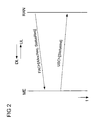
- Figure 2 shows a time diagram for messages communicated between a mobile equipment and a radio access network access mode.
-
- There will now be a described by way of example, the best mode contemplated by the inventors for carrying out the invention. In the following description, numerous specific details are set out in order to provide a complete understanding of the present invention. It will be apparent however, to those skilled in the art that the present invention may be put into practice with variations of the specification.
- Referring now to figure 1, there is shown a radio access system comprising mobile equipment (ME) which communicate over an access network by uplink signals (UL) and down link signals (DL) with base stations (Node B; NB). The base stations communicate with a radio network controller (RNC) and comprise a base station system (BSS). The base stations also communicate with a mobile switching centre (MSC). The network requested Mobile Equipment buffer state reporting for shared channel resource allocation on Uplink (UL) and Downlink (DL) this concept allows the simultaneous transmission with an allocation request message (AllocReq), an additional message (StatusReq) in order to request information about the buffer status on the Mobile Equipment side (StatusInd) at a defined time (e.g. more than one round trip delay before the end of the current allocation cycle). This method can be used to send a StatusInd message to the Radio Access Network containing the latest possible status information from the Mobile Equipment at the end of the allocation cycle but still right in time for planning the next allocation interval. For the StatusInd an existing message can be used, whereas a new StatusReq message will be needed.
- The transportation of StatusReq together with AllocReq is based on the assumption that AllocReq is normally transmitted on a safe channel (modulation, transmit power, e.g. UTRAN: FACH). Accordingly, for the message StatusInd a safe channel can be used as well (to enable maximum transmit power, high interleaving, e.g. UTRAN: USCH). Using such channels increase the probability that both messages (StatusReq and StatusInd) will be delivered.
- This scheme can thus provide an additional method to request a "normal" status report. It is then possible to request a status report at a defined moment, independent to other existing rules.
- By signalling the StatusReq with the AllocReq message it is possible to transport the request on a safer way (combination of allocation and request message; if the allocation is received on Mobile Equipment side, the request is received as well) and by using a safe channel for the measurement report (e.g. USCH) the whole allocation procedure becomes more robust and reliable. Furthermore, by applying this method, the Radio Access Network gets more precise information about the amount of data in the Mobile Equipment buffer for all involved users in order to organise efficient scheduling and to use shared physical resources in an optimised manner.
Subsequently, two scenarios for shared allocation within UTRAN TDD (Time Division Duplex) deploying this method will be described:
Network requested measurement reporting for shared channel resource allocation on Uplink (UL). - Additional to a timer or threshold based measurement reporting method, the UTRAN can request a buffer state measurement report from the Mobile Equipment when allocating physical resources, using the PhyShChAllocation message. Uplink (UP) on reception of this message, the Mobile Equipment responds with a state report (MEASUREMENT REPORT message) at a determined time (e.g. more than one round trip delay before the allocation cycle ends). The combination of threshold trigger (e.g. upward crossing of zero buffer state) with network requested measurement is seen as an efficient reporting solution. Further, signalling traffic (on RACH) can be reduced, because the measurement reports can be send on USCH only once within an allocation cycle.
- Network requested measurement reporting for shared channel resource allocation on Downlink (DL):
Additional to the provision of poll-bit settings, timer or threshold based measurement reporting, the UTRAN can request a (buffer) status measurement report from the Mobile Equipment already when allocating physical resources, using the PhyShChAllocation message. Uplink (UP) on receipt of this message, the Mobile Equipment responds with a status report (using STATUS PDU) at a determined time (e.g. more than one round trip delay before the allocation cycle ends). - Additionally, it is possible to allocate a save Uplink (UL) resource for the transportation of the status (e.g. USCH).
- The following advantages arise from the invention:
By giving the Radio Access Network an opportunity to request Mobile Equipment buffer state information at allocation time, the Mobile Equipment can respond with the latest measurement report at the right time, which is transmitted more than one round trip delay before the allocation cycle ends. Furthermore signalling traffic on random access channel (RACH) can be reduced by the use of USCH for measurement reporting. - Using safe channels in Downlink (DL) and Uplink (UL) to transmit status re and to the Mobile Equipment and status reports to the Radio Access Network in order to obtain a robust and reliable allocation procedure.
- The invention describes a method which enables the Radio Access Network to request status (measurement) reports from the Mobile Equipment in order to perform scheduling and allocation of shared channels in a very efficient manner, without causing much signalling traffic. For this reason existing reporting methods can be combined with an additional measurement requested by the Radio Access Network. For this purpose the status request message (StatusReq) can be sent together with the allocation request message (AllocReq) the allocation request message already being present at the beginning of the allocation cycle. The status report (StatusInd) can then be transmitted at the end of the allocation cycle, ideally via a safe channel (e.g. USCH). Thus the allocation procedure can become very robust and reliable.
Claims (7)
- A method for reporting status information between a mobile equipment (ME) and an access network (RAN) of a radio communications system, wherein
in an allocation cycle, the access network (RAN) sends an allocation message (AllocReq) for allocating resources of a shared channel together with an additional message (StatusReq) for requesting information about a buffer status of the mobile equipment (ME),
the mobile equipment (ME) sends a buffer status message (StatusInd) to the access network (RAN), and
the access network (RAN) takes the buffer status message (StatusInd) into account for allocating resources in a subsequent allocation cycle. - A method according to claim 1, wherein
the buffer status is requested at a defined time. - A method according to claim 2, wherein
the defined time is more than one round trip delay before the end of a current resource allocation cycle within the access network (RAN). - A method according to one of the preceeding claims, wherein
the allocation message (AllocReq) is transmitted on a FACH-channel, and the buffer status message (StatusInd) on an USCH-channel of an UTRAN radio access network. - A method according to one of the preceeding claims, wherein
the access network (RAN) requests a buffer state measurement report from the mobile equipment (ME) when allocating physical resources, and the mobile equipment (ME) responds with a state report at a determined time. - A radio communications system comprising an access network (RAN) operable to communicate with a mobile equipment (ME), and a mobile equipment (ME),
wherein the system is configured such that the access network (RAN) is operable to transmit, in an allocation cycle, to a mobile equipment (ME) an allocation message (AllocReq) for allocating resources of a shared channel together with an additional message (StatusReq) whereby to request information about the buffer status of the mobile equipment (ME),
wherein the mobile equipment (ME) is operable to transmit a buffer status message (StatusInd) to the access network, and
wherein the access network (RAN) is operable to take into account the buffer status message (StatusInd) for the allocation of resources in a subsequent allocation cycle - A radio access network, in a radio communications system,
wherein the radio access network is operable to transmit, in an allocation cycle, to a mobile equipment (ME) an allocation message (AllocReq) for allocating resources of a shared channel together with an additional message (StatusReq) whereby to request information about the buffer status, and
wherein the radio access network is operable to take into account the buffer status message (StatusInd) received from the mobile equipment (ME) for the allocation of resources in a subsequent allocation cycle.
Applications Claiming Priority (3)
| Application Number | Priority Date | Filing Date | Title |
|---|---|---|---|
| GBGB0101115.4A GB0101115D0 (en) | 2001-01-16 | 2001-01-16 | Improvements in or relating to radio communications network |
| GB0101115 | 2001-01-16 | ||
| PCT/EP2002/000397 WO2002056627A1 (en) | 2001-01-16 | 2002-01-16 | Method for reporting status information between a mobile station and a radio access network |
Publications (2)
| Publication Number | Publication Date |
|---|---|
| EP1352540A1 EP1352540A1 (en) | 2003-10-15 |
| EP1352540B1 true EP1352540B1 (en) | 2005-03-23 |
Family
ID=9906908
Family Applications (1)
| Application Number | Title | Priority Date | Filing Date |
|---|---|---|---|
| EP02702275A Expired - Lifetime EP1352540B1 (en) | 2001-01-16 | 2002-01-16 | Method and radio communications system for reporting status information between a mobile station and a radio access network |
Country Status (8)
| Country | Link |
|---|---|
| EP (1) | EP1352540B1 (en) |
| KR (1) | KR100833762B1 (en) |
| CN (1) | CN1224291C (en) |
| AT (1) | ATE291822T1 (en) |
| DE (1) | DE60203368D1 (en) |
| GB (1) | GB0101115D0 (en) |
| PT (1) | PT1352540E (en) |
| WO (1) | WO2002056627A1 (en) |
Cited By (1)
| Publication number | Priority date | Publication date | Assignee | Title |
|---|---|---|---|---|
| US9143974B2 (en) | 2008-04-26 | 2015-09-22 | Huawei Technologies Co., Ltd. | Method and device for sending a buffer status report |
Families Citing this family (16)
| Publication number | Priority date | Publication date | Assignee | Title |
|---|---|---|---|---|
| US6993342B2 (en) | 2003-05-07 | 2006-01-31 | Motorola, Inc. | Buffer occupancy used in uplink scheduling for a communication device |
| KR100595645B1 (en) | 2004-01-09 | 2006-07-03 | 엘지전자 주식회사 | Control Information Transmission Method in Mobile Communication System |
| US8098622B2 (en) * | 2005-10-05 | 2012-01-17 | Electronics And Telecommunications Research Institute | Method for requesting resource and scheduling for uplink traffic in mobile communication and apparatus thereof |
| US20070155390A1 (en) * | 2006-01-04 | 2007-07-05 | Ipwireless, Inc. | Initial connection establishment in a wireless communication system |
| EP1985146A4 (en) * | 2006-02-03 | 2012-01-18 | Nokia Corp | APPARATUS, METHOD, AND COMPUTER PROGRAM FOR PROVIDING THRESHOLD-BASED BUFFER STATE REPORTS FROM USER EQUIPMENT TO WIRELESS NETWORK |
| TWI528746B (en) * | 2006-03-24 | 2016-04-01 | 內數位科技公司 | Non-continuous reception (DRX) and measurement reports in the wireless network |
| KR100996704B1 (en) | 2006-11-06 | 2010-11-25 | 삼성전자주식회사 | How buffer size information is sent |
| CN101212758B (en) * | 2006-12-25 | 2010-12-29 | 中兴通讯股份有限公司 | Method and device for transferring measurement data in a wireless communication system |
| GB2452013A (en) * | 2007-06-19 | 2009-02-25 | Nec Corp | Buffer status reporting from a mobile communications device |
| KR101102730B1 (en) * | 2010-03-22 | 2012-01-05 | 임성훈 | Row holder |
| US10250362B2 (en) | 2014-03-20 | 2019-04-02 | Interdigital Patent Holdings, Inc. | Method and apparatus for non-orthogonal access in LTE systems |
| US10292191B2 (en) | 2014-03-25 | 2019-05-14 | Futurewei Technologies, Inc. | Systems and methods for control plane for D2D communications |
| US10033655B2 (en) * | 2015-09-04 | 2018-07-24 | Arris Enterprises Llc | Packet prioritization based on client device feedback |
| CN109952720A (en) | 2016-09-28 | 2019-06-28 | Idac控股公司 | Novel Radio Random Access in Beamforming Systems |
| US10313991B2 (en) | 2017-03-08 | 2019-06-04 | Texas Instruments Incorporated | Implicit exchange of channel information for un-slotted channel hopping networks |
| CN116097117B (en) * | 2020-08-07 | 2025-08-05 | 中兴通讯股份有限公司 | Method for positioning status information reporting |
Family Cites Families (2)
| Publication number | Priority date | Publication date | Assignee | Title |
|---|---|---|---|---|
| FR2767620B1 (en) * | 1997-08-25 | 1999-09-24 | Alsthom Cge Alcatel | PROCESS FOR OPERATING A DIGITAL TRANSMISSION LINK TEMPORALLY SHARED BY SEVERAL UNITS AND UNIT FOR THE IMPLEMENTATION OF SUCH A PROCESS |
| JP3224362B2 (en) | 1997-09-01 | 2001-10-29 | 株式会社エヌ・ティ・ティ・ドコモ | How to use mobile communication frequency |
-
2001
- 2001-01-16 GB GBGB0101115.4A patent/GB0101115D0/en not_active Ceased
-
2002
- 2002-01-16 KR KR1020037009380A patent/KR100833762B1/en not_active Expired - Fee Related
- 2002-01-16 AT AT02702275T patent/ATE291822T1/en not_active IP Right Cessation
- 2002-01-16 WO PCT/EP2002/000397 patent/WO2002056627A1/en not_active Ceased
- 2002-01-16 DE DE60203368T patent/DE60203368D1/en not_active Expired - Lifetime
- 2002-01-16 CN CN02803737.5A patent/CN1224291C/en not_active Expired - Fee Related
- 2002-01-16 PT PT02702275T patent/PT1352540E/en unknown
- 2002-01-16 EP EP02702275A patent/EP1352540B1/en not_active Expired - Lifetime
Cited By (2)
| Publication number | Priority date | Publication date | Assignee | Title |
|---|---|---|---|---|
| US9143974B2 (en) | 2008-04-26 | 2015-09-22 | Huawei Technologies Co., Ltd. | Method and device for sending a buffer status report |
| US9516536B2 (en) | 2008-04-26 | 2016-12-06 | Huawei Technologies Co., Ltd. | Method and device for sending a buffer status report |
Also Published As
| Publication number | Publication date |
|---|---|
| WO2002056627A1 (en) | 2002-07-18 |
| CN1224291C (en) | 2005-10-19 |
| CN1486579A (en) | 2004-03-31 |
| PT1352540E (en) | 2005-08-31 |
| GB0101115D0 (en) | 2001-02-28 |
| KR20030072380A (en) | 2003-09-13 |
| DE60203368D1 (en) | 2005-04-28 |
| ATE291822T1 (en) | 2005-04-15 |
| EP1352540A1 (en) | 2003-10-15 |
| KR100833762B1 (en) | 2008-05-29 |
Similar Documents
| Publication | Publication Date | Title |
|---|---|---|
| US10440774B2 (en) | Method and device for message delivery and for discontinuous transmission | |
| RU2175466C2 (en) | Method and device for channel allocation in radio communication system | |
| KR20210042345A (en) | Information transmission method and device | |
| EP2134132B1 (en) | Method and apparatus for handling scheduling information report | |
| KR101243875B1 (en) | Method and device for triggering and reporting scheduling request in wireless networks | |
| EP2816861B1 (en) | Wireless communication method and apparatus for transferring buffered enhanced uplink data from a mobile station to a Node-B | |
| US9877201B2 (en) | Method for communicating in a network, a secondary station and a system therefor | |
| US20120238318A1 (en) | Scheduling data transmissions in a wireless communications network | |
| EP1352540A1 (en) | Method for reporting status information between a mobile station and a radio access network | |
| EP2797373B1 (en) | Transmission subframe determination method, system and device | |
| EP4512138A1 (en) | A method and system for performing fast mobility based on lower layer signaling | |
| JP5632839B2 (en) | Method for communicating in a network, secondary station and system therefor | |
| CN116261220A (en) | CG configuration method, device, equipment and medium | |
| KR20110000657A (en) | How to communicate and radio station for it | |
| US20110151883A1 (en) | Method for communicating in a network, a secondary station and a system therefor | |
| CN108631901B (en) | An information transmission method, processing method and device | |
| CN106538024A (en) | Uplink data transmission method for split bearer, user equipment, and base station | |
| JP2020102883A (en) | Uplink information transmission method and device, base station, and user device | |
| CN111432379B (en) | Transmission method and terminal of direct link | |
| Liu et al. | OSU-MAC: a new, real-time medium access control protocol for wireless WANs with asymmetric wireless links | |
| KR20150088747A (en) | System and method for priority data transmission on LTE dual connectivity | |
| CN104661264B (en) | Method and multi-upstream access point, the downlink access point of a kind of scheduling user's set | |
| Liu et al. | Time-frequency slicing with distributed-queueing request update multiple access (DQRUMA) for multi-rate wireless packet (ATM) networks | |
| Liuy et al. | OSU-MAC: A New, Real-Time Medium Access Control Protocol for Wireless WANs with Asymmetric Wireless Links1 |
Legal Events
| Date | Code | Title | Description |
|---|---|---|---|
| PUAI | Public reference made under article 153(3) epc to a published international application that has entered the european phase |
Free format text: ORIGINAL CODE: 0009012 |
|
| AK | Designated contracting states |
Kind code of ref document: A1 Designated state(s): AT BE CH CY DE DK ES FI FR GB GR IE IT LI LU MC NL PT SE TR |
|
| 17P | Request for examination filed |
Effective date: 20030528 |
|
| RIN1 | Information on inventor provided before grant (corrected) |
Inventor name: SITTE, ARMIN Inventor name: GESSNER, CHRISTINA Inventor name: PAPOUTSIS, GEORGIOS Inventor name: KROTH, NORBERT Inventor name: RANDALL, DAVID Inventor name: WEGNER, FRANK |
|
| RIN1 | Information on inventor provided before grant (corrected) |
Inventor name: RANDALL, DAVID Inventor name: SITTE, ARMIN Inventor name: PAPOUTSIS, GEORGIOS Inventor name: GESSNER, CHRISTINA Inventor name: KROTH, NORBERT Inventor name: WEGNER, FRANK |
|
| RIN1 | Information on inventor provided before grant (corrected) |
Inventor name: RANDALL, DAVID Inventor name: PAPOUTSIS, GEORGIOS Inventor name: SITTE, ARMIN Inventor name: WEGNER, FRANK Inventor name: KROTH, NORBERT Inventor name: GESSNER, CHRISTINA |
|
| 17Q | First examination report despatched |
Effective date: 20040216 |
|
| GRAP | Despatch of communication of intention to grant a patent |
Free format text: ORIGINAL CODE: EPIDOSNIGR1 |
|
| RTI1 | Title (correction) |
Free format text: METHOD AND RADIO COMMUNICATIONS SYSTEM FOR REPORTING STATUS INFORMATION BETWEEN A MOBILE STATION AND A RADIO ACCESS NETWO |
|
| GRAS | Grant fee paid |
Free format text: ORIGINAL CODE: EPIDOSNIGR3 |
|
| GRAA | (expected) grant |
Free format text: ORIGINAL CODE: 0009210 |
|
| AK | Designated contracting states |
Kind code of ref document: B1 Designated state(s): AT BE CH CY DE DK ES FI FR GB GR IE IT LI LU MC NL PT SE TR |
|
| PG25 | Lapsed in a contracting state [announced via postgrant information from national office to epo] |
Ref country code: NL Free format text: LAPSE BECAUSE OF FAILURE TO SUBMIT A TRANSLATION OF THE DESCRIPTION OR TO PAY THE FEE WITHIN THE PRESCRIBED TIME-LIMIT Effective date: 20050323 Ref country code: IT Free format text: LAPSE BECAUSE OF FAILURE TO SUBMIT A TRANSLATION OF THE DESCRIPTION OR TO PAY THE FEE WITHIN THE PRESCRIBED TIME-LIMIT;WARNING: LAPSES OF ITALIAN PATENTS WITH EFFECTIVE DATE BEFORE 2007 MAY HAVE OCCURRED AT ANY TIME BEFORE 2007. THE CORRECT EFFECTIVE DATE MAY BE DIFFERENT FROM THE ONE RECORDED. Effective date: 20050323 Ref country code: LI Free format text: LAPSE BECAUSE OF FAILURE TO SUBMIT A TRANSLATION OF THE DESCRIPTION OR TO PAY THE FEE WITHIN THE PRESCRIBED TIME-LIMIT Effective date: 20050323 Ref country code: BE Free format text: LAPSE BECAUSE OF FAILURE TO SUBMIT A TRANSLATION OF THE DESCRIPTION OR TO PAY THE FEE WITHIN THE PRESCRIBED TIME-LIMIT Effective date: 20050323 Ref country code: CH Free format text: LAPSE BECAUSE OF FAILURE TO SUBMIT A TRANSLATION OF THE DESCRIPTION OR TO PAY THE FEE WITHIN THE PRESCRIBED TIME-LIMIT Effective date: 20050323 Ref country code: FI Free format text: LAPSE BECAUSE OF FAILURE TO SUBMIT A TRANSLATION OF THE DESCRIPTION OR TO PAY THE FEE WITHIN THE PRESCRIBED TIME-LIMIT Effective date: 20050323 Ref country code: AT Free format text: LAPSE BECAUSE OF FAILURE TO SUBMIT A TRANSLATION OF THE DESCRIPTION OR TO PAY THE FEE WITHIN THE PRESCRIBED TIME-LIMIT Effective date: 20050323 |
|
| REG | Reference to a national code |
Ref country code: GB Ref legal event code: FG4D |
|
| REG | Reference to a national code |
Ref country code: CH Ref legal event code: EP |
|
| REG | Reference to a national code |
Ref country code: IE Ref legal event code: FG4D |
|
| REF | Corresponds to: |
Ref document number: 60203368 Country of ref document: DE Date of ref document: 20050428 Kind code of ref document: P |
|
| REG | Reference to a national code |
Ref country code: GR Ref legal event code: EP Ref document number: 20050401367 Country of ref document: GR |
|
| PG25 | Lapsed in a contracting state [announced via postgrant information from national office to epo] |
Ref country code: DK Free format text: LAPSE BECAUSE OF FAILURE TO SUBMIT A TRANSLATION OF THE DESCRIPTION OR TO PAY THE FEE WITHIN THE PRESCRIBED TIME-LIMIT Effective date: 20050623 |
|
| PG25 | Lapsed in a contracting state [announced via postgrant information from national office to epo] |
Ref country code: DE Free format text: LAPSE BECAUSE OF FAILURE TO SUBMIT A TRANSLATION OF THE DESCRIPTION OR TO PAY THE FEE WITHIN THE PRESCRIBED TIME-LIMIT Effective date: 20050624 |
|
| REG | Reference to a national code |
Ref country code: PT Ref legal event code: SC4A Effective date: 20050623 |
|
| NLV1 | Nl: lapsed or annulled due to failure to fulfill the requirements of art. 29p and 29m of the patents act | ||
| REG | Reference to a national code |
Ref country code: CH Ref legal event code: PL |
|
| PG25 | Lapsed in a contracting state [announced via postgrant information from national office to epo] |
Ref country code: GB Free format text: LAPSE BECAUSE OF NON-PAYMENT OF DUE FEES Effective date: 20060116 |
|
| PLBE | No opposition filed within time limit |
Free format text: ORIGINAL CODE: 0009261 |
|
| STAA | Information on the status of an ep patent application or granted ep patent |
Free format text: STATUS: NO OPPOSITION FILED WITHIN TIME LIMIT |
|
| PG25 | Lapsed in a contracting state [announced via postgrant information from national office to epo] |
Ref country code: MC Free format text: LAPSE BECAUSE OF NON-PAYMENT OF DUE FEES Effective date: 20060131 Ref country code: LU Free format text: LAPSE BECAUSE OF NON-PAYMENT OF DUE FEES Effective date: 20060131 |
|
| 26N | No opposition filed |
Effective date: 20051227 |
|
| EN | Fr: translation not filed | ||
| GBPC | Gb: european patent ceased through non-payment of renewal fee |
Effective date: 20060116 |
|
| PG25 | Lapsed in a contracting state [announced via postgrant information from national office to epo] |
Ref country code: SE Free format text: LAPSE BECAUSE OF FAILURE TO SUBMIT A TRANSLATION OF THE DESCRIPTION OR TO PAY THE FEE WITHIN THE PRESCRIBED TIME-LIMIT Effective date: 20050623 |
|
| PG25 | Lapsed in a contracting state [announced via postgrant information from national office to epo] |
Ref country code: CY Free format text: LAPSE BECAUSE OF FAILURE TO SUBMIT A TRANSLATION OF THE DESCRIPTION OR TO PAY THE FEE WITHIN THE PRESCRIBED TIME-LIMIT Effective date: 20050323 Ref country code: FR Free format text: LAPSE BECAUSE OF FAILURE TO SUBMIT A TRANSLATION OF THE DESCRIPTION OR TO PAY THE FEE WITHIN THE PRESCRIBED TIME-LIMIT Effective date: 20050323 |
|
| PG25 | Lapsed in a contracting state [announced via postgrant information from national office to epo] |
Ref country code: ES Free format text: LAPSE BECAUSE OF NON-PAYMENT OF DUE FEES Effective date: 20060131 |
|
| PGFP | Annual fee paid to national office [announced via postgrant information from national office to epo] |
Ref country code: PT Payment date: 20181218 Year of fee payment: 18 |
|
| PGFP | Annual fee paid to national office [announced via postgrant information from national office to epo] |
Ref country code: IE Payment date: 20190122 Year of fee payment: 18 |
|
| PGFP | Annual fee paid to national office [announced via postgrant information from national office to epo] |
Ref country code: TR Payment date: 20190108 Year of fee payment: 18 Ref country code: GR Payment date: 20190108 Year of fee payment: 18 |
|
| PG25 | Lapsed in a contracting state [announced via postgrant information from national office to epo] |
Ref country code: GR Free format text: LAPSE BECAUSE OF NON-PAYMENT OF DUE FEES Effective date: 20200806 Ref country code: PT Free format text: LAPSE BECAUSE OF NON-PAYMENT OF DUE FEES Effective date: 20200818 |
|
| PG25 | Lapsed in a contracting state [announced via postgrant information from national office to epo] |
Ref country code: IE Free format text: LAPSE BECAUSE OF NON-PAYMENT OF DUE FEES Effective date: 20200116 |
|
| PG25 | Lapsed in a contracting state [announced via postgrant information from national office to epo] |
Ref country code: TR Free format text: LAPSE BECAUSE OF NON-PAYMENT OF DUE FEES Effective date: 20200116 |