EP1351183A2 - Sequence data combining method, apparatus and program - Google Patents
Sequence data combining method, apparatus and program Download PDFInfo
- Publication number
- EP1351183A2 EP1351183A2 EP03251311A EP03251311A EP1351183A2 EP 1351183 A2 EP1351183 A2 EP 1351183A2 EP 03251311 A EP03251311 A EP 03251311A EP 03251311 A EP03251311 A EP 03251311A EP 1351183 A2 EP1351183 A2 EP 1351183A2
- Authority
- EP
- European Patent Office
- Prior art keywords
- sequence data
- homology
- creating
- identity
- probability
- Prior art date
- Legal status (The legal status is an assumption and is not a legal conclusion. Google has not performed a legal analysis and makes no representation as to the accuracy of the status listed.)
- Withdrawn
Links
Images



Classifications
-
- G—PHYSICS
- G16—INFORMATION AND COMMUNICATION TECHNOLOGY [ICT] SPECIALLY ADAPTED FOR SPECIFIC APPLICATION FIELDS
- G16B—BIOINFORMATICS, i.e. INFORMATION AND COMMUNICATION TECHNOLOGY [ICT] SPECIALLY ADAPTED FOR GENETIC OR PROTEIN-RELATED DATA PROCESSING IN COMPUTATIONAL MOLECULAR BIOLOGY
- G16B30/00—ICT specially adapted for sequence analysis involving nucleotides or amino acids
- G16B30/10—Sequence alignment; Homology search
-
- G—PHYSICS
- G16—INFORMATION AND COMMUNICATION TECHNOLOGY [ICT] SPECIALLY ADAPTED FOR SPECIFIC APPLICATION FIELDS
- G16B—BIOINFORMATICS, i.e. INFORMATION AND COMMUNICATION TECHNOLOGY [ICT] SPECIALLY ADAPTED FOR GENETIC OR PROTEIN-RELATED DATA PROCESSING IN COMPUTATIONAL MOLECULAR BIOLOGY
- G16B40/00—ICT specially adapted for biostatistics; ICT specially adapted for bioinformatics-related machine learning or data mining, e.g. knowledge discovery or pattern finding
-
- G—PHYSICS
- G16—INFORMATION AND COMMUNICATION TECHNOLOGY [ICT] SPECIALLY ADAPTED FOR SPECIFIC APPLICATION FIELDS
- G16B—BIOINFORMATICS, i.e. INFORMATION AND COMMUNICATION TECHNOLOGY [ICT] SPECIALLY ADAPTED FOR GENETIC OR PROTEIN-RELATED DATA PROCESSING IN COMPUTATIONAL MOLECULAR BIOLOGY
- G16B40/00—ICT specially adapted for biostatistics; ICT specially adapted for bioinformatics-related machine learning or data mining, e.g. knowledge discovery or pattern finding
- G16B40/20—Supervised data analysis
-
- G—PHYSICS
- G16—INFORMATION AND COMMUNICATION TECHNOLOGY [ICT] SPECIALLY ADAPTED FOR SPECIFIC APPLICATION FIELDS
- G16B—BIOINFORMATICS, i.e. INFORMATION AND COMMUNICATION TECHNOLOGY [ICT] SPECIALLY ADAPTED FOR GENETIC OR PROTEIN-RELATED DATA PROCESSING IN COMPUTATIONAL MOLECULAR BIOLOGY
- G16B30/00—ICT specially adapted for sequence analysis involving nucleotides or amino acids
Definitions
- the present invention relates to a sequence data combining method, a sequence data combining apparatus, and a sequence data combining program used for re-classifying pieces of sequence data that are classified into homology groups, so as to provide more useful grouping of data, such as DNA or amino acid sequences, for use in biochemical and genetic research.
- sequence data combining program capable of directing a computer to combine some pieces of sequence data using the sequence data combining method of the present invention.
- a sequence data combining method for re-classifying two or more pieces of sequence data that are classified into several homology groups which includes a probability model creating step of creating a probability model for each of the homology groups to be processed based on pieces of sequence data in each homology group; an identity value calculating step of calculating, from each combination of two probability models among the probability models created in the probability model creating step, an identity value which is an index of identity between the two probability models; and a homology group creating step of specifying similar homology groups based on the identity values calculated in the identity value calculation step, and of creating a homology group by combining the specified homology groups.
- the sequence data combining method of the present invention is a method by which more useful information for bio researchers is created, not by checking the identity of pieces of sequence data, but by combining some existing homology groups. Consequently, using this sequence data combining method, useful information for research can be prepared more rapidly.
- the probability model creating step When implementing the sequence data combining method of the present invention, it is possible in the probability model creating step to create an HMM (Hidden Markov Model) as the probability model, or in the identity value calculating step in which the identity value is calculated to use dynamic programming techniques. Further, it is possible to adapt the homology group creating step, to further involve creating a probability model for the created homology group.
- HMM Hidden Markov Model
- the sequence data combining apparatus is configured so as to be able to perform the sequence data combining method according to the present invention. Consequently, when using this sequence data combining apparatus of the present invention, it is possible to prepare useful information more rapidly.
- a sequence data combining program for causing a computer to execute a process for re-classifying two or more pieces of sequence data that are classified into several homology groups, said process comprising: a probability model creating step of creating a probability model for each of the homology groups to be processed based on pieces of sequence data in each homology group; an identity value calculating step of calculating, from each combination of two probability models among the probability models created in said probability model creating step, an identity value which is an index of identity between the two probability models; and a homology group creating step of specifying similar homology groups based on the identity values calculated in said identity value calculating step, and of creating a homology group by combining the specified homology groups.
- FIG. 1 is a functional block diagram of a sequence data combining apparatus 10 of an embodiment of the present invention.
- the sequence data combining apparatus 10 of this embodiment is realized as a device wherein a sequence data combining program is installed on a relatively high-performance computer.
- the sequence data combining apparatus 10 functions, as shown in this figure, as a device that includes a sequence data extracting unit 21, an HMM creating unit 22, an identity value calculation unit 23, and a combining unit 24 (homology group creating unit).
- the sequence data extracting unit 21 is a unit for extracting, from a database of gene sequences and/or amino acid sequences, some pieces of homology group (HG) information (collection of pieces of sequence data that are classified into a homology group) that meet a retrieval condition inputted by an operator, and for storing the extracted information into an auxiliary storage (not shown in FIG. 1) in the sequence data combining apparatus 10.
- the sequence data extracting unit 21 starts the above processing when the operator performs operations including inputting of the retrieval condition to an input device of the sequence data combining apparatus 10.
- Each piece of homology group information that the sequence data extracting unit 21 extracts is a collection of pieces of multiple-aligned sequence data.
- Multiple alignment is an operation (process) for obtaining from three or more sequences new sequences in which elements are lined up in the most similar order by inserting gaps into appropriate locations of the original sequences.
- the term "alignment” is also used to describe the result of the alignment processing.
- the HMM creating unit 22 is a unit for creating an HMM (Hidden Markov Model) from each piece of the homology group information extracted by the sequence data extracting unit 21.
- the HMM is a probability model that comprises M nodes, I nodes, D nodes, S nodes and E nodes made to correlate with each other via a transition probability (shown by arrows in the figure).
- the M nodes and I nodes included in this HMM are nodes each expressing the state of a certain element of a sequence (or a sequence alignment).
- the M node is the node to which emission probability of symbols (in HMMs expressing a base sequence there are four types of emission probability for four types of symbols referred to as A, G, C and T, and in HMMs expressing amino acid sequences, there are twenty types of emission probability) and the probability of a transition to several other nodes (M nodes, I nodes and D nodes) is assigned.
- the I node is the node to which emission probabilities for a plurality of symbols and several transition probabilities to several other nodes are assigned. However, the probability of a transition between I nodes is made to correspond at one I node rather than being the probability of a transition to another I node.
- the D node is the dummy node to which no emission probability is assigned. Only the probabilities of transitions to several nodes are assigned to the D node.
- the S node is the node expressing the start state (initial state) of this HMM, and only the probabilities of transitions to several other nodes are assigned to this S node.
- the E node is the node expressing the end state (final state) of this HMM, and only emission probabilities are assigned to this E node.
- the identity value calculation unit 23 (FIG. 1) is a unit for calculating, from each couple (pair) of HMMs (combination of two HMMs) among all HMMs created by the HMM creation unit 22, an identity value that is an index of identity (similarity) of the couple of HMMs.
- Arithmetic processing executed by the HMM creating unit 22 is a variation of arithmetic processing employing dynamic programming techniques carried out in the related art for pairwise alignment.
- pairwise alignment is an operation (usually performed by computer processing) for obtaining two sequences in which elements are lined up in a most similar (coincident) order by inserting gaps into appropriate locations of two sequences that are to be processed.
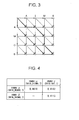
- each migration path along the direction of the arrows from the node at the upper left end of the matrix to the node at the lower right end can be understood as one alignment (one alignment result for two series).
- movement along the arrows towards the right can be understood to be an operation of outputting elements (characters) made to correspond to nodes after movement as elements of alignment results
- movement to the right along the direction of the arrows can be understood to be an operation of outputting gaps as elements of alignment results.
- movement at an incline along the direction of the arrows can be understood as an operation for outputting elements (characters) made to correspond to nodes after movement as elements of alignment results.
- movement downwards along the direction of the arrows can be understood as an operation of outputting gaps as elements of alignment results
- this movement can be understood as an operation of outputting elements (characters) made to correspond to nodes after movement as elements of alignment results.
- the path shown by the dotted line can be understood as showing “-AIMS” and “AMOS-”, while the path shown by the thick lined arrows can be understood as showing “AIM-S” and "A-MOS”.
- equation 1 (a recursive formula for i, j) is used for obtaining an evaluation point (evaluation value) for each path.
- V i, j is an evaluation point (evaluation value) for a path to a node making a first sequence element #i and a second sequence element #j correspond.
- ⁇ is a function which outputs maximum element
- d is an evaluation point for a deficiency of corresponding elements referred to as "gap penalty" or "gap cost”.
- w i, j is an evaluation point relating to identity (similarity) between the first sequence element #i and the second sequence element #j.
- a value (one of two preset values) corresponding to whether or not both elements coincide is used as w i, j when a base sequence is taken as a subject and a value read out from a table storing w values for each combination of two amino acids is used when an amino acid sequence is taken as the subject.
- equation 1 is then carried out for each node by increasing i, j sequentially while obtaining pairwise alignment using dynamic programming techniques.
- the optimum alignment is then obtained by storing which of the paths traced was the most appropriate (a plurality is also possible), and then, after completion of all the calculations, tracing the optimum path back (trace back) in reverse from the lower right end.
- the pairwise alignment employing dynamic programming techniques can therefore be completed at high speed, because carried out is a process in which every calculation of a V value increases paths (those without optimum alignment) for which final evaluation points are not calculated (a process in which, with the max function ⁇ , paths for two of three types of path capable of reaching this node are taken to be paths for which calculation of the final evaluation point is not carried out).
- the identity value calculation unit 23 is for subjecting the HMM to processing by the same theory as for the processing carried out in order to obtain pairwise alignment.
- a matrix comprising (imax + 1) x (jmax + 1) nodes where emission probability vectors for ith M nodes relating to HMM#0 (one of the two HMMs to be subjected to sequence data combining) are made to correspond to emission probability vectors for jth M nodes relating to HMM #1 (the other of the two HMMs to be subjected to sequence data combining) is assumed.
- HMM#0 is one of the two HMMs to be subjected to sequence data combining
- HMM #1 is the other of the two HMMs
- imax is the number of M nodes of the HMM#0
- jmax is the number of M nodes of the HMM#1.
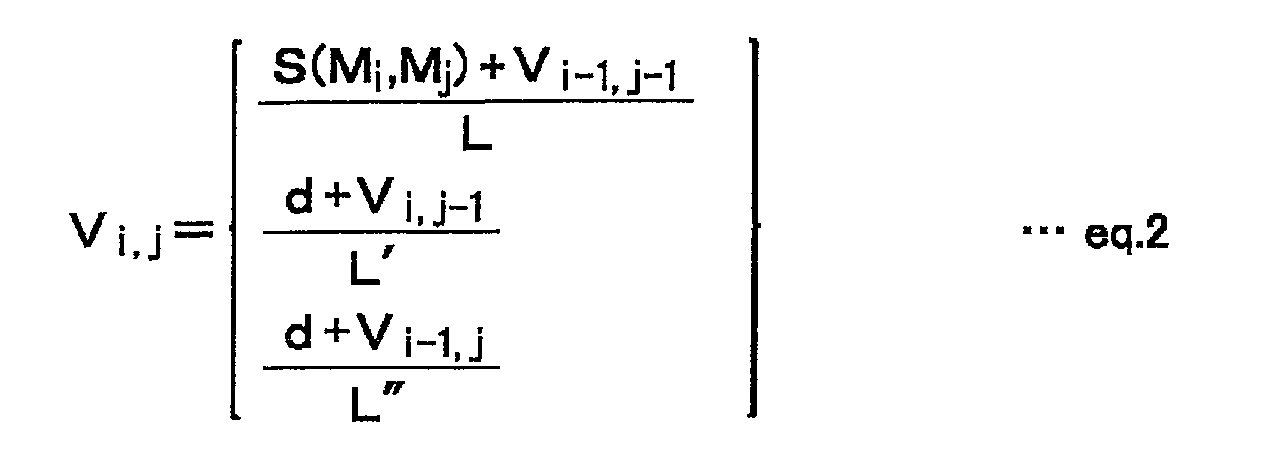
- evaluation values V i, j which are evaluation values for nodes (i, j) of the evaluation matrix, are calculated using equation 2 described in the following.
- d is a so-called gap cost (gap penalty)
- L, L' and L'' are the number of nodes that are passed through to reach node (i, j).
- the introduction of L, L' and L'' is so that an evaluation value for a path with a large number of gaps inserted is a relatively small value.
- M i is an emission probability vector for the ith M node of HMM#0
- M j is an emission probability vector for the jth M node of HMM#1.
- S(M i , M j ) is a function for obtaining an identity constituted by numerical information exhibiting this identity from the emission probability vector M i and the emission probability vector M j . Any function may be employed as S(M i , M j ) providing that a maximum value (for example, "1") is taken when M i and M j are the same, and a minimum value (for example, "0") is taken when M i and M j are completely different (when M i and M j are orthogonal). Namely, as shown in FIG.
- the cosine cos(è) of the angle è between the vectors M i and M j or the cosine squared cos 2 (é) of the angle è can be used as S(M i , Mj), but the identity value calculation unit 23 of this embodiment employs the cosine squared cos2(è) of the angle è as S(M i , M j ).
- the combining unit 24 is a unit for combining pieces of HG information extracted by the identity value calculation unit 23, based on the calculation results of the identity value calculation unit 23.
- the combining unit 24 starts operation when the identity value calculation unit 23 finishes the calculation processing.
- the combining unit 24 tries to specify (select) every couple of HMMs the identity value of which is lower than a predetermined identity threshold value.
- the combining unit 24 has specified one or more couples of HMMs, it starts combining processing for combining the specified couples of HMMs.
- the combining processing executed by the combining unit 24 is described giving an example of the case where the identity values calculated by the identity value calculation unit 23 are those shown in FIG. 4 and the identity threshold value is 0.9.
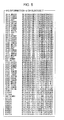
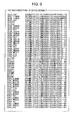
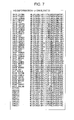
- the HMM- ⁇ , HMM- ⁇ , and HMM- ⁇ in FIG. 4 are HMMs created by the HMM creation unit 22 from HG information- ⁇ (5H1B_MOUSE.7) shown in FIG. 5, HG information- ⁇ (5H1B_DIDMA.7) shown in FIG. 6, and HG information- ⁇ (SH1B_RAT.3) shown in FIG. 7, respectively.
- the HMM- ⁇ and HMM- ⁇ , the HMM- ⁇ and HMM- ⁇ are HMMs having the relationships shown in FIGs 8A-8C, which show the back trace results of the identity calculation processing by the identity value calculation unit 23, respectively.
- FIG. 8A-8C show the back trace results of the identity calculation processing by the identity value calculation unit 23, respectively.
- ”, “ " are portions connected by diagonal, up, and sideways (left), respectively. Further, portions described by each of the symbols “+”, “:” and “-" are non-back traced portions and show portions connected from diagonal, up, sideways (left) (i.e. connected by diagonal, down, right).
- the combining unit 24 extracts from the HG information- ⁇ and the HG information- ⁇ all sequence data but without duplication. The combining unit 24, thereafter, executes multiple alignment processing on the extracted sequence data, thereby creating new HG information as shown in FIG. 9, and stores the created HG information into the auxiliary storage. Further, the combining unit 24 creates a HMM from the created HG information and stores the created HMM into the auxiliary storage and then terminates the processing.
- the sequence data combining apparatus 10 of this embodiment is configured so as to be able to retrieve similar HG information from pieces of HG information, and combine the retrieved two or more pieces of HG information.
- the sequence data combining apparatus 10 is configured so as to create some pieces of new HG information which are more useful for biochemical, genetic etc. research, not by checking the identity of pieces of sequence data, but by combining some pieces of existing HG information.
- the sequence data combining apparatus 10 has the ability to create a HMM of the created HG information. Therefore, if this sequence data combining apparatus 10 is used, it is possible to prepare useful information on gene sequence and the likes for the bio researchers rapidly.
- sequence data combining apparatus 10 is configured so as to calculate V i,j using eq. 2.
- the sequence data combining apparatus 10 is configured so as to calculate the identity value of the two HMMs considering only the emission probabilities assigned to M nodes.
- the sequence data combining apparatus 10 can be modified so as to calculate V i , j using eq. 3 instead of eq. 1.
- Ti is a transition probability vector for the ith M node of HMM#0
- Tj is an emission probability vector for the jth M node of HMM#1.
- S(T i , T j ) is the identity between the two transition probability vectors (S(T i , T j ) is the cosine squared of the angle made by the two vectors).
- the sequence data combining apparatus 10 can be also modified so as to calculate V i,j using equations 4 to 7 instead of eq. 1.
- Tm i , Ti i and Td i are the probability of a transition to an M node, the probability of a transition to an I node, and the probability of a transition to a D node, respectively, with regard to the ith M node of the HMM#0.
- Tmj, Tij and Tdj are the probability of a transition to an M node, the probability of a transition to an I node, and the probability of a transition to a D node, respectively, with regard to the jth M node of the HMM#1.
- I i is an emission probability vector for the ith node of HMM#0
- I j is an emission probability vector for the jth I node of HMM#1.
- sequence data combining apparatus 10 can be configured so that the combining unit 24 operates as follows.
- the standby screen is a screen where frequency distribution information on the identity values and the current threshold value are shown.
- the standby screen is a screen which allows the operator to know how many pieces of HG information will be combined by the current threshold value.
- the combining unit 24 After displaying the standby screen, the combining unit 24 goes into a standby state and waits for input of a change instruction indicating a change of the identity threshold value, an execution instruction indicating to start combining processing and so on.
- the combining unit 24 displays a screen for prompting the operator to input a new identity threshold value, and goes into a state where it waits for input of the new identity threshold value.
- the combining unit 24 stores the inputted identity threshold value. Thereafter, the combining unit 24 displays the standby screen where the inputted identity threshold value is shown on the display device, and goes back into the standby state.
- the combining unit 24 specifies each couple of HMMs whose identity values are higher than the identity threshold value. And, the combining unit 24, when it has specified at least one couple of HMMs, executes the combining processing of combining pieces of HMM information related to the specified one or more couple of HMMs.
- sequence data combining apparatus 10 can be configured so as to operate interactively.
- sequence data combining apparatus 10 is a device where the sequence data combining program is installed on a computer. It is possible to realize the sequence data combining apparatus 10 having an IC that operates as the identity value calculation unit 23 and so on.
- the technology employed in the sequence data combining apparatus 10 may also be applied to probability models other than HMMs.
- a portable record medium (CD-ROM and MO, etc.) containing the sequence data combining program may be distributed (sold) to a person who wants it.
- the method, apparatus and program of the present invention provide fast and efficient data sorting and grouping for large quantities of complex data.
Landscapes
- Engineering & Computer Science (AREA)
- Physics & Mathematics (AREA)
- Life Sciences & Earth Sciences (AREA)
- Medical Informatics (AREA)
- Health & Medical Sciences (AREA)
- Theoretical Computer Science (AREA)
- Data Mining & Analysis (AREA)
- Biophysics (AREA)
- Spectroscopy & Molecular Physics (AREA)
- General Health & Medical Sciences (AREA)
- Evolutionary Biology (AREA)
- Biotechnology (AREA)
- Bioinformatics & Computational Biology (AREA)
- Bioinformatics & Cheminformatics (AREA)
- Computer Vision & Pattern Recognition (AREA)
- Public Health (AREA)
- Artificial Intelligence (AREA)
- Evolutionary Computation (AREA)
- Epidemiology (AREA)
- Databases & Information Systems (AREA)
- Bioethics (AREA)
- Software Systems (AREA)
- Proteomics, Peptides & Aminoacids (AREA)
- Analytical Chemistry (AREA)
- Chemical & Material Sciences (AREA)
- Information Retrieval, Db Structures And Fs Structures Therefor (AREA)
- Management, Administration, Business Operations System, And Electronic Commerce (AREA)
- Complex Calculations (AREA)
Abstract
Description





Claims (11)
- A sequence data combining method for re-classifying two or more pieces of sequence data that are classified into several homology groups, including:a probability model creating step of creating a probability model for each of the homology groups to be processed based on pieces of sequence data in each homology group;an identity value calculating step of calculating, from each combination of two probability models among the probability models created in said probability model creating step, an identity value which is an index of identity between the two probability models; anda homology group creating step of specifying similar homology groups based on the identity values calculated in said identity value calculation step, and of creating a homology group by combining the specified homology groups.
- The sequence data combining method according to claim 1, wherein the probability model created in said probability model creating step is a Hidden Markov Model.
- The sequence data combining method according to claim 1 or 2, wherein the identity value calculating step is a step of calculating the identity value using dynamic programming techniques.
- The sequence data combining method according to claim 1, 2, or 3, wherein the homology group creating step involves creating a probability model for the created homology group.
- A sequence data combining apparatus for re-classifying two or more pieces of sequence data that are classified into several homology groups, including:a probability model creating unit for creating a probability model for each of the homology groups to be processed based on pieces of sequence data in each homology group;an identity value calculating unit for calculating, from each combination of two probability models among the probability models created by said probability model creating unit, an identity value which is an index of identity between the two probability models; anda homology group creating unit for specifying similar homology groups based on the identity values calculated by said identity value calculating unit, and of creating a homology group by combining the specified homology groups.
- The sequence data combining apparatus according to claim 5, wherein the probability model created by said probability model creating unit is a Hidden Markov Model.
- The sequence data combining apparatus according to claim 5 or 6, wherein the identity value calculating unit calculates the identity value using dynamic programming techniques.
- A sequence data combining program for causing a computer to execute a process for re-classifying two or more pieces of sequence data that are classified into several homology groups, said process comprising:a probability model creating step of creating a probability model for each of the homology groups to be processed based on pieces of sequence data in each homology group;an identity value calculating step of calculating, from each combination of two probability models among the probability models created in said probability model creating step, an identity value which is an index of identity between the two probability models; anda homology group creating step of specifying similar homology groups based on the identity values calculated in said identity value calculating step, and of creating a homology group by combining the specified homology groups.
- The sequence data combining program according to claim 8, wherein the probability model created in said probability model creating step is a Hidden Markov Model.
- The sequence data combining program according to claim 8 or 9, wherein the identity value calculated in the identity value calculating step is calculated using dynamic programming techniques.
- An apparatus for re-classifying two or more pieces of data that are classified into several homology groups, including:probability model creating means for creating a probability model for each of the homology groups to be processed based on pieces of data in each homology group;identity value calculating means for calculating, from each combination of two probability models among the probability models created by said probability model creating means, an identity value which is an index of identity between the two probability models; andhomology group creating means for specifying similar homology groups based on the identity values calculated by said identity value calculating means, and for creating a homology group by combining the specified homology groups.
Applications Claiming Priority (2)
| Application Number | Priority Date | Filing Date | Title |
|---|---|---|---|
| JP2002059973 | 2002-03-06 | ||
| JP2002059973A JP2003256435A (en) | 2002-03-06 | 2002-03-06 | Sequence data integration processing method, sequence data integration processing device, and sequence data integration processing program |
Publications (2)
| Publication Number | Publication Date |
|---|---|
| EP1351183A2 true EP1351183A2 (en) | 2003-10-08 |
| EP1351183A3 EP1351183A3 (en) | 2004-03-31 |
Family
ID=28034826
Family Applications (1)
| Application Number | Title | Priority Date | Filing Date |
|---|---|---|---|
| EP03251311A Withdrawn EP1351183A3 (en) | 2002-03-06 | 2003-03-05 | Sequence data combining method, apparatus and program |
Country Status (4)
| Country | Link |
|---|---|
| US (1) | US20030171902A1 (en) |
| EP (1) | EP1351183A3 (en) |
| JP (1) | JP2003256435A (en) |
| AU (1) | AU2003200409A1 (en) |
Cited By (8)
| Publication number | Priority date | Publication date | Assignee | Title |
|---|---|---|---|---|
| CN105893332A (en) * | 2016-03-25 | 2016-08-24 | 合肥工业大学 | Calculation method suitable for transfer rate matrix of composite state spatial model |
| US9593370B2 (en) | 2010-10-01 | 2017-03-14 | Oxford Nanopore Technologies Ltd. | Biochemical analysis apparatus and rotary valve |
| US10054234B2 (en) | 2011-07-13 | 2018-08-21 | Oxford Nanopore Technologies Limited | One-way valve |
| US10131943B2 (en) | 2012-12-19 | 2018-11-20 | Oxford Nanopore Technologies Ltd. | Analysis of a polynucleotide via a nanopore system |
| US10675412B2 (en) | 2011-09-15 | 2020-06-09 | Oxford Nanopore Technologies Limited | Piston seal |
| US10689697B2 (en) | 2014-10-16 | 2020-06-23 | Oxford Nanopore Technologies Ltd. | Analysis of a polymer |
| US11921103B2 (en) | 2011-09-23 | 2024-03-05 | Oxford Nanopore Technologies Plc | Method of operating a measurement system to analyze a polymer |
| US11959906B2 (en) | 2012-02-16 | 2024-04-16 | Oxford Nanopore Technologies Plc | Analysis of measurements of a polymer |
Families Citing this family (1)
| Publication number | Priority date | Publication date | Assignee | Title |
|---|---|---|---|---|
| CN109617123B (en) * | 2018-12-29 | 2022-02-11 | 合肥工业大学 | Reliability Sensitivity Analysis Method of Wind-Fire System Based on State Space Combination and Clustering Simplification |
Family Cites Families (2)
| Publication number | Priority date | Publication date | Assignee | Title |
|---|---|---|---|---|
| US6128587A (en) * | 1997-01-14 | 2000-10-03 | The Regents Of The University Of California | Method and apparatus using Bayesian subfamily identification for sequence analysis |
| US7133780B2 (en) * | 2001-04-19 | 2006-11-07 | Affymetrix, Inc. | Computer software for automated annotation of biological sequences |
-
2002
- 2002-03-06 JP JP2002059973A patent/JP2003256435A/en not_active Withdrawn
-
2003
- 2003-01-29 US US10/353,000 patent/US20030171902A1/en not_active Abandoned
- 2003-01-30 AU AU2003200409A patent/AU2003200409A1/en not_active Abandoned
- 2003-03-05 EP EP03251311A patent/EP1351183A3/en not_active Withdrawn
Cited By (17)
| Publication number | Priority date | Publication date | Assignee | Title |
|---|---|---|---|---|
| US9593370B2 (en) | 2010-10-01 | 2017-03-14 | Oxford Nanopore Technologies Ltd. | Biochemical analysis apparatus and rotary valve |
| US10036065B2 (en) | 2010-10-01 | 2018-07-31 | Oxford Nanopore Technologies Limited | Biochemical analysis apparatus and rotary valve |
| US10054234B2 (en) | 2011-07-13 | 2018-08-21 | Oxford Nanopore Technologies Limited | One-way valve |
| US10675412B2 (en) | 2011-09-15 | 2020-06-09 | Oxford Nanopore Technologies Limited | Piston seal |
| US12216110B2 (en) | 2011-09-23 | 2025-02-04 | Oxford Nanopore Technologies Plc | Method and system of estimating a sequence of polymer units |
| US11921103B2 (en) | 2011-09-23 | 2024-03-05 | Oxford Nanopore Technologies Plc | Method of operating a measurement system to analyze a polymer |
| US11959906B2 (en) | 2012-02-16 | 2024-04-16 | Oxford Nanopore Technologies Plc | Analysis of measurements of a polymer |
| US10131943B2 (en) | 2012-12-19 | 2018-11-20 | Oxford Nanopore Technologies Ltd. | Analysis of a polynucleotide via a nanopore system |
| US11085077B2 (en) | 2012-12-19 | 2021-08-10 | Oxford Nanopore Technologies Ltd. | Analysis of a polynucleotide via a nanopore system |
| US12351867B2 (en) | 2012-12-19 | 2025-07-08 | Oxford Nanopore Technologies Plc | Analysis of a polynucleotide via a nanopore system |
| US12486534B2 (en) | 2012-12-19 | 2025-12-02 | Oxford Nanopore Technologies Plc | Analysis of a polynucleotide via a nanopore system |
| US10689697B2 (en) | 2014-10-16 | 2020-06-23 | Oxford Nanopore Technologies Ltd. | Analysis of a polymer |
| US11401549B2 (en) | 2014-10-16 | 2022-08-02 | Oxford Nanopore Technologies Plc | Analysis of a polymer |
| US12545956B2 (en) | 2014-10-16 | 2026-02-10 | Oxford Nanopore Technologies Plc | Analysis of a polymer |
| US12545955B2 (en) | 2014-10-16 | 2026-02-10 | Oxford Nanopore Technologies Plc | Analysis of a polymer |
| CN105893332B (en) * | 2016-03-25 | 2018-07-03 | 合肥工业大学 | A kind of computational methods suitable for assembled state spatial model transfer rate matrix |
| CN105893332A (en) * | 2016-03-25 | 2016-08-24 | 合肥工业大学 | Calculation method suitable for transfer rate matrix of composite state spatial model |
Also Published As
| Publication number | Publication date |
|---|---|
| AU2003200409A1 (en) | 2003-09-25 |
| EP1351183A3 (en) | 2004-03-31 |
| US20030171902A1 (en) | 2003-09-11 |
| JP2003256435A (en) | 2003-09-12 |
Similar Documents
| Publication | Publication Date | Title |
|---|---|---|
| Marian et al. | Assembly sequence planning and optimisation using genetic algorithms: part I. Automatic generation of feasible assembly sequences | |
| US6466923B1 (en) | Method and apparatus for biomathematical pattern recognition | |
| CN111860981B (en) | Enterprise national industry category prediction method and system based on LSTM deep learning | |
| EP0439743B1 (en) | Constraint driven on-line recognition of handwritten characters and symbols | |
| Yu et al. | Using Bayesian network inference algorithms to recover molecular genetic regulatory networks | |
| JP4382526B2 (en) | Sentence classification apparatus and method | |
| WO2002027532A1 (en) | System and method for use in text analysis of documents and records | |
| US6973446B2 (en) | Knowledge finding method | |
| EP1351183A2 (en) | Sequence data combining method, apparatus and program | |
| CN118051442B (en) | Test case multiplexing method and system based on spectral clustering | |
| US6571013B1 (en) | Automatic method for developing custom ICR engines | |
| US7085651B2 (en) | Method and device for assembling nucleic acid base sequences | |
| EP2348403B1 (en) | Method and system for analyzing a legacy system based on trails through the legacy system | |
| US6370479B1 (en) | Method and apparatus for extracting and evaluating mutually similar portions in one-dimensional sequences in molecules and/or three-dimensional structures of molecules | |
| CN119293342B (en) | An intelligent technology dynamic tracking system for scientific fields | |
| Oh et al. | Mining protein data from two‐dimensional gels: Tools for systematic post‐planned analyses | |
| EP1298534A2 (en) | Method and apparatus for Similarity evaluation | |
| JP4234841B2 (en) | Data analyzer | |
| CN114996062B (en) | Chip layout level hidden hardware Trojan test set generation method | |
| Ficarra et al. | Automatic intrinsic DNA curvature computation from AFM images | |
| JP4247026B2 (en) | Keyword frequency calculation method and program for executing the same | |
| JP3925011B2 (en) | Pattern recognition apparatus and recognition method | |
| JP4177997B2 (en) | Database search apparatus, database search method, computer program, and computer-readable recording medium | |
| JPH10232874A (en) | Information processing know-how sharing method | |
| JP2940470B2 (en) | Structure analysis method and structure analysis device |
Legal Events
| Date | Code | Title | Description |
|---|---|---|---|
| PUAI | Public reference made under article 153(3) epc to a published international application that has entered the european phase |
Free format text: ORIGINAL CODE: 0009012 |
|
| AK | Designated contracting states |
Kind code of ref document: A2 Designated state(s): AT BE BG CH CY CZ DE DK EE ES FI FR GB GR HU IE IT LI LU MC NL PT RO SE SI SK TR |
|
| AX | Request for extension of the european patent |
Extension state: AL LT LV MK |
|
| PUAL | Search report despatched |
Free format text: ORIGINAL CODE: 0009013 |
|
| AK | Designated contracting states |
Kind code of ref document: A3 Designated state(s): AT BE BG CH CY CZ DE DK EE ES FI FR GB GR HU IE IT LI LU MC NL PT RO SE SI SK TR |
|
| AX | Request for extension of the european patent |
Extension state: AL LT LV MK |
|
| AKX | Designation fees paid | ||
| REG | Reference to a national code |
Ref country code: DE Ref legal event code: 8566 |
|
| STAA | Information on the status of an ep patent application or granted ep patent |
Free format text: STATUS: THE APPLICATION IS DEEMED TO BE WITHDRAWN |
|
| 18D | Application deemed to be withdrawn |
Effective date: 20041001 |