EP1351035A2 - Paint film thickness predicting method and system for actual car with recording medium - Google Patents
Paint film thickness predicting method and system for actual car with recording medium Download PDFInfo
- Publication number
- EP1351035A2 EP1351035A2 EP03006134A EP03006134A EP1351035A2 EP 1351035 A2 EP1351035 A2 EP 1351035A2 EP 03006134 A EP03006134 A EP 03006134A EP 03006134 A EP03006134 A EP 03006134A EP 1351035 A2 EP1351035 A2 EP 1351035A2
- Authority
- EP
- European Patent Office
- Prior art keywords
- film thickness
- car
- paint film
- electrodeposition coating
- predicting
- Prior art date
- Legal status (The legal status is an assumption and is not a legal conclusion. Google has not performed a legal analysis and makes no representation as to the accuracy of the status listed.)
- Granted
Links
Images



Classifications
-
- C—CHEMISTRY; METALLURGY
- C25—ELECTROLYTIC OR ELECTROPHORETIC PROCESSES; APPARATUS THEREFOR
- C25D—PROCESSES FOR THE ELECTROLYTIC OR ELECTROPHORETIC PRODUCTION OF COATINGS; ELECTROFORMING; APPARATUS THEREFOR
- C25D13/00—Electrophoretic coating characterised by the process
- C25D13/22—Servicing or operating apparatus or multistep processes
-
- C—CHEMISTRY; METALLURGY
- C25—ELECTROLYTIC OR ELECTROPHORETIC PROCESSES; APPARATUS THEREFOR
- C25D—PROCESSES FOR THE ELECTROLYTIC OR ELECTROPHORETIC PRODUCTION OF COATINGS; ELECTROFORMING; APPARATUS THEREFOR
- C25D21/00—Processes for servicing or operating cells for electrolytic coating
- C25D21/12—Process control or regulation
Definitions
- the present invention relates to an approach of predicting a paint film thickness of an actual car, which is formed by the electrodeposition coating, without the execution of electrodeposition coating analysis on the vehicle model base, particularly to make it possible to predict a paint film thickness of an actual car without the execution of electrodeposition coating analysis on the vehicle model base, and to make it possible to calculate effectively a paint film thickness of an actual car by achieving reduction in an amount of operation required for the prediction of the paint film thickness of the actual car.
- the electrodeposition coating is such a coating method that utilizes the electrophoresis phenomenon of the polyelectrolyte, the electrodialysis phenomenon, etc. Since this coating can cause the paint film to adhere uniformly to surface of the coated object and is excellent in the anticorrosion property, such coating is used widely as the undercoating of various members such as the vehicle body, parts . From viewpoints of rust preventing measure, reduction in the paint consumption, lighter weight of the members, etc., it is an important design subject to suppress a paint film thickness, which has adhered to the surface of the member by the electrodeposition coating, within a predetermined range. Therefore, it becomes important to analyze and study the paint film separation state by electrodeposition coating analysis. In the prior art, the paint film thickness of the actual car is predicted/ evaluated by executing the electrodeposition coating analysis while using the vehicle model whose vehicle shape is expressed by meshes.
- the electrodeposition coating analysis is to be executed on the vehicle model base, first the analyzing mesh that expresses shapes of individual members in the vehicle by the meshes must be generated.
- vehicle meshes of the overall actual car containing all members are generated by superposing/extending the member meshes, which express shapes of individual members in the vehicle by the meshes, to the overall vehicle.
- the member meshes are overlapped with each other on the overall vehicle, the number of meshes in complicated vehicle meshes is increased enormously.
- an amount of computation required for the electrodeposition coating analysis of the overall vehicle becomes enormous. Therefore, in order to execute the mesh generation and analysis effectively, the high processing ability is required of the computer.
- the processing abilities of the personal computers that are spread normally have their limitation it takes much time to generate the analyzing meshes of the vehicle model or to predict an amount of paint film on the vehicle base.
- the present invention has been made in light of such circumstances and it is an object of the present invention to make it possible to predict a paint film thickness of an actual car without the execution of electrodeposition coating analysis on the vehicle model base.
- a first aspect of the present invention provides a paint film thickness predicting method for an actual car, which predicts a paint film thickness of an object car in an actual car state, an electrodeposition coating being applied to the object car by using an electrodeposition coating line, having a calculating an analyzed value of the paint film thickness of a constituent member constituting a part of the object car by executing electrodeposition coating analysis by using a computer, the constituent member being employed as an analyzed object in the electrodeposition coating analysis, and a predicting the paint film thickness of the object car in the actual car state from the analyzed value of the paint film thickness by the computer based on a previously-prepared correlation predicting expression, wherein the correlation predicting expression stipulates a correlation between the paint film thickness of a mass-produced car, to which the electrodeposition coating has already been applied in an electrodeposition coating line by which the electrodeposition coating is applied to the object car, in the actual car state and an analyzed value of the paint film thickness of the constituent member, which is obtained by the electrodeposition coating analysis that is applied to the
- a function using at least the analyzed value of the paint film thickness of the constituent member as an input variable may be employed as the correlation predicting expression.
- a neural network using at least the analyzed value of the paint film thickness of the constituent member as an input variable may be employed as the correlation predicting expression.
- the predicting further comprises an executing correction of the paint film thickness of the object car, which was calculated based on the correlation predicting expression, in the actual car state under consideration of electrodeposition equipment conditions or electrodeposition solution characteristics.
- the executing correction is executed by using a neural network that employs at least the electrodeposition equipment conditions or the electrodeposition solution characteristics as the input variable.
- the calculating includes, a generating analysis meshes of the constituent member, and an applying a process preventing an electrodeposition solution from entering from an outside to the analysis meshes.
- a second aspect of the present invention provides a paint film thickness predicting system for an actual car, which predicts a paint film thickness of an object car in an actual car state, an electrodeposition coating being applied to the object car by using an electrodeposition coating line, having a memory device for storing a correlation predicting expression that stipulates a correlation between the paint film thickness of a mass-produced car, to which the electrodeposition coating has already been applied in an electrodeposition coating line by which the electrodeposition coating is applied to the object car, in the actual car state and an analyzed value of the paint film thickness of the constituent member, which is obtained by electrodeposition coating analysis that is applied to the constituent member constituting a part of the mass-produced car as the analyzed object, and a computer for calculating an analyzed value of the paint film thickness of a constituent member constituting a part of the object car by executing the electrodeposition coating analysis, in which the constituent member is employed as an analyzed object, and then predicting the paint film thickness of the object car in the actual car state from the analyzed value of the paint film thickness based on the
- a third aspect of the present invention provides a recording medium for recording a program that causes a computer to execute a paint film thickness predicting method for an actual car, which predicts a paint film thickness of an object car in an actual car state, an electrodeposition coating being applied by using an electrodeposition coating line, the paint film thickness predicting method for an actual car, having a calculating an analyzed value of the paint film thickness of a constituent member constituting a part of the object car by executing electrodeposition coating analysis by using the computer, the constituent member being employed as an analyzed object in the electrodeposition coating analysis, and a predicting the paint film thickness of the object car in the actual car state from the analyzed value of the paint film thickness by the computer based on a previously-prepared correlation predicting expression, wherein the correlation predicting expression stipulates a correlation between the paint film thickness of a mass-produced car, to which the electrodeposition coating has already been applied in an electrodeposition coating line by which the electrodeposition coating is applied to the object car, in the actual car state and an analyzed value of the paint film thickness of the constituent
- FIG.1 is a configurative view showing a paint film thickness predicting system for an actual car according to the present embodiment.
- the paint film thickness for the actual car, to which the electrodeposition coating is applied by using the electrodeposition coating line, is predicted in the actual car state by using this system.
- This system comprises a computer 10, an input device 11 such as a key board, a mouse, or the like, a display device 12 such as CRT, a liquid crystal display, or the like, and a memory device 13 such as a magnetic disk, or the like.
- the computer 10 is the well-known one consisting of CPU, RAM, ROM, input/output interface, etc.
- This computer 10 executes the electrodeposition coating analysis of a constituent member (single body of the member or assembled body of plural members) constituting a part of the actual car as the analyzed object (object car) and predicts the paint film thickness at the actual car level on the electrodeposition coating line of this object car based on the analyzed result (analyzed value of the paint film thickness).
- the operator executes the designation of the constituent member serving as the analyzed object, the input of numerical values, etc. by operating the input device 11 based on the information displayed on the display device 12.
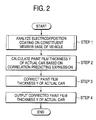
- FIG.2 is a flowchart showing procedures of predicting the paint film thickness of the actual car.
- the electrodeposition coating analysis is applied to a certain constituent member of the object car (single body of the member or assembled body of plural members) as the analyzed object on the constituent member base of the vehicle using the standard paints.
- a paint film thickness X of the constituent member is calculated.
- FIG.3 is a flowchart showing an example of the electrodeposition coating analysis on the constituent element base. Since these analyzing procedures themselves are well known, they will be explained schematically hereunder .
- step 11 initialization is executed.
- the analyzing mesh of the objective portion e.g., front pillar, a center pillar, or the like
- boundary conditions and computation conditions are set.
- the end-face correction that corresponds to the packing, the lid, or the like in computation is applied to the cut-out constituent member as the analyzed object (test piece) before the analysis is executed on the constituent element base. Since the process of preventing the entering of the electrodeposition solution from the outside is applied, improvement of the analysis precision can be achieved.
- step 12 a time step in computation is advanced by ⁇ t. Then, in step 13, potential boundary conditions such as an electrode voltage, etc. at a current time t are updated. Then, a potential distribution in an electrodeposition solution bath is calculated by solving the potential diffusion equation according to finite volume method, finite element method, finite difference method, or the like (step 14). Then, while taking account of the film thickness resistance of the paint that is adsorbed onto the surface of the member, a current density on a surface of the member is calculated based on the resultant potential distribution (step 15).
- a deposition amount ⁇ X of the paint film on the surface of the member is calculated based on the current density according to the prediction expression between the current density and the paint film thickness, which has been previously checked by the basic experiment, or the like (step 16).
- the paint film thickness X is updated by adding the deposition amount ⁇ X, which is calculated at this time, to the preceding paint film thickness X (paint film thickness before one time step) (this thickness corresponds to the paint film thickness at a current time t).
- the current time t and the analysis end time t END are compared with each other to decide whether or not the analysis is ended.
- step 12 If the current time t does not come up to the analysis end time t END , the process goes back to step 12 and then procedures in steps 12 to 18 are executed repeatedly until the current time t reaches the analysis end time t END .
- the process goes from step 18 to step 19 where the paint film thickness X is output.
- the electrodeposition coating analysis is ended.
- a paint film thickness Y in the actual car state of the object car is calculated from the paint film thickness X, which is calculated by the electrodeposition coating analysis on the constituent element base, based on the correlation predicting expression that is set in advance in the memory device 13.
- the constituent element base signifies that not the overall object car but one constituent member constituting a part of the object car is set as the analyzed object.
- this correlation predicting expression defines the correlation between the paint film thickness of the "mass-produced car” in the actual car state and the analyzed value of the paint film thickness of the constituent member constituting a part of the "mass-produced car".
- the "mass-produced car” means the car electrodeposition coating of which has already been executed in the electrodeposition coating line that is going to apply the electrodeposition coating to the object car.
- the preceding car or the resemble car may be listed as the "mass-produced car”.
- the mass-produced car means not the actual car itself whose paint film state is to be predicted at this time but the car electrodeposition coating of which has already been executed in the same electrodeposition coating line.
- the analyzed value of the paint film thickness of the constituent member of the mass-produced car can be obtained by applying the electrodeposition coating analysis to this constituent member as the analyzed object. In this case, it is preferable that, in order to achieve the improvement of the prediction precision, the constituent member of the mass-produced car should be set to the same member as that of the object car.
- the correlation predicting expression is set by one of approaches 1 and 2 described in the following.
- a multiple correlation function f (X, L, A, H, 7) given by a following expression is employed as the correlation predicting expression (X, L, A, H are input variables, and C0 to C4 are coefficients).
- Y C 0+ C 1 ⁇ X + C 2 ⁇ L + C 3 ⁇ A + C 4 ⁇ H +.
- variable Y is the paint film thickness (deposition amount of the paint film) of the mass-produced car in the actual car state
- variable X is the deposition amount of the paint film of the constituent member constituting a part of the mass-produced car (paint film thickness obtained by the electrodeposition coating analysis on the constituent member base).
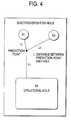
- the variable L is a distance between a prediction point and a hole (electrodeposition hole or structural hole)
- variable A is a hole area as the object of the variable L
- variable H is an inter-member distance.
- a distance H between two mutually-opposed members A, B is identified as a distance from the prediction point on the member B side to the member A.
- variable X is an indispensable input variable.
- all the variables L, A, H are not always needed as the input variables, and may be applied appropriately selectively in connection with the prediction precision.
- the paint film thickness Y (deposition amount of the paint film) in the actual car state is calculated uniquely based on the correlation predicting expression in which the paint film thickness X of the constituent member, which is calculated by the electrodeposition coating analysis on the constituent member base, is used as the indispensable input variable.
- the paint film thickness Y of the actual car becomes thicker as the paint film thickness X of the constituent member becomes thicker, there is the clear correlation between both variables X, Y.
- the paint film thickness Y of the actual car on the electrodeposition coating line of the actual car (the paint film thickness in the actual car state) can be predicted from the paint film thickness X on the constituent member base.
- a table that describes the correlation the input variables X1 to X4 and the deposition amount Y of the paint film may be employed in place of the multiple correlation function f in Expression 1. Also, a plurality of multiple correlation functions f are prepared previously, and then the appropriate one may be applied selectively in response to individual electrodeposition coating case.
- FIG.6 is a view showing a basic configuration of the normal neural network.
- the hierarchical neural network that consists of the input layer, the intermediate layers, and the output layer, respective layers are composed of a plurality of elements having the same function. Respective elements are coupled by proper weight coefficients wij.
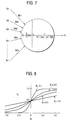
- FIG.7 is an explanatory view showing an inner configuration of the element.
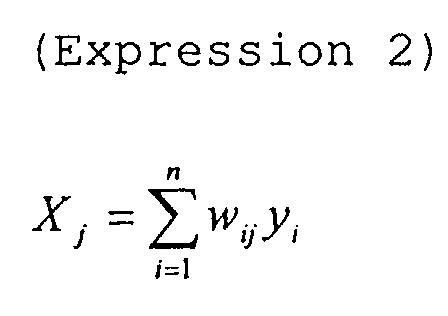
- Each element executes calculations shown in Expressions 2, 3 with respect to input data yi and then calculated results are output as output data Yj.
- wij is the weight coefficient between the i-th element and the j-th element
- ⁇ j is a threshold value. (Expression 3)
- Y j 1 1 + exp[-( X j - ⁇ j )]
- Expression 3 is called the sigmoid function and is employed commonly as the function of the neural network element.
- FIG.8 is a view showing an input/output characteristic diagram of the sigmoid function. As can be seen from this characteristic diagram, the sigmoid function changes continuously from 0 to 1 and comes closer to the step function as the threshold value ⁇ j is reduced smaller.
- the weight coefficient wij and the threshold value ⁇ j must be adjusted appropriately.
- This adjustment (called also the "learning") is carried out by the approach that is called the Back-Propagation method.
- This method prepares the teacher's data previously, then proceeds the learning such that the result coincides with the teacher' s data, and then decides the weight coefficient wij and the threshold value ⁇ j. Both initial values of the weight coefficient wij and the threshold value ⁇ j are given by the random number.
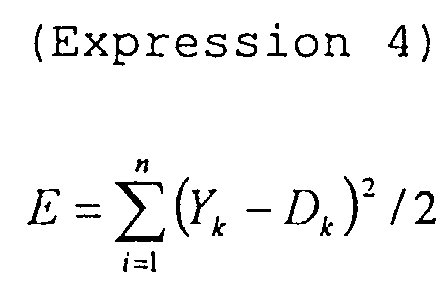
- the input data are input into the input layer element of the neural network, and then an error E expressed by following Expression 4 is calculated by comparing the output result from the output layer element with the value of the teacher's data.
- Yk is the output value of the output element of the neural network
- Dk is a desired output value
- n is the number of the teacher's data.
- ⁇ wij(t) is an amount of correction of the weight coefficient prior to the leaning
- ⁇ j(t) is an amount of correction of the threshold value prior to one leaning step.
- the leaning is carried forward by repeating the correction of the weight coefficients wij and the threshold values ⁇ j.
- the number of times of the learning is set to more than 500 per one teacher's data.
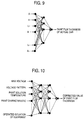
- FIG.9 is a configurative view showing a neural network for predicting the paint film thickness for the actual car. Like three-layered model shown in FIG.9, the number of elements in the input layer of more than 2 is needed.
- the distance L between the prediction point and the hole (electrodeposition hole or structural hole), the hole area A as the object of L, the inter-member distance H, etc. are set in addition to the paint film thickness X as the analyzed result on the constituent member base.
- all the distance L, the hole area A, and the inter-member distance H are not always input, and appropriate variables may be applied as the case may be.
- the appropriate number is set after it is checked how the estimating precision is changed when the number of elements in the intermediate layer is changed.
- the output from the element in the output layer corresponds to the paint film thickness Y at the actual car level (deposition amount of the paint film).
- the paint film thickness Y of the actual car is calculated by using the neural network, which uses the paint film thickness X of the constituent member calculated by the electrodeposition coating analysis in step 1 as the indispensable input and also uses the distance L, the hole area A, and the inter-member distance H as inputs appropriately. Since the neural network that is suitable for the prediction of the nonlinear phenomenon is employed, the prediction precision of the paint film thickness Y of the actual car can be improved rather than the case where the multiple correlation function f in the approach 1 is employed.
- step 3 the paint film thickness Y of the actual car obtained in step 2 is corrected as the case may be.
- the corrected value is calculated based on the multi- dimensional function, the neural network, or the like, which takes account of differences in voltage pattern, paint characteristic, etc., and then the paint film thickness is corrected by using this corrected value.
- FIG.10 is a configurative view showing the neural network for calculating the corrected value.
- electrodeposition equipment conditions such as maximum voltage (max voltage) of the electrodeposition coating, voltage pattern, operated situation of the equipment, etc.
- electrodeposition solution conditions such as paint solution temperature, paint characteristic, etc.
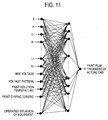
- the neural network is used as the correlation predicting expression and also the neural network for the corrected value is used, a configuration of a unified neural network shown in FIG.11 may be employed.
- the input is of the mode in which the electrodeposition equipment conditions and the paint characteristic are added to the paint film thickness X of the constituent member, the inter- member distance H, the distance L, and the hole area A. If such configuration is employed, the paint film thickness Y of the actual car with high prediction precision can be detected at a time and the correcting process in step 3 can be omitted.
- step 4 the paint film thickness Y of the actual car corrected in step 4 subsequent to step 3 is output. Thus, the process is ended.
- the paint film thickness X at the constituent member level is calculated by executing the electrodeposition coating analysis of the objective constituent member while using the analysis mesh of this constituent member.
- the paint film thickness X at the constituent member level and the paint film thickness Y at the vehicle level have the correlation. Therefore, if the relationship between both thicknesses is detected in advance as the correlation predicting expression through the experiment, the simulation, etc., the paint film thickness Y of the actual car on the actual electrodeposition coating line can be predicted effectively without execution of the electrodeposition coating analysis on the vehicle model base.
- the correlation predicting expression is set to the mass- produced car, which is coated by the electrodeposition coating on the same electrodeposition coating line, prior to the object car as the analyzed object.
- This correlation predicting expression is satisfactorily reflective of the characteristics peculiar to the objective electrodeposition coating line (e.g., flow of the paint, position of the electrodes, etc.).
- the paint film thickness Y in the actual car state of the object car can be predicted satisfactorily.
- the constituent member of the object car is set identically to the constituent member of the mass-produced car, the prediction precision of the paint film thickness can be improved much more.
- the input variable X of the correlation predicting expression is calculated by the electrodeposition coating analysis that employs the constituent member of the object car as the analyzed object. This input variable X reflects the structural difference between the object car and the mass-produced car. Therefore, the paint film thickness in the actual car state of the object car can be detected with good precision by the correlation predicting expression that is identified based on accumulated data of different car type.
- the recording medium for recording a computer program to implement functions of the above embodiment may be supplied to the system having the configuration in FIG.1.
- the object of the present invention can be achieved when the computer 1 in this system reads and executes the computer program stored in the recording medium. Therefore, since the computer program itself, which is read from the recordingmedium, can implement new functions of the present invention, the recording medium for recording the computer program constitutes the present invention.
- the recording medium for recording the computer program there maybe listed CD-ROM, flexible disk, hard disk, memory card, optical disk, DVD-ROM, DVD-RAM, etc., for example.
- the computer program itself, which can implement the functions of the above embodiment has the new function.
- the paint film thickness of the actual car can be calculated uniquely based on results of the electrodeposition coating analysis of the objective constituent member. Therefore, not only the generation of the analysis mesh of the vehicle model but also the execution of the electrodeposition coating analysis on the vehicle model base is not needed. As a result, the paint film thickness of the actual car can be predicted effectively by a small amount of computation.
Landscapes
- Chemical & Material Sciences (AREA)
- Engineering & Computer Science (AREA)
- Chemical Kinetics & Catalysis (AREA)
- Electrochemistry (AREA)
- Materials Engineering (AREA)
- Metallurgy (AREA)
- Organic Chemistry (AREA)
- Automation & Control Theory (AREA)
- Application Of Or Painting With Fluid Materials (AREA)
- Length Measuring Devices With Unspecified Measuring Means (AREA)
Abstract
Description
a generating analysis meshes of the constituent member, and an applying a process preventing an electrodeposition solution from entering from an outside to the analysis meshes.
Claims (9)
- A paint film thickness predicting method for an actual car, which predicts a paint film thickness of an object car in an actual car state, an electrodeposition coating being applied to the object car by using an electrodeposition coating line, comprising:wherein the correlation predicting expression stipulates a correlation between the paint filmthickness of a mass-produced car, to which the electrodeposition coating has already been applied in an electrodeposition coating line by which the electrodeposition coating is applied to the object car, in the actual car state and an analyzed value of the paint film thickness of the constituent member, which is obtained by the electrodeposition coating analysis that is applied to the constituent member constituting a part of the mass-produced car as the analyzed object.a calculating an analyzed value of the paint film thickness of a constituent member constituting a part of the object car by executing electrodeposition coating analysis by using a computer, the constituent member being employed as an analyzed object in the electrodeposition coating analysis; anda predicting the paint film thickness of the object car in the actual car state from the analyzed value of the paint film thickness by the computer based on a previously-prepared correlation predicting expression;
- The paint film thickness predicting method for the actual car, according to claim 1, wherein the constituent member constituting a part of the mass-produced car is same as the constituent member constituting a part of the object car.
- The paint film thickness predicting method for the actual car, according to claim 1 or 2, wherein, in the predicting, a function using at least the analyzed value of the paint film thickness of the constituent member as an input variable is employed as the correlation predicting expression.
- The paint film thickness predicting method for the actual car, according to claim 1 or 2, wherein, in the predicting, a neural network using at least the analyzed value of the paint film thickness of the constituent member as an input variable is employed as the correlation predicting expression.
- The paint film thickness predicting method for the actual car, according to any one of claims 1 to 4, wherein the predicting further comprises an executing correction of the paint film thickness of the object car, which was calculated based on the correlation predicting expression, in the actual car state under consideration of electrodeposition equipment conditions or electrodeposition solution characteristics.
- The paint film thickness predicting method for the actual car, according to claim 5, wherein the executing correction is executed by using a neural network that employs at least the electrodeposition equipment conditions or the electrodeposition solution characteristics as the input variable.
- The paint film thickness predicting method for the actual car, according to any one of claims 1 to 6, wherein the calculating includes,a generating analysis meshes of the constituent member, andan applying a process preventing an electrodeposition solution from entering from an outside to the analysis meshes.
- Apaint film thickness predicting system for an actual car, which predicts a paint film thickness of an object car in an actual car state, an electrodeposition coating being applied to the object car by using an electrodeposition coating line, comprising:a memory device for storing a correlation predicting expression that stipulates a correlation between the paint film thickness of a mass-produced car, to which the electrodeposition coating has already been applied in an electrodeposition coating line by which the electrodeposition coating is applied to the object car, in the actual car state and an analyzed value of the paint film thickness of the constituent member, which is obtained by electrodeposition coating analysis that is applied to the constituent member constituting a part of the mass-produced car as the analyzed object; anda computer for calculating an analyzed value of the paint film thickness of a constituent member constituting a part of the object car by executing the electrodeposition coating analysis, in which the constituent member is employed as an analyzed object, and then predicting the paint film thickness of the object car in the actual car state from the analyzed value of the paint film thickness based on the correlation predicting expression.
- A recording medium for recording a program that causes a computer to execute a paint film thickness predicting method for an actual car, which predicts a paint film thickness of an object car in an actual car state, an electrodeposition coating being applied by using an electrodeposition coating line, the paint film thickness predicting method for an actual car, comprising:wherein the correlation predicting expression stipulates a correlation between the paint film thickness of a mass-produced car, to which the electrodeposition coating has already been applied in an electrodeposition coating line by which the electrodeposition coating is applied to the object car, in the actual car state and an analyzed value of the paint film thickness of the constituent member, which is obtained by the electrodeposition coating analysis that is applied to the constituent member constituting a part of the mass-produced car as the analyzed object.a calculating an analyzed value of the paint film thickness of a constituent member constituting a part of the object car by executing electrodeposition coating analysis by using the computer, the constituent member being employed as an analyzed object in the electrodeposition coating analysis; anda predicting the paint film thickness of the object car in the actual car state from the analyzed value of the paint film thickness by the computer based on a previously-prepared correlation predicting expression;
Applications Claiming Priority (2)
| Application Number | Priority Date | Filing Date | Title |
|---|---|---|---|
| JP2002078283A JP4220169B2 (en) | 2002-03-20 | 2002-03-20 | Actual vehicle coating thickness prediction method, actual vehicle coating thickness prediction system, and recording medium |
| JP2002078283 | 2002-03-20 |
Publications (3)
| Publication Number | Publication Date |
|---|---|
| EP1351035A2 true EP1351035A2 (en) | 2003-10-08 |
| EP1351035A3 EP1351035A3 (en) | 2011-05-18 |
| EP1351035B1 EP1351035B1 (en) | 2018-07-25 |
Family
ID=28035568
Family Applications (1)
| Application Number | Title | Priority Date | Filing Date |
|---|---|---|---|
| EP03006134.5A Expired - Lifetime EP1351035B1 (en) | 2002-03-20 | 2003-03-18 | Paint film thickness predicting method, system, and recording medium |
Country Status (3)
| Country | Link |
|---|---|
| US (1) | US6816756B2 (en) |
| EP (1) | EP1351035B1 (en) |
| JP (1) | JP4220169B2 (en) |
Cited By (1)
| Publication number | Priority date | Publication date | Assignee | Title |
|---|---|---|---|---|
| EP1643398A1 (en) * | 2004-06-02 | 2006-04-05 | Fuji Jukogyo Kabushiki Kaisha | Computer implemented method of locating residual fluid and computer readable medium |
Families Citing this family (15)
| Publication number | Priority date | Publication date | Assignee | Title |
|---|---|---|---|---|
| US7171394B2 (en) * | 2003-10-30 | 2007-01-30 | Ford Motor Company | Global paint process optimization |
| US20060031027A1 (en) * | 2004-08-03 | 2006-02-09 | Alman David H | Method and apparatus for predicting properties of a chemical mixture |
| US7606671B2 (en) * | 2007-12-12 | 2009-10-20 | Elcometer, Inc. | Method of quantifying paint and bodywork on automobiles and other painted objects using coating thickness gauges |
| US8244481B2 (en) * | 2009-12-09 | 2012-08-14 | Toyota Motor Engineering & Manufacturing North America, Inc. | Methods for utilizing paint formulations based on paint component risk scores |
| US8775341B1 (en) | 2010-10-26 | 2014-07-08 | Michael Lamport Commons | Intelligent control with hierarchical stacked neural networks |
| US9015093B1 (en) | 2010-10-26 | 2015-04-21 | Michael Lamport Commons | Intelligent control with hierarchical stacked neural networks |
| JP6521822B2 (en) * | 2015-09-30 | 2019-05-29 | 株式会社Subaru | Flow simulation method of paint |
| EP3330411A1 (en) * | 2016-12-02 | 2018-06-06 | Elsyca N.V. | Intelligent volume meshing for modelling electrochemical processes |
| CN110108245B (en) * | 2019-05-22 | 2021-04-13 | 优信拍(北京)信息科技有限公司 | Method, device and equipment for detecting vehicle paint surface condition |
| JP7710444B2 (en) * | 2019-11-27 | 2025-07-18 | スリーエム イノベイティブ プロパティズ カンパニー | Robotic repair control system and method |
| CN111926367B (en) * | 2020-08-25 | 2021-10-22 | 一汽解放青岛汽车有限公司 | Electrophoresis process parameter determination method, device, system, equipment and medium |
| JP7603451B2 (en) * | 2021-01-12 | 2024-12-20 | トリニティ工業株式会社 | Film thickness estimation system for electrodeposition painting equipment |
| JP7592527B2 (en) | 2021-03-19 | 2024-12-02 | 株式会社Subaru | Electrodeposition coating thickness estimation method |
| CN116770395B (en) * | 2023-08-22 | 2023-10-20 | 深圳市互成自动化设备有限公司 | Electrophoretic powder spraying coating quality monitoring method and system |
| CN120636635A (en) * | 2025-05-30 | 2025-09-12 | 四川省科学城久信科技有限公司 | A performance analysis method and system for metallized film flexible capacitors |
Family Cites Families (13)
| Publication number | Priority date | Publication date | Assignee | Title |
|---|---|---|---|---|
| EP0278482B1 (en) * | 1987-02-10 | 1991-01-09 | Mazda Motor Corporation | Coating method |
| US5674562A (en) * | 1990-06-25 | 1997-10-07 | Lanxide Technology Company, Lp | Method for making self supporting composite bodies |
| JPH0559593A (en) * | 1991-08-28 | 1993-03-09 | Kansai Paint Co Ltd | Electrodeposition coating method |
| US5366690A (en) * | 1993-06-18 | 1994-11-22 | Combustion Engineering, Inc. | Zirconium alloy with tin, nitrogen, and niobium additions |
| US6185472B1 (en) * | 1995-12-28 | 2001-02-06 | Kabushiki Kaisha Toshiba | Semiconductor device manufacturing method, manufacturing apparatus, simulation method and simulator |
| US5941825A (en) * | 1996-10-21 | 1999-08-24 | Philipp Lang | Measurement of body fat using ultrasound methods and devices |
| EP1023595A4 (en) * | 1996-11-22 | 2003-07-09 | Perceptron Inc | Method and system for processing measurement signals to obtain a value for a physical parameter |
| US6128081A (en) * | 1996-11-22 | 2000-10-03 | Perceptron, Inc. | Method and system for measuring a physical parameter of at least one layer of a multilayer article without damaging the article and sensor head for use therein |
| WO2000053349A1 (en) * | 1999-03-10 | 2000-09-14 | Ishikawajima-Harima Heavy Industries Co., Ltd. | Device and method for manufacturing hot-rolled sheet steel and device and method for sheet thickness pressing used for the device and method |
| US6519037B2 (en) * | 1999-12-23 | 2003-02-11 | Lj Laboratories, Llc | Spectrometer having optical unit including a randomized fiber optic implement |
| US6219138B1 (en) * | 2000-01-10 | 2001-04-17 | The United States Of America As Represented By The Secretary Of The Navy | Particle sizing technique |
| JP3879384B2 (en) * | 2000-03-31 | 2007-02-14 | 株式会社日立製作所 | Method of providing information for predicting thinning, computer-readable recording medium in which a program for predicting thinning is recorded, and method for planning a piping work plan |
| JP4554037B2 (en) * | 2000-07-04 | 2010-09-29 | 東京エレクトロン株式会社 | Consumable consumption level prediction method and deposited film thickness prediction method |
-
2002
- 2002-03-20 JP JP2002078283A patent/JP4220169B2/en not_active Expired - Fee Related
-
2003
- 2003-03-18 EP EP03006134.5A patent/EP1351035B1/en not_active Expired - Lifetime
- 2003-03-19 US US10/390,716 patent/US6816756B2/en not_active Expired - Fee Related
Cited By (2)
| Publication number | Priority date | Publication date | Assignee | Title |
|---|---|---|---|---|
| EP1643398A1 (en) * | 2004-06-02 | 2006-04-05 | Fuji Jukogyo Kabushiki Kaisha | Computer implemented method of locating residual fluid and computer readable medium |
| US7346474B2 (en) | 2004-06-02 | 2008-03-18 | Fuji Jukogyo Kabushiki Kaisha | Method of analyzing residual fluid and computer readable medium |
Also Published As
| Publication number | Publication date |
|---|---|
| US6816756B2 (en) | 2004-11-09 |
| JP4220169B2 (en) | 2009-02-04 |
| US20030182006A1 (en) | 2003-09-25 |
| EP1351035A3 (en) | 2011-05-18 |
| EP1351035B1 (en) | 2018-07-25 |
| JP2003277993A (en) | 2003-10-02 |
Similar Documents
| Publication | Publication Date | Title |
|---|---|---|
| EP1351035B1 (en) | Paint film thickness predicting method, system, and recording medium | |
| Ungoren et al. | An adaptive lateral preview driver model | |
| Momennejad et al. | Predicting the future with multi-scale successor representations | |
| CN110688729B (en) | LSTM-IDM car-following characteristic fusion method, storage medium and equipment based on adaptive Kalman filter | |
| Gopal et al. | Learning in Single Hidden‐Layer Feedforward Network Models: Backpropagation in a Spatial Interaction Modeling Context | |
| CN108168577A (en) | MEMS gyro random error compensation method based on BP neural network | |
| US20040019469A1 (en) | Method of generating a multifidelity model of a system | |
| US20240419756A1 (en) | Neural partial differential equation solution refiner | |
| Lim et al. | Gaussian process auto regression for vehicle center coordinates trajectory prediction | |
| JP2002180295A (en) | Electrodeposition analysis method and electrodeposition analysis device | |
| Liu et al. | Vehicle lateral position prediction: A small step towards a comprehensive risk assessment system | |
| Huang et al. | Deep learning-based wind noise prediction study for automotive clay model | |
| Wu et al. | Modeling car‐following behaviors using a driving style–based Bayesian model averaging Copula framework in mixed traffic flow | |
| Attarzadeh et al. | A novel soft computing model to increase the accuracy of software development cost estimation | |
| US11049265B2 (en) | Balancing diversity and precision of generative models with complementary density estimators | |
| Talwar et al. | Estimation of aerodynamic parameters using Cascade Forward Back Propagation | |
| Thormann et al. | Kalman filter based extended object tracking with a Gaussian mixture spatial distribution model | |
| Bučar et al. | An improved neural computing method for describing the scatter of S–N curves | |
| Zhao et al. | Inverse reinforcement learning and gaussian process regression-based real-time framework for personalized adaptive cruise control | |
| Song et al. | Data-Driven Vehicle Dynamics: Neural Network Modeling for System Identification and Prediction in Driver Assistance Control | |
| JP2003049298A (en) | Method of estimating coating thickness of actual vehicle, system for estimating coating thickness of actual vehicle, and recording medium | |
| Abid et al. | Evaluation of the feedforward neural network covariance matrix error | |
| EP1847856A1 (en) | Method and system for forecasting an ambient variable | |
| Liu et al. | Weight initialization of feedforward neural networks by means of partial least squares | |
| JPH08235145A (en) | A method for determining optimal neural network structure for application problems. |
Legal Events
| Date | Code | Title | Description |
|---|---|---|---|
| PUAI | Public reference made under article 153(3) epc to a published international application that has entered the european phase |
Free format text: ORIGINAL CODE: 0009012 |
|
| AK | Designated contracting states |
Kind code of ref document: A2 Designated state(s): AT BE BG CH CY CZ DE DK EE ES FI FR GB GR HU IE IT LI LU MC NL PT RO SE SI SK TR |
|
| AX | Request for extension of the european patent |
Extension state: AL LT LV MK |
|
| PUAL | Search report despatched |
Free format text: ORIGINAL CODE: 0009013 |
|
| AK | Designated contracting states |
Kind code of ref document: A3 Designated state(s): AT BE BG CH CY CZ DE DK EE ES FI FR GB GR HU IE IT LI LU MC NL PT RO SE SI SK TR |
|
| AX | Request for extension of the european patent |
Extension state: AL LT LV MK |
|
| 17P | Request for examination filed |
Effective date: 20110912 |
|
| AKX | Designation fees paid |
Designated state(s): DE |
|
| RAP1 | Party data changed (applicant data changed or rights of an application transferred) |
Owner name: FUJI JUKOGYO KABUSHIKI KAISHA |
|
| RAP1 | Party data changed (applicant data changed or rights of an application transferred) |
Owner name: SUBARU CORPORATION |
|
| REG | Reference to a national code |
Ref country code: DE Ref legal event code: R079 Ref document number: 60351346 Country of ref document: DE Free format text: PREVIOUS MAIN CLASS: G01B0021080000 Ipc: C25D0013220000 |
|
| GRAP | Despatch of communication of intention to grant a patent |
Free format text: ORIGINAL CODE: EPIDOSNIGR1 |
|
| RIC1 | Information provided on ipc code assigned before grant |
Ipc: C25D 21/12 20060101ALI20180131BHEP Ipc: C25D 13/22 20060101AFI20180131BHEP |
|
| INTG | Intention to grant announced |
Effective date: 20180213 |
|
| GRAS | Grant fee paid |
Free format text: ORIGINAL CODE: EPIDOSNIGR3 |
|
| GRAA | (expected) grant |
Free format text: ORIGINAL CODE: 0009210 |
|
| RIN1 | Information on inventor provided before grant (corrected) |
Inventor name: SHIN, KENEI Inventor name: KOMORIYA, TORU |
|
| AK | Designated contracting states |
Kind code of ref document: B1 Designated state(s): DE |
|
| REG | Reference to a national code |
Ref country code: DE Ref legal event code: R096 Ref document number: 60351346 Country of ref document: DE |
|
| RIC2 | Information provided on ipc code assigned after grant |
Ipc: C25D 21/12 20060101ALI20180131BHEP Ipc: C25D 13/22 20060101AFI20180131BHEP |
|
| REG | Reference to a national code |
Ref country code: DE Ref legal event code: R097 Ref document number: 60351346 Country of ref document: DE |
|
| PLBE | No opposition filed within time limit |
Free format text: ORIGINAL CODE: 0009261 |
|
| STAA | Information on the status of an ep patent application or granted ep patent |
Free format text: STATUS: NO OPPOSITION FILED WITHIN TIME LIMIT |
|
| 26N | No opposition filed |
Effective date: 20190426 |
|
| PGFP | Annual fee paid to national office [announced via postgrant information from national office to epo] |
Ref country code: DE Payment date: 20200320 Year of fee payment: 18 |
|
| REG | Reference to a national code |
Ref country code: DE Ref legal event code: R119 Ref document number: 60351346 Country of ref document: DE |
|
| PG25 | Lapsed in a contracting state [announced via postgrant information from national office to epo] |
Ref country code: DE Free format text: LAPSE BECAUSE OF NON-PAYMENT OF DUE FEES Effective date: 20211001 |