EP1350790A1 - Process for preparing active esters - Google Patents
Process for preparing active esters Download PDFInfo
- Publication number
- EP1350790A1 EP1350790A1 EP01270527A EP01270527A EP1350790A1 EP 1350790 A1 EP1350790 A1 EP 1350790A1 EP 01270527 A EP01270527 A EP 01270527A EP 01270527 A EP01270527 A EP 01270527A EP 1350790 A1 EP1350790 A1 EP 1350790A1
- Authority
- EP
- European Patent Office
- Prior art keywords
- active ester
- preparation
- carboxylic acid
- reaction
- reagent
- Prior art date
- Legal status (The legal status is an assumption and is not a legal conclusion. Google has not performed a legal analysis and makes no representation as to the accuracy of the status listed.)
- Withdrawn
Links
- CUYSFIAZHCKARE-QMMMGPOBSA-N CC(C)(C)OC(N(CSC1)[C@@H]1C(ON(C(CC1)=O)C1=O)=O)=O Chemical compound CC(C)(C)OC(N(CSC1)[C@@H]1C(ON(C(CC1)=O)C1=O)=O)=O CUYSFIAZHCKARE-QMMMGPOBSA-N 0.000 description 1
- FZSNXWJALVECTH-ZETCQYMHSA-N CC(C)(C)OC(N1[C@H](C(O)=O)C#CSC1)=O Chemical compound CC(C)(C)OC(N1[C@H](C(O)=O)C#CSC1)=O FZSNXWJALVECTH-ZETCQYMHSA-N 0.000 description 1
- HRFYEAOTNUSCGI-LBPRGKRZSA-N CCOC(CC[C@@H](C(O)=O)NC(OCc1ccccc1)=O)=O Chemical compound CCOC(CC[C@@H](C(O)=O)NC(OCc1ccccc1)=O)=O HRFYEAOTNUSCGI-LBPRGKRZSA-N 0.000 description 1
- NQNCPQZAWMOZEG-AWEZNQCLSA-N CCOC(CC[C@@H](C(ON(C(CC1)=O)C1=O)=O)NC(OCc1ccccc1)=O)=O Chemical compound CCOC(CC[C@@H](C(ON(C(CC1)=O)C1=O)=O)NC(OCc1ccccc1)=O)=O NQNCPQZAWMOZEG-AWEZNQCLSA-N 0.000 description 1
- 0 CCOCOC[C@](C[C@](*)C(NO)=O)NC(c(cc1)ccc1Oc1ccccc1)=O Chemical compound CCOCOC[C@](C[C@](*)C(NO)=O)NC(c(cc1)ccc1Oc1ccccc1)=O 0.000 description 1
Classifications
-
- C—CHEMISTRY; METALLURGY
- C07—ORGANIC CHEMISTRY
- C07D—HETEROCYCLIC COMPOUNDS
- C07D417/00—Heterocyclic compounds containing two or more hetero rings, at least one ring having nitrogen and sulfur atoms as the only ring hetero atoms, not provided for by group C07D415/00
- C07D417/02—Heterocyclic compounds containing two or more hetero rings, at least one ring having nitrogen and sulfur atoms as the only ring hetero atoms, not provided for by group C07D415/00 containing two hetero rings
- C07D417/12—Heterocyclic compounds containing two or more hetero rings, at least one ring having nitrogen and sulfur atoms as the only ring hetero atoms, not provided for by group C07D415/00 containing two hetero rings linked by a chain containing hetero atoms as chain links
-
- C—CHEMISTRY; METALLURGY
- C07—ORGANIC CHEMISTRY
- C07D—HETEROCYCLIC COMPOUNDS
- C07D207/00—Heterocyclic compounds containing five-membered rings not condensed with other rings, with one nitrogen atom as the only ring hetero atom
- C07D207/46—Heterocyclic compounds containing five-membered rings not condensed with other rings, with one nitrogen atom as the only ring hetero atom with hetero atoms directly attached to the ring nitrogen atom
Definitions
- the present invention relates to a method for the preparation of active ester. More specifically, the present invention relates to a method for the preparation of active ester of carboxylic acid, which is an intermediate in the induction from carboxylic acid to amide, ester or alcohol.
- the method of the present invention makes it possible to prepare active ester efficiently, which is an intermediate of an important compound as a pharmaceutical drug, etc.
- the method (1) wherein a condensing reagent is used, is widely used, for example, it is carried out in an organic solvent (chloroform, methylene chloride, dimethylformamide, diethyl ether, etc.) or without a solvent, in the presence or absence of a tertiary amine (pyridine, triethylamine, dimethylaniline, dimethylaminopyridine, etc.) using a condensing reagent [1-(3-dimethylaminopropyl)-3-ethylcarbodiimide (EDC) or a hydrochloride thereof, 1,3-dicyclohexylcarbodiimide (DCC), etc.] by subjecting to a reaction a reagent which forms active ester [N-hydroxysuccinimide (HOSu), N-hydroxybenzotriazole (HOBt), etc.].
- an organic solvent chloroform, methylene chloride, dimethylformamide, diethyl ether, etc
- EDC is expensive, and so it is not a preferable reagent for industrial mass synthesis.
- DCC is comparatively less expensive, but it is stimulant and DCC has a disadvantage that it generates dicyclohexylurea as a by-product in the progress of the reaction and it is difficult to remove it.
- the method (2) wherein a halogenating reagent is used, is carried out in an organic solvent (chloroform, methylene chloride, diethyl ether, tetrahydrofuran, etc.) or without a solvent, by subjecting to a reaction carboxylic acid with a halogenating reagent (oxalyl chloride, thionyl chloride, etc.), followed by subjecting to a reaction thus obtained acid halogenated compound with a reagent which forms active ester.
- an organic solvent chloroform, methylene chloride, diethyl ether, tetrahydrofuran, etc.
- a halogenating reagent oxalyl chloride, thionyl chloride, etc.
- This method requires two steps; one is to subject to a reaction carboxylic acid with a halogenating reagent, and the other is to subject to a reaction thus obtained acid halide with active ester reagent. That is to say, first step gives acid halide by reaction a halogenating reagent and the second step gives the solution of acid halide to remove excess halogenating reagent, followed by subjecting to a reaction with a reagent which forms active ester.
- the method (3), wherein a mixed acid anhydride is used is carried out in an organic solvent (chloroform, methylene chloride, diethyl ether, tetrahydrofuran, etc.) or without a solvent, in the presence of a tertiary amine (pyridine, triethylamine, dimethylaniline, dimethylaminopyridine, etc.) by subjecting to a reaction acid halide (pivaloyl chloride, tosyl chloride, mesyl chloride, chloroethyl formate, chloroisobutyl formate, etc.) and subjecting to a reaction thus given mixed acid anhydride and a reagent which forms active ester.
- an organic solvent chloroform, methylene chloride, diethyl ether, tetrahydrofuran, etc.
- a tertiary amine pyridine, triethylamine, dimethylaniline, dimethylaminopyridine, etc.
- This method also requires two steps; one is to subject to a reaction a carboxylic acid and acid halide, and the other is to subject to a reaction thus obtained mixed acid anhydride with active ester reagent.
- This method is not suitable for industrial mass synthesis, because the intermediate (i.e. mixed acid anhydride) has high reactivity and is unstable and easily decomposed, so it is difficult to judge whether it is quantitatively generated, and because the reaction is very liable to cause adverse reaction such as dismutation etc. due to overheating in the progress of reactions.
- the intermediate i.e. mixed acid anhydride
- the active ester compound is obtained in low isomerization ratio and efficiently, but it requires several reaction steps.
- the method (4) requires 3 steps, (I) a process of preparing the starting material, N-hydroxysuccinimide trimethylsilyl ether, (ii) a process for the preparation of N,N'-disuccinimidylsulfite, using the ether, and (iii) a process for the preparation of target compound using carboxylic acid compound and N,N'-disuccinimidylsulfite.
- the method (5) requires 2 steps, (I) a process of preparing N,N'-disuccinimidylsulfite from N-hydroxysuccinimide, and (ii) a process of preparing the target compound by the reaction of carboxylic acid compound and N,N'-disuccinimidylsulfite.
- N-hydroxysuccinimide remains in the course of the reaction of carboxylic acid (N-terminus-protected amino acid or peptide) and N,N'-disuccinimidylsulfite, as shown in the following reaction scheme.
- the present invention relates to a method for the preparation of active ester of carboxylic acid, which is an intermediate from carboxylic acid to amide, ester or alcohol.
- the present invention relates to a method for the preparation of active ester in one-pot reaction using a reagent that forms active ester, a base and a halogenating reagent from carboxylic acid compound.
- the present invention relates to a method for the preparation of active ester, characterized by subjecting to a reaction a mixture of carboxylic acid (starting material), a reagent which forms active ester and a base in an organic solvent (for example, acetonitrile, tetrahydrofuran, dimethylformamide, dioxane, methylene chloride, ethyl acetate, ethyleneglycol dimethyl ether, 1,3-dimethyl-2-imidazolidinone, dimethysulfoxide, etc.) halogenating reagent, to prepare active ester in one-pot reaction.
- an organic solvent for example, acetonitrile, tetrahydrofuran, dimethylformamide, dioxane, methylene chloride, ethyl acetate, ethyleneglycol dimethyl ether, 1,3-dimethyl-2-imidazolidinone, dimethysulfoxide, etc.
- N-hydroxysuccinimide As a reagent which forms active ester used in the present invention, N-hydroxysuccinimide (HOSu), N-hydroxybenzo triazole (HOBt), 3-hydroxy-4-oxo-3,4-dihydro-1,2,3-benzotriazine, N-hydroxy-5-norbornen-2,3-dicarboxylic acid imide, imidazole are used. Above all, N-hydroxysuccinimide is particularly preferable.
- tertiary amine or aromatic heterocyclic amine is used, for example, triethylamine, diisopropyl ethylamine (DIPEA), dimethylaniline, N-methylmorpholine (NMM), dimethyaminopyridine (DMAP), pyridine, pyrimidine, pyrazine, pyridazine, quinoline, isoquinoline, quinazoline. Above all, triethylamine or pyridine is preferable particularly.
- halogenating agent for example, thionyl chloride, thionyl bromide, sulfuryl chloride, oxalyl chloride, phosgene, phosphorus oxychloride, diphosgene, triphosgene are used. Particularly, thionyl chloride or oxalyl chloride are preferably used.
- the quantity of reagent which forms active ester, base and halogenating agent is as follows. Reagent which forms active ester is 1 ⁇ 1.5 eq., preferably 1 ⁇ 1.3 eq., base is 2 ⁇ 10 eq., preferably 2 ⁇ 5.5 eq., halogenating agent is 1 ⁇ 1.5 eq., preferably 1 ⁇ 1.3 eq., versus carboxylic acid (starting material) 1 eq.
- the reaction is desirably carried out at a temperature of -20 ⁇ 40°C.
- -10 ⁇ 10°C is preferable and -5 ⁇ 5°C is particularly preferable.
- the termination of the reaction is confirmed by thin layer chromatography, high performance liquid chromatography or other means for analysis.
- Active ester compound, given after the reaction may be purified by normal purification techniques, for example, distillation under normal or reduced pressure, high performance liquid chromatography, thin layer chromatography, or column chromatography, washing or recrystallization.
- activated esters are prepared using an inexpensive halogenating reagent in a one-pot reaction from carboxylic acid without using a condensing agent which is expensive and has a lot of problems.
- the method of the present invention is excellent, because it may be applied to various carboxylic acids regardless of the structures. For example, it may be applied to N-protected amino acid, its derivative and a peptide containing it without any difficulty, to say nothing of organic carboxylic acid. Particularly, when it is applied to even such amino acid, its derivative or a peptide containing it protected by protective group sensitive to acid, e.g. t-butoxycarbonyl etc., it has no danger to cause deprotection and generating by-products.
- the target active ester compound is prepared in high yield without causing any isomerization. According to the present invention, the target ester compound is prepared in high yield without causing isomerization.
- the active ester which is prepared by the present invention, is isolatable and so it may be a synthetic intermediate for various compounds.
- the active ester may be induced to amide, ester or alcohol, which is an important intermediate for pharmaceuticals etc and they are isolatable.
- reactions from a carboxylic acid to various amides, esters or alcohols may be carried out in a one-pot reaction, by subjecting to a reaction active ester without isolation with various compounds such as amine, alcohol or reductive reagent as it is.
- the method for the preparation of the present invention provides active ester in high yield, which is useful as an intermediate for pharmaceuticals etc. in one-pot reaction without causing isomerization, from organic carboxylic acid or amino acid whose N-terminus is protected by acid-sensitive protective group, regardless of the structure of starting material carboxylic acid.
- the compound is important as a pharmaceutical drug, described as a compound having N-type calcium channel inhibitory activity in the specification of WO00/00470.
Landscapes
- Chemical & Material Sciences (AREA)
- Organic Chemistry (AREA)
- Organic Low-Molecular-Weight Compounds And Preparation Thereof (AREA)
Abstract
The present invention relates to a method for the
preparation of active ester, characterized by subjecting
to a reaction a mixture of a carboxylic acid, which is a
starting material, reagent which forms active ester and a
base or a starting material carboxylic acid.
The present invention provides an active ester
useful as an intermediate of pharmaceutical drugs etc. in
high yield using an inexpensive reagent, in one-pot
reaction, without causing isomerization, regardless of
the structure of starting material carboxylic acid.
Description
The present invention relates to a method for the
preparation of active ester. More specifically, the
present invention relates to a method for the preparation
of active ester of carboxylic acid, which is an
intermediate in the induction from carboxylic acid to
amide, ester or alcohol.
The method of the present invention makes it
possible to prepare active ester efficiently, which is an
intermediate of an important compound as a pharmaceutical
drug, etc.
As methods for the preparation of active ester from
a carboxylic acid compound, the followings are known;
The method (1), wherein a condensing reagent is
used, is widely used, for example, it is carried out in
an organic solvent (chloroform, methylene chloride,
dimethylformamide, diethyl ether, etc.) or without a
solvent, in the presence or absence of a tertiary amine
(pyridine, triethylamine, dimethylaniline,
dimethylaminopyridine, etc.) using a condensing reagent
[1-(3-dimethylaminopropyl)-3-ethylcarbodiimide (EDC) or a
hydrochloride thereof, 1,3-dicyclohexylcarbodiimide (DCC),
etc.] by subjecting to a reaction a reagent which forms
active ester [N-hydroxysuccinimide (HOSu), N-hydroxybenzotriazole
(HOBt), etc.].
However, EDC is expensive, and so it is not a
preferable reagent for industrial mass synthesis. On the
other hand, DCC is comparatively less expensive, but it
is stimulant and DCC has a disadvantage that it generates
dicyclohexylurea as a by-product in the progress of the
reaction and it is difficult to remove it.
The method (2), wherein a halogenating reagent is
used, is carried out in an organic solvent (chloroform,
methylene chloride, diethyl ether, tetrahydrofuran, etc.)
or without a solvent, by subjecting to a reaction
carboxylic acid with a halogenating reagent (oxalyl
chloride, thionyl chloride, etc.), followed by subjecting
to a reaction thus obtained acid halogenated compound
with a reagent which forms active ester.
This method requires two steps; one is to subject
to a reaction carboxylic acid with a halogenating reagent,
and the other is to subject to a reaction thus obtained
acid halide with active ester reagent. That is to say,
first step gives acid halide by reaction a halogenating
reagent and the second step gives the solution of acid
halide to remove excess halogenating reagent, followed by
subjecting to a reaction with a reagent which forms
active ester.
In the industrial mass synthesis, generally,
reduction of operations and steps is extremely important
and increase of them affects the price of the final
product greatly. Therefore, fewer operations and steps
is desired for industrial mass synthesis
Moreover, amino acid whose N-terminus is protected
by a protective group sensitive to acid (t-butoxycarbonyl
etc.) or a peptide containing it, then in the first acid-halogenation
reaction, the protective group is very
liable to be cut off. And it has another disadvantageous
problem, subgenerating N-carboxy anhydride. Therefore,
it is not suitable for industrial mass synthesis, to say
nothing of small-scale reaction.
The method (3), wherein a mixed acid anhydride is
used, for example, is carried out in an organic solvent
(chloroform, methylene chloride, diethyl ether,
tetrahydrofuran, etc.) or without a solvent, in the
presence of a tertiary amine (pyridine, triethylamine,
dimethylaniline, dimethylaminopyridine, etc.) by
subjecting to a reaction acid halide (pivaloyl chloride,
tosyl chloride, mesyl chloride, chloroethyl formate,
chloroisobutyl formate, etc.) and subjecting to a
reaction thus given mixed acid anhydride and a reagent
which forms active ester.
This method also requires two steps; one is to
subject to a reaction a carboxylic acid and acid halide,
and the other is to subject to a reaction thus obtained
mixed acid anhydride with active ester reagent.
This method is not suitable for industrial mass
synthesis, because the intermediate (i.e. mixed acid
anhydride) has high reactivity and is unstable and easily
decomposed, so it is difficult to judge whether it is
quantitatively generated, and because the reaction is
very liable to cause adverse reaction such as dismutation
etc. due to overheating in the progress of reactions.
From these above, a better method for the
preparation of active ester from carboxylic acid, in
fewer steps and efficiently, regardless of the structure
of carboxylic acid, without using a troublesome
condensing reagent, has been desired.
On the other hand, when an optically active
carboxylic acid by the existence of asymmetric carbon
atom is used as a starting material, isomerization of the
carboxylic acid matters. Therefore, a method for the
preparation of active ester without isomerization has
been also investigated.
When amino acid or peptide compounds are used as a
starting material, usually N-terminus thereof is
protected. A method has been also investigated to
prepare the target active ester without generating by-product
which is cut off the protected amino acid or
peptide in the progress of the reaction.
For example, (4) a method for the preparation of
succinimide ester of N-terminus protected amino acid or
peptide, i.e. activated ester using N,N'-disuccinimidylsulfite
of the following formula
 , which is prepared by subjecting to a reaction N-hydroxysuccinimide
trimethylsilyl ether and thionyl
chloride is proposed [Izv. Akad. Nauk SSSR, Ser. Khim. 5,
1163-5 (1984)].
, which is prepared by subjecting to a reaction N-hydroxysuccinimide
trimethylsilyl ether and thionyl
chloride is proposed [Izv. Akad. Nauk SSSR, Ser. Khim. 5,
1163-5 (1984)].
And as another method for the preparation of N,N'-disuccinimidylsulfite,
(5) N-hydroxysuccinimide, a method
using thionyl chloride and triethylamine is also proposed
[Izv. Akad. Nauk SSSR, Ser. Khim., 11, 2579-80 (1988)].
According to these methods, the active ester
compound is obtained in low isomerization ratio and
efficiently, but it requires several reaction steps.
Concretely, the method (4) requires 3 steps, (I) a
process of preparing the starting material, N-hydroxysuccinimide
trimethylsilyl ether, (ii) a process
for the preparation of N,N'-disuccinimidylsulfite, using
the ether, and (iii) a process for the preparation of
target compound using carboxylic acid compound and N,N'-disuccinimidylsulfite.
On the other hand, the method (5) requires 2 steps,
(I) a process of preparing N,N'-disuccinimidylsulfite
from N-hydroxysuccinimide, and (ii) a process of
preparing the target compound by the reaction of
carboxylic acid compound and N,N'-disuccinimidylsulfite.
Both methods of (4) and (5) require purification
after each reaction.
Such methods are not suitable for industrial mass
synthesis, because they have a lot of steps.
Furthermore, in these methods one molecule of N-hydroxysuccinimide
remains in the course of the reaction
of carboxylic acid (N-terminus-protected amino acid or
peptide) and N,N'-disuccinimidylsulfite, as shown in the
following reaction scheme.

That is to say, it is not an advantageous method
industrially because 1) it is inefficient because only
half of N-hydroxysuccinimide in N,N'-disuccinimidylsulfite
molecule is used in the reaction
and 2) it is necessary to remove the by-product, i.e. N-hydroxysuccinimide
after reaction.
Considering the above technical background, the
following is desired; a method for the preparation of
active ester from carboxylic acid, regardless of the
structure of carboxylic acid, using an inexpensive
reagent in fewer steps and in high yield. And when an
optically active carboxylic acid is used, a method
causing no isomerization is also desired.
The present invention relates to a method for the
preparation of active ester of carboxylic acid, which is
an intermediate from carboxylic acid to amide, ester or
alcohol.
Concretely, the present invention relates to a
method for the preparation of active ester in one-pot
reaction using a reagent that forms active ester, a base
and a halogenating reagent from carboxylic acid compound.
More concretely, the present invention relates to a
method for the preparation of active ester, characterized
by subjecting to a reaction a mixture of carboxylic acid
(starting material), a reagent which forms active ester
and a base in an organic solvent (for example,
acetonitrile, tetrahydrofuran, dimethylformamide, dioxane,
methylene chloride, ethyl acetate, ethyleneglycol
dimethyl ether, 1,3-dimethyl-2-imidazolidinone,
dimethysulfoxide, etc.) halogenating reagent, to prepare
active ester in one-pot reaction.
As a reagent which forms active ester used in the
present invention, N-hydroxysuccinimide (HOSu), N-hydroxybenzo
triazole (HOBt), 3-hydroxy-4-oxo-3,4-dihydro-1,2,3-benzotriazine,
N-hydroxy-5-norbornen-2,3-dicarboxylic
acid imide, imidazole are used. Above all,
N-hydroxysuccinimide is particularly preferable.
As a base, tertiary amine or aromatic heterocyclic
amine is used, for example, triethylamine, diisopropyl
ethylamine (DIPEA), dimethylaniline, N-methylmorpholine
(NMM), dimethyaminopyridine (DMAP), pyridine, pyrimidine,
pyrazine, pyridazine, quinoline, isoquinoline,
quinazoline. Above all, triethylamine or pyridine is
preferable particularly.
As a halogenating agent, for example, thionyl
chloride, thionyl bromide, sulfuryl chloride, oxalyl
chloride, phosgene, phosphorus oxychloride, diphosgene,
triphosgene are used. Particularly, thionyl chloride or
oxalyl chloride are preferably used.
The quantity of reagent which forms active ester,
base and halogenating agent is as follows. Reagent which
forms active ester is 1~1.5 eq., preferably 1~1.3 eq.,
base is 2~10 eq., preferably 2~5.5 eq., halogenating
agent is 1~1.5 eq., preferably 1~1.3 eq., versus
carboxylic acid (starting material) 1 eq.
The reaction is desirably carried out at a
temperature of -20~40°C. When an optically active
carboxylic acid is used as a starting material, -10~10°C
is preferable and -5~5°C is particularly preferable.
The termination of the reaction is confirmed by
thin layer chromatography, high performance liquid
chromatography or other means for analysis.
Active ester compound, given after the reaction may
be purified by normal purification techniques, for
example, distillation under normal or reduced pressure,
high performance liquid chromatography, thin layer
chromatography, or column chromatography, washing or
recrystallization.
According to the present invention, activated
esters are prepared using an inexpensive halogenating
reagent in a one-pot reaction from carboxylic acid
without using a condensing agent which is expensive and
has a lot of problems.
The method of the present invention is excellent,
because it may be applied to various carboxylic acids
regardless of the structures. For example, it may be
applied to N-protected amino acid, its derivative and a
peptide containing it without any difficulty, to say
nothing of organic carboxylic acid. Particularly, when
it is applied to even such amino acid, its derivative or
a peptide containing it protected by protective group
sensitive to acid, e.g. t-butoxycarbonyl etc., it has no
danger to cause deprotection and generating by-products.
And according to the present invention, the target active
ester compound is prepared in high yield without causing
any isomerization. According to the present invention,
the target ester compound is prepared in high yield
without causing isomerization.
And the active ester, which is prepared by the
present invention, is isolatable and so it may be a
synthetic intermediate for various compounds. For
example, the active ester may be induced to amide, ester
or alcohol, which is an important intermediate for
pharmaceuticals etc and they are isolatable.
According to the present invention, reactions from
a carboxylic acid to various amides, esters or alcohols
may be carried out in a one-pot reaction, by subjecting
to a reaction active ester without isolation with various
compounds such as amine, alcohol or reductive reagent as
it is.
The method for the preparation of the present
invention provides active ester in high yield, which is
useful as an intermediate for pharmaceuticals etc. in
one-pot reaction without causing isomerization, from
organic carboxylic acid or amino acid whose N-terminus is
protected by acid-sensitive protective group, regardless
of the structure of starting material carboxylic acid.
The present invention is illustrated by the
examples, but is not limited to them.
The solvents described in the parentheses in NMR
show the solvents used in the measurement. In the
formula, Et is ethyl.

To a suspension of (2R)-2-(t-butoxycarbonylamino)-3-cyclohexylmethylthiopropanoic
acid (952.8 mg; 100%
e.e.) and N-hydroxysuccinimide (379.8 mg) in acetonitrile
(1.28 mL) was added pyridine (1.22 ml), and the mixture
was cooled to -10°C. To the mixture was added a solution
of thionyl chloride (0.28 ml) in acetonitrile (0.4 ml) at
0°C dropwise, and the mixture was stirred for 30 minutes.
The termination of the reaction was confirmed by HPLC.
To the reaction solution was added cool water (11 ml) and
was extracted with a mixture of t-butyl methyl ether (4
ml) and ethyl acetate (8 ml). The organic layer was
washed with water (twice) and a saturated aqueous
solution of sodium chloride, dried over anhydrous
magnesium sulfate and was concentrated. The residue was
dried overnight under reduced pressure to give the title
compound (1.03 g; 82.8% yield, 86.2% purity, 100% e.e.).
NMR (CDCl3, 200 MHz): δ 5.32 (1H, bd), 4.82 (1H, bd),
3.16-2.94 (2H, m), 2.85 (2H, d, J = 6.8 Hz), 1.85-0.84
(30H, m) .
MS (FAB, Pos.):m/e 437(M++Na), 415 (M++ H).
MS (FAB, Pos.):m/e 437(M++Na), 415 (M++ H).

To a suspension of (4R)-3-butoxycarbonyl
thiazolidin-4-ylcarboxylic acid (50 g; 100% e.e.) and N-hydroxy
succinimide (25.9 g) in acetonitrile (146 ml) was
added pyridine (38.1 ml) and the mixture was cooled
to -4°C. To the mixture was added thionyl chloride (17.2
ml) in acetonitrile (20 ml) at a temperature of 0~2°C.
The mixture was stirred for 1 hour under 0°C and the
termination of the reaction was confirmed by HPLC. To
the reaction solution was added cool water (630 ml) at
0°C dropwise and the mixture was stirred for 1 hours
under 5°C. The precipitated crystal was collected by
filtration and was washed with water twice. The crystal
was washed with water until the filtrate became neutral.
The obtained crystal was dried for 24 hours under reduced
pressure to give the title compound (68.24 g; 96.4% yield,
99.2% purity, 100% e.e.) having the following physical
data.
NMR (CDCl3, 200 MHz): δ 4.93 (1H, m) , 4.61 (2H, dd, J = 28.7, 9.1 Hz), 3.60-3.38 (2H, m), 2.84 (4H, s), 1.48 (9H, s) .
MS (EI, Pos.): m/e 233 (M+), 189, 178, 160, 133, 105, 100.
NMR (CDCl3, 200 MHz): δ 4.93 (1H, m) , 4.61 (2H, dd, J = 28.7, 9.1 Hz), 3.60-3.38 (2H, m), 2.84 (4H, s), 1.48 (9H, s) .
MS (EI, Pos.): m/e 233 (M+), 189, 178, 160, 133, 105, 100.

A suspension of (4S)-4-benzyloxycarbonylamino-4-carbonylpentanoic
acid ethyl ester (50.0 g; 100% e.e.)
and N-hydroxysuccinimide (20.46 g) in acetonitrile (100
ml) was cooled to 2°C and thereto was added pyridine
(31.11 g) below 11°C. The mixture was cooled to -5°C and
thereto was added a solution of thionyl chloride (24.72
g) in acetonitrile (27 ml) at a temperature below 0°C for
10 minutes. The termination of reaction was confirmed by
HPLC. To the reaction solution was added cool water (620
ml) under 0°C and was extracted with a mixture of t-butyl
methyl ether(210 ml) and ethyl acetate (410 ml). The
organic layer was washed with water (twice) and a
saturated aqueous solution of sodium chloride and was
dried over magnesium sulfate and was concentrated. To
the residue was added tetrahydrofuran and the mixture was
concentrated. The operation was repeated. Part of the
residue (2.016 g among 87.335 g) was dried overnight
under reduced pressure to give the title compound (1.569
g, 98.6% yield, 98.2% purity, 100% e.e.) having the
following physical data.
NMR (CDCl3, 200 MHz) : δ 7.33 (5H, s), 5.63 (1H, bd, J = 9.5 Hz), 5.13 (2H, s), 4.87-4.72 (1H, m), 4.13 (2H, q, J = 7.5 Hz), 2.82 (4H, s), 2.53 (2H, t, J = 8.0 Hz), 2.50-2.07 (2H, m), 1.24 (3H, t, J = 7.5 Hz).
NMR (CDCl3, 200 MHz) : δ 7.33 (5H, s), 5.63 (1H, bd, J = 9.5 Hz), 5.13 (2H, s), 4.87-4.72 (1H, m), 4.13 (2H, q, J = 7.5 Hz), 2.82 (4H, s), 2.53 (2H, t, J = 8.0 Hz), 2.50-2.07 (2H, m), 1.24 (3H, t, J = 7.5 Hz).

To a suspension of 4-phenoxybenzoic acid (533.6 mg)
and N-hydroxysuccinimide (345.3 mg) in acetonitrile (1.9
ml) was added pyridine (0.6 ml) and the mixture was
cooled in an ice bath. To the suspension was added
thionyl chloride (0.22 ml) with internal temperature
approximately 5°C and at the temperature the mixture was
stirred for 10 minutes and the mixture was stirred for 50
minutes at room temperature. The termination of the
reaction was confirmed by HPLC. To the reaction solution
was added water (7.5 ml) and the mixture was cooled to
5°C and the mixture was stirred for 30 minutes. The
precipitated crystals were collected and was washed with
water 5 times and was dried under reduced pressure
overnight to give the title compound (765 mg; 98.4% yield,
99.96% purity) having the following physical data.
NMR (CDCl3, 200 MHz): δ 8.09 (2H, d, J = 10.5 Hz), 7.43 (2H, t, J = 8.5 Hz), 7.14 (1H, t, J = 8.5 Hz), 7.03 (4H, d, J = 10.5 Hz), 2.89 (4H, s).
NMR (CDCl3, 200 MHz): δ 8.09 (2H, d, J = 10.5 Hz), 7.43 (2H, t, J = 8.5 Hz), 7.14 (1H, t, J = 8.5 Hz), 7.03 (4H, d, J = 10.5 Hz), 2.89 (4H, s).

To a suspension of (2R)-2-(t-butoxycarbonylamino)-3-cyclohexylmethylthiopropanoic
acid (952.4 mg; 100%
e.e.) and N-hydroxysuccinimide (362.6 mg) in acetonitrile
(1.28 ml) was added pyridine (1.22 ml) and the mixture
was cooled to -10°C. To the mixture was added a solution
of thionyl chloride (0.28 ml) in acetonitrile (0.4 ml) at
0°C dropwise, and the mixture was stirred for 30 minutes.
The termination of the reaction was confirmed by HPLC.
To the reaction solution was added a solution of 4-amino-1-benzylpiperidine
(0.62 ml) and triethylamine (2.1 ml)
in acetonitrile (3 ml) at a temperature below 3°C
dropwise. The mixture was stirred for 30 minutes below
0°C and the termination of the reaction was confirmed by
HPLC. To the reaction mixture was added water (30 ml)
and was extracted with ethyl acetate. The organic layer
was washed with a saturated aqueous solution of sodium
bicarbonate and water, dried over magnesium sulfate and
was concentrated. The residue was dried under reduced
pressure for 4 hours to give the title compound (1.23 g;
86.9% yield, 82.7% purity, 97.2% e.e.) having the
following physical data.
NMR (CDCl3, 200 MHz) : δ 7.34-7.22 (5H, m), 4.16-4.11 (1H, m), 3.73-3.56 (1H, m), 3.51 (2H, s), 2.88-2.78 (3H, m), 2.67 (1H, dd, J = 13.8, 7.5 Hz), 2.43 (2H, d, J = 6.9 Hz), 2.17-2.09 (2H, m), 1.88-1.78 (4H, br), 1.76-1.38 (15H, m), 1.33-1.09 (3H, m), 1.00-0.87 (2H, m).
MS (MALDI, Pos.): m/e 490 (M + H+).
NMR (CDCl3, 200 MHz) : δ 7.34-7.22 (5H, m), 4.16-4.11 (1H, m), 3.73-3.56 (1H, m), 3.51 (2H, s), 2.88-2.78 (3H, m), 2.67 (1H, dd, J = 13.8, 7.5 Hz), 2.43 (2H, d, J = 6.9 Hz), 2.17-2.09 (2H, m), 1.88-1.78 (4H, br), 1.76-1.38 (15H, m), 1.33-1.09 (3H, m), 1.00-0.87 (2H, m).
MS (MALDI, Pos.): m/e 490 (M + H+).
By subjecting to amidation reaction an amine
compound given by subjecting to the same method of
reference example 3 or reference example 7 and active
ester given by example 2, using the compound prepared in
reference example 1, (2R)-N-(1-benzylpiperidin-4-yl)-3-cyclohexylmethylthio-2-((4R)-3-t-butoxycarbonylthiazolidin-4-ylcarbonylamino)
propanamide
of the following formula

The compound is important as a pharmaceutical drug,
described as a compound having N-type calcium channel
inhibitory activity in the specification of WO00/00470.
By subjecting to amidation reaction the active
ester prepared in example 3 and the amine compound
prepared by the same method of example 39 (only the part
of reaction with sodium borohydride) → example 41 →
example 69 (the part of refluxing after addition of 10%
palladium on carbon, filtration and concentration)
described in the specification of WO99/19296, followed by
example 70 → example 71 in the specification, N-hydroxy-(2S)-methyl-5-ethoxymethoxy-(4S)-[N-(4-phenoxyohenylcarbonyl)amino]pentanamide
of the following
formula
 was given. The compound is important as a pharmaceutical
drug, which is described as a compound having
metalloproteinase inhibitory activity in the
specification of WO99/19296.
was given. The compound is important as a pharmaceutical
drug, which is described as a compound having
metalloproteinase inhibitory activity in the
specification of WO99/19296.
By subjecting to amidation reaction the amine
prepared by the same method as example 39 (only the part
of subjecting to a reaction with sodium borohydride) →
example 69 (the part of refluxing after addition of 10%
palladium on carbon, filtration and concentration) using
the active ester prepared in example 3 and the active
ester prepared in example 4 in the present invention,
followed by the same method as example 45 → example 70
→ example 48 → example 71 in the specification, N-hydroxy-(2S)-methyl-5-hydroxy-(4S)-[N-(4-phenoxyphenylcarbonyl)amino]pentanamide
of the following
formula
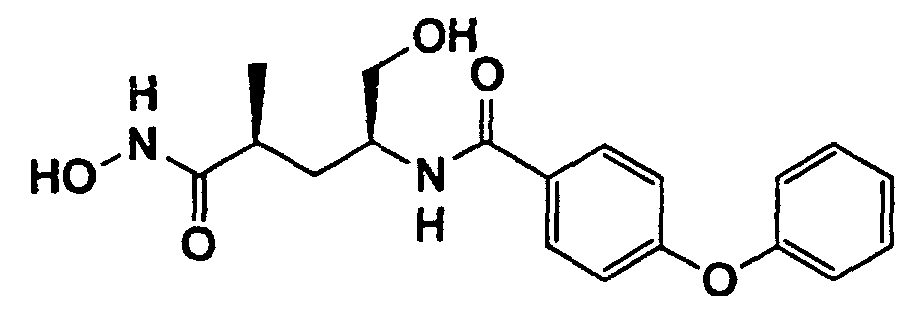 was given. The compound is important, which is described
as a compound (pharmaceutical drug) having
metalloproteinase inhibitory activity in the
specification of WO99/19296.
was given. The compound is important, which is described
as a compound (pharmaceutical drug) having
metalloproteinase inhibitory activity in the
specification of WO99/19296.
Claims (11)
- A method for the preparation of active ester, comprising adding a halogenating agent to a mixture of carboxylic acid, a reagent to form active ester and a base in an organic solvent and subjecting the mixture to a reaction in one-pot reaction.
- The method for the preparation according to claim 1, which further comprises isolating the active ester after the reaction.
- The method for the preparation of active ester according to claim 1, wherein the reagent which forms active ester is N-hydroxysuccinimide.
- The method for the preparation of active ester according to claim 1, wherein the base is pyridine or triethylamine.
- The method for the preparation of active ester according to claim 1, wherein the halogenating reagent is thionyl chloride or oxalyl chloride.
- The method for the preparation of active ester according to claim 1, wherein 1~1.5 eq. of the reagent which forms active ester, 2~10 eq. of a base and 1~1.5 eq. of halogenating agent are used versus 1 eq. of starting material carboxylic acid.
- The method for the preparation of active ester according to claim 1, wherein starting material is carboxylic acid is amino acid, its derivative or a peptide containing it, whose N-terminus is protected.
- The method for the preparation of a reagent which forms active ester according to claim 1, wherein starting material carboxylic acid is (2R)-2-(t-butoxycarbonylamino)-3-cyclohexylmethylthiopropanoic acid.
- The method for the preparation of a reagent which forms active ester according to claim 1, wherein starting material carboxylic acid is (4R)-3-t-butoxycarbonylthiazolizin-4-ylcarboxylic acid.
- The method for the preparation of a reagent which forms active ester according to claim 1, wherein the starting material carboxylic acid is (4S)-4-benzyloxycarbonyl amino-4-carboxypentanoic acid ethyl ester.
- The method for the preparation of active ester compound according to claim 1, wherein starting material carboxylic acid is 4-phenoxybenzoic acid.
Applications Claiming Priority (3)
| Application Number | Priority Date | Filing Date | Title |
|---|---|---|---|
| JP2000380145 | 2000-12-14 | ||
| JP2000380145 | 2000-12-14 | ||
| PCT/JP2001/010936 WO2002048103A1 (en) | 2000-12-14 | 2001-12-13 | Process for preparing active esters |
Publications (1)
| Publication Number | Publication Date |
|---|---|
| EP1350790A1 true EP1350790A1 (en) | 2003-10-08 |
Family
ID=18848383
Family Applications (1)
| Application Number | Title | Priority Date | Filing Date |
|---|---|---|---|
| EP01270527A Withdrawn EP1350790A1 (en) | 2000-12-14 | 2001-12-13 | Process for preparing active esters |
Country Status (6)
| Country | Link |
|---|---|
| US (1) | US20040030155A1 (en) |
| EP (1) | EP1350790A1 (en) |
| JP (1) | JPWO2002048103A1 (en) |
| AU (1) | AU2002222634A1 (en) |
| HU (1) | HUP0400690A2 (en) |
| WO (1) | WO2002048103A1 (en) |
Family Cites Families (1)
| Publication number | Priority date | Publication date | Assignee | Title |
|---|---|---|---|---|
| AT404250B (en) * | 1996-04-04 | 1998-09-25 | Chemie Linz Gmbh | METHOD FOR PRODUCING CARBONIC ACID SUCINIMIDYL ESTERS |
-
2001
- 2001-12-13 AU AU2002222634A patent/AU2002222634A1/en not_active Abandoned
- 2001-12-13 HU HU0400690A patent/HUP0400690A2/en unknown
- 2001-12-13 EP EP01270527A patent/EP1350790A1/en not_active Withdrawn
- 2001-12-13 JP JP2002549635A patent/JPWO2002048103A1/en not_active Withdrawn
- 2001-12-13 WO PCT/JP2001/010936 patent/WO2002048103A1/en not_active Ceased
- 2001-12-13 US US10/450,653 patent/US20040030155A1/en not_active Abandoned
Non-Patent Citations (1)
| Title |
|---|
| See references of WO0248103A1 * |
Also Published As
| Publication number | Publication date |
|---|---|
| AU2002222634A1 (en) | 2002-06-24 |
| US20040030155A1 (en) | 2004-02-12 |
| WO2002048103A1 (en) | 2002-06-20 |
| HUP0400690A2 (en) | 2004-08-30 |
| JPWO2002048103A1 (en) | 2004-04-15 |
Similar Documents
| Publication | Publication Date | Title |
|---|---|---|
| HUT67374A (en) | Process for producing hexahydropyridazine carboxylic acid derivatives and pharmaceutical compositions containing them | |
| JPH0144693B2 (en) | ||
| JP2024009021A (en) | How to synthesize cyclic depsipeptide | |
| EP0741697B1 (en) | Amino acid derivatives and their use as phospholipase a2 inhibitors | |
| CA1117136A (en) | Peptides and acid addition salts thereof | |
| Liu et al. | Solvent-free Ugi four-component condensation: application to synthesis of philanthotoxins-12 analogues | |
| US20040030155A1 (en) | Process for preparing active esters | |
| US4761479A (en) | Crystalline quinapril and a process for producing the same | |
| JPH0751553B2 (en) | α-halogenated carboxylic acid ester | |
| JPH0346460B2 (en) | ||
| Mazaleyrat et al. | Practical resolution of an atropoisomeric α, α-disubstituted glycine with l-phenylalanine cyclohexylamide as chiral auxiliary | |
| US5939554A (en) | Diarylaminopropanediol and diarylmethyl-oxazolidinone compounds | |
| JPS625994A (en) | Production of lysine derivative | |
| US3445447A (en) | Tert-amyloxycarbonyl derivatives of amino acids | |
| JPH078855B2 (en) | Sulfonium compound | |
| JP2700943B2 (en) | Optically active 2-morpholino-2- (1-naphthylmethyl) -4-oxobutyric acid 2'-hydroxy-1,1'-binaphthalen-2-yl and process for producing the same | |
| US5739354A (en) | Process for the preparation of N-methyl-D-phenylalanyl-N- 1- 3- (aminoiminomethyl)amino!propyl!-3,3-difluoro-2-oxohexyl!-L-prolinamide | |
| JPH0363560B2 (en) | ||
| Rane et al. | Novel high yielding route for the synthesis of Melphalan dimer impurity G | |
| JP3110132B2 (en) | Novel β-alanine derivative, method for producing the same, and method for producing glutamate blocker | |
| JPH0786102B2 (en) | Process for producing optically active 6- (4-imidazolylmethyl) -3-substituted-2,5-piperazinedione | |
| JPH0359899B2 (en) | ||
| US20230174569A1 (en) | PROCESS PER PREPARING (3a,5a)-20-OXOPREGNAN-3-YL GLYCYL-L-VALINATE HYDROCHLORIDE | |
| JPH05320148A (en) | Synthesis of cyclic depsipeptide pf1022 substance | |
| EP3480195A1 (en) | Method for the synthesis of cyclic depsipeptides |
Legal Events
| Date | Code | Title | Description |
|---|---|---|---|
| PUAI | Public reference made under article 153(3) epc to a published international application that has entered the european phase |
Free format text: ORIGINAL CODE: 0009012 |
|
| 17P | Request for examination filed |
Effective date: 20030612 |
|
| AK | Designated contracting states |
Kind code of ref document: A1 Designated state(s): AT BE CH CY DE DK ES FI FR GB GR IE IT LI LU MC NL PT SE TR |
|
| AX | Request for extension of the european patent |
Extension state: AL LT LV MK RO SI |
|
| STAA | Information on the status of an ep patent application or granted ep patent |
Free format text: STATUS: THE APPLICATION HAS BEEN WITHDRAWN |
|
| 18W | Application withdrawn |
Effective date: 20040805 |