EP1350786A1 - Process for production of dicarboxylic acids - Google Patents
Process for production of dicarboxylic acids Download PDFInfo
- Publication number
- EP1350786A1 EP1350786A1 EP01270515A EP01270515A EP1350786A1 EP 1350786 A1 EP1350786 A1 EP 1350786A1 EP 01270515 A EP01270515 A EP 01270515A EP 01270515 A EP01270515 A EP 01270515A EP 1350786 A1 EP1350786 A1 EP 1350786A1
- Authority
- EP
- European Patent Office
- Prior art keywords
- group
- selectivity
- groups
- compound
- dicarboxylic acid
- Prior art date
- Legal status (The legal status is an assumption and is not a legal conclusion. Google has not performed a legal analysis and makes no representation as to the accuracy of the status listed.)
- Granted
Links
- 238000000034 method Methods 0.000 title claims abstract description 30
- 238000004519 manufacturing process Methods 0.000 title abstract description 6
- 150000001991 dicarboxylic acids Chemical class 0.000 title description 6
- 238000006243 chemical reaction Methods 0.000 claims abstract description 99
- -1 imide compound Chemical class 0.000 claims abstract description 87
- 150000001924 cycloalkanes Chemical class 0.000 claims abstract description 49
- OFOBLEOULBTSOW-UHFFFAOYSA-N Malonic acid Chemical compound OC(=O)CC(O)=O OFOBLEOULBTSOW-UHFFFAOYSA-N 0.000 claims abstract description 38
- 229910000765 intermetallic Inorganic materials 0.000 claims abstract description 30
- 229910052760 oxygen Inorganic materials 0.000 claims abstract description 23
- 239000003054 catalyst Substances 0.000 claims abstract description 22
- 239000001301 oxygen Substances 0.000 claims abstract description 22
- 125000004435 hydrogen atom Chemical group [H]* 0.000 claims abstract description 13
- 125000004430 oxygen atom Chemical group O* 0.000 claims abstract description 7
- 238000007248 oxidative elimination reaction Methods 0.000 claims abstract description 5
- QVGXLLKOCUKJST-UHFFFAOYSA-N atomic oxygen Chemical compound [O] QVGXLLKOCUKJST-UHFFFAOYSA-N 0.000 claims abstract 3
- 150000001875 compounds Chemical class 0.000 claims description 30
- 125000003118 aryl group Chemical group 0.000 claims description 26
- 125000000217 alkyl group Chemical group 0.000 claims description 25
- 125000003545 alkoxy group Chemical group 0.000 claims description 18
- 125000002887 hydroxy group Chemical group [H]O* 0.000 claims description 17
- 125000002252 acyl group Chemical group 0.000 claims description 16
- 125000004453 alkoxycarbonyl group Chemical group 0.000 claims description 15
- 229910052751 metal Inorganic materials 0.000 claims description 13
- 125000000753 cycloalkyl group Chemical group 0.000 claims description 12
- 125000005843 halogen group Chemical group 0.000 claims description 10
- 230000000737 periodic effect Effects 0.000 claims description 10
- 125000006574 non-aromatic ring group Chemical group 0.000 claims description 9
- 125000006239 protecting group Chemical group 0.000 claims description 9
- NQTADLQHYWFPDB-UHFFFAOYSA-N N-Hydroxysuccinimide Chemical compound ON1C(=O)CCC1=O NQTADLQHYWFPDB-UHFFFAOYSA-N 0.000 claims description 7
- 125000003178 carboxy group Chemical group [H]OC(*)=O 0.000 claims description 7
- 125000004122 cyclic group Chemical class 0.000 claims description 7
- 239000002904 solvent Substances 0.000 claims description 7
- 150000002825 nitriles Chemical class 0.000 claims description 4
- 239000007810 chemical reaction solvent Substances 0.000 claims description 3
- 239000003960 organic solvent Substances 0.000 claims description 2
- CFMZSMGAMPBRBE-UHFFFAOYSA-N 2-hydroxyisoindole-1,3-dione Chemical compound C1=CC=C2C(=O)N(O)C(=O)C2=C1 CFMZSMGAMPBRBE-UHFFFAOYSA-N 0.000 abstract description 29
- 238000007254 oxidation reaction Methods 0.000 abstract description 5
- 230000003647 oxidation Effects 0.000 abstract description 4
- 230000003197 catalytic effect Effects 0.000 abstract description 3
- QTBSBXVTEAMEQO-UHFFFAOYSA-N Acetic acid Chemical compound CC(O)=O QTBSBXVTEAMEQO-UHFFFAOYSA-N 0.000 description 135
- XDTMQSROBMDMFD-UHFFFAOYSA-N Cyclohexane Chemical compound C1CCCCC1 XDTMQSROBMDMFD-UHFFFAOYSA-N 0.000 description 50
- WNLRTRBMVRJNCN-UHFFFAOYSA-N adipic acid Chemical compound OC(=O)CCCCC(O)=O WNLRTRBMVRJNCN-UHFFFAOYSA-N 0.000 description 50
- JHIVVAPYMSGYDF-UHFFFAOYSA-N cyclohexanone Chemical compound O=C1CCCCC1 JHIVVAPYMSGYDF-UHFFFAOYSA-N 0.000 description 48
- KDYFGRWQOYBRFD-UHFFFAOYSA-N succinic acid Chemical compound OC(=O)CCC(O)=O KDYFGRWQOYBRFD-UHFFFAOYSA-N 0.000 description 42
- 239000007788 liquid Substances 0.000 description 41
- 125000004432 carbon atom Chemical group C* 0.000 description 31
- 239000007789 gas Substances 0.000 description 29
- 239000011541 reaction mixture Substances 0.000 description 29
- 239000001361 adipic acid Substances 0.000 description 25
- 235000011037 adipic acid Nutrition 0.000 description 25
- HPXRVTGHNJAIIH-UHFFFAOYSA-N cyclohexanol Chemical compound OC1CCCCC1 HPXRVTGHNJAIIH-UHFFFAOYSA-N 0.000 description 25
- MYMOFIZGZYHOMD-UHFFFAOYSA-N Dioxygen Chemical compound O=O MYMOFIZGZYHOMD-UHFFFAOYSA-N 0.000 description 24
- JUPWRUDTZGBNEX-UHFFFAOYSA-N cobalt;pentane-2,4-dione Chemical compound [Co].CC(=O)CC(C)=O.CC(=O)CC(C)=O.CC(=O)CC(C)=O JUPWRUDTZGBNEX-UHFFFAOYSA-N 0.000 description 22
- 238000001816 cooling Methods 0.000 description 22
- RTBFRGCFXZNCOE-UHFFFAOYSA-N 1-methylsulfonylpiperidin-4-one Chemical compound CS(=O)(=O)N1CCC(=O)CC1 RTBFRGCFXZNCOE-UHFFFAOYSA-N 0.000 description 21
- JFCQEDHGNNZCLN-UHFFFAOYSA-N anhydrous glutaric acid Natural products OC(=O)CCCC(O)=O JFCQEDHGNNZCLN-UHFFFAOYSA-N 0.000 description 21
- YYLLIJHXUHJATK-UHFFFAOYSA-N Cyclohexyl acetate Chemical compound CC(=O)OC1CCCCC1 YYLLIJHXUHJATK-UHFFFAOYSA-N 0.000 description 20
- 239000001384 succinic acid Substances 0.000 description 20
- 229910000619 316 stainless steel Inorganic materials 0.000 description 19
- 238000010521 absorption reaction Methods 0.000 description 19
- 239000008246 gaseous mixture Substances 0.000 description 19
- 239000007787 solid Substances 0.000 description 19
- 239000000243 solution Substances 0.000 description 19
- ZBYYWKJVSFHYJL-UHFFFAOYSA-L cobalt(2+);diacetate;tetrahydrate Chemical compound O.O.O.O.[Co+2].CC([O-])=O.CC([O-])=O ZBYYWKJVSFHYJL-UHFFFAOYSA-L 0.000 description 17
- 125000001424 substituent group Chemical group 0.000 description 15
- 150000003839 salts Chemical class 0.000 description 13
- DDTBPAQBQHZRDW-UHFFFAOYSA-N cyclododecane Chemical compound C1CCCCCCCCCCC1 DDTBPAQBQHZRDW-UHFFFAOYSA-N 0.000 description 12
- 239000000203 mixture Substances 0.000 description 12
- 150000008064 anhydrides Chemical class 0.000 description 11
- 150000002430 hydrocarbons Chemical class 0.000 description 11
- 229910052757 nitrogen Inorganic materials 0.000 description 11
- 150000001869 cobalt compounds Chemical class 0.000 description 10
- TVIDDXQYHWJXFK-UHFFFAOYSA-N dodecanedioic acid Chemical compound OC(=O)CCCCCCCCCCC(O)=O TVIDDXQYHWJXFK-UHFFFAOYSA-N 0.000 description 10
- 125000002777 acetyl group Chemical class [H]C([H])([H])C(*)=O 0.000 description 8
- 125000002496 methyl group Chemical group [H]C([H])([H])* 0.000 description 8
- 239000000758 substrate Substances 0.000 description 8
- 150000003949 imides Chemical class 0.000 description 7
- 125000001997 phenyl group Chemical group [H]C1=C([H])C([H])=C(*)C([H])=C1[H] 0.000 description 7
- 239000002994 raw material Substances 0.000 description 7
- WEVYAHXRMPXWCK-UHFFFAOYSA-N Acetonitrile Chemical compound CC#N WEVYAHXRMPXWCK-UHFFFAOYSA-N 0.000 description 6
- SXVPOSFURRDKBO-UHFFFAOYSA-N Cyclododecanone Chemical compound O=C1CCCCCCCCCCC1 SXVPOSFURRDKBO-UHFFFAOYSA-N 0.000 description 6
- ZMXDDKWLCZADIW-UHFFFAOYSA-N N,N-Dimethylformamide Chemical compound CN(C)C=O ZMXDDKWLCZADIW-UHFFFAOYSA-N 0.000 description 6
- 125000001495 ethyl group Chemical group [H]C([H])([H])C([H])([H])* 0.000 description 6
- 125000001624 naphthyl group Chemical group 0.000 description 6
- 125000000449 nitro group Chemical group [O-][N+](*)=O 0.000 description 6
- OKTJSMMVPCPJKN-UHFFFAOYSA-N Carbon Chemical group [C] OKTJSMMVPCPJKN-UHFFFAOYSA-N 0.000 description 5
- 125000001931 aliphatic group Chemical group 0.000 description 5
- 125000003917 carbamoyl group Chemical group [H]N([H])C(*)=O 0.000 description 5
- 230000007423 decrease Effects 0.000 description 5
- 125000000623 heterocyclic group Chemical group 0.000 description 5
- 125000004178 (C1-C4) alkyl group Chemical group 0.000 description 4
- ZAMOUSCENKQFHK-UHFFFAOYSA-N Chlorine atom Chemical compound [Cl] ZAMOUSCENKQFHK-UHFFFAOYSA-N 0.000 description 4
- RGSFGYAAUTVSQA-UHFFFAOYSA-N Cyclopentane Chemical compound C1CCCC1 RGSFGYAAUTVSQA-UHFFFAOYSA-N 0.000 description 4
- QAOWNCQODCNURD-UHFFFAOYSA-N Sulfuric acid Chemical compound OS(O)(=O)=O QAOWNCQODCNURD-UHFFFAOYSA-N 0.000 description 4
- DHKHKXVYLBGOIT-UHFFFAOYSA-N acetaldehyde Diethyl Acetal Natural products CCOC(C)OCC DHKHKXVYLBGOIT-UHFFFAOYSA-N 0.000 description 4
- 125000002723 alicyclic group Chemical group 0.000 description 4
- 125000003277 amino group Chemical group 0.000 description 4
- 239000000460 chlorine Substances 0.000 description 4
- 229910052801 chlorine Inorganic materials 0.000 description 4
- OPQARKPSCNTWTJ-UHFFFAOYSA-L copper(ii) acetate Chemical compound [Cu+2].CC([O-])=O.CC([O-])=O OPQARKPSCNTWTJ-UHFFFAOYSA-L 0.000 description 4
- 125000004093 cyano group Chemical group *C#N 0.000 description 4
- 125000000113 cyclohexyl group Chemical group [H]C1([H])C([H])([H])C([H])([H])C([H])(*)C([H])([H])C1([H])[H] 0.000 description 4
- 150000002148 esters Chemical class 0.000 description 4
- 125000001188 haloalkyl group Chemical group 0.000 description 4
- DMEGYFMYUHOHGS-UHFFFAOYSA-N heptamethylene Natural products C1CCCCCC1 DMEGYFMYUHOHGS-UHFFFAOYSA-N 0.000 description 4
- 150000002697 manganese compounds Chemical class 0.000 description 4
- 239000000463 material Substances 0.000 description 4
- 150000007524 organic acids Chemical class 0.000 description 4
- 235000005985 organic acids Nutrition 0.000 description 4
- 125000001820 oxy group Chemical group [*:1]O[*:2] 0.000 description 4
- 229910052698 phosphorus Inorganic materials 0.000 description 4
- 229910052717 sulfur Inorganic materials 0.000 description 4
- 125000000999 tert-butyl group Chemical group [H]C([H])([H])C(*)(C([H])([H])[H])C([H])([H])[H] 0.000 description 4
- IJRNYIWWGDQEIY-UHFFFAOYSA-N (1,3-dioxoisoindol-2-yl) acetate Chemical compound C1=CC=C2C(=O)N(OC(=O)C)C(=O)C2=C1 IJRNYIWWGDQEIY-UHFFFAOYSA-N 0.000 description 3
- WFDIJRYMOXRFFG-UHFFFAOYSA-N Acetic anhydride Chemical compound CC(=O)OC(C)=O WFDIJRYMOXRFFG-UHFFFAOYSA-N 0.000 description 3
- IJGRMHOSHXDMSA-UHFFFAOYSA-N Atomic nitrogen Chemical compound N#N IJGRMHOSHXDMSA-UHFFFAOYSA-N 0.000 description 3
- UHOVQNZJYSORNB-UHFFFAOYSA-N Benzene Chemical compound C1=CC=CC=C1 UHOVQNZJYSORNB-UHFFFAOYSA-N 0.000 description 3
- WKBOTKDWSSQWDR-UHFFFAOYSA-N Bromine atom Chemical compound [Br] WKBOTKDWSSQWDR-UHFFFAOYSA-N 0.000 description 3
- CURLTUGMZLYLDI-UHFFFAOYSA-N Carbon dioxide Chemical compound O=C=O CURLTUGMZLYLDI-UHFFFAOYSA-N 0.000 description 3
- YMWUJEATGCHHMB-UHFFFAOYSA-N Dichloromethane Chemical compound ClCCl YMWUJEATGCHHMB-UHFFFAOYSA-N 0.000 description 3
- RWSOTUBLDIXVET-UHFFFAOYSA-N Dihydrogen sulfide Chemical class S RWSOTUBLDIXVET-UHFFFAOYSA-N 0.000 description 3
- OKKJLVBELUTLKV-UHFFFAOYSA-N Methanol Chemical compound OC OKKJLVBELUTLKV-UHFFFAOYSA-N 0.000 description 3
- GRYLNZFGIOXLOG-UHFFFAOYSA-N Nitric acid Chemical compound O[N+]([O-])=O GRYLNZFGIOXLOG-UHFFFAOYSA-N 0.000 description 3
- 239000004952 Polyamide Substances 0.000 description 3
- XBDQKXXYIPTUBI-UHFFFAOYSA-N Propionic acid Chemical class CCC(O)=O XBDQKXXYIPTUBI-UHFFFAOYSA-N 0.000 description 3
- 125000003342 alkenyl group Chemical group 0.000 description 3
- 238000004458 analytical method Methods 0.000 description 3
- 229910052787 antimony Inorganic materials 0.000 description 3
- 125000004104 aryloxy group Chemical group 0.000 description 3
- JFDZBHWFFUWGJE-UHFFFAOYSA-N benzonitrile Chemical compound N#CC1=CC=CC=C1 JFDZBHWFFUWGJE-UHFFFAOYSA-N 0.000 description 3
- GDTBXPJZTBHREO-UHFFFAOYSA-N bromine Substances BrBr GDTBXPJZTBHREO-UHFFFAOYSA-N 0.000 description 3
- 229910052794 bromium Inorganic materials 0.000 description 3
- 239000002801 charged material Substances 0.000 description 3
- 239000007795 chemical reaction product Substances 0.000 description 3
- 230000000052 comparative effect Effects 0.000 description 3
- 239000010949 copper Substances 0.000 description 3
- SFVWPXMPRCIVOK-UHFFFAOYSA-N cyclododecanol Chemical compound OC1CCCCCCCCCCC1 SFVWPXMPRCIVOK-UHFFFAOYSA-N 0.000 description 3
- 125000002704 decyl group Chemical group [H]C([H])([H])C([H])([H])C([H])([H])C([H])([H])C([H])([H])C([H])([H])C([H])([H])C([H])([H])C([H])([H])C([H])([H])* 0.000 description 3
- 229910001873 dinitrogen Inorganic materials 0.000 description 3
- 229910001882 dioxygen Inorganic materials 0.000 description 3
- 125000003754 ethoxycarbonyl group Chemical group C(=O)(OCC)* 0.000 description 3
- 238000004817 gas chromatography Methods 0.000 description 3
- 125000004051 hexyl group Chemical group [H]C([H])([H])C([H])([H])C([H])([H])C([H])([H])C([H])([H])C([H])([H])* 0.000 description 3
- 150000002484 inorganic compounds Chemical class 0.000 description 3
- 229910010272 inorganic material Inorganic materials 0.000 description 3
- 150000002500 ions Chemical class 0.000 description 3
- XEEYBQQBJWHFJM-UHFFFAOYSA-N iron Substances [Fe] XEEYBQQBJWHFJM-UHFFFAOYSA-N 0.000 description 3
- 125000001449 isopropyl group Chemical group [H]C([H])([H])C([H])(*)C([H])([H])[H] 0.000 description 3
- 239000011572 manganese Substances 0.000 description 3
- 125000001160 methoxycarbonyl group Chemical group [H]C([H])([H])OC(*)=O 0.000 description 3
- 229910017604 nitric acid Inorganic materials 0.000 description 3
- MWUXSHHQAYIFBG-UHFFFAOYSA-N nitrogen oxide Inorganic materials O=[N] MWUXSHHQAYIFBG-UHFFFAOYSA-N 0.000 description 3
- 150000004714 phosphonium salts Chemical class 0.000 description 3
- 229910052696 pnictogen Inorganic materials 0.000 description 3
- 229920002647 polyamide Polymers 0.000 description 3
- 239000000047 product Substances 0.000 description 3
- 125000001501 propionyl group Chemical group O=C([*])C([H])([H])C([H])([H])[H] 0.000 description 3
- 125000000472 sulfonyl group Chemical group *S(*)(=O)=O 0.000 description 3
- 150000003682 vanadium compounds Chemical class 0.000 description 3
- YQTCQNIPQMJNTI-UHFFFAOYSA-N 2,2-dimethylpropan-1-one Chemical group CC(C)(C)[C]=O YQTCQNIPQMJNTI-UHFFFAOYSA-N 0.000 description 2
- 125000003903 2-propenyl group Chemical group [H]C([*])([H])C([H])=C([H])[H] 0.000 description 2
- DLFVBJFMPXGRIB-UHFFFAOYSA-N Acetamide Chemical compound CC(N)=O DLFVBJFMPXGRIB-UHFFFAOYSA-N 0.000 description 2
- XKRFYHLGVUSROY-UHFFFAOYSA-N Argon Chemical compound [Ar] XKRFYHLGVUSROY-UHFFFAOYSA-N 0.000 description 2
- HEDRZPFGACZZDS-UHFFFAOYSA-N Chloroform Chemical compound ClC(Cl)Cl HEDRZPFGACZZDS-UHFFFAOYSA-N 0.000 description 2
- 239000005749 Copper compound Substances 0.000 description 2
- 229910021591 Copper(I) chloride Inorganic materials 0.000 description 2
- DKKCQDROTDCQOR-UHFFFAOYSA-L Ferrous lactate Chemical compound [Fe+2].CC(O)C([O-])=O.CC(O)C([O-])=O DKKCQDROTDCQOR-UHFFFAOYSA-L 0.000 description 2
- ZHNUHDYFZUAESO-UHFFFAOYSA-N Formamide Chemical compound NC=O ZHNUHDYFZUAESO-UHFFFAOYSA-N 0.000 description 2
- MHAJPDPJQMAIIY-UHFFFAOYSA-N Hydrogen peroxide Chemical compound OO MHAJPDPJQMAIIY-UHFFFAOYSA-N 0.000 description 2
- AVXURJPOCDRRFD-UHFFFAOYSA-N Hydroxylamine Chemical compound ON AVXURJPOCDRRFD-UHFFFAOYSA-N 0.000 description 2
- KFSLWBXXFJQRDL-UHFFFAOYSA-N Peracetic acid Chemical compound CC(=O)OO KFSLWBXXFJQRDL-UHFFFAOYSA-N 0.000 description 2
- NBIIXXVUZAFLBC-UHFFFAOYSA-N Phosphoric acid Chemical compound OP(O)(O)=O NBIIXXVUZAFLBC-UHFFFAOYSA-N 0.000 description 2
- JUJWROOIHBZHMG-UHFFFAOYSA-N Pyridine Chemical compound C1=CC=NC=C1 JUJWROOIHBZHMG-UHFFFAOYSA-N 0.000 description 2
- VYPSYNLAJGMNEJ-UHFFFAOYSA-N Silicium dioxide Chemical compound O=[Si]=O VYPSYNLAJGMNEJ-UHFFFAOYSA-N 0.000 description 2
- DKGAVHZHDRPRBM-UHFFFAOYSA-N Tert-Butanol Chemical compound CC(C)(C)O DKGAVHZHDRPRBM-UHFFFAOYSA-N 0.000 description 2
- YRKCREAYFQTBPV-UHFFFAOYSA-N acetylacetone Chemical compound CC(=O)CC(C)=O YRKCREAYFQTBPV-UHFFFAOYSA-N 0.000 description 2
- 150000008065 acid anhydrides Chemical class 0.000 description 2
- 125000004423 acyloxy group Chemical group 0.000 description 2
- 230000002411 adverse Effects 0.000 description 2
- 229940045714 alkyl sulfonate alkylating agent Drugs 0.000 description 2
- 150000008052 alkyl sulfonates Chemical class 0.000 description 2
- 125000000304 alkynyl group Chemical group 0.000 description 2
- 150000003863 ammonium salts Chemical class 0.000 description 2
- 150000001450 anions Chemical class 0.000 description 2
- 125000002029 aromatic hydrocarbon group Chemical group 0.000 description 2
- 229910052785 arsenic Inorganic materials 0.000 description 2
- 125000003710 aryl alkyl group Chemical group 0.000 description 2
- 125000001797 benzyl group Chemical group [H]C1=C([H])C([H])=C(C([H])=C1[H])C([H])([H])* 0.000 description 2
- 229910052797 bismuth Inorganic materials 0.000 description 2
- 235000010338 boric acid Nutrition 0.000 description 2
- 229910052796 boron Inorganic materials 0.000 description 2
- KDYFGRWQOYBRFD-NUQCWPJISA-N butanedioic acid Chemical compound O[14C](=O)CC[14C](O)=O KDYFGRWQOYBRFD-NUQCWPJISA-N 0.000 description 2
- 125000000484 butyl group Chemical group [H]C([*])([H])C([H])([H])C([H])([H])C([H])([H])[H] 0.000 description 2
- 125000004063 butyryl group Chemical group O=C([*])C([H])([H])C([H])([H])C([H])([H])[H] 0.000 description 2
- 125000002915 carbonyl group Chemical group [*:2]C([*:1])=O 0.000 description 2
- 150000001768 cations Chemical class 0.000 description 2
- 229910052798 chalcogen Inorganic materials 0.000 description 2
- 239000003426 co-catalyst Substances 0.000 description 2
- QAHREYKOYSIQPH-UHFFFAOYSA-L cobalt(II) acetate Chemical compound [Co+2].CC([O-])=O.CC([O-])=O QAHREYKOYSIQPH-UHFFFAOYSA-L 0.000 description 2
- 229910052802 copper Inorganic materials 0.000 description 2
- 150000001880 copper compounds Chemical class 0.000 description 2
- OXBLHERUFWYNTN-UHFFFAOYSA-M copper(I) chloride Chemical compound [Cu]Cl OXBLHERUFWYNTN-UHFFFAOYSA-M 0.000 description 2
- WJTCGQSWYFHTAC-UHFFFAOYSA-N cyclooctane Chemical compound C1CCCCCCC1 WJTCGQSWYFHTAC-UHFFFAOYSA-N 0.000 description 2
- 239000004914 cyclooctane Substances 0.000 description 2
- 125000001511 cyclopentyl group Chemical group [H]C1([H])C([H])([H])C([H])([H])C([H])(*)C1([H])[H] 0.000 description 2
- 238000004821 distillation Methods 0.000 description 2
- 235000013925 ferrous lactate Nutrition 0.000 description 2
- 239000004225 ferrous lactate Substances 0.000 description 2
- 239000012847 fine chemical Substances 0.000 description 2
- 125000002485 formyl group Chemical group [H]C(*)=O 0.000 description 2
- 125000001976 hemiacetal group Chemical group 0.000 description 2
- FLBJFXNAEMSXGL-UHFFFAOYSA-N het anhydride Chemical compound O=C1OC(=O)C2C1C1(Cl)C(Cl)=C(Cl)C2(Cl)C1(Cl)Cl FLBJFXNAEMSXGL-UHFFFAOYSA-N 0.000 description 2
- 239000003456 ion exchange resin Substances 0.000 description 2
- 229920003303 ion-exchange polymer Polymers 0.000 description 2
- 229910052742 iron Inorganic materials 0.000 description 2
- 150000002506 iron compounds Chemical class 0.000 description 2
- 125000000959 isobutyl group Chemical group [H]C([H])([H])C([H])(C([H])([H])[H])C([H])([H])* 0.000 description 2
- 239000003446 ligand Substances 0.000 description 2
- 239000007791 liquid phase Substances 0.000 description 2
- 229910052748 manganese Inorganic materials 0.000 description 2
- OJURWUUOVGOHJZ-UHFFFAOYSA-N methyl 2-[(2-acetyloxyphenyl)methyl-[2-[(2-acetyloxyphenyl)methyl-(2-methoxy-2-oxoethyl)amino]ethyl]amino]acetate Chemical class C=1C=CC=C(OC(C)=O)C=1CN(CC(=O)OC)CCN(CC(=O)OC)CC1=CC=CC=C1OC(C)=O OJURWUUOVGOHJZ-UHFFFAOYSA-N 0.000 description 2
- 150000007522 mineralic acids Chemical class 0.000 description 2
- 229910052750 molybdenum Inorganic materials 0.000 description 2
- 125000004433 nitrogen atom Chemical group N* 0.000 description 2
- 125000002347 octyl group Chemical group [H]C([*])([H])C([H])([H])C([H])([H])C([H])([H])C([H])([H])C([H])([H])C([H])([H])C([H])([H])[H] 0.000 description 2
- 125000000962 organic group Chemical group 0.000 description 2
- 125000004043 oxo group Chemical group O=* 0.000 description 2
- 125000005740 oxycarbonyl group Chemical group [*:1]OC([*:2])=O 0.000 description 2
- 235000011007 phosphoric acid Nutrition 0.000 description 2
- XNGIFLGASWRNHJ-UHFFFAOYSA-N phthalic acid Chemical compound OC(=O)C1=CC=CC=C1C(O)=O XNGIFLGASWRNHJ-UHFFFAOYSA-N 0.000 description 2
- 229920000728 polyester Polymers 0.000 description 2
- 125000001436 propyl group Chemical group [H]C([*])([H])C([H])([H])C([H])([H])[H] 0.000 description 2
- 125000001453 quaternary ammonium group Chemical group 0.000 description 2
- 238000007142 ring opening reaction Methods 0.000 description 2
- 229910052707 ruthenium Inorganic materials 0.000 description 2
- 229920006395 saturated elastomer Polymers 0.000 description 2
- 125000002914 sec-butyl group Chemical group [H]C([H])([H])C([H])([H])C([H])(*)C([H])([H])[H] 0.000 description 2
- 238000000926 separation method Methods 0.000 description 2
- KZNICNPSHKQLFF-UHFFFAOYSA-N succinimide Chemical compound O=C1CCC(=O)N1 KZNICNPSHKQLFF-UHFFFAOYSA-N 0.000 description 2
- CIHOLLKRGTVIJN-UHFFFAOYSA-N tert‐butyl hydroperoxide Chemical compound CC(C)(C)OO CIHOLLKRGTVIJN-UHFFFAOYSA-N 0.000 description 2
- NHGXDBSUJJNIRV-UHFFFAOYSA-M tetrabutylammonium chloride Chemical compound [Cl-].CCCC[N+](CCCC)(CCCC)CCCC NHGXDBSUJJNIRV-UHFFFAOYSA-M 0.000 description 2
- 229910052719 titanium Inorganic materials 0.000 description 2
- 239000010936 titanium Substances 0.000 description 2
- RIOQSEWOXXDEQQ-UHFFFAOYSA-N triphenylphosphine Chemical compound C1=CC=CC=C1P(C=1C=CC=CC=1)C1=CC=CC=C1 RIOQSEWOXXDEQQ-UHFFFAOYSA-N 0.000 description 2
- 125000003774 valeryl group Chemical group O=C([*])C([H])([H])C([H])([H])C([H])([H])C([H])([H])[H] 0.000 description 2
- YUHMCCIYROSXFZ-UHFFFAOYSA-N (1,3-dioxo-3a,4,5,6,7,7a-hexahydroisoindol-2-yl) acetate Chemical group C1CCCC2C(=O)N(OC(=O)C)C(=O)C21 YUHMCCIYROSXFZ-UHFFFAOYSA-N 0.000 description 1
- MMZCYVBYIOUFEO-UHFFFAOYSA-N (1,3-dioxoisoindol-2-yl) 4-methylbenzenesulfonate Chemical compound C1=CC(C)=CC=C1S(=O)(=O)ON1C(=O)C2=CC=CC=C2C1=O MMZCYVBYIOUFEO-UHFFFAOYSA-N 0.000 description 1
- PSXVVEFTUBMHJR-UHFFFAOYSA-N (1,3-dioxoisoindol-2-yl) benzoate Chemical compound O=C1C2=CC=CC=C2C(=O)N1OC(=O)C1=CC=CC=C1 PSXVVEFTUBMHJR-UHFFFAOYSA-N 0.000 description 1
- MZVIAOIHWLOXPX-UHFFFAOYSA-N (1,3-dioxoisoindol-2-yl) methanesulfonate Chemical compound C1=CC=C2C(=O)N(OS(=O)(=O)C)C(=O)C2=C1 MZVIAOIHWLOXPX-UHFFFAOYSA-N 0.000 description 1
- CNQULYDFCRJTKV-UHFFFAOYSA-N (2,5-dioxopyrrol-1-yl) acetate Chemical group CC(=O)ON1C(=O)C=CC1=O CNQULYDFCRJTKV-UHFFFAOYSA-N 0.000 description 1
- SIFCHNIAAPMMKG-UHFFFAOYSA-N (2,5-dioxopyrrolidin-1-yl) acetate Chemical group CC(=O)ON1C(=O)CCC1=O SIFCHNIAAPMMKG-UHFFFAOYSA-N 0.000 description 1
- KNDQHSIWLOJIGP-UMRXKNAASA-N (3ar,4s,7r,7as)-rel-3a,4,7,7a-tetrahydro-4,7-methanoisobenzofuran-1,3-dione Chemical compound O=C1OC(=O)[C@@H]2[C@H]1[C@]1([H])C=C[C@@]2([H])C1 KNDQHSIWLOJIGP-UMRXKNAASA-N 0.000 description 1
- MUTGBJKUEZFXGO-OLQVQODUSA-N (3as,7ar)-3a,4,5,6,7,7a-hexahydro-2-benzofuran-1,3-dione Chemical compound C1CCC[C@@H]2C(=O)OC(=O)[C@@H]21 MUTGBJKUEZFXGO-OLQVQODUSA-N 0.000 description 1
- KMOUUZVZFBCRAM-OLQVQODUSA-N (3as,7ar)-3a,4,7,7a-tetrahydro-2-benzofuran-1,3-dione Chemical compound C1C=CC[C@@H]2C(=O)OC(=O)[C@@H]21 KMOUUZVZFBCRAM-OLQVQODUSA-N 0.000 description 1
- ODTYCZSEJKXOID-UHFFFAOYSA-N (4,5,6,7-tetrabromo-1,3-dioxoisoindol-2-yl) acetate Chemical compound BrC1=C(Br)C(Br)=C(Br)C2=C1C(=O)N(OC(=O)C)C2=O ODTYCZSEJKXOID-UHFFFAOYSA-N 0.000 description 1
- RIYQAUQPSQPWDH-UHFFFAOYSA-N (4,5,6,7-tetrachloro-1,3-dioxoisoindol-2-yl) acetate Chemical compound ClC1=C(Cl)C(Cl)=C(Cl)C2=C1C(=O)N(OC(=O)C)C2=O RIYQAUQPSQPWDH-UHFFFAOYSA-N 0.000 description 1
- 125000003837 (C1-C20) alkyl group Chemical group 0.000 description 1
- 125000006823 (C1-C6) acyl group Chemical group 0.000 description 1
- VNNDVNZCGCCIPA-FDGPNNRMSA-N (z)-4-hydroxypent-3-en-2-one;manganese Chemical compound [Mn].C\C(O)=C\C(C)=O.C\C(O)=C\C(C)=O VNNDVNZCGCCIPA-FDGPNNRMSA-N 0.000 description 1
- RDMHXWZYVFGYSF-LNTINUHCSA-N (z)-4-hydroxypent-3-en-2-one;manganese Chemical compound [Mn].C\C(O)=C\C(C)=O.C\C(O)=C\C(C)=O.C\C(O)=C\C(C)=O RDMHXWZYVFGYSF-LNTINUHCSA-N 0.000 description 1
- WSLDOOZREJYCGB-UHFFFAOYSA-N 1,2-Dichloroethane Chemical compound ClCCCl WSLDOOZREJYCGB-UHFFFAOYSA-N 0.000 description 1
- OCJBOOLMMGQPQU-UHFFFAOYSA-N 1,4-dichlorobenzene Chemical compound ClC1=CC=C(Cl)C=C1 OCJBOOLMMGQPQU-UHFFFAOYSA-N 0.000 description 1
- LDMOEFOXLIZJOW-UHFFFAOYSA-N 1-dodecanesulfonic acid Chemical class CCCCCCCCCCCCS(O)(=O)=O LDMOEFOXLIZJOW-UHFFFAOYSA-N 0.000 description 1
- CWJAAGIABCRGGL-UHFFFAOYSA-N 1-hydroxy-3-methylpyrrolidine-2,5-dione Chemical compound CC1CC(=O)N(O)C1=O CWJAAGIABCRGGL-UHFFFAOYSA-N 0.000 description 1
- 125000004066 1-hydroxyethyl group Chemical group [H]OC([H])([*])C([H])([H])[H] 0.000 description 1
- BUXKULRFRATXSI-UHFFFAOYSA-N 1-hydroxypyrrole-2,5-dione Chemical compound ON1C(=O)C=CC1=O BUXKULRFRATXSI-UHFFFAOYSA-N 0.000 description 1
- FDZXBERTWXBXIP-UHFFFAOYSA-M 1-methylquinolin-1-ium;chloride Chemical compound [Cl-].C1=CC=C2[N+](C)=CC=CC2=C1 FDZXBERTWXBXIP-UHFFFAOYSA-M 0.000 description 1
- 125000000453 2,2,2-trichloroethyl group Chemical group [H]C([H])(*)C(Cl)(Cl)Cl 0.000 description 1
- 125000001917 2,4-dinitrophenyl group Chemical group [H]C1=C([H])C(=C([H])C(=C1*)[N+]([O-])=O)[N+]([O-])=O 0.000 description 1
- VBBUVIWLZBAEEF-UHFFFAOYSA-N 2,6-dihydroxypyrrolo[3,4-f]isoindole-1,3,5,7-tetrone Chemical compound C1=C2C(=O)N(O)C(=O)C2=CC2=C1C(=O)N(O)C2=O VBBUVIWLZBAEEF-UHFFFAOYSA-N 0.000 description 1
- NEIZSPQALDZQNZ-UHFFFAOYSA-N 2-(2-methoxyethoxymethoxy)isoindole-1,3-dione Chemical compound C1=CC=C2C(=O)N(OCOCCOC)C(=O)C2=C1 NEIZSPQALDZQNZ-UHFFFAOYSA-N 0.000 description 1
- FALRKNHUBBKYCC-UHFFFAOYSA-N 2-(chloromethyl)pyridine-3-carbonitrile Chemical compound ClCC1=NC=CC=C1C#N FALRKNHUBBKYCC-UHFFFAOYSA-N 0.000 description 1
- ZOKLLTMXPSYFMB-UHFFFAOYSA-N 2-(methoxymethoxy)isoindole-1,3-dione Chemical compound C1=CC=C2C(=O)N(OCOC)C(=O)C2=C1 ZOKLLTMXPSYFMB-UHFFFAOYSA-N 0.000 description 1
- 125000003821 2-(trimethylsilyl)ethoxymethyl group Chemical group [H]C([H])([H])[Si](C([H])([H])[H])(C([H])([H])[H])C([H])([H])C(OC([H])([H])[*])([H])[H] 0.000 description 1
- DBWVTDFTWIVIQA-UHFFFAOYSA-N 2-hydroxy-3a,4,5,6,7,7a-hexahydroisoindole-1,3-dione Chemical compound C1CCCC2C(=O)N(O)C(=O)C21 DBWVTDFTWIVIQA-UHFFFAOYSA-N 0.000 description 1
- MSXVEPNJUHWQHW-UHFFFAOYSA-N 2-methylbutan-2-ol Chemical compound CCC(C)(C)O MSXVEPNJUHWQHW-UHFFFAOYSA-N 0.000 description 1
- 125000006279 3-bromobenzyl group Chemical group [H]C1=C([H])C(=C([H])C(Br)=C1[H])C([H])([H])* 0.000 description 1
- 125000004080 3-carboxypropanoyl group Chemical group O=C([*])C([H])([H])C([H])([H])C(O[H])=O 0.000 description 1
- NHQDETIJWKXCTC-UHFFFAOYSA-N 3-chloroperbenzoic acid Chemical compound OOC(=O)C1=CC=CC(Cl)=C1 NHQDETIJWKXCTC-UHFFFAOYSA-N 0.000 description 1
- DPKHPTVBFHJMBL-UHFFFAOYSA-N 4,5,6,7-tetrabromo-2-hydroxyisoindole-1,3-dione Chemical compound BrC1=C(Br)C(Br)=C(Br)C2=C1C(=O)N(O)C2=O DPKHPTVBFHJMBL-UHFFFAOYSA-N 0.000 description 1
- UTRBHXSKVVPTLY-UHFFFAOYSA-N 4,5,6,7-tetrachloro-2-hydroxyisoindole-1,3-dione Chemical compound ClC1=C(Cl)C(Cl)=C(Cl)C2=C1C(=O)N(O)C2=O UTRBHXSKVVPTLY-UHFFFAOYSA-N 0.000 description 1
- ROFZMKDROVBLNY-UHFFFAOYSA-N 4-nitro-2-benzofuran-1,3-dione Chemical compound [O-][N+](=O)C1=CC=CC2=C1C(=O)OC2=O ROFZMKDROVBLNY-UHFFFAOYSA-N 0.000 description 1
- LSNNMFCWUKXFEE-UHFFFAOYSA-M Bisulfite Chemical compound OS([O-])=O LSNNMFCWUKXFEE-UHFFFAOYSA-M 0.000 description 1
- ZOXJGFHDIHLPTG-UHFFFAOYSA-N Boron Chemical compound [B] ZOXJGFHDIHLPTG-UHFFFAOYSA-N 0.000 description 1
- 229910021503 Cobalt(II) hydroxide Inorganic materials 0.000 description 1
- PMPVIKIVABFJJI-UHFFFAOYSA-N Cyclobutane Chemical compound C1CCC1 PMPVIKIVABFJJI-UHFFFAOYSA-N 0.000 description 1
- LVZWSLJZHVFIQJ-UHFFFAOYSA-N Cyclopropane Chemical compound C1CC1 LVZWSLJZHVFIQJ-UHFFFAOYSA-N 0.000 description 1
- RPNUMPOLZDHAAY-UHFFFAOYSA-N Diethylenetriamine Chemical compound NCCNCCN RPNUMPOLZDHAAY-UHFFFAOYSA-N 0.000 description 1
- PIICEJLVQHRZGT-UHFFFAOYSA-N Ethylenediamine Chemical compound NCCN PIICEJLVQHRZGT-UHFFFAOYSA-N 0.000 description 1
- PXGOKWXKJXAPGV-UHFFFAOYSA-N Fluorine Chemical compound FF PXGOKWXKJXAPGV-UHFFFAOYSA-N 0.000 description 1
- UFHFLCQGNIYNRP-UHFFFAOYSA-N Hydrogen Chemical compound [H][H] UFHFLCQGNIYNRP-UHFFFAOYSA-N 0.000 description 1
- OKIZCWYLBDKLSU-UHFFFAOYSA-M N,N,N-Trimethylmethanaminium chloride Chemical compound [Cl-].C[N+](C)(C)C OKIZCWYLBDKLSU-UHFFFAOYSA-M 0.000 description 1
- FXHOOIRPVKKKFG-UHFFFAOYSA-N N,N-Dimethylacetamide Chemical compound CN(C)C(C)=O FXHOOIRPVKKKFG-UHFFFAOYSA-N 0.000 description 1
- 229910017912 NH2OH Inorganic materials 0.000 description 1
- 229910002651 NO3 Inorganic materials 0.000 description 1
- IOVCWXUNBOPUCH-UHFFFAOYSA-N Nitrous acid Chemical compound ON=O IOVCWXUNBOPUCH-UHFFFAOYSA-N 0.000 description 1
- 229910019142 PO4 Inorganic materials 0.000 description 1
- ABLZXFCXXLZCGV-UHFFFAOYSA-N Phosphorous acid Chemical compound OP(O)=O ABLZXFCXXLZCGV-UHFFFAOYSA-N 0.000 description 1
- LGRFSURHDFAFJT-UHFFFAOYSA-N Phthalic anhydride Natural products C1=CC=C2C(=O)OC(=O)C2=C1 LGRFSURHDFAFJT-UHFFFAOYSA-N 0.000 description 1
- QHWKHLYUUZGSCW-UHFFFAOYSA-N Tetrabromophthalic anhydride Chemical compound BrC1=C(Br)C(Br)=C2C(=O)OC(=O)C2=C1Br QHWKHLYUUZGSCW-UHFFFAOYSA-N 0.000 description 1
- RTAQQCXQSZGOHL-UHFFFAOYSA-N Titanium Chemical compound [Ti] RTAQQCXQSZGOHL-UHFFFAOYSA-N 0.000 description 1
- 229910021550 Vanadium Chloride Inorganic materials 0.000 description 1
- 229910021536 Zeolite Inorganic materials 0.000 description 1
- DGEZNRSVGBDHLK-UHFFFAOYSA-N [1,10]phenanthroline Chemical compound C1=CN=C2C3=NC=CC=C3C=CC2=C1 DGEZNRSVGBDHLK-UHFFFAOYSA-N 0.000 description 1
- XHCLAFWTIXFWPH-UHFFFAOYSA-N [O-2].[O-2].[O-2].[O-2].[O-2].[V+5].[V+5] Chemical compound [O-2].[O-2].[O-2].[O-2].[O-2].[V+5].[V+5] XHCLAFWTIXFWPH-UHFFFAOYSA-N 0.000 description 1
- QKDGGEBMABOMMW-UHFFFAOYSA-I [OH-].[OH-].[OH-].[OH-].[OH-].[V+5] Chemical compound [OH-].[OH-].[OH-].[OH-].[OH-].[V+5] QKDGGEBMABOMMW-UHFFFAOYSA-I 0.000 description 1
- 150000001242 acetic acid derivatives Chemical class 0.000 description 1
- 125000002339 acetoacetyl group Chemical group O=C([*])C([H])([H])C(=O)C([H])([H])[H] 0.000 description 1
- CUJRVFIICFDLGR-UHFFFAOYSA-N acetylacetonate Chemical compound CC(=O)[CH-]C(C)=O CUJRVFIICFDLGR-UHFFFAOYSA-N 0.000 description 1
- 125000005595 acetylacetonate group Chemical group 0.000 description 1
- 125000003668 acetyloxy group Chemical group [H]C([H])([H])C(=O)O[*] 0.000 description 1
- 239000002253 acid Substances 0.000 description 1
- 125000004018 acid anhydride group Chemical group 0.000 description 1
- 150000007513 acids Chemical class 0.000 description 1
- 229910052768 actinide Inorganic materials 0.000 description 1
- 150000001255 actinides Chemical class 0.000 description 1
- 238000005377 adsorption chromatography Methods 0.000 description 1
- 150000001298 alcohols Chemical class 0.000 description 1
- 229910052784 alkaline earth metal Inorganic materials 0.000 description 1
- 150000008055 alkyl aryl sulfonates Chemical class 0.000 description 1
- 229910052782 aluminium Inorganic materials 0.000 description 1
- PNEYBMLMFCGWSK-UHFFFAOYSA-N aluminium oxide Inorganic materials [O-2].[O-2].[O-2].[Al+3].[Al+3] PNEYBMLMFCGWSK-UHFFFAOYSA-N 0.000 description 1
- 229910000147 aluminium phosphate Inorganic materials 0.000 description 1
- 150000001408 amides Chemical class 0.000 description 1
- 235000019270 ammonium chloride Nutrition 0.000 description 1
- 229910052786 argon Inorganic materials 0.000 description 1
- 150000004945 aromatic hydrocarbons Chemical class 0.000 description 1
- 125000005098 aryl alkoxy carbonyl group Chemical group 0.000 description 1
- 125000002102 aryl alkyloxo group Chemical group 0.000 description 1
- 125000005228 aryl sulfonate group Chemical group 0.000 description 1
- 125000004429 atom Chemical group 0.000 description 1
- 229910052788 barium Inorganic materials 0.000 description 1
- 239000000440 bentonite Substances 0.000 description 1
- 229910000278 bentonite Inorganic materials 0.000 description 1
- SVPXDRXYRYOSEX-UHFFFAOYSA-N bentoquatam Chemical compound O.O=[Si]=O.O=[Al]O[Al]=O SVPXDRXYRYOSEX-UHFFFAOYSA-N 0.000 description 1
- SRSXLGNVWSONIS-UHFFFAOYSA-N benzenesulfonic acid Chemical class OS(=O)(=O)C1=CC=CC=C1 SRSXLGNVWSONIS-UHFFFAOYSA-N 0.000 description 1
- 125000003236 benzoyl group Chemical group [H]C1=C([H])C([H])=C(C([H])=C1[H])C(*)=O 0.000 description 1
- 125000001584 benzyloxycarbonyl group Chemical group C(=O)(OCC1=CC=CC=C1)* 0.000 description 1
- KGBXLFKZBHKPEV-UHFFFAOYSA-N boric acid Chemical compound OB(O)O KGBXLFKZBHKPEV-UHFFFAOYSA-N 0.000 description 1
- 239000004327 boric acid Substances 0.000 description 1
- 125000005619 boric acid group Chemical class 0.000 description 1
- 229910052795 boron group element Inorganic materials 0.000 description 1
- 150000001642 boronic acid derivatives Chemical class 0.000 description 1
- 150000001649 bromium compounds Chemical class 0.000 description 1
- 125000001246 bromo group Chemical group Br* 0.000 description 1
- 125000004106 butoxy group Chemical group [*]OC([H])([H])C([H])([H])C(C([H])([H])[H])([H])[H] 0.000 description 1
- JHIWVOJDXOSYLW-UHFFFAOYSA-N butyl 2,2-difluorocyclopropane-1-carboxylate Chemical compound CCCCOC(=O)C1CC1(F)F JHIWVOJDXOSYLW-UHFFFAOYSA-N 0.000 description 1
- 125000004744 butyloxycarbonyl group Chemical group 0.000 description 1
- 239000006227 byproduct Substances 0.000 description 1
- 229910052791 calcium Inorganic materials 0.000 description 1
- 239000001569 carbon dioxide Substances 0.000 description 1
- 229910002092 carbon dioxide Inorganic materials 0.000 description 1
- 229910052800 carbon group element Inorganic materials 0.000 description 1
- 229910002091 carbon monoxide Inorganic materials 0.000 description 1
- 150000004649 carbonic acid derivatives Chemical class 0.000 description 1
- KXDHJXZQYSOELW-UHFFFAOYSA-N carbonic acid monoamide Natural products NC(O)=O KXDHJXZQYSOELW-UHFFFAOYSA-N 0.000 description 1
- 125000001721 carboxyacetyl group Chemical group 0.000 description 1
- 150000001735 carboxylic acids Chemical class 0.000 description 1
- YMKDRGPMQRFJGP-UHFFFAOYSA-M cetylpyridinium chloride Chemical compound [Cl-].CCCCCCCCCCCCCCCC[N+]1=CC=CC=C1 YMKDRGPMQRFJGP-UHFFFAOYSA-M 0.000 description 1
- 150000001805 chlorine compounds Chemical class 0.000 description 1
- 229910052804 chromium Inorganic materials 0.000 description 1
- 229910017052 cobalt Inorganic materials 0.000 description 1
- 239000010941 cobalt Substances 0.000 description 1
- 229940011182 cobalt acetate Drugs 0.000 description 1
- GUTLYIVDDKVIGB-UHFFFAOYSA-N cobalt atom Chemical compound [Co] GUTLYIVDDKVIGB-UHFFFAOYSA-N 0.000 description 1
- GVPFVAHMJGGAJG-UHFFFAOYSA-L cobalt dichloride Chemical compound [Cl-].[Cl-].[Co+2] GVPFVAHMJGGAJG-UHFFFAOYSA-L 0.000 description 1
- UFMZWBIQTDUYBN-UHFFFAOYSA-N cobalt dinitrate Chemical compound [Co+2].[O-][N+]([O-])=O.[O-][N+]([O-])=O UFMZWBIQTDUYBN-UHFFFAOYSA-N 0.000 description 1
- 229910001981 cobalt nitrate Inorganic materials 0.000 description 1
- 229910000428 cobalt oxide Inorganic materials 0.000 description 1
- 229910000152 cobalt phosphate Inorganic materials 0.000 description 1
- 229940044175 cobalt sulfate Drugs 0.000 description 1
- 229910000361 cobalt sulfate Inorganic materials 0.000 description 1
- KTVIXTQDYHMGHF-UHFFFAOYSA-L cobalt(2+) sulfate Chemical compound [Co+2].[O-]S([O-])(=O)=O KTVIXTQDYHMGHF-UHFFFAOYSA-L 0.000 description 1
- VPUKOWSPRKCWBV-UHFFFAOYSA-L cobalt(2+);2-hydroxypropanoate Chemical compound [Co+2].CC(O)C([O-])=O.CC(O)C([O-])=O VPUKOWSPRKCWBV-UHFFFAOYSA-L 0.000 description 1
- ZBDSFTZNNQNSQM-UHFFFAOYSA-H cobalt(2+);diphosphate Chemical compound [Co+2].[Co+2].[Co+2].[O-]P([O-])([O-])=O.[O-]P([O-])([O-])=O ZBDSFTZNNQNSQM-UHFFFAOYSA-H 0.000 description 1
- AMFIJXSMYBKJQV-UHFFFAOYSA-L cobalt(2+);octadecanoate Chemical compound [Co+2].CCCCCCCCCCCCCCCCCC([O-])=O.CCCCCCCCCCCCCCCCCC([O-])=O AMFIJXSMYBKJQV-UHFFFAOYSA-L 0.000 description 1
- BKFAZDGHFACXKY-UHFFFAOYSA-N cobalt(II) bis(acetylacetonate) Chemical compound [Co+2].CC(=O)[CH-]C(C)=O.CC(=O)[CH-]C(C)=O BKFAZDGHFACXKY-UHFFFAOYSA-N 0.000 description 1
- BZRRQSJJPUGBAA-UHFFFAOYSA-L cobalt(ii) bromide Chemical compound Br[Co]Br BZRRQSJJPUGBAA-UHFFFAOYSA-L 0.000 description 1
- ASKVAEGIVYSGNY-UHFFFAOYSA-L cobalt(ii) hydroxide Chemical compound [OH-].[OH-].[Co+2] ASKVAEGIVYSGNY-UHFFFAOYSA-L 0.000 description 1
- IVMYJDGYRUAWML-UHFFFAOYSA-N cobalt(ii) oxide Chemical compound [Co]=O IVMYJDGYRUAWML-UHFFFAOYSA-N 0.000 description 1
- 238000004440 column chromatography Methods 0.000 description 1
- 238000002425 crystallisation Methods 0.000 description 1
- 230000008025 crystallization Effects 0.000 description 1
- 150000001925 cycloalkenes Chemical group 0.000 description 1
- 125000000392 cycloalkenyl group Chemical group 0.000 description 1
- LMGZGXSXHCMSAA-UHFFFAOYSA-N cyclodecane Chemical compound C1CCCCCCCCC1 LMGZGXSXHCMSAA-UHFFFAOYSA-N 0.000 description 1
- COZWXTZNDSMXKZ-UHFFFAOYSA-N cyclodocosane Chemical compound C1CCCCCCCCCCCCCCCCCCCCC1 COZWXTZNDSMXKZ-UHFFFAOYSA-N 0.000 description 1
- JJWIOXUMXIOXQN-UHFFFAOYSA-N cyclohexadecane Chemical compound C1CCCCCCCCCCCCCCC1 JJWIOXUMXIOXQN-UHFFFAOYSA-N 0.000 description 1
- SMEJCQZFRMVYGC-UHFFFAOYSA-N cyclohexane-1,2,3,4-tetracarboxylic acid Chemical compound OC(=O)C1CCC(C(O)=O)C(C(O)=O)C1C(O)=O SMEJCQZFRMVYGC-UHFFFAOYSA-N 0.000 description 1
- 125000000596 cyclohexenyl group Chemical group C1(=CCCCC1)* 0.000 description 1
- ZBLGFUHEYYJSSE-UHFFFAOYSA-N cycloicosane Chemical compound C1CCCCCCCCCCCCCCCCCCC1 ZBLGFUHEYYJSSE-UHFFFAOYSA-N 0.000 description 1
- GPTJTTCOVDDHER-UHFFFAOYSA-N cyclononane Chemical compound C1CCCCCCCC1 GPTJTTCOVDDHER-UHFFFAOYSA-N 0.000 description 1
- JNFIMRWCDIOUMT-UHFFFAOYSA-N cyclooctadecane Chemical compound C1CCCCCCCCCCCCCCCCC1 JNFIMRWCDIOUMT-UHFFFAOYSA-N 0.000 description 1
- 125000000058 cyclopentadienyl group Chemical group C1(=CC=CC1)* 0.000 description 1
- KATXJJSCAPBIOB-UHFFFAOYSA-N cyclotetradecane Chemical compound C1CCCCCCCCCCCCC1 KATXJJSCAPBIOB-UHFFFAOYSA-N 0.000 description 1
- RPRAXXJCTCCPOZ-UHFFFAOYSA-N cyclotriacontane Chemical compound C1CCCCCCCCCCCCCCCCCCCCCCCCCCCCC1 RPRAXXJCTCCPOZ-UHFFFAOYSA-N 0.000 description 1
- 230000003247 decreasing effect Effects 0.000 description 1
- PUBNPKMXGRPTQT-UHFFFAOYSA-N decyl benzenesulfonate Chemical class CCCCCCCCCCOS(=O)(=O)C1=CC=CC=C1 PUBNPKMXGRPTQT-UHFFFAOYSA-N 0.000 description 1
- 229940117389 dichlorobenzene Drugs 0.000 description 1
- REZZEXDLIUJMMS-UHFFFAOYSA-M dimethyldioctadecylammonium chloride Chemical compound [Cl-].CCCCCCCCCCCCCCCCCC[N+](C)(C)CCCCCCCCCCCCCCCCCC REZZEXDLIUJMMS-UHFFFAOYSA-M 0.000 description 1
- HNPSIPDUKPIQMN-UHFFFAOYSA-N dioxosilane;oxo(oxoalumanyloxy)alumane Chemical compound O=[Si]=O.O=[Al]O[Al]=O HNPSIPDUKPIQMN-UHFFFAOYSA-N 0.000 description 1
- YRIUSKIDOIARQF-UHFFFAOYSA-N dodecyl benzenesulfonate Chemical class CCCCCCCCCCCCOS(=O)(=O)C1=CC=CC=C1 YRIUSKIDOIARQF-UHFFFAOYSA-N 0.000 description 1
- CCIVGXIOQKPBKL-UHFFFAOYSA-N ethanesulfonic acid Chemical class CCS(O)(=O)=O CCIVGXIOQKPBKL-UHFFFAOYSA-N 0.000 description 1
- NDCAOQAQPGWWEZ-UHFFFAOYSA-M ethyl(diphenyl)sulfanium;iodide Chemical compound [I-].C=1C=CC=CC=1[S+](CC)C1=CC=CC=C1 NDCAOQAQPGWWEZ-UHFFFAOYSA-M 0.000 description 1
- 238000000605 extraction Methods 0.000 description 1
- 229940037907 ferrous lactate Drugs 0.000 description 1
- 238000001914 filtration Methods 0.000 description 1
- 229910052731 fluorine Inorganic materials 0.000 description 1
- 239000011737 fluorine Substances 0.000 description 1
- 150000002222 fluorine compounds Chemical class 0.000 description 1
- 125000001153 fluoro group Chemical group F* 0.000 description 1
- ANSXAPJVJOKRDJ-UHFFFAOYSA-N furo[3,4-f][2]benzofuran-1,3,5,7-tetrone Chemical compound C1=C2C(=O)OC(=O)C2=CC2=C1C(=O)OC2=O ANSXAPJVJOKRDJ-UHFFFAOYSA-N 0.000 description 1
- 229910001849 group 12 element Inorganic materials 0.000 description 1
- 229910021480 group 4 element Inorganic materials 0.000 description 1
- 229910021478 group 5 element Inorganic materials 0.000 description 1
- 229910021476 group 6 element Inorganic materials 0.000 description 1
- 229910021474 group 7 element Inorganic materials 0.000 description 1
- 229910021472 group 8 element Inorganic materials 0.000 description 1
- 229910052735 hafnium Inorganic materials 0.000 description 1
- 150000004820 halides Chemical class 0.000 description 1
- 150000008282 halocarbons Chemical class 0.000 description 1
- 229910052736 halogen Inorganic materials 0.000 description 1
- 150000002367 halogens Chemical class 0.000 description 1
- 239000001307 helium Substances 0.000 description 1
- 229910052734 helium Inorganic materials 0.000 description 1
- SWQJXJOGLNCZEY-UHFFFAOYSA-N helium atom Chemical compound [He] SWQJXJOGLNCZEY-UHFFFAOYSA-N 0.000 description 1
- MUTGBJKUEZFXGO-UHFFFAOYSA-N hexahydrophthalic anhydride Chemical compound C1CCCC2C(=O)OC(=O)C21 MUTGBJKUEZFXGO-UHFFFAOYSA-N 0.000 description 1
- 125000005935 hexyloxycarbonyl group Chemical group 0.000 description 1
- 229930195733 hydrocarbon Natural products 0.000 description 1
- 239000001257 hydrogen Substances 0.000 description 1
- 229910052739 hydrogen Inorganic materials 0.000 description 1
- 230000007062 hydrolysis Effects 0.000 description 1
- 238000006460 hydrolysis reaction Methods 0.000 description 1
- 150000002432 hydroperoxides Chemical class 0.000 description 1
- 150000004679 hydroxides Chemical class 0.000 description 1
- 229910052738 indium Inorganic materials 0.000 description 1
- 239000011261 inert gas Substances 0.000 description 1
- 238000011835 investigation Methods 0.000 description 1
- 150000004694 iodide salts Chemical class 0.000 description 1
- PNDPGZBMCMUPRI-UHFFFAOYSA-N iodine Chemical compound II PNDPGZBMCMUPRI-UHFFFAOYSA-N 0.000 description 1
- AQBLLJNPHDIAPN-LNTINUHCSA-K iron(3+);(z)-4-oxopent-2-en-2-olate Chemical compound [Fe+3].C\C([O-])=C\C(C)=O.C\C([O-])=C\C(C)=O.C\C([O-])=C\C(C)=O AQBLLJNPHDIAPN-LNTINUHCSA-K 0.000 description 1
- 125000005928 isopropyloxycarbonyl group Chemical group [H]C([H])([H])C([H])(OC(*)=O)C([H])([H])[H] 0.000 description 1
- 150000004715 keto acids Chemical class 0.000 description 1
- 150000003893 lactate salts Chemical class 0.000 description 1
- JVTAAEKCZFNVCJ-UHFFFAOYSA-N lactic acid Chemical group CC(O)C(O)=O JVTAAEKCZFNVCJ-UHFFFAOYSA-N 0.000 description 1
- 229910052747 lanthanoid Inorganic materials 0.000 description 1
- 150000002602 lanthanoids Chemical class 0.000 description 1
- 229910052745 lead Inorganic materials 0.000 description 1
- 229910052749 magnesium Inorganic materials 0.000 description 1
- FPYJFEHAWHCUMM-UHFFFAOYSA-N maleic anhydride Chemical compound O=C1OC(=O)C=C1 FPYJFEHAWHCUMM-UHFFFAOYSA-N 0.000 description 1
- NNYHMCFMPHPHOQ-UHFFFAOYSA-N mellitic anhydride Chemical compound O=C1OC(=O)C2=C1C(C(OC1=O)=O)=C1C1=C2C(=O)OC1=O NNYHMCFMPHPHOQ-UHFFFAOYSA-N 0.000 description 1
- VHOVSQVSAAQANU-UHFFFAOYSA-M mepiquat chloride Chemical compound [Cl-].C[N+]1(C)CCCCC1 VHOVSQVSAAQANU-UHFFFAOYSA-M 0.000 description 1
- 239000002184 metal Substances 0.000 description 1
- AFVFQIVMOAPDHO-UHFFFAOYSA-M methanesulfonate group Chemical class CS(=O)(=O)[O-] AFVFQIVMOAPDHO-UHFFFAOYSA-M 0.000 description 1
- 125000004184 methoxymethyl group Chemical group [H]C([H])([H])OC([H])([H])* 0.000 description 1
- 125000001570 methylene group Chemical group [H]C([H])([*:1])[*:2] 0.000 description 1
- 125000004170 methylsulfonyl group Chemical group [H]C([H])([H])S(*)(=O)=O 0.000 description 1
- 125000004092 methylthiomethyl group Chemical group [H]C([H])([H])SC([H])([H])* 0.000 description 1
- XKBGEWXEAPTVCK-UHFFFAOYSA-M methyltrioctylammonium chloride Chemical compound [Cl-].CCCCCCCC[N+](C)(CCCCCCCC)CCCCCCCC XKBGEWXEAPTVCK-UHFFFAOYSA-M 0.000 description 1
- 125000001421 myristyl group Chemical group [H]C([*])([H])C([H])([H])C([H])([H])C([H])([H])C([H])([H])C([H])([H])C([H])([H])C([H])([H])C([H])([H])C([H])([H])C([H])([H])C([H])([H])C([H])([H])C([H])([H])[H] 0.000 description 1
- GEMHFKXPOCTAIP-UHFFFAOYSA-N n,n-dimethyl-n'-phenylcarbamimidoyl chloride Chemical compound CN(C)C(Cl)=NC1=CC=CC=C1 GEMHFKXPOCTAIP-UHFFFAOYSA-N 0.000 description 1
- PSZYNBSKGUBXEH-UHFFFAOYSA-N naphthalene-1-sulfonic acid Chemical class C1=CC=C2C(S(=O)(=O)O)=CC=CC2=C1 PSZYNBSKGUBXEH-UHFFFAOYSA-N 0.000 description 1
- 125000005609 naphthenate group Chemical group 0.000 description 1
- 125000001038 naphthoyl group Chemical group C1(=CC=CC2=CC=CC=C12)C(=O)* 0.000 description 1
- 229910052759 nickel Inorganic materials 0.000 description 1
- 150000002823 nitrates Chemical class 0.000 description 1
- QJGQUHMNIGDVPM-UHFFFAOYSA-N nitrogen group Chemical group [N] QJGQUHMNIGDVPM-UHFFFAOYSA-N 0.000 description 1
- JFNLZVQOOSMTJK-UHFFFAOYSA-N norbornene Chemical group C1C2CCC1C=C2 JFNLZVQOOSMTJK-UHFFFAOYSA-N 0.000 description 1
- 229920001778 nylon Polymers 0.000 description 1
- 150000002894 organic compounds Chemical class 0.000 description 1
- 125000003431 oxalo group Chemical group 0.000 description 1
- 230000001590 oxidative effect Effects 0.000 description 1
- 229910052763 palladium Inorganic materials 0.000 description 1
- 125000000913 palmityl group Chemical group [H]C([*])([H])C([H])([H])C([H])([H])C([H])([H])C([H])([H])C([H])([H])C([H])([H])C([H])([H])C([H])([H])C([H])([H])C([H])([H])C([H])([H])C([H])([H])C([H])([H])C([H])([H])C([H])([H])[H] 0.000 description 1
- RPESBQCJGHJMTK-UHFFFAOYSA-I pentachlorovanadium Chemical compound [Cl-].[Cl-].[Cl-].[Cl-].[Cl-].[V+5] RPESBQCJGHJMTK-UHFFFAOYSA-I 0.000 description 1
- 125000001147 pentyl group Chemical group C(CCCC)* 0.000 description 1
- 150000002978 peroxides Chemical class 0.000 description 1
- 150000004965 peroxy acids Chemical class 0.000 description 1
- UYWQUFXKFGHYNT-UHFFFAOYSA-N phenylmethyl ester of formic acid Natural products O=COCC1=CC=CC=C1 UYWQUFXKFGHYNT-UHFFFAOYSA-N 0.000 description 1
- 125000003170 phenylsulfonyl group Chemical group C1(=CC=CC=C1)S(=O)(=O)* 0.000 description 1
- PMOIAJVKYNVHQE-UHFFFAOYSA-N phosphanium;bromide Chemical group [PH4+].[Br-] PMOIAJVKYNVHQE-UHFFFAOYSA-N 0.000 description 1
- REJGOFYVRVIODZ-UHFFFAOYSA-N phosphanium;chloride Chemical group P.Cl REJGOFYVRVIODZ-UHFFFAOYSA-N 0.000 description 1
- 235000021317 phosphate Nutrition 0.000 description 1
- 150000003003 phosphines Chemical class 0.000 description 1
- 150000003013 phosphoric acid derivatives Chemical class 0.000 description 1
- 150000003016 phosphoric acids Chemical class 0.000 description 1
- 125000004437 phosphorous atom Chemical group 0.000 description 1
- 150000003018 phosphorus compounds Chemical class 0.000 description 1
- XKJCHHZQLQNZHY-UHFFFAOYSA-N phthalimide Chemical compound C1=CC=C2C(=O)NC(=O)C2=C1 XKJCHHZQLQNZHY-UHFFFAOYSA-N 0.000 description 1
- 125000000612 phthaloyl group Chemical group C(C=1C(C(=O)*)=CC=CC1)(=O)* 0.000 description 1
- 229910052697 platinum Inorganic materials 0.000 description 1
- 235000019260 propionic acid Nutrition 0.000 description 1
- 239000003586 protic polar solvent Substances 0.000 description 1
- UMJSCPRVCHMLSP-UHFFFAOYSA-N pyridine Natural products COC1=CC=CN=C1 UMJSCPRVCHMLSP-UHFFFAOYSA-N 0.000 description 1
- 150000003242 quaternary ammonium salts Chemical class 0.000 description 1
- IUVKMZGDUIUOCP-BTNSXGMBSA-N quinbolone Chemical compound O([C@H]1CC[C@H]2[C@H]3[C@@H]([C@]4(C=CC(=O)C=C4CC3)C)CC[C@@]21C)C1=CCCC1 IUVKMZGDUIUOCP-BTNSXGMBSA-N 0.000 description 1
- 238000007348 radical reaction Methods 0.000 description 1
- 150000003254 radicals Chemical class 0.000 description 1
- 230000035484 reaction time Effects 0.000 description 1
- 238000001953 recrystallisation Methods 0.000 description 1
- 229910052703 rhodium Inorganic materials 0.000 description 1
- 229910052711 selenium Inorganic materials 0.000 description 1
- 239000000377 silicon dioxide Substances 0.000 description 1
- 125000003808 silyl group Chemical group [H][Si]([H])([H])[*] 0.000 description 1
- CMZUMMUJMWNLFH-UHFFFAOYSA-N sodium metavanadate Chemical compound [Na+].[O-][V](=O)=O CMZUMMUJMWNLFH-UHFFFAOYSA-N 0.000 description 1
- 125000004079 stearyl group Chemical group [H]C([*])([H])C([H])([H])C([H])([H])C([H])([H])C([H])([H])C([H])([H])C([H])([H])C([H])([H])C([H])([H])C([H])([H])C([H])([H])C([H])([H])C([H])([H])C([H])([H])C([H])([H])C([H])([H])C([H])([H])C([H])([H])[H] 0.000 description 1
- 229910052712 strontium Inorganic materials 0.000 description 1
- 239000000126 substance Substances 0.000 description 1
- 229940014800 succinic anhydride Drugs 0.000 description 1
- 229960002317 succinimide Drugs 0.000 description 1
- 150000003460 sulfonic acids Chemical class 0.000 description 1
- 125000004434 sulfur atom Chemical group 0.000 description 1
- 150000003467 sulfuric acid derivatives Chemical class 0.000 description 1
- 238000003786 synthesis reaction Methods 0.000 description 1
- ILMRJRBKQSSXGY-UHFFFAOYSA-N tert-butyl(dimethyl)silicon Chemical group C[Si](C)C(C)(C)C ILMRJRBKQSSXGY-UHFFFAOYSA-N 0.000 description 1
- IBWGNZVCJVLSHB-UHFFFAOYSA-M tetrabutylphosphanium;chloride Chemical compound [Cl-].CCCC[P+](CCCC)(CCCC)CCCC IBWGNZVCJVLSHB-UHFFFAOYSA-M 0.000 description 1
- AUHHYELHRWCWEZ-UHFFFAOYSA-N tetrachlorophthalic anhydride Chemical compound ClC1=C(Cl)C(Cl)=C2C(=O)OC(=O)C2=C1Cl AUHHYELHRWCWEZ-UHFFFAOYSA-N 0.000 description 1
- YMBCJWGVCUEGHA-UHFFFAOYSA-M tetraethylammonium chloride Chemical compound [Cl-].CC[N+](CC)(CC)CC YMBCJWGVCUEGHA-UHFFFAOYSA-M 0.000 description 1
- ODTSDWCGLRVBHJ-UHFFFAOYSA-M tetrahexylazanium;chloride Chemical compound [Cl-].CCCCCC[N+](CCCCCC)(CCCCCC)CCCCCC ODTSDWCGLRVBHJ-UHFFFAOYSA-M 0.000 description 1
- 125000003718 tetrahydrofuranyl group Chemical group 0.000 description 1
- 125000001412 tetrahydropyranyl group Chemical group 0.000 description 1
- NJFUXFRJVIXVSG-UHFFFAOYSA-M tetramethylphosphanium;chloride Chemical compound [Cl-].C[P+](C)(C)C NJFUXFRJVIXVSG-UHFFFAOYSA-M 0.000 description 1
- 125000004149 thio group Chemical group *S* 0.000 description 1
- 125000003396 thiol group Chemical group [H]S* 0.000 description 1
- 229910052718 tin Inorganic materials 0.000 description 1
- KJAMZCVTJDTESW-UHFFFAOYSA-N tiracizine Chemical compound C1CC2=CC=CC=C2N(C(=O)CN(C)C)C2=CC(NC(=O)OCC)=CC=C21 KJAMZCVTJDTESW-UHFFFAOYSA-N 0.000 description 1
- JOXIMZWYDAKGHI-UHFFFAOYSA-N toluene-4-sulfonic acid Chemical class CC1=CC=C(S(O)(=O)=O)C=C1 JOXIMZWYDAKGHI-UHFFFAOYSA-N 0.000 description 1
- 229910052723 transition metal Inorganic materials 0.000 description 1
- MKBMFIUCQUUSSD-UHFFFAOYSA-M tributyl(hexadecyl)azanium;chloride Chemical compound [Cl-].CCCCCCCCCCCCCCCC[N+](CCCC)(CCCC)CCCC MKBMFIUCQUUSSD-UHFFFAOYSA-M 0.000 description 1
- NNENFOSYDBTCBO-UHFFFAOYSA-M tributyl(hexadecyl)phosphanium;chloride Chemical compound [Cl-].CCCCCCCCCCCCCCCC[P+](CCCC)(CCCC)CCCC NNENFOSYDBTCBO-UHFFFAOYSA-M 0.000 description 1
- ICTMDIORIDZWQN-UHFFFAOYSA-M triethyl(phenyl)azanium;chloride Chemical compound [Cl-].CC[N+](CC)(CC)C1=CC=CC=C1 ICTMDIORIDZWQN-UHFFFAOYSA-M 0.000 description 1
- ZQPLVTMCKFXQJF-UHFFFAOYSA-M triethyl(phenyl)phosphanium;chloride Chemical compound [Cl-].CC[P+](CC)(CC)C1=CC=CC=C1 ZQPLVTMCKFXQJF-UHFFFAOYSA-M 0.000 description 1
- LKDQWVKWYGOVJW-UHFFFAOYSA-M triethylsulfanium;iodide Chemical compound [I-].CC[S+](CC)CC LKDQWVKWYGOVJW-UHFFFAOYSA-M 0.000 description 1
- 125000002023 trifluoromethyl group Chemical group FC(F)(F)* 0.000 description 1
- 125000001889 triflyl group Chemical group FC(F)(F)S(*)(=O)=O 0.000 description 1
- SRPWOOOHEPICQU-UHFFFAOYSA-N trimellitic anhydride Chemical compound OC(=O)C1=CC=C2C(=O)OC(=O)C2=C1 SRPWOOOHEPICQU-UHFFFAOYSA-N 0.000 description 1
- 125000000026 trimethylsilyl group Chemical group [H]C([H])([H])[Si]([*])(C([H])([H])[H])C([H])([H])[H] 0.000 description 1
- ONDSBJMLAHVLMI-UHFFFAOYSA-N trimethylsilyldiazomethane Chemical compound C[Si](C)(C)[CH-][N+]#N ONDSBJMLAHVLMI-UHFFFAOYSA-N 0.000 description 1
- 125000002221 trityl group Chemical group [H]C1=C([H])C([H])=C([H])C([H])=C1C([*])(C1=C(C(=C(C(=C1[H])[H])[H])[H])[H])C1=C([H])C([H])=C([H])C([H])=C1[H] 0.000 description 1
- 229910052721 tungsten Inorganic materials 0.000 description 1
- 229910052720 vanadium Inorganic materials 0.000 description 1
- 229910001935 vanadium oxide Inorganic materials 0.000 description 1
- VLOPEOIIELCUML-UHFFFAOYSA-L vanadium(2+);sulfate Chemical compound [V+2].[O-]S([O-])(=O)=O VLOPEOIIELCUML-UHFFFAOYSA-L 0.000 description 1
- UUUGYDOQQLOJQA-UHFFFAOYSA-L vanadyl sulfate Chemical compound [V+2]=O.[O-]S([O-])(=O)=O UUUGYDOQQLOJQA-UHFFFAOYSA-L 0.000 description 1
- 229940041260 vanadyl sulfate Drugs 0.000 description 1
- 229910000352 vanadyl sulfate Inorganic materials 0.000 description 1
- 239000010457 zeolite Substances 0.000 description 1
- XOOUIPVCVHRTMJ-UHFFFAOYSA-L zinc stearate Chemical class [Zn+2].CCCCCCCCCCCCCCCCCC([O-])=O.CCCCCCCCCCCCCCCCCC([O-])=O XOOUIPVCVHRTMJ-UHFFFAOYSA-L 0.000 description 1
- 229910052726 zirconium Inorganic materials 0.000 description 1
- 229910000166 zirconium phosphate Inorganic materials 0.000 description 1
Classifications
-
- C—CHEMISTRY; METALLURGY
- C07—ORGANIC CHEMISTRY
- C07C—ACYCLIC OR CARBOCYCLIC COMPOUNDS
- C07C51/00—Preparation of carboxylic acids or their salts, halides or anhydrides
- C07C51/16—Preparation of carboxylic acids or their salts, halides or anhydrides by oxidation
- C07C51/31—Preparation of carboxylic acids or their salts, halides or anhydrides by oxidation of cyclic compounds with ring-splitting
-
- C—CHEMISTRY; METALLURGY
- C07—ORGANIC CHEMISTRY
- C07C—ACYCLIC OR CARBOCYCLIC COMPOUNDS
- C07C51/00—Preparation of carboxylic acids or their salts, halides or anhydrides
- C07C51/16—Preparation of carboxylic acids or their salts, halides or anhydrides by oxidation
- C07C51/31—Preparation of carboxylic acids or their salts, halides or anhydrides by oxidation of cyclic compounds with ring-splitting
- C07C51/313—Preparation of carboxylic acids or their salts, halides or anhydrides by oxidation of cyclic compounds with ring-splitting with molecular oxygen
-
- Y—GENERAL TAGGING OF NEW TECHNOLOGICAL DEVELOPMENTS; GENERAL TAGGING OF CROSS-SECTIONAL TECHNOLOGIES SPANNING OVER SEVERAL SECTIONS OF THE IPC; TECHNICAL SUBJECTS COVERED BY FORMER USPC CROSS-REFERENCE ART COLLECTIONS [XRACs] AND DIGESTS
- Y02—TECHNOLOGIES OR APPLICATIONS FOR MITIGATION OR ADAPTATION AGAINST CLIMATE CHANGE
- Y02P—CLIMATE CHANGE MITIGATION TECHNOLOGIES IN THE PRODUCTION OR PROCESSING OF GOODS
- Y02P20/00—Technologies relating to chemical industry
- Y02P20/50—Improvements relating to the production of bulk chemicals
- Y02P20/55—Design of synthesis routes, e.g. reducing the use of auxiliary or protecting groups
Definitions
- the present invention relates to a process for producing dicarboxylic acids that are useful as, for example, raw materials for polyamides and polyesters, and intermediate materials for fine chemicals. More specifically, it relates to a process of oxidative cleavage of a cycloalkane with oxygen in the presence of a catalyst to thereby yield a corresponding dicarboxylic acid.
- adipic acid a raw material for polyamides
- adipic acid is produced by a process of oxidizing cyclohexanol alone or a mixture of cyclohexanol and cyclohexane with nitric acid.
- this process requires expensive facilities for exhaust gas for disposal of nitrogen oxides by-produced in the reaction.
- an object of the present invention is to provide a process for producing a corresponding dicarboxylic acid by catalytic oxidation of a cycloalkane with oxygen, which process can yield the dicarboxylic acid in a high space time yield even using a small amount of a catalyst.
- the present inventors have made intensive and detail investigations on an oxidation reaction of a cycloalkane with oxygen in the presence of a catalyst including an imide compound and a metallic compound. As a result, they have found that a reaction temperature and a concentration of the cycloalkane in a reaction system very significantly affect the space time yield of the resulting dicarboxylic acid.
- the present invention provides a process for producing a dicarboxylic acid by oxidative cleavage of a corresponding cycloalkane with oxygen, wherein a reaction is performed in the presence of a catalyst comprising an imide compound and a metallic compound, the imide compound having a cyclic imide skeleton represented by following Formula (I): wherein X is an oxygen atom or an-OR group, where R is a hydrogen atom or a hydroxyl-protecting group, under conditions of a reaction temperature of 80°C or higher and a concentration of the cycloalkane in a system of 21% by weight or more.
- Formula (I) wherein X is an oxygen atom or an-OR group, where R is a hydrogen atom or a hydroxyl-protecting group, under conditions of a reaction temperature of 80°C or higher and a concentration of the cycloalkane in a system of 21% by weight or more.
- the imide compound includes, for example, compounds represented by following Formula (1): wherein R 1 and R 2 are the same or different and are each a hydrogen atom, a halogen atom, an alkyl group, an aryl group, a cycloalkyl group, a hydroxyl group, an alkoxy group, a carboxyl group, an alkoxycarbonyl group, or an acyl group, where R 1 and R 2 may be combined to form a double bond, an aromatic ring, or a non-aromatic ring; X is an oxygen atom or an -OR group, where R is a hydrogen atom or a hydroxyl-protecting group; and wherein one or two of an N-substituted cyclic imido group indicated in the formula may be further formed on the R 1 , R 2 , or on the double bond, aromatic ring or non-aromatic ring formed by R 1 and R 2 .
- Formula (1) wherein R 1 and R 2 are the same or different and are each
- a preferred example of the imide compound is N-hydroxysuccinimide which may have an alkyl group at the ⁇ -position and/or the ⁇ -position and whose hydroxyl group may be protected by a protecting group.
- the amount of the imide compound is, for example, from about 0.000001 to about 0.01 mole per mole of the cycloalkane.
- At least one metallic compound selected from compounds of metallic elements belonging to Groups 5, 6, 7, 8, 9, 10, and 11 of the Periodic Table can be used as the metallic compound.
- the metallic compound may be a combination of a low-valence metallic compound and a high-valence metallic compound.
- the amount of the metallic compound is, for example, from about 0.05 to about 20 moles per mole of the imide compound.
- At least one solvent selected from protic organic solvents and nitriles can be used as a reaction solvent.
- the material cycloalkane is preferably a compound having a cycloalkane ring containing 5 to 15 members.
- Cycloalkanes (hereinafter briefly referred to as “substrate”) are used as a raw material in the present invention.
- Such cycloalkanes include, but are not limited to, cyclopropane, cyclobutane, cyclopentane, cyclohexane, cycloheptane, cyclooctane, cyclononane, cyclodecane, cyclododecane, cyclotetradecane, cyclohexadecane, cyclooctadecane, cycloicosane, cyclodocosane, cyclotriacontane, and other cycloalkanes each containing from about 3 to about 30 members.
- cyclopentane, cyclohexane, cyclooctane, cyclododecane, and other cycloalkanes each containing about 5 to about 15 members are preferred, of which cyclohexane and cyclododecane are typically preferred.
- the cycloalkanes may each have at least one substituent within ranges not adversely affecting the reaction.
- substituents include, but are not limited to, halogen atoms, oxo group, hydroxyl group, mercapto group, substituted oxy groups (e.g., alkoxy groups, aryloxy groups, and acyloxy groups), substituted thio groups, carboxyl groups, substituted oxycarbonyl groups, substituted or unsubstituted carbamoyl groups, cyano group, nitro group, substituted or unsubstituted amino groups, alkyl groups (e.g., methyl, ethyl, isopropyl, t-butyl, hexyl, octyl, decyl, and other C 1 -C 20 alkyl groups, of which C 1 -C 4 alkyl groups are preferred), alkenyl groups, alkynyl groups, cycloalkyl groups, cycloal
- An aromatic or non-aromatic carbon ring or heterocyclic ring may be condensed with the cycloalkane ring of the cycloalkanes within ranges not adversely affecting the reaction.
- the cycloalkanes can therefore be bridged hydrocarbons.
- a corresponding cycloalkanol and/or a cycloalkanone may be added to a reaction system in addition to the cycloalkane. These compounds can be converted into a corresponding dicarboxylic acid.
- any of molecular oxygen and nascent oxygen can be used.
- molecular oxygen is not specifically limited and includes pure oxygen, oxygen diluted with an inert gas such as nitrogen gas, helium gas, argon gas, and carbon dioxide gas, and air.
- Oxygen can be generated in the reaction system.
- the amount of oxygen varies depending on the type of the substrate but is generally 0.5 mole or more (e.g., 1 mole or more), preferably from about 1 to about 100 moles, and more preferably from about 2 to about 50 moles per mole of the substrate. Excess moles of oxygen to the substrate is often used.
- the imide compound having a cyclic imide skeleton represented by Formula (I) and a metallic compound are used in combination as a catalyst in the present invention.
- the bond between the nitrogen atom and X in Formula (I) is a single or double bond.
- the imide compound may have a plurality of the N-substituted cyclic imide skeleton represented by Formula (I) in its molecule.
- R is a hydroxyl-protecting group
- a plurality of skeletons (N-oxy cyclic imide skeletons) derived from the N-substituted cyclic imide skeleton by removal of R may be combined through R in the imide compound.
- the hydroxyl-protecting group represented by R in Formula (I) includes conventional hydroxyl-protecting groups in the field of organic synthesis.
- Such protecting groups include, but are not limited to, alkyl groups (e.g., methyl, t-butyl, and other C 1 -C 4 alkyl groups), alkenyl groups (e.g., allyl group), cycloalkyl groups (e.g., cyclohexyl group), aryl groups (e.g., 2,4-dinitrophenyl group), aralkyl groups (e.g., benzyl, 2,6-dichlorobenzyl, 3-bromobenzyl, 2-nitrobenzyl, and triphenylmethyl groups); substituted methyl groups (e.g., methoxymethyl, methylthiomethyl, benzyloxymethyl, t-butoxymethyl, 2-methoxyethoxymethyl, 2,2,2-trichloroethoxymethyl, bis(2-chloroethoxy
- a plurality of skeletons (N-oxy cyclic imide skeletons) derived from the N-substituted cyclic imide skeleton by removal of R may be combined through R.
- R include oxalyl, malonyl, succinyl, glutaryl, phthaloyl, isophthaloyl, terephthaloyl, and other polycarboxylic acyl groups; carbonyl group; methylene, ethylidene, isopropylidene, cyclopentylidene, cyclohexylidene, benzylidene, and other polyvalent hydrocarbon groups, of which groups that can form an acetal bond with two hydroxyl groups are preferred.
- R Protecting groups other than methyl group and other alkyl groups are more preferred as R.
- R are hydrogen atom; groups that can form an acetal or hemiacetal group with a hydroxyl group; acyl groups, sulfonyl groups, alkoxycarbonyl groups, carbamoyl groups, and other groups derived from acids (e.g., carboxylic acids, sulfonic acids, carbonic acid, carbamic acid, sulfuric acid, phosphoric acids, and boric acids) by removal of OH group, and other hydrolyzable protecting groups that can be eliminated or deprotected by hydrolysis.
- acids e.g., carboxylic acids, sulfonic acids, carbonic acid, carbamic acid, sulfuric acid, phosphoric acids, and boric acids
- the imide compounds are imide compounds represented by Formula (1).
- the halogen atom includes iodine, bromine, chlorine and fluorine atoms.
- the alkyl group includes, but is not limited to, methyl, ethyl, propyl, isopropyl, butyl, isobutyl, s-butyl, t-butyl, hexyl, decyl, and other straight- or branched-chain alkyl groups each containing from about 1 to about 10 carbon atoms.
- Preferred alkyl groups are alkyl groups each containing from about 1 to about 6 carbon atoms, of which lower alkyl groups each containing from about 1 to about 4 carbon atoms are typically preferred.
- the aryl group includes phenyl and naphthyl groups, for example.
- the cycloalkyl group includes, for example, cyclopentyl and cyclohexyl groups.
- the alkoxy group includes, for example, methoxy, ethoxy, isopropoxy, butoxy, t-butoxy, hexyloxy, and other alkoxy groups each containing from about 1 to about 10 carbon atoms, and preferably containing from about 1 to about 6 carbon atoms. Among them, lower alkoxy groups each containing from about 1 to about 4 carbon atoms are typically preferred.
- alkoxycarbonyl group examples include methoxycarbonyl, ethoxycarbonyl, isopropoxycarbonyl, butoxycarbonyl, t-butoxycarbonyl, hexyloxycarbonyl, and other alkoxycarbonyl groups each containing from about 1 to about 10 carbon atoms in the alkoxy moiety.
- Preferred carbonyl groups are alkoxycarbonyl groups each containing from about 1 to about 6 carbon atoms in the alkoxy moiety, of which lower alkoxycarbonyl groups each containing from about 1 to about 4 carbon atoms in the alkoxy moiety are typically preferred.
- the acyl group includes, but is not limited to, formyl, acetyl, propionyl, butyryl, isobutyryl, valeryl, isovaleryl, pivaloyl, and other acyl groups each containing from about 1 to about 6 carbon atoms.
- the substituents R 1 and R 2 may be identical to or different from each other.
- the substituents R 1 and R 2 in Formula (1) may be combined to form a double bond, an aromatic ring, or a non-aromatic ring.
- the preferred aromatic or non-aromatic ring is a 5- to 12-membered ring, and especially a 6- to 10-membered ring.
- the ring may be a heterocyclic ring or condensed heterocyclic ring, but it is often a hydrocarbon ring.
- Such rings include, but are not limited to, non-aromatic alicyclic rings (e.g., cyclohexane ring and other cycloalkane rings which may have a substituent, cyclohexene ring and other cycloalkene rings which may have a substituent), non-aromatic bridged rings (e.g., 5-norbornene ring and other bridged hydrocarbon rings which may have a substituent), benzene ring, naphthalene ring, and other aromatic rings (including condensed rings) which may have a substituent.
- the ring often comprises an aromatic ring.
- the ring may have at least one substituent.
- substituents include, for example, alkyl groups, haloalkyl groups, hydroxyl group, alkoxy groups, carboxyl group, alkoxycarbonyl groups, acyl groups, nitro group, cyano group, amino groups, and halogen atoms.
- one or two of the N-substituted cyclic imido group indicated in Formula (1) may be further formed.
- R 1 or R 2 is an alkyl group containing two or more carbon atoms
- the N-substituted cyclic imido group may be formed together with the adjacent two carbon atoms constituting the alkyl group.
- R 1 and R 2 are combined to form a double bond
- the N-substituted cyclic imido group may be formed together with the double bond.
- the N-substituted cyclic imido group may be formed with the adjacent two carbon atoms constituting the ring.
- Preferred imide compounds include compounds of the following formulae: wherein R 3 , R 4 , R 5 and R 6 are the same or different and are each a hydrogen atom, an alkyl group, a haloalkyl group, a hydroxyl group, an alkoxy group, a carboxyl group, an alkoxycarbonyl group, an acyl group, a nitro group, a cyano group, an amino group, or a halogen atom, where adjacent groups of R 3 to R 6 may be combined to form an aromatic or non-aromatic ring;
- a in Formula (1f) is a methylene group or an oxygen atom; and R 1 , R 2 and X have the same meanings as defined above, and wherein one or two of the N-substituted cyclic imido group indicated in Formula (1c) may be further formed on the benzene ring in Formula (1c).
- the alkyl group includes similar alkyl groups to those exemplified above, of which alkyl groups each containing from about 1 to about 6 carbon atoms are preferred.
- the haloalkyl group includes trifluoromethyl group, and other haloalkyl groups each containing from about 1 to about 4 carbon atoms.
- the alkoxy group includes similar alkoxy groups to those mentioned above, of which lower alkoxy groups each containing from about 1 to about 4 carbon atoms are preferred.
- the alkoxycarbonyl group includes similar alkoxycarbonyl groups to those described above, of which lower alkoxycarbonyl groups each containing from about 1 to about 4 carbon atoms in the alkoxy moiety are preferred.
- the acyl group includes similar acyl groups to those described above, of which acyl groups each containing from about 1 to about 6 carbon atoms are preferred.
- the halogen atom includes, for example, fluorine, chlorine and bromine atoms.
- Each of the substituents R 3 to R 6 is often a hydrogen atom, a lower alkyl group containing from about 1 to about 4 carbon atoms, a carboxyl group, a nitro group, or a halogen atom.
- the ring formed by R 3 to R 6 includes similar rings to the aforementioned rings which are formed by R 1 and R 2 . Among them, aromatic or non-aromatic 5- to 12-membered rings are preferred.
- Typical examples of preferred imide compounds are N-hydroxysuccinimide, N-hydroxy- ⁇ -methylsuccinimide, N-hydroxy- ⁇ , ⁇ -dimethylsuccinimide, N-hydroxymaleimide, N-hydroxyhexahydrophthalimide, N,N'-dihydroxycyclohexanetetracarboxylic imide, N-hydroxyphthalimide, N-hydroxytetrabromophthalimide, N-hydroxytetrachlorophthalimide, N-hydroxychlorendimide, N-hydroxyhimimide, N-hydroxytrimellitimide, N,N'-dihydroxypyromellitic imide, N,N'-dihydroxynaphthalenetetracarboxylic imide, and other compounds wherein X is an -OR group and R is a hydrogen atom; N-acetoxysuccinimide, N-acetoxymaleimide, N-acetoxyhexahydrophthalimide, N,N'-diacetoxycyclo
- N-hydroxysuccinimide which may have an alkyl group, such as methyl, ethyl or another C 1 -C 4 alkyl group, at the ⁇ -position and/or the ⁇ -position and whose hydroxyl group may be protected by a protecting group such as acetoxy group or another acyl group.
- oxidative cleavage of a cycloalkane with oxygen yields or by-produces a dicarboxylic acid having carbon atoms in its principle chain in a number equal to or less than the number of carbon atoms constituting the material cycloalkane.
- cyclohexane yields glutaric acid and/or succinic acid in addition to adipic acid.
- the imide compound used as the catalyst often undergoes ring-opening and is thereby decomposed into a corresponding dicarboxylic acid during the reaction.
- the catalyst will yield a similar compound, such as succinic acid, to the reaction products even when it is decomposed. Accordingly, there is no need of a special step for removing such a decomposed product of the imide compound catalyst, and the process is industrially very advantageous.
- compounds wherein X is an -OR group and R is a hydrogen atom can be prepared by a conventional imidization process such as a process that comprises the steps of allowing a corresponding acid anhydride to react with hydroxylamine NH 2 OH for ring-opening of an acid anhydride group, and closing the ring to form an imide.
- Such acid anhydrides include succinic anhydride, maleic anhydride, and other saturated or unsaturated aliphatic dicarboxylic anhydrides, tetrahydrophthalic anhydride, hexahydrophthalic anhydride (1,2-cyclohexanedicarboxylic anhydride), 1,2,3,4-cyclohexanetetracarboxylic 1,2-dianhydride, and other saturated or unsaturated non-aromatic cyclic polycarboxylic anhydrides (alicyclic polycarboxylic anhydrides), HET anhydride (chlorendic anhydride), himic anhydride, and other bridged polycarboxylic anhydrides (alicyclic polycarboxylic anhydrides), phthalic anhydride, tetrabromophthalic anhydride, tetrachlorophthalic anhydride, nitrophthalic anhydride, trimellitic anhydride, methylcyclohexenetricarboxylic anhydride, pyromelli
- compounds wherein X is an -OR group and R is a hydroxyl-protecting group can be prepared by introducing a desired protecting group into a corresponding compound wherein R is a hydrogen atom (N-hydroxy cyclic imide compounds) by the aid of a conventional reaction for the introduction of protecting groups.
- N-acetoxyphthalimide can be prepared by allowing N-hydroxyphthalimide to react with acetic anhydride or to react with an acetyl halide in the presence of a base.
- Specifically preferred imide compounds are N-hydroxysuccinimide, N-hydroxyphthalimide, N,N'-dihydroxypyromellitimide, and other N-hydroxyimide compounds derived from aliphatic dicarboxylic anhydrides, alicyclic polycarboxylic anhydrides or aromatic polycarboxylic anhydrides, of which those derived from aliphatic dicarboxylic anhydrides or aromatic polycarboxylic anhydrides are especially preferred; and compounds obtained by introducing a protecting group into the hydroxyl group of these N-hydroxyimide compounds.
- Each of the imide compounds having the N-substituted cyclic imide skeleton represented by Formula (I) can be used alone or in combination in the reaction.
- the imide compounds can be formed in the reaction system.
- the imide compounds can be used as being supported by a carrier.
- Activated carbon, zeolite, silica, silica-alumina, bentonite, and other porous carries are often used as the carrier.
- the amount of the imide compound on the carrier is, for example, from about 0.1 to about 50 parts by weight, preferably from about 0.5 to about 30 parts by weight, and more preferably from about 1 to about 20 parts by weight, relative to 100 parts by weight of the carrier.
- the amount of the imide compound can be selected within broad ranges and is, for example, from about 0.000001 to about 1 mole per mole of the substrate (from 0.0001% to 100% by mole). However, in consideration of economical efficiency and after-treatment, the amount of the imide compound is, per mole of the substrate, preferably from about 0.000001 to about 0.01 more (from about 0.0001% to about 1% by mole) and more preferably from about 0.00001 to about 0.005 mole (from about 0.001% to about 0.5% by mole). This is because a high space time yield can be obtained even using a small amount of the catalyst in the present invention.
- Metallic elements constituting metallic compounds for use as the catalyst are not specifically limited and are often metallic elements of the Groups 2 to 15 of the Periodic Table.
- the term "metallic element” as used herein also includes boron B.
- the metallic elements include, of the Periodic Table, Group 2 elements (e.g., Mg, Ca, Sr and Ba), Groups 3 elements (e.g., Sc, lanthanoid elements and actinoid elements), Group 4 elements (e.g., Ti, Zr and Hf), Group 5 elements (e.g., V), Group 6 elements (e.g., Cr, Mo and W), Group 7 elements (e.g., Mn), Group 8 elements (e.g., Fe and Ru), Group 9 elements (e.g., Co and Rh), Group 10 elements (e.g., Ni, Pd and Pt), Group 11 elements (e.g., Cu), Group 12 elements (e.g., Zn), Groups 13 elements (e.g., B, Al and In), Group 14 elements (e.g
- Preferred metallic elements include transition metal elements (elements of Groups 3 to 12 of the Periodic Table) and Group 13 elements of the Periodic Table. Among them, elements of the Groups 5 to 11 of the Periodic Table, such as V, Mo, Mn, Fe, Ru, Co, and Cu, are preferred, of which Mn, Fe, Co, and Cu are especially preferred. Above all, Co is preferred.
- the valence of the metallic element is not specifically limited and is, for example, from about 0 to about 6.
- Such metallic compounds include, but are not limited to, elementary substances, hydroxides, oxides (including complex oxides), halides (fluorides, chlorides, bromides, and iodides), salts of oxoacids (e.g., nitrates, sulfates, phosphates, borates, and carbonates), salts of isopolyacids, salts of heteropolyacids, and other inorganic compounds of the aforementioned metallic elements; salts of organic acids (e.g., acetates, propionates, prussiates, naphthenates, stearates, and lactates), complexes, and other organic compounds of the metallic elements.
- oxoacids e.g., nitrates, sulfates, phosphates, borates, and carbonates
- salts of isopolyacids salts of heteropolyacids, and other inorganic compounds of the aforementioned metallic elements
- Ligands constituting the complexes include OH (hydroxo), alkoxy (e.g., methoxy, ethoxy, propoxy, and butoxy), acyls (e.g., acetyl and propionyl), alkoxycarbonyls (e.g., methoxycarbonyl and ethoxycarbonyl), acetylacetonato, cyclopentadienyl group, halogen atoms (e.g., chlorine and bromine), CO, CN, oxygen atom, H 2 O (aquo), phosphines (triphenylphosphine and other triarylphosphines) and other phosphorus compounds, NH 3 (ammine), NO, NO 2 (nitro), NO 3 (nitrato), ethylenediamine, diethylenetriamine, pyridine, phenanthroline, and other nitrogen-containing compounds.
- alkoxy e.g., methoxy, ethoxy, propoxy, and but
- metallic compounds include, by taking cobalt compounds as an example, cobalt hydroxide, cobalt oxide, cobalt chloride, cobalt bromide, cobalt nitrate, cobalt sulfate, cobalt phosphate, and other inorganic compounds; cobalt acetate, cobalt naphthenate, cobalt stearate, cobalt lactate, and other salts of organic acids; acetylacetonatocobalt, and other complexes, and other divalent or trivalent cobalt compounds.
- cobalt compounds as an example, cobalt hydroxide, cobalt oxide, cobalt chloride, cobalt bromide, cobalt nitrate, cobalt sulfate, cobalt phosphate, and other inorganic compounds
- vanadium compounds include, but are not limited to, vanadium hydroxide, vanadium oxide, vanadium chloride, vanadyl chloride, vanadium sulfate, vanadyl sulfate, sodium vanadate, and other inorganic compounds; acetylacetonatovanadium, vanadyl acetylacetonato, and other complexes, and other vanadium compounds having a valence of from 2 to 5.
- compounds of the other metallic elements include compounds corresponding to the above-mentioned cobalt or vanadium compounds.
- Each of these metallic compounds can be used alone or in combination.
- a combination use of a low-valence metallic compound with a high-valence metallic compound as the metallic compound may significantly increase the reaction rate as compared with the single use of each compound.
- a metallic compound having a lower valence is called a "low-valence metallic compound” and a metallic compound having a higher valence is called a "high-valence metallic compound”.
- Examples of such combinations of a low-valence metallic compound with a high-valence metallic compound are combinations of a low-valence metallic compound selected from divalent cobalt compounds, divalent manganese compounds, divalent iron compounds and monovalent copper compounds with a high-valence metallic compound selected from trivalent cobalt compounds, trivalent manganese compounds, trivalent iron compounds, and divalent copper compounds.
- a low-valence metallic compound selected from divalent cobalt compounds, divalent manganese compounds, divalent iron compounds and monovalent copper compounds with a high-valence metallic compound selected from trivalent cobalt compounds, trivalent manganese compounds, trivalent iron compounds, and divalent copper compounds are preferred.
- a combination use of two or more of metallic compounds containing different metallic elements may improve the conversion and/or selectivity as compared with a single use of each metallic compound.
- Such combinations include, for example, a combination of a cobalt compound (a divalent or trivalent cobalt compound) with a manganese compound (divalent or trivalent).
- the molar ratio of the cobalt compound to the manganese compound is, for example, from about 1:99 to about 99:1 and preferably from about 5:95 to about 95:5.
- the amount of the metallic compound is, for example, from about 0.05 to about 20 moles, and preferably from about 0.1 to about 10 moles per mole of the imide compound.
- Organic salts each comprising a polyatomic cation or a polyatomic anion and its counter ion, which polyatomic cation or anion contains a Group 15 or Group 16 element of the Periodic Table having at least one organic group combined therewith, can be used as a promoter (co-catalyst) in the present invention.
- a promoter co-catalyst
- the rate and selectivity of the reaction can be improved.
- the Group 15 elements of the Periodic Table include N, P, As, Sb, and Bi
- the Group 16 elements of the Periodic Table include, for example, O, S, Se and Te.
- Preferred elements are N, P, As, Sb and S, of which N, P and S are typically preferred.
- the organic groups to be combined with atoms of the elements include, but are not limited to, hydrocarbon groups which may have a substituent, and substituted oxy groups.
- the hydrocarbon groups include, but are not limited to, methyl, ethyl, propyl, isopropyl, butyl, isobutyl, s-butyl, t-butyl, pentyl, hexyl, octyl, decyl, tetradecyl, hexadecyl, octadecyl, allyl, and other straight- or branched-chain aliphatic hydrocarbon groups (alkyl groups, alkenyl groups and alkynyl groups) each containing from about 1 to about 30 carbon atoms (preferably from about 1 to about 20 carbon atoms); cyclopentyl, cyclohexyl, and other alicyclic hydrocarbon groups each containing from about 3 to about 8 carbon atoms; and pheny
- Substituents which the hydrocarbon groups may have include, but are not limited to, halogen atoms, oxo group, hydroxyl group, substituted oxy groups (e.g., alkoxy groups, aryloxy groups, and acyloxy groups), carboxyl group, substituted oxycarbonyl groups, substituted or unsubstituted carbamoyl groups, cyano group, nitro group, substituted or unsubstituted amino groups, alkyl groups (e.g., methyl, ethyl, and other C 1 -C 4 alkyl groups), cycloalkyl groups, aryl groups (e.g., phenyl and naphthyl groups), and heterocyclic groups.
- halogen atoms e.g., alkoxy groups, aryloxy groups, and acyloxy groups
- carboxyl group e.g., substituted oxycarbonyl groups, substituted or unsubstituted carbamoyl groups
- the preferred hydrocarbon groups include, for example, alkyl groups each containing from about 1 to about 30 carbon atoms, and aromatic hydrocarbon groups (especially, phenyl or naphthyl group) each containing from about 6 to about 14 carbon atoms.
- the substituted oxy groups include, but are not limited to, alkoxy groups, aryloxy groups and aralkyloxy groups.
- organic salts include organic ammonium salts, organic phosphonium salts, organic sulfonium salts, and other organic onium salts.
- organic ammonium salts are tetramethylammonium chloride, tetraethylammonium chloride, tetrabutylammonium chloride, tetrahexylammonium chloride, trioctylmethylammonium chloride, triethylphenylammonium chloride, tributyl(hexadecyl)ammonium chloride, di (octadecyl) dimethylammonium chloride, and other quaternary ammonium chlorides, and corresponding quaternary ammonium bromides, and other quaternary ammonium salts each containing four hydrocarbon groups combined with a nitrogen atom; dimethylpiperidinium chloride, hexadecylpyridinium chloride, methylquinolinium chloride, and other
- organic phosphonium salts examples include tetramethylphosphonium chloride, tetrabutylphosphonium chloride, tributyl(hexadecyl)phosphonium chloride, triethylphenylphosphonium chloride, and other quaternary phosphonium chlorides, corresponding quaternary phosphonium bromides, and other quaternary phosphonium salts each containing four hydrocarbon groups combined with a phosphorus atom.
- organic sulfonium salts examples include triethylsulfonium iodide, ethyldiphenylsulfonium iodide, and other sulfonium salts each containing three hydrocarbon groups combined with a sulfur atom.
- the organic salts also include methanesulfonates, ethanesulfonates, octanesulfonates, dodecanesulfonates, and other alkyl-sulfonates (e.g., C 1 -C 18 alkyl-sulfonates); benzenesulfonates, p-toluenesulfonates, naphthalenesulfonates, decylbenzenesulfonates, dodecylbenzenesulfonates, and other aryl-sulfonates which may be substituted with an alkyl group (e.g., C 1 -C 18 alkyl-arylsulfonates); sulfonic acid type ion exchange resins (ion exchangers) ; and phosphonic acid type ion exchange resins (ion exchangers).
- alkyl-sulfonates e.g., C 1 -C 18 alky
- the amount of the organic salt is, for example, from about 0.001 to about 20 moles, and preferably from about 0.1 to about 10 moles per mole of the imide compound.
- the system in the process of the present invention may further comprise a free-radical generator or a free-radical reaction accelerator.
- a free-radical generator or a free-radical reaction accelerator include, but are not limited to, halogens (e.g., chlorine and bromine), peracids (e.g., peracetic acid and m-chloroperbenzoic acid), and peroxides (e.g., hydrogen peroxide, t-butyl hydroperoxide (TBHP), and other hydroperoxides), as well as nitric acid, nitrous acid, and salts thereof.
- halogens e.g., chlorine and bromine
- peracids e.g., peracetic acid and m-chloroperbenzoic acid
- peroxides e.g., hydrogen peroxide, t-butyl hydroperoxide (TBHP), and other hydroperoxides
- TBHP t-butyl hydroperoxide
- the reaction is performed in the presence of a solvent.
- solvents include, but are not limited to, benzene and other aromatic hydrocarbons; dichloromethane, chloroform, 1,2-dichloroethane, dichlorobenzene, and other halogenated hydrocarbons; t-butyl alcohol, t-amyl alcohol, and other alcohols; acetonitrile, benzonitrile, and other nitriles; acetic acid, propionic acid, and other organic acids; formamide, acetamide, dimethylformamide (DMF), dimethylacetamide, and other amides.
- solvents can be used in combination.
- organic acids and other organic protic solvents as well as nitriles are preferred.
- the reaction product dicarboxylic acid can also serve as a reaction solvent.
- reaction is performed under conditions of a reaction temperature of 80°C or higher and a concentration of the cycloalkane in the reaction system of 21% by weight or higher (from 21% to 100% by weight).
- the reaction temperature is, for example, from about 80°C to about 200°C, preferably from about 80°C to about 150°C, and especially preferably from about 90°C to about 140°C. If the reaction temperature is lower than 80°C, the reaction rate is markedly decreased.
- the concentration of the cycloalkane is preferably from about 21% to about 99.5% by weight, more preferably from about 25% to about 95% by weight (e.g., from 35% to 95% by weight), further preferably from about 30% to about 70% by weight (e.g., from 35% to 70% by weight), and typically preferably from about 35% to about 55% by weight (e.g., from 40% to 55% by weight).
- the concentration of the cycloalkane in the reaction system is excessively low, i.e., less than 21% by weight, the conversion rate from the cycloalkane is low and the space time yield of the resulting dicarboxylic acid is markedly low. Namely, the yield of the dicarboxylic acid per unit volume and unit time is low, and the dicarboxylic acid cannot be obtained with high production efficiency.
- the conversion rate of the cycloalkane is high and the corresponding dicarboxylic acid can be obtained in a high space time yield.
- the space time yield of the dicarboxylic acid increases with an increasing concentration of the cycloalkane in the reaction system, but passes through the maximum and gradually decreases when the concentration of the cycloalkane reaches a certain level or higher. Although reasons are not completely clarified, this is probably because the solubility of the catalyst decreases and thereby the reaction rate also decreases at a very high concentration of the cycloalkane.
- the reaction can be performed at normal pressure or under a pressure (under a load).
- the reaction pressure is, for example, from about 0.5 to about 20 MPa, and preferably from about 1 to about 15 MPa.
- the reaction can be performed in the presence of, or under the flow of, oxygen according to a conventional procedure such as a batch system, semi-batch system or continuous system.
- a conventional procedure such as a batch system, semi-batch system or continuous system.
- the reaction is performed in the batch system or semi-batch system, good results can be obtained by setting the initial concentration of the cycloalkane within the above-specified range (21% by weight or higher).
- the dicarboxylic acid can be obtained with a high production efficiency by setting the concentration of the cycloalkane in a steady state within the above-specified range (21% by weight or higher).
- the cycloalkane used as a raw material oxidatively cleaves and thereby yields a dicarboxylic acid having a carbon chain containing carbon atoms in the same number as that of carbon atoms constituting the cycloalkane ring.
- cyclohexane yields adipic acid
- cyclododecane yields a dodecanedioic acid.
- a dicarboxylic acid having a carbon chain containing carbon atoms in a number one or two less than the number of carbon atoms constituting the cycloalkane ring, a corresponding cycloalkanol, a cycloalkanone, and other products may be by-produced.
- glutaric acid, succinic acid, cyclohexanol, and/or cyclohexanone may be by-produced.
- glutaric acid, succinic acid, cyclohexanol, and/or cyclohexanone may be by-produced.
- glutaric acid, succinic acid, cyclohexanol, and/or cyclohexanone may be by-produced.
- cycloalkanols and cyclohexanone can be recycled to the reaction system.
- reaction products can be separated and purified by a separation means such as filtration, concentration, distillation, extraction, crystallization, recrystallization, adsorption, and column chromatography or any combination of these separation means.
- a separation means such as filtration, concentration, distillation, extraction, crystallization, recrystallization, adsorption, and column chromatography or any combination of these separation means.
- Dicarboxylic acids obtained by the production process of the present invention can be used, for example, as raw materials for polyamides (nylons) and polyesters and as intermediate materials for fine chemicals.
- the present invention can produce the dicarboxylic acid in a high space time yield even using a small amount of a catalyst.
- the dicarboxylic acids such as adipic acid, glutaric acid and succinic acid were analyzed by converting a target dicarboxylic acid into a dimethyl ester derivative in the following manner and analyzing the dimethyl ester derivative by gas chromatography. Specifically, about 1 g of the reaction mixture was sampled, a solvent therein was removed by distillation using an evaporator, the residue was diluted with about 1 g of methanol, and a commercially available TMS-CHN 2 was added to the mixture until the mixture became yellow, and the resulting mixture was stirred for about 1 hour. Next, acetic acid was added to the mixture until the mixture became colorless, the resulting mixture was brought into a gas chromatograph and was analyzed.
- a reaction mixture was diluted with 120 g of acetic acid to thereby dissolve all of solid matters.
- the resulting solution was analyzed to find that a conversion from cyclohexane was 13.8% and a selectivity for adipic acid was 58.8%.
- glutaric acid selectivity: 11.0%
- succinic acid selectivity: 10.9%
- cyclohexanone selectivity: 3.67%
- cyclohexanol selectiveivity: 14.6%
- cyclohexyl acetate sodium
- the liquid temperature was raised on an oil bath and was held at 110°C. Immediately after the liquid temperature reached 110°C, absorption of the gas began. The reaction was terminated by cooling 60 minutes later. A reaction mixture was diluted with 60 g of acetic acid to thereby dissolve all of solid matters. The resulting solution was analyzed to find that a conversion from cyclohexane was 38.9% and a selectivity for adipic acid was 71.5%.
- a total of 550 g of a mixture having the following composition was charged into a 1-L autoclave with a titanium jacket having an agitator including three paddle blades and an agitating motor, an opening for charging an oxygen-containing gas, and another opening for extracting gaseous components.
- the inside of the reactor (autoclave) was pressurized to 3 MPa with nitrogen gas, and the temperature was raised while rotating the agitator at 500 rpm.
- air supply at a flow rate of 100 L (normal conditions) per hour was started.
- a reaction began and the temperature was raised to some extent.
- the reaction was continued for 120 minutes.
- the supplied gas was changed to nitrogen gas, and the reaction mixture was cooled.
- the gas in the reactor was released, and the reaction mixture was extracted.
- the reaction mixture had separated into two liquid-phase layers and was mixed with acetic acid in equal proportions to thereby yield a homogenous one layer, followed by analysis to find that a conversion from cyclohexane was 15.4% and a selectivity for adipic acid was 54.2% (0.245 mol).
- cyclohexanone (0.113 mol; selectivity: 25.0%)
- cyclohexanol 0.059 mol; selectivity: 13.1%
- cyclohexyl acetate 0.009 mol; selectivity: 2.0%)
- glutaric acid 0.023 mol; selectivity: 5.1%)
- succinic acid 0.014 mol
- succinimide 0.0015 mol
- Example 20 The procedure of Example 20 was repeated, except that the composition of charged materials to the reactor was changed as follows.
- the reaction mixture had separated into two liquid-phase layers and was mixed with acetic acid in equal proportions to thereby yield a homogenous one layer, followed by analysis to find that a conversion from cyclohexane was 15.1% and a selectivity for adipic acid was 50.8% (0.226 mol).
Landscapes
- Chemical & Material Sciences (AREA)
- Organic Chemistry (AREA)
- Engineering & Computer Science (AREA)
- Oil, Petroleum & Natural Gas (AREA)
- Organic Low-Molecular-Weight Compounds And Preparation Thereof (AREA)
- Catalysts (AREA)
- Low-Molecular Organic Synthesis Reactions Using Catalysts (AREA)
Abstract
Description
- The present invention relates to a process for producing dicarboxylic acids that are useful as, for example, raw materials for polyamides and polyesters, and intermediate materials for fine chemicals. More specifically, it relates to a process of oxidative cleavage of a cycloalkane with oxygen in the presence of a catalyst to thereby yield a corresponding dicarboxylic acid.
- Certain processes of oxidatively cleaving a cycloalkane and/or a cycloalkanol are known as processes for producing dicarboxylic acids. For example, adipic acid, a raw material for polyamides, is produced by a process of oxidizing cyclohexanol alone or a mixture of cyclohexanol and cyclohexane with nitric acid. However, this process requires expensive facilities for exhaust gas for disposal of nitrogen oxides by-produced in the reaction.
- To avoid these problems, certain processes of oxidatively cleaving a cycloalkane with molecular oxygen in the presence of an oxidation catalyst to thereby yield a corresponding dicarboxylic acid have been proposed. For example, Japanese Unexamined Patent Application Publications No. 08-38909, No. 09-327626, and No. 10-286467 each disclose a process of oxidatively cleaving a cycloalkane with oxygen in the presence of a catalyst comprising an imide compound having an N-hydroxy or N-oxo cyclic imide skeleton and a metallic compound to thereby yield a corresponding dicarboxylic acid. However, examples disclosed in these publications use a relatively large amount of the catalyst and do not always achieve sufficiently satisfactory results in their space time yields (STYs). A demand has therefore been made on a process for producing a dicarboxylic acid, which process can reduce the amount of a catalyst, can significantly improve the space time yield and can produce the dicarboxylic acid more efficiently.
- Accordingly, an object of the present invention is to provide a process for producing a corresponding dicarboxylic acid by catalytic oxidation of a cycloalkane with oxygen, which process can yield the dicarboxylic acid in a high space time yield even using a small amount of a catalyst.
- To achieve the above object, the present inventors have made intensive and detail investigations on an oxidation reaction of a cycloalkane with oxygen in the presence of a catalyst including an imide compound and a metallic compound. As a result, they have found that a reaction temperature and a concentration of the cycloalkane in a reaction system very significantly affect the space time yield of the resulting dicarboxylic acid. Specifically, they have found that a conversion rate from the cycloalkane is low and the space time yield of the dicarboxylic acid is low when the concentration of the cycloalkane in the reaction system is excessively low or excessively high, and that the conversion rate from the cycloalkane can be significantly improved and the corresponding dicarboxylic acid is produced in a high space time yield even using a reduced amount of the catalyst by setting the reaction temperature at a specific temperature or higher and the concentration of the cycloalkane within a specific range. The present invention has been accomplished based on these findings.
- Specifically, the present invention provides a process for producing a dicarboxylic acid by oxidative cleavage of a corresponding cycloalkane with oxygen, wherein a reaction is performed in the presence of a catalyst comprising an imide compound and a metallic compound, the imide compound having a cyclic imide skeleton represented by following Formula (I):wherein X is an oxygen atom or an-OR group, where R is a hydrogen atom or a hydroxyl-protecting group, under conditions of a reaction temperature of 80°C or higher and a concentration of the cycloalkane in a system of 21% by weight or more.

- The imide compound includes, for example, compounds represented by following Formula (1):wherein R1 and R2 are the same or different and are each a hydrogen atom, a halogen atom, an alkyl group, an aryl group, a cycloalkyl group, a hydroxyl group, an alkoxy group, a carboxyl group, an alkoxycarbonyl group, or an acyl group, where R1 and R2 may be combined to form a double bond, an aromatic ring, or a non-aromatic ring; X is an oxygen atom or an -OR group, where R is a hydrogen atom or a hydroxyl-protecting group; and wherein one or two of an N-substituted cyclic imido group indicated in the formula may be further formed on the R1, R2, or on the double bond, aromatic ring or non-aromatic ring formed by R1 and R2.

- A preferred example of the imide compound is N-hydroxysuccinimide which may have an alkyl group at the α-position and/or the β-position and whose hydroxyl group may be protected by a protecting group.
- The amount of the imide compound is, for example, from about 0.000001 to about 0.01 mole per mole of the cycloalkane.
- At least one metallic compound selected from compounds of metallic elements belonging to Groups 5, 6, 7, 8, 9, 10, and 11 of the Periodic Table can be used as the metallic compound.
- The metallic compound may be a combination of a low-valence metallic compound and a high-valence metallic compound.
- The amount of the metallic compound is, for example, from about 0.05 to about 20 moles per mole of the imide compound.
- At least one solvent selected from protic organic solvents and nitriles can be used as a reaction solvent.
- The material cycloalkane is preferably a compound having a cycloalkane ring containing 5 to 15 members.
- Cycloalkanes (hereinafter briefly referred to as "substrate") are used as a raw material in the present invention.
- Such cycloalkanes include, but are not limited to, cyclopropane, cyclobutane, cyclopentane, cyclohexane, cycloheptane, cyclooctane, cyclononane, cyclodecane, cyclododecane, cyclotetradecane, cyclohexadecane, cyclooctadecane, cycloicosane, cyclodocosane, cyclotriacontane, and other cycloalkanes each containing from about 3 to about 30 members. Among them, cyclopentane, cyclohexane, cyclooctane, cyclododecane, and other cycloalkanes each containing about 5 to about 15 members are preferred, of which cyclohexane and cyclododecane are typically preferred.
- The cycloalkanes may each have at least one substituent within ranges not adversely affecting the reaction. Such substituents include, but are not limited to, halogen atoms, oxo group, hydroxyl group, mercapto group, substituted oxy groups (e.g., alkoxy groups, aryloxy groups, and acyloxy groups), substituted thio groups, carboxyl groups, substituted oxycarbonyl groups, substituted or unsubstituted carbamoyl groups, cyano group, nitro group, substituted or unsubstituted amino groups, alkyl groups (e.g., methyl, ethyl, isopropyl, t-butyl, hexyl, octyl, decyl, and other C1-C20 alkyl groups, of which C1-C4 alkyl groups are preferred), alkenyl groups, alkynyl groups, cycloalkyl groups, cycloalkenyl groups, aryl groups (e.g., phenyl and naphthyl groups), aralkyl groups (e.g., benzyl group), and heterocyclic groups. An aromatic or non-aromatic carbon ring or heterocyclic ring may be condensed with the cycloalkane ring of the cycloalkanes within ranges not adversely affecting the reaction. The cycloalkanes can therefore be bridged hydrocarbons.
- A corresponding cycloalkanol and/or a cycloalkanone may be added to a reaction system in addition to the cycloalkane. These compounds can be converted into a corresponding dicarboxylic acid.
- As oxygen, any of molecular oxygen and nascent oxygen can be used. Such molecular oxygen is not specifically limited and includes pure oxygen, oxygen diluted with an inert gas such as nitrogen gas, helium gas, argon gas, and carbon dioxide gas, and air. Oxygen can be generated in the reaction system. The amount of oxygen varies depending on the type of the substrate but is generally 0.5 mole or more (e.g., 1 mole or more), preferably from about 1 to about 100 moles, and more preferably from about 2 to about 50 moles per mole of the substrate. Excess moles of oxygen to the substrate is often used.
- The imide compound having a cyclic imide skeleton represented by Formula (I) and a metallic compound are used in combination as a catalyst in the present invention.
- The bond between the nitrogen atom and X in Formula (I) is a single or double bond. The imide compound may have a plurality of the N-substituted cyclic imide skeleton represented by Formula (I) in its molecule. When X is an -OR group and R is a hydroxyl-protecting group, a plurality of skeletons (N-oxy cyclic imide skeletons) derived from the N-substituted cyclic imide skeleton by removal of R may be combined through R in the imide compound.
- The hydroxyl-protecting group represented by R in Formula (I) includes conventional hydroxyl-protecting groups in the field of organic synthesis. Such protecting groups include, but are not limited to, alkyl groups (e.g., methyl, t-butyl, and other C1-C4 alkyl groups), alkenyl groups (e.g., allyl group), cycloalkyl groups (e.g., cyclohexyl group), aryl groups (e.g., 2,4-dinitrophenyl group), aralkyl groups (e.g., benzyl, 2,6-dichlorobenzyl, 3-bromobenzyl, 2-nitrobenzyl, and triphenylmethyl groups); substituted methyl groups (e.g., methoxymethyl, methylthiomethyl, benzyloxymethyl, t-butoxymethyl, 2-methoxyethoxymethyl, 2,2,2-trichloroethoxymethyl, bis(2-chloroethoxy)methyl, and 2-(trimethylsilyl)ethoxymethyl groups), substituted ethyl groups (e.g., 1-ethoxyethyl, 1-methyl-1-methoxyethyl, 1-isopropoxyethyl, and 2,2,2-trichloroethyl groups), tetrahydropyranyl group, tetrahydrofuranyl group, 1-hydroxyalkyl groups (e.g., 1-hydroxyethyl, 1-hydroxyhexyl, 1-hydroxydecyl, 1-hydroxyhexadecyl, 1-hydroxy-1-phenylmethyl groups), and other groups that can form an acetal or hemiacetal group with a hydroxyl group; acyl groups (e.g., formyl, acetyl, propionyl, butyryl, isobutyryl, valeryl, pivaloyl, and other aliphatic C1-C6 acyl groups; acetoacetyl group; benzoyl, naphthoyl, and other aromatic acyl groups), sulfonyl groups (e.g., methanesulfonyl, ethanesulfonyl, trifluoromethanesulfonyl, benzenesulfonyl, p-toluenesulfonyl, and naphthalenesulfonyl groups), alkoxycarbonyl groups (e.g., methoxycarbonyl, ethoxycarbonyl, t-butoxycarbonyl, and other C1-C4 alkoxy-carbonyl groups), aralkyloxycarbonyl groups (e.g., benzyloxycarbonyl, and p-methoxybenzyloxycarbonyl groups), substituted or unsubstituted carbamoyl groups (e.g., carbamoyl, methylcarbamoyl, and phenylcarbamoyl groups), groups derived from inorganic acids (e.g., sulfuric acid, nitric acid, phosphoric acid, and boric acid) by removal of OH group, dialkylphosphinothioyl groups (e.g., dimethylphosphinothioyl group), diarylphosphinothioyl groups (e.g., diphenylphosphinothioyl group), and substituted silyl groups (e.g., trimethylsilyl, t-butyldimethylsilyl, tribenzylsilyl, and triphenylsilyl groups).
- When X is an -OR group, a plurality of skeletons (N-oxy cyclic imide skeletons) derived from the N-substituted cyclic imide skeleton by removal of R may be combined through R. In this case, examples of R include oxalyl, malonyl, succinyl, glutaryl, phthaloyl, isophthaloyl, terephthaloyl, and other polycarboxylic acyl groups; carbonyl group; methylene, ethylidene, isopropylidene, cyclopentylidene, cyclohexylidene, benzylidene, and other polyvalent hydrocarbon groups, of which groups that can form an acetal bond with two hydroxyl groups are preferred.
- Protecting groups other than methyl group and other alkyl groups are more preferred as R. Typically preferred examples of R are hydrogen atom; groups that can form an acetal or hemiacetal group with a hydroxyl group; acyl groups, sulfonyl groups, alkoxycarbonyl groups, carbamoyl groups, and other groups derived from acids (e.g., carboxylic acids, sulfonic acids, carbonic acid, carbamic acid, sulfuric acid, phosphoric acids, and boric acids) by removal of OH group, and other hydrolyzable protecting groups that can be eliminated or deprotected by hydrolysis.
- Typical examples of the imide compounds are imide compounds represented by Formula (1). Of the substituents R1 and R2 in the imide compounds, the halogen atom includes iodine, bromine, chlorine and fluorine atoms. The alkyl group includes, but is not limited to, methyl, ethyl, propyl, isopropyl, butyl, isobutyl, s-butyl, t-butyl, hexyl, decyl, and other straight- or branched-chain alkyl groups each containing from about 1 to about 10 carbon atoms. Preferred alkyl groups are alkyl groups each containing from about 1 to about 6 carbon atoms, of which lower alkyl groups each containing from about 1 to about 4 carbon atoms are typically preferred.
- The aryl group includes phenyl and naphthyl groups, for example. The cycloalkyl group includes, for example, cyclopentyl and cyclohexyl groups. The alkoxy group includes, for example, methoxy, ethoxy, isopropoxy, butoxy, t-butoxy, hexyloxy, and other alkoxy groups each containing from about 1 to about 10 carbon atoms, and preferably containing from about 1 to about 6 carbon atoms. Among them, lower alkoxy groups each containing from about 1 to about 4 carbon atoms are typically preferred.
- Examples of the alkoxycarbonyl group include methoxycarbonyl, ethoxycarbonyl, isopropoxycarbonyl, butoxycarbonyl, t-butoxycarbonyl, hexyloxycarbonyl, and other alkoxycarbonyl groups each containing from about 1 to about 10 carbon atoms in the alkoxy moiety. Preferred carbonyl groups are alkoxycarbonyl groups each containing from about 1 to about 6 carbon atoms in the alkoxy moiety, of which lower alkoxycarbonyl groups each containing from about 1 to about 4 carbon atoms in the alkoxy moiety are typically preferred. The acyl group includes, but is not limited to, formyl, acetyl, propionyl, butyryl, isobutyryl, valeryl, isovaleryl, pivaloyl, and other acyl groups each containing from about 1 to about 6 carbon atoms.
- The substituents R1 and R2 may be identical to or different from each other. The substituents R1 and R2 in Formula (1) may be combined to form a double bond, an aromatic ring, or a non-aromatic ring. The preferred aromatic or non-aromatic ring is a 5- to 12-membered ring, and especially a 6- to 10-membered ring. The ring may be a heterocyclic ring or condensed heterocyclic ring, but it is often a hydrocarbon ring. Such rings include, but are not limited to, non-aromatic alicyclic rings (e.g., cyclohexane ring and other cycloalkane rings which may have a substituent, cyclohexene ring and other cycloalkene rings which may have a substituent), non-aromatic bridged rings (e.g., 5-norbornene ring and other bridged hydrocarbon rings which may have a substituent), benzene ring, naphthalene ring, and other aromatic rings (including condensed rings) which may have a substituent. The ring often comprises an aromatic ring. The ring may have at least one substituent. Such substituents include, for example, alkyl groups, haloalkyl groups, hydroxyl group, alkoxy groups, carboxyl group, alkoxycarbonyl groups, acyl groups, nitro group, cyano group, amino groups, and halogen atoms.
- On R1, R2, or on the double bond, aromatic ring or non-aromatic ring formed by R1 and R2, one or two of the N-substituted cyclic imido group indicated in Formula (1) may be further formed. For example, when R1 or R2 is an alkyl group containing two or more carbon atoms, the N-substituted cyclic imido group may be formed together with the adjacent two carbon atoms constituting the alkyl group. Likewise, when R1 and R2 are combined to form a double bond, the N-substituted cyclic imido group may be formed together with the double bond. When R1 and R2 are combined to form an aromatic or non-aromatic ring, the N-substituted cyclic imido group may be formed with the adjacent two carbon atoms constituting the ring.
- Preferred imide compounds include compounds of the following formulae:
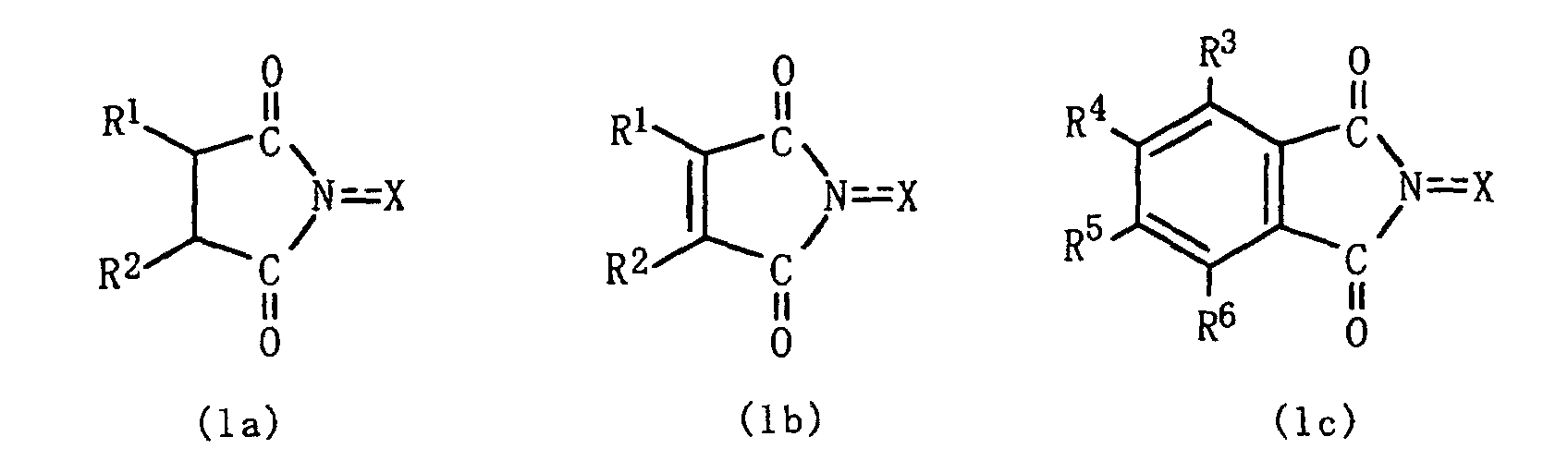 wherein R3, R4, R5 and R6 are the same or different and are each a hydrogen atom, an alkyl group, a haloalkyl group, a hydroxyl group, an alkoxy group, a carboxyl group, an alkoxycarbonyl group, an acyl group, a nitro group, a cyano group, an amino group, or a halogen atom, where adjacent groups of R3 to R6 may be combined to form an aromatic or non-aromatic ring; A in Formula (1f) is a methylene group or an oxygen atom; and R1, R2 and X have the same meanings as defined above, and wherein one or two of the N-substituted cyclic imido group indicated in Formula (1c) may be further formed on the benzene ring in Formula (1c).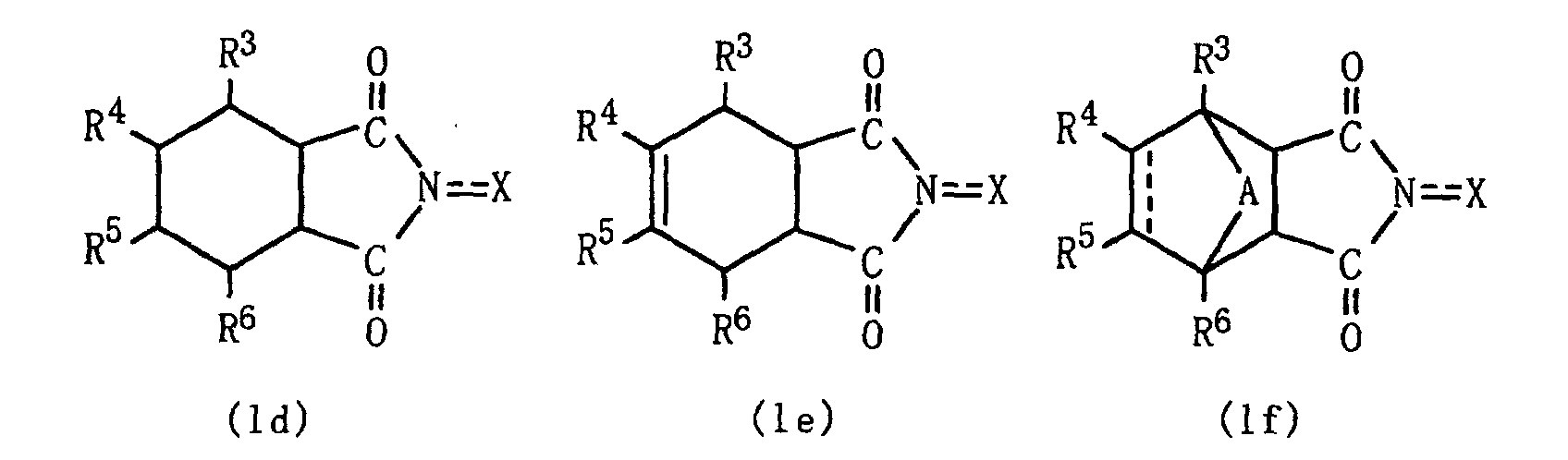
- In the substituents R3 to R6, the alkyl group includes similar alkyl groups to those exemplified above, of which alkyl groups each containing from about 1 to about 6 carbon atoms are preferred. The haloalkyl group includes trifluoromethyl group, and other haloalkyl groups each containing from about 1 to about 4 carbon atoms. The alkoxy group includes similar alkoxy groups to those mentioned above, of which lower alkoxy groups each containing from about 1 to about 4 carbon atoms are preferred. The alkoxycarbonyl group includes similar alkoxycarbonyl groups to those described above, of which lower alkoxycarbonyl groups each containing from about 1 to about 4 carbon atoms in the alkoxy moiety are preferred. The acyl group includes similar acyl groups to those described above, of which acyl groups each containing from about 1 to about 6 carbon atoms are preferred. The halogen atom includes, for example, fluorine, chlorine and bromine atoms. Each of the substituents R3 to R6 is often a hydrogen atom, a lower alkyl group containing from about 1 to about 4 carbon atoms, a carboxyl group, a nitro group, or a halogen atom. The ring formed by R3 to R6 includes similar rings to the aforementioned rings which are formed by R1 and R2. Among them, aromatic or non-aromatic 5- to 12-membered rings are preferred.
- Typical examples of preferred imide compounds are
N-hydroxysuccinimide, N-hydroxy-α-methylsuccinimide,
N-hydroxy-α,α-dimethylsuccinimide, N-hydroxymaleimide,
N-hydroxyhexahydrophthalimide,
N,N'-dihydroxycyclohexanetetracarboxylic imide,
N-hydroxyphthalimide, N-hydroxytetrabromophthalimide,
N-hydroxytetrachlorophthalimide, N-hydroxychlorendimide,
N-hydroxyhimimide, N-hydroxytrimellitimide,
N,N'-dihydroxypyromellitic imide,
N,N'-dihydroxynaphthalenetetracarboxylic imide, and other compounds wherein X is an -OR group and R is a hydrogen atom; N-acetoxysuccinimide, N-acetoxymaleimide,
N-acetoxyhexahydrophthalimide,
N,N'-diacetoxycyclohexanetetracaboxylic imide,
N-acetoxyphthalimide, N-acetoxytetrabromophthalimide,
N-acetoxytetrachlorophthalimide, N-acetoxychlorendimide,
N-acetoxyhimimide, N-acetoxytrimellitimide,
N,N'-diacetoxypyromellitic imide,
N,N'-diacetoxynaphthalenetetracarboxylic imide,
N-benzoyloxyphthalimide, and other compounds wherein X is an -OR group and R is an acyl group such as acetyl group;
N-methoxymethyloxyphthalimide,
N-(2-methoxyethoxymethyloxy)phthalimide, and other compounds wherein X is an -OR group and R is a group that can form an acetal or hemiacetal bond with a hydroxyl group;
N-methanesulfonyloxyphthalimide,
N-(p-toluenesulfonyloxy)phthalimide, and other compounds
wherein X is an -OR group and R is a sulfonyl group; sulfuric esters, nitric esters, phosphoric esters, and boric esters of N-hydroxyphthalimide, and other compounds wherein X is an -OR group and R is a group derived from an inorganic acid by removal of OH group. - Among them, typically preferred is N-hydroxysuccinimide which may have an alkyl group, such as methyl, ethyl or another C1-C4 alkyl group, at the α-position and/or the β-position and whose hydroxyl group may be protected by a protecting group such as acetoxy group or another acyl group. In general, oxidative cleavage of a cycloalkane with oxygen yields or by-produces a dicarboxylic acid having carbon atoms in its principle chain in a number equal to or less than the number of carbon atoms constituting the material cycloalkane. For example, cyclohexane yields glutaric acid and/or succinic acid in addition to adipic acid. In contrast, the imide compound used as the catalyst often undergoes ring-opening and is thereby decomposed into a corresponding dicarboxylic acid during the reaction. When the aforementioned
N-hydroxysuccinimide or its analogue is used as the catalyst, the catalyst will yield a similar compound, such as succinic acid, to the reaction products even when it is decomposed. Accordingly, there is no need of a special step for removing such a decomposed product of the imide compound catalyst, and the process is industrially very advantageous. - Among the imide compounds, compounds wherein X is an -OR group and R is a hydrogen atom can be prepared by a conventional imidization process such as a process that comprises the steps of allowing a corresponding acid anhydride to react with hydroxylamine NH2OH for ring-opening of an acid anhydride group, and closing the ring to form an imide. Such acid anhydrides include succinic anhydride, maleic anhydride, and other saturated or unsaturated aliphatic dicarboxylic anhydrides, tetrahydrophthalic anhydride, hexahydrophthalic anhydride (1,2-cyclohexanedicarboxylic anhydride), 1,2,3,4-cyclohexanetetracarboxylic 1,2-dianhydride, and other saturated or unsaturated non-aromatic cyclic polycarboxylic anhydrides (alicyclic polycarboxylic anhydrides), HET anhydride (chlorendic anhydride), himic anhydride, and other bridged polycarboxylic anhydrides (alicyclic polycarboxylic anhydrides), phthalic anhydride, tetrabromophthalic anhydride, tetrachlorophthalic anhydride, nitrophthalic anhydride, trimellitic anhydride, methylcyclohexenetricarboxylic anhydride, pyromellitic anhydride, mellitic anhydride, 1,8;4,5-naphthalenetetracarboxylic dianhydride, and other aromatic polycarboxylic anhydrides.
- Among the imide compounds, compounds wherein X is an -OR group and R is a hydroxyl-protecting group can be prepared by introducing a desired protecting group into a corresponding compound wherein R is a hydrogen atom (N-hydroxy cyclic imide compounds) by the aid of a conventional reaction for the introduction of protecting groups. For example,
N-acetoxyphthalimide can be prepared by allowing
N-hydroxyphthalimide to react with acetic anhydride or to react with an acetyl halide in the presence of a base. - Specifically preferred imide compounds are
N-hydroxysuccinimide, N-hydroxyphthalimide,
N,N'-dihydroxypyromellitimide, and other N-hydroxyimide compounds derived from aliphatic dicarboxylic anhydrides, alicyclic polycarboxylic anhydrides or aromatic polycarboxylic anhydrides, of which those derived from aliphatic dicarboxylic anhydrides or aromatic polycarboxylic anhydrides are especially preferred; and compounds obtained by introducing a protecting group into the hydroxyl group of these N-hydroxyimide compounds. - Each of the imide compounds having the N-substituted cyclic imide skeleton represented by Formula (I) can be used alone or in combination in the reaction. The imide compounds can be formed in the reaction system.
- The imide compounds can be used as being supported by a carrier. Activated carbon, zeolite, silica, silica-alumina, bentonite, and other porous carries are often used as the carrier. The amount of the imide compound on the carrier is, for example, from about 0.1 to about 50 parts by weight, preferably from about 0.5 to about 30 parts by weight, and more preferably from about 1 to about 20 parts by weight, relative to 100 parts by weight of the carrier.
- The amount of the imide compound can be selected within broad ranges and is, for example, from about 0.000001 to about 1 mole per mole of the substrate (from 0.0001% to 100% by mole). However, in consideration of economical efficiency and after-treatment, the amount of the imide compound is, per mole of the substrate, preferably from about 0.000001 to about 0.01 more (from about 0.0001% to about 1% by mole) and more preferably from about 0.00001 to about 0.005 mole (from about 0.001% to about 0.5% by mole). This is because a high space time yield can be obtained even using a small amount of the catalyst in the present invention.
- Metallic elements constituting metallic compounds for use as the catalyst are not specifically limited and are often metallic elements of the Groups 2 to 15 of the Periodic Table. The term "metallic element" as used herein also includes boron B. Examples of the metallic elements include, of the Periodic Table, Group 2 elements (e.g., Mg, Ca, Sr and Ba), Groups 3 elements (e.g., Sc, lanthanoid elements and actinoid elements), Group 4 elements (e.g., Ti, Zr and Hf), Group 5 elements (e.g., V), Group 6 elements (e.g., Cr, Mo and W), Group 7 elements (e.g., Mn), Group 8 elements (e.g., Fe and Ru), Group 9 elements (e.g., Co and Rh), Group 10 elements (e.g., Ni, Pd and Pt), Group 11 elements (e.g., Cu), Group 12 elements (e.g., Zn), Groups 13 elements (e.g., B, Al and In), Group 14 elements (e.g., Sn and Pb), and Group 15 elements (e.g., Sb and Bi). Preferred metallic elements include transition metal elements (elements of Groups 3 to 12 of the Periodic Table) and Group 13 elements of the Periodic Table. Among them, elements of the Groups 5 to 11 of the Periodic Table, such as V, Mo, Mn, Fe, Ru, Co, and Cu, are preferred, of which Mn, Fe, Co, and Cu are especially preferred. Above all, Co is preferred. The valence of the metallic element is not specifically limited and is, for example, from about 0 to about 6.
- Such metallic compounds include, but are not limited to, elementary substances, hydroxides, oxides (including complex oxides), halides (fluorides, chlorides, bromides, and iodides), salts of oxoacids (e.g., nitrates, sulfates, phosphates, borates, and carbonates), salts of isopolyacids, salts of heteropolyacids, and other inorganic compounds of the aforementioned metallic elements; salts of organic acids (e.g., acetates, propionates, prussiates, naphthenates, stearates, and lactates), complexes, and other organic compounds of the metallic elements. Ligands constituting the complexes include OH (hydroxo), alkoxy (e.g., methoxy, ethoxy, propoxy, and butoxy), acyls (e.g., acetyl and propionyl), alkoxycarbonyls (e.g., methoxycarbonyl and ethoxycarbonyl), acetylacetonato, cyclopentadienyl group, halogen atoms (e.g., chlorine and bromine), CO, CN, oxygen atom, H2O (aquo), phosphines (triphenylphosphine and other triarylphosphines) and other phosphorus compounds, NH3 (ammine), NO, NO2 (nitro), NO3 (nitrato), ethylenediamine, diethylenetriamine, pyridine, phenanthroline, and other nitrogen-containing compounds.
- Specific examples of the metallic compounds include, by taking cobalt compounds as an example, cobalt hydroxide, cobalt oxide, cobalt chloride, cobalt bromide, cobalt nitrate, cobalt sulfate, cobalt phosphate, and other inorganic compounds; cobalt acetate, cobalt naphthenate, cobalt stearate, cobalt lactate, and other salts of organic acids; acetylacetonatocobalt, and other complexes, and other divalent or trivalent cobalt compounds. Examples of vanadium compounds include, but are not limited to, vanadium hydroxide, vanadium oxide, vanadium chloride, vanadyl chloride, vanadium sulfate, vanadyl sulfate, sodium vanadate, and other inorganic compounds; acetylacetonatovanadium, vanadyl acetylacetonato, and other complexes, and other vanadium compounds having a valence of from 2 to 5. Examples of compounds of the other metallic elements include compounds corresponding to the above-mentioned cobalt or vanadium compounds.
- Each of these metallic compounds can be used alone or in combination. A combination use of a low-valence metallic compound with a high-valence metallic compound as the metallic compound may significantly increase the reaction rate as compared with the single use of each compound. When a metal may have plural valences, a metallic compound having a lower valence is called a "low-valence metallic compound" and a metallic compound having a higher valence is called a "high-valence metallic compound".
- Examples of such combinations of a low-valence metallic compound with a high-valence metallic compound are combinations of a low-valence metallic compound selected from divalent cobalt compounds, divalent manganese compounds, divalent iron compounds and monovalent copper compounds with a high-valence metallic compound selected from trivalent cobalt compounds, trivalent manganese compounds, trivalent iron compounds, and divalent copper compounds. Among these combinations, those containing at least a divalent or trivalent cobalt compound are preferred, of which those of a divalent cobalt compound with a trivalent cobalt compound are especially preferred.
- A combination use of two or more of metallic compounds containing different metallic elements may improve the conversion and/or selectivity as compared with a single use of each metallic compound. Such combinations include, for example, a combination of a cobalt compound (a divalent or trivalent cobalt compound) with a manganese compound (divalent or trivalent). In this case, the molar ratio of the cobalt compound to the manganese compound is, for example, from about 1:99 to about 99:1 and preferably from about 5:95 to about 95:5.
- The amount of the metallic compound is, for example, from about 0.05 to about 20 moles, and preferably from about 0.1 to about 10 moles per mole of the imide compound.
- Organic salts each comprising a polyatomic cation or a polyatomic anion and its counter ion, which polyatomic cation or anion contains a Group 15 or Group 16 element of the Periodic Table having at least one organic group combined therewith, can be used as a promoter (co-catalyst) in the present invention. By using the organic salts as the promoter, the rate and selectivity of the reaction can be improved.
- In the organic salts, the Group 15 elements of the Periodic Table include N, P, As, Sb, and Bi, and the Group 16 elements of the Periodic Table include, for example, O, S, Se and Te. Preferred elements are N, P, As, Sb and S, of which N, P and S are typically preferred.
- The organic groups to be combined with atoms of the elements include, but are not limited to, hydrocarbon groups which may have a substituent, and substituted oxy groups. The hydrocarbon groups include, but are not limited to, methyl, ethyl, propyl, isopropyl, butyl, isobutyl, s-butyl, t-butyl, pentyl, hexyl, octyl, decyl, tetradecyl, hexadecyl, octadecyl, allyl, and other straight- or branched-chain aliphatic hydrocarbon groups (alkyl groups, alkenyl groups and alkynyl groups) each containing from about 1 to about 30 carbon atoms (preferably from about 1 to about 20 carbon atoms); cyclopentyl, cyclohexyl, and other alicyclic hydrocarbon groups each containing from about 3 to about 8 carbon atoms; and phenyl, naphthyl, and other aromatic hydrocarbon groups each containing from about 6 to about 14 carbon atoms. Substituents which the hydrocarbon groups may have include, but are not limited to, halogen atoms, oxo group, hydroxyl group, substituted oxy groups (e.g., alkoxy groups, aryloxy groups, and acyloxy groups), carboxyl group, substituted oxycarbonyl groups, substituted or unsubstituted carbamoyl groups, cyano group, nitro group, substituted or unsubstituted amino groups, alkyl groups (e.g., methyl, ethyl, and other C1-C4 alkyl groups), cycloalkyl groups, aryl groups (e.g., phenyl and naphthyl groups), and heterocyclic groups. The preferred hydrocarbon groups include, for example, alkyl groups each containing from about 1 to about 30 carbon atoms, and aromatic hydrocarbon groups (especially, phenyl or naphthyl group) each containing from about 6 to about 14 carbon atoms. The substituted oxy groups include, but are not limited to, alkoxy groups, aryloxy groups and aralkyloxy groups.
- Typical examples of the organic salts include organic ammonium salts, organic phosphonium salts, organic sulfonium salts, and other organic onium salts. Examples of the organic ammonium salts are tetramethylammonium chloride, tetraethylammonium chloride, tetrabutylammonium chloride, tetrahexylammonium chloride, trioctylmethylammonium chloride, triethylphenylammonium chloride, tributyl(hexadecyl)ammonium chloride, di (octadecyl) dimethylammonium chloride, and other quaternary ammonium chlorides, and corresponding quaternary ammonium bromides, and other quaternary ammonium salts each containing four hydrocarbon groups combined with a nitrogen atom; dimethylpiperidinium chloride, hexadecylpyridinium chloride, methylquinolinium chloride, and other cyclic quaternary ammonium salts. Examples of the organic phosphonium salts are tetramethylphosphonium chloride, tetrabutylphosphonium chloride, tributyl(hexadecyl)phosphonium chloride, triethylphenylphosphonium chloride, and other quaternary phosphonium chlorides, corresponding quaternary phosphonium bromides, and other quaternary phosphonium salts each containing four hydrocarbon groups combined with a phosphorus atom. Examples of the organic sulfonium salts are triethylsulfonium iodide, ethyldiphenylsulfonium iodide, and other sulfonium salts each containing three hydrocarbon groups combined with a sulfur atom.
- The organic salts also include methanesulfonates, ethanesulfonates, octanesulfonates, dodecanesulfonates, and other alkyl-sulfonates (e.g., C1-C18 alkyl-sulfonates); benzenesulfonates, p-toluenesulfonates, naphthalenesulfonates, decylbenzenesulfonates, dodecylbenzenesulfonates, and other aryl-sulfonates which may be substituted with an alkyl group (e.g., C1-C18 alkyl-arylsulfonates); sulfonic acid type ion exchange resins (ion exchangers) ; and phosphonic acid type ion exchange resins (ion exchangers).
- The amount of the organic salt is, for example, from about 0.001 to about 20 moles, and preferably from about 0.1 to about 10 moles per mole of the imide compound.
- The system in the process of the present invention may further comprise a free-radical generator or a free-radical reaction accelerator. Such components include, but are not limited to, halogens (e.g., chlorine and bromine), peracids (e.g., peracetic acid and m-chloroperbenzoic acid), and peroxides (e.g., hydrogen peroxide, t-butyl hydroperoxide (TBHP), and other hydroperoxides), as well as nitric acid, nitrous acid, and salts thereof. The existence of the component(s) in the system may enhance the reaction. The amount of the aforementioned component(s) is, for example, from about 0.001 to about 20 moles per mole of the imide compound.
- The reaction is performed in the presence of a solvent. Such solvents include, but are not limited to, benzene and other aromatic hydrocarbons; dichloromethane, chloroform, 1,2-dichloroethane, dichlorobenzene, and other halogenated hydrocarbons; t-butyl alcohol, t-amyl alcohol, and other alcohols; acetonitrile, benzonitrile, and other nitriles; acetic acid, propionic acid, and other organic acids; formamide, acetamide, dimethylformamide (DMF), dimethylacetamide, and other amides. These solvents can be used in combination. Among the solvents, organic acids and other organic protic solvents as well as nitriles are preferred. The reaction product dicarboxylic acid can also serve as a reaction solvent.
- An important feature of the present invention is that the reaction is performed under conditions of a reaction temperature of 80°C or higher and a concentration of the cycloalkane in the reaction system of 21% by weight or higher (from 21% to 100% by weight). The reaction temperature is, for example, from about 80°C to about 200°C, preferably from about 80°C to about 150°C, and especially preferably from about 90°C to about 140°C. If the reaction temperature is lower than 80°C, the reaction rate is markedly decreased. The concentration of the cycloalkane is preferably from about 21% to about 99.5% by weight, more preferably from about 25% to about 95% by weight (e.g., from 35% to 95% by weight), further preferably from about 30% to about 70% by weight (e.g., from 35% to 70% by weight), and typically preferably from about 35% to about 55% by weight (e.g., from 40% to 55% by weight).
- If the concentration of the cycloalkane in the reaction system is excessively low, i.e., less than 21% by weight, the conversion rate from the cycloalkane is low and the space time yield of the resulting dicarboxylic acid is markedly low. Namely, the yield of the dicarboxylic acid per unit volume and unit time is low, and the dicarboxylic acid cannot be obtained with high production efficiency. In contrast, when the substrate concentration falls within the above-specified range, the conversion rate of the cycloalkane is high and the corresponding dicarboxylic acid can be obtained in a high space time yield. Although reasons are not completely clarified, this is probably because, when the concentration of the cycloalkane is excessively low, the rate of a reaction (key step in chain steps) decreases, in which reaction a radical (peroxy radical) formed in the system withdraws a hydrogen from the substrate cycloalkane, and therefore the reaction rate as a whole decreases.
- In this connection, the space time yield of the dicarboxylic acid increases with an increasing concentration of the cycloalkane in the reaction system, but passes through the maximum and gradually decreases when the concentration of the cycloalkane reaches a certain level or higher. Although reasons are not completely clarified, this is probably because the solubility of the catalyst decreases and thereby the reaction rate also decreases at a very high concentration of the cycloalkane.
- The reaction can be performed at normal pressure or under a pressure (under a load). When the reaction is performed under a pressure (under a load), the reaction pressure is, for example, from about 0.5 to about 20 MPa, and preferably from about 1 to about 15 MPa.
- The reaction can be performed in the presence of, or under the flow of, oxygen according to a conventional procedure such as a batch system, semi-batch system or continuous system. When the reaction is performed in the batch system or semi-batch system, good results can be obtained by setting the initial concentration of the cycloalkane within the above-specified range (21% by weight or higher). When the reaction is performed in the continuous system, the dicarboxylic acid can be obtained with a high production efficiency by setting the concentration of the cycloalkane in a steady state within the above-specified range (21% by weight or higher).
- In the present invention, the cycloalkane used as a raw material oxidatively cleaves and thereby yields a dicarboxylic acid having a carbon chain containing carbon atoms in the same number as that of carbon atoms constituting the cycloalkane ring. Specifically, cyclohexane yields adipic acid, and cyclododecane yields a dodecanedioic acid. Under some conditions, a dicarboxylic acid having a carbon chain containing carbon atoms in a number one or two less than the number of carbon atoms constituting the cycloalkane ring, a corresponding cycloalkanol, a cycloalkanone, and other products may be by-produced. For example, when cyclohexane is used as a raw material, glutaric acid, succinic acid, cyclohexanol, and/or cyclohexanone may be by-produced. Among these by-products, cycloalkanols and cyclohexanone can be recycled to the reaction system.
- After the completion of the reaction, reaction products can be separated and purified by a separation means such as filtration, concentration, distillation, extraction, crystallization, recrystallization, adsorption, and column chromatography or any combination of these separation means.
- Dicarboxylic acids obtained by the production process of the present invention can be used, for example, as raw materials for polyamides (nylons) and polyesters and as intermediate materials for fine chemicals.
- In the production of a corresponding dicarboxylic acid by catalytic oxidation of a cycloalkane with oxygen, the present invention can produce the dicarboxylic acid in a high space time yield even using a small amount of a catalyst.
- The present invention will be illustrated in further detail with reference to several examples below, which are not intended to limit the scope of the invention.
- Other components such as cyclohexane, cyclohexanone, and cyclohexanol than dicarboxylic acids were analyzed by bringing a reaction mixture directly into a gas chromatograph.
- The dicarboxylic acids such as adipic acid, glutaric acid and succinic acid were analyzed by converting a target dicarboxylic acid into a dimethyl ester derivative in the following manner and analyzing the dimethyl ester derivative by gas chromatography. Specifically, about 1 g of the reaction mixture was sampled, a solvent therein was removed by distillation using an evaporator, the residue was diluted with about 1 g of methanol, and a commercially available TMS-CHN2 was added to the mixture until the mixture became yellow, and the resulting mixture was stirred for about 1 hour. Next, acetic acid was added to the mixture until the mixture became colorless, the resulting mixture was brought into a gas chromatograph and was analyzed.
- Gas Chromatography (GC) Conditions
- Model: 14A available from Shimadzu Corporation
- Detector: FID
- Column: FFAP (25 m x 0.32 mm x 0.25 µm)
- Temperature conditions:
- INJ, DET: 280°C
- Column: The column was held at 50°C for 5 minutes and was raised in temperature to 150°C at a rate of 5°C per minute.
- Gas flow rate: 2.8 ml/min, split ratio: 50
-
- In a 316 stainless steel reactor having an internal volume of 300 ml, 26 g (309 mmol) of cyclohexane, 14 g of acetic acid, 100.9 mg (0.618 mmol) of N-hydroxyphthalimide, 76.9 mg (0.309 mmol) of cobalt(II) acetate tetrahydrate, and 110 mg (0.309 mmol) of bis(acetylacetonato)cobalt(II) were placed, and the reactor was sealed and was pressurized to 50 Kg/cm2 (4.9 MPa) with a gaseous mixture comprising 50% of O2 and 50% of N2. The liquid temperature was raised on an oil bath and was held at 110°C. Immediately after the liquid temperature reached 110°C, absorption of the gas began. The reaction was terminated by cooling 20 minutes later. A reaction mixture was diluted with 60 g of acetic acid to thereby dissolve all of solid matters. The resulting solution was analyzed to find that a conversion from cyclohexane was 24.4% and a selectivity for adipic acid was 56.1%. In addition, glutaric acid (selectivity: 14.3%), succinic acid (selectivity: 12.1%), cyclohexanone (selectivity: 10.9%), cyclohexanol (selectivity: 5.9%), and cyclohexyl acetate (selectivity: 0.71%) were by-produced.
- In a 316 stainless steel reactor having an internal volume of 300 ml, 18 g (214 mmol) of cyclohexane, 22 g of acetic acid, 69.7 mg (0.428 mmol) of N-hydroxyphthalimide, 53.3 mg (0.214 mmol) of cobalt(II) acetate tetrahydrate, and 76.2 mg (0.214 mmol) of tris(acetylacetonato)cobalt(III) were placed, and the reactor was sealed and was pressurized to 50 Kg/cm2 (4.9 MPa) with a gaseous mixture comprising 50% of O2 and 50% of N2. The liquid temperature was raised on an oil bath and was held at 110°C. Immediately after the liquid temperature reached 110°C, absorption of the gas began. The reaction was terminated by cooling 20 minutes later. A reaction mixture was diluted with 60 g of acetic acid to thereby dissolve all of solid matters. The resulting solution was analyzed to find that a conversion from cyclohexane was 64.8% and a selectivity for adipic acid was 71.6%. In addition, glutaric acid (selectivity: 13.0%), succinic acid (selectivity: 12.5%), cyclohexanone (selectivity: 2.1%), cyclohexanol (selectivity: 1.7%), and cyclohexyl acetate (selectivity: 0.29%) were by-produced.
- In a 316 stainless steel reactor having an internal volume of 300 ml, 36 g (428 mmol) of cyclohexane, 4 g of acetic acid, 139.7 mg (0.856 mmol) of N-hydroxyphthalimide, 106.6 mg (0.428 mmol) of cobalt(II) acetate tetrahydrate, and 152.5 mg (0.428 mmol) of tris(acetylacetonato)cobalt(III) were placed, and the reactor was sealed and was pressurized to 50 Kg/cm2 (4.9 MPa) with a gaseous mixture comprising 50% of O2 and 50% of N2. The liquid temperature was raised on an oil bath and was held at 110°C. Immediately after the liquid temperature reached 110°C, absorption of the gas began. The reaction was terminated by cooling 20 minutes later. A reaction mixture was diluted with 60 g of acetic acid to thereby dissolve all of solid matters. The resulting solution was analyzed to find that a conversion from cyclohexane was 8.3% and a selectivity for adipic acid was 36.4%. In addition, glutaric acid (selectivity: 10.4%), succinic acid (selectivity: 7.7%), cyclohexanone (selectivity: 22.6%), cyclohexanol (selectivity: 21.6%), and cyclohexyl acetate (selectivity: 1.4%) were by-produced.
- In a 316 stainless steel reactor having an internal volume of 300 ml, 39.6 g (470 mmol) of cyclohexane, 0.4 g of acetic acid, 153.5 mg (0.940 mmol) of N-hydroxyphthalimide, 117.2 mg (0.470 mmol) of cobalt(II) acetate tetrahydrate, and 167.8 mg (0.470 mmol) of tris(acetylacetonato)cobalt(III) were placed, and the reactor was sealed and was pressurized to 50 Kg/cm2 (4.9 MPa) with a gaseous mixture comprising 50% of O2 and 50% of N2. The liquid temperature was raised on an oil bath and was held at 110°C. Immediately after the liquid temperature reached 110°C, absorption of the gas began. The reaction was terminated by cooling 60 minutes later. A reaction mixture was diluted with 60 g of acetic acid to thereby dissolve all of solid matters. The resulting solution was analyzed to find that a conversion from cyclohexane was 6.9% and a selectivity for adipic acid was 14.9%. In addition, glutaric acid (selectivity: 4.5%), succinic acid (selectivity: 3.9%), cyclohexanone (selectivity: 40.6%), cyclohexanol (selectivity: 35.5%), and cyclohexyl acetate (selectivity: 0.5%) were by-produced.
- In a 316 stainless steel reactor having an internal volume of 300 ml, 12 g (142 mmol) of cyclohexane, 28 g of acetic acid, 46.53mg (0.285 mmol) of N-hydroxyphthalimide, 35.49 mg (0.143 mmol) of cobalt(II) acetate tetrahydrate, and 50.75 mg (0.143 mmol) of tris(acetylacetonato)cobalt(III) were placed, and the reactor was sealed and was pressurized to 50 Kg/cm2 (4.9 MPa) with a gaseous mixture comprising 50% of O2 and 50% of N2. The liquid temperature was raised on an oil bath and was held at 110°C. Immediately after the liquid temperature reached 110°C, absorption of the gas began. The reaction was terminated by cooling 60 minutes later. A reaction mixture was diluted with 60 g of acetic acid to thereby dissolve all of solid matters. The resulting solution was analyzed to find that a conversion from cyclohexane was 13.5% and a selectivity for adipic acid was 61.0%. In addition, glutaric acid (selectivity: 12.2%), succinic acid (selectivity: 11.8%), cyclohexanone (selectivity: 7.7%), cyclohexanol (selectivity: 5.8%), and cyclohexyl acetate (selectivity: 1.5%) were by-produced.
- In a 316 stainless steel reactor having an internal volume of 300 ml, 10 g (118 mmol) of cyclohexane, 40 g of acetic acid, 38.8 mg (0.237 mmol) of N-hydroxyphthalimide, 29.6 mg (0.118 mmol) of cobalt(II) acetate tetrahydrate, and 42.4 mg (0.118 mmol) of tris(acetylacetonato)cobalt (III) were placed, and the reactor was sealed and was pressurized to 50 Kg/cm2 (4.9 MPa) with a gaseous mixture comprising 50% of O2 and 50% of N2. The liquid temperature was raised on an oil bath and was held at 110°C. Immediately after the liquid temperature reached 110°C, absorption of the gas began. The reaction was terminated by cooling 60 minutes later. A reaction mixture was analyzed to find that a conversion from cyclohexane was 1.8% and adipic acid was not produced. In addition, cyclohexanone (selectivity: 57.8%), cyclohexanol (selectivity: 33.0%), and cyclohexyl acetate (selectivity: 9.3%) were produced.
- In a 316 stainless steel reactor having an internal volume of 300 ml, 52 g (618 mmol) of cyclohexane, 28 g of acetic acid, 50.5 mg (0.309 mmol) of N-hydroxyphthalimide, 38.5 mg (0.154 mmol) of cobalt(II) acetate tetrahydrate, and 55.0 mg (0.154 mmol) of tris(acetylacetonato)cobalt(III) were placed, and the reactor was sealed and was pressurized to 50 Kg/cm2 (4.9 MPa) with a gaseous mixture comprising 50% of O2 and 50% of N2. The liquid temperature was raised on an oil bath and was held at 110°C. Immediately after the liquid temperature reached 110°C, absorption of the gas began. The reaction was terminated by cooling 20 minutes later. A reaction mixture was diluted with 60 g of acetic acid to thereby dissolve all of solid matters. The resulting solution was analyzed to find that a conversion from cyclohexane was 21.7% and a selectivity for adipic acid was 57.0%. In addition, glutaric acid (selectivity: 9.37%), succinic acid (selectivity: 8.37%), cyclohexanone (selectivity: 15.2%), cyclohexanol (selectivity: 9.4%), and cyclohexyl acetate (selectivity: 0.69%) were by-produced.
- In a 316 stainless steel reactor having an internal volume of 300 ml, 52 g (618 mmol) of cyclohexane, 28 g of acetic acid, 25.3 mg (0.154 mmol) of N-hydroxyphthalimide, 19.2 mg (0.077 mmol) of cobalt(II) acetate tetrahydrate, and 27.4 mg (0.077 mmol) of tris(acetylacetonato)cobalt(III) were placed, and the reactor was sealed and was pressurized to 50 Kg/cm2 (4.9 MPa) with a gaseous mixture comprising 50% of O2 and 50% of N2. The liquid temperature was raised on an oil bath and was held at 110°C. Immediately after the liquid temperature reached 110°C, absorption of the gas began. The reaction was terminated by cooling 20 minutes later. A reaction mixture was diluted with 60 g of acetic acid to thereby dissolve all of solid matters. The resulting solution was analyzed to find that a conversion from cyclohexane was 20.5% and a selectivity for adipic acid was 55.4%. In addition, glutaric acid (selectivity: 10.1%), succinic acid (selectivity: 8.9%), cyclohexanone (selectivity: 14.2%), cyclohexanol (selectivity: 8.54%), and cyclohexyl acetate (selectivity: 2.94%) were by-produced.
- In a 316 stainless steel reactor having an internal volume of 300 ml, 18 g (214 mmol) of cyclohexane, 22 g of acetic acid, 69.7 mg (0.428 mmol) of N-hydroxyphthalimide, 5.33 mg (0.0214 mmol) of cobalt (II) acetate tetrahydrate, and 7.62 mg (0.0214 mmol) of tris(acetylacetonato)cobalt(III) were placed, and the reactor was sealed and was pressurized to 50 Kg/cm2 (4.9 MPa) with a gaseous mixture comprising 50% of O2 and 50% of N2. The liquid temperature was raised on an oil bath and was held at 110°C. Immediately after the liquid temperature reached 110°C, absorption of the gas began. The reaction was terminated by cooling 60 minutes later. A reaction mixture was diluted with 60 g of acetic acid to thereby dissolve all of solid matters. The resulting solution was analyzed to find that a conversion from cyclohexane was 17.5% and a selectivity for adipic acid was 45.8%. In addition, glutaric acid (selectivity: 10.1%), succinic acid (selectivity: 7.4%), cyclohexanone (selectivity: 23.8%), cyclohexanol (selectivity: 11.1%), and cyclohexyl acetate (selectivity: 1.9%) were by-produced.
- In a 316 stainless steel reactor having an internal volume of 300 ml, 52 g (618 mmol) of cyclohexane, 28 g of acetic acid, 203.6 mg (1.236 mmol) of N-hydroxyphthalimide, and 441 mg (1.236 mmol) of tris(acetylacetonato)cobalt(III) were placed, and the reactor was sealed and was pressurized to 50 Kg/cm2 (4.9 MPa) with a gaseous mixture comprising 50% of O2 and 50% of N2. The liquid temperature was raised on an oil bath and was held at 110°C. Immediately after the liquid temperature reached 110°C, absorption of the gas began. The reaction was terminated by cooling 60 minutes later. A reaction mixture was diluted with 120 g of acetic acid to thereby dissolve all of solid matters. The resulting solution was analyzed to find that a conversion from cyclohexane was 13.8% and a selectivity for adipic acid was 58.8%. In addition, glutaric acid (selectivity: 11.0%), succinic acid (selectivity: 10.9%), cyclohexanone (selectivity: 3.67%), cyclohexanol (selectivity: 14.6%), and cyclohexyl acetate (selectivity: 1.09%) were by-produced.
- In a 316 stainless steel reactor having an internal volume of 300 ml, 18 g (214 mmol) of cyclohexane, 22 g of acetic acid, 69.7 mg (0.428 mmol) of N-hydroxyphthalimide, 61.9 mg (0.214 mmol) of bis(acetylacetonato)manganese(II) dihydrate, and 75.4 mg (0.214 mmol) of tris(acetylacetonato)manganese(III) were placed, and the reactor was sealed and was pressurized to 50 Kg/cm2 (4.9 MPa) with a gaseous mixture comprising 50% of O2 and 50% of N2. The liquid temperature was raised on an oil bath and was held at 110°C. Immediately after the liquid temperature reached 110°C, absorption of the gas began. The reaction was terminated by cooling 60 minutes later. A reaction mixture was diluted with 60 g of acetic acid to thereby dissolve all of solid matters. The resulting solution was analyzed to find that a conversion from cyclohexane was 38.9% and a selectivity for adipic acid was 71.5%. In addition, glutaric acid (selectivity: 14.0%), succinic acid (selectivity: 9.3%), cyclohexanone (selectivity: 0.4%), cyclohexanol (selectivity: 3.9%), and cyclohexyl acetate (selectivity: 1.0%) were by-produced.
- In a 316 stainless steel reactor having an internal volume of 300 ml, 18 g (214 mmol) of cyclohexane, 22 g of acetic acid, 69.7 mg (0.428 mmol) of N-hydroxyphthalimide, 61.6 mg (0.214 mmol) of iron(II) lactate [ferrous lactate], and 75.5 mg (0.214 mmol) of tris(acetylacetonato)iron(III) were placed, and the reactor was sealed and was pressurized to 50 Kg/cm2 (4.9 MPa) with a gaseous mixture comprising 50% of O2 and 50% of N2. The liquid temperature was raised on an oil bath and was held at 110°C. Immediately after the liquid temperature reached 110°C, absorption of the gas began. The reaction was terminated by cooling 60 minutes later. A reaction mixture was diluted with 60 g of acetic acid to thereby dissolve all of solid matters. The resulting solution was analyzed to find that a conversion from cyclohexane was 14.3% and a selectivity for adipic acid was 31.8%. In addition, glutaric acid (selectivity: 8.1%), succinic acid (selectivity: 9.9%), cyclohexanone (selectivity: 38.9%), cyclohexanol (selectivity: 10.0%), and cyclohexyl acetate (selectivity: 1.4%) were by-produced.
- In a 316 stainless steel reactor having an internal volume of 300 ml, 18 g (214 mmol) of cyclohexane, 22 g of acetic acid, 69.7 mg (0.428 mmol) of N-hydroxyphthalimide, 21.2 mg (0.214 mmol) of copper(I) chloride, and 42.7 mg (0.214 mmol) of copper(II) acetate were placed, and the reactor was sealed and was pressurized to 50 Kg/cm2 (4.9 MPa) with a gaseous mixture comprising 50% of O2 and 50% of N2. The liquid temperature was raised on an oil bath and was held at 110°C. Immediately after the liquid temperature reached 110°C, absorption of the gas began. The reaction was terminated by cooling 60 minutes later. A reaction mixture was diluted with 60 g of acetic acid to thereby dissolve all of solid matters. The resulting solution was analyzed to find that a conversion from cyclohexane was 13.0% and a selectivity for adipic acid was 38.8%. In addition, glutaric acid (selectivity: 9.4%), succinic acid (selectivity: 8.4%), cyclohexanone (selectivity: 29.5%), cyclohexanol (selectivity: 11.8%), and cyclohexyl acetate (selectivity: 2.1%) were by-produced.
- In a 316 stainless steel reactor having an internal volume of 300 ml, 18 g (214 mmol) of cyclohexane, 22 g of acetic acid, 69.7 mg (0.428 mmol) of N-hydroxyphthalimide, 212 mg (2.14 mmol) of copper(I) chloride, and 427 mg (2.14 mmol) of copper(II) acetate were placed, and the reactor was sealed and was pressurized to 50 Kg/cm2 (4.9 MPa) with a gaseous mixture comprising 50% of O2 and 50% of N2. The liquid temperature was raised on an oil bath and was held at 110°C. Immediately after the liquid temperature reached 110°C, absorption of the gas began. The reaction was terminated by cooling 60 minutes later. A reaction mixture was diluted with 60 g of acetic acid to thereby dissolve all of solid matters. The resulting solution was analyzed to find that a conversion from cyclohexane was 36.6% and a selectivity for adipic acid was 62.1%. In addition, glutaric acid (selectivity: 17.7%), succinic acid (selectivity: 12.7%), cyclohexanone (selectivity: 1.41%), cyclohexanol (selectivity: 4.90%), and cyclohexyl acetate (selectivity: 1.14%) were by-produced.
- In a 316 stainless steel reactor having an internal volume of 300 ml, 26 g (309 mmol) of cyclohexane, 14 g of acetic acid, 100.8 mg (0.617 mmol) of N-hydroxyphthalimide, 179 mg (0.617 mmol) of bis(acetylacetonato)manganese(II) dihydrate, and 15.4 mg (0.0617 mmol) of cobalt(II) acetate tetrahydrate were placed, and the reactor was sealed and was pressurized to 50 Kg/cm2 (4.9 MPa) with a gaseous mixture comprising 50% of O2 and 50% of N2. The liquid temperature was raised on an oil bath and was held at 110°C. Immediately after the liquid temperature reached 110°C, absorption of the gas began. The reaction was terminated by cooling 60 minutes later. A reaction mixture was diluted with 60 g of acetic acid to thereby dissolve all of solid matters. The resulting solution was analyzed to find that a conversion from cyclohexane was 14.7% and a selectivity for adipic acid was 62.9%. In addition, glutaric acid (selectivity: 20.2%), succinic acid (selectivity: 5.5%), cyclohexanone (selectivity: 7.1%), cyclohexanol (selectivity: 3.3%), and cyclohexyl acetate (selectivity: 1.0%) were by-produced.
- In a 316 stainless steel reactor having an internal volume of 100 ml, 13.5 g (160 mmol) of cyclohexane, 16.5 g of acetonitrile, 52.3 mg (0.320 mmol) of N-hydroxyphthalimide, 57.1 mg (0.160 mmol) of tris(acetylacetonato)cobalt(III), and 39.9 mg (0.160 mmol) of cobalt(II) acetate were placed, and the reactor was sealed and was pressurized to 50 Kg/cm2 (4.9 MPa) with a gaseous mixture comprising 50% of O2 and 50% of N2. The liquid temperature was raised on an oil bath and was held at 100°C. Immediately after the liquid temperature reached 100°C, absorption of the gas began. The reaction was terminated by cooling 60 minutes later. A reaction mixture was analyzed to find that a conversion from cyclohexane was 8.8% and a selectivity for adipic acid was 17.9%. In addition, glutaric acid (selectivity: 3.4%), succinic acid (selectivity: 1.7%), cyclohexanone (selectivity: 41.3%), cyclohexanol (selectivity: 35.3%), and cyclohexyl acetate (selectivity: 0.43%) were by-produced.
- In a 316 stainless steel reactor having an internal volume of 300 ml, 26 g (309 mmol) of cyclohexane, 14 g of acetic acid, 179 mg (0.617 mmol) of bis(acetylacetonato)manganese(II) dihydrate, and 15.4 mg (0.0617 mmol) of cobalt(II) acetate tetrahydrate were placed, and the reactor was sealed and was pressurized to 50 Kg/cm2 (4.9 MPa) with a gaseous mixture comprising 50% of O2 and 50% of N2. The liquid temperature was raised on an oil bath and was held at 110°C. Immediately after the liquid temperature reached 110°C, absorption of the gas began. The reaction was terminated by cooling 60 minutes later. A reaction mixture was diluted with 60 g of acetic acid to thereby dissolve all of solid matters. The resulting solution was analyzed to find that a conversion from cyclohexane was 0.11% and adipic acid was not produced. In addition, cyclohexanone (selectivity: 28.2%), cyclohexanol (selectivity: 70.3%), and cyclohexyl acetate (selectivity: 1.5%) were produced.
- In a 316 stainless steel reactor having an internal volume of 300 ml, 26 g (309 mmol) of cyclohexane, 14 g of acetic acid, and 100.8 mg (0.617 mmol) of N-hydroxyphthalimide were placed, and the reactor was sealed and was pressurized to 50 Kg/cm2 (4.9 MPa) with a gaseous mixture comprising 50% of O2 and 50% of N2. The liquid temperature was raised on an oil bath and was held at 110°C. Immediately after the liquid temperature reached 110°C, absorption of the gas began. The reaction was terminated by cooling 60 minutes later. A reaction mixture was diluted with 60 g of acetic acid to thereby dissolve all of solid matters. The resulting solution was analyzed to find that a conversion from cyclohexane was 0.23% and adipic acid was not produced. In addition, cyclohexanone (selectivity: 53.4%), cyclohexanol (selectivity: 46.1%), and cyclohexyl acetate (selectivity: 0.5%) were produced.
- In a flask having an internal volume of 100 ml, 8.4 g (50 mmol) of cyclododecane, 4.52 g of acetic acid, 16.3 mg (0.1 mmol) of N-hydroxyphthalimide, 28.9 mg (0.1 mmol) of bis(acetylacetonato)manganese(II) dihydrate, and 2.0 mg (0.01 mmol) of cobalt(II) acetate tetrahydrate were placed, and an oxygen balloon was attached to the reactor. The liquid temperature was raised on an oil bath and was held at 100°C. The reaction was terminated by cooling 6 hours later. A reaction mixture was diluted with 60 g of acetic acid to thereby dissolve all of solid matters. The resulting solution was analyzed to find that a conversion from cyclododecane was 20.6% and a selectivity for dodecanedioic acid was 23.7%. In addition, cyclododecanone (selectivity: 7.3%) and cyclododecanol (selectivity: 13.1%) were by-produced.
- In a flask having an internal volume of 100 ml, 8.4 g (50 mmol) of cyclododecane, 12.6 g of acetic acid, 16.3 mg (0.1 mmol) of N-hydroxyphthalimide, 28.9 mg (0.1 mmol) of bis(acetylacetonato)manganese(II) dihydrate, and 2.0 mg (0.01 mmol) of cobalt(II) acetate tetrahydrate were placed, and an oxygen balloon was attached to the reactor. The liquid temperature was raised on an oil bath and was held at 100°C. The reaction was terminated by cooling 4 hours later. A reaction mixture was diluted with 60 g of acetic acid to thereby dissolve all of solid matters. The resulting solution was analyzed to find that a conversion from cyclododecane was 26.5% and a selectivity for dodecanedioic acid was 21.4%. In addition, cyclododecanone (selectivity: 6.6%) and cyclododecanol (selectivity: 17.6%) were by-produced.
- In a flask having an inner volume of 100 ml, 8.4 g (50 mmol) of cyclododecane, 12.6 g of acetic acid, 32.6 mg (0.2 mmol) of N-hydroxyphthalimide, 57.8 mg (0.2 mmol) of bis(acetylacetonato)manganese(II) dihydrate, and 4.0 mg (0.02 mmol) of cobalt(II) acetate tetrahydrate were placed, and an oxygen balloon was attached to the reactor. The liquid temperature was raised on an oil bath and was held at 100°C. The reaction was terminated by cooling 4 hours later. A reaction mixture was diluted with 60 g of acetic acid to thereby dissolve all of solid matters. The resulting solution was analyzed to find that a conversion from cyclododecane was 16.1% and a selectivity for dodecanedioic acid was 27.5%. In addition, cyclododecanone (selectivity: 2.9%) and cyclododecanol (selectivity: 9.8%) were by-produced.
- In a 316 stainless steel reactor having an internal volume of 300 ml, 72 g (857 mmol) of cyclohexane, 351.4 mg (1.71 mmol) of N-acetoxyphthalimide, 214 mg (0.859 mmol) of cobalt(II) acetate tetrahydrate, and 306 mg (0.859 mmol) of tris(acetylacetonato)cobalt(III) were placed, and the reactor was sealed and was pressurized to 50 Kg/cm2 (4.9 MPa) with a gaseous mixture comprising 50% of O2 and 50% of N2. The liquid temperature was raised on an oil bath and was held at 110°C. Immediately after the liquid temperature reached 110°C, absorption of the gas began. The reaction was terminated by cooling 60 minutes later. A reaction mixture was analyzed to find that a conversion from cyclohexane was 3.65% and a selectivity for adipic acid was 4.79%. In addition, glutaric acid (selectivity: 1.15%), succinic acid (selectivity: 0.60%), cyclohexanone (selectivity: 49.8%), and cyclohexanol (selectivity: 43.6%) were by-produced.
- These results are shown in Tables 1 to 4. In the tables, the symbols "NHPI", "acac", "Ac", and "lac" mean N-hydroxyphthalimide, acetylacetone ligand, acetyl group, and lactic acid group, respectively. The term "mol %" after the names of imide compounds and metallic compounds indicates the ratio to a cycloalkane used as a raw material.
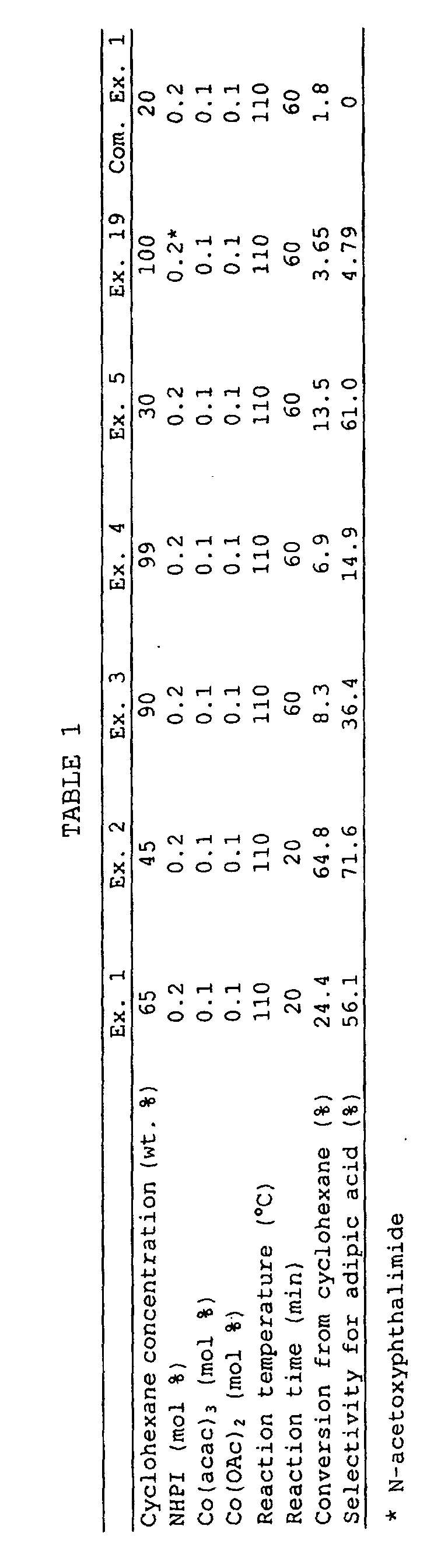
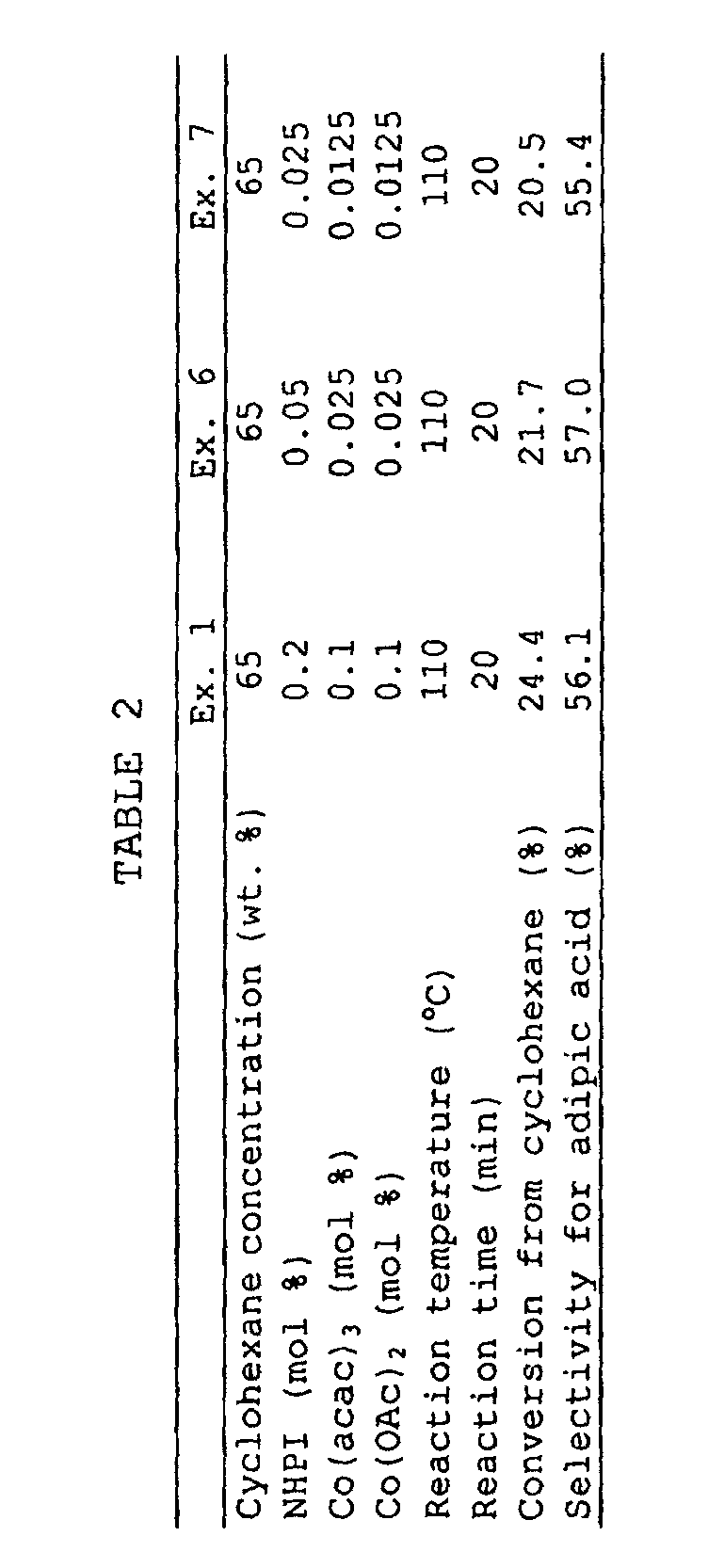

Ex. 16 Ex. 17 Ex. 18 Cyclododecane concentration (wt. %) 65 40 40 NHPI (mol %) 0.2 0.2 0.4 Mn(acac)2 (mol %) 0.2 0.2 0.04 Co(OAc)2 (mol %) 0.02 0.02 0.4 Reaction temperature (°C) 100 100 100 Reaction time (hr) 6 4 4 Conversion from cyclododecane (%) 20.6 26.5 16.1 Selectivity for dodecanedioic acid (%) 23.7 21.4 27.5 - A total of 550 g of a mixture having the following composition was charged into a 1-L autoclave with a titanium jacket having an agitator including three paddle blades and an agitating motor, an opening for charging an oxygen-containing gas, and another opening for extracting gaseous components.
- Charged material composition
- Cyclohexane: 45% by weight (2.939 mol)
- Acetic acid: 53.93% by weight
- N-Hydroxysuccinimide: 0.07% by weight
- Cobalt(II) acetate tetrahydrate: 1% by weight
-
- The inside of the reactor (autoclave) was pressurized to 3 MPa with nitrogen gas, and the temperature was raised while rotating the agitator at 500 rpm. At the time when the inside temperature of the reactor reached 100°C, air supply at a flow rate of 100 L (normal conditions) per hour was started. Immediately after the beginning of air supply, a reaction began and the temperature was raised to some extent. While keeping the inner temperature of the reactor at 100°C, the reaction was continued for 120 minutes. The supplied gas was changed to nitrogen gas, and the reaction mixture was cooled. At the time when the temperature of the reaction mixture reached room temperature, the gas in the reactor was released, and the reaction mixture was extracted.
- The reaction mixture had separated into two liquid-phase layers and was mixed with acetic acid in equal proportions to thereby yield a homogenous one layer, followed by analysis to find that a conversion from cyclohexane was 15.4% and a selectivity for adipic acid was 54.2% (0.245 mol). In addition, cyclohexanone (0.113 mol; selectivity: 25.0%), cyclohexanol (0.059 mol; selectivity: 13.1%), cyclohexyl acetate (0.009 mol; selectivity: 2.0%), glutaric acid (0.023 mol; selectivity: 5.1%), succinic acid (0.014 mol), and succinimide (0.0015 mol) were by-produced.
- The procedure of Example 20 was repeated, except that the composition of charged materials to the reactor was changed as follows.
- Charged material composition
- Cyclohexane: 45% by weight (2.939 mol)
- Acetic acid: 53.90% by weight
- N-Hydroxyphthalimide: 0.1% by weight
- Cobalt(II) acetate tetrahydrate: 1% by weight
-
- The reaction mixture had separated into two liquid-phase layers and was mixed with acetic acid in equal proportions to thereby yield a homogenous one layer, followed by analysis to find that a conversion from cyclohexane was 15.1% and a selectivity for adipic acid was 50.8% (0.226 mol). In addition, cyclohexanone (0.113 mol; selectivity: 25.4%), cyclohexanol (0.0589 mol; selectivity: 13.2%), cyclohexyl acetate (0.008 mol; selectivity: 1.8%), glutaric acid (0.023 mol; selectivity: 5.2%), succinic acid (0.009 mol; selectivity: 2.0%), phthalimide (0.0013 mol), and phthalic acid (0.0017 mol) were by-produced.
Claims (9)
- A process for producing a dicarboxylic acid by oxidative cleavage of a corresponding cycloalkane with oxygen, wherein a reaction is performed in the presence of a catalyst comprising an imide compound and a metallic compound, the imide compound having a cyclic imide skeleton represented by following Formula (I):wherein X is an oxygen atom or an-OR group, and where R is a hydrogen atom or a hydroxyl-protecting group, under conditions of a reaction temperature of 80°C or higher and a concentration of the cycloalkane in a system of 21% by weight or more.
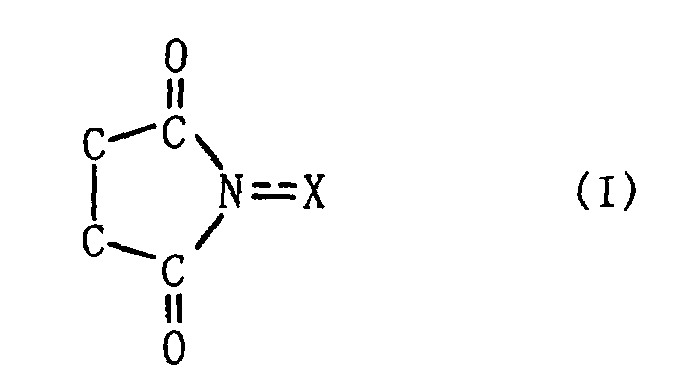
- The process for producing a dicarboxylic acid according to claim 1, wherein the imide compound is a compound represented by following Formula (1):wherein R1 and R2 are the same or different and are each a hydrogen atom, a halogen atom, an alkyl group, an aryl group, a cycloalkyl group, a hydroxyl group, an alkoxy group, a carboxyl group, an alkoxycarbonyl group, or an acyl group, where R1 and R2 may be combined to form a double bond, an aromatic ring, or a non-aromatic ring; X is an oxygen atom or an -OR group, where R is a hydrogen atom or a hydroxyl-protecting group; and wherein one or two of an N-substituted cyclic imido group indicated in the formula may be further formed on the R1, R2, or on the double bond, aromatic ring or non-aromatic ring formed by R1 and R2.
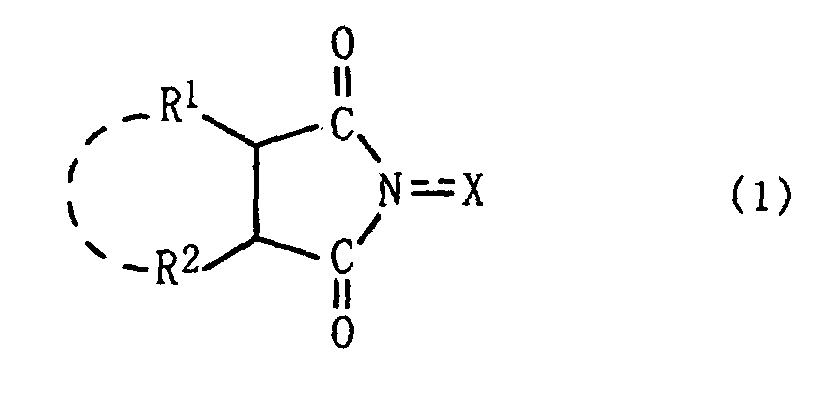
- The process for producing a dicarboxylic acid according to claim 1, wherein the imide compound is N-hydroxysuccinimide which may have an alkyl group at the α-position and/or the β-position and whose hydroxyl group may be protected by a protecting group.
- The process for producing a dicarboxylic acid according to claim 1, wherein the amount of the imide compound is from 0.000001 to 0.01 mole per mole of the cycloalkane.
- The process for producing a dicarboxylic acid according to claim 1, wherein the metallic compound is at least one selected from compounds of metallic elements belonging to Groups 5, 6, 7, 8, 9, 10, and 11 of the Periodic Table.
- The process for producing a dicarboxylic acid according to claim 1, wherein the metallic compound comprises a low-valence metallic compound and a high-valence metallic compound in combination.
- The process for producing a dicarboxylic acid according to claim 1, wherein the amount of the metallic compound is from 0.05 to 20 moles per mole of the imide compound.
- The process for producing a dicarboxylic acid according to claim 1, further comprising using at least one solvent selected from protonic organic solvents and nitriles as a reaction solvent.
- The process for producing a dicarboxylic acid according to claim 1, wherein the cycloalkane is a compound having a cycloalkane ring containing 5 to 15 members.
Applications Claiming Priority (3)
| Application Number | Priority Date | Filing Date | Title |
|---|---|---|---|
| JP2000380450 | 2000-12-14 | ||
| JP2000380450 | 2000-12-14 | ||
| PCT/JP2001/010753 WO2002048084A1 (en) | 2000-12-14 | 2001-12-07 | Process for production of dicarboxylic acids |
Publications (3)
| Publication Number | Publication Date |
|---|---|
| EP1350786A1 true EP1350786A1 (en) | 2003-10-08 |
| EP1350786A4 EP1350786A4 (en) | 2005-12-14 |
| EP1350786B1 EP1350786B1 (en) | 2008-08-13 |
Family
ID=18848630
Family Applications (1)
| Application Number | Title | Priority Date | Filing Date |
|---|---|---|---|
| EP01270515A Expired - Lifetime EP1350786B1 (en) | 2000-12-14 | 2001-12-07 | Process for production of dicarboxylic acids |
Country Status (10)
| Country | Link |
|---|---|
| US (1) | US7015356B2 (en) |
| EP (1) | EP1350786B1 (en) |
| JP (1) | JP4436905B2 (en) |
| KR (1) | KR100824126B1 (en) |
| CN (1) | CN1263724C (en) |
| AU (1) | AU2002221090A1 (en) |
| CA (1) | CA2436939C (en) |
| DE (1) | DE60135380D1 (en) |
| ES (1) | ES2310537T3 (en) |
| WO (1) | WO2002048084A1 (en) |
Families Citing this family (10)
| Publication number | Priority date | Publication date | Assignee | Title |
|---|---|---|---|---|
| CA2469926C (en) * | 2002-01-29 | 2011-04-26 | Daicel Chemical Industries, Ltd. | Process for producing dicarboxylic acids |
| US7718564B2 (en) * | 2005-06-24 | 2010-05-18 | Exxonmobil Research And Engineering Company | Partially decomposed catalyst and hydrocarbon oxidation processes using the same |
| EP2522426B1 (en) | 2011-05-12 | 2014-02-12 | King Saud University | Method for preparing carboxylic acids |
| CN102924262A (en) * | 2011-08-10 | 2013-02-13 | 中国石油化工集团公司 | Adipic acid preparation method |
| CN104109083B (en) * | 2013-04-16 | 2015-11-18 | 中国石油化工股份有限公司 | The method of hexanaphthene direct oxidation hexanodioic acid |
| CN109456167A (en) * | 2018-12-20 | 2019-03-12 | 福州大学 | A method of using micro passage reaction by cyclohexanone synthesizing adipic acid |
| CN113754531B (en) * | 2020-06-02 | 2023-09-29 | 中国石油化工股份有限公司 | Method for synthesizing adipic acid by one-step direct oxidation of cyclohexane |
| KR102778856B1 (en) * | 2020-10-30 | 2025-03-12 | 한국과학기술원 | Method of Preparing Linear Hydrocarbon Diacids Using Catalyst for Cyclo-Hhydrocarbon Oxidation |
| CN113563176B (en) * | 2021-08-25 | 2022-12-20 | 浙江工业大学 | Cu (II)/nitric acid binary catalytic system for catalyzing O 2 Method for synthesizing adipic acid by oxidizing cyclohexene in one step |
| CN113651685B (en) * | 2021-09-25 | 2024-02-09 | 侯凤芹 | Process for preparing dicarboxylic acids by two-stage oxidation of cyclic alkanes |
Family Cites Families (9)
| Publication number | Priority date | Publication date | Assignee | Title |
|---|---|---|---|---|
| JP3434034B2 (en) | 1994-08-02 | 2003-08-04 | ダイセル化学工業株式会社 | Oxidation catalyst and oxidation method using the same |
| EP0824962B1 (en) | 1996-02-07 | 2003-05-07 | Daicel Chemical Industries, Ltd. | Use of an oxidation catalyst system and process for oxidation with the same |
| JP3911060B2 (en) | 1996-02-07 | 2007-05-09 | ダイセル化学工業株式会社 | Oxidation catalyst system and oxidation method using the same |
| JP4756719B2 (en) * | 1997-02-17 | 2011-08-24 | ダイセル化学工業株式会社 | Oxidation catalyst system, oxidation method and oxide production method |
| JP4039730B2 (en) * | 1998-02-18 | 2008-01-30 | ダイセル化学工業株式会社 | Oxidation catalyst system and oxidation method using the same |
| JP4464476B2 (en) * | 1999-02-19 | 2010-05-19 | ダイセル化学工業株式会社 | Oxidation method |
| DE10015880A1 (en) * | 2000-03-30 | 2001-10-11 | Creavis Tech & Innovation Gmbh | Process for the oxidation of hydrocarbons |
| US7285684B2 (en) * | 2000-04-04 | 2007-10-23 | Daicel Chemical Industries, Ltd. | Process for separating imide compounds |
| JP4651181B2 (en) * | 2000-11-01 | 2011-03-16 | ダイセル化学工業株式会社 | Separation method of reaction product and catalyst |
-
2001
- 2001-12-07 WO PCT/JP2001/010753 patent/WO2002048084A1/en not_active Ceased
- 2001-12-07 CA CA002436939A patent/CA2436939C/en not_active Expired - Fee Related
- 2001-12-07 CN CNB018225667A patent/CN1263724C/en not_active Expired - Fee Related
- 2001-12-07 AU AU2002221090A patent/AU2002221090A1/en not_active Abandoned
- 2001-12-07 EP EP01270515A patent/EP1350786B1/en not_active Expired - Lifetime
- 2001-12-07 KR KR1020037007916A patent/KR100824126B1/en not_active Expired - Fee Related
- 2001-12-07 US US10/450,120 patent/US7015356B2/en not_active Expired - Fee Related
- 2001-12-07 JP JP2002549620A patent/JP4436905B2/en not_active Expired - Fee Related
- 2001-12-07 DE DE60135380T patent/DE60135380D1/en not_active Expired - Lifetime
- 2001-12-07 ES ES01270515T patent/ES2310537T3/en not_active Expired - Lifetime
Non-Patent Citations (2)
| Title |
|---|
| No further relevant documents disclosed * |
| See also references of WO0248084A1 * |
Also Published As
| Publication number | Publication date |
|---|---|
| US20040024248A1 (en) | 2004-02-05 |
| WO2002048084A1 (en) | 2002-06-20 |
| CA2436939A1 (en) | 2002-06-20 |
| AU2002221090A1 (en) | 2002-06-24 |
| CA2436939C (en) | 2007-10-09 |
| EP1350786B1 (en) | 2008-08-13 |
| CN1489569A (en) | 2004-04-14 |
| US7015356B2 (en) | 2006-03-21 |
| ES2310537T3 (en) | 2009-01-16 |
| CN1263724C (en) | 2006-07-12 |
| KR100824126B1 (en) | 2008-04-21 |
| EP1350786A4 (en) | 2005-12-14 |
| KR20030061440A (en) | 2003-07-18 |
| JPWO2002048084A1 (en) | 2004-07-29 |
| JP4436905B2 (en) | 2010-03-24 |
| DE60135380D1 (en) | 2008-09-25 |
Similar Documents
| Publication | Publication Date | Title |
|---|---|---|
| JP4942645B2 (en) | Method for oxidizing organic compounds | |
| EP1338336B1 (en) | Use of catalysts comprising n-substituted cyclic imides for preparing organic compounds | |
| US7015356B2 (en) | Process for producing dicarboxylic acids | |
| US6229050B1 (en) | Process for the preparation of hydroxyadamantanone derivatives | |
| EP1754693B9 (en) | Process for the production of esters or lactones | |
| KR20090128457A (en) | Process for preparing esters or lactones | |
| EP1070678B1 (en) | Process for producing hydrogen peroxide | |
| EP1471047B1 (en) | Process for producing dicarboxylic acid | |
| US6768030B2 (en) | Process for producing organic peroxides | |
| JP2001192354A (en) | Method for producing β-acyloxycarboxylic acid or β-acyloxyketone | |
| JP5106719B2 (en) | Method for producing ketone using imide compound as catalyst | |
| JP3992959B2 (en) | Method for producing oxidation products of cycloalkanes | |
| JP4798837B2 (en) | Method for producing lactam | |
| JP2002308805A (en) | Method for producing aromatic carboxylic acid and / or aromatic carboxylic anhydride | |
| JP2003128603A (en) | Process for producing oxidation products of cycloalkanes | |
| JP4606209B2 (en) | Lactone compound and process for producing lactone compound |
Legal Events
| Date | Code | Title | Description |
|---|---|---|---|
| PUAI | Public reference made under article 153(3) epc to a published international application that has entered the european phase |
Free format text: ORIGINAL CODE: 0009012 |
|
| 17P | Request for examination filed |
Effective date: 20030612 |
|
| AK | Designated contracting states |
Kind code of ref document: A1 Designated state(s): AT BE CH CY DE DK ES FI FR GB GR IE IT LI LU MC NL PT SE TR |
|
| AX | Request for extension of the european patent |
Extension state: AL LT LV MK RO SI |
|
| RBV | Designated contracting states (corrected) |
Designated state(s): AT BE CH CY DE ES FR GB IT LI |
|
| A4 | Supplementary search report drawn up and despatched |
Effective date: 20051028 |
|
| RIC1 | Information provided on ipc code assigned before grant |
Ipc: 7C 07C 51/31 A Ipc: 7C 07B 61/00 B Ipc: 7C 07C 55/14 B Ipc: 7C 07C 55/21 B |
|
| RBV | Designated contracting states (corrected) |
Designated state(s): DE ES FR GB IT |
|
| 17Q | First examination report despatched |
Effective date: 20070228 |
|
| RAP1 | Party data changed (applicant data changed or rights of an application transferred) |
Owner name: DAICEL CHEMICAL INDUSTRIES, LTD. |
|
| GRAP | Despatch of communication of intention to grant a patent |
Free format text: ORIGINAL CODE: EPIDOSNIGR1 |
|
| GRAS | Grant fee paid |
Free format text: ORIGINAL CODE: EPIDOSNIGR3 |
|
| GRAA | (expected) grant |
Free format text: ORIGINAL CODE: 0009210 |
|
| AK | Designated contracting states |
Kind code of ref document: B1 Designated state(s): DE ES FR GB IT |
|
| REG | Reference to a national code |
Ref country code: GB Ref legal event code: FG4D |
|
| REF | Corresponds to: |
Ref document number: 60135380 Country of ref document: DE Date of ref document: 20080925 Kind code of ref document: P |
|
| REG | Reference to a national code |
Ref country code: ES Ref legal event code: FG2A Ref document number: 2310537 Country of ref document: ES Kind code of ref document: T3 |
|
| PLBE | No opposition filed within time limit |
Free format text: ORIGINAL CODE: 0009261 |
|
| STAA | Information on the status of an ep patent application or granted ep patent |
Free format text: STATUS: NO OPPOSITION FILED WITHIN TIME LIMIT |
|
| 26N | No opposition filed |
Effective date: 20090514 |
|
| PGFP | Annual fee paid to national office [announced via postgrant information from national office to epo] |
Ref country code: IT Payment date: 20101218 Year of fee payment: 10 |
|
| PGFP | Annual fee paid to national office [announced via postgrant information from national office to epo] |
Ref country code: ES Payment date: 20110112 Year of fee payment: 10 |
|
| PG25 | Lapsed in a contracting state [announced via postgrant information from national office to epo] |
Ref country code: IT Free format text: LAPSE BECAUSE OF NON-PAYMENT OF DUE FEES Effective date: 20111207 |
|
| REG | Reference to a national code |
Ref country code: ES Ref legal event code: FD2A Effective date: 20130703 |
|
| PG25 | Lapsed in a contracting state [announced via postgrant information from national office to epo] |
Ref country code: ES Free format text: LAPSE BECAUSE OF NON-PAYMENT OF DUE FEES Effective date: 20111208 |
|
| PGFP | Annual fee paid to national office [announced via postgrant information from national office to epo] |
Ref country code: GB Payment date: 20141203 Year of fee payment: 14 Ref country code: DE Payment date: 20141202 Year of fee payment: 14 |
|
| PGFP | Annual fee paid to national office [announced via postgrant information from national office to epo] |
Ref country code: FR Payment date: 20141208 Year of fee payment: 14 |
|
| REG | Reference to a national code |
Ref country code: DE Ref legal event code: R119 Ref document number: 60135380 Country of ref document: DE |
|
| GBPC | Gb: european patent ceased through non-payment of renewal fee |
Effective date: 20151207 |
|
| REG | Reference to a national code |
Ref country code: FR Ref legal event code: ST Effective date: 20160831 |
|
| PG25 | Lapsed in a contracting state [announced via postgrant information from national office to epo] |
Ref country code: DE Free format text: LAPSE BECAUSE OF NON-PAYMENT OF DUE FEES Effective date: 20160701 Ref country code: GB Free format text: LAPSE BECAUSE OF NON-PAYMENT OF DUE FEES Effective date: 20151207 |
|
| PG25 | Lapsed in a contracting state [announced via postgrant information from national office to epo] |
Ref country code: FR Free format text: LAPSE BECAUSE OF NON-PAYMENT OF DUE FEES Effective date: 20151231 |