EP1349908B1 - A microemulsion fuel containing a hydrocarbon fraction, ethanol, water and an additive comprising a nitrogen-containing surfactnant and a an alcohol - Google Patents
A microemulsion fuel containing a hydrocarbon fraction, ethanol, water and an additive comprising a nitrogen-containing surfactnant and a an alcohol Download PDFInfo
- Publication number
- EP1349908B1 EP1349908B1 EP01270587A EP01270587A EP1349908B1 EP 1349908 B1 EP1349908 B1 EP 1349908B1 EP 01270587 A EP01270587 A EP 01270587A EP 01270587 A EP01270587 A EP 01270587A EP 1349908 B1 EP1349908 B1 EP 1349908B1
- Authority
- EP
- European Patent Office
- Prior art keywords
- formula
- group
- weight
- carbon atoms
- surfactant
- Prior art date
- Legal status (The legal status is an assumption and is not a legal conclusion. Google has not performed a legal analysis and makes no representation as to the accuracy of the status listed.)
- Expired - Lifetime
Links
Classifications
-
- C—CHEMISTRY; METALLURGY
- C10—PETROLEUM, GAS OR COKE INDUSTRIES; TECHNICAL GASES CONTAINING CARBON MONOXIDE; FUELS; LUBRICANTS; PEAT
- C10L—FUELS NOT OTHERWISE PROVIDED FOR; NATURAL GAS; SYNTHETIC NATURAL GAS OBTAINED BY PROCESSES NOT COVERED BY SUBCLASSES C10G OR C10K; LIQUIFIED PETROLEUM GAS; USE OF ADDITIVES TO FUELS OR FIRES; FIRE-LIGHTERS
- C10L1/00—Liquid carbonaceous fuels
- C10L1/02—Liquid carbonaceous fuels essentially based on components consisting of carbon, hydrogen, and oxygen only
-
- C—CHEMISTRY; METALLURGY
- C09—DYES; PAINTS; POLISHES; NATURAL RESINS; ADHESIVES; COMPOSITIONS NOT OTHERWISE PROVIDED FOR; APPLICATIONS OF MATERIALS NOT OTHERWISE PROVIDED FOR
- C09K—MATERIALS FOR MISCELLANEOUS APPLICATIONS, NOT PROVIDED FOR ELSEWHERE
- C09K23/00—Use of substances as emulsifying, wetting, dispersing, or foam-producing agents
- C09K23/017—Mixtures of compounds
-
- C—CHEMISTRY; METALLURGY
- C09—DYES; PAINTS; POLISHES; NATURAL RESINS; ADHESIVES; COMPOSITIONS NOT OTHERWISE PROVIDED FOR; APPLICATIONS OF MATERIALS NOT OTHERWISE PROVIDED FOR
- C09K—MATERIALS FOR MISCELLANEOUS APPLICATIONS, NOT PROVIDED FOR ELSEWHERE
- C09K23/00—Use of substances as emulsifying, wetting, dispersing, or foam-producing agents
- C09K23/16—Amines or polyamines
-
- C—CHEMISTRY; METALLURGY
- C10—PETROLEUM, GAS OR COKE INDUSTRIES; TECHNICAL GASES CONTAINING CARBON MONOXIDE; FUELS; LUBRICANTS; PEAT
- C10L—FUELS NOT OTHERWISE PROVIDED FOR; NATURAL GAS; SYNTHETIC NATURAL GAS OBTAINED BY PROCESSES NOT COVERED BY SUBCLASSES C10G OR C10K; LIQUIFIED PETROLEUM GAS; USE OF ADDITIVES TO FUELS OR FIRES; FIRE-LIGHTERS
- C10L1/00—Liquid carbonaceous fuels
- C10L1/10—Liquid carbonaceous fuels containing additives
-
- C—CHEMISTRY; METALLURGY
- C10—PETROLEUM, GAS OR COKE INDUSTRIES; TECHNICAL GASES CONTAINING CARBON MONOXIDE; FUELS; LUBRICANTS; PEAT
- C10L—FUELS NOT OTHERWISE PROVIDED FOR; NATURAL GAS; SYNTHETIC NATURAL GAS OBTAINED BY PROCESSES NOT COVERED BY SUBCLASSES C10G OR C10K; LIQUIFIED PETROLEUM GAS; USE OF ADDITIVES TO FUELS OR FIRES; FIRE-LIGHTERS
- C10L1/00—Liquid carbonaceous fuels
- C10L1/32—Liquid carbonaceous fuels consisting of coal-oil suspensions or aqueous emulsions or oil emulsions
- C10L1/328—Oil emulsions containing water or any other hydrophilic phase
-
- C—CHEMISTRY; METALLURGY
- C10—PETROLEUM, GAS OR COKE INDUSTRIES; TECHNICAL GASES CONTAINING CARBON MONOXIDE; FUELS; LUBRICANTS; PEAT
- C10L—FUELS NOT OTHERWISE PROVIDED FOR; NATURAL GAS; SYNTHETIC NATURAL GAS OBTAINED BY PROCESSES NOT COVERED BY SUBCLASSES C10G OR C10K; LIQUIFIED PETROLEUM GAS; USE OF ADDITIVES TO FUELS OR FIRES; FIRE-LIGHTERS
- C10L1/00—Liquid carbonaceous fuels
- C10L1/10—Liquid carbonaceous fuels containing additives
- C10L1/12—Inorganic compounds
- C10L1/1233—Inorganic compounds oxygen containing compounds, e.g. oxides, hydroxides, acids and salts thereof
- C10L1/125—Inorganic compounds oxygen containing compounds, e.g. oxides, hydroxides, acids and salts thereof water
-
- C—CHEMISTRY; METALLURGY
- C10—PETROLEUM, GAS OR COKE INDUSTRIES; TECHNICAL GASES CONTAINING CARBON MONOXIDE; FUELS; LUBRICANTS; PEAT
- C10L—FUELS NOT OTHERWISE PROVIDED FOR; NATURAL GAS; SYNTHETIC NATURAL GAS OBTAINED BY PROCESSES NOT COVERED BY SUBCLASSES C10G OR C10K; LIQUIFIED PETROLEUM GAS; USE OF ADDITIVES TO FUELS OR FIRES; FIRE-LIGHTERS
- C10L1/00—Liquid carbonaceous fuels
- C10L1/10—Liquid carbonaceous fuels containing additives
- C10L1/14—Organic compounds
- C10L1/18—Organic compounds containing oxygen
- C10L1/182—Organic compounds containing oxygen containing hydroxy groups; Salts thereof
- C10L1/1822—Organic compounds containing oxygen containing hydroxy groups; Salts thereof hydroxy group directly attached to (cyclo)aliphatic carbon atoms
- C10L1/1824—Organic compounds containing oxygen containing hydroxy groups; Salts thereof hydroxy group directly attached to (cyclo)aliphatic carbon atoms mono-hydroxy
-
- C—CHEMISTRY; METALLURGY
- C10—PETROLEUM, GAS OR COKE INDUSTRIES; TECHNICAL GASES CONTAINING CARBON MONOXIDE; FUELS; LUBRICANTS; PEAT
- C10L—FUELS NOT OTHERWISE PROVIDED FOR; NATURAL GAS; SYNTHETIC NATURAL GAS OBTAINED BY PROCESSES NOT COVERED BY SUBCLASSES C10G OR C10K; LIQUIFIED PETROLEUM GAS; USE OF ADDITIVES TO FUELS OR FIRES; FIRE-LIGHTERS
- C10L1/00—Liquid carbonaceous fuels
- C10L1/10—Liquid carbonaceous fuels containing additives
- C10L1/14—Organic compounds
- C10L1/22—Organic compounds containing nitrogen
- C10L1/222—Organic compounds containing nitrogen containing at least one carbon-to-nitrogen single bond
- C10L1/2222—(cyclo)aliphatic amines; polyamines (no macromolecular substituent 30C); quaternair ammonium compounds; carbamates
-
- C—CHEMISTRY; METALLURGY
- C10—PETROLEUM, GAS OR COKE INDUSTRIES; TECHNICAL GASES CONTAINING CARBON MONOXIDE; FUELS; LUBRICANTS; PEAT
- C10L—FUELS NOT OTHERWISE PROVIDED FOR; NATURAL GAS; SYNTHETIC NATURAL GAS OBTAINED BY PROCESSES NOT COVERED BY SUBCLASSES C10G OR C10K; LIQUIFIED PETROLEUM GAS; USE OF ADDITIVES TO FUELS OR FIRES; FIRE-LIGHTERS
- C10L1/00—Liquid carbonaceous fuels
- C10L1/10—Liquid carbonaceous fuels containing additives
- C10L1/14—Organic compounds
- C10L1/22—Organic compounds containing nitrogen
- C10L1/222—Organic compounds containing nitrogen containing at least one carbon-to-nitrogen single bond
- C10L1/2222—(cyclo)aliphatic amines; polyamines (no macromolecular substituent 30C); quaternair ammonium compounds; carbamates
- C10L1/2225—(cyclo)aliphatic amines; polyamines (no macromolecular substituent 30C); quaternair ammonium compounds; carbamates hydroxy containing
-
- C—CHEMISTRY; METALLURGY
- C10—PETROLEUM, GAS OR COKE INDUSTRIES; TECHNICAL GASES CONTAINING CARBON MONOXIDE; FUELS; LUBRICANTS; PEAT
- C10L—FUELS NOT OTHERWISE PROVIDED FOR; NATURAL GAS; SYNTHETIC NATURAL GAS OBTAINED BY PROCESSES NOT COVERED BY SUBCLASSES C10G OR C10K; LIQUIFIED PETROLEUM GAS; USE OF ADDITIVES TO FUELS OR FIRES; FIRE-LIGHTERS
- C10L1/00—Liquid carbonaceous fuels
- C10L1/10—Liquid carbonaceous fuels containing additives
- C10L1/14—Organic compounds
- C10L1/22—Organic compounds containing nitrogen
- C10L1/222—Organic compounds containing nitrogen containing at least one carbon-to-nitrogen single bond
- C10L1/224—Amides; Imides carboxylic acid amides, imides
-
- C—CHEMISTRY; METALLURGY
- C10—PETROLEUM, GAS OR COKE INDUSTRIES; TECHNICAL GASES CONTAINING CARBON MONOXIDE; FUELS; LUBRICANTS; PEAT
- C10L—FUELS NOT OTHERWISE PROVIDED FOR; NATURAL GAS; SYNTHETIC NATURAL GAS OBTAINED BY PROCESSES NOT COVERED BY SUBCLASSES C10G OR C10K; LIQUIFIED PETROLEUM GAS; USE OF ADDITIVES TO FUELS OR FIRES; FIRE-LIGHTERS
- C10L1/00—Liquid carbonaceous fuels
- C10L1/10—Liquid carbonaceous fuels containing additives
- C10L1/14—Organic compounds
- C10L1/22—Organic compounds containing nitrogen
- C10L1/23—Organic compounds containing nitrogen containing at least one nitrogen-to-oxygen bond, e.g. nitro-compounds, nitrates, nitrites
Definitions
- the present invention relates to an aqueous fuel composition having a homogeneous liquid phase, a so called microemulsion, containing a liquid hydrocarbon fraction, ethanol and an additive with an emulsifying and solubilizing ability.
- EP-A1-89 147 discloses a macroemulsion comprising liquid hydrocarbons, ethanol and water and as an emulsifier a polyetherpolystyrene block copolymer.
- the stability of such emulsions is limited and even minor separations may cause disturbances when starting or running an internal combustion engine, or causing increased emissions, for example of CO and organic substances, when burnt.
- EP-A1-475 620 discloses a microemulsion diesel fuel containing a hydrocarbon fraction, water and optionally also ethanol.
- a blend of a hydrophilic surfactant and a lipophilic surfactant is added, in particular a mixture of a sulfonate and an ethoxylate.
- This fuel needs large amounts of surfactants and is furthermore rather sensitive to temperature variations.
- the Derwent abstract accession number 1983-19166K, week 8308, 58008793, describes the use of C 3 or higher monohydric alcohols, such as octanol and decanol, in mixed fuels containing ethanol and a hydrocarbon fuel oil. Although these alcohols have a high capacity of forming microemulsions over a large temperature range, the fuels obtained have poor lubrication and a corrosive effect.
- a surfactant composition suitable for the emulsification of methanol or ethanol in a hydrocarbon liquid is described, the surfactant composition being a blend of i) a block or graft copolymer and ii) a salt of an aliphatic amino compound and a long-chain aliphatic carboxylic acid.
- the salts contain amino compounds having an aliphatic group within the range from 8-18 carbon atoms.
- macroemulsions were formed, which will separate upon storage.
- the Brazilian patent Application PI9804481-8 describes an additive composition for mixed ethanol and hydrocarbon fuels to improve the tolerance of the fuels to humidity and dispersed water and to improve the stability.
- the additive composition comprises from 90-100% of at least two compounds selected from the classes consisting of
- the fuel composition of the present invention is stable in a large temperature interval and the mixture of the liquid hydrocarbon fraction, ethanol and water are present in a homogeneous phase, a microemulaion, even at low temperatures. Therefore, the composition can be stored for long periods within the temperature interval without any risk for phase separation. Since the mixture of the liquid hydrocarbon fraction, ethanol and water has the form of a mieroamulsion and not the form of a maoroemulsion, there is no need for an addition of a stabilizing polymer such as the block or graft polymer disclosed in US 4 504 276 .
- the composition may advantageously be used as a fuel, especially an a fuel for internal combustion engines, which quite often can be subjected to large variations in temperature.
- microemulsiona between the hydrocarbon, ethanol and water can be established at temperatures far below -20°C, although in many cases the existence of a microemulsion down to 5°C or 0°C may be satisfactory.
- the compositions of the present invention has excellent anticorrosive and lubricating properties and these properties have been confirmed in diesel engine tests. It is believed that the properties depend on the presence of the nitrogen-containing surfactants, which via the nitrogen atoms are weakly attached to the metallic surfaces, for example in a diesel engine. The hydrophobic part of the surfactant can then impart lubrication and corrosion-inhibiting properties.
- the additive has a good capability to form clear solutions (microemulsions) between the Hydrocarbon fraction, ethanol and water.
- clear solutions microemulsions
- the amount of the additive needed to achieve a mioroemulsion is low in relation to the amount of ethanol and water.
- the amount of the additive has to be increased or as an alternative the amount of ethanol and/or water has to be reduced.
- Suitable surfactants of formula I are amine surfactants with formulae and/or where R is an aliphatic group having 8-22 carbon atoms, A is an alkyleneoxy group having 2-3 carbon atoms, p is 2 or 3, preferably 3, m is 0-3, and n is 0-4, the sum of all n being 0-5, and r is 1 or 2, or an amine oxide surfactant of the formula where R is an aliphatic group having 8-22 carbon atoms and R 1 and R 2 are an alkyl group having 1-4 carbon atoms, preferably methyl, or a hydroxyalkyl group having 2-4 carbon atoms, for example hydroxyethyl; or a mixture of any one of the surfactants defined in Ia, Ib or Ic.
- Suitable surfactants of formula I are ether amine surfactants of the formula where R is an aliphatic group of 8-22 carbon atoms and R 3 , A, n, p and m have the same meanings as in formula I.
- Especially preferred compounds are those where R is an aliphatic group of 12-20 carbon atoms, p is 3, m is 0-2 and n is 0-2; the sum of all n being 0-2.
- surfactants of formula I are amide surfactants of the formula where R is an acyl group of 8.-22, preferably 12-20, carbon atoms, m is 1, n is a number from 0-2 the sum of all n being 0-2, A has the same meaning as in formula I, and p is 3.
- combinations of alcohols of formula II and nitrogen-containing surfactants of formula I such has surfactants of formulae Ia, Ib, Io, Id and Ie, have in teats shown a high solubilizing effect.
- the amount of the alcohol of formula II is from 10-95%, preferably 50 to 90%, by weight and the nitrogen-containing surfactant of formula I is from 5-90%, preferably 10-50%, by weight of the combination.
- R preferably is an aliphatic group of 8-1.3 carbon atoms, combined with a compound of formula Ia, where m is 0 or 1, R is an aliphatic group of 16-20 carbon atoms and ⁇ n is 1-5, a compound of formula Ib, where r is 1, or a compound with formula Id, where n is 0 and R 3 is C 3 H 6
- the alcohol of formula II can be alkyl substituted phenols, such as olttylphenol, dioktylphenol, nonylphenol and dinonylphenol. Due to environmental reasons alcohols containing aliphatic groups are preferred.
- the aliphatic groups have normally 5-22, preferably 8-14, carbon atoms.
- suitable alcohols of formula II, where R is an aliphatic group are n-octanol, isooctanol, primary alcohols being branched in second position, such as 2-ethylhexanol, 2-propylheptanol and 2-butyloctanol, decanol, dodecanol, methyl-branched C 9 -C 13 alcohols, palm fatty alcohols, rape seed fatty alcohols, coco nut fatty alcohols and tallow fatty alcohols.
- the group R can be an aliphatic group derived from the above mentioned fatty alcohols, oleyl, 2-ethylhexyl, isooctyl, n-octyl, n-decyl, 2-propylheptyl, 2-butyloctyl and methyl-substituted alkyl groups with 9-13 carbon atoms.
- the acyl groups in formula Ie are suitably acyl group derived from fatty acids or synthetic acids, such as decanoic, dodecanoic, palm fatty acid, coco nut fatty acids, rape seed fatty acids and tallow fatty acids.
- n is preferably 0, when m is 0 and R is an aliphatic group of 8-14 carbon atoms.
- R is an aliphatic group with 15-22, preferably 16-20, carbon atoms, then the sum of all n is preferably 1-5.
- the alkyleneoxy group A is preferably ethyleneoxy, although one or more of the A groups may be a propyleneoxy group in order to adjust the HLB-value of the compound or the mixture.
- composition may also contain other conventional additives, such as corrosion inhibitors, viscosity improving agents, lubrication improving additives, cetan number increasing additives, surface-tension reducers and ignition improving agents as well as other solubilizers.
- corrosion inhibitors such as corrosion inhibitors, viscosity improving agents, lubrication improving additives, cetan number increasing additives, surface-tension reducers and ignition improving agents as well as other solubilizers.
- the presence of peroxide compounds may also affect the stability of the present composition.
- Fuel compositions according to the present invention as well as a number of comparison fuel compositions were produced by mixing a hydrocarbon fraction suitable to be used as a diesel fuel, an aqueous ethanol and an emulsifying and solubilizing additive.
- the additives added were as follows. Table I. Additives used in the Examples Reference No.
- the fuel composition was prepared by mixing an aqueous alcohol containing 0.04% by weight of water, a hydrocarbon fraction having a boiling point range from 180°C to 295°C and an additive.
- the amounts of the hydrocarbon fraction, pure ethanol, water content and additive is disclosed in Table II.
- the cloud points of the fuel compositions were determined. Results obtained are also shown in Table II. Table II. Fuels based on ethanol containing 0.04% water Composition Additive No.
- compositions 6-7 and 9,10 according to the invention even at very low temperatures form homogeneous, stable phase between the hydrocarbon fraction, ethanol and water. These compositions are therefore suitable to be used as diesel fuels.
- Example 2 In the same manner as in Example 1, a number of compositions were tested in order to evaluate their suitability to be used as a diesel fuel.
- the hydrocarbon fraction used in these compositions had a boiling point range from 159-360°C and a cloud point of -12°C due to preciptation in the hydrocarbon fraction.
- the compositions tested and the results obtained are disclosed in Table III below.
- Table III Composition Additive No. Composition, % by weight Cloud point °C Hydrocarbon fraction
- Fuel compositions based on the hydrocarbon fraction of Example 1 were prepared according to Table IV below. The cloud points of the different compositions were determined and results obtained are also shown in Table IV. Table IV.
- Composition Additive No. Composition, % by weight Cloud point °C Hydrocarbon fraction Ethanol Additive Water L 7 88.0 10.0 2.0 0.007 -21 15 5 88.0 10.0 2.0 0.007 -18 16 14 87.8 10.2 2.0 0.007 -16 17 15 88.0 10.0 2.0 0.007 -20 18 16 88.0 10.0 2.0 0.007 -20 19 17 88.0 10.0 2.0 0.007 -20 20 1 88.0 10.0 2.0 0.007 -20 21 8 88.0 10.0 2.0 0.007 -12 22 15+7 88.0 10.0 1,0+1,0 0.007 -22 23 16+7 88.0 10.0 1.0+1.0 0.007 -22 24 17+7 88.0 10.0 1.0+1.0 0.007 -22 25 1+7 88.0 10.0 0.5+1.5 0.007
- Fuel compositions according to the invention were prepared by using ethanol containing 1% by water.
- the hydrocarbon fraction was the same as in Example 1.
- the compositions and their cloud points are shown in the Table V below.
- Table V. Fuel compositions Composition Additive No. Composition, % by weight Cloud point °C Hydrocarbon fraction Ethanol Additive Water 34 17+7 87.4 10.5 0.5+1.6 0.1 5 35 1+7 87.4 10.5 0.5+1.6 0.1 5 36 13+7 87.4 10.5 0.5+1.6 0.1 5 37 19+7 87.4 10.5 0.5+1.6 0.1 5
- Fuel compositions according to the invention were prepared with aqueous alcohol containing 2 % water.
- the hydrocarbon fraction was the same as in Example 1.
- the compositions and their cloud points are shown in Table VI below.
- Table VI. Fuel containing ethanol with 2% water Composition Additive No. Composition, % by weight Cloud point °C Hydrocarbon fraction Ethanol Addictive Water 38 17+7 89.8 8.2 0.5+1.5 0.16 15 39 1+7 89.8 8.2 0.5+1.5 0.16 15 40 13+7 89.8 8.2 0.5+1.5 0.16 15
Landscapes
- Chemical & Material Sciences (AREA)
- Oil, Petroleum & Natural Gas (AREA)
- Engineering & Computer Science (AREA)
- Organic Chemistry (AREA)
- Chemical Kinetics & Catalysis (AREA)
- General Chemical & Material Sciences (AREA)
- Materials Engineering (AREA)
- Liquid Carbonaceous Fuels (AREA)
- Emulsifying, Dispersing, Foam-Producing Or Wetting Agents (AREA)
- Solid Fuels And Fuel-Associated Substances (AREA)
Abstract
Description
- The present invention relates to an aqueous fuel composition having a homogeneous liquid phase, a so called microemulsion, containing a liquid hydrocarbon fraction, ethanol and an additive with an emulsifying and solubilizing ability.
- In order to diminish the dependency on mineral oil, which is a not-renewable source of energy, mixed compositions, e g for use as fuels for internal combustion engines have been developed. In many of these fuel compositions a part of the hydrocarbon fraction has been replaced with water-containing ethanol or anhydrous ethanol. Diesel oil and anhydrous ethanol form solutions when blended but the presence of even a very low amount of water will cause a separation into a hydrocarbon phase and an ethanol/water phase. At lower temperatures the tendency of phase separation increases essentially. It is therefore important to maintain the fuel in a homogeneous liquid phase over the entire temperature range at which the fuel can be exposed.
- During the years a large number of methods have been suggested to increase the stability of a mixed fuel containing aqueous ethanol and hydrocarbons. Thus,
EP-A1-89 147 -
EP-A1-475 620 - The Derwent abstract, accession number 1983-19166K, week 8308, 58008793, describes the use of C3 or higher monohydric alcohols, such as octanol and decanol, in mixed fuels containing ethanol and a hydrocarbon fuel oil. Although these alcohols have a high capacity of forming microemulsions over a large temperature range, the fuels obtained have poor lubrication and a corrosive effect.
- In
US 4 504 276 a surfactant composition suitable for the emulsification of methanol or ethanol in a hydrocarbon liquid is described, the surfactant composition being a blend of i) a block or graft copolymer and ii) a salt of an aliphatic amino compound and a long-chain aliphatic carboxylic acid. In the blends 15 to 18 the salts contain amino compounds having an aliphatic group within the range from 8-18 carbon atoms. However, in all working examples where any of the blends 15-18 was used as an emulsifier, macroemulsions were formed, which will separate upon storage. - The Brazilian patent Application
PI9804481-8 - a) fatty acids with 12 to 20 carbon atoms,
- b) specific polyamines,
- c) specific fatty esters of polyoxyalkylene glycols,
- d) certain compounds containing hydrophilic and lipophilic sites, and
- e) certain cetane index activating substances.
- It has now been found that the above mentioned drawbacks of the prior art fuel compositions can be essentially avoided by a fuel composition having a homogeneous liquid phase, a microemulsion, containing
- a) 70-95%, preferably 75-92%, by weight of a hydrocarbon fraction having a boiling point within the range from 130 to 425°C,
- b) 2-2S%, preferably 5-.1;5%, by weight of ethanol,
- c) 0.002-1.2%, preferably 0.002%-0.8%, and most preferably 0.0005-0.4%, by weight of water, and
- d) 0.5-15% by weight of an additive comprising
- i) 5-90%, preferably 10-50%, by weight of a nitrogen-containing surfactant of the formula

R is an aliphatic group or an acyl group of 8-22, preferably 12 -20, carbon atoms or the group R2O(A)nR3, Where R2 is an aliphatic group of 8-22 carbon atoms, R3 is the group CpHap,
where p has the meaning mentioned above, or the groupe CH3CH(OH)CH2 and A and n have the meanings mentioned above, Y is an alkyl group of 1-4 carbon atoms or the group (A)nH, where A and n have the meanings mentioned above,
provided that when R is an acyl group, then the surfactant has the formula
B is the group →0 and v is 0 or 1 provided that when v is 1. then Y cannot be hydrogen, X is the group
- ii) 10-95%, preferably from 50-90%, by weight of an alcohol of the formula
ROH (II),
- i) 5-90%, preferably 10-50%, by weight of a nitrogen-containing surfactant of the formula
- The fuel composition of the present invention is stable in a large temperature interval and the mixture of the liquid hydrocarbon fraction, ethanol and water are present in a homogeneous phase, a microemulaion, even at low temperatures. Therefore, the composition can be stored for long periods within the temperature interval without any risk for phase separation. Since the mixture of the liquid hydrocarbon fraction, ethanol and water has the form of a mieroamulsion and not the form of a maoroemulsion, there is no need for an addition of a stabilizing polymer such as the block or graft polymer disclosed in
US 4 504 276 . The composition may advantageously be used as a fuel, especially an a fuel for internal combustion engines, which quite often can be subjected to large variations in temperature. - For example, microemulsiona between the hydrocarbon, ethanol and water can be established at temperatures far below -20°C, although in many cases the existence of a microemulsion down to 5°C or 0°C may be satisfactory. In addition, the compositions of the present invention has excellent anticorrosive and lubricating properties and these properties have been confirmed in diesel engine tests. It is believed that the properties depend on the presence of the nitrogen-containing surfactants, which via the nitrogen atoms are weakly attached to the metallic surfaces, for example in a diesel engine. The hydrophobic part of the surfactant can then impart lubrication and corrosion-inhibiting properties.
- The additive has a good capability to form clear solutions (microemulsions) between the Hydrocarbon fraction, ethanol and water. At high temperatures, for instance between 5°C and 25°C, the amount of the additive needed to achieve a mioroemulsion is low in relation to the amount of ethanol and water. At lower temperatures, for instance between -5°C to -25°C, the amount of the additive has to be increased or as an alternative the amount of ethanol and/or water has to be reduced.
- Suitable surfactants of formula I are amine surfactants with formulae


an amine oxide surfactant of the formula
- Other suitable surfactants of formula I are ether amine surfactants of the formula

Especially preferred compounds are those where R is an aliphatic group of 12-20 carbon atoms, p is 3, m is 0-2 and n is 0-2; the sum of all n being 0-2. - When R in formula (I) is an acyl group, then surfactants of formula I are amide surfactants of the formula

- According to the invention it may often be favourable to combine compounds from the different groups. Thus, combinations of alcohols of formula II and nitrogen-containing surfactants of formula I, such has surfactants of formulae Ia, Ib, Io, Id and Ie, have in teats shown a high solubilizing effect. The amount of the alcohol of formula II is from 10-95%, preferably 50 to 90%, by weight and the nitrogen-containing surfactant of formula I is from 5-90%, preferably 10-50%, by weight of the combination. Examples of such combinations are an alcohol of formula II, Where R preferably is an aliphatic group of 8-1.3 carbon atoms, combined with a compound of formula Ia, where m is 0 or 1, R is an aliphatic group of 16-20 carbon atoms and Σ n is 1-5, a compound of formula Ib, where r is 1, or a compound with formula Id, where n is 0 and R3 is C3H6
- The alcohol of formula II can be alkyl substituted phenols, such as olttylphenol, dioktylphenol, nonylphenol and dinonylphenol. Due to environmental reasons alcohols containing aliphatic groups are preferred. The aliphatic groups have normally 5-22, preferably 8-14, carbon atoms.
- Examples of suitable alcohols of formula II, where R is an aliphatic group, are n-octanol, isooctanol, primary alcohols being branched in second position, such as 2-ethylhexanol, 2-propylheptanol and 2-butyloctanol, decanol, dodecanol, methyl-branched C9-C13 alcohols, palm fatty alcohols, rape seed fatty alcohols, coco nut fatty alcohols and tallow fatty alcohols. In the compounds of formulae la, Ib, Ic and Id, the group R can be an aliphatic group derived from the above mentioned fatty alcohols, oleyl, 2-ethylhexyl, isooctyl, n-octyl, n-decyl, 2-propylheptyl, 2-butyloctyl and methyl-substituted alkyl groups with 9-13 carbon atoms. The acyl groups in formula Ie are suitably acyl group derived from fatty acids or synthetic acids, such as decanoic, dodecanoic, palm fatty acid, coco nut fatty acids, rape seed fatty acids and tallow fatty acids.
- In the formula I the symbols m and r are preferably 0 or 1 and 1, respectively. The symbol n is preferably 0, when m is 0 and R is an aliphatic group of 8-14 carbon atoms. When m is 1-3, r is 1-2 and R is an aliphatic group with 15-22, preferably 16-20, carbon atoms, then the sum of all n is preferably 1-5. The alkyleneoxy group A is preferably ethyleneoxy, although one or more of the A groups may be a propyleneoxy group in order to adjust the HLB-value of the compound or the mixture.
- Besides the essential components the composition may also contain other conventional additives, such as corrosion inhibitors, viscosity improving agents, lubrication improving additives, cetan number increasing additives, surface-tension reducers and ignition improving agents as well as other solubilizers. The presence of peroxide compounds may also affect the stability of the present composition.
- The present invention is further illustrated by the following working examples.
- Fuel compositions according to the present invention as well as a number of comparison fuel compositions were produced by mixing a hydrocarbon fraction suitable to be used as a diesel fuel, an aqueous ethanol and an emulsifying and solubilizing additive. The additives added were as follows.
Table I. Additives used in the Examples Reference No. Additive 1 Formula Ia, R = coco alkyl, n = O, m = O 2 Formula Ia, R = tallow alkyl, Σ n = 2, m = O, A = ethyleneoxy 3 Formula Ia, R = tallow alkyl, Σ n = 3, m = 1, A = ethyleneoxy 4 Formula Ic, R = coco alkyl R1 = R2 = methyl 5 Formula Ia, R = oleyl, Σ n = 2, m = O, A = ethyleneoxy 6 Formula Ia, R = coco alkyl, Σ n = 2, m = 0, A = propyleneoxy 7 Formula II, R = 2-ethylhexyl 8 Formula Ie, R = oleoyl, p = 3, A = ethyleneoxy, n = 1 and 0 , Σ n = 1, m = 1 9 Formula II, R = dodecyl 10 Formula II, C9-C11 alcohol 11 Formula Ia, R = coco alkyl, Σ n = 2, m = 0, A = ethyleneoxy 12 C12-C16-alcohol ethoxylated with 2 moles of ethylene oxide per mole of alcohol 13 Formula Ib, R = tallow alkyl, r = 1 and Σ n = 0 14 Formula Id, R = 2-ethylhexyl, n = 0, m = 0, R3 - C3H6 15 Formula Id, R = decyl, n = 0, m = 0 , R3 - C3H6 16 Formula Id, R = C8C10-alkyl, n = 0, m = 0, R3 - C3H6 17 Formula Id, R = tetradecyl, n = 0, m = 1, P = 3 18 Formula Id, R = 2-ethylhexyl, n = 1, Σ n = 1, A = propyleneoxy attached to a nitrogen atom, m = 0, R3 = C3H6 19 C3H6OH 20 C11H23O(C2H4O)2H - The fuel composition was prepared by mixing an aqueous alcohol containing 0.04% by weight of water, a hydrocarbon fraction having a boiling point range from 180°C to 295°C and an additive. The amounts of the hydrocarbon fraction, pure ethanol, water content and additive is disclosed in Table II. The cloud points of the fuel compositions were determined. Results obtained are also shown in Table II.
Table II. Fuels based on ethanol containing 0.04% water Composition Additive No. Composition, % by weight Cloud point °C Hydrocarbon fraction Ethanol Additive Water A - 100 - - - -36 B - 89.8 10.2 - 0.0041 -2 c 19 88.0 10.0 2.0 0.0040 >-10 D 12 88.0 10.0 2.0 0.0040 -10 E 20 88.0 10.0 2.0 0.0040 -10 F 7 88.0 10.0 2.0 0.0040 -25 G 10 88.0 10.0 2.0 0.0040 -28 H 9 88.0 10.0 2.0 0.0040 -28 1 1 88.0 10.0 2.0 0.0040 -28 2 2 88.0 9.7 2.3 0.0039 -23 3 3 89.0 8.0 3.0 0.0032 -25 4 4 88.0 10.0 2.0 0.0046 -25 5 6 88.0 10.0 2.0 0.0040 -25 6 10 88.1 9.7 1.6 0.0039 -31 2 0.6 7 7 88.3 9.7 1.8 0.0039 -29 11 0.2 8 11 88.0 9.8 2.2 0.0039 -23 9 7 88.0 10.0 1.0 0.0040 -24 5 1.0 10 7 87.0 10.0 1.5 0.0040 -36 5 1.5 - From the results it is evident that the compositions 6-7 and 9,10 according to the invention even at very low temperatures form homogeneous, stable phase between the hydrocarbon fraction, ethanol and water. These compositions are therefore suitable to be used as diesel fuels.
- In the same manner as in Example 1, a number of compositions were tested in order to evaluate their suitability to be used as a diesel fuel. The hydrocarbon fraction used in these compositions had a boiling point range from 159-360°C and a cloud point of -12°C due to preciptation in the hydrocarbon fraction. The compositions tested and the results obtained are disclosed in Table III below.
Table III Composition Additive No. Composition, % by weight Cloud point °C Hydrocarbon fraction Ethanol Additive Water I - 90 10.0 - 0.04 0 K - 100 - - - -12 11 2 90 10.0 2.0 0.04 -12 12 8 90 10.0 2.0 0.04 -12 13 4 90 10.0 2.0 0.04 -12 14 6 90 10.0 2.0 0.04 -12 - From the results it is evident that the presence of an additive results in the formation of a homogeneous phase below 0°C. Since the hydrocarbon fraction forms preciptations at -12°C it is not possible to determine the actual cloud point depending on the presence of water and ethanol below -12°C by this method.
- Fuel compositions based on the hydrocarbon fraction of Example 1 were prepared according to Table IV below. The cloud points of the different compositions were determined and results obtained are also shown in Table IV.
Table IV. Composition containing ethanol having 0.07% water Composition Additive No. Composition, % by weight Cloud point °C Hydrocarbon fraction Ethanol Additive Water L 7 88.0 10.0 2.0 0.007 -21 15 5 88.0 10.0 2.0 0.007 -18 16 14 87.8 10.2 2.0 0.007 -16 17 15 88.0 10.0 2.0 0.007 -20 18 16 88.0 10.0 2.0 0.007 -20 19 17 88.0 10.0 2.0 0.007 -20 20 1 88.0 10.0 2.0 0.007 -20 21 8 88.0 10.0 2.0 0.007 -12 22 15+7 88.0 10.0 1,0+1,0 0.007 -22 23 16+7 88.0 10.0 1.0+1.0 0.007 -22 24 17+7 88.0 10.0 1.0+1.0 0.007 -22 25 1+7 88.0 10.0 0.5+1.5 0.007 -22 26 13+7 88.0 10.0 0.5+1.5 0.007 -22 27 18+7 87.6 10.4 0.5+1.5 0.007 -20 28 17+7 83.0 15.0 0.5+1.5 0.011 -12 29 1+7 83.0 15.0 0.5+1.5 0.011 -12 30 13+7 83.0 15.0 0.5+1.5 0.011 -12 31 17+7 78.0 20.0 0.5+1.5 0.014 0 32 1+7 78.0 20.0 0.5+1.5 0.014 0 33 13+7 78.0 20.0 0.5+1.5 0.014 0 - From the test it is evident that the fuel compositions have the ability to form microemulsion down to 0°C. At lower addition of alcohol the cloud points will be essentially lowered.
- Fuel compositions according to the invention were prepared by using ethanol containing 1% by water. The hydrocarbon fraction was the same as in Example 1. The compositions and their cloud points are shown in the Table V below.
Table V. Fuel compositions Composition Additive No. Composition, % by weight Cloud point °C Hydrocarbon fraction Ethanol Additive Water 34 17+7 87.4 10.5 0.5+1.6 0.1 5 35 1+7 87.4 10.5 0.5+1.6 0.1 5 36 13+7 87.4 10.5 0.5+1.6 0.1 5 37 19+7 87.4 10.5 0.5+1.6 0.1 5 - From the test it is evident that at a water content of about 0.1% and an ethanol content of just over 10%, the fuel compositions are present as microemulsions down to 5°C.
- Fuel compositions according to the invention were prepared with aqueous alcohol containing 2 % water. The hydrocarbon fraction was the same as in Example 1. The compositions and their cloud points are shown in Table VI below.
Table VI. Fuel containing ethanol with 2% water Composition Additive No. Composition, % by weight Cloud point °C Hydrocarbon fraction Ethanol Addictive Water 38 17+7 89.8 8.2 0.5+1.5 0.16 15 39 1+7 89.8 8.2 0.5+1.5 0.16 15 40 13+7 89.8 8.2 0.5+1.5 0.16 15 - From the results it is evident that an increasing amount of water also noticeably increases the cloud point.
- Five fuel compositions containing a hydrocarbon fraction of Example 1 or Example 2 and an ethanol having 0.07% by weight of water were prepared and their lubricating properties were evaluated by the High-Frequency Reciprocating Rig (HFFR) according to ASTM D 6079-99. The compositions and the results obtained are shown in Table VII below.
Table VII. Compositions and lubrication Composition Additive No. Composition, % by weight Lubrication µm Hydrocarbon fraction Ex 1 Ex 2 Ethanol Additive M - 100.0 - - - 375 N - 90.0 - 10.0 - 386 O - - 100.0 - - 374 41 7+5 87.4 - 10.0 1.3+1.3 364 42 7+5 - 88.0 10.0 1.0+1.0 313 - The results obtained clearly illustrate that the fuel compositions 41 and 42 according to the invention have excellent lubricating properties.
Claims (9)
- An additive suitable for use as an emulsifier and solubilizer, characterised in that it containsi) 5-90% by weight of a surfactant of formula I

R is an aliphatic group or an acyl group of 8-22 carbon atoms or the group R2O(A)nR3, where R2 is an aliphatic group of 8-22 carbon atoms, R3 is the group CpH2p, where p has the meaning mentioned above, or the group CH2CH(OH)CH2 and A and n have the meanings mentioned above,
Y is an alkyl group of 1-4 carbon atoms or the group (A)nH, where A and n have the meanings mentioned above, provided that when R Is an acyl group then the surfactant has the formula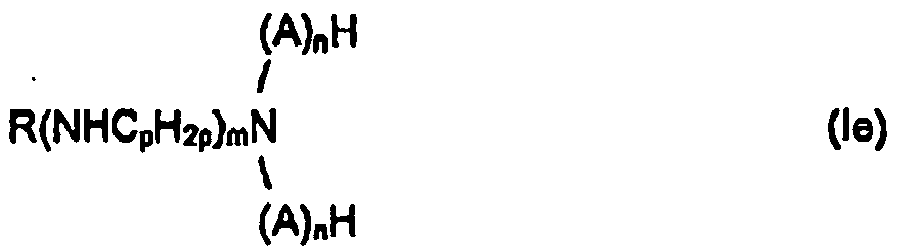
B Is the group →O and v is 0 or 1 provided that when v is 1 then Y cannot be hydrogen, X is the group ii) 10-95% by weight of an alcohol of formula IIwhere R is a hydrocarbon group having 5-24 carbon atoms.
ROH (II),
- An additive according to claim 1, characterised in that the amount of i) and ii) being 10-50% by weight and 50-90% by weight, respectively.
- Use of an additive as defined in claim 1 as an emulsifier and solubilizer.
- Use according to claim 3, the amount of i) and ii) being 10-50% by weight and 50-90% by weight respectively
- A composition, characterised in that it comprises a homogeneous liquid phase containinga) 70-95% by weight of a hydrocarbon fraction having a boiling point within the range from 130 to 425°C,b) 2-25% by weight of ethanol,c) 0.002-1.2% by weight of water, andd) 0.5-15% by weight of an additive of claim 1.
- A composition according to claim 5, characterised in that R in formula II is an aliphatic group of 8-14 carbon atoms.
- A composition according to claim 5, characterised in that the surfactant of formula I is an amine surfactant of the formulae


or
an amine oxide surfactant of the formula
- A composition according to claim 5, characteriasd in that the surfactant of formula I is an ether amine surfactant of the formula

- A composition according to claim 5, characterised in that the surfactant of formula I is an amide surfactant of the formula

Applications Claiming Priority (3)
| Application Number | Priority Date | Filing Date | Title |
|---|---|---|---|
| SE0004648A SE523228C2 (en) | 2000-12-15 | 2000-12-15 | Fuel composition containing a hydrocarbon fraction, ethanol and an additive with water solubilizing capacity |
| SE0004648 | 2000-12-15 | ||
| PCT/SE2001/002748 WO2002048294A1 (en) | 2000-12-15 | 2001-12-12 | A microemulsion fuel containing a hydrocarbon fraction, ethanol, water and an additive comprising a nitrogen-containing surfactnant and a an alcohol |
Publications (2)
| Publication Number | Publication Date |
|---|---|
| EP1349908A1 EP1349908A1 (en) | 2003-10-08 |
| EP1349908B1 true EP1349908B1 (en) | 2012-02-22 |
Family
ID=20282245
Family Applications (1)
| Application Number | Title | Priority Date | Filing Date |
|---|---|---|---|
| EP01270587A Expired - Lifetime EP1349908B1 (en) | 2000-12-15 | 2001-12-12 | A microemulsion fuel containing a hydrocarbon fraction, ethanol, water and an additive comprising a nitrogen-containing surfactnant and a an alcohol |
Country Status (15)
| Country | Link |
|---|---|
| US (2) | US7575607B2 (en) |
| EP (1) | EP1349908B1 (en) |
| JP (1) | JP3943023B2 (en) |
| CN (1) | CN1271181C (en) |
| AR (1) | AR031802A1 (en) |
| AT (1) | ATE546509T1 (en) |
| AU (1) | AU2002221253A1 (en) |
| BR (1) | BR0116152B1 (en) |
| CA (1) | CA2429438A1 (en) |
| CZ (1) | CZ20031879A3 (en) |
| MX (1) | MXPA03005242A (en) |
| PL (1) | PL194236B1 (en) |
| SE (1) | SE523228C2 (en) |
| WO (1) | WO2002048294A1 (en) |
| ZA (1) | ZA200304125B (en) |
Families Citing this family (15)
| Publication number | Priority date | Publication date | Assignee | Title |
|---|---|---|---|---|
| EP1408101A1 (en) | 2002-10-04 | 2004-04-14 | Infineum International Limited | Additives and fuel oil compositions |
| WO2004058925A1 (en) * | 2002-12-24 | 2004-07-15 | Sangi Co., Ltd. | Low-pollution liquid fuel for internal combustion engine |
| EP1512736B2 (en) | 2003-09-05 | 2025-12-17 | Infineum International Limited | Stabilised diesel fuel additive compositions |
| WO2008124800A1 (en) * | 2007-04-09 | 2008-10-16 | Ethanol Eex, Llc | Fuel blends |
| EP2017009B1 (en) | 2007-07-20 | 2013-07-03 | Clariant (Brazil) S.A. | Reverse iron ore flotation by collectors in aqueous nanoemulsion |
| DE102009048223A1 (en) | 2009-10-05 | 2011-06-16 | Fachhochschule Trier | Process for the in-situ production of fuel-water mixtures in internal combustion engines |
| CZ306196B6 (en) * | 2011-10-13 | 2016-09-21 | Česká zemědělská univerzita v Praze | Biodiesel-based fuel |
| RU2501844C2 (en) * | 2012-03-27 | 2013-12-20 | Хасан Амаевич Тайсумов | Hybrid emulsion fuel |
| WO2014062075A1 (en) * | 2012-10-15 | 2014-04-24 | Taysumov Hasan Amaevich | Hybrid emulsion fuel |
| SE538634C2 (en) * | 2013-11-12 | 2016-10-04 | Sekab Biofuels & Chemicals Ab | Method for preparing an ethanol fuel composition |
| EP3218452B1 (en) * | 2014-11-10 | 2019-07-31 | EME Finance Ltd | Water in diesel oil fuel micro-emulsions. |
| WO2016074903A1 (en) | 2014-11-10 | 2016-05-19 | Eme International Limited | Device for mixing water and diesel oil, apparatus and process for producing a water/diesel oil micro-emulsion. |
| DE102014225815A1 (en) | 2014-12-15 | 2016-06-16 | Fachhochschule Trier | In-situ production of fuel-water mixtures in internal combustion engines |
| US9771535B2 (en) * | 2015-08-19 | 2017-09-26 | Joe Ru He Zhao | Gasoline efficacy promoter (GEP) and method of making the same |
| IT201600132801A1 (en) | 2016-12-30 | 2018-06-30 | Eme International Ltd | Apparatus and process for producing liquid from biomass, biofuel and biomaterial |
Family Cites Families (37)
| Publication number | Priority date | Publication date | Assignee | Title |
|---|---|---|---|---|
| US1525578A (en) * | 1922-07-01 | 1925-02-10 | Friesenhahn Peter | Liquid fuel |
| US2194496A (en) * | 1938-02-17 | 1940-03-26 | Chemical Foundation Inc | Power alcohol |
| US3527581A (en) * | 1966-10-17 | 1970-09-08 | Exxon Research Engineering Co | Microemulsions of water in hydrocarbon fuel for engines |
| JPS5140565B2 (en) * | 1972-04-12 | 1976-11-04 | ||
| US4002438A (en) * | 1975-01-22 | 1977-01-11 | Joseph Fleming | Organic conversion system |
| DE2854540A1 (en) * | 1978-12-16 | 1980-06-26 | Bayer Ag | FUELS |
| US4208190A (en) * | 1979-02-09 | 1980-06-17 | Ethyl Corporation | Diesel fuels having anti-wear properties |
| US4384872A (en) * | 1979-03-05 | 1983-05-24 | Institute Of Gas Technology | Stabilized gasoline-alcohol fuel compositions |
| US4400178A (en) * | 1980-04-21 | 1983-08-23 | The Lubrizol Corporation | Liquid fuels containing polyamine dispersants |
| US4477258A (en) * | 1980-10-30 | 1984-10-16 | Labofina, S.A. | Diesel fuel compositions and process for their production |
| US4451265A (en) * | 1981-04-21 | 1984-05-29 | The United States Of America As Represented By The Secretary Of Agriculture | Diesel fuel-aqueous alcohol microemulsions |
| NZ201192A (en) | 1981-07-15 | 1984-10-19 | Massey Ferguson Perkins Ltd | Internal combustion engine fuel containing oil,alcohol and tall oil |
| US4392866A (en) * | 1981-11-05 | 1983-07-12 | Texaco Inc. | Etheramine corrosion inhibitor for alcohols |
| US4482666A (en) | 1982-03-12 | 1984-11-13 | Apace Research Limited | Emulsions of liquid hydrocarbons with water and/or alcohols |
| CA1224628A (en) | 1982-12-09 | 1987-07-28 | Union Carbide Corporation | Diesel fuels |
| EP0116197B1 (en) | 1983-01-14 | 1991-01-02 | Aeci Limited | Ignition improver for an alcohol based fuel for compression ignition engines |
| US4504275A (en) * | 1983-03-24 | 1985-03-12 | Imperial Chemical Industries Plc | Emulsifying agents |
| US4504276A (en) * | 1983-03-24 | 1985-03-12 | Imperial Chemical Industries Plc | Emulsifying agents |
| DE3525124A1 (en) * | 1985-07-13 | 1987-01-15 | Huels Chemische Werke Ag | FUELS AND HEATING OILS AND USE OF AN EMULGATOR SYSTEM FOR THE PRODUCTION OF THESE FUELS AND HEATING OILS |
| NO864988D0 (en) | 1986-12-10 | 1986-12-10 | Dyno Industrier As | UPGRADING OF HEAVY GROWN OIL FRACTIONS FOR USE AS LIGHTING FUEL OILS OR DIESEL OILS AND UPGRADED OILS. |
| IT1223404B (en) | 1987-12-04 | 1990-09-19 | Eniricerche Spa | DIESEL FUEL COMPOSITION |
| SE463028B (en) | 1988-02-22 | 1990-10-01 | Berol Kemi Ab | ETHANOL BRAZLE AND ITS APPLICATION AS DIESEL BRAZEN |
| EP0353713B1 (en) * | 1988-08-05 | 1994-03-16 | Kao Corporation | Use of an additive for fuel |
| CA2048906C (en) | 1990-09-07 | 2002-12-10 | Jan Bock | Microemulsion diesel fuel compositions and method of use |
| EP0570563A1 (en) * | 1991-11-15 | 1993-11-24 | Cytec Technology Corp. | A process for preparing a triazine tris-lactam crosslinking agent and curable compositions containing the same |
| WO1993024593A1 (en) | 1992-06-02 | 1993-12-09 | Greenbranch Enterprises, Inc. | A phase stabilized alcohol based diesel fuel containing ignition additives |
| BR9407052A (en) | 1993-07-16 | 1996-08-13 | Victorian Chemical Internation | Fuel mixtures |
| SE510104C2 (en) | 1993-08-19 | 1999-04-19 | Berol Nobel Ab | Ethanol fuel and use of an ignition enhancer |
| GB9621261D0 (en) | 1996-10-11 | 1996-11-27 | Exxon Chemical Patents Inc | Lubricity additives for fuel oil compositions |
| US5792223A (en) * | 1997-03-21 | 1998-08-11 | Intevep, S.A. | Natural surfactant with amines and ethoxylated alcohol |
| US6074445A (en) | 1997-10-20 | 2000-06-13 | Pure Energy Corporation | Polymeric fuel additive and method of making the same, and fuel containing the additive |
| AU761457B2 (en) * | 1998-01-12 | 2003-06-05 | Deborah Wenzel | An additive composition also used as a fuel composition comprising water soluble alcohols |
| GB2362163A (en) | 1998-11-23 | 2001-11-14 | Pure Energy Corp | Diesel fuel composition |
| US6017369A (en) * | 1998-11-23 | 2000-01-25 | Pure Energy Corporation | Diesel fuel composition |
| HU222559B1 (en) | 1999-05-14 | 2003-08-28 | András Bertha | Additive for stabilizing fuel of water content, the stabilized fuel and application thereof |
| WO2001018154A1 (en) | 1999-09-06 | 2001-03-15 | Agrofuel Ab | Motor fuel for diesel engines |
| US6224642B1 (en) | 1999-11-23 | 2001-05-01 | The Lubrizol Corporation | Additive composition |
-
2000
- 2000-12-15 SE SE0004648A patent/SE523228C2/en not_active IP Right Cessation
-
2001
- 2001-12-12 CA CA002429438A patent/CA2429438A1/en not_active Abandoned
- 2001-12-12 US US10/433,344 patent/US7575607B2/en not_active Expired - Fee Related
- 2001-12-12 CZ CZ20031879A patent/CZ20031879A3/en unknown
- 2001-12-12 AT AT01270587T patent/ATE546509T1/en active
- 2001-12-12 MX MXPA03005242A patent/MXPA03005242A/en active IP Right Grant
- 2001-12-12 PL PL01364710A patent/PL194236B1/en unknown
- 2001-12-12 EP EP01270587A patent/EP1349908B1/en not_active Expired - Lifetime
- 2001-12-12 JP JP2002549813A patent/JP3943023B2/en not_active Expired - Fee Related
- 2001-12-12 CN CNB018206255A patent/CN1271181C/en not_active Expired - Fee Related
- 2001-12-12 BR BRPI0116152-0A patent/BR0116152B1/en not_active IP Right Cessation
- 2001-12-12 AU AU2002221253A patent/AU2002221253A1/en not_active Abandoned
- 2001-12-12 AR ARP010105778A patent/AR031802A1/en not_active Application Discontinuation
- 2001-12-12 WO PCT/SE2001/002748 patent/WO2002048294A1/en not_active Ceased
-
2003
- 2003-05-28 ZA ZA200304125A patent/ZA200304125B/en unknown
-
2008
- 2008-05-12 US US12/118,998 patent/US8252071B2/en not_active Expired - Fee Related
Also Published As
| Publication number | Publication date |
|---|---|
| US7575607B2 (en) | 2009-08-18 |
| JP3943023B2 (en) | 2007-07-11 |
| EP1349908A1 (en) | 2003-10-08 |
| BR0116152B1 (en) | 2012-09-04 |
| US20080307699A1 (en) | 2008-12-18 |
| PL194236B1 (en) | 2007-05-31 |
| AU2002221253A1 (en) | 2002-06-24 |
| CN1481432A (en) | 2004-03-10 |
| WO2002048294A1 (en) | 2002-06-20 |
| US20040055210A1 (en) | 2004-03-25 |
| SE523228C2 (en) | 2004-04-06 |
| CN1271181C (en) | 2006-08-23 |
| CA2429438A1 (en) | 2002-06-20 |
| ZA200304125B (en) | 2004-08-13 |
| ATE546509T1 (en) | 2012-03-15 |
| AR031802A1 (en) | 2003-10-01 |
| JP2004515641A (en) | 2004-05-27 |
| SE0004648D0 (en) | 2000-12-15 |
| US8252071B2 (en) | 2012-08-28 |
| SE0004648L (en) | 2002-06-16 |
| CZ20031879A3 (en) | 2003-09-17 |
| MXPA03005242A (en) | 2004-05-05 |
| BR0116152A (en) | 2003-12-23 |
| PL364710A1 (en) | 2004-12-13 |
Similar Documents
| Publication | Publication Date | Title |
|---|---|---|
| US8252071B2 (en) | Fuel composition containing a hydrocarbon fraction and ethanol | |
| EP2343353B1 (en) | Uses of emulsifying agents in non-aqueous fuels and oils | |
| KR100533490B1 (en) | Additives for fuel compositions to reduce formation of combustion chamber deposits | |
| DE60306250T2 (en) | Friction modification additives for fuel compositions and methods of use thereof | |
| US7435272B2 (en) | Friction modifier alkoxyamine salts of carboxylic acids as additives for fuel compositions and methods of use thereof | |
| US20030134755A1 (en) | Compositions and a method for their preparation | |
| JP2003268392A (en) | Additive for lubrication of fuel, produced from hydrocarbylsuccinic anhydride and hydroxyamine, and middle distillate fuel containing it | |
| CA2769545A1 (en) | Composition for preparing an emulsion | |
| US4242101A (en) | Fuels for gasoline engines | |
| US10995291B2 (en) | Fuel compositions | |
| US20070094921A1 (en) | Methods to improve the low temperature compatibility of amide friction modifiers in fuels and amide friction modifiers | |
| CN1406269A (en) | Compositions | |
| EP0967263A1 (en) | Diesel fuel oil composition | |
| US3647378A (en) | Carburetor anti-icing composition | |
| CA2079049A1 (en) | Fuel compositions | |
| CA2380174A1 (en) | Aqueous fuel mixture | |
| AU2007231780A1 (en) | Fuel additive | |
| ZA200709398B (en) | Fuel additive |
Legal Events
| Date | Code | Title | Description |
|---|---|---|---|
| PUAI | Public reference made under article 153(3) epc to a published international application that has entered the european phase |
Free format text: ORIGINAL CODE: 0009012 |
|
| 17P | Request for examination filed |
Effective date: 20030625 |
|
| AK | Designated contracting states |
Kind code of ref document: A1 Designated state(s): AT BE CH CY DE DK ES FI FR GB GR IE IT LI LU MC NL PT SE TR |
|
| AX | Request for extension of the european patent |
Extension state: AL LT LV MK RO SI |
|
| 17Q | First examination report despatched |
Effective date: 20071030 |
|
| GRAP | Despatch of communication of intention to grant a patent |
Free format text: ORIGINAL CODE: EPIDOSNIGR1 |
|
| GRAS | Grant fee paid |
Free format text: ORIGINAL CODE: EPIDOSNIGR3 |
|
| GRAA | (expected) grant |
Free format text: ORIGINAL CODE: 0009210 |
|
| AK | Designated contracting states |
Kind code of ref document: B1 Designated state(s): AT BE CH CY DE DK ES FI FR GB GR IE IT LI LU MC NL PT SE TR |
|
| REG | Reference to a national code |
Ref country code: GB Ref legal event code: FG4D |
|
| REG | Reference to a national code |
Ref country code: CH Ref legal event code: EP |
|
| REG | Reference to a national code |
Ref country code: AT Ref legal event code: REF Ref document number: 546509 Country of ref document: AT Kind code of ref document: T Effective date: 20120315 |
|
| REG | Reference to a national code |
Ref country code: IE Ref legal event code: FG4D |
|
| REG | Reference to a national code |
Ref country code: DE Ref legal event code: R096 Ref document number: 60146147 Country of ref document: DE Effective date: 20120412 |
|
| REG | Reference to a national code |
Ref country code: NL Ref legal event code: VDEP Effective date: 20120222 |
|
| PG25 | Lapsed in a contracting state [announced via postgrant information from national office to epo] |
Ref country code: NL Free format text: LAPSE BECAUSE OF FAILURE TO SUBMIT A TRANSLATION OF THE DESCRIPTION OR TO PAY THE FEE WITHIN THE PRESCRIBED TIME-LIMIT Effective date: 20120222 |
|
| PG25 | Lapsed in a contracting state [announced via postgrant information from national office to epo] |
Ref country code: FI Free format text: LAPSE BECAUSE OF FAILURE TO SUBMIT A TRANSLATION OF THE DESCRIPTION OR TO PAY THE FEE WITHIN THE PRESCRIBED TIME-LIMIT Effective date: 20120222 Ref country code: PT Free format text: LAPSE BECAUSE OF FAILURE TO SUBMIT A TRANSLATION OF THE DESCRIPTION OR TO PAY THE FEE WITHIN THE PRESCRIBED TIME-LIMIT Effective date: 20120622 Ref country code: BE Free format text: LAPSE BECAUSE OF FAILURE TO SUBMIT A TRANSLATION OF THE DESCRIPTION OR TO PAY THE FEE WITHIN THE PRESCRIBED TIME-LIMIT Effective date: 20120222 Ref country code: GR Free format text: LAPSE BECAUSE OF FAILURE TO SUBMIT A TRANSLATION OF THE DESCRIPTION OR TO PAY THE FEE WITHIN THE PRESCRIBED TIME-LIMIT Effective date: 20120523 |
|
| REG | Reference to a national code |
Ref country code: AT Ref legal event code: MK05 Ref document number: 546509 Country of ref document: AT Kind code of ref document: T Effective date: 20120222 |
|
| PG25 | Lapsed in a contracting state [announced via postgrant information from national office to epo] |
Ref country code: CY Free format text: LAPSE BECAUSE OF FAILURE TO SUBMIT A TRANSLATION OF THE DESCRIPTION OR TO PAY THE FEE WITHIN THE PRESCRIBED TIME-LIMIT Effective date: 20120222 |
|
| PG25 | Lapsed in a contracting state [announced via postgrant information from national office to epo] |
Ref country code: DK Free format text: LAPSE BECAUSE OF FAILURE TO SUBMIT A TRANSLATION OF THE DESCRIPTION OR TO PAY THE FEE WITHIN THE PRESCRIBED TIME-LIMIT Effective date: 20120222 Ref country code: SE Free format text: LAPSE BECAUSE OF FAILURE TO SUBMIT A TRANSLATION OF THE DESCRIPTION OR TO PAY THE FEE WITHIN THE PRESCRIBED TIME-LIMIT Effective date: 20120222 |
|
| PG25 | Lapsed in a contracting state [announced via postgrant information from national office to epo] |
Ref country code: IT Free format text: LAPSE BECAUSE OF FAILURE TO SUBMIT A TRANSLATION OF THE DESCRIPTION OR TO PAY THE FEE WITHIN THE PRESCRIBED TIME-LIMIT Effective date: 20120222 |
|
| PLBE | No opposition filed within time limit |
Free format text: ORIGINAL CODE: 0009261 |
|
| STAA | Information on the status of an ep patent application or granted ep patent |
Free format text: STATUS: NO OPPOSITION FILED WITHIN TIME LIMIT |
|
| 26N | No opposition filed |
Effective date: 20121123 |
|
| PG25 | Lapsed in a contracting state [announced via postgrant information from national office to epo] |
Ref country code: AT Free format text: LAPSE BECAUSE OF FAILURE TO SUBMIT A TRANSLATION OF THE DESCRIPTION OR TO PAY THE FEE WITHIN THE PRESCRIBED TIME-LIMIT Effective date: 20120222 |
|
| REG | Reference to a national code |
Ref country code: DE Ref legal event code: R097 Ref document number: 60146147 Country of ref document: DE Effective date: 20121123 |
|
| PG25 | Lapsed in a contracting state [announced via postgrant information from national office to epo] |
Ref country code: ES Free format text: LAPSE BECAUSE OF FAILURE TO SUBMIT A TRANSLATION OF THE DESCRIPTION OR TO PAY THE FEE WITHIN THE PRESCRIBED TIME-LIMIT Effective date: 20120602 |
|
| PG25 | Lapsed in a contracting state [announced via postgrant information from national office to epo] |
Ref country code: MC Free format text: LAPSE BECAUSE OF NON-PAYMENT OF DUE FEES Effective date: 20121231 |
|
| REG | Reference to a national code |
Ref country code: CH Ref legal event code: PL |
|
| GBPC | Gb: european patent ceased through non-payment of renewal fee |
Effective date: 20121212 |
|
| REG | Reference to a national code |
Ref country code: IE Ref legal event code: MM4A |
|
| REG | Reference to a national code |
Ref country code: FR Ref legal event code: ST Effective date: 20130830 |
|
| REG | Reference to a national code |
Ref country code: DE Ref legal event code: R119 Ref document number: 60146147 Country of ref document: DE Effective date: 20130702 |
|
| PG25 | Lapsed in a contracting state [announced via postgrant information from national office to epo] |
Ref country code: LI Free format text: LAPSE BECAUSE OF NON-PAYMENT OF DUE FEES Effective date: 20121231 Ref country code: CH Free format text: LAPSE BECAUSE OF NON-PAYMENT OF DUE FEES Effective date: 20121231 Ref country code: DE Free format text: LAPSE BECAUSE OF NON-PAYMENT OF DUE FEES Effective date: 20130702 Ref country code: IE Free format text: LAPSE BECAUSE OF NON-PAYMENT OF DUE FEES Effective date: 20121212 |
|
| PG25 | Lapsed in a contracting state [announced via postgrant information from national office to epo] |
Ref country code: FR Free format text: LAPSE BECAUSE OF NON-PAYMENT OF DUE FEES Effective date: 20130102 Ref country code: GB Free format text: LAPSE BECAUSE OF NON-PAYMENT OF DUE FEES Effective date: 20121212 |
|
| PG25 | Lapsed in a contracting state [announced via postgrant information from national office to epo] |
Ref country code: TR Free format text: LAPSE BECAUSE OF FAILURE TO SUBMIT A TRANSLATION OF THE DESCRIPTION OR TO PAY THE FEE WITHIN THE PRESCRIBED TIME-LIMIT Effective date: 20120222 |
|
| PG25 | Lapsed in a contracting state [announced via postgrant information from national office to epo] |
Ref country code: LU Free format text: LAPSE BECAUSE OF NON-PAYMENT OF DUE FEES Effective date: 20121212 |