EP1349857B1 - Purine derivatives as purinergic receptor antagonists - Google Patents
Purine derivatives as purinergic receptor antagonists Download PDFInfo
- Publication number
- EP1349857B1 EP1349857B1 EP02729444A EP02729444A EP1349857B1 EP 1349857 B1 EP1349857 B1 EP 1349857B1 EP 02729444 A EP02729444 A EP 02729444A EP 02729444 A EP02729444 A EP 02729444A EP 1349857 B1 EP1349857 B1 EP 1349857B1
- Authority
- EP
- European Patent Office
- Prior art keywords
- purine
- sub
- furyl
- alkyl
- amine
- Prior art date
- Legal status (The legal status is an assumption and is not a legal conclusion. Google has not performed a legal analysis and makes no representation as to the accuracy of the status listed.)
- Expired - Lifetime
Links
- 0 C*Cc1c2N=INc2nc(*I)n1 Chemical compound C*Cc1c2N=INc2nc(*I)n1 0.000 description 17
Classifications
-
- C—CHEMISTRY; METALLURGY
- C07—ORGANIC CHEMISTRY
- C07D—HETEROCYCLIC COMPOUNDS
- C07D473/00—Heterocyclic compounds containing purine ring systems
-
- A—HUMAN NECESSITIES
- A61—MEDICAL OR VETERINARY SCIENCE; HYGIENE
- A61K—PREPARATIONS FOR MEDICAL, DENTAL OR TOILETRY PURPOSES
- A61K31/00—Medicinal preparations containing organic active ingredients
- A61K31/33—Heterocyclic compounds
- A61K31/395—Heterocyclic compounds having nitrogen as a ring hetero atom, e.g. guanethidine or rifamycins
- A61K31/495—Heterocyclic compounds having nitrogen as a ring hetero atom, e.g. guanethidine or rifamycins having six-membered rings with two or more nitrogen atoms as the only ring heteroatoms, e.g. piperazine or tetrazines
- A61K31/505—Pyrimidines; Hydrogenated pyrimidines, e.g. trimethoprim
- A61K31/519—Pyrimidines; Hydrogenated pyrimidines, e.g. trimethoprim ortho- or peri-condensed with heterocyclic rings
- A61K31/52—Purines, e.g. adenine
-
- A—HUMAN NECESSITIES
- A61—MEDICAL OR VETERINARY SCIENCE; HYGIENE
- A61P—SPECIFIC THERAPEUTIC ACTIVITY OF CHEMICAL COMPOUNDS OR MEDICINAL PREPARATIONS
- A61P25/00—Drugs for disorders of the nervous system
-
- A—HUMAN NECESSITIES
- A61—MEDICAL OR VETERINARY SCIENCE; HYGIENE
- A61P—SPECIFIC THERAPEUTIC ACTIVITY OF CHEMICAL COMPOUNDS OR MEDICINAL PREPARATIONS
- A61P25/00—Drugs for disorders of the nervous system
- A61P25/04—Centrally acting analgesics, e.g. opioids
-
- A—HUMAN NECESSITIES
- A61—MEDICAL OR VETERINARY SCIENCE; HYGIENE
- A61P—SPECIFIC THERAPEUTIC ACTIVITY OF CHEMICAL COMPOUNDS OR MEDICINAL PREPARATIONS
- A61P25/00—Drugs for disorders of the nervous system
- A61P25/08—Antiepileptics; Anticonvulsants
-
- A—HUMAN NECESSITIES
- A61—MEDICAL OR VETERINARY SCIENCE; HYGIENE
- A61P—SPECIFIC THERAPEUTIC ACTIVITY OF CHEMICAL COMPOUNDS OR MEDICINAL PREPARATIONS
- A61P25/00—Drugs for disorders of the nervous system
- A61P25/14—Drugs for disorders of the nervous system for treating abnormal movements, e.g. chorea, dyskinesia
-
- A—HUMAN NECESSITIES
- A61—MEDICAL OR VETERINARY SCIENCE; HYGIENE
- A61P—SPECIFIC THERAPEUTIC ACTIVITY OF CHEMICAL COMPOUNDS OR MEDICINAL PREPARATIONS
- A61P25/00—Drugs for disorders of the nervous system
- A61P25/14—Drugs for disorders of the nervous system for treating abnormal movements, e.g. chorea, dyskinesia
- A61P25/16—Anti-Parkinson drugs
-
- A—HUMAN NECESSITIES
- A61—MEDICAL OR VETERINARY SCIENCE; HYGIENE
- A61P—SPECIFIC THERAPEUTIC ACTIVITY OF CHEMICAL COMPOUNDS OR MEDICINAL PREPARATIONS
- A61P25/00—Drugs for disorders of the nervous system
- A61P25/24—Antidepressants
-
- A—HUMAN NECESSITIES
- A61—MEDICAL OR VETERINARY SCIENCE; HYGIENE
- A61P—SPECIFIC THERAPEUTIC ACTIVITY OF CHEMICAL COMPOUNDS OR MEDICINAL PREPARATIONS
- A61P25/00—Drugs for disorders of the nervous system
- A61P25/28—Drugs for disorders of the nervous system for treating neurodegenerative disorders of the central nervous system, e.g. nootropic agents, cognition enhancers, drugs for treating Alzheimer's disease or other forms of dementia
-
- A—HUMAN NECESSITIES
- A61—MEDICAL OR VETERINARY SCIENCE; HYGIENE
- A61P—SPECIFIC THERAPEUTIC ACTIVITY OF CHEMICAL COMPOUNDS OR MEDICINAL PREPARATIONS
- A61P43/00—Drugs for specific purposes, not provided for in groups A61P1/00-A61P41/00
-
- C—CHEMISTRY; METALLURGY
- C07—ORGANIC CHEMISTRY
- C07D—HETEROCYCLIC COMPOUNDS
- C07D473/00—Heterocyclic compounds containing purine ring systems
- C07D473/26—Heterocyclic compounds containing purine ring systems with an oxygen, sulphur, or nitrogen atom directly attached in position 2 or 6, but not in both
- C07D473/28—Oxygen atom
-
- C—CHEMISTRY; METALLURGY
- C07—ORGANIC CHEMISTRY
- C07D—HETEROCYCLIC COMPOUNDS
- C07D473/00—Heterocyclic compounds containing purine ring systems
- C07D473/26—Heterocyclic compounds containing purine ring systems with an oxygen, sulphur, or nitrogen atom directly attached in position 2 or 6, but not in both
- C07D473/32—Nitrogen atom
-
- C—CHEMISTRY; METALLURGY
- C07—ORGANIC CHEMISTRY
- C07D—HETEROCYCLIC COMPOUNDS
- C07D473/00—Heterocyclic compounds containing purine ring systems
- C07D473/26—Heterocyclic compounds containing purine ring systems with an oxygen, sulphur, or nitrogen atom directly attached in position 2 or 6, but not in both
- C07D473/36—Sulfur atom
-
- C—CHEMISTRY; METALLURGY
- C07—ORGANIC CHEMISTRY
- C07D—HETEROCYCLIC COMPOUNDS
- C07D473/00—Heterocyclic compounds containing purine ring systems
- C07D473/40—Heterocyclic compounds containing purine ring systems with halogen atoms or perhalogeno-alkyl radicals directly attached in position 2 or 6
Definitions
- the present invention relates to purine derivatives and their use in therapy.
- the present invention relates to the treatment of disorders in which the reduction of purinergic neurotransmission could be beneficial.
- the invention relates in particular to blockade of adenosine receptors and particularly adenosine A 2A receptors, and to the treatment of movement disorders such as Parkinson's disease.
- Movement disorders constitute a serious health problem, especially amongst the elderly sector of the population. These movement disorders are often the result of brain lesions. Disorders involving the basal ganglia which result in movement disorders include Parkinson's disease, Huntington's chorea and Wilson's disease. Furthermore, dyskinesias often arise as sequelae of cerebral ischaemia and other neurological disorders.
- Parkinson's disease There are four classic symptoms of Parkinson's disease: tremor, rigidity, akinesia and postural changes. The disease is also commonly associated with depression, dementia and overall cognitive decline. Parkinson's disease has a prevalence of 1 per 1,000 of the total population. The incidence increases to 1 per 100 for those aged over 60 years. Degeneration of dopaminergic neurones in the substantia nigra and the subsequent reductions in interstitial concentrations of dopamine in the striatum are critical to the development of Parkinson's disease. Some 80% of cells from the substantia nigra need to be destroyed before the clinical symptoms of Parkinson's disease are manifested.
- L-dihydroxyphenylacetic acid L-DOPA
- L-DOPA L-dihydroxyphenylacetic acid
- DPA monoamine oxidase
- dopamine receptor agonists e.g. bromocriptine and apomorphine
- anticholinergics e.g. benztrophine, orphenadrine
- Transmitter replacement therapy in particular does not provide consistent clinical benefit, especially after prolonged treatment when "on-off" symptoms develop, and this treatment has also been associated with involuntary movements of athetosis and chorea, nausea and vomiting. Additionally current therapies do not treat the underlying neurodegenerative disorder resulting in a continuing cognitive decline in patients.
- Blockade of A 2 adenosine receptors has recently been implicated in the treatment of movement disorders such as Parkinson's disease ( Richardson, P.J. et al., Trends Pharmacol. Sci. 1997, 18, 338-344 ) and in the treatment of cerebral ischaemia ( Gao, Y. and Phillis, J.W., Life Sci. 1994, 55, 61-65 ).
- the potential utility of adenosine A 2A receptor antagonists in the treatment of movement disorders such as Parkinson's Disease has recently been reviewed ( Mally, J. and Stone, T.W., CNS Drugs, 1998, 10, 311-320 ).
- Adenosine is a naturally occurring purine nucleoside which has a wide variety of well-documented regulatory functions and physiological effects.
- the central nervous system (CNS) effects of this endogenous nucleoside have attracted particular attention in drug discovery, owing to the therapeutic potential of purinergic agents in CNS disorders ( Jacobson, K.A. et al., J. Med. Chem. 1992, 35, 407-422 ).
- This therapeutic potential has resulted in considerable recent research endeavour within the field of adenosine receptor agonists and antagonists ( Bhagwhat, S.S.; Williams, M. Exp. Opin. Ther. Patents 1995, 5,547-558 ).
- Adenosine receptors represent a subclass (P 1 ) of the group of purine nucleotide and nucleoside receptors known as purinoreceptors.
- the main pharmacologically distinct adenosine receptor subtypes are known as A 1 , A 2A , A 2B (of high and low affinity) and A 3 ( Fredholm, B.B., et al., Phannacol. Rev. 1994, 46, 143-156 ).
- the adenosine receptors are present in the CNS ( Fredholm, B.B., News Physiol. Sci., 1995, 10, 122-128 ).
- P 1 receptor-mediated agents The design of P 1 receptor-mediated agents has been reviewed ( Jacobson, K.A., Suzuki, F., Drug Dev. Res., 1997, 39, 289-300 ; Baraldi, P.G. et al., Curr. Med. Chem. 1995, 2, 707-722 ), and such compounds are claimed to be useful in the treatment of cerebral ischemia or neurodegenerative disorders, such as Parkinson's disease ( Williams, M. and Burnstock, G. Purinergic Approaches Exp. Ther. (1997), 3-26. Editor: Jacobson, Kenneth A.; Jarvis, Michael F. Publisher: Wiley-Liss, New York, N.Y .)
- xanthine derivatives such as caffeine may offer a form of treatment for attention-deficit hyperactivity disorder (ADHD).
- ADHD attention-deficit hyperactivity disorder
- Antagonism of adenosine receptors is thought to account for the majority of the behavioural effects of caffeine in humans and thus blockade of adenosine A 2A receptors may account for the observed effects of caffeine in ADHD patients. Therefore a selective A 2A receptor antagonist may provide an effective treatment for ADHD but without the unwanted side effects associated with current therapy.
- Adenosine receptors have been recognised to play an important role in regulation of sleep patterns, and indeed adenosine antagonists such as caffeine exert potent stimulant effects and can be used to prolong wakefulness ( Porkka-Heiskanen, T. et al., Science, 1997, 276, 1265-1268 ). Recent evidence suggests that a substantial part of the actions of adenosine in regulating sleep is mediated through the adenosine A 2A receptor ( Satoh, S., et al., Proc. Natl. Acad. Sci., USA, 1996 ). Thus, a selective A 2A receptor antagonist may be of benefit in counteracting excessive sleepiness in sleep disorders such as hypersomnia or narcolepsy.
- a 2A receptor antagonists may offer a novel therapy for the treatment of major depression and other affective disorders in patients.
- adenosine A 2A antagonist therapy is that the underlying neurodegenerative disorder may also be treated.
- the neuroprotective effect of adenosine A 2A antagonists has been reviewed ( Ongini, E.; Adami, M.; Ferri, C.; Bertorelli, R., Ann. N. Y. Acad. Sci. 1997, 825 (Neuroprotective Agents), 30-48 ).
- blockade of A 2A receptor function confers neuroprotection against MPTP-induced neurotoxicity in mice ( Chen, J-F., J. Neurosci. 2001, 21, RC143 ).
- a 2A receptor antagonist may offer a novel treatment for conferring neuroprotection in neurodegenerative diseases such as Parkinson's disease.
- Xanthine derivatives have been disclosed as adenosine A 2 receptor antagonists as useful for treating various diseases caused by hyperfunctioning of adenosine A 2 receptors, such as Parkinson's disease (see, for example, EP-A-565377 ).
- CSC 8-(3-chlorostyryl)caffeine
- Theophylline (1,3-dimethylxanthine), a bronchodilator drug which is a mixed antagonist at adenosine A 1 and A 2A receptors, has been studied clinically.
- the patients exhibited significant improvements in mean objective disability scores and 11 reported moderate or marked subjective improvement ( Mally, J., Stone, T.W. J. Pharm. Pharmacol. 1994, 46, 515-517 ).
- KF 17837 [(E)-8-(3,4-dimethoxystyryl)-1,3-dipropyl-7-methylxanthine] is a selective adenosine A 2A receptor antagonist which on oral administration significantly ameliorated the cataleptic responses induced by intracerebroventricular administration of an adenosine A 2A receptor agonist, CGS 21680. KF 17837 also reduced the catalepsy induced by haloperidol and reserpine.
- KF 17837 potentiated the anticataleptic effects of a subthreshold dose of L-DOPA plus benserazide, suggesting that KF 17837 is a centrally active adenosine A 2A receptor antagonist and that the dopaminergic function of the nigrostriatal pathway is potentiated by adenosine A 2A receptor antagonists ( Kanda, T. et al., Eur. J. Pharmacol. 1994, 256, 263-268 ).
- the structure activity relationship (SAR) of KF 17837 has been published ( Shimada, J. et al., Bioorg. Med. Chem. Lett. 1997, 7, 2349-2352 ).
- New non-xanthine structures sharing these pharmacological properties include SCH 58261 and its derivatives ( Baraldi, P.G. et al., Pyrazolo[4,3-e]-1,2,4-triazolo[1,5-c]pyrimidine Derivatives: Potent and Selective A2A Adenosine Antagonists. J. Med. Chem. 1996, 39, 1164-71 ).
- SCH 58261 (7-(2-phenylethyl)-5-amino-2-(2-furyl)-pyrazolo-[4,3-e]-1,2,4-triazolo[1,5-c] pyrimidine) is reported as effective in the treatment of movement disorders ( Ongini, E. Drug Dev. Res. 1997, 42(2), 63-70 ) and has been followed up by a later series of compounds ( Baraldi, P.G. et al., J. Med. Chem. 1998, 41(12), 2126-2133 ).
- purine derivatives which are structurally unrelated to known adenosine receptor antagonists, exhibit unexpected antagonist binding affinity at adenosine (P 1 ) receptors, and in particular at the adenosine A 2A receptor.
- Such compounds may therefore be useful for the treatment of disorders in which the blocking of purine receptors, particularly adenosine receptors and more particularly adenosine A 2A receptors, may be beneficial.
- such compounds may be suitable for the treatment of movement disorders, such as disorders of the basal ganglia which result in dyskinesias.
- Disorders of particular interest in the present invention include Parkinson's disease, Alzheimer's disease, spasticity, Huntington's chorea and Wilson's disease.
- Such compounds may also be particularly suitable for the treatment of depression, cognitive or memory impairment including Alzheimer's disease, acute or chronic pain, ADHD, narcolepsy or for neuroprotection.
- alkyl means a branched or unbranched, cyclic or acyclic, saturated or unsaturated (e.g. alkenyl or alkynyl) hydrocarbyl radical which may be substituted or unsubstituted.
- the alkyl group is preferably C 3 to C 12 , more preferably C 5 to C 10 , more preferably C 5 , C 6 or C 7 .
- the alkyl group is preferably C 1 to C 10 , more preferably C 1 to C 6 , more preferably methyl, ethyl, propyl (n-propyl or isopropyl), butyl (n-butyl, isobutyl or tertiary-butyl) or pentyl (including n-pentyl and iso-pentyl), more preferably methyl.
- alkyl as used herein includes alkyl (branched or unbranched), alkenyl (branched or unbranched), alkynyl (branched or unbranched), cycloalkyl, cycloalkenyl and cycloalkynyl.
- lower alkyl means methyl, ethyl, propyl (n-propyl or isopropyl) or butyl (n-butyl, isobutyl or tertiary-butyl).
- aryl means an aromatic group, such as phenyl or naphthyl (preferably phenyl), or a heteroaromatic group containing one or more heteroatom(s) preferably selected from N, O and S, such as pyridyl, pyrrolyl, quinolinyl, furanyl, thienyl, oxadiazolyl, thiadiazolyl, thiazolyl, oxazolyl, isoxazolyl, pyrazolyl, triazolyl, imidazolyl, pyrimidinyl, indolyl, pyrazinyl or indazolyl.
- heteroaryl means an aromatic group containing one or more heteroatom(s) preferably selected from N, O and S, such as pyridyl, pyrrolyl, quinolinyl, furanyl, thienyl, oxadiazolyl, thiadiazolyl, thiazolyl, oxazolyl, isoxazolyl, pyrazolyl, triazolyl, imidazolyl, pyrimidinyl, indolyl, pyrazinyl or indazolyl.
- non-aromatic heterocyclyl means a non-aromatic cyclic group containing one or more heteroatom(s) preferably selected from N, O and S, such as a cyclic amino group (including aziridinyl, azetidinyl, pyrrolidinyl, piperidyl, piperazinyl, morpholinyl) or a cyclic ether (including tetrahydrofuranyl).
- a cyclic amino group including aziridinyl, azetidinyl, pyrrolidinyl, piperidyl, piperazinyl, morpholinyl
- a cyclic ether including tetrahydrofuranyl
- alkoxy means alkyl-O-.
- aryloxy means aryl-O-.
- halogen means a fluorine, chlorine, bromine or iodine radical.
- ortho,ortho-disubstituted heteroaryl groups refers to heteroaryl groups which are substituted in both ortho positions of the heteroaryl group relative to the point of attachment of the heteroaryl group to the purine ring.
- R 1 to R 120 is selected from alkyl, alkoxy and thioalkyl, in accordance with formula (I) as defined above, then that alkyl group, or the alkyl group of the alkoxy or thioalkyl group, may be substituted or unsubstituted.
- R 1 to R 20 are selected from aryl, aryloxy and thioaryl, in accordance with formula (I) as defined above, then said aryl group, or the aryl group of the aryloxy or thioaryl group, may be substituted or unsubstituted.
- R 5 and R 6 , or R 9 and R 10 , or R 8 and R 9 , or R 14 and R 15 are linked to form a heterocyclic group in accordance with formula (I) as defined above, then said heterocyclic ring may be substituted or unsubstituted. Where substituted, there will generally be 1 to 3 substituents present, preferably 1 substituent. Substituents may include: carbon-containing groups such as alkyl,
- R 1 to R 20 is selected from aryl or from an aryl-containing group such as aryloxy or arylthio
- preferred substituent group(s) are selected from halogen, alkyl (substituted or unsubstituted; and where substituted particularly from alkoxyalkyl, hydroxyalkyl, aminoalkyl and haloalkyl), hydroxy, alkoxy, CN, NO 2 , amines (including amino, mono- and di-alkylamino), alkoxycarbonyl, aminocarbonyl, carboxamido, sulfonamido, alkoxycarbonylamino and aryl, and particularly from unsubstituted alkyl, substituted alkyl (including alkoxyalkyl and aminoalkyl), halogen and amines.
- any of R 1 to R 20 is directly substituted by an alkyl substituent group, or by an alkyl-containing substituent group (such as alkoxy or alkylcarbonylamino for example), then the alkyl moiety of the substituent group directly attached to any of R 1 to R 20 may be further substituted by the substituent groups hereinbefore described and particularly by halogen, hydroxy, alkoxy, CN, amines (including amino, mono- and di-alkyl amino) and aryl.
- any of R 1 to R 20 is directly substituted by an aryl substitutent group, or by an aryl-containing substituent group (such as aryloxy or arylaminocarbonylamino for example), then the aryl moiety of the substituent group directly attached to any of R 1 to R 20 may be further substituted by the substituent groups hereinbefore described and particularly by halogen, alkyl (substituted or unsubstituted; and where substituted particularly from alkoxyalkyl, hydroxyalkyl, aminoalkyl and haloalkyl), hydroxy, alkoxy, CN, NO 2 , amines (including amino, mono- and di-alkylamino), alkoxycarbonyl, aminocarbonyl, carboxamido, sulfonamido, alkoxycarbonylamino and aryl.
- said aryl moiety is substituted by halogen, alkyl (including CF 3 ), hydroxy, alkoxy, CN, amines (including amino, mono- and di-alkyl amino) and NO 2 .
- said aryl moiety is substituted by unsubstituted alkyl, substituted alkyl (particularly alkoxyalkyl and aminoalkyl), halogen and amines.
- R 1 is selected from alkyl (including haloalkyl (such as CF 3 ), branched alkyl, cycloalkyl and arylalkyl), aryl (including heteroaryl), alkoxy, aryloxy, thioalkyl, thioaryl, halo, CN, NR 5 R 6 (including NH 2 ), NR 4 COR 5 , NR 4 CONR 5 R 6 , NR 4 CO 2 R 7 and NRSO 2 R 7 .
- alkyl including haloalkyl (such as CF 3 ), branched alkyl, cycloalkyl and arylalkyl), aryl (including heteroaryl), alkoxy, aryloxy, thioalkyl, thioaryl, halo, CN, NR 5 R 6 (including NH 2 ), NR 4 COR 5 , NR 4 CONR 5 R 6 , NR 4 CO 2 R 7 and NRSO 2 R 7 .
- R 1 is selected from NR 5 R 6 (including NH 2 ), alkoxy, thioalkyl and alkyl.
- R 1 is selected from NR 5 R 6 (including NH 2 ), and is preferably NH 2 .
- R 1 is selected from alkyl, preferably R 1 is selected from C 1-6 alkyl, more preferably from saturated C 1-6 alkyl and more preferably from lower alkyl.
- R 1 is selected from alkoxy and thioalkyl, preferably the alkyl moiety of said thioalkyl or alkoxy group is selected from C 1-6 alkyl, more preferably from saturated C 1-6 alkyl and more preferably from lower alkyl.
- R 1 is selected from halo, preferably R 1 is selected from chloro.
- R 1 is selected from NR 5 R 6 , preferably at least one and more preferably both of R 5 and R 6 are hydrogen.
- R 1 is selected from NR 4 COR 5 , NR 4 CONR 5 R 6 , NR 4 CO 2 R 7 and NR 4 SO 2 R 7 , and R 4 is selected from H and alkyl, and more preferably hydrogen.
- R 2 is selected from furyl (including 2-furyl), thienyl (including 2-thienyl), pyridyl (including 2-pyridyl), thiazolyl (including 2- and 5- thiazolyl), pyrazolyl (including 3-pyrazolyl), triazolyl (including 4-triazolyl), pyrrolyl (including 2-pyrrolyl) and oxazolyl (including 5-oxazolyl).
- R 2 is selected from 2-furyl, 2-thienyl, 2-thiazolyl, 2-pyridyl, 3-pyrazolyl, 2-pyrrolyl, 4-triazolyl and 5-oxazolyl.
- R 2 is selected from furyl, thienyl, pyridyl, thiazolyl and pyrazolyl, and particularly from 2-furyl, 2-thienyl, 2-thiazolyl, 2-pyridyl and 3-pyrazolyl.
- R 2 is selected from furyl, thienyl and pyridyl, preferably 2-furyl, 2-thienyl and 2-pyridyl, and more preferably from 2-furyl.
- R 2 is substituted heteroaryl
- substituent group(s) are not present in the ortho position relative to the point of attachment of the heteroaryl group to the purine moiety.
- reference to ortho-substitution of the R 2 group means the ortho positions of the R 2 group relative to the point of attachment of R 2 to the pyrimidine moiety of formula (I).
- R 2 is an unsubstituted heteroaryl group.
- R 3 is selected from H, substituted and unsubstituted alkyl (including saturated alkyl, alkenyl, alkynyl, branched and unbranched alkyl, and cyclic and acyclic alkyl), COR 8 , CONR 9 R 10 , CONR 8 NR 9 R 10 , CO 2 R 11 and SO 2 R 11 .
- R 3 is selected from H, alkyl and CONR 9 R 10 .
- R 3 is selected from H, substituted alkyl and CONR 9 R 10 .
- R 3 is selected from alkyl (substituted or unsubstituted) and CONR 9 R 10 , preferably substituted alkyl and CONR 9 R 10 .
- said substituted alkyl is preferably selected from arylalkyl (including heteroarylalkyl) and alkyl substituted by CONR 9 R 10 , and more preferably from arylalkyl (including heteroarylalkyl), and more preferably from arylmethyl (including heteroarylmethyl).
- R 8 is preferably selected from alkyl (including cycloalkyl) and aryl (including heteroaryl), preferably from saturated C 1-6 alkyl (including cycloalkyl) and aryl.
- R 9 and R 10 are selected from H, C 1-6 alkyl and aryl, and preferably from H, C 1-6 saturated alkyl (including cycloalkyl) and aryl, and more-preferably from H, lower alkyl and aryl.
- R 9 and R 10 is hydrogen.
- R 9 or R 10 is aryl, it is preferred that said aryl is substituted or unsubstituted phenyl.
- R 9 or R 10 is lower alkyl
- said lower alkyl may be substituted by hydroxy, halo, alkoxy, dialkylamino, substituted or unsubstituted aryl, preferably by substituted or unsubstituted aryl (including heteroaryl), more preferably by substituted and unsubstituted phenyl, thienyl, furyl and pyridyl, and more preferably by substituted phenyl, thienyl, furyl and pyridyl.
- R 3 is CONR 9 R 10 , R 9 is H and R 10 is selected from C 1-6 saturated alkyl, preferably saturated lower alkyl and preferably methyl, preferably substituted by substituted or unsubstituted aryl (including heteroaryl), more preferably substituted by phenyl, thienyl, furyl and pyridyl.
- R 3 is selected from CO 2 R 11 , preferably R 11 is selected from C 1-6 alkyl, preferably saturated C 1-6 alkyl, preferably saturated C 1-6 alkyl, and more preferably lower alkyl, optionally substituted by one or more (preferably one) substituent group preferably selected from aryl.
- R 3 is selected from SO 2 R 11 , it is preferred that R 11 is selected from C 1-6 alkyl (including cycloalkyl and alkenyl) and aryl (including heteroaryl). Where R 3 is SO 2 R 11 and R 11 is aryl, the aryl group may be substituted or unsubstituted, preferably substituted, and preferably substituted by lower alkyl or halo groups.
- R 3 is selected from alkyl
- R 3 is selected from acyclic alkyl (substituted or unsubstituted).
- R 3 is selected from substituted or unsubstituted C 1-6 alkyl (preferably acyclic, and including alkenyl and alkenyl), preferably from substituted or unsubstituted C 1-6 saturated alkyl and alkenyl (preferably acyclic), more preferably from substituted or unsubstituted C 1-6 saturated alkyl (preferably acyclic), preferably substituted or unsubstituted lower alkyl, more preferably from substituted or unsubstituted methyl, ethyl and propyl (n-propyl or isopropyl) groups, and more preferably from substituted or unsubstituted methyl.
- R 3 is selected from substituted alkyl, preferably mono-substituted alkyl where said substituent(s) is/are represented by R 12 .
- R 12 is selected from aryl (including heteroaryl)
- R 14 and R 15 are selected from H, C 1-6 alkyl and aryl, preferably from H, C 1-6 saturated alkyl (including cycloalkyl and arylalkyl (including heteroaryl)) and aryl (including heteroaryl) and more preferably from H, lower alkyl and aryl.
- R 14 and R 15 is hydrogen.
- R 12 is CONR 14 R 15 and R 14 and/or R 15 are selected from alkyl substituted by one or more, preferably one, substituent group(s) selected from hydroxy, alkoxy and dialkylamino.
- R 12 is selected from aryl (including heteroaryl), the aryl group may be unsubstituted or substituted, and is preferably substituted In a preferred embodiment, R 12 is selected from mono-, di- or tri-substituted aryl (including heteroaryl) groups.
- R 12 is preferably selected from mono or bicyclic heteroaryl groups, more preferably from pyridyl (including 2-pyridyl, 3-pyridyl and 4-pyridyl, preferably 2-pyridyl), indolyl (including 2-indolyl, 3-indolyl, 4-indolyl, 5-indolyl, 6-indolyl and 7-indolyl), furyl (including 2-furyl and 3-furyl, preferably 2-furyl), thienyl (including 2-thienyl and 3-thienyl; preferably 2-thienyl), isoindolyl, indolinyl, isoxazolyl, oxazolyl, thiazolyl, pyrazinyl, pyrimidinyl, quinolinyl, benzoxadiazolyl, benzothiadiazolyl, benzotriazolyl, indazolyl, benzodioxo
- R 12 is selected from phenyl, thienyl, furyl and pyridyl, more preferably from phenyl, 2-thienyl, 2-furyl and 2-pyridyl In a preferred embodiment, R 12 is phenyl.
- R 12 is selected from mono-, di- or tri-substituted aryl (including heteroaryl) groups represented by the formula Ar(R 18 ) a (R 19 ) b (R 20 ) c wherein Ar is an aryl (including heteroaryl) group, preferably selected from the preferred aryl groups described above for R 12 ; wherein R 18 , R 19 and R 20 are substituent group(s), the same or different; and wherein a, b and c are 0 or 1 such that a+b+c ⁇ 1.
- the substituent groups R 18 , R 19 and R 20 may be selected from any of the substituent groups described herein above.
- R 18 , R 18 and R 20 are selected from NR 5 R 6 (including NH 2 , and NHR 5 ) alkyl (substituted or unsubstituted; preferably C 1-6 acyclic alkyl), alkoxy (including fluoroallcoxy), halogen (including F, Cl, Br and I), NO 2 , CN, hydroxy, NHOH, CHO, CONR 5 R 6 , CO 2 R 5 , NR 4 COR 5 (preferably NHCOR 5 ), NR 4 CO 2 R 7 (preferably NHCO 2 R 7 ), NR 4 SO 2 R 7 (preferably NHSO 2 R 7 ), OCO 2 R 7 and aryl (including heteroaryl).
- NR 5 R 6 including NH 2 , and NHR 5 alkyl (substituted or unsubstituted; preferably C 1-6 acyclic alkyl), alkoxy (including fluoroallcoxy), halogen (including F, Cl, Br and I), NO 2 ,
- R 18 , R 19 and R 20 are selected from NR 5 R 6 (including NH 2 and NHR 5 ), alkyl (substituted or unsubstituted; and preferably C 1-6 acyclic saturated alkyl) and halogen (preferably F or Cl, particularly F).
- R 18 , R 19 and R 20 are selected from NR 5 R 6 (including NH 2 and NHR 5 , preferably NH 2 ) and alkyl (substituted or unsubstituted; preferably C 1-6 acyclic saturated alkyl).
- R 18 , R 19 and R 20 are selected from substituted alkyl
- said alkyl is preferably selected from alkoxyalkyl, hydroxyalkyl, aminoalkyl (including NH 2 -alkyl, mono-alkylaminoalkyl and di-alkylaminoalkyl), haloalkyl (particularly fluoroalkyl (including CF 3 )), cyanoalkyl, alkylthioalkyl, alkylcarboxyaminoalkyl, alkoxycarbonylaminoalkyl and alkylsulfonylamino, more preferably from alkoxyalkyl, hydroxyalkyl, aminoalkyl and haloalkyl (particularly fluoroalkyl (including CF 3 )) and most preferably from alkoxyalkyl and aminoalkyl.
- R 12 is aryl, preferably phenyl
- the substituent groups R 18 , R 19 and R 20 are selected from lower alkyl, hydroxy, lower alkoxy, amino (including NH 2 , -mono and di-alkylamino), NO 2 , CN, amido, aminocarbonyl (including mono- and di-alkylaminocarbonyl), sulfonamido or halo group(s).
- R 12 is aryl, preferably phenyl, substituted by NR 16 SO 2 R 17 wherein R 16 is selected from H, alkyl and aryl and preferably H, and R 17 is selected from alkyl and aryl, preferably from C 1-6 saturated alkyl and aryl (including heteroaryl). R 17 may be unsubstituted or substituted, for instance by alkyl or hydroxy.
- R 4 , R 5 , R 6 , R 8 , R 9 , R 10 , R 13 , R 14 and R 15 are independently selected from H, substituted and unsubstituted alkyl (including saturated alkyl, alkenyl, alkenyl, branched and unbranched alkyl, and cyclic and acyclic alkyl) and substituted and unsubstituted aryl (including heteroaryl), or where R 5 and R 6 are in an (NR 5 R 6 ) group then R 5 and R 6 may be linked to form a heterocyclic group, or where R 9 and R 10 are in an (NR 9 R 10 ) group then R 9 and R 10 may be linked to form a heterocyclic group, or where R 8 , R 9 and R 10 are in a (CONR 8 NR 9 R 10 ) group, R 8 and R 9 may be linked to form a heterocyclic group, or where R 14 and R 15 are in an (NR 14 R 15 )group,
- R 7 , R 11 and R 17 are independently selected from substituted and unsubstituted alkyl (including saturated alkyl, alkenyl, alkenyl, branched and unbranched alkyl and cyclic and acyclic alkyl) and substituted and unsubstituted aryl (including heteroaryl).
- R 4 , R 5 , R 6 , R 7 , R 13 and R 16 are independently selected from alkyl (substituted or unsubstituted), said alkyl group is preferably selected from C 1-6 alkyl, and preferably from C 1-6 saturated alkyl and C 1-6 alkenyl. In one embodiment, R 4 to R 7 , R 13 and R 16 are selected from C-6 saturated alkyl, preferably lower alkyl.
- R 4 , R 5 , R 6 , R 7 , R 13 and R 16 are independently selected from substituted alkyl- (including saturated alkyl, alkenyl and alkynyl), the one or more substituent group(s) are preferably selected from cycloalkyl, substituted and unsubstituted aryl (including heteroaryl), non-aromatic heterocyclyl, hydroxy, alkoxy and dialkylamino.
- heterocyclic ring may be saturated, partially unsaturated or aromatic, and is preferably saturated.
- Said heterocyclic ring preferably is a 5, 6 or 7-membered ring, preferably a 5 or 6-membered ring, and may contain one or more further heteroatoms preferably selected from N, O and S heteroatoms.
- the compounds of formula (I) are selected from those compounds wherein R 1 is NH 2 , R 2 is 2-furyl and R 3 is arylalkyl (including heteroarylalkyl), particularly arylmethyl (including heteroarylmethyl).
- the compounds of the present invention are selected from:
- the compounds of the formula (I) may be in the form of a racemic mixture of pairs of enantiomers or in enantiomerically pure form.
- the present invention may he employed in respect of a human or animal subject, more preferably a mammal, more preferably a human subject.
- the disorder may be caused by the hyperfunctioning of the purine receptors.
- the disorders of particular interest are those in which the blocking of purine receptors, partiucularly adenosine receptors and more particularly adenosine A 2A receptors, may he beneficial. These may include movement disorders such as Parkinson's disease, drug-induced Parkinsonism, post-encephalitic Parkinsonism, Parkinsonism induced by poisoning (for example MPTP, manganese, carbon monoxide) and post-traumatic Parkinson's disease (punch-drunk syndrome).
- movement disorders such as Parkinson's disease, drug-induced Parkinsonism, post-encephalitic Parkinsonism, Parkinsonism induced by poisoning (for example MPTP, manganese, carbon monoxide) and post-traumatic Parkinson's disease (punch-drunk syndrome).
- Other movement disorders in which the blocking of purine receptors, may be of benefit include progressive supernuclear palsy, Huntingtons disease, multiple system atrophy, corticobasal degeneration, Wilsons disease, Hallerrorden-Spatz disease, progressive pallidal atrophy, Dopa-responsive dystonia-Parkinsonism, spasticity or other disorders of the basal ganglia which result in abnormal movement or posture.
- the present invention may also be effective in treating Parkinson's with on-off phenomena; Parkinson's with freezing (end of dose deterioration); and Parkinson's with prominent dyskinesias.
- the compounds of formula (I) may be used or administered in combination with one or more additional drugs useful in the treatment of movement disorders, such as L-DOPA or a dopamine agonist, the components being in the same formulation or in separate formulations for administration simultaneously or sequentially.
- additional drugs useful in the treatment of movement disorders such as L-DOPA or a dopamine agonist
- disorders in which the blocking of purine receptors, particularly adenosine receptors and more particularly adenosine A 2A receptors may be beneficial include acute and chronic pain; for example neuropathic pain, cancer pain, trigeminal neuralgia, migraine and other conditions associated with cephalic pain, primary and secondary hyperalgesia, inflammatory pain, nociceptive pain, tabes dorsalis, phantom limb pain, spinal cord injury pain, central pain, post-herpetic pain and HIV pain; affective disorders including mood disorders such as bipolar disorder, seasonal affective disorder, depression, manic depression, atypical depression and monodepressive disease; central and peripheral nervous system degenerative disorders including corticobasal degeneration, demyelinating disease (multiple sclerosis, disseminated sclerosis), Freidrich's ataxia, motoneurone disease (amyotrophic lateral sclerosis, progressive bulbar atrophy), multiple system atrophy, myelopathy, radiculopathy, peripheral neuropathy (dia
- a method of treating or preventing movement disorders comprising administration to a subject in need of such treatment an effective dose of a compound of formula (I) or a pharmaceutically acceptable salt or prodrug thereof.
- a method of neuroprotection comprising administration to a subject in need of such treatment an effective dose of a compound of formula (I) or a pharmaceutically acceptable salt or prodrug thereof.
- the medicament for or method of neuroprotection may be of use in the treatment of subjects who are suffering from or at risk from a neurodegenerative disorder, such as a movement disorder.
- R 3 is alkyl (including arylalkyl, heteroarylalkyl and other substituted alkyl)
- R 3 is alkyl (including arylalkyl, heteroarylalkyl and other substituted alkyl)
- R 3 is alkyl (including arylalkyl, heteroarylalkyl and other substituted alkyl)
- R 3 is alkyl (including arylalkyl, heteroarylalkyl and other substituted alkyl)
- R 3 is alkyl (including arylalkyl, heteroarylalkyl and other substituted alkyl)
- R 3 is alkyl substituted with R 12 wherein R 12 is CONR 14 R 15 or CONR 8 NR 9 R 10
- R 3 is alkyl substituted with R 12 wherein R 12 is CO 2 R 13 by standard methods such as direct reaction with an appropriate amine or hydrazine or by initial hydrolysis of the ester group CO 2 R 13 to a carboxylic acid followed by reaction with an appropriate amine or hydrazine in the presence of a standard coupling reagent such as DCC.
- R 3 is alkyl substituted with R 12 wherein R 12 is NR 13 COR 14 , NR 13 CO 2 R 17 or NR 13 SO 2 R 17 may be prepared from compounds of formula (1) where R 3 is alkyl substituted with R 12 wherein R 12 is NHR 13 by standard methods such as treatment with an appropriate acid chloride (R 14 COCl), chloroformate (ClCO 2 R 17 ) or sulphonyl chloride (R 17 SO 2 Cl) in the presence of a suitable base such as triethylamine.
- R 14 COCl an appropriate acid chloride
- ClCO 2 R 17 chloroformate
- R 17 SO 2 Cl sulphonyl chloride
- R 3 is alkyl substituted with R 12 wherein R 12 is NR 13 CONR 14 R 15
- R 3 is alkyl substituted with R 12 wherein R 12 is NHR 13 by standard methods such as treatment with an appropriate isocyanate (R 14 NCO or R 15 NCO) or carbamoyl chloride (R 14 R 15 NCOCl).
- Compounds of formula (1) where R 3 is alkyl substituted with R 12 wherein R 12 is NHR 13 may be prepared from compounds of formula (1) where R 3 is alkyl substituted with R 12 wherein R 12 is NH 2 by standard methods such as alkylation or reductive alkylation.
- Compounds of formula (1) where R 3 is alkyl substituted with R 12 wherein R 12 is NH 2 may be prepared from compounds of formula (1) where R 3 is alkyl substituted with R 12 wherein R 12 is phthalimide by standard methods such as treatment with hydrazine.
- Compounds of formula (1) where R 3 is alkyl substituted with R 12 wherein R 12 is phthalimide may be prepared from compounds of formula (2) by standard methods such as treatment with an appropriate substituted alkyl halide in the presence of a suitable base such as sodium hydride.
- R 3 is an ethyl group substituted in the ⁇ -position with an electron withdrawing group such as an ester, amide, ketone or nitrile group
- an electron withdrawing group such as an ester, amide, ketone or nitrile group
- compounds of formula (2) may be prepared from compounds of formula (2) by standard methods such as Michael addition with a suitable ⁇ , ⁇ -unsaturated ester, amide, ketone or nitrile. It will be appreciated by those skilled in the art that selection of an ⁇ , ⁇ -unsaturated ester, amide, ketone or nitrile which contained additional substituents would lead in an analogous way to compounds of formula (1) where R 3 is an ethyl group substituted in the ⁇ -position with an ester, amide, ketone or nitrile and additionally substituted elsewhere.
- R 3 is CONR 9 R 10 or CONR 8 NR 9 R 10
- R 3 is CONR 9 R 10 or CONR 8 NR 9 R 10
- R 9 NCO or R 10 NCO isocyanate
- R 10 NCOCl carbamoyl chloride
- R 3 is COR 8 , CO 2 R 11 or SO 2 R 11
- R 3 is COR 8
- CO 2 R 11 or SO 2 R 11 may be prepared from compounds of formula (2) by standard methods such as treatment with an appropriate acid chloride (R 8 COCl), chloroformate (ClCO 2 R 11 ) or sulphonyl chloride (R 11 SO 2 Cl) in the presence of a suitable base such as triethylamine.
- Compounds of formula (2) where R 1 is alkoxy, aryloxy, alkylthio, arylthio, CN or NR 5 R 6 may be prepared from compounds of formula (3) by standard methods such as nucleophilic displacement using an appropriate nucleophilic reagent such as an alcohol, thiol, cyanide or amine (HNR 5 R 6 ) in the presence of a suitable base if required.
- an appropriate nucleophilic reagent such as an alcohol, thiol, cyanide or amine (HNR 5 R 6 ) in the presence of a suitable base if required.
- Compounds of formula (3) may be prepared from the commercially available chloro compound of formula (4) by standard methods such as aryl or heteroaryl coupling reactions.
- Suitable aryl or heteroaryl coupling reactions would include reaction with an appropriate aryl or heteroaryl trialkylstannane derivative, an aryl or heteroarylboronic acid or boronic ester derivative, or an aryl or heteroarylzinc halide derivative in the presence of a suitable catalyst such as a palladium complex.
- R 1 is NR 4 CONR 5 R 6 , wherein R 4 is H
- R 1 is NH 2
- R 5 NCO or R 6 NCO isocyanate
- R 5 R 6 NCOCl carbamoyl chloride
- R 1 is NR 4 CONR 5 R 6 , wherein R 4 is alkyl or aryl
- R 1 is NR 5 R 6 , wherein one of R 5 and R 6 is alkyl or aryl and the other is H, by standard methods as described above.
- R 1 is NR 4 COR 5 , NR 4 CO 2 R 7 or NR 4 SO 2 R 7 , wherein R 4 is H
- R 1 is NH 2 by standard methods such as treatment with an appropriate acid chloride (R 5 COCl), chloroformate (ClCO 2 R 7 ) or sulphonyl chloride (R 7 SO 2 Cl) in the presence of a suitable base.
- R 1 is NR 4 COR 5 , NR 4 CO 2 R 7 or NR 4 SO 2 R 7 , wherein R 4 is alkyl or aryl
- R 1 is NR 5 R 6 , wherein one of R 5 and R 6 is alkyl or aryl and the other is H, as described above.
- R 1 is NH 2
- R 1 is NR 5 R 6
- one of R 5 and R 6 is a protecting group and the other is H by standard methods such as treatment with TFA or Amberlyst-15.
- Suitable protecting groups would include 3,4-dimethoxybenzyl and THP.
- Compounds of formula (1) where R 1 is alkyl may be prepared from compounds of formula (5) by standard methods such as reaction with a suitable reagent such as a trialkylaluminium reagent preferably in the presence of a suitable catalyst such as a palladium catalyst.
- a suitable reagent such as a trialkylaluminium reagent preferably in the presence of a suitable catalyst such as a palladium catalyst.
- Compounds of formula (7) are prepared from compounds of formula (8) by standard methods such as those described above.
- compounds of formula (7) are prepared from compounds of formula (10) by standard methods such as those described above.
- Compounds of formula (8) and formula (10) are prepared from the commercially available compound of formula (9) by standard methods such as those described above.
- P is a protecting group
- Compounds of formula (11) may be transformed into compounds of formula (8) by standard methods such as aryl coupling reactions as described above followed by removal of the protecting groups by standard methods such as treatment with Amberlyst-15.
- Compounds of formula (11) are either known in the literature or may be prepared by methods analogous to those reported in the literature.
- any of the groups R 1 to R 11 is an alkyl group or aryl group or where any of the groups R 1 to R 11 contains an alkyl or aryl substituent
- the alkyl or aryl group may also be substituted. It will he appreciated by those skilled in the art that certain substituents on the alkyl or aryl groups mentioned above may be introduced directly as an integral part of the substituent R 1 to R 11 by using the synthetic methods described above. In other cases it may be advantageous to introduce certain substituents on the alkyl or aryl groups mentioned above by chemical transformation of other substituent groups.
- alkyl or aryl group mentioned above contains an amino substituent this may he converted to an alkylamino or dialkylamino group by standard methods such as alkylation or reductive alkylation, or to an amide, carbamate, urea or sulphonamide by standard methods such as those described above.
- alkyl or aryl group mentioned above contains a carboxylic ester substituent this may be converted to an amide or hydrazide derivative by standard methods such as reaction with an amine or hydrazine directly or in the presence of a catalyst such as Me 3 Al if required.
- substituents such as an amino group or a carboxylic ester group may also be transformed by standard methods to a wide range of additional substituent groups.
- a pharmaceutical composition comprising a compound of formula (I) in combination with a pharmaceutically acceptable carrier or excipient and a method of making such a composition comprising combining a compound of the present invention with a pharmaceutically acceptable carrier or excipient.
- compositions employed in the present invention comprise a compound of formula (I), or pharmaceutically acceptable salts thereof, and may also contain u pharmaceutically acceptable carrier and optionally other therapeutic ingredients known to those skilled in the art.
- pharmaceutically acceptable salts refers to salts prepared from pharmaceutically acceptable non-toxic acids including inorganic acids and organic acids.
- salts may be prepared from pharmaceutically acceptable non-toxic acids including inorganic and organic acids.
- acids include acetic, benzenesulfonic, benzoic, camphorsulfonic, citric, ethenesulfonic, fumaric, gluconic, glutamic, hippuric, hydrobromic, hydrochloric, isethionic, lactic, maleic, malic, mandelic, methanesulfonic, mucic, nitric, pamoic, pantothenic, phosphoric, succinic, sulfuric, tartaric, oxalic, p-toluenesulfone and the like.
- Particularly preferred are hydrochloric, hydrobromic, phosphoric, and sulfuric acids, and most particularly preferred is the hydrochloride, salt.
- Any suitable route of administration may be employed for providing the patient with an effective dosage of a compound of formula (I).
- oral, rectal, parenteral (intravenous, intramuscular), transdermal, subcutaneous, and the like may be employed.
- Dosage forms include tablets, troches, dispersions, suspensions, solutions, capsules, patches, and the like.
- the most suitable route in any given case will depend on the severity of the condition being treated.
- the most preferred route of administration is the oral route.
- the compositions may be conveniently presented in unit dosage form and prepared by any of the methods well known in the art of pharmacy.
- the compounds of formula (I) can be combined as the active ingredient in intimate admixture with a pharmaceutical carrier according to conventional pharmaceutical compounding techniques.
- the carrier may take a wide variety of forms depending on the form of preparation desired for administration, e.g . oral or parenteral ( e.g . intravenous).
- any of the usual pharmaceutical media may be employed as carriers, such as, for example, water, glycols, oils, alcohols, flavouring agents, preservatives, colouring agents, and the like in the case of oral liquid preparations (such as suspensions, solutions and elixirs) or aerosols; or carriers such as starches, sugars, micro-crystalline cellulose, diluents, granulating agents, lubricants, binders, disintegrating agents, and the like may be used in the case of oral solid preparations such as, for example, powders, capsules, and tablets, with the solid oral preparations being preferred over the liquid preparations. The most preferred solid oral preparation is tablets.
- tablets and capsules represent the most advantageous oral dosage unit form in which case solid pharmaceutical carriers are employed. If desired, tablets may be coated by standard aqueous or non-aqueous techniques.
- the compounds of formula (I) may also be administered by controlled release means and/or delivery devices such as those described in United States Patent Nos.: 3,845,770 ; 3,916,899 ; 3,536,809 ; 3,598,123 ; 3,630,200 ; 4,008,719 ; 4,687,660 ; and 4,769,027 , the disclosures of which are hereby incorporated by reference.
- compositions suitable for oral administration may be presented as discrete units such as capsules, cachets, or tablets, or aerosol sprays each containing a predetermined amount of the active ingredient as a powder or granules, a solution or a suspension in an aqueous liquid, an oil-in-water emulsion, or a water-in-oil liquid emulsion.
- Such compositions may be prepared by any of the methods of pharmacy, but all methods include the step of bringing the active ingredient into association with the carrier which constitutes one or more necessary ingredients.
- the compositions are prepared by uniformly and intimately admixing the active ingredient with liquid carriers or finely divided solid carriers or both, and then, if necessary, shaping the product into the desired presentation.
- a tablet may be prepared by compression or moulding, optionally with one or more accessory ingredients.
- Compressed tablets may be prepared by compressing in a suitable machine the active ingredient in a free-flowing form such as powder or granules, optionally mixed with a binder, a lubricant, an inert diluent, and/or a surface active or dispersing agent.
- Moulded tablets may be made by moulding in a suitable machine a mixture of the powdered compound moistened with an inert liquid diluent.
- the invention is illustrated with reference to the Examples set out in Table 1.
- the syntheses of the Examples are performed using the general Synthetic Methods set out hereinafter.
- the Method used for a given Example is noted in parentheses in column 1 of Table 1.
- Table 2 includes the analytical data for the compounds.
- the resulting solid was suspended in aqueous sodium bicarbonate, extracted with ether, the aqueous phase was acidified to pH 7 and the resulting solid filtered, suspended in methanol, treated with HCl in dioxane (4-M, 2 mL), diluted with ether and filtered to give the title compound (82 mg, 48 %) as a yellow solid.
- Example K i (nM) Example 3 23 Example 13 12
- Example 26 1
- Example 36 7
- Example 37 Example 38 1
- Example 39 1
- Example 45 2 Example 47 1
- Example 52 5
- Example 57 12 Example 68 9
- Example 79 1 Example 80 5
- Example 83 13 Example 92 6
- Example 93 4 Example 106 1
- Example 112 8 Example 118 3
- Example 125 6 Example 126 7
- Example 127 9 Example 141 36
- Example 162 8 Example 185 7
- Example 189 21 Example 192 24
- Example 198 7 Example 201 2
- Example 202 1
- Example 208 6 Example 211 3
- Example 212 35
- Example 235 4 Example 240 7
- Example 244 7 Example 259 11
- adenosine antagonists such as theophylline
- dopamine antagonists such as haloperidol
- rodents Mandhane S.N. et al., Adenosine A2 receptors modulate haloperidol-induced catalepsy in rats. Eur. J. Pharmacol. 1997, 328, 135 - 141 ).
- This approach is also considered a valid method for screening drugs with potential antiparkinsonian effects.
- the ability of novel adenosine antagonists to block haloperidol-induced deficits in locomotor activity in mice can be used to assess both in vivo and potential antiparkinsonian efficacy.
- mice Female TO mice (25-30g) obtained from TUCK, UK, are used for all experiments. Animals are housed in groups of 8 [cage size - 40 (width) x 40 (length) x 20 ( height)cm] under 12hr light/dark cycle (lights on 08:00hr), in a temperature (20 ⁇ 2°C) and humidity (55 ⁇ 15%) controlled environment. Animals have free access to food and water, and are allowed at least 7 days to acclimatize after delivery before experimental use.
- Liquid injectable haloperidol (1 ml Serenance ampoules from Baker Norton, Harlow, Essex, each containing haloperidol BP 5 mg, batch # P424) are diluted to a final concentration of 0.02 mg/ml using saline.
- Test compounds are typically prepared as aqueous suspensions in 8% Tween. All compounds are administered intraperitoneally in a volume of 10 ml/kg.
- mice 1.5 hours before testing, mice are administered 0.2 mg/kg haloperidol, a dose that reduces baseline locomotor activity by at least 50%.
- Test substances are typically administered 5-60 minutes prior to testing.
- the animals are then placed individually into clean, clear polycarbonate cages [20 (width) x 40 (length) x 20 (height) cm , with a flat perforated, Perspex lid].
- Horizontal locomotor activity is determined by placing the cages within a frame containing a 3 x 6 array of photocells linked to a computer, which tabulates beam breaks. Mice are left undisturbed to explore for 1 hour, and the number of beams breaks made during this period serves as a record of locomotor activity which is compared with data for control animals for statistically significant differences.
- Parkinson's disease is a progressive neurodegenerative disorder characterised by symptoms of muscle rigidity, tremor, paucity of movement (hypokinesia), and postural instability. It has been established for some time that the primary deficit in PD is a loss of dopaminergic neurones in the substantia nigra which project to the striatum, and indeed a substantial proportion of striatal dopamine is lost (ca 80-85%) before symptoms are observed. The loss of striatal dopamine results in abnormal activity of the basal ganglia, a series of nuclei which regulate smooth and well co-ordinated movement ( Blandini F. et al., Glutamate and Parkinson's Disease. Mol. Neurobiol. 1996, 12, 73 - 94 ). The neurochemical deficits seen in Parkinson's disease can be reproduced by local injection of the dopaminergic neurotoxin 6-hydroxydopamine into brain regions containing either the cell bodies or axonal fibres of the nigrostriatal neurones.
- mice Male Sprague-Dawley rats, obtained from Charles River, are used for all experiments. Animals are housed in groups of 5 under 12hr light/dark cycle (lights on 08:00hr), in a temperature (20 ⁇ 2°C) and humidity (55 ⁇ 15%) controlled environment. Animals have free access to food and water, and are allowed at least 7 days to acclimatize after delivery before experimental use.
- 6-OHDA Ascorbic acid, desipramine, 6-OHDA and apomorphine (Sigma-Aldrich, Poole, UK).
- 6-OHDA is freshly prepared as a solution in 0.2% ascorbate at a concentration of 4 mg/mL prior to surgery.
- Desipramine is dissolved in warm saline, and administered in a volume of 1 ml/kg.
- Apomorphine is dissolved in 0.02% ascorbate and administered in a volume of 2 mL/kg.
- Test compounds are suspended in 8%Tween and injected in a volume of 2 mL/kg.
- mice 15 minutes prior to surgery, animals are given an intraperitoneal injection of the noradrenergic uptake inhibitor desipramine (25 mg/kg) to prevent damage to non-dopamine neurones.
- Animals are then placed in an anaesthetic chamber and anaesthetised using a mixture of oxygen and isoflurane. Once unconscious, the animals are transferred to a stereotaxic frame, where anaesthesia is maintained through a mask. The top of the animal's s head is shaved and sterilised using an iodine solution. Once dry, a 2 cm long incision is made along the midline of the scalp and the skin retracted and clipped back to expose the skull. A small hole is then drilled through the skill above the injection site.
- desipramine 25 mg/kg
- the injection cannula is slowly lowered to position above the right medial forebrain bundle at -3.2 mm anterior posterior, -1.5 mm medial lateral from bregma, and to a depth of 7.2 mm below the duramater. 2 minutes after lowing the cannula, 2 ⁇ L of 6-OHDA is infused at a rate of 0.5 uL/min over 4 minutes, yeilding a final dose of 8 ⁇ g. The cannula is then left in place for a further 5 minutes to facilitate diffusion before being slowly withdrawn. The skin is then sutured shut using Ethicon W501 Mersilk, and the animal removed from the strereotaxic frame and returned to its homecage. The rats are allowed 2 weeks to recover from surgery before behavioural testing.
- Rotational behaviour is measured using an eight station rotameter system provided by Med Associates, San Diego, USA. Each station is comprised of a stainless steel bowl (45 cm diameter x 15 cm high) enclosed in a transparent Plexiglas cover running around the edge of the bowl, and extending to a height of 29 cm. To assess rotation, rats are placed in cloth jacket attached to a spring tether connected to optical rotameter positioned above the bowl, which assesses movement to the left or right either as partial (45°) or full (360°) rotations. All eight stations are interfaced to a computer that tabulated data.
- rats are initially habituated to the apparatus for 15 minutes on four consecutive days. On the test day, rats are given an intraperitoneal injection of test compound 30 minutes prior to testing. Immediately prior to testing, animals are given a subcutaneous injection of a subthreshold dose of apomorphine, then placed in the harness and the number of rotations recorded for one hour. The total number of full contralatral rotations during the hour test period serves as an index of antiparkinsonian drug efficacy.
Landscapes
- Chemical & Material Sciences (AREA)
- Organic Chemistry (AREA)
- Health & Medical Sciences (AREA)
- Medicinal Chemistry (AREA)
- Engineering & Computer Science (AREA)
- Bioinformatics & Cheminformatics (AREA)
- Pharmacology & Pharmacy (AREA)
- Life Sciences & Earth Sciences (AREA)
- Animal Behavior & Ethology (AREA)
- General Health & Medical Sciences (AREA)
- Public Health (AREA)
- Veterinary Medicine (AREA)
- Neurosurgery (AREA)
- Neurology (AREA)
- Biomedical Technology (AREA)
- Nuclear Medicine, Radiotherapy & Molecular Imaging (AREA)
- General Chemical & Material Sciences (AREA)
- Chemical Kinetics & Catalysis (AREA)
- Pain & Pain Management (AREA)
- Psychology (AREA)
- Epidemiology (AREA)
- Psychiatry (AREA)
- Hospice & Palliative Care (AREA)
- Pharmaceuticals Containing Other Organic And Inorganic Compounds (AREA)
- Acyclic And Carbocyclic Compounds In Medicinal Compositions (AREA)
- Medicines That Contain Protein Lipid Enzymes And Other Medicines (AREA)
- Organic Low-Molecular-Weight Compounds And Preparation Thereof (AREA)
- Nitrogen Condensed Heterocyclic Rings (AREA)
Abstract
Description
- The present invention relates to purine derivatives and their use in therapy. In particular, the present invention relates to the treatment of disorders in which the reduction of purinergic neurotransmission could be beneficial. The invention relates in particular to blockade of adenosine receptors and particularly adenosine A2A receptors, and to the treatment of movement disorders such as Parkinson's disease.
- Movement disorders constitute a serious health problem, especially amongst the elderly sector of the population. These movement disorders are often the result of brain lesions. Disorders involving the basal ganglia which result in movement disorders include Parkinson's disease, Huntington's chorea and Wilson's disease. Furthermore, dyskinesias often arise as sequelae of cerebral ischaemia and other neurological disorders.
- There are four classic symptoms of Parkinson's disease: tremor, rigidity, akinesia and postural changes. The disease is also commonly associated with depression, dementia and overall cognitive decline. Parkinson's disease has a prevalence of 1 per 1,000 of the total population. The incidence increases to 1 per 100 for those aged over 60 years. Degeneration of dopaminergic neurones in the substantia nigra and the subsequent reductions in interstitial concentrations of dopamine in the striatum are critical to the development of Parkinson's disease. Some 80% of cells from the substantia nigra need to be destroyed before the clinical symptoms of Parkinson's disease are manifested.
- Current strategies for the treatment of Parkinson's disease are based on transmitter replacement therapy (L-dihydroxyphenylacetic acid (L-DOPA)), inhibition of monoamine oxidase (e.g. Deprenyl®), dopamine receptor agonists (e.g. bromocriptine and apomorphine) and anticholinergics (e.g. benztrophine, orphenadrine). Transmitter replacement therapy in particular does not provide consistent clinical benefit, especially after prolonged treatment when "on-off" symptoms develop, and this treatment has also been associated with involuntary movements of athetosis and chorea, nausea and vomiting. Additionally current therapies do not treat the underlying neurodegenerative disorder resulting in a continuing cognitive decline in patients. Despite new drug approvals, there is still a medical need in terms of improved therapies for movement disorders, especially Parkinson's disease. In particular, effective treatments requiring less frequent dosing, effective treatments which are associated with less severe side-effects, and effective treatments which control or reverse the underlying neurodegenerative disorder, are required.
- Blockade of A2 adenosine receptors has recently been implicated in the treatment of movement disorders such as Parkinson's disease (Richardson, P.J. et al., Trends Pharmacol. Sci. 1997, 18, 338-344) and in the treatment of cerebral ischaemia (Gao, Y. and Phillis, J.W., Life Sci. 1994, 55, 61-65). The potential utility of adenosine A2A receptor antagonists in the treatment of movement disorders such as Parkinson's Disease has recently been reviewed (Mally, J. and Stone, T.W., CNS Drugs, 1998, 10, 311-320).
- Adenosine is a naturally occurring purine nucleoside which has a wide variety of well-documented regulatory functions and physiological effects. The central nervous system (CNS) effects of this endogenous nucleoside have attracted particular attention in drug discovery, owing to the therapeutic potential of purinergic agents in CNS disorders (Jacobson, K.A. et al., J. Med. Chem. 1992, 35, 407-422). This therapeutic potential has resulted in considerable recent research endeavour within the field of adenosine receptor agonists and antagonists (Bhagwhat, S.S.; Williams, M. Exp. Opin. Ther. Patents 1995, 5,547-558).
- Adenosine receptors represent a subclass (P1) of the group of purine nucleotide and nucleoside receptors known as purinoreceptors. The main pharmacologically distinct adenosine receptor subtypes are known as A1, A2A, A2B (of high and low affinity) and A3 (Fredholm, B.B., et al., Phannacol. Rev. 1994, 46, 143-156). The adenosine receptors are present in the CNS (Fredholm, B.B., News Physiol. Sci., 1995, 10, 122-128).
- The design of P1 receptor-mediated agents has been reviewed (Jacobson, K.A., Suzuki, F., Drug Dev. Res., 1997, 39, 289-300; Baraldi, P.G. et al., Curr. Med. Chem. 1995, 2, 707-722), and such compounds are claimed to be useful in the treatment of cerebral ischemia or neurodegenerative disorders, such as Parkinson's disease (Williams, M. and Burnstock, G. Purinergic Approaches Exp. Ther. (1997), 3-26. Editor: Jacobson, Kenneth A.; Jarvis, Michael F. Publisher: Wiley-Liss, New York, N.Y.)
- It has been speculated that xanthine derivatives such as caffeine may offer a form of treatment for attention-deficit hyperactivity disorder (ADHD). A number of studies have demonstrated a beneficial effect of caffeine on controlling the symptoms of ADHD (Garfinkel, B.D. et al., Psychiatry, 1981, 26, 395-401). Antagonism of adenosine receptors is thought to account for the majority of the behavioural effects of caffeine in humans and thus blockade of adenosine A2A receptors may account for the observed effects of caffeine in ADHD patients. Therefore a selective A2A receptor antagonist may provide an effective treatment for ADHD but without the unwanted side effects associated with current therapy.
- Adenosine receptors have been recognised to play an important role in regulation of sleep patterns, and indeed adenosine antagonists such as caffeine exert potent stimulant effects and can be used to prolong wakefulness (Porkka-Heiskanen, T. et al., Science, 1997, 276, 1265-1268). Recent evidence suggests that a substantial part of the actions of adenosine in regulating sleep is mediated through the adenosine A2A receptor (Satoh, S., et al., Proc. Natl. Acad. Sci., USA, 1996). Thus, a selective A2A receptor antagonist may be of benefit in counteracting excessive sleepiness in sleep disorders such as hypersomnia or narcolepsy.
- It has recently been observed that patients with major depression demonstrate a blunted response to adenosine agonist-induced stimulation in platelets, suggesting that a dysregulation of A2A receptor function may occur during depression (Berk, M. et al, 2001, Eur. Neuropsychopharmacol. 11, 183-186). Experimental evidence in animal models has shown that blockade of A2A receptor function confers antidepressant activity (El Yacoubi, M et al. Br. J. Phannacol. 2001, 134, 68-77). Thus, A2A receptor antagonists may offer a novel therapy for the treatment of major depression and other affective disorders in patients.
- The pharmacology of adenosine A2A receptors has been reviewed (Ongini, E.; Fredholm, B.B. Trends Pharmacol. Sci. 1996, 17(10), 364-372). One potential underlying mechanism in the aforementioned treatment of movement disorders by the blockade of A2 adenosine receptors is the evidence of a functional link between adenosine A2A receptors to dopamine D2 receptors in the CNS. Some of the early studies (e.g. Ferre, S. et al., Stimulation of high-affinity adenosine A2 receptors decreases the affinity of dopamine D2 receptors in rat striatal membranes. Proc. Natl. Acad. Sci. U.S.A. 1991, 88, 7238-41) have been summarised in two more recent articles (Fuxe, K. et al., Adenosine Adenine Nucleotides Mol. Biol. Integr. Physiol., [Proc. Int. Symp.], 5th (1995), 499-507. Editors: Belardinelli, Luiz; Pelleg, Amir. Publisher: Kluwer, Boston, Mass.; Ferre, S. et al., Trends Neurosci. 1997, 20, 482-487).
- As a result of these investigations into the functional role of adenosine A2A receptors in the CNS, especially in vivo studies linking A2 receptors with catalepsy (Ferre et al., Neurosci. Lett 1991, 130, 162-4; Mandhane, S.N. et. al., Eur. J. Pharmacol. 1997, 328, 135-141) investigations have been made into agents which selectively bind to adenosine A2A receptors as potentially effective treatments for Parkinson's disease.
- While many of the potential drugs for treatment of Parkinson's disease have shown benefit in the treatment of movement disorders, an advantage of adenosine A2A antagonist therapy is that the underlying neurodegenerative disorder may also be treated. The neuroprotective effect of adenosine A2A antagonists has been reviewed (Ongini, E.; Adami, M.; Ferri, C.; Bertorelli, R., Ann. N. Y. Acad. Sci. 1997, 825 (Neuroprotective Agents), 30-48). In particular, compelling recent evidence suggests that blockade of A2A receptor function confers neuroprotection against MPTP-induced neurotoxicity in mice (Chen, J-F., J. Neurosci. 2001, 21, RC143). In addition, several recent studies have shown that consumption of dietary caffeine, a known adenosine A2A receptor antagonist, is associated with a reduced risk of Parkinson's disease in man (Ascherio, A. et al, Ann Neurol., 2001, 50, 56-63; Ross G W, et al., JAMA, 2000, 283, 2674-9). Thus, A2A receptor antagonists may offer a novel treatment for conferring neuroprotection in neurodegenerative diseases such as Parkinson's disease.
- Xanthine derivatives have been disclosed as adenosine A2 receptor antagonists as useful for treating various diseases caused by hyperfunctioning of adenosine A2 receptors, such as Parkinson's disease (see, for example,
EP-A-565377 - One prominent xanthine-derived adenosine A2A selective antagonist is CSC [8-(3-chlorostyryl)caffeine] (Jacobson et al., FEBS Lett., 1993, 323, 141-144).
- Theophylline (1,3-dimethylxanthine), a bronchodilator drug which is a mixed antagonist at adenosine A1 and A2A receptors, has been studied clinically. To determine whether a formulation of this adenosine receptor antagonist would be of value in Parkinson's disease an open trial was conducted on 15 Parkinsonian patients, treated for up to 12 weeks with a slow release oral theophylline preparation (150 mg/day), yielding serum theophylline levels of 4.44 mg/L after one week. The patients exhibited significant improvements in mean objective disability scores and 11 reported moderate or marked subjective improvement (Mally, J., Stone, T.W. J. Pharm. Pharmacol. 1994, 46, 515-517).
- KF 17837 [(E)-8-(3,4-dimethoxystyryl)-1,3-dipropyl-7-methylxanthine] is a selective adenosine A2A receptor antagonist which on oral administration significantly ameliorated the cataleptic responses induced by intracerebroventricular administration of an adenosine A2A receptor agonist, CGS 21680. KF 17837 also reduced the catalepsy induced by haloperidol and reserpine. Moreover, KF 17837 potentiated the anticataleptic effects of a subthreshold dose of L-DOPA plus benserazide, suggesting that KF 17837 is a centrally active adenosine A2A receptor antagonist and that the dopaminergic function of the nigrostriatal pathway is potentiated by adenosine A2A receptor antagonists (Kanda, T. et al., Eur. J. Pharmacol. 1994, 256, 263-268). The structure activity relationship (SAR) of KF 17837 has been published (Shimada, J. et al., Bioorg. Med. Chem. Lett. 1997, 7, 2349-2352). Recent data has also been provided on the A2A receptor antagonist KW-6002 (Kuwana, Y et al., Soc. Neurosci. Abstr. 1997, 23, 119.14; and Kanda, T. et al., Ann. Neurol. 1998, 43(4), 507-513).
- New non-xanthine structures sharing these pharmacological properties include SCH 58261 and its derivatives (Baraldi, P.G. et al., Pyrazolo[4,3-e]-1,2,4-triazolo[1,5-c]pyrimidine Derivatives: Potent and Selective A2A Adenosine Antagonists. J. Med. Chem. 1996, 39, 1164-71). SCH 58261 (7-(2-phenylethyl)-5-amino-2-(2-furyl)-pyrazolo-[4,3-e]-1,2,4-triazolo[1,5-c] pyrimidine) is reported as effective in the treatment of movement disorders (Ongini, E. Drug Dev. Res. 1997, 42(2), 63-70) and has been followed up by a later series of compounds (Baraldi, P.G. et al., J. Med. Chem. 1998, 41(12), 2126-2133).
- The foregoing discussion indicates that a potentially effective treatment for movement disorders in humans would comprise agents which act as antagonists at adenosine A2A receptors.
- It has now been found that purine derivatives, which are structurally unrelated to known adenosine receptor antagonists, exhibit unexpected antagonist binding affinity at adenosine (P1) receptors, and in particular at the adenosine A2A receptor. Such compounds may therefore be useful for the treatment of disorders in which the blocking of purine receptors, particularly adenosine receptors and more particularly adenosine A2A receptors, may be beneficial. In particular such compounds may be suitable for the treatment of movement disorders, such as disorders of the basal ganglia which result in dyskinesias. Disorders of particular interest in the present invention include Parkinson's disease, Alzheimer's disease, spasticity, Huntington's chorea and Wilson's disease.
- Such compounds may also be particularly suitable for the treatment of depression, cognitive or memory impairment including Alzheimer's disease, acute or chronic pain, ADHD, narcolepsy or for neuroprotection.
- According to the present invention there is provided the use of a compound of formula (I):

- R1 is selected from alkyl, aryl, alkoxy, aryloxy, thioalkyl, thioaryl, CN, halo, NR5R6, NR4COR5, NR4CONR5R6, NR4CO2R7 and NR4SO2R7;
- R2 is selected from N, O or S-containing heteroaryl groups, wherein the heteroaryl group is attached via an unsaturated carbon atom which is adjacent to one or two N, O or S-heteroatom(s), other than ortho,ortho-disubstituted heteroaryl groups;
- R3 is selected from H, alkyl, COR8, CONR9R10, CONR8NR9R10, CO2R11 and SO2R11;
- R4, R5 and R6 are independently selected from H, alkyl and aryl or where R5 and R6 are in an (NR5R6) group then R5 and R6 may be linked to form a heterocyclic group;
- R7 is selected from alkyl and aryl;
- R8, R9 and R10 are independently selected from H, alkyl and aryl, or R9 and R10 may be linked to form a heterocyclic group, or where R8, R9 and R10 are in a (CONR8NR9R10) group, R8 and R9 may be linked to form a heterocyclic group, and
- R11 is selected from alkyl and acryl,
- or a pharmaceutically acceptable salt thereof thereof, in the manufacture of a medicament for the treatment or prevention of a disorder in which the blocking of purine receptors, particularly adenosine receptors and more (particularly A2A receptors, is beneficial, as defined in claim 1.
- As used herein, the term "alkyl" means a branched or unbranched, cyclic or acyclic, saturated or unsaturated (e.g. alkenyl or alkynyl) hydrocarbyl radical which may be substituted or unsubstituted. There cyclic, the alkyl group is preferably C3 to C12, more preferably C5 to C10, more preferably C5, C6 or C7. Where acyclic, the alkyl group is preferably C1 to C10, more preferably C1 to C6, more preferably methyl, ethyl, propyl (n-propyl or isopropyl), butyl (n-butyl, isobutyl or tertiary-butyl) or pentyl (including n-pentyl and iso-pentyl), more preferably methyl. It will be appreciated therefore that the term "alkyl" as used herein includes alkyl (branched or unbranched), alkenyl (branched or unbranched), alkynyl (branched or unbranched), cycloalkyl, cycloalkenyl and cycloalkynyl.
- As used herein, the term "lower alkyl" means methyl, ethyl, propyl (n-propyl or isopropyl) or butyl (n-butyl, isobutyl or tertiary-butyl).
- As used herein, the term "aryl" means an aromatic group, such as phenyl or naphthyl (preferably phenyl), or a heteroaromatic group containing one or more heteroatom(s) preferably selected from N, O and S, such as pyridyl, pyrrolyl, quinolinyl, furanyl, thienyl, oxadiazolyl, thiadiazolyl, thiazolyl, oxazolyl, isoxazolyl, pyrazolyl, triazolyl, imidazolyl, pyrimidinyl, indolyl, pyrazinyl or indazolyl.
- As used herein, the term "heteroaryl," means an aromatic group containing one or more heteroatom(s) preferably selected from N, O and S, such as pyridyl, pyrrolyl, quinolinyl, furanyl, thienyl, oxadiazolyl, thiadiazolyl, thiazolyl, oxazolyl, isoxazolyl, pyrazolyl, triazolyl, imidazolyl, pyrimidinyl, indolyl, pyrazinyl or indazolyl.
- As used herein, the term "non-aromatic heterocyclyl" means a non-aromatic cyclic group containing one or more heteroatom(s) preferably selected from N, O and S, such as a cyclic amino group (including aziridinyl, azetidinyl, pyrrolidinyl, piperidyl, piperazinyl, morpholinyl) or a cyclic ether (including tetrahydrofuranyl).
- As used herein, the term "alkoxy" means alkyl-O-. As used herein, the term "aryloxy" means aryl-O-.
- As used herein, the term "halogen" means a fluorine, chlorine, bromine or iodine radical.
- As used herein, the term "ortho,ortho-disubstituted heteroaryl groups" refers to heteroaryl groups which are substituted in both ortho positions of the heteroaryl group relative to the point of attachment of the heteroaryl group to the purine ring.
- Where any of R1 to R120 is selected from alkyl, alkoxy and thioalkyl, in accordance with formula (I) as defined above, then that alkyl group, or the alkyl group of the alkoxy or thioalkyl group, may be substituted or unsubstituted. Where any of R1 to R20 are selected from aryl, aryloxy and thioaryl, in accordance with formula (I) as defined above, then said aryl group, or the aryl group of the aryloxy or thioaryl group, may be substituted or unsubstituted. Where R5 and R6, or R9 and R10, or R8 and R9, or R14 and R15, are linked to form a heterocyclic group in accordance with formula (I) as defined above, then said heterocyclic ring may be substituted or unsubstituted. Where substituted, there will generally be 1 to 3 substituents present, preferably 1 substituent. Substituents may include: carbon-containing groups such as
alkyl, - aryl,
- (e.g. substituted and unsubstituted phenyl, including (alkyl)phenyl, (alkoxy)phenyl and halophenyl),
- arylalkyl;
- (e.g. substituted and unsubstituted benzyl, including alkylbenzyl);
- haloalkyl
- (e.g. trifluoromethyl),
- haloaryl
- (e.g. chlorophenyl);
- alcohols
- (e.g. hydroxy, hydroxyalkyl, hydroxyaryl, (aryl)(hydroxy)alkyl),
- ethers
- (e.g. alkoxy, aryloxy, alkoxyalkyl, aryloxyalkyl, alkoxyaryl, aryloxyaryl),
- aldehydes
- (e.g. carboxaldehyde),
- ketones
- (e.g. alkylcarbonyl, arylcarbonyl, alkylcarbonylalkyl, alkylcarbonylaryl, arylcarbonylalkyl, arylcarbonylaryl, arylalkylcarbonyl, arylalkylcarbonylalkyl, arylalkylcarbonylaryl)
- acids
- (e.g. carboxy, carboxyalkyl, carboxyaryl),
- acid derivatives such as esters
- (e.g. alkoxycarbonyl, aryloxycarbonyl, alkoxycarbonylalkyl, aryloxycarbonylalkyl, alkoxycarbonylaryl, aryloxycarbonylaryl, alkylcarbonyloxy, alkylcarbonyloxyalkyl), amides (e.g. aminocarbonyl, mono- or di-alkylaminocarbonyl, cyclicaminocarbonyl, aminocarbonylalkyl, mono- or di- alkylaminocarbonylalkyl, arylaminocarbonyl or arylalkylaminocarbonyl, alkylcarbonylamino, arylcarbonylamino, arylalkylcarbonylamino, alkylcarbonylaminoalkyl, arylcarbonylaminoalkyl or arylalkylcarbonylaminoalkyl), carbamates (eg. alkoxycarbonylamino, aryloxycarbonylamino, arylalkyloxycarbonylamino, aminocarbonyloxy, mono- or di-alkylaminocarbonyloxy, arylaminocarbonyloxy or arylalkylaminocarbonyloxy) and ureas (eg. mono- or di-alkylaminocarbonylamino, arylaminocarbonylamino or arylalkylaminocarbonylamino);
- amines
- (e.g. amino, mono- or dialkylamino, cyclicamino, arylamino, aminoalkyl, mono- or dialkylaminoalkyl),
- azides, nitriles
- (e.g. cyano, cyanoalkyl),
- nitro; sulfonamides
- (e.g. aminosulfonyl, mono- or di-alkylaminosulfonyl, mono- or di-arylaminosulfonyl, alkyl- or aryl- sulfonylamino, alkyl- or aryl-sulfonyl(alkyl)amino, alkyl- or aryl-sulfonyl(aryl)amino)
- thiols, thioethers, sulfoxides, and sulfones
- (e.g. alkylthio, alkylsulfinyl, alkylsulfonyl, alkylthioalkyl, alkylsulfinylalkyl, alkylsulfonylalkyl, arylthio, arylsulfinyl, arylsulfonyl, arylthioalkyl, arylsulfinylalkyl, arylsulfonylalkyl);
- heterocyclic groups containing one or more,
- preferably one, heteroatom,
- (e.g. thienyl, furanyl, pyrrolyl, imidazolyl, pyrazolyl, thiazolyl, isothiazolyl, oxazolyl, oxadiazolyl, thiadiazolyl, aziridinyl, azetidinyl, pyrrolidinyl, pyrrolinyl, imidazolidinyl, imidazolinyl, pyrazolidinyl, tetrahydrofuranyl, pyranyl, pyronyl, pyridyl, pyrazinyl, pyridazinyl, piperidyl, hexahydroazepinyl, piperazinyl, morpholinyl, thianaphthyl, benzofuranyl, isobenzofuranyl, indolyl, oxyindolyl, isoindolyl, indazolyl, indolinyl, 7-azaindolyl, benzopyranyl, coumarinyl, isocoumarinyl, quinolinyl, isoquinolinyl, naphthridinyl, cinnolinyl, quinazolinyl, pyridopyridyl, benzoxazinyl, quinoxalinyl, chromenyl, chromanyl, isochromanyl, phthalazinyl and carbolinyl); and
- silanes
- (e.g. trialkylsilyl).
- Where any of R1 to R20 is selected from aryl or from an aryl-containing group such as aryloxy or arylthio, preferred substituent group(s) are selected from halogen, alkyl (substituted or unsubstituted; and where substituted particularly from alkoxyalkyl, hydroxyalkyl, aminoalkyl and haloalkyl), hydroxy, alkoxy, CN, NO2, amines (including amino, mono- and di-alkylamino), alkoxycarbonyl, aminocarbonyl, carboxamido, sulfonamido, alkoxycarbonylamino and aryl, and particularly from unsubstituted alkyl, substituted alkyl (including alkoxyalkyl and aminoalkyl), halogen and amines.
- In one embodiment, where any of R1 to R20 is directly substituted by an alkyl substituent group, or by an alkyl-containing substituent group (such as alkoxy or alkylcarbonylamino for example), then the alkyl moiety of the substituent group directly attached to any of R1 to R20 may be further substituted by the substituent groups hereinbefore described and particularly by halogen, hydroxy, alkoxy, CN, amines (including amino, mono- and di-alkyl amino) and aryl.
- In a further embodiment, where any of R1 to R20 is directly substituted by an aryl substitutent group, or by an aryl-containing substituent group (such as aryloxy or arylaminocarbonylamino for example), then the aryl moiety of the substituent group directly attached to any of R1 to R20 may be further substituted by the substituent groups hereinbefore described and particularly by halogen, alkyl (substituted or unsubstituted; and where substituted particularly from alkoxyalkyl, hydroxyalkyl, aminoalkyl and haloalkyl), hydroxy, alkoxy, CN, NO2, amines (including amino, mono- and di-alkylamino), alkoxycarbonyl, aminocarbonyl, carboxamido, sulfonamido, alkoxycarbonylamino and aryl. In a further embodiment, said aryl moiety is substituted by halogen, alkyl (including CF3), hydroxy, alkoxy, CN, amines (including amino, mono- and di-alkyl amino) and NO2. In a further embodiment, said aryl moiety is substituted by unsubstituted alkyl, substituted alkyl (particularly alkoxyalkyl and aminoalkyl), halogen and amines.
- The terms "directly substituted" and "directly attached", as used herein, mean that the substituent group is bound directly to any of R1 to R20 without any intervening divalent atoms or groups.
- In the compounds of formula (I), R1 is selected from alkyl (including haloalkyl (such as CF3), branched alkyl, cycloalkyl and arylalkyl), aryl (including heteroaryl), alkoxy, aryloxy, thioalkyl, thioaryl, halo, CN, NR5R6 (including NH2), NR4COR5, NR4CONR5R6, NR4CO2R7 and NRSO2R7.
- In a preferred embodiment, R1 is selected from NR5R6 (including NH2), alkoxy, thioalkyl and alkyl.
- In a particularly preferred embodiment, R1 is selected from NR5R6 (including NH2), and is preferably NH2.
- Where R1 is selected from alkyl, preferably R1 is selected from C1-6 alkyl, more preferably from saturated C1-6 alkyl and more preferably from lower alkyl.
- Where R1 is selected from alkoxy and thioalkyl, preferably the alkyl moiety of said thioalkyl or alkoxy group is selected from C1-6 alkyl, more preferably from saturated C1-6 alkyl and more preferably from lower alkyl.
- Where R1 is selected from halo, preferably R1 is selected from chloro.
- Where R1 is selected from NR5R6, preferably at least one and more preferably both of R5 and R6 are hydrogen.
- In one embodiment, R1 is selected from NR4COR5, NR4CONR5R6, NR4CO2R7 and NR4SO2R7, and R4 is selected from H and alkyl, and more preferably hydrogen.
- In a preferred embodiment, R2 is selected from furyl (including 2-furyl), thienyl (including 2-thienyl), pyridyl (including 2-pyridyl), thiazolyl (including 2- and 5- thiazolyl), pyrazolyl (including 3-pyrazolyl), triazolyl (including 4-triazolyl), pyrrolyl (including 2-pyrrolyl) and oxazolyl (including 5-oxazolyl). In a further embodiment, R2 is selected from 2-furyl, 2-thienyl, 2-thiazolyl, 2-pyridyl, 3-pyrazolyl, 2-pyrrolyl, 4-triazolyl and 5-oxazolyl. In a further preferred embodiment, R2 is selected from furyl, thienyl, pyridyl, thiazolyl and pyrazolyl, and particularly from 2-furyl, 2-thienyl, 2-thiazolyl, 2-pyridyl and 3-pyrazolyl. In a further embodiment, R2 is selected from furyl, thienyl and pyridyl, preferably 2-furyl, 2-thienyl and 2-pyridyl, and more preferably from 2-furyl.
- In the compounds of formula (I), where R2 is substituted heteroaryl, it is preferred that the substituent group(s) are not present in the ortho position relative to the point of attachment of the heteroaryl group to the purine moiety. As used herein, reference to ortho-substitution of the R2 group means the ortho positions of the R2 group relative to the point of attachment of R2 to the pyrimidine moiety of formula (I).
- In a preferred embodiment, R2 is an unsubstituted heteroaryl group.
- In the compounds of formula (I), R3 is selected from H, substituted and unsubstituted alkyl (including saturated alkyl, alkenyl, alkynyl, branched and unbranched alkyl, and cyclic and acyclic alkyl), COR8, CONR9R10, CONR8NR9R10, CO2R11 and SO2R11.
- In a preferred embodiment, R3 is selected from H, alkyl and CONR9R10.
- In a particularly preferred embodiment, R3 is selected from H, substituted alkyl and CONR9R10. In an alternative embodiment, R3 is selected from alkyl (substituted or unsubstituted) and CONR9R10, preferably substituted alkyl and CONR9R10. Wherein R3 is substituted alkyl, said substituted alkyl is preferably selected from arylalkyl (including heteroarylalkyl) and alkyl substituted by CONR9R10, and more preferably from arylalkyl (including heteroarylalkyl), and more preferably from arylmethyl (including heteroarylmethyl).
- Where R3 is selected from COR8, R8 is preferably selected from alkyl (including cycloalkyl) and aryl (including heteroaryl), preferably from saturated C1-6 alkyl (including cycloalkyl) and aryl.
- Where R3 is selected from CONR9R10, it is preferred that R9 and R10 are selected from H, C1-6 alkyl and aryl, and preferably from H, C1-6 saturated alkyl (including cycloalkyl) and aryl, and more-preferably from H, lower alkyl and aryl. Preferably one of R9 and R10 is hydrogen. Where R9 or R10 is aryl, it is preferred that said aryl is substituted or unsubstituted phenyl. Where R9 or R10 is lower alkyl, said lower alkyl may be substituted by hydroxy, halo, alkoxy, dialkylamino, substituted or unsubstituted aryl, preferably by substituted or unsubstituted aryl (including heteroaryl), more preferably by substituted and unsubstituted phenyl, thienyl, furyl and pyridyl, and more preferably by substituted phenyl, thienyl, furyl and pyridyl.
- In a preferred embodiment, R3 is CONR9R10, R9 is H and R10 is selected from C1-6 saturated alkyl, preferably saturated lower alkyl and preferably methyl, preferably substituted by substituted or unsubstituted aryl (including heteroaryl), more preferably substituted by phenyl, thienyl, furyl and pyridyl.
- Where R3 is selected from CO2R11, preferably R11 is selected from C1-6 alkyl, preferably saturated C1-6 alkyl, preferably saturated C1-6 alkyl, and more preferably lower alkyl, optionally substituted by one or more (preferably one) substituent group preferably selected from aryl.
- Where R3 is selected from SO2R11, it is preferred that R11 is selected from C1-6 alkyl (including cycloalkyl and alkenyl) and aryl (including heteroaryl). Where R3 is SO2R11 and R11 is aryl, the aryl group may be substituted or unsubstituted, preferably substituted, and preferably substituted by lower alkyl or halo groups.
- Where R3 is selected from alkyl, in one embodiment R3 is selected from acyclic alkyl (substituted or unsubstituted). In a further embodiment, R3 is selected from substituted or unsubstituted C1-6 alkyl (preferably acyclic, and including alkenyl and alkenyl), preferably from substituted or unsubstituted C1-6 saturated alkyl and alkenyl (preferably acyclic), more preferably from substituted or unsubstituted C1-6 saturated alkyl (preferably acyclic), preferably substituted or unsubstituted lower alkyl, more preferably from substituted or unsubstituted methyl, ethyl and propyl (n-propyl or isopropyl) groups, and more preferably from substituted or unsubstituted methyl.
- In a preferred embodiment, R3 is selected from substituted alkyl, preferably mono-substituted alkyl where said substituent(s) is/are represented by R12. Preferably, R12 is selected from hydroxy, alkoxy, dialkylamino, NH2, aryloxy, CN, halo, cycloalkyl, aryl (including heteroaryl), non-aromatic heterocyclyl, CO2R13, CONR14R15, CONR8NR9R10, C(=NR13)NR14R15, NR13COR14, NR13CO2R11, trialkylsilyl and phthalimido, wherein R13, R14 and R15 are selected from hydrogen, alkyl and aryl, or where R14 and R15 are in an (NR14R15)group, R14 and R15 may be linked to form a heterocyclic ring. Preferably, R12 is selected from aryl (including heteroaryl) and CONR14R15, and preferably from aryl (including heteroaryl).
- Where R12 is CONR14R15, it is preferred that R14 and R15 are selected from H, C1-6 alkyl and aryl, preferably from H, C1-6 saturated alkyl (including cycloalkyl and arylalkyl (including heteroaryl)) and aryl (including heteroaryl) and more preferably from H, lower alkyl and aryl. Preferably one of R14 and R15 is hydrogen.
- In one embodiment, R12 is CONR14R15 and R14 and/or R15 are selected from alkyl substituted by one or more, preferably one, substituent group(s) selected from hydroxy, alkoxy and dialkylamino.
- Where R12 is selected from aryl (including heteroaryl), the aryl group may be unsubstituted or substituted, and is preferably substituted In a preferred embodiment, R12 is selected from mono-, di- or tri-substituted aryl (including heteroaryl) groups. Where R12 is heteroaryl, R12 is preferably selected from mono or bicyclic heteroaryl groups, more preferably from pyridyl (including 2-pyridyl, 3-pyridyl and 4-pyridyl, preferably 2-pyridyl), indolyl (including 2-indolyl, 3-indolyl, 4-indolyl, 5-indolyl, 6-indolyl and 7-indolyl), furyl (including 2-furyl and 3-furyl, preferably 2-furyl), thienyl (including 2-thienyl and 3-thienyl; preferably 2-thienyl), isoindolyl, indolinyl, isoxazolyl, oxazolyl, thiazolyl, pyrazinyl, pyrimidinyl, quinolinyl, benzoxadiazolyl, benzothiadiazolyl, benzotriazolyl, indazolyl, benzodioxolyl and dihydrobenzofuranyl, more preferably from pyridyl (preferably 2-pyridyl), indolyl, furyl (preferably 2-furyl) and thienyl (preferably 2-thienyl), and most preferably from pyridyl (preferably 2-pyridyl), furyl (preferably 2-furyl) and thienyl (preferably 2-thienyl). Preferably, R12 is selected from phenyl, thienyl, furyl and pyridyl, more preferably from phenyl, 2-thienyl, 2-furyl and 2-pyridyl In a preferred embodiment, R12 is phenyl.
- In one embodiment, R12 is selected from mono-, di- or tri-substituted aryl (including heteroaryl) groups represented by the formula Ar(R18)a(R19)b(R20)cwherein Ar is an aryl (including heteroaryl) group, preferably selected from the preferred aryl groups described above for R12; wherein R18, R19 and R20 are substituent group(s), the same or different; and wherein a, b and c are 0 or 1 such that a+b+c≥1.
- The substituent groups R18, R19 and R20 may be selected from any of the substituent groups described herein above.
- In a preferred embodiment, R18, R18 and R20 are selected from NR5R6 (including NH2, and NHR5) alkyl (substituted or unsubstituted; preferably C1-6 acyclic alkyl), alkoxy (including fluoroallcoxy), halogen (including F, Cl, Br and I), NO2, CN, hydroxy, NHOH, CHO, CONR5R6, CO2R5, NR4COR5 (preferably NHCOR5), NR4CO2R7 (preferably NHCO2R7), NR4SO2R7 (preferably NHSO2R7), OCO2R7 and aryl (including heteroaryl).
- In a more preferred embodiment, R18, R19 and R20 are selected from NR5R6 (including NH2 and NHR5), alkyl (substituted or unsubstituted; and preferably C1-6 acyclic saturated alkyl) and halogen (preferably F or Cl, particularly F).
- In a particularly preferred embodiment, R18, R19 and R20 are selected from NR5R6 (including NH2 and NHR5, preferably NH2) and alkyl (substituted or unsubstituted; preferably C1-6 acyclic saturated alkyl).
- Where R18, R19 and R20 are selected from substituted alkyl, said alkyl is preferably selected from alkoxyalkyl, hydroxyalkyl, aminoalkyl (including NH2-alkyl, mono-alkylaminoalkyl and di-alkylaminoalkyl), haloalkyl (particularly fluoroalkyl (including CF3)), cyanoalkyl, alkylthioalkyl, alkylcarboxyaminoalkyl, alkoxycarbonylaminoalkyl and alkylsulfonylamino, more preferably from alkoxyalkyl, hydroxyalkyl, aminoalkyl and haloalkyl (particularly fluoroalkyl (including CF3)) and most preferably from alkoxyalkyl and aminoalkyl.
- In one embodiment, particularly where R12 is aryl, preferably phenyl, the substituent groups R18, R19 and R20 are selected from lower alkyl, hydroxy, lower alkoxy, amino (including NH2, -mono and di-alkylamino), NO2, CN, amido, aminocarbonyl (including mono- and di-alkylaminocarbonyl), sulfonamido or halo group(s). In a further embodiment R12 is aryl, preferably phenyl, substituted by NR16SO2R17 wherein R16 is selected from H, alkyl and aryl and preferably H, and R17 is selected from alkyl and aryl, preferably from C1-6 saturated alkyl and aryl (including heteroaryl). R17 may be unsubstituted or substituted, for instance by alkyl or hydroxy.
- In the compounds of formula (I) R4, R5, R6, R8, R9, R10, R13, R14 and R15 are independently selected from H, substituted and unsubstituted alkyl (including saturated alkyl, alkenyl, alkenyl, branched and unbranched alkyl, and cyclic and acyclic alkyl) and substituted and unsubstituted aryl (including heteroaryl), or where R5 and R6 are in an (NR5R6) group then R5 and R6 may be linked to form a heterocyclic group, or where R9 and R10 are in an (NR9R10) group then R9 and R10 may be linked to form a heterocyclic group, or where R8, R9 and R10 are in a (CONR8NR9R10) group, R8 and R9 may be linked to form a heterocyclic group, or where R14 and R15 are in an (NR14R15)group, R14 and R15 may be linked to form a heterocyclic group. Preferably, R4, R13 and R16 are independently selected from H and alkyl.
- In the compounds of formula (I), R7, R11 and R17 are independently selected from substituted and unsubstituted alkyl (including saturated alkyl, alkenyl, alkenyl, branched and unbranched alkyl and cyclic and acyclic alkyl) and substituted and unsubstituted aryl (including heteroaryl).
- Where R4, R5, R6, R7, R13 and R16 are independently selected from alkyl (substituted or unsubstituted), said alkyl group is preferably selected from C1-6 alkyl, and preferably from C1-6 saturated alkyl and C1-6 alkenyl. In one embodiment, R4 to R7, R13 and R16 are selected from C-6 saturated alkyl, preferably lower alkyl.
- Where R4, R5, R6, R7, R13 and R16 are independently selected from substituted alkyl- (including saturated alkyl, alkenyl and alkynyl), the one or more substituent group(s) are preferably selected from cycloalkyl, substituted and unsubstituted aryl (including heteroaryl), non-aromatic heterocyclyl, hydroxy, alkoxy and dialkylamino.
- Where R5 and R6, or R9 and R10, or R8 and R9, or R14 and R15, in accordance with the definitions herein, are linked to form a heterocyclic ring, said heterocyclic ring may be saturated, partially unsaturated or aromatic, and is preferably saturated. Said heterocyclic ring preferably is a 5, 6 or 7-membered ring, preferably a 5 or 6-membered ring, and may contain one or more further heteroatoms preferably selected from N, O and S heteroatoms.
- In a particularly preferred embodiment of the invention, the compounds of formula (I) are selected from those compounds wherein R1 is NH2, R2 is 2-furyl and R3 is arylalkyl (including heteroarylalkyl), particularly arylmethyl (including heteroarylmethyl).
- In a particularly preferred embodiment of the invention, the compounds of the present invention are selected from:
- N,N-Dimethyl-6-(2-furyl)-1H-purine-2-amine;
- 6-(2-Furyl)-1H-purine-2-amine;
- 6-(2-Furyl)-2-methylthio-1H-purine;
- 2-Amino-N-benzyl-6-(2-furyl)-9H-purine-9-carboxamide;
- 2-Amino-N-n-butyl-6-(2-furyl)-9H-purine-9-carboxamide;
- 2-Amino-6-(2-furyl)-N-(4-methoxybenzyl)-9H-purine-9-carboxamide;
- 2-Amino-6-(2-furyl)-N-(4-methylbenzyl)-9H-purine-9-carboxamide;
- 2-Amino-N-(2-chlorobenzyl)-6-(2-furyl)-9H-purine-9-carboxamide;
- (1S)-2-Amino-6-(2-furyl)-N-(1-phenylethyl)-9H-purine-9-carboxamide;
- 2-Adno-6-(2-furyl)-N-(3-methylbenzyl)-9H-purine-9-carboxamide;
- 2-Amino-6-(2-furyl)-N-n-pentyl-9H-purine-9-carboxamide;
- 6-(2-Furyl)-9-(1-phenyl-1-propene-3-yl)-9H-purine-2-amine;
- 6-(2-Furyl)-9-(3-phenylpropyl)-9H-purine-2-amine;
- 2-Amino-N-(4-fluorobenzyl)-6-(2-furyl)-9H-purine-9-carboxamide;
- 2-Amino-N-(3,4-dichlorobenzyl)-6-(2-furyl)-9H-purine-9-carboxamide;
- 6-(2-Furyl)-9-(4-isopropylbenzyl)-9H-purine-2-amine;
- 2-Amino-6-(2-furyl)-N-(2-phenylethyl)-9H-purine-9-carboxamide;
- 2-Amino-N-(2,4-dichlorobenzyl)-6-(2-furyl)-9H-purine-9-carboxamide;
- Benzyl 2-amino-6-(2-furyl)-9H-purine-9-carboxylate;
- N-Benzyl-2-methoxy-6-(2-furyl)-9H-purine-9-carboxamide;
- 2-Amino-N-benzyl-6-(2-furyl)-N-methyl-9H-purine-9-carboxamide;
- 9-(3-Chlorobenzyl)-6-(2-furyl)-9H-purine-2-amine;
- 6-(2-Furyl)-9-(3-methylbenzyl)-9H-purine-2-amine;
- 6-(2-Furyl)-9-(4-methylbenzyl)-9H-purine-2-amine;
- 2-Amino-N-(3-chlorophenyl)-6-(2-furyl)-9H-purine-9-acetamide;
- 9-(2-Fluorobenzyl)-6-(2-furyl)-9H-purine-2-amine;
- 6-(2-Furyl)-9-(4-trifluoromethylbenzyl)-9H-purine-2-amine;
- 9-(4-Bromophenyl)sulphonyl-6-(2-furyl)-9H-purine-2-amine;
- 6-(2-Furyl)-9-(2-phenylethenyl)sulphonyl-9H-purine-2-amine;
- 6-(2-Furyl)-9-(3-(3-pyridyl)propyl)-9H-purine-2-amine;
- 9-(3-Aminobenzyl)-6-(2-furyl)-9H-purine-2-amine;
- 6-(2-Furyl)-9-(3-methoxybenzyl)-9H-purine-2-amine;
- 2-Amino-6-(2-furyl)-N-(2-furylmethyl)-9H-purine-9-carboxamide;
- 2-Amino-6-(2-furyl)-N-(2-thienylmethyl)-9H-purine-9-carboxamide;
- 9-(4-Methylbenzyl)-6-(5-methyl-2-furyl)-9H-purine-2-amine;
- 9-(2,6-Difluorobenzyl)-6-(2-furyl)-9H-purine-2-amine;
- 6-(2-Furyl)-9-(6-methyl-2-pyridyl)methyl-9H-purine-2-amine;
- 6-(2-Furyl)-9-(2-(1-methyl-1H-imidazol-4-ylsulphonylamino)benzyl)-9H-purine-2-amine;
- 9-(5-Chloro-2-thienylmethyl)-6-(2-furyl)-9H-purine-2-amine;
- 9-(2-Fluorobenzyl)-6-(4-methyl-2-thiazolyl)-9H-purine-2-amine; and
- 9-(2-Fluoro-5-nitrobenzyl)-6-(2-furyl)-9H-purine-2-amine.
- Where chiral the compounds of the formula (I) may be in the form of a racemic mixture of pairs of enantiomers or in enantiomerically pure form.
- The present invention may he employed in respect of a human or animal subject, more preferably a mammal, more preferably a human subject.
- The disorder may be caused by the hyperfunctioning of the purine receptors.
- The disorders of particular interest are those in which the blocking of purine receptors, partiucularly adenosine receptors and more particularly adenosine A2A receptors, may he beneficial. These may include movement disorders such as Parkinson's disease, drug-induced Parkinsonism, post-encephalitic Parkinsonism, Parkinsonism induced by poisoning (for example MPTP, manganese, carbon monoxide) and post-traumatic Parkinson's disease (punch-drunk syndrome).
- Other movement disorders in which the blocking of purine receptors, may be of benefit include progressive supernuclear palsy, Huntingtons disease, multiple system atrophy, corticobasal degeneration, Wilsons disease, Hallerrorden-Spatz disease, progressive pallidal atrophy, Dopa-responsive dystonia-Parkinsonism, spasticity or other disorders of the basal ganglia which result in abnormal movement or posture. The present invention may also be effective in treating Parkinson's with on-off phenomena; Parkinson's with freezing (end of dose deterioration); and Parkinson's with prominent dyskinesias.
- The compounds of formula (I) may be used or administered in combination with one or more additional drugs useful in the treatment of movement disorders, such as L-DOPA or a dopamine agonist, the components being in the same formulation or in separate formulations for administration simultaneously or sequentially.
- Other disorders in which the blocking of purine receptors, particularly adenosine receptors and more particularly adenosine A2A receptors may be beneficial include acute and chronic pain; for example neuropathic pain, cancer pain, trigeminal neuralgia, migraine and other conditions associated with cephalic pain, primary and secondary hyperalgesia, inflammatory pain, nociceptive pain, tabes dorsalis, phantom limb pain, spinal cord injury pain, central pain, post-herpetic pain and HIV pain; affective disorders including mood disorders such as bipolar disorder, seasonal affective disorder, depression, manic depression, atypical depression and monodepressive disease; central and peripheral nervous system degenerative disorders including corticobasal degeneration, demyelinating disease (multiple sclerosis, disseminated sclerosis), Freidrich's ataxia, motoneurone disease (amyotrophic lateral sclerosis, progressive bulbar atrophy), multiple system atrophy, myelopathy, radiculopathy, peripheral neuropathy (diabetic neuropathy, tabes dorsalis, drug-induced neuropathy, vitamin deficiency), systemic lupus erythamatosis, granulomatous disease, olivo-ponto-cerebellar atrophy, progressive pallidal atrophy, progressive supranuclear palsy, spasticity; schizophrenia and related pyshoses; cognitive disorders including dementia, Alzheimers Disease, Frontotemporal dementia, multi-infarct dementia, AIDS dementia, dementia associated with Huntingtons Disease, Lewy body dementia, senile dementia, age-related memory impairment, cognitive impairment associated with dementia, Korsakoff syndrome, dementia pugilans; attention disorders such as attention-deficit hyperactivity disorder (ADHD), attention deficit disorder, minimal brain dysfunction, brain-injured child syndrome, hyperkinetic reaction childhood, and hyperactive child syndrome; central nervous system injury including traumatic brain injury, neurosurgery (surgical trauma), neuroprotection for head injury, raised intracranial pressure, cerebral oedema, hydrocephalus, spinal cord injury; cerebral ischaemia including transient ischaemic attack, stroke (thrombotic stroke, ischaemic stroke, embolic stroke, haemorrhagic stroke, lacunar stroke) subarachnoid haemorrhage, cerebral vasospasm, neuroprotection for stroke, peri-natal asphyxia, drowning, cardiac arrest, subdural haematoma; myocardial ischaemia; muscle ischaemia; sleep disorders such as hypersomnia and narcolepsy; eye disorders such as retinal ischaemia-reperfusion injury and diabetic neuropathy; cardiovascular disorders such as claudication and hypotension; and diabetes and its complications.
- According to a further aspect of the present invention there is provided use of a compound of formula (I) or a pharmaceutically acceptable salt or prodrug thereof in the manufacture of a medicament for the treatment or prevention of movement disorders in a subject.
- According to a further aspect of the invention there is provided a method of treating or preventing movement disorders comprising administration to a subject in need of such treatment an effective dose of a compound of formula (I) or a pharmaceutically acceptable salt or prodrug thereof.
- According to a further aspect of the invention there is provided use of a compound of formula (I) or a pharmaceutically acceptable salt or prodrug thereof in the manufacture of a medicament for neuroprotection in a subject.
- According to a further aspect of the invention there is provided a method of neuroprotection comprising administration to a subject in need of such treatment an effective dose of a compound of formula (I) or a pharmaceutically acceptable salt or prodrug thereof.
- The medicament for or method of neuroprotection may be of use in the treatment of subjects who are suffering from or at risk from a neurodegenerative disorder, such as a movement disorder.
- According to a further aspect of the invention, there is provided for use in therapy a compound of formula (I), or a pharmaceutically acceptable salt or prodrug thereof, other than:
- (i) compounds wherein R1 is halogen or aryl and R3 is benzyl, and preferably other than compounds wherein R1 is halogen or aryl; and
- (ii) compounds wherein R3 is H, R1 is NH2 and R2 is thienyl, preferably other than compounds wherein R3 is H and R1 is NH2, and preferably other than compounds wherein R3 is H.
- According to a further aspect of the invention, there is provided for use in therapy a compound of formula (I), or a pharmaceutically acceptable salt or prodrug thereof, other than:
- (i) compounds wherein R1 is halogen or aryl and R3 is benzyl, and preferably other than compounds wherein R1 is halogen or aryl; and
- (ii) compounds wherein R3 is H, R1 is NH2 and R2 is thienyl, preferably other than compounds wherein R3 is H and R2 is thienyl, and preferably other than compounds wherein R2 is thienyl.
- In an alternative embodiment, there is provided for use in therapy a compound of formula (I), or a pharmaceutically acceptable salt or prodrug thereof, wherein:
- R1 is selected from NR5R6 (including NH2), alkoxy, thioalkyl and alkyl, preferably wherein R1 is selected from NR5R6, and more preferably wherein R1 is NH2, and
- R3 is-selected from alkyl and CONR9R10, preferably wherein R3 is selected from substituted alkyl and CONR9R10, more preferably wherein R3 is selected from substituted alkyl and CONR9R10 wherein said substituted alkyl is selected from arylalkyl (including heteroarylalkyl) and alkyl substituted by CONR9R10.
- According to a further aspect of the present invention there is provided a compound of formula (I) or a pharmaceutically acceptable salt or prodrug thereof, per se, other than:
- (i) compounds wherein R1 is halogen or aryl and R3 is benzyl, and preferably other than compounds wherein R1 is halogen or aryl; and
- (ii) compounds wherein R3 is H, R1 is NH2 and R2 is thienyl, preferably other than compounds wherein R3 is H and R1 is NH2, and preferably other than compounds wherein R3 is H.
- According to a further aspect of the invention, there is provided a compound of formula (I), or a pharmaceutically acceptable salt or prodrug thereof, per se, other than:
- (i) compounds wherein R1 is halogen or aryl and R3 is benzyl, and preferably other than compounds wherein R1 is halogen or aryl; and
- (ii) compounds wherein R3 is H, R1 is NH2 and R2 is thienyl, preferably other than compounds wherein R3 is H and R2 is thienyl, and preferably other than compounds wherein R2 is thienyl.
- In an alternative embodiment, there is provided a compound of formula (I), or a pharmaceutically acceptable salt thereof, per se, wherein:
- R1 is selected from NR5R6 (including NH2), alkoxy, thioalkyl and alkyl, preferably wherein R1
- is selected from NR5R6, and more preferably wherein R1 is NH2, and
- R3 is selected from alkyl and CONR9R10, preferably wherein R3 is selected from substituted alkyl and CONR9R10, more preferably wherein R3 is selected from substituted alkyl and CONR9R10 wherein said substituted alkyl is selected from arylalkyl (including heteroarylalkyl) und alkyl substituted by CONR9R10.
- According to a further aspect of the invention, there is provided a method of preparing the novel compounds of the present invention. Compounds of formula (I) may he prepared according to conventional synthetic methods, such an set out in Reaction Scheme 1.

- Compounds of formula (1) where R3 is alkyl (including arylalkyl, heteroarylalkyl and other substituted alkyl) may be prepared from a compound of formula (2) by standard methods such as reaction with an appropriate alkyl halide, or substituted alkyl halide in the presence of a suitable base such as sodium hydride.
- Compounds of formula (1) where R3 is alkyl substituted with R12 wherein R12 is CONR14R15 or CONR8NR9R10 may be prepared from compounds of formula (1) where R3 is alkyl substituted with R12 wherein R12 is CO2R13 by standard methods such as direct reaction with an appropriate amine or hydrazine or by initial hydrolysis of the ester group CO2R13 to a carboxylic acid followed by reaction with an appropriate amine or hydrazine in the presence of a standard coupling reagent such as DCC.
- Compounds of formula (1) where R3 is alkyl substituted with R12 wherein R12 is C(=NR13)NR14R15 may be prepared from compounds of formula (1) where R3 is alkyl substituted with R12 wherein R12 is CN by standard methods such as treatment with an appropriate amine in the presence of trimethylaluminium.
- Compounds of formula (1) where R3 is alkyl substituted with R12 wherein R12 is CO2R13 or CN may be prepared from compounds of formula (2) by standard methods such as treatment with an appropriate substituted alkyl halide in the presence of a suitable base such as sodium hydride.
- Compounds of formula (1) where R3 is alkyl substituted with R12 wherein R12 is NR13COR14, NR13CO2R17 or NR13SO2R17 may be prepared from compounds of formula (1) where R3 is alkyl substituted with R12 wherein R12 is NHR13 by standard methods such as treatment with an appropriate acid chloride (R14COCl), chloroformate (ClCO2R17) or sulphonyl chloride (R17SO2Cl) in the presence of a suitable base such as triethylamine.
- Compounds of formula (1) where R3 is alkyl substituted with R12 wherein R12 is NR13CONR14R15 may be prepared from compounds of formula (1) where R3 is alkyl substituted with R12 wherein R12 is NHR13 by standard methods such as treatment with an appropriate isocyanate (R14NCO or R15NCO) or carbamoyl chloride (R14R15NCOCl).
- Compounds of formula (1) where R3 is alkyl substituted with R12 wherein R12 is NHR13 may be prepared from compounds of formula (1) where R3 is alkyl substituted with R12 wherein R12 is NH2 by standard methods such as alkylation or reductive alkylation. Compounds of formula (1) where R3 is alkyl substituted with R12 wherein R12 is NH2 may be prepared from compounds of formula (1) where R3 is alkyl substituted with R12 wherein R12 is phthalimide by standard methods such as treatment with hydrazine. Compounds of formula (1) where R3 is alkyl substituted with R12 wherein R12 is phthalimide may be prepared from compounds of formula (2) by standard methods such as treatment with an appropriate substituted alkyl halide in the presence of a suitable base such as sodium hydride.
- Compounds of formula (1) where R3 is an ethyl group substituted in the β-position with an electron withdrawing group such as an ester, amide, ketone or nitrile group may be prepared from compounds of formula (2) by standard methods such as Michael addition with a suitable α,β-unsaturated ester, amide, ketone or nitrile. It will be appreciated by those skilled in the art that selection of an α,β-unsaturated ester, amide, ketone or nitrile which contained additional substituents would lead in an analogous way to compounds of formula (1) where R3 is an ethyl group substituted in the β-position with an ester, amide, ketone or nitrile and additionally substituted elsewhere.
- Compounds of formula (1) where R3 is CONR9R10 or CONR8NR9R10 may be prepared from compounds of formula (2) by standard methods such as treatment, with an appropriate isocyanate (R9NCO or R10NCO) or carbamoyl chloride (R9R10NCOCl, or R8R9NR10NCOCl).
- Compounds of formula (1) where R3 is COR8, CO2R11 or SO2R11 may be prepared from compounds of formula (2) by standard methods such as treatment with an appropriate acid chloride (R8COCl), chloroformate (ClCO2R11) or sulphonyl chloride (R11SO2Cl) in the presence of a suitable base such as triethylamine.
- Compounds of formula (2) where R1 is alkoxy, aryloxy, alkylthio, arylthio, CN or NR5R6 may be prepared from compounds of formula (3) by standard methods such as nucleophilic displacement using an appropriate nucleophilic reagent such as an alcohol, thiol, cyanide or amine (HNR5R6) in the presence of a suitable base if required.
- Compounds of formula (3) may be prepared from the commercially available chloro compound of formula (4) by standard methods such as aryl or heteroaryl coupling reactions. Suitable aryl or heteroaryl coupling reactions would include reaction with an appropriate aryl or heteroaryl trialkylstannane derivative, an aryl or heteroarylboronic acid or boronic ester derivative, or an aryl or heteroarylzinc halide derivative in the presence of a suitable catalyst such as a palladium complex.
- Compounds of formula (1) where R1 is NR4CONR5R6, wherein R4 is H, may be prepared from compounds of formula (1) where R1 is NH2, by standard methods such as treatment with an appropriate isocyanate (R5NCO or R6NCO) or carbamoyl chloride (R5R6NCOCl). Compounds of formula (1) where R1 is NR4CONR5R6, wherein R4 is alkyl or aryl, may be prepared from compounds of formula (1) where R1 is NR5R6, wherein one of R5 and R6 is alkyl or aryl and the other is H, by standard methods as described above.
- Compounds of formula (1) where R1 is NR4COR5, NR4CO2R7 or NR4SO2R7, wherein R4 is H, may be prepared from compounds of formula (1) where R1 is NH2 by standard methods such as treatment with an appropriate acid chloride (R5COCl), chloroformate (ClCO2R7) or sulphonyl chloride (R7SO2Cl) in the presence of a suitable base. Compounds of formula (1) where R1 is NR4COR5, NR4CO2R7 or NR4SO2R7, wherein R4 is alkyl or aryl, may be prepared from compounds of formula (1) where R1 is NR5R6, wherein one of R5 and R6 is alkyl or aryl and the other is H, as described above.
- Compounds of formula (1) where R1 is NH2 may be prepared from compounds of formula (1) where R1 is NR5R6, wherein one of R5 and R6 is a protecting group and the other is H by standard methods such as treatment with TFA or Amberlyst-15. Suitable protecting groups would include 3,4-dimethoxybenzyl and THP.
- Alternatively it may be advantageous to prepare compounds of formula (1) from compounds of formula (5) by standard methods such as nucleophilic displacement reaction as described above. Compounds of formula (5) are prepared either from compounds of formula (3) or from compounds of formula (6) by standard methods as described above. Compounds of formula (6) are prepared from compounds of formula (4) by standard methods as described above.
- Compounds of formula (1) where R1 is alkyl may be prepared from compounds of formula (5) by standard methods such as reaction with a suitable reagent such as a trialkylaluminium reagent preferably in the presence of a suitable catalyst such as a palladium catalyst.
- Compounds of formula (1) where R1 is aryl may be prepared from compounds of formula (5) by standard methods such as aryl coupling reaction as described above.
- Alternatively compounds of formula (1) where R1 is NH2 may be prepared by standard methods such as those illustrated in Reaction Scheme 2.

- Compounds of formula (7) are prepared from compounds of formula (8) by standard methods such as those described above. Alternatively compounds of formula (7) are prepared from compounds of formula (10) by standard methods such as those described above. Compounds of formula (8) and formula (10) are prepared from the commercially available compound of formula (9) by standard methods such as those described above. In certain cases it may be advantageous to prepare compounds of formula (8) from compounds of formula (11) where P is a protecting group, for example THP. Compounds of formula (11) may be transformed into compounds of formula (8) by standard methods such as aryl coupling reactions as described above followed by removal of the protecting groups by standard methods such as treatment with Amberlyst-15. Compounds of formula (11) are either known in the literature or may be prepared by methods analogous to those reported in the literature.
- Alternatively compounds of formula (1) where R1 is alkyl or aryl arc prepared by standard methods such as those illustrated in Reaction Scheme 3.

- Compounds of formula (1) where R1 is alkyl or aryl are prepared from compounds of formula (2) where R1 is alkyl or aryl by standard methods such as those described above. Alternatively compounds of formula (1) where R1 is alkyl or aryl are prepared from compounds of formula (12) where R1 is alkyl or aryl by standard methods such as those described above. Compounds of formula (2) where R1 is alkyl or aryl and compounds of formula (12) where R1 is alkyl or aryl are prepared front compounds of formula (13) by standard methods such as those described above. Compounds of formula (13) where R1 is alkyl or aryl are either known in the literature or may be prepared by methods analogous to those reported in the literature.
- In the compounds of the present invention, where any of the groups R1 to R11 is an alkyl group or aryl group or where any of the groups R1 to R11 contains an alkyl or aryl substituent, the alkyl or aryl group may also be substituted. It will he appreciated by those skilled in the art that certain substituents on the alkyl or aryl groups mentioned above may be introduced directly as an integral part of the substituent R1 to R11 by using the synthetic methods described above. In other cases it may be advantageous to introduce certain substituents on the alkyl or aryl groups mentioned above by chemical transformation of other substituent groups. For example where the alkyl or aryl group mentioned above contains an amino substituent this may he converted to an alkylamino or dialkylamino group by standard methods such as alkylation or reductive alkylation, or to an amide, carbamate, urea or sulphonamide by standard methods such as those described above. Additionally, for example, where the alkyl or aryl group mentioned above contains a carboxylic ester substituent this may be converted to an amide or hydrazide derivative by standard methods such as reaction with an amine or hydrazine directly or in the presence of a catalyst such as Me3Al if required. It will be appreciated by those skilled in the art that substituents such as an amino group or a carboxylic ester group may also be transformed by standard methods to a wide range of additional substituent groups.
- According to a further aspect of the invention, there is provided a pharmaceutical composition comprising a compound of formula (I) in combination with a pharmaceutically acceptable carrier or excipient and a method of making such a composition comprising combining a compound of the present invention with a pharmaceutically acceptable carrier or excipient.
- The pharmaceutical compositions employed in the present invention comprise a compound of formula (I), or pharmaceutically acceptable salts thereof, and may also contain u pharmaceutically acceptable carrier and optionally other therapeutic ingredients known to those skilled in the art. The term, "pharmaceutically acceptable salts", refers to salts prepared from pharmaceutically acceptable non-toxic acids including inorganic acids and organic acids.
- Where the compounds of formula (I) are basic, salts may be prepared from pharmaceutically acceptable non-toxic acids including inorganic and organic acids. Such acids include acetic, benzenesulfonic, benzoic, camphorsulfonic, citric, ethenesulfonic, fumaric, gluconic, glutamic, hippuric, hydrobromic, hydrochloric, isethionic, lactic, maleic, malic, mandelic, methanesulfonic, mucic, nitric, pamoic, pantothenic, phosphoric, succinic, sulfuric, tartaric, oxalic, p-toluenesulfone and the like. Particularly preferred are hydrochloric, hydrobromic, phosphoric, and sulfuric acids, and most particularly preferred is the hydrochloride, salt.
- Any suitable route of administration may be employed for providing the patient with an effective dosage of a compound of formula (I). For example, oral, rectal, parenteral (intravenous, intramuscular), transdermal, subcutaneous, and the like may be employed. Dosage forms include tablets, troches, dispersions, suspensions, solutions, capsules, patches, and the like. The most suitable route in any given case will depend on the severity of the condition being treated. The most preferred route of administration is the oral route. The compositions may be conveniently presented in unit dosage form and prepared by any of the methods well known in the art of pharmacy.
- In practical use, the compounds of formula (I) can be combined as the active ingredient in intimate admixture with a pharmaceutical carrier according to conventional pharmaceutical compounding techniques. The carrier may take a wide variety of forms depending on the form of preparation desired for administration, e.g. oral or parenteral (e.g. intravenous). In preparing the compositions for oral dosage form, any of the usual pharmaceutical media may be employed as carriers, such as, for example, water, glycols, oils, alcohols, flavouring agents, preservatives, colouring agents, and the like in the case of oral liquid preparations (such as suspensions, solutions and elixirs) or aerosols; or carriers such as starches, sugars, micro-crystalline cellulose, diluents, granulating agents, lubricants, binders, disintegrating agents, and the like may be used in the case of oral solid preparations such as, for example, powders, capsules, and tablets, with the solid oral preparations being preferred over the liquid preparations. The most preferred solid oral preparation is tablets.
- Because of their ease of administration, tablets and capsules represent the most advantageous oral dosage unit form in which case solid pharmaceutical carriers are employed. If desired, tablets may be coated by standard aqueous or non-aqueous techniques.
- In addition to the common dosage forms set out above, the compounds of formula (I) may also be administered by controlled release means and/or delivery devices such as those described in United States Patent Nos.:
3,845,770 ;3,916,899 ;3,536,809 ;3,598,123 ;3,630,200 ;4,008,719 ;4,687,660 ; and4,769,027 , the disclosures of which are hereby incorporated by reference. - Pharmaceutical compositions suitable for oral administration may be presented as discrete units such as capsules, cachets, or tablets, or aerosol sprays each containing a predetermined amount of the active ingredient as a powder or granules, a solution or a suspension in an aqueous liquid, an oil-in-water emulsion, or a water-in-oil liquid emulsion. Such compositions may be prepared by any of the methods of pharmacy, but all methods include the step of bringing the active ingredient into association with the carrier which constitutes one or more necessary ingredients. In general, the compositions are prepared by uniformly and intimately admixing the active ingredient with liquid carriers or finely divided solid carriers or both, and then, if necessary, shaping the product into the desired presentation.
- For example, a tablet may be prepared by compression or moulding, optionally with one or more accessory ingredients. Compressed tablets may be prepared by compressing in a suitable machine the active ingredient in a free-flowing form such as powder or granules, optionally mixed with a binder, a lubricant, an inert diluent, and/or a surface active or dispersing agent. Moulded tablets may be made by moulding in a suitable machine a mixture of the powdered compound moistened with an inert liquid diluent.
- The invention is further defined by reference to the following examples. It will be apparent to those skilled in the art that many modifications, both to materials and methods, may be practised without departing from the purpose and interest of this invention.
- The invention is illustrated with reference to the Examples set out in Table 1. The syntheses of the Examples are performed using the general Synthetic Methods set out hereinafter. The Method used for a given Example is noted in parentheses in column 1 of Table 1. Table 2 includes the analytical data for the compounds.
Table 1 Example Structure Compound Name 1
(A)
2-Chloro-6-(2-furyl)-9-(2-trimethylsilylethoxymethyl)-9H-purine 2
(B)
N,N-Dimethyl-6-(2-furyl)-9-(2-trimethylsilylethoxymethyl)-9H-purine-2-amine 3
(C)
N,N-Dimethyl-6-(2-furyl)-1H-purine-2-amine 4
(B)
6-(2-Furyl)-N-(2-hydroxyethyl)-9-(2-trimethylsilylethoxymethyl)-9H-purine-2-amine 5
(C)
N-(2-Hydroxyethyl)-6-(2-furyl)-1H-purine-2-amine 6
(S)
2-Chloro-9-cyclopentyl-6-(2-furyl)-9H-purine 7
(A)
tert-Butyl 2-chloro-6-(2-furyl)-9H-purine-9-carboxylate 8
(A)
2-Chloro-6-(2-furyl)-1H-purine 9
(B)
(2R)-1-(6-(2-Furyl)-1H-purine-2-yl)-2-pyrrolidinemethanol 10
(B)
N-(3,4-Dimethoxybenzyl)-6-(2-furyl)-1H-purine-2-amine 11
(D)
6-(2-Furyl)-1H-purine-2-amine 12
(E)
tert-Butyl 6-(2-furyl)-2-methylthio-9H-purine-9-carboxylate 13
(F)
6-(2-Furyl)-2-methylthio-1H-purine 14
(A)
tert-Butyl 2-amino-6-(2-furyl)-9H-purine-9-carboxylate 15
(B)
N-Allyl-6-(2-furyl)-9-(2-trimethylsilylethoxymethyl)-9H-purine-2-amine 16
(B)
6-(2-Furyl)-N-methyl-9-(2-trimethylsilylethoxymethyl)-9H-purine-2-amine 17
(C)
N-Allyl-6-(2-furyl)-1H-purine-2-amine 18
(C)
6-(2-Furyl)-N-methyl-1H-purine-2-amine 19
(A)
2-Amino-N-cyclohexyl-6-(2-furyl)-9H-purine-9-carboxamide 20
(A)
2-Methylpropyl 2-amino-6-(2-furyl)-9H-purine-9-carboxylate 21
(A)
2-Amino-N-tert-butyl-6-(2-furyl)-9H-purine-9-carboxamide 22
(A)
Phenyl 2-amino-6-(2-furyl)-9H-purine-9-carboxylate 23
(A)
N-(6-(2-Furyl)-1H-purine-2-yl)-N'-phenylurea 24
(A)
2-Amino-N-ethyl-6-(2-furyl)-9H-purine-9-carboxamide 25
(A)
2-Amino-6-(2-fury)-N-phenyl-9H-purine-9-carboxamide 26
(G)
2-Amino-N-benzyl-6-(2-furyl)-9H-purine-9-carboxamide 27
(H)
9-(4-tert-Butylphenylsulphonyl)-6-(2-furyl)-9H-purine-2-amine 28
(H)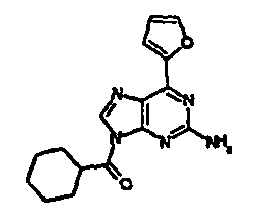
9-Cyclohexylcarbonyl-6-(2-furyl)-9H-purine-2-amine 29
(I)
6-(2-Furyl)-9-(1-pyrrolidinylcarbonyl)-9H-purine-2-amine 30
(G)
2-Amino-6-(2-furyl)-N-isopropyl-9H-purine-9-carboxamide 31
(A)
2-Chloro-N-cyclohexyl-6-(2-furyl)-9H-purine-9-carboxamide 33
(H)
6-(2-Furyl)-9-(3-methylbutyryl)-9H-purine-2-amine 34
(H)
9-Acetyl-6-(2-furyl)-9H-purine-2-amine 35
(G)
N-Benzyl-6-(2-furyl)-2-methylthio-9H-purine-9-carboxamide 36
(G)
2-Amino-N-n-butyl-6-(2-furyl)-9H-purine-9-caxboxamide 37
(G)
2-Amino-6-(2-furyl)-N-(4-methoxybenzyl)-9H-purine-9-carboxamide 38
(G)
2-Amino-6-(2-furyl)-N-(4-methylbenzyl)-9H-purine-9-carboxamide 39
(G)
2-Amino-N-(2-chlorobenzyl)-6-(2-furyl)-9H-purine-9-carboxamide 40
(G)
2-Amino-6-(2-furyl)-N-(1-naphthyl)-9H-purine-9-carboxamide 41
(G)
2-Amino-6-(2-furyl)-N-n-heptyl-9H-purine-9-carboxamide 42
(G)
2-Amino-6-(2-furyl)-N-(2-methylphenyl)-9H-purine-9-carboxamide 43
(G)
2-Amino-6-(2-furyl)-N-(3-methylphenyl)-9H-purine-9-carboxamide 44
(G)
2-Amino-N-(2-chlorophenyl)-6-(2-furyl)-9H-purine-9-carboxamide 45
(G)
(1S)-2-Amino-6-(2-furyl)-N-(1-phenylethyl)-9H-purine-9-carboxamide 46
(G)
(1R)-2-Amino-6-(2-furyl)-N-(1-phenylethyl)-9H-purine-9-carboxamide 47
(G)
2-Amino-6-(2-furyl)-N-(3-methylbenzyl)-9H-purine-9-carboxamide 48
(G)
2-Amino-6-(2-furyl)-N-(4-methylphenyl)-9H-purine-9-carboxamide 49
(G)
2-Amino-6-(2-furyl)-N-(2-methoxyphenyl)-9H-purine-9-carboxamide 50
(G)
2-Amino-6-(2-furyl)-N-(4-methoxyphenyl)-9H-purine-9-carboxamide 51
(G)
2-Amino-N-(4-chlorophenyl)-6-(2-furyl)-9H-purine-9-carboxamide 52
(G)
2-Amino-6-(2-furyl)-N-n-pentyl-9H-purine-9-carboxamide 53
(G)
2-Amino-N-n-dodecyl-6-(2-furyl)-9H-purine-9-carboxamide 54
(K)
9-(2-Cyclohexylethyl)-6-(2-furyl)-9H-purine-2-amine 55
(G)
N-Benzyl-2-dimethylamino-6-(2-furyl)-9H-purine-9-carboxamide 56
(H)
N,N-Dimethyl-6-(2-furyl)-9-(4-methylphenylsulphonyl)-9H-purine-2-amine 57
(K)
6-(2-Furyl)-9-(1-phenyl-1-propene-3-yl)-9H-purine-2-amine 58
(K)
9-(But-2-ene-4-yl)-6-(2-furyl)-9H-purine-2-amine 59
(K)
9-n-Butyl-6-(2-furyl)-9H-purine-2-amine 60
(K)
9-Cyclopentyl-6-(2-furyl)-9H-purine-2-amine 61
(K)
6-(2-Furyl)-9-isopropyl-9H-purine-2-amine 62
(K)
6-(2-Furyl)-9-(4-phenylbutyl)-9H-purine-2-amine 63
(K)
9-(2-Benzyloxyethyl)-6-(2-furyl)-9H-purine-2-amine 64
(K)
6-(2-Furyl)-9-(3-methylbutyl)-9H-purine-2-amine 65
(K)
6-(2-Furyl)-9-(2-methyl-2-buten-4-yl)-9H-purine-2-amine 66
(K)
9-Benzyl-6-(2-furyl)-9H-purine-2-amine 67
(K)
9-(4-Chlorobenzyl)-6-(2-furyl)-9H-purine-2-amine 68
(K)
6-(2-Furyl)-9-(3-phenylpropyl)-9H-purine-2-amine 69
(X)
Ethyl 2-amino-6-(2-furyl)-9H-purine-9-acetate 70
(L)
Isopropyl 2-dimethylamino-6-(2-furyl)-9H-purine-9-acetate 71
(B)
Ethyl 2-dimethylamino-6-(2-furyl)-9H-purine-9-acetate 72
(A)
Ethyl 2,6-bis(2-furyl)-9H-purine-9-acetate 73
(M)
2-Amino-6-(2-furyl)-9H-purine-9-acetic acid 74
(N)
6-(2-Furyl)-2-methoxy-9-(2-trimethylsilylethoxymethyl)-9H-purine 75
(C)
6-(2-Furyl)-2-methoxy-1H-purine 76(O) 
6-(2-Thienyl)-1H-purine-2-amine 77
(G)
2-Amino-N-benzyl-6-(2-thienyl)-9H-purine-9-carboxamide 78
(A)
tert-Butyl 2-amino-6-(2-thienyl)-9H-purine-9-carboxylate 79
(G)
2-Amino-N-(4-fluorobenzyl)-6-(2-furyl)-9H-purine-9-carboxamide 80
(G)
2-Amino-N-(3,4-dichlorobenzyl)-6-(2-furyl)-9H-purine-9-carboxamide 81
(K)
6-(2-Furyl)-9-(2-phenylethyl)-9H-purine-2-amine 82
(K)
9-(1-(4-Fluorophenyl)ethyl)-6-(2-furyl)-9H-purine-2-amine 83
(K)
6-(2-Furyl)-9-(4-isopropylbenzyl)-9H-purine-2-amine 84
(K)
9-(3,4-Difluorobenzyl)-6-(2-furyl)-9H-purine-2-amine 85
(P)
2-Amino-6-(2-furyl)-N-phenyl-9H-purine-9-acetamide 86
(Q)
2-Amino-N-benzyl-6-(2-furyl)-9H-purine-9-acetamide 87
(Q)
2-Amino-6-(2-furyl)-9H-purine-9-acetamide 88
(Q)
6-(2-Furyl)-9-(2-oxo-2-(1-pyrrolidinyl)ethyl)-9H-purine-2-amine 89
(Q)
2-Amino-6-(2-furyl)-N-methyl-9H-purine-9-acetamide 90
(R)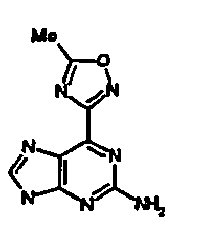
6-(5-Methyl-[1,2,4]-oxadiazol-3-yl)-1H-purine-2-amine 91
(G)
2-Amino-N-benzyl-6-(5-methyl-[1,2,4]-oxadiazol-3-yl)-9H-purine-9-carboxamide 92
(G)
2-Amino-6-(2-furyl)-N-(2-phenylethyl)-9H-purine-9-carboxamide 93
(G)
2-Amino-N-(2,4-dichlorobenzyl)-6-(2-furyl)-9H purine-9-carboxamide 94
(G)
(1RS)-2-Amino-6-(2-furyl)-N-(1-(1-naphthyl)ethyl)-9H-purine-9-carboxamide 95
(G)
2-Amino-6-(2-furyl)-N-(2-(3-isopropenylphenyl)-2-propyl)-9H-purine-9-carboxamide 96
(Q)
2-Amino-6-(2-furyl)-N-(2-hydroxyethyl)-9H-purine-9-acetamide 97
(Q)
6-(2-Furyl)-9-(2-oxo-2-(4-methyl-1-piperazinyl)ethyl)-9H-purine-2-amine 98
(G)
2-Amino-N-(2-chloroethyl)-6-(2-furyl)-9H-purine-9-carboxamide 99
(G)
2-Amino-N-(3-chloropropyl)-6-(2-furyl)-9H-purine-9-carboxamide 100
(G)
Ethyl 3-(2-Amino-6-(2-furyl)-9H-purine-9-yl)carbonylaminopropionate 101
(G)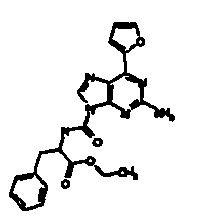
Ethyl 2-(2-Amino-6-(2-furyl)-9H-purine-9-yl)carbonylamino-3-phenylpropionate 102
(S)
6-(2-Furyl)-9-(2-(2-pyridyl)ethyl)-9H-purine-2-amine 103
(S)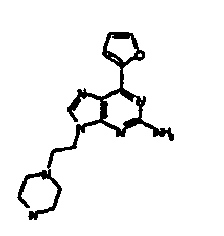
6-(2-Furyl)-9-(2-(1-piperazinyl)ethyl)-9H-purine-2-amine 104
(S)
6-(2-Furyl)-9-(2-(I-piperidinyl)ethyl)-9H-purine-2-amine 105
(S)
6-(2-Furyl)-9-(2-(1-pyrrolidinyl)ethyl)-9H-purine-2-amine 106
(T)
Benzyl 2-amino-6-(2-furyl)-9H-purine-9-carboxylate 112
(G)
N-Benzyl-2-methoxy-6-(2-furyl)-9H-purine-9-carboxamide 113
(S)
9-(2-(4-Chlorophenyl)ethyl)-6-(2-furyl)-9H-purine-2-amine 114
(S)
9-(2-(4-Dimethyluninophenyl)ethyl)-6-(2-furyl)-9H purine-2-amine 115
(S)
6-(2-Furyl)-9-(2-phenoxyethyl)-9H-purine-2-amine 116
(S)
9-Cyclohexylmethyl-6-(2-furyl)-9H-purine-2-amine 117
(S)
9-(3-Cyclohexylpropyl)-6-(2-furyl)-9H-purine-2-amine 118
(I)
2-Amino-N-benzyl-6-(2-furyl)-N-methyl-9H-purine-9-carboxamide 119
(Q)
2-Amino-6-(2-furyl)-N-(2-pyridylmethyl)-9H purine-9-acetamide 120
(O)
6-(Benzofuran-2-yl)-1H-purine-2-amine 122
(Q)
2-Amino-6-(2-furyl)-N-(2-pyridyl)-9H-purine-9-acetamide 123
(Q)
2-Amino-6-(2-furyl)-N-(2-phenylethyl)-9H-purine-9-acetamide 124
(Q)
2-Amino-6-(2-furyl)-N-n-propyl-9H-purine-9-acetamide 125
(S)
9-(3-Chlorobenzyl)-6-(2-furyl)-9H-purine-2-amine 126
(S)
6-(2-Furyl)-9-(3-methylbenzyl)-9H-purine-2-amine 127
(S)
6-(2-Furyl)-9-(4-methylbenzyl)-9H-purine-2-amine 128
(G)
2-Amino-6-(benzofuran-2-yl)-N-benzyl-9H-purine-9-carboxamide 129
(O)
6-(5-Chloro-2-thienyl)-1H-purine-2-amine 130
(G)
2-Amino-N-benzyl-6-(5-chloro-2-thienyl)-9H-purine-9-carboxamide 131
(I)
6-(2-Furyl)-9-(1,2,3,4-tetrahydroisoquinolin-2-ylcarbonyl)-9H-purine-2-amine 132
(I)
6-(2-Furyl)-9-(1-indolinylcarbonyl)-9H-purine-2-amine 133
(A)
6-(1-Methyl-1H-pyrrol-2-yl)-1H-purine-2-amine 134
(G)
2-Amino-N-benzyl-6-(1-methyl-1H-pyrrol-2-yl)-9H-purine-9-carboxamide 137
(Y)
6-(5-Thiazolyl)-1H-purine-2-amine 139
(G)
2-Amino-N-benzyl-6-(5-thiazolyl)-9H-purine-9-carboxamide 140
(Q)
2-Amino-6-(2-furyl)-N-(2-methylphenyl)-9H-purine-9-acetamide 141
(Q)
2-Amino-N-(3-chlorophenyl)-6-(2-furyl)-9H-purine-9-acetamide 142
(Q)
2-Amino-6-(2-furyl)-N-(4-pyridyl)-9H-purine-9-acetamide 143
(Q)
2-Amino-6-(2-furyl)-N-(3-pyridyl)-9H-purine-9-acetamide 144
(Q)
2-Amino-N-(4-chlorobenzyl)-6-(2-furyl)-9H-purine-9-acetamide 145
(Q)
2-Amino-N-benzyl-6-(2-furyl)-N-methyl-9H-purine-9-acetamide 146
(S)
6-(2-Furyl)-9-(2-(4-pyridyl)ethyl)-9H-purine-2-amine 147
(S)
6-(2-Furyl)-9-(2-(4-morpholinyl)ethyl)-9H-purine-2-amine 148
(S)
6-(2-Furyl)-9-(3-pyridylmethyl)-9H-purine-2-amine 150
(A)
6-(3-Methyl-2-thienyl)-1H-purine-2-amine 151
(AA)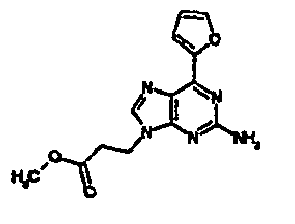
Methyl 3-(2-amino-6-(2-furyl)-9H-purine-9-yl)propionate 152
(M)
3-(2-Amino-6-(2-furyl)-9H-purine-9-yl)propionic acid 153
(AB)
6-(2-Furyl)-2-methyl-1H-purine 154
(G)
N-Benzyl-6-(2-furyl)-2-methyl-9H-purine-9-carboxamide 155
(H)
6-(2-Furyl)-9-isopropylsulphonyl-9H-purine-2-amine 156
(AC)
2-Chloro-6-(2-furyl)-9-(4-methylbenzyl)-9H-purine 157
(AC)
9-(2-Fluorobenzyl)-6-(2-furyl)-9H-purine-2-amine 158
(AC)
6-(2-Furyl)-9-(3-nitrobenzyl)-9H-purine-2-amine 159
(AC)
6-(2-Furyl)-9-(4-trifluoromethylbenzyl)-9H-purine-2-amine 160
(H)
6-(2-Furyl)-9-(3-nitrophenyl)sulphonyl-9H-purine-2-amine 161
(H)
9-(2-Bromophenyl)sulphonyl-6-(2-furyl)-9H-purine-2-amine 162
(H)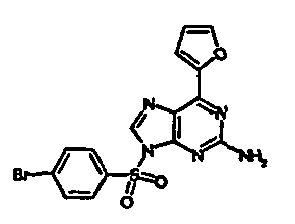
9-(4-Bromophenyl)sulphonyl-6-(2-furyl)-9H-purine-2-amine 163
(H)
9-(4-Fluorophenyl)sulphonyl-6-(2-furyl)-9H-purine-2-amine 164
(H)
6-(2-Furyl)-9-methanesulphonyl-9H-purine-2-amine 165
(H)
9-Butanesulphonyl-6-(2-furyl)-9H-purine-2-amine 166
(H)
6-(2-Furyl)-9-(8-quinolinesulphonyl)-9H-purine-2-amine 167
(H)
9-(3,5-Dimethylisoxazole-4-yl)sulphonyl-6-(2-furyl)-9H-purine-2-amine 168
(H)
6-(2-Furyl)-9-(5-(2-pyridyl)-2-thienyl)sulphonyl-9H-purine-2-amine 169
(Q)
2-Amino-6-(2-furyl)-N-(4-methoxy-2-methylphenyl)-9H-purine-9-acetamide 170
(Q)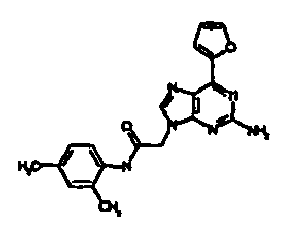
2-Amino-N-(2,4-dimethylphenyl)-6-(2-furyl)-9H-purine-9-acetamide 171
(I)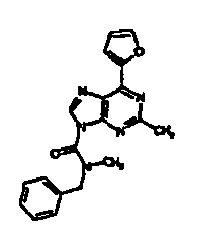
N-Benzyl-N,2-dimethyl-6-(2-furyl)-9H-purine-9-carboxamide 172
(AC)
6-(2-Furyl)-9-(4-nitrobenzyl)-9H-purine-2-amine 173
(AH)
6-(2-Furyl)-9-(4-methylbenzyl)-9H-purine-2-carbonitrile 174
(X)
6-(2-Furyl)-9-(2-phthalimidoethyl)-9H-purine-2-amine 175
(Q)
2-Amino-N-(4-chlorophenyl)-6-(2-furyl)-9H-purine-9-acetamide 176
(Q)
2-Amino-N-(3,4-dichlorophenyl)-6-(2-furyl)-9H-purine-9-acetamide 177
(AC)
9-(3-Cyanobenzyl)-6-(2-furyl)-9H-purine-2-amine 178
(AC)
9-(2-Chlorobenzyl)-6-(2-furyl)-9H-purine-2-amine 179
(H)
N-(5-(2-Amino-6-(2-furyl)-9H-purine-9-ylsulphonyl)-2-thienylmethyl)-4-chlorobenzamide 180
(H)
9-(2,1,3-Benzoxadiazol-4-yl)sulphonyl-6-(2-furyl)-9H-purine-2-amine 181
(H)
Methyl 3-(2-amino-6-(2-furyl)-9H-purine-9-sulphonyl)thiophene-2-carboxylate 182
(H)
6-(2-Furyl)-9-(5-(isoxazol-3-yl)-2-thienyl)sulphonyl-9H-purine-2-amine 183
(H)
6-(2-Furyl)-9-(5-chloro-1,3-dimethyl-1H-pyrazol-4-yl)sulphonyl-9H-purine-2-amine 184
(H)
9-(4-Acetylphenylsulphonyl)-6-(2-furyl)-9H-purine-2-amine 185
(H)
6-(2-Furyl)-9-(2-phenylethenyl)sulphonyl-9H-purine-2-amine 186
(H)
9-Ethanesulphonyl-6-(2-furyl)-9H-purine-2-amine 187
(S)
6-(2-Furyl)-9-(2-pyridylmethyl)-9H-purine-2-amine 188
(S)
6-(2-Furyl)-9-(4-pyridylmethyl)-9H-purine-2-amine 189
(S)
6-(2-Furyl)-9-(3-(3-pyridyl)propyl)-9H-purine-2-amine 190
(S)
6-(2-Furyl)-9-(3-(4-pyridyl)propyl)-9H-purine-2-amine 191
(G)
2-Amino-N-(1-(4-bromophenyl)ethyl)-6-(2-furyl)-9H-purine-9-carboxamide 192
(AD)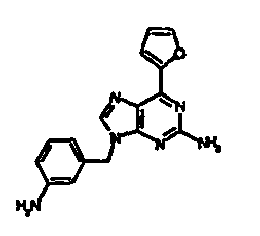
9-(3-Aminobenzyl)-6-(2-furyl)-9H-purine-2-amine 193
(AC)
Methyl 3-(2-amino-6-(2-furyl)-9H-purine-9-ylmethyl)benzoate 194
(AC)
9-(4-Cyanobenzyl)-6-(2-furyl)-9H-purine-2-amine 195
(Y)
6-(5-Methyl-2-furyl)-1H-purine-2-amine 196
(H)
9-n-Decanesulphonyl-6-(2-furyl)-9H-purine-2-amine 197
(AC)
6-(2-Furyl)-9-(2-nitrobenzyl)-9H-purine-2-amine 198
(AC)
6-(2-Furyl)-9-(3-methoxybenzyl)-9H-purine-2-amine 199
(M)
3-(2-Amino-6-(2-furyl)-9H-purine-9-ylmethyl)benzoic acid 200
(B)
N,N-Dimethyl-6-(2-furyl)-9-(4-methylbenzyl)-9H-purine-2-amine 201
(G)
2-Amino-6-(2-furyl)-N-(2-furylmethyl)-9H-purine-9-carboxamide 202
(G)
2-Amino-6-(2-furyl)-N-(2-thienylmethyl)-9H-purine-9-carboxamide 203
(AC)
9-(3-Fluorobenzyl)-6-(2-furyl)-9H-purine-2-amine 204
(G)
2-Amino-N-benzyl-6-(5-methyl-2-furyl)-9H-purine-9-carboxamide 205
(AF)
9-(3-Acetamidobenzyl)-6-(2-furyl)-9H-purine-2-amine 206
(AC)
6-(2-Furyl)-9-(4-methanesulphonylbenzyl)-9H-purine-2-amine 207
(AD)
9-(2-Aminobenzyl)-6-(2-furyl)-9H-purine-2-amine 208
(AC)
9-(4-Methylbenzyl)-6-(5-methyl-2-furyl)-9H-purine-2-amine 209
(Y)
6-(1-Methyl-1H-imidazol-5-yl)-1H-purine-2-amine 210
(AF)
6-(2-Furyl)-9-(2-methanesulphonylaminobenzyl)-9H-purine-2-amine 211
(AC)
9-(2,6-Difluorobenzyl)-6-(2-furyl)-9H-purine-2-amine 212
(S)
6-(2-Furyl)-9-(6-methyl-2-pyridyl)methyl-9H-purine-2-amine 213
(S)
6-(2-Furyl)-9-(3-furylmethyl)-9H-purine-2-amine 214
(H)
9-Benzylsulphonyl-6-(2-furyl)-9H-purine-2-amine 215
(AC)
Methyl 4-(2-amino-6-(2-furyl)-9H-purine-9-ylmethyl)benzoate 216
(M)
4-(2-Amino-6-(2-furyl)-9H-purine-9-ylmethyl)benzoic acid 217
(AF)
6-(2-Furyl)-9-(3-methanesulphonylaminobenzyl)-9H-purine-2-amine 218
(Q)
2-Amino-6-(2-furyl)-N-(2-furylmethyl)-9H-purine-9-acetamide 219
(AC)
9-(3,5-Dimethoxybenzyl)-6-(2-furyl)-9H-purine-2-amine 220
(AF)
9-(2-Acetamidobenzyl)-6-(2-furyl)-9H-purine-2-amine 221
(AG)
6-(2-Furyl)-9-(3-hydroxybenzyl)-9H-purine-2-amine 222
(S)
N-(2-(2-Amino-6-(2-furyl)-9H-purine-9-yl)ethyl)4-pyridinecarboxamide 223
(S)
6-(2-Furyl)-9-(3-thienylmethyl)-9H-purine-2-amine 224
(S)
9-(1-Benzyl-1H-imidazol-2-ylmethyl)-6-(2-furyl)-9H-purine-2-amine 225
(AD)
9-(4-Aminobenzyl)-6-(2-furyl)-9H-purine-2-amine 226
(P)
3-(2-Amino-6-(2-furyl)-9H-purine-9-ylmethyl)-N-benzylbenzamide 227
(P)
4-(2-Amino-6-(2-furyl)-9H-purine-9-ylmethyl)-N-benzylbenzamide 228
(H)
6-(2-Furyl)-9-(4-methylphenylsulphonyl)-9H-purine-2-amine 229
(AC)
9-(3,5-Dimethylisoxazol-4-ylmethyl)-6-(2-furyl)-9H-purine-2-amine 230
(P)
3-(2-Amino-6-(2-furyl)-9H-purine-9-ylmethyl)-N,N-dimethylbenzamide 231
(Q)
2-Amino-6-(2-furyl)-N-(3-methoxyphenyl)-9H-purine-9-acetamide 232
(AF)
6-(2-Furyl)-9-(4-methanesulphonylaminobenzyl)-9H-purine-2-amine 233
(P)
4-(2-Amino-6-(2-furyl)-9H-purine-9-ylmethyl)-N,N-dimethylbenzamide 234
(AF)
N-(2-(2-Amino-6-(2-furyl)-9H-purine-9-ylmethyl)phenyl)cyclopropanecarboxamide 235
(AF)
6-(2-Furyl)-9-(2-(1-methyl-1H-imidazol-4-ylsulphonylamino)benzyl)-9H-purine-2-amine 236
(Q)
2-Amino-6-(2-furyl)-N-(2-methoxybenzyl)-9H-purine-9-acetamide 237
(Q)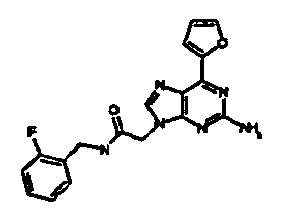
2-Amino-N-(2-fluorobenzyl)-6-(2-furyl)-9H-purine-9-acetamide 238
(AF)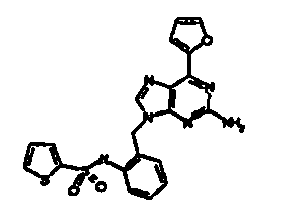
6-(2-Furyl)-9-(2-(2-thienylsulphonylamino)benzyl)-9H-purine-2-amine 239
(AF)
6-(2-Furyl)-9-(2-(3,5-dimethylisoxazol-4-ylsulphonylamino)benzyl)-9H-purine-2-amine 240
(AC)
9-(5-Chloro-2-thienylmethyl)-6-(2-furyl)-9H-purine-2-amine 241
(Z)
6-(5-Methyl-2-pyridinyl)-1H-purine-2-amine 242
(AF)
N-(6-(2-Furyl)-9-(2-(2-methylpropanamido)benzyl)-9H-purine-2-yl)-2-methylpropanamide 243
(AC)
9-(2-Fluorobenzyl)-6-(5-methyl-2-pyridinyl)-9H-purine-2-amine 244
(AJ)
9-(2-Fluorobenzyl)-6-(4-methyl-2-thiazolyl)-9H-purine-2-amine 245
(AK)
2-Amino-N-benzyl-6-(2-furyl)-9H-purine-9-acetimidamide 246
(Q)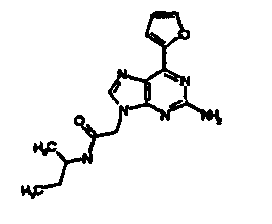
2-Amino-6-(2-furyl)-N-(1-methylpropyl)-9H-purine-9-acetamide 247
(Q)
2-Amino-N-ethyl-6-(2-furyl)-9H-purine-9-acetamide 248
(Q)
N-Allyl-2-amino-6-(2-furyl)-9H-purine-9-acetamide 249
(Q)
2-Amino-N-(3,4-difluorophenyl)-6-(2-furyl)-9H-purine-9-acetamide 250
(AF)
6-(2-Furyl)-9-(3-(3,5-dimethylisoxazol-4-ylsulphonylamino)benzyl)-9H-purine-2-amine 251
(AL)
(2S)-9-(2-Amino-1-propyl)-6-(2-furyl)-9H-purine-2-amine 252
(Q)
2-Amino-N-(2-dimethylaminoethyl)-6-(2-furyl)-9H-purine-9-acetamide 253
(AC)
9-(4-Fluorobenzyl)-6-(2-furyl)-9H-purine-2-amine 254
(AL)
(2R)-9-(2-Amino-1-propyl)-6-(2-furyl)-9H-purine-2-amine 255
(X)
9-(2-(Butoxycarbonylamino)ethyl)-6-(2-furyl)-9H-purine-2-amine 256
(AC)
N,9-Bis(4-methylbenzyl)-6-(2-furyl)-9H-purine-2-amine 257
(F)
9-(2-Aminoethyl)-6-(2-furyl)-9H-purine-2-amine 258
(AC)
6-(2-Furyl)-N,N,9-tris(4-methylbenzyl)-9H-purine-2-amine 259
(AC)
9-(2-Fluoro-5-nitrobenzyl)-6-(2-furyl)-9H-purine-2-amine 260
(AG)
6-(2-Furyl)-9-(4-hydroxybenzyl)-9H-purine-2-amine 261
(AC)
6-(2-Furyl)-9-(4-methoxybenzyl)-9H-purine-2-amine 262
(AM)
9-(2-Fluorobenzyl)-6-(1H-pyrazol-3-yl)-9H-purine-2-amine 263
(AM)
9-(2-Fluorobenzyl)-6-(1H-triazol-3-yl)-9H-purine-2-amine 264
(AM)
9-(3-Aminobenzyl)-6-(1H-pyrazol-3-yl)-9H-purine-2-amine 265
(AO)
9-(3-Aminobenzyl)-6-(5-methyl-1H-pyrazol-3-yl)-1H-purine-2-amine 266
(AC)
9-(3-Methoxybenzyl)-6-(5-methyl-2-furyl)-9H-purine-2-amine 267
(AC)
9-(2-Fluorobenzyl)-6-(thiazol-5-yl)-9H-purine-2-amine 268
(AC)
9-(6-Allyloxymethyl-2-pyridyl)-6-(2-furyl)-9H-purine-2-amine 269
(AC)
9-(3-Methyl-4-nitrobenzyl)-6-(2-furyl)-9H-purine-2-amine 270
(AC)
tert-butyl 4-(2-amino-6-(2-furyl)-1H-purine-9-ylmethyl)indole-1-carboxylate 271
(AQ)
6-(2-Furyl)-9-(4-indolylmethyl)-9H-purine-2-amine 272
(AQ)
6-(2-Furyl)-9-(5-indolylmethyl)-9H-purine-2-amine 273
(AC)
tert-butyl 5-(2-amino-6-(2-furyl)-1H-purine-9-ylmethyl)indole-1-carboxylate - A solution of 2,6-dichloro-9-(2-trimethylsilylethoxymethyl)-9H-purine (957 mg, 3 mmol) in DMF (2.5 mL) was treated with PdCl2(PPh3)2 (105 mg, 0.15 mmol) and 2-(tributylstannyl)furan (944 µL, 3 mmol), stirred at room temperature for 16 h, diluted with EtOAc, washed with water, dried (MgSO4) and concentrated in vacuo, purified by chromatography [SiO2; EtOAc : Heptane, (1:2)] and the resulting cream solid recrystallised (heptane) to give the title compound (738 mg, 70 %) as a white solid.
- A solution of 2-chloro-6-(2-furyl)-9-(2-trimethylsilylethoxymethyl)-9H-purine (488 mg, 1.4 mmol) in isopropanol (5 mL) was treated with 40 % dimethylamine in water (1 mL), refluxed for 2 h, concentrated in vacuo and purified by chromatography [SiO2; EtOAc : Heptane, (1:1)] to give the title compound (431 mg, 86 %) as a white solid.
- A solution of N,N-dimethyl-6-(2-furyl)-9-(2-trimethylsilylethoxymethyl)-9H-purine-2-amine (200 mg, 0.56 mmol) in THF (5 mL) was treated with tetra-n butylammonium fluoride (1-M in THF, 0.67 mL, 0.67 mmol), refluxed for 4 h, cooled, poured into water and extracted with EtOAc. The combined organic phase was dried (MgSO4), concentrated in vacuo and purified by chromatography (SiO2; EtOAc) to give the title compound (98 mg, 76 %) as a pale yellow solid.
- A solution of N-(3,4-dimethoxybenzyl)-6-(2-furyl)-1H-purine-2-amine (194 mg, 0.55 mmol) in TFA (1 mL) was heated at 60°C for 30 min, poured into water, extracted with EtOAc and the combined organic phase was dried (MgSO4), concentrated in vacuo and purified by chromatography (SiO2; 5% MeOH in EtOAc). The resulting yellow solid was dissolved in MeOH, treated with HCl (1-M in Et2O) and filtered to give the title compound (75 mg, 57 %) as a yellow solid.
- A solution of tert-butyl 2-chloro-6-(2-furyl)-9H-purine-9-carboxylate (320 mg, 1 mmol) in 1-methyl-2-pyrrolidinone (2 mL) was treated with NaSMe (140 mg, 2 mmol), heated at 110 °C for 48 h, cooled, poured into water, extracted with CHCl3 and the combined organic phase dried (MgSO4) and concentrated in vacuo. The resulting crude intermediate was dissolved in THF (2 mL), treated with di-tert-butyl dicarbonate (218 mg, 1 mmol), Et3N (139 µL, 1 mmol) and a catalytic amount of DMAP, stirred for 1 h, poured into water, extracted with CHCl3 and the combined organic phase dried (MgSO4), concentrated in vacuo and purified by chromatography [SiO2; Heptane : EtOAc (4:1)] to give the title compound (106 mg, 32 %) as a cream solid.
- A solution of tert-butyl 6-(2-furyl)-2-thiomethoxy-9H-purine-9-carboxylate (75 mg, 0.23 mmol) in dioxan (0.5 mL) was treated with HCl in dioxan (4-M, 0.5 mL, 2 mmol), stirred at room temperature for 30 min, poured into sat. NaHCO3, extracted with EtOAc and the combined organic phase dried (MgSO4), concentrated in vacuo and the resulting cream solid triturated with EtOAc and filtered to give the title compound (46 mg, 86 %) as a cream solid.
- A solution of 6-(2-furyl)-1H-purine-2-amine (0.050 g, 0.25 mmol) and DMAP (5 mg, 0.03 mmol) in anhydrous DMF (1 mL) was treated with n-butylisocyanate (0.029 g, 0.30 mmol), shaken at 65 °C for 1 h, poured onto ice-cold water (10 mL), cooled at 0 °C for 15 min and the resulting precipitate filtered and dried in vacuo over P2O5 to give the title compound (74 mg, 100 %) as a white solid.
- A solution of 6-(2-furyl)-1H-purine-2-amine (100 mg, 0.5 mmol) in THF (2 mL) and DMF (0.5 mL) was treated with 4-tert-butylbenzenesulphonyl chloride (116 mg, 0.5 mmol) and Et3N (69 µL, 0.6 mmol), heated at 60 °C for 2 h, cooled, diluted with water and the resulting solid filtered and washed with EtOAc to give the title compound (106 mg, 53 %) as a cream solid.
- A solution of pyrrolidine (50 mL, 0.6 mmol) in toluene (2 mL) was treated with a solution of phosgene in toluene (0.31 mL, 1.93-M, 0.6 mmol), heated at 80 °C for 30 mins, cooled and concentrated in vacuo. The residue was dissolved in THF (2 mL) and added to a solution of 6-(2-furyl)-1H-purine-2-amine (100 mg, 0.5 mmol) and Et3N (83 mL, 0.6 mmol) in DMF (0.5 mL), stirred at 60 °C for 16 h, poured into water and extracted with EtOAc. The combined organic phase was dried (MgSO4), concentrated in vacuo and the resulting solid triturated with EtOAc/heptane and filtered to give the title compound (92 mg, 62 %) as a cream solid.
- A solution of 6-(2-furyl)-1H-purine-2-amine (25 mg, 0.12 mmol) in anhydrous DMF (0.5 mL) and anhydrous THF (2 mL) was treated with triphenylphosphine polystyrene (65 mg, 0.25 mmol) and 2-cyclohexylethanol (35 mg, 0.25 mmol), shaken at room temperature for 10 min, treated with di-tert-butyl azodicarboxylate (0.058 g, 0.25 mmol), shaken at room temperature for 16 h, filtered and concentrated in vacuo. The resulting oil was dissolved in CH2Cl2 (2 mL) and TFA (1mL), shaken for 2 h and concentrated in vacuo. The resulting oil was dissolved in CH2Cl2 (3 mL), shaken with 1-M aq HCl (1 mL) for 15 min and the organic phase concentrated in vacuo and purified by chromatography (SiO2; EtOAc) to give the title compound (22 mg, 57 %) as a yellow solid.
- A solution of ethyl 2-chloro-6-(2-furyl)-9H-purine-9-acetate (100 mg, 0.33 mol) in isopropanol (1 mL) was treated with 40% dimethylamine in water, refluxed for 2 h, cooled, poured into water, extracted with EtOAc and the combined organic phase dried (MgSO4), concentrated in vacuo and purified by chromatography [SiO2; Heptane : EtOAc, (1:1)] to give the title compound (20 mg, 19 %) as a white solid.
- A solution of ethyl 2-amino-6-(2-furyl)-9H-purine-9-acetate (200 mg, 0.69 mmol) in MeOH (3 mL) was treated with aq NaOH (2-M, 0.5 mL, 1 mmol), refluxed for 10 min, cooled, diluted with water, acidified with aq HCl (1-M) and the resulting solid filtered, washed with water and dried to give the title compound (129 mg, 72 %) as a yellow solid.
- A solution of 2-chloro-6-(2-furyl)-9-(2-trimethylsilylethoxymethyl)-9H-purine (0.35g, 1.0 mmol) and sodium methoxide (60 mg, 1.1 mmol) in methanol (5 mL) was refluxed for 23 h, cooled, concentrated in vacuo and the resulting solid treated with water, acidified to pH 4 with acetic acid, extracted with EtOAc, dried (Na2SO4), concentrated in vacuo and purified by chromatography [SiO2; EtOAc:heptane (1:1)]to give the title compound (232 mg, 67 %) as a pale yellow solid.
- A solution of N,9-bis(tetrahydropyran-2-yl)-6-chloro-9H-purine-2-amine (1.01 g, 3.0 mmol) and Pd(PPh3)4 (250 mg, 10 mol%) in THF (20 mL) was treated with 5-chloro-2-thiopheneboronic acid (536 mg, 3.3 mmol) and saturated aq NaHCO3 (10 mL), refluxed for 1 h, diluted with H2O, extracted with EtOAc and the organic phase dried (MgSO4), concentrated in vacuo and purified by chromatography [SiO2; heptane: EtOAc (2:1)] to give the coupled product as a pale-yellow syrup. This material was dissolved in MeOH (20 mL) and stirred vigorously at 50 °C with Amberlyst-15 resin for 1 hr. The resin was filtered off, washed once with MeOH, and then re-suspended in fresh MeOH (20 mL), treated with NH3 solution (2-M in MeOH, 2.0 mL), stirred vigorously at 50 °C for 1 h, filtered, the resin washed twice with MeOH, and the filtrate concentrated in vacuo to give the title compound (230 mg, 36 %) as a yellow solid.
- A solution of 2-amino-6-(2-furyl)-9H-purine-9-acetic acid (129 mg, 0.5 mmol) in DCM (2 mL) was treated with EDCI (96 mg, 0.5 mmol) and aniline (45 µL, 0.5 mmol), stirred at room temperature for 3 days, diluted with DCM, washed with water, dried (MgSO4), concentrated in vacuo and purified by chromatography (SiO2; 1% MeOH in EtOAc) to give the title compound (51 mg, 31 %) as a white solid.
- A suspension of 2-amino-6-(2-furyl)-9H-purine-9-acetic acid (129 mg, 0.5 mmol) in DMF (2 mL) was treated with carbonyl diimidazole (81 mg, 0.5 mmol), stirred at room temperature for 1 h, treated with benzylamine (55 µL, 0.5 mmol), stirred at room temperature for 2 h, diluted with water, filtered and dried to give the title compound (115 mg, 66 %) as a white solid.
- A mixture of hydroxylamine hydrochloride (847 mg, 12.2 mmol) and potassium hydroxide (855 mg, 15.3 mmol) in EtOH was refluxed for 30 min, cooled, filtered to remove solid potassium chloride, treated with 9-(2-tetrahydropyranyl)-2-(2-tetrahydropyranylamino)-9H-purine-6-carbonitrile (1.0 g, 3.05 mmol), refluxed for 1 h, concentrated in vacuo and the residue triturated with Et2O to give a pale yellow solid (1.12 g). A portion (600 mg) of this material was stirred with N,N-dimethylacetamide dimethylacetal at 100°C for 1 h, concentrated in vacuo and purified by chromatography (SiO2; EtOAc) to give a pale yellow syrup (212 mg). This material was dissolved in MeOH and stirred vigorously at 50 °C with Amberlyst-15 resin for 1 hr and the resin filtered off and washed once with MeOH. The resin was then re-suspended in fresh MeOH, treated with a solution of NH3 in MeOH (2-M, 2 mL), stirred vigorously at 60 °C for 1 h, filtered, washed twice with MeOH, and the filtrate concentrated in vacuo to give the title compound (73 mg, 21 %) as a pale grey solid.
- A mixture of 6-(2-furyl)-1H-purine-2-amine (50 mg, 0.25 mmol) and triphenylphosphine polystyrene (0.21 g, 0.62 mmol) in anhydrous DMF (0.5 mL) and anhydrous THF (2 mL) was treated with 2-(2-hydroxyethyl)pyridine (61 mg, 0.50 mmol), shaken at room temperature for 10 min, treated with di-tert-butyl azodicarboxylate (0.115 g, 0.50 mmol), shaken for 16 h, filtered and the filtrate concentrated in vacuo and purified by chromatography [SiO2; CH2Cl2-MeOH (100 : 5)] to give the title compound (36 mg, 47 %) as an off-white solid.
- A solution of 6-(2-furyl)-1H-purine-2-amine (0.201 g, 1.0 mmol), benzyl chloroformate (0.20 mL, 1.1 mmol), triethylamine (0.21 mL, 1.5 mmol) and DMAP (15 mg) in DMF (10 mL) was stirred at room temperature for 4 h, poured into cold water, cooled for 30 min at 5 °C and the resulting solid filtered and dried at 40 °C to give the title compound (0.327 g, 98 %) as a cream solid.
- An ice-cold solution of 2,6-dichloro-1H-purine (1.89 g, 10 mmol) in THF (10 mL) was treated with NaH (60% in oil, 440 mg, 11 mmol), stirred at 0 °C for 30 min, treated with ethyl bromoacetate (1.22 mL, 11 mmol), stirred at room temperature for 2 h, poured into sat. NaHCO3, extracted with EtOAc and the combined organic phase dried (MgSO4), concentrated in vacuo and purified by chromatography [SiO2; Heptane : EtOAc (2:1)] to give the title compound (1.46 g, 53 %) as a white solid: IR νmax (Nujol)/cm-1 3106, 2985, 2955, 2924, 2854, 1734, 1598, 1557, 1374, 1341, 1298, 1156 and 884; NMR δH (400 MHz, CDCl3) 1.31 (3H, t, J 7.0 Hz), 4.29 (2H, q, J 7.0 Hz), 5.01 (2H, s), 8.17 (1H, s).
- A solution of N,9-bis(tetrahydropyran-2-yl)-4-chloro-9H-purine-2-amine (338 mg, 1 mmol), 5-methyl-2-(tributylstannyl)furan and Pd(PPh3)2Cl2 (70 mg) in DMF was heated at 80°C for 5 h, cooled, diluted with H2O, extracted with EtOAc and the organic phase dried (MgSO4), concentrated in vacuo and purified by chromatography [SiO2; heptane:EtOAc (6:1)] to give the coupled product. This material was dissolved in MeOH (20 mL), stirred vigorously at 50 °C with Amberlyst-15 resin for 1 h then the resin was filtered off and washed once with MeOH. The resin was then re-suspended in fresh MEOH (20 mL), treated with NH3 solution (2-M in MeOH, 1.0 mL) stirred vigorously at 50°C for 1 h, filtered, washed twice with MeOH, and the filtrate concentrated in vacuo to give the title compound (45 mg, 21 %) as a pale-yellow solid.
- A stirred solution of 5-methyl-2-pyridylzinc bromide (0.5 M, 8 mL, 4 mmol) was treated with Pd(PPh3)4 (250 mg) and N,9-bis(tetrahydropyran-2-yl)-4-chloro-9H-purine-2-amine (676 mg, 2 mmol), refluxed for 1 h, cooled, diluted with H2O, extracted with EtOAc, the extracts dried (MgSO4), concentrated in vacuo and purified by chromatography [SiO2; heptane: EtOAc (1:2), then EtOAc] to give the coupled product (498 mg). A portion of this material (100 mg) was suspended in MeOH, treated with a solution of HCl (4-M in dioxan, 0.5 mL), stirred for 17 h, diluted with Et2O and filtered to afford the title compound (37 mg, 35 %) as a yellow solid.
- A solution of 6-(2-furyl)-1H-purine-2-amine (0.70 g, 3.48 mmol) and K2CO3 (0.48g, 3.48 mmol) in DMF (20 mL) was treated with methyl acrylate (3.3 g, 38.3 mmol), stirred for 40 h, diluted with EtOAc, filtered to remove polymeric acrylate, washed with water, dried (MgSO4), concentrated in vacuo and purified by chromatography [SiO2: EtOAc-heptane, (4:1)] to give the title compound (114 mg, 11 %) as a white solid.
- A solution of 2-chloro-6-(2-furyl)-1H-purine (1.1 g, 5.0 mmol) and Pd(PPh3)4 (0.58 g, 0.5 mmol) in 1,2-dichloroethane (50 mL) at room temperature was treated dropwise with trimethylaluminium (3.3 mL, 2.0 M hexane), refluxed for 16 h, treated with water (100 mL) then EtOAc (100 mL), stirred for 60 h and filtered through glass microfibre paper. The organic phase was separated, dried (MgSO4), concentrated in vacuo and the resulting solid recrystallised from 90 % ethanol to give the title compound (0.30 g, 30 %) as a pale brown solid.
- An ice-cold solution of 6-(2-furyl)-1H-purine-2-amine (201 mg, 1 mmol) in DMF (6 mL) was treated with NaH (44 mg, 1.1 mmol), stirred for 30 min, treated with 3-nitrobenzyl bromide (238 mg, 1.1 mmol), stirred at room temperature for 3 h, treated with water and the resulting solid filtered, suspended in methanol, stirred for 30 min, and filtered to give the title compound (201 mg, 60 %) as a yellow solid.
- A solution of 6-(2-furyl)-9-(3-nitrobenzyl)-9H-purine-2-amine (400 mg, 1.12 mmol) in EtOH (10 mL) at 50 °C was treated with a solution of SnCl2.2H2O (808 mg, 3.58 mmol) in conc.HCl (1.8 mL, 21.42 mmol), stirred for 1.5 h, cooled, basified to pH 10 (1-M NaOH) and the resulting solid was filtered, suspended in methanol, treated with HCl in dioxane (4-M, 2 mL), diluted with diethyl ether and filtered to give the title compound (90 mg, 22 %) as a yellow solid.
- An ice-cold solution of 9-(3-aminobenzyl)-6-(2-furyl)-9H-purine-2-amine (145 mg, 0.48 mmol) in pyridine (3 mL) was treated with acetyl chloride (38 µL, 0.53 mmol), stirred for 1 h, quenched with water, extracted with EtOAc, dried (MgSO4), concentrated in vacuo and purified by chromatography (SiO2: Hexane:EtOAc (1:3) to EtOAc:MeOH (99:1)) to give the title compound (71 mg, 43 %) as a yellow solid.
- An ice-cold solution of 6-(2-furyl)-9-(3-methoxybenzyl)-9H-purine-2-amine (160 mg, 0.5 mmol) in DCM (3 mL) was treated with BBr3 (1 mL, 1-M in DCM, 1 mmol), stirred at 0 °C for 3 h, treated with more BBr3 (2 mL, 1-M in DCM, 2 mmol), stirred for 16 h, treated with NH4Cl solution, extracted with EtOAc, dried (MgSO4), concentrated in vacuo, triturated with ether and filtered. The resulting solid was suspended in aqueous sodium bicarbonate, extracted with ether, the aqueous phase was acidified to pH 7 and the resulting solid filtered, suspended in methanol, treated with HCl in dioxane (4-M, 2 mL), diluted with ether and filtered to give the title compound (82 mg, 48 %) as a yellow solid.
- A solution of 2-chloro-6-(2-furyl)-9-(4-methylbenzyl)-9H-purine (0.10 g, 0.31 mmol) and Et4NCN (0.10 g, 0.62 mmol) in acetonitrile (10 mL) was treated with DABCO (0.07 g, 0.62 mmol), stirred for 48 h, concentrated in vacuo, dissolved in chloroform (50 mL), washed with water (2 x 30 mL), dried (MgSO4) and concentrated in vacuo to give the title compound (56 mg, 57 %) as a pale green solid.
- A suspension of 2-amino-9-(2-fluorobenzyl)-9H-purine-6-carbonitrile (680 mg, 1.85 mmol) in isopropanol (50 mL) was treated with H2S gas for 15 min, then treated with Et3N (0.51 mL, 3.7 mmol), heated at 50°C for 1 h, concentrated in vacuo, diluted with Et2O and filtered to give the title compound (757 mg, 100 %) as a yellow solid; NMR δH (400 MHz, DMSO) 5.36 (2H, s), 6.66 (2H, br s), 7.06-7.43 (4H, m), 8.15 (1H, s), 9.81 (1H, br s) and 10.22 (1H, br s).
- A stirred suspension of 2-amino-9-(2-fluorobenzyl)-9H-purine-6-thiocarboxamide (200 mg, 0.5 mmol) and chloroacetone (1 mL) in isopropanol (5 mL) was heated at 80 °C for 2 h, filtered and the filtrate concentrated in vacuo and purified by chromatography [SiO2; EtOAc] to give the title compound (26 mg, 12 %) as a yellow solid.
- A solution of 2-amino-6-(2-furyl)-9H-purine-9-acetonitrile (0.24 g, 1.0 mmol) in dry toluene (5 mL) under argon was treated with N-benzylmethylchloroaluminium amide in toluene (1.2-M, 5 mL, 6.0 mmol), heated to 80 °C for 3 h, stirred at room temperature for 16 h, poured into a slurry of SiO2 (5 g) and CHCl3 (25 mL) and stirred for 5 min. The slurry was filtered, the filtrate concentrated in vacuo and the resulting solid purified by chromatography [SiO2; CH2Cl2-MeOH-NH4OH (100:10:1)] to give the title compound (0.16 g, 46 %) as a white solid.
- A solution of the 6-(2-furyl)-1H-purine-2-amine (0.1 g, 0.5 mmol) in DMSO was treated with freshly ground KOH (112 mg, 2 mmol), shaken for 10 min, treated with N-butoxycarbonyl-L-alaninol mesylate (316 mg, 3 mmol), shaken at 40°C. for a further 17 h, treated with di-tert-butyl dicarbonate (655 mg, 3 mmol), shaken for a further 30 min, diluted with H2O, extracted with EtOAc and the extracts dried (MgSO4), concentrated in vacuo and purified by chromatography [SiO2; (EtOAc)]. The resulting gelatinous solid was dissolved in MeOH (3 mL), treated with HCl solution (4-M in dioxan, 0.5 mL), stirred for 17 h, diluted with Et2O and filtered to give the title compound (67 mg, 45 %) as a yellow solid.
- A mixture of 1-(2-trimethylsilylethoxymethyl)-1H-pyrazole-5-boronic acid, Pd(PPh3)4 and saturated aqueous NaHCO3 in THF was refluxed with vigorous stirring for 1 h, cooled, diluted with EtOAc, washed with water, dried (MgSO4), concentrated in vacuo and purified by chromatography [SiO2; isohexane:EtOAc (2:1)] to give the coupled product. This material was dissolved in MeOH (2 mL), treated with HCl solution (4-M in dioxan, 2 mL), stirred for 17 h, diluted with Et2O and filtered to give the title compound (161 mg, 46 %) as a cream solid.
- A mixture of 6-chloro-9-(3-nitrobenzyl)-1H-purine-2-amine (304 mg, 1 mmol), 1-((2-trimethylsilylethoxy)methyl)-1H-pyrazole-5-boronic acid (2.4 mmol), Pd(PPh3)4 (110 mg, 10 mol%) and saturated NaHCO3 (5 mL) in THF (20 mL) was refluxed for 3 h, treated with more Pd(PPh3)4 (50 mg, 5 mol%) and refluxed for a further 17 h. The mixture was diluted with H2O (50 mL), extracted with EtOAc (2 x 25 mL), dried (MgSO4), concentrated in vacuo and purified by chromatography [SiO2; iso-hexane:EtOAc (1:2)] to afford a brown gum. This material was treated with MeOH (10 mL) and 10% Pd/C, stirred under an atmosphere of hydrogen for 30 min, filtered through a pad of Celite and concentrated in vacuo. The resulting gum was dissolved in MeOH (5 mL), treated with HCl solution (4-M in dioxane, 1 mL), stirred for 17 h and the filtered to give the title compound (25 mg, 7 %) as a grey solid.
- A solution of 6-allyloxymethylpyridine-2-methanol (1.56 g, 8.72 mmol) and triphenylphosphine (2.74 g, 10.5 mmol) in dichloromethane (40 mL) at 0 °C was treated portionwise with CBr4 (4.34 g, 13.1 mmol), stirred for 1 h, concentrated in vacuo and purified by chromatography [SiO2; isohexane:EtOAc (3:1)] to give the title compound (1.99 g, 94 %) as a colourless oil: NMR δH (400 MHz, CDCl3) 7.71 (1H, t, J 7.5 Hz), 7.40 (1H, d, J 7.5 Hz), 7.34 (1H, d, J 7.5 Hz), 6.03 - 5.93 (1H, m), 5.37 - 5.32 (1H, m), 5.26 - 5.22 (1H, m), 4.64 (2H, s), 4.54 (2H, s) and 4.14 - 4.12 (2H, m).
- A solution of tert-butyl 5-(2-amino-6-(2-furyl)-1H-purine-9-ylmethyl)indole-1-carboxylate (352 mg, 0.82 mmol) in MeOH (3 mL) was treated with NaOMe (221 mg, 4.1 mmol), refluxed for 17 h, diluted with water (10 mL) and filtered to give the title compounds (168 mg, 62 %) as a brown powder.
- A solution of tert-butyl 5-methylindole-1-carboxylate (2.07g, 9.0 mmol) in CCl4 (50 mL) was treated with N-bromosuccinimide (1.60 g, 9.0 mmol) and benzoyl peroxide (75 % in H2O, 276 mg, 9.0 mmol),refluxed for 3 h, concentrated in vacuo and purified by chromatography [SiO2; iso-hexane:EtOAc (20:1)] to give the title compound (1.67 g, 60 %) as an orange oil: NMR δH (400 MHz, CDCl3) 8.11 (1H, br d, J 8.5 Hz), 6.72 (1H, d, J 3.5 Hz), 7.59 (1H, d, J 1.5 Hz), 7.35 (1H, dd, J 8.5, 1.5 Hz), 6.54 (1H, d, J 4.0 Hz), 4.64 (2H, s) and 1.67 (9H, s).
- A solution of 2,6-pyridinedimethanol (5.0 g, 35.9 mmol) in DMF (30 mL) at 0 °C was treated with sodium hydride (1.44 g, 35.9 mmol), stirred for 30 min, treated with allyl bromide (3.42 ml, 39.5 mmol), stirred for 16 h at room temperature, poured into water (150 mL), extracted with EtOAc (3 x 30 mL) and the combined organic phase was dried (MgSO4), concentrated in vacuo and purified by chromatography [SiO2; isohexane:EtOAc (3:1 to 1:1)] to give the title compound (1.56 g, 24 %) as a colourless oil: NMR δH (400 MHz, CDCl3) 7.69 (1H, t, J 7.5 Hz), 7.37 (1H, d, J 7.5 Hz), 7.13 (1H, d, J 7.5 Hz), 6.04 - 5.93 (1H, m), 5.38 - 5.21 (2H, m), 4.74 (2H, d, J 5.0 Hz), 4.65 (2H, s), 4.15 - 4.09 (2H, m) and 3.76 (1H, t, J 5.0 Hz).
- The following intermediates were synthesised by the methods described above.
- This was prepared from 6-chloro-1H-purine-2-amine by method AC: NMR δH (400 MHz, DMSO) 8.82 (1H, s), 8.20 - 8.13 (2H, m), 7.73 - 7.61 (2H, m), 6.94 (2H, br s) and 5.45 (2H, s).
- This was prepared from 6-chloro-1H-purine-2-amine by method AC: NMR δH (400 MHz, DMSO) 8.22 (1H, s), 7.25 (1H, t, J 7.5 Hz), 6.91 (2H, br s), 6.89 - 6.84 (2H, m), 6.79 (1H, d, J 7.5 Hz), 5.25 (2H, s) and 3.72 (3H, s).
- This was prepared from 6-chloro-1H-purine-2-amine by method AC: IR (Nujol)/cm-1 3488, 3379, 2926, 1569, 1568, 1465, 1378, 918 and 756; NMR δH (400 MHz, DMSO) 8.17 (1H, s), 7.43 - 7.33 (1H, m), 7.29 - 7.21 (1H, m), 7.20 - 7.07 (2H, m), 6.91 (2H, br s) and 5.35 (2H, s).
- This was prepared from 2,6-dichloro-1H-purine by method X to give the title compounds (1.77 g, 78 %) as a pale yellow oil; NMR δH (400 MHz, CDCl3) 0.00 (9H, s), 0.94 (2H, t, J 8.3 Hz), 3.63 (2H, t, J 8.3 Hz), 5.63 (2H, s) and 8.25 (1H, s).
- This was prepared from 6-chloro-1H-purine-2-amine and di-tert-butyl dicarbonate by method G to give title compound (862 mg, 64 %) as a white solid; mp >350 °C; IR νmax (Nujol)/cm-1 3521, 3304, 3193, 3129, 2955, 2925, 2854, 1772, 1730, 1632, 1561, 1511, 1367,1308 and 1155; NMR δH (400 MHz, DMSO) 1.58 (9H, s), 7.06 (2H, s), 8.36 (1H, s). Anal. Calcd for C10H12ClN5O2: C, 44.54; H, 4.48; N, 25.96. Found: C, 44.27; H, 4.54; N, 25.88.
- This was prepared from 6-chloro-1H-purine-2-amine by method T to give the title compound (528 mg, 98 %) as a white solid; IR νmax (Nujol)/cm-1 3519, 3310, 3201, 3124, 2955, 2925, 2854, 1778, 1624, 1560, 1469, 1367, 1301 and 1186; NMR δH (400 MHz, CDCl3) 1.07 (6H, d, J 7.0 Hz), 2.10 - 2.25 (1H, m), 4.29 (2H, d, J 6.6 Hz), 5.48 (2H, s) and 8.25 (1H, s).
- This was prepared from 6-chloro-1H-purine-2-amine by method G to give the title compound (286 mg, 53 %) as a white solid; IR νmax (Nujol)/cm-1 3501, 3299, 3190, 3156, 2993, 2955, 2924, 2854, 1742, 1627, 1563, 1506 and 1369; NMR δH (400 MHz, CDCl3) 1.46 (9H, s), 7.40 (1H, s), 8.45 (1H, s) and 8.57 (1H, s).
- This was prepared from 6-chloro-1H-purine-2-amine by method T to give the crude title compound (625 mg, 100 %) as a white solid.
- This was prepared from 6-chloro-1H-purine-2-amine by method G to give the title compound (424 mg, 73 %) as a white solid; IR νmax (Nujol)/cm-1 3506, 3333, 3292, 3191, 3140, 2925, 2854, 1740, 1653, 1637, 1562, 1481 and 1367; NMR δH (400 MHz, DMSO) 7.20 (1H, m), 7.44 - 7.50 (2H, m), 7.61 (2H, s), 7.75 - 7.81 (2H, m), 8.60 (1H, s), 10.86 (1H, s).
- This was prepared from 6-chloro-1H-purine-2-amine by method G to give the title compound (449 mg, 93 %) as a white solid; IR νmax (Nujol)/cm-1 3404, 3324, 3304, 3222, 3125, 2925, 2854, 1730, 1646, 1614, 1547, 1514, 1484, 1460, 1370 and 1228; NMR δH (400 MHz, DMSO) 1.25 (3H, t, J 7.0 Hz), 3.37 - 3.46 (2H, m), 7.37 (2H, s), 8.47 (1H, s), 8.64 (1H, t, J 5.5 Hz).
- This was prepared from 6-chloro-1H-purine-2-amine by method G to give the title compound (1.66 g, 53 %) as a white solid; NMR δH (400 MHz, CDCl3) 1.29 - 1.41 (1H, m), 1.42 - 1.54 (4H, m), 1.60 - 1.70 (1H, m), 1.74 - 1.86 (2H, m), 2.00 - 2.10 (2H, m), 3.88 - 4.00 (1H, m), 8.13 (1H, d, J 6.7 Hz) and 8.81 (1H, s).
- This was prepared from 6-chloro-9-(2-fluorobenzyl)-9H-purine-2-amine by method AH to give the title compound (450 mg, 84 %) as a cream solid; NMR δH (400 MHz, DMSO) 5.39 (2H, s), 7.12 (2H, br s), 7.1207.45 (4H, m) and 8.41 (1H, s).
- HPLC is carried out using the following conditions: Column. Waters Xterra RP 18 (50 x 4.6 mm); Particle size 5 µM; Mobile phase MeOH : 10 mM aq NH4OAc (pH 7 buffer); Gradient 50:50 isocratic for 1 min. then linear gradient 50:50 to 80:20 over 5 min. then 80:20 isocratic for 3 min.; Flow rate 2.0 mL/min.; Detection wavelength λ = 230 nM. Retention times are provided in Table 2.
- Alternatively HPLC is carried out using the following conditions: Column. Supelcosil ABZ+ (170 x 4.6 mm), particle size 5 µM, mobile phase MeOH : 10 mM aq NH4OAc (80:20), (80:50), (70:30), (60:40) or (50:20) (specified in Table 2), flow rate 1.0 mL/min., detection wavelength λ = 230 nM. Retention times and mobile phase ratio are provided in Table 2.


- The compounds were examined in an assay measuring in vitro binding to human adenosine A2A receptors by determining the displacement of the adenosine A2A receptor selective radioligand [3H]-CGS 21680 using standard techniques. The results are summarised in Table 3.
Table 3 Example Ki (nM) Example 3 23 Example 13 12 Example 26 1 Example 36 7 Example 37 4 Example 38 1 Example 39 1 Example 45 2 Example 47 1 Example 52 5 Example 57 12 Example 68 9 Example 79 1 Example 80 5 Example 83 13 Example 92 6 Example 93 4 Example 106 1 Example 112 8 Example 118 3 Example 125 6 Example 126 7 Example 127 9 Example 141 36 Example 157 4 Example 159 10 Example 162 8 Example 185 7 Example 189 21 Example 192 24 Example 198 7 Example 201 2 Example 202 1 Example 208 6 Example 211 3 Example 212 35 Example 235 4 Example 240 7 Example 244 7 Example 259 11 - It has previously been demonstrated that adenosine antagonists, such as theophylline, can reverse the behavioural depressant effects of dopamine antagonists, such as haloperidol, in rodents (Mandhane S.N. et al., Adenosine A2 receptors modulate haloperidol-induced catalepsy in rats. Eur. J. Pharmacol. 1997, 328, 135 - 141). This approach is also considered a valid method for screening drugs with potential antiparkinsonian effects. Thus, the ability of novel adenosine antagonists to block haloperidol-induced deficits in locomotor activity in mice can be used to assess both in vivo and potential antiparkinsonian efficacy.
- Female TO mice (25-30g) obtained from TUCK, UK, are used for all experiments. Animals are housed in groups of 8 [cage size - 40 (width) x 40 (length) x 20 ( height)cm] under 12hr light/dark cycle (lights on 08:00hr), in a temperature (20 ± 2°C) and humidity (55 ± 15%) controlled environment. Animals have free access to food and water, and are allowed at least 7 days to acclimatize after delivery before experimental use.
- Liquid injectable haloperidol (1 ml Serenance ampoules from Baker Norton, Harlow, Essex, each containing haloperidol BP 5 mg, batch # P424) are diluted to a final concentration of 0.02 mg/ml using saline. Test compounds are typically prepared as aqueous suspensions in 8% Tween. All compounds are administered intraperitoneally in a volume of 10 ml/kg.
- 1.5 hours before testing, mice are administered 0.2 mg/kg haloperidol, a dose that reduces baseline locomotor activity by at least 50%. Test substances are typically administered 5-60 minutes prior to testing. The animals are then placed individually into clean, clear polycarbonate cages [20 (width) x 40 (length) x 20 (height) cm , with a flat perforated, Perspex lid]. Horizontal locomotor activity is determined by placing the cages within a frame containing a 3 x 6 array of photocells linked to a computer, which tabulates beam breaks. Mice are left undisturbed to explore for 1 hour, and the number of beams breaks made during this period serves as a record of locomotor activity which is compared with data for control animals for statistically significant differences.
- Parkinson's disease is a progressive neurodegenerative disorder characterised by symptoms of muscle rigidity, tremor, paucity of movement (hypokinesia), and postural instability. It has been established for some time that the primary deficit in PD is a loss of dopaminergic neurones in the substantia nigra which project to the striatum, and indeed a substantial proportion of striatal dopamine is lost (ca 80-85%) before symptoms are observed. The loss of striatal dopamine results in abnormal activity of the basal ganglia, a series of nuclei which regulate smooth and well co-ordinated movement (Blandini F. et al., Glutamate and Parkinson's Disease. Mol. Neurobiol. 1996, 12, 73 - 94). The neurochemical deficits seen in Parkinson's disease can be reproduced by local injection of the dopaminergic neurotoxin 6-hydroxydopamine into brain regions containing either the cell bodies or axonal fibres of the nigrostriatal neurones.
- By unilaterally lesioning the nigrostriatal pathway on only one-side of the brain, a behavioural asymmetry in movement inhibition is observed. Although unilaterally-lesioned animals are still mobile and capable of self maintenance, the remaining dopamine-sensitive neurones on the lesioned side become supersenstive to stimulation. This is demonstrated by the observation that following systemic administration of dopamine agonists, such as apomorphine, animals show a pronounced rotation in a direction contralateral to the side of lesioning. The ability of compounds to induce contralateral rotations in 6-OHDA lesioned rats has proven to be a sensitive model to predict drug efficacy in the treatment of Parkinson's Disease.
- Male Sprague-Dawley rats, obtained from Charles River, are used for all experiments. Animals are housed in groups of 5 under 12hr light/dark cycle (lights on 08:00hr), in a temperature (20 ± 2°C) and humidity (55 ± 15%) controlled environment. Animals have free access to food and water, and are allowed at least 7 days to acclimatize after delivery before experimental use.
- Ascorbic acid, desipramine, 6-OHDA and apomorphine (Sigma-Aldrich, Poole, UK). 6-OHDA is freshly prepared as a solution in 0.2% ascorbate at a concentration of 4 mg/mL prior to surgery. Desipramine is dissolved in warm saline, and administered in a volume of 1 ml/kg. Apomorphine is dissolved in 0.02% ascorbate and administered in a volume of 2 mL/kg. Test compounds are suspended in 8%Tween and injected in a volume of 2 mL/kg.
- 15 minutes prior to surgery, animals are given an intraperitoneal injection of the noradrenergic uptake inhibitor desipramine (25 mg/kg) to prevent damage to non-dopamine neurones. Animals are then placed in an anaesthetic chamber and anaesthetised using a mixture of oxygen and isoflurane. Once unconscious, the animals are transferred to a stereotaxic frame, where anaesthesia is maintained through a mask. The top of the animal's s head is shaved and sterilised using an iodine solution. Once dry, a 2 cm long incision is made along the midline of the scalp and the skin retracted and clipped back to expose the skull. A small hole is then drilled through the skill above the injection site. In order to lesion the nigrostriatal pathway, the injection cannula is slowly lowered to position above the right medial forebrain bundle at -3.2 mm anterior posterior, -1.5 mm medial lateral from bregma, and to a depth of 7.2 mm below the duramater. 2 minutes after lowing the cannula, 2 µL of 6-OHDA is infused at a rate of 0.5 uL/min over 4 minutes, yeilding a final dose of 8 µg. The cannula is then left in place for a further 5 minutes to facilitate diffusion before being slowly withdrawn. The skin is then sutured shut using Ethicon W501 Mersilk, and the animal removed from the strereotaxic frame and returned to its homecage. The rats are allowed 2 weeks to recover from surgery before behavioural testing.
- Rotational behaviour is measured using an eight station rotameter system provided by Med Associates, San Diego, USA. Each station is comprised of a stainless steel bowl (45 cm diameter x 15 cm high) enclosed in a transparent Plexiglas cover running around the edge of the bowl, and extending to a height of 29 cm. To assess rotation, rats are placed in cloth jacket attached to a spring tether connected to optical rotameter positioned above the bowl, which assesses movement to the left or right either as partial (45°) or full (360°) rotations. All eight stations are interfaced to a computer that tabulated data.
- To reduce stress during drug testing, rats are initially habituated to the apparatus for 15 minutes on four consecutive days. On the test day, rats are given an intraperitoneal injection of test compound 30 minutes prior to testing. Immediately prior to testing, animals are given a subcutaneous injection of a subthreshold dose of apomorphine, then placed in the harness and the number of rotations recorded for one hour. The total number of full contralatral rotations during the hour test period serves as an index of antiparkinsonian drug efficacy.
Claims (50)
- Use of a compound of formula (I):
 R1 is selected from alkyl, aryl, alkoxy, aryloxy, thioalkyl, thioaryl, CN, halo, NR5R6, NR4COR5, NR4CONR5R6,NR4CO2R7 and NR4SO2R7;R2 is selected from N, O or S-containing heteroaryl groups, wherein the heteroaryl group is attached via an unsaturated carbon atom which is adjacent to one or two N, O or S-heteroatom(s), other than ortho,ortho-disubstituted heteroaryl groups;R3 is selected from H, alkyl, COR8, CONR9R10, CONR8NR9R10, CO2R11 and SO2R11;R4, R5 and R6 are independently elected from H, alkyl and aryl or where R5 and R6 are in an (NR5R6) group then R5 and R6 may be linked to form a heterocyclic ring;R7 is selected from alkyl and aryl;R8, R9 and R10 arc independently selected from 11, alkyl and aryl, or R9 and R10 may be linked to form a heterocyclic ring, or where R8, R9 and R10 are in a (CONR8NR9R10) group, R8 and R9 may be linked to form is heterocyclic group; andR11 is selected from alkyl and aryl,wherein said alkyl groups are selected from saturated or unsaturated C1 to C10 acyclic and C3 to C12 cyclic hydrocarbyl radicals, and said aryl groups are selected from aromatic groups selected from phenyl and naphthyl and from heteroaromatic groups selected from pyridyl, pyrrolyl, quinolinyl, furanyl, thienyl, oxadiazolyl, thiadiazolyl, thiazolyl, oxazolyl, isoxazolyl, pyrazolyl, thiazolyl, imidazolyl, pyrimidinyl, indolyl, pyrazinyl and indazolyl,or a pharmaceutically acceptable salt thereof, in the manufacture of a medicament for the treatment or prevention of a disorder in which the blocking of purine receptors is beneficial selected from:(i) movement disorders;(ii) acute and chronic pain;(iii) affective disorders;(iv) central and peripheral nervous system degenerative disorders;(v) schizophrenia and related psychoses;(vi) cognitive disorders;(vii) attention disorders;(viii) central nervous system injury;(ix) cerebral ischaemia;(x) myocardial ischaemia;(xi) muscle ischaemia;(xii) sleep disorders;(xiii) eye disorders selected from retinal ischaemia-reperfusion injury and diabetic neuropathy;(xiv) cardiovascular disorders; and(xv) diabetes and its complications.
 - Use according to claim 1 wherein R1 is selected from NR5R6, alkoxy, thioalkyl and alkyl.
- Use According to claim 1 wherein R1 is selected from NH2.
- Use according to claim 1 wherein R1 is selected from NR4COR5, NR4CONR5R6, NR4CO2R7 and NR4SO2R7, and R4 is selected from H and alkyl.
- Use according to claim I wherein R1 is selected from NHCOR5, NHCONR5R6, NHCO2R7 and NHSO2R7.
- Use according to any preceding claim wherein R2 is unsubstituted at either ortho position.
- Use according to any preceding claim R2 is an unsubstituted heteroaryl group.
- Use according any preceding claim wherein R7 is selected from 2-furyl, 2-thienyl, 2-pyridyl, 2-thiazolyl and 3-pyrazolyl.
- Use according to any preceding claim wherein R2 is 2-furyl.
- Use according to any preceding claim wherein R3 is selected from H, alkyl and CONR9R10.
- Use according to claim 10 wherein R3 is selected from H, substituted alkyl and CONR9R10 wherein said substituted alkyl is selected from arylalkyl and alkyl substituted by CONR9R10.
- Use according to any of claims 1 to 9 wherein R3 is selected from COR8 and R8 is selected from alkyl and aryl.
- Use according to any of claims 1 to 9 wherein R3 is selected from CONR9R10 and R9 is hydrogen.
- Use according to claim 13 wherein R3 is selected from CONR9R10, R9 is hydrogen and R10 is selected from alkyl.
- Use according to claim 13 wherein R3 is selected from CONR9R10, R9 is hydrogen and R10 is selected from alkyl substituted by aryl.
- Use according to claim 13, 14 or 15 wherein R3 is selected from CONR9R10, R9 is hydrogen and R10 is selected from methyl substituted by aryl.
- Use according to claim 15 or 16 wherein said aryl is selected from phenyl, thienyl, furyl and pyridyl.
- Use according to any of claims 1 to 9 wherein R3 is selected from lower alkyl.
- Use according to any of claims 1 to 9 wherein R3 is alkyl substituted by a substituent R12 wherein R12 is selected from hydroxy, alkoxy, dialkylamino, NH2, aryloxy, CN, halo, cycloalkyl), aryl, non-aromatic heterocyclyl, CO2R13, CONR14R15, CONR8NR9R10, C(-N13)NR14R15, NR13COR14, NR13CO2R11, trialkylsilyl and phthalimido, wherein R13, R14 and R15 are selected from hydrogen, alkyl and aryl, or where R14 and R15 arc in an (NR14R15)group, R14 and R15 may he linked to form a heterocyclic ring.
- Use according to claim 19 wherein R12 is selected from aryl and CONR14R15.
- Use according to claim 19 wherein R12 is selected from phenyl, thienyl, furyl, indolyl and pyridyl.
- Use according to claim 19 or 21 wherein R12 is aryl substituted by NR5R6, alkyl, alkoxy, halogen, NO2, CN, hydroxy, NHOH, CHO, CONR5R6, CO2R5, NR4COR5, NR4CO2R7, NR4SO2R7, OCO2R7 and aryl.
- Use according to claim 19 or 21 wherein R12 is aryl substituted by NR5R6, alkyl and halogen.
- Use according to claim 19 or 21 wherein R12 is aryl substituted by substituted alkyl selected from from alkoxyalkyl, hydroxyalkyl, aminoalkyl and haloalkyl.
- Use according to claim 19 or 21 wherein R12 is aryl substituted by unsubstituted alkyl, NH2 and fluoro.
- Use according to claim 19 wherein R12 is CONR14R15 and R14 is hydrogen.
- Use according to claim 19 or 26 wherein R12 is CONR14R15 and R15 is selected from alkyl substituted by one or more substituent group(s) selected from hydroxy, alkoxy, and dialkylamino.
- Use according to according to any preceding claim wherein R4 and R13 are independently selected from II and alkyl.
- Use according to claim 1 wherein R1 is NH2, R2 is 2-furyl and R3 is arylalkyl, preferably arylmethyl.
- Use according to claim 1 wherein the compound of formula (I) is selected from:N,N-Dimethyl-6-(2-furyl)-1H-purine-2-amine;6-(2-Furyl)-1H-purine-2-amine;6-(2-Furyl)-2-methylthio-1H-purine;2-Amino-N-benzyl-6-(2-furyl)-9H-purine-9-carboxamide;2-Amino-N-n-butyl-6-(2-fiuyl)-9H-purine-9-carboxamide;2-Amino-6-(2-furyl)-N-(4-methoxybenzyl)-9H-purine-carboxamide;2-Amino-6-(2-furyl)-N-(4-methylbenzyl)-9H-purine-9-carboxamide;2-Amino-N-(2-chlorobenzyl)-6-(2-furyl)-9H-purine-9-carboxamide;(1S)-2-Amine-6-(2-furyl)-N-(1-phenylethyl)-9H-purine-9-carboxamide;2-Amino-6-(2-furyl)-N-(3-methylbenzyl)-9H-purine-9-carboxamide;2-Amino-6-(2-furyl)-N-n-pentyl-9H-purine-9-carboxamide;6-(2-Furyl)-9-(1-phenyl-1-propene-3-yl)-9H-purine-2-amine;6-(2-Furyl)-9-(3-phenylpropyl)-9H-purine-2-amine;2-Amino-N-(4-fluorobenzyl)-6-(2-furyl)-9H-purine-9-carboxamide;2-Amino-N-(3,4-dichlorobenzyl)-6-(2-furyl)-9H-purine-9-carboxamide;6-(2-Furyl)-9-(4-isopropylbenzyl)-9H-purine-2-amine;2-Amino-6-(2-furyl)-N-(2-phenylethyl)-9H-purine-9-carboxamide;2-Amino-N-(2,4-dichlorobenzyl)-6-(2-furyl)-9H-purine-9-carboxamide;Benzyl 2-amino-6-(2-furyl)-9H-purine-9-carboxylate;N-Benzyl-2-methoxy-6-(2-furyl)-9H-purine-9-carboxamide;2-Amino-N-benzyl-6-(2-furyl)-N-methyl-9H-purine-9-carboxamide;9-(3-Chlorobenzyl)-6-(2-furyl)-9H-purine-2-amine;6-(2-Furyl)-9-(3-methylbenzyl)-9H-purine-2-amine;6-(2-Furyl)-9-(4-methylbenzyl)-9H-purine-2-amine;2-Amino-N-(3-chlorophenyl)-6-(2-furyl)-9H-purine-9-acetamide;9-(2-Fluorobenzyl)-6-(2-furyl)-9H-purine-2-amine;6-(2-Furyl)-9-(4-trifluoromethylbenzyl)-9H-purine-2-amine;9-(4-Bromophenyl)sulphonyl-6-(2-furyl)-9H-purine-2-amine;6-(2-Furyl)-9-(2-phenylethenyl)sulphonyl-9H-purine-2-amine;6-(2-Furyl)-9-(3-(3-pyridyl)propyl)-9H-purine-2-amine;9-(3-Aminobenzyl)-6-(2-furyl)-9H-purine-2-amine;6-(2-Furyl)-9-(3-methoxybenzyl)-9H-purine-2-amine;2-Amino-6-(2-furyl)-N-(2-furylmethyl)-9H-purine-9-carboxamide;2-Amino-6-(2-furyl)-N-(2-thienylmethyl)-9H-purine-9-carboxamide;9-(4-Methylbenzyl)-6-(5-methyl-2-furyl)-9H-purine-2-amine;9-(2,6-Difluorobenzyl)-6-(2-furyl)-9H-purine-2-amide;6-(2-furyl)-9-(6-methyl-2-pyridyl)methyl-9H-purine-2-amine;6-(2-Furyl)-9-(2-(1-methyl-1H-imidazol-4-ylsulphonylamino)benzyl)-9H-purine-2-amine;9-(5-Chloro-2-thienylmethyl)-6-(2-furyl)-9H-purine-2-amine;9-(2-Fluorobenryl)-6-(4-methyl-2-thiazolyl)-9H-purine-2-amine; and9-(2-Fluoro-5-nitrobenzyl)-6-(2-furyl)-9H-purine-2-amine.
- A use according to any preceding claim wherein the disorder is caused by the hyperfunctioning of purine receptors.
- A use according to any preceding claim wherein the purine receptors are adenosine receptors.
- A use according to claim 32 wherein the adenosine receptors are A2A receptors.
- A use as set out in any one of claims 1 to 33 wherein said disorder is a movement disorder.
- A use according to claim 34 wherein the movement disorder is Parkinson's disease.
- A use according to claim 35 for treatment of drug-induced Parkinsonism, post-encephalitic Parkinsonism, Parkinsonism induced by poisoning or post-traumatic Parkinson's disease.
- A use according to claim 34 wherein the movement disorder is progressive supernuclear palsy, Huntingtons disease, multiple system atrophy, corticobasal degeneration, Wilsons disease, Hallerrorden-Spatz disease, progressive pallidal atrophy, Dopa-responsive dystonia-Parkinsonism, spasticity or other disorders of the basal ganglia which result in dyskinesias.
- A use according to any one of claims 34 to 37 wherein the compound of formula (I) is in combination with one or more additional drugs useful in the treatment of movement disorders, the components being in the same formulation or in separate formulations for administration simultaneously or sequentially.
- A use according to claim 38 wherein said additional drug(s) useful in the treatment of movement disorders is/are a drug useful in the treatment of Parkinson's disease.
- A use according to claim 38 or 39 wherein the or one of the additional drugs is L-DOPA or a dopamine agonist.
- A use according to any one of claims 1 to 33 wherein said disorder is depression, cognitive or memory impairment, acute or chronic pain, ADHD or narcolepsy.
- A use according to claims 41 wherein said cognitive or memory impairment disorder is Alzheimer's disease.
- Use of a compound as set out in any one of claims 1 to 30 or a pharmaceutically acceptable salt thereof in the manufacture of a medicament for neuroprotection in a subject.
- A use according to claim 43 wherein said medicament is for neuroprotection in a subject suffering from or at risk from a neurodegenerative disorder.
- A use according to claim 44 wherein said neurodegenerative disorder is a movement disorder.
- A use according to claim 45 wherein said movement disorder is a disorder as set out in claim 35, 36 or 37.
- A use according to any one of claims 1 to 46 wherein the subject is human.
- A compound as defined in claims 1 or a pharmaceutically acceptable salt thereof, for use in therapy, other than:(i) compounds wherein R1 is halogen or aryl and R3 is benzyl, and preferably other than compounds wherein R1 is halogen or aryl; and(ii) Compounds wherein R3 is 11, R1 is NH2 and R2 is thienyl, preferably other than compounds wherein R1 is H and R1 is NH2, and preferably other than compounds wherein R3 is H.
- A compound as defined in claim 1 or a pharmaceutically acceptable salt thereof, for use in therapy wherein:R1 is selected from NR5R6, alkoxy, thioalkyl and alkyl, preferably wherein R1 is selected from NR5R6, and more preferably wherein R1 is NH2, andR3 is selected from alkyl and CONR9R10, preferably wherein R3 is selected from substituted alkyl and CONR9R10, more preferably wherein R3 is selected from substituted alkyl andCONR9R10 wherein said substituted alkyl is selected from arylalkyl and alkyl substituted by CONR9R10.
- A compound as defined in claim 48 or 49, per se.
Applications Claiming Priority (3)
| Application Number | Priority Date | Filing Date | Title |
|---|---|---|---|
| GBGB0100623.8A GB0100623D0 (en) | 2001-01-10 | 2001-01-10 | Chemical compounds IV |
| GB0100623 | 2001-01-10 | ||
| PCT/GB2002/000076 WO2002055521A1 (en) | 2001-01-10 | 2002-01-10 | Purine derivatives as purinergic receptor antagonists |
Publications (2)
| Publication Number | Publication Date |
|---|---|
| EP1349857A1 EP1349857A1 (en) | 2003-10-08 |
| EP1349857B1 true EP1349857B1 (en) | 2010-06-16 |
Family
ID=9906570
Family Applications (1)
| Application Number | Title | Priority Date | Filing Date |
|---|---|---|---|
| EP02729444A Expired - Lifetime EP1349857B1 (en) | 2001-01-10 | 2002-01-10 | Purine derivatives as purinergic receptor antagonists |
Country Status (22)
| Country | Link |
|---|---|
| US (2) | US7452894B2 (en) |
| EP (1) | EP1349857B1 (en) |
| JP (1) | JP4284069B2 (en) |
| KR (1) | KR20030079945A (en) |
| CN (1) | CN1617871A (en) |
| AT (1) | ATE471323T1 (en) |
| AU (1) | AU2002217331B2 (en) |
| BR (1) | BR0206561A (en) |
| CA (1) | CA2433858C (en) |
| CZ (1) | CZ20031956A3 (en) |
| DE (1) | DE60236719D1 (en) |
| GB (1) | GB0100623D0 (en) |
| HU (1) | HUP0402504A2 (en) |
| IL (1) | IL156779A0 (en) |
| MX (1) | MXPA03006163A (en) |
| NO (1) | NO20033145L (en) |
| NZ (1) | NZ527249A (en) |
| PL (1) | PL363172A1 (en) |
| RU (1) | RU2003124653A (en) |
| WO (1) | WO2002055521A1 (en) |
| YU (1) | YU55603A (en) |
| ZA (1) | ZA200305116B (en) |
Cited By (2)
| Publication number | Priority date | Publication date | Assignee | Title |
|---|---|---|---|---|
| WO2021099838A1 (en) * | 2019-11-19 | 2021-05-27 | Ildgng Pharmaceutical Co., Ltd. | Adenosine receptor antagonist compounds |
| US11806350B2 (en) | 2020-11-19 | 2023-11-07 | Ildong Pharmaceutical Co., Ltd. | Prevention and/or treatment of CNS disorders |
Families Citing this family (28)
| Publication number | Priority date | Publication date | Assignee | Title |
|---|---|---|---|---|
| JP4222837B2 (en) * | 2001-04-05 | 2009-02-12 | 住友化学株式会社 | Process for producing 2,6-dihalogenopurine |
| EP1440072A4 (en) | 2001-10-30 | 2005-02-02 | Conforma Therapeutic Corp | Purine analogs having hsp90-inhibiting activity |
| US7414036B2 (en) | 2002-01-25 | 2008-08-19 | Muscagen Limited | Compounds useful as A3 adenosine receptor agonists |
| DE10252650A1 (en) | 2002-11-11 | 2004-05-27 | Grünenthal GmbH | New 1,4-disubstituted cyclohexylamine derivatives, are opioid receptor like-receptor 1 receptor ligands useful e.g. for treating anxiety, depression, epilepsy, senile dementia, withdrawal symptoms or especially pain |
| NZ546611A (en) * | 2003-09-18 | 2010-02-26 | Conforma Therapeutics Corp | Novel heterocyclic compounds as HSP90-inhibitors |
| JPWO2005085210A1 (en) * | 2004-03-10 | 2008-01-17 | 小野薬品工業株式会社 | Nitrile compound and pharmaceutical composition containing the compound as an active ingredient |
| MY140748A (en) | 2004-12-06 | 2010-01-15 | Astrazeneca Ab | Novel pyrrolo [3,2-d] pyrimidin-4-one derivatives and their use in therapy |
| BRPI0609509A2 (en) | 2005-03-30 | 2010-04-13 | Conforma Therapeutics Corp | pharmaceutically acceptable compound or a polymorph, solvate, tautomer, enantiomer, prodrug or salt thereof, pharmaceutical composition, and, use of the pharmaceutically acceptable compound, polymorph, solvate, tautomer, enantiomer, prodrug or salt |
| WO2007035873A1 (en) * | 2005-09-21 | 2007-03-29 | Pharmacopeia, Inc. | Purinone derivatives for treating neurodegenerative diseases |
| CN1947717B (en) * | 2005-10-14 | 2012-09-26 | 卓敏 | Method for treating neuronal and non-neuronal pain |
| US7989459B2 (en) | 2006-02-17 | 2011-08-02 | Pharmacopeia, Llc | Purinones and 1H-imidazopyridinones as PKC-theta inhibitors |
| US7902187B2 (en) | 2006-10-04 | 2011-03-08 | Wyeth Llc | 6-substituted 2-(benzimidazolyl)purine and purinone derivatives for immunosuppression |
| CL2007002867A1 (en) | 2006-10-04 | 2008-06-27 | Pharmacopeia Inc | COMPOUNDS DERIVED FROM 2- (BENCIMIDAZOLIL) PURINA, INHIBITORS OF JANUS QUINASA 3; PHARMACEUTICAL COMPOSITION THAT CONTAINS THEM; AND ITS USE TO TREAT AUTOIMMUNE, INFLAMMATORY, CARDIOVASCULAR DISEASES, IMPLANT REJECTION, AMONG OTHERS. |
| CL2007002866A1 (en) | 2006-10-04 | 2008-07-04 | Pharmacopeia Inc | COMPOUNDS DERIVED FROM 6-SUBSTITUTES-2- (BENCIMIDAZOLIL) PURINA AND PURINONA; PHARMACEUTICAL COMPOSITION THAT INCLUDES SUCH COMPOUND; AND USE OF THE COMPOUND IN THE TREATMENT OF AUTOIMMUNE DISEASES, INFLAMMATORY DISEASE, DISEASE MEDIATED BY M |
| US20090054468A1 (en) * | 2007-08-23 | 2009-02-26 | Astrazeneca Ab | New Use 938 |
| DK2209786T3 (en) * | 2007-10-05 | 2013-06-03 | Verastem Inc | PYRIMIDINE-SUBSTITUTED PURINDER DERIVATIVES |
| GB0906579D0 (en) * | 2009-04-16 | 2009-05-20 | Vernalis R&D Ltd | Pharmaceuticals, compositions and methods of making and using the same |
| CN102428085B (en) | 2009-04-03 | 2015-07-15 | 维拉斯通股份有限公司 | Pyrimidine-substituted purine compounds as kinase inhibitors |
| ES2572915T3 (en) | 2011-06-02 | 2016-06-03 | The University Of Louisville Research Foundation, Inc. | Nanoparticles conjugated to an antinucleolin agent |
| WO2012172043A1 (en) * | 2011-06-15 | 2012-12-20 | Laboratoire Biodim | Purine derivatives and their use as pharmaceuticals for prevention or treatment of bacterial infections |
| CN104284895B (en) * | 2012-04-17 | 2016-08-31 | 安斯泰来制药株式会社 | Nitrogen-containing bicyclic aromatic heterocyclic compounds |
| WO2018093758A1 (en) * | 2016-11-18 | 2018-05-24 | The Procter & Gamble Company | Fabric treatment compositions and methods for providing a benefit |
| US10870816B2 (en) | 2016-11-18 | 2020-12-22 | The Procter & Gamble Company | Fabric treatment compositions having low calculated cationic charge density polymers and fabric softening actives and methods for providing a benefit |
| JP7137225B2 (en) * | 2017-08-21 | 2022-09-14 | 国立大学法人三重大学 | Observation method using non-human mammal cerebral infarction model and observation device using non-human mammal cerebral infarction model |
| CN107903274A (en) * | 2017-12-28 | 2018-04-13 | 窦玉玲 | A kind of aminated compounds and its application in antitumor drug |
| CN114025758B (en) * | 2019-07-01 | 2026-05-08 | 钱立刚 | P2X7R antagonist |
| US11787775B2 (en) * | 2020-07-24 | 2023-10-17 | Genentech, Inc. | Therapeutic compounds and methods of use |
| CN116589464B (en) * | 2022-02-14 | 2025-10-31 | 上海科技大学 | Pyrimidine ring compound, preparation method and application thereof |
Family Cites Families (24)
| Publication number | Priority date | Publication date | Assignee | Title |
|---|---|---|---|---|
| US3630997A (en) * | 1970-05-04 | 1971-12-28 | Paul M Craven | Curable epoxy resin compositions and method of preparing same |
| US5064745A (en) * | 1988-02-25 | 1991-11-12 | Mitsubishi Paper Mills, Ltd. | Method for making lithographic printing plate |
| US5403932A (en) * | 1988-05-25 | 1995-04-04 | Research Corporation Technologies, Inc. | Phosphoramidates useful as antitumor agents |
| US5968989A (en) * | 1991-12-18 | 1999-10-19 | The Salk Institute For Biological Studies | Means for the modulation of processes mediated by retinoid receptors and compounds useful therefor |
| IL108523A0 (en) * | 1993-02-03 | 1994-05-30 | Gensia Inc | Pharmaceutical compositions containing adenosine kinase inhibitors for preventing or treating conditions involving inflammatory responses and pain |
| DE4330735A1 (en) * | 1993-09-10 | 1995-03-16 | Wacker Chemie Gmbh | Organopolysiloxanes containing hydrophilic groups |
| US5789416B1 (en) | 1996-08-27 | 1999-10-05 | Cv Therapeutics Inc | N6 mono heterocyclic substituted adenosine derivatives |
| JP2002507996A (en) | 1997-07-03 | 2002-03-12 | デュポン ファーマシューティカルズ カンパニー | Imidazopyrimidines and imidazopyridines for treating neurological disorders |
| WO1999026627A1 (en) * | 1997-11-26 | 1999-06-03 | Cerebrus Limited | (-)-mefloquine to block purinergic receptors and to treat movement or neurodegenerative disorders |
| CA2315736A1 (en) | 1998-01-05 | 1999-07-15 | Eisai Co., Ltd. | Purine compounds and adenosine a2 receptor antagonist as preventive or therapeutic for diabetes mellitus |
| JPH11279193A (en) * | 1998-03-24 | 1999-10-12 | Akira Matsuda | Adenosine derivative |
| GB9819382D0 (en) * | 1998-09-04 | 1998-10-28 | Cerebrus Ltd | Chemical compounds I |
| GB9819384D0 (en) * | 1998-09-04 | 1998-10-28 | Cerebrus Ltd | Chemical compounds II |
| GB9915437D0 (en) * | 1999-07-01 | 1999-09-01 | Cerebrus Ltd | Chemical compounds III |
| DE60022366T2 (en) | 1999-07-02 | 2006-06-14 | Eisai Co Ltd | CONDENSED IMIDAZOLE DERIVATIVES AND MEDICAMENTS AGAINST DIABETES MELLITUS |
| AU2001255620A1 (en) * | 2000-04-26 | 2001-11-07 | Warner-Lambert Company | Cyclohexylamine derivative as subtype selective NMDA receptor antagonists |
| US6903238B2 (en) * | 2001-12-13 | 2005-06-07 | Wyeth | Substituted indenones as estrogenic agents |
| US6946005B2 (en) * | 2002-03-27 | 2005-09-20 | L'oreal S.A. | Pyrrolidinyl-substituted para-phenylenediamine derivatives substituted with a cationic radical, and use of these derivatives for dyeing keratin fibers |
| DE10326303A1 (en) * | 2003-06-11 | 2004-12-30 | Celares Gmbh | Reagents for modifying biopharmaceuticals, their manufacture and use |
| US20060211698A1 (en) * | 2005-01-14 | 2006-09-21 | Genelabs, Inc. | Bicyclic heteroaryl derivatives for treating viruses |
| JP5190364B2 (en) * | 2005-09-09 | 2013-04-24 | ベーリンガー インゲルハイム インターナショナル ゲゼルシャフト ミット ベシュレンクテル ハフツング | Ring-closing metathesis process for the preparation of macrocyclic peptides |
| EP1965805B1 (en) * | 2005-11-25 | 2009-12-02 | Galapagos SAS | Urea derivatives useful as calcium receptor modulators |
| US8143236B2 (en) * | 2005-12-13 | 2012-03-27 | Bionumerik Pharmaceuticals, Inc. | Chemoprotective methods |
| US20080045498A1 (en) * | 2006-07-20 | 2008-02-21 | Genelabs Technologies, Inc. | Polycyclic viral inhibitors |
-
2001
- 2001-01-10 GB GBGB0100623.8A patent/GB0100623D0/en not_active Ceased
-
2002
- 2002-01-10 IL IL15677902A patent/IL156779A0/en unknown
- 2002-01-10 RU RU2003124653/04A patent/RU2003124653A/en not_active Application Discontinuation
- 2002-01-10 AU AU2002217331A patent/AU2002217331B2/en not_active Ceased
- 2002-01-10 WO PCT/GB2002/000076 patent/WO2002055521A1/en not_active Ceased
- 2002-01-10 DE DE60236719T patent/DE60236719D1/en not_active Expired - Lifetime
- 2002-01-10 BR BR0206561-4A patent/BR0206561A/en not_active Application Discontinuation
- 2002-01-10 JP JP2002556190A patent/JP4284069B2/en not_active Expired - Fee Related
- 2002-01-10 YU YU55603A patent/YU55603A/en unknown
- 2002-01-10 PL PL02363172A patent/PL363172A1/en not_active Application Discontinuation
- 2002-01-10 CN CNA028062582A patent/CN1617871A/en active Pending
- 2002-01-10 AT AT02729444T patent/ATE471323T1/en not_active IP Right Cessation
- 2002-01-10 CZ CZ20031956A patent/CZ20031956A3/en unknown
- 2002-01-10 US US10/250,941 patent/US7452894B2/en not_active Expired - Fee Related
- 2002-01-10 NZ NZ527249A patent/NZ527249A/en unknown
- 2002-01-10 CA CA2433858A patent/CA2433858C/en not_active Expired - Fee Related
- 2002-01-10 MX MXPA03006163A patent/MXPA03006163A/en unknown
- 2002-01-10 EP EP02729444A patent/EP1349857B1/en not_active Expired - Lifetime
- 2002-01-10 KR KR10-2003-7009241A patent/KR20030079945A/en not_active Withdrawn
- 2002-01-10 HU HU0402504A patent/HUP0402504A2/en unknown
-
2003
- 2003-07-01 ZA ZA200305116A patent/ZA200305116B/en unknown
- 2003-07-09 NO NO20033145A patent/NO20033145L/en not_active Application Discontinuation
-
2006
- 2006-07-19 US US11/488,750 patent/US20060270691A1/en not_active Abandoned
Cited By (8)
| Publication number | Priority date | Publication date | Assignee | Title |
|---|---|---|---|---|
| WO2021099838A1 (en) * | 2019-11-19 | 2021-05-27 | Ildgng Pharmaceutical Co., Ltd. | Adenosine receptor antagonist compounds |
| WO2021099837A1 (en) * | 2019-11-19 | 2021-05-27 | Ildong Pharmaceutical Co., Ltd. | Adenosine receptor antagonist compounds |
| WO2021099832A3 (en) * | 2019-11-19 | 2021-07-01 | Ildong Pharmaceutical Co., Ltd. | Adenosine receptor antagonist compounds |
| CN116425756A (en) * | 2019-11-19 | 2023-07-14 | 日东制药株式会社 | Adenosine receptor antagonist compounds and uses thereof |
| AU2020386189B2 (en) * | 2019-11-19 | 2024-05-16 | Ildong Pharmaceutical Co., Ltd. | Adenosine receptor antagonist compounds |
| CN116425756B (en) * | 2019-11-19 | 2025-05-13 | 日东制药株式会社 | Adenosine receptor antagonist compounds and uses thereof |
| US12606564B2 (en) | 2019-11-19 | 2026-04-21 | Ildong Pharmaceutical Co., Ltd. | Adenosine receptor antagonist compounds |
| US11806350B2 (en) | 2020-11-19 | 2023-11-07 | Ildong Pharmaceutical Co., Ltd. | Prevention and/or treatment of CNS disorders |
Also Published As
| Publication number | Publication date |
|---|---|
| ZA200305116B (en) | 2004-07-01 |
| US7452894B2 (en) | 2008-11-18 |
| NZ527249A (en) | 2005-04-29 |
| NO20033145D0 (en) | 2003-07-09 |
| MXPA03006163A (en) | 2003-09-16 |
| DE60236719D1 (en) | 2010-07-29 |
| CA2433858C (en) | 2010-12-14 |
| US20040102459A1 (en) | 2004-05-27 |
| HUP0402504A2 (en) | 2005-04-28 |
| BR0206561A (en) | 2004-06-22 |
| CA2433858A1 (en) | 2002-07-18 |
| IL156779A0 (en) | 2004-02-08 |
| US20060270691A1 (en) | 2006-11-30 |
| EP1349857A1 (en) | 2003-10-08 |
| PL363172A1 (en) | 2004-11-15 |
| KR20030079945A (en) | 2003-10-10 |
| NO20033145L (en) | 2003-09-09 |
| CZ20031956A3 (en) | 2003-11-12 |
| ATE471323T1 (en) | 2010-07-15 |
| AU2002217331B2 (en) | 2006-06-29 |
| RU2003124653A (en) | 2005-01-10 |
| YU55603A (en) | 2006-05-25 |
| GB0100623D0 (en) | 2001-02-21 |
| WO2002055521A1 (en) | 2002-07-18 |
| JP4284069B2 (en) | 2009-06-24 |
| JP2004517874A (en) | 2004-06-17 |
| CN1617871A (en) | 2005-05-18 |
Similar Documents
| Publication | Publication Date | Title |
|---|---|---|
| EP1349552B1 (en) | PYRAZOLO[3,4-d]PYRIMIDINE DERIVATIVES AND THEIR USE AS PURINERGIC RECEPTOR ANTAGONISTS | |
| EP1392312B1 (en) | TRIAZOLO 4,5-d PYRIMIDINE DERIVATIVES AND THEIR USE AS PURINERGIC RECEPTOR ANTAGONISTS | |
| AU2002217331B2 (en) | Purine derivatives as purinergic receptor antagonists | |
| EP1363639B1 (en) | PYRROLO 2,3-d PYRIMIDINE AND THEIR USE AS PURINERGIC RECEPTOR ANTAGONISTS | |
| EP1349861B1 (en) | THIENO(3,2-d)PYRIMIDINES AND FURANO(3,2-d)PYRIMIDINES AND THEIR USE AS PURINERGIC RECEPTOR ANTAGONISTS | |
| EP1192164A1 (en) | Thieno- and furopyrimidine derivatives as a2a-receptor antagonists | |
| AU2002217331A1 (en) | Purine derivatives as purinergic receptor antagonists | |
| HK1061206B (en) | Triazolo 4,5-d pyrimidine derivatives and their use as purinergic receptor antagonists |
Legal Events
| Date | Code | Title | Description |
|---|---|---|---|
| PUAI | Public reference made under article 153(3) epc to a published international application that has entered the european phase |
Free format text: ORIGINAL CODE: 0009012 |
|
| 17P | Request for examination filed |
Effective date: 20030708 |
|
| AK | Designated contracting states |
Kind code of ref document: A1 Designated state(s): AT BE CH CY DE DK ES FI FR GB GR IE IT LI LU MC NL PT SE TR |
|
| AX | Request for extension of the european patent |
Extension state: AL LT LV MK RO SI |
|
| 17Q | First examination report despatched |
Effective date: 20031204 |
|
| GRAP | Despatch of communication of intention to grant a patent |
Free format text: ORIGINAL CODE: EPIDOSNIGR1 |
|
| GRAS | Grant fee paid |
Free format text: ORIGINAL CODE: EPIDOSNIGR3 |
|
| GRAA | (expected) grant |
Free format text: ORIGINAL CODE: 0009210 |
|
| AK | Designated contracting states |
Kind code of ref document: B1 Designated state(s): AT BE CH CY DE DK ES FI FR GB GR IE IT LI LU MC NL PT SE TR |
|
| AX | Request for extension of the european patent |
Extension state: AL LT LV MK RO SI |
|
| REG | Reference to a national code |
Ref country code: CH Ref legal event code: EP |
|
| REG | Reference to a national code |
Ref country code: IE Ref legal event code: FG4D |
|
| REF | Corresponds to: |
Ref document number: 60236719 Country of ref document: DE Date of ref document: 20100729 Kind code of ref document: P |
|
| REG | Reference to a national code |
Ref country code: HK Ref legal event code: WD Ref document number: 1056359 Country of ref document: HK |
|
| REG | Reference to a national code |
Ref country code: NL Ref legal event code: VDEP Effective date: 20100616 |
|
| PG25 | Lapsed in a contracting state [announced via postgrant information from national office to epo] |
Ref country code: SE Free format text: LAPSE BECAUSE OF FAILURE TO SUBMIT A TRANSLATION OF THE DESCRIPTION OR TO PAY THE FEE WITHIN THE PRESCRIBED TIME-LIMIT Effective date: 20100616 |
|
| LTIE | Lt: invalidation of european patent or patent extension |
Effective date: 20100616 |
|
| PG25 | Lapsed in a contracting state [announced via postgrant information from national office to epo] |
Ref country code: FI Free format text: LAPSE BECAUSE OF FAILURE TO SUBMIT A TRANSLATION OF THE DESCRIPTION OR TO PAY THE FEE WITHIN THE PRESCRIBED TIME-LIMIT Effective date: 20100616 Ref country code: AT Free format text: LAPSE BECAUSE OF FAILURE TO SUBMIT A TRANSLATION OF THE DESCRIPTION OR TO PAY THE FEE WITHIN THE PRESCRIBED TIME-LIMIT Effective date: 20100616 |
|
| PG25 | Lapsed in a contracting state [announced via postgrant information from national office to epo] |
Ref country code: GR Free format text: LAPSE BECAUSE OF FAILURE TO SUBMIT A TRANSLATION OF THE DESCRIPTION OR TO PAY THE FEE WITHIN THE PRESCRIBED TIME-LIMIT Effective date: 20100917 Ref country code: CY Free format text: LAPSE BECAUSE OF FAILURE TO SUBMIT A TRANSLATION OF THE DESCRIPTION OR TO PAY THE FEE WITHIN THE PRESCRIBED TIME-LIMIT Effective date: 20100616 |
|
| PG25 | Lapsed in a contracting state [announced via postgrant information from national office to epo] |
Ref country code: NL Free format text: LAPSE BECAUSE OF FAILURE TO SUBMIT A TRANSLATION OF THE DESCRIPTION OR TO PAY THE FEE WITHIN THE PRESCRIBED TIME-LIMIT Effective date: 20100616 |
|
| PG25 | Lapsed in a contracting state [announced via postgrant information from national office to epo] |
Ref country code: PT Free format text: LAPSE BECAUSE OF FAILURE TO SUBMIT A TRANSLATION OF THE DESCRIPTION OR TO PAY THE FEE WITHIN THE PRESCRIBED TIME-LIMIT Effective date: 20101018 Ref country code: BE Free format text: LAPSE BECAUSE OF FAILURE TO SUBMIT A TRANSLATION OF THE DESCRIPTION OR TO PAY THE FEE WITHIN THE PRESCRIBED TIME-LIMIT Effective date: 20100616 |
|
| PG25 | Lapsed in a contracting state [announced via postgrant information from national office to epo] |
Ref country code: IT Free format text: LAPSE BECAUSE OF FAILURE TO SUBMIT A TRANSLATION OF THE DESCRIPTION OR TO PAY THE FEE WITHIN THE PRESCRIBED TIME-LIMIT Effective date: 20100616 |
|
| PLBE | No opposition filed within time limit |
Free format text: ORIGINAL CODE: 0009261 |
|
| STAA | Information on the status of an ep patent application or granted ep patent |
Free format text: STATUS: NO OPPOSITION FILED WITHIN TIME LIMIT |
|
| PG25 | Lapsed in a contracting state [announced via postgrant information from national office to epo] |
Ref country code: DK Free format text: LAPSE BECAUSE OF FAILURE TO SUBMIT A TRANSLATION OF THE DESCRIPTION OR TO PAY THE FEE WITHIN THE PRESCRIBED TIME-LIMIT Effective date: 20100616 |
|
| 26N | No opposition filed |
Effective date: 20110317 |
|
| REG | Reference to a national code |
Ref country code: DE Ref legal event code: R097 Ref document number: 60236719 Country of ref document: DE Effective date: 20110316 |
|
| PG25 | Lapsed in a contracting state [announced via postgrant information from national office to epo] |
Ref country code: MC Free format text: LAPSE BECAUSE OF NON-PAYMENT OF DUE FEES Effective date: 20110131 |
|
| REG | Reference to a national code |
Ref country code: CH Ref legal event code: PL |
|
| GBPC | Gb: european patent ceased through non-payment of renewal fee |
Effective date: 20110110 |
|
| REG | Reference to a national code |
Ref country code: FR Ref legal event code: ST Effective date: 20110930 |
|
| REG | Reference to a national code |
Ref country code: IE Ref legal event code: MM4A |
|
| PG25 | Lapsed in a contracting state [announced via postgrant information from national office to epo] |
Ref country code: LI Free format text: LAPSE BECAUSE OF NON-PAYMENT OF DUE FEES Effective date: 20110131 Ref country code: FR Free format text: LAPSE BECAUSE OF NON-PAYMENT OF DUE FEES Effective date: 20110131 Ref country code: CH Free format text: LAPSE BECAUSE OF NON-PAYMENT OF DUE FEES Effective date: 20110131 |
|
| PG25 | Lapsed in a contracting state [announced via postgrant information from national office to epo] |
Ref country code: GB Free format text: LAPSE BECAUSE OF NON-PAYMENT OF DUE FEES Effective date: 20110110 |
|
| REG | Reference to a national code |
Ref country code: DE Ref legal event code: R119 Ref document number: 60236719 Country of ref document: DE Effective date: 20110802 |
|
| PG25 | Lapsed in a contracting state [announced via postgrant information from national office to epo] |
Ref country code: IE Free format text: LAPSE BECAUSE OF NON-PAYMENT OF DUE FEES Effective date: 20110110 |
|
| PG25 | Lapsed in a contracting state [announced via postgrant information from national office to epo] |
Ref country code: LU Free format text: LAPSE BECAUSE OF NON-PAYMENT OF DUE FEES Effective date: 20110110 |
|
| PG25 | Lapsed in a contracting state [announced via postgrant information from national office to epo] |
Ref country code: DE Free format text: LAPSE BECAUSE OF NON-PAYMENT OF DUE FEES Effective date: 20110802 |
|
| PG25 | Lapsed in a contracting state [announced via postgrant information from national office to epo] |
Ref country code: TR Free format text: LAPSE BECAUSE OF FAILURE TO SUBMIT A TRANSLATION OF THE DESCRIPTION OR TO PAY THE FEE WITHIN THE PRESCRIBED TIME-LIMIT Effective date: 20100616 |
|
| PG25 | Lapsed in a contracting state [announced via postgrant information from national office to epo] |
Ref country code: ES Free format text: LAPSE BECAUSE OF FAILURE TO SUBMIT A TRANSLATION OF THE DESCRIPTION OR TO PAY THE FEE WITHIN THE PRESCRIBED TIME-LIMIT Effective date: 20100927 |