EP1348763A1 - Sweet potato sporamin gene promoter - Google Patents
Sweet potato sporamin gene promoter Download PDFInfo
- Publication number
- EP1348763A1 EP1348763A1 EP03005127A EP03005127A EP1348763A1 EP 1348763 A1 EP1348763 A1 EP 1348763A1 EP 03005127 A EP03005127 A EP 03005127A EP 03005127 A EP03005127 A EP 03005127A EP 1348763 A1 EP1348763 A1 EP 1348763A1
- Authority
- EP
- European Patent Office
- Prior art keywords
- tuberous plant
- transgenic
- sequence encoding
- propeptide
- sweet potato
- Prior art date
- Legal status (The legal status is an assumption and is not a legal conclusion. Google has not performed a legal analysis and makes no representation as to the accuracy of the status listed.)
- Withdrawn
Links
- HOZOZZFCZRXYEK-GSWUYBTGSA-M butylscopolamine bromide Chemical compound [Br-].C1([C@@H](CO)C(=O)O[C@H]2C[C@@H]3[N+]([C@H](C2)[C@@H]2[C@H]3O2)(C)CCCC)=CC=CC=C1 HOZOZZFCZRXYEK-GSWUYBTGSA-M 0.000 title claims abstract description 38
- 244000017020 Ipomoea batatas Species 0.000 title claims abstract description 35
- 235000002678 Ipomoea batatas Nutrition 0.000 title claims abstract description 35
- 108090000623 proteins and genes Proteins 0.000 title claims description 52
- 241000196324 Embryophyta Species 0.000 claims abstract description 65
- 230000009261 transgenic effect Effects 0.000 claims abstract description 49
- 229920001184 polypeptide Polymers 0.000 claims abstract description 28
- 108090000765 processed proteins & peptides Proteins 0.000 claims abstract description 28
- 102000004196 processed proteins & peptides Human genes 0.000 claims abstract description 28
- 108020004707 nucleic acids Proteins 0.000 claims abstract description 6
- 102000039446 nucleic acids Human genes 0.000 claims abstract description 6
- 150000007523 nucleic acids Chemical class 0.000 claims abstract description 6
- 108010011619 6-Phytase Proteins 0.000 claims description 47
- 229940085127 phytase Drugs 0.000 claims description 44
- 102000004169 proteins and genes Human genes 0.000 claims description 34
- 244000061456 Solanum tuberosum Species 0.000 claims description 33
- 235000002595 Solanum tuberosum Nutrition 0.000 claims description 29
- 108010076504 Protein Sorting Signals Proteins 0.000 claims description 28
- 238000011144 upstream manufacturing Methods 0.000 claims description 13
- 241000588724 Escherichia coli Species 0.000 claims description 11
- 239000002689 soil Substances 0.000 claims description 6
- 239000002609 medium Substances 0.000 description 18
- 230000000694 effects Effects 0.000 description 14
- 210000004027 cell Anatomy 0.000 description 12
- 230000014509 gene expression Effects 0.000 description 12
- 101150050411 appA gene Proteins 0.000 description 10
- PEDCQBHIVMGVHV-UHFFFAOYSA-N Glycerine Chemical compound OCC(O)CO PEDCQBHIVMGVHV-UHFFFAOYSA-N 0.000 description 9
- 101100148259 Actinobacillus pleuropneumoniae apxIIA gene Proteins 0.000 description 8
- 108020004414 DNA Proteins 0.000 description 8
- 229920001817 Agar Polymers 0.000 description 7
- 239000008272 agar Substances 0.000 description 7
- 238000001262 western blot Methods 0.000 description 6
- 108091026890 Coding region Proteins 0.000 description 4
- 108091034117 Oligonucleotide Proteins 0.000 description 4
- JLCPHMBAVCMARE-UHFFFAOYSA-N [3-[[3-[[3-[[3-[[3-[[3-[[3-[[3-[[3-[[3-[[3-[[5-(2-amino-6-oxo-1H-purin-9-yl)-3-[[3-[[3-[[3-[[3-[[3-[[5-(2-amino-6-oxo-1H-purin-9-yl)-3-[[5-(2-amino-6-oxo-1H-purin-9-yl)-3-hydroxyoxolan-2-yl]methoxy-hydroxyphosphoryl]oxyoxolan-2-yl]methoxy-hydroxyphosphoryl]oxy-5-(5-methyl-2,4-dioxopyrimidin-1-yl)oxolan-2-yl]methoxy-hydroxyphosphoryl]oxy-5-(6-aminopurin-9-yl)oxolan-2-yl]methoxy-hydroxyphosphoryl]oxy-5-(6-aminopurin-9-yl)oxolan-2-yl]methoxy-hydroxyphosphoryl]oxy-5-(6-aminopurin-9-yl)oxolan-2-yl]methoxy-hydroxyphosphoryl]oxy-5-(6-aminopurin-9-yl)oxolan-2-yl]methoxy-hydroxyphosphoryl]oxyoxolan-2-yl]methoxy-hydroxyphosphoryl]oxy-5-(5-methyl-2,4-dioxopyrimidin-1-yl)oxolan-2-yl]methoxy-hydroxyphosphoryl]oxy-5-(4-amino-2-oxopyrimidin-1-yl)oxolan-2-yl]methoxy-hydroxyphosphoryl]oxy-5-(5-methyl-2,4-dioxopyrimidin-1-yl)oxolan-2-yl]methoxy-hydroxyphosphoryl]oxy-5-(5-methyl-2,4-dioxopyrimidin-1-yl)oxolan-2-yl]methoxy-hydroxyphosphoryl]oxy-5-(6-aminopurin-9-yl)oxolan-2-yl]methoxy-hydroxyphosphoryl]oxy-5-(6-aminopurin-9-yl)oxolan-2-yl]methoxy-hydroxyphosphoryl]oxy-5-(4-amino-2-oxopyrimidin-1-yl)oxolan-2-yl]methoxy-hydroxyphosphoryl]oxy-5-(4-amino-2-oxopyrimidin-1-yl)oxolan-2-yl]methoxy-hydroxyphosphoryl]oxy-5-(4-amino-2-oxopyrimidin-1-yl)oxolan-2-yl]methoxy-hydroxyphosphoryl]oxy-5-(6-aminopurin-9-yl)oxolan-2-yl]methoxy-hydroxyphosphoryl]oxy-5-(4-amino-2-oxopyrimidin-1-yl)oxolan-2-yl]methyl [5-(6-aminopurin-9-yl)-2-(hydroxymethyl)oxolan-3-yl] hydrogen phosphate Polymers Cc1cn(C2CC(OP(O)(=O)OCC3OC(CC3OP(O)(=O)OCC3OC(CC3O)n3cnc4c3nc(N)[nH]c4=O)n3cnc4c3nc(N)[nH]c4=O)C(COP(O)(=O)OC3CC(OC3COP(O)(=O)OC3CC(OC3COP(O)(=O)OC3CC(OC3COP(O)(=O)OC3CC(OC3COP(O)(=O)OC3CC(OC3COP(O)(=O)OC3CC(OC3COP(O)(=O)OC3CC(OC3COP(O)(=O)OC3CC(OC3COP(O)(=O)OC3CC(OC3COP(O)(=O)OC3CC(OC3COP(O)(=O)OC3CC(OC3COP(O)(=O)OC3CC(OC3COP(O)(=O)OC3CC(OC3COP(O)(=O)OC3CC(OC3COP(O)(=O)OC3CC(OC3COP(O)(=O)OC3CC(OC3COP(O)(=O)OC3CC(OC3CO)n3cnc4c(N)ncnc34)n3ccc(N)nc3=O)n3cnc4c(N)ncnc34)n3ccc(N)nc3=O)n3ccc(N)nc3=O)n3ccc(N)nc3=O)n3cnc4c(N)ncnc34)n3cnc4c(N)ncnc34)n3cc(C)c(=O)[nH]c3=O)n3cc(C)c(=O)[nH]c3=O)n3ccc(N)nc3=O)n3cc(C)c(=O)[nH]c3=O)n3cnc4c3nc(N)[nH]c4=O)n3cnc4c(N)ncnc34)n3cnc4c(N)ncnc34)n3cnc4c(N)ncnc34)n3cnc4c(N)ncnc34)O2)c(=O)[nH]c1=O JLCPHMBAVCMARE-UHFFFAOYSA-N 0.000 description 4
- 238000004519 manufacturing process Methods 0.000 description 4
- 241000589158 Agrobacterium Species 0.000 description 3
- OKKJLVBELUTLKV-UHFFFAOYSA-N Methanol Chemical compound OC OKKJLVBELUTLKV-UHFFFAOYSA-N 0.000 description 3
- 108010008281 Recombinant Fusion Proteins Proteins 0.000 description 3
- 108010084455 Zeocin Proteins 0.000 description 3
- 238000003556 assay Methods 0.000 description 3
- 229940041514 candida albicans extract Drugs 0.000 description 3
- 239000001963 growth medium Substances 0.000 description 3
- 229930027917 kanamycin Natural products 0.000 description 3
- SBUJHOSQTJFQJX-NOAMYHISSA-N kanamycin Chemical compound O[C@@H]1[C@@H](O)[C@H](O)[C@@H](CN)O[C@@H]1O[C@H]1[C@H](O)[C@@H](O[C@@H]2[C@@H]([C@@H](N)[C@H](O)[C@@H](CO)O2)O)[C@H](N)C[C@@H]1N SBUJHOSQTJFQJX-NOAMYHISSA-N 0.000 description 3
- 229960000318 kanamycin Drugs 0.000 description 3
- 229930182823 kanamycin A Natural products 0.000 description 3
- 210000000056 organ Anatomy 0.000 description 3
- CWCMIVBLVUHDHK-ZSNHEYEWSA-N phleomycin D1 Chemical compound N([C@H](C(=O)N[C@H](C)[C@@H](O)[C@H](C)C(=O)N[C@@H]([C@H](O)C)C(=O)NCCC=1SC[C@@H](N=1)C=1SC=C(N=1)C(=O)NCCCCNC(N)=N)[C@@H](O[C@H]1[C@H]([C@@H](O)[C@H](O)[C@H](CO)O1)O[C@@H]1[C@H]([C@@H](OC(N)=O)[C@H](O)[C@@H](CO)O1)O)C=1N=CNC=1)C(=O)C1=NC([C@H](CC(N)=O)NC[C@H](N)C(N)=O)=NC(N)=C1C CWCMIVBLVUHDHK-ZSNHEYEWSA-N 0.000 description 3
- 239000013612 plasmid Substances 0.000 description 3
- 235000012015 potatoes Nutrition 0.000 description 3
- 230000009466 transformation Effects 0.000 description 3
- 210000003934 vacuole Anatomy 0.000 description 3
- 239000012138 yeast extract Substances 0.000 description 3
- YBJHBAHKTGYVGT-ZKWXMUAHSA-N (+)-Biotin Chemical compound N1C(=O)N[C@@H]2[C@H](CCCCC(=O)O)SC[C@@H]21 YBJHBAHKTGYVGT-ZKWXMUAHSA-N 0.000 description 2
- 108010025188 Alcohol oxidase Proteins 0.000 description 2
- IJGRMHOSHXDMSA-UHFFFAOYSA-N Atomic nitrogen Chemical compound N#N IJGRMHOSHXDMSA-UHFFFAOYSA-N 0.000 description 2
- 241000235058 Komagataella pastoris Species 0.000 description 2
- 241001465754 Metazoa Species 0.000 description 2
- 239000001888 Peptone Substances 0.000 description 2
- 108010080698 Peptones Proteins 0.000 description 2
- 241000235648 Pichia Species 0.000 description 2
- 102000007056 Recombinant Fusion Proteins Human genes 0.000 description 2
- 240000004808 Saccharomyces cerevisiae Species 0.000 description 2
- FAPWRFPIFSIZLT-UHFFFAOYSA-M Sodium chloride Chemical compound [Na+].[Cl-] FAPWRFPIFSIZLT-UHFFFAOYSA-M 0.000 description 2
- 238000004458 analytical method Methods 0.000 description 2
- -1 e.g. Proteins 0.000 description 2
- 238000004520 electroporation Methods 0.000 description 2
- 235000013305 food Nutrition 0.000 description 2
- 239000012634 fragment Substances 0.000 description 2
- 230000004927 fusion Effects 0.000 description 2
- 230000000977 initiatory effect Effects 0.000 description 2
- 239000007788 liquid Substances 0.000 description 2
- 239000000463 material Substances 0.000 description 2
- 230000001404 mediated effect Effects 0.000 description 2
- 238000000034 method Methods 0.000 description 2
- 108010058731 nopaline synthase Proteins 0.000 description 2
- 235000019319 peptone Nutrition 0.000 description 2
- 150000003839 salts Chemical class 0.000 description 2
- 238000013518 transcription Methods 0.000 description 2
- 230000035897 transcription Effects 0.000 description 2
- LWIHDJKSTIGBAC-UHFFFAOYSA-K tripotassium phosphate Chemical compound [K+].[K+].[K+].[O-]P([O-])([O-])=O LWIHDJKSTIGBAC-UHFFFAOYSA-K 0.000 description 2
- 239000013598 vector Substances 0.000 description 2
- QKNYBSVHEMOAJP-UHFFFAOYSA-N 2-amino-2-(hydroxymethyl)propane-1,3-diol;hydron;chloride Chemical compound Cl.OCC(N)(CO)CO QKNYBSVHEMOAJP-UHFFFAOYSA-N 0.000 description 1
- 241000589155 Agrobacterium tumefaciens Species 0.000 description 1
- 244000291564 Allium cepa Species 0.000 description 1
- 235000002732 Allium cepa var. cepa Nutrition 0.000 description 1
- 241000894006 Bacteria Species 0.000 description 1
- 235000014698 Brassica juncea var multisecta Nutrition 0.000 description 1
- 235000006008 Brassica napus var napus Nutrition 0.000 description 1
- 240000000385 Brassica napus var. napus Species 0.000 description 1
- 235000006618 Brassica rapa subsp oleifera Nutrition 0.000 description 1
- 235000004977 Brassica sinapistrum Nutrition 0.000 description 1
- HZZVJAQRINQKSD-UHFFFAOYSA-N Clavulanic acid Natural products OC(=O)C1C(=CCO)OC2CC(=O)N21 HZZVJAQRINQKSD-UHFFFAOYSA-N 0.000 description 1
- 244000205754 Colocasia esculenta Species 0.000 description 1
- 235000006481 Colocasia esculenta Nutrition 0.000 description 1
- 240000004270 Colocasia esculenta var. antiquorum Species 0.000 description 1
- 101710190853 Cruciferin Proteins 0.000 description 1
- FBPFZTCFMRRESA-FSIIMWSLSA-N D-Glucitol Natural products OC[C@H](O)[C@H](O)[C@@H](O)[C@H](O)CO FBPFZTCFMRRESA-FSIIMWSLSA-N 0.000 description 1
- 238000001712 DNA sequencing Methods 0.000 description 1
- 244000000626 Daucus carota Species 0.000 description 1
- 235000002767 Daucus carota Nutrition 0.000 description 1
- 235000002723 Dioscorea alata Nutrition 0.000 description 1
- 235000007056 Dioscorea composita Nutrition 0.000 description 1
- 235000009723 Dioscorea convolvulacea Nutrition 0.000 description 1
- 235000005362 Dioscorea floribunda Nutrition 0.000 description 1
- 235000004868 Dioscorea macrostachya Nutrition 0.000 description 1
- 235000005361 Dioscorea nummularia Nutrition 0.000 description 1
- 235000005360 Dioscorea spiculiflora Nutrition 0.000 description 1
- KCXVZYZYPLLWCC-UHFFFAOYSA-N EDTA Chemical compound OC(=O)CN(CC(O)=O)CCN(CC(O)=O)CC(O)=O KCXVZYZYPLLWCC-UHFFFAOYSA-N 0.000 description 1
- 108090000790 Enzymes Proteins 0.000 description 1
- 102000004190 Enzymes Human genes 0.000 description 1
- 241000620209 Escherichia coli DH5[alpha] Species 0.000 description 1
- 229920002148 Gellan gum Polymers 0.000 description 1
- WQZGKKKJIJFFOK-GASJEMHNSA-N Glucose Natural products OC[C@H]1OC(O)[C@H](O)[C@@H](O)[C@@H]1O WQZGKKKJIJFFOK-GASJEMHNSA-N 0.000 description 1
- 241000238631 Hexapoda Species 0.000 description 1
- 235000006350 Ipomoea batatas var. batatas Nutrition 0.000 description 1
- 241000234435 Lilium Species 0.000 description 1
- 239000006137 Luria-Bertani broth Substances 0.000 description 1
- 240000003183 Manihot esculenta Species 0.000 description 1
- 235000016735 Manihot esculenta subsp esculenta Nutrition 0.000 description 1
- NWBJYWHLCVSVIJ-UHFFFAOYSA-N N-benzyladenine Chemical compound N=1C=NC=2NC=NC=2C=1NCC1=CC=CC=C1 NWBJYWHLCVSVIJ-UHFFFAOYSA-N 0.000 description 1
- 108091028043 Nucleic acid sequence Proteins 0.000 description 1
- 229920002472 Starch Polymers 0.000 description 1
- 229930006000 Sucrose Natural products 0.000 description 1
- CZMRCDWAGMRECN-UGDNZRGBSA-N Sucrose Chemical compound O[C@H]1[C@H](O)[C@@H](CO)O[C@@]1(CO)O[C@@H]1[C@H](O)[C@@H](O)[C@H](O)[C@@H](CO)O1 CZMRCDWAGMRECN-UGDNZRGBSA-N 0.000 description 1
- 108010008038 Synthetic Vaccines Proteins 0.000 description 1
- 229920004890 Triton X-100 Polymers 0.000 description 1
- 239000013504 Triton X-100 Substances 0.000 description 1
- IXKSXJFAGXLQOQ-XISFHERQSA-N WHWLQLKPGQPMY Chemical compound C([C@@H](C(=O)N[C@@H](CC=1C2=CC=CC=C2NC=1)C(=O)N[C@@H](CC(C)C)C(=O)N[C@@H](CCC(N)=O)C(=O)N[C@@H](CC(C)C)C(=O)N1CCC[C@H]1C(=O)NCC(=O)N[C@@H](CCC(N)=O)C(=O)N[C@@H](CC(O)=O)C(=O)N1CCC[C@H]1C(=O)N[C@@H](CCSC)C(=O)N[C@@H](CC=1C=CC(O)=CC=1)C(O)=O)NC(=O)[C@@H](N)CC=1C2=CC=CC=C2NC=1)C1=CNC=N1 IXKSXJFAGXLQOQ-XISFHERQSA-N 0.000 description 1
- OJOBTAOGJIWAGB-UHFFFAOYSA-N acetosyringone Chemical compound COC1=CC(C(C)=O)=CC(OC)=C1O OJOBTAOGJIWAGB-UHFFFAOYSA-N 0.000 description 1
- 125000003275 alpha amino acid group Chemical group 0.000 description 1
- 235000019730 animal feed additive Nutrition 0.000 description 1
- 239000003674 animal food additive Substances 0.000 description 1
- 238000013459 approach Methods 0.000 description 1
- 230000001580 bacterial effect Effects 0.000 description 1
- 229960002685 biotin Drugs 0.000 description 1
- 235000020958 biotin Nutrition 0.000 description 1
- 239000011616 biotin Substances 0.000 description 1
- 229940027138 cambia Drugs 0.000 description 1
- HZZVJAQRINQKSD-PBFISZAISA-N clavulanic acid Chemical compound OC(=O)[C@H]1C(=C/CO)/O[C@@H]2CC(=O)N21 HZZVJAQRINQKSD-PBFISZAISA-N 0.000 description 1
- 229960003324 clavulanic acid Drugs 0.000 description 1
- 238000010367 cloning Methods 0.000 description 1
- 239000002299 complementary DNA Substances 0.000 description 1
- 238000010276 construction Methods 0.000 description 1
- 238000012258 culturing Methods 0.000 description 1
- 239000007857 degradation product Substances 0.000 description 1
- 239000008121 dextrose Substances 0.000 description 1
- KXZOIWWTXOCYKR-UHFFFAOYSA-M diclofenac potassium Chemical compound [K+].[O-]C(=O)CC1=CC=CC=C1NC1=C(Cl)C=CC=C1Cl KXZOIWWTXOCYKR-UHFFFAOYSA-M 0.000 description 1
- 230000029087 digestion Effects 0.000 description 1
- 235000004879 dioscorea Nutrition 0.000 description 1
- 201000010099 disease Diseases 0.000 description 1
- 208000037265 diseases, disorders, signs and symptoms Diseases 0.000 description 1
- 229940088598 enzyme Drugs 0.000 description 1
- 239000000284 extract Substances 0.000 description 1
- 239000011536 extraction buffer Substances 0.000 description 1
- 235000012041 food component Nutrition 0.000 description 1
- 238000004108 freeze drying Methods 0.000 description 1
- 238000000338 in vitro Methods 0.000 description 1
- 230000006698 induction Effects 0.000 description 1
- 239000004615 ingredient Substances 0.000 description 1
- 230000004807 localization Effects 0.000 description 1
- 238000012986 modification Methods 0.000 description 1
- 230000004048 modification Effects 0.000 description 1
- 238000011587 new zealand white rabbit Methods 0.000 description 1
- 229910052757 nitrogen Inorganic materials 0.000 description 1
- 230000031787 nutrient reservoir activity Effects 0.000 description 1
- 230000002018 overexpression Effects 0.000 description 1
- 239000013600 plasmid vector Substances 0.000 description 1
- 229910000160 potassium phosphate Inorganic materials 0.000 description 1
- 235000011009 potassium phosphates Nutrition 0.000 description 1
- 239000002243 precursor Substances 0.000 description 1
- 238000002360 preparation method Methods 0.000 description 1
- 239000000047 product Substances 0.000 description 1
- 238000000746 purification Methods 0.000 description 1
- 238000011002 quantification Methods 0.000 description 1
- 229940124551 recombinant vaccine Drugs 0.000 description 1
- 108091008146 restriction endonucleases Proteins 0.000 description 1
- 229940016590 sarkosyl Drugs 0.000 description 1
- 108700004121 sarkosyl Proteins 0.000 description 1
- 239000011780 sodium chloride Substances 0.000 description 1
- KSAVQLQVUXSOCR-UHFFFAOYSA-M sodium lauroyl sarcosinate Chemical compound [Na+].CCCCCCCCCCCC(=O)N(C)CC([O-])=O KSAVQLQVUXSOCR-UHFFFAOYSA-M 0.000 description 1
- 229940083982 sodium phytate Drugs 0.000 description 1
- 239000000600 sorbitol Substances 0.000 description 1
- 238000010186 staining Methods 0.000 description 1
- 239000008107 starch Substances 0.000 description 1
- 235000019698 starch Nutrition 0.000 description 1
- 239000005720 sucrose Substances 0.000 description 1
- 230000008685 targeting Effects 0.000 description 1
- OHKOGUYZJXTSFX-KZFFXBSXSA-N ticarcillin Chemical compound C=1([C@@H](C(O)=O)C(=O)N[C@H]2[C@H]3SC([C@@H](N3C2=O)C(O)=O)(C)C)C=CSC=1 OHKOGUYZJXTSFX-KZFFXBSXSA-N 0.000 description 1
- 229960004659 ticarcillin Drugs 0.000 description 1
- 210000001519 tissue Anatomy 0.000 description 1
- 239000012137 tryptone Substances 0.000 description 1
- 230000003442 weekly effect Effects 0.000 description 1
- DGVVWUTYPXICAM-UHFFFAOYSA-N β‐Mercaptoethanol Chemical compound OCCS DGVVWUTYPXICAM-UHFFFAOYSA-N 0.000 description 1
Classifications
-
- C—CHEMISTRY; METALLURGY
- C12—BIOCHEMISTRY; BEER; SPIRITS; WINE; VINEGAR; MICROBIOLOGY; ENZYMOLOGY; MUTATION OR GENETIC ENGINEERING
- C12N—MICROORGANISMS OR ENZYMES; COMPOSITIONS THEREOF; PROPAGATING, PRESERVING, OR MAINTAINING MICROORGANISMS; MUTATION OR GENETIC ENGINEERING; CULTURE MEDIA
- C12N15/00—Mutation or genetic engineering; DNA or RNA concerning genetic engineering, vectors, e.g. plasmids, or their isolation, preparation or purification; Use of hosts therefor
- C12N15/09—Recombinant DNA-technology
- C12N15/63—Introduction of foreign genetic material using vectors; Vectors; Use of hosts therefor; Regulation of expression
- C12N15/79—Vectors or expression systems specially adapted for eukaryotic hosts
- C12N15/82—Vectors or expression systems specially adapted for eukaryotic hosts for plant cells, e.g. plant artificial chromosomes (PACs)
- C12N15/8216—Methods for controlling, regulating or enhancing expression of transgenes in plant cells
- C12N15/8222—Developmentally regulated expression systems, tissue, organ specific, temporal or spatial regulation
- C12N15/8223—Vegetative tissue-specific promoters
- C12N15/8226—Stem-specific, e.g. including tubers, beets
-
- C—CHEMISTRY; METALLURGY
- C12—BIOCHEMISTRY; BEER; SPIRITS; WINE; VINEGAR; MICROBIOLOGY; ENZYMOLOGY; MUTATION OR GENETIC ENGINEERING
- C12N—MICROORGANISMS OR ENZYMES; COMPOSITIONS THEREOF; PROPAGATING, PRESERVING, OR MAINTAINING MICROORGANISMS; MUTATION OR GENETIC ENGINEERING; CULTURE MEDIA
- C12N15/00—Mutation or genetic engineering; DNA or RNA concerning genetic engineering, vectors, e.g. plasmids, or their isolation, preparation or purification; Use of hosts therefor
- C12N15/09—Recombinant DNA-technology
- C12N15/63—Introduction of foreign genetic material using vectors; Vectors; Use of hosts therefor; Regulation of expression
- C12N15/79—Vectors or expression systems specially adapted for eukaryotic hosts
- C12N15/82—Vectors or expression systems specially adapted for eukaryotic hosts for plant cells, e.g. plant artificial chromosomes (PACs)
- C12N15/8216—Methods for controlling, regulating or enhancing expression of transgenes in plant cells
- C12N15/8222—Developmentally regulated expression systems, tissue, organ specific, temporal or spatial regulation
- C12N15/8223—Vegetative tissue-specific promoters
-
- C—CHEMISTRY; METALLURGY
- C12—BIOCHEMISTRY; BEER; SPIRITS; WINE; VINEGAR; MICROBIOLOGY; ENZYMOLOGY; MUTATION OR GENETIC ENGINEERING
- C12N—MICROORGANISMS OR ENZYMES; COMPOSITIONS THEREOF; PROPAGATING, PRESERVING, OR MAINTAINING MICROORGANISMS; MUTATION OR GENETIC ENGINEERING; CULTURE MEDIA
- C12N15/00—Mutation or genetic engineering; DNA or RNA concerning genetic engineering, vectors, e.g. plasmids, or their isolation, preparation or purification; Use of hosts therefor
- C12N15/09—Recombinant DNA-technology
- C12N15/63—Introduction of foreign genetic material using vectors; Vectors; Use of hosts therefor; Regulation of expression
- C12N15/79—Vectors or expression systems specially adapted for eukaryotic hosts
- C12N15/82—Vectors or expression systems specially adapted for eukaryotic hosts for plant cells, e.g. plant artificial chromosomes (PACs)
- C12N15/8216—Methods for controlling, regulating or enhancing expression of transgenes in plant cells
- C12N15/8222—Developmentally regulated expression systems, tissue, organ specific, temporal or spatial regulation
- C12N15/8223—Vegetative tissue-specific promoters
- C12N15/8225—Leaf-specific, e.g. including petioles, stomata
-
- C—CHEMISTRY; METALLURGY
- C12—BIOCHEMISTRY; BEER; SPIRITS; WINE; VINEGAR; MICROBIOLOGY; ENZYMOLOGY; MUTATION OR GENETIC ENGINEERING
- C12N—MICROORGANISMS OR ENZYMES; COMPOSITIONS THEREOF; PROPAGATING, PRESERVING, OR MAINTAINING MICROORGANISMS; MUTATION OR GENETIC ENGINEERING; CULTURE MEDIA
- C12N15/00—Mutation or genetic engineering; DNA or RNA concerning genetic engineering, vectors, e.g. plasmids, or their isolation, preparation or purification; Use of hosts therefor
- C12N15/09—Recombinant DNA-technology
- C12N15/63—Introduction of foreign genetic material using vectors; Vectors; Use of hosts therefor; Regulation of expression
- C12N15/79—Vectors or expression systems specially adapted for eukaryotic hosts
- C12N15/82—Vectors or expression systems specially adapted for eukaryotic hosts for plant cells, e.g. plant artificial chromosomes (PACs)
- C12N15/8241—Phenotypically and genetically modified plants via recombinant DNA technology
- C12N15/8242—Phenotypically and genetically modified plants via recombinant DNA technology with non-agronomic quality (output) traits, e.g. for industrial processing; Value added, non-agronomic traits
- C12N15/8257—Phenotypically and genetically modified plants via recombinant DNA technology with non-agronomic quality (output) traits, e.g. for industrial processing; Value added, non-agronomic traits for the production of primary gene products, e.g. pharmaceutical products, interferon
Definitions
- Sporomin a storage protein family, accounts for 60-80% of total soluble proteins in the tuberous roots of a sweet potato (Maeshima et al., 1985, Phytochemistry 24: 1899-1902). It is encoded by two major gene subfamilies, A and B (Hatori et al., 1989, Plant Mol Biol 13: 563-572). The genomic DNA of two sporomin genes, SPO-A1 and SPO-B1 , have been isolated and characterized (Hattori and Nakamura, 1988, Plant Mol. Biol. 11: 417-426). They belong to the gene subfamilies A and B, respectively.
- the present invention relates to a transformed tuberous plant cell (e.g., a potato cell) containing a nucleic acid that includes a sweet potato sporamin promoter operably linked to a sequence encoding a polypeptide (e.g., an Escherichia coli phytase).
- a polypeptide e.g., an Escherichia coli phytase
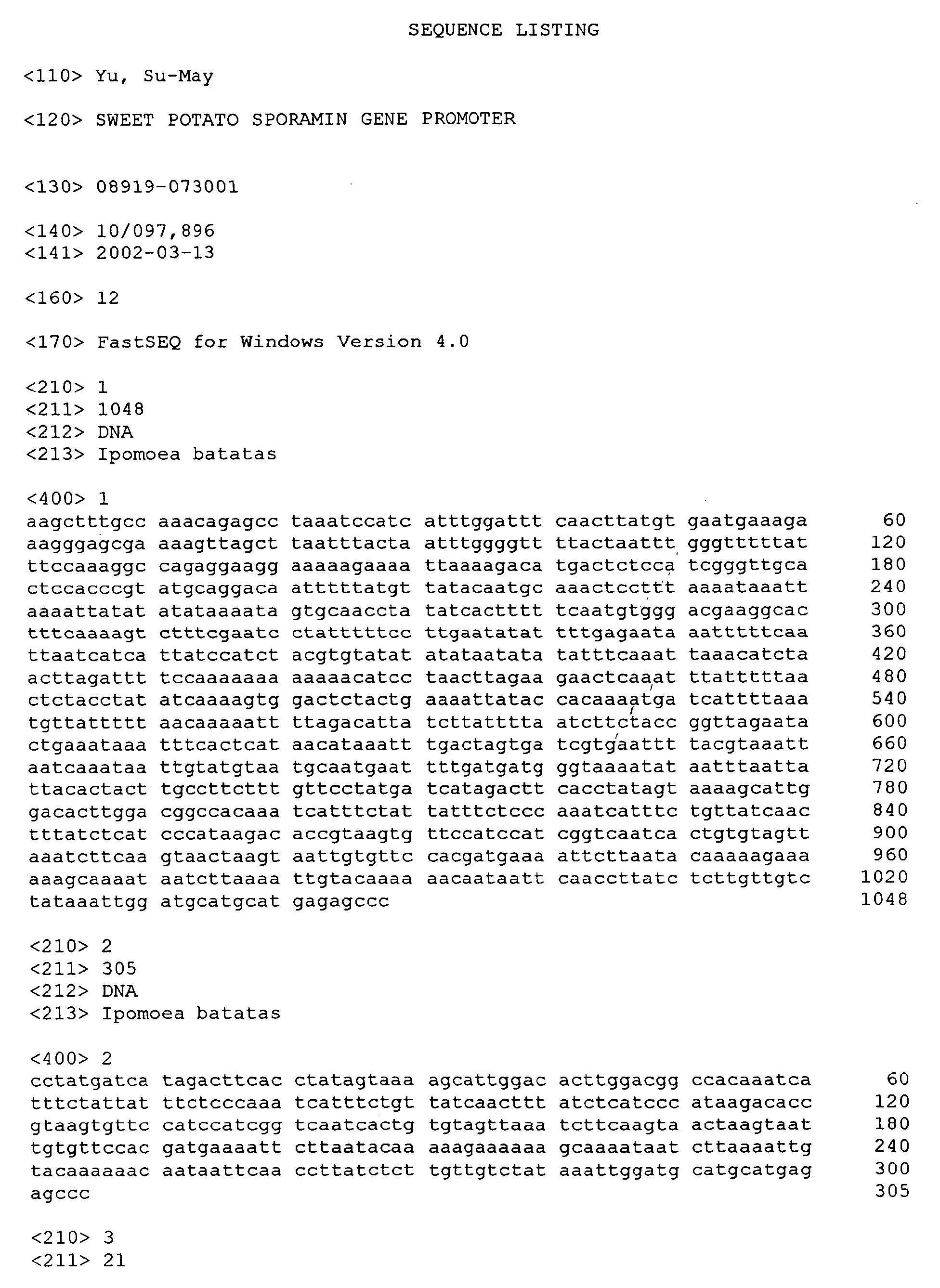
- One example of the sweet potato sporamin promoters, bp -1048 to -1 of the SPO-A1 gene is shown below: Fragments of SEQ ID NO: 1, e.g., bp -305 to -1 of the SPO-A1 gene (SEQ ID NO:2) may be used as promoters as long as they retain the capability of initiating transcription.
- the sequence encoding the polypeptide is linked to an upstream sequence encoding a propeptide, and the sequence encoding the propeptide is linked to a further upstream sequence encoding a signal peptide.
- the polypeptide is directed by the signal peptide and the propeptide to vacuoles, where a protein body is formed and the polypeptide is stabilized.
- Both the signal peptide and the propeptide may be from a sweet potato sporamin protein, for example, the signal peptide of the SPO-A1 protein, aa 1-21 of the SPO-A1 protein (SEQ ID NO:3) and the propeptide of the SPO-A1 protein, aa 22-37 of the SPO-A1 protein (SEQ ID NO:4).
- the amino acid sequences of the SPO-A1 signal peptide and propeptide are shown below:
- transgenic tuberous plant e.g., potato
- a transgenic tuberous plant e.g., potato
- the genome contains a nucleic acid that includes a sweet potato sporamin promoter operably linked to a sequence encoding a polypeptide as described above.
- the polypeptide may be expressed (i.e., at a level higher than that in a non-transgenic plant) in the leaf, stem, and microtuber when cultured in medium, and expressed (i.e., at a level higher than that in a non-transgenic plant) in the leaf, petiole, and tuber when grown in soil.
- Tuberous plant cells and tuberous plants express large amounts of recombinant proteins when they contain protein-coding genes under the control of sweet potato sporamin promoters. Such transformed cells and transgenic plants are useful in production of commercially valuable recombinant vaccines and proteins, e.g., phytase widely used in animal feed.
- the transgenic tuberous plants can also display improved traits by expressing genes involved in, for example, resistance to diseases, insects and stresses; in altering starch or protein content and structures; and in altering nutritional components.
- a tuberous plant is a plant that produces tuberous roots, e.g., potato, sweet potato, cassava, carrot, and yam; or a plant that produces tuberous stems, e.g., taro, onion, and lily.
- tuberous plants potato is of particular interest as it serves as a major food crop in many countries and is widely used in food, animal feed, and other industries.
- the present invention is based on the discovery that a sweet potato sporamin promoter directs high expression of a recombinant protein when it is introduced into a tuberous plant cell, for example, via Agrobacterium -mediated transformation.
- this invention features a transformed tuberous plant cell containing a nucleic acid that includes a sweet potato sporamin promoter operably linked to a sequence encoding a polypeptide.
- Sweet potato sporamin proteins are encoded by a gene family.
- an SPO-A1 promoter, bp -1048 to -1 of the SPO-A1 gene (SEQ ID NO: 1) is used to direct the expression of an Escherichia coli phytase in a transfromed potato cell.
- This promoter can be substituted by any other promoter within the sweet potato sporamin family, or by a shorter promoter sequence which is capable of initiating transcription, e.g., bp -305 to -1 of the SPO-A1 gene (SEQ ID NO:2).
- Sporamin accumulates in large quantities in vacuoles of the tuberous root of sweet potato. It is synthesized as a prepro-precursor with a 21-amino acid signal peptide and a 16-amino acid propeptide at the N-terminus (Matsuoka and Nakamura, 1991, Proc. Natl. Acad. Sci. USA 88: 834-838). The signal peptide and the propeptide are required for vacuolar targeting of sporamin (Matsuoka et al., 1990, J. Biol. Chem. 265: 19750-19757).
- the sequence encoding the polypeptide can be linked to an upstream sequence encoding a propeptide, the coding sequence of which is linked to a further upstream sequence encoding a signal peptide.
- Both the propeptide and the signal peptide are from a sweet potato sporamin protein.
- the propeptide and the signal peptide can be from the same sweet potato sporamin protein (e.g., the SPO-A1 protein); they can also be from two different members of the sporamin protein family.
- the polypeptide is directed by the signal peptide and the propeptide to vacuoles and accumulates there. Vacuolar localization allows the polypeptide to form a protein body and becomes more stable, thereby resulting in high yields of the recombinant polypeptide.
- the transformed tuberous plant cell described above can be cultivated to become a transgenic plant.
- the polypeptide is highly expressed in various organs of a transgenic plant either cultured in medium or grown in soil.
- a transgenic potato expressing an Escherichia coli phytase under the control of an SPO-A1 promoter
- 6% of the soluble proteins in the leaf and stem and 3% of the soluble proteins in the tuber are phytase proteins (see the examples below).
- the entire transgenic potato, including the leaf, stem, and tuber can be processed and used as an animal feed additive at reduced production costs.
- In vitro cultured potato Solanum tuberosum L. cv. Kennebec seedlings and microtubers were used.
- the potato seedlings were initiated by culture of 2-3-cm stem segments on MS agar medium (Murashige and Skoog, 1962, Physiol Plant 15: 473-497).
- the potato microtubers were produced by culturing root-containing 2-3-cm stem segments on a modified MT agar medium (Wang and Hu, 1982, American Potato J 59: 33-37) that contains MS salts with 10 mg/L 6-BAP and 8% sucrose. The cultures were maintained at 25°C with a 16-hr daily light.
- a 1048-bp sporamin gene ( SPO-A1 ) promoter, a 63-bp signal peptide sequence, and a 48-bp propeptide sequence were PCR-amplified using sweet potato genomic DNA as a template and oligo-nucleotides Spo5' (5'-CCC AAGCTT TGCCAAACAGAGCCTA-3', Hind III site underlined) and Spopro3' (5'-G GAATTC GGCGGGTTCGTGTGTGGT-3', Eco RI site underlined) as primers.
- the Spo5' and Spopro 3' primers were designed based on a genomic DNA sequence of SPO-A1 (Hattori and Nakamura, 1988, Plant Mol. Biol.
- Nos nopaline synthase gene ( Nos ) terminator was PCR-amplified using pBI221 (Clontech) as a DNA template and oligo-nucleotides 5'-TCCGAG CTGCAG ATCGTTCAAACATTT-3' ( Pst I site underlined) and 5'-AGCGAGCTCG ATCGAT C TCTAGA CAT-3' ( Cla I and Xba I sites underlined) as forward and reverse primers, respectively.
- pBI221 Chip-amplified using pBI221 (Clontech) as a DNA template and oligo-nucleotides 5'-TCCGAG CTGCAG ATCGTTCAAACATTT-3' ( Pst I site underlined) and 5'-AGCGAGCTCG ATCGAT C TCTAGA CAT-3' ( Cla I and Xba I sites underlined) as forward and reverse primers, respectively.
- coli phytase gene appA was PCR-amplified using plasmid pET-appA (Golovan et al., 2000, Can J Microbiol 46: 59-71) as a DNA template and oligo-nucleotides appA 5' (5'-AAA GAATTC CAGAGTGAGCCGGAGCTGAAGCT-3', Eco RI site underlined) and appA 3' (5'-AAA CTGCAG TTACAAACTGCACGCCGGTAT-3', Pst I site underlined) as forward and reverse primers, respectively.
- pET-appA was a gift from the Department of Microbiology, University of Guelph, Canada.
- the PCR-amplified sequence of sporamin gene promoter, the signal peptide, and the propeptide was digested with Hind III and Eco RI, and subcloned into the same sites in pBluescript (Strategene) to generate pBS-Spopro.
- the PCR-amplified Nos terminator was digested with Pst I and Xba I and fused downstream of the sporamin propeptide sequence in pBS-Spopro to generate pBS-Spopro-Nos.
- the PCR-amplified appA gene was digested with Eco RI and Pst I and inserted into the same sites in pBS-Spopro-Nos to generate pBS-Spopro-appA-Nos.
- the Spopro-appA-Nos chimeric gene was excised from pBS-Spopro-appA-Nos with Xba I and Hind III and inserted into the same sites of the binary vector pCAMBIA2301 (a gift from Richard A. Jefferson, CAMBIA, Australia) to generate pSpopro-appA.
- the junction regions which link PCR-amplified DNA fragments were all verified by DNA sequencing.
- Plasmid pSpopro-appA was transferred into E. coli strain XL1-blue (Stratagene) and Agrobacterium tumefaciens strain LBA4404 (Hoekema et al., 1983, Nature 303: 179-180) using electroporation.
- Phytase activity was detected in the transformed E. coli and Agrobacteriuim using a modified agar plate phytase activity assay method (Yanke et al., 1998, Microbiology 144: 1565-1573; also see below), indicating that the sporamin gene promoter was recognized and active phytase was correctly produced by the two bacteria.
- the potato microtubers were sliced into discs of 2-mm thickness. Discs were placed on 3C5ZR agar medium (Sheerman and Bevan, 1988, Plant Cell Reports 7: 13-16) in a Petri dish and co-cultured with Agrobacterium in 5 ml of 3C5ZR liquid medium. The culture was incubated at 26°C for 15 min. The microtubers were transferred to 3C5ZR-AS agar medium (3C5ZR medium with 100 ⁇ M acetosyringon (Aldrich) and 3g/L phytagel (Sigma), pH 5.2) and incubated at 28°C in dark for 72 hr.
- 3C5ZR agar medium Sheerman and Bevan, 1988, Plant Cell Reports 7: 13-16
- the culture was incubated at 26°C for 15 min.
- the microtubers were transferred to 3C5ZR-AS agar medium (3C5ZR medium with 100 ⁇ M acetosyringon (Al
- the infected microtuber discs were washed three times with 3C5ZR liquid medium containing 100 mg/L ticarcillin/clavulanicacid (timenten) (Duchefa), blotted dry on sterile filter papers, and transferred to 3C5ZR agar medium containing 100 mg/L each of kanamycin (Sigma) and timenten and incubated at 26°C with 16-hr daily light for selection of transformants.
- the tissues were subcultured at weekly intervals. After several weeks, the young shoots formed from the inoculated microtuber discs were transferred to MS agar medium containing 100 mg/L each of kanamycin and timenten and incubated at 26°C with 16-hr daily light. The regenerated seedlings of 10-15-cm high were transferred to soil and incubated at 26°C with 16-hr daily light for further growth.
- the coding region of appA was PCR-amplified using a pET- appA as the DNA template and oligo-nucleotides 5'-GC GAATTC CAGAGTGAGCCGGAGCTG-3' ( Eco RI site underlined) as the 5' primer and 5'-GC TCTAGA TACGCATTAGACAGTTCTTCGTT-3' ( Xba I site underlined) as the 3' primer.
- the PCR product was digested with Eco RI and Xba I and ligated into the same sites in pICZ ⁇ A (Invitrogen) to generate pPICZ ⁇ A-appA.
- pPICZ ⁇ A-appA was led by a signal peptide of ⁇ -factor and was under the control of alcohol oxidase (AOX) promoter.
- AOX alcohol oxidase
- pPICZ ⁇ A-appA was amplified in Escherichia coli DH5 ⁇ (Promega) grown in low salt LB broth (1% tryptone, 0.5% sodium chloride, 0.5% yeast extract, pH 7.5) supplemented with Zeocin (25 ⁇ g/ml) (Invitrogen).
- pPICZ ⁇ A-appA was linearized by restriction enzyme Pme I digestion and transferred into P. pastoris host strain KM71 (Invitrogen) by electroporation.
- the transformed cells were plated on YPD (1% yeast extract, 2% peptone, 2% dextrose, 1 M sorbitol, pH 7.5) supplemented with zeocin (100 ⁇ g/ml) at 30°C for 3 days.
- YPD 1% yeast extract, 2% peptone, 2% dextrose, 1 M sorbitol, pH 7.5
- zeocin 100 ⁇ g/ml
- Zeocin-resistant yeast colonies were incubated in BMGY medium (1% yeast extract, 2% peptone, 1 mM potassium phosphate, pH 6.0, 1.34% yeast nitrogen bath (Invitrogen), 4 x 10 -5 % biotin, and 1% glycerol) for enrichment of cell mass and then in BMMY medium (same ingredients as BMGY medium except that 1% glycerol was replaced with 0.5% methanol) for induction of phytase expression. All media were prepared according to the protocols provided in the EasySelect Pichia Expression Kit (Invitrogen).
- Phytase was the major protein secreted into the culture medium, and was recovered by lyophilization of the culture medium.
- One hundred micrograms of purified phytase was injected into a New Zealand White rabbit successively at 4 to 6-day intervals to generate polyclonal antibodies according to the methods described by Williams et al. (Expression of foreign proteins in E. coli using plasmid vectors and purification of specific polyclonal antibodies (1995) In: DNA Cloning 2. Expression Systems. A Practical Approach. (Ed) Glover DM and Hames BD. IRL Press, New York).
- Total proteins were extracted from the microtuber, leaf, and petiole of a potato plant using an extraction buffer (50 mM Tris-HCl (pH 8.8), 1 mM EDTA, 10% glycerol, 1% Triton X-100, 10 mM ⁇ -mercaptoethanol, and 0.1 % sarkosyl).
- Western blot analysis was performed using an ECL Western blotting analysis system (Amersham Pharmacia) according to the manufacturer's instructions.
- Protein extract was prepared from the microtuber, leaf, and petiole of a potato plant as described by Li et al. (1997, Plant Physiol 114: 1103-1111). The phytase activity was determined as described by Shimizu (1992, Biosci Biotech Biochem 56: 1266-1269). One unit of phytase activity was defined as the amount of enzyme that frees 1 ⁇ mole inorganic P from 1.5 mM-sodium phytate/min at pH 4.5 and 37°C.
- a 1048-bp sporamin gene promoter, a 63-bp sequence encoding a 21-amino acid signal peptide, and a 48-bp sequence encoding a 16-amino acid propeptide from sweet potato were placed upstream of the coding region of appA gene to make a translational fusion, and the nopaline synthase gene ( Nos ) terminator was placed downstream of the appA coding region.
- the chimeric DNA was then inserted into the binary vector pCAMBIA2301 to generate pSpopro-appA, which was delivered into potato genome via Agrobacterium -mediated transformation of potato microtuber discs.
- the putative transgenic lines were selected on medium containing kanamycin.
- Sweet potato sporamin gene promoter confers high level expression of phytase in leaf, stem and microtuber of transgenic potato cultured in medium
- Total proteins were extracted from leaves, stems, roots and microtubers of two transgenic potato lines 1-1 and 2-1 cultured in medium and subjected to Western blot analysis using the phytase antibody described above. Unexpectedly, phytase with correct molecular weight of 48 kD was accumulated at high levels in leaves, stems and microtubers and at low levels in roots. Phytase was not detected in non-transformants. A 34-kD protein was also detected in the transgenic lines with the phytase antibody. The 34-kD protein could be a degradation product of the 48-kD phytase, since it is not present in non-transformants.
- Phytase activity in various organs of transgenic potato lines 1-1, 2-1 and another line 7-1 was also determined. The results show that phytase activity correlates well with the expression level of phytase, i.e., phytase activity is also high in leaves, stems and microtubers but low in roots. Phytase activity was not detected in non-transformants.
- Sweet potato sporamin gene promoter confers high level expression of phytase in tuber of transgenic potato grown in soil
- Transgenic potato plants were transferred to pots in growth chamber and allowed to form tubers. Total proteins were extracted from tubers of six transgenic lines and subjected to Western blot analysis using the phytase antibody. Unexpectedly, the 48-kD phytase accumulated in all six transgenic lines but not in non-transformants. The level of the 34-kD protein detected by the phytase antibody was lower in the tubers of soil-grown transgenic potatoes than in the leaves, stems and microtubers of transgenic potatoes cultured in medium.
- Total proteins were extracted from leaves, stems and tubers of transgenic potato lines 1-1, 2-1, and 7-1, and subjected to Western blot analysis using the phytase antibody described above.
- Various known amounts of phytase purified from the culture medium of Pichia were used as the quantification standards.
- the yields of phytase in leaves and stems were approximately 6% of total soluble proteins, and the yield of phytase in tubers was approximately 3% of total soluble proteins.
Landscapes
- Health & Medical Sciences (AREA)
- Genetics & Genomics (AREA)
- Life Sciences & Earth Sciences (AREA)
- Engineering & Computer Science (AREA)
- Biomedical Technology (AREA)
- Chemical & Material Sciences (AREA)
- Zoology (AREA)
- General Engineering & Computer Science (AREA)
- Organic Chemistry (AREA)
- Wood Science & Technology (AREA)
- Bioinformatics & Cheminformatics (AREA)
- Biotechnology (AREA)
- Molecular Biology (AREA)
- Biophysics (AREA)
- Plant Pathology (AREA)
- Cell Biology (AREA)
- Microbiology (AREA)
- Biochemistry (AREA)
- General Health & Medical Sciences (AREA)
- Physics & Mathematics (AREA)
- Pharmacology & Pharmacy (AREA)
- Medicinal Chemistry (AREA)
- Breeding Of Plants And Reproduction By Means Of Culturing (AREA)
- Micro-Organisms Or Cultivation Processes Thereof (AREA)
Abstract
A transformed tuberous plant cell or a transgenic tuberous plant containing a nucleic
acid that includes a sweet potato sporamin promoter operably linked to a sequence encoding
a polypeptide.
Description
- Sporomin, a storage protein family, accounts for 60-80% of total soluble proteins in the tuberous roots of a sweet potato (Maeshima et al., 1985, Phytochemistry 24: 1899-1902). It is encoded by two major gene subfamilies, A and B (Hatori et al., 1989, Plant Mol Biol 13: 563-572). The genomic DNA of two sporomin genes, SPO-A1 and SPO-B1, have been isolated and characterized (Hattori and Nakamura, 1988, Plant Mol. Biol. 11: 417-426). They belong to the gene subfamilies A and B, respectively.
- The present invention relates to a transformed tuberous plant cell (e.g., a potato cell) containing a nucleic acid that includes a sweet potato sporamin promoter operably linked to a sequence encoding a polypeptide (e.g., an Escherichia coli phytase). One example of the sweet potato sporamin promoters, bp -1048 to -1 of the SPO-A1 gene (SEQ ID NO: 1) is shown below:Fragments of SEQ ID NO: 1, e.g., bp -305 to -1 of the SPO-A1 gene (SEQ ID NO:2) may be used as promoters as long as they retain the capability of initiating transcription.

- In one embodiment, the sequence encoding the polypeptide is linked to an upstream sequence encoding a propeptide, and the sequence encoding the propeptide is linked to a further upstream sequence encoding a signal peptide. The polypeptide is directed by the signal peptide and the propeptide to vacuoles, where a protein body is formed and the polypeptide is stabilized.
- Both the signal peptide and the propeptide may be from a sweet potato sporamin protein, for example, the signal peptide of the SPO-A1 protein, aa 1-21 of the SPO-A1 protein (SEQ ID NO:3) and the propeptide of the SPO-A1 protein, aa 22-37 of the SPO-A1 protein (SEQ ID NO:4). The amino acid sequences of the SPO-A1 signal peptide and propeptide are shown below:
- SPO-A1 signal peptide: MKALTLALFLALSLYLLPNPA (SEQ ID NO:3)
- SPO-A1 propeptide: HSRFNPIRLPTTHEPA (SEQ ID NO:4)
-
- Also within the scope of this invention is a transgenic tuberous plant (e.g., potato) whose genome contains a nucleic acid that includes a sweet potato sporamin promoter operably linked to a sequence encoding a polypeptide as described above. In such a plant, the polypeptide may be expressed (i.e., at a level higher than that in a non-transgenic plant) in the leaf, stem, and microtuber when cultured in medium, and expressed (i.e., at a level higher than that in a non-transgenic plant) in the leaf, petiole, and tuber when grown in soil.
- Tuberous plant cells and tuberous plants express large amounts of recombinant proteins when they contain protein-coding genes under the control of sweet potato sporamin promoters. Such transformed cells and transgenic plants are useful in production of commercially valuable recombinant vaccines and proteins, e.g., phytase widely used in animal feed. The transgenic tuberous plants can also display improved traits by expressing genes involved in, for example, resistance to diseases, insects and stresses; in altering starch or protein content and structures; and in altering nutritional components.
- The details of one or more embodiments of the invention are set forth in the accompanying description below. Other features, objects, and advantages of the invention will be apparent from the detailed description, and from the claims.
- A tuberous plant is a plant that produces tuberous roots, e.g., potato, sweet potato, cassava, carrot, and yam; or a plant that produces tuberous stems, e.g., taro, onion, and lily. Among the tuberous plants, potato is of particular interest as it serves as a major food crop in many countries and is widely used in food, animal feed, and other industries.
- The present invention is based on the discovery that a sweet potato sporamin promoter directs high expression of a recombinant protein when it is introduced into a tuberous plant cell, for example, via Agrobacterium-mediated transformation. Specifically, this invention features a transformed tuberous plant cell containing a nucleic acid that includes a sweet potato sporamin promoter operably linked to a sequence encoding a polypeptide. Sweet potato sporamin proteins are encoded by a gene family. In the examples described below, an SPO-A1 promoter, bp -1048 to -1 of the SPO-A1 gene (SEQ ID NO: 1) is used to direct the expression of an Escherichia coli phytase in a transfromed potato cell. This promoter can be substituted by any other promoter within the sweet potato sporamin family, or by a shorter promoter sequence which is capable of initiating transcription, e.g., bp -305 to -1 of the SPO-A1 gene (SEQ ID NO:2).
- Sporamin accumulates in large quantities in vacuoles of the tuberous root of sweet potato. It is synthesized as a prepro-precursor with a 21-amino acid signal peptide and a 16-amino acid propeptide at the N-terminus (Matsuoka and Nakamura, 1991, Proc. Natl. Acad. Sci. USA 88: 834-838). The signal peptide and the propeptide are required for vacuolar targeting of sporamin (Matsuoka et al., 1990, J. Biol. Chem. 265: 19750-19757).
- Thus, when a sweet potato sporamin promoter is introduced into a tuberous plant cell to direct the expression of a recombinant polypeptide, the sequence encoding the polypeptide can be linked to an upstream sequence encoding a propeptide, the coding sequence of which is linked to a further upstream sequence encoding a signal peptide. Both the propeptide and the signal peptide are from a sweet potato sporamin protein. The propeptide and the signal peptide can be from the same sweet potato sporamin protein (e.g., the SPO-A1 protein); they can also be from two different members of the sporamin protein family. The polypeptide is directed by the signal peptide and the propeptide to vacuoles and accumulates there. Vacuolar localization allows the polypeptide to form a protein body and becomes more stable, thereby resulting in high yields of the recombinant polypeptide.
- The transformed tuberous plant cell described above can be cultivated to become a transgenic plant. Unexpectedly, the polypeptide is highly expressed in various organs of a transgenic plant either cultured in medium or grown in soil. For instance, in a transgenic potato expressing an Escherichia coli phytase under the control of an SPO-A1 promoter, 6% of the soluble proteins in the leaf and stem and 3% of the soluble proteins in the tuber are phytase proteins (see the examples below). As such, the entire transgenic potato, including the leaf, stem, and tuber, can be processed and used as an animal feed additive at reduced production costs.
- The specific examples below are to be construed as merely illustrative, and not limitative of the remainder of the disclosure in any way whatsoever. Without further elaboration, it is believed that one skilled in the art can, based on the description herein, utilize the present invention to its fullest extent. All publications recited herein are hereby incorporated by reference in their entirety.
- In vitro cultured potato (Solanum tuberosum L. cv. Kennebec) seedlings and microtubers were used. The potato seedlings were initiated by culture of 2-3-cm stem segments on MS agar medium (Murashige and Skoog, 1962, Physiol Plant 15: 473-497). The potato microtubers were produced by culturing root-containing 2-3-cm stem segments on a modified MT agar medium (Wang and Hu, 1982, American Potato J 59: 33-37) that contains MS salts with 10 mg/L 6-BAP and 8% sucrose. The cultures were maintained at 25°C with a 16-hr daily light.
- A 1048-bp sporamin gene (SPO-A1) promoter, a 63-bp signal peptide sequence, and a 48-bp propeptide sequence were PCR-amplified using sweet potato genomic DNA as a template and oligo-nucleotides Spo5' (5'-CCCAAGCTTTGCCAAACAGAGCCTA-3', HindIII site underlined) and Spopro3' (5'-GGAATTCGGCGGGTTCGTGTGTGGT-3', EcoRI site underlined) as primers. The Spo5' and Spopro 3' primers were designed based on a genomic DNA sequence of SPO-A1 (Hattori and Nakamura, 1988, Plant Mol. Biol. 11: 417-426). A nopaline synthase gene (Nos) terminator was PCR-amplified using pBI221 (Clontech) as a DNA template and oligo-nucleotides 5'-TCCGAGCTGCAGATCGTTCAAACATTT-3' (PstI site underlined) and 5'-AGCGAGCTCGATCGATCTCTAGACAT-3' (ClaI and XbaI sites underlined) as forward and reverse primers, respectively. The E. coli phytase gene appA was PCR-amplified using plasmid pET-appA (Golovan et al., 2000, Can J Microbiol 46: 59-71) as a DNA template and oligo-nucleotides appA 5' (5'-AAAGAATTCCAGAGTGAGCCGGAGCTGAAGCT-3', EcoRI site underlined) and appA 3' (5'-AAACTGCAGTTACAAACTGCACGCCGGTAT-3', PstI site underlined) as forward and reverse primers, respectively. pET-appA was a gift from the Department of Microbiology, University of Guelph, Canada.
- The PCR-amplified sequence of sporamin gene promoter, the signal peptide, and the propeptide was digested with HindIII and EcoRI, and subcloned into the same sites in pBluescript (Strategene) to generate pBS-Spopro. The PCR-amplified Nos terminator was digested with PstI and XbaI and fused downstream of the sporamin propeptide sequence in pBS-Spopro to generate pBS-Spopro-Nos. The PCR-amplified appA gene was digested with EcoRI and PstI and inserted into the same sites in pBS-Spopro-Nos to generate pBS-Spopro-appA-Nos. The Spopro-appA-Nos chimeric gene was excised from pBS-Spopro-appA-Nos with XbaI and HindIII and inserted into the same sites of the binary vector pCAMBIA2301 (a gift from Richard A. Jefferson, CAMBIA, Australia) to generate pSpopro-appA. The junction regions which link PCR-amplified DNA fragments were all verified by DNA sequencing.
- Plasmid pSpopro-appA was transferred into E. coli strain XL1-blue (Stratagene) and Agrobacterium tumefaciens strain LBA4404 (Hoekema et al., 1983, Nature 303: 179-180) using electroporation. Phytase activity was detected in the transformed E. coli and Agrobacteriuim using a modified agar plate phytase activity assay method (Yanke et al., 1998, Microbiology 144: 1565-1573; also see below), indicating that the sporamin gene promoter was recognized and active phytase was correctly produced by the two bacteria.
- The potato microtubers were sliced into discs of 2-mm thickness. Discs were placed on 3C5ZR agar medium (Sheerman and Bevan, 1988, Plant Cell Reports 7: 13-16) in a Petri dish and co-cultured with Agrobacterium in 5 ml of 3C5ZR liquid medium. The culture was incubated at 26°C for 15 min. The microtubers were transferred to 3C5ZR-AS agar medium (3C5ZR medium with 100 µM acetosyringon (Aldrich) and 3g/L phytagel (Sigma), pH 5.2) and incubated at 28°C in dark for 72 hr. The infected microtuber discs were washed three times with 3C5ZR liquid medium containing 100 mg/L ticarcillin/clavulanicacid (timenten) (Duchefa), blotted dry on sterile filter papers, and transferred to 3C5ZR agar medium containing 100 mg/L each of kanamycin (Sigma) and timenten and incubated at 26°C with 16-hr daily light for selection of transformants. The tissues were subcultured at weekly intervals. After several weeks, the young shoots formed from the inoculated microtuber discs were transferred to MS agar medium containing 100 mg/L each of kanamycin and timenten and incubated at 26°C with 16-hr daily light. The regenerated seedlings of 10-15-cm high were transferred to soil and incubated at 26°C with 16-hr daily light for further growth.
- The coding region of appA was PCR-amplified using a pET- appA as the DNA template and oligo-nucleotides 5'-GCGAATTCCAGAGTGAGCCGGAGCTG-3' (EcoRI site underlined) as the 5' primer and 5'-GCTCTAGATACGCATTAGACAGTTCTTCGTT-3' (XbaI site underlined) as the 3' primer. The PCR product was digested with EcoRI and XbaI and ligated into the same sites in pICZαA (Invitrogen) to generate pPICZαA-appA. appA was led by a signal peptide of α-factor and was under the control of alcohol oxidase (AOX) promoter. pPICZαA-appA was amplified in Escherichia coli DH5α (Promega) grown in low salt LB broth (1% tryptone, 0.5% sodium chloride, 0.5% yeast extract, pH 7.5) supplemented with Zeocin (25 µg/ml) (Invitrogen). pPICZαA-appA was linearized by restriction enzyme PmeI digestion and transferred into P. pastoris host strain KM71 (Invitrogen) by electroporation. The transformed cells were plated on YPD (1% yeast extract, 2% peptone, 2% dextrose, 1 M sorbitol, pH 7.5) supplemented with zeocin (100 µg/ml) at 30°C for 3 days. Zeocin-resistant yeast colonies were incubated in BMGY medium (1% yeast extract, 2% peptone, 1 mM potassium phosphate, pH 6.0, 1.34% yeast nitrogen bath (Invitrogen), 4 x 10⁻⁵ % biotin, and 1% glycerol) for enrichment of cell mass and then in BMMY medium (same ingredients as BMGY medium except that 1% glycerol was replaced with 0.5% methanol) for induction of phytase expression. All media were prepared according to the protocols provided in the EasySelect Pichia Expression Kit (Invitrogen).
- Phytase was the major protein secreted into the culture medium, and was recovered by lyophilization of the culture medium. One hundred micrograms of purified phytase was injected into a New Zealand White rabbit successively at 4 to 6-day intervals to generate polyclonal antibodies according to the methods described by Williams et al. (Expression of foreign proteins in E. coli using plasmid vectors and purification of specific polyclonal antibodies (1995) In: DNA Cloning 2. Expression Systems. A Practical Approach. (Ed) Glover DM and Hames BD. IRL Press, New York).
- Total proteins were extracted from the microtuber, leaf, and petiole of a potato plant using an extraction buffer (50 mM Tris-HCl (pH 8.8), 1 mM EDTA, 10% glycerol, 1% Triton X-100, 10 mM β-mercaptoethanol, and 0.1 % sarkosyl). Western blot analysis was performed using an ECL Western blotting analysis system (Amersham Pharmacia) according to the manufacturer's instructions.
- Protein extract was prepared from the microtuber, leaf, and petiole of a potato plant as described by Li et al. (1997, Plant Physiol 114: 1103-1111). The phytase activity was determined as described by Shimizu (1992, Biosci Biotech Biochem 56: 1266-1269). One unit of phytase activity was defined as the amount of enzyme that frees 1 µmole inorganic P from 1.5 mM-sodium phytate/min at pH 4.5 and 37°C.
- A 1048-bp sporamin gene promoter, a 63-bp sequence encoding a 21-amino acid signal peptide, and a 48-bp sequence encoding a 16-amino acid propeptide from sweet potato were placed upstream of the coding region of appA gene to make a translational fusion, and the nopaline synthase gene (Nos) terminator was placed downstream of the appA coding region. The chimeric DNA was then inserted into the binary vector pCAMBIA2301 to generate pSpopro-appA, which was delivered into potato genome via Agrobacterium-mediated transformation of potato microtuber discs. The putative transgenic lines were selected on medium containing kanamycin.
- Approximately 15 independent putative transgenic plants were regenerated and cultured for microtuber production. Expression of phytase gene in transformed potatoes was confirmed by blot analysis of RNA purified from microtubers. As pSpopro-appA also contains a CaMV35S-GUS cDNA fusion gene derived from pCAMBIA2301, expression of GUS was determined by GUS activity staining assay of leaves. GUS activity was detected in leaves of transformed potato lines but not in leaves of a non-transformed control. These results indicate that the phytase and GUS genes have been integrated into the genomes of transformed potato lines.
- Total proteins were extracted from leaves, stems, roots and microtubers of two transgenic potato lines 1-1 and 2-1 cultured in medium and subjected to Western blot analysis using the phytase antibody described above. Unexpectedly, phytase with correct molecular weight of 48 kD was accumulated at high levels in leaves, stems and microtubers and at low levels in roots. Phytase was not detected in non-transformants. A 34-kD protein was also detected in the transgenic lines with the phytase antibody. The 34-kD protein could be a degradation product of the 48-kD phytase, since it is not present in non-transformants.
- Phytase activity in various organs of transgenic potato lines 1-1, 2-1 and another line 7-1 was also determined. The results show that phytase activity correlates well with the expression level of phytase, i.e., phytase activity is also high in leaves, stems and microtubers but low in roots. Phytase activity was not detected in non-transformants.
- Transgenic potato plants were transferred to pots in growth chamber and allowed to form tubers. Total proteins were extracted from tubers of six transgenic lines and subjected to Western blot analysis using the phytase antibody. Unexpectedly, the 48-kD phytase accumulated in all six transgenic lines but not in non-transformants. The level of the 34-kD protein detected by the phytase antibody was lower in the tubers of soil-grown transgenic potatoes than in the leaves, stems and microtubers of transgenic potatoes cultured in medium.
- Total proteins were extracted from leaves, petioles and tubers of transgenic potato lines 1-1, 2-1, and 7-1, and phytase activity was analyzed. Phytase activity was detected in all organs of the transgenic lines but not in non-transformants. Unexpectedly, phytase activity was 3-5-fold higher in tubers than in leaves and petioles.
- Total proteins were extracted from leaves, stems and tubers of transgenic potato lines 1-1, 2-1, and 7-1, and subjected to Western blot analysis using the phytase antibody described above. Various known amounts of phytase purified from the culture medium of Pichia were used as the quantification standards. Unexpectedly, the yields of phytase in leaves and stems were approximately 6% of total soluble proteins, and the yield of phytase in tubers was approximately 3% of total soluble proteins. These yields are comparable to the high yield of phytase expressed in canola seeds under the control of cruciferin A promoter (Verwoerd and Pen, 1996, Phytase produced in transgenic plants for use as a novel feed additive. In Transgenic Plants: A Production System for Industrial and Pharmaceutical Proteins. Eds. M.R.L. Owen and J. Pen. John Wiley & Sons Ltd. p. 213-225).
- All of the features disclosed in this specification may be combined in any combination. Each feature disclosed in this specification may be replaced by an alternative feature serving the same, equivalent, or similar purpose. Thus, unless expressly stated otherwise, each feature disclosed is only an example of a generic series of equivalent or similar features.
- From the above description, one skilled in the art can easily ascertain the essential characteristics of the present invention, and without departing from the spirit and scope thereof, can make various changes and modifications of the invention to adapt it to various usages and conditions. Thus, other embodiments are also within the scope of the following claims.


Claims (28)
- A transformed tuberous plant cell comprising a nucleic acid that contains a sweet potato sporamin promoter operably linked to a sequence encoding a polypeptide.
- The transformed tuberous plant cell of claim 1, wherein the sweet potato sporamin promoter includes SEQ ID NO: 1.
- The transformed tuberous plant cell of claim 2, wherein the sweet potato sporamin promoter includes SEQ ID NO:2.
- The transformed tuberous plant cell of claim 1, wherein the polypeptide is an Escherichia coli phytase.
- The transformed tuberous plant cell of claim 1, wherein the sequence encoding the polypeptide is linked to an upstream sequence encoding a propeptide, and the sequence encoding the propeptide is linked to a further upstream sequence encoding a signal peptide, wherein both the propeptide and the signal peptide are from a sweet potato sporamin protein.
- The transformed tuberous plant cell of claim 5, wherein the signal peptide is SEQ ID NO:3 and the propeptide is SEQ ID NO:4.
- The transformed tuberous plant cell of claim 1, wherein the tuberous plant is potato.
- The transformed tuberous plant cell of claim 7, wherein the sweet potato sporamin promoter includes SEQ ID NO: 1.
- The transformed tuberous plant cell of claim 8, wherein the sweet potato sporamin promoter includes SEQ ID NO:2.
- The transformed tuberous plant cell of claim 7, wherein the polypeptide is an Escherichia coli phytase.
- The transformed tuberous plant cell of claim 7, wherein the sequence encoding the polypeptide is linked to an upstream sequence encoding a propeptide, and the sequence encoding the propeptide is linked to a further upstream sequence encoding a signal peptide, wherein both the propeptide and the signal peptide are from a sweet potato sporamin protein.
- The transformed tuberous plant cell of claim 11, wherein the signal peptide is SEQ ID NO:3 and the propeptide is SEQ ID NO:4.
- A transgenic tuberous plant whose genome comprises a nucleic acid that contains a sweet potato sporamin promoter operably linked to a sequence encoding a polypeptide.
- The transgenic tuberous plant of claim 13, wherein the sweet potato sporamin promoter includes SEQ ID NO: 1.
- The transgenic tuberous plant of claim 14, wherein the sweet potato sporamin promoter includes SEQ ID NO:2.
- The transgenic tuberous plant of claim 13, wherein the polypeptide is an Escherichia coli phytase.
- The transgenic tuberous plant of claim 13, wherein the sequence encoding the polypeptide is linked to an upstream sequence encoding a propeptide, and the sequence encoding the propeptide is linked to a further upstream sequence encoding a signal peptide, wherein both the propeptide and the signal peptide are from a sweet potato sporamin protein.
- The transgenic tuberous plant of claim 17, wherein the signal peptide is SEQ ID NO:3 and the propeptide is SEQ ID NO:4.
- The transgenic tuberous plant of claim 13, wherein the polypeptide is expressed in the leaf, stem, and microtuber of the transgenic tuberous plant cultured in medium.
- The transgenic tuberous plant of claim 13, wherein the polypeptide is expressed in the leaf, petiole, and tuber of the transgenic tuberous plant grown in soil.
- The transgenic tuberous plant of claim 13, wherein the tuberous plant is potato.
- The transgenic tuberous plant of claim 21, wherein the sweet potato sporamin promoter includes SEQ ID NO: 1.
- The transgenic tuberous plant of claim 22, wherein the sweet potato sporamin promoter includes SEQ ID NO:2.
- The transgenic tuberous plant of claim 21, wherein the polypeptide is an Escherichia coli phytase.
- The transgenic tuberous plant of claim 21, wherein the sequence encoding the polypeptide is linked to an upstream sequence encoding a propeptide, and the sequence encoding the propeptide is linked to a further upstream sequence encoding a signal peptide, wherein both the propeptide and the signal peptide are from a sweet potato sporamin protein.
- The transgenic tuberous plant of claim 25, wherein the signal peptide is SEQ ID NO:3 and the propeptide is SEQ ID NO:4.
- The transgenic tuberous plant of claim 21, wherein the polypeptide is expressed in the leaf, stem, and microtuber of the transgenic tuberous plant cultured in medium.
- The transgenic tuberous plant of claim 21, wherein the polypeptide is expressed in the leaf, petiole, and tuber of the transgenic tuberous plant grown in soil.
Applications Claiming Priority (2)
| Application Number | Priority Date | Filing Date | Title |
|---|---|---|---|
| US97896 | 2002-03-13 | ||
| US10/097,896 US20030177517A1 (en) | 2002-03-13 | 2002-03-13 | Sweet potato sporamin gene promoter |
Publications (1)
| Publication Number | Publication Date |
|---|---|
| EP1348763A1 true EP1348763A1 (en) | 2003-10-01 |
Family
ID=27804290
Family Applications (1)
| Application Number | Title | Priority Date | Filing Date |
|---|---|---|---|
| EP03005127A Withdrawn EP1348763A1 (en) | 2002-03-13 | 2003-03-07 | Sweet potato sporamin gene promoter |
Country Status (4)
| Country | Link |
|---|---|
| US (1) | US20030177517A1 (en) |
| EP (1) | EP1348763A1 (en) |
| AU (1) | AU2003200786A1 (en) |
| TW (1) | TW200401031A (en) |
Cited By (1)
| Publication number | Priority date | Publication date | Assignee | Title |
|---|---|---|---|---|
| EP1659181A1 (en) * | 2004-11-15 | 2006-05-24 | Academia Sinica | Sweet potato sporamin gene promoter |
Families Citing this family (2)
| Publication number | Priority date | Publication date | Assignee | Title |
|---|---|---|---|---|
| CN102198263B (en) * | 2010-03-23 | 2015-12-02 | 中国农业科学院农产品加工研究所 | Rhizoma Dioscoreae esculentae Sporamin albumen is preparing the application in prevention and therapy tumour medicine and health product |
| CN112830962B (en) * | 2021-03-10 | 2022-07-12 | 中国农业大学 | Apple pillar type candidate gene Co41 related protein and coding gene and application thereof |
Citations (2)
| Publication number | Priority date | Publication date | Assignee | Title |
|---|---|---|---|---|
| JPH0372826A (en) * | 1989-08-12 | 1991-03-28 | Kirin Brewery Co Ltd | Transformation method for plants that form tubers |
| EP0945508A1 (en) * | 1998-03-17 | 1999-09-29 | National Science Council | The insect-resistant use of sweet potato sporamin gene and method for controlling pests using the gene |
Family Cites Families (2)
| Publication number | Priority date | Publication date | Assignee | Title |
|---|---|---|---|---|
| DE3843627A1 (en) * | 1988-12-21 | 1990-07-05 | Inst Genbiologische Forschung | POTATO TUBE-SPECIFIC TRANSCRIPTIONAL REGULATION |
| US5110732A (en) * | 1989-03-14 | 1992-05-05 | The Rockefeller University | Selective gene expression in plants |
-
2002
- 2002-03-13 US US10/097,896 patent/US20030177517A1/en not_active Abandoned
-
2003
- 2003-03-04 AU AU2003200786A patent/AU2003200786A1/en not_active Abandoned
- 2003-03-07 EP EP03005127A patent/EP1348763A1/en not_active Withdrawn
- 2003-03-13 TW TW092105720A patent/TW200401031A/en unknown
Patent Citations (2)
| Publication number | Priority date | Publication date | Assignee | Title |
|---|---|---|---|---|
| JPH0372826A (en) * | 1989-08-12 | 1991-03-28 | Kirin Brewery Co Ltd | Transformation method for plants that form tubers |
| EP0945508A1 (en) * | 1998-03-17 | 1999-09-29 | National Science Council | The insect-resistant use of sweet potato sporamin gene and method for controlling pests using the gene |
Non-Patent Citations (7)
| Title |
|---|
| [online] 7 October 1997 (1997-10-07), "DNA encoding Ipomoea batatas sporamine A.", XP002249238, retrieved from EBI Database accession no. E02799 * |
| DATABASE SWALL [online] EBI; 1 May 2000 (2000-05-01), "Sporamin A precursor", XP002249239, Database accession no. Q9SWG8 * |
| MATSUOKA K ET AL: "PROPEPTIDE OF A PRECURSOR TO A PLANT VACUOLAR PROTEIN REQUIRED FOR VACUOLAR TARGETING", PROCEEDINGS OF THE NATIONAL ACADEMY OF SCIENCES OF THE UNITED STATES, vol. 88, no. 3, 1991, 1991, pages 834 - 838, XP002249236, ISSN: 0027-8424 * |
| MATSUOKA K ET AL: "VACUOLAR TARGETING AND POSTTRANSLATIONAL PROCESSING OF THE PRECURSOR TO THE SWEET POTATO TUBEROUS ROOT STORAGE PROTEIN IN HETEROLOGOUS PLANT CELLS", JOURNAL OF BIOLOGICAL CHEMISTRY, vol. 265, no. 32, 1990, pages 19750 - 19757, XP002249237, ISSN: 0021-9258 * |
| OHTA S ET AL: "HIGH-LEVEL EXPRESSION OF A SWEET POTATO SPORAMIN GENE PROMOTER BETA GLUCURONIDASE GUS FUSION GENE IN THE STEMS OF TRANSGENIC TOBACCO PLANTS IS CONFERRED BY MULTIPLE CELL TYPE-SPECIFIC REGULATORY ELEMENTS", MOLECULAR & GENERAL GENETICS, vol. 225, no. 3, 1991, pages 369 - 378, XP002135160, ISSN: 0026-8925 * |
| WANG SHU-JEN ET AL: "Wound-response regulation of the sweet potato sporamin gene promoter region.", PLANT MOLECULAR BIOLOGY, vol. 48, no. 3, February 2002 (2002-02-01), February, 2002, pages 223 - 231, XP009014750, ISSN: 0167-4412 * |
| YEH K W ET AL: "Functional activity of sporamin from sweet potato (Ipomoea batatas Lam.): a tuber storage protein with trypsin-inhibitory activity", PLANT MOLECULAR BIOLOGY, NIJHOFF PUBLISHERS, DORDRECHT, NL, 1 February 1997 (1997-02-01), XP002075083, ISSN: 0167-4412 * |
Cited By (2)
| Publication number | Priority date | Publication date | Assignee | Title |
|---|---|---|---|---|
| US7411115B2 (en) | 2002-03-13 | 2008-08-12 | Academia Sinica | Sweet potato sporamin gene promoter |
| EP1659181A1 (en) * | 2004-11-15 | 2006-05-24 | Academia Sinica | Sweet potato sporamin gene promoter |
Also Published As
| Publication number | Publication date |
|---|---|
| TW200401031A (en) | 2004-01-16 |
| US20030177517A1 (en) | 2003-09-18 |
| AU2003200786A1 (en) | 2003-10-02 |
Similar Documents
| Publication | Publication Date | Title |
|---|---|---|
| CN101932596B (en) | Genes Regulating Plant Height and Their Applications | |
| EP2554674B1 (en) | Trichome specific promoters | |
| AU2010267655B2 (en) | Expression of transcription regulators that provide heat tolerance | |
| KR101640586B1 (en) | Pollen- or pollen tube-specific promoter from kiwifruit and uses thereof | |
| TWI534265B (en) | Method, genetic construct and transgenic p;ant cell for manipulating fructan biosynthesis in photosynthetic cells of a plant | |
| US5917127A (en) | Plasmids useful for and methods of preparing transgenic plants with modifications of habit and yield | |
| US20030177517A1 (en) | Sweet potato sporamin gene promoter | |
| CN104039127A (en) | Use of fructokinases and sucrose synthases for increasing cell wall polymers | |
| US7411115B2 (en) | Sweet potato sporamin gene promoter | |
| CN101942477A (en) | Method for improving expression level of target protein in transgenic rice endosperm | |
| CN101245349B (en) | Plants leaf all-level vein and tillering base section special expression promoter and application | |
| CN112979775B (en) | Breeding method of ear germination-resistant transgenic wheat and related biological materials | |
| US6376750B1 (en) | Plant seedling and embryo promoter | |
| CN117736285A (en) | Application of poplar calmodulin binding protein PdecaMBP in regulation of plant organ formation and biomass | |
| CN103451169B (en) | A related gene regulating wood development and its application | |
| JP5257880B2 (en) | Highly polymerized fructan synthetic sucrose: fructan-6-fructosyltransferase gene | |
| AU2015264827B2 (en) | Modification of fructan biosynthesis, increasing plant biomass, and enhancing productivity of biochemical pathways in a plant (2) | |
| JP4092110B2 (en) | DNA fragment having promoter activity and method of using the same | |
| KR101051659B1 (en) | Arabidopsis-derived constitutive promoters, expression vectors comprising the same and uses thereof | |
| KR101666680B1 (en) | Transgenic rice callus producing PNGase A and uses thereof | |
| CA2303911A1 (en) | Method for altering storage organ composition | |
| CN119120560A (en) | Application of Desaturated Acid Lipase in Resistance to Rice Black-streaked Dwarf Virus | |
| CN120193000A (en) | A protein regulating cold tolerance in rice seedlings and its encoding gene and application | |
| CN117736286A (en) | Pdecambp-1 proteins associated with plant organogenesis and biomass and uses thereof | |
| CN121674462A (en) | ShSBT1.4 protein and application of encoding gene thereof in regulating and controlling powdery mildew resistance of plants |
Legal Events
| Date | Code | Title | Description |
|---|---|---|---|
| PUAI | Public reference made under article 153(3) epc to a published international application that has entered the european phase |
Free format text: ORIGINAL CODE: 0009012 |
|
| 17P | Request for examination filed |
Effective date: 20030317 |
|
| AK | Designated contracting states |
Kind code of ref document: A1 Designated state(s): AT BE BG CH CY CZ DE DK EE ES FI FR GB GR HU IE IT LI LU MC NL PT RO SE SI SK TR |
|
| AX | Request for extension of the european patent |
Extension state: AL LT LV MK |
|
| AKX | Designation fees paid |
Designated state(s): DE FR GB IT |
|
| STAA | Information on the status of an ep patent application or granted ep patent |
Free format text: STATUS: THE APPLICATION HAS BEEN WITHDRAWN |
|
| 18W | Application withdrawn |
Effective date: 20050104 |