EP1348695A1 - Dérivés de paraphénylènediamine à groupement pyrrolidinyle substitués par un radical cationique et utilisation de ces dérivés pour la coloration de fibres kératiniques - Google Patents
Dérivés de paraphénylènediamine à groupement pyrrolidinyle substitués par un radical cationique et utilisation de ces dérivés pour la coloration de fibres kératiniques Download PDFInfo
- Publication number
- EP1348695A1 EP1348695A1 EP03290597A EP03290597A EP1348695A1 EP 1348695 A1 EP1348695 A1 EP 1348695A1 EP 03290597 A EP03290597 A EP 03290597A EP 03290597 A EP03290597 A EP 03290597A EP 1348695 A1 EP1348695 A1 EP 1348695A1
- Authority
- EP
- European Patent Office
- Prior art keywords
- radical
- alkyl
- amino
- methyl
- phenyl
- Prior art date
- Legal status (The legal status is an assumption and is not a legal conclusion. Google has not performed a legal analysis and makes no representation as to the accuracy of the status listed.)
- Granted
Links
- DYDXTTNHPBVVHC-UHFFFAOYSA-N CC1(C=CC(N)=CC1)N(CC1)CC1[N+]1(CC2)CCN2CC1 Chemical compound CC1(C=CC(N)=CC1)N(CC1)CC1[N+]1(CC2)CCN2CC1 DYDXTTNHPBVVHC-UHFFFAOYSA-N 0.000 description 1
- OLOABQJWJXXNHS-UHFFFAOYSA-N CS(OC(CC1)CN1c(cc1)ccc1[N+]([O-])=O)(=O)=O Chemical compound CS(OC(CC1)CN1c(cc1)ccc1[N+]([O-])=O)(=O)=O OLOABQJWJXXNHS-UHFFFAOYSA-N 0.000 description 1
- FNFQGHPTKDYWIY-UHFFFAOYSA-N [O-][N+](c(cc1)ccc1N(CC1)CC1[N]1(CC2)CCN2CC1)=O Chemical compound [O-][N+](c(cc1)ccc1N(CC1)CC1[N]1(CC2)CCN2CC1)=O FNFQGHPTKDYWIY-UHFFFAOYSA-N 0.000 description 1
Classifications
-
- C—CHEMISTRY; METALLURGY
- C07—ORGANIC CHEMISTRY
- C07D—HETEROCYCLIC COMPOUNDS
- C07D231/00—Heterocyclic compounds containing 1,2-diazole or hydrogenated 1,2-diazole rings
- C07D231/02—Heterocyclic compounds containing 1,2-diazole or hydrogenated 1,2-diazole rings not condensed with other rings
- C07D231/10—Heterocyclic compounds containing 1,2-diazole or hydrogenated 1,2-diazole rings not condensed with other rings having two or three double bonds between ring members or between ring members and non-ring members
- C07D231/12—Heterocyclic compounds containing 1,2-diazole or hydrogenated 1,2-diazole rings not condensed with other rings having two or three double bonds between ring members or between ring members and non-ring members with only hydrogen atoms, hydrocarbon or substituted hydrocarbon radicals, directly attached to ring carbon atoms
-
- C—CHEMISTRY; METALLURGY
- C07—ORGANIC CHEMISTRY
- C07D—HETEROCYCLIC COMPOUNDS
- C07D207/00—Heterocyclic compounds containing five-membered rings not condensed with other rings, with one nitrogen atom as the only ring hetero atom
- C07D207/02—Heterocyclic compounds containing five-membered rings not condensed with other rings, with one nitrogen atom as the only ring hetero atom with only hydrogen or carbon atoms directly attached to the ring nitrogen atom
- C07D207/04—Heterocyclic compounds containing five-membered rings not condensed with other rings, with one nitrogen atom as the only ring hetero atom with only hydrogen or carbon atoms directly attached to the ring nitrogen atom having no double bonds between ring members or between ring members and non-ring members
- C07D207/10—Heterocyclic compounds containing five-membered rings not condensed with other rings, with one nitrogen atom as the only ring hetero atom with only hydrogen or carbon atoms directly attached to the ring nitrogen atom having no double bonds between ring members or between ring members and non-ring members with hetero atoms or with carbon atoms having three bonds to hetero atoms with at the most one bond to halogen, e.g. ester or nitrile radicals, directly attached to ring carbon atoms
- C07D207/14—Nitrogen atoms not forming part of a nitro radical
-
- C—CHEMISTRY; METALLURGY
- C07—ORGANIC CHEMISTRY
- C07D—HETEROCYCLIC COMPOUNDS
- C07D233/00—Heterocyclic compounds containing 1,3-diazole or hydrogenated 1,3-diazole rings, not condensed with other rings
- C07D233/54—Heterocyclic compounds containing 1,3-diazole or hydrogenated 1,3-diazole rings, not condensed with other rings having two double bonds between ring members or between ring members and non-ring members
- C07D233/56—Heterocyclic compounds containing 1,3-diazole or hydrogenated 1,3-diazole rings, not condensed with other rings having two double bonds between ring members or between ring members and non-ring members with only hydrogen atoms or radicals containing only hydrogen and carbon atoms, attached to ring carbon atoms
-
- C—CHEMISTRY; METALLURGY
- C07—ORGANIC CHEMISTRY
- C07D—HETEROCYCLIC COMPOUNDS
- C07D249/00—Heterocyclic compounds containing five-membered rings having three nitrogen atoms as the only ring hetero atoms
- C07D249/02—Heterocyclic compounds containing five-membered rings having three nitrogen atoms as the only ring hetero atoms not condensed with other rings
- C07D249/08—1,2,4-Triazoles; Hydrogenated 1,2,4-triazoles
-
- C—CHEMISTRY; METALLURGY
- C07—ORGANIC CHEMISTRY
- C07D—HETEROCYCLIC COMPOUNDS
- C07D401/00—Heterocyclic compounds containing two or more hetero rings, having nitrogen atoms as the only ring hetero atoms, at least one ring being a six-membered ring with only one nitrogen atom
- C07D401/02—Heterocyclic compounds containing two or more hetero rings, having nitrogen atoms as the only ring hetero atoms, at least one ring being a six-membered ring with only one nitrogen atom containing two hetero rings
- C07D401/04—Heterocyclic compounds containing two or more hetero rings, having nitrogen atoms as the only ring hetero atoms, at least one ring being a six-membered ring with only one nitrogen atom containing two hetero rings directly linked by a ring-member-to-ring-member bond
-
- C—CHEMISTRY; METALLURGY
- C07—ORGANIC CHEMISTRY
- C07D—HETEROCYCLIC COMPOUNDS
- C07D417/00—Heterocyclic compounds containing two or more hetero rings, at least one ring having nitrogen and sulfur atoms as the only ring hetero atoms, not provided for by group C07D415/00
- C07D417/02—Heterocyclic compounds containing two or more hetero rings, at least one ring having nitrogen and sulfur atoms as the only ring hetero atoms, not provided for by group C07D415/00 containing two hetero rings
- C07D417/04—Heterocyclic compounds containing two or more hetero rings, at least one ring having nitrogen and sulfur atoms as the only ring hetero atoms, not provided for by group C07D415/00 containing two hetero rings directly linked by a ring-member-to-ring-member bond
-
- C—CHEMISTRY; METALLURGY
- C07—ORGANIC CHEMISTRY
- C07D—HETEROCYCLIC COMPOUNDS
- C07D487/00—Heterocyclic compounds containing nitrogen atoms as the only ring hetero atoms in the condensed system, not provided for by groups C07D451/00 - C07D477/00
- C07D487/02—Heterocyclic compounds containing nitrogen atoms as the only ring hetero atoms in the condensed system, not provided for by groups C07D451/00 - C07D477/00 in which the condensed system contains two hetero rings
- C07D487/08—Bridged systems
-
- C—CHEMISTRY; METALLURGY
- C07—ORGANIC CHEMISTRY
- C07F—ACYCLIC, CARBOCYCLIC OR HETEROCYCLIC COMPOUNDS CONTAINING ELEMENTS OTHER THAN CARBON, HYDROGEN, HALOGEN, OXYGEN, NITROGEN, SULFUR, SELENIUM OR TELLURIUM
- C07F9/00—Compounds containing elements of Groups 5 or 15 of the Periodic Table
- C07F9/02—Phosphorus compounds
- C07F9/547—Heterocyclic compounds, e.g. containing phosphorus as a ring hetero atom
- C07F9/553—Heterocyclic compounds, e.g. containing phosphorus as a ring hetero atom having one nitrogen atom as the only ring hetero atom
- C07F9/572—Five-membered rings
Definitions
- the subject of the invention is new derivatives of paraphenylenediamine to pyrrolidinyl group substituted by a cationic radical, the compositions containing them as well as the process for dyeing keratin fibers from of these compositions.
- dye compositions containing dye precursors oxidation in particular ortho or para-phenylenediamines, ortho or para-aminophenols, heterocyclic compounds such as derivatives of diaminopyrazole, pyrazolo [1,5-a] pyrimidine derivatives, pyrimidine derivatives, pyridine derivatives, 5,6-dihydroxyindole derivatives, 5,6-dihydroxyindoline derivatives generally called oxidation bases.
- the precursors of oxidation dyes, or oxidation bases are colorless or weakly colored which, combined with oxidizing products, can give rise to by a process of oxidative condensation to colored and coloring compounds.
- couplers or color modifiers these the latter being chosen in particular from aromatic meta-diamines, meta-aminophenols, meta-hydroxyphenols and certain heterocyclic compounds such as that for example derivatives of pyrazolo [1,5-b] -1,2,4, -triazoles, derivatives of pyrazolo [3,2-c] -1,2,4, -triazoles, derivatives of pyrazolo [1,5-a] pyrimidines, derivatives pyridine, pyrazol-5-one derivatives, indoline derivatives and derivatives indole.
- couplers or color modifiers these the latter being chosen in particular from aromatic meta-diamines, meta-aminophenols, meta-hydroxyphenols and certain heterocyclic compounds such as that for example derivatives of pyrazolo [1,5-b] -1,2,4, -triazoles, derivatives of pyrazolo [3,2-c] -1,2,4, -triazoles, derivatives of pyrazolo [1,
- the dyes should also cover white hair, and finally be the least selective possible, that is to say allow to obtain differences of weakest possible coloring throughout the same keratin fiber, which can be in fact differently sensitized (i.e. damaged) between its tip and its root. They must also have good chemical stability in the formulations. They must have a good toxicological profile.
- Patent application JP 11-158048 proposes compositions containing at least one compound chosen from 4-aminoaniline derivatives optionally substituted on the benzene ring and one of the nitrogen atoms of which is included in a cycle of 5 to 7 carbon chains.
- the aim of the present invention is to develop new dye compositions not having the disadvantages of oxidation bases of the prior art by providing new dye compositions for the tincture of keratin fibers which do not degrade keratin fibers, while being able to generate intense colorings in varied shades, little particularly resistant and with a good toxicological profile.
- the invention also relates to a dye composition containing in a medium suitable for dyeing keratin fibers at least one derivative of paraphenylenediamine of formula (I) as an oxidation base.
- Another object of the invention is the use of this composition for the dyeing of keratin fibers and the process for dyeing keratin fibers, in particular human keratin fibers such as hair using of the composition of the present invention.
- composition of the present invention makes it possible in particular to obtain a coloring of chromatic keratin fibers, powerful, not very selective and tenacious.
- an aliphatic hydrocarbon chain is a linear or branched chain which may contain unsaturations of the alkene type or alkyne.
- An alicyclic hydrocarbon chain is a saturated branched chain or unsaturated containing no aromatic ring structure.
- onium is understood to mean a quaternary radical of a nitrogenous base.
- R 1 may be a chlorine atom, a methyl, ethyl, isopropyl, vinyl, allyl, methoxymethyl, hydroxyethyl, 1-carboxymethyl, 1-aminomethyl, 2-carboxyethyl, 2-hydroxyethyl, 3-hydroxypropyl radical. , 1,2-dihydroxyethyl, 1-hydroxy-2-aminoethyl, 1-amino-2-hydroxyethyl, 1,2-diaminoethyl, methoxy, ethoxy, allyloxy, 2-hydroxyethyloxy.
- R 1 is preferably a halogen atom; a saturated or unsaturated, aliphatic or alicyclic C 1 -C 6 hydrocarbon chain, one or more carbon atoms which can be replaced by an oxygen, nitrogen, silicon or sulfur atom, by an SO 2 group, the radical R 1 comprising no peroxide bond, nor diazo, nitro or nitroso radicals.
- R 1 is selected from chlorine, bromine, alkyl C 1 -C 4 hydroxyalkyl, C 1 -C 4 aminoalkyl, C 1 -C 4 alkoxy, C 1 -C 4 hydroxyalkoxy C 1 -C 4 .
- R 1 is chosen from a methyl, hydroxymethyl, 2-hydroxyethyl, 1,2-dihydroxyethyl, methoxy, isopropyloxy, 2-hydroxyethoxy radical.
- R 5 and R 6 separately are preferably chosen from a C 1 -C 6 alkyl radical, a C 1 -C 4 monohydroxyalkyl radical, a polyhydroxyalkyl radical in C 2 -C 4 alkoxy (C 1 -C 6) alkyl C 1 -C 4 amidoalkyl radical a C 1 -C 6 tri (C 1 -C 6) alkylsilane C 1 -C 6 , or R 4 with R 5 together form an azetidine ring, a pyrrolidine, piperidine, piperazine, morpholine ring, R 6 being chosen in this case from a C 1 -C 6 alkyl radical; a C 1 -C 6 monohydroxyalkyl radical; a C 2 -C 6 polyhydroxyalkyl radical; a C 1 -C 6 aminoalkyl radical, a monoalkyl or disubstituted aminoalkyl radical with a (C 1 -
- R 7 is preferably chosen from a C 1 -C 6 alkyl radical; a C 1 -C 6 monohydroxyalkyl radical; a C 2 -C 6 polyhydroxyalkyl radical; an aminoalkyl radical in C 1 -C 6 aminoalkyl radical in C 1 -C 6 whose amine is mono- or disubstituted with an alkyl radical (C 1 -C 6) alkyl (C 1 -C 6) alkylcarbonyl, amido or (C 1 -C 6 ) alkyl sulfonyl; a C 1 -C 6 carbamylalkyl radical; a tri (C 1 -C 6) alkylsilane C 1 -C 6 alkyl; an alkyl (C 1 -C 6) carboxyalkyl, C 1 -C 6 alkyl; a C 1 -C 6 carbonylalkyl C 1 -C 6 alkyl radical; an N-C 1 -C 6 alkyl radical
- D is preferably a covalent bond or a alkylene chain which can be substituted.
- vertices E, G, J and L can form a cycle pyrolic, imidazolic, pyrazolic, oxazolic, thiazolic and triazolic, imidazolic preference.
- radicals R 2 of formulas (III) preferred are the radicals in which x is equal to 0, D is a covalent bond or an alkylene chain which can be substituted.
- the vertices E, G, J, L and M form with the nitrogen of the cycle a pyridine and pyrimidine cycle.
- R is preferably selected from a hydroxyl radical, an alkyl radical C 1 -C 6 monohydroxyalkyl radical, a C 1 -C 6 polyhydroxyalkyl radical, C 2 -C 6 alkoxy C 1 -C 6 tri (C 1 -C 6) alkylsilane C 1 -C 6, an amido radical, an alkylcarbonyl radical in C 1 -C 6 alkyl, an amino radical, an amino radical mono- or di -substituted by an alkyl radical (C 1 -C 6 ), alkyl (C 1 -C 6 ) carbonyl, amido or alkyl (C 1 -C 6 ) sulfonyl; a C 1 -C 6 monohydroxyalkyl radical or a C 2 -C 6 polyhydroxyalkyl radical and R 3 is chosen from a C 1 -C 6 alkyl radical, a C 1 -C 6 monohydroxyalkyl radical, a C 1 -C 6 monohydroxyalkyl
- R 7 is preferably chosen from a C 1 -C 6 alkyl radical; a C 1 -C 6 monohydroxyalkyl radical; a C 2 -C 6 polyhydroxyalkyl radical; an aminoalkyl radical in C 1 -C 6 aminoalkyl radical in C 1 -C 6 whose amine is mono- or di- substituted with an alkyl radical (C 1 -C 6) alkyl (C 1 -C 6) carbonyl, an amido radical or a (C 1 -C 6 ) alkyl sulfonyl radical; a C 1 -C 6 carbamylalkyl radical; a tri (C 1 -C 6) alkylsilane C 1 -C 6 alkyl; a C 1 -C 6 carbonylalkyl C 1 -C 6 alkyl radical; an N-C 1 -C 6 carbamylalkyl C 1 -C 6 radical; R is chosen from a hydroxyl radical,
- R, R 7 and R 3 are alkyl radicals which can be substituted.
- the radical R 2 can also represent an onium radical of formula -XP (O) (O-) OCH 2 CH 2 N + (CH 3 ) 3 where X represents an oxygen atom or a radical -NR 11 , R 11 representing hydrogen, a C 1 -C 4 alkyl radical or a hydroxyalkyl radical.
- X is -NR 11
- R 8 is hydrogen
- R 9 and R 10 are chosen from hydrogen or an alkyl radical, preferably methyl.
- the counter ion can be chosen from a halogen atom such as bromine, chlorine, fluorine or iodine, a hydroxide, a citrate, a succinate, a tartrate, a lactate, a tosylate, a mesylate, a benzenesulfonate, an acetate, a hydrogen sulfate or a C 1 -C 6 alkyl sulfate such as, for example, methyl sulfate, or ethyl sulfate.
- a halogen atom such as bromine, chlorine, fluorine or iodine
- a hydroxide such as bromine, chlorine, fluorine or iodine
- a hydroxide such as bromine, chlorine, fluorine or iodine
- a hydroxide such as bromine, chlorine, fluorine or iodine
- a hydroxide such as bromine, chlorine, fluorine or
- the chain D comprises a radical phosphoryl.
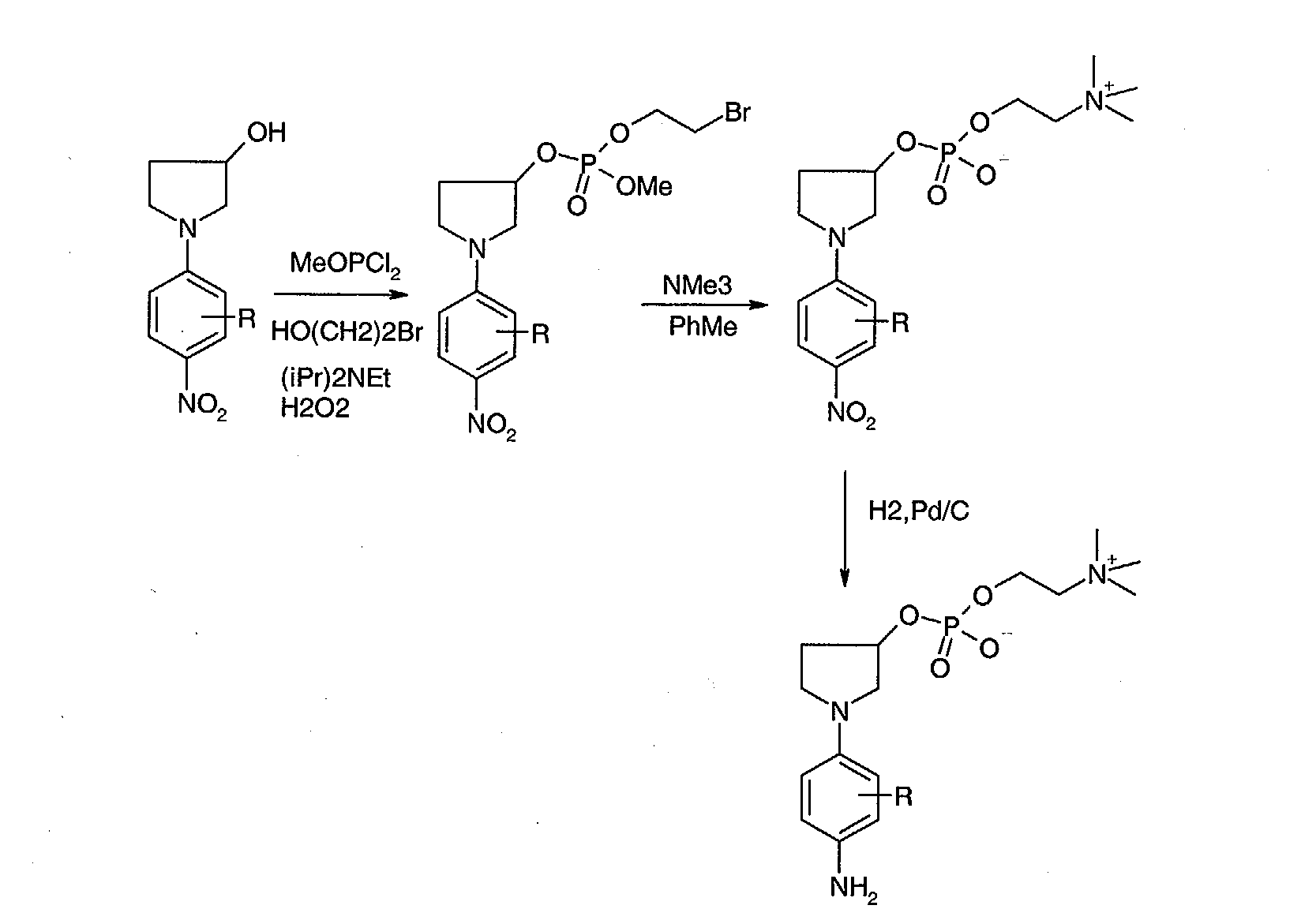
- a radical phosphoryl By way of example, there may be mentioned [1- (4-Amino-phenyl) -pyrrolidin-3-yl] -oxophosphorylcholine, [1- (4-Amino-3-methyl-phenyl) -pyrrolidin-3-yl] -oxophosphorylcholine .
- the dye composition of the present invention comprises, in a medium suitable for dyeing keratin fibers, in particular the hair humans, as the oxidation base a derivative of formula (I) as defined previously.
- the oxidation base (s) of the invention are generally present each in an amount between 0.001 to 10% by weight approximately of the total weight of the dye composition, preferably between 0.005 and 6%.
- the dye composition of the invention may contain one or more couplers conventionally used for dyeing keratin fibers.
- couplers conventionally used for dyeing keratin fibers.
- couplers mention may in particular be made of metaphenylenediamines, meta-aminophenols, metadiphenols, naphthalene couplers, couplers heterocyclics and their addition salts.
- the coupler (s) are each generally present in an amount between 0.001 and 10% by weight about the total weight of the dye composition, preferably between 0.005 and 6%.
- composition of the present invention may further comprise one or more several additional oxidation bases conventionally used in dyeing oxidation other than those described above.
- bases additional oxidation are chosen from paraphenylenediamines other than those described above, bis-phenylalkylenediamines, para-aminophenols, bis-paraaminophenols, ortho-aminophenols, bases heterocyclics and their addition salts.
- paraphenylenediamines there may be mentioned by way of example, the paraphenylenediamine, paratoluylenediamine, 2-chloro paraphenylenediamine, 2,3-dimethyl paraphenylenediamine, 2,6-dimethyl paraphenylenediamine, 2,6-diethyl paraphenylenediamine, 2,5-dimethyl paraphenylenediamine, N, N-dimethyl paraphenylenediamine, N, N-diethyl paraphenylenediamine, N, N-dipropyl paraphenylenediamine, 4-amino N, N-diethyl 3-methyl aniline, N, N-bis- ( ⁇ -hydroxyethyl) paraphenylenediamine, 4-N, N-bis- ( ⁇ -hydroxyethyl) amino 2-methyl aniline, 4-N, N-bis- ( ⁇ -hydroxyethyl) amino 2-chloro aniline, 2- ⁇ -hydroxyethyl paraphenyl
- paraphenylenediamine paratoluylenediamine, 2-isopropyl paraphenylenediamine, 2- ⁇ -hydroxyethyl paraphenylenediamine, 2- ⁇ -hydroxyethyloxy paraphenylenediamine, 2,6-dimethyl paraphenylenediamine, 2,6-diethyl paraphenylenediamine, 2,3-dimethyl paraphenylenediamine, N, N-bis- ( ⁇ -hydroxyethyl) paraphenylenediamine, 2-chloro paraphenylenediamine, 2- ⁇ -acetylaminoethyloxy paraphenylenediamine, and their acid addition salts are particularly preferred.
- the N, N'-bis- ( ⁇ -hydroxyethyl) N, N'-bis- (4'-aminophenyl) 1,3-diamino propanol N, N'-bis- ( ⁇ -hydroxyethyl) N, N'-bis- (4'-aminophenyl) ethylenediamine, N, N'-bis- (4-aminophenyl) tetramethylenediamine, N, N'-bis- ( ⁇ -hydroxyethyl) N, N'-bis- (4-aminophenyl) tetramethylenediamine, N, N'-bis- (4-methyl-aminophenyl) tetramethylenediamine, N, N'-bis- (ethyl) N, N'-bis- (4'-amino, 3'-methylphenyl) ethylenediamine, 1,8-bis- (2,5-di
- para-aminophenol there may be mentioned by way of example, para-aminophenol, 4-amino 3-methyl phenol, 4-amino 3-fluoro phenol, 4-amino 3-hydroxymethyl phenol, 4-amino 2-methyl phenol, 4-amino 2-hydroxymethyl phenol, 4-amino 2-methoxymethyl phenol, 4-amino 2-aminomethyl phenol, 4-amino 2- ( ⁇ -hydroxyethyl aminomethyl) phenol, 4-amino 2-fluoro phenol, and their salts addition with an acid.
- ortho-aminophenols mention may be made, for example, of 2-amino phenol, 2-amino 5-methyl phenol, 2-amino 6-methyl phenol, 5-acetamido 2-amino phenol, and their addition salts with an acid.
- heterocyclic bases that may be mentioned by way of example, the derivatives pyridine, pyrimidine derivatives and pyrazole derivatives.
- pyridine derivatives mention may be made of the compounds described by example in GB 1,026,978 and GB 1,153,196, such as 2,5-diamino pyridine, 2- (4-methoxyphenyl) amino 3-amino pyridine, 2,3-diamino 6-methoxy pyridine, 2- ( ⁇ -methoxyethyl) amino 3-amino 6-methoxy pyridine, 3,4-diamino pyridine, and their acid addition salts.
- pyridine oxidation bases useful in the present invention are the 3-amino pyrazolo- [1,5-a] -pyridines oxidation bases or their addition salts described for example in patent application FR 2801308.
- pyrimidine derivatives mention may be made of the compounds described by example in patents DE 2359399; JP 88-169571; JP 05-63124; EP 0770375 or WO 96/15765 such as 2,4,5,6-tetra-aminopyrimidine, 4-hydroxy 2,5,6-triaminopyrimidine, 2-hydroxy 4,5,6-triaminopyrimidine, 2,4-dihydroxy 5,6-diaminopyrimidine, 2,5,6-triaminopyrimidine, and derivatives pyrazolo-pyrimidiniques such as those mentioned in the patent application FR-A-2750048 and among which mention may be made of pyrazolo- [1,5-a] -pyrimidine-3,7-diamine ; 2,5-dimethyl pyrazolo- [1,5-a] -pyrimidine-3,7-diamine; pyrazolo- [1,5-a] -pyrimidine-3,5-diamine ; 2,
- the oxidation base (s) present in the composition of the invention are generally each present in an amount between 0.001 to 10% by weight about the total weight of the dye composition, preferably between 0.005 and 6%.
- addition salts of the oxidation bases and of the couplers which can be used in the context of the invention are in particular chosen from salts addition with an acid such as hydrochlorides, hydrobromides, sulfates, citrates, succinates, tartrates, lactates, tosylates, benzenesulfonates, phosphates and acetates and addition salts with a base such as sodium hydroxide, potash, ammonia, amines or alkanolamines.
- an acid such as hydrochlorides, hydrobromides, sulfates, citrates, succinates, tartrates, lactates, tosylates, benzenesulfonates, phosphates and acetates
- a base such as sodium hydroxide, potash, ammonia, amines or alkanolamines.
- the dye composition in accordance with the invention may also contain a or several direct dyes which can in particular be chosen from dyes nitrates of the benzene series, azo direct dyes, direct dyes methine. These direct dyes can be of nonionic, anionic or cationic.
- the medium suitable for dyeing also called dye support, generally consists of water or of a mixture of water and at least one organic solvent to dissolve the compounds which are not sufficiently soluble in water.
- organic solvent mention may, for example, be made of lower C 1 -C 4 alkanols, such as ethanol and isopropanol; polyols and polyol ethers such as 2-butoxyethanol, propylene glycol, propylene glycol monomethyl ether, monoethyl ether and diethylene glycol monomethyl ether, as well as aromatic alcohols such as benzyl alcohol or phenoxyethanol, and mixtures thereof.
- the solvents are preferably present in proportions of preferably between 1 and 40% by weight approximately relative to the total weight of the dye composition, and even more preferably between 5 and 30% by weight about.
- the dye composition in accordance with the invention may also contain various adjuvants conventionally used in compositions for dyeing hair, such as anionic, cationic, nonionic surfactants, amphoteric, zwitterionic or mixtures thereof, anionic polymers, cationic, nonionic, amphoteric, zwitterionic or mixtures thereof, agents mineral or organic thickeners, and in particular associative thickeners anionic, cationic, nonionic and amphoteric polymers, agents antioxidants, penetration agents, sequestering agents, perfumes, buffers, dispersing agents, conditioning agents such as for example modified or non-modified volatile or non-volatile silicones, agents film formers, ceramides, preservatives, opacifiers.
- adjuvants conventionally used in compositions for dyeing hair, such as anionic, cationic, nonionic surfactants, amphoteric, zwitterionic or mixtures thereof, anionic polymers, cationic, nonionic, amphoteric
- the above adjuvants are generally present in an amount included for each of them between 0.01 and 20% by weight relative to the weight of the composition.
- the pH of the dye composition in accordance with the invention is generally between 3 and 12 approximately, and preferably between 5 and 11 approximately. He can be adjusted to the desired value using acidifying or basifying agents usually used in dyeing keratin fibers or even using systems classic stamps.
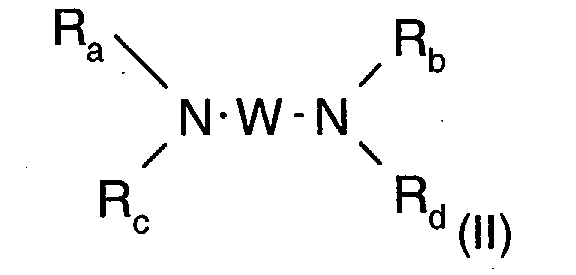
- basifying agents there may be mentioned, by way of example, ammonia, alkali carbonates, alkanolamines such as mono-, di- and triethanolamines as well as their derivatives, sodium or potassium hydroxides and compounds of formula (II) below: in which W is a propylene residue optionally substituted by a hydroxyl group or a C 1 -C 4 alkyl radical; R a, R b, R c and R d, identical or different, represent a hydrogen atom, an alkyl radical in C 1 -C 4 hydroxyalkyl or C 1 -C 4.
- the dye composition according to the invention can be presented in various forms, such as liquids, creams, gels, or any another suitable form for dyeing keratin fibers, and especially human hair.
- the process of the present invention is a process in which one applies on the fibers, the composition according to the present invention as defined previously, and the color is revealed using an oxidizing agent.
- the color can be revealed at acidic, neutral or alkaline pH and the oxidizing agent can be added to the composition of the invention just at the time of use or it can be implemented at from an oxidizing composition containing it, applied simultaneously or sequentially to the composition of the invention.
- the composition according to the present invention is mixed, preferably at the time of use, with a composition containing, in a medium suitable for dyeing, at least one oxidizing agent, this oxidizing agent being present in an amount sufficient to develop coloring.
- the mixture obtained is then applied to the keratin fibers. After a time of laying for 3 to 50 minutes approximately, preferably 5 to 30 minutes approximately, the fibers are rinsed, washed with shampoo, rinsed again and then dried.
- the oxidizing agents conventionally used for the oxidation dyeing of keratin fibers are for example hydrogen peroxide, urea peroxide, alkali metal bromates, persalts such as perborates and persulfates, peracids and the oxidase enzymes among which mention may be made of peroxidases, 2-electron oxidoreductases such as uricases and 4-electron oxygenases like the laccases. Hydrogen peroxide is particularly preferred.
- the oxidizing composition may also contain various adjuvants conventionally used in compositions for dyeing hair and such as previously defined.
- the pH of the oxidizing composition containing the oxidizing agent is such that after mixing with the dye composition, the pH of the resulting composition applied to the keratin fibers preferably varies between 3 and 12 approximately, and even more preferably between 5 and 11. It can be adjusted to the desired value at using acidifying or basifying agents usually used in fiber dyeing keratin and as defined above.
- the ready-to-use composition which is finally applied to the fibers keratin may be in various forms, such as in the form of liquids, creams, gels or any other suitable form to achieve a dyeing of keratin fibers, and in particular human hair.
- the invention also relates to a device with several compartments or dye "kit” in which a first compartment contains the composition dye of the present invention defined above and a second compartment contains an oxidizing composition.
- This device can be equipped with a means allowing the desired mixture to be delivered to the hair, such as the devices described in patent FR-2,586,913 in the name of the applicant.
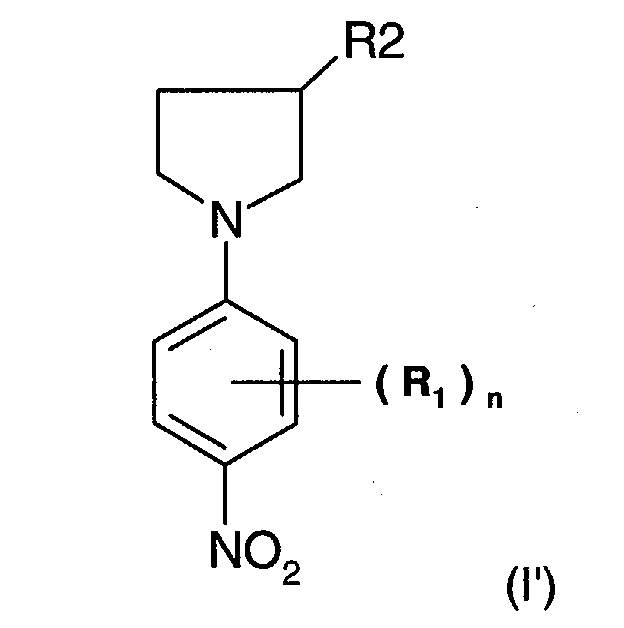
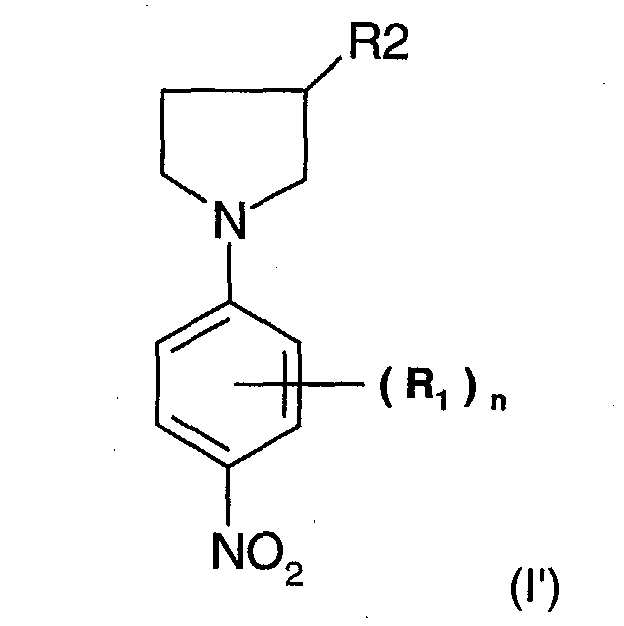
- the present invention also relates to nitro compounds of formula (I ′) which are intermediate compounds in the synthesis of derivatives of formula (I). in which R 1 , n and R2 are as defined above.
- the compounds of the present invention can be prepared by the application or adaptation of known methods. Particularly, they can be obtained by the adaptation of the methods disclosed below.
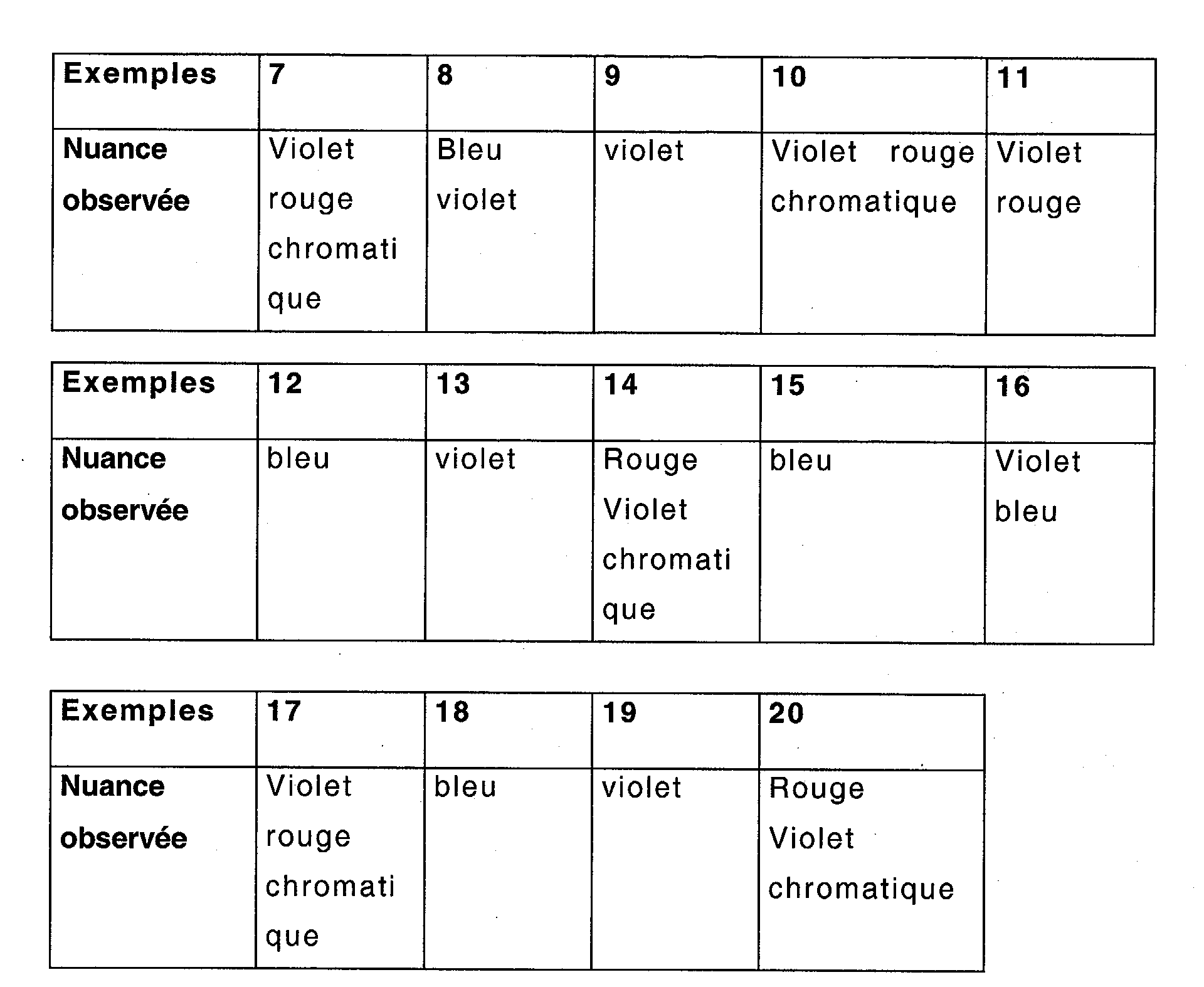
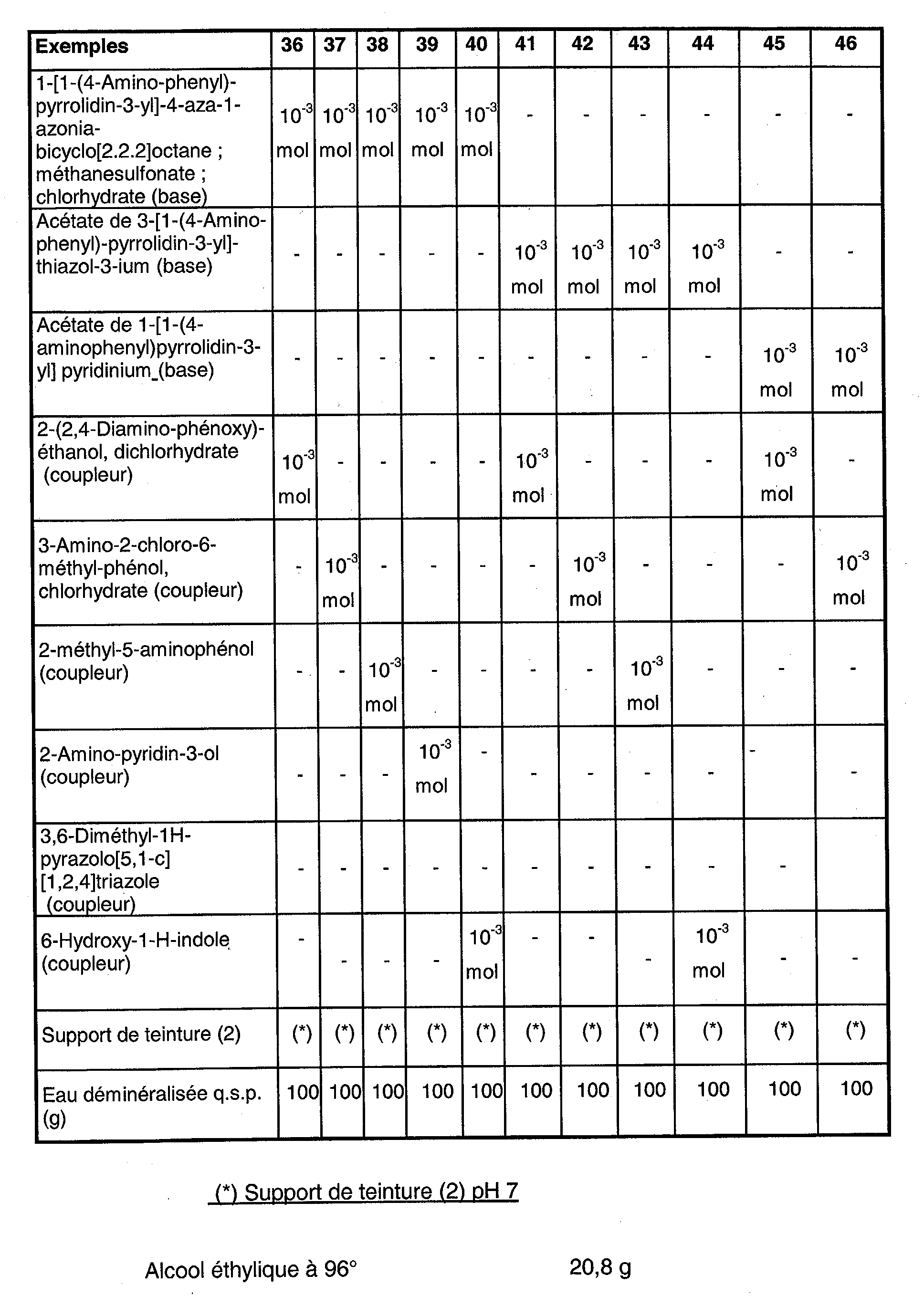
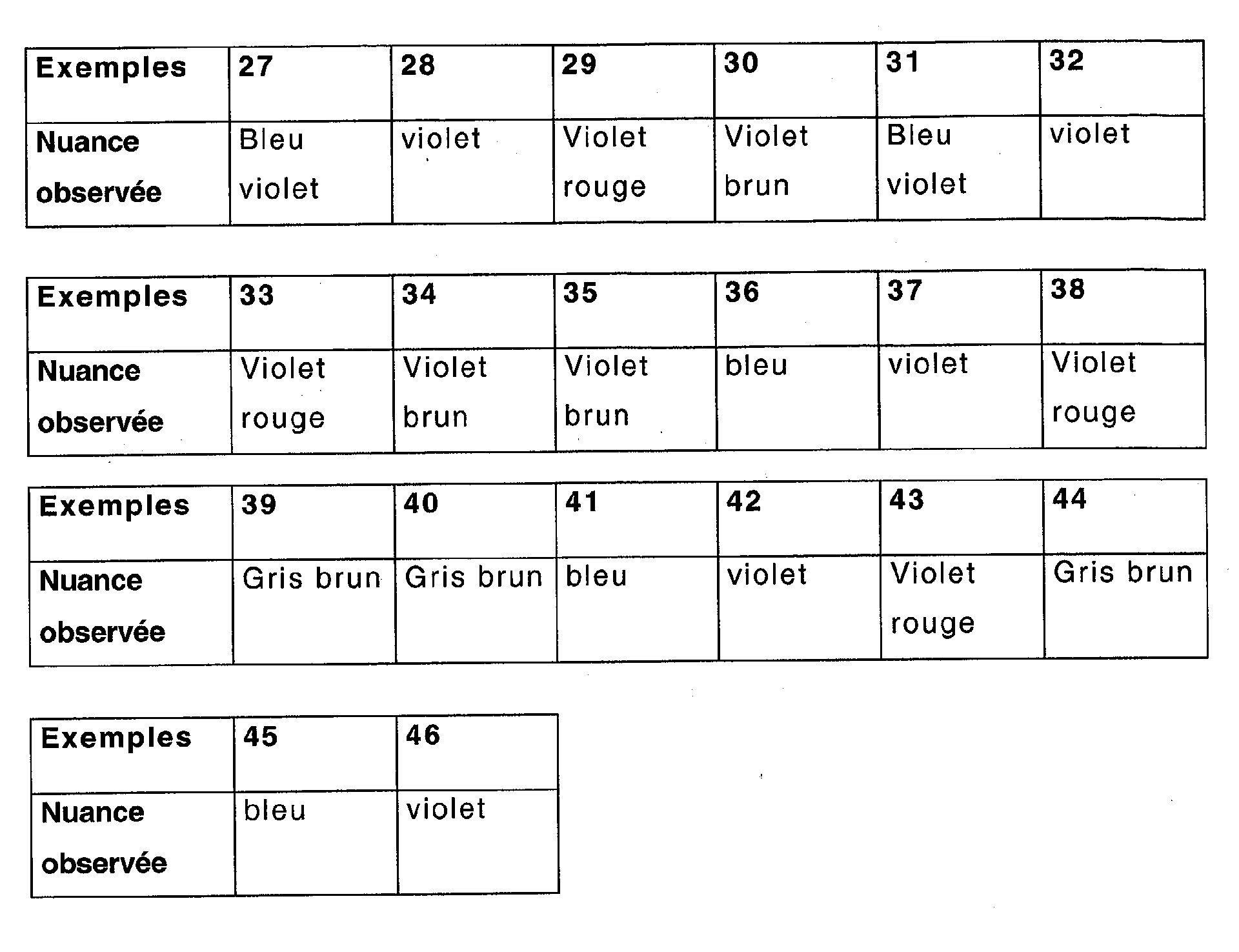
- Example 7 1- [1- (4-Amino-phenyl) -pyrrolidin-3-yl] -4-aza-1-azonia-bicyclo [2.2.2] octane: methanesulfonate; hydrochloride
- Example 8 Derivatives of the [1- (4-amino-phenyl) -pyrrolidin-3-yl] -oxophosphorylcholine Type
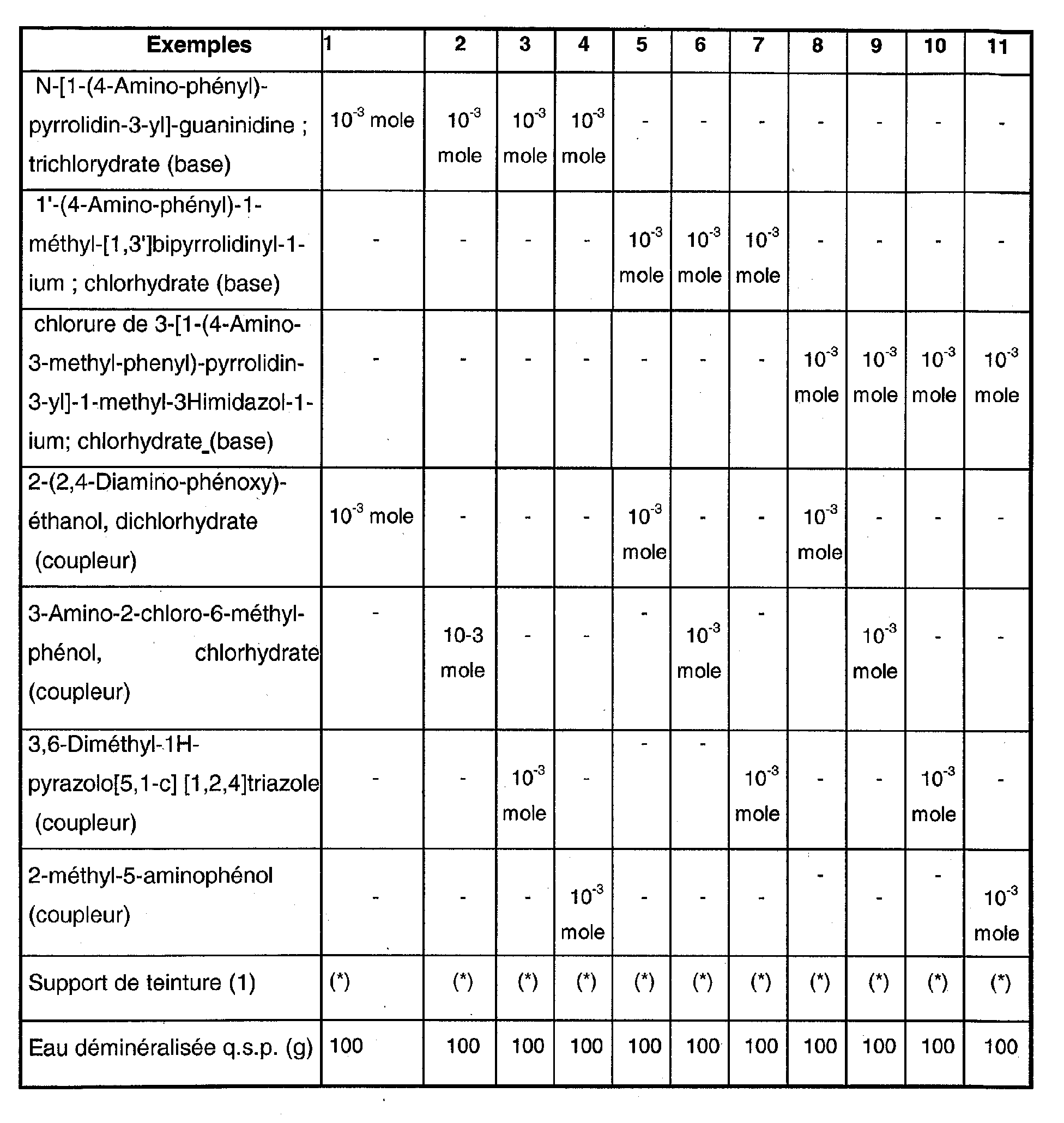
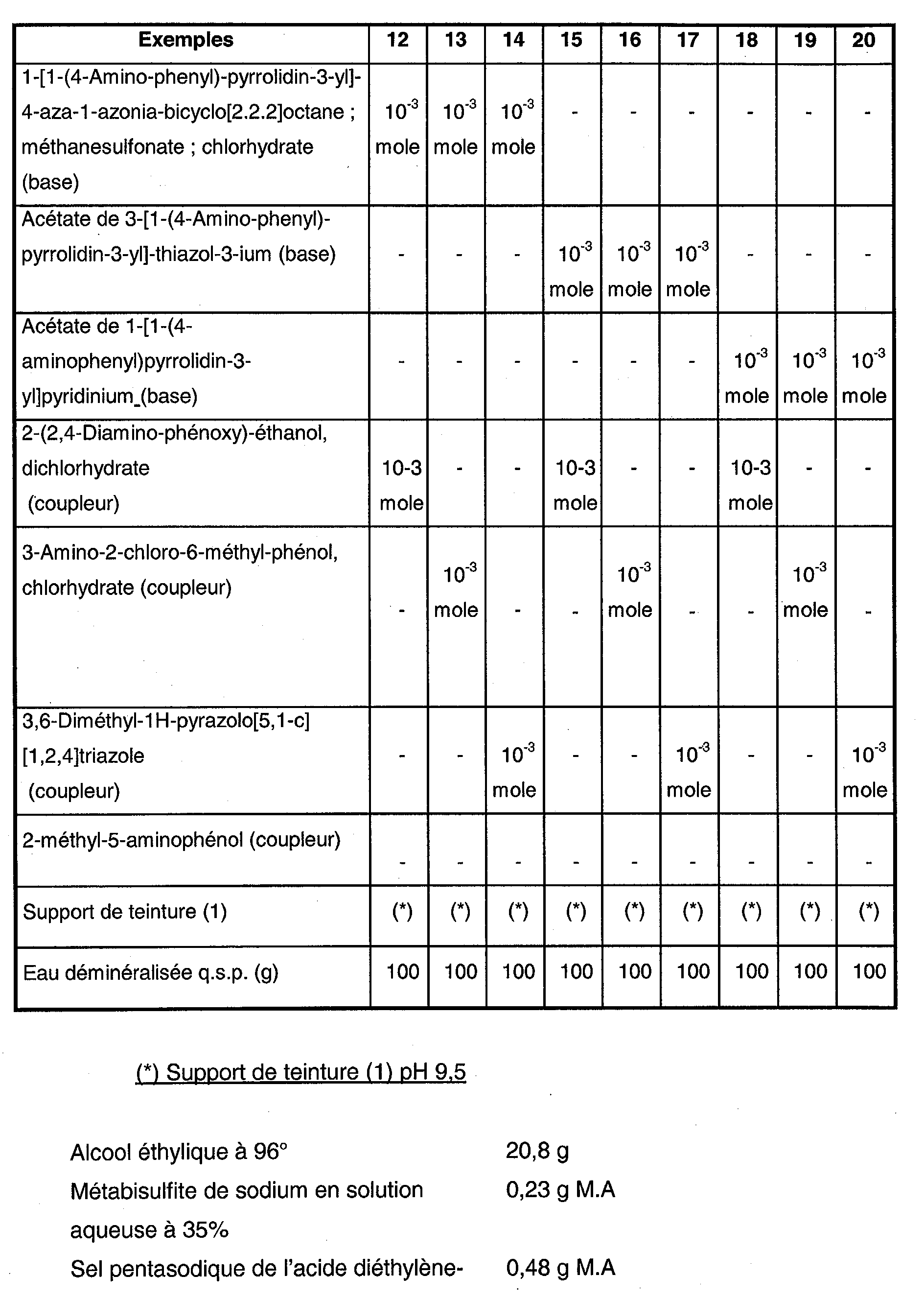
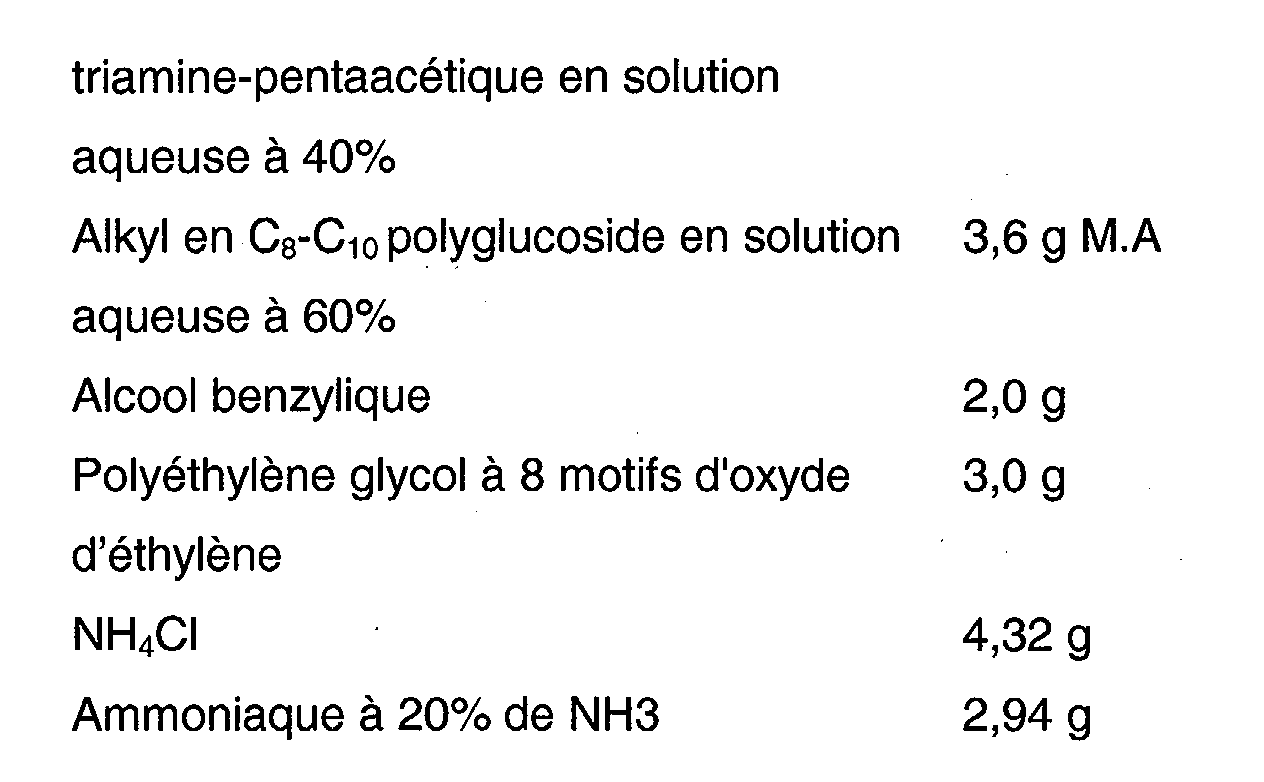
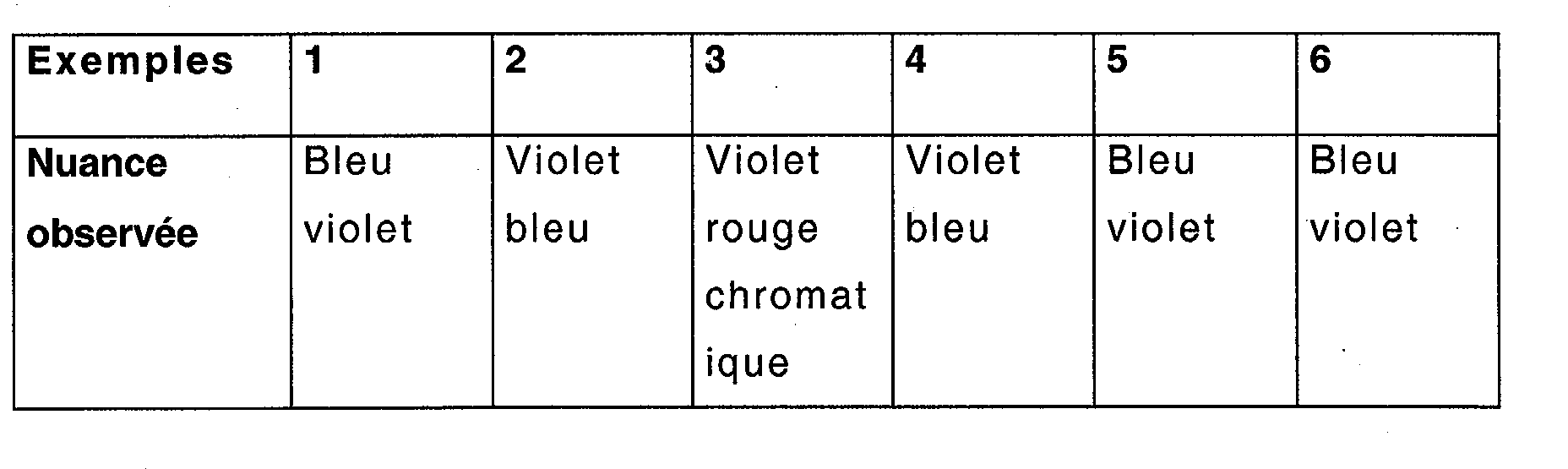
- each composition is mixed with an equal weight of water oxygenated to 20 volumes (6% by weight). A final pH of 9.5 is obtained.
- each composition is mixed with an equal weight of water oxygenated to 20 volumes (6% by weight). A final pH of 7 is obtained.
Landscapes
- Chemical & Material Sciences (AREA)
- Organic Chemistry (AREA)
- Health & Medical Sciences (AREA)
- Life Sciences & Earth Sciences (AREA)
- Biochemistry (AREA)
- General Health & Medical Sciences (AREA)
- Molecular Biology (AREA)
- Cosmetics (AREA)
- Pyrrole Compounds (AREA)
- Nitrogen Condensed Heterocyclic Rings (AREA)
- Plural Heterocyclic Compounds (AREA)
- Coloring (AREA)
Abstract
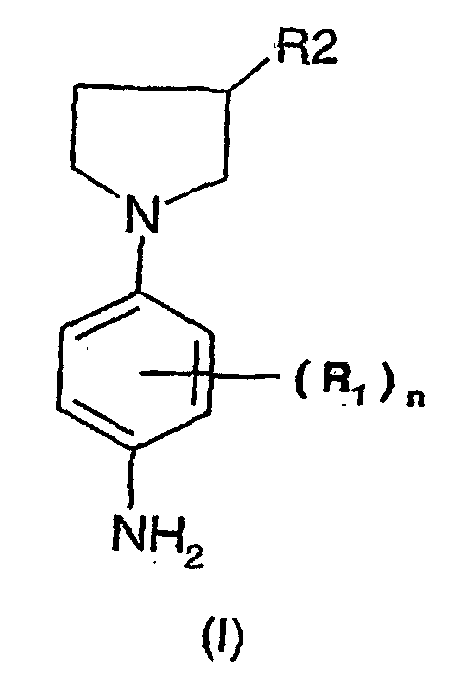
Description

- n est compris entre 0 et 4, étant entendu que lorsque n est supérieur ou égal à 2 alors les radicaux R1 peuvent être identiques ou différents,
- R1 représente un atome d'halogène ; une chaíne hydrocarbonée en C1-C6, aliphatique ou alicyclique, saturée ou insaturée, la chaíne pouvant être interrompue par un ou plusieurs atomes d'oxygène, d'azote, de silicium, de soufre ou par un groupement SO2, ; un radical onium Z, le radical R1 ne comportant pas de liaison peroxyde, ni de radicaux diazo, nitro ou nitroso ,
- R2 représente un radical onium Z de formule (II); (III) ou (IV) telle que défini ci après ou un radical -X-C=NR8-NR9R10 dans lequel X représente un atome d'oxygène ou un radical -NR11 et R8, R9,R10 et R11 représentent un hydrogène, un radical alkyle en C1-C4 ou un radical hydroxyalkyle en C1-C4.
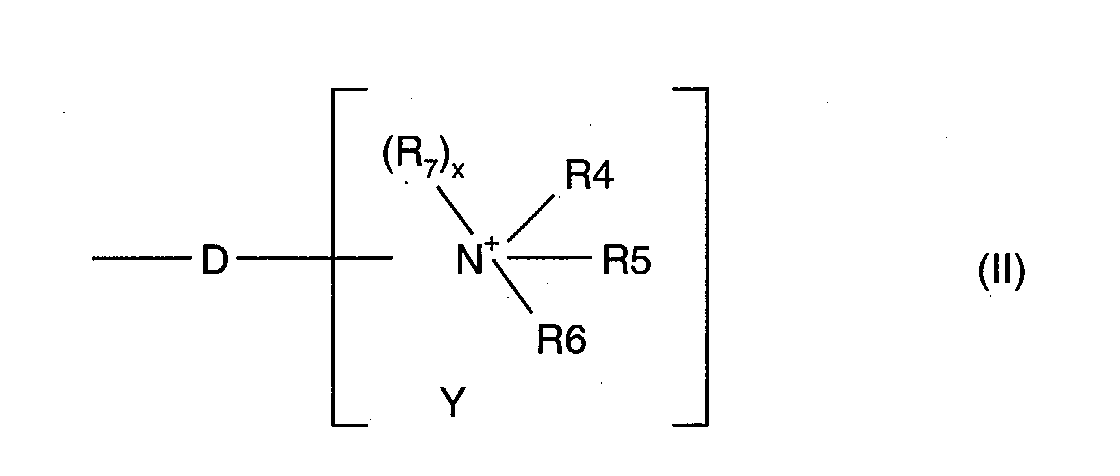
- D est une liaison covalente ou une chaíne alkylène en C1-C14, linéaire ou ramifiée pouvant être interrompue par un ou plusieurs hétéroatomes choisis parmi l'oxygène, le soufre ou l'azote, et pouvant être substituée par un ou plusieurs radicaux hydroxyle, alcoxy en C1-C6 ou amino, et pouvant porter une ou plusieurs fonctions cétone ;
- R4 R5 et R6, pris séparément, représentent un radical alkyle en C1-C15 ; un radical monohydroxyalkyle en C1-C6 ; un radical polyhydroxyalkyle en C2-C6 ; un radical alcoxy(C1-C6)alkyle en C1-C6 ; un radical aryle ; un radical benzyle ; un radical amidoalkyle en C1-C6 ; un radical trialkyl(C1-C6)silanealkyle en C1-C6 ; un radical aminoalkyle en C1-C6 ; un radical aminoalkyle en C1-C6 dont l'amine est mono- di-, tri substituée par un radical alkyle en C1-C4, alkyl(C1-C6)carbonyle, amido ou alkyl(C1-C6)sulfonyle ; à la condition que lorsque D est une liaison covalente alors R4 représente un radical aryle ; un radical benzyle ; un radical amidoalkyle en C1-C6 ; un radical trialkyl(C1-C6)silanealkyle en C1-C6 ; un radical aminoalkyle en C1-C6 ; un radical aminoalkyle en C1-C6 dont l'amine est mono-di-, tri substituée par un radical alkyle en C1-C4, alkyl(C1-C6)carbonyle, amido ou alkyl(C1-C6)sulfonyle
- R4, R5 et R6 ensemble, deux à deux, forment, avec l'atome d'azote auxquels ils sont rattachés, un cycle saturé carboné à 4, 5, 6 ou 7 chaínons pouvant contenir un ou plusieurs hétéroatomes tel que par exemple un cycle azétidine, un cycle pyrrolidine, un cycle pipéridine, un cycle pipérazine ou un cycle morpholine, le cycle cationique pouvant être substitué par un atome d'halogène, un radical hydroxyle, un radical alkyle en C1-C6, un radical monohydroxyalkyle en C1-C6, un radical polyhydroxyalkyle en C2-C6, un radical alcoxy en C1-C6, un radical trialkyl(C1-C6)silanealkyle en C1-C6, un radical amido, un radical carboxyle, un radical alkyl(C1-C6)carbonyl, un radical thio (-SH), un radical thioalkyle (-R-SH) en C1-C6, un radical alkyl(C1-C6)thio, un radical amino, un radical amino mono di ou trisubstitué par un radical alkyl(C1-C6), alkyl(C1-C6)carbonyle, amido ou alkyl(C1-C6)sulfonyle ;
- R7 représente un radical alkyle en C1-C6 ; un radical monohydroxyalkyle en C1-C6 ; un radical polyhydroxyalkyle en C2-C6 ; un radical aryle ; un radical benzyle ; un radical aminoalkyle en C1-C6 ; un radical aminoalkyle en C1-C6 dont l'amine est mono- ou di-subsituée par un radical alkyl(C1-C6), alkyl(C1-C6)carbonyle, amido ou alkyl(C1-C6)sulfonyle; un radical carboxyalkyle en C1-C6 ; un radical carbamylalkyle en C1-C6 ; un radical trifluoroalkyle en C1-C6 ; un radical trialkyl(C1-C6)silanealkyle en C1-C6 ; un radical sulfonamidoalkyle en C1-C6 ; un radical alkyl(C1-C6)carboxyalkyle en C1-C6 ; un radical alkyl(C1-C6)sulfinylalkyle en C1-C6 ; un radical alkyl(C1-C6)sulfonylalkyle en C1-C6 ; un radical alkyl(C1-C6)carbonylalkyle en C1-C6 ; un radical N-alkyl(C1-C6)carbamylalkyle en C1-C6 ; un radical N-alkyl(C1-C6)sulfonamidoalkyle en C1-C6 ;
- x est 0 ou 1,
- lorsque x = 0, alors le bras de liaison est rattaché à l'atome d'azote portant les radicaux R4 à R6,
- lorsque x = 1, alors deux des radicaux R4 à R6 forment conjointement avec l'atome d'azote auquel ils sont rattachés un cycle saturé à 4, 5, 6 ou 7 chaínons et D est lié à un atome de carbone du cycle saturé ;
- Y est un contre ion.
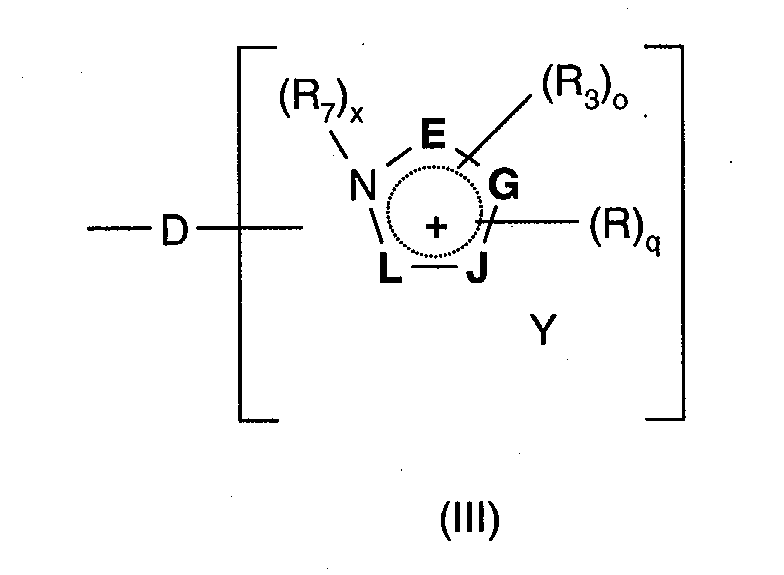
- D est une liaison covalente ou une chaíne alkylène en C1-C14, linéaire ou ramifiée pouvant être interrompue par un ou plusieurs hétéroatomes choisis parmi l'oxygène, le soufre ou l'azote, et pouvant être substituée par un ou plusieurs radicaux hydroxyle, alcoxy en C1-C6 ou amino, et pouvant porter une ou plusieurs fonctions cétone;
- les sommets E, G, J, L, identiques ou différents, représentent un atome de carbone, d'oxygène, de soufre ou d'azote pour former un cycle pyrrolique, pyrazolique, imidazolique, triazolique, oxazolique, isooxazolique, thiazolique, isothiazolique,
- q est un nombre entier compris entre 0 et 4 inclus ;
- o est un nombre entier compris entre 0 et 3 inclus ;
- q+o est un nombre entier compris entre 0 et 4
- R, identiques ou différents, représentent un atome d'halogène, un radical hydroxyle, un radical alkyle en C1-C6, un radical monohydroxyalkyle en C1-C6, un radical polyhydroxyalkyle en C2-C6, un radical alcoxy en C1-C6, un radical trialkyl(C1-C6)silanealkyle en C1-C6, un radical amido, un radical carboxyle, un radical alkylcarbonyle en C1-C6, un radical thio, un radical thioalkyle en C1-C6, un radical alkyl(C1-C6)thio, un radical amino, un radical amino mono- ou di-substitué par un radical alkyl(C1-C6), alkyl(C1-C6)carbonyle, amido, alkyl(C1-C6)sulfonyle ; un radical monohydroxyalkyle en C1-C6 ou un radical polyhydroxyalkyle en C2-C6 ; étant entendu que les radicaux R sont portés par un atome de carbone,
- R3 , identique ou différent, représente un radical alkyle en C1-C6, un radical monohydroxyalkyle en C1-C6, un radical polyhydroxyalkyle en C2-C6, un radical trialkyl(C1-C6)silanealkyle en C1-C6, un radical alcoxy(C1-C6)alkyle en C1-C6, un radical carbamylalkyle C1-C6, un radical alkyl(C1-C6)carboxyalkyle en C1-C6, un radical benzyle ; étant entendu que les radicaux R3 sont portés par un azote,
- R7 représente un radical alkyle en C1-C6 ; un radical monohydroxyalkyle en C1-C6 ; un radical polyhydroxyalkyle en C2-C6 ; un radical aryle ; un radical benzyle ; un radical aminoalkyle en C1-C6, un radical aminoalkyle en C1-C6 dont l'amine est substitué par un radical alkyl(C1-C6), alkyl(C1-C6)carbonyle, amido ou alkyl(C1-C6)sulfonyle ; un radical carboxyalkyle en C1-C6 ; un radical carbamylalkyle en C1-C6 ; un radical trifluoroalkyle en C1-C6 ; un radical trialkyl(C1-C6)silanealkyle en C1-C6 ; un radical sulfonamidoalkyle en C1-C6 ; un radical alkyl(C1-C6)carboxyalkyle en C1-C6 ; un radical alkyl(C1-C6)sulfinylalkyle en C1-C6 ; un radical alkyl(C1-C6)sulfonylalkyle en C1-C6 ; un radical alkyl(C1-C6)carbonylalkyle en C1-C6 ; un radical N-alkyl(C1-C6)carbamylalkyle en C1-C6 ; un radical N-alkyl(C1-C6)sulfonamidoalkyle en C1-C6 ;
- x est 0 ou 1
- lorsque x = 0, le bras de liaison D est rattaché à l'atome d'azote,
- lorsque x = 1, le bras de liaison D est rattaché à l'un des sommets E, G, J ou L,
- Y est un contre-ion.
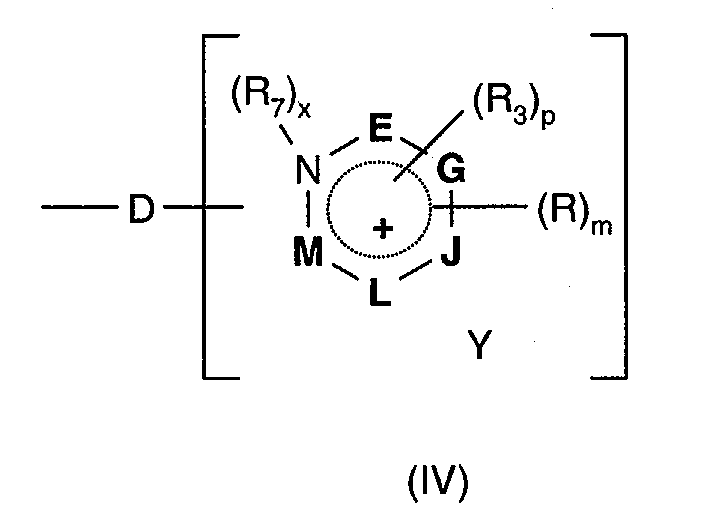
- D est une liaison covalente ou une chaíne alkylène en C1-C14, linéaire ou ramifiée pouvant être interrompue par un ou plusieurs hétéroatomes choisis parmi un atomes d'oxygène, de soufre ou d'azote, et pouvant être substituée par un ou plusieurs radicaux hydroxyle, alcoxy en C1-C6 ou amino, et pouvant porter une ou plusieurs fonctions cétone;
- les sommets E, G, J, L et M identiques ou différents, représentent un atome de carbone, d'oxygène, de soufre ou d'azote former un cycle choisi parmi les cycles pyridiniques, pyrimidiniques, pyraziniques, triaziniques et pyridaziniques ;
- p est un nombre entier compris entre 0 et 3 inclus ;
- m est un nombre entier compris entre 0 et 5 inclus ;
- p+m est un nombre entier compris entre 0 et 5 ;
- R, identiques ou différents, représentent un atome d'halogène, un radical hydroxyle, un radical alkyle en C1-C6, un radical monohydroxyalkyle en C1-C6, un radical polyhydroxyalkyle en C2-C6, un radical alcoxy en C1-C6, un radical trialkyl(C1-C6)silanealkyle en C1-C6, un radical amido, un radical carboxyle, un radical alkylcarbonyle en C1-C6, un radical thio, un radical thioalkyle en C1-C6, un radical alkyl(C1-C6)thio, un radical amino, un radical amino substitué par un radical alkyl(C1-C6), alkyl(C1-C6)carbonyle, amido ou alkyl(C1-C6)sulfonyle ; un radical monohydroxyalkyle en C1-C6 ou un radical polyhydroxyalkyle en C2-C6 ; étant entendu que les radicaux R sont portés par un atome de carbone,
- R3 , identiques ou différents, représentent un radical alkyle en C1-C6, un radical monohydroxyalkyle en C1-C6, un radical polyhydroxyalkyle en C2-C6, un radical trialkyl(C1-C6)silanealkyle en C1-C6, un radical alcoxy(C1-C6)alkyle en C1-C6, un radical carbamylalkyle C1-C6, un radical alkyl(C1-C6)carboxyalkyle en C1-C6, un radical benzyle ; étant entendu que les radicaux R3 sont portés par un azote,
- R7 représente un radical alkyle en C1-C6 ; un radical monohydroxyalkyle en C1-C6 ; un radical polyhydroxyalkyle en C2-C6 ; un radical aryle ; un radical benzyle ; un radical aminoalkyle en C1-C6, un radical aminoalkyle en C1-C6 dont l'amine est mono- ou di- substituée par un radical alkyl(C1-C6), alkyl(C1-C6)carbonyle, amido ou alkyl(C1-C6)sulfonyle ; un radical carboxyalkyle en C1-C6 ; un radical carbamylalkyle en C1-C6 ; un radical trifluoroalkyle en C1-C6 ; un radical trialkyl(C1-C6)silanealkyle en C1-C6; un radical sulfonamidoalkyle en C1-C6 ; un radical alkyl(C1-C6)carboxyalkyle en C1-C6 ; un radical alkyl(C1-C6)sulfinylalkyle en C1-C6 ; un radical alkyl(C1-C6)sulfonylalkyle en C1-C6 ; un radical alkyl(C1-C6)carbonylalkyle en C1-C6 ; un radical N-alkyl(C1-C6)carbamylalkyle en C1-C6 ; un radical N-alkyl(C1-C6)sulfonamidoalkyle en C1-C6 ;
- x est 0 ou 1
- lorsque x = 0, le bras de liaison D est rattaché à l'atome d'azote,
- lorsque x = 1, le bras de liaison D est rattaché à l'un des sommets E, G, J, L ou M,
- Y représente un contre ion.

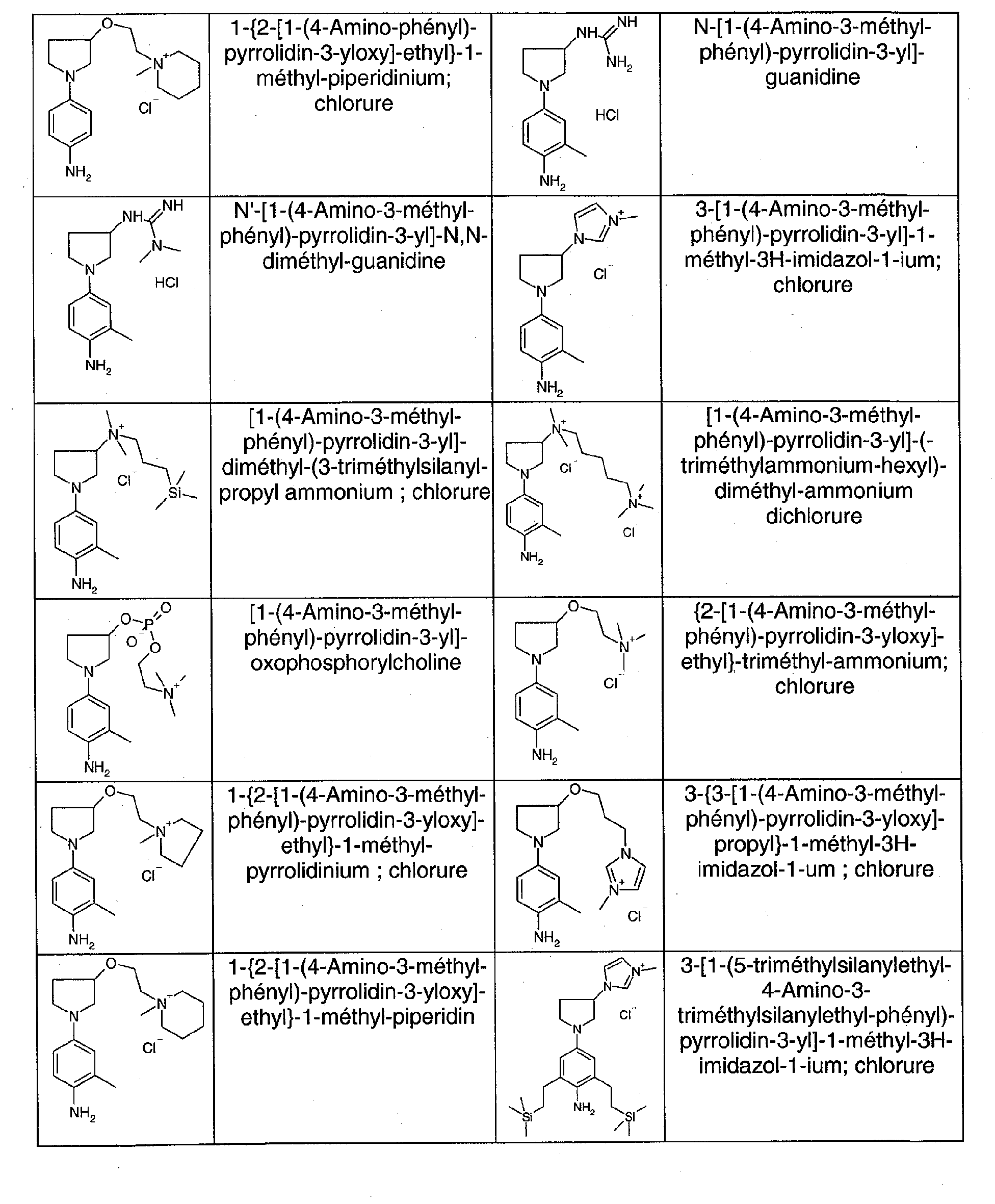
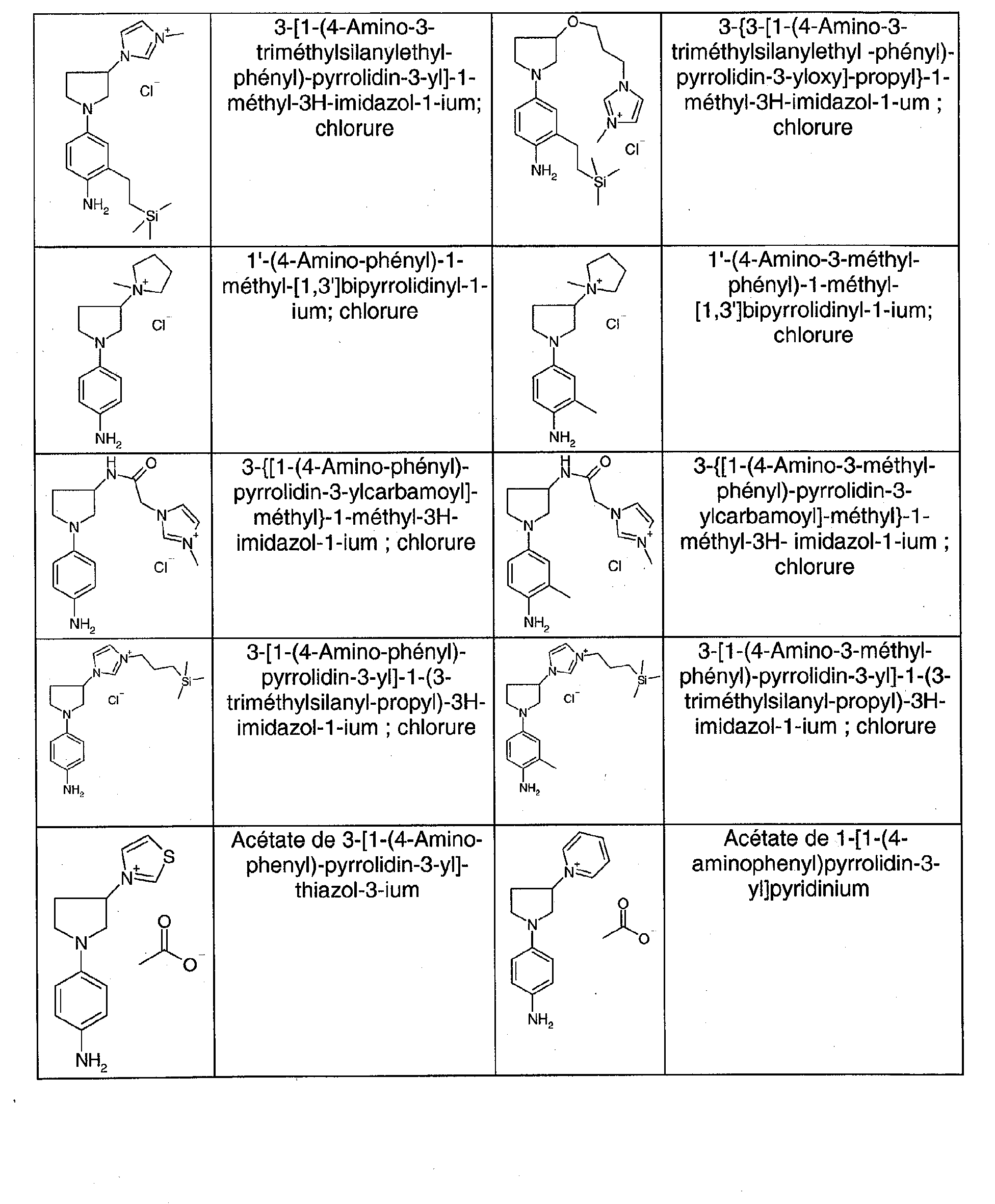

- N'-[1-(4-Amino-phényl)-pyrrolidin-3-yl]-N,N-diméthyl-guanidine
- N-[1-(4-Amino-phényl)-pyrrolidin-3-yl]-guanidine
- 3-[1-(4-Amino-phényl)-pyrrolidin-3-yl]-1-méthyl-3H-imidazol-1-ium; chlorure
- [1-(4-Amino-phényl)-pyrrolidin-3-yl]-diméthyl-(3-triméthylsilanyl-propyl)-ammonium ; chlorure
- N'-[1-(4-Amino-3-méthyl-phényl)-pyrrolidin-3-yl]-N,N-diméthyl-guanidine
- N-[1-(4-Amino-3-méthyl-phényl)-pyrrolidin-3-yl]-guanidine
- 3-[1-(4-Amino-3-méthyl-phényl)-pyrrolidin-3-yl]-1-méthyl-3H-imidazol-1-ium; chlorure
- [1-(4-amino 3-méthyl phényl) pyrrolidin 3 -yl] diméthyl (3-triméthylsilanyl propyl ammonium ; chlorure ;
- 3-[1-(4-Amino-phényl)-pyrrolidin-3-yl]-1-(3-triméthylsilanyl-propyl)-3H-imidazol-1-ium ; chlorure
- 3-[1 -(4-Amino-3-méthyl-phényl)-pyrrolidin-3-yl]-1-(3-triméthylsilanyl-propyl)-3H-imidazol-1-ium ; chlorure
- 1'-(4-Amino-phényl)-1-méthyl-[1,3']bipyrrolidinyl-1-ium; chlorure
- 1'-(4-Amino-3-méthyl-phényl)-1-méthyl-[1,3']bipyrrolidinyl-1-ium; chlorure
- 3-{[1-(4-Amino-phényl)-pyrrolidin-3-ylcarbamoyl]-méthyl}-1-méthyl-3H-imidazol-1-ium ; chlorure
- 3-{[1-(4-Amino-3-méthyl-phényl)-pyrrolidin-3-ylcarbamoyl]-méthyl}-1-méthyl-3H-imidazol-1-ium ; chlorure
- 1'-(4-amino-phényl)-1-méthyl-[1,3']bipyrrolidinyl-1-ium, chlorure.
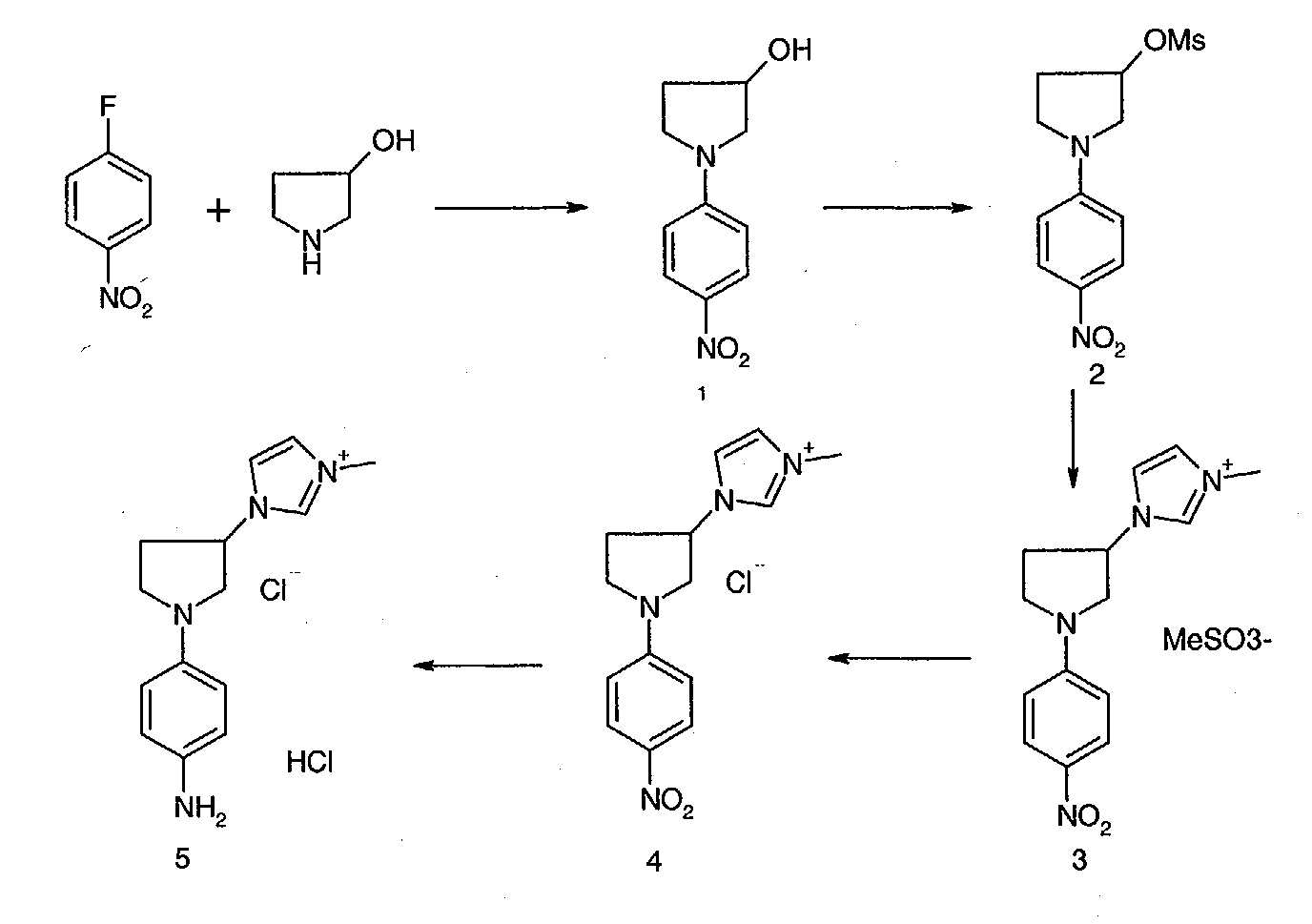
RMN 1H (DMSO d6, 200 MHz, ppm) conforme au produit attendu :
8,04 (d, J = 9 Hz, 2H) ; 6,58 (d, J = 9 Hz, 2H) ; 5,06 (d, J =3,6 Hz, 1H) ; 4,41 (m, 1H) ; 3,45 (m, 3H) ; 3,20 (m, 1H) ; 2,04 (m, 2H).
| Analyse élémentaire: | ||||
| % | C | H | N | O |
| calculé | 57,89 | 5,81 | 13,45 | 23,05 |
| trouvé | 57,17 | 5,72 | 13,23 | 23,28 |
Point de fusion : 203°C
RMN 1H (400MHz-DMSO) ppm 8.09(d, 2 H) ; 6.68(d, 2H) ;5.47(m, 1H) ; 3.77-3.48 (m,4H) ; 3.28(s,3H) ; 2.35(m,2H).
Masse ESI+ : m/z=287 [MH+]
RMN 1H (400MHz-DMSO) ppm 9.44(s, 1H) ; 8.29 (d, 2 H) 8.07(m, 1H) 7.96(m, 1H) ; 6.91(d, 2H) ;5.48(m, 1H) ; 4.16(m, 1H) ; 4.02(s, 3H)de 3.98 à 3.79 à (m,4H) ; 2.85(m, 1H) ; 2.69(m, 1H) ; 2.50(s,3H)
Masse ESI+ : m/z=273 [M+]
RMN 1H (400MHz-DMSO) ppm 9.35(s, 1H) ; 8.11(m, 2 H) ; 8.90(m, 1H) ; 7.78(m, 1H) ; 6.71(m, 2H) ; 5.31(m, 1H) ; 4.37(m, 1H) ; de 3.98 à 3.95(m, 1H) ; 3.85(s, 3H) ; de 3.83 à 3.69 (m,4H) ; de 2.51 à 2.49.(m,2H) ;
Masse ESI+ : m/z=307 [M+]
RMN 1H (400MHz-DMSO) ppm 8.86(s, 1H); 7.59(t, 1 H) ; 7.54(t, 1H) ; 7.41(m, 2H) ; 6.89(m, 2H) ; 5.33(m, 1H) ; 3.97(m, 3H) ; 3.85 (m, 2H) ; 3.71(m, 1H) ; 3.50 (m, 1H) ; 2.76(m, 1H) ; 2.51.(m, 1H) ;
Masse ESI+ : m/z=243 [M+]

synthèse du 1-(4-Nitro-phényl)-pyrrolidin-3-ylamine (2)
RMN 1H (400MHz, DMSO) ppm 8.08 (m, 2H), 6.66 (m, 2H), 4.34 (m, 1H), 3.72 (m, 2H), 3.56 (m, 1H), 3.48 (m, 1H), 3.33 (m, 1H), 2.31 (m, 1H), 2.02 (m, 1H).
Masse ESI+ : m/z=250( MH+)
RMN 1H (400MHz, DMSO) ppm 7.52 (m, 2H), 7.31 (m, 2H), 4.53 (m, 1H), 3.94 (dd, 1H), 3.84 (m, 1H), 3.72 (m, 2H), 2.64 (m, 1H), 2.28 (m, 1H).
Masse ESI+ : m/z=220(MH+)

.(rendement 53 %)
point de fusion=114°C
RMN 1H (400MHz, DMSO) ppm 8.04(m, 2H) ; 6.61(m, 2 H) ; 3.60(m, 2H) ; 3.40(m, 1H) ; 3.24(m, 1H); 2.86(m, 1H) ; 2.50(m, 2H) ; 2.16(m, 1H) ; 1.92(m, 1H) ; 1.70(m, 4H).
Masse ESI+ : m/z=262( MH+)
RMN 1H (400MHz, D2O) ppm 7.96(m, 2H) ; 6.51 (m, 2 H) ; 4.3(m, 1H) ; 3.78-3.39(m, 8H); 2.98(s,3H) ; 2.97-2.42(m, 2H) ;2.16(m, 4H)
Masse ESI+ : m/z=276(M+)
RMN 1H (400MHz, DMSO) ppm 2,29 (m, 4 H) ; 2,49 (m, 1H) ; 2,63 (m, 1H) ; 3,1 (s, 3H) ; 3,35 (m, 1H) ; 3,69 (m, 7H); 3,8 (dd, 1H) ; 4,42 (m, 1H) ; 6,86 (m, 2H) ; 7,35 (m, 2H)
Masse ESI+ : m/z=246(M+)

RMN 1H (400MHz-DMSO) ppm 8.01 (d, 1H) ; 6.50-6.46 (m, 2H) ; 5.04(m, 1H) ; 4.42 (m, 1H) 3.50-3.42 (m, 3H) ; 3.24-3.21 (m, 1H) ; 2.56 (s, 3H) ; 2.15-1.90 (m, 2H).
RMN 1H (400MHz-DMSO) ppm 7.98-7.95 (m, 1H) ; 6.50-6.47 (m, 2H) ; 5.4 (m, 1H) ; 3.64-3.39 (m, 4H) ; 3.21 (s, 3H) ; 2.50 (s, 3H) ; 2.27-2.24 (m, 2H).
RMN 1H (400MHz-DMSO) ppm 8.07 (s, 1H) ; 7.72 (m, 1H) ; 7.43 (s, 1H) ; 7.42 (m, 1H) ; 6.28-6.23 (m, 2H) ; 5.16 (m, 1H) ; 3.81-3.77 (m, 4H) ; 3.67-3.43 (m, 3H) ; 2.68 (s, 3H) ; 2.59 (m, 1H) ; 2.35 (m, 1H) ; 2.28 (s, 3H).
Masse ESI+ : m/z= 287[M+]
RMN 1H (400MHz-DMSO) ppm 8.72 (s, 1H) ; 7.65 (m, 1H) ; 7.43 (s, 1H) ; 7.37 (m, 1H) ; 6.22-6.17 (m, 2H) ; 5.16 (m, 1H) ; 3.78 (m, 4H) ; 3.64-3.40 (m, 3H) ; 2.60-2.56 (m, 1H) ; 2.40-2.37 (m, 1H) ; 2.23 (s, 3H).
Masse ESI+ : m/z= 287[M+]
RMN 1H (400MHz-DMSO) ppm 7,35 (m, 2H) ; 6,86 (m, 2H) ; 4,42 (m, 1H) ; 3,8 (dd , 1H) ; 3,69 (m, 7H) ; 3,35 (m, 1H) ; 3,1 (s, 3H); 2,63 (m, 1H) ; 2,49 (m, 1H) ; 2,29 (m, 4H).Masse ESI+ : m/z= 257[M+]
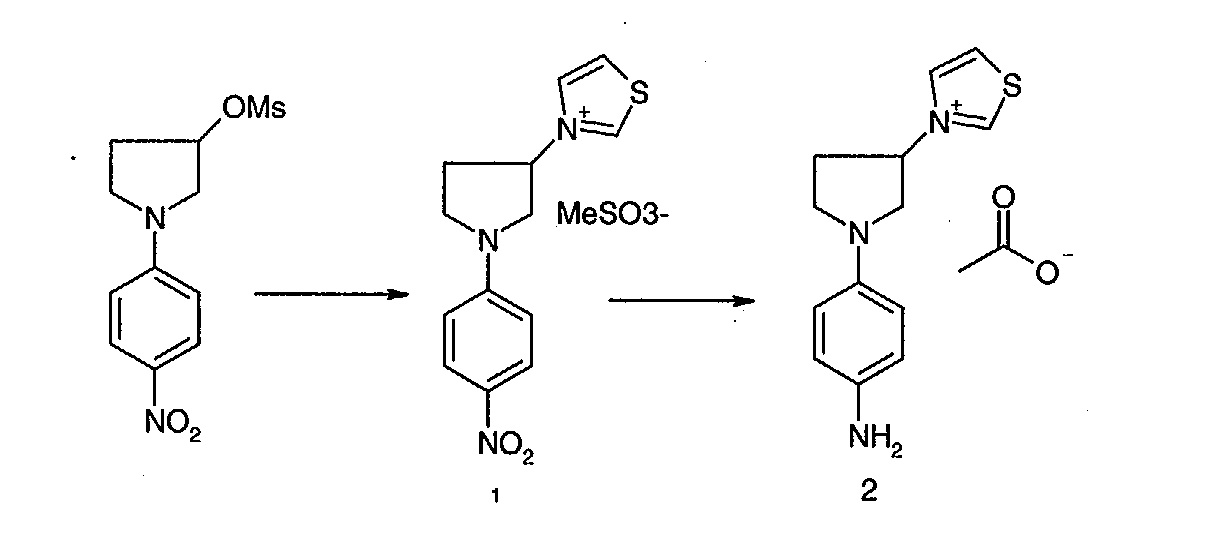
RMN 1H (400MHz-DMSO) ppm ) 10,26 (dd, 1H) ; 8,64 (dd ,1H) ; 8,41 (dd 1H) ; 8,12 (m ,2 H) ; 6,74 (m ,2 H) ; 5,72 (m, 1H) ; 4,05 (dd ,1 H) ; 3,95 (dd , 1H) ; 3,76( m , 1H ) ; 3,62 (m , 1H) ; 2,76( m, 1H) ; 2,6 (m, 1H) ; 2,31 (s, 3H).
Masse ESI+ : m/z=270[M+]
Masse ESI+ : m/z=246[M+]

RMN 1H (400MHz-DMSO) ppm 9,26 (m, 2H) ; 8,67 (m, 1H) ; 8,2 (m, 2H) ; 8,1 (m, 2H) ; 6,74 (m, 1H) ; 5,86 (m, 1H) ; 4,03 (dd, 1H) ; 3,84 (m, 1H) ; 3,62 (m, 1H) ; 2,84 (m, 1H) ; 2,67 (m, 1H).
Masse ESI+ : m/z=270[M+]
Masse ESI+ : m/z=240[M+]
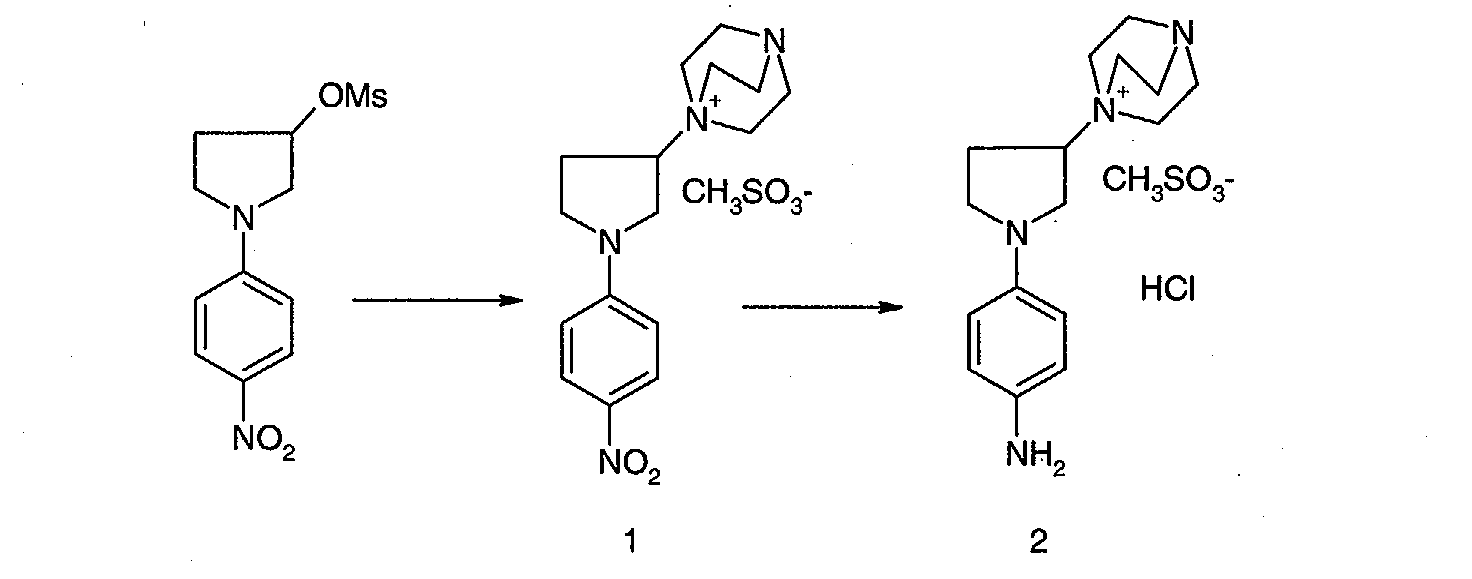
RMN 1H (400MHz-DMSO) ppm 8,14 (d, 2H) ; 6,72 (d, 2 H) ; 3,67 -4,26 (m, 4H) ; 3,41 (m, 7H) ; 3,06(m, 6H) ; 2,35-2,56 (m, 4H) ; 2,30 (s, 3H).
Masse ESI+ : m/z=303[M+]
RMN 1H (400MHz-D20) ppm 7,35 (m, 2H) ; 6,88 (m, 2H) ; 4,6 (m, 1H) ; 4,11 (t, 6H) ; 4,02 (m, 2H) ; 3,96( t, 6H) ; 3,74 (m, 2H) ; 2,8 (s, 3H) ; 2,66 (m, 2H).Masse ESI+ : m/z=373[M+]



Claims (29)
- Dérivés de paraphénylènediamine substitués par un groupement pyrrolidinyle de formule (I) et leurs sels d'additiondans laquelle
 Y- représente un contre ion.n est compris entre 0 et 4, étant entendu que lorsque n est supérieur ou égal à 2 alors les radicaux R1 peuvent être identiques ou différents,R1 représente un atome d'halogène ; une chaíne hydrocarbonée en C1-C6, aliphatique ou alicyclique, saturée ou insaturée, un ou plusieurs atomes de carbone pouvant être remplacés par un atome d'oxygène, d'azote, de silicium, de soufre, par un groupement SO2, ; un radical onium Z, le radical R1 ne comportant pas de liaison peroxyde, ni de radicaux diazo, nitro ou nitroso ,R2 représente un radical onium Z choisi parmi les radicaux Z de formule (II), (III) ou (IV) suivante ou un radical -X-C=NR8-NR9R10 dans lequel X représente un atome d'oxygène ou un radical -NR11 et R8, R9,R10 et R11 représentent un hydrogène, un radical alkyle en C1-C4 ou un radical hydroxyalkyle en C1-C4 ;Formule (II)dans laquelle
 D est une liaison covalente ou une chaíne alkylène en C1-C14, linéaire ou ramifiée pouvant être interrompue par un ou plusieurs hétéroatomes choisis parmi l'oxygène, le soufre ou l'azote, et pouvant être substituée par un ou plusieurs radicaux hydroxyle, alcoxy en C1-C6 ou amino, et pouvant porter une ou plusieurs fonctions cétone ;liaison covalente R4, R5 et R6, pris séparément, représentent un radical alkyle en C1-C15 ; un radical monohydroxyalkyle en C1-C6 ; un radical polyhydroxyalkyle en C2-C6 ; un radical alcoxy(C1-C6)alkyle en C1-C6 ; un radical aryle ; un radical benzyle ; un radical amidoalkyle en C1-C6 ; un radical trialkyl(C1-C6)silanealkyle en C1-C6 ; un radical aminoalkyle en C1-C6 ; un radical aminoalkyle en C1-C6 dont l'amine est mono-, di- ou tri-substituée par un radical alkyle en C1-C4, alkyl(C1-C6)carbonyle, amido ou alkyl(C1-C6)sulfonyle ; à la condition que si D représente une liaison covalente alors R4 représente un radical aryle ; un radical benzyle ; un radical amidoalkyle en C1-C6 ; un radical trialkyl(C1-C6)silanealkyle en C1-C6 ; un radical aminoalkyle en C1-C6 ; un radical aminoalkyle en C1-C6 dont l'amine est mono-, di- ou tri-substituée par un radical alkyle en C1-C4, alkyl(C1-C6)carbonyle, amido ou alkyl(C1-C6)sulfonyle;R4, R5 et R6 ensemble, deux à deux, forment, avec l'atome d'azote auxquels ils sont rattachés, un cycle saturé carboné à 4, 5, 6 ou 7 chaínons pouvant contenir un ou plusieurs hétéroatomes, le cycle cationique pouvant être substitué par un atome d'halogène, un radical hydroxyle, un radical alkyle en C1-C6, un radical monohydroxyalkyle en C1-C6, un radical polyhydroxyalkyle en C2-C6, un radical alcoxy en C1-C6, un radical trialkyl(C1-C6)silanealkyle en C1-C6, un radical amido, un radical carboxyle, un radical alkyl(C1-C6)carbonyle, un radical thio, un radical thioalkyle en C1-C6, un radical alkyl(C1-C6)thio, un radical amino, un radical amino mono- di- ou tri substitué par un radical alkyl(C1-C6), alkyl(C1-C6)carbonyle, amido ou alkyl(C1-C6)sulfonyle;R7 représente un radical alkyle en C1-C6 ; un radical monohydroxyalkyle en C1-C6 ; un radical polyhydroxyalkyle en C2-C6 ; un radical aryle ; un radical benzyle ; un radical aminoalkyle en C1-C6 ; un radical aminoalkyle en C1-C6 dont l'amine est mono- ou di-subsitué par un radical alkyl(C1-C6), alkyl(C1-C6)carbonyle, amido ou alkyl(C1-C6)sulfonyle ; un radical carboxyalkyle en C1-C6 ; un radical carbamylalkyle en C1-C6 ; un radical trifluoroalkyle en C1-C6 ; un radical trialkyl(C1-C6)silanealkyle en C1-C6 ; un radical sulfonamidoalkyle en C1-C6 ; un radical alkyl(C1-C6)carboxyalkyle en C1-C6 ; un radical alkyl(C1-C6)sulfinylalkyle en C1-C6 ; un radical alkyl(C1-C6)sulfonylalkyle en C1-C6 ; un radical alkyl(C1-C6)carbonylalkyle en C1-C6 ; un radical N-alkyl(C1-C6)carbamylalkyle en C1-C6 ; un radical N-alkyl(C1-C6)sulfonamidoalkyle en C1-C6 ;x est 0 ou 1,lorsque x = 0, alors le bras de liaison est rattaché à l'atome d'azote portant les radicaux R4 à R6,lorsque x = 1, alors deux des radicaux R4 à R6 forment conjointement avec l'atome d'azote auquel ils sont rattachés un cycle saturé à 4, 5, 6 ou 7 chaínons et D est lié à un atome de carbone du cycle saturé,Formule (III)dans laquelle
 D est une liaison covalent ou une chaíne alkylène en C1-C14, linéaire ou ramifiée pouvant être interrompue par un ou plusieurs hétéroatomes choisis parmi l'oxygène, le soufre ou l'azote, et pouvant être substituée par un ou plusieurs radicaux hydroxyle, alcoxy en C1-C6 ou amino, et pouvant porter une ou plusieurs fonctions cétone;les sommets E, G, J, L, identiques ou différents, représentent un atome de carbone, d'oxygène, de soufre ou d'azote pour former un cycle pyrrolique, pyrazolique, imidazolique, triazolique, oxazolique, isooxazolique, thiazolique, isothiazolique,q est un nombre entier compris entre 0 et 4 inclus ;o est un nombre entier compris entre 0 et 3 inclus ;q+o est un nombre entier compris entre 0 et 4R, identiques ou différents, représentent un atome d'halogène, un radical hydroxyle, un radical alkyle en C1-C6, un radical monohydroxyalkyle en C1-C6, un radical polyhydroxyalkyle en C2-C6, un radical alcoxy en C1-C6, un radical trialkyl(C1-C6)silanealkyle en C1-C6, un radical amido, un radical carboxyle, un radical alkylcarbonyle en C1-C6, un radical thio, un radical thioalkyle en C1-C6, un radical alkyl(C1-C6)thio, un radical amino, un radical amino mono ou di substituée par un radical alkyl(C1-C6), alkyl(C1-C6)carbonyle, amido, alkyl(C1-C6)sulfonyle ; un radical monohydroxyalkyle en C1-C6 ou un radical polyhydroxyalkyle en C2-C6 ; étant entendu que les radicaux R sont portés par un atome de carbone,R3 , identique ou différent, représente un radical alkyle en C1-C6, un radical monohydroxyalkyle en C1-C6, un radical polyhydroxyalkyle en C2-C6, un radical trialkyl(C1-C6)silanealkyle en C1-C6, un radical alcoxy(C1-C6)alkyle en C1-C6, un radical carbamylalkyle C1-C6, un radical alkyl(C1-C6)carboxyalkyle en C1-C6, un radical benzyle ; étant entendu que les radicaux R3 sont portés par un azote,R7 représente un radical alkyle en C1-C6 ; un radical monohydroxyalkyle en C1-C6 ; un radical polyhydroxyalkyle en C2-C6 ; un radical aryle ; un radical benzyle ; un radical aminoalkyle en C1-C6, un radical aminoalkyle en C1-C6 dont l'amine est substitué par un radical alkyl(C1-C6), alkyl(C1-C6)carbonyle, amido ou alkyl(C1-C6)sulfonyle ; un radical carboxyalkyle en C1-C6 ; un radical carbamylalkyle en C1-C6 ; un radical trifluoroalkyle en C1-C6 ; un radical trialkyl(C1-C6)silanealkyle en C1-C6 ; un radical sulfonamidoalkyle en C1-C6 ; un radical alkyl(C1-C6)carboxyalkyle en C1-C6 ; un radical alkyl(C1-C6)sulfinylalkyle en C1-C6 ; un radical alkyl(C1-C6)sulfonylalkyle en C1-C6 ; un radical alkyl(C1-C6)carboxyalkyle en C1-C6 ; un radical N-alkyl(C1-C6)carbamylalkyle en C1-C6 ; un radical N-alkyl(C1-C6)sulfonamidoalkyle en C1-C6 ;x est 0 ou 1lorsque x = 0, le bras de liaison D est rattaché à l'atome d'azote,lorsque x = 1, le bras de liaison D est rattaché à l'un des sommets E, G, J ou L,Formule (IV)dans laquelle :
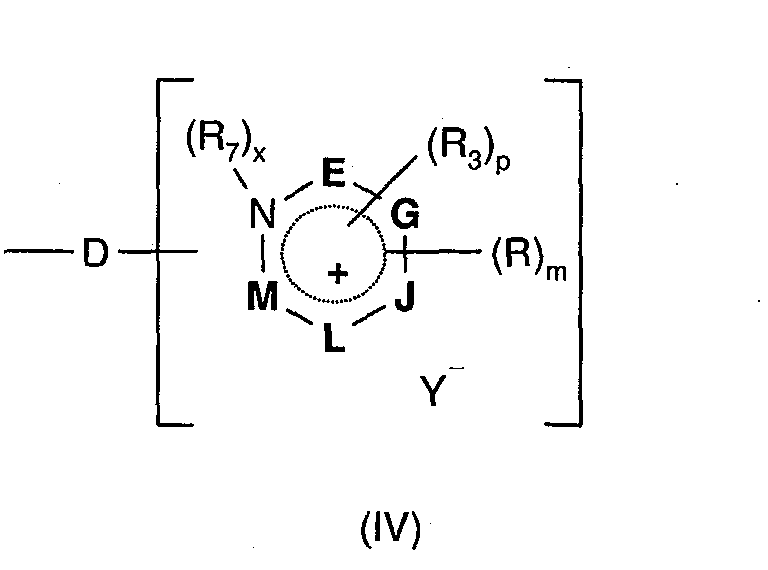 D est une liaison covalent ou une chaíne alkylène en C1-C14, linéaire ou ramifiée pouvant être interrompue par un ou plusieurs hétéroatomes choisis parmi un atomes d'oxygène, de soufre ou d'azote, et pouvant être substituée par un ou plusieurs radicaux hydroxyle, alcoxy en C1-C6 ou amino, et pouvant porter une ou plusieurs fonctions cétone;les sommets E, G, J, L et M identiques ou différents, représentent un atome de carbone, d'oxygène, de soufre ou d'azote et forment un cycle choisi parmi les cycles pyridiniques, pyrimidiniques, pyraziniques, triaziniques et pyridaziniques,p est un nombre entier compris entre 0 et 3 inclus ;m est un nombre entier compris entre 0 et 5 inclus ;p+m est un nombre entier compris entre 0 et 5 ;R, identiques ou différents, représentent un atome d'halogène, un radical hydroxyle, un radical alkyle en C1-C6, un radical monohydroxyalkyle en C1-C6, un radical polyhydroxyalkyle en C2-C6, un radical alcoxy en C1-C6, un radical trialkyl(C1-C6)silanealkyle en C1-C6, un radical amido, un radical carboxyle, un radical alkylcarbonyle en C1-C6, un radical thio, un radical thioalkyle en C1-C6, un radical alkyl(C1-C6)thio, un radical amino, un radical amino substitué par un radical alkyl(C1-C6), alkyl(C1-C6)carbonyle, amido ou alkyl(C1-C6)sulfonyle ; un radical monohydroxyalkyle en C1-C6 ou un radical polyhydroxyalkyle en C2-C6 ; étant entendu que les radicaux R sont portés par un atome de carbone,R3 , identiques ou différents, représentent un radical alkyle en C1-C6, un radical monohydroxyalkyle en C1-C6, un radical polyhydroxyalkyle en C2-C6, un radical trialkyl(C1-C6)silanealkyle en C1-C6, un radical alcoxy(C1-C6)alkyle en C1-C6, un radical carbamylalkyle C1-C6, un radical alkyl(C1-C6)carboxyalkyle en C1-C6, un radical benzyle ; étant entendu que les radicaux R3 sont portés par un azote,R7 représente un radical alkyle en C1-C6 ; un radical monohydroxyalkyle en C1-C6 ; un radical polyhydroxyalkyle en C2-C6 ; un radical aryle ; un radical benzyle ; un radical aminoalkyle en C1-C6, un radical aminoalkyle en C1-C6 dont l'amine est mono- ou di- substituée par un radical alkyl(C1-C6), alkyl(C1-C6)carbonyle, amido ou alkyl(C1-C6)sulfonyle ; un radical carboxyalkyle en C1-C6 ; un radical carbamylalkyle en C1-C6 ; un radical trifluoroalkyle en C1-C6 ; un radical trialkyl(C1-C6)silanealkyle en C1-C6; un radical sulfonamidoalkyle en C1-C6 ; un radical alkyl(C1-C6)carboxyalkyle en C1-C6 ; un radical alkyl(C1-C6)sulfinylalkyle en C1-C6 ; un radical alkyl(C1-C6)sulfonylalkyle en C1-C6 ; un radical alkyl(C1-C6)carboxyalkyle en C1-C6 ; un radical N-alkyl(C1-C6)carbamylalkyle en C1-C6 ; un radical N-alkyl(C1-C6)sulfonamidoalkyle en C1-C6 ;x est 0 ou 1lorsque x = 0, le bras de liaison D est rattaché à l'atome d'azote,lorsque x = 1, le bras de liaison D est rattaché à l'un des sommets E, G, J, L ou M,
 - Dérivés selon la revendication 1 dans lesquels n est égal à 0.
- Dérivés selon la revendication 1 dans lesquels n est égal à 1 et R1 est un atome d'halogène ; une chaíne hydrocarbonée en C1-C6, aliphatique ou alicyclique, saturée ou insaturée, un ou plusieurs atomes de carbone pouvant être remplacés par un atome d'oxygène, d'azote, de silicium, de soufre, par un groupement SO2, le radical R1 ne comportant pas de liaison peroxyde, ni de radicaux diazo, nitro ou nitroso.
- Dérivés selon la revendication 1 dans lesquels R1 est choisi parmi le chlore, le brome, un radical alkyle en C1-C4, hydroxyalkyle en C1-C4, aminoalkyle en C1-C4, alcoxy en C1-C4, hydroxyalcoxy en C1-C4.
- Dérivés selon la revendication 4 dans lesquels R1 est choisi parmi un radical méthyle, hydroxyméthyle, 2-hydroxyéthyle, 1,2-dihydroxyéthyle, méthoxy, isopropyloxy, 2-hydroxyéthoxy.
- Dérivés selon l'une quelconque des revendications 1 à 5 dans lesquels R2 de formule (II) est tel que x est égal à 0, et R5 et R6 séparément sont choisis parmi un radical alkyle en C1-C6, un radical monohydroxyalkyle en C1-C4, un radical polyhydroxyalkyle en C2-C4, un radical alcoxy(C1-C6)alkyle en C1-C4, un radical amidoalkyle en C1-C6, un radical trialkyl(C1-C6)silanealkyle en C1-C6 , ou R4 avec R5 forment ensemble un cycle azétidine, pyrrolidine, pipéridine, pipérazine, morpholine, R6 étant choisi dans ce cas parmi un radical alkyle en C1-C6 ; un radical monohydroxyalkyle en C1-C6 ; un radical polyhydroxyalkyle en C2-C6 ; un radical aminoalkyle en C1-C6, un radical aminoalkyle mono- ou di-substitué par un radical alkyl(C1-C6), alkyl(C1-C6)carbonyle, amido ou alkyl(C1-C6)sulfonyle ; un radical carbamylalkyle en C1-C6 ; un radical trialkyl(C1-C6)silanealkyle en C1-C6 ; un radical alkyl(C1-C6)carboxyalkyle en C1-C6 ; un radical alkyl(C1-C6)carbonylalkyle en C1-C6 ; un radical N-alkyl(C1-C6)carbamylalkyle en C1-C6.
- Dérivés selon l'une quelconque des revendications 1 à 5 dans lesquels R2 de formule (II) est tel que x est égal à 1, R7 est choisi parmi un radical alkyle en C1-C6 ; un radical monohydroxyalkyle en C1-C6 ; un radical polyhydroxyalkyle en C2-C6 ; un radical aminoalkyle en C1-C6, un radical aminoalkyle en C1-C6 dont l'amine est mono ou disubstituée par un radical alkyl(C1-C6), alkyl(C1-C6)carbonyle, amido ou alkyl(C1-C6)sulfonyle ; un radical carbamylalkyle en C1-C6 ; un radical trialkyl(C1-C6)silanealkyle en C1-C6 ; un radical alkyl(C1-C6)carboxyalkyle en C1-C6 ; un alkyl(C1-C6)carbonylalkyle en C1-C6 ; un radical N-alkyl(C1-C6)carbamylalkyle en C1-C6 ; R4 avec R5 ensemble forment un cycle azétidine pyrrolidine, pipéridine, pipérazine, morpholine, R6 étant choisi dans ce cas parmi un radical alkyle en C1-C6 ; un radical monohydroxyalkyle en C1-C6 ; un radical polyhydroxyalkyle en C2-C6; un radical aminoalkyle en C1-C6, un radical aminoalkyle en C1-C6 dont l'amine est mono ou disubstituée par un radical alkyl(C1-C6), alkyl(C1-C6)carbonyle, amido ou alkyl(C1-C6)sulfonyle ; un radical carbamylalkyle en C1-C6 ; un radical trialkyl(C1-C6)silanealkyle en C1-C6 ; un radical alkyl(C1-C6)carboxyalkyle en C1-C6 ; un radical alkyl(C1-C6)carbonylalkyle en C1-C6 ; un radical N-alkyl(C1-C6)carbamylalkyle en C1-C6.
- Dérivés selon l'une quelconque des revendications 1 à 7 dans lesquels D est une liaison covalente ou une chaíne alkylène pouvant être substituée.
- Dérivés selon la revendication 8 dans lesquels R2 de formule (III) est tel que les sommets E, G, J et L forment un cycle pyrrolique, imidazolique, pyrazolique, oxazolique, thiazolique et triazolique.
- Dérivés selon la revendication 9 dans lesquels les sommets E, G, J et L forment un cycle imidazolique.
- Dérivés selon la revendication 1 dans lesquels R2 de formule (IV) est tel que les sommets E,G,J,L et M avec l'azote du cycle forment un cycle choisi parmi les cycles pyridiniques, pyrimidiniques.
- Dérivés selon l'une quelconque des revendications 1 à 11 dans lesquels R2 de formule (III) ou (IV) est tel que R, R7 et R3 sont des radicaux alkyles pouvant être substitués.
- Dérivés selon la revendication 1 dans lesquels R2 est un radical -X-C=NR8-NR9R10, X représente un atome d'oxygène ou un radical -NR11, R8 R9 R10 et R11 représentant un hydrogène, un radical alkyle en C1-C4 ou un radical hydroxyalkyle.
- Dérivés selon la revendication 14 dans lesquels X est -NR11, R8 est un hydrogène, R9 et R10 sont choisis parmi l'hydrogène ou un radical alkyle.
- Dérivés de formule (I) dans lesquels R1 et n sont tels que définis à l'une quelconque des revendications 1 à 5 et R2 est Dérivés selon la revendication 1 dans lesquels le radical R2 est un radical -XP(O)(O-)OCH2CH2N+(CH3)3 où X représente un atome d'oxygène ou un radical -NR11, R11 représentant un hydrogène, un radical alkyle en C1-C4 ou un radical hydroxyalkyle
- Dérivés selon l'une quelconque des revendications 1 à 15 choisis parmiN'-[1-(4-Amino-phényl)-pyrrolidin-3-yl]-N,N-diméthyl-guanidineN-[1-(4-Amino-phényl)-pyrrolidin-3-yl]-guanidine3-[1-(4-Amino-phényl)-pyrrolidin-3-yl]-1-méthyl-3H-imidazol-1 -ium; chlorure[1-(4-Amino-phényl)-pyrrolidin-3-yl]-diméthyl-(3-triméthylsilanyl-propyl)-ammonium ; chlorureN'-[1-(4-Amino-3-méthyl-phényl)-pyrrolidin-3-yl]-N,N-diméthyl-guanidineN-[1-(4-Amino-3-méthyl-phényl)-pyrrolidin-3-yl]-guanidine3-[1-(4-Amino-3-méthyl-phényl)-pyrrolidin-3-yl]-1-méthyl-3H-imidazol-1-ium; chlorure[1-(4-Amino-3-méthyl-phényl)-pyrrolidin-3-yl]-diméthyl-(3-triméthylsilanyl-propyl ammonium ; chlorure3-[1-(4-Amino-phényl)-pyrrolidin-3-yl]-1-(3-triméthylsilanyl-propyl)-3H-imidazol-1-ium ; chlorure3-[1-(4-Amino-3-méthyl-phényl)-pyrrolidin-3-yl]-1-(3-triméthylsilanyl-propyl)-3H-imidazol-1-ium ; chlorure1'-(4-Amino-phényl)-1-méthyl-[1,3']bipyrrolidinyl-1-ium; chlorure1'-(4-Amino-3-méthyl-phényl)-1 -méthyl-[1,3']bipyrrolidinyl-1 -ium; chlorure-3-{[1-(4-Amino-phényl)-pyrrolidin-3-ylcarbamoyl]-méthyl}-1-méthyl-3H-imidazol-1-ium ; chlorure-3-{[1-(4-Amino-3-méthyl-phényl)-pyrrolidin-3-ylcarbamoyl]-méthyl}-1 -méthyl-3H-imidazol-1-ium ; chlorure
- Dérivés selon la revendication 16 choisis parmi le 1-méthyl-3-[1-(4-amino-phényl)-pyrrolidin-3-yl]-3H-imidazol-1-ium , chlorure ; chlorhydrate, le N-[1-(4-Amino-phényl)-pyrrolidin-3-yl]-guaninidine ; trichlorhydrate et le l'-(4-Amino-phényl)-1-méthyl-[1,3']bipyrrolidinyl-1-ium; chlorure
- Dérivés selon la revendication 1 dans lesquels la chaíne D comprend un radical phosphoryle.
- Dérivés selon la revendication 18 choisis parmi le [1-(4-Amino-phényl)-pyrrolidin-3-yl]-oxophosphorylcholine, le [1-(4-Amino-3-méthyl-phényl)-pyrrolidin-3-yl]-oxophosphorylcholine.
- Composition tinctoriale comprenant à titre de base d'oxydation au moins un dérivé paraphénylènediamine de formule (I), tel que défini selon l'une quelconque des revendications 1 à 19.
- Composition selon la revendication 20 comprenant de plus un coupleur choisi parmi les méta-phénylènediamines, les méta-aminophénols, les méta-diphénols, les coupleurs naphtaléniques, les coupleurs hétérocycliques et leurs sels d'addition
- Composition selon l'une quelconque des revendications 20 ou 21 comprenant une base d'oxydation additionnelle autre que les bases d'oxydation de formule (I) choisie parmi les para-phénylènediamines, les bis-phénylalkylènediamines, les para-aminophénols, les ortho-aminophénols, les bases hétérocycliques et leurs sels d'addition.
- Composition selon l'une quelconque des revendications précédentes dans laquelle la quantité de chacune des bases d'oxydation est comprise entre 0,001 à 10 % en poids environ du poids total de la composition tinctoriale.
- Composition selon la revendication 23 dans laquelle la quantité de chacun des coupleurs est comprise entre 0,001 et 10 % en poids environ du poids total de la composition tinctoriale.
- Procédé de teinture d'oxydation des fibres kératiniques, caractérisé en ce qu'on applique sur les fibres une composition tinctoriale telle que définie dans l'une quelconque des revendications 20 à 24 en présence d'un agent oxydant pendant un temps suffisant pour développer la coloration désirée.
- Procédé selon la revendication 25 dans lequel l'agent oxydant est choisi parmi le peroxyde d'hydrogène, le peroxyde d'urée, les bromates de métaux alcalins, les persels, les peracides et les enzymes oxydases.
- Dispositif à plusieurs compartiments dans lequel un premier compartiment contient une composition tinctoriale telle que définie à l'une quelconque des revendications 20 à 24 et un deuxième compartiment contient un agent oxydant.
- Utilisation de la composition définie aux revendications 20 à 24 pour la teinture de fibres kératiniques.
- Composés nitro de formule (I') suivantedans laquelle R1, n et R2 sont tels que définis selon l'une quelconque des revendications 1 à 22.
Applications Claiming Priority (2)
| Application Number | Priority Date | Filing Date | Title |
|---|---|---|---|
| FR0203847 | 2002-03-27 | ||
| FR0203847A FR2837821B1 (fr) | 2002-03-27 | 2002-03-27 | Derives de paraphenylenediamine a groupement pyrrolidinyle substitues par un radical cationique et utilisation de ces derives pour la coloration de fibres keratiniques |
Publications (2)
| Publication Number | Publication Date |
|---|---|
| EP1348695A1 true EP1348695A1 (fr) | 2003-10-01 |
| EP1348695B1 EP1348695B1 (fr) | 2012-04-25 |
Family
ID=27799269
Family Applications (1)
| Application Number | Title | Priority Date | Filing Date |
|---|---|---|---|
| EP03290597A Expired - Lifetime EP1348695B1 (fr) | 2002-03-27 | 2003-03-11 | Dérivés de paraphénylènediamine à groupement pyrrolidinyle substitués par un radical cationique et utilisation de ces dérivés pour la coloration de fibres kératiniques |
Country Status (5)
| Country | Link |
|---|---|
| EP (1) | EP1348695B1 (fr) |
| JP (1) | JP2003286256A (fr) |
| AT (1) | ATE555086T1 (fr) |
| ES (1) | ES2384456T3 (fr) |
| FR (1) | FR2837821B1 (fr) |
Cited By (27)
| Publication number | Priority date | Publication date | Assignee | Title |
|---|---|---|---|---|
| EP1428507A1 (fr) * | 2002-12-13 | 2004-06-16 | L'oreal | Composition tinctoriale comprenant une paraphénylènediamine tertiaire cationique et un diacide organique, procédés et utilisations |
| EP1428512A1 (fr) * | 2002-12-13 | 2004-06-16 | L'oreal | Composition tinctoriale comprenant une paraphénylènediamine tertiaire cationique et un paraaminophénol, procédés et utilisations |
| FR2865388A1 (fr) * | 2004-01-28 | 2005-07-29 | Oreal | Composition de teinture des fibres keratiniques contenant une alcool oxydase et une base d'oxydation cationique, procede mettant en oeuvre cette composition |
| EP1674074A1 (fr) * | 2004-12-23 | 2006-06-28 | L'oreal | Traitement de fibres kératiniques colorées avec une composition comprenant un tensioactif non ionique particuler et/ou amphotère et/ou anionique doux particulier et utilisation pour protéger la couleur |
| EP1728500A1 (fr) | 2005-05-31 | 2006-12-06 | L'oreal | Composition pour la teinture des fibres kératiniques comprenant un dérivé de diamino-N,N-dihydro-pyrazolone et un colorant d'oxydation cationique |
| US7674299B2 (en) | 2006-12-21 | 2010-03-09 | L'oreal S.A. | Direct dye composition comprising a cationic surfactant, a bioheteropolysaccharide, an amphoteric surfactant and direct dye |
| EP2198853A1 (fr) | 2008-12-19 | 2010-06-23 | L'oreal | Composition de teinture d'oxydation des fibres kératiniques comprenant un corps gras et la n,n bis (beta-hydroxyéthyl)-paraphénylène diamine |
| EP2198846A1 (fr) | 2008-12-19 | 2010-06-23 | L'oreal | Composition de teinture d'oxydation des fibres kératiniques comprenant un corps gras, un épaississant et un précurseur de colorant d'oxydation |
| EP2198839A1 (fr) | 2008-12-19 | 2010-06-23 | L'oreal | Composition de teinture d'oxydation des fibres kératiniques comprenant un corps gras et un dérivé 4,5-diaminopyrazole |
| EP2198845A2 (fr) | 2008-12-19 | 2010-06-23 | L'oreal | Composition de teinture d'oxydation des fibres keratiniques comprenant un para-aminophenol et du dipropyleneglycol |
| EP2198840A1 (fr) | 2008-12-19 | 2010-06-23 | L'oreal | Composition de teinture d'oxydation des fibres kératiniques comprenant un corps gras et un dérivé de diaminopyrazolone |
| US7799094B2 (en) | 2006-12-21 | 2010-09-21 | L'oreal S.A. | Oxidation dye composition comprising a cationic surfactant, a bioheteropolysaccharide, an amphoteric surfactant and a dye precursor |
| EP2246039A1 (fr) | 2009-04-30 | 2010-11-03 | L'Oréal | Procédé de coloration des cheveux comprenant une étape de traitement des cheveux à partir d'un composé organique du silicium |
| EP2266528A1 (fr) | 2009-04-30 | 2010-12-29 | L'Oréal | Procédé de coloration et/ou de blanchiement des cheveux à base d'une composition comprenant une amino trialcoxysilane ou une amino trialcenyloxysilane |
| DE102011079773A1 (de) | 2011-07-26 | 2012-08-30 | Henkel Ag & Co. Kgaa | Neue Oxidationsfarbstoffvorprodukte |
| WO2012175688A2 (fr) | 2011-06-24 | 2012-12-27 | L'oreal | Composition colorante sous forme d'émulsion contenant une amine ou un phospholipide, au moins un tensioactif non ionique et au moins un acide carboxylique, et procédé de production de ladite composition |
| WO2012175687A2 (fr) | 2011-06-24 | 2012-12-27 | L'oreal | Composition colorante sous forme d'émulsion contenant une amine ou un phospholipide, au moins un tensioactif non ionique et au moins un ester de phosphate, et procédé de production de ladite composition |
| WO2012175685A2 (fr) | 2011-06-24 | 2012-12-27 | L'oreal | Composition colorante sous forme d'émulsion contenant une amine ou un phospholipide, au moins un tensioactif non ionique et au moins une silicone, et procédé de production de ladite composition |
| US8388698B2 (en) | 2011-06-24 | 2013-03-05 | L'oreal | Emulsion dyeing composition containing at least one polyamine, at least one nonionic surfactant and at least one carboxylic acid, and method of using same |
| US8506650B2 (en) | 2011-06-24 | 2013-08-13 | L'oreal | Emulsion dyeing composition containing at least one polyamine, at least one nonionic surfactant and at least one phosphate ester, and method of using same |
| US8512419B2 (en) | 2011-06-24 | 2013-08-20 | L'oreal | Emulsion dyeing composition containing at least one phospholipid, at least one nonionic surfactant and at least one phosphate ester, and method of using same |
| US8518124B2 (en) | 2011-06-24 | 2013-08-27 | L'oreal | Emulsion dyeing composition containing at least one quaternary amine, at least one nonionic surfactant and at least one phosphate ester, and method of using same |
| US8518125B2 (en) | 2011-06-24 | 2013-08-27 | L'oreal | Emulsion dyeing composition containing at least one phospholipid, at least one nonionic surfactant and at least one carboxylic acid, and method of using same |
| US8523955B2 (en) | 2011-06-24 | 2013-09-03 | L'oreal | Emulsion dyeing composition containing at least one fatty quaternary amine, at least one nonionic surfactant and at least one silicone, and method of using same |
| US8529636B2 (en) | 2011-06-24 | 2013-09-10 | L'oreal | Emulsion dyeing composition containing at least one phospholipid, at least one nonionic surfactant and at least one silicone, and method of using same |
| US8540782B2 (en) | 2011-06-24 | 2013-09-24 | L'oreal | Emulsion dyeing composition containing at least one quarternary amine, at least one nonionic surfactant and at least one carboxylic acid and method of using the same |
| WO2016139066A1 (fr) | 2015-03-04 | 2016-09-09 | Symrise Ag | Compositions comprenant des composés mentholés en tant qu'agents apaisants |
Citations (5)
| Publication number | Priority date | Publication date | Assignee | Title |
|---|---|---|---|---|
| US5135543A (en) * | 1989-12-29 | 1992-08-04 | Clairol Incorporated | Quaternized monoalkylenediamine nitrobenzene compounds and their use as dyes for keratinaceous fibers |
| FR2766178A1 (fr) * | 1997-07-16 | 1999-01-22 | Oreal | Nouvelles bases d'oxydation cationiques, leur utilisation pour la teinture d'oxydation des fibres keratiniques, compositions tinctoriales et procedes de teinture |
| WO1999003819A1 (fr) * | 1997-07-16 | 1999-01-28 | L'oreal | Nouvelles bases d'oxydation cationiques, leur utilisation pour la teinture d'oxydation des fibres keratiniques, compositions tinctoriales et procedes de teinture |
| EP1018508A1 (fr) * | 1999-01-08 | 2000-07-12 | L'oreal | Nitrophenylenediamines cationiques monobenzéniques, leur utilisation pour la teinture des fibres kératiniques, compositions tinctoriales les renfermant et procédés de teinture |
| WO2001068043A2 (fr) * | 2000-03-14 | 2001-09-20 | L'oreal | Compositions pour la teinture des fibres keratiniques contenant des derives de paraphenylenediamine a groupement pyrrolidinyle |
Family Cites Families (1)
| Publication number | Priority date | Publication date | Assignee | Title |
|---|---|---|---|---|
| MXPA03005000A (es) * | 2000-12-06 | 2004-09-10 | P & G Clairol Inc | Intermediarios primarios para la coloracion oxidativa del cabello. |
-
2002
- 2002-03-27 FR FR0203847A patent/FR2837821B1/fr not_active Expired - Fee Related
-
2003
- 2003-03-11 EP EP03290597A patent/EP1348695B1/fr not_active Expired - Lifetime
- 2003-03-11 AT AT03290597T patent/ATE555086T1/de active
- 2003-03-11 ES ES03290597T patent/ES2384456T3/es not_active Expired - Lifetime
- 2003-03-27 JP JP2003089390A patent/JP2003286256A/ja not_active Withdrawn
Patent Citations (5)
| Publication number | Priority date | Publication date | Assignee | Title |
|---|---|---|---|---|
| US5135543A (en) * | 1989-12-29 | 1992-08-04 | Clairol Incorporated | Quaternized monoalkylenediamine nitrobenzene compounds and their use as dyes for keratinaceous fibers |
| FR2766178A1 (fr) * | 1997-07-16 | 1999-01-22 | Oreal | Nouvelles bases d'oxydation cationiques, leur utilisation pour la teinture d'oxydation des fibres keratiniques, compositions tinctoriales et procedes de teinture |
| WO1999003819A1 (fr) * | 1997-07-16 | 1999-01-28 | L'oreal | Nouvelles bases d'oxydation cationiques, leur utilisation pour la teinture d'oxydation des fibres keratiniques, compositions tinctoriales et procedes de teinture |
| EP1018508A1 (fr) * | 1999-01-08 | 2000-07-12 | L'oreal | Nitrophenylenediamines cationiques monobenzéniques, leur utilisation pour la teinture des fibres kératiniques, compositions tinctoriales les renfermant et procédés de teinture |
| WO2001068043A2 (fr) * | 2000-03-14 | 2001-09-20 | L'oreal | Compositions pour la teinture des fibres keratiniques contenant des derives de paraphenylenediamine a groupement pyrrolidinyle |
Cited By (30)
| Publication number | Priority date | Publication date | Assignee | Title |
|---|---|---|---|---|
| EP1428507A1 (fr) * | 2002-12-13 | 2004-06-16 | L'oreal | Composition tinctoriale comprenant une paraphénylènediamine tertiaire cationique et un diacide organique, procédés et utilisations |
| EP1428512A1 (fr) * | 2002-12-13 | 2004-06-16 | L'oreal | Composition tinctoriale comprenant une paraphénylènediamine tertiaire cationique et un paraaminophénol, procédés et utilisations |
| FR2865388A1 (fr) * | 2004-01-28 | 2005-07-29 | Oreal | Composition de teinture des fibres keratiniques contenant une alcool oxydase et une base d'oxydation cationique, procede mettant en oeuvre cette composition |
| EP1559412A1 (fr) * | 2004-01-28 | 2005-08-03 | L'oreal | Composition de teinture des fibres kératiniques contenant une alcool oxydase et une base d'oxydation cationique |
| EP1674074A1 (fr) * | 2004-12-23 | 2006-06-28 | L'oreal | Traitement de fibres kératiniques colorées avec une composition comprenant un tensioactif non ionique particuler et/ou amphotère et/ou anionique doux particulier et utilisation pour protéger la couleur |
| FR2879923A1 (fr) * | 2004-12-23 | 2006-06-30 | Oreal | Traitement de fibres keratiniques colorees avec une composition comprenant un tensioactif non ionique et/ou amphotere et/ou anionique doux particulier et utilisation pour proteger la couleur |
| EP1728500A1 (fr) | 2005-05-31 | 2006-12-06 | L'oreal | Composition pour la teinture des fibres kératiniques comprenant un dérivé de diamino-N,N-dihydro-pyrazolone et un colorant d'oxydation cationique |
| US7674299B2 (en) | 2006-12-21 | 2010-03-09 | L'oreal S.A. | Direct dye composition comprising a cationic surfactant, a bioheteropolysaccharide, an amphoteric surfactant and direct dye |
| US7799094B2 (en) | 2006-12-21 | 2010-09-21 | L'oreal S.A. | Oxidation dye composition comprising a cationic surfactant, a bioheteropolysaccharide, an amphoteric surfactant and a dye precursor |
| EP2198853A1 (fr) | 2008-12-19 | 2010-06-23 | L'oreal | Composition de teinture d'oxydation des fibres kératiniques comprenant un corps gras et la n,n bis (beta-hydroxyéthyl)-paraphénylène diamine |
| EP2198846A1 (fr) | 2008-12-19 | 2010-06-23 | L'oreal | Composition de teinture d'oxydation des fibres kératiniques comprenant un corps gras, un épaississant et un précurseur de colorant d'oxydation |
| EP2198839A1 (fr) | 2008-12-19 | 2010-06-23 | L'oreal | Composition de teinture d'oxydation des fibres kératiniques comprenant un corps gras et un dérivé 4,5-diaminopyrazole |
| EP2198845A2 (fr) | 2008-12-19 | 2010-06-23 | L'oreal | Composition de teinture d'oxydation des fibres keratiniques comprenant un para-aminophenol et du dipropyleneglycol |
| EP2198840A1 (fr) | 2008-12-19 | 2010-06-23 | L'oreal | Composition de teinture d'oxydation des fibres kératiniques comprenant un corps gras et un dérivé de diaminopyrazolone |
| EP2246039A1 (fr) | 2009-04-30 | 2010-11-03 | L'Oréal | Procédé de coloration des cheveux comprenant une étape de traitement des cheveux à partir d'un composé organique du silicium |
| EP2266528A1 (fr) | 2009-04-30 | 2010-12-29 | L'Oréal | Procédé de coloration et/ou de blanchiement des cheveux à base d'une composition comprenant une amino trialcoxysilane ou une amino trialcenyloxysilane |
| US8394152B2 (en) | 2011-06-24 | 2013-03-12 | L'oreal | Emulsion dyeing composition containing at least one amine, at least one nonionic surfactant and at least one carboxylic acid, and method of using same |
| US8512419B2 (en) | 2011-06-24 | 2013-08-20 | L'oreal | Emulsion dyeing composition containing at least one phospholipid, at least one nonionic surfactant and at least one phosphate ester, and method of using same |
| WO2012175687A2 (fr) | 2011-06-24 | 2012-12-27 | L'oreal | Composition colorante sous forme d'émulsion contenant une amine ou un phospholipide, au moins un tensioactif non ionique et au moins un ester de phosphate, et procédé de production de ladite composition |
| WO2012175685A2 (fr) | 2011-06-24 | 2012-12-27 | L'oreal | Composition colorante sous forme d'émulsion contenant une amine ou un phospholipide, au moins un tensioactif non ionique et au moins une silicone, et procédé de production de ladite composition |
| US8388698B2 (en) | 2011-06-24 | 2013-03-05 | L'oreal | Emulsion dyeing composition containing at least one polyamine, at least one nonionic surfactant and at least one carboxylic acid, and method of using same |
| US8540782B2 (en) | 2011-06-24 | 2013-09-24 | L'oreal | Emulsion dyeing composition containing at least one quarternary amine, at least one nonionic surfactant and at least one carboxylic acid and method of using the same |
| US8506650B2 (en) | 2011-06-24 | 2013-08-13 | L'oreal | Emulsion dyeing composition containing at least one polyamine, at least one nonionic surfactant and at least one phosphate ester, and method of using same |
| WO2012175688A2 (fr) | 2011-06-24 | 2012-12-27 | L'oreal | Composition colorante sous forme d'émulsion contenant une amine ou un phospholipide, au moins un tensioactif non ionique et au moins un acide carboxylique, et procédé de production de ladite composition |
| US8518124B2 (en) | 2011-06-24 | 2013-08-27 | L'oreal | Emulsion dyeing composition containing at least one quaternary amine, at least one nonionic surfactant and at least one phosphate ester, and method of using same |
| US8518125B2 (en) | 2011-06-24 | 2013-08-27 | L'oreal | Emulsion dyeing composition containing at least one phospholipid, at least one nonionic surfactant and at least one carboxylic acid, and method of using same |
| US8523955B2 (en) | 2011-06-24 | 2013-09-03 | L'oreal | Emulsion dyeing composition containing at least one fatty quaternary amine, at least one nonionic surfactant and at least one silicone, and method of using same |
| US8529636B2 (en) | 2011-06-24 | 2013-09-10 | L'oreal | Emulsion dyeing composition containing at least one phospholipid, at least one nonionic surfactant and at least one silicone, and method of using same |
| DE102011079773A1 (de) | 2011-07-26 | 2012-08-30 | Henkel Ag & Co. Kgaa | Neue Oxidationsfarbstoffvorprodukte |
| WO2016139066A1 (fr) | 2015-03-04 | 2016-09-09 | Symrise Ag | Compositions comprenant des composés mentholés en tant qu'agents apaisants |
Also Published As
| Publication number | Publication date |
|---|---|
| EP1348695B1 (fr) | 2012-04-25 |
| FR2837821A1 (fr) | 2003-10-03 |
| ES2384456T3 (es) | 2012-07-05 |
| JP2003286256A (ja) | 2003-10-10 |
| FR2837821B1 (fr) | 2005-03-11 |
| ATE555086T1 (de) | 2012-05-15 |
Similar Documents
| Publication | Publication Date | Title |
|---|---|---|
| EP1348695B1 (fr) | Dérivés de paraphénylènediamine à groupement pyrrolidinyle substitués par un radical cationique et utilisation de ces dérivés pour la coloration de fibres kératiniques | |
| EP1550656B1 (fr) | Dérivés de 4-5-diamino-N,N-dihydro-pyrazol-3-one condensé, utilisés pour la teinture des fibres keratiniques | |
| EP1792606B1 (fr) | Composition pour la teinture des fibres keratiniques comprenant au moins un dérive 3-amino pyrazolopyridine | |
| EP1792903A1 (fr) | Composition pour la teinture des fibres kératiniques comprenant au moins un dérivé 3-amino pyrazolopyridine cationique | |
| FR2927078A1 (fr) | Composition pour la teinture des fibres keratiniques comprenant au moins un derive de diamino-n,n-dihydro-pyrazolone cationique | |
| EP1341509A1 (fr) | Composition de teinture d'oxydation a base de 1-(4-aminophenyl) pyrrolidines substituees en position 2 | |
| FR2817473A1 (fr) | Composition de teinture d'oxydation a base de 1-4(-aminophenyl)pyrrolidines substituees en position 2 et 4 et procede de teinture de mise en oeuvre | |
| EP1733714A1 (fr) | Composition pour la teinture des fibres kératiniques comprenant un dérivé de diamino-N,N-dihydro-pyrazolone, un coupleur et un polyol | |
| EP1417184B1 (fr) | Composition pour la teinture de fibre keratiniques contenant une paraphenylenediamine substituee par un radical diazacycloheptane | |
| FR2866338A1 (fr) | Composition pour la teinture des fibres keratiniques comprenant au moins un derive de diamino-n,n-dihydro-pyrazolone | |
| EP1396486A1 (fr) | Dérivés bis-paraphénylènediamine à groupement pyrrolidinyle et utilisation de ces dérivés pour la coloration de fibres kératiniques | |
| EP1457199B1 (fr) | Nouveaux coupleurs du type 2,3,5-triaminopyridine et utilisation de ces coupleurs pour la teinture des fibres kératiniques | |
| FR2817470A1 (fr) | Composition de teinture d'oxydation a base de 1-(aminophenyl)pyrrolidines substituees en position 2 et 5 et procede de teinture de mise en oeuvre | |
| FR2817471A1 (fr) | Composition de teinture d'oxydation a base de 1-(4-aminophenyl) pyrrolidines substituees en position 3 et 4 et procede de teinture de mise en oeuvre | |
| EP1498109A1 (fr) | Dérivés du furane et composition tinctoriale comprenant à titre de coupleur un dérivé du furane | |
| EP1462091A1 (fr) | Composition de teinture des fibres kératiniques comprenant un dérivé de para-phénylènediamine cationique substitué par un cycle diazacyclohexane ou diazacycloheptane | |
| EP1518860A1 (fr) | Dérivés de triazacyclononane substitué sur l'un au moins des atomes d'azote par un groupement 4-aminophényle substitué ou non substitué pour la teinture des fibres kératiniques | |
| EP1336606B1 (fr) | Nouveaux coupleurs 6-alcoxy-2,3-diaminopyridine utiles pour la teinture des fibres kératiniques | |
| EP1378230B1 (fr) | Dérivés de para-phénylènediamine à groupement pyrrolidinyle substitué par un radical cyclique et leur utilisation pour la coloration de fibres kératiniques | |
| EP1484049A1 (fr) | Nouveaux composés imidazoles et utilisation de ces composés pour la teinture de fibres kératiniques | |
| EP1462445B1 (fr) | Dérivés de paraphénylènediamine à groupement cyclique diaza substitué par un radical cationique et utilisation de ces dérivés pour la coloration de fibres kératiniques | |
| EP1375480A1 (fr) | Dérivés de para-phénylènediamine à groupement pyrrolidinyle substitué par un radical silyle et utilisation de ces dérives pour la coloration de fibres kératiniques | |
| EP1462453A1 (fr) | Dérivés de paraphénylènediamine à groupement pyrrolidinyle disubstitué et porteur d'un radical cationique et utilisation de ces dérivés pour la coloration de fibres kératiniques | |
| EP1512684A1 (fr) | Utilisation, pour la teinture des fibres kératiniques, d'un dérivés de para-phénylènediamine substituée par un noyau homopiperidine | |
| FR2984324A1 (fr) | Tetrahydropyrazolopyridines cationiques, composition tinctoriale comprenant de telles bases d'oxydation, procede de mise en oeuvre et utilisation |
Legal Events
| Date | Code | Title | Description |
|---|---|---|---|
| PUAI | Public reference made under article 153(3) epc to a published international application that has entered the european phase |
Free format text: ORIGINAL CODE: 0009012 |
|
| AK | Designated contracting states |
Kind code of ref document: A1 Designated state(s): AT BE BG CH CY CZ DE DK EE ES FI FR GB GR HU IE IT LI LU MC NL PT RO SE SI SK TR |
|
| AX | Request for extension of the european patent |
Extension state: AL LT LV MK |
|
| 17P | Request for examination filed |
Effective date: 20040401 |
|
| AKX | Designation fees paid |
Designated state(s): AT BE BG CH CY CZ DE DK EE ES FI FR GB GR HU IE IT LI LU MC NL PT RO SE SI SK TR |
|
| 17Q | First examination report despatched |
Effective date: 20051114 |
|
| GRAP | Despatch of communication of intention to grant a patent |
Free format text: ORIGINAL CODE: EPIDOSNIGR1 |
|
| RIC1 | Information provided on ipc code assigned before grant |
Ipc: A61K 8/49 20060101ALN20110622BHEP Ipc: C07D 487/08 20060101ALI20110622BHEP Ipc: C07D 417/04 20060101ALI20110622BHEP Ipc: C07F 9/09 20060101ALI20110622BHEP Ipc: C07D 521/00 20060101ALI20110622BHEP Ipc: C07D 207/14 20060101AFI20110622BHEP Ipc: A61Q 5/10 20060101ALN20110622BHEP Ipc: C07D 401/04 20060101ALI20110622BHEP |
|
| RIN1 | Information on inventor provided before grant (corrected) |
Inventor name: PHILIPPE, MICHEL Inventor name: RAMOS, LAURE Inventor name: SABELLE, STEPHANE Inventor name: LEDUC, MADELEINE,RES. LES CHEVREFEUILLES |
|
| GRAS | Grant fee paid |
Free format text: ORIGINAL CODE: EPIDOSNIGR3 |
|
| GRAA | (expected) grant |
Free format text: ORIGINAL CODE: 0009210 |
|
| AK | Designated contracting states |
Kind code of ref document: B1 Designated state(s): AT BE BG CH CY CZ DE DK EE ES FI FR GB GR HU IE IT LI LU MC NL PT RO SE SI SK TR |
|
| REG | Reference to a national code |
Ref country code: GB Ref legal event code: FG4D Free format text: NOT ENGLISH |
|
| REG | Reference to a national code |
Ref country code: CH Ref legal event code: EP |
|
| REG | Reference to a national code |
Ref country code: AT Ref legal event code: REF Ref document number: 555086 Country of ref document: AT Kind code of ref document: T Effective date: 20120515 |
|
| REG | Reference to a national code |
Ref country code: IE Ref legal event code: FG4D Free format text: LANGUAGE OF EP DOCUMENT: FRENCH |
|
| REG | Reference to a national code |
Ref country code: DE Ref legal event code: R096 Ref document number: 60340714 Country of ref document: DE Effective date: 20120621 |
|
| REG | Reference to a national code |
Ref country code: ES Ref legal event code: FG2A Ref document number: 2384456 Country of ref document: ES Kind code of ref document: T3 Effective date: 20120705 |
|
| REG | Reference to a national code |
Ref country code: NL Ref legal event code: VDEP Effective date: 20120425 |
|
| REG | Reference to a national code |
Ref country code: AT Ref legal event code: MK05 Ref document number: 555086 Country of ref document: AT Kind code of ref document: T Effective date: 20120425 |
|
| PG25 | Lapsed in a contracting state [announced via postgrant information from national office to epo] |
Ref country code: SE Free format text: LAPSE BECAUSE OF FAILURE TO SUBMIT A TRANSLATION OF THE DESCRIPTION OR TO PAY THE FEE WITHIN THE PRESCRIBED TIME-LIMIT Effective date: 20120425 Ref country code: FI Free format text: LAPSE BECAUSE OF FAILURE TO SUBMIT A TRANSLATION OF THE DESCRIPTION OR TO PAY THE FEE WITHIN THE PRESCRIBED TIME-LIMIT Effective date: 20120425 Ref country code: CY Free format text: LAPSE BECAUSE OF FAILURE TO SUBMIT A TRANSLATION OF THE DESCRIPTION OR TO PAY THE FEE WITHIN THE PRESCRIBED TIME-LIMIT Effective date: 20120425 |
|
| PG25 | Lapsed in a contracting state [announced via postgrant information from national office to epo] |
Ref country code: GR Free format text: LAPSE BECAUSE OF FAILURE TO SUBMIT A TRANSLATION OF THE DESCRIPTION OR TO PAY THE FEE WITHIN THE PRESCRIBED TIME-LIMIT Effective date: 20120726 Ref country code: SI Free format text: LAPSE BECAUSE OF FAILURE TO SUBMIT A TRANSLATION OF THE DESCRIPTION OR TO PAY THE FEE WITHIN THE PRESCRIBED TIME-LIMIT Effective date: 20120425 Ref country code: PT Free format text: LAPSE BECAUSE OF FAILURE TO SUBMIT A TRANSLATION OF THE DESCRIPTION OR TO PAY THE FEE WITHIN THE PRESCRIBED TIME-LIMIT Effective date: 20120827 |
|
| PG25 | Lapsed in a contracting state [announced via postgrant information from national office to epo] |
Ref country code: EE Free format text: LAPSE BECAUSE OF FAILURE TO SUBMIT A TRANSLATION OF THE DESCRIPTION OR TO PAY THE FEE WITHIN THE PRESCRIBED TIME-LIMIT Effective date: 20120425 Ref country code: SK Free format text: LAPSE BECAUSE OF FAILURE TO SUBMIT A TRANSLATION OF THE DESCRIPTION OR TO PAY THE FEE WITHIN THE PRESCRIBED TIME-LIMIT Effective date: 20120425 Ref country code: AT Free format text: LAPSE BECAUSE OF FAILURE TO SUBMIT A TRANSLATION OF THE DESCRIPTION OR TO PAY THE FEE WITHIN THE PRESCRIBED TIME-LIMIT Effective date: 20120425 Ref country code: NL Free format text: LAPSE BECAUSE OF FAILURE TO SUBMIT A TRANSLATION OF THE DESCRIPTION OR TO PAY THE FEE WITHIN THE PRESCRIBED TIME-LIMIT Effective date: 20120425 Ref country code: DK Free format text: LAPSE BECAUSE OF FAILURE TO SUBMIT A TRANSLATION OF THE DESCRIPTION OR TO PAY THE FEE WITHIN THE PRESCRIBED TIME-LIMIT Effective date: 20120425 Ref country code: CZ Free format text: LAPSE BECAUSE OF FAILURE TO SUBMIT A TRANSLATION OF THE DESCRIPTION OR TO PAY THE FEE WITHIN THE PRESCRIBED TIME-LIMIT Effective date: 20120425 Ref country code: RO Free format text: LAPSE BECAUSE OF FAILURE TO SUBMIT A TRANSLATION OF THE DESCRIPTION OR TO PAY THE FEE WITHIN THE PRESCRIBED TIME-LIMIT Effective date: 20120425 |
|
| PLBE | No opposition filed within time limit |
Free format text: ORIGINAL CODE: 0009261 |
|
| STAA | Information on the status of an ep patent application or granted ep patent |
Free format text: STATUS: NO OPPOSITION FILED WITHIN TIME LIMIT |
|
| 26N | No opposition filed |
Effective date: 20130128 |
|
| REG | Reference to a national code |
Ref country code: DE Ref legal event code: R097 Ref document number: 60340714 Country of ref document: DE Effective date: 20130128 |
|
| PG25 | Lapsed in a contracting state [announced via postgrant information from national office to epo] |
Ref country code: BG Free format text: LAPSE BECAUSE OF FAILURE TO SUBMIT A TRANSLATION OF THE DESCRIPTION OR TO PAY THE FEE WITHIN THE PRESCRIBED TIME-LIMIT Effective date: 20120725 |
|
| BERE | Be: lapsed |
Owner name: L'OREAL Effective date: 20130331 |
|
| PG25 | Lapsed in a contracting state [announced via postgrant information from national office to epo] |
Ref country code: MC Free format text: LAPSE BECAUSE OF NON-PAYMENT OF DUE FEES Effective date: 20130331 |
|
| REG | Reference to a national code |
Ref country code: CH Ref legal event code: PL |
|
| GBPC | Gb: european patent ceased through non-payment of renewal fee |
Effective date: 20130311 |
|
| REG | Reference to a national code |
Ref country code: FR Ref legal event code: ST Effective date: 20131129 |
|
| REG | Reference to a national code |
Ref country code: IE Ref legal event code: MM4A |
|
| REG | Reference to a national code |
Ref country code: DE Ref legal event code: R119 Ref document number: 60340714 Country of ref document: DE Effective date: 20131001 |
|
| PG25 | Lapsed in a contracting state [announced via postgrant information from national office to epo] |
Ref country code: CH Free format text: LAPSE BECAUSE OF NON-PAYMENT OF DUE FEES Effective date: 20130331 Ref country code: GB Free format text: LAPSE BECAUSE OF NON-PAYMENT OF DUE FEES Effective date: 20130311 Ref country code: DE Free format text: LAPSE BECAUSE OF NON-PAYMENT OF DUE FEES Effective date: 20131001 Ref country code: FR Free format text: LAPSE BECAUSE OF NON-PAYMENT OF DUE FEES Effective date: 20130402 Ref country code: BE Free format text: LAPSE BECAUSE OF NON-PAYMENT OF DUE FEES Effective date: 20130331 Ref country code: LI Free format text: LAPSE BECAUSE OF NON-PAYMENT OF DUE FEES Effective date: 20130331 Ref country code: IE Free format text: LAPSE BECAUSE OF NON-PAYMENT OF DUE FEES Effective date: 20130311 |
|
| PG25 | Lapsed in a contracting state [announced via postgrant information from national office to epo] |
Ref country code: IT Free format text: LAPSE BECAUSE OF NON-PAYMENT OF DUE FEES Effective date: 20130311 |
|
| PG25 | Lapsed in a contracting state [announced via postgrant information from national office to epo] |
Ref country code: TR Free format text: LAPSE BECAUSE OF FAILURE TO SUBMIT A TRANSLATION OF THE DESCRIPTION OR TO PAY THE FEE WITHIN THE PRESCRIBED TIME-LIMIT Effective date: 20120425 |
|
| REG | Reference to a national code |
Ref country code: ES Ref legal event code: FD2A Effective date: 20150715 |
|
| PG25 | Lapsed in a contracting state [announced via postgrant information from national office to epo] |
Ref country code: LU Free format text: LAPSE BECAUSE OF NON-PAYMENT OF DUE FEES Effective date: 20130311 Ref country code: HU Free format text: LAPSE BECAUSE OF FAILURE TO SUBMIT A TRANSLATION OF THE DESCRIPTION OR TO PAY THE FEE WITHIN THE PRESCRIBED TIME-LIMIT; INVALID AB INITIO Effective date: 20030311 Ref country code: ES Free format text: LAPSE BECAUSE OF NON-PAYMENT OF DUE FEES Effective date: 20130312 |