EP1347602A2 - Two stage egress scheduler for a network device - Google Patents
Two stage egress scheduler for a network device Download PDFInfo
- Publication number
- EP1347602A2 EP1347602A2 EP03006384A EP03006384A EP1347602A2 EP 1347602 A2 EP1347602 A2 EP 1347602A2 EP 03006384 A EP03006384 A EP 03006384A EP 03006384 A EP03006384 A EP 03006384A EP 1347602 A2 EP1347602 A2 EP 1347602A2
- Authority
- EP
- European Patent Office
- Prior art keywords
- packet
- fetching
- queue
- recited
- network device
- Prior art date
- Legal status (The legal status is an assumption and is not a legal conclusion. Google has not performed a legal analysis and makes no representation as to the accuracy of the status listed.)
- Granted
Links
Images


Classifications
-
- H—ELECTRICITY
- H04—ELECTRIC COMMUNICATION TECHNIQUE
- H04L—TRANSMISSION OF DIGITAL INFORMATION, e.g. TELEGRAPHIC COMMUNICATION
- H04L47/00—Traffic control in data switching networks
- H04L47/10—Flow control; Congestion control
-
- H—ELECTRICITY
- H04—ELECTRIC COMMUNICATION TECHNIQUE
- H04L—TRANSMISSION OF DIGITAL INFORMATION, e.g. TELEGRAPHIC COMMUNICATION
- H04L12/00—Data switching networks
- H04L12/54—Store-and-forward switching systems
- H04L12/56—Packet switching systems
Definitions
- the present invention relates to network devices, including switches, routers and bridges, which allow for data to be routed and moved in computing networks. More specifically, the present invention provides for a two stage egress scheduler for assisting in the flow of data to the egress port of a network device and a network device having such a scheduler.
- each element of the network performs functions that allow for the network as a whole to perform the tasks required of the network.
- One such type of element used in computer networks is referred to, generally, as a switch.
- Switches as they relate to computer networking and to Ethernet, are hardware-based devices that control the flow of data packets or cells based upon destination address information, which is available in each packet or cell.
- a properly designed and implemented switch should be capable of receiving a packet and switching the packet to an appropriate output port at what is referred to wirespeed or linespeed, which is the maximum speed capability of the particular network.
- Basic Ethernet wirespeed is up to 10 megabits per second
- Fast Ethernet is up to 100 megabits per second.
- Another type of Ethernet is referred to as 10 gigabit Ethernet, and is capable of transmitting data over a network at a rate of up to 10,000 megabits per second.
- design constraints and design requirements have become more and more complex with respect to following appropriate design and protocol rules and providing a low cost, commercially viable solution.
- One potential difficulty in reaching high-speed operation occurs when packets exit the network device. Packets queued up on an egress port of a network device need to be shaped and scheduled for transmission. This shaping is typically performed on a per class of service (CoS) basis.
- CoS class of service
- a dual leaky bucket algorithm is typically used to shape the packet stream on an egress port. The dual leaky bucket monitors at least two parameters, that are the maximum burst size (MBS) and the rate of transmission.
- packets are stored in DRAM, which has higher access latency than SRAM. Packets are read into SRAM and then scheduled for transmission on the egress ports. The latency of accessing the SDRAM is hidden by using work conserving schemes to transmit packets on the egress port, but this is often inefficient. In addition, if there is flow control per CoS, Head of Line (HOL) blocking problems can occur, as explained below. These difficulties often affect the ability of a network device to provide the level of throughput desired.
- HOL Head of Line
- the present invention provides for a two stage egress scheduler for data packets passing through network devices.
- a network device for network communications includes at least one data port interface, the at least one data port interface supporting at least one ingress data port receiving data and at least one egress port transmitting data.
- the device also includes a memory communicating with the at least one data port interface and a memory management unit including a memory interface for communicating data from the at least one data port interface and the memory.
- the memory management unit includes a scheduler and a prefetch scheduler and the memory comprises at least two queues for containing packet data.
- the prefetch scheduler is configured to fetch packet data from a first queue of the at least two queues and placing the packet data on a second queue of the at least two queues and the scheduler is configured to fetch packet data from the second queue and send the packet data to the at least one egress port.
- the network device may have at least two series of queues, where each queue of the at least two series of queues is configured for packets having a particular class of service.
- the prefetch scheduler may be configured to fetch packet data from a queue of a first series of queues for the particular class of service and place the packet data on a queue of a second series of queues for the particular class of service.
- the prefetch scheduler may be configured to fetch packet data based on at least one fetching criterion, where that criterion may be selected such that the at least one egress port never has to wait for packet data to be fetched to the second queue.
- the network device may have a memory including dynamic random access memory and static random access memory wherein at least one of the at least two queues for containing packet data is configured in the dynamic random access memory.
- the memory may further include at least one flow control bit register and wherein the scheduler may be configured to access the at least one flow control bit register to determine whether packet data should be fetched from the second queue.
- the scheduler may be configured to fetch packet data based on at least one priority scheme, where the scheme may be at least one of a strict priority scheme, weighted round robin scheme and a weighted fair queuing scheme.
- the scheduler may be configured to return a memory pointer position for the packet data upon request from the at least one egress port.
- a method of handling data packets in a network device is disclosed.
- Processed packets are placed into a first queue and at least one processed packet is fetched from the first queue based on at least one fetching criterion.
- the at least one processed packet is placed into a second queue and the at least one processed packet is fetched from the second queue based on at least one priority scheme for egress packets.
- the at least one processed packet is sent to an egress port of the network device.
- the first and the second queues may be associated with a particular class of service, the first and second queues may be implemented in memory and the steps of fetching at least one processed packet comprises fetching at least one processed packet from memory. Additionally, the first queue may be implemented in dynamic random access memory and the second queue may be implemented in static random access memory. Also, the at least one fetching criterion may include fetching processed packets such that the egress port never has to wait for packet data to be fetched.
- the step of fetching the at least one processed packet from the second queue may include accessing a flow control bit for the second queue and fetching the at least one processed packet from the second queue only when the flow control bit has not been set.
- the step of sending the at least one processed packet to an egress port of the network device may include returning a pointer location in memory to the processed packet to the egress port, accessing processed packet data at the pointer location and sending the processed packet data out through the egress port. Additionally, the fetching steps may be performed concurrently.
- the step of fetching the at least one processed packet from the second queue based on at least one priority scheme for egress packets may comprise fetching at least one process packet based on at least one of a strict priority scheme, weighted round robin scheme and a weighted fair queuing scheme.
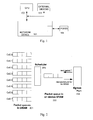
- Fig. 1 is a general block diagram of elements of an example of a network device according to the present invention.
- Fig. 2 is a schematic view of the egress portion of a network device according to an existing implementation
- Fig. 3 is a schematic view of the egress portion of a network device according to one embodiment of the present invention.
- Fig. 4 is a flow chart illustrating the processes carried out by the prefetch scheduler, according to one embodiment of the present invention.
- Fig. 5 is a flow chart illustrating the processes carried out by the scheduler, according to one embodiment of the present invention.
- Fig. 1 illustrates a configuration of a node of the network, in accordance with the present invention.
- the network device 101 is connected to a Central Processing Unit (CPU) 102 and other external devices 103.
- the CPU can be used as necessary to program the network device 101 with rules that are appropriate to control packet processing.
- the network 101 device should be able to process data received through physical ports 104 with only minimal interaction with the CPU and operate, as much as possible, in a free running manner.
- the present is directed to systems and processes involved in sending data processed by the network device to the egress ports to reach their respective destinations.
- the scheduler 202 uses some scheduling policy like strict priority (SP), weighted round robin (WRR) or a combination to schedule packets for the egress port.
- SP strict priority
- WRR weighted round robin
- the memory management unit (MMU) transfers the next packet scheduled by the scheduler from the DRAM 201 to the on chip SRAM 203. It then queues the packet to be sent to the egress port 204 in a single queue of packet descriptors. Whenever the egress port 204 requests a packet, the next packet queued in the egress queue 203 is transmitted out.
- HOL blocking is a phenomenon that occurs in an input-buffered switch wherein a packet is temporarily blocked by another packet either at the input buffer or at the output buffer. In other words, packets destined for non-congested ports can be delayed because a packet is blocked in front of other packets which would otherwise not be blocked. If flow control is exerted for any CoS, head of line (HOL) blocking will result for all other CoSs, since there is only a single egress queue 203 for packets in the SRAM.
- Weighted Fair Queuing is a technique where bandwidth is shared between CoSes to ensure fairness and parameters like information rate and maximum burst size are controlled on a per CoS basis.
- the traffic will be shaped through WFQ according to user specified parameters of committed information rate, peak information rate, peak burst size and committed burst size per CoS.
- the committed information rate is the minimum rate of data transmission for the CoS and the peak information rate is the upper bound of that rate.
- the other parameters relate to the burst rates of data and the above two rates. Through these parameters, the shaping of the queues of packets can be controlled and the flow can be controlled on the number of bytes for each CoS.
- the two-stage scheduler has of a first stage, a Prefetch Scheduler (PS) 302, and a second stage, a scheduler (S) 305.
- the per CoS packet queues are still in the SDRAM 301.
- the PS 302 is responsible for transferring packets from the DRAM 301 to the SRAM 303 based on a specific policy configured for the system. This policy is independent of the scheduler's scheduling policy.
- the scheduler responds to egress port requests by returning a pointer to the packet in SRAM whenever the egress port requests the next packet.
- the Scheduler 305 can implement one of the following schemes: 1) Strict Priority (SP); 2) Weighted Round Robin (WRR), 3) SP plus WRR, and 4) Weighted Fair Queuing (WFQ).
- SP Strict Priority
- WRR Weighted Round Robin
- WFQ Weighted Fair Queuing
- the scheduler implements a flow control mechanism overriding any of the above scheduling mechanism. There is one bit per CoS, i.e. flow control bits, as shown in Fig. 3.
- a flow control bit is set to 1 when a pause message is received from a physical port for a CoS. No packets are scheduled for transmission from a CoS if the flow control bit is set to 1. When a resume message is received for a CoS, the flow control bit is set to 0.
- the Prefetch Scheduler (PS) 302 is responsible for prefetching packets from the DRAM to the SRAM.
- One purpose of the PS 302 is to hide the latency of DRAM read access to achieve line rate egress port performance. Additionally, the PS also acts to decouple the process of fetching packets from the DRAM, thus optimizing the opening and closing of pages and at the same time achieving the fairness expected of the shaping algorithm chosen.
- the PS also allows packets to be prefetched into the SRAM for each CoS queue based on the scheduling policy chosen per CoS.
- the number of packets fetched is chosen such that the egress port does not have to wait for a packet to be fetched from the DRAM.
- Flow charts for the processes carried out by the Prefetch Scheduler 302 and the Scheduler 305 are illustrated in Figs. 4 and 5, respectively.
- the PS monitors the queues or fetches packets such that the egress port never has to wait for a packet to be fetched from the DRAM. Such a determination is applied to decide whether a next packet is to be fetched from a particular CoS queue in DRAM.
- the scheduler looks at the control bit for a particular CoS queue selected based on a priority scheme. If the bit is not set, then a pointer is returned to the egress port for a packet in the per CoS queue. If the control bit is set, then the scheduler selects another queue based on the priority scheme.
- the above process and two stage egress scheduler allows per CoS flow control to operate without causing any head of line blocking and enable a true WFQ implementation.
- the present invention also allows for many types of scheduling policies to be implemented and provides for an efficient compensation for the higher access latency of the DRAM used in the packet queues.
- the above-discussed configuration of the invention is, in one embodiment, embodied on a semiconductor substrate, such as silicon, with appropriate semiconductor manufacturing techniques and based upon a circuit layout which would, based upon the embodiments discussed above, be apparent to those skilled in the art.
- a person of skill in the art with respect to semiconductor design and manufacturing would be able to implement the various modules, interfaces, and components, etc. of the present invention onto a single semiconductor substrate, based upon the architectural description discussed above. It would also be within the scope of the invention to implement the disclosed elements of the invention in discrete electronic components, thereby taking advantage of the functional aspects of the invention without maximizing the advantages through the use of a single semiconductor substrate.
- packet has been used in the description of the present invention, the invention has import to many types of network data.
- packet includes packet, cell, frame, datagram, bridge protocol data unit packet, and packet data.
Landscapes
- Engineering & Computer Science (AREA)
- Computer Networks & Wireless Communication (AREA)
- Signal Processing (AREA)
- Data Exchanges In Wide-Area Networks (AREA)
Abstract
Description
Claims (28)
- A network device for network communications, said network device comprising:wherein said memory management unit comprises a scheduler and a prefetch scheduler and said memory comprises at least two queues for containing packet data, and wherein said prefetch scheduler is configured to fetch packet data from a first queue of said at least two queues and placing the packet data on a second queue of said at least two queues and the scheduler is configured to fetch packet data from said second queue and send the packet data to the at least one egress port.at least one data port interface, said at least one data port interface supporting at least one ingress data port receiving data and at least one egress port transmitting data;a memory, said memory communicating with said at least one data port interface; anda memory management unit, said memory management unit including a memory interface for communicating data from said at least one data port interface and said memory;
- A network device as recited in claim 1, wherein said at least two queues comprises at least two series of queues, where each queue of said at least two series of queues is configured for packets having a particular class of service.
- A network device as recited in claim 2, wherein said prefetch scheduler is configured to fetch packet data from a queue of a first series of queues for said particular class of service and place said packet data on a queue of a second series of queues for said particular class of service.
- A network device as recited in claim 1, wherein said prefetch scheduler is configured to fetch packet data based on at least one fetching criterion.
- A network device as recited in claim 4, wherein said prefetch scheduler is configured such that at least one fetching criterion is selected such that the at least one egress port does not have to wait for packet data to be fetched to said second queue.
- A network device as recited in claim 1, wherein said memory comprises dynamic random access memory and static random access memory, and wherein at least one of said at least two queues for containing packet data is configured in the dynamic random access memory.
- A network device as recited in claim 1, wherein said memory comprises at least one flow control bit register, and wherein the scheduler is configured to access the at least one flow control bit register to determine whether packet data should be fetched from said second queue.
- A network switch as recited in claim 1, said scheduler is configured to fetch packet data based on at least one priority scheme.
- A network switch as recited in claim 8, wherein said priority schemes comprises at least one of a strict priority scheme, weighted round robin scheme and a weighted fair queuing scheme.
- A network switch as recited in claim 1, wherein scheduler is configured to return a memory pointer position for the packet data upon request from the at least one egress port.
- A method of handling data packets in a network device, said method comprising:placing packets into a first queue;fetching at least one packet from said first queue based on at least one fetching criterion;placing said at least one packet into a second queue ;fetching said at least one packet from said second queue based on at least one priority scheme for egress packets; andsending the at least one packet to an egress port of the network device.
- A method as recited in claim 11 wherein each of the first and the second queues are associated with a particular class of service.
- A method as recited in claim 11, wherein said first and second queues are implemented in memory and said steps of fetching at least one packet comprises fetching at least one packet from memory.
- A method as recited in claim 13, wherein said first queue is implemented in dynamic random access memory and said second queue is implemented in static random access memory.
- A method as recited in claim 11, wherein said step of fetching said at least one packet from said second queue comprises:accessing a flow control bit for said second queue; andfetching said at least one packet from said second queue only when said flow control bit has not been set.
- A method as recited in claim 11, wherein step of sending the at least one packet to an egress port of the network device comprises:returning a pointer location in memory to said packet to said egress port;accessing packet data at the pointer location; andsending said packet data out through the egress port.
- A method as recited in claim 11, wherein said step of fetching at least one packet from said first queue based on at least one fetching criterion comprises fetching packets such that the egress port never has to wait for packet data to be fetched.
- A method as recited in claim 11, wherein said fetching steps are performed concurrently.
- A method as recited in claim 11, wherein said step of fetching said at least one processed packet from said second queue based on at least one priority scheme for egress packets comprises fetching at least one process packet based on at least one of a strict priority scheme, weighted round robin scheme and a weighted fair queuing scheme.
- A network device for handling data packets, said network device comprising:first placing means for placing packets into a first queue;first fetching means for fetching at least one packet from said first queue based on at least one fetching criterion;second placing means for placing said at least one packet into a second queue ;second fetching means for fetching said at least one packet from said second queue based on at least one priority scheme for egress packets; andsending means for sending the at least one packet to an egress port of the network device.
- A network device as recited in claim 20 wherein the first and the second queues are associated with a particular class of service.
- A network device as recited in claim 20, wherein said first and second queues are implemented in memory and said first and second fetching means are configured to fetch at least one packet from memory.
- A network device as recited in claim 22, wherein said first queue is implemented in dynamic random access memory and said second queue is implemented in static random access memory.
- A network device as recited in claim 20, wherein said second fetching means comprises:accessing means for accessing a flow control bit for said second queue; andthird fetching means for fetching said at least one packet from said second queue only when said flow control bit has not been set.
- A network device as recited in claim 20, wherein said sending means comprises:returning means for returning a pointer location in memory to said packet to said egress port;accessing means for accessing packet data at the pointer location; andsecond sending means for sending said packet data out through the egress port.
- A network device as recited in claim 20, wherein said first fetching means comprises third fetching means for fetching packets configured such that the egress port never has to wait for packet data to be fetched.
- A network device as recited in claim 20, wherein said first and second fetching means are configured to perform their functions concurrently.
- A network device as recited in claim 20, wherein said second fetching means comprises third fetching means for fetching at least one process packet based on at least one of a strict priority scheme, weighted round robin scheme and a weighted fair queuing scheme.
Applications Claiming Priority (4)
| Application Number | Priority Date | Filing Date | Title |
|---|---|---|---|
| US36551002P | 2002-03-20 | 2002-03-20 | |
| US365510P | 2002-03-20 | ||
| US10/247,299 US20030179754A1 (en) | 2002-03-20 | 2002-09-20 | Two stage egress scheduler for a network device |
| US247299 | 2002-09-20 |
Publications (3)
| Publication Number | Publication Date |
|---|---|
| EP1347602A2 true EP1347602A2 (en) | 2003-09-24 |
| EP1347602A3 EP1347602A3 (en) | 2004-05-06 |
| EP1347602B1 EP1347602B1 (en) | 2011-05-18 |
Family
ID=27791412
Family Applications (1)
| Application Number | Title | Priority Date | Filing Date |
|---|---|---|---|
| EP03006384A Expired - Lifetime EP1347602B1 (en) | 2002-03-20 | 2003-03-20 | Two stage egress scheduler for a network device |
Country Status (2)
| Country | Link |
|---|---|
| US (1) | US20030179754A1 (en) |
| EP (1) | EP1347602B1 (en) |
Cited By (1)
| Publication number | Priority date | Publication date | Assignee | Title |
|---|---|---|---|---|
| WO2012119614A1 (en) * | 2011-03-07 | 2012-09-13 | Nec Europe Ltd. | A method for operating an openflow switch within a network, an openflow switch and a network |
Families Citing this family (7)
| Publication number | Priority date | Publication date | Assignee | Title |
|---|---|---|---|---|
| US7346068B1 (en) * | 2002-12-13 | 2008-03-18 | Cisco Technology, Inc. | Traffic management scheme for crossbar switch |
| US20060064535A1 (en) * | 2004-09-22 | 2006-03-23 | Walker Robert M | Efficient multi-bank memory queuing system |
| EP1650905A1 (en) * | 2004-10-25 | 2006-04-26 | Siemens Aktiengesellschaft | Method for bandwidth profile management in a Metro Ethernet network |
| US7809009B2 (en) * | 2006-02-21 | 2010-10-05 | Cisco Technology, Inc. | Pipelined packet switching and queuing architecture |
| US7577089B2 (en) * | 2006-05-26 | 2009-08-18 | Transwitch Corporation | Methods and apparatus for fast ETHERNET link switchover in the event of a link failure |
| US10728156B2 (en) * | 2013-02-22 | 2020-07-28 | Avago Technologies International Sales Pte. Limited | Scalable, low latency, deep buffered switch architecture |
| US9634953B2 (en) * | 2013-04-26 | 2017-04-25 | Mediatek Inc. | Scheduler for deciding final output queue by selecting one of multiple candidate output queues and related method |
Family Cites Families (9)
| Publication number | Priority date | Publication date | Assignee | Title |
|---|---|---|---|---|
| US585772A (en) * | 1897-07-06 | Electric controller | ||
| US5515376A (en) * | 1993-07-19 | 1996-05-07 | Alantec, Inc. | Communication apparatus and methods |
| GB2337905B (en) * | 1998-05-28 | 2003-02-12 | 3Com Technologies Ltd | Buffer management in network devices |
| CA2245367A1 (en) * | 1998-08-19 | 2000-02-19 | Newbridge Networks Corporation | Two-component bandwidth scheduler having application in multi-class digital communication systems |
| US6680933B1 (en) * | 1999-09-23 | 2004-01-20 | Nortel Networks Limited | Telecommunications switches and methods for their operation |
| CN1376345A (en) * | 1999-09-25 | 2002-10-23 | 摩托罗拉公司 | Hierarchical prioritized round robin (HPRR) scheduling |
| US6801203B1 (en) * | 1999-12-22 | 2004-10-05 | Microsoft Corporation | Efficient graphics pipeline with a pixel cache and data pre-fetching |
| US20040213255A1 (en) * | 2000-06-30 | 2004-10-28 | Mariner Networks, Inc | Connection shaping control technique implemented over a data network |
| US6404737B1 (en) * | 2000-08-10 | 2002-06-11 | Ahead Communications Systems, Inc. | Multi-tiered shaping allowing both shaped and unshaped virtual circuits to be provisioned in a single virtual path |
-
2002
- 2002-09-20 US US10/247,299 patent/US20030179754A1/en not_active Abandoned
-
2003
- 2003-03-20 EP EP03006384A patent/EP1347602B1/en not_active Expired - Lifetime
Non-Patent Citations (1)
| Title |
|---|
| None |
Cited By (2)
| Publication number | Priority date | Publication date | Assignee | Title |
|---|---|---|---|---|
| WO2012119614A1 (en) * | 2011-03-07 | 2012-09-13 | Nec Europe Ltd. | A method for operating an openflow switch within a network, an openflow switch and a network |
| US9253098B2 (en) | 2011-03-07 | 2016-02-02 | Nec Europe Ltd. | Method for operating an openflow switch within a network, an openflow switch and a network |
Also Published As
| Publication number | Publication date |
|---|---|
| US20030179754A1 (en) | 2003-09-25 |
| EP1347602B1 (en) | 2011-05-18 |
| EP1347602A3 (en) | 2004-05-06 |
Similar Documents
| Publication | Publication Date | Title |
|---|---|---|
| US6785236B1 (en) | Packet transmission scheduling with threshold based backpressure mechanism | |
| US7990858B2 (en) | Method, device and system of scheduling data transport over a fabric | |
| US7414973B2 (en) | Communication traffic management systems and methods | |
| US6401147B1 (en) | Split-queue architecture with a first queue area and a second queue area and queue overflow area having a trickle mode and an overflow mode based on prescribed threshold values | |
| US7042843B2 (en) | Algorithm for time based queuing in network traffic engineering | |
| US7245586B2 (en) | Buffer management based on buffer sharing across ports and per-port minimum buffer guarantee | |
| US10193831B2 (en) | Device and method for packet processing with memories having different latencies | |
| US7349405B2 (en) | Method and apparatus for fair queueing of data packets | |
| EP1553740A1 (en) | Method and system for providing committed information rate (CIR) based fair access policy | |
| US20110069615A1 (en) | Systems and methods for limiting low priority traffic from blocking high priority traffic | |
| KR100463697B1 (en) | Method and system for network processor scheduling outputs using disconnect/reconnect flow queues | |
| EP1356640B1 (en) | Modular and scalable switch and method for the distribution of fast ethernet data frames | |
| US7292578B1 (en) | Flexible, high performance support for QoS on an arbitrary number of queues | |
| US10645033B2 (en) | Buffer optimization in modular switches | |
| US20040004961A1 (en) | Method and apparatus to communicate flow control information in a duplex network processor system | |
| US8509077B2 (en) | Method for congestion management of a network, a switch, and a network | |
| WO1999063712A1 (en) | Method and apparatus for forwarding packets from a plurality of contending queues to an output | |
| US7020133B2 (en) | Switch queue predictive protocol (SQPP) based packet switching method | |
| US6952424B1 (en) | Method and system for network processor scheduling outputs using queueing | |
| US8018851B1 (en) | Flow control for multiport PHY | |
| US6230191B1 (en) | Method and apparatus for regulating the amount of buffer memory requested by a port in a multi-port switching device with shared buffer memory | |
| US7209489B1 (en) | Arrangement in a channel adapter for servicing work notifications based on link layer virtual lane processing | |
| US20030179754A1 (en) | Two stage egress scheduler for a network device | |
| US7032082B1 (en) | Centralized memory allocation with write pointer drift correction | |
| CN118827547A (en) | Congestion control method, device, equipment, storage medium and product |
Legal Events
| Date | Code | Title | Description |
|---|---|---|---|
| PUAI | Public reference made under article 153(3) epc to a published international application that has entered the european phase |
Free format text: ORIGINAL CODE: 0009012 |
|
| AK | Designated contracting states |
Kind code of ref document: A2 Designated state(s): AT BE BG CH CY CZ DE DK EE ES FI FR GB GR HU IE IT LI LU MC NL PT RO SE SI SK TR |
|
| AX | Request for extension of the european patent |
Extension state: AL LT LV MK |
|
| PUAL | Search report despatched |
Free format text: ORIGINAL CODE: 0009013 |
|
| AK | Designated contracting states |
Kind code of ref document: A3 Designated state(s): AT BE BG CH CY CZ DE DK EE ES FI FR GB GR HU IE IT LI LU MC NL PT RO SE SI SK TR |
|
| AX | Request for extension of the european patent |
Extension state: AL LT LV MK |
|
| 17P | Request for examination filed |
Effective date: 20041108 |
|
| AKX | Designation fees paid |
Designated state(s): DE FR GB |
|
| RAP1 | Party data changed (applicant data changed or rights of an application transferred) |
Owner name: BROADCOM CORPORATION |
|
| GRAP | Despatch of communication of intention to grant a patent |
Free format text: ORIGINAL CODE: EPIDOSNIGR1 |
|
| GRAS | Grant fee paid |
Free format text: ORIGINAL CODE: EPIDOSNIGR3 |
|
| GRAA | (expected) grant |
Free format text: ORIGINAL CODE: 0009210 |
|
| AK | Designated contracting states |
Kind code of ref document: B1 Designated state(s): DE FR GB |
|
| REG | Reference to a national code |
Ref country code: GB Ref legal event code: FG4D |
|
| REG | Reference to a national code |
Ref country code: DE Ref legal event code: R096 Ref document number: 60337122 Country of ref document: DE Effective date: 20110630 |
|
| PLBE | No opposition filed within time limit |
Free format text: ORIGINAL CODE: 0009261 |
|
| STAA | Information on the status of an ep patent application or granted ep patent |
Free format text: STATUS: NO OPPOSITION FILED WITHIN TIME LIMIT |
|
| 26N | No opposition filed |
Effective date: 20120221 |
|
| REG | Reference to a national code |
Ref country code: DE Ref legal event code: R097 Ref document number: 60337122 Country of ref document: DE Effective date: 20120221 |
|
| REG | Reference to a national code |
Ref country code: FR Ref legal event code: ST Effective date: 20121130 |
|
| PG25 | Lapsed in a contracting state [announced via postgrant information from national office to epo] |
Ref country code: FR Free format text: LAPSE BECAUSE OF NON-PAYMENT OF DUE FEES Effective date: 20120402 |
|
| PGFP | Annual fee paid to national office [announced via postgrant information from national office to epo] |
Ref country code: GB Payment date: 20130318 Year of fee payment: 11 Ref country code: DE Payment date: 20130331 Year of fee payment: 11 |
|
| REG | Reference to a national code |
Ref country code: DE Ref legal event code: R119 Ref document number: 60337122 Country of ref document: DE |
|
| REG | Reference to a national code |
Ref country code: DE Ref legal event code: R079 Ref document number: 60337122 Country of ref document: DE Free format text: PREVIOUS MAIN CLASS: H04L0012560000 Ipc: H04L0012801000 |
|
| GBPC | Gb: european patent ceased through non-payment of renewal fee |
Effective date: 20140320 |
|
| REG | Reference to a national code |
Ref country code: DE Ref legal event code: R119 Ref document number: 60337122 Country of ref document: DE Effective date: 20141001 Ref country code: DE Ref legal event code: R079 Ref document number: 60337122 Country of ref document: DE Free format text: PREVIOUS MAIN CLASS: H04L0012560000 Ipc: H04L0012801000 Effective date: 20141118 |
|
| PG25 | Lapsed in a contracting state [announced via postgrant information from national office to epo] |
Ref country code: GB Free format text: LAPSE BECAUSE OF NON-PAYMENT OF DUE FEES Effective date: 20140320 Ref country code: DE Free format text: LAPSE BECAUSE OF NON-PAYMENT OF DUE FEES Effective date: 20141001 |