EP1346971A1 - Production method for biarylalanine - Google Patents
Production method for biarylalanine Download PDFInfo
- Publication number
- EP1346971A1 EP1346971A1 EP03251300A EP03251300A EP1346971A1 EP 1346971 A1 EP1346971 A1 EP 1346971A1 EP 03251300 A EP03251300 A EP 03251300A EP 03251300 A EP03251300 A EP 03251300A EP 1346971 A1 EP1346971 A1 EP 1346971A1
- Authority
- EP
- European Patent Office
- Prior art keywords
- group
- formula
- acid
- compound
- ester
- Prior art date
- Legal status (The legal status is an assumption and is not a legal conclusion. Google has not performed a legal analysis and makes no representation as to the accuracy of the status listed.)
- Granted
Links
Classifications
-
- C—CHEMISTRY; METALLURGY
- C07—ORGANIC CHEMISTRY
- C07C—ACYCLIC OR CARBOCYCLIC COMPOUNDS
- C07C229/00—Compounds containing amino and carboxyl groups bound to the same carbon skeleton
- C07C229/02—Compounds containing amino and carboxyl groups bound to the same carbon skeleton having amino and carboxyl groups bound to acyclic carbon atoms of the same carbon skeleton
- C07C229/34—Compounds containing amino and carboxyl groups bound to the same carbon skeleton having amino and carboxyl groups bound to acyclic carbon atoms of the same carbon skeleton the carbon skeleton containing six-membered aromatic rings
- C07C229/36—Compounds containing amino and carboxyl groups bound to the same carbon skeleton having amino and carboxyl groups bound to acyclic carbon atoms of the same carbon skeleton the carbon skeleton containing six-membered aromatic rings with at least one amino group and one carboxyl group bound to the same carbon atom of the carbon skeleton
-
- C—CHEMISTRY; METALLURGY
- C07—ORGANIC CHEMISTRY
- C07B—GENERAL METHODS OF ORGANIC CHEMISTRY; APPARATUS THEREFOR
- C07B37/00—Reactions without formation or introduction of functional groups containing hetero atoms, involving either the formation of a carbon-to-carbon bond between two carbon atoms not directly linked already or the disconnection of two directly linked carbon atoms
- C07B37/04—Substitution
-
- C—CHEMISTRY; METALLURGY
- C07—ORGANIC CHEMISTRY
- C07C—ACYCLIC OR CARBOCYCLIC COMPOUNDS
- C07C269/00—Preparation of derivatives of carbamic acid, i.e. compounds containing any of the groups, the nitrogen atom not being part of nitro or nitroso groups
- C07C269/06—Preparation of derivatives of carbamic acid, i.e. compounds containing any of the groups, the nitrogen atom not being part of nitro or nitroso groups by reactions not involving the formation of carbamate groups
-
- C—CHEMISTRY; METALLURGY
- C07—ORGANIC CHEMISTRY
- C07C—ACYCLIC OR CARBOCYCLIC COMPOUNDS
- C07C271/00—Derivatives of carbamic acids, i.e. compounds containing any of the groups, the nitrogen atom not being part of nitro or nitroso groups
- C07C271/06—Esters of carbamic acids
- C07C271/08—Esters of carbamic acids having oxygen atoms of carbamate groups bound to acyclic carbon atoms
- C07C271/10—Esters of carbamic acids having oxygen atoms of carbamate groups bound to acyclic carbon atoms with the nitrogen atoms of the carbamate groups bound to hydrogen atoms or to acyclic carbon atoms
- C07C271/22—Esters of carbamic acids having oxygen atoms of carbamate groups bound to acyclic carbon atoms with the nitrogen atoms of the carbamate groups bound to hydrogen atoms or to acyclic carbon atoms to carbon atoms of hydrocarbon radicals substituted by carboxyl groups
-
- C—CHEMISTRY; METALLURGY
- C07—ORGANIC CHEMISTRY
- C07D—HETEROCYCLIC COMPOUNDS
- C07D333/00—Heterocyclic compounds containing five-membered rings having one sulfur atom as the only ring hetero atom
- C07D333/02—Heterocyclic compounds containing five-membered rings having one sulfur atom as the only ring hetero atom not condensed with other rings
- C07D333/04—Heterocyclic compounds containing five-membered rings having one sulfur atom as the only ring hetero atom not condensed with other rings not substituted on the ring sulphur atom
- C07D333/06—Heterocyclic compounds containing five-membered rings having one sulfur atom as the only ring hetero atom not condensed with other rings not substituted on the ring sulphur atom with only hydrogen atoms, hydrocarbon or substituted hydrocarbon radicals, directly attached to the ring carbon atoms
- C07D333/24—Radicals substituted by carbon atoms having three bonds to hetero atoms with at the most one bond to halogen, e.g. ester or nitrile radicals
-
- C—CHEMISTRY; METALLURGY
- C07—ORGANIC CHEMISTRY
- C07B—GENERAL METHODS OF ORGANIC CHEMISTRY; APPARATUS THEREFOR
- C07B2200/00—Indexing scheme relating to specific properties of organic compounds
- C07B2200/07—Optical isomers
-
- Y—GENERAL TAGGING OF NEW TECHNOLOGICAL DEVELOPMENTS; GENERAL TAGGING OF CROSS-SECTIONAL TECHNOLOGIES SPANNING OVER SEVERAL SECTIONS OF THE IPC; TECHNICAL SUBJECTS COVERED BY FORMER USPC CROSS-REFERENCE ART COLLECTIONS [XRACs] AND DIGESTS
- Y02—TECHNOLOGIES OR APPLICATIONS FOR MITIGATION OR ADAPTATION AGAINST CLIMATE CHANGE
- Y02P—CLIMATE CHANGE MITIGATION TECHNOLOGIES IN THE PRODUCTION OR PROCESSING OF GOODS
- Y02P20/00—Technologies relating to chemical industry
- Y02P20/50—Improvements relating to the production of bulk chemicals
- Y02P20/55—Design of synthesis routes, e.g. reducing the use of auxiliary or protecting groups
Definitions
- aromatic amino acid of formula (1) include, for example, optical isomer or a racemate of:
- the amount of the organic boron compound of formula (2) to be used in the reaction is generally from not less than 1 mol to not more than 10 moles, preferably not more than 3 moles per mol of the aromatic amino acid of formula (1).
Landscapes
- Chemical & Material Sciences (AREA)
- Organic Chemistry (AREA)
- Chemical Kinetics & Catalysis (AREA)
- Organic Low-Molecular-Weight Compounds And Preparation Thereof (AREA)
- Low-Molecular Organic Synthesis Reactions Using Catalysts (AREA)
Abstract

said amino protective and carboxy protective groups together form an amino acid protective group, and

- X is a halogen atom or a trifluoromethanesulfonyloxy group, and
- R1, R2 and R3 are the same as defined above, with an organic boron
compound of formula (2):

- wherein R4 has the same meaning as defined above, and
- Q1 and Q2 are the same or different and independently represent a hydroxy group or an alkoxy group having 1 to 4 carbon atoms, or
- Q1 and Q2 together form an alkylenedioxy or 1,2-phenylenedioxy group
optionally substituted by an alkyl group having 1 to 4 carbon atoms,
or
a boroxine ring compound of formula (3):wherein R4 has the same meaning as defined above, or a mixture thereof, in the presence of a nickel catalyst and a base.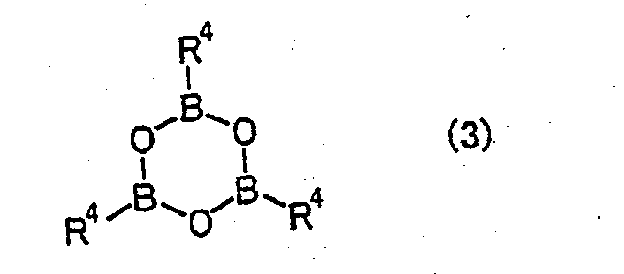
Description
- The present invention relates to a production method for a biarylalanine, which is useful as an intermediate for a medicament, an agrochemical and the like.
- As conventional production methods for a biarylalanine compound, the following method are known: a method comprising cross-coupling
N-(t-butyloxycarbonyl)-O-(trifluoromethanesulfonyl)tyrosine methyl ester, which is a derivative of a natural amino acid tyrosine, with phenylboronic acid in the presence of a palladium catalyst (WO 2001-36376), a method comprising cross-coupling N-FMOC-4-(trimethylstannyl)-phenylalanine tert-butyl ester with a halobenzene in the presence of a palladium catalyst (WO 2001-12183), a method comprising cross-coupling N-(t-butyloxycarbonyl)-4-iodophenylalanine methyl ester with phenyl boronic acid in the presence of a palladium catalyst (WO 2000-43372) and the like. - However, in each of the above-mentioned cross-coulping methods, an expensive palladium catalyst is used. Therefore, an economical production method has been desired.
- According to the present invention, a biarylalanine compound can be produced economically and in a good yield, by cross-coupling a phenylalanine compound having a halogen group or a trifluoromethanesulfonyloxy group at 4-position, with an organic boron compound, using a nickel catalyst that is more inexpensive than a palladium catalyst.
- The present invention provides a production method for producing a biarylalanine compound of formula (4):wherein R1 represents amino protective group and R2 represents an amino protective group or a hydrogen atom,

- R3 is a carboxy protective group, or
said amino protective and carboxy protective groups are together to form an amino acid protective group, and - R4 is a substituted or unsubstituted aryl or heteroaryl
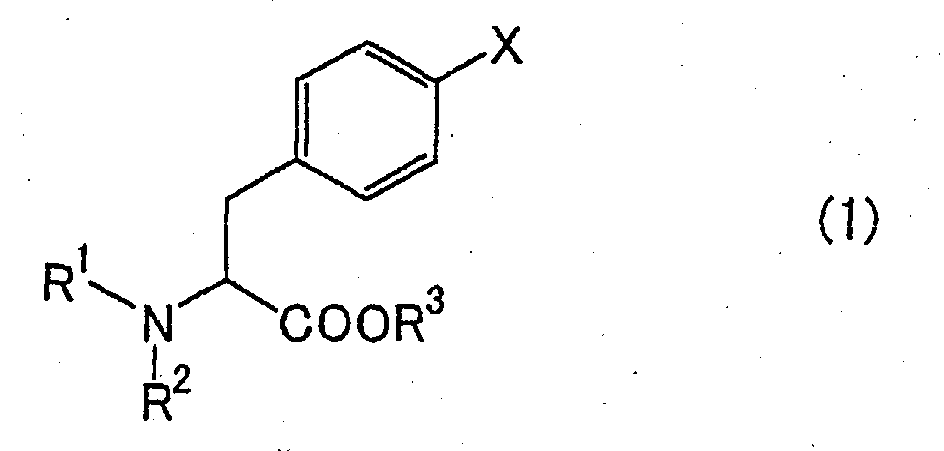
group, which comprises reacting an aromatic amino acid of formula
(1):
wherein X is a halogen atom, or a trifluoromethylsulfonyloxy group, and R1, R2 and R3 has the same meaning as defined above, with an organic boron compound of formula (2):
 wherein R4 has the same meaning as defined above, and Q1 and Q2 are the same or different and independently represents a hydroxy group, an alkoxy group having 1 to 4 carbon atoms, or
- Q1 and Q2 are together to form an alkylenedioxy group or
a 1,2-phenylenedioxy group, each of which is optionally
substituted by an alkyl group having 1 to 4 carbon atoms,
or a boroxine ring compound of formula (3):
wherein R4 has the same meaning as defined above, or a mixture thereof,
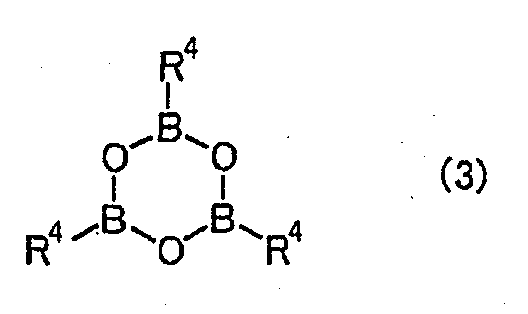
in the presence of a nickel catalyst and a base. -
- Hereinafter the present invention is explained in more detail.
- Examples of the halogen atom represented by X in formula (1) include, for example, chlorine, bromine, iodine.
- Examples of the protective group for R1 and R2 in the aromatic amino acid derivative (1) and the biarylalanine compound (4), include, for example,
carbamate protective groups such as methyloxycarbonyl group, ethyloxycarbonyl group, isobutyloxycarbonyl group, t-butyloxycarbonyl group, t-amyloxycarbonyl group, 2,2,2-trichloroethyloxycarbonyl group, 2-trimethylsilylethyloxycarbonyl group, phenylethyloxycarbonyl group, 1-(1-adamantyl)-1-methylethyloxycarbonyl group, 1,1-dimethyl-2-haloethyloxycarbonyl group, 1,1-dimethyl-2,2-dibromoethyloxycarbonyl group, 1,1-dimethyl-2,2,2-trichloroethyloxycarbonyl group, -1-methyl-1-(4-biphenylyl)ethyloxycarbonyl group, 1-(3,5-di-t-butylphenyl)-1-methylethyloxycarbonyl group, 2-(2'-pyridyl)ethyloxycarbonyl group, 2-(4'-pyridyl)ethyloxycarbonyl group, 2-(N,N-dicyclohexylcarboxyamide)ethyloxycarbonyl group, 1-adamantyloxycarbonyl group, vinyloxycarbonyl group, allyloxycarbonyl group, 1-isopropylallyloxycarbonyl group, cynnamyloxycarbonyl group, 4-nitrocynnamyloxycarbonyl group, 8-quinolyloxycarbonyl group, N-piperidinyloxycarbonyl group, alkyldithiocarbonyl group, benzyloxycarbonyl group, p-methoxybenzyloxycarbonyl group, p-nitrobenzyloxycarbonyl group, p-bromobenzyloxycarbonyl group, p-chlorobenzyloxycarbonyl group, 2,4-dichlorobenzyloxycarbonyl group, 4-methylsulfinylbenzyloxycarbonyl group, 9-anthrylmethyloxycarbonyl group, diphenylmethyloxycarbonyl group, 9-fluorenylmethyloxycarbonyl group, 9-(2,7-dibromo)fluorenylmethyloxycarbonyl group, 2,7-di-t-butyl[9-(10,10-dioxo-thioxantyl)]methyloxycarbonyl group, 4-methoxyphenacyloxycarbonyl group, 2-methylthioethyloxycarbonyl group, 2-methylsulfonylethyloxycarbonyl group, 2-(p-toluenesulfonyl)ethyloxycarbonyl group, [2-(1,3-dithianyl)]methyloxycarbonyl group, 4-methylthiophenyloxycarbonyl group, 2,4-dimethylthiophenyloxycarbonyl group, 2-phosphonioethyloxycarbonyl group, 2-triphenylphosphonioisopropyloxycarbonyl group, 1,1-dimethyl-2-cyanoethyloxycarbonyl group, m-chloro-p-acyloxybenzyloxycarbonyl group, p-(dihydroxyboryl)benzyloxycarbonyl group, 5-benzoisooxazolylmethloxycarbonyl group, 2-(trifluoromethyl)-6-chromonylmethyloxycarbonyl group, phenyloxycarbonyl group, m-nitrophenyloxycarbonyl group, 3,5-dimethoxybenzyloxycarbonyl group, o-nitrobenzyloxycarbonyl group, 3,4-dimethoxy-6-nitrobenzyloxycarbonyl group, or phenyl(o-nitrophenyl)methyloxycarbonyl group;
amide protective groups such as formyl group, acetyl group, chloroacetyl group, trichloroacetyl group, trifluoroacetyl group, phenylacetyl group, or benzoyl group;
N-alkyl protective groups such as benzyl group, N-di(4-methoxyphenyl)methyl group, N-5-dibenzosuberyl group, N-triphenylmethyl group, (4-methoxyphenyl)diphenylmethyl group, N-9-phenylfluorenyl group, allyl group, N-[2-(trimethylsilyl)ethoxy]methyl group, or N-3-acetoxypropyl group. - Examples of the carboxy protective group represented by R3 include, for example, methyl group, ethyl group, n-propyl group, isopropyl group, n-butyl group, isobutyl group, s-butyl group, t-butyl group, cyclohexyl group, 9-fluorenylmethyl group, methoxymethyl group, benzyloxymethyl group, pivaloyloxymethyl group, phenylacetoxymethyl group, N-phthalimidemethyl group, benzyl group, α-phenetyl group, triphenylmethyl group, diphenylmethyl group, o-nitrobenzyl group, p-nitrobenzyl group, p-methoxybenzyl group, 2,6-dimethoxybenzyl group. Preferred are the alkyl group having 1 to 4 carbon atoms, a benzyl group.
- The amino group and the carboxyl group in formula (1) or (4) may be suitably protected by a single protective group for amino acids, and examples of the groups formed by the amino acid residue of formula (1) or (4) and the amino acid protective group, which may be formed by the amino protective and carboxy protective groups include, for example,
4-substitued-5-oxo-1,3-oxazolidine,
4-substitued-2-methyl-5(4H)-oxazolone,
4-substitued-2,5-oxazolidinedione,
5-substituted-2,4-imidazolidinedione and the like. - The aromatic amino acid compound (1) can be readily synthesized from phenylalanine or tyrosine, which are natural amino acids. The protective groups R1, R2, R3 and the group X can be introduced in any order. Two or more substituents may be introduced by one step.
- The introduction methods of amino and carboxy protective groups represented by R1, R2 and R3 respectively include, for example, methods generally used for protecting amino acids and peptide synthesis (for example, the method described in Nobuo Izumiya et al, "Basis and Experiments for Peptide Synthesis", Maruzen Co., Ltd., 1985).
- The amino acid protective groups may be suitably introduced by methods as disclosed in "PROTECTIVE GROUPS in ORGANIC SYNTHESIS, 3rd Edition, T.W. Greene and P.G.M. Wuts published by Wiley-Interscience", for example, on pp.435-436, 503, and 592-595, and the whole disclosures of the references are incorporated herein by reference.
- The group X can be introduced by such a method comprising selectively introducing an objective halogen atom at the 4-position of the phenyl group of phenylalanine (a method described in J. Med. Chem., 17(5), 556 (1974)) and the like. Alternatively, the introduction method includes, when X is a trifluoromethanesulfonyloxy group, for example, a method comprising reacting the aromatic hydroxy group of tyrosine with a trifluoromethanesulfonylating agent such as trifluoromethanesulfonic acid anhydride or the like in the presence of a base (Japanese PCT Laid-open Publication No. 2001-521764) and the like.
- Specific examples of the aromatic amino acid of formula (1) include, for example, optical isomer or a racemate of:
- N-(t-butyloxycarbonyl)-O-trifluoromethanesulfonyltyrosine methyl ester,
- N-(t-butyloxycarbonyl)-O-trifluoromethanesulfonyltyrosine ethyl ester,
- N-(t-butyloxycarbonyl)-O-trifluoromehanesulfonyltyrosine isopropyl ester,
- N-(t-butyloxycarbonyl)-O-trifluoromethanesulfonyltyrosine t-butyl ester,
- N-acetyl-O-trifluoromethanesulfonyltyrosine methyl ester,
- N-acetyl-O-trifluoromethanesulfonyltyrosine ethyl ester,
- N-acetyl-O-trifluoromethanesulfonyltyrosine isopropyl ester,
- N-acetyl-O-trifluoromethanesulfonyltyrosine t-butyl ester,
- N-acetyl-O-trifluoromethanesulfonyltyrosine benzyl ester,
- N-benzyl-O-trifluoromethanesulfonyltyrosine methyl ester,
- N-benzyl-O-trifluoromethanesulfonyltyrosine ethyl ester,
- N-benzyl-O-trifluoromethanesulfonyltyrosine isopropyl ester,
- N-benzyl-O-trifluoromethanesulfonyltyrosine t-butyl ester,
- N-benzyl-O-trifluoromethanesulfonyltyrosine benzyl ester,
- N-(9-fluorenylmethoxycarbonyl)-O-trifluoromethanesulfonyl-tyrosine methyl ester,
- N-(9-fluorenylmethoxycarbonyl)-O-trifluoromethanesulfonyl-tyrosine ethyl ester,
- N-(9-fluorenylmethoxycarbonyl)-O-trifluoromethanesulfonyl-tyrosine isopropyl ester,
- N-(9-fluorenylmethoxycarbonyl)-O-trifluoromethanesulfonyl-tyrosine t-butyl ester,
- N-(9-fluorenylmethoxycarbonyl)-O-trifluoromethanesulfonyl-tyrosine benzyl ester,
- N-benzyloxycarbonyl-O-trifluoromethanesulfonyltyrosine methyl ester,
- N-benzyloxycarbonyl-O-trifluoromethanesulfonyltyrosine ethyl ester,
- N-benzyloxycarbonyl-O-trifluoromethanesulfonyltyrosine isopropyl ester,
- N-benzyloxycarbonyl-O-trifluoromethanesulfonyltyrosine t-butyl ester,
- N-(t-butyloxycarbonyl-4-chlorophenylalanine methyl ester,
- N-(t-butyloxycarbonyl-4-chlorophenylalanine ethyl ester,
- N-(t-butyloxycarbonyl-4-chlorophenylalanine isopropyl ester,
- N-(t-butyloxycarbonyl-4-chlorophenylalanine t-butyl ester,
- N-acetyl-4-chlorophenylalanine methyl ester,
- N-acetyl-4-chlorophenylalanine ethyl ester,
- N-acetyl-4-chlorophenylalanine isopropyl ester,
- N-acetyl-4-chlorophenylalanine t-butyl ester,
- N-acetyl-4-chlorophenylalanine benzyl ester,
- N-benzyl-4-chlorophenylalanine methyl ester,
- N-benzyl-4-chlorophenylalanine ethyl ester,
- N-benzyl-4-chlorophenylalanine isopropyl ester,
- N-benzyl-4-chlorophenylalanine t-butyl ester,
- N-benzyl-4-chlorophenylalanine benzyl ester,
- N-(9-fluorenylmethoxycarbonyl)- 4-chlorophenylalanine methyl ester,
- N-(9-fluorenylmethoxycarbonyl)-4-chlorophenylalanine ethyl ester,
- N-(9-fluorenylmethoxycarbonyl)-4-chlorophenylalanine isopropyl ester,
- N-(9-fluorenylmethoxycarbonyl)-4-chlorophenylalanine t-butyl ester,
- N-(9-fluorenylmethoxycarbonyl)-4-chlorophenylalanine benzyl ester,
- N-benzyloxycarbonyl-4-chlorophenylalanine methyl ester,
- N-benzyloxycarbonyl-4-chlorophenylalanine ethyl ester,
- N-benzyloxycarbonyl-4-chlorophenylalanine isopropyl ester,
- N-benzyloxycarbonyl-4-chlorophenylalanine t-butyl ester,
- N-benzyloxycarbonyl-4-chlorophenylalanine benzyl ester,
- N-t-butyloxycarbonyl-4-bromophenylalanine methyl ester,
- N-t-butyloxycarbonyl-4-bromophenylalanine ethyl ester,
- N-t-butyloxycarbonyl-4-bromophenylalanine isopropyl ester,
- N-t-butyloxycarbonyl-4-bromophenylalanine t-butyl ester,
- N-t-butyloxycarbonyl-4-bromophenylalanine benzyl ester,
- N-acetyl-4-bromophenylalanine methyl ester,
- N-acetyl-4-bromophenylalanine ethyl ester,
- N-acetyl-4-bromophenylalanine isopropyl ester,
- N-acetyl-4-bromophenylalanine t-butyl ester,
- N-acetyl-4-bromophenylalanine benzyl ester,
- N-benzyl-4-bromophenylalanine methyl ester,
- N-benzyl-4-bromophenylalanine ethyl ester,
- N-benzyl-4-bromophenylalanine isopropyl ester,
- N-benzyl-4-bromophenylalanine t-butyl ester,
- N-benzyl-4-bromophenylalanine benzyl ester,
- N-(9-fluorenylmethoxycarbonyl)-4-bromophenylalanine methyl ester,
- N-(9-fluorenylmethoxycarbonyl)-4-bromophenylalanine ethyl ester,
- N-(9-fluorenylmethoxycarbonyl)-4-bromophenylalanine isopropyl ester,
- N-(9-fluorenylmethoxycarbonyl)-4-bromophenylalanine t-butyl ester,
- N-(9-fluorenylmethoxycarbonyl)-4-bromophenylalanine benzyl ester,
- N-benzyloxycarbonyl-4-bromophenylalanine methyl ester,
- N-benzyloxycarbonyl-4-bromophenylalanine ethyl ester,
- N-benzyloxycarbonyl-4-bromophenylalanine isopropyl ester,
- N-benzyloxycarbonyl-4-bromophenylalanine t-butyl ester,
- N-benzyloxycarbonyl-4-bromophenylalanine benzyl ester,
- N-t-butyloxycarbonyl-4-iodophenylalanine methyl ester,
- N-t-butyloxycarbonyl-4-iodophenylalanine ethyl ester,
- N-t-butyloxycarbonyl-4-iodophenylalanine isopropyl ester,
- N-t-butyloxycarbonyl-4-iodophenylalanine t-butyl ester,
- N-t-butyloxycarbonyl-4-iodophenylalanine benzyl ester,
- N-acetyl-4-iodophenylalanine methyl ester,
- N-acetyl-4-iodophenylalanine ethyl ester,
- N-acetyl-4-iodophenylalanine isopropyl ester,
- N-acetyl-4-iodophenylalanine t-butyl ester,
- N-acetyl-4-iodophenylalanine benzyl ester,
- N-benzyl-4-iodophenylalanine methyl ester,
- N-benzyl-4-iodophenylalanine ethyl ester,
- N-benzyl-4-iodophenylalanine isopropyl ester,
- N-benzyl-4-iodophenylalanine t-butyl ester,
- N-benzyl-4-iodophenylalanine benzyl ester,
- N-(9-fluorenylmethoxycarbonyl)-4-iodophenylalanine methyl ester,
- N-(9-fluorenylmethoxycarbonyl)-4-iodophenylalanine ethyl ester,
- N-(9-fluorenylmethoxycarbonyl)-4-iodophenylalanine isopropyl ester,
- N-(9-fluorenylmethoxycarbonyl)-4-iodophenylalanine t-butyl ester,
- N-(9-fluorenylmethoxycarbonyl)-4-iodophenylalanine benzyl ester,
- N-benzyloxycarbonyl-4-iodophenylalanine methyl ester,
- N-benzyloxycarbonyl-4-iodophenylalanine ethyl ester,
- N-benzyloxycarbonyl-4-iodophenylalanine isopropyl ester,
- N-benzyloxycarbonyl-4-iodophenylalanine t-butyl ester,
- N-benzyloxycarbonyl-4-iodophenylalanine benzyl ester, and the like.
-
- The organic boron compound (2) and boroxine compound (3), the aryl group for R4 includes, and is not limited to, aryl group having 6 to 14 carbon atoms and consisting of 1 to 3 ring(s) and the like, and such aryl group includes, for example, phenyl group, naphthyl group, anthracenyl group, phenanthryl group, indenyl group, fluorenyl group and the like. The heteroaryl group includes, and is not limited to, a 5- to 7-membered aromatic heterocycle comprising 1 to 3 heteroatom(s) selected from up to 3 nitrogen atoms (i.e. 0, 1, 2 or 3), up to 2 oxygen atoms (i.e. 0, 1 or 2) and up to 2 sulfur atoms (i.e. 0, 1 or 2), and such heteroaryl group includes, for example, pyridyl group, furyl group, thienyl group, pyrrolyl group, imidazolyl group and the like.
- Examples of the substituent groups of the substituted aryl or heteroaryl group represented by R4 include, for example, fluorine atom, alkyl groups such as methyl group, ethyl group, i-propyl group, or cycloalkyl group, haloalkyl groups such as trifluoromethyl group, dialkylaminoalkyl group such as N,N-dimethylaminomethyl group, hydroxyl group,
alkoxy groups such as methoxy group, ethoxy group, t-butoxy group, phenoxy group, mercapto group,
alkylthio groups such as methylthio,
arylthio groups such as phenylthio group, cyano group, nitro group, amino group, substituted amino groups such as dimethylamino group, cyclohexylamino group and the like, acylamino groups such as t-butoxycarbonyl amino group, acetoxyamino group, sulfoneamide groups such as benzenesulfoneamide group, methanesulfonylamide group, imino group, imide groups such as phthalimide group, formyl group, carboxy group, alkoxycarbonyl groups such as methoxycarbonyl group, aryloxycarbonyl groups such as p-methoxyphenoxycarbonyl group,
unsubstituted or substituted carbamoyl groups such as carbamoyl group, N-phenylcarbamoyl group,
heterocyclic groups such as pyridyl group, furyl group, thienyl group, aryl groups such as phenyl group or naphthyl group. - Alternatively, two substituents on the adjacent two carbon atoms of the substituted aryl or heteroaryl group and the aryl or heteroaryl are together to form a fused ring (e.g, methylenedioxyphenyl, indolinyl or the like). These substituents may further be substituted.
- Specific examples of the organic boron compound of formula (2) include, phenylboronic acid, 2-methylphenylboronic acid, 3-methylphenylboronic acid, 4-methylphenylboronic acid, 2,3-dimethylphenylboronic acid, 2,4-dimethylphenylboronic acid, 2,5-dimethylphenylboronic acid, 2,6-dimethylphenylboronic acid, 2,4,6-trimethylphenylboronic acid, 2,3,5,6-tetramethylphenylboronic acid, 2-ethylphenylboronic acid, 4-n-propylphenylboronic acid, 4-isopropylphenylboronic acid, 4-n-butylphenylboronic acid, 4-t-butylphenylboronic acid, 1-naphthylboronic acid, 2-naphthylboronic acid, 2-biphenylboronic acid, 3-biphenylboronic acid, 4-biphenylboronic acid, 2-fluoro-4-biphenylboronic acid, 2-fluorenylboronic acid, 9-fluorenylboronic acid, 9-phenanthrenylboronic acid, 9-anthracenylboronic acid, 1-pyrenylboronic acid, 2-trifluoromethylphenylboronic acid, 3-trifluoromethylphenylboronic acid, 4-trifluorophenylboronic acid, 3,5-bis(trifluoromethyl)phenylboronic acid, 2-methoxyphenylboronic acid, 3-methoxyphenylboronic acid, 4-methoxyphenylboronic acid, 2,5-dimethoxyphenylboronic acid, 2,6-dimethoxyphenylboronic acid, 4,5-dimethoxyphenylboronic acid, 2,4-dimethoxyphenylboronic acid, 2-ethoxyphenylboronic acid, 3-ethoxyphenylboronic acid, 4-ethoxyphenylboronic acid, 4-phenoxyboronic acid, 3,4-methylenedioxyboronic acid, 2-fluorophenylboronic acid, 3-fluorophenylboronic acid, 4-fluorophenylboronic acid, 2,4-difluorophenylboronic acid, 2,5-difluorophenylboronic acid, 2,6-difluorophenylboronic acid, 4,5-difluorophenylboronic acid, 3,5-difluorophenylboronic acid, 2-formylphenylboronic acid, 3-formylphenylboronic acid, 4-formylphenylboronic acid, 3-formyl-4-methoxyphenylboronic acid, 2-cyanophenylboronic acid, 3-cyanophenylboronic acid, 4-cyanophenylboronic acid, 3-nitrophenylboronic acid, 3-acetylphenylboronic acid, 4-acetylphenylboronic acid, 3-trifluoroacetylphenylboronic acid, 4-trifluoroacetylphenylboronic acid, 4-methylthiophenylboronic acid, 4-vinylphenylboronic acid, 3-carboxyphenylboronic acid, 4-carboxyphenylboronic acid, 3-aminophenylboronic acid, 2-(N,N-dimethylamino)phenylboronic acid, 3-(N,N-dimethylamino)phenylboronic acid, 4-(N,N-dimethylamino)phenylboronic acid, 2-(N,N-diethylamino)phenylboronic acid, 3-(N,N-diethylamino)phenylboronic acid, 4-(N,N-diethylamino)phenylboronic acid, 2-(N,N-dimethylaminomethyl)phenylboronic acid, furan-2-boronic acid, furan-3-boronic acid, 2-formylfuranboronic acid, 3-formylfuran-2-boronic acid, dibenzofuran-4-boronic acid, benzofuran-2-boronic acid, thiophene-2-boronic acid, thiophene-3-boronic acid, 5-methylthiophene-2-boronic acid, 5-chlorothiophene-2-boronic acid, 4-methylthiophene-2-boronic acid, 5-methylthiophene-2-boronic acid, 2-acetylthiophene-5-boronic acid, 3-formylthiophene-2-boronic acid, 5-methylthiophene-2-boronic acid, benzothiophene-2-boronic acid, dibenzothiophene-4-boronicacid, pyrazole-4-boronicacid, 3-methylpyrazole-4-boronic acid, 3, 5-dimethylpyrazole-4-boronic acid, 3-nitro-1,2,4-triazole-5-boronic acid, thiazole-2-boronic acid, pyridine-3-boronic acid, pyridine-4-boronic acid, pyrimidine-5-boronic acid, quinoline-8-boronic acid, isoquinoline-4-boronic acid, 1,4-benzenebis (boronic acid), and a pinacol ester, a cathecol ester, a boroxine ring compound thereof, and the like.
- The amount of the organic boron compound of formula (2) to be used in the reaction is generally from not less than 1 mol to not more than 10 moles, preferably not more than 3 moles per mol of the aromatic amino acid of formula (1).
- The nickel catalyst to be used may be zerovalent or divalent, or the divalent catalyst may be reduced to zerovalent with a reduction agent prior to use. The zerovalent catalyst includes, for example, bis(1,5-cyclooctadiene)nickel (0), tetrakis(triphenylphosphine)nickel (0) and the like. The divalent catalyst includes, for example, metal halides (II) such as nickel chloride (II), nickel bromide (II), nickel iodide (II) and the like, nickel nitrate (II), nickel acetate (II), dichlorobis(triphenylphosphine)nickel (II), bisacetylacetonate nickel (II) and the like. These nickel catalysts may optionally contain a ligand, or the ligand may be added to the reaction mixture. Such ligand includes, for example, triphenylphosphine, tricyclohexylphosphine, tri-tert-butylphosphine, bis(diphenylphosphino)ferrocene and the like.
- Examples of the reduction agent that may be used in the reduction of the divalent nickel into the zerovalent nickel prior to use includes, and is not limited to, for example, sodium borohydride, lithium aluminum hydride, sodium hydride, diisobutylaluminum hydride, alkyl Grignard's agent, alkyl lithium, alkyl aluminum, zinc metal and the like. In this case, during the preparation of the catalyst, the divalent catalyst, ligand, reduction agent and optionally a suitable inert solvent are added, and the order of addition is not specifically limited.
- The nickel catalyst may be dissolved completely in the reaction mixture, or may be suspended therein. The nickel catalyst may be used as it is, or may be carried onto a substance that can not be dissolved into the solvent to be used for the reaction, such as carbon, silica, alumina or the like.
- The amount of the nickel catalyst to be used in the reaction is generally catalytic, preferably from not less than 0.00001 mole to not more than 1 mol, and more preferably not more than 0.2 mol per mol of the aromatic amino acid compound of formula (1). The amount of the ligand to be used is generally not less than 0.1 mol to not more than 10 moles, preferably from not less than 0.5 mol to not more than 5 moles per mol of the nickel catalyst.
- A base is generally used in this reaction, and such base includes, for example, a hydroxide, a carbonate, a hydrogencarbonate, a phosphorate, a carboxylate, and an alkoxide of an alkali metal or an alkaline earth metal, an alkali metal fluoride or a tertiary amine.
- Such alkali metal salt and alkaline earth metal salt include, for example, sodium hydroxide, potassium hydroxide, barium hydroxide, lithium carbonate, sodium carbonate, potassium carbonate, cesium carbonate, calcium carbonate, barium carbonate, lithium phosphorate, sodium phosphorate, potassium phosphorate and the like.
- Examples of the alkali metal fluoride include, for example, Sodium fluoride, potassium fluoride, cesium fluoride and the like.
- Examples of the tertiary amine include, for example, trimethylamine, triethylamine, N,N-dimethylbenzylamine, N,N-diehtylaniline and the like.
- The amount of the base to be used is generally from 0.1 to 20 moles, preferably from 1 to 5 moles per mol of the aromatic amino acid of formula (1). Furthermore, two or more of the bases may be used in combination.
- A solvent is generally used in the reaction, for example, an organic solvent, water, or a mixture thereof may be used as the solvent.
- The organic solvent includes, alcohol solvents such as methanol, ethanol and the like, aprotic organic polar solvents such as N-methylpyrrolidone, N,N-dimethylformamide, dimethylsulfoxide, acetonitrile and the like, ether solvents such as diethyl ether, diisopropyl ether, diethylene glycol dimethyl ether, 1,4-dioxane, tetrahydrofuran and the like, aromatic hydrocarbons such as benzene, toluene, xylene and the like, aliphatic hydrocarbons such as hexane, heptane and the like. Each of the solvents is used solely, or two or more of the solvents are used in combination. The amount to be used is generally from not less than 0.5 part by weight to not more than 200 parts by weight, preferably from not less than 1 part by weight to not more than 10 parts by weight per 1 part by weight of the aromatic amino acid compound of formula (1).
- In the production method of the present invention, the aromatic amino acid of formula (1), the organic boron compound of formula (2), nickel catalyst, and base, and optionally a ligand and a suitable solvent, may be added in any order. However, when a reduction agent that may react with the aromatic amino acid compound or the organic boron compound is used, preferably these compounds and agents are added in a different order so that undesirable contact can be avoided. For example, a method comprising adding a mixture of a nickel catalyst, a ligand and a reduction agent to a system in which the aromatic amino acid derivative, the organic boron compound and base, and optionally a suitable solvent have been added in any order previously, or a method comprising adding the aromatic amino acid derivative, the organic boron compound and the base and optionally a suitable solvent in any order to a mixture of a nickel catalyst, a ligand and a reduction agent, is preferred. In this case, a nickel catalyst with which a ligand is coodinated may be used instead of the ligand and nickel catalyst.
- The reaction is generally carried out under heating, and the reaction temperature is from ambient temperature to the boiling point of the solvent to be used, preferably not more than 70°C.
- After the reaction has been completed, the objective biarylalanine compound of the formula (4) can be obtained, by optionally removing the insoluble fraction in the reaction system by filtration and the like and followed by conventional after-treatment(s).
- Examples of the biarylalanine compound of formula (4) include, for example,
- N-(t-butyloxycarbonyl)-4-phenyl-L-phenylalanine methyl ester,
- N-(t-butyloxycarbonyl)-4-phenyl-L-phenylalanine benzyl ester,N-acetyl-4-phenyl-L-phenylalanine methyl ester,
- N-(t-butyloxycarbonyl)-4-(2,6-dimethoxyphenyl)-L-phenyl -alanine methyl ester,
- N-(t-butyloxycarbonyl)-4-(2-methoxyphenyl)-L-phenyl-alanine methyl ester,
- N-(t-butyloxycarbonyl)-4-(4-methylphenyl)-L-phenyl-alanine methyl ester,
- N-(t-butyloxycarbonyl)-4-(1-naphthyl)-L-phenyl-alanine methyl ester,
- N-(t-butyloxycarbonyl)-4-(thiophen-2-yl)-L-phenyl-alanine methyl ester,
- N-(t-butyloxycarbonyl)-4-(4-acetylphenyl)-L-phenyl-alanine methyl ester and racemic compounds of the above-described optically active compounds.
-
- According to the method of the present invention, a biarylalanine, which is useful as a production intermediate for a medicament, an agrochemical and the like, can be obtained economically and in a good yield.
- Hereinafter the present invention is explained in more detail with referring to the Examples, and the present invention is not limited to these Examples.
-

- Under nitrogen atmosphere,
N-(t-butyloxycarbonyl)-4-chloro-L-tyrosine methyl ester (1.26 g, 4.0 mmol), 2, 6-dimethoxyphenyl boronic acid (1.09g, 6.0mmol), cesium carbonate (2.61 g, 8.0 mmol), tricyclohexylphosphine (0.12 g, 0.4 mmol) and bis(1,5-cyclooctadiene)nickel (0.055 g, 0.2 mmol) were mixed in dioxane (4 ml). The reaction mixture was then heated to 50°C and stirred at the same temperature for 5hr. After the reaction had been completed, the reaction mixture was left standing and cooled to room temperature, and insolubles were filtered off. The filtrate was analyzed by liquid chromatography and it was revealed that
N-(t-butyloxycarbonyl)-4-(2,6-dimethoxyphenyl)-L-phenyl-alanine methyl ester was obtained in a yield of 78%. -

- Under nitrogen atmosphere,
N-(t-butyloxycarbonyl)-O-(trifluoromethylsulfonyl)-L-tyrosi ne methyl ester (0.86 g, 2.0mmol), 2, 6-dimethoxyphenyl boronic acid (0.55 g, 3.0 mmol), cesium carbonate (1.30 g, 4.0 mmol), tricyclohexylphosphine (0.24 g, 0.8 mmol) and bis(1,5-cyclooctadiene)nickel (0.056 g, 0.2 mmol) were mixed in dioxane (2 ml). The reaction mixture was then heated to 50°C and stirred at the same temperature for 5 hr. After the reaction had been completed, the reaction mixture was left standing and cooled to room temperature, and insolubles were filtered off. The filtrate was analyzed by liquid chromatography and it was revealed that N-(t-butyloxycarbonyl)-4-(2,6-dimethoxyphenyl) -L-phenylalanine methyl ester was obtained in a yield of 94%.
Claims (8)
- A method for producing a biarylalanine compound of formula (4):wherein
 R1 represents an amino protective group, and R2 represents an amino protective group or a hydrogen atom,R3 is a carboxy protective group, or
said amino protective and carboxy protective groups together form an amino acid protective group, andR4 is a substituted or unsubstituted aryl or heteroaryl group, which comprises reacting an aromatic amino acid of formula (1):wherein X is a halogen atom or a trifluoromethanesulfonyloxy group, and R1, R2 and R3 are the same as defined above, with an organic boron compound of formula (2):wherein R4 has the same meaning as defined above, and
 Q1 and Q2 are the same or different and independently represent a hydroxy group or an alkoxy group having 1 to 4 carbon atoms, orQ1 and Q2 together form an alkylenedioxy or 1,2-phenylenedioxy group optionally substituted by an alkyl group having 1 to 4 carbon atoms, ora boroxine ring compound of formula (3):wherein R4 has the same meaning as defined above, or a mixture thereof, in the presence of a nickel catalyst and a base.
- A method according to claim 1, wherein the amino protective group represented by R1 is a carbamate amino protective group, an amide amino protective group or an N-alkyl type amino protective group, and R2 is a hydrogen atom.
- A method according to claim 1 or 2, wherein R3 is an alkyl group having 1 to 4 carbon atoms or a benzyl group.
- A method according to any one of claims 1 to 3, wherein X is a chlorine atom, or trifluoromethanesulfonyloxy group.
- A method according to any one of claims 1 to 4, wherein a nickel catalyst and a ligand are used.
- A method according to any one of claims 1 to 5, wherein the base is an alkali metal hydroxide, an alkaline earth metal hydroxide, an alkali metal carbonate, an alkaline earth metal carbonate, an alkali metal hydrogencarbonate, an alkali metal alkoxide, an alkaline earth metal alkoxide, an alkali metal fluoride, a tertiary amine, or a mixture thereof.
- A method according to any one of claims 1 to 6, wherein each of the aromatic amino acid of formula (1) and the biarylalanine of formula (4) are optically active compounds.
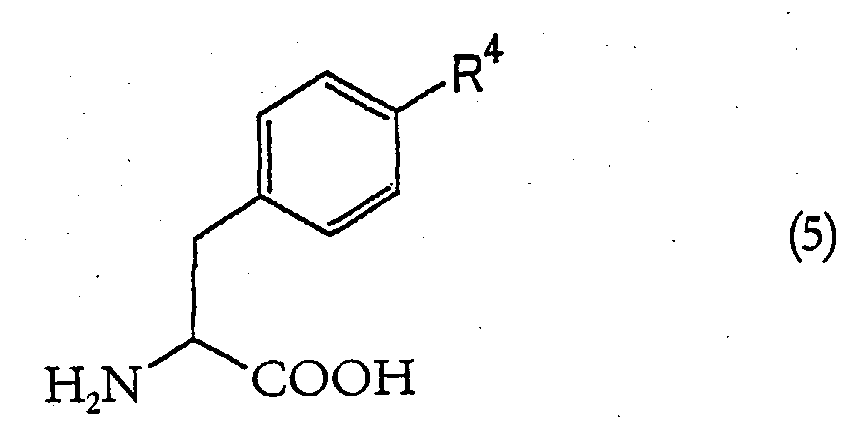
- A method for producing a biarylalanine compound of formula (5):wherein R4 is as defined in claim 1, which comprises carrying out a method according to any one of claims 1 to 7 to obtain a compound of formula (4), and then deprotecting the protected amino group represented by -NR1R2 and the protected carboxy group represented by -COOR3 in the compound of formula (4).
Applications Claiming Priority (2)
| Application Number | Priority Date | Filing Date | Title |
|---|---|---|---|
| JP2002073833 | 2002-03-18 | ||
| JP2002073883 | 2002-03-18 |
Publications (3)
| Publication Number | Publication Date |
|---|---|
| EP1346971A1 true EP1346971A1 (en) | 2003-09-24 |
| EP1346971A8 EP1346971A8 (en) | 2009-09-23 |
| EP1346971B1 EP1346971B1 (en) | 2010-01-20 |
Family
ID=31170840
Family Applications (1)
| Application Number | Title | Priority Date | Filing Date |
|---|---|---|---|
| EP03251300A Expired - Lifetime EP1346971B1 (en) | 2002-03-18 | 2003-03-04 | Production method for biarylalanine |
Country Status (3)
| Country | Link |
|---|---|
| US (1) | US7091373B2 (en) |
| EP (1) | EP1346971B1 (en) |
| DE (1) | DE60331018D1 (en) |
Families Citing this family (2)
| Publication number | Priority date | Publication date | Assignee | Title |
|---|---|---|---|---|
| WO2007011005A1 (en) * | 2005-07-20 | 2007-01-25 | Sumitomo Chemical Company, Limited | Process for producing biaryl compound |
| US20100087680A1 (en) * | 2005-07-20 | 2010-04-08 | Sumitomo Chemical Company Limited | Method for producing biaryl compound |
Citations (2)
| Publication number | Priority date | Publication date | Assignee | Title |
|---|---|---|---|---|
| WO2001012183A1 (en) * | 1999-08-16 | 2001-02-22 | Merck & Co., Inc. | Heterocycle amides as cell adhesion inhibitors |
| EP1127861A1 (en) * | 2000-02-22 | 2001-08-29 | Clariant GmbH | Method to synthesise substituted benzyl and toluene compounds |
Family Cites Families (8)
| Publication number | Priority date | Publication date | Assignee | Title |
|---|---|---|---|---|
| US5618934A (en) | 1994-05-17 | 1997-04-08 | Merck & Co., Inc. | Boronic acid compound |
| WO2000043369A1 (en) | 1999-01-22 | 2000-07-27 | Elan Pharmaceuticals, Inc. | Compounds which inhibit leukocyte adhesion mediated by vla-4 |
| DE19920847A1 (en) | 1999-05-06 | 2000-11-09 | Clariant Gmbh | Pd and Ni complexes of biphenyl-2-ylphosphanes and their application in catalytic C, C, N and C, O couplings |
| WO2001036376A1 (en) | 1999-11-18 | 2001-05-25 | Ajinomoto Co., Inc. | Novel phenylalanine derivatives |
| PL355851A1 (en) | 1999-12-08 | 2004-05-31 | Gentian As | Substituted phthalocyanines and their precursors |
| DE19963563A1 (en) | 1999-12-29 | 2001-07-05 | Clariant Gmbh | Preparation of 4'-trifluoromethylbiphenyl-2-carboxylic acid comprises reacting an o-carboxyphenyl boronic acid (anhydride) with a trifluoromethylbenzene derivative |
| WO2001066248A2 (en) | 2000-02-22 | 2001-09-13 | University Of New Orleans Research And Technology Foundation | C-c and c-n coupling catalyst comprising transition metal and carbene |
| US6693210B2 (en) | 2000-03-14 | 2004-02-17 | Mitsubishi Rayon Co., Ltd. | Triphenylphosphine derivative, production process therefor, palladium complex thereof, and process for producing biaryl derivative |
-
2003
- 2003-03-04 EP EP03251300A patent/EP1346971B1/en not_active Expired - Lifetime
- 2003-03-04 DE DE60331018T patent/DE60331018D1/en not_active Expired - Lifetime
- 2003-03-04 US US10/377,710 patent/US7091373B2/en not_active Expired - Lifetime
Patent Citations (2)
| Publication number | Priority date | Publication date | Assignee | Title |
|---|---|---|---|---|
| WO2001012183A1 (en) * | 1999-08-16 | 2001-02-22 | Merck & Co., Inc. | Heterocycle amides as cell adhesion inhibitors |
| EP1127861A1 (en) * | 2000-02-22 | 2001-08-29 | Clariant GmbH | Method to synthesise substituted benzyl and toluene compounds |
Non-Patent Citations (4)
| Title |
|---|
| FIROOZNIA F ET AL: "Enantioselective Synthesis of 4-Substituted Phenylalanines by Cross-Coupling Reactions", TETRAHEDRON LETTERS, ELSEVIER SCIENCE PUBLISHERS, AMSTERDAM, NL, vol. 40, no. 2, 8 January 1999 (1999-01-08), pages 213 - 216, XP004152513, ISSN: 0040-4039 * |
| FIROOZNIA F ET AL: "Synthesis of 4-Substituted Phenylalanines by Cross-Coupling Reactions: Extension of the Methodology to Aryl Chlorides", TETRAHEDRON LETTERS, ELSEVIER SCIENCE PUBLISHERS, AMSTERDAM, NL, vol. 39, 1998, pages 3985 - 3988, XP002170343, ISSN: 0040-4039 * |
| GALLAND J-C ET AL: "Cross-Coupling of Chloroarenes with Boronic Acids using a Water-Soluble Nickel Catalyst", TETRAHEDRON LETTERS, ELSEVIER SCIENCE PUBLISHERS, AMSTERDAM, NL, vol. 40, no. 12, 19 March 1999 (1999-03-19), pages 2323 - 2326, XP004157463, ISSN: 0040-4039 * |
| SATOH Y ET AL: "Synthesis of 4-Substituted Phenylalanine Derivatives by Cross-Coupling Reaction of p-Boronophenylalanines", TETRAHEDRON LETTERS, ELSEVIER SCIENCE PUBLISHERS, AMSTERDAM, NL, vol. 38, no. 44, 3 November 1997 (1997-11-03), pages 7645 - 7648, XP004093385, ISSN: 0040-4039 * |
Also Published As
| Publication number | Publication date |
|---|---|
| DE60331018D1 (en) | 2010-03-11 |
| EP1346971B1 (en) | 2010-01-20 |
| EP1346971A8 (en) | 2009-09-23 |
| US7091373B2 (en) | 2006-08-15 |
| US20040024229A1 (en) | 2004-02-05 |
Similar Documents
| Publication | Publication Date | Title |
|---|---|---|
| US9802887B2 (en) | Process for the preparation of intermediates useful for the manufacture NEP inhibitors | |
| US8278486B2 (en) | Process and intermediates for the preparation of N-acylated-4-aryl beta-amino acid derivatives | |
| CN102026982A (en) | Method for preparing amides | |
| US7714157B2 (en) | Process for preparing a biaryl compound | |
| EP1346971B1 (en) | Production method for biarylalanine | |
| JP4292834B2 (en) | Method for producing optically active biaryl compound | |
| JP2003342251A (en) | Method for producing biarylalanine | |
| CN102026954B (en) | Processes for the preparation of esters | |
| US8501993B2 (en) | Processes for the preparation of amides | |
| WO2004103990A1 (en) | Process for producing optically active n-monoalkyl-3hydroxy-3-arylpropylamine compound and intermediate | |
| WO2007064869A2 (en) | Catalysts for aryl sulfide synthesis and method of producing aryl sulfides | |
| PL210934B1 (en) | Optically active bisoxazoline compounds, process for production of the same and use thereof | |
| US6906216B2 (en) | Process for the synthesis of N-Substituted β-amino nitriles through the ring opening of aziridines | |
| US20050033090A1 (en) | Process for the preparation of cinnamaldehyde compounds | |
| JPH0797368A (en) | Process for producing protected hydroxyl group-containing heterocyclic compound | |
| Gao | Cobalt-Catalyzed Reductive Cross-Coupling between C-Heteroatom (S, N, O, X) Electrophiles to Build Csp3-Csp2 and Csp3-Csp3 Bonds | |
| EP1236715B1 (en) | Process for S-Aryl cysteine | |
| JP3396065B2 (en) | Method for producing heterocyclic compound | |
| JPH09194432A (en) | Bisthiazolines, method for producing the same and method for producing asymmetric cyclopropanecarboxylic acids using the same | |
| JP2003327573A (en) | Amino acid compounds | |
| JPH0550556B2 (en) |
Legal Events
| Date | Code | Title | Description |
|---|---|---|---|
| PUAI | Public reference made under article 153(3) epc to a published international application that has entered the european phase |
Free format text: ORIGINAL CODE: 0009012 |
|
| AK | Designated contracting states |
Kind code of ref document: A1 Designated state(s): AT BE BG CH CY CZ DE DK EE ES FI FR GB GR HU IE IT LI LU MC NL PT RO SE SI SK TR |
|
| AX | Request for extension of the european patent |
Extension state: AL LT LV MK |
|
| 17P | Request for examination filed |
Effective date: 20040305 |
|
| AKX | Designation fees paid |
Designated state(s): CH DE FR GB IT LI |
|
| 17Q | First examination report despatched |
Effective date: 20040510 |
|
| RAP1 | Party data changed (applicant data changed or rights of an application transferred) |
Owner name: SUMITOMO CHEMICAL COMPANY, LIMITED |
|
| GRAC | Information related to communication of intention to grant a patent modified |
Free format text: ORIGINAL CODE: EPIDOSCIGR1 |
|
| GRAP | Despatch of communication of intention to grant a patent |
Free format text: ORIGINAL CODE: EPIDOSNIGR1 |
|
| GRAS | Grant fee paid |
Free format text: ORIGINAL CODE: EPIDOSNIGR3 |
|
| GRAA | (expected) grant |
Free format text: ORIGINAL CODE: 0009210 |
|
| AK | Designated contracting states |
Kind code of ref document: B1 Designated state(s): CH DE FR GB IT LI |
|
| REG | Reference to a national code |
Ref country code: GB Ref legal event code: FG4D |
|
| REG | Reference to a national code |
Ref country code: CH Ref legal event code: NV Representative=s name: BOHEST AG Ref country code: CH Ref legal event code: EP |
|
| REF | Corresponds to: |
Ref document number: 60331018 Country of ref document: DE Date of ref document: 20100311 Kind code of ref document: P |
|
| PLBE | No opposition filed within time limit |
Free format text: ORIGINAL CODE: 0009261 |
|
| STAA | Information on the status of an ep patent application or granted ep patent |
Free format text: STATUS: NO OPPOSITION FILED WITHIN TIME LIMIT |
|
| 26N | No opposition filed |
Effective date: 20101021 |
|
| REG | Reference to a national code |
Ref country code: CH Ref legal event code: PCAR Free format text: NEW ADDRESS: HOLBEINSTRASSE 36-38, 4051 BASEL (CH) |
|
| REG | Reference to a national code |
Ref country code: FR Ref legal event code: PLFP Year of fee payment: 14 |
|
| REG | Reference to a national code |
Ref country code: FR Ref legal event code: PLFP Year of fee payment: 15 |
|
| REG | Reference to a national code |
Ref country code: FR Ref legal event code: PLFP Year of fee payment: 16 |
|
| PGFP | Annual fee paid to national office [announced via postgrant information from national office to epo] |
Ref country code: IT Payment date: 20190326 Year of fee payment: 17 Ref country code: CH Payment date: 20190314 Year of fee payment: 17 Ref country code: DE Payment date: 20190219 Year of fee payment: 17 Ref country code: FR Payment date: 20190111 Year of fee payment: 17 Ref country code: GB Payment date: 20190227 Year of fee payment: 17 |
|
| REG | Reference to a national code |
Ref country code: DE Ref legal event code: R119 Ref document number: 60331018 Country of ref document: DE |
|
| REG | Reference to a national code |
Ref country code: CH Ref legal event code: PL |
|
| PG25 | Lapsed in a contracting state [announced via postgrant information from national office to epo] |
Ref country code: CH Free format text: LAPSE BECAUSE OF NON-PAYMENT OF DUE FEES Effective date: 20200331 Ref country code: DE Free format text: LAPSE BECAUSE OF NON-PAYMENT OF DUE FEES Effective date: 20201001 Ref country code: LI Free format text: LAPSE BECAUSE OF NON-PAYMENT OF DUE FEES Effective date: 20200331 Ref country code: FR Free format text: LAPSE BECAUSE OF NON-PAYMENT OF DUE FEES Effective date: 20200331 |
|
| GBPC | Gb: european patent ceased through non-payment of renewal fee |
Effective date: 20200304 |
|
| PG25 | Lapsed in a contracting state [announced via postgrant information from national office to epo] |
Ref country code: GB Free format text: LAPSE BECAUSE OF NON-PAYMENT OF DUE FEES Effective date: 20200304 |
|
| PG25 | Lapsed in a contracting state [announced via postgrant information from national office to epo] |
Ref country code: IT Free format text: LAPSE BECAUSE OF NON-PAYMENT OF DUE FEES Effective date: 20200304 |