EP1346882A2 - Bumper beam assembly - Google Patents
Bumper beam assembly Download PDFInfo
- Publication number
- EP1346882A2 EP1346882A2 EP03014674A EP03014674A EP1346882A2 EP 1346882 A2 EP1346882 A2 EP 1346882A2 EP 03014674 A EP03014674 A EP 03014674A EP 03014674 A EP03014674 A EP 03014674A EP 1346882 A2 EP1346882 A2 EP 1346882A2
- Authority
- EP
- European Patent Office
- Prior art keywords
- bumper beam
- beam members
- members
- bumper
- mounting structure
- Prior art date
- Legal status (The legal status is an assumption and is not a legal conclusion. Google has not performed a legal analysis and makes no representation as to the accuracy of the status listed.)
- Withdrawn
Links
- 229910000831 Steel Inorganic materials 0.000 claims abstract description 17
- 239000010959 steel Substances 0.000 claims abstract description 17
- 229910000797 Ultra-high-strength steel Inorganic materials 0.000 claims abstract description 4
- 239000011324 bead Substances 0.000 claims description 9
- 229910052751 metal Inorganic materials 0.000 description 20
- 239000002184 metal Substances 0.000 description 20
- 230000000712 assembly Effects 0.000 description 13
- 238000000429 assembly Methods 0.000 description 13
- 238000005096 rolling process Methods 0.000 description 12
- 238000000034 method Methods 0.000 description 10
- 238000005452 bending Methods 0.000 description 6
- 239000000463 material Substances 0.000 description 6
- 238000003466 welding Methods 0.000 description 6
- 238000004519 manufacturing process Methods 0.000 description 5
- 239000007769 metal material Substances 0.000 description 5
- 238000010276 construction Methods 0.000 description 3
- 238000012986 modification Methods 0.000 description 2
- 230000004048 modification Effects 0.000 description 2
- 238000007493 shaping process Methods 0.000 description 2
- 230000015572 biosynthetic process Effects 0.000 description 1
- 230000003247 decreasing effect Effects 0.000 description 1
- 229910001385 heavy metal Inorganic materials 0.000 description 1
- 150000002739 metals Chemical class 0.000 description 1
- 239000002994 raw material Substances 0.000 description 1
Images



Classifications
-
- B—PERFORMING OPERATIONS; TRANSPORTING
- B60—VEHICLES IN GENERAL
- B60R—VEHICLES, VEHICLE FITTINGS, OR VEHICLE PARTS, NOT OTHERWISE PROVIDED FOR
- B60R19/00—Wheel guards; Radiator guards, e.g. grilles; Obstruction removers; Fittings damping bouncing force in collisions
- B60R19/02—Bumpers, i.e. impact receiving or absorbing members for protecting vehicles or fending off blows from other vehicles or objects
- B60R19/18—Bumpers, i.e. impact receiving or absorbing members for protecting vehicles or fending off blows from other vehicles or objects characterised by the cross-section; Means within the bumper to absorb impact
-
- B—PERFORMING OPERATIONS; TRANSPORTING
- B60—VEHICLES IN GENERAL
- B60R—VEHICLES, VEHICLE FITTINGS, OR VEHICLE PARTS, NOT OTHERWISE PROVIDED FOR
- B60R19/00—Wheel guards; Radiator guards, e.g. grilles; Obstruction removers; Fittings damping bouncing force in collisions
- B60R19/02—Bumpers, i.e. impact receiving or absorbing members for protecting vehicles or fending off blows from other vehicles or objects
- B60R19/18—Bumpers, i.e. impact receiving or absorbing members for protecting vehicles or fending off blows from other vehicles or objects characterised by the cross-section; Means within the bumper to absorb impact
- B60R2019/1806—Structural beams therefor, e.g. shock-absorbing
- B60R2019/1813—Structural beams therefor, e.g. shock-absorbing made of metal
- B60R2019/1826—Structural beams therefor, e.g. shock-absorbing made of metal of high-tension steel
Definitions
- the present invention relates to bumper beam assemblies.
- Open cross-section and closed cross-section bumpers for conventional motor vehicles are known in the prior art. It is also known that either type of bumper can be made by roll-forming or by stamping. Closed cross-section bumpers of a straight configuration can be formed by roll-forming a continuous sheet of metal so that the longitudinal edges thereof abut each other and then seam welding these edges, or by stamping two "clam-shell" halves having a C-shaped cross-section and seam welding the halves together.
- Each type of bumper is frequently also provided with an arcuate curvature in the longitudinal direction. Often this longitudinal curvature, sometimes referred to as the "sweep", is imparted to the metal by passing the same through a series of mandrels following a roll-forming operation.
- Conventional open cross-section bumpers are disadvantageous in that such bumpers offer less resistance to deformation during impact for a given metal gauge and thickness than a closed cross-section bumper.
- Conventional open cross-section bumpers are often strengthened by increasing the metal thickness, which results in an undesirable increase in weight and materials cost.
- open cross-section bumpers are typically easier to manufacture than closed cross-section bumpers. For example, it is easier to roll form and bend an open cross-section bumper to provide for bumper sweep, even when a relatively high tensile strength steel is used to construct the bumper. That is, it is relatively more difficult to provide a straight roll-formed closed cross-section bumper with sweep, because bending a closed cross-section beam tends to cause the metal material to buckle. Consequently, there exists a need in the art for a bumper beam assembly that provides the impact strength of a closed section beam without the difficulties typically associated with providing a desired curvature or sweep to the closed section beam.
- the bumper beam assembly in accordance with the present invention comprises a bumper beam mounting structure; and a plurality of elongated, roll-formed bumper beam members fixed to said bumper beam mounting structure, said bumper beam members being formed from a first, ultra high strength steel and having substantially identical cross-sectional configurations each having one open side, said bumper beam mounting structure closing off said one open side of each of said bumper beam members and being formed from a second steel that is milder than said first steel and that has a lower tensile strength than said first steel, and is preferably formed by: roll forming from sheet metal a plurality of substantially identical elongated bumper beam members each having a generally opened cross-sectional configuration including one opened side, the plurality of bumper beam members including a first set of bumper beam members having a first longitudinal configuration and a second set of bumper beam members having a second longitudinal configuration different from the first longitudinal configuration;
- a method of forming a plurality of bumper beam assemblies for accommodating different applications.
- the method comprises roll forming from sheet metal a plurality of elongated bumper beam members each having a generally identical longitudinal configuration to form an inventory of elongated bumper beam members; stamping from sheet metal a plurality of elongated, generally planar bumper beam mounting structures; selecting a first number of the bumper beam members from the inventory; fixing the first number of bumper beam members to a selected one of the bumper beam mounting structures to form a first bumper beam assembly; selecting a second number of bumper beam members different from the first number; and fixing the second number of bumper beam members to another selected one of the bumper beam mounting structures to form a second bumper beam assembly different from the first bumper beam assembly.
- the bumper beam member is provided with an open cross-section during the roll-forming process, and thus it is easier to bend the bumper beam member longitudinally in order to provide the desired degree of arcuate curvature, or sweep, in comparison to bending a structure with a closed cross-section.
- the closed section is formed from two parts, and therefore higher strength steel can be used to construct the bumper beam member in comparison with the mounting structure portion of the closed section.
- the bumper beam members can be nested to provide increased bumper strength.
- bumper beam mounting structures can also be constructed in different sizes to accommodate a selected number of bumper beam members.
- bumper beam mounting structures may be secured together prior to fixing the bumper beam members thereto in order to form larger bumper beam assemblies.
- a plurality of identical bumper beam members and bumper beam mounting structures can be easily stored and maintained in an inventory to construct a wide range of bumper beam assemblies as needed.
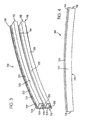
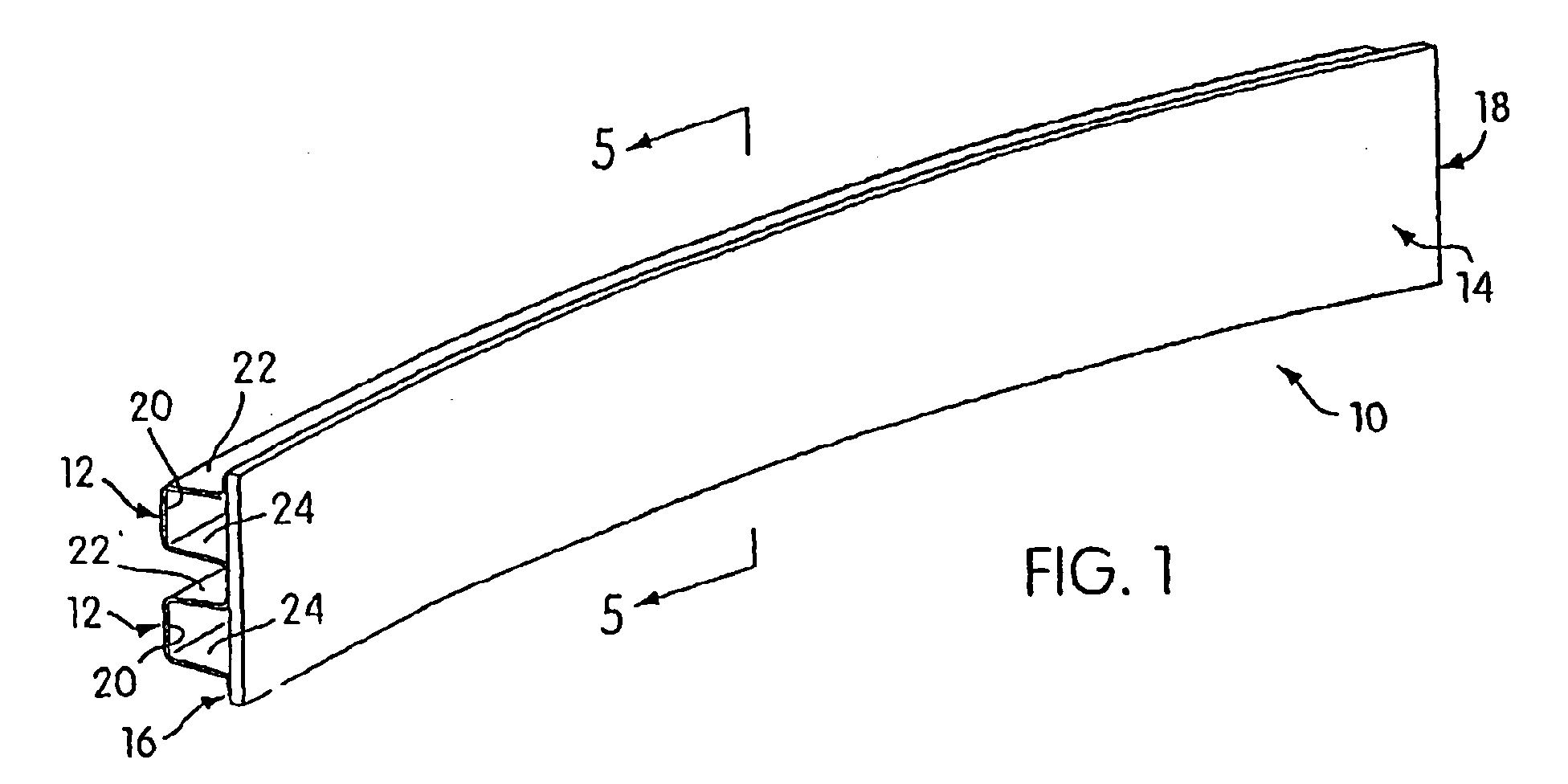
- FIG. 1 shows a motor vehicle bumper beam assembly 10 constructed according to the principles of the present invention.
- the bumper beam assembly 10 comprises at least one bumper beam member, generally designated 12, affixed to a bumper beam mounting structure, generally designated 14.
- the bumper beam assembly 10 is an elongated structure and preferably has a longitudinal configuration having a slight degree of longitudinal curvature, or "sweep", from a first end 16 thereof to a second end 18 thereof.
- the bumper beam assembly 10 can be provided with an inside sweep as shown in Figures 1 to 2, with an outside sweep as shown in the bumper beam assembly 110 of Figures 3 to 4, or can have a substantially straight (not shown) longitudinal configuration, depending an the application.
- a cross-sectional view of the bumper beam assembly 10 of Figure 1 is shown in Figure 5. It should be appreciated that a cross-section taken through a beam of an opposite longitudinal curvature as in the embodiment of Figure 3, or of a straight longitudinal configuration would be substantially identical.
- the bumper beam assemblies 10 and 110 shown in Figures 1 to 5 each include two bumper beam members 12, 112 (respectively) rigidly fixed an the bumper beam mounting structures 114.
- each bumper beam member 12 is an integral structure that has a central wall portion 20 and an upper and a lower wall portion, 22 and 24, respectively.
- the upper and lower wall portions 22, 24 terminate respectively in an upper flange portion 26 and a lower flange portion 28.
- the C-shaped, open cross-sectional configuration of each beam member 12 includes one opened side designated 30.
- the bumper beam members 12 and the bumper beam mounting structure 14 are preferably made of steel. It is contemplated to use metals having a variety of tensile strengths and thicknesses, but it is preferred to use ultra high strength steel having a KSI value of between about 100 and 220 to form the bumper beam members 12 and to use a milder steel having a KSI value of between about 28 and 50 to form the bumper beam mounting structure 14.
- the milder steel used for the bumper beam mounting structure in accordance with the invention facilitates bending of the mounting structure to accommodate a particular bumper beam curvature if one is desired.
- the bumper beam members 12 can be affixed to the bumper beam mounting structure 14 by any suitable means, but the preferred method is welding. A series of puddle welds are shown in the embodiment of Figure 3 designated by the reference numeral 132.
- the bumper beam members 12 can be roll-formed from rolls of raw sheet metal material, preferably steel, in a conventional rolling apparatus.
- a rolling apparatus for forming the bumper beam members 12 of the present invention is shown schematically in Figure 6 and is generally designated by the reference numeral 34.
- the rolling apparatus 34 generally includes an uncoiling station 36 for uncoiling large strips or sheets of coiled raw metal material 38.
- the coiled metal material 38 is uncoiled so that a flat sheet of material 40 is fed sequentially through a plurality of metal forming devices including a temper mill 42, a stock straightener 44, an optional pre-pierce press 46, a conventional rolling mill 48 and a cutoff press 50.
- the rolling mill 48 includes several pairs of cooperating heavy metal rollers, generally designated 52.
- a last set of rollers 52 may comprise a conventional twisting station (not shown) which straightens out any twists in the roll-formed section during formation.
- the temper mill 44 provides cold metal reduction prior to the rolling process. This increases the strength of the metal and simultaneously reduces the metal thickness (e.g., by about five percent) to increase the strength to weight ratio of the bumper beam members 12 enabling the same to be formed within closer tolerances.
- the stock straightener 42 flattens the metal sheet to remove any imperfections or inconsistencies in the metal.
- the optional pre-piercing press 46 can punch holes in the bumper beam members 12 as may be required to secure other structures. After the sheet metal is roll-formed to have an open, generally C-shaped cross-section and then provided with the desired degree of longitudinal sweep, a predetermined length of the rolled material is cut by the cutoff press 50 to form the individual bumpers.
- the bumper beam sweep is provided by the roll forming operation itself.
- the bumper beam is rolled into a substantially straight configuration and then subsequently bent in a bending station.
- the latter, alternate embodiment may be advantageous in that it allows a large stock of straight beams to be roll-formed and then later bent to meet particular applications as they arise.
- roll forming the bumper beam with sweep is a more economical and efficient process.
- Figures 7 to 12 show in fragmentary cross-sectional view successive pairs of metal rollers 52 used within the rolling mill 48 to form the C-shaped cross-section of the bumper beam members 12.
- Figure 7 shows in fragmentary sectional view a first pair of rollers 56 and 58 for initially flattening the sheet of raw material 40 in order to remove any imperfections or inconsistencies in the sheet.
- the first shaping operation is performed with paired rollers 60 and 62 as shown in Figure 8.
- the engaging surface 64 of the roller 60 has a slightly convex cross-section and the engaging surface 66 of the complimentary roller 62 is slightly concave. These surfaces 64, 66 compress the sheet of material 40 therebetween, thereby slightly bending the material as it passes through the rolling mill.
- each pair of rollers in the rolling mill also feeds the sheet 40 to the next pair of rollers.
- the cooperating pairs of rollers 68 and 70, 72 and 74, 76 and 78, and 80 and 82 progressively bend the sheet of steel material 40 to form the upper and lower wall portions 22, 24 and form the upper and lower support portions 26, 28 on the respective edges of the upper and lower wall portions 22, 24 (shown in Figure 5).
- Figure 13 shows a full sectional view of rollers 76 and 78 for further illustrative purposes.
- the rolling mill 48 illustrated in Figures 6 and 8 and the sweep apparatus 88 are configured to provide bumper beam members 12 having an inside sweep as shown, for example, in Figures 1 and 2. It can also be appreciated that each pair of rollers can be reversed and the sweep apparatus 88 appropriately reconfigured to provide bumper beam members having an outside sweep or a straight sweep.
- the roll-forming procedure is advantageous over stamping because an entire roll of metal material 38 can be processed in continuous fashion without the need to move bumper beam members 12 to and from a stamping station or between a plurality of stamping stations.
- roll-forming is a gradual process in which a sheet of metal is bent incrementally to form the C-shaped cross-section of each bumper beam member 12, roll-formed beam members are more accurately formed than would be the case if they were formed by stamping. Stamping can also result in undesirable wrinkling of the metal bumper members.
- the bumper beam mounting structure 14 is preferably formed by stamping into essentially planar elongated sections of predetermined dimensions. As will be explained hereinbelow, it is contemplated to stamp a plurality of bumper beam mounting structures 14 having different heights so that bumper beam assemblies of a wide range of sizes can easily be constructed.
- the bumper beam assembly in accordance with the present invention is generally formed by mounting a preselected number of bumper beam members 12 on a selected bumper beam mounting structure 14.
- the bumper beam mounting structure 14 is substantially straight and planar prior to being fixed to the bumper beam members 12 and can be bent while it is being fixed.
- the mounting structure 14 is preferably affixed to the bumper beam member 12 by welding and is bent progressively as it is welded onto the bumper beam member. It can be appreciated that the lower tensile strength of the bumper beam mounting structure 14 facilitates bending thereof as it is fixed to the bumper beam member 12.
- the bumper beam members 12, 112 and the mounting structures 14 and 114 are modular in nature in that a small inventory thereof can be maintained and assembled as needed to produce bumper beam assemblies 10, 110 of different sizes, sweeps and strengths.
- An exemplary modular bumper assembly inventory can be comprised of a plurality of bumper beam members of two cross-sectional sizes; and a plurality of bumper beam mounting structures of identical lengths but different vertical heights. More specifically, each bumper beam mounting structure has a length preferably equal to the length of each bumper beam member.
- the bumper beam mounting structures can have a range of vertical heights, however, to accommodate bumper beam members of different sizes, to accommodate a plurality of vertically spaced bumper beam members, and/or to accommodate such plurality of vertically spaced bumper beam members with a variety of spacing configurations to accommodate different applications with the same inventory.
- Figures 5, 14, 15, and 16 illustrate a plurality of bumper beam assemblies, which can be constructed from a small exemplary inventory.
- Figure 5 shows in cross-section an example of a bumper beam assembly 10 which can be constructed from a single bumper beam mounting structure 14 and two bumper beam members 12.
- the cross-section in Figure 5 shows the vertical height of the mounting structure 14, but the longitudinal extent thereof is not shown.
- the same beam members 12 can be used for different applications by altering the vertical spacing therebetween.
- the mounting structure 14 may be provided with an increased vertical height to accommodate a greater range of vertical spacing variations between beam members 12 for different applications.
- an increased mounting structure height also lends to having a different number of beam members being mounted.
- an increased vertical height mounting plate in comparison with mounting plate 14 in Figure 5 may accommodate three or more open section beams mounted thereon.
- a decreased vertical height for the mounting plate may better accommodate a single open section beam.
- FIG 14 shows that two bumper beam mounting assemblies 10 and 210, each of which can be used as bumper beam assembly in and of itself for particular application, can be combined by being secured to one another to form a larger bumper beam assembly 310 for yet even another application.
- the assemblies 10 and 210 can be secured together to increase the size range of the bumper beam assemblies that can be produced from a given inventory of identical bumper beam members 12 and different sized beam mounting structures 14 and 214.
- the bumper beam mounting structure 214 accommodating only a single beam 12 is weldedly fixed to the bumper beam mounting structure 14 (as was illustrated in Figures 1, 2 and 5) to form a bumper beam mounting structure with a vertical height equal to the sum of the vertical heights of 14 and 214 and sufficient to receive the three bumper beam members 12.
- the bumper beam mounting structures 14 and 214 are preferably secured together by welding longitudinal edges thereof in a first manufacturing step to produce the bumper beam mounting structure of increased vertical height, and this combined mounting structure is then used to mount the plurality of bumper beam members 12 in a second step.
- Figure 15 shows that a plurality of bumper beam members (designated 412 and 12) that differ only in cross-section can be nested to form a reinforced or high strength bumper beam assembly 410.
- the cross-section of the beam member 12 is slightly smaller than that of beam member 412 so that beam 12 can be nested within bumper beam 412 as shown to increase the impact resistance and strength of the assembly 410.
- a basic principle behind the present invention is that a plurality of bumper beam members, which may include members with different sweeps and cross-sectional sizes, and a plurality of generally planar bumper beam mounting structures differing only in vertical height can comprise a modular bumper system to provide a plurality of bumper beam assemblies having a wide range of sizes, configurations, strengths and sweeps to accommodate a wide range of vehicle designs and bumper applications.
- each bumper beam member has an open cross-section but that the bumper beam member (or members if more than one is used) and the bumper beam mounting structure cooperate to provide the bumper beam assembly with a closed cross-section. Because each bumper beam member has an open cross-section during the roll-forming process, it is easier to provide each bumper beam member 12, 12d with the desired degree of inside or outside sweep. It is easily understood that when the bumper beam mounting structure is secured by welding to each bumper beam member in the associated bumper beam assembly, the opened side 30 of each bumper beam member is closed to increase the strength of the assembly for a given type, strength and thickness of metal.
- bumper beam members 12 each of which is swept or arcuate in generally the same configuration and that the bumper beam mounting structure is bent during the bumper assembly process to conform to the sweep or generally same arcuate longitudinal configuration of the bumper beam members 12.
- FIG. 16 shows in cross-section a bumper beam member 90, which was roll-formed to form a plurality of channels or protruding portions 92.
- This bumper beam member 90 has an essentially double C-shaped cross-section.
- This member 90 can be swept in either direction and can be mounted on a mounting structure 14 so as to close off the one open side of the beam member 90 in a similar manner described above for a single channel member 12.
- a plurality of double channel bumper beam members can be nested to form a reinforced assembly.
- each of the embodiments shown in cross-section in the figures can represent assemblies that are inside swept, outside swept, or straight configurations degrees or straight.
- FIG. 17 Shown in Figure 17 is a further embodiment of a bumper beam assembly 510 employing a bumper beam member 590 similar to that shown in Figure 16.
- each of the horizontally extending wall portions 522 are provided with outwardly projecting stiffening beads 527 to improve impact resistance of the beam.
- Figure 18 is a further embodiment similar to that illustrated in Figure 17, but in which the inner stiffening beads have been removed. This construction makes it much easier to provide the bumper beam assembly with the desired sweep in comparison with the construction of Figure 17.
Landscapes
- Engineering & Computer Science (AREA)
- Mechanical Engineering (AREA)
- Vibration Dampers (AREA)
- Bending Of Plates, Rods, And Pipes (AREA)
Abstract
Description
- Figure 1
- is an isolated perspective view of a bumper beam assembly with an inside sweep constructed according to the principles of the present invention.
- Figure 2
- is a top plan view of the bumper beam assembly of Figure 1.
- Figure 3
- is an isolated perspective view of a bumper beam assembly with an outside sweep constructed according to the principles of the present invention.
- Figure 4
- is a top plan view of the bumper beam assembly of Figure 3.
- Figure 5
- is cross-sectional view of the bumper beam assembly taken along the line 5-5 in Figure 1.
- Figure 6
- is a schematic side plan view of a rolling apparatus for constructing the bumper beam members of the present invention.
- Figures 7 to 13
- are fragmentary cross-sectional views of an exemplary series of paired rollers configured for roll forming bumper beam members according to the present invention.
- Figure 14
- is a cross-sectional view of a bumper beam assembly in accordance with another embodiment of the present invention.
- Figure 15
- is a cross-section view of a bumper beam assembly in accordance with yet another embodiment of the present invention in which a plurality of bumper beam members have been nested to reinforce the assembly.
- Figure 16
- is a cross-sectional view of yet another embodiment of the invention, wherein a bumper beam member has a double C-shaped cross-section.
- Figure 17
- is a further embodiment of a bumper beam assembly employing a bumper beam member similar to that shown in Figure 16, but provided with outwardly projecting stiffening beads to improve impact resistance.
- Figure 18
- is a further embodiment similar to that illustrated in Figure 17, but in which the inner stiffening beads have been removed.
Claims (8)
- A bumper beam assembly comprising:a bumper beam mounting structure; anda plurality of elongated, roll-formed bumper beam members fixed to said bumper beam mounting structure, said bumper beam members being formed from a first, ultra high strength steel and having substantially identical cross-sectional configurations each having one open side,said bumper beam mounting structure closing off said one open side of each of said bumper beam members and being formed from a second steel that is milder than said first steel and that has a lower tensile strength than said first steel.
- A bumper beam assembly according to claim 1, wherein said bumper beam members are mounted vertically with respect to one another on said bumper beam mounting structure.
- A bumper beam assembly according to claim 1, wherein said bumper beam members comprise two bumper beam members nested within one another.
- A bumper beam assembly according to claim 1, wherein said bumper beam members each have a generally C-shaped cross-section with a central wall portion and upper and lower wall portions and wherein said bumper beam members each have at least one stiffening bead formed in and extending longitudinally along the upper or lower wall thereof.
- A bumper beam assembly according to claim 4, wherein one of said bumper beam members has said at least one stiffening bead extending longitudinally along the upper wall thereof and another of said bumper beam members has said at least one stiffening bead extending along the lower wall thereof.
- A bumper beam assembly according to claim 4, wherein each of said bumper beam members has a stiffening bead extending longitudinally along each of the upper and lower walls thereof.
- A bumper beam member comprising an upper, longitudinally extending wall; a lower, longitudinally extending wall; a central wall disposed therebetween; and an outwardly projecting stiffening bead formed in and extending longitudinally along at least one of said upper and lower walls thereof.
- A bumper beam member according to claim 7, wherein said bumper beam member has outwardly projecting stiffening beams formed in and extending along both of said upper and lower walls thereof.
Applications Claiming Priority (3)
| Application Number | Priority Date | Filing Date | Title |
|---|---|---|---|
| US10083598P | 1998-09-18 | 1998-09-18 | |
| US100835P | 1998-09-18 | ||
| EP99944179A EP1113947B1 (en) | 1998-09-18 | 1999-09-14 | Method for Forming Bumper Beam Assemblies |
Related Parent Applications (2)
| Application Number | Title | Priority Date | Filing Date |
|---|---|---|---|
| EP99944179A Division EP1113947B1 (en) | 1998-09-18 | 1999-09-14 | Method for Forming Bumper Beam Assemblies |
| EP99944179.3 Division | 1999-09-14 |
Publications (2)
| Publication Number | Publication Date |
|---|---|
| EP1346882A2 true EP1346882A2 (en) | 2003-09-24 |
| EP1346882A3 EP1346882A3 (en) | 2003-10-29 |
Family
ID=27790140
Family Applications (1)
| Application Number | Title | Priority Date | Filing Date |
|---|---|---|---|
| EP03014674A Withdrawn EP1346882A3 (en) | 1998-09-18 | 1999-09-14 | Bumper beam assembly |
Country Status (1)
| Country | Link |
|---|---|
| EP (1) | EP1346882A3 (en) |
Cited By (1)
| Publication number | Priority date | Publication date | Assignee | Title |
|---|---|---|---|---|
| CN110466464A (en) * | 2019-08-20 | 2019-11-19 | 中山市易路美道路养护科技有限公司 | Anticollision device, collision-prevention device with cushion bumper column |
Family Cites Families (6)
| Publication number | Priority date | Publication date | Assignee | Title |
|---|---|---|---|---|
| US3779592A (en) * | 1972-06-01 | 1973-12-18 | Rockwell International Corp | High strength vehicle bumper |
| FR2392850A1 (en) * | 1977-06-03 | 1978-12-29 | Citroen Sa | Bumper assembly for road vehicle - comprise metal frame with elastomer esp. polypropylene covering centre portion with greater rigidity than ends |
| US5395036A (en) * | 1990-03-26 | 1995-03-07 | Shape Corporation | Method of roll-forming an end automotive bumper |
| DE4413641C1 (en) * | 1994-04-20 | 1995-06-29 | Daimler Benz Ag | Shock absorber for motor vehicle |
| DE19525347C1 (en) * | 1995-07-12 | 1996-07-11 | Ymos Ag Ind Produkte | Batten-shaped structural component with profiled part |
| SE509617C2 (en) * | 1996-09-13 | 1999-02-15 | Peter Benson | Beam-shaped object, such as a bumper and the like |
-
1999
- 1999-09-14 EP EP03014674A patent/EP1346882A3/en not_active Withdrawn
Non-Patent Citations (1)
| Title |
|---|
| None |
Cited By (1)
| Publication number | Priority date | Publication date | Assignee | Title |
|---|---|---|---|---|
| CN110466464A (en) * | 2019-08-20 | 2019-11-19 | 中山市易路美道路养护科技有限公司 | Anticollision device, collision-prevention device with cushion bumper column |
Also Published As
| Publication number | Publication date |
|---|---|
| EP1346882A3 (en) | 2003-10-29 |
Similar Documents
| Publication | Publication Date | Title |
|---|---|---|
| EP1113947B1 (en) | Method for Forming Bumper Beam Assemblies | |
| US5934544A (en) | Apparatus and method for making an automotive bumper beam | |
| US6948749B2 (en) | Cross member for vehicle bumper bar and method for making same | |
| US5395036A (en) | Method of roll-forming an end automotive bumper | |
| EP0783425B1 (en) | Ladder frame assembly for a motor vehicle | |
| US3698224A (en) | Process for the production of steel structural shapes | |
| EP1301291B1 (en) | Method of manufacturing a one-piece tubular doorbeam | |
| US9009970B2 (en) | Curvilineal closed structure parts and method for manufacturing the same | |
| WO2006056046A2 (en) | Method for forming a bumper beam for a motor vehicle | |
| US4619131A (en) | Method for bending sheets | |
| EP1346882A2 (en) | Bumper beam assembly | |
| WO1982003347A1 (en) | Producing formations in continuously processed material | |
| US9097013B2 (en) | Fabrication member | |
| MXPA01002306A (en) | Bumper beam assembly and method | |
| US6520215B2 (en) | Tubular bar with integral rolled locking system and method of making same | |
| US3186059A (en) | Method of roll-forming metal product | |
| CZ2001865A3 (en) | Process for producing buffer body and assembly process thereof | |
| KR19980076539A (en) | Method for manufacturing bumper beams for vehicles | |
| CN119190199A (en) | A high energy absorption lightweight roll-formed profile and its processing method and application | |
| WO2007084120A1 (en) | Integrated roll-formed front and bed panel for vehicle box assembly |
Legal Events
| Date | Code | Title | Description |
|---|---|---|---|
| PUAI | Public reference made under article 153(3) epc to a published international application that has entered the european phase |
Free format text: ORIGINAL CODE: 0009012 |
|
| PUAL | Search report despatched |
Free format text: ORIGINAL CODE: 0009013 |
|
| AC | Divisional application: reference to earlier application |
Ref document number: 1113947 Country of ref document: EP Kind code of ref document: P |
|
| AK | Designated contracting states |
Kind code of ref document: A2 Designated state(s): AT BE CH CY DE DK ES FI FR GB GR IE IT LI LU MC NL PT SE |
|
| AK | Designated contracting states |
Kind code of ref document: A3 Designated state(s): AT BE CH CY DE DK ES FI FR GB GR IE IT LI LU MC NL PT SE |
|
| RIN1 | Information on inventor provided before grant (corrected) |
Inventor name: MELLIS, JAY Inventor name: HIMSL, WALTER |
|
| RIN1 | Information on inventor provided before grant (corrected) |
Inventor name: HIMSL, WALTER Inventor name: MELLIS, JAY |
|
| 17P | Request for examination filed |
Effective date: 20040120 |
|
| AKX | Designation fees paid |
Designated state(s): DE FR GB |
|
| 17Q | First examination report despatched |
Effective date: 20050124 |
|
| STAA | Information on the status of an ep patent application or granted ep patent |
Free format text: STATUS: THE APPLICATION IS DEEMED TO BE WITHDRAWN |
|
| 18D | Application deemed to be withdrawn |
Effective date: 20050401 |