EP1345908B1 - Process for the preparation of alpha-aminosubstituted carboxylic acid amides - Google Patents
Process for the preparation of alpha-aminosubstituted carboxylic acid amides Download PDFInfo
- Publication number
- EP1345908B1 EP1345908B1 EP01988018A EP01988018A EP1345908B1 EP 1345908 B1 EP1345908 B1 EP 1345908B1 EP 01988018 A EP01988018 A EP 01988018A EP 01988018 A EP01988018 A EP 01988018A EP 1345908 B1 EP1345908 B1 EP 1345908B1
- Authority
- EP
- European Patent Office
- Prior art keywords
- atoms
- nha
- hal
- het
- oar
- Prior art date
- Legal status (The legal status is an assumption and is not a legal conclusion. Google has not performed a legal analysis and makes no representation as to the accuracy of the status listed.)
- Expired - Lifetime
Links
- 238000000034 method Methods 0.000 title claims abstract description 37
- 238000002360 preparation method Methods 0.000 title claims abstract description 19
- -1 hydroxy imino Chemical class 0.000 claims abstract description 167
- 150000001875 compounds Chemical class 0.000 claims abstract description 63
- 150000003839 salts Chemical class 0.000 claims abstract description 45
- 239000002253 acid Substances 0.000 claims abstract description 27
- 238000005984 hydrogenation reaction Methods 0.000 claims abstract description 17
- 230000007062 hydrolysis Effects 0.000 claims abstract description 14
- 238000006460 hydrolysis reaction Methods 0.000 claims abstract description 14
- 239000003795 chemical substances by application Substances 0.000 claims abstract description 13
- 150000001732 carboxylic acid derivatives Chemical class 0.000 claims abstract description 7
- 125000002924 primary amino group Chemical class [H]N([H])* 0.000 claims abstract 2
- 125000004432 carbon atom Chemical group C* 0.000 claims description 182
- 125000000753 cycloalkyl group Chemical group 0.000 claims description 54
- 239000002585 base Substances 0.000 claims description 47
- 125000000896 monocarboxylic acid group Chemical group 0.000 claims description 42
- 125000001188 haloalkyl group Chemical group 0.000 claims description 30
- 229910052739 hydrogen Inorganic materials 0.000 claims description 30
- 125000001997 phenyl group Chemical group [H]C1=C([H])C([H])=C(*)C([H])=C1[H] 0.000 claims description 29
- 125000004438 haloalkoxy group Chemical group 0.000 claims description 27
- 125000004995 haloalkylthio group Chemical group 0.000 claims description 27
- 229910052717 sulfur Inorganic materials 0.000 claims description 27
- 125000000217 alkyl group Chemical group 0.000 claims description 26
- 125000003709 fluoroalkyl group Chemical group 0.000 claims description 25
- 125000001624 naphthyl group Chemical group 0.000 claims description 25
- 125000002950 monocyclic group Chemical group 0.000 claims description 22
- 229910052757 nitrogen Inorganic materials 0.000 claims description 20
- 125000000876 trifluoromethoxy group Chemical group FC(F)(F)O* 0.000 claims description 17
- 239000003054 catalyst Substances 0.000 claims description 16
- 238000003786 synthesis reaction Methods 0.000 claims description 16
- MDFFNEOEWAXZRQ-UHFFFAOYSA-N aminyl Chemical compound [NH2] MDFFNEOEWAXZRQ-UHFFFAOYSA-N 0.000 claims description 15
- 125000004430 oxygen atom Chemical group O* 0.000 claims description 15
- 229920006395 saturated elastomer Polymers 0.000 claims description 15
- 229910052751 metal Inorganic materials 0.000 claims description 14
- 239000002184 metal Substances 0.000 claims description 14
- 125000001424 substituent group Chemical group 0.000 claims description 14
- 229910052784 alkaline earth metal Inorganic materials 0.000 claims description 13
- 229910052760 oxygen Inorganic materials 0.000 claims description 13
- 229910052783 alkali metal Inorganic materials 0.000 claims description 12
- 230000015572 biosynthetic process Effects 0.000 claims description 12
- 125000005842 heteroatom Chemical group 0.000 claims description 12
- UFHFLCQGNIYNRP-UHFFFAOYSA-N Hydrogen Chemical compound [H][H] UFHFLCQGNIYNRP-UHFFFAOYSA-N 0.000 claims description 10
- 150000007513 acids Chemical class 0.000 claims description 9
- 125000003118 aryl group Chemical group 0.000 claims description 9
- 239000003153 chemical reaction reagent Substances 0.000 claims description 9
- 150000001340 alkali metals Chemical class 0.000 claims description 8
- 150000001342 alkaline earth metals Chemical class 0.000 claims description 8
- 150000003975 aryl alkyl amines Chemical group 0.000 claims description 8
- 239000000543 intermediate Substances 0.000 claims description 8
- 125000001979 organolithium group Chemical group 0.000 claims description 8
- LMBFAGIMSUYTBN-MPZNNTNKSA-N teixobactin Chemical compound C([C@H](C(=O)N[C@@H]([C@@H](C)CC)C(=O)N[C@@H](CO)C(=O)N[C@H](CCC(N)=O)C(=O)N[C@H]([C@@H](C)CC)C(=O)N[C@@H]([C@@H](C)CC)C(=O)N[C@@H](CO)C(=O)N[C@H]1C(N[C@@H](C)C(=O)N[C@@H](C[C@@H]2NC(=N)NC2)C(=O)N[C@H](C(=O)O[C@H]1C)[C@@H](C)CC)=O)NC)C1=CC=CC=C1 LMBFAGIMSUYTBN-MPZNNTNKSA-N 0.000 claims description 8
- 150000002739 metals Chemical class 0.000 claims description 7
- 125000004433 nitrogen atom Chemical group N* 0.000 claims description 7
- 230000009467 reduction Effects 0.000 claims description 7
- OAKJQQAXSVQMHS-UHFFFAOYSA-N Hydrazine Chemical compound NN OAKJQQAXSVQMHS-UHFFFAOYSA-N 0.000 claims description 6
- 239000000203 mixture Substances 0.000 claims description 6
- 125000003367 polycyclic group Chemical group 0.000 claims description 6
- 239000003905 agrochemical Substances 0.000 claims description 5
- 239000003814 drug Substances 0.000 claims description 5
- 239000003513 alkali Substances 0.000 claims description 4
- 229910000102 alkali metal hydride Inorganic materials 0.000 claims description 4
- 150000008046 alkali metal hydrides Chemical class 0.000 claims description 4
- 150000003973 alkyl amines Chemical group 0.000 claims description 4
- 150000004795 grignard reagents Chemical class 0.000 claims description 4
- 150000004678 hydrides Chemical class 0.000 claims description 3
- 150000004679 hydroxides Chemical class 0.000 claims description 3
- 239000012847 fine chemical Substances 0.000 claims description 2
- 238000006243 chemical reaction Methods 0.000 description 25
- WYURNTSHIVDZCO-UHFFFAOYSA-N Tetrahydrofuran Chemical compound C1CCOC1 WYURNTSHIVDZCO-UHFFFAOYSA-N 0.000 description 22
- VLKZOEOYAKHREP-UHFFFAOYSA-N n-Hexane Chemical compound CCCCCC VLKZOEOYAKHREP-UHFFFAOYSA-N 0.000 description 18
- XEKOWRVHYACXOJ-UHFFFAOYSA-N Ethyl acetate Chemical compound CCOC(C)=O XEKOWRVHYACXOJ-UHFFFAOYSA-N 0.000 description 16
- YMWUJEATGCHHMB-UHFFFAOYSA-N Dichloromethane Chemical compound ClCCl YMWUJEATGCHHMB-UHFFFAOYSA-N 0.000 description 15
- 230000009635 nitrosylation Effects 0.000 description 14
- KDLHZDBZIXYQEI-UHFFFAOYSA-N Palladium Chemical compound [Pd] KDLHZDBZIXYQEI-UHFFFAOYSA-N 0.000 description 13
- 125000002023 trifluoromethyl group Chemical group FC(F)(F)* 0.000 description 13
- 125000004776 1-fluoroethyl group Chemical group [H]C([H])([H])C([H])(F)* 0.000 description 12
- QTBSBXVTEAMEQO-UHFFFAOYSA-N Acetic acid Chemical compound CC(O)=O QTBSBXVTEAMEQO-UHFFFAOYSA-N 0.000 description 12
- LFQSCWFLJHTTHZ-UHFFFAOYSA-N Ethanol Chemical compound CCO LFQSCWFLJHTTHZ-UHFFFAOYSA-N 0.000 description 11
- HEMHJVSKTPXQMS-UHFFFAOYSA-M Sodium hydroxide Chemical compound [OH-].[Na+] HEMHJVSKTPXQMS-UHFFFAOYSA-M 0.000 description 11
- 238000004128 high performance liquid chromatography Methods 0.000 description 11
- 125000001570 methylene group Chemical group [H]C([H])([*:1])[*:2] 0.000 description 11
- 239000000243 solution Substances 0.000 description 11
- VEXZGXHMUGYJMC-UHFFFAOYSA-N Hydrochloric acid Chemical compound Cl VEXZGXHMUGYJMC-UHFFFAOYSA-N 0.000 description 10
- 235000013877 carbamide Nutrition 0.000 description 10
- CETVQRFGPOGIQJ-UHFFFAOYSA-N lithium;hexane Chemical compound [Li+].CCCCC[CH2-] CETVQRFGPOGIQJ-UHFFFAOYSA-N 0.000 description 10
- 239000002904 solvent Substances 0.000 description 10
- 150000003141 primary amines Chemical class 0.000 description 9
- XLYOFNOQVPJJNP-UHFFFAOYSA-N water Substances O XLYOFNOQVPJJNP-UHFFFAOYSA-N 0.000 description 9
- 125000004777 2-fluoroethyl group Chemical group [H]C([H])(F)C([H])([H])* 0.000 description 8
- 0 CC(C(*(*)N)=O)N Chemical compound CC(C(*(*)N)=O)N 0.000 description 8
- OKKJLVBELUTLKV-UHFFFAOYSA-N Methanol Chemical compound OC OKKJLVBELUTLKV-UHFFFAOYSA-N 0.000 description 8
- MZRVEZGGRBJDDB-UHFFFAOYSA-N N-Butyllithium Chemical compound [Li]CCCC MZRVEZGGRBJDDB-UHFFFAOYSA-N 0.000 description 8
- KFZMGEQAYNKOFK-UHFFFAOYSA-N Isopropanol Chemical compound CC(C)O KFZMGEQAYNKOFK-UHFFFAOYSA-N 0.000 description 7
- 239000012074 organic phase Substances 0.000 description 7
- AUAKXRGQXZRTQC-UHFFFAOYSA-N 3-amino-1,3,4,5-tetrahydro-1-benzazepin-2-one Chemical compound N1C(=O)C(N)CCC2=CC=CC=C21 AUAKXRGQXZRTQC-UHFFFAOYSA-N 0.000 description 6
- WEVYAHXRMPXWCK-UHFFFAOYSA-N Acetonitrile Chemical compound CC#N WEVYAHXRMPXWCK-UHFFFAOYSA-N 0.000 description 6
- KWYUFKZDYYNOTN-UHFFFAOYSA-M Potassium hydroxide Chemical compound [OH-].[K+] KWYUFKZDYYNOTN-UHFFFAOYSA-M 0.000 description 6
- YXFVVABEGXRONW-UHFFFAOYSA-N Toluene Chemical compound CC1=CC=CC=C1 YXFVVABEGXRONW-UHFFFAOYSA-N 0.000 description 6
- XSQUKJJJFZCRTK-UHFFFAOYSA-N Urea Chemical compound NC(N)=O XSQUKJJJFZCRTK-UHFFFAOYSA-N 0.000 description 6
- ZCSHNCUQKCANBX-UHFFFAOYSA-N lithium diisopropylamide Chemical compound [Li+].CC(C)[N-]C(C)C ZCSHNCUQKCANBX-UHFFFAOYSA-N 0.000 description 6
- 239000011541 reaction mixture Substances 0.000 description 6
- 125000002914 sec-butyl group Chemical group [H]C([H])([H])C([H])([H])C([H])(*)C([H])([H])[H] 0.000 description 6
- 238000003756 stirring Methods 0.000 description 6
- NBIIXXVUZAFLBC-UHFFFAOYSA-N Phosphoric acid Chemical compound OP(O)(O)=O NBIIXXVUZAFLBC-UHFFFAOYSA-N 0.000 description 5
- QAOWNCQODCNURD-UHFFFAOYSA-N Sulfuric acid Chemical compound OS(O)(=O)=O QAOWNCQODCNURD-UHFFFAOYSA-N 0.000 description 5
- 150000002923 oximes Chemical class 0.000 description 5
- LPNYRYFBWFDTMA-UHFFFAOYSA-N potassium tert-butoxide Chemical compound [K+].CC(C)(C)[O-] LPNYRYFBWFDTMA-UHFFFAOYSA-N 0.000 description 5
- 239000000126 substance Substances 0.000 description 5
- 239000000758 substrate Substances 0.000 description 5
- 150000003672 ureas Chemical group 0.000 description 5
- HRVRAYIYXRVAPR-UHFFFAOYSA-N 1,3,4,5-tetrahydro-1-benzazepin-2-one Chemical compound N1C(=O)CCCC2=CC=CC=C21 HRVRAYIYXRVAPR-UHFFFAOYSA-N 0.000 description 4
- RTZKZFJDLAIYFH-UHFFFAOYSA-N Diethyl ether Chemical compound CCOCC RTZKZFJDLAIYFH-UHFFFAOYSA-N 0.000 description 4
- PMZURENOXWZQFD-UHFFFAOYSA-L Sodium Sulfate Chemical compound [Na+].[Na+].[O-]S([O-])(=O)=O PMZURENOXWZQFD-UHFFFAOYSA-L 0.000 description 4
- 235000011054 acetic acid Nutrition 0.000 description 4
- 239000001257 hydrogen Substances 0.000 description 4
- JVTAAEKCZFNVCJ-UHFFFAOYSA-N lactic acid Chemical compound CC(O)C(O)=O JVTAAEKCZFNVCJ-UHFFFAOYSA-N 0.000 description 4
- 239000003446 ligand Substances 0.000 description 4
- 235000011007 phosphoric acid Nutrition 0.000 description 4
- BASFCYQUMIYNBI-UHFFFAOYSA-N platinum Chemical compound [Pt] BASFCYQUMIYNBI-UHFFFAOYSA-N 0.000 description 4
- 239000010948 rhodium Substances 0.000 description 4
- 229910052938 sodium sulfate Inorganic materials 0.000 description 4
- 235000011152 sodium sulphate Nutrition 0.000 description 4
- DSSYKIVIOFKYAU-XCBNKYQSSA-N (R)-camphor Chemical compound C1C[C@@]2(C)C(=O)C[C@@H]1C2(C)C DSSYKIVIOFKYAU-XCBNKYQSSA-N 0.000 description 3
- 125000001478 1-chloroethyl group Chemical group [H]C([H])([H])C([H])(Cl)* 0.000 description 3
- 125000004790 1-fluoroethoxy group Chemical group FC(C)O* 0.000 description 3
- 125000001340 2-chloroethyl group Chemical group [H]C([H])(Cl)C([H])([H])* 0.000 description 3
- 125000004791 2-fluoroethoxy group Chemical group FCCO* 0.000 description 3
- 125000004105 2-pyridyl group Chemical group N1=C([*])C([H])=C([H])C([H])=C1[H] 0.000 description 3
- HBAQYPYDRFILMT-UHFFFAOYSA-N 8-[3-(1-cyclopropylpyrazol-4-yl)-1H-pyrazolo[4,3-d]pyrimidin-5-yl]-3-methyl-3,8-diazabicyclo[3.2.1]octan-2-one Chemical class C1(CC1)N1N=CC(=C1)C1=NNC2=C1N=C(N=C2)N1C2C(N(CC1CC2)C)=O HBAQYPYDRFILMT-UHFFFAOYSA-N 0.000 description 3
- UHOVQNZJYSORNB-UHFFFAOYSA-N Benzene Chemical compound C1=CC=CC=C1 UHOVQNZJYSORNB-UHFFFAOYSA-N 0.000 description 3
- WHXSMMKQMYFTQS-UHFFFAOYSA-N Lithium Chemical compound [Li] WHXSMMKQMYFTQS-UHFFFAOYSA-N 0.000 description 3
- OFOBLEOULBTSOW-UHFFFAOYSA-N Malonic acid Chemical compound OC(=O)CC(O)=O OFOBLEOULBTSOW-UHFFFAOYSA-N 0.000 description 3
- ZMANZCXQSJIPKH-UHFFFAOYSA-N Triethylamine Chemical compound CCN(CC)CC ZMANZCXQSJIPKH-UHFFFAOYSA-N 0.000 description 3
- 229960000846 camphor Drugs 0.000 description 3
- 239000004202 carbamide Substances 0.000 description 3
- KRKNYBCHXYNGOX-UHFFFAOYSA-N citric acid Chemical compound OC(=O)CC(O)(C(O)=O)CC(O)=O KRKNYBCHXYNGOX-UHFFFAOYSA-N 0.000 description 3
- 238000001816 cooling Methods 0.000 description 3
- 125000001495 ethyl group Chemical group [H]C([H])([H])C([H])([H])* 0.000 description 3
- 125000000959 isobutyl group Chemical group [H]C([H])([H])C([H])(C([H])([H])[H])C([H])([H])* 0.000 description 3
- SKRDXYBATCVEMS-UHFFFAOYSA-N isopropyl nitrite Chemical compound CC(C)ON=O SKRDXYBATCVEMS-UHFFFAOYSA-N 0.000 description 3
- UBJFKNSINUCEAL-UHFFFAOYSA-N lithium;2-methylpropane Chemical compound [Li+].C[C-](C)C UBJFKNSINUCEAL-UHFFFAOYSA-N 0.000 description 3
- 125000002496 methyl group Chemical group [H]C([H])([H])* 0.000 description 3
- 229910052763 palladium Inorganic materials 0.000 description 3
- 239000012071 phase Substances 0.000 description 3
- 230000035484 reaction time Effects 0.000 description 3
- 125000000999 tert-butyl group Chemical group [H]C([H])([H])C(*)(C([H])([H])[H])C([H])([H])[H] 0.000 description 3
- YLQBMQCUIZJEEH-UHFFFAOYSA-N tetrahydrofuran Natural products C=1C=COC=1 YLQBMQCUIZJEEH-UHFFFAOYSA-N 0.000 description 3
- BJEPYKJPYRNKOW-REOHCLBHSA-N (S)-malic acid Chemical compound OC(=O)[C@@H](O)CC(O)=O BJEPYKJPYRNKOW-REOHCLBHSA-N 0.000 description 2
- CYSGHNMQYZDMIA-UHFFFAOYSA-N 1,3-Dimethyl-2-imidazolidinon Chemical compound CN1CCN(C)C1=O CYSGHNMQYZDMIA-UHFFFAOYSA-N 0.000 description 2
- VDFVNEFVBPFDSB-UHFFFAOYSA-N 1,3-dioxane Chemical compound C1COCOC1 VDFVNEFVBPFDSB-UHFFFAOYSA-N 0.000 description 2
- 125000001637 1-naphthyl group Chemical group [H]C1=C([H])C([H])=C2C(*)=C([H])C([H])=C([H])C2=C1[H] 0.000 description 2
- XHLHPRDBBAGVEG-UHFFFAOYSA-N 1-tetralone Chemical compound C1=CC=C2C(=O)CCCC2=C1 XHLHPRDBBAGVEG-UHFFFAOYSA-N 0.000 description 2
- 125000004206 2,2,2-trifluoroethyl group Chemical group [H]C([H])(*)C(F)(F)F 0.000 description 2
- 125000004778 2,2-difluoroethyl group Chemical group [H]C([H])(*)C([H])(F)F 0.000 description 2
- GQHTUMJGOHRCHB-UHFFFAOYSA-N 2,3,4,6,7,8,9,10-octahydropyrimido[1,2-a]azepine Chemical compound C1CCCCN2CCCN=C21 GQHTUMJGOHRCHB-UHFFFAOYSA-N 0.000 description 2
- HZAXFHJVJLSVMW-UHFFFAOYSA-N 2-Aminoethan-1-ol Chemical compound NCCO HZAXFHJVJLSVMW-UHFFFAOYSA-N 0.000 description 2
- 125000006012 2-chloroethoxy group Chemical group 0.000 description 2
- LNMAXZZQNSPQSR-UHFFFAOYSA-N 3-(hydroxyamino)indol-2-one Chemical compound C1=CC=CC2=NC(=O)C(NO)=C21 LNMAXZZQNSPQSR-UHFFFAOYSA-N 0.000 description 2
- BMYNFMYTOJXKLE-UHFFFAOYSA-N 3-azaniumyl-2-hydroxypropanoate Chemical compound NCC(O)C(O)=O BMYNFMYTOJXKLE-UHFFFAOYSA-N 0.000 description 2
- JMXPGCGROVEPID-UHFFFAOYSA-N 3-bromo-1,3,4,5-tetrahydro-1-benzazepin-2-one Chemical compound N1C(=O)C(Br)CCC2=CC=CC=C21 JMXPGCGROVEPID-UHFFFAOYSA-N 0.000 description 2
- KCZINOHBCNUPRI-UHFFFAOYSA-N 3-hydroxyimino-4,5-dihydro-1h-1-benzazepin-2-one Chemical compound N1C(=O)C(=NO)CCC2=CC=CC=C21 KCZINOHBCNUPRI-UHFFFAOYSA-N 0.000 description 2
- CIWBSHSKHKDKBQ-JLAZNSOCSA-N Ascorbic acid Chemical compound OC[C@H](O)[C@H]1OC(=O)C(O)=C1O CIWBSHSKHKDKBQ-JLAZNSOCSA-N 0.000 description 2
- VTYYLEPIZMXCLO-UHFFFAOYSA-L Calcium carbonate Chemical compound [Ca+2].[O-]C([O-])=O VTYYLEPIZMXCLO-UHFFFAOYSA-L 0.000 description 2
- 241000723346 Cinnamomum camphora Species 0.000 description 2
- RGHNJXZEOKUKBD-SQOUGZDYSA-N D-gluconic acid Chemical compound OC[C@@H](O)[C@@H](O)[C@H](O)[C@@H](O)C(O)=O RGHNJXZEOKUKBD-SQOUGZDYSA-N 0.000 description 2
- FEWJPZIEWOKRBE-JCYAYHJZSA-N Dextrotartaric acid Chemical compound OC(=O)[C@H](O)[C@@H](O)C(O)=O FEWJPZIEWOKRBE-JCYAYHJZSA-N 0.000 description 2
- VZCYOOQTPOCHFL-OWOJBTEDSA-N Fumaric acid Chemical compound OC(=O)\C=C\C(O)=O VZCYOOQTPOCHFL-OWOJBTEDSA-N 0.000 description 2
- DGAQECJNVWCQMB-PUAWFVPOSA-M Ilexoside XXIX Chemical compound C[C@@H]1CC[C@@]2(CC[C@@]3(C(=CC[C@H]4[C@]3(CC[C@@H]5[C@@]4(CC[C@@H](C5(C)C)OS(=O)(=O)[O-])C)C)[C@@H]2[C@]1(C)O)C)C(=O)O[C@H]6[C@@H]([C@H]([C@@H]([C@H](O6)CO)O)O)O.[Na+] DGAQECJNVWCQMB-PUAWFVPOSA-M 0.000 description 2
- XEEYBQQBJWHFJM-UHFFFAOYSA-N Iron Chemical compound [Fe] XEEYBQQBJWHFJM-UHFFFAOYSA-N 0.000 description 2
- 239000002841 Lewis acid Substances 0.000 description 2
- KWYHDKDOAIKMQN-UHFFFAOYSA-N N,N,N',N'-tetramethylethylenediamine Chemical compound CN(C)CCN(C)C KWYHDKDOAIKMQN-UHFFFAOYSA-N 0.000 description 2
- PVNIIMVLHYAWGP-UHFFFAOYSA-N Niacin Chemical compound OC(=O)C1=CC=CN=C1 PVNIIMVLHYAWGP-UHFFFAOYSA-N 0.000 description 2
- GRYLNZFGIOXLOG-UHFFFAOYSA-N Nitric acid Chemical compound O[N+]([O-])=O GRYLNZFGIOXLOG-UHFFFAOYSA-N 0.000 description 2
- JUJWROOIHBZHMG-UHFFFAOYSA-N Pyridine Chemical compound C1=CC=NC=C1 JUJWROOIHBZHMG-UHFFFAOYSA-N 0.000 description 2
- NPXOKRUENSOPAO-UHFFFAOYSA-N Raney nickel Chemical compound [Al].[Ni] NPXOKRUENSOPAO-UHFFFAOYSA-N 0.000 description 2
- PXIPVTKHYLBLMZ-UHFFFAOYSA-N Sodium azide Chemical compound [Na+].[N-]=[N+]=[N-] PXIPVTKHYLBLMZ-UHFFFAOYSA-N 0.000 description 2
- FEWJPZIEWOKRBE-UHFFFAOYSA-N Tartaric acid Natural products [H+].[H+].[O-]C(=O)C(O)C(O)C([O-])=O FEWJPZIEWOKRBE-UHFFFAOYSA-N 0.000 description 2
- 238000007792 addition Methods 0.000 description 2
- BJEPYKJPYRNKOW-UHFFFAOYSA-N alpha-hydroxysuccinic acid Natural products OC(=O)C(O)CC(O)=O BJEPYKJPYRNKOW-UHFFFAOYSA-N 0.000 description 2
- VSCWAEJMTAWNJL-UHFFFAOYSA-K aluminium trichloride Chemical compound Cl[Al](Cl)Cl VSCWAEJMTAWNJL-UHFFFAOYSA-K 0.000 description 2
- 239000000010 aprotic solvent Substances 0.000 description 2
- 239000008346 aqueous phase Substances 0.000 description 2
- 238000003556 assay Methods 0.000 description 2
- TZCXTZWJZNENPQ-UHFFFAOYSA-L barium sulfate Chemical compound [Ba+2].[O-]S([O-])(=O)=O TZCXTZWJZNENPQ-UHFFFAOYSA-L 0.000 description 2
- 230000031709 bromination Effects 0.000 description 2
- 238000005893 bromination reaction Methods 0.000 description 2
- 229930008380 camphor Natural products 0.000 description 2
- 229910052799 carbon Inorganic materials 0.000 description 2
- 239000003610 charcoal Substances 0.000 description 2
- 238000002425 crystallisation Methods 0.000 description 2
- 230000008025 crystallization Effects 0.000 description 2
- 125000004122 cyclic group Chemical group 0.000 description 2
- 125000000113 cyclohexyl group Chemical group [H]C1([H])C([H])([H])C([H])([H])C([H])(*)C([H])([H])C1([H])[H] 0.000 description 2
- XBDQKXXYIPTUBI-UHFFFAOYSA-N dimethylselenoniopropionate Natural products CCC(O)=O XBDQKXXYIPTUBI-UHFFFAOYSA-N 0.000 description 2
- 125000006343 heptafluoro propyl group Chemical group 0.000 description 2
- 125000000623 heterocyclic group Chemical group 0.000 description 2
- 239000012442 inert solvent Substances 0.000 description 2
- TWBYWOBDOCUKOW-UHFFFAOYSA-N isonicotinic acid Chemical compound OC(=O)C1=CC=NC=C1 TWBYWOBDOCUKOW-UHFFFAOYSA-N 0.000 description 2
- 125000001449 isopropyl group Chemical group [H]C([H])([H])C([H])(*)C([H])([H])[H] 0.000 description 2
- 239000004310 lactic acid Substances 0.000 description 2
- 235000014655 lactic acid Nutrition 0.000 description 2
- 150000007517 lewis acids Chemical class 0.000 description 2
- 229910052744 lithium Inorganic materials 0.000 description 2
- AMXOYNBUYSYVKV-UHFFFAOYSA-M lithium bromide Chemical compound [Li+].[Br-] AMXOYNBUYSYVKV-UHFFFAOYSA-M 0.000 description 2
- WGOPGODQLGJZGL-UHFFFAOYSA-N lithium;butane Chemical compound [Li+].CC[CH-]C WGOPGODQLGJZGL-UHFFFAOYSA-N 0.000 description 2
- 239000001630 malic acid Substances 0.000 description 2
- 235000011090 malic acid Nutrition 0.000 description 2
- BDAGIHXWWSANSR-UHFFFAOYSA-N methanoic acid Natural products OC=O BDAGIHXWWSANSR-UHFFFAOYSA-N 0.000 description 2
- LNOPIUAQISRISI-UHFFFAOYSA-N n'-hydroxy-2-propan-2-ylsulfonylethanimidamide Chemical compound CC(C)S(=O)(=O)CC(N)=NO LNOPIUAQISRISI-UHFFFAOYSA-N 0.000 description 2
- 229910017604 nitric acid Inorganic materials 0.000 description 2
- 238000006146 oximation reaction Methods 0.000 description 2
- CFJYNSNXFXLKNS-UHFFFAOYSA-N p-menthane Chemical compound CC(C)C1CCC(C)CC1 CFJYNSNXFXLKNS-UHFFFAOYSA-N 0.000 description 2
- 125000006340 pentafluoro ethyl group Chemical group FC(F)(F)C(F)(F)* 0.000 description 2
- 150000003016 phosphoric acids Chemical class 0.000 description 2
- WLJVNTCWHIRURA-UHFFFAOYSA-N pimelic acid Chemical compound OC(=O)CCCCCC(O)=O WLJVNTCWHIRURA-UHFFFAOYSA-N 0.000 description 2
- XOKSLPVRUOBDEW-UHFFFAOYSA-N pinane Chemical compound CC1CCC2C(C)(C)C1C2 XOKSLPVRUOBDEW-UHFFFAOYSA-N 0.000 description 2
- 229910052697 platinum Inorganic materials 0.000 description 2
- 125000001436 propyl group Chemical group [H]C([*])([H])C([H])([H])C([H])([H])[H] 0.000 description 2
- LPXPTNMVRIOKMN-UHFFFAOYSA-M sodium nitrite Chemical compound [Na+].[O-]N=O LPXPTNMVRIOKMN-UHFFFAOYSA-M 0.000 description 2
- MFRIHAYPQRLWNB-UHFFFAOYSA-N sodium tert-butoxide Chemical compound [Na+].CC(C)(C)[O-] MFRIHAYPQRLWNB-UHFFFAOYSA-N 0.000 description 2
- 239000007787 solid Substances 0.000 description 2
- 239000011877 solvent mixture Substances 0.000 description 2
- 239000000725 suspension Substances 0.000 description 2
- 239000011975 tartaric acid Substances 0.000 description 2
- 235000002906 tartaric acid Nutrition 0.000 description 2
- IOGXOCVLYRDXLW-UHFFFAOYSA-N tert-butyl nitrite Chemical compound CC(C)(C)ON=O IOGXOCVLYRDXLW-UHFFFAOYSA-N 0.000 description 2
- JOXIMZWYDAKGHI-UHFFFAOYSA-N toluene-4-sulfonic acid Chemical compound CC1=CC=C(S(O)(=O)=O)C=C1 JOXIMZWYDAKGHI-UHFFFAOYSA-N 0.000 description 2
- VZCYOOQTPOCHFL-UHFFFAOYSA-N trans-butenedioic acid Natural products OC(=O)C=CC(O)=O VZCYOOQTPOCHFL-UHFFFAOYSA-N 0.000 description 2
- NOOLISFMXDJSKH-UTLUCORTSA-N (+)-Neomenthol Chemical compound CC(C)[C@@H]1CC[C@@H](C)C[C@@H]1O NOOLISFMXDJSKH-UTLUCORTSA-N 0.000 description 1
- QBYIENPQHBMVBV-HFEGYEGKSA-N (2R)-2-hydroxy-2-phenylacetic acid Chemical compound O[C@@H](C(O)=O)c1ccccc1.O[C@@H](C(O)=O)c1ccccc1 QBYIENPQHBMVBV-HFEGYEGKSA-N 0.000 description 1
- DNISEZBAYYIQFB-PHDIDXHHSA-N (2r,3r)-2,3-diacetyloxybutanedioic acid Chemical compound CC(=O)O[C@@H](C(O)=O)[C@H](C(O)=O)OC(C)=O DNISEZBAYYIQFB-PHDIDXHHSA-N 0.000 description 1
- JUSWZYFYLXTMLJ-JTQLQIEISA-N (2s)-1-(benzenesulfonyl)pyrrolidine-2-carboxylic acid Chemical compound OC(=O)[C@@H]1CCCN1S(=O)(=O)C1=CC=CC=C1 JUSWZYFYLXTMLJ-JTQLQIEISA-N 0.000 description 1
- RQYKQWFHJOBBAO-JTQLQIEISA-N (2s)-1-benzoylpyrrolidine-2-carboxylic acid Chemical compound OC(=O)[C@@H]1CCCN1C(=O)C1=CC=CC=C1 RQYKQWFHJOBBAO-JTQLQIEISA-N 0.000 description 1
- AUAKXRGQXZRTQC-MRVPVSSYSA-N (3r)-3-amino-1,3,4,5-tetrahydro-1-benzazepin-2-one Chemical compound N1C(=O)[C@H](N)CCC2=CC=CC=C21 AUAKXRGQXZRTQC-MRVPVSSYSA-N 0.000 description 1
- 229930007886 (R)-camphor Natural products 0.000 description 1
- YAXWOADCWUUUNX-UHFFFAOYSA-N 1,2,2,3-tetramethylpiperidine Chemical compound CC1CCCN(C)C1(C)C YAXWOADCWUUUNX-UHFFFAOYSA-N 0.000 description 1
- 125000005919 1,2,2-trimethylpropyl group Chemical group 0.000 description 1
- OLYMKHFFLBFZGU-UHFFFAOYSA-N 1,2-dimethoxyethane;1-methoxy-2-(2-methoxyethoxy)ethane Chemical compound COCCOC.COCCOCCOC OLYMKHFFLBFZGU-UHFFFAOYSA-N 0.000 description 1
- KQDQZEZWWRPNQH-UHFFFAOYSA-N 1,3-diazabicyclo[2.2.2]octane Chemical compound C1CC2CCN1CN2 KQDQZEZWWRPNQH-UHFFFAOYSA-N 0.000 description 1
- RYHBNJHYFVUHQT-UHFFFAOYSA-N 1,4-Dioxane Chemical compound C1COCCO1 RYHBNJHYFVUHQT-UHFFFAOYSA-N 0.000 description 1
- 125000005940 1,4-dioxanyl group Chemical group 0.000 description 1
- UUUHXMGGBIUAPW-UHFFFAOYSA-N 1-[1-[2-[[5-amino-2-[[1-[5-(diaminomethylideneamino)-2-[[1-[3-(1h-indol-3-yl)-2-[(5-oxopyrrolidine-2-carbonyl)amino]propanoyl]pyrrolidine-2-carbonyl]amino]pentanoyl]pyrrolidine-2-carbonyl]amino]-5-oxopentanoyl]amino]-3-methylpentanoyl]pyrrolidine-2-carbon Chemical compound C1CCC(C(=O)N2C(CCC2)C(O)=O)N1C(=O)C(C(C)CC)NC(=O)C(CCC(N)=O)NC(=O)C1CCCN1C(=O)C(CCCN=C(N)N)NC(=O)C1CCCN1C(=O)C(CC=1C2=CC=CC=C2NC=1)NC(=O)C1CCC(=O)N1 UUUHXMGGBIUAPW-UHFFFAOYSA-N 0.000 description 1
- CYNYIHKIEHGYOZ-UHFFFAOYSA-N 1-bromopropane Chemical compound CCCBr CYNYIHKIEHGYOZ-UHFFFAOYSA-N 0.000 description 1
- 125000006218 1-ethylbutyl group Chemical group [H]C([H])([H])C([H])([H])C([H])([H])C([H])(*)C([H])([H])C([H])([H])[H] 0.000 description 1
- 125000006219 1-ethylpentyl group Chemical group [H]C([H])([H])C([H])([H])C([H])([H])C([H])([H])C([H])(*)C([H])([H])C([H])([H])[H] 0.000 description 1
- 125000004214 1-pyrrolidinyl group Chemical group [H]C1([H])N(*)C([H])([H])C([H])([H])C1([H])[H] 0.000 description 1
- 125000001462 1-pyrrolyl group Chemical group [*]N1C([H])=C([H])C([H])=C1[H] 0.000 description 1
- 125000000453 2,2,2-trichloroethyl group Chemical group [H]C([H])(*)C(Cl)(Cl)Cl 0.000 description 1
- RKMGAJGJIURJSJ-UHFFFAOYSA-N 2,2,6,6-Tetramethylpiperidine Substances CC1(C)CCCC(C)(C)N1 RKMGAJGJIURJSJ-UHFFFAOYSA-N 0.000 description 1
- SMZOPJDSHVNPHT-UHFFFAOYSA-N 2-(2-oxo-1,3,4,5-tetrahydro-1-benzazepin-3-yl)isoindole-1,3-dione Chemical compound C1CC2=CC=CC=C2NC(=O)C1N1C(=O)C2=CC=CC=C2C1=O SMZOPJDSHVNPHT-UHFFFAOYSA-N 0.000 description 1
- UZYQSNQJLWTICD-UHFFFAOYSA-N 2-(n-benzoylanilino)-2,2-dinitroacetic acid Chemical compound C=1C=CC=CC=1N(C(C(=O)O)([N+]([O-])=O)[N+]([O-])=O)C(=O)C1=CC=CC=C1 UZYQSNQJLWTICD-UHFFFAOYSA-N 0.000 description 1
- OXQGTIUCKGYOAA-UHFFFAOYSA-N 2-Ethylbutanoic acid Chemical compound CCC(CC)C(O)=O OXQGTIUCKGYOAA-UHFFFAOYSA-N 0.000 description 1
- KMGUEILFFWDGFV-UHFFFAOYSA-N 2-benzoyl-2-benzoyloxy-3-hydroxybutanedioic acid Chemical compound C=1C=CC=CC=1C(=O)C(C(C(O)=O)O)(C(O)=O)OC(=O)C1=CC=CC=C1 KMGUEILFFWDGFV-UHFFFAOYSA-N 0.000 description 1
- 125000006276 2-bromophenyl group Chemical group [H]C1=C([H])C(Br)=C(*)C([H])=C1[H] 0.000 description 1
- 125000004182 2-chlorophenyl group Chemical group [H]C1=C([H])C(Cl)=C(*)C([H])=C1[H] 0.000 description 1
- 125000006176 2-ethylbutyl group Chemical group [H]C([H])([H])C([H])([H])C([H])(C([H])([H])*)C([H])([H])C([H])([H])[H] 0.000 description 1
- 125000004198 2-fluorophenyl group Chemical group [H]C1=C([H])C(F)=C(*)C([H])=C1[H] 0.000 description 1
- 125000002941 2-furyl group Chemical group O1C([*])=C([H])C([H])=C1[H] 0.000 description 1
- 125000004204 2-methoxyphenyl group Chemical group [H]C1=C([H])C(*)=C(OC([H])([H])[H])C([H])=C1[H] 0.000 description 1
- 125000004493 2-methylbut-1-yl group Chemical group CC(C*)CC 0.000 description 1
- 125000005916 2-methylpentyl group Chemical group 0.000 description 1
- BBQDLDVSEDAYAA-AATRIKPKSA-N 2-nitrocinnamic acid Chemical compound OC(=O)\C=C\C1=CC=CC=C1[N+]([O-])=O BBQDLDVSEDAYAA-AATRIKPKSA-N 0.000 description 1
- 125000004485 2-pyrrolidinyl group Chemical group [H]N1C([H])([H])C([H])([H])C([H])([H])C1([H])* 0.000 description 1
- 125000000389 2-pyrrolyl group Chemical group [H]N1C([*])=C([H])C([H])=C1[H] 0.000 description 1
- PDFYKDYEFKYENU-UHFFFAOYSA-N 3-azido-1,3,4,5-tetrahydro-1-benzazepin-2-one Chemical compound N1C(=O)C(N=[N+]=[N-])CCC2=CC=CC=C21 PDFYKDYEFKYENU-UHFFFAOYSA-N 0.000 description 1
- 125000006275 3-bromophenyl group Chemical group [H]C1=C([H])C(Br)=C([H])C(*)=C1[H] 0.000 description 1
- 125000004179 3-chlorophenyl group Chemical group [H]C1=C([H])C(*)=C([H])C(Cl)=C1[H] 0.000 description 1
- 125000004180 3-fluorophenyl group Chemical group [H]C1=C([H])C(*)=C([H])C(F)=C1[H] 0.000 description 1
- 125000003682 3-furyl group Chemical group O1C([H])=C([*])C([H])=C1[H] 0.000 description 1
- KXEAZJHCOWBLLF-UHFFFAOYSA-N 3-methyl-3-(3-methylpentan-3-yloxy)pentane Chemical compound CCC(C)(CC)OC(C)(CC)CC KXEAZJHCOWBLLF-UHFFFAOYSA-N 0.000 description 1
- 125000005917 3-methylpentyl group Chemical group 0.000 description 1
- IUPXUZKWDJJBAK-UHFFFAOYSA-N 3-propan-2-yl-1,3,4,5-tetrahydro-1-benzazepin-2-one Chemical compound N1C(=O)C(C(C)C)CCC2=CC=CC=C21 IUPXUZKWDJJBAK-UHFFFAOYSA-N 0.000 description 1
- 125000003349 3-pyridyl group Chemical group N1=C([H])C([*])=C([H])C([H])=C1[H] 0.000 description 1
- 125000004575 3-pyrrolidinyl group Chemical group [H]N1C([H])([H])C([H])([H])C([H])(*)C1([H])[H] 0.000 description 1
- 125000001397 3-pyrrolyl group Chemical group [H]N1C([H])=C([*])C([H])=C1[H] 0.000 description 1
- OSWFIVFLDKOXQC-UHFFFAOYSA-N 4-(3-methoxyphenyl)aniline Chemical compound COC1=CC=CC(C=2C=CC(N)=CC=2)=C1 OSWFIVFLDKOXQC-UHFFFAOYSA-N 0.000 description 1
- CSDQQAQKBAQLLE-UHFFFAOYSA-N 4-(4-chlorophenyl)-4,5,6,7-tetrahydrothieno[3,2-c]pyridine Chemical compound C1=CC(Cl)=CC=C1C1C(C=CS2)=C2CCN1 CSDQQAQKBAQLLE-UHFFFAOYSA-N 0.000 description 1
- 125000004800 4-bromophenyl group Chemical group [H]C1=C([H])C(*)=C([H])C([H])=C1Br 0.000 description 1
- 125000004860 4-ethylphenyl group Chemical group [H]C1=C([H])C(=C([H])C([H])=C1*)C([H])([H])C([H])([H])[H] 0.000 description 1
- 125000001255 4-fluorophenyl group Chemical group [H]C1=C([H])C(*)=C([H])C([H])=C1F 0.000 description 1
- 125000004861 4-isopropyl phenyl group Chemical group [H]C1=C([H])C(=C([H])C([H])=C1*)C([H])(C([H])([H])[H])C([H])([H])[H] 0.000 description 1
- 125000004172 4-methoxyphenyl group Chemical group [H]C1=C([H])C(OC([H])([H])[H])=C([H])C([H])=C1* 0.000 description 1
- 125000000339 4-pyridyl group Chemical group N1=C([H])C([H])=C([*])C([H])=C1[H] 0.000 description 1
- KDDQRKBRJSGMQE-UHFFFAOYSA-N 4-thiazolyl Chemical compound [C]1=CSC=N1 KDDQRKBRJSGMQE-UHFFFAOYSA-N 0.000 description 1
- 125000004539 5-benzimidazolyl group Chemical group N1=CNC2=C1C=CC(=C2)* 0.000 description 1
- CWDWFSXUQODZGW-UHFFFAOYSA-N 5-thiazolyl Chemical group [C]1=CN=CS1 CWDWFSXUQODZGW-UHFFFAOYSA-N 0.000 description 1
- BDDLHHRCDSJVKV-UHFFFAOYSA-N 7028-40-2 Chemical compound CC(O)=O.CC(O)=O.CC(O)=O.CC(O)=O BDDLHHRCDSJVKV-UHFFFAOYSA-N 0.000 description 1
- 238000006237 Beckmann rearrangement reaction Methods 0.000 description 1
- CTYPJIUQROQJBG-DQEYMECFSA-N C[C@@H](C[C@H](C)P(c1ccccc1)c1ccccc1)P(c1ccccc1)c1ccccc1 Chemical compound C[C@@H](C[C@H](C)P(c1ccccc1)c1ccccc1)P(c1ccccc1)c1ccccc1 CTYPJIUQROQJBG-DQEYMECFSA-N 0.000 description 1
- OKTJSMMVPCPJKN-UHFFFAOYSA-N Carbon Chemical compound [C] OKTJSMMVPCPJKN-UHFFFAOYSA-N 0.000 description 1
- BVKZGUZCCUSVTD-UHFFFAOYSA-L Carbonate Chemical compound [O-]C([O-])=O BVKZGUZCCUSVTD-UHFFFAOYSA-L 0.000 description 1
- 229920002284 Cellulose triacetate Polymers 0.000 description 1
- RGHNJXZEOKUKBD-UHFFFAOYSA-N D-gluconic acid Natural products OCC(O)C(O)C(O)C(O)C(O)=O RGHNJXZEOKUKBD-UHFFFAOYSA-N 0.000 description 1
- NOOLISFMXDJSKH-UHFFFAOYSA-N DL-menthol Natural products CC(C)C1CCC(C)CC1O NOOLISFMXDJSKH-UHFFFAOYSA-N 0.000 description 1
- ZAFNJMIOTHYJRJ-UHFFFAOYSA-N Diisopropyl ether Chemical compound CC(C)OC(C)C ZAFNJMIOTHYJRJ-UHFFFAOYSA-N 0.000 description 1
- 238000010268 HPLC based assay Methods 0.000 description 1
- 229910010084 LiAlH4 Inorganic materials 0.000 description 1
- 238000005684 Liebig rearrangement reaction Methods 0.000 description 1
- CERQOIWHTDAKMF-UHFFFAOYSA-M Methacrylate Chemical compound CC(=C)C([O-])=O CERQOIWHTDAKMF-UHFFFAOYSA-M 0.000 description 1
- AFVFQIVMOAPDHO-UHFFFAOYSA-N Methanesulfonic acid Chemical compound CS(O)(=O)=O AFVFQIVMOAPDHO-UHFFFAOYSA-N 0.000 description 1
- FXHOOIRPVKKKFG-UHFFFAOYSA-N N,N-Dimethylacetamide Chemical compound CN(C)C(C)=O FXHOOIRPVKKKFG-UHFFFAOYSA-N 0.000 description 1
- SECXISVLQFMRJM-UHFFFAOYSA-N N-Methylpyrrolidone Chemical compound CN1CCCC1=O SECXISVLQFMRJM-UHFFFAOYSA-N 0.000 description 1
- CTQNGGLPUBDAKN-UHFFFAOYSA-N O-Xylene Chemical compound CC1=CC=CC=C1C CTQNGGLPUBDAKN-UHFFFAOYSA-N 0.000 description 1
- 102000004270 Peptidyl-Dipeptidase A Human genes 0.000 description 1
- 108090000882 Peptidyl-Dipeptidase A Proteins 0.000 description 1
- ZLMJMSJWJFRBEC-UHFFFAOYSA-N Potassium Chemical compound [K] ZLMJMSJWJFRBEC-UHFFFAOYSA-N 0.000 description 1
- 229910019020 PtO2 Inorganic materials 0.000 description 1
- IWYDHOAUDWTVEP-UHFFFAOYSA-N R-2-phenyl-2-hydroxyacetic acid Natural products OC(=O)C(O)C1=CC=CC=C1 IWYDHOAUDWTVEP-UHFFFAOYSA-N 0.000 description 1
- 239000007868 Raney catalyst Substances 0.000 description 1
- 229910000564 Raney nickel Inorganic materials 0.000 description 1
- KJTLSVCANCCWHF-UHFFFAOYSA-N Ruthenium Chemical compound [Ru] KJTLSVCANCCWHF-UHFFFAOYSA-N 0.000 description 1
- VYPSYNLAJGMNEJ-UHFFFAOYSA-N Silicium dioxide Chemical compound O=[Si]=O VYPSYNLAJGMNEJ-UHFFFAOYSA-N 0.000 description 1
- KEAYESYHFKHZAL-UHFFFAOYSA-N Sodium Chemical compound [Na] KEAYESYHFKHZAL-UHFFFAOYSA-N 0.000 description 1
- WQDUMFSSJAZKTM-UHFFFAOYSA-N Sodium methoxide Chemical compound [Na+].[O-]C WQDUMFSSJAZKTM-UHFFFAOYSA-N 0.000 description 1
- KDYFGRWQOYBRFD-UHFFFAOYSA-N Succinic acid Natural products OC(=O)CCC(O)=O KDYFGRWQOYBRFD-UHFFFAOYSA-N 0.000 description 1
- HCHKCACWOHOZIP-UHFFFAOYSA-N Zinc Chemical compound [Zn] HCHKCACWOHOZIP-UHFFFAOYSA-N 0.000 description 1
- NNLVGZFZQQXQNW-ADJNRHBOSA-N [(2r,3r,4s,5r,6s)-4,5-diacetyloxy-3-[(2s,3r,4s,5r,6r)-3,4,5-triacetyloxy-6-(acetyloxymethyl)oxan-2-yl]oxy-6-[(2r,3r,4s,5r,6s)-4,5,6-triacetyloxy-2-(acetyloxymethyl)oxan-3-yl]oxyoxan-2-yl]methyl acetate Chemical compound O([C@@H]1O[C@@H]([C@H]([C@H](OC(C)=O)[C@H]1OC(C)=O)O[C@H]1[C@@H]([C@@H](OC(C)=O)[C@H](OC(C)=O)[C@@H](COC(C)=O)O1)OC(C)=O)COC(=O)C)[C@@H]1[C@@H](COC(C)=O)O[C@@H](OC(C)=O)[C@H](OC(C)=O)[C@H]1OC(C)=O NNLVGZFZQQXQNW-ADJNRHBOSA-N 0.000 description 1
- 125000005073 adamantyl group Chemical group C12(CC3CC(CC(C1)C3)C2)* 0.000 description 1
- YKIOKAURTKXMSB-UHFFFAOYSA-N adams's catalyst Chemical compound O=[Pt]=O YKIOKAURTKXMSB-UHFFFAOYSA-N 0.000 description 1
- 239000000654 additive Substances 0.000 description 1
- 230000000996 additive effect Effects 0.000 description 1
- 230000001476 alcoholic effect Effects 0.000 description 1
- 125000002723 alicyclic group Chemical group 0.000 description 1
- 125000001931 aliphatic group Chemical group 0.000 description 1
- 150000001408 amides Chemical class 0.000 description 1
- 150000001412 amines Chemical class 0.000 description 1
- 150000003863 ammonium salts Chemical class 0.000 description 1
- 239000000538 analytical sample Substances 0.000 description 1
- 235000010323 ascorbic acid Nutrition 0.000 description 1
- 239000011668 ascorbic acid Substances 0.000 description 1
- 229960005070 ascorbic acid Drugs 0.000 description 1
- 238000011914 asymmetric synthesis Methods 0.000 description 1
- 125000000852 azido group Chemical group *N=[N+]=[N-] 0.000 description 1
- 150000007514 bases Chemical class 0.000 description 1
- BEWYHVAWEKZDPP-UHFFFAOYSA-N bornane Chemical compound C1CC2(C)CCC1C2(C)C BEWYHVAWEKZDPP-UHFFFAOYSA-N 0.000 description 1
- 229930006742 bornane Natural products 0.000 description 1
- WTEOIRVLGSZEPR-UHFFFAOYSA-N boron trifluoride Chemical compound FB(F)F WTEOIRVLGSZEPR-UHFFFAOYSA-N 0.000 description 1
- 239000012267 brine Substances 0.000 description 1
- 239000000872 buffer Substances 0.000 description 1
- KDYFGRWQOYBRFD-NUQCWPJISA-N butanedioic acid Chemical compound O[14C](=O)CC[14C](O)=O KDYFGRWQOYBRFD-NUQCWPJISA-N 0.000 description 1
- 125000000484 butyl group Chemical group [H]C([*])([H])C([H])([H])C([H])([H])C([H])([H])[H] 0.000 description 1
- 229910000019 calcium carbonate Inorganic materials 0.000 description 1
- MIOPJNTWMNEORI-UHFFFAOYSA-N camphorsulfonic acid Chemical class C1CC2(CS(O)(=O)=O)C(=O)CC1C2(C)C MIOPJNTWMNEORI-UHFFFAOYSA-N 0.000 description 1
- 235000014633 carbohydrates Nutrition 0.000 description 1
- 150000001720 carbohydrates Chemical class 0.000 description 1
- 150000003857 carboxamides Chemical class 0.000 description 1
- 125000002843 carboxylic acid group Chemical group 0.000 description 1
- 238000004587 chromatography analysis Methods 0.000 description 1
- 235000015165 citric acid Nutrition 0.000 description 1
- 238000007796 conventional method Methods 0.000 description 1
- 239000013078 crystal Substances 0.000 description 1
- 125000001995 cyclobutyl group Chemical group [H]C1([H])C([H])([H])C([H])(*)C1([H])[H] 0.000 description 1
- 125000000582 cycloheptyl group Chemical group [H]C1([H])C([H])([H])C([H])([H])C([H])([H])C([H])(*)C([H])([H])C1([H])[H] 0.000 description 1
- 125000000640 cyclooctyl group Chemical group [H]C1([H])C([H])([H])C([H])([H])C([H])([H])C([H])(*)C([H])([H])C([H])([H])C1([H])[H] 0.000 description 1
- 125000001511 cyclopentyl group Chemical group [H]C1([H])C([H])([H])C([H])([H])C([H])(*)C1([H])[H] 0.000 description 1
- 125000001559 cyclopropyl group Chemical group [H]C1([H])C([H])([H])C1([H])* 0.000 description 1
- 238000010511 deprotection reaction Methods 0.000 description 1
- 230000005595 deprotonation Effects 0.000 description 1
- 238000010537 deprotonation reaction Methods 0.000 description 1
- 238000001514 detection method Methods 0.000 description 1
- 150000001983 dialkylethers Chemical class 0.000 description 1
- JMRYOSQOYJBDOI-UHFFFAOYSA-N dilithium;di(propan-2-yl)azanide Chemical compound [Li+].CC(C)[N-]C(C)C.CC(C)N([Li])C(C)C JMRYOSQOYJBDOI-UHFFFAOYSA-N 0.000 description 1
- VURFVHCLMJOLKN-UHFFFAOYSA-N diphosphane Chemical compound PP VURFVHCLMJOLKN-UHFFFAOYSA-N 0.000 description 1
- MOTZDAYCYVMXPC-UHFFFAOYSA-N dodecyl hydrogen sulfate Chemical compound CCCCCCCCCCCCOS(O)(=O)=O MOTZDAYCYVMXPC-UHFFFAOYSA-N 0.000 description 1
- 239000000975 dye Substances 0.000 description 1
- 239000003480 eluent Substances 0.000 description 1
- 239000011982 enantioselective catalyst Substances 0.000 description 1
- 150000002148 esters Chemical class 0.000 description 1
- CCIVGXIOQKPBKL-UHFFFAOYSA-M ethanesulfonate Chemical compound CCS([O-])(=O)=O CCIVGXIOQKPBKL-UHFFFAOYSA-M 0.000 description 1
- 150000002170 ethers Chemical class 0.000 description 1
- 125000004494 ethyl ester group Chemical group 0.000 description 1
- 238000001704 evaporation Methods 0.000 description 1
- 230000008020 evaporation Effects 0.000 description 1
- 238000000605 extraction Methods 0.000 description 1
- 238000001914 filtration Methods 0.000 description 1
- 235000019253 formic acid Nutrition 0.000 description 1
- 239000001530 fumaric acid Substances 0.000 description 1
- 239000000174 gluconic acid Substances 0.000 description 1
- 235000012208 gluconic acid Nutrition 0.000 description 1
- 229940093915 gynecological organic acid Drugs 0.000 description 1
- JEGUKCSWCFPDGT-UHFFFAOYSA-N h2o hydrate Chemical compound O.O JEGUKCSWCFPDGT-UHFFFAOYSA-N 0.000 description 1
- 125000003187 heptyl group Chemical group [H]C([*])([H])C([H])([H])C([H])([H])C([H])([H])C([H])([H])C([H])([H])C([H])([H])[H] 0.000 description 1
- 125000004051 hexyl group Chemical group [H]C([H])([H])C([H])([H])C([H])([H])C([H])([H])C([H])([H])C([H])([H])* 0.000 description 1
- 229930195733 hydrocarbon Natural products 0.000 description 1
- 150000002430 hydrocarbons Chemical class 0.000 description 1
- 150000002431 hydrogen Chemical class 0.000 description 1
- BDAGIHXWWSANSR-NJFSPNSNSA-N hydroxyformaldehyde Chemical compound O[14CH]=O BDAGIHXWWSANSR-NJFSPNSNSA-N 0.000 description 1
- 239000005457 ice water Substances 0.000 description 1
- 125000001841 imino group Chemical group [H]N=* 0.000 description 1
- JYGFTBXVXVMTGB-UHFFFAOYSA-N indolin-2-one Chemical compound C1=CC=C2NC(=O)CC2=C1 JYGFTBXVXVMTGB-UHFFFAOYSA-N 0.000 description 1
- 239000003112 inhibitor Substances 0.000 description 1
- 229910052741 iridium Inorganic materials 0.000 description 1
- GKOZUEZYRPOHIO-UHFFFAOYSA-N iridium atom Chemical compound [Ir] GKOZUEZYRPOHIO-UHFFFAOYSA-N 0.000 description 1
- 229910052742 iron Inorganic materials 0.000 description 1
- 125000004491 isohexyl group Chemical group C(CCC(C)C)* 0.000 description 1
- 238000002955 isolation Methods 0.000 description 1
- 125000001972 isopentyl group Chemical group [H]C([H])([H])C([H])(C([H])([H])[H])C([H])([H])C([H])([H])* 0.000 description 1
- 125000003253 isopropoxy group Chemical group [H]C([H])([H])C([H])(O*)C([H])([H])[H] 0.000 description 1
- 239000012280 lithium aluminium hydride Substances 0.000 description 1
- AFRJJFRNGGLMDW-UHFFFAOYSA-N lithium amide Chemical compound [Li+].[NH2-] AFRJJFRNGGLMDW-UHFFFAOYSA-N 0.000 description 1
- 229910000103 lithium hydride Inorganic materials 0.000 description 1
- YSQFBLFEYNOIBW-UHFFFAOYSA-N lithium;cyclopropane Chemical compound [Li+].C1C[CH-]1 YSQFBLFEYNOIBW-UHFFFAOYSA-N 0.000 description 1
- YDGSUPBDGKOGQT-UHFFFAOYSA-N lithium;dimethylazanide Chemical compound [Li+].C[N-]C YDGSUPBDGKOGQT-UHFFFAOYSA-N 0.000 description 1
- SZAVVKVUMPLRRS-UHFFFAOYSA-N lithium;propane Chemical compound [Li+].C[CH-]C SZAVVKVUMPLRRS-UHFFFAOYSA-N 0.000 description 1
- 125000000040 m-tolyl group Chemical group [H]C1=C([H])C(*)=C([H])C(=C1[H])C([H])([H])[H] 0.000 description 1
- NXPHGHWWQRMDIA-UHFFFAOYSA-M magnesium;carbanide;bromide Chemical compound [CH3-].[Mg+2].[Br-] NXPHGHWWQRMDIA-UHFFFAOYSA-M 0.000 description 1
- 230000014759 maintenance of location Effects 0.000 description 1
- VZCYOOQTPOCHFL-UPHRSURJSA-N maleic acid Chemical compound OC(=O)\C=C/C(O)=O VZCYOOQTPOCHFL-UPHRSURJSA-N 0.000 description 1
- 239000011976 maleic acid Substances 0.000 description 1
- 229960002510 mandelic acid Drugs 0.000 description 1
- 238000004519 manufacturing process Methods 0.000 description 1
- 229940041616 menthol Drugs 0.000 description 1
- GRWIABMEEKERFV-UHFFFAOYSA-N methanol;oxolane Chemical compound OC.C1CCOC1 GRWIABMEEKERFV-UHFFFAOYSA-N 0.000 description 1
- JIQNWFBLYKVZFY-UHFFFAOYSA-N methoxycyclohexatriene Chemical compound COC1=C[C]=CC=C1 JIQNWFBLYKVZFY-UHFFFAOYSA-N 0.000 description 1
- DVSDBMFJEQPWNO-UHFFFAOYSA-N methyllithium Chemical compound C[Li] DVSDBMFJEQPWNO-UHFFFAOYSA-N 0.000 description 1
- 150000007522 mineralic acids Chemical class 0.000 description 1
- 238000012544 monitoring process Methods 0.000 description 1
- 125000004312 morpholin-2-yl group Chemical group [H]N1C([H])([H])C([H])([H])OC([H])(*)C1([H])[H] 0.000 description 1
- 125000004572 morpholin-3-yl group Chemical group N1C(COCC1)* 0.000 description 1
- 125000004573 morpholin-4-yl group Chemical group N1(CCOCC1)* 0.000 description 1
- YFDVQUUMKXZPLK-UHFFFAOYSA-N n-(3,4-dihydro-2h-naphthalen-1-ylidene)hydroxylamine Chemical compound C1=CC=C2C(=NO)CCCC2=C1 YFDVQUUMKXZPLK-UHFFFAOYSA-N 0.000 description 1
- ADICYZCHPFSRFC-UHFFFAOYSA-N n-(6,7,8,9-tetrahydrobenzo[7]annulen-5-ylidene)hydroxylamine Chemical compound ON=C1CCCCC2=CC=CC=C12 ADICYZCHPFSRFC-UHFFFAOYSA-N 0.000 description 1
- CSDTZUBPSYWZDX-UHFFFAOYSA-N n-pentyl nitrite Chemical compound CCCCCON=O CSDTZUBPSYWZDX-UHFFFAOYSA-N 0.000 description 1
- 125000001971 neopentyl group Chemical group [H]C([*])([H])C(C([H])([H])[H])(C([H])([H])[H])C([H])([H])[H] 0.000 description 1
- 239000011664 nicotinic acid Substances 0.000 description 1
- 235000001968 nicotinic acid Nutrition 0.000 description 1
- 229960003512 nicotinic acid Drugs 0.000 description 1
- VPCDQGACGWYTMC-UHFFFAOYSA-N nitrosyl chloride Chemical compound ClN=O VPCDQGACGWYTMC-UHFFFAOYSA-N 0.000 description 1
- 238000010534 nucleophilic substitution reaction Methods 0.000 description 1
- 125000003261 o-tolyl group Chemical group [H]C1=C([H])C(*)=C(C([H])=C1[H])C([H])([H])[H] 0.000 description 1
- 125000002347 octyl group Chemical group [H]C([*])([H])C([H])([H])C([H])([H])C([H])([H])C([H])([H])C([H])([H])C([H])([H])C([H])([H])[H] 0.000 description 1
- 150000007524 organic acids Chemical class 0.000 description 1
- 235000005985 organic acids Nutrition 0.000 description 1
- MUMZUERVLWJKNR-UHFFFAOYSA-N oxoplatinum Chemical compound [Pt]=O MUMZUERVLWJKNR-UHFFFAOYSA-N 0.000 description 1
- 125000003854 p-chlorophenyl group Chemical group [H]C1=C([H])C(*)=C([H])C([H])=C1Cl 0.000 description 1
- 229930004008 p-menthane Natural products 0.000 description 1
- 125000001037 p-tolyl group Chemical group [H]C1=C([H])C(=C([H])C([H])=C1*)C([H])([H])[H] 0.000 description 1
- 230000020477 pH reduction Effects 0.000 description 1
- 125000003538 pentan-3-yl group Chemical group [H]C([H])([H])C([H])([H])C([H])(*)C([H])([H])C([H])([H])[H] 0.000 description 1
- 125000001147 pentyl group Chemical group C(CCCC)* 0.000 description 1
- 239000003208 petroleum Substances 0.000 description 1
- 238000005191 phase separation Methods 0.000 description 1
- NHKJPPKXDNZFBJ-UHFFFAOYSA-N phenyllithium Chemical compound [Li]C1=CC=CC=C1 NHKJPPKXDNZFBJ-UHFFFAOYSA-N 0.000 description 1
- 125000005544 phthalimido group Chemical group 0.000 description 1
- OXNIZHLAWKMVMX-UHFFFAOYSA-N picric acid Chemical class OC1=C([N+]([O-])=O)C=C([N+]([O-])=O)C=C1[N+]([O-])=O OXNIZHLAWKMVMX-UHFFFAOYSA-N 0.000 description 1
- 229930006728 pinane Natural products 0.000 description 1
- 125000004483 piperidin-3-yl group Chemical group N1CC(CCC1)* 0.000 description 1
- 125000004482 piperidin-4-yl group Chemical group N1CCC(CC1)* 0.000 description 1
- IUGYQRQAERSCNH-UHFFFAOYSA-N pivalic acid Chemical compound CC(C)(C)C(O)=O IUGYQRQAERSCNH-UHFFFAOYSA-N 0.000 description 1
- 229910003446 platinum oxide Inorganic materials 0.000 description 1
- 229920000642 polymer Polymers 0.000 description 1
- 229920000137 polyphosphoric acid Polymers 0.000 description 1
- 229910052700 potassium Inorganic materials 0.000 description 1
- 239000011591 potassium Substances 0.000 description 1
- RPDAUEIUDPHABB-UHFFFAOYSA-N potassium ethoxide Chemical compound [K+].CC[O-] RPDAUEIUDPHABB-UHFFFAOYSA-N 0.000 description 1
- FYRHIOVKTDQVFC-UHFFFAOYSA-M potassium phthalimide Chemical compound [K+].C1=CC=C2C(=O)[N-]C(=O)C2=C1 FYRHIOVKTDQVFC-UHFFFAOYSA-M 0.000 description 1
- 239000002243 precursor Substances 0.000 description 1
- 235000019260 propionic acid Nutrition 0.000 description 1
- 125000006239 protecting group Chemical group 0.000 description 1
- 238000000746 purification Methods 0.000 description 1
- 125000003373 pyrazinyl group Chemical group 0.000 description 1
- 125000002206 pyridazin-3-yl group Chemical group [H]C1=C([H])C([H])=C(*)N=N1 0.000 description 1
- 125000004940 pyridazin-4-yl group Chemical group N1=NC=C(C=C1)* 0.000 description 1
- UMJSCPRVCHMLSP-UHFFFAOYSA-N pyridine Natural products COC1=CC=CN=C1 UMJSCPRVCHMLSP-UHFFFAOYSA-N 0.000 description 1
- 125000000246 pyrimidin-2-yl group Chemical group [H]C1=NC(*)=NC([H])=C1[H] 0.000 description 1
- 125000004527 pyrimidin-4-yl group Chemical group N1=CN=C(C=C1)* 0.000 description 1
- 125000004528 pyrimidin-5-yl group Chemical group N1=CN=CC(=C1)* 0.000 description 1
- 125000004943 pyrimidin-6-yl group Chemical group N1=CN=CC=C1* 0.000 description 1
- IUVKMZGDUIUOCP-BTNSXGMBSA-N quinbolone Chemical compound O([C@H]1CC[C@H]2[C@H]3[C@@H]([C@]4(C=CC(=O)C=C4CC3)C)CC[C@@]21C)C1=CCCC1 IUVKMZGDUIUOCP-BTNSXGMBSA-N 0.000 description 1
- 239000000376 reactant Substances 0.000 description 1
- 229910052703 rhodium Inorganic materials 0.000 description 1
- MHOVAHRLVXNVSD-UHFFFAOYSA-N rhodium atom Chemical compound [Rh] MHOVAHRLVXNVSD-UHFFFAOYSA-N 0.000 description 1
- 229910052707 ruthenium Inorganic materials 0.000 description 1
- 125000003548 sec-pentyl group Chemical group [H]C([H])([H])C([H])([H])C([H])([H])C([H])(*)C([H])([H])[H] 0.000 description 1
- 239000000741 silica gel Substances 0.000 description 1
- 229910002027 silica gel Inorganic materials 0.000 description 1
- 229910052708 sodium Inorganic materials 0.000 description 1
- 239000011734 sodium Substances 0.000 description 1
- ODZPKZBBUMBTMG-UHFFFAOYSA-N sodium amide Chemical compound [NH2-].[Na+] ODZPKZBBUMBTMG-UHFFFAOYSA-N 0.000 description 1
- 239000012279 sodium borohydride Substances 0.000 description 1
- 229910000033 sodium borohydride Inorganic materials 0.000 description 1
- BEOOHQFXGBMRKU-UHFFFAOYSA-N sodium cyanoborohydride Chemical compound [Na+].[B-]C#N BEOOHQFXGBMRKU-UHFFFAOYSA-N 0.000 description 1
- AJPJDKMHJJGVTQ-UHFFFAOYSA-M sodium dihydrogen phosphate Chemical compound [Na+].OP(O)([O-])=O AJPJDKMHJJGVTQ-UHFFFAOYSA-M 0.000 description 1
- QDRKDTQENPPHOJ-UHFFFAOYSA-N sodium ethoxide Chemical compound [Na+].CC[O-] QDRKDTQENPPHOJ-UHFFFAOYSA-N 0.000 description 1
- 229910000104 sodium hydride Inorganic materials 0.000 description 1
- 239000012312 sodium hydride Substances 0.000 description 1
- 235000010288 sodium nitrite Nutrition 0.000 description 1
- 229910000162 sodium phosphate Inorganic materials 0.000 description 1
- HPALAKNZSZLMCH-UHFFFAOYSA-M sodium;chloride;hydrate Chemical compound O.[Na+].[Cl-] HPALAKNZSZLMCH-UHFFFAOYSA-M 0.000 description 1
- WBQTXTBONIWRGK-UHFFFAOYSA-N sodium;propan-2-olate Chemical compound [Na+].CC(C)[O-] WBQTXTBONIWRGK-UHFFFAOYSA-N 0.000 description 1
- 239000007858 starting material Substances 0.000 description 1
- 229910000018 strontium carbonate Inorganic materials 0.000 description 1
- 125000000542 sulfonic acid group Chemical group 0.000 description 1
- 235000007586 terpenes Nutrition 0.000 description 1
- WHRNULOCNSKMGB-UHFFFAOYSA-N tetrahydrofuran thf Chemical compound C1CCOC1.C1CCOC1 WHRNULOCNSKMGB-UHFFFAOYSA-N 0.000 description 1
- 229910052723 transition metal Inorganic materials 0.000 description 1
- 150000003624 transition metals Chemical group 0.000 description 1
- IMFACGCPASFAPR-UHFFFAOYSA-N tributylamine Chemical compound CCCCN(CCCC)CCCC IMFACGCPASFAPR-UHFFFAOYSA-N 0.000 description 1
- 125000004784 trichloromethoxy group Chemical group ClC(O*)(Cl)Cl 0.000 description 1
- 125000003866 trichloromethyl group Chemical group ClC(Cl)(Cl)* 0.000 description 1
- ITMCEJHCFYSIIV-UHFFFAOYSA-M triflate Chemical compound [O-]S(=O)(=O)C(F)(F)F ITMCEJHCFYSIIV-UHFFFAOYSA-M 0.000 description 1
- 238000010626 work up procedure Methods 0.000 description 1
- 239000008096 xylene Substances 0.000 description 1
- 239000011701 zinc Substances 0.000 description 1
- 229910052725 zinc Inorganic materials 0.000 description 1
Classifications
-
- C—CHEMISTRY; METALLURGY
- C07—ORGANIC CHEMISTRY
- C07D—HETEROCYCLIC COMPOUNDS
- C07D223/00—Heterocyclic compounds containing seven-membered rings having one nitrogen atom as the only ring hetero atom
- C07D223/14—Heterocyclic compounds containing seven-membered rings having one nitrogen atom as the only ring hetero atom condensed with carbocyclic rings or ring systems
- C07D223/16—Benzazepines; Hydrogenated benzazepines
-
- C—CHEMISTRY; METALLURGY
- C07—ORGANIC CHEMISTRY
- C07D—HETEROCYCLIC COMPOUNDS
- C07D209/00—Heterocyclic compounds containing five-membered rings, condensed with other rings, with one nitrogen atom as the only ring hetero atom
- C07D209/02—Heterocyclic compounds containing five-membered rings, condensed with other rings, with one nitrogen atom as the only ring hetero atom condensed with one carbocyclic ring
- C07D209/04—Indoles; Hydrogenated indoles
- C07D209/30—Indoles; Hydrogenated indoles with hetero atoms or with carbon atoms having three bonds to hetero atoms with at the most one bond to halogen, directly attached to carbon atoms of the hetero ring
- C07D209/40—Nitrogen atoms, not forming part of a nitro radical, e.g. isatin semicarbazone
Definitions
- R 1 independently can be H, A, OA, SA, Hal, cycloalkyl having 3 to 10 C atoms haloalkyl having 1 to 3 C atoms haloalkoxy having 1 to 3 C atoms haloalkylthio having 1 to 3 C atoms, -(CH 2 ) t -OA, Het, -(CH 2 ) t -Het, -(CH 2 ) t -OAr, Ar, OAr, O-CH t -Ar, NO 2 , NHA, NA 2 , -(CH 2 ) t -NHA, -(CH 2 ) t -NA 2, COOH, COOA or CN, and t is 1.
- R 1 -[(CR 1 (CR 1 ) n -[C ⁇ C] o -[(CR 1 ) (CR 1 )] p - in which n is 0,1, 2, 3, 4, 5, 6, 7, 8, 9, 10 or 11, o is 1, 2, 3, 4, 5, 6 or 7, p is 0, 1, 2, 3, 4, 5, 6 or 7, (CR 1 ) can be replaced by N and R 1 independently can be H, A, OA, SA, Hal, cycloalkyl having 3 to 10 C atoms, haloalkyl having 1 to 3 C atoms, haloalkoxy having 1 to 3 C atoms, haloalkylthio having 1 to 3 C atoms, -(CH 2 ) t -OA, Het, -(CE 2 ) t -Het, -(CH 2 ) t -OAr, Ar, OAr, O-CH t -Ar, NO 2 , NHA, NA 2 , -(CH 2 )
- r is 0, 1, 2, 3, 4, 5, 6 or 7, X, Y and Z independently of each other are CH 2 , NH, O or S, provided that X, Y and Z can not be alltogether a heteroatom, (C-R 1 ) can be replaced by N, and R 1 independently can be H, A, OA, SA, Hal, cycloalkyl having 3 to 10 C atoms, haloalkyl having 1 to 3 C atoms, haloalkoxy having 1 to 3 C atoms, haloalkylthio having 1 to 3 C atoms, -(CH 2 ) t -OA, Het, -(CH 2 ) t -Het, -(CH 2 ) t -OAr, Ar, OAr, O-CH t -Ar, NO 2 NHA, NA 2, -(CH 2 ) t -NHA, -(CH 2 ) t -NA 2 , COOH, COOA or CN, and
- R 1 can be replaced by N, and R 1 independently can be H, A, OA, SA, Hal, cycloalkyl having 3 to 10 C atoms, haloalkyl having 1 to 3 C atoms, haloalkoxy having 1 to 3 C atoms, haloalkylthio having 1 to 3 C atoms, -(CH 2 ) t -OA, Het, -(CH 2 ) t -Het, -(CH 2 ) t -OAr, Ar, OAr, O-CH t -Ar, NO 2 , NHA, NA 2 , -(CH 2 ) t NHA.
- -(CH 2 ) t -NA 2 COOH, COOA or CN, and t is 1, 2 or 3; and a mono- or polycyclic aromatic ring system having 0, 1. 2, 3 or 4 heteroatoms selected from the group consisting of N, O, and S wherein the ring nitrogen atoms are unsubstitued or substituted with one R 2 substituent and the ring carbon atoms are unsubstituted or substituted with one to five R 1 substituents and R 1 independently can be H, A, OA, SA, Hal, cycloalkyl having 3 to 10 C atoms, Haloalkyl having 1 to 3 C atoms, haloalkoxy having 1 to 3 C atoms haloalkylthio having 1 to 3 C atoms, -(CH 2 ) t -OA, Het, -(CH 2 ) t -Het, -(CH 2 ) t -OAr, Ar, OAr, O-CH t t
- ⁇ -Aminosubstituted carboxylic acid amides are important intermediates in industrial organic synthesis, e.g. in the preparation of Life Science Chemicals such as fine chemicals, dyes, crop-protection compositions agrochemicals and/or pharmaceuticals.
- compounds of formula IIIb as indicated below are important intermediates in the preparation of inhibitors of the angiotensin converting enzyme.
- 3-amino-1,3,4,5-tetrahydro-benzo[b]azepin-2-one is an intermediate in the synthesis of benazeprile, known from EP0072352 .
- the object of the invention was therefore to develop a simple process for the preparation of ⁇ -aminosubstituted carboxylic acid amides of primary amines.
- the process according to the invention is further advantageous because the hydrogenation reaction of the hydroxy imino derivatives can be easily carried out in the presence of an enantioselective catalyst to form enantiomers of said ⁇ -aminosubstituted carbamides.
- the invention therefore provides in one aspect a process for the preparation of ⁇ -aminosubstituted carboxylic acid amides of the formula III in which
- the invention therefore provides in another aspect a process for the preparation of ⁇ -aminosubstituted carboxylic acid amides of the formula III in which E and G together form a structural formula selected from the group consisting of and in which
- compounds of the formula III according to the invention can be chiral and can accordingly occur in various enantiomeric forms. They can therefore be present in racemic or in optically active form.
- the formula III includes all these forms.
- stereoisomeric forms can be separated into enantiomeric compounds by chemical, biochemical or physical measures known to the person skilled in the art, or even employed as such in the synthesis.
- diastereomers can be formed from the racemate of formula I by reaction with an optically active resolving agent.
- Suitable resolving agents for basic compounds of the formula I are, for example, optically active acids, such as the R and S forms of tartaric acid, diacetyl tartaric acid, dibenzoyltartaric acid, mandelic acid, malic acid, lactic acid, suitably N-protected amino acids (e.g. N-benzoylproline or N-benzenesulfonyl-proline) or the various optically active camphorsulfonic acids. Chromatographic resolution of enantiomers with the aid of an optically active resolving agent (e.g.
- eluents for this are aqueous or alcoholic solvent mixtures such as, for example, hexane/isopropanol/acetonitrile, e.g. in the ratio 82:15:3.
- A is alkyl and has 1 to 8, preferably 1, 2, 3, 4, 5 or 6 C atoms.
- Alkyl is preferably methyl, furthermore ethyl, propyl, isopropyl, butyl, isobutyl, sec-butyl or tert-butyl, additionally also pentyl, 1-, 2- or 3-methylbutyl, 1,1-, 1,2- or 2,2-dimethylpropyl, 1-ethylpropyl, hexyl, 1-, 2-, 3- or 4-methylpentyl, 1,1-, 1,2-, 1,3-, 2,2-, 2,3- or 3,3-dimethylbutyl, 1- or 2-ethylbutyl, 1-ethyl-1-methylpropyl, 1-ethyl-2-methylpropyl, 1,1,2- or 1,2,2-trimethylpropyl, heptyl or octyl.
- A is preferentially methyl, ethyl, propyl, isopropy
- Ar is phenyl or naphthyl, which is unsubstituted or mono- or di-substituted by A, OA or Hal.
- Ar is preferentially phenyl, preferably 2-, 3- or 4-methylphenyl, 2-, 3- or 4-ethylphenyl, 2-, 3- or 4-propylphenyl, 2-, 3- or 4-isopropylphenyl, 2-, 3- or 4-butylphenyl, 2-, 3- or 4-tert-butylphenyl, 2-, 3- or 4-methoxyphenyl, 2-, 3- or 4-ethoxyphenyl, 2-, 3- or 4-pentoxyphenyl, 2-, 3- or 4-fluorophenyl, 2-, 3- or 4-chlorophenyl, 2-, 3- or 4-bromophenyl, 2,3-, 2,4-, 2,5-, 2,6-, 3,4- or 3,5-dichlorophenyl, 2,3-, 2,4-, 2,5-, 2,6-, 3,4- or 3,5-dibromophenyl, 2,3-, 2,4-, 2,5-, 2,6-, 3,4- or 3,5-dibromophenyl, 2,3
- Phenyl is particularly preferred for Ar.
- cycloalkyl having 3 to 10 carbon atoms is preferably cyclopropyl, cyclobutyl, cyclopentyl, cyclohexyl, cycloheptyl or cyclooctyl.
- Cycloalkyl is likewise a monocyclic or bicyclic terpene, preferably p-menthane, menthol, pinane, bornane or camphor, where each known stereoisomeric form is included, or adamantyl.
- camphor this is both L-camphor and D-camphor.
- fluoroalkyl is preferentially mono-, di- or trifluoromethyl, 1- or 2-monofluoroethyl, 1,1-, 1,2- or 2,2-difluoroethyl, 1,1,2-, 1,2,2- or 2,2,2-trifluoroethyl, pentafluoroethyl, 3,3,3-trifluoropropyl or heptafluoropropyl.
- Particularly preferred is trifluoromethyl.
- Hal is preferably F, Cl, Br or I.
- Hal 1 is preferably F or Cl.
- haloalkyl is preferentially mono-, di- or trifluoromethyl, 1- or 2-monofluoroethyl, 1,1-, 1,2- or 2,2-difluoroethyl, 1,1,2-, 1,2,2- or 2,2,2-trifluoroethyl, pentafluoroethyl, 3,3,3-trifluoropropyl or heptafluoropropyl, mono-, di- or trichloromethyl, 1- or 2-monochloroethyl, 1,1-, 1,2- or 2,2-dichloroethyl, 1,1,2-, 1,2,2- or 2,2,2-trichloroethyl, pentachloroethyl, 3,3,3-trichloropropyl or heptachloropropyl, mono-, di- or tribromomethyl, 1- or 2-monobromoethyl, 1,1-, 1,2- or 2,2-dibromoethyl,
- haloalkoxy is preferentially mono-, di- or trifluoromethoxy, 1- or 2-monofluoroethoxy, 1,1-, 1,2- or 2,2-difluoroethoxy, 1,1,2-, 1,2,2- or 2,2,2-trifluoroethoxy, pentafluoroethoxy, 3,3,3-trifluoropropoxy or heptafluoropropoxy, mono-, di- or trichloromethoxy, 1- or 2-monochloroethoxy, 1,1-, 1,2- or 2,2-dichloroethoxy, 1,1,2-, 1,2,2- or 2,2,2-trichloroethoxy, pentachloroethoxy, 3,3,3-trichloropropoxy or heptachloropropoxy, mono-, di- or tribromomethoxy, 1- or 2- monobromoethoxy, 1,1-, 1,2- or 2,2-dibromoethoxy, 1,1,2-, 1,2,2- or 2,2,2-t
- haloalkylthio is mono-, di- or trifluormethylsulfanyl, 1- or 2-monofluoroethylsulfanyl, 1,1-, 1,2- or 2,2-difluoroethylsulfanyl, 1,1,2-, 1,2,2- or 2,2,2-trifluoroethylsulfanyl, pentafluoroethylsulfanyl, 3,3,3-trifluoropropylsulfanyl or heptafluoropropylsulfanyl, mono-, di- or trichloromethylsulfanyl, 1- or 2- monochloroethylsulfanyl, 1,1-, 1,2- or 2,2-dichloroethylsulfanyl, 1,1,2-, 1,2,2- or 2,2,2-trichloroethylsulfanyl, pentachloroethylsulfanyl, 3,3,3-trichloro
- Het is a saturated, partially or completely unsaturated mono- or bicyclic heterocyclic radical having 5 to 10 ring members, where 1 or 2 N and/or 1 or 2 S or O atoms can be present and the heterocyclic radical can be mono- or disubstituted by oxo, A, Hal, OH, OA, CF 3 , OCF 3 , NH 2 , NHA, NA 2 , COOH or COOA.
- Het is preferably 2- or 3-furyl, 2- or 3-thiophenyl, 1-, 2- or 3-pyrrolyl, 1-, 2-, 4- or 5-imidazolyl, 1-, 3-, 4- or 5-pyrazolyl, 2-, 4- or 5-oxazolyl, 3-, 4- or 5-isoxazolyl, 2-, 4- or 5-thiazolyl, 3-, 4- or 5-isothiazolyl, 2-, 3- or 4-pyridyl, 2-, 4-, 5- or 6-pyrimidinyl, furthermore preferably 1,2,3-triazol-1-, -4- or -5-yl, 1,2,4-triazol-1-, -4- or -5-yl, 1- or 5-tetrazolyl, 1,2,3-oxadiazol-4- or -5-yl, 1,2,4-oxadiazol-3- or -5-yl, 1,3,4-thiadiazol-2- or -5-yl, 1,2,4-thiadiazol-3- or -5-yl, 1,2,3-thiadiazol-4-
- heterocyclic radicals can also be partially or completely hydrogenated. Het can thus also be 2,3-dihydro-2-, -3-, -4- or -5-furyl, 2,5-dihydro-2-, -3-, -4- or -5-furyl, tetrahydro-2- or -3-furyl, 1,3-dioxolan-4-yl, tetrahydro-2- or -3-thienyl, 2,3-dihydro-1-, -2-, -3-, -4- or -5-pyrrolyl, 2,5-dihydro-1-, -2-, -3-, -4- or -5-pyrrolyl, 1-, 2- or 3-pyrrolidinyl, tetrahydro-1-, -2- or -3-pyrrolyl, tetrahydro-1-, -2- or 4-imidazolyl, 2,3-dihydro-1-, -2-, -3-, -4-, -5
- R is independently selected from the group consisting of H, A, -(CH 2 ) r -OA, -(CH 2 ) r -SA, cycloalkyl having 3 to 10 C atoms, -(CH 2 ) s -cycloalkyl, fluoroalkyl having 1 to 3 C atoms, -(CH 2 ) r -OAr, -(CH 2 ) r -OHet, -(CH 2 ) s -Ar, -(CH 2 ) s -Het, NHA, NA 2 , -(CH 2 ) s -NHA or -(CH 2 ) s -NA 2 , in which A, Ar, cycloalkyl, fluoroalkyl and Het have one of the above defined meanings and s is 1, 2 or 3, preferentially 1. r is 2, 3 or 4, preferentially 2. R is preferentially H or A, particularly preferred H.
- R 1 is independently selected from the group consisting of H, A, OA, SA, Hal, cycloalkyl having 3 to 10 C atoms, haloalkyl having 1 to 3 C atoms, haloalkoxy having 1 to 3 C atoms, haloalkylthio having 1 to 3 C atoms, -(CH 2 ) t -OA, Het, -(CH 2 ) t -Het, -(CH 2 ) t -OAr, Ar, OAr, O-CH t -Ar, NO 2 , NHA, NA 2 , -(CH 2 ) t -NHA, -(CH 2 ) t -NA 2 , COOH, COOA or CN, in which A, Ar, cycloalkyl, fluoroalkyl, haloalkyl, haloalkoxy, haloalkylthio and Het have one of the above defined meanings and t is 1, 2 or 3,
- R 2 is independently selected from the group consisting of H, A or CO-A, in which A has one of the meanings as indicated above.
- R 2 is preferentially H.
- R 3 is selected from the group consisting of OA, OAr, OCH 2 -Ar or Hal 1 , where A, Ar and Hal 1 have a preferred meaning indicated beforehand.
- R 3 is preferentially butoxy, tert-butoxy, pentoxy, 3-methyl-but-1-yloxy or isopropoxy.
- R 4 is selected from the group consisting of A, CO-A, CH 2 -Ar, (CH 2 ) o -OA, - (CH 2 ) o -Het, (CH 2 ) o -OAr, haloalkyl having 1 to 3 C atoms, (CH 2 ) o -NH 2 , (CH 2 ) o -NHA or (CH 2 ) o -NA 2 , where Ar, haloalkyl and Het have a preferred meaning indicated beforehand and o is 1, 2, 3, 4, 5, 6 or 7, preferentially 1.
- R 4 is preferentially A, CO-A or CH 2 -Ar, particularly preferably A.
- E is independently selected from the group as defined in claim 2.
- E is particularly a mono- or polycyclic aromatic ring system having 0, 1, 2, 3 or 4 heteroatoms selected from the group consisting of N, O, and S wherein the ring nitrogen atoms are unsubstitued or substituted with one R 2 substituent and the ring carbon atoms are unsubstituted or substituted with one to five R 1 substituents, in which R 1 and R 2 have a meaning as indicated above.
- Particularly preferred mono- or polycylic aromatic ring systems for E are pyridin-2-yl, naphthalen-1-yl and phenyl.
- G is selected from the group consisting of H, A, -(CR 2 ) r -OA, -(CR 2 ) r -SA, cycloalkyl having 3 to 10 C atoms, -(CR 2 ) s -cycloalkyl, fluoroalkyl having 1 to 3 C atoms, -(CR 2 ) r -OAr, -(CR 2 ) r -OHet, -(CR 2 ) s -Ar, -(CR 2 ) s -Het, NHA, NA 2 , -(CR 2 ) s -NHA or -(CR 2 ) s -NA 2 , where R, A, cycloalkyl, Ar and Het have a meaning as indicated above. G is particularly preferred H or cyclohexyl.
- E and G together form a structural formula selected from the group consisting of and in which R, R 1 and R 2 each independently have one of the above defined meanings and n is 1, 2 or 3.
- E and G together form in particular the structural formula where R and R 1 each independently have one of the above meanings and n is 1, 2 or 3, particularly preferred R and R 1 are each independently H and n is 2.
- the present invention is directed to a process for the preparation of compounds of formula III in which
- the present invention is directed to a process for the preparation of compounds of formula III in which
- particularly preferred compounds of formula I in which E and G do not together form a cyclic system, are the compounds selected from the following group:
- the present invention is directed to a process for the preparation of compounds of formula III, in which E and G together form the structural formula to generate a compound of formula IIIb in which
- the present invention is directed to a process for the preparation of compounds of formula IIIb in which n is 2, that means compounds of formula IIIa in which
- the unknown compounds can be prepared by methods known per se.
- the substrates of formula lb in which n is 1 can be prepared by reacting 2-nitro-trans-cinnamic acid wtih hydrogen in the presence of PtO 2 in the solvent acetic acid according to Sicker, D.; Rabe, A.; Zakrzewski, A.; Mann, G.; J.Prakt.Chem. 1987, 329; 1063-1070 ; or converting the corresponding ethyl ester under similar conditions as described therein.
- the substrates of formula lb in which n is 2 can be prepared by reacting 3,4-dihydro-2H naphthalen-1-one oxime with polyphosphoric acid according to Nieduzak, Thaddeus R.; Boyer, Frederick E.; Synth.Commun. 1996 26; 3443-3452 .
- the substrates of formula lb in which n is 3 can be prepared by reacting 6,7,8,9-tetrahydro-benzocyclohepten-5-one oxime according to Behringer; Meier; Justus Liebigs Ann. Chem. 1957, 607, 67,83 .
- Compounds of formula Ib in which n is 0 can be prepared according to Houben-Weyl. Methoden der Organischen Chemie, Band Xl/2, 560, 4. Aufl., Stuttgart,1958.
- the substrates of formula IV are mostly commercial available and can be prepared by reacting the corresponding alcohol with sodium nitrite in the presence of hydrochloric acid.
- Preferred nitrosylating agents are pentylnitrit, 3-methyl-but-1-yl-nitrit, butyinitrit, tert-butylnitrit and nitrosyl chlorid or - tetrafluoroborate or, most preferably, iso-propylnitrit.
- Any solvent can be used in the first stage of the process of the invention, that means the nitrosylation reaction, provided that it does not interfere with the formation of the hydroxy imino derivatives. Both polar aprotic or unpolar aprotic solvents and combinations thereof are acceptable.
- Suitable aprotic solvents are hydrocarbons such as hexane, petroleum ether, benzene, toluene or xylene, ethers such as dialkyl ether, diisopropyl ether, tetrahydrofuran or 1,3-dioxane, ethylene glycol dimethyl ether (diglyme) or diethyl ethylether, amides such as dimethylacetamide or dimethylfomamide (DMF), N-methyl pyrrolidone, dimethyl ethylene urea (DMEU), pyridine, or optionally also mixtures of the solvents mentioned with one another.
- a particularly preferred solvent in said nitrosylation reaction is tetrahydrofuran and 1,3-dioxane.
- a suitable quantity of solvent typically ranges from about 5 to about 25 grams solvent per 100 gram reactant.
- Non-limiting examples for suitable strong bases in the nitrosylation reaction of stage 1 of the process according to the invention are organo lithium reagents, combinations thereof or combinations together with alkali or alkaline earth metals, Grignard reagents, alkali metal alcoholates, alkali metal amides, alkali metal hydrides, alkaline earth metal hydrides, alkyl-, aryl- or arylalkylamines.
- organo lithium reagents examples include lithium amide, lithium diisopropyl amide (LDA), lithium dimethylamide, methyllithium, n-butyllithium, sec-butyllithium, isopropyllithium, sec-amyllithium, n-hexyllithium, 4-heptyllithium, cyclopropyllithium or cyclohexyllithium, tert-butyllithium, tert-amyllithium, triethylmethyllithium, phenyllithium, 1-methylcyclopentyllithium or adamantyllithium.
- LDA lithium diisopropyl amide
- LDA lithium dimethylamide
- methyllithium methyllithium
- n-butyllithium sec-butyllithium
- isopropyllithium sec-amyllithium
- n-hexyllithium 4-heptyllithium
- Suitable bases for combination with organo lithium reagents as defined above are alkali or alkaline earth metals, such as sodium or potassium, Grignard reagents, such as MeMgBr, alkali metal alcoholates such a sodium methanolate, sodium ethoxide, potassium ethoxide, sodium isopropoxide, sodium tert-butoxide or potassium tert-butoxide, alkali metal amides, such as sodium amide, lithium hydride, alkali metal hydrides, such as sodium hydride, alkaline earth metal hydrides, such as calcium hydride, hydroxides such as sodium hydroxide or potassium hydroxide, alkyl-, aryl-or arylalkylamines, such as triethylamine, tributylamine, 1,8-diazabicyclo[5.4.0]-undec-7-ene or 1,8-diazabicyclo-[2.2.2]-octane.
- the alkali metal lithium is excluded.
- the base is an organo lithium reagent or an organo lithium reagent in combination with alkali metal alcoholates, more preferably n-hexyllithium, n-butyllithium or tert-butyllithium or a combination of n-butyllithium, n-hexyllithium or tert-butyllithium with potassium tert.-butoxide.
- the deprotonation with the aid of the strong base may be carried out additionally in the presence of complex builders, such as N,N,N,N,-tetramethyl-ethylene-diamine (TMEDA) or tetramethyl-piperidine.
- complex builders such as N,N,N,N,N,-tetramethyl-ethylene-diamine (TMEDA) or tetramethyl-piperidine.
- the invention further provides a process for the preparation of an aminosubstituted carboxylic acid amide in ⁇ -position according to claim 1, 12, 13 or 14, characterized in that the strong base be selected from the group consisting of organo lithium reagents, combinations thereof or combinations together with alkali or alkaline earth metals, Grignard reagents, alkali metal alcoholates, alkali metal amides, alkali metal hydrides, alkaline earth metal hydrides, hydroxides, alkyl-, aryl- or arylalkylamines.
- the strong base be selected from the group consisting of organo lithium reagents, combinations thereof or combinations together with alkali or alkaline earth metals, Grignard reagents, alkali metal alcoholates, alkali metal amides, alkali metal hydrides, alkaline earth metal hydrides, hydroxides, alkyl-, aryl- or arylalkylamines.
- the molar ratio of strong base as single base or combination thereof to carbamide of the primary amine ranges from about 1,8:1 to about 5:1, and more preferably between about 2:1 and 4:1.
- the molar ratio of organo lithium reagent to non-lithium base ranges from about 1:1 to about 4:1, and more preferably between about 2:1 and 3:1.
- the invention relates to a process according to claim 1, 12, 13 or 14, wherein the ratio of said base to said carboxylic acid amide of a primary amine is in the range of about 1.8:1 and 5:1.
- the reagents in the nitrosylation reaction may be added to a solvent and mixed together in any order.
- the reaction time of the nitrosylation reaction is between a few hours and 4 days.
- the reaction temperature is between -150° and 10° C, preferably between -30° C and -10° C while adding the strong base to the unsubstituted carboxamide of primary amines.
- the reaction temperature of the nitrosylation reaction is between -30° C and -20° C, preferably between -150° C and 0° C.
- hydrolysis takes place while customary working up, as defined below to form crude hydroxy imino derivatives.
- Said oxime can be purified by conventional methods known to those skilled in the art, including, for example, chromatography or crystallization.
- the conversion of hydroxy imino derivatives to ⁇ -aminosubstituted carboxylic acid amides is carried out according to the invention using electrochemical reduction, complex hydrides, such as LiAlH 4 , NaBH 4 , diborane, NaAl(OCH 2 CH 2 OCH 3 ) 2 H 2 or combinations thereof with Lewis acids, hydrazine, combination of metals, such as iron or zinc, with acids, such as sulfuric acid, nitric acid, hydrohalic acids such as hydrochloric acid or hydrobromic acid, phosphoric acids such as orthophosphoric acid or sulfamic acid or hydrogen gas with the aid of a metal catalyst selected from the group consisting of Group 8 metals.
- Suitable Lewis acids are BF 3 , AlCl 3 or LiBr.
- the invention further provides a process according to claim 1, 12, 13 or 14, wherein said hydrogenation be carried out using electrochemical reduction, complex hydrides, hydrazine, combination of metals with acids or hydrogen gas with the aid of a metal catalyst selected from the group consisting of Group 8 metals.
- hydrogenation is carried out using hydrogen gas with the aid of a metal catalyst selected from the group consisting of Group 8 metals.
- Suitable catalysts are e.g. Raney nickel, palladium or platinum catalysts.
- Palladium or platinum catalysts may be present on supports, e.g. on charcoal, calcium carbonate, barium sulfate or strontium carbonate, in the form of oxides, such as platinum oxide, or in finely divided form.
- Hydrogenation can preferably be carried out under pressures of about 1 to 200 bar and at temperatures of about -80° to +150°.
- the hydrogenation is carried out in the presence of an inert solvent, for example an alcohol, such as methanol, ethanol or isopropanol, a carboxylic acid, such as acetic acid, an ester, such as ethyl acetate, or an ether, such as tetrahydrofuran or dioxane.
- an inert solvent for example an alcohol, such as methanol, ethanol or isopropanol, a carboxylic acid, such as acetic acid, an ester, such as ethyl acetate, or an ether, such as tetrahydrofuran or dioxane.
- solvent mixtures for example also mixtures which contain water. Hydrogenation under mild conditions, for example at temperatures of 0 to 50° and under pressures of about 1 to 5 bar is preferred.
- the hydrogenation reaction can be carried out using hydrogen gas in the presence of an enantioselective or an enantiomerically enriched catalyst to form enantiomers of formula I.
- the catalyst is a transition metal complex comprising a metal selected from the group rhodium, iridium, ruthenium and palladium, which is complexed with a chiral diphosphane ligand.
- the (R) or (S) enantiomer of formula I is obtained in an excess.
- Precursors used for the chiral ligands are compounds such as, for example, Rh(COD) 2O Tf (rhodiumcycloocatdiene triflate), [Rh(COD)Cl] 2 , Rh(COD) 2 BF 4 , [lr(COD)Cl] 2 , Ir(COD) 2 BF 4 or [Ru(COD)Cl 2 ] x.
- the reaction time of the enantioselective hydrogenation is between a few minutes and 14 days; the reaction temperature is between 0 and 150°, normally between 20 and 130°C. Customarily, the catalyst/substrate ratio is between 1:2000 and 1:50, particularly preferably 1:1000 and 1:100. The reaction time is then, for example, between 3 and 20 hours.
- the hydrogenation is carried out under 1-200 bar of hydrogen, preferably at 3-100 bar.
- the invention further provides a process according to claim 1, 12, 13 or 14, wherein said hydrogenation be carried out using hydrogen gas in the presence of an enantioselective or an enantiomerically enriched catalyst.
- a base of the ⁇ -aminosubstituted carboxylic acid amide can be converted into the associated acid addition salt using an acid, for example by reaction of equivalent amounts of the base and of the acid in an inert solvent such as ethanol and subsequent evaporation.
- Acids which give physiologically acceptable salts are particularly suitable for this reaction.
- inorganic acids can be used, e.g.
- sulfuric acid nitric acid, hydrohalic acids such as hydrochloric acid or hydrobromic acid, phosphoric acids such as orthophosphoric acid, sulfamic acid, furthermore organic acids, in particular aliphatic, alicyclic, araliphatic, aromatic or heterocyclic mono- or polybasic carboxylic, sulfonic or sulfuric acids, e.g.
- ⁇ -aminosubstituted carboxylic acid amides with bases can be converted into the corresponding metal salts, in particular alkali metal or alkaline earth metal salts, or into the corresponding ammonium salts.
- the process described herein may be conducted in any conventional reactor or in a micromixer.
- the present invention is directed to hydroxy imino derivatives of formula llb in which
- Compounds of formula IIb are important intermediates for the production of Life Science Chemicals, particularly of pharmaceuticals or agrochemicals.
- formula llb can exist in two isomeric forms such as formulae IV-1 and IV-2.
- general formula llb includes both formulae IIb-1 and IIb-2.
- imino derivatives are compounds of formula llb, in which n is 2 (compounds of formula IIa) and in which R and R 1 each independently have the meanings as indicated in claim 19.
- the invention furthermore relates to the use of compounds of the formula IIIb as defined above as intermediates for the synthesis of Life Science Chemicals, in particular of pharmaceuticals or agrochemicals. Therefore, the invention relates additionally to the use of compounds of formula IIb according to claim 19 as intermediates for the synthesis of Life Science Chemicals, in particular of pharmaceuticals or agrochemicals.
- the invention accordingly relates in particular to the use of the compounds of formula IIIb, in which n is 2 and R and R 1 are each independently H, for the synthesis of benazeprile. Therefore, the invention relates additionally to the use of compounds of formula IIb according to claim 20, in which n is 2 and R and R 1 are each independently H, for the synthesis of benazeprile.
- the phases are separated and the organic phase is washed with 100 ml of 1 N NaOH.
- the organic phase is separated off, dried over sodium sulfate and evaporated.
- 2,8 g (16,3 mmol) of the educt 1,3,4,5-tetrahydro-benzo[b]azepin-2-one is isolated back from the reaction mixture [53%, HPLC 94,7 area %].
- the combined aqueous phases with a pH 13,0 are adjusted to pH 4,0 with 175 ml of 1 N HCl and extracted three times with 100 ml dichloromethane.
- the combined organic phases are dried over sodium sulfate and evaporated.
- nitrosylation reactions can also be carried out under variation of the following parameters but analoguosly as described in example 1, part 1.1.. exp.2.1.1. exp. 2.1.2. exp. 2.1.3. exp.2.1.4. exp. 2.1.5. base 1 - - KO t Bu KO t Bu - (mole %) (100 %) (100 %) (100 %) (100 %) solvent THF THF THF THF base 2, 1 st equiv. LDA sec-BuLi n-HexLi n-HexLi n-HexLi (mole %) (310 %) (300 %) (200 %) (220 %) (300 %) nitrosylating IPN IPN IPN IPN IPN agent, 1 st equiv.
- the reductions can also be carried out under variation of the following parameters but analoguosly as described in example 1, part 1.2. exp.2.2.1. exp. 2.2.2. exp. 2.2.3. exp. 2.2.4. qty. oxime 1 g 1 g 2 g 1 g solvent 1 ethyl acetate THF methanol methanol (ml) (10 ml) (10 ml) (20 ml) (50 ml) solvent 2 water water - (ml) (10 ml) (10 ml) (10 ml) acid acetic acid acetic acid acetic acid (mole %) (240 %) (240 %) (400 %) (20 ml) catalyst Pd/C 5% Pd/C 5% Raney-Ni Pd/C 10% (g) (50 % H 2 O) (50 % H 2 O) 1,2 g 0,42 g 0,2 g 0,2 g in portions temp.
- the phases are separated and the organic phase is discarded.
- the aqueous phase with a pH 12,5 is adjusted to pH 3,5 with 13,72 g of 37% HCl and 323 ml ethyl acetate are added.
- the aqueous layer is reextracted with 55,5 ml of ethyl acetate and the combined organic phases are dried over sodium sulfate and concentrated.
- the yellow solid is filtered off and dried after washig with cold ethyl acetate. 4,65 g (27,0 mmol) of the oxime indoline-2,3-dione-3-oxime is obtained [73,3 %, HPLC 94,2 area %].
- An analytical sample (2 g) can be recrystallized from 22,10 g water:ethanol 1:1 to yield 1,33 g indoline-2,3-dione-3-oxime [HPLC 98,92 area %, mp. 212,5 °].
Landscapes
- Chemical & Material Sciences (AREA)
- Organic Chemistry (AREA)
- Organic Low-Molecular-Weight Compounds And Preparation Thereof (AREA)
- Pharmaceuticals Containing Other Organic And Inorganic Compounds (AREA)
- Plural Heterocyclic Compounds (AREA)
- Low-Molecular Organic Synthesis Reactions Using Catalysts (AREA)
- Medicines That Contain Protein Lipid Enzymes And Other Medicines (AREA)
Abstract
Description
- The invention relates to a process for the preparation of α-aminosubstituted carboxylic acid amide compounds and/or their salts comprising reacting a compound of formula I

E is selected from the group consisting of
R1[(CR1)=(CR1)]n(CR1)=CR1)-
in which
n is 0, 1 , 2, 3, 4, 5, 6, 7, 8, 9, 10. 11, 12, 13, 14, 15, 16, 17, 18, 19, 20 or 21,
(CR1) can be replaced by N and
R1 independently can be H, A, OA, SA, Hal, cycloalkyl having 3 to 10 C atoms haloalkyl having 1 to 3 C atoms haloalkoxy having 1 to 3 C atoms haloalkylthio having 1 to 3 C atoms, -(CH2)t-OA, Het, -(CH2)t-Het, -(CH2)t-OAr, Ar, OAr, O-CHt-Ar, NO2, NHA, NA2, -(CH2)t-NHA, -(CH2)t-NA2, COOH, COOA or CN, and t is 1. 2 or 3;
R1-[(CR1(CR1)n-[C≡C]o-[(CR1)=(CR1)]p-
in which
n is 0,1, 2, 3, 4, 5, 6, 7, 8, 9, 10 or 11,
o is 1, 2, 3, 4, 5, 6 or 7,
p is 0, 1, 2, 3, 4, 5, 6 or 7,
(CR1) can be replaced by N and
R1 independently can be H, A, OA, SA, Hal, cycloalkyl having 3 to 10 C atoms, haloalkyl having 1 to 3 C atoms, haloalkoxy having 1 to 3 C atoms, haloalkylthio having 1 to 3 C atoms, -(CH2)t-OA, Het, -(CE2)t-Het, -(CH2)t-OAr, Ar, OAr, O-CHt-Ar, NO2, NHA, NA2, -(CH2)t-NHA, -(CH2)t-NA2, COOH, COOA or CN, and t is 1, 2 or 3;
n is 0,1, 2, 3, 4, 5, 6, 7, 8, 9, 10 or 11,
o is 0,1, 2 or 3,
p is 1, 2 or 3,
g is 1. 2 or 3,
r is 0, 1, 2, 3, 4, 5, 6 or 7,
X, Y and Z independently of each other are CH2, NH, O or S, provided that X, Y and Z can not be alltogether a heteroatom,
(C-R1) can be replaced by N,
and
R1 independently can be H, A, OA, SA, Hal, cycloalkyl having 3 to 10 C atoms, haloalkyl having 1 to 3 C atoms, haloalkoxy having 1 to 3 C atoms, haloalkylthio having 1 to 3 C atoms, -(CH2)t-OA, Het, -(CH2)t-Het, -(CH2)t-OAr, Ar, OAr, O-CHt-Ar, NO2 NHA, NA2, -(CH2)t-NHA, -(CH2)t-NA2, COOH, COOA or CN, and t is 1, 2 or 3;
n is 0, 1, 2, 3, 4, 5 or 6,
o is 0, 1, 2 or 3,
p is 1, 2 or 3,
X and Y independently of each other are CH2, NH, O or S, provided that X and Y can not be alltogether a heteroatom.
(C-R1) can be replaced by N,
and
R1 independently can be H, A, OA, SA, Hal, cycloalkyl having 3 to 10 C atoms, haloalkyl having 1 to 3 C atoms, haloalkoxy having 1 to 3 C atoms, haloalkylthio having 1 to 3 C atoms, -(CH2)t-OA, Het, -(CH2)t-Het, -(CH2)t-OAr, Ar, OAr, O-CHt-Ar, NO2, NHA, NA2, -(CH2)tNHA. -(CH2)t-NA2, COOH, COOA or CN, and t is 1, 2 or 3;
and
a mono- or polycyclic aromatic ring system having 0, 1. 2, 3 or 4 heteroatoms selected from the group consisting of N, O, and S wherein the ring nitrogen atoms are unsubstitued or substituted with one R2 substituent and the ring carbon atoms are unsubstituted or substituted with one to five R1 substituents
and
R1 independently can be H, A, OA, SA, Hal, cycloalkyl having 3 to 10 C atoms, Haloalkyl having 1 to 3 C atoms, haloalkoxy having 1 to 3 C atoms haloalkylthio having 1 to 3 C atoms, -(CH2)t-OA, Het, -(CH2)t-Het, -(CH2)t-OAr, Ar, OAr, O-CHt-Ar, NO2,NHA, NA2, -(CH2)t-NHA, -(CH2)t-NA2, COOH, COOA or CN,
t is 1, 2 or 3, and
R2 can be H, A or CO-A:
G is selected from the group consisting of H, A -(CR2)r-OA, -(CR2)r-SA, cycloalkyl having 3 to 10 C atoms, -(CR2)s-cycloalkyl, fluoroalkyl having 1 to 3 C atoms, -(CR2)r-OAr, -(CR2)r-OHet, -(CR2)s-Ar, -(CR2)s-Het, NHA, NA2, -(CR2)s-NHA or -(CR2)s-NA2,
R is independently selected from the group consisting of H, A, -(CH2)rOA, -(CH2)r-SA, cycloalkyl having 3 to 10 C atoms, -(CH2)s-cycloalkyl, fluoroalkyl having 1 to 3 C atoms, -(CH2)r -OAr, -(CH2)r-OHet, -(CH2)s-Ar, -(CH2)s-Het. NHA, NA2, -(CH2)s-NHA or -(CH2)s-NA2,
r is 2, 3 or 4,
s is 1. 2 or 3,
A is alkyl having 1 to 10 C atoms,
Ar is phenyl or naphthyl which are unsubstituted or mono- or disubstituted by A, OA or Hal,
Hal is F, Cl, Br or I,
Het is a saturated, partially or completely unsaturated mono- or bicyclic heterocyclic radical having 5 to 10 ring members, where 1 or 2 N and/or 1 or 2 S or O atoms can be present and the heterocyclic radical can be mono- or disubstituted by oxo, A, Hal, OH, OA, CF3, OCF3, NH2, NHA, NA2, COOH or COOA,
or their salts with a nitrosylating agent in the presence of a base followed by hydrolysis to give a hydroxy imino derivative followed by hydrogenation and if necessary converting a base or acid of the α-aminosubstituted carboxylic acid amide into one of its salts. - α-Aminosubstituted carboxylic acid amides are important intermediates in industrial organic synthesis, e.g. in the preparation of Life Science Chemicals such as fine chemicals, dyes, crop-protection compositions agrochemicals and/or pharmaceuticals.
In one special aspect of the invention, compounds of formula IIIb as indicated below are important intermediates in the preparation of inhibitors of the angiotensin converting enzyme. In particular, 3-amino-1,3,4,5-tetrahydro-benzo[b]azepin-2-one is an intermediate in the synthesis of benazeprile, known fromEP0072352 . - It would be advantageous to prepare α-aminosubstituted carboxylic acid amides of primary amines from their corresponding unsubstituted carboxylic acid amides, because the unsubstituted carboxylic acid amides are readily and easily available.
- From classical organic synthesis (see on this subject standard works on organic synthesis, such as Houben-Weyl, Methoden der organischen Chemie [Methods in Organic Chemistry], Georg-Thieme-Verlag, Stuttgart, or Beyer, Walter, Lehrbuch der organischen Synthese [Handbook of Organic Synthesis], S. Hirzel Verlag, Stuttgart), the N functionalisation at the α-position of carbamides of primary amines in the presence of a base, in particular of a carbamide of formula I as defined above, via direct nitrosylation is not known, if the methylene group in α-position of said carbamide is not activated by C=O, C≡N, N=C- or an aromatic carbocycle or heterocycle.
- To the contrary, the N functionalisation at the α-position of carbamides of primary amines in the presence of an acid is known in the field of the art.
- A. DeBruyn et al, Tetrahedron 1985, 41, 5553-55562 describes nitrosylation reactions with non-activated carbamides of secundary amines. These reactions are performed in the presence of a metal alcoholate, e.g. potassium tert-butylate in toluene.
By reacting non-activated carbamides of primary amines with tert-butylnitrit under the known reaction conditions, no oximation occurs. - Additionally, at date, methods of producing the special compounds of formula IIIb as indicated below as one special aspect of the invention via direct nitrosylation of unsubstituted carbamides of formula Ib as indicated below are unknown.
- In one example, S.K. Boyer et al, Helv. Chim. Acta 1988, 71, 337f. describes the synthesis of 3-phthalimido-1,3,4,5-tetrahydro-benzo[b]azepin-2-one by reacting 3-bromo-1,3,4,5-tetrahydro-benzo[b]azepin-2-one, which is synthesized by bromination of 1-tetralone, followed by oximation and Beckmann rearrangement, with potassium phthalimide. Subsequent deprotection of the phthalimido protecting group according to known procedures e.g. by reaction with 2-aminoethanol would lead to 3-amino-1,3,4,5-tetrahydro-benzo[b]azepin-2-one.
- In
US 4,873,235, W.H. Parsons et al. describes the synthesis of 3-amino-1,3,4,5-tetrahydro-benzo[b]azepin-2-one by reacting 3-bromo-1,3,4,5-tetrahydro-benzo[b]azepin-2-one, which is synthesized by bromination of 1-tetralone, followed by reaction with sodium azide to form 3-azido-1,3,4,5-tetrahydro-benzo[b]azepin-2-one. Subsequent hydrogenation of the azido group e.g. by reaction with sodium cyanoborohydride or in the presence of hydrogen on a suitable catalyst leads to 3-amino-1,3,4,5-tetrahydro-benzo[b]azepin-2-one. - Tikk I et al. (Acta Chimica Hungarica 1986, 121(3): 255-262) describe the synthesis of 4-amino-1,2,3,4-tetrahydroisoguinolines.
Armstrong III JD and co-workers (Tetrahedon Letters 1994, 35(20): 3239-3242) describe an efficient asymmetric synthesis of (R)-3-amino-2,3,4,5-tetrahydro-1H-[1]benzazepin-2-one. - Further common procedures for the preparation of compounds of formula IIIb as defined below, especially of 3-amino-1,3,4,5-tetrahydro-benzo[b]azepin-2-one are described in:
- H.U. Blaser, S.K. Boyer, U. Pittelkow, Tetrahedron: Asymmetry 1991, 2, 721.
- J.L. Stanton, J.W.H. Watthey, M.N. Desai, B.M. Finn, J.E. Babiarz, J. Med. Chem. 1985, 28, 1511.
- G.B. Brown, V.S. Weliky, J. Org. Chem. 1958, 23, 125.
- Th.K. Hansen, H. Thøgersen, B.S. Hanse, Bioorg. Med. Chemistry Letters 1997, 7, 2951.
- J.D. Armstrong, III, K.K. Eng, J.L. Keller, R.M. Purick, F.W. Hartner, jr., W.-B. Choi, D. Askin, R.P. Volante, Tetrahedron Letters 1994, 35, 3239.
- For economic and ecological reasons, the above cited known synthesis sequences are additionally disadvantageous for industrial application because on the one hand they use halogenated derivatives which are known to be extremely irritating and lachrymatory and stresses the environment or on the other hand they are multistage synthesis sequences.
- The object of the invention was therefore to develop a simple process for the preparation of α-aminosubstituted carboxylic acid amides of primary amines.
- Surprisingly, it has been found that direct nitrosylation of carboxylic acid amides of a primary amines in the presence of a strong base is possible to give hydroxy imino derivatives as intermediates which can be reduced to form the corresponding α-aminosubstituted carbamides according to the invention.
- The process according to the invention is further advantageous because the hydrogenation reaction of the hydroxy imino derivatives can be easily carried out in the presence of an enantioselective catalyst to form enantiomers of said α-aminosubstituted carbamides.
- The invention therefore provides in one aspect a process for the preparation of α-aminosubstituted carboxylic acid amides of the formula III

- E
- is selected from the group consisting of
R1-[(CR1)=(CR1)]n-(CR1)=(CR1)- ,
in which n is 0,1, 2, 3, 4, 5, 6, 7, 8, 9, 10. 11, 12, 13, 14, 15, 16, 17, 18, 19, 20 or 21, (CR1) can be replaced by N and R1 independently can be H, A, OA, SA, Hal, cycloalkyl having 3 to 10 C atoms, haloalkyl having 1 to 3 C atoms, haloalkoxy having 1 to 3 C atoms, haloalkylthio having 1 to 3 C atoms, -(CH2)t-OA, Het, -(CH2)t-Het, -(CH2)t-OAr, Ar, OAr, O-CHt-Ar, NO2, NHA, NA2, -(CH2)t-NHA, -(CH2)t-NA2, COOH, COOA or CN, and t is 1, 2 or 3;
R1-[(CR1)=(CR1)]n-[C≡C]o-[(CR1)=(CR1)]p- ,
- n
- is 0, 1, 2, 3, 4, 5, 6, 7, 8, 9, 10 or 11,
- o
- is 1, 2, 3, 4, 5, 6 or 7,
- p
- is 0, 1, 2, 3, 4, 5, 6 or 7,
- (CR1)
- can be replaced by N and
- R1
- independently can be H, A, OA, SA, Hal, cycloalkyl having 3 to 10 C atoms, haloalkyl having 1 to 3 C atoms, haloalkoxy having 1 to 3 C atoms, haloalkylthio having 1 to 3 C atoms, -(CH2)t-OA, Het, -(CH2)t-Het, -(CH2)t-OAr, Ar, OAr, O-CHt-Ar, NO2, NHA, NA2, -(CH2)t-NHA, -(CH2)t-NA2, COOH, COOA or CN, and t is 1, 2 or 3;

- n
- is 0, 1, 2, 3, 4, 5, 6, 7, 8, 9, 10 or 11,
- o
- is 0, 1, 2 or 3,
- p
- is 1, 2 or 3,
- q
- is 1, 2 or 3,
- r
- is 0, 1, 2, 3, 4, 5, 6 or 7,
- X,
- Y and Z independently of each other are CH2, NH, O or S, provided that X, Y and Z can not be alltogether a heteroatom, (C-R1) can be replaced by N, and
- R1
- independently can be H, A, OA, SA, Hal, cycloalkyl having 3 to 10 C atoms, haloalkyl having 1 to 3 C atoms, haloalkoxy having 1 to 3 C atoms, haloalkylthio having 1 to 3 C atoms, -(CH2)t-OA, Het, -(CH2)t-Het, -(CH2)t-OAr, Ar, OAr, O-CHt-Ar, NO2, NHA, NA2, -(CH2)t-NHA, -(CH2)t-NA2, COOH, COOA or CN, and t is 1, 2 or 3;

- n
- is 0, 1, 2, 3, 4, 5 or 6,
- o
- is 0, 1, 2 or 3,
- p
- is 1, 2 or 3,
- X
- and Y independently of each other are CH2, NH, O or S, provided that X and Y can not be alltogether a heteroatom, (C-R1) can be replaced by N,
and - R1
- independently can be H, A, OA, SA, Hal, cycloalkyl having 3 to 10 C atoms, haloalkyl having 1 to 3 C atoms, haloalkoxy having 1 to 3 C atoms, haloalkylthio having 1 to 3 C atoms, -(CH2)t-OA, Het, -(CH2)t-Het, -(CH2)t-OAr, Ar, OAr, O-CHt-Ar, NO2, NHA, NA2, -(CH2)t-NHA, -(CH2)t-NA2, COOH, COOA or CN, and t is 1, 2 or 3;
- G
- is selected from the group consisting of H, A, -(CR2)r-OA, -(CR2)r-SA, cycloalkyl having 3 to 10 C atoms, -(CR2)s-cycloalkyl, fluoroalkyl having 1 to 3 C atoms, -(CR2)r-OAr, -(CR2)r-OHet, -(CR2)s-Ar, -(CR2)s-Het, NHA, NA2, -(CR2)s-NHA or -(CR2)5-NA2,
- R
- is independently selected from the group consisting of H, A, -(CH2)r-OA, -(CH2)r-SA, cycloalkyl having 3 to 10 C atoms, -(CH2)s-cycloalkyl, fluoroalkyl having 1 to 3 C atoms, -(CH2)r-OAr, -(CH2)r-OHet, -(CH2)s-Ar, -(CH2)s-Het, NHA, NA2, -(CH2)s-NHA or -(CH2)s-NA2,
- r
- is 2, 3 or 4,
- s
- is 1, 2 or 3,
- A
- is alkyl having 1 to 10 C atoms,
- Ar
- is phenyl or naphthyl which are unsubstituted or mono- or disubstituted by A, OA or Hal,
- Hal
- is F, Cl, Br or I,
- Het
- is a saturated, partially or completely unsaturated mono- or bicyclic heterocyclic radical having 5 to 10 ring members, where 1 or 2 N and/or 1 or 2 S or O atoms can be present and the heterocyclic radical can be mono- or disubstituted by oxo, A, Hal, OH, OA, CF3, OCF3, NH2, NHA, NA2, COOH or COOA,
- (1) a compound of formula I


- R3
- is OA, OAr, OCH2-Ar or Hal1,
- A
- is alkyl having 1 to 8 C atoms,
- Ar
- is phenyl or naphthyl which are unsubstituted or mono- or disubstituted by A, OA or Hal,
- Hal1
- is F or Cl,

- (2) a compound of formula II is then hydrogenated and in that if necessary
- (3) a base or acid of the formula III is converted into one of its salts.
- The invention therefore provides in another aspect a process for the preparation of α-aminosubstituted carboxylic acid amides of the formula III

E and G together form a structural formula selected from the group consisting of
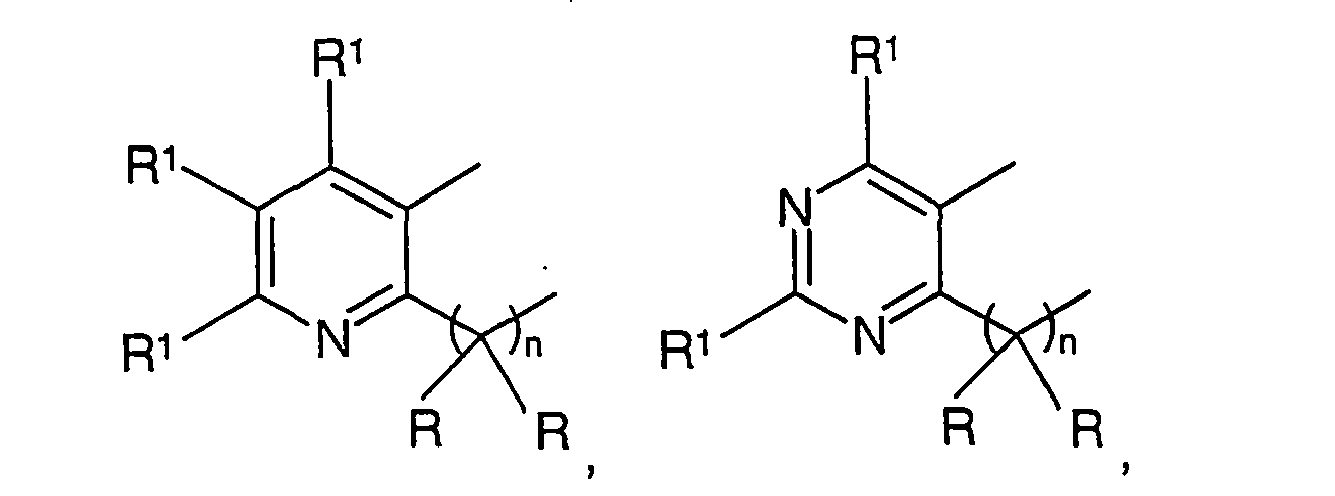

- R
- is independently selected from the group consisting of H, A, -(CH2)r-OA, -(CH2)r-SA, cycloalkyl having 3 to 10 C atoms, -(CH2)s-cycoalkyl, fluoroalkyl having 1 to 3 C atoms, -(CH2)r-OAr, -(CH2)r-OHet, -(CH2)s-Ar, -(CH2)s-Het, NHA, NA2, -(CH2)s-NHA or -(CH2)s-NA2,
- R1
- is independently of each other H, A, OA, SA, Hal, cycloalkyl having 3 to 10 C atoms, haloalkyl having 1 to 3 C atoms, haloalkoxy having 1 to 3 C atoms, haloalkylthio having 1 to 3 C atoms, -(CH2)t-OA, Het, -(CH2)t-Het, -(CH2)t-OAr, Ar, OAr, O-CHt-Ar, NO2, NHA, NA2, -(CH2)t-NHA, -(CH2)t-NA2, COOH, COOA or CN,
- R2
- is H, A or CO-A,
- r
- is 2, 3 or 4,
- s
- is 1, 2 or 3,
- t
- is 1, 2 or 3;
- n
- is 1, 2 or 3,
- A
- is alkyl having 1 to 8 C atoms,
- Ar
- is phenyl or naphthyl which are unsubstituted or mono- or disubstituted by A, OA or Hal,
- Hal
- is F, Cl, Br or I,
- Het
- is a saturated, partially or completely unsaturated mono- or bicyclic heterocyclic radical having 5 to 10 ring members, where 1 or 2 N and/or 1 or 2 S or O atoms can be present and the heterocyclic radical can be mono- or disubstituted by oxo, A, Hal, OH, OA, CF3, OCF3, NH2, NHA, NA2, COOH or COOA,
- (1) a compound of formula I


- R3
- is OA, OAr, OCH2-Ar or Hal1,
- A
- is alkyl having 1 to 8 C atoms,
- Ar
- is phenyl or naphthyl which are unsubstituted or mono- or disubstituted by A, OA or Hal,
- Hal1
- is F or Cl,

- (2) a compound of formula II is then hydrogenated and in that if necessary
- (3) a base or acid of the formula III is converted into one of its salts.
- The abbreviations used have the following meanings:
- Bu
- n-butyl
- t-Bu
- tert-butyl
- Et
- ethyl
- Me
- methyl
- LDA
- lithium diisopropyl amide
- THF
- tetrahydrofuran
- h
- hours
- HPLC
- high pressure liquid chromatography
- IPN
- isopropylnitrit
- On account of their molecular structure, compounds of the formula III according to the invention can be chiral and can accordingly occur in various enantiomeric forms. They can therefore be present in racemic or in optically active form. The formula III includes all these forms.
- The stereoisomeric forms can be separated into enantiomeric compounds by chemical, biochemical or physical measures known to the person skilled in the art, or even employed as such in the synthesis.
- Thus diastereomers can be formed from the racemate of formula I by reaction with an optically active resolving agent. Suitable resolving agents for basic compounds of the formula I are, for example, optically active acids, such as the R and S forms of tartaric acid, diacetyl tartaric acid, dibenzoyltartaric acid, mandelic acid, malic acid, lactic acid, suitably N-protected amino acids (e.g. N-benzoylproline or N-benzenesulfonyl-proline) or the various optically active camphorsulfonic acids. Chromatographic resolution of enantiomers with the aid of an optically active resolving agent (e.g. dinitrobenzoylphenylglycine, cellulose triacetate or other derivatives of carbohydrates or chirally derivatized methacrylate polymers immobilized on silica gel) is also advantageous. Suitable eluents for this are aqueous or alcoholic solvent mixtures such as, for example, hexane/isopropanol/acetonitrile, e.g. in the ratio 82:15:3.
- In the above or below formulae, A is alkyl and has 1 to 8, preferably 1, 2, 3, 4, 5 or 6 C atoms. Alkyl is preferably methyl, furthermore ethyl, propyl, isopropyl, butyl, isobutyl, sec-butyl or tert-butyl, additionally also pentyl, 1-, 2- or 3-methylbutyl, 1,1-, 1,2- or 2,2-dimethylpropyl, 1-ethylpropyl, hexyl, 1-, 2-, 3- or 4-methylpentyl, 1,1-, 1,2-, 1,3-, 2,2-, 2,3- or 3,3-dimethylbutyl, 1- or 2-ethylbutyl, 1-ethyl-1-methylpropyl, 1-ethyl-2-methylpropyl, 1,1,2- or 1,2,2-trimethylpropyl, heptyl or octyl.
A is preferentially methyl, ethyl, propyl, isopropyl or tert-butyl. Particular preference is given to tert-butyl. - In the above or below formulae, Ar is phenyl or naphthyl, which is unsubstituted or mono- or di-substituted by A, OA or Hal.
- Ar is preferentially phenyl, preferably 2-, 3- or 4-methylphenyl, 2-, 3- or 4-ethylphenyl, 2-, 3- or 4-propylphenyl, 2-, 3- or 4-isopropylphenyl, 2-, 3- or 4-butylphenyl, 2-, 3- or 4-tert-butylphenyl, 2-, 3- or 4-methoxyphenyl, 2-, 3- or 4-ethoxyphenyl, 2-, 3- or 4-pentoxyphenyl, 2-, 3- or 4-fluorophenyl, 2-, 3- or 4-chlorophenyl, 2-, 3- or 4-bromophenyl, 2,3-, 2,4-, 2,5-, 2,6-, 3,4- or 3,5-dichlorophenyl, 2,3-, 2,4-, 2,5-, 2,6-, 3,4- or 3,5-dibromophenyl, 2,3-, 2,4-, 2,5-, 2,6-, 3,4- or 3,5-dimethoxyphenyl.
- Phenyl is particularly preferred for Ar.
- In the above or below formulae, cycloalkyl having 3 to 10 carbon atoms is preferably cyclopropyl, cyclobutyl, cyclopentyl, cyclohexyl, cycloheptyl or cyclooctyl. Cycloalkyl is likewise a monocyclic or bicyclic terpene, preferably p-menthane, menthol, pinane, bornane or camphor, where each known stereoisomeric form is included, or adamantyl. For camphor, this is both L-camphor and D-camphor.
- In the above or below formulae, fluoroalkyl is preferentially mono-, di- or trifluoromethyl, 1- or 2-monofluoroethyl, 1,1-, 1,2- or 2,2-difluoroethyl, 1,1,2-, 1,2,2- or 2,2,2-trifluoroethyl, pentafluoroethyl, 3,3,3-trifluoropropyl or heptafluoropropyl. Particularly preferred is trifluoromethyl.
- In the above or below formulae, Hal is preferably F, Cl, Br or I.
- In the above or below formulae, Hal1 is preferably F or Cl.
- In the above or below formulae, haloalkyl is preferentially mono-, di- or trifluoromethyl, 1- or 2-monofluoroethyl, 1,1-, 1,2- or 2,2-difluoroethyl, 1,1,2-, 1,2,2- or 2,2,2-trifluoroethyl, pentafluoroethyl, 3,3,3-trifluoropropyl or heptafluoropropyl, mono-, di- or trichloromethyl, 1- or 2-monochloroethyl, 1,1-, 1,2- or 2,2-dichloroethyl, 1,1,2-, 1,2,2- or 2,2,2-trichloroethyl, pentachloroethyl, 3,3,3-trichloropropyl or heptachloropropyl, mono-, di- or tribromomethyl, 1- or 2-monobromoethyl, 1,1-, 1,2- or 2,2-dibromoethyl, 1,1,2-, 1,2,2- or 2,2,2-tribromoethyl, pentabromoethyl, 3,3,3-tribromopropyl or heptabromopropyl. Particularly preferred is trifluoromethyl.
- In the above or below formulae, haloalkoxy is preferentially mono-, di- or trifluoromethoxy, 1- or 2-monofluoroethoxy, 1,1-, 1,2- or 2,2-difluoroethoxy, 1,1,2-, 1,2,2- or 2,2,2-trifluoroethoxy, pentafluoroethoxy, 3,3,3-trifluoropropoxy or heptafluoropropoxy, mono-, di- or trichloromethoxy, 1- or 2-monochloroethoxy, 1,1-, 1,2- or 2,2-dichloroethoxy, 1,1,2-, 1,2,2- or 2,2,2-trichloroethoxy, pentachloroethoxy, 3,3,3-trichloropropoxy or heptachloropropoxy, mono-, di- or tribromomethoxy, 1- or 2- monobromoethoxy, 1,1-, 1,2- or 2,2-dibromoethoxy, 1,1,2-, 1,2,2- or 2,2,2-tribromoethoxy, pentabromoethoxy, 3,3,3-tribromopropoxy or heptabromopropoxy. Particularly preferred is trifluoromethoxy.
- In the above or below formulae, haloalkylthio is mono-, di- or trifluormethylsulfanyl, 1- or 2-monofluoroethylsulfanyl, 1,1-, 1,2- or 2,2-difluoroethylsulfanyl, 1,1,2-, 1,2,2- or 2,2,2-trifluoroethylsulfanyl, pentafluoroethylsulfanyl, 3,3,3-trifluoropropylsulfanyl or heptafluoropropylsulfanyl, mono-, di- or trichloromethylsulfanyl, 1- or 2- monochloroethylsulfanyl, 1,1-, 1,2- or 2,2-dichloroethylsulfanyl, 1,1,2-, 1,2,2- or 2,2,2-trichloroethylsulfanyl, pentachloroethylsulfanyl, 3,3,3-trichloropropylsulfanyl or heptachloropropylsulfanyl, mono-, di- or tribromomethylsulfanyl, 1- or 2-monobromoethylsulfanyl, 1,1-, 1,2- or 2,2-dibromoethylsulfanyl, 1,1,2-, 1,2,2- or 2,2,2-tribromoethylsulfanyl, pentabromoethylsulfanyl, 3,3,3-tribromopropylsulfanyl or heptabromopropylsulfanyl. Particularly preferred is trifluoromethylsulfanyl.
- Het is a saturated, partially or completely unsaturated mono- or bicyclic heterocyclic radical having 5 to 10 ring members, where 1 or 2 N and/or 1 or 2 S or O atoms can be present and the heterocyclic radical can be mono- or disubstituted by oxo, A, Hal, OH, OA, CF3, OCF3, NH2, NHA, NA2, COOH or COOA.
- Het is preferably 2- or 3-furyl, 2- or 3-thiophenyl, 1-, 2- or 3-pyrrolyl, 1-, 2-, 4- or 5-imidazolyl, 1-, 3-, 4- or 5-pyrazolyl, 2-, 4- or 5-oxazolyl, 3-, 4- or 5-isoxazolyl, 2-, 4- or 5-thiazolyl, 3-, 4- or 5-isothiazolyl, 2-, 3- or 4-pyridyl, 2-, 4-, 5- or 6-pyrimidinyl, furthermore preferably 1,2,3-triazol-1-, -4- or -5-yl, 1,2,4-triazol-1-, -4- or -5-yl, 1- or 5-tetrazolyl, 1,2,3-oxadiazol-4- or -5-yl, 1,2,4-oxadiazol-3- or -5-yl, 1,3,4-thiadiazol-2- or -5-yl, 1,2,4-thiadiazol-3- or -5-yl, 1,2,3-thiadiazol-4- or -5-yl, 2-, 3-, 4-, 5- or 6-2H-thiopyranyl, 2-, 3- or 4-4H-thiopyranyl, 3- or 4-pyridazinyl, pyrazinyl, 2-, 3-, 4-, 5-, 6- or 7-benzofuryl, 2-, 3-, 4-, 5-, 6- or 7-benzothienyl, 1-, 2-, 3-, 4-, 5-, 6- or 7-1 H-indolyl, 1-, 2-, 4- or 5-benzimidazolyl, 1-, 3-, 4-, 5-, 6- or 7-benzopyrazolyl, 2-, 4-, 5-, 6- or 7-benzoxazolyl, 3-, 4-, 5-, 6- or 7-benzisoxazolyl, 2-, 4-, 5-, 6- or 7-benzothiazolyl, 2-, 4-, 5-, 6- or 7-benzisothiazolyl, 4-, 5-, 6- or 7-benz-2,1,3-oxadiazolyl, 1-, 2-, 3-, 4-, 5-, 6-, 7- or 8-quinolinyl, 1-, 3-, 4-, 5-, 6-, 7- or 8-isoquinolinyl, 1-, 2-, 3-, 4- or 9-carbazolyl, 1-, 2-, 3-, 4-, 5-, 6-, 7-, 8- or 9-acridinyl, 3-, 4-, 5-, 6-, 7- or 8-cinnolinyl, 2-, 4-, 5-, 6-, 7- or 8-quinazolinyl. The heterocyclic radicals can also be partially or completely hydrogenated. Het can thus also be 2,3-dihydro-2-, -3-, -4- or -5-furyl, 2,5-dihydro-2-, -3-, -4- or -5-furyl, tetrahydro-2- or -3-furyl, 1,3-dioxolan-4-yl, tetrahydro-2- or -3-thienyl, 2,3-dihydro-1-, -2-, -3-, -4- or -5-pyrrolyl, 2,5-dihydro-1-, -2-, -3-, -4- or -5-pyrrolyl, 1-, 2- or 3-pyrrolidinyl, tetrahydro-1-, -2- or -3-pyrrolyl, tetrahydro-1-, -2- or 4-imidazolyl, 2,3-dihydro-1-, -2-, -3-, -4-, -5-, -6-, -7-1 H-indolyl, 2,3-dihydro-1-, -2-, -3-, -4- or -5-pyrazolyl, tetrahydro-1-, -3- or -4-pyrazolyl, 1,4-dihydro-1-, -2-, -3- or -4-pyridyl, 1,2,3,4-tetrahydro-1-, -2-, -3-, -4-, -5- or -6-pyridyl, 1,2,3,6-tetrahydro-1-, -2-, -3-, -4-, -5- or -6-pyridyl, 1-, 2-, 3- or 4-piperidinyl, 1-, 2-, 3- or 4-azepanyl, 2-, 3- or 4-morpholinyl, tetrahydro-2-, -3- or -4-pyranyl, 1,4-dioxanyl, 1,3-dioxan-2-, -4- or -5-yl, hexahydro-1-, -3- or -4-pyridazinyl, hexahydro-1-, -2-, -4- or -5-pyrimidinyl, 1-, 2- or 3-piperazinyl, 1,2,3,4-tetrahydro-1-, -2-, -3-, -4-, -5-, -6-, -7- or -8-quinolinyl, 1,2,3,4-tetrahydro-1-, -2-, -3-, -4-, -5-, -6-, -7- or -8-isoquinolinyl.
- R is independently selected from the group consisting of H, A, -(CH2)r-OA, -(CH2)r-SA, cycloalkyl having 3 to 10 C atoms, -(CH2)s-cycloalkyl, fluoroalkyl having 1 to 3 C atoms, -(CH2)r-OAr, -(CH2)r-OHet, -(CH2)s-Ar, -(CH2)s-Het, NHA, NA2, -(CH2)s-NHA or -(CH2)s-NA2, in which A, Ar, cycloalkyl, fluoroalkyl and Het have one of the above defined meanings and
s is 1, 2 or 3, preferentially 1.
r is 2, 3 or 4, preferentially 2.
R is preferentially H or A, particularly preferred H. - R1 is independently selected from the group consisting of H, A, OA, SA, Hal, cycloalkyl having 3 to 10 C atoms, haloalkyl having 1 to 3 C atoms, haloalkoxy having 1 to 3 C atoms, haloalkylthio having 1 to 3 C atoms, -(CH2)t-OA, Het, -(CH2)t-Het, -(CH2)t-OAr, Ar, OAr, O-CHt-Ar, NO2, NHA, NA2, -(CH2)t-NHA, -(CH2)t-NA2, COOH, COOA or CN, in which A, Ar, cycloalkyl, fluoroalkyl, haloalkyl, haloalkoxy, haloalkylthio and Het have one of the above defined meanings and t is 1, 2 or 3, preferentially 1.
R1 is preferentially H or A, particularly preferred H. - R2 is independently selected from the group consisting of H, A or CO-A, in which A has one of the meanings as indicated above. R2 is preferentially H.
- R3 is selected from the group consisting of OA, OAr, OCH2-Ar or Hal1, where A, Ar and Hal1 have a preferred meaning indicated beforehand. R3 is preferentially butoxy, tert-butoxy, pentoxy, 3-methyl-but-1-yloxy or isopropoxy.
- R4 is selected from the group consisting of A, CO-A, CH2-Ar, (CH2)o-OA, - (CH2)o-Het, (CH2)o-OAr, haloalkyl having 1 to 3 C atoms, (CH2)o-NH2, (CH2)o-NHA or (CH2)o-NA2, where Ar, haloalkyl and Het have a preferred meaning indicated beforehand and o is 1, 2, 3, 4, 5, 6 or 7, preferentially 1. R4 is preferentially A, CO-A or CH2-Ar, particularly preferably A.
- E is independently selected from the group as defined in claim 2.
E is particularly a mono- or polycyclic aromatic ring system having 0, 1, 2, 3 or 4 heteroatoms selected from the group consisting of N, O, and S wherein the ring nitrogen atoms are unsubstitued or substituted with one R2 substituent and the ring carbon atoms are unsubstituted or substituted with one to five R1 substituents, in which R1 and R2 have a meaning as indicated above.
Particularly preferred mono- or polycylic aromatic ring systems for E are pyridin-2-yl, naphthalen-1-yl and phenyl. - G is selected from the group consisting of H, A, -(CR2)r-OA, -(CR2)r-SA, cycloalkyl having 3 to 10 C atoms, -(CR2)s-cycloalkyl, fluoroalkyl having 1 to 3 C atoms, -(CR2)r-OAr, -(CR2)r-OHet, -(CR2)s-Ar, -(CR2)s-Het, NHA, NA2, -(CR2)s-NHA or -(CR2)s-NA2, where R, A, cycloalkyl, Ar and Het have a meaning as indicated above.
G is particularly preferred H or cyclohexyl. - E and G together form a structural formula selected from the group consisting of


- E and G together form in particular the structural formula

- In another aspect, the present invention is directed to a process for the preparation of compounds of formula III

- E
- is a mono- or polycyclic aromatic ring system having 0, 1, 2, 3 or 4 heteroatoms selected from the group consisting of N, O, and S wherein the ring nitrogen atoms are unsubstitued or substituted with one R2 substituent and the ring carbon atoms are unsubstituted or substituted with one to five R1 substituents and R1 independently can be H, A, OA, SA, Hal, cycloalkyl having 3 to 10 C atoms, haloalkyl having 1 to 3 C atoms, aloalkoxy having 1 to 3 C atoms, haloalkylthio having 1 to 3 C atoms, -(CH2)t-OA, Het, -(CH2)t-Het, -(CH2)t-OAr, Ar, OAr, O-CHt-Ar, NO2 NHA, NA2, -(CH2)t-NHA; -(CH2)t-NA2, COOH, COOA or CN, t is 1, 2 or 3, and R 2 can be H, A or CO-A;
- G
- is selected from the group consisting of H, A, -(CR2)r-OA, -(CR2)r-SA, cycloalkyl having 3 to 10 C atoms, -(CR2)s-cycloalkyl, fluoroalkyl having 1 to 3 C atoms, -(CR2)r-OAr, -(CR2)r-OHet, -(CR2)s-Ar, -(CR2)s-Het, NHA, NA2, -(CR2)s-NHA or -(CR2)s-NA2,
- R
- is independently selected from the group consisting of H, A, -(CH2)r-OA, -(CH2)r-SA, cycloalkyl having 3 to 10 C atoms, -(CH2)s-cycloalkyl, fluoroalkyl having 1 to 3 C atoms, -(CH2)r-OAr, -(CH2)r-OHet, -(CH2)s-Ar, -(CH2)s-Het, NHA, NA2, -(CH2)s-NHA or -(CH2)s-NA2,
- r
- is 2, 3 or 4,
- s
- is 1, 2 or 3,
- A
- is alkyl having 1 to 10 C atoms,
- Ar
- is phenyl or naphthyl which are unsubstituted or mono- or disubstituted by A, OA or Hal,
- Hal
- is F, Cl, Br or 1,
- Het
- is a saturated, partially or completely unsaturated mono- or bicyclic heterocyclic radical having 5 to 10 ring members, where 1 or 2 N and/or 1 or 2 S or O atoms can be present and the heterocyclic radical can be mono- or disubstituted by oxo, A, Hal, OH, OA, CF3, OCF3, NH2, NHA, NA2, COOH or COOA,
- (1) a compound of formula I


- R3
- is OA, OAr, OCH2-Ar or Hal1,
- A
- is alkyl having 1 to 8 C atoms,
- Ar
- is phenyl or naphthyl which are unsubstituted or mono- or disubstituted by A, OA or Hal,
- Hal1
- is F or Cl,

- (2) a compound of formula II is then hydrogenated and in that if necessary
- (3) a base or acid of the formula III is converted into one of its salts.
- In a preferred aspect, the present invention is directed to a process for the preparation of compounds of formula III

- E
- is pyridin-2-yl, naphthalen-1-yl or phenyl wherein the ring nitrogen atoms are unsubstitued or substituted with one R2 substituent and the ring carbon atoms are unsubstituted or substituted with one to five R1 substituents and R1 independently can be H, A, OA, SA, Hal, cycloalkyl having 3 to 10 C atoms, haloalkyl having 1 to 3 C atoms, haloalkoxy having 1 to 3 C atoms, haloalkylthio having 1 to 3 C atoms, -(CH2)t-OA, Het, -(CH2)t-Het, -(CH2)t-OAr, Ar, OAr, O-CHt-Ar, NO2, NHA, NA2, -(CH2)t-NHA, -(CH2)t-NA2, COOH, COOA or CN, t is 1, 2 or 3, and R2 can be H, A or CO-A;
- G
- is selected from the group consisting of H, A, -(CR2)r-OA, -(CR2)r-SA, cycloalkyl having 3 to 10 C atoms, -(CR2)s-cycloalkyl, fluoroalkyl having 1 to 3 C atoms, -(CR2)r-OAr, -(CR2)r-OHet, -(CR2)s-Ar, -(CR2)s-Het, NHA, NA2, -(CR2)s-NHA or -(CR2)s-NA2,
- R
- is independently selected from the group consisting of H, A, -(CH2)r-OA, -(CH2)r-SA, cycloalkyl having 3 to 10 C atoms, -(CH2)s-cycloalkyl, fluoroalkyl having 1 to 3 C atoms, -(CH2)r-OAr, -(CH2)r-OHet, -(CH2)s-Ar, -(CH2)s-Het, NHA, NA2, -(CH2)s-NHA or -(CH2)s-NA2,
- r
- is 2, 3 or 4,
- s
- is 1, 2 or 3,
- A
- is alkyl having 1 to 10 C atoms,
- Ar
- is phenyl or naphthyl which are unsubstituted or mono- or disubstituted by A, OA or Hal,
- Hal
- is F, Cl, Br or I,
- Het
- is a saturated, partially or completely unsaturated mono- or bicyclic heterocyclic radical having 5 to 10 ring members, where 1 or 2 N and/or 1 or 2 S or O atoms can be present and the heterocyclic radical can be mono- or disubstituted by oxo, A, Hal, OH, OA, CF3, OCF3, NH2, NHA, NA2, COOH or COOA,
- (1) a compound of formula I


- R3
- is OA, OAr, OCH2-Ar or Ha11,
- A
- is alkyl having 1 to 8 C atoms,
- Ar
- is phenyl or naphthyl which are unsubstituted or mono- or disubstituted by A, OA or Hal,
- Hal1
- is F or Cl,

- (2) a compound of formula II is then hydrogenated and in that if necessary
- (3) a base or acid of the formula III is converted into one of its salts.
- Therefore, particularly preferred compounds of formula I, in which E and G do not together form a cyclic system, are the compounds selected from the following group:

- In another aspect, the present invention is directed to a process for the preparation of compounds of formula III,


- R
- is independently selected from the group consisting of H, A, -(CH2)r- OA, -(CH2)r-SA, cycloalkyl having 3 to 10 C atoms, -(CH2)s-cycloalkyl, fluoroalkyl having 1 to 3 C atoms, -(CH2)r-OAr, -(CH2)r-OHet, -(CH2)s-Ar, -(CH2)s-Het, NHA, NA2, -(CH2)s-NHA or -(CH2)s-NA2,
- R1
- is independentaly of each other H, A, OA, SA, Hal, cycloalkyl having 3 to 10 C atoms, haloalkyl having 1 to 3 C atoms, haloalkoxy having 1 to 3 C atoms, haloalkylthio having 1 to 3 C atoms, -(CH2)t-OA, Het, -(CH2)t-Het, -(CH2)t-OAr, Ar, OAr, O-CHt- Ar, NO2 NHA, NA2, -(CH2)t-NHA, -(CH2)t-NA2, COOH, COOA or CN,
- r
- is 2, 3 or 4,
- s
- is 1, 2 or 3,
- n
- is 1, 2 or 3,
- t
- is 1, 2 or 3,
- A
- is alkyl having 1 to 8 C atoms,
- Ar
- is phenyl or naphthyl which are unsubstituted or mono- or disubstituted by A, OA or Hal,
- Hal
- is F, Cl, Br or I,
- Het
- is a saturated, partially or completely unsaturated mono- or bicyclic heterocyclic radical having 5 to 10 ring members, where 1 or 2 N and/or 1 or 2 S or O atoms can be present and the heterocyclic radical can be mono- or disubstituted by oxo, A, Hal, OH, OA, CF3, OCF3, NH2, NHA, NA2, COOH or COOA,
- (1) a compound of formula lb

is reacted with nitrosyl tetrafluoroborate or a compound of formula IV
- R3
- is OA, OAr, OCH2-Ar or Hal1,
- A
- is alkyl having 1 to 8 C atoms,
- Ar
- is phenyl or naphthyl which are unsubstituted or mono- or disubstituted by A, OA or Hal,
- Hal1
- is F or Cl,

- (2) a compound of formula llb is then hydrogenated and in that if necessary
- (3) a base or acid of the formula IIIb is converted into one of its salts.
- In a preferred aspect, the present invention is directed to a process for the preparation of compounds of formula IIIb


- R
- is independently selected from the group consisting of H, A, -(CH2)r-OA, -(CH2)r-SA, cycloalkyl having 3 to 10 C atoms, -(CH2),-cycloalkyl, fluoroalkyl having 1 to 3 C atoms, -(CH2)r-OAr, -(CH2)r-OHet, -(CH2)s-Ar, -(CH2)s-Het, NHA, NA2, -(CH2)s-NHA or -(CH2)s-NA2,
- R1
- is independentaly of each other H, A, OA, SA, Hal, cycloalkyl having 3 to 10 C atoms, haloalkyl having 1 to 3 C atoms, haloalkoxy having 1 to 3 C atoms, haloalkylthio having 1 to 3 C atoms, -(CH2)t-OA, Het, -(CH2)t-Het, -(CH2)t-OAr, Ar, OAr, O-CHt- Ar, NO2, NHA, NA2, -(CH2)t-NHA, -(CH2)t-NA2, COOH, COOA or CN,
- r
- is 2, 3 or 4,
- s
- is 1, 2 or 3,
- n
- is 1, 2 or 3,
- t
- is 1, 2 or 3,
- A
- is alkyl having 1 to 8 C atoms,
- Ar
- is phenyl or naphthyl which are unsubstituted or mono- or disubstituted by A, OA or Hal,
- Hal
- is F, Cl, Br or I,
- Het
- is a saturated, partially or completely unsaturated mono- or bicyclic heterocyclic radical having 5 to 10 ring members, where 1 or 2 N and/or 1 or 2 S or O atoms can be present and the heterocyclic radical can be mono- or disubstituted by oxo, A, Hal, OH, OA, CF3, OCF3, NH2, NHA, NA2, COOH or COOA,
- (1) a compound of formula la

is reacted with nitrosyl tetrafluoroborate or a compound of formula IV
- R3
- is OA, OAr, OCH2-Ar or Hal1,
- A
- is alkyl having 1 to 8 C atoms,
- Ar
- is phenyl or naphthyl which are unsubstituted or mono- or disubstituted by A, OA or Hal,
- Hal1
- is F or Cl,
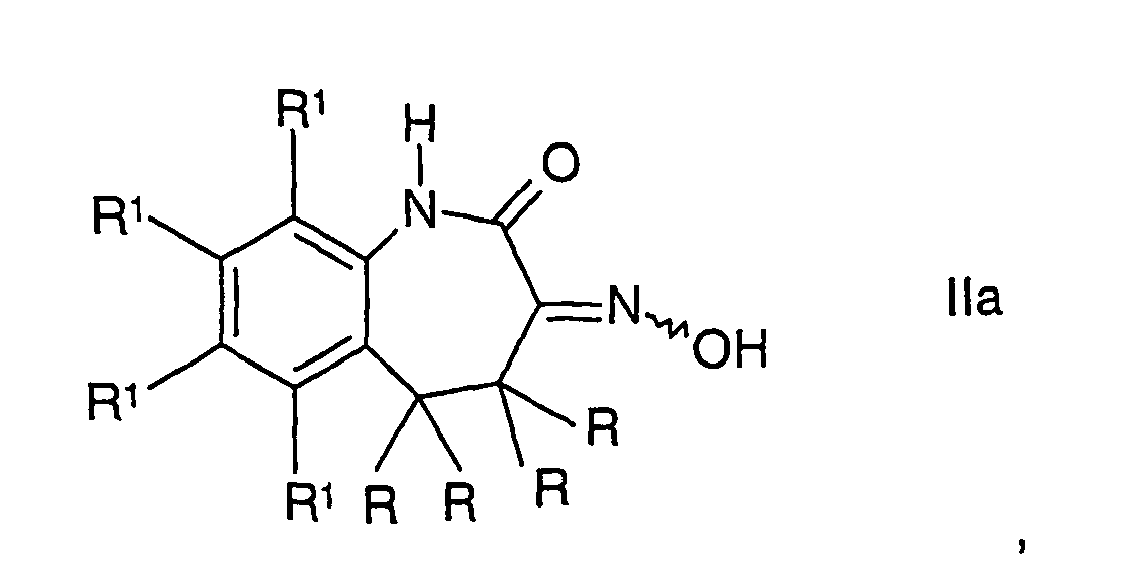
- (2) a compound of formula IIa is then hydrogenated and in that if necessary
- (3) a base or acid of the formula IIIa is converted into one of its salts.
- Therefore, particularly preferred compounds of formula I, in which E and G together form a cyclic system, is the compound 1,3,4,5-tetrahydro-benzo[b]azepin-2-one

- As a rule, the starting compounds of the formulae I, IV and V.are known or commercially available.
- The unknown compounds, however, can be prepared by methods known per se.
The substrates of formula lb in which n is 1 can be prepared by reacting 2-nitro-trans-cinnamic acid wtih hydrogen in the presence of PtO2 in the solvent acetic acid according to Sicker, D.; Rabe, A.; Zakrzewski, A.; Mann, G.; J.Prakt.Chem. 1987, 329; 1063-1070; or converting the corresponding ethyl ester unter similar conditions as described therein. - The substrates of formula lb in which n is 2 (formula la) can be prepared by reacting 3,4-dihydro-2H naphthalen-1-one oxime with polyphosphoric acid according to Nieduzak, Thaddeus R.; Boyer, Frederick E.; Synth.Commun. 1996 26; 3443-3452.
The substrates of formula lb in which n is 3 can be prepared by reacting 6,7,8,9-tetrahydro-benzocyclohepten-5-one oxime according to Behringer; Meier; Justus Liebigs Ann. Chem. 1957, 607, 67,83.
Compounds of formula Ib in which n is 0 can be prepared according to Houben-Weyl. Methoden der Organischen Chemie, Band Xl/2, 560, 4.
Aufl., Stuttgart,1958. - The substrates of formula IV are mostly commercial available and can be prepared by reacting the corresponding alcohol with sodium nitrite in the presence of hydrochloric acid.
- Preferred nitrosylating agents are pentylnitrit, 3-methyl-but-1-yl-nitrit, butyinitrit, tert-butylnitrit and nitrosyl chlorid or - tetrafluoroborate or, most preferably, iso-propylnitrit.
- Any solvent can be used in the first stage of the process of the invention, that means the nitrosylation reaction, provided that it does not interfere with the formation of the hydroxy imino derivatives. Both polar aprotic or unpolar aprotic solvents and combinations thereof are acceptable. Suitable aprotic solvents are hydrocarbons such as hexane, petroleum ether, benzene, toluene or xylene, ethers such as dialkyl ether, diisopropyl ether, tetrahydrofuran or 1,3-dioxane, ethylene glycol dimethyl ether (diglyme) or diethyl ethylether, amides such as dimethylacetamide or dimethylfomamide (DMF), N-methyl pyrrolidone, dimethyl ethylene urea (DMEU), pyridine, or optionally also mixtures of the solvents mentioned with one another.
A particularly preferred solvent in said nitrosylation reaction is tetrahydrofuran and 1,3-dioxane. - A suitable quantity of solvent typically ranges from about 5 to about 25 grams solvent per 100 gram reactant.
- Non-limiting examples for suitable strong bases in the nitrosylation reaction of stage 1 of the process according to the invention are organo lithium reagents, combinations thereof or combinations together with alkali or alkaline earth metals, Grignard reagents, alkali metal alcoholates, alkali metal amides, alkali metal hydrides, alkaline earth metal hydrides, alkyl-, aryl- or arylalkylamines.
Examples of useful organo lithium reagents include lithium amide, lithium diisopropyl amide (LDA), lithium dimethylamide, methyllithium, n-butyllithium, sec-butyllithium, isopropyllithium, sec-amyllithium, n-hexyllithium, 4-heptyllithium, cyclopropyllithium or cyclohexyllithium, tert-butyllithium, tert-amyllithium, triethylmethyllithium, phenyllithium, 1-methylcyclopentyllithium or adamantyllithium. - Suitable bases for combination with organo lithium reagents as defined above are alkali or alkaline earth metals, such as sodium or potassium, Grignard reagents, such as MeMgBr, alkali metal alcoholates such a sodium methanolate, sodium ethoxide, potassium ethoxide, sodium isopropoxide, sodium tert-butoxide or potassium tert-butoxide, alkali metal amides, such as sodium amide, lithium hydride, alkali metal hydrides, such as sodium hydride, alkaline earth metal hydrides, such as calcium hydride, hydroxides such as sodium hydroxide or potassium hydroxide, alkyl-, aryl-or arylalkylamines, such as triethylamine, tributylamine, 1,8-diazabicyclo[5.4.0]-undec-7-ene or 1,8-diazabicyclo-[2.2.2]-octane. In the term "alkali metal" as used for the definition of said bases, the alkali metal lithium is excluded.
Preferably, the base is an organo lithium reagent or an organo lithium reagent in combination with alkali metal alcoholates, more preferably n-hexyllithium, n-butyllithium or tert-butyllithium or a combination of n-butyllithium, n-hexyllithium or tert-butyllithium with potassium tert.-butoxide. - The deprotonation with the aid of the strong base may be carried out additionally in the presence of complex builders, such as N,N,N,N,-tetramethyl-ethylene-diamine (TMEDA) or tetramethyl-piperidine.
- Therefore, the invention further provides a process for the preparation of an aminosubstituted carboxylic acid amide in α-position according to claim 1, 12, 13 or 14, characterized in that the strong base be selected from the group consisting of organo lithium reagents, combinations thereof or combinations together with alkali or alkaline earth metals, Grignard reagents, alkali metal alcoholates, alkali metal amides, alkali metal hydrides, alkaline earth metal hydrides, hydroxides, alkyl-, aryl- or arylalkylamines.
- Preferably, the molar ratio of strong base as single base or combination thereof to carbamide of the primary amine ranges from about 1,8:1 to about 5:1, and more preferably between about 2:1 and 4:1.
- Preferably, in base mixtures, the molar ratio of organo lithium reagent to non-lithium base ranges from about 1:1 to about 4:1, and more preferably between about 2:1 and 3:1.
- Therefore, the invention relates to a process according to claim 1, 12, 13 or 14, wherein the ratio of said base to said carboxylic acid amide of a primary amine is in the range of about 1.8:1 and 5:1.
- Generally, the reagents in the nitrosylation reaction may be added to a solvent and mixed together in any order.
- The reaction time of the nitrosylation reaction, depending on the conditions used, is between a few hours and 4 days.
The reaction temperature is between -150° and 10° C, preferably between -30° C and -10° C while adding the strong base to the unsubstituted carboxamide of primary amines. The reaction temperature of the nitrosylation reaction is between -30° C and -20° C, preferably between -150° C and 0° C. - hydrolysis takes place while customary working up, as defined below to form crude hydroxy imino derivatives. Said oxime can be purified by conventional methods known to those skilled in the art, including, for example, chromatography or crystallization.
- The conversion of hydroxy imino derivatives to α-aminosubstituted carboxylic acid amides is carried out according to the invention using electrochemical reduction, complex hydrides, such as LiAlH4, NaBH4, diborane, NaAl(OCH2CH2OCH3)2H2 or combinations thereof with Lewis acids, hydrazine, combination of metals, such as iron or zinc, with acids, such as sulfuric acid, nitric acid, hydrohalic acids such as hydrochloric acid or hydrobromic acid, phosphoric acids such as orthophosphoric acid or sulfamic acid or hydrogen gas with the aid of a metal catalyst selected from the group consisting of Group 8 metals.
Suitable Lewis acids are BF3, AlCl3 or LiBr. - Therefore, the invention further provides a process according to claim 1, 12, 13 or 14, wherein said hydrogenation be carried out using electrochemical reduction, complex hydrides, hydrazine, combination of metals with acids or hydrogen gas with the aid of a metal catalyst selected from the group consisting of Group 8 metals.
- Preferably, hydrogenation is carried out using hydrogen gas with the aid of a metal catalyst selected from the group consisting of Group 8 metals. Suitable catalysts are e.g. Raney nickel, palladium or platinum catalysts. Palladium or platinum catalysts may be present on supports, e.g. on charcoal, calcium carbonate, barium sulfate or strontium carbonate, in the form of oxides, such as platinum oxide, or in finely divided form. Hydrogenation can preferably be carried out under pressures of about 1 to 200 bar and at temperatures of about -80° to +150°. The hydrogenation is carried out in the presence of an inert solvent, for example an alcohol, such as methanol, ethanol or isopropanol, a carboxylic acid, such as acetic acid, an ester, such as ethyl acetate, or an ether, such as tetrahydrofuran or dioxane. It is also possible to use solvent mixtures, for example also mixtures which contain water. Hydrogenation under mild conditions, for example at temperatures of 0 to 50° and under pressures of about 1 to 5 bar is preferred.
- Additionally, the hydrogenation reaction can be carried out using hydrogen gas in the presence of an enantioselective or an enantiomerically enriched catalyst to form enantiomers of formula I. Particularly preferably, the catalyst is a transition metal complex comprising a metal selected from the group rhodium, iridium, ruthenium and palladium, which is complexed with a chiral diphosphane ligand.
- The ligands below may be mentioned by way of example:


- Depending on the choice of the (R) or (S) enantiomer of the ligand in the catalyst, the (R) or (S) enantiomer of formula I is obtained in an excess.
- Precursors used for the chiral ligands are compounds such as, for example, Rh(COD)2OTf (rhodiumcycloocatdiene triflate), [Rh(COD)Cl]2, Rh(COD)2BF4, [lr(COD)Cl]2, Ir(COD)2BF4 or [Ru(COD)Cl2]x.
- The reaction time of the enantioselective hydrogenation, depending on the conditions used, is between a few minutes and 14 days; the reaction temperature is between 0 and 150°, normally between 20 and 130°C. Customarily, the catalyst/substrate ratio is between 1:2000 and 1:50, particularly preferably 1:1000 and 1:100. The reaction time is then, for example, between 3 and 20 hours. The hydrogenation is carried out under 1-200 bar of hydrogen, preferably at 3-100 bar.
- Therefore, the invention further provides a process according to claim 1, 12, 13 or 14, wherein said hydrogenation be carried out using hydrogen gas in the presence of an enantioselective or an enantiomerically enriched catalyst.
- A base of the α-aminosubstituted carboxylic acid amide can be converted into the associated acid addition salt using an acid, for example by reaction of equivalent amounts of the base and of the acid in an inert solvent such as ethanol and subsequent evaporation. Acids which give physiologically acceptable salts are particularly suitable for this reaction. Thus inorganic acids can be used, e.g. sulfuric acid, nitric acid, hydrohalic acids such as hydrochloric acid or hydrobromic acid, phosphoric acids such as orthophosphoric acid, sulfamic acid, furthermore organic acids, in particular aliphatic, alicyclic, araliphatic, aromatic or heterocyclic mono- or polybasic carboxylic, sulfonic or sulfuric acids, e.g. formic acid, acetic acid, propionic acid, pivalic acid, diethylacetic acid, malonic acid, succinic acid, pimelic acid, fumaric acid, maleic acid, lactic acid, tartaric acid, malic acid, citric acid, gluconic acid, ascorbic acid, nicotinic acid, isonicotinic acid, methane-or ethanesulfonic acid, p-toluenesulfonic acid, naphthalenemono- and disulfonic acids or laurylsulfuric acid. Salts with physiologically unacceptable acids, e.g. picrates, can be used for the isolation and/or purification of the compounds of the formula III.
- On the other hand, α-aminosubstituted carboxylic acid amides with bases (e.g sodium or potassium hydroxide or carbonate) can be converted into the corresponding metal salts, in particular alkali metal or alkaline earth metal salts, or into the corresponding ammonium salts.
- The process described herein may be conducted in any conventional reactor or in a micromixer.
- In another aspect, the present invention is directed to hydroxy imino derivatives of formula llb

- R
- is independently selected from the group consisting of H, A, -(CH2)r-OA, -(CH2)r-SA, cycloalkyl having 3 to 10 C atoms, -(CH2)s-cycloalkyl, fluoroalkyl having 1 to 3 C atoms, -(CH2)r-OAr, -(CH2)r-OHet, -(CH2)s-Ar, -(CH2)s-Het, NHA, NA2, -(CH2)s-NHA or -(CH2)s-NA2,
- R1
- is independentaly of each other H, A, OA, SA, Hal, cycloalkyl having 3 to 10 C atoms, haloalkyl having 1 to 3 C atoms, haloalkoxy having 1 to 3 C atoms, haloalkylthio having 1 to 3 C atoms, -(CH2)t-OA, Het, -(CH2)t-Het, -(CH2)t-OAr, Ar, OAr, O-CHt- Ar, NO2 NHA, NA2, -(CH2)t-NHA, -(CH2)t-NA2, COOH, COOA or CN,
- r
- is 2, 3 or 4,
- s
- is 1, 2 or 3,
- n
- is 1, 2 or 3,
- t
- is 1, 2 or 3,
- A
- is alkyl having 1 to 8 C atoms,
- Ar
- is phenyl or naphthyl which are unsubstituted or mono- or disubstituted by A, OA or Hal,
- Hal
- is F, Cl, Br or I,
- Het
- is a saturated, partially or completely unsaturated mono- or bicyclic heterocyclic radical having 5 to 10 ring members, where 1 or 2 N and/or 1 or 2 S or O atoms can be present and the heterocyclic radical can be mono- or disubstituted by oxo, A, Hal, OH, OA, CF3, OCF3, NH2, NHA, NA2, COOH or COOA,
- Compounds of formula IIb are important intermediates for the production of Life Science Chemicals, particularly of pharmaceuticals or agrochemicals.
- The compounds of formula llb can exist in two isomeric forms such as formulae IV-1 and IV-2. Thus, general formula llb includes both formulae IIb-1 and IIb-2.

- Particularly preferred imino derivatives are compounds of formula llb, in which n is 2 (compounds of formula IIa)

- The invention furthermore relates to the use of compounds of the formula IIIb as defined above as intermediates for the synthesis of Life Science Chemicals, in particular of pharmaceuticals or agrochemicals. Therefore, the invention relates additionally to the use of compounds of formula IIb according to claim 19 as intermediates for the synthesis of Life Science Chemicals, in particular of pharmaceuticals or agrochemicals.
- The invention accordingly relates in particular to the use of the compounds of formula IIIb, in which n is 2 and R and R1 are each independently H, for the synthesis of benazeprile. Therefore, the invention relates additionally to the use of compounds of formula IIb according to claim 20, in which n is 2 and R and R1 are each independently H, for the synthesis of benazeprile.
- The following examples are intended to illustrate, but in no way limit the scope of the present invention.
- Above and below, all temperatures are indicated in °C.
-
Column: LiChrospher RP Select B, Cat. No.: 50839 Flow: Isocratic Flow rate: 1.0 ml/min Eluate: 35 ml acetonitrile / 65 ml water, pH = 3, buffers NaH2PO4 / H3PO4 Detection: UV Waveleng th: 223 Dosage: Microliter RT = Retention Time [min] - 5 g (31 mmol) of 1,3,4,5-tetrahydro-benzo[b]azepin-2-one (RT = 5.85) is suspended in 120 ml of THF. At a temperature of -70°, 33,1 g (77,5 mmol) of n-butyllithium (15% in hexane) are added over the course of 30 min. The reaction mixture is allowed to come to room temperature and left to stir for 12 hours. Then a solution of 5,15 g (46,5 mmol) tert-butyinitrit in 10 ml THF is added. After the solution has been stirred for 80 hours, it is added dropwise to 150 g of a brine solution (10%) while stirring. The phases are separated and the organic phase is washed with 100 ml of 1 N NaOH. The organic phase is separated off, dried over sodium sulfate and evaporated. 2,8 g (16,3 mmol) of the educt 1,3,4,5-tetrahydro-benzo[b]azepin-2-one is isolated back from the reaction mixture [53%, HPLC 94,7 area %].
The combined aqueous phases with a pH 13,0 are adjusted to pH 4,0 with 175 ml of 1 N HCl and extracted three times with 100 ml dichloromethane. The combined organic phases are dried over sodium sulfate and evaporated. 2,5 g (9 mmol) of the oxime 4,5-dihydro-1 H-benzo[b]azepine-2,3-dione-3-oxime is obtained [30,5%, HPLC 71,8 area %, RT = 3.50, 4.10]. - 5 g (26,3 mmol) of 4,5-dihydro-1 H-benzo[b]azepine-2,3-dione 3-oxime is taken in 50 ml of methanol then 6,3 g (105 mmol) acetic acid is added. The reaction mixture is left to stir at 50°C and 5 bar hydrogen pressure for 21 hours in the presence of 1,1 g Pd catalyst (5 % on charcoal, containing 50 % water). The reaction mixture is evaporated after filtration and the residue is dissolved in 16,5 ml water. 9,5 ml dichloromethane is added and the pH value is adjusted to pH 12-14 with NaOH (32%). After phase separation the aqueous layer is extracted two times with 5,5 ml dichloromethane each. The organic phases are dried over sodium sulfate and evaporated to give 3,12 g 3-amino-1 ,3,4,5-tetrahydro-benzo[b]azepin-2-one, yield 67,4 %, HPLC 94,5 area %, RT = 2.45.
- The nitrosylation reactions can also be carried out under variation of the following parameters but analoguosly as described in example 1, part 1.1..
exp.2.1.1. exp. 2.1.2. exp. 2.1.3. exp.2.1.4. exp. 2.1.5. base 1 - - KO t Bu KO t Bu - (mole %) (100 %) (100 %) solvent THF THF THF THF THF base 2, 1 st equiv. LDA sec-BuLi n-HexLi n-HexLi n-HexLi (mole %) (310 %) (300 %) (200 %) (220 %) (300 %) nitrosylating IPN IPN IPN IPN IPN agent, 1 st equiv. (mole %) (210 %) (120 %) (61 %) (60 %) (412 %) base 2, 2 nd equiv. - n-HexLi n-HexLi - (mole %) (100 %) (80 %) nitrosylating agent, 2 nd equiv. - - IPN IPN - (mole %) (62 %) (60 %) yield 48,4 % 30,2 % 43,8 % 42,2 % 25,8% assay 84,5 % 94,9 % 90,0 % 88,0 % 99,0 % (area % HPLC) 67,1 % 95,2 % additive - - - - TMEDA (mole %) (200 %) notes 1, 2, 3 2, 3 1, 3 Notes:
1) In these cases the solution of the deprotonated educt was added to a solution of the nitrosylating agent.
2) For the course of reactions with iterated additions of the base / nitrosylating agent: see example 4.
3) Extraction with ethyl acetate after acidification of the aqueous layer and treatment with active carbon before crystallization. - The reductions can also be carried out under variation of the following parameters but analoguosly as described in example 1, part 1.2.
exp.2.2.1. exp. 2.2.2. exp. 2.2.3. exp. 2.2.4. qty. oxime 1 g 1 g 2 g 1 g solvent 1 ethyl acetate THF methanol methanol (ml) (10 ml) (10 ml) (20 ml) (50 ml) solvent 2 water water - (ml) (10 ml) (10 ml) acid acetic acid acetic acid acetic acid acetic acid (mole %) (240 %) (240 %) (400 %) (20 ml) catalyst Pd/C 5% Pd/C 5% Raney-Ni Pd/C 10% (g) (50 % H2O) (50 % H2O) 1,2 g 0,42 g 0,2 g 0,2 g in portions temp. / press. / time 48,8°C / 2,2 bar / 1h 53,3°C / 2,2 bar / 2h 55,4°C / 2,1 / bar / 58h 22°C / 1 1 bar / 20h yield 99,1% conv. 92,8% conv. 75 % conv. 88,5% assay - - - 100 % (area % HPLC) notes 1, 2 1, 2 1 2 Notes:
1) No workup; only monitoring by HPLC.
2) Reduction of recrystallized oxime. - 29,01 g (0,253 mol) potassium tert-butylate is suspended in 227 ml of THF and 40 g (0,249 mol) 1,3,4,5-tetrahydro-benzo[b]azepin-2-one is added in portions at a temperature of -16°. At the same temperature 140,22 g (0,50 mol) of n-hexyllithium (33% in hexane) are added over the course of 30 min. Then a solution of 34,28 g (0,276 mol) 3-bromo propane in 21,8 ml THF is added at a temperature of -16°. After the solution has been stirred for 23 hours and meanwhile was allowed to reach room temperature, 150 g of water is added dropwise while stirring and cooling with ice water. The resulting mixture is acidified with 62 g hydrochloric acid (37%), the phases are separated and the organic phase is evaporated. 150 ml dichloromethane is added to the residue, the suspension is filtered and the filter is washed with additional 60 ml dichloromethane. The solution is concentrated and the crystals which precipitated on cooling to 0 ° over night are filtered off. The solid is recrystallized from 94,9 g 2-propanol. 23,3 g (0,115 mol) of 4,5-dihydro-3-(2-propyl)-1H benzo[b]azepine-2-one is obtained [46,1%, HPLC 98,4 area %].
- 4,31 g (37,6 mmol) potassium tert-butylate is suspended in 50,35 ml of THF and 5,01 g (36,9 mmol) indoline-2-one is added at a temperature of - 3°, a thick white suspension is formed and 18 ml of THF is added. Ahter cooling to - 8°, 20,83 g of n-hexyllithium (33% in hexane) are added over the course of 15 min what causes an exothermic reaction. The reaction mixture is allowed to come to room temperature and left to stir for 140 minutes. Then it is cooled again to a temperature of - 7° and a solution of 1,84 g (20,7 mmol) 2-propynitrit in 3,26 ml THF is added. After the solution has been stirred for 90 minutes and meanwhile reached room temerature, it is cooled again to a temperature of - 8°-and further 7,73 g of n- hexyllithium (33% in hexane) are added as described above. Then a solution of 1,8 g (20,2 mmol) 2-propylnitrit in 2,92 ml THF is added described above. After additional stirring for 18 hours at room temperature the reaction mixture is added to 51,93 g of water at 13 °. The phases are separated and the organic phase is discarded. The aqueous phase with a pH 12,5 is adjusted to pH 3,5 with 13,72 g of 37% HCl and 323 ml ethyl acetate are added. The aqueous layer is reextracted with 55,5 ml of ethyl acetate and the combined organic phases are dried over sodium sulfate and concentrated. The yellow solid is filtered off and dried after washig with cold ethyl acetate. 4,65 g (27,0 mmol) of the oxime indoline-2,3-dione-3-oxime is obtained [73,3 %, HPLC 94,2 area %]. An analytical sample (2 g) can be recrystallized from 22,10 g water:ethanol 1:1 to yield 1,33 g indoline-2,3-dione-3-oxime [HPLC 98,92 area %, mp. 212,5 °].
a mono- or polycyclic aromatic ring system having 0, 1, 2, 3 or 4 heteroatoms selected from the group consisting of N, O, and S wherein the ring nitrogen atoms are unsubstitued or substituted with one R2 substituent and the ring carbon atoms are unsubstituted or substituted with one to five R1 substituents and
R1 independently can be H, A, OA, SA, Hal, cycloalkyl having 3 to 10 C atoms, haloalkyl having 1 to 3 C atoms, haloalkoxy having 1 to 3 C atoms, haloalkylthio having 1 to 3 C atoms, -(CH2)t-OA, Het, -(CH2)t-Het, -(CH2)t-OAr, Ar, OAr, O-CHt-Ar, NO2, NHA, NA2, -(CH2)t-NHA, -(CH2)t-NA2, COOH, COOA or CN, t is 1, 2 or 3 and R2 can be H, A or CO-A;
Claims (18)
- A process for the preparation of α-aminosubstituted carboxylic acid amide compounds and/or their salts comprising reacting a compound of formula I
 E is selected from the group consisting ofin which
R1-[(CR1)=(CR1)]n-(cR1)=(CR1)- ,
in which n is 0, 1, 2, 3, 4, 5, 6, 7, 8, 9, 10. 11, 12, 13, 14, 15, 16, 17, 18, 19, 20 or 21, (CR1) can be replaced by N and R1 independently can be H, A, OA, SA, Hal, cycloalkyl having 3 to 10 C atoms, haloalkyl having 1 to 3 C atoms, haloalkoxy having 1 to 3 C atoms, haloalkylthio having 1 to 3 C atoms, -(CH2)t-OA, Het, -(CH2)t-Het, -(CH2)t-OAr, Ar, OAr, O-CHt-Ar, NO2, NHA, NA2, -(CH2)t-NHA, -(CH2)t-NA2, COOH, COOA or CN, and t is 1, 2 or 3;
R1-[(CR1)=(CR1)]n-[C≡C]o-(cR1)=(CR1)]p- ,
in which n is 0, 1, 2, 3, 4, 5, 6, 7, 8, 9, 10 or 11, o is 1, 2, 3, 4, 5, 6 or 7, p is 0, 1, 2, 3, 4, 5, 6 or 7, (CR1) can be replaced by N and R1 independently can be H, A, OA, SA, Hal, cycloalkyl having 3 to 10 C atoms, haloalkyl having 1 to 3 C atoms, haloalkoxy having 1 to 3 C atoms, haloalkylthio having 1 to 3 C atoms, -(CH2)t-OA, Het, -(CH2)t-Het, -(CH2)t-OAr, Ar, OAr, O-CHt-Ar, NO2, NHA, NA2, -(CH2)t-NHA, -(CH2)t-NA2, COOH, COOA or CN, and t is 1, 2 or 3; n is 0, 1, 2, 3, 4, 5, 6, 7, 8, 9, 10 or 11,o is 0, 1, 2 or 3,p is 1, 2 or 3,q is 1, 2 or 3,r is 0, 1, 2, 3, 4, 5, 6 or 7,X, Y and Z independently of each other are CH2, NH, O or S, provided that X, Y and Z can not be alltogether a heteroatom, (C-R1) can be replaced by N,
and
R1 independently can be H, A, OA, SA, Hal, cycloalkyl having 3 to 10 C atoms, haloalkyl having 1 to 3 C atoms, haloalkoxy having 1 to 3 C atoms, haloalkylthio having 1 to 3 C atoms, -(CH2)t-OA, Het, -(CH2)t-Het, -(CH2)t-OAr, Ar, OAr, O-CHt-Ar, NO2, NHA, NA2, -(CH2)t-NHA, -(CH2)t-NA2, COOH, COOA or CN, and t is 1, 2 or 3; n is 0, 1, 2, 3, 4, 5 or 6,o is 0, 1, 2 or 3,p is 1, 2 or 3,X and Y independently of each other are CH2, NH, O or S, provided that X and Y can not be alltogether a heteroatom,
(C-R1) can be replaced by N,
and
R' independently can be H, A, OA, SA, Hal, cycloalkyl having 3 to 10 C atoms, haloalkyl having 1 to 3 C atoms, haloalkoxy having 1 to 3 C atoms, haloalkylthio having 1 to 3 C atoms, -(CH2)t-OA, Het, -(CH2)t-Het, -(CH2)t-OAr, Ar, OAr, O-CHt-Ar, NO2, NHA, NA2, -(CH2)t-NHA, -(CH2)t-NA2, COOH, COOA or CN, and t is 1, 2 or 3;
and
a mono- or polycyclic aromatic ring system having 0, 1, 2, 3 or 4 heteroatoms selected from the group consisting of N, O and S wherein the ring nitrogen atoms are unsubstitued or substituted with one R2 substituent and the ring carbon atoms are unsubstituted or substituted with one to five R1 substituents
and
R1 independently can be H, A, OA, SA, Hal, cycloalkyl having 3 to 10 C atoms, haloalkyl having 1 to 3 C atoms, haloalkoxy having 1 to 3 C atoms, haloalkylthio having 1 to 3 C atoms, -(CH2)t-OA, Het, -(CH2)t-Het, -(CH2)t-OAr, Ar, OAr, O-CHt-Ar, NO2, NHA, NA2, -(CH2)t-NHA, -(CH2)t-NA2, COOH, COOA or CN, t is 1, 2 or 3, and R2 can be H, A or CO-A;G is selected from the group consisting of H, A, -(CR2)rOA, -(CR2)r-SA, cycloalkyl having 3 to 10 C atoms, -(CR2)s-cycloalkyl, fluoroalkyl having 1 to 3 C atoms, -(CR2)r-OAr, -(CR2)r-OHet, -(CR2)s-Ar, -(CR2)s-Het, NHA, NA2, -(CR2)s-NHA or -(CR2)s-NA2,R is independently selected from the group consisting of H, A, -(CH2)r-OA, -(CH2)rSA, cycloalkyl having 3 to 10 C atoms, -(CH2)s-cyc)oa)ky), fluoroalkyl having 1 to 3 C atoms, -(CH2)rOAr, -(CH2)r-OHet, -(CH2)s-Ar, -(CH2)s-Het, NHA, NA2, -(CH2)s-NHA or -(CH2)s-NA2,r is 2, 3 or 4,s is 1, 2 or 3,A is alkyl having 1 to 10 C atoms,Ar is phenyl or naphthyl which are unsubstituted or mono- or disubstituted by A, OA or Hal,Hal is F, Cl, Br or I,Het is a saturated, partially or completely unsaturated mono- or bicyclic heterocyclic radical having 5 to 10 ring members, where 1 or 2 N and/or 1 or 2 S or O atoms can be present and the heterocyclic radical can be mono- or disubstituted by oxo, A, Hal, OH, OA, CF3, OCF3, NH2, NHA, NA2, COOH or COOA,or their salts, with a nitrosylating agent in the presence of a base followed by hydrolysis to give a hydroxy imino derivative followed by hydrogenation and if necessary converting a base or acid of the α-aminosubstituted carboxylic acid amide into one of its salts. - A process for the preparation of α-aminosubstituted carboxylic acid amide compounds and/or their salts comprising reacting a compound of formula I

E and G together form a structural formula selected from the group consisting of

 R is independently selected from the group consisting of H, A, -(CH2)rOA, -(CH2)rSA, cycloalkyl having 3 to 10 C atoms, -(CH2)s-cycloalkyl, fluoroalkyl having 1 to 3 C atoms, -(CH2)r-OAr, -(CHz)r-OHet, -(CH2)s-Ar, -(CHz)s-Het, NHA, NA2, -(CH2)s-NHA or -(CH2)s-NA2,R1 is independentaly of each other H, A, OA, SA, Hal, cycloalkyl having 3 to 10 C atoms, haloalkyl having 1 to 3 C atoms, haloalkoxy having 1 to 3 C atoms, haloalkylthio having 1 to 3 C atoms, -(CH2)t-OA, Het, -(CH2)t-Het, -(CH2)t-OAr, Ar, OAr, O-CHt- Ar, NO2, NHA, NA2, -(CH2)t-NHA, -(CH2)t-NA2, COOH, COOA or CN,R2 is H, A or CO-A,r is 2, 3 or 4,s is1,2or3,n is1,2or3,t is1,2or3,A is alkyl having 1 to 8 C atoms,Ar is phenyl or naphthyl which are unsubstituted or mono- or disubstituted by A, OA or Hal,Hal is F, Cl, Br or I,Het is a saturated, partially or completely unsaturated mono- or bicyclic heterocyclic radical having 5 to 10 ring members, where 1 or 2 N and/or 1 or 2 S or O atoms can be present and the heterocyclic radical can be mono- or disubstituted by oxo, A, Hal, OH, OA, CF3, OCF3, NH2, NHA, NA2, COOH or COOA,or their salts, with a nitrosylating agent in the presence of a base followed by hydrolysis to give a hydroxy imino derivative followed by hydrogenation and if necessary converting a base or acid of the α-aminosubstituted carboxylic acid amide into one of its salts.
 - Process according to claim 1, wherein the hydroxy imino derivative is a compound of formula II

- Process according to claim 2, wherein said hydroxy imino derivative is a compound of formula II
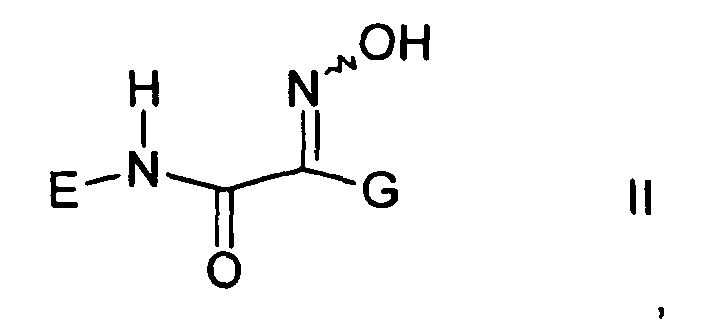
- Process according to claim 1, wherein said α-aminosubstituted carboxamide is a compound of formula III

- Process according to claim 2, wherein the α-aminosubstituted carboxamide is a compound of formula III

- Process according to claims 1 to 6, wherein said nitrosylating agent is nitrosyl tetrafluoroborate or a compound of formula IV
 R3 is OA, OAr, OCH2-Ar or Hal1,A is alkyl having 1 to 8 C atoms,Ar is phenyl or naphthyl which are unsubstituted or mono- or disubstituted by A, OA or Hal,Hal1 is F or Cl.
 - Process according to claim 5 for the preparation of compounds of formula III
 E is a mono- or polycyclic aromatic ring system having 0, 1, 2, 3 or 4 heteroatoms selected from the group consisting of N, O and S wherein the ring nitrogen atoms are unsubstitued or substituted with one R2 substituent and the ring carbon atoms are unsubstituted or substituted with one to five R1 substituents and
R1 independently can be H, A, OA, SA, Hal, cycloalkyl having 3 to 10 C atoms, haloalkyl having 1 to 3 C atoms, haloalkoxy having 1 to 3 C atoms, haloalkylthio having 1 to 3 C atoms, -(CH2)t-OA, Het, -(CH2)t-Het, -(CH2)t-OAr, Ar, OAr, O-CHt-Ar, NO2, NHA, NA2, -(CH2)t-NHA, -(CH2)t-NA2, COOH, COOA or CN, t is 1, 2 or 3, and R 2 can be H, A or CO-A;G is selected from the group consisting of H, A, -(CR2)r-OA, -(CR2)r-SA, cycloalkyl having 3 to 10 C atoms, -(CR2)s-cycloalkyl, fluoroalkyl having 1 to 3 C atoms, -(CR2)r-OAr, -(CR2)rOHet, -(CR2)s-Ar, -(CR2)s-Het, NHA, NA2, -(CR2)s-NHA or -(CR2)s-NA2,R is independently selected from the group consisting of H, A, -(CH2)r-OA, -(CH2)rSA, cycloalkyl having 3 to 10 C atoms, -(CH2)s-cydoalkyl, fluoroalkyl having 1 to 3 C atoms, -(CH2)r-OAr, -(CH2)r-OHet, -(CH2)s-Ar, -(CH2)s-Het, NHA, NA2, -(CH2)s-NHA or -(CH2)s-NA2,r is 2, 3 or 4,s is 1, 2 or 3,A is alkyl having 1 to 10 C atoms,Ar is phenyl or naphthyl which are unsubstituted or mono- or disubstituted by A, OA or Hal,Hal is F, Cl, Br or I,Het is a saturated, partially or completely unsaturated mono- or bicyclic heterocyclic radical having 5 to 10 ring members, where 1 or 2 N and/or 1 or 2 S or O atoms can be present and the heterocyclic radical can be mono- or disubstituted by oxo, A, Hal, OH, OA, CF3, OCF3, NH2, NHA, NA2, COOH or COOA,and their salts, characterized in that(1) a compound of formula I

R 3 is OA, OAr, OCH2-Ar or Hall,A is alkyl having 1 to 8 C atoms,Ar is phenyl or naphthyl which are unsubstituted or mono- or disubstituted by A, OA or Hal,Hal1 is F or Cl,in the presence of a strong base followed by hydrolysis to give hydroxy imino derivatives of formula II
in that(2) a compound of formula II is then hydrogenated and in that if necessary(3) a base or acid of the formula III is converted into one of its salts. - Process according to claim 6 for the preparation of compounds of formula III

E and G together form the structural formula R is independently selected from the group consisting of H, A, -(CH2)r-OA, -(CH2)r-SA, cycloalkyl having 3 to 10 C atoms, -(CH2)s-cydoalkyl, fluoroalkyl having 1 to 3 C atoms, -(CH2)r-OAr, -(CH2)r-OHet, -(CH2)s-Ar, -(CH2)s-Het, NHA, NA2, -(CH2)s-NHA or -(CH2)s-NA2,R1 is independentaly of each other H, A, OA, SA, Hal, cycloalkyl having 3 to 10 C atoms, haloalkyl having 1 to 3 C atoms, haloalkoxy having 1 to 3 C atoms, haloalkylthio having 1 to 3 C atoms, -(CH2)t-OA, Het, -(CH2)t-Het, -(CH2)t-OAr, Ar, OAr, O-CHt- Ar, NO2, NHA, NA2, -(CH2)t-NHA, -(CH2)t-NA2, COOH, COOA or CN,r is 2, 3 or 4,s is 1, 2 or 3,n is 1, 2 or 3,t is 1, 2 or 3,A is alkyl having 1 to 8 C atoms,Ar is phenyl or naphthyl which are unsubstituted or mono- or disubstituted by A, OA or Hal,Hal is F, Cl, Br or I,Het is a saturated, partially or completely unsaturated mono- or bicyclic heterocyclic radical having 5 to 10 ring members, where 1 or 2 N and/or 1 or 2 S or O atoms can be present and the heterocyclic radical can be mono- or disubstituted by oxo, A, Hal, OH, OA, CF3, OCF3, NH2, NHA, NA2, COOH or COOA,and their salts, characterized in that(1) a compound of formula I
 R3 is OA, OAr, OCH2-Ar or Hal1,A is alkyl having 1 to 8 C atoms,Ar is phenyl or naphthyl which are unsubstituted or mono- or disubstituted by A, OA or Hal,Hal1 is F or Cl,in the presence of a strong base followed by hydrolysis to give hydroxy imino derivatives of formula II
in that(2) a compound of formula II is then hydrogenated and in that if necessary(3) a base or acid of the formula III is converted into one of its salts. - Process according to claim 9 for the preparation of compounds of formula IIIa
 R is independently selected from the group consisting of H, A, -(CH2)r-OA, -(CH2)r-SA, cycloalkyl having 3 to 10 C atoms, -(CH2)s-cycloalkyl, fluoroalkyl having 1 to 3 C atoms, -(CH2)r-OAr, -(CH2)rOHet, -(CH2)s-Ar, -(CH2)s-Het, NHA, NA2, -(CH2)s-NHA or -(CH2)s-NA2,R1 is independentaly of each other H, A, OA, SA, Hal, cycloalkyl having 3 to 10 C atoms, haloalkyl having 1 to 3 C atoms, haloalkoxy having 1 to 3 C atoms, haloalkylthio having 1 to 3 C atoms, -(CH2)t-OA, Het, -(CH2)t-Het, -(CH2)t-OAr, Ar, OAr, O-CHt- Ar, NO2, NHA, NA2, -(CH2)t-NHA, -(CH2)t-NA2, COOH, COOA or CN,r is 2, 3 or 4,s is1,2or3,n is 1, 2 or 3,t is 1, 2 or 3,A is alkyl having 1 to 8 C atoms,Ar is phenyl or naphthyl which are unsubstituted or mono- or disubstituted by A, OA or Hal,Hal is F, Cl, Br or I,Het is a saturated, partially or completely unsaturated mono- or bicyclic heterocyclic radical having 5 to 10 ring members, where 1 or 2 N and/or 1 or 2 S or O atoms can be present and the heterocyclic radical can be mono- or disubstituted by oxo, A, Hal, OH, OA, CF3, OCF3, NH2, NHA, NA2, COOH or COOA,and their salts, characterized in that(1) a compound of formula la
is reacted with nitrosyl tetrafluoroborate or a compound of formula IV R3 is OA, OAr, OCH2-Ar or Hall,A is alkyl having 1 to 8 C atoms,Ar is phenyl or naphthyl which are unsubstituted or mono- or disubstituted by A, OA or Hal,Hall is F or Cl,in the presence of a strong base followed by hydrolysis to give hydroxy imino derivatives of formula IIa
in that(2) a compound of formula IIa is then hydrogenated and in that if necessary(3) a base or acid of the formula IIIa is converted into one of its salts. - Process according to claims 1, 8, 9 and 10, characterized in that the base be selected from the group consisting of organo lithium reagents, combinations thereof or combinations together with alkali or alkaline earth metals, Grignard reagents, alkali metal alcoholates, alkali metal amides, alkali metal hydrides, alkaline earth metal hydrides, hydroxides, alkyl-, aryl- or arylalkylamines.
- Process according to claims 1, 8, 9 and 10, wherein the ratio of said base to said carboxylic acid amide of a primary amine is in the range of about 1.8:1 and 5:1.
- Process according to claims 1, 8, 9 and 10, wherein said hydrogenation be carried out using electrochemical reduction, complex hydrides, hydrazine, combination of metals with acids or hydrogen gas with the aid of a metal catalyst selected from the group consisting of Group 8 metals.
- Process according to claims 1, 8, 9 and 10, wherein said hydrogenation be carried out using hydrogen gas in the presence of an enantioselective or an enantiomerically enriched catalyst.
- Hydroxy imino derivatives of the formula IIb
 R is independently selected from the group consisting of H, A, -(CH2)rOA, -(CH2)rSA, cycloalkyl having 3 to 10 C atoms, -(CH2)s-cycloalkyl, fluoroalkyl having 1 to 3 C atoms, -(CH2)r-OAr, -(CH2)r-OHet, -(CH2)s-Ar, -(CH2)s-Het, NHA, NA2, -(CH2)s-NHA or -(CH2)s-NA2,R1 is independentaly of each other H, A, OA, SA, Hal, cycloalkyl , having 3 to 10 C atoms, haloalkyl having 1 to 3 C atoms, haloalkoxy having 1 to 3 C atoms, haloalkylthio having 1 to 3 C atoms, -(CH2)t-OA, Het, -(CH2)t-Het, -(CH2)t-OAr, Ar, OAr, O-char Ar, NO2, NHA, NA2, -(CH2)t-NHA, -(CH2),-NA2, COOH, COOA or CN,r is 2, 3 or 4,s is 1, 2 or 3,n is 1, 2 or 3,t is1,2or3,A is alkyl having 1 to 8 C atoms,Ar is phenyl or naphthyl which are unsubstituted or mono- or disubstituted by A, OA or Hal,Hal is F, Cl, Br or ItHet is a saturated, partially or completely unsaturated mono- or bicyclic heterocyclic radical having 5 to 10 ring members, where 1 or 2 N and/or 1 or 2 S or O atoms can be present and the heterocyclic radical can be mono- or disubstituted by oxo, A, Hal, OH, OA, CF3, OCF3, NH2, NHA, NA2, COOH or COOA,and their salts.
 - Hydroxy imino derivatives of formula lib according to claim 15, in which n is 2.
- Use of the compounds of the formula lib according to claim 15 as intermediates for the synthesis of fine chemicals, deys, crop-protection compositions, agrochemicals and/ or pharmaceuticals.
- Use of the compound of the formula lib according to claim 16, in which R and R1 are H, in the synthesis of benazeprile.
Priority Applications (2)
| Application Number | Priority Date | Filing Date | Title |
|---|---|---|---|
| EP10008589A EP2256104A1 (en) | 2000-12-27 | 2001-12-11 | Process for the preparation of alpha-aminosubstituted carboxylic acid amides |
| EP01988018A EP1345908B1 (en) | 2000-12-27 | 2001-12-11 | Process for the preparation of alpha-aminosubstituted carboxylic acid amides |
Applications Claiming Priority (4)
| Application Number | Priority Date | Filing Date | Title |
|---|---|---|---|
| EP00128232 | 2000-12-27 | ||
| EP00128232 | 2000-12-27 | ||
| EP01988018A EP1345908B1 (en) | 2000-12-27 | 2001-12-11 | Process for the preparation of alpha-aminosubstituted carboxylic acid amides |
| PCT/EP2001/014519 WO2002051813A2 (en) | 2000-12-27 | 2001-12-11 | PROCESS FOR THE PREPARATION OF α-AMINOSUBSTITUTED CARBOXYLIC ACID AMIDES |
Related Child Applications (1)
| Application Number | Title | Priority Date | Filing Date |
|---|---|---|---|
| EP10008589.3 Division-Into | 2010-08-17 |
Publications (2)
| Publication Number | Publication Date |
|---|---|
| EP1345908A2 EP1345908A2 (en) | 2003-09-24 |
| EP1345908B1 true EP1345908B1 (en) | 2011-07-27 |
Family
ID=8170768
Family Applications (2)
| Application Number | Title | Priority Date | Filing Date |
|---|---|---|---|
| EP10008589A Withdrawn EP2256104A1 (en) | 2000-12-27 | 2001-12-11 | Process for the preparation of alpha-aminosubstituted carboxylic acid amides |
| EP01988018A Expired - Lifetime EP1345908B1 (en) | 2000-12-27 | 2001-12-11 | Process for the preparation of alpha-aminosubstituted carboxylic acid amides |
Family Applications Before (1)
| Application Number | Title | Priority Date | Filing Date |
|---|---|---|---|
| EP10008589A Withdrawn EP2256104A1 (en) | 2000-12-27 | 2001-12-11 | Process for the preparation of alpha-aminosubstituted carboxylic acid amides |
Country Status (6)
| Country | Link |
|---|---|
| US (2) | US7053211B2 (en) |
| EP (2) | EP2256104A1 (en) |
| JP (2) | JP4508528B2 (en) |
| AT (1) | ATE517870T1 (en) |
| CA (2) | CA2433089A1 (en) |
| WO (1) | WO2002051813A2 (en) |
Families Citing this family (4)
| Publication number | Priority date | Publication date | Assignee | Title |
|---|---|---|---|---|
| PE20080145A1 (en) * | 2006-03-21 | 2008-02-11 | Janssen Pharmaceutica Nv | TETRAHYDRO-PYRIMIDOAZEPINE AS MODULATORS OF TRPV1 |
| WO2009078999A1 (en) | 2007-12-17 | 2009-06-25 | Janssen Pharmaceutica N.V. | Imidazolo-, oxazolo-, and thiazolopyrimidine modulators of trpv1 |
| CN107162951B (en) * | 2017-05-20 | 2019-09-13 | 宁波大学 | A kind of preparation method of isatin-3-oxime derivative |
| US20190021163A1 (en) * | 2017-07-11 | 2019-01-17 | Robert C. Shelsky | Z-axis guardbanding using vertical ground conductors for crosstalk mitigation |
Family Cites Families (9)
| Publication number | Priority date | Publication date | Assignee | Title |
|---|---|---|---|---|
| US2851494A (en) * | 1955-03-04 | 1958-09-09 | Hoechst Ag | New alpha-amino-beta-hydroxycarboxylic acid amides and a process of preparing them |
| US4619784A (en) * | 1979-12-26 | 1986-10-28 | Polaroid Corporation, Patent Dept. | Image dye-providing materials |
| US4267251A (en) * | 1979-12-26 | 1981-05-12 | Polaroid Corporation | Novel image dye-providing materials, photographic products and processes |
| ZA825779B (en) * | 1981-08-11 | 1984-04-25 | Ciba Geigy Ag | Benzazepins-2-ones |
| DE3269625D1 (en) | 1981-08-11 | 1986-04-10 | Ciba Geigy Ag | Benzazepin-2-ones, process for their preparation, pharmaceutical preparations containing these compounds and the compounds for therapeutical use |
| US4873235A (en) | 1982-06-01 | 1989-10-10 | Merck & Co., Inc. | Benzofused lactams as antihypertensives |
| JP3030091B2 (en) * | 1994-10-04 | 2000-04-10 | ファイザー・インコーポレーテッド | Methods and intermediates for producing 3-amino-benzo [b] azepinone |
| US6262068B1 (en) * | 1997-02-21 | 2001-07-17 | Bristol-Myers Squibb Company | Lactam derivatives as antiarrhythmic agents |
| US6664250B2 (en) * | 1998-01-20 | 2003-12-16 | Bristol-Myers Squibb Co. | Lactam derivatives as antiarrhythmic agents |
-
2001
- 2001-12-11 EP EP10008589A patent/EP2256104A1/en not_active Withdrawn
- 2001-12-11 US US10/433,011 patent/US7053211B2/en not_active Expired - Fee Related
- 2001-12-11 CA CA002433089A patent/CA2433089A1/en not_active Abandoned
- 2001-12-11 WO PCT/EP2001/014519 patent/WO2002051813A2/en not_active Ceased
- 2001-12-11 CA CA002668823A patent/CA2668823A1/en not_active Abandoned
- 2001-12-11 AT AT01988018T patent/ATE517870T1/en not_active IP Right Cessation
- 2001-12-11 EP EP01988018A patent/EP1345908B1/en not_active Expired - Lifetime
- 2001-12-11 JP JP2002552910A patent/JP4508528B2/en not_active Expired - Fee Related
-
2005
- 2005-09-22 US US11/232,020 patent/US7166720B2/en not_active Expired - Fee Related
-
2009
- 2009-03-27 JP JP2009079495A patent/JP2009173672A/en active Pending
Non-Patent Citations (1)
| Title |
|---|
| ARMSTRONG J D ET AL: "AN EFFICIENT ASYMMETRIC SYNTHESIS OF (R)-3-AMINO-2,3,4,5-TETRAHYDRO-1 H-Ä1ÜBENZAZEPIN-2-ONE", TETRAHEDRON LETTERS, ELSEVIER, AMSTERDAM, NL LNKD- DOI:10.1016/S0040-4039(00)76874-2, vol. 35, no. 20, 1 January 1994 (1994-01-01), pages 3239 - 3242, XP001236169, ISSN: 0040-4039 * |
Also Published As
| Publication number | Publication date |
|---|---|
| US7166720B2 (en) | 2007-01-23 |
| JP2004516315A (en) | 2004-06-03 |
| US20040034250A1 (en) | 2004-02-19 |
| CA2668823A1 (en) | 2002-07-04 |
| US7053211B2 (en) | 2006-05-30 |
| WO2002051813A3 (en) | 2003-02-27 |
| EP2256104A1 (en) | 2010-12-01 |
| JP4508528B2 (en) | 2010-07-21 |
| EP1345908A2 (en) | 2003-09-24 |
| WO2002051813A2 (en) | 2002-07-04 |
| JP2009173672A (en) | 2009-08-06 |
| US20060025587A1 (en) | 2006-02-02 |
| ATE517870T1 (en) | 2011-08-15 |
| CA2433089A1 (en) | 2002-07-04 |
Similar Documents
| Publication | Publication Date | Title |
|---|---|---|
| AU2010201035B2 (en) | New process for the synthesis of ivabradine and addition salts thereof with a pharmaceutically acceptable acid | |
| US4124593A (en) | Aromatic dicarboximides | |
| KR101372389B1 (en) | New process for the synthesis of ivabradine and addition salts thereof with a pharmaceutically acceptable acid | |
| US7053211B2 (en) | Process for the preparation of α-aminosubstituted carboxylic acid amides | |
| RU2273638C2 (en) | Chromanone derivatives | |
| CA2697562C (en) | New process for the synthesis of ivabradine and its addition salts with a pharmaceutically acceptable acid | |
| FI68222C (en) | FOERFARANDE FOER 0-METYLERING AV HYDROXIAPORFINER | |
| UA113052C2 (en) | METHOD OF ENZYME SYNTHESIS (7S) -1- (3,4-DIMETHOXYBYCYCLO $ 4.2.0] OCTA-1,3,5-TRIEN-7-YL) -N-METHYL METHETANAMINE AND USE OF USE AND USES | |
| CA2181351C (en) | Process and intermediates for preparing naphthyridonecarboxylic acid salts | |
| US4822895A (en) | 3-aminoazetidine, its salts and intermediates of synthesis | |
| Ghosh et al. | Stereocontrolled syntheses of some conformationally restricted analogs of serotonin | |
| US6329536B1 (en) | Stereoselective process for producing nitro compounds | |
| KR100695366B1 (en) | Process for producing indane-1,3-dicarboxylic acid | |
| US6340773B1 (en) | Preparation of halogenated primary amines | |
| US4024127A (en) | Process for the preparation of 5-alkyl-10-amino-dihydrodibenzoazepines | |
| JP2005531545A (en) | Method for preparing benazepril hydrochloride | |
| KR20000016898A (en) | Process for preparing pyrrolidinyl hydroxamic acid compounds | |
| US20040242879A1 (en) | Process for preparing 1-methyl-3-phenylpiperazine using a novel intermediate | |
| US4376860A (en) | Pyridyl ketone | |
| WO2024110998A1 (en) | A sterogenic 3,3-disubstituted 3-amino oxindole compounds and a process for preparation thereof | |
| HU207834B (en) | Process for producing n-/2-amino-3,5-dibromo-benzyl/-trans-4-amino-cyclohexanol | |
| JPH0632777A (en) | Production of 5-chlorooxyindole | |
| FR2901554A1 (en) | 2-ALCOXY-3,4,5-TRIHYDROXY-ALKYLAMIDE-BENZAZEPINE, PREPARATION THEREOF, COMPOSITIONS CONTAINING SAME AND USE THEREOF | |
| IE50656B1 (en) | 7,8-dihydroxy-1-(sulfamylphenyl)-2,3,4,5-tetrahydro-1h-3-benzazepine derivatives,a process for their preparation and compositions containing them | |
| EP0080847A2 (en) | Improvements in or relating to the synthesis of dioxane analgesics |
Legal Events
| Date | Code | Title | Description |
|---|---|---|---|
| PUAI | Public reference made under article 153(3) epc to a published international application that has entered the european phase |
Free format text: ORIGINAL CODE: 0009012 |
|
| 17P | Request for examination filed |
Effective date: 20030423 |
|
| AK | Designated contracting states |
Kind code of ref document: A2 Designated state(s): AT BE CH CY DE DK ES FI FR GB GR IE IT LI LU MC NL PT SE TR |
|
| AX | Request for extension of the european patent |
Extension state: AL LT LV MK RO SI |
|
| 17Q | First examination report despatched |
Effective date: 20050805 |
|
| GRAP | Despatch of communication of intention to grant a patent |
Free format text: ORIGINAL CODE: EPIDOSNIGR1 |
|
| GRAS | Grant fee paid |
Free format text: ORIGINAL CODE: EPIDOSNIGR3 |
|
| GRAA | (expected) grant |
Free format text: ORIGINAL CODE: 0009210 |
|
| AK | Designated contracting states |
Kind code of ref document: B1 Designated state(s): AT BE CH CY DE DK ES FI FR GB GR IE IT LI LU MC NL PT SE TR |
|
| REG | Reference to a national code |
Ref country code: GB Ref legal event code: FG4D |
|
| REG | Reference to a national code |
Ref country code: CH Ref legal event code: EP |
|
| REG | Reference to a national code |
Ref country code: DE Ref legal event code: R096 Ref document number: 60145049 Country of ref document: DE Effective date: 20110915 |
|
| REG | Reference to a national code |
Ref country code: NL Ref legal event code: VDEP Effective date: 20110727 |
|
| REG | Reference to a national code |
Ref country code: AT Ref legal event code: MK05 Ref document number: 517870 Country of ref document: AT Kind code of ref document: T Effective date: 20110727 |
|
| PG25 | Lapsed in a contracting state [announced via postgrant information from national office to epo] |
Ref country code: FI Free format text: LAPSE BECAUSE OF FAILURE TO SUBMIT A TRANSLATION OF THE DESCRIPTION OR TO PAY THE FEE WITHIN THE PRESCRIBED TIME-LIMIT Effective date: 20110727 Ref country code: SE Free format text: LAPSE BECAUSE OF FAILURE TO SUBMIT A TRANSLATION OF THE DESCRIPTION OR TO PAY THE FEE WITHIN THE PRESCRIBED TIME-LIMIT Effective date: 20110727 Ref country code: BE Free format text: LAPSE BECAUSE OF FAILURE TO SUBMIT A TRANSLATION OF THE DESCRIPTION OR TO PAY THE FEE WITHIN THE PRESCRIBED TIME-LIMIT Effective date: 20110727 Ref country code: PT Free format text: LAPSE BECAUSE OF FAILURE TO SUBMIT A TRANSLATION OF THE DESCRIPTION OR TO PAY THE FEE WITHIN THE PRESCRIBED TIME-LIMIT Effective date: 20111128 Ref country code: NL Free format text: LAPSE BECAUSE OF FAILURE TO SUBMIT A TRANSLATION OF THE DESCRIPTION OR TO PAY THE FEE WITHIN THE PRESCRIBED TIME-LIMIT Effective date: 20110727 |
|
| PG25 | Lapsed in a contracting state [announced via postgrant information from national office to epo] |
Ref country code: GR Free format text: LAPSE BECAUSE OF FAILURE TO SUBMIT A TRANSLATION OF THE DESCRIPTION OR TO PAY THE FEE WITHIN THE PRESCRIBED TIME-LIMIT Effective date: 20111028 Ref country code: AT Free format text: LAPSE BECAUSE OF FAILURE TO SUBMIT A TRANSLATION OF THE DESCRIPTION OR TO PAY THE FEE WITHIN THE PRESCRIBED TIME-LIMIT Effective date: 20110727 Ref country code: CY Free format text: LAPSE BECAUSE OF FAILURE TO SUBMIT A TRANSLATION OF THE DESCRIPTION OR TO PAY THE FEE WITHIN THE PRESCRIBED TIME-LIMIT Effective date: 20110727 |
|
| PG25 | Lapsed in a contracting state [announced via postgrant information from national office to epo] |
Ref country code: IT Free format text: LAPSE BECAUSE OF FAILURE TO SUBMIT A TRANSLATION OF THE DESCRIPTION OR TO PAY THE FEE WITHIN THE PRESCRIBED TIME-LIMIT Effective date: 20110727 |
|
| PLBE | No opposition filed within time limit |
Free format text: ORIGINAL CODE: 0009261 |
|
| STAA | Information on the status of an ep patent application or granted ep patent |
Free format text: STATUS: NO OPPOSITION FILED WITHIN TIME LIMIT |
|
| PG25 | Lapsed in a contracting state [announced via postgrant information from national office to epo] |
Ref country code: DK Free format text: LAPSE BECAUSE OF FAILURE TO SUBMIT A TRANSLATION OF THE DESCRIPTION OR TO PAY THE FEE WITHIN THE PRESCRIBED TIME-LIMIT Effective date: 20110727 |
|
| 26N | No opposition filed |
Effective date: 20120502 |
|
| PG25 | Lapsed in a contracting state [announced via postgrant information from national office to epo] |
Ref country code: MC Free format text: LAPSE BECAUSE OF NON-PAYMENT OF DUE FEES Effective date: 20111231 |
|
| REG | Reference to a national code |
Ref country code: CH Ref legal event code: PL |
|
| REG | Reference to a national code |
Ref country code: DE Ref legal event code: R097 Ref document number: 60145049 Country of ref document: DE Effective date: 20120502 |
|
| GBPC | Gb: european patent ceased through non-payment of renewal fee |
Effective date: 20111211 |
|
| REG | Reference to a national code |
Ref country code: FR Ref legal event code: ST Effective date: 20120831 |
|
| REG | Reference to a national code |
Ref country code: IE Ref legal event code: MM4A |
|
| REG | Reference to a national code |
Ref country code: DE Ref legal event code: R119 Ref document number: 60145049 Country of ref document: DE Effective date: 20120703 |
|
| PG25 | Lapsed in a contracting state [announced via postgrant information from national office to epo] |
Ref country code: DE Free format text: LAPSE BECAUSE OF NON-PAYMENT OF DUE FEES Effective date: 20120703 Ref country code: IE Free format text: LAPSE BECAUSE OF NON-PAYMENT OF DUE FEES Effective date: 20111211 Ref country code: GB Free format text: LAPSE BECAUSE OF NON-PAYMENT OF DUE FEES Effective date: 20111211 Ref country code: CH Free format text: LAPSE BECAUSE OF NON-PAYMENT OF DUE FEES Effective date: 20111231 Ref country code: LI Free format text: LAPSE BECAUSE OF NON-PAYMENT OF DUE FEES Effective date: 20111231 |
|
| PG25 | Lapsed in a contracting state [announced via postgrant information from national office to epo] |
Ref country code: FR Free format text: LAPSE BECAUSE OF NON-PAYMENT OF DUE FEES Effective date: 20120102 Ref country code: ES Free format text: LAPSE BECAUSE OF FAILURE TO SUBMIT A TRANSLATION OF THE DESCRIPTION OR TO PAY THE FEE WITHIN THE PRESCRIBED TIME-LIMIT Effective date: 20111107 |
|
| PG25 | Lapsed in a contracting state [announced via postgrant information from national office to epo] |
Ref country code: LU Free format text: LAPSE BECAUSE OF NON-PAYMENT OF DUE FEES Effective date: 20111211 |
|
| PG25 | Lapsed in a contracting state [announced via postgrant information from national office to epo] |
Ref country code: TR Free format text: LAPSE BECAUSE OF FAILURE TO SUBMIT A TRANSLATION OF THE DESCRIPTION OR TO PAY THE FEE WITHIN THE PRESCRIBED TIME-LIMIT Effective date: 20110727 |