EP1345429A2 - Digital broadcasting reception apparatus and control method - Google Patents
Digital broadcasting reception apparatus and control method Download PDFInfo
- Publication number
- EP1345429A2 EP1345429A2 EP03001882A EP03001882A EP1345429A2 EP 1345429 A2 EP1345429 A2 EP 1345429A2 EP 03001882 A EP03001882 A EP 03001882A EP 03001882 A EP03001882 A EP 03001882A EP 1345429 A2 EP1345429 A2 EP 1345429A2
- Authority
- EP
- European Patent Office
- Prior art keywords
- recording
- program information
- digital broadcasting
- unit
- time
- Prior art date
- Legal status (The legal status is an assumption and is not a legal conclusion. Google has not performed a legal analysis and makes no representation as to the accuracy of the status listed.)
- Withdrawn
Links
- 238000000034 method Methods 0.000 title claims description 40
- 239000000284 extract Substances 0.000 claims abstract description 6
- 238000001514 detection method Methods 0.000 description 5
- 238000010586 diagram Methods 0.000 description 5
- 238000007906 compression Methods 0.000 description 3
- 230000006870 function Effects 0.000 description 3
- 230000005236 sound signal Effects 0.000 description 3
- 230000005540 biological transmission Effects 0.000 description 2
- 230000015572 biosynthetic process Effects 0.000 description 2
- 230000006835 compression Effects 0.000 description 2
- 238000003786 synthesis reaction Methods 0.000 description 2
- 230000003287 optical effect Effects 0.000 description 1
- 230000010363 phase shift Effects 0.000 description 1
- 239000004065 semiconductor Substances 0.000 description 1
- 230000001360 synchronised effect Effects 0.000 description 1
Images




Classifications
-
- H—ELECTRICITY
- H04—ELECTRIC COMMUNICATION TECHNIQUE
- H04N—PICTORIAL COMMUNICATION, e.g. TELEVISION
- H04N5/00—Details of television systems
- H04N5/76—Television signal recording
-
- H—ELECTRICITY
- H04—ELECTRIC COMMUNICATION TECHNIQUE
- H04N—PICTORIAL COMMUNICATION, e.g. TELEVISION
- H04N21/00—Selective content distribution, e.g. interactive television or video on demand [VOD]
- H04N21/40—Client devices specifically adapted for the reception of or interaction with content, e.g. set-top-box [STB]; Operations thereof
- H04N21/41—Structure of client; Structure of client peripherals
- H04N21/4104—Peripherals receiving signals from specially adapted client devices
- H04N21/4135—Peripherals receiving signals from specially adapted client devices external recorder
-
- H—ELECTRICITY
- H04—ELECTRIC COMMUNICATION TECHNIQUE
- H04N—PICTORIAL COMMUNICATION, e.g. TELEVISION
- H04N21/00—Selective content distribution, e.g. interactive television or video on demand [VOD]
- H04N21/40—Client devices specifically adapted for the reception of or interaction with content, e.g. set-top-box [STB]; Operations thereof
- H04N21/41—Structure of client; Structure of client peripherals
- H04N21/426—Internal components of the client ; Characteristics thereof
-
- H—ELECTRICITY
- H04—ELECTRIC COMMUNICATION TECHNIQUE
- H04N—PICTORIAL COMMUNICATION, e.g. TELEVISION
- H04N21/00—Selective content distribution, e.g. interactive television or video on demand [VOD]
- H04N21/40—Client devices specifically adapted for the reception of or interaction with content, e.g. set-top-box [STB]; Operations thereof
- H04N21/41—Structure of client; Structure of client peripherals
- H04N21/426—Internal components of the client ; Characteristics thereof
- H04N21/42661—Internal components of the client ; Characteristics thereof for reading from or writing on a magnetic storage medium, e.g. hard disk drive
-
- H—ELECTRICITY
- H04—ELECTRIC COMMUNICATION TECHNIQUE
- H04N—PICTORIAL COMMUNICATION, e.g. TELEVISION
- H04N21/00—Selective content distribution, e.g. interactive television or video on demand [VOD]
- H04N21/40—Client devices specifically adapted for the reception of or interaction with content, e.g. set-top-box [STB]; Operations thereof
- H04N21/43—Processing of content or additional data, e.g. demultiplexing additional data from a digital video stream; Elementary client operations, e.g. monitoring of home network or synchronising decoder's clock; Client middleware
- H04N21/433—Content storage operation, e.g. storage operation in response to a pause request, caching operations
- H04N21/4334—Recording operations
-
- H—ELECTRICITY
- H04—ELECTRIC COMMUNICATION TECHNIQUE
- H04N—PICTORIAL COMMUNICATION, e.g. TELEVISION
- H04N21/00—Selective content distribution, e.g. interactive television or video on demand [VOD]
- H04N21/40—Client devices specifically adapted for the reception of or interaction with content, e.g. set-top-box [STB]; Operations thereof
- H04N21/43—Processing of content or additional data, e.g. demultiplexing additional data from a digital video stream; Elementary client operations, e.g. monitoring of home network or synchronising decoder's clock; Client middleware
- H04N21/436—Interfacing a local distribution network, e.g. communicating with another STB or one or more peripheral devices inside the home
- H04N21/43622—Interfacing an external recording device
-
- H—ELECTRICITY
- H04—ELECTRIC COMMUNICATION TECHNIQUE
- H04N—PICTORIAL COMMUNICATION, e.g. TELEVISION
- H04N21/00—Selective content distribution, e.g. interactive television or video on demand [VOD]
- H04N21/40—Client devices specifically adapted for the reception of or interaction with content, e.g. set-top-box [STB]; Operations thereof
- H04N21/43—Processing of content or additional data, e.g. demultiplexing additional data from a digital video stream; Elementary client operations, e.g. monitoring of home network or synchronising decoder's clock; Client middleware
- H04N21/442—Monitoring of processes or resources, e.g. detecting the failure of a recording device, monitoring the downstream bandwidth, the number of times a movie has been viewed, the storage space available from the internal hard disk
- H04N21/4424—Monitoring of the internal components or processes of the client device, e.g. CPU or memory load, processing speed, timer, counter or percentage of the hard disk space used
-
- H—ELECTRICITY
- H04—ELECTRIC COMMUNICATION TECHNIQUE
- H04N—PICTORIAL COMMUNICATION, e.g. TELEVISION
- H04N21/00—Selective content distribution, e.g. interactive television or video on demand [VOD]
- H04N21/40—Client devices specifically adapted for the reception of or interaction with content, e.g. set-top-box [STB]; Operations thereof
- H04N21/43—Processing of content or additional data, e.g. demultiplexing additional data from a digital video stream; Elementary client operations, e.g. monitoring of home network or synchronising decoder's clock; Client middleware
- H04N21/436—Interfacing a local distribution network, e.g. communicating with another STB or one or more peripheral devices inside the home
- H04N21/4363—Adapting the video stream to a specific local network, e.g. a Bluetooth® network
- H04N21/43632—Adapting the video stream to a specific local network, e.g. a Bluetooth® network involving a wired protocol, e.g. IEEE 1394
-
- H—ELECTRICITY
- H04—ELECTRIC COMMUNICATION TECHNIQUE
- H04N—PICTORIAL COMMUNICATION, e.g. TELEVISION
- H04N21/00—Selective content distribution, e.g. interactive television or video on demand [VOD]
- H04N21/40—Client devices specifically adapted for the reception of or interaction with content, e.g. set-top-box [STB]; Operations thereof
- H04N21/47—End-user applications
- H04N21/472—End-user interface for requesting content, additional data or services; End-user interface for interacting with content, e.g. for content reservation or setting reminders, for requesting event notification, for manipulating displayed content
- H04N21/47214—End-user interface for requesting content, additional data or services; End-user interface for interacting with content, e.g. for content reservation or setting reminders, for requesting event notification, for manipulating displayed content for content reservation or setting reminders; for requesting event notification, e.g. of sport results or stock market
-
- H—ELECTRICITY
- H04—ELECTRIC COMMUNICATION TECHNIQUE
- H04N—PICTORIAL COMMUNICATION, e.g. TELEVISION
- H04N5/00—Details of television systems
- H04N5/76—Television signal recording
- H04N5/765—Interface circuits between an apparatus for recording and another apparatus
- H04N5/775—Interface circuits between an apparatus for recording and another apparatus between a recording apparatus and a television receiver
-
- H—ELECTRICITY
- H04—ELECTRIC COMMUNICATION TECHNIQUE
- H04N—PICTORIAL COMMUNICATION, e.g. TELEVISION
- H04N5/00—Details of television systems
- H04N5/76—Television signal recording
- H04N5/78—Television signal recording using magnetic recording
- H04N5/781—Television signal recording using magnetic recording on disks or drums
-
- H—ELECTRICITY
- H04—ELECTRIC COMMUNICATION TECHNIQUE
- H04N—PICTORIAL COMMUNICATION, e.g. TELEVISION
- H04N9/00—Details of colour television systems
- H04N9/79—Processing of colour television signals in connection with recording
- H04N9/80—Transformation of the television signal for recording, e.g. modulation, frequency changing; Inverse transformation for playback
- H04N9/804—Transformation of the television signal for recording, e.g. modulation, frequency changing; Inverse transformation for playback involving pulse code modulation of the colour picture signal components
- H04N9/8042—Transformation of the television signal for recording, e.g. modulation, frequency changing; Inverse transformation for playback involving pulse code modulation of the colour picture signal components involving data reduction
Definitions
- the present invention relates to a digital broadcasting reception system which receives, for example, digital television broadcasting, particularly to improvements in a digital broadcasting reception apparatus which digitally records stream information of a received program onto a recording medium disposed therein, and a control method of the apparatus.
- HDD hard disk drive
- a countermeasure is indispensable when the total recording time is longer than the free space of the hard disk, that is, the remaining recordable time.
- Jpn. Pat. Appln. KOKAI Publication No. 2001-320659 Jpn. Pat. Appln. KOKAI Publication No. 2001-186450, it is disclosed that data is scattered/recorded in a plurality of recording mediums based on a recording order set in accordance with vacant states of a plurality of recording mediums.
- One embodiment of the present invention may provide a digital broadcasting reception apparatus and control method in which to reserve recording of program information in an included recording medium, and an external recording apparatus can be used to record information without any interruption even with an insufficient remaining free space of the recording medium.
- a digital broadcasting reception apparatus comprising:
- a control method of a digital broadcasting reception apparatus including a reception unit adapted to receive digital broadcasting and extract predetermined program information, a recording unit adapted to digitally record program information obtained by the reception unit, and an external apparatus control unit to allow a recording apparatus connected to the outside to digitally record the program information obtained by the reception unit, the method comprising:
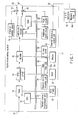
- FIG. 1 shows a constitution of a digital broadcasting receiver 11 described in the first embodiment. That is, a high-frequency signal supplied to an input terminal 12 from a satellite is supplied to a tuner 13, and a signal component of a predetermined frequency is extracted.
- the signal component extracted by the tuner 13 is supplied to an 8 phase shift keying (PSK) demodulation circuit 14 and subjected to a PSK demodulation process.
- PSK phase shift keying
- the signal subjected to the PSK demodulation process in the 8PSK demodulation circuit 14 is supplied to a transport stream (TS) decoder 15 and subjected to decode processing of the transport stream.
- TS transport stream
- a moving picture image coding experts group (MPEG)-audio video (AV) decoder 16 receives data of MPEG from the TS decoder 15, and uses a random access memory (RAM) 17 as a memory for operation to decode video and audio signals.
- MPEG moving picture image coding experts group
- AV audio video
- a character graphic plane 18 converts channel numbers and characters of a program table, and character graphic information of data broadcasting into the video signal. Moreover, the respective video signals output from the MPEG-AV decoder 16 and character graphic plane 18 are synthesized by a synthesis circuit 19, and taken out to the outside from a video output terminal 20. For example, a monitor (not shown) is connected to the video output terminal 20, and video display is performed.
- a remote control transmission unit 21 generates instructions of recording start and stop to an external video tape recorder (VTR) (not shown).
- VTR video tape recorder
- a read only memory (ROM) 22 is a flash memory for storing program to control the whole digital broadcasting receiver 11.
- a RAM 23 is used for operation of a central processing unit (CPU) 24.
- the CPU 24 controls the whole operation of the digital broadcasting receiver 11 based on the program of the ROM 22.
- a modem 25 has a function of transmitting/receiving data with respect to a telephone circuit.
- An integrated circuit (IC) card circuit 26 has a function of interfacing with an IC card for obtaining user information of a limited reception system.
- An additional sound circuit 27 has a function of generating an additional sound designated by data broadcasting.
- a pulse code modulation (PCM) decoder 28 generates the audio signal from additional sound information.
- the respective audio signals outputted from the MPEG-AV decoder 16 and PCM decoder 28 are synthesized in a synthesis circuit 29, and taken out to the outside via an audio output terminal 30.
- the audio output terminal 30 is connected, for example, to a speaker (not shown), and audio reproduction is performed.
- a remote control reception unit 31 receives an operation signal from a remote controller (not shown) for a user to perform a reception operation.
- the CPU 24 executes change processing of a display state of the digital broadcasting receiver 11 based on the operation signal received by the remote control reception unit 31.
- An external apparatus control unit 32 controls an external apparatus connected [i.LINK (registered trademark) connection] via a connection terminal 33 and controls data communication based on the Institute of Electrical & Electronics Engineers (IEEE) 1394 standard.
- FIG. 1 shows an example in which a digital (D)-video home system (VHS) apparatus 34 using a magnetic tape 34a as a recording medium is connected as an external apparatus.
- D digital
- VHS digital-video home system
- An HDD 35 digitally records stream information of a received program on a hard disk 35a.
- the D-VHS apparatus 34 as the external apparatus is automatically driven, and controlled so as to start writing of the stream information onto the magnetic tape 34a.
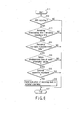
- FIG. 2 shows a flowchart of a major operation in the first embodiment.
- the operation is started (step S11), and the CPU 24 judges in step S12 whether or not the stream information of the program is being recorded in the HDD 35. It is judged that the information is not being recorded (NO), and then this process is ended (step S17).
- step S13 it is judged that the information is being recorded (YES), and the CPU 24 judges in step S13 whether or not the remaining broadcasting time of a reserved/recorded program is longer than the remaining recordable time of the HDD 35.
- the time is judged to be equal or shorter (NO)
- the process is ended (step S17).
- step S13 It is judged in step S13 that the remaining broadcasting time of the program reserved to be recorded is longer than the remaining recordable time of the HDD 35 (YES), and then the CPU 24 judges in step S14 whether or not the remaining recordable time of the HDD 35 is shorter than a predetermined time. It is judged that the time is not short (NO), and the process ends (step S17).
- step S14 it is judged in step S14 that the remaining recordable time of the HDD 35 is equal to or shorter than the predetermined time (YES), and then the CPU 24 judges in step S15 whether or not the external apparatus (D-VHS apparatus 34) is recordable. It is judged that the apparatus is not recordable (NO), and then the process ends (step S17).
- D-VHS apparatus 34 the external apparatus
- the CPU 24 sends an instruction of recording start to the D-VHS apparatus 34 via the external apparatus control unit 32 in step S16, and ends the process (step S17).
- FIG. 3 shows a recording operation of the HDD 35 and a recording operation of the D-VHS apparatus 34 in a time series manner.
- the HDD 35 starts the recording operation at the same time T1.
- the recording operation is started with respect to the external D-VHS apparatus 34.
- the stream information which cannot be recorded in the HDD 35 is recorded in the D-VHS apparatus 34. Therefore, it is possible to record the stream information of the program in the digital television broadcasting without being interrupted.
- the instruction of the recording start with respect to the D-VHS apparatus 34 is sent from the external apparatus control unit 32 via the connection terminal 33. Additionally, the operation signal from the remote control transmission unit 21 may also be transmitted to the D-VHS apparatus 34. In this case, the video output terminal 20 and audio output terminal 30 may also be connected to the corresponding input terminal of the D-VHS apparatus 34.
- an order of execution of the process of steps S13 to S15 is not limited to the order shown in FIG. 2, and may also be an arbitrary order.
- the D-VHS apparatus 34 is instructed to start the recording before the predetermined time at which the remaining recordable time of the HDD 35 completely ends. Therefore, this can prevent a problem that the program cannot be recorded at a switch time to D-VHS apparatus 34 from the HDD 35.
- a method of checking whether or not the D-VHS apparatus 34 is recordable may be a method of acquiring apparatus information in accordance with presence/absence of the instruction from the user of the digital broadcasting receiver 11 or communication with the D-VHS apparatus 34 by the external apparatus control unit 32 which conforms to IEEE 1394 standard.
- the present invention is not limited to the embodiment, and can also broadly be applied, for example, to CATV and a digital broadcasting receiver which receives terrestrial digital broadcasting.
- the external apparatus is not limited to the D-VHS apparatus 34, and it is also possible to use a recording/reproducing apparatus in which recording mediums such as an optical disc and semiconductor memory are used.
- a time offset table (TOT) detection circuit 36 acquires time information for taking out TOT from the stream information obtained from the TS decoder 15, and outputs the information to a timer circuit 37.
- the timer circuit 37 counts the present time based on the inputted time information. Thereby, the present time synchronized with a broadcasting wave can be known.
- an event information table (EIT) detection circuit 38 extracts EIT from the stream information obtained from the TS decoder 15, and acquires a start or end time of the program (event) or genre information. That is, in the digital broadcasting, program arrangement information is transmitted together with program information, and the program arrangement information includes TOT and EIT.
- FIG. 5 shows details of the EIT.
- FIG. 6 shows a flowchart showing the whole major operation in the second embodiment.
- the same steps as those of FIG. 2 are denoted with the same reference numerals.
- step S14 it is judged that the remaining recordable time of the HDD 35 is equal to or shorter than the predetermined time (YES). Then, the CPU 24 judges in step S18 whether or not it is before a predetermined time to update event information of the recorded program. If it is judged that it is not before the predetermined time (NO), the process is ended (step S17). If it is judged that it is before the predetermined time (YES), the process shifts to a process of step S15.
- the D-VHS apparatus 34 when the remaining recordable time of the HDD 35 is, for example, 30 minutes or less, at a time one minute before an event in the program being broadcasted by EIT ends, the D-VHS apparatus 34 can be instructed to start the recording.
- the stream information is always recorded in the D-VHS apparatus 34 from the top of the event, and is easily seen by the user at reproduction time. It is to be noted that the instruction of the recording start to the D-VHS apparatus 34 may be given after an elapse of the predetermined time since the update of the event information.
- FIG. 7 the same components as those of FIG. 4 are denoted with the same reference numerals. That is, the EIT detection circuit 38 is omitted from FIG. 4.
- FIG. 8 shows a flowchart of the whole major recording operation in the third embodiment.
- the same steps as those of FIG. 2 are denoted with the same reference numerals.
- step S14 it is judged that the remaining recordable time of the HDD 35 is equal to or shorter than the predetermined time (YES). Then, the CPU 24 judges in step S19 whether or not the present time has reached a predetermined time. It is judged that the time has not reached the predetermined time (NO), and then the process is ended (step S17). On the other hand, it is judged that the time has reached the predetermined time (YES), and the process shifts to the process of step S15.
- the instruction of the recording start can be made to the D-VHS apparatus 34.
- a commercial is inserted into the program by a unit of 15 minutes in many cases. Therefore, when the instruction of the recording start to the D-VHS apparatus 34 is made at the above-described timing, the recording start in the middle of a program main part can be avoided to the utmost to ease the user's watching at reproduction time.
- FIG. 9 the same components as those of FIG. 1 are denoted with the same reference numerals. That is, a sound multiplex detection circuit 39 detects information of a sound multiplex form from the output of the MPEG-AV decoder 16.
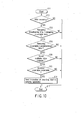
- FIG. 10 shows a flowchart of the whole major recording operation in the fourth embodiment.
- the same steps as those of FIG. 2 are denoted with the same reference numerals.
- step S14 it is judged that the remaining recordable time of the HDD 35 is equal to or shorter than the predetermined time (YES). Then, the CPU 24 judges in step S20 whether or not the sound multiplex detection circuit 39 detects a change of a sound multiplex state. When the change is judged not to be detected (NO), the process is ended (step S17). When the change is judged to be detected (YES), the process shifts to the process of step S15.
- the change of the sound multiplex state is used as a trigger to instruct the D-VHS apparatus 34 to start the recording.
- the recording start from the middle of the program main part can be avoided to the utmost, and the program is easily seen by the user at reproduction time.
- the instruction of the recording start to the D-VHS apparatus 34 may be made after an elapse of predetermined time since the change of the sound multiplex state. Moreover, the trigger is not limited to the change of the sound multiplex state. When superimposed title information of the program changes, the D-VHS apparatus 34 may also be instructed to start the recording.
- a fifth embodiment of the present invention will next be described.
- the recording instruction into the external apparatus is made simultaneously with the recording onto the HDD 35.
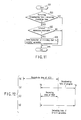
- FIG. 11 shows a flowchart of the whole major operation in the fifth embodiment.
- the process is started (step S21), and the CPU 24 then judges in step S22 whether or not a remaining broadcasting time of the reserved/recorded program is longer than the remaining recordable time of the HDD 35.
- the time is judged to be equal or shorter (NO)
- the process is ended (step S25).
- the remaining broadcasting time of the reserved/recorded program is judged to be longer than the remaining recordable time of the HDD 35 (YES), and then the CPU 24 judges in step S23 whether or not the external apparatus (D-VHS apparatus 34) is recordable. When the apparatus is judged not to be recordable (NO), the process is ended (step S25).
- step S24 the CPU 24 sends the instruction of the recording start to the D-VHS apparatus 34 via the external apparatus control unit 32, and ends the process (step S25).
- FIG. 12 shows the recording operation of the HDD 35 and recording operation of the D-VHS apparatus 34 in the fifth embodiment in the time series manner. It is assumed that first at a predetermined time T5 in the recordable time of the HDD 35 shown in (a) of FIG. 12, as shown in (b) of FIG. 12, the broadcasting of the program reserved to be recorded is started.
- both the HDD 35 and D-VHS apparatus 34 starts the recording operation. Thereafter, when the broadcasting of the program is ended at time T6, the recording operation of the D-VHS apparatus 34 is also ended.
- the recording instruction to the external apparatus is made simultaneously with the recording into the HDD 35. Therefore, it is possible to record the stream information of the program in the digital television broadcasting without being interrupted.
- steps S22 and S23 may be arbitrary. Furthermore, in this case, the recording into the HDD 35 is started in the above-described constitution, but the constitution may be such that the recording into the HDD 35 is not performed.
- timings to instruct the D-VHS apparatus 34 to start the recording described in the first to fifth embodiments in a compatible range. For example, either one of a condition of update of event information described in the second embodiment and a condition that the present time has reached the predetermined time as described in the third embodiment is satisfied. In this case, it is also possible to instruct the D-VHS apparatus 34 to start the recording.
Landscapes
- Engineering & Computer Science (AREA)
- Multimedia (AREA)
- Signal Processing (AREA)
- Computer Networks & Wireless Communication (AREA)
- Databases & Information Systems (AREA)
- Television Signal Processing For Recording (AREA)
- Signal Processing For Digital Recording And Reproducing (AREA)
- Management Or Editing Of Information On Record Carriers (AREA)
- Circuits Of Receivers In General (AREA)
Abstract
There is disclosed a digital broadcasting
reception apparatus comprising a reception unit (13)
which receives digital broadcasting and extracts
predetermined program information, a recording unit
(35) which digitally records program information
obtained by the reception unit (13), an external
apparatus control unit (32) which allows a recording
apparatus (34) connected to the outside to digitally
record the program information obtained by the
reception unit (13), and a control unit (24) to allow
the recording apparatus (34) to record program
information which cannot be recorded in the recording
unit (35) any more, when the remaining recordable time
of the recording unit (35) is shorter than the total
time of the program information to be recorded.
Description
The present invention relates to a digital
broadcasting reception system which receives, for
example, digital television broadcasting, particularly
to improvements in a digital broadcasting reception
apparatus which digitally records stream information of
a received program onto a recording medium disposed
therein, and a control method of the apparatus.
As well known, in recent years, digital television
broadcasting using, for example, satellite and cable
has actively been performed. Moreover, for a digital
broadcasting receiver which receives this type of
digital television broadcasting, there has been spread
an apparatus which includes a hard disk drive (HDD) and
digitally records stream information of a received
program on the hard disk.
Additionally, in this digital broadcasting
receiver including the HDD, for a user to reserve
recording of a predetermined program with a timer, a
countermeasure is indispensable when the total
recording time is longer than the free space of the
hard disk, that is, the remaining recordable time.
Concerning this respect, for example, in Jpn. Pat.
Appln. KOKAI Publication No. 2001-160281, it is
described that with a remaining space of the hard disk
smaller than an estimated recording time, the
compression ratio of data at the recording time is
changed to change the recording mode within the
remaining space of the hard disk, or a message
indicating non-start of the recording is displayed.
However, the method of changing the compression
ratio of the data at the recording time cannot be used
with digital television broadcasting. This is because
digital television broadcasting is of a stream form
with video, audio, and other information data existing
therein in a mixed manner, and therefore a compression
process cannot freely be executed on a reception side.
Moreover, it is apparent that to display the message
indicating non-start of the recording is not a positive
problem solution.
It is to be noted that a technique of continuously
recording data having continuity into a plurality of
recording mediums and preventing the recording from
being discontinued is disclosed in Jpn. Pat. Appln.
KOKAI Publication No. 2001-320659. Further in Jpn.
Pat. Appln. KOKAI Publication No. 2001-186450, it is
disclosed that data is scattered/recorded in a
plurality of recording mediums based on a recording
order set in accordance with vacant states of a
plurality of recording mediums.
However, in any one of these publications, digital
data transmitted in a network system is an object, and
it is not described that the stream information of the
program in the digital television broadcasting is
recorded.
That is, in the present circumstances, to reserve
the recording of the stream information of the program
in the digital television broadcasting in a
recording/reproducing apparatus included in the digital
broadcasting receiver, there is a problem that no
effective countermeasure for insufficient free space of
the recording medium is taken.
One embodiment of the present invention may
provide a digital broadcasting reception apparatus and
control method in which to reserve recording of program
information in an included recording medium, and an
external recording apparatus can be used to record
information without any interruption even with an
insufficient remaining free space of the recording
medium.
According to one aspect of the present invention,
there is provided a digital broadcasting reception
apparatus comprising:
According to one aspect of the present invention,
there is provided a control method of a digital
broadcasting reception apparatus including a reception
unit adapted to receive digital broadcasting and
extract predetermined program information, a recording
unit adapted to digitally record program information
obtained by the reception unit, and an external
apparatus control unit to allow a recording apparatus
connected to the outside to digitally record the
program information obtained by the reception unit, the
method comprising:
This summary of the invention does not necessarily
describe all necessary features so that the invention
may also be a sub-combination of these described
features.
The invention can be more fully understood from
the following detailed description when taken in
conjunction with the accompanying drawings, in which:
A first embodiment of the present invention will
be described hereinafter in detail with reference to
the drawings. FIG. 1 shows a constitution of a digital
broadcasting receiver 11 described in the first
embodiment. That is, a high-frequency signal supplied
to an input terminal 12 from a satellite is supplied to
a tuner 13, and a signal component of a predetermined
frequency is extracted.
The signal component extracted by the tuner 13 is
supplied to an 8 phase shift keying (PSK) demodulation
circuit 14 and subjected to a PSK demodulation process.
The signal subjected to the PSK demodulation process in
the 8PSK demodulation circuit 14 is supplied to a
transport stream (TS) decoder 15 and subjected to
decode processing of the transport stream.
A moving picture image coding experts group
(MPEG)-audio video (AV) decoder 16 receives data of
MPEG from the TS decoder 15, and uses a random access
memory (RAM) 17 as a memory for operation to decode
video and audio signals.
Moreover, a character graphic plane 18 converts
channel numbers and characters of a program table, and
character graphic information of data broadcasting into
the video signal. Moreover, the respective video
signals output from the MPEG-AV decoder 16 and
character graphic plane 18 are synthesized by a
synthesis circuit 19, and taken out to the outside from
a video output terminal 20. For example, a monitor
(not shown) is connected to the video output terminal
20, and video display is performed.
On the other hand, a remote control transmission
unit 21 generates instructions of recording start and
stop to an external video tape recorder (VTR) (not
shown). A read only memory (ROM) 22 is a flash memory
for storing program to control the whole digital
broadcasting receiver 11.
A RAM 23 is used for operation of a central
processing unit (CPU) 24. The CPU 24 controls the
whole operation of the digital broadcasting receiver 11
based on the program of the ROM 22. A modem 25 has a
function of transmitting/receiving data with respect to
a telephone circuit.
An integrated circuit (IC) card circuit 26 has a
function of interfacing with an IC card for obtaining
user information of a limited reception system. An
additional sound circuit 27 has a function of
generating an additional sound designated by data
broadcasting. A pulse code modulation (PCM) decoder 28
generates the audio signal from additional sound
information.
The respective audio signals outputted from the
MPEG-AV decoder 16 and PCM decoder 28 are synthesized
in a synthesis circuit 29, and taken out to the outside
via an audio output terminal 30. The audio output
terminal 30 is connected, for example, to a speaker
(not shown), and audio reproduction is performed.
A remote control reception unit 31 receives an
operation signal from a remote controller (not shown)
for a user to perform a reception operation. The CPU
24 executes change processing of a display state of the
digital broadcasting receiver 11 based on the operation
signal received by the remote control reception
unit 31.
An external apparatus control unit 32 controls an
external apparatus connected [i.LINK (registered
trademark) connection] via a connection terminal 33 and
controls data communication based on the Institute of
Electrical & Electronics Engineers (IEEE) 1394
standard. FIG. 1 shows an example in which a digital
(D)-video home system (VHS) apparatus 34 using a
magnetic tape 34a as a recording medium is connected as
an external apparatus.
An HDD 35 digitally records stream information of
a received program on a hard disk 35a.
Moreover, in this first embodiment, while the
stream information of the received program is recorded
on the hard disk 35a, and when the free space of the
hard disk 35a becomes smaller than a predetermined
value, the D-VHS apparatus 34 as the external apparatus
is automatically driven, and controlled so as to start
writing of the stream information onto the magnetic
tape 34a.
FIG. 2 shows a flowchart of a major operation in
the first embodiment. First, the operation is started
(step S11), and the CPU 24 judges in step S12 whether
or not the stream information of the program is being
recorded in the HDD 35. It is judged that the
information is not being recorded (NO), and then this
process is ended (step S17).
Moreover, it is judged that the information is
being recorded (YES), and the CPU 24 judges in step S13
whether or not the remaining broadcasting time of a
reserved/recorded program is longer than the remaining
recordable time of the HDD 35. When the time is judged
to be equal or shorter (NO), the process is ended
(step S17).
It is judged in step S13 that the remaining
broadcasting time of the program reserved to be
recorded is longer than the remaining recordable time
of the HDD 35 (YES), and then the CPU 24 judges in step
S14 whether or not the remaining recordable time of the
HDD 35 is shorter than a predetermined time. It is
judged that the time is not short (NO), and the process
ends (step S17).
Moreover, it is judged in step S14 that the
remaining recordable time of the HDD 35 is equal to or
shorter than the predetermined time (YES), and then the
CPU 24 judges in step S15 whether or not the external
apparatus (D-VHS apparatus 34) is recordable. It is
judged that the apparatus is not recordable (NO), and
then the process ends (step S17).
On the other hand, it is judged that the external
apparatus is recordable (YES). In this case, the CPU
24 sends an instruction of recording start to the D-VHS
apparatus 34 via the external apparatus control unit 32
in step S16, and ends the process (step S17).
FIG. 3 shows a recording operation of the HDD 35
and a recording operation of the D-VHS apparatus 34 in
a time series manner. First, at a predetermined time
T1 in the recordable time of the HDD 35 shown in (a) of
FIG. 3, as shown in (b) of FIG. 3, the broadcasting of
the program reserved to be recorded starts. Then, as
shown in (c) of FIG. 3, the HDD 35 starts the recording
operation at the same time T1.
Subsequently, at a time T2 before a time T3 to end
the recordable time of the HDD 35 by a predetermined
time t, as shown in (d) of FIG. 3, the recording
operation of the D-VHS apparatus 34 is started.
Thereafter, when the broadcasting of the program is
ended at time T4, the recording operation of the D-VHS
apparatus 34 is also ended.
According to the first embodiment, when the
recordable time of the HDD 35 is within a predetermined
time during the recording operation of the program
reserved to be recorded, the recording operation is
started with respect to the external D-VHS apparatus
34. The stream information which cannot be recorded in
the HDD 35 is recorded in the D-VHS apparatus 34.
Therefore, it is possible to record the stream
information of the program in the digital television
broadcasting without being interrupted.
Here, as described above, the instruction of the
recording start with respect to the D-VHS apparatus 34
is sent from the external apparatus control unit 32 via
the connection terminal 33. Additionally, the
operation signal from the remote control transmission
unit 21 may also be transmitted to the D-VHS apparatus
34. In this case, the video output terminal 20 and
audio output terminal 30 may also be connected to the
corresponding input terminal of the D-VHS apparatus 34.
Moreover, an order of execution of the process of
steps S13 to S15 is not limited to the order shown in
FIG. 2, and may also be an arbitrary order.
Furthermore, the D-VHS apparatus 34 is instructed
to start the recording before the predetermined time at
which the remaining recordable time of the HDD 35
completely ends. Therefore, this can prevent a problem
that the program cannot be recorded at a switch time to
D-VHS apparatus 34 from the HDD 35.
Additionally, a method of checking whether or not
the D-VHS apparatus 34 is recordable may be a method of
acquiring apparatus information in accordance with
presence/absence of the instruction from the user of
the digital broadcasting receiver 11 or communication
with the D-VHS apparatus 34 by the external apparatus
control unit 32 which conforms to IEEE 1394 standard.
It is to be noted that the reception of digital
broadcasting using a satellite has been described above
in the first embodiment. The present invention is not
limited to the embodiment, and can also broadly be
applied, for example, to CATV and a digital
broadcasting receiver which receives terrestrial
digital broadcasting.
Moreover, the external apparatus is not limited to
the D-VHS apparatus 34, and it is also possible to use
a recording/reproducing apparatus in which recording
mediums such as an optical disc and semiconductor
memory are used.
A second embodiment of the present invention will
next be described. In FIG. 4, the same components as
those of FIG. 1 are denoted with the same reference
numerals. First, a time offset table (TOT) detection
circuit 36 acquires time information for taking out TOT
from the stream information obtained from the TS
decoder 15, and outputs the information to a timer
circuit 37. The timer circuit 37 counts the present
time based on the inputted time information. Thereby,
the present time synchronized with a broadcasting wave
can be known.
On the other hand, an event information table
(EIT) detection circuit 38 extracts EIT from the stream
information obtained from the TS decoder 15, and
acquires a start or end time of the program (event) or
genre information. That is, in the digital
broadcasting, program arrangement information is
transmitted together with program information, and the
program arrangement information includes TOT and EIT.
FIG. 5 shows details of the EIT.
FIG. 6 shows a flowchart showing the whole major
operation in the second embodiment. In FIG. 6, the
same steps as those of FIG. 2 are denoted with the same
reference numerals.
In step S14 it is judged that the remaining
recordable time of the HDD 35 is equal to or shorter
than the predetermined time (YES). Then, the CPU 24
judges in step S18 whether or not it is before a
predetermined time to update event information of the
recorded program. If it is judged that it is not
before the predetermined time (NO), the process is
ended (step S17). If it is judged that it is before
the predetermined time (YES), the process shifts to a
process of step S15.
That is, according to the second embodiment, when
the remaining recordable time of the HDD 35 is, for
example, 30 minutes or less, at a time one minute
before an event in the program being broadcasted by EIT
ends, the D-VHS apparatus 34 can be instructed to start
the recording.
Thereby, the stream information is always recorded
in the D-VHS apparatus 34 from the top of the event,
and is easily seen by the user at reproduction time.
It is to be noted that the instruction of the recording
start to the D-VHS apparatus 34 may be given after an
elapse of the predetermined time since the update of
the event information.
A third embodiment of the present invention will
next be described. In FIG. 7, the same components as
those of FIG. 4 are denoted with the same reference
numerals. That is, the EIT detection circuit 38 is
omitted from FIG. 4.
FIG. 8 shows a flowchart of the whole major
recording operation in the third embodiment. In
FIG. 8, the same steps as those of FIG. 2 are denoted
with the same reference numerals.
In step S14 it is judged that the remaining
recordable time of the HDD 35 is equal to or shorter
than the predetermined time (YES). Then, the CPU 24
judges in step S19 whether or not the present time has
reached a predetermined time. It is judged that the
time has not reached the predetermined time (NO), and
then the process is ended (step S17). On the other
hand, it is judged that the time has reached the
predetermined time (YES), and the process shifts to the
process of step S15.
That is, according to the third embodiment, when
the remaining recordable time of the HDD 35 is, for
example, 30 minutes or less, and when the present time
reaches any one of 00, 15, 30, 45 minutes, the
instruction of the recording start can be made to the
D-VHS apparatus 34.
A commercial is inserted into the program by a
unit of 15 minutes in many cases. Therefore, when the
instruction of the recording start to the D-VHS
apparatus 34 is made at the above-described timing, the
recording start in the middle of a program main part
can be avoided to the utmost to ease the user's
watching at reproduction time.
A fourth embodiment of the present invention will
next be described. In FIG. 9, the same components as
those of FIG. 1 are denoted with the same reference
numerals. That is, a sound multiplex detection circuit
39 detects information of a sound multiplex form from
the output of the MPEG-AV decoder 16.
FIG. 10 shows a flowchart of the whole major
recording operation in the fourth embodiment. In
FIG. 10, the same steps as those of FIG. 2 are denoted
with the same reference numerals.
In step S14 it is judged that the remaining
recordable time of the HDD 35 is equal to or shorter
than the predetermined time (YES). Then, the CPU 24
judges in step S20 whether or not the sound multiplex
detection circuit 39 detects a change of a sound
multiplex state. When the change is judged not to be
detected (NO), the process is ended (step S17). When
the change is judged to be detected (YES), the process
shifts to the process of step S15.
That is, for example, bilingual broadcasting in
the main program part is switched to stereo
broadcasting during a commercial in many cases.
Therefore, as in the fourth embodiment, the change of
the sound multiplex state is used as a trigger to
instruct the D-VHS apparatus 34 to start the recording.
Thereby, the recording start from the middle of the
program main part can be avoided to the utmost, and the
program is easily seen by the user at reproduction
time.
It is to be noted that the instruction of the
recording start to the D-VHS apparatus 34 may be made
after an elapse of predetermined time since the change
of the sound multiplex state. Moreover, the trigger is
not limited to the change of the sound multiplex state.
When superimposed title information of the program
changes, the D-VHS apparatus 34 may also be instructed
to start the recording.
A fifth embodiment of the present invention will
next be described. In the fifth embodiment, when the
recordable time of the HDD 35 is shorter than the
estimated time of the program at recording start time,
the recording instruction into the external apparatus
is made simultaneously with the recording onto the
HDD 35.
FIG. 11 shows a flowchart of the whole major
operation in the fifth embodiment. First, the process
is started (step S21), and the CPU 24 then judges in
step S22 whether or not a remaining broadcasting time
of the reserved/recorded program is longer than the
remaining recordable time of the HDD 35. When the time
is judged to be equal or shorter (NO), the process is
ended (step S25).
Moreover, the remaining broadcasting time of the
reserved/recorded program is judged to be longer than
the remaining recordable time of the HDD 35 (YES), and
then the CPU 24 judges in step S23 whether or not the
external apparatus (D-VHS apparatus 34) is recordable.
When the apparatus is judged not to be recordable (NO),
the process is ended (step S25).
On the other hand, when the external apparatus is
judged to be recordable (YES), in step S24 the CPU 24
sends the instruction of the recording start to the
D-VHS apparatus 34 via the external apparatus control
unit 32, and ends the process (step S25).
FIG. 12 shows the recording operation of the HDD
35 and recording operation of the D-VHS apparatus 34 in
the fifth embodiment in the time series manner. It is
assumed that first at a predetermined time T5 in the
recordable time of the HDD 35 shown in (a) of FIG. 12,
as shown in (b) of FIG. 12, the broadcasting of the
program reserved to be recorded is started.
Then, as shown in (c), (d) of FIG. 12, at the same
time T5, both the HDD 35 and D-VHS apparatus 34 starts
the recording operation. Thereafter, when the
broadcasting of the program is ended at time T6, the
recording operation of the D-VHS apparatus 34 is also
ended.
According to the fifth embodiment, when the
recordable time of the HDD 35 is shorter than the
estimated time of the program at the recording start
time, the recording instruction to the external
apparatus is made simultaneously with the recording
into the HDD 35. Therefore, it is possible to record
the stream information of the program in the digital
television broadcasting without being interrupted.
Moreover, the order of execution of steps S22 and
S23 may be arbitrary. Furthermore, in this case, the
recording into the HDD 35 is started in the above-described
constitution, but the constitution may be
such that the recording into the HDD 35 is not
performed.
Here, it is also possible to appropriately combine
the timings to instruct the D-VHS apparatus 34 to start
the recording described in the first to fifth
embodiments in a compatible range. For example, either
one of a condition of update of event information
described in the second embodiment and a condition that
the present time has reached the predetermined time as
described in the third embodiment is satisfied. In
this case, it is also possible to instruct the D-VHS
apparatus 34 to start the recording.
Claims (18)
- A digital broadcasting reception apparatus characterized by comprising:a reception unit (13) configured to receive digital broadcasting and extract predetermined program information;a recording unit (35) configured to digitally record program information obtained by the reception unit (13);an external apparatus control unit (32) configured to allow a recording apparatus (34) connected to the outside to digitally record the program information obtained by the reception unit (13); anda control unit (24) configured to allow the recording (34) apparatus to record program information which cannot be recorded in the recording unit (35) any more, when the remaining recordable time of the recording unit (35) is shorter than the total time of the program information to be recorded.
- A digital broadcasting reception apparatus according to claim 1, characterized in that the control unit (24) instructs the recording apparatus (34) to start the recording, while the recording unit (35) is recording the program information and when the remaining recordable time of the recording unit (35) becomes shorter than a preset predetermined time.
- A digital broadcasting reception apparatus according to claim 1, characterized in that the control unit (24) instructs the recording apparatus (34) to start the recording, while the recording unit (35) is recording the program information and when the remaining recordable time of the recording unit (35) becomes shorter than a preset predetermined time and before or after the predetermined time at which event information of the program is updated.
- A digital broadcasting reception apparatus according to claim 1, characterized in that the control unit (24) instructs the recording apparatus (34) to start the recording, while the recording unit (35) is recording the program information and when the remaining recordable time of the recording unit (35) becomes shorter than a preset predetermined time and when the present time has reached a preset predetermined time.
- A digital broadcasting reception apparatus according to claim 1, characterized in that the control unit (24) instructs the recording apparatus (34) to start the recording, while the recording unit (35) is recording the program information and when the remaining recordable time of the recording unit (35) becomes shorter than a preset predetermined time and when the sound multiplex state of the program changes.
- A digital broadcasting reception apparatus according to claim 1, characterized in that the control unit (24) instructs the recording apparatus (34) to start the recording, while the recording unit (35) is recording the program information and when the remaining recordable time of the recording unit (35) becomes shorter than a preset predetermined time and when superimposed title information of the program changes.
- A digital broadcasting reception apparatus according to claim 1, characterized in that the control unit (24) executes control so as to record the program information from the top in the recording apparatus (34), when the remaining recordable time of the recording unit (35) is shorter than the total time of the program information to be recorded.
- A digital broadcasting reception apparatus according to claim 7, characterized in that the control unit (24) executes control so as to record the program information also in the recording unit (35), while the program information is being recorded in the recording apparatus (34).
- A digital broadcasting reception apparatus according to claim 7, characterized in that the control unit (24) executes control so as not to record the program information in the recording unit (35), while the program information is being recorded in the recording apparatus (34).
- A control method of a digital broadcasting reception apparatus including a reception unit (13) adapted to receive digital broadcasting and extract predetermined program information, a recording unit (35) adapted to digitally record program information obtained by the reception unit (13), and an external apparatus control unit (32) adapted to digitally record the program information obtained by the reception unit (13) with respect to a recording apparatus (34) connected to the outside, the method characterized by comprising:controlling the digital broadcasting reception apparatus so as to record the program information which cannot be recorded in the recording unit (35) any more in the recording apparatus (34), when the remaining recordable time of the recording unit (35) is shorter than the total time of the program information to be recorded.
- A control method of a digital broadcasting reception apparatus according to claim 10, characterized by further comprising: instructing the recording apparatus (34) to start the recording, while the recording unit (35) is recording the program information and when the remaining recordable time of the recording unit (35) becomes shorter than a preset predetermined time.
- A control method of a digital broadcasting reception apparatus according to claim 10, characterized by further comprising: instructing the recording apparatus (34) to start the recording, while the recording unit (35) is recording the program information and when the remaining recordable time of the recording unit (35) becomes shorter than a preset predetermined time and before or after the predetermined time at which event information of the program is updated.
- A control method of a digital broadcasting reception apparatus according to claim 10, characterized by further comprising: instructing the recording apparatus (34) to start the recording, while the recording unit (35) is recording the program information and when the remaining recordable time of the recording unit (35) becomes shorter than a preset predetermined time and when the present time has reached a preset predetermined time.
- A control method of a digital broadcasting reception apparatus according to claim 10, characterized by further comprising: controlling the digital broadcasting reception apparatus so as to instruct the recording apparatus (34) to start the recording, while the recording unit (35) is recording the program information and when the remaining recordable time of the recording unit (35) becomes shorter than a preset predetermined time and when the sound multiplex state of the program changes.
- A control method of a digital broadcasting reception apparatus according to claim 10, characterized by further comprising: instructing the recording apparatus (34) to start the recording, while the recording unit (35) is recording the program information and when the remaining recordable time of the recording unit (35) becomes shorter than a preset predetermined time and when superimposed title information of the program changes.
- A control method of a digital broadcasting reception apparatus according to claim 10, characterized by further comprising: controlling the digital broadcasting reception apparatus so as to record the program information from the top in the recording apparatus (34), when the remaining recordable time of the recording unit (35) is shorter than the total time of the program information to be recorded.
- A control method of a digital broadcasting reception apparatus according to claim 16, characterized by further comprising: controlling the digital broadcasting reception apparatus so as to record the program information also in the recording unit (35), while the program information is being recorded in the recording apparatus (34).
- A control method of a digital broadcasting reception apparatus according to claim 16, characterized by further comprising: controlling the digital broadcasting reception apparatus so as to prevent the program information from being recorded in the recording unit (35), while the program information is being recorded in the recording apparatus (34).
Applications Claiming Priority (2)
| Application Number | Priority Date | Filing Date | Title |
|---|---|---|---|
| JP2002073177 | 2002-03-15 | ||
| JP2002073177A JP2003272297A (en) | 2002-03-15 | 2002-03-15 | Digital broadcast receiving apparatus and control method thereof |
Publications (1)
| Publication Number | Publication Date |
|---|---|
| EP1345429A2 true EP1345429A2 (en) | 2003-09-17 |
Family
ID=27764579
Family Applications (1)
| Application Number | Title | Priority Date | Filing Date |
|---|---|---|---|
| EP03001882A Withdrawn EP1345429A2 (en) | 2002-03-15 | 2003-01-29 | Digital broadcasting reception apparatus and control method |
Country Status (3)
| Country | Link |
|---|---|
| US (1) | US20030175009A1 (en) |
| EP (1) | EP1345429A2 (en) |
| JP (1) | JP2003272297A (en) |
Families Citing this family (4)
| Publication number | Priority date | Publication date | Assignee | Title |
|---|---|---|---|---|
| JP3843975B2 (en) * | 2003-10-01 | 2006-11-08 | ソニー株式会社 | Recording medium management apparatus and recording medium management method |
| KR101063606B1 (en) | 2004-12-23 | 2011-09-07 | 엘지전자 주식회사 | How to record on a digital recording device |
| JP4419850B2 (en) * | 2005-01-14 | 2010-02-24 | 船井電機株式会社 | Recording / playback device |
| TWI401953B (en) * | 2010-04-16 | 2013-07-11 | 瀚宇彩晶股份有限公司 | Display device and control method thereof |
Family Cites Families (1)
| Publication number | Priority date | Publication date | Assignee | Title |
|---|---|---|---|---|
| JP3103151B2 (en) * | 1990-09-03 | 2000-10-23 | 富士写真フイルム株式会社 | Electronic still camera and operation control method thereof |
-
2002
- 2002-03-15 JP JP2002073177A patent/JP2003272297A/en active Pending
-
2003
- 2003-01-29 EP EP03001882A patent/EP1345429A2/en not_active Withdrawn
- 2003-02-11 US US10/361,576 patent/US20030175009A1/en not_active Abandoned
Also Published As
| Publication number | Publication date |
|---|---|
| JP2003272297A (en) | 2003-09-26 |
| US20030175009A1 (en) | 2003-09-18 |
Similar Documents
| Publication | Publication Date | Title |
|---|---|---|
| US7536707B2 (en) | Visual communications system and method of controlling the same | |
| JP4601010B2 (en) | Receiver | |
| JPH11225292A (en) | Digital broadcast receiving apparatus and receiving method | |
| JP3912563B2 (en) | Input / output device, input / output method, and receiving device | |
| US7039936B1 (en) | Receiving system for digital broadcasting, data transmitting method in digital broadcasting receiving system, and receiving apparatus for digital broadcasting | |
| KR100741189B1 (en) | Digital broadcast receiver, recording apparatus and data recording method | |
| KR20060127851A (en) | Method and apparatus for providing simplified peer-to-peer recording | |
| EP1001629B1 (en) | Receiving apparatus | |
| US20030175009A1 (en) | Digital broadcasting reception apparatus and control method | |
| US6556776B1 (en) | Digital signal recording/reproducing apparatus | |
| US7577335B2 (en) | Digital broadcasting receiving/recording apparatus | |
| US7990479B2 (en) | Communication system and communication method | |
| US7865929B1 (en) | Receiving apparatus of digital broadcasting and display method of recording program associated information | |
| US20040247287A1 (en) | Video signal output device and video signal output method | |
| JP4192363B2 (en) | Playback apparatus and method | |
| JP3177426B2 (en) | Digital broadcast receiver | |
| JP3297805B2 (en) | Decoding device and transport stream processing method | |
| KR100312511B1 (en) | Apparatus and Method of Recording and Playing Broadcasting Data | |
| JP2007068042A (en) | Receiving apparatus and method | |
| JP2003143561A (en) | Recording device | |
| JP2005278214A (en) | Transmitter and receiver | |
| KR19980014882A (en) | Digital VISCAL's video and OSD data automatic switching device | |
| JP2007020218A (en) | Input / output device, input / output method, and receiving device | |
| JP2009105796A (en) | Television receiver | |
| KR20090061858A (en) | Device and method for outputting recorded data |
Legal Events
| Date | Code | Title | Description |
|---|---|---|---|
| PUAI | Public reference made under article 153(3) epc to a published international application that has entered the european phase |
Free format text: ORIGINAL CODE: 0009012 |
|
| 17P | Request for examination filed |
Effective date: 20030129 |
|
| AK | Designated contracting states |
Kind code of ref document: A2 Designated state(s): AT BE BG CH CY CZ DE DK EE ES FI FR GB GR HU IE IT LI LU MC NL PT SE SI SK TR |
|
| AX | Request for extension of the european patent |
Extension state: AL LT LV MK RO |
|
| STAA | Information on the status of an ep patent application or granted ep patent |
Free format text: STATUS: THE APPLICATION HAS BEEN WITHDRAWN |
|
| 18W | Application withdrawn |
Effective date: 20070413 |