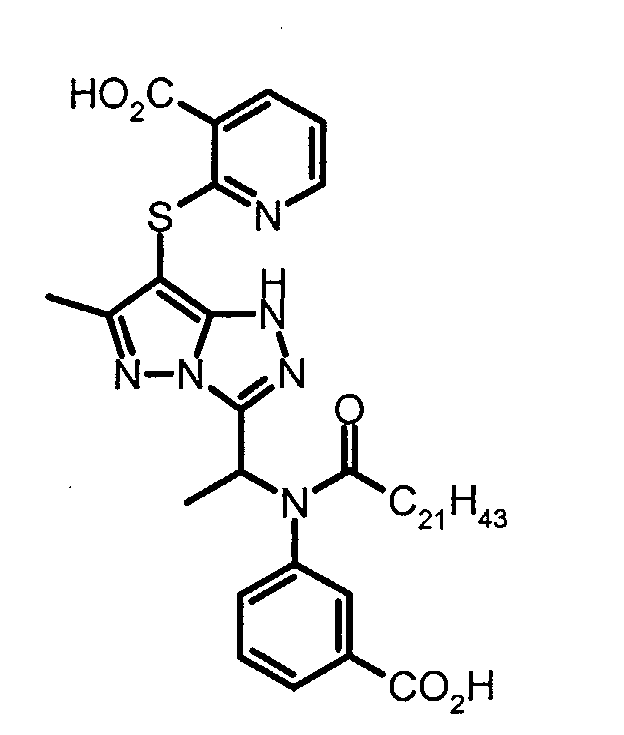
FIELD OF THE INVENTION
The present invention relates to a silver halide colour photographic
element containing a magenta or cyan dye-forming coupler, and in particular a
fused ring heterocyclic dye-forming coupler capable of carrying a
photographically useful group.
BACKGROUND OF THE INVENTION
In silver halide based colour photography, a typical photographic
element contains multiple layers of light-sensitive photographic silver halide
emulsions coated on a support with one or more of these layers being spectrally
sensitized to each of blue light, green light and red light. The blue, green and red
light-sensitive layers typically contain, respectively, yellow, magenta and cyan
dye-forming couplers, hereinafter 'couplers'. These couplers provide yellow,
magenta and cyan dyes in the so-called subtractive colour process to reproduce
their complementary colours blue, green and red as in the original image. After
exposure to light, colour development is accomplished by immersing the exposed
material in an aqueous alkali solution containing an aromatic primary amine
colour developing agent. The couplers are selected so as to react efficiently with
the oxidized colour developing agent so formed, thereby minimizing the amounts
of coupler and silver halide necessary in the photographic element
A variety of coupler types have been used in photographic
materials. Among the known couplers are cyclic azoles, in particular those
containing bridgehead nitrogen 5,5; 5,6 or 5,5,6 fused ring systems, such as
pyrazolotriazoles, pyrazolotriazines, pyrazolopyrimidines, pyrazolothiadiazines,
pyrrolotriazoles, imidazopyrazoles and pyrazolobenzimidazoles, for example as
described in EP-A-0 119 860, EP-A-0 269 436, EP-A-0 398 664, EP-A-0 714 892,
EP-A-0 744 655, EP-A-0 802 454, EP-A-0 883 024, US Patent Nos. 4,916,051,
4,950,585, 4,970,142, 5,451,501, 5,776,669 and 6,132,945 and JP 04125557.
These couplers may form magenta or cyan dyes depending on the ring structure
and substituents.
A coupling-off group is a group adapted to split off from the
coupler as the result of the reaction between the coupler and the oxidation product
of an arylamine colour developing agent. Coupling-off groups can determine the
equivalency of the coupler, can modify the reactivity of the coupler or can, where
required, advantageously affect the layer in which the coupler is coated or other
layers in the element by performing, after the release from the coupler, such
functions as development inhibition, development acceleration, bleach inhibition,
bleach acceleration or colour correction. Typical examples of coupling-off groups
include, for example, halogen, alkoxy, aryloxy, sulfonyloxy, acyloxy,
phosophonyloxy, heterocyclyloxy, acyl, heterocyclyl, sulfonamido, benzothiazolyl,
alkylthio, arylthio, heterocyclylthio and arylazo groups. These
coupling-off groups are described in the art, for example, in U.S. Patent Nos.
2,455,169, 3,227,551, 3,432,521, 3,467,563, 3,617,291, 3,880,661, 4,052,212 and
4,134,766; and in UK Patent Nos. and published applications 1,466,728,
1,531,927, 1,533,039, 2,066,755A and 2,017,704A, the disclosures of which are
incorporated herein by reference.
However the number of coupling-off group moieties which form
good couplers in combination with fused ring heterocyclic systems, such as for
example pyrazoloazoles, is limited. A commonly used coupling-off 'group' for
these systems is a chloro atom, as described, for example, in US Patent No.
5,681,691. Whilst arylthio groups are disclosed in US Patent No. 5,262,292 as
acting as good coupling-off groups for pyrazolone couplers, they do not act as
such for fused ring heterocyclic systems, even when a solubilising group such as a
carboxylic acid is present. Couplers containing heteroarylthio coupling-off
groups, wherein the coupling-off group functions as an inhibitor, include
mercaptothiadiazoles, mercaptooxadiazoles or, as disclosed for example in
JP 05127326, mercaptotetrazoles. Being inhibitors these heterocycles affect
development and couplers containing them are 'Development Inhibitor Releasing'
couplers (DIRs). Couplers wherein the coupling-off group functions as a bleach
accelerator are disclosed, for example, in EP-A-0 287 073.
PROBLEM TO BE SOLVED BY THE INVENTION
There is a need for coupling-off groups for fused ring heterocyclic
ring systems having at least one bridgehead nitrogen atom which can confer
satisfactory activity on the couplers and which can comprise or be linked to
photographically useful groups (PUGs), such as dyes, development accelerators
and electron transfer agents, without the coupling-off group having an inhibitory
effect on silver development or causing a bleach acceleration effect. Whilst a
chloro coupling-off group on such couplers provides the necessary activity, it is
not possible to link a PUG thereto. Although a PUG can be linked to an arylthio
coupling-off group, for the fused ring heterocyclic ring systems above a coupler
including such a group is not sufficiently active for practical use.
SUMMARY OF THE INVENTION
It has now been found that, when a heterocyclylthio coupling-off
group is linked to a heterocyclic coupler containing at least two fused rings and
having at least one bridgehead nitrogen atom, not only does the resulting coupler
possess the required activity but the heterocyclylthio moiety released upon
reaction with oxidised developer does not significantly inhibit silver development
nor cause a bleach acceleration effect.
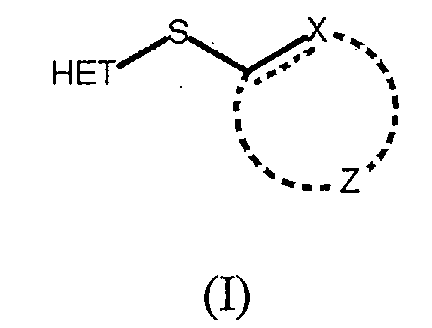
According to the present invention therefore there is provided a
photographic element comprising at least one light-sensitive silver halide
emulsion layer having associated therewith a heterocyclic magenta or cyan
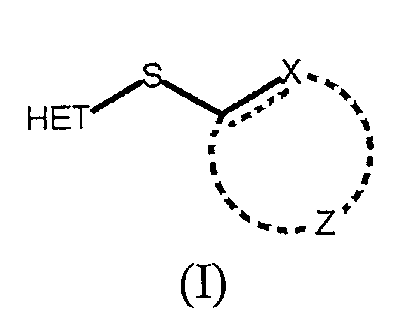
dye-forming coupler of formula (I),
wherein
HET is a heterocyclic coupler comprising at least two fused rings
and having at least one bridgehead nitrogen atom;
S is bonded to a position of HET capable of releasing the
heterocyclylthio moiety from HET upon reaction with oxidized developer;
X is a heteroatom selected from nitrogen, oxygen and sulfur,
bonded to the carbon atom bearing the exocyclic S and to other ring atoms only;
and
Z are the atoms necessary to complete an unsubstituted or
substituted heterocyclic ring or ring system, which may contain one or more other
heteroatoms selected from nitrogen, oxygen and sulfur;
provided also that the heterocyclylthio moiety released upon
reaction with oxidised developer does not significantly inhibit silver development
nor cause a bleach acceleration effect.
In another embodiment of the invention there is provided a multi-colour
photographic element comprising a support bearing yellow, magenta and
cyan image-dye-forming units comprising at least one blue-, green- or red-sensitive
silver halide emulsion layer having associated therewith at least one
yellow, magenta or cyan dye-forming coupler respectively, wherein the element
includes a heterocyclic magenta or cyan dye-forming coupler of formula (I) as
herein described.
In yet another embodiment of the invention there is provided a
process of forming an image in a photographic element as hereinbefore defined
after the element has been imagewise exposed to light, comprising contacting the
element, as herein described, with a colour developing agent.
ADVANTAGEOUS EFFECT OF THE INVENTION
In addition to the couplers herein described having the required
activity, the heterocyclylthio coupling-off groups can comprise or be linked to
PUGs, such as dyes, development accelerators or electron transfer agents, thereby
providing a practical way of attaching these groups to fused heterocyclic ring
systems.
BRIEF DESCRIPTION OF THE DRAWINGS
Fig. 1 shows the silver development curves for coupler M2 for use
in the invention and control coupler CC3.
DETAILED DESCRIPTION OF THE INVENTION
The invention is as described in the Summary of the Invention and
relates to a photographic element containing a heterocyclic magenta or cyan
coupler, comprising at least two fused rings and having at least one bridgehead
nitrogen atom and being capable of carrying a PUG.
As used herein and throughout the specification unless where
specifically stated otherwise, the term "alkyl" refers to an unsaturated or saturated,
straight or branched chain alkyl group, including alkenyl and aralkyl, and includes
cyclic alkyl groups, including cycloalkenyl, having 3-8 carbon atoms and the term
"aryl" includes specifically fused aryl.
The couplers for use in this invention can be based on any
heterocyclic coupler having at least two fused rings and having at least one
bridgehead nitrogen, preferably a coupler comprising a 5-membered ring fused to
a ring or ring system having from 5-10 carbon atoms. More preferably the
coupler is a 5,5; 5,6 or 5,5,6 fused ring system. 5,5 fused ring systems may
include, for example, pyrazolo[5,1-c][1,2,4]triazoles, pyrazolo[1,5-b][1,2,4]-triazoles,
pyrrolo[2,3-b]pyrazoles, pyrrolo[1,5-b][1,2,4]triazoles, imidazo[1,2-b]-pyrazoles,
imidazo[1,5-b]pyrazoles, imidazo[1,2-a]imidazoles, imidazo[1,2-b]-[1,2,4]triazoles,
imidazo[2,1-c][1,2,4]triazoles, imidazo[5,1-c][1,2,4]triazoles and
triazolo[3,4-c][1,2,4]triazoles. 5,6 fused ring systems may include, for example,
pyrazolo[1,5-a]pyrimidines, pyrazolo[1,5-b][1,2,4]thiadiazines, pyrazolo[5,1-c]-[1,2,4]thiadiazines,
pyrazolo[5,1-c][1,2,4]triazines and pyrazolo[1,5-a][1,3,5]-triazines
and 5,5,6 fused ring systems may include, for example, pyrazolo[3,2-b]-benzimidazoles.
Preferably the couplers are selected from pyrazolotriazoles,
pyrrolotriazoles, imidazopyrazoles, pyrazolopyrimidines, pyrazolothiadiazines,
pyrazolotriazines and pyrazolobenzimidazoles. Single ring heterocycles, such as
pyrazolones, are specifically excluded from the scope of this invention.
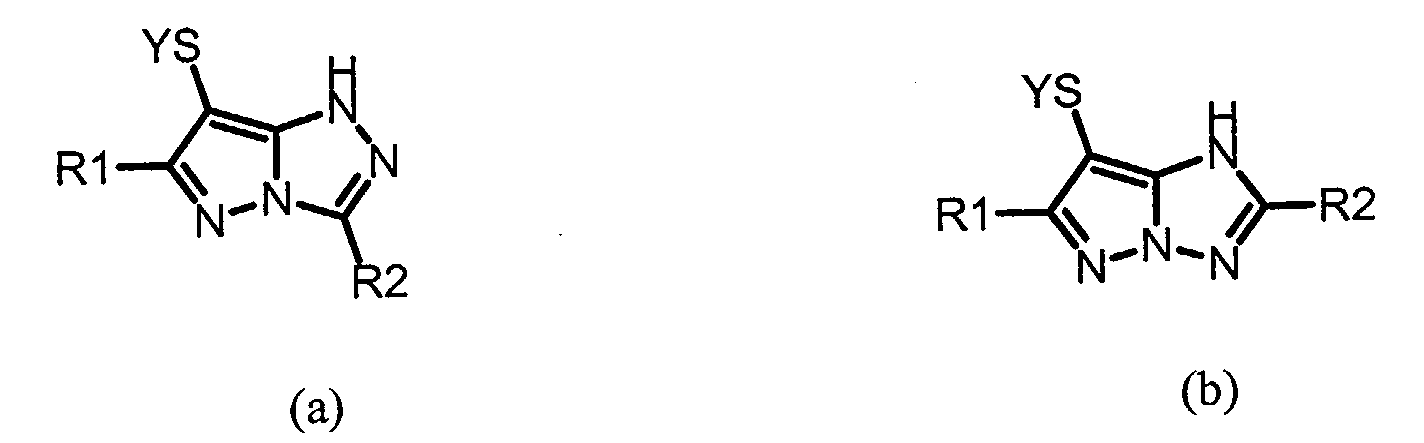
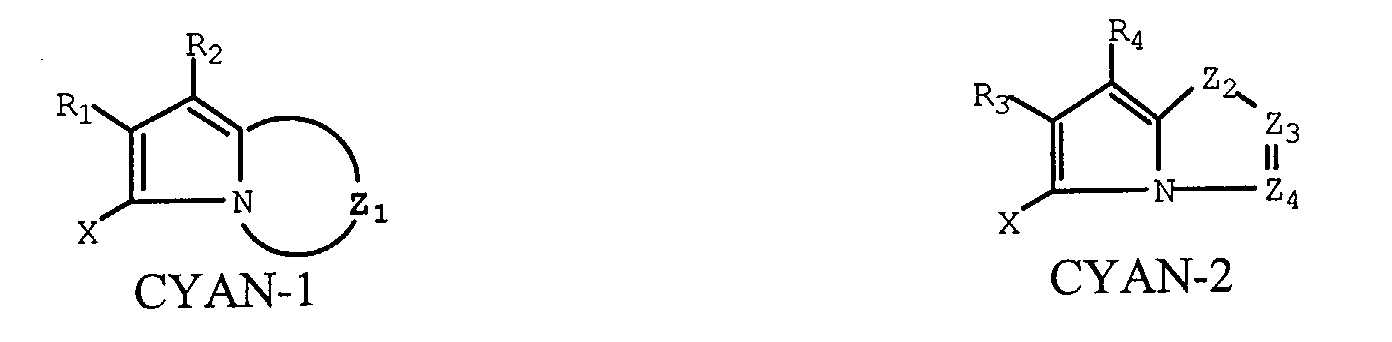
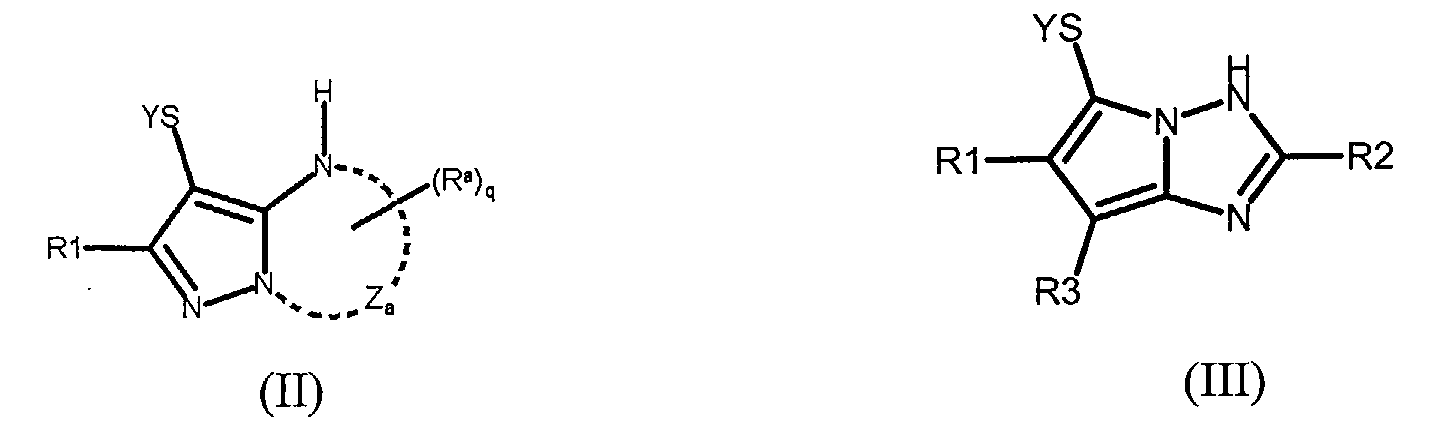
Preferred couplers are selected from the following formulae (II)
and (III):-
wherein
R
1, R
2 and R
3 are independently hydrogen or a substituent;
each R
a is an independently selected substituent and two R
a groups
may join to form a ring;
q is 0 to 4;
Z
a represents the atoms necessary to complete an unsubstituted or
substituted heterocyclic ring or ring system which may contain one or more other
heteroatoms selected from nitrogen, oxygen and sulfur;
providing that each R
a is attached to a carbon atom of the ring; and
Y is a heterocyclic ring or ring system having a heteroatom X
selected from nitrogen, oxygen and sulfur, bonded to the carbon atom bearing the
exocyclic S and to other ring atoms only and having atoms Z necessary to
complete an unsubstituted or substituted heterocyclic ring or ring system, which
may contain one or more other heteroatoms selected from nitrogen, oxygen and
sulfur.
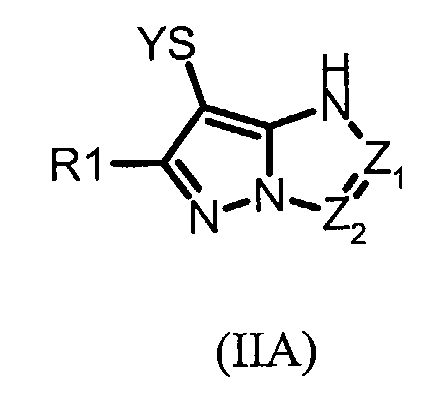
One particularly preferred embodiment of a compound of
formula (II) has the formula (IIA)
wherein
Z
1 and Z
2 are independently nitrogen atoms, -CH- groups or
-CR- groups, wherein R is a substituent; or
when both Z
1 and Z
2 are -CR- groups they may combine to form an
unsubstituted or substituted ring or ring system; and
R
1 and Y are as defined for formula (II);
Structures falling within formula (IIA) may, for example, be one of
the following:-
wherein
R
2, R
4 and each R
5 are independently hydrogen or a substituent;
or R
2 and R
4 may combine to form an unsubstituted or substituted
ring or ring system;
r is 0 to 4; and
R
1 and Y are as defined for formula (II).
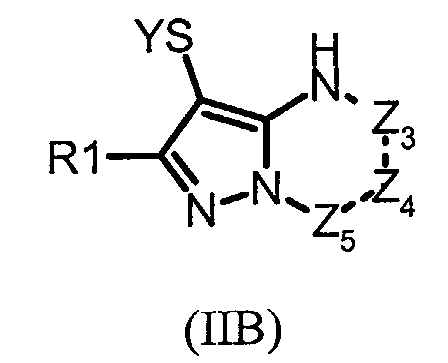
Alternatively the compound of formula (II) may have the
structure (IIB):-
wherein
one of Z
3 and Z
5 is a carbonyl or sulfonyl group and the other of
Z
3 and Z
5 is a nitrogen atom, CH- or -CR- group, wherein R is a substituent;
Z
4 is a nitrogen atom or a -CH- or -CR- group; or
Z
4 and the other of Z
3 and Z
5 may together form an unsubstituted
or substituted ring or ring system; and
R
1 and Y are as defined for formula (II).
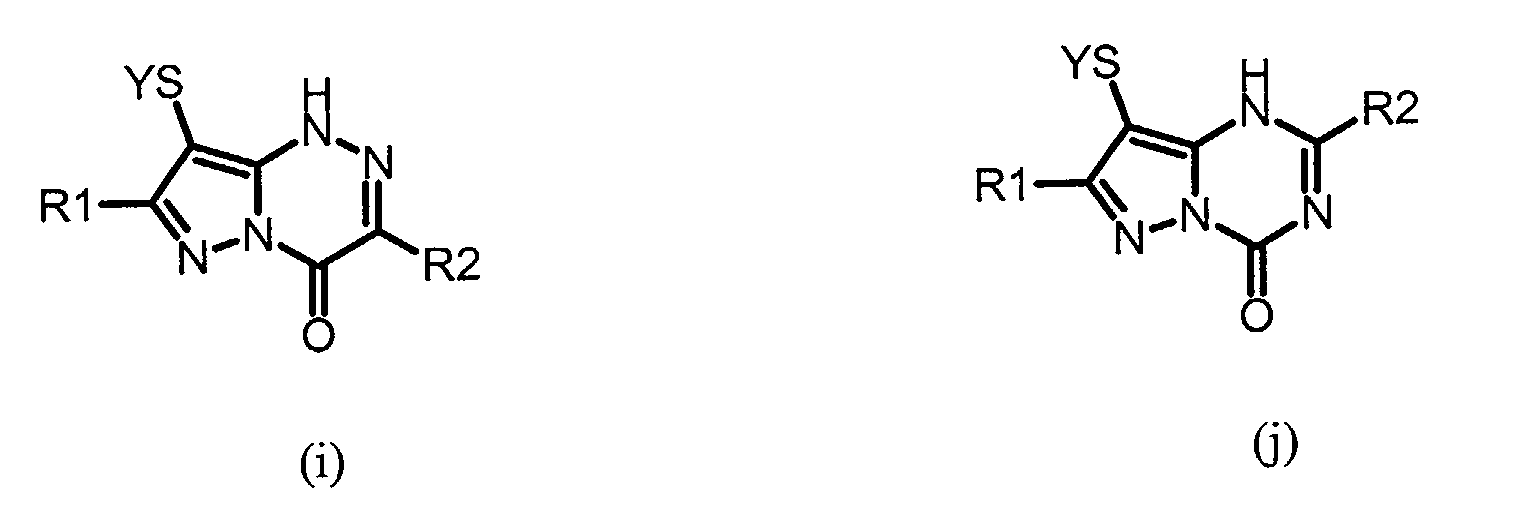
Structures falling within formula (IIB) may, for example, be one of
the following:-
wherein
R
2 and R
4 are independently hydrogen or a substituent; or
R
2 and R
4 may combine to form an unsubstituted or substituted
ring or ring system; and
R
1 and Y are as defined for formula (II).
In formulae IIA and IIB, when -CR- groups combine to form a
ring, this may be an unsubstituted or substituted 5- to 10- membered carbocyclic
or heterocyclic ring which may contain one or more heteroatoms selected from
nitrogen, oxygen and sulfur, which ring is unsubstituted or substituted.
Generally a cyan coupler of formula (II) may have any of the above
structures (a) to (j), with (a) being the preferred structure, but a magenta coupler
of formula (II) will normally have any one of the structures (a), (b) or (d).
Couplers of formula (III) will generally be cyan. Whether a particular coupler is a
cyan or magenta coupler is determined by the substituent groups present on the
ring system. For example the cyan and magenta couplers will have electron-withdrawing
and electron-donating substituents respectively in the ring system.
Appropriate combinations of R1 to R5 may result in dyes having a reddish or
bluish colour and are specifically included within the scope of 'cyan' or 'magenta'
for the purposes of this invention.
R1, R2, R3, R4 and R5 may be independently selected from
hydrogen, cyano, fluoro, chloro, bromo, iodo, nitro, carboxylic acid, sulfonic acid;
or an unsubstituted or substituted alkyl, aryl, heterocyclyl, alkoxy, aryloxy, alkyl-
or aryl-carbonyl, alkyl- or aryl-oxycarbonyl, alkyl- or aryl-carbonyloxy, acyloxy,
carbonamido, alkyl- or aryl-carbonamido, alkyl- or aryl-oxycarbonylamino, alkyl-
or aryl-sulfonyl, alkyl- or aryl-sulfonyloxy, alkyl- or aryl-oxysulfonyl, alkyl- or
aryl-sulfoxide, alkyl- or aryl-sulfamoyl, alkyl- or aryl-sulfamoylamino, alkyl- or
aryl-sulfonamido, alkyl- or aryl-thio, alkyl- or aryl-phosphonate, alkyl- or aryl-amino,
alkyl- or aryl-ureido or alkyl- or aryl-carbamoyl group. When any of R1 to
R5 is substituted with one or more substituents, these may be selected, for
example, from the above list and these may in turn be further so substituted.
Preferably R1 is selected from a cyano or an unsubstituted or
substituted alkyl, aryl, alkoxy, aryloxy, or alkyl- or aryl-carbamoyl or alkyl- or
aryl-carbonamido group.
R2 and R3 are preferably independently selected from hydrogen or
an unsubstituted or substituted alkyl, including trifluoromethyl, aryl, alkyl- or
aryl-oxycarbonyl or alkyl- or aryl-carbonyloxy group. A particularly preferred
group for R2 is an alkyl group substituted with a group N(R1)C(=O)R2, wherein
R1 is an unsubstituted or substituted alkyl group and R2 is an unsubstituted or
substituted aryl group
R4 is preferably hydrogen or R2 and R4 may join to form an
unsubstituted or substituted 5- to 10-membered carbocyclic or heterocyclic ring
which may contain one or more heteroatoms selected from nitrogen, oxygen and
sulfur, which ring is unsubstituted or substituted.
Each R5 is conveniently hydrogen or a substituent as hereinbefore
listed, especially a substituent at either or both of the positions of the phenyl ring
not adjacent to the carbon atoms shared with the adjoining ring.
The coupling-off group S-Y may be any group that, when released
upon reaction with oxidised developer, does not significantly inhibit silver
development nor cause a bleach acceleration effect. By 'does not significantly
inhibit' it is meant that, in comparison with an element not containing a coupler of
formula (I), in an element containing such a coupler from which S-Y is released,
S-Y is any group that neither
Preferably the reduction in the total amount of silver developed is
less than about 10%, more preferably less than about 5%, and the increase in the
rate at which the silver metal is oxidized is less than about 10%, more preferably
less than about 5%.
Suitably Y is a 5- to 10-membered unsubstituted or substituted
heterocyclic ring or ring system, which may contain one or more other
heteroatoms selected from nitrogen, oxygen and sulfur and which may include one
or more carbonyl groups.
In particular Y is a 5- to 8-membered ring or ring system and is
especially, for example, a pyridine, pyrimidine, pyrazine, triazine, pyridazine,
thiazole, isothiazole, oxazole, imidazole, pyrazole, isoxazole, oxazine, pyrrole,
cyclopentadienylpyrrole, triazepine or thiin. Specifically Y cannot comprise any
ring or ring system capable of inhibiting the development of silver halide such as,
for example, a tetrazole, an oxadiazole, a thiadiazole or a triazole.
Y may be unsubstituted or substituted, for example, with any one or
more of the substituents listed herein for R1 to R5 and in particular with a cyano,
carboxylic acid, or an unsubstituted or substituted alkyl- or aryl-carbonyloxy,
alkyl- or aryl-oxycarbonyl, alkyl- or aryl-sulfonamido, alkyl- or aryl-sulfamoyl,
alkyl- or aryl-carbonamido, alkyl- or aryl-carbamoyl, alkyl- or aryl-amino, alkoxy
aryloxy or heterocyclyl group, or may also be substituted, for example, with an
alkylidene, azomethine or imino group or the ring or rings of Y include one or
more carbonyl groups .
Y may itself comprise or be linked to a PUG, such as a dye,
development accelerator or electron transfer agent. Suitable linking groups may
be, for example, unsubstituted or substituted alkyl, aryl, heterocyclyl, alkyl- or
aryl-carbamoyl, alkyl- or aryl-carbonamido, alkyl- or aryl-sulfonamido, alkyl- or
aryl-sulfamoyl, alkyl- or aryl-carbonyloxy, alkyl- or aryl-ester, alkyl- or aryl-sulfone,
alkyl- or aryl-sulfoxide, alkyl- or aryl-sulfide, alkyl- or aryl-amino or
alkyl- or aryl-ether groups. It is preferred that the linking group comprises less
than 10 carbon atoms.
It is important that the substituent groups R1 to R5, Ra and groups
on Y are selected so as to adequately ballast the coupler and the resulting dye in
the organic solvent in which the coupler is dispersed. The ballasting may be
accomplished by providing hydrophobic substituent groups in one or more of
these substituent groups. Generally a ballast group is an organic radical of such
size and configuration as to confer on the coupler molecule sufficient bulk and
aqueous insolubility as to render the coupler substantially nondiffusible from the
layer in which it is coated in a photographic element. Thus the combination of
these substituent groups in the couplers for use in the invention are suitably
chosen to meet these criteria. To be effective, the ballast will usually contain at
least 8 carbon atoms and typically contains 10 to 30 carbon atoms. Suitable
ballasting may also be accomplished by providing a plurality of groups which in
combination meet these criteria. Furthermore, even if the coupling-off group
contains a ballast it is often necessary to ballast the other substituents as well,
since the coupling-off group is eliminated from the molecule upon coupling.
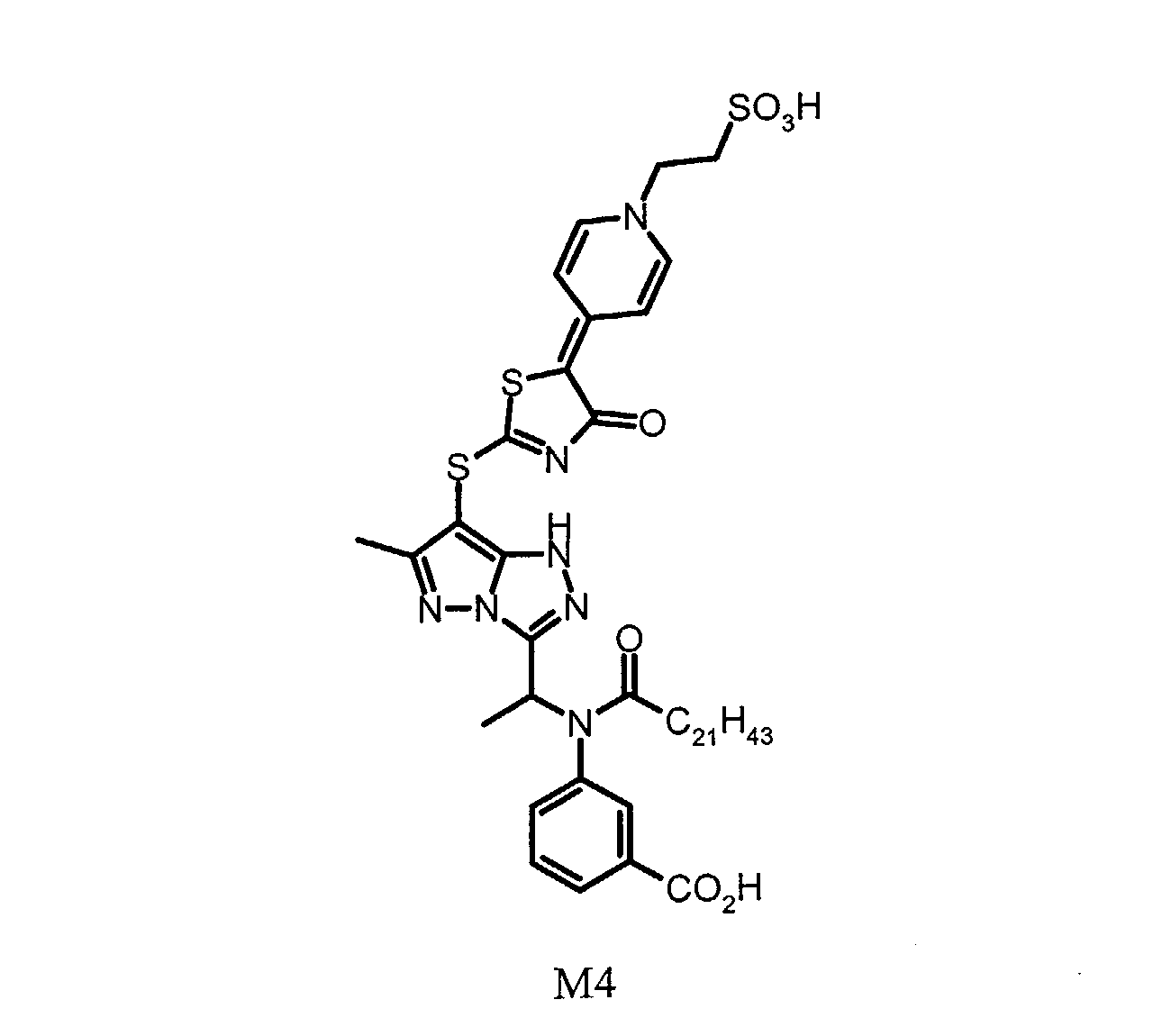
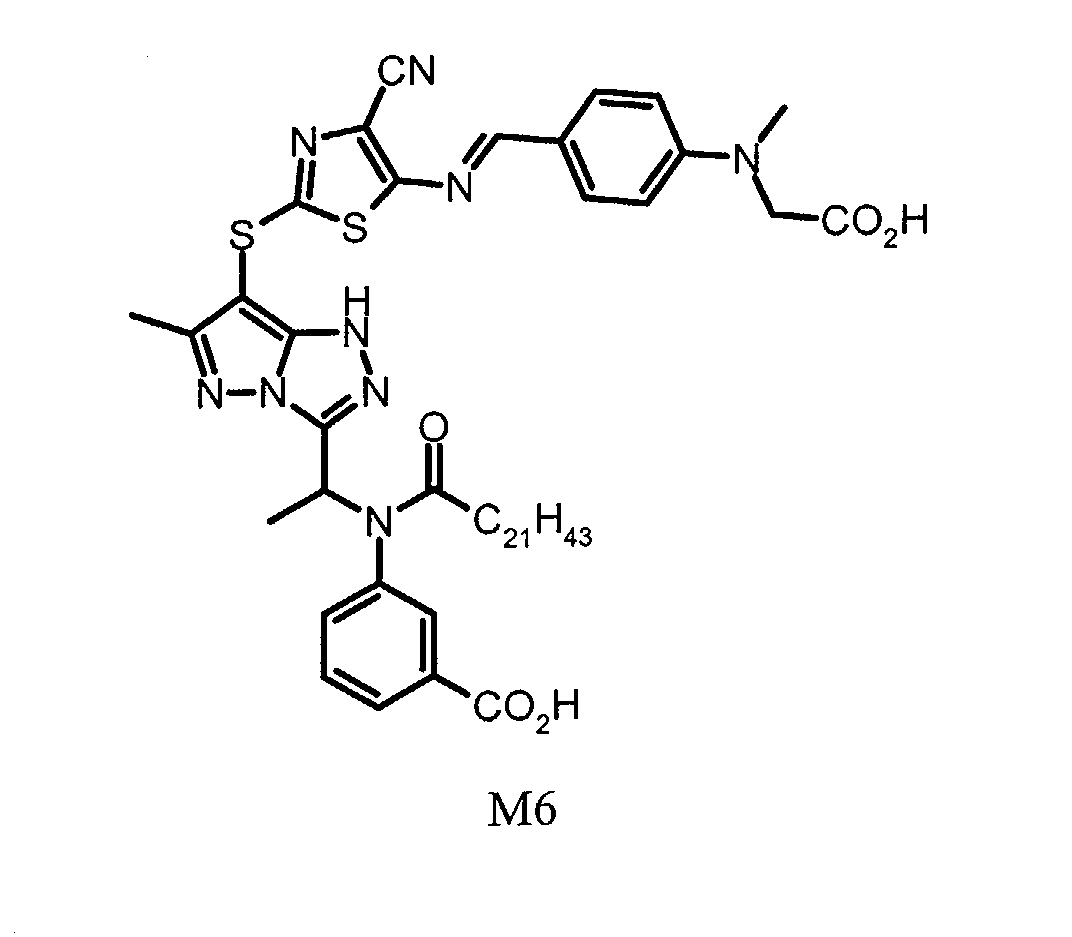
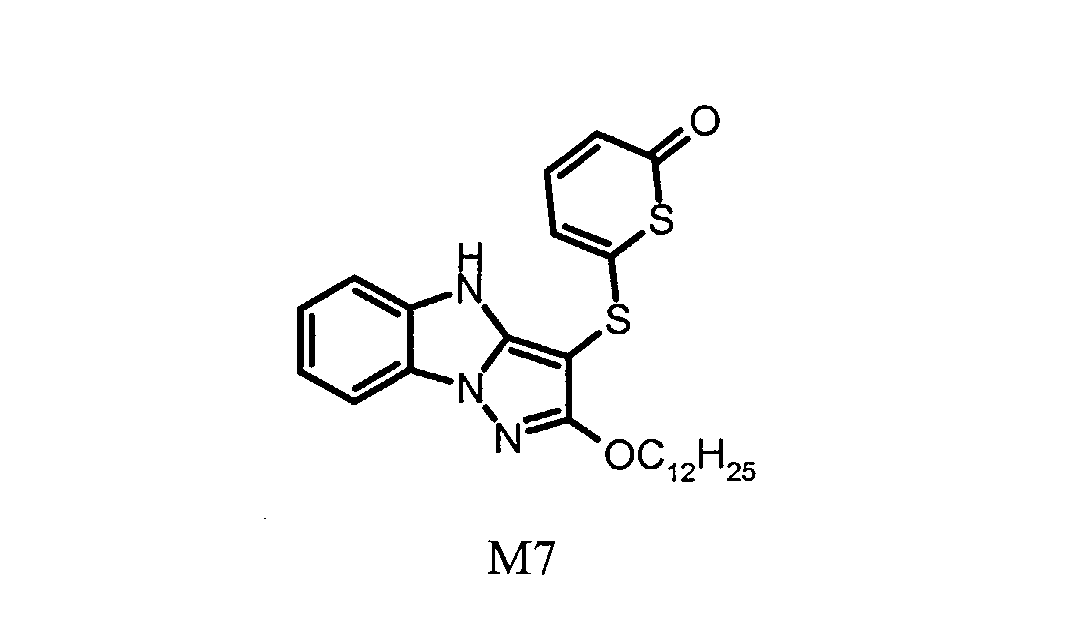
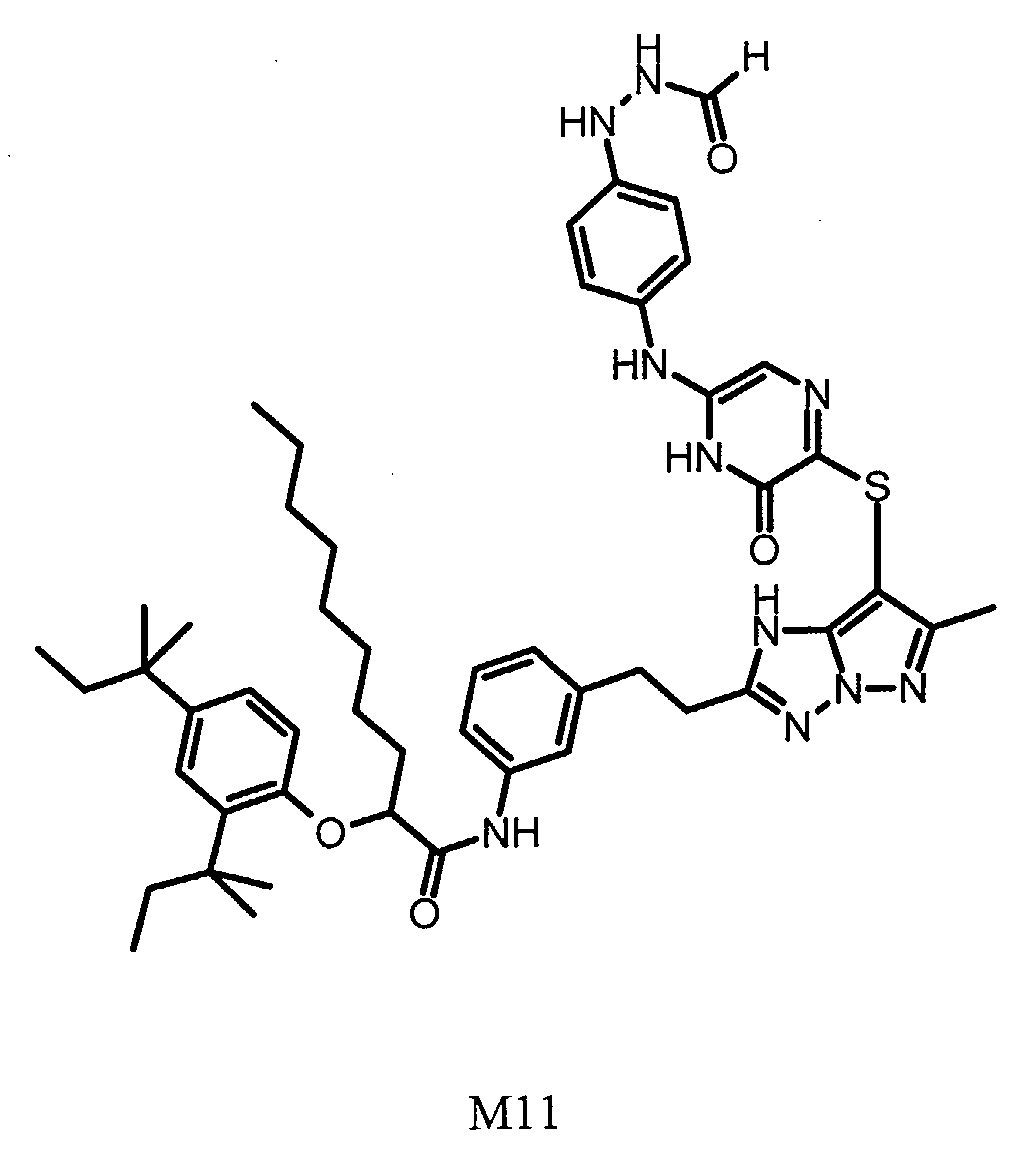
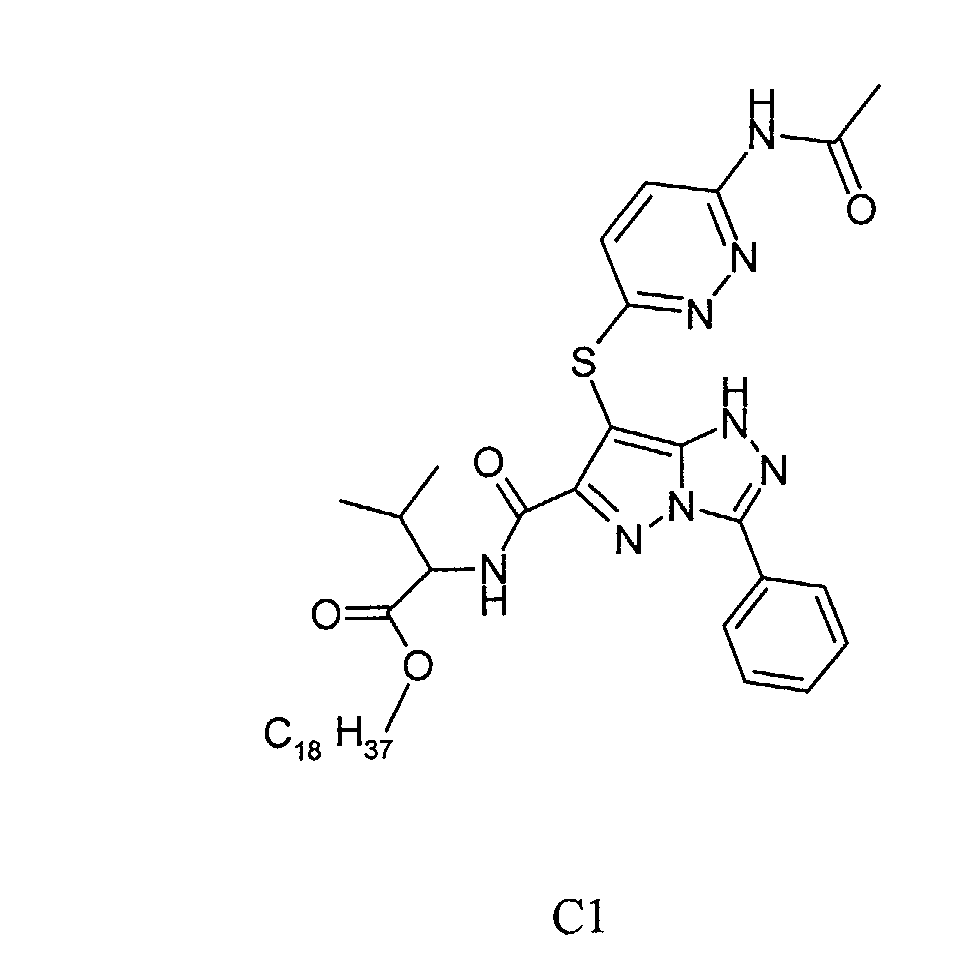
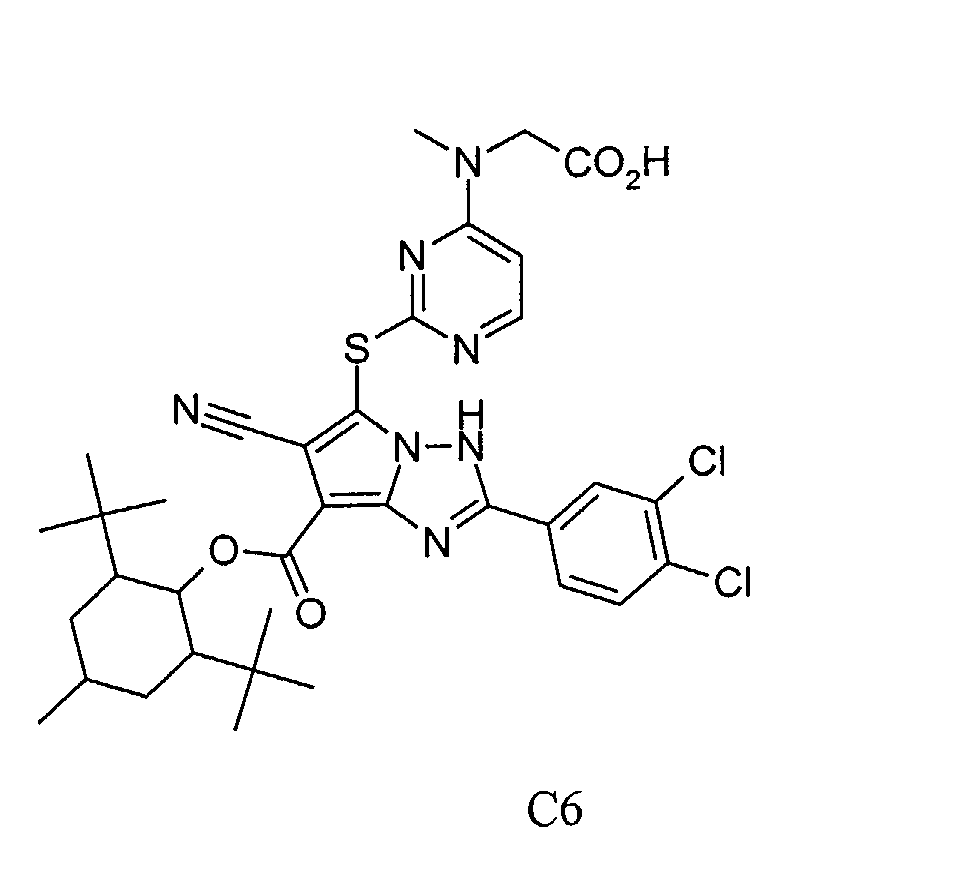
The following examples further illustrate heterocyclic couplers that
may be used in the invention. It is not to be construed that the present invention is
limited to these examples.
Magenta Couplers
Cyan Couplers
Unless otherwise specifically stated, substituent groups which
may be substituted on molecules herein include any groups, whether substituted or
unsubstituted, which do not destroy properties necessary for photographic utility.
When the term "group" is applied to the identification of a substituent containing a
substitutable hydrogen, it is intended to encompass not only the substituent's
unsubstituted form, but also its form further substituted with any group or groups
as herein mentioned. Suitably, the group may be halogen or may be bonded to the
remainder of the molecule by an atom of carbon, silicon, oxygen, nitrogen,
phosphorous or sulfur. The substituent may be, for example, halogen, such as
chlorine, bromine or fluorine; nitro; hydroxyl; cyano; carboxyl; or groups which
may be further substituted, such as alkyl, including straight or branched chain
alkyl, such as methyl, trifluoromethyl, ethyl, t-butyl, 3-(2,4-di-t-pentylphenoxy)
propyl and tetradecyl; alkenyl, such as ethylene, 2-butene; alkoxy, such as
methoxy, ethoxy, propoxy, butoxy, 2-methoxyethoxy, sec-butoxy, hexyloxy,
2-ethylhexyloxy, tetradecyloxy, 2-(2,4-di-t-pentylphenoxy)ethoxy and 2-dodecyloxyethoxy;
aryl such as phenyl, 4-t-butyl-phenyl, 2,4,6-trimethylphenyl, naphthyl;
aryloxy, such as phenoxy, 2-methylphenoxy, alpha- or beta-naphthyloxy and
4-tolyloxy; carbonamido, such as acetamido, benzamido, butyramido,
tetradecanamido, alpha-(2,4-di-t-pentylphenoxy)acetamido, alpha-(2,4-di-t-pentylphenoxy)butyramido,
alpha-(3-pentadecylphenoxy)hexanamido, alpha-(4-hydroxy-3-t-butylphenoxy)tetradecanamido,
2-oxopyrrolidin-1-yl, 2-oxo-5-tetradecylpyrrolin-1-yl,
N-methyltetradecanamido, N-succinimido,
N-phthalimido, 2,5-dioxo-1-oxazolidinyl, 3-dodecyl-2,5-dioxo-1-imidazolyl and
N-acetyl-N-dodecylamino, ethoxycarbonylamino, phenoxycarbonylamino,
benzyloxycarbonylamino, hexadecyloxycarbonylamino, 2,4-di-t-butylphenoxycarbonylamino,
phenylcarbonylamino, 2,5-(di-t-pentylphenyl)carbonylamino,
p-dodecylphenylcarbonylamino, p-toluylcarbonylamino, N-methylureido,
N,N-dimethylureido, N-methyl-N-dodecylureido, N-hexadecylureido,
N,N-dioctadecylureido, N,N-dioctyl-N'-ethylureido, N-phenylureido, N,N-diphenylureido,
N-phenyl-N-p-toluylureido, N-(m-hexa-decylphenyl)ureido,
N,N-(2,5-di-t-pentylphenyl)-N'-ethylureido and t-butylcarbonamido; sulfonamido,
such as methylsulfonamido, benzenesulfonamido, p-toluylsulfonamido,
p-dodecylbenzenesulfonamido, N-methyltetradecylsulfonamido, N,N-dipropylsulfamoylamino
and hexadecylsulfonamido; sulfamoyl, such as N-methylsulfamoyl,
N-ethylsulfamoyl, N,N-dipropylsulfamoyl, N-hexadecylsulfamoyl,
N,N-dimethylsulfamoyl; N-[3-(dodecyloxy)propyl]sulfamoyl, N-[4-(2,4-di-t-pentylphenoxy)butyl]sulfamoyl,
N-methyl-N-tetradecylsulfamoyl and
N-dodecylsulfamoyl; carbamoyl, such as N-methylcarbamoyl, N,N-dibutylcarbamoyl,
N-octadecylcarbamoyl, N-[4-(2,4-di-t-pentylphenoxy)butyl]-carbamoyl,
N-methyl-N-tetradecylcarbamoyl and N,N-di-octylcarbamoyl; acyl,
such as acetyl, (2,4-di-t-amylphenoxy)acetyl, phenoxycarbonyl, p-dodecyloxyphenoxycarbonyl,
methoxycarbonyl, butoxycarbonyl, tetradecyloxycarbonyl,
ethoxycarbonyl, benzyloxycarbonyl, 3-pentadecyloxycarbonyl and dodecyloxycarbonyl;
sulfonyl, such as methoxysulfonyl, octyloxysulfonyl, tetradecyloxysulfonyl,
2-ethylhexyloxysulfonyl, phenoxysulfonyl, 2,4-di-t-pentylphenoxysulfonyl,
methylsulfonyl, octylsulfonyl, 2-ethylhexylsulfonyl,
dodecylsulfonyl, hexadecylsulfonyl, phenylsulfonyl, 4-nonylphenylsulfonyl and
p-toluylsulfonyl; sulfonyloxy, such as dodecylsulfonyloxy and hexadecylsulfonyloxy;
sulfinyl, such as methylsulfinyl, octylsulfinyl, 2-ethylhexylsulfinyl,
dodecylsulfinyl, hexadecylsulfinyl, phenylsulfinyl, 4-nonylphenylsulfinyl and
p-toluylsulfinyl; thio, such as ethylthio, octylthio, benzylthio, tetradecylthio,
2-(2,4-di-t-pentylphenoxy)ethylthio, phenylthio, 2-butoxy-5-t-octylphenylthio and
p-tolylthio; acyloxy, such as acetyloxy, benzoyloxy, octadecanoyloxy,
p-dodecylamidobenzoyloxy, N-phenylcarbamoyloxy, N-ethylcarbamoyloxy and
cyclohexylcarbonyloxy; amino, such as phenylanilino, 2-chloroanilino,
diethylamino and dodecylamino; imino, such as 1 (N-phenylimido)ethyl,
N-succinimido or 3-benzyl-hydantoinyl; phosphate, such as dimethylphosphate
and ethylbutylphosphate; phosphite, such as diethyl and dihexylphosphite; a
heterocyclic group, a heterocyclic oxy group or a heterocyclic thio group, each of
which may be substituted and which contain a 3 to 7 membered heterocyclic ring
composed of carbon atoms and at least one hetero atom selected from the group
consisting of oxygen, nitrogen and sulfur, such as 2-furyl, 2-thienyl,
2-benzimidazolyloxy or 2-benzothiazolyl; quaternary ammonium, such as
triethylammonium; and silyloxy, such as trimethylsilyloxy.
If desired, the substituents may themselves be further substituted
one or more times with the described substituent groups. The particular
substituents used may be selected by those skilled in the art to attain the desired
photographic properties for a specific application and can include, for example,
hydrophobic groups, solubilizing groups, blocking groups, releasing or releasable
groups. Generally, the above groups and substituents thereof may include those
having up to 48 carbon atoms, typically 1 to 36 carbon atoms and usually less than
24 carbon atoms, but greater numbers are possible depending on the particular
substituents selected.
Representative substituents on ballast groups include alkyl, aryl,
alkoxy, aryloxy, alkylthio, hydroxy, halogen, alkoxycarbonyl, aryloxycarbonyl,
carboxy, acyl, acyloxy, amino, anilino, carbonamido, carbamoyl, alkylsulfonyl,
arylsulfonyl, sulfonamido and sulfamoyl groups wherein the substituents typically
contain 1 to 42 carbon atoms. Such substituents can also be further substituted.
The dispersion of a coupler for use in the invention can be
incorporated into the photographic element as an emulsified photographic
dispersion, prepared by dissolving the material in one or more high-boiling
permanent organic solvents, with or without a low-boiling or partially water-soluble
auxiliary organic solvent. A blend of permanent solvents may be
advantageous to optimise the desired features, such as solubility, dye hue, thermal
or light stability or the coupling reactivity of the dispersions.
The resulting organic solution may then be mixed with an aqueous
gelatin solution and the mixture passed through a mechanical mixing device
suitable for high-shear or turbulent mixing generally suitable for preparing
photographic emulsified dispersions, as described in EP-A-1 037 103,
incorporated herein by reference. The dispersion particles preferably have an
average particle size of less than 2µm, generally from about 0.02 to 2µm, more
preferably from about 0.02 to 0.5µm, especially from about 0.02 to 0.3µm. These
methods are described in detail in U.S. Patent Nos. 2,322,027, 2,787,544,
2,801,170, 2,801,171, 2,949,360 and 3,396,027, the disclosures of which are
incorporated by reference herein.
The aqueous phase of the coupler dispersion for use in the
invention preferably comprises gelatin as a hydrophilic colloid. This may be
gelatin or a modified gelatin such as acetylated gelatin, phthalated gelatin or
oxidized gelatin. Gelatin may be base-processed, such as lime-processed gelatin,
or may be acid-processed, such as acid-processed ossein gelatin. Other
hydrophilic colloids may also be used, such as a water-soluble polymer or
copolymer including, but not limited to poly(vinyl alcohol), partially hydrolyzed
poly(vinyl acetate-co-vinyl alcohol), hydroxyethyl cellulose, poly(acrylic acid),
poly(1-vinylpyrrolidone), poly(sodium styrene sulfonate), poly(2-acrylamido-2-methane
sulfonic acid) and polyacrylamide. Copolymers of these polymers with
hydrophobic monomers may also be used.
A surfactant may be present in either the aqueous phase or the
organic phase or the dispersions can be prepared without any surfactant present.
Surfactants may be cationic, anionic, zwitterionic or non-ionic. Ratios of
surfactant to liquid organic solution typically are in the range of 0.5 to 25wt.% for
forming small particle photographic dispersions. In a preferred embodiment of the
invention, an anionic surfactant is contained in the aqueous gelatin solution.
An aqueous coating solution in accordance with the present
invention may be prepared from the coupler dispersion. Other ingredients may
also be contained in this solution such as silver halide emulsions, dispersions or
solutions of other photographically useful compounds, additional gelatin, or acids
and bases to adjust the pH. These ingredients may then be mixed with a
mechanical device at an elevated temperature (e.g. 30 to 50C) for a short period of
time (e.g. 5 min to 4 h) prior to coating.
The materials for use in the invention can be used in any of the
ways and in any of the combinations known in the art. Typically, the materials are
incorporated in a silver halide emulsion and the emulsion coated as a layer on a
support to form part of a photographic element. Alternatively, unless provided
otherwise, they can be incorporated at a location adjacent to the silver halide
emulsion layer where, during development, they will be in reactive association
with development products such as oxidized colour developing agent. Thus, as
used herein, the term "associated" signifies that the compound is in the silver
halide emulsion layer or in an adjacent location where, during processing, it is
capable of reacting with silver halide development products.
Suitable laydowns of total coupler are from about 0.05 mmol/m2 to
about 2.0 mmol/m2, preferably from about 0.15 mmol/m2 to about 1.5 mmol/m2,
more preferably from about 0.30 mmol/m2 to about 1.2 mmol/m2. The ratio of
solvent to coupler (by weight) is from about 0.2:1 to about 5:1, preferably from
about 0.5:1 to about 4:1, more preferably from about 0.5:1 to about 2:1.
The photographic elements comprising a coupler dispersion for use
in the invention can be single colour elements or multicolour elements.
Multicolour elements contain image dye-forming units sensitive to each of the
three primary regions of the spectrum. Each unit can comprise a single emulsion
layer or multiple emulsion layers sensitive to a given region of the spectrum. The
layers of the element, including the layers of the image-forming units, can be
arranged in various orders as known in the art. In an alternative format, the
emulsions sensitive to each of the three primary regions of the spectrum can be
disposed as a single segmented layer.
A typical multicolour photographic element comprises a support
bearing a cyan dye image-forming unit comprised of at least one red-sensitive
silver halide emulsion layer having associated therewith at least one cyan dye-forming
coupler, a magenta dye image-forming unit comprising at least one green-sensitive
silver halide emulsion layer having associated therewith at least one
magenta dye-forming coupler and a yellow dye image-forming unit comprising at
least one blue-sensitive silver halide emulsion layer having associated therewith at
least one yellow dye-forming coupler.
The element can be employed with a reflective support, as
described in U.S. Patent No. 5,866,282. The element can contain additional layers,
such as filter layers, interlayers, overcoat layers and subbing layers.
If desired, the photographic element can be used in conjunction
with an applied magnetic layer as described in Research Disclosure, November
1992, Item 34390 published by Kenneth Mason Publications, Ltd., Dudley Annex,
12a North Street, Emsworth, Hampshire P010 7DQ, ENGLAND, and as described
in Hatsumi Kyoukai Koukai Gihou No. 94-6023, published March 15, 1994,
available from the Japanese Patent Office, the contents of which are incorporated
herein by reference. When it is desired to employ the inventive materials in a
small format film, Research Disclosure, June 1994, Item 36230 provides suitable
embodiments.
In the following discussion of suitable materials for use in the
emulsions and elements of this invention, reference will be made to Research
Disclosure, September 1994, Item 36544, available as described above, which will
be identified hereafter by the term "Research Disclosure". The contents of the
Research Disclosure, including the patents and publications referenced therein, are
incorporated herein by reference, and the Sections hereafter referred to are
Sections of the Research Disclosure.
Except as provided, the silver halide emulsion containing elements
employed in this invention can be either negative-working or positive-working as
indicated by the type of processing instructions (i.e. colour negative, reversal or
direct positive processing) provided with the element. Suitable emulsions and
their preparation as well as methods of chemical and spectral sensitization are
described in Sections I through V. Various additives such as UV dyes,
brighteners, antifoggants, stabilizers, light absorbing and scattering materials and
physical property modifying addenda such as hardeners, coating aids, plasticizers,
lubricants and matting agents are described, for example, in Sections II and VI
through VIII. Colour materials are described in Sections X through XIII. Scan
facilitating is described in Section XIV. Supports, exposure, development systems
and processing methods and agents are described in Sections XV to XX. Certain
desirable photographic elements and processing steps, particularly those useful in
conjunction with colour reflective prints, are described in Research Disclosure,
Item 37038, February 1995. US Patent No. 5,558,980 discloses loaded latex
compositions, such as poly- and t-butyl-acrylamides which can be incorporated
into any photographic coating in any layer to provide extra dye stability.
In colour couplers a coupling-off group is a group adapted to split off from
the coupler as the result of the reaction between the coupler and the oxidation
product of an arylamine colour developing agent. Typical examples of such
groups are as hereinbefore defined in the Background of the Invention.
Couplers that form cyan dyes upon reaction with oxidized colour developing
agents are typically phenols, naphthols or pyrazoloazoles, described in such
representative patents and publications as U.S. Patent Nos. 2,367,531,
2,423,730, 2,474,293, 2,772,162, 2,895,826, 3,002,836, 3,034,892, 3,041,236,
4,333,999 and 4,883,746, EP-A-0 544 322, EP-A-0 556 700, EP-A-0 556 777,
EP-A- 0 565 096, EP-A-0 570 006 and EP-A-0 574 948 and "Farbkuppler-eine
Literature Übersicht," published in Agfa Mitteilungen, Band III, pp.56-175 (1961).
Typical cyan couplers are represented by the following formulae:-
wherein
R
1, R
5 and R
8 each represent a hydrogen or a substituent,
R
2 represents a substituent, R
3, R
4 and R
7 each represent an electron attractive
group having a Hammett's substituent constant s
para of 0.2 or more and the sum of
the s
para values of R
3 and R
4 is 0.65 or more, R
6 represents an electron attractive
group having a Hammett's substituent constant s
para of 0.35 or more,
X represents a hydrogen or a coupling-off group, Z
1 represents nonmetallic atoms
necessary for forming a nitrogen-containing, six-membered, heterocyclic ring
which has at least one dissociative group, Z
2 represents -C(R
7)= and -N= and
Z
3 and Z
4 each represent -C(R
8)= and -N=,
or by the formulae:-
wherein
R
9 represents a substituent (preferably a carbamoyl, ureido, or
carbonamido group), R
10 represents a substituent (preferably individually selected
from halogens, alkyl, and carbonamido groups), R
11 represents ballast substituent;
R
12 represents a hydrogen or a substituent (preferably a carbonamido or
sulfonamido group), X represents a hydrogen or a coupling-off group, and
m is an integer from 1-3.
Couplers that form magenta dyes upon reaction with oxidized
colour developing agent are described in such representative patents and
publications as: U.S. Patent Nos. 2,311,082, 2,343,703, 2,369,489, 2,600,788,
2,908,573, 3,062,653, 3,152,896, 3,519,429, 3,758,309, 4,540,654 and
"Farbkuppler-eine Literature Übersicht," published in Agfa Mitteilungen, Band III,
pp. 126-156 (1961). Preferably such couplers are pyrazolones, pyrazolotriazoles
or pyrazolobenzimidazoles that form magenta dyes upon reaction with oxidized
colour developing agents.
Especially preferred couplers are 1H-pyrazolo [5,1-c]-1,2,4-triazole
and 1H-pyrazolo [1,5-b]-1,2,4-triazole. Examples of 1H-pyrazolo [5,1-c]-1,2,4-triazole
couplers are described in U.K. Patent Nos. 1,247,493, 1,252,418,
1,398,979, U.S. Patent Nos. 4,443,536, 4,514,490, 4,540,654, 4,590,153,
4,665,015, 4,822,730, 4,945,034, 5,017,465 and 5,023,170. Examples of
1H-pyrazolo [1,5-b]-1,2,4-triazoles can be found in EP-A-0 176 804,
EP-A-0 177 765 and U.S Patent Nos. 4,659,652, 5,066,575 and 5,250,400.
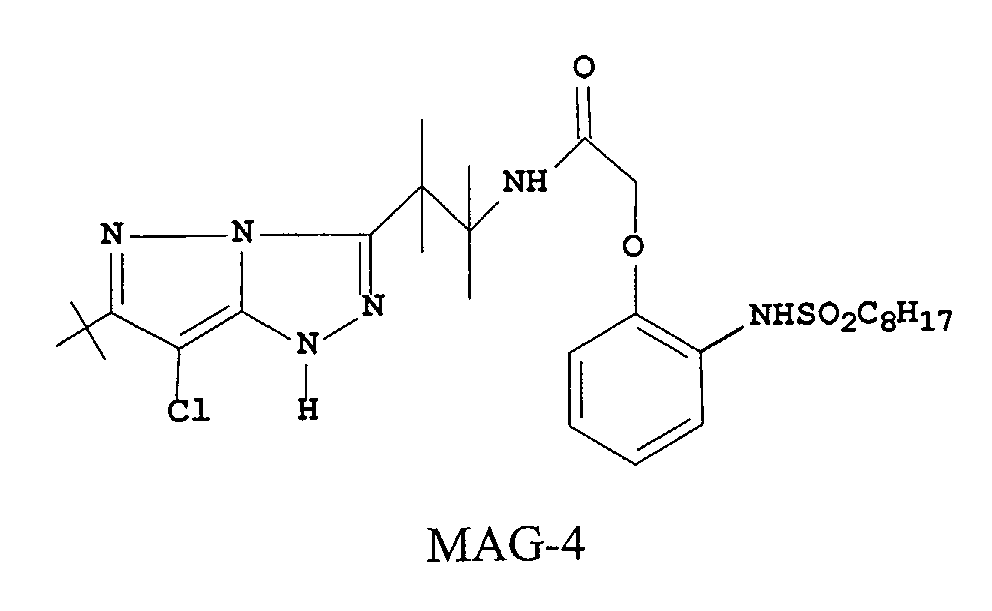
Typical pyrazoloazole and pyrazolone couplers are represented by
the following formulae:
wherein
R
a and R
b are independently hydrogen or a substituent, R
c is a
substituent (preferably an aryl group), R
d is a substituent (preferably an anilino,
carbonamido, ureido, carbamoyl, alkoxy, aryloxycarbonyl, alkoxycarbonyl, or
N-heterocyclic group), X is hydrogen or a coupling-off group, and Z
a, Z
b, and Z
c
are independently a substituted methine group, =N-, =C- or -NH-, provided
that one of either the Z
a-Z
b bond or the Z
b-Z
c bond is a double bond and the
other is a single bond, and when the Z
b-Z
c bond is a carbon-carbon double bond,
it may form part of an aromatic ring, and at least one of Z
a, Z
b, and Z
c is a
methine group connected to the group R
b.
Specific examples of such couplers are:
Couplers that form yellow dyes upon reaction with oxidized colour
developing agent are described in such representative patents and publications as:
U.S. Patent Nos. 2,298,443, 2,407,210, 2,875,057, 3,048,194, 3,265,506,
3,447,928, 3,960,570, 4,022,620, 4,443,536, 4,910,126 and 5,340,703 and
"Farbkuppler-eine Literature Übersicht", published in Agfa Mitteilungen, Band III,
pp. 112-126 (1961). Such couplers are typically open chain ketomethylene
compounds.
Also preferred are yellow couplers such as described in, for
example, EP-A- 0 482 552, EP-A-0 510 535, EP-A-0 524 540, EP-A-0 543 367
and U.S. Patent No. 5,238,803. For improved colour reproduction, couplers which
give yellow dyes that cut off sharply on the long wavelength side are particularly
preferred (for example, see U.S. Patent No. 5,360,713).
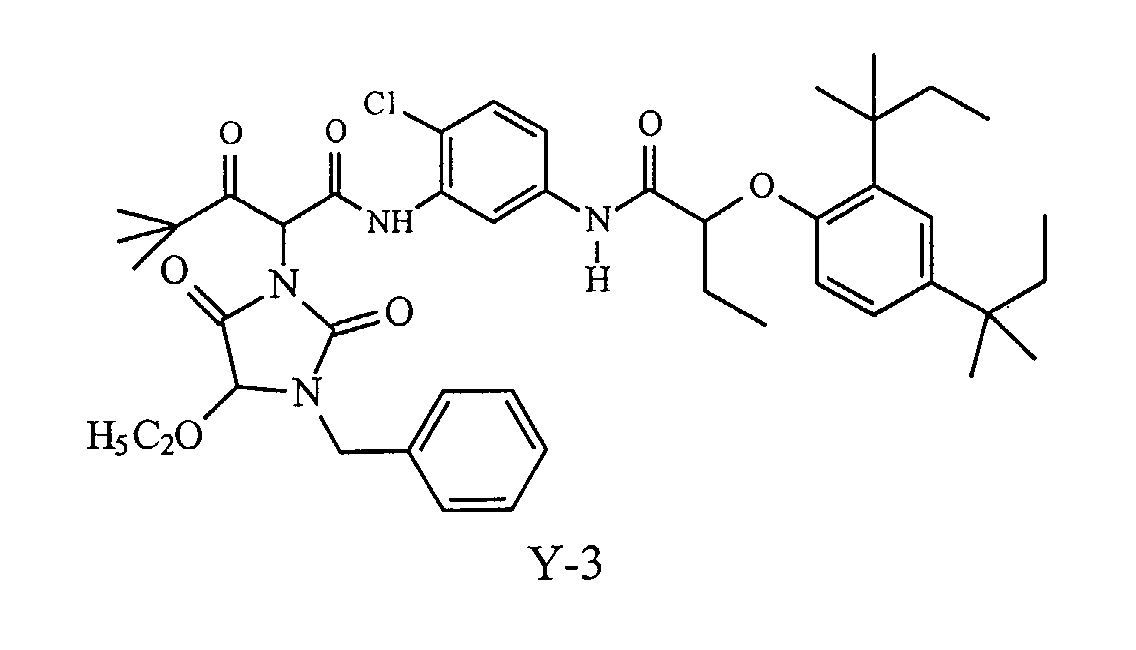
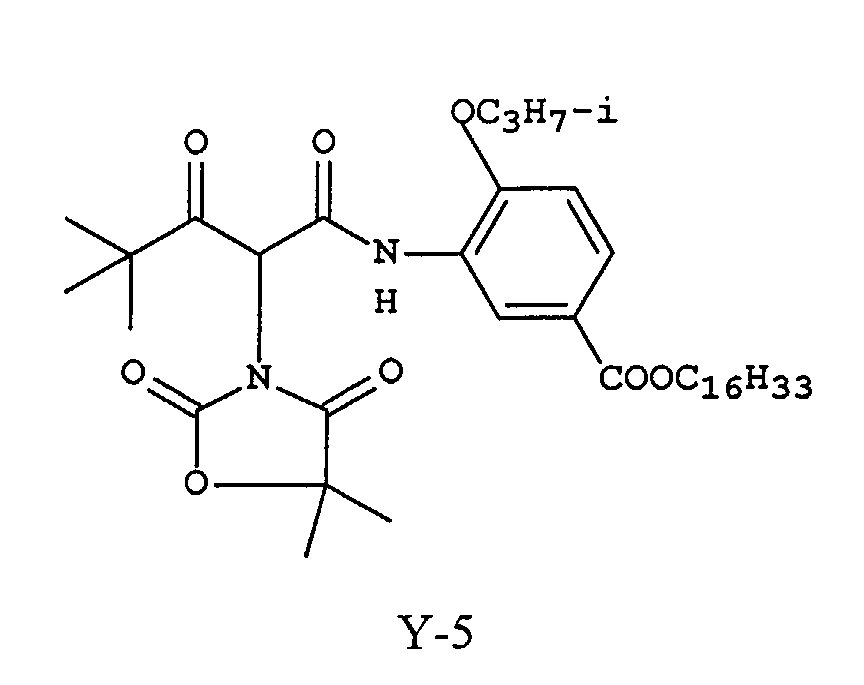
Typical preferred yellow couplers are represented by the following
formulae:
wherein
R
1, R
2, Q
1 and Q
2 are each a substituent, X is hydrogen or a
coupling-off group, Y is an aryl group or a heterocyclic group, Q
3 is an organic
residue required to form a nitrogen-containing heterocyclic group together with the
>N-, and Q
4 are nonmetallic atoms necessary to form a 3- to 5-membered
hydrocarbon ring or a 3- to 5-membered heterocyclic ring which contains at least
one hetero atom selected from nitrogen, oxygen, sulfur and phosphorous in the
ring. Particularly preferred is when Q
1 and Q
2 are each an alkyl group, an aryl
group or a heterocyclic group, and R
2 is an aryl or tertiary alkyl group.
Preferred yellow couplers have the following structures:
Couplers that form colourless products upon reaction with oxidized
colour developing agent are described in such representative patents as:
U.K. Patent No. 861,138, U.S. Patent Nos. 3,632,345, 3,928,041, 3,958,993 and
3,961,959. Typically such couplers are cyclic carbonyl-containing compounds that
form colourless products on reaction with an oxidized colour developing agent.
Couplers that form black dyes upon reaction with oxidized colour
developing agent are described in such representative patents as U.S. Patent Nos.
1,939,231, 2,181,944, 2,333,106 and 4,126,461, German OLS No. 2,644,194 and
German OLS No. 2,650,764. Typically, such couplers are resorcinols or
m-aminophenols that form black or neutral products on reaction with oxidized
colour developing agent.
In addition to the foregoing, so-called "universal" or "washout"
couplers may be employed. These couplers do not contribute to image dye-formation.
Thus, for example, a naphthol having an unsubstituted carbamoyl or
one substituted with a low molecular weight substituent at the 2- or 3- position
may be employed. Couplers of this type are described, for example, in U.S. Patent
Nos. 5,026,628, 5,151,343 and 5,234,800.
It may be useful to use additional couplers any of which may
contain known ballasts or coupling-off groups such as those described in U.S.
Patent Nos. 4,301,235, 4,853,319 and 4,351,897. The coupler may contain
solubilizing groups such as described in U.S. Patent No. 4,482,629. The coupler
may also be used in association with "wrong" coloured couplers (e.g. to adjust
levels of interlayer correction) and, in colour negative applications, with masking
couplers such as those described in EP-A-0 213 490, Japanese Published
Application 58-172,647, U.S. Patent Nos. 2,983,608, 4,070,191 and 4,273,861,
German Applications DE 2,706,117 and DE 2,643,965, UK Patent No. 1,530,272
and Japanese Application 58-113935. The masking couplers may be shifted or
blocked, if desired.
The materials for use in the invention may be used in association
with materials that accelerate or otherwise modify the processing steps e.g. of
bleaching or fixing to improve the quality of the image. Bleach accelerator
releasing couplers such as those described in EP-A-0 193 389; EP-A-0 301 477
and in U.S. Patent Nos. 4,163,669, 4,865,956 and 4,923,784, may be useful. Also
contemplated is use of the compositions in association with nucleating agents,
development accelerators or their precursors (UK Patent Nos. 2,097,140 and
2,131,188); electron transfer agents (U.S. Patent Nos. 4,859,578 and 4,912,025);
antifogging and anti colour-mixing agents such as derivatives of hydroquinones,
aminophenols, amines, gallic acid; catechol; ascorbic acid; hydrazides;
sulfonamidophenols and non colour-forming couplers.
The materials for use in the invention may also be used in
combination with filter dye layers comprising colloidal silver sol or yellow, cyan
and/or magenta filter dyes, either as oil-in-water dispersions, latex dispersions or
as solid particle dispersions. Additionally, they may be used with "smearing"
couplers (e.g. as described in U.S. Patent Nos. 4,366,237, 4,420,556, 4,543,323
and in EP-A-0 096 570). Also, the compositions may be blocked or coated in
protected form as described, for example, in Japanese Application 61/258,249 or
U.S. Patent No. 5,019,492.
The materials for use in the invention may further be used in
combination with image-modifying compounds such as "Developer Inhibitor-Releasing"
compounds (DIRs). DIRs useful in conjunction with the compositions
of the invention are known in the art and examples are described in U.S. Patent
Nos. 3,137,578, 3,148,022, 3,148,062, 3,227,554, 3,384,657, 3,379,529, 3,615,506,
3,617,291, 3,620,746, 3,701,783, 3,733,201, 4,049,455, 4,095,984, 4,126,459,
4,149,886, 4,150,228, 4,211,562, 4,248,962, 4,259,437, 4,362,878, 4,409,323,
4,477,563, 4,782,012, 4,962,018, 4,500,634, 4,579,816, 4,607,004, 4,618,571,
4,678,739, 4,746,600, 4,746,601, 4,791,049, 4,857,447, 4,865,959, 4,880,342,
4,886,736, 4,937,179, 4,946,767, 4,948,716, 4,952,485, 4,956,269, 4,959,299,
4,966,835, 4,985,336 as well as in patent publications GB 1,560,240,
GB 2,007,662, GB 2,032,914, GB 2,099,167, DE 2,842,063, DE 2,937,127,
DE 3,636,824, DE 3,644,416 as well as the following European Patent
Publications: EP-A-0 272 573, EP-A-0 335 319, EP-A-0 336 411,
EP-A-0 346 899, EP-A-0 362 870, EP-A-0 365 252, EP-A-0 365 346,
EP-A-0 373 382, EP-A-0 376 212, EP-A-0 377 463, EP-A-0 378 236, EP-A-0 384
670, EP-A-0 396 486, EP-A-0 401 612 and EP-A-0 401 613.
Such compounds are also disclosed in "Developer-Inhibitor-Releasing
(DIR) Couplers for Color Photography," C.R. Barr, J.R. Thirtle and
P.W. Vittum in Photographic Science and Engineering, Vol.13, p.174 (1969),
incorporated herein by reference. Generally, the developer inhibitor-releasing
(DIR) couplers include a coupler moiety and an inhibitor coupling-off moiety (IN).
The inhibitor-releasing couplers may be of the time-delayed type (DIAR couplers)
which also include a timing moiety or chemical switch which produces a delayed
release of inhibitor. Examples of typical inhibitor moieties are: oxazoles,
thiazoles, diazoles, triazoles, oxadiazoles, thiadiazoles, oxathiazoles, thiatriazoles,
benzotriazoles, tetrazoles, benzimidazoles, indazoles, isoindazoles, mercaptotetrazoles,
selenotetrazoles, mercaptobenzothiazoles, selenobenzothiazoles,
mercaptobenzoxazoles, selenobenzoxazoles, mercaptobenzimidazoles,
selenobenzimidazoles, benzodiazoles, mercaptooxazoles, mercaptothiadiazoles,
mercaptothiazoles, mercaptotriazoles, mercaptooxadiazoles, mercaptodiazoles,
mercaptooxathiazoles, tellurotetrazoles or benzisodiazoles. In a preferred
embodiment, the inhibitor moiety or group is selected from the following
formulae:
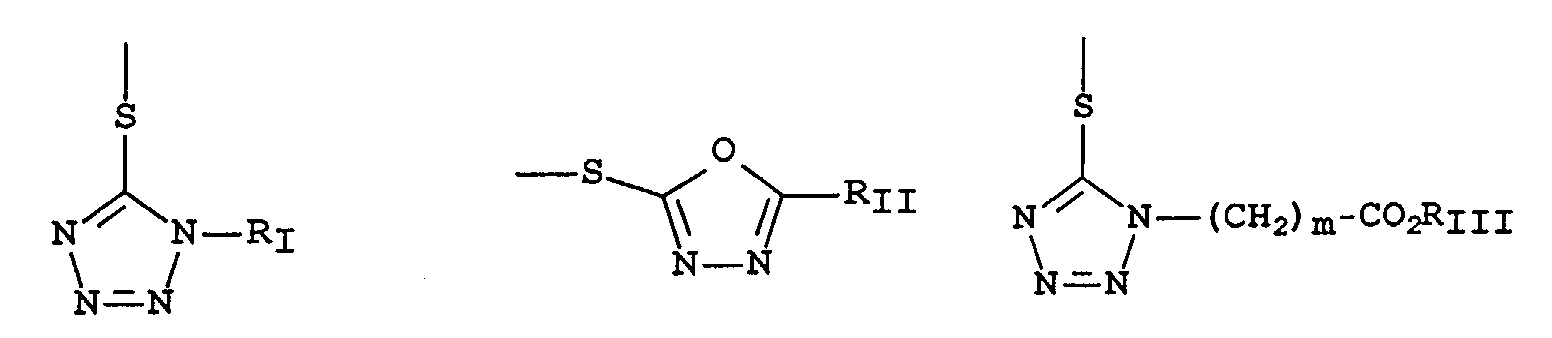

wherein
R
I is selected from the group consisting of straight and branched
alkyl groups of from 1 to about 8 carbon atoms, benzyl, phenyl and alkoxy groups
and such groups containing none, one or more than one such substituent, R
II is
selected from R
I and -SR
I, R
III is a straight or branched alkyl group of from
1 to about 5 carbon atoms and m is from 1 to 3, and R
IV is selected from the group
consisting of hydrogen, halogens and alkoxy, phenyl and carbonamido groups,
-COOR
V and -NHCOOR
V, wherein R
V is selected from substituted and
unsubstituted alkyl and aryl groups.
Although it is typical that the coupler moiety included in the
developer inhibitor-releasing coupler forms an image dye corresponding to the
layer in which it is located, it may also form a different colour as one associated
with a different film layer. It may also be useful that the coupler moiety included
in the developer inhibitor-releasing coupler forms colourless products and/or
products that wash out of the photographic material during processing (so-called
"universal" couplers).
As mentioned, the developer inhibitor-releasing coupler may
include a timing group, which produces the time-delayed release of the inhibitor
group, such as groups using an intramolecular nucleophilic substitution reaction
(U.S. Patent No. 4,248,962); groups utilizing an electron transfer reaction along a
conjugated system (U.S. Patent Nos. 4,409,323, 4,421,845 and 4,861,701 and
Japanese Applications 57-188035; 58-98728; 58-209736; 58-209738); groups
utilizing ester hydrolysis (German Patent Application (OLS) No. 2,626,315);
groups that function as a coupler or reducing agent after the coupler reaction
(U.S. Patent Nos. 4,438,193 and 4,618,571) and groups that combine the features
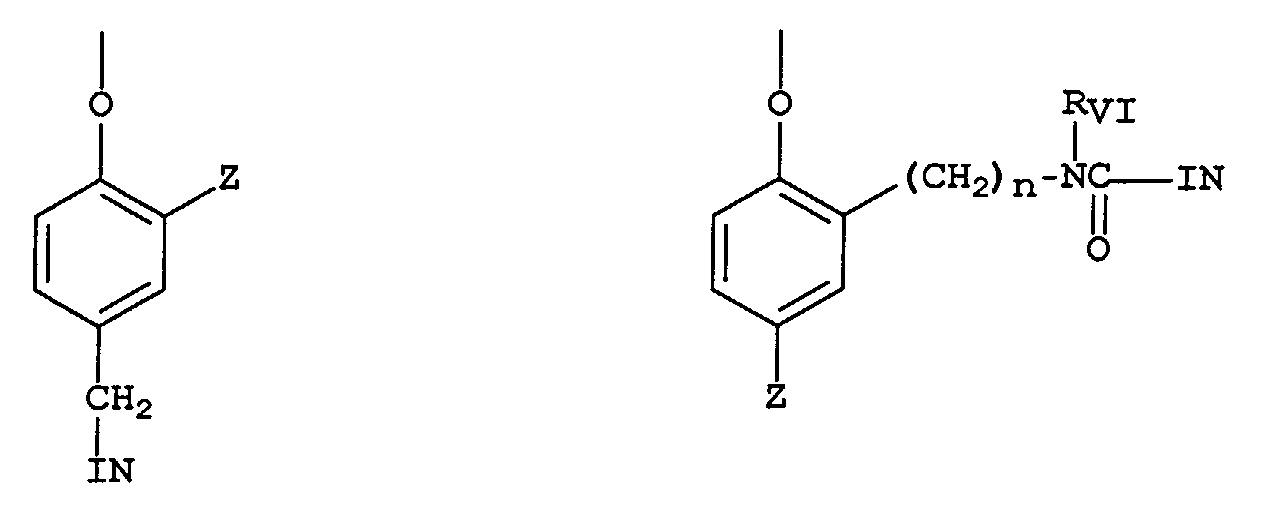
described above. It is typical that the timing group is of one of the formulae:
wherein
IN is the inhibitor moiety, Z is selected from the group consisting of
nitro, cyano, alkylsulfonyl, sulfamoyl (-SO
2NR
2) and sulfonamido (-NRSO
2R)
groups, n is 0 or 1, and R
VI is selected from the group consisting of substituted and
unsubstituted alkyl and phenyl groups. The oxygen atom of each timing group is
bonded to the coupling-off position of the respective coupler moiety of the DIAR.
The timing or linking groups may also function by electron transfer
down an unconjugated chain. Linking groups are known in the art under various
names. Often they have been referred to as groups capable of utilizing a
hemiacetal or iminoketal cleavage reaction or as groups capable of utilizing a
cleavage reaction due to ester hydrolysis such as U.S. Patent No. 4,546,073. This
electron transfer down an unconjugated chain typically results in a relatively fast
decomposition and the production of carbon dioxide, formaldehyde or other low
molecular weight by-products. The groups are exemplified in EP-A-0 464 612,
EP-A-0 523 451, U.S. Patent No. 4,146,396 and Japanese Kokai 60-249148 and
60-249149.
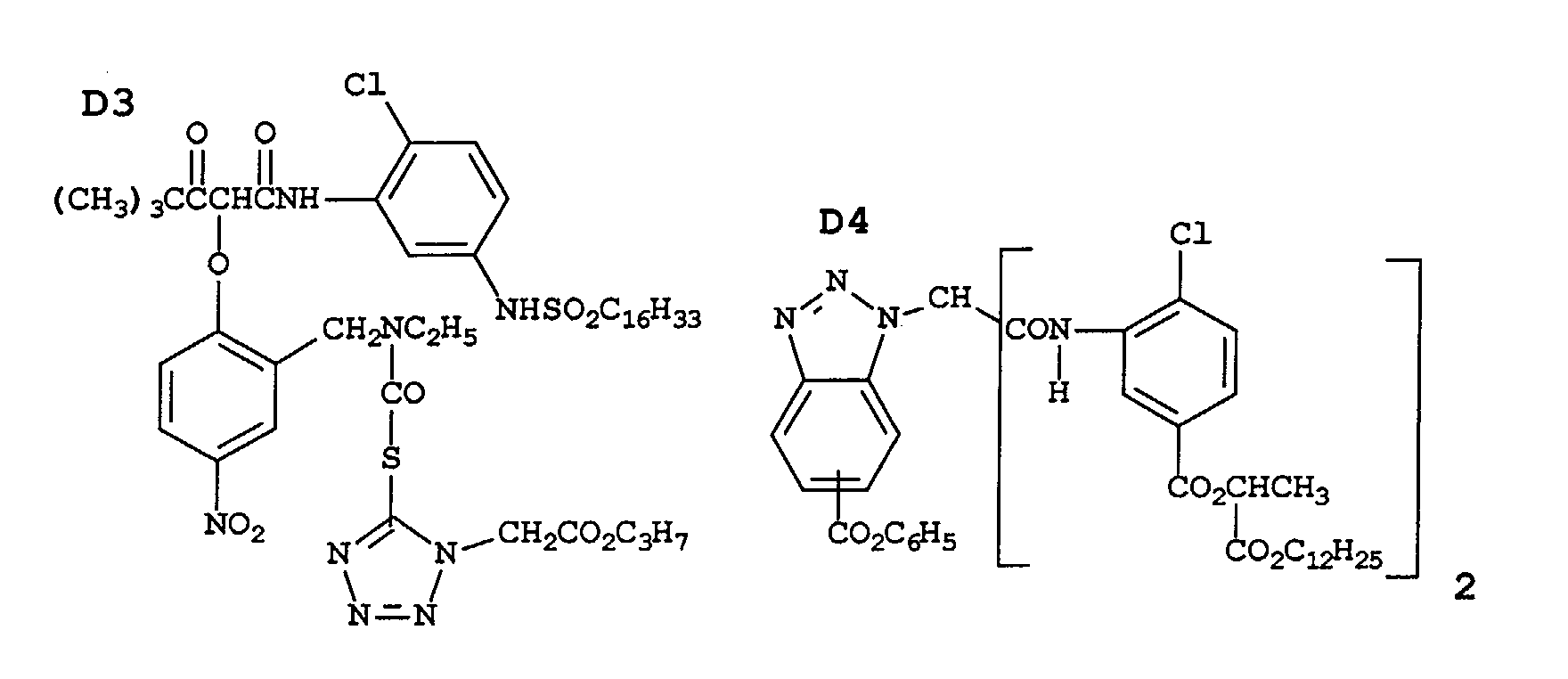
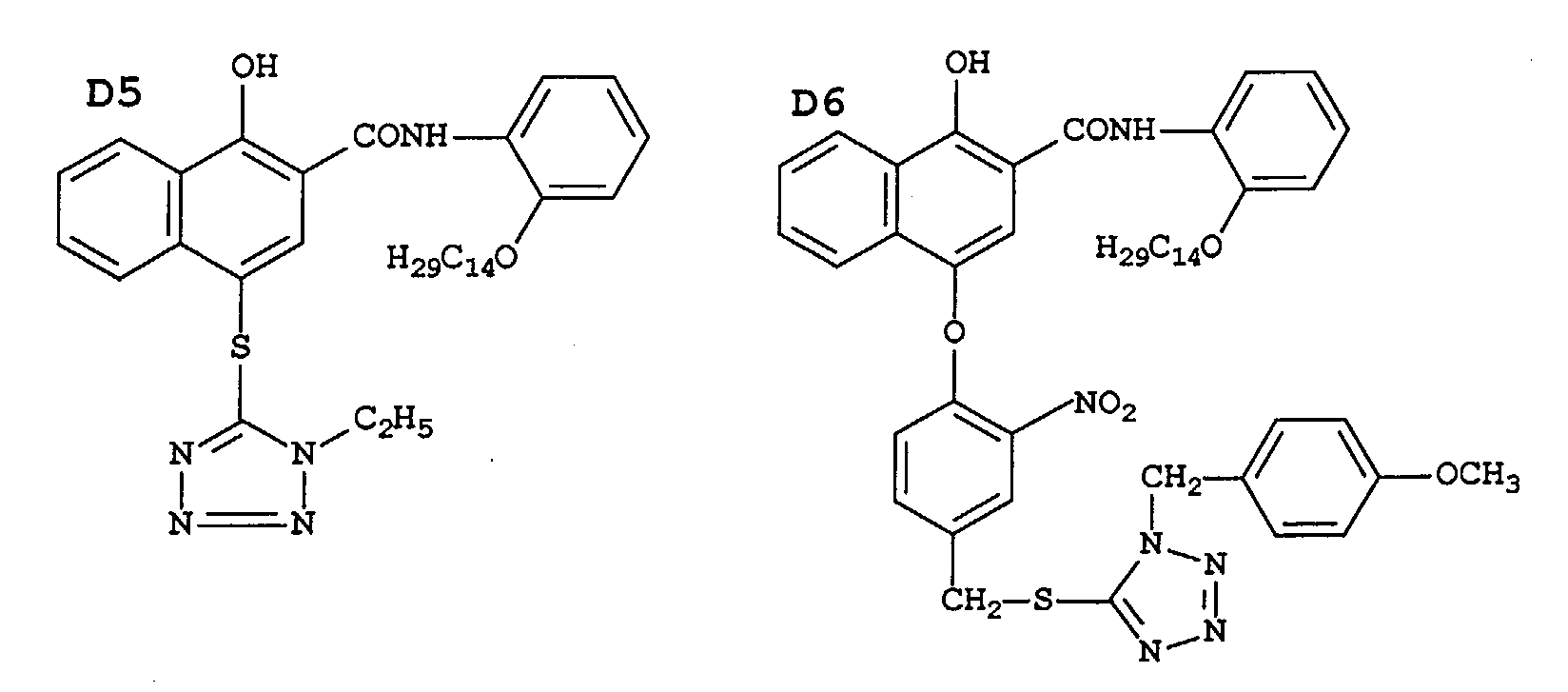
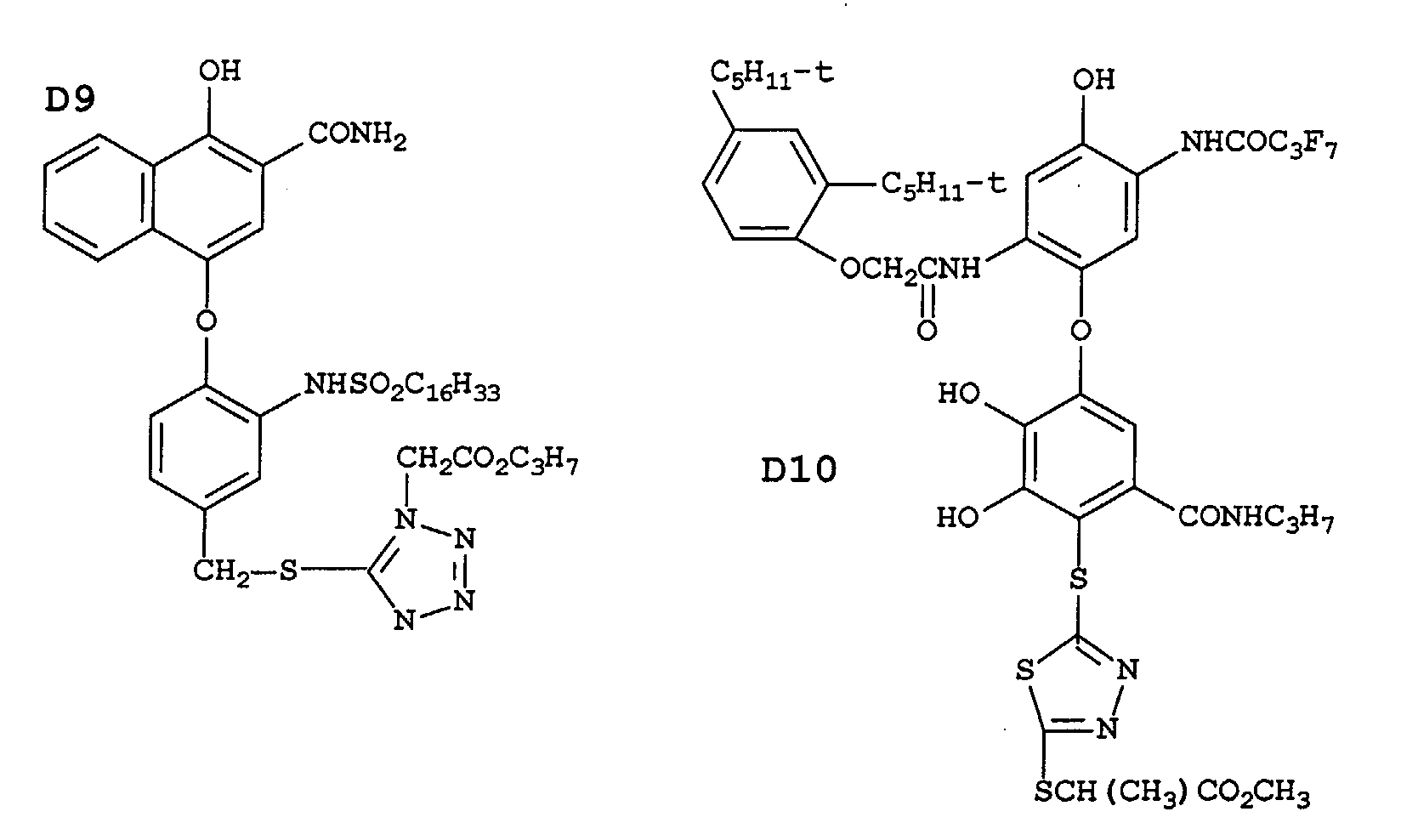
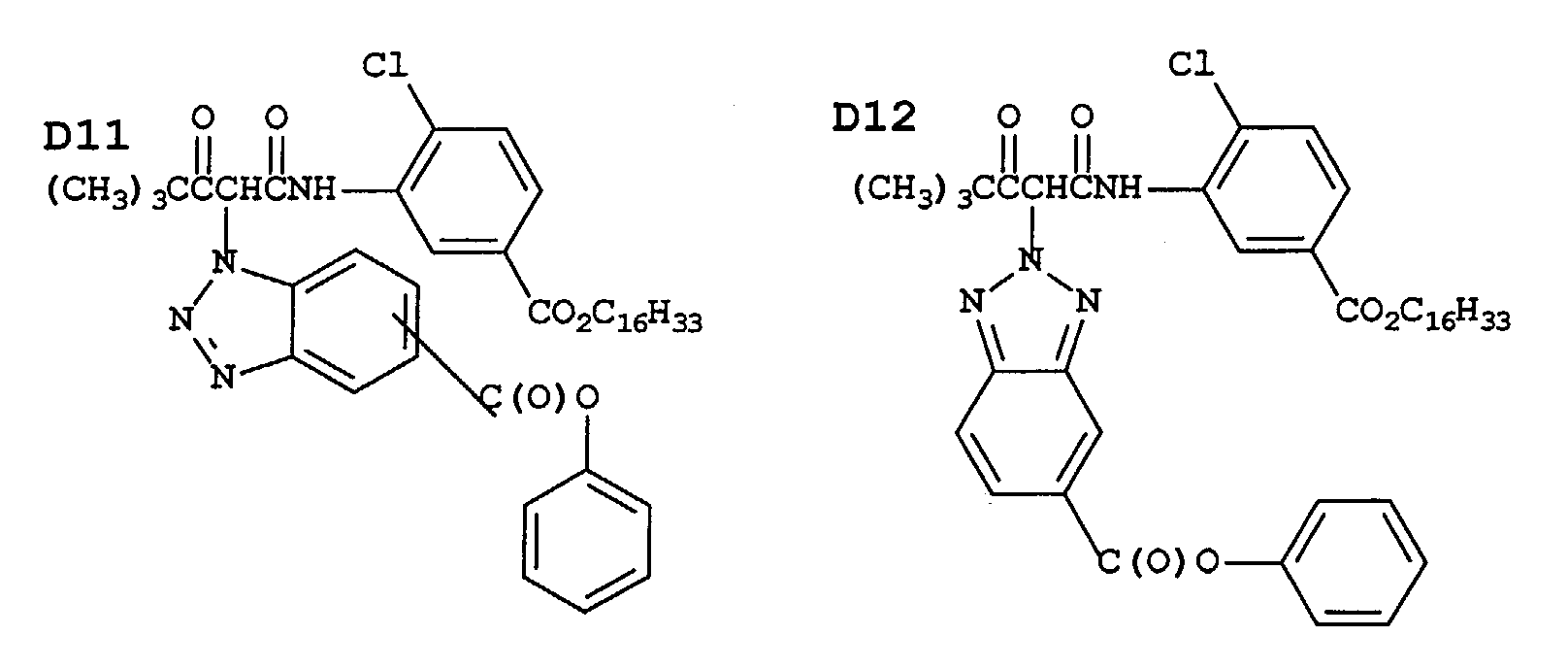
Suitable developer inhibitor-releasing couplers that may be included
in photographic light sensitive emulsion layer include, but are not limited to, the
following:
It is also contemplated that the concepts of the present invention
may be employed to obtain reflection colour prints as described in Research
Disclosure, November 1979, Item 18716, available from Kenneth Mason
Publications, Ltd, Dudley Annex, 12a North Street, Emsworth, Hampshire P0101
7DQ, England, incorporated herein by reference. Materials of the invention may
be coated on pH adjusted support as described in U.S. Patent No. 4,917,994, on a
support with reduced oxygen permeability (EP-A-0 553 339), with epoxy solvents
(EP-A-0 164 961), with nickel complex stabilizers (U.S. Patent Nos. 4,346,165,
4,540,653 and 4,906,559 for example), with ballasted chelating agents such as
those in U.S. Patent No. 4,994,359 to reduce sensitivity to polyvalent cations such
as calcium and with stain reducing compounds such as described in U.S. Patent
No. 5,068,171. Other compounds useful in combination with the invention are
disclosed in Japanese Published Applications described in Derwent Abstracts
having accession numbers as follows: 90-072,629, 90-072,630, 90-072,631,
90-072,632, 90-072,633, 90-072,634, 90-077,822, 90-078,229, 90-078,230,
90-079,336, 90-079,337, 90-079,338, 90-079,690, 90-079,691, 90-080,487,
90-080,488, 90-080,489, 90-080,490, 90-080,491, 90-080,492, 90-080,494,
90-085,928, 90-086,669, 90-086,670, 90-087,360, 90-087,361, 90-087,362,
90-087,363, 90-087,364, 90-088,097, 90-093,662, 90-093,663, 90-093,664,
90-093,665, 90-093,666, 90-093,668, 90-094,055, 90-094,056, 90-103,409,
83-62,586 and 83-09,959.
Any silver halide combination can be used for the photographic
element, such as silver chloride, silver chlorobromide, silver chlorobromoiodide,
silver bromide, silver bromoiodide or silver chloroiodide. In cases where the
emulsion composition is a mixed halide, the minor component may be added in the
crystal formation or after formation as part of the sensitization or melting. The
shape of the silver halide emulsion grain can be cubic, pseudo-cubic, octahedral,
tetradecahedral or tabular. The emulsions may be precipitated in any suitable
environment such as a ripening environment, a reducing environment or an
oxidizing environment.
Emulsion addenda that adsorb to grain surfaces, such as
antifoggants, stabilizers and dyes can also be added to the emulsions during
precipitation. Chemical sensitization of the materials in this photographic element
is accomplished by any of a variety of known chemical sensitizers. The emulsions
described herein may or may not have other addenda such as sensitizing dyes,
supersensitizers, emulsion ripeners, gelatin or halide conversion restrainers present
before, during or after the addition of chemical sensitization.
Tabular grain silver halide emulsions may be used in the present
invention. Specifically contemplated tabular grain emulsions are those in which
greater than 50 percent of the total projected area of the emulsion grains are
accounted for by tabular grains having a thickness of less than 0.3 micrometers
(0.5 micrometers for blue sensitive emulsion) and an average tabularity (T) of
greater than 25 (preferably greater than 100), where the term "tabularity" is
employed in its art recognized usage as
T = ECD/t2
wherein
ECD is the average equivalent circular diameter of the tabular
grains in micrometers and
t is the average thickness in micrometers of the tabular grains.
The average useful ECD of photographic emulsions can range up to
about 10 micrometers, although in practice emulsion ECDs seldom exceed about
4 micrometers. Since both photographic speed and granularity increase with
increasing ECDs, it is generally preferred to employ the smallest tabular grain
ECDs compatible with achieving aim speed requirements.
Emulsion tabularity increases markedly with reductions in tabular
grain thickness. It is generally preferred that aim tabular grain projected areas be
satisfied by thin (t < 0.2 micrometer) tabular grains. To achieve the lowest levels
of granularity it is preferred that aim tabular grain projected areas be satisfied with
ultrathin (t < 0.06 micrometer) tabular grains. Tabular grain thicknesses typically
range down to about 0.02 micrometer. However, still lower tabular grain
thicknesses are contemplated. For example, Daubendiek et al U.S. Patent No.
4,672,027 reports a 3 mol percent iodide tabular grain silver bromoiodide
emulsion having a grain thickness of 0.017 micrometer. Ultrathin tabular grain
high chloride emulsions are disclosed by Maskasky in U.S. Patent No. 5,217,858.
As noted above tabular grains of less than the specified thickness
account for at least 50 percent of the total grain projected area of the emulsion.
To maximize the advantages of high tabularity it is generally preferred that tabular
grains satisfying the stated thickness criterion account for the highest conveniently
attainable percentage of the total grain projected area of the emulsion. For
example, in preferred emulsions, tabular grains satisfying the stated thickness
criteria above account for at least 70 percent of the total grain projected area. In
the highest performance tabular grain emulsions, tabular grains satisfying the
thickness criteria above account for at least 90 percent of total grain projected
area.
Suitable tabular grain emulsions can be selected from among a
variety of conventional teachings, such as those of the following: Research
Disclosure, Item 22534, January 1983, published by Kenneth Mason Publications,
Ltd., Emsworth, Hampshire P010 7DD, England; U.S. Patent Nos. 4,439,520,
4,414,310, 4,433,048, 4,643,966, 4,647,528, 4,665,012, 4,672,027, 4,678,745,
4,693,964, 4,713,320, 4,722,886, 4,755,456, 4,775,617, 4,797,354, 4,801,522,
4,806,461, 4,835,095, 4,853,322, 4,914,014, 4,962,015, 4,985,350, 5,061,069 and
5,061,616.
The emulsions can be surface-sensitive emulsions, i.e. emulsions
that form latent images primarily on the surfaces of the silver halide grains, or the
emulsions can form internal latent images predominantly in the interior of the
silver halide grains. The emulsions can be negative-working emulsions, such as
surface-sensitive emulsions or unfogged internal latent image-forming emulsions,
or direct-positive emulsions of the unfogged, internal latent image-forming type,
which are positive-working when development is conducted with uniform light
exposure or in the presence of a nucleating agent.
Photographic elements can be exposed to actinic radiation, typically
in the visible region of the spectrum, to form a latent image and can then be
processed to form a visible dye image. Processing to form a visible dye image
includes the step of contacting the element with a colour developing agent to
reduce developable silver halide and oxidize the colour developing agent.
Oxidized colour developing agent in turn reacts with the coupler to yield a dye.
With negative-working silver halide, the processing step described
above provides a negative image. The described elements can be processed in the
known Kodak C-41™ colour process as described in The British Journal of
Photography Annual of 1988, pp 191-198. Where applicable, the element may be
processed in accordance with colour print processes such as the RA-4™ process of
Eastman Kodak Company as described in the British Journal of Photography
Annual of 1988, pp 198-199. Such negative working emulsions are typically sold
with instructions to process using a colour negative method such as the C-41™ or
RA-4™ process. To provide a positive (or reversal) image, the colour
development step can be preceded by development with a non-chromogenic
developing agent to develop exposed silver halide, but not form dye, and followed
by uniformly fogging the element to render unexposed silver halide developable.
Such reversal emulsions are typically sold with instructions to process using a
colour reversal process such as E-6™. Alternatively, a direct positive emulsion
can be employed to obtain a positive image.
The multicolour photographic elements of the invention may be
processed alternatively in a developer solution that will provide reduced
processing times of one minute or less (dry to dry), and particularly reduced colour
development times of less than about 25 seconds, such that all colour records are
fully developed with aim sensitometry.
Preferred colour developing agents are p-phenylenediamines such as:
Development is usually followed by the conventional steps of
bleaching, fixing or bleach-fixing, to remove silver or silver halide, washing and
drying.
The coupler dispersions may be coated with emulsions to form
photographic elements at very low levels of silver (generally less than 100 mg/m2).
Reasons for doing this include reducing cost, reducing the thickness of silver
halide emulsion layers to gain sharpness advantages and reducing the
environmental impact during and after processing.
One class of low silver photographic material is colour material
intended for redox amplification processes wherein the developed silver acts as a
catalyst to the formation of the dye image. This process can take place in a low
volume thin processor, such as a low volume thin tank (LVTT), for example, as
disclosed in U.S. Patent No. 5,436,118. Redox amplification processes have been
described for example in GB Patent Nos. 1,268,126, 1,399,481, 1,403,418,
1,560,572 and U.S. Patent Nos. 3,748,138, 3,822,129 and 4,097,278. In such
processes, colour materials are developed to produce a silver image (which may
contain only small amounts of silver) and are then treated with a redox amplifying
solution (or a combined developer-amplifier) to form a dye image.
The invention will now be described with reference to the
following examples, which should not, however, be construed as limiting the
scope thereof.
EXAMPLES
Preparative Examples
The cyan couplers of formula (IIA) (a) and (b) may be prepared
according to the methods described in EP-A-0 744 655 and EP-A-0 802 454. The
magenta couplers of formula (IIA) (b) may be synthesised as described in
EP-A-0 119 860 and US Patent No. 5,451,501, whilst the cyan and magenta
couplers of formula (IIA) (d) may be prepared as described in US Patent Nos.
4,916,051 and 5,776,669 respectively. The cyan couplers of formula (IIA) (c) may
be synthesised according to the method described in EP-A-0 269 436 whilst those
of formula (IIB) (e), (f) and (i) may be prepared as described in US Patent No.
4,950,585. The cyan couplers of formula (IIB) (g) and (h) may be prepared
according to the syntheses described in EP-A-0 398 664 and JP 04125557
respectively and those of formula (IIB) (j) as disclosed in US Patent
No. 4,970,142. The cyan couplers of formula (III) may be prepared as described in
EP-A-0 714 892, EP-A-0 883 024 and US Patent No. 6,132,945.
The couplers for use in the invention can be prepared according to
the procedure outlined below for the preparation of M-2.
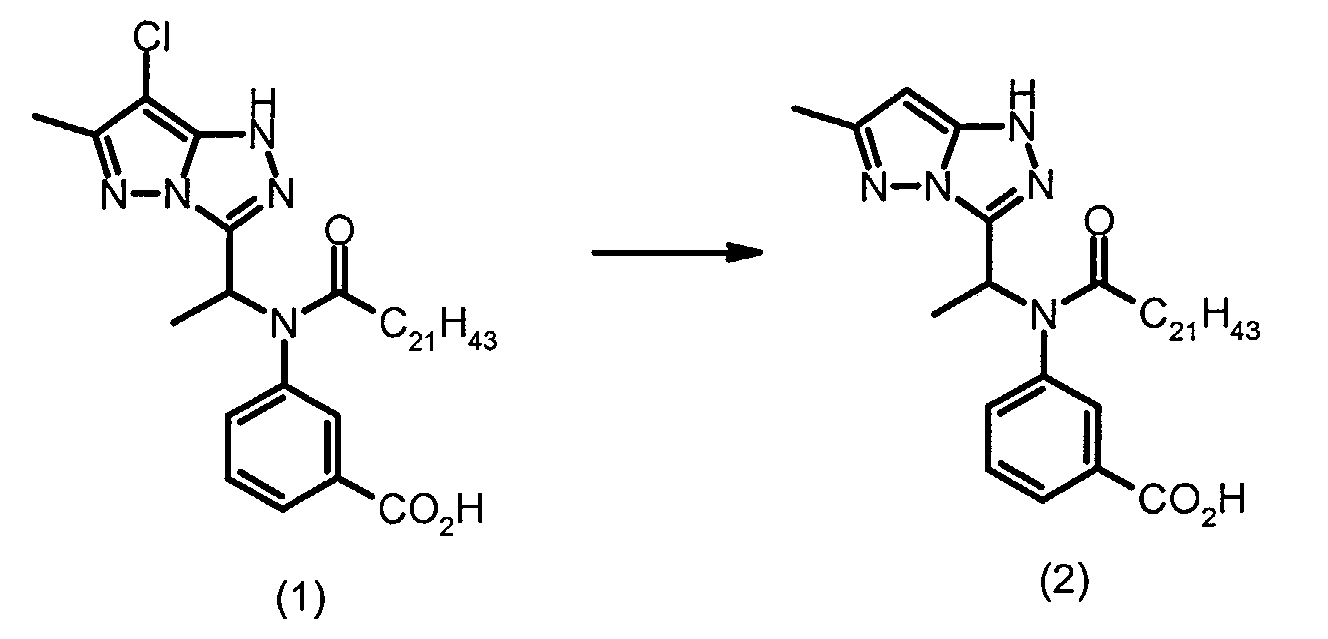
(a) Preparation of Intermediate (2)
Ethanol (300ml) was added to a mixture of (1) (CAS Reg No.
192317-69-4; 30.0g, 65.0mmol) and 10% palladium on carbon (1g) under an
atmosphere of nitrogen. The reaction was then stirred under hydrogen at 30atm
initial pressure and at 100C (pressure rose to about 40atm) for 6h then was
allowed to cool overnight. The catalyst was removed by filtration through
Kieselguhr and the filtrate concentrated in vacuo to give a pale green oil (31.30g).
A solution of sodium hydroxide (12.22g, 0.306mol) in water (25ml) was added to
a stirred solution of the oil in a mixture of tetrahydrofuran (50ml) and
methanol (300ml). Some material came out of solution. The reaction was heated
at reflux for 3h. The solvent was removed in vacuo then the residue was treated
with water (400ml) and made acidic with concentrated hydrochloric acid (50ml).
The solid which had formed was extracted into ethyl acetate (3x200ml), then the
organic solution was dried (magnesium sulfate) and concentrated in vacuo. This
gave the title compound (25.24g) as a buff solid.
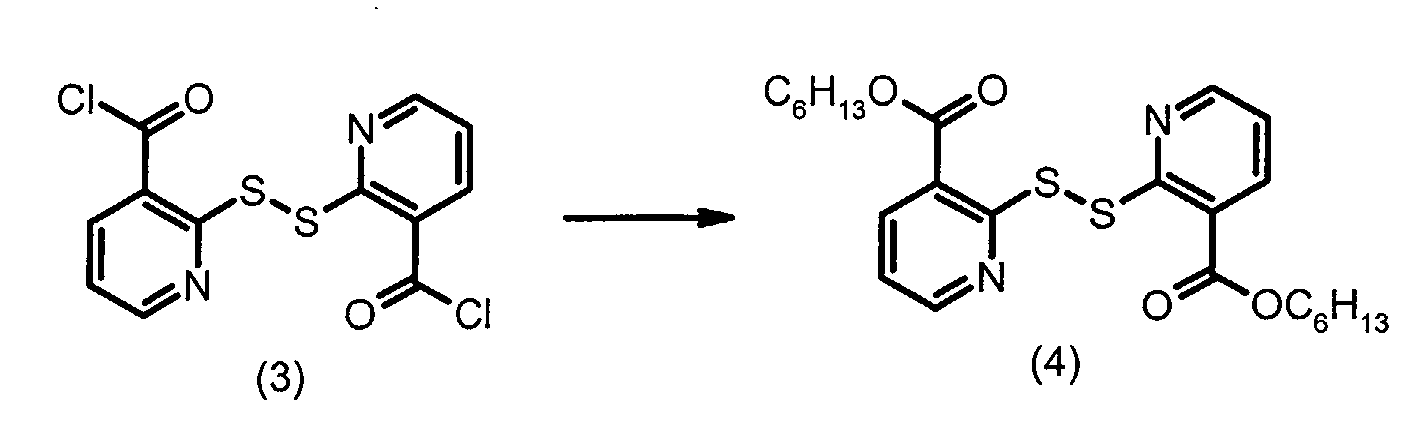
(b) Preparation of Intermediate (4)
Hexanol (1.18g, 11.6mmol) was added to a stirred suspension of
(3) (CAS Reg No. 104857-34-43; 2.00g, 5.80mmol) in a mixture of tetrahydrofuran
(10ml) and pyridine (10ml) containing 4-(dimethylamino)pyridine
(catalytic amount). The reaction was stirred for 3h then the solvent was removed
in vacuo. The residue was taken up in a mixture of dilute hydrochloric
acid (200ml) and warm ethyl acetate (100ml). Some solid remained and this was
removed by filtration. The organic solution was dried (magnesium sulfate) and
concentrated in vacuo. The solid was added to hot ethyl acetate and, after 30min,
all the insoluble material was removed from the hot suspension. The filtrate was
concentrated in vacuo to give the title compound (1.35g) as a yellowish solid.
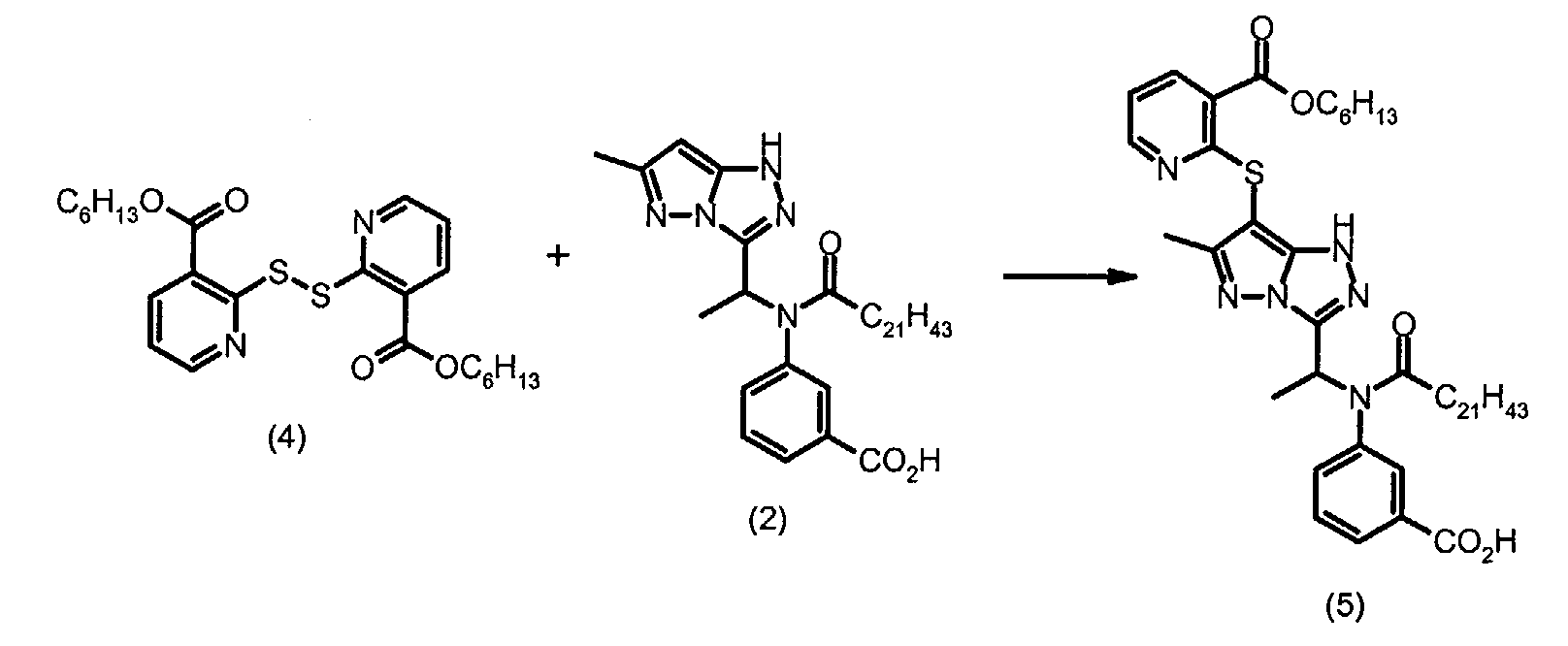
(c) Preparation of M-2 (5)
A solution of bromine (0.46g, 2.84mmol) in dry dimethylformamide
(1ml) was added dropwise over about 5min to a stirred suspension of
(4) (1.35g, 2.84mmol) and (2) (3.44g, 5.67mmol) in dry dimethylformamide
(10ml). The solid dissolved over a period of about 20min. The reaction was
stirred for 1h then was added with stirring to water (400ml). After 30min the solid
which had formed was removed by filtration and dissolved in ethyl acetate
(100ml). The organic solution was dried (magnesium sulfate) and concentrated
in vacuo to give an orange oil (4.67g). This was purified by column
chromatography over silica (eluent 19:1 dichloromethane/methanol) to give the
title compound, M-2, (2.91g) as a yellow foam.
Photographic examples
Compounds for use in the present invention (and control
compounds) were dispersed in coupler solvent and incorporated into photographic
coatings containing a silver bromoiodide emulsion, on a transparent support,
according to the coating diagram shown in TABLE 1 below.
| Structure of Photographic Element |
| Gel Supercoat | Gelatin | 1.000 g/m2 |
| | Bis(vinylsulfonyl)methane (hardener) | 0.069 g/m2 |
| | Silver bromoiodide | 1.076 g/m2 |
| Emulsion Layer | Coupler | 0.473 mmol/m2 |
| | Gelatin | 2.420 g/m2 |
| Support | Cellulose Acetate (with Gel U-coat and Removable Carbon Antihalation Backing) |
Aqueous dispersions of the couplers were prepared by methods
known in the art. The magenta dye-forming coupler dispersions contained 8% by
weight of gelatin, 5% by weight of coupler and a 1:2:3 weight ratio of coupler to
tricresyl phosphate coupler solvent to 2-(2-butoxyethoxy)ethyl acetate auxiliary
solvent. The auxiliary solvent was included to aid in dispersion preparation and
was removed by washing the dispersion for 6 h at 4C and pH 6.0.
(i) Sensitometric testing
The experimental photographic coatings prepared in this way were
slit and chopped into 30cm x 35mm test strips. After hardening the strips were
exposed (0.02s) through a 0-4.0 neutral density step wedge (0.2 ND step
increments) and Daylight V and Wratten™ 74 filters and then processed through a
standard C-41™ process as described in the British Journal of Photography
Annual (1988) 196 -198 using the following steps and process times:
| Developer | 2.5 min |
| Bleach | 4.0 min |
| Wash | 2.0 min |
| Fix | 4.0 min |
| Wash | 2.0 min |
For each test strip, Status M densities were measured as a function
of exposure using a spectral array automatic transmission densitometer.
Measurements of sensitometric parameters - minimum density (D
min), maximum
density (D
max) and contrast (γ) - were obtained from plots of density vs. log
exposure (DlogE curves) and are shown in TABLE 2, wherein the structures of
M1, M2, CC1 and CC2 are derived from the following general formula:-
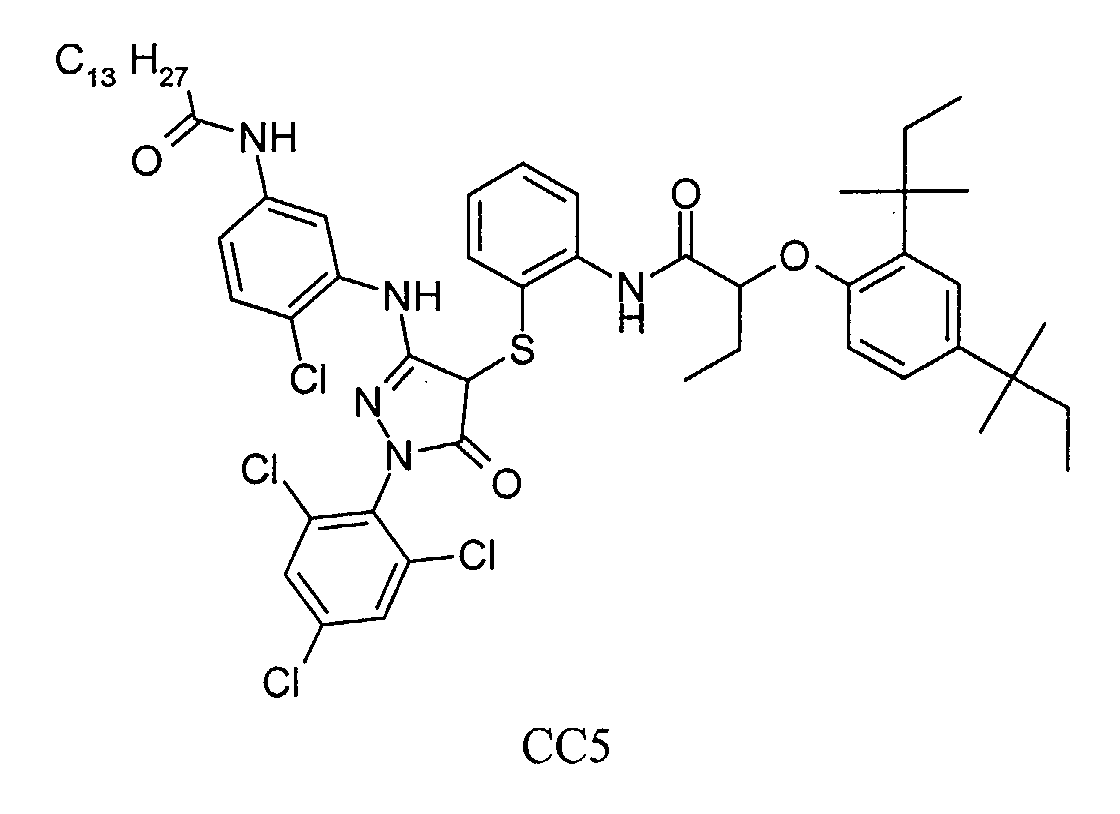
and CC3, CC4 and CC5 have the following structures:-
| Compound No | R | X | Contrast (γ) | Dmin | Dmax |
| CC1 | CO2H | CH | 0.47 | 0.08 | 0.78 |
| M1 | CO2H | N | 1.10 | 0.16 | 1.12 |
| CC2 | CO2C6H13 | CH | 0.32 | 0.05 | 0.49 |
| M2 | CO2C6H13 | N | 0.98 | 0.11 | 1.16 |
| CC3 | N/A | N/A | 0.10 | 0.05 | 0.23 |
| CC4 | N/A | N/A | 1.39 | 0.32 | 1.40 |
| CC5 | N/A | N/A | 1.51 | 0.24 | 1.71 |
The data in TABLE 2 show that, in comparison to the control
coupler CC1, the compound of formula (I) M1 is more active as can be seen from
the significantly higher contrast and Dmax. This effect is also seen in the
comparison of the control coupler CC2 with the compound of formula (I) M2.
Neither M1 nor M2 caused significant inhibition of the development process as
can be seen by comparing their contrast and Dmax with the very low contrast and
Dmax obtained with the control coupler CC3, which is a development inhibitor
releasing coupler, differing only in having a phenylmercaptotetrazole coupling-off
group.
Data for control magenta image couplers CC4 and CC5 were
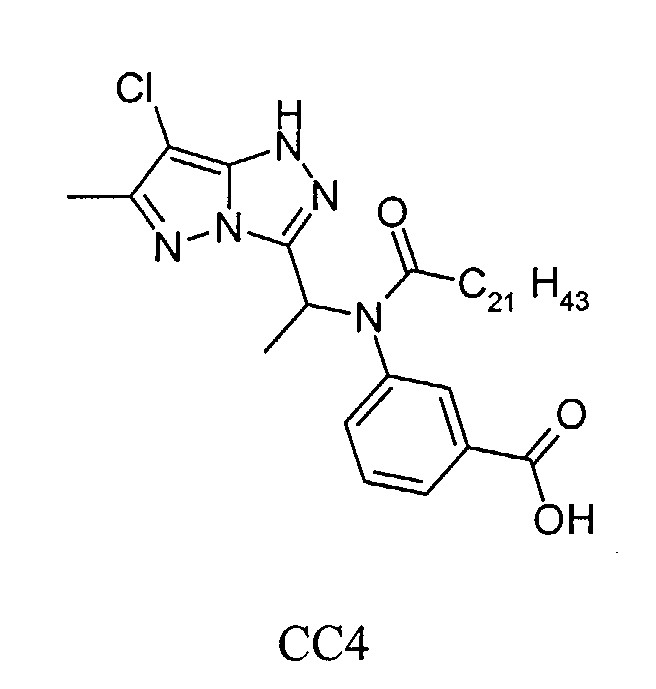
included for comparison purposes. CC4 differs only from M1 and M2 in having a
chloro coupling-off group instead of a heterocyclylthio group. Although CC4
showed good activity it is not possible to link a PUG thereto. CC5 is a single ring
i.e. non-fused heterocyclic coupler, namely a pyrazolone coupler, which exhibited
good activity but dyes derived therefrom are known to have less good colour
reproduction characteristics than dyes derived from the structures of couplers M1
and M2.
(ii) Investigation of silver inhibition effects
A set of 35mm strips was exposed for 0.02s through a 0-1.8 neutral
density step wedge (0.3 ND increments) and Daylight V, Wratten™ 74 and
0.98ND filters and processed through a modified C-41™ process, in which the
bleach step was omitted and a stopbath (1% acetic acid solution) was inserted
after the developer step, using the following processing sequence:
| Developer | 2.5 min |
| Stopbath | 1.0 min |
| Wash | 2.0 min |
| Fix | 4.0 min |
| Wash | 2.0 min |
The strips processed through the "no bleach" process were
subjected to X-ray fluorescence (XRF) analysis to determine the amount of
developed silver in each of the seven steps of the processed strip. Silver
development curves (developed silver in mg/m2 vs. step number (or log
exposure)) were then created.
Neither M1 nor M2 showed significant inhibition as exemplified
for M2 in Fig.1, which shows an increase in the amount of developed silver with
increasing amount of exposure. In contrast, CC3 showed a negligible amount of
developed silver that did not increase with increasing exposure, indicating that
CC3 caused a significant amount of inhibition.
(iii) Investigation of bleach acceleration effects :
A set of 35mm strips was exposed for 0.02s through a 0-1.8 neutral
density step wedge (0.3 ND increments) and Daylight V, Wratten™ 74 and
0.98ND filters and processed through a C-41™ process, in which the normal
bleach solution was substituted with one of significantly reduced bleaching
capacity, using the following steps and process times:
| Developer | 2.5 min |
| Bleach | 4.0 min |
| Wash | 2.0 min |
| Fix | 4.0 min |
| Wash | 2.0 min |
The replacement bleach was prepared by taking a seasoned C-41™
bleach and diluting it to 5% of its original concentration. Strips processed in this
way were then submitted for XRF silver analysis as in (ii) above in order to
measure the amount of residual silver in the strips after a bleach step of 4 min.
The % residual silver for coatings containing each coupler was then
calculated using the following formula :
% Residual Ag = [Ag in Dmax (4 min bleach)] [Ag in Dmax (no bleach)] x 100
where Ag in Dmax is measured in mg/m2 (by XRF)
The values of % residual silver for M1 and M2 were compared
with those obtained for CC1 and CC2 and also for the typical magenta coupler
CC5, which does not show bleach acceleration, and presented hereunder in
TABLE 3.
| Compound No | R1 | X | % Residual Silver |
| CC1 | CO2H | CH | 8.0 |
| M1 | CO2H | N | 26.4 |
| CC2 | CO2C6H13 | CH | 13.4 |
| M2 | CO2C6H13 | N | 44.8 |
| CC5 | N/A | N/A | 7.0 |
The data in TABLE 3 show that the elements containing couplers
M1 and M2 and control couplers CC1 and CC2 have at least as much residual
silver as control coupler CC5, indicating that they are not bleach accelerators. If
they did show bleach acceleration there would be less residual silver.
It should be emphasised that in a normal C-41™ process, using a
standard undiluted bleach, there would be no residual silver retained in coatings
containing M1 or M2 after a 4 min bleach step.
The invention has been described in detail with particular reference
to certain preferred embodiments thereof, but it will be understood that variations
and modifications can be effected within the spirit and scope of the invention.

























 wherein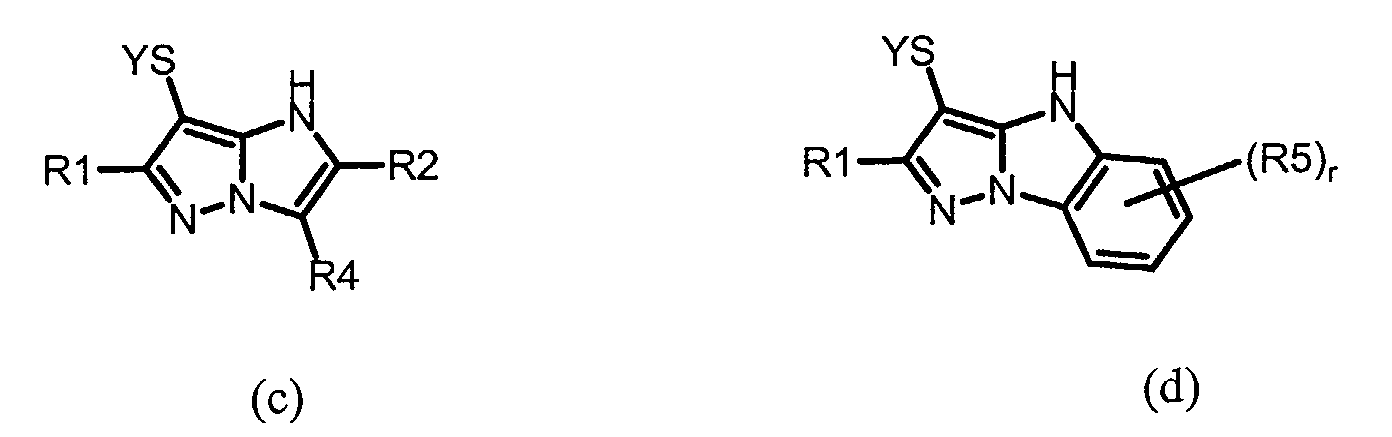

 wherein