EP1344779B1 - Azolo-pyrimidines - Google Patents
Azolo-pyrimidines Download PDFInfo
- Publication number
- EP1344779B1 EP1344779B1 EP03075887A EP03075887A EP1344779B1 EP 1344779 B1 EP1344779 B1 EP 1344779B1 EP 03075887 A EP03075887 A EP 03075887A EP 03075887 A EP03075887 A EP 03075887A EP 1344779 B1 EP1344779 B1 EP 1344779B1
- Authority
- EP
- European Patent Office
- Prior art keywords
- formula
- compound
- ome
- nhch
- compounds
- Prior art date
- Legal status (The legal status is an assumption and is not a legal conclusion. Google has not performed a legal analysis and makes no representation as to the accuracy of the status listed.)
- Expired - Lifetime
Links
- KCTZOTUQSGYWLV-UHFFFAOYSA-N N1C=NC=C2N=CC=C21 Chemical class N1C=NC=C2N=CC=C21 KCTZOTUQSGYWLV-UHFFFAOYSA-N 0.000 title description 2
- 208000037265 diseases, disorders, signs and symptoms Diseases 0.000 claims abstract description 22
- 208000019901 Anxiety disease Diseases 0.000 claims abstract description 12
- 230000036506 anxiety Effects 0.000 claims abstract description 12
- 201000010099 disease Diseases 0.000 claims abstract description 7
- 230000002526 effect on cardiovascular system Effects 0.000 claims abstract description 6
- 150000001875 compounds Chemical class 0.000 claims description 584
- 125000004123 n-propyl group Chemical group [H]C([H])([H])C([H])([H])C([H])([H])* 0.000 claims description 30
- 125000001559 cyclopropyl group Chemical group [H]C1([H])C([H])([H])C1([H])* 0.000 claims description 21
- 239000003814 drug Substances 0.000 claims description 17
- 239000000203 mixture Substances 0.000 claims description 17
- 208000035475 disorder Diseases 0.000 claims description 15
- 150000003839 salts Chemical group 0.000 claims description 13
- 125000006311 cyclobutyl amino group Chemical group [H]N(*)C1([H])C([H])([H])C([H])([H])C1([H])[H] 0.000 claims description 12
- 229940079593 drug Drugs 0.000 claims description 10
- 208000019454 Feeding and Eating disease Diseases 0.000 claims description 7
- 208000019022 Mood disease Diseases 0.000 claims description 7
- 208000024891 symptom Diseases 0.000 claims description 7
- 208000024827 Alzheimer disease Diseases 0.000 claims description 6
- 125000004108 n-butyl group Chemical group [H]C([H])([H])C([H])([H])C([H])([H])C([H])([H])* 0.000 claims description 6
- 208000028173 post-traumatic stress disease Diseases 0.000 claims description 6
- 208000017194 Affective disease Diseases 0.000 claims description 5
- 206010048327 Supranuclear palsy Diseases 0.000 claims description 5
- 208000002551 irritable bowel syndrome Diseases 0.000 claims description 5
- 239000008194 pharmaceutical composition Substances 0.000 claims description 5
- 208000000103 Anorexia Nervosa Diseases 0.000 claims description 4
- 208000018522 Gastrointestinal disease Diseases 0.000 claims description 4
- 241000725303 Human immunodeficiency virus Species 0.000 claims description 4
- 208000007271 Substance Withdrawal Syndrome Diseases 0.000 claims description 4
- 208000029650 alcohol withdrawal Diseases 0.000 claims description 4
- 239000003937 drug carrier Substances 0.000 claims description 4
- 230000035558 fertility Effects 0.000 claims description 4
- 208000027866 inflammatory disease Diseases 0.000 claims description 4
- 208000018460 Feeding disease Diseases 0.000 claims description 3
- 206010019233 Headaches Diseases 0.000 claims description 3
- 208000013016 Hypoglycemia Diseases 0.000 claims description 3
- 208000008589 Obesity Diseases 0.000 claims description 3
- 208000006011 Stroke Diseases 0.000 claims description 3
- 208000025865 Ulcer Diseases 0.000 claims description 3
- 230000003042 antagnostic effect Effects 0.000 claims description 3
- 206010013663 drug dependence Diseases 0.000 claims description 3
- 206010015037 epilepsy Diseases 0.000 claims description 3
- 231100000869 headache Toxicity 0.000 claims description 3
- 230000002008 hemorrhagic effect Effects 0.000 claims description 3
- 230000002218 hypoglycaemic effect Effects 0.000 claims description 3
- 230000008629 immune suppression Effects 0.000 claims description 3
- 208000000509 infertility Diseases 0.000 claims description 3
- 230000036512 infertility Effects 0.000 claims description 3
- 231100000535 infertility Toxicity 0.000 claims description 3
- 208000014674 injury Diseases 0.000 claims description 3
- 238000004519 manufacturing process Methods 0.000 claims description 3
- 235000020824 obesity Nutrition 0.000 claims description 3
- 210000000278 spinal cord Anatomy 0.000 claims description 3
- 208000011117 substance-related disease Diseases 0.000 claims description 3
- 230000008733 trauma Effects 0.000 claims description 3
- 231100000397 ulcer Toxicity 0.000 claims description 3
- 230000009385 viral infection Effects 0.000 claims description 2
- 208000034189 Sclerosis Diseases 0.000 claims 1
- 239000000055 Corticotropin-Releasing Hormone Substances 0.000 abstract description 40
- 108010022152 Corticotropin-Releasing Hormone Proteins 0.000 abstract description 6
- 208000012902 Nervous system disease Diseases 0.000 abstract description 6
- 208000025966 Neurological disease Diseases 0.000 abstract description 6
- 206010020751 Hypersensitivity Diseases 0.000 abstract description 5
- 208000026935 allergic disease Diseases 0.000 abstract description 4
- 239000005557 antagonist Substances 0.000 abstract description 4
- 230000000112 colonic effect Effects 0.000 abstract description 4
- 230000009610 hypersensitivity Effects 0.000 abstract description 4
- 230000001900 immune effect Effects 0.000 abstract description 4
- 102000012289 Corticotropin-Releasing Hormone Human genes 0.000 abstract 2
- 239000000460 chlorine Substances 0.000 description 160
- -1 and R1 and R2 are H Chemical group 0.000 description 82
- YXFVVABEGXRONW-UHFFFAOYSA-N Toluene Chemical compound CC1=CC=CC=C1 YXFVVABEGXRONW-UHFFFAOYSA-N 0.000 description 78
- RTZKZFJDLAIYFH-UHFFFAOYSA-N Diethyl ether Chemical compound CCOCC RTZKZFJDLAIYFH-UHFFFAOYSA-N 0.000 description 76
- UHOVQNZJYSORNB-UHFFFAOYSA-N Benzene Chemical compound C1=CC=CC=C1 UHOVQNZJYSORNB-UHFFFAOYSA-N 0.000 description 75
- WEVYAHXRMPXWCK-UHFFFAOYSA-N Acetonitrile Chemical compound CC#N WEVYAHXRMPXWCK-UHFFFAOYSA-N 0.000 description 69
- 239000012442 inert solvent Substances 0.000 description 68
- ZMXDDKWLCZADIW-UHFFFAOYSA-N N,N-Dimethylformamide Chemical compound CN(C)C=O ZMXDDKWLCZADIW-UHFFFAOYSA-N 0.000 description 66
- 238000006243 chemical reaction Methods 0.000 description 63
- LFQSCWFLJHTTHZ-UHFFFAOYSA-N Ethanol Chemical compound CCO LFQSCWFLJHTTHZ-UHFFFAOYSA-N 0.000 description 52
- 229910052783 alkali metal Inorganic materials 0.000 description 52
- WYURNTSHIVDZCO-UHFFFAOYSA-N Tetrahydrofuran Chemical compound C1CCOC1 WYURNTSHIVDZCO-UHFFFAOYSA-N 0.000 description 50
- 150000008064 anhydrides Chemical class 0.000 description 50
- IAZDPXIOMUYVGZ-UHFFFAOYSA-N Dimethylsulphoxide Chemical compound CS(C)=O IAZDPXIOMUYVGZ-UHFFFAOYSA-N 0.000 description 49
- 239000002585 base Substances 0.000 description 46
- SECXISVLQFMRJM-UHFFFAOYSA-N N-Methylpyrrolidone Chemical compound CN1CCCC1=O SECXISVLQFMRJM-UHFFFAOYSA-N 0.000 description 44
- YMWUJEATGCHHMB-UHFFFAOYSA-N Dichloromethane Chemical compound ClCCl YMWUJEATGCHHMB-UHFFFAOYSA-N 0.000 description 42
- OKKJLVBELUTLKV-UHFFFAOYSA-N Methanol Chemical compound OC OKKJLVBELUTLKV-UHFFFAOYSA-N 0.000 description 42
- 239000002253 acid Substances 0.000 description 37
- 102100021752 Corticoliberin Human genes 0.000 description 34
- 150000001340 alkali metals Chemical class 0.000 description 34
- 229910052736 halogen Inorganic materials 0.000 description 34
- 150000002367 halogens Chemical class 0.000 description 34
- 125000000217 alkyl group Chemical group 0.000 description 32
- WQDUMFSSJAZKTM-UHFFFAOYSA-N Sodium methoxide Chemical compound [Na+].[O-]C WQDUMFSSJAZKTM-UHFFFAOYSA-N 0.000 description 30
- 239000003795 chemical substances by application Substances 0.000 description 30
- JUJWROOIHBZHMG-UHFFFAOYSA-N Pyridine Chemical compound C1=CC=NC=C1 JUJWROOIHBZHMG-UHFFFAOYSA-N 0.000 description 28
- ZMANZCXQSJIPKH-UHFFFAOYSA-N Triethylamine Chemical compound CCN(CC)CC ZMANZCXQSJIPKH-UHFFFAOYSA-N 0.000 description 27
- 150000007513 acids Chemical class 0.000 description 25
- 150000004945 aromatic hydrocarbons Chemical class 0.000 description 25
- 150000004292 cyclic ethers Chemical class 0.000 description 25
- YLQBMQCUIZJEEH-UHFFFAOYSA-N tetrahydrofuran Natural products C=1C=COC=1 YLQBMQCUIZJEEH-UHFFFAOYSA-N 0.000 description 25
- RYHBNJHYFVUHQT-UHFFFAOYSA-N 1,4-Dioxane Chemical compound C1COCCO1 RYHBNJHYFVUHQT-UHFFFAOYSA-N 0.000 description 24
- XEKOWRVHYACXOJ-UHFFFAOYSA-N Ethyl acetate Chemical compound CCOC(C)=O XEKOWRVHYACXOJ-UHFFFAOYSA-N 0.000 description 24
- 150000001983 dialkylethers Chemical class 0.000 description 23
- FXHOOIRPVKKKFG-UHFFFAOYSA-N N,N-Dimethylacetamide Chemical compound CN(C)C(C)=O FXHOOIRPVKKKFG-UHFFFAOYSA-N 0.000 description 22
- 150000003950 cyclic amides Chemical class 0.000 description 22
- 239000000543 intermediate Substances 0.000 description 20
- QTBSBXVTEAMEQO-UHFFFAOYSA-N Acetic acid Chemical compound CC(O)=O QTBSBXVTEAMEQO-UHFFFAOYSA-N 0.000 description 19
- 125000005233 alkylalcohol group Chemical group 0.000 description 18
- 150000004820 halides Chemical class 0.000 description 18
- 125000001997 phenyl group Chemical group [H]C1=C([H])C([H])=C(*)C([H])=C1[H] 0.000 description 18
- JGFZNNIVVJXRND-UHFFFAOYSA-N N,N-Diisopropylethylamine (DIPEA) Chemical compound CCN(C(C)C)C(C)C JGFZNNIVVJXRND-UHFFFAOYSA-N 0.000 description 17
- 238000000034 method Methods 0.000 description 17
- 125000005270 trialkylamine group Chemical group 0.000 description 17
- XLYOFNOQVPJJNP-UHFFFAOYSA-N water Substances O XLYOFNOQVPJJNP-UHFFFAOYSA-N 0.000 description 16
- KEAYESYHFKHZAL-UHFFFAOYSA-N Sodium Chemical compound [Na] KEAYESYHFKHZAL-UHFFFAOYSA-N 0.000 description 15
- 229910000102 alkali metal hydride Inorganic materials 0.000 description 15
- 150000008046 alkali metal hydrides Chemical class 0.000 description 15
- 229910052784 alkaline earth metal Inorganic materials 0.000 description 15
- 150000001342 alkaline earth metals Chemical class 0.000 description 15
- 150000001408 amides Chemical class 0.000 description 15
- 150000004982 aromatic amines Chemical class 0.000 description 15
- 239000003153 chemical reaction reagent Substances 0.000 description 15
- QDRKDTQENPPHOJ-UHFFFAOYSA-N sodium ethoxide Chemical compound [Na+].CC[O-] QDRKDTQENPPHOJ-UHFFFAOYSA-N 0.000 description 15
- 229910000104 sodium hydride Inorganic materials 0.000 description 15
- 239000012312 sodium hydride Substances 0.000 description 15
- ZCSHNCUQKCANBX-UHFFFAOYSA-N lithium diisopropylamide Chemical compound [Li+].CC(C)[N-]C(C)C ZCSHNCUQKCANBX-UHFFFAOYSA-N 0.000 description 14
- UMJSCPRVCHMLSP-UHFFFAOYSA-N pyridine Natural products COC1=CC=CN=C1 UMJSCPRVCHMLSP-UHFFFAOYSA-N 0.000 description 14
- VEXZGXHMUGYJMC-UHFFFAOYSA-N Hydrochloric acid Chemical compound Cl VEXZGXHMUGYJMC-UHFFFAOYSA-N 0.000 description 13
- 229910000288 alkali metal carbonate Inorganic materials 0.000 description 13
- 150000008041 alkali metal carbonates Chemical class 0.000 description 13
- WRIKHQLVHPKCJU-UHFFFAOYSA-N sodium bis(trimethylsilyl)amide Chemical compound C[Si](C)(C)N([Na])[Si](C)(C)C WRIKHQLVHPKCJU-UHFFFAOYSA-N 0.000 description 13
- 239000004480 active ingredient Substances 0.000 description 11
- CSNNHWWHGAXBCP-UHFFFAOYSA-L Magnesium sulfate Chemical compound [Mg+2].[O-][S+2]([O-])([O-])[O-] CSNNHWWHGAXBCP-UHFFFAOYSA-L 0.000 description 10
- AFVFQIVMOAPDHO-UHFFFAOYSA-N Methanesulfonic acid Chemical compound CS(O)(=O)=O AFVFQIVMOAPDHO-UHFFFAOYSA-N 0.000 description 10
- NBIIXXVUZAFLBC-UHFFFAOYSA-N Phosphoric acid Chemical compound OP(O)(O)=O NBIIXXVUZAFLBC-UHFFFAOYSA-N 0.000 description 10
- QAOWNCQODCNURD-UHFFFAOYSA-N Sulfuric acid Chemical compound OS(O)(=O)=O QAOWNCQODCNURD-UHFFFAOYSA-N 0.000 description 10
- 150000001350 alkyl halides Chemical class 0.000 description 10
- 125000003118 aryl group Chemical group 0.000 description 10
- 230000000694 effects Effects 0.000 description 10
- 125000001072 heteroaryl group Chemical group 0.000 description 10
- 239000000243 solution Substances 0.000 description 10
- 238000003786 synthesis reaction Methods 0.000 description 10
- JOXIMZWYDAKGHI-UHFFFAOYSA-N toluene-4-sulfonic acid Chemical compound CC1=CC=C(S(O)(=O)=O)C=C1 JOXIMZWYDAKGHI-UHFFFAOYSA-N 0.000 description 10
- HEDRZPFGACZZDS-MICDWDOJSA-N Trichloro(2H)methane Chemical compound [2H]C(Cl)(Cl)Cl HEDRZPFGACZZDS-MICDWDOJSA-N 0.000 description 9
- 235000019439 ethyl acetate Nutrition 0.000 description 9
- 230000002140 halogenating effect Effects 0.000 description 9
- 125000002496 methyl group Chemical group [H]C([H])([H])* 0.000 description 9
- 239000002904 solvent Substances 0.000 description 9
- 229910052717 sulfur Inorganic materials 0.000 description 9
- 229940086542 triethylamine Drugs 0.000 description 9
- 229910052760 oxygen Inorganic materials 0.000 description 8
- 239000007787 solid Substances 0.000 description 8
- 238000012360 testing method Methods 0.000 description 8
- 229960000583 acetic acid Drugs 0.000 description 7
- 125000003545 alkoxy group Chemical group 0.000 description 7
- 239000002168 alkylating agent Substances 0.000 description 7
- 229940100198 alkylating agent Drugs 0.000 description 7
- 210000004027 cell Anatomy 0.000 description 7
- QUPDWYMUPZLYJZ-UHFFFAOYSA-N ethyl Chemical group C[CH2] QUPDWYMUPZLYJZ-UHFFFAOYSA-N 0.000 description 7
- 125000000623 heterocyclic group Chemical group 0.000 description 7
- 239000011541 reaction mixture Substances 0.000 description 7
- 125000004178 (C1-C4) alkyl group Chemical group 0.000 description 6
- 241000124008 Mammalia Species 0.000 description 6
- 229940049706 benzodiazepine Drugs 0.000 description 6
- 239000002769 corticotropin releasing factor antagonist Substances 0.000 description 6
- HQKMJHAJHXVSDF-UHFFFAOYSA-L magnesium stearate Chemical class [Mg+2].CCCCCCCCCCCCCCCCCC([O-])=O.CCCCCCCCCCCCCCCCCC([O-])=O HQKMJHAJHXVSDF-UHFFFAOYSA-L 0.000 description 6
- 239000008188 pellet Substances 0.000 description 6
- XHXFXVLFKHQFAL-UHFFFAOYSA-N phosphoryl trichloride Chemical compound ClP(Cl)(Cl)=O XHXFXVLFKHQFAL-UHFFFAOYSA-N 0.000 description 6
- 0 *C1=C(*)C(*)=N*1 Chemical compound *C1=C(*)C(*)=N*1 0.000 description 5
- 108010056643 Corticotropin-Releasing Hormone Receptors Proteins 0.000 description 5
- DGAQECJNVWCQMB-PUAWFVPOSA-M Ilexoside XXIX Chemical compound C[C@@H]1CC[C@@]2(CC[C@@]3(C(=CC[C@H]4[C@]3(CC[C@@H]5[C@@]4(CC[C@@H](C5(C)C)OS(=O)(=O)[O-])C)C)[C@@H]2[C@]1(C)O)C)C(=O)O[C@H]6[C@@H]([C@H]([C@@H]([C@H](O6)CO)O)O)O.[Na+] DGAQECJNVWCQMB-PUAWFVPOSA-M 0.000 description 5
- PEYVWBGHBCDXRT-UHFFFAOYSA-N N1=NNC2=CN=NC2=C1 Chemical class N1=NNC2=CN=NC2=C1 PEYVWBGHBCDXRT-UHFFFAOYSA-N 0.000 description 5
- 229910000147 aluminium phosphate Inorganic materials 0.000 description 5
- 230000000949 anxiolytic effect Effects 0.000 description 5
- 238000003556 assay Methods 0.000 description 5
- 230000003542 behavioural effect Effects 0.000 description 5
- SRSXLGNVWSONIS-UHFFFAOYSA-N benzenesulfonic acid Chemical compound OS(=O)(=O)C1=CC=CC=C1 SRSXLGNVWSONIS-UHFFFAOYSA-N 0.000 description 5
- 229940092714 benzenesulfonic acid Drugs 0.000 description 5
- 239000002775 capsule Substances 0.000 description 5
- 239000003054 catalyst Substances 0.000 description 5
- 238000000262 chemical ionisation mass spectrometry Methods 0.000 description 5
- 229910052801 chlorine Inorganic materials 0.000 description 5
- 230000005764 inhibitory process Effects 0.000 description 5
- 229910052943 magnesium sulfate Inorganic materials 0.000 description 5
- 229940098779 methanesulfonic acid Drugs 0.000 description 5
- VLKZOEOYAKHREP-UHFFFAOYSA-N n-Hexane Chemical compound CCCCCC VLKZOEOYAKHREP-UHFFFAOYSA-N 0.000 description 5
- 239000012044 organic layer Substances 0.000 description 5
- 239000007800 oxidant agent Substances 0.000 description 5
- 108090000765 processed proteins & peptides Proteins 0.000 description 5
- 239000000651 prodrug Substances 0.000 description 5
- 229940002612 prodrug Drugs 0.000 description 5
- 208000020016 psychiatric disease Diseases 0.000 description 5
- 238000010992 reflux Methods 0.000 description 5
- 238000012552 review Methods 0.000 description 5
- 239000011734 sodium Substances 0.000 description 5
- 229910052708 sodium Inorganic materials 0.000 description 5
- 239000003826 tablet Substances 0.000 description 5
- APXRHPDHORGIEB-UHFFFAOYSA-N 1H-pyrazolo[4,3-d]pyrimidine Chemical class N1=CN=C2C=NNC2=C1 APXRHPDHORGIEB-UHFFFAOYSA-N 0.000 description 4
- YYROPELSRYBVMQ-UHFFFAOYSA-N 4-toluenesulfonyl chloride Chemical compound CC1=CC=C(S(Cl)(=O)=O)C=C1 YYROPELSRYBVMQ-UHFFFAOYSA-N 0.000 description 4
- HEDRZPFGACZZDS-UHFFFAOYSA-N Chloroform Chemical compound ClC(Cl)Cl HEDRZPFGACZZDS-UHFFFAOYSA-N 0.000 description 4
- 229940122010 Corticotropin releasing factor antagonist Drugs 0.000 description 4
- TWRXJAOTZQYOKJ-UHFFFAOYSA-L Magnesium chloride Chemical compound [Mg+2].[Cl-].[Cl-] TWRXJAOTZQYOKJ-UHFFFAOYSA-L 0.000 description 4
- DRBBFCLWYRJSJZ-UHFFFAOYSA-N N-phosphocreatine Chemical compound OC(=O)CN(C)C(=N)NP(O)(O)=O DRBBFCLWYRJSJZ-UHFFFAOYSA-N 0.000 description 4
- KDLHZDBZIXYQEI-UHFFFAOYSA-N Palladium Chemical compound [Pd] KDLHZDBZIXYQEI-UHFFFAOYSA-N 0.000 description 4
- 102100027467 Pro-opiomelanocortin Human genes 0.000 description 4
- 125000002252 acyl group Chemical group 0.000 description 4
- 150000008044 alkali metal hydroxides Chemical class 0.000 description 4
- 230000000338 anxiogenic effect Effects 0.000 description 4
- 210000004556 brain Anatomy 0.000 description 4
- 239000000872 buffer Substances 0.000 description 4
- 230000003197 catalytic effect Effects 0.000 description 4
- 239000003638 chemical reducing agent Substances 0.000 description 4
- 125000000753 cycloalkyl group Chemical group 0.000 description 4
- 239000007903 gelatin capsule Substances 0.000 description 4
- 238000001727 in vivo Methods 0.000 description 4
- 239000010410 layer Substances 0.000 description 4
- 239000007788 liquid Substances 0.000 description 4
- 238000001819 mass spectrum Methods 0.000 description 4
- 239000003921 oil Substances 0.000 description 4
- 235000019198 oils Nutrition 0.000 description 4
- 125000002524 organometallic group Chemical group 0.000 description 4
- 239000000047 product Substances 0.000 description 4
- 238000000159 protein binding assay Methods 0.000 description 4
- 125000004076 pyridyl group Chemical group 0.000 description 4
- 150000003461 sulfonyl halides Chemical class 0.000 description 4
- 239000000725 suspension Substances 0.000 description 4
- FYSNRJHAOHDILO-UHFFFAOYSA-N thionyl chloride Chemical compound ClS(Cl)=O FYSNRJHAOHDILO-UHFFFAOYSA-N 0.000 description 4
- WJKHJLXJJJATHN-UHFFFAOYSA-N triflic anhydride Chemical compound FC(F)(F)S(=O)(=O)OS(=O)(=O)C(F)(F)F WJKHJLXJJJATHN-UHFFFAOYSA-N 0.000 description 4
- SVUOLADPCWQTTE-UHFFFAOYSA-N 1h-1,2-benzodiazepine Chemical compound N1N=CC=CC2=CC=CC=C12 SVUOLADPCWQTTE-UHFFFAOYSA-N 0.000 description 3
- MDNLGQGDHKQYQB-UHFFFAOYSA-N 7-chloro-3-(2-chloro-4-methylphenyl)-5-methylpyrazolo[1,5-a]pyrimidine Chemical compound ClC1=CC(C)=CC=C1C1=C2N=C(C)C=C(Cl)N2N=C1 MDNLGQGDHKQYQB-UHFFFAOYSA-N 0.000 description 3
- CSCPPACGZOOCGX-UHFFFAOYSA-N Acetone Chemical compound CC(C)=O CSCPPACGZOOCGX-UHFFFAOYSA-N 0.000 description 3
- KXDHJXZQYSOELW-UHFFFAOYSA-M Carbamate Chemical compound NC([O-])=O KXDHJXZQYSOELW-UHFFFAOYSA-M 0.000 description 3
- YQYJSBFKSSDGFO-UHFFFAOYSA-N Epihygromycin Natural products OC1C(O)C(C(=O)C)OC1OC(C(=C1)O)=CC=C1C=C(C)C(=O)NC1C(O)C(O)C2OCOC2C1O YQYJSBFKSSDGFO-UHFFFAOYSA-N 0.000 description 3
- 201000005569 Gout Diseases 0.000 description 3
- GUBGYTABKSRVRQ-QKKXKWKRSA-N Lactose Natural products OC[C@H]1O[C@@H](O[C@H]2[C@H](O)[C@@H](O)C(O)O[C@@H]2CO)[C@H](O)[C@@H](O)[C@H]1O GUBGYTABKSRVRQ-QKKXKWKRSA-N 0.000 description 3
- DNIAPMSPPWPWGF-UHFFFAOYSA-N Propylene glycol Chemical compound CC(O)CO DNIAPMSPPWPWGF-UHFFFAOYSA-N 0.000 description 3
- 230000009471 action Effects 0.000 description 3
- 125000004414 alkyl thio group Chemical group 0.000 description 3
- 125000006242 amine protecting group Chemical group 0.000 description 3
- 206010002026 amyotrophic lateral sclerosis Diseases 0.000 description 3
- 239000002249 anxiolytic agent Substances 0.000 description 3
- 229940005530 anxiolytics Drugs 0.000 description 3
- 125000004429 atom Chemical group 0.000 description 3
- 150000001557 benzodiazepines Chemical class 0.000 description 3
- 229910052794 bromium Inorganic materials 0.000 description 3
- 125000004432 carbon atom Chemical group C* 0.000 description 3
- KRKNYBCHXYNGOX-UHFFFAOYSA-N citric acid Chemical compound OC(=O)CC(O)(C(O)=O)CC(O)=O KRKNYBCHXYNGOX-UHFFFAOYSA-N 0.000 description 3
- 229910052802 copper Inorganic materials 0.000 description 3
- 239000010949 copper Substances 0.000 description 3
- 238000001914 filtration Methods 0.000 description 3
- 238000009472 formulation Methods 0.000 description 3
- 125000001188 haloalkyl group Chemical group 0.000 description 3
- 230000003993 interaction Effects 0.000 description 3
- 229910052740 iodine Inorganic materials 0.000 description 3
- 239000008101 lactose Substances 0.000 description 3
- 235000019359 magnesium stearate Nutrition 0.000 description 3
- 208000024714 major depressive disease Diseases 0.000 description 3
- 125000001624 naphthyl group Chemical group 0.000 description 3
- 102000004196 processed proteins & peptides Human genes 0.000 description 3
- 125000001436 propyl group Chemical group [H]C([*])([H])C([H])([H])C([H])([H])[H] 0.000 description 3
- LDIJKUBTLZTFRG-UHFFFAOYSA-N pyrazolo[1,5-a]pyrimidine Chemical compound N1=CC=CN2N=CC=C21 LDIJKUBTLZTFRG-UHFFFAOYSA-N 0.000 description 3
- 239000000126 substance Substances 0.000 description 3
- 208000011580 syndromic disease Diseases 0.000 description 3
- 229940124597 therapeutic agent Drugs 0.000 description 3
- 125000003396 thiol group Chemical class [H]S* 0.000 description 3
- 210000001519 tissue Anatomy 0.000 description 3
- NWZSZGALRFJKBT-KNIFDHDWSA-N (2s)-2,6-diaminohexanoic acid;(2s)-2-hydroxybutanedioic acid Chemical compound OC(=O)[C@@H](O)CC(O)=O.NCCCC[C@H](N)C(O)=O NWZSZGALRFJKBT-KNIFDHDWSA-N 0.000 description 2
- 125000000008 (C1-C10) alkyl group Chemical group 0.000 description 2
- PUSVNBDKPAFNMX-UHFFFAOYSA-N 2-(2,4-dimethylphenyl)-3-oxobutanenitrile Chemical compound CC(=O)C(C#N)C1=CC=C(C)C=C1C PUSVNBDKPAFNMX-UHFFFAOYSA-N 0.000 description 2
- QKNYBSVHEMOAJP-UHFFFAOYSA-N 2-amino-2-(hydroxymethyl)propane-1,3-diol;hydron;chloride Chemical compound Cl.OCC(N)(CO)CO QKNYBSVHEMOAJP-UHFFFAOYSA-N 0.000 description 2
- APIXJSLKIYYUKG-UHFFFAOYSA-N 3 Isobutyl 1 methylxanthine Chemical compound O=C1N(C)C(=O)N(CC(C)C)C2=C1N=CN2 APIXJSLKIYYUKG-UHFFFAOYSA-N 0.000 description 2
- 102000001707 3',5'-Cyclic-AMP Phosphodiesterases Human genes 0.000 description 2
- 108010054479 3',5'-Cyclic-AMP Phosphodiesterases Proteins 0.000 description 2
- XZDWHLCHDZABFW-UHFFFAOYSA-N 4-(2,4-dimethylphenyl)-5-methyl-1h-pyrazol-3-amine Chemical compound CC1=NNC(N)=C1C1=CC=C(C)C=C1C XZDWHLCHDZABFW-UHFFFAOYSA-N 0.000 description 2
- QGZKDVFQNNGYKY-UHFFFAOYSA-N Ammonia Chemical compound N QGZKDVFQNNGYKY-UHFFFAOYSA-N 0.000 description 2
- CIWBSHSKHKDKBQ-JLAZNSOCSA-N Ascorbic acid Chemical compound OC[C@H](O)[C@H]1OC(=O)C(O)=C1O CIWBSHSKHKDKBQ-JLAZNSOCSA-N 0.000 description 2
- ZAMOUSCENKQFHK-UHFFFAOYSA-N Chlorine atom Chemical compound [Cl] ZAMOUSCENKQFHK-UHFFFAOYSA-N 0.000 description 2
- YWDUWXXUFQOWJA-UHFFFAOYSA-N ClC1=CC(C)=CC=C1C1=C2N=C(C)C=C(O)N2N=C1 Chemical compound ClC1=CC(C)=CC=C1C1=C2N=C(C)C=C(O)N2N=C1 YWDUWXXUFQOWJA-UHFFFAOYSA-N 0.000 description 2
- 101800000414 Corticotropin Proteins 0.000 description 2
- 102100038018 Corticotropin-releasing factor receptor 1 Human genes 0.000 description 2
- WQZGKKKJIJFFOK-GASJEMHNSA-N Glucose Natural products OC[C@H]1OC(O)[C@H](O)[C@@H](O)[C@@H]1O WQZGKKKJIJFFOK-GASJEMHNSA-N 0.000 description 2
- 208000023105 Huntington disease Diseases 0.000 description 2
- OAKJQQAXSVQMHS-UHFFFAOYSA-N Hydrazine Chemical compound NN OAKJQQAXSVQMHS-UHFFFAOYSA-N 0.000 description 2
- UFHFLCQGNIYNRP-UHFFFAOYSA-N Hydrogen Chemical compound [H][H] UFHFLCQGNIYNRP-UHFFFAOYSA-N 0.000 description 2
- MHAJPDPJQMAIIY-UHFFFAOYSA-N Hydrogen peroxide Chemical compound OO MHAJPDPJQMAIIY-UHFFFAOYSA-N 0.000 description 2
- 206010020772 Hypertension Diseases 0.000 description 2
- KFZMGEQAYNKOFK-UHFFFAOYSA-N Isopropanol Chemical compound CC(C)O KFZMGEQAYNKOFK-UHFFFAOYSA-N 0.000 description 2
- 239000012359 Methanesulfonyl chloride Substances 0.000 description 2
- 229910020667 PBr3 Inorganic materials 0.000 description 2
- 229910020656 PBr5 Inorganic materials 0.000 description 2
- 229910019201 POBr3 Inorganic materials 0.000 description 2
- 229910019213 POCl3 Inorganic materials 0.000 description 2
- 208000018737 Parkinson disease Diseases 0.000 description 2
- NFHFRUOZVGFOOS-UHFFFAOYSA-N Pd(PPh3)4 Substances [Pd].C1=CC=CC=C1P(C=1C=CC=CC=1)C1=CC=CC=C1.C1=CC=CC=C1P(C=1C=CC=CC=1)C1=CC=CC=C1.C1=CC=CC=C1P(C=1C=CC=CC=1)C1=CC=CC=C1.C1=CC=CC=C1P(C=1C=CC=CC=1)C1=CC=CC=C1 NFHFRUOZVGFOOS-UHFFFAOYSA-N 0.000 description 2
- KFSLWBXXFJQRDL-UHFFFAOYSA-N Peracetic acid Chemical compound CC(=O)OO KFSLWBXXFJQRDL-UHFFFAOYSA-N 0.000 description 2
- 108010069820 Pro-Opiomelanocortin Proteins 0.000 description 2
- 201000004681 Psoriasis Diseases 0.000 description 2
- 241000700159 Rattus Species 0.000 description 2
- 229910006124 SOCl2 Inorganic materials 0.000 description 2
- VYPSYNLAJGMNEJ-UHFFFAOYSA-N Silicium dioxide Chemical compound O=[Si]=O VYPSYNLAJGMNEJ-UHFFFAOYSA-N 0.000 description 2
- 229920002472 Starch Chemical class 0.000 description 2
- DTQVDTLACAAQTR-UHFFFAOYSA-N Trifluoroacetic acid Chemical compound OC(=O)C(F)(F)F DTQVDTLACAAQTR-UHFFFAOYSA-N 0.000 description 2
- 108010093894 Xanthine oxidase Proteins 0.000 description 2
- 102100033220 Xanthine oxidase Human genes 0.000 description 2
- OCBFFGCSTGGPSQ-UHFFFAOYSA-N [CH2]CC Chemical compound [CH2]CC OCBFFGCSTGGPSQ-UHFFFAOYSA-N 0.000 description 2
- 230000002159 abnormal effect Effects 0.000 description 2
- 150000001242 acetic acid derivatives Chemical class 0.000 description 2
- 102000030621 adenylate cyclase Human genes 0.000 description 2
- 108060000200 adenylate cyclase Proteins 0.000 description 2
- 125000004453 alkoxycarbonyl group Chemical group 0.000 description 2
- 150000001412 amines Chemical class 0.000 description 2
- 238000004458 analytical method Methods 0.000 description 2
- 125000005279 aryl sulfonyloxy group Chemical group 0.000 description 2
- 208000006673 asthma Diseases 0.000 description 2
- 238000004166 bioassay Methods 0.000 description 2
- 230000004071 biological effect Effects 0.000 description 2
- 230000015572 biosynthetic process Effects 0.000 description 2
- UORVGPXVDQYIDP-UHFFFAOYSA-N borane Chemical compound B UORVGPXVDQYIDP-UHFFFAOYSA-N 0.000 description 2
- 229940124630 bronchodilator Drugs 0.000 description 2
- 239000000168 bronchodilator agent Substances 0.000 description 2
- 229940082638 cardiac stimulant phosphodiesterase inhibitors Drugs 0.000 description 2
- 239000000969 carrier Substances 0.000 description 2
- 210000000170 cell membrane Anatomy 0.000 description 2
- 239000001913 cellulose Chemical class 0.000 description 2
- 235000010980 cellulose Nutrition 0.000 description 2
- 229920002678 cellulose Chemical class 0.000 description 2
- 210000003169 central nervous system Anatomy 0.000 description 2
- 210000001175 cerebrospinal fluid Anatomy 0.000 description 2
- XMPZTFVPEKAKFH-UHFFFAOYSA-P ceric ammonium nitrate Chemical compound [NH4+].[NH4+].[Ce+4].[O-][N+]([O-])=O.[O-][N+]([O-])=O.[O-][N+]([O-])=O.[O-][N+]([O-])=O.[O-][N+]([O-])=O.[O-][N+]([O-])=O XMPZTFVPEKAKFH-UHFFFAOYSA-P 0.000 description 2
- OSASVXMJTNOKOY-UHFFFAOYSA-N chlorobutanol Chemical compound CC(C)(O)C(Cl)(Cl)Cl OSASVXMJTNOKOY-UHFFFAOYSA-N 0.000 description 2
- ZPUCINDJVBIVPJ-LJISPDSOSA-N cocaine Chemical compound O([C@H]1C[C@@H]2CC[C@@H](N2C)[C@H]1C(=O)OC)C(=O)C1=CC=CC=C1 ZPUCINDJVBIVPJ-LJISPDSOSA-N 0.000 description 2
- 239000007891 compressed tablet Substances 0.000 description 2
- IDLFZVILOHSSID-OVLDLUHVSA-N corticotropin Chemical compound C([C@@H](C(=O)N[C@@H](CO)C(=O)N[C@@H](CCSC)C(=O)N[C@@H](CCC(O)=O)C(=O)N[C@@H](CC=1NC=NC=1)C(=O)N[C@@H](CC=1C=CC=CC=1)C(=O)N[C@@H](CCCNC(N)=N)C(=O)N[C@@H](CC=1C2=CC=CC=C2NC=1)C(=O)NCC(=O)N[C@@H](CCCCN)C(=O)N1[C@@H](CCC1)C(=O)N[C@@H](C(C)C)C(=O)NCC(=O)N[C@@H](CCCCN)C(=O)N[C@@H](CCCCN)C(=O)N[C@@H](CCCNC(N)=N)C(=O)N[C@@H](CCCNC(N)=N)C(=O)N1[C@@H](CCC1)C(=O)N[C@@H](C(C)C)C(=O)N[C@@H](CCCCN)C(=O)N[C@@H](C(C)C)C(=O)N[C@@H](CC=1C=CC(O)=CC=1)C(=O)N1[C@@H](CCC1)C(=O)N[C@@H](CC(N)=O)C(=O)NCC(=O)N[C@@H](C)C(=O)N[C@@H](CCC(O)=O)C(=O)N[C@@H](CC(O)=O)C(=O)N[C@@H](CCC(O)=O)C(=O)N[C@@H](CO)C(=O)N[C@@H](C)C(=O)N[C@@H](CCC(O)=O)C(=O)N[C@@H](C)C(=O)N[C@@H](CC=1C=CC=CC=1)C(=O)N1[C@@H](CCC1)C(=O)N[C@@H](CC(C)C)C(=O)N[C@@H](CCC(O)=O)C(=O)N[C@@H](CC=1C=CC=CC=1)C(O)=O)NC(=O)[C@@H](N)CO)C1=CC=C(O)C=C1 IDLFZVILOHSSID-OVLDLUHVSA-N 0.000 description 2
- 229960000258 corticotropin Drugs 0.000 description 2
- GGSUCNLOZRCGPQ-UHFFFAOYSA-N diethylaniline Chemical compound CCN(CC)C1=CC=CC=C1 GGSUCNLOZRCGPQ-UHFFFAOYSA-N 0.000 description 2
- 238000010790 dilution Methods 0.000 description 2
- 239000012895 dilution Substances 0.000 description 2
- 239000002552 dosage form Substances 0.000 description 2
- 238000001035 drying Methods 0.000 description 2
- 230000004064 dysfunction Effects 0.000 description 2
- 230000002124 endocrine Effects 0.000 description 2
- 125000003754 ethoxycarbonyl group Chemical group C(=O)(OCC)* 0.000 description 2
- 125000001495 ethyl group Chemical group [H]C([H])([H])C([H])([H])* 0.000 description 2
- DEFVIWRASFVYLL-UHFFFAOYSA-N ethylene glycol bis(2-aminoethyl)tetraacetic acid Chemical compound OC(=O)CN(CC(O)=O)CCOCCOCCN(CC(O)=O)CC(O)=O DEFVIWRASFVYLL-UHFFFAOYSA-N 0.000 description 2
- 238000003818 flash chromatography Methods 0.000 description 2
- 238000004817 gas chromatography Methods 0.000 description 2
- 239000012362 glacial acetic acid Substances 0.000 description 2
- 150000008282 halocarbons Chemical class 0.000 description 2
- 230000002363 herbicidal effect Effects 0.000 description 2
- 229940088597 hormone Drugs 0.000 description 2
- 239000005556 hormone Substances 0.000 description 2
- IKDUDTNKRLTJSI-UHFFFAOYSA-N hydrazine monohydrate Substances O.NN IKDUDTNKRLTJSI-UHFFFAOYSA-N 0.000 description 2
- 150000002430 hydrocarbons Chemical group 0.000 description 2
- 208000026278 immune system disease Diseases 0.000 description 2
- 238000011065 in-situ storage Methods 0.000 description 2
- 238000002955 isolation Methods 0.000 description 2
- 229910001629 magnesium chloride Inorganic materials 0.000 description 2
- 238000002844 melting Methods 0.000 description 2
- 230000008018 melting Effects 0.000 description 2
- IZDROVVXIHRYMH-UHFFFAOYSA-N methanesulfonic anhydride Chemical compound CS(=O)(=O)OS(C)(=O)=O IZDROVVXIHRYMH-UHFFFAOYSA-N 0.000 description 2
- QARBMVPHQWIHKH-UHFFFAOYSA-N methanesulfonyl chloride Chemical compound CS(Cl)(=O)=O QARBMVPHQWIHKH-UHFFFAOYSA-N 0.000 description 2
- 150000007522 mineralic acids Chemical class 0.000 description 2
- 230000004048 modification Effects 0.000 description 2
- 238000012986 modification Methods 0.000 description 2
- 230000003961 neuronal insult Effects 0.000 description 2
- 239000002858 neurotransmitter agent Substances 0.000 description 2
- 150000002815 nickel Chemical class 0.000 description 2
- ZBRJXVVKPBZPAN-UHFFFAOYSA-L nickel(2+);triphenylphosphane;dichloride Chemical compound [Cl-].[Cl-].[Ni+2].C1=CC=CC=C1P(C=1C=CC=CC=1)C1=CC=CC=C1.C1=CC=CC=C1P(C=1C=CC=CC=1)C1=CC=CC=C1 ZBRJXVVKPBZPAN-UHFFFAOYSA-L 0.000 description 2
- 229910052757 nitrogen Inorganic materials 0.000 description 2
- LXCFILQKKLGQFO-UHFFFAOYSA-N p-hydroxybenzoic acid methyl ester Natural products COC(=O)C1=CC=C(O)C=C1 LXCFILQKKLGQFO-UHFFFAOYSA-N 0.000 description 2
- 229910052763 palladium Inorganic materials 0.000 description 2
- ZOUWOGOTHLRRLS-UHFFFAOYSA-N palladium;phosphane Chemical class P.[Pd] ZOUWOGOTHLRRLS-UHFFFAOYSA-N 0.000 description 2
- 239000003182 parenteral nutrition solution Substances 0.000 description 2
- 239000002571 phosphodiesterase inhibitor Substances 0.000 description 2
- UXCDUFKZSUBXGM-UHFFFAOYSA-N phosphoric tribromide Chemical compound BrP(Br)(Br)=O UXCDUFKZSUBXGM-UHFFFAOYSA-N 0.000 description 2
- UHZYTMXLRWXGPK-UHFFFAOYSA-N phosphorus pentachloride Chemical compound ClP(Cl)(Cl)(Cl)Cl UHZYTMXLRWXGPK-UHFFFAOYSA-N 0.000 description 2
- IPNPIHIZVLFAFP-UHFFFAOYSA-N phosphorus tribromide Chemical compound BrP(Br)Br IPNPIHIZVLFAFP-UHFFFAOYSA-N 0.000 description 2
- FAIAAWCVCHQXDN-UHFFFAOYSA-N phosphorus trichloride Chemical compound ClP(Cl)Cl FAIAAWCVCHQXDN-UHFFFAOYSA-N 0.000 description 2
- BWHMMNNQKKPAPP-UHFFFAOYSA-L potassium carbonate Chemical compound [K+].[K+].[O-]C([O-])=O BWHMMNNQKKPAPP-UHFFFAOYSA-L 0.000 description 2
- 239000002244 precipitate Substances 0.000 description 2
- 238000002360 preparation method Methods 0.000 description 2
- 125000002924 primary amino group Chemical group [H]N([H])* 0.000 description 2
- QELSKZZBTMNZEB-UHFFFAOYSA-N propylparaben Chemical compound CCCOC(=O)C1=CC=C(O)C=C1 QELSKZZBTMNZEB-UHFFFAOYSA-N 0.000 description 2
- 102000004169 proteins and genes Human genes 0.000 description 2
- 108090000623 proteins and genes Proteins 0.000 description 2
- 238000000746 purification Methods 0.000 description 2
- 108020003175 receptors Proteins 0.000 description 2
- 102000005962 receptors Human genes 0.000 description 2
- 238000011160 research Methods 0.000 description 2
- 230000004044 response Effects 0.000 description 2
- 230000028327 secretion Effects 0.000 description 2
- 238000000926 separation method Methods 0.000 description 2
- JQWHASGSAFIOCM-UHFFFAOYSA-M sodium periodate Chemical compound [Na+].[O-]I(=O)(=O)=O JQWHASGSAFIOCM-UHFFFAOYSA-M 0.000 description 2
- GEHJYWRUCIMESM-UHFFFAOYSA-L sodium sulfite Chemical compound [Na+].[Na+].[O-]S([O-])=O GEHJYWRUCIMESM-UHFFFAOYSA-L 0.000 description 2
- 239000003381 stabilizer Substances 0.000 description 2
- 239000008107 starch Chemical class 0.000 description 2
- 235000019698 starch Nutrition 0.000 description 2
- 239000012258 stirred mixture Substances 0.000 description 2
- 238000003756 stirring Methods 0.000 description 2
- 230000001629 suppression Effects 0.000 description 2
- 238000013268 sustained release Methods 0.000 description 2
- 239000012730 sustained-release form Substances 0.000 description 2
- DLYUQMMRRRQYAE-UHFFFAOYSA-N tetraphosphorus decaoxide Chemical compound O1P(O2)(=O)OP3(=O)OP1(=O)OP2(=O)O3 DLYUQMMRRRQYAE-UHFFFAOYSA-N 0.000 description 2
- 230000001225 therapeutic effect Effects 0.000 description 2
- 229910052727 yttrium Inorganic materials 0.000 description 2
- NAWXUBYGYWOOIX-SFHVURJKSA-N (2s)-2-[[4-[2-(2,4-diaminoquinazolin-6-yl)ethyl]benzoyl]amino]-4-methylidenepentanedioic acid Chemical compound C1=CC2=NC(N)=NC(N)=C2C=C1CCC1=CC=C(C(=O)N[C@@H](CC(=C)C(O)=O)C(O)=O)C=C1 NAWXUBYGYWOOIX-SFHVURJKSA-N 0.000 description 1
- 125000003088 (fluoren-9-ylmethoxy)carbonyl group Chemical group 0.000 description 1
- WPWHSFAFEBZWBB-UHFFFAOYSA-N 1-butyl radical Chemical compound [CH2]CCC WPWHSFAFEBZWBB-UHFFFAOYSA-N 0.000 description 1
- OOWISQLTVOZJJI-UHFFFAOYSA-N 2-(2,4-dimethylphenyl)acetonitrile Chemical compound CC1=CC=C(CC#N)C(C)=C1 OOWISQLTVOZJJI-UHFFFAOYSA-N 0.000 description 1
- NHQDETIJWKXCTC-UHFFFAOYSA-N 3-chloroperbenzoic acid Chemical compound OOC(=O)C1=CC=CC(Cl)=C1 NHQDETIJWKXCTC-UHFFFAOYSA-N 0.000 description 1
- NEYLCHIXOANQPD-UHFFFAOYSA-N 4-(2-chloro-4-methylphenyl)-5-methyl-1h-pyrazol-3-amine Chemical compound CC1=NNC(N)=C1C1=CC=C(C)C=C1Cl NEYLCHIXOANQPD-UHFFFAOYSA-N 0.000 description 1
- RXQZLSRIOOYKLF-UHFFFAOYSA-N 5H-pyrazolo[4,3-d]triazine Chemical compound N1=NN=C2C=NNC2=C1 RXQZLSRIOOYKLF-UHFFFAOYSA-N 0.000 description 1
- QTBSBXVTEAMEQO-UHFFFAOYSA-M Acetate Chemical compound CC([O-])=O QTBSBXVTEAMEQO-UHFFFAOYSA-M 0.000 description 1
- VHUUQVKOLVNVRT-UHFFFAOYSA-N Ammonium hydroxide Chemical compound [NH4+].[OH-] VHUUQVKOLVNVRT-UHFFFAOYSA-N 0.000 description 1
- 108010039627 Aprotinin Proteins 0.000 description 1
- 206010004446 Benign prostatic hyperplasia Diseases 0.000 description 1
- 229940110385 Benzodiazepine receptor antagonist Drugs 0.000 description 1
- 208000020925 Bipolar disease Diseases 0.000 description 1
- 241000283690 Bos taurus Species 0.000 description 1
- 201000006474 Brain Ischemia Diseases 0.000 description 1
- 206010006550 Bulimia nervosa Diseases 0.000 description 1
- 125000006519 CCH3 Chemical group 0.000 description 1
- HNUALPPJLMYHDK-UHFFFAOYSA-N C[CH]C Chemical compound C[CH]C HNUALPPJLMYHDK-UHFFFAOYSA-N 0.000 description 1
- 241000282472 Canis lupus familiaris Species 0.000 description 1
- OKTJSMMVPCPJKN-UHFFFAOYSA-N Carbon Chemical compound [C] OKTJSMMVPCPJKN-UHFFFAOYSA-N 0.000 description 1
- 206010007559 Cardiac failure congestive Diseases 0.000 description 1
- 206010008120 Cerebral ischaemia Diseases 0.000 description 1
- 108091026890 Coding region Proteins 0.000 description 1
- 108020004705 Codon Proteins 0.000 description 1
- 206010010144 Completed suicide Diseases 0.000 description 1
- 101710198652 Corticotropin-releasing factor receptor 1 Proteins 0.000 description 1
- 208000011231 Crohn disease Diseases 0.000 description 1
- IVOMOUWHDPKRLL-KQYNXXCUSA-N Cyclic adenosine monophosphate Chemical compound C([C@H]1O2)OP(O)(=O)O[C@H]1[C@@H](O)[C@@H]2N1C(N=CN=C2N)=C2N=C1 IVOMOUWHDPKRLL-KQYNXXCUSA-N 0.000 description 1
- 206010012335 Dependence Diseases 0.000 description 1
- 206010012735 Diarrhoea Diseases 0.000 description 1
- OIFBSDVPJOWBCH-UHFFFAOYSA-N Diethyl carbonate Chemical compound CCOC(=O)OCC OIFBSDVPJOWBCH-UHFFFAOYSA-N 0.000 description 1
- ZAFNJMIOTHYJRJ-UHFFFAOYSA-N Diisopropyl ether Chemical compound CC(C)OC(C)C ZAFNJMIOTHYJRJ-UHFFFAOYSA-N 0.000 description 1
- XTHFKEDIFFGKHM-UHFFFAOYSA-N Dimethoxyethane Chemical compound COCCOC XTHFKEDIFFGKHM-UHFFFAOYSA-N 0.000 description 1
- 206010013883 Dwarfism Diseases 0.000 description 1
- KCXVZYZYPLLWCC-UHFFFAOYSA-N EDTA Chemical compound OC(=O)CN(CC(O)=O)CCN(CC(O)=O)CC(O)=O KCXVZYZYPLLWCC-UHFFFAOYSA-N 0.000 description 1
- 208000030814 Eating disease Diseases 0.000 description 1
- 241000283073 Equus caballus Species 0.000 description 1
- 206010015549 Euthyroid sick syndrome Diseases 0.000 description 1
- 208000001640 Fibromyalgia Diseases 0.000 description 1
- BDAGIHXWWSANSR-UHFFFAOYSA-M Formate Chemical compound [O-]C=O BDAGIHXWWSANSR-UHFFFAOYSA-M 0.000 description 1
- 241000287828 Gallus gallus Species 0.000 description 1
- 108010010803 Gelatin Proteins 0.000 description 1
- 208000011688 Generalised anxiety disease Diseases 0.000 description 1
- 235000010469 Glycine max Nutrition 0.000 description 1
- 244000068988 Glycine max Species 0.000 description 1
- XKMLYUALXHKNFT-UUOKFMHZSA-N Guanosine-5'-triphosphate Chemical compound C1=2NC(N)=NC(=O)C=2N=CN1[C@@H]1O[C@H](COP(O)(=O)OP(O)(=O)OP(O)(O)=O)[C@@H](O)[C@H]1O XKMLYUALXHKNFT-UUOKFMHZSA-N 0.000 description 1
- 206010019196 Head injury Diseases 0.000 description 1
- 206010019280 Heart failures Diseases 0.000 description 1
- GVGLGOZIDCSQPN-PVHGPHFFSA-N Heroin Chemical compound O([C@H]1[C@H](C=C[C@H]23)OC(C)=O)C4=C5[C@@]12CCN(C)[C@@H]3CC5=CC=C4OC(C)=O GVGLGOZIDCSQPN-PVHGPHFFSA-N 0.000 description 1
- 101000878678 Homo sapiens Corticotropin-releasing factor receptor 1 Proteins 0.000 description 1
- AVXURJPOCDRRFD-UHFFFAOYSA-N Hydroxylamine Chemical compound ON AVXURJPOCDRRFD-UHFFFAOYSA-N 0.000 description 1
- 206010062767 Hypophysitis Diseases 0.000 description 1
- 229930194542 Keto Natural products 0.000 description 1
- GDBQQVLCIARPGH-UHFFFAOYSA-N Leupeptin Natural products CC(C)CC(NC(C)=O)C(=O)NC(CC(C)C)C(=O)NC(C=O)CCCN=C(N)N GDBQQVLCIARPGH-UHFFFAOYSA-N 0.000 description 1
- WHXSMMKQMYFTQS-UHFFFAOYSA-N Lithium Chemical compound [Li] WHXSMMKQMYFTQS-UHFFFAOYSA-N 0.000 description 1
- 239000012448 Lithium borohydride Substances 0.000 description 1
- 208000007466 Male Infertility Diseases 0.000 description 1
- 241001465754 Metazoa Species 0.000 description 1
- 229920000168 Microcrystalline cellulose Polymers 0.000 description 1
- 208000005314 Multi-Infarct Dementia Diseases 0.000 description 1
- 206010028980 Neoplasm Diseases 0.000 description 1
- 108090000189 Neuropeptides Proteins 0.000 description 1
- 102000003797 Neuropeptides Human genes 0.000 description 1
- PXHVJJICTQNCMI-UHFFFAOYSA-N Nickel Chemical compound [Ni] PXHVJJICTQNCMI-UHFFFAOYSA-N 0.000 description 1
- 208000021384 Obsessive-Compulsive disease Diseases 0.000 description 1
- 208000001132 Osteoporosis Diseases 0.000 description 1
- 238000013494 PH determination Methods 0.000 description 1
- 208000002193 Pain Diseases 0.000 description 1
- YNHIGQDRGKUECZ-UHFFFAOYSA-L PdCl2(PPh3)2 Substances [Cl-].[Cl-].[Pd+2].C1=CC=CC=C1P(C=1C=CC=CC=1)C1=CC=CC=C1.C1=CC=CC=C1P(C=1C=CC=CC=1)C1=CC=CC=C1 YNHIGQDRGKUECZ-UHFFFAOYSA-L 0.000 description 1
- 241001494479 Pecora Species 0.000 description 1
- 208000008939 Pneumonic Pasteurellosis Diseases 0.000 description 1
- 239000002202 Polyethylene glycol Substances 0.000 description 1
- 229920002873 Polyethylenimine Polymers 0.000 description 1
- 229920012196 Polyoxymethylene Copolymer Polymers 0.000 description 1
- 201000009916 Postpartum depression Diseases 0.000 description 1
- 239000000683 Pro-Opiomelanocortin Substances 0.000 description 1
- 206010060862 Prostate cancer Diseases 0.000 description 1
- 208000004403 Prostatic Hyperplasia Diseases 0.000 description 1
- 102000001253 Protein Kinase Human genes 0.000 description 1
- 208000028017 Psychotic disease Diseases 0.000 description 1
- 229910019020 PtO2 Inorganic materials 0.000 description 1
- 206010037660 Pyrexia Diseases 0.000 description 1
- 239000007868 Raney catalyst Substances 0.000 description 1
- 229910000564 Raney nickel Inorganic materials 0.000 description 1
- 241000283984 Rodentia Species 0.000 description 1
- BUGBHKTXTAQXES-UHFFFAOYSA-N Selenium Chemical compound [Se] BUGBHKTXTAQXES-UHFFFAOYSA-N 0.000 description 1
- 206010039966 Senile dementia Diseases 0.000 description 1
- DWAQJAXMDSEUJJ-UHFFFAOYSA-M Sodium bisulfite Chemical compound [Na+].OS([O-])=O DWAQJAXMDSEUJJ-UHFFFAOYSA-M 0.000 description 1
- FAPWRFPIFSIZLT-UHFFFAOYSA-M Sodium chloride Chemical compound [Na+].[Cl-] FAPWRFPIFSIZLT-UHFFFAOYSA-M 0.000 description 1
- DBMJMQXJHONAFJ-UHFFFAOYSA-M Sodium laurylsulphate Chemical compound [Na+].CCCCCCCCCCCCOS([O-])(=O)=O DBMJMQXJHONAFJ-UHFFFAOYSA-M 0.000 description 1
- 208000005392 Spasm Diseases 0.000 description 1
- NINIDFKCEFEMDL-UHFFFAOYSA-N Sulfur Chemical compound [S] NINIDFKCEFEMDL-UHFFFAOYSA-N 0.000 description 1
- 208000001871 Tachycardia Diseases 0.000 description 1
- 208000007536 Thrombosis Diseases 0.000 description 1
- 229940123445 Tricyclic antidepressant Drugs 0.000 description 1
- 206010046543 Urinary incontinence Diseases 0.000 description 1
- 201000004810 Vascular dementia Diseases 0.000 description 1
- 230000005856 abnormality Effects 0.000 description 1
- 230000002378 acidificating effect Effects 0.000 description 1
- 239000013543 active substance Substances 0.000 description 1
- 125000004423 acyloxy group Chemical group 0.000 description 1
- 125000005076 adamantyloxycarbonyl group Chemical group C12(CC3CC(CC(C1)C3)C2)OC(=O)* 0.000 description 1
- YKIOKAURTKXMSB-UHFFFAOYSA-N adams's catalyst Chemical compound O=[Pt]=O YKIOKAURTKXMSB-UHFFFAOYSA-N 0.000 description 1
- 150000001335 aliphatic alkanes Chemical class 0.000 description 1
- 125000001931 aliphatic group Chemical group 0.000 description 1
- 239000003513 alkali Substances 0.000 description 1
- 150000001336 alkenes Chemical class 0.000 description 1
- 125000003342 alkenyl group Chemical group 0.000 description 1
- 125000004450 alkenylene group Chemical group 0.000 description 1
- 125000005115 alkyl carbamoyl group Chemical group 0.000 description 1
- 125000002947 alkylene group Chemical group 0.000 description 1
- 125000000304 alkynyl group Chemical group 0.000 description 1
- 230000007815 allergy Effects 0.000 description 1
- HSFWRNGVRCDJHI-UHFFFAOYSA-N alpha-acetylene Natural products C#C HSFWRNGVRCDJHI-UHFFFAOYSA-N 0.000 description 1
- AZDRQVAHHNSJOQ-UHFFFAOYSA-N alumane Chemical class [AlH3] AZDRQVAHHNSJOQ-UHFFFAOYSA-N 0.000 description 1
- 229910052782 aluminium Inorganic materials 0.000 description 1
- PNEYBMLMFCGWSK-UHFFFAOYSA-N aluminium oxide Inorganic materials [O-2].[O-2].[O-2].[Al+3].[Al+3] PNEYBMLMFCGWSK-UHFFFAOYSA-N 0.000 description 1
- 150000001413 amino acids Chemical class 0.000 description 1
- 125000003277 amino group Chemical group 0.000 description 1
- 239000000908 ammonium hydroxide Substances 0.000 description 1
- 229940035676 analgesics Drugs 0.000 description 1
- 239000003098 androgen Substances 0.000 description 1
- 239000000730 antalgic agent Substances 0.000 description 1
- 210000004198 anterior pituitary gland Anatomy 0.000 description 1
- 230000003110 anti-inflammatory effect Effects 0.000 description 1
- 230000003064 anti-oxidating effect Effects 0.000 description 1
- 239000000935 antidepressant agent Substances 0.000 description 1
- 229940005513 antidepressants Drugs 0.000 description 1
- 229960004405 aprotinin Drugs 0.000 description 1
- 229910052786 argon Inorganic materials 0.000 description 1
- 235000010323 ascorbic acid Nutrition 0.000 description 1
- 239000011668 ascorbic acid Substances 0.000 description 1
- 229960005070 ascorbic acid Drugs 0.000 description 1
- 239000012131 assay buffer Substances 0.000 description 1
- 239000012298 atmosphere Substances 0.000 description 1
- 230000002567 autonomic effect Effects 0.000 description 1
- 229960000686 benzalkonium chloride Drugs 0.000 description 1
- 239000000749 benzodiazepine receptor blocking agent Substances 0.000 description 1
- 239000000755 benzodiazepine receptor inverse stimulating agent Substances 0.000 description 1
- 150000001558 benzoic acid derivatives Chemical class 0.000 description 1
- 125000001797 benzyl group Chemical group [H]C1=C([H])C([H])=C(C([H])=C1[H])C([H])([H])* 0.000 description 1
- CADWTSSKOVRVJC-UHFFFAOYSA-N benzyl(dimethyl)azanium;chloride Chemical compound [Cl-].C[NH+](C)CC1=CC=CC=C1 CADWTSSKOVRVJC-UHFFFAOYSA-N 0.000 description 1
- 125000001584 benzyloxycarbonyl group Chemical group C(=O)(OCC1=CC=CC=C1)* 0.000 description 1
- AZWXAPCAJCYGIA-UHFFFAOYSA-N bis(2-methylpropyl)alumane Chemical compound CC(C)C[AlH]CC(C)C AZWXAPCAJCYGIA-UHFFFAOYSA-N 0.000 description 1
- RZPSHRCROPCUCY-UHFFFAOYSA-N bis(3-methylbutyl)boron Chemical compound CC(C)CC[B]CCC(C)C RZPSHRCROPCUCY-UHFFFAOYSA-N 0.000 description 1
- 230000037396 body weight Effects 0.000 description 1
- 238000009835 boiling Methods 0.000 description 1
- 229910000085 borane Inorganic materials 0.000 description 1
- 239000012267 brine Substances 0.000 description 1
- 125000001246 bromo group Chemical group Br* 0.000 description 1
- 244000309464 bull Species 0.000 description 1
- ARUJJNVNLJPSDO-UHFFFAOYSA-N butanamide;hydrochloride Chemical compound Cl.CCCC(N)=O ARUJJNVNLJPSDO-UHFFFAOYSA-N 0.000 description 1
- 235000014121 butter Nutrition 0.000 description 1
- 201000011510 cancer Diseases 0.000 description 1
- 125000003917 carbamoyl group Chemical group [H]N([H])C(*)=O 0.000 description 1
- 229910052799 carbon Inorganic materials 0.000 description 1
- 239000011203 carbon fibre reinforced carbon Substances 0.000 description 1
- 125000002915 carbonyl group Chemical group [*:2]C([*:1])=O 0.000 description 1
- 125000003178 carboxy group Chemical group [H]OC(*)=O 0.000 description 1
- 125000002843 carboxylic acid group Chemical group 0.000 description 1
- 150000001735 carboxylic acids Chemical class 0.000 description 1
- 206010061592 cardiac fibrillation Diseases 0.000 description 1
- 239000012159 carrier gas Substances 0.000 description 1
- 238000005119 centrifugation Methods 0.000 description 1
- 230000002490 cerebral effect Effects 0.000 description 1
- 206010008118 cerebral infarction Diseases 0.000 description 1
- OGEBRHQLRGFBNV-RZDIXWSQSA-N chembl2036808 Chemical class C12=NC(NCCCC)=NC=C2C(C=2C=CC(F)=CC=2)=NN1C[C@H]1CC[C@H](N)CC1 OGEBRHQLRGFBNV-RZDIXWSQSA-N 0.000 description 1
- 235000013330 chicken meat Nutrition 0.000 description 1
- ANTSCNMPPGJYLG-UHFFFAOYSA-N chlordiazepoxide Chemical compound O=N=1CC(NC)=NC2=CC=C(Cl)C=C2C=1C1=CC=CC=C1 ANTSCNMPPGJYLG-UHFFFAOYSA-N 0.000 description 1
- 229960004782 chlordiazepoxide Drugs 0.000 description 1
- 125000001309 chloro group Chemical group Cl* 0.000 description 1
- 229960004926 chlorobutanol Drugs 0.000 description 1
- 238000004587 chromatography analysis Methods 0.000 description 1
- 230000001684 chronic effect Effects 0.000 description 1
- 230000009194 climbing Effects 0.000 description 1
- 238000000576 coating method Methods 0.000 description 1
- 229960003920 cocaine Drugs 0.000 description 1
- 229940075614 colloidal silicon dioxide Drugs 0.000 description 1
- 239000003086 colorant Substances 0.000 description 1
- 238000004040 coloring Methods 0.000 description 1
- 108010050742 corticotropin releasing hormone (9-41) Proteins 0.000 description 1
- 235000012343 cottonseed oil Nutrition 0.000 description 1
- 239000002385 cottonseed oil Substances 0.000 description 1
- 238000005859 coupling reaction Methods 0.000 description 1
- 125000004093 cyano group Chemical group *C#N 0.000 description 1
- 125000004122 cyclic group Chemical group 0.000 description 1
- 125000001995 cyclobutyl group Chemical group [H]C1([H])C([H])([H])C([H])(*)C1([H])[H] 0.000 description 1
- 125000000113 cyclohexyl group Chemical group [H]C1([H])C([H])([H])C([H])([H])C([H])(*)C([H])([H])C1([H])[H] 0.000 description 1
- 125000001511 cyclopentyl group Chemical group [H]C1([H])C([H])([H])C([H])([H])C([H])(*)C1([H])[H] 0.000 description 1
- 208000026725 cyclothymic disease Diseases 0.000 description 1
- 230000003247 decreasing effect Effects 0.000 description 1
- 239000012024 dehydrating agents Substances 0.000 description 1
- 230000003111 delayed effect Effects 0.000 description 1
- 230000000994 depressogenic effect Effects 0.000 description 1
- 239000008121 dextrose Substances 0.000 description 1
- 206010012601 diabetes mellitus Diseases 0.000 description 1
- 229960002069 diamorphine Drugs 0.000 description 1
- YNHIGQDRGKUECZ-UHFFFAOYSA-N dichloropalladium;triphenylphosphanium Chemical compound Cl[Pd]Cl.C1=CC=CC=C1[PH+](C=1C=CC=CC=1)C1=CC=CC=C1.C1=CC=CC=C1[PH+](C=1C=CC=CC=1)C1=CC=CC=C1 YNHIGQDRGKUECZ-UHFFFAOYSA-N 0.000 description 1
- 208000010643 digestive system disease Diseases 0.000 description 1
- SBZXBUIDTXKZTM-UHFFFAOYSA-N diglyme Chemical compound COCCOCCOC SBZXBUIDTXKZTM-UHFFFAOYSA-N 0.000 description 1
- 239000003085 diluting agent Substances 0.000 description 1
- ASQQEOXYFGEFKQ-UHFFFAOYSA-N dioxirane Chemical compound C1OO1 ASQQEOXYFGEFKQ-UHFFFAOYSA-N 0.000 description 1
- 235000014632 disordered eating Nutrition 0.000 description 1
- 238000006073 displacement reaction Methods 0.000 description 1
- 238000009826 distribution Methods 0.000 description 1
- 231100000673 dose–response relationship Toxicity 0.000 description 1
- 238000010828 elution Methods 0.000 description 1
- XYIBRDXRRQCHLP-UHFFFAOYSA-N ethyl acetoacetate Chemical compound CCOC(=O)CC(C)=O XYIBRDXRRQCHLP-UHFFFAOYSA-N 0.000 description 1
- 125000002534 ethynyl group Chemical group [H]C#C* 0.000 description 1
- 238000011156 evaluation Methods 0.000 description 1
- 231100000318 excitotoxic Toxicity 0.000 description 1
- 230000003492 excitotoxic effect Effects 0.000 description 1
- 239000013604 expression vector Substances 0.000 description 1
- 238000000605 extraction Methods 0.000 description 1
- 230000002600 fibrillogenic effect Effects 0.000 description 1
- 238000011049 filling Methods 0.000 description 1
- 239000000796 flavoring agent Substances 0.000 description 1
- 125000001153 fluoro group Chemical group F* 0.000 description 1
- 235000013355 food flavoring agent Nutrition 0.000 description 1
- 125000002485 formyl group Chemical group [H]C(*)=O 0.000 description 1
- 239000012634 fragment Substances 0.000 description 1
- 210000005153 frontal cortex Anatomy 0.000 description 1
- 125000000524 functional group Chemical group 0.000 description 1
- 208000018685 gastrointestinal system disease Diseases 0.000 description 1
- 210000001035 gastrointestinal tract Anatomy 0.000 description 1
- 239000008273 gelatin Substances 0.000 description 1
- 229920000159 gelatin Polymers 0.000 description 1
- 235000019322 gelatine Nutrition 0.000 description 1
- 235000011852 gelatine desserts Nutrition 0.000 description 1
- 208000029364 generalized anxiety disease Diseases 0.000 description 1
- 239000008103 glucose Substances 0.000 description 1
- 150000002334 glycols Chemical class 0.000 description 1
- 230000012010 growth Effects 0.000 description 1
- 229940093915 gynecological organic acid Drugs 0.000 description 1
- 125000005843 halogen group Chemical group 0.000 description 1
- 230000036541 health Effects 0.000 description 1
- 239000004009 herbicide Substances 0.000 description 1
- 230000000971 hippocampal effect Effects 0.000 description 1
- 210000001320 hippocampus Anatomy 0.000 description 1
- LURQBQNWDYASPJ-UHFFFAOYSA-N hydrazinyl Chemical compound N[NH] LURQBQNWDYASPJ-UHFFFAOYSA-N 0.000 description 1
- 229910052739 hydrogen Inorganic materials 0.000 description 1
- 239000001257 hydrogen Substances 0.000 description 1
- 125000004435 hydrogen atom Chemical group [H]* 0.000 description 1
- 125000002887 hydroxy group Chemical group [H]O* 0.000 description 1
- CBOIHMRHGLHBPB-UHFFFAOYSA-N hydroxymethyl Chemical compound O[CH2] CBOIHMRHGLHBPB-UHFFFAOYSA-N 0.000 description 1
- 210000000987 immune system Anatomy 0.000 description 1
- 230000002055 immunohistochemical effect Effects 0.000 description 1
- 208000015181 infectious disease Diseases 0.000 description 1
- 239000003112 inhibitor Substances 0.000 description 1
- 230000002401 inhibitory effect Effects 0.000 description 1
- ZPNFWUPYTFPOJU-LPYSRVMUSA-N iniprol Chemical compound C([C@H]1C(=O)NCC(=O)NCC(=O)N[C@H]2CSSC[C@H]3C(=O)N[C@@H](CCCCN)C(=O)N[C@@H](C)C(=O)N[C@@H](CCCNC(N)=N)C(=O)N[C@H](C(N[C@H](C(=O)N[C@@H](CCCNC(N)=N)C(=O)N[C@@H](CC=4C=CC(O)=CC=4)C(=O)N[C@@H](CC=4C=CC=CC=4)C(=O)N[C@@H](CC=4C=CC(O)=CC=4)C(=O)N[C@@H](CC(N)=O)C(=O)N[C@@H](C)C(=O)N[C@@H](CCCCN)C(=O)N[C@@H](C)C(=O)NCC(=O)N[C@@H](CC(C)C)C(=O)N[C@@H](CSSC[C@H](NC(=O)[C@H](CC(O)=O)NC(=O)[C@H](CCC(O)=O)NC(=O)[C@H](C)NC(=O)[C@H](CO)NC(=O)[C@H](CCCCN)NC(=O)[C@H](CC=4C=CC=CC=4)NC(=O)[C@H](CC(N)=O)NC(=O)[C@H](CC(N)=O)NC(=O)[C@H](CCCNC(N)=N)NC(=O)[C@H](CCCCN)NC(=O)[C@H](C)NC(=O)[C@H](CCCNC(N)=N)NC2=O)C(=O)N[C@@H](CCSC)C(=O)N[C@@H](CCCNC(N)=N)C(=O)N[C@@H]([C@@H](C)O)C(=O)N[C@@H](CSSC[C@H](NC(=O)[C@H](CC=2C=CC=CC=2)NC(=O)[C@H](CC(O)=O)NC(=O)[C@H]2N(CCC2)C(=O)[C@@H](N)CCCNC(N)=N)C(=O)N[C@@H](CC(C)C)C(=O)N[C@@H](CCC(O)=O)C(=O)N2[C@@H](CCC2)C(=O)N2[C@@H](CCC2)C(=O)N[C@@H](CC=2C=CC(O)=CC=2)C(=O)N[C@@H]([C@@H](C)O)C(=O)NCC(=O)N2[C@@H](CCC2)C(=O)N3)C(=O)NCC(=O)NCC(=O)N[C@@H](C)C(O)=O)C(=O)N[C@@H](CCC(N)=O)C(=O)N[C@H](C(=O)N[C@@H](CC=2C=CC=CC=2)C(=O)N[C@H](C(=O)N1)C(C)C)[C@@H](C)O)[C@@H](C)CC)=O)[C@@H](C)CC)C1=CC=C(O)C=C1 ZPNFWUPYTFPOJU-LPYSRVMUSA-N 0.000 description 1
- 229910052500 inorganic mineral Inorganic materials 0.000 description 1
- 125000002346 iodo group Chemical group I* 0.000 description 1
- 208000028867 ischemia Diseases 0.000 description 1
- 230000000302 ischemic effect Effects 0.000 description 1
- 125000000468 ketone group Chemical group 0.000 description 1
- 239000003041 laboratory chemical Substances 0.000 description 1
- GDBQQVLCIARPGH-ULQDDVLXSA-N leupeptin Chemical compound CC(C)C[C@H](NC(C)=O)C(=O)N[C@@H](CC(C)C)C(=O)N[C@H](C=O)CCCN=C(N)N GDBQQVLCIARPGH-ULQDDVLXSA-N 0.000 description 1
- 108010052968 leupeptin Proteins 0.000 description 1
- 239000012280 lithium aluminium hydride Substances 0.000 description 1
- 230000004807 localization Effects 0.000 description 1
- 239000003550 marker Substances 0.000 description 1
- 230000007246 mechanism Effects 0.000 description 1
- 239000012528 membrane Substances 0.000 description 1
- 108020004999 messenger RNA Proteins 0.000 description 1
- 235000010270 methyl p-hydroxybenzoate Nutrition 0.000 description 1
- 239000004292 methyl p-hydroxybenzoate Substances 0.000 description 1
- 229960002216 methylparaben Drugs 0.000 description 1
- 229940016286 microcrystalline cellulose Drugs 0.000 description 1
- 235000019813 microcrystalline cellulose Nutrition 0.000 description 1
- 239000008108 microcrystalline cellulose Substances 0.000 description 1
- 239000011707 mineral Substances 0.000 description 1
- 239000012046 mixed solvent Substances 0.000 description 1
- 239000002808 molecular sieve Substances 0.000 description 1
- 230000001722 neurochemical effect Effects 0.000 description 1
- 230000004770 neurodegeneration Effects 0.000 description 1
- 208000015122 neurodegenerative disease Diseases 0.000 description 1
- 230000009251 neurologic dysfunction Effects 0.000 description 1
- 230000007658 neurological function Effects 0.000 description 1
- 210000002569 neuron Anatomy 0.000 description 1
- 125000000449 nitro group Chemical group [O-][N+](*)=O 0.000 description 1
- 229910000069 nitrogen hydride Inorganic materials 0.000 description 1
- 229910000510 noble metal Inorganic materials 0.000 description 1
- 239000012457 nonaqueous media Substances 0.000 description 1
- AOCUKGFDRUSDQH-PIKKTMSISA-N ocrf Chemical compound C([C@@H](C(=O)N[C@@H](CO)C(=O)N[C@@H](CC(N)=O)C(=O)N[C@@H](CCCN=C(N)N)C(=O)N[C@@H](CCCCN)C(=O)N[C@@H](CC(C)C)C(=O)N[C@@H](CC(C)C)C(=O)N[C@@H](CC(O)=O)C(=O)N[C@@H]([C@@H](C)CC)C(=O)N[C@@H](C)C(N)=O)NC(=O)[C@H](C)NC(=O)[C@H](CCC(N)=O)NC(=O)[C@H](CCC(N)=O)NC(=O)[C@H](C)NC(=O)[C@H](CC(C)C)NC(=O)[C@H](CCC(N)=O)NC(=O)[C@H](CC(O)=O)NC(=O)[C@H](C)NC(=O)[C@H](CCCCN)NC(=O)[C@@H](NC(=O)[C@H](CCSC)NC(=O)[C@H](CCC(O)=O)NC(=O)[C@H](CC(C)C)NC(=O)[C@@H](NC(=O)[C@H](CCC(O)=O)NC(=O)[C@H](CCCN=C(N)N)NC(=O)[C@H](CC(C)C)NC(=O)[C@H](CC(C)C)NC(=O)[C@H](CC=1N=CNC=1)NC(=O)[C@H](CC=1C=CC=CC=1)NC(=O)[C@@H](NC(=O)[C@H](CC(C)C)NC(=O)[C@H](CC(O)=O)NC(=O)[C@@H](NC(=O)[C@H](CO)NC(=O)[C@@H](NC(=O)[C@H]1N(CCC1)C(=O)[C@H]1N(CCC1)C(=O)[C@H](CCC(O)=O)NC(=O)[C@H](CCC(N)=O)NC(=O)[C@@H](N)CO)[C@@H](C)CC)C(C)CC)[C@@H](C)O)C(C)C)C(C)O)C1=CNC=N1 AOCUKGFDRUSDQH-PIKKTMSISA-N 0.000 description 1
- QIQXTHQIDYTFRH-UHFFFAOYSA-N octadecanoic acid Chemical class CCCCCCCCCCCCCCCCCC(O)=O QIQXTHQIDYTFRH-UHFFFAOYSA-N 0.000 description 1
- 239000004006 olive oil Substances 0.000 description 1
- 235000008390 olive oil Nutrition 0.000 description 1
- 150000007524 organic acids Chemical class 0.000 description 1
- 235000005985 organic acids Nutrition 0.000 description 1
- 239000003960 organic solvent Substances 0.000 description 1
- 201000008482 osteoarthritis Diseases 0.000 description 1
- QEEJLLNYQOBRRM-KSHGRFHLSA-N ovine crf Chemical compound C([C@@H](C(=O)N[C@@H](CO)C(=O)N[C@@H](CC(N)=O)C(=O)N[C@@H](CCCNC(N)=N)C(=O)N[C@@H](CCCCN)C(=O)N[C@@H](CC(C)C)C(=O)N[C@@H](CC(C)C)C(=O)N[C@@H](CC(O)=O)C(=O)N[C@@H]([C@@H](C)CC)C(=O)N[C@@H](C)C(N)=O)NC(=O)[C@H](C)NC(=O)[C@H](CCC(N)=O)NC(=O)[C@H](CCC(N)=O)NC(=O)[C@H](C)NC(=O)[C@H](CC(C)C)NC(=O)[C@H](CCC(N)=O)NC(=O)[C@H](CC(O)=O)NC(=O)[C@H](C)NC(=O)[C@H](CCCCN)NC(=O)[C@@H](NC(=O)[C@H](CCSC)NC(=O)[C@H](CCC(O)=O)NC(=O)[C@H](CC(C)C)NC(=O)[C@@H](NC(=O)[C@H](CCC(O)=O)NC(=O)[C@H](CCCNC(N)=N)NC(=O)[C@H](CC(C)C)NC(=O)[C@H](CC(C)C)NC(=O)[C@H](CC=1NC=NC=1)NC(=O)[C@H](CC=1C=CC=CC=1)NC(=O)[C@@H](NC(=O)[C@H](CC(C)C)NC(=O)[C@H](CC(O)=O)NC(=O)[C@H](CC(C)C)NC(=O)[C@H](CO)NC(=O)[C@@H](NC(=O)[C@H]1N(CCC1)C(=O)[C@H]1N(CCC1)C(=O)[C@H](CCC(O)=O)NC(=O)[C@H](CCC(N)=O)NC(=O)[C@@H](N)CO)[C@@H](C)CC)[C@@H](C)O)C(C)C)[C@@H](C)O)C1=CN=CN1 QEEJLLNYQOBRRM-KSHGRFHLSA-N 0.000 description 1
- 230000003647 oxidation Effects 0.000 description 1
- 238000007254 oxidation reaction Methods 0.000 description 1
- 230000001590 oxidative effect Effects 0.000 description 1
- 239000001301 oxygen Substances 0.000 description 1
- 230000036407 pain Effects 0.000 description 1
- 230000037324 pain perception Effects 0.000 description 1
- 235000019629 palatability Nutrition 0.000 description 1
- YJVFFLUZDVXJQI-UHFFFAOYSA-L palladium(ii) acetate Chemical compound [Pd+2].CC([O-])=O.CC([O-])=O YJVFFLUZDVXJQI-UHFFFAOYSA-L 0.000 description 1
- 238000007911 parenteral administration Methods 0.000 description 1
- 230000001314 paroxysmal effect Effects 0.000 description 1
- 230000007310 pathophysiology Effects 0.000 description 1
- PQPFFKCJENSZKL-UHFFFAOYSA-N pentan-3-amine Chemical compound CCC(N)CC PQPFFKCJENSZKL-UHFFFAOYSA-N 0.000 description 1
- 229950000964 pepstatin Drugs 0.000 description 1
- 108010091212 pepstatin Proteins 0.000 description 1
- FAXGPCHRFPCXOO-LXTPJMTPSA-N pepstatin A Chemical compound OC(=O)C[C@H](O)[C@H](CC(C)C)NC(=O)[C@H](C)NC(=O)C[C@H](O)[C@H](CC(C)C)NC(=O)[C@H](C(C)C)NC(=O)[C@H](C(C)C)NC(=O)CC(C)C FAXGPCHRFPCXOO-LXTPJMTPSA-N 0.000 description 1
- 230000003285 pharmacodynamic effect Effects 0.000 description 1
- 230000000144 pharmacologic effect Effects 0.000 description 1
- 125000000951 phenoxy group Chemical group [H]C1=C([H])C([H])=C(O*)C([H])=C1[H] 0.000 description 1
- 125000003884 phenylalkyl group Chemical group 0.000 description 1
- 208000019899 phobic disease Diseases 0.000 description 1
- 229950007002 phosphocreatine Drugs 0.000 description 1
- 125000001557 phthalyl group Chemical group C(=O)(O)C1=C(C(=O)*)C=CC=C1 0.000 description 1
- 210000003635 pituitary gland Anatomy 0.000 description 1
- 230000008635 plant growth Effects 0.000 description 1
- BASFCYQUMIYNBI-UHFFFAOYSA-N platinum Chemical compound [Pt] BASFCYQUMIYNBI-UHFFFAOYSA-N 0.000 description 1
- 229920001467 poly(styrenesulfonates) Polymers 0.000 description 1
- 229920001223 polyethylene glycol Polymers 0.000 description 1
- 230000002980 postoperative effect Effects 0.000 description 1
- 229910000027 potassium carbonate Inorganic materials 0.000 description 1
- LPNYRYFBWFDTMA-UHFFFAOYSA-N potassium tert-butoxide Chemical compound [K+].CC(C)(C)[O-] LPNYRYFBWFDTMA-UHFFFAOYSA-N 0.000 description 1
- 239000000843 powder Substances 0.000 description 1
- 239000003755 preservative agent Substances 0.000 description 1
- 201000002212 progressive supranuclear palsy Diseases 0.000 description 1
- 125000004368 propenyl group Chemical group C(=CC)* 0.000 description 1
- 235000010232 propyl p-hydroxybenzoate Nutrition 0.000 description 1
- 239000004405 propyl p-hydroxybenzoate Substances 0.000 description 1
- 229960003415 propylparaben Drugs 0.000 description 1
- 125000002568 propynyl group Chemical group [*]C#CC([H])([H])[H] 0.000 description 1
- 125000006239 protecting group Chemical group 0.000 description 1
- 108060006633 protein kinase Proteins 0.000 description 1
- 238000000425 proton nuclear magnetic resonance spectrum Methods 0.000 description 1
- 125000003373 pyrazinyl group Chemical group 0.000 description 1
- 125000000714 pyrimidinyl group Chemical group 0.000 description 1
- XKMLYUALXHKNFT-UHFFFAOYSA-N rGTP Natural products C1=2NC(N)=NC(=O)C=2N=CN1C1OC(COP(O)(=O)OP(O)(=O)OP(O)(O)=O)C(O)C1O XKMLYUALXHKNFT-UHFFFAOYSA-N 0.000 description 1
- 229940044551 receptor antagonist Drugs 0.000 description 1
- 239000002464 receptor antagonist Substances 0.000 description 1
- 238000001525 receptor binding assay Methods 0.000 description 1
- 238000011084 recovery Methods 0.000 description 1
- 230000000306 recurrent effect Effects 0.000 description 1
- 230000010076 replication Effects 0.000 description 1
- 230000002441 reversible effect Effects 0.000 description 1
- 206010039073 rheumatoid arthritis Diseases 0.000 description 1
- MHOVAHRLVXNVSD-UHFFFAOYSA-N rhodium atom Chemical compound [Rh] MHOVAHRLVXNVSD-UHFFFAOYSA-N 0.000 description 1
- 229920006395 saturated elastomer Polymers 0.000 description 1
- 229910052711 selenium Inorganic materials 0.000 description 1
- 239000011669 selenium Substances 0.000 description 1
- 239000000741 silica gel Substances 0.000 description 1
- 229910002027 silica gel Inorganic materials 0.000 description 1
- 238000001577 simple distillation Methods 0.000 description 1
- 208000019116 sleep disease Diseases 0.000 description 1
- URGAHOPLAPQHLN-UHFFFAOYSA-N sodium aluminosilicate Chemical compound [Na+].[Al+3].[O-][Si]([O-])=O.[O-][Si]([O-])=O URGAHOPLAPQHLN-UHFFFAOYSA-N 0.000 description 1
- 239000012279 sodium borohydride Substances 0.000 description 1
- 229910000033 sodium borohydride Inorganic materials 0.000 description 1
- 239000011780 sodium chloride Substances 0.000 description 1
- 235000010267 sodium hydrogen sulphite Nutrition 0.000 description 1
- 235000010265 sodium sulphite Nutrition 0.000 description 1
- HPALAKNZSZLMCH-UHFFFAOYSA-M sodium;chloride;hydrate Chemical compound O.[Na+].[Cl-] HPALAKNZSZLMCH-UHFFFAOYSA-M 0.000 description 1
- 239000007909 solid dosage form Substances 0.000 description 1
- 238000001179 sorption measurement Methods 0.000 description 1
- 241000894007 species Species 0.000 description 1
- 238000001228 spectrum Methods 0.000 description 1
- 239000007858 starting material Substances 0.000 description 1
- 125000001424 substituent group Chemical group 0.000 description 1
- 125000000547 substituted alkyl group Chemical group 0.000 description 1
- 238000006467 substitution reaction Methods 0.000 description 1
- 125000000472 sulfonyl group Chemical group *S(*)(=O)=O 0.000 description 1
- 239000011593 sulfur Substances 0.000 description 1
- 210000000225 synapse Anatomy 0.000 description 1
- 235000020357 syrup Nutrition 0.000 description 1
- 239000006188 syrup Substances 0.000 description 1
- 230000006794 tachycardia Effects 0.000 description 1
- 229910052714 tellurium Inorganic materials 0.000 description 1
- PORWMNRCUJJQNO-UHFFFAOYSA-N tellurium atom Chemical compound [Te] PORWMNRCUJJQNO-UHFFFAOYSA-N 0.000 description 1
- 125000005931 tert-butyloxycarbonyl group Chemical group [H]C([H])([H])C(OC(*)=O)(C([H])([H])[H])C([H])([H])[H] 0.000 description 1
- 125000001544 thienyl group Chemical group 0.000 description 1
- 230000009466 transformation Effects 0.000 description 1
- 238000000844 transformation Methods 0.000 description 1
- 239000003029 tricyclic antidepressant agent Substances 0.000 description 1
- 125000004044 trifluoroacetyl group Chemical group FC(C(=O)*)(F)F 0.000 description 1
- PQDJYEQOELDLCP-UHFFFAOYSA-N trimethylsilane Chemical compound C[SiH](C)C PQDJYEQOELDLCP-UHFFFAOYSA-N 0.000 description 1
- 125000002221 trityl group Chemical group [H]C1=C([H])C([H])=C([H])C([H])=C1C([*])(C1=C(C(=C(C(=C1[H])[H])[H])[H])[H])C1=C([H])C([H])=C([H])C([H])=C1[H] 0.000 description 1
- 239000013598 vector Substances 0.000 description 1
- 125000000391 vinyl group Chemical group [H]C([*])=C([H])[H] 0.000 description 1
- 230000003612 virological effect Effects 0.000 description 1
- 239000003039 volatile agent Substances 0.000 description 1
- 238000005406 washing Methods 0.000 description 1
- 238000010626 work up procedure Methods 0.000 description 1
- 239000003064 xanthine oxidase inhibitor Substances 0.000 description 1
Classifications
-
- C—CHEMISTRY; METALLURGY
- C07—ORGANIC CHEMISTRY
- C07D—HETEROCYCLIC COMPOUNDS
- C07D487/00—Heterocyclic compounds containing nitrogen atoms as the only ring hetero atoms in the condensed system, not provided for by groups C07D451/00 - C07D477/00
- C07D487/02—Heterocyclic compounds containing nitrogen atoms as the only ring hetero atoms in the condensed system, not provided for by groups C07D451/00 - C07D477/00 in which the condensed system contains two hetero rings
- C07D487/04—Ortho-condensed systems
-
- A—HUMAN NECESSITIES
- A61—MEDICAL OR VETERINARY SCIENCE; HYGIENE
- A61P—SPECIFIC THERAPEUTIC ACTIVITY OF CHEMICAL COMPOUNDS OR MEDICINAL PREPARATIONS
- A61P1/00—Drugs for disorders of the alimentary tract or the digestive system
-
- A—HUMAN NECESSITIES
- A61—MEDICAL OR VETERINARY SCIENCE; HYGIENE
- A61P—SPECIFIC THERAPEUTIC ACTIVITY OF CHEMICAL COMPOUNDS OR MEDICINAL PREPARATIONS
- A61P1/00—Drugs for disorders of the alimentary tract or the digestive system
- A61P1/04—Drugs for disorders of the alimentary tract or the digestive system for ulcers, gastritis or reflux esophagitis, e.g. antacids, inhibitors of acid secretion, mucosal protectants
-
- A—HUMAN NECESSITIES
- A61—MEDICAL OR VETERINARY SCIENCE; HYGIENE
- A61P—SPECIFIC THERAPEUTIC ACTIVITY OF CHEMICAL COMPOUNDS OR MEDICINAL PREPARATIONS
- A61P15/00—Drugs for genital or sexual disorders; Contraceptives
- A61P15/08—Drugs for genital or sexual disorders; Contraceptives for gonadal disorders or for enhancing fertility, e.g. inducers of ovulation or of spermatogenesis
-
- A—HUMAN NECESSITIES
- A61—MEDICAL OR VETERINARY SCIENCE; HYGIENE
- A61P—SPECIFIC THERAPEUTIC ACTIVITY OF CHEMICAL COMPOUNDS OR MEDICINAL PREPARATIONS
- A61P25/00—Drugs for disorders of the nervous system
-
- A—HUMAN NECESSITIES
- A61—MEDICAL OR VETERINARY SCIENCE; HYGIENE
- A61P—SPECIFIC THERAPEUTIC ACTIVITY OF CHEMICAL COMPOUNDS OR MEDICINAL PREPARATIONS
- A61P25/00—Drugs for disorders of the nervous system
- A61P25/04—Centrally acting analgesics, e.g. opioids
-
- A—HUMAN NECESSITIES
- A61—MEDICAL OR VETERINARY SCIENCE; HYGIENE
- A61P—SPECIFIC THERAPEUTIC ACTIVITY OF CHEMICAL COMPOUNDS OR MEDICINAL PREPARATIONS
- A61P25/00—Drugs for disorders of the nervous system
- A61P25/06—Antimigraine agents
-
- A—HUMAN NECESSITIES
- A61—MEDICAL OR VETERINARY SCIENCE; HYGIENE
- A61P—SPECIFIC THERAPEUTIC ACTIVITY OF CHEMICAL COMPOUNDS OR MEDICINAL PREPARATIONS
- A61P25/00—Drugs for disorders of the nervous system
- A61P25/08—Antiepileptics; Anticonvulsants
-
- A—HUMAN NECESSITIES
- A61—MEDICAL OR VETERINARY SCIENCE; HYGIENE
- A61P—SPECIFIC THERAPEUTIC ACTIVITY OF CHEMICAL COMPOUNDS OR MEDICINAL PREPARATIONS
- A61P25/00—Drugs for disorders of the nervous system
- A61P25/22—Anxiolytics
-
- A—HUMAN NECESSITIES
- A61—MEDICAL OR VETERINARY SCIENCE; HYGIENE
- A61P—SPECIFIC THERAPEUTIC ACTIVITY OF CHEMICAL COMPOUNDS OR MEDICINAL PREPARATIONS
- A61P25/00—Drugs for disorders of the nervous system
- A61P25/24—Antidepressants
-
- A—HUMAN NECESSITIES
- A61—MEDICAL OR VETERINARY SCIENCE; HYGIENE
- A61P—SPECIFIC THERAPEUTIC ACTIVITY OF CHEMICAL COMPOUNDS OR MEDICINAL PREPARATIONS
- A61P25/00—Drugs for disorders of the nervous system
- A61P25/28—Drugs for disorders of the nervous system for treating neurodegenerative disorders of the central nervous system, e.g. nootropic agents, cognition enhancers, drugs for treating Alzheimer's disease or other forms of dementia
-
- A—HUMAN NECESSITIES
- A61—MEDICAL OR VETERINARY SCIENCE; HYGIENE
- A61P—SPECIFIC THERAPEUTIC ACTIVITY OF CHEMICAL COMPOUNDS OR MEDICINAL PREPARATIONS
- A61P25/00—Drugs for disorders of the nervous system
- A61P25/30—Drugs for disorders of the nervous system for treating abuse or dependence
-
- A—HUMAN NECESSITIES
- A61—MEDICAL OR VETERINARY SCIENCE; HYGIENE
- A61P—SPECIFIC THERAPEUTIC ACTIVITY OF CHEMICAL COMPOUNDS OR MEDICINAL PREPARATIONS
- A61P29/00—Non-central analgesic, antipyretic or antiinflammatory agents, e.g. antirheumatic agents; Non-steroidal antiinflammatory drugs [NSAID]
-
- A—HUMAN NECESSITIES
- A61—MEDICAL OR VETERINARY SCIENCE; HYGIENE
- A61P—SPECIFIC THERAPEUTIC ACTIVITY OF CHEMICAL COMPOUNDS OR MEDICINAL PREPARATIONS
- A61P3/00—Drugs for disorders of the metabolism
- A61P3/04—Anorexiants; Antiobesity agents
-
- A—HUMAN NECESSITIES
- A61—MEDICAL OR VETERINARY SCIENCE; HYGIENE
- A61P—SPECIFIC THERAPEUTIC ACTIVITY OF CHEMICAL COMPOUNDS OR MEDICINAL PREPARATIONS
- A61P3/00—Drugs for disorders of the metabolism
- A61P3/08—Drugs for disorders of the metabolism for glucose homeostasis
-
- A—HUMAN NECESSITIES
- A61—MEDICAL OR VETERINARY SCIENCE; HYGIENE
- A61P—SPECIFIC THERAPEUTIC ACTIVITY OF CHEMICAL COMPOUNDS OR MEDICINAL PREPARATIONS
- A61P31/00—Antiinfectives, i.e. antibiotics, antiseptics, chemotherapeutics
- A61P31/12—Antivirals
- A61P31/14—Antivirals for RNA viruses
- A61P31/18—Antivirals for RNA viruses for HIV
-
- A—HUMAN NECESSITIES
- A61—MEDICAL OR VETERINARY SCIENCE; HYGIENE
- A61P—SPECIFIC THERAPEUTIC ACTIVITY OF CHEMICAL COMPOUNDS OR MEDICINAL PREPARATIONS
- A61P37/00—Drugs for immunological or allergic disorders
- A61P37/02—Immunomodulators
- A61P37/04—Immunostimulants
-
- A—HUMAN NECESSITIES
- A61—MEDICAL OR VETERINARY SCIENCE; HYGIENE
- A61P—SPECIFIC THERAPEUTIC ACTIVITY OF CHEMICAL COMPOUNDS OR MEDICINAL PREPARATIONS
- A61P37/00—Drugs for immunological or allergic disorders
- A61P37/02—Immunomodulators
- A61P37/06—Immunosuppressants, e.g. drugs for graft rejection
-
- A—HUMAN NECESSITIES
- A61—MEDICAL OR VETERINARY SCIENCE; HYGIENE
- A61P—SPECIFIC THERAPEUTIC ACTIVITY OF CHEMICAL COMPOUNDS OR MEDICINAL PREPARATIONS
- A61P43/00—Drugs for specific purposes, not provided for in groups A61P1/00-A61P41/00
-
- A—HUMAN NECESSITIES
- A61—MEDICAL OR VETERINARY SCIENCE; HYGIENE
- A61P—SPECIFIC THERAPEUTIC ACTIVITY OF CHEMICAL COMPOUNDS OR MEDICINAL PREPARATIONS
- A61P9/00—Drugs for disorders of the cardiovascular system
Definitions
- This invention relates to compounds suitable for a treatment of psychiatric disorders and neurological diseases including major depression, anxiety-related disorders, post-traumatic stress disorder, supranuclear palsy and feeding disorders as well as treatment of immunological, cardiovascular or heart-related diseases and colonic hypersensitivity associated with psychopathological disturbance and stress, those compounds being certain [1,5- a ]-pyrazolo-pyrimidines.
- Corticotropin releasing factor (herein referred to as CRF), a 41 amino acid peptide, is the primary physiological regulator of proopiomelanocortin(POMC) -derived peptide secretion from the anterior pituitary gland [J. Rivier et al., Proc. Nat. Acad. Sci. (USA) 80:4851 ( 1983 ); W. Vale et al., Science 213:1394 ( 1981 )].
- POMC proopiomelanocortin
- CRF CRF plays a significant role in integrating the response of the immune system to physiological, psychological, and immunological stressors [J.E. Blalock, Physiological Reviews 69:1 ( 1989 ); J.E. Morley, Life Sci. 41:527 ( 1987 )].
- CRF has a role in psychiatric disorders and neurological diseases including depression, anxiety-related disorders and feeding disorders.
- a role for CRF has also been postulated in the etiology and pathophysiology of Alzheimer's disease, Parkinson's disease, Huntington's disease, progressive supranuclear palsy and amyotrophic lateral sclerosis as they relate to the dysfunction of CRF neurons in the central nervous system [for review see E.B. De Souza, Hosp . Practice 23:59 ( 1988 )].
- CSF cerebral spinal fluid
- the concentration of CRF is significantly increased in the cerebral spinal fluid (CSF) of drug-free individuals [C.B. Nemeroff et al., Science 226:1342 ( 1984 ); C.M. Banki et al., Am. J . Psychiatry 144:873 ( 1987 ); R.D. France et al., Biol . Psychiatry 28:86 ( 1988 ); M. Arato et al., Biol Psychiatry 25:355 ( 1989 )]. Furthermore, the density of CRF receptors is significantly decreased in the frontal cortex of suicide victims, consistent with a hypersecretion of CRF [C.B. Nemeroff et al., Arch. Gen.
- CRF produces anxiogenic effects in animals and interactions between benzodiazepine / non-benzodiazepine anxiolytics and CRF have been demonstrated in a variety of behavioral anxiety models [D.R. Britton et al., Life Sci. 31:363 ( 1982 ); C.W. Berridge and A.J. Dunn Regul. Peptides 16:83 ( 1986 )].
- EP 0 269 859 discloses pyrazolotriazine compounds of the formula where R 1 is OH or alkanoyl, R 2 is H, OH, or SH, and R 3 is an unsaturated heterocyclic group, naphthyl or substituted phenyl, and states that the compounds have xanthine oxidase inhibitory activity and are useful for treatment of gout.
- US 3,995,039 discloses pyrazolotriazines of the formula: where R 1 is H or alkyl, R 2 is H or alkyl, R 3 is H, alkyl, alkanoyl, carbamoyl, or lower alkylcarbamoyl, and R is pyridyl, pyrimidinyl, or pyrazinyl, and states that the compounds are useful as bronchodilators.
- US 5,484,760 and WO 92/10098 discloses herbicidal compositions containing, among other things, a herbicidal compound of the formula where A can be N, B can be CR 3 , R 3 can be phenyl or substituted phenyl, etc., R is -N(R 4 )SO 2 R 5 or - SO 2 N(R 6 )R 7 and R 1 and R 2 can be taken together to form where X, Y and Z are H, alkyl, acyl, etc. and D is O or S.
- WO95/35298 discloses pyrazolopyrimidines and states that they are useful as analgesics.
- the compounds are represented by the formula where Q is carbonyl or sulfonyl, n is 0 or 1, A is a single bond, alkylene or alkenylene, R 1 is H, alkyl, etc., R 2 is naphthyl, cycloalkyl, heteroaryl, substituted phenyl or phenoxy, R 3 is H, alkyl or phenyl, R 4 is H, alkyl, alkoxycarbonyl, phenylalkyl, optionally phenylthio-substituted phenyl, or halogen, R 5 and R 6 are H or alkyl.
- EP 0 591 528 discloses antiinflammatory use of pyrazolopyrimidines represented by the formula where R 1 , R 2 , R 3 and R 4 are H, carboxyl, alkoxycarbonyl, optionally substituted alkyl, cycloalkyl, or phenyl, R 5 is SR 6 or NR 7 R 8 , R 6 is pyridyl or optionally substituted phenyl, and R 7 and R 8 are H or optionally substituted phenyl.
- WO 97/29109 discloses certain pyrazolopyrimidines as CRF receptor antagonists.
- the present invention provides novel compounds, pharmaceutical compositions which may be used in the treatment of affective disorder, anxiety, depression, irritable bowel syndrome, post-traumatic stress disorder, supranuclear palsy, immune suppression, Alzheimer's disease, gastrointestinal disease, anorexia nervosa or other feeding disorder, drug or alcohol withdrawal symptoms, drug addiction, inflammatory disorder, fertility problems, disorders, the treatment of which can be effected or facilitated by antagonizing CRF, including but not limited to disorders induced or facilitated by CRF, or a disorder selected from inflammatory disorders such as rheumatoid arthritis and osteoarthritis, pain, asthma, psoriasis and allergies; generalized anxiety disorder; panic, phobias, obsessive-compulsive disorder; post-traumatic stress disorder; sleep disorders induced by stress; pain perception such as fibromyalgia; mood disorders such as depression, including major depression, single episode depression, recurrent depression, child abuse induced depression, and postpartum depression; dysth
- the present invention provides novel compounds described below which are useful as antagonists of the corticotropin releasing factor.
- the compounds of the present invention exhibit activity as corticotropin releasing factor antagonists and appear to suppress CRF hypersecretion.
- the present invention also includes pharmaceutical compositions containing such compounds of Formulae (1) and (2), and the use of such compounds for the manufacture of a medicament suitable for the suppression of CRF hypersecretion, and/or for the treatment of anxiogenic disorders.
- alkyl includes both branched and straight-chain alkyl having the specified number of carbon atoms. Commonly used abbreviations have the following meanings: Me is methyl, Et is ethyl, Pr is propyl, Bu is butyl.
- the prefix “n” means a straight chain alkyl.
- the prefix “c” means a cycloalkyl.
- the prefix “( S )” means the S enantiomer and the prefix "( R )” means the R enantiomer.
- Alkenyl includes hydrocarbon chains of either a straight or branched configuration and one or more unsaturated carbon-carbon bonds which may occur in any stable point along the chain, such as ethenyl, propenyl, and the like.
- Alkynyl includes hydrocarbon chains of either a straight or branched configuration and one or more triple carbon-carbon bonds which may occur in any stable point along the chain, such as ethynyl, propynyl and the like.
- Haloalkyl is intended to include both branched and straight-chain alkyl having the specified number of carbon atoms, substituted with 1 or more halogen; "alkoxy” represents an alkyl group of indicated number of carbon atoms attached through an oxygen bridge; “cycloalkyl” is intended to include saturated ring groups, including mono-,bi- or polycyclic ring systems, such as cyclopropyl, cyclobutyl, cyclopentyl, cyclohexyl, and so forth. "Halo” or “halogen” includes fluoro, chloro, bromo, and iodo.
- substituted means that one or more hydrogen on the designated atom is replaced with a selection from the indicated group, provided that the designated atom's normal valency is not exceeded, and that the substitution results in a stable compound.
- 2 hydrogens on the atom are replaced.
- stable compound or “stable structure” is meant a compound that is sufficiently robust to survive isolation to a useful degree of purity from a reaction mixture, and formulation into an efficacious therapeutic agent.
- amine protecting group means any group known in the art of organic synthesis for the protection of amine or carboxylic acid groups.
- amine protecting groups include those listed in Greene and Wuts, "Protective Groups in Organic Synthesis” John Wiley & Sons, New York (1991) and "The Peptides: Analysis, Synthesis, Biology, Vol. 3, Academic Press, New York (1981), the disclosure of which is hereby incorporated by reference. Any amine protecting group known in the art can be used.
- amine protecting groups include, but are not limited to, the following: 1) acyl types such as formyl, trifluoroacetyl, phthalyl, and p-toluenesulfonyl; 2) aromatic carbamate types such as benzyloxycarbonyl (Cbz) and substituted benzyloxycarbonyls, 1-(p-biphenyl)-1-methylethoxycarbonyl, and 9-fluorenylmethyloxycarbonyl (Fmoc); 3) aliphatic carbamate types such as tert-butyloxycarbonyl (Boc), ethoxycarbonyl, diisopropylmethoxycarbonyl, and allyloxycarbonyl; 4) cyclic alkyl carbamate types such as cyclopentyloxycarbonyl and adamantyloxycarbonyl; 5) alkyl types such as triphenylmethyl and benzyl; 6) trialkylsilane such as tri
- pharmaceutically acceptable salts includes acid or base salts of the compounds of Formulae (1) and (2).
- pharmaceutically acceptable salts include, but are not limited to, mineral or organic acid salts of basic residues such as amines; alkali or organic salts of acidic residues such as carboxylic acids; and the like.
- compositions of the compounds of the invention can be prepared by reacting the free acid or base forms of these compounds with a stoichiometric amount of the appropriate base or acid in water or in an organic solvent, or in a mixture of the two; generally, nonaqueous media like ether, ethyl acetate, ethanol, isopropanol, or acetonitrile are preferred. Lists of suitable salts are found in Remington's Pharmaceutical Sciences, 17th ed., Mack Publishing Company, Easton, PA, 1985, p. 1418, the disclosure of which is hereby incorporated by reference.
- Prodrugs are considered to be any covalently bonded carriers which release the active parent drug of formula (I) or (II) in vivo when such prodrug is administered to a mammalian subject.
- Prodrugs of the compounds of formula (I) and (II) are prepared by modifying functional groups present in the compounds in such a way that the modifications are cleaved, either in routine manipulation or in vivo , to the parent compounds.
- Prodrugs include compounds wherein hydroxy, amine, or sulfhydryl groups are bonded to any group that, when administered to a mammalian subject, cleaves to form a free hydroxyl, amino, or sulfhydryl group, respectively.
- Examples of prodrugs include, but are not limited to, acetate, formate and benzoate derivatives of alcohol and amine functional groups in the compounds of formulas (I) and (II); and the like.
- terapéuticaally effective amount of a compound of this invention means an amount effective to antagonize abnormal level of CRF or treat the symptoms of affective disorder, anxiety or depression in a host.
- Some compounds of Formula (1) may be prepared from intermediate compounds of Formula (7), using the procedures outlined in Scheme 1: Compounds of Formula (7) (where Y is O) may be treated with a halogenating agent or sulfonylating agent in the presence or absence of a base in the presence or absence of an inert solvent at reaction temperatures ranging from -80°C to 250°C to give products of Formula (8) (where X is halogen, alkanesulfonyloxy, arylsulfonyloxy or haloalkane-sulfonyloxy).
- Halogenating agents include, but are not limited to, SOCl 2 , POCl 3 , PCl 3 , PCl 5 , POBr 3 , PBr 3 or PBr 5 .
- Sulfonylating agents include, but are not limited to, alkanesulfonyl halides or anhydrides (such as methanesulfonyl chloride or methanesulfonic acid anhydride), arylsulfonyl halides or anhydrides (such as p-toluenesulfonyl chloride or anhydride) or haloalkylsulfonyl halides or anhydrides (preferably trifluoromethanesulfonic anhydride).
- Bases may include, but are not limited to, alkali metal hydrides (preferably sodium hydride), alkali metal alkoxides (1 to 6 carbons) (preferably sodium methoxide or sodium ethoxide), alkaline earth metal hydrides, alkali metal dialkylamides (preferably lithium di-isopropylamide), alkali metal bis(trialkylsilyl)amides (preferably sodium bis(trimethylsilyl)amide), trialkyl amines (preferably N,N-di-isopropyl-N-ethyl amine or triethylamine) or aromatic amines (preferably pyridine).
- alkali metal hydrides preferably sodium hydride
- alkali metal alkoxides (1 to 6 carbons) preferably sodium methoxide or sodium ethoxide
- alkaline earth metal hydrides alkali metal dialkylamides (preferably lithium di-isopropylamide), alkali metal bis(trialkylsilyl)amide
- Inert solvents may include, but are not limited to, lower alkanenitriles (1 to 6 carbons, preferably acetonitrile), dialkyl ethers (preferably diethyl ether), cyclic ethers (preferably tetrahydrofuran or 1,4-dioxane), N,N-dialkylformamides (preferably dimethylformamide), N,N-dialkylacetamides (preferably dimethylacetamide), cyclic amides (preferably N-methylpyrrolidin-2-one), dialkylsulfoxides (preferably dimethylsulfoxide), aromatic hydrocarbons (preferably benzene or toluene) or haloalkanes of 1 to 10 carbons and 1 to 10 halogens (preferably dichloromethane).
- Preferred reaction temperatures range from -20°C to 100°C.
- Compounds of Formula (8) may be reacted with compounds of Formula R 3 H (where R 3 is defined as above except R 3 is not SH, COR 7 , CO 2 R 7 , aryl or heteroaryl) in the presence or absence of a base in the presence or absence of an inert solvent at reaction temperatures ranging from -80 to 250°C to generate compounds of Formula (1).
- Bases may include, but are not limited to, alkali metal hydrides (preferably sodium hydride), alkali metal alkoxides (1 to 6 carbons)(preferably sodium methoxide or sodium ethoxide), alkaline earth metal hydrides, alkali metal dialkylamides (preferably lithium di-isopropylamide), alkali metal carbonates, alkali metal bicarbonates, alkali metal bis(trialkylsilyl)amides (preferably sodium bis(trimethylsilyl)amide), trialkyl amines (preferably N,N-di-isopropyl-N-ethyl amine) or aromatic amines (preferably pyridine).
- alkali metal hydrides preferably sodium hydride
- alkaline earth metal hydrides alkali metal dialkylamides (preferably lithium di-isopropylamide)
- Inert solvents may include, but are not limited to, alkyl alcohols (1 to 8 carbons, preferably methanol or ethanol), lower alkanenitriles (1 to 6 carbons, preferably acetonitrile), dialkyl ethers (preferably diethyl ether), cyclic ethers (preferably tetrahydrofuran or 1,4-dioxane), N,N-dialkylformamides (preferably dimethylformamide), N,N-dialkylacetamides (preferably dimethylacetamide), cyclic amides (preferably N-methylpyrrolidin-2-one), dialkylsulfoxides (preferably dimethylsulfoxide), aromatic hydrocarbons (preferably benzene or toluene) or haloalkanes of 1 to 10 carbons and 1 to 10 halogens (preferably dichloromethane).
- Preferred reaction temperatures range from 0°C to 140°C.
- Scheme 2 delineates the procedures for converting intermediate compounds of Formula (7) (where Y is S) to some compounds of Formula (1).
- Compounds of Formula (7) (where Y is S) may be treated with an alkylating agent R 13 X (where R 13 is defined as above, except R 13 is not aryl or heteroaryl) in the presence or absence of a base in the presence or absence of an inert solvent at reaction temperatures ranging from -80°C to 250°C.
- Bases may include, but are not limited to, alkali metal hydrides (preferably sodium hydride), alkali metal alkoxides (1 to 6 carbons)(preferably sodium methoxide or sodium ethoxide), alkaline earth metal hydrides, alkali metal dialkylamides (preferably lithium di-isopropylamide), alkali metal carbonates, alkali metal hydroxides, alkali metal bis(trialkylsilyl)amides (preferably sodium bis(trimethylailyl)amide), trialkyl amines (prefereably N,N-di-isopropyl-N-ethyl amine or triethyl amine) or aromatic amines (preferably pyridine).
- alkali metal hydrides preferably sodium hydride
- alkali metal alkoxides (1 to 6 carbons)(preferably sodium methoxide or sodium ethoxide) preferably sodium methoxide or sodium ethoxide
- alkaline earth metal hydrides alkal
- Inert solvents may include, but are not limited to, alkyl alcohols (1 to 8 carbons, preferably methanol or ethanol), lower alkanenitriles (1 to 6 carbons, preferably acetonitrile), dialkyl ethers (preferably diethyl ether), cyclic ethers (preferably tetrahydrofuran or 1,4-dioxane), N,N-dialkylformamides (preferably dimethylformamide), N,N-dialkylacetamides (preferably dimethylacetamide), cyclic amides (preferably N-methylpyrrolidin-2-one), dialkylsulfoxides (preferably dimethylsulfoxide), aromatic hydrocarbons (preferably benzene or toluene) or haloalkanes of 1 to 10 carbons and 1 to 10 halogens (preferably dichloromethane).
- Preferred reaction temperatures range from -80°C to 100°C.
- Oxidizing agents include, but are not limited to, hydrogen peroxide, alkane or aryl peracids (preferably peracetic acid or m-chloro-perbenzoic acid), dioxirane, oxone, or sodium periodate.
- Inert solvents may include, but are not limited to, alkanones (3 to 10 carbons, preferably acetone), water, alkyl alcohols (1 to 6 carbons), aromatic hydrocarbons (preferably benzene or toluene) or haloalkanes of 1 to 10 carbons and 1 to 10 halogens (preferably dichloromethane) or combinations thereof.
- alkanones 3 to 10 carbons, preferably acetone
- water alkyl alcohols (1 to 6 carbons
- aromatic hydrocarbons preferably benzene or toluene
- haloalkanes 1 to 10 carbons and 1 to 10 halogens (preferably dichloromethane) or combinations thereof.
- the choices of oxidant and solvent are known
- R 3 may be - NR 8 COR 7 , -N(COR 7 ) 2 , -NR 8 CONR 6 R 7 , -NR 8 CO 2 R 13 , -NR 6 R 7, - NR 8 SO 2 R 7 , may be prepared from compounds of Formula (7), where Y is NH, by the procedures depicted in Scheme 3.
- Reaction of compounds of Formula (7), where Y is NH, with alkylating agents, sulfonylating agents or acylating agents or sequential reactions with combinations thereof, in the presence or absence of a base in an inert solvent at reaction temperatures ranging from -80°C to 250°C may afford compounds of Formula (1), where R 3 may be -NR 8 COR 7 , -N(COR 7 ) 2 , - NR 8 CONR 6 R 7 , -NR 8 CO 2 R 13 , -NR 6 R 7 , -NR 8 SO 2 R 7 .
- Alkylating agents may include, but are not limited to, C 1 -C 10 alkyl -halides, -tosylates, -mesylates or -triflates; C 1 -C 10 haloalkyl(1 - 10 halogens)-halides, -tosylates, -mesylates or -triflates; C 2 -C 8 alkoxyalkyl-halides, - tosylates, -mesylates or -triflates; C 3 -C 6 cycloalkyl-halides, -tosylates, -mesylates or -triflates; C 4 -C 12 cycloalkylalkyl-halides, -tosylates, -mesylates or -triflates; aryl(C 1 -C 4 alkyl)-halides, -tosylates, - mesylates or -triflate
- Acylating agents may include, but are not limited to, C 1 -C 10 alkanoyl halides or anhydrides, C 1 -C 10 haloalkanoyl halides or anhydrides with 1 - 10 halogens, C 2 -C 8 alkoxyalkanoyl halides or anhydrides, C 3 -C 6 cycloalkanoyl halides or anhydrides, C 4 -C 12 cycloalkylalkanoyl halides or anhydrides, aroyl halides or anhydrides, aryl(C 1 -C 4 ) alkanoyl halides or anhydrides, heteroaroyl halides or anhydrides, heteroaryl(C 1 -C 4 ) alkanoyl halides or anhydrides, heterocyclylcarboxylic acid halides or anhydrides or heterocyclyl(C 1 -C 4 ) alkanoyl halides or anhydrides.
- Sulfonylating agents include, but are not limited to, C 1 -C 10 alkylsulfonyl halides or anhydrides, C 1 -C 10 haloalkylsulfonyl halides or anhydrides with 1 - 10 halogens, C 2 -C 8 alkoxyalkylsulfonyl halides or anhydrides, C 3 -C 6 cycloalkylsulfonyl halides or anhydrides, C 4 -C 12 cycloalkylalkylsulfonyl halides or anhydrides, arylsulfonyl halides or anhydrides, aryl(C 1 -C 4 alkyl)-, heteroarylsulfonyl halides or anhydrides, heteroaryl(C 1 -C 4 alkyl)sulfonyl halides or anhydrides, heterocyclylsulfonyl halides or anhydrides or heterocycly
- Bases may include, but are not limited to, alkali metal hydrides (preferably sodium hydride), alkali metal alkoxides (1 to 6 carbons) (preferably sodium methoxide or sodium ethoxide), alkaline earth metal hydrides, alkali metal dialkylamides (preferably lithium di-isopropylamide), alkali metal carbonates, alkali metal bis(trialkylsilyl)amides (preferably sodium bis(trimethylsilyl)amide), trialkyl amines (prefereably di-isopropylethyl amine) or aromatic amines (preferably pyridine).
- alkali metal hydrides preferably sodium hydride
- alkali metal alkoxides (1 to 6 carbons) preferably sodium methoxide or sodium ethoxide
- alkaline earth metal hydrides alkali metal dialkylamides (preferably lithium di-isopropylamide)
- alkali metal carbonates alkali metal bis(trialkylsilyl
- Inert solvents may include, but are not limited to, alkyl alcohols (1 to 8 carbons, preferably methanol or ethanol), lower alkanenitriles (1 to 6 carbons, preferably acetonitrile), dialkyl ethers (preferably diethyl ether), cyclic ethers (preferably tetrahydrofuran or 1,4-dioxane), N,N-dialkylformamides (preferably dimethylformamide), N,N-dialkylacetamides (preferably dimethylacetamide), cyclic amides (preferably N-methylpyrrolidin-2-one), dialkylsulfoxides (preferably dimethylsulfoxide) or aromatic hydrocarbons (preferably benzene or toluene).
- Preferred reaction temperatures range from 0°C to 100°C.
- Scheme 4 delineates procedures, which may be employed to prepare intermediate compounds of Formula (7), where Y is O, S and Z is CR 2 .
- Compounds of the formula ArCH 2 CN are reacted with compounds of the formula R 2 COR b , where R 2 is defined above and R b is halogen, cyano, lower alkoxy (1 to 6 carbons) or lower alkanoyloxy (1 to 6 carbons), in the presence of a base in an inert solvent at reaction temperatures ranging from -78°C to 200°C to afford compounds of Formula (3).
- Bases may include, but are not limited to, alkali metal hydrides (preferably sodium hydride), alkali metal alkoxides (1 to 6 carbons)(preferably sodium methoxide or sodium ethoxide), alkaline earth metal hydrides, alkali metal dialkylamides (preferably lithium di-isopropylamide), alkali metal carbonates, alkali metal hydroxides, alkali metal bis(trialkylsilyl)amides (preferably sodium bis(trimethylsilyl)amide), trialkyl amines (preferably N,N-di-isopropyl-N-ethyl amine) or aromatic amines (preferably pyridine).
- alkali metal hydrides preferably sodium hydride
- alkali metal alkoxides (1 to 6 carbons)(preferably sodium methoxide or sodium ethoxide) preferably sodium methoxide or sodium ethoxide
- alkaline earth metal hydrides alkali metal dialkylamides (preferably lithium di
- Inert solvents may include, but are not limited to, alkyl alcohols (1 to 8 carbons, preferably methanol or ethanol), lower alkanenitriles (1 to 6 carbons, preferably acetonitrile), water, dialkyl ethers (preferably diethyl ether), cyclic ethers (preferably tetrahydrofuran or 1,4-dioxane), N,N-dialkylformamides (preferably dimethylformamide), N,N-dialkylacetamides (preferably dimethylacetamide), cyclic amides (preferably N-methylpyrrolidin-2-one), dialkylsulfoxides (preferably dimethylsulfoxide) or aromatic hydrocarbons (preferably benzene or toluene).
- Preferred reaction temperatures range from 0°C to 100°C.
- Compounds of Formula (3) may be treated with hydrazine-hydrate in the presence of an inert solvent at temperatures ranging from 0°C to 200°C, preferably 70°C to 150°C, to produce compounds of Formula (4).
- Inert solvents may include, but are not limited to, water, alkyl alcohols (1 to 8 carbons, preferably methanol or ethanol), lower alkanenitriles (1 to 6 carbons, preferably acetonitrile), cyclic ethers (preferably tetrahydrofuran or 1,4-dioxane), N,N-dialkylformamides (preferably dimethylformamide), N,N-dialkylacetamides (preferably dimethylacetamide), cyclic amides (preferably N-methylpyrrolidin-2-one), dialkylsulfoxides (preferably dimethylsulfoxide) or aromatic hydrocarbons (preferably benzene or toluene).
- Compounds of Formula (4) may be reacted with compounds of Formula (5) (where R c is alkyl (1-6 carbons)) in the presence or absence of an acid in the presence of an inert solvent at temperatures ranging from 0°C to 200°C to produce compounds of Formula (6).
- Acids may include, but are not limited to alkanoic acids of 2 to 10 carbons (preferably acetic acid), haloalkanoic acids (2 - 10 carbons, 1-10 halogens, such as trifluoroacetic acid), arylsulfonic acids (preferably p-toluenesulfonic acid or benzenesulfonic acid), alkanesulfonic acids of 1 to 10 carbons (preferably methanesulfonic acid), hydrochloric acid, sulfuric acid or phosphoric acid. Stoichiometric or catalytic amounts of such acids may be used.
- Inert solvents may include, but are not limited to, water, alkanenitriles (1 to 6 carbons, preferably acetonitrile), halocarbons of 1 to 6 carbons and 1 to 6 halogens (preferably dichloromethane or chloroform), alkyl alcohols of 1 to 10 carbons (preferably ethanol), dialkyl ethers (4 to 12 carbons, preferably diethyl ether or di-isopropylether) or cyclic ethers such as dioxan or tetrahydrofuran.
- Preferred temperatures range from ambient temprature to 100°C.
- Bases may include, but are not limited to, alkali metal hydrides (preferably sodium hydride), alkali metal alkoxides (1 to 6 carbons) (preferably sodium methoxide or sodium ethoxide), alkali metal carbonates, alkali metal hydroxides, trialkyl amines (preferably N,N-diisopropyl-N-ethyl amine or triethylamine) or aromatic amines (preferably pyridine).
- alkali metal hydrides preferably sodium hydride
- alkali metal alkoxides (1 to 6 carbons) preferably sodium methoxide or sodium ethoxide
- alkali metal carbonates preferably sodium methoxide or sodium ethoxide
- alkali metal hydroxides preferably N,N-diisopropyl-N-ethyl amine or triethylamine
- aromatic amines preferably pyridine
- Inert solvents may include, but are not limited to, alkyl alcohols (1 to 8 carbons, preferably methanol or ethanol), lower alkanenitriles (1 to 6 carbons, preferably acetonitrile), cyclic ethers (preferably tetrahydrofuran or 1,4-dioxane), N,N-dialkylformamides (preferably dimethylformamide), N,N-dialkylacetamides (preferably dimethylacetamide), cyclic amides (preferably N-methylpyrrolidin-2-one), dialkylsulfoxides (preferably dimethylsulfoxide) or aromatic hydrocarbons (preferably benzene or toluene).
- Preferred temperatures are 0°C to 150°C.
- Bases may include, but are not limited to, alkali metal hydrides (preferably sodium hydride), alkali metal alkoxides (1 to 6 carbons)(preferably sodium methoxide, sodium ethoxide or potassium t-butoxide), alkaline earth metal hydrides, alkali metal dialkylamides (preferably lithium di-isopropylamide), alkali metal carbonates, alkali metal hydroxides, alkali metal bis(trialkylsilyl)amides (preferably sodium bis(trimethylsilyl)amide), trialkyl amines (preferably N,N-di-isopropyl-N-ethyl amine or triethylamine) or aromatic amines (preferably pyridine).
- alkali metal hydrides preferably sodium hydride
- alkali metal alkoxides (1 to 6 carbons) preferably sodium methoxide, sodium ethoxide or potassium t-butoxide
- alkaline earth metal hydrides alkali metal dial
- Organometallic catalysts include, but are not limited to, palladium phosphine complexes (such as Pd(PPh 3 ) 4 ), palladium halides or alkanoates (such as PdC1 2 (PPh 3 ) 2 or Pd(OAc) 2 ) or nickel complexes (such as NiCl 2 (PPh 3 ) 2 ).
- Bases may include, but are not limited to, alkali metal carbonates or trialkyl amines (preferably N,N-di-isopropyl-N-ethyl amine or triethylamine).
- Inert solvents may include, but are not limited to, dialkyl ethers (preferably diethyl ether), cyclic ethers (preferably tetrahydrofuran or 1,4-dioxane), N,N-dialkylformamides (preferably dimethylformamide), N,N-dialkylacetamides (preferably dimethylacetamide), cyclic amides (preferably N-methylpyrrolidin-2-one), dialkylsulfoxides (preferably dimethylsulfoxide), aromatic hydrocarbons (preferably benzene or toluene) or water.
- Preferred reaction temperatures range from -80°C to 100°C.
- the choices of M and X are known to those skilled in the art (cf.
- Compounds of Formula (1) may also be prepared using the methods shown in Scheme 9.
- Compounds of Formula (16) where A, Z, R 1 and R 3 are defined above and X is Br, Cl, I, O 3 SCF 3 or B(OR"") 2 and R"" is H or alkyl (1 to 6 carbons)
- a compound of Formula ArM where M is halogen, alkali metal, ZnCl, ZnBr, ZnI, MgBr, MgCl, MgI, CeCl 2 , CeBr 2 or copper halides
- M is halogen, alkali metal, ZnCl, ZnBr, ZnI, MgBr, MgCl, MgI, CeCl 2 , CeBr 2 or copper halides
- an organometallic catalyst in the presence or absence of a base in an inert solvents at temperatures ranging from -100°C to 200°C.
- Inert solvents may include, but are not limited to, dialkyl ethers (preferably diethyl ether), cyclic ethers (preferably tetrahydrofuran or 1,4-dioxane), N,N-dialkylformamides (preferably dimethylformamide), N,N-dialkylacetamides (preferably dimethylacetamide), cyclic amides (preferably N-methylpyrrolidin-2-one), dialkylsulfoxides (preferably dimethylsulfoxide), aromatic hydrocarbons (preferably benzene or toluene) or water.
- Preferred reaction temperatures range from -80°C to 100°C.
- Acids may include, but are not limited to alkanoic acids of 2 to 10 carbons (preferably acetic acid), arylsulfonic acids (preferably p-toluenesulfonic acid or benzenesulfonic acid), alkanesulfonic acids of 1 to 10 carbons (preferably methanesulfonic acid), hydrochloric acid, sulfuric acid or phosphoric acid. Stoichiometric or catalytic amounts of such acids may be used.
- Bases may include, but are not limited to, alkali metal hydrides (preferably sodium hydride), alkali metal alkoxides (1 to 6 carbons)(preferably sodium methoxide or sodium ethoxide), alkaline earth metal hydrides, alkali metal dialkylamides (preferably lithium di-isopropylamide), alkali metal bis(trialkylsilyl)amides (preferably sodium bis(trimethylsilyl)amide), trialkyl amines (preferably N,N-di-isopropyl-N-ethyl amine or triethylamine) or aromatic amines (preferably pyridine).
- alkali metal hydrides preferably sodium hydride
- alkaline earth metal hydrides alkali metal dialkylamides (preferably lithium di-isopropylamide), alkali metal bis(trialkylsilyl)amide
- Inert solvents may include, but are not limited to, alkyl alcohols (1 to 6 carbons), lower alkanenitriles (1 to 6 carbons, preferably acetonitrile), dialkyl ethers (preferably diethyl ether), cyclic ethers (preferably tetrahydrofuran or 1,4-dioxane), N,N-dialkylformamides (preferably dimethylformamide), N,N-dialkylacetamides (preferably dimethylacetamide), cyclic amides (preferably N-methylpyrrolidin-2-one), dialkylsulfoxides (preferably dimethylsulfoxide), aromatic hydrocarbons (preferably benzene or toluerie) or haloalkanes of 1 to 10 carbons and 1 to 10 halogens (preferably dichloromethane).
- Inert solvents may include, but are not limited to, lower alkanenitriles (1 to 6 carbons, preferably acetonitrile), dialkyl ethers (preferably diethyl ether), cyclic ethers (preferably tetrahydrofuran or 1,4-dioxane), N,N-dialkylformamides (preferably dimethylformamide), N,N-dialkylacetamides (preferably dimethylacetamide), cyclic amides (preferably N-methylpyrrolidin-2-one), dialkylsulfoxides (preferably dimethylsulfoxide), aromatic hydrocarbons (preferably benzene or toluene) or haloalkanes of 1 to 10 carbons and 1 to 10 halogens (preferably dichloromethane).
- Preferred reaction temperatures range from 50°C to 150°C.
- Alkylating agents may include, but are not limited to, C 1 -C 10 alkyl -halides, -tosylates, -mesylates or -triflates; C 1 -C 10 haloalkyl(1 - 10 halogens)-halides, -tosylates, - mesylates or -triflates; C 2 -C 8 alkoxyalkyl-halides, - tosylates, -mesylates or -triflates; C 3 -C 6 cycloalkyl-halides, -tosylates, -mesylates or -triflates; C 4 -C 12 cycloalkylalkyl-halides, -tosylates, -mesylates or -triflates; aryl(C 1 -C 4 alkyl)-halides, -tosylates, - mesylates or -triflat
- Acylating agents may include, but are not limited to, C 1 -C 10 alkanoyl halides or anhydrides, C 1 -C 10 haloalkanoyl halides or anhydrides with 1 - 10 halogens, C 2 -C 8 alkoxyalkanoyl halides or anhydrides, C 3 -C 6 cycloalkanoyl halides or anhydrides, C 4 -C 12 cycloalkylalkanoyl halides or anhydrides, aroyl halides or anhydrides, aryl(C 1 -C 4 ) alkanoyl halides or anhydrides, heteroaroyl halides or anhydrides, heteroaryl(C 1 -C 4 ) alkanoyl halides or anhydrides, heterocyclylcarboxylic acid halides or anhydrides or heterocyclyl(C 1 -C 4 ) alkanoyl halides or anhydrides.
- Bases may include, but are not limited to, alkali metal hydrides (preferably sodium hydride), alkali metal alkoxides (1 to 6 carbons)(preferably sodium methoxide or sodium ethoxide), alkaline earth metal hydrides, alkali metal dialkylamides (preferably lithium di-isopropylamide), alkali metal carbonates, alkali metal bis(trialkylsilyl)amides (preferably sodium bis(trimethylsilyl)amide), trialkyl amines (prefereably di-isopropylethyl amine) or aromatic amines (preferably pyridine).
- alkali metal hydrides preferably sodium hydride
- alkaline earth metal hydrides alkali metal dialkylamides (preferably lithium di-isopropylamide)
- alkali metal carbonates alkali metal bis(trialkylsilyl
- Compounds of Formula (1), where A is CR and R is defined above, may be synthesized by the methods depicted in Scheme 14.
- Compounds of Formula (4) or (10) may be treated with compounds of Formula (20), where R 1 and R 3 are defined above in the presence or absence of base in an inert solvent at temperatures ranging from 0°c to 250°C to give compounds of Formula (1), where A is CR and R is defined above.
- Bases may include, but are not limited to, alkali metal hydrides (preferably sodium hydride), alkali metal alkoxides (1 to 6 carbons)(preferably sodium methoxide or sodium ethoxide), alkaline earth metal hydrides, alkali metal dialkylamides (preferably lithium di-isopropylamide), alkali metal carbonates, alkali metal bis(trialkylsilyl)amides (preferably sodium bis(trimethylsilyl)amide), trialkyl amines (preferably di-isopropylethyl amine) or aromatic amines (preferably pyridine).
- alkali metal hydrides preferably sodium hydride
- alkali metal alkoxides (1 to 6 carbons)(preferably sodium methoxide or sodium ethoxide) preferably sodium methoxide or sodium ethoxide
- alkaline earth metal hydrides alkali metal dialkylamides (preferably lithium di-isopropylamide)
- alkali metal carbonates al
- Inert solvents may include, but are not limited to, alkyl alcohols (1 to 8 carbons, preferably methanol or ethanol), lower alkanenitriles (1 to 6 carbons, preferably acetonitrile), dialkyl ethers (preferably diethyl ether), cyclic ethers (preferably tetrahydrofuran or 1,4-dioxane), N,N-dialkylformamides (preferably dimethylformamide), N,N-dialkylacetamides (preferably dimethylacetamide), cyclic amides (preferably N-methylpyrrolidin-2-one), dialkylsulfoxides (preferably dimethylsulfoxide) or aromatic hydrocarbons (preferably benzene or toluene).
- Preferred reaction temperatures range from 0°C to 100°C.
- compounds of Formula (1) where A is CR and R is defined above may be synthesized through intermediates (22) and (23).
- Bases may include, but are not limited to, alkali metal hydrides (preferably sodium hydride), alkali metal alkoxides (1 to 6 carbons)(preferably sodium methoxide or sodium ethoxide), alkaline earth metal hydrides, alkali metal dialkylamides (preferably lithium di-isopropylamide), alkali metal carbonates, alkali metal bis(trialkylsilyl)amides (preferably sodium bis(trimethylsilyl)amide), trialkyl amines (prefereably di-isopropylethyl amine) or aromatic amines (preferably pyridine).
- alkali metal hydrides preferably sodium hydride
- alkaline earth metal hydrides alkali metal dialkylamides (preferably lithium di-isopropylamide)
- alkali metal carbonates alkali metal bis(trialkylsilyl
- Preferred reaction temperatures range from 0°C to 100°C.
- Compounds of Formula (22) may be treated with a halogenating agent or sulfonylating agent in the presence or absence of a base in the presence or absence of an inert solvent at reaction temperatures ranging from -80°C to 250°C to give products of Formula (23) (where X is halogen, alkanesulfonyloxy, arylsulfonyloxy or haloalkane-sulfonyloxy).
- Halogenating agents include, but are not limited to, SOCl 2 , POCl 3 , PCl 3 , PCl 5 , POBr 3 , PBr 3 or PBr 5 .
- Sulfonylating agents include, but are not limited to, alkanesulfonyl halides or anhydrides (such as methanesulfonyl chloride or methanesulfonic acid anhydride), arylsulfonyl halides or anhydrides (such as p-toluenesulfonyl chloride or anhydride) or haloalkylsulfonyl halides or anhydrides (preferably trifluoromethanesulfonic anhydride).
- alkanesulfonyl halides or anhydrides such as methanesulfonyl chloride or methanesulfonic acid anhydride
- arylsulfonyl halides or anhydrides such as p-toluenesulfonyl chloride or anhydride
- haloalkylsulfonyl halides or anhydrides preferably trifluoromethanesulfonic anhydride
- Bases may include, but are not limited to, alkali metal hydrides (preferably sodium hydride), alkali metal alkoxides (1 to 6 carbons) (preferably sodium methoxide or sodium ethoxide), alkaline earth metal hydrides, alkali metal dialkylamides (preferably lithium di-isopropylamide), alkali metal bis(trialkylsilyl)amides (preferably sodium bis(trimethylsilyl)amide), trialkyl amines (preferably N,N-di-isopropyl-N-ethyl amine or triethylamine) or aromatic amines (preferably pyridine).
- alkali metal hydrides preferably sodium hydride
- alkali metal alkoxides (1 to 6 carbons) preferably sodium methoxide or sodium ethoxide
- alkaline earth metal hydrides alkali metal dialkylamides (preferably lithium di-isopropylamide), alkali metal bis(trialkylsilyl)amide
- Inert solvents may include, but are not limited to, lower alkanenitriles (1 to 6 carbons, preferably acetonitrile), dialkyl ethers (preferably diethyl ether), cyclic ethers (preferably tetrahydrofuran or 1,4-dioxane), N,N-dialkylformamides (preferably dimethylformamide), N,N-dialkylacetamides (preferably dimethylacetamide), cyclic amides (preferably N-methylpyrrolidin-2-one), dialkylsulfoxides (preferably dimethylsulfoxide), aromatic hydrocarbons (preferably benzene or toluene) or haloalkanes of 1 to 10 carbons and 1 to 10 halogens (preferably dichloromethane).
- Preferred reaction temperatures range from -20°C to 100°C.
- Compounds of Formula (23) may be reacted with compounds of Formula R 3 H (where R3 is defined as above except R 3 is not SH, COR 7 , CO 2 R 7 , aryl or heteroaryl) in the presence or absence of a base in the presence or absence of an inert solvent at reaction temperatures ranging from -80°C to 250°C to generate compounds of Formula (1).
- Bases may include, but are not limited to, alkali metal hydrides (preferably sodium hydride), alkali metal alkoxides (1 to 6 carbons) (preferably sodium methoxide or sodium ethoxide), alkaline earth metal hydrides, alkali metal dialkylamides (preferably lithium di-isopropylamide), alkali metal carbonates, alkali metal bicarbonates, alkali metal bis(trialkylsilyl)amides (preferably sodium bis(trimethylsilyl)amide), trialkyl amines (preferably N,N-di-isopropyl-N-ethyl amine) or aromatic amines (preferably pyridine).
- alkali metal hydrides preferably sodium hydride
- alkali metal alkoxides (1 to 6 carbons) preferably sodium methoxide or sodium ethoxide
- alkaline earth metal hydrides alkali metal dialkylamides (preferably lithium di-isopropylamide)
- Inert solvents may include, but are not limited to, alkyl alcohols (1 to 8 carbons, preferably methanol or ethanol), lower alkanenitriles (1 to 6 carbons, preferably acetonitrile), dialkyl ethers (preferably diethyl ether), cyclic ethers (preferably tetrahydrofuran or 1,4-dioxane), N,N-dialkylformamides (preferably dimethylformamide), N,N-dialkylacetamides (preferably dimethylacetamide), cyclic amides (preferably N-methylpyrrolidin-2-one), dialkylsulfoxides (preferably dimethylsulfoxide), aromatic hydrocarbons (preferably benzene or toluene) or haloalkanes of 1 to 10 carbons and 1 to 10 halogens (preferably dichloromethane).
- Preferred reaction temperatures range from 0°C to 140°C.
- compounds of Formula (27) may be converted to compounds of Formula (1) in Scheme 15.
- Intermediate compounds of Formula (27) may be alkylated with a compound R f X (where R f is lower alkyl and X is halogen, alkanesulfonyloxy or haloalkanesulfonyloxy) in an inert solvent, (then optionally oxidized with an oxidizing agent in an inert solvent) and then reacted with R 3 H in the presence or absence of a base in an inert solvent to give a compound of Formula (1).
- the conditions and reagents employed are similar to those used in the conversion of intermediate compounds of Formulae (7) to (12) (or to (13)) to compounds of Formula (1) in Scheme 2.
- Compounds of Formula (1) may be prepared from compounds of Formula (24), using an alternate route as depicted in Scheme 15.
- Some compounds of Formula (2) may be prepared by the methods illustrated in Scheme 16.
- Compounds of Formula (27b) may be treated with various alkylating agents R 14 X (where R 14 is defined above and X is halogen, alkanesulfonyloxy or haloalkanesulfonyloxy) in the presence or absence of a base in an inert solvent to afford structures of Formula (28).
- Compounds of Formula (28) (Y is O) may then be converted to compounds of Formula (2) by treatment with halogenating agents or sulfonylating agents in the presence or absence of a base in an inert solvent, followed by reaction with R 3 H in the presence or absence of a base in an inert solvent to give compounds of Formula (2).
- reaction conditions used for these conversions are similar to the ones employed for the conversion of intermediate compounds (22) to (23) to (1) in Scheme 14 (for A is CR) or the conversion of intermediate compounds of Formulae (7) to (8) to (1) in Scheme 1 (where A is N).
- compounds of Formula (28) (Y is S) may be alkylated with a compound R f X (where R f is lower alkyl and X is halogen, alkanesulfonyloxy or haloalkanesulfonyloxy) in an inert solvent, (then optionally oxidized with an oxidizing agent in an inert solvent) and then reacted with R 3 H in the presence or absence of a base in an inert solvent to give a compound of Formula (1).
- the conditions and reagents employed are similar to those used in the conversion of intermediate compounds of Formulae (7) to (12) (or to (13)) to compounds of Formula (1) in Scheme 2.
- Bases may include, but are not limited to, alkali metal hydrides (preferably sodium hydride), alkali metal alkoxides (1 to 6 carbons) (preferably sodium methoxide or sodium ethoxide), alkaline earth metal hydrides, alkali metal dialkylamides (preferably lithium di-isopropylamide), alkali metal bis(trialkylsilyl)amides (preferably sodium bis(trimethylsilyl)amide), trialkyl amines (preferably N,N-di-isopropyl-N-ethyl amine or triethylamine) or aromatic amines (preferably pyridine).
- alkali metal hydrides preferably sodium hydride
- alkali metal alkoxides (1 to 6 carbons) preferably sodium methoxide or sodium ethoxide
- alkaline earth metal hydrides alkali metal dialkylamides (preferably lithium di-isopropylamide), alkali metal bis(trialkylsilyl)amide
- Inert solvents may include, but are not limited to, lower alkanenitriles (1 to 6 carbons, preferably acetonitrile), dialkyl ethers (preferably diethyl ether), cyclic ethers (preferably tetrahydrofuran or 1,4-dioxane), N,N-dialkylformamides (preferably dimethylformamide), N,N-dialkylacetamides (preferably dimethylacetamide), cyclic amides (preferably N-methylpyrrolidin-2-one), dialkylsulfoxides (preferably dimethylsulfoxide), aromatic hydrocarbons (preferably benzene or toluene) or haloalkanes of 1 to 10 carbons and 1 to 10 halogens (preferably dichloromethane).
- Preferred reaction temperatures range from -20°C to 100°C.
- Reagents were purchased from commercial sources and, where necessary, purified prior to use according to the general procedures outlined by D. Perrin and W.L.F. Armarego, Purification of Laboratory Chemicals, 3rd ed., (New York: Pergamon Press, 1988). Chromatography was performed on silica gel using the solvent systems indicated below. For mixed solvent systems, the volume ratios are given. Otherwise, parts and percentages are by weight.
- Glacial aetic acid (9.7 mL, 0.17 mol) was added to a stirred mixture of 5-amino-4-(2,4-dimethylphenyl)-3-methylpyrazole (34g, 0.17 mol), ethyl acetamidate (22g, 0.25 mol) and acetonitrile (500 mL).
- the resulting reaction mixture was stirred at room temperature for 3 days; at the end of which time, it was concentrated in vacuo to about one-third of its original volume.
- the resulting suspension was filtered and the collected solid was washed with copious amounts of ether.
- Binding assays are performed in 96 well plates; each well having a 300 ⁇ l capacity. To each well is added 50 ⁇ l of test drug dilutions (final concentration of drugs range from 10- 10 - 10- 5 M), 100 ⁇ l of 125 I-ovine-CRF ( 125 I-o-CRF) (final concentration 150 pM) and 150 ⁇ l of the cell homogenate described above. Plates are then allowed to incubate at room temperature for 2 hours before filtering the incubate over GF/F filters (presoaked with 0.3% polyethyleneimine) using an appropriate cell harvester. Filters are rinsed 2 times with ice cold assay buffer before removing individual filters and assessing them for radioactivity on a gamma counter.
- a compound is considered to be active if it has a K i value of less than about 10000 nM for the inhibition of CRF.
- Inhibition of CRF-stimulated adenylate cyclase activity can be performed as described by G. Battaglia et al. Synapse 1 :572 (1987). Briefly, assays are carried out at 37° C for 10 min in 200 ml of buffer containing 100 mM Tris-HCl (pH 7.4 at 37° C), 10 mM MgCl 2 , 0.4 mM EGTA, 0.1% BSA, 1 mM isobutylmethylxanthine (IBMX), 250 units/ml phosphocreatine kinase, 5 mM creatine phosphate, 100 mM guanosine 5'-triphosphate, 100 nM oCRF, antagonist peptides (concentration range 10 -9 to 10 -6m ) and 0.8 mg original wet weight tissue (approximately 40-60 mg protein).
- Tris-HCl pH 7.4 at 37° C
- 10 mM MgCl 2 0.4
- Reactions are initiated by the addition of 1 mM ATP/ 32 P]ATP (approximately 2-4 mCi/tube) and terminated by the addition of 100 ml of 50 mM Tris-HCL, 45 mM ATP and 2% sodium dodecyl sulfate.
- 1 ⁇ l of [ 3 H]cAMP (approximately 40,000 dpm) is added to each tube prior to separation.
- the separation of [ 32 P]cAMP from [ 32 P]ATP is performed by sequential elution over Dowex and alumina columns.
- the in vivo activity of the compounds of the present invention can be assessed using any one of the biological assays available and accepted within the art. Illustrative of these tests include the Acoustic Startle Assay, the Stair Climbing Test, and the Chronic Administration Assay. These and other models useful for the testing of compounds of the present invention have been outlined in C.W. Berridge and A.J. Dunn Brain Research Reviews 15:71 ( 1990 ). Compounds may be tested in any species of rodent or small mammal.
- Compounds of this invention have utility in the treatment of inbalances associated with abnormal levels of corticotropin releasing factor in patients suffering from depression, affective disorders, and/or anxiety.
- Compounds of this invention can be administered to treat these abnormalities by means that produce contact of the active agent with the agent's site of action in the body of a mammal.
- the compounds can be administered by any conventional means available for use in conjunction with pharmaceuticals either as individual therapeutic agent or in combination of therapeutic agents. They can be administered alone, but will generally be administered with a pharmaceutical carrier selected on the basis of the chosen route of administration and standard pharmaceutical practice.
- the dosage administered will vary depending on the use and known factors such as pharmacodynamic character of the particular agent, and its mode and route of administration; the recipient's age, weight, and health; nature and extent of symptoms; kind of concurrent treatment; frequency of treatment; and desired effect.
- the compounds of this invention can be orally administered daily at a dosage of the active ingredient of 0.002 to 200 mg/kg of body weight. Ordinarily, a dose of 0.01 to 10 mg/kg in divided doses one to four times a day, or in sustained release formulation will be effective in obtaining the desired pharmacological effect.
- the active ingredient can be administered orally is solid dosage forms, such as capsules, tablets and powders; or in liquid forms such as elixirs, syrups, and/or suspensions.
- the compounds of this invention can also be administered parenterally in sterile liquid dose formulations.
- Liquid dose forms for oral administration can contain coloring or flavoring agents to increase patient acceptance.
- parenteral solutions In general, water, pharmaceutically acceptable oils, saline, aqueous dextrose (glucose), and related sugar solutions and glycols, such as propylene glycol or polyethylene glycol, are suitable carriers for parenteral solutions.
- Solutions for parenteral administration preferably contain a water soluble salt of the active ingredient, suitable stabilizing agents, and if necessary, butter substances.
- Antioxidizing agents such as sodium bisulfite, sodium sulfite, or ascorbic acid, either alone or in combination, are suitable stabilizing agents.
- citric acid and its salts, and EDTA are also used.
- parenteral solutions can contain preservatives such as benzalkonium chloride, methyl- or propyl-paraben, and chlorobutanol.
- Suitable pharmaceutical carriers are described in "Remington's Pharmaceutical Sciences", A. Osol, a standard reference in the field.
- Useful pharmaceutical dosage-forms for administration of the compounds of this invention can be illustrated as follows:
- a large number of units capsules are prepared by filling standard two-piece hard gelatin capsules each with 100 mg of powdered active ingredient, 150 mg lactose, 50 mg cellulose, and 6 mg magnesium stearate.
- a mixture of active ingredient in a digestible oil such as soybean, cottonseed oil, or olive oil is prepared and injected by means of a positive displacement was pumped into gelatin to form soft gelatin capsules containing 100 mg of the active ingredient. The capsules were washed and dried.
- a digestible oil such as soybean, cottonseed oil, or olive oil
- a large number of tablets are prepared by conventional procedures so that the dosage unit was 100 mg active ingredient, 0.2 mg of colloidal silicon dioxide, 5 mg of magnesium stearate, 275 mg of microcrystalline cellulose, 11 mg of starch, and 98.8 mg lactose.
- Appropriate coatings may be applied to increase palatability or delayed adsorption.
- the compounds of this invention may also be used as reagents or standards in the biochemical study of neurological function, dysfunction, and disease.
Landscapes
- Health & Medical Sciences (AREA)
- Organic Chemistry (AREA)
- Chemical & Material Sciences (AREA)
- Life Sciences & Earth Sciences (AREA)
- General Chemical & Material Sciences (AREA)
- Public Health (AREA)
- Medicinal Chemistry (AREA)
- Nuclear Medicine, Radiotherapy & Molecular Imaging (AREA)
- Chemical Kinetics & Catalysis (AREA)
- Pharmacology & Pharmacy (AREA)
- Bioinformatics & Cheminformatics (AREA)
- Animal Behavior & Ethology (AREA)
- General Health & Medical Sciences (AREA)
- Engineering & Computer Science (AREA)
- Veterinary Medicine (AREA)
- Neurosurgery (AREA)
- Neurology (AREA)
- Biomedical Technology (AREA)
- Immunology (AREA)
- Pain & Pain Management (AREA)
- Diabetes (AREA)
- Psychiatry (AREA)
- Obesity (AREA)
- Virology (AREA)
- Reproductive Health (AREA)
- Endocrinology (AREA)
- Hematology (AREA)
- Hospice & Palliative Care (AREA)
- Child & Adolescent Psychology (AREA)
- Transplantation (AREA)
- Rheumatology (AREA)
- AIDS & HIV (AREA)
- Tropical Medicine & Parasitology (AREA)
- Molecular Biology (AREA)
- Heart & Thoracic Surgery (AREA)
- Communicable Diseases (AREA)
- Oncology (AREA)
- Emergency Medicine (AREA)
- Cardiology (AREA)
- Gynecology & Obstetrics (AREA)
Abstract
Description
- This invention relates to compounds suitable for a treatment of psychiatric disorders and neurological diseases including major depression, anxiety-related disorders, post-traumatic stress disorder, supranuclear palsy and feeding disorders as well as treatment of immunological, cardiovascular or heart-related diseases and colonic hypersensitivity associated with psychopathological disturbance and stress, those compounds being certain [1,5-a]-pyrazolo-pyrimidines.
- Corticotropin releasing factor (herein referred to as CRF), a 41 amino acid peptide, is the primary physiological regulator of proopiomelanocortin(POMC) -derived peptide secretion from the anterior pituitary gland [J. Rivier et al., Proc. Nat. Acad. Sci. (USA) 80:4851 (1983); W. Vale et al., Science 213:1394 (1981)]. In addition to its endocrine role at the pituitary gland, immunohistochemical localization of CRF has demonstrated that the hormone has a broad extrahypothalamic distribution in the central nervous system and produces a wide spectrum of autonomic, electrophysiological and behavioral effects consistent with a neurotransmitter or neuromodulator role in brain [W. Vale et al., Rec. Prog. Horm. Res. 39:245 (1983); G.F. Koob, Persp. Behav. Med. 2:39 (1985); E.B. De Souza et al., J. Neurosci. 5:3189 (1985)]. There is also evidence that CRF plays a significant role in integrating the response of the immune system to physiological, psychological, and immunological stressors [J.E. Blalock, Physiological Reviews 69:1 (1989); J.E. Morley, Life Sci. 41:527 (1987)].
- Clinical data provide evidence that CRF has a role in psychiatric disorders and neurological diseases including depression, anxiety-related disorders and feeding disorders. A role for CRF has also been postulated in the etiology and pathophysiology of Alzheimer's disease, Parkinson's disease, Huntington's disease, progressive supranuclear palsy and amyotrophic lateral sclerosis as they relate to the dysfunction of CRF neurons in the central nervous system [for review see E.B. De Souza, Hosp. Practice 23:59 (1988)].
- In affective disorder, or major depression, the concentration of CRF is significantly increased in the cerebral spinal fluid (CSF) of drug-free individuals [C.B. Nemeroff et al., Science 226:1342 (1984); C.M. Banki et al., Am. J. Psychiatry 144:873 (1987); R.D. France et al., Biol. Psychiatry 28:86 (1988); M. Arato et al., Biol Psychiatry 25:355 (1989)]. Furthermore, the density of CRF receptors is significantly decreased in the frontal cortex of suicide victims, consistent with a hypersecretion of CRF [C.B. Nemeroff et al., Arch. Gen. psychiatry 45:577 (1988)]. In addition, there is a blunted adrenocorticotropin (ACTH) response to CRF (i.v. administered) observed in depressed patients [p.w. Gold et al., Am J. Psychiatry 141:619 (1984); F. Holsboer et al., Psychoneuroendocrinology 9:147 (1984); P.W. Gold et al., New Eng. J. Med. 314:1129 (1986)]. Preclinical studies in rats and non-human primates provide additional support for the hypothesis that hypersecretion of CRF may be involved in the symptoms seen in human depression [R.M. Sapolsky, Arch. Gen. Psychiatry 46:1047 (1989)]. There is preliminary evidence that tricyclic antidepressants can alter CRF levels and thus modulate the numbers of CRF receptors in brain [Grigoriadis et al., Neuropsychopharmacology 2:53 (1989)].
- There has also been a role postulated for CRF in the etiology of anxiety-related disorders. CRF produces anxiogenic effects in animals and interactions between benzodiazepine / non-benzodiazepine anxiolytics and CRF have been demonstrated in a variety of behavioral anxiety models [D.R. Britton et al., Life Sci. 31:363 (1982); C.W. Berridge and A.J. Dunn Regul. Peptides 16:83 (1986)]. Preliminary studies using the putative CRF receptor antagonist a-helical ovine CRF (9-41) in a variety of behavioral paradigms demonstrate that the antagonist produces "anxiolytic-like" effects that are qualitatively similar to the benzodiazepines [C.W. Berridge and A.J. Dunn Horm. Behav. 21:393 (1987), Brain Research Reviews 15:71 (1990)]. Neurochemical, endocrine and receptor binding studies have all demonstrated interactions between CRF and benzodiazepine anxiolytics providing further evidence for the involvement of CRF in these disorders. Chlordiazepoxide attenuates the "anxiogenic" effects of CRF in both the conflict test [K.T. Britton et al., Psychopharmacology 86:170 (1985); K.T. Britton et al., Psychopharmacology 94:306 (1988)] and in the acoustic startle test [N.R. Swerdlow et al., Psychopharmacology 88:147 (1986)] in rats. The benzodiazepine receptor antagonist (Ro15-1788), which was without behavioral activity alone in the operant conflict test, reversed the effects of CRF in a dose-dependent manner while the benzodiazepine inverse agonist (FG7142) enhanced the actions of CRF [K.T. Britton et al., Psychopharmacology 94:306 (1988)].
- The mechanisms and sites of action through which the standard anxiolytics and antidepressants produce their therapeutic effects remain to be elucidated. It has been hypothesized however, that they are involved in the suppression of the CRF hypersecretion that is observed in these disorders. Of particular interest is that preliminary studies examining the effects of a CRF receptor antagonist (α-helical CRF9-41) in a variety of behavioral paradigms have demonstrated that the CRF antagonist produces "anxiolytic-like" effects qualitatively similar to the benzodiazepines [for review see G.F. Koob and K.T. Britton, In: Corticotropin-Releasing Factor: Basic and Clinical Studies of a Neuropeptide, E.B. De Souza and C.B. Nemeroff eds., CRC Press p221 (1990)].
- Several publications describe corticotropin releasing factor antagonist compounds and their use to treat psychiatric disorders and neurological diseases. Examples of such publications include DuPont Merck PCT application US94/11050, Pfizer WO 95/33750, Pfizer WO 95/34563, Pfizer WO 95/33727 and Pfizer EP 0778 277 A1.
- Insofar as is known, [1,5-a]-pyrazolo-1,3,5-triazines, [1,5-a]-1,2,3-triazolo-1,3,5-triazines, [1,5-a]-pyrazolo-pyrimidines and [1,5-a]-1,2,3-triazolo-pyrimidines, have not been previously reported as corticotropin releasing factor antagonist compounds useful in the treatment of psychiatric disorders and neurological diseases. However, there have been publications which teach some of these compounds for other uses.
- For instance, EP 0 269 859 (Ostuka, 1988) discloses pyrazolotriazine compounds of the formulawhere R1 is OH or alkanoyl, R2 is H, OH, or SH, and R3 is an unsaturated heterocyclic group, naphthyl or substituted phenyl, and states that the compounds have xanthine oxidase inhibitory activity and are useful for treatment of gout.

- EP 0 594 149 (Ostuka, 1994) discloses pyrazolotriazine and pyrazolopyrimidine compounds of the formulawhere A is CH or N, R0 and R3 are H or alkyl, and R1 and R2 are H, alkyl, alkoxyl, alkylthio, nitro, etc., and states that the compounds inhibit androgen and are useful in treatment of benign prostatic hypertrophy and prostatic carcinoma.
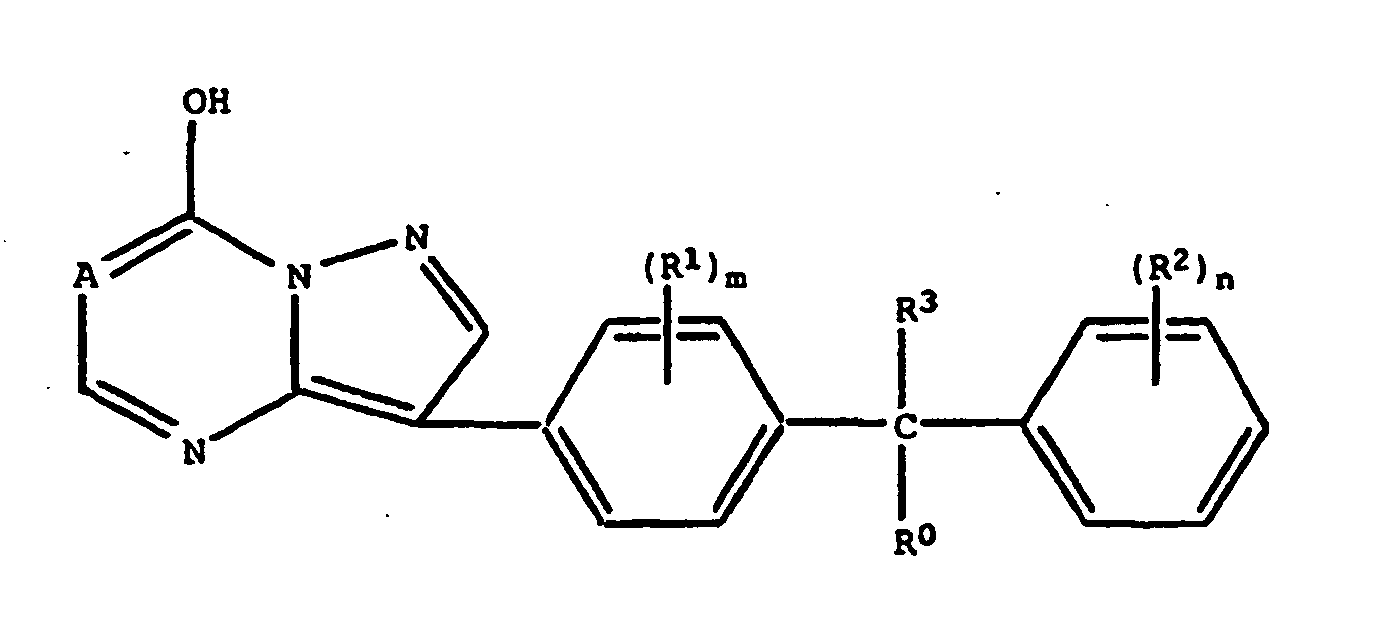
- US 3,910,907 (ICI, 1975) discloses pyrazolotriazines of the formula:where R1 is CH3, C2H5 or C6H5, X is H, C6H5, m-CH3C6H4, CN, COOEt, Cl, I or Br, Y is H, C6H5, o-CH3C6H4, or p-CH3C6H4, and Z is OH, H, CH3, C2H5, C6H5, n-C3H7, i-C3H7, SH, SCH3, NHC4H9, or N(C2H5)2, and states that the compounds are c-AMP phosphodiesterase inhibitors useful as bronchodilators.

- US 3,995,039 discloses pyrazolotriazines of the formula:where R1 is H or alkyl, R2 is H or alkyl, R3 is H, alkyl, alkanoyl, carbamoyl, or lower alkylcarbamoyl, and R is pyridyl, pyrimidinyl, or pyrazinyl, and states that the compounds are useful as bronchodilators.
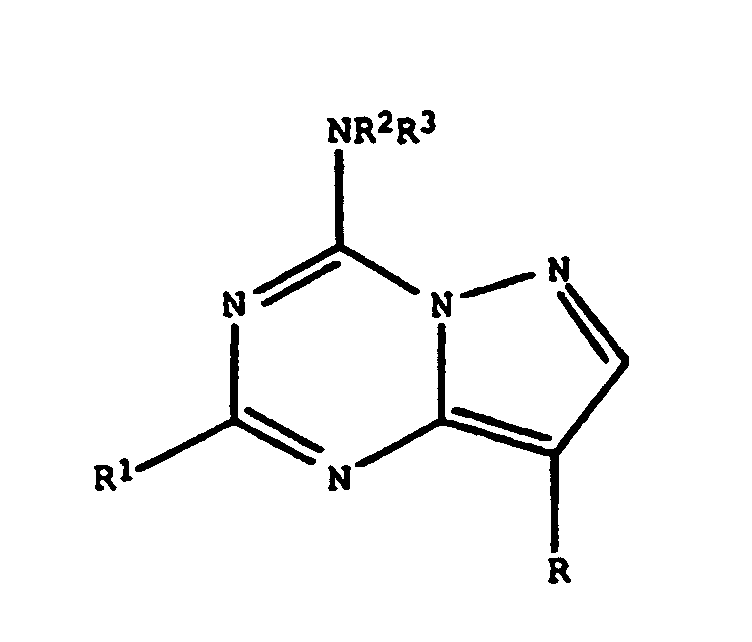
- US 5,137,887 discloses pyrazolotriazines of the formulawhere R is lower alkoxy, and teaches that the compounds are xanthine oxidase inhibitors and are useful for treatment of gout.

- US 4,892,576 discloses pyrazolotriazines of the formulawhere X is O or S, Ar is a phenyl, naphthyl, pyridyl or thienyl group, R6-R8 are H, alkyl, etc., and R9 is H, alkyl, phenyl, etc. The patent states that the compounds are useful as herbicides and plant growth regulants.

- US 5,484,760 and WO 92/10098 discloses herbicidal compositions containing, among other things, a herbicidal compound of the formulawhere A can be N, B can be CR3, R3 can be phenyl or substituted phenyl, etc., R is -N(R4)SO2R5 or - SO2N(R6)R7 and R1 and R2 can be taken together to form
 where X, Y and Z are H, alkyl, acyl, etc. and D is O or S.
- US 3,910,907 and Senga et al., J. Med. Chem., 1982, 25, 243-249, disclose triazolotriazines cAMP phosphodiesterase inhibitors of the formulawhere Z is H, OH, CH3, C2H5, C6H5, n-C3H7, iso-C3H7, SH, SCH3, NH(n-C4H9), or N(C2H5)2, R is H or CH3, and R1 is CH3 or C2H5. The reference lists eight therapeutic areas where inhibitors of cAMP phosphodiesterase could have utility: asthma, diabetes mellitus, female fertility control, male infertility, psoriasis, thrombosis, anxiety, and hypertension.

- WO95/35298 (Otsuka, 1995) discloses pyrazolopyrimidines and states that they are useful as analgesics. The compounds are represented by the formulawhere Q is carbonyl or sulfonyl, n is 0 or 1, A is a single bond, alkylene or alkenylene, R1 is H, alkyl, etc., R2 is naphthyl, cycloalkyl, heteroaryl, substituted phenyl or phenoxy, R3 is H, alkyl or phenyl, R4 is H, alkyl, alkoxycarbonyl, phenylalkyl, optionally phenylthio-substituted phenyl, or halogen, R5 and R6 are H or alkyl.

- EP 0 591 528 (Otsuka,1991) discloses antiinflammatory use of pyrazolopyrimidines represented by the formulawhere R1, R2, R3 and R4 are H, carboxyl, alkoxycarbonyl, optionally substituted alkyl, cycloalkyl, or phenyl, R5 is SR6 or NR7R8, R6 is pyridyl or optionally substituted phenyl, and R7 and R8 are H or optionally substituted phenyl.

- Springer et al, J. Med. Chem., 1976, vol. 19, no. 2, 291-296 and Springer U.S. patents 4021,556 and 3,920,652 disclose pyrazolopyrimidines of the formulawhere R can be phenyl, substituted phenyl or pyridyl, and their use to treat gout, based on their ability to inhibit xanthine oxidase.
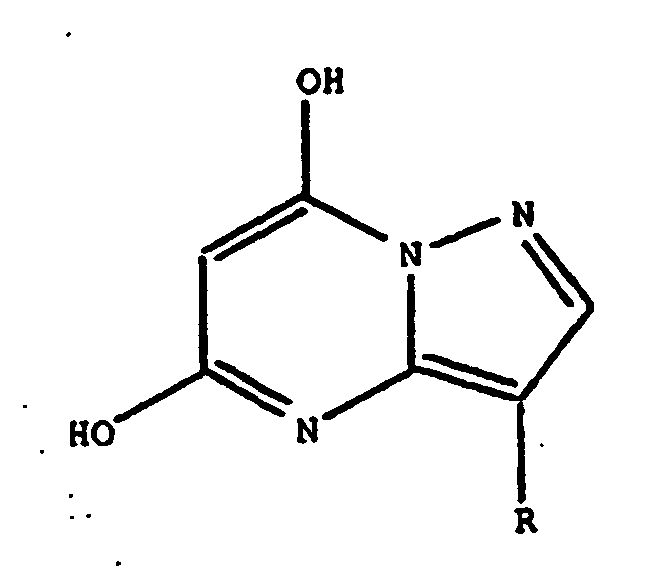
- Joshi et al., J. Prakt. Chemie, 321, 2, 1979, 341-344, discloses compounds of the formulawhere R1 is CF3, C2F5, or C6H4F, and R2 is CH3, C2H5, CF3, or C6H4F.
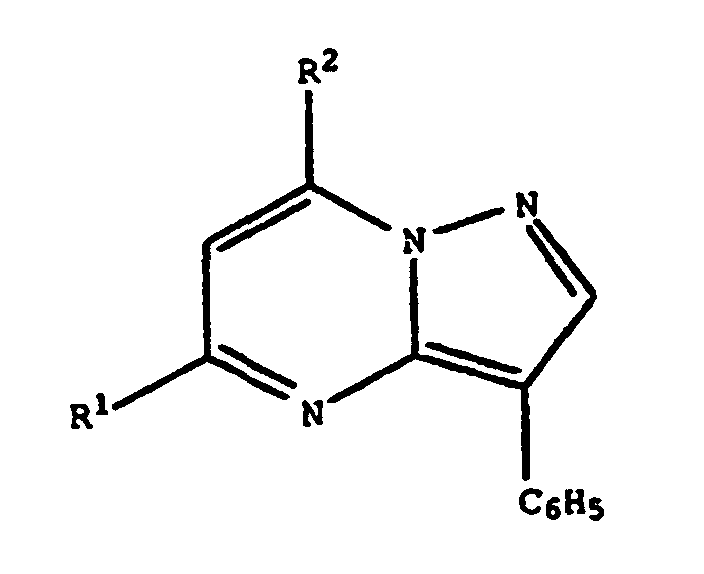
- Maquestiau et al., Bull. Soc. Belg., vol.101, no. 2, 1992, pages 131-136 discloses a pyrazolo[1,5-a]pyrimidine of the formula

- Ibrahim et al., Arch. Pharm. (weinheim) 320, 487-491 (1987) discloses pyrazolo[1,5-a]pyrimidines of the formulawhere R is NH2 or OH and Ar is 4-phenyl-3-cyano-2-aminopyrid-2-yl.

- Other references which disclose azolopyrimidines inclued EP 0 511 528 (Otsuka, 1992), US 4,997,940 (Dow, 1991), EP 0 374 448 (Nissan, 1990), US 4,621,556 (ICN,1997), EP 0 531 901 (Fujisawa, 1993), US 4,567,263 (BASF, 1986), EP 0 662 477 (Isagro, 1995), DE 4 243 279 (Bayer, 1994), US 5,397,774 (Upjohn, 1995), EP 0 521 622 (Upjohn, 1993), WO 94/109017 (Upjohn, 1994), J. Med. Chem., 24, 610-613 (1981), and J. Het. Chem., 22, 601 (1985).
- WO 97/29109 (Janssen) discloses certain pyrazolopyrimidines as CRF receptor antagonists.
- In accordance with one aspect, the present invention provides novel compounds, pharmaceutical compositions which may be used in the treatment of affective disorder, anxiety, depression, irritable bowel syndrome, post-traumatic stress disorder, supranuclear palsy, immune suppression, Alzheimer's disease, gastrointestinal disease, anorexia nervosa or other feeding disorder, drug or alcohol withdrawal symptoms, drug addiction, inflammatory disorder, fertility problems, disorders, the treatment of which can be effected or facilitated by antagonizing CRF, including but not limited to disorders induced or facilitated by CRF, or a disorder selected from inflammatory disorders such as rheumatoid arthritis and osteoarthritis, pain, asthma, psoriasis and allergies; generalized anxiety disorder; panic, phobias, obsessive-compulsive disorder; post-traumatic stress disorder; sleep disorders induced by stress; pain perception such as fibromyalgia; mood disorders such as depression, including major depression, single episode depression, recurrent depression, child abuse induced depression, and postpartum depression; dysthemia; bipolar disorders; cyclothymia; fatigue syndrome; stress-induced headache; cancer, human immunodeficiency virus (HIV) infections; neurodegenerative diseases such as Alzheimer's disease, Parkinson's disease and Huntington's disease; gastrointestinal diseases such as ulcers, irritable bowel syndrome, Crohn's disease, spastic colon, diarrhea, and post operative ilius and colonic hypersensitivity associated by psychopathological disturbances or stress; eating disorders such as anorexia and bulimia nervosa; hemorrhagic stress; stress-induced psychotic episodes; euthyroid sick syndrome; syndrome of inappropriate antidiarrhetic hormone (ADH); obesity; infertility; head traumas; spinal cord trauma; ischemic neuronal damage (e.g., cerebral ischemia such as cerebral hippocampal ischemia); excitotoxic neuronal damage; epilepsy; cardiovascular and hear related disorders including hypertension, tachycardia and congestive heart failure; stroke; immune dysfunctions including stress induced immune dysfunctions (e.g., stress induced fevers, porcine stress syndrome, bovine shipping fever, equine paroxysmal fibrillation, and dysfunctions induced by confinement in chickens, sheering stress in sheep or human-animal interaction related stress in dogs); muscular spasms; urinary incontinence; senile dementia of the Alzheimer's type; multiinfarct dementia; amyotrophic lateral sclerosis; chemical dependencies and addictions (e.g., dependencies on alcohol, cocaine, heroin, benzodiazepines, or other drugs); drug and alcohol withdrawal symptoms; osteoporosis; psychosocial dwarfism and hypoglycemia in a mammal.
- The present invention provides novel compounds which bind to corticotropin releasing factor receptors, thereby altering the anxiogenic effects of CRF secretion. The compounds of the present invention are useful for the treatment of psychiatric disorders and neurological diseases, anxiety-related disorders, post-traumatic stress disorder, supranuclear palsy and feeding disorders as well as treatment of immunological, cardiovascular or heart-related diseases and colonic hypersensitivity associated with psychopathological disturbance and stress in a mammal.
- According to another aspect, the present invention provides novel compounds described below which are useful as antagonists of the corticotropin releasing factor. The compounds of the present invention exhibit activity as corticotropin releasing factor antagonists and appear to suppress CRF hypersecretion. The present invention also includes pharmaceutical compositions containing such compounds of Formulae (1) and (2), and the use of such compounds for the manufacture of a medicament suitable for the suppression of CRF hypersecretion, and/or for the treatment of anxiogenic disorders.
- According to yet another aspect of the invention, the compounds provided by this invention (and especially labelled compounds of this invention) are also useful as standards and reagents in deterznining the ability of a potential pharmaceutical to bind to the CRF receptor.
-
- [1] The present invention provides
compounds of Formula (70)
and geometric isomers thereof, stereoisomeric forms thereof, or mixtures of stereoisomeric forms thereof, and pharmaceutically acceptable salt forms thereof selected from the group:

- a compound of Formula (70) wherein R is Cl, R3 is - NHCH(n-Pr)2, R4a is Me, R4b is H, R4c is Me, R4d is H and R4e is H;
- a compound of Formula (70) wherein R is Cl, R3 is - NHCH(CH2OMe)2, R4a is Me, R4b is H, R4c is Me, R4d is H and R4e is H;
- a compound of Formula (70) wherein R is Cl, R3 is - N(CH2CH2OMe)2, R4a is Me, R4b is H, R4c is Me, R4d is H and R4e is H;
- a compound of Formula (70) wherein R is Cl, R3 is -N(c-Pr) (CH2CH2CN), R4a is Me, R4b is H, R4c is Me, R4d is H and R4e is H;
- a compound of Formula (70) wherein R is Cl, R3 is - N(CH2CH2OMe)2, R4a is Cl, R4b is H, R4c is Me, R4d is H and R4e is H;
- a compound of Formula (70) wherein R is Cl, R3 is - NHCH(CH2OMe)2, R4a is Cl, R4b is H, R4c is Me, R4d is H and R4e is H;
- a compound of Formula (70) wherein R is Cl, R3 is - NHCH(Et)2, R4a is Cl, R4b is H, R4c is Me, R4d is H and R4e is H;
- a compound of Formula (70) wherein R is Cl, R3 is - N(Et)2, R4a is Me, R4b is H, R4c is Me, R4d is H and R4e is H;
- a compound of Formula (70) wherein R is Cl, R3 is -N(n-Pr)(CH2CH2CN), R4a is Me, R4b is H, R4c is Me, R4d is H and R4e is H;
- a compound of Formula (70) wherein R is Cl, R3 is -N(n-Bu)(CH2CH2CN), R4a is Me, R4b is H, R4c is Me, R4d is H and R4e is H;
- a compound of Formula (70) wherein R is Cl, R3 is - NHCH(n-Pr) (CH2OMe), R4a is Me, R4b is H, R4c is Me, R4d is H and R4e is H;
- a compound of Formula (70) wherein R is Cl, R3 is - NHCH(Et)2, R4a is Me, R4b is H, R4c is OMe, R4d is H and R4e is H;
- a compound of Formula (70) wherein R is Cl, R3 is - NHCH(CH2OMe)2, R4a is Me, R4b is H, R4C is OMe, R4d is H and R4e is H;
- a compound of Formula (70) wherein R is Cl, R3 is (S) - NH(CH2CH2OMe)CH2OMe, R4a is Me, R4b is H, R4c is Me, R4d is H and R4e is H;
- a compound of Formula (70) wherein R is Cl, R3 is - NH(CH2CH2OMe)CH2OMe, R4a is Me, R4b is H, R4c is Me, R4d is H and R4e is H;
- a compound of Formula (70) wherein R is Cl, R3 is - N(CH2CH2OMe)2, R4a is Me, R4b is H, R4c is Cl, R4d is H and R4e is H;
- a compound of Formula (70) wherein R is Cl, R3 is - NH(Et), R4a is Me, R4b is H, R4c is Me, R4d is H and R4e is H;
- a compound of Formula (70) wherein R is Cl, R3 is - NHCH(n-Pr)2, R4a is Me, R4b is H, R4c is Cl, R4d is H and R4e is H;
- a compound of Formula (70) wherein R is Cl, R3 is - NHCH(CH2OMe)2, R4a is Me, R4b is H, R4c is Cl, R4d is H and R4e is H;
- a compound of Formula (70) wherein R is Cl, R3 is (S) - NH(CH2CH2OMe)CH2OMe, R4a is Me, R4b is H, R4c is Cl, R4d is H and R4e is H;
- a compound of Formula (70) wherein R is Cl, R3 is - NH(CH2CH2OMe)CH2OMe, R4a is Me, R4b is H, R4c is Cl, R4d is H and R4e is H;
- a compound of Formula (70) wherein R is Cl, R3 is -N(n-Pr)(CH2CH2CN), R4a is Me, R4b is H, R4c is OMe, R4d is H and R4e is H;
- a compound of Formula (70) wherein R is Cl, R3 is - N(Et)2, R4a is Me, R4b is H, R4c is OMe, R4d is H and R4e is H;
- a compound of Formula (70) wherein R is C1, R3 is (S) - NH(CH2CH2OMe)CH2OMe, R4a is Cl, R4b is H, R4c is Me, R4d is H and R4e is H;
- a compound of Formula (70) wherein R is Cl, R3 is - NH(CH2CH2OMe)CH2OMe, R4a is Cl, R4b is H, R4c is Me, R4d is H and R4e is H;
- a compound of Formula (70) wherein R is Cl, R3 is - N(Et)2, R4a is Cl, R4b is H, R4c is Me, R4d is H and R4e is H;
- a compound of Formula (70) wherein R is Cl, R3 is -N(c-Pr)(CH2CH2CN), R4a is Me, R4b is H, R4c is OMe, R4d is H and R4e is H;
- a compound of Formula (70) wherein R is Cl, R3 is -N(c-Pr)(CH2CH2CN), R4a is Cl, R4b is H, R4c is Me, R4d is H and R4e is H;
- a compound of Formula (70) wherein R is Cl, R3 is -NHCH (n-Pr)(CH2OMe), R4a is Me, R4b is H, R4C is OMe, R4d is H and R4e is H;
- a compound of Formula (70) wherein R is Cl, R3 is -NHCH (n-Pr) (CH2OMe), R4a is Cl, R4b is H, R4c is Me, R4d is H and R4e is H;
- a compound of Formula (70) wherein R is Cl, R3 is - NHCH(Et)2, R4a is Br, R4b is H, R4c is OMe, R4d is OMe and R4e is H;
- a compound of Formula (70) wherein R is Cl, R3 is - NHCH(Et)2, R4a is Br, R4b is H, R4c is OMe, R4d is H and R4e is H;
- a compound of Formula (70) wherein R is Cl, R3 is - N(CH2CH2OMe)2, R4a is Br, R4b is H, R4c is OMe, R4d is H and R4e is H;
- a compound of Formula (70) wherein R is Cl, R3 is - NHCH(CH2OMe)2, R4a is Br, R4b is H, R4c is OMe, R4d is H and R4e is H;
- a compound of Formula (70) wherein R is Cl, R3 is - N(Et)2, R4a is Me, R4b is H, R4c is Cl, R4d is H and R4e is H;
- a compound of Formula (70) wherein R is Cl, R3 is - N(Et)2, R4a is Cl, R4b is H, R4c is OMe, R4d is OMe and R4e is H;
- a compound of Formula (70) wherein R is Cl, R3 is - NHCH(Et)2, R4a is Cl, R4b is H, R4c is OMe, R4d is OMe and R4e is H;
- a compound of Formula (70) wherein R is Cl, R3 is - N(CH2CH2OMe)2, R4a is Cl, R4b is H, R4c is Cl, R4d is H and R4e is H;
- a compound of Formula (70) wherein R is Cl, R3 is - NHCH(CH2OMe)2, R4a is Cl, R4b is H, R4c is Cl, R4d is H and R4e is H;
- a compound of Formula (70) wherein R is Cl, R3 is - N(Pr)(CH2CH2CN), R4a is Cl, R4b is H, R4c is Cl, R4d is H and R4e is H;
- a compound of Formula (70) wherein R is Cl, R3 is - N(Bu)(Et), R4a is Cl, R4b is H, R4c is Cl, R4d is H and R4e is H;
- a compound of Formula (70) wherein R is Cl, R3 is - NHCH(Et)CH2OMe, R4a is Cl, R4b is H, R4c is Cl, R4d is H and R4e is H;
- a compound of Formula (70) wherein R is Cl, R3 is - NHCH(Et)2, R4a is Cl, R4b is H, R4c is Cl, R4d is H and R4e is H;
- a compound of Formula (70) wherein R is Cl, R3 is - NHCH(Et)2, R4a is Me, R4b is H, R4c is Me, R4d is H and R4e is H;
- a compound of Formula (70) wherein R is Cl, R3 is - NHCH(Et)2, R4a is Cl, R4b is H, R4c is Me, R4d is H and R4e is H;
- a compound of Formula (70) wherein R is Cl, R3 is - NHCH(Et)2, R4a is Me, R4b is H, R4c is Cl, R4d is H and R4e is H;
- a compound of Formula (70) wherein R is Cl, R3 is - NEt2, R4a is Me, R4b is H, R4c is OMe, R4d is H and R4e is H; and
- a compound of Formula (70) wherein R is Cl, R3 is - M(Pr)(CH2CH2CN), R4a is Me, R4b is H, R4c is OMe, R4d is H and R4e is H;
- a compound of Formula (70) wherein R is Me, R3 is - NHCH(n-Pr)2, R4a is Me, R4b is H, R4c is Me, R4d is H and R4e is H;
- a compound of Formula (70) wherein R is Me, R3 is - NHCH(CH2OMe)2, R4a is Me, R4b is H, R4c is Me, R4d is H and R4e is H;
- a compound of Formula (70) wherein R is Me, R3 is - N(CH2CH2OMe)2, R4a is Me, R4b is H, R4c is Me, R4d is H and R4e is H;
- a compound of Formula (70) wherein R is Me, R3 is -N(c-Pr) (CH2CH2CN), R4a is Me, R4b is H, R4c is Me, R4d is H and R4e is H;
- a compound of Formula (70) wherein R is Me, R3 is - N(CH2CH2OMe)2, R4a is Cl, R4b is H, R4c is Me, R4d is H and R4e is H;
- a compound of Formula (70) wherein R is Me, R3 is - NHCH(CH2OMe)2, R4a is Cl, R4b is H, R4c is Me, R4d is H and R4e is H;
- a compound of Formula (70) wherein R is Me, R3 is - NHCH(Et)2, R4a is Cl, R4b is H, R4c is Me, R4d is H and R4e is H;
- a compound of Formula (70) wherein R is Me, R3 is - N(Et)2, R4a is Me, R4b is H, R4c is Me, R4d is H and R4e is H;
- a compound of Formula (70) wherein R is Me, R3 is -N(n-Pr)(CH2CH2CN), R4a is Me, R4b is H, R4c is Me, R4d is H and R4e is H;
- a compound of Formula (70) wherein R is Me, R3 is -N(n-Bu)(CH2CH2CN), R4a is Me, R4b is H, R4c is Me, R4d is H and R4e is H;
- a compound of Formula (70) wherein R is Me, R3 is - NHCH(n-Pr)(CH2OMe), R4a is Me, R4b is H, R4c is Me, R4d is H and R4e is H;
- a compound of Formula (70) wherein R is Me, R3 is - NHCH(Et)2, R4a is Me, R4b is H, R4c is OMe, R4d is H and R4e is H;
- a compound of Formula (70) wherein R is Me, R3 is - NHCH(CH2OMe)2, R4a is Me, R4b is H, R4c is OMe, R4d is H and R4e is H;
- a compound of Formula (70) wherein R is Me, R3 is (S) - NH(CH2CH2OMe)CH2OMe, R4a is Me, R4b is H, R4c is Me, R4d is H and R4e is H;
- a compound of Formula (70) wherein R is Me, R3 is - NH(CH2CH2OMe)CH2OMe, R4a is Me, R4b is H, R4c is Me, R4d is H and R4e is H;
- a compound of Formula (70) wherein R is Me, R3 is - N(CH2CH2OMe)2, R4a is Me, R4b is H, R4c is Cl, R4d is H and R4e is H;
- a compound of Formula (70) wherein R is Me, R3 is - NH(Et), R4a is Me, R4b is H, R4c is Me, R4d is H and R4e is H;
- a compound of Formula (70) wherein R is Me, R3 is - NHCH(n-Pr)2, R4a is Me, R4b is H, R4c is Cl, R4d is H and R4e is H;
- a compound of Formula (70) wherein R is Me, R3 is - NHCH(CH2OMe)2, R4a is Me, R4b is H, R4c is Cl, R4d is H and R4e is H;
- a compound of Formula (70) wherein R is Me, R3 is (S) - NH(CH2CH2OMe)CH2OMe, R4a is Me, R4b is H, R4c is Cl, R4d is H and R4e is H;
- a compound of Formula (70) wherein R is Me, R3 is - NH(CH2CH2OMe)CH2OMe, R4a is Me, R4b is H, R4c is Cl, R4d is H and R4e is H;
- a compound of Formula (70) wherein R is Me, R3 is -N(n-Pr) (CH2CH2CN), R4a is Me, R4b is H, R4c is OMe, R4d is H and R4e is H;
- a compound of Formula (70) wherein R is Me, R3 is - N(Et)2, R4a is Me, R4b is H, R4c is OMe, R4d is H and R4e is H;
- a compound of Formula (70) wherein R is Me, R3 is (S) - NH(CH2CH2OMe)CH2OMe, R4a is Cl, R4b is H, R4c is Me, R4d is H and R4e is H;
- a compound of Formula (70) wherein R is Me, R3 is - NH(CH2CH2OMe)CH2OMe, R4a is Cl, R4b is H, R4c is Me, R4d is H and R4e is H;
- a compound of Formula (70) wherein R is Me, R3 is - N(Et)2, R4a is Cl, R4b is H, R4c is Me, R4d is H and R4e is H;
- a compound of Formula (70) wherein R is Me, R3 is -N(c-Pr)(CH2CH2CN), R4a is Me, R4b is H, R4c is OMe, R4d is H and R4e is H;
- a compound of Formula (70) wherein R is Me, R3 is -N(c-Pr)(CH2CH2CN), R4a is Cl, R4b is H, R4c is Me, R4d is H and R4e is H;
- a compound of Formula (70) wherein R is Me, R3 is -NHCH (n-Pr)(CH2OMe), R4a is Me, R4b is H, R4c is OMe, R4d is H and R4e is H;
- a compound of Formula (70) wherein R is Me, R3 is -NHCH (n-Pr)(CH2OMe), R4a is Cl, R4b is H, R4c is Me, R4d is H and R4e is H;
- a compound of Formula (70) wherein R is Me, R3 is - NHCH(Et)2, R4a is Br, R4b is H, R4c is OMe, R4d is OMe and R4e is H;
- a compound of Formula (70) wherein R is Me, R3 is - NHCH(Et)2, R4a is Br, R4b is H, R4c is OMe, R4d is H and R4e is H;
- a compound of Formula (70) wherein R is Me, R3 is - N(CH2CH2OMe)2, R4a is Br, R4b is H, R4c is OMe, R4d is H and R4e is H;
- a compound of Formula (70) wherein R is Me, R3 is - NHCH(CH2OMe)2, R4a is Br, R4b is H, R4c is OMe, R4d is H and R4e is H;
- a compound of Formula (70) wherein R is Me, R3 is - N(Et)2, R4a is Me, R4b is H, R4c is Cl, R4d is H and R4e is H;
- a compound of Formula (70) wherein R is Me, R3 is - N(Et)2, R4a is Cl, R4b is H, R4c is OMe, R4d is OMe and R4e is H;
- a compound of Formula (70) wherein R is Me, R3 is - NHCH(Et)2, R4a is Cl, R4b is H, R4c is OMe, R4d is OMe and R4e is H;
- a compound of Formula (70) wherein R is Me, R3 is - N(CH2CH2OMe)2, R4a is Cl, R4b is H, R4c is Cl, R4d is H and R4e is H;
- a compound of Formula (70) wherein R is Me, R3 is - NHCH(CH2OMe)2, R4a is Cl, R4b is H, R4c is Cl, R4d is H and R4e is H;
- a compound of Formula (70) wherein R is Me, R3 is - N(Pr) (CH2CH2CN), R4a is Cl, R4b is H, R4c is Cl, R4d is H and R4e is H;
- a compound of Formula (70) wherein R is Me, R3 is - N(Bu) (Et), R4a is Cl, R4b is H, R4c is Cl, R4d is H and R4e is H;
- a compound of Formula (70) wherein R is Me, R3 is - NHCH(Et)CH2OMe, R4a is Cl, R4b is H, R4c is Cl, R4d is H and R4e is H;
- a compound of Formula (70) wherein R is Me, R3 is - NHCH(Et)2, R4a is Cl, R4b is H, R4c is Cl, R4d is H and R4e is H;
- a compound of Formula (70) wherein R is Me, R3 is - NHCH(Et)2, R4a is Me, R4b is H, R4c is Me, R4d is H and R4e is H;
- a compound of Formula (70) wherein R is Me, R3 is - NHCH(Et)2, R4a is Cl, R4b is H, R4c is Me, R4d is H and R4e is H;
- a compound of Formula (70) wherein R is Me, R3 is - NHCH(Et)2, R4a is Me, R4b is H, R4c is Cl, R4d is H and R4e is H;
- a compound of Formula (70) wherein R is Me, R3 is - NEt2, R4a is Me, R4b is H, R4c is OMe, R4d is H and R4e is H; and
- a compound of Formula (70) wherein R is Me, R3 is - N(Pr)(CH2CH2CN), R4a is Me, R4b is H, R4c is OMe, R4d is H and R4e is H;
- a compound of Formula (70) wherein R is F, R3 is - R4d NHCH(n-Pr)2, R4a is Me, R4b is H, R4c is Me, R4d is H and R4e is H;
- a compound of Formula (70) wherein R is F, R3 is - NHCH(CH2OMe)2, R4a is Me, R4b is H, R4c is Me, R4d is H and R4e is H;
- a compound of Formula (70) wherein R is F, R3 is - N(CH2CH2OMe)2, R4a is Me, R4b is H, R4c is Me, R4d is H and R4e is H;
- a compound of Formula (70) wherein R is F, R3 is -N(c-Pr)(CH2CH2CN), R4a is Me, R4b is H, R4c is Me, R4d is H and R4e is H;
- a compound of Formula (70) wherein R is F, R3 is - N(CH2CH2OMe)2, R4a is Cl, R4b is H, R4c is Me, R4d is H and R4e is H;
- a compound of Formula (70) wherein R is F, R3 is - NHCH(CH2OMe)2, R4a is Cl, R4b is H, R4c is Me, R4d is H and R4e is H;
- a compound of Formula (70) wherein R is F, R3 is - NHCH(Et)2, R4a is Cl, R4b is H, R4c is Me, R4d is H and R4e is H;
- a compound of Formula (70) wherein R is F, R3 is - N(Et)2, R4a is Me, R4b is H, R4c is Me, R4d is H and R4e is H;
- a compound of Formula (70) wherein R is F, R3 is -N(n-Pr)(CH2CH2CN), R4a is Me, R4b is H, R4c is Me, R4d is H and R4e is H;
- a compound of Formula (70) wherein R is F, R3 is -N(n-Bu)(CH2CH2CN), R4a is Me, R4b is H, R4c is Me, R4d is H and R4e is H;
- a compound of Formula (70) wherein R is F, R3 is - NHCH(n-Pr)(CH2OMe), R4a is Me, R4b is H, R4c is Me, R4d is H and R4e is H;
- a compound of Formula (70) wherein R is F, R3 is - NHCH(Et)2, R4a is Me, R4b is H, R4c is OMe, R4d is H and R4e is H;
- a compound of Formula (70) wherein R is F, R3 is - NHCH(CH2OMe)2, R4a is Me, R4b is H, R4c is OMe, R4d is H and R4e is H;
- a compound of Formula (70) wherein R is F, R3 is (S) - NH(CH2CH2OMe)CH2OMe, R4a is Me, R4b is H, R4c is Me, R4d is H and R4e is H;
- a compound of Formula (70) wherein R is F, R3 is - NH(CH2CH2OMe)CH2OMe, R4a is Me, R4b is H, R4c is Me, R4d is H and R4e is H;
- a compound of Formula (70) wherein R is F, R3 is - N(CH2CH2OMe)2, R4a is Me, R4b is H, R4c is Cl, R4d is H and R4e is H;
- a compound of Formula (70) wherein R is F, R3 is - NH(Et), R4a is Me, R4b is H, R4c is Me, R4d is H and R4e is H;
- a compound of Formula (70) wherein R is F, R3 is - NHCH(n-Pr)2, R4a is Me, R4b is H, R4c is Cl, R4d is H and R4e is H;
- a compound of Formula (70) wherein R is F, R3 is - NHCH(CH2OMe)2, R4a is Me, R4b is H, R4c is Cl, R4d is H and R4e is H;
- a compound of Formula (70) wherein R is F, R3 is (S) - NH(CH2CH2OMe)CH2OMe, R4a is Me, R4b is H, R4c is Cl, R4d is H and R4e is H;
- a compound of Formula (70) wherein R is F, R3 is - NH(CH2CH2OMe)CH2OMe, R4a is Me, R4b is H, R4c is Cl, R4d is H and R4e is H;
- a compound of Formula (70) wherein R is F, R3 is -N(n-Pr)(CH2CH2CN), R4a is Me, R4b is H, R4c is OMe, R4d is H and R4e is H;
- a compound of Formula (70) wherein R is F, R3 is - N(Et)2, R4a is Me, R4b is H, R4c is OMe, R4d is H and R4e is H;
- a compound of Formula (70) wherein R is F, R3 is (S) - NH(CH2CH2OMe)CH2OMe, R4a is Cl, R4b is H, R4c is Me, R4d is H and R4e is H;
- a compound of Formula (70) wherein R is F, R3 is - NH(CH2CH2OMe)CH2OMe, R4a is Cl, R4b is H, R4c is Me, R4d is H and R4e is H;
- a compound of Formula (70) wherein R is F, R3 is - N(Et)2, R4a is Cl, R4b is H, R4c is Me, R4d is H and R4e is H;
- a compound of Formula (70) wherein R is F, R3 is -N(c-Pr)(CH2CH2CN), R4a is Me, R4b is H, R4c is OMe, R4d is H and R4e is H;
- a compound of Formula (70) wherein R is F, R3 is -N(c-Pr)(CH2CH2CN), R4a is Cl, R4b is H, R4c is Me, R4d is H and R4e is H;
- a compound of Formula (70) wherein R is F, R3 is -NHCH (n-Pr)(CH2OMe), R4a is Me, R4b is H, R4c is OMe, R4d is H and R4e is H;
- a compound of Formula (70) wherein R is F, R3 is -NHCH (n-Pr)(CH2OMe), R4a is Cl, R4b is H, R4c is Me, R4d is H and R4e is H;
- a compound of Formula (70) wherein R is F, R3 is - NHCH(Et)2, R4a is Br, R4b is H, R4c is OMe, R4d is OMe and R4e is H;
- a compound of Formula (70) wherein R is F, R3 is - NHCH(Et)2, R4a is Br, R4b is H, R4c is OMe, R4d is H and R4e is H;
- a compound of Formula (70) wherein R is F, R3 is - N(CH2CH2OMe)2, R4a is Br, R4b is H, R4c is OMe, R4d is H and R4e is H;
- a compound of Formula (70) wherein R is F, R3 is - NHCH(CH2OMe)2, R4a is Br, R4b is H, R4c is OMe, R4d is H and R4e is H;
- a compound of Formula (70) wherein R is F, R3 is - N(Et)2, R4a is Me, R4b is H, R4c is Cl, R4d is H and R4e is H;
- a compound of Formula (70) wherein R is F, R3 is - N(Et)2, R4a is Cl, R4b is H, R4c is OMe, R4d is OMe and R4e is H;
- a compound of Formula (70) wherein R is F, R3 is - NHCH(Et)2, R4a is Cl, R4b is H, R4c is OMe, R4d is OMe and R4e is H;
- a compound of Formula (70) wherein R is F, R3 is - N(CH2CH2OMe)2, R4a is Cl, R4b is H, R4c is Cl, R4d is H and R4e is H;
- a compound of Formula (70) wherein R is F, R3 is - NHCH(CH2OMe)2, R4a is Cl, R4b is H, R4c is Cl, R4d is H and R4e is H;
- a compound of Formula (70) wherein R is F, R3 is - N(Pr)(CH2CH2CN), R4a is Cl, R4b is H, R4c is Cl, R4d is H and R4e is H;
- a compound of Formula (70) wherein R is F, R3 is - N(Bu)(Et), R4a is Cl, R4b is H, R4c is Cl, R4d is H and R4e is H;
- a compound of Formula (70) wherein R is F, R3 is - NHCH(Et)CH2OMe, R4a is Cl, R4b is H, R4c is Cl, R4d is H and R4e is H;
- a compound of Formula (70) wherein R is F, R3 is NHCH(Et)2, R4a is Cl, R4b is H, R4c is Cl, R4d is H and R4e is H;
- a compound of Formula (70) wherein R is F, R3 is - NHCH(Et)2, R4a is Me, R4b is H, R4c is Me, R4d is H and R4e is H;
- a compound of Formula (70) wherein R is F, R3 is - NHCH(Et)2, R4a is Cl, R4b is H, R4c is Me, R4d is H and R4e is H;
- a compound of Formula (70) wherein R is F, R3 is - NHCH(Et)2, R4a is Me, R4b is H, R4c is Cl, R4d is H and R4e is H;
- a compound of Formula (70) wherein R is F, R3 is -NEt2, R4a is Me, R4b is H, R4c is OMe, R4d is H and R4e is H; and
- a compound of Formula (70) wherein R is F, R3 is - N(Pr)(CH2CH2CN), R4a is Me, R4b is H, R4c is OMe, R4d is H and R4e is H;
- a compound of Formula (70) wherein R is C1, R3 is - N(Pr)(CH2CH2OMe), R4a is Me, R4b is H, R4c is OMe, R4d is H and R4e is H;
- a compound of Formula (70) wherein R is Cl, R3 is - N(Et)(CH2CH2OMe), R4a is Me, R4b is H, R4c is OMe, R4d is H and R4e is H;
- a compound of Formula (70) wherein R is Cl, R3 is - N(Me)(CH2CH2OMe), R4a is Me, R4b is H, R4c is OMe, R4d is H and R4e is H;
- a compound of Formula (70) wherein R is Cl, R3 is - NMeEt, R4a is Me, R4b is H, R4c is OMe, R4d is H and R4e is H;
- a compound of Formula (70) wherein R is Cl, R3 is - NMePr, R4a is Me, R4b is H, R4c is OMe, R4d is H and R4e is H;
- a compound of Formula (70) wherein R is Cl, R3 is - NMeBu, R4a is Me, R4b is H, R4c is OMe, R4d is H and R4e is H;
- a compound of Formula (70) wherein R is Cl, R3 is -NH-2-butyl, R4a is Me, R4b is H, R4c is OMe, R4d is H and R4e is H;
- a compound of Formula (70) wherein R is Cl, R3 is cyclobutylamino, R4a is Me, R4b is H, R4c is OMe, R4d is H and R4e is H;
- a compound of Formula (70) wherein R is Cl, R3 is - N(Pr)(CH2CH2OMe), R4a is Me, R4b is H, R4c is OMe, R4d is Me and R4e is H;
- a compound of Formula (70) wherein R is Cl, R3 is - N(Et)(CH2CH2OMe), R4a is Me, R4b is H, R4c is OMe, R4d is Me and R4e is H;
- a compound of Formula (70) wherein R is Cl, R3 is - N(Me)(CH2CH2OMe), R4a is Me, R4b is H, R4c is OMe, R4d is Me and R4e is H;
- a compound of Formula (70) wherein R is Cl, R3 is - NMeEt, R4a is Me, R4b is H, R4c is OMe, R4d is Me and R4e is H;
- a compound of Formula (70) wherein R is Cl, R3 is - NMePr, R4a is Me, R4b is H, R4c is OMe, R4d is Me and R4e is H;
- a compound of Formula (70) wherein R is Cl, R3 is - NMeBu, R4a is Me, R4b is H, R4c is OMe, R4d is Me and R4e is H;
- a compound of Formula (70) wherein R is Cl, R3 is -NH-2-butyl, R4a is Me, R4b is H, R4c is OMe, R4d is Me and R4e is H;
- a compound of Formula (70) wherein R is Cl, R3 is cyclobutylamino, R4a is Me, R4b is H, R4c is OMe, R4d is ME and R4e is H;
- a compound of Formula (70) wherein R is F, R3 is - N(Pr)(CH2CH2OMe), R4a is Me, R4b is H, R4c is OMe, R4d is H and R4e is H;
- a compound of Formula (70) wherein R is F, R3 is - N(Et)(CH2CH2OMe), R4a is Me, R4b is H, R4c is OMe, R4d is H and R4e is H;
- a compound of Formula (70) wherein R is F, R3 is - N(Me)(CH2CH2OMe), R4a is Me, R4b is H, R4c is OMe, R4d is H and R4e is H;
- a compound of Formula (70) wherein R is F, R3 is - NMeEt, R4a is Me, R4b is H, R4c is OMe, R4d is H and R4e is H;
- a compound of Formula (70) wherein R is F, R3 is - NMePr, R4a is Me, R4b is H, R4c is OMe, R4d is H and R4e is H;
- a compound of Formula (70) wherein R is F, R3 is - NMeBu, R4a is Me, R4b is H, R4c is OMe, R4d is H and R4e is H;
- a compound of Formula (70) wherein R is F, R3 is -NH-2-butyl, R4a is Me, R4b is H, R4c is OMe, R4d is H and R4e is H;
- a compound of Formula (70) wherein R is F, R3 is cyclobutylamino, R4a is Me, R4b is H, R4c is OMe, R4d is H and R4e is H;
- a compound of Formula (70) wherein R is F, R3 is - N(Pr)(CH2CH2OMe), R4a is Me, R4b is H, R4c is OMe, R4d is Me and R4e is H;
- a compound of Formula (70) wherein R is F, R3 is - N(Et)(CH2CH2OMe), R4a is Me, R4b is H, R4c is OMe, R4d is Me and R4e is H;
- a compound of Formula (70) wherein R is F, R3 is - N(Me)(CH2CH2OMe), R4a is Me, R4b is H, R4c is OMe, R4d is Me and R4e is H;
- a compound of Formula (70) wherein R is F, R3 is - NMeEt, R4a is Me, R4b is H, R4c is OMe, R4d is Me and R4e is H;
- a compound of Formula (70) wherein R is F, R3 is - NMePr, R4a is Me, R4b is H, R4c is OMe, R4d is Me and R4e is H;
- a compound of Formula (70) wherein R is F, R3 is - NMeBu, R4a is Me, R4b is H, R4c is OMe, R4d is Me and R4e is H;
- a compound of Formula (70) wherein R is F, R3 is -NH-2-butyl, R4a is Me, R4b is H, R4c is OMe, R4d is Me and R4e is H;
- a compound of Formula (70) wherein R is F, R3 is cyclobutylamino, R4a is Me, R4b is H, R4c is OMe, R4d is Me and R4e is H;
- a compound of Formula (70) wherein R is Me, R3 is - N(Pr)(CH2CH2OMe), R4a is Me, R4b is H, R4c is OMe, R4d is H and R4e is H;
- a compound of Formula (70) wherein R is Me, R3 is - N(Et)(CH2CH2OMe), R4a is Me, R4b is H, R4c is OMe, R4d is H and R4e is H;
- a compound of Formula (70) wherein R is Me, R3 is - N(Me)(CH2CH2OMe), R4a is Me, R4b is H, R4c is OMe, R4d is H and R4e is H;
- a compound of Formula (70) wherein R is Me, R3 is - NMeEt, R4a is Me, R4b is H, R4c is OMe, R4d is H and R4e is H;
- a compound of Formula (70) wherein R is Me, R3 is - NMePr, R4a is Me, R4b is H, R4c is OMe, R4d is H and R4e is H;
- a compound of Formula (70) wherein R is Me, R3 is - NMeBu, R4a is Me, R4b is H, R4c is OMe, R4d is H and R4e is H;
- a compound of Formula (70) wherein R is Me, R3 is -NH-2-butyl, R4a is Me, R4b is H, R4c is OMe, R4d is H and R4e is H;
- a compound of Formula (70) wherein R is Me, R3 is cyclobutylamino, R4a is Me; R4b is H, R4c is OMe, R4d is H and R4e is H;
- a compound of Formula (70) wherein R is Me, R3 is - N(Pr)(CH2CH2OMe), R4a is Me, R4b is H, R4c is OMe, R4d is Me and R4e is H;
- a compound of Formula (70) wherein R is Me, R3 is - N(St)(CH2CH2OMe), R4a is Me, R4b is H, R4c is OMe, R4d is Me and R4e is H;
- a compound of Formula (70) wherein R is Me, R3 is - N(Me)(CH2CH2OMe), R4a is Me, R4b is H, R4c is OMe, R4d is Me and R4e is H;
- a compound of Formula (70) wherein R is Me, R3 is - NMeEt, R4a is Me, R4b is H, R4c is OMe, R4d is Me and R4e is H;
- a compound of Formula (70) wherein R is Me, R3 is - NMePr, R4a is Me, R4b is H, R4c is OMe, R4d is Me and R4e is H;
- a compound of Formula (70) wherein R is Me, R3 is - UMeBu, R4a is Me, R4b is H, R4c is OMe, R4d is Me and R4e is H;
- a compound of Formula (70) wherein R is Me, R3 is -NH-2-butyl, R4a is Me, R4b is H, R4c is OMe, R4d is Me and R4e is H; and
- a compound of Formula (70) wherein R is Me, R3 is cyclobutylamino, R4a is Me, R4b is H, R4c is OMe, R4d is Me and R4e is H.
- [2] Specifically preferred compounds of the present invention include compounds and geometric isomers thereof, stereoisomeric forms thereof, or mixtures of stereoisomeric forms thereof, and pharmaceutically acceptable salt forms thereof, wherein said compound is selected from: 7-(diethylamino)-2,5-dimethyl-3-(2-methyl-4-methoxyphenyl-[1,5-a]-pyrazolopyrimidine and 7-(N-(3-cyanopropyl)-N-propylamino)-2,5-dimethyl-3-(2,4-dimethylphenyl)-[1,5-a]-pyrazolopyrimidine.
- [3] The present invention also provides pharmaceutical compositions comprising a therapeutically effective amount of the above-described compounds and a pharmaceutically acceptable carrier.
- [4] The present invention still further provides the use of the above compounds in the manufacture of a medicament suitable for treating affective disorder, anxiety, depression, headache, irritable bowel syndrome, post-traumatic stress disorder, supranuclear palsy, immune suppression, Alzheimer's disease, gastrointestinal diseases, anorexia nervosa or other feeding disorder, drug addiction, drug or alcohol withdrawal symptoms, inflammatory diseases, cardiovascular or heart-related diseases, fertility problems, human immunodeficiency virus infections, hemorrhagic stress, obesity, infertility, head and spinal cord traumas, epilepsy, stroke, ulcers, amyotrophic lateral sclerosis, hypoglycemia or a disorder the treatment of which can be effected or facilitated by antagonizing CRF, including but not limited to disorders induced or facilitated by CRF, in mammals comprising administering to the mammal a therapeutically effective amount of the above-described compounds.
-
- Many compounds of this invention have one or more asymmetric centers or planes. Unless otherwise indicated, all chiral (enantiomeric and diastereomeric) and racemic forms are included in the present invention. Many geometric isomers of olefins, C=N double bonds, and the like can also be present in the compounds, and all such stable isomers are contemplated in the present invention. The compounds may be isolated in optically active or racemic forms. It is well known in the art how to prepare optically active forms, such as by resolution of racemic forms or by synthesis from optically active starting materials. All chiral, (enantiomeric and diastereomeric) and racemic forms and all geometric isomeric forms of a structure are intended, unless the specific stereochemistry or isomer form is specifically indicated.
- The term "alkyl" includes both branched and straight-chain alkyl having the specified number of carbon atoms. Commonly used abbreviations have the following meanings: Me is methyl, Et is ethyl, Pr is propyl, Bu is butyl. The prefix "n" means a straight chain alkyl. The prefix "c" means a cycloalkyl. The prefix "(S)" means the S enantiomer and the prefix "(R)" means the R enantiomer. Alkenyl" includes hydrocarbon chains of either a straight or branched configuration and one or more unsaturated carbon-carbon bonds which may occur in any stable point along the chain, such as ethenyl, propenyl, and the like. "Alkynyl" includes hydrocarbon chains of either a straight or branched configuration and one or more triple carbon-carbon bonds which may occur in any stable point along the chain, such as ethynyl, propynyl and the like. "Haloalkyl" is intended to include both branched and straight-chain alkyl having the specified number of carbon atoms, substituted with 1 or more halogen; "alkoxy" represents an alkyl group of indicated number of carbon atoms attached through an oxygen bridge; "cycloalkyl" is intended to include saturated ring groups, including mono-,bi- or polycyclic ring systems, such as cyclopropyl, cyclobutyl, cyclopentyl, cyclohexyl, and so forth. "Halo" or "halogen" includes fluoro, chloro, bromo, and iodo.
- The term "substituted", as used herein, means that one or more hydrogen on the designated atom is replaced with a selection from the indicated group, provided that the designated atom's normal valency is not exceeded, and that the substitution results in a stable compound. When a substitent is keto (i.e., =O), then 2 hydrogens on the atom are replaced.
- Combinations of substituents and/or variables are permissible only if such combinations result in stable compounds. By "stable compound" or "stable structure" is meant a compound that is sufficiently robust to survive isolation to a useful degree of purity from a reaction mixture, and formulation into an efficacious therapeutic agent.
- The term "appropriate amino acid protecting group" means any group known in the art of organic synthesis for the protection of amine or carboxylic acid groups. Such amine protecting groups include those listed in Greene and Wuts, "Protective Groups in Organic Synthesis" John Wiley & Sons, New York (1991) and "The Peptides: Analysis, Synthesis, Biology, Vol. 3, Academic Press, New York (1981), the disclosure of which is hereby incorporated by reference. Any amine protecting group known in the art can be used. Examples of amine protecting groups include, but are not limited to, the following: 1) acyl types such as formyl, trifluoroacetyl, phthalyl, and p-toluenesulfonyl; 2) aromatic carbamate types such as benzyloxycarbonyl (Cbz) and substituted benzyloxycarbonyls, 1-(p-biphenyl)-1-methylethoxycarbonyl, and 9-fluorenylmethyloxycarbonyl (Fmoc); 3) aliphatic carbamate types such as tert-butyloxycarbonyl (Boc), ethoxycarbonyl, diisopropylmethoxycarbonyl, and allyloxycarbonyl; 4) cyclic alkyl carbamate types such as cyclopentyloxycarbonyl and adamantyloxycarbonyl; 5) alkyl types such as triphenylmethyl and benzyl; 6) trialkylsilane such as trimethylsilane; and 7) thiol containing types such as phenylthiocarbonyl and dithiasuccinoyl.
- The term "pharmaceutically acceptable salts" includes acid or base salts of the compounds of Formulae (1) and (2). Examples of pharmaceutically acceptable salts include, but are not limited to, mineral or organic acid salts of basic residues such as amines; alkali or organic salts of acidic residues such as carboxylic acids; and the like.
- Pharmaceutically acceptable salts of the compounds of the invention can be prepared by reacting the free acid or base forms of these compounds with a stoichiometric amount of the appropriate base or acid in water or in an organic solvent, or in a mixture of the two; generally, nonaqueous media like ether, ethyl acetate, ethanol, isopropanol, or acetonitrile are preferred. Lists of suitable salts are found in Remington's Pharmaceutical Sciences, 17th ed., Mack Publishing Company, Easton, PA, 1985, p. 1418, the disclosure of which is hereby incorporated by reference.
- "Prodrugs" are considered to be any covalently bonded carriers which release the active parent drug of formula (I) or (II) in vivo when such prodrug is administered to a mammalian subject. Prodrugs of the compounds of formula (I) and (II) are prepared by modifying functional groups present in the compounds in such a way that the modifications are cleaved, either in routine manipulation or in vivo, to the parent compounds. Prodrugs include compounds wherein hydroxy, amine, or sulfhydryl groups are bonded to any group that, when administered to a mammalian subject, cleaves to form a free hydroxyl, amino, or sulfhydryl group, respectively. Examples of prodrugs include, but are not limited to, acetate, formate and benzoate derivatives of alcohol and amine functional groups in the compounds of formulas (I) and (II); and the like.
- The term "therapeutically effective amount" of a compound of this invention means an amount effective to antagonize abnormal level of CRF or treat the symptoms of affective disorder, anxiety or depression in a host.
- Some compounds of Formula (1) may be prepared from intermediate compounds of Formula (7), using the procedures outlined in Scheme 1:Compounds of Formula (7) (where Y is O) may be treated with a halogenating agent or sulfonylating agent in the presence or absence of a base in the presence or absence of an inert solvent at reaction temperatures ranging from -80°C to 250°C to give products of Formula (8) (where X is halogen, alkanesulfonyloxy, arylsulfonyloxy or haloalkane-sulfonyloxy). Halogenating agents include, but are not limited to, SOCl2, POCl3, PCl3, PCl5, POBr3, PBr3 or PBr5. Sulfonylating agents include, but are not limited to, alkanesulfonyl halides or anhydrides (such as methanesulfonyl chloride or methanesulfonic acid anhydride), arylsulfonyl halides or anhydrides (such as p-toluenesulfonyl chloride or anhydride) or haloalkylsulfonyl halides or anhydrides (preferably trifluoromethanesulfonic anhydride). Bases may include, but are not limited to, alkali metal hydrides (preferably sodium hydride), alkali metal alkoxides (1 to 6 carbons) (preferably sodium methoxide or sodium ethoxide), alkaline earth metal hydrides, alkali metal dialkylamides (preferably lithium di-isopropylamide), alkali metal bis(trialkylsilyl)amides (preferably sodium bis(trimethylsilyl)amide), trialkyl amines (preferably N,N-di-isopropyl-N-ethyl amine or triethylamine) or aromatic amines (preferably pyridine). Inert solvents may include, but are not limited to, lower alkanenitriles (1 to 6 carbons, preferably acetonitrile), dialkyl ethers (preferably diethyl ether), cyclic ethers (preferably tetrahydrofuran or 1,4-dioxane), N,N-dialkylformamides (preferably dimethylformamide), N,N-dialkylacetamides (preferably dimethylacetamide), cyclic amides (preferably N-methylpyrrolidin-2-one), dialkylsulfoxides (preferably dimethylsulfoxide), aromatic hydrocarbons (preferably benzene or toluene) or haloalkanes of 1 to 10 carbons and 1 to 10 halogens (preferably dichloromethane). Preferred reaction temperatures range from -20°C to 100°C.

- Compounds of Formula (8) may be reacted with compounds of Formula R3H (where R3 is defined as above except R3 is not SH, COR7, CO2R7, aryl or heteroaryl) in the presence or absence of a base in the presence or absence of an inert solvent at reaction temperatures ranging from -80 to 250°C to generate compounds of Formula (1). Bases may include, but are not limited to, alkali metal hydrides (preferably sodium hydride), alkali metal alkoxides (1 to 6 carbons)(preferably sodium methoxide or sodium ethoxide), alkaline earth metal hydrides, alkali metal dialkylamides (preferably lithium di-isopropylamide), alkali metal carbonates, alkali metal bicarbonates, alkali metal bis(trialkylsilyl)amides (preferably sodium bis(trimethylsilyl)amide), trialkyl amines (preferably N,N-di-isopropyl-N-ethyl amine) or aromatic amines (preferably pyridine). Inert solvents may include, but are not limited to, alkyl alcohols (1 to 8 carbons, preferably methanol or ethanol), lower alkanenitriles (1 to 6 carbons, preferably acetonitrile), dialkyl ethers (preferably diethyl ether), cyclic ethers (preferably tetrahydrofuran or 1,4-dioxane), N,N-dialkylformamides (preferably dimethylformamide), N,N-dialkylacetamides (preferably dimethylacetamide), cyclic amides (preferably N-methylpyrrolidin-2-one), dialkylsulfoxides (preferably dimethylsulfoxide), aromatic hydrocarbons (preferably benzene or toluene) or haloalkanes of 1 to 10 carbons and 1 to 10 halogens (preferably dichloromethane). Preferred reaction temperatures range from 0°C to 140°C.
- Scheme 2 delineates the procedures for converting intermediate compounds of Formula (7) (where Y is S) to some compounds of Formula (1).Compounds of Formula (7) (where Y is S) may be treated with an alkylating agent R13X (where R13 is defined as above, except R13 is not aryl or heteroaryl) in the presence or absence of a base in the presence or absence of an inert solvent at reaction temperatures ranging from -80°C to 250°C. Bases may include, but are not limited to, alkali metal hydrides (preferably sodium hydride), alkali metal alkoxides (1 to 6 carbons)(preferably sodium methoxide or sodium ethoxide), alkaline earth metal hydrides, alkali metal dialkylamides (preferably lithium di-isopropylamide), alkali metal carbonates, alkali metal hydroxides, alkali metal bis(trialkylsilyl)amides (preferably sodium bis(trimethylailyl)amide), trialkyl amines (prefereably N,N-di-isopropyl-N-ethyl amine or triethyl amine) or aromatic amines (preferably pyridine). Inert solvents may include, but are not limited to, alkyl alcohols (1 to 8 carbons, preferably methanol or ethanol), lower alkanenitriles (1 to 6 carbons, preferably acetonitrile), dialkyl ethers (preferably diethyl ether), cyclic ethers (preferably tetrahydrofuran or 1,4-dioxane), N,N-dialkylformamides (preferably dimethylformamide), N,N-dialkylacetamides (preferably dimethylacetamide), cyclic amides (preferably N-methylpyrrolidin-2-one), dialkylsulfoxides (preferably dimethylsulfoxide), aromatic hydrocarbons (preferably benzene or toluene) or haloalkanes of 1 to 10 carbons and 1 to 10 halogens (preferably dichloromethane). Preferred reaction temperatures range from -80°C to 100°C.

- Compounds of Formula (12) (Formula (1) where R3 is SR13) may then be reacted with compounds of Formula R3H to give compounds of Formula (1), using the same conditions and reagents as were used for the conversion of compounds of Formula (8) to compounds of Formula (1) as outlined for Scheme 1 above. Alternatively, compounds of Formula (12) (Formula (1) where R3 is SR13) may be oxidized to compounds of Formula (13) (Formula (1) where R3 is S(O)nR13, n is 1,2) by treatment with an oxidizing agent in the presence of an inert solvent at temperatures ranging from -80°C to 250°C. Oxidizing agents include, but are not limited to, hydrogen peroxide, alkane or aryl peracids (preferably peracetic acid or m-chloro-perbenzoic acid), dioxirane, oxone, or sodium periodate. Inert solvents may include, but are not limited to, alkanones (3 to 10 carbons, preferably acetone), water, alkyl alcohols (1 to 6 carbons), aromatic hydrocarbons (preferably benzene or toluene) or haloalkanes of 1 to 10 carbons and 1 to 10 halogens (preferably dichloromethane) or combinations thereof. The choices of oxidant and solvent are known to those skilled in the art (cf. Uemura, S., Oxidation of Sulfur, Selenium and Tellurium, in Comprehensive Organic Synthesis, Trost, B.M. ed., (Elmsford, NY; Pergamon Press, 1991), 7, 762-769). Preferred reaction temperatures range from -20°C to 100°C. Compounds of Formula (13) (Formula (1) where R3 is S(O)nR13, n is 1,2) may then be reacted with compounds of Formula R3H to give compounds of Formula (1), using the same conditions and reagents as were used for the conversion of compounds of Formula (8) to compounds of Formula (1) as outlined for Scheme (1) above.
- Compounds of Formula (1), where R3 may be - NR8COR7, -N(COR7)2, -NR8CONR6R7, -NR8CO2R13, -NR6R7, - NR8SO2R7, may be prepared from compounds of Formula (7), where Y is NH, by the procedures depicted in Scheme 3.Reaction of compounds of Formula (7), where Y is NH, with alkylating agents, sulfonylating agents or acylating agents or sequential reactions with combinations thereof, in the presence or absence of a base in an inert solvent at reaction temperatures ranging from -80°C to 250°C may afford compounds of Formula (1), where R3 may be -NR8COR7, -N(COR7)2, - NR8CONR6R7, -NR8CO2R13, -NR6R7, -NR8SO2R7. Alkylating agents may include, but are not limited to, C1-C10 alkyl -halides, -tosylates, -mesylates or -triflates; C1-C10 haloalkyl(1 - 10 halogens)-halides, -tosylates, -mesylates or -triflates; C2-C8 alkoxyalkyl-halides, - tosylates, -mesylates or -triflates; C3-C6 cycloalkyl-halides, -tosylates, -mesylates or -triflates; C4-C12 cycloalkylalkyl-halides, -tosylates, -mesylates or -triflates; aryl(C1-C4 alkyl)-halides, -tosylates, - mesylates or -triflates; heteroaryl(C1-C4 alkyl)-halides, -tosylates, -mesylates or -triflates; or heterocyclyl(C1-C4 alkyl)-halides, -tosylates, - mesylates or -triflates. Acylating agents may include, but are not limited to, C1-C10 alkanoyl halides or anhydrides, C1-C10 haloalkanoyl halides or anhydrides with 1 - 10 halogens, C2-C8 alkoxyalkanoyl halides or anhydrides, C3-C6 cycloalkanoyl halides or anhydrides, C4-C12 cycloalkylalkanoyl halides or anhydrides, aroyl halides or anhydrides, aryl(C1-C4) alkanoyl halides or anhydrides, heteroaroyl halides or anhydrides, heteroaryl(C1-C4) alkanoyl halides or anhydrides, heterocyclylcarboxylic acid halides or anhydrides or heterocyclyl(C1-C4) alkanoyl halides or anhydrides. Sulfonylating agents include, but are not limited to, C1-C10 alkylsulfonyl halides or anhydrides, C1-C10 haloalkylsulfonyl halides or anhydrides with 1 - 10 halogens, C2-C8 alkoxyalkylsulfonyl halides or anhydrides, C3-C6 cycloalkylsulfonyl halides or anhydrides, C4-C12 cycloalkylalkylsulfonyl halides or anhydrides, arylsulfonyl halides or anhydrides, aryl(C1-C4 alkyl)-, heteroarylsulfonyl halides or anhydrides, heteroaryl(C1-C4 alkyl)sulfonyl halides or anhydrides, heterocyclylsulfonyl halides or anhydrides or heterocyclyl(C1-C4 alkyl)sulfonyl halides or anhydrides. Bases may include, but are not limited to, alkali metal hydrides (preferably sodium hydride), alkali metal alkoxides (1 to 6 carbons) (preferably sodium methoxide or sodium ethoxide), alkaline earth metal hydrides, alkali metal dialkylamides (preferably lithium di-isopropylamide), alkali metal carbonates, alkali metal bis(trialkylsilyl)amides (preferably sodium bis(trimethylsilyl)amide), trialkyl amines (prefereably di-isopropylethyl amine) or aromatic amines (preferably pyridine). Inert solvents may include, but are not limited to, alkyl alcohols (1 to 8 carbons, preferably methanol or ethanol), lower alkanenitriles (1 to 6 carbons, preferably acetonitrile), dialkyl ethers (preferably diethyl ether), cyclic ethers (preferably tetrahydrofuran or 1,4-dioxane), N,N-dialkylformamides (preferably dimethylformamide), N,N-dialkylacetamides (preferably dimethylacetamide), cyclic amides (preferably N-methylpyrrolidin-2-one), dialkylsulfoxides (preferably dimethylsulfoxide) or aromatic hydrocarbons (preferably benzene or toluene). Preferred reaction temperatures range from 0°C to 100°C.

- Scheme 4 delineates procedures, which may be employed to prepare intermediate compounds of Formula (7), where Y is O, S and Z is CR2.Compounds of the formula ArCH2CN are reacted with compounds of the formula R2CORb, where R2 is defined above and Rb is halogen, cyano, lower alkoxy (1 to 6 carbons) or lower alkanoyloxy (1 to 6 carbons), in the presence of a base in an inert solvent at reaction temperatures ranging from -78°C to 200°C to afford compounds of Formula (3). Bases may include, but are not limited to, alkali metal hydrides (preferably sodium hydride), alkali metal alkoxides (1 to 6 carbons)(preferably sodium methoxide or sodium ethoxide), alkaline earth metal hydrides, alkali metal dialkylamides (preferably lithium di-isopropylamide), alkali metal carbonates, alkali metal hydroxides, alkali metal bis(trialkylsilyl)amides (preferably sodium bis(trimethylsilyl)amide), trialkyl amines (preferably N,N-di-isopropyl-N-ethyl amine) or aromatic amines (preferably pyridine). Inert solvents may include, but are not limited to, alkyl alcohols (1 to 8 carbons, preferably methanol or ethanol), lower alkanenitriles (1 to 6 carbons, preferably acetonitrile), water, dialkyl ethers (preferably diethyl ether), cyclic ethers (preferably tetrahydrofuran or 1,4-dioxane), N,N-dialkylformamides (preferably dimethylformamide), N,N-dialkylacetamides (preferably dimethylacetamide), cyclic amides (preferably N-methylpyrrolidin-2-one), dialkylsulfoxides (preferably dimethylsulfoxide) or aromatic hydrocarbons (preferably benzene or toluene). Preferred reaction temperatures range from 0°C to 100°C.
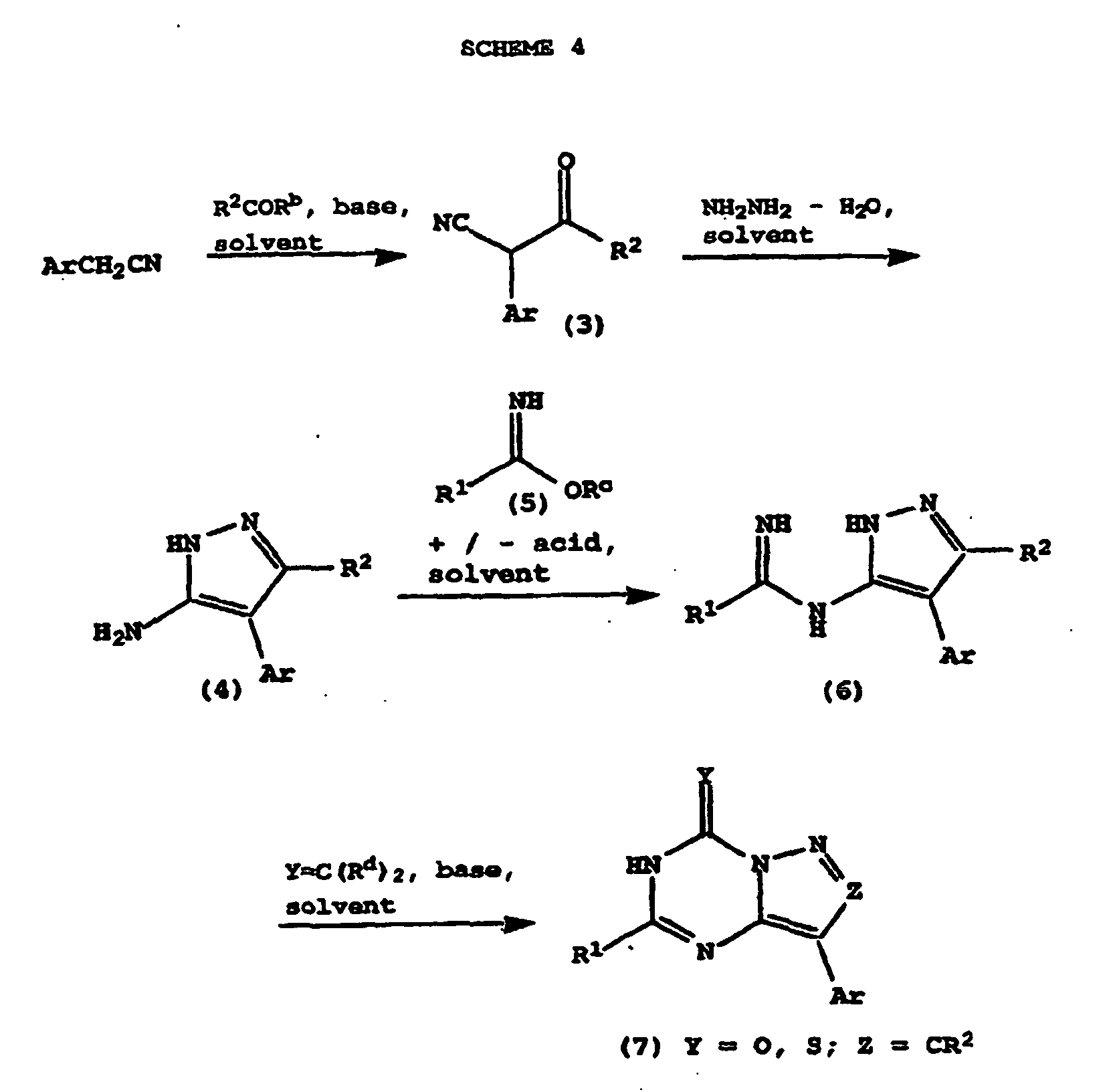
- Compounds of Formula (3) may be treated with hydrazine-hydrate in the presence of an inert solvent at temperatures ranging from 0°C to 200°C, preferably 70°C to 150°C, to produce compounds of Formula (4). Inert solvents may include, but are not limited to, water, alkyl alcohols (1 to 8 carbons, preferably methanol or ethanol), lower alkanenitriles (1 to 6 carbons, preferably acetonitrile), cyclic ethers (preferably tetrahydrofuran or 1,4-dioxane), N,N-dialkylformamides (preferably dimethylformamide), N,N-dialkylacetamides (preferably dimethylacetamide), cyclic amides (preferably N-methylpyrrolidin-2-one), dialkylsulfoxides (preferably dimethylsulfoxide) or aromatic hydrocarbons (preferably benzene or toluene). Compounds of Formula (4) may be reacted with compounds of Formula (5) (where Rc is alkyl (1-6 carbons)) in the presence or absence of an acid in the presence of an inert solvent at temperatures ranging from 0°C to 200°C to produce compounds of Formula (6). Acids may include, but are not limited to alkanoic acids of 2 to 10 carbons (preferably acetic acid), haloalkanoic acids (2 - 10 carbons, 1-10 halogens, such as trifluoroacetic acid), arylsulfonic acids (preferably p-toluenesulfonic acid or benzenesulfonic acid), alkanesulfonic acids of 1 to 10 carbons (preferably methanesulfonic acid), hydrochloric acid, sulfuric acid or phosphoric acid. Stoichiometric or catalytic amounts of such acids may be used. Inert solvents may include, but are not limited to, water, alkanenitriles (1 to 6 carbons, preferably acetonitrile), halocarbons of 1 to 6 carbons and 1 to 6 halogens (preferably dichloromethane or chloroform), alkyl alcohols of 1 to 10 carbons (preferably ethanol), dialkyl ethers (4 to 12 carbons, preferably diethyl ether or di-isopropylether) or cyclic ethers such as dioxan or tetrahydrofuran. Preferred temperatures range from ambient temprature to 100°C.
- Compounds of Formula (6) may be converted to intermediate compounds of Formula (7) by treatment with compounds C=Y(Rd)2 (where Y is O or S and Rd is halogen (preferably chlorine), alkoxy (1 to 4 carbons) or alkylthio (1 to 4 carbons)) in the presence or absence of a base in an inert solvent at reaction temperatures from -50°C to 200°C. Bases may include, but are not limited to, alkali metal hydrides (preferably sodium hydride), alkali metal alkoxides (1 to 6 carbons) (preferably sodium methoxide or sodium ethoxide), alkali metal carbonates, alkali metal hydroxides, trialkyl amines (preferably N,N-diisopropyl-N-ethyl amine or triethylamine) or aromatic amines (preferably pyridine). Inert solvents may include, but are not limited to, alkyl alcohols (1 to 8 carbons, preferably methanol or ethanol), lower alkanenitriles (1 to 6 carbons, preferably acetonitrile), cyclic ethers (preferably tetrahydrofuran or 1,4-dioxane), N,N-dialkylformamides (preferably dimethylformamide), N,N-dialkylacetamides (preferably dimethylacetamide), cyclic amides (preferably N-methylpyrrolidin-2-one), dialkylsulfoxides (preferably dimethylsulfoxide) or aromatic hydrocarbons (preferably benzene or toluene). Preferred temperatures are 0°C to 150°C.
- Intermediate compounds of Formula (7), where Z is N, may be synthesized according the methods outlined in Scheme 5.Compounds of ArCH2CN are reacted with compounds of Formula RqCH2N3 (where Rq is a phenyl group optionally substituted by H, alkyl (1 to 6 carbons) or alkoxy (1 to 6 carbons) in the presence or absence of a base in an inert solvent at temperatures ranging from 0°C to 200°C to generate compounds of Formula (9). Bases may include, but are not limited to, alkali metal hydrides (preferably sodium hydride), alkali metal alkoxides (1 to 6 carbons)(preferably sodium methoxide, sodium ethoxide or potassium t-butoxide), alkaline earth metal hydrides, alkali metal dialkylamides (preferably lithium di-isopropylamide), alkali metal carbonates, alkali metal hydroxides, alkali metal bis(trialkylsilyl)amides (preferably sodium bis(trimethylsilyl)amide), trialkyl amines (preferably N,N-di-isopropyl-N-ethyl amine or triethylamine) or aromatic amines (preferably pyridine). Inert solvents may include, but are not limited to, alkyl alcohols (1 to 8 carbons, preferably methanol or ethanol), lower alkanenitriles (1 to 6 carbons, preferably acetonitrile), dialkyl ethers (preferably diethyl ether), cyclic ethers (preferably tetrahydrofuran or 1,4-dioxane), N,N-dialkylformamides (preferably dimethylformamide), N,N-dialkylacetamides (preferably dimethylacetamide), cyclic amides (preferably N-methylpyrrolidin-2-one), dialkylsulfoxides (preferably dimethylsulfoxide) or aromatic hydrocarbons (preferably benzene or toluene). Preferred reaction temperatures range from ambient temperature to 100°C. Compounds of Formula (9) may be treated with a reducing agent in an inert solvent at -100°C to 100°C to afford products of Formula (10). Reducing agents include, but are not limited to, (a) hydrogen gas in combination with noble metal catalysts such as Pd-on-carbon, PtO2, Pt-on-carbon, Rh-on-alumina or Raney nickel, (b) alkali metals (preferably sodium) in combination with liquid ammonia or (c) ceric ammonium nitrate. Inert solvents may include, but are not limited to, alkyl alcohols (1 to 8 carbons, preferably methanol or ethanol), lower alkanenitriles (1 to 6 carbons, preferably acetonitrile), water, dialkyl ethers (preferably diethyl ether), cyclic ethers (preferably tetrahydrofuran or 1,4-dioxane), N,N-dialkylformamides (preferably dimethylformamide), N,N-dialkylacetamides (preferably dimethylacetamide), cyclic amides (preferably N-methylpyrrolidin-2-one), dialkylsulfoxides (preferably dimethylsulfoxide) or aromatic hydrocarbons (preferably benzene or toluene). The preferred reaction temperatures are -50°C to 60°C. Compounds of Formula (9) are then converted to compounds of Formula (7) (where Z is N) via intermediates of Formula (11) using the reagents and reaction conditions outlined in Scheme 4 for the conversion of compounds of Formula (4) to compounds of Formula (7) (where Z is CR2).

- Compounds of Formula (1) may also be prepared from compounds of Formula (7) (where Y is O, S and Z is defined above) as outlined in Scheme 6:Compounds of Formula (7) may be reacted with compounds of Formula R3H in the presence of a dehydrating agent in an inert solvent at reaction temperatures ranging from 0°C to 250°C. Dehydrating agents include, but are not limited to, P2O5, molecular sieves or inorganic or organic acids. Acids may include, but are not limited to alkanoic acids of 2 to 10 carbons (preferably acetic acid), arylsulfonic acids (preferably p-toluenesulfonic acid or benzenesulfonic acid), alkanesulfonic acids of 1 to 10 carbons (preferably methanesulfonic acid), hydrochloric acid, sulfuric acid or phosphoric acid. Inert solvents may include, but are not limited to, alkyl alcohols (1 to 8 carbons, preferably methanol or ethanol), lower alkanenitriles (1 to 6 carbons, preferably acetonitrile), dialkyl ethers (preferably glyme or diglyme), cyclic ethers (preferably tetrahydrofuran or 1,4-dioxane), N,N-dialkylformamides (preferably dimethylformamide), N,N-dialkylacetamides (preferably dimethylacetamide), cyclic amides (preferably N-methylpyrrolidin-2-one), dialkylsulfoxides (preferably dimethylsulfoxide), aromatic hydrocarbons (preferably benzene or toluene) or halocarbons of 1 to 10 carbons and 1 to 10 halogens (preferably chloroform). Preferred reaction temperatures range from ambient temperature to 150°C.

- Some compounds of Formula (1) (where A is N) may also be prepared by the methods shown in Scheme 7:Intermediate compounds of Formula (14), where Z is defined above, may be reacted with compounds of Formula R3C(ORe)3, where Re may be alkyl (1 to 6 carbons) in the presence or absence of an acid in an inert solvent at temperatures ranging from 0°C to 250°C. Acids may include, but are not limited to alkanoic acids of 2 to 10 carbons (preferably acetic acid), arylsulfonic acids (preferably p-toluenesulfonic acid or benzenesulfonic acid), alkanesulfonic acids of 1 to 10 carbons (preferably methanesulfonic acid), hydrochloric acid, sulfuric acid or phosphoric acid. Stoichiometric or catalytic amounts of such acids may be used. Inert solvents may include, but are not limited to, lower alkanenitriles (1 to 6 carbons, preferably acetonitrile), dialkyl ethers (preferably diethyl ether), cyclic ethers (preferably tetrahydrofuran or 1,4-dioxane), N,N-dialkylformamides (preferably dimethylformamide), N,N-dialkylacetamides (preferably dimethylacetamide), cyclic amides (preferably N-methylpyrrolidin-2-one), dialkylsulfoxides (preferably dimethylsulfoxide), aromatic hydrocarbons (preferably benzene or toluene) or haloalkanes of 1 to 10 carbons and 1 to 10 halogens (preferably dichloromethane). Preferred reaction temperatures range from 50°C to 150°C.

- Intermediate compounds of Formula (7) may also be synthesized by the reactions displayed in Scheme 8.Compounds of Formula (15), (where Y is OH, SH, NR6R7; Z is defined above, X is Br, Cl, I, O3SCF3 or B(OR"")2 and R"" is H or alkyl (1 to 6 carbons)) may be reacted with a compound of Formula ArM (where M is halogen, alkali metal, ZnCl, ZnBr, ZnI, MgBr, MgCl, MgI, CeCl2, CeBr2 or copper halides) in the presence or absence of an organometallic catalyst in the presence or absence of a base in an inert solvents at temperatures ranging from -100°C to 200°C. Those skilled in the art will recognize that the reagents ArM may be generated in situ. Organometallic catalysts include, but are not limited to, palladium phosphine complexes (such as Pd(PPh3)4), palladium halides or alkanoates (such as PdC12(PPh3)2 or Pd(OAc)2) or nickel complexes (such as NiCl2(PPh3)2). Bases may include, but are not limited to, alkali metal carbonates or trialkyl amines (preferably N,N-di-isopropyl-N-ethyl amine or triethylamine). Inert solvents may include, but are not limited to, dialkyl ethers (preferably diethyl ether), cyclic ethers (preferably tetrahydrofuran or 1,4-dioxane), N,N-dialkylformamides (preferably dimethylformamide), N,N-dialkylacetamides (preferably dimethylacetamide), cyclic amides (preferably N-methylpyrrolidin-2-one), dialkylsulfoxides (preferably dimethylsulfoxide), aromatic hydrocarbons (preferably benzene or toluene) or water. Preferred reaction temperatures range from -80°C to 100°C. The choices of M and X are known to those skilled in the art (cf. Imamoto, T., Organocerium Reagents in Comprehensive organic Synthesis, Trost, B.M. ed., (Elmsford, NY: Pergamon Press, 1991), 1, 231-250; Knochel, P., Organozinc, Organocadmium and Organomercury Reagents in Comprehensive Organic Synthesis, Trost, B.M. ed., (Elmsford, NY: Pergamon Press, 1991), 1, 211-230; Knight, D.W., Coupling Reactions between sp2 Carbon Centers, in Comprehensive Organic Synthesis, Trost, B.M. ed., (Elmsford, NY: Pergamon Press, 1991), 3, 481-520).

- Compounds of Formula (1) may also be prepared using the methods shown in Scheme 9.Compounds of Formula (16), where A, Z, R1 and R3 are defined above and X is Br, Cl, I, O3SCF3 or B(OR"")2 and R"" is H or alkyl (1 to 6 carbons)) may be reacted with a compound of Formula ArM (where M is halogen, alkali metal, ZnCl, ZnBr, ZnI, MgBr, MgCl, MgI, CeCl2, CeBr2 or copper halides) in the presence or absence of an organometallic catalyst in the presence or absence of a base in an inert solvents at temperatures ranging from -100°C to 200°C. Those skilled in the art will recognize that the reagents ArM may be generated in situ (see the above references in Comprehensive Organic Synthesis). Organometallic catalysts include, but are not limited to, palladium phosphine complexes (such as Pd(PPh3)4), palladium halides or alkanoates (such as PdCl2(PPh3)2 or Pd(OAC)2) or nickel complexes (such as NiCl2(PPh3)2). Bases may include, but are not limited to, alkali metal carbonates or trialkyl amines (preferably N,N-di-isopropyl-N-ethyl amine or triethylamine). Inert solvents may include, but are not limited to, dialkyl ethers (preferably diethyl ether), cyclic ethers (preferably tetrahydrofuran or 1,4-dioxane), N,N-dialkylformamides (preferably dimethylformamide), N,N-dialkylacetamides (preferably dimethylacetamide), cyclic amides (preferably N-methylpyrrolidin-2-one), dialkylsulfoxides (preferably dimethylsulfoxide), aromatic hydrocarbons (preferably benzene or toluene) or water. Preferred reaction temperatures range from -80°C to 100°C.

- Intermediate compounds of Formula (7) (where Y is O, S, NH, Z is CR2 and R1, R2 and Ar are defined as above) may be prepared as illustrated in Scheme 10.Compounds of Formula (3) may be reacted with compounds of Formula H2NNH(C=Y)NH2, where Y is O, S or NH, in the presence or absence of a base or acid in an inert solvent at temperatures from 0°C to 250°C to produce compounds of Formula (17). Acids may include, but are not limited to alkanoic acids of 2 to 10 carbons (preferably acetic acid), arylsulfonic acids (preferably p-toluenesulfonic acid or benzenesulfonic acid), alkanesulfonic acids of 1 to 10 carbons (preferably methanesulfonic acid), hydrochloric acid, sulfuric acid or phosphoric acid. Stoichiometric or catalytic amounts of such acids may be used. Bases may include, but are not limited to, alkali metal hydrides (preferably sodium hydride), alkali metal alkoxides (1 to 6 carbons)(preferably sodium methoxide or sodium ethoxide), alkaline earth metal hydrides, alkali metal dialkylamides (preferably lithium di-isopropylamide), alkali metal bis(trialkylsilyl)amides (preferably sodium bis(trimethylsilyl)amide), trialkyl amines (preferably N,N-di-isopropyl-N-ethyl amine or triethylamine) or aromatic amines (preferably pyridine). Inert solvents may include, but are not limited to, alkyl alcohols (1 to 6 carbons), lower alkanenitriles (1 to 6 carbons, preferably acetonitrile), dialkyl ethers (preferably diethyl ether), cyclic ethers (preferably tetrahydrofuran or 1,4-dioxane), N,N-dialkylformamides (preferably dimethylformamide), N,N-dialkylacetamides (preferably dimethylacetamide), cyclic amides (preferably N-methylpyrrolidin-2-one), dialkylsulfoxides (preferably dimethylsulfoxide), aromatic hydrocarbons (preferably benzene or toluerie) or haloalkanes of 1 to 10 carbons and 1 to 10 halogens (preferably dichloromethane).

- Preferred reaction temperatures range from 0°C to 150°C. Compounds of Formula (17) may then be reacted with compounds of Formula R3C(ORe)3, where Re may be alkyl (1 to 6 carbons) in the presence or absence of an acid in an inert solvent at temperatures ranging from 0°C to 250°C. Acids may include, but are not limited to alkanoic acids of 2 to 10 carbons (preferably acetic acid), arylsulfonic acids (preferably p-toluenesulfonic acid or benzenesulfonic acid), alkanesulfonic acids of 1 to 10 carbons (preferably methanesulfonic acid), hydrochloric acid, sulfuric acid or phosphoric acid. Stoichiometric or catalytic amounts of such acids may be used. Inert solvents may include, but are not limited to, lower alkanenitriles (1 to 6 carbons, preferably acetonitrile), dialkyl ethers (preferably diethyl ether), cyclic ethers (preferably tetrahydrofuran or 1,4-dioxane), N,N-dialkylformamides (preferably dimethylformamide), N,N-dialkylacetamides (preferably dimethylacetamide), cyclic amides (preferably N-methylpyrrolidin-2-one), dialkylsulfoxides (preferably dimethylsulfoxide), aromatic hydrocarbons (preferably benzene or toluene) or haloalkanes of 1 to 10 carbons and 1 to 10 halogens (preferably dichloromethane). Preferred reaction temperatures range from 50°C to 150°C.
- In Scheme 11, the procedures which may be used to convert compounds of Formula (1), where R3 is COR7, CO2R7, NR8COR7 and CONR6R7, to other compounds of Formula (1), where R3 is CH(OH)R7, CH2OH, NR8CH2R7 and CH2NR6R7 by treatment with a reducing agent in an inert solvent at temperatures ranging from -80°C to 250°C.Reducing agents include, but are not limited to, alkali metal or alkaline earth metal borohydrides (preferably lithium or sodium borohydride), borane, dialkylboranes (such as di-isoamylborane), alkali metal aluminum hydrides (preferably lithium aluminum hydride), alkali metal (trialkoxy)aluminum hydrides, or dialkyl aluminum hydrides (such as di-isobutylaluminum hydride). Inert solvents may include, but are not limited to, alkyl alcohols (1 to 6 carbons), dialkyl ethers (preferably diethyl ether), cyclic ethers (preferably tetrahydrofuran or 1,4-dioxane), aromatic hydrocarbons (preferably benzene or toluene). Preferred reaction temperatures range from -80°C to 100°C.

- In Scheme 12, the procedures are shown which may be used to convert compounds of Formula (1), where R3 is COR7 or CO2R7, to other compounds of Formula (1), where R3 is C(OH) (R7)2 by treatment with a reagent of Formula R7M in an inert solvent at temperatures ranging from -80°C to 250°C.M is halogen, alkali metal, ZnCl, ZnBr, ZnI, MgBr, MgCl, MgI, CeCl2, CeBr2 or copper halides. Inert solvents may include, but are not limited to, dialkyl ethers (preferably diethyl ether), cyclic ethers (preferably tetrahydrofuran) or aromatic hydrocarbons (preferably benzene or toluene). Preferred reaction temperatures range from -80°C to 100°C.
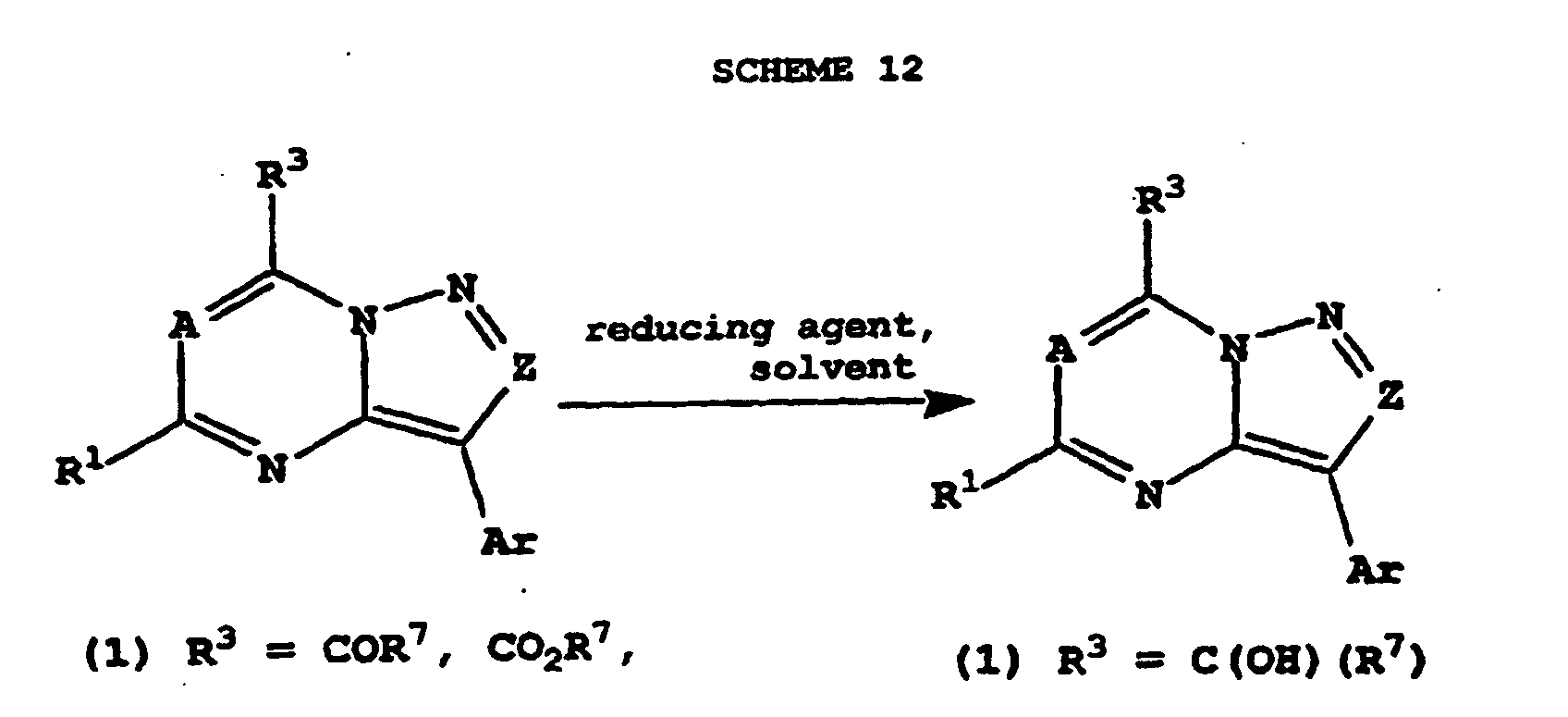
- Compounds of Formula (1), where R3 may be - NR8COR7, -N(COR7)2, -NR8CONR6R7, -NR8CO2R13, -NR6R7, - NR8SO2R7, may be synthesized as depicted in Scheme 13.Reaction of compounds of Formula (18), where R and R1 are defined above, with compounds of Formula (4) or (10) in the presence or absence of base in an inert solvent may produce compounds of Formula (19) at temperatures ranging from -50°C to 250°C. Bases may include, but are not limited to, alkali metal hydrides (preferably sodium hydride), alkali metal alkoxides (1 to 6 carbons) (preferably sodium methoxide or sodium ethoxide), alkaline earth metal hydrides, alkali metal dialkylamides (preferably lithium di-isopropylamide), alkali metal carbonates, alkali metal bis(trialkylsilyl)amides (preferably sodium bis(trimethylsilyl)amide), trialkyl amines (prefereably di-isopropylethyl amine) or aromatic amines (preferably pyridipe). Inert solvents may include, but are not limited to, alkyl alcohols (1 to 8 carbons, preferably methanol or ethanol), lower alkanenitriles (1 to 6 carbons, preferably acetonitrile), dialkyl ethers (preferably diethyl ether), cyclic ethers (preferably tetrahydrofuran or 1,4-dioxane), N,N-dialkylformamides (preferably dimethylformamide), N,N-dialkylacetamides (preferably dimethylacetamide), cyclic amides (preferably N-methylpyrrolidin-2-one), dialkylsulfoxides (preferably dimethylsulfoxide) or aromatic hydrocarbons (preferably benzene or toluene).' Preferred reaction temperatures range from 0°C to 100°C.

- Compounds of Formula (19) may then be reacted with alkylating agents, sulfonylating agents or acylating agents or sequential reactions with combinations thereof, in the presence or absence of a base in an inert solvent at reaction temperatures ranging from - 80°C to 250°C may afford compounds of Formula (1), where R3 may be -NR8COR7, -N(COR7)2, -NR8CONR6R7, - NR8CO2R13, -NR6R7, -NR8SO2R7. Alkylating agents may include, but are not limited to, C1-C10 alkyl -halides, -tosylates, -mesylates or -triflates; C1-C10 haloalkyl(1 - 10 halogens)-halides, -tosylates, - mesylates or -triflates; C2-C8 alkoxyalkyl-halides, - tosylates, -mesylates or -triflates; C3-C6 cycloalkyl-halides, -tosylates, -mesylates or -triflates; C4-C12 cycloalkylalkyl-halides, -tosylates, -mesylates or -triflates; aryl(C1-C4 alkyl)-halides, -tosylates, - mesylates or -triflates; heteroaryl(C1-C4 alkyl)-halides, -tosylates, -mesylates or -triflates; or heterocyclyl(C1-C4 alkyl)-halides, -tosylates, - mesylates or -triflates. Acylating agents may include, but are not limited to, C1-C10 alkanoyl halides or anhydrides, C1-C10 haloalkanoyl halides or anhydrides with 1 - 10 halogens, C2-C8 alkoxyalkanoyl halides or anhydrides, C3-C6 cycloalkanoyl halides or anhydrides, C4-C12 cycloalkylalkanoyl halides or anhydrides, aroyl halides or anhydrides, aryl(C1-C4) alkanoyl halides or anhydrides, heteroaroyl halides or anhydrides, heteroaryl(C1-C4) alkanoyl halides or anhydrides, heterocyclylcarboxylic acid halides or anhydrides or heterocyclyl(C1-C4) alkanoyl halides or anhydrides. Sulfonylating agents include, but are not limited to, C1-C10 alkylsulfonyl halides or anhydrides, C1-C10 haloalkylsulfonyl halides or anhydrides with 1 - 10 halogens, C2-C8 alkoxyalkylsulfonyl halides or anhydrides, C3-C6 cycloalkylsulfonyl halides or anhydrides, C4-C12 cycloalkylalkylsulfonyl halides or anhydrides, arylsulfonyl halides or anhydrides, aryl(C1-C4 alkyl)-, heteroarylsulfonyl halides or anhydrides, heteroaryl(C1-C4 alkyl)sulfonyl halides or anhydrides, heterocyclylsulfonyl halides or anhydrides or heterocyclyl(C1-C4 alkyl)sulfonyl halides or anhydrides. Bases may include, but are not limited to, alkali metal hydrides (preferably sodium hydride), alkali metal alkoxides (1 to 6 carbons)(preferably sodium methoxide or sodium ethoxide), alkaline earth metal hydrides, alkali metal dialkylamides (preferably lithium di-isopropylamide), alkali metal carbonates, alkali metal bis(trialkylsilyl)amides (preferably sodium bis(trimethylsilyl)amide), trialkyl amines (prefereably di-isopropylethyl amine) or aromatic amines (preferably pyridine). Inert solvents may include, but are not limited to, alkyl alcohols (1 to 8 carbons, preferably methanol or ethanol), lower alkanenitriles (1 to 6 carbons, preferably acetonitrile), dialkyl ethers (preferably diethyl ether), cyclic ethers (preferably tetrahydrofuran or 1,4-dioxane), N,N-dialkylformamides (preferably dimethylformamide), N,N-dialkylacetamides (preferably dimethylacetamide), cyclic amides (preferably N-methylpyrrolidin-2-one), dialkylsulfoxides (preferably dimethylsulfoxide) or aromatic hydrocarbons (preferably benzene or toluene). Preferred reaction temperatures range from 0°C to 100°C.
- Compounds of Formula (1), where A is CR and R is defined above, may be synthesized by the methods depicted in Scheme 14.Compounds of Formula (4) or (10) may be treated with compounds of Formula (20), where R1 and R3 are defined above in the presence or absence of base in an inert solvent at temperatures ranging from 0°c to 250°C to give compounds of Formula (1), where A is CR and R is defined above. Bases may include, but are not limited to, alkali metal hydrides (preferably sodium hydride), alkali metal alkoxides (1 to 6 carbons)(preferably sodium methoxide or sodium ethoxide), alkaline earth metal hydrides, alkali metal dialkylamides (preferably lithium di-isopropylamide), alkali metal carbonates, alkali metal bis(trialkylsilyl)amides (preferably sodium bis(trimethylsilyl)amide), trialkyl amines (preferably di-isopropylethyl amine) or aromatic amines (preferably pyridine). Inert solvents may include, but are not limited to, alkyl alcohols (1 to 8 carbons, preferably methanol or ethanol), lower alkanenitriles (1 to 6 carbons, preferably acetonitrile), dialkyl ethers (preferably diethyl ether), cyclic ethers (preferably tetrahydrofuran or 1,4-dioxane), N,N-dialkylformamides (preferably dimethylformamide), N,N-dialkylacetamides (preferably dimethylacetamide), cyclic amides (preferably N-methylpyrrolidin-2-one), dialkylsulfoxides (preferably dimethylsulfoxide) or aromatic hydrocarbons (preferably benzene or toluene). Preferred reaction temperatures range from 0°C to 100°C. Alternatively, compounds of Formula (1) where A is CR and R is defined above, may be synthesized through intermediates (22) and (23).

- Compounds of Formula (4) or (10) may be treated with compounds of Formula (21), where R1 is defined above and Re is alkyl (1 - 6 carbons), in the presence or absence of base in an inert solvent at temperatures ranging from 0°C to 250°C to give compounds of Formula (1), where A is CR and R is defined above. Bases may include, but are not limited to, alkali metal hydrides (preferably sodium hydride), alkali metal alkoxides (1 to 6 carbons)(preferably sodium methoxide or sodium ethoxide), alkaline earth metal hydrides, alkali metal dialkylamides (preferably lithium di-isopropylamide), alkali metal carbonates, alkali metal bis(trialkylsilyl)amides (preferably sodium bis(trimethylsilyl)amide), trialkyl amines (prefereably di-isopropylethyl amine) or aromatic amines (preferably pyridine). Inert solvents may include, but are not limited to, alkyl alcohols (1 to 8 carbons, preferably methanol or ethanol), lower alkanenitriles (1 to 6 carbons, preferably acetonitrile), dialkyl ethers (preferably diethyl ether), cyclic ethers (preferably tetrahydrofuran or 1,4-dioxane), N,N-dialkylformamides (preferably dimethylformamide), N,N-dialkylacetamides (preferably dimethylacetamide), cyclic amides (preferably N-methylpyrrolidin-2-one), dialkylsulfoxides (preferably dimethylsulfoxide) or aromatic hydrocarbons (preferably benzene or toluene) . Preferred reaction temperatures range from 0°C to 100°C. Compounds of Formula (22) may be treated with a halogenating agent or sulfonylating agent in the presence or absence of a base in the presence or absence of an inert solvent at reaction temperatures ranging from -80°C to 250°C to give products of Formula (23) (where X is halogen, alkanesulfonyloxy, arylsulfonyloxy or haloalkane-sulfonyloxy). Halogenating agents include, but are not limited to, SOCl2, POCl3, PCl3, PCl5, POBr3, PBr3 or PBr5. Sulfonylating agents include, but are not limited to, alkanesulfonyl halides or anhydrides (such as methanesulfonyl chloride or methanesulfonic acid anhydride), arylsulfonyl halides or anhydrides (such as p-toluenesulfonyl chloride or anhydride) or haloalkylsulfonyl halides or anhydrides (preferably trifluoromethanesulfonic anhydride). Bases may include, but are not limited to, alkali metal hydrides (preferably sodium hydride), alkali metal alkoxides (1 to 6 carbons) (preferably sodium methoxide or sodium ethoxide), alkaline earth metal hydrides, alkali metal dialkylamides (preferably lithium di-isopropylamide), alkali metal bis(trialkylsilyl)amides (preferably sodium bis(trimethylsilyl)amide), trialkyl amines (preferably N,N-di-isopropyl-N-ethyl amine or triethylamine) or aromatic amines (preferably pyridine). Inert solvents may include, but are not limited to, lower alkanenitriles (1 to 6 carbons, preferably acetonitrile), dialkyl ethers (preferably diethyl ether), cyclic ethers (preferably tetrahydrofuran or 1,4-dioxane), N,N-dialkylformamides (preferably dimethylformamide), N,N-dialkylacetamides (preferably dimethylacetamide), cyclic amides (preferably N-methylpyrrolidin-2-one), dialkylsulfoxides (preferably dimethylsulfoxide), aromatic hydrocarbons (preferably benzene or toluene) or haloalkanes of 1 to 10 carbons and 1 to 10 halogens (preferably dichloromethane). Preferred reaction temperatures range from -20°C to 100°C.
- Compounds of Formula (23) may be reacted with compounds of Formula R3H (where R3 is defined as above except R3 is not SH, COR7, CO2R7, aryl or heteroaryl) in the presence or absence of a base in the presence or absence of an inert solvent at reaction temperatures ranging from -80°C to 250°C to generate compounds of Formula (1). Bases may include, but are not limited to, alkali metal hydrides (preferably sodium hydride), alkali metal alkoxides (1 to 6 carbons) (preferably sodium methoxide or sodium ethoxide), alkaline earth metal hydrides, alkali metal dialkylamides (preferably lithium di-isopropylamide), alkali metal carbonates, alkali metal bicarbonates, alkali metal bis(trialkylsilyl)amides (preferably sodium bis(trimethylsilyl)amide), trialkyl amines (preferably N,N-di-isopropyl-N-ethyl amine) or aromatic amines (preferably pyridine). Inert solvents may include, but are not limited to, alkyl alcohols (1 to 8 carbons, preferably methanol or ethanol), lower alkanenitriles (1 to 6 carbons, preferably acetonitrile), dialkyl ethers (preferably diethyl ether), cyclic ethers (preferably tetrahydrofuran or 1,4-dioxane), N,N-dialkylformamides (preferably dimethylformamide), N,N-dialkylacetamides (preferably dimethylacetamide), cyclic amides (preferably N-methylpyrrolidin-2-one), dialkylsulfoxides (preferably dimethylsulfoxide), aromatic hydrocarbons (preferably benzene or toluene) or haloalkanes of 1 to 10 carbons and 1 to 10 halogens (preferably dichloromethane). Preferred reaction temperatures range from 0°C to 140°C.
- Some compounds of Formula (1) may also be prepared using the methods shown in Scheme 15.A compound of Formula (24) (Rc is a lower alkyl group and Ar is defined as above) may be reacted with hydrazine in the presence or absence of an inert solvent to afford an intermediate of Formula (25), where Ar is defined as above. The conditions employed are similar to those used for the preparation of intermediate of Formula (4) from compound of Formula (3) in Scheme 4. Compounds of Formula (25), where A is N, may be reacted with reagents of the formula R1C(=NH)ORe, where R1 is defined above and Re is a lower alkyl group) in the presence or absence of an acid in an inert solvent, followed by reaction with a compound of formula YisC(Rd)2 (where Y is O or S and Rd is halogen (preferably chlorine), alkoxy (1 to 4 carbons) or alkylthio (1 to 4 carbons)) in the presence or absence of a base in an inert solvent to give compounds of Formula (27) (where A is N and Y is 0, S). The conditions for these transformations are the same as those employed for the conversions of compound of Formula (4) to compound of Formula (7) in Scheme 4.

- Alternatively, compounds of Formula (25), where A is CR, may be reacted with compounds of the formula R1(C=O)CHR(C=Y)ORc (where R1 and R are defined as above and Rc is a lower alkyl group) to give a compound of Formula (27) (where A is CR) using conditions similar to those employed for the conversion of compounds of Formula (21) to compounds of Formula (22) in Scheme 14. Intermediates of Formula (27) (where Y is O) may be treated with halogenating agents or sulfonylating agents in the presence or absence of a base in an inert solvent, followed by reaction with R3H or R2H in the presence or absence of a base in an inert solvent to give compounds of Formula (1) (where Z is CR2).
- It will be recognized by those skilled in the art that various combinations of halogenating agents, sulfonylating agents, R3H or R2H may be used in different orders of reaction sequences in Scheme 15 to afford compounds of Formula (1). For example, in some cases, it may be desirable to react compounds with stoichiometric amounts of halogenating agents or sulfonylating agents, react with R2H (or R3H), then repeat the reaction with halogenating agents or sulfonylating agents and react with R3H (or R2H) to give compounds of Formula (1). The reaction conditions and reagents used for these conversions are similar to the ones employed for the conversion of intermediate compounds of Formulae (22) to (23) to (1) in Scheme 14 (for A is CR) or the conversion of intermediate compounds of Formulae (7) to (8) to (1) in Scheme 1 (where A is N).
- Alternatively, compounds of Formula (27) (where Y is S) may be converted to compounds of Formula (1) in Scheme 15. Intermediate compounds of Formula (27) may be alkylated with a compound RfX (where Rf is lower alkyl and X is halogen, alkanesulfonyloxy or haloalkanesulfonyloxy) in an inert solvent, (then optionally oxidized with an oxidizing agent in an inert solvent) and then reacted with R3H in the presence or absence of a base in an inert solvent to give a compound of Formula (1). The conditions and reagents employed are similar to those used in the conversion of intermediate compounds of Formulae (7) to (12) (or to (13)) to compounds of Formula (1) in Scheme 2.
- Compounds of Formula (1) may be prepared from compounds of Formula (24), using an alternate route as depicted in Scheme 15. Compounds of Formula (24) may be converted to compounds of Formula (27) via reaction with compounds of formula NH2NH(C=NH)NH2 in the presence or absence of an acid in an inert solvent, followed by reaction with compounds R1C(ORc)3 (where Rc is lower alkyl and R1 is defined as above), using the conditions employed for the conversion of compounds of Formulae (3) to (17) to (7) in Scheme 10.
- Some compounds of Formula (2) may be prepared by the methods illustrated in Scheme 16.Compounds of Formula (27b) may be treated with various alkylating agents R14X (where R14 is defined above and X is halogen, alkanesulfonyloxy or haloalkanesulfonyloxy) in the presence or absence of a base in an inert solvent to afford structures of Formula (28). Compounds of Formula (28) (Y is O) may then be converted to compounds of Formula (2) by treatment with halogenating agents or sulfonylating agents in the presence or absence of a base in an inert solvent, followed by reaction with R3H in the presence or absence of a base in an inert solvent to give compounds of Formula (2). The reaction conditions used for these conversions are similar to the ones employed for the conversion of intermediate compounds (22) to (23) to (1) in Scheme 14 (for A is CR) or the conversion of intermediate compounds of Formulae (7) to (8) to (1) in Scheme 1 (where A is N). Alternatively, compounds of Formula (28) (Y is S) may be alkylated with a compound RfX (where Rf is lower alkyl and X is halogen, alkanesulfonyloxy or haloalkanesulfonyloxy) in an inert solvent, (then optionally oxidized with an oxidizing agent in an inert solvent) and then reacted with R3H in the presence or absence of a base in an inert solvent to give a compound of Formula (1). The conditions and reagents employed are similar to those used in the conversion of intermediate compounds of Formulae (7) to (12) (or to (13)) to compounds of Formula (1) in Scheme 2.

- Compounds of Formula (1), where Z is COH, may be converted to compounds of Formula (2) as illustrated in Scheme 16. Treatment with various alkylating agents R14X (where R14 is defined above and X is halogen, alkanesulfonyloxy or haloalkanesulfonyloxy) in the presence or absence of a base in an inert solvent to afford structures (2). It will be recognized by one skilled in the art that the methods used in Scheme 16 may also be used to prepare compounds of Formula (1) where Z is COR7.
- For Scheme 16, the terms "base" and " inert solvent" may have the meanings given below. Bases may include, but are not limited to, alkali metal hydrides (preferably sodium hydride), alkali metal alkoxides (1 to 6 carbons) (preferably sodium methoxide or sodium ethoxide), alkaline earth metal hydrides, alkali metal dialkylamides (preferably lithium di-isopropylamide), alkali metal bis(trialkylsilyl)amides (preferably sodium bis(trimethylsilyl)amide), trialkyl amines (preferably N,N-di-isopropyl-N-ethyl amine or triethylamine) or aromatic amines (preferably pyridine). Inert solvents may include, but are not limited to, lower alkanenitriles (1 to 6 carbons, preferably acetonitrile), dialkyl ethers (preferably diethyl ether), cyclic ethers (preferably tetrahydrofuran or 1,4-dioxane), N,N-dialkylformamides (preferably dimethylformamide), N,N-dialkylacetamides (preferably dimethylacetamide), cyclic amides (preferably N-methylpyrrolidin-2-one), dialkylsulfoxides (preferably dimethylsulfoxide), aromatic hydrocarbons (preferably benzene or toluene) or haloalkanes of 1 to 10 carbons and 1 to 10 halogens (preferably dichloromethane). Preferred reaction temperatures range from -20°C to 100°C.
- Analytical data were recorded for the compounds described below using the following general procedures. Proton NMR spectra were recorded on an IBM-Bruker FT-NMR (300 MHz) ; chemical shifts were recorded in ppm (δ) from an internal tetramethysilane standard in deuterochloroform or deuterodimethylsulfoxide as specified below. Mass spectra (MS) or high resolution mass spectra (HRMS) were recorded on a Finnegan MAT 8230 spectrometer (using chemi-ionization (CI) with NH3 as the carrier gas or gas chromatography (GC) as specified below) or a Hewlett Packard 5988A model spectrometer. Melting points were recorded on a Buchi Model 510 melting point apparatus and are uncorrected. Boiling points are uncorrected. All pH determinations during workup were made with indicator paper.
- Reagents were purchased from commercial sources and, where necessary, purified prior to use according to the general procedures outlined by D. Perrin and W.L.F. Armarego, Purification of Laboratory Chemicals, 3rd ed., (New York: Pergamon Press, 1988). Chromatography was performed on silica gel using the solvent systems indicated below. For mixed solvent systems, the volume ratios are given. Otherwise, parts and percentages are by weight.
- The following examples are provided to describe the invention in further detail. These examples, which set forth the best mode presently contemplated for carrying out the invention, are intended to illustrate and not to limit the invention.
- Sodium pellets (9.8g, 0.43 mol) were added portionwise to a solution of 2,4-dimethylphenylacetonitrile (48 g, 0.33 mol) in ethyl acetate (150 mL) at ambient temperature. The reaction mixture was heated to reflux temperature and stirred for 16 hours. The resulting suspension was cooled to room temperature and filtered. The collected precipitate was washed with copious amounts of ether and then air-dried. The solid was,dissolved in water and a 1N HCl solution was added until the pH = 5-6. The mixture was extracted with ethyl acetate (3 X 200 mL) ; the combined organic layers were dried over MgSO4 and filtered. Solvent was removed in vacuo to afford a white solid (45.7g, 74% yield): NMR (CDCl3,300 MHz):; CI-MS: 188 (M + H).
- A mixture of 1-cyano-1-(2,4-dimethylphenyl)propan-2-one (43.8g, 0.23 mol), hydrazine-hydrate (22 mL, 0.46 mol), glacial acetic acid (45 mL, 0.78 mol) and toluene (500 mL) were stirred at reflux temperature for 18 hours in an apparatus fitted with a Dean-Stark trap. The reaction mixture was cooled to ambient temperature and solvent was removed in vacuo. The residue was dissolved in 6N HCl and the resulting solution was extracted with ether three times. A concentrated ammonium hydroxide solution was added to the aqueous layer until pH = 11. The resulting semi-solution was extracted three times with ethyl acetate. The combined organic layers were dried over MgSO4 and filtered. Solvent was removed in vacuo to give a pale brown viscous oil (34.6g, 75% yield): NMR (CDCl3,300 MHz): 7.10 (s, 1H), 7.05 (d, 2H, J=1), 2.37 (s, 3H), 2.10 (s, 3H); CI-MS: 202 (M + H).
- Ethyl acetamidate hydrochloride (60g, 0.48 mol) was added quickly to a rapidly stirred mixture of potassium carbonate (69.5g, 0.50 mol), dichloromethane (120 mL) and water (350 mL). The layers were separated and the aqueous layer was extracted with dichloromethane (2 X 120 mL). The combined organic layers were dried over MgSO4 and filtered. Solvent was removed by simple distillation and the pot residue, a clear pale yellow liquid, (35.0 g) was used without further purification.
- Glacial aetic acid (9.7 mL, 0.17 mol) was added to a stirred mixture of 5-amino-4-(2,4-dimethylphenyl)-3-methylpyrazole (34g, 0.17 mol), ethyl acetamidate (22g, 0.25 mol) and acetonitrile (500 mL). The resulting reaction mixture was stirred at room temperature for 3 days; at the end of which time, it was concentrated in vacuo to about one-third of its original volume. The resulting suspension was filtered and the collected solid was washed with copious amounts of ether. The white solid was dried in vacuo (31.4g, 61% yield): NMR (DMSO-d6,300 MHz): 7.00 (s, 1H), 6.90 (dd, 2H, J=7, 1), 2. 2 8 (s, 3H), 2.08 (s, 3H), 2.00 (s, 3H), 1.90 (s, 3H), 1.81 (s, 3H); CI-MS: 243 (M + H).
- Sodium pellets (23g, 1 mol) were added portionwise to ethanol (500 mL) with vigorous stirring. After all the sodium reacted, 5-acetamidino-4-(2,4-dimethylphenyl)-3-methylpyrazole, acetic acid salt (31.2g, 0.1 mol) and diethyl carbonate (97 mL, 0.8 mol) were added. The resulting reaction mixture was heated to reflux temperature and stirred for 18 hours. The mix was cooled to room temperature and solvent was removed in vacuo. The residue was dissolved in water and a 1N HCl solution was added slowly until pH = 5-6. The aqueous layer was extracted with ethyl acetate three times; the combined organic layers were dried over MgSO4 and filtered. Solvent was removed in vacuo to give a pale tan solid (26g, 98% yield): NMR (CDCl3, 300 MHz): 7.15(s, 1H), 7.09 (s, 2H), 2.45 (s, 3H), 2.39 (s, 3H), 2.30 (s, 3H); CI-MS: 269 (M + H).
- 5-Amino-4-(2-chloro-4-methylphenyl)-3-methylpyrazole (1.86 g, 8.4 mmol) was dissolved in glacial acetic acid (30 mL) with stirring. Ethyl acetoacetate (1.18 mL, 9.2 mmol) was then added dropwise to the resulting solution. The reaction mixture was then heated to reflux temperature and stirred for 16 hours, then cooled to room temperature. Ether (100 mL) was added and the resulting precipitate was collected by filtration. Drying in vacuo afforded a white solid (1.0 g, 42% yield): NMR (CDCl3, 300Hz): 8.70 (br.s 1H), 7.29 (s, 1H), 7.21-7.09 (m, 2H), 5.62 (s, 1H), 2.35 (s. 6H), 2.29 (s, 3H); CI-MS: 288 (M+H).
- A mixture of 7-hydroxy-5-methyl-3-(2-chloro-4-methylphenyl)-pyrazolo[1,5-a]pyrimidine (1.0 g, 3.5 mmol), phosphorus oxychloride (2.7 g, 1.64 mL, 17.4 mmol), N,N-diethylaniline (0.63 g, 0.7 mL, 4.2 mmol) and toluene (20 mL) was stirred at reflux temperature for 3 hours, then it was cooled to ambient temperature. The volatiles were removed in vacuo. Flash chromatography (EtOAc:hexane::1:2) on the residue gave 7-chloro-5-methyl-3-(2-chloro-4-methylphenyl)-pyrazolo[1,5-a]pyrimidine (900 mg, 84% yield) as a yellow oil: NMR (CDCl3, 300Hz): 7.35 (s, 1H), 7.28-7.26 (m, 1H), 71.6 (d, 1H, J = 7), 6.80 (s, 1H), 2.55 (s, 3H), 2.45 (s, 3H), 2.40 (s, 3H); CI- MS: 306 (M+H).
- A solution of 3-pentylamine (394mg, 6.5 mmol) and 7-chloro-5-methyl-3-(2-chloro-4-methylphenyl)pyrazolo[1,5-a]pyrimidine (200 mg, 0.65 mmol) in dimethylsulfoxide (DMSO, 10 mL) was stirred at 150°C for 2 hours; then it was cooled to ambient temperature. The reaction mixture was then poured onto water (100 mL) and mixed. Three extractions with dichloromethane, washing the combined organic layers with brine, drying over MgSO4, filtration and removal of solvent in vacuo produced a yellow solid. Flash chromatography (EtOAc:hexanes::1:4) afforded a white solid (140 mg, 60% yield): mp 139-141°C; NMR (CDCl3, 300Hz):7.32 (s, 1H), 7.27 (d, 1H, J = 8), 7.12 (d, 1H, J = 7), 6.02 (d, 1H, J = 9), 5.78 (s, 1H), 3.50-3.39 (m, 1H), 2.45 (s, 3H), 2.36 (s, 6H), 1.82-1.60 (m, 4H), 1.01 (t, 6H, J = 8); Analysis Calcd for C2OH25ClN4: C, 67.31, H, 7.06, N, 15.70, Cl: 9.93; Found: C, 67.32, H, 6.95, N, 15.50, Cl, 9.93.
- The examples delineated in TABLE 8 may be prepared by the methods outlined in Examples 1A, 1B, 2, 3, 4. Commonly used abbreviations are: Ph is phenyl, Pr is propyl, Me is methyl, Et is ethyl, Bu is butyl, cPr is cyclopropyl, Ex is Example, EtOAc is ethyl acetate.


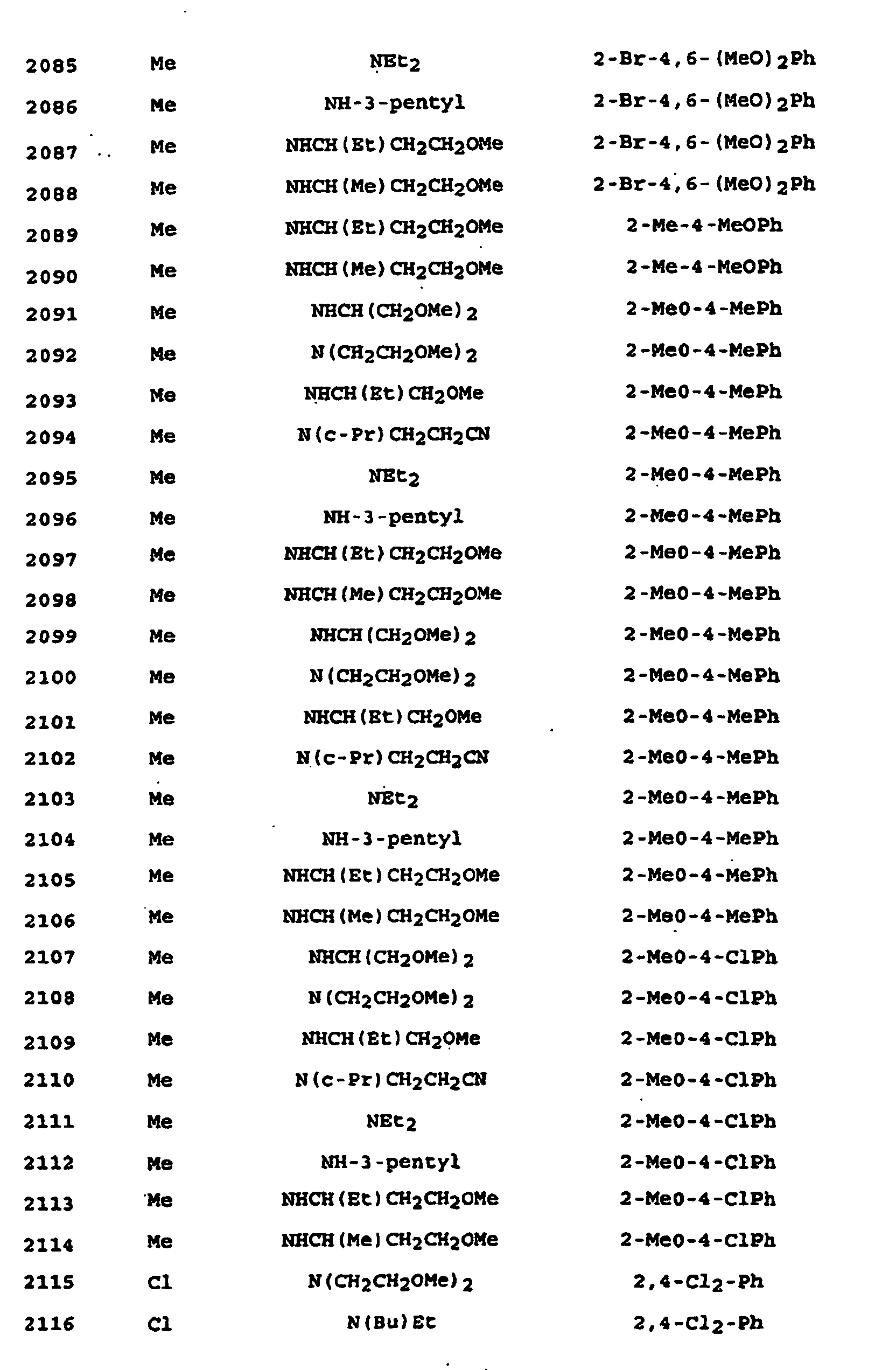
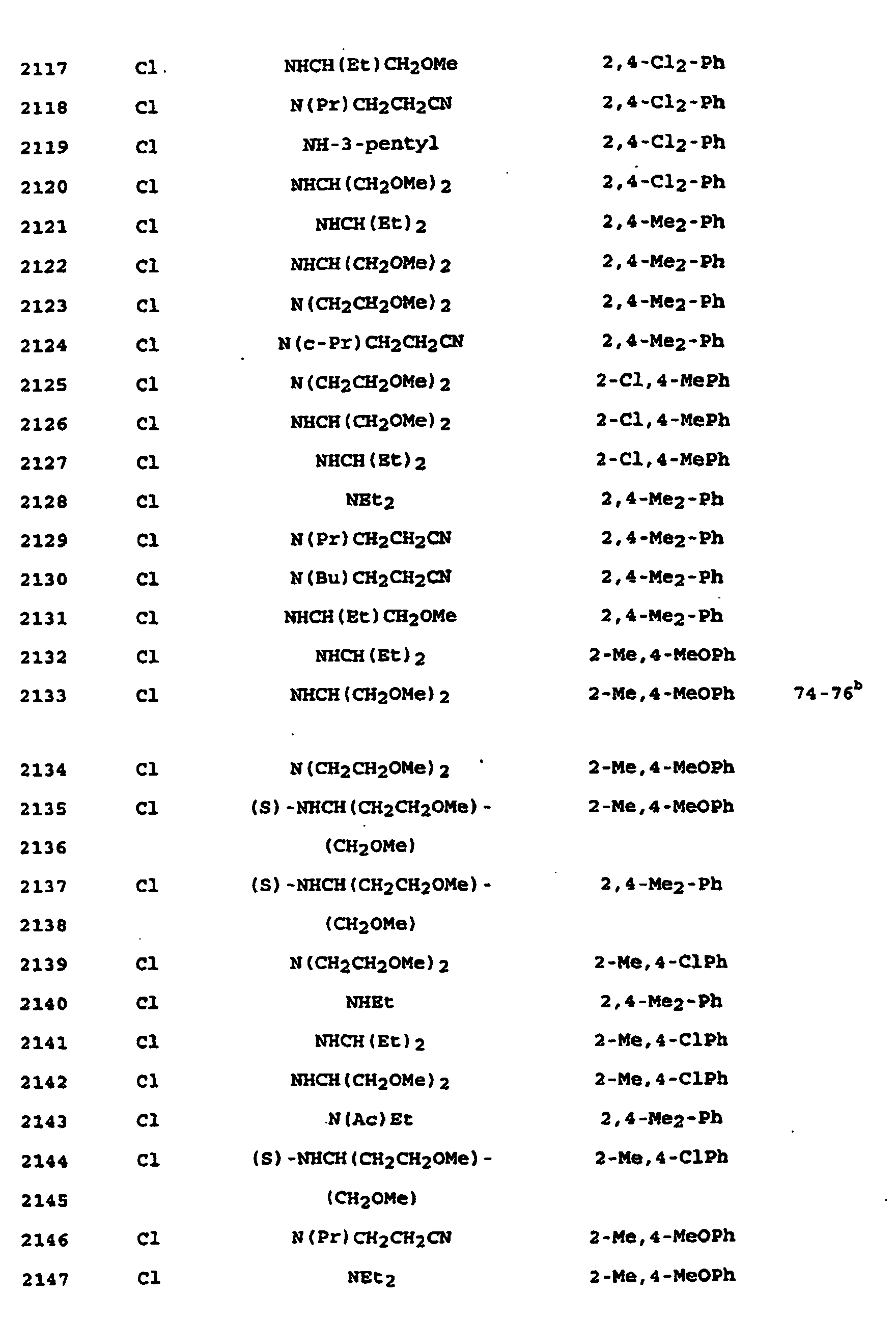
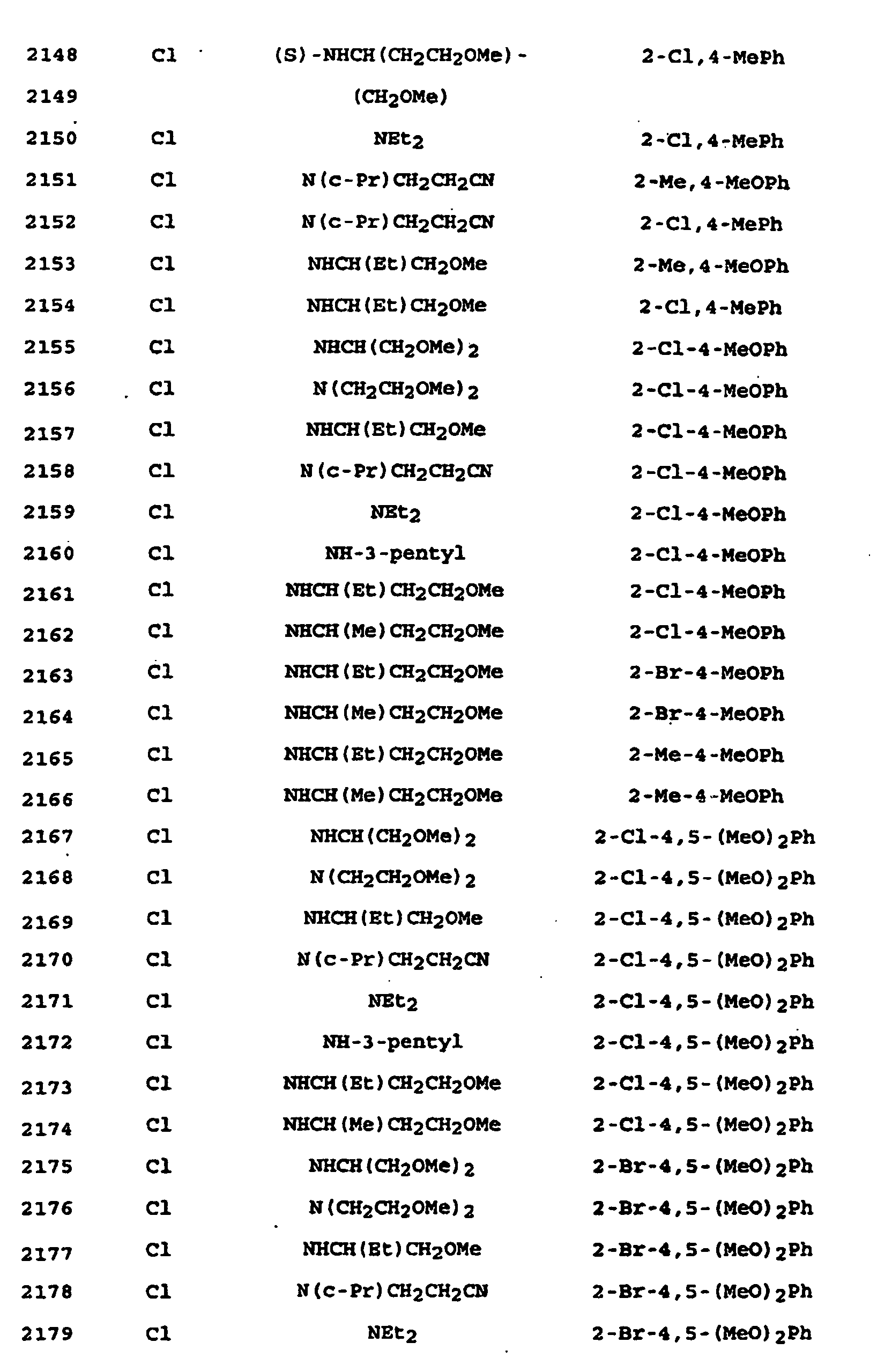


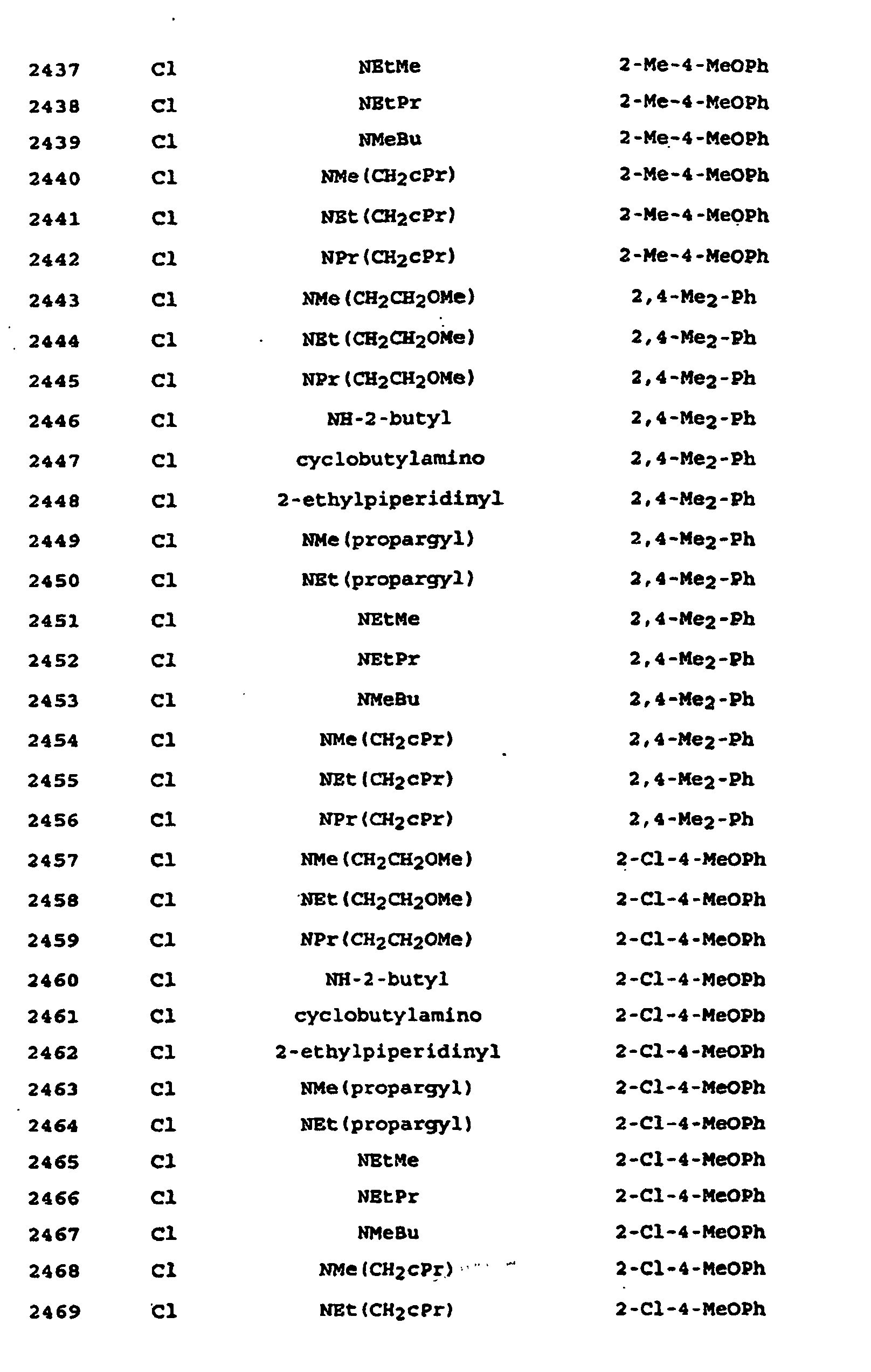
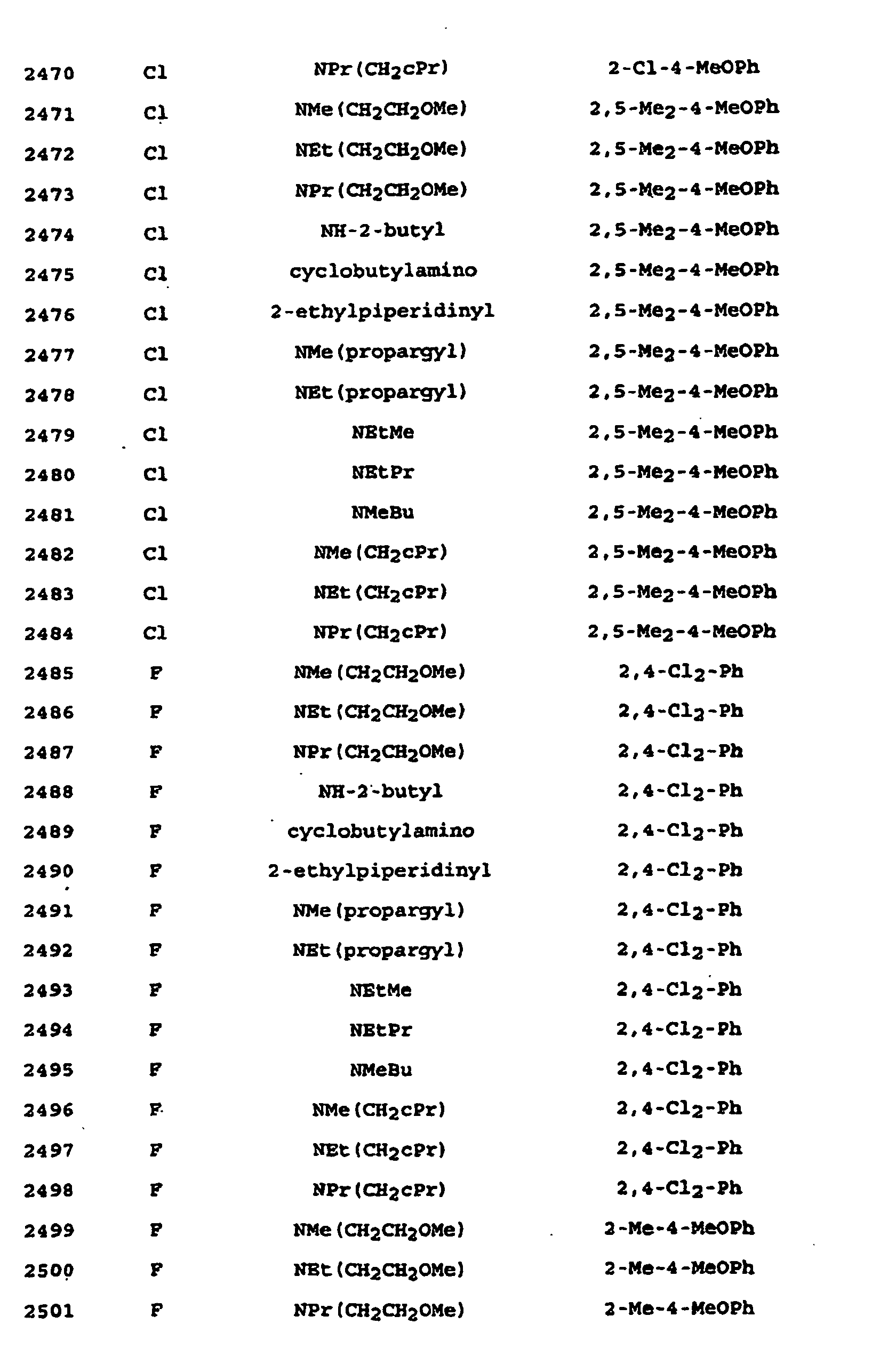


- The following is a description of the isolation of cell membranes containing cloned human CRF-R1 receptors for use in the standard binding assay as well as a description of the assay itself.
- Messenger RNA was isolated from human hippocampus. The mRNA was reverse transcribed using oligo (dt) 12-18 and the coding region was amplified by PCR from start to stop codons The resulting PCR fragment was cloned into the EcoRV site of pGEMV, from whence the insert was reclaimed using XhoI + XbaI and cloned into the XhoI + XbaI sites of vector pm3ar (which contains a CMV promoter, the SV40 't' splice and early poly A signals, an Epstein-Barr viral origin of replication, and a hygromycin selectable marker). The resulting expression vector, called phchCRFR was transfected in 293EBNA cells and cells retaining the episome were selected in the presence of 400 µM hygromycin. Cells surviving 4 weeks of selection in hygromycin were pooled, adapted to growth in suspension and used to generate membranes for the binding assay described below. Individual aliquots containing approximately 1 x 10⁸ of the suspended cells were then centrifuged to form a pellet and frozen.
- For the binding assay a frozen pellet described above containing 293EBNA cells transfected with hCRFRl receptors is homogenized in 10 ml of ice cold tissue buffer (50 mM HBPES buffer pH 7.0, containing 10 mM MgCl2, 2 mM EGTA, 1 µg/l aprotinin, 1 µg/ml leupeptin and 1 µg/ml pepstatin). The homogenate is centrifuged at 40,000 x g for 12 min and the resulting pellet rehomogenized in 10 ml of tissue buffer. After another centrifugation at 40,000 x g for 12 min, the pellet is resuspended to a protein concentration of 360 µg/ml to be used in the assay.
- Binding assays are performed in 96 well plates; each well having a 300 µl capacity. To each well is added 50 µl of test drug dilutions (final concentration of drugs range from 10-10 - 10-5 M), 100 µl of 125I-ovine-CRF (125I-o-CRF) (final concentration 150 pM) and 150 µl of the cell homogenate described above. Plates are then allowed to incubate at room temperature for 2 hours before filtering the incubate over GF/F filters (presoaked with 0.3% polyethyleneimine) using an appropriate cell harvester. Filters are rinsed 2 times with ice cold assay buffer before removing individual filters and assessing them for radioactivity on a gamma counter.
- Curves of the inhibition of 125I-o-CRF binding to cell membranes at various dilutions of test drug are analyzed by the iterative curve fitting program LIGAND [P.J. Munson and D. Rodbard, Anal. Biochem. 107:220 (1980), which provides Ki values for inhibition which are then used to assess biological activity.
- A compound is considered to be active if it has a Ki value of less than about 10000 nM for the inhibition of CRF.
- Inhibition of CRF-stimulated adenylate cyclase activity can be performed as described by G. Battaglia et al. Synapse 1:572 (1987). Briefly, assays are carried out at 37° C for 10 min in 200 ml of buffer containing 100 mM Tris-HCl (pH 7.4 at 37° C), 10 mM MgCl2, 0.4 mM EGTA, 0.1% BSA, 1 mM isobutylmethylxanthine (IBMX), 250 units/ml phosphocreatine kinase, 5 mM creatine phosphate, 100 mM guanosine 5'-triphosphate, 100 nM oCRF, antagonist peptides (concentration range 10-9 to 10-6m) and 0.8 mg original wet weight tissue (approximately 40-60 mg protein). Reactions are initiated by the addition of 1 mM ATP/32P]ATP (approximately 2-4 mCi/tube) and terminated by the addition of 100 ml of 50 mM Tris-HCL, 45 mM ATP and 2% sodium dodecyl sulfate. In order to monitor the recovery of cAMP, 1 µl of [3H]cAMP (approximately 40,000 dpm) is added to each tube prior to separation. The separation of [32P]cAMP from [32P]ATP is performed by sequential elution over Dowex and alumina columns.
- The in vivo activity of the compounds of the present invention can be assessed using any one of the biological assays available and accepted within the art. Illustrative of these tests include the Acoustic Startle Assay, the Stair Climbing Test, and the Chronic Administration Assay. These and other models useful for the testing of compounds of the present invention have been outlined in C.W. Berridge and A.J. Dunn Brain Research Reviews 15:71 (1990).
Compounds may be tested in any species of rodent or small mammal. - Compounds of this invention have utility in the treatment of inbalances associated with abnormal levels of corticotropin releasing factor in patients suffering from depression, affective disorders, and/or anxiety.
- Compounds of this invention can be administered to treat these abnormalities by means that produce contact of the active agent with the agent's site of action in the body of a mammal. The compounds can be administered by any conventional means available for use in conjunction with pharmaceuticals either as individual therapeutic agent or in combination of therapeutic agents. They can be administered alone, but will generally be administered with a pharmaceutical carrier selected on the basis of the chosen route of administration and standard pharmaceutical practice.
- The dosage administered will vary depending on the use and known factors such as pharmacodynamic character of the particular agent, and its mode and route of administration; the recipient's age, weight, and health; nature and extent of symptoms; kind of concurrent treatment; frequency of treatment; and desired effect. For use in the treatment of said diseases or conditions, the compounds of this invention can be orally administered daily at a dosage of the active ingredient of 0.002 to 200 mg/kg of body weight. Ordinarily, a dose of 0.01 to 10 mg/kg in divided doses one to four times a day, or in sustained release formulation will be effective in obtaining the desired pharmacological effect.
- Dosage forms (compositions) suitable for administration contain from about 1 mg to about 100 mg of active ingredient per unit. In these pharmaceutical compositions, the active ingredient will ordinarily be present in an amount of about 0.5 to 95% by weight based on the total weight of the composition.
- The active ingredient can be administered orally is solid dosage forms, such as capsules, tablets and powders; or in liquid forms such as elixirs, syrups,
and/or suspensions. The compounds of this invention can also be administered parenterally in sterile liquid dose formulations. - Gelatin capsules can be used to contain the active ingredient and a suitable carrier such as but not limited to lactose, starch, magnesium stearate, steric acid, or cellulose derivatives. Similar diluents can be used to make compressed tablets. Both tablets and capsules can be manufactured as sustained release products to provide for continuous release of medication over a period of time. Compressed tablets can be sugar-coated or film-coated to mask any unpleasant taste, or used to protect the active ingredients from the atmosphere, or to allow selective disintegration of the tablet in the gastrointestinal tract.
- Liquid dose forms for oral administration can contain coloring or flavoring agents to increase patient acceptance.
- In general, water, pharmaceutically acceptable oils, saline, aqueous dextrose (glucose), and related sugar solutions and glycols, such as propylene glycol or polyethylene glycol, are suitable carriers for parenteral solutions. Solutions for parenteral administration preferably contain a water soluble salt of the active ingredient, suitable stabilizing agents, and if necessary, butter substances. Antioxidizing agents, such as sodium bisulfite, sodium sulfite, or ascorbic acid, either alone or in combination, are suitable stabilizing agents. Also used are citric acid and its salts, and EDTA. In addition, parenteral solutions can contain preservatives such as benzalkonium chloride, methyl- or propyl-paraben, and chlorobutanol.
- Suitable pharmaceutical carriers are described in "Remington's Pharmaceutical Sciences", A. Osol, a standard reference in the field.
- Useful pharmaceutical dosage-forms for administration of the compounds of this invention can be illustrated as follows:
- A large number of units capsules are prepared by filling standard two-piece hard gelatin capsules each with 100 mg of powdered active ingredient, 150 mg lactose, 50 mg cellulose, and 6 mg magnesium stearate.
- A mixture of active ingredient in a digestible oil such as soybean, cottonseed oil, or olive oil is prepared and injected by means of a positive displacement was pumped into gelatin to form soft gelatin capsules containing 100 mg of the active ingredient. The capsules were washed and dried.
- A large number of tablets are prepared by conventional procedures so that the dosage unit was 100 mg active ingredient, 0.2 mg of colloidal silicon dioxide, 5 mg of magnesium stearate, 275 mg of microcrystalline cellulose, 11 mg of starch, and 98.8 mg lactose. Appropriate coatings may be applied to increase palatability or delayed adsorption.
- The compounds of this invention may also be used as reagents or standards in the biochemical study of neurological function, dysfunction, and disease.
- Although the present invention has been described and exemplified in terms of certain preferred embodiments, other embodiments will be apparent to those skilled in the art. The invention is, therefore, not limited to the particular embodiments described and exemplified, but is capable of modification or variation without departing from the invention, the full scope of which is delineated by the appended claims.
Claims (5)
- A compound of Formula (70)and geometric isomers thereof, stereoisomeric forms thereof, or mixtures of stereoisomeric forms thereof, and pharmaceutically acceptable salt forms thereof selected from the group:
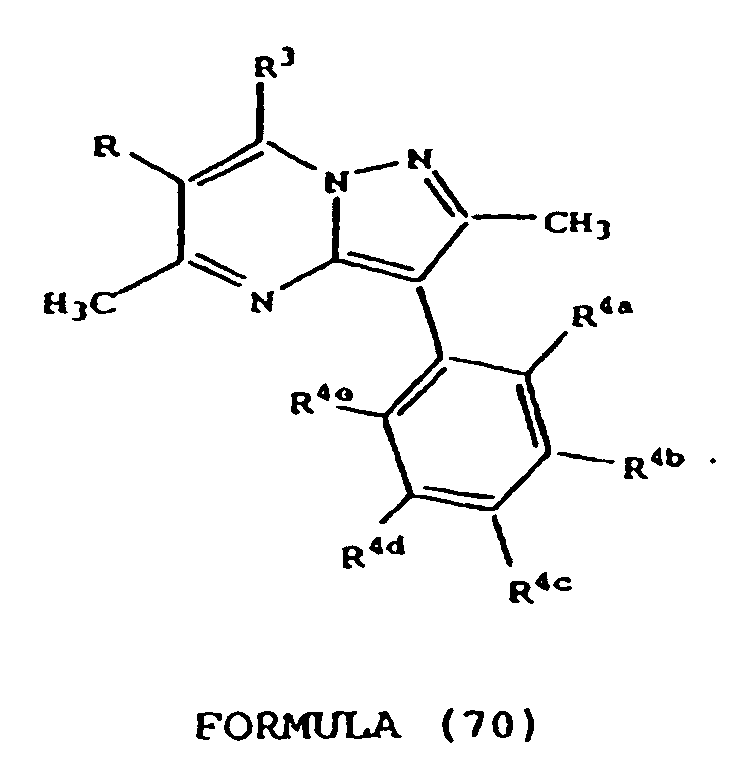 a compound of Formula (70) wherein R is Cl, R3 is - NHCH(n-Pr)2, R4a is Me, R4b is H, R4c is Me, R4d is H and R4e is H;a compound of Formula (70) wherein R is Cl, R3 is - NHCH(CH2OMe)2, R4a is Me, R4b is H, R4c is Me, R4d is H and R4e is H;a compound of Formula (70) wherein R is Cl, R3 is - N(CH2CH2OMe)2, R4a is Me, R4b is H, R4c is Me, R4d is H and R4e is H;a compound of Formula (70) wherein R is Cl, R3 is -N(c-Pr)(CH2CH2CN), R4a is Me, R4b is H, R4c is Me, R4d is H and R4e is H;a compound of Formula (70) wherein R is Cl, R3 is - N(CH2CH2OMe)2, R4a is Cl, R4b is H, R4c is Me, R4d is H and R4e is H;a compound of Formula (70) wherein R is Cl, R3 is - NHCH(CH2OMe)2, R4a is Cl, R4b is H, R4c is Me, R4d is H and R4e is H;a compound of Formula (70) wherein R is Cl, R3 is - NHCH(Et)2, R4a is Cl, R4b is H, R4c is Me, R4d is H and R4e is H;a compound of Formula (70) wherein R is Cl, R3 is - N(Et)2, R4a is Me, R4b is H, R4c is Me, R4d is H and R4e is H;a compound of Formula (70) wherein R is Cl, R3 is -N(n-Pr)(CH2CH2CN), R4a is Me, R4b is H, R4c is Me, R4d is H and R4e is H;a compound of Formula (70) wherein R is Cl, R3 is -N(n-Bu)(CH2CH2CN), R4a is Me, R4b is H, R4c is Me, R4d is H and R4e is H;a compound of Formula (70) wherein R is Cl, R3 is - NHCH(n-Pr)(CH2OMe), R4a is Me, R4b is H, R4c is Me, R4d is H and R4e is H;a compound of Formula (70) wherein R is Cl, R3 is - NHCH(Et)2, R4a is Me, R4b is H, R4c is OMe, R4d is H and R4e is H;a compound of Formula (70) wherein R is Cl, R3 is - NHCH(CH2OMe)2, R4a is Me, R4b is H, R4c is OMe, R4d is H and R4e is H;a compound of Formula (70) wherein R is Cl, R3 is (S) - NH(CH2CH2OMe)CH2OMe, R4a is Me, R4b is H, R4c is Me, R4d is H and R4e is H;a compound of Formula (70) wherein R is Cl, R3 is - NH(CH2CH2OMe)CH2OMe, R4a is Me, R4b is H, R4c is Me, R4d is H and R4e is H;a compound of Formula (70) wherein R is Cl, R3 is - N(CH2CH2OMe)2, R4a is Me, R4b is H, R4c is Cl, R4d is H and R4e is H;a compound of Formula (70) wherein R is Cl, R3 is - NH(Et), R4a is Me, R4b is H, R4c is Me, R4d is H and R4e is H;a compound of Formula (70) wherein R is Cl, R3 is - NHCH(n-Pr)2, R4a is Me, R4b is H, R4c is Cl, R4d is H and R4e is H;a compound of Formula (70) wherein R is Cl, R3 is - NHCH(CH2OMe)2, R4a is Me, R4b is H, R4c is Cl, R4d is H and R4e is H;a compound of Formula (70) wherein R is Cl, R3 is (S) - NH(CH2CH2OMe)CH2OMe, R4a is Me, R4b is H, R4c is Cl, R4d is H and R4e is H;a compound of Formula (70) wherein R is Cl, R3 is - NH(CH2CH2OMe)CH2OMe, R4a is Me, R4b is H, R4c is Cl, R4d is H and R4e is H;a compound of Formula (70) wherein R is Cl, R3 is -N(n-Pr)(CH2CH2CN), R4a is Me, R4b is H, R4c is OMe, R4d is H and R4e is H;a compound of Formula (70) wherein R is Cl, R3 is - N(Et)2, R4a is Me, R4b is H, R4c is OMe, R4d is H and R4e is H;a compound of Formula (70) wherein R is Cl, R3 is (S) - NH(CH2CH2OMe)CH2OMe, R4a is Cl, R4b is H, R4c is Me, R4d is H and R4e is H;a compound of Formula (70) wherein R is Cl, R3 is - NH(CH2CH2OMe)CH2OMe, R4a is Cl, R4b is H, R4c is Me, R4d is H and R4e is H;a compound of Formula (70) wherein R is Cl, R3 is - N(Et)2, R4a is Cl, R4b is H, R4c is Me, R4d is H and R4e is H;a compound of Formula (70) wherein R is Cl, R3 is -N(c-Pr) (CH2CH2CN), R4a is Me, R4b is H, R4c is OMe, R4d is H and R4e is H;a compound of Formula (70) wherein R is Cl; R3 is -N(c-Pr) (CH2CH2CN), R4a is Cl, R4b is H, R4c is Me, R4d is H and R4e is H;a compound of Formula (70) wherein R is Cl, R3 is -NHCH (n-Pr)(CH2OMe), R4a is Me, R4b is H, R4c is OMe, R4d is H and R4e is H;a compound of Formula (70) wherein R is Cl, R3 is -NHCH (n-Pr)(CH2OMe), R4a is Cl, R4b is H, R4c is Me, R4d is H and R4e is H;a compound of Formula (70) wherein R is Cl, R3 is - NHCH(Et)2, R4a is Br, R4b is H, R4c is OMe, R4d is OMe and R4e is H;a compound of Formula (70) wherein R is Cl, R3 is - NHCH(Et)2, R4a is Br, R4b is H, R4c is OMe, R4d is H and R4e is H;a compound of Formula (70) wherein R is Cl, R3 is - N(CH2CH2OMe)2, R4a is Br, R4b is H, R4c is OMe, R4d is H and R4e is H;a compound of Formula (70) wherein R is Cl, R3 is - NHCH(CH2OMe)2, R4a is Br, R4b is H, R4c is OMe, R4d is H and R4e is H;a compound of Formula (70) wherein R is Cl, R3 is - N(Et)2, R4a is Me, R4b is H, R4c is Cl, R4d is H and R4e is H;a compound of Formula (70) wherein R is Cl, R3 is - N(Et)2, R 4a is Cl, R4b is H, R4c is OMe, R4d is OMe and R4e is H;a compound of Formula (70) wherein R is Cl, R3 is - NHCH(Et)2, R4a is Cl, R4b is H, R4c is OMe, R4d is OMe and R4e is H;a compound of Formula (70) wherein R is Cl, R3 is - N(CH2CH2OMe)2, R4a is Cl, R4b is H, R4c is Cl, R4d is H and R4e is H;a compound of Formula (70) wherein R is Cl, R3 is - NHCH(CH2OMe)2, R4a is Cl, R4b is H, R4c is Cl, R4d is H and R4e is H;a compound of Formula (70) wherein R is Cl, R3 is - N(Pr) (CH2CH2CN), R4a is Cl, R4b is H, R4c is Cl, R4d is H and R4e is H;a compound of Formula (70) wherein R is Cl, R3 is - N(Bu) (Et), R4a is Cl, R4b is H, R4c is Cl, R4d is H and R4e is H;a compound of Formula (70) wherein R is Cl, R3 is - NHCH(Et)CH2OMe, R4a is Cl, R4b is H, R4c is Cl, R4d is H and R4e is H;a compound of Formula (70) wherein R is Cl, R3 is - NHCH(Et)2, R4a is Cl, R4b is H, R4c is Cl, R4d is H and R4e is H;a compound of Formula (70) wherein R is Cl, R3 is - NHCH(Et)2, R4a is Me, R4b is H, R4c is Me, R4d is H and R4e is H;a compound of Formula (70) wherein R is Cl, R3 is - NHCH(Et)2, R4a is Cl, R4b is H, R4c is Me, R4d is H and R4e is H;a compound of Formula (70) wherein R is Cl, R3 is - NHCH(Et)2, R4a is Me, R4b is H, R4c is Cl, R4d is H and R4e is H;a compound of Formula (70) wherein R is Cl, R3 is - NEt2, R4a is Me, R4b is H, R4c is OMe, R4d is H and R4e is H; anda compound of Formula (70) wherein R is Cl, R3 is - N(Pr)(CH2CH2CN), R4a is Me, R4b is H, R4c is OMe, R4d is H and R4e is H;a compound of Formula (70) wherein R is Me, R3 is - NHCH(n-Pr)2, R4a is Me, R4b is H, R4c is Me, R4d is H and R4e is H;a compound of Formula (70) wherein R is Me, R3 is - NHCH(CH2OMe)2, R4a is Me, R4b is H, R4c is Me, R4d is H and R4e is H;a compound of Formula (70) wherein R is Me, R3 is - N(CH2CH2OMe)2, R4a is Me, R4b is H, R4c is Me, R4d is H and R4e is H;a compound of Formula (70) wherein R is Me, R3 is -N(c-Pr)(CH2CH2CN), R4a is Me, R4b is H, R4c is Me, R4d is H and R4e is H;a compound of Formula (70) wherein R is Me, R3 is - N(CH2CH2OMe)2, R4a is Cl, R4b is H, R4c is Me, R4d is H and R4e is H;a compound of Formula (70) wherein R is Me, R3 is - NHCH(CH2OMe)2, R4a is Cl, R4b is H, R4c is Me, R4d is H and R4e is H;a compound of Formula (70) wherein R is Me, R3 is - NHCH(Et)2, R4a is Cl, R4b is H, R4c is Me, R4d is H and R4e is H;a compound of Formula (70) wherein R is Me, R3 is - N(Et)2, R4a is Me, R4b is H, R4c is Me, R4d is H and R4e is H;a compound of Formula (70) wherein R is Me, R3 is -N(n-Pr) (CH2CH2CN), R4a is Me, R4b is H, R4c is Me, R4d is H and R4e is H;a compound of Formula (70) wherein R is Me, R3 is -N(n-Bu) (CH2CH2CN), R4a is Me, R4b is H, R4c is Me, R4d is H and R4e is H;a compound of Formula (70) wherein R is Me, R3 is - NHCH(n-Pr)(CH2OMe), R4a is Me, R4b is H, R4c is Me, R4d is H and R4e is H;a compound of Formula (70) wherein R is Me, R3 is - NHCH(Et)2, R4a is Me, R4b is H, R4c is OMe, R4d is H and R4e is H;a compound of Formula (70) wherein R is Me, R3 is - NHCH(CH2OMe)2, R4a is Me, R4b is H, R4c is OMe, R4d is H and R4e is H;a compound of Formula (70) wherein R is Me, R3 is (S) - NH(CH2CH2OMe)CH2OMe, R4a is Me, R4b is H, R4c is Me, R4d is H and R4e is H;a compound of Formula (70) wherein R is Me, R3 is - NH(CH2CH2OMe)CH2OMe, R4a is Me, R4b is H, R4c is Me, R4d is H and R4e is H;a compound of Formula (70) wherein R is Me, R3 is - N(CH2CH2OMe)2, R4a is Me, R4b is H, R4c is Cl, R4d is H and R4e is H;a compound of Formula (70) wherein R is Me, R3 is - NH(Et), R4a is Me, R4b is H, R4c is Me, R4d is H and R4e is H;a compound of Formula (70) wherein R is Me, R3 is - NHCH(n-Pr)2, R4a is Me, R4b is H, R4c is Cl, R4d is H and R4e is H;a compound of Formula (70) wherein R is Me, R3 is - NHCH(CH2OMe)2, R4a is Me, R4b is H, R4c is Cl, R4d is H and R4e is H;a compound of Formula (70) wherein R is Me, R3 is (S) - NH(CH2CH2OMe)CH2OMe, R4a is Me, R4b is H, R4c is Cl, R4d is H and R4e is H;a compound of Formula (70) wherein R is Me, R3 is - NH(CH2CH2OMe)CH2OMe, R4a is Me, R4b is H, R4c is Cl, R4d is H and R4e is H;a compound of Formula (70) wherein R is Me, R3 is -N(n-Pr)(CH2CH2CN), R4a is Me, R4b is H, R4c is OMe, R4d is H and R4e is H;a compound of Formula (70) wherein R is Me, R3 is - N(Et)2, R4a is Me, R4b is H, R4c is OMe, R4d is H and R4e is H;a compound of Formula (70) wherein R is Me, R3 is (S) - NH(CH2CH2OMe)CH2OMe, R4a is Cl, R4b is H, R4c is Me, R4d is H and R4e is H;a compound of Formula (70) wherein R is Me, R3 is - NH(CH2CH2OMe)CH2OMe, R4a is Cl, R4b is H, R4c is Me, R4d is H and R4e is H;a compound of Formula (70) wherein R is Me, R3 is - N(Et)2, R4a is Cl, R4b is H, R4c is Me, R4d is H and R4e is H;a compound of Formula (70) wherein R is Me, R3 is -N(c-Pr)(CH2CH2CN), R4a is Me, R4b is H, R4c is OMe, R4d is H and R4e is H;a compound of Formula (70) wherein R is Me, R3 is -N(c-Pr)(CH2CH2CN), R4a is Cl, R4b is H, R4c is Me, R4d is H and R4e is H;a compound of Formula (70) wherein R is Me, R3 is -NHCH (n-Pr)(CH2OMe), R4a is Me, R4b is H, R4c is OMe, R4d is H and R4e is H;a compound of Formula (70) wherein R is Me, R3 is -NHCH (n-Pr)(CH2OMe), R4a is Cl, R4b is H, R4c is Me, R4d is H and R4e is H;a compound of Formula (70) wherein R is Me, R3 is - NHCH(Et)2, R4a is Br, R4b is H, R4c is OMe, R4d is OMe and R4e is H;a compound of Formula (70) wherein R is Me, R3 is - NHCH(Et)2, R4a is Br, R4b is H, R4c is OMe, R4d is H and R4e is H;a compound of Formula (70) wherein R is Me, R3 is - N(CH2CH2OMe)2, R4a is Br, R4b is H, R4c is OMe, R4d is H and R4e is H;a compound of Formula (70) wherein R is Me, R3 is - NHCH(CH2OMe)2, R4a is Br, R4b is H, R4c is OMe, R4d is H and R4e is H;a compound of Formula (70) wherein R is Me, R3 is - N(Et)2, R4a is Me, R4b is H, R4c is Cl, R4d is H and R4e is H;a compound of Formula (70) wherein R is Me, R3 is - N(Et)2, R4a is Cl, R4b is H, R4c is OMe, R4d is OMe and R4e is H;a compound of Formula (70) wherein R is Me, R3 is - NHCH(Et)2, R4a is Cl, R4b is H, R4c is OMe, R4d is OMe and R4e is H;a compound of Formula (70) wherein R is Me, R3 is - N(CH2CH2OMe)2, R4a is Cl, R4b is H, R4c is Cl, R4d is H and R4e is H;a compound of Formula (70) wherein R is Me, R3 is - NHCH(CH2OMe)2, R4a is Cl, R4b is H, R4c is Cl, R4d is H and R4e is H;a compound of Formula (70) wherein R is Me, R3 is - N(Pr)(CH2CH2CN), R4a is Cl, R4b is H, R4c is Cl, R4d is H and R4e is H;a compound of Formula (70) wherein R is Me, R3 is - N(Bu)(Et), R4a is Cl, R4b is H, R4c is Cl, R4d is H and R4e is H;a compound of Formula (70) wherein R is Me, R3 is - NHCH(Et)CH2OMe, R4a is Cl, R4b is H, R4c is Cl, R4d is H and R4e is H;a compound of Formula (70) wherein R is Me, R3 is - NHCH(Et)2, R4a is Cl, R4b is H, R4c is Cl, R4d is H and R4e is H;a compound of Formula (70) wherein R is Me, R3 is - NHCH(Et)2, R4a is Me, R4b is H, R4c is Me, R4d is H and R4e is H;a compound of Formula (70) wherein R is Me, R3 is - NHCH(Et)2, R4a is Cl, R4b is H, R4c is Me, R4d is H and R4e is H;a compound of Formula (70) wherein R is Me, R3 is - NHCH(Et)2, R4a is Me, R4b is H, R4c is Cl, R4d is H and R4e is H;a compound of Formula (70) wherein R is Me, R3 is - NEt2, R4a is Me, R4b is H, R4c is OMe, R4d is H and R4e is H; anda compound of Formula (70) wherein R is Me, R3 is - N(Pr)(CH2CH2CN), R4a is Me, R4b is H, R4c is OMe, R4d is H and R4e is H;a compound of Formula (70) wherein R is F, R3 is - NHCH(n-Pr)2, R4a is Me, R4b is H, R4c is Me, R4d is H and R4e is H;a compound of Formula (70) wherein R is F, R3 is - NHCH(CH2OMe)2, R4a is Me, R4b is H, R4c is Me, R4d is H and R4e is H;a compound of Formula (70) wherein R is F, R3 is - N(CH2CH2OMe)2, R4a is Me, R4b is H, R4c is Me, R4d is H and R4e is H;a compound of Formula (70) wherein R is F, R3 is -N(c-Pr)(CH2CH2CN), R4a is Me, R4b is H, R4c is Me, R4d is H and R4e is H;a compound of Formula (70) wherein R is F, R3 is - N(CH2CH2OMe)2, R4a is Cl, R4b is H, R4c is Me, R4d is H and R4e is H;a compound of Formula (70) wherein R is F, R3 is - NHCH(CH2OMe)2, R4a is Cl, R4b is H, R4c is Me, R4d is H and R4e is H;a compound of Formula (70) wherein R is F, R3 is - NHCH(Et)2, R4a is Cl, R4b is H, R4c is Me, R4d is H and R4e is H;a compound of Formula (70) wherein R is F, R3 is - N(Et)2, R4a is Me, R4b is H, R4c is Me, R4d is H and R4e is H;a compound of Formula (70) wherein R is F, R3 is -N(n-Pr)(CH2CH2CN), R4a is Me, R4b is H, R4c is Me, R4d is H and R4e is H;a compound of Formula (70) wherein R is F, R3 is -N(n-Bu)(CH2CH2CN), R4a is Me, R4b is H, R4c is Me, R4d is H and R4e is H;a compound of Formula (70) wherein R is F, R3 is - NHCH(n-Pr)(CH2OMe), R4a is Me, R4b is H, R4c is Me, R4d is H and R4e is H;a compound of Formula (70) wherein R is F, R3 is - NHCH(Et)2, R4a is Me, R4b is H, R4c is OMe, R4d is H and R4e is H;a compound of Formula (70) wherein R is F, R3 is - NHCH(CH2OMe)2, R4a is Me, R4b is H, R4c is OMe, R4d is H and R4e is H;a compound of Formula (70) wherein R is F, R3 is (S) - NH(CH2CH2OMe)CH2OMe, R4a is Me, R4b is H, R4c is Me, R4d is H and R4e is H;a compound of Formula (70) wherein R is F, R3 is - NH(CH2CH2OMe)CH2OMe, R4a is Me, R4b is H, R4c is Me, R4d is H and R4e is H;a compound of Formula (70) wherein R is F, R3 is - N(CH2CH2OMe)2, R4a is Me, R4b is H, R4c is Cl, R4d is H and R4e is H;a compound of Formula (70) wherein R is F, R3 is - NH(Et), R4a is Me, R4b is H, R4c is Me, R4d is H and R4e is H;a compound of Formula (70) wherein R is F, R3 is - NHCH(n-Pr)2, R4a is Me, R4b is H, R4c is Cl, R4d is H and R4e is H;a compound of Formula (70) wherein R is F, R3 is - NHCH(CH2OMe)2, R4a is Me, R4b is H, R4c is Cl, R4d is H and R4e is H;a compound of Formula (70) wherein R is F, R3 is (S) - NH(CH2CH2OMe)CH2OMe, R4a is Me, R4b is H, R4c is Cl, R4d is H and R4e is H;a compound of Formula (70) wherein R is F, R3 is - NH(CH2CH2OMe)CH2OMe, R4a is Me, R4b is H, R4c is Cl, R4d is H and R4e is H;a compound of Formula (70) wherein R is F, R3 is -N(n-Pr) (CH2CH2CN), R4a is Me, R4b is H, R4c is OMe, R4d is H and R4e is H;a compound of Formula (70) wherein R is F, R3 is - N(Et)2, R4a is Me, R4b is H, R4c is OMe, R4d is H and R4e is H;a compound of Formula (70) wherein R is F, R3 is (S) - NH(CH2CH2OMe)CH2OMe, R4a is Cl, R4b is H, R4c is Me, R4d is H and R4e is H;a compound of Formula (70) wherein R is F, R3 is - NH(CH2CH2OMe)CH2OMe, R4a is Cl, R4b is H, R4c is Me, R4d is H and R4e is H;a compound of Formula (70) wherein R is F, R3 is - N(Et)2, R4a is Cl, R4b is H, R4c is Me, R4d is H and R4e is H;a compound of Formula (70) wherein R is F, R3 is -N(c-Pr) (CH2CH2CN), R4a is Me, R4b is H, R4c is OMe, R4d is H and R4e is H;a compound of Formula (70) wherein R is F, R3 is -N(c-Pr) (CH2CH2CN), R4a is Cl, R4b is H, R4c is Me, R4d is H and R4e is H;a compound of Formula (70) wherein R is F, R3 is -NHCH (n-Pr)(CH2OMe), R4a is Me, R4b is H, R4c is OMe, R4d is H and R4e is H;a compound of Formula (70) wherein R is F, R3 is -NHCH (n-Pr) (CH2OMe), R4a is cl, R4b is H, R4c is Me, R4d is H and R4e is H;a compound of Formula (70) wherein R is F, R3 is - NHCH(Et)2, R4a is Br, R4b is H, R4c is OMe, R4d is OMe and R4e is H;a compound of Formula (70) wherein R is F, R3 is - NHCH(Et)2, R4a is Br, R4b is H, R4c is OMe, R4d is H and R4e is H;a compound of Formula (70) wherein R is F, R3 is - N(CH2CH2OMe)2, R4a is Br, R4b is H, R4c is OMe, R4d is H and R4e is H;a compound of Formula (70) wherein R is F, R3 is - NHCH(CH2OMe)2, R4a is Br, R4b is H, R4c is OMe, R4d is H and R4e is H;a compound of Formula (70) wherein R is F, R3 is - N(Et)2, R4a is Me, R4b is H, R4c is Cl, R4d is H and R4e is H;a compound of Formula (70) wherein R is F, R3 is - N(Et)2, R4a is Cl, R4b is H, R4c is OMe, R4d is OMe and R4e is H;a compound of Formula (70) wherein R is F, R3 is - NHCH(Et)2, R4a is Cl, R4b is H, R4c is OMe, R4d is OMe and R4e is H;a compound of Formula (70) wherein R is F, R3 is - N(CH2CH2OMe)2, R4a is Cl, R4b is H, R4c is Cl, R4d is H and R4e is H;a compound of Formula (70) wherein R is F, R3 is - NHCH(CH2OMe)2, R4a is Cl, R4b is H, R4c is Cl, R4d is H and R4e is H;a compound of Formula (70) wherein R is F, R3 is - N(Pr)(CH2CH2CN), R4a is Cl, R4b is H, R4c is Cl, R4d is H and R4e is H;a compound of Formula (70) wherein R is F, R3 is - N(Bu)(Et), R4a is Cl, R4b is H, R4c is Cl, R4d is H and R4e is H;a compound of Formula (70) wherein R is F, R3 is - NHCH(Et)CH2OMe, R4a is Cl, R4b is H, R4c is Cl, R4d is H and R4e is H;a compound of Formula (70) wherein R is F, R3 is - NHCH(Et)2, R4a is Cl, R4b is H, R4c is Cl, R4d is H and R4e is H;a compound of Formula (70) wherein R is F, R3 is - NHCH(Et)2, R4a is Me, R4b is H, R4c is Me, R4d is H and R4e is H;a compound of Formula (70) wherein R is F, R3 is - NHCH(Et)2, R4a is Cl, R4b is H, R4c is Me, R4d is H and R4e is H;a compound of Formula (70) wherein R is F, R3 is - NHCH(Et)2, R4a is Me, R4b is H, R4c is Cl, R4d is H and R4e is H;a compound of Formula (70) wherein R is F, R3 is -NEt2, R4a is Me, R4b is H, R4c is OMe, R4d is H and R4e is H; anda compound of Formula (70) wherein R is F, R3 is - N(Pr)(CH2CH2CN), R4a is Me, R4b is H, R4c is OMe, R4d is H and R4e is H;a compound of Formula (70) wherein R is Cl, R3 is - N(Pr)(CH2CH2OMe), R4a is Me, R4b is H, R4c is OMe, R4d is H and R4e is H;a compound of Formula (70) wherein R is Cl, R3 is - N(Et)(CH2CH2OMe), R4a is Me, R4b is H, R4c is OMe, R4d is H and R4e is H;a compound of Formula (70) wherein R is Cl, R3 is - N(Me)(CH2CH2OMe), R4a is Me, R4b is H, R4c is OMe, R4d is H and R4e is H;a compound of Formula (70) wherein R is Cl, R3 is - NMeEt, R4a is Me, R4b is H, R4c is OMe, R4d is H and R4e is H;a compound of Formula (70) wherein R is Cl, R3 is - NMePr, R4a is Me, R4b is H, R4c is OMe, R4d is H and R4e is H;a compound of Formula (70) wherein R is Cl, R3 is - NMeBu, R4a is Me, R4b is H, R4c is OMe, R4d is H and R4e is H;a compound of Formula (70) wherein R is Cl, R3 is -NH-2-butyl, R4a is Me, R4b is H, R4c is OMe, R4d is H and R4e is H;a compound of Formula (70) wherein R is Cl, R3 is cyclobutylamino, R4a is Me, R4b is H, R4c is OMe, R4d is H and R4e is H;a compound of Formula (70) wherein R is Cl, R3 is - N(Pr)(CH2CH2OMe), R4a is Me, R4b is H, R4c is OMe, R4d is Me and R4e is H;a compound of Formula (70) wherein R is Cl, R3 is - N(Et)(CH2CH2OMe), R4a is Me, R4b is H, R4c is OMe, R4d is Me and R4e is H;a compound of Formula (70) wherein R is Cl, R3 is - N(Me)(CH2CH2OMe), R4a is Me, R4b is H, R4c is OMe, R4d is Me and R4e is H;a compound of Formula (70) wherein R is Cl, R3 is - NMeEt, R4a is Me, R4b is H, R4c is OMe, R4d is Me and R4e is H;a compound of Formula (70) wherein R is Cl, R3 is - NMePr, R4a is Me, R4b is H, R4c is OMe, R4d is Me and R4e is H;a compound of Formula (70) wherein R is Cl, R3 is - NMeBu, R4a is Me, R4b is H, R4c is OMe, R4d is Me and R4e is H;a compound of Formula (70) wherein R is Cl, R3 is -NH-2-butyl, R4a is Me, R4b is H, R4c is OMe, R4d is Me and R4e is H;a compound of Formula (70) wherein R is Cl, R3 is cyclobutylamino, R4a is Me, R4b is H, R4c is OMe, R4d is ME and R4e is H;a compound of Formula (70) wherein R is F, R3 is - N(Pr)(CH2CH2OMe), R4a is Me, R4b is H, R4c is OMe, R4d is H and R4e is H;a compound of Formula (70) wherein R is F, R3 is - N(Et)(CH2CH2OMe), R4a is Me, R4b is H, R4c is OMe, R4d is H and R4e is H;a compound of Formula (70) wherein R is F, R3 is - N(Me)(CH2CH2OMe), R4a is Me, R4b is H, R4c is OMe, R4d is H and R4e is H;a compound of Formula (70) wherein R is F, R3 is - NMeEt, R4a is Me, R4b is H, R4c is OMe, R4d is H and R4e is H;a compound of Formula (70) wherein R is F, R3 is - NMePr, R4a is Me, R4b is H, R4c is OMe, R4d is H and R4e is H;a compound of Formula (70) wherein R is F, R3 is - NMeBu, R4a is Me, R4b is H, R4c is OMe, R4d is H and R4e is H;a compound of Formula (70) wherein R is F, R3 is -NH-2-butyl, R4a is Me, R4b is H, R4c is OMe, R4d is H and R4e is H;a compound of Formula (70) wherein R is F, R3 is cyclobutylamino, R4a is Me, R4b is H, R4c is OMe, R4d is H and R4e is H;a compound of Formula (70) wherein R is F, R3 is - N(Pr)(CH2CH2OMe), R4a is Me, R4b is H, R4c is OMe, R4d is Me and R4e is H;a compound of Formula (70) wherein R is F, R3 is - N(Et)(CH2CH2OMe), R4a is Me, R4b is H, R4c is OMe, R4d is Me and R4e is H;a compound of Formula (70) wherein R is F, R3 is - N(Me)(CH2CH2OMe), R4a is Me, R4b is H, R4c is OMe, R4d is Me and R4e is H;a compound of Formula (70) wherein R is F, R3 is - NMeEt, R4a is Me, R4b is H, R4c is OMe, R4d is Me and R4e is H;a compound of Formula (70) wherein R is F, R3 is - NMePr, R4a is Me, R4b is H, R4c is OMe, R4d is Me and R4e is H;a compound of Formula (70) wherein R is F, R3 is - NMeBu, R4a is Me, R4b is H, R4c is OMe, R4d is Me and R4e is H;a compound of Formula (70) wherein R is F, R3 is -NH-2-butyl, R4a is Me, R4b is H, R4c is OMe, R4d is Me and R4e is H;a compound of Formula (70) wherein R is F, R3 is cyclobutylamino, R4a is Me, R4b is H, R4c is OMe, R4d is Me and R4e is H;a compound of Formula (70) wherein R is Me, R3 is - N(Pr)(CH2CH2OMe), R4a is Me, R4b is H, R4c is OMe, R4d is H and R4e is H;a compound of Formula (70) wherein R is Me, R3 is - N(Et)(CH2CH2OMe), R4a is Me, R4b is H, R4c is OMe, R4d is H and R4e is H;a compound of Formula (70) wherein R is Me, R3 is - N(Me)(CH2CH2OMe), R4a is Me, R4b is H, R4c is OMe, R4d is H and R4e is H;a compound of Formula (70) wherein R is Me, R3 is - NMeEt, R4a is Me, R4b is H, R4c is OMe, R4d is H and R4e is H;a compound of Formula (70) wherein R is Me, R3 is - NMePr, R4a is Me, R4b is H, R4c is OMe, R4d is H and R4e is H;a compound of Formula (70) wherein R is Me, R3 is - NMeBu, R4a is Me, R4b is H, R4c is OMe, R4d is H and R4e is H;a compound of Formula (70) wherein R is Me, R3 is -NH-2-butyl, R4a is Me, R4b is H, R4c is OMe, R4d is H and R4e is H;a compound of Formula (70) wherein R is Me, R3 is cyclobutylamino, R4a is Me, R4b is H, R4c is OMe, R4d is H and R4e is H;a compound of Formula (70) wherein R is Me, R3 is - N(Pr) (CH2CH2OMe), R4a is Me, R4b is H, R4c is OMe, R4d is Me and R4e is H;a compound of Formula (70) wherein R is Me, R3 is - N(Et)(CH2CH2OMe), R4a is Me, R4b is H, R4c is OMe, R4d is Me and R4e is H;a compound of Formula (70) wherein R is Me, R3 is - N(Me)(CH2CH2OMe), R4a is Me, R4b is H, R4c is OMe, R4d is Me and R4e is H;a compound of Formula (70) wherein R is Me, R3 is - NMeEt, R4a is Me, R4b is H, R4c is OMe, R4d is Me and R4e is H;a compound of Formula (70) wherein R is Me, R3 is - NMePr, R4a is Me, R4b is H, R4c is OMe, R4d is Me and R4e is H;a compound of Formula (70) wherein R is Me, R3 is - NMeBu, R4a is Me, R4b is H, R4c is OMe, R4d is Me and R4e is H;a compound of Formula (70) wherein R is Me, R3 is -NH-2-butyl, R4a is Me, R4b is H, R4c is OMe, R4d is Me and R4e is H; anda compound of Formula (70) wherein R is Me, R3 is cyclobutylamino, R4a is Me, R4b is H, R4c is OMe, R4d is Me and R4e is H.
 - A compound and geometric isomers thereof, stereoisomeric forms thereof, or mixtures of stereoisomeric forms thereof, and pharmaceutically acceptable salt forms thereof, wherein said compound is 7-(N-(3-cyanopropyl)-N-propylamino)-2,5-dimethyl-3-(2,4-dimethylphenyl)-[1,5-a]-pyrazolopyrimidine.
- A compound and geometric isomers thereof, stereoisomeric forms thereof, or mixtures of stereoisomeric forms thereof, and pharmaceutically acceptable salt forms thereof, wherein said compound is 7-(diethylamino)-2,5-dimethyl-3-(2-methyl-4-methoxyphenyl)-[1,5-a]-pyrazolopyrimidine.
- A pharmaceutical composition comprising a pharmaceutically acceptable carrier and a therapeutically effective amount of a compound of claims 1, 2 or 3.
- Use, in the manufacture of a medicament for treating affective disorder, anxiety, depression, headache, irritable bowel syndrome, post-traumatic stress disorder, supranuclear palsy, immune suppression, Alzheimer's disease, gastrointestinal diseases, anorexia nervosa or other feeding disorder, drug addiction, drug or alcohol withdrawal symptoms, inflammatory diseases, cardiovascular or heart-related diseases, fertility problems, human immunodeficiency virus infections, hemorrhagic stress, obesity, infertility, head and spinal cord traumas, epilepsy, stroke, ulcers, amyotrophic literal sclerosis, hypoglycemia or a disorder the treatment of which can be effected or facilitated by antagonizing CRF, including but not limited to disorders induced or facilitated by CRF, of a compound of claims 1, 2 or 3.
Priority Applications (1)
| Application Number | Priority Date | Filing Date | Title |
|---|---|---|---|
| SI9930817T SI1344779T1 (en) | 1998-01-28 | 1999-01-28 | Azolo-pyrimidines |
Applications Claiming Priority (7)
| Application Number | Priority Date | Filing Date | Title |
|---|---|---|---|
| US09/015,002 US6191131B1 (en) | 1997-07-23 | 1998-01-28 | Azolo triazines and pyrimidines |
| US15001 | 1998-01-28 | ||
| US09/014,734 US6313124B1 (en) | 1997-07-23 | 1998-01-28 | Tetrazine bicyclic compounds |
| US15002 | 1998-01-28 | ||
| US09/015,001 US6060478A (en) | 1996-07-24 | 1998-01-28 | Azolo triazines and pyrimidines |
| US14734 | 1998-01-28 | ||
| EP99904382A EP1049699B1 (en) | 1998-01-28 | 1999-01-28 | Pyrazolotriazines as crf antagonists |
Related Parent Applications (1)
| Application Number | Title | Priority Date | Filing Date |
|---|---|---|---|
| EP99904382A Division EP1049699B1 (en) | 1998-01-28 | 1999-01-28 | Pyrazolotriazines as crf antagonists |
Publications (2)
| Publication Number | Publication Date |
|---|---|
| EP1344779A1 EP1344779A1 (en) | 2003-09-17 |
| EP1344779B1 true EP1344779B1 (en) | 2005-08-10 |
Family
ID=27360164
Family Applications (2)
| Application Number | Title | Priority Date | Filing Date |
|---|---|---|---|
| EP03075887A Expired - Lifetime EP1344779B1 (en) | 1998-01-28 | 1999-01-28 | Azolo-pyrimidines |
| EP99904382A Expired - Lifetime EP1049699B1 (en) | 1998-01-28 | 1999-01-28 | Pyrazolotriazines as crf antagonists |
Family Applications After (1)
| Application Number | Title | Priority Date | Filing Date |
|---|---|---|---|
| EP99904382A Expired - Lifetime EP1049699B1 (en) | 1998-01-28 | 1999-01-28 | Pyrazolotriazines as crf antagonists |
Country Status (19)
| Country | Link |
|---|---|
| EP (2) | EP1344779B1 (en) |
| JP (1) | JP4228332B2 (en) |
| KR (1) | KR100574313B1 (en) |
| CN (2) | CN1542010A (en) |
| AT (2) | ATE301657T1 (en) |
| AU (1) | AU748818C (en) |
| BR (1) | BR9908206A (en) |
| CA (2) | CA2314613C (en) |
| DE (2) | DE69926665T2 (en) |
| DK (2) | DK1344779T3 (en) |
| ES (2) | ES2247478T3 (en) |
| IL (1) | IL137019A0 (en) |
| NZ (2) | NZ524842A (en) |
| PL (1) | PL200939B1 (en) |
| PT (2) | PT1049699E (en) |
| SG (1) | SG111076A1 (en) |
| SI (2) | SI1049699T1 (en) |
| TW (1) | TW520372B (en) |
| WO (1) | WO1999038868A1 (en) |
Cited By (1)
| Publication number | Priority date | Publication date | Assignee | Title |
|---|---|---|---|---|
| US10154988B2 (en) | 2012-11-14 | 2018-12-18 | The Johns Hopkins University | Methods and compositions for treating schizophrenia |
Families Citing this family (32)
| Publication number | Priority date | Publication date | Assignee | Title |
|---|---|---|---|---|
| AU4331500A (en) | 1999-04-06 | 2000-10-23 | Du Pont Pharmaceuticals Company | Pyrazolotriazines as crf antagonists |
| US6432989B1 (en) | 1999-08-27 | 2002-08-13 | Pfizer Inc | Use of CRF antagonists to treat circadian rhythm disorders |
| PL354675A1 (en) | 1999-09-30 | 2004-02-09 | Neurogen Corporation | Certain alkylene diamine-substituted pyrazolo[1,5,-a]-1,5-pyrimidines and pyrazolo[1,5-a]-1,3,5-triazines |
| AU7738000A (en) | 1999-09-30 | 2001-04-30 | Neurogen Corporation | Certain alkylene diamine-substituted heterocycles |
| US6525067B1 (en) | 1999-11-23 | 2003-02-25 | Pfizer Inc | Substituted heterocyclic derivatives |
| US6541469B2 (en) | 2000-05-18 | 2003-04-01 | Neurocrine Biosciences, Inc. | CRF receptor antagonists and methods relating thereto |
| NZ524348A (en) * | 2000-08-02 | 2004-07-30 | Malope Company Ltd | Diagnosis and treatment of non-ulcer dyspepsia based on dysfunction in the corticotropin releasing hormone (CRH) receptor and repsonse to ACTH |
| ES2282401T3 (en) * | 2001-03-13 | 2007-10-16 | Bristol-Myers Squibb Pharma Company | 4- (2-BUTILAMINO) -2,7-DIMETHYL-8- (2-METHYL-6-METOXIPIRID-3-IL) PIRAZOLO - 1,5-A-1,3,5-TRIAZINE, ITS ENANTIOMERS AND PHARMACEUTICALLY SALTS ACCEPTABLE AS LIGANDS OF THE RECEIVER OF THE CROTICOTROPINE RELEASE FACTOR. |
| FR2842809A1 (en) * | 2002-07-26 | 2004-01-30 | Greenpharma Sas | NOVEL SUBSTITUTED PYRAZOLO [1,5-a] -1,3,5-TRIAZINES AND THEIR ANALOGUES, PHARMACEUTICAL COMPOSITIONS CONTAINING THE SAME, USE AS A MEDICAMENT AND METHODS FOR THEIR PREPARATION |
| US7034023B2 (en) * | 2003-04-04 | 2006-04-25 | Pfizer Inc | Pyrrolo[1,2-B]pyridazine compounds and their uses |
| US7056920B2 (en) | 2003-04-04 | 2006-06-06 | Pfizer Inc | Pyrrolo[1,2-B]pyridazine compounds and their uses |
| JP4926720B2 (en) * | 2003-12-22 | 2012-05-09 | スミスクライン ビーチャム (コーク) リミテッド | CRF receptor antagonists and methods related thereto |
| US20070293511A1 (en) * | 2003-12-22 | 2007-12-20 | Sb Pharmco Puerto Rico Inc. And Neurocrine Biosciences, Inc., A Corporation | Crf Receptor Antagonists and Methods |
| JP2008503444A (en) * | 2004-02-13 | 2008-02-07 | エスビー・ファルムコ・プエルト・リコ・インコーポレイテッド | CRF receptor antagonist, its preparation, its pharmaceutical composition and its use |
| GB0519957D0 (en) | 2005-09-30 | 2005-11-09 | Sb Pharmco Inc | Chemical compound |
| PE20070855A1 (en) * | 2005-12-02 | 2007-10-14 | Bayer Pharmaceuticals Corp | DERIVATIVES OF 4-AMINO-PYRROLOTRIAZINE SUBSTITUTE AS KINASE INHIBITORS |
| US7851468B2 (en) * | 2006-05-15 | 2010-12-14 | Cephalon, Inc. | Substituted pyrazolo[3,4-d]pyrimidines |
| US10166271B2 (en) | 2006-06-21 | 2019-01-01 | The Regents Of The University Of California | Methods for promoting hair growth |
| CN101679408B (en) | 2006-12-22 | 2016-04-27 | Astex治疗学有限公司 | Bicyclic heterocycles as FGFR inhibitors |
| JP5442449B2 (en) | 2006-12-22 | 2014-03-12 | アステックス、セラピューティックス、リミテッド | New compounds |
| GB0720038D0 (en) | 2007-10-12 | 2007-11-21 | Astex Therapeutics Ltd | New compounds |
| GB0720041D0 (en) | 2007-10-12 | 2007-11-21 | Astex Therapeutics Ltd | New Compounds |
| GB0810902D0 (en) | 2008-06-13 | 2008-07-23 | Astex Therapeutics Ltd | New compounds |
| GB0906472D0 (en) | 2009-04-15 | 2009-05-20 | Astex Therapeutics Ltd | New compounds |
| GB0906470D0 (en) | 2009-04-15 | 2009-05-20 | Astex Therapeutics Ltd | New compounds |
| CN104876935B (en) * | 2015-05-18 | 2017-04-19 | 南方医科大学 | 2-aminopyrrolo[1,2-f][1,2,4]triazine compounds, and synthesis method and application thereof |
| CN107949563B (en) * | 2015-06-24 | 2020-06-05 | 库洛维公司 | Pyrazolo [1,5-a ] triazin-4-amine derivatives useful in therapy |
| BR112020002967A2 (en) | 2017-08-14 | 2020-08-11 | Spruce Biosciences, Inc. | corticotropin releasing factor receptor antagonists |
| TWI803504B (en) * | 2017-08-14 | 2023-06-01 | 美商雲杉生物科技股份有限公司 | Corticotropin releasing factor receptor antagonists |
| CN112608316B (en) * | 2019-07-30 | 2022-10-21 | 厦门宝太生物科技股份有限公司 | Pyrazolotriazine adenosine receptor antagonist |
| JP2023537598A (en) | 2020-08-12 | 2023-09-04 | スプルース バイオサイエンシーズ,インク. | Methods and compositions for treating polycystic ovary syndrome |
| US11708372B2 (en) | 2021-11-19 | 2023-07-25 | Spruce Biosciences, Inc. | Crystalline composition of tildacerfont and methods of use and preparation thereof |
Family Cites Families (5)
| Publication number | Priority date | Publication date | Assignee | Title |
|---|---|---|---|---|
| TW574214B (en) * | 1994-06-08 | 2004-02-01 | Pfizer | Corticotropin releasing factor antagonists |
| JPH10506126A (en) * | 1995-05-12 | 1998-06-16 | ニューロゲン コーポレイション | Novel deazapurine derivatives; a new class of CRF1 specific ligands |
| ES2168237T3 (en) * | 1996-02-07 | 2007-04-01 | Neurocrine Biosciences, Inc. | PIRAZOLOPIRIMIDINAS AS AN ANTIGONISTS OF CRF RECEPTORS. |
| AU747708B2 (en) * | 1996-07-24 | 2002-05-23 | Du Pont Pharmaceuticals Company | Azolo triazines and pyrimidines |
| PL332040A1 (en) * | 1996-08-28 | 1999-08-16 | Pfizer | Substitution 6,5-heterobicyclic derivatives |
-
1999
- 1999-01-28 IL IL13701999A patent/IL137019A0/en unknown
- 1999-01-28 PT PT99904382T patent/PT1049699E/en unknown
- 1999-01-28 BR BR9908206-3A patent/BR9908206A/en not_active Application Discontinuation
- 1999-01-28 PT PT03075887T patent/PT1344779E/en unknown
- 1999-01-28 JP JP2000529335A patent/JP4228332B2/en not_active Expired - Fee Related
- 1999-01-28 KR KR1020007008188A patent/KR100574313B1/en not_active Expired - Fee Related
- 1999-01-28 AT AT03075887T patent/ATE301657T1/en active
- 1999-01-28 SG SG200204556A patent/SG111076A1/en unknown
- 1999-01-28 DK DK03075887T patent/DK1344779T3/en active
- 1999-01-28 DE DE69926665T patent/DE69926665T2/en not_active Expired - Lifetime
- 1999-01-28 SI SI9930578T patent/SI1049699T1/en unknown
- 1999-01-28 DK DK99904382T patent/DK1049699T3/en active
- 1999-01-28 NZ NZ524842A patent/NZ524842A/en not_active IP Right Cessation
- 1999-01-28 CN CNA2003101225466A patent/CN1542010A/en active Pending
- 1999-01-28 DE DE69916578T patent/DE69916578T2/en not_active Expired - Lifetime
- 1999-01-28 NZ NZ505079A patent/NZ505079A/en not_active IP Right Cessation
- 1999-01-28 CN CNB998023639A patent/CN1137123C/en not_active Expired - Fee Related
- 1999-01-28 CA CA002314613A patent/CA2314613C/en not_active Expired - Fee Related
- 1999-01-28 CA CA2614603A patent/CA2614603C/en not_active Expired - Fee Related
- 1999-01-28 ES ES03075887T patent/ES2247478T3/en not_active Expired - Lifetime
- 1999-01-28 AT AT99904382T patent/ATE264860T1/en active
- 1999-01-28 EP EP03075887A patent/EP1344779B1/en not_active Expired - Lifetime
- 1999-01-28 PL PL342183A patent/PL200939B1/en unknown
- 1999-01-28 AU AU24787/99A patent/AU748818C/en not_active Ceased
- 1999-01-28 ES ES99904382T patent/ES2218991T3/en not_active Expired - Lifetime
- 1999-01-28 WO PCT/US1999/001824 patent/WO1999038868A1/en not_active Ceased
- 1999-01-28 EP EP99904382A patent/EP1049699B1/en not_active Expired - Lifetime
- 1999-01-28 SI SI9930817T patent/SI1344779T1/en unknown
- 1999-02-23 TW TW088102636A patent/TW520372B/en not_active IP Right Cessation
Cited By (2)
| Publication number | Priority date | Publication date | Assignee | Title |
|---|---|---|---|---|
| US10154988B2 (en) | 2012-11-14 | 2018-12-18 | The Johns Hopkins University | Methods and compositions for treating schizophrenia |
| EP3610890A1 (en) | 2012-11-14 | 2020-02-19 | The Johns Hopkins University | Methods and compositions for treating schizophrenia |
Also Published As
Similar Documents
| Publication | Publication Date | Title |
|---|---|---|
| EP1049699B1 (en) | Pyrazolotriazines as crf antagonists | |
| US6191131B1 (en) | Azolo triazines and pyrimidines | |
| EP0915880B1 (en) | Azolo triazines and pyrimidines | |
| US6060478A (en) | Azolo triazines and pyrimidines | |
| US6124289A (en) | Azolo triazines and pyrimidines | |
| US6313124B1 (en) | Tetrazine bicyclic compounds | |
| US6960583B2 (en) | Pyrazolotriazines as CRF antagonists | |
| US6734185B2 (en) | Pyrrolo[3,4-d]pyrimidines as corticotropin releasing factor (CRF) antagonists | |
| JP4704521B2 (en) | Azolotriazines and Azolopyrimidines | |
| US20030008885A1 (en) | Azolo triazines and pyrimidines | |
| US7094782B1 (en) | Azolo triazines and pyrimidines | |
| HK1060348B (en) | Azolo-pyrimidines | |
| AU2002300983B2 (en) | Azolo Triazines And Pyrimidines |
Legal Events
| Date | Code | Title | Description |
|---|---|---|---|
| PUAI | Public reference made under article 153(3) epc to a published international application that has entered the european phase |
Free format text: ORIGINAL CODE: 0009012 |
|
| AC | Divisional application: reference to earlier application |
Ref document number: 1049699 Country of ref document: EP Kind code of ref document: P |
|
| AK | Designated contracting states |
Kind code of ref document: A1 Designated state(s): AT BE CH DE DK ES FI FR GB GR IE IT LI LU NL PT SE |
|
| AX | Request for extension of the european patent |
Extension state: LT LV RO SI |
|
| 17P | Request for examination filed |
Effective date: 20040224 |
|
| 17Q | First examination report despatched |
Effective date: 20040416 |
|
| AKX | Designation fees paid |
Designated state(s): AT BE CH DE DK ES FI FR GB GR IE IT LI LU NL PT SE |
|
| AXX | Extension fees paid |
Extension state: RO Payment date: 20040224 Extension state: LT Payment date: 20040224 Extension state: SI Payment date: 20040224 Extension state: LV Payment date: 20040224 |
|
| REG | Reference to a national code |
Ref country code: HK Ref legal event code: DE Ref document number: 1060348 Country of ref document: HK |
|
| GRAP | Despatch of communication of intention to grant a patent |
Free format text: ORIGINAL CODE: EPIDOSNIGR1 |
|
| GRAS | Grant fee paid |
Free format text: ORIGINAL CODE: EPIDOSNIGR3 |
|
| GRAA | (expected) grant |
Free format text: ORIGINAL CODE: 0009210 |
|
| AC | Divisional application: reference to earlier application |
Ref document number: 1049699 Country of ref document: EP Kind code of ref document: P |
|
| AK | Designated contracting states |
Kind code of ref document: B1 Designated state(s): AT BE CH DE DK ES FI FR GB GR IE IT LI LU NL PT SE |
|
| AX | Request for extension of the european patent |
Extension state: LT LV RO SI |
|
| REG | Reference to a national code |
Ref country code: GB Ref legal event code: FG4D |
|
| REG | Reference to a national code |
Ref country code: CH Ref legal event code: EP |
|
| REG | Reference to a national code |
Ref country code: DK Ref legal event code: T3 |
|
| REG | Reference to a national code |
Ref country code: IE Ref legal event code: FG4D |
|
| REF | Corresponds to: |
Ref document number: 69926665 Country of ref document: DE Date of ref document: 20050915 Kind code of ref document: P |
|
| REG | Reference to a national code |
Ref country code: HK Ref legal event code: GR Ref document number: 1060348 Country of ref document: HK |
|
| REG | Reference to a national code |
Ref country code: PT Ref legal event code: SC4A Effective date: 20050824 |
|
| REG | Reference to a national code |
Ref country code: SE Ref legal event code: TRGR |
|
| REG | Reference to a national code |
Ref country code: CH Ref legal event code: NV Representative=s name: BOVARD AG PATENTANWAELTE |
|
| REG | Reference to a national code |
Ref country code: GR Ref legal event code: EP Ref document number: 20050403037 Country of ref document: GR |
|
| REG | Reference to a national code |
Ref country code: ES Ref legal event code: FG2A Ref document number: 2247478 Country of ref document: ES Kind code of ref document: T3 |
|
| ET | Fr: translation filed | ||
| PLBE | No opposition filed within time limit |
Free format text: ORIGINAL CODE: 0009261 |
|
| STAA | Information on the status of an ep patent application or granted ep patent |
Free format text: STATUS: NO OPPOSITION FILED WITHIN TIME LIMIT |
|
| 26N | No opposition filed |
Effective date: 20060511 |
|
| REG | Reference to a national code |
Ref country code: CH Ref legal event code: PFA Owner name: BRISTOL-MYERS SQUIBB PHARMA COMPANY Free format text: BRISTOL-MYERS SQUIBB PHARMA COMPANY#LAWRENCEVILLE-PRINCETON ROAD P.O. BOX 4000#PRINCETON, NEW JERSEY 08543-4000 (US) -TRANSFER TO- BRISTOL-MYERS SQUIBB PHARMA COMPANY#LAWRENCEVILLE-PRINCETON ROAD P.O. BOX 4000#PRINCETON, NEW JERSEY 08543-4000 (US) |
|
| REG | Reference to a national code |
Ref country code: FR Ref legal event code: PLFP Year of fee payment: 18 |
|
| PGFP | Annual fee paid to national office [announced via postgrant information from national office to epo] |
Ref country code: GR Payment date: 20151215 Year of fee payment: 18 |
|
| PGFP | Annual fee paid to national office [announced via postgrant information from national office to epo] |
Ref country code: FR Payment date: 20151208 Year of fee payment: 18 Ref country code: ES Payment date: 20151214 Year of fee payment: 18 |
|
| PGFP | Annual fee paid to national office [announced via postgrant information from national office to epo] |
Ref country code: LU Payment date: 20160115 Year of fee payment: 18 Ref country code: NL Payment date: 20160111 Year of fee payment: 18 |
|
| PGFP | Annual fee paid to national office [announced via postgrant information from national office to epo] |
Ref country code: CH Payment date: 20160111 Year of fee payment: 18 Ref country code: IE Payment date: 20160112 Year of fee payment: 18 Ref country code: DE Payment date: 20160119 Year of fee payment: 18 Ref country code: IT Payment date: 20160127 Year of fee payment: 18 Ref country code: DK Payment date: 20160112 Year of fee payment: 18 |
|
| PGFP | Annual fee paid to national office [announced via postgrant information from national office to epo] |
Ref country code: AT Payment date: 20151223 Year of fee payment: 18 Ref country code: PT Payment date: 20160126 Year of fee payment: 18 Ref country code: GB Payment date: 20160127 Year of fee payment: 18 Ref country code: SE Payment date: 20160112 Year of fee payment: 18 Ref country code: BE Payment date: 20151223 Year of fee payment: 18 Ref country code: FI Payment date: 20160112 Year of fee payment: 18 |
|
| PG25 | Lapsed in a contracting state [announced via postgrant information from national office to epo] |
Ref country code: BE Free format text: LAPSE BECAUSE OF NON-PAYMENT OF DUE FEES Effective date: 20170131 |
|
| REG | Reference to a national code |
Ref country code: DE Ref legal event code: R119 Ref document number: 69926665 Country of ref document: DE |
|
| REG | Reference to a national code |
Ref country code: DK Ref legal event code: EBP Effective date: 20170131 |
|
| REG | Reference to a national code |
Ref country code: LT Ref legal event code: MM9D Effective date: 20170128 |
|
| REG | Reference to a national code |
Ref country code: CH Ref legal event code: PL |
|
| REG | Reference to a national code |
Ref country code: NL Ref legal event code: MM Effective date: 20170201 |
|
| REG | Reference to a national code |
Ref country code: AT Ref legal event code: MM01 Ref document number: 301657 Country of ref document: AT Kind code of ref document: T Effective date: 20170128 |
|
| GBPC | Gb: european patent ceased through non-payment of renewal fee |
Effective date: 20170128 |
|
| REG | Reference to a national code |
Ref country code: FR Ref legal event code: ST Effective date: 20170929 |
|
| REG | Reference to a national code |
Ref country code: SI Ref legal event code: KO00 Effective date: 20170912 |
|
| PG25 | Lapsed in a contracting state [announced via postgrant information from national office to epo] |
Ref country code: GR Free format text: LAPSE BECAUSE OF NON-PAYMENT OF DUE FEES Effective date: 20170811 Ref country code: CH Free format text: LAPSE BECAUSE OF NON-PAYMENT OF DUE FEES Effective date: 20170131 Ref country code: FI Free format text: LAPSE BECAUSE OF NON-PAYMENT OF DUE FEES Effective date: 20170128 Ref country code: LI Free format text: LAPSE BECAUSE OF NON-PAYMENT OF DUE FEES Effective date: 20170131 Ref country code: FR Free format text: LAPSE BECAUSE OF NON-PAYMENT OF DUE FEES Effective date: 20170131 Ref country code: AT Free format text: LAPSE BECAUSE OF NON-PAYMENT OF DUE FEES Effective date: 20170128 |
|
| REG | Reference to a national code |
Ref country code: IE Ref legal event code: MM4A |
|
| PG25 | Lapsed in a contracting state [announced via postgrant information from national office to epo] |
Ref country code: SE Free format text: LAPSE BECAUSE OF NON-PAYMENT OF DUE FEES Effective date: 20170129 Ref country code: NL Free format text: LAPSE BECAUSE OF NON-PAYMENT OF DUE FEES Effective date: 20170201 Ref country code: LU Free format text: LAPSE BECAUSE OF NON-PAYMENT OF DUE FEES Effective date: 20170128 Ref country code: GB Free format text: LAPSE BECAUSE OF NON-PAYMENT OF DUE FEES Effective date: 20170128 Ref country code: PT Free format text: LAPSE BECAUSE OF NON-PAYMENT OF DUE FEES Effective date: 20170728 Ref country code: DE Free format text: LAPSE BECAUSE OF NON-PAYMENT OF DUE FEES Effective date: 20170801 |
|
| PG25 | Lapsed in a contracting state [announced via postgrant information from national office to epo] |
Ref country code: DK Free format text: LAPSE BECAUSE OF NON-PAYMENT OF DUE FEES Effective date: 20170131 |
|
| REG | Reference to a national code |
Ref country code: BE Ref legal event code: MM Effective date: 20170131 |
|
| PG25 | Lapsed in a contracting state [announced via postgrant information from national office to epo] |
Ref country code: IT Free format text: LAPSE BECAUSE OF NON-PAYMENT OF DUE FEES Effective date: 20170128 Ref country code: IE Free format text: LAPSE BECAUSE OF NON-PAYMENT OF DUE FEES Effective date: 20170128 |
|
| PG25 | Lapsed in a contracting state [announced via postgrant information from national office to epo] |
Ref country code: ES Free format text: LAPSE BECAUSE OF NON-PAYMENT OF DUE FEES Effective date: 20170129 |
|
| REG | Reference to a national code |
Ref country code: ES Ref legal event code: FD2A Effective date: 20180628 |