EP1344726A1 - Logistic system - Google Patents
Logistic system Download PDFInfo
- Publication number
- EP1344726A1 EP1344726A1 EP01919820A EP01919820A EP1344726A1 EP 1344726 A1 EP1344726 A1 EP 1344726A1 EP 01919820 A EP01919820 A EP 01919820A EP 01919820 A EP01919820 A EP 01919820A EP 1344726 A1 EP1344726 A1 EP 1344726A1
- Authority
- EP
- European Patent Office
- Prior art keywords
- information
- control process
- saleable items
- integrated
- transportation
- Prior art date
- Legal status (The legal status is an assumption and is not a legal conclusion. Google has not performed a legal analysis and makes no representation as to the accuracy of the status listed.)
- Withdrawn
Links
Images



Classifications
-
- G—PHYSICS
- G06—COMPUTING OR CALCULATING; COUNTING
- G06Q—INFORMATION AND COMMUNICATION TECHNOLOGY [ICT] SPECIALLY ADAPTED FOR ADMINISTRATIVE, COMMERCIAL, FINANCIAL, MANAGERIAL OR SUPERVISORY PURPOSES; SYSTEMS OR METHODS SPECIALLY ADAPTED FOR ADMINISTRATIVE, COMMERCIAL, FINANCIAL, MANAGERIAL OR SUPERVISORY PURPOSES, NOT OTHERWISE PROVIDED FOR
- G06Q10/00—Administration; Management
- G06Q10/08—Logistics, e.g. warehousing, loading or distribution; Inventory or stock management
-
- B—PERFORMING OPERATIONS; TRANSPORTING
- B65—CONVEYING; PACKING; STORING; HANDLING THIN OR FILAMENTARY MATERIAL
- B65G—TRANSPORT OR STORAGE DEVICES, e.g. CONVEYORS FOR LOADING OR TIPPING, SHOP CONVEYOR SYSTEMS OR PNEUMATIC TUBE CONVEYORS
- B65G1/00—Storing articles, individually or in orderly arrangement, in warehouses or magazines
- B65G1/02—Storage devices
- B65G1/04—Storage devices mechanical
- B65G1/137—Storage devices mechanical with arrangements or automatic control means for selecting which articles are to be removed
-
- G—PHYSICS
- G06—COMPUTING OR CALCULATING; COUNTING
- G06Q—INFORMATION AND COMMUNICATION TECHNOLOGY [ICT] SPECIALLY ADAPTED FOR ADMINISTRATIVE, COMMERCIAL, FINANCIAL, MANAGERIAL OR SUPERVISORY PURPOSES; SYSTEMS OR METHODS SPECIALLY ADAPTED FOR ADMINISTRATIVE, COMMERCIAL, FINANCIAL, MANAGERIAL OR SUPERVISORY PURPOSES, NOT OTHERWISE PROVIDED FOR
- G06Q10/00—Administration; Management
- G06Q10/08—Logistics, e.g. warehousing, loading or distribution; Inventory or stock management
- G06Q10/083—Shipping
-
- G—PHYSICS
- G06—COMPUTING OR CALCULATING; COUNTING
- G06Q—INFORMATION AND COMMUNICATION TECHNOLOGY [ICT] SPECIALLY ADAPTED FOR ADMINISTRATIVE, COMMERCIAL, FINANCIAL, MANAGERIAL OR SUPERVISORY PURPOSES; SYSTEMS OR METHODS SPECIALLY ADAPTED FOR ADMINISTRATIVE, COMMERCIAL, FINANCIAL, MANAGERIAL OR SUPERVISORY PURPOSES, NOT OTHERWISE PROVIDED FOR
- G06Q10/00—Administration; Management
- G06Q10/08—Logistics, e.g. warehousing, loading or distribution; Inventory or stock management
- G06Q10/083—Shipping
- G06Q10/0843—Shipping using forecasting or optimisation
-
- G—PHYSICS
- G06—COMPUTING OR CALCULATING; COUNTING
- G06Q—INFORMATION AND COMMUNICATION TECHNOLOGY [ICT] SPECIALLY ADAPTED FOR ADMINISTRATIVE, COMMERCIAL, FINANCIAL, MANAGERIAL OR SUPERVISORY PURPOSES; SYSTEMS OR METHODS SPECIALLY ADAPTED FOR ADMINISTRATIVE, COMMERCIAL, FINANCIAL, MANAGERIAL OR SUPERVISORY PURPOSES, NOT OTHERWISE PROVIDED FOR
- G06Q10/00—Administration; Management
- G06Q10/08—Logistics, e.g. warehousing, loading or distribution; Inventory or stock management
- G06Q10/087—Inventory or stock management, e.g. order filling, procurement or balancing against orders
Definitions
- the present invention relates to a logistics system for quickly and efficiently satisfying requests of customers for saleable items such as goods, services and information, which include money and knowledge, through a management mechanism comprised of a demanding system, supplying system, and transporting system.
- the present inventors engaged in in-depth research and as a result obtained the idea of going beyond the framework of individual companies, businesses, etc. or going beyond even the framework of groups, assembling these into a single economy, forming a single demand information layer as a whole and a single supply information layer as a whole as information integration layers, and thereby integrating into one transportation layer and constructing a single logistics system comprised of these layers integrated into one for the economy as a whole, and thereby completed the present invention.
- the present invention in consideration of the above problems, has as its object to form a single demand information layer common to the economy as a whole, a similar single supply information layer, and a similar single integrated transportation layer and thereby construct a single integrated logistics system for customers and economic entities as a whole.
- the present invention provides a logistics system for realizing a highly efficient, waste-free flow of saleable items in an economy comprised of users and customers.
- This logistics system is constructed from a demand information layer (12) which receives as input requests for saleable items from customers (15) and generates integrated demand information, a supply information layer (13) which receives as input this integrated demand information and generates integrated supply information for economic entities making up a business process relating to the supply of the saleable items relating to the requests from the customers (15), and an integrated transportation layer (14) which receives as input the integrated supply information, generates integrated transportation information relating to the saleable items, and integratedly executes the physical transportation of the saleable items within the economy (10).
- Fig. 9 is a view summarizing a conventional logistics system.
- reference numeral 1 indicates a logistics system (LS).
- LS logistics system
- the first, second, ... n-th logistics systems LS1, LS2, and LSn are shown.
- the logistics systems 1 basically have substantially the same configurations.
- LS2 logistics system
- CP communication platform
- Management mechanisms DS21 demanding system
- SS21 supplying system
- TS21 transporting system
- DS2n transporting system
- SS2n transporting system
- TS2n SS2n
- TS2n TS2n
- the management mechanisms 4 are shown for only the LS2, but there are similarly a DS11, SS11, TS11, ... DS1n, SS1n, and TS1n for LS1 and a DS1n SS1n, TS1n, ... DSnn, SSnn, and TSnn for LSn.
- managing systems (MS) 3 built around computers are provided as MS21, ..., MS2n.
- MS21, ..., MS2n find the optimal solutions for the flow of saleable items in accordance with the request information input from the customers through the communication platform CP2 using the computers and cause the management mechanisms 4, that is, the DS21, SS21, TS21 ... DS2n, SS2n, and TS2n to function.
- MS21 for example has jurisdiction over the business process of PET bottled mineral water
- MS2n has jurisdiction over the business process of for example canned coffee beverages.
- Fig. 1 is a view of the principle of a logistics system according to the present invention.
- the logistics system 11 is a logistics system to be applied to the flow of saleable items (not shown) in an economy 10 comprised of customers 15 and economic entities 2.
- a "customer” is defined to include an individual, company, or business providing required information on saleable items.
- an "economic entity” is defined as a company, business, etc. forming part of a business process relating to the supply of such saleable items.
- “saleable items” mean goods, services, or information relating to a business process or work of an economic entity in an economy comprised of customers and economic entities.
- the logistics system 11 is comprised of a demand information layer 12, a supply information layer 13, and an integrated transportation layer 14.
- the demand information layer 12 receives as input request information from customers 15 relating to saleable items and generates integrated demand information for economic entities 2 using this request information.
- the supply information layer 13 receives as input the integrated demand information and generates integrated supply information for economic entities 2 forming part of the business process relating to the supply of saleable items relating to the requests from the customers 15.
- the integrated transportation layer 14 receives as input the integrated supply information, generates integrated transportation information relating to the saleable items, and executes the physical transportation of the saleable items integratedly in the economy 10.
- the logistics system 11 of the present invention is in principle comprised of these layers 12, 13, and 14.
- the thus constructed logistics system 11 solves the problems arising due to the logistics systems being individually dealt with in units of individual companies, businesses, or saleable items in the above-mentioned prior art and can optimize the flow of saleable items.
- Fig. 2 is a view of the basic configuration for realizing the principle shown in Fig. 1.
- the basic elements making up the logistics system 11 include the demanding system (DS) 21 for converting requests for saleable items arising from customers 15 into demand information, a supplying system (SS) 22 for converting the demand information into supply information, and a transporting system (TS) 23 for converting the supply information to transportation information and executing the physical transportation of the saleable items.
- DS demanding system
- SS supplying system
- TS transporting system
- the characterizing features of the present invention are a supply chain management system (MSC) 24 and transportation management system (MT) 25. Further characterizing the present invention is the integrated managing system (IMS) 26.
- MSC supply chain management system
- MT transportation management system
- IMS integrated managing system
- the supply chain management system (MSC) 24 is interposed between the demanding system (DS) 21 and supplying system (SS) 22 and, on a single enterprise basis, manages the demanding system and supplying system to optimize demand and supply.
- the transportation management system (MT) 25 is interposed between the transporting system (TS) 23 and supplying system (SS) 22 and, on a single enterprise basis, manages the supplying system and transporting system to optimize supply and transport.
- IMS integrated management system
- SCM supply chain management system
- TS transportation management system
- the logistics system (LS) 11 of the present invention shares and standardizes the DS 21 and SS 22 in the overall economy made up of the customers and economic entities. Therefore, the TS 23 is also shared and standardized in the economy as a whole.
- the logistics system (LS) 11 of the present invention shown in Fig. 2 differs greatly from the logistics system in the above-mentioned shipping industry as illustrated below.
- the economy 10 is divided into a customer 15 domain and a company or business or other economy entity 2 domain.
- the economic entity 2 domain is divided into a plurality of stages along the flow of requests or the flow of saleable items. Each stage forms an economic body (EB) 31 to 34.
- EB customer is also considered as an economic body (EB customer) 35.
- the economic body (EB) 31 is for example a supplier (EB supplier) providing raw materials for the saleable items,
- the DS receives as input the request information from customers and outputs demand information.
- the SS receives as input the demand information and outputs the supply information.
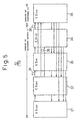
- Fig. 5 shows the configuration of the transporting system TS. Saleable items are transferred along the arrow direction from the left to right in accordance with the supply information of Fig. 4. Note that in this figure three saleable items 36 are illustrated as an example. For example, these may include finished products, parts, raw materials, and packing materials.
- the TS receives as input the supply information, outputs the transportation information, and executes the physical transportation of the saleable items.
- the maximization of customer satisfaction over the goods, services, and other saleable items in consumption, purchase, procurement, and reclamation is the index of optimization.
- the minimization of the total amount of transport relating to the production, cargo, positioning, transport, loading, and distribution-processing is the index of optimization.
- the minimization of the transport costs for the saleable items in the physical transportation and delivery, storage, entry to and exit from warehouses, loading, and distribution processing is the index of optimization.
- the MSC 24 manages the demanding system and supplying systems by for instance optimizing the inventory allocations, intra-center transport plans, or production plans so as to optimize the demand and supply based on the demand information and supply information.
- the MT 25 for example on a single enterprize basis, manages the supplying system and transporting system by for instance optimizing the transport facility capacities or transported lots so as to optimize the supply and transport based on the supply information and transportation information.
- the IMS 26 in Fig. 2 adjusts the delivery dates or delivery times with respect to the demand information through the MSC 24 and MT 25 or provides information on substitutes or related goods so as to optimize the operation of the logistics system as a whole, that is, optimize the flow of saleable items.
- the explanation was given using certain goods as the saleable items, but the present logistics system can also be applied to goods, services, and information including money and knowledge as saleable items. For example, it can be applied to the flow of money, that is, the business process of billing and settlements.
- Fig. 6 shows an embodiment for specifically realizing the basic configuration shown in Fig. 2.
- reference numeral 41 represents an integrated platform (MPCP: multiparty communication platform), 42 a process connection agent (PCA), and 26 integrated management systems (IMS1, IMS2, IMSn).
- MPCP multiparty communication platform
- PCA process connection agent
- IMS1, IMS2, IMSn integrated management systems
- the communication platforms (CP) 2, economic bodies (EB), demanding systems (DS), supplying systems (SS), and transporting systems (TS) are the same as explained above.
- the configuration of the present invention shown in Fig. 6 is completely different. That is, in the present invention, the frameworks of the individual companies, individual businesses, or individual saleable items (LS1, LS2, ..., LSn in Fig. 9) are completely removed. Further, looking at the IMS's 26, in the past, several individual systems were established in parallel such as the MS11, ..., MS1n, MS21, ..., MS2n, MSn1, ..., MSn, but in the present invention, they are completely integrated such as IMS1, IMS2, and IMSn. The units of integration are business processes or management functions.
- the logistics system 11 is a logistics system applied to the flow of saleable items 36 in an economy 10 comprised of customers 15 and economic entities 2, characterized by forming a standardized integrated communication platform (MPCP) 41 in the economy 10 and, on a single enterprize basis, managing the customers and economic entities.
- MPCP standardized integrated communication platform
- the platform 41 is provided with a process connection agent 42.
- the process connection agent 42 can connect with economic bodies for the flow of information relating to saleable items.
- the "platform” spoken of here means standardized media of the Internet, EDI, telephone, facsimile, i-mode communications, data, audio, and display communications and includes platforms in the sense ordinarily used in general computer systems. Specifically, it includes hardware forming the basis of the computer system and OS's (operating systems) for operation of computers.
- the process connection agent 42 built into the platform 41 works as main function of this embodiment. Note that the process connection agent 42 may also be configured connected to the platform 41.
- the process connection agent 42 has or connects
- the process connection agent 42 has or connects integrated management systems (IMS) 26 for, on a single enterprize basis, managing the above supply chain management system (i) and the above transportation management system (ii) and optimizing the flow of saleable items.
- IMS integrated management systems
- the characteristic feature of this embodiment is the optimization of the flow of saleable items for each business process by the integrated management systems. These are the IMS1, IMS2, ..., IMSn shown in Fig. 6.
- the above business processes include at least one of a sales plan control process, shipment projection control process, transportation control process, production control process, purchase control process, incoming order control process, outgoing order control process, inventory control process, delivery center and warehouse control process, distribution processing control process, shipping control process, cargo information control process, ordered saleable item information control process, product control process, and sales performance control process.
- IMS integrated management system
- MSnn shown in Fig. 9 executed the above business processes and calculated the optimal solutions separately and independently and in duplicate or association.
- the process connection agent 42 creates added value by centralizing the software, knowhow, and knowledge relating to the above supply chain management and transportation management.
- An integrated management system given this added value can optimize the flow of saleable items for each economic entity.
- the invention is also advantageous when seen from another aspect than the aspect of mutual use or consolidation or abandonment.
- the customers and economic entities 2 can connect to the process connection agent 42 in any way. Further, they can be disconnected from the process connection agent 42 in any way.
- connection/disconnection to the economic bodies becomes possible.
- the process connection agent 42 is connected to the shared integrated communication platform 41 and can transfer information relating to the saleable items with the economic bodies connected to the same.
- the platform may be connected to by a dedicated line or by the electronic communications network as of the Internet. According to the latter, that is, the Internet, the above connection/disconnection is extremely easy. Therefore, the customers and economic entities can connect by images such as inserting a plug into the platform 41 and conversely can disconnect by images such as pulling out a plug.
- the present invention is realized specifically by an integrated communication platform (MPCP) 41 which is able to easily connect or disconnect and integratedly operate with logistics elements of individual companies and businesses, that is, their (1) transporting means, (2) optimization and streamlining tools, and (3) communication platforms.
- MPCP integrated communication platform
- the integrated platform 41 enables integration of a plurality of conventionally separate LS's over a wide range and to a high performance by the inclusion of a process connection agent 42 serving as a location for linking the individual companies and businesses.
- the integrated platform 41 integrates communication of overall information, integrates the IMS's 43, and places them under its control so as to centrally manage information relating to saleable items and optimizes the flow of saleable items so as to enable changes in the logistics environment to be swiftly handled.
- a logistics system having an integrated platform 41 and process connection agent 42 in this way is called a "multi party logistics system" (MPLS).
- MPLS multi party logistics system
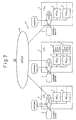
- Fig. 7 is a view capturing the embodiment of the present invention from its virtual aspects.
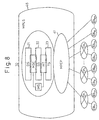
- Fig. 8 is a view capturing the embodiment of the present invention from its practical aspects.
- the logistics systems appear to operate by exclusively utilizing the MPCP 41 as individual CPs. This provides the individual companies or businesses with familiar business processes unique to each.
- the demanding systems (DS), supplying systems (SS), and transport systems (TS) of the individual companies or businesses are all operated integratedly on the MPLS 45.
- the process of transaction in business processes for an economic entity 2 is the same as in the past where a terminal connected to the CP of the local system connected to the MPCP 41 was simply accessed.
- the business process is one in which outgoing order processing, incoming order processing, shipment instructions, demand and supply management, replenishment loading, operation instructions, checking, billing, payment, cargo tracking, inquiry processing and other work and further the framework and tools for optimization and streamlining in the planning, for example, shipment projections, short cycle demand-supply management, continuous automatic replenishment, controlling desirable inventory, simple networking, new product management, product closing management, integrated transportation arrangement system, global cross docking, etc. and communications infrastructure, personnel (operations, storage, and management), and other logistic elements are all processed, on a single enterprize basis, all together in a manner shared by all economic entities.
- a logistics system is realized which solves the problems in past development, investment, and operation of the waste when viewing the economy as a whole and which can operate to satisfy both effectiveness and efficiency and agilely cope with changes in the environment.
Landscapes
- Business, Economics & Management (AREA)
- Engineering & Computer Science (AREA)
- Economics (AREA)
- Marketing (AREA)
- Quality & Reliability (AREA)
- Theoretical Computer Science (AREA)
- Entrepreneurship & Innovation (AREA)
- Human Resources & Organizations (AREA)
- General Physics & Mathematics (AREA)
- Operations Research (AREA)
- Development Economics (AREA)
- Strategic Management (AREA)
- Tourism & Hospitality (AREA)
- Physics & Mathematics (AREA)
- General Business, Economics & Management (AREA)
- Accounting & Taxation (AREA)
- Finance (AREA)
- Mechanical Engineering (AREA)
- Management, Administration, Business Operations System, And Electronic Commerce (AREA)
Abstract
A logistics system for realizing a high efficiency,
waste-free flow of saleable items in an economy comprised
of users and customers, constructed from a demand
information layer 12 which receives as input requests for
saleable items from customers 15 and generates integrated
demand information, a supply information layer 13 which
receives as input this integrated demand information and
generates integrated supply information for economic
entities making up the business process relating to the
supply of the saleable items relating to the requests
from the customers 15, and an integrated transportation
layer 14 which receives as input the integrated supply
information, generates integrated transportation
information relating to the saleable items, and
integratedly executes the physical transportation of the
saleable items within the economy 10.
Description
The present invention relates to a logistics system
for quickly and efficiently satisfying requests of
customers for saleable items such as goods, services and
information, which include money and knowledge, through a
management mechanism comprised of a demanding system,
supplying system, and transporting system.
In recent years, logistics systems designed to
optimize the flow of saleable items in an economy through
the maximum utilization of computers have been developed
to enable companies, businesses, and other economic
entities to quickly and efficiently supply large amounts
of various types of saleable items to meet with the
diverse requests of their customers.
Such logistics systems, explained in detail later
with reference to Fig. 9, suffer from the following
problems:
By adopting such a group strategy and sharing
business processes, it is possible to lower the costs
required for development and investment. Even if such a
group strategy is adopted, however, expansion to the
point of coordination in business processes among
companies or businesses in different fields would require
co-development predicated on the extensions of the
existing frameworks of individual companies, businesses,
or other entities or individual business processes. The
differences in rules, terminology, corporate culture,
etc. would become barriers making this extremely
difficult.
Still further, there is the disadvantage that
when various changes or modifications occur in business
processes within that group, the risk would arise of
repeat development and investment being required when
dealing with these changes or modifications. Further, as
one change, a new entry into the group would cause the
problem of requiring as a condition for entry new
investment based on the existing processes and procedures
and other constraints and, in the final analysis, great
waste in terms of both investment and efficiency when
viewing the economy as a whole.
Further, viewing the above (i) and (ii) together,
there is also the critical problem that the system
structure, which inherently suffers from the defect of
requiring that each change be dealt with and adjustments
made in the operation of the business system for each
logistics system when the above changes and modifications
occur, ends up becoming even more enormous.
Further, there is a similar problem even when
introducing a means for improving efficiency or
increasing optimization by a discovery, knowledge,
method, etc. newly developed or found and put into
practical use or when changing or discarding existing
means.
Therefore, the present inventors engaged in in-depth
research and as a result obtained the idea of going
beyond the framework of individual companies, businesses,
etc. or going beyond even the framework of groups,
assembling these into a single economy, forming a single
demand information layer as a whole and a single supply
information layer as a whole as information integration
layers, and thereby integrating into one transportation
layer and constructing a single logistics system
comprised of these layers integrated into one for the
economy as a whole, and thereby completed the present
invention.
That is, the present invention, in consideration of
the above problems, has as its object to form a single
demand information layer common to the economy as a
whole, a similar single supply information layer, and a
similar single integrated transportation layer and
thereby construct a single integrated logistics system
for customers and economic entities as a whole.
To achieve the above object, the present invention
provides a logistics system for realizing a highly
efficient, waste-free flow of saleable items in an
economy comprised of users and customers. This logistics
system is constructed from a demand information layer
(12) which receives as input requests for saleable items
from customers (15) and generates integrated demand
information, a supply information layer (13) which
receives as input this integrated demand information and
generates integrated supply information for economic
entities making up a business process relating to the
supply of the saleable items relating to the requests
from the customers (15), and an integrated transportation
layer (14) which receives as input the integrated supply
information, generates integrated transportation
information relating to the saleable items, and
integratedly executes the physical transportation of the
saleable items within the economy (10).
To clarify the effects of the present invention,
first a conventional logistics system will be explained.
Fig. 9 is a view summarizing a conventional
logistics system.
In this figure, reference numeral 1 indicates a
logistics system (LS). In the figure, as one example, as
the LS's of individual companies, individual businesses,
or individual saleable items, the first, second, ... n-th
logistics systems LS1, LS2, and LSn are shown.
The logistics systems 1 basically have substantially
the same configurations. Explaining the logistics system
(LS2) 1 as a typical example, in the LS2, there is a
communication platform (CP) CP2 at the center. Management
mechanisms DS21 (demanding system), SS21 (supplying
system), TS21 (transporting system), ... DS2n, SS2n, and
TS2n function in accordance with the demand information
relating to the saleable items input from the customers
connected to the CP2. That is, in the LS2, products are
produced and shipped out by the "just in time" system in
small lots on the optimal factory lines in response to
the customer requests. The saleable items are loaded on a
large number of trucks or other vehicles and delivered
between the factories and warehouses and consuming areas.
Note that for space reasons in the figure, the management
mechanisms 4 are shown for only the LS2, but there are
similarly a DS11, SS11, TS11, ... DS1n, SS1n, and TS1n
for LS1 and a DS1n SS1n, TS1n, ... DSnn, SSnn, and TSnn
for LSn.
To optimize the flow of saleable items in these
management mechanisms 4, that is, to transfer saleable
items by the lowest operation and management costs and
the greatest effectiveness and efficiency, managing
systems (MS) 3 built around computers are provided as
MS21, ..., MS2n. MS21, ..., MS2n find the optimal
solutions for the flow of saleable items in accordance
with the request information input from the customers
through the communication platform CP2 using the
computers and cause the management mechanisms 4, that is,
the DS21, SS21, TS21 ... DS2n, SS2n, and TS2n to
function.
Giving a specific example, if LS2 is a logistics
system of a business handling soft drinks, MS21 for
example has jurisdiction over the business process of PET
bottled mineral water, while MS2n has jurisdiction over
the business process of for example canned coffee
beverages.
According to the logistics system (LS) 1 shown in
Fig. 9, the various problems explained in detail in the
"BACKGROUND ART" arise. The present invention for solving
these problems will be explained in detail below.
Fig. 1 is a view of the principle of a logistics
system according to the present invention.
The logistics system 11 according to the present
invention is a logistics system to be applied to the flow
of saleable items (not shown) in an economy 10 comprised
of customers 15 and economic entities 2. Here, a
"customer" is defined to include an individual, company,
or business providing required information on saleable
items. Further, an "economic entity" is defined as a
company, business, etc. forming part of a business
process relating to the supply of such saleable items.
Further, "saleable items" mean goods, services, or
information relating to a business process or work of an
economic entity in an economy comprised of customers and
economic entities.
The logistics system 11, as shown in the figure, is
comprised of a demand information layer 12, a supply
information layer 13, and an integrated transportation
layer 14.
The demand information layer 12 receives as input
request information from customers 15 relating to
saleable items and generates integrated demand
information for economic entities 2 using this request
information. The supply information layer 13 receives as
input the integrated demand information and generates
integrated supply information for economic entities 2
forming part of the business process relating to the
supply of saleable items relating to the requests from
the customers 15.
The integrated transportation layer 14 receives as
input the integrated supply information, generates
integrated transportation information relating to the
saleable items, and executes the physical transportation
of the saleable items integratedly in the economy 10. The
logistics system 11 of the present invention is in
principle comprised of these layers 12, 13, and 14.
The thus constructed logistics system 11 solves the
problems arising due to the logistics systems being
individually dealt with in units of individual companies,
businesses, or saleable items in the above-mentioned
prior art and can optimize the flow of saleable items.
The idea of constructing a logistics system 11
integrating and centralizing an economy as a whole has
never been proposed in the past and is novel. This has
become more practical due to the rapid improvement in the
advanced information infrastructure as represented by the
Internet.
In the past, as such an integrated and centralized
logistics system, a nationwide or global scale logistics
system for the shipping industry (for example, the
transportation of designated packages to individuals) has
been proposed and has already been put into practice.
Such a logistics system in the shipping industry and the
logistics system 11 of the present invention, however,
differ fundamentally in the following two points. First,
in the case of the shipping industry, the system is
limited to the transportation business of the collection
of saleable items from customers and delivery to
customers, while in the case of the present invention,
the system is applied to the economy starting from
requests from customers for saleable items to the
production, procurement, storage, and delivery of the
same, that is, the entire business process from
consumption to production, purchase, and sales. Second,
it covers with its operational scope all companies,
businesses, and other economic entities 2 regardless of
whether they are in the same industries or different
industries.
Therefore, a transportation system free of waste as
viewed as the economy as a whole is realized.
Fig. 2 is a view of the basic configuration for
realizing the principle shown in Fig. 1.
In this figure, the basic elements making up the
logistics system 11 include the demanding system (DS) 21
for converting requests for saleable items arising from
customers 15 into demand information, a supplying system
(SS) 22 for converting the demand information into supply
information, and a transporting system (TS) 23 for
converting the supply information to transportation
information and executing the physical transportation of
the saleable items.
In the basic configuration of Fig. 2, the
characterizing features of the present invention are a
supply chain management system (MSC) 24 and
transportation management system (MT) 25. Further
characterizing the present invention is the integrated
managing system (IMS) 26.
The supply chain management system (MSC) 24 is
interposed between the demanding system (DS) 21 and
supplying system (SS) 22 and, on a single enterprise
basis, manages the demanding system and supplying system
to optimize demand and supply.
The transportation management system (MT) 25 is
interposed between the transporting system (TS) 23 and
supplying system (SS) 22 and, on a single enterprise
basis, manages the supplying system and transporting
system to optimize supply and transport.
Further, the integrated management system (IMS) 26,
on a single enterprise basis, manages the supply chain
management system (SCM) 24 and transportation management
system (TS) 25 to optimize the flow of saleable items.
The logistics system (LS) 11 of the present
invention shares and standardizes the DS 21 and SS 22 in
the overall economy made up of the customers and economic
entities. Therefore, the TS 23 is also shared and
standardized in the economy as a whole.
The logistics system (LS) 11 of the present
invention shown in Fig. 2 differs greatly from the
logistics system in the above-mentioned shipping industry
as illustrated below.
First, referring to Fig. 3, the economy 10 is
divided into a customer 15 domain and a company or
business or other economy entity 2 domain. The economic
entity 2 domain is divided into a plurality of stages
along the flow of requests or the flow of saleable items.
Each stage forms an economic body (EB) 31 to 34. Note
that a customer 15 is also considered as an economic body
(EB customer) 35.
The economic body (EB) 31 is for example a supplier
(EB supplier) providing raw materials for the saleable
items,
In Fig. 3, the arrows from the right to the left
indicate various request information. Such requests, as
illustrated, arise between various economic bodies (EB).
The DS receives as input the request information
from customers and outputs demand information.
Next, referring to Fig. 4, the flow of the supplying
system SS becomes the opposite to the flow of the
demanding system DS shown in Fig. 3. In this figure, the
arrows from the left to the right indicate various supply
information.
The SS receives as input the demand information and
outputs the supply information.
Fig. 5 shows the configuration of the transporting
system TS. Saleable items are transferred along the arrow
direction from the left to right in accordance with the
supply information of Fig. 4. Note that in this figure
three saleable items 36 are illustrated as an example.
For example, these may include finished products, parts,
raw materials, and packing materials.
Note that in Fig. 5, the arrows from the right to
the left indicate not the flow of transportation of
finished products to the customers, but the flow of
returned goods, recycled goods, reclaimed goods, and
pallets and other transport materials.
That is, the TS receives as input the supply
information, outputs the transportation information, and
executes the physical transportation of the saleable
items.
Here, the suppliers such as manufacturers of raw
materials and packing materials are themselves EBmak in
view of the functions of production. There are therefore
suppliers as a previous process.
At the DS 21 (Fig. 3), the maximization of customer
satisfaction over the goods, services, and other saleable
items in consumption, purchase, procurement, and
reclamation is the index of optimization.
At the SS 22 (Fig. 4), the minimization of the total
amount of transport relating to the production, cargo,
positioning, transport, loading, and distribution-processing
is the index of optimization.
Further, at the TS 23 (Fig. 5), the minimization of
the transport costs for the saleable items in the
physical transportation and delivery, storage, entry to
and exit from warehouses, loading, and distribution
processing is the index of optimization.
Further, the MSC 24, for example, on a single
enterprize basis, manages the demanding system and
supplying systems by for instance optimizing the
inventory allocations, intra-center transport plans, or
production plans so as to optimize the demand and supply
based on the demand information and supply information.
Further, the MT 25 for example on a single
enterprize basis, manages the supplying system and
transporting system by for instance optimizing the
transport facility capacities or transported lots so as
to optimize the supply and transport based on the supply
information and transportation information.
Finally, the IMS 26 in Fig. 2 adjusts the delivery
dates or delivery times with respect to the demand
information through the MSC 24 and MT 25 or provides
information on substitutes or related goods so as to
optimize the operation of the logistics system as a
whole, that is, optimize the flow of saleable items.
Note that in the above example, the explanation was
given using certain goods as the saleable items, but the
present logistics system can also be applied to goods,
services, and information including money and knowledge
as saleable items. For example, it can be applied to the
flow of money, that is, the business process of billing
and settlements.
Fig. 6 shows an embodiment for specifically
realizing the basic configuration shown in Fig. 2.
In this figure, reference numeral 41 represents an
integrated platform (MPCP: multiparty communication
platform), 42 a process connection agent (PCA), and 26
integrated management systems (IMS1, IMS2, IMSn). The
communication platforms (CP) 2, economic bodies (EB),
demanding systems (DS), supplying systems (SS), and
transporting systems (TS) are the same as explained
above.
Compared with the conventional configuration shown
in Fig. 9 above, the configuration of the present
invention shown in Fig. 6 is completely different. That
is, in the present invention, the frameworks of the
individual companies, individual businesses, or
individual saleable items (LS1, LS2, ..., LSn in Fig. 9)
are completely removed. Further, looking at the IMS's 26,
in the past, several individual systems were established
in parallel such as the MS11, ..., MS1n, MS21, ..., MS2n,
MSn1, ..., MSn, but in the present invention, they are
completely integrated such as IMS1, IMS2, and IMSn. The
units of integration are business processes or management
functions.
Therefore, the logistics system 11 according to this
embodiment of the present invention is a logistics system
applied to the flow of saleable items 36 in an economy 10
comprised of customers 15 and economic entities 2,
characterized by forming a standardized integrated communication platform (MPCP) 41 in theeconomy 10 and,
on a single enterprize basis, managing the customers and
economic entities.
characterized by forming a standardized integrated communication platform (MPCP) 41 in the
Further, the platform 41 is provided with a process
connection agent 42. The process connection agent 42 can
connect with economic bodies for the flow of information
relating to saleable items.
Note that the "platform" spoken of here means
standardized media of the Internet, EDI, telephone,
facsimile, i-mode communications, data, audio, and
display communications and includes platforms in the
sense ordinarily used in general computer systems.
Specifically, it includes hardware forming the basis of
the computer system and OS's (operating systems) for
operation of computers. The process connection agent 42
built into the platform 41 works as main function of this
embodiment. Note that the process connection agent 42 may
also be configured connected to the platform 41.
The process connection agent 42 has or connects
Here, the process connection agent 42 has or
connects integrated management systems (IMS) 26 for, on a
single enterprize basis, managing the above supply chain
management system (i) and the above transportation
management system (ii) and optimizing the flow of
saleable items.
In this case, the characteristic feature of this
embodiment is the optimization of the flow of saleable
items for each business process by the integrated
management systems. These are the IMS1, IMS2, ..., IMSn
shown in Fig. 6.
Giving a specific example, the above business
processes include at least one of a sales plan control
process, shipment projection control process,
transportation control process, production control
process, purchase control process, incoming order control
process, outgoing order control process, inventory
control process, delivery center and warehouse control
process, distribution processing control process,
shipping control process, cargo information control
process, ordered saleable item information control
process, product control process, and sales performance
control process. For example, the IMS1 (consumption
control process) to IMS9 (shipping control process) are
working at the same time as the integrated management
system (IMS) 26. These business processes are however
illustrations. It is possible to freely include original
business processes for each economic entity 2.
Note that in the past the MS11, MS1n, ... MSn1, MSnn
shown in Fig. 9 executed the above business processes and
calculated the optimal solutions separately and
independently and in duplicate or association.
Therefore, according to the present embodiment, it
is possible to give rise to a new management function
featuring an effectiveness and efficiency not seen in the
past. This is given rise to first by integrating the
MS11, MS1n, ..., MSn1, MSnn shown in Fig. 9.
That is, the process connection agent 42 creates
added value by centralizing the software, knowhow, and
knowledge relating to the above supply chain management
and transportation management. An integrated management
system given this added value can optimize the flow of
saleable items for each economic entity.
Giving one example, assuming the economic entities A
to G have as essential business processes the above
inventory control process and warehouse control process,
it is possible to make mutual use of them or consolidate
or discard them by merger or linkage of the inventory
control processes of the economic entities A to D and the
warehouse control processes of the economic entities E to
G in accordance with need and therefore give rise to a
more efficient, waste-free inventory and warehouse
control process.
On the other hand, according to the present
embodiment, the invention is also advantageous when seen
from another aspect than the aspect of mutual use or
consolidation or abandonment.
That is, the customers and economic entities 2 can
connect to the process connection agent 42 in any way.
Further, they can be disconnected from the process
connection agent 42 in any way. In the logistics system
11, connection/disconnection to the economic bodies
becomes possible. Note that the process connection agent
42 is connected to the shared integrated communication
platform 41 and can transfer information relating to the
saleable items with the economic bodies connected to the
same. The platform may be connected to by a dedicated
line or by the electronic communications network as of
the Internet. According to the latter, that is, the
Internet, the above connection/disconnection is extremely
easy. Therefore, the customers and economic entities can
connect by images such as inserting a plug into the
platform 41 and conversely can disconnect by images such
as pulling out a plug.
When viewing the above embodiment (Fig. 6) as a
whole, the following can be said.
Sharing of the knowledge, knowhow, software, and
other "optimization and streamlining tools", goods,
services, and information, that is, "saleable items", and
vehicles, trucks, ships, aircraft, containers, pallets,
cartons, warehouses, conveyors, etc., that is,
"transporting means", and "communication platforms (EDI
networks, Internet, VAN, facsimiles, telephones, i-mode,
etc.)" owned by the various companies, businesses, etc.
by the related companies, businesses, and other economic
entities by pooling of information leads to realization
of further efficiency. The present invention is realized
specifically by an integrated communication platform
(MPCP) 41 which is able to easily connect or disconnect
and integratedly operate with logistics elements of
individual companies and businesses, that is, their (1)
transporting means, (2) optimization and streamlining
tools, and (3) communication platforms.
The integrated platform 41, as mentioned above,
enables integration of a plurality of conventionally
separate LS's over a wide range and to a high performance
by the inclusion of a process connection agent 42 serving
as a location for linking the individual companies and
businesses. Here, the integrated platform 41 integrates
communication of overall information, integrates the
IMS's 43, and places them under its control so as to
centrally manage information relating to saleable items
and optimizes the flow of saleable items so as to enable
changes in the logistics environment to be swiftly
handled. A logistics system having an integrated platform
41 and process connection agent 42 in this way is called
a "multi party logistics system" (MPLS).
Finally, the architecture of the present embodiment
will be shown from its virtual aspects and practical
aspects.
Fig. 7 is a view capturing the embodiment of the
present invention from its virtual aspects.
Fig. 8 is a view capturing the embodiment of the
present invention from its practical aspects.
Note that the reference numerals and symbols used in
Fig. 7 and Fig. 8 represent the same elements as those
used in Fig. 2 and Fig. 6 etc.
As shown in Fig. 7, for the individual companies or
businesses, the logistics systems (LS) appear to operate
by exclusively utilizing the MPCP 41 as individual CPs.
This provides the individual companies or businesses with
familiar business processes unique to each.
In reality, however, as shown in Fig. 8, the
demanding systems (DS), supplying systems (SS), and
transport systems (TS) of the individual companies or
businesses are all operated integratedly on the MPLS 45.
In the final analysis, the individual companies or
individual businesses etc. appear to operate their LS's
individually, but in reality the logistics system of the
present invention operates all LS's in a manner
integrating all of the companies and businesses.
When considering the advantages inherent to the
present embodiment with reference to Fig. 7 and Fig. 8,
the following can be said.
Since it is a virtual reality process provided by
the MPLS 45, the process of transaction in business
processes for an economic entity 2 is the same as in the
past where a terminal connected to the CP of the local
system connected to the MPCP 41 was simply accessed. In
practice, however, the business process is one in which
outgoing order processing, incoming order processing,
shipment instructions, demand and supply management,
replenishment loading, operation instructions, checking,
billing, payment, cargo tracking, inquiry processing and
other work and further the framework and tools for
optimization and streamlining in the planning, for
example, shipment projections, short cycle demand-supply
management, continuous automatic replenishment,
controlling desirable inventory, simple networking, new
product management, product closing management,
integrated transportation arrangement system, global
cross docking, etc. and communications infrastructure,
personnel (operations, storage, and management), and
other logistic elements are all processed, on a single
enterprize basis, all together in a manner shared by all
economic entities.
In a business process utilizing the MPLS 45, it is
possible to cut the (1) "cost of logistics operation"
relating to the saleable items themselves such as goods,
services, or information including money and knowledge
and (2) "running and adjusting cost" spent for the
logistics system itself. Further, the scope of
application, performance, and quality in the individual
business processes and management functions are shared
and improved to the maximum level of the logistic
elements.
Further, by upgrading the output performance and
streamlining the framework and operation in the
individual elements of all logistic systems, all of the
companies or businesses and other economic entities
connected to the MPLS 45 enjoy these merits in tandem.
Further, in addition to the connection and
disconnection between customers and economic entities, it
is easy to set, modify, introduce, and discard elements
such as functions, knowhow, software optimization tools,
etc. Due to this, it is possible to deal with changes in
the logistics environment agilely, flexibly, and
accurately and increase customer satisfaction.
As explained above, according to the present
invention, a logistics system is realized which solves
the problems in past development, investment, and
operation of the waste when viewing the economy as a
whole and which can operate to satisfy both effectiveness
and efficiency and agilely cope with changes in the
environment.
Claims (12)
- A logistics system used for the flow of saleable items in an economy comprised of customers and economic entities,said logistics system characterized by being constructed froma demand information layer which receives as input request information for saleable items from customers and generates integrated demand information for the economic entities using the request information,a supply information layer which receives as input said integrated demand information and generates integrated supply information for economic entities making up a business process relating to the supply of the saleable items relating to the requests from the customers, andan integrated transportation layer which receives as input said integrated supply information, generates integrated transportation information relating to the saleable items, and integratedly executes the physical transportation of the saleable items within the economy.
- A logistics system used for the flow of saleable items in an economy comprised of customers and economic entities,said logistics system characterized by being provided witha supply chain management system interposed between a demanding system converting requests issued from customers for saleable items to demand information and a supplying system converting said demand information to supply information and, on a single enterprize basis, managing the demanding system and supplying system anda transportation management system interposed between a transporting system converting said supply information to transportation information and executing physical transportation of said saleable items and the supplying system and, on a single enterprize basis, managing the supplying system and transporting system.
- A logistics system as set forth in claim 2, further provided with an integrated management system for, on a single enterprize basis, managing the supply chain management system and transportation management system and optimizing the flow of saleable items.
- A logistics system used for the flow of saleable items in an economy comprised of customers and economic entities,
said logistics system characterized by forming a standardized integrated communication platform in the economy and, on a single enterprize basis, managing the customers and economic entities. - A logistics system as set forth in claim 4, further provided with a process connection agent in said integrated communication platform, said process connection agent able connect the customers and economic entities to enable the flow of information relating to saleable items.
- A logistics system as set forth in claim 5, wherein said process connection agent has or connectsa supply chain management system interposed between the demanding system converting a request issued by a customer for saleable items to demand information and a supplying system converting the demand information to supply information and, on a single enterprize basis, managing the demanding system and the supplying system anda transportation management system interposed between the transporting system for converting the supply information to transportation information and executing the physical transportation of the saleable items and the supplying system and, on a single enterprize basis, managing the supplying system and transporting system.
- A logistics system as set forth in claim 6, wherein said process connection agent has or connects an integrated management system for, on a single enterprize basis, managing the above supply chain management system and the above transportation management system and optimizing the flow of saleable items.
- A logistics system as set forth in claim 7, wherein said integrated management system optimizes the flow of saleable items for each business process.
- A logistics system as set forth in claim 8, wherein said business process forms at least one of a sales plan control process, shipment projection control process, transportation control process, production control process, purchase control process, incoming order control process, outgoing order control process, inventory control process, delivery center and warehouse control process, distribution processing control process, shipping control process, cargo information control process, ordered saleable item information control process, product control process, and sales performance control process.
- A logistics system as set forth in claim 7, wherein the integrated management system optimizes the flow of saleable items for each economic entity.
- A logistics system as set forth in claim 5, wherein said customers and economic entities can freely connect to said process connection agent and can freely disconnect from said process connection agent.
- A logistics system as set forth in claim 5, wherein said process connection agent optimally connects said customers and economic entities by transferring information relating to saleable items via an electronic communications network.
Applications Claiming Priority (3)
| Application Number | Priority Date | Filing Date | Title |
|---|---|---|---|
| JP2000107203 | 2000-04-07 | ||
| JP2000107203A JP2001290989A (en) | 2000-04-07 | 2000-04-07 | Logistics system |
| PCT/JP2001/003008 WO2001076983A2 (en) | 2000-04-07 | 2001-04-06 | Logistic system |
Publications (2)
| Publication Number | Publication Date |
|---|---|
| EP1344726A1 true EP1344726A1 (en) | 2003-09-17 |
| EP1344726A4 EP1344726A4 (en) | 2003-09-17 |
Family
ID=18620227
Family Applications (1)
| Application Number | Title | Priority Date | Filing Date |
|---|---|---|---|
| EP01919820A Withdrawn EP1344726A4 (en) | 2000-04-07 | 2001-04-06 | LOGISTICS SYSTEM |
Country Status (4)
| Country | Link |
|---|---|
| US (1) | US20020156642A1 (en) |
| EP (1) | EP1344726A4 (en) |
| JP (1) | JP2001290989A (en) |
| WO (1) | WO2001076983A2 (en) |
Families Citing this family (7)
| Publication number | Priority date | Publication date | Assignee | Title |
|---|---|---|---|---|
| US8438051B2 (en) * | 2004-09-28 | 2013-05-07 | Sap Aktiengeselleschaft | Rounding to transportation quantities |
| FI126245B (en) * | 2005-03-09 | 2016-08-31 | Konecranes Finland Oy | Procedure for placing a palletless goods package on a warehouse shelf and handing it over therefrom and administering the package logistics and equipment for carrying out the procedure |
| US20070174145A1 (en) * | 2005-12-30 | 2007-07-26 | Stephan Hetzer | Controlling logistics execution in a computer application |
| US7841516B2 (en) * | 2005-12-30 | 2010-11-30 | Sap Ag | Delivery data objects in enterprise computing systems |
| EP2266080A1 (en) * | 2008-03-30 | 2010-12-29 | Flavio Costa | Ecological goods logistics system |
| US8788247B2 (en) * | 2008-08-20 | 2014-07-22 | International Business Machines Corporation | System and method for analyzing effectiveness of distributing emergency supplies in the event of disasters |
| CN109146372A (en) * | 2018-04-26 | 2019-01-04 | 宏泰集团(厦门)有限公司 | Global wisdom manufactures sales service system |
Family Cites Families (12)
| Publication number | Priority date | Publication date | Assignee | Title |
|---|---|---|---|---|
| US5666493A (en) * | 1993-08-24 | 1997-09-09 | Lykes Bros., Inc. | System for managing customer orders and method of implementation |
| US5485369A (en) * | 1993-09-28 | 1996-01-16 | Tandata Corporation | Logistics system for automating tansportation of goods |
| US5450317A (en) * | 1993-11-24 | 1995-09-12 | U S West Advanced Technologies, Inc. | Method and system for optimized logistics planning |
| US6549891B1 (en) * | 1996-03-26 | 2003-04-15 | Recovery Management Corporation | Method for managing inventory |
| US6460020B1 (en) * | 1996-12-30 | 2002-10-01 | De Technologies, Inc. | Universal shopping center for international operation |
| JP3986192B2 (en) * | 1998-12-25 | 2007-10-03 | 富士通株式会社 | Data utilization method, data processing apparatus, and recording medium |
| US6934692B1 (en) * | 1999-07-06 | 2005-08-23 | Dana B. Duncan | On-line interactive system and method for transacting business |
| US6847938B1 (en) * | 1999-09-20 | 2005-01-25 | Donna R. Moore | Method of exchanging goods over the internet |
| US6957197B1 (en) * | 1999-12-30 | 2005-10-18 | Pitney Bowes Inc. | Load planning tables for a parcel shipping system |
| US6711798B2 (en) * | 2000-01-18 | 2004-03-30 | Dell Products L.P. | Method for manufacturing products according to customer orders |
| US6915268B2 (en) * | 2000-07-28 | 2005-07-05 | Odyssey Logistics & Technology Corporation | Transport logistics systems and methods |
| US6785718B2 (en) * | 2000-10-23 | 2004-08-31 | Schneider Logistics, Inc. | Method and system for interfacing with a shipping service |
-
2000
- 2000-04-07 JP JP2000107203A patent/JP2001290989A/en active Pending
-
2001
- 2001-04-06 WO PCT/JP2001/003008 patent/WO2001076983A2/en not_active Ceased
- 2001-04-06 US US09/980,689 patent/US20020156642A1/en not_active Abandoned
- 2001-04-06 EP EP01919820A patent/EP1344726A4/en not_active Withdrawn
Also Published As
| Publication number | Publication date |
|---|---|
| US20020156642A1 (en) | 2002-10-24 |
| JP2001290989A (en) | 2001-10-19 |
| WO2001076983A9 (en) | 2004-05-13 |
| EP1344726A4 (en) | 2003-09-17 |
| WO2001076983A2 (en) | 2001-10-18 |
Similar Documents
| Publication | Publication Date | Title |
|---|---|---|
| Caputo et al. | Internal, vertical and horizontal logistics integration in Italian grocery distribution | |
| US6698655B2 (en) | Super cross-dock logistics system and method | |
| KR20120100601A (en) | Optimization system of smart logistics network | |
| CN109919549A (en) | A Port Third Party Logistics Management Information System Based on Three-tier B/S Mode | |
| CN115456522A (en) | Shared tray management system and lease platform based on Internet of things | |
| Correa Issi et al. | Mathematical Optimization Model for Truck Scheduling in a Distribution Center with a Mixed Service‐Mode Dock Area | |
| CN107918843A (en) | Logistics supply chain management system | |
| US20020156642A1 (en) | Logistic system | |
| Bookbinder et al. | Logistics information systems in a Just-In-Time environment | |
| McKinnon | Road transport optimization | |
| Novack et al. | Rethinking integrated concept foundations: a just‐in‐time argument for linking production/operations and logistics management | |
| Ertek | A tutorial on crossdocking | |
| Li et al. | Optimal product allocation for crossdocking and warehousing operations in FMCG supply chain | |
| Rahbari et al. | Robust vehicle routing and cross-dock scheduling with uncertain loading and unloading time | |
| Bányai | Just In Sequence Supply with Multilevel Cross Docking | |
| KR20030009595A (en) | Supply Chain Management System | |
| US20240161055A1 (en) | Facility and method for executing logistics operation | |
| KR20210087633A (en) | Supply Chain Management System | |
| JP7488311B2 (en) | Facilities and methods for carrying out logistics operations | |
| US20040210499A1 (en) | System and method for shipment management | |
| Ivaković et al. | Optimisation of distribution network applying logistic outsourcing | |
| Lyu | The impact of E-commerce Warehousing and Logistics Efficiency from the Perspective of Supply Chain Management | |
| Bajor et al. | The role of decision-making parameters in constructing and re-engineering of distribution networks | |
| Sitek et al. | The declarative framework approach to decision support for constrained search problems | |
| Hesse et al. | LOGISTICS-International Encyclopedia of Human Geography (1025) |
Legal Events
| Date | Code | Title | Description |
|---|---|---|---|
| PUAI | Public reference made under article 153(3) epc to a published international application that has entered the european phase |
Free format text: ORIGINAL CODE: 0009012 |
|
| 17P | Request for examination filed |
Effective date: 20011227 |
|
| A4 | Supplementary search report drawn up and despatched |
Effective date: 20030128 |
|
| AK | Designated contracting states |
Kind code of ref document: A1 Designated state(s): AT BE CH CY DE DK ES FI FR GB GR IE IT LI LU MC NL PT SE TR |
|
| 17Q | First examination report despatched |
Effective date: 20040324 |
|
| STAA | Information on the status of an ep patent application or granted ep patent |
Free format text: STATUS: THE APPLICATION IS DEEMED TO BE WITHDRAWN |
|
| 18D | Application deemed to be withdrawn |
Effective date: 20050929 |
|
| RIC1 | Information provided on ipc code assigned before grant |
Ipc: B65G 1/00 20060101AFI20060327BHEP |