EP1343771B1 - 3-ox(adi)azolylpropanohydroxamic acids useful as procollagen c-proteinase inhibitors - Google Patents
3-ox(adi)azolylpropanohydroxamic acids useful as procollagen c-proteinase inhibitors Download PDFInfo
- Publication number
- EP1343771B1 EP1343771B1 EP01271107A EP01271107A EP1343771B1 EP 1343771 B1 EP1343771 B1 EP 1343771B1 EP 01271107 A EP01271107 A EP 01271107A EP 01271107 A EP01271107 A EP 01271107A EP 1343771 B1 EP1343771 B1 EP 1343771B1
- Authority
- EP
- European Patent Office
- Prior art keywords
- preparation
- formula
- compound
- oxadiazol
- methyl
- Prior art date
- Legal status (The legal status is an assumption and is not a legal conclusion. Google has not performed a legal analysis and makes no representation as to the accuracy of the status listed.)
- Expired - Lifetime
Links
- 0 **C(CC(*)=O)C(N[C@@](*)C(*)=O)=O Chemical compound **C(CC(*)=O)C(N[C@@](*)C(*)=O)=O 0.000 description 12
- PFYDVOYXRHIRQE-MRXNPFEDSA-N CC(C)(C)OC(C[C@@H](CCCC1CCCCC1)c1nc(CNC)n[o]1)=O Chemical compound CC(C)(C)OC(C[C@@H](CCCC1CCCCC1)c1nc(CNC)n[o]1)=O PFYDVOYXRHIRQE-MRXNPFEDSA-N 0.000 description 2
- HZTUNMMJTJXLAB-YHVXIASJSA-N CC(C)(C)N/[O]=S(/NCc1n[o]c([C@H](CCCC2CCCCC2)CC(O)=O)n1)\O Chemical compound CC(C)(C)N/[O]=S(/NCc1n[o]c([C@H](CCCC2CCCCC2)CC(O)=O)n1)\O HZTUNMMJTJXLAB-YHVXIASJSA-N 0.000 description 1
- CTRPQQNYPGGBBQ-LJQANCHMSA-N CC(C)(C)NS(NCc1n[o]c([C@H](CCCC2CCCCC2)CC(OC(C)(C)C)=O)n1)(OC)=O Chemical compound CC(C)(C)NS(NCc1n[o]c([C@H](CCCC2CCCCC2)CC(OC(C)(C)C)=O)n1)(OC)=O CTRPQQNYPGGBBQ-LJQANCHMSA-N 0.000 description 1
- QLVCCVNHGNNRIY-UHFFFAOYSA-N CC(C)(C)OC(CC(CCCC1CCCCC1)c1nc(CNC2CC2)n[o]1)=O Chemical compound CC(C)(C)OC(CC(CCCC1CCCCC1)c1nc(CNC2CC2)n[o]1)=O QLVCCVNHGNNRIY-UHFFFAOYSA-N 0.000 description 1
- PVKMJEZPBDTWHS-UHFFFAOYSA-O CC(C)(C)OC(CC1(C(CCC2CCCCC2)C1)c1nc(CNS(C(C=N)=C[NH3+])(=O)=O)n[o]1)=O Chemical compound CC(C)(C)OC(CC1(C(CCC2CCCCC2)C1)c1nc(CNS(C(C=N)=C[NH3+])(=O)=O)n[o]1)=O PVKMJEZPBDTWHS-UHFFFAOYSA-O 0.000 description 1
- VVYVFZRWUJASEV-CQSZACIVSA-N CC(C)(C)OC(C[C@@H](CCCC1CCCCC1)C(O)=O)=O Chemical compound CC(C)(C)OC(C[C@@H](CCCC1CCCCC1)C(O)=O)=O VVYVFZRWUJASEV-CQSZACIVSA-N 0.000 description 1
- JSIOOENOXJVEEX-JOCHJYFZSA-N CC(C)(C)OC(C[C@@H](CCCC1CCCCC1)C1=[O](C)CNC(C(CC2)CCN2S(C)(=O)=O)=NO1)=O Chemical compound CC(C)(C)OC(C[C@@H](CCCC1CCCCC1)C1=[O](C)CNC(C(CC2)CCN2S(C)(=O)=O)=NO1)=O JSIOOENOXJVEEX-JOCHJYFZSA-N 0.000 description 1
- VJKBNKBCVNEZPE-LJQANCHMSA-N CC(C)(C)OC(C[C@@H](CCCC1CCCCC1)c1nc(CN(CC2)CCC2O)n[o]1)=O Chemical compound CC(C)(C)OC(C[C@@H](CCCC1CCCCC1)c1nc(CN(CC2)CCC2O)n[o]1)=O VJKBNKBCVNEZPE-LJQANCHMSA-N 0.000 description 1
- BDRMZDKLGALUTN-OAHLLOKOSA-N CC(C)(C)OC(C[C@@H](CCCC1CCCCC1)c1nc(CN)n[o]1)=O Chemical compound CC(C)(C)OC(C[C@@H](CCCC1CCCCC1)c1nc(CN)n[o]1)=O BDRMZDKLGALUTN-OAHLLOKOSA-N 0.000 description 1
- ODQIMTCPKCYTJH-LJQANCHMSA-N CC(C)(C)OC(C[C@@H](CCCC1CCCCC1)c1nc(CN2CCOCC2)n[o]1)=O Chemical compound CC(C)(C)OC(C[C@@H](CCCC1CCCCC1)c1nc(CN2CCOCC2)n[o]1)=O ODQIMTCPKCYTJH-LJQANCHMSA-N 0.000 description 1
- MJFFDRPCOASHCF-QGZVFWFLSA-N CC(C)(C)OC(C[C@@H](CCCC1CCCCC1)c1nc(CNC(C)=O)n[o]1)=O Chemical compound CC(C)(C)OC(C[C@@H](CCCC1CCCCC1)c1nc(CNC(C)=O)n[o]1)=O MJFFDRPCOASHCF-QGZVFWFLSA-N 0.000 description 1
- URWFRZISGZAWJS-GOSISDBHSA-N CC(C)(C)OC(C[C@@H](CCCC1CCCCC1)c1nc(CNC(CN(C)C)=O)n[o]1)=O Chemical compound CC(C)(C)OC(C[C@@H](CCCC1CCCCC1)c1nc(CNC(CN(C)C)=O)n[o]1)=O URWFRZISGZAWJS-GOSISDBHSA-N 0.000 description 1
- LYYPYFVMFBDBBS-QGZVFWFLSA-N CC(C)(C)OC(C[C@@H](CCCC1CCCCC1)c1nc(CNC(COC)=O)n[o]1)=O Chemical compound CC(C)(C)OC(C[C@@H](CCCC1CCCCC1)c1nc(CNC(COC)=O)n[o]1)=O LYYPYFVMFBDBBS-QGZVFWFLSA-N 0.000 description 1
- NMGPGYUCKRRVMA-LJQANCHMSA-N CC(C)(C)OC(C[C@@H](CCCC1CCCCC1)c1nc(CNS(c2cnccc2)(=O)=O)n[o]1)=O Chemical compound CC(C)(C)OC(C[C@@H](CCCC1CCCCC1)c1nc(CNS(c2cnccc2)(=O)=O)n[o]1)=O NMGPGYUCKRRVMA-LJQANCHMSA-N 0.000 description 1
- HTQWSWLSGCPRDE-QGZVFWFLSA-N CC(C)(C)OC(C[C@@H](CCCC1CCCCC1)c1nc(C[N](C)(C)S=O)n[o]1)=O Chemical compound CC(C)(C)OC(C[C@@H](CCCC1CCCCC1)c1nc(C[N](C)(C)S=O)n[o]1)=O HTQWSWLSGCPRDE-QGZVFWFLSA-N 0.000 description 1
- AIRUAJVKRRUSFL-CQSZACIVSA-N CC(C)(C)OC(C[C@H](c1nc(CN)n[o]1)OCCC1CCCCC1)=O Chemical compound CC(C)(C)OC(C[C@H](c1nc(CN)n[o]1)OCCC1CCCCC1)=O AIRUAJVKRRUSFL-CQSZACIVSA-N 0.000 description 1
- LNNFBRYJWWWQCH-UHFFFAOYSA-N CC(C)CNCc1n[o]c(C2(CC(O)=O)C(CCC3CCCCC3)C2)n1 Chemical compound CC(C)CNCc1n[o]c(C2(CC(O)=O)C(CCC3CCCCC3)C2)n1 LNNFBRYJWWWQCH-UHFFFAOYSA-N 0.000 description 1
- ZYUOJTGPHGRYEI-UHFFFAOYSA-N CC(C)CNCc1n[o]c(CC(CCC2CCCCC2)CCC(OC(C)(C)C)=O)n1 Chemical compound CC(C)CNCc1n[o]c(CC(CCC2CCCCC2)CCC(OC(C)(C)C)=O)n1 ZYUOJTGPHGRYEI-UHFFFAOYSA-N 0.000 description 1
- PKPJCYUZLWOTKC-OAHLLOKOSA-N CC(C)NCc1n[o]c([C@H](CCCC2CCCCC2)CC(NO)=O)n1 Chemical compound CC(C)NCc1n[o]c([C@H](CCCC2CCCCC2)CC(NO)=O)n1 PKPJCYUZLWOTKC-OAHLLOKOSA-N 0.000 description 1
- AEMFTRVZLUSAHX-OAHLLOKOSA-N CC(C)NCc1n[o]c([C@H](CCCC2CCCCC2)CC(O)=O)n1 Chemical compound CC(C)NCc1n[o]c([C@H](CCCC2CCCCC2)CC(O)=O)n1 AEMFTRVZLUSAHX-OAHLLOKOSA-N 0.000 description 1
- QDQDGNLVYVRQQY-CQSZACIVSA-N CC(NCc1n[o]c([C@H](CCCC2CCCCC2)CC(O)=O)n1)=O Chemical compound CC(NCc1n[o]c([C@H](CCCC2CCCCC2)CC(O)=O)n1)=O QDQDGNLVYVRQQY-CQSZACIVSA-N 0.000 description 1
- RWOOXNHOVIHFIB-LJQANCHMSA-N CCC(CC)NCc1n[o]c([C@H](CCCC2CCCCC2)CC(OC(C)(C)C)=O)n1 Chemical compound CCC(CC)NCc1n[o]c([C@H](CCCC2CCCCC2)CC(OC(C)(C)C)=O)n1 RWOOXNHOVIHFIB-LJQANCHMSA-N 0.000 description 1
- FLNZYCGJVGDUDY-QGZVFWFLSA-N CCNCc1n[o]c([C@H](CCCC2CCCCC2)CC(OC(C)(C)C)=O)n1 Chemical compound CCNCc1n[o]c([C@H](CCCC2CCCCC2)CC(OC(C)(C)C)=O)n1 FLNZYCGJVGDUDY-QGZVFWFLSA-N 0.000 description 1
- VSLRLVXTWKQRJN-CQSZACIVSA-N CCS(NCc1n[o]c([C@H](CCCC2CCCCC2)CC(NO)=O)n1)(=O)=O Chemical compound CCS(NCc1n[o]c([C@H](CCCC2CCCCC2)CC(NO)=O)n1)(=O)=O VSLRLVXTWKQRJN-CQSZACIVSA-N 0.000 description 1
- DIPNESGQMLRKDK-CQSZACIVSA-N CCS(NCc1n[o]c([C@H](CCCC2CCCCC2)CC(O)=O)n1)(=O)=O Chemical compound CCS(NCc1n[o]c([C@H](CCCC2CCCCC2)CC(O)=O)n1)(=O)=O DIPNESGQMLRKDK-CQSZACIVSA-N 0.000 description 1
- AHCYRUDFTMOBNA-LJQANCHMSA-N CC[n]1nccc1NCc1n[o]c([C@H](CCCC2CCCCC2)CC(OC(C)(C)C)=O)n1 Chemical compound CC[n]1nccc1NCc1n[o]c([C@H](CCCC2CCCCC2)CC(OC(C)(C)C)=O)n1 AHCYRUDFTMOBNA-LJQANCHMSA-N 0.000 description 1
- KSRIUBMBJZNWGF-OAHLLOKOSA-N CN(C)CC(NCc1n[o]c([C@H](CCCC2CCCCC2)CC(O)=O)n1)=O Chemical compound CN(C)CC(NCc1n[o]c([C@H](CCCC2CCCCC2)CC(O)=O)n1)=O KSRIUBMBJZNWGF-OAHLLOKOSA-N 0.000 description 1
- FGGXCRXNTBKHSJ-XPKAQORNSA-N CN(Cc1n[o]c([C@]2(CC(O)=O)C(CCC3CCCCC3)C2)n1)S(C)(=O)=O Chemical compound CN(Cc1n[o]c([C@]2(CC(O)=O)C(CCC3CCCCC3)C2)n1)S(C)(=O)=O FGGXCRXNTBKHSJ-XPKAQORNSA-N 0.000 description 1
- FZDBEWBNNYIUSH-UHFFFAOYSA-N CNC(CN(C)Cc1n[o]c(C(CCCC2CCCCC2)CC(O)=O)n1)=O Chemical compound CNC(CN(C)Cc1n[o]c(C(CCCC2CCCCC2)CC(O)=O)n1)=O FZDBEWBNNYIUSH-UHFFFAOYSA-N 0.000 description 1
- GIHICUGWADMLDM-OAHLLOKOSA-N CNC(CN(C)Cc1n[o]c([C@H](CCCC2CCCCC2)CC(NO)=O)n1)=O Chemical compound CNC(CN(C)Cc1n[o]c([C@H](CCCC2CCCCC2)CC(NO)=O)n1)=O GIHICUGWADMLDM-OAHLLOKOSA-N 0.000 description 1
- BIKZLMVGXBDKAE-CQSZACIVSA-N COCC(NCc1n[o]c([C@H](CCCC2CCCCC2)CC(NO)=O)n1)=O Chemical compound COCC(NCc1n[o]c([C@H](CCCC2CCCCC2)CC(NO)=O)n1)=O BIKZLMVGXBDKAE-CQSZACIVSA-N 0.000 description 1
- NLNSJZNOKVALOQ-MRXNPFEDSA-N COCCCNCc1n[o]c([C@H](CCCC2CCCCC2)CC(O)=O)n1 Chemical compound COCCCNCc1n[o]c([C@H](CCCC2CCCCC2)CC(O)=O)n1 NLNSJZNOKVALOQ-MRXNPFEDSA-N 0.000 description 1
- XIVWQXRPIVXZRZ-UHFFFAOYSA-N N=C(C[n]1ncnc1)NO Chemical compound N=C(C[n]1ncnc1)NO XIVWQXRPIVXZRZ-UHFFFAOYSA-N 0.000 description 1
- QBYPMHWTJYZRRY-UHFFFAOYSA-O NCC(S(NCc1n[o]c(C(CCCC2CCCCC2)CC(O)=O)n1)(=O)=O)=C[NH3+] Chemical compound NCC(S(NCc1n[o]c(C(CCCC2CCCCC2)CC(O)=O)n1)(=O)=O)=C[NH3+] QBYPMHWTJYZRRY-UHFFFAOYSA-O 0.000 description 1
- RIQUQXVLDBREQO-UHFFFAOYSA-N OC(CC(CCCC1CCCCC1)c1nc(CNS(=O)=O)n[o]1)=O Chemical compound OC(CC(CCCC1CCCCC1)c1nc(CNS(=O)=O)n[o]1)=O RIQUQXVLDBREQO-UHFFFAOYSA-N 0.000 description 1
- RFRIUHXFLFAWGP-MRXNPFEDSA-N OC(C[C@@H](CCCC1CCCCC1)c1nc(CN2CCOCC2)n[o]1)=O Chemical compound OC(C[C@@H](CCCC1CCCCC1)c1nc(CN2CCOCC2)n[o]1)=O RFRIUHXFLFAWGP-MRXNPFEDSA-N 0.000 description 1
- VTTGVZWIUSPKBK-MRXNPFEDSA-N OC(C[C@@H](CCCC1CCCCC1)c1nc(CNS(c2cnccc2)(=O)=O)n[o]1)=O Chemical compound OC(C[C@@H](CCCC1CCCCC1)c1nc(CNS(c2cnccc2)(=O)=O)n[o]1)=O VTTGVZWIUSPKBK-MRXNPFEDSA-N 0.000 description 1
- NKZXXSRUKSVXBP-MRXNPFEDSA-N OC1CCN(Cc2n[o]c([C@H](CCCC3CCCCC3)CC(O)=O)n2)CC1 Chemical compound OC1CCN(Cc2n[o]c([C@H](CCCC3CCCCC3)CC(O)=O)n2)CC1 NKZXXSRUKSVXBP-MRXNPFEDSA-N 0.000 description 1
- ONDRLZVWIPVNEC-QGZVFWFLSA-N ONC(C[C@@H](CCCC1CCCCC1)c1nc(CNS(c2ccccc2)(=O)=O)n[o]1)=O Chemical compound ONC(C[C@@H](CCCC1CCCCC1)c1nc(CNS(c2ccccc2)(=O)=O)n[o]1)=O ONDRLZVWIPVNEC-QGZVFWFLSA-N 0.000 description 1
Classifications
-
- C—CHEMISTRY; METALLURGY
- C07—ORGANIC CHEMISTRY
- C07D—HETEROCYCLIC COMPOUNDS
- C07D263/00—Heterocyclic compounds containing 1,3-oxazole or hydrogenated 1,3-oxazole rings
- C07D263/02—Heterocyclic compounds containing 1,3-oxazole or hydrogenated 1,3-oxazole rings not condensed with other rings
- C07D263/08—Heterocyclic compounds containing 1,3-oxazole or hydrogenated 1,3-oxazole rings not condensed with other rings having one double bond between ring members or between a ring member and a non-ring member
- C07D263/16—Heterocyclic compounds containing 1,3-oxazole or hydrogenated 1,3-oxazole rings not condensed with other rings having one double bond between ring members or between a ring member and a non-ring member with hetero atoms or with carbon atoms having three bonds to hetero atoms with at the most one bond to halogen, e.g. ester or nitrile radicals, directly attached to ring carbon atoms
-
- A—HUMAN NECESSITIES
- A61—MEDICAL OR VETERINARY SCIENCE; HYGIENE
- A61K—PREPARATIONS FOR MEDICAL, DENTAL OR TOILETRY PURPOSES
- A61K31/00—Medicinal preparations containing organic active ingredients
- A61K31/33—Heterocyclic compounds
- A61K31/395—Heterocyclic compounds having nitrogen as a ring hetero atom, e.g. guanethidine or rifamycins
- A61K31/41—Heterocyclic compounds having nitrogen as a ring hetero atom, e.g. guanethidine or rifamycins having five-membered rings with two or more ring hetero atoms, at least one of which being nitrogen, e.g. tetrazole
- A61K31/42—Oxazoles
- A61K31/421—1,3-Oxazoles, e.g. pemoline, trimethadione
-
- A—HUMAN NECESSITIES
- A61—MEDICAL OR VETERINARY SCIENCE; HYGIENE
- A61K—PREPARATIONS FOR MEDICAL, DENTAL OR TOILETRY PURPOSES
- A61K31/00—Medicinal preparations containing organic active ingredients
- A61K31/33—Heterocyclic compounds
- A61K31/395—Heterocyclic compounds having nitrogen as a ring hetero atom, e.g. guanethidine or rifamycins
- A61K31/41—Heterocyclic compounds having nitrogen as a ring hetero atom, e.g. guanethidine or rifamycins having five-membered rings with two or more ring hetero atoms, at least one of which being nitrogen, e.g. tetrazole
- A61K31/42—Oxazoles
- A61K31/422—Oxazoles not condensed and containing further heterocyclic rings
-
- A—HUMAN NECESSITIES
- A61—MEDICAL OR VETERINARY SCIENCE; HYGIENE
- A61K—PREPARATIONS FOR MEDICAL, DENTAL OR TOILETRY PURPOSES
- A61K31/00—Medicinal preparations containing organic active ingredients
- A61K31/33—Heterocyclic compounds
- A61K31/395—Heterocyclic compounds having nitrogen as a ring hetero atom, e.g. guanethidine or rifamycins
- A61K31/41—Heterocyclic compounds having nitrogen as a ring hetero atom, e.g. guanethidine or rifamycins having five-membered rings with two or more ring hetero atoms, at least one of which being nitrogen, e.g. tetrazole
- A61K31/4245—Oxadiazoles
-
- A—HUMAN NECESSITIES
- A61—MEDICAL OR VETERINARY SCIENCE; HYGIENE
- A61P—SPECIFIC THERAPEUTIC ACTIVITY OF CHEMICAL COMPOUNDS OR MEDICINAL PREPARATIONS
- A61P17/00—Drugs for dermatological disorders
-
- A—HUMAN NECESSITIES
- A61—MEDICAL OR VETERINARY SCIENCE; HYGIENE
- A61P—SPECIFIC THERAPEUTIC ACTIVITY OF CHEMICAL COMPOUNDS OR MEDICINAL PREPARATIONS
- A61P17/00—Drugs for dermatological disorders
- A61P17/02—Drugs for dermatological disorders for treating wounds, ulcers, burns, scars, keloids, or the like
-
- A—HUMAN NECESSITIES
- A61—MEDICAL OR VETERINARY SCIENCE; HYGIENE
- A61P—SPECIFIC THERAPEUTIC ACTIVITY OF CHEMICAL COMPOUNDS OR MEDICINAL PREPARATIONS
- A61P43/00—Drugs for specific purposes, not provided for in groups A61P1/00-A61P41/00
-
- C—CHEMISTRY; METALLURGY
- C07—ORGANIC CHEMISTRY
- C07C—ACYCLIC OR CARBOCYCLIC COMPOUNDS
- C07C235/00—Carboxylic acid amides, the carbon skeleton of the acid part being further substituted by oxygen atoms
- C07C235/70—Carboxylic acid amides, the carbon skeleton of the acid part being further substituted by oxygen atoms having carbon atoms of carboxamide groups and doubly-bound oxygen atoms bound to the same carbon skeleton
- C07C235/72—Carboxylic acid amides, the carbon skeleton of the acid part being further substituted by oxygen atoms having carbon atoms of carboxamide groups and doubly-bound oxygen atoms bound to the same carbon skeleton with the carbon atoms of the carboxamide groups bound to acyclic carbon atoms
- C07C235/74—Carboxylic acid amides, the carbon skeleton of the acid part being further substituted by oxygen atoms having carbon atoms of carboxamide groups and doubly-bound oxygen atoms bound to the same carbon skeleton with the carbon atoms of the carboxamide groups bound to acyclic carbon atoms of a saturated carbon skeleton
-
- C—CHEMISTRY; METALLURGY
- C07—ORGANIC CHEMISTRY
- C07C—ACYCLIC OR CARBOCYCLIC COMPOUNDS
- C07C259/00—Compounds containing carboxyl groups, an oxygen atom of a carboxyl group being replaced by a nitrogen atom, this nitrogen atom being further bound to an oxygen atom and not being part of nitro or nitroso groups
- C07C259/12—Compounds containing carboxyl groups, an oxygen atom of a carboxyl group being replaced by a nitrogen atom, this nitrogen atom being further bound to an oxygen atom and not being part of nitro or nitroso groups with replacement of the other oxygen atom of the carboxyl group by nitrogen atoms, e.g. N-hydroxyamidines
- C07C259/14—Compounds containing carboxyl groups, an oxygen atom of a carboxyl group being replaced by a nitrogen atom, this nitrogen atom being further bound to an oxygen atom and not being part of nitro or nitroso groups with replacement of the other oxygen atom of the carboxyl group by nitrogen atoms, e.g. N-hydroxyamidines having carbon atoms of hydroxamidine groups bound to hydrogen atoms or to acyclic carbon atoms
-
- C—CHEMISTRY; METALLURGY
- C07—ORGANIC CHEMISTRY
- C07C—ACYCLIC OR CARBOCYCLIC COMPOUNDS
- C07C311/00—Amides of sulfonic acids, i.e. compounds having singly-bound oxygen atoms of sulfo groups replaced by nitrogen atoms, not being part of nitro or nitroso groups
- C07C311/01—Sulfonamides having sulfur atoms of sulfonamide groups bound to acyclic carbon atoms
- C07C311/02—Sulfonamides having sulfur atoms of sulfonamide groups bound to acyclic carbon atoms of an acyclic saturated carbon skeleton
- C07C311/03—Sulfonamides having sulfur atoms of sulfonamide groups bound to acyclic carbon atoms of an acyclic saturated carbon skeleton having the nitrogen atoms of the sulfonamide groups bound to hydrogen atoms or to acyclic carbon atoms
- C07C311/06—Sulfonamides having sulfur atoms of sulfonamide groups bound to acyclic carbon atoms of an acyclic saturated carbon skeleton having the nitrogen atoms of the sulfonamide groups bound to hydrogen atoms or to acyclic carbon atoms to acyclic carbon atoms of hydrocarbon radicals substituted by carboxyl groups
-
- C—CHEMISTRY; METALLURGY
- C07—ORGANIC CHEMISTRY
- C07D—HETEROCYCLIC COMPOUNDS
- C07D205/00—Heterocyclic compounds containing four-membered rings with one nitrogen atom as the only ring hetero atom
- C07D205/02—Heterocyclic compounds containing four-membered rings with one nitrogen atom as the only ring hetero atom not condensed with other rings
- C07D205/04—Heterocyclic compounds containing four-membered rings with one nitrogen atom as the only ring hetero atom not condensed with other rings having no double bonds between ring members or between ring members and non-ring members
-
- C—CHEMISTRY; METALLURGY
- C07—ORGANIC CHEMISTRY
- C07D—HETEROCYCLIC COMPOUNDS
- C07D211/00—Heterocyclic compounds containing hydrogenated pyridine rings, not condensed with other rings
- C07D211/04—Heterocyclic compounds containing hydrogenated pyridine rings, not condensed with other rings with only hydrogen or carbon atoms directly attached to the ring nitrogen atom
- C07D211/06—Heterocyclic compounds containing hydrogenated pyridine rings, not condensed with other rings with only hydrogen or carbon atoms directly attached to the ring nitrogen atom having no double bonds between ring members or between ring members and non-ring members
- C07D211/36—Heterocyclic compounds containing hydrogenated pyridine rings, not condensed with other rings with only hydrogen or carbon atoms directly attached to the ring nitrogen atom having no double bonds between ring members or between ring members and non-ring members with hetero atoms or with carbon atoms having three bonds to hetero atoms with at the most one bond to halogen, e.g. ester or nitrile radicals, directly attached to ring carbon atoms
- C07D211/60—Carbon atoms having three bonds to hetero atoms with at the most one bond to halogen, e.g. ester or nitrile radicals
-
- C—CHEMISTRY; METALLURGY
- C07—ORGANIC CHEMISTRY
- C07D—HETEROCYCLIC COMPOUNDS
- C07D211/00—Heterocyclic compounds containing hydrogenated pyridine rings, not condensed with other rings
- C07D211/92—Heterocyclic compounds containing hydrogenated pyridine rings, not condensed with other rings with a hetero atom directly attached to the ring nitrogen atom
- C07D211/96—Sulfur atom
-
- C—CHEMISTRY; METALLURGY
- C07—ORGANIC CHEMISTRY
- C07D—HETEROCYCLIC COMPOUNDS
- C07D231/00—Heterocyclic compounds containing 1,2-diazole or hydrogenated 1,2-diazole rings
- C07D231/02—Heterocyclic compounds containing 1,2-diazole or hydrogenated 1,2-diazole rings not condensed with other rings
- C07D231/10—Heterocyclic compounds containing 1,2-diazole or hydrogenated 1,2-diazole rings not condensed with other rings having two or three double bonds between ring members or between ring members and non-ring members
- C07D231/12—Heterocyclic compounds containing 1,2-diazole or hydrogenated 1,2-diazole rings not condensed with other rings having two or three double bonds between ring members or between ring members and non-ring members with only hydrogen atoms, hydrocarbon or substituted hydrocarbon radicals, directly attached to ring carbon atoms
-
- C—CHEMISTRY; METALLURGY
- C07—ORGANIC CHEMISTRY
- C07D—HETEROCYCLIC COMPOUNDS
- C07D233/00—Heterocyclic compounds containing 1,3-diazole or hydrogenated 1,3-diazole rings, not condensed with other rings
- C07D233/54—Heterocyclic compounds containing 1,3-diazole or hydrogenated 1,3-diazole rings, not condensed with other rings having two double bonds between ring members or between ring members and non-ring members
- C07D233/56—Heterocyclic compounds containing 1,3-diazole or hydrogenated 1,3-diazole rings, not condensed with other rings having two double bonds between ring members or between ring members and non-ring members with only hydrogen atoms or radicals containing only hydrogen and carbon atoms, attached to ring carbon atoms
-
- C—CHEMISTRY; METALLURGY
- C07—ORGANIC CHEMISTRY
- C07D—HETEROCYCLIC COMPOUNDS
- C07D249/00—Heterocyclic compounds containing five-membered rings having three nitrogen atoms as the only ring hetero atoms
- C07D249/02—Heterocyclic compounds containing five-membered rings having three nitrogen atoms as the only ring hetero atoms not condensed with other rings
- C07D249/08—1,2,4-Triazoles; Hydrogenated 1,2,4-triazoles
-
- C—CHEMISTRY; METALLURGY
- C07—ORGANIC CHEMISTRY
- C07D—HETEROCYCLIC COMPOUNDS
- C07D263/00—Heterocyclic compounds containing 1,3-oxazole or hydrogenated 1,3-oxazole rings
- C07D263/02—Heterocyclic compounds containing 1,3-oxazole or hydrogenated 1,3-oxazole rings not condensed with other rings
- C07D263/30—Heterocyclic compounds containing 1,3-oxazole or hydrogenated 1,3-oxazole rings not condensed with other rings having two or three double bonds between ring members or between ring members and non-ring members
- C07D263/32—Heterocyclic compounds containing 1,3-oxazole or hydrogenated 1,3-oxazole rings not condensed with other rings having two or three double bonds between ring members or between ring members and non-ring members with only hydrogen atoms, hydrocarbon or substituted hydrocarbon radicals, directly attached to ring carbon atoms
-
- C—CHEMISTRY; METALLURGY
- C07—ORGANIC CHEMISTRY
- C07D—HETEROCYCLIC COMPOUNDS
- C07D263/00—Heterocyclic compounds containing 1,3-oxazole or hydrogenated 1,3-oxazole rings
- C07D263/02—Heterocyclic compounds containing 1,3-oxazole or hydrogenated 1,3-oxazole rings not condensed with other rings
- C07D263/30—Heterocyclic compounds containing 1,3-oxazole or hydrogenated 1,3-oxazole rings not condensed with other rings having two or three double bonds between ring members or between ring members and non-ring members
- C07D263/34—Heterocyclic compounds containing 1,3-oxazole or hydrogenated 1,3-oxazole rings not condensed with other rings having two or three double bonds between ring members or between ring members and non-ring members with hetero atoms or with carbon atoms having three bonds to hetero atoms with at the most one bond to halogen, e.g. ester or nitrile radicals, directly attached to ring carbon atoms
-
- C—CHEMISTRY; METALLURGY
- C07—ORGANIC CHEMISTRY
- C07D—HETEROCYCLIC COMPOUNDS
- C07D271/00—Heterocyclic compounds containing five-membered rings having two nitrogen atoms and one oxygen atom as the only ring hetero atoms
- C07D271/02—Heterocyclic compounds containing five-membered rings having two nitrogen atoms and one oxygen atom as the only ring hetero atoms not condensed with other rings
- C07D271/06—1,2,4-Oxadiazoles; Hydrogenated 1,2,4-oxadiazoles
-
- C—CHEMISTRY; METALLURGY
- C07—ORGANIC CHEMISTRY
- C07D—HETEROCYCLIC COMPOUNDS
- C07D271/00—Heterocyclic compounds containing five-membered rings having two nitrogen atoms and one oxygen atom as the only ring hetero atoms
- C07D271/02—Heterocyclic compounds containing five-membered rings having two nitrogen atoms and one oxygen atom as the only ring hetero atoms not condensed with other rings
- C07D271/06—1,2,4-Oxadiazoles; Hydrogenated 1,2,4-oxadiazoles
- C07D271/07—1,2,4-Oxadiazoles; Hydrogenated 1,2,4-oxadiazoles with oxygen, sulfur or nitrogen atoms, directly attached to ring carbon atoms, the nitrogen atoms not forming part of a nitro radical
-
- C—CHEMISTRY; METALLURGY
- C07—ORGANIC CHEMISTRY
- C07D—HETEROCYCLIC COMPOUNDS
- C07D413/00—Heterocyclic compounds containing two or more hetero rings, at least one ring having nitrogen and oxygen atoms as the only ring hetero atoms
- C07D413/02—Heterocyclic compounds containing two or more hetero rings, at least one ring having nitrogen and oxygen atoms as the only ring hetero atoms containing two hetero rings
- C07D413/04—Heterocyclic compounds containing two or more hetero rings, at least one ring having nitrogen and oxygen atoms as the only ring hetero atoms containing two hetero rings directly linked by a ring-member-to-ring-member bond
-
- C—CHEMISTRY; METALLURGY
- C07—ORGANIC CHEMISTRY
- C07D—HETEROCYCLIC COMPOUNDS
- C07D413/00—Heterocyclic compounds containing two or more hetero rings, at least one ring having nitrogen and oxygen atoms as the only ring hetero atoms
- C07D413/02—Heterocyclic compounds containing two or more hetero rings, at least one ring having nitrogen and oxygen atoms as the only ring hetero atoms containing two hetero rings
- C07D413/06—Heterocyclic compounds containing two or more hetero rings, at least one ring having nitrogen and oxygen atoms as the only ring hetero atoms containing two hetero rings linked by a carbon chain containing only aliphatic carbon atoms
-
- C—CHEMISTRY; METALLURGY
- C07—ORGANIC CHEMISTRY
- C07D—HETEROCYCLIC COMPOUNDS
- C07D413/00—Heterocyclic compounds containing two or more hetero rings, at least one ring having nitrogen and oxygen atoms as the only ring hetero atoms
- C07D413/02—Heterocyclic compounds containing two or more hetero rings, at least one ring having nitrogen and oxygen atoms as the only ring hetero atoms containing two hetero rings
- C07D413/12—Heterocyclic compounds containing two or more hetero rings, at least one ring having nitrogen and oxygen atoms as the only ring hetero atoms containing two hetero rings linked by a chain containing hetero atoms as chain links
-
- C—CHEMISTRY; METALLURGY
- C07—ORGANIC CHEMISTRY
- C07D—HETEROCYCLIC COMPOUNDS
- C07D417/00—Heterocyclic compounds containing two or more hetero rings, at least one ring having nitrogen and sulfur atoms as the only ring hetero atoms, not provided for by group C07D415/00
- C07D417/02—Heterocyclic compounds containing two or more hetero rings, at least one ring having nitrogen and sulfur atoms as the only ring hetero atoms, not provided for by group C07D415/00 containing two hetero rings
- C07D417/06—Heterocyclic compounds containing two or more hetero rings, at least one ring having nitrogen and sulfur atoms as the only ring hetero atoms, not provided for by group C07D415/00 containing two hetero rings linked by a carbon chain containing only aliphatic carbon atoms
-
- C—CHEMISTRY; METALLURGY
- C07—ORGANIC CHEMISTRY
- C07C—ACYCLIC OR CARBOCYCLIC COMPOUNDS
- C07C2601/00—Systems containing only non-condensed rings
- C07C2601/12—Systems containing only non-condensed rings with a six-membered ring
- C07C2601/14—The ring being saturated
Definitions
- This invention relates to a certain class of compounds, and the pharmaceutically acceptable salts and solvates thereof, which inhibit Procollagen C-proteinase ("PCP"). They are therefore useful in the treatment of mammals having conditions alleviable by inhibition of PCP. Especially of interest is an antiscarring treatment for wounds.
- PCP Procollagen C-proteinase
- Fibrotic tissues including dermal scars, are characterised by excessive accumulation of extracellular matrix, mainly collagen type I. It is thought that inhibition of collagen deposition will reduce formation of scar tissue.
- Collagen is secreted as the precursor, procollagen, which is transformed into the insoluble collagen by cleavage of the C-temninal propeptide by PCP.
- PCP is a zinc-dependent metalloprotease which is secreted from TGF-p-activated fibroblasts belonging to the subfamily of astacin-like proteases and able to cleave the C-terminal peptide of types I, II and III procollagens.
- PCP activates lysyl oxidase, an enzyme essential for the formation of covalent cross-links which stabilise the fibrous form of collagen. Therefore, inhibition of PCP may not only reduce collagen deposition but may also make collagen more accessible for degradation.
- Collagen is integral to, among other things, the proper formation of connective tissue.
- the over- or under-production of collagen or the production of abnormal collagen has been linked with numerous connective tissue diseases and disorders.
- Mounting evidence suggests that PCP is an essential key enzyme for the proper maturation of collagen (see for example International Patent Application publication number WO 97/05865).
- the present invention relates to substances capable of inhibiting PCP activity in order to regulate, modulate and/or reduce collagen formation and deposition. More specifically, the invention relates to the use of compounds and pharmaceutical compositions thereof for the treatment of various conditions relating to production of collagen.
- procollagen precursor molecules which contain amino- and carboxy-terminal peptide extensions. These peptide extensions, referred to as "pro-regions,” are designated as N- and C- propeptides, respectively.
- the pro-regions are typically cleaved upon secretion of the procollagen triple helical precursor molecule from the cell to yield a mature triple helical collagen molecule.
- the "mature" collagen molecule is capable of association, for example, into highly structured collagen fibers. See e.g., Fessler and Fessler, 1978, Annu. Rev. Biochem.
- An array of conditions has been associated with the inappropriate or unregulated production of collagen, including pathological fibrosis or scarring, including endocardial sclerosis, idiopathic interstitial fibrosis, interstitial pulmonary fibrosis, perimuscular fibrosis, Symmers' fibrosis, pericentral fibrosis, hepatitis, dermatofibroma, cirrhosis such as billary cirrhosis and alcoholic cirrhosis, acute pulmonary fibrosis, idiopathic pulmonary fibrosis, acute respiratory distress syndrome, kidney fibrosis/glomerulonephritis, kidney fibrosis/diabetic nephropathy, scleroderma/systemic, scleroderma/local, keloids, hypertrophic scars, severe joint adhesions/arthritis, myelofibrosis, corneal scarring, cystic fibrosis, muscular dystrophy (duchenne's), cardiac fibrosis
- fibrotic disorders may be induced or initiated by surgery, including scar revision/plastic surgeries, glaucoma, cataract fibrosis, corneal scarring, joint adhesions, graft vs. host disease, tendon surgery, nerve entrapment, dupuytren's contracture, OB/GYN adhesions/fibrosis, pelvic adhesions, peridural fibrosis, restenosis.
- Other conditions where collagen plays a key role include burns, and chronic dermal ulcers which sometimes have a build-up of periulcer fibrosed material around them.
- Fibrosis of lung tissue is also observed in patients suffering from chronic obstructive airways disease (COAD) and asthma.
- COAD chronic obstructive airways disease
- One strategy for the treatment of these diseases and conditions is to inhibit the overproduction and/or deposition and/or unregulation of collagen.
- identification and isolation of molecules which control, inhibit and/or modulate the production and deposition of collagen are of major medical interest.
- PCP is the essential key enzyme that catalyzes the cleavage of the Procollagen C-propeptide. This has been demonstrated in fibrillar collagens, including type I, type II, and type III collagen.
- PCP was first observed in the culture media of human and mouse fibroblasts (Goldberg et al., 1975, Cell 4 :45-50; Kessler and Goldberg, 1978, Anal. Biochem. 86 :463-469), and chick tendon fibroblasts (Duskin et al., 1978, Arch. Biochem. Biophys. 185 :326-332; Leung et al., 1979, J.
- a partially purified protein having PCP activity was obtained from chick calvaria in 1982. Njieha et al., 1982, Biochemistry 23 :757-764.
- chicken PCP was isolated, purified and characterized from conditioned media of chick embryo tendons. Hojima et al., 1985, J. Biol. Chem. 260 :15996-16003.
- Murine PCP has been subsequently purified from media of cultured mouse fibroblasts. Kessler et al., 1986, Collagen Relat. Res. 6 :249-266; Kessler and Adar, 1989, Eur. J. Biochem. 186 :115-121.
- the cDNA encoding human PCP has been identified, as set forth in the above-referenced articles and references disclosed therein.
- PCP inhibitors As a consequence of the enzyme's apparent importance to collagen production, scientists have identified a number of PCP inhibitors. See e.g., Hojima et al., supra. For example, several metal chelators have demonstrated activity as PCP inhibitors. Likewise, chymostatin and pepstatin A were found to be relatively strong inhibitors of PCP. Additionally, ⁇ 2 -Macroglobuline, ovostatin, and fetal bovine serum appear to at least partially inhibit PCP activity.
- Dithiothreitol, SDS, concanavalin A, Zn 2+ , Cu 2+ , and Cd 2+ are similarly reported to be inhibitory at tow concentrations.
- some reducing agents, several amino acids, phosphate, and ammonium sulfate were inhibitory at concentrations of 1-10mM.
- the enzyme was shown to be inhibited by the basic amino acids lysine and arginine (Leung et al., supra; Ryotronen et al., 1982, Arch. Biochem. Biophys. 215 :230-235).
- high concentrations of NaCl or Tris-HCl buffer were found to inhibit PCP's activity.
- PCP In view of its essential role in the formation and maturation of collagen PCP appears to be an ideal target for the treatment of disorders associated with the inappropriate or unregulated production and maturation of collagen.
- the identification of effective compounds which specifically inhibit the activity of PCP to regulate and modulate abnormal or inappropriate collagen production is therefore desirable and the object of this invention.
- Matrix metalloproteases constitute a family of structurally similar zinc-containing metalloproteases, which are involved in the remodelling, repair and degradation of extracellular matrix proteins, both as part of normal physiological processes and in pathological conditions.
- MMPs Another important function of certain MMPs is to activate other enzymes, including other MMPs, by cleaving the pro-domain from their protease domain.
- certain MMPs act to regulate the activities of other MMPs, so that over-production in one MMP may lead to excessive proteolysis of extracellular matrix by another, e.g. MMP-14 activates pro-MMP-2
- MMP-1 is expressed by migrating keratinocytes at the wound edges (U.K. Saarialho-Kere, S.O. Kovacs, A.P. Pentland, J. Clin. Invest. 1993, 92, 2858-66).
- MMP-1 is required for keratinocyte migration on a collagen type I matrix in vitro, and is completely inhibited by the presence of the non-selective MMP inhibitor SC44463 ((N4-hydroxy)-N1-[(1S)-2-(4-methoxyphenyl)methyl-1-((1R)-methylamino)carbonyl)]-(2R)-2-(2-rnethylpropyl)butanediamide) (B.K. Pilcher, J.A. Dumin, B.D. Sudbeck, S.M. Krane, H.G. Welgus, W.C. Parks, J. Cell Biol., 1997, 137, 1-13). Keratinocyte migration in vivo is essential for effective wound healing to occur.
- MMP-2 and MMP-9 appear to play important roles in wound healing during the extended remodelling phase and the onset of re-epithelialisation, respectively (M.S. Agren, Brit. J. Dermatology, 1994, 131, 634-40; T. Salo, M. French relienen, M. Kylmänieml, Lab. Invest., 1994, 70, 176-82).
- the potent, non-selective MMP inhibitor BB94 ((2S,3R)-5-methyl-3- ⁇ [(1S)-1-(methylcarbamoyl)-2-phenylethyl]carbamoyl ⁇ -2-[(2-thienylthio)methyl]hexanohydroxamic acid, batimastat), inhibits endothelial cell invasion of basement membrane, thereby inhibiting angiogenesis (G. Tarboletti, A. Garofalo, D. Belotti, T. Drudis, P. Borsotti, E. Scanziani, P.D. Brown, R. Giavazzi, J. Natl. Cancer Inst., 1995, 87, 293-8). There is evidence that this process requires active MMP-2 and/or 9.
- MMP-14 is responsible for the activation of MMP-2, and thus inhibition of MMP-14 might also result in impaired wound healing.
- MMP-7 Pump Matrilysin Proteoglycans, laminin, fibronectin, gelatins, collagen IV, elastin, activates pro-MMP-1 and -2 .
- MMP-8 Collagenase-2, neutrophil collagenase Collagens I, II, III MMP-9 Gelatinase B, 92 kDa gelatinase Gelatins, collagens IV, V, elastin MMP-12 Macrophage metalloelastase Elastin, collagen IV, fibronectin, activates pro-MMP-2 & 3.
- MMP-13 Collagenase-3 Collagens I, II, III, gelatins MMP-14 MT-MMP-1 Activates pro-MMP-2 & 13, gelatins MMP-15 MT-MMP-2 unknown MMP-16 MT-MMP-3 Activates pro-MMP-2 MMP-17 MT-MMP-4 unknown
- Yamamoto et al in J.Med.Chem. (1998) 41, 1209 discloses a series of hydroxamic acid derivatives as MMP-1 inhibitors.
- Alkyl alkylene, alkoxy, “alkanoyl”, and “alkenylene” groups, including in groups incorporating said moieties, may be straight chain or branched where the number of carbon atoms allows.
- Halogen is taken to mean fluorine, chlorine, bromine or iodine.
- Suitable acid addition salts are formed from acids which form non-toxic salts and include the hydrochloride, hydrobromide, hydrolodide, nitrate, sulphate, bisulphate, phosphate, hydrogenphosphate, acetate, trifluoroacetate, gluconate, lactate, salicylate, citrate, tartrate, ascorbate, succinate, maleate, fumarate, gluconate, formate, benzoate, methanesulphonate, ethanesulphonate, benzenesulphonate, pamoate, camsylate, and p-toluenesulphonate salts.
- base addition salts are well known to those skilled in the art, and for example include those mentioned in the art cited above, and can be formed from bases which form non-toxic salts and include the aluminium, calcium, lithium, magnesium, potassium, sodium and zinc salts, and salts of non-toxic amines such as diethanolamine.
- Certain of the compounds of formula (I) may exist in one or more zwitterionic forms. Certain of the compounds of formula (I) may exist in one or more tautomeric forms. Certain of the compounds of formula (I), their salts, solvates, etc. may exist in one or more polymorphic forms. It is to be understood that the compounds of formula (I) include all such zwitterions, tautomers and polymorphs.
- the compounds of formula (I), their salts, hydrates, etc. can exhibit isotopic variation, e.g. forms with enriched 2 H, 3 H, 13 C, 14 C, 15 N, 18 O, etc. may be prepared, for example by suitable variation of the synthetic methods described herein using methods and reagents known in the art or routine modification thereof. All such isotopic variants are included in the scope of the invention.
- Certain of the compounds of the formula (I) may exist as geometric isomers.
- the compounds of the formula (I) may possess one or more asymmetric centres, apart from the specified centres in formula (I), and so exist in two or more stereoisomeric forms.
- the present invention indudes all the individual stereoisomers and geometric isomers of the compounds of formula (I) and mixtures thereof.
- the compounds of formula (I) have the following stereochemistry (IA):
- W is N.
- X is a linear C 2-6 alkylene moiety optionally substituted by one or more fluorine atoms. More preferably X is propylene.
- R is C 3-8 cycloalkyl optionally substituted by one or more fluorine atoms. More preferably R is cyclobutyl, cyclopentyl or cyclohexyl optionally substituted by one or more fluorine atoms. Most preferably R is cyclohexyl.
- Y is CH 2 N(H or CH 3 )(SO 2 (C 1-4 alkyl, aryl, heteroaryl or NR 1 R 3 )), or Y is a 6-membered saturated or partially or fully unsaturated N-heterocycle, and which heterocycle is optionally substituted by SO 2 (C 1-4 alkyl) and/or C(O) p (C 1-4 alkyl) groups.
- Y is CH 2 NHSO 2 (C 1-4 alkyl), or Y is a 6-membered saturated N-heterocycle, and which heterocycle is optionally substituted by SO 2 (C 1-4 alkyl) or C(O) p (C 1-4 alkyl).
- Y is CH 2 NHSO 2 CH 3 or methylsulphonylpiperidinyl.
- Z is H or CH 3
- a preferred group of compound of formula (I) are those wherein each substituent is as specified in the Examples below.
- Another preferred group are the compounds of the Examples below and the salts or solvates thereof.
- a further aspect of the invention is a PCP inhibitor of formula (I) which is selective against MMP-1 and/or MMP-2 and/or MMP-9 and/or MMP-14.
- a further aspect of the invention is a PCP inhibitor of formula (I) which is selective against MMP-1 and/or MMP-2 and/or MMP-9 and/or MMP-14 for use in medicine.
- Further related to this aspect of the invention is the use of a PCP inhibitor of formula (I) which is selective against MMP-1 and/or MMP-2 and/or MMP-9 and/or MMP-14 in the manufacture of an antiscarring medicament.
- a compound of formula (I) for use in a method of treating a condition mediated by PCP and in which MMP-1 and/or MMP-2 and/or MMP-9 and/or MMP-14 have a beneficial effect, with an effective amount of PCP inhibitor of formula (I) which is selective against MMP-1 and/or MMP-2 and/or MMP-9 and/or MMP-14, an example of such a condition being a wound.
- the PCP inhibitor of formula (I) mentioned in this aspect of the invention is selective against at least MMP-1, MMP-2 and MMP-9.
- the said PCP inhibitor of formula (I) is selective against MMP-1, MMP-2, MMP-9, and MMP-14.
- the said selective PCP inhibitor of formula (I) has an IC 50 vs. PCP of 0.5 ⁇ M or lower, and selectivities vs. MMP-2 and MMP-9 of at least 30-fold, in the tests described herein.
- the selective PCP inhibitor of formula (I) has an IC 50 vs. PCP of 0.1 ⁇ M or lower, and selectivities vs. MMP-1, MMP-2, MMP-9 and MMP-14 of at least 300-fold, in the tests described herein.
- Another aspect of the invention is a substance of formula (I) described herein, including the salts and solvates thereof, for use in medicine.
- Another aspect of the invention is the use of the substances of formula (I) described herein, including the salts and solvates thereof, in the manufacture of a medicament for treatment of a PCP-mediated condition (e.g. an antiscarring medicament).
- a PCP-mediated condition e.g. an antiscarring medicament
- Another aspect of the invention is a pharmaceutical composition
- a pharmaceutical composition comprising a compound of formula (I), salts thereof and solvates thereof and a pharmaceutically acceptable diluent, carrier or adjuvant.
- Another aspect of the invention is the combination of a compound of formula (I), or a salt, or solvate thereof, with one or more other active agent useful in treating wounds, such as:
- Yet another aspect of the invention is a compound of formula (I) for use in a method of treatment of a condition mediated by PCP comprising administration of a therapeutically-effective amount of a substance according to the above definitions.
- reference to treatment includes prophylaxis as well as the alleviation of established symptoms of PCP-mediated conditions and diseases.
- the invention further provides Methods for the production of compounds of the invention, which are described below and in the Examples and Preparations.
- the skilled man will appreciate that the compounds of the invention could be made by methods other than those specifically described herein, by adaptation of the methods herein described in the sections below and/or adaptation thereof, for example by methods known in the art.
- Suitable guides to synthesis, functional group transformations, use of protecting groups, etc. are, for example, "Comprehensive Organic Transformations" by RC Larock, VCH Publishers Inc.
- hydroxamic acid compounds of formula (I) where W is N can be made by reaction of the corresponding activated acid derivative of formula (II), where L - is a suitable leaving group, with hydroxylamine.
- Suitable leaving groups are generally those which would leave in a more efficient manner than the hydroxide of the parent acid (IV), in a nucleophilic substitution reaction, such as a halide, C 1-4 alkoxide optionally substituted by halogen, an alkylsulphonate such as methylsulphonate or mesylsulphonate, an arylsulphonate such as p-tosylsulphonate.
- Suitable leaving groups are familiar to those working in the field of amino acid coupling.
- Such compounds of formula (II) may be made via standard chemistry from the corresponding acid (IV).
- Compounds of formula (II) where L is a leaving group such as Cl, Br, l, OCO(C 1-4 alkyl optionally substituted by one or more halogen), mesylate, tosylate, and the like can be made from the corresponding compound of formula (II) where L is OH by conventional methods, using an acid-activating agent including methods typified in e.g. Examples 1-6, etc.
- a coupling agent such as a diimide coupling agent, e.g. carbonyldiimidazole or N,N'-dicyclohexylcarbodiimide, may be used to convert compounds of formula (IV) to compounds of formula (I) (see e.g. Examples 7,19), under standard conditions with the agents mentioned previously, e.g. via intermediates of formulae (II) and/or (III).
- a diimide coupling agent e.g. carbonyldiimidazole or N,N'-dicyclohexylcarbodiimide
- the hydroxylamine used in this reaction can be suitably generated in situ by treatment of a hydroxylamine salt such as the hydrochloride salt with a suitable base such as triethylamine.
- a suitable base such as triethylamine.
- the reaction is carried out in a polar solvent such as DMF.
- This reaction, leaving groups, solvents, reagents, etc. are exemplified below in the relevant Examples below.
- the compounds of formula (I) may be made from a NHO-protected compound of formula (III), where P is a suitable O-protecting group, by suitable deprotection.
- Suitable O-protecting groups can be found in the text by Greene and Wuts, supra, and include trialkylsilyl (such as trimethylsilyl), benzyl, etc.
- Compounds of formula (III) can be made in an analogous manner to the compounds of formula (I) from the compounds of formula (II), using a protected hydroxylamine PONH 2 or a suitable salt thereof in place of hydroxylamine itself or the hydroxylamine salt.
- the deprotection method is determined by the protective group used, as is well known in the art (see e.g.
- benzyl groups may be hydrogenated, suitably using a catalytic transfer hydrogenation method.
- the reagents and conditions for reaction (III) -> (I) are typified in certain of the Examples below, such as where a protected hydroxylamine reagent (e.g. O-trimethylsilylhydroxylamine) can be used (e.g. Examples 1-6, etc.), where conveniently the deprotection is carried out in the same vessel as the previous step.
- hydroxamic acids (I) Other methods of making hydroxamic acids (I) are known and may be used, e.g. those mentioned in the text by J.March, supra, chapters 0-54, 0-57 and 6-4, and relevant references therein.
- Acids of formula (IV) may be made by deprotection of the O-protected species of formula (V).
- Suitable O-protecting groups can be found in the chapter on O-protection in the book by Greene and Wuts, supra, and include C 1-4 alkoxy such as t-butoxy (as typified in Preparations 4, 7, 9, 11, 13, 15, etc.), benzyloxy, trialkylsilyloxy such as trimethylsilyloxy, etc..
- the deprotection method is determined by the protective group used, as is well known in the art (see Greene and Wuts, supra). E.g.
- benzyl groups may be removed by hydrogenation, suitably using a catalytic transfer hydrogenation method, t-butyl groups may be removed by treatment with an acid in a suitable solvent, such as trifluoroacetic acid in dioxan, hydrochloric acid in toluene, etc.
- Compounds of formula (V), e.g. where P is a t-butoxy can be made for example by condensation reaction of a corresponding compound of formula (VI), for example by heating to elevated temperature in an inert solvent such as in xylene at about 130°C, this reaction being typified by Preparation 3, 32, etc. below.
- a suitable coupling agent such as a carbodiimide coupling agent, e.g. N,N
- Compounds of formula (VII), and salts thereof which can generate the acid in situ on acidification can be made by hydrogenation of the corresonding itaconate derivative, which in turn can be made by conventional methods such as the Stobbe condensation (see e.g. Preparation 168).
- Compounds of formula (VII) where R is cyclohexyl can be made by catalytic hydrogenation of the corresponding compound of formula (I) where R is phenyl, using suitable catalysts and conditions, such as those mentioned in Preparation 168 (in part).
- hydroxamic acid compounds of formula (I) where W is CZ can be made by reaction of the corresponding activated acid derivative of formula (IX), where L - is a suitable leaving group, with hydroxylamine.
- the leaving groups, reagents, etc. are the same as those mentioned above in relation to the corresponding compounds of formula (I) where W is N.
- Such compounds of formula (IX) may be made via standard chemistry from the corresponding acid (X) using the same or similar chemistry to that outlined above in relation to the corresponding compounds of formula (II) where W is N (supra).
- the compounds of formula (I) may be made from a NHO-protected compound of formula (VIII), where P is a suitable O-protecting group, by suitable deprotection.
- Suitable O-protecting groups can be found in the text by Greene and Wuts, supra, and include trialkylsilyl (such as trimethylsilyl), benzyl, etc.
- hydroxamic acids (I) Other methods of making hydroxamic acids (I) are known and may be used, e.g. those mentioned in the text by J.March, supra, chapters 0-54, 0-57 and 6-4, and relevant references therein.
- Acids of formula (X) may be made by deprotection of the O-protected species of formula (XI).
- Suitable O-protecting groups can be found in the chapter on O-protection in the book by Greene and Wuts, supra, and include C 1-4 alkoxy such as t-butoxy (as typified by the conditions mentioned in Preparation 4, etc.), benzyloxy, trialkylsilyloxy such as trimethylsilyloxy, etc..
- the deprotection method is determined by the protective group used, as is well known in the art (see Greene and Wuts, supra).
- benzyl groups may be removed by hydrogenation, suitably using a catalytic transfer hydrogenation method
- t-butyl groups may be removed by treatment with an acid such as trifluoroacetic acid, etc.
- Compounds of formula (XI), e.g. where P is a t-butoxy group can be made for example by oxidation of a compound of formula (XII).
- the oxidation is carried out using copper (II) bromide with hexamethylenetetramine and a base such as DBU.
- Compounds of formula (XII) may be made by condensation of compounds of formula (XIII), for example by treatment of the compound of formula (XIII) with s suitable agent such as Burgess Reagent, in an anhydrous solvent such as THF.
- suitable agent such as Burgess Reagent
- Compounds of formula (XIII) may be made by condensation of the acid of formula (II) above with an agent of formula NH 2 CH(Y)CH(Z)OH.
- Compounds of formula NH 2 CH(Y)CH(Z)OH are available commercially, from the literature or by routine modification thereof.
- compounds of formula (XI) may be made by condensation of compounds of formula (XIV) (see for example, Preparation 173): where Y' is a precursor moiety which can undergo functional group transformation to give Y as defined earlier to give compounds of formula (XI).
- a pharmaceutically acceptable salt of a compound of formula (I) may be conveniently be prepared by mixing together solutions of a compound of formula (I) and the desired acid or base, as appropriate.
- the salt may be precipitated from solution and collected by filtration, or may be collected by other means such as by evaporation of the solvent.
- Certain compounds of the invention may be interconverted into certain other compounds of the invention by methods mentioned in the Examples and Preparations, and well-known methods from the literature.
- the compounds, salts and solvates of the invention may be separated and purified by conventional methods.
- Separation of diastereomers may be achieved by conventional techniques, e.g. by fractional crystallisation, chromatography or H.P.L.C. of a stereoisomeric mixture of a compound of formula (I) or a suitable salt or derivative thereof.
- An individual enantiomer of a compound of formula (I) may also be prepared from a corresponding optically pure intermediate or by resolution, such as by H.P.L.C. of the corresponding racemate using a suitable chiral support or by fractional crystallisation of the diastereomeric salts formed by reaction of the corresponding racemate with a suitably optically active acid or base.
- preferential crystallisation of one of the enantiomers can occur from a solution of a mixture of enantiomers, thus enriching the remaining solution in the other enantiomer.
- the compounds of formula (I) or their salts can be administered alone, but will generally be administered in admixture with a pharmaceutically acceptable diluent or carrier selected with regard to the intended route of administration and standard pharmaceutical practice.
- the compounds or salts can be injected parenterally, for example, intravenously, intradermally intramuscularly or subcutaneously. They can be administered topically and/or transdermally. The compound or salt could also be administered intraocularly for ophthalmic use.
- vaginal, rectal and nasal (e.g. by inhalation of a dry powder or aerosol) administration would be suitable.
- Formulations may be of immediate-, delayed-, modified-, sustained-, pulsed- or controlled-release type, and may be sterile or preserved or self-preserving.
- Suitable formulations for oral administration would include tablets containing such excipients as starch or lactose, capsules or ovules either alone or in admixture with excipients, or in the form of elixirs, solutions or suspensions containing flavouring or colouring agents.
- the compound or salt could be incorporated into capsules or tablets for targetting the colon or duodenum via delayed dissolution of said capsules or tablets for a particular time following oral administration. Dissolution could be controlled by susceptibility of the formulation to bacteria found in the duodenum or colon, so that no substantial dissolution takes places before reaching the target area of the gastrointestinal tract.
- the compounds or salts can be administered parenterally, by injection for example, intravenously, intradermally intramuscularly or subcutaneously.
- parenteral administration they are best used in the form of a sterile, preserved or self-preserving aqueous solution or suspension which may contain other substances, for example, enough salt or glucose to make the solution isotonic with blood.
- the compounds or salts may be used in combination with cyclodextrins.
- injection we include standard injection techniques, and also needlefree injector or implant injection techniques.
- the compounds or salts can be administered topically, and/or transdermally, in the form of sterile or preserved or self-preserving creams, gels, suspensions, lotions, solutions, sponges, fibres, microemulsions, films, ointments, dusting powders, sprays, foams, mousses, drug-incorporated dressings, skin patches, ointments such as petrolatum or white soft paraffin based ointments or via a skin patch or other device. They could be administered directly onto a wound.
- the compounds or salts may be delivered using iontophoresis, electroporation, phonophoresis and sonophoresis.They could be incorporated into a coated suture.
- a lotion or cream consisting of an aqueous or oily emulsion of mineral oils; sorbitan monostearate; polysorbate 60; cetyl esters wax; cetearyl alcohol; 2-octyldodecanol; benzyl alcohol; water; polyethylene glycols and/or liquid paraffin, or they can be incorporated into a suitable ointment consisting of one or more of the following - mineral oil; liquid petrolatum; white petrolatum; propylene glycol; polyoxyethylene polyoxypropylene compound; emulsifying wax and water, or as a gel such as a hydrogel with cellulose or polyacrylate derivatives or other viscosity modifiers, or as a dry powder or liquid spray or aerosol with butane/propane, HFA, CFC, CO 2 or other suitable propellant, optionally also including a lubricant such as sorbitan trioleate, or as a drug-incorporated dressing either as a tulle
- the compound can be dissolved or suspended in, for example, water, appropriate buffers, alcohols (e.g. ethanol, isopropyl alcohol, benzyl alcohol), glycols (e.g. propylene glycol, glycerol, polyethylene glycols), diethylene glycol ethers, poloxamers (polyoxyethylene polyoxypropylene compounds), isopropylmyristate, isopropylpalmitate, fixed oils (e.g. castor oil), mineral oil, silicone oils (e.g.
- dimeticone other synthetic mono-/di-/triglycerides, fatty acids, liquid petrolatum, white petrolatum, liquid paraffin, emulsifying wax, sorbitan monostearate, polysorbates, cetostearyl alcohol, cetyl alcohol, 2-octyldodecanol or combinations thereof.
- Suitable viscosity modifiers for example cellulose or polyacrylate derivatives can also be Incorporated. Penetration enhancers may also be used.
- the compound or salt could also be administered intraocularly for ophthalmic use e.g. in a lens implant, ointment, micronised suspension, absorbable gel sponges, implants, particulate or vesicular systems such as niosomes or liposomes, or as an eye drop with appropriate buffers, viscosity modifiers (e.g. cellulose or polyacrylate derivatives), preservatives (e.g. benzalkonium chloride (BZK)) and agents to adjust tonicity (e.g. sodium chloride),
- BZK benzalkonium chloride
- agents to adjust tonicity e.g. sodium chloride
- the compound may be used in combination with cyclodextrins.
- compounds may be delivered by lontophoresis. Such formulation techniques are well-known in the art.
- vaginal, rectal and nasal (e.g. by inhalation of a dry powder or aerosol) administration would be suitable.
- auxiliaries such as appropriate stabilisers, preservatives such as antioxidants and chelating agents, flavours, colourings, cyclodextrins, etc.
- auxiliaries are well-known in the formulation art and the skilled person will be able to choose from such auxiliaries based on the properties of the compound or salt to be administered, the administration route, etc.
- the daily dosage level of the compounds of formula (I) or their salts will be from 0.001 to 20, preferably from 0.01 to 20, more preferably from 0.1 to 10, and most preferably from 0.5 to 5 mg/kg with respect to the active compound (in single or divided doses).
- tablets or capsules of the compounds will contain from 0.1 to 500, preferably from 50 to 200, mg of active compound for administration singly or two or more at a time as appropriate.
- the daily dosage level of the compounds, in suspension or other formulation could be from 0.01 to 50mg/ml, preferably from 0.3 to 30 mg/ml.
- the dosage will vary with the size of the wound, whether or not the wound is open or closed or partially closed, and whether or not the skin is intact.
- the physician in any event will determine the actual dosage which will be most suitable for a an individual patient and it will vary with the condition to be treated, the age, weight and response of the particular patient, as well as the efficacy of the drug compound.
- the above dosages are exemplary of the average case; there can of course be individual instances where higher or lower dosage ranges are merited, and such are within the scope of this invention.
- a fluorogenic PCP cleavage assay was used. This assay is based on the template of Beekman et al. (FEBS Letters (1996), 390: 221-225) using a fluorogenic substrate.
- the substrate (Dabcyl-Arg-Tyr-Tyr-Arg-Ala-Asp-Asp-Ala-Asn-Val-Glu(EDANS)-NH 2 ) contains the cleavage site of human PCP (Hojima et al., J Biol Chem (1985), 260: 15996-16003).
- MMPs 1, 2, 9, and 14 The ability of compounds to inhibit the cleavage of fluorogenic peptides by MMPs 1, 2, 9, and 14 is described below.
- the assays for MMPs 2, 9, and 14 are based upon the original protocol described by Knight et al. (Fed.Euro.Biochem.Soc., 296 (3), 263-266; 1992) with the slight modifications given below.
- Catalytic domain MMP-1 was prepared at Pfizer Central Research. A stock solution of MMP-1 (1 ⁇ M) was activated by the addition of aminophenylmercuric acetate (APMA), at a final concentration of 1mM, for 20 minutes at 37°C. MMP-1 was then diluted in Tris-HCl assay buffer (50mM Tris, 200mM NaCl, 5mM CaCl 2 , 20 ⁇ M ZnSO 4 , 0.05% Brij 35) pH 7.5 to a concentration of 10nM. The final concentration of enzyme used in the assay was 1nM.
- Tris-HCl assay buffer 50mM Tris, 200mM NaCl, 5mM CaCl 2 , 20 ⁇ M ZnSO 4 , 0.05% Brij 35
- the fluorogenic substrate used in this assay was Onp-Pro- -cyclohexyl-Ala-Gly-Cys(Me)-His-Ala-Lys(N-Me-AJa)-NH 2 as originally described by Bickett et al (Anal. Biochem, 212, 58-64, 1993).
- the final substrate concentration used In the assay was 10 ⁇ M.
- Test compounds were dissolved In dimethyl sulphoxide and diluted with assay buffer so that no more than 1% dimethyl sulphoxide was present.
- Test compound and enzyme were added to each well of a 96 well plate and allowed to equilibrate for 15 minutes at 37°C in an orbital shaker prior to the addition of substrate. Plates were then incubated for 1 hour at 37°C prior to determination of fluorescence (substrate cleavage) using a fluorimeter (Fluostar; BMG LabTechnologies, Aylesbury, UK) at an excitation wavelength of 355nm and emission wavelength of 440nm.
- the potency of inhibitors was measured from the amount of substrate cleavage obtained using a range of test compound concentrations, and, from the resulting dose-response curve, an IC 50 value (the concentration of inhibitor required to inhibit 50% of the enzyme activity) was calculated.
- Catalytic domain MMP-2 and MMP-9 were prepared at Pfizer Central Research.
- a stock solution of MMP-2 / MMP-9 (1 M) was activated by the addition of aminophenylmercuric acetate (APMA).
- APMA aminophenylmercuric acetate
- MMP-2 and MMP-9 a final concentration of 1mM APMA was added, followed by incubation for 1 hour at 37°C.
- the enzymes were then diluted in Tris-HCl assay buffer (100mM Tris, 100mM NaCl, 10mM CaCl 2 and 0.16% Brij 35, pH 7.5), to a concentration of 10nM.
- the final concentration of enzyme used in the assays was 1nM.
- the fluorogenic substrate used in this screen was Mca-Arg-Pro-Lys-Pro-Tyr-Ala-Nva-Trp-Met-Lys(Dnp)-NH 2 (Bachem Ltd, Essex, UK) as originally described by Nagase et al (J.Biol.Chem., 269(33), 20952-20957, 1994).
- This substrate was selected because it has a balanced hydrolysis rate against MMPs 2 and 9 (k cal / k m of 54,000, 59,400 and 55,300 s -1 M -1 respectively).
- the final substrate concentration used in the assay was 5 ⁇ M.
- Test compounds were dissolved in dimethyl sulphoxide and diluted with test buffer solution (as above) so that no more than 1% dimethyl sulphoxide was present.
- Test compound and enzyme were added to each well of a 96 well plate and allowed to equilibrate for 15 minutes at 37°C in an orbital shaker prior to the addition of substrate. Plates were then incubated for 1 hour at 37°C prior to determination of fluorescence using a fluorimeter (Fluostar; BMG LabTechnologies, Aylesbury, UK) at an excitation wavelength of 328nm and emission wavelength of 393nm.
- the potency of inhibitors was measured from the amount of substrate cleavage obtained using a range of test compound concentrations, and, from the resulting dose-response curve, an IC 50 value (the concentration of inhibitor required to inhibit 50% of the enzyme activity) was calculated.
- Catalytic domain MMP-14 was purchased from Prof. Tschesche, Department of Biochemistry, Faculty of Chemistry, University of Bielefeld, Germany. A 10 M enzyme stock solution was activated for 20 minutes at 25°C following the addition of 5 g/ml of trypsin (Sigma, Dorset, UK). The trypsin activity was then neutralised by the addition of 50 g/ml of soyabean trypsin inhibitor (Sigma, Dorset, UK), prior to dilution of this enzyme stock solution in Tris-HCl assay buffer (100mM Tris, 100mM NaCl, 10mM CaCl 2 and 0.16% Brij 35, pH 7.5) to a concentration of 10nM. The final concentration of enzyme used in the assay was 1 nM.
- the fluorogenic substrate used in this screen was Mca-Pro-Leu-Gly-Leu-Dpa-Ala-Arg-NH 2 (Bachem Ltd, Essex, UK) as described by Will et al (J.Biol.Chem., 271(29), 17119-17123, 1996).
- the final substrate concentration used in the assay was 10 ⁇ M.
- All the compounds of the Examples had IC 50 values vs PCP of 0.5 ⁇ M or less.
- Flash chromatography refers to column chromatography on silica gel (Kieselgel 60, 230-400 mesh, from E. Merck, Darmstadt. Kleselgel 60 F 254 plates from E. Merck were used for TLC, and compounds were visualised using UV light, 5% aqueous potassium permanagate or Dragendorff's reagent (oversprayed with aqueous sodium nitrite). Thermal analyses by Differential Scanning Calorimetry (DSC) and ThermoGravimetric Analysis (TGA) were obtained using Perkin Elmer DSC7 and TGA7.
- DSC Differential Scanning Calorimetry
- TGA ThermoGravimetric Analysis
- Moisture sorption characteristics were recorded using Surface Measurement Systems Ltd. Automated Water Sorption Analyser DVS 1. Water content was determined on a Mitsubishi CA100 (Coulometric Karl Fisher Titrator). Powder X-ray diffraction (PXRD) pattern was determined using a Siemens D5000 powder X-ray diffractometer fitted with an automatic sample changer, a theta-theta goniometer, automatic beam divergence slits, a secondary monochromator and a scintillation counter. Other measurements were taken using standard equipment. Hexane refers to a mixture of hexanes (hplc grade) b.p. 65-70°C.
- Ether and Et 2 O refers to diethyl ether.
- Acetic acid refers to glacial acetic acid.
- HOAt 1-Hydroxy-7-aza-1H-1,2,3-benzotriazole.
- HOAt 1-Hydroxy-7-aza-1H-1,2,3-benzotriazole
- THF is tetrahydrofuran.
- WSCDI is 1-(3-dimethylaminopropyl)-3-ethylcarbodiimide hydrochloride.
- CDI is carbonyldiimidazole.
- EtOAc is ethyl acetate.
- MeOH is methanol.
- DMSO dimethylsulphoxide.
- ACE-Cl is 1-chloroethyl chloroformate.
- NMM is N-methylmorpholine.
- Pentane refers to High Performance Liquid Chromatography (HPLC) grade n-pentane (b.pt.35-37°C). Nomenclature has been allocated using the commercially available ACD program.
- Aqueous citric acid solution (10%, 160ml) was added and the mixture was extracted with ethyl acetate (2x160ml). The combined organic fractions were washed with demineralised water (160ml) and then concentrated in vacuo to a colourless solid. Ethyl acetate (64ml) was added and the mixture was stirred at ambient temeprature for 1 hour and then filtered. The residue was dried in vacuo at 45°C to afford the title compound as an off-white solid (14.2g, 85%).
- Example 1 using (3 R )-6-cyclohexyl-3-(3- ⁇ [(ethylsulfonyl)amino]methyl ⁇ -1,2,4-oxadiazol-5-yl)hexanoic acid (preparation 9) (143mg, 0.37mmol) as starting material.
- Purification Crude material was purified on a silica column eluting with a solvent gradient of DCM : MeOH (100 : 0) gradually changing to (95: 5) to afford the title compound as a sticky yellow gum (103mg, 69%).
- Second spot was (3 R )-3-[3-( ⁇ [( tert -butylamino)sulfonyl]amino ⁇ methyl)-1,2,4-oxadiazol-5-yl]-6-cyclohexyl- N -hydroxyhexanamide (example 17) (34mg).
- N-methyl morpholine (1.12Kg, 11.1mol) was added dropwise over 30 min to a stirred suspension of aminoacetonitrile.hydrochloride (500g, 5.4mol) in dichloromethane (2.6litres), between 25 and 28°C. The mixture was stirred at ambient temperature for 30 min. Methanesulfonyl chloride (619g, 5.4mol) was added dropwise over 60 min, maintaining the temperature between 15 and 22°C. The mixture was stirred at ambient temperature for 45 min and then cooled to 12°C. The mixture was filtered and the filtrate concentrated in vacuo to a brown suspension. Acetone (2 litres) was added and the mixture was cooled to 10°C and then filtered.
- Method B A solution of N -(cyanomethyl)methanesulfonamide (WO 92102521) (10.85g, 81.0mmol) in EtOH (370ml) was treated with hydroxylamine.HCl (5.63g, 81.0mmol) followed by a solution of aqueous NaOH (3.24g, 81.0mmol in125ml) and stirred at room temperature, under a nitrogen atmosphere for 20 hours. The solvent was removed under reduced pressure. The solid was dissolved in hot EtOH and the solid NaCl was filtered off. A solid began to crystallise out after 1 hour. The solid was filtered off and washed with Et 2 O to afford the title compound as white crystals (9.77g, 72%).
- the oil was purified on a silica column eluting with a solvent gradient of DCM : MeOH : AcOH (100 : 0 : 0) gradually changing to (90 : 10 : 1) to afford a colourless oil which solidified on standing.
- the solid was triturated with pentane, filtered off and dried under reduced pressure to afford the title compound as a white solid (372mg, 78%).
Landscapes
- Chemical & Material Sciences (AREA)
- Organic Chemistry (AREA)
- Health & Medical Sciences (AREA)
- General Health & Medical Sciences (AREA)
- Veterinary Medicine (AREA)
- Public Health (AREA)
- Medicinal Chemistry (AREA)
- Animal Behavior & Ethology (AREA)
- Life Sciences & Earth Sciences (AREA)
- Pharmacology & Pharmacy (AREA)
- Epidemiology (AREA)
- Bioinformatics & Cheminformatics (AREA)
- Engineering & Computer Science (AREA)
- General Chemical & Material Sciences (AREA)
- Chemical Kinetics & Catalysis (AREA)
- Nuclear Medicine, Radiotherapy & Molecular Imaging (AREA)
- Dermatology (AREA)
- Pharmaceuticals Containing Other Organic And Inorganic Compounds (AREA)
- Peptides Or Proteins (AREA)
- Heterocyclic Carbon Compounds Containing A Hetero Ring Having Nitrogen And Oxygen As The Only Ring Hetero Atoms (AREA)
- Medicines That Contain Protein Lipid Enzymes And Other Medicines (AREA)
- Plural Heterocyclic Compounds (AREA)
- Low-Molecular Organic Synthesis Reactions Using Catalysts (AREA)
- Preparation Of Compounds By Using Micro-Organisms (AREA)
- Acyclic And Carbocyclic Compounds In Medicinal Compositions (AREA)
Abstract
Description
- This invention relates to a certain class of compounds, and the pharmaceutically acceptable salts and solvates thereof, which inhibit Procollagen C-proteinase ("PCP"). They are therefore useful in the treatment of mammals having conditions alleviable by inhibition of PCP. Especially of interest is an antiscarring treatment for wounds.
- Fibrotic tissues, including dermal scars, are characterised by excessive accumulation of extracellular matrix, mainly collagen type I. It is thought that inhibition of collagen deposition will reduce formation of scar tissue. Collagen is secreted as the precursor, procollagen, which is transformed into the insoluble collagen by cleavage of the C-temninal propeptide by PCP. PCP is a zinc-dependent metalloprotease which is secreted from TGF-p-activated fibroblasts belonging to the subfamily of astacin-like proteases and able to cleave the C-terminal peptide of types I, II and III procollagens. Furthermore, data suggest that PCP activates lysyl oxidase, an enzyme essential for the formation of covalent cross-links which stabilise the fibrous form of collagen. Therefore, inhibition of PCP may not only reduce collagen deposition but may also make collagen more accessible for degradation.
- Collagen is integral to, among other things, the proper formation of connective tissue. Thus, the over- or under-production of collagen or the production of abnormal collagen (including incorrectly processed collagen) has been linked with numerous connective tissue diseases and disorders. Mounting evidence suggests that PCP is an essential key enzyme for the proper maturation of collagen (see for example International Patent Application publication number WO 97/05865).
- The present invention relates to substances capable of inhibiting PCP activity in order to regulate, modulate and/or reduce collagen formation and deposition. More specifically, the invention relates to the use of compounds and pharmaceutical compositions thereof for the treatment of various conditions relating to production of collagen.
- At present more than nineteen types of collogens have been identified. These collagens, including fibrillar collagen types I, II, III are synthesized as procollagen precursor molecules which contain amino- and carboxy-terminal peptide extensions. These peptide extensions, referred to as "pro-regions," are designated as N- and C- propeptides, respectively. The pro-regions are typically cleaved upon secretion of the procollagen triple helical precursor molecule from the cell to yield a mature triple helical collagen molecule. Upon cleavage, the "mature" collagen molecule is capable of association, for example, into highly structured collagen fibers. See e.g., Fessler and Fessler, 1978, Annu. Rev. Biochem. 47:129-162; Bornstein and Traub, 1979, in: The Proteins (eds. Neurath, H. and Hill, R.H.), Academic Press, New York, pp. 412-632; Kivirikko et al., 1984, in: Extracellur Matrix Biochemistry (eds. Piez, K.A. and Reddi. A.H.), Elsevier Science Publishing Co., Inc., New York, pp. 83-118; Prockop and Kivirikko, 1984, N. Engl, J. Med. 311:376-383; Kuhn, 1987, in: Structure and Function of Collagen Types (eds. Mayne, R. and Burgeson, R.E.). Academic Press, Inc., Orlando, Florida, pp. 1-42.
- An array of conditions has been associated with the inappropriate or unregulated production of collagen, including pathological fibrosis or scarring, including endocardial sclerosis, idiopathic interstitial fibrosis, interstitial pulmonary fibrosis, perimuscular fibrosis, Symmers' fibrosis, pericentral fibrosis, hepatitis, dermatofibroma, cirrhosis such as billary cirrhosis and alcoholic cirrhosis, acute pulmonary fibrosis, idiopathic pulmonary fibrosis, acute respiratory distress syndrome, kidney fibrosis/glomerulonephritis, kidney fibrosis/diabetic nephropathy, scleroderma/systemic, scleroderma/local, keloids, hypertrophic scars, severe joint adhesions/arthritis, myelofibrosis, corneal scarring, cystic fibrosis, muscular dystrophy (duchenne's), cardiac fibrosis, muscular fibrosis/retinal separation, esophageal stricture and Pyronie's disease. Further fibrotic disorders may be induced or initiated by surgery, including scar revision/plastic surgeries, glaucoma, cataract fibrosis, corneal scarring, joint adhesions, graft vs. host disease, tendon surgery, nerve entrapment, dupuytren's contracture, OB/GYN adhesions/fibrosis, pelvic adhesions, peridural fibrosis, restenosis. Other conditions where collagen plays a key role include burns, and chronic dermal ulcers which sometimes have a build-up of periulcer fibrosed material around them. Fibrosis of lung tissue is also observed in patients suffering from chronic obstructive airways disease (COAD) and asthma. One strategy for the treatment of these diseases and conditions is to inhibit the overproduction and/or deposition and/or unregulation of collagen. Thus, identification and isolation of molecules which control, inhibit and/or modulate the production and deposition of collagen are of major medical interest.
- Recent evidence suggests that PCP is the essential key enzyme that catalyzes the cleavage of the Procollagen C-propeptide. This has been demonstrated in fibrillar collagens, including type I, type II, and type III collagen.
- PCP was first observed in the culture media of human and mouse fibroblasts (Goldberg et al., 1975, Cell 4:45-50; Kessler and Goldberg, 1978, Anal. Biochem. 86:463-469), and chick tendon fibroblasts (Duskin et al., 1978, Arch. Biochem. Biophys. 185:326-332; Leung et al., 1979, J.
- Biol, Chem. 254:224-232). An acidic proteinase which removes the C-terminal propeptides from type I procollagen has also been identified (Davidson et al., 1979, Eur. J. Biochem. 100:551).
- A partially purified protein having PCP activity was obtained from chick calvaria in 1982. Njieha et al., 1982, Biochemistry 23:757-764. In 1985, chicken PCP was isolated, purified and characterized from conditioned media of chick embryo tendons. Hojima et al., 1985, J. Biol. Chem. 260:15996-16003. Murine PCP has been subsequently purified from media of cultured mouse fibroblasts. Kessler et al., 1986, Collagen Relat. Res. 6:249-266; Kessler and Adar, 1989, Eur. J. Biochem. 186:115-121. Finally, the cDNA encoding human PCP has been identified, as set forth in the above-referenced articles and references disclosed therein.
- Experiments conducted with these purified forms of chick and mouse PCP have indicated that the enzyme is instrumental in the formation of functional collagen fibers. Fertala et al., 1994, J. Biol. Chem. 269:11584.
- As a consequence of the enzyme's apparent importance to collagen production, scientists have identified a number of PCP inhibitors. See e.g., Hojima et al., supra. For example, several metal chelators have demonstrated activity as PCP inhibitors. Likewise, chymostatin and pepstatin A were found to be relatively strong inhibitors of PCP. Additionally, α2-Macroglobuline, ovostatin, and fetal bovine serum appear to at least partially inhibit PCP activity.
- Dithiothreitol, SDS, concanavalin A, Zn2+, Cu2+, and Cd2+ are similarly reported to be inhibitory at tow concentrations. Likewise, some reducing agents, several amino acids, phosphate, and ammonium sulfate were inhibitory at concentrations of 1-10mM. Further, the enzyme was shown to be inhibited by the basic amino acids lysine and arginine (Leung et al., supra; Ryhänen et al., 1982, Arch. Biochem. Biophys. 215:230-235). Finally, high concentrations of NaCl or Tris-HCl buffer were found to inhibit PCP's activity. For example, it is reported that, with 0.2, 0.3, and 0.5M NaCl, the activity of PCP was reduced 66, 38, and 25%, respectively, of that observed with the standard assay concentration of 0.15M. Tris-HCl buffer in a concentration of 0.2-0.5M markedly inhibited activity (Hojima et al., supra). PCP activity and its inhibition have been determined using a wide array of assays. See e.g., Kessler and Goldberg, 1978, Anal. Biochem. 86:463; Njieha et al., 1982, Biochemistry 21:757-764. As articulated in numerous publications, the enzyme is difficult to isolate by conventional biochemical means and the identity of the cDNA sequence encoding such enzyme was not known until reported in the above references and related patent applications.
- In view of its essential role in the formation and maturation of collagen PCP appears to be an ideal target for the treatment of disorders associated with the inappropriate or unregulated production and maturation of collagen.
The identification of effective compounds which specifically inhibit the activity of PCP to regulate and modulate abnormal or inappropriate collagen production is therefore desirable and the object of this invention. - Matrix metalloproteases (MMPs) constitute a family of structurally similar zinc-containing metalloproteases, which are involved in the remodelling, repair and degradation of extracellular matrix proteins, both as part of normal physiological processes and in pathological conditions.
- Another important function of certain MMPs is to activate other enzymes, including other MMPs, by cleaving the pro-domain from their protease domain. Thus, certain MMPs act to regulate the activities of other MMPs, so that over-production in one MMP may lead to excessive proteolysis of extracellular matrix by another, e.g. MMP-14 activates pro-MMP-2
- During the healing of normal and chronic wounds, MMP-1 is expressed by migrating keratinocytes at the wound edges (U.K. Saarialho-Kere, S.O. Kovacs, A.P. Pentland, J. Clin. Invest. 1993, 92, 2858-66). There is evidence which suggests MMP-1 is required for keratinocyte migration on a collagen type I matrix in vitro, and is completely inhibited by the presence of the non-selective MMP inhibitor SC44463 ((N4-hydroxy)-N1-[(1S)-2-(4-methoxyphenyl)methyl-1-((1R)-methylamino)carbonyl)]-(2R)-2-(2-rnethylpropyl)butanediamide) (B.K. Pilcher, J.A. Dumin, B.D. Sudbeck, S.M. Krane, H.G. Welgus, W.C. Parks, J. Cell Biol., 1997, 137, 1-13). Keratinocyte migration in vivo is essential for effective wound healing to occur.
- MMP-2 and MMP-9 appear to play important roles in wound healing during the extended remodelling phase and the onset of re-epithelialisation, respectively (M.S. Agren, Brit. J. Dermatology, 1994, 131, 634-40; T. Salo, M. Mäkänen, M. Kylmänieml, Lab. Invest., 1994, 70, 176-82). The potent, non-selective MMP inhibitor BB94 ((2S,3R)-5-methyl-3-{[(1S)-1-(methylcarbamoyl)-2-phenylethyl]carbamoyl}-2-[(2-thienylthio)methyl]hexanohydroxamic acid, batimastat), inhibits endothelial cell invasion of basement membrane, thereby inhibiting angiogenesis (G. Tarboletti, A. Garofalo, D. Belotti, T. Drudis, P. Borsotti, E. Scanziani, P.D. Brown, R. Giavazzi, J. Natl. Cancer Inst., 1995, 87, 293-8). There is evidence that this process requires active MMP-2 and/or 9.
- Thus PCP inhibitors which significantly inhibit MMPs 1 and/or 2 and/or 9 would be expected to impair wound healing. MMP-14 is responsible for the activation of MMP-2, and thus inhibition of MMP-14 might also result in impaired wound healing.
- For recent reviews of MMPs, see Zask et al, Current Pharmaceutical Design, 1996, 2, 624-661; Beckett, Exp. Opin. Ther. Patents, 1996, 6, 1305-1315; and Beckett et al, Drug Discovery Today, vol 1(no.1), 1996,16-26.
- Alternative names for various MMPs and substrates acted on by these are shown in the table below (Zask et al, supra).
Enzyme Other names Preferred substrates MMP-1 Collagenase-1, interstitial collagenase Collagens I, II, III, VII, X, gelatins MMP-2 Gelatinase A, 72kDa gelatinase Gelatins, collagens IV, V, VII, X, elastin, fibronectin; activates pro-MMP-13 MMP-3 Stromelysin-1 Proteoglycans, laminin, fibronectin, gelatins. MMP-7 Pump, Matrilysin Proteoglycans, laminin, fibronectin, gelatins, collagen IV, elastin, activates pro-MMP-1 and -2 . MMP-8 Collagenase-2, neutrophil collagenase Collagens I, II, III MMP-9 Gelatinase B, 92 kDa gelatinase Gelatins, collagens IV, V, elastin MMP-12 Macrophage metalloelastase Elastin, collagen IV, fibronectin, activates pro-MMP-2 & 3. MMP-13 Collagenase-3 Collagens I, II, III, gelatins MMP-14 MT-MMP-1 Activates pro-MMP-2 & 13, gelatins MMP-15 MT-MMP-2 unknown MMP-16 MT-MMP-3 Activates pro-MMP-2 MMP-17 MT-MMP-4 unknown - International Patent Application publication number WO 01/47901 discloses a number of 3-heterocyclylpropanohydroxamic acid PCP inhibitors.
- International Patent Application publication number WO 95/23790 discloses a number of imidazole-substituted hydroxamic acid derivatives as MMP inhibitors, including collagenase inhibitors.
- Yamamoto et al, in J.Med.Chem. (1998) 41, 1209 discloses a series of hydroxamic acid derivatives as MMP-1 inhibitors.
- Dankwardt et al, in Bioorg.Med.Chem Letters (2000) 10,2513 discloses various peptidic hydroxamic acid inhibitors of PCP.
- According to one aspect of the present invention, there are provided compounds of formula (I):

- X is C1-6 alkylene or C2-6 alkenylene, each of which is optionally substituted by one or more fluorine atoms;
- R is aryl or C3-6 cycloalkyl optionally substituted by one or more fluorine atoms;
- W is N or CZ;
- Y is
- (a) NR1R3,
- (b) C1-4 alkyl substituted by NR1R2 or by a 4- to 7-membered N-heterocycle attached via the N-atom, which heterocycle optionally contains 1 or 2 further ring hetero-atoms independently selected from N, O and S, and which heterocycle is optionally substituted by one or more substituents Independently selected from R2, =O, OH, SO2(C1-4 alkyl) and/or C(O)p(C1-4 alkyl) groups,
or (c) a 4- to 7-membered saturated or partially or fully unsaturated N-heterocycle, which heterocycle optionally contains 1 or 2 further ring hetero-atoms independently selected from N, O and S, and which heterocycle is optionally substituted by one or more substituents independently selected from R2, =O, OH, SO2(C1-4 alkyl) and/or C(O)p(C1-4 alkyl) groups,
- Z is H or C1-4 alkyl,
or when W is CZ, Y is H or C1-4 alkyl, and Z is- (a) NR1R3,
- (b) C1-4 alkyl substituted by NR1R2 or by a 4- to 7-membered N-heterocycle attached via the N-atom, which heterocycle optionally contains 1 or 2 further ring hetero-atoms independently selected from N, O and S, and which heterocycle is optionally substituted by one or more substituents independently selected from R2, =O, OH, SO2(C1-4 alkyl) and/or C(O)p(C1-4 alkyl) groups,
or (c) a 4- to 7-membered saturated or partially or fully unsaturated N-heterocycle attached via the N-atom, which heterocycle optionally contains 1 or 2 further ring hetero-atoms independently selected from N, O and S, and which heterocycle is optionally substituted by one or more substituents independently selected from R2, =O, OH, SO2(C1-4 alkyl) and/or C(O)p(C1-4 alkyl) groups,
- R2 is H,
C1-6 alkyl (optionally substituted by one or more substituents independently selected from OH,
C1-4 alkoxy, C(O)p(C1-4 alkyl, aryl, heteroaryl, or NR1R3), CONR1R3 or NR1R3),
SO2(C1-4 alkyl, aryl, heteroaryl or NR1R3),
C(O)p(C1-4 alkyl optionally substituted by C1-4 alkoxy or NR1R3),
C(O)p(C3-7 cycloalkyl),
C(O)p(aryl),
C(O)p(heteroaryl),
CONR1R3,
C3-7 cycloalkyl optionally substituted by one or more substituents independently selected from OH and C1-4 alkoxy,
a 4- to 7-membered saturated or partially or fully unsaturated heterocycle, which heterocycle ring contains up to 3 ring hetero-atoms independently selected from N, O and S, and which heterocycle is optionally substituted by one or more substituents independently selected from
R3, =O, OH, SO2(C1-4 alkyl) and/or C(O)p(C1-4 alkyl) groups,
or aryl, - R1 and R3 are each independently selected from H and C1-4 alkyl optionally substituted by OH, NR4R5 or by C1-4 alkoxy,
- R4 and R6 are each independently selected from H and C1-4 alkyl,
- p is 1 or 2,
- "aryl" is phenyl optionally substituted by one or more substituents independently selected from R3, OH, SO2(C1-4 alkyl) and/or C(O)p(C1-4 alkyl) groups,
- "heteroaryl" is a 5- to 7-membered aromatic heterocycle with 1, 2 or 3 ring hetero-atoms independently selected from N, O and S, and which ring is optionally substituted by one or more substituents independently selected from R3, =O, OH, SO2(C1-4 alkyl) and/or C(O)p(C1-4 alkyl) groups,
and the pharmaceutically acceptable salts and solvates (including hydrates) thereof. - "Alkyl", "alkylene", "alkoxy", "alkanoyl", and "alkenylene" groups, including in groups incorporating said moieties, may be straight chain or branched where the number of carbon atoms allows.
- Halogen is taken to mean fluorine, chlorine, bromine or iodine.
- Pharmaceutically-acceptable salts are well known to those skilled In the art, and for example include those mentioned in the art cited above, and by Berge et al, in J.Pharm.Sci., 66, 1-19 (1977). Suitable acid addition salts are formed from acids which form non-toxic salts and include the hydrochloride, hydrobromide, hydrolodide, nitrate, sulphate, bisulphate, phosphate, hydrogenphosphate, acetate, trifluoroacetate, gluconate, lactate, salicylate, citrate, tartrate, ascorbate, succinate, maleate, fumarate, gluconate, formate, benzoate, methanesulphonate, ethanesulphonate, benzenesulphonate, pamoate, camsylate, and p-toluenesulphonate salts.
- Pharmaceutically acceptable base addition salts are well known to those skilled in the art, and for example include those mentioned in the art cited above, and can be formed from bases which form non-toxic salts and include the aluminium, calcium, lithium, magnesium, potassium, sodium and zinc salts, and salts of non-toxic amines such as diethanolamine.
- Certain of the compounds of formula (I) may exist in one or more zwitterionic forms. Certain of the compounds of formula (I) may exist in one or more tautomeric forms. Certain of the compounds of formula (I), their salts, solvates, etc. may exist in one or more polymorphic forms. It is to be understood that the compounds of formula (I) include all such zwitterions, tautomers and polymorphs.
- The compounds of formula (I), their salts, hydrates, etc. can exhibit isotopic variation, e.g. forms with enriched 2H, 3H, 13C, 14C, 15N, 18O, etc. may be prepared, for example by suitable variation of the synthetic methods described herein using methods and reagents known in the art or routine modification thereof. All such isotopic variants are included in the scope of the invention.
- Certain of the compounds of the formula (I) may exist as geometric isomers. The compounds of the formula (I) may possess one or more asymmetric centres, apart from the specified centres in formula (I), and so exist in two or more stereoisomeric forms. The present invention indudes all the individual stereoisomers and geometric isomers of the compounds of formula (I) and mixtures thereof.
- Preferably the compounds of formula (I) have the following stereochemistry (IA):

- Preferably W is N.
- Preferably X is a linear C2-6alkylene moiety optionally substituted by one or more fluorine atoms. More preferably X is propylene.
- Preferably R is C3-8 cycloalkyl optionally substituted by one or more fluorine atoms.
More preferably R is cyclobutyl, cyclopentyl or cyclohexyl optionally substituted by one or more fluorine atoms.
Most preferably R is cyclohexyl. - Preferably Y is C1-4 alkyl substituted by NR1R2, or Y is a 4- to 7-membered saturated or partially or fully unsaturated N-heterocycle, which heterocycle optionally contains 1 or 2 further ring hetero-atoms independently selected from N, O and S, and which heterocycle is optionally substituted by one or more substituents independently selected from R2, =O, OH, SO2(C1-4 alkyl) and/or C(O)p(C1-4 alkyl) groups.
More preferably Y is CH2 substituted by NR1R2, or Y is a 6-membered saturated or partially or fully unsaturated N-heterocycle, and which heterocycle is optionally substituted by one or more substituents independently selected from R2, =O, OH, SO2(C1-4 alkyl) and/or C(O)p(C1-4 alkyl) groups.
Yet more preferably Y is CH2N(H or CH3)(SO2(C1-4 alkyl, aryl, heteroaryl or NR1R3)), or Y is a 6-membered saturated or partially or fully unsaturated N-heterocycle, and which heterocycle is optionally substituted by SO2(C1-4 alkyl) and/or C(O)p(C1-4 alkyl) groups.
Further more preferably Y is CH2NHSO2(C1-4 alkyl), or Y is a 6-membered saturated N-heterocycle, and which heterocycle is optionally substituted by SO2(C1-4 alkyl) or C(O)p(C1-4 alkyl).
Most preferably Y is CH2NHSO2CH3 or methylsulphonylpiperidinyl. - Preferably Z is H or CH3
- A preferred group of compound of formula (I) are those wherein each substituent is as specified in the Examples below.
- Another preferred group are the compounds of the Examples below and the salts or solvates thereof.
- A further aspect of the invention is a PCP inhibitor of formula (I) which is selective against MMP-1 and/or MMP-2 and/or MMP-9 and/or MMP-14.
A further aspect of the invention is a PCP inhibitor of formula (I) which is selective against MMP-1 and/or MMP-2 and/or MMP-9 and/or MMP-14 for use in medicine.
Further related to this aspect of the invention is the use of a PCP inhibitor of formula (I) which is selective against MMP-1 and/or MMP-2 and/or MMP-9 and/or MMP-14 in the manufacture of an antiscarring medicament.
Further related to this aspect of the invention is a compound of formula (I) for use in a method of treating a condition mediated by PCP and in which MMP-1 and/or MMP-2 and/or MMP-9 and/or MMP-14 have a beneficial effect, with an effective amount of PCP inhibitor of formula (I) which is selective against MMP-1 and/or MMP-2 and/or MMP-9 and/or MMP-14, an example of such a condition being a wound. - Preferably the PCP inhibitor of formula (I) mentioned in this aspect of the invention is selective against at least MMP-1, MMP-2 and MMP-9.
Most preferably the said PCP inhibitor of formula (I) is selective against MMP-1, MMP-2, MMP-9, and MMP-14.
Preferably the said selective PCP inhibitor of formula (I) has an IC50 vs. PCP of 0.5µM or lower, and selectivities vs. MMP-2 and MMP-9 of at least 30-fold, in the tests described herein. Preferably the selective PCP inhibitor of formula (I) has an IC50 vs. PCP of 0.1 µM or lower, and selectivities vs. MMP-1, MMP-2, MMP-9 and MMP-14 of at least 300-fold, in the tests described herein. - Another aspect of the invention is a substance of formula (I) described herein, including the salts and solvates thereof, for use in medicine.
- Another aspect of the invention is the use of the substances of formula (I) described herein, including the salts and solvates thereof, in the manufacture of a medicament for treatment of a PCP-mediated condition (e.g. an antiscarring medicament).
- Another aspect of the invention is a pharmaceutical composition comprising a compound of formula (I), salts thereof and solvates thereof and a pharmaceutically acceptable diluent, carrier or adjuvant.
- Another aspect of the invention is the combination of a compound of formula (I), or a salt, or solvate thereof, with one or more other active agent useful in treating wounds, such as:
- (I) a growth factor such as TGF-β-3 (Renovo), IGF-1 (Genentech), IGF-1 complex (Celtrix), KGF-2 or FGF-10 (Sumitomo), DWP-401/EGF (Daewoong) or SNK-863 (Sanwa Kagaku Kenkyusho);
- (ii) a growth factor agonist such as Noggin (Regeneron);
- (iii) a growth factor antibody/antisense material, such as those to: TGF-β-1 or 2 (Renovo, CaT), PDGF (II Yang) or CTGF (Fibrogen);
- (iv) a hormone such as DHEAS (Pharmadigm). ConXn / Relaxin (Connetics);
- (v) an antibody to adhesion compounds such as ICAM-1 (Boehringer);
- (vi) a MMP beneficial to healing of wounds, such as Collagenase ABC (BioSpecifics);
- (vii) a barrier such as ADCON (Gliatech);
- (viii) skin products such as artificial skin systems such as those based on DermaGraft (Advanced Tissue Sciences Inc.), INTEGRA Artificial Skin (Integra Life Sciences Holding Corp.), cell cultures such as Apligraf / Graftskin (Novartis), those developed by Cell Genesys Inc., AlloDerm (LifeCell) or matrix formulation products such as Argidene gel (Tellos Pharmaceuticals Inc.);
- (ix) a uPA inhibitor such as those disclosed in patent applications WO 99/20608, WO 00/05214 and EP 1 044 967; and/or
- (x) a MMP-3 inhibitor such as those disclosed in patent applications WO99/35124,WO 99/29667, EP 0 931 788 and WO 00/74681.
- Yet another aspect of the invention is a compound of formula (I) for use in a method of treatment of a condition mediated by PCP comprising administration of a therapeutically-effective amount of a substance according to the above definitions.
- It is to be appreciated that reference to treatment includes prophylaxis as well as the alleviation of established symptoms of PCP-mediated conditions and diseases.
- The invention further provides Methods for the production of compounds of the invention, which are described below and in the Examples and Preparations. The skilled man will appreciate that the compounds of the invention could be made by methods other than those specifically described herein, by adaptation of the methods herein described in the sections below and/or adaptation thereof, for example by methods known in the art. Suitable guides to synthesis, functional group transformations, use of protecting groups, etc. are, for example, "Comprehensive Organic Transformations" by RC Larock, VCH Publishers Inc. (1989), "Advanced Organic Chemistry" by J March, Wiley Interscience (1985), "Designing Organic Synthesis" by S Warren, Wiley Interscience (1978), "Organic Synthesis - The Disconnection Approach" by S Warren, Wiley Interscience (1982), "Guidebook to Organic Synthesis" by RK Mackie and DM Smith, Longman (1982), "Protective Groups in Organic Synthesis" by TW Greene and PGM Wuts, John Wiley and Sons Inc. (1999), and PJ Kocienski, in "Protecting Groups", Georg Thieme Verlag (1994), and any updated versions of said standard works.
- In the Methods below, unless otherwise specified, the substituents are as defined above with reference to the compounds of formula (I) above.
- The compounds of formula (I) where W is N can be prepared according to the chemistry outlined in the schemes below.

- The hydroxamic acid compounds of formula (I) where W is N can be made by reaction of the corresponding activated acid derivative of formula (II), where L- is a suitable leaving group, with hydroxylamine.
- Suitable leaving groups are generally those which would leave in a more efficient manner than the hydroxide of the parent acid (IV), in a nucleophilic substitution reaction, such as a halide, C1-4 alkoxide optionally substituted by halogen, an alkylsulphonate such as methylsulphonate or mesylsulphonate, an arylsulphonate such as p-tosylsulphonate. Other suitable leaving groups are familiar to those working in the field of amino acid coupling.
- Such compounds of formula (II) may be made via standard chemistry from the corresponding acid (IV). Compounds of formula (II) where L is a leaving group such as Cl, Br, l, OCO(C1-4 alkyl optionally substituted by one or more halogen), mesylate, tosylate, and the like, can be made from the corresponding compound of formula (II) where L is OH by conventional methods, using an acid-activating agent including methods typified in e.g. Examples 1-6, etc.
- A coupling agent such as a diimide coupling agent, e.g. carbonyldiimidazole or N,N'-dicyclohexylcarbodiimide, may be used to convert compounds of formula (IV) to compounds of formula (I) (see e.g. Examples 7,19), under standard conditions with the agents mentioned previously, e.g. via intermediates of formulae (II) and/or (III).
- The hydroxylamine used in this reaction can be suitably generated in situ by treatment of a hydroxylamine salt such as the hydrochloride salt with a suitable base such as triethylamine. Suitably the reaction is carried out in a polar solvent such as DMF.
This reaction, leaving groups, solvents, reagents, etc. are exemplified below in the relevant Examples below. - Alternatively the compounds of formula (I) may be made from a NHO-protected compound of formula (III), where P is a suitable O-protecting group, by suitable deprotection.
Suitable O-protecting groups can be found in the text by Greene and Wuts, supra, and include trialkylsilyl (such as trimethylsilyl), benzyl, etc. Compounds of formula (III) can be made in an analogous manner to the compounds of formula (I) from the compounds of formula (II), using a protected hydroxylamine PONH2 or a suitable salt thereof in place of hydroxylamine itself or the hydroxylamine salt.
The deprotection method is determined by the protective group used, as is well known in the art (see e.g. Greene and Wuts, supra). E.g. benzyl groups may be hydrogenated, suitably using a catalytic transfer hydrogenation method. The reagents and conditions for reaction (III) -> (I) are typified in certain of the Examples below, such as where a protected hydroxylamine reagent (e.g. O-trimethylsilylhydroxylamine) can be used (e.g. Examples 1-6, etc.), where conveniently the deprotection is carried out in the same vessel as the previous step. - Other methods of making hydroxamic acids (I) are known and may be used, e.g. those mentioned in the text by J.March, supra, chapters 0-54, 0-57 and 6-4, and relevant references therein.
- Acids of formula (IV) may be made by deprotection of the O-protected species of formula (V). Suitable O-protecting groups can be found in the chapter on O-protection in the book by Greene and Wuts, supra, and include C1-4 alkoxy such as t-butoxy (as typified in Preparations 4, 7, 9, 11, 13, 15, etc.), benzyloxy, trialkylsilyloxy such as trimethylsilyloxy, etc..
The deprotection method is determined by the protective group used, as is well known in the art (see Greene and Wuts, supra). E.g. benzyl groups may be removed by hydrogenation, suitably using a catalytic transfer hydrogenation method, t-butyl groups may be removed by treatment with an acid in a suitable solvent, such as trifluoroacetic acid in dioxan, hydrochloric acid in toluene, etc. - Compounds of formula (V), e.g. where P is a t-butoxy can be made for example by condensation reaction of a corresponding compound of formula (VI), for example by heating to elevated temperature in an inert solvent such as in xylene at about 130°C, this reaction being typified by Preparation 3, 32, etc. below.
- Compounds of formula (VI) can be made for example by coupling an acid of formula (VII) with a reagent of formula C(NH2)(Y)=NOH, which is available via literature methods or adaptation thereof in a conventional manner (see e.g. Preparation 1), such as typified in methods described herein (e.g. see Preparation 2, etc.). Typically the condensation is carried out by adding a solution of the acid (VII) in a suitable inert solvent such as 1,4-dioxane or dichloromethane or the like, to a suitable agent such as 1-hydroxybenzotriazole hydrate, followed by addition of a suitable coupling agent such as a carbodiimide coupling agent, e.g. N,N'-dicyclohexylcarbodiimide, then treatment with the reagent C(NH2)(Y)=NOH. Suitably the coupling is carried out at ambient temperature.
- Compounds of formula (VII), and salts thereof which can generate the acid in situ on acidification, can be made by hydrogenation of the corresonding itaconate derivative, which in turn can be made by conventional methods such as the Stobbe condensation (see e.g. Preparation 168).
Compounds of formula (VII) where R is cyclohexyl can be made by catalytic hydrogenation of the corresponding compound of formula (I) where R is phenyl, using suitable catalysts and conditions, such as those mentioned in Preparation 168 (in part). - The compounds of formula (I), where W is CZ, can be prepared according to the chemistry outlined in the scheme below:

- The hydroxamic acid compounds of formula (I) where W is CZ can be made by reaction of the corresponding activated acid derivative of formula (IX), where L- is a suitable leaving group, with hydroxylamine. The leaving groups, reagents, etc. are the same as those mentioned above in relation to the corresponding compounds of formula (I) where W is N.
- Such compounds of formula (IX) may be made via standard chemistry from the corresponding acid (X) using the same or similar chemistry to that outlined above in relation to the corresponding compounds of formula (II) where W is N (supra).
- Alternatively the compounds of formula (I) may be made from a NHO-protected compound of formula (VIII), where P is a suitable O-protecting group, by suitable deprotection. Suitable O-protecting groups can be found in the text by Greene and Wuts, supra, and include trialkylsilyl (such as trimethylsilyl), benzyl, etc.
- Compounds of formula (VIII) can be made in an analogous manner to the compounds of formula (II) from the compounds of formula (II), using a protected hydroxylamine PONH2 or a suitable salt thereof in place of hydroxylamine itself or the hydroxylamine salt.
The deprotection method is determined by the protective group used, as is well known in the art. E.g. benzyl groups may be hydrogenated, suitably using a catalytic transfer hydrogenation method. The reagents and conditions for reaction (VIII) -> (I) are typified in Examples 68-72 below. - Other methods of making hydroxamic acids (I) are known and may be used, e.g. those mentioned in the text by J.March, supra, chapters 0-54, 0-57 and 6-4, and relevant references therein.
- Acids of formula (X) may be made by deprotection of the O-protected species of formula (XI). Suitable O-protecting groups can be found in the chapter on O-protection in the book by Greene and Wuts, supra, and include C1-4 alkoxy such as t-butoxy (as typified by the conditions mentioned in Preparation 4, etc.), benzyloxy, trialkylsilyloxy such as trimethylsilyloxy, etc..
The deprotection method is determined by the protective group used, as is well known in the art (see Greene and Wuts, supra). E.g. benzyl groups may be removed by hydrogenation, suitably using a catalytic transfer hydrogenation method, t-butyl groups may be removed by treatment with an acid such as trifluoroacetic acid, etc. - Compounds of formula (XI), e.g. where P is a t-butoxy group can be made for example by oxidation of a compound of formula (XII). Suitably the oxidation is carried out using copper (II) bromide with hexamethylenetetramine and a base such as DBU.
- Compounds of formula (XII) may be made by condensation of compounds of formula (XIII), for example by treatment of the compound of formula (XIII) with s suitable agent such as Burgess Reagent, in an anhydrous solvent such as THF.
- Compounds of formula (XIII) may be made by condensation of the acid of formula (II) above with an agent of formula NH2CH(Y)CH(Z)OH. Compounds of formula NH2CH(Y)CH(Z)OH are available commercially, from the literature or by routine modification thereof.
- Alternatively, compounds of formula (XI) may be made by condensation of compounds of formula (XIV) (see for example, Preparation 173):

- Certain other of the intermediates mentioned earlier (en route to compounds of formula (I) where W is N or CZ) can incorporate a Y' moiety instead of the Y moiety, which Y' moiety can undergo suitable functional group transformations at a suitable juncture at some point in the synthetic sequence to give intermediates or final compounds of formula (I) where the Y group is present as defined above.
- Some specific routes to compounds of formula (I) (where X is propylene and R is cyclohexyl) are outlined in the following schemes, and with reference to certain Examples mentioned below, as further illustrations of the methods of preparation. As the skilled reader will recognise immediately, in these schemes the "Y" substituent in formula (I) above is designated in a different manner. The chemistry mentioned below can readily be extrapolated to give certain other compounds of formula (I) as defined above.
- In the scheme below, W is N, and the Y substituent is represented as R:
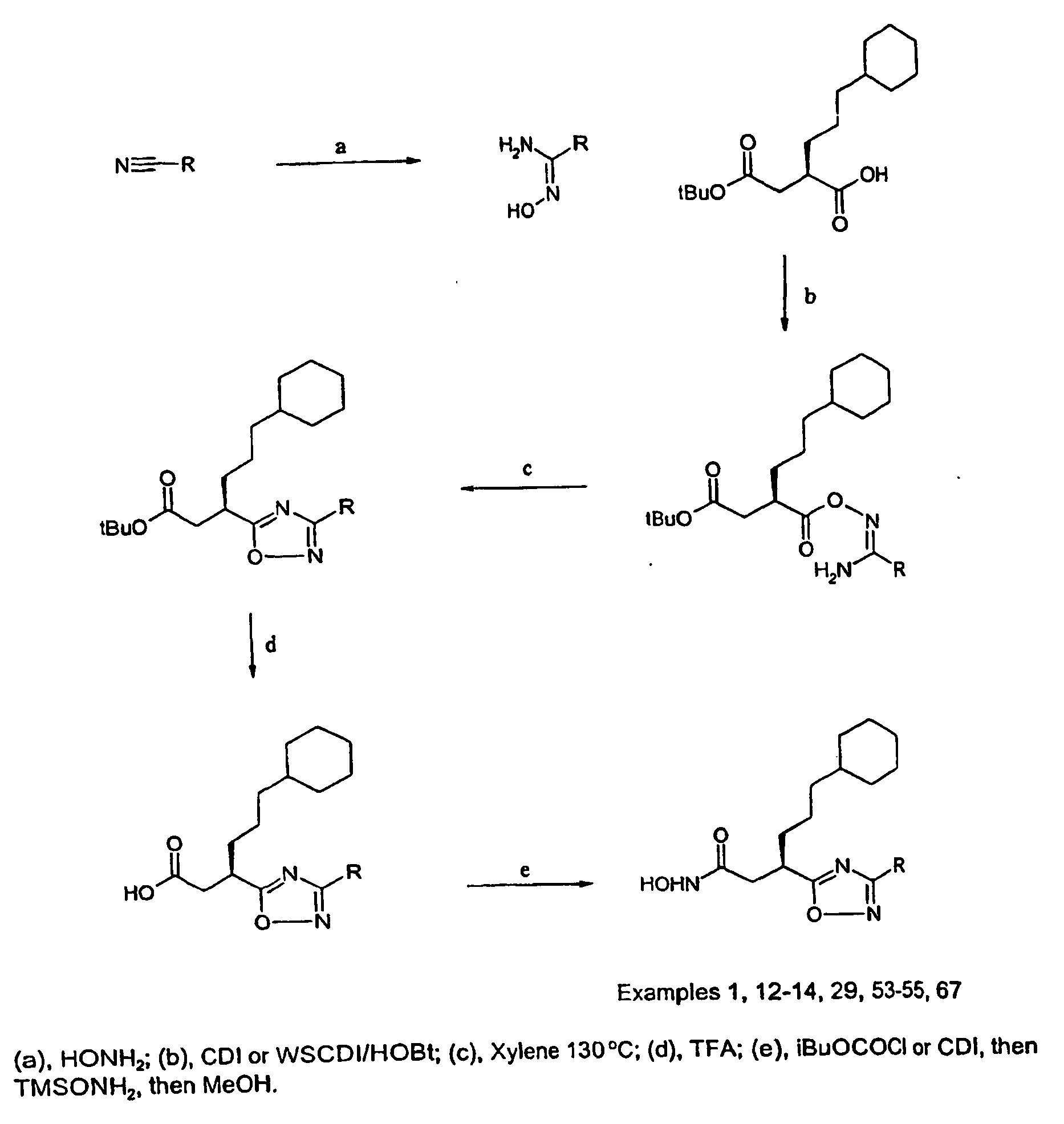
- The scheme below illustraies synthesis of certain compounds where W is N and Y is an amine moiety (NB The functional group interconversions could equally be applied to the corresponding oxazoles (i.e. where W is CZ)):
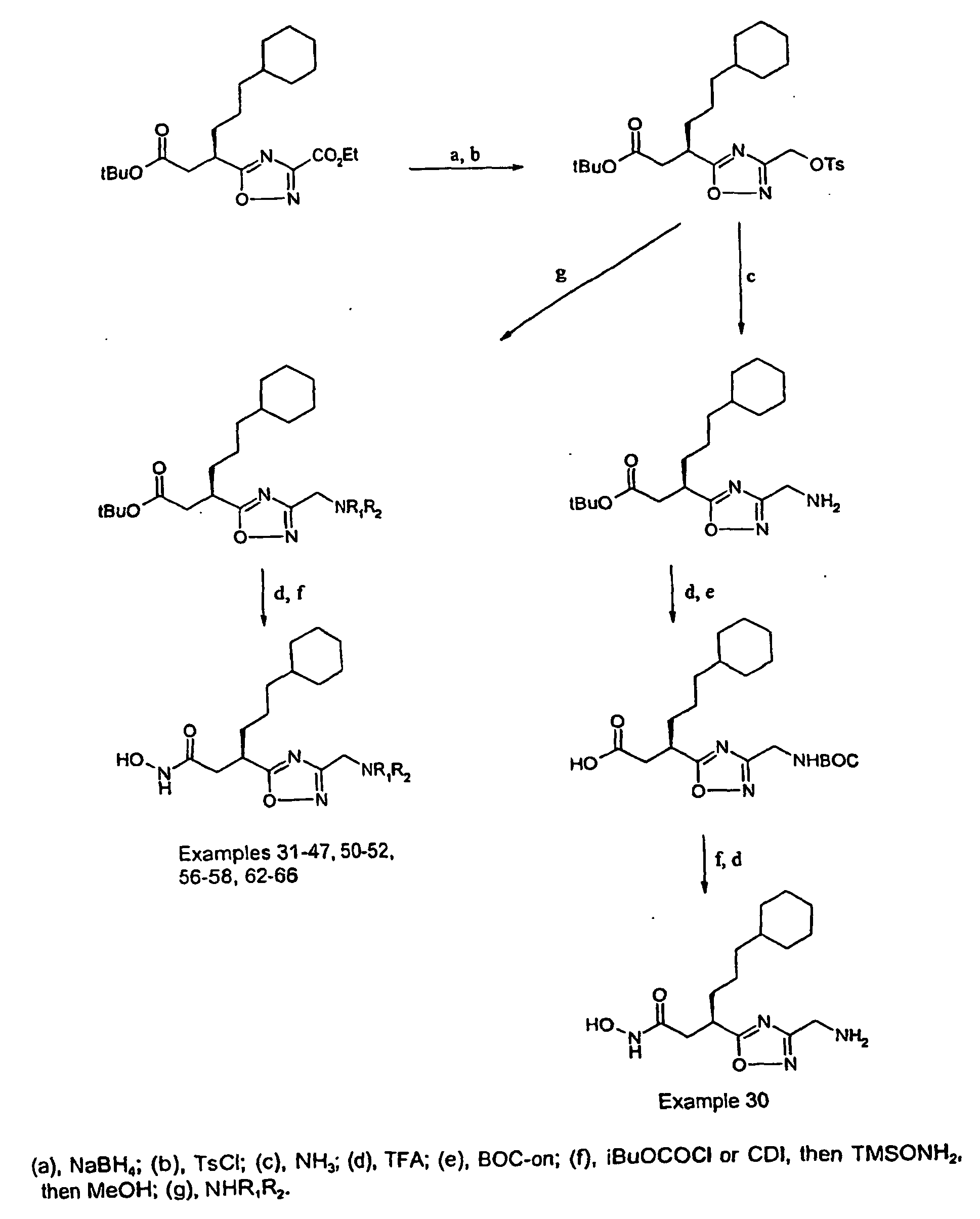
- The scheme below represents a general route to compounds where W is N and Y incorporates a certain sulfonamide, amide, or urea moiety (NB again this chemistry will be equally applicable to the corresponding oxazole compounds, i.e. where W is CZ):

- The scheme below represents a general route to compounds where W is N and Y incorporates certain amide moieties (NB again this chemistry will be equally applicable to the corresponding oxazole compounds, i.e. where W is CZ):

- The scheme below represents a general route to compounds where W is CZ and Y incorporates an amine moiety (NB the latter stages of this chemistry will be equally applicable to the corresponding oxadiazole compounds, i.e. where W is N):

- Similar types of chemistry were used used in the preparation of the compounds of Examples 71 and 72.
- It will be apparent to those skilled in the art that other protection and subsequent deprotection regimes during synthesis of a compound of the invention may be achieved by conventional techniques, for example as described in the volumes by Greene and Wuts, and Kocienski, supra.
- Where desired or necessary the compound of formula (I) is converted into a pharmaceutically acceptable salt thereof. A pharmaceutically acceptable salt of a compound of formula (I) may be conveniently be prepared by mixing together solutions of a compound of formula (I) and the desired acid or base, as appropriate. The salt may be precipitated from solution and collected by filtration, or may be collected by other means such as by evaporation of the solvent.
- Certain compounds of the invention may be interconverted into certain other compounds of the invention by methods mentioned in the Examples and Preparations, and well-known methods from the literature.
- Compounds of the invention are available by either the methods described herein in the Methods, Examples and Preparations or suitable adaptation thereof using methods known in the art. It is to be understood that the synthetic transformation methods mentioned herein may be carried out in various different sequences in order that the desired compounds can be efficiently assembled. The skilled chemist will exercise his judgement and skill as to the most efficient sequence of reactions for synthesis of a given target compound.
- The compounds, salts and solvates of the invention may be separated and purified by conventional methods.
- Separation of diastereomers may be achieved by conventional techniques, e.g. by fractional crystallisation, chromatography or H.P.L.C. of a stereoisomeric mixture of a compound of formula (I) or a suitable salt or derivative thereof. An individual enantiomer of a compound of formula (I) may also be prepared from a corresponding optically pure intermediate or by resolution, such as by H.P.L.C. of the corresponding racemate using a suitable chiral support or by fractional crystallisation of the diastereomeric salts formed by reaction of the corresponding racemate with a suitably optically active acid or base. In certain cases preferential crystallisation of one of the enantiomers can occur from a solution of a mixture of enantiomers, thus enriching the remaining solution in the other enantiomer.
- For human use, the compounds of formula (I) or their salts can be administered alone, but will generally be administered in admixture with a pharmaceutically acceptable diluent or carrier selected with regard to the intended route of administration and standard pharmaceutical practice.
- For example, they can be administered orally, including bucally and sublingually. The compounds or salts can be injected parenterally, for example, intravenously, intradermally intramuscularly or subcutaneously. They can be administered topically and/or transdermally. The compound or salt could also be administered intraocularly for ophthalmic use. For certain uses, vaginal, rectal and nasal (e.g. by inhalation of a dry powder or aerosol) administration would be suitable.
- Formulations may be of immediate-, delayed-, modified-, sustained-, pulsed- or controlled-release type, and may be sterile or preserved or self-preserving.
- Suitable formulations for oral administration would include tablets containing such excipients as starch or lactose, capsules or ovules either alone or in admixture with excipients, or in the form of elixirs, solutions or suspensions containing flavouring or colouring agents. The compound or salt could be incorporated into capsules or tablets for targetting the colon or duodenum via delayed dissolution of said capsules or tablets for a particular time following oral administration. Dissolution could be controlled by susceptibility of the formulation to bacteria found in the duodenum or colon, so that no substantial dissolution takes places before reaching the target area of the gastrointestinal tract.
- The compounds or salts can be administered parenterally, by injection for example, intravenously, intradermally intramuscularly or subcutaneously. For parenteral administration, they are best used in the form of a sterile, preserved or self-preserving aqueous solution or suspension which may contain other substances, for example, enough salt or glucose to make the solution isotonic with blood. The compounds or salts may be used in combination with cyclodextrins. By injection we include standard injection techniques, and also needlefree injector or implant injection techniques.
- The compounds or salts can be administered topically, and/or transdermally, in the form of sterile or preserved or self-preserving creams, gels, suspensions, lotions, solutions, sponges, fibres, microemulsions, films, ointments, dusting powders, sprays, foams, mousses, drug-incorporated dressings, skin patches, ointments such as petrolatum or white soft paraffin based ointments or via a skin patch or other device. They could be administered directly onto a wound. The compounds or salts may be delivered using iontophoresis, electroporation, phonophoresis and sonophoresis.They could be incorporated into a coated suture. For example they can be incorporated into a lotion or cream consisting of an aqueous or oily emulsion of mineral oils; sorbitan monostearate; polysorbate 60; cetyl esters wax; cetearyl alcohol; 2-octyldodecanol; benzyl alcohol; water; polyethylene glycols and/or liquid paraffin, or they can be incorporated into a suitable ointment consisting of one or more of the following - mineral oil; liquid petrolatum; white petrolatum; propylene glycol; polyoxyethylene polyoxypropylene compound; emulsifying wax and water, or as a gel such as a hydrogel with cellulose or polyacrylate derivatives or other viscosity modifiers, or as a dry powder or liquid spray or aerosol with butane/propane, HFA, CFC, CO2 or other suitable propellant, optionally also including a lubricant such as sorbitan trioleate, or as a drug-incorporated dressing either as a tulle dressing, with white soft paraffin or polyethylene glycols impregnated gauze dressings or with a gel such as a hydrogel, hydrocolloid, alginate or film dressings. The compound can be dissolved or suspended in, for example, water, appropriate buffers, alcohols (e.g. ethanol, isopropyl alcohol, benzyl alcohol), glycols (e.g. propylene glycol, glycerol, polyethylene glycols), diethylene glycol ethers, poloxamers (polyoxyethylene polyoxypropylene compounds), isopropylmyristate, isopropylpalmitate, fixed oils (e.g. castor oil), mineral oil, silicone oils (e.g. dimeticone), other synthetic mono-/di-/triglycerides, fatty acids, liquid petrolatum, white petrolatum, liquid paraffin, emulsifying wax, sorbitan monostearate, polysorbates, cetostearyl alcohol, cetyl alcohol, 2-octyldodecanol or combinations thereof. Suitable viscosity modifiers, for example cellulose or polyacrylate derivatives can also be Incorporated.
Penetration enhancers may also be used. - The compound or salt could also be administered intraocularly for ophthalmic use e.g. in a lens implant, ointment, micronised suspension, absorbable gel sponges, implants, particulate or vesicular systems such as niosomes or liposomes, or as an eye drop with appropriate buffers, viscosity modifiers (e.g. cellulose or polyacrylate derivatives), preservatives (e.g. benzalkonium chloride (BZK)) and agents to adjust tonicity (e.g. sodium chloride), The compound may be used in combination with cyclodextrins. In addition, compounds may be delivered by lontophoresis. Such formulation techniques are well-known in the art.
- For certain uses, vaginal, rectal and nasal (e.g. by inhalation of a dry powder or aerosol) administration would be suitable.
- All such formulations may also contain auxiliaries such as appropriate stabilisers, preservatives such as antioxidants and chelating agents, flavours, colourings, cyclodextrins, etc. Such auxiliaries are well-known in the formulation art and the skilled person will be able to choose from such auxiliaries based on the properties of the compound or salt to be administered, the administration route, etc.
- For oral and parenteral administration to human patients, the daily dosage level of the compounds of formula (I) or their salts will be from 0.001 to 20, preferably from 0.01 to 20, more preferably from 0.1 to 10, and most preferably from 0.5 to 5 mg/kg with respect to the active compound (in single or divided doses). Thus tablets or capsules of the compounds will contain from 0.1 to 500, preferably from 50 to 200, mg of active compound for administration singly or two or more at a time as appropriate.
- For topical administration to human patients with acute/surgical wounds or scars, the daily dosage level of the compounds, in suspension or other formulation, could be from 0.01 to 50mg/ml, preferably from 0.3 to 30 mg/ml.
- For treatment of a wound, the dosage will vary with the size of the wound, whether or not the wound is open or closed or partially closed, and whether or not the skin is intact.
- The physician in any event will determine the actual dosage which will be most suitable for a an individual patient and it will vary with the condition to be treated, the age, weight and response of the particular patient, as well as the efficacy of the drug compound. The above dosages are exemplary of the average case; there can of course be individual instances where higher or lower dosage ranges are merited, and such are within the scope of this invention.
- In order to determine potency of PCP inhibitors a fluorogenic PCP cleavage assay was used. This assay is based on the template of Beekman et al. (FEBS Letters (1996), 390: 221-225) using a fluorogenic substrate. The substrate (Dabcyl-Arg-Tyr-Tyr-Arg-Ala-Asp-Asp-Ala-Asn-Val-Glu(EDANS)-NH2) contains the cleavage site of human PCP (Hojima et al., J Biol Chem (1985), 260: 15996-16003). Human PCP has been purified from supematant of stable transfected CHO cells using hydrophobic interaction column followed by Superdex 200 gel filtration. 4 µg total protein of this enzyme preparation was incubated with various concentrations of the substance to be tested and 3x 10⁻⁶ M substrate in assay buffer (50 mM Tris-Base, pH 7.6 containing 150 mM NaCl, 5 mM CaCl2, 1µM ZnCl2 and 0.01 % Brij 35). The assay was performed in 96-well black fluorimeter plates and fluorescence was read continuously in a fluorimeter over 2.5 hours (λex = 340 nm, λem = 485 nm) at a constant 37°C with shaking. Release of the fluorogenic signal was in linear correlation to PCP activity. Reading of the mean velocity from 30 min after start of experiment until 2.5 hours was calculated by the Biolise software. IC50 values were calculated by plotting % inhibition values against compound concentration using Tessela add in for Excel spreadsheet. Example compounds were tested and were found to have IC50 values vs. PCP of 1µM or less.
- The ability of compounds to inhibit the cleavage of fluorogenic peptides by MMPs 1, 2, 9, and 14 is described below.
The assays for MMPs 2, 9, and 14 are based upon the original protocol described by Knight et al. (Fed.Euro.Biochem.Soc., 296 (3), 263-266; 1992) with the slight modifications given below. - Catalytic domain MMP-1 was prepared at Pfizer Central Research. A stock solution of MMP-1 (1 µM) was activated by the addition of aminophenylmercuric acetate (APMA), at a final concentration of 1mM, for 20 minutes at 37°C. MMP-1 was then diluted in Tris-HCl assay buffer (50mM Tris, 200mM NaCl, 5mM CaCl2, 20µM ZnSO4, 0.05% Brij 35) pH 7.5 to a concentration of 10nM. The final concentration of enzyme used in the assay was 1nM.
- The fluorogenic substrate used in this assay was Onp-Pro- -cyclohexyl-Ala-Gly-Cys(Me)-His-Ala-Lys(N-Me-AJa)-NH2 as originally described by Bickett et al (Anal. Biochem, 212, 58-64, 1993). The final substrate concentration used In the assay was 10µM.
- Test compounds were dissolved In dimethyl sulphoxide and diluted with assay buffer so that no more than 1% dimethyl sulphoxide was present. Test compound and enzyme were added to each well of a 96 well plate and allowed to equilibrate for 15 minutes at 37°C in an orbital shaker prior to the addition of substrate. Plates were then incubated for 1 hour at 37°C prior to determination of fluorescence (substrate cleavage) using a fluorimeter (Fluostar; BMG LabTechnologies, Aylesbury, UK) at an excitation wavelength of 355nm and emission wavelength of 440nm. The potency of inhibitors was measured from the amount of substrate cleavage obtained using a range of test compound concentrations, and, from the resulting dose-response curve, an IC50 value (the concentration of inhibitor required to inhibit 50% of the enzyme activity) was calculated.
- Catalytic domain MMP-2 and MMP-9 were prepared at Pfizer Central Research. A stock solution of MMP-2 / MMP-9 (1 M) was activated by the addition of aminophenylmercuric acetate (APMA). For MMP-2 and MMP-9, a final concentration of 1mM APMA was added, followed by incubation for 1 hour at 37°C. The enzymes were then diluted in Tris-HCl assay buffer (100mM Tris, 100mM NaCl, 10mM CaCl2 and 0.16% Brij 35, pH 7.5), to a concentration of 10nM. The final concentration of enzyme used in the assays was 1nM.
- The fluorogenic substrate used in this screen was Mca-Arg-Pro-Lys-Pro-Tyr-Ala-Nva-Trp-Met-Lys(Dnp)-NH2 (Bachem Ltd, Essex, UK) as originally described by Nagase et al (J.Biol.Chem., 269(33), 20952-20957, 1994). This substrate was selected because it has a balanced hydrolysis rate against MMPs 2 and 9 (kcal / km of 54,000, 59,400 and 55,300 s-1 M-1 respectively). The final substrate concentration used in the assay was 5µM.
- Test compounds were dissolved in dimethyl sulphoxide and diluted with test buffer solution (as above) so that no more than 1% dimethyl sulphoxide was present. Test compound and enzyme were added to each well of a 96 well plate and allowed to equilibrate for 15 minutes at 37°C in an orbital shaker prior to the addition of substrate. Plates were then incubated for 1 hour at 37°C prior to determination of fluorescence using a fluorimeter (Fluostar; BMG LabTechnologies, Aylesbury, UK) at an excitation wavelength of 328nm and emission wavelength of 393nm. The potency of inhibitors was measured from the amount of substrate cleavage obtained using a range of test compound concentrations, and, from the resulting dose-response curve, an IC50 value (the concentration of inhibitor required to inhibit 50% of the enzyme activity) was calculated.
- Catalytic domain MMP-14 was purchased from Prof. Tschesche, Department of Biochemistry, Faculty of Chemistry, University of Bielefeld, Germany. A 10 M enzyme stock solution was activated for 20 minutes at 25°C following the addition of 5 g/ml of trypsin (Sigma, Dorset, UK). The trypsin activity was then neutralised by the addition of 50 g/ml of soyabean trypsin inhibitor (Sigma, Dorset, UK), prior to dilution of this enzyme stock solution in Tris-HCl assay buffer (100mM Tris, 100mM NaCl, 10mM CaCl2 and 0.16% Brij 35, pH 7.5) to a concentration of 10nM. The final concentration of enzyme used in the assay was 1 nM.
- The fluorogenic substrate used in this screen was Mca-Pro-Leu-Gly-Leu-Dpa-Ala-Arg-NH2 (Bachem Ltd, Essex, UK) as described by Will et al (J.Biol.Chem., 271(29), 17119-17123, 1996). The final substrate concentration used in the assay was 10µM.
- Determination of enzyme inhibition by test compounds was performed in the same manner as described for MMPs-2 and -9 above.
- All the compounds of the Examples had IC50 values vs PCP of 0.5µM or less.
The compounds of Examples 6, 17, and 72 had IC50 values vs PCP of 107nM, 98nM and 37nM respectively. - The compounds of the invention are illustrated by the Examples below.
- Melting points were determined using open glass capillary tubes and a Gallenkamp melting point apparatus and are uncorrected. Nuclear magnetic resonance (NMR) data were obtained using Varian Unity Inova-400, Varian Unity Inova-300 or Bruker AC300 spectrometers and are quoted in parts per million from tetramethylsilane. Mass spectral (MS) data were obtained on a Finnigan Mat. TSQ 7000 or a Fisons Instruments Trio 1000. The calculated and observed ions quoted refer to the isotopic composition of lowest mass. Infra red (IR) spectra were measured using a Nicolet Magna 550 Fourier transform infra-red spectrometer. Flash chromatography refers to column chromatography on silica gel (Kieselgel 60, 230-400 mesh, from E. Merck, Darmstadt. Kleselgel 60 F254 plates from E. Merck were used for TLC, and compounds were visualised using UV light, 5% aqueous potassium permanagate or Dragendorff's reagent (oversprayed with aqueous sodium nitrite). Thermal analyses by Differential Scanning Calorimetry (DSC) and ThermoGravimetric Analysis (TGA) were obtained using Perkin Elmer DSC7 and TGA7.
- Moisture sorption characteristics were recorded using Surface Measurement Systems Ltd. Automated Water Sorption Analyser DVS 1. Water content was determined on a Mitsubishi CA100 (Coulometric Karl Fisher Titrator). Powder X-ray diffraction (PXRD) pattern was determined using a Siemens D5000 powder X-ray diffractometer fitted with an automatic sample changer, a theta-theta goniometer, automatic beam divergence slits, a secondary monochromator and a scintillation counter. Other measurements were taken using standard equipment. Hexane refers to a mixture of hexanes (hplc grade) b.p. 65-70°C. "Ether" and "Et2O" refers to diethyl ether. Acetic acid refers to glacial acetic acid. 1-Hydroxy-7-aza-1H-1,2,3-benzotriazole (HOAt). "HOBt" is 1-hydroxy-1H-1,2,3-benzotriazole. N-[(dimethylamino)-1H-1,2,3-triazolo[4,5-b]pyridin-1-ylmethylene]-N-methylmethaninium hexafluorophosphate N-oxide (HATU) and 7-azabenzotriazol-1-yloxytris(pyrrolidino)phosphonium hexafluorophosphate (PyAOP) were purchased from PerSeptive Biosystems U.K. Ltd. "DIPE" refers to diisopropyl ether. Reverse-phase silica gel for flash chromatography was obtained from Fluka (Fluka 100, C18, 40-63µ). "DCM" is dichloromethane. "THF" is tetrahydrofuran. "WSCDI" is 1-(3-dimethylaminopropyl)-3-ethylcarbodiimide hydrochloride. "CDI" is carbonyldiimidazole. "EtOAc" is ethyl acetate. "MeOH" is methanol. "DMSO" is dimethylsulphoxide. "ACE-Cl" is 1-chloroethyl chloroformate. "NMM" is N-methylmorpholine. "Pentane" refers to High Performance Liquid Chromatography (HPLC) grade n-pentane (b.pt.35-37°C). Nomenclature has been allocated using the commercially available ACD program. Standard abbreviations are used throughout, e.g. "Me" is methyl, "Et" is ethyl, "Pr" is propyl, "Ph" is phenyl, etc.
aHPLC autopurification performed using 2 columns - Phenomonex LUNA C8 150x21.2mm, 10µm and Phenomonex MAGELLEN C18 150x21.2mm, 5µm, eluting with a gradient system of organic solvent [ammonium acetate (aq) 100mM : acetonitrile (1 : 9)] : aqueous solvent [ammonium acetate (aq) 100mM : acetonitrile (9 :1)]
b HPLC autopurification performed using 2 columns - Phenomonex LUNA C8 150x21.2mm, 10µm and Phenomonex MAGELLEN C18 150x21.2mm, 5µm, eluting with a gradient system of organic solvent (acetonitrile) : aqueous solvent (0.1 % aqueous trifluoroacetic acid) -
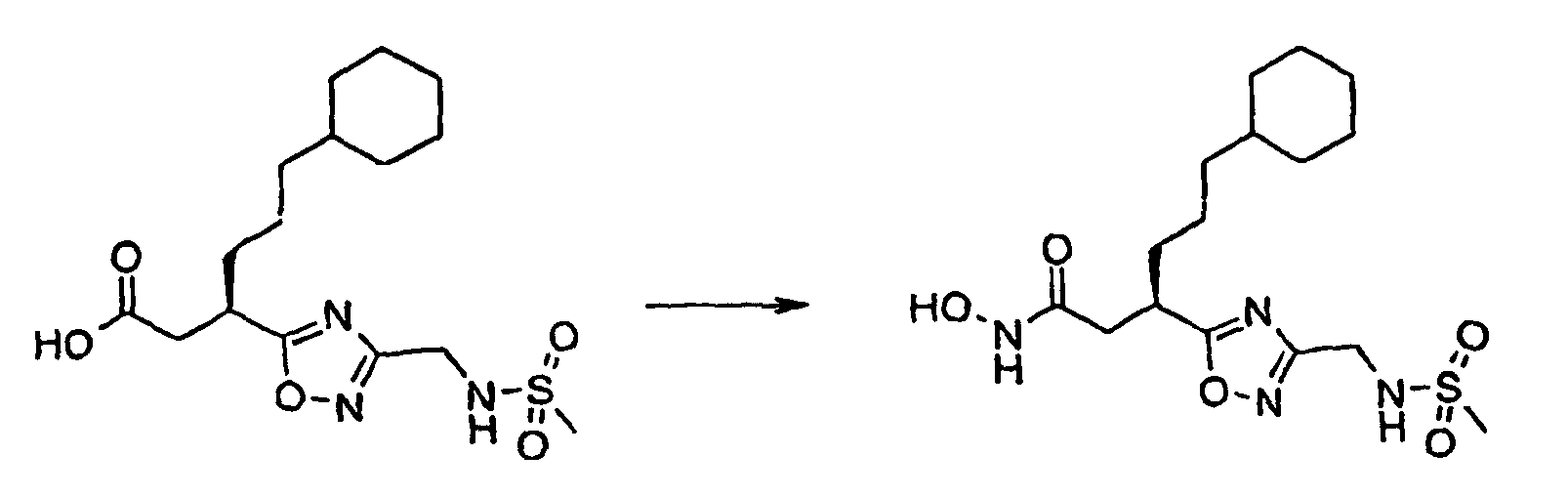
- METHOD A. A solution of (3R)-6-cyclohexyl-3-(3-{[(methylsulfonyl)amino]methyl}-1,2,4-oxadiazol-5-yl)hexanoic acid (preparation 4) (6.80g, 18.2mmol) and 2,6-lutidine (2.3ml, 20.0mmol) in THF (100ml) at 0°C, under a nitrogen atmosphere was treated with i-butyl chloroformate (2.6ml, 20.0mmol) and stirred at 0°C for 1.5hours. o-(trimethylsilyl)hydroxylamine (4.9ml, 40.0mmol) was added and the reaction mixture was stirred for 18 hours warming to room temperature over this time. MeOH was added and the reaction mixture stirred for a further 2 hours. The solvent was removed under reduced pressure. The yellow solid was dissolved in EtOAc (400ml), washed with dilute HCl (150ml 2M HCl + 200ml H2O) and brine, dried over MgSO4 and filtered. The solvent was remove under reduced pressure. The solid was recrystallised from hot EtOAc to afford the title compound as a white solid (4.74g, 67%).
- METHOD B. COI (7.6g, 47mmol) was added portionwise over 2 min to a solution of (3R)-6-cyclohexyl-3-(3-{[(methylsulfonyl)amino]methyl}-1,2,4-oxadiazol-5-yl)hexanoic acid (preparation 4) (14.0g, 42mmol) in THF (160ml), at ambient temperature, under a nitrogen. The mixture was stirred at ambient temperature for 30 min and then cooled to 0°C. Aqueous hydroxylamine (50%, 13.1ml, 0.21 mol) was added between 0 and 5°C and the reaction mixture was stirred for 18 hours warming to room temperature over this time. Aqueous citric acid solution (10%, 160ml) was added and the mixture was extracted with ethyl acetate (2x160ml). The combined organic fractions were washed with demineralised water (160ml) and then concentrated in vacuo to a colourless solid. Ethyl acetate (64ml) was added and the mixture was stirred at ambient temeprature for 1 hour and then filtered. The residue was dried in vacuo at 45°C to afford the title compound as an off-white solid (14.2g, 85%).
Mpt : 115-116°C
1H nmr : (d6DMSO) 0.80 (2H, m), 1.00-1.15 (8H, m), 1.50-1.70 (8H, m), 2.50-2.55 (2H, obs), 2.89 (3H, s), 3.41 (1H, m), 4.24 (2H, d), 7.63 (1H, brs), 8.62 (1H, brs), 10.38 (1H, brs)
MS : 411 (MNa+)
CHN : Found: C49.42%; H7.40%; N14.48%; C16H28N4O5S requires C49.47%; H7.26%; N14.42% - METHOD C (Alternative Synthesis): Ethyl chloroformate (0.11 ml, 1.2mmol) was added to a stirred solution of (3R)-6-cyclohexyl-3-(3-{[(methylsulfonyl)amino]methyl}-1,2,4-oxadiazol-5-yl)hexanoic acid (preparation 4) (0.40g, 1.1mmol) in THF (10m1) and ether (10ml) at 0 °C under a nitrogen atmosphere. The reaction was stirred at 0 °C for 40 minutes then aqueous hydroxylamine (80 µl of 50% solution by weight, 1.2 mmol) was added. The reaction was left to warm to room temperature overnight. The solvents were removed under reduced pressure, then the residue was dissolved in EtOAc (20ml) and washed with water (20ml) and brine (20 ml). The organic layer was dried (MgSO4) and filtered. The solvent was removed under reduced pressure. The residue was triturated with pentane, the solid was collected by filtration to give a white solid (410 mg, 98%). HPLC analysis indicated 95.5% was the title compound, 2% starting material and 2.5% other unidentified products.
-

- Method is the same as for Example 1 using (3R)-6-cyclohexyl-3-(3-{[methyl(methylsulfonyl)amino]methyl}-1,2,4-oxadiazol-5-yl)hexanoic acid (preparaton 7) (225mg, 0.58mmol) as starting material.
Purification: The crude material was purified on a silica column eluting with a solvent gradient of DCM : MeOH (100 : 0) gradually changing to (97 : 3) to yield the title compound as sticky colourless gum (180mg, 77%)
1H nmr: (d6DMSO) 0.80 (2H, m), 1.05-1.30 (8H, m), 1.50-1.70 (7H, m), 2.52 (2H, obs), 2.80 (3H, s), 2.93 (3H, s), 3.42 (1H, m), 4.44 (1H, m), 8.62 (1H, brs), 10.38 (1H, brs).
MS : 425 (MNa+)
CHN: Found: C50.87%; H7.69%; N13.47%; C17H30N4O5S. 0.1H2O requires C50.50%; H7.53%; N13.86% -

- Method same is for Example 1 using (3R)-6-cyclohexyl-3-(3-{[(ethylsulfonyl)amino]methyl}-1,2,4-oxadiazol-5-yl)hexanoic acid (preparation 9) (143mg, 0.37mmol) as starting material.
Purification: Crude material was purified on a silica column eluting with a solvent gradient of DCM : MeOH (100 : 0) gradually changing to (95: 5) to afford the title compound as a sticky yellow gum (103mg, 69%).
1H nmr: (d6DMSO) 0.80 (2H, m), 1.00-1.25 (11H, m), 1.55-1.70 (7H, m), 2.52 (2H, obs), 3.00 (2H, q), 3.41 (1H, m), 4.24 (2H, d), 7.67 (1H, brs), 10.38 (1H, brs).
MS: 403 (MH+)
Accurate mass : Found 425.1828 (MNa+), Calculated C17H30N4O6S 425.1829 (MNa+) -

- Method same as for example 1 using (3R)-6-cyclohexyl-3-(3-{[(isopropylsulfonyl)amino]methyl}-1,2,4-oxadiazol-5-yl)hexanoic acid (prepapration 11) (88mg, 0.22mmol) as starting material. Purification: The crude material was purified on a silica column eluting with a solvent gradient of DCM : MeOH (100 : 0) gradually changing to (95 : 5) to afford the title compound as an orange gum (76mg, 83%).
1H nmr : (CD3OD) 0.80-0.90 (2H, m), 1.10-1.30 (14H, m+d). 1.60-1.80 (7H, m), 2.50 (1H, dd), 2.60 (1H, dd), 3.20 (1H, m), 3.50 (1H, m), 4.35 (2H, s).
MS : 439 (MNa+)
CHN : Found: C50.61%; H7.72%; N12.83%: C18H32N4O5S. 0.3 H2O. 0.1 DCM requires C50.51%; H7.68%; N13.02% -

- Method same as for example 1 using (3R)-6-cyclohexyl-3-(3-{[(phenylsulfonyl)amino]methyl}-1,2,4-oxadiazol-5-yl)hexanoic acid (preparation 13) (149mg, 0.34mmol) as starting material.
- Purification: The crude material was purified on a silica column eluting with a solvent gradient of DCM : MeOH (100 : 0) gradually changing to (95 : 5) to afford the title compound as a colourless gum (116mg, 75%).
1H nmr : (d6DMSO) 0.80 (2H, m), 1.00-1.20 (8H, m), 1.50-1.70 (7H, m), 2.38 (1H, dd), 2.52 (1H, obs), 3.37 (1H, m), 4.11 (2H, s), 7.48-7.62 (3H, m). 7.78 (2H, d), 8.25 (1H, brs), 8.62 (1H, brs), 10.38 (1H, brs).
MS : 473 (MNa+)
Accurate mass: Found 451.2004 (MH+), Calculated C21H30N4O6S 451.2010 (MH+) -
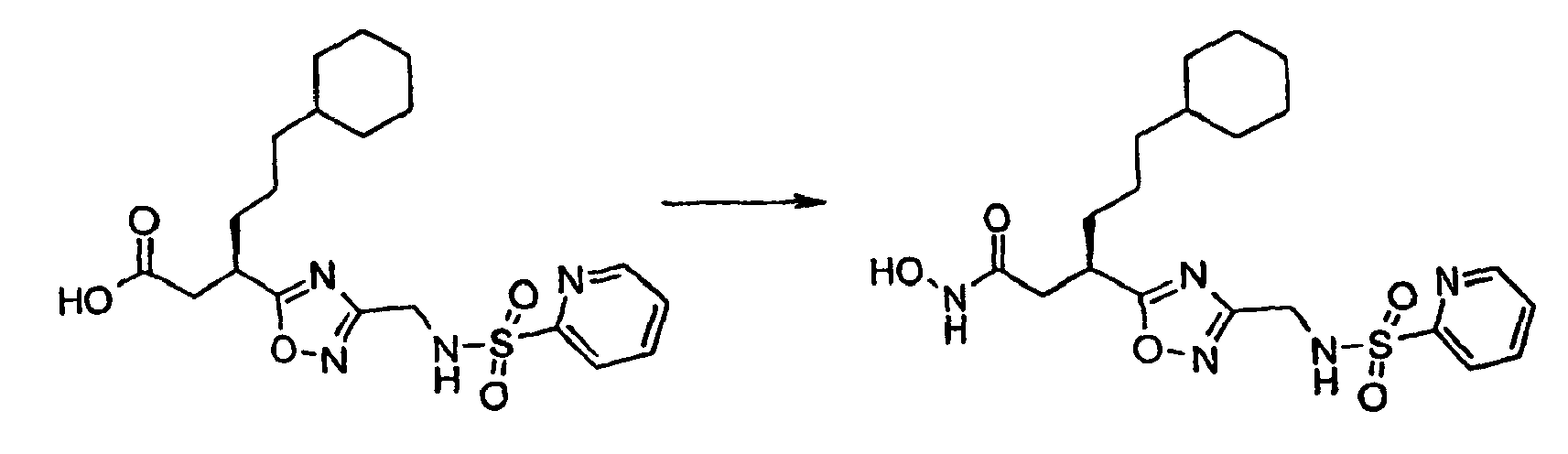
- Method same as for example 1 except using NMM as the base and (3R)-6-cyclohexyl-3-(3-{[(2-pyridinylsulfonyl)amino]methyl}-1,2,4-oxadiazol-5-yl)hexanoic acid (preparation 15) (231mg, 0.53mmol) as the starting material.
Purification: Crude material was purified on a silica column eluting with Et2O : MeOH (19 : 1) to afford the title compound as a white foam (36mg).
1H nmr : (d6DMSO) 0.80 (2H, m), 1.05-1.25 (8H, m), 1.50-1.70 (7H, m), 2.38 (2H, m), 3.37 (1H, m), 4.28 (2H, d), 7.60 (1H, m), 7.88 (1H, d), 8.03 (1H, t), 8.44 (1H, brs), 8.62 (2H, brd), 10.38 (1H, brs).
MS : 474 (MNa+) -

- A solution of (3R)-6-cyclohexyl-3-(3-{[(3-pyridinylsulfonyl)amino]methyl}-1,2,4-oxadiazol-5-yl)hexanoic acid (preparation 17) (167mg, 0.33mmol) DCM (6ml) under a nitrogen atmosphere was treated with CDI (80mg, 0.49mmol) and stirred at room temperature for 1 hour. o-(trimethylsilyl)hydroxylamine (121µl, 0.99mmol) was added and the reaction mixture was stirred for 18 hours. MeOH (3ml) was added and the reaction mixture stirred for a further 2 hours. The solvent was removed under reduced pressure. The residue was dissolved in EtOAc, washed with H2O and brine, dried over MgSO4 and filtered. The solvent was removed under reduced pressure. The crude material was purified on a silica column eluting with a solvent gradient of DCM : MeOH (100 : 0) gradually changing to (95 : 5) to afford the title compound as a white solid (100mg, 67%).
1H nmr: (d6DMSO) 0.80 (2H, m), 1.00-1.30 (8H, m), 1.50-1.70 (7H, m), 2.38 (2H, brm), 3.35 (1H, m), 4.21 (2H, s), 7.59 (1H, m), 8.11 (1H, d), 8.63 (1H, brs), 8.77 (1H, d), 8.90 (1H, s).
MS : 450 (M-H)
Accurate mass : Found 452.1947 (MH+), Calculated C20H29N5O5S 452.1962 -
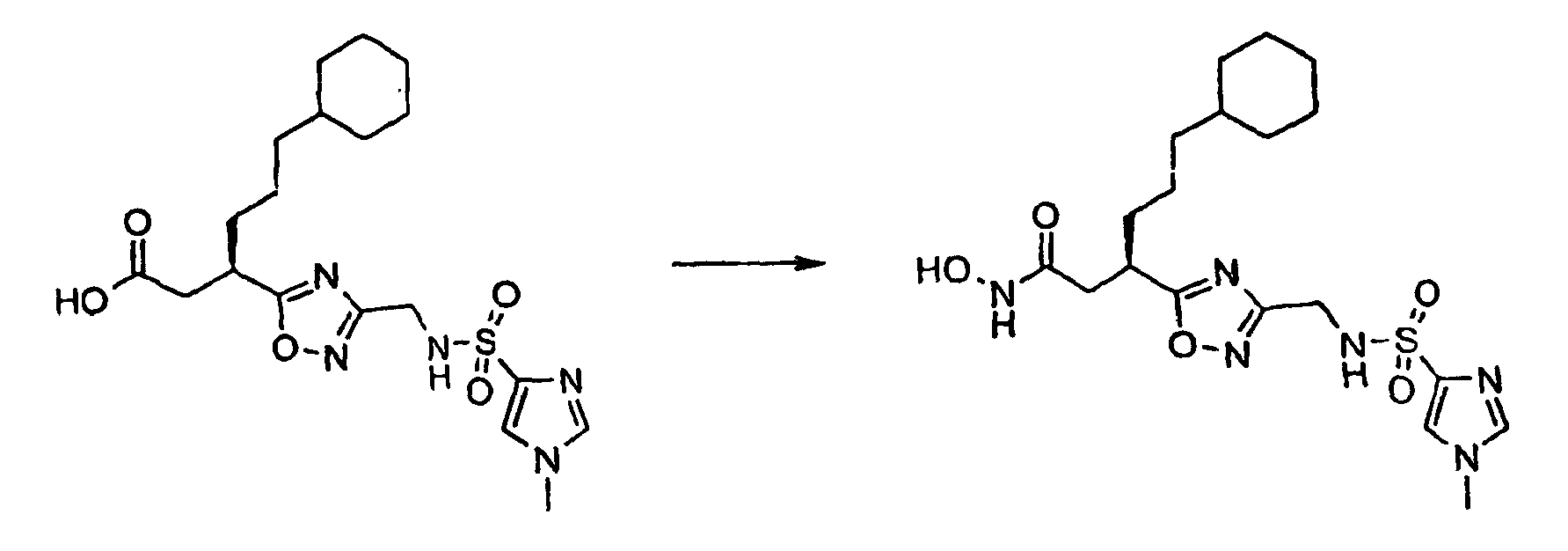
- Method same as for example 7 using (3R)-6-cyclohexyl-3-[3-({[(1-methyl-1H-imidazol-4-yl)sulfonyl]amino}methyl)-1,2,4-oxadiazol-5-yl]hexanoic acid (preparation 20) (205mg, 0.43mmol) as starting material.
Purification: Crude material purified on a silca column eluting with a solvent gradient of DCM : MeOH : NH3 (98 : 2 : 0) gradually changing to (90 : 10 : 1) to afford the title compound as a white solid (105mg, 54%)
1H nmr : (d6DMSO) 0.80 (2H, m), 1.05-1.25 (8H, m), 1.50-1.70 (7H, m), 2.41 (2H, m), 3.40 (1H, m), 3.70 (3H, s), 4.14 (2H, d), 7.66 (1H, s), 7.71 (1H, s), 7.98 (1H, brs), 8.66 (1H, brs), 10.39 (1H, brs).
MS : 477 (MNa+)
CHN : Found: C49.86%; H6.67%; N18.28%; C18H30N6O5S. 0.1 H2O requires C50.01%; H6.67%; N18.42% -

- Method same as for example 7 using (3R)-6-cyclohexyl-3-(3-{[(1H-pyrazol-4-ylsulfonyl)amino]methyl}-1,2,4-oxadiazol-5-yl)hexanoic acid (preparation 23) (122mg, 0.29mmol) as starting material.
Purification: The cude material was purified on 2 silica columns both eluting with a solvent gradient of DCM : MeOH (95 : 5) gradually changing to (90 : 10) to afford the title compound as a white sold (64mg, 50%).
M.pt. 124-126°C dcc (formed a glass at 60-62°C)
1H nmr : (CD3OD) 0.85 (2H, m), 1.10-1.30 (8H, m), 1.55-1.75 (7H, m), 2.40-2.60 (2H, m), 3.47 (1 H, m), 4.22 (2H, s), 7.92 (2H, brs).
MS : 463 (MNa+)
CHN : Found: C47.87%; H6.58%; N18.53%: C18H28N6O5S. 0.6 H2O requires C47.90%; H6.52%; N18.62% -

- Method as for example 7 using (3R)-6-cyclohexyl-3-(3-{[(4H-1,2,4-triazol-3-ylsulfonyl)amino]methyl}-1,2,4-oxadiazol-5-yl)hexanoic acid (preparation 26) (200mg, 0.47mmol) as starting material.
Purification: Crude material was purified on a silica column eluting with EtOAc and changing to a solvent gradient of DCM : MeOH (95 : 5) gradually changing to (90 : 10) and finally neat MeOH was used to afford the title compound as a light brown solid (50mg, 24%).
1H nmr: (CD3OD) 0.83 (2H, m),1.05-1.30 (8H, m), 1.55-1.75 (7H, m), 2.40-2.65 (2H, m), 3.49 (1H, m), 4.39 (2H, s), 8.28 (1H, s).
MS : 440 (M-H) -
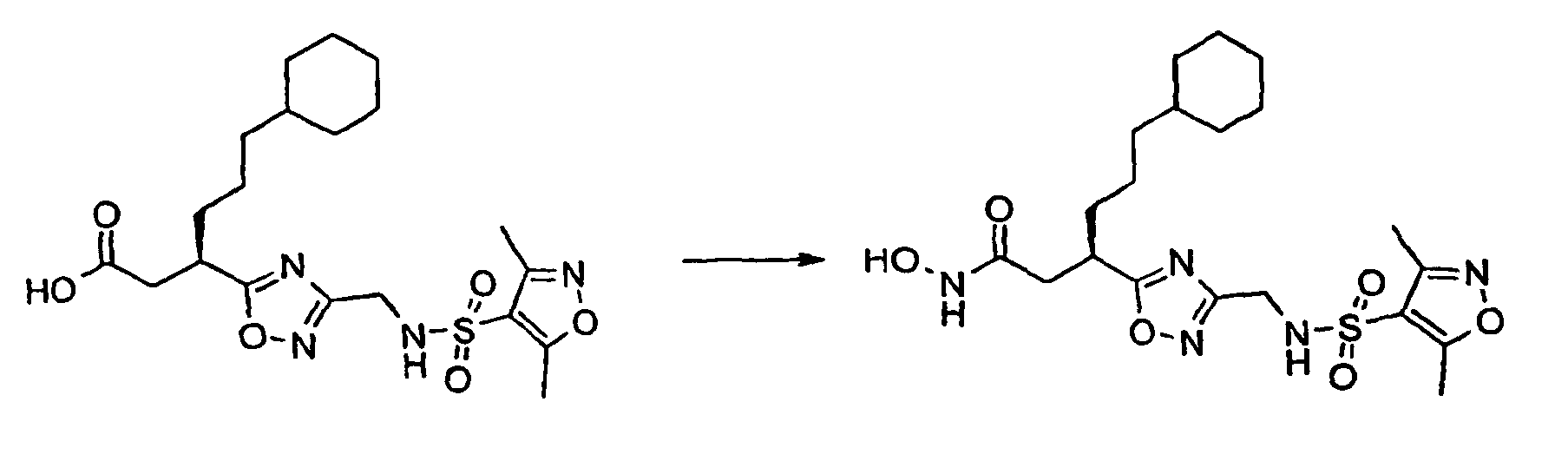
- Method as for Example 1 using (3R)-6-cyclohexyl-3-[3-({[(3,5-dimethyl-4-isoxazolyl)sulfonyl]amino}methyl)-1,2,4-oxadiazol-5-yl]hexanoic acid (preparation 28) (220mg, 0.48mmol) as starting material.
Purification: The crude material was purified on a silica column eluting with DCM : MeOH (95 : 5) to afford the title compound as a white foam (92mg, 41%).
1H nmr : (d6-DMSO) 0.81 (2H, m), 1.05-1.20 (8H, m), 1.50-1.70 (7H, m), 2.27 (3H, s), 2.41 (2H, dd), 2.54 (3H, s), 3.36 (1H, m), 4.21 (2H, d), 8.61 (2H, brs), 10.39 (1H, s).
MS : 492 (MNa+)
CHN : Found: C51.08%; H6.77%; N14.16%; C20H31N5O6S. 0.15 H2O. 0.15 EtOAc requires C51.19%; H6.84%; N14.49% -

- Method as for example 1 using (3R)-6-cyclohexyl-3-(3-{2-[(methylsulfonyl)amino]ethyl}-1,2,4-oxadiazol-5-yl)hexanoic acid (preparation 33) (315mg, 0.81 mmol) as starting material.
1H nmr : (CD3OD) 0.84 (2H, m), 1.10-1.35 (8H, m), 1.55-1.75 (7H, m), 2.49 (1H, dd), 2.60 (1H, dd), 2.91 (3H, s), 2.96 (2H, t), 3.43 (2H, t), 3.51 (1H, s).
MS : 425 (MNa+)
CHN : Found: C47.35%; H7.04%; N12.47%; C17H30N4O5S requires C47.24%; H7.02%; N12.59% -

- Method as for example 1 using (3R)-6-cyclohexyl-3-{3-[1-(methylsulfonyl)-3-azetidinyl]-1,2,4-oxadiazol-5-yl}hexanoic acid (preparation 39) (150mg, 0.38mmol) as starting material. Purification: Crude material was purified on a silica column eluting with a solvent gradient of DCM : MeOH (98 : 2) gradually changing to (90 : 10) to afford the title compound as a sticky, glassy oil (140mg, 90%).
1H nmr : (CD3OD) 0.82 (2H, m), 1.05-1.35 (8H, m), 1.55-1.80 (7H, m), 2.53 (1H, dd), 2.61 (1H, dd), 2.98 (3H, s), 3.55 (1H, m), 4.00 (1H, m), 4.15 (2H, m), 4.25 (2H, m).
MS : 437 (MNa+)
CHN : Found: C51.04%; H7.26%; N12.93%; C18H30N4O5S. 0.25 EtOAC. 0.05DCM requires C51.22%; H7.29%; N13.24% -

- Method as for example 1 using (3R)-6-cyclohexyl-3-{3-[1-(methylsulfonyl)-4-piperidinyl]-1,2,4-oxediazol-5-yl}hexanoic acid (preparation 44) (230mg, 0.54mmol) as starting material. Purification: Crude material triturated with DIPE, filtered off and dried under reduced pressure to afford the title compound as fluffy white solid (204mg, 85%).
1H nmr : (CD3OD) 0.83 (2H, m), 1.05-1.35 (8H. m). 1.55-1.75 (7H, m), 1.88 (2H, m), 2.09 (2H, m), 2.48 (1H, dd), 2.60 (1H, dd), 2.82 (3H, s), 2.98 (3H, m), 3.52 (1H, m), 3.70 (2H, m).
MS : 465 (MNa+)
CHN : Found: C54.08%; H7.75%; N12.48%; C20H34N4O5S requires C54.28%; H7.74%; N12.66% -

- Method as for example 1 using (3R)-6-cyclohexyl-3-[3-(1,1-dioxido-2-isothiazolidinyl)-1,2,4-oxadiazol-5-yl]hexanoic acid (preparation 46) (194mg, 0.49mmol) as starting material and NMM as base.
Purification: The crude material was purified on a silica column eluting with Et2O to removed the impurities and changing to DCM : MeOH (9 : 1) as eluent to afford the title compound as a colourless oil 103mg, 51%).
1H nmr : (d6-DMSO) 0.80 (2H, m), 1.00-1.25 (8H, m), 1.50-1.70 (7H, m), 2.22 (2H, m), 2.52 (2H, obs), 2.74 (2H, t), 3.20 (2H, obs), 3.26 (2H, t), 3.41 (1H, m), 4.20 (2H, s), 8.62 (1H, brs), 10.39 (1H, brs).
MS : 437 (MNa+)
CHN : Found: C51.86%; H7.37%; N13.03%; C18H30N4O5S. 0.2 H2O requires C51.71 %; H7.33%; N13.40% -
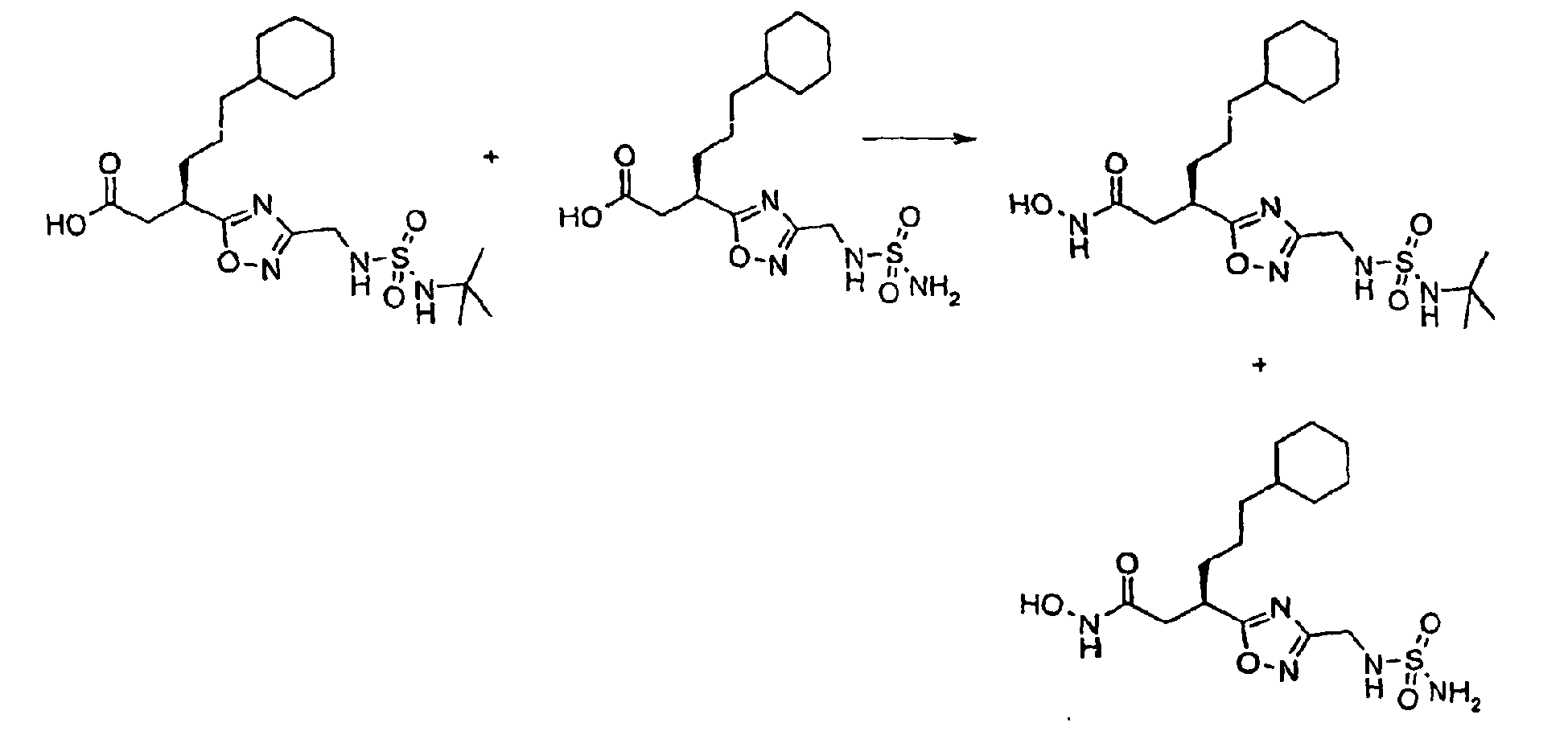
- Method as for example 1 using (3R)-3-[3-({[(tert-butylamino)sulfonyl]amino}methyl)-1,2,4-oxadiazol-5-yl]-6-cyclohexylhexanoic acid and (3R)-3-(3-{[(aminosulfonyl)amino]methyl}-1,2,4-oxadiazol-5-yl)-6-cyclohexylhexanoic acid (preparations 48 and 49) as starting material. Purification: The crude mixture of products was purified on a silica column eluting with a solvent gradient of DCM : MeOH (100 : 0) gradually changing to (98 : 2).
- Top spot was (3R)-3-(3-{[(aminosulfonyl)amino]methyl}-1,2,4-oxadiazol-5-yl)-6-cyclohexyl-N-hydroxyhexanamide (example 16) isolated as a white foam (38mg).
1H nmr : (d6-DMSO) 0.80 (2H, m), 1.00-1.25 (8H, m), 1.50-1.70 (7H, m), 2.41 (1H, dd), 2.65 (1H, dd), 3.41 (1H, m), 4.16 (2H, d), 6.53 (2H, brs), 7.01 (1H, brs), 8.64 (1H, brs), 10.40 (1H, brs).
MS: 390 (MH+)
Accurate mass : Found 390.1794 (MH+), Calculated C15H27N5O5S, 390.1806 - Second spot was (3R)-3-[3-({[(tert-butylamino)sulfonyl]amino}methyl)-1,2,4-oxadiazol-5-yl]-6-cyclohexyl-N-hydroxyhexanamide (example 17) (34mg).
1H nmr : (d6-DMSO) 0.81 (2H, m), 1.00-1.20 (8H, m), 2.40 (9H, s), 1.50-1.70 (7H, m), 2.40 (1 H, dd), 2.66 (1H, dd), 3.41 (1H, m), 4.08 (2H, d), 6.52 (1H, brs), 7.17 (1H, brs), 8.63 (1H, brs), 10.38 (1H, brs).
MS : 468 (MNa+)
Accurate mass : Found 468.2235 (MNa+). Calculated C19H35N5O5S, 468.2251 -

- Method as for example 1 using (3R)-3-{3-[(acetylamino)methyl]-1,2,4-oxadiazol-5-yl}-6-cyclohexylhexanoic acid (preparation 51) (215mg, 0.64mmol) as strating material and NMM as base.
Purification: Crude material was purified on a silica column eluting with a solvent gradient of Et2O : MeOH (19 : 1) gradually changing to (9 : 1) to afford the title compound as a colourless gum (39mg, 17%)
1H nmr : (d6-DMSO) 0.80 (2H, m), 1.05-1.25 (8H, m), 1.55-1.70 (7H, m), 1.81 (3H, s), 2.40 (2H, m), 3.39 (1H, m), 4.32 (2H, d), 8.31 (1H, brs), 8.62 (1H, s), 10.38 (1H, brs).
MS : 375 (MNa+)
CHN : Found: C56.17%; H7.93%; N14.86%; C17H27N3O4. 0.4 H2O. 0.1 DCM requires C55.79%; H7.94%; N15.22% -
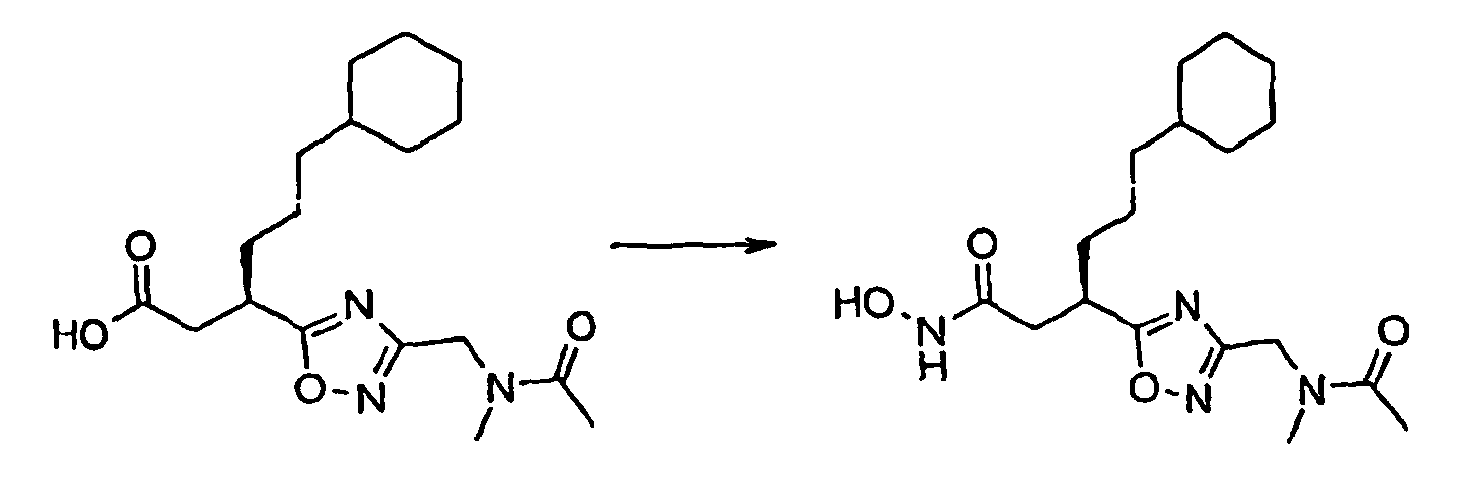
- Method as for example 7 using (3R)-3-(3-{[acetyl(methyl)amino]methyl}-1,2,4-oxadiazol-5-yl)-6-cyclohexylhexanoic acid (preparation 53) (122mg, 0.37mmol) as starting material.
Purification: Crude material was purified on a silica column eluting with DCM : MeOH (9 : 1) to afford the title compound as a colourless oil (23mg, 18%).
1H nmr : (CD3OD): 0.83 (2H,m), 1.10-1.35 (8H, m), 1.60-1.80 (7H, m), 2.12-2.18 (3H, s+s), 2.52 (1H, m), 2.59 (1H, m), 2.95-3.10 (3H, s+s), 3.54 (1H, m), 4.65 (2H, s) and some imidazole.
MS : 389 (MNa+)
CHN : Found: C56.04%; H8.20%; N15.26%; C18H30N4O4. 0.6 H2O. 0.1 DCM. 0.1 imidazole requires C56.30%; H8.16%; N14.99% -
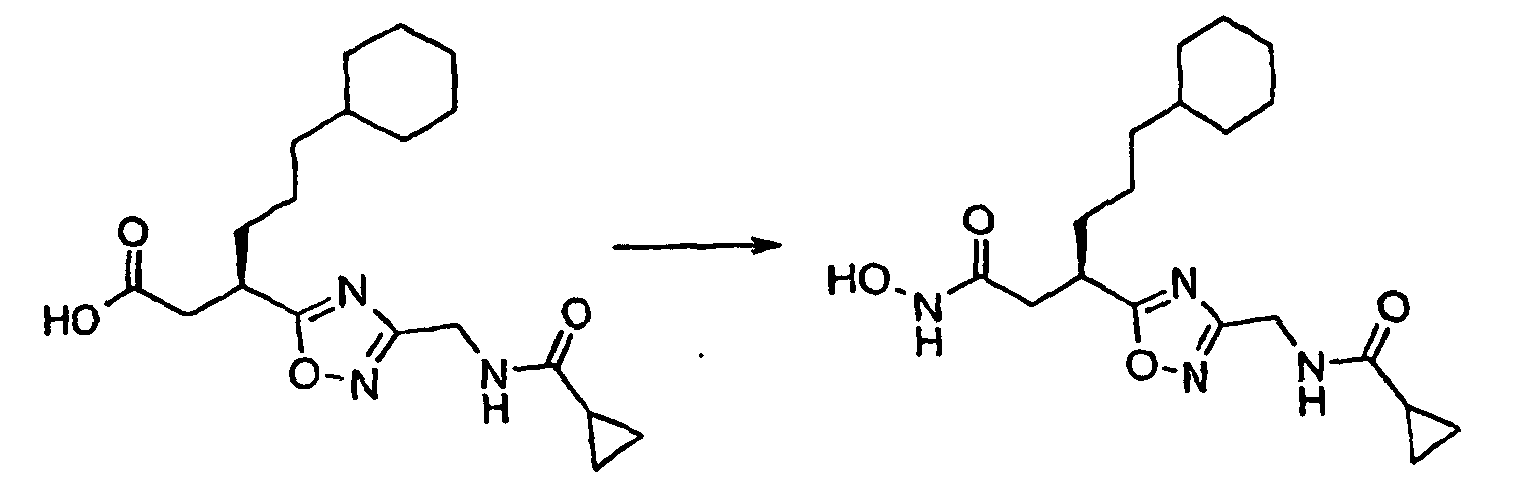
- Method as for example 1 using (3R)-6-cyclohexyl-3-(3-{[(cyclopropylcarbonyl)amino]methyl}-1,2,4-oxadiazol-5-yl)hexanoic acid (preparation 55) (198mg, 0.54mmol) as starting material and NMM as the base.
Purification: The crude material was purified on a silica column eluting with DCM : MeOH (19 : 1) to afford the title compound as a white foam (141mg, 68%).
1H nmr : (d6DMSO) 0.65 (4H, t), 0.80 (2H, m), 1.00-1.25 (8H, m), 1.50-1.70 (8H, m), 2.41 (2H, m), 3.40 (1H, m), 4.37 (2H, d), 8.49 (1H, brs), 8.61 (1H, brs), 10.37 (1H, brs).
MS : 401 (MNa+)
CHN : Found: C59.61%; H8.05%; N14.19%; C19H30N4O4. 0.3 H2O requires C59.45%; H8.03%; N14.59% -

- Method as for example 1 using (3R)-6-cyclohexyl-3-(3-{[(methoxyacetyl)amino]methyl}-1,2,4-oxadiazol-5-yl)hexanoic acid (preparation 57) (186mg, 0.51mmol) and NMM as the base. Purification: The crude material was purified on a silica column eluting with DCM: MeOH (19: 1) to afford the title compound as a colourless, sticky gum (90mg, 46%).
1H nmr : (d6DMSO) 0.80 (2H, m), 1.00-1.25 (8H, m), 1.55-1.70 (7H, m), 2.41 (2H, m), 3.32 (3H, s), 3.40 (1H, m), 3.82 (2H, s), 4.39 (2H, d), 8.21 (1H, brs), 8.63 (1 H, brs), 10.38 (1H, brs).
MS : 405 (MNa+)
CHN : Found: C54.09%; H7.79%; N13.81%; C18H30N4O5. 0.8 H2O requires C54.48%; H8.03%; N14.12% -

- Method as for example 7 using (3R)-6-cyclohexyl-3-[3-({[(dimethylamino)aretyl]amino}methyl)-1,2,4-oxadiazol-5-yl]hexanoic acid (preparation 59) (215mg, 0.52mmol) as starting material. Purification: The crude material was purified on a silica column eluting with DCM : MeOH (9 : 1) to afford the title compound as a colourless oil (60mg, 29%).
1H nmr : (d6DMSO) 0.80 (2H, m), 1.00-1.20 (8H, m), 1.50-1.65 (8H, m), 2.21 (6H, s), 2.40 (2H, m), 2.91 (2H, s), 3.40 (1H, m), 4.38 (2H, d), 8.18 (1H, brs), 10.37 (1H, brs).
MS : 396 (MH+)
CHN : Found: C55.31 %; H7.76%; N22.53%; C19H32N4O4. 0.5 H2O. 1.6 imidazole requires C55.68%; H7.93%; N22.37% -

- Method as for example 1 using (3R)-3-{3-[(benzoylamino)methyl]-1,2,4-oxadiazol-5-yl}-6-cyclohexylhexanoic acid (preparation 61) (202mg, 0.51mmol) and NMM as the base. Purification: The crude material was purified on a silica column eluting with Et2O : MeOH (19: 1) to afford the title compound as a colourless oil (112mg, 53%).
1H nmr: (d6DMSO) 0.79 (2H, m), 1.00-1.25 (8H, m), 1.50-1.70 (7H, m), 2.41 (2H, m), 3.41 (1H, m), 4.54 (2H, d), 7.42 (2H, t), 7.53 (1H, t), 7.83 (2H, d), 8.61 (1H, brs), 8.97 (1H, brs), 10.37 (1 H, brs).
MS : 437 (MNa+)
CHN : Found: C61.11%; H7.18%; N11.83%; C22H30N4O4. 0.4 H2O. 0.2 DCM. 0.2 DIPE requires C61.22%; H7.46%; N12.20% -

- Method as for example 7 using (3R)-6-cyclohexyl-3-(3-{[(2-pyridinylcarbonyl)amino]methyl}-1,2,4-oxadiazol-5-yl)hexanoic acid (preparation 63) (188mg, 0.43mmol) as starting material. Purification: The crude material was purified on a silica column eluting with DCM : MeOH (19 : 1) to afford the title compound as a colourless oil (41mg, 23%).
1H nmr : (d6DMSO) 0.78 (2H, m), 1.00-1.25 (8H, m), 1.50-1.65 (7H, m), 2.40 (2H, m), 3.40 (1H, m), 4.58 (2H, d), 7.59 (1H, t), 7.98 (2H, m), 8.61 (2H, brs), 9.12 (1H, brs), 10.38 (1H, brs).
MS : 438 (MNa+)
CHN : Found: C60.09%; H7.15%; N15.82%; C21H29N5O4. 0.4 H2O. 0.1 DIPE requires C59.93%; H7.26%; N16.18% -

- Method as for example 7 using (3R)-3-(3-{[(aminocarbonyl)amino]methyl}-1,2,4-oxadiazol-5-yl)-6-cyclohexylhexanoic acid (preparation 65) (78mg, 0.23mmol) as starting material. Purification: Crude material was purified on a silica column eluting with DCM : MeOH : NH3 (90 : 10 : 1) to afford the title compound as a white solid (13mg)
1H nmr : (d6DMSO) 0.81 (2H, m), 1.05-1.30 (8H, m), 1.50-1.70 (7H, m), 2.42 (2H, m), 3.41 (1H, m), 4.31 (2H, d), 6.60 (2H, brs). -

- Method as for example 1 using (3R)-6-cyclohexyl-3-[3-({[(methylamino)carbonyl]amino}methyl)-1,2,4-oxadiazol-5-yl]hexanoic acid (preparation 67) (119mg, 0.34mmol) as starting material and Et3N as base.
Purification: Two silica columns were required to purify the crude material the first eluting with DCM : MeOH : NH3 (90 : 10 : 1) and the second eluting with DCM : MeOH (95 : 5) to afford the title compound as a colourless oil (11mg).
1H nmr : (d6DMSO) 0.79 (2H, m), 1.05-1.20 (8H, m), 1.50-1.70 (7H, m), 2.41 (2H, m), 2.55 (3H, d), 3.40 (1H, m), 4.25 (2H, d), 6.42 (1H, brs), 8.80 (1H, brs), 10.50 (1H, brs).
MS : 366 (M-H) -

- Method as for example 1 using (3R)-6-cyclohexyl-3-[3-({[(dimethylamino)carbonyl]amino}methyl)-1,2,4-oxadiazol-5-yl]hexanoic acid (preparation 69) (204mg, 0.56mmol) as starting material and Et3N as base.
Purification: The crude material was purified on a silica column eluting with a solvent gradient of DCM : MeOH (98 : 2) gradually changing to (90 : 10) to afford the title compound as a crunchy, white foam (147mg).
1H nmr : (d6DMSO) 0.80 (2H, m), 1.05-1.30 (8H, m), 1.50-1.70 (7H, m), 2.40 (2H, m), 2.79 (6H, m), 3.40 (1H, m), 4.25 (2H, d), 6.75 (1H, brs), 8.62 (1H, brs), 10.38 (1H, brs).
MS : 380 (M-H) -

- Method as for example 1 using (3R)-3-(3-{[(tert-butoxycarbonyl)amino]methyl}-1,2,4-oxadiazol-5-yl)-6-cyclohexylhexanoic acid (preparation 70) (113mg, 0.29mmol) as starting material and NMM as the base.
1H nmr: (CDCl3) 0.81 (2H, m), 1.10-1.35 (8H, m), 1.43 (9H, s), 1.60-1.80 (7H, m), 2.59 (1H, dd), 2.70 (1H, m), 3.57 (1H, m), 4.40 (2H, d), 5.01 (1H, brs).
MS : 433 (MNa+)
CHN : Found: C57.95%; H8.40%; N13.16%; C20H34N4O5. 0.25 H2O requires C57.88%; H8.38%; N13.50% -

- Method as for example 7 using (3R)-3-(3-amino-1,2,4-oxadiazol-5-yl)-6-cyclohexylhexanoic acid (preparation 72) (390mg, 1.38mmol) as starting material.
Purification: The crude material was purified on a silica column eluting with a solvent gradient of DCM : MeOH : NH3 (95 : 5 : 0.5) gradually changing to (70 : 30 : 5) to afford the title compound as a white foam (170mg, 42%).
1H nmr: (d6DMSO) 0.80 (2H, m), 1.00-1.20 (8H, m), 1.50-1.70 (7H, m), 2.35 (2H, m), 3.21 (1H, m), 6.10 (2H, brs).
MS : 319 (MNa+) -
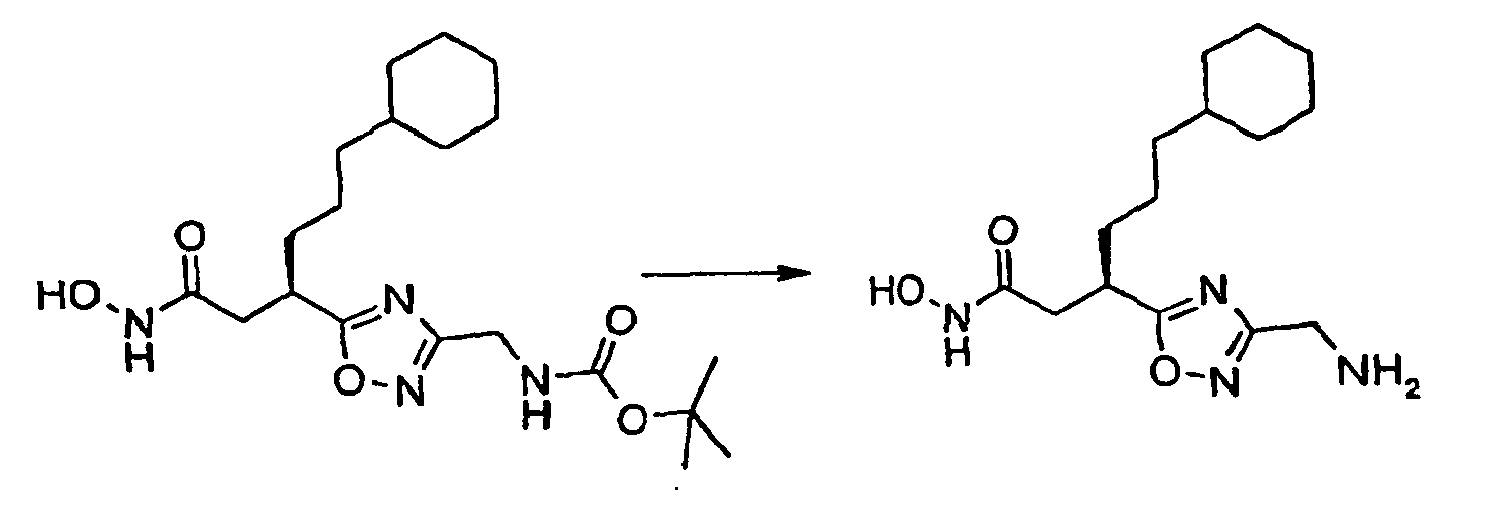
- Method as for preparation 11 using tert-butyl (5-{(1R)-4-cyclohexyl-1-[2-(hydroxyamino)-2-oxoethyl]butyl}-1,2,4-oxadiazol-3-yl)methylcarbamate (example 28) (65mg, 0.16mmol) as starting material. The crude material was azeotroped from DCM (x4) and Et2O (2x) and the residue dried under reduced pressure to afford the title compound as a pale yellow foam (61 mg, 90%).
1H nmr : (d6DMSO) 0.80 (2H, m), 1.05-1.25 (8H, m), 1.50-1.70 (7H, m), 2.40 (2H, m), 3.46 (1H, m), 4.22 (2H, s), 8.45 (2H, brs).
MS : 311 (MH+) -

- Method as for example 7 using (3R)-6-cyclohexyl-3-{3-[(methylamino)methyl]-1,2,4-oxadiazol-5-yl}hexanoic acid (preparation 73) (370mg, 1.07mmol) as starting material.
Purification: The crude material was purified one silica column eluting with DCM : MeOH (9 : 1) to afford the title compound as a colourless oil (93mg, 27%).
1H nmr : (CD3OD) 0.85 (2H, m), 1.10-1.35 (8H, m), 1.60-1.80 (7H, m), 2.40 (3H, s), 2.50 (1H, dd), 2.60 (1H, dd), 3.37 (1H, s), 3.54 (1H, m), 3.80 (2H, s).
MS : 325 (MH+)
CHN : Found: C57.95%; H8.84%; N16.57%; C16H28N4O3. 0.4 H2O requires C57.95%; H8.75%; N16.89% -

- Method as for example 7 using (3R)-6-cyclohexyl-3-{3-[(ethylamino)methyl]-1,2,4-oxadiazol-5-yl}hexanoic acid (preparation 75) (360mg, 0.76mmol) as starting material.
Purification: The crude material was purified on a silica column eluting with a solvent gradient of DCM : MeOH : NH3 (97.5 : 2.5 : 0.5) gradually changing to (90 : 10 :1). The product was recrystallised from Et2O to afford the title compound as white crystals (79mg, 31 %).
M. Pt. : 69.4-71.4°C
1H nmr : (d6DMSO) 0.80 (2H, m), 0.99 (3H, t), 1.05-1.20 (8H, m), 1.50-1.70 (7H, m), 2.40 (2H, m), 2.53 (2H, q), 3.40 (1H, m), 3.71 (2H, s).
MS : 339 (MH+)
CHN : Found: C59.58%; H8.85%; N16.47%; C17H30N4O3. 0.08 DCM requires C59.42%; H8.81%; N16.23% -
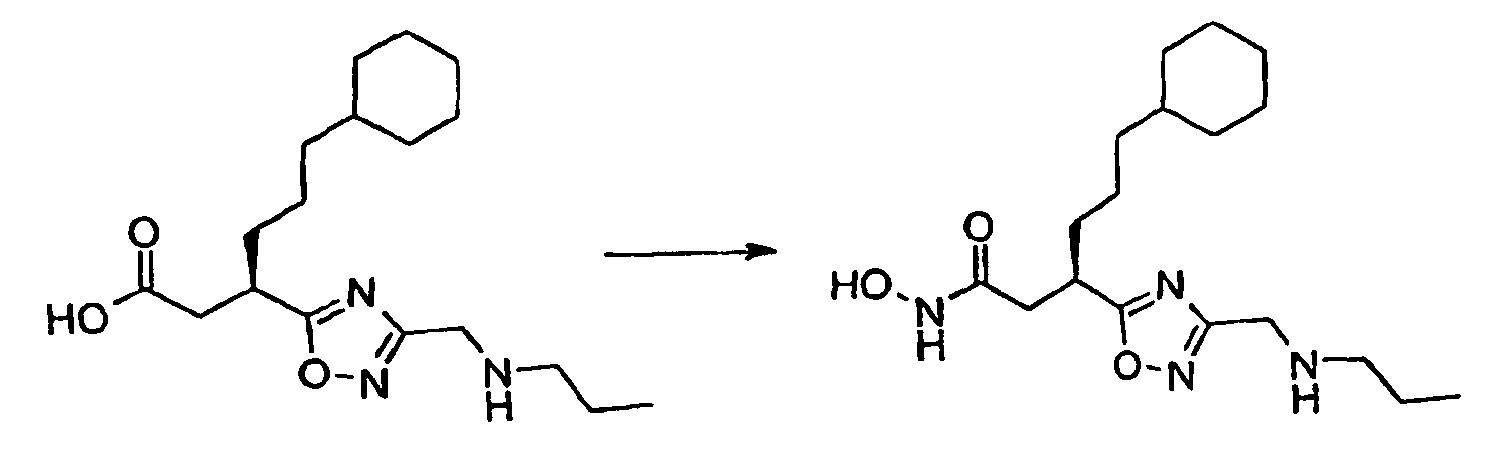
- Method as for example 7 using (3R)-6-cyclohexyl-3-{3-[(propylamino)methyl]-1,2,4-oxadiazol-5-yl}hexanoic acid (preparation 77) (270mg, 0.60mmol) as starting material.
Purification: The crude material was purified on a silica column eluting with a solvent gradient of DCM : MeOH : NH3 (97.5 : 2.5 : 0.25) gradually changing to (90 : 10 : 1). The product was recrystallised from Et2O to afford the title compound as a sticky solid (46mg).
M.Pt. : 90.4-91.8°C
1H nmr : (d6DMSO) 0.79 (5H, m), 1.00-1.20 (8H, m), 1.39 (2H, m), 1.50-1.70 (7H, m), 1.99 (1H, brs), 2.30-2.45 (3H, m), 3.41 (1H, m), 3.74 (2H, s), 8.74 (1H, brs), 10.41 (1H, brs).
MS : 353 (MH+)
CHN : Found: C58.03%; H8.65%; N15.00%; C18H32N4O3. 0.3 DCM requires C58.16; H8.69%; N14.82% -

- Method as for example 7 using (3R)-6-cyclohexyl-3-{3-[(isopropylamino)methyl]-1,2,4-oxadiazol-5-yl}hexanoic acid (preparation 79) (198mg, 0.44mmol) as starting material.
Purification: The crude material was purified on a silica column eluting with a solvent gradient of DCM : MeOH : NH3 (95 : 5 : 0.5) gradually changing to (90 : 10: 1). The oil was treated with Et2O to afford the title compound as a white solid (67mg, 44%).
1H nmr : (CD3OD) 0.82 (2H, m), 1.09 (6H, d), 1.10-1.30 (8H, m), 1.60-1.80 (7H, m), 2.51 (1 H, dd), 2.61 (1H, dd), 2.81 (1H, m), 3.57 (1H, m), 3.86 (2H, s).
MS : 353 (MH+) -

- Method as for example 7 using (3R)-6-cyclohexyl-3-{3-[(isobutylamino)methyl]-1,2,4-oxadiazol-5-yl}hexanoic acid (preparation 81) (495mg, 1.06mmol) as starting material.
Purification: The crude material was purified on a silica column eluting with a solvent gradient of DCM : MeOH : NH3 (97.5 : 2.5 : 0.25) gradually changing to (90 : 10 :1). The glass obtained was recrystallised from Et2O to afford the title compound as colourless crystals (71mg).
M.Pt.: 97.8-99.0°C
1H nmr : (d6DMSO) 0.83 (2H, m), 0.92 (6H, d), 1.10-1.35 (8H, m), 1.60-1.80 (8H, m), 2.46 (2H, d), 2.59 (1H, brs), 2.69 (1H, brs), 3.59 (1H, m), 3.88 (2H, s).
MS : 367 (MH+)
CHN : Found: C62.21 %; H9.48%; N15.47%; C19H34N4O3 requires C62.27; H9.35%; N15.29% -

- Method as for example 7 using (3R)-3-{3-[(tert-butylamino)methyl]-1,2,4-oxadiazol-5-yl}-6-cyclohexylhexanoic acid (preparation 83) (274mg, 0.59mmol) as starting material.
Purification: The crude material was purified on a silica column eluting with a solvent gradient of DCM : MeOH : NH3 (97.5 : 2.5 : 0.25) gradually changing to (90 : 10 :1). Second column was required eluting with DCM : MeOH : NH3 (95 : 5 : 0.5). The product was partitioned between Et2O and H2O. The organic extracts were concentrated under reduced pressure. The residue was dissolved in DCM, dried over anhydrous Na2SO4, filtered and the solvent removed under reduced pressure. The residue was dired under reduced pressure to afford the title compound (52mg).
1H nmr: (CDCl3) 0.83 (2H, m), 1.10-1.40 (17H, s+m), 1.60-1.80 (7H, m), 2.50-2.75 (2H, brd), 3.59 (1H, m), 3.85 (2H, s).
MS : 367 (MH+)
Accurate mass : Found 367.2711 (MH+), Calculated C19H35N4O3, 367.2709 -

- Method as for example 7 using (3R)-6-cyclohexyl-3-(3-{[(1-ethylpropyl)amino]methyl}-1,2,4-oxadiazol-5-yl)hexanoic acid (preparation 85) as starting material.
Purification: Crude material purified on a silica column eluting with DCM : MeOH : NH3 (97.5 : 2.5 : 0.25). The solid was recrystallised from Et2O to afford the title compound as fluffy crystals (212mg).
M.Pt. : 102.7-104.3°C
1H nmr : (d6DMSO) 0.79 (8H, m+t), 1.00-1.20 (8H, m), 1.33 (4H, m),1.50-1.75 (7H, m), 2.29 (1H, t), 2.40 (2H, m), 3.41 (1H, m), 3.74 (2H, s).
MS : 381 (MH+)
CHN : Found: C63.12%; H9.64%; N14.85%; C20H36N4O3 requires C63.13; H9.54%; N14.72% -
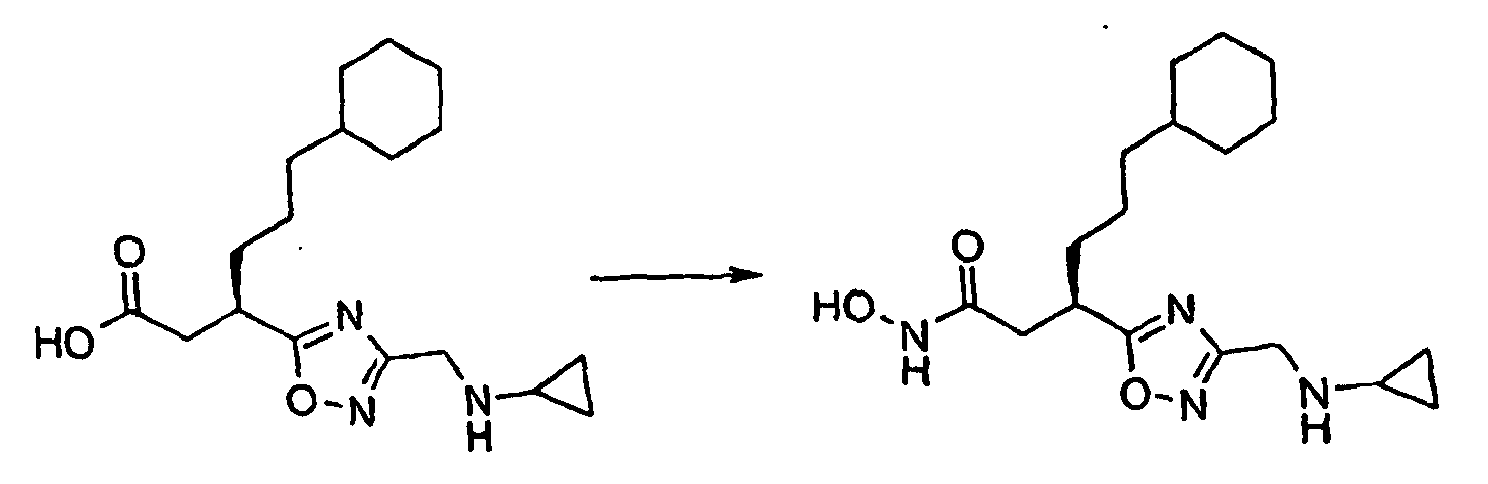
- Method as for Example 7 using (3R)-6-cyclohexyl-3-{3-[(cyctopropylamino)methyl]-1,2,4-oxadiazol-5-yl}hexanoic acid (preparation 87) (300mg, 0.67mmol) as starting material.
- Purification: Crude material purified on a silica column eluting with a solvent gradient of DCM : MeOH : NH3 (97.5 : 2.5 : 0.25) gradually changing to (90 : 10 : 1). The material was dissolved in Et2O and washed with H2O (x5) and the organic extracts were concentrated under reduced pressure. The residue was dissolved in DCM, dried over anhydrous Na2SO4 and filtered. The solvent was removed under reduced pressure to afford the title compound (41mg).
1H nmr : (CDCl3) 0.40 (2H, s), 0.46 (2H, m), 0.86 (2H, m), 1.10-1.40 (8H, m), 1.60-1.80 (7H. m), 2.19 (1H, m), 2.59 (1H, dd), 2.71 (1H, brs), 3.58 (1H, m), 3.92 (2H, s).
MS : 351 (MH+)
CHN : Found: C61.77%; H8.78%; N15.13%; C18H30N4O3. 0.25 Et2O requires C61.85; H8.88%; N15.18% -
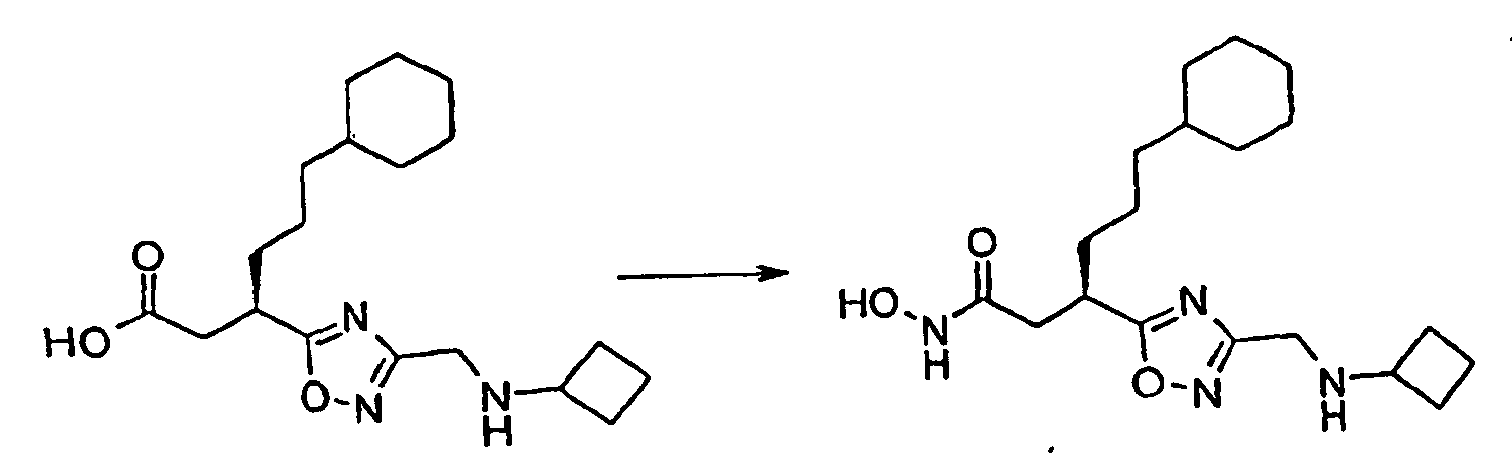
- Method as for example 7 using (3R)-3-{3-[(cyclobutylamino)methyl]-1,2,4-oxadiazol-5-yl}-6-cyclohexylhexanoic acid (preparation 89) (300mg, 0.67mmol) as starting material.
Purification: Crude material purified on a silica column eluting with a solvent gradient of DCM : MeOH : NH3 (97.5 : 2.5 : 0.25) gradually changing to (90 : 10 : 1). The material was triturated with DIPE to afford the title compound as a white solid (27mg).
M.Pt. : 82.0-83.9°C
1H nmr : (d6DMSO) 0.79 (2H, m), 1.00-1.20 (8H, m), 1.40-1.70 (11H, m), 2.39 (1H, dd), 2.42 (1H, dd), 3.15 (1H, m), 3.40 (1H, m), 3.64 (2H, s), 8.74 (1H, brs), 10.41 (1H, brs).
MS : 365 (MH+)
CHN : Found: C62.38%; H8.86%; N15.29%; C19H32N4O3 requires C62.61; H8.85%; N15.37% -

- Method as for example 7 using (3R)-6-cyclohexyl-3-{3-[(cyclopentylamino)methyl]-1,2,4-oxadiazol-5-yl}hexanoic acid (preparation 91) (240mg, 0.50mmol) as starting material. Purification: The crude material was purified on a silica column eluting with DCM : MeOH : NH3 (90 : 10 : 1) and the white solid was recrystallised from EtOAc to afford the title compound as a white solid (60mg).
1H nmr: (d6DMSO) 0.79 (2H, m), 0.95-1.10 (12H, m), 1.45-1.70 (9H, m), 1.78 (2H, m), 1.95 (1H, brs), 2.25-2.45 (3H, m), 3.41 (1H, m), 3.75 (2H, s), 8.80 (1H, brs), 10.48 (1H, brs).
MS : 379 (MH+)
CHN : Found: C63.53%; H9.16%; N14.66%; C20H34N4O3 requires C63.46; H9.05%; N14.80% -

- Method as for example 7 using (3R)-6-cyclohexyl-3-{3-[(cyclohexylamino)methyl]-1,2,4-oxadiazol-5-yl}hexanoic acid (preparation 93) (262mg, 0.53mmol) as starting material. Purification: The crude material was purified on a silica column eluting with DCM : MeOH : NH3 (90 : 10 : 1) to afford the title compound as a white solid (130mg).
M. Pt. : 127°C
1H nmr : (d6DMSO) 0.79 (2H, m), 0.95-1.20 (10H, m), 1.27 (2H, m), 1.41 (2H, m), 1.50-1.70 (11H, m), 2.40 (2H, m), 2.97 (1H, m), 3.40 (1H, m), 3.71 (2H, s), 8.79 (1H, brs), 10.45 (1H, brs).
MS : 393 (MH+)
CHN : Found: C63.79%; H9.24%; N14.32%; C21H36N4O3 requires C64.20; H9.24%; N14.27% -

- A solution of (3R)-6-cyclohexyl-3-(3-{[(2-hydroxyethyl)amino]methyl}-1,2,4-oxadiazol-5-yl)hexanoic acid (preparation 95) (398mg, 0.82mmol) in DCM (8ml) was treated with imidazole (56mg, 0.82mmol) and stirred at room temperature until all imidazole had dissolved. TMSCI (100µl, 0.82mmol) was added and the reaction mixture was stirred at room temperature for 1 hour. Method as for example 7 was then followed.
Purification: The crude material was purified on 2 silica columns. The first eluting with DCM : MeOH : NH3 (90 : 10 : 1) and the second eluting with DCM : MeOH : NH3 (80 : 20 : 2) to afford the title compound as a oil (90mg).
1H nmr : (CD3OD) 0.82 (2H, m), 1.10-1.35 (8H, m), 1.60-1.80 (7H, m). 2.50-2.70 (2H, m), 2.86 (2H, t), 3.55 (1H, m), 3.70 (2H, t), 4.04 (2H, s) + some impurities.
MS : 355 (MH+) -
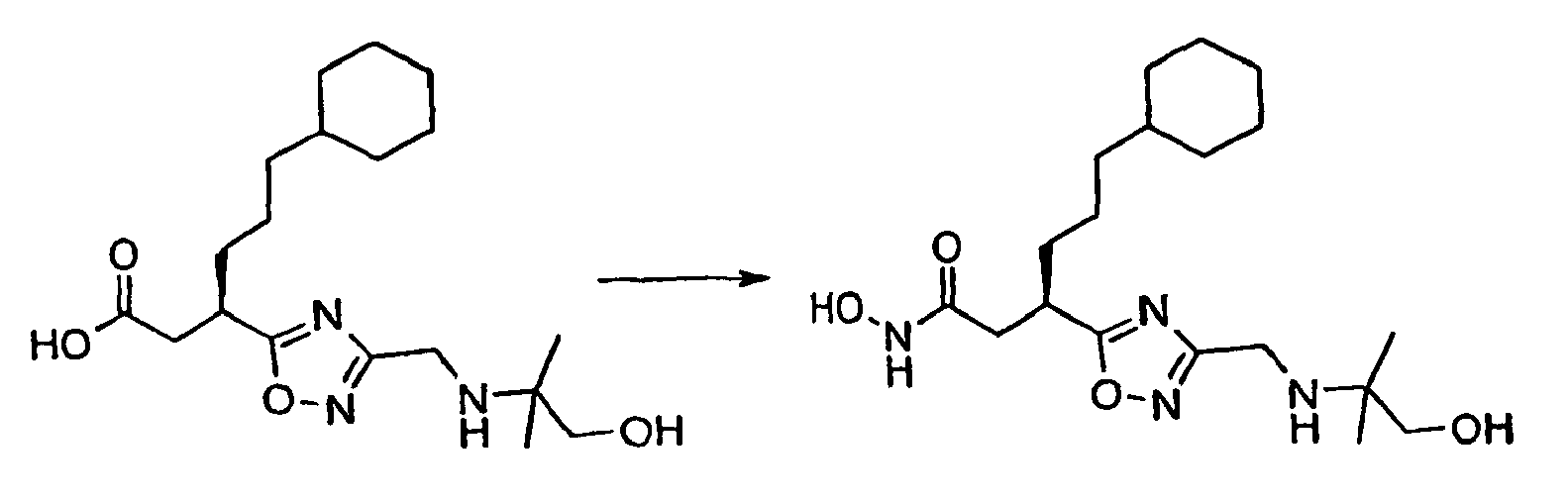
- Method as for example 42 using (3R)-6-cyclohexyl-3-(3-{[(2-hydroxy-1,1-dimethylethyl)amino]methyl}-1,2,4-oxediazol-5-yl)hexanoic acid (preparation 97) (2.59g, 4.95mmol) as starting material.
Purification: The crude material was purififed on a silica column eluting with DCM : MeOH : NH3 (98 : 2 : 0.2) gradually changing to (90 : 10: 1). The material was azeotroped from DCM followed by Et2O to afford the title compound as a white foam (980mg, 52%).
M.Pt. : 49-51 °C
1H nmr : (d6DMSO) 0.80 (2H, m), 0.98 (6H, s), 1.05-1.25 (8H, m), 1.50-1.70 (7H, m), 2.40 (2H, m), 3.20 (2H, m), 3.40 (1H, m), 3.73 (2H, s), 4.43 (1H, brs), 8.62 (1H, brs), 10.38 (1H, brs).
MS : 383 (MH+)
CHN : Found: C59.27%; H9.06%; N14.22%; C19H34N4O4. 0.05 H2O requires C59.52; H8.96%; N14.61% -

- Method as for example 7 using (3R)-6-cyclohexyl-3-(3-{[(2-methoxyethyl)amino]methyl}-1,2,4-oxadiazol-5-yl)hexanoic acid (preparation 99) (429mg, 0.93mrnol) as starting material. Purification: The oil solidified on standing to afford the title compound (44mg).
1H nmr: (d6DMSO) 0.79 (2H, m), 1.05-1.20 (8H, m), 1.55-1.65 (7H, m), 2.42 (2H, m), 2.69 (2H, t), 3.20 (3H, s), 3.39 (2H, t), 3.41 (1H, m), 3.80 (2H, s), 8.78 (1H, brs), 10.46 (1H, brs). -

- Method as for example 7 using (3R)-6-cyclohexyl-3-(3-{[(3-methoxypropyl)amino]methyl}-1,2,4-oxadiazol-5-yl)hexanoic acid (preparation 101) (226mg, 0.62mmol) as starting material. Purification: The crude material was purified on a silica column eluting with DCM : MeOH : NH3 (92.5 : 7.5: 0.5) to afford the title compound as a white solid (52mg, 25%).
M.Pt. : 60°C
1H nmr : (CD3OD) 0.83 (2H, m), 1.10-1.30 (8H, m), 1.60-1.80 (9H, m). 2.52 (1H, dd), 2.61 (1H, dd), 2.68 (2H, t), 3.33 (3H, obs), 3.42 (2H, t), 3.58 (1H, m), 3.83 (2H, s).
MS : 383 (MH+) -

- Method as for example 7 using (3R)-6-cyclohexyl-3-(3-{[(4-hydroxycyclohexyl)amino]methyl}-1,2,4-oxadiazol-5-yl)hexanoic acid (preparation 103) (179mg, 0.35mmol) as starting material.. Purification: The crude material was purified on a silica column eluting with a solvent gradient of DCM : MeOH : NH3 (90 : 10 : 1) gradually changing to (80 : 20 : 1) to afford the title compound as a colourless oil (70mg).
1H nmr: (CD3OD) 0.82 (2H, m), 1.10-1.35 (12H, m), 1.60-1.80 (7H, m), 1.99 (4H, brd), 2.52 (1H, dd), 2.60 (1H, dd), 2.63 (1H, m), 3.54 (2H, m), 4.01 (2H, s).
MS : 409 (MH+) -

- Method as for example 7 using (3R)-6-cyclohexyl-3-(3-{[(4-methoxycyclohexyl)amino]methyl}-1,2,4-oxadiazol-5-yl)hexanoic acid (preparation 105) (175mg, 0.34mmol) as starting material.
Purification: The crude material was purified on a silica column eluting with a solvent gradient of DCM: MeOH : NH3 (97.5 : 2.5 : 0.25) gradually changing to (90 : 10 : 1) to afford the title compound as a gum (68mg).
1H nmr: (CDCl3) 0.82 (2H, m), 1.10-1.35 (10H, m),1.40-1.90 (13H, m), 2.60 (3H, m), 3.26 (4H, s+m), 3.59 (1 H, m), 3.91 (2H, s). Evidence of the presence of the cis-isomer of the cyclohexanamine.
MS : 424 (MH+) -
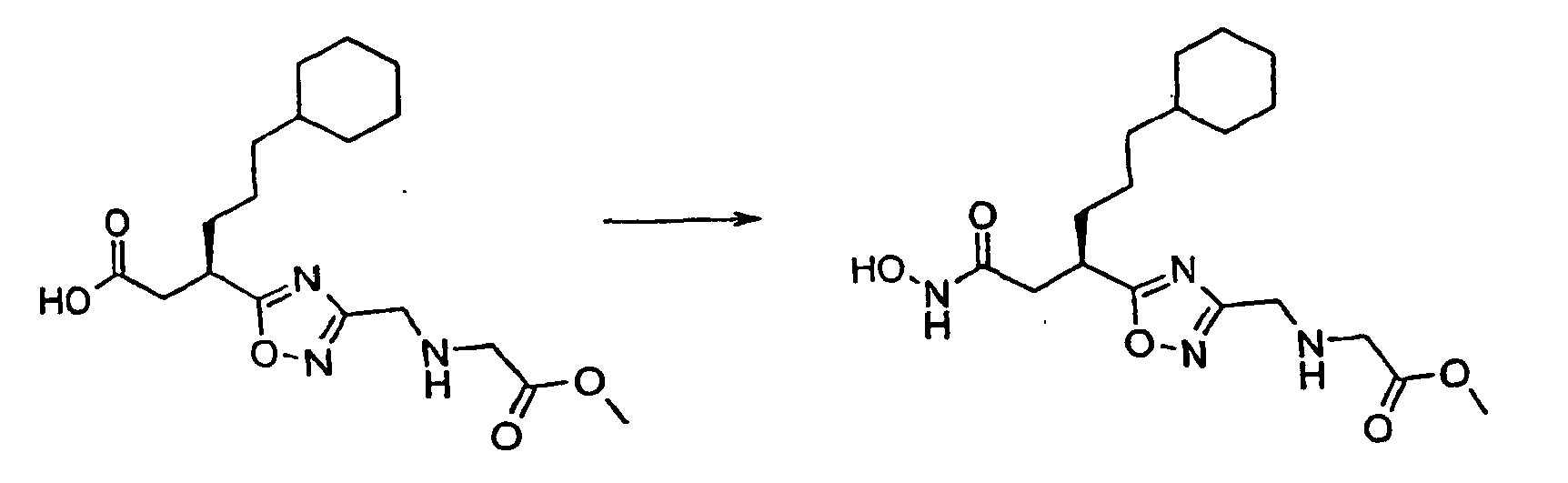
- Method as for example 7 using (3R)-6-cyclohexyl-3-(3-{[(2-methoxy-2-oxoethyl)amino]methyl}-1,2,4-oxadiazol-5-yl)hexanoic acid (preparation 107) (135mg, 0.37mmol) as starting material. Purification: The crude material was purified on a silica column eluting with a solvent gradient of DCM : MeOH (100 : 0) gradually changing to (90 : 10) to afford the title compound as a colourless oil (30mg, 21%).
1H nmr : (CDCl3) 0.82 (2H, m), 1.10-1.40 (8H, m), 1.60-1.85 (7H, m), 2.55-2.79 (2H, m), 3.49 (2H, s), 3.59 (1H, m), 3.77 (3H, s), 3.93 (2H, s).
MS : 383 (MH+)
Accurate mass : Found 383.2300 (MH+), Calculated C18H30N4O5, 383.2289 -

- Method as for example 7 using (3R)-3-(3-{[(2-amino-2-oxoethyl)amino]methyl}-1,2,4-oxadiazol-5-yl)-6-cyclohexylhexanoic acid (preparation 109) (137mg, 0.35mmol) as starting material. Purification: The crude material was purified on a silica column eluting with a solvent gradient of DCM : MeOH (9 : 1) gradually changing to (1: 1) To afford the title compound as a white solid (15mg).
M.Pt. : 60-70°C
1H nmr : (d6DMSO) 0.80 (2H, m), 1.00-1.25 (8H, m), 1.50-1.70 (7H, m), 2.41 (2H, m), 3.08 (2H, s), 3.40 (1H, m), 3.79 (2H, s), 6.82 (1H, brs), 7.18 (1H, brs), 8.62 (1 H, brs), 10.38 (1H, brs).
MS : 390 (MNa+) -

- Method as for example 7 using (3R)-6-cyclohexyl-3-{3-[(tetrahydro-2H-pyran-4-ylamino)methyl]-1,2,4-oxadiazol-5-yl}hexanoic acid (preparation 111) (223mg, 0.45mmol) as starting material. Purification: The crude material was purified on a silica column eluting with a solvent gradient of DCM : MeOH : NH3 (97.5 : 2.5 : 0.25) gradually changing to (90 : 10: 1). The material was azeotroped from Et2O and then triturated with Et2O to afford the title compound as a white solid, which was dried under reduced pressure (35.3mg).
M. Pt. : 108.9-110.3°C
1H nmr : (CDCl3) 0.81 (2H, m), 1.10-1.35 (8H, m),1.43 (2H, m), 1.60-1.80 (7H, m),1.82 (2H, brd), 2.55 (1H, m), 2.62 (1H, m), 2.78 (1H, m), 3.39 (2H, t), 3.59 (1H, m), 3.93 (2H, s), 3.98 (2H, d).
MS : 395 (MH+)
CHN : Found: C60.53%; H8.73%; N14.04%; C20H34N4O4 requires C60.89; H8.69%; N14.20% -

- Method as for example 7 using (3R)-6-cyclohexyl-3-{3-[(1H-pyrazol-3-ylamino)methyl]-1,2,4-oxadiazol-5-yl}hexanoic acid (preparation 113) (132mg, 0.27mmol) as starting material. Purification: The crude material was purified on a silica column eluting with DCM : MeOH : NH3 (90 : 10 : 1) to afford the title compound as a colourless oil (4.1 mg)
1H nmr : (d6DMSO) 0.79 (2H, m), 1.00-1.20 (8H, m), 1.50-1.65 (7H, m), 2.40 (2H, m), 3.40 (1H, m), 5.19 (2H, s), 5.24 (3H, s), 7.02 (1H, s). -
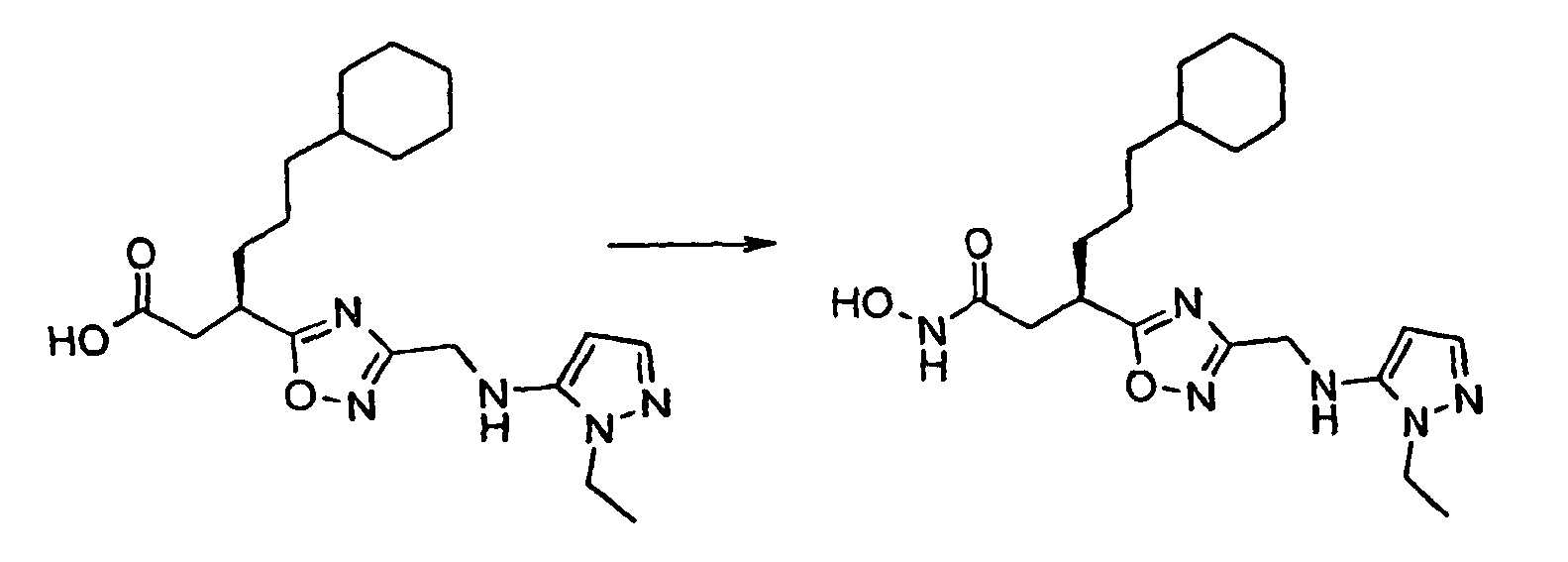
- Method as for example 1 using (3R)-6-cyclohexyl-3-(3-{[(1-ethyl-1H-pyrazol-5-yl)amino]methyl}-1,2,4-oxadiazol-5-yl)hexanoic acid (preparation 115) (40mg, 0.10mmol) as starting material and NMM as the base.
Purification: The crude material was purified on a silica column eluting with DCM : MeOH : NH3 (97 : 3 : 0.3) gradually changing to (90 : 10 : 1) to afford the title compound as a white foam (31mg).
1H nmr : (CDCl3) 0.79 (2H, m), 1.05-1.40 (11 H, m), 1.55-1.80 (7H, m), 2.52 (2H, brs), 3.59 (1H, m), 3.92 (2H, brs), 4.33 (2H, brs), 5.51 (1H, brs), 7.26 (1H, obs).
MS : 405 (MH+)
CHN : Found: C57.94%; H7.92%; N20.08%; C20H32N6O3. 0.5 H2O requires C58.09; H8.04%; N20.32% -

- Method as for example 7 using (3R)-3-{3-[(2S)-1-(tert-butoxycarbonyl)pyrrolidinyl]-1,2,4-oxadiazol-5-yl}-6-cyclohexylhexanoic acid (preparation 120) (220mg, 0.50mmol) as starting material.
Purification: The crude material was purified on a silica column eluting with DCM : MeOH (95 : 5) to afford the title compound as a colourless oil (95mg).
1H nmr : (d6DMSO) 0.79 (2H, m), 1.10-1.40 (17H, m+s+m), 1.50-1.65 (7H, m), 1.70-1.95 (3H, m), 2.22 (1H, m), 2.40 (2H, m), 3.39 (3H, m), 4.81 (1H, brs), 8.78 (1H, brs), 10.42 (1H, brs).
MS : 473 (MNa+) -

- Method as for preparation 11 using tert-butyl (2S)-2-(5-{(1R)-4-cyclohexyl-1-[2-(hydroxyamino)-2-oxoethyl]butyl}-1,2,4-oxadiazol-3-yl)-1-pyrrolidinecarboxylate (example 53) (90mg, 0.2mmol) as starting material to afford the title compound as a colourless gum.
1H nmr : (d6DMSO) 0.80 (2H, m), 1.00-1.25 (8H, m), 1.50-1.70 (7H, m), 2.02 (4H, m), 2.40 (2H, m), 3.31 (2H, m), 4.48 (1H, m), 4.83 (1H, brs), 9.28 (1H, brs), 9.80 (1H, brs).
MS : 351 (MH+) -

- Method as for example 7 using (3R)-6-cyclohexyl-3-{3-[(2S)-piperidinyl]-1,2,4-oxadiazol-5-yl}hexanoic acid (preparation 123) (319mg, 0.83mmol) as starting material.
Purification: The crude material was purified on a silica column eluting with a solvent gradient of DCM : MeOH (100 : 0) gradually changing to (95: 5) to afford the title compound contaminated with imidazole. The material was dissolved in EtOAc and washed with H2O (x2) followed by brine. The organic extract was dried over anhydrous MgSO4 and filtered. The solvent was removed under reduced pressure to afford the title compound as a white foam.
1H nmr : (d6DMSO) 0.80 (2H, m), 1.00-1.30 (8H, m), 1.30-1.65 (11H, m), 1.74 (1H, m), 1.82 (1H, d), 2.45 (2H, obs), 2.60 (1H, t), 2.97 (1H, d), 3.40 (1H, m), 3.79 (1H, d), 8.61 (1H, brs), 10.38 (1H, brs).
MS : 365 (MH+)
CHN : Found: C60.88%; H8.82%; N15.06%; C19H32N4O3. 0.5H2O requires C61.10; H8.91%; N15.00% -

- Method as for example 7 using (3R)-6-cyclohexyl-3-{3-[(dimethylamino)methyl]-1,2,4-oxadiazol-5-yl}hexanoic acid (Preparation 125) (495mg, 1.14mmol) as starting material.
Purification: The residue was purified on a silica column eluting with DCM : MeOH : NH3 (90 : 10 : 1) to afford the title compound (90mg).
1Hnmr (CD3OD) : 0.85 (2H, m), 1.10-1.30 (8H, m), 1.60-1.80 (7H, m), 2.38 (6H, s), 2.51 (1H, dd), 2.61 (1H, dd), 3.54 (1H, m), 3.65 (2H, s).
MS : 339 (MH+) -
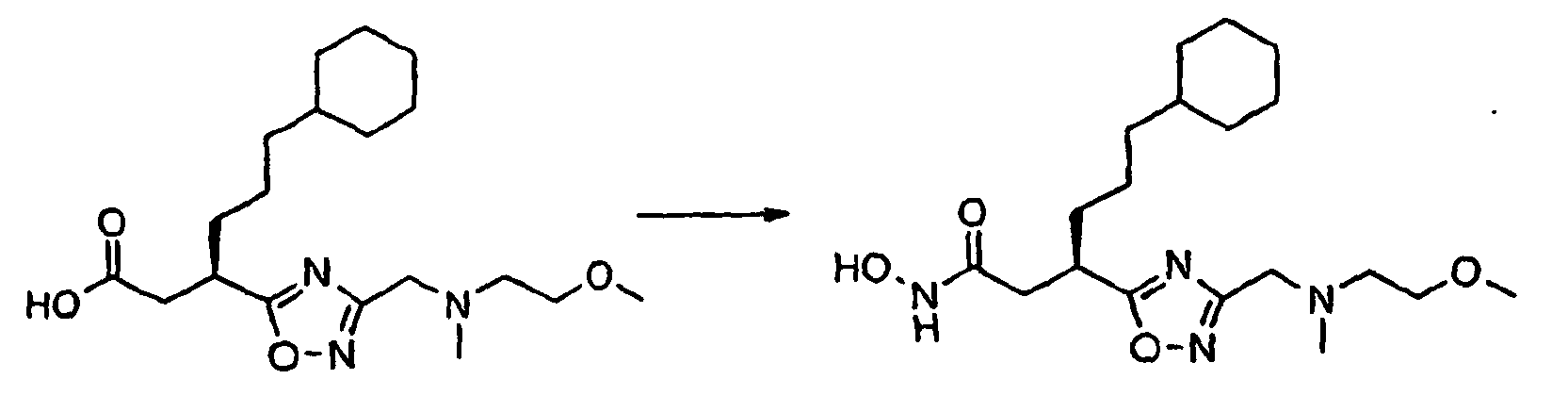
- Method as for example 7 using (3R)-6-cyclohexyl-3-(3-{[(2-methoxyethyl)(methyl)amino]methyl}-1,2,4-oxadiazol-5-yl)hexanoic acid (preparation 127) (209mg, 0.57mmol) as starting material. Purification: The crude material was purified on a silica column eltuing with DCM : MeOH : NH3 (90 : 10 : 1) to afford the title compound as a colourless gum (145mg, 66%).
1Hnmr (CD3OD) : 0.83 (2H, m), 1.10-1.30 (8H, m), 1.60-1.80 (7H, m), 2.37 (3H, s), 2.53 (1H, dd), 2.61 (1H, dd), 2.71 (2H, t), 3.36 (3H, s), 3.55 (3H, t+m), 3.78 (2H, s).
MS : 383 (MH+) -

- Method as for example 7 using (3R)-6-cyclohexyl-3-(3-{[[2-(dimethylamino)ethyl](methyl)amino]methyl}-1,2,4-oxadiazol-5-yl)hexanoic acid (preparation 129) (354mg, 0.58mmol) as starting material.
Purification: The crude material was purified on a silica column eluting with DCM : MeOH : NH3 (90 : 10 : 1) to afford the title compound as a colourless oil (40mg).
1Hnmr (d6DMSO) : 0.78 (2H, m), 1.00-1.20 (8H, m), 1.50-1.70 (7H, m), 2.08 (6H, s), 2.19 (3H, s), 2.32 (2H, t), 2.42 (4H, m), 3.41 (1H, m), 3.65 (2H, s).
MS : 397 (M-H) -
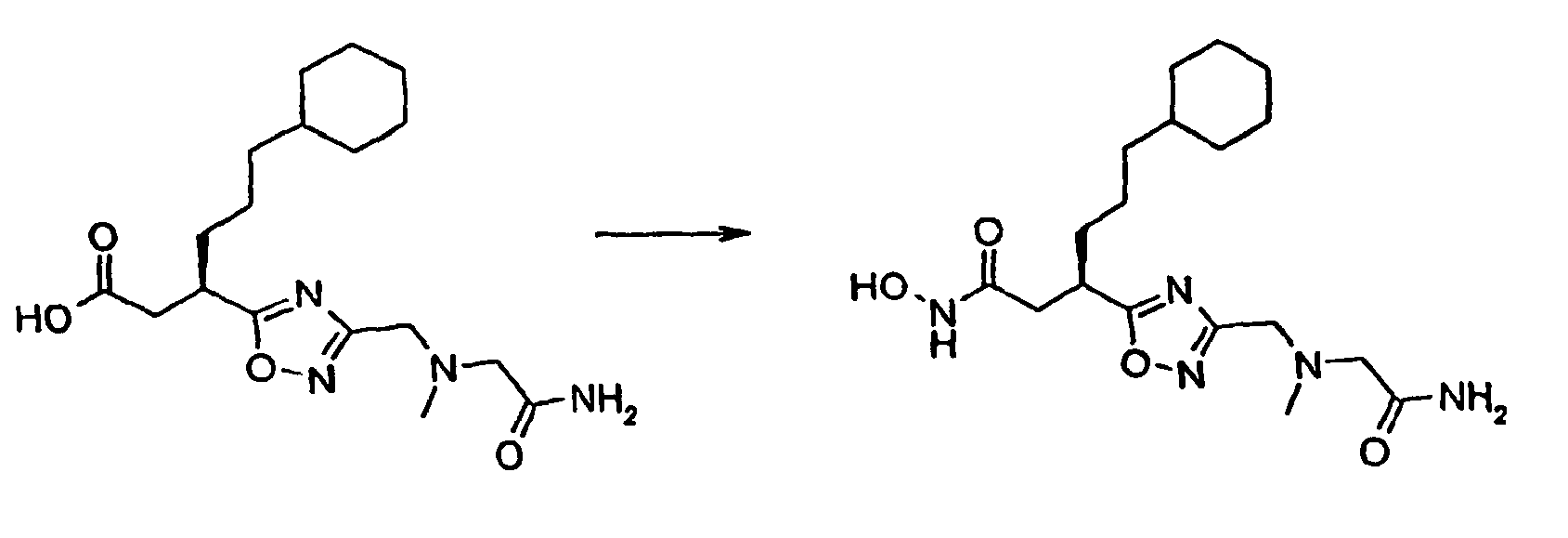
- Method as for example 7 using (3R)-3-(3-{[(2-amino-2-oxoethyl)(methyl)amino]methyl}-1,2,4-oxadiazol-5-yl)-6-cyclohexylhexanoic acid (preparation 131) (223mg, 0.57mmol) as starting material.
Purification: The crude material was purified on a silica column eluting with DCM : MeOH (9 : 1) to afford the title compound as a colourless oil (74mg).
1H nmr : (CD3OD) 0.83 (2H, m), 1.10-1.30 (8H, m), 1.60-1.80 (7H, m), 2.39 (3H, s), 2.52 (1H, dd), 2.61 (1H, dd), 3.18 (2H, s), 3.56 (1H, m), 3.80 (2H, s) + imidazole
MS : 404 (MNa+)
CHN : Found: C55.09%; H8.03%; N18.63%; C18H31N5O4. 0.5 H2O. 0.1 imidazole requires C55.33; H8.22%; N18.33% -

- Method as for example 7 using (3R)-6-cyclohexyl-3-[3-({methyl[2-(methylamino)-2-oxoethyl]amino}methyl)-1,2,4-oxediazol-5-yl]hexanoic acid (preparation 135) (398mg, 0.95mmol) as starting material.
Purification: The crude material was purified on a silica column eluting with DCM : MeOH (19 : 1) to afford the title compound as a colourless gum (198mg, 52%).
1H nmr: (d6DMSO) 0.80 (2H, m), 1.00-1.25 (8H, m), 1.50-1.70 (7H, m), 2.23 (3H, s), 2.41 (2H, m), 2.60 (3H, d), 3.02 (2H, s), 3.41 (1H, m), 3.78 (2H, s), 7.58 (1H, brs), 8.63 (1H, brs), 10.39 (1H, brs).
MS : 418 (MNa+)
CHN : Found: C56.22%; H8.22%; N17.23%; C19H33N5O4. 0.5 H2O requires C56.42; H8.47%; N17.31% -
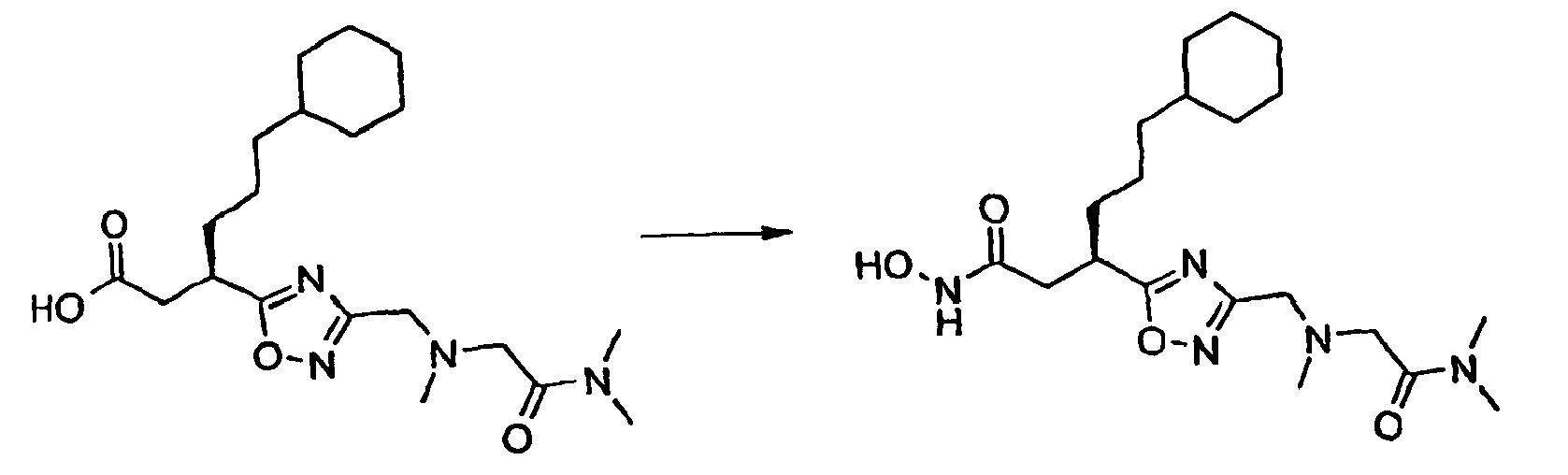
- Method as for example 7 using (3R)-6-cyclohexyl-3-(3-{[[2-(dimethylamino)-2-oxoethyl](methyl)amino]methyl}-1,2,4-oxadiazol-5-yl)hexanoic acid (preparation 137) (403mg, 0.94mmol) as starting material.
Purification: The crude material was purified on a 2 silica columns eluting with DCM : MeOH (19 : 1) to afford the title compound as a colourless sticky gum (76mg).
1H nmr : (d6DMSO) 0.80 (2H, m), 1.00-1.25 (8H, m), 1.50-1.70 (7H, m), 2.27 (3H, s), 2.41 (2H, m), 2.80 (3H, s), 2.93 (3H, s), 3.27 (2H, s), 3.41 (1H, m), 3.78 (2H, s), 8.64 (1H, brs), 10.39 (1H, brs).
MS : 432 (MNa+)
CHN : Found: C56.58%; H8.56%; N16.46%; C20H35N5O4. 0.7 H2O requires C56.91; H8.69%; N16.59% -

- Method as for example 7 using (3R)-3-(3-{[bis(2-methoxyethyl)amino]methyl}-1,2,4-oxadiazol-5-yl)-6-cyclohexylhexanoic acid (preparation 139) (176mg, 0.42mmol) as starting material. Purification: The crude material was purififed on a silica column eluting with DCM : MeOH : NH3 (90 : 10 : 1) to afford the title compound as a colourless oil (76mg).
1Hnmr (d6DMSO) : 0.79 (2H, m), 1.00-1.20 (8H, m), 1.50-1.70 (7H, m), 2.42 (2H, m), 2.69 (4H, t), 3.20 (6H, s), 3.19 (4H, t), 3.20 (1H, m), 3.80 (2H, s). -

- Method as for example 7 using (3R)-6-cyclohexyl-3-[3-(1-pyrrolidinylmethyl)-1,2,4-oxadiazol-5-yl]hexanoic acid (Preparation 141) (97mg, 0.24mmol).
Purification: The residue was purified a silica column eluting with a solvent gradient system of DCM : MeOH : NH3 (95 : 5 : 0.5) gradually changing to (90 : 10 : 1) to afford the title compound (14mg).
1Hnmr (CD3OD) : 0.86 (2H, m), 1.05-1.35 (8H, m), 1.60-1.90 (11H, m), 2.52 (1H, dd), 2.60 (1H, dd), 2.72 (4H, m), 3.54 (1H, m), 3.83 (2H, s),
MS : 365 (MH+), 387 (MNa+) -

- Method as for example 7 using (3R)-6-cyclohexyl-3-{3-[(4-hydroxy-1-piperidinyl)methyl]-1,2,4-oxadiazol-5-yl}hexanoic acid trifluoroacetate (Preparation 143) (414mg, 0.84mmol) as starting material.
Purifcation:The crude material was purified on a silica column eluting with DCM : MeOH : NH3 (90 : 10 : 1). The residue was azeotroped from Et2O to afford the title compound as a white foam (240mg).
M.Pt. : 85°C
1Hnmr (CD3OD) : 0.85 (2H, m), 1.05-1.35 (8H, m), 1.55-1.80 (9H, m), 1.88 (2H, m), 2.42 (2H, m), 2.54 (1H, dd), 2.61 (1H, dd), 2.93 (2H, m), 3.55 (1H, m), 3.63 (1H, m), 3.76 (2H, s)
MS : 395 (MH+), 417 (MNa+) -

- Method as for example 7 using (3R)-8-cyclohexyl-3-[3-(4-morpholinylmethyl)-1,2,4-oxadiazol-5-yl]hexanoic acid (Preparation 145) (120mg, 0.33mmol) as starting material.
Purification: The crude material was purified on a silica column eluting with DCM : MeOH : NH3 (90 : 10 : 1). The residue was triturated with Et2O to afford the title compound as a white solid (29mg).
M.Pt. : 138-139°C
1Hnmr (d6DMSO) : 0.77 (2H, m), 1.00-1.25 (8H, m), 1.50-1.70 (7H, m), 2.35-2.55 (6H, m), 3.42 (1H, m), 3.53 (4H, m), 3.60 (2H, s), 8.74 (1H, s), 10.45 (1H, s)
MS : 381 (MH+) -
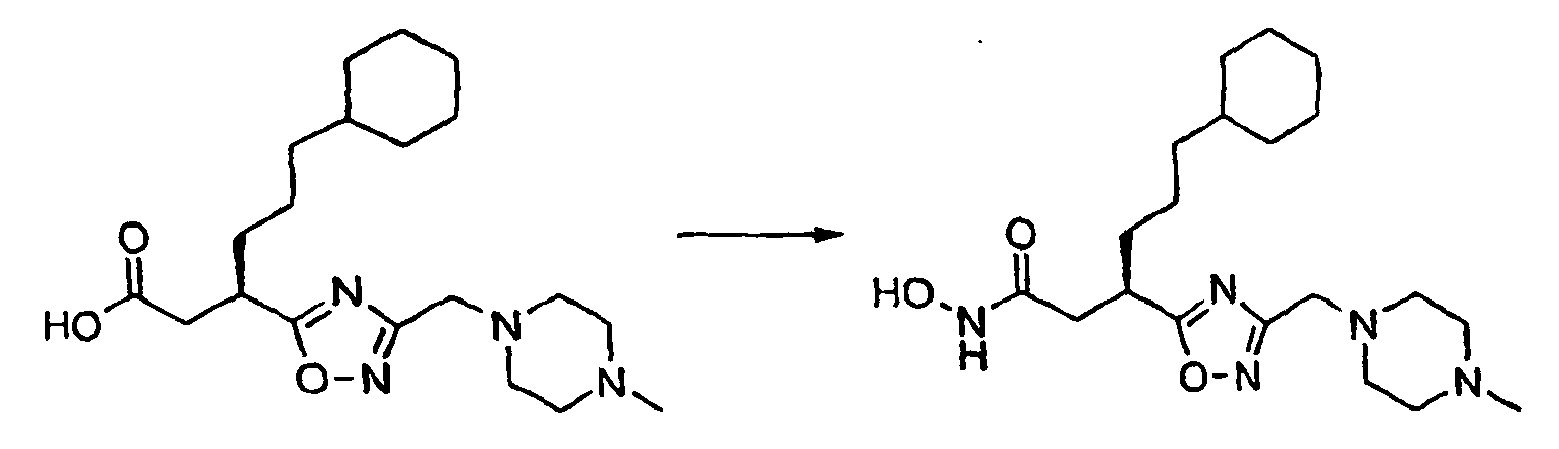
- Method as for example 7 using (3R)-6-cyclohexyl-3-{3-[(4-methyl-1-piperazinyl)methyl]-1,2,4-oxadiazol-5-yl}hexanoic acid trifluoroacetate (Preparation 147) (343mg, 0.91mmol) as starting material.
Purification: The crude material was purified on a silica column eluting with a gradient system of DCM : MeOH : NH3 (95 : 5 : 0.5) gradually changing to (80 : 20 : 1) to afford the title compound as a white gum (140mg).
1Hnmr (CD3OD) : 0.87 (2H, m), 1.10-1.40 (8H, m), 1.60-1.80 (7H, m), 2.50-3.45 (13H, m), 3.52 (1H, m), 3.84 (2H, s)
MS : 394 (MH+) -

- Method as for example 7 using (3R)-6-cyclohexyl-3-[3-(1H-1,2,4-triazol-1-ylmethyl)-1,2,4-oxadiazol-5-yl]hexanoic acid (Preparation 150) (174mg, 0.50mmol) as starting material to afford the title compound as a white solid (68mg).
M.Pt. : 118-120°C
1Hnmr (d6DMSO) : 0.75 (2H, m), 1.0-1.20 (8H, m), 1.45-1.65 (7H, m), 2.35-2.55 (2H, m), 3.40 (1H, m), 5.61 (2H, s), 7.98 (1H, s), 8.63 (1H, s), 8.76 (1H, s), 10.45 (1H, s) -
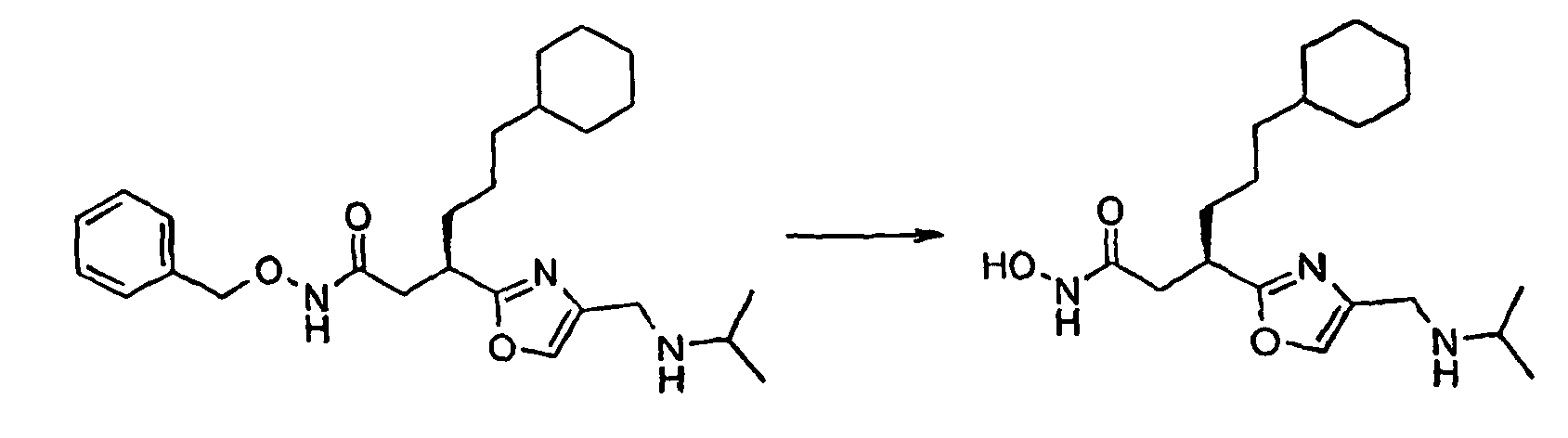
- A solution of (3R)-N-(benzyloxy)-6-cyclohexyl-3-{4-[(isopropylamino)methyl]-1,3-oxazol-2-yl}hexanamide (preparation 157) (85mg, 0.20mmol) in EtOH (5ml) was treated with HCO2NH4 (63mg, 1.00mmol) and Pd(OH)2 (20mg) and the reaction mixture heated at 43°C for 18 hours. 2 further portions of HCO2NH4 (30mg + 30mg) and Pd(OH)2 (10mg + 30mg) were added over a period of 4 hours. The catalyst was filtered off and washed with EtOH. The solvent was removed under reduced pressure. The crude material was purified on a silica column eluting with DCM : MeOH : NH3 (90 : 10 : 1) to afford the title compound.
1H nmr: (d6DMSO) 0.79 (2H, m), 0.96 (6H, d), 1.00-1.20 (8H, m), 1.50-1.65 (7H, m), 2.24 (1H, m), 2.40 (1H, m), 3.70 (1H, m), 3.20 (1H, obs), 3.52 (2H, s), 7.68 (1H, s).
MS : 352 (MH+)
Acc. Mass : Found 374.2415 (MNH4 +); Calculated C19H33N3O3 374.2420 (MNH4 +) -

- Method and purification as for example 67 using (3R)-N-(benzyloxy)-6-cyclohexyl-3-{4-[(cyclopentylamino)methyl]-1,3-oxazol-2-yl}hexanamide (preparation 158) (112mg, 023mmol) as starting material to afford the title compound as a white solid (30mg, 35%).
M.Pt. : 124-127°C
1H nmr : (d6DMSO) 0.80 (2H, m), 1.00-1.20 (8H, m+Et2O), 1.28 (2H, m), 1.42 (2H, m), 1.50-1.75 (11H, m), 2.25 (1H, m), 2.39 (1H, m), 2.99 (1H, m), 3.20 (1H, m), 3.49 (2H, s), 7.64 (1H, s).
MS : 378 (MH+)
CHN : Found: C66.40%; H9.48%; N11.08%; C21H35N3O3. 0.1 H2O requires C66.49; H9.35%; N11.08% -

- Method as for example 67 using (3R)-N-(benzyloxy)-6-cyclohexyl-3-[4-(4-morpholinylmethyl)-1,3-oxazol-2-yl]hexanamide (preparation 159) (130mg, 0.28mmol) as starting material. Purification: The crude material was purified on a silica column eluting with a solvent gradient of DCM : MeOH : NH3 (98 : 2 : 0.2) gradually changing to (90 : 10 : 1) to afford the title compound as a white solid (32mg, 30%).
M.Pt. : 117-119°C
1H nmr : (d6DMSO) 0.79 (2H, m), 1.00-1.20 (8H, m), 1.50-1.65 (7H, m), 2.25 (1H, m), 2.26 (1H, m), 2.38 (4H, t), 2.41 (1H, m), 3.20 (1H, m), 3.53 (4H, t), 3.90 (2H, d), 7.77 (1H, s), 8.58 (1H, brs), 10.28 (1H, brs).
MS : 402 (MNa+)
CHN : Found: C63.09%; H8.80%; N11.01%; C20H33N3O4 requires C63.30; H8.76%; N11.07% -

- Method as for example 67 using (3R)-N-(benzyloxy)-6-cyclohexyl-3-{5-methyl-4-[(tetrahydro-2H-pyran-4-ylamino)methyl]-1,3-oxazol-2-yl}hexanamide (preparation 161) (200mg, 0.40mmol) as starting material.
Purification: The crude material was purified on a silica column eluting with DCM : MeOH : NH3 (95 : 5 : 0.5) to afford the title compound as a white solid (28mg, 17%).
M.Pt. : 108-110°C
1H nmr : (d6DMSO) 0.79 (2H, m), 1.05-1.30 (10H, m), 1.50-1.65 (7H, m), 1.70 (2H, brd), 2.20 (3H, s), 2.37 (1H, m), 2.50 (2H, obs), 3.15 (1H, obs), 3.21 (2H, t), 3.46 (2H, s), 3.79 (2H, m), 8.58 (1H, brs), 10.27 (1H, brs).
MS : 408 (MH+)
CHN : Found: C64.37%; H9.25%; N10.27%; C22H37N3O4. 0.1 H2O requires C64.55; H9.16%; N10.26% -
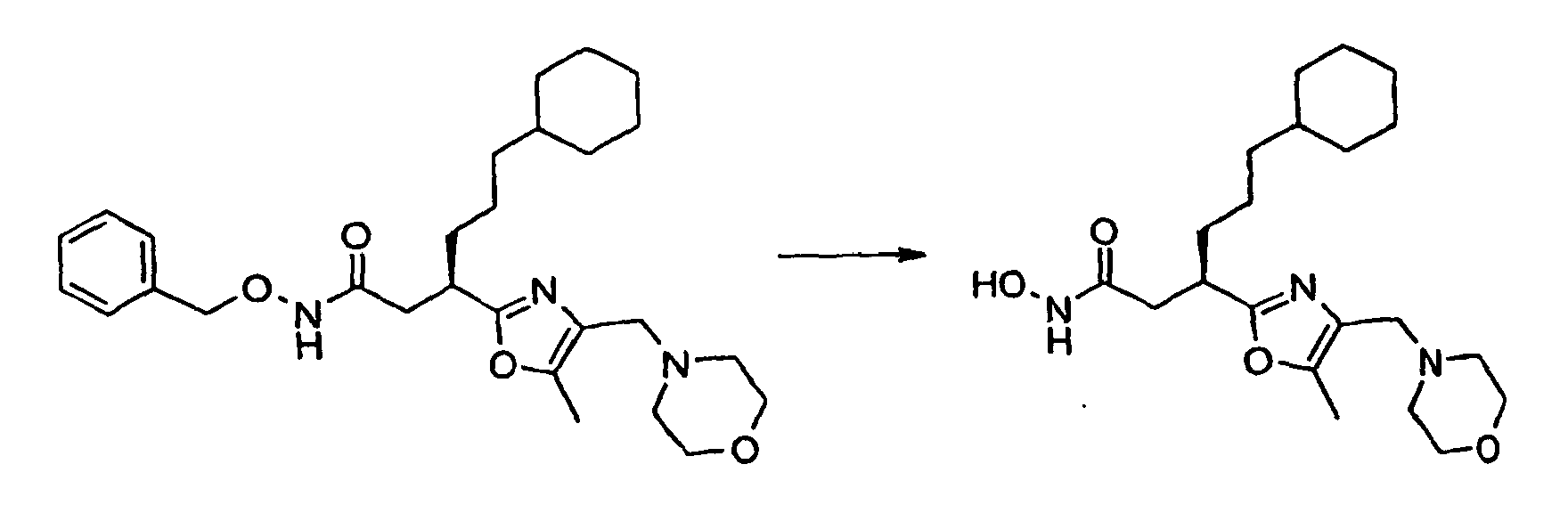
- Method as for example 67 using (3R)-N-(benzyloxy)-6-cyclohexyl-3-[5-methyl-4-(4-morpholinylmethyl)-1,3-oxazol-2-yl]hexanamide (preparation 162) (154mg, 0.32mmol) as starting material.
Purification: 3 silica columns were required to purify the crude material. First column eluting with a solvent gradient of DCM : MeOH : NH3 (100 : 0 : 0) gradually changing to (95 : 5 : 0.5). The second column eluting with toluene : EtOAc (9 : 1) and the final column eluting with DCM : MeOH : NH3 (95 : 5 : 0.5) to afford the title compound as a white foam (50mg, 40%).
1H nmr: (d6DMSO) 0.79 (2H, m), 1.00-1.20 (8H, m), 1.50-1.65 (7H, m), 2.21 (3H, s), 2.35 (5H, m), 2.50 (1H, obs), 3.14 (1H, obs)3.22 (2H, s), 3.51 (4H, m), 8.58 (1H, brs), 10.28 (1H, brs).
MS : 394 (MH+)
CHN : Found: C63.15%; H9.20%; N10.57%; C21H35N3O4. 0.2 H2O requires C63.51; H8.98%; N10.58% -

- N-methyl morpholine (1.12Kg, 11.1mol) was added dropwise over 30 min to a stirred suspension of aminoacetonitrile.hydrochloride (500g, 5.4mol) in dichloromethane (2.6litres), between 25 and 28°C. The mixture was stirred at ambient temperature for 30 min. Methanesulfonyl chloride (619g, 5.4mol) was added dropwise over 60 min, maintaining the temperature between 15 and 22°C. The mixture was stirred at ambient temperature for 45 min and then cooled to 12°C. The mixture was filtered and the filtrate concentrated in vacuo to a brown suspension. Acetone (2 litres) was added and the mixture was cooled to 10°C and then filtered. Silica (1Kg) was added to the filtrate, which was then filtered through a plug of silica (1Kg). The residue was washed with acetone (2x2.5litres) and the combined filtrate was concentrated in vacuo to afford the title compound as a brown oil (725g, quantitative).
-

- METHOD A. A solution of 50% aqueous hydroxylamine (367g, 5.4mol) was added over 60 min to a solution of N-(cyanomethyl)methanesulfonamide (725g, 5.4mol) in EtOH (3.6litres), between 25 and 35°C. The mixture was stirred at ambient temperature for 60 min and then cooled to 5°C. The mixture was filtered and the residue washed with EtOH (3x250ml) and then dried by suction overnight to afford the title compound as white crystals (781g, 87%).
- Method B. A solution of N-(cyanomethyl)methanesulfonamide (WO 92102521) (10.85g, 81.0mmol) in EtOH (370ml) was treated with hydroxylamine.HCl (5.63g, 81.0mmol) followed by a solution of aqueous NaOH (3.24g, 81.0mmol in125ml) and stirred at room temperature, under a nitrogen atmosphere for 20 hours. The solvent was removed under reduced pressure. The solid was dissolved in hot EtOH and the solid NaCl was filtered off. A solid began to crystallise out after 1 hour. The solid was filtered off and washed with Et2O to afford the title compound as white crystals (9.77g, 72%).
1H nmr : (d6DMSO) 2.87 (3H, s), 3.49 (2H, s), 5.22 (2H, brs), 7.09 (1H, brs), 9.00 (1H, s)
MS : 190 (MNa+)
CHN : Found: C21.46%; H5.41%; N24.58%; C3H9N3O3S. 0.1 H2O requires C21.32%; H5.49%; N24.87% -

- Method A. Sodium (2R)-2-(2-tert-butoxy-2-oxoethyl)-5-cyclohexylpentanoate (Preparation 167) (18.68g, 58.4mmol) was partitioned between 10% citric acid solution (190ml) and EtOAc (190ml). The organic layer was washed with brine, dried over anhydrous MgSO4, filtered and the solvent removed under reduced pressure to afford the free acid as a colourless oil. A solution of the free acid in DCM (185ml) was treated CDI (9.46g, 58.4mmol) and the reaction mixture was stirred at room temperature for 1.5 hours. (12)-N'-hydroxy-2-[(methylsulfonyl)amino]ethanimidamide (preparation 1) (9.75g, 58.4mmol) was added portionwise but required the addition of DMF (50ml) to dissolve the solid. The reaction mixture was stirred at room temperature for 18 hours. The solvents were removed under reduced pressure. The residue was dissolved on EtOAc (500ml) and washed with water (2x500ml) and brine, dried over anhydrous MgSO4, filtered and the solvent removed under reduced pressure to afford the title compound as a white solid (26.3g, ~100%).
- METHOD B. Sodium (2R)-2-(2-tert-butoxy-2-oxoethyl)-5-cyclohexylpentanoate (Preparation 167) (50.0g, 0.16mol) was partitioned between 10% citric acid solution (500ml) and dichloromethane (500ml). The organic layer was separated, washed with demineralised water (500ml), and then dried by azeotropic distillation at constant volume of dichloromethane. The mixture was allowed to cool to ambient temperature and then CDI (25.3g, 0.16mol) was added portionwise over 2 min, under nitrogen. The mixture was stirred at ambient temperature for 30 min and then (1Z)-N'-hydroxy-2-[(methylsulfonyl)amino]ethanimidamide (preparation 1) (26.1g, 0.16mol) was added in one portion. The mixture was stirred at ambient temperature for 18 hours and then filtered. The filtrate was washed with water (2x500ml), 10% aqueous citric acid solution (500ml) and water (500ml) and then concentrated in vacuo to afford the title compound as a white solid (58.3g, 83%).
1H nmr : (d6DMSO) 0.81 (2H, m), 1.00-1.30 (9H, m), 1.37 (9H, s), 1.40-1.65 (6H, m), 2.39 (1H, dd), 2.55 (1H, dd), 2.79 (1H, m), 2.94 (3H, s), 3.62 (2H, s), 6.19 (2H, brs), 7.30 (1H, brs)
MS : 470 (MNa+) -

- METHOD A. tert-butyl (5Z,9R)-5-amino-9-(3-cyclohexylpropyl)-8-oxo-7-oxa-2-thia-3,6-diazaundec-5-en-11-oate 2,2-dioxide (preparation 2) (26.0g, 58.2mmol) was heated at 130°C in xylene (500ml) under a nitrogen atmosphere for 20 hours. The crude reaction mixture was purified on a silica column diluted at first by pentane and eluting the column with a solvent gradient of DCM : MeOH (100 : 0) gradually changing to (90 : 10). Mixed fractions were combined and the solvent removed under reduced pressure to give a brown residue. This was triturated with pentane and the solid filtered off to afford the title compound as a white solid (9.43g, 38%).
- METHOD B. A stirred suspension of tert-butyl (5Z,9R)-5-amino-9-(3-cyclohexylpropyl)-8-oxo-7-oxa-2-thia-3,6-diazaundec-5-en-11-oate 2,2-dioxide (preparation 2) (50.0g, 0.11mol) and basic aluminium oxide (150g) in toluene was heated to reflux for 5 hours, under nitrogen. Basic aluminium oxide (50g) was added and the mixture was held at reflux for a further 1 hour. The mixture was allowed to cool to ambient temperature and then filtered. The residue was washed with toluene (100ml) and the combined filtrate was concentrated in vacuo to afford the title compound as a white solid (24.0g, 50%).
1H nmr : (CD3OD) 0.83 (2H, m), 1.10-1.30 (9H, m), 1.38 (9H, s), 1.60-1.75 (7H, m), 2.67 (1 H, dd), 2.79 (1H, dd), 2.98 (3H, s), 3.42 (1H, m), 4.39 (2H, s)
MS: 452 (MNa+) -

- A solution of tert-butyl (3R)-3-[3-(aminomethyl)-1,2,4-oxadiazol-5-yl]-6-cyclohexylhexanoate (preparation 18) (1.0g, 2.85mmol) in pyridine (10ml) at 0°C was treated with methanesulphonylchloride (221 µl, 2.85mmol) and stirred under a nitrogen atmosphere for 5 hours. The solvent was removed under reduced pressure. The residue was dissolved in ethyl acetate and washed with 1M HCl followed by brine. The organic extract was dried over anhydrous MgSO4, filtered and the solvent removed under reduced pressure. The residue was purified on a silica column eluting with a gradient solvent system EtOAc : pentane (0 : 100) gradually changing to (35: 55) to afford the title compound as a pale yellow oil (1.22g, 98%).
1H nmr : (CDCl3) 0.84 (2H, m), 1.10-1.35 (8H, m), 1.40 (9H, s), 1.60-1.80 (7H, m). 2.62 (1H, dd), 2.79 (1H, dd), 2.99 (3H, s), 3.42 (1H, m), 4.45 (2H, d), 4.82 (1H, s).
MS : 452 (MNa+) -

- METHOD A. A solution of tert-butyl (3R)-6-cyclohexyl-3-(3-{[(methylsulfonyl)amino]methyl}-1,2,4-oxadiazol-5-yl)hexanoate (preparation 3) (9.36g, 21.8mmol) in toluene (100ml) was treated with TFA (50ml) and stirred under a nitrogen atmosphere, at room temperature for 20 hours. The solvent was removed under reduced pressure and azeotroped with EtOAc. The residue was dissolved in EtOAc (250ml) and washed with H2O followed by brine. The organic layer was dried over anhydrous MgSO4, filtered and the solvent was removed under reduced pressure. The solid was triturated with Et2O, filtered off and dried under reduced pressure to afford the title compound as an off-white solid (7.06g, 87%).
- METHOD B. Trifluoroacetic acid (48ml) was added in one portion to a stirred solution of tert-butyl (3R)-6-cyclohexyl-3-(3-{[(methylsulfonyl)amino]methyl}-1,2,4-oxadiazol-5-yl)hexanoate (preparation 3) (24.0g, 56mmol) in toluene (120ml), under nitrogen. The mixture was stirred at ambient temperature for 20 hours and then concentrated in vacuo to a yellow oil. Toluene (100ml) was added and the mixture was filtered. The residue was washed with toluene (2x20ml) and then dried in vacuo at 45°C to afford the title compound as an off-white solid (16.4g, 78%).
1H nmr : (CD3OD) 0.83 (2H, m), 1.10-1.35 (8H, m), 1.60-1.80 (7H, m), 2.75 (1H, dd), 2.85 (1H, dd), 2.97 (3H, s), 3.48 (1H, m), 4.39 (2H, s)
MS : 396 (MNa+)
CHN : Found: C51.45%; H7.29%; N11.20%; C16H27N3O5S requires C51.46%; H7.29%; N11.25% -

- A solution of tert-butyl (3R)-6-cyclohexyl-3-[3-({[(4-methylphenyl)suffonyl]oxy}methyl)-1,2,4-oxadiazol-5-yl]hexanoate (preparation 177) (492mg, 0.97mmol) in THF (1ml) was treated with a solution of 2M methylamine in THF (7ml, 14.4mmol) and stirred at 40°C in a sealed vessel for 75 minutes. The reaction mixture was allowed to cool to room temprature and dissolved in EtOAc (100ml) which was washed with sat. NaHCO3 (100ml) solution followed by brine. The organic extract was dried over MgSO4, filtered and the solvent was removed under reduced pressure to afford the title compound as a colourless oil (337mg, 95%).
1H nmr : (CDCl3) 0.82 (2H, m), 1.10-1.35 (8H, m), 1.39 (9H, s), 1.55-1.80 (7H, m), 2.43 (3H, s), 2.60 (1H, dd), 2.79 (1H, dd), 3.43 (1H, m), 3.83 (2H, s).
MS : 366 (MH+)
CHN : Found: C65.32%; H9.67%; N11.22%: C20H35N3O3 requires C65.72%; H9.65%; N11.50% -

- A solution of tert-butyl (3R)-6-cyclchexyl-3-{3-[(methylemino)methyl]-1,2,4-oxediazol-5-yl}hexanoate (preparation 5) (300mg, 0.82mmol) in pyridine (2ml) in a water bath was treated with methanesulphonylchloride (64µl, 0.82mmol) and stirred under a nitrogen atmosphere for 20 minutes. The solvent was removed under reduced pressure. The residue was dissolved in EtOAc and washed with 2M HCl followed by brine. The organic extract was dried over MgSO4, filtered and the solvent removed under reduced pressure. The residue was purified on a silica column eluting with a solvent gradient of EtOAc : pentane (5 : 95) gradually changing to (30 : 70) to afford the title compound as a colourless oil (273mg, 75%).
1H nmr : (CDCl3) 0.84 (2H, m), 1.10-1.35 (8H, m), 1.39 (9H, s), 1.60-1.80 (7H, m), 2.61 (1H, dd), 2.79 (1H, dd), 2.93 (3H, s), 2.97 (3H, s), 3.43 (1H, m), 3.59 (2H, s).
MS : 466 (MNa+)
CHN : Found: C57.03%; H8.43%; N9.39%; C21H37N3O5S requires C56.86%; H8.41%; N9.47% -

- A solution of tert-butyl (3R)-6-cyclohexyl-3-(3-{[methyl(methylsulfonyl)amino]methyl}-1,2,4-oxadiazol-5-yl)hexanoate (preparation 6) (264mg, 0.60mmol) in 4M HCl in dioxan (2ml) was stirred at room temperature for 20 hours. Further 4M HCl in dioxan (2ml) was added and stirred for a further 3 hours. A few drops of concentrated HCl was added and the reaction mixture was stirred at room temperature for 18 hours. The solvent was removed under reduced pressure to afford the title compound (245mg - contained some dioxan as impurity).
1H nmr : (CDCl3) 0.84 (2H, m), 1.10-1.35 (8H, m), 1.60-1.85 (7H, m), 2.61 (1H, dd), 2.79 (1H, dd), 2.88-2.99 (7H, m), 3.47 (1H, m), 4.58 (2H, s).
MS : 386 (M-H)
CHN : Found: C50.82%; H7.45%; N9.93%; C17H25N3O5S. 0.75 H2O. 0.15 dioxan requires C51.03%; H7.71%; N10.14% -

- Method the same as for Preparation 6 using tert-butyl (3R)-3-[3-(aminomethyl)-1,2,4-oxadiazol-5-yl]-6-cyclohexylhexanoate (preparation 18) (200mg, 0.57mmol) and ethanesulphonylchloride (54µl, 0.57mmol) as starting materials. The reaction was carried out at 0°C.
Purification: Crude material was purified on a silica column eluting with a solvent gradient of DCM : MeOH (100 : 0) gradually changing to (90 :10) to yield the title compound as a colourless oil (190mg, 90%).
1H nmr : (CDCl3) 0.84 (2H, m), 1.05-1.35 (11H, m), 1.40 (9H, s), 1.60-1.80 (7H, m), 2.61 (1H, dd), 2.79 (1H, dd), 3.09 (2H, q), 3.42 (1H, m), 4.43 (2H, d), 4.73 (1H, brs).
MS : 466 (MNa+)
CHN : Found: C57.14%; H8.48%; N9.47%; C21H37N3O5S requires C56.86%; H8.41%; N9.47% -

- Method same as for preparation 7 using tert-butyl (3R)-6-cyclohexyl-3-(3-{[(ethylsulfonyl)amino]methyl}-1,2,4-oxadiazol-5-yl)hexanoate (preparation 8) (174mg, 0.40mmol) as starting material. After 24 hours the reaction had not gone to completion. The solvent was removed under reduced pressure. DCM (4ml) and TFA (2ml) were added and the reaction mixture was stirred at room temperature for 2 hours. The solvent was removed under reduced pressure and azeotroped with DCM (x3) and Et2O. The residue was dissolved in EtOAc and washed with H2O and brine. The organic extracts were dried over MgSO4, filtered and the solvent removed under reduced pressure to afford the title compound as a colourless oil (148mg, 96%).
1H nmr : (CDCl3) 0.81 (2H, m), 1.05-1.35 (11H, m), 1.60-1.80 (7H, m), 2.78 (1H, dd), 2.97 (1H, dd), 3.09 (2H, q), 3.48 (1H, m), 4.43 (2H, d), 5.14 (1H, brs).
MS : 386 (M-H)
CHN : Found: C52.07%; H7.38%; N10.30%; C17H29N3O5S. 0.1TFA requires C51.79%; H7.35%; N10.53% -

- A solution of tert-butyl (3R)-3-[3-(aminomethyl)-1,2,4-oxadiazol-5-yl]-6-cyclohexylhexanoate (preparation 18) (216mg, 0.61mmol) and 2,6-lutidine (180µl, 1.50mmol) in DCM (3ml) was treated with isopropanesulphonylchloride (100µl, 0.90mmol) and stirred at room temperature for 18 hours. Reaction was complete but it was left for 12 days before purification commenced. The reaction mixture was diluted with DCM and washed with 1M HCl (2x20ml), sat. NaHCO3 solution and brine. The organic extract was dried over anhydrous MgSO4, filtered and the solvent removed under reduced pressure. The residue was purified on a silica column eluting with a solvent gradient of pentane : EtOAc (90 : 10) gradually changing to (50 : 50) to afford the title compound as a colourless oil (157mg, 56%).
1H nmr : (CDCl3) 0.80-0.90 (2H, m), 1.00-1.30 (8H, m), 1.30-1.40 (15H, d+s),1.60-1.80 (7H, m), 2.60 (1H, dd), 2.80 (1H, dd), 3.20 (1H, m), 3.45 (1H, m), 4.45 (2H, d), 4.60 (1H, m).
MS : 458 (MH+) -

- A solution of tert-butyl (3R)-3-[3-(aminomethyl)-1,2,4-oxadiazol-5-yl]-6-cyclohexylhexanoate (preparation 10) (145mg, 0.32mmol) in DCM (4ml) was treated with TFA (2ml) and stirred at room temperature for 6 hours. The solvent was removed under reduced pressure and azeotroped with toluene (x3) and DCM (x3) to afford the title compound as a yellow oil (117mg, 92%).
1H nmr : (CDCl3) 0.80-0.90 (2H, m), 1.10-1.30 (8H, m), 1.35 (6H, d), 1.60-1.80 (7H, m), 2.75 (1H, dd), 2.90 (1H, dd), 3.20 (1H, m), 3.50 (1H, m), 4.40 (2H, d), 4.90 (1H, m).
MS : 400 (M-H) -

- Method as for preparation 6 using tert-butyl (3R)-3-[3-(aminomethyl)-1,2,4-oxadiazol-5-yl]-6-cyclohexylhexanoate (preparation 18) (205mg, 0.58mmol) and benzenesulphonylchloride (75µl, 0.58mmol) as starting materials.
Purification: The crude materal was purified on a silica column eluting with a solvent gradient of pentane : EtOAc (100 : 0) gradually changing to (65 : 35) to afford the title compound as a colourless oil (241mg, 85%).
1H nmr : (CDCl3) 0.83 (2H, m), 1.10-1.30 (8H, m), 1.39 (9H, s), 1.60-1.75 (7H, m), 2.55 (1H, dd), 2.68 (1H, dd), 3.37 (1H, m), 4.31 (2H, d), 5.00 (1H, brs), 7.47 (2H, t), 7.56 (1H, d), 7.86 (2H, d)
MS : 514 (MNa+)
CHN : Found: C60.34%; H7.60%; N8.29%; C25H37N3O5S. 0.25 H2O requires C60.52%; H7.62%; N8.47% -
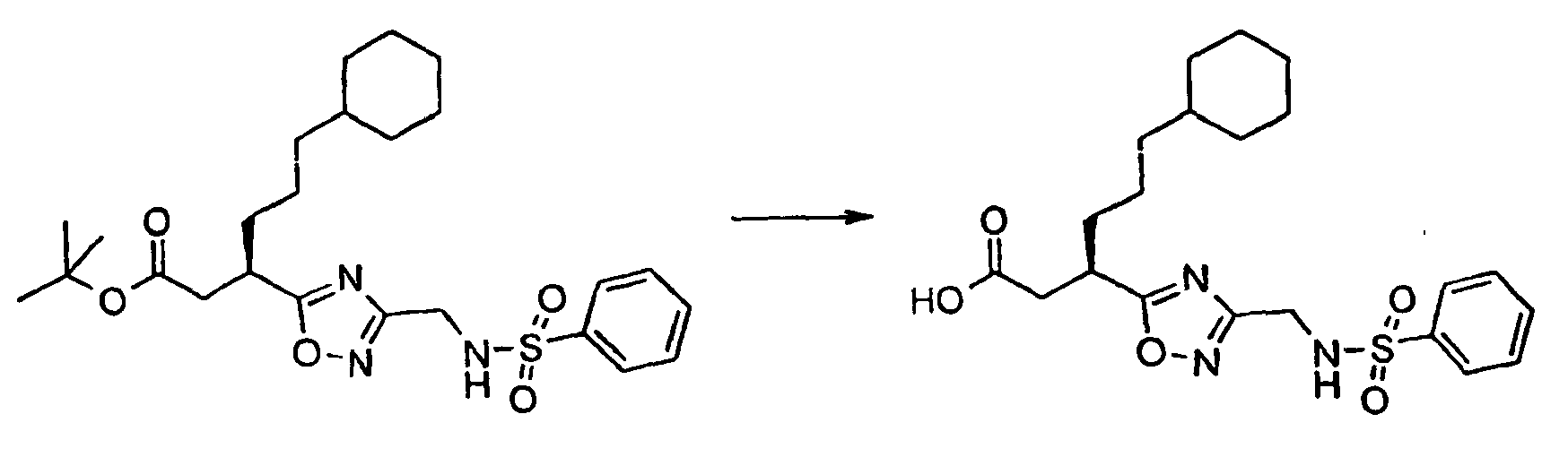
- Method same as preparation 11 using tert-butyl (3R)-6-cyclohexyl-3-(3-{[(phenylsulfonyl)amino]methyl}-1,2,4-oxadiazol-5-yl)hexanoate (preparation 12) (231mg, 0.47mmol) as starting material.
Purification: The crude product was dissolved in EtOAc and washed with H2O and brine. The organic extract was dried over anhydrous MgSO4, filtered and the solvent removed under reduced pressure to afford the title compound as a white solid (168mg, 82%).
1H nmr : (CD3OD) 0.85 (2H, m), 1.10-1.30 (8H, m), 1.60-1.75 (7H, m), 2.62 (1H, dd), 2.76 (1H, dd), 3.38 (1H, m), 4.21 (2H, d), 7.50 (2H, m), 7.58 (1H, m), 7.81 (2H, d)
MS : 458 (MNa+)
CHN : Found: C57.73%; H6.68%; N9.51%; C21H29N3O5S requires C57.91%; H6.71%; N9.65% -

- Method same as for preparation 10 using tert-butyl (3R)-3-[3-(aminomethyl)-1,2,4-oxadiazol-5-yl]-6-cyclohexylhexanoate (preparation 18) (210mg, 057mmol) and 2-pyridinesulphonylchloride (J. Med. Chem; 1997, 40, 1149) (170mg, 0.96mmol) as starting materials.
Purification: Attempted purification on a silica column eluting with DCM failed as the title compound could only be isolated with 0.5eq 2,6-lutidine as an impurity. -
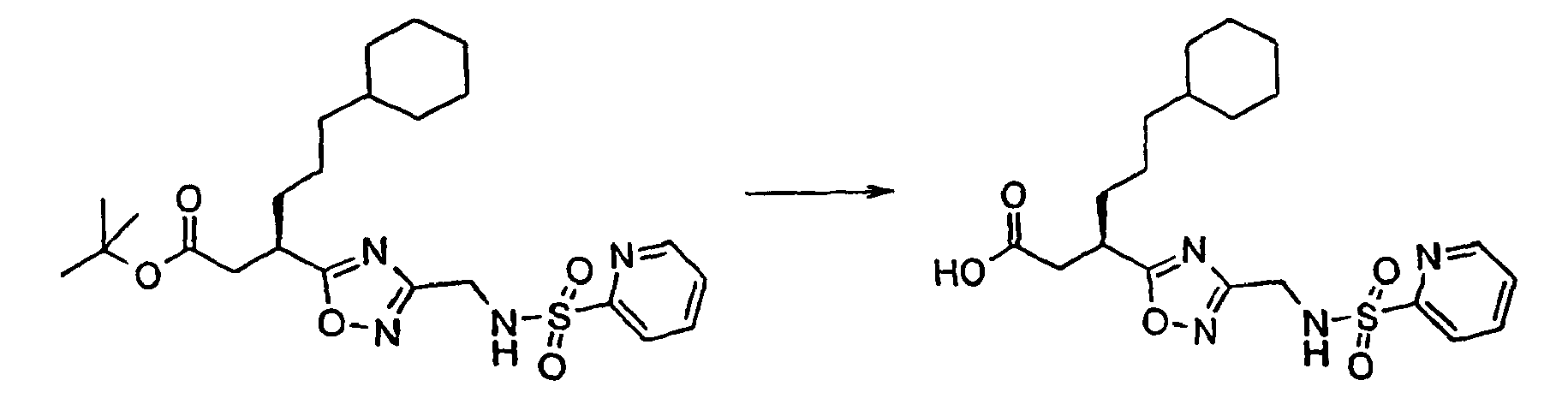
- Method same as for preparation 7 using tert-butyl (3R)-6-cyclohexyl-3-(3-{[(2-pyridinylsulfonyl)amino]methyl}-1,2,4-oxadiazol-5-yl)hexanoate (preparation 14) (300mg, 0.61mmol) as starting material to afford the title compound as a pale yellow oil (250mg).
1H nmr : (d6DMSO) 0.81 (2H, m), 1.05-1.25 (8H. m), 1.50-1.70 (7H, m), 2.68 (2H, d), 3.31 (1H, m), 4.32 (2H, d), 7.60 (1H, m), 7.88 (1H, d), 8.03 (1H, t), 8.48 (1H, brs), 8.66 (1H, d).
MS : 459 (MNa+)
CHN : Found: C54.80%; H6.79%; N11.21%; C20H26N4O5S. 0.2 H2O. 0.5 dioxan requires C54.57%; H6.74%; N11.57% -
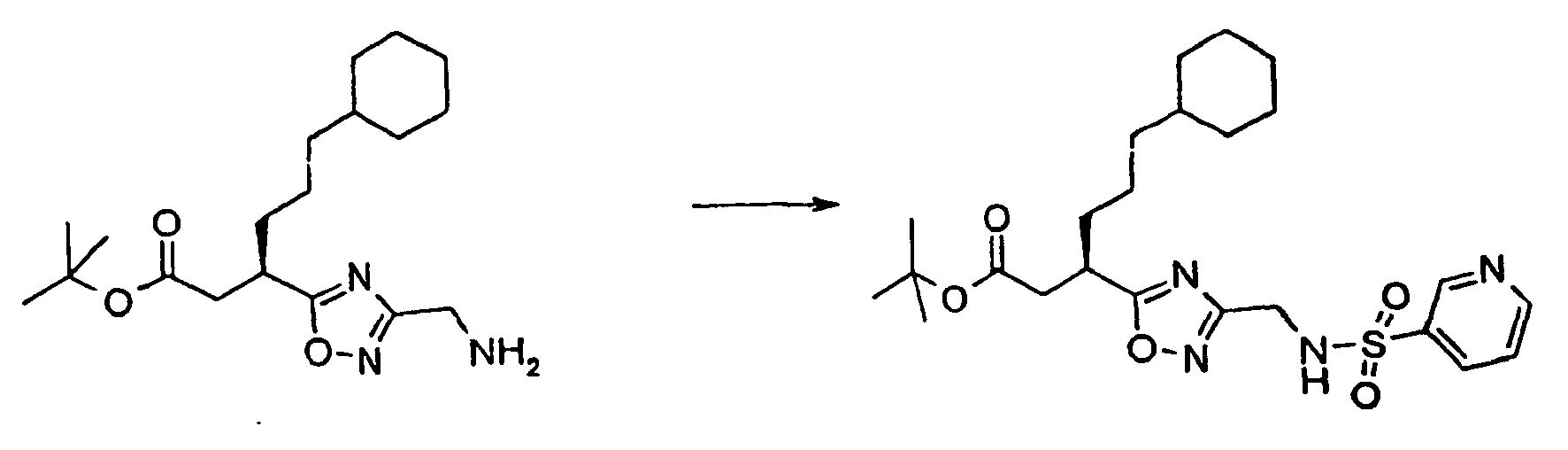
- Method same as Preparation 14 using tert-butyl (3R)-3-[3-(aminomethyl)-1,2,4-oxadiazol-5-yl]-6-cyclohexylhexanoate (preparation 18) (200mg, 057mmol) and 3-pyridinesulphonylchloride (EP911333) (134mg, 0.63mmol) as starting materials.
Purification: The crude material was purified on a silica column eluting with a solvent gradient of pentane : EtOAc (100 : 0) gradually changing to (50 : 50) to afford the title compound as a colourless oil (192mg, 68%).
1H nmr : (CDCl3) 0.84 (2H, m), 1.10-1.30 (8H, m), 1.40 (9H, s), 1.60-1.75 (7H, m), 2.58 (1H, dd), 2.67 (1H, dd), 3.38 (1H, m), 4.40 (2H, d), 5.19 (1H, brs), 7.40 (1H, m), 8.14 (1H, d), 8.78 (1H, d), 9.08 (1H, s).
MS : 515 (MNa+)
CHN : Found: C57.96%; H7.48%; N10.99%; C24H36N4O5S. 0.1 H2O requires C58.30%; H7.38%; N11.33% -

- Method same as for preparation 11 using tert-butyl (3R)-6-cyclohexyl-3-(3-{[(3-pyridinylsulfonyl)amino]methyl}-1,2,4-oxadiazol-5-yl)hexanoate (preparation 16) (181mg, 0.37mmol) as starting material to afford the title compound as a white foam (177mg, 94%)
1H nmr: (CDCl3) 0.82 (2H, m), 1.05-1.30 (8H, m + EtOAc), 1.55-1.75 (7H, m), 2.63-2.84 (2H, m), 3.37 (1H, m), 4.43 (2H, d), 7.58 (1H, m), 8.28 (1H, d), 8.78 (1H, brs), 9.00 (1H, brs).
MS : 435 (M-H)
CHN : Found: C50.67%; H5.92%; N10.76%; C20H28N4O5S. 0.1 H2O. 0.5 TFA. 0.15 EtOAc requires C51.01%; H5.93%; N11.02% -
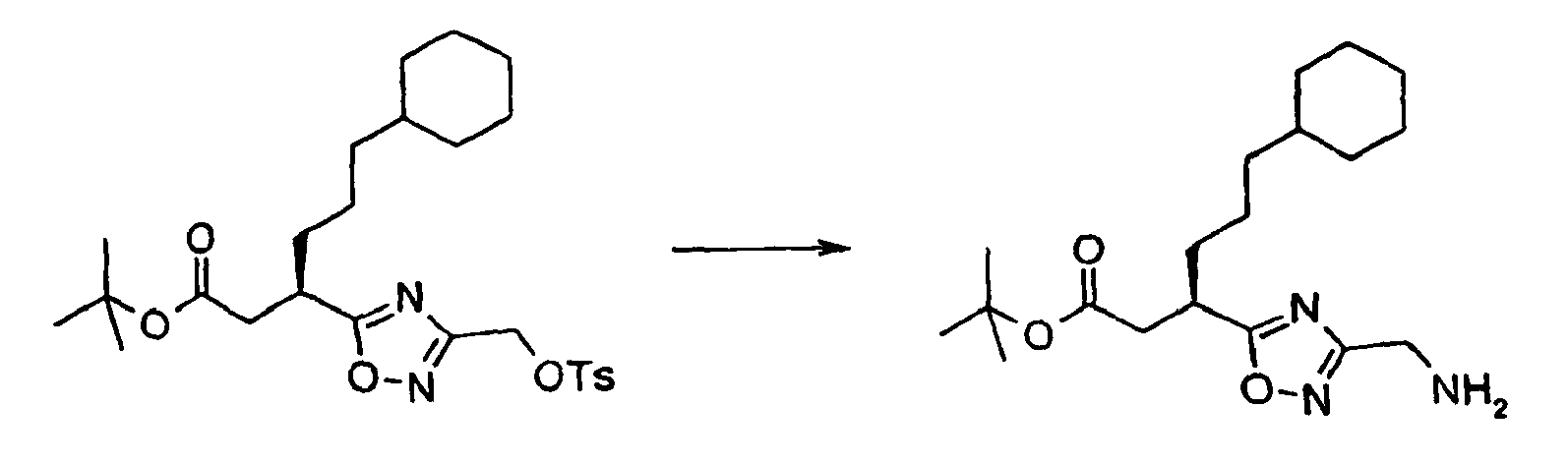
- A soluton of tert-butyl (3R)-6-cyclohexyl-3-[3-({[(4-methylphenyl)sulfonyl]oxy}methyl)-1,2,4-oxadiazol-5-yl]hexanoate (preparation 177) (1.2g, 2.37mmol) in THF (40ml) was treated with concentrated ammonia solution and heated in a bomb at 40°C for 18 hours. The reaction mixture was diluted with EtOAc and washed with sat. NaHCO3 solution followed by brine. The organic extract was dried over anhydrous MgSO4, filtered and the solvent removed under reduced pressure. The colourless oil was purified on a silica column eluting with a solvent gradient of pentane : EtOAc (4 : 1) gradually changing to (1 : 1) and then changing to DCM : MeOH : NH3 (95 : 5 : 0.5) to afford the title compound as a colourless oil (782mg, 94%).
1H nmr : (CDCl3) 0.84 (2H, m), 1.10-1.35 (8H, m), 1.40 (9H, s), 1.60-1.80 (7H, m), 2.61 (1H, dd), 2.79 (1H, dd), 3.42 (1H, m), 3.95 (2H, s).
MS : 374 (MNa+) -

- Method same as for preparation 10 using tert-butyl (3R)-3-[3-(aminomethyl)-1,2,4-oxadiazol-5-yl]-6-cyclohexylhexanoate (preparation 18) (145mg, 0.41mmol) and 1-methyl-1H-imidazole-4-sulphonyl chloride (75mg, 0.41mmol) as starting materials.
Purification: The crude matrial was purified on a silica column eluting with a solvent gradient of DCM : MeOH (100 : 0) gradually changing to (90 : 10) to afford the title compound as a colourless oil.
1H nmr: (CDCl3) 0.83 (2H, m), 1.10-1.30 (8H, m), 1.40 (9H, s), 1.60-1.75 (7H, m), 2.59 (1H, dd), 2.75 (1H, dd), 3.40 (1H, m), 3.73 (3H, s), 4.36 (2H, d), 5.38 (1H, brs), 41 (1H, s), 7.46 (1H, s).
MS : 435 (MNa+)
CHN : Found: C52.40%; H7.07%; N13.12%; C23H37N5O5S. 0.5 DCM requires C52.45%; H7.12%; N13.01% -
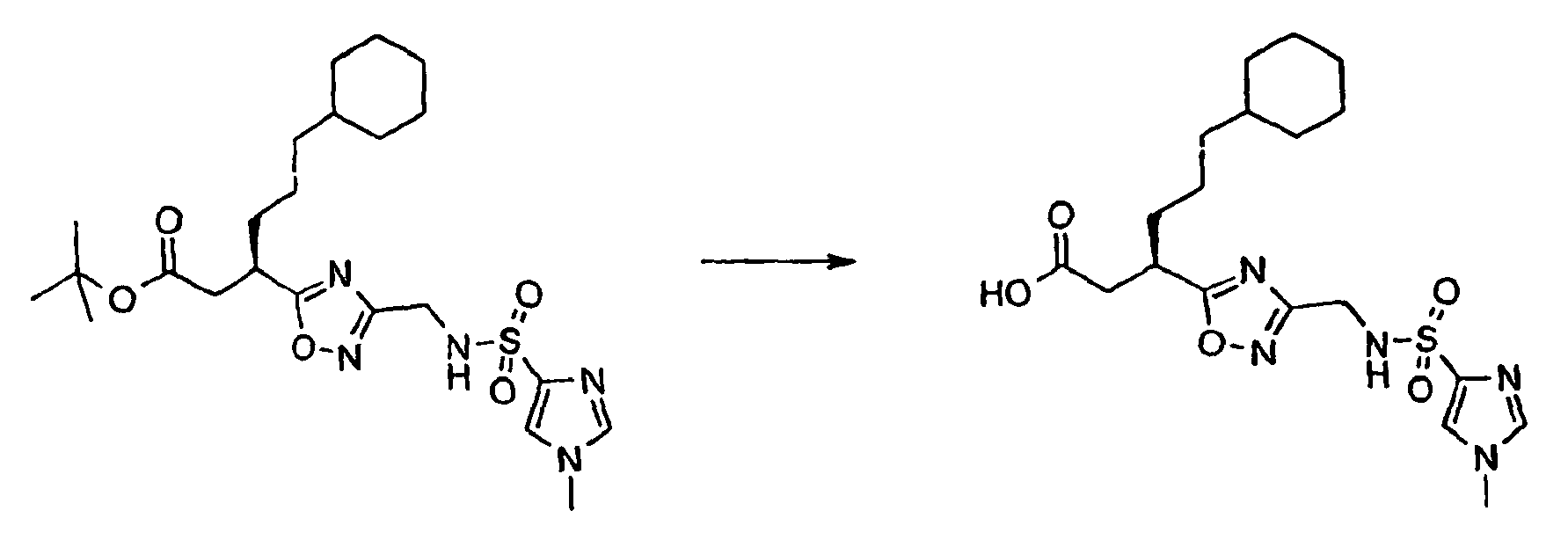
- Method as for preparation 7 using tert-butyl (3R)-6-cyclohexyl-3-[3-({[(1-methyl-1H-imidazol-4-yl)sulfonyl]amino}methyl)-1,2,4-oxadiazol-5-yl]hexanoate (preparation 19) (490mg, 1.00mmol) as starting material.
Purification: Triturated with Et2O to afford the title compound as a white solid 320mg (320mg, 74%)
1H nmr : (CD3OD) 0.83 (2H, m), 1.10-1.30 (8H, m), 1.60-1.75 (7H, m), 2.78 (2H, m), 3.40 (1H, m), 3.91 (3H, s), 4.40 (2H, d), 7.98 (1H, s), 8.78 (1H, s).
MS : 438 (M-H)
CHN : Found: C47.18%; H6.25%; N14.33%; C19H29N5O5S. 1 HCl. 0.1 DCM requires C47.35%; H6.28%; N14.46% -
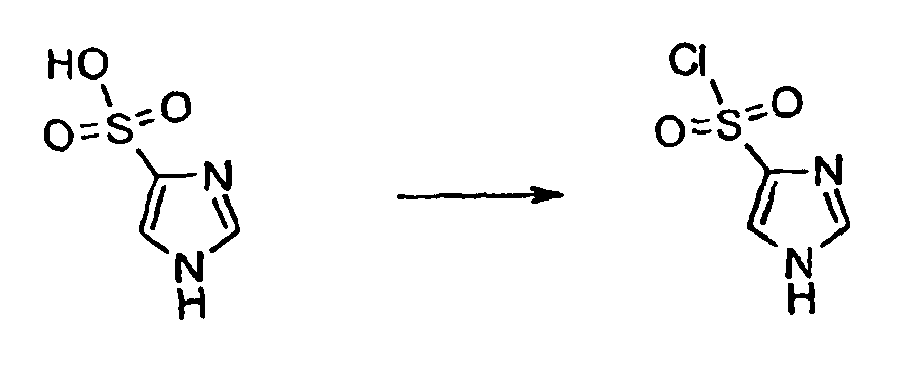
- A mixture of 1H-pyrazole-4-sulfonic acid (J. Am. Chem. Soc.; 1955, 77, 6532) (1.0g, 4.0mmol) and phosphorous pentachloride (1.6g, 7.7mmol) were heated up to 180°C over the period of an hour. The mixture began to reflux but not fully molten. The reaction mixture was cooled to 130°C and toluene (5ml) was added and allowed to cool to room temperature with stirring. The white solid was filtered off. The filtrate solvent was removed under reduced pressure and azeotroped with toluene and DCM to afford the title compound as a colourless oil and impure.
-

- Method as for Preparation 10 using tert-butyl (3R)-3-[3-(aminomethyl)-1,2,4-oxadiazol-5-yl]-6-cyclohexylhexanoate (preparation 18) (310mg, 0.88mmol) and 1H-pyrazole-4-sulfonyl chloride (preparation 21) (220mg, 1.32mmol) as starting materials.
Purification: The crude material was purified on a silica column eluting with a solvent gradient of DCM : MeOH (98 : 2) gradually changing to (90 : 10) to afford the title compound.
1H nmr : (CDCl3) does not integrate for the pyrrole protons
MS : 503 (MNa+) -

- Method as for preparation 7 using tert-butyl (3R)-6-cyclohexyl-3-(3-{[(1H-pyrazol-4-ylsulfonyl)amino]methyl}-1,2,4-oxadiazol-5-yl)hexanoate (preparation 22) (420mg, 0.87mmol) as starting material.
Purification: Crude material taken up in Et2O and DIPE and left in the fridge for 2 days. Solid was filtered off and dried under reduced pressure to afford the title compound as a white solid (140mg, 38%).
1H nmr : (CD3OD) 0.83 (2H, m), 1.05-1.30 (8H, m), 1.55-1.75 (7H, m), 2.69 (1H, dd), 2.81 (1H, dd), 3.41 (1H, m), 4.22 (2H, s), 7.91 (2H, brs).
MS : 424 (M-H)
CHN : Found: C50.23%; H6.33%; N16.46%; C18H27N5O5S. 0.2 H2O requires C50.38%; H6.44%; N16.32% -

- Chlorine gas was bubbled through a suspension of 4H-1,2,4-triazole-3-thiol (2.7g, 26.7mmol) in 2M HCl (5ml) for 1 hour, at 0°C. The reaction mixture became homogenous. Aqueous Na2S2O5 was added to the reaction mixture and nitrogen gas was bubbled through for 10 minutes. The white solid was filtered and washed with cold H2O to afford the title compound (460mg, 10%).
1H nmr : (CD3OD) 8.69 (1H, s).
MS : 166 (M-H) -

- Method as for preparation 10 using tert-butyl (3R)-3-[3-(aminomethyl)-1,2,4-oxadiazol-5-yl]-6-cyclohexylhexanoate (preparation 18) (292mg, 0.83mmol) and 4H-1,2,4-triazole-3-sulfonyl chloride (preparation 24) (208mg, 1.24mmol) as starting materials.
Purification: The crude material was purified on a silica column eluting with a solvent gradient of DCM : MeOH (98 : 2) gradually changing to (90 : 10) to afford the title compound as a colourless oil (412mg, 102%, contains DCM).
1H nmr : (CD3OD) 0.83 (2H, m), 1.05-1.30 (8H, m), 1.38 (9H, s), 1.55-1.75 (7H, m), 2.60-2.80 (2H, m), 3.40 (1H, m), 4.41 (2H, s), 8.50 (1H, s).
MS : 505 (MNa+) -
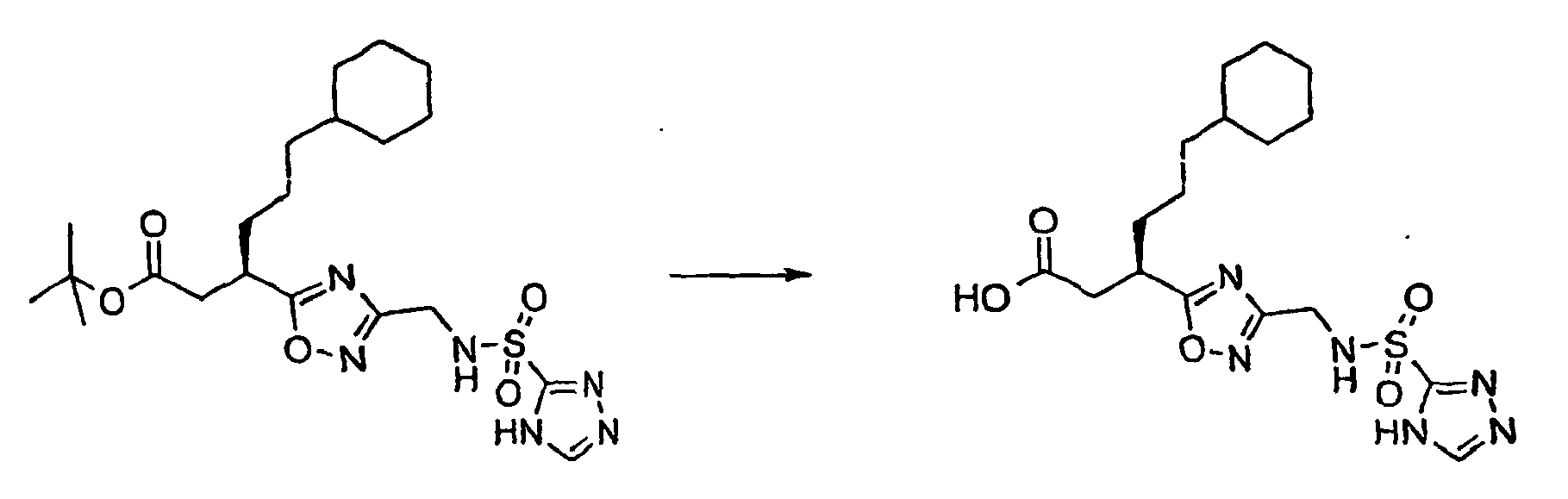
- Method as for preparation 7 using tert-butyl (3R)-6-cyclohexyl-3-(3-{[(4H-1,2,4-triazol-3-ylsulfonyl)amino]methyl}-1,2,4-oxadiazol-5-yl)hexanoate (preparation 25) (410mg, 0.85mmol) as starting material.
Purification: Material was azeotroped with toluene followed by DCM to afford the title compound as a white solid (320mg, 88%).
M.pt. 151-153°C
1H nmr : (CD3OD) 0.83 (2H, m), 1.10-1.30 (8H, m), 1.55-1.75 (7H, m), 2.69 (1H, dd), 2.81 (1H, dd), 3.42 (1H, m), 4.40 (2H, s), 8.48 (1H, s).
MS : 425 (M-H) -
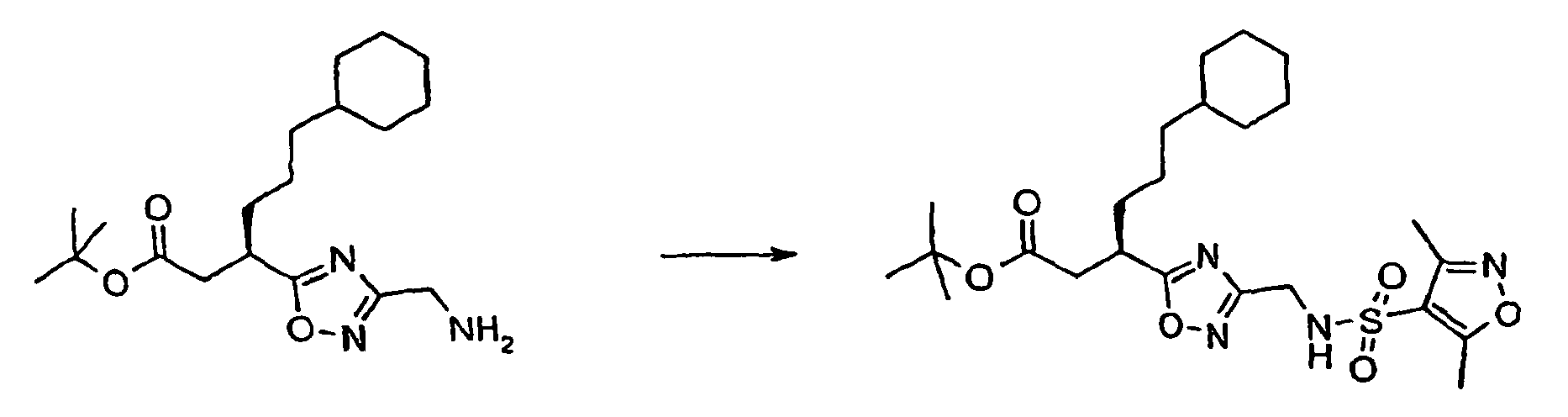
- Method as for preparation 6 using tert-butyl (3R)-3-[3-(aminomethyl)-1,2,4-oxadiazol-5-yl]-6-cyclohexylhexanoate (preparation 18) (200mg, 0.57mmol) and 3,5-dimethylisoxazolesulphonyl chloride (112mg, 0.57mmol) as starting materials.
Purification: The crude material was purified on a silica column eluting with a solvent gradient of pentane : EtOAc (100 : 0) gradually changing to (70 : 30) to afford the title compound as a colourless oil (252mg, 87%).
1H nmr : (CDCl3) 0.82 (2H, m), 1.10-1.30 (8H, m), 1.39 (9H, s), 1.60-1.75 (7H, m), 2.39 (3H, s), 2.58 (2H, dd), 2.61 (3H, s), 2.71 (1H, dd), 3.38 (1H, m), 4.37 (2H, d), 5.26 (1H, brs).
MS : 533 (MNa+)
CHN : Found: C56.17%; H7.48%; N10.65%; C24H38N4O6S requires C56.45%; H7.50%; N10.97% -

- Method same as for Preparation 11 using tert-butyl (3R)-6-cyclohexyl-3-[3-({[(3,5-dimethyl-4-isoxazolyl)sulfonyl]amino}methyl)-1,2,4-oxadiazol-5-yl]hexanoate (preparation 27) (246mg, 0.48mmol) as starting material to afford the title compound as a yellow gum (238mg, 109%, contains EtOAc).
1H nmr : (CDCl3) 0.82 (2H, m), 1.10-1.25 (8H, m), 1.55-1.75 (7H, m), 2.35 (3H, s), 2.59 (3H, s), 2.74 (1H, dd), 2.83 (1H, dd), 3.41 (1H, m), 4.38 (2H, d), 5.69 (1H, brs).
MS : 453 (M-H) -

- A solution of aminopropionitrile fumarate salt (6.0g, 47mmol) in 2M NaOH solution (40ml) was stirred at room temperaute for 15 minutes. The reaction mixture extracted with DCM (50ml). The organic extract was dried over anhydrous Na2SO4 and filtered. The filtrate was treated pyridine (11ml, 136mmol) and methanesulphonyl chloride (3.9ml, 50mmol) and stirred under at nitrogen atmosphere for 18 hours. The solvent was removed under reduced pressure. The oil was dissolved in DCM and washed with 2M HCl (2x100ml) and saturated NaHCO3 solution. All the product had been extracted into the aqueous washings. NaHCO3 solution was acidified with conc. HCl and combined with the other acidic washes. The aqueous washes were reduced to ~50ml in volume and extracted with EtOAc. The organic extract was evaporated under reduced pressure to afford the title compound as a pink oil (2.1g, 30%).
1H nmr : (CDCl3) 2.64 (2H, t), 3.00 (3H, s), 3.42 (2H, m), 4.83 (1H, brs).
MS : 171 (MNa+) -
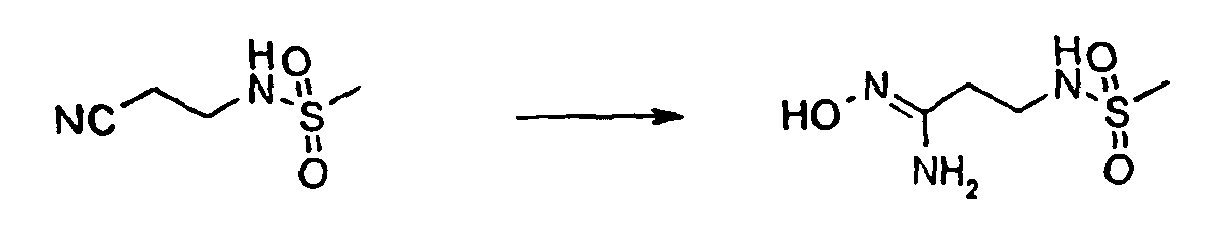
- Method as for preparation 1 using N-(2-cyanoethyl)methanesulfonamide (preparation 29) (1.0g, 6.75mmol) as starting material.
Purification: Crude material was dissolved in hot EtOH and filtered. The solvent in the filtrate was removed under reduced pressure to afford the title compound as a colourless oil (1.13g).
1H nmr : (CD3OD) contains starting material in ratio product : SM (3 : 2)
MS : 204 (MNa+) -
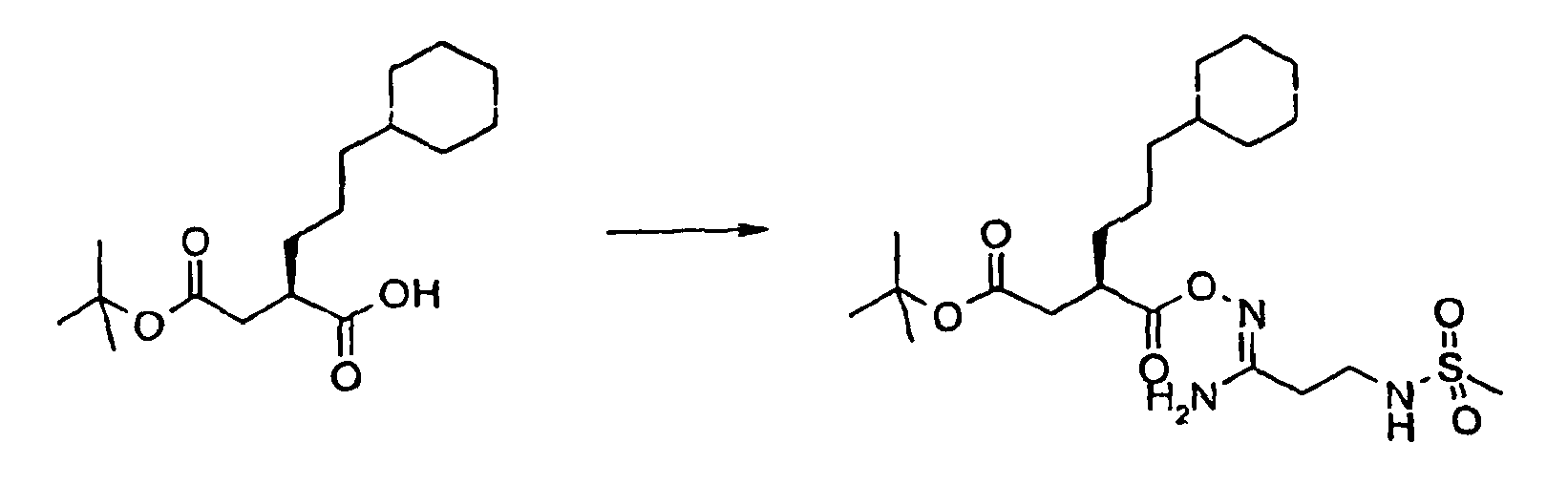
- Method as for preparation 2 using (2R)-2-(2-tert-butoxy-2-oxoethyl)-5-cyclohexylpentanoic acid (preparation 168) (670mg, 2.25mmol) and (1Z)-N'-hydroxy-3-[(methylsulfonyl)amino]propanimidamide (preparation 30) (700mg, 2.50mmol) as starting materials to afford the title compound as a yellow oil.
- Compound only 90% pure.
-
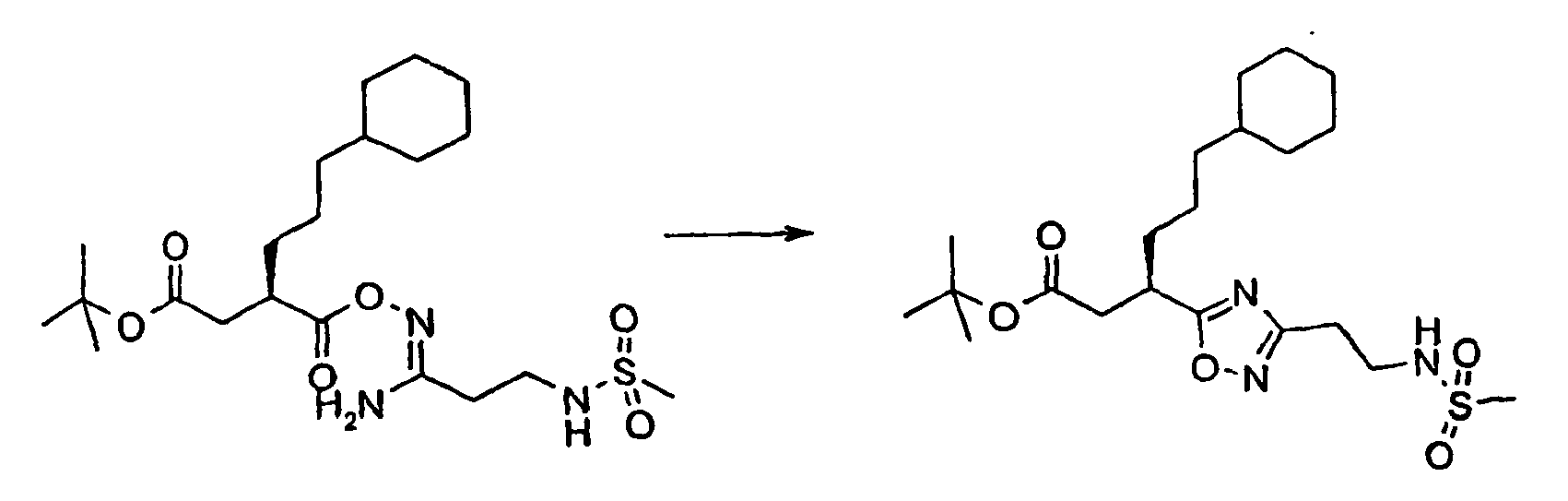
- Method as for preparation 3 using tert-butyl (6Z,10R)-6-amino-10-(3-cyclohexylpropyl)-9-oxo-8-oxa-2-thia-3,7-diazadodec-6-en-12-oate 2,2-dioxide (preparation 31) (1.14g, 2.48mmol) as starting material.
Purification: The crude material was purified on a silica column eluting with a solvent gradient of pentane : EtOAc (90 : 10) gradually changing to (50 : 50) to afford the title compound as a colourless oil (910mg, 83%).
1H nmr : (CD3OD) 0.85 (2H, m), 1.10-1.35 (8H, m), 1.39 (9H, s), 1.60-1.75 (7H, m), 2.66 (1H, dd), 2.77 (1H, dd), 2.91 (3H, s), 2.98 (2H, t), 3.42 (3H, m).
MS : 466 (MNa+)
CHN : Found: C56.77%; H8.39%; N9.36%; C21H37N3O5S requires C56.86%; H8.41%; N9.47% -

- Method as for preparation 11 using tert-butyl (3R)-6-cyclohexyl-3-(3-{2-[(methylsulfonyl)amino]ethyl}-1,2,4-oxadiazol-5-yl)hexanoate (preparation 32) (400mg, 0.9mmol) as starting material.
Purification: Crude material was purified on a silica column eluting with a solvent gradient of DCM : MeOH : AcOH (100 : 0 : 0) gradually changing to (90 : 10: 1) to afford the title compound as a colourless oil (370mg)
1H nmr : (CD3OD) 0.85 (2H, m), 1.05-1.35 (8H, m), 1.55-1.75 (7H, m), 2.73 (1H, dd), 2.84 (1H, dd), 2.90 (3H, s), 2.95 (2H, t), 3.43 (3H, t).
MS : 386 (M-H)
CHN : Found: C52.54%; H7.62%; N10.58%; C17H29N3O5S requires C52.69%; H7.54%; N10.84% -
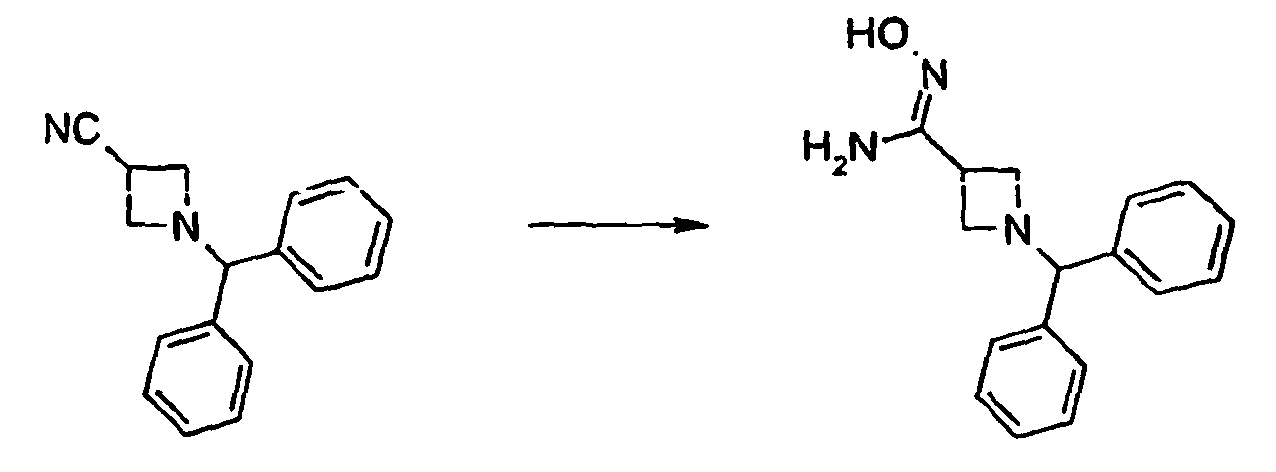
- Method as for preparation 1 using 1-benzhydryl-3-azetidinecarbonitrile (2.0g, 8.0mmol) was used as starting material.
- The title material isolated 90% pure and used as such in the following step.
-

- Method as for preparation 2 using (2R)-2-(2-tert-butoxy-2-oxoethyl)-5-cyclohexylpentanoic acid (1.65g, 5.51mmol) and 1-benzhydryl-N'-hydroxy-3-azetidinecarboximidamide (preparation 34) (1.74g, 6.17mmol) as starting materials.
Purification: The crude material was dissolved in EtOAc and washed with H2O (3x50ml) and brine. The organic extract was dried over Na2SO4, filterd and the solvent removed under reduced pressure to afford the title compound as a brown oil (3.25g).
1H nmr : (CDCl3) 0.83 (2H, m), 1.05-1.30 (8H, m), 1.41 (9H, s), 1.60-1.75 (7H, m), 2.41 (1H, brd), 2.65 (1H, m), 2.87 (1H, brs), 3.09 (1H, brs), 3.30 (4H, brs), 4.36 (1H, s), 5.87 (2H, brs), 7.15-7.40 (10H, m + CHCl3)
MS : 584 (MNa+) -
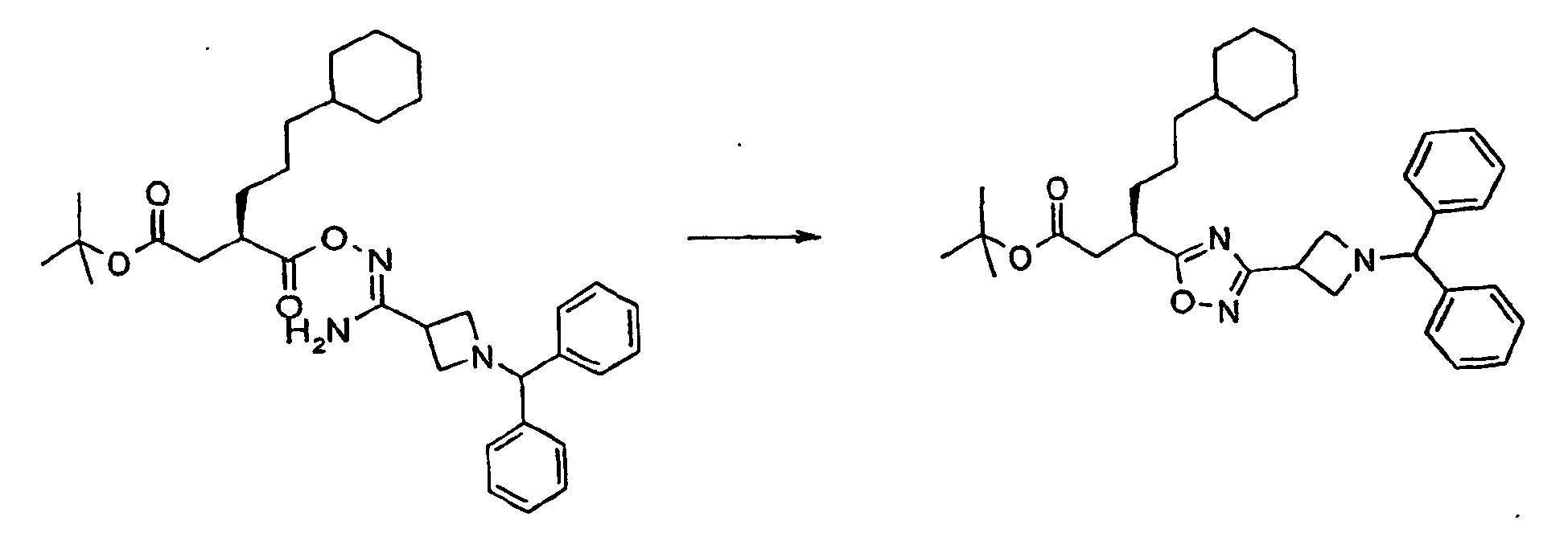
- A solution of tert-butyl (3R)-3-[({[(Z)-amino(1-benzhydryl-3-azetidinyl)methylidene]amino}oxy)carbonyl]-6-cyclohexylhexanoate (preparation 35) (2.85g, 5.07mmol) in toluene (90ml) was heated at 140°C under Dean and Stark conditions for 18 hours. The reaction mixture was allowed to cool to room temperature. The solvent was removed under reduced pressure. The residue was purified on a silica column eluting with a solvent gradient of cyclohexane : Et2O (90 : 10) gradually changing to (60 : 40) to afford the title compound as a colourless oil (2.0g, 73%).
1H nmr: (CDCl3) 0.83 (2H, m), 1.05-1.35 (8H, m), 1.39 (9H, s), 1.60-1.80 (7H, m), 2.60 (1H, dd), 2.79 (1H, dd), 3.34 (2H, t), 3.43 (1H, m), 3.60 (2H, t), 3.80 (1H, m), 4.43 (1H, s), 7.18 (2H, m), 7.26 (4H, t+CHCl3), 7.40 (4H, m).
MS : 544 (MH+)
CHN : Found: C73.58%; H8.15%; N7.66%; C34H45N3O3. 0.2 DCM requires C73.26%; H8.16%; N7.49% -

- A solution of tert-butyl (3R)-3-[3-(1-benzhydryl-3-azetidinyl)-1,2,4-oxadiazol-5-yl]-6-cyclohexylhexanoate (preparation 36) (1.99g, 3.66mmol) in DCM (15ml) was treated with ACE-Cl (530µl, 4.90mmol) and heated at reflux for 4 hours. The solvent was removed under reduced pressure. The residue was dissolved in MeOH (15ml) and heated at reflux for 1.5 hours. The solvent was removed under reduced pressure. The oil was dissolved in EtOAc (150ml) and washed with sat. NaHCO3 solution (50ml) and brine (40ml). The aqueous extracts were combined and extracted with EtOAc. All of the organic extracts were combined, dried over anhydrous Na2SO4 and filtered. The solvent was removed under reduced pressure to afford the title compound as a colourless oil (900mg).
1H nmr: (CD3OD) 0.85 (2H, m), 1.10-1.35 (8H, m), 1.60-1.80 (7H, m), 2.78 (1H, dd), 2.86 (1H, dd), 3.49 (1H, m), 3.61 (3H, s), 3.95 (4H, m), 4.06 (1H, m).
MS : 336 (MH+) -

- Method as for preparation 10 using methyl (3R)-3-[3-(3-azetidinyl)-1,2,4-oxadiazol-5-yl]-6-cyclohexylhexanoate (preparation 37) (880mg, 2.64mmol) and methanesulphonyl chloride (1.53ml, 19.77mmol) as starting materials.
Purification: After aqueous work-up MeOH was added to quench the excess methanesulphonyl chloride. The solvent was removed under reduced pressure. The crude material was purified on a silica column eluting with a solvent gradient of cyclohexane : EtOAc (90 : 10) gradually changing to (50 : 50) to afford the title compound as a yellow oil (900mg, contains 3 equivalents of MeSO3Me).
1H nmr: (CDCl3) 0.82 (2H, m), 1.10-1.35 (8H, m), 1.60-1.80 (7H, m), 2.72 (1H, dd), 2.82-2.94 (4H, dd+s), 3.50 (1H, m), 3.64 (3H, s), 3.96 (1H, m), 4.19 (2H, m), 4.28 (2H, m).
MS : 436 (MNa+) -
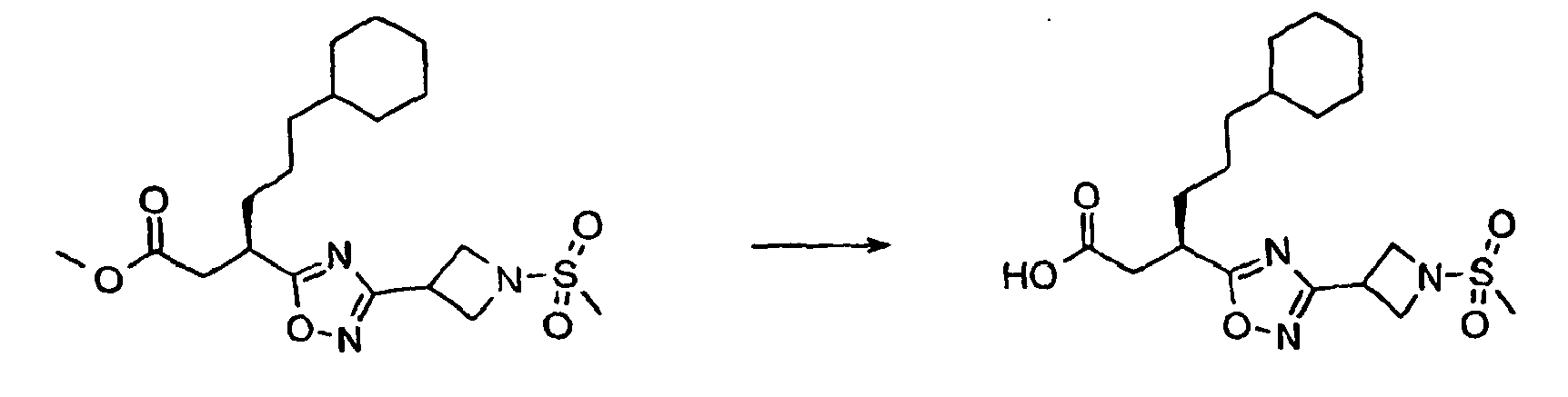
- A solution of methyl (3R)-6-cyclohexyl-3-{3-[1-(methylsulfonyl)-3-azetidinyl]-1,2,4-oxadiazol-5-yl}hexanoate (preparation 38) (780mg, 1.05mmol) in dioxan (20ml) and H2O (10ml) was treated with LiOH.H2O (218mg, 5.2mmol) and stirred at room temperature for 2.25 hours. The reaction mixture was acidified with 2M HCl (20ml) and extracted with EtOAc. The organic extract was washed with H2O and the solvent was removed under reduced pressure. The oil was purified on a silica column eluting with a solvent gradient of DCM : MeOH : AcOH (100 : 0 : 0) gradually changing to (90 : 10 : 1) to afford a colourless oil which solidified on standing. The solid was triturated with pentane, filtered off and dried under reduced pressure to afford the title compound as a white solid (372mg, 78%).
1H nmr : (CD3OD) 0.83 (2H, m), 1.05-1.35 (8H, m), 1.55-1.80 (7H, m), 2.75 (1H, dd), 2.84 (1H, dd), 2.98 (3H, s), 3.47 (1H, m), 4.01 (1H, m), 4.12 (2H, m), 4.26 (2H, m).
MS : 398 (M-H)
CHN : Found: C54.08%; H7.34%; N10.37%; C18H29N3O5S requires C54.12%; H7.32%; N10.52% -

- Method as for preparation 6 using 4-piperidinecarboxamide (4.0g, 31.2mmol) as starting material and DMF (2ml) was added.
- Purification: The crude material was triturated with Et2O, filtered off and dried under reduced pressure to afford the title compound as a white solid (2.48g, 42%).
1H nmr : (CD3OD) 1.85 (2H, m), 2.01 (2H, m), 2.81 (3H, s), 2.95 (1H, m), 3.18 (2H, m), 3.41 (2H, m).
MS : 211 (MNa+)
CHN : Found: C44.52%; H6.46%; N14.77%; C7H12N2O2S requires C44.66%; H6.43%; N14.88% -
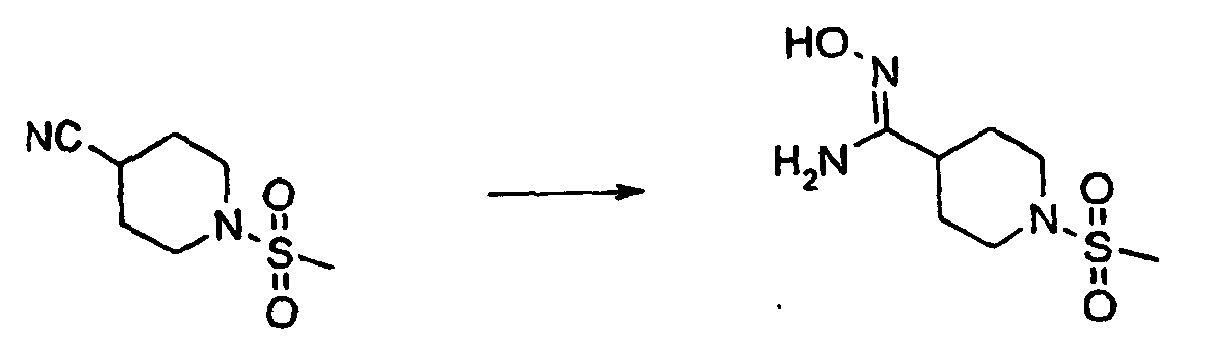
- Method as for preparation 1 using 1-(methylsulfonyl)-4-piperidinecarbonitrile (preparation 40) (1.47g, 7.81mmol) as starting material.
Purification: The crude material was dissolved in EtOH, filtered and the solvent removed under reduced pressure to afford the title compound as a white solid.
1H nmr : shows 2 : 1 mixture starting material : product. Taken on crude to next step. -
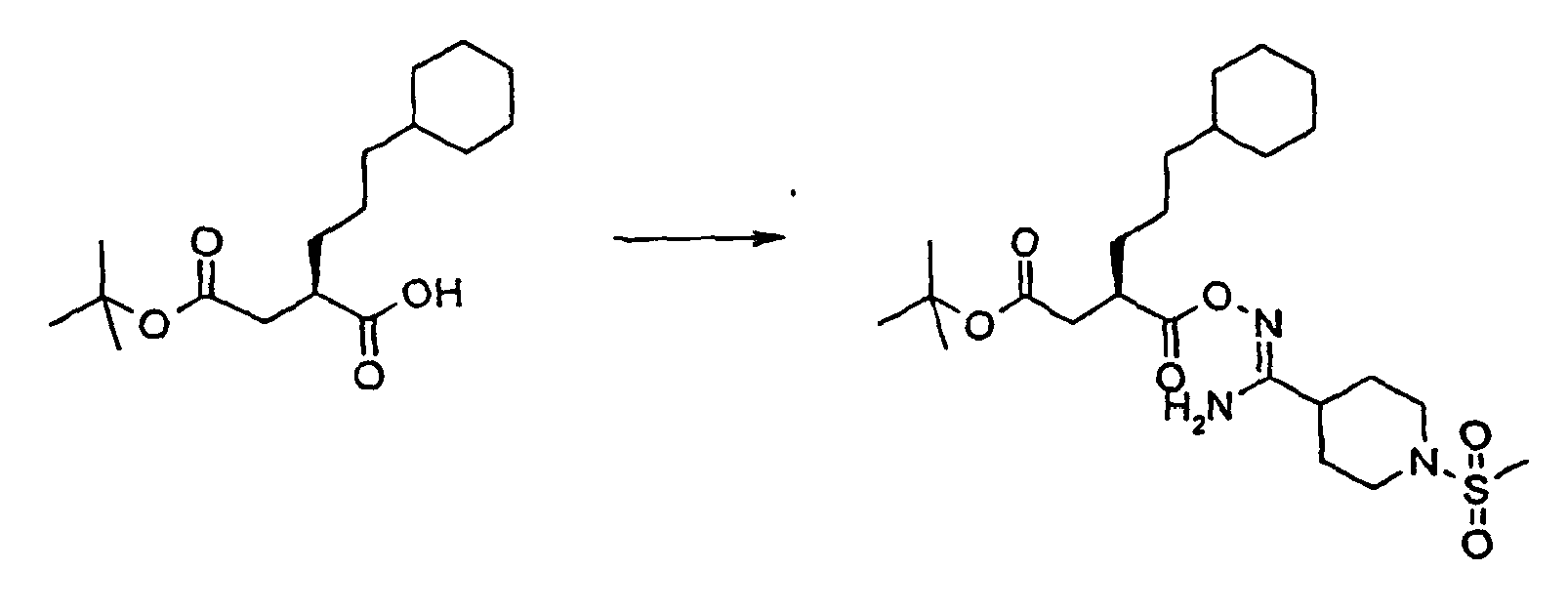
- Method as for preparation 2 using (2R)-2-(2-tert-butoxy-2-oxoethyl)-5-cyclohexylpentanoic acid (54mg, 1.83mmol) and N'-hydroxy-1-(methylsulfonyl)-4-piperidinecarboximidamide (preparation 41) (1.20g, 2.0mmol) as starting materials.
Title compound isolated with 1-(methylsulfonyl)-4-piperidinecarbonitrile (preparation 40) as a major impurity in the ratio product : nitrile 1 : 1.5. Taken on crude to following stage. -

- A solution of tert-butyl (3R)-3-{[({(Z)-amino[1-(methylsulfonyl)-4-piperidinyl]melhylidene}amino)oxy]carbonyl}-6-cyclohexylhexanoate (preparation 42) (1.50g, 1.83mmol) in toluene (100ml) was treated with pyridine (90µl, 1.83mmol) and anhydrous ZnCl2 (150mg, 1.83mmol) and heated at reflux for 20 hours. The reaction mixture was diluted with EtOAc and washed with H2O, brine and H2O, dried over anhydrous Na2SO4 and filtered. The solvent was removed under reduced pressure. The residue was purified on a silica column eluting with a solvent gradient of cyclohexane : EtOAc (90 : 10) gradually changing to (50 : 50). The oil was recrystallised from pentane to afford the title compound as a white solid (320mg, 36%).
1H nmr: (CDCl3) 0.83 (2H, m), 1.10-1.35 (8H, m), 1.40 (9H, s), 1.60-1.80 (7H, m), 1.99 (2H, m), 2.14 (2H, brd), 2.60 (1H, dd), 2.71-2.80 (4H, dd+s), 2.95 (3H, m), 3.41 (1H, m), 3.74 (2H, m).
MS : 506 (MNa+)
CHN : Found: C59.55%; H8.58%; N8.68%; C24H41N3O5S requires C59.60%; H8.54%; N8.69% -
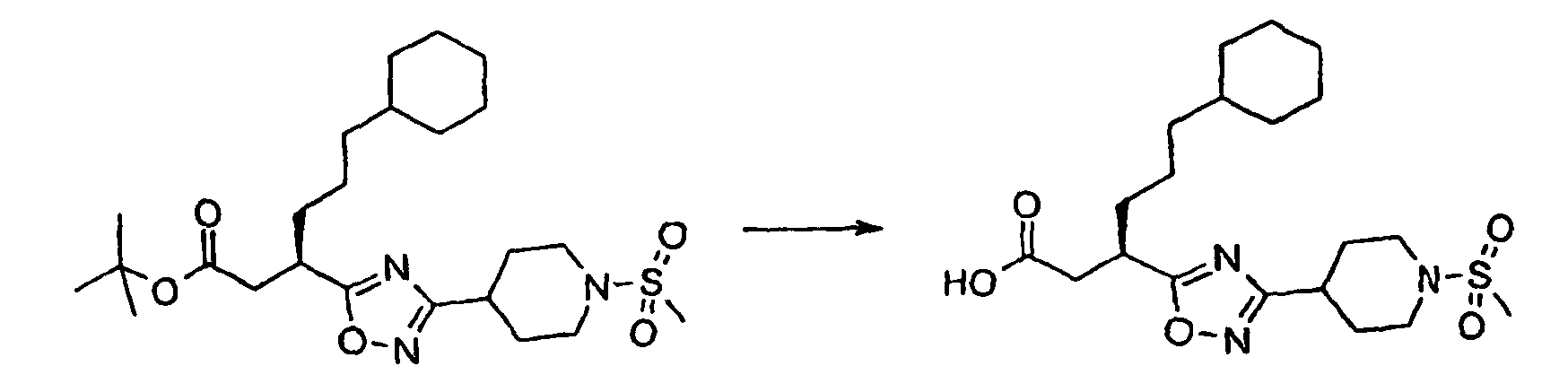
- Method as for preparation 11 using tert-butyl (3R)-6-cyclohexyl-3-{3-[1-(methylsulfonyl)-4-piperidinyl]-1,2,4-oxadiazol-5-yl}hexanoate (preparation 43) (310mg, 0.64mmol) as starting material.
Purification: The crude material was triturated with pentane and filtered off to afford the title compound as a white solid (245mg, 89%).
1H nmr : (CDCl3) 0.81 (2H, m), 1.05-1.35 (8H, m), 1.55-1.85 (7H, m), 1.97 (2H, m), 2.10 (2H, m), 2.70-2.80 (4H, dd+s), 2.93 (4H, m), 3.45 (1H, m), 3.72 (2H, m).
MS : 426 (M-H)
CHN : Found: C56.15%; H7.77%; N9.64%; C20H33N3O5S requires C56.18%; H7.78%; N9.83% -
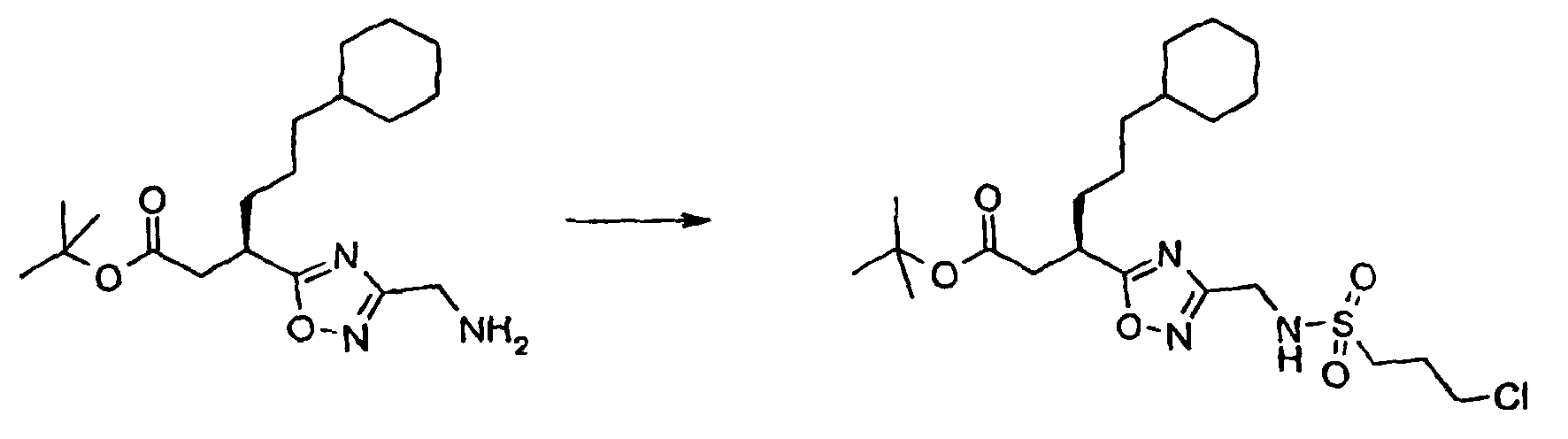
- Method as for preparation 10 using tert-butyl (3R)-3-[3-(aminomethyl)-1,2,4-oxadiazol-5-yl]-6-cyclohexylhexanoate (preparation 18) (200mg, 0.57mmol) and 3-chloropropanesulphonyl chloride (83µl, 0.68mmol) as starting materials and pyridine as the base.
Pruification: The crude material was purified on a silica column eluting with pentane : Et2O (1 : 1) to afford the title compound as a colourless oil (225mg, 93%).
1H nmr : (CDCl3) 0.83 (2H, m), 1.10-1.35 (8H, m), 1.40 (9H, s), 1.60-1.80 (7H, m), 2.28 (2H, m), 2.61 (1H, dd), 2.78 (1H, dd), 3.23 (2H, m), 3.42 (1H, m), 3.62 (2H, t), 4.45 (2H, d), 5.79 (1H, brs).
MS : 514 (MNa+)
CHN : Found: C53.01%; H7.70%; N8.17%; C22H36ClN3O5S, 0.2 H2O requires C53.31%; H7.81%; N8.48% -

- Sodium metal (114mg, 5.00mmol) was added in portions to MeOH (10ml) at 0°C and stirred until all of the sodium had dissloved (-10 minutes). A solution of tert-butyl (3R)-3-(3-{[(3-chloropropyl)sulfonyl]amino}-1,2,4-oxadiazol-5-yl)-6-cyclohexylhexanoate (preparation 45) (245mg, 0.50mmol) in MeOH (3ml) was added to the reaction mixture and was stirred under a nitrogen atmosphere for 3 days warming to room temperature over this time. The reaction was quenched with H2O and the solvent removed under reduced pressure. The residue was diluted with water and acidified with 2M HCl (pH-3) and extracted with Et2O followed by EtOAc. The organic extracts were combined, dried over anhydrous MgSO4 and filtered. The solvent was removed under reduced pressure to afford the title compound as a colouriess oil (203mg, 98%).
1H nmr : (d6-DMSO) 0.81 (2H, m), 1.00-1.25 (8H, m),1.50-1.70 (7H, m), 2.21 (2H, m), 2.74 (2H, t), 3.26 (2H, t), 3.40 (1H, m), 4.21 (2H, s).
MS : 422 (MNa+)
CHN : Found: C54.33%; H7.49%; N10.10%; C18H29N3O5S. 0.05 H2O requires C53.99%; H7.33%; N10.49% -

- Method as for preparation 10 using tert-butyl (3R)-3-[3-(aminomethyl)-1,2,4-oxadiazol-5-yl]-6-cyclohexylhexanoate (preparation 18) (200mg, 0.57mmol) and N-tert-butylsulfamoyl chloride (J. Org. Chem.; 1976, 41, 4028) (108mg, 0.63mmol) as starting materials and pyridine as base. Purification: The crude product was purified on a silica column eluting with a solvent gradient of DCM : MeOH (100 : 0) gradually changing to (93 : 7) to afford the title compound as a colourless oil (186mg, 67%).
1H nmr : (CDCl3) 0.83 (2H, m), 1.10-1.30 (8H, m), 1.38 (9H, s), 1.40 (9H, s), 1.60-1.80 (7H, m), 2.61 (1H, dd), 2.79 (1H, dd), 3.43 (1H, m), 4.22 (1H, brs), 4.38 (2H, d), 4.70 (1H, brs).
MS : 509 (MNa+)
CHN : Found: C56.20%; H8.67%; N11.32%; C23H42N4O5S. 0.15 H2O requires C56.45%; H8.71%; N11.45% -
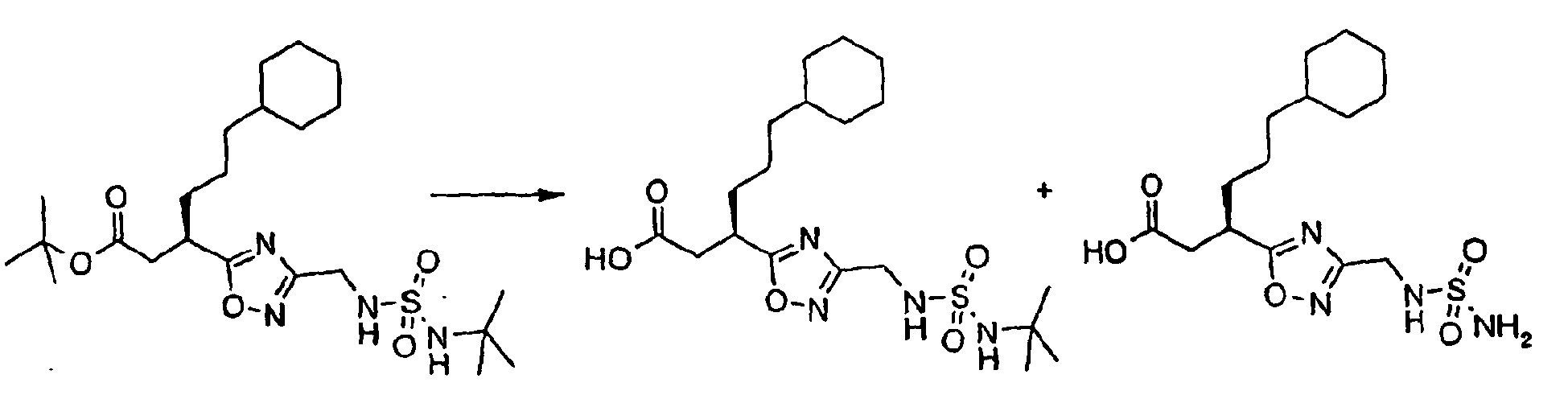
- Method as for preparation 11 using tert-butyl (3R)-3-[3-({[(tert-butylamino)sulfonyl]amino}methyl)-1,2,4-oxadiazol-5-yl]-6-cyclohexylhexanoate (preparation 47) (171mg, 0.35mmol) as starting material.
Purification: The crude product was dissolved in EtOAc and washed with H2O and brine. The orgainc extract was dried over anhydrous MgSO4 and filtered. The solvent was removed under reduced pressure to afford a mixture of (3R)-3-[3-({[(tert-butylamino)sulfonyl]amino}methyl)-1,2,4-oxadiazol-5-yl]-6-cyclohexylhexanoic acid and (3R)-3-(3-{[(aminosulfonyl)amino]methyl}-1,2,4-oxadiazol-5-yl)-6-cyclohexylhexanoic acid (130mg). - Taken on as a mixture to the following step (see Examples 16,17).
-

- A solution of tert-butyl (3R)-3-[3-(aminomethyl)-1,2,4-oxadiazol-5-yl]-6-cyclohexylhexanoate (preparation 18) (219mg, 0.62mmol) in THF (1 0ml) was treated with AcCl (53µl, 0.75mmol) and stirred at room temperature for 1 hour. More AcCl (200µl) was added and stirred for a further hour. Sat. NaHCO3 solution was added and the layers separated. The organic extract was washed with brine, dried over anhydrous Na2SO4 and filtered. The solvent was removed under reduced pressure to afford the title compound as a colourless oil (247mg, 100%).
1H nmr : (CDCl3) 0.83 (2H, m), 1.10-1.35 (8H, m), 1.40 (9H, s), 1.60-1.80 (7H, m), 2.03 (3H, s), 2.60 (1H, dd), 2.79 (1H, dd), 3.42 (1H, m), 4.58 (2H, d), 5.94 (1H, brs).
MS : 416 (MNa+) -

- Method as for preparation 7 using tert-butyl (3R)-3-{3-[(acetylamino)methyl]-1,2,4-oxadiazol-5-yl}-6-cyclohexylhexanoate (preparation 50) (229mg, 0.58mmol) as starting material to afford the title compound as a pale yellow oil (235mg)
1H nmr : (d6-DMSO) 0.81 (2H, m), 1.05-1.25 (8H, m), 1.50-1.70 (7H, m), 1.83 (3H, s), 2.70 (2H, m), 3.39 (1H, m), 4.32 (2H, d), 8.34 (1H, brs).
MS : 360 (MNa+)
CHN : Found: C57.98%; H8.24%; N10.18%; C17H27N3O4. 0.8 H2O. 0.6 dioxan requires C57.58%; H8.32%; N10.38% -

- Method as for preparation 50 using tert-butyl (3R)-6-cyclohexyl-3-{3-[(methylamino)methyl]-1,2,4-oxadiazol-5-yl}hexanoate (preparation 5) as starting material.
Purification: Crude material purified on a silica column eluting with DCM : MeOH (19 : 1) to afford the title compound as a colourless oil (255mg, 94%).
1H nmr : (CDCl3) contains rotamers: 0.86 (2H, m), 1.10-1.35 (8H, m), 1.40 (9H, s), 1.60-1.80 (7H, m), 2.10-2.20 (3H, s+s), 2.60 (1H, m), 2.78 (1H, m), 2.98-3.15 (3H, s+s), 3.42 (1H, m), 4.50-4.70 (2H, s+s).
MS : 430 (MNa+) -

- Method as for preparation 7 using tert-butyl (3R)-3-(3-{[acetyl(methyl)amino]methyl}-1,2,4-oxadiazol-5-yl)-6-cyclohexylhexanoate (preparation 52) (241mg, 0.59mmol) as starting material to afford the title compound as a colourless oil (146mg, 46%).
1H nmr : (CDCl3) contains rotamers: 0.83 (2H,br), 1.05-1.50 (8H, br), 1.60-1.90 (7H, br), 2.10-2.20 (3H, s+s), 2.62-3.10 (5H, m), 3.47 (1H, m), 4.50-4.70 (2H, s+s).
MS : 374 (MNa+)
CHN : Found: C59.73%; H8.21%; N11.07%; C18H29N3O4. 0.45 H2O. 0.1 dioxan requires C60.00%; H8.40%; N11.41% -

- Method as for preparation 50, using tert-butyl (3R)-3-[3-(aminomethyl)-1,2,4-oxadiazol-5-yl]-6-cyclohexylhexanoate (preparation 18) (204mg, 0.57mmol) and cyclopropane carboxylic acid chloride (62µl, 0.68mmol) as starting materials to afford the title compound as a colourless oil (257mg).
1H nmr: (CDCl3) 0.75-1.80 (31 H, m), 2.61 (1H, dd), 2.78 (1 H, dd), 3.42 (1 H, m), 4.59 (2H, d), 6.20 (1H, brs).
MS : 442 (MNa+)
CHN : Found: C64.74%; H8.80%; N9.12%; C23H37N3O4. 0.5 H2O requires C64.53%; H9.01%; N9.49% -
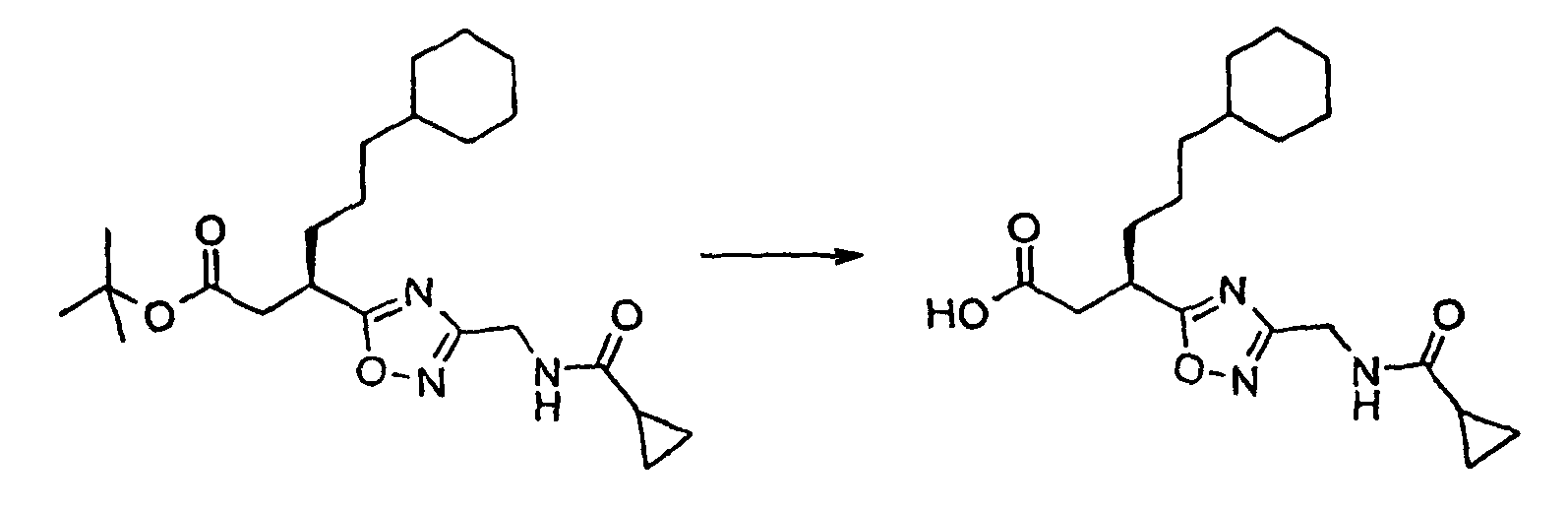
- Method as for preparation 7 using tert-butyl (3R)-6-cyclohexyl-3-(3-{[(cyclopropylcarbonyl)amino]methyl}-1,2,4-oxadiazol-5-yl)hexanoate (preparation 54) (236mg, 0.56mmol) as starting material to afford the title compound as a yellow oil (224mg).
1H nmr : (d6DMSO) 0.68 (4H, m), 0.80 (2H, m), 1.05-1.25 (8H, m), 1.55-1.70 (8H, m), 2.69 (2H, m), 3.38 (1H, m), 4.36 (2H, d), 8.51 (1H, brs).
MS : 386 (MNa+)
CHN : Found: C60.81 %; H8.09%; N9.47%; C19H29N3O4. 0.2 H2O. 0.7 dioxan requires C61.07%; H8.23%; N9.80% -

- A solution of tert-butyl (3R)-3-[3-(aminomethyl)-1,2,4-oxadiazol-5-yl]-6-cyclohexylhexanoate (preparation 18) (206mg, 0.57mmol) and methoxyacetic acid (48µl, 0.63mmol) in DCM (5ml) was treated with a solution of WSCDI (120mg, 0.63mmol), HOBt (85mg, 0.63mmol) and NMM (69µl, 0.63mmol) in DCM (10ml) and stirred at room temperature for 18 hours. The reaction mixture was washed with sat. NaHCO3 solution followed by brine, dried over MgSO4 and filtered. The solvent was removed under reduced pressure. The residue was purified on a silica column eluting with Et2O to afford the title compound as a colourless oil (230mg, 93%).
1H nmr : (CDCl3) 0.82 (2H, m), 1.10-1.30 (8H, m), 1.40 (9H, s), 1.60-1.80 (7H, m), 2.60 (1H, dd), 2.79 (1H, dd), 3.40-3.50 (4H, s+m), 3.97 (2H, s), 4.60 (2H, d), 7.00 (1H, brs).
MS : 446 (MNa+)
CHN : Found: C62.28%; H8.84%; N9.62%; C22H37N3O5 requires C62.39%; H8.81%; N9.92% -

- Method as for preparation 7 using tert-butyl (3R)-6-cyclohexyl-3-(3-{[(methoxyacetyl)amino]methyl}-1,2,4-oxadiazol-5-yl)hexanoate (preparation 56) (216mg, 0.51 mmol) as starting material to afford the title compound as a yellow oil (196mg).
1H nmr : (d6DMSO) 0.80 (2H, m), 1.05-1.25 (8H, m), 1.50-1.70 (7H, m), 2.68 (2H, m), 3.32 (3H, s), 3.39 (1H, m), 3.81 (2H, s), 4.39 (2H, d), 8.21 (1H, brs).
MS : 368 (MH+)
CHN : Found: C58.39%; H8.18%; N10.05%; C18H29N3O5. 0.4 dioxan requires C58.46%; H8.06%; N10.43% -
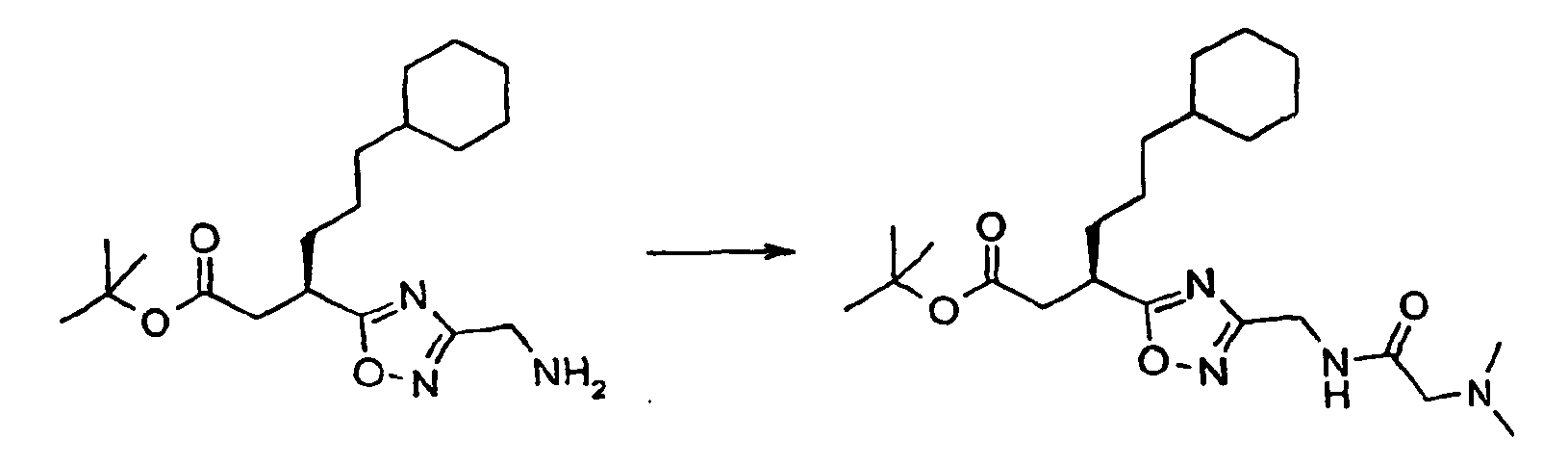
- Method as for preparation 56 using tert-butyl (3R)-3-[3-(aminomethyl)-1,2,4-oxadiazol-5-yl]-6-cyclohexylhexanoate (preparation 18) (206mg, 0.57mmol) and N,N-dimethylglycine (65mg, 0.63mmol) as starting materials.
Purification: The crude material was purified on a silica column eluting with Et2O : MeOH (9 : 1) to afford the title compound as a colourless oil (227mg, 89%).
1H nmr : (CDCl3) 0.83 (2H, m), 1.10-1.35 (8H, m), 1.40 (9H, s), 1.60-1.75 (7H, m), 2.32 (6H, s), 2.61 (1H, dd), 2.79 (1H, dd), 3.00 (2H, s), 2.44 (1H, m), 4.60 (2H, d), 7.60 (1H, brs).
MS : 459 (MNa+)
CHN : Found: C63.04%; H9.30%; N12.67%; C23H40N4O4 requires C63.27%; H9.23%; N12.83% -

- Method as for preparation 7 using tert-butyl (3R)-6-cyclohexyl-3-[3-({[(dimethylamino)acetyl]amino}methyl)-1,2,4-oxadiazol-5-yl]hexanoate (preparation 58) (216mg, 0.49mmol) as starting material to afford the title compound as a white solid (225mg).
1H nmr : (d6DMSO) 0.81 (2H, m), 1.05-1.25 (8H, m), 1.50-1.70 (8H, m), 2.70 (2H, m), 2.79 (6H, s), 3.39 (1H, m), 3.93 (2H, s), 4.44 (2H, d), 9.15 (1H, brs).
MS : 381 (MH+)
CHN : Found: C54. 46%; H7.96%; N13.17%; C19H32N4O4. HCl requires C54.73%; H7.98%; N13.44% -

- Method as for preparation 50 using tert-butyl (3R)-3-[3-(aminomethyl)-1,2,4-oxadiazol-5-yl]-6-cyclohexylhexanoate (preparation 18) (200mg, 0.57mmol) and benzoylchloride (79µl, 0.68mmol) as starting materials.
Purification: The crude material was purified on a silica column eluting with Et2O : pentane(1 : 1) to afford the title compound as a colourless oil (243mg, 94%).
1H nmr : (CDCl3) 0.82 (2H, m), 1.10-1.80 (24H, m), 2.61 (1H, dd), 2.79 (1H, dd), 3.43 (1H, m), 4.79 (2H, d), 6.60 (1H, brs), 7.42 (2H, t), 7.51 (2H, d), 7.80 (2H, d).
MS : 478 (MNa+)
CHN : Found: C68.40%; H8.26%; N9.04%; C26H37N3O4. 0.1 H2O. 0.1 Et2O requires C68.22%; H8.28%; N9.04% -

- Method as for preparation 7 using tert-butyl (3R)-3-{3-[(benzoylamino)methyl]-1,2,4-oxadiazol-5-yl}-6-cyclohexylhexanoate (preparation 60) (227mg, 0.50mmol) as starting material to afford the title compound as a yellow oil (227mg).
1H nmr : (d6DMSO) 0.79 (2H, m), 1.00-125 (8H, m), 1.50-1.70 (7H, m), 2.68 (2H, m), 3.39 (1H, m), 4.54 (2H, d), 7.43 (2H, t), 7.50 (1H, t), 7.82 (2H, d), 8.98 (1H, brs).
MS : 422 (MNa+)
CHN : Found: C64.32%; H7.64%; N8.73%; C22H29N3O4. 0.7 dioxan requires C64.59%; H7.56%; N9.11% -

- Method as for preparation 56 using tert-butyl (3R)-3-[3-(aminomethyl)-1,2,4-oxadiazol-5-yl]-6-cyclohexylhexanoate (preparation 18) (202mg, 0.57mmol) and picolininc acid (77mg, 0.63mmol) as starting materials.
Purification: The crude material was purified on a silica column eluting with pentane : Et2O (1 : 1) to afford the title compound as a colourless oil.
1H nmr : (CDCl3) 0.81 (2H, m), 1.05-1.35 (8H, m), 1.39 (9H, s), 1.55-1.80 (7H, m), 2.60 (1H, dd), 2.80 (1H, dd), 3.43 (1H, m), 4.79 (2H, d), 7.41 (1H, m), 7.82 (1H, t), 8.20 (1H, d), 8.50 (1H, brs), 8.59 (1H, d).
MS : 479 (MNa+)
CHN : Found: C65.39%; H7.98%; N12.00%; C25H36N4O4 requires C65.77%; H7.95%; N12.27% -

- Method as for preparation 7 using tert-butyl (3R)-6-cyclohexyl-3-(3-{[(2-pyridinylcarbonyl)amino]methyl}-1,2,4-oxadiazol-5-yl)hexanoate (preparation 62) (216mg, 0.47mmol) as starting material to afford the title compound as a yellow oil (213mg).
1H nmr: (d6DMSO) 0.77 (2H, m), 1.00-9.20 (8H, m), 1.50-1.65 (7H, m), 2.79 (2H, m), 3.40 (1H, m), 4.58 (2H, d), 7.60 (1H, t), 8.00 (2H, m), 8.62 (1H, d), 9.30 (1H, t).
MS : 399 (M-H)
CHN : Found: C61.20%; H7.16%; N12.65%; C21H28N4O4. 0.4 H2O. 0.3 dioxan requires C61.42%; H7.24%; N12.91% -
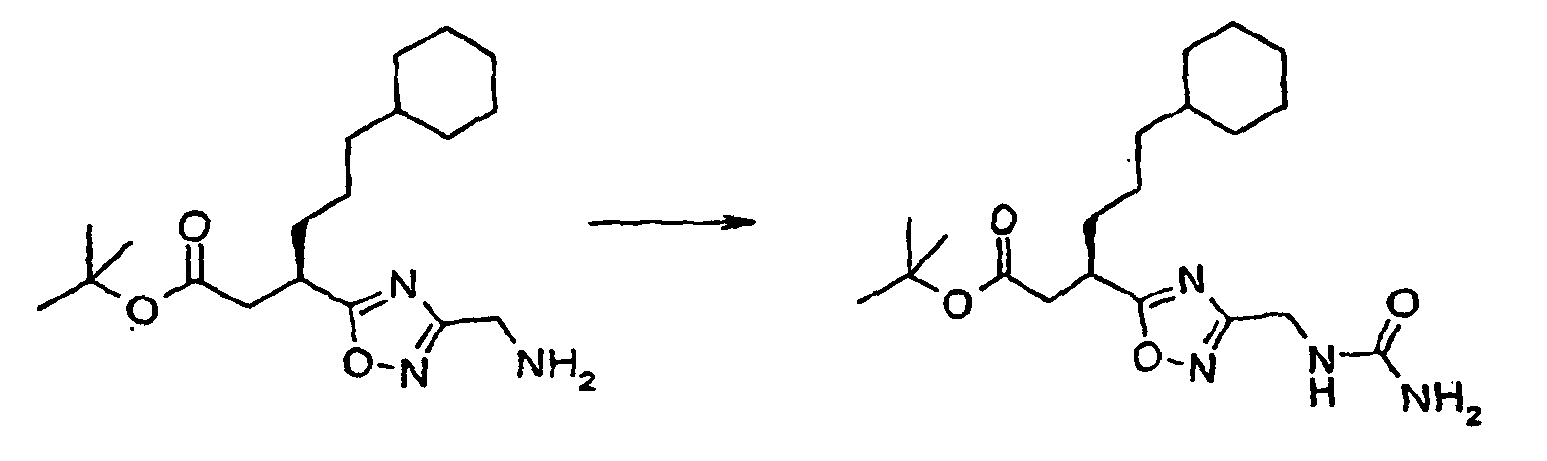
- A solution of tert-butyl (3R)-3-[3-(aminomethyl)-1,2,4-oxadiazol-5-yl]-6-cyclohexythexanoate (preparation 18) (310mg, 0.88mmol) in MeCN (10ml) was treated with N,N-disuccinimidyl carbonate (271 mg, 1.06mmol) and stirred at room temperature, under a nitrogen atmosphere for 4.5 hours. NH3 (0.5M in dioxan) was added forming a white precipitate. The reaction mixture was stirred at room temperature for 18hours. The reaction mixture was filtered and the solvent removed under reduced pressure. The residue was purified on a silica column eluting with a solvent gradient of DCM : MeOH (100 : 0) gradually changing to (95: 5) to afford the title compound as a colourless oil (253mg, 73%).
1H nmr : (CDCl3) 0.83 (2H, m), 1.10-1.35 (8H, m), 1.40 (9H, s), 1.55-1.80 (7H, m), 2.60 (1H, dd), 2.78 (1H, dd). 3.42 (1H, m), 4.54 (2H, d), 5.08 (1H, brs). -

- Method as for preparation 11 using tert-butyl (3R)-3-(3-{[(aminocarbonyl)amino]methyl}-1,2,4-oxadiazol-5-yl)-6-cyclohexylhexanoate (preparation 64) (261mg, 0.66mmol) as starting material to afford the title compound as a yellow oil (191 mg, 86%).
1H nmr : (CDCl3) 0.85 (2H, m), 1.10-1.40 (8H, m), 1.60-1.85 (7H, m), 2.80 (2H, m), 3.44 (1H, m), 4.45 (2H, d). -

- A solution of tert-butyl (3R)-3-[3-(aminomethyl)-1,2,4-oxadiazol-5-yl]-6-cyclohexylhexanoate (preparation 18) (148mg, 0.42mmol) in MeCN (10ml) was treated with N,N-disuccinimidyl carbonate (130mg, 0.51mmol) and stirred at room temperature, under a nitrogen atmosphere for 4 hours. The solvent was removed under reduced pressure. The oil was dissolved in THF (5ml) and treated with MeNH2 (2.0M In THF) (1.0ml) forming a white precipitate. The reaction mixture was stirred at room temperature for 2 days and filtered. The solvent was removed under reduced pressure. The oil was purified on a silica column eluting with a solvent gradient of DCM : MeOH (95 : 5) gradually changing to (90 : 10) to afford the title compound as a colourless oil (134mg, 78%).
1H nmr: (CDCl3) 0.82 (2H, m), 1.10-1.30 (8H, m),1.39 (9H, s), 1.60-1.80 (7H, m), 2.60 (1H, dd), 2.78 (1H, dd), 2.80 (3H, d), 3.42 (1H, m), 4.50 (2H, d), 4.83 (1H, brs).
MS : 431 (MNa+) -

- Method as for preparation 11 using tert-butyl (3R)-6-cyclohexyl-3-[3-({[(methylamino)carbonyl]amino}methyl)-1,2,4-oxadiazol-5-yl]hexanoate (preparation 66) (140mg, 0.34mmol) as starting material to afford the title compound as a colourless oil (141mg).
1H nmr : (d6DMSO) 0.81 (2H, m), 1.05-1.30 (8H, m), 1.50-1.70 (7H, m), 2.56 (3H, d), 2.67 (2H, m), 3.38 (1 H, m), 4.25 (2H, s).
MS : 375 (MNa+) -

- Method as for preparation 66 using tert-butyl (3R)-3-[3-(aminomethyl)-1,2,4-oxadiazol-5-yl]-6-cyclohexylhexanoate (preparation 18) (310mg, 0.88mmol) and Me2NH (2.0M in THF) (1.80ml, 3.52mmol) as starting materials.
Purification: The crude material was purified on a silica column eluting with a solvent gradient of DCM : MeOH (98: 2) gradually changing to (95 : 5) to afford the title compound (309mg, 83%).
1H nmr : (CDCl3)0.81 (2H, m), 1.10-1.30 (8H, m), 1.39 (9H, s), 1.60-1.80 (7H, m), 2.61 (1H, dd), 2.78 (1H, m), 2.94 (6H, s), 3.42 (1H, m), 4.57 (2H, m), 5.01 (1H, brs).
MS : 423 (MH+) -
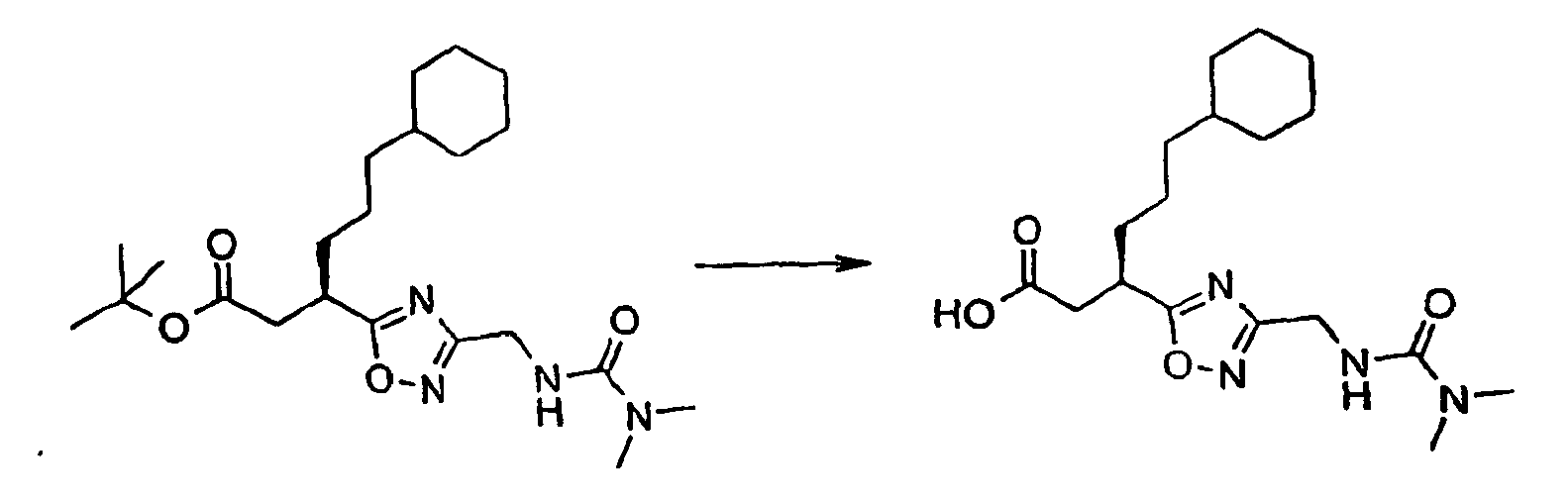
- Method as for preparation 11 using tert-butyl (3R)-6-cyclohexyl-3-[3-({[(dimethylamino)carbonyl]amino}methyl)-1,2,4-oxadiazol-5-yl]hexanoate (preparation 68) 9298mg, 0.71mmol) as starting material.
Purification: The crude material was purified on a silica column eluting with a solvent gardient of DCM : MeOH (98 : 2) gradually changing to (90 : 10) to afford the title compound (214mg, 83%).
1H nmr : (CDCl3) 0.80 (2H, m), 1.05-1.30 (8H, m), 1.60-1.80 (7H, m), 2.73 (1H, dd), 2.92 (7H, m), 3.49 (1H, m), 4.51 (2H, m), 5.37 (1H, brs).
MS : 365 (M-H) -

- A solution of (3R)-3-[3-(aminomethyl)-1,2,4-oxadiazol-5-yl]-6-cyclohexylhexanoic acid (preparation 163) (177mg, 0.53mmol) and Et3N (186µl, 1.33mmol) In dioxan (500µl) and H2O (500µl) was treated with Boc-ON (145mg, 0.58mmol) and stirred at room temperature for 18hours. The reaction mixture was diluted with H2O and extracted with EtOAc (x2). The organic extracts were combined and the solvent removed under reduced pressure. The crude material was purified on a silica column eluting with DCM : MeOH (100 : 0) gradually changing to (90 : 10) to afford the title compound as a colourless gum (115mg, 55%).
1H nmr : (CDCl3) 0.84 (2H, m), 1.10-1.35 (8H, m), 1.42 (9H, s), 1.60-1.80 (7H, m), 2.74 (1H, dd), 2.94 (1H, dd), 3.48 (1H, m), 4.40 (2H, d).
MS : 394 (M-H)
Accurate mass : Found 396.2500 (MH+), Calculated C20H34N3O5, 396.2493 -

- A solution of ethyl 5-[(1R)-1-(2-tert-butoxy-2-oxoethyl)-4-cyclohexylbutyl]-1,2,4-oxadiazole-3-carboxylate (preparation 170) (1.14g, 2.89mmol) in EtOH (20ml) was treated with NH2NH2.H2O (280µl, 5.78mmol) and stirred at room temperature for 45 minutes. The solvent was removed under reduced pressure. The residue was partitioned between EtOAc and H2O/brine. The organic solvent was removed under reduced pressure to afford the title compound (1.06g, 90%).
1H nmr: (d6DMSO) 0.80 (2H, m), 1.00-1.25 (8H, m), 1.38 (9H, s). 1.50-1.70 (7H, m), 2.74 (2H, d), 3.42 (1H, m), 4.66 (2H, brs), 10.20 (1H, brs).
MS : 403 (MNa+) -

- A solution of tert-butyl (3R)-6-cyclohexyl-3-[3-(hydrazinocarbonyl)-1,2,4-oxadiazol-5-yl]hexanoate (preparation 71) (1.06g, 2.76mmol) in glacial AcOH (10ml) was treated with 2M HCl (10ml) and stirred at room temperature for 30 minutes. The reaction mixture was cooled to 0°C before being treated with a solution of NaNO2 (278mg, in 5ml H2O) making sure the temperature never rose above 5°C. The reaction mixture was stirred at 0°C for 30 minutes and then allowed to warm to room temperature before being heated at 85°C until the evolution of gas a finished. The reaction mixture was neutralised with sat. Na2CO3 solution and extracted with EtOAc. The organic extract was washed with brine and the solvent removed under reduced pressure. The residue was treated with TFA (4ml) and stirred at room temperature for 1 hour. The solvent was removed under reduced pressure and the residue azeotroped from toluene (x3) and DCM (x3) to afford the title compound as a foam (390mg, 50%).
1H nmr: (CDCl3) 0.82 (2H, m), 1.05-1.40 (8H, m), 1.55-1.85 (7H, m), 2.70 (1H, dd), 2.86 (1H, dd), 3.38 (1H, m), 4.58 (2H, brs).
MS : 304 (MNa+) -

- Method as for preparation 7 using tert-butyl (3R)-6-cyclohexyl-3-{3-[(methylamino)methyl]-1,2,4-oxadiazol-5-yl}hexanoate (preparation 5) (400mg, 1.09mmol) as starting material to afford the title compound as a yellow oil (389mg).
1H nmr : (CD3OD) 0.85 (2H, m), 1.10-1.40 (9H, m), 1.60-1.80 (6H, m), 2.75-2.95 (5H, s+m), 3.54 (1H, m), 4.40 (2H, s).
MS : 310 (MH+)
CHN : Found: C55.44%; H8.34%; N10.13%; C16H27N3O3. 0.1 H2O. 0.6 dioxan. HCl requires C55.18%; H8.30%; N10.49% -

- Method as for preparation 5 using tert-butyl (3R)-6-cyclohexyl-3-[3-({[(4-methylphenyl)sulfonyl]oxy}methyl)-1,2,4-oxadiazol-5-yl]hexanoate (preparation 177) (750mg, 1.48mmol) and ethylamine (2M in THF, 2.22ml, 4.4mmol) as starting materials. Purification: The crude material was purified on a silica column eluting with a solvent gradient of DCM : Et2O (90 : 10) followed by (0 : 100) to afford the title compound as a runny oil (275mg, 49%).
1H nmr : (CDCl3) 0.82 (2H, m), 1.10-1.30 (11H, m), 1.39 (9H, s), 1.60-1.80 (7H, m), 2.55-2.70 (3H, m), 2.79 (1H, dd), 3.43 (1H, m), 3.91 (2H, s).
MS : 380 (MH+) -

- tert-butyl (3R)-6-cyclohexyl-3-{3-[(ethylamino)methyl]-1,2,4-oxadiazol-5-yl}hexanoate (preparation 74) (288mg, 0.76mmol) was treated with TFA (5ml) and stirred at room temperature for 1 hour. The reaction mixture was diluted with DCM and the solvents removed under reduced pressure. The residue was azeotroped from toluene (x3) and DCM (x3) to afford the title compound (373mg).
1H nmr: (CDCl3) 0.81 (2H, m), 1.10-1.30 (8H, m), 1.36 (3H, t), 1.60-1.80 (7H, m), 2.78 (1H, dd), 2.93 (1H, dd), 3.18 (2H, q), 3.43 (1H, m), 4.24 (2H, s).
MS : 324 (MH+)
CHN : Found: C49.84%; H6.55%; N8.65%; C17H29N3O3. 1.3 TFA requires C49.91%; H6.48%; N8.91% -
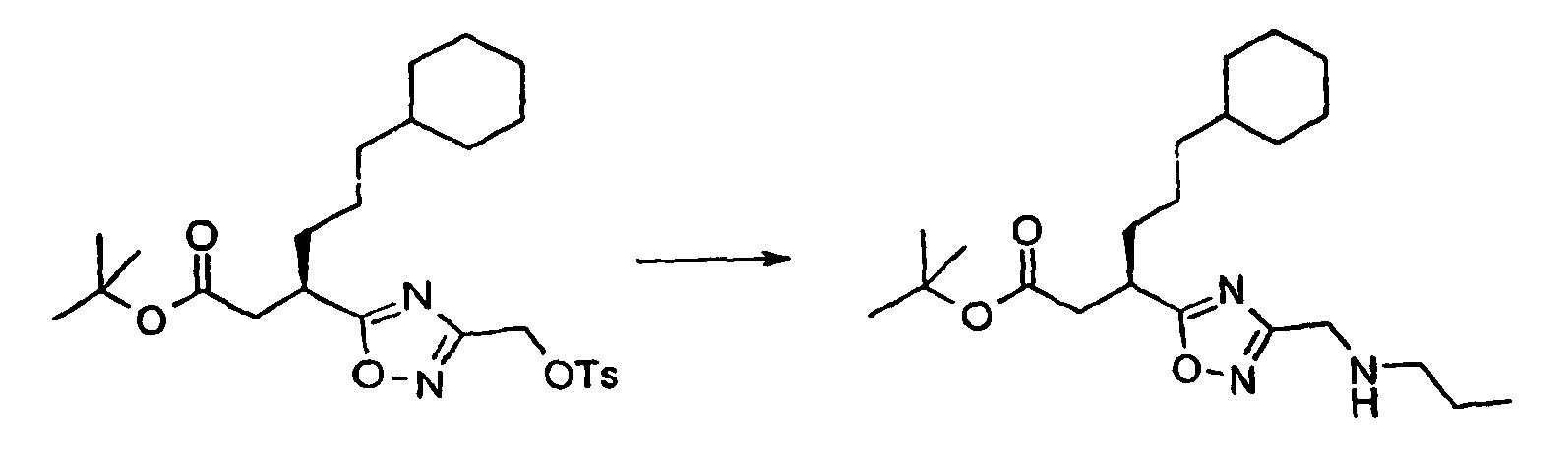
- Method as for preparation 5 using tert-butyl (3R)-6-cyclohexyl-3-[3-({[(4-methylphenyl)sulfonyl]oxy}methyl)-1,2,4-oxadiazol-5-yl]hexanoate (preparation 177) (500mg, 1.00mmol) and propylamine (175mg, 3.00mmol) as starting materials.
Purification: The crude material was purified on a silica column eluting with a solvent gradient of DCM : Et2O (90 : 10) followed by (0 : 100) to afford the title compound as a colourless oil (257mg, 66%).
1H nmr: (CDCl3) 0.80 (2H, m), 0.91 (3H, t), 1.10-1.30 (8H, m), 1.39 (9H, s), 1.151 (2H, m), 1.60-1,80 (7H, m), 2.55-2.6 (3H, t+dd), 2.79 (1H, dd), 3.43 (1H, m), 3.91 (2H, s).
MS : 394 (MH+)
CHN : Found: C67.05%; H10.15%; N10.63%; C22H39N3O3 requires C67.14; H9.99%; N10.68% -

- Method as for preparation 75 using tert-butyl (3R)-6-cyclohexyl-3-{3-[(propylamino)methyl]-1,2,4-oxadiazol-5-yl}hexanoate (preparation 76) (257mg, 0.65mmol) as starting material.
Purification: Crude material purified on a silica column eluting with DCM : MeOH (90 : 10) to afford the title compound (272mg).
1H nmr: (CDCl3) 0.81 (2H, m), 0.99 (3H, t), 1.05-1.30 (8H, m), 1.60-1.70 (7H, m), 1.77 (2H, m), 2.77 (1H. dd), 2.91 (1H, dd), 3.03 (2H, t), 3.41 (1H, m), 4.20 (2H, s).
MS : 338 (MH+)
CHN : Found: C50.22%; H6.75%; N8.50%; C18H31N3O3. 1.4 TFA requires C50.26; H6.57%; N8.45% -

- Method as for preparation 5 using tert-butyl (3R)-6-cyclohexyl-3-[3-({[(4-methylphenyl)sulfonyl]oxy}methyl)-1,2,4-oxadiazol-5-yl]hexanoate (preparation 177) (490mg, 0.97mmol) and isopropylamine (175mg, 3.00mmol) as starting materials.
Purification: Crude material was purified on a silica column eluting with DCM : MeOH (97 : 3) to afford the title compound as a yellow oil (323mg, 85%).
1H nmr: (CDCl3) 0.81 (2H, m), 1.06 (6H, d), 1.10-1.30 (8H, m), 1.39 (9H, s), 1.60-1.80 (7H, m), 2.61 (1H, dd), 2.80 (2H, m), 3.44 (1H, m), 3.91 (2H, s).
MS : 394 (MH+) -

- Method as for preparation 75 using tert-butyl (3R)-6-cyclohexyl-3-{3-[(isopropylamino)methyl]-1,2.4-oxadiazol-5-yl}hexanoate (preparation 78) (323mg, 0.82mmol) as starting material to afford the title compound as a yellow gum (390mg, 100%).
1H nmr : (CDCl3) 0.81 (2H, m), 1.10-1.30 (8H, m), 1.40 (6H, d), 1.60-1.80 (7H, m), 2.79 (1H, dd), 2.97 (2H, m), 3.42 (1H, m), 4.18 (2H, m).
MS : 338 (MH+) -

- Method as for preparation 5 using tert-butyl (3R)-6-cyclohexyl-3-[3-({[(4-methylphenyl)sulfonyl]oxy}methyl)-1,2,4-oxadiazol-5-yl]hexanoate (preparation 177) (750mg, 1.48mmol) and isobutylamine (325mg, 4.44mmol) as starting materials.
Purification: The crude material was purified on a silica column eluting with a solvent gradient of DCM: Et2O (90 : 10) followed by (0 : 100) to afford the title compound as a colourless oil (437mg, 72%).
1H nmr : (CDCl3) 0.81 (2H, m), 1.92 (6H, d), 1.10-1.30 (8H, m), 1.40 (9H, s), 1.48 (1H, brs), 1.60-1.80 (7H, m), 2.41 (2H, d), 2.61 (1H, dd), 2.80 (1H, dd), 3.43 (1H, m), 3.88 (2H, s).
MS : 408 (MH+) -
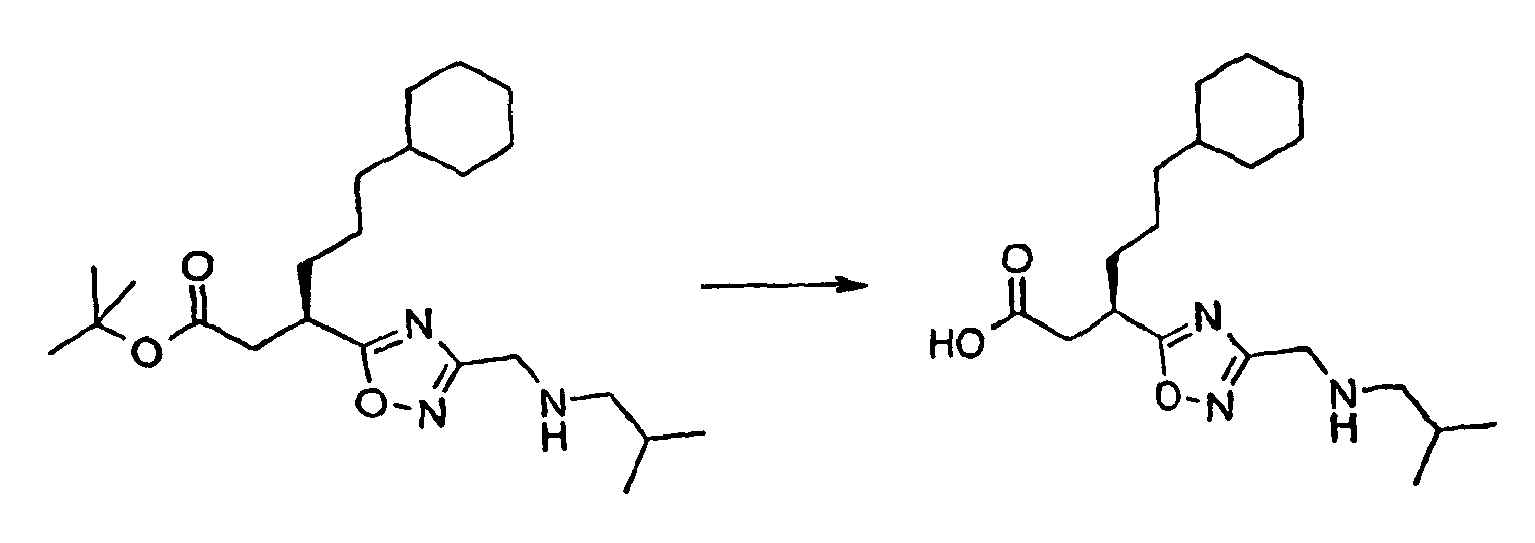
- Method as for preparation 75 using tert-butyl (3R)-6-cyclohexyl-3-{3-[(isobutylamino)methyl]-1,2,4-oxadiazol-5-yl}hexanoate (preparation 80) (437mg, 1.1mmol) as starting material to afford the title compound (506mg).
1H nmr : (CDCl3) 0.82 (2H, m), 1.00 (6H, d), 1.10-1.35 (8H, m), 1.60-1.80 (7H, m), 2.09 (1H, m), 2.78 (1H, dd), 2.93 (3H, dd+d), 3.43 (1H, m), 4.22 (2H, s).
MS : 352 (MH+)
CHN : Found: C51.15%; H6.98%; N8.20%; C19H33N3O3. 1.4 TFA requires C51.23; H6.78%; N8.22% -

- Method as for preparation 5 using tert-butyl (3R)-6-cyclohexyl-3-[3-({[(4-methylphenyl)sulfonyl]oxy}methyl)-1,2,4-oxadiazol-5-yl]hexanoate (preparation 177) (500mg, 0.99mmol) and tert-butylamine (216mg, 2.96mmol) as starting materials.
Purification: The crude material was purified on a silica column eluting with a solvent gradient of DCM : Et2O (90 : 10) followed by (0 : 100) to afford the title compound as a colourless oil (253mg, 63%).
1H nmr : (CDCl3) 0.82 (2H, m), 1.10-1.30 (17H, s+m), 1.39 (9H, s), 1.60-1.80 (7H, m), 2.60 (1H, dd), 2.78 (1H, dd), 3.43 (1H, m), 3.88 (2H, s).
MS : 408 (MH+)
CHN : Found: C67.48%; H10.20%; N10.29%; C23H41N3O3 requires C67.78; H10.14%; N10.31% -
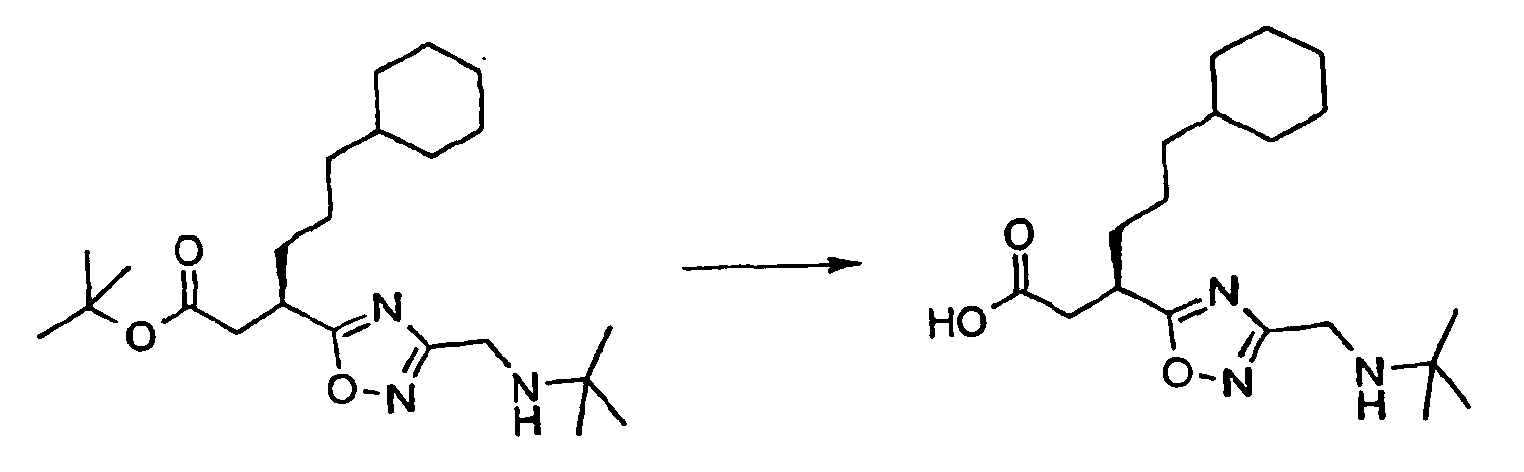
- Method as for preparation 75 using tert-butyl (3R)-3-{3-[(tert-butylamino)methyl]-1,2,4-oxadiazol-5-yl}-6-cydobexylhexanoate (preparation 82) (240mg, 0.59mmol) as starting material to afford the title compound (300mg)
1H nmr : (CDCl3) 0.82 (2H, m), 1.10-1.30 (8H, s+m), 1.40 (9H, s), 1.50-1.70 (7H, m), 2.80 (1H, d), 3.05 (1H, dd), 3.40 (1H, m), 3.79 (1H, d), 4.12 (1H, d).
MS : 352 (MH+)
CHN : Found: C51.29%; H6.93%; N8.17%; C19H33N3O3. 1.4 TFA requires C51.23; H6.78%; N8.22% -

- Method as for preparation 5 using tert-butyl (3R)-6-cyclohexyl-3-[3-({[(4-methylphenyl)sulfonyl]oxy}methyl)-1,2,4-oxadiazol-5-yl]hexanoate (preparation 177) (750mg, 1.48mmol) and 3-aminopentane (520µl, 4.44mmol) as starting materials. Purification: The crude material was purified on a silica column eluting with a solvent gradient of DCM : Et2O (95 : 5) followed by (0 : 100) to afford the title compound as a colourless oil (132mg, 21%).
1H nmr: (CDCl3) 0.84 (8H, m+t), 1.10-1.30 (8H, m), 1.39 (9H, s), 1.42 (4H, m), 1.60-1.80 (7H, m), 2.40 (1H, t), 2.60 (1H, dd), 2.79 (1H, dd), 3.42 (1H, m), 3.88 (2H, s).
MS : 422 (MH+)
CHN : Found: C68.21 %; H10.57%; N9.86%; C24H43N3O3 requires C68.37; H10.28%; N9.97% -

- Method as for preparation 75 using tert-butyl (3R)-6-cyclohexyl-3-(3-{[(1-ethylpropyl)amino]methyl}-1,2,4-oxadiazol-5-yl)hexanoate (preparation 84) (682mg) as starting material.
Purification: The crude material was purified on a silica column eluting with DCM : MeOH (90 : 10) to afford the title compound (795mg)
1H nmr : (CDCl3) 0.82 (2H, m), 1.00 (6H, t), 1.10-1.35 (8H, m), 1.60-1.85 (11H, m), 2.75 (1H, dd), 2.93 (1H, dd), 3.08 (1H, t), 3.42 (1H, m), 4.21 (2H, q).
MS : 366 (MH+)
CHN : Found: C52.11%; H7.33%; N8.00%; C20H35N3O3. 1.4 TFA requires C52.15; H6.99%; N8.00% -

- Method as for preparation 5 using tert-butyl (3R)-6-cyclohexyl-3-[3-({[(4-methylphenyl)sulfonyl]oxy}methyl)-1,2,4-oxadiazol-5-yl]hexanoate (preparation 177) (500mg, 0.99mmol) and cyclopropylamine (210µl, 2.96mmol) as starting materials.
Purification: The crude material was purified on a silica column eluting with a solvent gradient of DCM : Et2O (90 : 10) followed by (0 : 100) to afford the title compound (287mg, 74%).
1H nmr : (CDCl3) 0.40 (4H, m), 0.82 (2H, m), 1.10-1.30 (8H, m), 1.39 (9H, s), 1.60-1.80 (7H, m), 2.19 (1H, m), 2.60 (1 H, dd), 2.79 (1H, dd), 3.43 (1H, m), 3.94 (2H, s).
MS : 392 (MH+)
CHN : Found: C67.31%; H9.62%; N10.72%; C22H37N3O3 requires C67.49; H9.52%; N10.73% -

- Method as for preparation 75 using tert-butyl (3R)-6-cyclohexyl-3-{3-[(cyclopropylamino)methyl]-1,2,4-oxadiazol-5-yl}hexanoate (preparation 86) (280mg, 0.72mmol) as starting material. Purification: Crude material purified on a silica column eluting with DCM : MeOH (90 : 10) to afford the title compound (300mg).
1H nmr : (CDCl3) 0.78 (2HM d), 0.82 (2H, m), 0.95 (2H, brs), 1.10-1.35 (8H, m), 1.60-1.80 (7H, m), 2.61 (1H, m), 2.75 (1H, dd), 2.89 (1H, dd), 3.40 (1H, m), 4.20 (2H, s).
MS : 336 (MH+)
CHN : Found: C51.59%; H6.73%; N8.74%; C18H29N3O3. 1.2 TFA requires C51.88; H6.45%; N8.90% -

- Method as for preparation 5 using tert-butyl (3R)-6-cyclohexyl-3-[3-({[(4-methylphenyl)sulfonyl]oxy}methyl)-1,2,4-oxadiazol-5-yl]hexanoate (preparation 177) (500mg, 0.99mmol) and cyclobutylamine (250µl, 2.96mmol) as starting materials.
Purification: The crude material was purified on a silica column eluting with a solvent gradient of DCM : Et2O (90 : 10) gradually changing to (50 : 50) to afford the title compound (180mg, 45%).
1H nmr : (CDCl3) 0.81 (2H, m), 1.10-1.35 (8H, m),1.39 (9H, s), 1.55-1.80 (11H, m), 2.17 (2H, m), 2.60 (1H, dd), 2.79 (1H, dd), 3.30 (1H, m), 3.43 (1H, m), 3.81 (2H, s).
MS : 406 (MH+)
CHN : Found: C67.98%; H9.82%; N10.36%; C23H39N3O3 requires C68.11; H9.69%; N10.36% -

- Method as for preparation 75 using tert-butyl (3R)-3-{3-[(cyclobutylamino)methyl]-1,2,4-oxadiazol-5-yl}-6-cyclohexylhexanoate (preparation 88) (180mg, 0.44mmol) as starting material to afford the title compound (197mg).
1H nmr : (CDCl3) 0.81 (2H, m), 1.10-1.35 (8H, m), 1.60-2.00 (9H, m), 2.30 (4H, m), 2.79 (1H, dd), 2.95 (1H, dd), 3.42 (1H, m), 3.74 (1H, m), 4.11 (2H, s).
MS : 350 (MH+)
CHN : Found: C51.68%; H6.78%; N8.40%; C19H31N3O3. 1.35 TFA requires C51.78; H6.48%; N8.35% -

- Method as for preparation 5 using tert-butyl (3R)-6-cyclohexyl-3-[3-({[(4-methylphenyl)sulfonyl]oxy}methyl)-1,2,4-oxadiazol-5-yl]hexanoate (preparation 177) (500mg, 0.99mmol) and cyclopentylamine (170mg, 1.98mmol) as starting materials to afford the title compound as a colourless oil (220mg).
1H nmr : (CDCl3) 0.81 (2H, m), 1.05-1.30 (10H, m), 1.38 (11H, s+m), 1.51 (2H, m),1.55-1.75 (7H, m), 1.81 (2H, m), 2.60 (1H, dd), 2.79 (1H, dd), 3.06 (1H, m), 3.42 (1H, m), 3.87 (2H, s). -
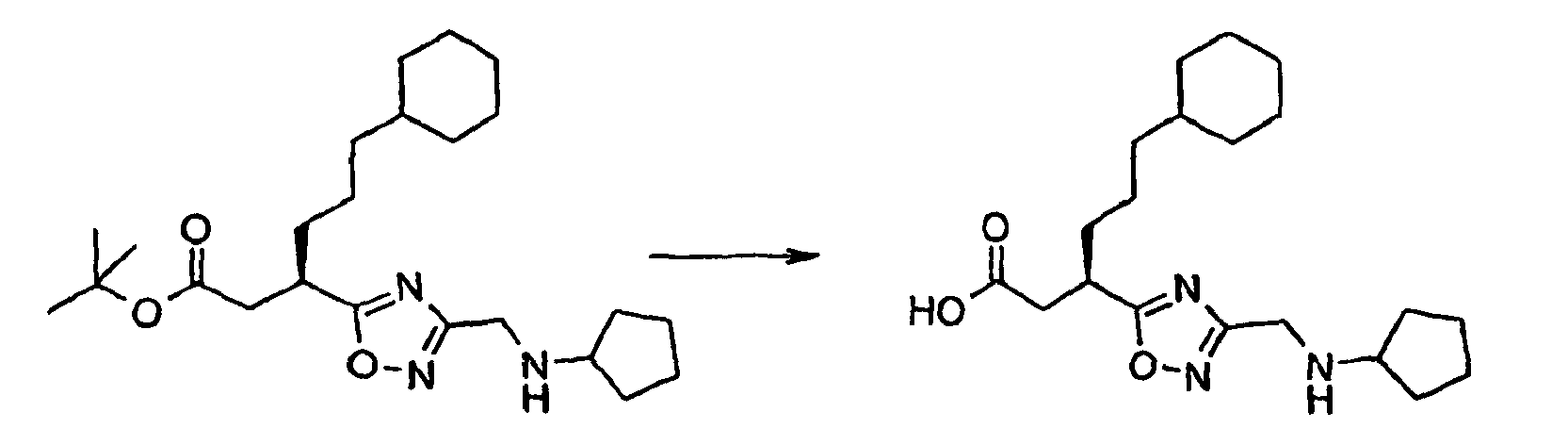
- Method as for preparation 75 using tert-butyl (3R)-6-cyclohexyl-3-{3-[(cyclopentylamino)methyl]-1,2,4-oxadiazol-5-yl}hexanoate (preparation 90) (220mg, 0.53mmol) as starting material to afford the title compound as a white foam (240mg).
1H nmr : (CDCl3) 0.81 (2H, m), 1.10-1.35 (10H, m), 1.55-1.75 (7H, m), 1.81 (4H, m), 2.07 (2H, m), 2.78 (1H, dd), 2.95 (1H, dd), 3.40-3.60 (3H, m), 4.10-4,25 (2H, q).
MS : 364 (MH+) -
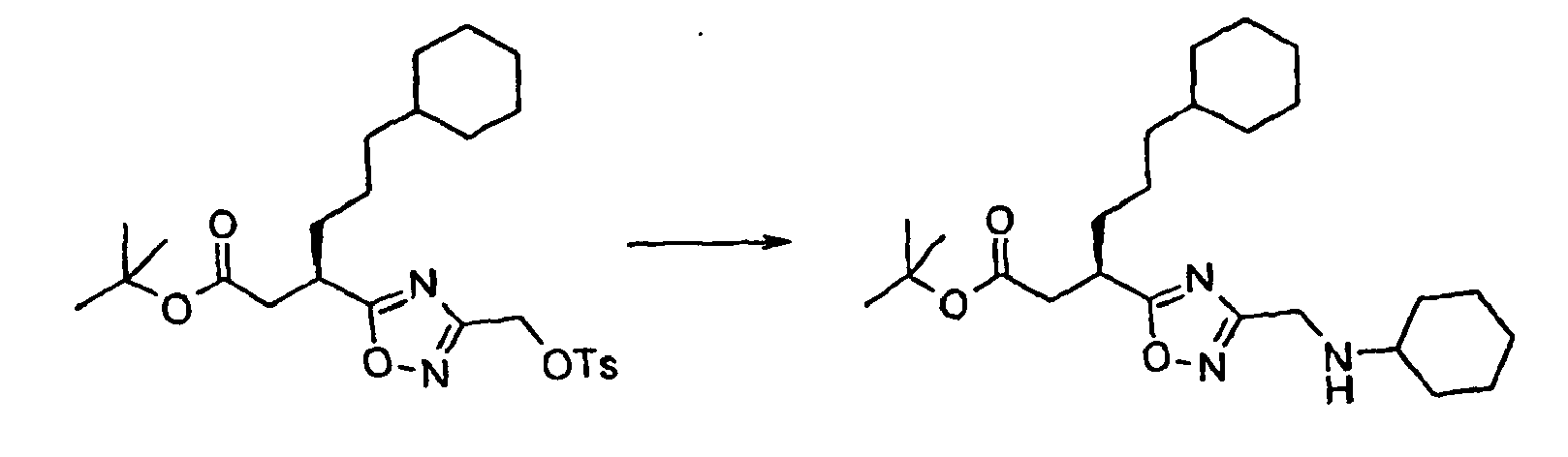
- Method as for preparation 5 using tert-butyl (3R)-6-cyclohexyl-3-[3-({[(4-methylphenyl)sulfonyl]oxy}methyl)-1,2,4-oxadiazol-5-yl]hexanoate (preparation 177) (500mg, 0.99mmol) and cyclohexylamine (198mg, 1.98mmol) as starting materials to afford the title compound as a colourless oil (250mg).
1H nmr: (CDCl3) 0.80 (2H, m), 1.00-1.30 (12H, m), 1.38 (9H, s), 1.55-1.75 (11H, m), 1.82 (2H, m), 2.39 (1H, m), 2.60 (1 H, dd), 2.79 (1H, dd), 3.41 (1H, m), 3.89 (2H, s). -
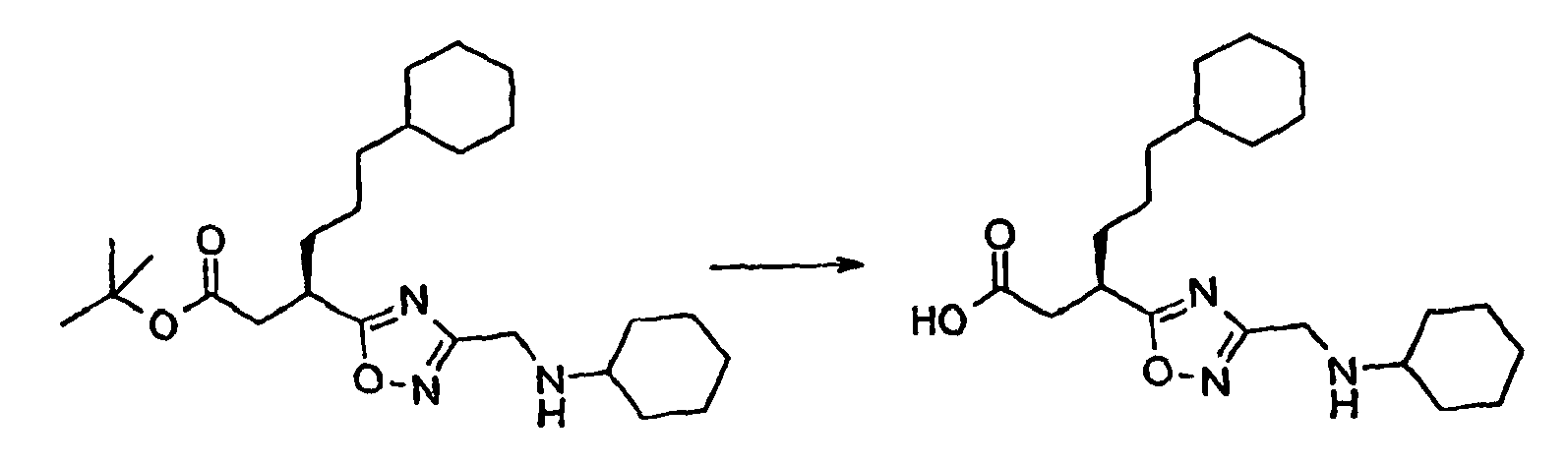
- Method as for preparation 75 using tert-butyl (3R)-6-cyclohexyl-3-{3-[(cyclohexylamino)methyl]-1,2,4-oxadiazol-5-yl}hexanoate (preparation 92) (250mg, 0.58mmol) as starting material to afford the title compound as a white foam (262mg).
1H nmr : (CDCl3) 0.81 (2H, m), 1.10-1.35 (12H, m+Et2O), 1.44 (2H, m),1.60-1.80 (7H, m), 1.85 (2H, m), 2.07 (2H, m), 2.78 (1H, dd), 2.96 (1H, dd), 3.05 (1H, m), 3.41 (1H, m), 4.08-4.25 (2H, q).
MS: 378 (MH+) -
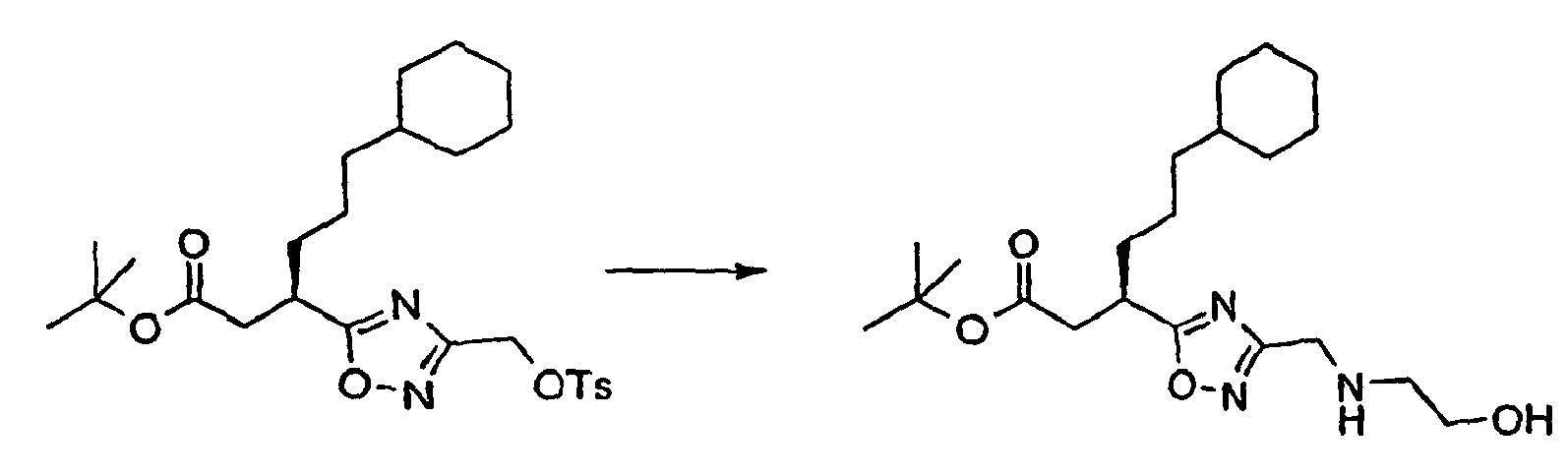
- Method as for preparation 5 using tert-butyl (3R)-6-cyclohexyl-3-[3-({[(4-methylphenyl)sulfonyl]oxy}methyl)-1,2,4-oxadiazol-5-yl]hexanoate (preparation 177) (489mg, 0.97mmol) and ethanolamine (250µl, 3.87mmol) as starting materials.
Purification: The crude material was purified on a silica column eluting with DCM : MeOH (95 : 5) to afford the title compound as a colourless oil (322mg, 83%).
1H nmr: (CDCl3) 0.81 (2H, m), 1.10-1.35 (8H, m), 1.39 (9H, s), 1.50-1.80 (7H, m), 2.41 (1H, brs), 2.62 (1H, dd), 2.80 (3H, m), 3.43 (1H, m), 3.62 (2H, t), 3.94 (2H, s).
MS : 396 (MH+) -
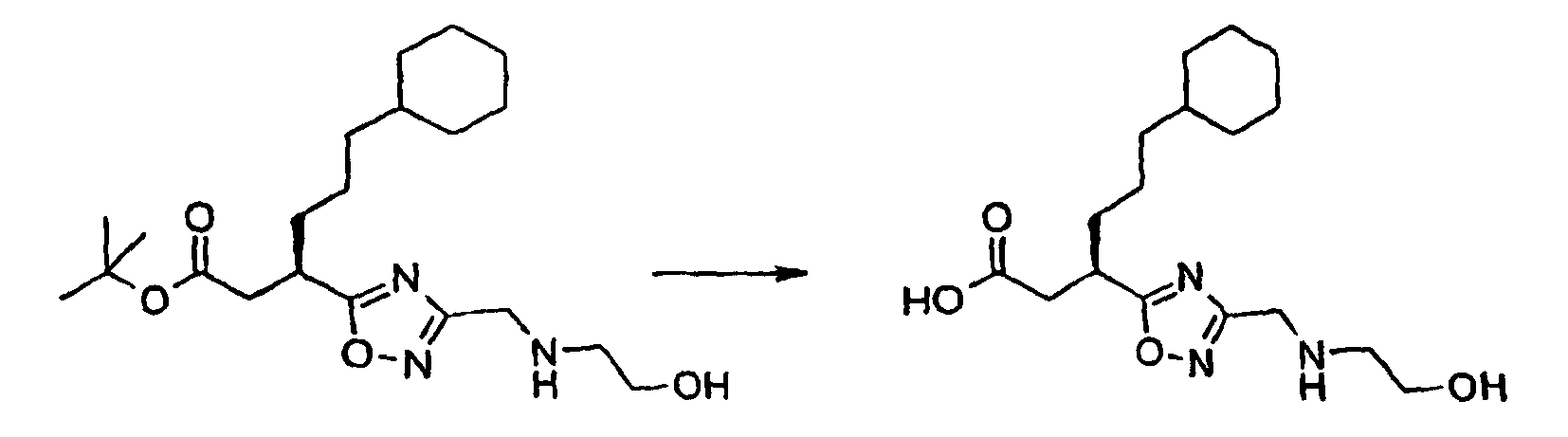
- Method as for preparation 75 using tert-butyl (3R)-6-cyclohexyl-3-(3-{[(2-hydroxyethyl)amino]methyl}-1,2,4-oxadiazol-5-yl)hexanoate (preparation 94) (322mg, 0.82mmol) as starting material to afford the title compound as a sticky gum (398mg, 100%).
1H nmr : (CDCl3) 0.81 (2H, m), 1.10-1.35 (8H, m+Et2O), 1.60-1.80 (7H, m), 2.79 (1H, dd), 2.89 (1H, dd), 3.20 (2H, m), 3.43 (1H, m+Et2O), 3.87 (2H, t), 4.36 (2H, m).
MS : 340 (MH+) -

- Method as for preparation 5 using tert-butyl (3R)-6-cyclohexyl-3-[3-({[(4-methylphenyl)sulfonyl]oxy}methyl)-1,2,4-oxadiazol-5-yl]hexanoate (preparation 177) (3.71g, 7.32mmol) and 2-amino-2-methyl-1-propanol (2.10ml, 22.0mmol) as starting materials. Purification: The crude material was purified on a silica column eluting with a solvent gradient of pentane : EtOAc (80 : 20) gradually changing to (0 : 100) to afford the title compound as a colourless oil (2.52g, 81%).
1H nmr : (CDCl3) 0.84 (2H, m), 1.10 (6H, s), 1.15-1.35 (9H, m), 1.40 (9H, s), 1.60-1.80 (6H, m), 2.60 (1H, dd), 2.70 (1H, brs), 2.79 (1H, dd), 3.29 (2H, s), 3.42 (1H, m), 3.83 (2H, s).
MS : 424 (MH+) -

- Method as for preparation 75 using tert-butyl (3R)-6-cyclohexyl-3-(3-{[(2-hydroxy-1,1-dimethylethyl)amino]methyl}-1,2,4-oxadiazol-5-yl)hexanoate (preparation 96) (2.5g, 5.90mmol) as starting material.
Purification: The crude material was purified on a silica column eluting with a solvent gradient of DCM: MeOH (100: 0) gradually changing to (90: 10) to afford the title compound as a colourless oil (2.95g)
1H nmr : (CDCl3) 0.82 (2H, m), 1.10-1.30 (8H, m), 1.39 (6H, d), 1.60-1.80 (7H, m), 2.78 (1H, dd), 2.92 (1H, dd), 3.42 (1H, m), 3.63 (2H, s), 4.24 (2H, m).
MS : 368 (MH+) -

- Method as for preparation 5 using tert-butyl (3R)-6-cyclohexyl-3-[3-({[(4-methylphenyl)sulfonyl]oxy}methyl)-1,2,4-oxadiazol-5-yl]hexanoate (preparation 177) (500mg, 0.99mmol) and 2-methoxyethylamine (225mg, 2.97mmol) as starting materials to afford the title compound as a colouriess oil (372mg).
1H nmr : (CDCl3) 0.80 (2H, m), 1.05-1.30 (8H, m+EtOAC), 1.38 (9H, s), 1.55-1.75 (7H, m), 1.95 (1H, brs), 2.60 (1H, dd), 2.79 (1H, dd+t), 3.33 (3H, s), 3.42 (3H, m+t), 3.92 (2H, s). -

- Method as for preparation 75 using tert-butyl (3R)-6-cyclohexyl-3-(3-{[(2-methoxyethyl)amino]methyl}-1,2,4-oxadiazol-5-yl)hexanoate (preparation 98) (372mg, 0.91mmol) as starting material to afford the title compound as a pale brown oil.
1H nmr : (d6DMSO) 0.80 (2H, m), 1.00-1.25 (8H, m), 1.55-1.70 (7H, m), 2.78 (2H, d), 3.21 (2H, t), 3.28 (3H, s), 3.44 (1H, m), 3.60 (2H, t), 4.42 (2H, s). -
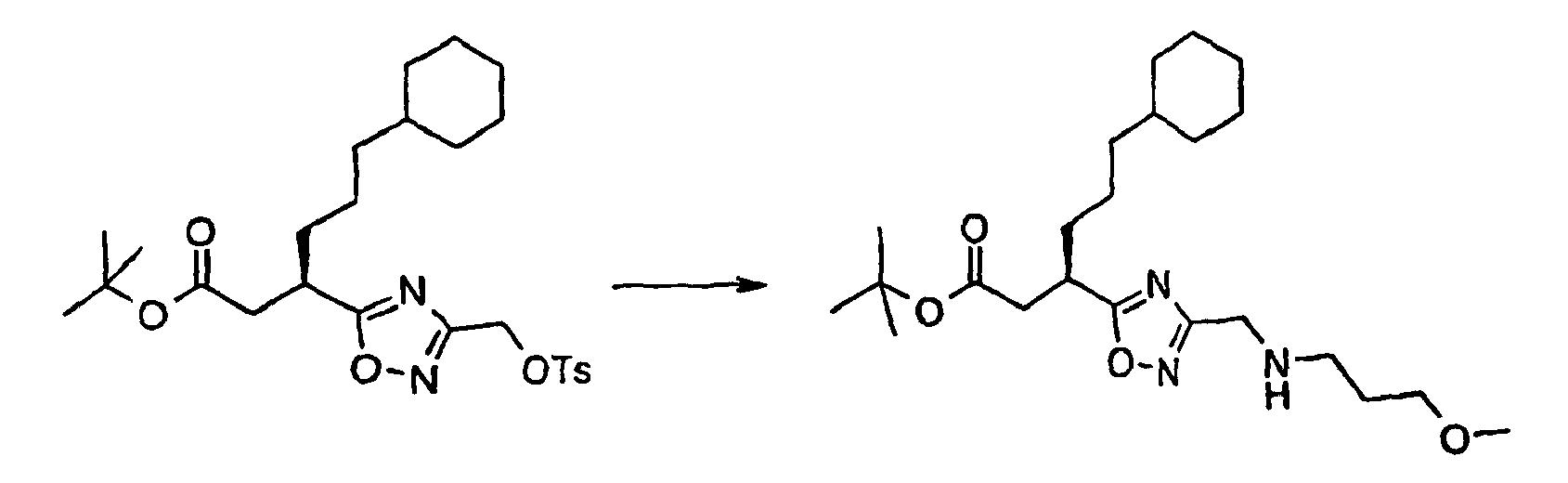
- Method as for preparation 5 using tert-butyl (3R)-6-cyclohexyl-3-[3-({[(4-methylphenyl)sulfonyl]oxy}methyl)-1,2,4-oxadiazol-5-yl]hexanoate (preparation 177) (488mg, 0.96mmol) and 3-methoxypropylamine (325mg, 3.84mmol) as starting materials.
Purification: The crude material was purified on a silica column eluting with DCM : MeOH (95 : 5) to afford the title compound as a colourless oil (397mg, 97%).
1H nmr : (CDCl3) 0.81 (2H, m), 1.10-1.30 (8H, m), 1.39 (9H, s), 1.55-1.70 (7H, m), 1.79 (2H, quin), 2.61 (1H, dd), 2.72 (2H, t), 2.80 (1H, dd), 3.32 (3H, s), 3.42 (3H, t+m), 3.91 (2H, s).
MS : 425 (MH+) -
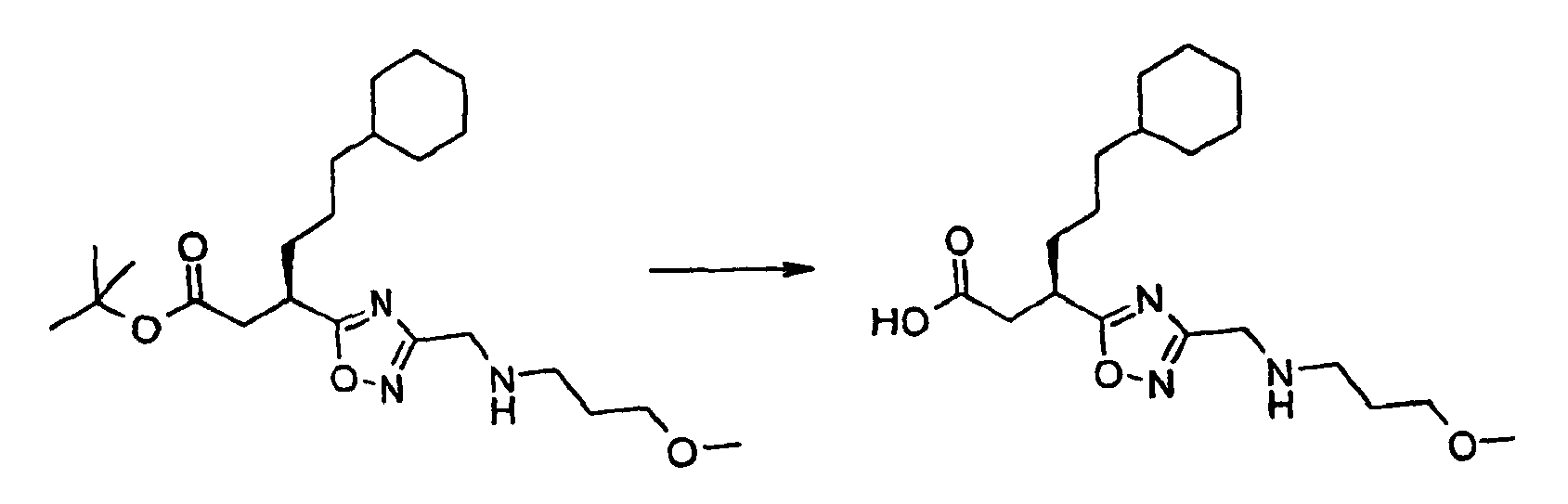
- Method as for preparation 75 using tert-butyl (3R)-6-cyclohexyl-3-(3-{[(3-methoxypropyl)amino]methyl}-1,2,4-oxadiazol-5-yl)hexanoate (preparation 100) (390mg, 0.92mmol) as starting material to afford the title compound as a pale yellow oil (477mg).
1H nmr : (CDCl3) 0.81 (2H, m), 1.10-1.25 (8H, m), 1.60-1.70 (7H, m), 2.00 (2H, quin), 2.79 (1H, dd), 2.92 (1H, dd), 3.25 (2H, t), 3.38 (3H, s), 3.44 (1H, m), 3.58 (2H, t), 4.29 (2H, s).
MS : 369 (MH+) -

- Method as for preparation 5 using tert-butyl (3R)-6-cyclohexyl-3-[3-({[(4-methylphenyl)sulfonyl]oxy}methyl)-1,2,4-oxadiazol-5-yl]hexanoate (preparation 177) (282mg, 0.96mmol) and trans-4-aminocyclohexanol.HCl (325mg, 3.84mmol) as starting materials. Dissolving the solid in 2M NaOH solution with Dowex 50Wx4-200R resin isolated the free base of trans-4-aminocyclohexanol.
Purification: The crude material was purified on a silica column eluting with a solvent gradient of DCM : MeOH (97.5 : 2.5) gradually changing to (95 : 5) to afford the title compound (180mg).
1H nmr : (CDCl3) 0.83 (2H, m), 1.10-1.35 (12H, m), 1.40 (9H, s), 1.60-1.80 (7H, m), 1.96 (4H, m), 2.48 (1H, m), 2.60 (1H, dd), 2.79 (1 H, dd), 3.43 (1H, m), 3.60 (1H, m), 3.92 (2H, s).
MS : 450 (MH+)
CHN : Found: C65.65%; H9.60%; N9.07%; C25H43N3O4. 0.5 H2O requires C65.47; H9.67%; N9.16% -
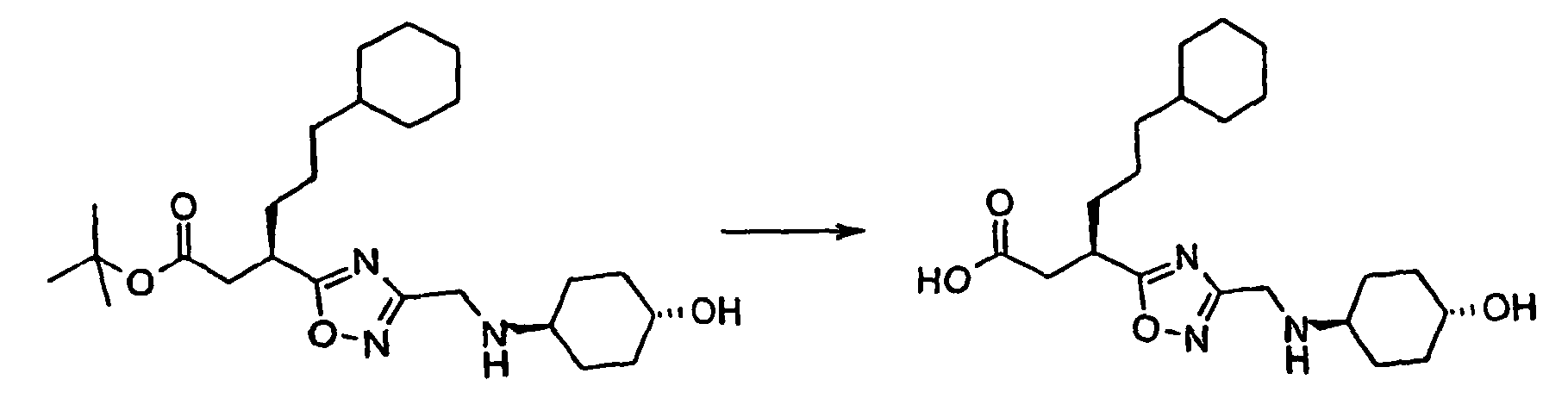
- Method as for preparation 75 using tert-butyl (3R)-6-cyclohexyl-3-(3-{[(4-hydroxycyclohexyl)amino]methyl}-1,2,4-oxadiazol-5-yl)hexanoate (preparation 102) (250mg, 0.56mmol) as starting material.
Purification: The crude material was purified on a silica column eluting with a solvent gradient of DCM : MeOH (95 : 5) gradually changing to (85 : 15) to afford the title compound (190mg).
1H nmr : (CD3OD) 0.83 (2H, m), 1.10-1.40 (10H, m), 1.43 (2H, q), 1.60-1.80 (7H, m), 2.02 (2H, brd), 2.17 (2H, brd), 2.79 (1H, dd), 2.86 (1H, dd), 3.11 (1H, m), 3.54 (2H, m), 4.40 (2H, s).
MS : 394 (MH+) -

- Method as for preparation 5 using tert-butyl (3R)-6-cyclohexyl-3-[3-({[(4-methylphenyl)sulfonyl]oxy}methyl)-1,2,4-oxadiazol-5-yl]hexanoate (preparation 177) (500mg, 0.99mmol) and trans-4-methoxycyclohexanamine.HCl (490mg, 2.96mmol) as starting materials. Purification: A total of 3 silica columns were required to afford the title compound reasonably pure. First column eluted with DCM : MeOH (97 : 3), the second column eluted with DCM : MeOH (99 : 1) and the third column eluted with DCM : MeOH (98 : 2) to afford the title compound (160mg).
1H nmr : (CDCl3) 0.82 (2H, m), 1.10-1.50 (10H, m), 1.39 (9H, s), 1.40-1.80 (11H, m+H2O), 1.85 (2H, m), 2.57 (1H, dd), 2.61 (2H, t), 2.79 (1H, dd), 3.23 (3H, s), 3.33 (1H, m), 3.42 (1H, m), 3.90 (2H, s). Evidence of the presence of the cis-isomer of the cyclohexanamine.
MS : 464 (MH+) -
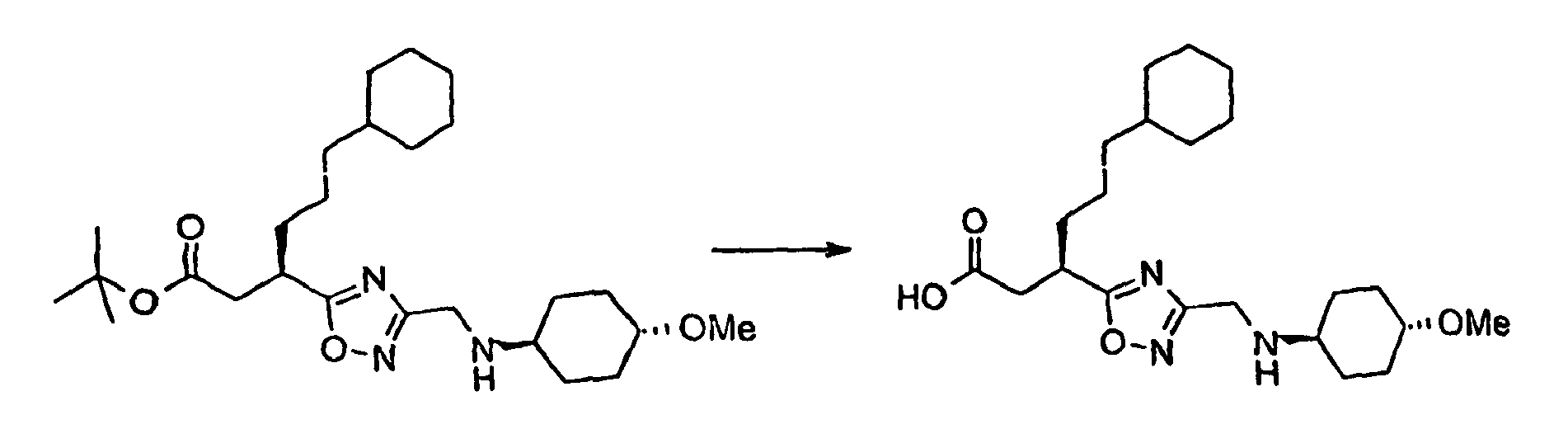
- Method as for preparation 75 using tert-butyl (3R)-6-cyclohexyl-3-(3-{[(4-methoxycyclohexyl)amino]methyl}-1,2,4-oxadiazol-5-yl)hexanoate (preparation 104) (160mg) as starting material to afford the title compound (175mg).
1H nmr : (CDCl3) 0.82 (2H, m), 1.10-1.35 (8H, m), 1.40 (2H, m), 1.55-1.95 (11 H, m), 2.06 (2H, m), 2.78 (1H, dd), 2.95 (1H, dd), 3.19 (1H, m), 3.31 (3H, s), 3.42 (2H, m), 4.21 (2H, d). Evidence of the presence of the cis-isomer of the cyclohexanamine.
MS: 408 (MH+) -

- A solution of tert-butyl (3R)-3-[3-(aminomethyl)-1,2,4-oxadiazol-5-yl]-6-cyclohexylhexanoate (preparation 18) (200mg, 0.57mmol) in THF (2ml) was treated with methyl bromoacetate (55µl, 0.57mmol) and NMM (63µl, 0.57mmol) and stirred at room temperature, under a nitrogen atmosphere for 3 days. The reaction mixture was diluted with EtOAc and washed with H2O followed by brine, dried over anhydrous MgSO4 and filtered. The solvent was removed under reduced pressure. The crude material was purified on a silica column eluting with a solvent gradient of EtOAc : pentane (5 : 95) gradually changing to (50 : 50) to afford the title compound as a colourless oil (170mg, 70%).
1H nmr: (CDCl3) 0.83 (2H, m), 1.10-1.35 (9H, m), 1.39 (9H, s), 1.60-1.80 (6H, m), 2.61 (1H, dd), 2.79 (1H, dd), 3.40-3.50 (3H, m+s), 3.73 (3H, s), 3.95 (2H, s).
MS : 421 (M-H) -

- Method as for preparation 11 using tert-butyl (3R)-6-cyclohexyl-3-(3-{[(2-methoxy-2-oxoethyl)amino]methyl}-1,2,4-oxadiazol-5-yl)hexanoate (preparation 106) (198mg, 0.47mmol) as starting material.
Purification: The crude material was purified on a silica column eluting with a solvent gradient of DCM : MeOH : AcOH (100 : 0 : 0) gradually changing to (93 : 7 : 0.7) to afford the title compound as a pale yellow oil (137mg, 79%).
1H nmr : (CDCl3) 0.81 (2H, m), 1.10-1.35 (8H, m), 1.60-1.80 (7H, m), 2.79 (1H, brd), 2.90 (1H, m), 3.46 (1H, brs), 3.79 (3H, s), 3.86 (2H, brs), 4.26 (2H, brs).
MS: 368 (MH+)
Accurate mass : Found 368.2187 (MH+), Calculated C18H29N3O5, 368.2180 -

- Method as for preparation 106 using tert-butyl (3R)-3-[3-(aminomethyl)-1,2,4-oxadiazol-5-yl]-6-cyclohexylhexanoate (preparation 18) (250mg, 0.71 mmol) and 2-bromoacetamide (98mg, 0.71mmol) as starting materials and Et3N as the base.
Purification: The crude material was purified on a silica column eluting with DCM : MeOH : NH3 (95 : 6 : 0.5) to afford the title compound as a colourless oil (150mg).
1H nmr: (CDCl3) 0.83 (2H, m), 1.10-1.35 (8H, m), 1.39 (9H, s), 1.50-1.80 (7H, m+H2O), 2.60 (1H, dd), 2.79 (1H, dd), 3.35 (2H, s), 3.42 (1H, m), 3.92 (2H, s), 5.40 (1H, brs), 6.92 (1H, brs).
MS : 409 (MH+) -

- Method as for preparation 7 using tert-butyl (3R)-3-(3-{[(2-amino-2-oxoethyl)amino]methyl}-1,2,4-oxadiazol-5-yl)-6-cyclohexylhexanoate (preparation 108) (138mg, 0.34mmol) as starting material to afford the title compound as a yellow oil (147mg).
1H nmr: (d6DMSO) 0.81 (2H, m), 1.10-1.30 (8H, m), 1.55-1.70 (7H, m), 2.78 (2H, d), 3.43 (1H, m), 3.79 (2H, s), 4.40 (2H, s), 7.42 (1H, brs), 7.80 (1H, brs).
MS : 353 (MH+) -

- Method as for preparation 5 using tert-butyl (3R)-6-cyclohexyl-3-[3-({[(4-methylphenyl)sulfonyl]oxy}methyl)-1,2,4-oxadiazol-5-yl]hexanoate (preparation 177) (500mg, 0.99mmol) and 4-aminotetrahydro-4H-pyran.HCl (J. Med. Chem.; 1971, 14, 600-14) (400mg, 2.90mmol) as starting materials. Dissolving the solid in 2M NaOH solution with Dowex 50Wx4-200R resin isolated the free base of 4-aminotetrahydro-4H-pyran.
Purification: The crude material was purified on a silica column eluting with a solvent gradient of Et2O : MeOH (100 : 0) gradually changing to (98 : 2) to afford the title compound (308mg)
1H nmr : (CDCl3) 0.83 (2H, m), 1.10-1.30 (8H, m), 1.35-1.55 (13H, s+m), 1.60-1.85 (7H, m), 2.60 (1H, dd), 2.72 (1H, m), 2.79 (1H, dd), 3.39 (2H, t), 3.42 (1H, m), 3.92 (4H, s+m).
MS : 436 (MH+) -
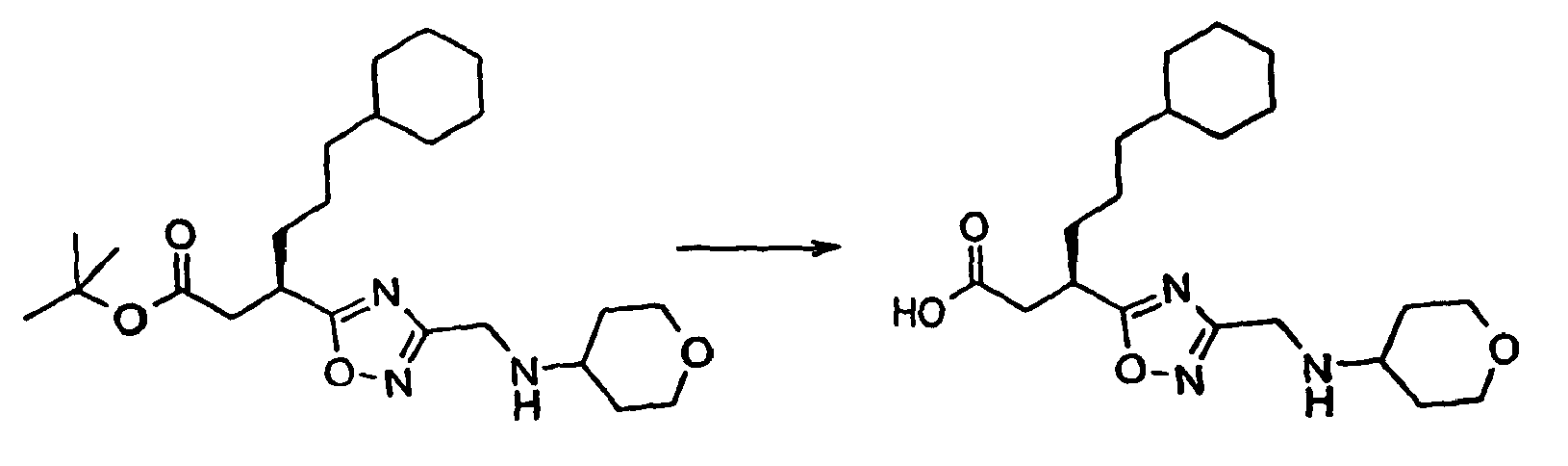
- Method as for preparation 11 using tert-butyl (3R)-6-cyclohexyl-3-{3-[(tetrahydro-2H-pyran-4-ylamino)methyl]-1,2,4-oxadiazol-5-yl}hexanoate (preparation 110) (313mg) as starting material. Purified on a silica column eluting with a solvent gradient of DCM : MeOH (95 : 5) gradually changing to (93 : 7) to afford the title compound (231 mg).
1H nmr : (CDCl3) 0.84 (2H, m), 1.10-1.35 (8H, m), 1.60-1.75 (7H, m), 1.81 2H, m), 2.00 (2H, m), 2.73 (1H, brd), 2.84 (1H, m), 3.28 (1 H, m), 3.40 (3H, m), 4.05 (2H, d), 4.20 (2H, m).
MS : 380 (MH+) -
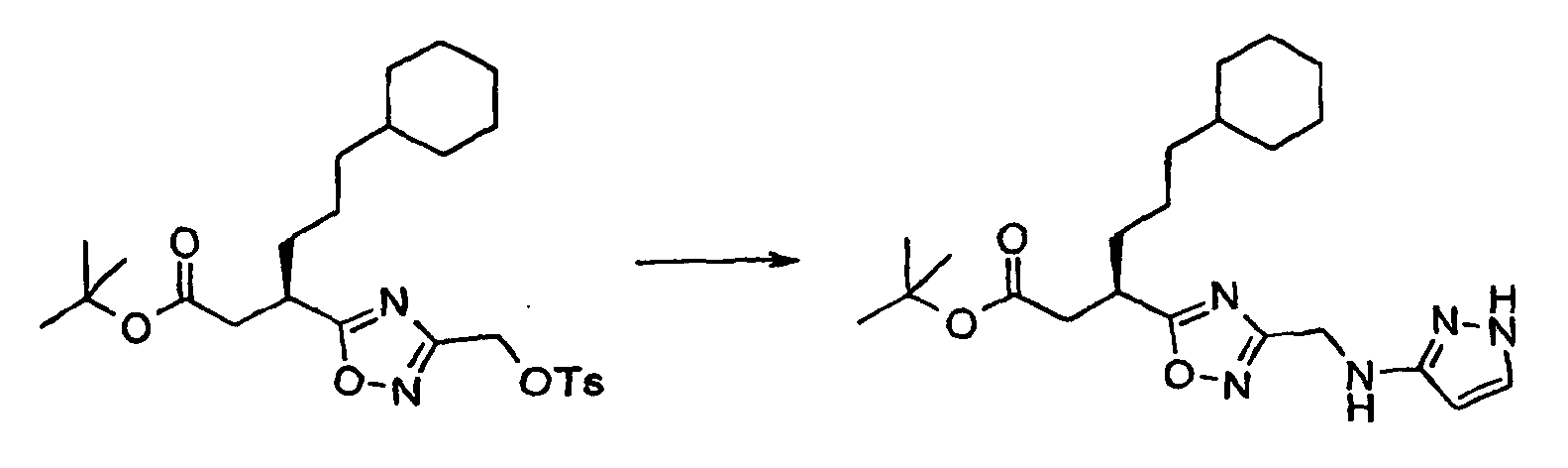
- Method as for preparation 5 using tert-butyl (3R)-6-cyclohexyl-3-[3-({[(4-methylphenyl)sulfonyl]oxy}methyl)-1,2,4-oxadiazol-5-yl]hexanoate (preparation 177) (500mg, 0.99mmol) and 3-aminopyrazole (249mg, 2.97mmol) as starting materials.
Purification: The crude material was purified on a silica column eluting with DCM : MeOH (95 : 5) to afford the title compound (132mg).
1H nmr : (d6DMSO) 0.79 (2H, m), 1.05-1.25 (8H, m), 1.28 (9H, s), 1.55-1.65 (7H, m), 2.66 (2H, d), 3.36 (1H, m), 5.19 (2H, s), 5.25 (3H, s), 7.01 (1H, s).
MS: 419 (MH+) -

- Method as for preparation 75 using tert-butyl (3R)-6-cyclohexyl-3-{3-[(1H-pyrazol-3-ylamino)methyl]-1,2,4-oxadiazol-5-yl}hexanoate (preparation 112) (139mg, 0.33mmol) as starting material to afford the title compound as a colourless oil (132mg)
1H nmr : (CDCl3) 0.81 (2H, m), 1.05-1.35 (8H, m), 1.55-1.80 (7H, m), 2.73 (1H, dd), 2.81 (1H, dd), 3.42 (1H, m), 5.50 (2H, m), 5.74 (1H, s), 7.18 (1H, d), 7.56 (1H, s).
MS : 362 (MH+) -

- Method as for preparation 5 using tert-butyl (3R)-6-cyclohexyl-3-[3-({[(4-methylphenyl)sulfonyl]oxy}methyl)-1,2,4-oxadiazol-5-yl]hexanoate (preparation 177) (493mg, 0.97mmol) and 5-amino-3-ethylpyrazole (321 mg, 2.97mmol) as starting materials.
Purification: The crude material was purified on a silica column eluting with pentane : EtOAc (1 : 1) to afford the title compound as an oil (47mg).
1H nmr : (CDCl3) 0.80 (2H, m), 1.10-1.30 (8H, m), 1.39 (12H, s+t), 1.50-1.80 (7H, m), 2.60 (1H, dd), 2.79 (1H, dd), 3.42 (1H, m), 3.81 (1H, brs), 3.99 (2H, q), 4.38 (2H, d), 5.57 (1H, s), 7.24 (1H, s).
MS : 446 (MH+) -

- Method as for preparation 7 using tert-butyl (3R)-6-cyclohexyl-3-(3-{[(1-ethyl-1H-pyrazol-5-yl)amino]methyl}-1,2,4-oxadiazol-5-yl)hexanoate (preparation 114) (45mg, 0.10mmol) as starting material to afford the title compound as a gum (38mg).
1H nmr : (CDCl3) very broad.
MS : 390 (MH+) -
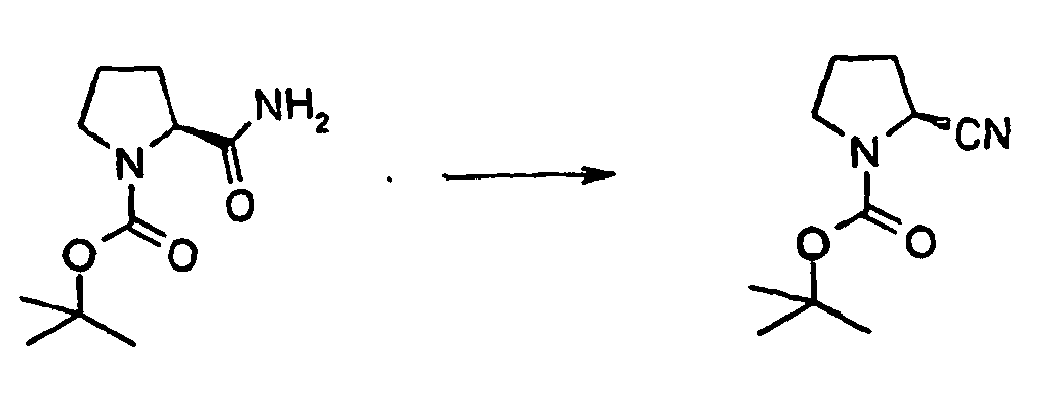
- A solution of oxalyl chloride (11.0ml, 0.126mol) and DMF (11.4ml, 0.138mol) in MeCN (170ml) was treated dropwise with a solution of N-Boc-L-proline amide (12.3g, 0.57mol) and pyridine (20.4ml, 0.253mol) in MeCN (30ml) at 0°C and stirred at this temperature for 15 minutes. The reaction mixture was diluted with EtOAc and washed with H2O (x3). The organic extract was dried over anhydrous MgSO4 and filtered. The solvent was removed under reduced pressure. The residue was purified on a silica column eluting with a solvent gradient of pentane : EtOAc (80 : 20) gradually changing to (60 : 40) to afford the title compound (7.40g, 66%).
1H nmr: (d6DMSO) 1.40 (9H, s), 1.88 (2H, brs), 2.05-2.30 (2H, m), 3.21 (1H, m), 3.35 (1H, brs), 4.60 (1H, d).
MS : 214 (MNH4 +) -
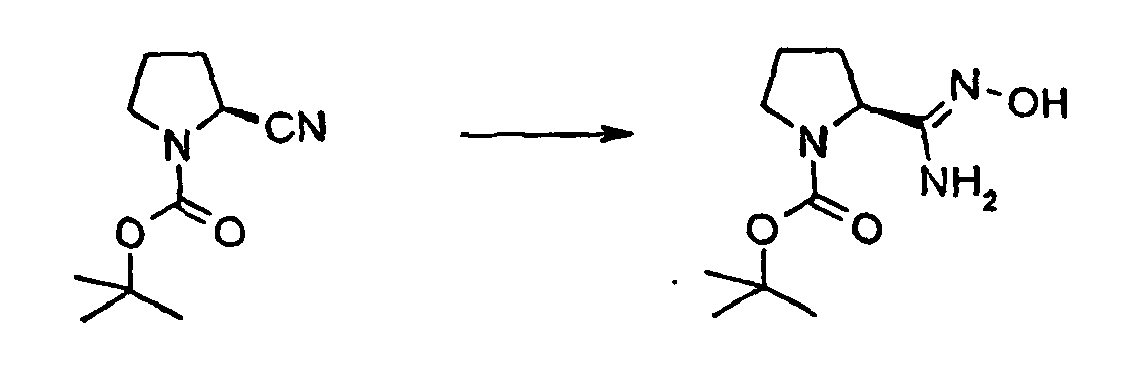
- Method as for preparation 1 using tert-butyl (2S)-2-cyano-1-pyrrolidinecarboxylate (preparation 116) (1.96g, 10.0mmol) as starting material to afford the title compound as a white solid (1.63g)
1H nmr: (d6DMSO) 1.34 (9H, d), 1.65-2.00 (4H, m), 3.15-3.35 (2H, m+H2O), 4.05 (0.5H, brs), 4.19 (0.5H, brs), 5.19 (2H, brd), 8.91 (1H, brs). -

- Method as for preparation 2 using tert-butyl (2S)-2-[(Z)-amino(hydroxyimino)methyl]-1-pyrrolidinecarboxylate (preparation 117) (1.60g, 7.00mmol) as starting material. The crude material was taken onto the cyclisation using the method as preparation 3.
Purification: The crude material was purified on a silica column eluting with DCM to afford the title compound as a colourless oil (1.42g).
1H nmr : (CDCl3) 0.81 (2H, m), 1.10-1.50 (26H, m), 1.60-1.80 (6H, m), 1.85-2.10 (4H, m), 2.22 (1H, m), 2.59 (1H, dd), 2.79 (1H, dd), 3.41 (1H, m), 3.50-3.65 (2H, m), 4.91 (0.5H. brs), 5.03 (0.5H, brs).
MS : 492 (MH+) -

- Method as for preparation 75 using tert-butyl (2S)-2-{5-[(1R)-1-(2-tert-butoxy-2-oxoethyl)-4-cyclohexylbutyl]-1,2,4-oxadiazol-3-yl}-1-pyrrolidinecarboxylate (preparation 118) (1.42g, 2.89mmol) as starting material to afford the title compound as a colourless oil.
1H nmr : (d6DMSO) 0.79 (2H, m), 1.05-1.30 (8H, m), 1.50-1.70 (7H, m), 2.01 (3H, m), 2.39 (1H, m), 2.78 (2H, d), 3.30 (2H, m), 3.42 (1H, m), 4.86 (1H, m).
MS : 336 (MH+) -

- A solution of (3R)-6-cyclohexyl-3-{3-[(2S)-pyrrolidinyl]-1,2,4-oxadiazol-5-yl}hexanoic acid (preparation 119) (1.30g, 3.88mmol) in dioxan (10ml) was treated with sat. NaHCO3 solution (1 0ml) followed by Boc anhydride (1.00g, 4.59mmol) and stirred at room temperature for 18 hours. The reaction mixture was partitioned between EtOAc and 5% citric acid solution. The organic extract was dried over anhydrous MgSO4 and filtered. The solvent was removed under reduced pressure. The residue was purified on a silica column eluting with pentane : EtOAc (70 : 30) to afford the title compound as a colourless gum (1.18g)
1H nmr : (d6DMSO) 0.79 (2H, m), 1.10-1.25 (8H, m+tBuOH+EtOAc), 1.42 (9H, s), 1.50-1.70 (7H, m), 1.70-1.95 (3H, m), 2.22 (1H, m), 2.69 (2H, m), 3.38 (3H, m), 4.81 (1H. brs). -

- A solution of (2R)-2-(2-tert-butoxy-2-oxoethyl)-5-cyclohexylpentanoic acid (preparation 168) (500mg, 1.67mmol) in DCM (20ml) was treated with HOBt (227mg, 1.67mmol), NMM (203µl, 1.85mmol) and WSCDI (354mg, 1.85mmol) followed by tert-butyl (2S)-2-[(Z)-amino(hydroxyimino)methyl]-1-piperidinecarboxylate (WO 9945006) (406mg, 1.67mmol) and stiired at room temperature, under a nitrogen atmosphere for 18 hours. H2O (10ml) was added and after 10 minutes the reaction mixture was separated in a 5 micron filter cartridge. The solvent was removed under reduced pressure to afford the title compound as a colourless foam.
1H nmr : (COCl3) 0.86 (2H, m), 1.10-1.30 (6H, m), 1.30-1.50 (20H, m+s+s), 1.50-1.70 (11H, m), 1.90 (1H, m), 2.30 (1H, brd), 2.41 (1H, dd), 2.68 (1H, dd), 2.80 (1H, brd), 2.89 (1H, m), 3.99 (1H, brd), 4.98 (1H, d), 5.17 (2H, brs).
MS : 547 (MNa+) -

- Method as for preparation 3 using tert-butyl (2S)-2-[(Z)-amino({[(2R)-2-(2-tert-butoxy-2-oxoethyl)-5-cyclohexylpentanoyl]oxy}imino)methyl]-1-piperidinecarboxylate (preparation 121) (870mg, 1.60mmol) as starting material.
Purification: The crude material was purified on a silica column eluting with DCM : MeOH (100: 0) gradually changing to (95 : 5) to afford the title compound as a pale yellow oil (472mg, 58%).
1H nmr: (CDCl3) 0.83 (2H, m), 1.10-1.30 (8H, m), 1.35-1.50 (21H, s+m+s), 1.60-1.75 (8H, m), 1.82 (1H, m), 2.21 (1H, brd), 2.59 (1H, dd), 2.78 (1H, dd), 1.98 (1H, brt), 3.41 (1H, m), 4.00 (1H, brd), 5.43 (1H, brs).
MS : 529 (MNa+)
CHN : Found: C66.36%; H9.37%; N8.22%; C28H47N3O5 requires C66.50; H9.37%; N8.31% -
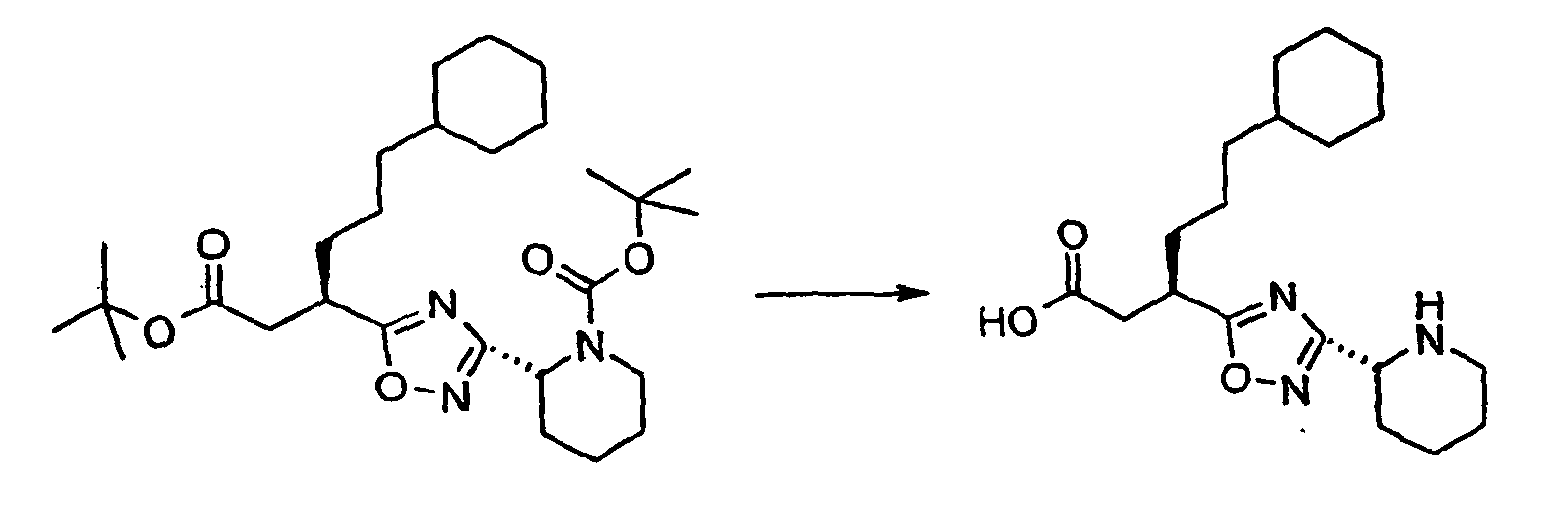
- Method as for preparation 7 using tert-butyl (2S)-2-{5-[(1R)-1-(2-tert-butoxy-2-oxoethyl)-4-cyclohexylbutyl]-1,2,4-oxadiazol-3-yl}-1-piperidinecarboxylate (preparation 122) (437mg, 0.86mmol) as starting material.
1H nmr : (d6DMSO) 0.81 (2H, m), 1.05-1.30 (8H, m), 1.55-1.85 (12H, m), 2.12 (1H, d), 2.48 (2H, obs), 3.04 (1H, t), 3.23 (1H, t), 3.42 (1H, m), 4.61 (1 H, d).
MS : 348 (M-H)
CHN : Found: C57.81%; H8.42%; N10.13%; C19H31N3O3. HCl. 0.4H2O. 0.1 dioxan requires C57.97; H8.43%; N10.45% -

- Method as for preparation 5 using tert-butyl (3R)-6-cyclohexyl-3-[3-({[(4-methylphenyl)sulfonyl]oxy}methyl)-1,2,4-oxadiazol-5-yl]hexanoate (preparation 177) (730mg, 1.44mmol) and N,N-dimethylamine (2M in THF) (800µl, 1.60mmol) as starting materials. Purification: The residue was purified on a silica column eluting with DCM : MeOH (95 : 5) to afford the title compound as a pale orange oil (430mg).
1Hnmr (CDCl3) : 0.82 (2H, m), 1.05-1.35 (8H, m), 1.39 (9H, s), 1.60-1.85 (7H, m), 2.35 (6H, s), 2.63 (1H, dd), 2.85 (1H, dd), 3.46 (1H, m), 3.60 (2H, s).
MS: 402 (MNa+) -

- Method as for preparation 75 using tert-butyl (3R)-6-cyclohexyl-3-{3-[(dimethylamino)methyl]-1,2,4-oxadiazol-5-yl}hexanoate (preparation 124) (430mg, 1.14mmol) as starting material to afford the title compound as a yellow oil (495/550mg).
1Hnmr (CDCl3): 0.83 (2H, m), 1.05-1.40 (8H, m), 1.55-1.85 (7H, m), 2.74-2.99 (8H, m), 3.50 (1H, m), 4.32 (2H, s).
MS : 324 (MH+) -

- Method as for preparation 5 using tert-butyl (3R)-6-cyclohexyl-3-[3-({[(4-methylphenyl)sulfonyl]oxy}methyl)-1,2,4-oxadiazol-5-yl]hexanoate (preparation 177) (367mg, 0.72mmol) and 2-methoxyethylmethyl amine (130mg, 1.45mmol) as starting materials. Purification: The residue was purified on a silica column eluting with DCM : MeOH (96 : 4) to afford the title compound as a pale yellow oil (240mg).
1Hnmr (CDCl3) : 0.81 (2H, m), 1.10-1.30 (8H, m), 1.39 (9H, s), 1.55-1.80 (7H, m), 2.39 (3H, s), 2.61 (1H, dd), 2.74 (2H, t), 2.82 (1H, dd), 3.37 (3H, s), 3.45 (1H, m), 3.55 (2H, t), 3.82 (2H, s).
MS: 425 (MH+) -
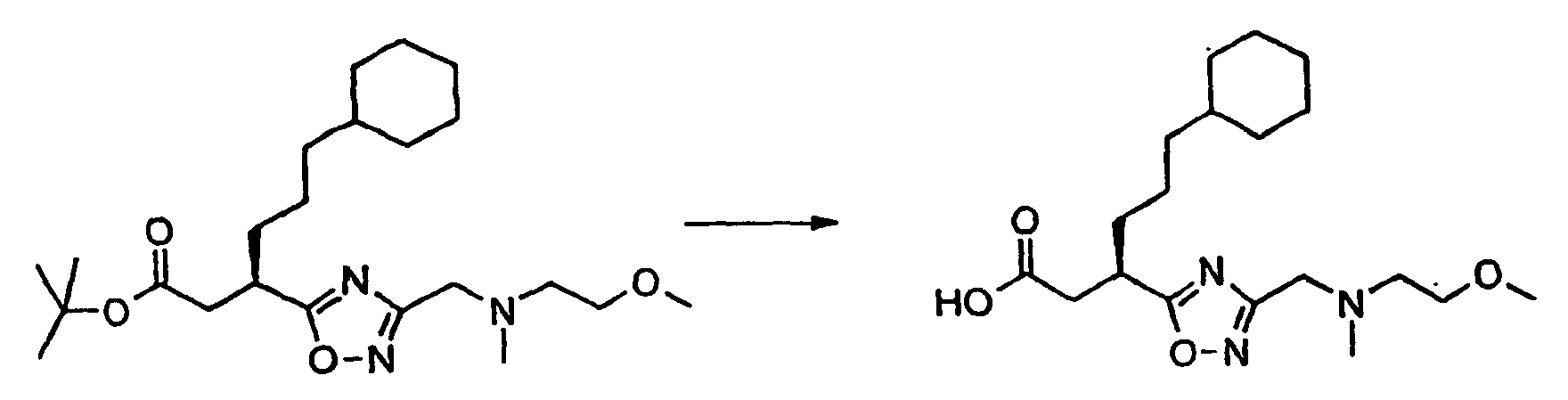
- Method as for preparation 75 using tert-butyl (3R)-6-cyclohexyl-3-(3-{[(2-methoxyethyl)(methyl)amino]methyl}-1,2,4-oxadiazol-5-yl)hexanoate (preparation 126) (240mg, 0.57mmol) as starting material to afford the title compound as a pale orange oil (294mg).
1Hnmr (CDCl3) : 0.82 (2H, m), 1.10-1.35 (8H, m), 1.60-1.85 (7H, m), 2.80 (1H, dd), 2.90 (4H, s+dd), 3.38 (5H, s), 3.51 (1H, m), 3.79 (2H, t), 4.42 (2H, s).
MS: 368 (MH+) -

- Method as for preparation 5 using tert-butyl (3R)-6-cyclohexyl-3-[3-({[(4-methylphenyl)sulfonyl]oxy}methyl)-1,2,4-oxadiazol-5-yl]hexanoate (preparation 177) (500mg, 0.99mmol) and N,N,N'-trimethylethylenediamine (200mg, 1.98mmol) as starting materials to afford the title compound as a colourless oil (241 mg).
1Hnmr (CDCl3) : 0.80 (2H, m), 1.05-1.25 (8H, m), 1.38 (9H, s), 1.55-1.75 (7H, m), 2.22 (6H, s), 2.35 (3H, s), 2.45 (2H, t), 2.60 (3H, m), 2.79 (1H, dd), 3.41 (1H, m), 3.77 (2H, s).
MS : 437 (MH+) -
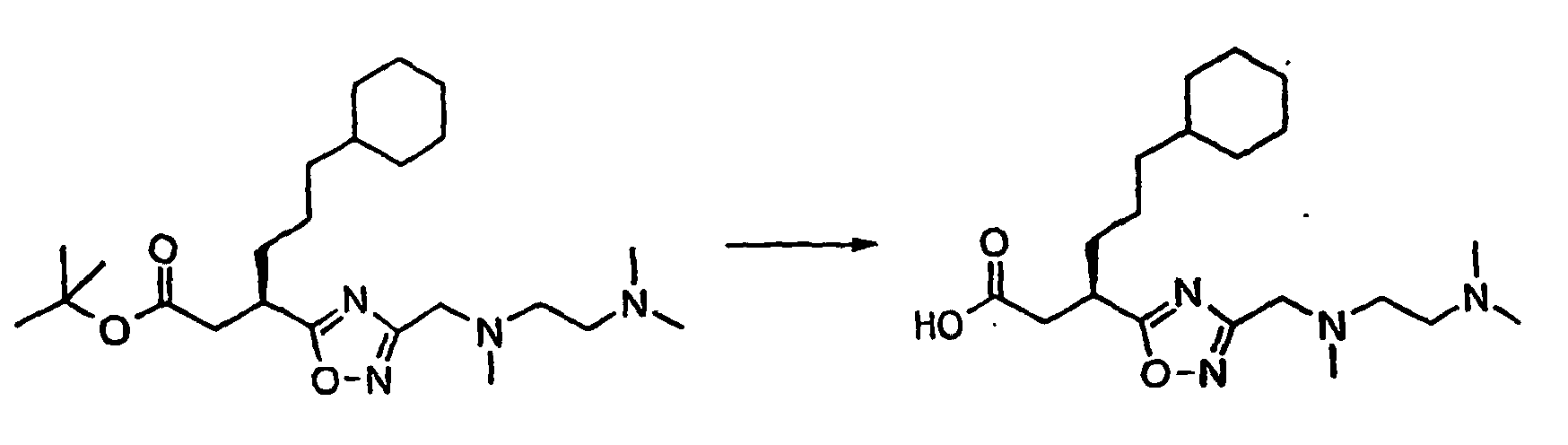
- Method as for preparation 75 using tert-butyl (3R)-6-cyclohexyl-3-(3-{[[2-(dimethylamino)ethyl](methyl)amino]methyl}-1,2,4-oxadiazol-5-yl)hexanoate (preparation 128) (241mg, 0.55mmol) as starting material to afford the title compound as a pale brown oil.
1Hnmr (d6DMSO) : 0.79 (2H, m), 1.00-1.25 (8H, m), 1.50-1.70 (7H, m), 2.28 (3H, s), 2.75 (8H, m), 3.21 (3H, m), 3.39 (1H, m), 3.82 (2H, s). -

- Method as for preparation 106 using tert-butyl (3R)-6-cyclohexyl-3-{3-[(methylamino)methyl]-1,2,4-oxadiazol-5-yl}hexanoate (preparation 5) (244mg, 0.67mmol) and 2-bromoacetamide (95mg, 0.69mmol) as starting materials and Et3N as the base to afford the title compound as a colourless oil (296mg).
1H nmr: (CDCl3) 0.85 (2H, m), 1.10-1.35 (8H, m), 1.40 (9H, s), 1.55-1.80 (7H, m), 2.40 (3H, s), 2.61 (1H. dd), 2.79 (1H, dd), 3.19 (2H, s), 3.42 (1H, m), 3.75 (2H, s), 5.35 (1H, brs), 7.20 (1H, brs).
MS : 445 (MNa+) -
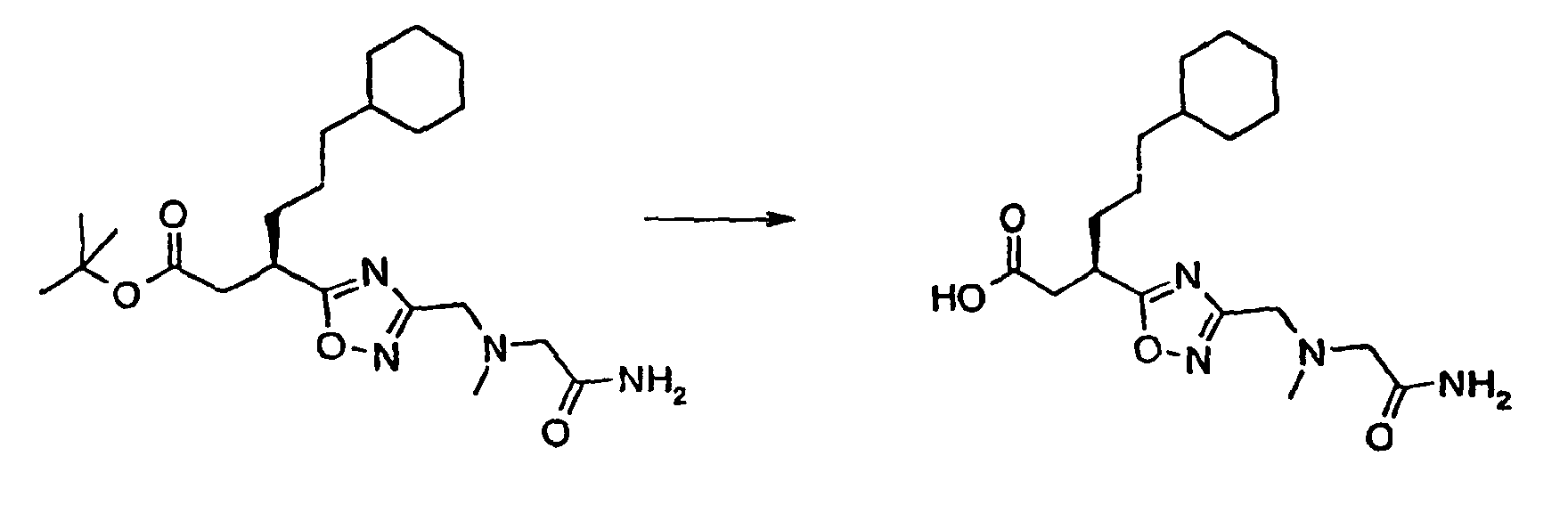
- Method as for preparation 7 using tert-butyl (3R)-3-(3-{[(2-amino-2-oxoethyl)(methyl)amino]methyl}-1,2,4-oxadiazol-5-yl)-6-cyclohexylhexanoate (preparation 130) as starting material to afford the title compound as a yellow oil (250mg).
1H nmr : (CD3OD) 0.85 (2H, m), 1.10-1.40 (8H, m), 1.60-1.80 (7H, m), 2.81 (1H, dd), 2.90 (1H, dd), 3.02 (3H, s), 3.54 (1H, m), 4.08 (2H, s), 4.62 (2H, s).
MS : 389 (MNa+)
CHN : Found: C53.94%; H8.17%; N11.71%; C18H30N4O4. HCl. 0.7 dioxan requires C53.77; H7.94%; N12.06% -

- Method as for preparation 106 using tert-butyl (3R)-6-cyclohexyl-3-{3-[(methylamino)methyl]-1,2,4-oxadiazol-5-yl}hexanoate (preparation 5) (1.50g, 4.10mmol) and ethyl bromoacetate (460µl, 4.10mmol) as starting materials.
Purification: The crude material was purified on a silica column eluting with hexane: Et2O (1 : 1) to afford the title compound as a colourless oil (1.04g, 55%).
1H nmr: (CDCl3) 0.84 (2H, m), 1.10-1.35 (11H, m), 1.40 (9H, s), 1.60-1.80 (7H, m), 2.48 (3H, s), 2.60 (1H, dd), 2.80 (1H, dd), 3.41 (3H, s+m), 3.97 (2H, s), 4.19 (2H, q).
MS: 474 (MNa+)
CHN : Found: C63.65%; H9.17%; N9.04%; C24H41N3O5 requires C63.83; H9.15%; N9.30% -

- A solution of tert-butyl (3R)-6-cyclohexyl-3-(3-{[(2-ethoxy-2-oxoethyl)(methyl)amino]methyl}-1,2,4-oxadiazol-5-yl)hexanoate (preparation 132) (1.00g, 2.21 mmol) in dioxan (20ml) and H2O (20ml) was treated with LiOH.H2O (193mg, 2.21 mmol) and the reaction mixture stirred at room temperature for 19 hours. The solvent was removed under reduced pressure. The residue was dissolved in EtOAc and washed with brine. The aqueous was extracted with EtOAc (x3). The combined organic extracts were dried over anhydrous Na2SO4 and filtered. The solvent was removed under reduced pressure to afford the title compound as a white foam (1.13g).
1H nmr : (CDCl3) 0.82 (2H, m), 1.05-1.30 (8H, m), 1.39 (9H, s), 1.55-1.80 (7H, m), 2.23 (3H, s), 2.61 (1H, dd), 2.82 (1H, dd), 3.04 (2H, s), 3.41 (1H, m), 3.75 (2H, s).
MS : 446 (MNa+) -

- Method as for preparation 56 using [({5-[(1R)-1-(2-tert-butoxy-2-oxoethyl)-4-cyclohexylbutyl]-1,2,4-oxadiazol-3-yl}methyl)(methyl)amino]acetic acid (preparation 133) (618mg, 1.46mmol) and methylamine (2M in THF) (1.4ml, 2.80mmol) as starting materials.
Purification: The crude material was purified on a silica column eluting with a solvent gradient of DCM : MeOH (95 : 5) gradually changing to (90 : 10) to afford the title compound as a colourless oil (455mg).
1H nmr : (CDCl3) 0.82 (2H, m), 1.05-1.30 (8H, m), 1.39 (9H, s), 1.55-1.80 (7H, m), 2.39 (3H, s), 2.61 (1H, dd), 2.79 (1H, dd), 2.81 (3H, s), 3.18 (2H, s), 3.42 (1H, m), 3.71 (2H, s).
MS : 459 (MNa+) -

- Method as for preparation 7 using tert-butyl (3R)-6-cyclohexyl-3-[3-({methyl[2-(methylamino)-2-oxoethyl]amino}methyt)-1,2,4-oxadiazol-5-yl]hexanoate (preparation 134) (435mg) as starting material to afford the title compound as a pale yellow solid.
1H nmr : (CD3OD) 0.86 (2H, m), 1.10-1.40 (8H, m), 1.60-1.80 (7H, m), 2.80 (3H, s), 2.82 (1H, dd), 2.89 (1H, dd), 3.00 (3H, s), 3.53 (1H, m), 4.00 (2H, s), 4.60 (2H, s).
MS : 403 (MNa+) -
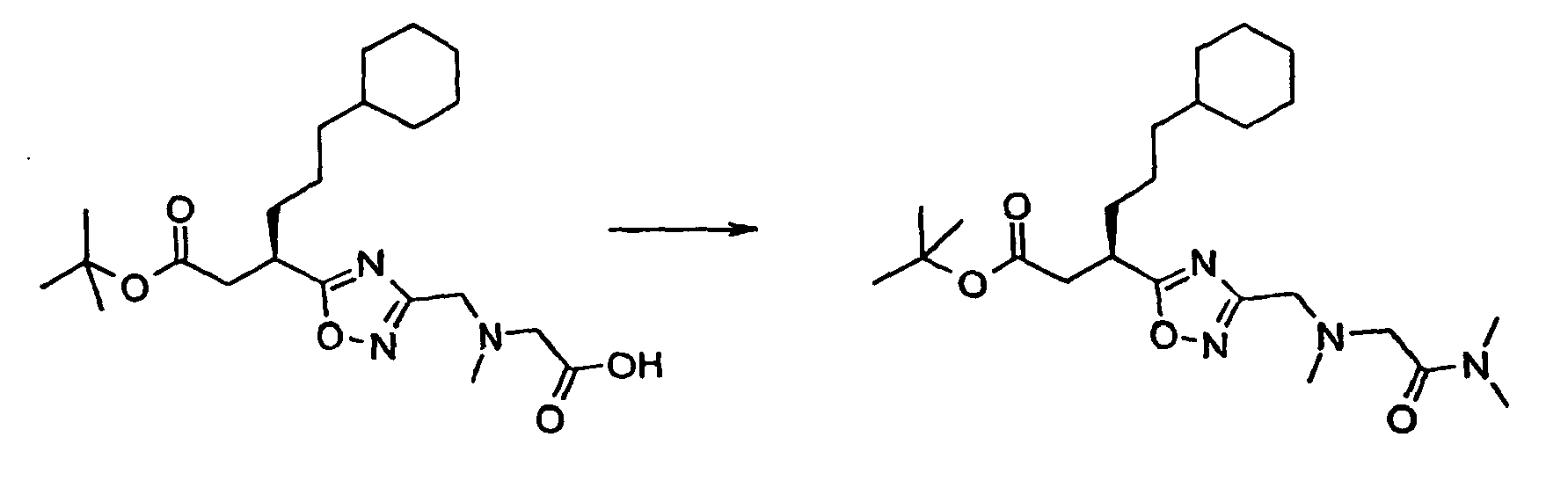
- Method as for preparation 56 using [({5-[(1R)-1-(2-tert-butoxy-2-oxoethyl)-4-cyclohexylbutyl]-1,2,4-oxadiazol-3-yl}methyl)(methyl)amino]acetic acid (preparation 133) (725mg, 1.71mmol) and Me2NH.HCl (106mg, 1.30mmol) as starting materials.
Purification: The crude material was purified on a silica column eluting with DCM : MeOH (19 : 1) to afford the title compound as a colourless oil (504mg).
1H nmr : (CDCl3) 0.82 (2H, m), 1.05-1.30 (8H, m), 1.39 (9H, s), 1.60-1.80 (7H, m), 2.41 (3H, s), 2.60 (1H, dd), 2.79 (1H, dd), 2.94 (3H, s), 3.00 (3H, s), 3.39 (2H, s), 3.42 (1H, m), 3.81 (2H, s).
MS : 473 (MNa+) -

- Method as for preparation 7 using tert-butyl (3R)-6-cyclohexyl-3-(3-{[[2-(dimethylamino)-2-oxoethyl](methyl)amino]methyl}-1,2,4-oxadiazol-5-yl)hexanoate (preparation 136) (489mg) as starting material to afford the title compound as pale yellow gum (439mg).
1H nmr : (CD3OD) 0.85 (2H, m), 1.10-1.40 (8H, m), 1.60-1.80 (7H, m), 2.82 (2H, m), 2.99 (6H, d), 3.01 (3H, s), 3.55 (1H, m), 4.31 (2H, s), 4.61 (2H, s).
MS : 395 (MH+) -
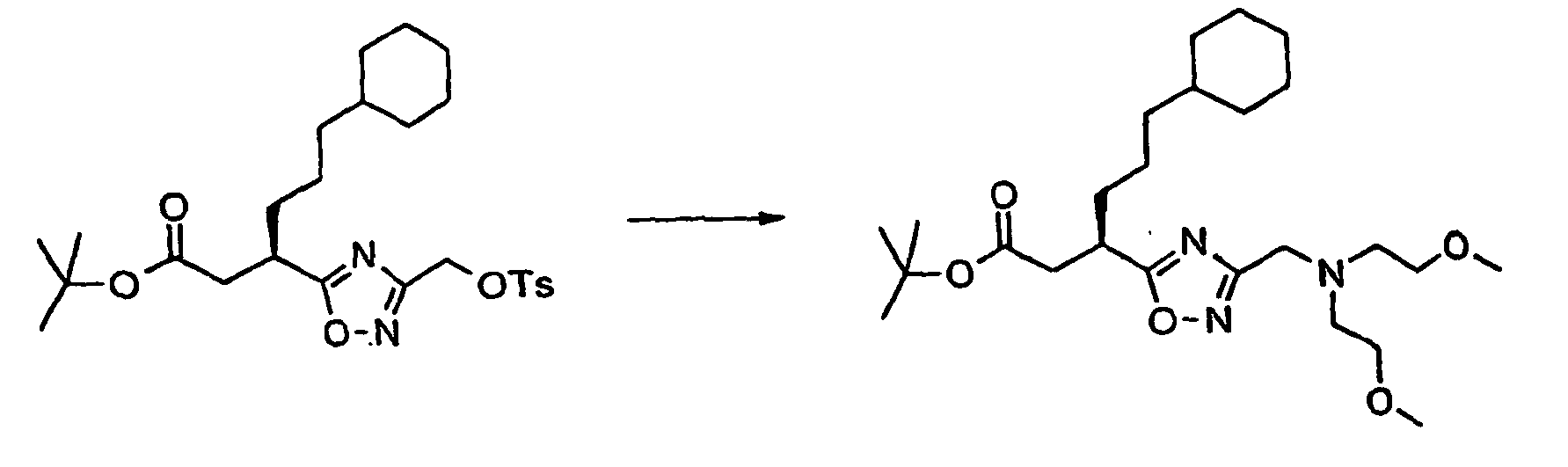
- Method as for preparation 5 using tert-butyl (3R)-6-cyclohexyl-3-[3-({[(4-methylphenyl)sulfonyl]oxy}methyl)-1,2,4-oxadiazol-5-yl]hexanoate (preparation 177) (500mg, 0.99mmol) and bis-(2-methoxyethyl)amine (280µl, 1.98mmol) as starting materials. Purification: The residue was purified on a silica column eluting with a solvent gradient of DCM : MeOH (99 : 1) gradually changing to (97 : 3) to afford the title compound as a colourless oil (220mg).
1Hnmr (CDCl3) δ: 0.81 (2H, m), 1.10-1.30 (8H, m), 1.39 (9H, s), 1.60-1.85 (7H, m+H2O), 2.61 (1H, dd), 2.79 (1H, dd), 2.82 (4H, t), 3.35 (6H, s), 3.43 (1H, m), 3.50 (4H, t), 3.98 (2H, s).
MS : 468 (MH+) -

- Method as for preparation 75 using tert-butyl (3R)-3-(3-{[bis(2-methoxyethyl)amino]methyl}-1,2,4-oxadiazol-5-yl)-6-cyclohexylhexanoate (preparation 138) (220mg, 0.46mmol) as staring material to afford the title compound as a yellow oil (176mg).
1Hnmr (CDCl3) δ : 0.80 (2H, m), 1.05-1.35 (8H, m), 1.55-1.85 (7H, m), 2.79 (1H, dd), 2.92 (1H, dd), 3.34 (6H, s), 3.42 (4H, t), 3.51 (1H, m), 3.79 (4H, t), 4.60 (2H, s). -

- Method as for preparation 5 using tert-butyl (3R)-6-cyclohexyl-3-[3-({[(4-methylphenyl)sulfonyl]oxy}methyl)-1,2,4-oxadiazol-5-yl]hexanoate (preparation 177) (126mg, 0.25mmol) and pyrrolidine (100µl, 1.20mmol) as starting materials.
Purification: The crude material was purified on a silica column eluting with DCM : MeOH (98 : 2) to afford the title compound as a colourless oil (99mg).
1Hnmr (CDCl3) : 0.82 (2H, m),1.05-1.35 (8H, m), 1.39 (9H, s),1.50-1.85 (11H, m), 2.62 (5H, m), 2.83 (1H, dd), 3.46 (1H, m), 3.77 (2H, s).
MS : 428 (MNa+) -

- Method as for preparation 75 using tert-butyl (3R)-6-cyclohexyl-3-[3-(1-pyrrolidinylmethyl)-1,2,4-oxadiazol-5-yl]hexanoate (preparation 140) (99mg, 0.24mmol) as starting material to afford the title compound as a colourless oil (85mg).
1Hmnr (CDCl3) : 0.82 (2H, m), 1.00-1.35 (10H, m), 1.55-1.85 (7H, m), 2.00-2.20 (4H, m), 2.97-2.71 (2H, m), 3.51 (1H, m), 4.38 (2H, s).
MS: 349 (M+) -

- Method as for preparation 5 using tert-butyl (3R)-6-cyclohexyl-3-[3-({[(4-methylphenyl)sulfonyl]oxy}methyl)-1,2,4-oxadiazol-5-yl]hexanoate (preparation 177) (500mg, 0.99mmol) and N-hydroxypiperidine (150mg, 1.48mmol) as starting materials. Purification: The crude material was purified on a silica column eluting with DCM : MeOH (95 : 5) to afford the title compound as a pale yellow oil (366mg).
1Hnmr (CDCl3) : 0.83 (2H, m), 1.05-1.35 (8H, m), 1.39 (9H, s), 1.60-1.80 (9H, m), 1.90 (2H, m), 2.31 (2H, m), 2.63 (1 H, dd), 2.83 (3H, m), 3.45 (1H, m), 3.67 (3H, m),
MS: 436 (MH+) -
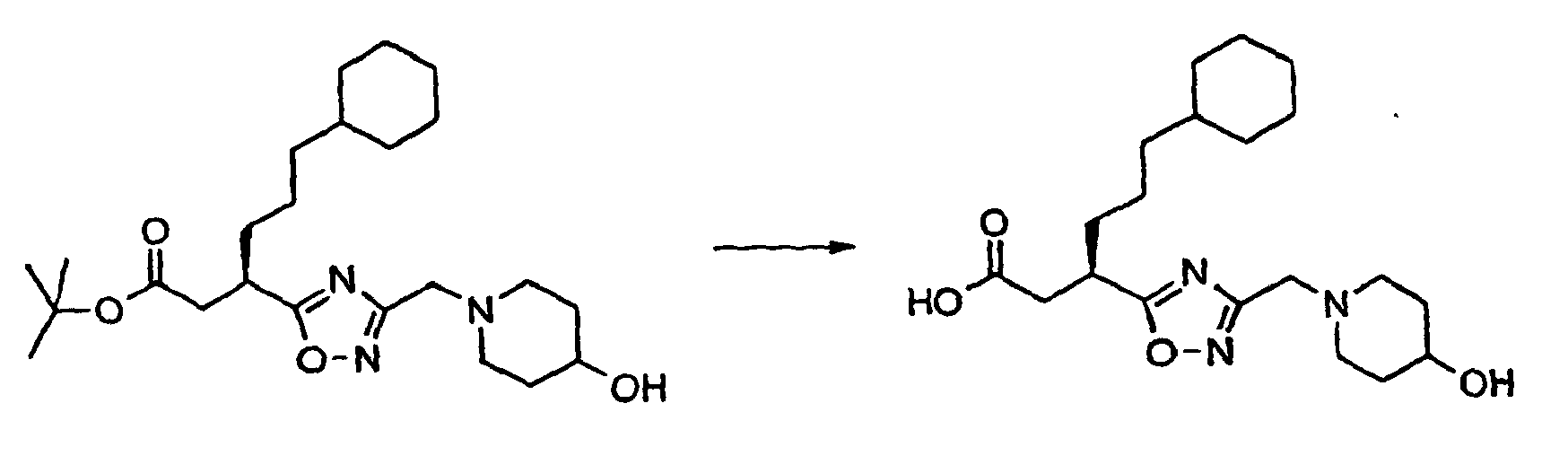
- Method as for preparation 75 using tert-butyl (3R)-6-cyclohexyl-3-{3-[(4-hydroxy-1-piperidinyl)methyl]-1,2,4-oxadiazol-5-yl}hexanoate (Preparation 142) (366mg, 0.84mmol) as starting material to afford the title compound as a pale yellow oil (460mg).
1Hnmr (CDCl3) : 0.85 (2H, m), 1.05-1.40 (8H, m), 1.60-1.85 (7H, m), 1.92 (2H, m), 2.20 (2H, m), 2.79 (1H, dd), 2.90 (1H, dd), 3.59-3.12 (5H, m), 4.16 (1H, m), 4.34 (2H, m),
MS: 380 (MH+) -

- Method as for preparations 2 and 3 combined using 2-[2-(tert-butoxy)-2-oxoethyl]-5-cyclohexylpentanoic acid (preparation 168) (1.00g, 3.36mmol) and N-hydroxy-2-(4-morpholinyl)ethanimidamide (J. Org. Chem.; 1958, 23, 1112) (534mg, 3.36mmol) as starting material.
Purification: The crude material was purified on a silica column eluting with DCM : MeOH (95 : 5) to afford the title compound as a colourless oil (150mg)
1Hnmr (CDCl3) : 0.83 (2H, m), 1.05-1.35 (8H, m), 1.39 (9H, s), 1.40-1.80 (7H, m), 2.50-2.70 (5H, m), 2.83 (1H, dd), 3.46 (1H, m), 3.66 (2H, s), 3.73 (4H, m)
MS : 422 (MH+), 444 (MNa+) -

- Method as for preparation 75 using tert-butyl (3R)-6-cyclohexyl-3-[3-(4-morpholinylmethyl)-1,2,4-oxadiazol-5-yl]hexanoate (Preparation 144) (150mg, 0.36mmol) as starting material to afford the title compound as a pale brown oil (120mg).
1Hnmr (CDCl3) δ: 0.84 (2H, m), 1.05-1.40 (8H, m), 1.55-1.85 (7H, m), 2.76 (1H, dd), 2.90 (1H, dd), 3.22 (4H, m), 3.47 (1H, m), 3.92 (4H, m), 4.28 (2H, m), 9.80 (1H, br s)
MS : 366 (MH+) -

- Method as for preparation 5 using tert-butyl (3R)-6-cyclohexyl-3-[3-({[(4-methylphenyl)sulfonyl]oxy}methyl)-1,2,4-oxadiazol-5-yl]hexanoate (preparation 168) (598mg, 1.18mmol) and N-methylpiperazine (120mg, 1.18mmol) as starting materials.
Purification: The crude material was purified on a silica column eluting with DCM : MeOH : NH3 (95 : 5 : 0.5) to afford the title compound as a pale orange oil (395mg).
1Hnmr (CDCl3) : 0.83 (2H, m), 1.05-1.35 (8H, m), 1.40 (9H, s), 1.60-1.80 (7H, m), 2.29 (3H, s), 2.35-2.75 (9H, m), 2.83 (1H, dd), 3.45 (1H, m), 3.68 (2H, s)
MS : 436 (M2H+) -

- Method as for preparation 75 using tert-butyl (3R)-6-cyclohexyl-3-{3-[(4-methyl-1-piperazinyl)methyl]-1,2,4-oxadiazol-5-yl}hexanoate (Preparation 146) (395mg, 0.91mmol) as starting material to afford the title compound as a foam (585mg).
1Hnmr (CDCl3) : 0.84 (2H, m), 1.10-1.40 (8H, m), 1.60-1.85 (7H, m), 2.75-2.95 (5H, m), 3.00-3.25 (4H, m), 3.45-3.70 (3H, m), 4.05 (2H, m)
MS: 379 (MH+) -

- Method as for preparation 1 using 2-(1H-1,2,4-triazol-1-yl)acetonitrile (J.Org.Chem. USSR, 18; 2; 1982; 407) (2.16g, 20mmol) as starting material. The crystalline precipitate was filtered off and washed with cold MeOH and Et2O to afford the title compound (2.37g)
1Hnmr (d6DMSO) : 4.72 (2H, s), 5.54 (2H, br s), 7.93 (1H, s), 8.46 (1H, s), 9.29 (1H, s), -

- Method as for preparation 2 and 3 combined using 2-[2-(tert-butoxy)-2-oxoethyl]-5-cyclohexylpentanoic acid (preparation 168) (2.98g, 10mmol) and N-hydroxy-2-(1H-1,2,4-triazol-1-yl)ethanimidamide (preparation 148) (1.01g, 10mmol) as starting materials.
Purification: The crude material was purified on a silica column eluting with a solvent gradient EtOAc : pentane (100 : 0) gradually changing to (50 : 50) to afford the title compound as a golden oil (1.10g)
1Hnmr (CDCl3) : 0.82 (2H. m), 1.05-1.40 (17H, m), 1.60-1.80 (7H, m), 2.62 (1H, dd), 2.77 (1H. dd), 3.44 (1H, m), 5.46 (2H, s), 7.96 (1H, s), 8.25 (1H, s),
MS : 404 (MH+), 426 (MNa+) -

- Nlethod as for preparation 75 using tert-butyl (3R)-6-cyclohexyl-3-[3-(1H-1,2,4-triazol-1-ylmethyl)-1,2,4-oxadiazol-5-yl]hexanoate (Preparation 149) (500mg, 1.24mmol) as starting material to afford the title compound as an oil which crystallised on standing (420mg).
1Hnmr (CDCl3) : 0.83 (2H, m), 1.05-1.40 (8H, m), 1.55-1.85 (7H, m), 2.78 (1H, dd), 2.92 (1H, dd), 3.51 (1H, m), 5.53 (2H, d), 8.06 (1H, s), 8.52 (1H, s)
MS: 346 (MH-) -
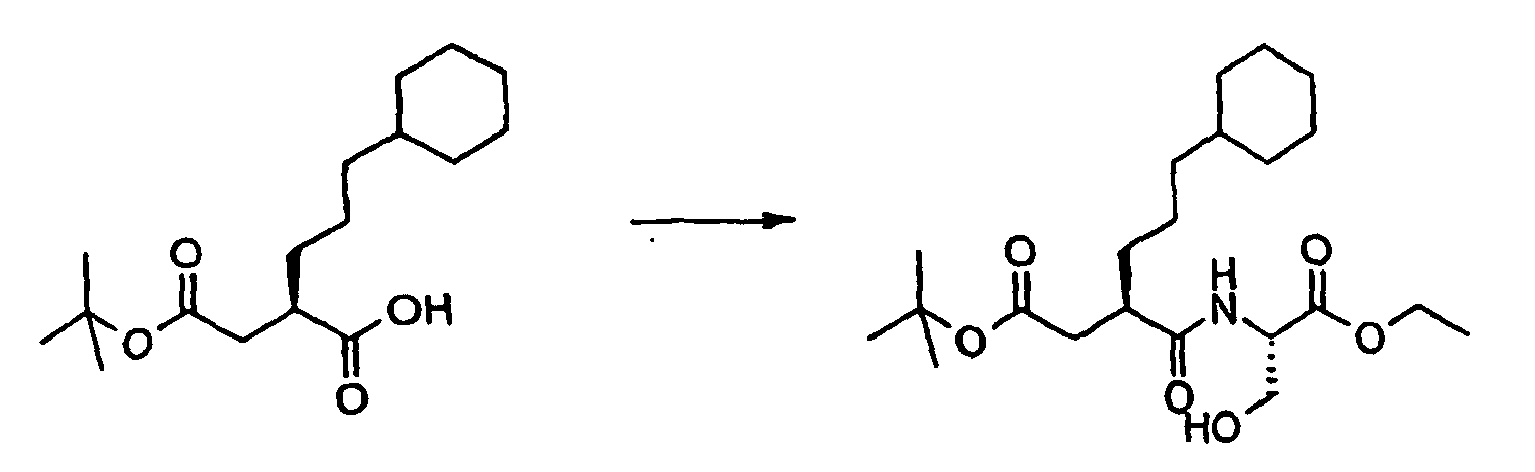
- Method as for preparation 56 using 2-[2-(tert-butoxy)-2-oxoethyl]-5-cyclohexylpentanoic acid (preparation 168) (15.0g, 50.3mmol) and L-serine (9.38g, 55.3mmol) as starting materials. Purification: The crude material was combined with another batch and purified on a silica column eluting with a solvent gradient of pentane : EtOAc (100 : 0) gradually changing to (60:40) to afford the title compound as a pale yellow oil (21.6g, 78%).
1Hnmr (CDCl3) : 0.81 (2H, m), 1.10-1.35 (11H, m), 1.40 (9H, s), 1.55-1.70 (7H, m), 2.34 (1H, dd), 2.49 (1H, m), 2.65 (1H, dd), 3.81 (1H, d), 4.01 (1H, d), 4.21 (2H, q), 4.59 (1H, m), 6.56 (1H, d).
MS : 413 (M+) -

- A solution of tert-butyl (3R)-6-cyclohexyl-3-({[(1S)-2-ethoxy-1-(hydroxymethyl)-2-oxoethyl]amino}carbonyl)hexanoate (preparation 151) (10.0g, 24.2mmol) in THF (80ml) was treated with Burgess reagent (6.34g, 26.6mmol) and heated at reflux for 1 hour. The reaction mixture was allowed to cool to room temperature and stored in a fridge for 3 days. The solvent was removed under reduced pressure. The crude material was ourififed on a silica column eluting with a solvent gradient of pentane : EtOAc (100 : 0) gradually changing to (80 : 20) to afford the title compound as a colourless oil (9.26g, 97%).
1Hnmr (CDCl3) : 0.81 (2H, m), 1.10-1.35 (11H, m), 1.40 (9H, s), 1.45-1.70 (7H, m), 2.39 (1H, dd), 2.60 (1H, dd), 2.85 (1H, m), 4.20 (2H, m), 4.30-4.45 (2H, m), 4.66 (1H, dd).
MS: 396 (MH+) -
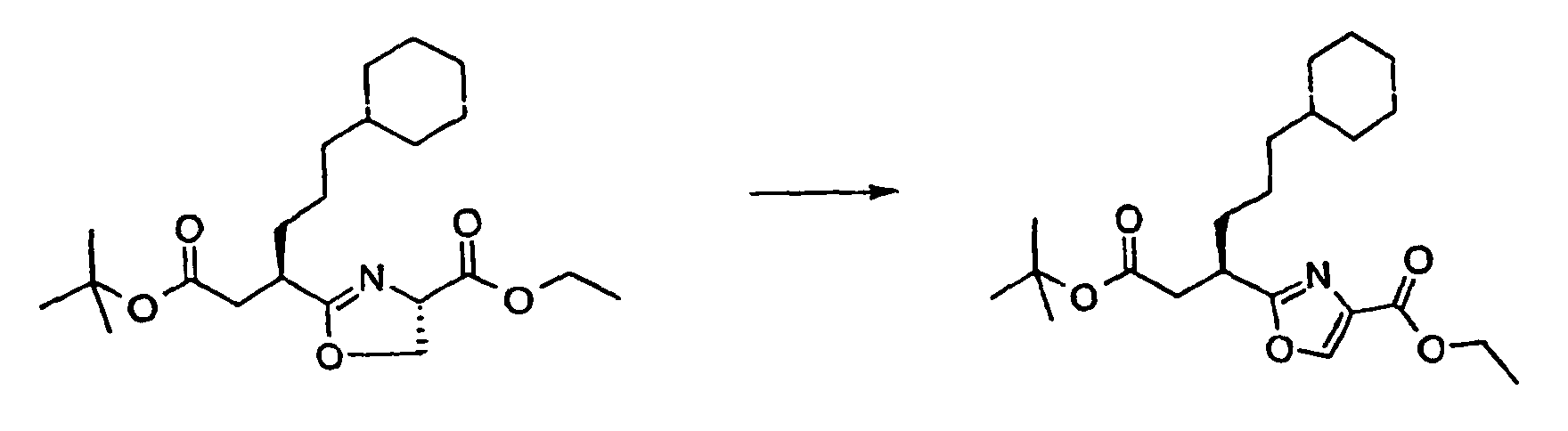
- A suspension of CuBr2 (20.88g, 93.5mmol) and HMTA (13.1g, 93.5mmol) in degassed DCM (250ml) was treated with DBU (14.0ml, 93.5mmol) and the dark solution formed was stirred in a water bath for 5 minutes. A solution of ethyl (4S)-2-[(1R)-1-(2-tert-butoxy-2-oxoethyl)-4-cyclohexylbutyl]4,5-dihydro-1,3-oxazole-4-carboxylate (preparation 152) (9.24g, 23.4mmol) In degassed DCM (30ml) was added dropwise to the reaction mixture and stirred at room temperature for a further 3 hours. The solvent was removed under reduced pressure. The resdue was dissolved in EtOAc and washed with a 1 : 1 solution of NH3(aq) : NH4Cl. The aqueous extract was washed with EtOAc (2x 380ml). The combined organic extracts were washed with 2M HCl (500ml), sat. NaHCO3 (500ml) and brine (500ml). The organic extracts were dried over anhydrous MgSO4 and filtered. The solvent was removed under reduced pressure. The crude material was purified on a silica column eluting with a solvent gradient of EtOAc : pentane (0 : 100) gradually changing to (25 : 75) to afford the title compound as colourless oil which formed needles on standing (7.39g, 80%).
1Hnmr (CDCl3) : 0.81 (2H, m), 1.10-1.30 (8H, m), 1.39 (12H, t+s), 1.55-1.80 (7H, m), 2.58 (1H. dd), 2.79 (1H, dd), 3.38 (1H, m), 4.39 (2H, q), 8.09 (1H, s). -

- Method as for preparation 11 using ethyl 2-[(1R)-1-(2-tert-butoxy-2-oxoethyl)-4-cyclohexylbutyl]-1,3-oxazole-4-carboxylate (preparation 153) (7.39g, 18.8mmol) as starting material to afford the title compound as a pale yellow oil (6.34g, 99%).
1Hnmr (CDCl3) : 0.80 (2H, m), 1.05-1.30 (8H, m), 1.38 (3H, t), 1.55-1.80 (7H, m), 2.77 (1H, dd), 2.97 (1H, dd), 3.44 (1H, m), 4.38 (2H, q), 8.15 (1H, s). -

- Method as for preparation 56 using (3R)-6-cyclohexyl-3-[4-(ethoxycarbonyl)-1,3-oxazol-2-yl]hexanoic acid (preparation 154) (2.21g, 6.55mmol) and o-benzylhydroxylamine (1.05g, (6.55mmol) as starting materials.
Purification: The crude material ws purified on a silica column eluting with a solvent gradient of pentane : EtOAc (100 : 0) gradually changing to (50 : 50) to afford the title compound as a colourless oil which solidified on standing (2.3g, 80%).
1H nmr: (CDCl3) 0.80 (2H, m), 1.10-1.30 (8H, m+EtOAc), 1.38 (3H, t), 1.55-1.75 (7H, m+H2O), 2.41 (1H, brs), 2.65 (1H, brs), 3.45 (1H, brs), 4.39 (2H, q), 4.84 (2H, s), 7.37 (5H, s), 8.08 (1H, s), 8.50 (1H, brs).
MS : 443 (MH+)
CHN : Found: C67.62%; H7.78%; N6.30%; C25H34N2O5 requires C67.85; H7.74%; N6.33% -

- A solution of ethyl 2-((1R)-1-{2-[(benzyloxy)amino]-2-oxoethyl}-4-cyclohexylbutyl)-1,3-oxazole-4-carboxylate (preparation 155) (1.50g, 3.39mmol) in toluene (50ml) at -78°C was treated dropwise with DIBAL (1 M in hexanes) (11.86ml, 11.86mmol) and stirred at this temperature for 30 minutes. MeOH (12ml) was added to quench the reaction and the reaction mixture allowed to warm to room temperature. Alternate portions of NaHCO3 and MgSO4 were added to the reaction mixture to form a white paste. EtOAc was added and the solid filtered off. The solvent was removed under reduced pressure. The crude material was purified on a silica column eluting with a solvent gradient of EtOAc : pentane (1 : 1) gradually changing to (1 : 0) to afford the title compound as a colourless oil (605mg, 45%).
1H nmr : (CDCl3) 0.80 (2H, m), 1.10-1.30 (8H, m+EtOAc), 1.55-1.70 (7H, m+H2O), 2.42 (1H, brs), 2.61 (1H, brs), 3.48 (1H, m+MeOH), 4.83 (2H, s), 7.35 (5H, s), 8.16 (1H, s), 8.43 (1H, brs), 9.81 (1H, brs).
MS : 399 (MH+) -

- A solution of (3R)-N-(benzyloxy)-6-cyclohexyl-3-(4-formyl-1,3-oxazol-2-yl)hexanamide (preparation 156) (200mg, 0.50mmol) in DCM (10ml) was treated with isopropylamine (43µl, 0.50mmol) and stirred at room temperature for 15 minutes. NaHB(OAc)3 (170mg, 0.80mmol) and AcOH (29µl, 0.50mmol) were added and the reaction mixture stirred at room temperature for 1 hour. The reaction mixture was diluted with DCM and washed with sat. NaHCO3 solution followed by brine. The organic extract was dried over anhydrous MgSO4 and filtered. The solvent was removed under reduced pressure. The crude material was purified on a silica column eluting with a solvent gradient of DCM : MeOH : NH3 (100 : 0 : 0) gradually changing to (95 : 5 : 0.5) to afford the title compound asa colourless oil (75mg, 32%).
1H nmr: (CDCl3) 0.80 (2H, m), 1.00-1.30 (14H, d+m), 1.55-1.75 (7H, m), 2.40 (1H, brs), 2.59 (1H, brs), 2.80 (1H, m), 3.35 (1 H, brs), 3.59 (2H, s), 4.81 (2H, s), 7.37 (5H, s), 7.39 (1H, s), 8.50 (1H, s).
MS : 442 (MH+) -

- Method and purification as for preparation 157 using (3R)-N-(benzyloxy)-6-cyclohexyl-3-(4-formyl-1,3-oxazol-2-yl)hexanamide (preparation 156) (200mg, 0.50mmol) and cyclopentylamine (50µl, 0.50mmol) as starting materials to afford the title compound as a colourless oil (122mg, 48%).
1H nmr: (CDCl3) 0.80 (2H, m), 1.05-1.30 (8H, m), 1.34 (2H, m), 1.50 (2H, m), 1.55-1.75 (9H, m), 1.80 (2H, m), 2.40 (1H, brs), 2.59 (1H, brs), 3.03 (1H, m), 3.35 (1H, brs), 3.58 (2H, s), 4.82 (2H, s), 7.34 (5H, s), 7.38 (1H, s).
MS : 468 (MH+) -

- Method and purification as for preparation 157 using (3R)-N-(benzyloxy)-6-cyclohexyl-3-(4-formyl-1,3-oxazol-2-yl)hexanamide (preparation 156) (180mg, 0.45mmol) and morpholine (40µl, 0.45mmol) as starting materials to afford the title compound as a colourless oil (130mg, 62%).
1H nmr : (CDCl3) 0.80 (2H, m), 1.05-1.30 (8H, m), 1.55-1.75 (9H, m), 2.37 (1H, brs), 2.41 (4H, brs), 2.60 (1H, brs), 3.38 (2H, brs), 3.46 (1H, m), 3.35 (1H, brs), 3.66 (4H, brs), 4.82 (2H, s), 7.37 (5H, s), 7.40 (1H, s), 8.77 (1H, brs).
MS : 470 (MH+) -

- Method as for preparation 156 using methyl 2-((1R)-1-{2-[(benzyloxy)amino]-2-oxoethyl}-4-cyclohexylbutyl)-5-methyl-1,3-oxazole-4-carboxylate (preparation 175) (1.86g, 4.20mmol) as starting material.
Purification: The crude material was purified on a silica column eluting with EtOAc : pentane (1 : 1) to afford the title compound as a colourless oil (1.06g, 61%).
1H nmr : (CDCl3) 0.81 (2H, m), 1.05-1.30 (8H, m+EtOAc), 1.55-1.75 (7H, m), 2.46 (1H, brs), 2.55 (3H, s), 2.66 (1H, brs), 3.39 (1H, brs), 4.82 (2H, s), 7.33 (5H, brs), 9.81 (1H, brs).
MS: 413 (MH+) -

- Method as for preparation 157 using (3R)-N-(benzyloxy)-6-cyclohexyl-3-(4-formyl-5-methyl-1,3-oxazol-2-yl)hexanamide (preparation 160) (300mg, 0.73mmol) and 4-aminotetrahydro-4H-pyran. HCl (J. Med. Chem.; 1971, 14, 600-14) (110mg, 0.80mmol) as starting materials and DIPEA as base.
Purification: The crude material was purified on a silica column eluting with a solvent gradient of DCM : MeOH : NH3 (98 : 2 : 0.2) gradually changing to (95 : 5 : 0.5) to afford the title compound as a colourless oil (222mg, 61 %).
1H nmr : (CDCl3) 0.82 (2H, m), 1.10-1.30 (8H, m), 1.38-1.70 (9H, m+H2O), 1.79 (2H, brd), 2.21 (3H, s), 2.41 (1H, m), 2.65 (2H, m), 3.27 (1 H, brs), 3.38 (2H, t), 3.58 (2H, s), 3.95 (2H, m), 4.83 (2H, s), 7.35 (5H, s).
MS : 499 (M2H+) -

- Method as for preparation 157 using (3R)-N-(benzyloxy)-6-cyclohexyl-3-(4-formyl-5-methyl-1,3-oxazol-2-yl)hexanamide (preparation 160) (300mg, 0.73mmol) and morpholine (64µl, 0.73mmol) as starting materials.
Purification: The crude material was purified on a silica column eluting with a solvent gradient of DCM: MeOH : NH3 (100 : 0 : 0) gradually changing to (95 : 5 : 0.5) to afford the title compound as a colourless oil (156mg, 44%).
1H nmr : (CDCl3) 0.82 (2H, m), 1.05-1.35 (8H, m), 1.50-1.75 (7H, m), 2.21 (3H, s), 2.40 (5H, m), 2.62 (1H, brs), 3.23 (3H, m), 3.63 (4H, m), 4.83 (2H, s), 7.34 (5H, s).
MS : 484 (MH+)
Acc. Mass. : Found 484.3164 (MH+), Calculated C28H41N3O4 484.3175 (MH+) -

- Method as for preparation 7 using (3R)-3-[3-(aminomethyl)-1,2,4-oxadiazol-5-yl]-6-cyclohexylhexanoate (preparation 18) (220mg, 0.63mmol) as starting material.
Purification: The crude material was azeotroped from EtOAc, DCM and Et2O and dried under reduced pressure to afford the title compound (192mg, 92%).
1H nmr: (d6DMSO) 0.80 (2H, m), 1.05-1.30 (8H, m), 1.50-1.70 (7H, m), 2.75 (2H, d), 3.42 (1H, m), 4.20 (2H, s), 8.72 (2H, brs).
MS : 296 (MH+)
CHN : Found: C54.04%; H7.95%; N12.00%; C15H25N3O3. HCl. 0.1 EtOAc requires C54.30; H7.93%; N12.34% -
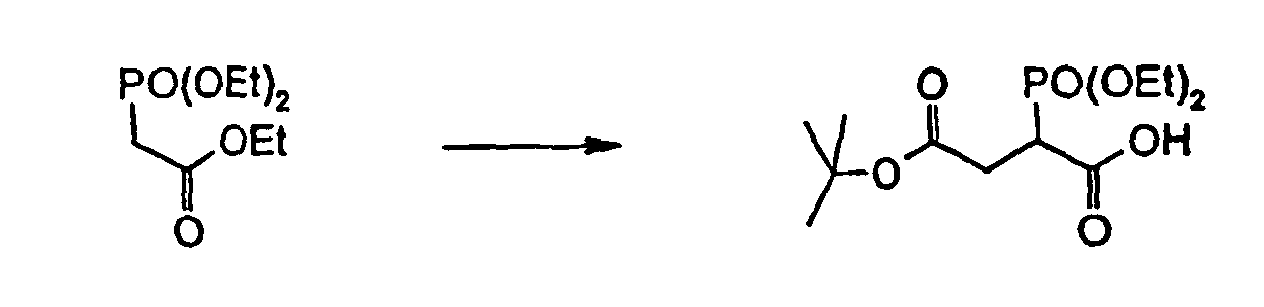
- Triethylphosphonoacetate (12.0Kg, 53.5 mol) was added over 30 minutes to a stirred solution of potassium tert-butoxide (7.20Kg, 64.2 mol) in THF (118 litres), between 0 and 5°C, under nitrogen. The mixture was warmed to 25-30°C where it was stirred for 1 hour and then added over 45 minutes to a solution of tert-butyl bromoacetate (11.5Kg, 59.0 mol) in THF (28 litres), between 0 and 5°C, under nitrogen. The mixture was stirred at 0-5°C for 1 hour and then demineralised water (6.1 litres) and ethanol (30 litres) were added. A solution of potassium hydroxide (4.2Kg, 75.0 mol) in demineralised water (84 litres) was then added over 2 hours, between -5 and 0°C. The mixture was stirred at -10°C for 16 hours and then a solution of citric acid (16.5Kg, 85.8 mol) in demineralised water (32 litres) was added. The mixture was concentrated in vacuo to a volume of 180 litres and then ethyl acetate (90 litres) was added. The organic phase was separated and the aqueous phase was re-extracted with ethyl acetate (30 litres). The combined organic phases were washed with water (30 litres) and then stripped and replaced with cyclohexane by distillation at atmospheric pressure, at a constant volume of 72 litres. tert-Butylmethyl ether (18 litres) was added and the mixture was stirred at ambient temperature for 12 hours and then filtered. The residue was washed with a mixture of cyclohexane (16 litres) and tert-butylmethyl ether (3.6 litres) then dried in vacuo for 16 hours to give the title compound as a colourless solid (10.0Kg, 60% yield, 98% pure by HPLC).
1H-NMR (CDCl3) δ : 4.20-4.10 (4H, m), 3.49-3.36 (1H, m), 3.00-2.85 (1H, m), 2.72-2.60 (1H, m), 1.20 (9H, s), 1.37-1.27 (6H, m) -
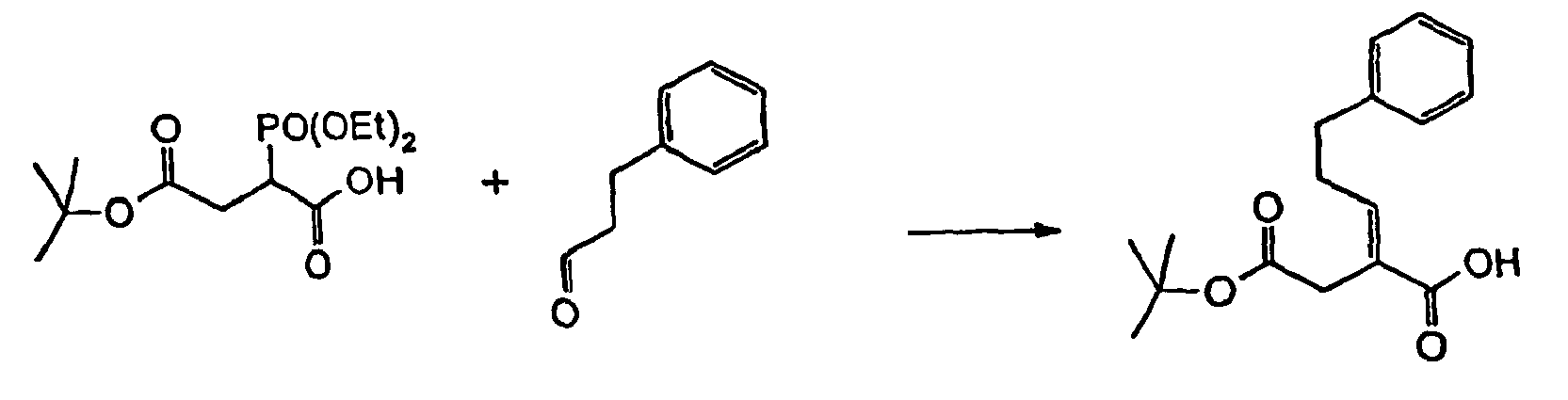
- A solution of 3-(diethoxyphosphoryl)succinic acid 1-tert-butyl ester (Preparation 164,100g, 0.32mol) in THF (300ml) was added dropwise over 15 min to a stirred solution of potassium tert-butoxide (110g, 0.98mol) in THF (300ml), between -10 and -5°C, under nitrogen. The mixture was stirred at -10°C for 15 min and then a solution of hydrocinnamaldehyde (46.8g, 0.35mmol) in THF (100ml) was added dropwise over 15 min, between -13 and -8°C. The mixture was stirred at -10°C for 30 min and then a solution of citric acid (111g, 0.58mol) in demineralised water (500ml), and ethyl acetate (500ml), were added. The pH was adjusted to pH 4 with aqueous sodium hydroxide solution (50%) and the phases were separated. The aqueous fraction was washed with ethyl acetate (500ml) and the combined organic fractions were washed with saturated sodium bicarbonate solution (500ml), citric acid solution (10%, 500ml) and demineralised water (500ml) and then concentrated in vacuo. The resulting solid was slurried in cyclohexane (470ml) for 1 hour and then the mixture was filtered. The residue was washed with cyclohexane (2x50ml) and dried in vacuo to leave the title compound as a colourless solid (76g, 81% yield, 99% pure by HPLC).
MS : 289 [(M-H)]-
1H-NMR (CDCl3) δ : 7.33-7.16 (5H, m), 7.05 (1H, br t), 3.20 (2H, s), 2.89 (2H, br t), 2.50 (2H, br dd), 1.41 (9H, s) -

- A stirred solution of cyclohexylamine (266ml, 2.32 mol), (E)-2-[2-(tert-butoxy)-2-oxoethyl]-5-phenyl-2-pentenoic acid (Preparation 165, 688g, 2.37 mol) and [(S)-2,2'-bis(diphenylphosphino-1,1'-binaphthyl]chloro(p-cymene)ruthenium chloride (4.4g, 4.7 mmol) in methanol (6.9 litres) was heated to 60°C, under hydrogen (60p.s.i.), for 47 hours and then allowed to cool to room temperature (enantiomeric excess= 88%). The mixture was filtered through celite and then the solvent was stripped and replaced with acetone by distillation at atmospheric pressure, at a constant volume of 4.2 litres. The resulting suspension was cooled to room temperature where it was stirred for 4 hours and then filtered. The residue was washed with acetone (2x 1 litre) and then dried in vacuo at 45°C for 16 hours to leave the title compound as a colourless solid (590g, 64% yield, enantiomeric excess=98.9%. 97% pure by HPLC).
1H-NMR (CD3OD) δ : 7.23-7.09 (5H, m), 3.05-2.98 (1H, m), 2.64-2.56 (3H, m), 2.53 (1H, dd, J 15.2, 7.2Hz), 2.23 (1H, dd, J 15.2, 7.2Hz), 2.00-1.97, (2H, m), 1.85-1.81 (2H, m), 1.72-1.20 (10H, m), 1.40 (9H, s) -

- (R)-2-[2-(tert-Butoxy)-2-oxoethyl]-5-phenylpentanoic acid cyclohexylamine salt (Preparation 166, 6.8g, 17 mmol) and ethyl acetate (100ml) were added to an aqueous solution of citric acid (10%. 100ml) and the organic phase was separated and washed with water (100ml). /so-propyl alcohol (20ml) and 5% rhodium on alumina (51.6g) were added and the mixture was stirred at room temperature, under hydrogen (10 atmospheres, 150p.s.i.) for 48 hours and then filtered through celite. To the filtrate was added a solution of sodium hydroxide (0.67g, 17 mmol) in water and the mixture was stripped and replaced with acetonitrile by distillation at atmospheric pressure to a volume of 30ml. The mixture was allowed to cool to room temperature where it was stirred for 24 hours. The mixture was cooled to 0°C and then filtered. The residue was washed with acetonitrile (2x 10ml) and then dried in vacuo at 45°C for 2 hours to leave the title compound as a colourless solid (3.8g, 69% yield, 95% pure by NMR).
1H-NMR (CD3OD) δ: 2.62-2.57 (1H, m), 2.53 (1H, dd, J 14.8, 7.2Hz), 2.23 (1H, dd, J 14.8, 7.2Hz), 1.76-1.18 (15H, m),1.44 (9H, s), 0.93-0.82 (2H, m) -

- A solution of (2R)-2-[2-(tert-butoxy)-2-oxoethyl]-5-phenylpentanoic acid (Syn. Lett.; 1998; 637-639) (10.00g, 34.2mmol) in acetic acid (120ml) was treated with 5% Rhodium on alumina catalyst, pressurised to 60psi with hydrogen in a sealed vessel and stirred at room temperature for 17 hours. The mixture was filtered through a pad of Arbocel® and the solvent was removed from the filtrate under reduced pressure. The residue was azeotroped from toluene to afford the title compound (7.53g).
MS : 299 (MH+)
1H-NMR (CDCl3) δ : 2.80 (1H, m), 2.61 (1H, m), 2.38 (1 H, m), 1.75-1.56 (7H, m), 1.55-1.04 (17H, m), 0.84 (2H, m). -
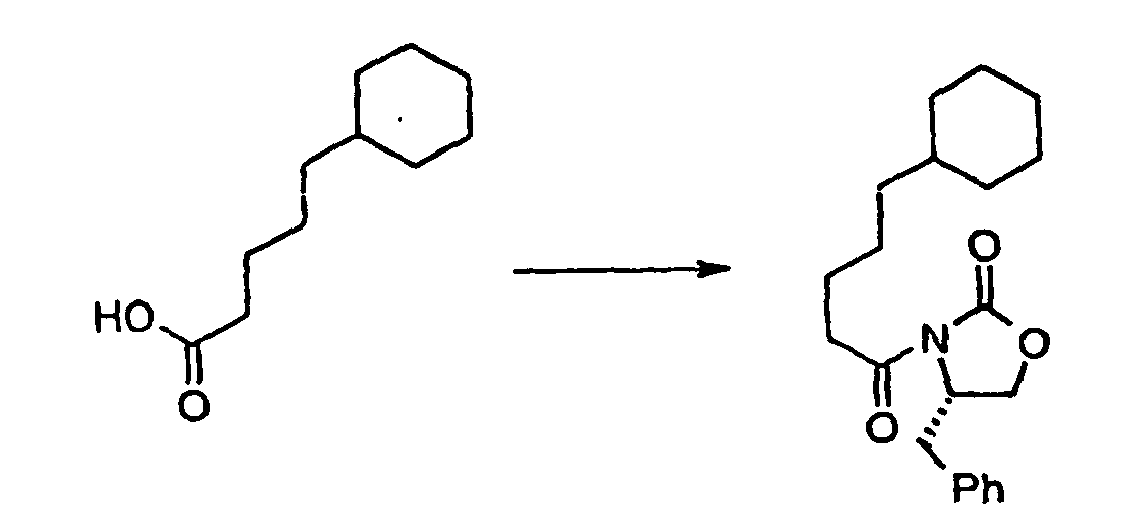
- A solution of 5-cyclohexylpentanoic acid (63.50g, 345mmol) in N,N-dimethylformamide (0.5ml) and dichloromethane (350ml) was cooled to 5°C and treated dropwise with oxalyl chloride (31.6ml, 362mmol) over 30 minutes. The mixture was stirred at 0°C for 3 hours then the solvent was removed under reduced pressure to afford 5-cyclohexylpentanoyl chloride as a pale yellow solid (70.0g).
A solution of n-butyllithium (100ml, 250mmol, 2.5M in hexanes) was added via a cannula to a solution of (4S)-4-benzyl-1,3-oxazolidin-2-one (44.30g, 250mmol) in anhydrous tetrahydrofuran (400ml) at -78°C. The yellow solution was then stirred for 45 minutes. A solution of 5-cyclohexylpentanoyl chloride (55.5g, 275mmol) in tetrahydrofuran (100ml) was then added over 1 hour. The mixture was stirred at -78°C for 30 minutes then warmed to room temperature over 1 hour. The mixture was quenched with an aqueous solution of ammonium chloride (20% w/v, 400ml) and extracted with ethyl acetate. The layers were separated and the organic layer was washed with brine, dried over anhydrous sodium sulphate and the solvent removed under reduced pressure. The solid was recrystallised from hexane (500ml) to afford the title compound as a white solid (81.0g).
MS: 344 (MH+)
1H-NMR (COCl3) δ : 7.41-7.13 (5H, m), 4.68 (1H, m), 4.27-4.02 (2H, m), 3.31 (1H, dd, J=16, 4Hz), 3.06-2.70 (3H, m), 1.81-1.53 (7H, m), 1.49-1.04 (8H, m), 0.88 (2H, m) -

- A solution of (4S)-4-benzyl-3-(5-cyclohexylpentanoyl)-1,3-oxazolidin-2-one (70.0g, 204mmol) in anhydrous tetrahydrofuran (650ml) was cooied to -70°C and treated dropwise with sodium hexamethyldisilazide (1M in tetrahydrofuran, 224ml, 224mmol) over 45 minutes. The mixture was stirred for a further 45 minutes before being treated with t-butylbromoacetate (31.6ml, 214mmol). This mixture was stirred at -70°C for 30 minutes then warmed to -30°C and quenched with an aqueous solution of ammonium chloride (20%w/v, 400ml) and warmed to room temperature. The mixture was extracted with ethyl acetate and the combined organic extracts were washed with brine, dried over anhydrous sodium sulphate and the solvent removed under reduced pressure. The solid was recrystallised from hexane to afford the title compound as a while solid (71.4g).
MS: 458(MH+)
1H-NMR (CDCl3) δ : 7.41-7.13 (5H, m), 4.66 (1H, m), 423-4.03 (3H, m), 3.35 (1H, dd, J=16, 4Hz), 2.95-2.68 (3H, m), 2.47 (1H, m), 1.80-1.07 (24H, m), 0.85 (2H, m) -

- A solution of tert-butyl 3-{[(4S)-4-benzyl-2-oxo-1,3-oxazolidin-3-yl]carbonyl}-6-cyclohexylhexanoate (64.0g, 139.9mmol) in tetrahydrofuran : water (3:1, 800ml) was cooled to 5°C then treated sequentially with hydrogen peroxide (30%w/v water, 87ml, 769mmol) then lithium hydroxide hydrate (10.0g, 238mmol). The reaction was stirred for 1 hour then quenched by dropwise addition of an aqueous solution of sodium thiosulphate (500ml) keeping the temperature below 20°C. The mixture was extracted with ethyl acetate (discarded) and the aqueous phase was acidifed to pH 2 with solid citric acid and extracted with ethyl acetate. The combined organic phases were washed with brine, dried over anhydrous sodium sulphate and the solvent removed under reduced pressure. The residue was purified by column chromatography on silica gel eluting with a gradient system of hexane : ethyl acetate (2 : 1) gradually changing to hexane : ethyl acetate (1 : 1) to afford the title compound (40.7g)
-

- Triethylphosphonoacetate (102g, 0.45 mol) was added dropwise over 11 min to a stirred solution of potassium tert-butoxide (60g, 0.54 mol) in THF (500ml), at 0°C, under nitrogen. The mixture was stirred for 1 hour at 0°C and then dichloromethane (300ml) was added and the reaction mixture was warmed to 25-30°C. The mixture was stirred at 25-30°C for 1 hour and then added dropwise over 33 minutes to a solution of tert-butyl bromoacetate (96g, 0.49 mol) in THF (500ml), at 0°C, under nitrogen. The mixture was stirred at 0-5°C for 2 hours and then a solution of citric acid (174g, 0.91 mol) in demineralised water (250ml) was added. The mixture was concentrated in vacuo to remove most of the THF and then toluene (750ml) was added. The organic phase was separated, washed with brine (2x150ml) and concentrated in vacuo to leave a colourless oil. The oil was taken up in ethanol and a solution of potassium hydroxide (36.g, 0.64mol) in demineralised water (150ml) was added dropwise over 15 mins. The mixture was stirred at 0°C for 4 hours and then a solution of citric acid (158 g, 0.82 mol) in demineralised water (600ml), and toluene (600ml), were added. The organic phase was separated and the aqueous phase was re-extracted with toluene (600ml). The combined organic phases were washed with demineralised water (2x150ml) and concentrated in vacuo to leave a white solid. Toluene (150ml) was added and the slurry was re-concentrated in vacuo to leave a white solid. The product was purified by crystallisation from tert-butylmethyl ether (300ml) and cyclohexane (600ml) to give the title compound as a solid (79g).
1H-NMR (CDCl3) δ : 4.20-4.10 (4H, m), 3.49-3.36 (1H, m), 3.00-2.85 (1H, m), 2.72-2.60 (1H, m), 1.20 (9H, s), 1.37-1.27 (6H, m) - Triethylphosphonoacetate (12.0Kg, 53.5 mol) was added over 30 minutes to a stirred solution of potassium tert-butoxide (7.20Kg, 64.2 mol) in THF (118 litres), between 0 and 5°C, under nitrogen. The mixture was warmed to 25-30°C where it was stirred for 1 hour and then added over 45 minutes to a solution of tert-butyl bromoacetate (11.5Kg, 59.0 mol) In THF (28 litres), between 0 and 5°C, under nitrogen. The mixture was stirred at 0-5°C for 1 hour and then demineralised water (6.1 litres) and ethanol (30 litres) were added. A solution of potassium hydroxide (4.2Kg, 75.0 mol) in demineralised water (84 litres) was then added over 2 hours, between -5 and 0°C. The mixture was stirred at -10°C for 16 hours and then a solution of citric acid (16.5Kg, 85.8 mol) in demineralised water (32 litres) was added. The mixture was concentrated in vacuo to a volume of 180 litres and then ethyl acetate (90 litres) was added. The organic phase was separated and the aqueous phase was re-extracted with ethyl acetate (30 litres). The combined organic phases were washed with water (30 litres) and then stripped and replaced with cyclohexane by distillation at atmospheric pressure, at a constant volume of 72 litres. tert-Butylmethyl ether (18 litres) was added and the mixture was stirred at ambient temperature for 12 hours and then filtered. The residue was washed with a mixture of cyclohexane (16 litres) and tert-butylmethyl ether (3.6 litres) then dried in vacuo for 16 hours to give the title compound as a colourless solid (10.0Kg, 60%).
1H-NMR (CDCl3) δ : 4.20-4.10 (4H, m), 3.49-3.36 (1H, m), 3.00-2.85 (1H, m), 2.72-2.60 (1H, m), 1.20 (9H, s), 1.37-1.27 (6H, m) -

- A solution of 3-(diethoxyphosphoryl)succinic acid 1-tert-butyl ester (100g, 0.32mol) in THF (300ml) was added dropwise over 15 min to a stirred solution of potassium tert-butoxide (110g, 0.98mol) in THF (300ml), between -10 and -5°C, under nitrogen. The mixture was stirred at -10°C for 15 min and then a solution of hydrocinnamaldehyde (46.8g, 0.35mmol) in THF (100ml) was added dropwise over 15 min, between -13 and -8°C. The mixture was stirred at -10°C for 30 min and then a solution of citric acid (111g, 0.58mol) in demineralised water (500ml), and ethyl acetate (500ml), were added. The pH was adjusted to pH 4 with aqueous sodium hydroxide solution (50%) and the phases were separated. The aqueous fraction was washed with ethyl acetate (500ml) and the combined organic fractions were washed with saturated sodium bicarbonate solution (500ml), citric acid solution (10%, 500ml) and demineralised water (500ml) and then concentrated in vacuo. The resulting solid was slurried in cyclohexane (470ml) for 1 hour and then the mixture was filtered. The residue was washed with cyclohexane (2x50ml) and dried in vacuo to leave the title compound as a colourless solid (76g, 81%).
MS : 289 [(M-H)]-
1H-NMR (CDCl3) δ : 7.33-7.16 (5H, m), 7.05 (1 H, br t), 3.20 (2H, s), 2.89 (2H, br t), 2.50 (2H, br dd), 1.41 (9H, s) -

- A stirred solution of (E)-2-[2-(tert-butoxy)-2-oxoethyl]-5-phenyl-2-pentenoic acid (100g, 0.34mol), cyclohexylamine (39ml, 0.34mol) and [(S)-2,2'-bis(diphenylphosphino-1,1'-binaphthyl]chloro(p-cymene)ruthenium chloride (0.64g, 0.69mmol) in methanol (1000ml) was heated to 60°C, under hydrogen (60p.s.i.), for 42 hours and then allowed to cool to room temperature. The mixture was filtered through celite and then concentrated in vacuo to a yellow solid which was purified by re-crystallisation from acetone (850ml). The resulting solid was partitioned between ethyl acetate (1200ml) and citric acid solution (10%, 1200ml) and the organic phase was separated, washed with demineralised water (1200ml) and concentrated in vacuo to leave the title compound as an oil (80g).
1H-NMR (CDCl3) δ : 7.30-7.17 (5H, m), 2.85-2.78 (1 H, m), 2.66-2.58 (3H, m), 2.37 (1H, br dd), 1.75-1.51 (4H, m), 1.40 (9H, s) -

- A stirred solution of cyclohexylamine (266ml, 2.32 mol), (E)-2-[2-(tert-butoxy)-2-oxoethyl]-5-phenyl-2-pentenoic acid (688g, 2.37 mol) and [(S)-2,2'-bis(diphenylphosphino-1,1'-binaphthyl]chloro(p-cymene)ruthenium chloride (4.4g, 4.7 mmol) in methanol (6.9 litres) was heated to 60°C, under hydrogen (60p.s.i.), for 47 hours and then allowed to cool to room temperature (enantiomeric excess= 88%). The mixture was filtered through celite and then the solvent was stripped and replaced with acetone by distillation at atmospheric pressure, at a constant volume of 4.2 litres. The resulting suspension was cooled to room temperature where it was stirred for 4 hours and then filtered. The residue was washed with acetone (2x 1 litre) and then dried in vacuo at 45°C for 16 hours to leave the title compound as a colouriess solid (590g, 64%, enantiomeric excess=98.9%).
1H-NMR (CD3OD) δ : 7.23-7.09 (5H, m), 3.05-2.98 (1H, m), 2.64-2.56 (3H, m), 2.53 (1H, dd, J 15.2, 7.2Hz), 2.23 (1H, dd, J 15.2, 7.2Hz), 2.00-1.97, (2H, m), 1.85-1.81 (2H, m), 1.72-1.20 (10H, m), 1.40 (9H, s) -

- (R)-2-[2-(tert-Butoxy)-2-oxoethyl]-5-phenylpentanoic acid cyclohexylamine salt (691g, 1.77 mol) and ethyl acetate (7.0 litres) were added to an aqueous solution of citric acid (10%, 6.3 litres) and the organic phase was separated, washed with water (7.0 litres) and concentrated in vacuo to a yellow oil. A solution of the oil and 5% rhodium on carbon (51.6g) in methanol (7.0 litres) was stirred at ambient temperature, under hydrogen (150p.s.i.) for 48 hours and then filtered through celite. To the filtrate was added cyclohexylamine (202ml, 1.77 mol) and the methanol solution was stripped and replaced with methylethyl ketone by distillation at atmospheric pressure, to a volume of 5.5 litres. The mixture was allowed to cool to ambient temperature where it was stirred for 48 hours and then filtered. The residue was washed with methylethyl ketone (2x 500ml) and then dried in vacuo at 45°C for 4 hours to leave the title compound as a colourless solid (495g, 71 %).
1H-NMR (CD3OD) δ : 3.06-2.99 (1H, m), 2.63-2.56 (1H, m), 2.53 (1H, dd, J 15.2, 7.2Hz), 2.23 (1H, dd, J 15.2, 7.2Hz), 2.02-1.97 (2H, m), 1.77-1.15 (21H, m), 1.43 (9H, s), 0.93-0.82 (2H, m) -

- A solution of (R)-2-[2-(tert-butoxy)-2-oxoethyl]-5-phenylpentanoic acid (2.2g, 7.5mmol) and 5%Rh/C (0.22g) in methanol (220ml) was stirred at room temperature, under hydrogen (150p.s.i.) for 24 hours and then filtered through celite. The filtrate was concentrated in vacuo to leave the title compound as an oil (2.0g).
1H-NMR (CDCl3) δ : 2.82-2.76 (1H, m), 2.60 (1H, br dd), 2.37 (1H, br dd), 1.70-1.60 (6H, m), 1.51-1.30 (3H, m), 1.42 (9H, s), 1.23-1.11 (6H, m), 0.96-0.80 (2H, m) -

- A solution of (2R)-2-[2-(tert-butoxy)-2-oxoethyl]-5-cyclohexylpentanoic acid (Preparation 168) (7.53g, 25.2mmol) in 1,4-dioxane (175ml) was treated with 1-hydroxybenzotriazole hydrate (3.75g, 27.8mmol) and the mixture cooled to 0°C. N,N'-Dicyclohexylcarbodiimide (5.47g, 26.5mmol) was then added and the mixture was stirred for 3 hours being allowed to warm to room temperature over this time. The mixture was then filtered and washed with 1,4-dioxane (2x50ml). The filtrate was then treated with sodium carbonate (4.01g, 37.8mmol) and ethyl 2-amino-2-(hydroxyimino)acetate (J.Org.Chem.;23; 1958; 1794) (3.33g, 25.2mmol). The resulting mixture was stirred at room temperature for 17 hours. The solvent was removed under reduced pressure and the residue was partitioned between ethyl acetate and water. The layers were separated and the aqueous phase was extracted with ethyl acetate (x2). The combined organic layers were dried over anhydrous magnesium sulphate, filtered and the solvent removed under reduced pressure. The residue was purified by column chromatography on silica gel eluting with a gradient system of ethyl acetate : pentane (30 : 70) gradually changing to ethyl acetate : pentane (50 : 50) to afford the title compound as a white solid (6.50g).
MS : 413 (MH+)
1H-NMR (CDCl3) δ : 5.71 (2H, br s), 4.39 (2H, q), 2.92 (1 H, m), 2.67 (1H, dd), 2.44 (1H, dd), 1.75-1.32 (22H, m), 1.26-1.04 (5H, m), 0.84 (2H, m). -
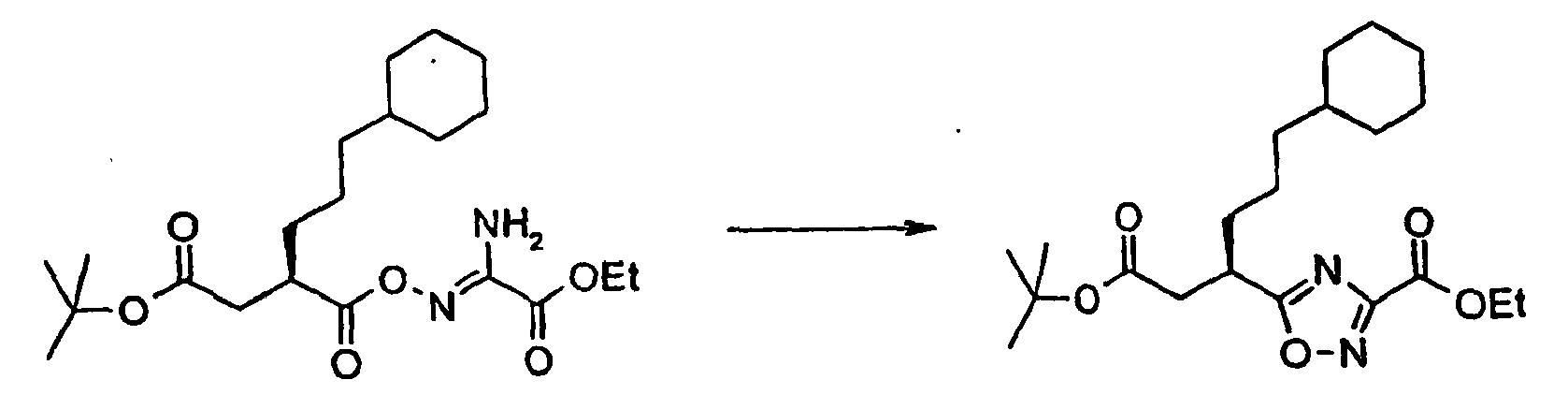
- A solution of tert-Butyl (3R)-3-[({[(Z)-1-amino-2-ethoxy-2-oxoethylidene]amino}oxy)carbonyl]-6-cyclohexylhexanoate (Preparation 169) (21.0g, 50.82mmol) in xylene (400ml) was heated at 130°C for 17 hours, then allowed to cool to room temperature. The residue was purified by column chromatography on silica gel eluting with a gradient system of ethyl acetate : pentane (5 : 95) gradually changing to ethyl acetate : pentane (20 : 80) to afford the title compound as a colourless oil (20.0g).
MS: 395 (MH+), 412 (MNH4 +)
1H-NMR (CDCl3) δ : 4.51 (2H, m), 3.54 (1H, m), 2.86 (1H, dd), 2.65 (1H, dd), 1.86-1.57 (7H, m), 1.50-1.33 (12H, m), 1.30-1.03 (8H, m), 0.82 (2H, m). -
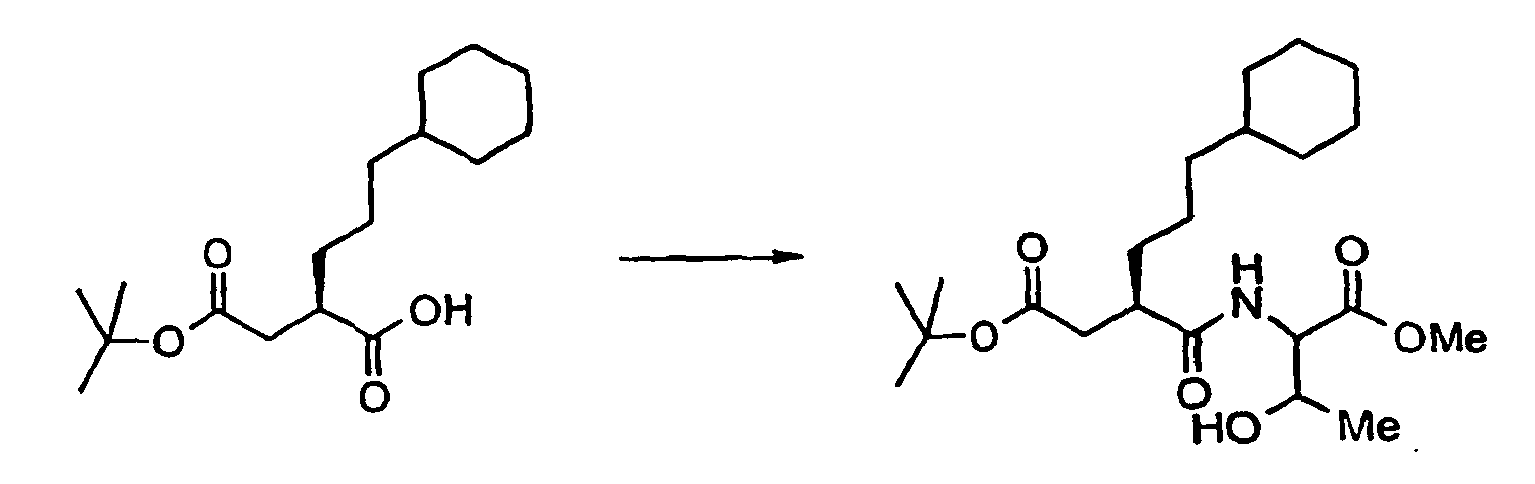
- An ice-cooled solution of (2R)-2-[2-(tert-butoxy)-2-oxoethyl]-5-cyclohexylpentanoic acid (Preparation 168) (6.40g, 21.45mmol) in dichloromethane (75ml) was treated sequentially with 1-hydroxybenzotriazole hydrate (3.19g, 23.60mmol), threonine methyl ester hydrochloride (4.00g, 23.60mmol), N,N-diisopropylethylamine (7.85ml, 45.10mmol) and 1-[3-(dimethylamino)propyl]-3-ethylcarbodiimide hydrochloride (4.52g, 23.58mmol) and the mixture was stirred for 17 hours being allowed to warm to room temperature over this time. The solvent was removed under reduced pressure and the residue was dissolved in ethyl acetate then washed sequentially with water, aqueous citric acid solution (10% w/v), a saturated aqueous sodium hydrogen carbonate solution and brine, dried over anhydrous magnesium sulphate, filtered and the solvent removed under reduced pressure. The residue was dissolved in diethyl ether (100ml) and treated with pentane (150ml) to produce a white precipitate. This was filtered off and washed with pentane to afford the title compound as a white powder (6.48g).
MS : 436 (MNa+)
1H-NMR (CDCl3) δ : 6.35 (1H, br d), 4.63 (1H, m), 4.26 (1H, m), 3.76 (3H, s), 2.73-2.53 (2H, m), 2.34 (1H, m), 1.73-1.56 (7H, m), 1.45-1.09 (20H, m), 0.84 (2H, m) -

- A solution of tert-butyl (3R)-6-cyclohexyl-3-({[2-hydroxy-1-(methoxycarbonyl)propyl]amino}carbonyl) hexanoate (Preparation 171) (6.48g, 15.69mmol) in dichloromethane (60ml) was treated with Dess-Martin periodinane [1.1,1-triacetoxy-1,1-dihydro-1,2-benziodoxol-3(1H)-one] (7.32g, 17.26mmol) and the resulting mixture was stirred at room temperature under a nitrogen atmosphere for 1 hour. A solution of sodium thiosulphate (6g in 50ml water) and a saturated aqueous sodium hydrogen carbonate solution (50ml) were then added to the mixture which was stirred for a further 10 minutes. The layers were separated and the aqueous layer was extracted with dichloromethane. The combined organic layers were sequentially washed with water and brine, dried over anhydrous magnesium sulphate, filtered and the solvent removed under reduced pressure. The residue was purified by column chromatography on silica gel eluting with a gradient system of pentane : ethyl acetate (100:0 to 90:10) to afford the title compound as a colourless oil (4.86g)
MS : 412 (MH+), 434 (MNa+)
1H-NMR (CDCl3) δ : 6.82 (1H, br d), 5.21 (1H, m), 3.78 (3H, s), 2.72-2.52 (2H, m), 2.40-2.25 (4H, m), 1.72-1.53 (7H, m), 1.45-1.04 (17H, m), 0.83 (2H, m) -

- A suspension of triphenylphosphine (9.49g, 36.18mmol), iodine (7.98g, 31.44mmol) and triethylamine (8.40ml, 60.75mmol) in tetrahydrofuren was cooled to -78°C then treated with tert-butyl (3R)-6-cyclohexyl-3-({[1-(methoxycarbonyl)-2-oxopropyl]amino}carbonyl) hexanoate (Preparation 172) (4.86g, 11.80mmol) over 15 minutes. The mixture was stirred at -78°C for 30 minutes then at 0-5°C for 2 hours. The mixture was diluted with water and extracted with dichloromethane. The combined organic layers were dried over anhydrous magnesium sulphate, filtered and the solvent removed under reduced pressure. The residue was purified by column chromatography on silica gel eluting with a gradient system of ethyl acetate : pentane (0: 100 to 10:90) to afford the title compound as a colourless oil (2.92g).
MS : 394 (MH+), 416 (MNa+)
1H-NMR (COCl3) δ : 3.89 (3H, s), 3.29 (1H, m), 2.74 (1H, dd, J=14, 6Hz), 2.60-2.49 (4H, m), 1.79-1.54 (7H, m), 1.38 (9H, s), 1.31-1.05 (8H, m), 0.82 (2H, m) -
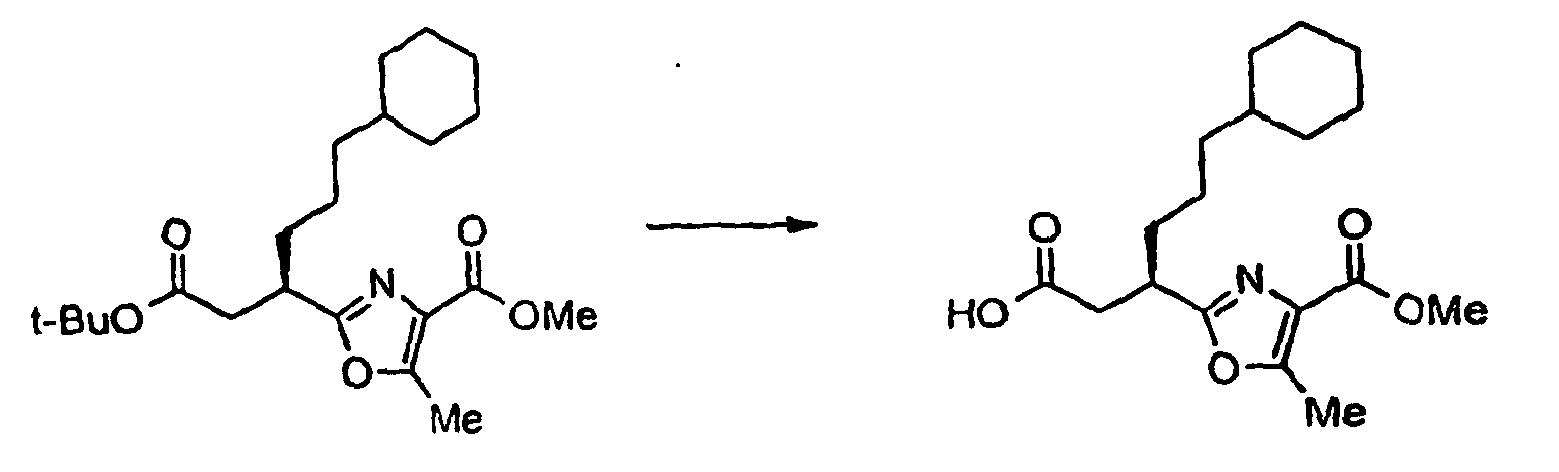
- A solution of methyl 2-{(1R)-1-[2-(tert-butoxy)-2-oxoethyl]-4-cyclohexylbutyl}-5-methyl-1,3-oxazole-4-carboxylate (Preparation 173) (2.92g, 7.43mmol) in anhydrous dichloromethane (15ml) was treated with trifluoroacetic acid (7.5ml) and the resulting mixture was stirred at room temperature under a nitrogen atmosphere for 24 hours. The solvent was removed under reduced pressure and the residue was azeotroped with dichloromethane (x3). The residue was purified by column chromatography on silica gel eluting with a gradient system of ethyl acetate : pentane (0:100 to 40:60) to afford the title compound as a colourless oil (2.50g).
MS : 338 (MH+), 360 (MNa+)
Analysis : Found C, 62.90; H, 8.18; N, 3.93%; C18H27NO5. 0.3 EtOAc requires C, 63.38;H, 8.14; N, 3.85%
1H-NMR (CDCl3) δ : 3.86 (3H, s), 3.33 (1H, m), 2.92 (1H, dd, J=17, 8Hz), 2.67 (1H, dd, J=17, 5Hz), 2.58 (3H, s), 1.81-1.56 (7H, m), 1.34-1.03 (8H, m), 0.81 (2H, m) -

- A solution of (3R)-6-cyclohexyl-3-[4-(methoxycarbonyl)-5-methyl-1,3-oxazol-2-yl]hexanoic acid (Preparation 174) (2.48g, 7.36mmol) was cooled to 0° and treated with 1-hydroxybenzotriazole hydrate (994mg, 7.36mmol), 1-[3-(dimethylamino)propyl]-3-ethylcarbodiimide hydrochloride (2.12g, 11.06mmol) and N-methylmorpholine (1.21ml, 11.04mmol). The mixture was stirred for 15 minutes then treated with O-benzylhydroxyamine (1.17g, 7.36mmol) and further N-methylmorpholine (0.81ml, 7.36mmol). The mixture was stirred for 1 hour being allowed to warm to room temperature over this time. The solvent was removed under reduced pressure and the residue was dissolved in ethyl acetate, washed sequentially with water, a saturated solution of sodium hydrogen carbonate and brine, dried over anhydrous magnesium sulphate, filtered and the solvent removed under reduced pressure to afford the title compound as a colourless oil (3.22g)
MS : 443 (MH+), 465 (MNa+)
Analysis : Found C, 66.78; H, 7.77; N, 6.19%; C25H34N2O5. 0.3 EtOAc requires C, 67.10;H, 7.82; N, 5.97%
1H-NMR (CDCl3) δ : 8.62 (1H, br s), 7.33 (5H, m), 4.84 (2H, s), 3.84 (3H, s), 3.36 (1H, m), 2.70-2.33 (5H, m), 1.78-1.54 (7H, m), 1.30-1.03 (8H, m), 0.82 (2H, m) -
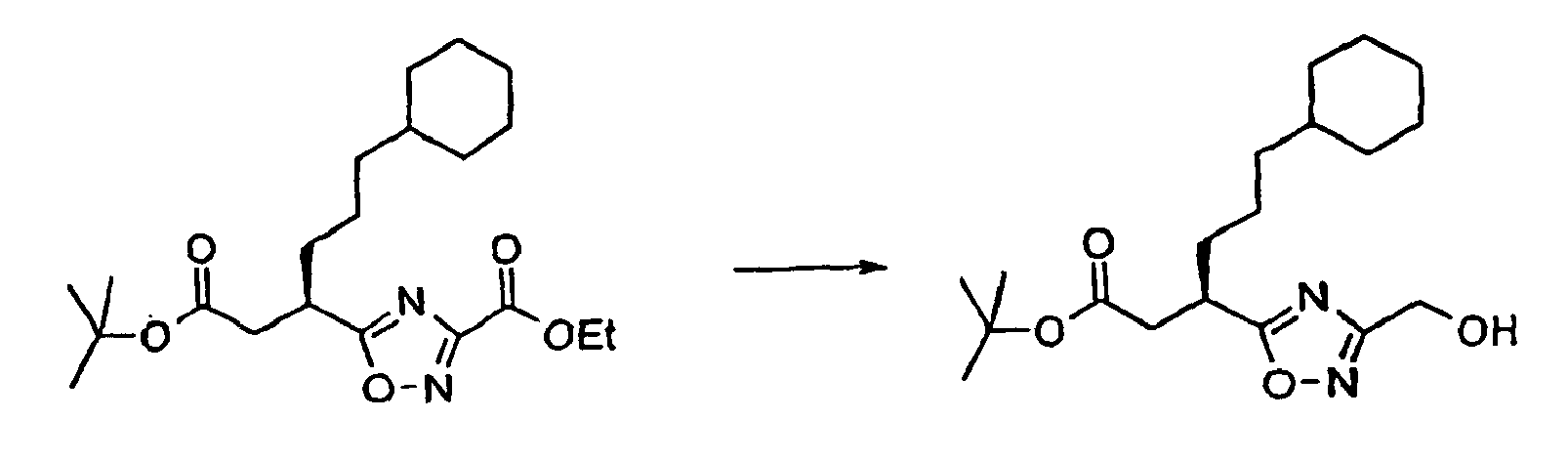
- A solution of ethyl 5-{(1R)-1-[2-(tert-butoxy)-2-oxoethyl]-4-cyclohexylbutyl}-1,2,4-oxadiazole-3-carboxylate (Preparation 170) (15.2g, 38.50mmol) in ethanol (120ml) was treated with portions of sodium borohydride (1.46g, 38.50mmol) and the resulting mixture was was stirred at room temperature under a nitrogen atmosphere for 5 hours. Aqueous citric acid (5%w/v solution) was added slowly and the mixture was stirred at room temperature for a further 30 minutes. The organic solvent was removed under reduced pressure. The aqueous layer was diluted with water and extracted with ethyl acetate giving an emulsion. Anhydrous sodium chloride was added to break up the emulsion. The combined organic layers were washed with saturated sodium hydrogen carbonate solution and brine, dried over anhydrous sodium sulphate, filtered and the solvent removed under reduced pressure to afford the title compound as a colourless oil (13.4g).
MS : 375 (MH+)
1H-NMR (CDCl3) δ : 4.77 (2H, s), 3.46 (1H, m), 2.80 (1H, dd), 2.62 (1H, dd), 1.58-1.80 (7H, m), 1.39 (9H, s), 1.07-1.33 (8H, m), 0.82 (2H, m). -

- A suspension of sodium hydride 60% suspension in mineral oil (1.52g, 38.00mmol) in anhydrous tetrahydrofuran (30ml) was cooled to 0°C and treated with a solution of tert-butyl (3R)-6-cyclohexyl-3-[3-(hydroxymethyl)-1,2,4-oxadiazol-5-yl]hexanoate (Preparation 176) (13.40g, 38.00mmol) in anhydrous tetrahydrofuran (120ml) and stirred under a nitrogen atmosphere for 30 minutes. p-Toluene sulphonyl chloride (7.25g, 38.00mmol) was added portionwise and the mixture was allowed to warm to room temperature over 18 hours. The solvent was removed under reduced pressure The residue was dissolved in ethyl acetate and washed with water, saturated sodium hydrogen carbonate solution and brine, dried over anhydrous sodium sulphate, filtered and the solvent removed under reduced pressure. The oil was purified by column chromatography on silica gel eluting with dichloromethane to afford the title compound (10.75g).
MS : 529 (MNa+)
1H-NMR (CDCl3) δ : 7.80 (2H, d), 7.33 (2H, d), 5.12 (2H, s), 3.40 (1H, m), 2.72 (1H, dd), 2.58 (1H, dd), 2.43 (3H, s), 1.56-1.78 (7H, m), 1.35 (9H, s), 1.05-1.30 (8H, m), 0.82 (2H, m).
Claims (21)
- A compound of formula (I):
 X is C1-6 alkylene or C2-6 alkenylene, each of which is optionally substituted by one or more fluorine atoms;R is aryl or C3-6 cycloalkyl optionally substituted by one or more fluorine atoms;W is N or CZ;Y is(a) NR1R3,(b) C1-4 alkyl substituted by NR1R2 or by a 4- to 7-membered N-heterocycle attached via the N-atom, which heterocycle optionally contains 1 or 2 further ring hetero-atoms independently selected from N, O and S, and which heterocycle is optionally substituted by one or more substituents independently selected from R2, =O and OH,or (c) a 4- to 7-membered saturated or partially or fully unsaturated N-heterocycle, which heterocycle optionally contains 1 or 2 further ring hetero-atoms independently selected from N, O and S, and which heterocycle is optionally substituted by one or more substituents independently selected from R2, =O and OH,Z is H or C1-4 alkyl,or when W is CZ, Y is H or C1-4 alkyl, and Z is(a) NR1R3,(b) C1-4 alkyl substituted by NR1R2 or by a 4- to 7-membered N-heterocycle attached via the N-atom, which heterocycle optionally contains 1 or 2 further ring hetero-atoms independently selected from N, O and S, and which heterocycle is optionally substituted by one or more substituents independently selected from R2, =O and OH,or (c) a 4- to 7-membered saturated of partially or fully unsaturated N-heterocycle attached via the N-atom, which heterocycle optionally contains 1 or 2 further ring hetero-atoms independently selected from N, O and S, and which heterocycle is optionally substituted by one or more substituents independently selected from R2, =O and OH,R2 is H,
C1-6 alkyl (optionally substituted by one or more substituents independently selected from OH,
C1-4 alkoxy, C(O)p(C1-4 alkyl, aryl, heteroaryl, or NR1R3), CONR1R3 or NR1R3),
SO2(C1-4 alkyl, aryl, heteroaryl or NR1R3),
C(O)p(C1-4 alkyl optionally substituted by C1-4 alkoxy or NR1R3),
C(O)p(C3-7 cycloalkyl),
C(O)p(aryl),
C(O)p(heteroaryl),
CONR1R3,
C3-7 cycloalkyl optionally substituted by one or more substituents independently selected from OH and C1-4 alkoxy,
a 4- to 7-membered saturated or partially or fully unsaturated heterocycle, which heterocycle ring contains up to 3 ring hetero-atoms independently selected from N, O and S, and which heterocycle is optionally substituted by one or more substituents independently selected from
R3, =O, OH, SO2(C1-4 alkyl) and/or C(O)p(C1-4 alkyl) groups, or aryl,R1 and R3 are each independently selected from H and (C1-4 alkyl optionally substituted by OH, NR4R5 or by C1-4 alkoxy),R4 and R5 are each independently selected from H and C1-4 alkyl,p is 1 or 2,"aryl" is phenyl optionally substituted by one or more substituents independently selected from R3, OH, SO2(C1-4 alkyl) and/or C(O)p(C1-4 alkyl) groups,"heteroaryl" is a 5- to 7-membered aromatic heterocycle with 1, 2 or 3 ring hetero-atoms independently selected from N, O and S, and which ring is optionally substituted by one or more substituents independently selected from R3, =O, OH, SO2(C1-4 alkyl) and/or C(O)p(C1-4alkyl) groups,and the pharmaceutically acceptable salts and solvates (including hydrates) thereof. - A compound, salt, or solvate according to claim 1 wherein the compound of formula (I) has the following stereochemistry (IA):

- A compound, salt or solvate according to daim 1 or claim 2 wherein W is N.
- A compound, salt or solvate according to any previous claim wherein X is a linear C2-6 alkylene moiety optionally substituted by one or more fluorine atoms.
- A compound, salt or solvate according to any previous claim wherein R is C3-6 cycloalkyl optionally substituted by one or more fluorine atoms.
- A compound, salt or solvate according to any previous claim wherein Y is C1-4 alkyl substituted by NR1R2, or Y is a 4- to 7-membered saturated or partially or fully unsaturated N-heterocycle, which heterocycle optionally contains 1 or 2 further ring hetero-atoms independently selected from N, O and S, and which heterocycle is optionally substituted by one or more substituents independently selected from R2, =O and OH.
- A compound, salt or solvate according to any one of claims 1, 2, 4, 5 or 6 wherein W is CZ and Z is H or CH3.
- A compound, salt or solvate according to any previous claim wherein X is propylene.
- A compound, salt or solvate according to any previous claim wherein R is cyclobutyl, cyclopentyl or cyclohexyl optimialty substituted by one or more fluorine atoms.
- A compound, salt or solvate according to any previous claim wherein Y is CH2 substituted by NR1R2, or Y is a 6-membered saturated or partially or fully unsaturated N-heterocycle, and which heterocyde is optionally substituted by one or more substituents independently selected from R2, =O and OH.
- A compound, salt or solvate according to any previous claim wherein R is cyclohexyl.
- A compound, salt or solvate according to any previous claim wherein Y is CH2N(H or CH3)(SO2(C1-4 alkyl, aryl, heteroaryl or NR1R3)), or Y is a 6-membered saturated or partially or fully unsaturated N-heterocycle, and which heterocycle is optionally substituted by SO2(C1-4 alkyl) and/or C(O)p(C1-4 alkyl) groups.
- A compound, salt or solvate according to any previous claim wherein Y is CH2NHSO2(C1-4 alkyl), or Y is a 6-membered saturated N-heterocyde, and which heterocycle is optionally substituted by SO2(C1-4 alkyl) or C(O)p(C1-4 alkyl).
- A compound, salt or solvate according to any previous claim wherein Y is CH2NHSO2CH3 or methylsulphonylpiperidinyl.
- A pharmaceutical composition comprising a compound, salt or solvate according to any previous claim and a pharmaceutically acceptable adjuvant, diluent or carrier.
- A kit comprising :a compound, salt or solvate according to any one of claims 1 to 14, or a composition according to claim 15 ;packaging; andinstructions for the use of the said compound, salt or solvate or composition in a manner suitable for treating or preventing a condition mediated by PCP.
- A compound, salt or solvate according to any one of claims 1 to 14 for use in medicine.
- A compound, salt or solvate according to any one of claims 1 to 14 for use in treating or preventing a condition mediated by PCP.
- The use of a compound, salt or solvate according to any one of claims 1 to 14 in the manufacture of a medicament for the treatment or prevention of a condition mediated by PCP.
- A process to make a compound of formula (I) where W is N and wherein the substituents X, R, and Y are as defined in claim 1,
which comprises any of the steps below: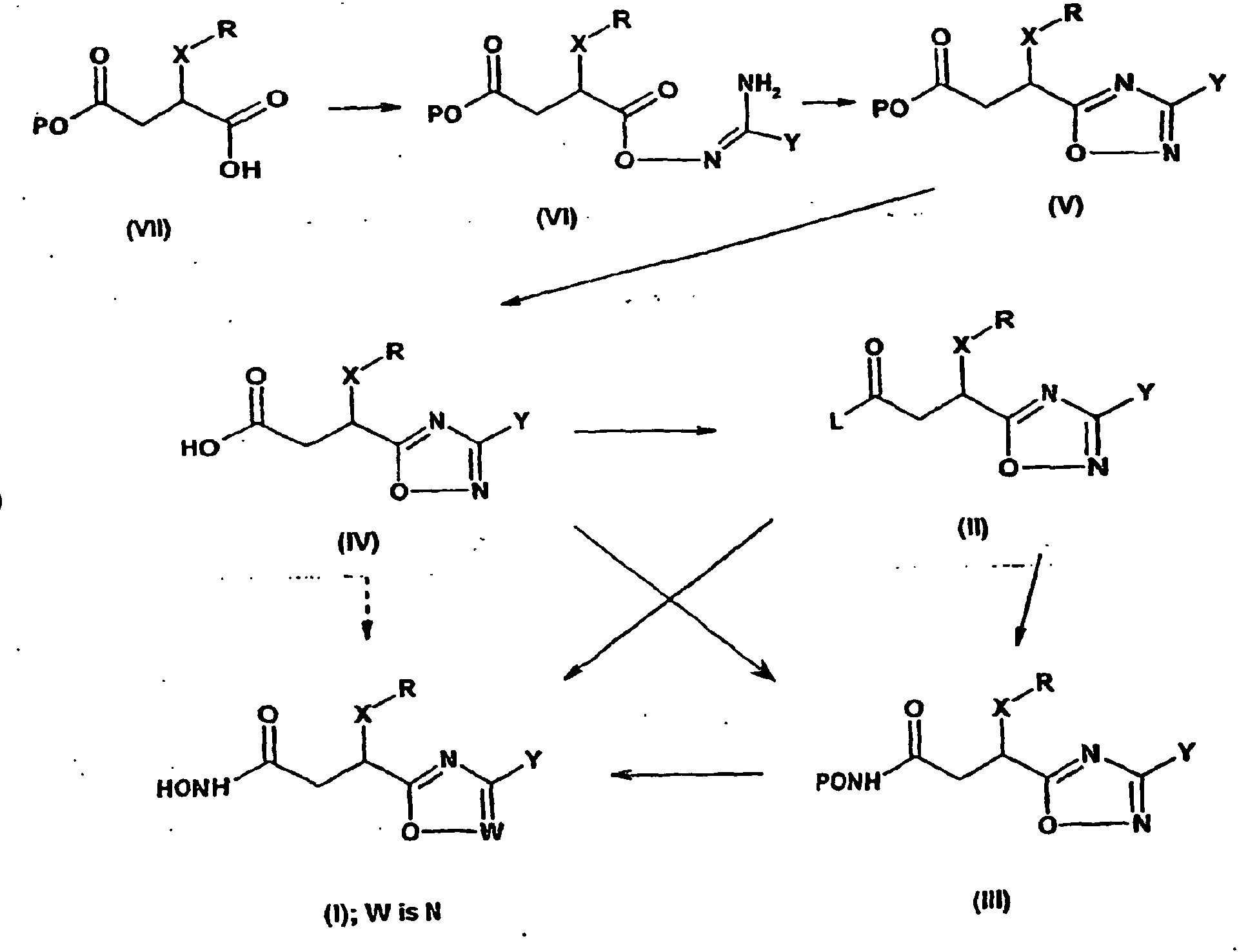
the hydroxamic acid of formula (I) where W is N is made by reaction of the corresponding activated acid derivative of formula (II), where L- is a suitable leaving group, with hydroxylamine;
the compound of formula (II) is made from the corresponding acid (IV) by reaction with an acid-activating agent;
a coupling agent is used to convert compounds of formula (IV) to compounds of formula (I) for example via intermediates of formulae (II) and/or (III);
the compound of formula (I) is made from a NHO-protected compound of formula (III), where P is a suitable O-protecting group, by suitable deprotection;
the compound of formula (111) is made from a compound of formula (II), using a protected hydroxylamine PONH2 or a suitable salt thereof;
the compound of formula (IV) is made by deprotection of the O-protected species of formula (V); the compound of formula (V) is made by condensation reaction of a compound of formula (VI);
the compound of formula (VI) is made by coupling an acid of formula (VII) with a reagent of formula C(NH2)(Y)=NOH; and
the Y moiety of the compound of formula (I) where W is CZ undergoes a functional group transformation to give another compound of formula (I) where W is N and the Y group is different. - A process to make a compound of formula (I) where W is CZ and wherein the substituents X, R, and Y are as defined in claim 1, which comprises any of the steps below:

the hydroxamic acid compound of formula (I) where W is CZ is made by reaction of the corresponding activated add derivative of formula (IX), where L- is a suitable leaving group, with hydroxylamine;
the compound of formula (IX) is made from the corresponding add (X) by reaction with an acid-activating agent;
the compound of formula (I) is made from a NHO-protected compound of formula (VIII), where P is a suitable O-protecting group, by suitable deprotection;
the compound of formula (VIII) is made a compound of formula (IX), using a protected hydroxylamine PONH2 or a suitable salt thereof;
the acid of formula (X) is made by deprotection of the O-protected species of formula (XI);
the compound of formula (XI) is made by oxidation of a compound of formula (XII);
the compound of formula (XII) is made by condensation of a compound of formula (XIII);
a coupling agent is used to convert compounds of formula (X) to compounds of formula (I) for example via intermediates of formulae (IX) and/or (VIII);
the compound of formula (XIII) is made by condensation of the acid of formula (II) as defined in claim 20, with an agent of formula NH2CH(Y)CH(Z)OH;
the compound of formula (XI) is made by condensation of compounds of formula (XIV)
Applications Claiming Priority (3)
| Application Number | Priority Date | Filing Date | Title |
|---|---|---|---|
| GB0031321 | 2000-12-21 | ||
| GBGB0031321.3A GB0031321D0 (en) | 2000-12-21 | 2000-12-21 | Treatment |
| PCT/IB2001/002360 WO2002050046A1 (en) | 2000-12-21 | 2001-12-07 | 3-ox(adi)azolylpropanohydroxamic acids useful as procollagen c-proteinase inhibitors |
Publications (2)
| Publication Number | Publication Date |
|---|---|
| EP1343771A1 EP1343771A1 (en) | 2003-09-17 |
| EP1343771B1 true EP1343771B1 (en) | 2006-04-12 |
Family
ID=9905646
Family Applications (1)
| Application Number | Title | Priority Date | Filing Date |
|---|---|---|---|
| EP01271107A Expired - Lifetime EP1343771B1 (en) | 2000-12-21 | 2001-12-07 | 3-ox(adi)azolylpropanohydroxamic acids useful as procollagen c-proteinase inhibitors |
Country Status (19)
| Country | Link |
|---|---|
| EP (1) | EP1343771B1 (en) |
| JP (1) | JP4055993B2 (en) |
| AP (1) | AP2001002379A0 (en) |
| AT (1) | ATE323074T1 (en) |
| AU (1) | AU2002223107A1 (en) |
| BR (1) | BR0116412A (en) |
| CA (1) | CA2432643C (en) |
| DE (1) | DE60118780T2 (en) |
| ES (1) | ES2260161T3 (en) |
| GB (1) | GB0031321D0 (en) |
| GT (1) | GT200100256A (en) |
| HN (1) | HN2001000282A (en) |
| MX (1) | MXPA03005749A (en) |
| PA (1) | PA8535801A1 (en) |
| PE (1) | PE20020723A1 (en) |
| SV (1) | SV2002000778A (en) |
| TN (1) | TNSN01176A1 (en) |
| UY (1) | UY27086A1 (en) |
| WO (1) | WO2002050046A1 (en) |
Families Citing this family (3)
| Publication number | Priority date | Publication date | Assignee | Title |
|---|---|---|---|---|
| EP1893569A4 (en) * | 2005-06-10 | 2009-08-05 | Elixir Pharmaceuticals Inc | Sulfonamide compounds and uses thereof |
| US7829589B2 (en) | 2005-06-10 | 2010-11-09 | Elixir Pharmaceuticals, Inc. | Sulfonamide compounds and uses thereof |
| CN106103431B (en) | 2014-01-10 | 2019-03-15 | 葛兰素史密斯克莱知识产权(第2 号)有限公司 | Hydroxycarboxamide derivatives and their uses |
Family Cites Families (2)
| Publication number | Priority date | Publication date | Assignee | Title |
|---|---|---|---|---|
| GB9404046D0 (en) * | 1994-03-03 | 1994-04-20 | Smithkline Beecham Corp | Novel compounds |
| GB9930570D0 (en) * | 1999-12-23 | 2000-02-16 | Pfizer Ltd | Therapy |
-
2000
- 2000-12-21 GB GBGB0031321.3A patent/GB0031321D0/en not_active Ceased
-
2001
- 2001-12-07 WO PCT/IB2001/002360 patent/WO2002050046A1/en not_active Ceased
- 2001-12-07 JP JP2002551543A patent/JP4055993B2/en not_active Expired - Fee Related
- 2001-12-07 CA CA002432643A patent/CA2432643C/en not_active Expired - Fee Related
- 2001-12-07 AT AT01271107T patent/ATE323074T1/en not_active IP Right Cessation
- 2001-12-07 MX MXPA03005749A patent/MXPA03005749A/en active IP Right Grant
- 2001-12-07 DE DE60118780T patent/DE60118780T2/en not_active Expired - Fee Related
- 2001-12-07 EP EP01271107A patent/EP1343771B1/en not_active Expired - Lifetime
- 2001-12-07 AU AU2002223107A patent/AU2002223107A1/en not_active Abandoned
- 2001-12-07 AP APAP/P/2001/002379A patent/AP2001002379A0/en unknown
- 2001-12-07 ES ES01271107T patent/ES2260161T3/en not_active Expired - Lifetime
- 2001-12-07 BR BR0116412-0A patent/BR0116412A/en not_active IP Right Cessation
- 2001-12-19 PE PE2001001272A patent/PE20020723A1/en not_active Application Discontinuation
- 2001-12-19 HN HN2001000282A patent/HN2001000282A/en unknown
- 2001-12-20 SV SV2001000778A patent/SV2002000778A/en not_active Application Discontinuation
- 2001-12-20 GT GT200100256A patent/GT200100256A/en unknown
- 2001-12-20 TN TNTNSN01176A patent/TNSN01176A1/en unknown
- 2001-12-20 UY UY27086A patent/UY27086A1/en not_active Application Discontinuation
- 2001-12-21 PA PA20018535801A patent/PA8535801A1/en unknown
Also Published As
| Publication number | Publication date |
|---|---|
| HN2001000282A (en) | 2002-06-28 |
| AP2001002379A0 (en) | 2001-12-31 |
| GB0031321D0 (en) | 2001-02-07 |
| EP1343771A1 (en) | 2003-09-17 |
| BR0116412A (en) | 2003-12-30 |
| JP4055993B2 (en) | 2008-03-05 |
| ES2260161T3 (en) | 2006-11-01 |
| TNSN01176A1 (en) | 2005-11-10 |
| SV2002000778A (en) | 2002-12-02 |
| AU2002223107A1 (en) | 2002-07-01 |
| DE60118780D1 (en) | 2006-05-24 |
| JP2004521098A (en) | 2004-07-15 |
| MXPA03005749A (en) | 2003-09-25 |
| CA2432643A1 (en) | 2002-06-27 |
| UY27086A1 (en) | 2002-07-31 |
| PA8535801A1 (en) | 2002-08-26 |
| WO2002050046A1 (en) | 2002-06-27 |
| PE20020723A1 (en) | 2002-08-12 |
| ATE323074T1 (en) | 2006-04-15 |
| DE60118780T2 (en) | 2006-11-02 |
| GT200100256A (en) | 2002-08-19 |
| CA2432643C (en) | 2007-07-17 |
Similar Documents
| Publication | Publication Date | Title |
|---|---|---|
| DE60016629T2 (en) | OX (ADI) AZOLY-HYDROXAMIC ACIDS AND THEIR USE AS PROCOLLAGES C-PROTEINASE INHIBITORS | |
| EP1373264B1 (en) | 3-heterocyclylpropanohydroxamic acid as procollagen c-proteinase inhibitors | |
| HUT73428A (en) | Thiazolidine derivatives, preparation thereof and drugs containing same | |
| JP2006506326A (en) | Cysteine protease inhibitor | |
| US6448278B2 (en) | Procollagen C-proteinase inhibitors | |
| CA2432643C (en) | 3-ox(adi)azolylpropanohydroxamic acids useful as procollagen c-proteinase inhibitors | |
| US6716861B2 (en) | 3-ox(adi)azolylpropanohydroxamic acids useful as procollagen C-proteinase inhibitors | |
| US6831088B2 (en) | 3-heterocyclypropanohydroxamic acid PCP inhibitors | |
| EP1373231B1 (en) | 3-heterocyclyl-propano-hydroxamic acid as pcp inhibitors | |
| MXPA05006973A (en) | Cyclopentil-substituted glutaramide compounds as endopeptidasev inhibitors. | |
| HRP960260A2 (en) | Hover boat |
Legal Events
| Date | Code | Title | Description |
|---|---|---|---|
| PUAI | Public reference made under article 153(3) epc to a published international application that has entered the european phase |
Free format text: ORIGINAL CODE: 0009012 |
|
| 17P | Request for examination filed |
Effective date: 20030402 |
|
| AK | Designated contracting states |
Kind code of ref document: A1 Designated state(s): AT BE CH CY DE DK ES FI FR GB GR IE IT LI LU MC NL PT SE TR |
|
| AX | Request for extension of the european patent |
Extension state: AL LT LV MK RO SI |
|
| 17Q | First examination report despatched |
Effective date: 20050201 |
|
| GRAP | Despatch of communication of intention to grant a patent |
Free format text: ORIGINAL CODE: EPIDOSNIGR1 |
|
| GRAS | Grant fee paid |
Free format text: ORIGINAL CODE: EPIDOSNIGR3 |
|
| GRAA | (expected) grant |
Free format text: ORIGINAL CODE: 0009210 |
|
| AK | Designated contracting states |
Kind code of ref document: B1 Designated state(s): AT BE CH CY DE DK ES FI FR GB GR IE IT LI LU MC NL PT SE TR |
|
| PG25 | Lapsed in a contracting state [announced via postgrant information from national office to epo] |
Ref country code: FI Free format text: LAPSE BECAUSE OF FAILURE TO SUBMIT A TRANSLATION OF THE DESCRIPTION OR TO PAY THE FEE WITHIN THE PRESCRIBED TIME-LIMIT Effective date: 20060412 Ref country code: LI Free format text: LAPSE BECAUSE OF FAILURE TO SUBMIT A TRANSLATION OF THE DESCRIPTION OR TO PAY THE FEE WITHIN THE PRESCRIBED TIME-LIMIT Effective date: 20060412 Ref country code: CH Free format text: LAPSE BECAUSE OF FAILURE TO SUBMIT A TRANSLATION OF THE DESCRIPTION OR TO PAY THE FEE WITHIN THE PRESCRIBED TIME-LIMIT Effective date: 20060412 Ref country code: BE Free format text: LAPSE BECAUSE OF FAILURE TO SUBMIT A TRANSLATION OF THE DESCRIPTION OR TO PAY THE FEE WITHIN THE PRESCRIBED TIME-LIMIT Effective date: 20060412 Ref country code: AT Free format text: LAPSE BECAUSE OF FAILURE TO SUBMIT A TRANSLATION OF THE DESCRIPTION OR TO PAY THE FEE WITHIN THE PRESCRIBED TIME-LIMIT Effective date: 20060412 Ref country code: NL Free format text: LAPSE BECAUSE OF FAILURE TO SUBMIT A TRANSLATION OF THE DESCRIPTION OR TO PAY THE FEE WITHIN THE PRESCRIBED TIME-LIMIT Effective date: 20060412 |
|
| REG | Reference to a national code |
Ref country code: GB Ref legal event code: FG4D |
|
| REG | Reference to a national code |
Ref country code: CH Ref legal event code: EP |
|
| REF | Corresponds to: |
Ref document number: 60118780 Country of ref document: DE Date of ref document: 20060524 Kind code of ref document: P |
|
| REG | Reference to a national code |
Ref country code: IE Ref legal event code: FG4D |
|
| PG25 | Lapsed in a contracting state [announced via postgrant information from national office to epo] |
Ref country code: DK Free format text: LAPSE BECAUSE OF FAILURE TO SUBMIT A TRANSLATION OF THE DESCRIPTION OR TO PAY THE FEE WITHIN THE PRESCRIBED TIME-LIMIT Effective date: 20060712 Ref country code: SE Free format text: LAPSE BECAUSE OF FAILURE TO SUBMIT A TRANSLATION OF THE DESCRIPTION OR TO PAY THE FEE WITHIN THE PRESCRIBED TIME-LIMIT Effective date: 20060712 |
|
| REG | Reference to a national code |
Ref country code: IE Ref legal event code: ERR Free format text: PATENTS GRANTED UNDER EUROPEAN PATENT CONVENTION DESIGNATING IRELAND: IN JOURNAL NUMBER 2047 OF 20060531 IN THE LIST OF EUROPEAN PATENT GRANTED AT PAGE 1212, THE DETAILS FOR PATENT NUMBER 1343771 SHOULD HAVE SHOWN PFIZER INC., 235 EAST 42ND STREET, NEW YORK, NY 10017, US AS THE SOLE PROPRIETOR. |
|
| PG25 | Lapsed in a contracting state [announced via postgrant information from national office to epo] |
Ref country code: PT Free format text: LAPSE BECAUSE OF FAILURE TO SUBMIT A TRANSLATION OF THE DESCRIPTION OR TO PAY THE FEE WITHIN THE PRESCRIBED TIME-LIMIT Effective date: 20060912 |
|
| NLV1 | Nl: lapsed or annulled due to failure to fulfill the requirements of art. 29p and 29m of the patents act | ||
| REG | Reference to a national code |
Ref country code: CH Ref legal event code: PL |
|
| REG | Reference to a national code |
Ref country code: ES Ref legal event code: FG2A Ref document number: 2260161 Country of ref document: ES Kind code of ref document: T3 |
|
| ET | Fr: translation filed | ||
| PG25 | Lapsed in a contracting state [announced via postgrant information from national office to epo] |
Ref country code: MC Free format text: LAPSE BECAUSE OF NON-PAYMENT OF DUE FEES Effective date: 20061231 |
|
| PLBE | No opposition filed within time limit |
Free format text: ORIGINAL CODE: 0009261 |
|
| STAA | Information on the status of an ep patent application or granted ep patent |
Free format text: STATUS: NO OPPOSITION FILED WITHIN TIME LIMIT |
|
| 26N | No opposition filed |
Effective date: 20070115 |
|
| PGFP | Annual fee paid to national office [announced via postgrant information from national office to epo] |
Ref country code: ES Payment date: 20071219 Year of fee payment: 7 |
|
| PGFP | Annual fee paid to national office [announced via postgrant information from national office to epo] |
Ref country code: IT Payment date: 20071215 Year of fee payment: 7 |
|
| PG25 | Lapsed in a contracting state [announced via postgrant information from national office to epo] |
Ref country code: GR Free format text: LAPSE BECAUSE OF FAILURE TO SUBMIT A TRANSLATION OF THE DESCRIPTION OR TO PAY THE FEE WITHIN THE PRESCRIBED TIME-LIMIT Effective date: 20060713 |
|
| PGFP | Annual fee paid to national office [announced via postgrant information from national office to epo] |
Ref country code: GB Payment date: 20071106 Year of fee payment: 7 |
|
| PGFP | Annual fee paid to national office [announced via postgrant information from national office to epo] |
Ref country code: DE Payment date: 20071228 Year of fee payment: 7 |
|
| PG25 | Lapsed in a contracting state [announced via postgrant information from national office to epo] |
Ref country code: TR Free format text: LAPSE BECAUSE OF FAILURE TO SUBMIT A TRANSLATION OF THE DESCRIPTION OR TO PAY THE FEE WITHIN THE PRESCRIBED TIME-LIMIT Effective date: 20060412 Ref country code: LU Free format text: LAPSE BECAUSE OF NON-PAYMENT OF DUE FEES Effective date: 20061207 |
|
| PGFP | Annual fee paid to national office [announced via postgrant information from national office to epo] |
Ref country code: FR Payment date: 20071204 Year of fee payment: 7 |
|
| PG25 | Lapsed in a contracting state [announced via postgrant information from national office to epo] |
Ref country code: CY Free format text: LAPSE BECAUSE OF FAILURE TO SUBMIT A TRANSLATION OF THE DESCRIPTION OR TO PAY THE FEE WITHIN THE PRESCRIBED TIME-LIMIT Effective date: 20060412 |
|
| GBPC | Gb: european patent ceased through non-payment of renewal fee |
Effective date: 20081207 |
|
| PGFP | Annual fee paid to national office [announced via postgrant information from national office to epo] |
Ref country code: IE Payment date: 20071030 Year of fee payment: 7 |
|
| REG | Reference to a national code |
Ref country code: FR Ref legal event code: ST Effective date: 20090831 |
|
| PG25 | Lapsed in a contracting state [announced via postgrant information from national office to epo] |
Ref country code: IE Free format text: LAPSE BECAUSE OF NON-PAYMENT OF DUE FEES Effective date: 20081208 Ref country code: DE Free format text: LAPSE BECAUSE OF NON-PAYMENT OF DUE FEES Effective date: 20090701 |
|
| PG25 | Lapsed in a contracting state [announced via postgrant information from national office to epo] |
Ref country code: GB Free format text: LAPSE BECAUSE OF NON-PAYMENT OF DUE FEES Effective date: 20081207 |
|
| REG | Reference to a national code |
Ref country code: ES Ref legal event code: FD2A Effective date: 20081209 |
|
| PG25 | Lapsed in a contracting state [announced via postgrant information from national office to epo] |
Ref country code: ES Free format text: LAPSE BECAUSE OF NON-PAYMENT OF DUE FEES Effective date: 20081209 Ref country code: FR Free format text: LAPSE BECAUSE OF NON-PAYMENT OF DUE FEES Effective date: 20081231 |
|
| PG25 | Lapsed in a contracting state [announced via postgrant information from national office to epo] |
Ref country code: IT Free format text: LAPSE BECAUSE OF NON-PAYMENT OF DUE FEES Effective date: 20081207 |