EP1343761B1 - Piperidine mch antagonists and their use in the treatment of obesity - Google Patents
Piperidine mch antagonists and their use in the treatment of obesity Download PDFInfo
- Publication number
- EP1343761B1 EP1343761B1 EP01991369A EP01991369A EP1343761B1 EP 1343761 B1 EP1343761 B1 EP 1343761B1 EP 01991369 A EP01991369 A EP 01991369A EP 01991369 A EP01991369 A EP 01991369A EP 1343761 B1 EP1343761 B1 EP 1343761B1
- Authority
- EP
- European Patent Office
- Prior art keywords
- alkyl
- aryl
- compound
- group
- compounds
- Prior art date
- Legal status (The legal status is an assumption and is not a legal conclusion. Google has not performed a legal analysis and makes no representation as to the accuracy of the status listed.)
- Expired - Lifetime
Links
- 0 C=C1CC*CC1 Chemical compound C=C1CC*CC1 0.000 description 4
- GBCGZHZAXJYUHO-UHFFFAOYSA-N CCC(c(cc1)ccc1I)NC(c1ccc(CC2(CCN(Cc3cc4cccnc4cc3)CC2)OC)cc1)=O Chemical compound CCC(c(cc1)ccc1I)NC(c1ccc(CC2(CCN(Cc3cc4cccnc4cc3)CC2)OC)cc1)=O GBCGZHZAXJYUHO-UHFFFAOYSA-N 0.000 description 1
- CZNGTXVOZOWWKM-UHFFFAOYSA-N COC(c(cc1)ccc1Br)=O Chemical compound COC(c(cc1)ccc1Br)=O CZNGTXVOZOWWKM-UHFFFAOYSA-N 0.000 description 1
Classifications
-
- C—CHEMISTRY; METALLURGY
- C07—ORGANIC CHEMISTRY
- C07D—HETEROCYCLIC COMPOUNDS
- C07D401/00—Heterocyclic compounds containing two or more hetero rings, having nitrogen atoms as the only ring hetero atoms, at least one ring being a six-membered ring with only one nitrogen atom
- C07D401/02—Heterocyclic compounds containing two or more hetero rings, having nitrogen atoms as the only ring hetero atoms, at least one ring being a six-membered ring with only one nitrogen atom containing two hetero rings
- C07D401/06—Heterocyclic compounds containing two or more hetero rings, having nitrogen atoms as the only ring hetero atoms, at least one ring being a six-membered ring with only one nitrogen atom containing two hetero rings linked by a carbon chain containing only aliphatic carbon atoms
-
- A—HUMAN NECESSITIES
- A61—MEDICAL OR VETERINARY SCIENCE; HYGIENE
- A61K—PREPARATIONS FOR MEDICAL, DENTAL OR TOILETRY PURPOSES
- A61K31/00—Medicinal preparations containing organic active ingredients
- A61K31/33—Heterocyclic compounds
- A61K31/395—Heterocyclic compounds having nitrogen as a ring hetero atom, e.g. guanethidine or rifamycins
- A61K31/435—Heterocyclic compounds having nitrogen as a ring hetero atom, e.g. guanethidine or rifamycins having six-membered rings with one nitrogen as the only ring hetero atom
- A61K31/44—Non condensed pyridines; Hydrogenated derivatives thereof
- A61K31/445—Non condensed piperidines, e.g. piperocaine
-
- A—HUMAN NECESSITIES
- A61—MEDICAL OR VETERINARY SCIENCE; HYGIENE
- A61K—PREPARATIONS FOR MEDICAL, DENTAL OR TOILETRY PURPOSES
- A61K31/00—Medicinal preparations containing organic active ingredients
- A61K31/33—Heterocyclic compounds
- A61K31/395—Heterocyclic compounds having nitrogen as a ring hetero atom, e.g. guanethidine or rifamycins
- A61K31/435—Heterocyclic compounds having nitrogen as a ring hetero atom, e.g. guanethidine or rifamycins having six-membered rings with one nitrogen as the only ring hetero atom
- A61K31/44—Non condensed pyridines; Hydrogenated derivatives thereof
- A61K31/445—Non condensed piperidines, e.g. piperocaine
- A61K31/4523—Non condensed piperidines, e.g. piperocaine containing further heterocyclic ring systems
- A61K31/4525—Non condensed piperidines, e.g. piperocaine containing further heterocyclic ring systems containing a five-membered ring with oxygen as a ring hetero atom
-
- A—HUMAN NECESSITIES
- A61—MEDICAL OR VETERINARY SCIENCE; HYGIENE
- A61K—PREPARATIONS FOR MEDICAL, DENTAL OR TOILETRY PURPOSES
- A61K31/00—Medicinal preparations containing organic active ingredients
- A61K31/33—Heterocyclic compounds
- A61K31/395—Heterocyclic compounds having nitrogen as a ring hetero atom, e.g. guanethidine or rifamycins
- A61K31/435—Heterocyclic compounds having nitrogen as a ring hetero atom, e.g. guanethidine or rifamycins having six-membered rings with one nitrogen as the only ring hetero atom
- A61K31/44—Non condensed pyridines; Hydrogenated derivatives thereof
- A61K31/445—Non condensed piperidines, e.g. piperocaine
- A61K31/4523—Non condensed piperidines, e.g. piperocaine containing further heterocyclic ring systems
- A61K31/453—Non condensed piperidines, e.g. piperocaine containing further heterocyclic ring systems containing a six-membered ring with oxygen as a ring hetero atom
-
- A—HUMAN NECESSITIES
- A61—MEDICAL OR VETERINARY SCIENCE; HYGIENE
- A61K—PREPARATIONS FOR MEDICAL, DENTAL OR TOILETRY PURPOSES
- A61K31/00—Medicinal preparations containing organic active ingredients
- A61K31/33—Heterocyclic compounds
- A61K31/395—Heterocyclic compounds having nitrogen as a ring hetero atom, e.g. guanethidine or rifamycins
- A61K31/435—Heterocyclic compounds having nitrogen as a ring hetero atom, e.g. guanethidine or rifamycins having six-membered rings with one nitrogen as the only ring hetero atom
- A61K31/44—Non condensed pyridines; Hydrogenated derivatives thereof
- A61K31/445—Non condensed piperidines, e.g. piperocaine
- A61K31/4523—Non condensed piperidines, e.g. piperocaine containing further heterocyclic ring systems
- A61K31/454—Non condensed piperidines, e.g. piperocaine containing further heterocyclic ring systems containing a five-membered ring with nitrogen as a ring hetero atom, e.g. pimozide, domperidone
-
- A—HUMAN NECESSITIES
- A61—MEDICAL OR VETERINARY SCIENCE; HYGIENE
- A61K—PREPARATIONS FOR MEDICAL, DENTAL OR TOILETRY PURPOSES
- A61K31/00—Medicinal preparations containing organic active ingredients
- A61K31/33—Heterocyclic compounds
- A61K31/395—Heterocyclic compounds having nitrogen as a ring hetero atom, e.g. guanethidine or rifamycins
- A61K31/435—Heterocyclic compounds having nitrogen as a ring hetero atom, e.g. guanethidine or rifamycins having six-membered rings with one nitrogen as the only ring hetero atom
- A61K31/47—Quinolines; Isoquinolines
- A61K31/4709—Non-condensed quinolines and containing further heterocyclic rings
-
- A—HUMAN NECESSITIES
- A61—MEDICAL OR VETERINARY SCIENCE; HYGIENE
- A61K—PREPARATIONS FOR MEDICAL, DENTAL OR TOILETRY PURPOSES
- A61K31/00—Medicinal preparations containing organic active ingredients
- A61K31/33—Heterocyclic compounds
- A61K31/395—Heterocyclic compounds having nitrogen as a ring hetero atom, e.g. guanethidine or rifamycins
- A61K31/495—Heterocyclic compounds having nitrogen as a ring hetero atom, e.g. guanethidine or rifamycins having six-membered rings with two or more nitrogen atoms as the only ring heteroatoms, e.g. piperazine or tetrazines
- A61K31/4965—Non-condensed pyrazines
-
- A—HUMAN NECESSITIES
- A61—MEDICAL OR VETERINARY SCIENCE; HYGIENE
- A61K—PREPARATIONS FOR MEDICAL, DENTAL OR TOILETRY PURPOSES
- A61K31/00—Medicinal preparations containing organic active ingredients
- A61K31/33—Heterocyclic compounds
- A61K31/395—Heterocyclic compounds having nitrogen as a ring hetero atom, e.g. guanethidine or rifamycins
- A61K31/495—Heterocyclic compounds having nitrogen as a ring hetero atom, e.g. guanethidine or rifamycins having six-membered rings with two or more nitrogen atoms as the only ring heteroatoms, e.g. piperazine or tetrazines
- A61K31/505—Pyrimidines; Hydrogenated pyrimidines, e.g. trimethoprim
- A61K31/517—Pyrimidines; Hydrogenated pyrimidines, e.g. trimethoprim ortho- or peri-condensed with carbocyclic ring systems, e.g. quinazoline, perimidine
-
- A—HUMAN NECESSITIES
- A61—MEDICAL OR VETERINARY SCIENCE; HYGIENE
- A61P—SPECIFIC THERAPEUTIC ACTIVITY OF CHEMICAL COMPOUNDS OR MEDICINAL PREPARATIONS
- A61P3/00—Drugs for disorders of the metabolism
- A61P3/04—Anorexiants; Antiobesity agents
-
- A—HUMAN NECESSITIES
- A61—MEDICAL OR VETERINARY SCIENCE; HYGIENE
- A61P—SPECIFIC THERAPEUTIC ACTIVITY OF CHEMICAL COMPOUNDS OR MEDICINAL PREPARATIONS
- A61P3/00—Drugs for disorders of the metabolism
- A61P3/08—Drugs for disorders of the metabolism for glucose homeostasis
- A61P3/10—Drugs for disorders of the metabolism for glucose homeostasis for hyperglycaemia, e.g. antidiabetics
-
- A—HUMAN NECESSITIES
- A61—MEDICAL OR VETERINARY SCIENCE; HYGIENE
- A61P—SPECIFIC THERAPEUTIC ACTIVITY OF CHEMICAL COMPOUNDS OR MEDICINAL PREPARATIONS
- A61P43/00—Drugs for specific purposes, not provided for in groups A61P1/00-A61P41/00
-
- C—CHEMISTRY; METALLURGY
- C07—ORGANIC CHEMISTRY
- C07D—HETEROCYCLIC COMPOUNDS
- C07D211/00—Heterocyclic compounds containing hydrogenated pyridine rings, not condensed with other rings
- C07D211/04—Heterocyclic compounds containing hydrogenated pyridine rings, not condensed with other rings with only hydrogen or carbon atoms directly attached to the ring nitrogen atom
- C07D211/06—Heterocyclic compounds containing hydrogenated pyridine rings, not condensed with other rings with only hydrogen or carbon atoms directly attached to the ring nitrogen atom having no double bonds between ring members or between ring members and non-ring members
- C07D211/08—Heterocyclic compounds containing hydrogenated pyridine rings, not condensed with other rings with only hydrogen or carbon atoms directly attached to the ring nitrogen atom having no double bonds between ring members or between ring members and non-ring members with hydrocarbon or substituted hydrocarbon radicals directly attached to ring carbon atoms
- C07D211/18—Heterocyclic compounds containing hydrogenated pyridine rings, not condensed with other rings with only hydrogen or carbon atoms directly attached to the ring nitrogen atom having no double bonds between ring members or between ring members and non-ring members with hydrocarbon or substituted hydrocarbon radicals directly attached to ring carbon atoms with substituted hydrocarbon radicals attached to ring carbon atoms
- C07D211/34—Heterocyclic compounds containing hydrogenated pyridine rings, not condensed with other rings with only hydrogen or carbon atoms directly attached to the ring nitrogen atom having no double bonds between ring members or between ring members and non-ring members with hydrocarbon or substituted hydrocarbon radicals directly attached to ring carbon atoms with substituted hydrocarbon radicals attached to ring carbon atoms with hydrocarbon radicals, substituted by carbon atoms having three bonds to hetero atoms with at the most one bond to halogen, e.g. ester or nitrile radicals
-
- C—CHEMISTRY; METALLURGY
- C07—ORGANIC CHEMISTRY
- C07D—HETEROCYCLIC COMPOUNDS
- C07D405/00—Heterocyclic compounds containing both one or more hetero rings having oxygen atoms as the only ring hetero atoms, and one or more rings having nitrogen as the only ring hetero atom
- C07D405/02—Heterocyclic compounds containing both one or more hetero rings having oxygen atoms as the only ring hetero atoms, and one or more rings having nitrogen as the only ring hetero atom containing two hetero rings
- C07D405/06—Heterocyclic compounds containing both one or more hetero rings having oxygen atoms as the only ring hetero atoms, and one or more rings having nitrogen as the only ring hetero atom containing two hetero rings linked by a carbon chain containing only aliphatic carbon atoms
-
- C—CHEMISTRY; METALLURGY
- C07—ORGANIC CHEMISTRY
- C07D—HETEROCYCLIC COMPOUNDS
- C07D413/00—Heterocyclic compounds containing two or more hetero rings, at least one ring having nitrogen and oxygen atoms as the only ring hetero atoms
- C07D413/02—Heterocyclic compounds containing two or more hetero rings, at least one ring having nitrogen and oxygen atoms as the only ring hetero atoms containing two hetero rings
- C07D413/06—Heterocyclic compounds containing two or more hetero rings, at least one ring having nitrogen and oxygen atoms as the only ring hetero atoms containing two hetero rings linked by a carbon chain containing only aliphatic carbon atoms
-
- C—CHEMISTRY; METALLURGY
- C07—ORGANIC CHEMISTRY
- C07D—HETEROCYCLIC COMPOUNDS
- C07D417/00—Heterocyclic compounds containing two or more hetero rings, at least one ring having nitrogen and sulfur atoms as the only ring hetero atoms, not provided for by group C07D415/00
- C07D417/02—Heterocyclic compounds containing two or more hetero rings, at least one ring having nitrogen and sulfur atoms as the only ring hetero atoms, not provided for by group C07D415/00 containing two hetero rings
- C07D417/06—Heterocyclic compounds containing two or more hetero rings, at least one ring having nitrogen and sulfur atoms as the only ring hetero atoms, not provided for by group C07D415/00 containing two hetero rings linked by a carbon chain containing only aliphatic carbon atoms
Definitions
- This invention relates to amide derivatives of 1,4-di-substituted piperidine antagonists for melanin-concentrating hormone (MCH) and their use in the treatment of obesity and diabetes.
- MCH melanin-concentrating hormone
- MCH a cyclic peptide
- Piperidine-derivative muscarinic antagonists useful in the treatment of cognitive disorders such as Alzheimer's disease are disclosed in US 6,037,352.
- US 6,037,352 discloses compounds of the generic formula wherein, inter alia, Y is CH; Z is N; X is -NHCO -; R is substituted benzyl or cycloalkylalkyl; R 1 , R 21 , R 3 , R 4 , R 27 and R 28 are each hydrogen; and R 2 is optionally substituted cycloalkyl or arylalkyl.
- US 6,037,352 does not disclose the use of the compounds for treating obesity or diabetes.
- WO 99/00367 discloses N-substituted azaheterocyclic compounds primarily as analgesic/anti-inflammatory compounds, but discloses that they may additionally be used in treating ageing-associated obesity.
- EP-A-0 643 057 discloses substituted piperidine and piperazine compounds useful for lowering serum lipids and treating atherosclerosis and related diseases.
- WO 01/09137 discloses tricyclic compound useful for treating diseases associated with aberrant leukocyte recruitment.
- the present invention relates to compounds represented by structural formula I: or a pharmaceutically acceptable salt, N-oxide or solvate thereof, wherein the dotted line is an optional double bond;
- Y is or, when the double bond is present,
- R 1 is R 5 -(C 3 -C 8 )cycloalkyl, R 5 -(C 3 -C 8 )cycloalkyl(C 1 -C 6 )alkyl, R 5 -aryl, R 5 -aryl-(C 1 -C 6 )alkyl, R 5 -heteroaryl, R 5 -heteroaryl(C 1 -C 6 )alkyl, R 5 -heterocycloalkyl or R 5 -heterocycloalkyl(C 1 -C 6 )alky
- the present invention also relates to a method of treating eating disorders, such as obesity and hyperphagia, and diabetes comprising administering to a mammal in need of such treatment an effective amount of a compound of formula I.
- Another aspect of the invention is a pharmaceutical composition for treating eating disorders and diabetes which comprises a compound of formula I in combination with a pharmaceutically acceptable carrier.
- R 1 is preferably R 5 -phenyl.
- R 5 is preferably H, halogen, C 1 -C 6 alkyl or phenyl, more preferably halogen or phenyl.
- R 2 is R 6 -aryl, especially when n is 1. More preferred is R 6 -aryl wherein “aryl” is phenyl and R 6 is 1-2 substituents.
- X is preferably -CHR 8 wherein R 8 is H and Y is CH, or X and Y form a double bond.
- R 3 is preferably ethyl or methyl, and R 4 and R 12 are each preferably H.
- R 10 is preferably H or -CH 3 ; when n is 2-5, preferably only one R 10 is alkyl and the rest are hydrogen.
- Alkyl represents a straight or branched saturated hydrocarbon chain having the designated number of carbon atoms. Where the number of carbon atoms is not specified, 1 to 6 carbons are intended.
- Cycloalkyl represents a saturated carbocyclic ring having 3 to 8 carbon atoms.
- heterocycloalkyl refers to 4- to 7-membered saturated rings comprising 1 to 3 heteroatoms independently selected from the group consisting of -O-, -S- and -NR 7 -, wherein R 7 is H or C 1 -C 6 alkyl, and wherein the remaining ring members are carbon.
- a heterocyclic ring comprises more than one heteroatom, no rings are formed where there are adjacent oxygen atoms, adjacent sulfur atoms, or three consecutive heteroatoms.
- heterocyclic rings are tetrahydrofuranyl, pyrrolidinyl, tetrahydropyranyl, piperidinyl, morpholinyl, thiomorpholinyl and piperazinyl.
- Halogen represents fluoro, chloro, bromo or iodo.
- Aryl represents a monoaromatic ring or a bicyclic fused ring system of 6- to 10 carbon atoms, possessing one or two aromatic rings including, phenyl, naphthyl, tetrahydronaphthyl, indanyl, and the like.
- single ring heteroaryl groups are pyridyl, isoxazolyl, oxadiazolyl, furanyl, pyrrolyl, thienyl, imidazolyl, pyrazolyl, tetrazolyl, thiazolyl, thiadiazolyl, pyrazinyl, pyrimidinyl, pyridazinyl and triazolyl.
- benzofused rings are indolyl, benzofuranyl, quinolyl, quinazolinyl, quinoxalinyl, benzoxazolyl, benzothiazolyl, benzothiadiazolyl, thianaphthenyl, and benzofurazanyl. All positional isomers are contemplated, e.g., 2-pyridyl, 3-pyridyl and 4-pyridyl.
- each variable appearing more than once may be independently selected from the definition for that variable.
- a compound of formula I may form pharmaceutically acceptable salts with organic and inorganic acids.
- suitable acids for salt formation are hydrochloric, sulfuric, phosphoric, acetic, citric, malonic, salicylic, malic, fumaric, succinic, ascorbic, maleic, methanesulfonic and other mineral and carboxylic acids well known to those skilled in the art.
- the salts are prepared by contacting the free base forms with a sufficient amount of the desired acid to produce a salt in the conventional manner.
- the free base forms may be regenerated by treating the salt with a suitable dilute aqueous base solution, such as dilute aqueous sodium hydroxide, potassium carbonate, ammonia or sodium bicarbonate.
- the free base forms differ from their respective salt forms somewhat in certain physical properties, such as solubility in polar solvents, but the salts are otherwise equivalent to their respective free base forms for purposes of the invention.
- the amine (R 1 CR 12 R 3 NR 5 H) is reacted with Argopore-MB-CHO resin (Argonaut Corporation, San Carlos, CA) by reductive alkylation with sodium triacetoxyborohydride.
- Subsequent acylation of the resin-bound amine with activated acids such as acid chlorides 3 deprotection of the N-Fmoc group, followed by reductive alkylation with aldehydes or ketones, or reaction with an aldehyde followed by treatment with a Grignard reagent, or by reaction with the appropriate mesylate or alkyl halide, provides a resin bound intermediate, which on treatment with trifluoroacetic acid (TFA) produces compounds of Formula I.
- TFA trifluoroacetic acid
- Compounds 10 can be prepared by the route shown in Scheme 2 by first converting an acid such as 4 into an amine such as 6 by the Curtius reaction, for example by treatment with diphenylphosphoryl azide in an alcohol such as t-butanol followed by hydrolysis. Subsequent reaction with a resin-bound aldehyde such as the Argopore MB-CHO resin under reducing conditions provides a resin-bound amine 7 which can be further functionalized by reaction with activated carboxylic acid derivatives such as acid chlorides. Removal of the FMOC group and reductive alkylation with carbonyl-containing compounds, followed by treatment with acid to remove the compound from the polymeric resin, provides compounds 10 .
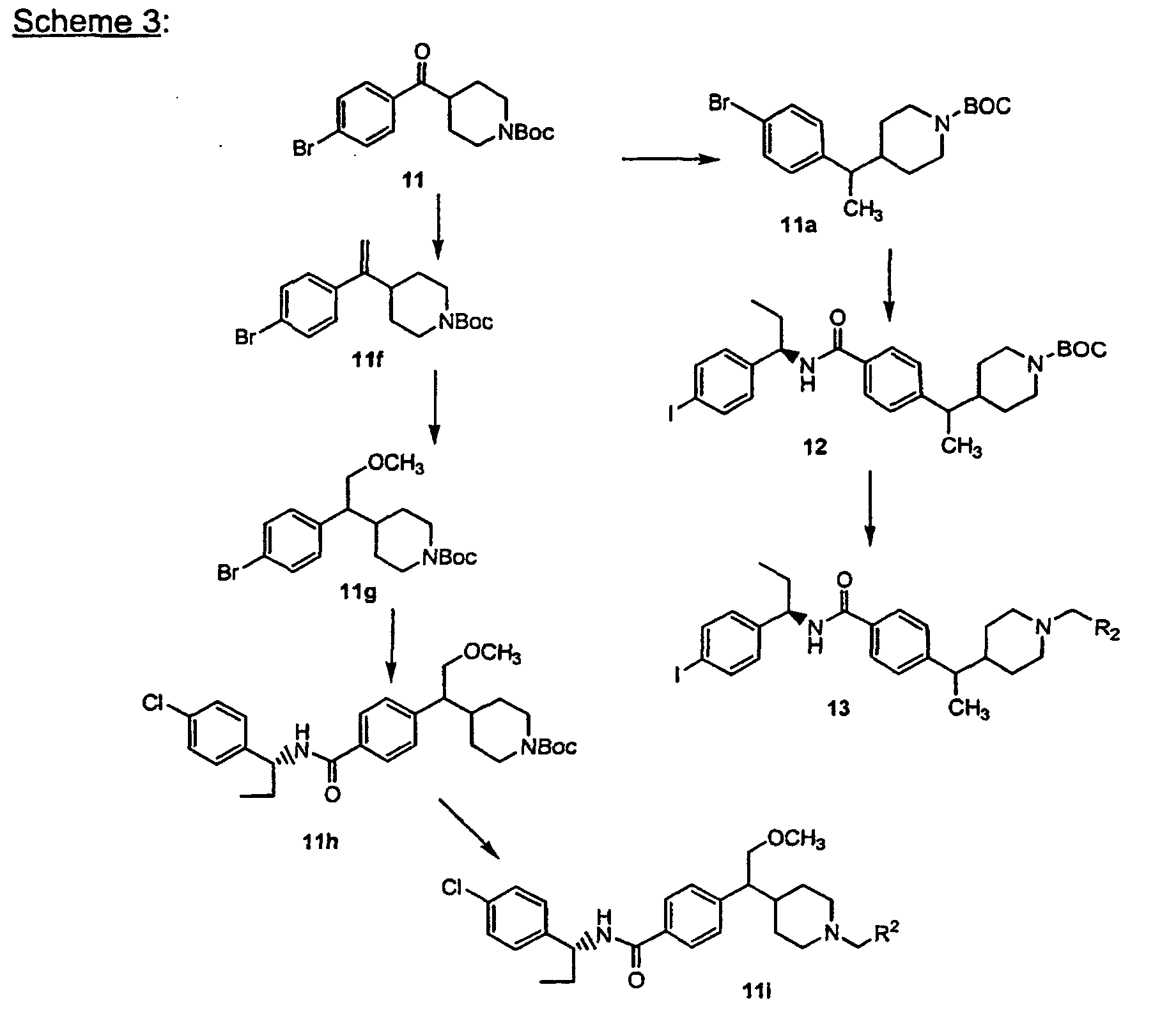
- compounds of formula I are prepared as shown in Scheme 3 by reacting an aryl bromide such as 11a with an alkyl lithium reagent, followed by addition of an aryl isocyanate. Subsequent removal of the BOC group from compound 12 by treatment with acid and then introduction of the R 2 group by alkylation or reductive alkylation provides compounds such as 13. Furthermore, 11 can also be elaborated into compounds such as 11i as shown in Scheme 3.
- R 10 is alkyl
- the compounds of formula I exhibit MCH receptor antagonizing activity, which has been correlated with pharmaceutical activity for treating eating disorders, such as obesity and hyperphagia, and diabetes.
- the compounds of formula I display pharmacological activity in a test procedure designed to demonstrate MCH receptor antagonist activity.
- the compounds are non-toxic at pharmaceutically therapeutic doses. Following is a description of the test procedure.
- Membranes from CHO cells expressing the MCH receptor were prepared by lysing cells with 5 mM HEPES for 15 min at 4C. Cell lysates were centrifuged (12.5000 x g, 15 min) and the pellet was resuspended in 5 mM HEPES. For each 96-well plate (Microlite, Dynex Technologies), 1 mg of cell membranes were incubated with 10 mg of wheat germ agglutinin SPA beads (Amersham) for 5 min at 4 C in a volume of 10 ml of binding buffer (25 mM HEPES, 10 mM MGCl 2 , 10 mM NaCl, 5 mM MnCl 2 , 0.1% BSA).
- the membrane/bead mixture was centrifuged (1500 x g, 3.5 min), the supernatant was aspirated, and the pellet was resuspended in 10 ml binding buffer. The centrifugation, aspiration and resuspension were then repeated.
- the membrane/bead mixture (100 l) was then added to 96-well plates containing 50 l of 500 pM [ 125 I]-MCH (NEN) and 50 ml of the appropriate concentration of compound (4X the desired final concentration).
- Nonspecific binding was determined by including 1 M MCH in the binding reaction.
- the binding reaction was incubated at room temperature for 2 h. Plates were then analyzed in a TOPCOUNT microplate scintillation counter (Packard). Data was analyzed and Ki values were determined using GraphPad Prim.
- a range of MCH receptor binding activity (Ki values) of from about 3 nM to about 1500 nM was observed.
- Compounds of this invention preferably have a binding activity in the range of from about 3 nM to about 500 nM, more preferably from about 3 to about 200 nM, and most preferably from about 3 to about 80 nM.
- inert, pharmaceutically acceptable carriers can be either solid or liquid.
- Solid form preparations include powders, tablets, dispersible granules, capsules, cachets and suppositories.
- the powders and tablets may be comprised of from about 5 to about 95 percent active ingredient.
- Suitable solid carriers are known in the art, e.g., magnesium carbonate, magnesium stearate, talc, sugar or lactose. Tablets, powders, cachets and capsules can be used as solid dosage forms suitable for oral administration. Examples of pharmaceutically acceptable carriers and methods of manufacture for various compositions may be found in A. Gennaro (ed.), Remington's Pharmaceutical Sciences, 18 th Edition, (1990), Mack Publishing Co., Easton, Pennsylvania.
- Liquid form preparations include solutions, suspensions and emulsions. As an example may be mentioned water or water-propylene glycol solutions for parenteral injection or addition of sweeteners and opacifiers for oral solutions, suspensions and emulsions. Liquid form preparations may also include solutions for intranasal administration.
- Aerosol preparations suitable for inhalation may include solutions and solids in powder form, which may be in combination with a pharmaceutically acceptable carrier, such as an inert compressed gas, e.g. nitrogen.
- a pharmaceutically acceptable carrier such as an inert compressed gas, e.g. nitrogen.
- solid form preparations which are intended to be converted, shortly before use, to liquid form preparations for either oral or parenteral administration.
- liquid forms include solutions, suspensions and emulsions.
- the compounds of the invention may also be deliverable transdermally.
- the transdermal compositions can take the form of creams, lotions, aerosols and/or emulsions and can be included in a transdermal patch of the matrix or reservoir type as are conventional in the art for this purpose.
- the compound is administered orally.
- the pharmaceutical preparation is in a unit dosage form.
- the preparation is subdivided into suitably sized unit doses containing appropriate quantities of the active component, e.g., an effective amount to achieve the desired purpose.
- the quantity of active compound in a unit dose of preparation may be varied or adjusted from about 1 mg to about 100 mg, preferably from about 1 mg to about 50 mg, more preferably from about 1 mg to about 25 mg, according to the particular application.
- the actual dosage employed may be varied depending upon the requirements of the patient and the severity of the condition being treated. Determination of the proper dosage regimen for a particular situation is within the skill of the art. For convenience, the total daily dosage may be divided and administered in portions during the day as required.
- a typical recommended daily dosage regimen for oral administration can range from about 1 mg/day to about 300 mg/day, preferably 1 mg/day to 50 mg/day, in two to four divided doses.
- Dissolve compound 2 (1.1 g) in CH 3 OH (20 ml) and add LiOH (0.2g) and water (7.5 ml). After heating to reflux for 1 h, cool the reaction mix, remove the CH 3 OH under vacuum and acidify the mixture with HCl. Collect the solid by filtration and dry in vacuo, and dissolve in 4 M HCl in dioxane (35 ml) and stir for 1.5 h. Add ether and collect the solid (0.67 g) by filtration.
- step 1 The product of step 1 (1 g, 2.91 mmol, 1 eq) was dissolved in CH 3 OH (35 ml), water (10 ml) and 2N NaOH (6 ml). The solution was stirred overnight and TLC showed complete conversion. The solvent was removed and extraction with CH 2 Cl 2 several times provided the desired product as colorless oil (0.69 g, 96 % yield).
- step 1 To a solution of the product of Preparation 2, step 1, (1 g, 2.92 mmol, 1 eq)/10 ml THF at 0 °C under N 2 was added KHMDS (0.5 M in toluene, 7 ml, 1.2 eq) dropwise. 20 min later, CH 3 l (0.36 ml, 2 eq) was added and the mixture was stirred overnight. After workup and flash chromatography (EtOAc:hexane, 1:10), 1 g of the desired product was obtained.
- 6-Methylquinoxaline was oxidized by SeO 2 to 6-formylquinoxaoline in > 80 % yield according to Chem. Abstr. (1945), 39 , 4077-4078.
- 6-Methylquinazoline (prepared from 4-hydroxy-6-methylquinazoline according to J. Am . Chem. Soc. (1962) 561) was oxidized by SeO 2 to 6-formylquinazoline in 10 % yield.
- Step 1 The product of Step 1 (25 g) was dissolved in CH 3 OH (200 ml), treated with 3 N NaOH (100 ml) at 0 °C and gradually warmed up to rt overnight. The solvent was removed and the solution was extracted with CH 2 Cl 2 followed by drying with Na 2 CO 3 . After removal of the solvent, 14 g of the desired product was obtained in 77 % yield.
- the Argopore aldehyde resin (Argonaut Corporation, San Carlos, CA) (10 g, 0.76 mmol/g) in EDC (40 ml) was stirred with the product of Step 2 (7.93 g, 4 eq) for 15 min followed by addition of NaB(OAc) 3 H (6 g, 4 eq). The mixture was stirred under N 2 at rt for 20 h before being quenched with CH 3 OH. The CH 3 OH was removed and the crude was treated with 2N NH 3 /CH 3 OH for 0.5 h. The resin was further washed with CH 3 OH, CH 2 Cl 2 (3 times each) and dried under vacuum at 40 °C overnight.
- the resin from Step 3 was treated with 10 eq of DIPEA and 2 eq of the product of Preparation 1 in CH 2 Cl 2 at rt overnight. The resin was then washed with CH 2 Cl 2 several times.
- Step 1
- the acid 4 (4.42 g, 0.01 mol) is suspended in distilled t-butanol (30 ml), DIPEA (1.66 ml, 0.0095 mol) and diphenylphosphoryl azide (2.16 ml, 0.01 mol) are added under N 2 , and the mixture is refluxed overnight.
- the t-butanol is removed by rotoevaporation, and the concentrated residue is purified by flash chromatography (EtOAc/Hexane (1:3) with 10% CH 2 Cl 2 ), to obtain compound 5 (1.65 gm).
- Step 2
- Argopore-MB-CHO resin (5.0 g, 0.76 mmol/g) is suspended in EDC (40 ml), amine 6 (1.67 g, 4.05 mmol) and NaBH(OAc) 3 (4.24 g, 20.25 mmol) is added and shaken for 70 h. CH 3 OH is added, the reaction stirred for 30 min., then the resin is washed with 2N NH 3 /CH 3 OH (2x), CH 3 OH (2x), THF (2x) and CH 2 Cl 2 (2x), and dried under vacuum to obtain resin 7 .
- Step 4
- Resin 7 (70 mg, 0.76 mmol/g) is suspended in anhydrous CH 2 Cl 2 , then anhydrous pyridine (0.045 ml, 0.532 mmol) is added and mixed, followed by addition of 1-(4-chlorophenyl) 1-cycylopentanecarbonyl chloride (65 mg, 0.266 mmol). The mixture is shaken is overnight, then washed with CH 3 OH (2x), THF (2x), CH 2 Cl 2 (2x), and dried in vacuum to obtain resin bound amide. This resin is treated with 20% piperidine in DMF (3 times, 20 min each) then washed with THF (2x), CH 3 OH (2x), CH 2 Cl 2 (2x), and dried.
- Step 1
- Step 2
- Step 3
- Example 7b LCMS Rt 5.23 min. obs. mass 647.2 (M+H)
- the acid (215 mg, 0.371 mmol, 1 eq) was mixed with R- ⁇ -ethyl-4-iodo-benzylamine (97 mg, 1 eq), HATU (142 mg, 1 eq), Hunig's base (0.14 ml, 2 eq) in 1 ml of DMF and stirred for 1.5 h.
- the crude was extracted with EtOAc and dried over MgSO 4 . After removal of the solvent, the crude was treated with 4M HCl/dioxane (2 ml) for 5 h. The solvent was removed and basified with saturated Na 2 CO 3 . Extraction with CH 2 Cl 2 several times and then removal of the solvent provided the desired product.
- the compound of Example 8B was prepared from the tertiary alcohol 15b (0.19 g, 0.54 mmol, 1 eq) by dissolving in anhydrous THF (5 ml) and treating with NaH (60 %, 0.2 g, 10 eq) and CH 3 l (1 ml). The mixture was stirred at rt overnight. After quenching the reaction with CH 3 OH, the solvent was removed and extraction with CH 2 Cl 2 followed by flash chromatography (EtOAc:Hexane, 1:3) provided the desired methyl ether (46 mg, 23 %).
- the acid (45 mg) was treated with R- ⁇ -ethyl-4-iodo-benzylamine (37 mg, 1.1 eq), HATU (49 mg, 1 eq) and 2 eq of Hunig's base in 0.5 ml DMF for 24 h. After workup, 74 mg of the crude was obtained. The material was dissolved in 4 M HCl/dioxane (2 ml) and stirred overnight. After removal of the solvent, the crude was basified to pH 10 and extracted with EtOAc.
- the iodide analog on the Argopore-MB-CHO resin (prepared as described in the general synthesis procedures, 100 mg, 0.7 mmol/g, 0.07 mmol) was mixed with phenylboronic acid (42 mg), Pd(PPh 3 ) 4 (8 mg), K 2 CO 3 (100 mg) in 0.5 ml DMF. The mixture was stirred under Ar at 40 °C for 12 h. The crude was washed with 5 % KCN/DMF, water, CH 3 OH, CH 2 Cl 2 , and the final product was cleaved with 10 % TFA/CH 2 Cl 2 and dried as TFA salt. LC-MS Rt 4.83 min., observed mass 533 (M + H).
Landscapes
- Health & Medical Sciences (AREA)
- Chemical & Material Sciences (AREA)
- Organic Chemistry (AREA)
- General Health & Medical Sciences (AREA)
- Veterinary Medicine (AREA)
- Public Health (AREA)
- Medicinal Chemistry (AREA)
- Animal Behavior & Ethology (AREA)
- Life Sciences & Earth Sciences (AREA)
- Pharmacology & Pharmacy (AREA)
- Epidemiology (AREA)
- Diabetes (AREA)
- Bioinformatics & Cheminformatics (AREA)
- Nuclear Medicine, Radiotherapy & Molecular Imaging (AREA)
- Engineering & Computer Science (AREA)
- General Chemical & Material Sciences (AREA)
- Chemical Kinetics & Catalysis (AREA)
- Obesity (AREA)
- Hematology (AREA)
- Endocrinology (AREA)
- Child & Adolescent Psychology (AREA)
- Emergency Medicine (AREA)
- Pharmaceuticals Containing Other Organic And Inorganic Compounds (AREA)
- Hydrogenated Pyridines (AREA)
- Plural Heterocyclic Compounds (AREA)
Abstract
Description
- This invention relates to amide derivatives of 1,4-di-substituted piperidine antagonists for melanin-concentrating hormone (MCH) and their use in the treatment of obesity and diabetes.
- MCH, a cyclic peptide, was first identified over a decade ago in teleost fish where it appears to regulate color change. More recently, MCH has been the subject of investigation for its possible role as a regulator of eating behavior in mammals. As reported by Shimada et al., Nature, Vol. 396 (17 Dec. 1998), pp. 670-673, MCH-deficient mice have reduced body weight and leanness due to hypophagia (reduced feeding). In view of their findings, the authors have suggested that antagonists of MCH action may be effective for the treatment of obesity. U.S. Patent No. 5,908,830 discloses a combination therapy for the treatment of diabetes or obesity involving the administration of a metabolic rate increasing agent and a feeding behavior modifying agent, an example of the latter being an MCH antagonist.
- Piperidine-derivative muscarinic antagonists useful in the treatment of cognitive disorders such as Alzheimer's disease are disclosed in US 6,037,352. In particular, US 6,037,352 discloses compounds of the generic formulawherein, inter alia, Y is CH; Z is N; X is -NHCO -; R is substituted benzyl or cycloalkylalkyl; R1, R21, R3, R4, R27 and R28 are each hydrogen; and R2 is optionally substituted cycloalkyl or arylalkyl. US 6,037,352 does not disclose the use of the compounds for treating obesity or diabetes.

- WO 99/00367 discloses N-substituted azaheterocyclic compounds primarily as analgesic/anti-inflammatory compounds, but discloses that they may additionally be used in treating ageing-associated obesity.
- EP-A-0 643 057 discloses substituted piperidine and piperazine compounds useful for lowering serum lipids and treating atherosclerosis and related diseases.
- WO 01/09137 discloses tricyclic compound useful for treating diseases associated with aberrant leukocyte recruitment.
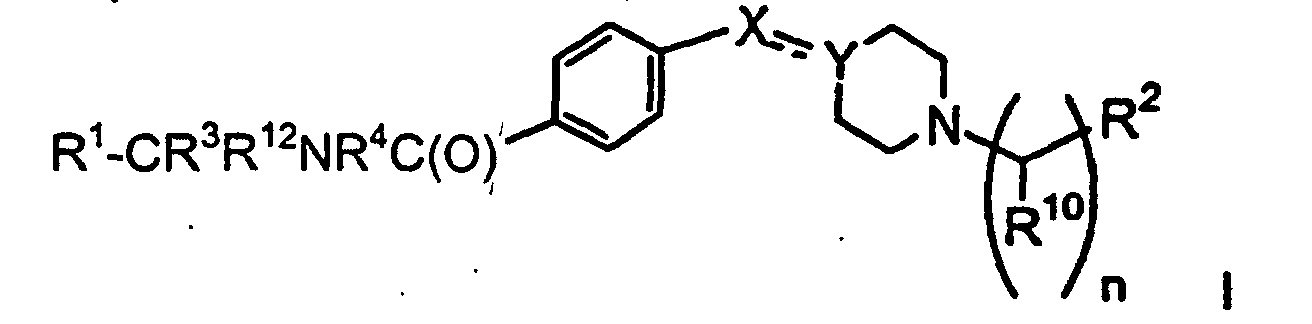
- The present invention relates to compounds represented by structural formula I:or a pharmaceutically acceptable salt, N-oxide or solvate thereof, wherein

the dotted line is an optional double bond;
X is -CHR8-, -C(O)-, -C(=NOR9)-, or, when the double bond is present, -CR8=;
Y isor, when the double bond is present, R1 is R5-(C3-C8)cycloalkyl, R5-(C3-C8)cycloalkyl(C1-C6)alkyl, R5-aryl, R5-aryl-(C1-C6)alkyl, R5-heteroaryl, R5-heteroaryl(C1-C6)alkyl, R5-heterocycloalkyl or R5-heterocycloalkyl(C1-C6)alkyl;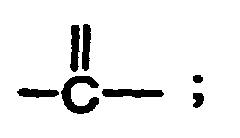
R2 is R6-aryl or R6-heteroaryl;
n is 1, 2 or 3;
R3 is C1-C6 alkyl, aryl or heteroaryl;
R4 is H or C1-C6 alkyl;
R5 is 1-4 substituents independently selected from the group consisting of H, C1-C6 alkyl, halogen, -OH, C1-C6 alkoxy, -CF3, (C1-C6)-alkoxycarbonyl, -SO2NHR4, -C(O)NHR4, -NR4C(O)NHR4, -NR4C(O)R4, -NR4SO2R4, R13-phenyl and naphthyl;
R6 is 1-4 substituents independently selected from the group consisting of H, C1-C6 alkyl, halogen, -OH, -SH, -S(C1-C6 alkyl), -CN, C1-C6 alkoxy, C1-C6 alkylcarboxy, CF3, -NO2, -NH2, (C1-C6)alkylamino, phenyl, (C1-C6)-alkoxycarbonyl and R7-phenoxy, or adjacent ring carbon atoms form a ring with the group -O(CH2)1-2O-, -O(CH2)2-3- or -O(CF2)O-;
R7 is 1-3 substituents independently selected from the group consisting of H, C1-C6 alkyl, halogen, -OH, C1-C6 alkoxy and CF3;
R8 is H, C1-C6 alkyl or (C1-C4)alkoxy-(C1-C4)alkyl;
R9 is H, C1-C6 alkyl or aryl-(C1-C4)alkyl;
R10 is independently selected from the group consisting of H, C1-C6 alkyl and aryl;
R12 is H or C1-C6 alkyl; and
R13 is 1 to 3 substituents independently selected from the group consisting of H, C1-C6 alkyl, halogen, -OH, C1-C6 alkoxy, -CF3, -OCF3, -NO2 and -C(O)CH3. - The present invention also relates to a method of treating eating disorders, such as obesity and hyperphagia, and diabetes comprising administering to a mammal in need of such treatment an effective amount of a compound of formula I.
- Another aspect of the invention is a pharmaceutical composition for treating eating disorders and diabetes which comprises a compound of formula I in combination with a pharmaceutically acceptable carrier.
- R1 is preferably R5-phenyl. R5 is preferably H, halogen, C1-C6 alkyl or phenyl, more preferably halogen or phenyl.
- Another group of preferred compounds is that wherein R2 is R6-aryl, especially when n is 1. More preferred is R6-aryl wherein "aryl" is phenyl and R6 is 1-2 substituents.
- X is preferably -CHR8 wherein R8 is H and Y is CH, or X and Y form a double bond.
- R3 is preferably ethyl or methyl, and R4 and R12 are each preferably H.
- R10 is preferably H or -CH3; when n is 2-5, preferably only one R10 is alkyl and the rest are hydrogen.
- Except where stated otherwise, the following definitions apply throughout the present specification and claims. These definitions apply regardless of whether a term is used by itself or in combination with other terms. Hence the definition of "alkyl" applies to "alkyl'" as well as to the "alkyl" portions of "alkoxy", etc.
- "Alkyl" represents a straight or branched saturated hydrocarbon chain having the designated number of carbon atoms. Where the number of carbon atoms is not specified, 1 to 6 carbons are intended.
- "Cycloalkyl" represents a saturated carbocyclic ring having 3 to 8 carbon atoms.
- The term "heterocycloalkyl" refers to 4- to 7-membered saturated rings comprising 1 to 3 heteroatoms independently selected from the group consisting of -O-, -S- and -NR7-, wherein R7 is H or C1-C6 alkyl, and wherein the remaining ring members are carbon. Where a heterocyclic ring comprises more than one heteroatom, no rings are formed where there are adjacent oxygen atoms, adjacent sulfur atoms, or three consecutive heteroatoms. Examples of heterocyclic rings are tetrahydrofuranyl, pyrrolidinyl, tetrahydropyranyl, piperidinyl, morpholinyl, thiomorpholinyl and piperazinyl.
- Halogen represents fluoro, chloro, bromo or iodo.
- Aryl represents a monoaromatic ring or a bicyclic fused ring system of 6- to 10 carbon atoms, possessing one or two aromatic rings including, phenyl, naphthyl, tetrahydronaphthyl, indanyl, and the like.
- Heteroaryl means a 5- to 10-membered single or benzofused aromatic ring comprising 1 to 3 heteroatoms independently selected from the group consisting of -O-, -S- and -N=, provided that the rings do not include adjacent oxygen and/or sulfur atoms. Examples of single ring heteroaryl groups are pyridyl, isoxazolyl, oxadiazolyl, furanyl, pyrrolyl, thienyl, imidazolyl, pyrazolyl, tetrazolyl, thiazolyl, thiadiazolyl, pyrazinyl, pyrimidinyl, pyridazinyl and triazolyl. Examples of benzofused rings are indolyl, benzofuranyl, quinolyl, quinazolinyl, quinoxalinyl, benzoxazolyl, benzothiazolyl, benzothiadiazolyl, thianaphthenyl, and benzofurazanyl. All positional isomers are contemplated, e.g., 2-pyridyl, 3-pyridyl and 4-pyridyl.
- When a variable appears more than once in the structural formula, for example R5, the identity of each variable appearing more than once may be independently selected from the definition for that variable.
- N-oxides can form on a tertiary nitrogen present in an R1 or R2 substituent, or on =N- in a heteroaryl ring substituent and are included in the compounds of formula I.
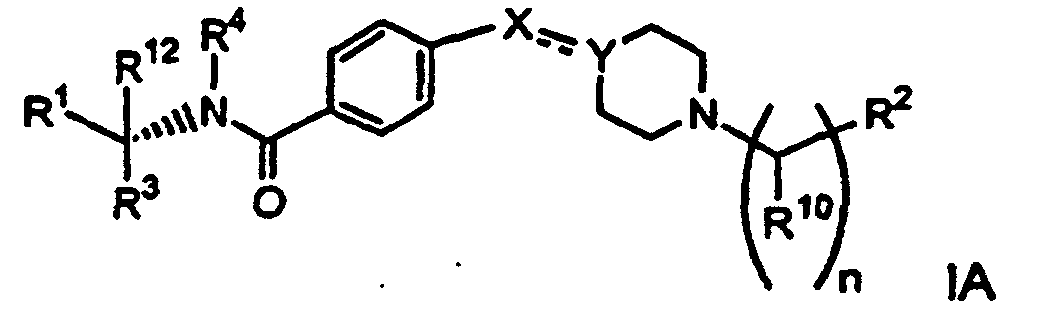
- For compounds of the invention having at least one asymmetrical carbon atom, all isomers, including diastereomers, enantiomers and rotational isomers are contemplated as being part of this invention. The invention includes d and I isomers in both pure form and in admixture, including racemic mixtures. Isomers can be prepared using conventional techniques, either by reacting optically pure or optically enriched starting materials or by separating isomers of a compound of formula I. The preferred stereochemistry for compounds of the invention wherein W is R1-CR3R12NR4C(O)- is shown in formula IA:
- Compounds of formula I can exist in unsolvated and solvated forms, including hydrated forms. In general, the solvated forms, with pharmaceutically acceptable solvents such as water, ethanol and the like, are equivalent to the unsolvated forms for purposes of this invention.
- A compound of formula I may form pharmaceutically acceptable salts with organic and inorganic acids. Examples of suitable acids for salt formation are hydrochloric, sulfuric, phosphoric, acetic, citric, malonic, salicylic, malic, fumaric, succinic, ascorbic, maleic, methanesulfonic and other mineral and carboxylic acids well known to those skilled in the art. The salts are prepared by contacting the free base forms with a sufficient amount of the desired acid to produce a salt in the conventional manner. The free base forms may be regenerated by treating the salt with a suitable dilute aqueous base solution, such as dilute aqueous sodium hydroxide, potassium carbonate, ammonia or sodium bicarbonate. The free base forms differ from their respective salt forms somewhat in certain physical properties, such as solubility in polar solvents, but the salts are otherwise equivalent to their respective free base forms for purposes of the invention.
- Compounds of formula I can be produced by processes known to those skilled in the art using either solution phase or solid phase synthesis as shown in the following reaction schemes and in the preparations and examples below:
- Compounds of Formula I wherein W is R1-CR3R12NR4C(O)- can be produced as shown in Scheme 1.

- The synthesis of compounds such as 3 can be accomplished by the reaction of 9-borabicyclo[3.3.1]nonane (9-BBN) with an olefin such as 1 followed by the Suzuki coupling with an aryl halide such as 1a to afford compounds 2. Hydrolysis of ester 2 and subsequent deprotection of the N-Boc provides the amino acid intermediate which is protected by treatment with 9-fluorenylmethoxycarbonyl oxy succinimide (FmocOSU). This product is then converted into the acid chloride 3 upon treatment with reagents such as POCl3 or oxalyl chloride.
- The amine (R1CR12R3NR5H) is reacted with Argopore-MB-CHO resin (Argonaut Corporation, San Carlos, CA) by reductive alkylation with sodium triacetoxyborohydride. Subsequent acylation of the resin-bound amine with activated acids such as acid chlorides 3, deprotection of the N-Fmoc group, followed by reductive alkylation with aldehydes or ketones, or reaction with an aldehyde followed by treatment with a Grignard reagent, or by reaction with the appropriate mesylate or alkyl halide, provides a resin bound intermediate, which on treatment with trifluoroacetic acid (TFA) produces compounds of Formula I.
- Compounds of Formula I wherein W is R11C(O)NR4 can be prepared according to Scheme 2.
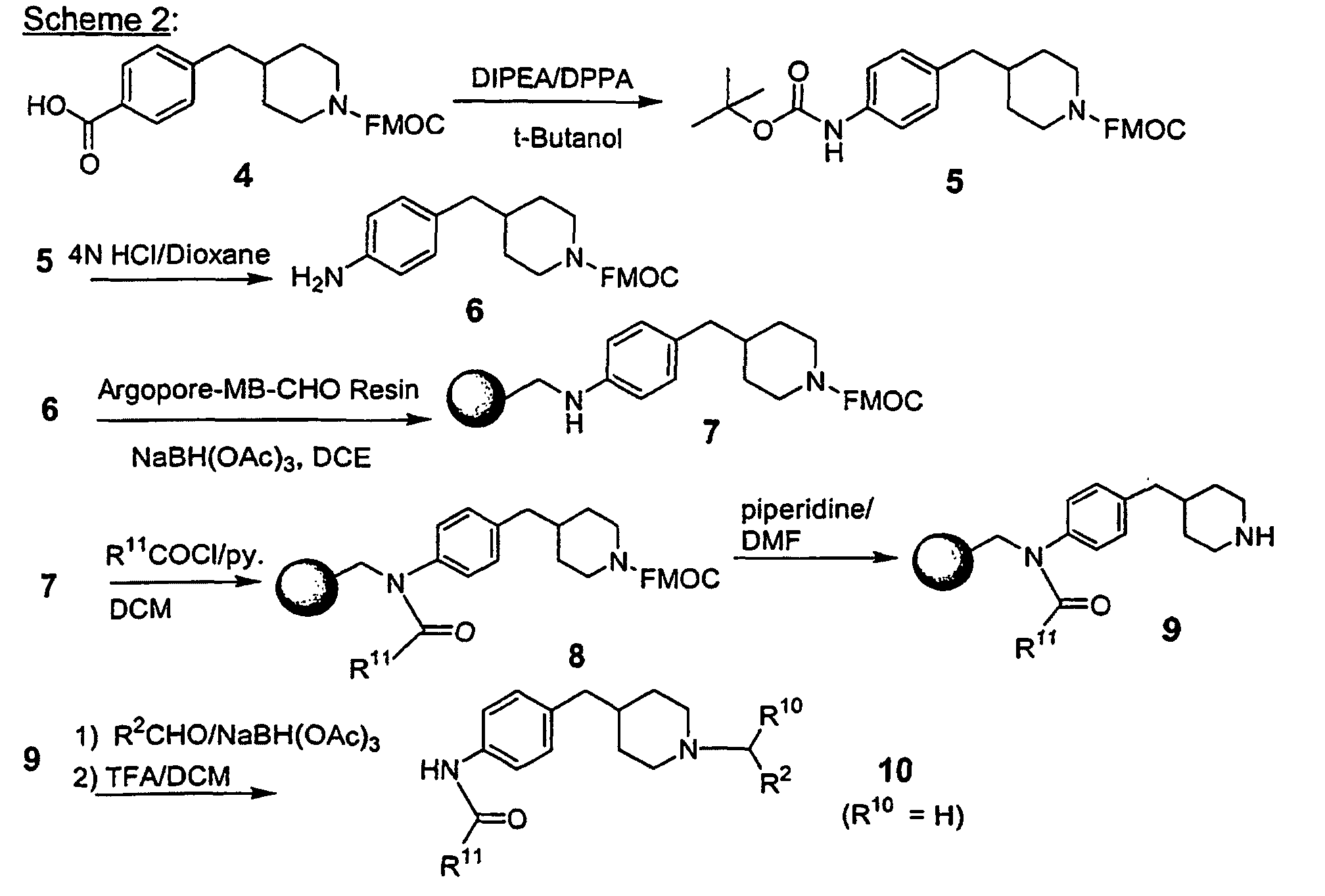
- Compounds 10 can be prepared by the route shown in Scheme 2 by first converting an acid such as 4 into an amine such as 6 by the Curtius reaction, for example by treatment with diphenylphosphoryl azide in an alcohol such as t-butanol followed by hydrolysis. Subsequent reaction with a resin-bound aldehyde such as the Argopore MB-CHO resin under reducing conditions provides a resin-bound amine 7 which can be further functionalized by reaction with activated carboxylic acid derivatives such as acid chlorides. Removal of the FMOC group and reductive alkylation with carbonyl-containing compounds, followed by treatment with acid to remove the compound from the polymeric resin, provides compounds 10.
- Alternatively, compounds of formula I are prepared as shown in Scheme 3 by reacting an aryl bromide such as 11a with an alkyl lithium reagent, followed by addition of an aryl isocyanate. Subsequent removal of the BOC group from compound 12 by treatment with acid and then introduction of the R2 group by alkylation or reductive alkylation provides compounds such as 13. Furthermore, 11 can also be elaborated into compounds such as 11i as shown in Scheme 3.
- Compounds wherein R10 is alkyl can be prepared by the following procedure:

- Additional compounds of formula I are prepared according the route shown in Scheme 5 (specific compounds are shown, but the procedure may be modified to make other compounds within the scope of formula I):

- Compounds of formula I wherein W is R1-CR3R12NR4C(O)- and R1 is biphenyl can be prepared by the Suzuki coupling reaction:The iodophenyl analogs on Argopore-MB-CHO resin are treated with phenylboronic acid, K2CO3, Pd(dppf)Cl2 and 1-methyl-2-pyrrolidinone. The resin is washed, then cleaved using 10% TFA/CH2Cl2.

- Starting materials are prepared by known methods and/or methods described in the Preparations.
- The compounds of formula I exhibit MCH receptor antagonizing activity, which has been correlated with pharmaceutical activity for treating eating disorders, such as obesity and hyperphagia, and diabetes.
- The compounds of formula I display pharmacological activity in a test procedure designed to demonstrate MCH receptor antagonist activity. The compounds are non-toxic at pharmaceutically therapeutic doses.
Following is a description of the test procedure. - Membranes from CHO cells expressing the MCH receptor were prepared by lysing cells with 5 mM HEPES for 15 min at 4C. Cell lysates were centrifuged (12.5000 x g, 15 min) and the pellet was resuspended in 5 mM HEPES. For each 96-well plate (Microlite, Dynex Technologies), 1 mg of cell membranes were incubated with 10 mg of wheat germ agglutinin SPA beads (Amersham) for 5 min at 4 C in a volume of 10 ml of binding buffer (25 mM HEPES, 10 mM MGCl2, 10 mM NaCl, 5 mM MnCl2, 0.1% BSA). The membrane/bead mixture was centrifuged (1500 x g, 3.5 min), the supernatant was aspirated, and the pellet was resuspended in 10 ml binding buffer. The centrifugation, aspiration and resuspension were then repeated. The membrane/bead mixture (100 l) was then added to 96-well plates containing 50 l of 500 pM [125I]-MCH (NEN) and 50 ml of the appropriate concentration of compound (4X the desired final concentration). Nonspecific binding was determined by including 1 M MCH in the binding reaction. The binding reaction was incubated at room temperature for 2 h. Plates were then analyzed in a TOPCOUNT microplate scintillation counter (Packard). Data was analyzed and Ki values were determined using GraphPad Prim.
- For the compounds of this invention, a range of MCH receptor binding activity (Ki values) of from about 3 nM to about 1500 nM was observed. Compounds of this invention preferably have a binding activity in the range of from about 3 nM to about 500 nM, more preferably from about 3 to about 200 nM, and most preferably from about 3 to about 80 nM.
- For preparing pharmaceutical compositions from the compounds described by this invention, inert, pharmaceutically acceptable carriers can be either solid or liquid. Solid form preparations include powders, tablets, dispersible granules, capsules, cachets and suppositories. The powders and tablets may be comprised of from about 5 to about 95 percent active ingredient. Suitable solid carriers are known in the art, e.g., magnesium carbonate, magnesium stearate, talc, sugar or lactose. Tablets, powders, cachets and capsules can be used as solid dosage forms suitable for oral administration. Examples of pharmaceutically acceptable carriers and methods of manufacture for various compositions may be found in A. Gennaro (ed.), Remington's Pharmaceutical Sciences, 18th Edition, (1990), Mack Publishing Co., Easton, Pennsylvania.
- Liquid form preparations include solutions, suspensions and emulsions. As an example may be mentioned water or water-propylene glycol solutions for parenteral injection or addition of sweeteners and opacifiers for oral solutions, suspensions and emulsions. Liquid form preparations may also include solutions for intranasal administration.
- Aerosol preparations suitable for inhalation may include solutions and solids in powder form, which may be in combination with a pharmaceutically acceptable carrier, such as an inert compressed gas, e.g. nitrogen.
- Also included are solid form preparations which are intended to be converted, shortly before use, to liquid form preparations for either oral or parenteral administration. Such liquid forms include solutions, suspensions and emulsions.
- The compounds of the invention may also be deliverable transdermally. The transdermal compositions can take the form of creams, lotions, aerosols and/or emulsions and can be included in a transdermal patch of the matrix or reservoir type as are conventional in the art for this purpose.
- Preferably the compound is administered orally.
- Preferably, the pharmaceutical preparation is in a unit dosage form. In such form, the preparation is subdivided into suitably sized unit doses containing appropriate quantities of the active component, e.g., an effective amount to achieve the desired purpose.
- The quantity of active compound in a unit dose of preparation may be varied or adjusted from about 1 mg to about 100 mg, preferably from about 1 mg to about 50 mg, more preferably from about 1 mg to about 25 mg, according to the particular application.
- The actual dosage employed may be varied depending upon the requirements of the patient and the severity of the condition being treated. Determination of the proper dosage regimen for a particular situation is within the skill of the art. For convenience, the total daily dosage may be divided and administered in portions during the day as required.
- The amount and frequency of administration of the compounds of the invention and/or the pharmaceutically acceptable salts thereof will be regulated according to the judgment of the attending clinician considering such factors as age, condition and size of the patient as well as severity of the symptoms being treated. A typical recommended daily dosage regimen for oral administration can range from about 1 mg/day to about 300 mg/day, preferably 1 mg/day to 50 mg/day, in two to four divided doses.
- The invention disclosed herein is exemplified by the following preparations and examples. Alternative mechanistic pathways and analogous structures may be apparent to those skilled in the art. The following terms are abbreviated: room temperature (rt); ethyl acetate (EtOAc); tetrahydrofuran (THF); dimethylformamide (DMF); diisopropylethylamine (DIPEA); and dichloroethane (EDC).
-

- See Scheme 1, above.
- Mix starting material 1 (1 g) with 9-BBN (10.2 ml of a 0.5 M THF solution), place under a N2 atmosphere and heat to reflux for 1 h. To the cooled solution add methyl 4- bromobenzoate (1.09 g), K2CO3 (0.84 g), PdCl2(dppf) (0.21g), Ph3As (0.155 g), DMF (7 ml) and water (1.1 ml) and heat at 65 °C for 3 h. Pour the reaction mixture into ice water, extract into EtOAc and purify the organic layer by flash chromatography (Hex: EtOAc (90:10) to yield compound 2 (1.1 g). Dissolve compound 2 (1.1 g) in CH3OH (20 ml) and add LiOH (0.2g) and water (7.5 ml). After heating to reflux for 1 h, cool the reaction mix, remove the CH3OH under vacuum and acidify the mixture with HCl. Collect the solid by filtration and dry in vacuo, and dissolve in 4 M HCl in dioxane (35 ml) and stir for 1.5 h. Add ether and collect the solid (0.67 g) by filtration. Add the solid (0.66 g) to a solution of Na2CO3 (0.6g) in water (120 ml) and dioxane (40 ml) followed by dropwise addition at 0 °C of a solution prepared from FMOC-OSuc (0.87g) and dioxane (10 ml). After 2 h at rt, remove the dioxane under vacuum and acidify the mixture with HCl. Collect the solid by filtration and dry in vacuo (0.93 g, LCMS 442.1 [M+H]). Treat the residue with oxalyl chloride in CH2Cl2 to obtain the title compound.
-

- To a solution of (R)-α-methylbenzylamine (7.0 g, 57.8 mmol, 1 eq )/10 ml EDC was added trifluoroacetic anhydride (10 ml, 1.22 eq) in EDC (10 ml) below 30 °C. The mixture was stirred for 1.5 h and then cooled to 0 °C. Iodine (7 .0 g, 0.48 eq) was added, followed by addition of bis(trifluoroacetoxy)iodobenzene (12.6 g, 0.5 eq). The mixture was stirred overnight and quenched by 10 % Na2S2O3 (130 ml). 130 ml CH2Cl2 was added and the organic layer was washed with saturated NaHCO3. After drying over Na2CO3 and removing CH2Cl2, the solid was dissolved in ether (50 ml) by heat, followed by addition of hexane (150 ml). White solids were precipitated out and the mixture was further stirred for 2 h. Filtration afforded white crystal, which was washed with hexane (30 ml x 2) and air-dried. 9.2 g of the desired product was obtained in 46 % yield. 1HNMR (CDCl3): δ 1.6 (d, 3 H, J = 7.3 Hz), 5.08 (m, 1 H), 6.40 (br s, 1 H), 7.05 (d, 2 H, J = 8.3 Hz), 7.70 (d, 2 H, J = 8.3 Hz).
- The product of step 1 (1 g, 2.91 mmol, 1 eq) was dissolved in CH3OH (35 ml), water (10 ml) and 2N NaOH (6 ml). The solution was stirred overnight and TLC showed complete conversion. The solvent was removed and extraction with CH2Cl2 several times provided the desired product as colorless oil (0.69 g, 96 % yield).
1HNMR (CDCl3): δ 1.22 (d, 3 H, J = 6.5 Hz), 1.40 (s, 2 H), 3.98 (q, 1 H, J = 6.6 Hz), 7.00 (d, 2 H, J = 8.3 Hz)), 7.58 (d, 2 H, J = 8.3 Hz).
13CNMR (CDCl3): δ 27.12, 51.98, 93.09, 128.92, 138.36, 148.38.
HRMS for C8H11lN (M + 1) calcd: 247.9936; found: 247.9936. -
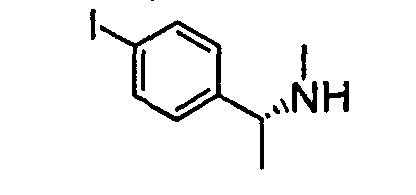
- To a solution of the product of Preparation 2, step 1, (1 g, 2.92 mmol, 1 eq)/10 ml THF at 0 °C under N2 was added KHMDS (0.5 M in toluene, 7 ml, 1.2 eq) dropwise. 20 min later, CH3l (0.36 ml, 2 eq) was added and the mixture was stirred overnight. After workup and flash chromatography (EtOAc:hexane, 1:10), 1 g of the desired product was obtained. 2:1 rotamers were observed, the major one was reported as:
1HNMR (CDCl3): δ 1.58 (d, 3 H, J = 6.6 Hz), 2.80 (s, 3 H), 5.90 (q, 1 H, J = 6.6 Hz), 7.00 (d, 2 H, J = 8.3 Hz), 7.75 (d, 2 H, J = 8.3 Hz). - The above product was hydrolyzed in NaOH/CH3OH to the amine in 85 % yield. 1HNMR (CDCl3: δ 1.30 (d, 3 H, J = 6.6 Hz), 1.40 (br s, 1 H), 2.30 (s, 3 H), 3.60 (q, 1 H, J = 6.6 Hz), 7.05 (d, 2 H, J = 8.3 Hz), 7.61 (d, 2 H, J = 8.3 Hz).
-
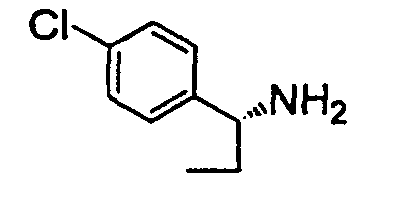
- 4'-chloropropiophenone was reduced to (S)-4-chloro-α-ethylbenzyl alcohol according to J.Org. Chem. (1993), 58, 2880-2888. (> 95 % ee by NMR of the corresponding Mosher's esters.)
1HNMR (CDCl3): δ 0.98 (t, 3 H, J = 7.4 Hz), 1.60-1.78 (m, 2 H), 1.80-2.00 (br s , 1 H), 4.58 (t, 1 H, J = 6.7 Hz), 7.22 (d, 2 H, J = 8.4 Hz), 7.30 (d, 2 H, J = 8.4 Hz). - The (S)-4-chloro-α-ethylbenzyl alcohol was then converted to the corresponding (R)-azide according to J.Org. Chem. (1993), 58, 2880-2888. 1HNMR (CDCl3): δ 0.98 (t, 3 H, J = 7.4 Hz), 1.70-1.85 (m, 2 H), 4.35 (t, 1 H, J = 6.7 Hz), 7.22 (d, 2 H, J = 8.4 Hz), 7.38 (d, 2 H, J = 8.4 Hz).
- The azide was reduced by triphenylphosphine to the amine by literature procedures (J. Med. Chem. (1997), 2755-61).
1HNMR (CDCl3): δ 0.98 (t, 3 H, J = 7.3 Hz), 1.60 (m, 2 H), 3.75 (m, 1 H) 7.20 (m, 4 H). 13CNMR (CDCl3): δ 12.08, 33.64, 58.35, 128.83, 129.43, 132.97, 133.33. -
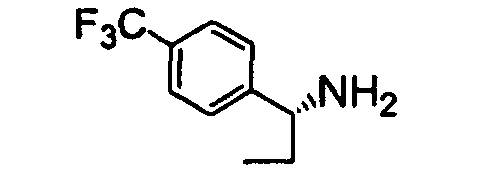
- (R)-α-ethyl-4-trifluoromethylbenzylamine was prepared by methods similar to the above procedures. 1HNMR (CDCl3): δ 0.90 (t, 3 H, J = 7.4 Hz), 1.60-1.78 (m, 2 H), 2.00-2.18 (br s), 3.90 (t, 1 H, J = 6.9 Hz), 7.41 (d, 2 H, J = 8.2 Hz), 7.60 (d, 2 H, J = 8.2 Hz).
-

- The title compound was prepared by a procedure similar to that described above. 1HNMR (CDCl3): δ 0.99 (t, 3 H, J = 7.3 Hz), 1.20-1.40 (m, 2 H), 1.50-1.70 (m, 4 H), 3.92 (t, 1 H, J = 6.9 Hz), 7.10 (d, 2 H, J = 8.3 Hz), 7.60 (d, 2 H, J = 8.3 Hz).
-

- 6-Methylquinoxaline was oxidized by SeO2 to 6-formylquinoxaoline in > 80 % yield according to Chem. Abstr. (1945), 39, 4077-4078.
1HNMR (CDCl3): δ 8.20 (m, 2 H), 8.59 (s, 1 H), 8.98 (s, 1 H), 10.22 (s, 1 H). -
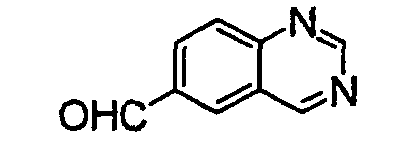
- 6-Methylquinazoline (prepared from 4-hydroxy-6-methylquinazoline according to J. Am. Chem. Soc. (1962) 561) was oxidized by SeO2 to 6-formylquinazoline in 10 % yield. 1HNMR (CDCl3): δ 8.20 (d, 1 H, J = 8.3 Hz), 8.40 (d, 1 H, J = 8.3 Hz), 8.45 (s, 1 H), 9.40 (s, 1 H), 9.50 (s, 1 H), 10.20 (s, 1 H).
-

- 5-Methyl-2,1,3-benzothiadiazole was converted to the corresponding aldehyde according to the procedure of Eur. J. Med. Chem. (1993), 28, 141.
1HNMR (CDCL3) δ 8.10 (s, 2 H), 8.50 (s, 1 H), 10.20 (s, 1 H). -
-

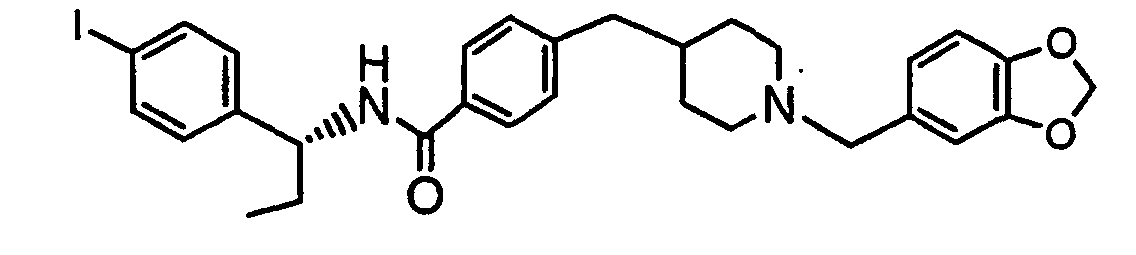
- To (R)-α-ethylbenzylamine (19.8 g, 146.7 mmol, 1 eq) in EDC (30 ml) at 0 °C was added trifluoroacetic anhydride (25.3 ml, 1.22 eq) dropwise. The ice bath was removed and the mixture was stirred for 1.5 h. The crude was then cooled to 0 °C followed by the addition of I2 (17.9 g, 0.48 eq) and bis(trifluoroacetoxy)iodobenzene (32.1 g, 0.51 eq). The dark purple mixture was stirred for 18 h until it became slightly yellow. 10 % Na2S2O3 (330 ml) and CH2Cl2 (330 ml) were added and stirred at 0 °C for 0.5 h. After separation, the organic layer was washed with saturated NaHCO3 until the pH of the aqueous layer was 9. After further extraction with CH2Cl2, the organic layers were combined and dried over Na2CO3. Removal of the solvent provided a white solid which was redissolved in CH2Cl2 (300 ml). The solution was treated with 1 liter of hexane and white solid precipitated. After filtration and washing with hexane and ether, 26.5 g of the desired product as white solid was obtained in 50 % yield.
-

- The product of Step 1 (25 g) was dissolved in CH3OH (200 ml), treated with 3 N NaOH (100 ml) at 0 °C and gradually warmed up to rt overnight. The solvent was removed and the solution was extracted with CH2Cl2 followed by drying with Na2CO3. After removal of the solvent, 14 g of the desired product was obtained in 77 % yield.
1HNMR (CDCl3): δ 0.82 (d, 3 H, J = 7.3 Hz), 1.46 (s, 2 H), 1.60 (m, 2 H), 3.78 (t, 1 H, J = 6.7 Hz), 7.05 (d, 2 H, J = 8.3 Hz), 7.60 (d, 2 H, J = 8.3 Hz).
13CNMR (CDCl3): δ 12.14, 33.60, 58.46, 93.10, 129.56, 138.35, 146.99.
HRMS for C9H13lN (M + 1) calcd: 262.0093; found: 262.0092.
Elemental analysis: C, H, N. N: calcd: 5.36; found: 4.60. - The Argopore aldehyde resin (Argonaut Corporation, San Carlos, CA) (10 g, 0.76 mmol/g) in EDC (40 ml) was stirred with the product of Step 2 (7.93 g, 4 eq) for 15 min followed by addition of NaB(OAc)3H (6 g, 4 eq). The mixture was stirred under N2 at rt for 20 h before being quenched with CH3OH. The CH3OH was removed and the crude was treated with 2N NH3/CH3OH for 0.5 h. The resin was further washed with CH3OH, CH2Cl2 (3 times each) and dried under vacuum at 40 °C overnight.
- The resin from Step 3 was treated with 10 eq of DIPEA and 2 eq of the product of Preparation 1 in CH2Cl2 at rt overnight. The resin was then washed with CH2Cl2 several times.
- The resin of Step 4 was treated with 20 % piperidine/DMF for 1 h (twice). After washing with CH2Cl2, then EDC, the resin was treated with EDC, piperonal (10 eq) and NaB(OAc)3H (10 eq) under N2 for 24-48 h. The resin was then washed with CH3OH, 2N NH3/ CH3OH, CH3OH, CH2Cl2 (3 times each) and dried under vacuum. Final cleavage was done with 10 % TFA/CH2Cl2 (1 h). The crude (TFA salt) was chromatographed to give the title compound (Rf = 0.45, CH2Cl2/CH3OH/NH4OH = 97/3/1).
1H NMR(CDCl3): δ 0.99 (t, 3 H, J = 7.3 Hz), 1.22-1.37 (m, 2 H), 1.45-1.60 (m, 3 H), 1.80-1.99 (m, 4 H), 2.58 (d, 2 H, J = 6.6 Hz), 2.82 (d, 2 H, J = 7.4 Hz), 3.40 (s, 2 H), 5.00 (q, 1 H, J = 7.4 Hz), 5.90 (s, 2 H), 6.25 (d, 1 H, J = 8.0 Hz), 6.70 (s, 2 H), 6.80 (s, 1 H), 7.10 (d, 2 H, J = 8.0 Hz), 7.18 (d, 2 H, J = 8.0 Hz), 7.65 (d, 4 H, J = 8.1Hz).
MS for C30H33lN2O3: 597 (M+1)+
Tr = 6.7 min (gradient A (CH3CN)/B (water with 0.1 % TFA): from 5% A/B to 95 % A/B in 10 min.) - Using a similar procedure with the appropriate amines and aldehydes, the following compounds of formula I were prepared, wherein R1-CR12R3- andare as defined in the following Table 1:


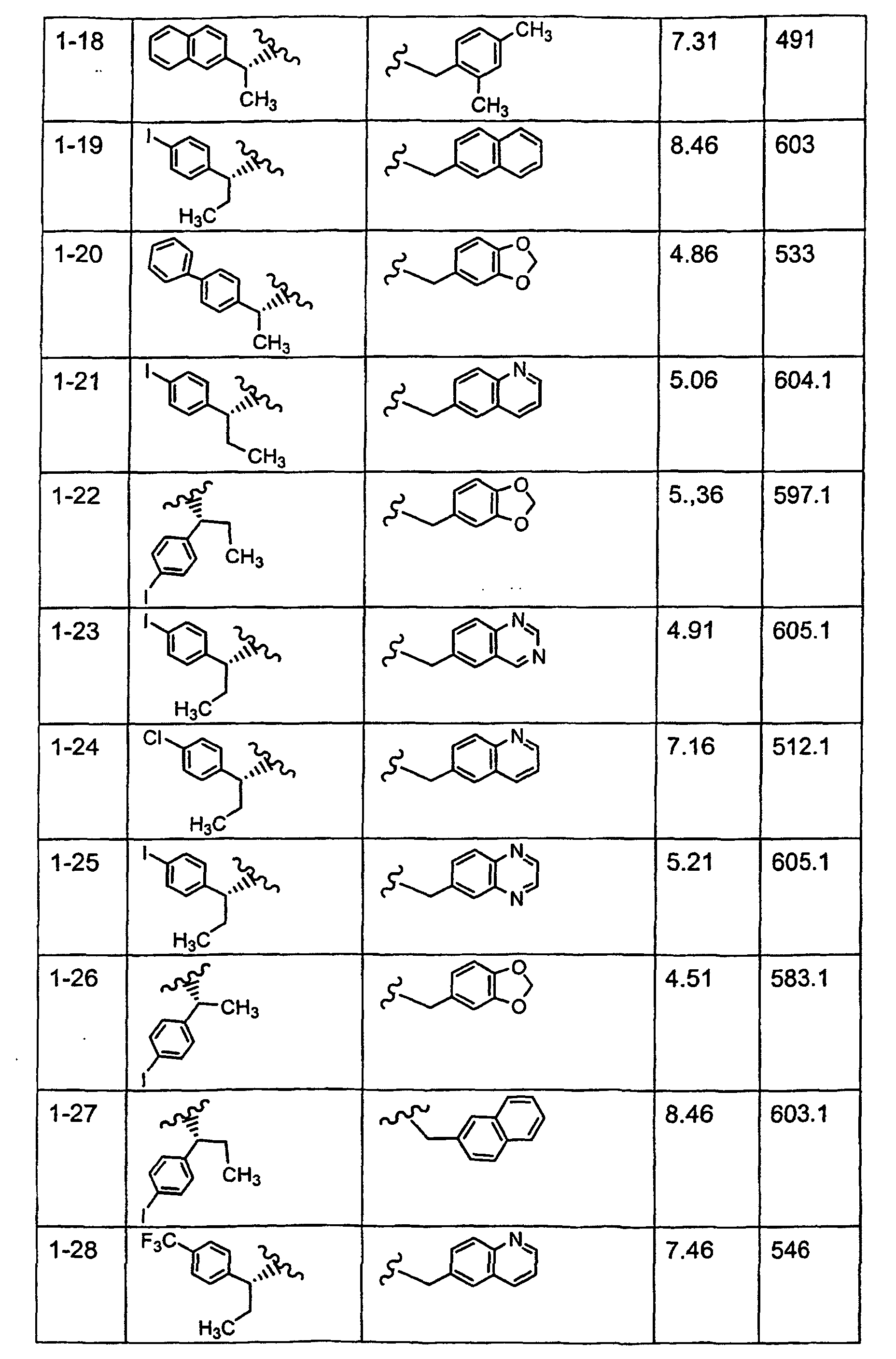


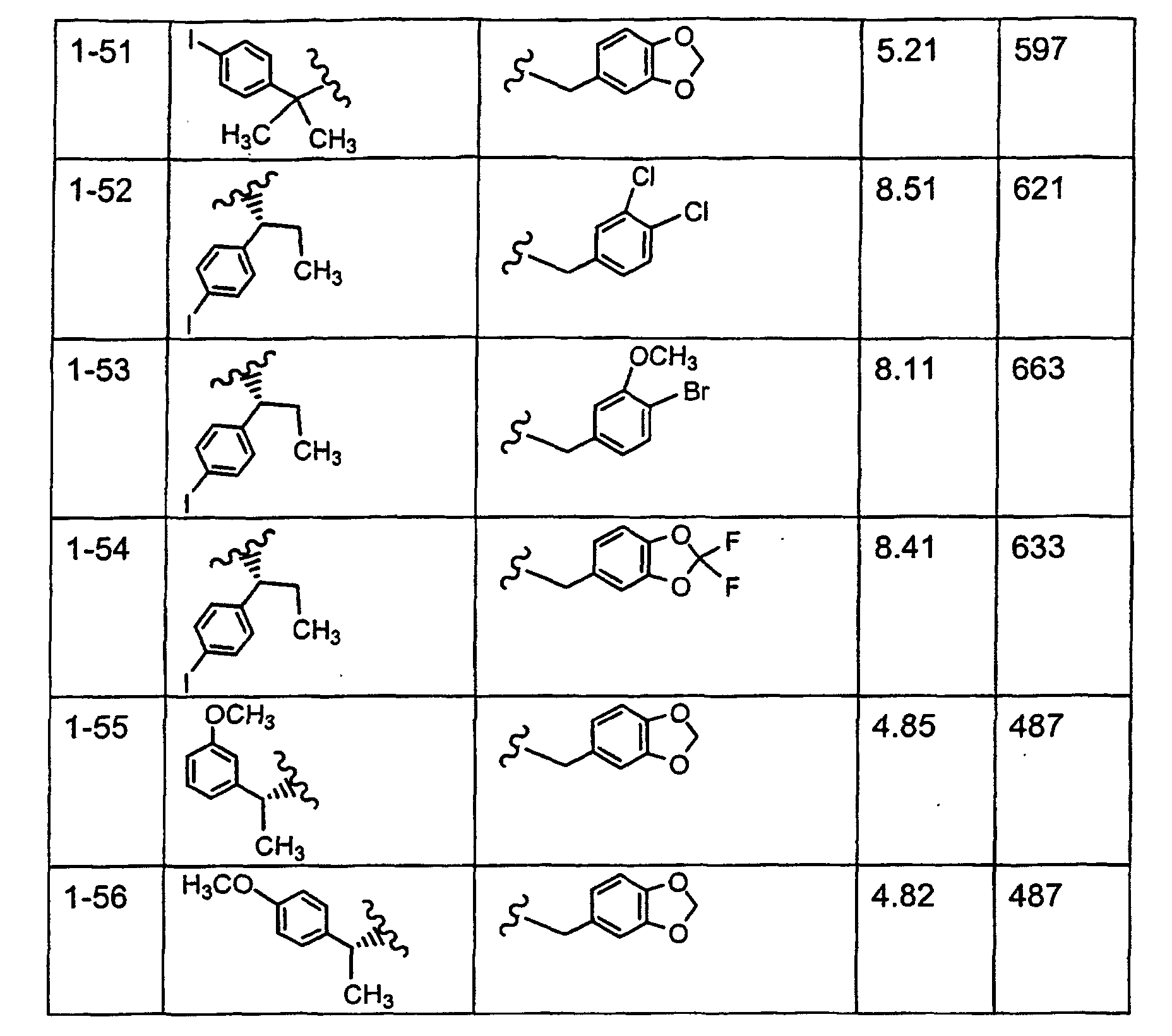
-

- The acid 4 (4.42 g, 0.01 mol) is suspended in distilled t-butanol (30 ml), DIPEA (1.66 ml, 0.0095 mol) and diphenylphosphoryl azide (2.16 ml, 0.01 mol) are added under N2, and the mixture is refluxed overnight. The t-butanol is removed by rotoevaporation, and the concentrated residue is purified by flash chromatography (EtOAc/Hexane (1:3) with 10% CH2Cl2), to obtain compound 5 (1.65 gm).
- Compound 5 (2.85 g) is dissolved in 4N HCl in dioxane and stirred overnight, and concentrated. The residue is dissolved in 1N HCl, extracted with ether, and the HCl layer is basified with saturated NaHCO3 solution to pH 9, and extracted with CH2Cl2 twice. The combined CH2Cl2 layer is washed with brine and dried over anhydrous Na2SO4, to give 6 (1.67 gm).
- Argopore-MB-CHO resin (5.0 g, 0.76 mmol/g) is suspended in EDC (40 ml), amine 6 (1.67 g, 4.05 mmol) and NaBH(OAc)3 (4.24 g, 20.25 mmol) is added and shaken for 70 h. CH3OH is added, the reaction stirred for 30 min., then the resin is washed with 2N NH3/CH3OH (2x), CH3OH (2x), THF (2x) and CH2Cl2 (2x), and dried under vacuum to obtain resin 7.
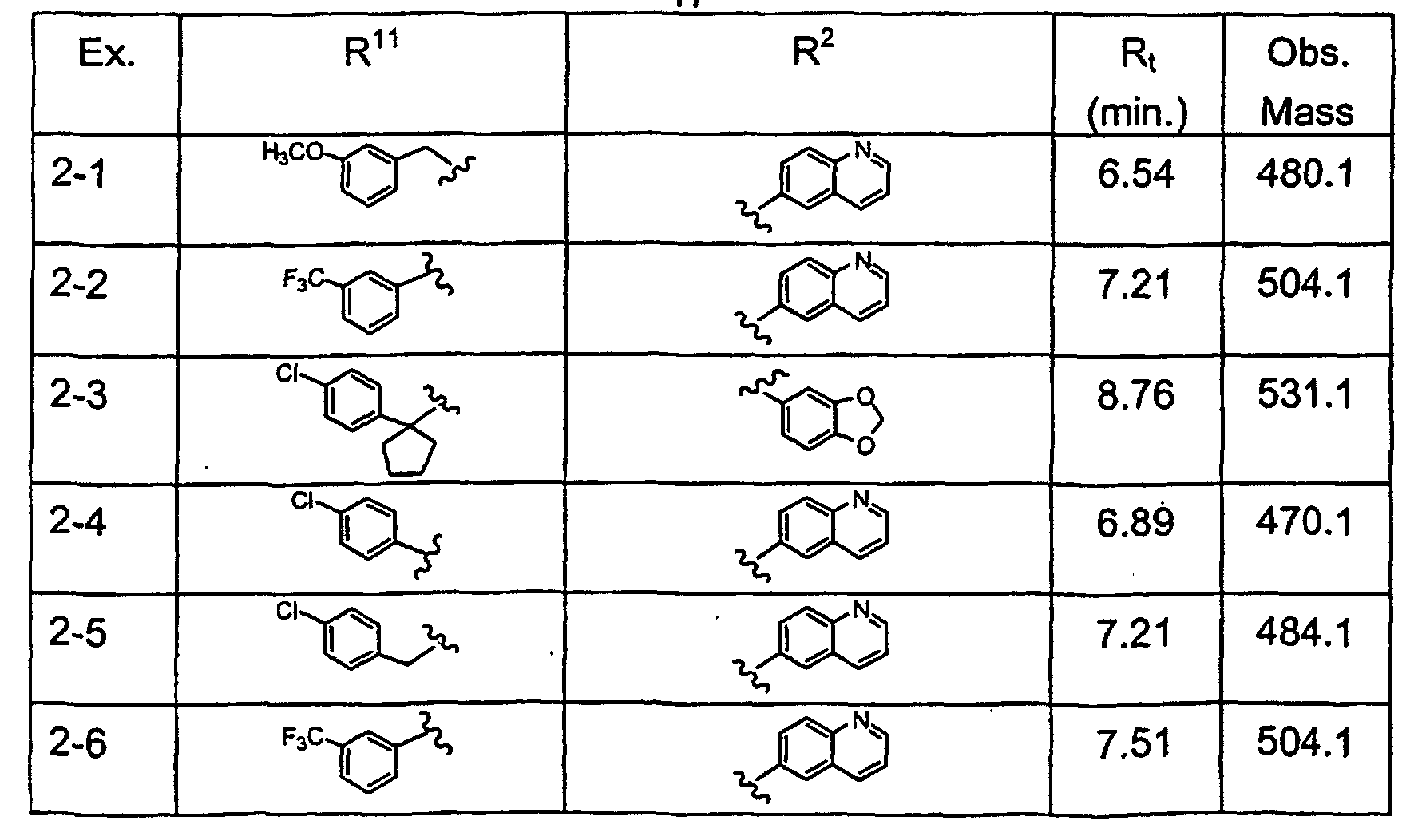
- Resin 7 (70 mg, 0.76 mmol/g) is suspended in anhydrous CH2Cl2, then anhydrous pyridine (0.045 ml, 0.532 mmol) is added and mixed, followed by addition of 1-(4-chlorophenyl) 1-cycylopentanecarbonyl chloride (65 mg, 0.266 mmol). The mixture is shaken is overnight, then washed with CH3OH (2x), THF (2x), CH2Cl2 (2x), and dried in vacuum to obtain resin bound amide. This resin is treated with 20% piperidine in DMF (3 times, 20 min each) then washed with THF (2x), CH3OH (2x), CH2Cl2 (2x), and dried. The resultant resin is suspended in EDC, 6-quinoline carboxaldehyde (167 mg, 1.06 mmol) and NaBH(OAc)3 (112.8 mg, 0.532 mmol) are added and the mixture is shaken for 70 h. The resin is washed with THF (2x), CH3OH (2x), CH2Cl2 (2x), and treated with 40% TFA/CH2Cl2 for 30 min. The mixture is filtered and the volatiles are evaporated to obtain the title compound. LCMS Rt 7.69 min., observed mass 538.1 (M+H).
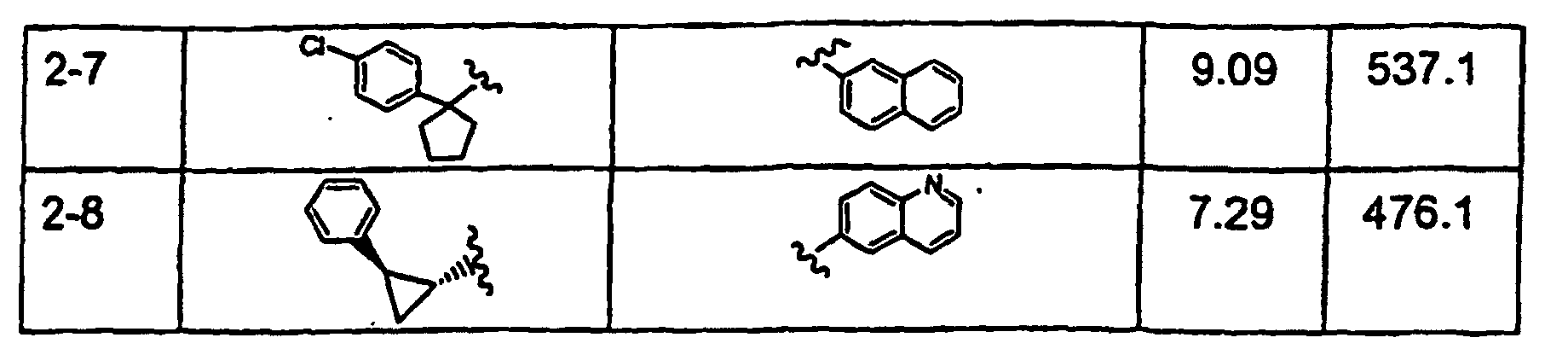
Using the same procedures with the appropriate acid chlorides and aldehydes the following compounds in Table 2 are obtained:
-

- To a stirring solution of 11 (4 gm) in THF (20 ml) at -78 °C add CH3MgBr (11 ml of a 3M solution in THF). After 30 min, warm to rt and then heat the reaction mixture at reflux temperature for 1 h and partition between saturated NH4Cl and EtOAc. Wash the organic layers with 1N HCl and H2O, dry over MgSO4 and concentrate to dryness. Dissolve the residue (2.2 g) in CH2Cl2 (30 ml), add triethylsilane (15 ml) and TFA (15 ml). After stirring overnight, concentrate the reaction mixture under reduced vacuum (135°C at 26 Pa) to provide a yellow solid. Dissolve the solid (0.96 gm) in CH2Cl2 (30 ml), add (BOC)2O (1.6 g) and 1 N NaOH (20 ml). After 2 h, separate the organic layer, wash with 1 N HCl, and dry over MgSO4. Concentrate the mixture under reduced pressure (100 °C at 133 Pa) to provide compound 11A as light yellow oil (1.14 g).
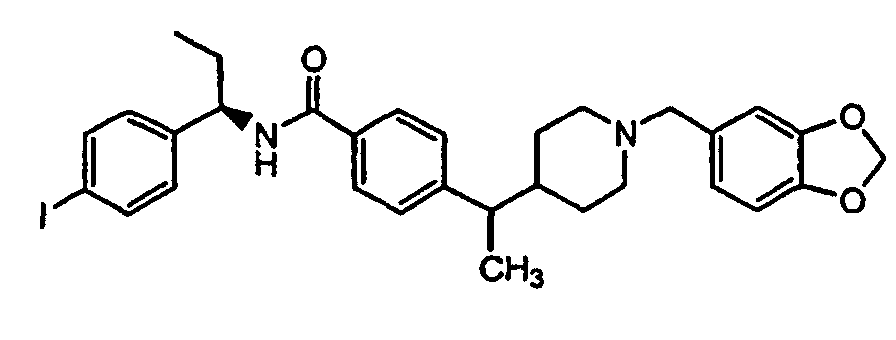
- To a solution of 11A (0.37 gm) in THF (10 ml) cooled to -78°C, add n-BuLi (0.6 ml of a 2.5 M solution in hexane) with stirring. After 30 min at - 78 °C,add a solution of 1-(4-iodophenyl)-propylisocyanate (prepare this from R-α-ethyl-4-iodo-benzylamine from example 1, step 2, by reaction with triphosgene and proton sponge). After 15 min. add a solution of NH4Cl and partition with CH2Cl2. The CH2Cl2 layers are separated and concentrated and the residue purified by prep TLC using 1:3 EtOAc:Hex to yield a colorless oil (0.91 g). Treat this oil with 10 % TFA in CH2Cl2 (5 ml) for 2 h, then concentrate to dryness. Suspend a portion of this material (0.026 g) in CH2Cl2, add 6-quinoline-carboxaldehyde (0.016 g) and NaBH(OAc)3 (0.014 g). Stir the reaction overnight, then purify by prep TLC using EtOAc to give the title compound as a yellow oil. LCMS Rt 5.26min., observed mass 618.1 (M+H).
- Using the same procedure as above but using piperonal in place of 6-quinoline-carboxaldehyde provides example 3a:LCMS Rt 5.51 min., observed mass 611.1(M+H)
-

- To CH3Ph3Br (13.58 g, 38 mmol, 2 eq) in THF (65 ml) at -78 °C was added n-BuLi (2.5 M in hexane, 15.2 ml, 2 eq) dropwise. The mixture was warmed to 0 °C and then cooled back to -78 °C before the ketone 11 (7 g, 1 eq)/30 ml THF) solution was transferred to the anion solution. 15 min later, the solution was warmed up to rt. After 1 h, the reaction was quenched by water. Extraction with ether and flash chromatography (EtOAc:Hexane, 1:6) gave the olefin 11f as clear oil (6.7 g, 97 %). 1HNMR (CDCl3): δ 1.30 (m, 1 H), 1.41 (s, 9 H), 1.60 (m, 1 H), 1.80 (m, 2 H), 2.50 (m, 1 H), 2.75 (m, 2 H), 4.20 (, 2 H), 5.01 (s, 1 H), 5.20 (s, 1 H), 7.20 (d, 2 H, J = 8.3 Hz), 7.41 (d, 2 H, J = 8.3 Hz)
- Hydroboration of the 11f was done with 9-BBN and the alcohol was obtained in 97 % yield. 1HNMR (CDCl3): δ 1.00 (m, 1 H), 1.10-1.38 (m, 4 H), 1.40 (s, 9 H), 1.60-1.80 (m, 3 H), 2.40-2.60 (m, 2 H), 2.60-2.70 (m, 1 H), 3.60 (m, 2 H), 3.90-4.20 (m, 2 H), 7.00 (d, 2 H, J = 8.1 Hz), 7.40 (d, 2 H, J = 8.1 Hz).
The alcohol (0.63 g, 1.64 mmol, 1 eq) was stirred with NaH (60 %, 0.13 g, 2 eq), n-Bu4NBr (0.2 g) in THF (5 ml) for 40 min before CH3l (1 ml) was added. The mixture was stirred at 40 °C for 2 h. After extraction with EtOAc, flash chromatography (EtOAc:Hexane, 1:3) gave the methyl ether 11g (0.45 g, 69 %).
1HNMR (CDCl3): δ 0.99 (m, 1 H), 1.10-1.38 (m, 4 H), 1.40 (s, 9 H), 1.60-1.80 (m, 3 H), 2.40-2.60 (m, 2 H), 2.60-2.70 (m, 1 H), 3.20 (s, 3 H), 3.60 (m, 2 H), 3.90-4.20 (m, 2 H), 7.00 (d, 2 H, J = 8.1 Hz), 7.40 (d, 2 H, J = 8.1 Hz). - 11g (0.45 g, 1.13 mmol, 1 eq) was dissolved in THF (6 ml) and cooled to -78 °C under N2. N-BuLi (2.5 M in hexane, 0.54 ml, 1.2 eq) was added dropwise and stirred for 5 min, then (R)-α-ethyl-4-chlorobenzylisocyanate (0.26 g, 1.2 eq) was added [Prepared from the amine (1 g, 5.90 mmol, 1 eq) by treatment with diphosgene (0.85 ml, 1.2 eq) and proton sponge (2.53 g, 2 eq) in 10 ml CH2Cl2). After 30 min, the crude was washed with 1 M HCl and 1 M NaOH. Flash chromatography (EtOAc:hexane, 1:5) provided 0.9 g of colorless liquid which was used immediately. 1HNMR (CDCl3): δ 1.00 (t, 3 H, J = 7.3 Hz), 1.80 (m, 2 H), 4.5 (t, 1 H, J = 7.3 Hz), 7.20 (d, 2 H, J = 8.3 Hz), 7.30 (d, 2 H, J = 8.3 Hz)]. The crude was stirred for -78 °C for 1 h and warmed up to rt for another hour. After quenching with water and extraction, flash chromatography (EtOAc:hexane, 1:3) provided 11h (0.40 g, 69 %).
1HNMR (CDCl3): δ 1.00 (t, 3 H, J = 7.0 Hz), 1.10-1.25 (m, 2 H), 1.40 (s, 9 H), 1.60-1.90 (m, 4 H), 2.40-2.65 (m, 3 H), 3.22 (s, 3 H), 3.40 (m. 2 H), 3.80-4.20 (m, 2 H), 5.00 (q, 1 H, J = 7.2 Hz), 6.60 (d, 1 H, J =7.7 Hz), 7.20 (d, 2 H, J = 7.1 Hz), 7.25 (s, 4 H), 7.70 (d, 2 H, J = 7.0 Hz).
13CNMR (CDCl3): δ 12.12, 29.64, 30.28, 31.34, 31.59, 39.53, 52.43, 55.91, 60.15, 75.11, 80.44, 128.01, 129.06, 129.62, 129.69, 133.66, 133.88, 141.90, 147.50, 155.63, 167.68.
HRMS for C29H40ClN2O4 (M + 1) calcd: 262.0093; found: 262.0092. - 11h (87 mg, 0.169 mmol, 1 eq) was dissolved in CH2Cl2 (0.5 ml) and treated with 4 M HCl/dioxane (3 ml) for 24 h. The solvent was removed and the crude was basified with saturated NaHCO3. Extraction with EtOAc provided 80 mg of the crude which was treated with 6-formylquinoline (80 mg, 3 eq) and NaBH(OAc)3 (107 mg, 3 eq) in 5 ml CH2Cl2 for 24 h. The crude was washed with saturated Na2CO3 followed by extraction with CH2Cl2. Flash chromatography (CH2Cl2:CH3OH:NH4OH, 98:2:1) provided 60 mg of the desired product 11i.
1HNMR (CDCl3): δ 0.99 (t, 3 H, J = 7.3 Hz, 1.20 (m, 2 H), 1.40 (m, 1 H), 1.60 (m, 1 H), 1.90 (m, 4 H), 2.02 (m, 1 H), 2.60 (m, 1 H), 2.80 (d, 1 H, J = 12.1 Hz), 2.99 (d, 1 H, J = 11.7 Hz), 3.20 (s, 3 H), 3.60 (m, 2 H), 3.62 (s, 2 H), 5.00 (q, 1 H, J = 7.5 Hz), 6.58 (d, 1 H, J = 7.9 Hz), 7.20 (d, 2 H, J = 8.3 Hz), 7.22 (m, 3 H), 7.38 (m, 1 H), 7.70 (m, 4 H), 8.00 (d, 1 H, J = 8.0 Hz), 8.10 (d, 1 H, J = 8.3 Hz), 8.90 (d,1 H, J = 4.0 Hz) -

- 6-Methylbenzoxazole was reacted with NBS (1 eq) and catalytic amount of benzoyl peroxide in CCl4 at 90 °C for 12 h to obtain 6-bromomethylbenzoxazole which was purified by flash chromatography (EtOAc:Hexane = 1:5).
1HNMR (CDCl3): δ 4.60 (s, 2 H), 7.42 (d, 1 H, J = 8.2 Hz), 7.64 (s, 1 H), 7.76 (d, 1 H, J = 8.2 Hz), 8.12 (s, 1 H). The product (42 mg, 1.5 eq) was immediately reacted with the piperidine derivative (62 mg, 1 eq) with K2CO3 in CH3CN (3 ml) at 80 °C under N2 overnight. Direct chromatography (CH2Cl2:CH3OH:NH4OH, 98:2:1) gave the desired product (8.4 mg).
1HNMR (CDCl3): δ 1.00 (t, 3 H, J = 7.3 Hz), 1.20-1.40 (m, 2 H), 1.50-1.70 (m, 3 H), 1.80-2.00 (m, 4 H), 2.60 (d, 2 H, J = 6.6 Hz), 2.90 (d, 2 H, J = 10.5 Hz), 3.60 (s, 2 H), 5.00 (q, 1 H, J = 7.6 Hz), 6.38 (d, 1 H, J = 7.9 Hz), 7.05 (d, 2 H, J = 8.2 Hz), 7.19 (d, 2 H, J = 8.1 Hz), 7.30 (d, 1 H, J = 8.1 Hz), 7.60 (s, 1 H), 7.62-7.70 (dm, 5 H).
HRMS for C30H33lN3O2 (M + 1) calcd: 594.1618; found: 594.1612. - Compound 14 (150 mg, 0.325 mmol) is dissolved in dry CH2Cl2 under N2, Ti(Oi-Pr)4 (0.144 ml, 0.487 mmol) and quinoline-6-carboxaldehyde (77 mg, 0.487 mmol) are added and stirred overnight. the reaction is cooled to 0 °C under N2, CH3MgBr (0.325 ml of 3M solution, 0.975 mmol) is added dropwise, THF (1 ml) is added, and the reaction is stirred for 4 h. The reaction is quenched with water, and EtOAc and 1N NaOH are added. The mixture is filtered through celite, the organic layer is separated and washed with sat. NaCl, dried over Na2SO4, and purified by flash chromatography with CH2Cl2/2N NH3 in CH3OH (97/3) to obtain the title compound. LCMS Rt 7.06 min., observed mass 618.1 (M+H).

- Using the same procedure, but with piperonal in place of quinoline-6-carboxaldehyde, gives Example 6a:LCMS Rt 5.01 min., 611.1 obs. mass (M+H)

-

- 14 (100 mg, 0.22 mmol) and 1-(2-napthyl)-chloroethane (63 mg, 0.33 mmol) are suspended in 4-methyl-2-pentanone (3 ml). Na2CO3 (466 mg, 4.4 mmol) and Kl (4.0 mg, 0.022 mmol) are added into the above mixture, and the sealed tube is heated at 80 °C overnight. The reaction mixture is cooled tort, filtered and washed with CH2Cl2, the CH2Cl2 solution is concentrated and purified by flash chromatography with CH2Cl2/2N NH3 in CH3OH (97:3) to yield the title compound. LCMS Rt 5.51 min., observed mass 617.1 (M+H).
- Use the same procedure, but with 6-(1-[methylsulfonyloxy]propyl)-quinoline (prepared from the corresponding alcohol by reaction with CH3SO2Cl and DIPEA in ether) in place of 1-(2-napthyl)-chloroethane to obtain Example 7a:LCMS Rt 5.16 min. 632.1 obs. mass (M+H)

- Use the same procedure but with 1-(4-bromophenyl)-chloroethane in place of 1-(2-napthyl)-chloroethane to obtain Example 7b:LCMS Rt 5.23 min. obs. mass 647.2 (M+H)

-

- To 15 (10.1 g, 20.14 mmol, 1 eq)/90 ml anhydrous THF was added KHMDS (0.5 M, 44 ml, 1.1 eq) at rt under N2. After stirring for 1 h, the ketone (see Scheme 5) (4.8 g, 1.2 eq) was added and the mixture was heated to 90 °C for 24 h. The reaction was quenched by water and extracted with EtOAc. The organic layer was dried with MgSO4 and flash chromatography (EtOAc:hexane, 1:10) afforded 15a as white solid (4.15 g, 62 % yield).
1HNMR (CDCl3): δ 1.40 (s, 9 H), 2.38 (m, 2 H), 2.42 (m, 2 H), 3.40 (m, 2 H), 3.70 (m, 2 H), 3.90 (s, 3 H), 6.40 (s, 1 H), 7.20 (d, 2 H, J = 8.3 Hz), 8.00 (d, 2 H, J = 8.3 Hz). - Intermediate 15a (0.9 g, 2.72 mmol, 1 eq) was dissolved in CH2Cl2 (10 ml) at rt and MCPBA (1.87 g, 50 %, 2 eq) for 24 h. 10 % Na2SO3 (10 ml) was added and the organic layer was further washed with NaHCO3. After drying with MgSO4, the solvent was removed and the residue redissolved in CH3OH. Pd/C (0.1 g) was added the reaction was conducted under H2 balloon at rt for 3 h. After filtration through celite, flash chromatography (EtOAc:hexane, 1:1) provided 15b as white solid (0.59 g, 56 % yield).
1HNMR (CDCl3): δ 1.30-1.60 (m, 4 H), 1.40 (s, 9 H), 2.78 (s, 2 H), 3.00-3.16 (m. 2 H), 3.70-3.90 (m, 2 H), 3.88 (s, 3 H), 7.20 (d, 2 H, J = 8.2 Hz), 7.90 (d, 2 H, J = 8.2 Hz). 13CNMR (CDCl3): δ 29.64, 29.69, 30.28, 37.84, 50.49, 53.23, 70.70, 80.57, 129.52, 130.43, 131.55, 142.83, 155.69, 167.88.
HRMS for C19H28NO5 (M + 1) calcd: 350.1967; found: 350.1968. - 15b (0.56 g, 0.968 mmol, 1 eq) was stirred with LiOH·H2O (40 mg) in THF (2 ml), CH3OH (2 ml) and H2O (2 ml) at 40 °C for 20 h. The solvent was removed and the solution was treated with concentrated HCl to pH 1. Extraction with CH2Cl2 afforded 0.45 g acid in 84 % yield.
1HNMR (CDCl3): δ 1.40-1.65 (m, 4 H), 1.42 (s, 9 H), 2.80 (s, 2 H), 3.00-3.20 (m, 2 H), 3.80-3.95 (m, 2 H), 3.88 (s, 3 H), 7.30 (d, 2 H, J = 8.2 Hz), 8.00 (d, 2 H, J = 8.2 Hz). - The acid (215 mg, 0.371 mmol, 1 eq) was mixed with R-α-ethyl-4-iodo-benzylamine (97 mg, 1 eq), HATU (142 mg, 1 eq), Hunig's base (0.14 ml, 2 eq) in 1 ml of DMF and stirred for 1.5 h. The crude was extracted with EtOAc and dried over MgSO4. After removal of the solvent, the crude was treated with 4M HCl/dioxane (2 ml) for 5 h. The solvent was removed and basified with saturated Na2CO3. Extraction with CH2Cl2 several times and then removal of the solvent provided the desired product. It was then immediately treated with 6-formylquinoline (65 mg, 1.1 eq) and NaBH(OAc)3 (89 mg, 1.1 eq) in CH2Cl2 (5 ml) for 39 h. The crude was washed with saturated Na2CO3 followed by extraction with CH2Cl2. Flash chromatography (CH2Cl2: CH3OH:NH4OH, 98:2:1) provided 39 mg of the title compound in 23 % yield.
1HNMR (CDCl3): δ 0.98 (t, 3 H, J = 7.4 Hz), 1.30 (br s, 1 H), 1.50 (d, 2 H, J = 13.2 Hz), 1.70-1.80 (m, 2 H), 1.80-2.00 (m, 2 H), 2.35 (t, 2 H, J = 10.9 Hz), 2.62 (d, 2 H, J = 11.2 Hz), 2.80 (s, 2 H), 3.62 (s, 2 H), 5.00 (q, 1 H, J = 7.5 Hz), 6.30 (d, 1 H, J = 7.6 Hz), 7.05 (d, 2 H, J = 8.2 Hz), 7.24 (d, 2 H, J = 7.6 Hz), 7.40 (dd, 1 H, J = 4.2, 8.2 Hz), 7.60-7.77 (m, 6 H), 8.02 (d, 1 H, J = 9.1 Hz), 8.10 (d, 1 H, J = 8.8 Hz), 8.90 (d, 1 H, J = 4.1 Hz). HRMS for C32H35lN3O2 (M + 1) calcd: 620.1774; found: 620.1769. - Using the procedure in step 3 with 15a as starting material, Example 8A was obtained:1HNMR (CDCl3): δ 0.99 (t, 3 H, J = 7.2 Hz), 1.80-1.90 (m, 2 H), 2.40-2.70 (m, 8 H), 3.73 (s, 2 H), 5.00 (q, 1 H, J = 7.2 Hz), 6.29 (s, 1 H), 6.32 (d, 1 H, J = 8.0 Hz), 7.09 (d, 2 H, J = 8.0 Hz), 7.20 (d, 2 H, J = 8.2 Hz), 7.40 (dd, 1 H, J = 4.4, 8.3 Hz), 7.65 (d, 2 H, J = 8.3 Hz), 7.69 (d, 2 H, J = 8.0 Hz); 7.76 (d, 1 H, J = 7.2 Hz), 8.07 (d, 1 H, J = 8.8 Hz), 8.13 (d, 1 H, J = 8.0 Hz), 8.88 (d, 1 H, J = 4.0 Hz).
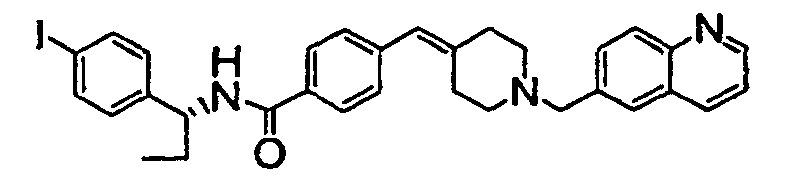
HRMS for C32H33lN3O (M + 1): calcd: 602.1668; found: 602.1657. - The compound of Example 8Bwas prepared from the tertiary alcohol 15b (0.19 g, 0.54 mmol, 1 eq) by dissolving in anhydrous THF (5 ml) and treating with NaH (60 %, 0.2 g, 10 eq) and CH3l (1 ml). The mixture was stirred at rt overnight. After quenching the reaction with CH3OH, the solvent was removed and extraction with CH2Cl2 followed by flash chromatography (EtOAc:Hexane, 1:3) provided the desired methyl ether (46 mg, 23 %).
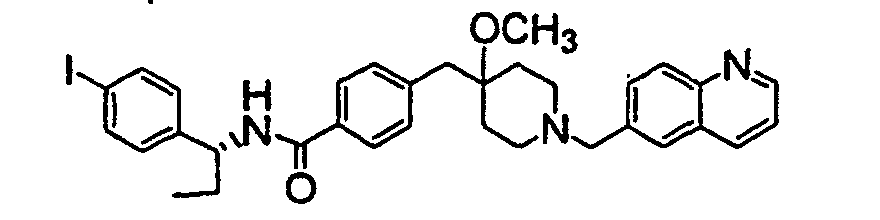
1HNMR (CDCl3): δ 1.42 (s, 9 H), 1.35-1.50 (m, 2 H), 1.60-1.70 (m, 2 H), 2.80 (s, 2 H), 2.90-3.10 (m, 2 H), 3.38 (s, 3 H), 3.70-3.85 (m, 2 H), 3.90 (s, 3 H), 7.20 (d, 2 H, J = 8.1 Hz), 7.99 (d, 2 H, J = 8.1 Hz). - The methyl ether was treated with LiOH·H2O (58 mg) in 1 ml water/0.5 ml THF/0.5 ml CH3OH at 40 °C for 60 h. The solvent was removed and the pH was adjusted to 1. Extraction with EtOAc and drying over MgSO4 gave the corresponding acid (45 mg).
1HNMR (CDCl3): δ 1.42 (s, 9 H), 1.40-1.50 (m, 2 H), 1.60-1.70 (m, 2 H), 2.80 (s, 2 H), 2.90-3.10 (m, 2 H), 3.40 (s, 3 H), 3.70-3.85 (m, 2 H), 7.20 (d, 2 H, J = 8.1 Hz), 8.02 (d, 2 H, J = 8.1 Hz). - The acid (45 mg) was treated with R-α-ethyl-4-iodo-benzylamine (37 mg, 1.1 eq), HATU (49 mg, 1 eq) and 2 eq of Hunig's base in 0.5 ml DMF for 24 h. After workup, 74 mg of the crude was obtained. The material was dissolved in 4 M HCl/dioxane (2 ml) and stirred overnight. After removal of the solvent, the crude was basified to pH 10 and extracted with EtOAc. About one half of the obtained product (30 mg, 0.061 mmol) was treated with 6-formylquinoline (76 mg, 8 eq) and NaBH(OAc)3 (103 mg, 8 eq) in 4 ml CH2Cl2 for 22 h. The crude was washed with saturated Na2CO3 followed by extraction with CH2Cl2. Flash chromatography (CH2Cl2: CH3OH:NH4OH, 98:2:1) provided 32 mg of the title compound.
1HNMR (CDCl3): δ 0.98 (t, 3 H, J = 7.3 Hz), 1.50-1.70 (m, 4 H), 1.80-1.90 (m, 2 H), 2.2-2.00-2.40 (m, 2 H), 2.55-2.70 (m, 2 H), 2.78 (s, 2 H), 3.30 (s, 3 H), 3.70 (s, 2 H), 4.90 (s, 1 H), 5.00 (q, 1 H, J = 7.3 Hz), 6.40 (d, 1 H, J = 8.0 Hz), 7.05 (d, 2 H, J = 8.1 Hz), 7.18 (d, 2 H, J = 8.0 Hz), 7.40 (m, 1 H), 7.60-7.80 (m, 5 H), 8.02 (m, 1 H), 8.10 (d, 1 H, J = 8.0 Hz), 8.95 (m, 1 H). -
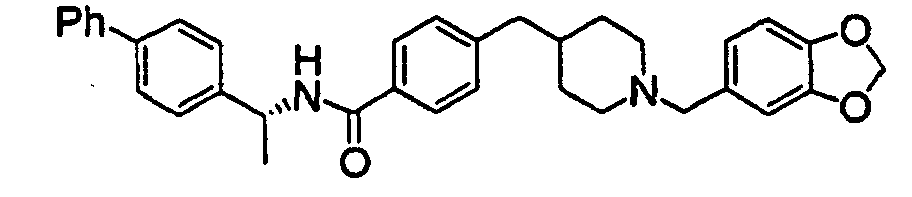
- The iodide analog on the Argopore-MB-CHO resin (prepared as described in the general synthesis procedures, 100 mg, 0.7 mmol/g, 0.07 mmol) was mixed with phenylboronic acid (42 mg), Pd(PPh3)4 (8 mg), K2CO3 (100 mg) in 0.5 ml DMF. The mixture was stirred under Ar at 40 °C for 12 h. The crude was washed with 5 % KCN/DMF, water, CH3OH, CH2Cl2, and the final product was cleaved with 10 % TFA/CH2Cl2 and dried as TFA salt. LC-MS Rt 4.83 min., observed mass 533 (M + H).
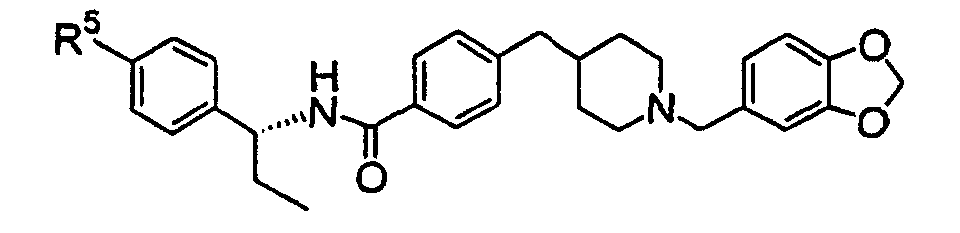
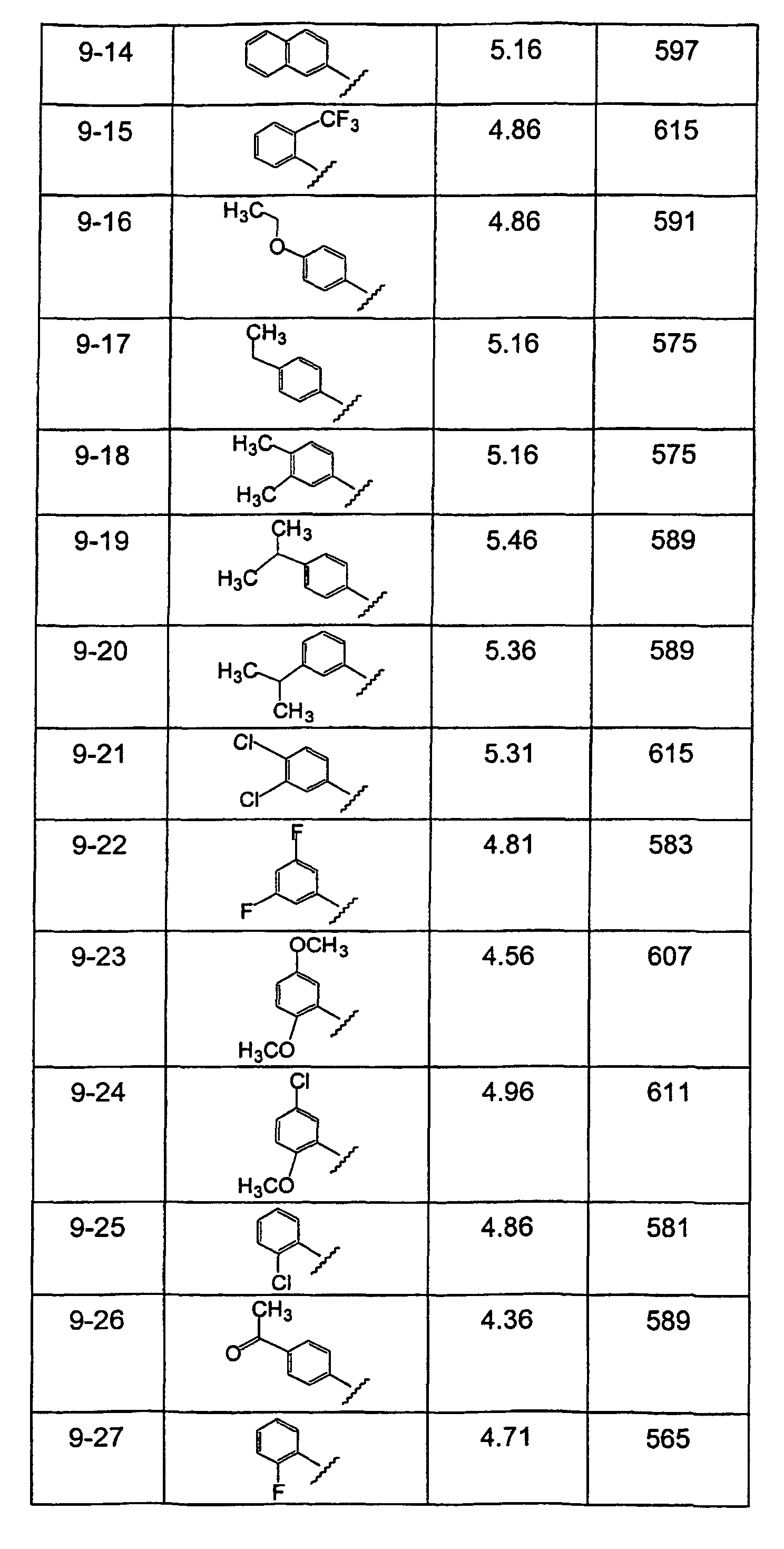
- Using this procedure and the appropriate aromatic halides the examples in Table 3 of the formulawherein R5 is defined in the table, were prepared.


-

- The iodide analog on the Argopore-MB-CHO resin (100 mg, 0.7 mmol/g, 0.07 mmol) was mixed with Pd(OAc)2 (50 mg), Et3N (0.2 ml) and Ph3P (0.1 g) in CH3OH (10 ml). The mixture was stirred under CO atmosphere at 50 °C for 12 h. The crude was washed with water, CH3OH, CH2Cl2 and the final product was cleaved with 10 % TFA/ CH2Cl2 and dried as TFA salt. Flash chromatography (CH2Cl2:CH3OH:NH4OH, 98:2:1) gave the desired product (19 mg).
1HNMR (CDCl3): δ 1.00 (t, 3 H, J = 7.4 Hz), 1.30 (m, 2 H), 1.50 (m, 3 H), 1.70-2.00 (m, 4 H), 2.58 (d, 2 H, J = 6.8 Hz), 2.90 (d, 2 H, J = 11.5 Hz), 3.40 (s, 2 H), 3.90 (s, 3 H), 5.10 (q, 1 H, J = 7.6 Hz), 5.99 (s, 2 H), 6.40 (d, 1 H, J = 7.8 Hz), 6.70 (s, 2 H), 6.80 (s, 1 H), 7.20 (d, 2 H, J = 8.2 Hz), 7.40 (d, 2 H, J = 8.3 Hz), 7.66 (d, 2 H, J = 8.3 Hz), 8.00 (d, 2 H, J = 8.3 Hz).
LC-MS Rt 4.36 min., observed mass 528 (M + H).
Claims (9)
- Compounds represented by the structural formulaor a pharmaceutically acceptable salt, N-oxide or solvate thereof, wherein
the dotted line is an optional double bond;
X is -CHR8-, -C(O)-, -C(=NOR9)-, or, when the double bond is present, -CR8=;
Y isor, when the double bond is present, R1 is R5-(C3-C8)cycloalkyl, R5-(C3-C8)cycloalkyl(C1-C6)alkyl, R5-aryl, R5-aryl-(C1-C6)alkyl, R5-heteroaryl, R5-heteroaryl(C1-C6)alkyl, R5-heterocycloalkyl or R5-heterocycloalkyl(C1-C6)alkyl;
R2 is R6-aryl or R6-heteroaryl;
n is 1, 2 or 3;
R3 is C1-C6 alkyl, aryl or heteroaryl;
R4 is H or C1-C6 alkyl;
R5 is 1-4 substituents independently selected from the group consisting of H, C1-C6 alkyl, halogen, -OH, C1-C6 alkoxy, -CF3, (C1-C6)-alkoxycarbonyl, -SO2NHR4, -C(O)NHR4, -NR4C(O)NHR4, -NR4C(O)R4, -NR4SO2R4, R13-phenyl and naphthyl;
R6 is 1-4 substituents independently selected from the group consisting of H, C1-C6 alkyl, halogen, -OH, -SH, -S(C1-C6 alkyl), -CN, C1-C6 alkoxy, C1-C6 alkylcarboxy, CF3, -NO2, -NH2, (C1-C6)alkylamino, phenyl, (C1-C6)-alkoxycarbonyl and R7-phenoxy, or adjacent ring carbon atoms form a ring with the group -O(CH2)1-2O-, -O(CH2)2-3- or -O(CF2)O-;
R7 is 1-3 substituents independently selected from the group consisting of H, C1-C6 alkyl, halogen, -OH, C1-C6 alkoxy and CF3;
R8 is H, C1-C6 alkyl or (C1-C4)alkoxy-(C1-C4)alkyl;
R9 is H, C1-C6 alkyl or aryl-(C1-C4)alkyl;
R10 is independently selected from the group consisting of H, C1-C6 alkyl and aryl;
R12 is H or C1-C6 alkyl; and
R13 is 1 to 3 substituents independently selected from the group consisting of H, C1-C6 alkyl, halogen, -OH-, C1-C6 alkoxy, -CF3, -OCF3, -NO2 and -C(O)CH3, and wherein
"heterocycloalkyl" refers to 4- to 7-membered saturated rings comprising 1 to 3 heteroatoms independently selected from the group consisting of -O-, -S- and -NR7-, wherein R7 is H or C1-C6 alkyl, and wherein the remaining ring members are carbon;
"aryl" represents a monoaromatic ring or a bicyclic fused ring system of 6- to 10 carbon atoms, possessing one or two aromatic rings; and
"heteroaryl" means a 5- to 10-membered single or benzofused aromatic ring comprising 1 to 3 heteroatoms independently selected from the group consisting of -O-, -S- and -N=, provided that the rings do not include adjacent oxygen and/or sulfur atoms. - A compound of claim 1 wherein R1 is R5-phenyl.
- A compound of claim 1 wherein R2 is R6-aryl.
- A compound of claim 1 wherein R10 is H and n is 1.
- A compound of claim 1 wherein X is -CHR8 and Y is CH.
- A compound of claim 1 wherein X and Y form a double bond.
- A compound of claim 1 selected from the group consisting of: compounds of the formulawherein
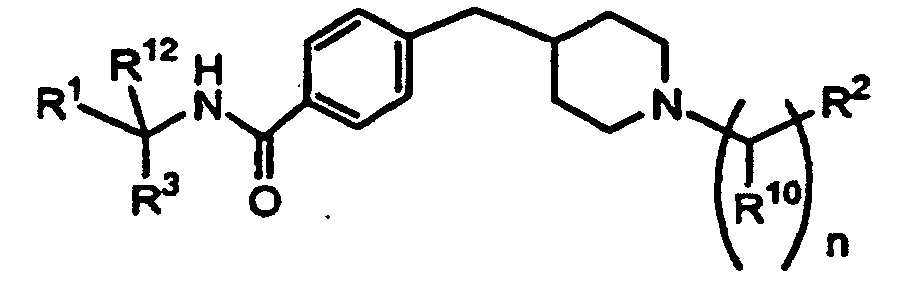
 and compounds of the formula

- A pharmaceutical composition comprising a therapeutically effective amount of a compound of claim 1 in combination with a pharmaceutically acceptable carrier.
- The use of a compound of claim 1 for the preparation of a medicament for treating an eating disorder or diabetes.
Applications Claiming Priority (3)
| Application Number | Priority Date | Filing Date | Title |
|---|---|---|---|
| US25787300P | 2000-12-22 | 2000-12-22 | |
| US257873P | 2000-12-22 | ||
| PCT/US2001/049301 WO2002051809A1 (en) | 2000-12-22 | 2001-12-17 | Piperidine mch antagonists and their use in the treatment of obesity |
Publications (2)
| Publication Number | Publication Date |
|---|---|
| EP1343761A1 EP1343761A1 (en) | 2003-09-17 |
| EP1343761B1 true EP1343761B1 (en) | 2005-08-17 |
Family
ID=22978138
Family Applications (1)
| Application Number | Title | Priority Date | Filing Date |
|---|---|---|---|
| EP01991369A Expired - Lifetime EP1343761B1 (en) | 2000-12-22 | 2001-12-17 | Piperidine mch antagonists and their use in the treatment of obesity |
Country Status (20)
| Country | Link |
|---|---|
| US (1) | US6472394B1 (en) |
| EP (1) | EP1343761B1 (en) |
| JP (2) | JP4025200B2 (en) |
| KR (1) | KR20040011447A (en) |
| CN (1) | CN1273451C (en) |
| AR (1) | AR031930A1 (en) |
| AT (1) | ATE302185T1 (en) |
| AU (1) | AU2002231097B2 (en) |
| CA (1) | CA2431953A1 (en) |
| DE (1) | DE60112791T2 (en) |
| ES (1) | ES2243588T3 (en) |
| HK (1) | HK1054390B (en) |
| HU (1) | HUP0302582A2 (en) |
| IL (1) | IL155772A0 (en) |
| MX (1) | MXPA03005744A (en) |
| MY (1) | MY134017A (en) |
| NZ (1) | NZ525723A (en) |
| PE (1) | PE20020658A1 (en) |
| WO (1) | WO2002051809A1 (en) |
| ZA (1) | ZA200303638B (en) |
Families Citing this family (84)
| Publication number | Priority date | Publication date | Assignee | Title |
|---|---|---|---|---|
| US6569861B2 (en) | 2000-07-06 | 2003-05-27 | Neurogen Corporation | Melanin concentrating hormone receptor ligands |
| WO2002089729A2 (en) | 2001-05-04 | 2002-11-14 | Tularik Inc. | Fused heterocyclic compounds |
| US6809104B2 (en) | 2001-05-04 | 2004-10-26 | Tularik Inc. | Fused heterocyclic compounds |
| IL158941A0 (en) * | 2001-05-22 | 2004-05-12 | Neurogen Corp | Melanin concentrating hormone receptor ligands: substituted 1-benzyl-4-aryl piperazine analogues |
| CA2468015A1 (en) | 2001-11-27 | 2003-06-05 | Merck & Co., Inc. | 2-aminoquinoline compounds |
| EP1465635A4 (en) * | 2002-01-10 | 2005-04-13 | Neurogen Corp | Melanin concentrating hormone receptor ligands: substituted 2-(4-benzyl-piperazin-1-ylmethyl)- and 2-(4-benzyl-diazepan-1-ylmethyl)-1h-benzoimidazole analogues |
| WO2003059289A2 (en) | 2002-01-10 | 2003-07-24 | Neurogen Corporation | Melanin concentrating hormone receptor ligands: substituted benzoimidazole analogues |
| US7105526B2 (en) | 2002-06-28 | 2006-09-12 | Banyu Pharmaceuticals Co., Ltd. | Benzimidazole derivatives |
| DE10238865A1 (en) * | 2002-08-24 | 2004-03-11 | Boehringer Ingelheim International Gmbh | New carboxamides are melanin-concentrating hormone receptor antagonists, useful for treating e.g. metabolic diseases, diabetes, eating disorders, cardiovascular disease, emotional disorders, reproductive and memory disorders |
| US7351719B2 (en) | 2002-10-31 | 2008-04-01 | Boehringer Ingelheim Pharma Gmbh & Co. Kg | Amide compounds having MCH-antagonistic activity and medicaments comprising these compounds |
| WO2004043958A1 (en) * | 2002-11-06 | 2004-05-27 | Amgen Inc. | Fused heterocyclic compounds |
| US7772188B2 (en) | 2003-01-28 | 2010-08-10 | Ironwood Pharmaceuticals, Inc. | Methods and compositions for the treatment of gastrointestinal disorders |
| CA2515717A1 (en) * | 2003-02-10 | 2004-08-19 | Banyu Pharmaceutical Co., Ltd. | Melanin-concentrating hormone receptor antagonists containing piperidine derivatives as the active ingredient |
| US7601868B2 (en) | 2003-02-12 | 2009-10-13 | Takeda Pharmaceutical Company Limited | Amine derivative |
| US7514438B2 (en) * | 2003-08-13 | 2009-04-07 | Amgen, Inc. | Melanin concentrating hormone receptor antagonist |
| US20050256161A1 (en) * | 2003-08-13 | 2005-11-17 | Tempest Paul A | Melanin concentrating hormone receptor antagonists |
| JP4765627B2 (en) | 2003-09-22 | 2011-09-07 | Msd株式会社 | Novel piperidine derivatives |
| CA2540826A1 (en) | 2003-10-01 | 2005-04-14 | The Procter & Gamble Company | Melanin concentrating hormone antagonists |
| US20060247239A1 (en) * | 2003-10-01 | 2006-11-02 | Hu Xiufeng E | Melanin concentrating hormone antagonists |
| US7592373B2 (en) | 2003-12-23 | 2009-09-22 | Boehringer Ingelheim International Gmbh | Amide compounds with MCH antagonistic activity and medicaments comprising these compounds |
| US20080125403A1 (en) | 2004-04-02 | 2008-05-29 | Merck & Co., Inc. | Method of Treating Men with Metabolic and Anthropometric Disorders |
| WO2005110982A2 (en) * | 2004-04-07 | 2005-11-24 | Neurogen Corporation | Substituted 1-benzyl-4-substituted piperazine analogues |
| WO2005110989A1 (en) * | 2004-04-07 | 2005-11-24 | Neurogen Corporation | Substituted 1-heteroaryl-4-substituted piperazine and piperidine analogues |
| DE102004017934A1 (en) | 2004-04-14 | 2005-11-03 | Boehringer Ingelheim Pharma Gmbh & Co. Kg | New alkyne compounds having MCH antagonist activity and medicaments containing these compounds |
| US7524862B2 (en) | 2004-04-14 | 2009-04-28 | Boehringer Ingelheim International Gmbh | Alkyne compounds with MCH antagonistic activity and medicaments comprising these compounds |
| TW200609219A (en) * | 2004-06-17 | 2006-03-16 | Neurogen Corp | Aryl-substituted piperazine derivatives |
| US7063034B2 (en) * | 2004-08-10 | 2006-06-20 | Watermark Paddlesports, Inc. | Spray skirt for watercraft |
| CA2577060A1 (en) | 2004-08-13 | 2006-02-23 | Amgen Inc. | Substituted benzofused heterocycles |
| ES2325773T5 (en) | 2004-11-01 | 2014-02-24 | Amylin Pharmaceuticals, Llc. | Treatment of obesity and related disorders |
| US8394765B2 (en) | 2004-11-01 | 2013-03-12 | Amylin Pharmaceuticals Llc | Methods of treating obesity with two different anti-obesity agents |
| US7737155B2 (en) | 2005-05-17 | 2010-06-15 | Schering Corporation | Nitrogen-containing heterocyclic compounds and methods of use thereof |
| US8138206B2 (en) | 2005-05-30 | 2012-03-20 | Msd. K.K. | Piperidine derivative |
| KR20080011677A (en) * | 2005-05-31 | 2008-02-05 | 아스트라제네카 아베 | Novel MCHR1 Antagonists and Their Uses for the Treatment of MCHR1 Mediated Conditions and Disorders |
| CA2618112A1 (en) | 2005-08-10 | 2007-02-15 | Banyu Pharmaceutical Co., Ltd. | Pyridone compound |
| BRPI0614649A2 (en) | 2005-08-11 | 2011-04-12 | Amylin Pharmaceuticals Inc | hybrid polypeptides with selectable properties |
| AU2006279680B2 (en) | 2005-08-11 | 2012-12-06 | Amylin Pharmaceuticals, Llc | Hybrid polypeptides with selectable properties |
| WO2007024004A1 (en) | 2005-08-24 | 2007-03-01 | Banyu Pharmaceutical Co., Ltd. | Phenylpyridone derivative |
| AU2006288153A1 (en) | 2005-09-07 | 2007-03-15 | Msd K.K. | Bicyclic aromatic substituted pyridone derivative |
| KR20080048502A (en) | 2005-09-29 | 2008-06-02 | 머크 앤드 캄파니 인코포레이티드 | Acylated spiropiperidine derivatives as melanocortin-4 receptor modulators |
| WO2007039462A2 (en) | 2005-09-30 | 2007-04-12 | F. Hoffmann-La Roche Ag | Indane derivatives as mch receptor antagonists |
| RU2008119687A (en) | 2005-10-21 | 2009-11-27 | Новартис АГ (CH) | COMBINATIONS OF ORGANIC COMPOUNDS |
| CA2627139A1 (en) | 2005-10-27 | 2007-05-03 | Banyu Pharmaceutical Co., Ltd. | Novel benzoxathiin derivative |
| ES2381205T3 (en) | 2005-11-10 | 2012-05-24 | Msd K.K. | Aza-substituted spiro derivative |
| US7671221B2 (en) * | 2005-12-28 | 2010-03-02 | Vertex Pharmaceuticals Incorporated | Modulators of ATP-Binding Cassette transporters |
| AU2006336504C9 (en) * | 2005-12-28 | 2015-05-14 | Vertex Pharmaceuticals Incorporated | 1-(benzo [D] [1,3] dioxol-5-yl) -N- (phenyl) cyclopropane- carboxamide derivatives and related compounds as modulators of ATP-Binding Cassette transporters for the treatment of Cystic Fibrosis |
| US20080027072A1 (en) * | 2006-04-20 | 2008-01-31 | Ampla Pharmaceuticals, Inc. | Potentiation of MC4 receptor activity |
| US8173629B2 (en) | 2006-09-22 | 2012-05-08 | Merck Sharp & Dohme Corp. | Method of treatment using fatty acid synthesis inhibitors |
| WO2008047544A1 (en) | 2006-09-28 | 2008-04-24 | Banyu Pharmaceutical Co., Ltd. | Diaryl ketimine derivative |
| WO2008083124A1 (en) * | 2006-12-28 | 2008-07-10 | Rigel Pharmaceuticals, Inc. | N-substituted-heterocycloalkyloxybenzamide compounds and methods of use |
| JP5319518B2 (en) | 2007-04-02 | 2013-10-16 | Msd株式会社 | Indoledione derivative |
| JP5514716B2 (en) * | 2007-05-11 | 2014-06-04 | コリア・リサーチ・インスティテュート・オブ・ケミカル・テクノロジー | Imidazole derivative having arylpiperidine substituent, method for producing the same, and pharmaceutical composition containing the same |
| US8969514B2 (en) | 2007-06-04 | 2015-03-03 | Synergy Pharmaceuticals, Inc. | Agonists of guanylate cyclase useful for the treatment of hypercholesterolemia, atherosclerosis, coronary heart disease, gallstone, obesity and other cardiovascular diseases |
| MX2009013293A (en) | 2007-06-04 | 2010-02-15 | Synergy Pharmaceuticals Inc | Agonists of guanylate cyclase useful for the treatment of gastrointestinal disorders, inflammation, cancer and other disorders. |
| JPWO2009110510A1 (en) | 2008-03-06 | 2011-07-14 | Msd株式会社 | Alkylaminopyridine derivatives |
| US20110015198A1 (en) | 2008-03-28 | 2011-01-20 | Banyu Pharmaceutical Co., Inc. | Diarylmethylamide derivative having melanin-concentrating hormone receptor antagonism |
| EP2810951B1 (en) | 2008-06-04 | 2017-03-15 | Synergy Pharmaceuticals Inc. | Agonists of guanylate cyclase useful for the treatment of gastrointestinal disorders, inflammation, cancer and other disorders |
| JPWO2009154132A1 (en) | 2008-06-19 | 2011-12-01 | Msd株式会社 | Spirodiamine-diarylketoxime derivatives |
| CA2730603C (en) | 2008-07-16 | 2019-09-24 | Synergy Pharmaceuticals Inc. | Agonists of guanylate cyclase useful for the treatment of gastrointestinal disorders, inflammation, cancer and other disorders |
| JPWO2010013595A1 (en) | 2008-07-30 | 2012-01-12 | Msd株式会社 | 5-membered or 5-membered or 6-membered condensed cycloalkylamine derivative |
| EP2348857B1 (en) | 2008-10-22 | 2016-02-24 | Merck Sharp & Dohme Corp. | Novel cyclic benzimidazole derivatives useful anti-diabetic agents |
| EP2350010B1 (en) | 2008-10-30 | 2014-03-26 | Merck Sharp & Dohme Corp. | Isonicotinamide orexin receptor antagonists |
| JP5557845B2 (en) | 2008-10-31 | 2014-07-23 | メルク・シャープ・アンド・ドーム・コーポレーション | Novel cyclic benzimidazole derivatives useful as antidiabetic agents |
| US20110245209A1 (en) | 2008-12-16 | 2011-10-06 | Schering Corporation | Pyridopyrimidine derivatives and methods of use thereof |
| US20110243940A1 (en) | 2008-12-16 | 2011-10-06 | Schering Corporation | Bicyclic pyranone derivatives and methods of use thereof |
| AU2011218830B2 (en) | 2010-02-25 | 2014-07-24 | Merck Sharp & Dohme Corp. | Novel cyclic benzimidazole derivatives useful anti-diabetic agents |
| US9616097B2 (en) | 2010-09-15 | 2017-04-11 | Synergy Pharmaceuticals, Inc. | Formulations of guanylate cyclase C agonists and methods of use |
| MX348131B (en) | 2011-02-25 | 2017-05-26 | Merck Sharp & Dohme | Novel cyclic azabenzimidazole derivatives useful as anti-diabetic agents. |
| AR088352A1 (en) | 2011-10-19 | 2014-05-28 | Merck Sharp & Dohme | ANTAGONISTS OF THE RECEIVER OF 2-PIRIDILOXI-4-NITRILE OREXINE |
| WO2014022528A1 (en) | 2012-08-02 | 2014-02-06 | Merck Sharp & Dohme Corp. | Antidiabetic tricyclic compounds |
| WO2014130608A1 (en) | 2013-02-22 | 2014-08-28 | Merck Sharp & Dohme Corp. | Antidiabetic bicyclic compounds |
| WO2014139388A1 (en) | 2013-03-14 | 2014-09-18 | Merck Sharp & Dohme Corp. | Novel indole derivatives useful as anti-diabetic agents |
| JP2016514670A (en) | 2013-03-15 | 2016-05-23 | シナジー ファーマシューティカルズ インコーポレイテッド | Guanylate cyclase receptor agonists in combination with other drugs |
| JP2016514671A (en) | 2013-03-15 | 2016-05-23 | シナジー ファーマシューティカルズ インコーポレイテッド | Guanylate cyclase agonists and uses thereof |
| EA201592263A1 (en) | 2013-06-05 | 2016-05-31 | Синерджи Фармасьютикалз, Инк. | ULTRASCULAR AGONISTS OF GUANYLACYCLASE C, METHOD OF THEIR RECEIVING AND USING |
| WO2015051496A1 (en) | 2013-10-08 | 2015-04-16 | Merck Sharp & Dohme Corp. | Antidiabetic tricyclic compounds |
| EP3186242B1 (en) | 2014-08-29 | 2021-10-06 | Tes Pharma S.r.l. | Inhibitors of alpha-amino-beta-carboxymuconic acid semialdehyde decarboxylase |
| AU2017342083A1 (en) | 2016-10-14 | 2019-04-11 | Tes Pharma S.R.L. | Inhibitors of alpha-amino-beta-carboxymuconic acid semialdehyde decarboxylase |
| US11072602B2 (en) | 2016-12-06 | 2021-07-27 | Merck Sharp & Dohme Corp. | Antidiabetic heterocyclic compounds |
| EP3558298B1 (en) | 2016-12-20 | 2026-03-11 | Merck Sharp & Dohme LLC | Antidiabetic spirochroman compounds |
| AR117122A1 (en) | 2018-11-20 | 2021-07-14 | Tes Pharma S R L | A-AMINO-b-CARBOXIMUCONIC ACID INHIBITORS SEMIALDEHYDE DECARBOXYLASE |
| TW202045476A (en) | 2019-02-13 | 2020-12-16 | 美商默沙東藥廠 | 5-alkyl pyrrolidine orexin receptor agonists |
| EP3923933A4 (en) | 2019-02-13 | 2022-08-17 | Merck Sharp & Dohme Corp. | PYRROLIDINE-LIKE OREXIN RECEPTOR AGONISTS |
| WO2021026047A1 (en) | 2019-08-08 | 2021-02-11 | Merck Sharp & Dohme Corp. | Heteroaryl pyrrolidine and piperidine orexin receptor agonists |
| MX2023001840A (en) | 2020-08-18 | 2023-03-13 | Merck Sharp & Dohme Llc | Bicycloheptane pyrrolidine orexin receptor agonists. |
Family Cites Families (6)
| Publication number | Priority date | Publication date | Assignee | Title |
|---|---|---|---|---|
| US5595872A (en) | 1992-03-06 | 1997-01-21 | Bristol-Myers Squibb Company | Nucleic acids encoding microsomal trigyceride transfer protein |
| IL117149A0 (en) | 1995-02-23 | 1996-06-18 | Schering Corp | Muscarinic antagonists |
| US5908830A (en) | 1996-10-31 | 1999-06-01 | Merck & Co., Inc. | Combination therapy for the treatment of diabetes and obesity |
| US6040318A (en) | 1997-06-25 | 2000-03-21 | Novo Nordisk A/S | Tricycle substituted with azaheterocyclic carboxylic acids |
| JP2002536434A (en) * | 1999-02-10 | 2002-10-29 | イーライ・リリー・アンド・カンパニー | 5-HT1F agonist |
| AU6503900A (en) | 1999-07-28 | 2001-02-19 | Kyowa Hakko Kogyo Co. Ltd. | Chemokine receptor antagonists and methods of use therefor |
-
2001
- 2001-12-17 NZ NZ525723A patent/NZ525723A/en unknown
- 2001-12-17 CA CA002431953A patent/CA2431953A1/en not_active Abandoned
- 2001-12-17 DE DE60112791T patent/DE60112791T2/en not_active Expired - Lifetime
- 2001-12-17 HK HK03106690.7A patent/HK1054390B/en unknown
- 2001-12-17 AT AT01991369T patent/ATE302185T1/en not_active IP Right Cessation
- 2001-12-17 CN CNB018210066A patent/CN1273451C/en not_active Expired - Fee Related
- 2001-12-17 MX MXPA03005744A patent/MXPA03005744A/en active IP Right Grant
- 2001-12-17 EP EP01991369A patent/EP1343761B1/en not_active Expired - Lifetime
- 2001-12-17 US US10/023,371 patent/US6472394B1/en not_active Expired - Fee Related
- 2001-12-17 AR ARP010105839A patent/AR031930A1/en unknown
- 2001-12-17 KR KR10-2003-7008345A patent/KR20040011447A/en not_active Ceased
- 2001-12-17 WO PCT/US2001/049301 patent/WO2002051809A1/en not_active Ceased
- 2001-12-17 HU HU0302582A patent/HUP0302582A2/en unknown
- 2001-12-17 JP JP2002552906A patent/JP4025200B2/en not_active Expired - Fee Related
- 2001-12-17 ES ES01991369T patent/ES2243588T3/en not_active Expired - Lifetime
- 2001-12-17 AU AU2002231097A patent/AU2002231097B2/en not_active Ceased
- 2001-12-17 IL IL15577201A patent/IL155772A0/en unknown
- 2001-12-18 PE PE2001001268A patent/PE20020658A1/en not_active Application Discontinuation
- 2001-12-19 MY MYPI20015748A patent/MY134017A/en unknown
-
2003
- 2003-05-12 ZA ZA200303638A patent/ZA200303638B/en unknown
-
2007
- 2007-07-26 JP JP2007195250A patent/JP2007284451A/en active Pending
Also Published As
| Publication number | Publication date |
|---|---|
| MY134017A (en) | 2007-11-30 |
| CN1481361A (en) | 2004-03-10 |
| DE60112791D1 (en) | 2005-09-22 |
| HK1054390A1 (en) | 2003-11-28 |
| PE20020658A1 (en) | 2002-07-23 |
| CA2431953A1 (en) | 2002-07-04 |
| ES2243588T3 (en) | 2005-12-01 |
| DE60112791T2 (en) | 2006-06-08 |
| ATE302185T1 (en) | 2005-09-15 |
| EP1343761A1 (en) | 2003-09-17 |
| KR20040011447A (en) | 2004-02-05 |
| JP4025200B2 (en) | 2007-12-19 |
| IL155772A0 (en) | 2003-12-23 |
| MXPA03005744A (en) | 2003-09-05 |
| US6472394B1 (en) | 2002-10-29 |
| JP2004516314A (en) | 2004-06-03 |
| WO2002051809A1 (en) | 2002-07-04 |
| HUP0302582A2 (en) | 2003-12-29 |
| AU2002231097B2 (en) | 2004-12-09 |
| AR031930A1 (en) | 2003-10-08 |
| HK1054390B (en) | 2006-01-06 |
| ZA200303638B (en) | 2004-08-12 |
| JP2007284451A (en) | 2007-11-01 |
| NZ525723A (en) | 2004-11-26 |
| CN1273451C (en) | 2006-09-06 |
Similar Documents
| Publication | Publication Date | Title |
|---|---|---|
| US6472394B1 (en) | MCH antagonists and their use in the treatment of obesity | |
| AU2002231097A1 (en) | Piperidine MCH antagonists and their use in the treatment of obesity | |
| JP4758609B2 (en) | γ-secretase inhibitor | |
| JP4351053B2 (en) | Dihydroxypyrimidine carboxamide HIV integrase inhibitor | |
| AU2005321475B2 (en) | Organic compounds | |
| CN103827101B (en) | Dicyclo dihydroquinoline-2-ketone derivatives | |
| EP1499596B1 (en) | Muscarinic antagonists | |
| JP3617454B2 (en) | Amide compounds | |
| EP3526198B1 (en) | 3-sulfonyl-5-aminopyridine-2,4-diol apj agonists | |
| JP4012068B2 (en) | Muscarinic antagonist | |
| JP2006502180A (en) | N-substituted piperidinyl-imidazopyridine compounds as 5-HT4 receptor modulators | |
| ZA200204350B (en) | Substituted imidazole neuropeptide Y Y5 receptor antagonists. | |
| JP2004513944A (en) | Novel amidoalkyl-piperidine and amidoalkyl-piperazine derivatives useful for treating nervous system disorders | |
| EP1556372B1 (en) | Substituted 4-amino-1-(pyridylmethyl) piperidine as muscarinic receptor antagonists | |
| JP2014076948A (en) | Isoquinoline amide derivative | |
| US7947714B2 (en) | Piperidine glycine transporter inhibitors | |
| JP2006076884A (en) | Acrylamide derivatives | |
| HK1068136B (en) | Muscarinic antagonists | |
| JP2001011073A (en) | Cyclic amide compound, and its production and use |
Legal Events
| Date | Code | Title | Description |
|---|---|---|---|
| PUAI | Public reference made under article 153(3) epc to a published international application that has entered the european phase |
Free format text: ORIGINAL CODE: 0009012 |
|
| 17P | Request for examination filed |
Effective date: 20030526 |
|
| AK | Designated contracting states |
Kind code of ref document: A1 Designated state(s): AT BE CH CY DE DK ES FI FR GB GR IE IT LI LU MC NL PT SE TR |
|
| AX | Request for extension of the european patent |
Extension state: AL LT LV MK RO SI |
|
| 17Q | First examination report despatched |
Effective date: 20031218 |
|
| GRAP | Despatch of communication of intention to grant a patent |
Free format text: ORIGINAL CODE: EPIDOSNIGR1 |
|
| GRAS | Grant fee paid |
Free format text: ORIGINAL CODE: EPIDOSNIGR3 |
|
| GRAA | (expected) grant |
Free format text: ORIGINAL CODE: 0009210 |
|
| AK | Designated contracting states |
Kind code of ref document: B1 Designated state(s): AT BE CH CY DE DK ES FI FR GB GR IE IT LI LU MC NL PT SE TR |
|
| AX | Request for extension of the european patent |
Extension state: RO SI |
|
| PG25 | Lapsed in a contracting state [announced via postgrant information from national office to epo] |
Ref country code: LI Free format text: LAPSE BECAUSE OF FAILURE TO SUBMIT A TRANSLATION OF THE DESCRIPTION OR TO PAY THE FEE WITHIN THE PRESCRIBED TIME-LIMIT Effective date: 20050817 Ref country code: FI Free format text: LAPSE BECAUSE OF FAILURE TO SUBMIT A TRANSLATION OF THE DESCRIPTION OR TO PAY THE FEE WITHIN THE PRESCRIBED TIME-LIMIT Effective date: 20050817 Ref country code: CH Free format text: LAPSE BECAUSE OF FAILURE TO SUBMIT A TRANSLATION OF THE DESCRIPTION OR TO PAY THE FEE WITHIN THE PRESCRIBED TIME-LIMIT Effective date: 20050817 Ref country code: TR Free format text: LAPSE BECAUSE OF FAILURE TO SUBMIT A TRANSLATION OF THE DESCRIPTION OR TO PAY THE FEE WITHIN THE PRESCRIBED TIME-LIMIT Effective date: 20050817 Ref country code: NL Free format text: LAPSE BECAUSE OF FAILURE TO SUBMIT A TRANSLATION OF THE DESCRIPTION OR TO PAY THE FEE WITHIN THE PRESCRIBED TIME-LIMIT Effective date: 20050817 Ref country code: BE Free format text: LAPSE BECAUSE OF FAILURE TO SUBMIT A TRANSLATION OF THE DESCRIPTION OR TO PAY THE FEE WITHIN THE PRESCRIBED TIME-LIMIT Effective date: 20050817 Ref country code: AT Free format text: LAPSE BECAUSE OF FAILURE TO SUBMIT A TRANSLATION OF THE DESCRIPTION OR TO PAY THE FEE WITHIN THE PRESCRIBED TIME-LIMIT Effective date: 20050817 |
|
| REG | Reference to a national code |
Ref country code: GB Ref legal event code: FG4D |
|
| REG | Reference to a national code |
Ref country code: CH Ref legal event code: EP |
|
| REG | Reference to a national code |
Ref country code: IE Ref legal event code: FG4D |
|
| REF | Corresponds to: |
Ref document number: 60112791 Country of ref document: DE Date of ref document: 20050922 Kind code of ref document: P |
|
| PG25 | Lapsed in a contracting state [announced via postgrant information from national office to epo] |
Ref country code: GR Free format text: LAPSE BECAUSE OF FAILURE TO SUBMIT A TRANSLATION OF THE DESCRIPTION OR TO PAY THE FEE WITHIN THE PRESCRIBED TIME-LIMIT Effective date: 20051117 Ref country code: DK Free format text: LAPSE BECAUSE OF FAILURE TO SUBMIT A TRANSLATION OF THE DESCRIPTION OR TO PAY THE FEE WITHIN THE PRESCRIBED TIME-LIMIT Effective date: 20051117 Ref country code: SE Free format text: LAPSE BECAUSE OF FAILURE TO SUBMIT A TRANSLATION OF THE DESCRIPTION OR TO PAY THE FEE WITHIN THE PRESCRIBED TIME-LIMIT Effective date: 20051117 |
|
| REG | Reference to a national code |
Ref country code: ES Ref legal event code: FG2A Ref document number: 2243588 Country of ref document: ES Kind code of ref document: T3 |
|
| PG25 | Lapsed in a contracting state [announced via postgrant information from national office to epo] |
Ref country code: CY Free format text: LAPSE BECAUSE OF FAILURE TO SUBMIT A TRANSLATION OF THE DESCRIPTION OR TO PAY THE FEE WITHIN THE PRESCRIBED TIME-LIMIT Effective date: 20051217 |
|
| PG25 | Lapsed in a contracting state [announced via postgrant information from national office to epo] |
Ref country code: IE Free format text: LAPSE BECAUSE OF NON-PAYMENT OF DUE FEES Effective date: 20051219 |
|
| PG25 | Lapsed in a contracting state [announced via postgrant information from national office to epo] |
Ref country code: MC Free format text: LAPSE BECAUSE OF NON-PAYMENT OF DUE FEES Effective date: 20051231 Ref country code: LU Free format text: LAPSE BECAUSE OF NON-PAYMENT OF DUE FEES Effective date: 20051231 |
|
| REG | Reference to a national code |
Ref country code: HK Ref legal event code: GR Ref document number: 1054390 Country of ref document: HK |
|
| PG25 | Lapsed in a contracting state [announced via postgrant information from national office to epo] |
Ref country code: PT Free format text: LAPSE BECAUSE OF FAILURE TO SUBMIT A TRANSLATION OF THE DESCRIPTION OR TO PAY THE FEE WITHIN THE PRESCRIBED TIME-LIMIT Effective date: 20060117 |
|
| NLV1 | Nl: lapsed or annulled due to failure to fulfill the requirements of art. 29p and 29m of the patents act | ||
| REG | Reference to a national code |
Ref country code: CH Ref legal event code: PL |
|
| ET | Fr: translation filed | ||
| PLBE | No opposition filed within time limit |
Free format text: ORIGINAL CODE: 0009261 |
|
| STAA | Information on the status of an ep patent application or granted ep patent |
Free format text: STATUS: NO OPPOSITION FILED WITHIN TIME LIMIT |
|
| 26N | No opposition filed |
Effective date: 20060518 |
|
| REG | Reference to a national code |
Ref country code: IE Ref legal event code: MM4A |
|
| PGFP | Annual fee paid to national office [announced via postgrant information from national office to epo] |
Ref country code: FR Payment date: 20101203 Year of fee payment: 10 |
|
| PGFP | Annual fee paid to national office [announced via postgrant information from national office to epo] |
Ref country code: IT Payment date: 20101120 Year of fee payment: 10 Ref country code: GB Payment date: 20101123 Year of fee payment: 10 |
|
| PGFP | Annual fee paid to national office [announced via postgrant information from national office to epo] |
Ref country code: DE Payment date: 20101230 Year of fee payment: 10 |
|
| PGFP | Annual fee paid to national office [announced via postgrant information from national office to epo] |
Ref country code: ES Payment date: 20101220 Year of fee payment: 10 |
|
| GBPC | Gb: european patent ceased through non-payment of renewal fee |
Effective date: 20111217 |
|
| REG | Reference to a national code |
Ref country code: FR Ref legal event code: ST Effective date: 20120831 |
|
| REG | Reference to a national code |
Ref country code: DE Ref legal event code: R119 Ref document number: 60112791 Country of ref document: DE Effective date: 20120703 |
|
| PG25 | Lapsed in a contracting state [announced via postgrant information from national office to epo] |
Ref country code: DE Free format text: LAPSE BECAUSE OF NON-PAYMENT OF DUE FEES Effective date: 20120703 Ref country code: GB Free format text: LAPSE BECAUSE OF NON-PAYMENT OF DUE FEES Effective date: 20111217 |
|
| PG25 | Lapsed in a contracting state [announced via postgrant information from national office to epo] |
Ref country code: IT Free format text: LAPSE BECAUSE OF NON-PAYMENT OF DUE FEES Effective date: 20111217 |
|
| PG25 | Lapsed in a contracting state [announced via postgrant information from national office to epo] |
Ref country code: FR Free format text: LAPSE BECAUSE OF NON-PAYMENT OF DUE FEES Effective date: 20120102 |
|
| REG | Reference to a national code |
Ref country code: ES Ref legal event code: FD2A Effective date: 20130704 |
|
| PG25 | Lapsed in a contracting state [announced via postgrant information from national office to epo] |
Ref country code: ES Free format text: LAPSE BECAUSE OF NON-PAYMENT OF DUE FEES Effective date: 20111218 |