EP1342733A1 - Low-substituted cellulose ether powder and production process thereof - Google Patents
Low-substituted cellulose ether powder and production process thereof Download PDFInfo
- Publication number
- EP1342733A1 EP1342733A1 EP03251271A EP03251271A EP1342733A1 EP 1342733 A1 EP1342733 A1 EP 1342733A1 EP 03251271 A EP03251271 A EP 03251271A EP 03251271 A EP03251271 A EP 03251271A EP 1342733 A1 EP1342733 A1 EP 1342733A1
- Authority
- EP
- European Patent Office
- Prior art keywords
- low
- cellulose ether
- substituted
- substituted cellulose
- powder
- Prior art date
- Legal status (The legal status is an assumption and is not a legal conclusion. Google has not performed a legal analysis and makes no representation as to the accuracy of the status listed.)
- Granted
Links
- 239000000843 powder Substances 0.000 title claims abstract description 38
- 229920003086 cellulose ether Polymers 0.000 title claims description 44
- 238000004519 manufacturing process Methods 0.000 title claims description 10
- XLYOFNOQVPJJNP-UHFFFAOYSA-N water Substances O XLYOFNOQVPJJNP-UHFFFAOYSA-N 0.000 claims abstract description 26
- 238000006467 substitution reaction Methods 0.000 claims abstract description 21
- 239000002245 particle Substances 0.000 claims abstract description 19
- 239000006185 dispersion Substances 0.000 claims abstract description 17
- 239000012670 alkaline solution Substances 0.000 claims abstract description 16
- 229920002678 cellulose Polymers 0.000 claims abstract description 16
- 239000001913 cellulose Substances 0.000 claims abstract description 16
- 239000002253 acid Substances 0.000 claims abstract description 8
- 238000000034 method Methods 0.000 claims abstract description 8
- 239000000243 solution Substances 0.000 claims description 14
- 239000011164 primary particle Substances 0.000 claims description 12
- 238000001694 spray drying Methods 0.000 claims description 8
- 239000000203 mixture Substances 0.000 claims description 5
- 125000000217 alkyl group Chemical group 0.000 claims description 3
- 125000002768 hydroxyalkyl group Chemical group 0.000 claims description 3
- 238000001665 trituration Methods 0.000 abstract description 10
- RTZKZFJDLAIYFH-UHFFFAOYSA-N Diethyl ether Chemical compound CCOCC RTZKZFJDLAIYFH-UHFFFAOYSA-N 0.000 abstract description 8
- 238000006386 neutralization reaction Methods 0.000 abstract description 8
- 239000003795 chemical substances by application Substances 0.000 abstract description 3
- 238000000576 coating method Methods 0.000 abstract description 3
- 239000002537 cosmetic Substances 0.000 abstract description 3
- 235000013305 food Nutrition 0.000 abstract description 3
- 239000003381 stabilizer Substances 0.000 abstract description 2
- 229920013821 hydroxy alkyl cellulose Polymers 0.000 abstract 1
- 230000008961 swelling Effects 0.000 abstract 1
- HEMHJVSKTPXQMS-UHFFFAOYSA-M Sodium hydroxide Chemical compound [OH-].[Na+] HEMHJVSKTPXQMS-UHFFFAOYSA-M 0.000 description 15
- QTBSBXVTEAMEQO-UHFFFAOYSA-N Acetic acid Chemical compound CC(O)=O QTBSBXVTEAMEQO-UHFFFAOYSA-N 0.000 description 12
- 239000003513 alkali Substances 0.000 description 10
- 229940031703 low substituted hydroxypropyl cellulose Drugs 0.000 description 10
- UFHFLCQGNIYNRP-UHFFFAOYSA-N Hydrogen Chemical compound [H][H] UFHFLCQGNIYNRP-UHFFFAOYSA-N 0.000 description 7
- 229920000642 polymer Polymers 0.000 description 7
- -1 aqueous coatings Substances 0.000 description 6
- VEXZGXHMUGYJMC-UHFFFAOYSA-N Hydrochloric acid Chemical compound Cl VEXZGXHMUGYJMC-UHFFFAOYSA-N 0.000 description 4
- QAOWNCQODCNURD-UHFFFAOYSA-N Sulfuric acid Chemical compound OS(O)(=O)=O QAOWNCQODCNURD-UHFFFAOYSA-N 0.000 description 4
- 238000006243 chemical reaction Methods 0.000 description 4
- 238000002360 preparation method Methods 0.000 description 4
- 238000000926 separation method Methods 0.000 description 4
- 125000001424 substituent group Chemical group 0.000 description 4
- 229920000663 Hydroxyethyl cellulose Polymers 0.000 description 3
- 239000004354 Hydroxyethyl cellulose Substances 0.000 description 3
- KWYUFKZDYYNOTN-UHFFFAOYSA-M Potassium hydroxide Chemical compound [OH-].[K+] KWYUFKZDYYNOTN-UHFFFAOYSA-M 0.000 description 3
- 230000000052 comparative effect Effects 0.000 description 3
- 235000019447 hydroxyethyl cellulose Nutrition 0.000 description 3
- 239000001866 hydroxypropyl methyl cellulose Substances 0.000 description 3
- 229920003088 hydroxypropyl methyl cellulose Polymers 0.000 description 3
- 235000010979 hydroxypropyl methyl cellulose Nutrition 0.000 description 3
- UFVKGYZPFZQRLF-UHFFFAOYSA-N hydroxypropyl methyl cellulose Chemical class OC1C(O)C(OC)OC(CO)C1OC1C(O)C(O)C(OC2C(C(O)C(OC3C(C(O)C(O)C(CO)O3)O)C(CO)O2)O)C(CO)O1 UFVKGYZPFZQRLF-UHFFFAOYSA-N 0.000 description 3
- 229920000609 methyl cellulose Polymers 0.000 description 3
- 239000001923 methylcellulose Substances 0.000 description 3
- 235000010981 methylcellulose Nutrition 0.000 description 3
- 239000007921 spray Substances 0.000 description 3
- 239000006228 supernatant Substances 0.000 description 3
- GOOHAUXETOMSMM-UHFFFAOYSA-N Propylene oxide Chemical compound CC1CO1 GOOHAUXETOMSMM-UHFFFAOYSA-N 0.000 description 2
- 229920002472 Starch Polymers 0.000 description 2
- 239000003814 drug Substances 0.000 description 2
- 238000001035 drying Methods 0.000 description 2
- 239000000976 ink Substances 0.000 description 2
- 239000000047 product Substances 0.000 description 2
- 239000007787 solid Substances 0.000 description 2
- 235000019698 starch Nutrition 0.000 description 2
- 238000005406 washing Methods 0.000 description 2
- IAYPIBMASNFSPL-UHFFFAOYSA-N Ethylene oxide Chemical compound C1CO1 IAYPIBMASNFSPL-UHFFFAOYSA-N 0.000 description 1
- 239000007795 chemical reaction product Substances 0.000 description 1
- 239000000084 colloidal system Substances 0.000 description 1
- 238000000502 dialysis Methods 0.000 description 1
- 239000007884 disintegrant Substances 0.000 description 1
- 238000004090 dissolution Methods 0.000 description 1
- 238000009826 distribution Methods 0.000 description 1
- 230000000694 effects Effects 0.000 description 1
- 230000001804 emulsifying effect Effects 0.000 description 1
- 239000012530 fluid Substances 0.000 description 1
- 125000002791 glucosyl group Chemical group C1([C@H](O)[C@@H](O)[C@H](O)[C@H](O1)CO)* 0.000 description 1
- 239000008187 granular material Substances 0.000 description 1
- 238000010438 heat treatment Methods 0.000 description 1
- 125000004435 hydrogen atom Chemical group [H]* 0.000 description 1
- 125000002887 hydroxy group Chemical group [H]O* 0.000 description 1
- 238000011835 investigation Methods 0.000 description 1
- 238000007561 laser diffraction method Methods 0.000 description 1
- 239000000463 material Substances 0.000 description 1
- 125000000956 methoxy group Chemical group [H]C([H])([H])O* 0.000 description 1
- GRVDJDISBSALJP-UHFFFAOYSA-N methyloxidanyl Chemical group [O]C GRVDJDISBSALJP-UHFFFAOYSA-N 0.000 description 1
- 238000002156 mixing Methods 0.000 description 1
- 230000003472 neutralizing effect Effects 0.000 description 1
- 239000012299 nitrogen atmosphere Substances 0.000 description 1
- 239000003960 organic solvent Substances 0.000 description 1
- 230000010355 oscillation Effects 0.000 description 1
- 239000002244 precipitate Substances 0.000 description 1
- 238000010298 pulverizing process Methods 0.000 description 1
- 239000011541 reaction mixture Substances 0.000 description 1
- 150000003839 salts Chemical class 0.000 description 1
- 238000007873 sieving Methods 0.000 description 1
- 239000002904 solvent Substances 0.000 description 1
- 238000005507 spraying Methods 0.000 description 1
- 239000007858 starting material Substances 0.000 description 1
- 238000003756 stirring Methods 0.000 description 1
- 239000000126 substance Substances 0.000 description 1
- 230000008719 thickening Effects 0.000 description 1
- 230000009974 thixotropic effect Effects 0.000 description 1
- 230000000007 visual effect Effects 0.000 description 1
- 238000005550 wet granulation Methods 0.000 description 1
Images

Classifications
-
- C—CHEMISTRY; METALLURGY
- C08—ORGANIC MACROMOLECULAR COMPOUNDS; THEIR PREPARATION OR CHEMICAL WORKING-UP; COMPOSITIONS BASED THEREON
- C08J—WORKING-UP; GENERAL PROCESSES OF COMPOUNDING; AFTER-TREATMENT NOT COVERED BY SUBCLASSES C08B, C08C, C08F, C08G or C08H
- C08J3/00—Processes of treating or compounding macromolecular substances
- C08J3/12—Powdering or granulating
- C08J3/122—Pulverisation by spraying
-
- A—HUMAN NECESSITIES
- A61—MEDICAL OR VETERINARY SCIENCE; HYGIENE
- A61K—PREPARATIONS FOR MEDICAL, DENTAL OR TOILETRY PURPOSES
- A61K8/00—Cosmetics or similar toiletry preparations
- A61K8/18—Cosmetics or similar toiletry preparations characterised by the composition
- A61K8/72—Cosmetics or similar toiletry preparations characterised by the composition containing organic macromolecular compounds
- A61K8/73—Polysaccharides
- A61K8/731—Cellulose; Quaternized cellulose derivatives
-
- A—HUMAN NECESSITIES
- A61—MEDICAL OR VETERINARY SCIENCE; HYGIENE
- A61Q—SPECIFIC USE OF COSMETICS OR SIMILAR TOILETRY PREPARATIONS
- A61Q19/00—Preparations for care of the skin
-
- C—CHEMISTRY; METALLURGY
- C08—ORGANIC MACROMOLECULAR COMPOUNDS; THEIR PREPARATION OR CHEMICAL WORKING-UP; COMPOSITIONS BASED THEREON
- C08B—POLYSACCHARIDES; DERIVATIVES THEREOF
- C08B11/00—Preparation of cellulose ethers
- C08B11/20—Post-etherification treatments of chemical or physical type, e.g. mixed etherification in two steps, including purification
-
- C—CHEMISTRY; METALLURGY
- C08—ORGANIC MACROMOLECULAR COMPOUNDS; THEIR PREPARATION OR CHEMICAL WORKING-UP; COMPOSITIONS BASED THEREON
- C08J—WORKING-UP; GENERAL PROCESSES OF COMPOUNDING; AFTER-TREATMENT NOT COVERED BY SUBCLASSES C08B, C08C, C08F, C08G or C08H
- C08J2301/00—Characterised by the use of cellulose, modified cellulose or cellulose derivatives
- C08J2301/08—Cellulose derivatives
- C08J2301/26—Cellulose ethers
Definitions
- the present invention relates to a low-substituted cellulose ether powder used preferably as a dispersion stabilizer, a viscosity adjustment agent or the like of foods, pharmaceuticals, cosmetics, aqueous coatings, inks, starches and the like; and a production process thereof.
- JP-B Japanese Patent Publications
- 56-54292/1981 USP No. 4258179
- 62-61041/1987 and 6-49768/1994 disclose production processes of an aqueous gel comprising steps of dispersing a low-substituted cellulose ether powder in water and shear-triturating the resulting dispersion.
- cellulose polymers are required to have such performances as easy handling, good stability, viscosity and a shape-retaining property adequate for each application, and good feeling when used.
- Crystalline cellulose has such performances that it is widely used. However, it is slightly insufficient in water-retaining property.
- the low-substituted cellulose ethers of prior art are in fibrous form so that feeling upon their application to the skin is not good.
- none of the low-substituted cellulose ethers is substantially spherical in a stage of primary particles, it is not suitable for a carrier.
- An object of the present invention is to provide cellulose polymer which can overcome these problems.
- a low-substituted cellulose ether powder comprising primary particles, wherein at least 95% by weight of the primary particles have an aspect ratio of 1.0 to 1.5.
- a production process of a low-substituted cellulose ether powder having a molar substitution degree of 0.05 to 1.0 comprising, during or after addition of an acid to an alkaline solution of a low-substituted cellulose ether to neutralize the solution, shear-triturating the resulting mixture and then spray-drying the resulting dispersion.
- a production process of a low-substituted cellulose ether powder having a molar substitution degree of 0.05 to 1.0 comprising shear-triturating a low-substituted cellulose ether powder so as to swell-disperse the powder in water, and spray-drying the resulting dispersion.
- the low-substituted cellulose ether powder according to the present invention is superior in form of particles to that of the prior art. When it is added to foods, pharmaceuticals or cosmetics in the paste or gel form, or aqueous coatings, inks, starches or the like, it exhibits an excellent water-retaining, dispersion-stabilizing and/or thickening effect.
- FIG. 1 is an SEM photograph (5,000 ⁇ ) of a low-substituted hydroxypropyl cellulose powder prepared in Example 1;
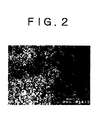
- FIG. 2 is an SEM photograph (250 ⁇ ) of a low-substituted hydroxypropyl cellulose powder prepared in Example 1;
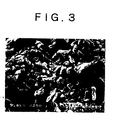
- FIG. 3 is an SEM photograph (350 ⁇ ) of a commercially available low-substituted hydroxypropyl cellulose powder ("LH-31”) used in Comparative Example 1.
- the low-substituted cellulose ether of the present invention is soluble not in water but in an alkaline solution.
- cellulose is not water soluble, but substitution of a hydrogen atom of a hydroxyl group on a glucose ring constituting the cellulose with an alkyl or hydroxyalkyl group may add water solubility thereto, depending on the degree of substitution.
- the cellulose having a low degree of substitution is not soluble in water, but instead, tends to be soluble in an alkaline solution.
- a low-substituted cellulose powder when a low-substituted cellulose powder is dispersed in water, a portion thereof may be swelled with water.
- Cellulose having a high degree of substitution becomes soluble in water, but loses solubility in an alkaline solution.
- An aqueous gel of the present invention cannot be obtained by using such a water soluble cellulose ether.
- the low-substituted cellulose ether mainly used in the present invention has preferably a molar substitution degree of 0.05 to 1.0.
- a desirable wt% range (the numeral in parentheses below is a molar substitution degree) of the substituent will be described below. It is to be noted that the molar substitution degree can be measured with reference to the Japanese Pharmacopoeia.
- Low-substituted cellulose ethers are insoluble in water but soluble in an alkaline solution. In addition, it absorbs water and swells therewith.
- Low-substituted hydroxypropyl cellulose is one of the typical examples and now commercially available as a trade name of Low-Substituted Hydroxypropyl Cellulose from Shin-Etsu Chemical Co., Ltd. It is listed in the Japanese Pharmacopoeia and generally used as a disintegrant to be incorporated in tablets particularly in the field of pharmaceutical materials.
- JP-B Japanese Patent Publication
- UDP No. 4091205 Japanese Patent Publication
- preparation of an alkali cellulose is necessary. It may be prepared, for example, by immersing a sheet-like pulp, which is a starting material, in an aqueous alkaline solution such as sodium hydroxide; by mixing pulverized pulp with an alkaline solution; or by dispersing pulp powder in an organic solvent and then adding an alkali to the resulting dispersion.
- an alkali cellulose is necessary. It may be prepared, for example, by immersing a sheet-like pulp, which is a starting material, in an aqueous alkaline solution such as sodium hydroxide; by mixing pulverized pulp with an alkaline solution; or by dispersing pulp powder in an organic solvent and then adding an alkali to the resulting dispersion.
- the alkali cellulose thus obtained may be then charged in a reactor and after addition thereto of an etherifying agent such as propylene oxide or ethylene oxide, the mixture may be heated to cause reaction, whereby the corresponding cellulose ether is obtained. After the reaction is over, the crude cellulose ether obtained may be transferred to another tank, in which the alkali may be neutralized with an acid. The resulting solid may be then washed, dried and pulverized to yield a finished product in the powder form. Alternatively, it may be also obtained by dissolving the crude cellulose ether just after the reaction in water completely or partially, neutralizing the resulting solution, and collecting the polymer precipitated, washing, drying and then pulverizing the polymer.
- an etherifying agent such as propylene oxide or ethylene oxide
- low-substituted cellulose ether is dissolved once in an aqueous alkaline solution; and during or after neutralization, the solution is shear-triturated and the dispersion thus obtained is spray dried.
- a similar result may be obtained for the low-substituted cellulose ether powder obtained as the finished product in the above-described manner being dissolved in an aqueous alkaline solution or for the crude cellulose ether being dissolved in water just after the reaction.
- water may be used alone as a solvent for dissolving the ether, but an alkali may be sometimes added further in order to ensure complete dissolution of the cellulose ether. Either method is embraced in the present invention.
- alkali used for dissolving the ether examples include potassium hydroxide and sodium hydroxide. Its concentration may be determined in each case because of dependency on the substituent or substitution degree of the cellulose ether to be employed. It may be usually 2 to 25% by weight, especially 3 to 15% by weight. As a typical example, low-substituted hydroxypropyl cellulose having a molar substitution degree of 0.2 is dissolved in 10% by weight of sodium hydroxide. The solution thus obtained may be clear in some cases but not completely clear in some cases, depending on a difference in the distribution of the substituent. In the latter cases, an apparent increase of viscosity is considered to mean that the ether is dissolved in an alkali.
- the alkaline solution may be neutralized with an equivalent amount of hydrochloric acid, sulfuric acid, acetic acid or the like.
- the alkaline solution may be shear-triturated in a shear-triturator while adding an acid in portions to proceed with neutralization, or may be neutralized with an equivalent amount of an acid in advance and then a solution containing the precipitated polymer may be shear-triturated.
- Shear-trituration of an alkaline solution or a neutralized solution of cellulose ether having a proper concentration may be carried out, preferably in an emulsify-dispersing machine.
- the examples include an vibration ball mill, a colloid mill, a homomixer, and homogenizers such as a propeller homogenizer, a high pressure homogenizer and a ultrasonic homogenizer. Among them, the homogenizers are preferred.
- High pressure homogenizers for spraying a fluid through openings of valve under high pressure for example, "Homogenizer” manufactured by Sanwa Machine Co., Ltd., "Ultimaizer System” manufactured by Sugino Machine Co., Ltd., “Microfluidizer” manufactured by Mizuho Kogyo Co., Ltd., and a high pressure homogenizer manufactured by Gaulin Co., Ltd.
- a ultrasonic homogenizer utilizing oscillation of an ultrasonic wave for example, "Ultrasonic Homogenizer” manufactured by Nippon Seiki Co., Ltd.
- Ultrasonic Homogenizer manufactured by Nippon Seiki Co., Ltd.
- Trituration of the alkaline solution may be carried out while gradually adding an acid such as hydrochloric acid, sulfuric acid or acetic acid.
- the shear-trituration condition is not particularly limited, but 3,000 to 15,000 rpm, particularly 10,000 to 15,000 rpm is preferred when a propeller homogenizer is employed.
- a pressure 100 to 2,000 kg/cm 2 , particularly 200 to 2,000 kg/cm 2 is preferred when a high pressure homogenizer is employed.
- the cellulose ether concentration in the solution upon trituration may be preferably 0.01 to 20% by weight, particularly 0.1 to 10% by weight. Concentrations higher than the above-described range may cause an excessive rise in viscosity, which may disturb smooth trituration.
- a salt formed by the neutralization exists in the dispersion thus prepared. If necessary, it may be removed by means of centrifugal separation, dialysis or the like. It should be noted that the dispersion of the present invention embraces a gel.
- the low-substituted cellulose ether in an alkali, it can be swelled and dispersed in water, followed by shear-trituration, preferably using an emulsifying disperser.
- the powder may be obtained by ordinarily employed spray-drying.
- the spray-drying may be performed at 20 to 150°C by a spray-drier.
- the powder thus obtained has primary particles in a substantially spherical shape wherein at least 95% by weight of the primary particles have an aspect ratio (a ratio of a major axis to a minor axis of the particle) of 1.0 to 1.5.
- the powder does not contain fibrous particles.
- Spherical granules obtained by wet granulation of low-substituted cellulose ether containing fibrous particles are not regarded as primary particles, being different from that of the present invention.
- the aspect ratio is expressed by a ratio of a major diameter to a minor diameter of the particle based on a scanning electron microscopic (SEM) observation. Particles having an aspect ratio outside the above-described range may be insufficient in feeling upon use when applied to the skin.
- the average particle size of the low-substituted cellulose ether of the present invention may be usually 1 mm or less, preferably 100 ⁇ m or less, more preferably 10 ⁇ m or less when measured by the method (limited only to a dry method) such as a sieving method, a laser diffraction method or visual method through a microscope. Although no particular limitation is placed on the lowest limit, it may be usually 0.1 ⁇ m or greater.
- the particle size may be controlled by varying on the condition such as shear-triturating force applied for the preparation of the dispersion or a concentration of the dissolved polymer.
- the gel thus obtained was subjected to centrifugal separation at 10,000 rpm. The supernatant was discarded, while the precipitate was dispersed again after pure water was added thereto so as to form a solid concentration of 2% by weight.
- the dispersion was spray-dried at intake temperature of 120°C using a spray dryer ("Minispray” produced by Pulvis Co., Ltd.) whereby the corresponding powder was obtained.
- the powder was observed through an electron microscope.
- the primary particles were spherical and at least 95% by weight of the particles had an aspect ratio of 1.1 (refer to FIGS. 1 and 2).
- An average particle size was 2 ⁇ m as determined based on photographs.
- a pulp sheet was immersed in 49% by weight sodium hydroxide solution and the alkali cellulose thus obtained was cut into chips of 1 cm x 1 cm.
- the resulting chips were placed in a reactor, and 11 g of propylene oxide was added thereto.
- the reactor was under nitrogen atmosphere and then hermetically sealed. While stirring, heating was conducted at 60°C for 5 hours. A small amount of the reaction mixture was sampled. After neutralization, washing and drying, its molar substitution degree was measured to be 0.2.
- 7 g of the reaction product was dissolved in 400 g of water. While turning the solution at 5,000 rpm in a homogenizer similar to that used above, the solution was neutralized gradually by adding acetic acid for 5 minutes from a small opening of the chamber.
- the primary particles were in the spherical form and at least 95% by weight of the particles had an aspect ratio of 1.1.
- the average particle size determined based on photographs was 3 ⁇ m.
- Example 1 In a similar manner to Example 1 except for use of low-substituted methyl cellulose (molar substitution degree of 0.28), low-substituted hydroxypropylmethyl cellulose (molar substitution degree with methoxy group of 0.13 and with hydroxypropoxyl group of 0.18) and low-substituted hydroxyethyl cellulose (molar substitution degree of 0.2) in the place of the low-substituted hydroxypropyl cellulose, the corresponding powders were prepared. As a result of the observation of the powders through an electron microscope, the primary particles were all in the spherical form. Their aspect ratios and average particle sizes as determined from photographs are shown in Table 1. Table 1 Aspect ratio Average particle size ( ⁇ m) Low-substituted methyl cellulose 1.4 900 Low-substituted hydroxypropylmethyl cellulose 1.3 5 Low-substituted hydroxyethyl cellulose 1.1 5
- Example 2 Eight parts by weight of the powder obtained in Example 1 was dispersed in 92 parts by weight of water whereby a translucent gel having a thixotropic viscosity was obtained.
- a translucent gel having a thixotropic viscosity was obtained.
- low-substituted hydroxypropyl cellulose powder (“LH-31" produced by Shin-Etsu Chemical Co., Ltd., molar substitution degree of 0.2, fibrous particles, average particle size of 17 ⁇ m, refer to FIG. 3) was dispersed in water similarly, a turbid gel was obtained. It was inferior in smoothness and touch-feeling to the skin to the gel of Example 1.
Landscapes
- Health & Medical Sciences (AREA)
- Chemical & Material Sciences (AREA)
- Life Sciences & Earth Sciences (AREA)
- Organic Chemistry (AREA)
- Chemical Kinetics & Catalysis (AREA)
- General Health & Medical Sciences (AREA)
- Public Health (AREA)
- Veterinary Medicine (AREA)
- Animal Behavior & Ethology (AREA)
- Polymers & Plastics (AREA)
- Medicinal Chemistry (AREA)
- Epidemiology (AREA)
- Materials Engineering (AREA)
- Biochemistry (AREA)
- Engineering & Computer Science (AREA)
- Birds (AREA)
- Dermatology (AREA)
- Polysaccharides And Polysaccharide Derivatives (AREA)
- Cosmetics (AREA)
- Jellies, Jams, And Syrups (AREA)
- Medicinal Preparation (AREA)
- Processes Of Treating Macromolecular Substances (AREA)
Abstract
Description
- The present invention relates to a low-substituted cellulose ether powder used preferably as a dispersion stabilizer, a viscosity adjustment agent or the like of foods, pharmaceuticals, cosmetics, aqueous coatings, inks, starches and the like; and a production process thereof.
- Cellulose polymers have made a great contribution to the above-described fields. For example, crystalline cellulose, cellulose powder or water soluble cellulose derivatives have been used widely. Japanese Patent Publications (JP-B) Nos. 56-54292/1981 (USP No. 4258179), 62-61041/1987 and 6-49768/1994 disclose production processes of an aqueous gel comprising steps of dispersing a low-substituted cellulose ether powder in water and shear-triturating the resulting dispersion.
- In the above-described industrial fields, cellulose polymers are required to have such performances as easy handling, good stability, viscosity and a shape-retaining property adequate for each application, and good feeling when used. Crystalline cellulose has such performances that it is widely used. However, it is slightly insufficient in water-retaining property. The low-substituted cellulose ethers of prior art are in fibrous form so that feeling upon their application to the skin is not good. In addition, because none of the low-substituted cellulose ethers is substantially spherical in a stage of primary particles, it is not suitable for a carrier. An object of the present invention is to provide cellulose polymer which can overcome these problems.
- As a result of extensive investigation, the present inventor has found a substance capable of overcoming the above-described problems and completed the present invention. In one aspect of the present invention, there is thus provided a low-substituted cellulose ether powder comprising primary particles, wherein at least 95% by weight of the primary particles have an aspect ratio of 1.0 to 1.5. In another aspect of the present invention, there is also provided a production process of a low-substituted cellulose ether powder having a molar substitution degree of 0.05 to 1.0, comprising, during or after addition of an acid to an alkaline solution of a low-substituted cellulose ether to neutralize the solution, shear-triturating the resulting mixture and then spray-drying the resulting dispersion. In a further aspect of the present invention, there is also provided a production process of a low-substituted cellulose ether powder having a molar substitution degree of 0.05 to 1.0, comprising shear-triturating a low-substituted cellulose ether powder so as to swell-disperse the powder in water, and spray-drying the resulting dispersion.
- The low-substituted cellulose ether powder according to the present invention is superior in form of particles to that of the prior art. When it is added to foods, pharmaceuticals or cosmetics in the paste or gel form, or aqueous coatings, inks, starches or the like, it exhibits an excellent water-retaining, dispersion-stabilizing and/or thickening effect.
- FIG. 1 is an SEM photograph (5,000×) of a low-substituted hydroxypropyl cellulose powder prepared in Example 1; FIG. 2 is an SEM photograph (250×) of a low-substituted hydroxypropyl cellulose powder prepared in Example 1; and FIG. 3 is an SEM photograph (350×) of a commercially available low-substituted hydroxypropyl cellulose powder ("LH-31") used in Comparative Example 1.
- The present invention will hereinafter be described more specifically.
- The low-substituted cellulose ether of the present invention is soluble not in water but in an alkaline solution. In general, cellulose is not water soluble, but substitution of a hydrogen atom of a hydroxyl group on a glucose ring constituting the cellulose with an alkyl or hydroxyalkyl group may add water solubility thereto, depending on the degree of substitution. The cellulose having a low degree of substitution is not soluble in water, but instead, tends to be soluble in an alkaline solution. In many cases, when a low-substituted cellulose powder is dispersed in water, a portion thereof may be swelled with water. Cellulose having a high degree of substitution becomes soluble in water, but loses solubility in an alkaline solution. An aqueous gel of the present invention cannot be obtained by using such a water soluble cellulose ether.
- The low-substituted cellulose ether mainly used in the present invention has preferably a molar substitution degree of 0.05 to 1.0. A desirable wt% range (the numeral in parentheses below is a molar substitution degree) of the substituent will be described below. It is to be noted that the molar substitution degree can be measured with reference to the Japanese Pharmacopoeia.
- Low-substituted methyl cellulose: 3 to 15% by weight (0.16 to 0.85) of a methoxyl group
- Low-substituted hydroxyethyl cellulose: 3 to 15% by weight (0.08 to 0.45) of a hydroxyethoxyl group
- Low-substituted hydroxypropyl cellulose: 4 to 20% by weight (0.09 to 0.51) of a hydroxypropyl group
- Low-substituted hydroxypropylmethyl cellulose: 3 to 12% by weight of a methoxyl group and 4 to 20% by weight of a hydroxypropyl group (0.25 to 1.0 in total of both substituents)
- Such low-substituted cellulose ethers are insoluble in water but soluble in an alkaline solution. In addition, it absorbs water and swells therewith. Low-substituted hydroxypropyl cellulose is one of the typical examples and now commercially available as a trade name of Low-Substituted Hydroxypropyl Cellulose from Shin-Etsu Chemical Co., Ltd. It is listed in the Japanese Pharmacopoeia and generally used as a disintegrant to be incorporated in tablets particularly in the field of pharmaceutical materials.
- Known preparation processes of these low-substituted cellulose ethers are described, for example, in Japanese Patent Publication (JP-B) No. 57-53100/1982 (USP No. 4091205). Firstly, preparation of an alkali cellulose is necessary. It may be prepared, for example, by immersing a sheet-like pulp, which is a starting material, in an aqueous alkaline solution such as sodium hydroxide; by mixing pulverized pulp with an alkaline solution; or by dispersing pulp powder in an organic solvent and then adding an alkali to the resulting dispersion. The alkali cellulose thus obtained may be then charged in a reactor and after addition thereto of an etherifying agent such as propylene oxide or ethylene oxide, the mixture may be heated to cause reaction, whereby the corresponding cellulose ether is obtained. After the reaction is over, the crude cellulose ether obtained may be transferred to another tank, in which the alkali may be neutralized with an acid. The resulting solid may be then washed, dried and pulverized to yield a finished product in the powder form. Alternatively, it may be also obtained by dissolving the crude cellulose ether just after the reaction in water completely or partially, neutralizing the resulting solution, and collecting the polymer precipitated, washing, drying and then pulverizing the polymer.
- On the other hand, according to the production process of the present invention, low-substituted cellulose ether is dissolved once in an aqueous alkaline solution; and during or after neutralization, the solution is shear-triturated and the dispersion thus obtained is spray dried. A similar result may be obtained for the low-substituted cellulose ether powder obtained as the finished product in the above-described manner being dissolved in an aqueous alkaline solution or for the crude cellulose ether being dissolved in water just after the reaction. In the latter case, since the crude cellulose ether contains an alkali, water may be used alone as a solvent for dissolving the ether, but an alkali may be sometimes added further in order to ensure complete dissolution of the cellulose ether. Either method is embraced in the present invention.
- Examples of the alkali used for dissolving the ether include potassium hydroxide and sodium hydroxide. Its concentration may be determined in each case because of dependency on the substituent or substitution degree of the cellulose ether to be employed. It may be usually 2 to 25% by weight, especially 3 to 15% by weight. As a typical example, low-substituted hydroxypropyl cellulose having a molar substitution degree of 0.2 is dissolved in 10% by weight of sodium hydroxide. The solution thus obtained may be clear in some cases but not completely clear in some cases, depending on a difference in the distribution of the substituent. In the latter cases, an apparent increase of viscosity is considered to mean that the ether is dissolved in an alkali.
- The alkaline solution may be neutralized with an equivalent amount of hydrochloric acid, sulfuric acid, acetic acid or the like. The alkaline solution may be shear-triturated in a shear-triturator while adding an acid in portions to proceed with neutralization, or may be neutralized with an equivalent amount of an acid in advance and then a solution containing the precipitated polymer may be shear-triturated.
- Shear-trituration of an alkaline solution or a neutralized solution of cellulose ether having a proper concentration may be carried out, preferably in an emulsify-dispersing machine. No particular limitation is placed on the emulsify-dispersing machine. The examples include an vibration ball mill, a colloid mill, a homomixer, and homogenizers such as a propeller homogenizer, a high pressure homogenizer and a ultrasonic homogenizer. Among them, the homogenizers are preferred. High pressure homogenizers for spraying a fluid through openings of valve under high pressure (for example, "Homogenizer" manufactured by Sanwa Machine Co., Ltd., "Ultimaizer System" manufactured by Sugino Machine Co., Ltd., "Microfluidizer" manufactured by Mizuho Kogyo Co., Ltd., and a high pressure homogenizer manufactured by Gaulin Co., Ltd.), and a ultrasonic homogenizer utilizing oscillation of an ultrasonic wave (for example, "Ultrasonic Homogenizer" manufactured by Nippon Seiki Co., Ltd.) are preferred for the preparation of a uniform aqueous dispersion.
- Trituration of the alkaline solution may be carried out while gradually adding an acid such as hydrochloric acid, sulfuric acid or acetic acid. The shear-trituration condition is not particularly limited, but 3,000 to 15,000 rpm, particularly 10,000 to 15,000 rpm is preferred when a propeller homogenizer is employed. A pressure 100 to 2,000 kg/cm2, particularly 200 to 2,000 kg/cm2 is preferred when a high pressure homogenizer is employed.
- The cellulose ether concentration in the solution upon trituration may be preferably 0.01 to 20% by weight, particularly 0.1 to 10% by weight. Concentrations higher than the above-described range may cause an excessive rise in viscosity, which may disturb smooth trituration.
- A salt formed by the neutralization exists in the dispersion thus prepared. If necessary, it may be removed by means of centrifugal separation, dialysis or the like. It should be noted that the dispersion of the present invention embraces a gel.
- Alternatively, without dissolving the low-substituted cellulose ether in an alkali, it can be swelled and dispersed in water, followed by shear-trituration, preferably using an emulsifying disperser.
- The powder may be obtained by ordinarily employed spray-drying. The spray-drying may be performed at 20 to 150°C by a spray-drier. The powder thus obtained has primary particles in a substantially spherical shape wherein at least 95% by weight of the primary particles have an aspect ratio (a ratio of a major axis to a minor axis of the particle) of 1.0 to 1.5. Different from the conventional one, the powder does not contain fibrous particles. Spherical granules obtained by wet granulation of low-substituted cellulose ether containing fibrous particles are not regarded as primary particles, being different from that of the present invention. The aspect ratio is expressed by a ratio of a major diameter to a minor diameter of the particle based on a scanning electron microscopic (SEM) observation. Particles having an aspect ratio outside the above-described range may be insufficient in feeling upon use when applied to the skin.
- The average particle size of the low-substituted cellulose ether of the present invention may be usually 1 mm or less, preferably 100 µm or less, more preferably 10 µm or less when measured by the method (limited only to a dry method) such as a sieving method, a laser diffraction method or visual method through a microscope. Although no particular limitation is placed on the lowest limit, it may be usually 0.1 µm or greater. The particle size may be controlled by varying on the condition such as shear-triturating force applied for the preparation of the dispersion or a concentration of the dissolved polymer.
- Specific Examples and Comparative Examples will next be described. However, it should not be construed that the present invention is limited to or by them.
- In 425 g of a 6.3 wt% aqueous NaOH solution was dissolved 7.5 g of low-substituted hydroxypropyl cellulose powder (produced by Shin-Etsu Chemical Co., Ltd., molar substitution degree of 0.2, average particle size of 100 µm). While shear-triturating the resulting solution in a homogenizer ("AM-10" manufactured by Nippon Seiki Co., Ltd.) at 5,000 rpm, an equivalent amount of acetic acid to the amount required for neutralization was added dropwise for 5 minutes from a small opening of a container. After the neutralization, the shear-trituration was continued for further 10 minutes at 10,000 rpm. The gel thus obtained was subjected to centrifugal separation at 10,000 rpm. The supernatant was discarded, while the precipitate was dispersed again after pure water was added thereto so as to form a solid concentration of 2% by weight. The dispersion was spray-dried at intake temperature of 120°C using a spray dryer ("Minispray" produced by Pulvis Co., Ltd.) whereby the corresponding powder was obtained.
- The powder was observed through an electron microscope. As a result, the primary particles were spherical and at least 95% by weight of the particles had an aspect ratio of 1.1 (refer to FIGS. 1 and 2). An average particle size was 2 µm as determined based on photographs.
- A pulp sheet was immersed in 49% by weight sodium hydroxide solution and the alkali cellulose thus obtained was cut into chips of 1 cm x 1 cm. The resulting chips were placed in a reactor, and 11 g of propylene oxide was added thereto. The reactor was under nitrogen atmosphere and then hermetically sealed. While stirring, heating was conducted at 60°C for 5 hours. A small amount of the reaction mixture was sampled. After neutralization, washing and drying, its molar substitution degree was measured to be 0.2. Aside from it, 7 g of the reaction product was dissolved in 400 g of water. While turning the solution at 5,000 rpm in a homogenizer similar to that used above, the solution was neutralized gradually by adding acetic acid for 5 minutes from a small opening of the chamber. After the neutralization, shear-trituration was continued for further 5 minutes at 1,000 rpm. The aqueous gel thus obtained was subjected to centrifugal separation for 10 minutes at 10,000 rpm. After removal of the supernatant, 350 mg of pure water was added to the resulting mixture and re-dispersed. The supernatant was removed after centrifugal separation. A similar operation was repeated again to purify the gel. Water was then added to adjust the concentration of the cellulose ether to 3% by weight. The dispersion thus obtained was spray-dried using a spray drier ("Minispray" manufactured by Pulvis Co., Ltd.) at intake temperature of 120°C, whereby the corresponding powder was obtained.
- As a result of observation of the powder through an electron microscope, the primary particles were in the spherical form and at least 95% by weight of the particles had an aspect ratio of 1.1. The average particle size determined based on photographs was 3 µm.
- In a similar manner to Example 1 except for use of low-substituted methyl cellulose (molar substitution degree of 0.28), low-substituted hydroxypropylmethyl cellulose (molar substitution degree with methoxy group of 0.13 and with hydroxypropoxyl group of 0.18) and low-substituted hydroxyethyl cellulose (molar substitution degree of 0.2) in the place of the low-substituted hydroxypropyl cellulose, the corresponding powders were prepared. As a result of the observation of the powders through an electron microscope, the primary particles were all in the spherical form. Their aspect ratios and average particle sizes as determined from photographs are shown in Table 1.
Table 1 Aspect ratio Average particle size (µm) Low-substituted methyl cellulose 1.4 900 Low-substituted hydroxypropylmethyl cellulose 1.3 5 Low-substituted hydroxyethyl cellulose 1.1 5 - Eight parts by weight of the powder obtained in Example 1 was dispersed in 92 parts by weight of water whereby a translucent gel having a thixotropic viscosity was obtained. When commercially available low-substituted hydroxypropyl cellulose powder ("LH-31" produced by Shin-Etsu Chemical Co., Ltd., molar substitution degree of 0.2, fibrous particles, average particle size of 17 µm, refer to FIG. 3) was dispersed in water similarly, a turbid gel was obtained. It was inferior in smoothness and touch-feeling to the skin to the gel of Example 1.
Claims (9)
- A low-substituted cellulose ether powder having a molar substitution degree of 0.05 to 1.0 comprising primary particles wherein at least 95% by weight of the primary particles have an aspect ratio of 1.0 to 1.5.
- A low-substituted cellulose ether powder according to claim 1 wherein the average particle size is 1 mm or less.
- A low-substituted cellulose ether powder according to claim 1 or claim 2 obtained from a process comprising, during or after addition of an acid to an alkaline solution of a low-substituted cellulose ether to neutralise the solution, shear triturating a resulting mixture; and then spray drying a resulting dispersion.
- A low-substituted cellulose ether powder according to claim 1 or claim 2 obtained from a process comprising shear triturating a low-substituted cellulose ether powder in water so as to swell-disperse the powder and spray drying a resulting dispersion.
- A low-substituted cellulose ether powder according to any preceding claim wherein the cellulose is substituted with alkyl and or hydroxyalkyl groups.
- A production process of a low-substituted cellulose ether powder having a molar substitution degree of 0.05 to 1.0, comprising, during or after addition of an acid to an alkaline solution of a low-substituted cellulose ether to neutralise the solution, shear triturating a resulting mixture; and then spray drying a resulting dispersion.
- A production process of a low-substituted cellulose ether powder having a molar substitution degree of 0.05 to 1.0, comprising shear triturating a low-substituted cellulose ether powder in water so as to swell-disperse the powder and spray drying a resulting dispersion.
- A production process of a low-substituted cellulose ether powder according to claim 6 or claim 7 wherein the cellulose is substituted with alkyl and or hydroxyalkyl groups.
- A production process of a low-substituted cellulose ether powder according to any one of claims 6 to 8 wherein at least 95% by weight of primary particles so produced have an aspect ratio of 1.0 to 1.5.
Applications Claiming Priority (2)
| Application Number | Priority Date | Filing Date | Title |
|---|---|---|---|
| JP2002056992 | 2002-03-04 | ||
| JP2002056992A JP4082656B2 (en) | 2002-03-04 | 2002-03-04 | Low substituted cellulose ether powder and method for producing the same |
Publications (2)
| Publication Number | Publication Date |
|---|---|
| EP1342733A1 true EP1342733A1 (en) | 2003-09-10 |
| EP1342733B1 EP1342733B1 (en) | 2009-07-15 |
Family
ID=27751025
Family Applications (1)
| Application Number | Title | Priority Date | Filing Date |
|---|---|---|---|
| EP03251271A Expired - Lifetime EP1342733B1 (en) | 2002-03-04 | 2003-03-04 | Low-substituted cellulose ether powder and production process thereof |
Country Status (4)
| Country | Link |
|---|---|
| US (1) | US6849729B2 (en) |
| EP (1) | EP1342733B1 (en) |
| JP (1) | JP4082656B2 (en) |
| DE (1) | DE60328323D1 (en) |
Cited By (7)
| Publication number | Priority date | Publication date | Assignee | Title |
|---|---|---|---|---|
| EP1437216A1 (en) * | 2003-01-10 | 2004-07-14 | Shin-Etsu Chemical Co., Ltd. | Paper/film composite structure and making method |
| EP1582551A1 (en) * | 2004-03-26 | 2005-10-05 | Tetsuo Kondo | Wet pulverizing of polysaccharides |
| EP1547583A3 (en) * | 2003-12-25 | 2005-11-16 | Shin-Etsu Chemical Co., Ltd. | Capsule comprising low-substituted cellulose ether |
| CN102666590A (en) * | 2009-11-24 | 2012-09-12 | 日本曹达株式会社 | Hydroxyalkylcellulose microparticles |
| CN107915779A (en) * | 2016-10-07 | 2018-04-17 | 信越化学工业株式会社 | Low-substituted hydroxypropyl cellulose, its production method and solid pharmaceutical preparation |
| EP3303406B1 (en) | 2015-06-05 | 2019-06-26 | Dow Global Technologies LLC | Cellulose ether powders |
| US10513565B2 (en) | 2016-10-07 | 2019-12-24 | Shin-Etsu Chemical Co., Ltd. | Low-substituted hydroxypropyl cellulose, production method thereof, and solid preparation |
Families Citing this family (13)
| Publication number | Priority date | Publication date | Assignee | Title |
|---|---|---|---|---|
| JP4128521B2 (en) * | 2003-12-19 | 2008-07-30 | 信越化学工業株式会社 | Gel sheet and method for producing the same |
| DE602005015506D1 (en) * | 2004-04-28 | 2009-09-03 | Shinetsu Chemical Co | Film preparation and process for its production |
| JP4585909B2 (en) * | 2004-04-28 | 2010-11-24 | 信越化学工業株式会社 | Film preparation and method for producing the same |
| JP4557161B2 (en) * | 2004-06-30 | 2010-10-06 | 愛知県 | Fiber modification method |
| JP2007031407A (en) | 2005-07-29 | 2007-02-08 | Shin Etsu Chem Co Ltd | Low-substituted cellulose ether-containing coating composition and film coating preparation with unpleasant taste masked |
| JP4916894B2 (en) * | 2007-01-11 | 2012-04-18 | 株式会社ツキオカ | Film-form preparation and method for producing film-form preparation |
| JP5318475B2 (en) * | 2008-06-20 | 2013-10-16 | 信越化学工業株式会社 | Low substituted cellulose ether powder and method for producing low substituted cellulose ether powder composition |
| JP5031054B2 (en) * | 2010-03-18 | 2012-09-19 | 信越化学工業株式会社 | Low substituted hydroxypropyl cellulose and solid preparation containing the same |
| EP2428523B1 (en) * | 2010-09-14 | 2017-12-06 | Shin-Etsu Chemical Co., Ltd. | Method for producing low-substituted hydroxypropylcellulose |
| US20190263938A1 (en) * | 2016-09-29 | 2019-08-29 | Sumitomo Seika Chemicals Co., Ltd. | Method for producing water-soluble hydroxyethyl cellulose |
| EP3318537B1 (en) * | 2016-11-01 | 2021-06-30 | Shin-Etsu Chemical Co., Ltd. | Concrete composition and making method |
| JP7674284B2 (en) * | 2022-01-19 | 2025-05-09 | 信越化学工業株式会社 | Personal care compositions and methods of use thereof |
| JP2025172540A (en) | 2024-05-13 | 2025-11-26 | 信越化学工業株式会社 | Low-substituted cellulose ether spherical microparticles, cosmetic composition using the same, and method for producing low-substituted cellulose spherical microparticles |
Citations (7)
| Publication number | Priority date | Publication date | Assignee | Title |
|---|---|---|---|---|
| GB616304A (en) * | 1945-05-19 | 1949-01-19 | Sylvania Ind Corp | Cellulose ethers and the process for producing the same |
| US4091205A (en) * | 1974-11-28 | 1978-05-23 | Shin-Etsu Chemical Co., Ltd. | Method for preparing low-substituted cellulose ethers |
| JPS5474855A (en) * | 1977-11-29 | 1979-06-15 | Takeda Chem Ind Ltd | Preparation of finely divided soluble cellulose derivative |
| US4258179A (en) * | 1977-12-29 | 1981-03-24 | Yamanouchi Pharmaceutical Co., Ltd. | Coating agents for solid medicaments |
| JPH01152103A (en) * | 1987-12-08 | 1989-06-14 | Nippon Soda Co Ltd | Spherical particle of cellulose derivative and preparation thereof |
| JPH10287701A (en) * | 1997-04-11 | 1998-10-27 | Nippon Soda Co Ltd | Method for granulating and drying hydroxyalkylcellulose derivative |
| EP1120427A1 (en) * | 2000-01-14 | 2001-08-01 | Shin-Etsu Chemical Co., Ltd. | Method for the formation of low-substituted hydroxypropyl cellulose particles |
Family Cites Families (2)
| Publication number | Priority date | Publication date | Assignee | Title |
|---|---|---|---|---|
| JPS5815412B2 (en) | 1976-05-24 | 1983-03-25 | 住友重機械工業株式会社 | How to set the unloader excavation path |
| JP2890021B2 (en) | 1995-10-16 | 1999-05-10 | 科学技術庁無機材質研究所長 | Method for producing easily sinterable aluminum oxide powder |
-
2002
- 2002-03-04 JP JP2002056992A patent/JP4082656B2/en not_active Expired - Fee Related
-
2003
- 2003-02-27 US US10/375,444 patent/US6849729B2/en not_active Expired - Lifetime
- 2003-03-04 EP EP03251271A patent/EP1342733B1/en not_active Expired - Lifetime
- 2003-03-04 DE DE60328323T patent/DE60328323D1/en not_active Expired - Lifetime
Patent Citations (7)
| Publication number | Priority date | Publication date | Assignee | Title |
|---|---|---|---|---|
| GB616304A (en) * | 1945-05-19 | 1949-01-19 | Sylvania Ind Corp | Cellulose ethers and the process for producing the same |
| US4091205A (en) * | 1974-11-28 | 1978-05-23 | Shin-Etsu Chemical Co., Ltd. | Method for preparing low-substituted cellulose ethers |
| JPS5474855A (en) * | 1977-11-29 | 1979-06-15 | Takeda Chem Ind Ltd | Preparation of finely divided soluble cellulose derivative |
| US4258179A (en) * | 1977-12-29 | 1981-03-24 | Yamanouchi Pharmaceutical Co., Ltd. | Coating agents for solid medicaments |
| JPH01152103A (en) * | 1987-12-08 | 1989-06-14 | Nippon Soda Co Ltd | Spherical particle of cellulose derivative and preparation thereof |
| JPH10287701A (en) * | 1997-04-11 | 1998-10-27 | Nippon Soda Co Ltd | Method for granulating and drying hydroxyalkylcellulose derivative |
| EP1120427A1 (en) * | 2000-01-14 | 2001-08-01 | Shin-Etsu Chemical Co., Ltd. | Method for the formation of low-substituted hydroxypropyl cellulose particles |
Non-Patent Citations (6)
| Title |
|---|
| DATABASE WPI Week 197930, Derwent World Patents Index; AN 1979-55315B * |
| DATABASE WPI Week 198930, Derwent World Patents Index; AN 1989-215714 * |
| DATABASE WPI Week 199902, Derwent World Patents Index; AN 1999-018389 * |
| PATENT ABSTRACTS OF JAPAN vol. 13, no. 414 (C - 635) 13 September 1989 (1989-09-13) * |
| PATENT ABSTRACTS OF JAPAN vol. 1999, no. 01 29 January 1999 (1999-01-29) * |
| PATENT ABSTRACTS OF JAPAN vol. 3, no. 95 (C - 055) 11 August 1979 (1979-08-11) * |
Cited By (18)
| Publication number | Priority date | Publication date | Assignee | Title |
|---|---|---|---|---|
| EP1437216A1 (en) * | 2003-01-10 | 2004-07-14 | Shin-Etsu Chemical Co., Ltd. | Paper/film composite structure and making method |
| US6946204B2 (en) | 2003-01-10 | 2005-09-20 | Shin-Etsu Chemical Co., Ltd. | Paper/film composite structure and making method |
| EP1547583A3 (en) * | 2003-12-25 | 2005-11-16 | Shin-Etsu Chemical Co., Ltd. | Capsule comprising low-substituted cellulose ether |
| US8029821B2 (en) | 2003-12-25 | 2011-10-04 | Shin-Etsu Chemical Co. Ltd. | Capsule comprising low-substituted cellulose ether and method for preparing the same |
| US8784883B2 (en) | 2003-12-25 | 2014-07-22 | Shin-Etsu Chemical Co., Ltd. | Capsule comprising low-substituted cellulose ether and method for preparing the same |
| EP1582551A1 (en) * | 2004-03-26 | 2005-10-05 | Tetsuo Kondo | Wet pulverizing of polysaccharides |
| US7357339B2 (en) | 2004-03-26 | 2008-04-15 | Tetsuo Kondo | Wet pulverizing of polysaccharides |
| US8568787B2 (en) * | 2009-11-24 | 2013-10-29 | Nippon Soda Co., Ltd. | Hydroxyalkylcellulose microparticles |
| US20120232167A1 (en) * | 2009-11-24 | 2012-09-13 | Nippon Soda Co., Ltd. | Hydroxyalkylcellulose microparticles |
| EP2492284A4 (en) * | 2009-11-24 | 2013-11-06 | Nippon Soda Co | MICROPARTICLES OF HYDROXYALKYLCELLULOSE |
| CN102666590A (en) * | 2009-11-24 | 2012-09-12 | 日本曹达株式会社 | Hydroxyalkylcellulose microparticles |
| CN102666590B (en) * | 2009-11-24 | 2015-02-18 | 日本曹达株式会社 | Hydroxyalkylcellulose microparticles |
| US9090714B2 (en) | 2009-11-24 | 2015-07-28 | Nippon Soda Co., Ltd. | Method of making hydroxyalkylcellulose microparticles |
| EP3303406B1 (en) | 2015-06-05 | 2019-06-26 | Dow Global Technologies LLC | Cellulose ether powders |
| CN107915779A (en) * | 2016-10-07 | 2018-04-17 | 信越化学工业株式会社 | Low-substituted hydroxypropyl cellulose, its production method and solid pharmaceutical preparation |
| EP3308776A1 (en) * | 2016-10-07 | 2018-04-18 | Shin-Etsu Chemical Co., Ltd. | Low-substituted hydroxypropyl cellulose, production method thereof, and solid preparation |
| US10513565B2 (en) | 2016-10-07 | 2019-12-24 | Shin-Etsu Chemical Co., Ltd. | Low-substituted hydroxypropyl cellulose, production method thereof, and solid preparation |
| US10882923B2 (en) | 2016-10-07 | 2021-01-05 | Shin-Etsu Chemical Co., Ltd. | Low-substituted hydroxypropyl cellulose, production method thereof, and solid preparation |
Also Published As
| Publication number | Publication date |
|---|---|
| JP4082656B2 (en) | 2008-04-30 |
| US20030166918A1 (en) | 2003-09-04 |
| US6849729B2 (en) | 2005-02-01 |
| EP1342733B1 (en) | 2009-07-15 |
| JP2003252902A (en) | 2003-09-10 |
| DE60328323D1 (en) | 2009-08-27 |
Similar Documents
| Publication | Publication Date | Title |
|---|---|---|
| EP1342733B1 (en) | Low-substituted cellulose ether powder and production process thereof | |
| EP2900753B1 (en) | Process for producing cellulose derivatives of high bulk density, good flowability and/or dispersibility in cold water as well as low solution color | |
| AU726272B2 (en) | Manufacture of cross-linked amylose useful as an excipient for control release of active compounds | |
| EP3145498B1 (en) | Dispersion comprising a partially neutralized esterified cellulose ether | |
| EP0375126A1 (en) | A process for derivatizing polygalactomannan using water-soluble aluminium salts in the process | |
| WO2002022172A2 (en) | Powdered/microfibrillated cellulose | |
| KR102322197B1 (en) | Dispersion comprising an esterified cellulose ether | |
| WO2016148976A1 (en) | Gelling esterified cellulose ethers | |
| EP3356421B1 (en) | Aqueous composition comprising dispersed esterified cellulose ether | |
| JP4054943B2 (en) | Aqueous cellulose gel and method for producing the same | |
| US20140201872A1 (en) | Coating composition comprising a cellulose ether and starch | |
| JP6371482B2 (en) | Aqueous solution of esterified cellulose ether | |
| Chatap et al. | Synthesis and characterization of hydroxypropyl sesbania galactamannan seed gum for pharmaceutical application | |
| EP1375523B1 (en) | Method for selecting a water-soluble cellulose ether having improved filtering characteristics | |
| JP2003252749A (en) | External base | |
| EP1749518B1 (en) | Composition for coating comprising low-substituted cellulose ether for taste-masking and coated preparation therof | |
| JP3046105B2 (en) | Chitosan-plant fiber composite and method for preparing the same | |
| WO2015084696A1 (en) | Process for preparing a mixture of a cellulose derivative and a liquid diluent | |
| CN110981984A (en) | Preparation method of high-viscosity sodium carboxymethyl starch | |
| TWI413532B (en) | Extended release excipient and its use | |
| KR101156365B1 (en) | Process for Preparing Cellulose Derivatives Having Improved Solubility | |
| WO2006017787A2 (en) | Tablet coating composition | |
| JPS647601B2 (en) | ||
| JPS6355526B2 (en) |
Legal Events
| Date | Code | Title | Description |
|---|---|---|---|
| PUAI | Public reference made under article 153(3) epc to a published international application that has entered the european phase |
Free format text: ORIGINAL CODE: 0009012 |
|
| AK | Designated contracting states |
Kind code of ref document: A1 Designated state(s): AT BE BG CH CY CZ DE DK EE ES FI FR GB GR HU IE IT LI LU MC NL PT RO SE SI SK TR |
|
| AX | Request for extension of the european patent |
Extension state: AL LT LV MK |
|
| 17P | Request for examination filed |
Effective date: 20040220 |
|
| AKX | Designation fees paid |
Designated state(s): DE FR GB |
|
| 17Q | First examination report despatched |
Effective date: 20040910 |
|
| GRAP | Despatch of communication of intention to grant a patent |
Free format text: ORIGINAL CODE: EPIDOSNIGR1 |
|
| GRAS | Grant fee paid |
Free format text: ORIGINAL CODE: EPIDOSNIGR3 |
|
| GRAA | (expected) grant |
Free format text: ORIGINAL CODE: 0009210 |
|
| AK | Designated contracting states |
Kind code of ref document: B1 Designated state(s): DE FR GB |
|
| REG | Reference to a national code |
Ref country code: GB Ref legal event code: FG4D |
|
| REF | Corresponds to: |
Ref document number: 60328323 Country of ref document: DE Date of ref document: 20090827 Kind code of ref document: P |
|
| PLBE | No opposition filed within time limit |
Free format text: ORIGINAL CODE: 0009261 |
|
| STAA | Information on the status of an ep patent application or granted ep patent |
Free format text: STATUS: NO OPPOSITION FILED WITHIN TIME LIMIT |
|
| 26N | No opposition filed |
Effective date: 20100416 |
|
| REG | Reference to a national code |
Ref country code: FR Ref legal event code: PLFP Year of fee payment: 13 |
|
| REG | Reference to a national code |
Ref country code: FR Ref legal event code: PLFP Year of fee payment: 14 |
|
| REG | Reference to a national code |
Ref country code: FR Ref legal event code: PLFP Year of fee payment: 15 |
|
| REG | Reference to a national code |
Ref country code: FR Ref legal event code: PLFP Year of fee payment: 16 |
|
| PGFP | Annual fee paid to national office [announced via postgrant information from national office to epo] |
Ref country code: FR Payment date: 20210210 Year of fee payment: 19 |
|
| PGFP | Annual fee paid to national office [announced via postgrant information from national office to epo] |
Ref country code: GB Payment date: 20210225 Year of fee payment: 19 Ref country code: DE Payment date: 20210216 Year of fee payment: 19 |
|
| REG | Reference to a national code |
Ref country code: DE Ref legal event code: R119 Ref document number: 60328323 Country of ref document: DE |
|
| GBPC | Gb: european patent ceased through non-payment of renewal fee |
Effective date: 20220304 |
|
| PG25 | Lapsed in a contracting state [announced via postgrant information from national office to epo] |
Ref country code: GB Free format text: LAPSE BECAUSE OF NON-PAYMENT OF DUE FEES Effective date: 20220304 Ref country code: FR Free format text: LAPSE BECAUSE OF NON-PAYMENT OF DUE FEES Effective date: 20220331 Ref country code: DE Free format text: LAPSE BECAUSE OF NON-PAYMENT OF DUE FEES Effective date: 20221001 |